
A PUBLICATION OF THE FLORIDA LEAGUE OF CITIES QUALITY CITIES FOURTH QUARTER 2022 ALSO IN THIS ISSUE: FLORIDA MUNICIPAL ACHIEVEMENT AWARDS: ▸ GAINESVILLE ▸ MIAMI SHORES VILLAGE ▸ ORLANDO Education, Inspiration And Celebration ▸ Cities Offer Aid After Ian p. 22 ▸ Autism-Friendly Designation Enhances City Services p. 44 ▸ Counting Those Who Are Homeless p. 46 FINDING COMMON GROUNDS p. 28 FLC honors the past and plans for the future See p. 24

INVESTMENTS: Investing Together for Local Benefit Are your investments properly diversified in today’s current environment? RETIREMENT: Protecting the Retirement of Those Serving the Public Could hidden fees be derailing your retirement plans? LOANS: Making Your Dollars Do More for Local Communities Debating a new construction project or refinancing an existing loan? Providing local governments with HIGH-QUALITY FINANCIAL SERVICES. FLCITIES.COM Contact Jeremy Langley Account Executive jlangley@flcities.com 859.552.5224
BOARD OF DIRECTORS QC
Quality Cities Magazine
Volume 96 | Number 4
PUBLISHER
Jeannie Garner
EDITOR AND CREATIVE PROJECT MANAGER
Joy Dickinson
ASSISTANT EDITOR
Kelli Gemmer
WRITER/EDITOR
Sheryl S. Jackson
GRAPHIC DESIGNERS
Sydney Fraser
Bonnie Gaupp
Jena Glantz
CIRCULATION
Eryn Russell
Stay informed: Follow us on Twitter, Facebook, LinkedIn and Instagram. Visit our website at flcities.com.
Quality Cities (formerly Quality Cities ’90) (ISSN 0892-4171) (USPS Number: 201-780) serves as a medium of exchange of ideas and information on municipal affairs for the public officials of Florida. The views expressed and the data presented by contributors and advertisers are not to be construed as having the endorsement of the Florida League of Cities unless so specifically stated. No material from this publication may be reprinted without the express permission of the editor.
The mailing address for the publishers of Quality Cities is P.O. Box 1757, Tallahassee, FL 32302-1757. The telephone number is 850.222.9684, and the email address is jdickinson@ flcities.com. Offices are located at 301 S. Bronough St., Suite 300, Tallahassee, FL 32301-1722. Quality Cities is published quarterly by the Florida League of Cities. Periodicals Postage Paid at Tallahassee, FL, No. 201780.
Postmaster: Send address changes to Quality Cities, P.O. Box 1757, Tallahassee, FL 32302-1757.
The yearly MAGAZINE SUBSCRIPTION rate for members is $10.00, other governmental agencies –$15.00 and nonmembers – $20.00 for four issues.
PRESIDENT
Jolien Caraballo, Vice Mayor, Port St. Lucie
FIRST VICE PRESIDENT
Greg Ross, Mayor, Cooper City
SECOND VICE PRESIDENT
Michael Blake, Mayor, Cocoa
DISTRICT DIRECTORS
(1) William Schaetzle, Mayor Pro Tem, Niceville
(1) J.B. Whitten, Mayor, Crestview
(2) Jake Hill, Councilmember, Lake City
(2) Thomas DeVille, Vice Mayor, Penney Farms
(3) Don Burnette, Mayor, Port Orange
(3) William Partington, Mayor, Ormond Beach
(4) Mindy Gibson, Councilmember, Satellite Beach
(4) Sarah Stoeckel, Councilmember, Titusville
(5) Louie Davis, Mayor, Waldo
(5) Cal Rolfson, Councilmember, Mount Dora
(6) Nathan Blackwell, Mayor, St. Cloud
(6) Joseph McMullen, Commissioner, Oakland
(6) Rosemary Wilsen, Commissioner, Ocoee
(7) Dorothea Taylor Bogert, Mayor, Auburndale
(7) Marlene Wagner, Vice Mayor, Lake Hamilton
(8) Tyler Payne, Mayor, Treasure Island
(8) Trish Springer, Councilor, Seminole
(9) Ed Dodd, Councilman, Sebastian
(10) Brian Williams, Commissioner, Palmetto
(11) Julie Wilkins, Mayor, LaBelle
(12) Julia Botel, Councilmember, Riviera Beach
(12) Kimberly Glas-Castro, Vice Mayor, Lake Park
(12) Lawrence Gordon, Vice Mayor, Haverhill
(12) Jeff Hmara, Councilman, Royal Palm Beach
(13) Traci L. Callari, Commissioner, Hollywood
(13) Todd Drosky, Commissioner, Deerfield Beach
(13) Bob Mayersohn, Commissioner, Parkland
(13) Gary Resnick, Commissioner, Wilton Manors
(13) Iris Siple, Commissioner, Pembroke Pines
(13) Susan Starkey, Councilwoman, Davie
(13) Beverly Williams, Commissioner, Lauderdale Lakes
(14) Juan Carlos “JC” Bermudez, Mayor, Doral
(14) Joseph Corradino, Mayor, Pinecrest
(14) Rodney Harris, Mayor, Miami Gardens
(14) Crystal Wagar, Councilmember, Miami Shores
10 MOST POPULOUS CITIES
Samuel Newby, Councilmember, Jacksonville
Ken Russell, Commissioner, Miami
Joseph Citro, Council Chairman, Tampa
Robert Stuart, Commissioner, Orlando
Kenneth T. Welch, Mayor, St. Petersburg
Estebon Bovo Jr., Mayor, Hialeah
Stephanie Morgan, Councilwoman, Port St. Lucie
Dianne Williams-Cox, Commissioner, Tallahassee
John Gunter, Mayor, Cape Coral
Dean Trantalis, Mayor, Fort Lauderdale
PAST PRESIDENTS
Scott Black, Commissioner, Dade City
Frank C. Ortis, Mayor, Pembroke Pines
Joy Cooper, Mayor, Hallandale Beach
Patricia Bates, Mayor, Altamonte Springs
Matthew D. Surrency, Commissioner, Hawthorne
Leo E. Longworth, Vice Mayor, Bartow
Isaac Salver, Council Member, Bay Harbor Islands
Antonio “Tony” Ortiz, Commissioner, Orlando
Phillip E. Walker, Commissioner, Lakeland
FCCMA EX-OFFICIO MEMBER
Michael Pleus, City Manager, DeLand
Jeannie Garner, Executive Director/CEO
Kraig Conn, General Counsel
CERTIFICATE PROGRAM FOR ELECTED MUNICIPAL OFFICIALS
Elected municipal officials devote time to training and continuing their education to better serve their constituents. Now the Florida League of Cities University (FLCU) is recognizing that dedication with a new no-cost, multi-level achievement program that awards points for activities in which officials are already participating. To learn more, visit flcities.com/certificate.
FOURTH QUARTER 2022 | QUALITY CITIES 3
24 Education, Inspiration and Celebration
DEPARTMENTS
Research
52 The Value of Data for DecisionMaking
Annual CityStats survey provides insight for Florida cities
Legal
54 On the Case
FLC department issues friend of the court briefs for cities

Municomm
56 Reacting to a Mass Shooting
Identify tactics and strategies before an emergency occurs
Business Watch
57 Fuel Hedging for Public Entities
Locking in your costs today to help guide budget planning
Lifestyle
58 Managing Depression
Understanding symptoms, coping strategies and treatments
59 Music and Your Health: A PitchPerfect Match
The surprising mental and physical benefits of music
4 QUALITY CITIES | FOURTH QUARTER 2022 VOL. 96, ISSUE 4, FOURTH QUARTER 2022 QC QUALITY CITIES contents COVER FEATURE
honors the past
for the
FLC
and plans
future
FLORIDA MUNICIPAL ACHIEVEMENT AWARDS 14 City’s Efforts Bear Fruit Gainesville provides fresh food in public spaces 16 Beyond the Bookshelves Inspiration to learn about Miami Shores Village history and why it matters 18 Orlando Shares Outdoor Adventures Program educates and exposes students to new activities 24
FEATURES 22 Neighbors Helping Neighbors Cities offer aid after catastrophic damage from Hurricane Ian 28 Finding Common Grounds President Caraballo shares plan to strengthen relationships with legislators 30 Longworth Receives Top Honor Bartow Vice Mayor presented E. Harris Drew Award 32 City Catalyst Grant Winners Partnership program supports projects that strengthen Florida communities 33 Meet Michael Blake FLC Second Vice President, Mayor of Cocoa 34 Welcome New Board List of New Board of Directors Members for 2022-2023 36 Residents Dig Composting Education, free bins and online resources are effective 40 Rent Assistance Cities use federal and state funds to avert a crisis 43 Delivering Meals and Smiles League staff assist local seniors for two decades 44 Autism-Friendly Designation Enhances City Services Employee training and new tools increase support for all residents 46 Counting Those Who Are Homeless Technology and T-shirts improve process 50 Digging in the Dirt Youth councils are beautifying their cities 55 Statement of Ownership FOURTH QUARTER 2022 | QUALITY CITIES 5 IN THIS ISSUE From the President QC today League and member news meeting Calendar did you know State is melting pot of musicians emPloyee ProFile David Cruz 7 8 9 10 21 ON THE COVER: Jolien Caraballo is sworn in as FLC President PHOTO COURTESY OF FLORIDA LEAGUE OF CITIES

The Florida Municipal Insurance Trust (FMIT) provides local governments with a complete Employee Benefits Package. ∙ A Customized Wellness Solution ∙ COBRA Administration ∙ Full Online Eligibility and Enrollment System The Employee Benefits Package includes: ∙ Medical ∙ Dental ∙ Vision ∙ Life ∙ Disability ∙ Voluntary Employee Benefits ∙ Section 125 Administration ∙ Flexible Spending Account/ Health Savings Account/Health Reimbursement Arrangement Administration Contact Lindsey Larson Health Marketing Manager llarson@flcities.com 920.606.9716
Working collectively for a stronger Florida
Now more than ever before, cities are showing our ability to help our residents recover, repair and reconnect with each other. Following the devastation of Hurricane Ian, cities have come together to offer aid to those impacted by the storm. (See article on p. 22). We have a long recovery ahead, but know that you are not alone.
As we look toward the year ahead, I’m asking our membership to work collectively to achieve more robust relationships with our state leaders by supporting our new initiative: finding #commongrounds. Our focus will help build a unified collaboration with our legislators by finding #commongrounds with tools that many of us use daily: coffee and conversation. By advocating while using #commongrounds, we will protect Home Rule. Just as importantly, state and local officials will have the opportunity to work together on the issues that are significant to all Floridians such as fostering a strong economy, safe communities, transportation and infrastructure, water quality and much more. I hope you will join me in this year’s initiative. (For more on the finding #commongrounds initiative powered by the Florida League of Cities, see p. 28)
While I’m excited to work with you this upcoming year, we should acknowledge what a great job our League has done for the past 100 years. At the Florida League of Cities (FLC) Annual Conference, we celebrated the League’s successes and kicked off the next 100 years. We also shared ideas, named the E. Harris Drew Award winner and the Defender of Home Rule, celebrated our Home Rule Heroes and concluded the conference with a 100th Anniversary Gala, which received rave reviews. (See the annual conference recap on p. 24.)
In the spirit of celebrating our municipalities, cities across the state participated in the 2022 Florida City Government Week October 17-23. This weeklong annual event is a time for our cities to showcase and engage citizens in the work of municipal government.
In closing, I believe the League is a powerful force when we are unified and working toward our shared vision. It has taken all of us, past and present, to make the last 100 years of FLC possible. By working together with a common goal, we can continue to serve our residents better and strongly impact our communities across the state.
Let’s find #commongrounds.
Jolien Caraballo


FOURTH QUARTER 2022 | QUALITY CITIES 7
FROM THE PRESIDENT QC
President Jolien Caraballo Vice Mayor City of Port St. Lucie
WHO | WHERE | WHAT
St. Pete Pier Recognized For Urban Design

A pier in the City of St. Petersburg received recognition from the Urban Land Institute (ULI) as a top urban design project in the nation. The St. Pete Pier was one of 10 winners – and the only design in the Southeastern United States – selected to receive one of ULI’s 2022 Americas Awards for Excellence.
The City was selected as one of six winners of the 2022 ULI Global Awards for Excellence, a top honor recognizing the best new urban designs in the world. “This is an incredible, meaningful accomplishment for our city and our iconic waterfront,” said Mayor Kenneth T. Welch. “The ULI Global Awards for Excellence win puts the St. Pete Pier on the map as a world-class destination for residents and visitors alike.”
KUDOS
Tallahassee Honored For Innovation in Health
The City of Tallahassee was awarded the Innovation in Health Award by the National Recreation and Park Association (NRPA).
The award recognizes the City’s Utilizing and Promoting Social Engagement for Loneliness, Isolation and Depression in the Elderly (UPSLIDE) program and its impact on fostering a culture of health in the community. UPSLIDE is a unique, comprehensive program that addresses loneliness and isolation by connecting people age 50 and older for meaningful social interaction.
AWARDS
Two Cities Recognized For Local Programs
The International City/County Management Association (ICMA) has awarded the City of Coral Springs the Strategic Leadership and Governance Award for its Behavioral Health Access Program and the City of Oakland Park its Community Health and Safety Award for the City’s COVID-19 Vaccination Site for Vulnerable Seniors.
ICMA’s Local Government Excellence Awards Program highlights creative contributions to professional local government management that enhance the quality of life in communities.

RECOGNITION
Three Winners Announced For FMIT Partnership Award
The Florida Municipal Insurance Trust (FMIT), administrated by the Florida League of Cities (FLC), recognized its valued partners with a new award.
The FMIT Partnership Award is designed to recognize members’ successful insurance processes, risk management efforts and other proactive measures that improve the quality of life in their community and working environment.
The winners of the 2022 Award are:
▸ Innovation Award: City of Coral Springs – Employee Wellness and Safety Committee Program
▸ Risk and Safety Award: City of Palm Coast –Human Resources and Risk & Safety Management Processes
▸ Insurance Leader Award Leadership: City of Sunrise – Leadership.
For more information on the award and this year’s winners, visit bit.ly/3Dm487L.
8 QUALITY CITIES | FOURTH QUARTER 2022
QC TODAY Have news to share? Send it to kgemmer@flcities.com.
RECOGNITION
St. Pete Pier.
PHOTO COURTESY OF CITY OF ST. PETERSBURG
Gainesville City Services Fair Showcases Municipal Programs
The City of Gainesville hosted its inaugural City Services Fair to help residents learn more about city programs, events, services, job opportunities, charter officers, governing structure and more.

Nearly 30 offices and departments attended and taught about the community programs, bus routes, affordable housing programs, the City’s new website, job opportunities and more. Residents also had the opportunity to recycle unwanted tires and pick up a free tree from the City arborist and horticulturist.
MEETING CALENDAR
NOVEMBER 17-19, 2022
National League of Cities City Summit
Kansas City, MO
Contact Allison Payne
NOVEMBER 30-DECEMBER 2, 2022
Florida League of Cities Legislative Conference
Embassy Suites by Hilton Orlando Lake Buena Vista South
Contact Mary Edenfield
JANUARY 20-21, 2023
Institute for Elected Municipal Officials
Renaissance World Golf Village Resort St. Augustine
Contact Angela Delune
JANUARY 24-26, 2023
Florida Local Government Information Systems Association
Winter Symposium
Embassy Suites Orlando Lake Buena Vista South
Contact Becky Brennan
FEBRUARY 9-10, 2023
Florida City and County Management Association
Winter Institute
Sheraton Sand Key Resort, Clearwater Beach
INFRASTRUCTURE
Coral Gables Pump Station Earns Recognition
The City of Coral Gables earned an Envision Bronze award from the Institute for Sustainable Infrastructure for its Cocoplum 1 Pump Station. This award recognizes stakeholder involvement and delivery of community benefits, climate resilience and protection of the surrounding lands.

“This is a great Utilities Division accomplishment,” said Public Works Director Hermes Diaz. “In addition to improving system reliability crucial to our environment and by working with the Homeowners Association, we were able to offer additional benefits to the community resulting in widening an existing bike path and installing a sidewalk.”
Contact Carol Russell
MARCH 2-3, 2023
FBC-LEO Spring Conference
Embassy Suites Orlando Lake Buena Vista South
Contact Nykierama Cooper
APRIL 3-5, 2023
Florida League of Cities Legislative Action Days
Tallahassee
Contact Mary Edenfield
MAY 18-19, 2023
Florida Municipal Communicators Association
Annual Conference
Embassy Suites by Hilton, Kissimmee
Contact Selina Smith
MAY 31-JUNE 3, 2023
Florida City and County Management Association
Annual Conference
Hyatt Regency Grand Cypress
Contact Carol Russell
GO TO:
flcities.com/education-andevents/calendar-of-events or call 850.222.9684 for more information.
FOURTH QUARTER 2022 | QUALITY CITIES 9 TODAY QC
ENGAGEMENT
Gainesville residents attend the City’s inaugural services fair.
PHOTO COURTESY OF CITY OF GAINESVILLE
Coral Gables’ Cocoplum 1 Pump Station.
PHOTO COURTESY OF CITY OF CORAL GABLES
State Is Melting Pot Of Musicians
Florida’s natives and transplants have found worldwide success in many musical genres. Some have ties to Florida cities and other surprises in their history.
Brian Kelley, country music star in the duo Florida Georgia Line, grew up in Ormond Beach. His father, Ed Kelley, is a former Mayor and former Volusia County Council Chair. Brian shot part of the “Florida Boy Forever” video at the City’s Ormond Beach Sports Complex and included his dad, current members of his high school’s baseball team and his former coach. Brian, who played sports at the complex as a student, has described it as “a memory lane” that he visits every time he’s home. “It means the world to show off where I’m from,” he said.
The video includes scenes from Daytona Beach and Flagler Beach. The song is part of Brian’s “Sunshine State of Mind” album.
Tom Petty and the Heartbreakers played a 2006 hometown show in Gainesville. The City issued a proclamation declaring it Tom Petty and the Heartbreakers Day. The show was recorded for the “Live from Gatorville” video. Their song “I Won’t Back Down” is still played at University of Florida football games. A city park is named in his honor.
Several other musicians have Florida connections, including:
▸ Ray Charles, well-known for “Georgia on My Mind,” was raised in Greenville. Charles attended the Florida School for the Deaf and the Blind in St. Augustine. He also lived in Tampa and played in a country-western band. One early
KUDOS Suncoast Region Earns All-America City Award

The Suncoast, FL, region was one of the 10 recipients of the National Civic League’s 2022 All-America City Award. This year’s theme was “housing as a platform for equitable learning recovery.”
The region was recognized for promoting early school success and equitable learning recovery through the Suncoast Campaign for Grade-Level Reading (SCGLR). That campaign uses a two-generation lens and works to ensure children retain gradelevel reading skills. SCGLR invests in education and certification for parents, caregivers and children and aligns mental health support with academic success.
Visit nationalcivicleague. org/2022-finalists to read more. Visit bit.ly/3iMirVi to apply for the 2023 AllAmerica City Awards, with the theme “creating thriving communities through youth engagement.”

recording was “St. Pete Florida Blues.”
▸ Brothers Duane and Gregg Allman of the Allman Brothers Band were raised in Daytona Beach, and the band was organized in Jacksonville
▸ Jimmy Buffett and “Margaritaville” are associated with Florida, and he’s lived in the state for years. However, Buffett was born in Mississippi.
Someone who doesn’t have ties to Florida? Stephen Foster, who wrote the state song “Old Folks at Home.” He saw the Suwannee River spelled “Swanee River” on a map and liked the sound of it. The misspelled name is still the more familiar title of the song.
Sources: City of Gainesville, jacksonville.com, onlyinyourstate. com, City of Ormond Beach and The Daytona Beach News-Journal.
INFRASTRUCTURE City of Ocoee Debuts New City Hall
The City of Ocoee introduced a new City Hall that is the centerpiece of the City’s historic downtown revitalization. It is a neoclassical three-story, structural steel and brick building with more than 46,000 square feet.
The new City Hall brings city services under one roof, and it provides an efficient, modern space for residents to engage in business with the City. The facility is energyefficient with a reliance on natural and LED lighting. With a health and wellness theme, City departments have ergonomic workstations, and each floor has water bottle fillers to encourage employees to use reusable drinking cups to reduce the use of plastics.

10 QUALITY CITIES | FOURTH QUARTER 2022 QC TODAY
DID YOU KNOW …
PHOTO COURTESY OF BEN CHRISTENSEN
Brian Kelley (in shorts) of Florida Georgia Line filmed a video at the city sports complex in Ormond Beach.
PHOTO COURTESY OF CITY OF OCOEE
Ocoee City Hall.
ACHIEVEMENT
Doral’s Commitment To City Data Recognized
The City of Doral is the first city in the United States and Canada to achieve World Council on City Data (WCCD) certification under all three standards within the WCCD administered ISO 37120 Series of Standards.

“This significant certification further confirms our status as an international model city that is focused on transparency and data-driven decision-making that yields results,” said Mayor Juan Carlos Bermudez. “By investing in these initiatives, we cultivate a safer, more sustainable community for our residents and businesses.”
Awards Recognize Local Water And Wastewater Programs
Seven of the 10 awards presented by the Florida Rural Water Association at its 2022 Annual Conference went to cities or employees of cities:

▸ City of Alachua’s Sallie Arnette – Wastewater Operator of the Year
▸ City of Hampton – Small Public Water System of the Year
▸ City of Lawtey’s Lisa Harley –Manager/Administrator of the Year
▸ City of Orange City – Medium Public Water System of the Year
▸ Orange City’s Mariluz Diaz – System Office Employee of the Year
▸ Orange City’s Pat Thomas – Distribution/Collection Operator of the Year
▸ City of Waldo’s Bernard Carter – Drinking Water Operator of the Year.
COMMUNITY
Florida Nonprofit Raises Human Trafficking Awareness
The Florida Alliance to End Human Trafficking offers training and awareness programs to help end human trafficking. Municipal officials and staff can take the Alliance’s free one-hour online training on detecting human trafficking and reporting it. (For more on the training, see bit.ly/3Tu3WZy.)

Municipalities can join the 100 Percent Club, a human trafficking awareness campaign led by Florida Attorney General Ashley Moody . The 100 Percent Club recognizes entities that take a stand against human trafficking by requiring all employees to complete the online training. (Learn more at bit.ly/3SmMNQt.)

Florida ranks third in the country for calls of suspected trafficking to the National Human Trafficking Hotline. In 2021, over 2,000 victims were identified within the state.
ENGAGEMENT Sunny Isles Beach Hosts Ukrainian Refugee Event
The City of Sunny Isles Beach, which has become home to many Ukrainian refugees, hosted a Ukrainian Refugee Assistance event with the local nonprofit Florida for Ukraine.

Immigration lawyers, health care insurance agents, mortgage brokers and educational professionals spoke at the event. Topics included the Uniting for Ukraine program (U4U), temporary protected status, government benefits, medical insurance and Medicaid, the real estate market and educational opportunities, programs and accommodations.
Speakers share information on programs and assistance for Ukrainian refugees.
FOURTH QUARTER 2022 | QUALITY CITIES 11 TODAY QC
PHOTO
OF
OF
Doral’s Mayor, City Council, IT Department and the World Council on City Data team at the presentation.
COURTESY
CITY
DORAL KUDOS
PHOTO COURTESY OF CITY OF SUNNY ISLES BEACH
Obituaries
Former Jacksonville City Council President And FLC past President Henry Cook
Former Jacksonville City Council President Henry Cook died September 17 at age 93. Cook had 40 years of leadership and service to the City of Jacksonville. He worked with the City from 1948 until 1968, when he retired as an Assistant Engineer. Cook then began his career in public service. He was elected to the City of Jacksonville Civil Service Board and then served two terms as City Councilman from 1979-1987. While on the City Council, Cook served as Council President in 19821983 and 1986-1987.
Cook served as President of the Florida League of Cities from 1984-1985. He was President of the National League of Cities Board of Directors from 1986-1987. From 1988-2000, Cook served as Duval County Clerk of the Court. In 1996 and 1997, he became President of the Florida Court Clerks and Comptroller, a statewide association for Florida Clerks of the Circuit Court and Comptrollers.
Cook was also a freelance artist and owner of Henry Cook & Associates Commercial Art and Screen Process Company. He often painted Florida landscapes and beaches. He was married for 71 years to Dorothy Eaddy, a Jacksonville native whom he met on a blind date.
Miami Beach Commissioner Mark Samuelian
Miami Beach Commissioner Mark Samuelian died June 22 at age 58. Samuelian was elected to the City Commission in November 2017 and reelected in 2021. As a former partner at the professional services firm Accenture, Samuelian brought three decades of business experience to the City Commission. He was a seasoned business executive with the experience of a proven community leader. A former national chess master, Samuelian enjoyed sponsoring scholastic chess in Miami Beach schools when he wasn’t working on city issues. “Mark Samuelian was a superb colleague and dedicated public servant,” said Mayor Dan Gelber. “Mark always conducted himself with integrity and, in every action, reflected great devotion to our city and its residents.”

Former Kissimmee Mayor Jim Swan

Former Kissimmee Mayor Jim Swan died September 10 at age 74. Swan moved to Kissimmee in 1972 from Bloomington, IL, where he grew up. He served as Mayor of Kissimmee from 2006 until 2016, which makes him the longesttenured mayor of the City. He also served on the Osceola County Commission from 1982-1994. An avid fisherman, Swan had a special interest in protecting the environment and played a key role in promoting clean lakes. Kissimmee Mayor Olga Gonzalez said, “He is remembered for his love and passion to this community. He was key to many of the projects that came to fruition in our city, making it a better place to those who live, work and play here.” City Manager Mike Steigerwald said, “Jim was a no-nonsense man who prided himself on employing a commonsense approach to leadership and governance.”


Callaway Commissioner Frank Mancinelli
Callaway Ward IV Commissioner Frank Mancinelli died on June 29 at age 79. Mancinelli joined the Commission in 2020 and was known for his work as the project manager for the Hurricane Michael Debris Removal Grant with the University of Florida Institute of Food and Agricultural Sciences extension in Bay County. He served in the U.S. Air Force overseas as an aircraft maintainer. After 22 years of service, Mancinelli retired as a Senior Master Sergeant at Tyndall Air Force Base. “Frank Mancinelli was a great asset to the Commission and to the citizens of Callaway,” said Mayor Pamn Henderson. “The two years that he served on the Commission were critical to the rebuilding of Callaway after Hurricane Michael, so the City was fortunate to have his outlook and experience at that time.”
Lauderdale Lakes City Manager Phil Alleyne
The City of Lauderdale Lakes City Manager Phil Alleyne died October 3 at age 70. A civil engineer by training and experience, Alleyne first joined Lauderdale Lakes in 2006 as the Public Works Director. After a brief hiatus, he returned to the City in 2016 and was appointed City Manager. He created the annual Taste of Lauderdale Lakes Event to promote the City and its businesses and recently established funding for a new community center and fire station. “His last notable act was to develop a $90.6 million budget for fiscal year 2023 that will allow his legacy to live on through infrastructure projects and continued development,” said Assistant City Manager Treasa Brown Stubbs Public Works Assistant Director Robin Soodeen said, “Most importantly, he cared for this City and the employees. I was fortunate to have known him for more than 20 years. He will truly be missed.”

12 QUALITY CITIES | FOURTH QUARTER 2022
QC TODAY
Florida Municipal Officials MANUAL
Florida Municipal Officials Manual 2022
This updated manual is a Floridaspecific reference guide for elected officials and municipal staff.
Historical information about municipal government in Florida
Review of forms of municipal government in Florida
Municipal financial and budget information

Florida’s planning, zoning and land-use requirements for municipal governments
Review of basic municipal services
Resource information

Access the manual at flcities.com/officialsmanual. 20
22
City’s Efforts Bear Fruit
Gainesville provides fresh food in public spaces
by Brandy Stone and Suzette Cook City of Gainesville
Access to affordable, fresh, quality food is a challenge many communities across the country face. While the City of Gainesville has established successful community gardens in multiple locations, neighbors expressed a desire to see more city-owned property used for edible plantings. In 2021, the City took an additional step to address the public health concern through establishing the Edible Groves Program.
From the feedback collected through public outreach, city staff created an interdepartmental team including Communications; Parks, Recreation and Cultural Affairs; Public Works; Strategic Initiatives; and Sustainable Development to make the vision of neighbors come to fruition. Staff identified the public spaces best suited for the Edible Groves. After much consideration, two municipal parks and one greenway were selected: Fred Cone Park, Smokey Bear Park and “Bountiful Boulevard.”
City Horticulturist Eric Kohnen worked with local specialists to generate a list of fruit-bearing species of trees and bushes. Kohnen determined what would be planted at each site, purchased the trees and planted them with the assistance of equipment and staff from Public Works. The Fred Cone Park groves were the first site, followed by Smokey Bear and Bountiful Boulevard.
About 175 fruit and nut trees have been planted across the sites. Species available include plum, persimmon, pear, nectarine, fig and chestnut, among many others. Hundreds of people have visited the locations, either passersby who stumbled upon the groves when visiting or those who learned about Edible Groves and sought it out.
While traditional methods of increasing food access tend to be retail-focused, the Edible Groves Program takes an innovative

14 QUALITY CITIES | FOURTH QUARTER 2022 QC CITY SPOTLIGHT
SPIRIT AWARD
PHOTO COURTESY OF CITY OF GAINESVILLE
GAINESVILLE Alachua County Pop. 143,835
City Horticulturist Eric Kohnen plants trees throughout Gainesville and manages the 175 plants at the Edible Groves.
approach to tackle the complex issue. Neighbors are encouraged to take as many fruits as they need and leave some for others. Not only is the produce free, but the Edible Groves provide a destigmatized way of obtaining healthy food. The groves were placed on both the east and west sides of Gainesville in areas with families and children who are likely to frequent community spaces such as parks. Additionally, the team was able to develop a significant grove in a geographic area not previously thought by most to be well-suited to growing fruit trees.
Kohnen said, “The Edible Groves program provides me a unique opportunity to utilize my horticultural knowledge to increase public access to healthy food, especially in areas where access is limited.”
Along with the personal benefit to neighbors, the Edible Groves Program positively contributes to environmental sustainability. The outcomes include increased urban forest canopy and species diversity, lowered heat-island effect, absorption of carbon dioxide and increased oxygen production.
In addition to the work provided by city staff, community partnerships have ensured the continued success of the Edible Groves Program. A local nonprofit, Keep Alachua County Beautiful , will provide volunteers to water and prune the trees as needed as the plants grow. The University of Florida Institute for Food and Agricultural Sciences Master Gardener Volunteer Program contributed to the groves by developing informational resources about the species planted at each location that will be featured on the City’s website.
The program continues to thrive thanks to the dedication of the City Horticulturist. In just the first year, the peach, pear, nectarine and mulberry trees produced fruit. A community

member who was particularly fond of the fruit selection said, “I am thrilled with this project! I am a forager, and I’ve harvested loquats and wild grapes along 75th Street. I think the variety that is being planted is splendid.” At Smokey Bear Park, the tree trunks have grown to almost twice as thick, and trees have nearly doubled in height and produced shoots.
The City has received positive feedback from elected officials as well.
Gainesville Mayor Lauren Poe said, “This is one more way the City is working to build a sustainable community for the future. The trees not only provide a healthy, locally grown source of food, but they also offer shade, clean the air we breathe and help increase the diversity of species in the area. The benefits are countless.”
The program is financially supported by the City’s Tree Mitigation fund and the Wild Places and Public Places sales tax. Gainesville Interim City Manager Cynthia W. Curry expects the program to expand, and future locations are under consideration.

“This is a win-win for our neighbors and a fitting use of tree mitigation funds,” Curry said.
The Edible Grove Program demonstrates the ability of a local municipality to address a need of neighbors strategically. City leaders are excited to continue to see this program grow for years to come.
Brandy Stone is the Community Health Director with Gainesville Fire Rescue and former Civic Collaboration Specialist for the City of Gainesville. Suzette Cook is a Communications Specialist Senior with Gainesville Regional Utilities and former Marketing and Communications Specialist for the City. QC
Gainesville Wins a Florida Municipal Achievement Award
City of Gainesville recently received the Florida League of Cities City Spirit Award.
The award recognizes a specific citywide effort that successfully addresses a local need. Gainesville’s Edible Groves Program seeks to improve access to fresh produce in parts of the City that have low access to healthy food, encourage visits to City parks and community spaces and increase knowledge of food-bearing plants and trees that are well-adapted to the City’s local environment.
FOURTH QUARTER 2022 | QUALITY CITIES 15 CITY SPOTLIGHT QC
PHOTOS COURTESY OF CITY OF GAINESVILLE
Information about the Edible Groves is displayed at each location with a QR code that leads to the program website.
Everbearing Mulberry trees at Smokey Bear Park.
The
Beyond the Bookshelves
Inspiration to learn about Miami Shores Village history and why it matters
by Michelle Brown Miami Shores Village
Miami-Dade County
Pop. 11,548
Brockway Memorial Library, in the heart of Miami Shores Village, strives to be a point of connection between generations. Partnering with local historians, educators, storytellers and guides, the Library is an avenue for their passion for local history and a gathering place for learning about this unique locality.
A community resource since 1949, the Library acquired the Village’s historical holdings in 2002 and took on the role as a conduit for the Village’s historic preservation efforts. The archive serves as the area’s main resource for those seeking information about Miami Shores Village, which celebrates its 90th anniversary this year.
Over the years, the Library has tapped into the expertise of locals like Seth Bramson , a lecturer at Barry University and a prolific Florida history book author; Paul George , Ph.D., a Miami native and author who specializes in Florida’s historic

neighborhoods and landmarks; John Bachay, a Miamian for over 40 years who is also a local tour guide and facilitator for local historic designations; Kimberly Logan-Hynes, a trained preservationist and volunteer in the Library’s Archives; and Patrizia Bonaduce, a member of the Miami Shores Village Historic Preservation Board. Bonaduce’s love of local architecture has taken residents to the next level of discovering the beauty of the Village’s private residences.
The variety of programs stemming from these collaborations has served to raise awareness, educate and encourage civic engagement. Dynamic exhibits, lectures and interactive experiences have inspired the community to take an active interest in learning and provided opportunities to discover, be informed about and physically explore the area’s rich history.
INSPIRATION, INNOVATION AND VISION
Bonaduce was inspired by the 1987 Miami Shores Thematic Group nomination proposal for the National Register of Historic Places, which details the location, origins, survey information, setting and local stylistic features of the earliest homes of Miami Shores. She immersed herself in researching these homes and walked 2.5 square miles of residential sections of “the Village Beautiful.”
16 QUALITY CITIES | FOURTH QUARTER 2022 QC CITY SPOTLIGHT
MIAMI SHORES VILLAGE
Local historian Seth Bramson in a Florida East Coast Railway uniform at a collaborative Historic Preservation Month event.
PHOTO COURTESY OF BROCKWAY MEMORIAL LIBRARY
CITIZENSHIP AWARD
These efforts led her to create a database of more than 3,000 single-family Shores houses. Bonaduce classified, color-coded and mapped each by the date built. She focused on houses from the 1920s and 1930s that had already been designated historical, either nationally or locally. This database marked the first time such information had been digitally cataloged in an accessible format that could reach an audience ranging from young children to seniors, thus extending the lifespan of this essential information for future generations.
In honor of Historic Preservation Month 2021, Bonaduce and fellow Historic Preservation Board members Wesley Castellanos and Michelle Headley offered a series of walking tours. These tours gave participants a close-up view of the historical homes on Northeast 96th, 100th and 101st streets that are detailed on the maps. Tour participants were given a front-row seat to these local treasures.
Many homeowners shared stories about their homes and entertained questions. Each owner received a yard sign noting their home’s significance, which is a source of pride for those residents who still put out their signs each May.
Closing out the celebration, Bonaduce donated the database and related tour route information as a permanent offering to the archives. The guides have since been adapted to be used for self-guided tours. Like many of the Library’s local history programs, they encourage those with little awareness of local history to take a closer look – sparking the joy of discovery. To quote community advocate Roni Bennett, Executive Director of the South Florida People of Color, such programs “serve as an effort to open up dialogues among members of communities about our shared history.”
These offerings were made possible through the passion and personal dedication of citizens who sought out the Library as
a pathway for civic engagement. With the help of friends like Bonaduce, Bramson, Bachay and others, Brockway has been a channel for history. The Library has reached hundreds of patrons and inspired residents to learn more about where they live and the stories behind its people and places.

The success of these programs confirms that every community can benefit from the people within it. It also demonstrates how libraries can provide enrichment and knowledge in exciting ways that make an impact beyond the bookshelves. Libraries provide a sense of belonging and a foundation from which to build a vision. They are the bridge to the past and the gateway to the future.
Miami Shores Village Wins a Florida Municipal Achievement Award

Miami Shores Village recently received the Florida League of Cities Florida Citizenship Award.
The award recognizes a city project or program that increases civic awareness and education and promotes active participation in local government among residents. Brockway Library: A Conduit for Historic Preservation is a robust program that provides a rich offering of resources, including a digitized archive, ongoing lectures, community discussions, tours and exhibits.

FOURTH QUARTER 2022 | QUALITY CITIES 17 CITY SPOTLIGHT QC
Michelle Brown is the Library Director for the Brockway Memorial Library in Miami Shores Village. QC
Historic Homes Walking Tour.
Eryn Russell (third from right), Florida League of Cities Membership Program Specialist, presents the Florida Citizenship Award to Councilmember Crystal Wagar (from left), Vice Mayor Daniel Marinberg, Mayor Sandra Harris, Library Director Michelle Brown, Councilmember Katia Saint Fleur and Councilmember Alice Burch.
PHOTO COURTESY OF MIAMI SHORES VILLAGE
Brockway
Memorial Library.
PHOTO COURTESY OF BROCKWAY MEMORIAL LIBRARY
PHOTO COURTESY OF MIAMI SHORES BEAUTIFUL
HISTORIC HOUSES, PATRIZIA BONADUCE
Orlando Shares Outdoor Adventures
Program educates and exposes students to new activities
by Tara Russakov City of Orlando
The City of Orlando’s Sustainability Adventure Program (SAP) has allowed many students, including Hardy Merisier, to enjoy outdoor activities such as camping for the first time. “I had also never fished before,” Hardy said. “I learned all the techniques, and I believe I would be able to fish by myself now if I want to.”
Camping and fishing are just two of the incredible outdoor adventures found in Florida’s extensive span of state and local parks. They offer an abundance of natural landscapes teeming with wildlife. The state’s diverse ecosystems range from over 1,300 miles of coastline to the many lakes, rivers, springs and wetlands interwoven through its center and northern section.
Florida also offers a wide range of environmental careers
ORLANDO
Orange County Pop. 314,506
working with the state’s rich natural resources. Although environmental organizations have focused on increasing diversity and inclusion in the field for decades, desired progress remains elusive. The population of ethnic minorities in the United States is growing, but ethnic minorities remain underrepresented in the environmental workforce.
SAP was created to provide enriching outdoor adventures to minority students from the City’s Parramore and Holden Heights communities. The program is made possible through a grant from the Florida Department of Agriculture and Consumer Services. Middle and high school students involved in the City’s Parramore Kidz Zone and Holden Heights Kidz Zone youth programs participate in outdoor adventures in a safe and fun way.
18 QUALITY CITIES | FOURTH QUARTER 2022 QC CITY SPOTLIGHT
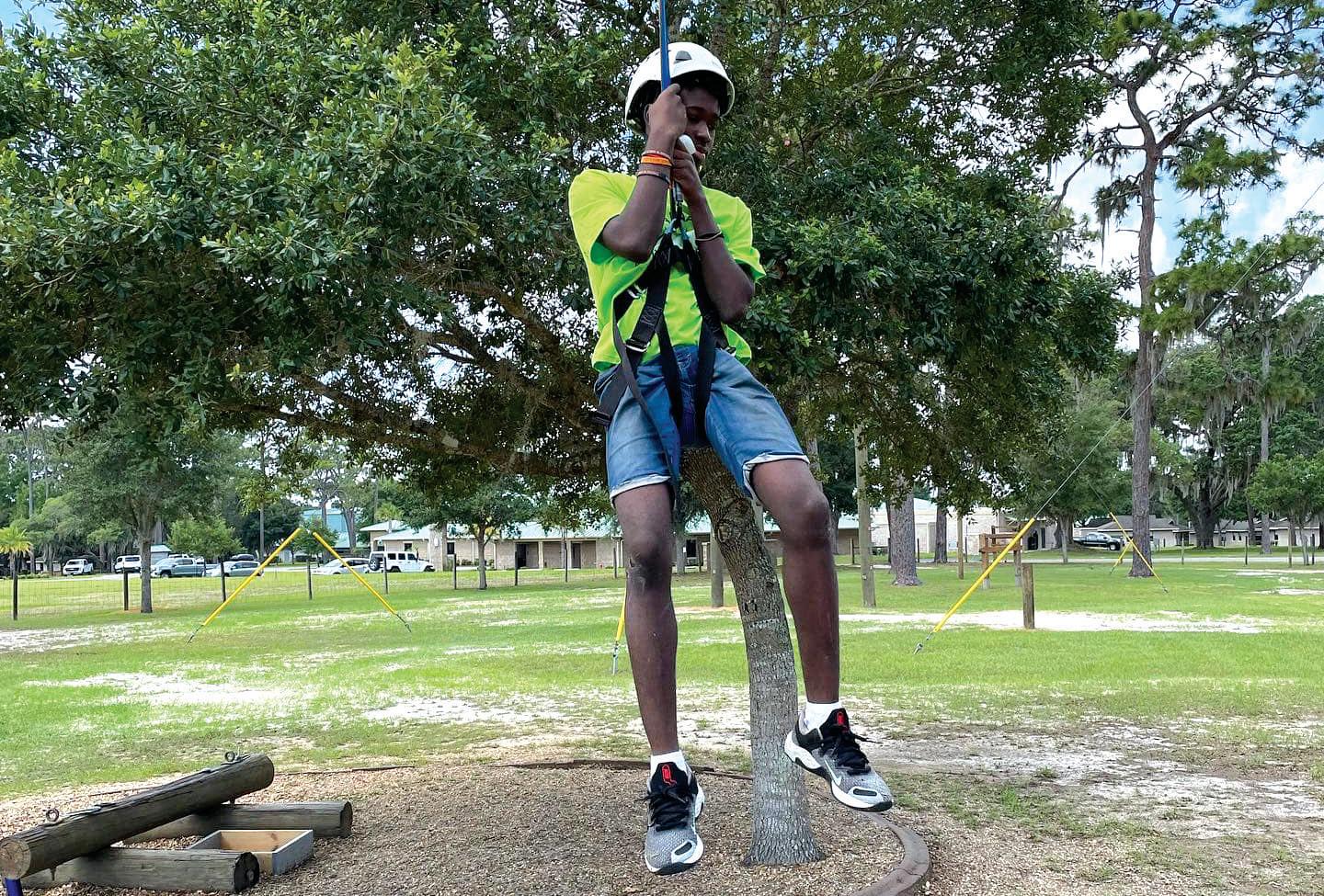
Darryl Johnson works on the ropes course at Florida Elks Youth Camp in Umatilla.
PHOTO COURTESY OF CITY OF ORLANDO ENVIRONMENTAL STEWARDSHIP AWARD
The program’s mission is to create outdoor experiences for students while providing education about sustainability initiatives and green careers throughout Florida.


Since its launch in November 2021, SAP has embarked on eight weekend camping trips and 15 day trips. Each of the outings is aligned with one of Mayor Buddy Dyer’s Green Works Orlando initiative’s sustainability focus areas such as clean energy, water, green buildings, local food, livability, transportation or zero waste. A primary objective of the program is to expose youth to the work that is being done to advance sustainability in Florida and to introduce them to diverse “green” careers.
The first SAP camping trip was hosted at the City’s Bill Frederick Park on 183 acres along Turkey Lake, a fishing lake that is rated among the top five in the state. During the trip, SAP students received fishing lessons from agents with the Florida Fish and Wildlife Conservation Commission and discussed career opportunities.
Dyer and Commissioner Bakari F. Burns joined in on the fun and fished with students and staff. Additional activities that first weekend included disc golf instructions and a game with semi-pro golfer Mark Janssen, as well as hands-on education about nocturnal wildlife with professionals from the Orlando Science Center.
Students had another overnight opportunity when they traveled to the Tampa Bay area to visit The Florida Aquarium and Tampa Bay Seawater Desalination facility. They learned firsthand about the work being done for wildlife and water conservation. At the Aquarium, students completed a scavenger hunt that guided them through ecosystem exhibits. At the desalination plant, students learned about Tampa Bay Water’s efforts to produce drinking water from seawater using reverse osmosis. The group spent the weekend camping and fishing at Masonic Park and Youth Camp in Wimauma
The SAP program was initially created to get students outdoors and educate them on sustainability and the environment. However, program leaders have found other ways for students to benefit from the program. Students were given the opportunity to challenge their physical and mental fitness and improve their team-building skills on a ropes course at Florida Elks Youth Camp in Umatilla. They also visited The Ritz-Carlton Orlando, Grande Lakes, where they learned how to grow their own food through a tour of the facility’s on-site gardens. Students then made a healthy salad.
For many of the youth, SAP gives them an opportunity to experience the outdoors for the first time. Some of those first-time experiences have included canoeing, rock climbing, zip lining and making s’mores. Students have also enjoyed airboat rides in central Florida lakes, encounters with their favorite animals and daytrips to local theme parks and attractions.

As SAP closes out its inaugural year, program leaders and participants are looking ahead to other places and activities to explore. The program’s leaders are looking forward to students embarking on many more adventures that will further connect them to their natural world and help build a more sustainable Orlando for the future.
Tara Russakov is the Marketing/Communications Manager with the City of Orlando Families, Parks and Recreation Department. QC
Orlando Wins a Florida Municipal Achievement Award
The City of Orlando recently received the Florida League of Cities Environmental Stewardship Award.
The Environmental Stewardship Award recognizes a city program that promotes conservation, improves and protects environmental conditions and/or provides environmental education and outreach programs. The Kidz Zone Sustainability Adventure Program provides Orlando youth from some of the City’s lowest income neighborhoods an opportunity to learn about sustainability principles and implementation and participate in hands-on service projects that improve the local environment while they explore potential career paths.
FOURTH QUARTER 2022 | QUALITY CITIES 19 CITY SPOTLIGHT QC PHOTOS COURTESY OF CITY OF ORLANDO
Michael Hawkins snorkels for the first time at Alexander Springs as part of the Sustainability Adventure Program.
Students in the Sustainability Adventure Program discover marine life as they learn about monitoring and conservation efforts.
Staff member Brittany Koziara assists Sustainability Adventure Program participant Kali Drummond as he masters the knots needed to attach a hook to his fishing line.
CONFERENCE
Local voices come together to identify the biggest challenges and opportunities for Florida's cities and protect our right to make the best local choices for our communities

NOVEMBER 30 -
DECEMBER 2
Embassy Suites Orlando
20 QUALITY CITIES | FOURTH QUARTER 2022
Lake Buena Vista South
QC SPOTLIGHT
EMPLOYEE PROFILE
David Cruz: Advocate, Counsel and Friend
David Cruz is known by his colleagues and friends for being hardworking and helpful.
He has two unique roles as Deputy General Counsel/Legislative Counsel with the Florida League of Cities (FLC). As a member of the Legal Department, David provides in-house legal counsel for the League. He also assists the Legislative Department with legislative policy coordination, research, analysis and program development.
“I have the privilege to advocate on behalf of Florida cities before the Florida Legislature,” said David. He concentrates on land use and economic development. Specific advocacy areas include growth management, special districts, community redevelopment, sovereign immunity, insurance, private property rights, public-private partnerships and annexation legislation.
David acts as the legal counsel to the Florida Municipal Investment Trust (FMIvT), the Florida Municipal Pension Trust Fund (FMPTF) and the Florida Municipal Loan Council (FMLC). He also advises City Attorneys on implementing new laws. As Legislative Counsel, David assists the Legislative Department in crafting and amending legislation and provides legal counsel to other League lobbyists on their legislative issues. He also participates in rule-making proceedings affecting municipalities and appears before legislative committees.
Fellow Deputy General Counsel Rebecca O’Hara said, “I really enjoy seeing him testify in legislative committees and the way he handles tough questions from legislators. He’s very good at explaining complicated concepts and getting his message across under pressure.”
David first learned about Florida’s legislative process while working for the Florida House of Representatives. He then attended law school and interned with the City of Coral Gables in the City Attorney’s office. David learned firsthand the important role cities play in addressing diverse issues. Upon passing the bar exam, he was hired by the League as a Legislative Advocate. David was later promoted to Assistant General Counsel and appointed to his current position in 2017.
David’s co-workers describe him as easygoing and compassionate. Scott Dudley, Director of Field Advocacy and Federal Affairs, said, “David cares a lot about being the best he can be at whatever he does, and that attitude is infectious. His sense of fairness and kindness are exemplary.”
Even among lawyers, David stands out. This fall, he achieved board certification in City, County and Local Government Law with the Florida Bar, which fewer than 311 Florida attorneys hold. In addition, David recently was accepted to the William H. Stafford Inn of Court, a prestigious group of lawyers, judges and law students who foster professionalism and civility in the justice system.
David also stands out based on his family background. Born and raised in Miami, David is bilingual and learned to speak Spanish before English. His parents are Cuban exiles who came to the United States at a young age in 1961. They’ve since retired – his father from banking and his mother from teaching. David’s sister, Laura, works for the City of Pembroke Pines as a licensed psychologist.
Family is important to David. He enjoys spending time with his wife, Tiffany, 8-year-old son, Carter, and 7-year-old daughter, Olivia. He especially enjoys fishing and scuba diving in some of Florida’s springs to explore underwater caves.
David’s caring nature extends beyond his family. “As good as he is at his day job, he’s an even better person and friend,” said Chief of Legislative Affairs Casey Cook. “David is one of the most thoughtful people I know and would do anything to help a person in need.” QC

FOURTH QUARTER 2022 | QUALITY CITIES 21
DISASTER RESPONSE
Neighbors Helping Neighbors
Cities offer aid after catastrophic damage from Hurricane Ian
by Joy Dickinson Florida League of Cities
Hurricane Ian hit Florida in late September as a monstrous Category 4 hurricane that was one of the strongest storms to ever hit the United States. The hurricane was deadly and destructive and reached much of Florida, including both coasts. In addition to the loss of life, it left behind flooding, destroyed bridges, broken roads, downed power lines and internet service outages.
The hurricane left many Florida cities cut off and crippled. However, cities that had been spared quickly jumped into action to provide aid that ranged from removing debris and restoring power to flipping burgers to feed city staff.
Here is just a sampling of how some cities responded:
Members of the Sarasota Police Department’s Emergency Response Team cooked three meals a day for officers with the North Port Police Department as well as civilian workers who were on rotating shifts. The team also took water and meals ready to eat. The police assisted with rescues and patrol calls, “helping however they can,” to allow City staff to take a break, according to the City.

“Hang in there,” the Police Department shared. “We’ll get through this together.”
A strike team from Palm Beach Fire Rescue went to Collier County to assist with post-hurricane recovery after their former Deputy Town Manager, Jay Boodheshwar, learned they were putting together a strike team. Boodheshwar is the City Manager of Naples. The team also assisted the City of Fort Myers. “We help each other out,” he told the Palm Beach Daily News. The flooding in Naples included about five feet of water in front of City Hall. It covered nine of the 10 steps leading to the first floor, Boodheshwar told the newspaper. At the time of the interview,
he hadn’t been able to check on the condition of the home that he and his wife had purchased in Naples. He was “focused on the mission at hand,” he said.
First responders from Task Force 8, which includes Gainesville Fire Rescue and Ocala Fire Rescue, traveled to the Fort Myers area to assist in recovery efforts. They specialize in urban search and rescue.


A hazmat strike team, including a large group from the Ocala Police Department, also traveled south to assist with recovery. The Police Department also deployed a hurricane response team to Hardee County along with a City of Dunnellon officer. This team conducted water search and rescue missions and reunited pets with their owners, including a 32-year-old macaw. Ocala Electric Utility (OEU) sent 10 employees to the City of Lakeland
Gainesville Regional Utilities sent 10 lineworkers, a mechanic and a safety officer to the City of Bartow and sent three engineers to Lakeland. Bartow, which lost virtually all electrical power, had
22 QUALITY CITIES | FOURTH QUARTER 2022 QC FEATURE
Deputy Chief Scott Mayforth was one of the Sarasota Police Department staff members who cooked three meals a day for City of North Port police officers and civilians.
PHOTO COURTESY OF SARASOTA POLICE DEPARTMENT
Members of Gainesville Fire Rescue were deployed as part of Task Force 8.
Palm Beach Fire Rescue Firefighter Walter Arcila returns to base in a helicopter after delivering supplies to Pine Island.
PHOTO COURTESY OF STEPHEN MONTOYA PHOTO COURTESY OF CITY OF GAINESVILLE
190 mutual aid workers from several states assisting at one point, including tree crews and damage assessors.
The hurricane severely damaged the Fort Myers Beach Fire Department’s 911 dispatch center. The City of Miami Ambulance Strike Team helped by responding to hundreds of 911 calls and assisting with hospital evacuations.
The Hollywood Police Department sent officers and equipment to the City of Bonita Springs. The officers compiled supplies and sent several staff members to help law enforcement. They were part of about 130 law enforcement staff members sent by the Miami-Dade County Association of Chiefs of Police. There were 26 cities represented in that group.
Also, Miami Mayor Francis Suarez, in his role as President of the U.S. Conference of Mayors , worked with the Cities of Clearwater, North Port, Sarasota, Tampa and others to provide resources. Miami-Dade County also sent a task force to Tampa.
The City of Coral Gables sent firefighters, paramedics and information technology personnel as well as a Mobile Command Center. This state-of-the-art facility allows public safety to coordinate responses in the field.
JEA, the City of Jacksonville’s utility, helped restore wastewater services to Sanibel Island. Also, the Jacksonville Fire & Rescue Department deployed a task force to Southwest Florida, where they found a 79-year-old man trapped under debris. The victim was rescued.


The Tallahassee/ Leon County Consolidated Dispatch Agency also sent team members to assist the City of Arcadia. Four Communications Operators, including a Certified Peer Support Counselor, assisted with 911 calls.
Florida League of Cities Was Conduit

The Florida League of Cities (FLC) served as a conduit between cities and the Florida Division of Emergency Management (FDEM), which provided mutual aid for cities and counties. That aid included City Managers and staff in public works, IT and other specialized areas. The League also offered a webpage, flcities.com/disasterresources, with information, resources and contact information.
A team of 25 members of the Tallahassee Fire Department’s (TFD’s) Urban Search and Rescue Team went to the state’s West Coast. Other TFD members assisted with the State Emergency Operations Center and drone needs. City electric utility crews sent 21 staff members, trucks and machinery to help the Orlando Utilities Commission (OUC). The City’s Emergency Support Coordinator went to Hardee County to assist its Emergency Management team. An engineer from the Technology & Innovation Department deployed with Florida Task Force Two to offer communications support on Pine Island. The City’s Fleet Department and Tallahassee International Airport also provided support.
“We stand with our neighbors to the south,” Mayor John Dailey said. “Our highly skilled crews will perform rescue operations and rebuild electric infrastructure. Through it all, they will demonstrate the professionalism and heart that Tallahassee is known for. To our fellow Floridians, stay strong. Help is on the way.”
Cities Gather Supplies To Distribute
After Hurricane Ian caused devastation across Florida, several cities gathered donations to help those in need.
The cities requested nonperishable food, water, cleaning supplies, bedding and linens, camping supplies, diapers, toys and hygiene items.
In the City of Doral, donations were dropped off at three city parks during the day. The donations were distributed by Global Empowerment Mission (GEM). “We received about eight full bins from the three Doral Parks,” said Maggie Santos, Communications Director for the City. Many of the items were immediately sorted and put into boxes for families, then sent to the City of Fort Myers

FOURTH QUARTER 2022 | QUALITY CITIES 23 FEATURE QC
IMAGE COURTESY OF CITY OF DORAL
The City of Tallahassee’s Fire Department Urban Search and Rescue Team went to the state’s West Coast. PHOTO COURTESY OF CITY OF TALLAHASSEE
The City of Miami Ambulance Strike Team assisted the City of Fort Myers Beach with 911 calls.
IMAGE COURTESY OF CITY OF MIAMI FIRE-RESCUE
Joy Dickinson is the Editor/Creative Project Manager for the Florida League of Cities. QC
PHOTO COURTESY OF OCALA POLICE DEPARTMENT
Members of the Ocala Police Department were able to reunite a 32-year-old macaw with its owner.
Education, Inspiration And Celebration
FLC honors the past and plans for the future
For 100 years, the Florida League of Cities (FLC) has been a resource and advocate for Florida’s cities, towns and villages. The 2022 FLC Annual Conference in Hollywood honored the League’s success in serving Florida’s municipalities through advocacy, training and programs for a century.
 by Kelli Gemmer Florida League of Cities
Phillip E. Walker, outgoing FLC President , said, “The League isn’t just the united voice for Florida’s cities. It also provides a forum where officials can come together to share ideas that shape our future.”
Walker presided over the three-day conference, which included educational workshops, general sessions, legislative policy committee meetings, local and regional league breakfast meetings and opportunities for attendees to network. In addition, the main exhibit hall provided access to information about municipal products and services. The conference concluded with a 100th Anniversary Gala.
Paying homage to the past, a History Hub centrally located next to registration and the exhibit hall showcased notable occasions in the League’s history through mementos, scrapbooks and a video. Participants
who visited the hub received a special History Hub ribbon and FLC’s 100th-year commemorative pin.
The 2022-2023 FLC officers were selected during the conference. At the business session, League members elected Port St. Lucie Vice Mayor Jolien Caraballo to serve as President , Cooper City Mayor Greg Ross as First Vice President and Cocoa Mayor Michael Blake as Second Vice President . (See the profile of Blake on p. 33.) At the past presidents’ luncheon, incoming President Caraballo shared her focus for the year: to foster and build relationships with legislators through an initiative she calls “Finding #commongrounds.” (For more on Caraballo’s vision, see p. 28.)
EDUCATION AND TRAINING
Conference workshops focused on timely topics such as broadband, Florida’s growth and infrastructure, how cities implement new laws, how to promote local and regional economic development and solutions for small cities. Many of the workshop presentations are available for free at flcities.com/annualconference
At the annual conference, the Florida League of Cities University (FLCU) launched the Elected

24 QUALITY CITIES | FOURTH QUARTER 2022 QC COVER FEATURE ANNUAL CONFERENCE
PHOTOS COURTESY OF FLORIDA LEAGUE OF CITIES
Outgoing FLC President Phillip E. Walker (center) with President Jolien Caraballo and First Vice President Greg Ross.
Florida League of Cities “FLC 100” commemorative letters were displayed outside the conference rooms.
Municipal Officials Certificate Program to reward officials for their time commitment and dedication to education and training. This new program, offered at no cost to members, recognizes elected officials who participate in the League’s many training and continuing education opportunities. Officials may earn a bronze, silver or gold level achievement through educational programs from August to July each year.
FLCU staff members were available at the conference to provide more information and register members on-site. Members can also visit flcities.com/certificate to register and start earning points for the activities they participate in, such as annual conference.
OUTSTANDING WORK RECOGNIZED
Local officials were recognized at the conference for their dedication and hard work. The League’s highest honor, the E. Harris Drew Municipal Official Lifetime Achievement Award , went to City of Bartow Vice Mayor Leo E. Longworth. (See article, p. 30.) FLC honored local elected officials for their tenure of municipal service ranging from 20 years to 40 years. The League will present more than 30 city officials with the John Land Years of Service Award , named in honor of John Land , who served as the Mayor of the City of Apopka for more than 60 years. (Their names and years of service are listed in the third quarter issue of Quality Cities magazine at bit.ly/3JNMmM9.)


The League also highlighted the winners of the Florida Municipal Achievement Awards for their innovations and excellence in municipal government. The City of Gainesville received the City Spirit Award, Miami Shores Village received the Florida Citizenship Award and the City of Orlando received the Environmental Stewardship Award. (See pages 14, 16 and 18 for stories about each of the award winners.)
Senator Ed Hooper, District 16, received the League’s Defender of Home Rule Award, given to legislators who go above and beyond to support the principle of decision-making at the local level. Hooper was recognized for his tireless efforts to defend and protect municipal Home Rule. With a strong background in solving problems at the local level, Hooper understands the important role of city government and has been a champion for local issues in the Legislature. This past session, he helped the League communicate its message and address concerns on tough bills, including the business damages bill and the sovereign immunity bill.
In his acceptance speech, Hooper emphasized that local government knows best what is good for their communities and shared his support for Home Rule. “I’m a big believer in if you need Tallahassee to do something for you, you will come ask us; we don’t need to tell you what’s best for you,” he said. Hooper was joined on stage by the Suncoast League of Cities.

HOME RULE HEROES CELEBRATED
The conference also celebrated the contributions of more than 150 Home Rule Heroes for their work during the 2022 Legislative Session. Recipients of the Home Rule Hero Award are local government officials, elected and nonelected, who consistently responded to the League’s requests to reach out to members of the Legislature and give a local perspective on an issue. (See
FOURTH QUARTER 2022 | QUALITY CITIES 25 COVER FEATURE QC
2022-2023 FLC Officers Second Vice President Michael Blake (from left), President Jolien Caraballo and First Vice President Greg Ross.
Senator Ed Hooper (second from left) receives the Defender of Home Rule Award.
PHOTOS COURTESY OF FLORIDA LEAGUE OF CITIES
National League of Cities (NLC) President Vince Williams.
the 2022 Home Rule Hero Award recipients in the third quarter issue of Quality Cities magazine at bit.ly/3Jwv6e2.)

SPEAKERS INSPIRED AND ENTERTAINED
The general sessions featured dynamic addresses from several presenters. Opening keynote presenter Ben Nemtin, the No. 1 New York Times bestselling author of “What Do You Want to Do Before You Die?” and star of MTV’s “The Buried Life,” shared his experiences and an inspiring message.
“By doing what you love, you inspire other people to do what they love,” he said. “There’s a ripple effect when you help someone. You don’t just help that one person; you help the people around them. This idea of a ripple effect is very powerful because it’s proof that one person can create an incredible impact through this exponential, sometimes invisible, ripple.”
National League of Cities President Vince Williams spoke about the challenges city leaders have recently faced and the aid that cities across Florida and the nation are receiving through the American Rescue Plan Act and the Bipartisan Infrastructure Law. He said, “If you are a Mayor, a Council Member, a Commissioner or a City Manager, you should be empowered to lift up your community with direct dollars and support, and that’s exactly what we’re going to do: direct relief to you, as the leaders of your communities, because you know better than anyone else what your community’s needs are.”
In his keynote address, “educa-tainer” Mickey Smith Jr. , a Grammy Music Educator Award recipient, dazzled the audience by entering the stage playing the saxophone. Smith’s motivational mixture of music and messages encouraged attendees to “see the sound” inside them. According to Smith, everyone has


26 QUALITY CITIES | FOURTH QUARTER 2022 QC COVER FEATURE
PHOTOS COURTESY OF FLORIDA LEAGUE OF CITIES
Justin Willman reveals the number from his magic trick, 81,322,911, which translates to 8/13/22 9:11 p.m. – that very moment in time.
Keynote presenter Mickey Smith Jr.
Keynote presenter Ben Nemtin.
PHOTO COURTESY OF FLORIDA LEAGUE OF CITIES
Florida League of Cities History Hub booth.
a “sound” (a significance) that has the power to resonate with others and create a shift in thoughts and perspectives. “We have to make the sound that brings the change,” he said.
The conference concluded with the 100th Anniversary Gala. Dressed in suits, tuxes and evening gowns, attendees celebrated the League’s centennial anniversary with a reception, dinner, entertainment, dessert and dancing. Magician/comedian Justin Willman wowed attendees with magic tricks after the sit-down dinner. Willman’s theme of the night was to “live in the moment.” He closed his show with a spectacular trick involving incoming President Caraballo, which demonstrated that theme by revealing the date and time of that very moment by using a seemingly random set of numbers added on her phone’s calculator.
Florida League of Cities
A RESOLUTION OF THE FLORIDA LEAGUE OF CITIES, INC., IN BOTH RECOGNITION AND CELEBRATION OF THE 100TH ANNIVERSARY OF THE LEAGUE AND HONORING THIS MOMENTOUS OCCASION.
WHEREAS, in 1922 several municipal officials came together in Tampa, formed the Florida League of Municipalities and stressed the need for a united voice for all cities, towns and villages as well as a forum at which common issues could be discussed and resolved; and
WHEREAS, for one century this association, whose name was changed to the Florida League of Cities in 1970, has been that uniting factor through which leaders have been galvanized on all municipal issues, and through which the League provides a valued forum today, holding fast to both original missions; and
WHEREAS, across the decades League advocates have worked tirelessly in Florida’s constitutional, legislative, legal and administrative arenas for reform, rights and action and such advocacy culminated in Home Rule powers being voted into the Constitution in 1968, and such actions continue to be the strongest force for preserving this authority despite efforts to preempt or diminish it or to burden cities with mandates; and
WHEREAS, the dedicated leadership of its officers and boards of directors over the decades have built a foundation of strength, resilience and success for the association to a level unparalleled among organizations, and these same leaders and devoted FLC staff have had and continue to have the outstanding vision for entrepreneurial programs, products and services for the League to provide to its members and other local governments, and through such actions ensures viable services that benefit local governments every day as well as ensuring for the League a healthy and sustainable fiscal standing; and
WHEREAS, an anniversary of this magnitude is worthy of acknowledgement, celebration and sober reflection upon all that has been accomplished and to also look toward the next century for this association and its many programs such that a promising, bright and attainable future is planned.
NOW, THEREFORE, BE IT RESOLVED BY THE FLORIDA LEAGUE OF CITIES, INC.:
Section 1. The membership acknowledges the century mark for its statewide association with great fanfare and celebration.
Section 2. This resolution be posted on the League’s website and published in QC magazine and a copy of this resolution be sent to the National League of Cities and the membership of the Florida League of Cities, Inc.
PASSED AND ADOPTED by the Florida League of Cities, Inc., in conference assembled at the League’s 2022 Annual Conference at the Diplomat Beach Resort in Hollywood, FL, this 13th day of August 2022.
Being unified, both now and in the future, will guide the League’s next 100 years, said Walker. “We can continue to shape history by advocating for our future, together.”
Gemmer is the Assistant Editor for the Florida League of Cities. QC
FLC Hosts 2022 Research Symposium
The Florida League of Cities (FLC) Center for Municipal Research’s Symposium explored the landscape of broadband and cybersecurity in Florida, funding opportunities and best practices for municipal governments handling digital infrastructure.
More than 130 attendees heard from industry experts and key stakeholders including:
▸ Doug Kinkoph, Associate Administrator, Office of Internet Connectivity and Growth, U.S. Department of Commerce’s National Telecommunications and Information Administration (NTIA)
▸ Jamie Grant, Chief Information Officer, State of Florida
▸ Katie Smith, Director, Office of Broadband, Florida Department of Economic Opportunity (FDEO).
During the keynote presentations, Grant discussed cybersecurity operations in Florida including recent legislation. Kinkoph presented on digital infrastructure pertaining to key federal programs and resources. Smith shared Florida’s strategic plan for broadband and its implementation.

Presentations from the symposium are available online at flcities.com/annualconference
Florida League of Cities Center for Municipal Research Symposium: Digital Infrastructure – Broadband and Cybersecurity.
ATTEST:______________________________
Jeannie Garner, Executive Director/CEO Florida League of Cities, Inc.
FOURTH QUARTER 2022 | QUALITY CITIES 27 COVER FEATURE QC
PHOTO COURTESY OF FLORIDA LEAGUE OF CITIES
Phillip E. Walker, President Florida League of Cities, Inc. Commissioner, City of Lakeland
Kelli
At annual conference, a resolution was issued and adopted that recognizes and honors the 100th anniversary of the Florida League of Cities.
Finding Common Grounds
President Caraballo shares plan to strengthen relationships with legislators
 by Kelli Gemmer Florida League of Cities
Florida League of Cities (FLC) President Jolien Caraballo, Vice Mayor for the City of Port St. Lucie, has a vision to brew up stronger relationships with legislators this year. Passionate about advocacy, Caraballo understands that the foundation of effective advocacy begins with solid relationships. That’s why during her one-year term as President, Caraballo will focus on building bridges between legislators and local officials by connecting on issues that unite one another.
“To help us foster and build these relationships, I am excited to announce that this year’s focus will be themed around my way of breaking the ice: coffee and conversation, or what we will call a #commongrounds initiative,” said Caraballo.
A friendly nod toward Caraballo’s love for Cuban coffee, the finding #commongrounds initiative, powered by the FLC, is the idea that a visit to the local coffee shop with state lawmakers can be an excellent first step to build or strengthen relationships. These face-to-face meetings in a low-stress environment can accomplish a lot in a short amount of time. By finding common grounds, elected officials put people over politics, access over agendas and success over shouting.
To aid local officials in this journey to find common grounds with state legislators, Caraballo shared an advocacy toolkit to lay the foundation for a good start. The toolkit provides tips for overcoming the political divide, a three-step process for advocacy, suggestions for hosting roundtables with local lawmakers and more. (Visit flcities.com/commongrounds to see the toolkit.)

To kickstart the finding #commongrounds initiative, local elected officials received a package in September that included a coffee mug, coffee grounds and cards that share information on the initiative and a link to the online toolkit.
With lawmakers back in their districts and an election that welcomes newly elected legislators, the finding #commongrounds initiative presents a perfect opportunity to connect or reconnect with state leaders, said Caraballo. She encourages local officials not to talk shop but to get to know their legislators. In her installation speech at the FLC Annual Conference, Caraballo said, “Learn what is important to them, and ask them what you can do to help them have a successful upcoming session.”
Through the finding #commongrounds initiative, local and state leaders can collectively work on the critical issues that unite
28 QUALITY CITIES | FOURTH QUARTER 2022 QC FEATURE ADVOCACY
PHOTO COURTESY OF FLORIDA LEAGUE OF CITIES
Florida’s cities and the state such as fostering a stable economy, prioritizing safe communities and supporting quality-of-life amenities. Caraballo acknowledged that there will still be challenges despite finding common grounds.
“There is no doubt in my mind that we are going to have to still fight for our cities. And when those times come, let’s remember that we are 411 cities strong,” said Caraballo. “We are thousands of city officials with a united voice, and that’s a powerful force to use when we have to stand up in committees and advocate against harmful legislation. But my hope is that through your efforts in finding common grounds … our advocacy efforts will be more effective. Ask your legislator to bring home a win bigger than an appropriation or a legislative preemption that does more harm than good.”
There will be additional events and programs throughout the year to help build relationships. The initiative will close with an FLC symposium on finding #commongrounds at the League’s annual conference. The symposium will feature topics that unite Florida, and lawmakers will be invited to attend.

Caraballo will also work with FLC to bring advocacy to the forefront through training. Under Caraballo’s leadership, the League will add an advocacy segment to the Florida League of Cities University’s (FLCU’s) Institute for Elected Municipal Officials (IEMO) program. The League will also launch a virtual advocacy academy for city officials offered at two levels: new advocates and veteran advocates. In addition, FLCU now offers the Certificate Program for Elected Municipal Officials to recognize elected officials who take part in the League’s many training and advocacy opportunities. (For more information, go to flcities.com/certificate and see p. 3.)
“Let’s bring home a strategic partnership that will benefit all of Florida and all we serve, because Floridians deserve leadership that works for them,” said Caraballo. “With the FLC by our side, we can build these relationships by finding common grounds together and leading the way for our communities today and the next 100 years to come.”
Preparation Tips For Pre-Session
▸ Schedule time to meet with your legislators. Develop and strengthen relationships now; don’t wait until session when you need your legislators’ assistance on an issue. Invite them to coffee, and find common grounds.

▸ Extend an invitation, or share information about specific upcoming events. These events can include commission meetings, town halls, community service/volunteer opportunities, local festivals and local/regional municipal league meetings.
▸ Get to know the legislative staff. Always be courteous. They are your link to getting an appointment.
▸ Share legislative issues that are important to your city. Prepare a one-page summary of these issues that you can leave with legislators and their staff. This summary helps them understand issues that are important to your community.
▸ Invite legislators/staff to visit project facilities. Examples include water treatment plants and community development agency and transportation projects. Talk about how you’re spending the American Rescue Plan Act (ARPA) funds.
▸ View Florida League of Cities (FLC) advocacy resources. Visit flcities.com/advocacy to review resources such as The Advo-Kit advocacy toolkit. Once the 2023 Florida League of Cities (FLC) Legislative Action Agenda is adopted in November, view issue briefs, talking points and more on the Advocacy section of the FLC website.
FOURTH QUARTER 2022 | QUALITY CITIES 29 FEATURE QC
Kelli Gemmer is the Assistant Editor for the Florida League of Cities. QC
PHOTOS COURTESY OF FLORIDA LEAGUE OF CITIES
Local elected officials received a finding #commongrounds package in September.
The finding #commongrounds package included a mug, coffee grounds and cards that share a link to the online toolkit.
Longworth Receives Top Honor
Bartow Vice Mayor presented
E. Harris Drew Lifetime Award
by Kelli Gemmer Florida League of Cities
Leo E. Longworth , Vice Mayor for the City of Bartow, was presented with the E. Harris Drew Municipal Official Lifetime Achievement Award at the 2022 Florida League of Cities (FLC) annual conference. This award recognizes local elected officials who have made lasting and worthwhile contributions to the citizens of Florida through their efforts and dedication in performing their duties at the local level.
“Leo Longworth has been an elected official for the City of Bartow for 27 years,” said Phillip E. Walker , City of Lakeland Commissioner and outgoing FLC President . “His dedication and willingness to go the extra mile for what he believes in have not gone unnoticed and serve as an example for all of us.”
This prestigious annual award is the League’s highest honor and is named for Supreme Court Justice E. Harris Drew , who was an advocate of local government throughout his career. (See p. 31 for more information on Drew’s legacy.) Drew was appointed to Florida’s Supreme Court while serving as the League’s First Vice President and coined the League’s motto: “Local self-government, the key to American democracy.”
Raised in Bartow, Longworth was drafted into the U.S. Army while in college and served his country on a tour of duty in Vietnam. He returned to school to graduate after serving a two-year stint. Longworth became involved with the City as a member of the Planning and
Zoning Commission, and he served in that role for 10 years before running for City Commission when an incumbent decided not to seek reelection. Longworth has not been opposed for reelection during his 27 years of service.
A dedicated advocate for all Bartow residents, Longworth has helped elevate the quality of life for his community through initiatives, projects and perseverance. He consistently leads the effort to make sure the implementation of a diversity, equity and inclusion plan and process continues to be a top priority for the City. Longworth also led the establishment and implementation of the City’s first Mayor’s Youth Council.
During his tenure, Longworth has served as Mayor five times and represents Bartow in numerous regional, state and national organizations, including the Ridge League of Cities , Florida Black Caucus of Local Elected Officials (FBCLEO), National League of Cities (NLC) and National Black Caucus of Local Elected Officials (NBC-LEO).
Longworth is also a past President of the FLC. He served from 2018-2019,
when the League celebrated the 50th anniversary of Home Rule. His initiative, “We Live Local,” helped highlight the importance of keeping local decisionmaking in the hands of the government closest to the people. Longworth has been recognized for his outstanding advocacy efforts with eight consecutive Home Rule Hero awards.
After receiving the E. Harris Drew award, Longworth said, “I’m so humbled, and I must give honor to God. I thank God so much for what he’s done in my life and in the life of the Florida League of Cities. I’m honored to receive this award from my longtime and good friend, FLC President Phillip Walker. I will always honor and cherish this, especially the fact that this is being given during the celebration of the 100th anniversary of the Florida League of Cities.”

30 QUALITY CITIES | FOURTH QUARTER 2022 QC FEATURE PHOTO
COURTESY OF FLORIDA LEAGUE OF CITIES
ACHIEVEMENT
Kelli Gemmer is the Assistant Editor for the Florida League of Cities. QC
Leo E. Longworth (left) accepts the E. Harris Drew award from outgoing FLC President Phillip E. Walker.
Award Namesake Served with Character and Conviction


At age 20, E. Harris Drew graduated from Stetson University College of Law in 1923, received a waiver that allowed him to start his law practice and was appointed attorney for the of Palm Beach – a position he held for 29 years.
He was active in the of Municipalities , now the League of Cities , in the 1940s and early 1950s. Drew was serving as First Vice President of the League when he was appointed to the Florida Supreme Court retired in 1971 after serving twice as Chief Justice – from May 6, 1955, to January 8, 1957, and again from July 1, 1963, to July 1, 1965.
His nephew Robert Harris Turner,
who goes by “Harris,” was named for his uncle. Turner carried on a family tradition of law and has served as the attorney for several cities in the Miami-Dade
“My uncle was a great person,” said Turner. “He demonstrated his courage and determination to serve all people throughout his life, but he is most remembered as a dissenting voice in the Virgil Hawkins case.” In 1957, Drew wrote a dissenting opinion from a decision of the Florida Supreme Court to deny Hawkins admission University of Florida Law on the basis that he was Black. “Times were different in the 1950s, but he was committed to providing justice for everyone.”
FOURTH QUARTER 2022 | QUALITY CITIES 31 PHOTO COURTESY OF FLORIDA LEAGUE OF CITIES FEATURE QC
Some of the past E. Harris Drew award winners with this year’s recipient, Leo Longworth. (From left) Robert Apgar, Frank Ortis, Sam Ferreri, P.C. Wu, Patricia Bates, Longworth, Marlene Wagner, Louie Davis, Matthew Surrency and Scott Black.
City Catalyst Grant Winners
Partnership program supports projects that strengthen Florida communities
by Scott Dudley Florida League of Mayors and Beth Rawlins Business Watch
For the eighth year, the Florida League of Mayors (FLM) partnered with Business Watch to offer the City Catalyst Grants. The program supports projects that foster a sense of community and enhance the lives of city residents. The projects are often in partnership with local organizations, which makes the dollars and impacts go even further. All grants this year were for $2,500.
Applications are judged by current Business Watch members and former Mayors. Judges appreciate that cities create specialized opportunities to meet their community needs, and this year was no exception. Winning projects are scheduled for completion this winter. All the projects are creating something new outside, so citizens will have great opportunities in the cooler weather.
FLM and Business Watch announced the 2022 City Catalyst Grant winners and their projects at the Florida League of Cities (FLC) Annual Conference in Hollywood.


▸ The City of Apalachicola is expanding the reach of its Margaret Key Public Library through two projects. First, they have signed on with Little Free Library and plan to build two little libraries and place them in parks. The Library will contribute some free books and encourage the community to donate. Expansion of the little libraries to every Apalachicola park and green space is planned. The Library is also adding an enclosed outdoor bulletin board so the community can learn about programs.
▸ Miami Shores Village is creating a partnership between their library and Parks and Recreation Department with a Story Walk. The Village is matching grant funds to install and market this program. Sixteen signs will be installed in a Village greenspace about every 8 feet. Children’s books will be re-created in full color in those stands, which allows the children of Miami Shores to “walk” through the story. The goal is to offer three to five children’s stories a year that encourage community engagement and a connection to one’s environment.
32 QUALITY CITIES | FOURTH QUARTER 2022 QC FEATURE AWARDS
Miami Shores Village
PHOTOS COURTESY OF FLORIDA LEAGUE OF CITIES
City of Sebring
City of Apalachicola
Scott Singer (left), outgoing President of Florida League of Mayors, and Joe Kilsheimer, Business Watch Board Member and Consultant with Woodard & Curran, with the award for the City of Apalachicola.
Mayor Sandra Harris accepts the award for Miami Shores Village.
Mayor John Shoop accepts the award for the City of Sebring.
▸ The City of Sebring is supporting a citizen initiative through the nonprofit Highlands County Citizens with Voices to create a veterans memorial. The citizens have entered into a long-term lease with the City and started work on the memorial. The project is designed to expand upon another park built across the street. It offers another way to beautify the Washington Heights neighborhood and provide a safer environment.
The FLM and Business Watch are very committed to sharing common-sense solutions and helping strengthen our communities. Both are proud to once again host the City Catalyst Grants Program. Congratulations to the winners!
Scott Dudley is Executive Director of the Florida League of Mayors and Director of Field Advocacy and Federal Affairs at the Florida League of Cities.


Beth Rawlins is President of Business Watch. Business Watch connects businesses and local government officials, leaders and managers to open dialog and work toward common goals. QC

The Florida League of Cities Municipal Directory


The Florida League of Cities Municipal Directory includes information on all municipalities:

• Names of the elected and charter city officials


• Mailing and street address of the city

• Telephone and fax number of city offices
• Primary city email and website where available.
The Municipal Directory is available at flcities.com under “Resources & Research.” Email updates to erussell@flcities.com


Meet Michael Blake
FLC Second Vice President, Mayor of Cocoa
At the Florida League of Cities (FLC) 2022 Annual Conference, the League membership elected Cocoa Mayor Michael Blake to serve as Second Vice President. In his remarks, Blake thanked God, his fellow officials and the FLC for this opportunity. Blake was first elected to the City Council in 1998 and served as Councilman through 2001. In 2004, he was elected as Mayor and served two terms until 2012. In 2014, he was elected as Councilman and served until June 2016. Blake was again elected Cocoa Mayor in 2020 and will serve until 2024. As Mayor, Blake has supported Cocoa’s redevelopment and economy, including supporting the City’s efforts to create jobs, expand affordable housing and improve the quality of life for its residents.
A leader in his community, Blake has served on boards, committees and task forces for the City. Blake has served as a Cocoa Community Redevelopment Agency member and liaison to the Cocoa Housing Authority, Weed and Seed and Save our Neighborhood organizations. He is a past President of the Space Coast League of Cities and a current member of the Florida Municipal Insurance Trust Board of Trustees. He has also served on the Florida League of Mayors Board of Directors.
Blake has been a resident of Cocoa his entire life. Earlier this year, he retired from teaching at Cocoa High School after nearly 30 years.
When asked how it feels to be the League’s Second Vice President, Blake said, “To whom much is given, much is required.” QC
FOURTH QUARTER 2022 | QUALITY CITIES 33 FEATURE QC
100TH ANNIVERSARY
This free online directory provides the most current information available.
WELCOME


New Board of Directors Members for 2022-2023!


34 QUALITY CITIES | FOURTH QUARTER 2022 QC
FLC Second Vice President MICHAEL BLAKE Mayor Cocoa
DOROTHEA TAYLOR BOGERT Mayor Auburndale
DON BURNETTE Mayor Port Orange
NATHAN BLACKWELL Mayor St. Cloud
JULIA BOTEL Councilmember Riviera Beach
THOMAS DEVILLE Vice Mayor Penney Farms
ED DODD Councilman
Sebastian TRISH SPRINGER Councilor Seminole
MINDY GIBSON Councilmember Satellite Beach
SARAH STOECKEL Councilmember Titusville
JULIE WILKINS Mayor LaBelle
DEAN TRANTALIS Mayor Fort Lauderdale
DIANNE WILLIAMS-COX Commissioner Tallahassee

FOURTH QUARTER 2022 | QUALITY CITIES 35 Grassroots Advocacy Expands Residents can advocate for local decision-making! Help us spread the word about Local Voices United by encouraging residents to: Visit localvoicesunited.com where they can learn about legislative issues, reach their local lawmakers and access advocacy tools and resources Text Local Voices to 50457 to receive issue updates right to their phone Like our Facebook page: Facebook.com/LocalVoicesUnited
Residents Dig Composting
Education, free bins and online resources are effective
by Sheryl S. Jackson Florida League of Cities
More than 30% of what people throw away is compostable: food scraps, shredded paper and yard waste, according to the U.S. Environmental Protection Agency. Composting keeps these materials out of landfills, where they take up space and release methane, a potent greenhouse gas. After the material undergoes a chemical and biological transformation, composting creates a rich, dark soil that suppresses plant diseases and pests and reduces the need for chemical fertilizers.
Several Florida cities have implemented composting programs as part of their sustainability initiatives.

MIAMI BEACH PROVIDES COMPOST HUBS
The City of Miami Beach collaborated with the Miami Beach Botanical Gardens to start a central composting hub at the Botanical Gardens using a $50,000 environmental sustainability grant and create signage for the pilot program. Gardens’ staff use the finished
compost throughout the gardens and offer it for sale.
Amy Knowles , the City’s Chief Resilience Officer , said the Gardens provided a great location in South Beach. There was an easy entry for community members who were dropping off materials for composting, and staff could oversee drop-offs. Public response to the community compost hub was so great that the North Beach Compost Hub was opened in 2020 to serve the North Beach area, she said. “The second site serves residents that live farther away and is a 24-hour self-serve drop-off hub.”
While the community hubs stay busy, the City is taking steps to promote home composting. Rolando Martinez, Sustainability Specialist for the City, said, “We recently awarded a grant to a local community organization to create a program that provides bins to residents who want to compost in their own yards.”
Partnering with community organizations is important to the success of composting and the overall sustainability program,
36 QUALITY CITIES | FOURTH QUARTER 2022 QC FEATURE
Largo’s fun, educational videos educate residents about the benefits of composting.
PHOTO COURTESY OF CITY OF LARGO
SUSTAINABILITY
said Knowles. The City partnered with nonprofit Oolite Arts to hold a Sustainability in Action PSA video contest to encourage residents to reduce waste. “One of the winning videos focused on composting and featured the South Beach Compost Hub at the Botanical Gardens,” she said. There is also a regular schedule of community education, workshops and social media posts about the benefits of composting. (See the video at bit.ly/3zNYDwT.)
LARGO OFFERS FREE BINS
Since the launch of its Community Composting Bin Program in October 2020, the City of Largo has had over 700 residents request free bins. “About one-half of the residents who started composting as a result of our program had never composted before,” said Julianne Perez, Community Engagement Administrator. The first 500 bins were part of a pilot program, but the City leaders have decided to make it a permanent program.

While the bins are a key part of the program, the City worked with community partners to create a robust educational component. “We partnered with a local nonprofit, Keep Pinellas Beautiful , City of Largo Outreach, Sustainability and Multimedia team members and one of our Community Ambassadors, a Largo resident passionate about sustainability, to develop educational materials,” said Perez.
The group created a web page (bit.ly/3MGtorn) that describes the program and includes resources such as educational videos in English and Spanish, flyers and FAQs. The page also includes the request form for a bin. Once the form is submitted, it goes to the Public Works Department to schedule
delivery, which typically takes a week or two.
“This was a pretty easy program to implement, and we continue to receive positive feedback from residents,” said Perez. While “low-touch” makes the program easy to maintain, Perez would like to increase direct support to residents. “Now that individuals have a bin, we want to make sure folks are actually using the bins and enjoying those benefits,” she said. “We are always looking for ways to improve, and we keep in close contact with our community partners to update information on the website and schedule educational events, including an upcoming compost workshop for bin users.”
CLEARWATER COMBINES EDUCATION AND BINS
The City of Clearwater partners with Pinellas Community Compost to provide an online class, “Create Compost,” to encourage residents to learn about the benefits of backyard composting. The online platform includes educational videos that are free and open to the public with required registration.
“Once Clearwater residents register for and complete the course, we provide instructions on how they can arrange pickup of their free composting bin,” said Sheridan Gemuendt, Sustainability Coordinator

Registration for the online course has topped 2,000, including people who don’t live in Clearwater. “We have distributed 490 bins and feel confident that people are using them because they’ve invested time to learn about composting and picking up their bin,” said Gemuendt.
Challenges that the City had to overcome included storage space for the bins, she said. “You do need

FOURTH QUARTER 2022 | QUALITY CITIES 37
Volunteers with the Miami Beach Botanical Gardens oversee the placement and turning of compost materials.
FEATURE QC
PHOTOS COURTESY OF CITY OF MIAMI BEACH
A Clearwater resident’s composting bin.
The City of Miami Beach offers a 24-hour, self-serve composting hub.
PHOTO COURTESY OF CITY OF CLEARWATER
to order the bins in bulk to get the best price, but before ordering them, know where you’ll store them,” Gemuendt said. “Our Public Utility Department had space, but our Solid Waste and Recycling staff are stretched thin, so we could not deliver the bins to residents.”
The distribution challenge was solved by designating a Saturday each month for pick up at a central location, she said. “About 95% of residents pick up their own bins, but if someone is disabled or does not have access to a vehicle that can transport the bin, we’ll make arrangements for the bin to be delivered,” Gemuendt said. There was a lot of interest in picking up a bin at the beginning of the program in 2020, but it is now a steady, continual level of interest that is easily managed, she added. For more information about the Clearwater program, go to bit.ly/3cnaIjs.
PALMETTO BAY FOCUSES ON EDUCATION
The Village of Palmetto Bay promotes composting to residents through a How-To Gardening Workshop series presented by Miami-Dade County Cooperative Extension’s Master Gardener Terri Stephen that includes one session on Composting 101. The series was offered virtually in 2020-2021, but in-person classes have resumed in 2022.
“The Village does not provide bins, but residents of Miami-Dade County are eligible for a voucher for one free composting bin from the County when they attend any of the Extension’s composting workshops,” said Stephen. The Village hosts the gardening series at Thalatta Estate Park, a 4-acre park that is home to two historic residential buildings, gardens, green space and unobstructed views of Biscayne Bay. “Village leaders wanted to encourage residents to use the park more, which led to gardening workshops at the park.”
Mayor Karyn Cunningham is proud of this program, which is offered free of charge to Village residents. “This is yet another fun way to promote environmental responsibility and sustainability in Palmetto Bay and get folks out to our parks.”
Response to the composting workshop is higher than in other gardening workshops, said Stephen. “We usually get 30 people registering for a class, but composting typically has 50 people,”
Palmetto Bay offers educational workshops to encourage composting from collection in a kitchen bucket through the beginning, middle and final stages to soil for garden beds.

she said. About 75% to 80% of attendees say they will obtain a bin and begin composting in the end-of-class survey. “I also receive emails asking follow-up questions once they begin composting, so I know the classes are effective.”
Stephen, an extension service volunteer, said that Palmetto Bay’s educational offering is so successful because a city staff person, Lisbeth Benivegna, Events and Program Supervisor, oversees logistics and publicity. “We have also posted videos of the 2020 workshop on the Village website to make it easy for people to learn if they can’t attend or re-watch the seminar as a refresher course,” said Stephen. (See the video at bit.ly/39OQP2Q.)
ST. AUGUSTINE DELIVERS COMPOST BINS
A pilot residential compost bin distribution program was launched in May 2022 to celebrate International Compost Awareness Week in the City of St. Augustine . “It is a pretty inexpensive way to reduce the amount of organic material in trash,” said Todd Grant, Utilities Director for the City.

The City delivered a free bin and composting instructions to the first 50 residents who signed up. The event was funded by miscellaneous income such as scrap material sales and franchise fees collected by the City.
While coordinating a giveaway program can be overwhelming, Grant said that the City had just completed a tree giveaway program, so a process already existed. “The program was promoted on social media and the City website, an online application was available on the website and the request went into our work order system,” he explained.
A community survey conducted two years ago showed significant interest in composting, said Grant. “We plan to offer free bin delivery again next year, and if demand warrants it, we’ll continue it as an ongoing program.”
For more information on composting, go to epa.gov/recycle/ composting-home.
38 QUALITY CITIES | FOURTH QUARTER 2022
QC FEATURE
Sheryl S. Jackson is a Writer/Editor for the Florida League of Cities. QC
Composting yields rich, dark soil.
PHOTOS COURTESY OF TERRI STEPHEN


FOURTH QUARTER 2022 | QUALITY CITIES 39 FEATURE QC The Florida Municipal Insurance Trust’s exclusive Employment Law Advisor program offers access to a Florida-based attorney with significant public-sector employment law experience. And, the best part is there is no cost to members of the FMIT with liability coverage for employment practices. We can help with a wide range of employment-related matters, including: Hiring Discipline Promotion/Demotion Transfer Reassignment Layoff Termination ADA Compliance Complaints of Discrimination, Harassment, Unfair Treatment and Retaliation
Employment
Attorneys
NO COST Help is only a phone call away. FMIT members can speak with an attorney Monday through Friday, 9:00 a.m. to 5:00 p.m., by calling 888.368.FMIT (3648).
Access to
Law
at
Rent Assistance

Cities use federal and state funds to avert a crisis
by Sheryl S. Jackson Florida League of Cities
(Editor’s note: Quality Cities is interested in how cities successfully use federal and state funds to address issues in their community. If your city has information to share, please contact Joy Dickinson, Editor and Creative Project Manager, at jdickinson@flcities.com.)
Acombination of COVID-related unemployment and underemployment, along with rising rent prices, brought rent assistance to the forefront for cities over the past couple of years. Layoffs or reduced hours affected employees’ ability to keep up with rent payments. At the same time, rents in Florida increased dramatically. The increase in 2021 rents was about 30% over 2020. That amount compares to an annual preCOVID increase of just 3.7% in 2018 throughout the state.

Municipalities throughout Florida responded to the increased need by accessing federal funds available through the Coronavirus Aid, Relief and Economic Security (CARES) Act, the Consolidated Appropriations Act and the American Rescue Plan Act (ARPA). The CARES Act, signed into law in March 2020, included a moratorium on evictions for late payment as well as some state funding for rent relief. With access to these funds,
cities successfully avoided an eviction crisis. Each city’s strategy reflects residents’ needs as well as the city’s available staffing and technology resources.
ORLANDO
TACKLES VOLUME OF APPLICATIONS
The City of Orlando felt the effects of the global pandemic early. “Even before the pandemic was recognized in the United
40 QUALITY CITIES | FOURTH QUARTER 2022
IMAGE COURTESY OF CITY OF ORLANDO QC FEATURE HOUSING
SUNDAEMORNING/ISTOCK/GETTY IMAGES PLUS
States, we had organizations canceling conventions due to concerns about the virus, so there were hotel and restaurant layoffs in early 2020,” said Oren Henry, Director of Housing and Community Development. In early summer 2020, excess grant funds were used to provide rent assistance, and then the CARES Act provided $2.5 million to Orlando for a more formal rental assistance program. “We were able to help over 550 tenants throughout the summer of 2020,” said Henry.
Orlando’s Emergency Rental Assistance 1 (ERA1) program launched in July 2021, and in just under four months, it assisted 1,524 households, with each receiving an average of $5,100. The City’s ERA2 program opened February 1, 2022, and had 2,900 applications in process during the first week.

Henry’s department has 15 employees, but the increased funding for the ERA1 and ERA2 programs and the increased demand made it necessary to partner with several organizations to handle calls and applications. One great advantage of having outside support from a national organization was its call center, said Henry. “Over 700 phone calls and numerous emails were received in a short period of time as we publicized ERA2,” he said.
Henry’s staff stayed involved. “The City still has to oversee the program because ultimately, we are responsible for the results of the program,” he said. One staff person was hired to be dedicated to the COVID-19 relief fund programs. “At some point, all members of the department were involved in rent relief activities, but they also had to keep our other grant programs operating.”
PORT ST. LUCIE BRINGS ERA2 IN-HOUSE
The City of Port St. Lucie has a high percentage of homeownership (75%), so many City programs are focused on helping low-income homeowners stay in their homes with health and safety repairs made through Community Development Block Grant (CDBG) Programs. “Normally, rental assistance is not in our everyday work plan, but everything changed with the pandemic,” said Alessandra Tasca, Deputy Director of Neighborhood
Services. “The first round of funding supported by the CARES Act was a smaller pot of money, so we were able to gain experience with a rent relief program by focusing on the hardest-hit members of our community,” she explained. “Cities in Florida are familiar with execution of emergency plans, and this was no different, as everyone put their regular jobs on the back-burner and focused on the top needs of our residents.”
Tasca’s department of four people worked with their counterparts in St. Lucie County to administer funds from the initial CARES Act funding and ERA1. “We normally handle about $1 million in CDBG funds, but we received $6 million in rent assistance for ERA1,” said Tasca. “Working with the County enabled us to double our staff resources and provide additional social services to our residents.”
The initial partnership with the County also provided access to the library system, where residents could access online applications and help from library personnel, Tasca said. “This was a big help for our residents who do not have internet access.”
For ERA2, Port St. Lucie managed the program in-house, said Tasca. With two years of experience and a steady pace of applications, her staff handled the processing of applications well, she said.
WESTON SHARES EXCESS FUNDS WITH COUNTY
The City of Weston has been an entitlement city since 2011, so it has been eligible for CDBG and Florida’s State Housing Initiatives Partnership (SHIP). “Both programs provide housingrelated assistance to low-to-moderate income residents, but only SHIP is specifically for rental assistance,” said Darrel Thomas, Assistant City Manager.
The City partners with Broward County to administer the rental assistance program, and this partnership eliminates the administrative costs associated with Weston administering its own program. “The City’s reporting requirements to the State are included with the County’s submittals, and the County staff provides customer service and assistance to Weston and County residents simultaneously,” said Thomas. “This arrangement allows for more grant dollars to go to rental assistance instead of administrative costs.”
With an initial spending deadline of December 31, 2020, which was only three months away, and less than 7% of residents who qualify as being at poverty level, they were concerned that they would not be able to spend all of the rental assistance funds provided for COVID relief under the CARES Act in the timeline specified for the use of the funds, said Thomas. “Funds not spent on rental assistance in Weston in the specified timeframe had to be returned to the Treasury, which meant that our neighbors within Broward County could not benefit from any unspent assistance,” he said.
The solution for Weston was to enter into an agreement with Broward County to administer the COVID relief funds. “Funds allocated to Weston were sent to the County, which prioritized Weston residents for assistance with that money, but also allowed funds not used by Weston residents to go to County residents outside Weston’s city limits,” said Thomas.
“Every city is different, so evaluate your needs carefully when considering how to implement a rent relief program,” said
FOURTH QUARTER 2022 | QUALITY CITIES 41 FEATURE QC GRAPHIC COURTESY OF CITY OF PORT ST. LUCIE
Thomas. “We wanted to take care of Weston residents first, then help other residents in our area, and the agreement with Broward County was the best way for us to reach that goal.”

ST. PETERSBURG ADDS TECHNOLOGY
The City of St. Petersburg has 15 people in the Housing and Community Development Department who handle ongoing CDBG and SHIP grant programs with community nonprofit organizations. However, the expected volume of applications for the over $8 million in ERA1 funds allocated to the City required technology the City didn’t have, said Joshua A. Johnson, Housing and Community Development Director. The solution was to share the Neighborly platform used by the County.
“Our funds were separate from the County’s funds, and our operations were partitioned from the County’s operations, but we were able to share the technology,” explained Johnson. “Immediate access to the platform versus going through a procurement process for new technology enabled us to ramp up our operations quickly in order to meet the spending deadline.” While a vendor’s call center handled the day-to-day interactions with applicants to walk them through the application process, City staff reviewed applications, communicated with residents following submission of applications and issued checks.
“We were surprised at the response to the rent relief programs,” admitted Johnson. “We were able to help 897 households with ERA1 funds, and the ERA2 program provided assistance to 903 households from funding received.”
LESSONS LEARNED
All cities promoted the availability of rent relief to their residents via press releases, social media and city websites. Port St. Lucie and Weston took steps to ensure the information reached residents who needed help.
“We published information in both English and Spanish and provided the full text in both languages,” said Thomas. Adding a statement that information in other languages is at a different site meets the letter of the law, but it isn’t convenient to the person who doesn’t speak English, he said.
“Boots on the ground” is the approach taken by the Port St. Lucie staff. Tasca said, “We produced flyers that staff dropped off at rental properties and housing developments to directly target people who might benefit from the program.”
Evaluate all options, and choose a strategy that fits residents’ needs but doesn’t overwhelm existing staff, suggested Johnson. “If handling the program in-house, be prepared to add temporary staff to support the program,” he said. “My staff of 16 averages more than 15 years of experience with the City, but everyone also has other programs to manage in addition to emergency programs. You don’t want to risk losing experienced staff to burnout or to having other assistance to residents fall behind.”
RESOURCES
While many municipalities offer housing support, the need for rent support programs increased after the expiration of the eviction moratorium in August 2021 and the end of funding from the Department of the Treasury’s Emergency Rental Assistance (ERA) programs.
▸ The National League of Cities (NLC) report “Eviction Prevention: A Guide for Local Governments” is available at bit.ly/3hacumJ
▸ ECivis, a partner of the Florida League of Cities (FLC), offers information on COVID-related grants available to cities. See flcities.com/grants for more information.
42 QUALITY CITIES | FOURTH QUARTER 2022
COURTESY OF CITY OF WESTON
IMAGE
QC FEATURE
Sheryl S. Jackson is a Writer/Editor with the Florida League of Cities. QC
“We were able to help 897 households with ERA1 funds, and the ERA2 program provided assistance to 903 households from funding received.”
– Joshua A. Johnson, Housing and Community Development Director, City of St. Petersburg
Delivering Meals and Smiles
League staff assist local seniors for two decades
by Eryn Russell Florida League of Cities
For two decades, employees in the Florida League of Cities (FLC) Tallahassee office have supported Elder Care Services’ Meals on Wheels benefit program. Elder Care Services collaborates with local, state and federal agencies and local organizations to improve the quality of life for seniors in the Big Bend area.

Elder Care offers several programs for seniors, including the Meals on Wheels program, which is a member of Meals on Wheels America. This meal program provides homebound seniors with two meals each day, Monday through Friday, at no cost to the senior. Volunteers pick up meals from Elder Care and deliver them each day. FLC employees deliver meals every other week to a designated route, which helps League employees get to know the seniors they are serving.
FLC staff started volunteering with this program in 2002 due to a desire to give back to the community. Rebecca “Beck” Garrett, Payroll Administrator, said, “Volunteering for Meals on Wheels is such an easy way to contribute. I enjoy being involved in my local community, and it has been very rewarding. One of the best parts has been getting to know my fellow Leaguers during deliveries and having the opportunity to forge friendships that I may not have otherwise.” Garrett has been participating in Meals on Wheels for over 13 years. When the COVID-19 pandemic began in 2020 and FLC offices closed briefly, she continued to help with FLC’s designated route.
Heather Hilaman, Accounting Analyst, is one of the newest League employees to participate in this program. “Meals on Wheels is a rewarding experience to serve the seniors in my community,” said Hilaman. “Everyone is appreciative and welcoming.”


It’s gratifying and humbling to provide a hot meal to someone who might not have one otherwise, said Linda Bridges, Director of Association Services and Meeting Planning. “Those on our routes, through the years, have generally been elderly individuals who are
happy to see a smiling face,” Bridges said. “I think seeing someone daily for a few minutes is sometimes even more important than the meal itself.” The volunteers have become very attached to the clients on the routes.
Laura Underhill, Senior Financial Analyst, has been participating in Meals on Wheels for 18 years, the longest of any current FLC employee. “The people we get to meet and serve are always thankful and kind,” Underhill said. “Some want to sit and talk for a while as they may not have anyone to talk to that day.”
She won’t ever forget one man who had chickens running around in his yard. “He always wanted to talk, so we made sure we allowed extra time to speak with him,” Underhill said.
In 2020, Executive Director/CEO Jeannie Garner began offering employees seven hours of paid “civic duty” each month. Employees can use the hours to volunteer without taking off personal time from work.
As part of the League’s 100th Anniversary, Garner challenged each office to earn 100 hours of community service work. Along with participating in the Meals on Wheels program, the Tallahassee office hosted a street cleanup and volunteered in the local community garden of the Second Harvest of the Big Bend, a nonprofit food bank. The Orlando office hosted several trips to the Central Florida branch of Second Harvest. Due to its popularity among staff, FLC’s Orlando employees plan to continue volunteering quarterly.
FOURTH QUARTER 2022 | QUALITY CITIES 43
COURTESY OF FLORIDA LEAGUE OF CITIES COMMUNITY SERVICE
PHOTOS
Eryn Russell is a Membership Program Specialist at the Florida League of Cities. QC
FLC Employees Karen Pastula (left) and Laura Underhill start the trip by picking up meals from the Elder Care Services building.
FEATURE QC
FLC Employees Heather Hilaman and Chris Holley drop off meals to one of the apartments on the League’s designated route.
Autism-Friendly Designation Enhances City Services
Employee training and new tools increase support for all residents
by Sheryl S. Jackson Florida League of Cities
Cities throughout the state are recognizing the need for autism-inclusive services and programs. This year, the City of Parkland achieved an autism-friendly designation by the University of Miami-Nova Southeastern University Center for Autism and Related Disabilities (UM-NSU CARD).
Mayor Rich Walker said, “Parkland has always been inclusive – it is ingrained in who we are.” Inclusive playgrounds that provide access to everyone, sports programs that pair young volunteers with children with special needs and local businesses that promote hiring of people with autism are a few long-standing features of the community.
Such features are becoming increasingly important. About one in 59 children in the United States has autism, according to data from the Centers for Disease Control and Prevention Other reports, which analyzed data from the National Survey of Children’s Health, show an estimated state-level prevalence of diagnosed autism at 4.88% for Florida, one of the highest in the nation.
For Parkland, the journey to an autism-friendly designation began with Walker’s predecessor, Mayor Christine Hunschofsky She spearheaded the creation of a committee to review the requirements of UM-NSU CARD’s program. The committee evaluated City services and identified strategies and tools needed to meet the requirements for designation and to enhance inclusion throughout City programs.
The process took about one and a half years and included training across all departments, said Walker. “Our public-facing employees completed in-depth online courses that included information about autism and discussion of situations they might encounter,” he said. While all employees received some education, employees at the Library and in the Parks and Recreation Department and school resource officers received the most intensive training.
Another component of the City’s initiative included the development of sensory maps and social scripts for public buildings. This effort required input from all departments and the steering

44 QUALITY CITIES | FOURTH QUARTER 2022 QC FEATURE
INCLUSION
PHOTO COURTESY OF CITY OF PARKLAND
During a walkthrough of the facilities, Jacquelyn Moultrie-Sequeira of UM-NSU CARD tests the QR code at the entrance to the Parkland Recreation and Enrichment Center (P-REC) with the City’s Assistant Director of Parks and Recreation Scott Harrison.
committee to identify areas that might be stressful due to lighting, smells, noise and activity levels. Icons on the maps clearly show which areas of the building have potential sensory and sensitivity zones along with areas that are quiet or calm zones. In addition to the maps, social scripts use words and pictures to prepare people on the autism spectrum for what they will encounter in the building. Maps are prominently displayed at the entrance to public buildings, and the maps and social scripts can be found on the City’s website at cityofparkland.org/autismfriendly
“The staff at UM-NSU CARD made the process easy and worked with us every step of the way,” said Walker. CARD staff worked with the City to create an action plan and provided suggestions, training courses and evaluation of efforts throughout all steps. Although all of the other UM-NSU CARD Autism Friendly Partners are businesses that provide a welcoming environment for customers and hire people on the autism spectrum, the tools and guidance were adaptable to the City’s needs.
“There was no need to add staff, but Jackie Wehmeyer, our Senior Director of Strategy and Intergovernmental Affairs , served as the initiative leader,” said Walker. “This worked well because she also serves as our liaison to the Parkland Chamber
of Commerce, working with local businesses that may also want to earn the autism-friendly designation.”
While there were some costs to produce materials such as sensory maps and social scripts and time for employee training, the expense is minimal and should not deter any city from pursuing the designation, said Walker. “The obvious benefit of this initiative is the help we provide to residents as we improve access to buildings and programs, and feedback from the community has been positive,” he said.
There was a surprising, less obvious benefit, said Walker. “It was a great team-building effort as people in different departments got to work together on the same project to reach one specific goal,” he said. “There is no downside to pursuing an autism-friendly designation as a city. You are only making your city better, and it’s a win-win for residents and staff.”
Information about the UM-NSU CARD Autism Friendly Initiative can be found at bit.ly/3SZHabS or by calling 800.928.8476, ext. 1 or 305.284.6563, or by emailing card@miami.edu
How Other Cities Promote Autism Awareness
The City of Tampa was the first municipality in Florida to be recognized as autism-friendly. It received the designation from the Center for Autism and Related Disabilities at the University of South Florida (CARD-USF) in 2017. Today, the “Autism Friendly Tampa” initiative continues with a wide range of services. These resources include:
▸ Experience stories
▸ A registry for people with special needs to enhance communication with first responders
▸ Training and tools for first responders
▸ A therapeutic recreation coordinator for inclusive recreation programs
▸ Sensory Relief Zones at large events so individuals who are overwhelmed can take a break with noise-reducing headsets, sensory fidget items and a reduced visual area.

In the City of Greenacres, a series of community conversations sponsored by the Community and Recreations Services Department includes a discussion of the autism spectrum. The discussion is led by a Clinical Support Specialist at the Florida Atlantic University Center for Autism and Related Disabilities. The Department also partners with a local nonprofit organization to provide a therapeutic tennis program for children and adults with autism spectrum disorders that focuses on teaching communication and life skills in addition to tennis.
The City of Coral Gables hosts a monthly social gathering for adults with intellectual disabilities and autism called My Squad. Activities have included karaoke and a “messy science project.” During Autism Acceptance Month in 2021, the Coral Gables Police Department unveiled a vehicle with messaging that promotes awareness of autism.
In the City of Atlantis, a registry for people with special needs has been created to enhance communications. Also, police officers receive crisis intervention training from experts from law enforcement and mental health communities. The training helps them recognize and respond to people with special needs or mental health conditions in order to de-escalate potentially volatile situations. For 20 years, officers have undergone the intense training that includes classroom lessons and role play with trained actors. The curriculum includes autism as well as cognitive disorders such as Alzheimer’s disease and dementia, schizophrenia, mood disorders and adolescent and elder issues.
FOURTH QUARTER 2022 | QUALITY CITIES 45 FEATURE QC
PHOTO COURTESY OF CITY OF TAMPA AND CARD-USF
Sheryl S. Jackson is a Writer/Editor with the Florida League of Cities. QC
City of Tampa’s Sensory Relief Zone at a festival.
Counting Those Who Are Homeless
Technology and T-shirts improve process
by Sheryl S. Jackson Florida League of Cities
Every January, volunteers hit the streets to conduct the national, one-day annual Point-in-Time (PIT) count for the U.S. Department of Housing and Urban Development (HUD). The count of sheltered and unsheltered people experiencing homelessness provides data used by HUD and local communities to set policy decisions and funding levels for relevant programs and measure progress toward the goal of eliminating homelessness.
The responsibility for coordinating the annual count lies with local Continuum of Care (CoC) organizations working with local governments and community-based agencies offering services to the homeless population. Tools and resources for
coordinating and conducting the count have increased in number and availability throughout the years.
ORLANDO VOLUNTEERS USE MOBILE APP
One of the most visible changes has been the method volunteers use to collect data, said Lisa Portelli, Senior Advisor to Mayor on Homelessness and Social Services, City of Orlando
“We’ve moved from completing the survey with pen and paper to using an app that can be downloaded to the volunteer’s phone,” she said. “Not only is this easier for the volunteer to manage, but the geolocation function of the app also provides exact locations that help the CoC report
data by specific communities.” More detailed information helps community organizations and federal, state and local governments better evaluate and enhance strategies to address homelessness, she added.
The Hyperion app used by Orlando volunteers contains the survey script to gather information on the person being interviewed. Demographic information is collected to build a picture of the homeless population in the area. The information that is collected includes age, gender and race as well as where the person is sleeping that night, if it’s the first time being homeless, medical or addiction concerns and veteran status.
Portelli and other city representatives

46 QUALITY CITIES | FOURTH QUARTER 2022 QC FEATURE
FEDERAL SURVEY
PHOTO COURTESY OF HOMELESS
OF
LEADERSHIP ALLIANCE
PINELLAS
Sedionia Boone, Veteran Navigator with the Homeless Leadership Alliance of Pinellas, wears the distinctive PIT count T-shirt while talking with Workforce Development Specialist Joe Joseph.
serve on the CoC committee coordinating the count. “The survey form is part of the mobile app, and we tweak the questions for each year as we plan the count,” she said. Volunteers input survey information on their phones, and data is transmitted to the CoC’s data analytics platform as surveys are completed.
Recruitment of city staff to survey unsheltered people within the City limits is led by department heads and usually focuses on employees who work in departments such as Housing and Community Development, Neighborhood and Community Relations and the Mayor’s office. “Surveying the homeless population is tough, but all of our employees who participate find it educational and rewarding,” Portelli said.

JACKSONVILLE EMPLOYEES PARTICIPATE IN COUNT

“All of our employees can volunteer as surveyors for the PIT count as part of their seven hours of volunteer time for which they are paid or as unpaid time,” said Dawn Lockhart, Director of Strategic Partnerships, Office of Mayor, for the City of Jacksonville. “We did use a mobile app in 2021, but COVID-19 affected our recruitment of volunteers – staff and community,” she said. “Because HUD allows cities that meet specific requirements to skip the count of unsheltered for a year, we did not count homeless persons outside our shelters in 2022.”
Jacksonville has a strong commitment to reducing homelessness through an intentional strategy that brings government,
business and community leaders together to address homelessness, said Lockhart. “We’ve seen a 35% decrease in homelessness since 2015. “Our efforts have worked because we have everyone at the table to discuss strategy, identify opportunities and share information.”
This strong coordination among all partners is also beneficial for planning the PIT count in Jacksonville, said Lockhart. “While the majority of our homeless population is in the core downtown area, we are the largest city by area in the contiguous United States and have 876 square miles to cover,” she said. “This makes deploying volunteers more complicated, but we do have known areas of encampments based on the work of our mobile social and medical services programs.”
Plans for the 2023 count include continued use of a mobile app, Lockhart said. Jacksonville volunteers use the Counting Us mobile app. “Benefits of the technology include its contactless nature – no pen, no paper, no signature required – which makes volunteers feel safer and more efficient,” she said. Data is automatically uploaded, which streamlines the recording and analyzing of data, and the use of a digital tool removes the human error from the process since paper forms don’t have to be re-entered, she added.
LARGO SERVES AS PIT DEPLOYMENT SITE
The City of Largo has evolved in its participation in the annual PIT count over the years, said Arrow M. Woodard, Housing Manager , Housing Division . City employees have volunteered for the count for many years but had to travel to deployment sites north or south of the City for assignments and training.
“A few years ago, we began hosting a mid-county deployment site, which means that we host training for volunteers in our area leading up to the count and deploy volunteers on the day of the count to complete
surveys,” said Woodard. The deployment site also provides support for volunteers and distributes and collects all materials used. “Typically, one or two 1.5-hour training sessions are offered for employees and community volunteers at our site.” Several more training sessions are held throughout the county with other deployment sites and partnering agencies.
Although volunteers use Outreach Grid’s PIT count mobile app to gather data from people interviewed for the count, lessons learned in weather emergencies in the area have led to precautions in case volunteers have any problems with the app. “Every team has a few paper copies of the survey to use if the app is not working or if the person being interviewed is reluctant to consent to use of the digital survey,” said Woodard.
The first year of using the app was an overwhelming success. Only a few volunteers from community organizations could not download the app onto their agency-provided phones because their IT departments had not yet approved its use. “The Homeless Leadership Alliance of Pinellas (HLA) provided tablets for these volunteers or paper survey forms to overcome this issue,” said Woodard. With the majority of volunteers capturing data electronically, it saved hundreds of hours of data entry that has been required
FOURTH QUARTER 2022 | QUALITY CITIES 47 FEATURE QC
The team at Largo deployment site prepares to head out to survey.
Orlando PIT volunteers visited a community meal program to locate the unsheltered for the survey.
PHOTO COURTESY OF CITY OF ORLANDO
PHOTO COURTESY OF CITY OF LARGO
in years past. Data from the few paper surveys received was entered electronically at the deployment sites the same day as the count.
Data captured by the mobile device is immediately uploaded to the HLA platform to be verified and formatted for reporting to HUD, so no data stays on the individual’s phone or mobile device.
The PIT Planning Committee has also taken steps to ensure the safety of volunteers. “Our community agency personnel and volunteers survey people at parks, bus stops, shopping areas and other high visibility areas, but law enforcement officers survey people in less visible or higher risk areas such as encampments or in wooded
areas,” Woodard said. “Law enforcement is a valuable partner during the PIT count because they can help us gather important data while keeping other volunteers safe.”
Efforts to streamline the process and thoroughly train and protect the safety of volunteers has paid off. “In the first year of deploying electronic surveys, we had the largest number of volunteers ever – the mobile technology did not deter agencies and community volunteers from participating,” said Woodard.
“The PIT Planning Committee holds a post-event debrief meeting after every PIT count. This always results in some tweaks to survey forms, volunteer recruitment or deployment efforts and is an important
Counting Throughout the Year
part of the process,” she said. Sometimes the changes are minor but critical as they continue to improve the PIT process each year, she added.
“Our PIT count volunteers wear distinctive T-shirts identifying them as official volunteers to reassure the people interviewed,” she said. “We realized that this is not effective if it is raining or cold and a jacket is covering the T-shirt. We are considering different options for the 2023 count, including a sash that can be placed over a jacket and can be re-used from year to year.”
In addition to supporting the annual Point-in-Time (PIT) count for the U.S. Department of Housing and Urban Development (HUD), cities throughout Florida continuously monitor homeless populations to identify trends that improve the decision-making process about programs.
As they provide assistance or handle calls, the City of Largo Police Department routinely includes a code that identifies homeless individuals. The information provides location, time of day and basic information that is then provided to the City’s Homeless Street Outreach Team. The information is used to identify individuals who may need services as well as overall trends in homelessness in the City.
The City of Jacksonville gathers ongoing data through services such as the Urban Rest Stop, which provides unsheltered homeless people with a place to access services such as showering, laundry and computer access and its extension, the Urban Rest Stop Healthmobile, which provides health care for people experiencing homelessness.

Ambassadors who walk or bicycle through the City to do a daily visual observation of new, existing or changing homeless populations keep staff at the City of Orlando informed of changing trends and provide important outreach services to those seeking assistance.

48 QUALITY CITIES | FOURTH QUARTER 2022 QC FEATURE
Sheryl S. Jackson is a Writer/Editor for the Florida League of Cities. QC
Orlando Ambassadors provide a year-round, ongoing evaluation of homelessness trends and connect people to services.
Jacksonville’s Urban Rest Stop Healthmobile bus is designed to bring “Health and Hope on Wheels.”
PHOTO COURTESY OF CITY OF ORLANDO
PHOTO COURTESY OF CITY OF JACKSONVILLE
FLC KEEPING YOU INFORMED OF THE AMERICAN RESCUE PLAN ACT

The American Rescue Plan Act provides cities with funding from the Coronavirus Local Fiscal Recovery Fund and offers eligibility for other funding. The Florida League of Cities’ goal is to keep members informed and prepared.
VISIT OUR ONLINE RESOURCE CENTER FOR THE LATEST INFORMATION. flcities.com/rescueplan
Tips and information for cities regarding the 2021 American Rescue Plan Act.

A series of #FLCitiesStrong webinars were launched to help guide members.
Information about the funding for Florida’s cities.

Important information about the funding allocated for Florida’s cities in the 2021 American Rescue Act Plan.
News, resources and updates from the League and our partners.


The League will share information and resources via email and social media from the Department of Treasury and the National League of Cities.
The League is compiling a list of frequently asked questions and will share them on flcities.com.

FOURTH QUARTER 2022 | QUALITY CITIES 49 FEATURE QC QC
FEATURE
Digging in the Dirt
Youth councils are beautifying their cities
by Eryn Russell Florida League of Cities
Municipal Youth Councils are citywide councils composed of students from different high schools within a city. They typically serve as an advisory board to the City Commission/Council and engage their community in various ways, often through community service. This year, several youth councils have engaged in beautification efforts within their cities.
The Ocoee Youth Council, established in 2019, partnered with the City of Ocoee to help the Ocoee Cemetery, which the City took ownership of in the 1960s. In January of this year, the City Commission approved a Capital Improvement Project to beautify the cemetery. The Ocoee Youth Council stepped in to help.
Youth Council members offered to help any plot owners who needed to bring their plot up to code by weeding or removing unauthorized items. Members also added flowers to the cemetery entrance to help bring attention to the cemetery’s rules and regulations.

The Naples Youth Council, established in 2021, visited the Naples Preserve earlier this year to complete a restoration project. Before beginning the project, Youth Council members learned about the local ecosystem and the importance of environmental preservation. The preserve’s land was covered with decaying organic matter, which contributed to the displacement of native animals.
Youth Council members spent a day cleaning the preserve by removing dead plants, branches and other debris that might prevent wildlife from accessing the land. The Youth Council chose this project because the area is treasured by residents who find the area undisturbed by commercial construction.
At the suggestion of a city resident, the Tamarac Teen Council, established in 2020, turned a local green space near a road into a garden of native plants. The goal of the garden, named the “Southgate Meadows Project,” is to serve as a sanctuary for native insects and beautify the area.
After planting, fencing was placed around the garden to protect the plants from iguanas in the area. The Youth Council members have established this project as an ongoing one and continue to visit the garden each month for maintenance. Members hope the garden will boost the local ecosystem and encourage the growth of more native plants in the area while providing residents with a beautiful garden to be proud of.
50 QUALITY CITIES | FOURTH QUARTER 2022 QC FEATURE
COMMUNITY SERVICE
Eryn Russell is a Membership Program Specialist at the Florida League of Cities. QC
The Ocoee Youth Council helped beautify the Ocoee Cemetery by planting flowers and weeding. PHOTO COURTESY OF CITY OF OCOEE
Conference Focuses on Effective Engagement


The 2022 Youth Council Annual Conference program brought together over 90 students from across the state to discuss how to move from ideas to action to effectiveness in their local communities. Youth council members participated in the World Café Method, which creates an informal café type of atmosphere and allows participants to discuss items in small groups.
Youth council members first discussed navigating tough conversations using the HADOC Method. HADOC stands for:
▸ Hear the challenge
▸ Accept what is said
▸ Depersonalize in response to the challenge

▸ Own our own subjectivity
▸ Care.
Next, youth council members moved into small groups to discuss obstacles they have faced in effectively pursuing their goals. Throughout the day, they discussed how they might overcome those obstacles.


At the end of the program, youth council members reported the most powerful insights they discovered and the most innovative approaches they saw as solutions.

FOURTH QUARTER 2022 | QUALITY CITIES 51 FEATURE QC
The Tamarac Teen Council goes over plans for the native-species garden.
The Naples Preserve, before and after the Naples Youth Council restored the area.
The Naples Youth Council removed decaying organic matter from the Naples Preserve.
Ocoee Youth Council members planted flowers in the City’s cemetery to draw attention to the rules and regulations signage.
The Tamarac Teen Council’s project turned an ordinary green lane into a native-species garden.
PHOTO COURTESY OF CITY OF OCOEE PHOTO COURTESY OF CITY OF TAMARAC PHOTO COURTESY OF CITY OF TAMARAC PHOTO COURTESY OF CITY OF NAPLES PHOTOS COURTESY OF CITY OF NAPLES
The Value of Data For Decision-Making


Annual survey provides insight for Florida Cities
by Wade Burkley Florida League of Cities
Today’s leaders understand the importance of data-driven decision-making. Gathering reliable and actionable data is important to all organizations, whether private or public. When a city, town or village is curious about what services a peer city offers, considers changing the way a service is provided or is interested in trends for municipal staffing, data from the Florida League of Cities (FLC) can provide the insight they need.
The League’s Center for Municipal Research (CMR) began collecting data to better understand the operations and services of Florida cities in 2011 when the state’s Legislative Committee on Intergovernmental Relations was eliminated. The League recognized that no one else was compiling this data and that making it accessible to cities would be another valuable member benefit. Not only is this information beneficial to cities, but League staff find the data helpful as they advocate on behalf of all 411 cities and develop member training that addresses the latest trends.
CITYSTATS
The annual CityStats survey averages 40 questions and captures information regarding revenue sources, number of employees, services and facility details, as well as information on public safety and utility services. These results are then combined with various data sets from state agencies to build a robust repository of information available to FLC members. The participation of Florida cities makes CityStats the most comprehensive source of municipal information in the state. The average response rate since its initial launch is 80%, with the 2021 CityStats response and the most recent survey reaching 86%. (See list of cities that responded, p. 53)
Any League member – Mayor, Council Member, Clerk, Manager or other staff – can contact CMR staff with requests for data. CMR staff members work with the requestor to understand the nature of the specific request and provide tailored information that is most helpful to the city.
Since 2013 there have been over 700 unique information/data requests fulfilled by CMR to member cities and League staff. Some examples of basic municipal information that can be provided as benchmarks include:
▸ Population
▸ Form of government
▸ Incorporation date
▸ Budget information
▸ Millage rate
▸ Region/county
▸ Revenue sources
▸ Number of municipal employees (full and part-time)
▸ Services details, including in-house or contract
▸ Facility details, such as airport, beach access, golf course and parks
▸ Public safety and utility services
▸ Number of miles of city-maintained roads.
MINI-SURVEYS
CMR occasionally conducts supplemental surveys that are more narrowly focused on a particular issue. These mini-surveys or issue-specific research can be used to prepare for a legislative issue, gather feedback for associations or collect information on behalf of our partners at state agencies. We combine the most recent CityStats data and overlay it with the results from the mini-surveys to see a complete picture of each city.
Examples of previous mini-surveys include:
▸ Municipal recycling operations – 2018
▸ Operation of eScooters within cities – 2019
▸ American Rescue Plan Act (ARPA) logistics and contacts
– 2021
▸ Resiliency officers – 2022.
The next time your city is considering a change in service or structure, know that the League’s CMR staff can assist you in providing a clear picture of how other cities compare. Don’t go into these discussions blindly. Be armed with the latest and most comprehensive information available, free to you as a League member.
52 QUALITY CITIES | FOURTH QUARTER 2022 QC RESEARCH
CITYSTATS
Wade Burkley is the Research and Policy Administrator for the Florida League of Cities. QC
COURTNEYK/ISTOCK/GETTY
PLUS
OVER700 unique data requests fulfilled since
2013
IMAGES
How to Improve Data Accuracy
CityStats started in 2011 as a way for the League to get a snapshot of all cities in Florida. What started as a way to understand what services cities offered and what general policies were in place has since become the backbone of all Florida League of Cities (FLC) research and data requests. However, the data is only as helpful as it is accurate. The greater participation of cities in the CityStats survey, the more useful and applicable the data becomes. The 2021 survey’s 86% participation rate is commendable, but all cities are encouraged to participate. See list of participants below. For more information about the CityStats survey and available data, go to bit.ly/3qGkeS4
Alachua
Alford
Anna Maria
Apalachicola
Apopka
Arcadia
Archer
Astatula
Atlantic Beach
Atlantis
Auburndale
Aventura
Avon Park
Bal Harbour
Baldwin
Bartow
Bay Harbor Islands
Bay Lake
Belle Glade
Belle Isle
Belleair
Belleair Beach
Belleair Bluffs
Belleair Shore
Belleview
Beverly Beach
Biscayne Park
Blountstown
Bonita Springs
Bowling Green
Boynton Beach
Bradenton
Bradenton Beach
Branford
Briny Breezes
Bronson
Brooker
Brooksville
Bunnell
Bushnell
Callahan
Callaway
Campbellton
Cape Canaveral
Cape Coral
Carrabelle
Casselberry
Cedar Key
Center Hill
Century
Chattahoochee
Chipley
Cinco Bayou
Clearwater
Clermont
Clewiston
Cloud Lake
Cocoa
Cocoa Beach
Coconut Creek
Cooper City
Coral Springs
Cottondale
Crescent City
Crestview
Crystal River
Cutler Bay
Dade City
Dania Beach
Davenport
Davie
Daytona Beach
Daytona Beach
Shores
DeBary
Deerfield Beach
DeFuniak Springs
DeLand
Delray Beach
Deltona
Destin
Doral
Dundee
Dunedin
Dunnellon
Eagle Lake
Eatonville
Ebro
Edgewater
Edgewood
El Portal
Estero
Esto
Eustis
Everglades City
Fellsmere
Fernandina Beach
Flagler Beach
Florida City
Fort Lauderdale
Fort Meade
Fort Myers
Fort Myers Beach
Fort Pierce
Frostproof
Fruitland Park
Glen Ridge
Golden Beach
Golf
Graceville
Grant-Valkaria
Green Cove Springs
Greenacres
Gretna
Groveland
Gulf Breeze
Gulf Stream
Gulfport
Haines City
Hallandale Beach
Hampton
Havana
Haverhill
Hawthorne
Hialeah Gardens
High Springs
Highland Beach
Hillcrest Heights
Hilliard
Hillsboro Beach
Holly Hill
Hollywood
Holmes Beach
Homestead
Horseshoe Beach
Howey-in-the-Hills
Hypoluxo
Indialantic
Indian Creek
Indian Harbour
Beach
Indian River Shores
Indian Rocks Beach
Indian Shores
Indiantown
Inglis
Interlachen
Inverness
Islamorada, Village of Islands
Jacksonville Beach
Jacob City
Jasper Jay Jennings
Juno Beach
Jupiter
Jupiter Inlet Colony
Jupiter Island
Kenneth City
Key Biscayne
Key Colony Beach
Key West
Keystone Heights
Kissimmee
La Crosse
LaBelle
Lady Lake
Lake Alfred
Lake Buena Vista
Lake Butler
Lake City
Lake Clarke Shores
Lake Hamilton
Lake Helen
Lake Mary
Lake Park
Lake Placid
Lake Wales
Lake Worth Beach
Lakeland
Lantana
Largo
Lauderdale Lakes
Lauderdale-ByThe-Sea
Lauderhill
Laurel Hill
Lawtey
Layton
Lee
Lighthouse Point
Live Oak
Longboat Key
Longwood
Loxahatchee
Groves
Lynn Haven
Madeira Beach
Madison
Maitland
Malabar
Malone
Manalapan
Mangonia Park
Marco Island
Margate
Marianna
Mary Esther
Mascotte
McIntosh
Melbourne
Melbourne Beach
Mexico Beach
Miami
Miami Lakes
Miami Shores
Micanopy
Midway
Milton
Minneola
Miramar
Monticello
Montverde
Mount Dora
Mulberry
Neptune Beach
New Port Richey
New Smyrna Beach
Newberry
Niceville
North Bay Village
North Lauderdale
North Miami Beach
North Palm Beach
North Port
Oak Hill
Oakland
Oakland Park
Ocala
Ocean Breeze
Ocean Ridge
Ocoee
Okeechobee
Oldsmar
Opa-locka
Orange City
Orange Park
Orchid
Orlando
Ormond Beach
Otter Creek
Oviedo
Pahokee
Palatka
Palm Beach Gardens
Palm Coast
Palm Shores
Palm Springs
Palmetto
Panama City Beach
Parker
Parkland
Paxton
Pembroke Pines
Penney Farms
Pensacola
Perry
Pierson
Pinecrest
Pinellas Park
Plant City
Polk City
Pomona Park
Pompano Beach
Ponce de Leon
Ponce Inlet
Port Orange
Port Richey
Port St. Joe
Port St. Lucie
Punta Gorda
Raiford
Reddick
Redington Beach
Redington Shores
Riviera Beach
Rockledge
Royal Palm Beach
Safety Harbor
San Antonio
Sanford
Sanibel
Sarasota
Satellite Beach
Sea Ranch Lakes
Sebastian
Sebring
Seminole
86% CityStats response rate
Sewall’s Point
Shalimar
Sneads
Sopchoppy
South Bay
South Daytona
South Miami
South Palm Beach
South Pasadena
Southwest Ranches
Springfield
St. Augustine
St. Augustine Beach
St. Cloud
St. Leo
St. Lucie Village
St. Marks
St. Pete Beach
St. Petersburg
Starke
Stuart Sunrise
Surfside
Tallahassee
Tarpon Springs
Tavares
Temple Terrace
Tequesta
Titusville
Treasure Island
Trenton
Umatilla
Valparaiso
Venice
Vero Beach
Waldo
Wauchula
Wausau
Webster
Welaka
Wellington
West Melbourne
West Miami
West Palm Beach
West Park
Westlake
Weston
Wewahitchka
Wildwood
Wilton Manors
Windermere
Winter Garden
Winter Haven
Winter Springs
Worthington Springs
Yankeetown
Zephyrhills
Zolfo Springs
FOURTH QUARTER 2022 | QUALITY CITIES 53 RESEARCH QC
On the Case
FLC department issues ‘friend of the court’ briefs for cities
by Kraig Conn Florida League of Cities
The Florida League of Cities (FLC) Legal Department provides a wide array of legal services to the League and its members. These services are designed to ensure that Florida’s cities remain apprised of legal matters affecting their operations and that municipal interests are advanced at the various levels of government.
In addition to general “in-house” legal services, the Department provides counsel on the development and effect of legislation, files original court and administrative actions on behalf of municipalities and files amicus curiae – “friend of the court” – briefs in the state and federal appellate courts. Legal staff members are also available to consult with Florida’s City Attorneys on legal problems facing their particular municipalities.
The League is currently involved as an amicus curiae in six cases. As an amicus curiae, the League is not a named party to the particular matter. Instead, the League’s role is to provide a court with a perspective on how its decision in a case may have a statewide impact. A summary of the six cases is provided below. At the time of publishing, all of the cases except two are pending, which means the particular court has not yet decided the matter.
FLORIDA DISTRICT COURTS OF APPEAL (DCA) CASES
Testa v. Town of Jupiter Island (Florida’s 4th DCA)
In this case, the Town delayed taking action on a proposed ordinance until the next scheduled town meeting. The Town made no changes to the ordinance and took action at the next meeting. Testa challenged the action because the Town did not readvertise the ordinance. The trial court determined the Town provided proper notice under state law of the ordinance adoption. The League’s brief supports the Town and the decision of
Weaver v. Volusia County (Florida’s 5th DCA)
This case involves whether a state law creating a firefighter cancer benefit applies retroactively or prospectively from when it became law. A former firefighter argued the law should be applied to a cancer diagnosis before the law took effect. The trial court determined the law had only prospective application and rejected the former firefighter’s argument. The League’s brief supported the County’s position for prospective application. The 5th DCA agreed with the trial court (and League) and determined the law has only prospective application.
City of North Port v. West Villagers for Responsible Government (Florida’s 2nd DCA)
This case involves the proper statutory process to follow during a contraction (or de-annexation) proceeding. Residents in an area of the City sought to de-annex from the City, which the City denied. The League’s brief supported the City’s position that the proper process was followed in denying the request. By action of the 2nd DCA, the City was determined not to have properly followed the statutory process.
Roldan v. City of Hallandale Beach (Florida’s 4th DCA)
This case involves when a person may seek attorney fees and costs in a civil action relating to a public records request. In 2017, the Florida Legislature amended the public records law to require a person to provide pre-suit notice before seeking to

54 QUALITY CITIES | FOURTH QUARTER 2022 QC LEGAL
the trial court. The League’s brief was joined by the Palm Beach County League of Cities and the Treasure Coast Regional League of Cities.
LAW
UTAH778/ISTOCK/GETTY IMAGES PLUS
obtain attorney fees and costs. The plaintiff, in this case, did not provide the required notice to the City, and the trial court did not award fees or costs. The League’s brief supports the trial court’s decision.
FLORIDA SUPREME COURT CASES City of Weston v. State of Florida
The Florida Supreme Court recently heard oral arguments in this case. This matter involves a challenge to a state law that imposes penalties on local officials and local governments for violating the state preemption of the regulation of firearms and ammunition. The trial court determined the law was unconstitutional because it violated the absolute legislative immunity of local officials and violated governmental function immunity. The 1st DCA upheld the penalty law and determined that, in the context of an express legislative preemption, legislative immunity and governmental function immunity did not apply. The League and the Florida Association of Counties (FAC) filed a joint amicus curiae brief with the Supreme Court and argued the penalty law is unconstitutional.
City of Gulf Breeze v. Brown
The Florida Supreme Court has granted the League permission to file an amicus curiae brief in this matter. The 1st DCA determined that city-owned property (a golf course and other buildings) operated under a management agreement with a private company is subject to ad valorem (property) taxes. The 1st DCA certified this matter to the Supreme Court as a question of great public importance. The League’s brief supports the City’s position that no taxes should be imposed.
The League will provide periodic updates on the resolution of these cases and other court activities it undertakes.
Kraig Conn is General Counsel/Chief Legal Officer for the Florida League of Cities. QC

MUNICIPAL HOME RULE RESOURCE
The Florida League of Cities (FLC) has developed a document listing express legislative preemptions of municipal Home Rule powers. The document is intended to be a working document and serve as a resource for identifying express preemptions. The current version has been updated to include preemptions passed during the 2022 Legislative Session. The document has been widely distributed to municipal attorneys.
If you would like to receive the Express Preemptions document or additional information on any of the League’s legal activities, please contact the League’s Legal Department at 850.222.9684.
FOURTH QUARTER 2022 | QUALITY CITIES 55
PS Form 3526 Statement of Ownership, Management, and Circulation (All Periodicals Publications Except Requester Publications) 1. Publication Title 2. Publication Number ISSN 3. Filing Date FLORIDA LEAGUE OF CITIES/QUALITY CITIES 201780 8096 09/09/2022 4. Issue Frequency 5. Number of Issues Published Annually 6. Annual Subscription Price QUARTERLY 4 $ 20.00 Contact Person JOY DICKINSON Telephone (850) 701-3631 8. Complete Mailing Address of Headquarters or General Business Office of Publisher 301 S BRONOUGH ST STE 300 TALLAHASSEE, FL 32301-1722 9. Full Names and Complete Mailing Addresses of Publisher, Editor, and Managing Editor Publisher (Name and complete mailing address) Jeannie Garner Florida League of Cities PO Box 1757 Tallahassee, FL 32302-1757 Editor (Name and complete mailing address) Joy Dickinson Florida League of Cities PO Box 1757 Tallahassee, FL 32302-1757 Managing Editor (Name and complete mailing address) N/A 10. Owner (Do not leave blank. If the publication is owned by a corporation, give the name and address of the corporation immediately followed by the names and addresses of all stockholders owning or holding 1 percent or more of the total amount of stock. If not owned by a corporation, give names and addresses of the individual owners. If owned by a partnership or other unincorporated firm, give its name and address as well as those of each individual owner. If the publication is published by a nonprofit organization, give its name and address.) Full Name Complete Mailing Address Florida League of Cities Inc PO Box 1757, Tallahassee, FL 32302-1757 11. Known Bondholders, Mortgagees, and Other Security Holders Owning or Hoding 1 Percent or More of Total Amount of Bonds. Mortgages, or Other Securities. If none, check box X None Full Name Complete Mailing Address PS Form 3526, September 2007 (Page 1) PRIVACY NOTICE: See our privacy policy on www.usps.com TALLAHASSEE, FL 32302-1757 PO BOX 1757 Complete Mailing Address of Known Office of Publication 7. 13. Publication Title 14. Issue Date for Circulation Data Below FLORIDA LEAGUE OF CITIES/QUALITY CITIES 07/01/2022 15. Extend and Nature of Circulation Average No. Copies Each Issue During Preceding 12 Months No. Copies of Single Issue Published Nearest to Filing Date a. Total Numbers of Copies (Net press run) 4000 4000 b. Paid Circulation (By Mail and Outside the Mail) (1) Mailed Outside County Paid Subscriptions Stated on PS Form 3541(include paid distribution above nominal rate, advertiser's proof copies, and exchange copies) (2) Mailed In-County Paid Subscriptions Stated on PS Form 3541(include paid distribution above nominal rate, advertiser's proof copies, and exchange copies) (3) Paid Distribution Outside the Mails Including Sales Through Dealers and Carriers, Street Vendors, Counter Sales, and Other Paid Distribution Outside USPS (4) Paid Distribution by Other Classes of Mail Through the USPS (e.g. First-Class Mail) 3503 3545 34 36 0 0 0 0 c. Total Paid Distribution (Sum of 15b (1), (2), (3), (4)) 3537 3581 d. Free or Nominal Rate Distribution (By Mail and Outside the Mail) (1) Free or Nominal Rate Outside County Copies included on PS Form 3541 (2) Free or Nominal Rate In-County Copies included on PS Form 3541 (3) Free or Nominal Rate Copies Mailed at Other Classes Through the USPS (e.g. First-Class Mail) (4) Free or Nominal Rate Distribution Outside the Mail (Carriers or other means) 146 143 6 6 26 30 120 120 e. Total Free or Nominal Rate Distribution (Sum of 15d (1), (2), (3), (4)) f. Total Distribution (Sum of 15c and 15e) g. Copies not Distributed h. Total (Sum of 15f and 15g) i. Percent Paid ((15c / 15f) times 100) 298 299 3835 3880 165 120 4000 4000 92.23 % 92.29 % 16. If total circulation includes electronic copies, report that circulation on lines below. a. Paid Electronic Copies b. Total Paid Print Copies(Line 15C) + Paid Electronic Copies c. Total Print Distribution(Line 15F) + Paid Electronic Copies d. Percent Paid(Both Print and Electronic Copies) 0 0 0 0 0 0 0.00 % 0.00 % Certify that 50% of all my distributed copies (Electronic and Print) are paid above a nominal price. 17. Publication of Statement of Ownership X If the publication is a general publication, publication of this statement is required. Will be printed Publication not required. in the 10/01/2022 issue of this publication. 18. Signature and Title of Editor, Publisher, Business Manager, or Owner Title Date Joy Dickinson Editor 09/09/2022 11:33:43 AM I certify that all information furnished on this form is true and complete. I understand that anyone who furnishes false or misleading information on this form or who omits material or information requested on the form may be subject to criminal sanctions (including fines and imprisonment) and/or civil sanctions (including civil penalties). PS Form 3526 September 2007 (Page 2) PRIVACY NOTICE: See our privacy policy on www.usps.com LEGAL
QC
Reacting to a Mass Shooting
Identify tactics and strategies before an emergency occurs
by Kara Irby Florida League of Cities
It’s an experience that no one wants in their community – mass shootings. However, reports indicate that there have been more than 300 mass shootings in 2022. While a mass shooting is not clearly defined, mass killings are defined at the federal level as “three or more killings in a single incident.”
Although everyone hopes these horrific events won’t happen in their municipality, it’s imperative that the city, including the communications professional, is prepared and ready to respond.
UnitedOnGuns , a nonpartisan initiative launched in 2019 by the Public Health Advocacy Institute, recently published a protocol and playbook for Mayors and City Managers about responding to mass shootings. Highlights of the resources were presented at the 2022 Florida League of Cities (FLC) Annual Conference in a panel on “Responding to Mass Shootings: Advice and Assistance for City Leaders.” (For information on accessing these resources, see bottom right.)
While municipal leaders are often the trusted face in their community, it’s important that the entire municipal team, including the Public Information Officer (PIO), is clear on the messaging after a crisis occurs. Being proactive rather than reactive is essential.

One recommendation is to prepare for an emergency with a tabletop exercise for the municipal team. This exercise can be used to plan the city’s approach and the overall interagency response to the shooting. Additionally, consider posting all releasable public records information online to reduce information barriers and the influx of requests you will undoubtedly receive. At the FLC Conference, Heather Fagan, Chief of Staff for the City of Orlando, shared with attendees that they still receive public records requests about the Pulse nightclub shooting that happened in 2016. (The public records page for the shooting can be an example for other cities. See the Resources list, at right.)
During the session, panelists also underscored that victim services are the top priority after a mass shooting. For city leaders, including communications professionals, that also means protecting victims’ families from the press. It’s recommended
that a secure location be identified for grieving families that is different from the press center.
Frequent communication with the public is also important. In consultation with law enforcement and municipal leaders, the PIO should decide who will speak at the conference, what the message is and how long each press conference participant will speak. The tabletop exercise is the perfect place to practice this.
UnitedOnGuns recommends scheduling the first press conference as soon as possible after a mass shooting, even if you don’t have all the details. Also, the group recommends you assure the press that you’ll have regular media briefings to provide the latest information as it becomes available.
Crisis communication is an important part of the municipal communicator’s role in city government. Having a protocol in place that addresses shootings as well as other crises is essential. Unfortunately, the question is likely not “if” you’ll need to use it for a crisis, but “when.” Ensure you’re prepared to tell the city’s story in all circumstances – positive and negative.
Kara Irby is a Communications Specialist at the Florida League of Cities. QC

MASS SHOOTING RESOURCES
▸ A Mass Shooting Protocol, Mass Shooting Playbook and Tabletop Exercise Template are available for free from a nonpartisan initiative at UnitedOnGuns.org.
▸ An example of a public records page, created for the Pulse nightclub shooting, is available at bit.ly/3TPfOFV.
56 QUALITY CITIES | FOURTH QUARTER 2022
QC MUNICOMM
CRISIS COMMUNICATION
AALEKSANDARGEORGIEV/ISTOCK/GETTY IMAGES PLUS
Business Watch connects businesses and local government elected officials, leaders and management, and it provides a unique network to share knowledge necessary to both the public and private sectors.
Together, Business Watch government and corporate members are a powerful coalition to better our economy, influence public policy and strengthen our communities.
Fuel Hedging for Public Entities
Locking in your costs today to help guide budget planning
by Jeff LeMunyon, CFA Linwood Capital, LLC – Fuel Hedging Advisory
Petroleum and natural gas prices have been extremely high and volatile in the past year due to geopolitical events, global growth and economic uncertainty. Most public entities spent much more than they budgeted for fuel in the past 12 months.
Despite recent price drops, the supply and refining capacity market is tight, and any disruption could cause fuel costs to spike again. Forecasts call for continued uncertainty in fuel pricing. There is an alternative to allowing the volatile energy markets to determine your fuel cost – you can set your costs in advance through fuel hedging.
Fuel hedging is simply “locking in” your cost today for fuel that you will buy and consume later. Fuel hedging contracts can be written up to several years in advance, from 0% to 100% of your projected gasoline, diesel and natural gas consumption. This way, municipalities can accurately budget because the next year’s fuel costs have already been locked in through hedging.
Fuel hedging uses specialized financial instruments to offset movements in fuel costs, and it doesn’t require you to change anything about the way you buy fuel. If prices increase, you’ll pay more at the pump, but the financial instrument will increase in value to cover the increase in your fuel costs. Conversely, if fuel prices drop, you’ll pay less at the pump, but the value of the financial instrument will decrease and offset your lower fuel costs.
Let’s say you’ve locked in your cost at $3.50 a gallon and you use 1,000 gallons per month. You know the monthly cost of your city’s fuel will be $3,500. If the price of fuel in November goes up to $4.00 a gallon, your city would pay $4,000 at the pump, and the hedging instrument would pay you $500 to offset the increase. If the price of fuel in December drops to $3.00 a gallon, you’ll only pay $3,000 for that month’s fill-ups, so you’ll send $500 to your hedging instrument. Your city’s fuel expenses stay at $3,500 a month regardless of the market price.
It is important to establish a statement of Fuel Hedging Policy and Strategy that sets program parameters, governs operations and defines how hedging will be carried out and for what purpose. Retaining an advisor to guide the creation and ongoing operations of the fuel hedging program may also be advantageous. Clear, written policies and guidelines are invaluable in communicating the purpose and goals of the program to elected officials, staff and the public.
It’s all about predictability and the ability to budget accurately. There is little reason for a public entity to expose itself to uncertainty and global risk factors when fuel costs can be managed efficiently through fuel hedging.
FOURTH QUARTER 2022 | QUALITY CITIES 57 FEATURE QC
Visit businesswatchinc.com to learn more
BUBAONE/DIGITALVISION VECTORS/GETTY IMAGES MARIIA LOGINOVSKAYA/ISTOCK/GETTY IMAGES PLUS
Jeff LeMunyon, CFA, is the Principal and Owner with Linwood Capital, LLC. QC
Managing Depression
Understanding symptoms, coping strategies and treatments
by Elizabeth Mello
Depression comes in many forms. Often we notice that we or those we care about don’t enjoy the things we used to or lack energy. The lenses that we use to interpret life take on an outlook of hopelessness.
The ways we interpret symptoms of depression vary based on culture, upbringing and understanding of mental health. They’re further impacted by socioeconomic factors, stages of life, society and support.
Depression impacts not only our moods but manifests physically, cognitively and behaviorally. Symptoms can include feeling unwell or run down, sleep issues (too much or too little), poor appetite, muscle pains, weight changes, socially withdrawing or being less productive, not engaging in activities that we once enjoyed, and difficulty with concentration. Individuals may experience a “glass-half-empty” perspective with hopelessness, discouragement or negative self-views.
Depression can be covert with feelings of frustration, irritability and being overwhelmed. Many have heard of major depressive disorder, seasonal depression (officially seasonal affective disorder) or postpartum depression. Keep in mind that there can be symptoms of depression without a formal diagnosis.
Treatment for depression can be effective regardless of the cause and symptoms. Finding a provider who is a good fit is vital, whether that provider is a general physician, therapist, pastor or support group leader. Sometimes treatment for depression can look like medication in combination with therapy and support groups. Barriers to finding treatment can include cultural implications and stigma, lack of awareness or accessibility of resources, reluctance to seek treatment
because of unsatisfactory experience in the past and financial considerations.
Management of depression is possible with help. Suggested resources include:
▸ Psychology Today ( psychologytoday.com), which includes a directory that allows you to search for a therapist
▸ National Alliance on Mental Illness (nami.org), which provides resources and connections to local chapters that offer free support groups
▸ Postpartum Support International ( postpartum.net), which offers free support groups for different populations and cultures
▸ Apps such as Headspace, which assists with relaxation, and Sanvello, which offers tools to help monitor moods
▸ Local chapters of 211, which provide assistance for mental health, housing, resources and employment and connect individuals to local support. 211 can be used as a hotline and also has an app.
Additionally, coping strategies can include peer support groups, nutrition, hydration, scheduling commitments that promote social connection and meeting with your doctor to rule out any underlying medical conditions. Depression can feel as if it’s permanent and pervasive, but getting the support we need can help us to find our true selves again.
Elizabeth Mello is a Licensed Mental Health Counselor and Certified Perinatal Mental Health Counselor with Whole Health Psychological Center. Mello has spoken about depression for the City of Greenacres. QC

58 QUALITY CITIES | FOURTH QUARTER 2022
MENTAL HEALTH
FATCAMERA/E+/GETTY IMAGES QC
lifestyle
QUALITY CITIES BALANCING LIFE AND PUBLIC SERVICE
Music and Your Health: A Pitch-Perfect Match

The surprising mental and physical benefits of music
by Erika Branchcomb Florida League of Cities
Music has been bringing people together and helping us communicate for more than 40,000 years. In addition to being a great unifier and a universal language, music has also been shown to positively affect our mental and physical well-being.
Music has been shown to reduce anxiety, lower blood pressure, boost immunity, decrease levels of the stress hormone cortisol and improve sleep quality, memory, mental alertness and mood.
As far back as ancient Greece, music has been used for healing and therapeutic purposes. Medical research on the subject grew during the 1800s. By the mid-20th century, universities and medical institutions began offering music therapy programs.
Music therapy has become a welcome alternative to traditional counseling options. This therapy can include listening to music, playing instruments, singing, songwriting, dancing and discussing music. Since music therapy does not rely solely on verbal communication, it can be highly effective for individuals who have issues

communicating verbally due to disabilities, neurological conditions or traumatic brain injuries.
Listening to music also provides a workout for your brain. Because music combines math, structure and architecture based on relationships between the notes, our brain must engage in numerous ways to decode it. Research has discovered that music can stimulate brain waves to sync with the beat, allowing for better concentration and alertness with fast beats and producing a meditative and calming state with slower tempos. The benefits of these changes continue even after we’ve stopped listening to music, as they can also help the brain to shift gears more nimbly on its own.
Learning to play an instrument – even if it’s just a few lessons – has been shown to enhance problem-solving ability. Going outside your preferred genre and listening to new music (what kids or grandkids are listening to) can help boost your creativity. Conversely, finding comfort in your familiar favorites can help you recall memories from that time. For that reason, music
therapy is very effective in helping patients with memory loss. Music memory is more resistant to dementia than other brain functions.
In addition to the benefits to your mind, listening to music can also benefit your body. Music therapy can assist pain management by reducing stress and providing a strong competing stimulus. Listening to upbeat songs during a workout can increase endurance. Playing soft music in the background during a meal encourages slower eating, which generally leads to eating less.
“Music in everyone’s life is absolutely therapeutic,” said Kyle Wilhelm, a Clinic Coordinator of the Music Therapy area at Colorado State University. “Whether you are focused on the music or not, you are still getting benefits from it.”
FOURTH QUARTER 2022 | QUALITY CITIES 59 LIFESTYLE QC
WELL-BEING
PEOPLEIMAGES/ISTOCK/GETTY
Erika Branchcomb is the Senior Communications Specialist at the Florida League of Cities. QC
IMAGES PLUS

1.800.445.6248 insurance.flcities.com The Florida Municipal Insurance Trust, with over 500 members, has been providing insurance to Florida’s local governments since 1977. ∙ Property ∙ Workers’ Compensation ∙ General Liability ∙ Health ∙ Auto ∙ Cyber Coverage ∙ Public Officials Liability ∙ Law Enforcement Professional Liability ∙ Disaster Response and Recovery Services ∙ FMIT Employment Law Advisor (ELA)
