A Brief History of Celebrating Independence Day
Among all the holidays, one stands out as preeminently American, reflecting the patriotism and national pride of its citizens. Independence Day, or the Fourth of July, is observed in every state in the nation as our distinctive national holiday, commemorating the date of the adoption of the Declaration of Independence, the document that declared our country free from British Rule.
John Adams wrote a letter to his wife at the time of the adoption, sharing his feelings on the significance of the event. “I am apt to believe,” he wrote, “that this day will be celebrated by succeeding generations as the great anniversary festival. It ought to be commemorated as the day of deliverance, by solemn acts of devotion to God Almighty. It ought to be solemnized with pomp and parade, with shows, games, sports, guns, bells, bonfires, and illuminations, from one end of this continent to the other, from this time forward forevermore.”
Though Adams was talking about July 2, the day the colonies resolved to separate from Britain, he accurately predicted public sentiment.
The first Independence Day celebration took place the following year, in 1777. The largest celebration that year took place in Philadelphia, and included an official dinner attended by the Continental Congress, a 13-gun salute, bell ringing, orations, and fireworks displays. The custom of commemorating American independence spread to other towns, both large and small, where the day was marked with processions, oratory, picnics, contests, games, military displays, decorations, and fireworks.
By the end of the War of 1812, observations throughout the nation became even more common. On June 28, 1870, Independence Day was established as an official federal holiday in the District of Columbia, and extended nationwide in 1885, codifying the celebrations practiced in many states since the late eighteenth century. The Fourth of July became a paid holiday for federal employees in 1941.
Independence Day celebration customs have changed little over the years, with the traditions of patriotic addresses, musical concerts, games, picnics, parades, and fireworks displays still popular. Nineteenth-century magazines, newspapers, and household manuals offered many suggestions for decorations, songs, and menus for the occasion, but also began to document the dangers associated with the festivities.
By the second half of the nineteenth century, concern had grown over the number of injuries and deaths associated with Independence Day celebrations, due to the unregulated and unsupervised use of fireworks, guns, and fires. American poet and author Julia Ward Howe, best known for writing the “Battle Hymn of the Republic,” was invited to present her ideas on the proper celebration of the holiday in the 1912 publication Independence Day: Its Celebration, Spirit, and Significance as Related in Prose and Verse. In reaction to previous raucous and violent demonstrations, Howe relayed that during her lifetime, the “endless crackling of torpedoes, the explosion of firecrackers and the booming of cannon, made the day one of joyous confusion and fatigue … devoted to boyish pleasure and

3
mischief.” “Going out of town to avoid the Fourth” became a common activity among city dwellers to escape the noise, crowds, and risk of injury.
Deaths and injuries caused by pistols (both real and toy), metal caps, fires, firecrackers, and exploding powders finally became such a problem that by the late 1890s, campaigns were started for “the safe and sane celebration of the Fourth of July.” Such campaigns lead to ordinances regulating fireworks and explosives across the United States. Newspaper accounts recounted the reduction in the number of Fourth of July fatalities over the previous few years. According to The New York Times, July 6, 1912, “The best kind of patriotism is controlled by intelligence, and there is surely
no intelligent person left now who believes in the ‘good, old-fashioned Fourth of July’ with its long death roll and list of losses and insurance.”
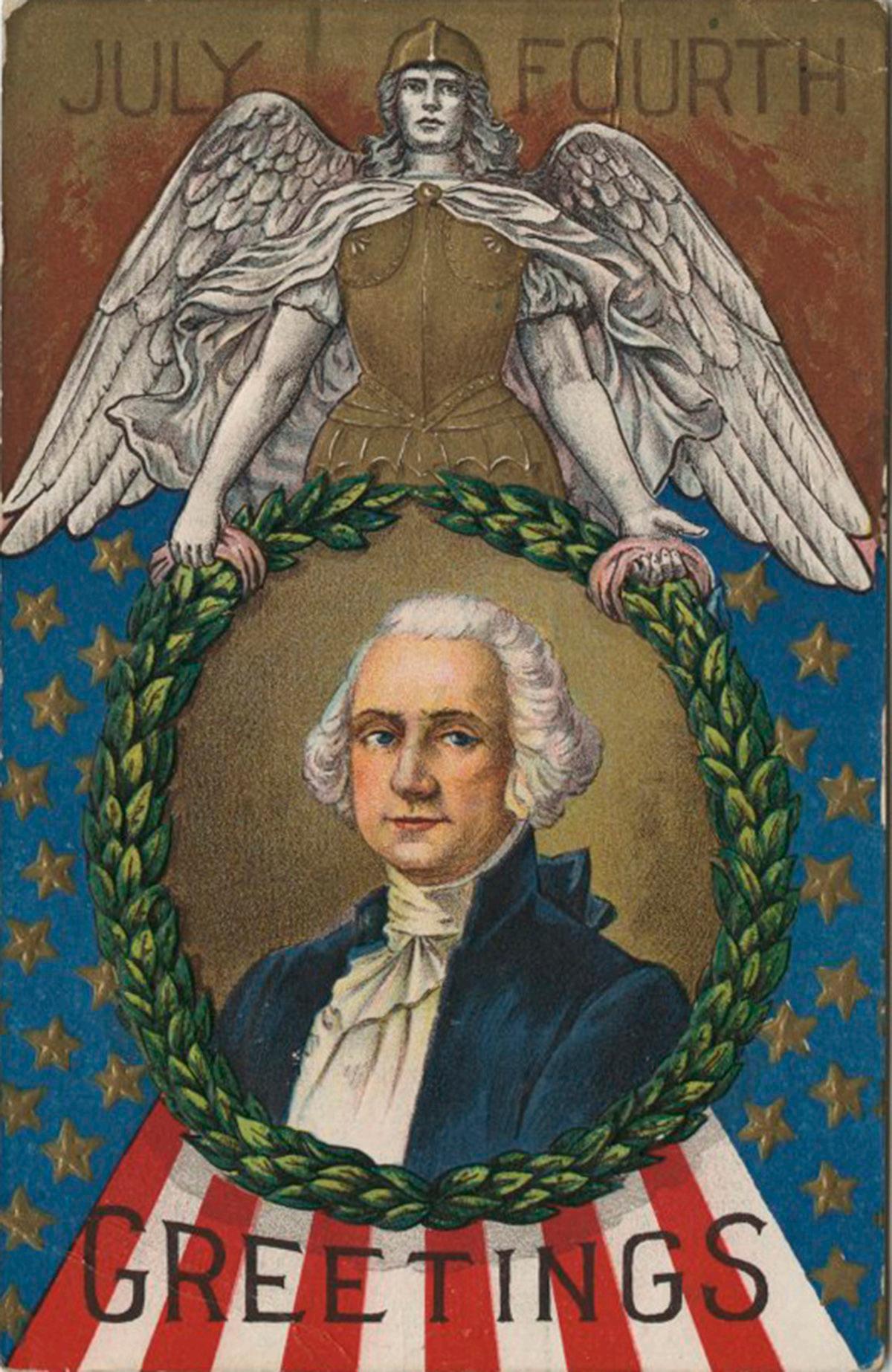
The Flagler Museum Archives houses many archival items that testify to the significance of the holiday in America and the patriotism of the period, including sheet music, postcards, menus, and rare books. Most of these objects feature popular motifs such as George Washington, Uncle Sam, the American Eagle, the flag, and fireworks, all of which are evoked today to symbolize American patriotism and pride.
The tradition of celebrating the Fourth of July in Gilded Age fashion continues each year at the Flagler Museum.
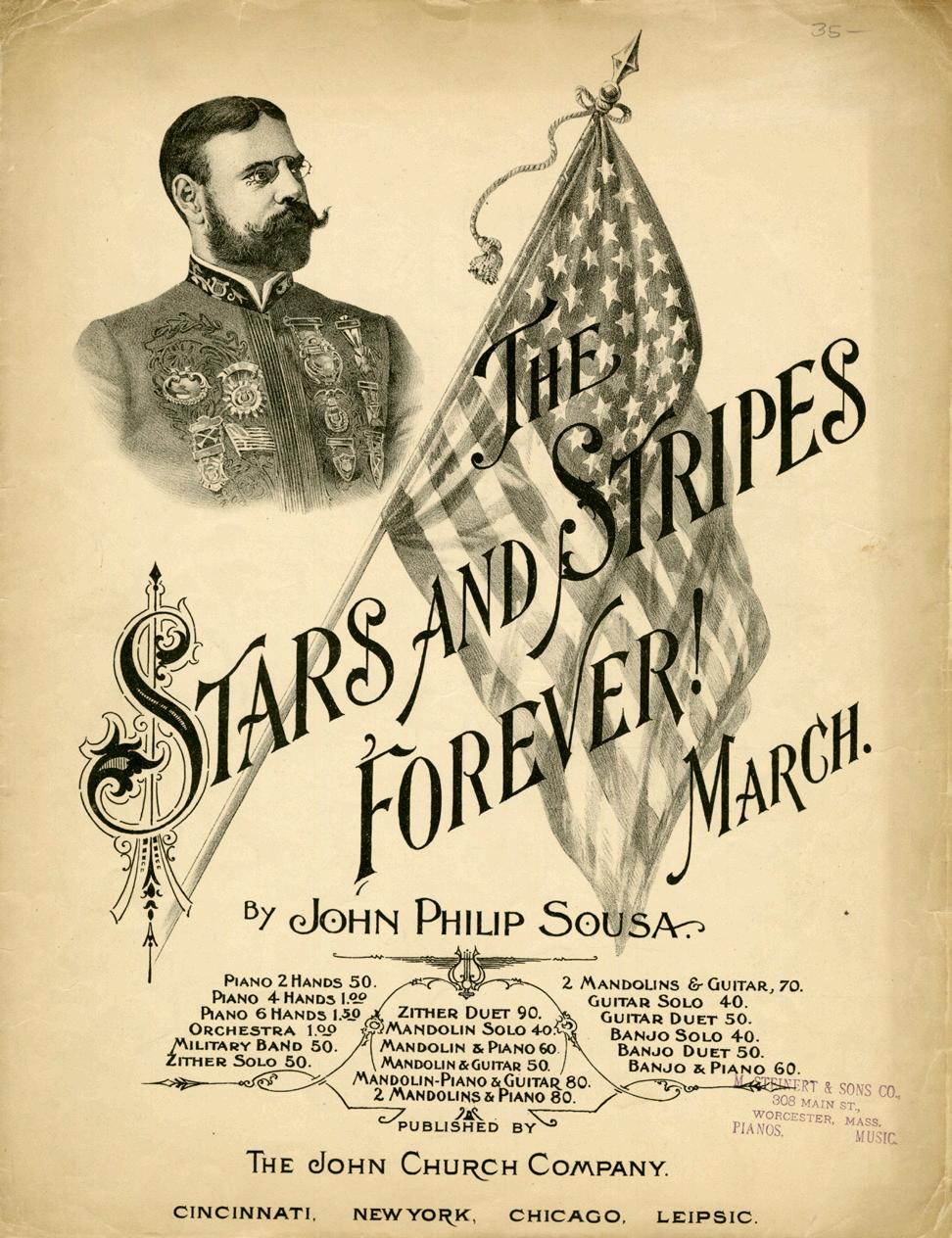 Patriotic postcards (inset and left) and sheet music from the Flagler Museum Archives.
4
The Declaration of Independence
When in the Course of human events, it becomes necessary for one people to dissolve the political bands which have connected them with another, and to assume among the powers of the earth, the separate and equal station to which the Laws of Nature and of Nature’s God entitle them, a decent respect to the opinions of mankind requires that they should declare the causes which impel them to the separation.
We hold these truths to be self-evident, that all men are created equal, that they are endowed by their Creator with certain unalienable Rights, that among these are Life, Liberty and the pursuit of Happiness--That to secure these rights, Governments are instituted among Men, deriving their just powers from the consent of the governed, That whenever any Form of Government becomes destructive of these ends, it is the Right of the People to alter or to abolish it, and to institute new Government, laying its foundation on such principles and organizing its powers in such form, as to them shall seem most likely to effect their Safety and Happiness. Prudence, indeed, will dictate that Governments long established should not be changed for light and transient causes; and accordingly all experience hath shewn, that mankind are more disposed to suffer, while evils are sufferable, than to right themselves by abolishing the forms to which they are accustomed. But when a long train of abuses and usurpations, pursuing invariably the same Object evinces a design to reduce them under absolute Despotism, it is their right, it is their duty, to throw off such Government, and to provide new Guards for their future security. Such has been the patient sufferance of these Colonies; and such is now the necessity which constrains them to alter their former Systems of Government. The history of the present King of Great Britain is a history of repeated injuries and usurpations, all having in direct object the establishment of an absolute Tyranny over these States. To prove this, let Facts be submitted to a candid world.
He has refused his Assent to Laws, the most wholesome and necessary for the public good.
He has forbidden his Governors to pass Laws of immediate and pressing importance, unless suspended in their operation till his Assent should be obtained; and when so suspended, he has utterly neglected to attend to them.
He has refused to pass other Laws for the accommodation of large districts of people, unless those people would relinquish the right of Representation in the Legislature, a Right inestimable to them and formidable to Tyrants only.
He has called together Legislative Bodies at Places unusual, uncomfortable, and distant from the Depository of their public Records, for the sole Purpose of fatiguing them into Compliance with his measures.
He has dissolved Representative Houses repeatedly, for opposing with manly firmness his invasions on the Rights of the People.
He has refused for a long time, after such Dissolutions, to cause others to be elected; whereby the Legislative Powers, incapable of Annihilation, have returned to the People at large for their exercise; the State remaining in the mean time exposed to all the dangers of invasion from without, and convulsions within.
He has endeavoured to prevent the Population of these States; for that purpose obstructing the Laws for Naturalization of Foreigners; refusing to pass others to encourage their migrations hither, and raising the conditions of new Appropriations of Lands.
He has obstructed the Administration of Justice, by refusing his Assent to Laws for establishing Judiciary Powers.
He has made Judges dependent on his Will alone, for the tenure of their offices, and the amount and payment of their salaries.
He has erected a multitude of New Offices, and sent hither swarms of Officers to harrass our People, and eat out their Substance.
He has kept among us, in times of peace, Standing Armies without the Consent of our Legislatures.
He has affected to render the Military independent of and superior to the Civil power.
4
He has combined with others to subject us to a Jurisdiction foreign to our Constitution, and unacknowledged by our laws; giving his Assent to their Acts of pretended Legislation:
For Quartering large bodies of armed troops among us:
For protecting them, by a mock Trial, from punishment for any Murders which they should commit on the Inhabitants of these States:
For cutting off our Trade with all parts of the world: For imposing Taxes on us without our Consent:
For depriving us in many cases, of the benefits of Trial by Jury: For transporting us beyond Seas to be tried for pretended offences:
For abolishing the free System of English Laws in a neighbouring Province, establishing therein an Arbitrary Government, and enlarging its Boundaries so as to render it at once an example and fit instrument for introducing the same absolute rule into these Colonies:
For taking away our Charters, abolishing our most valuable Laws, and altering fundamentally the Forms of our Governments:
For suspending our own Legislatures, and declaring themselves invested with power to legislate for us in all cases whatsoever.
He has abdicated Government here, by declaring us out of his Protection and waging War against us.
He has plundered our seas, ravaged our Coasts, burnt our towns, and destroyed the lives of our people.
He is at this time transporting large Armies of foreign Mercenaries to compleat the works of death, desolation and tyranny, already begun with circumstances of Cruelty & perfidy scarcely paralleled in the most barbarous ages, and totally unworthy of the Head of a civilized nation.
He has constrained our fellow Citizens taken Captive on the high Seas to bear Arms against their Country, to become the executioners of their friends and Brethren, or to fall themselves by their Hands.
He has excited domestic insurrections amongst us, and has endeavoured to bring on the inhabitants of our frontiers, the merciless Indian Savages, whose known rule of warfare, is an undistinguished destruction of all ages, sexes and conditions.
In every stage of these Oppressions We have Petitioned for Redress in the most humble terms: Our repeated Petitions have been answered only by repeated injury. A Prince whose character is thus marked by every act which may define a Tyrant, is unfit to be the ruler of a free people.
Nor have We been wanting in attentions to our British brethren. We have warned them from time to time of attempts by their Legislature to extend an unwarrantable jurisdiction over us. We have reminded them of the circumstances of our emigration and settlement here. We have appealed to their native justice and magnanimity, and we have conjured them by the ties of our common kindred to disavow these usurpations, which, would inevitably interrupt our connections and correspondence. They too have been deaf to the voice of justice and of consanguinity. We must, therefore, acquiesce in the necessity, which denounces our Separation, and hold them, as we hold the rest of mankind, Enemies in War, in Peace, Friends.
We, therefore, the Representatives of the United States of America, in General Congress, Assembled, appealing to the Supreme Judge of the world for the rectitude of our intentions, do, in the Name, and by Authority of the good People of these Colonies, solemnly publish and declare, That these United Colonies are, and of Right ought to be Free and Independent States; that they are Absolved from all Allegiance to the British Crown, and that all political connection between them and the State of Great Britain, is and ought to be totally dissolved; and that as Free and Independent States, they have full Power to levy War, conclude Peace, contract Alliances, establish Commerce, and to do all other Acts and Things which Independent States may of right do. And for the support of this Declaration, with a firm reliance on the protection of divine Providence, we mutually pledge to each other our Lives, our Fortunes and our sacred Honor.
5
Naturalization Ceremony
For more than 220 years immigrants who have met the requirements of citizenship have taken the Oath of Citizenship as naturalized citizens and contributed greatly to our communities and country.
The Flagler Museum is honored to host a new citizens Naturalization Ceremony. The following individuals will take the Oath of Citizenship this evening. As a welcome and symbol of solidarity, please join our new fellow citizens in reciting the Oath.
New Citizens
Rocio Schwartz, Mexico
Jade Ralson, Philippines
Adrian Orta Torres, Cuba
Chenielle Chambers, Jamaica
John Acevedo, Colombia
Pera Augustin, Haiti
Margaret Streeter, Australia
Maria Duarte Baez, Paraguay
Jose Bellorin Urdaneta, Venezuela
Berta Guillen Chavaria, El Salvador
Oath of Citizenship
"I hereby declare, on oath, that I absolutely and entirely renounce and abjure all allegiance and fidelity to any foreign prince, potentate, state, or sovereignty, of whom or which I have heretofore been a subject or citizen; that I will support and defend the Constitution and laws of the United States of America against all enemies, foreign and domestic; that I will bear true faith and allegiance to the same; that I will bear arms on behalf of the United States when required by the law; that I will perform noncombatant service in the Armed Forces of the United States when required by the law; that I will perform work of national importance under civilian direction when required by the law; and that I take this obligation freely, without any mental reservation or purpose of evasion; so help me God."
7


