Maroondah The
SEPTEMBER 2021
WHAT’S INSIDE: 04
LOCAL STORIES
19
COLUMNIST ARTICLES
38
TAX UPDATES
40
REAL ESTATE - RENTAL LISTINGS
50
MAROONDAH COUNCIL NEWS
78
FIND FAITH
80
FIND BIRTH, DEATHS, & MARRIAGES
82
FIND COUPONS
SUPPORT LOCAL, BUY LOCAL, DISCOVER MAROONDAH
MarkMogato
Occupational Health & Safety
SHL FINANCE
mfelton@beaumontlawyers.com.au
reece@shlfinance.com.au
www.thebeaumontgroup.com.au
www.shlfinance.com.au
0411 951 372
0478 021 757
info@findaccountant.com.au | www.findaccountant.com.au
PL ATINUM SPONSOR
SEPTEMBER SPONSOR
SEPTEMBER SPONSOR
COLUMNIST CONTRIBUTORS FOUNDER | ACCOUNTANT
LIFE COACH | FACILITATOR
WARREN STRYBOSCH
LESLEY-ANNE BANTON
BOOKKEEPER
ARCHITECT
NEHA NAYYAR
GARAGE DOORS
CHANTAL DJURIC
OCCUPATIONAL HEALTH & SAFETY
MARK FELTON
KATHY ISMAIL
SIGNAGES
GENERAL INSURANCE
CRAIG ANDERSON
MORTGAGE BROKER
REECE DROSCHER
EDITOR | WRITER
SUSAN PIEROTTI
LACTATION CONSULTANT
JOANNA STRYBOSCH
SOLICITOR
COMMERCIAL COFFEE MACHINE HIRE
GLENN MARTIN
IVANA SMITH
NATURE & CONSERVATION
HERITAGE & HISTORY
LIZ SANZARO
RUSS HAINES
DAVID HEASLEY
HEATHERDALE COMMUNITY ACTION GROUP
ELWYNNE KIFT
CLUB SPONSORS
findmaroondah.com.au
SEPTEMBER 2021 | FIND MAROONDAH
3
About the Find Maroondah By Warren Strybosch
The Find Maroondah is a community paper that aims to support all things Maroondah. We want to provide a place where all Not-For-Profits (NFP), schools, sporting groups and other like organisations can share their news in one place. For instance, submitting up-andcoming events in the Find Maroondah for Free. We do not proclaim to be another newspaper and we will not be aiming to compete with other news outlets. You can obtain your news from other sources. We feel you get enough of this already. We will keep our news topics to a minimum and only provide what we feel is most relevant topics to you each month. We invite local council and the current council members to participate by submitting information each month so as to keep us informed of any changes that may be of relevance to us, their local constituents.
We will also try and showcase different organisations throughout the year so you, the reader, can learn more about what is on offer in your local area. To help support the paper, we invite local businesses owners to sponsor the paper and in return we will provide exclusive advertising and opportunities to submit articles about their businesses. As a community we encourage you to support these businesses/columnists. Without their support, we would not be able to provide this community paper to you. Lastly, we want to ask you, the local community, to support the fundraising initiatives that we will be developing
and rolling out over the coming years. Our aim is to help as many NFP and other like organisations to raise much needed funds to help them to keep operating. Our fundraising initiatives will never simply ask for money from you. We will also aim to provide something of worth to you before you part with your hard-earned money. The first initiative is the Find Cards and Find Coupons – similar to the Entertainment Book but cheaper and more localised. Any NFP and similar organisations e.g., schools, sporting clubs, can participate. Follow us on facebook (https://www. facebook.com/findmaroondah) so you keep up to date with what we are doing. We value your support, The Find Maroondah Team.
Maroondah The
EDITORIAL ENQUIRES: Warren Strybosch | 1300 88 38 30 editor@findmaroondah.com.au PUBLISHER: Issuu pty Ltd POSTAL ADDRESS: 248 Wonga Road, Warranwood VIC 3134 ADVERTISING AND ACCOUNTS: editor@findmaroondah.com.au GENERAL ENQUIRIES: 1300 88 38 30 EMAIL SPORT: editor@findmaroondah.com.au WEBSITE: www.findmaroondah.com.au
OUR NEWSPAPER The Find Maroondah was established in 2019 and is owned by the Find Foundation, a Not-For-Profit organisation with is core focus of helping other Not-For-Profits, schools, clubs and other similar organisations in the local community - to bring everyone together in one place and to support each other. We provide the above organisations FREE advertising in the community paper to promote themselves as well as to make the community more aware of the services these organisations can offer. The Find Maroondah has a strong editorial focus and is supported via local grants and financed predominantly by local business owners.
ALL THINGS MAROONDAH The City of Maroondah is a local government area in Victoria, Australia in the eastern suburbs of Melbourne. Maroondah had a population of approximately 118,000 as at the 2019 Report which includes 9000 business and close to 46,000 households. The City of Maroondah was created through the amalgation the former Cities of Ringwood and Croydon in December 1994.
ACKNOWLEDGEMENT The Find Maroondah acknowledge the Traditional Owners of the lands where Maroondah now stands, the Wurundjeri people of the Kulin nation, and pays repect to their Elders - past, present and emerging - and acknowledges the important role Aboriginal and Torres Strait Islander people continue to play within our community.
ADVERTISING RATES (INCLUDE GST) Available Sizes:
Rates:
• Double Page Spread (408 x 276mm)
$1650
• Full Page (198 x 276mm)
$1100
• Half Page Landscape (198 x 138mm)
$715
• Half Page Portrait (95 x 276mm)
$715
• Third Page (189 x 90mm)
$550
• Quarter Page (97 x 137mm)
$440
• Business Card Size (93 x 65mm)
$275
• Ads Smaller than (85 x 55mm) and Below
$121
• Design Services We can create your ad for you. Prices start at $77 for the very first hour and $22 for each hour thereafter.
DISCLAIMER
NEXT ISSUE
Readers are advised that the Find Maroondah accepts no responsibility for financial, health or other claims published in advertising or in articles written in this newspaper. All comments are of a general nature and do not take into account your personal financial situation, health and/or wellbeing. We recommend you seek professional advice before acting on anything written herein.
Next Issue of the Find Maroondah will be published on Friday October 8, 2021. Advertising and Editorial copy closes Friday October 1, 2021.
SEPTEMBER 2021 | FIND MAROONDAH
3
4
FIND MAROONDAH | SEPTEMBER 2021
findmaroondah.com.au
Victoria Taxpayers will pay for future IVF Treatments By Warren Strybosch
Having a child is something most of us just take for granted. However, for some it becomes an emotional rollercoaster ride when they find out that they cannot have a child via natural means and need to consider alternative solutions. The world’s first In Vitro Fertilisation (IVF) occurred in 1973 and Australia had their first IVF birth in 1980. The first baby born from a frozen embryo was in 1983 and since then IVF success rates have increased from 1-9 successful births to over 50% of successful births. One of the biggest hurdles for people wanting to try IVF was the cost associated with the procedure. Not anymore. The Andrews Labor Government is making it easier for more Victorians to achieve their dream of becoming parents by establishing the first public fertility care service in Victoria and asking Victorian taxpayers to cover the majority of the costs of those treatments. Minister for Health Martin Foley has stated, “We’re removing the financial barrier faced by too many families and making IVF easier, fairer and more affordable – it will be life changing for thousands of Victorian families every year.” “Our policy will save Victorian families up to $10,000 each year, ensuring that bank balance is no barrier to becoming a parent.”
The Victorian Budget 2021/22 will invest $70 million to establish public fertility care services, which will help up to 4,000 Victorians every year – saving them on average $10,000 each. The funding includes $20 million to improve public hospital facilities to deliver the services, while $50 million will be invested to provide up to 2,700 free treatment cycles and a range of other fertility care services to up to 4,000 Victorians per year.
families, with services expected to start in a phased approach from 2022. It is estimated public IVF will deliver on average savings of $10,000 to eligible Victorians, depending on their individual circumstances. This investment will also create jobs for more Victorians, with roles as fertility specialist doctors, nurses, counsellors, laboratory scientists and support staff.
This investment will deliver on the Labor Government’s commitment to create public IVF services, while also establishing Victoria’s first public sperm and egg bank.
What are your thoughts on the matter? Do you think it is fair for Victorians to take upon themselves the financial burden of paying for these IVF treatments, whilst those who are wanting to use the services do not have to pay as much or anything at all?
Public fertility care will make a real difference to thousands of Victorian
You can write your comments to the editor@findmaroondah.com.au.
Pay relief for locked down parents-to-be By Georgie Moore
(Australian Associated Press)
Soon-to-be parents who have lost work because of lockdowns won’t miss out on paid parental leave under proposed federal government changes. Coronavirus disaster payments will count towards thresholds for parental and partner leave pay under a bill being introduced into parliament on Wednesday. Currently, a parent must show they’ve worked for the equivalent of at least one day a week for 10 out of 13 months before having a child.
Parents cannot have more than a 12 week gap between each work day in that period.
$772.55 payments can be transferred to another parent should they become the primary carer.
Social Services Minister Anne Ruston doesn’t want lockdowns to affect paid parental support that expectant mums and dads rely on. “This will come as welcome relief for families living
The final six weeks can also be shared or taken by either parent at any time before a child turns two. Two weeks’ pay is also available for dads or partners.
in extended lockdown conditions in NSW who are awaiting the arrival of a newborn,” she said. The change would be applied across other parts of the country and to anyone receiving disaster payments in the future. Primary carers can receive paid parental leave for up to 18 weeks. The weekly
Weekly coronavirus disaster payments of up to $750 a week are available for people in nationally recognised hotspot areas who have lost more than 20 hours of work. People who have lost between eight and 19 hours of work are eligible for $450 a week.
findmaroondah.com.au
SEPTEMBER 2021 | FIND MAROONDAH
5
Mental Health and Wellbeing “payroll” Surcharge - Another Cost to Victorian Businesses By Warren Strybosch
The Andrew’s Labor government has decided that Victoria taxpayers will need to cover the ever-increasing mental health costs the government continues to face. The Victorian State Revenue Office has advised that the “mental health and wellbeing surcharge” will commence from 1 Jan 2022, which is payable on Victorian taxable wages paid or payable from 1 January 2022 by an employer or a group of employers. The surcharge will be payable if Victorian taxable wages are paid and the Australian wages exceed the first annual threshold of $10m. The surcharge is payable at the same time that payroll tax is payable. Separate returns will not be required.
What is difficult for a lot of business owners to swallow is the fact that Victoria has experienced the most severe and extended lockdowns than any other place in the world. This has,
by its very nature, increased mental health issues for many Victoria’s, and with the introduction of this new payroll surcharge, seems to be another slap in the face to those running a business.
Heatherdale Spur HEATHERDALE COMMUNITY ACTION GROUP
By Elwynne Kift
The original road level can ve gauged from viewing the shop on the corner of Molan Street and Heatherdale Road. People would ride their horses to a rail which was as high as the present shop's door step up to go into the shop. (Have a look at it next time you are there.!) Soil fillin out of the original widened and deepened cutting for railway embankment, but also Heatherdale Road. Heatherdale Road only existed because one of Victoria's largest fruit coolrooms stood where the Nursery Supplies used to be, and which where SP Aus Net is now has taken over. There was a farmland/orchards all around because of the two creeks which
do not exist today. Heatherdale Spur had a creek running from Whitehorse Road, under the railway line and down what is now Cochrane Street to Somers Street through Somers Walk to the first football ground and on the rear of Manhattan Hotel it was a small but very muddy, boggy, blackberry overgrown creek. There was also a large damn on the Madden Street creek with its bank at Palmerston Street. That's why Palmerston Street is where it is, because you could walk, ride a horse through the orchards and the blackberries nad cross the creek over the dam wall. Around where the Manhattan Hotel is, there was low lying land and there was a marshy swampy
full of bulrusher, balckberries, frogs by the millionand snakes, up to and beyond the present heatherdale Sports Oval. Only when the creeks were converted into barrel drains and proper drainage installed, could Purches Street and Heatherdale Road extensions by joined up with Canterburry Road. When this happened, the Kinman night soil truck cleaning yard on the north side of the creek (about where Agent Place and Pilgrim Court are now.) was thankfully shifted. Some of the area may still be seen. HEATHERDALE has a fascinating history.... and the residents have every reason to be proud to live there!
SEPTEMBER 2021 | FIND MAROONDAH
5
6
FIND MAROONDAH | SEPTEMBER 2021
findmaroondah.com.au
Like our tree? Maybe you know a place/ group, that might like to borrow it? NATURE & CONSERVATION By Liz Sanzaro
This could easily be an on-line project, where individuals make their piece at home then post it to the coordinator, who can then decorate the tree and post the pictures, as a group team building exercise, post covid. We all need some fun and some uplifting engagement. Schools, banks, businesses, welcome. The Croydon Conservation Society is a lot about trees, so in 2018 we applied for an Arts grant from Maroondah Council. After filling in the paperwork, and deliberation from the Arts team, we were able to go ahead with the project, with a small amount of funding. It became a community effort. Croydon Men’s Shed made the tree in three pieces, with a bracket to strengthen it and a stand to support it. After painting it black, it became a moving art work. First displayed at Croydon Central shopping centre where all students from Croydon primary School created wonderful birds to enhance the tree, along with cicadas and ants.
Croydon Primary School
the base. It is as tall as a doorway and as wide as double doors. Contact CCS if you are interested in borrowing this frame for teaching Sustainability studies or Environmental studies or Art. Use the contact us button on our webpage.
Secondly it was to be found in the window of Stockdale and Leggo in Main St Croydon. This time it had been decorated by students from Ruskin Park Primary School together with Croydon Community School. Last it was in Realm in Ringwood where decorations had been made by Mullum Mullum Indigenous Gathering Place.
Also on the CCS Facebook page is our newly released map of the region, noting, locating and photographing many of our most precious mature beautiful trees, I wonder if we have one near you? A great activity for Covid times, a bit like a virtual walk, or making a note of where you might like to walk for exercise to check out the beautiful trees.
Since then, it has been to Wandin Yallock primary school, where Farmer Jill inspired students to create tree life. It has also been at Eastwood Primary School for a display of Owls, made of newspaper and recycled materials. CCS has no cost involved in using this art frame, it can be easily assembled and fits in a standard size SUV rear. A sand bag is used to stabilize the tree at
Mullum Mullum Indigenous Gathering Place
Liz Sanzaro
Ruskin Park and Croydon Community Schools
President of Croydon Conservation Society www.croydonconservation.org.au liz@sanzaro.com
findmaroondah.com.au
SEPTEMBER 2021 | FIND MAROONDAH
7
Textile Artist Annemieke Mein loses her sense of touch to rare autoimmune disease HEATHERDALE COMMUNITY ACTION
ABC Gippsland By Mim Cook
Posted Sun 9 2019, 9:04am
By Elwynne Kift
Annemieke's love of art, craft, sewing and texture of silk was inspired by her Grandparents. She was raised by her Grandmother during the 2nd world War. In 1951, at aged 7, Annemieke moved to Australia from the Netherlands and discovered the world of Australian bush critters. She says that there was a huge gum tree which she could sit under and see all these insects.. AT 24 HEATHERDALE ROAD, MITCHAM. She attended school locally after which she became a nurse at the Royal Melbourne Hospital, and still has friends in Mitcham. PHOTO: Annemieke Mein is meticulous about her work. (ABC Gippsland: Mim Cook)
Annemieke's art specialises in depicting wildlife. She was the first textile artist to be a member of the Wildlife Art Society of Australasia, and the Artists Guild of Realistic Art of Australia. The subjects of some of her sculptured textiles are of birds, frogs, gums, and wattle blossoms. Other invertabrates such as moths, dragon flies, wasps, and grasshoppers signify her fondness for insects. - her images are often enlarged. One of her books - THE ART OF ANNEMIEKE MEIN - wildlife artist in textiles, illustrates a
collection of skilled textile artworks containing fabric, stitching, and paints with hand machine embroidery. Annemieke uses an amazing variety of materials - silk, wool, fur, cotton and synthetics - all carefully chosen for their colour, texture, credibility and aesthetic appeal. Recently Annemieke was diagnosed with a very rare auto immune disease in which she has lost feeling in her hands and feet.
This has not stopped Annemieke working in her art studio, though, as she has said, her love of her art dull the feeling of the pain. Her art work is prominently displayed at the Gippsland Information Centre, Sale, Victoria where there are many of her pieces. EACH ARTWOK INVOLVES A SCIENTIFIC JOURNEY.
RETIREMENT We will look after your financial affairs so you can enjoy your retirement. WHO WE ARE
WHERE WE WORK
Find Retirement is a part of the Find
We service clients throughout Melbourne,
Group of companies offering Retirement
Bendigo and Geelong and surrounding
Planning, Accounting, Super, and
areas. With access to the internet it does
Insurance service to our clients.
not matter where you live.
WHAT WE DO We don’t sell proucts but provide simple retirement planning solutions. Bendigo | Geelong | Melbourne
info@findretirement.com.au
Mon - Fri: 9am - 5:30pm
www.findretirement.com.au
1300 88 38 30
Sat: 10am -1pm
Sun: CLOSED
This information is of a general nature only and has been prepared without taking into account your particular financial needs, circumstances and objectives. While every effort has been made to ensure the accuracy of the information, it is not guaranteed. You should obtain professional advice before acting on the information contained in this publication. Superannuation, tax and Centrelink and other relevant information is based on our interpretation and continuation of law current as at the date of this document. The information contained in this document does not constitute legal or tax advice. You should seek expert advice in this regard. Warren Strybosch, Find Wealth Pty Limited ABN 20 140 585 075 trading as Find Retirement, Corporate Authorised Representative No. 236815 of ClearView Financial Advice Pty Ltd ABN 89 133 593 012, AFSL No. 331367.
SEPTEMBER 2021 | FIND MAROONDAH
7
8
FIND MAROONDAH | SEPTEMBER 2021
findmaroondah.com.au
Penguin Books, Ringwood HERITAGE & HISTORY By Russ Haines OAM
START OF AN IDEA Penguin Books made their debut in British bookshops, bookstalls and branches of Woolworths on 30 July, 1935. Allen Lane thought he could, by mass-production and mass-distribution of "intelligent books”, reduce the price to around sixpence, a level where everyone could afford to have books in their own libraries. It took off like wildfire, even though the 1930s depression. The first subjects were on politics, the arts, and science and the covers were colour-coded, orange and white for general fiction, green and white for crime fiction, cerise and white for travel and adventure, dark blue and white for biographies, yellow and white for miscellaneous, red and white for drama; and the rarer purple and white for essays and belles-lettres [French, meaning “fine writing”] and grey and white for world affairs. In 1937, the education series in pale blue and white - Pelican Books - started and even though the sales were not high, continued until 1984. Puffins began in 1940 with the Puffin Picture Book, to help the children who were evacuated to the country and farming areas of UK. Thus were born the series for young readers. In 1970, six weeks after the death of Allen Lane, the Penguin Group was bought out by Pearson, the global publisher and owner of the Financial Times. TO THE ANTIPODES Just after 10 years the first Penguins were published in the UK, the Australian company was established in a simple warehouse, in Normanby Road, South Melbourne, Victoria in 1946. It was clad in corrugated iron and somewhat challenging in terms of space and decor. For many years it was simply a distribution branch of Penguin UK. Later, Penguin Australia published their own local titles (they had a penguin logo between two boomerangs).
Despite initial teething problems with the Australian arm, to a point where UK head office thought of shutting down the operation, sales picked up massively. The South Melbourne warehouse was too small so the company moved out into the eastern suburb, Mitcham, in 1953. RINGWOOD BOUND With the emergence of a computer system and the requirement to carry more stock, the search for some acreage was on in the early 1960s. Seven acres were coming up for sale on the north side of Maroondah Highway at the 17mile mark from Melbourne (see map). This area was once the home of Molloys’ orchards in East Ringwood, very fertile land being ideally placed in the flood plains of the Mullum Mullum Creek. The Carlton United Breweries’ experimental hop farm was already under operation next door, to the south-west. Laurie Nash was the chief scientist and had a hand in producing a number of new strains of hops, the most famous the “Ringwood Special”, which is still the preferred hop for many Australian and international beers. Brian Stonier, boss of Penguin Australia, loved the large area. It was great opportunity to expand and easily drive in and out of the warehouses to the highway. He wrote a proposal to head office and no response. So, with the auction coming up, he went off to the Saturday morning auction and bought it. Allen Lane eventually contacted him in the afternoon at the Metropolitan golf links. He said, “Don’t buy the land.” “Too
late”, Brain said, “I’ve already bought it 3 hours ago!” In the end, Allen came around to his way of thinking. THE NEW BUILDING The building was designed by architect Ian Turner. It had a large 20,000 square foot warehouse and offices built around the central court which featured a Ian Bow fountain, known as the Talisman Fountain. Besides the front entrance was an abstract sculpture in sheet metal by Robert Klippel. The builders were RJ Grills Pty Ltd. OPENING The opening took place on Friday 13th November, 1964 and were officially opened by Harold Holt, Federal Treasurer under Menzies. Holt became Prime Minister on Australia Day in 1966 and tragically lost his life on Cheviot Beach, Portsea in December 1967. Ninety guests were at the opening and went onto the Bird and Bottle Restaurant in Croydon for a very long lunch. This venue was a common haunt for Penguin management. Other guests were Sir Allen Lane, founder of the company, Director of the National Gallery, Eric Westbrook, John Jess MHR, JW Manson MLA and Cr Ben Hubbard, Mayor of Ringwood. A distinguished guest was Monica Dickens, great granddaughter of that great novelist. The site remained until 2002 when it moved its head office operations to Camberwell and distribution operations to a new location in Scoresby.
findmaroondah.com.au
SEPTEMBER 2021 | FIND MAROONDAH
9
China Reduces Screen-Time For Games Down To 3-Hours Per Week It is estimated that up to 1% of the American population might have aninternet gaming disorder and this can be assumed to be the case in most countries where teens have access to computers and the internet. It is no wonder China has come down hard on ‘gamers’ in their own country, as they try and curb the growing addiction which has been described as something akin to a “spiritual opium.” The new rules will apply to all devices including mobile phones and has gotten many global gaming companies concerned given the higher number of teens in China who play their games. “Teenagers are the future of our motherland,” Xinhua quoted an unnamed NPPA spokesperson as saying. “Protecting the physical and mental health of minors is related to the people’s vital interests and relates to the cultivation of the younger generation in the era of national rejuvenation.” By Warren Strybosch
China has introduced a new social intervention for under-18s. They have restricted the number of hours a child can play video games to no more than three hours a week – not three hours a day but three hours per week. The limit will be for one hour a day - 8 pm to 9 pm - on only Fridays, Saturdays and Sundays, according to the Xinhua state news agency. Personally, I think China is onto something here as research has shown the increasing health risks of playing video/computer games for long hours. A research paper conducted by Peter Grinspoon (2020), found that ‘gaming’ was associated with obesity in teens, vision problems, and psychological problems. Gaming is yet to be considered an addiction, but internet gaming disorder (IGD) is a real syndrome experienced by a lot of gamers. As per the Psychological Association, IGD is defined as experiencing at least five of the following nine criteria over a
12-month period: • • • • • • • • •
gaming preoccupation withdrawal tolerance loss of interest in other activities downplaying use loss of relationship, educational, or career opportunities gaming to escape or relieve anxiety, guilt, or other negative mood states failure to control continued gaming despite psychosocial problems.
The Chinese games market was estimated to make $A62.5 billion of revenue in 2021, ahead of the United States, according to analytics firm Newzoo, but these new rules will definitely put a dent in these estimates. China, is trying to curb the high number of runaway youth and believes gaming is one of the major reasons why youth are becoming more anxious, less tolerant, withdrawn and finding it more difficult to relate to others, including their own parents.
Gaming companies will be barred from providing services to minors in any form outside the stipulated hours and must ensure they have put real-name verification systems in place, said the regulator, which oversees the country’s video games market. With COVID and the resulting lockdowns, it is likely that Australian teens are spending more time in front of their screens playing games. Rather than cutting off their gaming time or reducing it down to 3 hours per week, we encourage all parents to be mindful of the ICD criteria’s and if a child is presenting with five or more of them, to find helpful ways to reduce their screen time, or seek professional help in dealing with this matter before it becomes a serious issue. Do you have a teen living in your home? Has screen time increased during COVID? What strategies have you come up with to encourage your teen to be off screens? We would love to hear from you. Send your responses to editor@ findmaroondah.com.au.
SEPTEMBER 2021 | FIND MAROONDAH
9
10
FIND MAROONDAH | SEPTEMBER 2021
findmaroondah.com.au
The Actual History of the Heatherdale Kindergarten. From commencement in Molan Street, Ringwood HEATHERDALE COMMUNITY ACTION
By Mr. Don Standford
In 1963, the land and building of the Heatherdale Kindergarten in Molan Street, Ringwood, was purchased by Mr. Donald Sandford with the purpose of building a factory mind. The Kindergaten was still operating in 1965, but on holidays when the fire burnt the front of the Kindergarten. The fire was caused by kids smoking uner the Kindergaten which had long grass surrounding on it. The children were not caught. The Kindergarten was on 2 blocks of land. , so Mr. Sandford built his factory on one block., and the remainder of the Kindergarten stood. The factory was later extended to the land on which the Kindergarten stood. Mr. Sandford wanted to shift the remainder of the Kindergaten to Tootgarook to some land he owned. The Council down there would not allow this, as they wanted to make sure that all buildings were up to standard when they arrived. Mr. Standford made the decision to shift the Kindergarten down to Tootgarook in sections in his truck, and the Kindergarten was ressembled and renovated. The Kindergarten has a asbestos roof, which was replaced with metal. Mr. Sandford obtained Council inspections and the building was passed... SO THE REMAINS.!!
KINDERGARTEN
BUILDING
It has now been sold, and the owner has renovated it again, and it is a holiday house. The owner has no idea of its history. Mark has a varied work experience, including 12 years in manufacturing as a manager and 19 years as a financial planner. He uses his wide range of experience and knowledge to quickly identify the right course of action, and uses his expertise to help you solve any problems.
Areas of Expertise º WHS/ OHS º Manufacturing º Regulatory Compliance
Contact Details mfelton@beaumontlawyers.com.au 03 9727 1376
º Safe Working Practices
www.thebeaumontgroup.com.au/lawyers/
º Succession Planning
PO Box 61, Mooroolbark VIC 3138
º Business Management º Operations
MARK FELTON OCCUPATIONAL HEALTH & SAFETY
findmaroondah.com.au
SEPTEMBER 2021 | FIND MAROONDAH
11
By Xave Gregorio
The Chapter 11 filing, which allows a company to continue operations while it restructures its finances, was a product of discussions with key shareholders, PAL said, adding the plan will not affect passengers and employees. The company will also complete a parallel filing for recognition in the Philippines under the Financial Insolvency and Rehabilitation (FRIA) Act of 2010. “We welcome this major breakthrough, an overall agreement that enables PAL to remain the flag carrier of the Philippines and the premier global airline of the country,” billionaire Lucio Tan, company president and CEO, said. To stay liquid during the recovery process, PAL said existing shareholders and local banks agreed to infuse $505 million in new debt and equity financing to the company. The carrier said it will gradually increase domestic and international flights to match any improvements in market demand.
Once the bankruptcy protection is over, PAL will borrow $150 million from foreign investors “to facilitate post-restructuring activities”. “PAL will continue to operate flights in the normal course of business in accordance with safety regulations, and the company expects to continue to meet its current financial obligations throughout this process,” the company said. As losses piled up for the beleaguered aviation sector, the Duterte government has continued to be reluctant in spending taxpayers’ money to rescue local airlines on the brink of financial collapse, unlike regional counterparts that handed bailouts to their cash-strapped carriers like Malaysia and Thailand. PAL has weathered past crises before. In 1999, the airline was placed under receivership after facing a series of labor strikes while grappling with the
Asian Financial Crisis and a $2 billion debt driven by its ambitious expansion plans at the time. But the coronavirus pandemic is a different kind of crisis for the company, which sank the airline deeper into the red in 2020 to mark the fourth consecutive year that it recorded hefty losses. In the first half, PAL Holdings Inc., the airline’s parent firm, narrowed its net loss by 20% year-on-year to P16.56 billion. Operating expenses fell nearly 49% onyear during the period, with manpower costs also declining after the company started shedding 2,300 workers in March while those who managed to stay took big pay cuts. "We are grateful to our lenders, aviation partners and other creditors for supporting the plan, which empowers PAL to overcome the unprecedented impact of the global pandemic that has significantly disrupted businesses in all sectors, especially aviation, and emerge stronger for the long-term,” Tan said. SEPTEMBER 2021 | FIND MAROONDAH
11
12
FIND MAROONDAH | SEPTEMBER 2021
findmaroondah.com.au
NAPLAN Results Victorian comes out in front despite lockdowns. By Warren Strybosch
Despite COVID, Victorian students have recorded the highest NAPLAN results. Year 3 students in Victoria continued improving on previous year’s results as they topped the class in reading, numeracy, and grammar and punctuation. Victoria's year 5 students also lead the nation in reading, numeracy, writing, and grammar and punctuation. Year 7 students improved in reading, writing and spelling compared to 2019 and scored the highest scores of any jurisdiction for reading and numeracy skills while Year 9s topped the nation in spelling.
"These phenomenal results are more than statistics - they represent thousands of Victorian kids who will be afforded better opportunities through education, no matter where they live or what their background," education minister James Merlino said. "We're so proud to be building a world-class education system that gives every student the opportunity to shine - and I want to thank every educator, principal, family and school community across Victoria for helping us get here." In secondary schools, more students are achieving the top two bands of reading compared to 2019 and there are less students in the bottom two bands.
Jabbed Should Get The Freedoms: Survey (Australian Associated Press)
A new survey shows a clear majority of Australians want fully vaccinated people to receive preferential treatment over the unvaccinated. YouGov, in a survey conducted exclusively for News Corp Australia, interviewed 3114 Australian residents aged 18 and over online between August 20 and 25. The survey, published in The Australian, found that 45 per cent of people support the right of all employers to demand their workers be vaccinated, while 24 per cent support it only for public-facing jobs. Just 23 per cent said employers should not compel workers to get the jab. The survey found almost half (49 per cent) blamed a flawed vaccine rollout for the fact more people have not been vaccinated to this point, while a smaller number (37 per cent) blamed the reluctance of people to get vaccinated. It also found that 45 per cent of Australians believe the most effective incentive to get vaccinated would be to exempt fully vaccinated Australians from lockdowns. Two in three people supported a vaccine passport to gain entry to sport venues, cinemas, nightclubs and restaurants. Just one in five people opposed such a move.
Almost two in three people (63 per cent) said borders between states should be reopened only to fully vaccinated people, while just 30 per cent said they should be reopened to both the vaccinated and the unvaccinated. The survey found 68 per cent of people supported the resumption of overseas travel for vaccinated people only. Just 22 per cent of people believed both vaccinated and unvaccinated people should be allowed to travel overseas once the vaccination rollout is complete.
findmaroondah.com.au
SEPTEMBER 2021 | FIND MAROONDAH
13
Wood heater use under health spotlight By Greta Stonehouse
(Australian Associated Press)
Smoke emitted from wood-fired heaters in NSW homes is causing premature deaths from pollution, a study has found. An average of 14 premature deaths per year was found to occur in the regional town Armidale, where the 12 months of research took place across a population of roughly 24,504. Dr Dorothy Robinson from the University of New England, author of the report published in the Medical Journal of Australia on Monday, likened the pollution to second-hand smoke from cigarettes. “These particles in the wood-smoke are so small they behave like gases and enter our homes even when all doors and windows are shut,” Ms Robinson told AAP. “If the air pollution is high outside it will also be high inside, maybe half an hour or an hour later.” The study collected data from air pollution monitors and from a station installed in the region by the state government in 2018. About 40 per cent of households in Armidale use wood-fired heating, while the area is known for trapping a concentration of smoke as it sits in a basin. Wood heater smoke can be particularly dangerous for vulnerable people including pregnant women, babies, and older generations, and those living with asthma, diabetes and heart disease, the Centre for Air pollution, energy and health Research (CAR) has found. Ms Robinson suggested large rural blocks with at least two hectares between them, such as the restrictions New Zealand has enforced, could mitigate some health effects. But she pointed to another New Zealand study that found a correlation between health risks and just one additional wood heater. “It showed it increased by seven per cent the risk that a child under three would need hospital emergency treatment for anything other than accidents.”
The academic said wood heating manufacturers downplayed the health effects of these devices like coal lobby groups did for emissions. Bruce Mogg from peak industry group Australian Home Heating Association did not deny wood heaters can cause pollution but said millions had been spent in making them cleaner. “Every heating appliance has issues, there’s no such thing as a pollutionfree appliance. And Australia has the toughest standards in the world when it comes to its wood heaters,” he told AAP. Mr Mogg said in some cases gas heaters could be worse for people’s health, with chemicals being injected directly into homes, and disputed second-hand smoke from cigarettes was the same. He questioned the efficacy of the often recommended reverse-cycle air conditioning, as it is “burned from coal”. CAR investigator Fay Johnston called for government incentives and buyback schemes to encourage Australians to
switch out wood heaters for heat pumps. “Wood heater smoke is one of the biggest contributors to air pollution in many parts of Australia, as highlighted by recent studies in NSW and Tasmanian,” she said in a statement. “Australians are nostalgic about the cosy family hearth they provide, but collectively, these heaters are actually damaging people’s lungs and hearts with toxic smoke.” Environment Minister Matt Kean said NSW had one of the strongest air quality regulatory frameworks in the world, but wouldn’t seek to ban wood heaters. “However, medical studies like this, serve as a reminder of how important clean air is for the health of our communities,” he told AAP in a statement. “While the NSW government recognises the potential adverse health impacts of wood heaters, particularly when they are used incorrectly, wood heaters remain a viable and cost-efficient form of heating for many people.”
SEPTEMBER 2021 | FIND MAROONDAH
13
14
FIND MAROONDAH | SEPTEMBER 2021
findmaroondah.com.au
September is Classical Music Month! Whether you consider yourself a classical music aficionado or newcomer, there are plenty of ways to celebrate classical music this month — from the comfort of your very own home. Settle in for an Online Concert Start with our Classical Concerts at the Centre playlist on YouTube, featuring stunning live performances by Freiburg Baroque Orchestra & Kristian Bezuidenhout, Gabrieli Consort & Players, Slava & Sharon Grigoryan and many more. Immerse Yourself in a Podcast To get your classical music fix on the go, be sure to listen to our podcasts Classical Uncovered with Graham Abbott and The Tune Up featuring Ben Opie. Read all about it on Soundescapes Check out our stories on Soundescapes, including Eddie Ayers' exquisite exploration of 'Why Classical Music is the One True Global Language.' Want more? Follow us on Facebook and Instagram as we share classical music gems with you all month long.
Your chance to win! Tell us what your favourite piece of classical music is and why and go into the draw to win one of three Melbourne Recital Centre Premium Memberships, valued at $200.
ENTER NOW
findmaroondah.com.au
SEPTEMBER 2021 | FIND MAROONDAH
15
All That Is Dust
Young Mozart
Oxossi - The Hunter
A charismatic star in Melbourne’s chamber music scene, Blair Harris is a must-hear for all cello lovers. This program reflects on the brevity of living and the unknown abyss that
Melbourne Chamber Orchestra performs youthfully brilliant and elegant Classical works including Mozart's Symphony No.28 and Piano Concerto No.9 with Hoang Pham.
Thu 16 & Sun 19 Sep
Australia meets South America in the eclectic music of contemporary jazz ensemble Panorama Brasil. For this concert, the ensemble takes inspiration from the story of Afro-Brazilian deity Oxóssi.
BOOK NOW
Fri 1 Oct 7pm
is eternity.
Tue 14 Sep 6pm BOOK NOW
BOOK NOW
Join us on YouTube for the 2021 Bach Competition Now in its 12th year, Melbourne Recital Centre’s Bach Competition is dedicated to young musicians passionate about the works of J.S. Bach. Due to the ongoing restrictions in Melbourne, the 2021 competition will premiere online on Wednesday 22 September at 7pm. Enjoy watching the next generations of musical stars battle it out for the prestigious Richard Mills Prize, from the comfort of your own home.
The 2021 Bach Competition is supported by Richard Mills AM, Martine Letts, Vivienne Ritchie, Maria Johnson in memory of the Late Harry Johnson and Melbourne Recital Centre. SEE MORE
MSO.LIVE
Stop The Interruptions
We miss seeing our Key Presenting Partner Melbourne Symphony Orchestra perform in our space. While we are closed, visit
We
the MSO's online home, MSO.LIVE, to see
cannot
wait
to
share
in
the
experience of life after lockdown and the
the Orchestra in full flight with Australian
return of live music. Join us and our arts
songstress, Tina Arena.
industry peers as we get vaccinated to protect our community, and to stop the
Use promo code TINA21 to save 20%
interruptions.
on this concert, or use it towards an annual MSO.LIVE membership.
Watch the #VaxTheNation video here WATCH NOW
and find out more below.
SEE MORE
SEPTEMBER 2021 | FIND MAROONDAH
15
People & Places
www.findmaroondah.com.au
Jersey Day is all about raising awareness - there is no requirements to raise funds. Jersey Day is fun, it's free and by registering to become an organ donor you could be helping to save a life.
MAKE YOUR DECISION COUNT. Join the Australian Organ Donor Register to save lives at donatlife.gov.au www.jerseyday.com.au
Warren Strybosch - Supporting Jersey Day
#JERSEYDAYTRICKSHOTS
#JERSEYDAYAU
#MAKEITCOUNT
#DONATELIFE
The Red Rattler comes through Croydon
People & Places
www.findmaroondah.com.au
Farewell VRI Last Drinks... • VRI Victorian Railways Institute • Lilydale Railway Museum and Bar • VRI Bar and Museum
By: Linda Willmott
SEPTEMBER | FIND MAROONDAH
17
18
FIND MAROONDAH | SEPTEMBER 2021
findmaroondah.com.au
Accountants No Longer Want To Provide Financial Planning Advice - It's All Too Hard And Costly ACCOUNTANT By Warren Strybosch
For many years, accountants looked down on financial planners. After all, financial planners supposedly caused all the financial crises that we have all experienced over the last 20 years, they took commissions for doing nothing, and simply sold products. Not so for accountants, who unlike the financial planners, provided a service that everyone required e.g., tax returns, and were the only ones who ever provided sound advice. I do say this with a bit of tongue in cheek, but you can be assured that is how some accountants viewed financial planners a few years back. How things are changed.
limited licenses by accountants, which reach its peak take up in 2018. In December 2018, when there was close to 29,000 financial advisors offering advice, almost nice per cent (9%) were made up of accountants.
In July 2012, the FoFA reforms were introduced. Out of the FoFA reforms was born the Ripoll Report, which examined the collapse of some big-name financial institutions Storm, Trio, Opes Prime, that resulted in many ordinary ‘mum and dad’ investors losing a lot of their money even though they were just following the advice of their financial planners, advisers and even accountants. FoFA introduced to protect consumers, and to enable ordinary consumers to obtain access to more affordable and competent financial advice. As part of the reforms the government decided that all financial advice should be afforded the same level of regulatory rigour, irrespective of who delivers that advice. That is, whether a financial planner or an accountant provides advice to a client, the client should still expect the same level of competence and protection from the law. Consequently, this meant that the accountants’ exemption relating to SMSFs had to be removed. After much debate and argument, it was decided that SMSFs are a financial product and therefore had to be included in the FoFA reforms. However, the experience of accountants was acknowledged and the government agreed to deem that accountants had relevant experience (normally this has to be proved to ASIC). This applies only to members of the Joint Accounting Bodies (JAB) (IPA, CPAA and CAANZ) with a PPC and during the transition period.
Source: AR Data
Since 2018, and after the introduction of the FASEA Code of conduct, higher education standards, a FASEA exam that all advisors had to sit, including accountants, and most importantly, the burgeoning increase in costs to be able to be able to give advice in this space, there has been a sharp decline in the number of accountants holding on to their limited licenses. Since 2019, there has been approximately 28 accountants every month handing back their limited license to ASIC which has reduce the number of accountants able to provide limited advice down to about 1300 accountants.
This was a major concession. Other concessions were also won, including the introduction of a limited license with an advice scope broader than under the exemption; and providing an annual compliance certificate instead of a full audit (which financial planners have to do).
What is interesting to note is that the cost to be able to provide advice has nearly doubled with most advisors having to now pay approximately $45,000 to their respective licensee per annum. When you add on PI, software fees, and association fees, that are mandatory to be able to provide advice, the costs can jump up to easily $60,000 per year. With financial advisors now having to pay ASIC levy fees on top of already high yearly running costs, you can understand why accountants are reluctant to stay in the game of providing financial planning advice. After all, their licence costs, including software, is easily under $5000 per annum – chalk and cheese when comparing accountant costs vs financial planning costs of running a business.
A three-year transition period was also granted, ending on 30 June 2016. Most of the FoFA reforms have not directly impacted accountants. The impact has been mostly on financial planners – including the changes around conflicted remuneration, opt-in, to name a few. It should also be remembered that the accountants’ exemption was introduced as a temporary measure during the last round of financial reforms, until a more permanent solution could be developed. However, ‘temporary’ lasted for about ten years during which time establishing SMSFs became embedded for many accountants. This was evident with a large take up of
Given, the government had formed the view that many accountants were operating in breach of the exemption, they decided they either had to have a limited license to be able to provide advice or become a fully qualified financial planner. However, after the Haynes Royal Commission and the introduction of the FASEA Code of Conduct, it was decided that anyone who wanted to provide financial planning advice, regardless of the type of license they held, needed to have the same qualifications e.g., minimum Bachelor related to financial planning and had to pass the FASEA exam. Given only 60% of those sitting the FASEA exam in August passed, it is likely we will
findmaroondah.com.au
SEPTEMBER 2021 | FIND MAROONDAH
see more accountants and financial planners exit the industry. It is expected that the numbers will reduce from the 29,000 advisors to approximately 15,000 advisors by 2026 when all education requirements have to be met. We are close to 19,000 at this present time. Of those who are accountant firms remaining, many are handing in their limited licenses and there are now less accounting advisors per limited license; approximately 1.6 advisors per limited advisors, from the highs of 2 per limited license.
19
With the ever-increasing fees associated with providing personal advice, which includes SMSF advice, higher education standards, and increased compliance requirements to make sure the advice is appropriate, it is likely more accountants will not want to work in this space, and more accountants will give up their limited licenses. Given that many accountants service SMSF clients, it will be interesting to see what accountants will do with regard to the provision of advice. If they do not have a license to provide the advice (and having the SMSF Specialist designation is not a license), then accountants will need to refer their clients on to a financial advisor that specialises in the SMSF space. At Find Accountant, we are doing just that. Whilst we have an accountant who is also a qualified financial planner which SMSF certifications, we felt it was best that the accountant looks after the tax side of SMSFs and a different advisor looking after the financial planning side of the SMSF. As such, we have invited a SMSF financial planner to join the Find Group so that we have a tax SMSF specialist and a financial planner SMSF specialist working under the same business and providing a comprehensive service to future SMSF clients. This will also enable us to avoid any conflicts of interest e.g., not just having one person providing tax and financial planning advice to SMSF trustees.
Source: AR Data
With the decrease in advisors, there will be fewer advisors having to carry the burden of covering the ever-increasing costs associated with being a financial advisor. For instance, the ASIC levy is paid proportionately amongst all advisors, so the fewer there are the higher the levy will be per advisor. This will result in more accountants leaving the industry.
At Find Accountant, we provide SMSF tax advice. Our senior accountant is also an award-winning financial advisor. If you require SMSF advice or are considering whether or not to wind up your SMSF, then speak to Warren Strybosch at Find Accountant Pty Ltd.
Not only are fees increasing but accountants are worried about the proposed Compensation Scheme of Last Resort that is likely to be introduced next year, which will required advisors to pay another levy to cover future compensation payments to consumers who suffer a loss as a result of inappropriate advice provided.
Warren Strybosch You can call them on 1300 88 38 30 or email info@findaccountant.com.au www.findaccountant.com.au
Special Tax Return Offer $99 Returns - PAYG Only We have made it cheaper and easier for you to get your returns completed & you can do it all from the comfort of your own home. Here are the steps involved: 1. Email to returns@findaccountant.com.au requesting your PAYG return to be completed. Provide us with your full name, D.O.B and address. 2. A Tax engagement letter will be emailed to you for signing via your mobile (no printing or scanning required). 3. You will be then sent a tax checklist to complete online. Takes less than 5 minutes. 4. We will then require you to upload your documents to our secure portal. 5. Once we have received all your documentation, we will complete the return. 6. We will email you the completed return with our invoices. Once you sign the return and pay the invoice we will lodge the return on your behalf.
1300 88 38 30 Important: This offer is only available new clients to Find Accountant Pty Ltd. Liability limited by a scheme approved under Professional Standards Legislation
SEPTEMBER 2021 | FIND MAROONDAH
19
20
FIND MAROONDAH | SEPTEMBER 2021
findmaroondah.com.au
DIY Bookkeeping BOOKKEEPER By Neha Nayyar
Expenses, invoicing, pays, BAS, GST… the list goes on. Every business (big and small) has to do bookkeeping to some extent, and if it is done by yourself or an employee, as long as you have the right training, software and support, you can do it successfully. Here are some key tips to help you successfully DIY your books. Invest in your bookkeeping Think of professional training for your bookkeeping as an investment rather than an expense. You are investing in knowledge customised to your business, which will pay in dividends over the years as you become proficient and can see insights at the click of a button to see how your business is performing, not to mention the sound knowledge that you are doing your books correctly. Choose your training wisely By choosing a bespoke, tailored training approach, you will walk away with the
knowledge you need, customised for your business. People fall into the trap of generic bookkeeping courses, or courses offered by the software provider, however generally, they are completely overwhelming as they cover every aspect, and many of the modules will not apply to your business and you will walk away more confused than when you started. If you are unsure, STOP! It is a lot easier (and cheaper for you) for a professional to come in and assist you if you get stuck on something, instead of having to pay for a big clean up of errors. If something doesn’t look or feel right, stop and get some help.
Ensure you have the right software There are many platforms on the market, however they all offer varying features (and pricing), so ensure you take the time to research several to choose the best one for your business. You may have used one platform for many years,
however there could be a better product more suitable out there which could save you both time and money. I strongly suggest seeking professional, unbiased advice on choosing the right software to suit your businesses needs. Get a health check on your books Have an accountant or bookkeeper go over your books to ensure you are on the right track. They will be able to offer advice on improvements and you will also have the reassurance that you are doing it correctly. Beware of the financial repercussions As a business owner, you are responsible for your declarations to the tax office. The onus is on you to provide the correct information when it comes to your tax and BAS obligations. If your bookwork is not correct, you could either be paying too much tax or not enough, which can have disastrous consequences. At Sum & Substance, we offer Health Checks where we go through your files, check for inconsistencies, ensure bank feeds and reconciliation are being done correctly and then meet with you online to go through the findings. If you do your own books, this is a worthwhile investment for peace of mind. Please contact us if you would like more information about our Xero Health Checks. We can be reached at (03) 9424 9447 or info@ sumsubstance.com.au. You can directly book in a time to chat by clicking here.
Save Your Time & Grow Your Business • New and Micro Business Owners • Xero Training for Business Owners • Xero Health Check and Clean up • Virtual CFO • Training and Webinar • Small and Medium Size Business Owners • Setup, Training & Review • Phone and Email Support • Payroll • Bookkeeping
Sum and Substance Bookkeeping, Training and VCFO services Neha Nayyar - Director 9/31 Dudbley St, Eltham VIC 3095 PO Box 759, Eltham VIC 3095 Office: (03) 9424 9447 Neha: 0401 409 573 Email: info@sumsubstance.com.au Website: www.sumsubstance.com.au
findmaroondah.com.au
SEPTEMBER 2021 | FIND MAROONDAH
21
SMSF Deeds and Legal Advice Should I use a Lawyer? SOLICITOR By David Heasley
A SMSF deed is a bit like insurance. You don’t know how well it protects you until the worst happens. For example, you discover the SMSF deed itself is invalid, or doesn’t comply with legislation. As superannuation and tax laws are constantly changing, SMSF deeds should be reviewed on at least an annual basis and revised as needed, preferably, by lawyers who are SMSF experts. This situation can come about because it has been possible for several years for advisers, such as accountants and financial planners to obtain the use of SMSF and related legal templates in order that the adviser can prepare documents themselves. Typically, the adviser pays a licence fee that permits them to download the template and prepare the documents as compared to paying a law firm to prepare an SMSF deed for a particular client. Generally speaking, the template suppliers do not have any significant technical or legal expertise in respect of drafting documents such as SMSF deeds or other related legal documents. But it was signed off by a Lawyer- Right? Many non-qualified SMSF document suppliers claim that their documents are “signed-off by a lawyer”.
While a reference to “signed off by a lawyer” does not have a fixed meaning, it is meant to give the impression that the document in question was prepared and reviewed by a lawyer who has approved that individual document, and not just the template. Thus, care is required when dealing with such claims. The actual template (for example a SMSF deed) may very well have been prepared by a lawyer, any resulting completed document may not have been. The position is likely to be clearer where the SMSF deed is supplied directly from a law firm and not from an advisor using a template. In this case a lawyer reviews the instructions for each SMSF, and then drafts documents that are appropriate to those instructions. Can I sue the lawyer when it all goes bad? Unfortunately, probably not. Unlike the scenario where a lawyer handles the whole matter, where the work is done by a non – lawyer there may be little or no protection for any badly done or erroneous work. One example (of erroneous work) may be an ineffective binding death benefit nomination (BDBN) where the SMSF deed has not been varied correctly.
In these instances there is unlikely to be professional indemnity insurance available to an adviser who prepares the invalid deed, as a non-qualified person is not legally authorised to prepare a legal document for a client. In fact, most professional indemnity insurance for advisers (other than lawyers) also excludes cover for services that a lawyer must perform. Advisers and end-users should therefore not assume that professional indemnity insurance is available. Further, some non-qualified suppliers may have no insurance cover at all, leaving the only option for recovery being to sue the advisor. In the cases the money saved by not involving a lawyer (as competent advisors will do) may prove to be expensive indeed.
David Heasley Principal Solicitor HEASLEY LAWYERS www.heasleylawyers.com.au 0408 611 834 SEPTEMBER 2021 | FIND MAROONDAH
21
22
FIND MAROONDAH | SEPTEMBER 2021
findmaroondah.com.au
How is your emotional cup doing?
Source: pixabay - novelro
PARENTING By Lesley-Anne Banton
How is your emotional cup doing? Have you checked in with yourself recently? Is it full? Dosed it need a little attention? Are you just hanging in there? There is so much unrest and unease currently, most seen on social media and in the media, some may be seen within your friendship groups and families. It can be all consuming and draining. Our emotional cups may be empty, and we haven’t even notice, some might of disengage from life and not noticed. There is all too much fear and anger around at this moment. Our focus might be so far outside ourselves that we have forgotten to check in or we might have checked in too late and we feel emotionally paralysed or overcome and living in a state of fear or anger. Give your self a gift. STOP for a moment, BREATH and CHECK in with yourself. Where are you? What’s your thinking state? What’s your emotional state? How full is your emotional cup? What’s in your emotional cup? Is it full of fear and anger? Is it full of love and peace? Is there a mix? BREATH, that’s it, take this moment for you for your wellbeing. Notice your breath coming into your body and filling your lungs and diaphragm, breath. Feel your heart calming.
Focus on your heart and lung area. Check-in, how are you doing? Is there an area in your life, thoughts or emotions that needs some TLC? Have you been in fear? Anger? Distress? This can drain our body, consume our thoughts, and create unhelpful thinking patterns that we might not know we are in whilst we are consumed by the noise of the day, the media, and social media. It is said that this state can really damage our health, our emotional health and psychological health. Take this moment to breath. Our mind can be our biggest controlling illusionist when it comes to telling what to think, feel, be and focus on. Our mind makes meaning of things well before we realise, we are reacting to the meaning and absorbed in the emotions and physical state it leaves behind. It is not until we take a moment to breath, notice the now this immediate moment that we can even begin to observe ourselves, our thoughts our emotions and they way our body is feeling. Most people in a heightened state of fear and anger wouldn’t have made it this far in to reading this, there mind would have already pulled them away. Their internal dialog might have been, “this is a load of rubbish”, “I’ve got better this to do with my time”, This is boring, and I can’t relate”. And that’s ok if did. If you are still reading you have realised that you do need to take a moment, that you might be running on empty or you may have realised that you have and rare in a state of fear and you want to move away from that feeling. If you are still here, breath and celebrate yourself for taking this moment for you, for your emotional, physical, and psychological
wellbeing. This is self-care, this is learning to observe yourself, this is helping your mind to get into the present moment and noticing that you are safely sat where you are simply noticing. This is noticing where your emotional cup is, what it has in it or not and how to fill with the stuff that make you feel good, the stuff that fills your heart, the stuff that helps you to focus on the things that bring you joy, even the smallest of things. It may even be gratitude for your self for taking this moment for you. In taking this moment you can start to recharge you can start to come out of a state of fear and or anger. You might even start to notice a small change in perspective of your world one that might seem a little more manageable, one that you might feel you can feel unstack and see some possible choices. You might even notice that those around you might be in a state of fear or that their cups might be empty or fill with unhelpful emotions. You might be able to help them now. Now that you have taken this moment you might decide that you need some self-care, some kind words said to yourself internally, you might choice to take different action that help fill your cup with the good stuff, you might even notice your cup already starting to fill. If you are still with me keep breathing, notice where you are sitting, how good does it feel? Can you see anything around you that might fill you with happiness or joy? Can you hear the birds singing? Your pet calling? Or if you have children, can you hear them? Smile, breath, and smile? Are you outside? Notice the sky, the trees, the spring flowers, the clouds, the sun, or the wind on your face? You can?! This is presence, you are becoming present to the moment not your thoughts, you are becoming present to the moment and focusing your attention to it not your thoughts. You are filling your cup. You might start to notice and feeling of stillness coming in or happiness flowing, to enhance these express words of gratitude to yourself for your self and for this moment. Express gratitude for witnessing the sky, the birds sing or your pet’s joy. Feel this moment without judgement, feel it with gratitude and simply notice YOU.
Lesley-Anne Banton Life Coach THE PARENT WHISPERER 0432 848 418 | theparentwhisperer1@gmail.com
www.theparentwhisperer.com.au
findmaroondah.com.au
SEPTEMBER 2021 | FIND MAROONDAH
23
Run Off Cover – What is it and why do I need it? GENERAL INSURANCE By Craig Anderson
Some insurance policies are written using ‘claims made’ wording. This means that they will only respond to claims which are made against an insured and notified to the insurer during the policy period, regardless of when the work was carried out by the insured. If the policy expires, no claims which have not already been notified to the insurer, can be made against the policy. The implication here is that all previous years of cover will cease to be in effect when a policy of this type is not renewed. So what can I do if I want to close a company, which has live ‘claims made’ policies in place, and there is a risk that a claim relating to past work will arise in the future? A run-off policy designed to indemnify the insured only for prior work performed
can be purchased before the entity stops trading. This will provide cover for future claims relating to acts, errors, or omissions, which pre-date the inception of the run-off policy period. These policies can sometimes be purchased as a multi-year policy with a single up-front premium, but may also be purchased on an annual basis. Buying run-off cover may also be a condition imposed on the sale of a company by a new owner who doesn’t wish to take on all of the past risks of the entity, so it is not confined only to company closures.
professional services, consult your broker. Some good advice could save you a bundle.
Some policies where run-off cover may be required are Professional Indemnity, IT Liability, Management Liability and Directors & Officers Liability.
regard to your objectives, needs and financial
Keep in mind that directors responsibilities can linger on long after a company is sold or dissolved. The lack of an entity to sue does not protect the past directors and owners from claims against them personally in many cases. So before you decide to close, or sell, or stop providing
For a health check of your business insurance, contact Small Business Insurance Brokers via email sales@ smallbusinessinsurancebrokers.com.au Any advice in this article has been prepared without taking into account your objectives, financial situation or needs. Because of that, before acting on the above advice, you should consider its appropriateness (having situation).
Craig Anderson General Insurance Small Business Insurance Brokers www. heightsafetyinsurancebrokers.com.au
0418 300 096
Australia’s Trusted Height Safety Insurance Brokers Height Safety Insurance Brokers Trust the insurance experts in covering your business against risks and losses. Let us create a specialised program for you to ensure any overlooked issues are covered. If you’d like us to handle insurance renewal get in touch with our friendly team. We also offer free assessments of your current program so you can make an informed decision for your business’ wellbeing.
www.heightsafetyinsurancebrokers.com.au
CRAIG ANDERSON GENERAL INSURANCE
0418 300 096 | sales@heightsafetyinsurancebrokers.com.au
ABN: 26689211803
Small Business Insurance Broker is a registered business name for the Trustee for The Anderson Kerr Family Trust, (Height Safety Insurance Brokers Pty Ltd, a Corporate Authorised Representative (AFS Representative Number 0012482300) of Focus Insurance Brokers AFSL 426797.
SEPTEMBER 2021 | FIND MAROONDAH
23
24
FIND MAROONDAH | SEPTEMBER 2021
findmaroondah.com.au
So, you want to be an architect? ARCHITECT By Kathy Ismail
I’ll tell you how I became an architect as it is a good illustration of the path someone aspiring to be an architect can follow. Interest and talents When I was twelve, I told my parents that I wanted to work as an architect. I loved science, maths and technical challenges. My dad was an engineer and my mum was an accountant; I suppose the precedent was there for me to follow. However, I also absolutely loved arts. I did all sorts of arts – traditional Malaysian wax painting, watercolours, acrylics, modern calligraphy, Arabic script calligraphy, model making with scraps ... Basically you name it, I’d probably have done it. I also had a strong affinity for reading. I decided to combine those all those interests together by becoming an architect! Architecture is one of the few science subjects with a strong arts focus. Read widely broad range of subjects and an extensive knowledge base will equip you well to be an architect. University life For my Bachelor’s degree, I enrolled in a university that focused on the technical. In the first three years, we produced our architectural drawings by hand – no architecture software or renders for our presentation! We were allowed to use AutoCAD or similar software for our final year of the undergraduate degree. Other useful softwares at this stage were Photoshop and Illustrator. Throughout university life, I was involved with the debating society that honed my critical thinking and helped my communication skills. Due to heavy loading of the semester (eight subjects!), I had to work smart in a field whose culture includes sleeplessness and caffeine.
Upon graduating, I spent a couple of months working for a small firm. It was exciting to put into practice what I’d learnt. When I enrolled in my Masters degree, I landed a student position at a local architecture firm, and continued working there after I graduated. It was a great firm to start my career in Australia. All the team members were so helpful and I learnt a great deal about construction detail. I have always been interested in technical detail so this helped propel my knowledge and career. Learn to love technology! There is so much software out there designed specifically that pinpoints accuracy and saves you time. Gains skills from other activities on offer at university, such as I did on the debating team. Learn to work smart, and maintain a mindset of learning. Though tertiary qualifications are necessary, they are just the groundwork; you will learn more about the architecture profession in your first jobs. Registration To work on the projects I desired and at the level I aspired to, I needed to become a registered architect. I sat for the Architectural Practice Exam. The Architects Accreditation Council of Australia (AACA) has outlined areas of competencies within architecture. You have to fulfil at least 3,500 hours in accumulation of these skills for architect registration. That is equivalent to almost two years working full-time post-graduate level as an architectural graduate. Once I passed the logbook and national written exam stages, I was interviewed by a panel of amazing and highly experienced architects who made me comfortable while answering the questions. Was I nervous?
Oh yeah! My interview was held in winter but the room, for some reason, seemed really warm ... When the interview ended, I thought I just woken up from a running nightmare! Each state has their own architecture registration board. Each state has a slightly different building law; hence, the final hurdle is conducted with the state’s architect registration board. You can find out more from these organisations: ACT: https://www.planning.act.gov.au/ build-buy-renovate/for-industry/otherpractitioners/architect-registration ARBV: http://www.arbv.vic.gov.au/ NSW: https://www.architects.nsw.gov.au/ NT: https://architects.nt.gov.au/ QLD: https://www.boaq.qld.gov.au/ SA: http://www.archboardsa.org.au/ TAS: http://architectsboardtas.org.au/ WA: http://www.architectsboard.org.au/ Resource link: AACA: https://www.aaca. org.au/ A week later, an email advised me that I passed all the hurdles to be become an architect. I was invited to be registered with the Architect Registration Board of Victoria (ARBV)! This allowed me to start my own architecture business three years after registration, KiR Architecture. Would you like to ask Kathy about becoming an architect? Let her know at contact@kirarchitecture.com.au. Contact Kir Architecture at contact@ kirarchitecture.com.au for help with planning your building projects. We are always happy to answer any inquiries.
findmaroondah.com.au
SEPTEMBER 2021 | FIND MAROONDAH
25
MENTAL HEALTH FOCUS IN THE PERINATAL PERIOD: PART 1 Postnatal Psychosis Postnatal (or postpartum) psychosis is a form of acute mental illness that usually occurs within the first four weeks after giving birth but may occur up to 12 weeks post birth.
LACTATION CONSULTANT By Dr. Joanna Strybosh
This month I have been confronted by the devastating impact of post natal depression, anxiety and psychosis which, for me as a clinician, has brought into laser focus the critical importance of perinatal mental health care. In my own clinical training, in the perinatal literature and textbooks and on social media alike, there is so much emphasis placed on the birthing process, on early parenting transitions, breastfeeding skills and problem solving, as well as child rearing, and development. Whilst these aspects are vitally important, underpinning the lived experience of parenting is the mental health and emotional well-being of every mother, and also of every father. Good mental health is, in fact, the most fundamental basis for a healthy and positive parenting experience. Postnatal Depression & Anxiety Parenting is a job that requires you to be well in both body and mind. But we know from research that up to 1 in 5 women experience postnatal depression (PND) in Australia every year, and up to 1 in 10 men. The rates of postnatal anxiety (PNA) are similar and many parents experience both at the same time. Postnatal anxiety and depression can be a frightening and isolating experience, especially when combined with caring for a newborn baby. Many parents have a difficult time disclosing their true thoughts and feelings. But if symptoms continue for more than 2 weeks, it’s time to seek help. PANDA (Perinatal Anxiety And Depression Australia) is an excellent resource. Panda.org.au informs us that the common signs and symptoms of PND & PNA are variable but may include: •
• • • • •
Panic attacks (a racing heart, palpitations, shortness of breath, shaking or feeling physically ‘detached’ from your surroundings) Persistent, generalised worry, often focused on fears for the health or wellbeing of baby The development of obsessive or compulsive behaviours Increased sensitivity to noise or touch Changes in appetite; under or over eating Sleep problems unrelated to the baby’s needs
Although relatively rare (1 or 2 in every 1,000 women), it is a serious and potentially life-threatening condition that puts both mother and baby at risk.
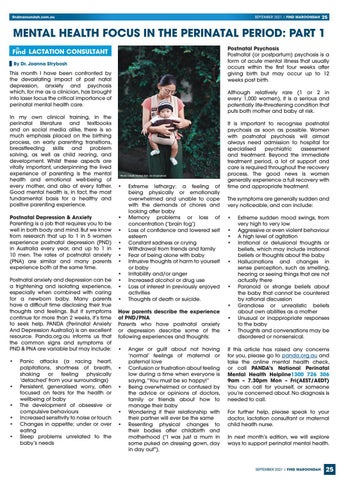
Photo Credit: Motrek Bali, via Unsplashed
•
• • • • • • • • • •
Extreme lethargy: a feeling of being physically or emotionally overwhelmed and unable to cope with the demands of chores and looking after baby Memory problems or loss of concentration (‘brain fog’) Loss of confidence and lowered self esteem Constant sadness or crying Withdrawal from friends and family Fear of being alone with baby Intrusive thoughts of harm to yourself or baby Irritability and/or anger Increased alcohol or drug use Loss of interest in previously enjoyed activities Thoughts of death or suicide.
How parents describe the experience of PND/PNA Parents who have postnatal anxiety or depression describe some of the following experiences and thoughts: • • •
• •
Anger or guilt about not having ‘normal’ feelings of maternal or paternal love Confusion or frustration about feeling low during a time when everyone is saying, “You must be so happy!” Being overwhelmed or confused by the advice or opinions of doctors, family or friends about how to manage their baby Wondering if their relationship with their partner will ever be the same Resenting physical changes to their bodies after childbirth and motherhood (“I was just a mum in some puked on dressing gown, day in day out”).
It is important to recognise postnatal psychosis as soon as possible. Women with postnatal psychosis will almost always need admission to hospital for specialised psychiatric assessment and treatment. Beyond the immediate treatment period, a lot of support and care is required throughout the recovery process. The good news is women generally experience a full recovery with time and appropriate treatment. The symptoms are generally sudden and very noticeable, and can include: • • • • •
• • • •
Extreme sudden mood swings, from very high to very low Aggressive or even violent behaviour A high level of agitation Irrational or delusional thoughts or beliefs, which may include irrational beliefs or thoughts about the baby Hallucinations and changes in sense perception, such as smelling, hearing or seeing things that are not actually there Paranoid or strange beliefs about the baby that cannot be countered by rational discussion Grandiose or unrealistic beliefs about own abilities as a mother Unusual or inappropriate responses to the baby Thoughts and conversations may be disordered or nonsensical.
If this article has raised any concerns for you, please go to panda.org.au and take the online mental health check, or call PANDA’s National Perinatal Mental Health Helpline1300 726 306 9am – 7.30pm Mon – Fri(AEST/AEDT) You can call for yourself, or someone you’re concerned about. No diagnosis is needed to call. For further help, please speak to your doctor, lactation consultant or maternal child health nurse. In next month’s edition, we will explore ways to support perinatal mental health.
SEPTEMBER 2021 | FIND MAROONDAH
25
26
FIND MAROONDAH | SEPTEMBER 2021
findmaroondah.com.au
How many times does the word ‘Culture’ get raised at a sports club? By Peter Horton
Is it time your club looked at its culture? There are several important issues that need to be addressed when reviewing the culture within your club. Have you got the right people around your club? Has your club developed its own brand and formulated a marketing and communication plan? Has your club updated its website in recent times and looked at how it can use social media to promote membership and social activities?
Does your club involve its sponsors in events and invite them to meet with members and discuss their business? It is important that your members fully understand the direction the club is taking including how it plans to grow membership and increase revenue that can be used to improve facilities at the club. Many sports clubs are struggling to retain membership and need to focus on ways to attract new members because without them revenue declines and there are less people to attend events and fewer volunteers prepared to assist around the club.
The Ringwood Bowls Club fully understands the views of its members and values their input and these are important ingredients that the club has addressed in recent times to ensure that its culture is geared to take the club forward. Its mission statement says it all – to give members of the Club reasons to remain loyal and opportunities for them to enjoy their bowling experiences. Take the time to review how your club is going – make sure it has a vision for the future not the past.
findmaroondah.com.au
SEPTEMBER 2021 | FIND MAROONDAH
Four Attractive Doors And Gates Options For Commercial Premises GARAGE DOORS By Chantal Djuric
Your commercial premises need to be super safe, especially during this period of fluctuating lockdown cycles. Here are four attractive door and gate options that you might not have thought of for securing your business workspace and assets. Sliding gates Sliding gates make an open, welcoming appearance to a property such as a car sales yard or gardening retail space.
Here are four benefits that may persuade you to install boom gates at your commercial premises: •
•
• There are several varieties of sliding gates on offer – face-welded radiatorstyle gates, aluminium slates, aluminium garden styles, Colorbond fencing and even laser-cut screens. They all come in a large range of up-to-date colours and sizes. They are typically made using 40 x 40 mm or 50 x 50 mm frames, with a design pattern to be specified. Guideposts are positioned at the back of the gate on either side; one supports the gate when sliding, the other supports the gate when it is closed. Sliding gates operate on an aluminium track with 90 mm wheels insert in the bottom rail. As the gate sits a total of 40 mm above ground, this needs to be factored in when determining the overall height of the gate. Sliding gates should always be installed by a garage door specialist. Boom gates Effective and affordable, boom gates are a popular option in carparks, shopping centres, hospitals and apartment complexes. Also perfect for gated industrial estates, these barriers can offer both privacy and security for business owners.
•
improved security – as they can only be opened with a card or other security device, unwanted vehicles are prevented from entering. Boom gates can also monitor and record vehicle registration details of all who enter and leave. control of traffic flow – where there are limited parking spaces and a lot of vehicles, boom gates allow full control over the amount of vehicles that can be on a property at any one time. cost savings on security – with minimal operating and maintenance costs, boom gates also remove the need for a security guard. saving space – boom gates require significantly less space than swinging and sliding gates and require only a small amount of vertical space to swing upwards.
Though boom gates are easy to install and maintain, we recommend that you call a garage door specialist to do the job. High cycle panel lift door High cycle panel lift doors are built for durability, speed and efficiency. They perform more quickly and reliably than traditional sectional doors, and are therefore especially suitable for transportation, distribution and manufacturing businesses, as they have faster opening and closing speeds.
27
An added bonus is that they are easy to clean and maintain. They also have an increased lifespan by eliminating the need for counterbalance springs. As if all that wasn’t enough, their rapid open-close cycles promote energy efficiency through reduction of heating and cooling. High cycle doors are made with strong components and heavy-duty springs. Most models have a barrel and spring construction; that means there’s a barrel holding the rolling mechanism while the springs ease the tension from the door’s weight. This kind of roll-up door is made from sturdier materials compared to others, so the size of springs used on them is very important. Regular repair and maintenance is essential for high cycle doors. We recommend servicing every three months to keep these doors in prime condition. Mesh panel doors Mesh panel doors have been designed for security and functionality. A strong and rigid aluminium frame surrounds the diamond mesh inserts for a door that is aesthetically pleasing in appearance yet will provide the user with many years of reliable service.
Suitable for use in residential and light commercial premises, an aluminium mesh roller panel door provides both security and ventilation of approximately 60%. They are ideally suited to carparking spaces in and under home units and commercial office buildings where security, reliability and ventilation issues are paramount, adding natural light and airflow to your garage. These doors can be operating at least a hundred times per day, so we highly recommend a routine service is done every three months to keep this door running its best at all times. For 24/7 garage door servicing, give Cruzin Garage Doors a call on 0427 894 603 or email us at sales@ cruzingaragedoors.com.au.
SEPTEMBER 2021 | FIND MAROONDAH
27
28
FIND MAROONDAH | SEPTEMBER 2021
findmaroondah.com.au
Significant Addition To The OHS Act Is Now In Place OCCUPATIONAL HEALTH & SAFETY By Mark Felton
If you are a business owner and employ staff, then you need to be aware of the recently introduced industrial manslaughter laws that have been added to the OHS Act, affecting businesses, including partnerships, corporations, self-employed persons, as well as officers of corporations. The new laws attract the highest penalty in the OHS Act, with maximum fines of approx. $16.5m for employers and jail terms of up to 20 years and fines of up to $1.65m for officers whose actions or omissions: • • •
cause the death of a worker or member of the public; involve a breach of an OHS duty; were negligent.
So what does this mean for and your business? What steps do you need to take to ensure that you are in step with demonstrated actions that will protect you from having a workplace death at your business, and finding yourself facing a prison sentence and/or a massive fine? Do you have an understanding of your obligations under the Act in general?
Initially you will need to review your site and the nature of the tasks carried out within it. You will need to gain an understanding of the elements of the Act relevant to the running of your business. You may need to develop procedures and practices, as well put in place protective measures, including equipment. What systems do you have to record relevant information, and to be able to recall these records? Do you have the right sort of consultative mechanisms to ensure that you develop effective
CORPORATE EVENTS Make more meaningful connections with your clients and team! Visit www.norwoodsportingclub.com.au, call 0467 676 753 or email enquieries@norwoodsportingclub.com.au
measures and comply with the Act? Beaumont Advisory can assist you in clearly identifying where you are currently at, and the measures that need to be developed to keep you and your employees healthy and safe. Please feel free to contact Mark Felton at Beaumont Advisory on 0411 951 372 or mfelton@ beaumontlawyers.com.au . Occupational Health & Safety BEAUMONT LAWYERS www.thebeaumontgroup.com.au
findmaroondah.com.au
SEPTEMBER 2021 | FIND MAROONDAH
One Easy Way To Prevent Elderly Loved Ones Feeling Lonely By Susan Pierotti
The City of Maroondah has great facilities for families and young people setting up home. There are numerous private and public schools, sporting clubs and grounds, libraries, house styles to suit everyone and shopping areas from small and chic to the giant-like Eastland.
One simple way to prevent elderly ones from feeling neglected, ignored or lonely is to take the time to sit and listen to their stories. This isn’t as easy as it sounds. Besides finding the time to do this consistently, this can be tricky as we often don’t have the time or headspace to ask the relevant questions. The elderly person may think, ‘Oh, everyone knows that story so I won’t repeat it’ or think that some facts are so ordinary that they are not worth telling.
Wherever they are, aside from their family members and friends, they are often the ‘silent generation’.
Elder abuse A lot of elderly people are abused. This tends to happen because, like children, they are now vulnerable. The World Health Organization defines elder abuse as ‘a single or repeated act, or lack of appropriate action, occurring within any relationship where there is an expectation of trust, which causes harm or distress to an older person. This type of violence constitutes a violation of human rights and includes physical,
The best way to stop elderly abuse is to make sure that you know what is going on in the lives of your elderly relatives. To make sure they are in a safe environment, and that they are getting regular contact with people who are invested in them, who aren’t just there to hand them a tray of food or check their blood pressure.
How to let them know they are valued
But did you know that Maroondah also has one of the highest numbers of elderly people living within it in the greater area of the city of Melbourne? They may be living in their own home, they may be enjoying the lifestyle of a retirement village or they may be in aged care.
Everyone pretty much knows all of that, but there’s something that happens to a lot of old people that isn’t talked about enough. That’s elder abuse.
There are many more still who are never technically ‘abused’ but who are rudely treated, ignored or just sadly misunderstood.
The elderly people who are most vulnerable to abuse are those who are isolated from their families, who don’t have many people to rely on, who can be easily silenced and brushed aside. That’s why it is so important that we look after our elderly relatives and make sure they are valued.
ACCREDITED EDITOR
Old age is filled with challenges. Our bodies begin to slow down, our mind is often not so sharp, and our strength begins to fade away. We get more wrinkles, our sight and hearing get worse, and often our life becomes slower and less adventurous.
29
sexual, psychological, and emotional abuse; financial and material abuse; abandonment; neglect; and serious loss of dignity and respect.’ WHO has revealed that, worldwide, around 1 in 6 elderly people experience some form of abuse in their lives. One of the saddest things in our society is a lot of the elderly have got nobody in the world, nobody to stand up for them and nobody to be there.
Why not employ a life story professional to complete your loved one’s story? In the telling of their tale to a stranger, the elderly story teller simply comes alive! They feel valued and important, and it is a sure-fire way to prevent them feeling lonely or neglected. Caring about someone’s life and showing them that they are loved is probably the most precious gift we can ever give. Contact Susan at www. creativetext.com.au to discuss recording your elderly loved one’s story.
When we get old, things can get lonely. We can become isolated and vulnerable. Sadly, there have been too many instances where elderly people have found themselves belittled, neglected, mistreated and taken advantage of when they are in a rest home or in some form of assisted care. Even after the 2018 Royal Commission into Aged Care, the 2020 COVID crisis revealed continuing neglect of elderly residents in some aged care facilities.
Susan Pierotti Accredited Editor Creative Text Solutions 0437 127 159 www.creativetext.com.au
SEPTEMBER 2021 | FIND MAROONDAH
29
30
FIND MAROONDAH | SEPTEMBER 2021
findmaroondah.com.au
Stick to national reopening plan: Morrison
By Matt Coughlan
(Australian Associated Press)
Scott Morrison has warned ongoing lockdowns will cause more harm than benefit when coronavirus vaccination coverages reaches 70 per cent.
Queensland Premier Annastacia Palaszczuk argues the initial research was based on having 30 cases in the community.
The prime minister insists high case numbers will not derail a national plan despite some states warning Doherty Institute modelling needs updating.
The Doherty Institute will provide updated advice to national cabinet on Friday.
Under the agreement, lockdowns will be less likely at 70 per cent and become highly targeted at 80 per cent. Mr Morrison said negative economic and mental health impacts would outweigh benefits when 70 and 80 per cent immunisation coverage is reached.
In a statement, the Doherty Institute said opening up at hundreds of cases nationally a day would be possible at 70 per cent vaccination coverage. “However, we will need vigilant public health interventions with higher case loads,” it said.
“That’s the advice, that’s the basis for the plan. We’ve all signed up to it, we need to get on with it,” he told the Seven Network.
The institute said hitting that vaccination rate would make it easier to live with the virus, similar to the flu. “However, it won’t be possible to maintain a situation where there are no cases at all.”
WA Premier Mark McGowan wants new modelling given high levels of virus circulating in NSW which reported 753 new local cases on Tuesday.
Labor leader Anthony Albanese accused the prime minister of pretending the report ruled out lockdowns at 70 per cent coverage.
Victoria is having a hard time getting on top of an outbreak with another 50 new cases, while the ACT had its worst daily rise since the start of the pandemic with 30 new infections.
“Mr Morrison is a barrier to the end of the tunnel, not the light. He’s the gaslight on the hill,” Mr Albanese told Labor MPs and senators in Canberra. He said Mr Morrison desperately wanted
to argue he was pro-freedom while casting everyone else as being against reopening. The prime minister insists the opposition leader is undermining the plan and hoping the government fails for political gain. Mr Morrison remains optimistic the Queensland government won’t keep its border shut with NSW if high case numbers continue. “It doesn’t matter whether it’s 30 cases or 800 cases, the conclusions are the same and that’s what the Doherty Institute said last night,” he told the Nine Network. He dismissed the federal-state bickering as a “bit of noise” with the vaccination targets still months away from being reached. “We can’t stay in the cave and we can get out of it safely.” The Doherty modelling recommends a staged reopening at 70 and 80 per cent with high-quality preventative measures remaining in place. Australia has fully vaccinated 30.27 per cent of its population aged 16 and over and 52.78 have received one jab.
findmaroondah.com.au
SEPTEMBER 2021 | FIND MAROONDAH
31
Finance Options For Small Business MORTGAGE BROKERING By Reece Droscher
One of the most competitive finance sectors for lenders in the current environment is the commercial lending market, particularly finance for small business. Once the domain of the major banks, there has been an influx of new providers in this market offering cheaper products and different solutions to help small business with their finance needs. Trying to work out the most suitable product for a particular finance need can be a difficult task. Here is a list of the most common products available to small business and how they are designed to help. SECURED BUSINESS LOANS These loans are the traditional products offered when a business requires to fund a large expense over a long term. For example the business may be looking to: • • • • • •
Buy a property to occupy. Complete a shop fit-out. Buy another business. Restructure the existing business, ie buy out an existing business partner. Consolidate or restructure existing business debt. Fund a start-up.
Secured loans come with a lower rate and are usually available for amounts between $50k and $10million depending on the lender. Residential or commercial property must be held as security and you may be able to access up to 70% of the security value. This will depend on the type of property offered as security. Generally lenders will offer up to a 15 year term, however there are some products available where a 30 year term may be available. UNSECURED BUSINESS LOANS Loans that can be offered without security are generally available for businesses which have a profitable trading history and have an urgent finance need which can be repaid over a shorter term. Examples of where an unsecured loan may be required would be: •
Immediate cash flow injection with a secure debt repayment source, such as outstanding debtors or sale of an asset.
• • •
Purchase of inventory or equipment. Working Capital. Small fit-out or renovation.
As these loans have a higher risk than secured loans the maximum a lender would consider is more conservative. Generally loans between $20k and $250k would be considered depending on the business performance, but some lenders may offer a higher loan limit if the business has a strong trading history and operates in an industry which is not affected by COVID-19 lockdowns. Loan terms are also usually lower than a secured facility. Maximum terms of 5 years for an unsecured loan are typical, and interest rates are higher in line with the greater risk associated with these types of loans. BUSINESS OVERDRAFTS This product would be the most common type of facility small businesses have utilised. It is a revolving line of credit usually attached to the main operating account of the business and is used as a tool to assist businesses with their cashflow and working capital needs. Overdrafts can be secured or unsecured, depending on the limit the business is requesting, and the cost for the facility would be determined by the security offered. SME RECOVERY LOANS As part of a number of initiatives for small businesses affected by the COVID-19 pandemic the Federal Government announced the implementation of the SME Recovery Loan program. This product is designed to assist businesses who have been unable to trade or had trade significantly reduced due to the pandemic. Loans can be accessed for business purposes only, including: • • • •
Refinancing existing business debt, unless already over 30 days in arrears. Purchase commercial property. Acquisition of another business. Businesses are also able to apply for a repayment deferral where their cash-flow has been affected, meaning they can access the credit but defer repayments for a period up to 24 months.
These loans can be secured (except by residential property) or unsecured. Amounts, loan terms and interest rates will be determined by the level of security offered. Although lenders can determine the interest rate applied the facility is Government Guaranteed by up to 80% of the loan amount, so rates may be lower for this type of loan than other similar options. The maximum accessible is $5million, with a maximum 10 year term offered. These products are just some of the options available. The commercial finance market is extensive and business needs are many and varied. There are even products designed for certain industries, like professional sectors, agriculture and franchises, that we haven’t scratched the surface of yet. That’s why speaking with a finance broker is the best way to find the right product to suit your business needs. At SHL Finance we are helping a number of small businesses improve their cashflow by reviewing their finance needs and accessing products that are more suitable for their requirements. Please give me a call on 0478 021 757. I would love the opportunity to help your small business in any way possible.
Reece Droscher MORTGAGE BROKER www.shlfinance.com.au
SEPTEMBER 2021 | FIND MAROONDAH
31
32
FIND MAROONDAH | SEPTEMBER 2021
findmaroondah.com.au
7 Signage Tips Business SIGNAGES By Glenn Martin
I have been in the print and signage industry for over 20 years and I have seen a lot of designs that really work and unfortunately, a lot that don’t. Below are some quick thoughts that may help those thinking about how to promote their business off-line. Bottom line, know what you want before you go in, and you will be much happier with the results when you walk out. So, here’s my signage tips for any business: #1 Why do you need to get your message out there? This will be the foundation for your sign plan and should be taken into consideration when you ask the other questions. Are you trying to improve your Brand awareness? Do you have a sale or special on? Do you need to tell people where you are or when you’re open? Does your audience need to know about your products or service? #2 Who is your target Audience for your message? This will influence the style of your design, the size, the colours and the information on it. Is your audience walking past your shop looking for a deal, or do you want to catch the eyes of vehicles driving past at a distance, or is your message going to be on a moving vehicle? Knowing who you are marketing to is the first step in successful signage design. #3 What is the key message for each sign? We have far more time to take in the message of a fixed sign on the side of a building, or on a window, than on a moving object. Keep your message appropriate for its location. Your audience need to know in a very short space of time what you are trying to say, so keep the message short, and the font large, not the other way around. Are you trying to promote your products, or your business?
#4 Where are you going to place your signs? Do you have permission? Check with your landlord, building owner or body corporate before placing any new signs. If you have taken over a new lease, there is no guarantee you have the right to the existing sign in a common area. Check the legal requirements with your local council regarding signs as they can vary from a residential zone to retail and industrial location. You may need to obtain a permit? Keep in mind you are responsible for the permit if the council catch you out and not your sign supplier. #5 What is your budget for signage? The old saying you get what you pay for counts in signs just like many other areas in life. Get a good idea on what your budget is and what you hope to see for your finical input. Your budget will dictate not just the size but the quality, location and materials. A solid message on the right sign in the right location should cover its costs quickly. #6 Branding. Branding is one of the most important pieces of the marketing model. It helps your suppliers and customers tie your whole storey together. Make sure when you are putting your message out there that your logos, message, fonts, images
etc reflect your Branding. People see the logo/colour schemes well before they see the many bullet points on what you do. #7 Research. Next time you are driving in the car look around at the various signs and take a mental note on what caught your eye and why. Try and read the A-Frames as you are driving by or the message on the back or sides of the car, did you get all the information on the Banner in front of the local school or church? Look for your competitors, what are they doing, do you think it is working for them? If a sign catches your eye stop and ask the owner how it works for them. Most people are more than happy to tell you their story. Have a signage project in mind? If you already have a design, simply send us the files and we will be in touch to start the process, including a free consultation and site audit to help your business stand out from the crowd. If you’re unsure of exactly what you want to say, or how you’d like it to look, that’s okay too, just contact the team on 1300 633 902 and together we’ll create the perfect signs for your business and to ensure you get current promotions, follow us on Instagram @Signarama_Mitcham.
findmaroondah.com.au
SEPTEMBER 2021 | FIND MAROONDAH
33
Best Coffee Dessert Recipes Easy no-bake desserts So many coffee desserts need only a few ingredients and are easy to make. For instance, who doesn’t love chocolate mousse?
COMMERCIAL COFFEE MACHINE By Ivana Smith
There’s something so evocative about the smell of freshly baked cakes or muffins. That warm, enticing aroma, the promise of sweet delights, of comfort – yum, yum! And what about an exotic dessert to end a gourmet dinner party?
Now imagine it infused with coffee for that ‘wow’ factor! For a stunning dinner party closer, try whisking cold coffee and marshmallows together before folding in whipped cream. You can make this before the guest arrive, keep it in the fridge and triumphantly escort it to the dining table, on the principle of keeping the best till last.
If you are looking for that special something to give an extra zing to your well loved classic recipes, why not try adding a dash of coffee to your usual repertoire of cakes, biscuits, slices and desserts. Coffee and chocolate – a match made in heaven Chocolate is nearly everyone’s favourite flavour but if you want a more sensual experience, try adding a little coffee for extra richness. Though coffee is originally from Ethiopia and chocolate from South America, coffee and chocolate together are a divine combination. They are both seeds of tropical plants, both are fermented and dried and both need some level of roasting. Probably the characteristic they have most in common are their bittersweet overtones (which is why they’re often combined with milk to reduce their inherent bitter aftertaste.) The easiest way to amplify the chocolate velvetiness of cakes, muffins, cupcakes and slices is to add a teaspoon of instant coffee granules or espresso powder to your batter or dough when you assemble your other dry ingredients. And for recipes such as cake mixes that require hot water, replace the water with strongly brewed coffee. So, if you’re in the habit of making brownies, chocolate cakes or muffins, spice them up by adding some coffee. There are so many mocha recipes around, and you’ll be a winner baking any one of them. Coffee goes with this...and that... Coffee is so versatile in that it blends with so many other flavours besides chocolate. For those who love the creamy, smooth texture of caramel but are seeking a flavour with more tang, coffee is your answer. Give your chocolate caramel slice extra tang by adding coffee to the caramel mixture.
Cold coffee smoothly. A become an of espresso granules.
granules melt quickly and no-bake cheesecake can exotic treat with a spoonful powder or instant coffee
Let’s not forget coffee slices, coffee fudge, coffee parfaits, coffee kisses, coffee macaroons, coffee ice cream – the list is only as limited as your imagination. The great news that coffee, while bursting with flavour, adds not one single calorie to your favourite desserts! In fact, any dessert that has a milk base can partner happily with coffee. Coffee and custard combine well together as do coffee and cream. Whisk strongly brewed espresso coffee to milk and cream when making baked custard, a Tuscan delight known as café in forchetta (coffee on a fork). The fabulous Italian dessert, tiramisu, is nothing without a strong dose of espresso. The name ‘tiramisu’ (tira mi su) literally means ‘pick me up’, which is what the coffee does when combined with the sweet biscuits, mascarpone and cream of a dessert that Australians have adopted as their own. Ironically, the original ‘coffee cake’ had no coffee in it at all. It was called ‘coffee cake’ because it was baked (by the Austrians) to be eaten with a cup of coffee. It is a teacake topped with a fair amount of streusel – a crumbly topping made from flour, butter and sugar – whose crunchy texture complements the delicate taste of the cake. Its main flavouring is often not coffee but cinnamon, another great complementary flavour that aligns well with coffee.
With just a small dash of coffee, you can enhance ordinary cakes and desserts with a taste of the exotic. You, too, can become the master chef in neighbourhood – and no one need know your secret success ingredient! For advice on coffee and how to supply it to office spaces, workplaces and clubs, contact Ivana at ivana.smith@ xpressodelight.com.au.
Ivana Smith Commercial Coffee Machine Xpresso Delight 0418 393 085 www.xdcoffee.com.au
SEPTEMBER 2021 | FIND MAROONDAH
33
34
FIND MAROONDAH | SEPTEMBER 2021
findmaroondah.com.au
Are you with one of Australia's worst 13 funds? You might need to consider changing super funds? FINANCIAL PLANNING By Warren Strybosch
The results our out and the 13 worst super funds are currently sending letters out to their clients explaining why they underperformed and to try and convince them to stay with them. The 13 funds that did not do very well and failed to meet the objective benchmarks set up by APRA are: • • • • • • •
• • • • • •
AMG Super — AMG MySuper ASGARD Independence Plan Division Two — ASGARD Employee MySuper Australian Catholic Superannuation and Retirement Fund — LifetimeOne AvSuper Fund — AvSuper Growth (MySuper) BOC Gases Superannuation Fund — BOC MySuper Christian Super — My Ethical Super Colonial First State FirstChoice Superannuation Trust — Colonial First State FirstChoice Superannuation Trust Commonwealth Bank Group Super — Accumulate Plus Balanced Energy Industries Superannuation Scheme-Pool A — Balanced (MySuper) Labour Union Co-Operative Retirement Fund — MySuper Balanced Maritime Super — MySuper Investment Option Retirement Wrap — BT Super MySuper The Victorian Independent Schools Superannuation Fund — VISSF Balanced Option (MySuper Product)
The Australian Prudential Regulation Authority (APRA) assessed 76 MySuper products based on a comparison of fees versus performance over seven years. While 84 per cent of the funds passed, the 13 funds that failed collectively hold $56 billion of Aussies’ investments. In fairness to these funds, it is not clear what tests APRA is using to assess the performance of these funds as some have done well over a 5 year and 10-year period. The Association of Superannuation Funds of Australia (ASFA) urged consumers to exercise caution in
how they interpret the report’s results and think carefully before making important decisions about their superannuation – not to simply base a decision on whether or not the super fund has has fallen one basis point below an arbitrary cut-off point in the performance test. While ASFA has long supported the removal of habitually underperforming products, according to ASFA CEO Dr Martin Fahy, some of those called out by this test are in fact good products. “Among these so-called‘underperformers’ we have products which have doubled people’s investments over the past decade,” he said. “The irony is that the financial performance of these so-called ‘underperforming’ products would be in the top quartile in many OECD countries,” he said. Of the total 76 MySuper superfund products, available to consumers, 84 per cent of products passed the performance test, however APRA remains concerned about those members in products that failed,” APRA executive board member Margaret Cole said. “APRA has intensified its supervision of trustees with products that failed the test and has requested they provide a report identifying the causes of their underperformance and how they plan to address them,” Ms Cole said. In a separate statement, Treasurer Josh Frydenberg revealed that $56.2 billion is invested in the underperforming products, with these products holding almost 1.1 million accounts.
on capital. At Find Wealth they, under their management and in conjunction with using one of Australia’s top performing super funds, are able to get fees as low as 0.25% per annum. If you would like to receive a Free Super Report then simply email Find Wealth at warren@findwealth.com.au and request your Free Super Report. If you are unsure as to how you’re tracking now or leading up to retirement, or are considering retiring in the next few years, then speak to an advisor at Find Retirement (www.findretirement.com.au). They will help you plan the next stage of your life and provide greater certainty for you and your family. This information is current as at September 2021. This article is intended to provide general information only and has been prepared without taking into account any particular person’s objectives, financial situation or needs (‘circumstances’). Before acting on such information, you should consider its appropriateness, taking into account your circumstances and obtain your own independent financial, legal or tax advice. You should read the relevant Product Disclosure Statement (PDS) before making any decision about a product. While all care has been taken to ensure the information is accurate and reliable, to the maximum extent the law permits, Clearview and its related bodies corporate, or each of their directors, officers, employees, contractors or agents, will not assume liability to any person for any error or omission in this material however caused, nor be responsible for any loss or damage suffered, sustained or incurred by any person who either does, or omits to do, anything in reliance on the information contained herein.
From next year, the annual performance test will also be expanded to a wider range of superannuation products, providing more members with the assurance that their product is being held to the highest standards of accountability. If you are a member of one of the above-mentioned funds and would like to review your superannuation, then consider obtaining a Free Super Report from Find Wealth (www.findwealth.com. au). The Free Super Report compares what fees you are currently paying to that of your current super fund. A saving of fees equals an additional real return
Warren Strybosch You can call them on 1300 88 38 30 or email info@findretirement.com.au www.findretirement.com.au
findmaroondah.com.au
SEPTEMBER 2021 | FIND MAROONDAH
SEPTEMBER 2021 | FIND MAROONDAH
35
35
36
FIND MAROONDAH | SEPTEMBER 2021
findmaroondah.com.au
Joe Biden Praises Mateship With Australia
By Matt Coughlan
(Australian Associated Press)
Joe Biden has pledged to maintain an unsurpassed partnership with Australia as the two nations strive for a free and open Indo-Pacific region. The United States president marked the 70th anniversary of the ANZUS treaty with a video message singing the alliance’s praises. He said the enduring partnership had been about strengthening the fabric of peace. “That partnership is as essential today as it ever has been in securing the safety and prosperity of both our countries,” Mr Biden said. “On this anniversary, we reaffirm our commitment to our shared values, democratic norms, global security and the prosperity for the next 70 years and beyond.” The president said Australians and Americans had built “unsurpassed partnership and an easy mateship”. He noted ANZUS was invoked for the first and only time after the September 11 terror attacks. “Our Australian friends stood with us in that darkest hour just as our two nations stood shoulder to shoulder in every major conflict since World War One.”
Prime Minister Scott Morrison declared the two nations supported a world that favoured freedom. “Our alliance and America’s deep engagement in our region is essential as we look to rebuild from the pandemic and shape a free and open Indo-Pacific that is stable, secure and prosperous,” he said. Opposition Leader Anthony Albanese used the anniversary to pledge the first major review of where Australia’s soldiers are stationed since 2012. “With the US again engaged in a Global Force Posture Review, it is time for Australia too to have a closer look at our own posture to ensure that it fully meets the times,” he told parliament. The force posture review would ensure the government is looking at long-term strategy as well as short-term needs with the Indo-Pacific a key focus. It would also respond to the emergence of cyber security as a central challenge to Australia’s strategic positioning over the coming decade.
and refresh our commitment to one another.” China’s increasingly assertive stance in the region shapes as a critical for Australia and the US. The prime minister said the alliance spanned security, defence, intelligence, new technology, boosting supply chains, supplying vaccines in the Pacific and tackling climate change. Mr Albanese called for an immediate boost to climate change co-operation with the US. Australia is increasingly isolated over climate action globally. “While so much of the region’s immediate focus is the response to COVID, its more profound concern is climate change,” Mr Albanese said. The prime minister, Defence Minister Peter Dutton and America’s charge d’affaires Michael Goldman laid a wreath in Canberra to mark the anniversary on Wednesday.
Mr Morrison said Australia was confronting the most challenging strategic environment for decades.
Coronavirus scuppered plans for the event to be marked with a face-to-face meeting between Mr Morrison and Mr Biden.
“Our alliance will stand resilient in the face of these challenges as we nurture
The prime minister is expected to speak with the president this week.
findmaroondah.com.au
SEPTEMBER 2021 | FIND MAROONDAH
37
No Power Reliability Gaps To 2025: Report By Paul Osborne
(Australian Associated Press)
Enough new power generation and storage is in place to ensure sufficient electricity for most of Australia over the next five years, a new report says. The early closure of some coal-fired power plants is expected to create some pressures in NSW and Victoria post-2025. But Australian Energy Market Operator CEO Daniel Westerman says there are “well-progressed generation, storage and transmission projects, which, once operational, will maintain reliability as coal plants start to close earlier”. A new report by AEMO released on Tuesday found that by 2025 there would be periods when all customer demand across the national electricity market could be met by renewable generation. The annual reliability outlook, known as the Electricity Statement of Opportunities, said the transition to cleaner energy was being driven by residential solar installation, grid-scale wind and solar projects and thermal generation retirements. “No reliability gaps are forecast for the next five years, primarily due to more than 4.4 gigawatts of new generation and storage capacity, as well as transmission investment and reduced peak demand forecasts,” Mr Westerman said. “Significant renewable energy investments, and well-progressed dispatchable generation projects, including gas plants, pumped hydro and battery storage, will all help replace retiring coal and gas plant.”
As well, investment in new and upgraded transmission infrastructure, including Project EnergyConnect linking South Australia and NSW, will reduce consumer costs while improving the resilience and security of the system. AEMO also forecasts a further 8.9GW of commercial and residential solar power to be installed by 2025 across Queensland, NSW, Victoria, SA and the ACT. These solar systems alone could supply up to 77 per cent of total electricity demand at times by 2026.
As a result, minimum operational demand across Queensland, NSW, Victoria, SA and the ACT is expected to drop to a record low of 4GW to 6GW by 2025, down from 15GW in 2019. AEMO said this underscored the need to improve the security of the system by developing grids capable of running at up to 100 per cent instantaneous renewables by 2025. Demand for electricity was expected to lift as more electric cars hit Australia’s roads.
Support Local, Buy Local, Discover Maroondah Do you have photos from a local event or a great story you would like to share?
SEND US YOUR NEWS!
editor@findmaroondah.com.au
SEPTEMBER 2021 | FIND MAROONDAH
37
2021 TA Reporting Victoria COVID-19 business grants and assistance On 21 July, the Victorian Government announced new cash grants for certain businesses impacted by the July 2021 lockdown restrictions. Many of these payments will be made automatically to businesses and sole traders that received grants under established COVID-19 support programs. Newly eligible businesses are also invited to apply. Other industry-specific support packages were also rolled out across 2020-21. Eligible businesses include those most highly impacted by drops in turnover from extended COVID-19 restrictions, such as the alpine regions or Melbourne CBD, hospitality or event industry operators. Previously, rent relief
Announced: 9-Apr-2020
was available for businesses renting government premises, and evictions for non-payment of commercial
Updated: 21-Jul-2021
tenancies were banned for 6 months. Most of the grants assisted with unavoidable business expenses that are not support by other government funding. The majority of these payments should be included as assessable income in the 2020-21 tax return under Label Q: Assessable Government Industry Payments. Certain payments will be non-assessable, non-exempt (NANE) income for tax purposes for certain businesses and do not need to be included in the eligible business’s tax return.
SA COVID-19 stimulus package Throughout the COVID-19 pandemic, the South Australian Government has implemented a range of stimulus packages for residents and businesses. Predominately, the measures to date have revolved around support for businesses with payroll tax and land tax relief. Smaller employing businesses have been given a waiver of payroll tax from March 2020 to May 2021. Depending on when the liability accrued, a larger businesses has been able to either defer their SA payroll tax liability or get a waiver. Also, wages that were reimbursed by JobKeeper payments have been exempt from payroll tax calculations. From November 2020, an exemption of payroll tax will also apply when an SA business hires a new apprentice or trainee for their first 12 months. Land tax deferrals were available to landlords during the 2020 land tax year. Also, landlords
Announced: 26-Mar-2020
who provided rent relief, or commercial property owner-occupiers who were eligible for JobKeeper, were
Updated: 22-Jul-2021
eligible for reduction in land tax liabilities up to 30 April 2021. In response to the July 2021 South Australian lockdown: •
businesses with a reduction in turnover are eligible for a $3,000 emergency cash grant, and
•
individuals outside the federal government’s declared hotspot areas who lose work hours will be entitled to the COVID-19 Disaster Payment.
JobSaver grant for 2021 greater Sydney lockdown An economic stimulus payment is due to be made for businesses under $50 million in annual turnover amidst the June-July 2021 greater Sydney COVID lockdown. The new business support payment will be available for businesses who can demonstrate a 30 per cent decline in turnover. It is understood that the support payment will be made through the ATO running balance account. An eligible entity, including not-for-profit entities, will receive payments of between $1,500 and $100,000 per week based on the level of their payroll. Non-employing sole traders will receive $1,000 per week. To receive the payment, an eligible
Announced: 13-Jul-2021 Updated: 29-Jul-2021
entity will be required to maintain their number of employees held as at 13 July 2021. These temporary cash flow boosts are available where a business has been locked down by public health order for at least three weeks. The business is required to be based inside a Commonwealth Government declared hotspot.
SMSF exempt current pension income changes proposed Self-managed superannuation funds may have simplified reporting options for their income tax calculation from 1 July 2021 subject to the passing of legislation. The 2019 federal budget announcement intends to allow SMSFs to choose a preferred method of calculating the exempt current pension income (ECPI).There are
Announcement(12-Jun-2019) Consultation(18-Jun-2021)
two current methods an SMSF may calculate the ECPI, being either the segregated assets or proportionate
Introduced
method. However, higher compliance costs occur in some circumstances where an SMSF must use both
Passed
the proportionate method and the segregated assets method in the same year. The proposed measures
Royal Assent
also remove a requirement for an SMSF to get an actuarial certificate where all members are in retirement phase.
Date of effect
AX UPDATES COVID-19 Disaster Payment increased for extended lockdown Changes to the support payment for individuals who are unable to work during a COVID-19 lockdown were announced by the federal government on 13 July 2021. The COVID-19 Disaster Payment was initially a payment of $325-500 a week for people who reside or work in a Commonwealth declared hotspot, depending on the hours of work a week lost by a person. The enhanced support sees the payment rate increase to $375-600 for eligible periods due to a Commonwealth declared hotspot. Announced: 3-Jun-2021
The announcement also extends the availability of the payment to: •
impacted individuals who are still working at reduced hours, and
•
individuals outside Commonwealth declared hotspots in NSW,
Updated: 2-Aug-2021
provided they meet the updated criteria for the payment. Like other support payments, it will be available through Services Australia. Further details on the payment and key eligibility dates can be accessed on the Services Australia website.
Active asset test passed for “vacant” land used as storage Appeals note: The decision in the Administrative Appeals Tribunal was in favour of the taxpayer, allowing the use of the small business CGT concessions. The event was subsequently updated in January 2020 when the original decision was overturned by the Federal Court. In September 2020, the Full Federal Court then overturned the single judge decision, meaning the taxpayer once again may use the small business CGT concessions. The Full Federal Court advised that small business relief should be applied beneficially rather than restrictively for a taxpayer. The Commissioner of Taxation has not appealed to the High Court of Australia. The ATO issued a decision impact statement on 29 July 2021 where it will continue to review the impact of the decision on its advice and related products. Current decision in case: Land adjacent to taxpayer’s main residence was used in the taxpayer’s small business, and therefore passes the active asset test. Editor’s note: The overview below and client impact statement were originally preserved as written for the January 2020 update. This allowed users to have full visibility of the arguments and opportunities which were subsequently
Announced: 21-Feb-2019
overturned. In this instance, the overview and client impact statement have been amended to take into
Updated: 4-Aug-2021
consideration various issues identified by the Full Federal Court, and how they may apply to future private binding ruling applications for your clients.Residential land has been determined to be an active asset as it stored materials and tools for a taxpayer’s business. The ruling from the Full Federal Court is in line with an earlier decision by the Administrative Appeals Tribunal, and has overturned the decision from a single judge appeal. This case is one of many which straddles the fence on whether unimproved land qualifies for as an active asset. In this case, the Full Federal Court concluded that the small business CGT concessions should be looked at beneficially for taxpayers, as is intended from the original legislation. The outcome of this case relies on the interpretation of “used in the course of carrying on a business” which is necessary for determining an active asset. The Full Federal Court has interpreted that this sentence does not use or imply restrictive language such as “ordinary course of a business” or “day to day running of a business”.
SMSF exempt current pension income changes proposed The principles of car parking fringe benefits and commercial parking stations have been confirmed by the ATO via public ruling. The ruling, which has now been finalised after a long consultation process, replaces a now withdrawn tax ruling from 1996. The ruling details the concept of a commercial parking facility, which is necessary for businesses with over $10 million turnover that provide car parking for free to staff. Specifically,
Announcement(22-Nov-2019)
a major change in the ATO’s interpretation of a commercial parking station exists where a shopping centre
Consultation period
car park comes within its definition. As there is a major change in interpretation, the ATO has advised that
Released(13-Nov-2019)
the new ruling will not apply to car parking benefits until 1 April 2022. Note: When the new rule comes into effect for shopping centres, the small business turnover threshold for car parking benefits will have increased from $10 million to $50 million.
See More
SEPTEMBER 2021 | FIND MAROONDAH
39
SEPTEMBER REALESTATE 2021
REALESTATE FIND AUSTRALIA’S #1 PLACE FOR PROPERTY
HOUSE OF THE MONTH
PROPERTIES FOR SALE 132345 Feature Address Place Here A Short Description for this Property.
Offered at $000,000
O C
N I M
O S G
N O
ADVERTISE YOUR PROPERTIES HERE Email your Properties For Sale in the Find Maroondah and we will place it in the online community paper. Contact Warren for all of your advertising needs.
Warren Strybosch 1300 88 38 30
editor@findmaroondah.com.au
SEPTEMBER 2021 | FIND MAROONDAH
41
42
FIND MAROONDAH | SEPTEMBER 2021
findmaroondah.com.au
Free RENTAL LISTING Advertising for Real Estate Agents
Email your Rental Listings to Find Maroondah each week and we will update your Listing in the online community paper for FREE.
If you have questions, contact Warren on 1300 88 38 30 or email: editor@findmaroondah.com.au
NEW RENTAL LISTING HOSKINS 142 Maroondah Highway Croydon VIC 3136
03 9722 9755 croydon@hoskins.com.au www.hoskins.com.au
$520 Per Week
$650 Per Week
Available now
Available now
5 Kallay Street Croydon VIC 3136
21 Raymond Street Blackburn North VIC 3130 5
2
6
MORE DETAILS
$430 Per Week
1
4
MORE DETAILS
$600 Per Week
Available now
Available now
214 Yarra Road Croydon North VIC 3136 2
2
2
MORE DETAILS
$470 Per Week
14 Kalimna Crescent Doncaster VIC 3108 4
2
2
MORE DETAILS
$550 Per Week
Available now
Available now
2/3-5 Camplin Rise Lilydale VIC 3140
3
3
2
2
MORE DETAILS
103 Winyard Drive Mooroolbark VIC 3138 4
2
2
MORE DETAILS
SEPTEMBER 2021 | FIND MAROONDAH
43
NEW RENTAL LISTING HOSKINS 142 Maroondah Highway Croydon VIC 3136
03 9722 9755 croydon@hoskins.com.au www.hoskins.com.au
$400 Per Week
$400 Per Week
Available now
Available now
324/33 Judd Street Richmond VIC 3121
1
1
1
MORE DETAILS
$850 Per Week
2
1
1
MORE DETAILS
$500 Per Week
Available now
Available now
1 Loughies Track Ringwood North VIC 3134 5
3/10 Wildwood Grove Ringwood VIC 3134
3
2
MORE DETAILS
41 Adolphson Avenue Ringwood North VIC 3134 3
1
4
MORE DETAILS
Looking to market your
Warren Strybosch
Building Company in
1300 88 38 30
Contact Warren for all of your advertising needs.
editor@findmaroondah.com.au
NEW RENTAL LISTING SURREAL PROPERTY GROUP P.O Box 2079, Bayswater 3153
03 9723 5288 info@surrealpg.com.au www.surrealpropertygroup.com.au
$600 Per Week
$380 Per Week
Avail Now
Avail Now
49B Albert Avenue BORONIA VIC 3155 4
2
2
MORE DETAILS
2/4 Dianne Street Bayswater VIC 3153 2
$3850 Per Week
$380 Per Week
Avail Now
Avail Now
1/23 Elmhurst Road BAYSWATER NORTH VIC 3153 2
1
1
MORE DETAILS
3
$390 Per Week
Avail Now
Avail Now
2
1
2
MORE DETAILS
1
MORE DETAILS
9 Margaret Avenue BAYSWATER VIC 3153
$370 Per Week
2/65 Bedford Road RINGWOOD EAST VIC 3135
1
2
0
MORE DETAILS
43B Lancaster Road MOOROOLBARK VIC 3138 3
1
1
MORE DETAILS
SEPTEMBER 2021 | FIND MAROONDAH
45
NEW RENTAL LISTING SURREAL PROPERTY GROUP P.O Box 2079, Bayswater 3153
03 9729 5288 info@surrealpg.com.au www.surrealpropertygroup.com.au
$395 Per Week
$400 Per Week
Avail Now
Avail Now
12/4 The Avenue WINDSOR VIC 3181 1
1
1
MORE DETAILS
1 Yering Court BAYSWATER VIC 3153 3
1
1
MORE DETAILS
$390 Per Week
Avail Now
7/21 King Street, BAYSWATER VIC 3153 2
1
1
MORE DETAILS
Looking to market your
Warren Strybosch
Building Company in
1300 88 38 30
Contact Warren for all of your advertising needs.
editor@findmaroondah.com.au
NEW RENTAL LISTING FLETCHERS MAROONDAH RAY WHITE CROYDON VICTORIA 1 Seymour Street Ringwood VIC 3134
71 Main Street Croydon VIC 3136 03 9955 4988 9725 744 maroondah@fletchers.com.au croydon.vic@raywhite.com www.fletchers.net.au
$650 Per Week
$380 Per Week
Available 15/07
Avail Now
6A Through Road Ringwood North VIC 3134
54/13-15 Hewish Road Croydon VIC 3136
3
2
2
MORE DETAILS
$430 Per Week
1
MORE DETAILS
Available 30th June 2021
504/233 Maroondah Highway Ringwood VIC 3134 2
1
MORE DETAILS
$475 Per Week
94 Princes Street Carlton North VIC 3054 2
1
0
MORE DETAILS
$550 Per Week
Avail Now
Available 4th August 2021
1/235 Burwood Highway Burwood East VIC 3151 3
1
$630 Per Week
Avail Now
2
2
2
2
MORE DETAILS
6 Hilldale Close Ringwood North VIC 3134 4
2
2
MORE DETAILS
SEPTEMBER 2021 | FIND MAROONDAH
47
NEW RENTAL LISTING FLETCHERS MAROONDAH 1 Seymour Street Ringwood VIC 3134
03 9955 4988 maroondah@fletchers.com.au www.fletchers.net.au
$460 Per Week
Available 26th July 2021
11 Keats Road Mooroolbark VIC 3138 3
2
2
MORE DETAILS
FREE OPEN INSPECTIONS IN THE REAL ESTATE Email your Open Inspections to the Find Maroondah each week and we will update your Open Inspections in the online community paper for FREE Contact Warren for all of your advertising needs.
Looking to market your Building Company in Contact Warren for all of your advertising needs.
Warren Strybosch 1300 88 38 30 editor@findmaroondah.com.au
NEW RENTAL LISTING FREE OPEN INSPECTIONS ADVERTISING
E L
RAY WHITE CROYDON VICTORIA
P M
71 Main Street Croydon VIC 3136 9725 744
croydon.vic@raywhite.com
www.raywhitecroydon.com.au
A S
SAMPLE SAMPLE SAMPLE OFFERED AT
$ 2,000,000
• 4 • 2 • 3 • 1
Modern Bedrooms Living Room Bathroom Kitchen
Email your Open Inspections to the Find Maroondah each week and we will update your Open Inspections in the online
Jessica Elaine Exclusive Broker 1300 88 38 30 email@addresshere.com.au www.company.com.au
community paper for FREE. Contact Warren for all of your advertising needs.
Warren Strybosch 1300 88 38 30 editor@findmaroondah.com.au
SEPTEMBER 2021 | FIND MAROONDAH
49
Maroondah C
REALESTATE
Heathmont Activity Centre Carpark: Have Your Say Consultation Now Open We are seeking feedback on the concept designs for the Heathmont Activity Centre carpark. This project will achieve some important outcomes for local residents, businesses and commuters. We are also asking for your feedback on the proposed landscape improvements for the adjoining FJC Rogers Reserve. To view the plans and for further information, please visit our Your Say Maroondah engagement portal. Consultation closes Sunday 19 September.
We want your feedback on our draft Complaints Policy We are inviting feedback from the community on our draft Maroondah City Council Complaints Policy 2021. We take complaints seriously and your feedback on the draft Policy is important.
Have Your Say
Council News SEPTEMBER 2021
Good food, good mood with Joel Feren Tuesday 14 September | Online | 7.30pm to 8.30pm An exciting and insightful event awaits with this online event with The Nutrition Guy, also known as Joel Feren. His presentation focuses on the importance of good nutrition and good mental wellbeing. The 40-minute presentation will be followed by 15 minutes of question and answer time.
Find out more
So, how good is our 'hood? Here's what you told us The results are in for the 2021 Australian Liveability Census. Our cafes, local business and accessibility to our many open public spaces are what the community told us they love most about living in Maroondah. Find out the full results and how they will help to inform our future decision making.
Read More
Free Activity Packs supporting families An Eastern Regional Libraries program is proving a success for parents, while also helping to maintain literacy in students who are learning from home. Staff at Croydon and Ringwood Libraries have been exceptionally busy preparing Activity Packs for children, which are designed to be both educational and fun.
Read More
SEPTEMBER 2021 | FIND MAROONDAH
51
52
FIND MAROONDAH | SEPTEMBER 2021
findmaroondah.com.au
Put Forward Your Ideas For A Sustainable Future Council recognises that a sustainable natural environment is essential for our community’s future health and wellbeing.
challenges we face; including climate change, population growth, infrastructure development and social equity.
To ensure we are working with our community towards a shared vision of a clean, green and sustainable future, Council is reviewing one of its important planning documents, the Maroondah Sustainability Strategy. The Strategy provides a framework to guide Council’s decision-making and plays a key role in delivering on sustainability outcomes identified in Maroondah 2040: Our future together.
Council has developed an Issues and Options paper and we are seeking your feedback. Your input will inform the development of the new Maroondah Sustainability Strategy 2021 to 2030.
We know that environmental sustainability is important to our community. That’s why we want your help in undertaking this review. Council is keen to build on the success of the past strategy 2016 to 2020 and find long-term solutions to the many
Maroondah Mayor, Councillor Kylie Spears, encouraged the community to put forward their views and contribute to this document. “Maroondah is known for its leafy green streets, its wide-open spaces and beautiful reserves. When people talk about Maroondah, they talk about its beautiful landscapes and the green backdrops weaved into an urban setting,” Cr Spears said. “Council acknowledges
the role we play in maintaining these highly valued natural areas. At its core, this Strategy respects the value our community places on sustainability and will provide clear guidance to support our decision-making for years to come.” Once the feedback is collected, a draft Strategy will be prepared and released for comment later this year. This Strategy will also play a role in delivering on sustainability outcomes identified in Maroondah 2040: Our future together. Combined, these documents will provide a strong foundation to deliver a more liveable and sustainable environment for the future of Maroondah. To have your say, visit the Your Say Maroondah Website.
Capital works an investment in liveability Maroondah has had a record year of capital works projects during 2020/21, despite the ongoing challenges of the pandemic.
Read More
findmaroondah.com.au
SEPTEMBER 2021 | FIND MAROONDAH
53
Let’s ‘Wheel Out’ The Praise For Volunteers National Meals on Wheels Day on 25 August is our opportunity to recognise the commitment and resilience of our volunteers. Maroondah’s dedicated team delivers on average 850 meals per week to support the health and wellbeing of some of our most vulnerable community members. The essential service they provide is available for those who may be nutritionally at risk, experiencing difficulty preparing meals, or living with an illness or disability. Meals on Wheels also plays an important role in early intervention, as well as allowing older Australians to live longer in their homes. Long-time volunteer Kevin Southey said he is proud to give back to his community. “I’ve now been volunteering for 12 years and I’ll do it for as long as I can. After I retired, I was encouraged to get out in the community and stay active, so volunteering has become a big part of my life,” Mr Southey said. “I enjoy the interaction with the community members and it feels good to brighten up their day. Sometimes you’re the only face they might see for the day. “Maroondah does such a great job in cooking and delivering all these meals every week. Meals on Wheels means the world to so many. If you’ve thought about volunteering before, I would encourage you to find out more.” Maroondah Mayor, Councillor Kylie Spears, said we must pay tribute to our volunteers.
“We are so thankful for our volunteers. Even in the face of the pandemic and changing restrictions, they continue to dig deep and deliver this service that has such a benefit on so many people’s lives,” Cr Spears said.
kitchen staff prepare to a high standard. Choices of four main meals are available daily, as well as soup and dessert.
“On behalf of our community and Council, we are incredibly grateful for the generosity of our volunteers, which ensures older Australians remain wellnourished and able to live safely in their homes.”
For information on how to access services, visit the My Aged Care website, or call 1800 200 422. If you have any further questions, you can call Council’s Aged and Disability Services team on 9298 4540 or email maroondah@ maroondah.vic.gov.au.
A significant benefit of delivered meals is face-to-face contact with the volunteers, when restrictions allow, who become an important point of contact and reduce social isolation. What services are available? Typically, people choose between one to seven meals weekly, which our Karralyka
I’m interested, where can I find out more?
How can I help others? There is always a need for some ‘wheels’ for our Delivered Meals program. To enquire about becoming a volunteer, call Council’s Aged and Disability Services team on 9294 5729 or email maroondah@maroondah.vic.gov.au.
Council Facility And Services Update Many Council facilities remain closed. For full updates, please visit our website. Services that are continuing are: •
School crossing supervisors
We encourage our community to use our extensive range of online services for information and
•
Maternal and Child Health appointments
payments, or phone us on 1300 88 22 33 for all their Council needs.
•
Immunisation sessions
•
Occasional Care
•
Family Day Care
•
NDIS support
•
Meals on Wheels
•
Waste collection
•
Hard waste collection
•
Sharps exchange (limited)
We apologise for any inconvenience. Please stay home, and stay safe.
For more information on service updates visit Council's website
SEPTEMBER 2021 | FIND MAROONDAH
53
54
FIND MAROONDAH | SEPTEMBER 2021
findmaroondah.com.au
Rates Notices To Be Delivered To Local Mailboxes Maroondah ratepayers will soon be receiving their 2021/22 rates notice in the mail, plus a six-page brochure highlighting how rates are allocated and some of the planned capital works projects that will take place during this financial year. Maroondah ratepayers who are paying their rates by instalments are reminded that the first instalment payment is due on Thursday, 30 September 2021. For those who wish to pay their rates in one lump sum, the full payment is due by Tuesday, 15 February 2022. Ratepayers who are having difficulty meeting their rates payments are encouraged to contact Council’s Revenue Services Team on 1300 88 22 33 to discuss alternative payment arrangements available under Council’s Financial Hardship Policy. Businesses and ratepayers not financially impacted by COVID-19 and who are able to continue meeting their rates payments are encouraged to do so to ensure Council’s financial support
reaches those most in need. Mayor of Maroondah, Cr Kylie Spears, said Council rates were a contribution each ratepayer made towards the cost of maintaining community infrastructure and the community services provided by Council. “Rates revenue, along with Council’s other income, helps to fund important local infrastructure and essential services for the benefit of the entire community,” Cr Spears said. “Council is acutely aware that the past 18 months have been particularly challenging, and we assure the community that all conversations and communication with Council around financial support remain confidential in accordance with Council Privacy regulations,” she said. “Council is also mindful that everyone’s circumstances are different, so I encourage residents to contact us to discuss any concerns they may have about their ability to pay any Council fees, charges or rates,” Cr Spears added.
Council endeavours to make the payment of rates as easy as possible for all ratepayers. In addition to conventional methods of payment, electronic banking is also available. For information on various payment options, please visit our Rates page. Would you like to receive your rates notice by email? You can sign up to receive your rates notice by email. Once you register you will no longer receive a paper version of that notice. Further information For more details, including how to make a payment, late fees and concessions, see the section on Rates on our website or contact us on 1300 88 22 33. Council sends out a rates reminder notice in the post before each quarterly instalment is due. If you have not received a reminder notice, please contact our customer service team on 1300 88 22 33, email us at maroondah@maroondah. vic.gov.au or text us on 0480 020 200 and we will text you back.
Feline Desexing Program To Curb Stray Cat Numbers To help pet-owners care for their feline friends, we have teamed up with Animal Aid to offer eligible community members free cat desexing, microchipping and health checks.
Read More
findmaroondah.com.au
SEPTEMBER 2021 | FIND MAROONDAH
55
Detox your Home New date Toxic household chemicals, such as cleaning products, pool chemicals, pesticides and weed killer, can be safely disposed of for free at Sustainability Victoria's Detox Your Home events. Collected items are recovered for reuse or safely disposed of. Event details Sunday 24 October 9am-2pm Maroondah Operations Centre - 28 Lincoln Road, Croydon
Register Here About Detox Your home Detox Your Home events are drivethrough (no walk-ins) and contactless, supported by a COVIDSafe plan.
This service is for household chemicals only.
•
•
•
• • •
The maximum acceptable weight or size for a single container is 20 kilograms or 20 litres. We can't decant so bring them in disposable, clearly labelled containers. If you don’t know what’s inside a container, label it as ‘unknown’. We can’t take paint, fluorescent lights and batteries.
View the full list of items accepted and not accepted including where to take items we don't accept.
Stay in your car: you will check in using a QR code and our trained chemists will do the rest. Follow all current public health measures at the time, including wearing a mask and staying home if you feel unwell
For public health measures, visit the Department of Health and Human Services website. If you can’t get to an event, here’s how to store unwanted household chemicals until you can safely dispose of them.
On the day:
This event is delivered by Sustainability Victoria in partnership with local governments.
•
Date and Time
•
Put your clearly labelled items in the empty boot of your car or vehicle tray. Drive-in and follow the event signage and directions.
Sunday, 24 October 2021 - 9.00am to 2.00pm
Walking Football Weekly Sessions Walking football is a modified version of soccer that doesn’t involve running or tackling. Aimed at participants aged over 50, Walking Football provides the opportunity to support and maintain mobility skills through walking, stopping, turning and transferring of weight - all of which improves balance and reduces the risk of falls.
Read More
SEPTEMBER 2021 | FIND MAROONDAH
55
Are you Not-For-Profit in Maroondah Area? Advertise your events for FREE on the following pages. Are you a NFP with an up-and-coming event? If so, email your event to editor@findmaroondah.com.au and we will place it in the paper for FREE.
Maroondah
SUPPORT YOUR LOCAL NOT-FOR-PROFIT
58
FIND MAROONDAH | SEPTEMBER 2021
NATHAN GREMMO’S DONATION STORY In May 2015 the Gremmo family’s life changed forever when their eldest child, Nathan, was critically injured in an accident at age 13. Nathan’s family chose to give the gift of life to others to honour Nathan’s generous personality. This amazing gift saved the lives of six people – including five young adults and a baby. Hours prior to his accident, Nathan wrote on his Instagram account, “You only live once, but if you do it right once is enough”. Wise beyond his years, he definitely was an extraordinary young man. Nathan is described by his father Michael, mother Kylie and sisters Ashley and Annaliese as “a boy with a unique sense of humour, a love for animals and an insatiable energy for life.”
MY BROTHER by ANNALIESE GREMMO
1,600 people waiting… waiting for their lives to be saved by a hero. I am the extremely proud sister of organ donor Nathan Gremmo. On 30 April 2015 our perfectly normal family life was shattered when my brother passed away in a car accident. Life will never be the same without him. Six lives were saved as a result of Nathan’s generous gift. Whilst we were in hospital, organ donation was the easiest decision that I helped to make. We needed something good to come out of this horrible tragedy. Could you imagine being on dialysis 12 hours a day, being injected daily with insulin, having lungs that didn’t work properly making you feel like you’re drowning or having a heart so damaged that it could stop beating at any second? We are lucky in Australia to have amazing organ transplant teams with doctors, nurses and research units that save lives. In 2014 a total of 1,193 people received the gift of life from 378 donors. World class facilities that have achieved some of the best transplant outcomes in the world; However only 50% of eligible families agreed to donate their loved ones organs. This leaves over 1600 people on a lifesaving waiting list. I’m here today to encourage people to think about and discuss tissue and organ donation. It’s as easy as discovering the facts about organ donation, deciding about becoming a donor, registering your decision online and most importantly discussing your decision with those closest to you so they are aware of your wishes. Through Nathan’s legacy, our family has established Jersey Day. Each Jersey Day we are simply asking everybody to wear a Jersey to school or work, and most importantly have a conversation with their friends and family about Organ and Tissue Donation. Our family has endured the cruelest possible circumstances. I can only think that if our circumstances were reversed and Nathan was desperate for an Organ Donation we would move heaven and Earth to save my brother; However, the reality is that we would be waiting for a generous organ donor family to save Nathan’s life. I think everyone here would feel the same way. I believe we all should live our lives the same way as my brother did with his selfless, caring and respectful nature. Nathan’s last Instagram post only hours before his tragic accident was: “YOU ONLY LIVE ONCE, BUT IF YOU DO IT RIGHT ONCE IS ENOUGH”
findmaroondah.com.au
findmaroondah.com.au
SEPTEMBER 2021 | FIND MAROONDAH
SEPTEMBER 2021 | FIND MAROONDAH
59
59
Cook Dads Favourite Meal Nothing beats a homecooked meal - better yet if it’s dad’s favourite! Nothing beats a homecooked meal—better yet if it’s dad’s favourite! Once you decide on a recipe, head to Omed Fresh Market for all of your fresh produce, Fish Pier for your seafood needs, The Chopping Block for a spot of meat and deli goodness from Dekagram. After you’ve gathered all the food, head to BWS or Liquorland to pick up a bottle of dad’s favourite wine or grab a beer or two. If you want to go all out (because why not?), visit Adairs for impressive table settings and décor.
What's On
You might also like these promotions
Stay Connected
Men's Fashion
Father's Day
Does your dad know his was around a video call?
How to upgrade in men’s fashion this season
Cheers to you dad, I turned out great!
Dad the Trend-setter Whether you’re searching for a casual wardrobe addition or something suited for the workplace to gift, there’s no shortage of options at Eastland! Stylish dads are well catered for with our range of retailers here at Eastland. Whether you’re searching for a casual wardrobe addition or something suited for the workplace to gift, there’s no shortage of options. Check out Neverland, Universal Store or Country Road for casual attire options with a bit of street cred. If your on a budget, but you know Dad still wants the latest trends do a drive by H&M, Cotton On, Ghanda or JayJays. We always find stylish accessories for Dad's 9-5 look at Myer and David Jones. Or if you are feeling especially generous why not spoil him with a whole new suit! Politix always provides the best advice to find the right fit, whilst Connor is great for mix and matching. Need a 'Plus Size'? Johnny Big located on Ground Level near City Beach offers a great selection of the latest men's fashions in big and tall sizes that we love. You will also find big and tall sizing's at Big W.
SEPTEMBER 2021 | FIND MAROONDAH
61
RETIREMENT
LIFESTYLE
ACCOMMODATION
RETIREMENT ADVICE
RETIREMENT We will look after your financial affairs so you can enjoy your retirement. WHO WE ARE
WHERE WE WORK
Find Retirement is a part of the Find Group of companies offering Retirement Planning, Accounting, Super, and Insurance service to our clients.
We service clients throughout Melbourne, Bendigo and Geelong and surrounding areas. With access to the internet it does not matter where you live.
WHAT WE DO We don’t sell proucts but provide simple retirement planning solutions. Bendigo | Geelong | Melbourne
info@findretirement.com.au
Mon - Fri: 9am - 5:30pm
www.findretirement.com.au
1300 88 38 30
Sat: 10am -1pm
Sun: CLOSED
This information is of a general nature only and has been prepared without taking into account your particular financial needs, circumstances and objectives. While every effort has been made to ensure the accuracy of the information, it is not guaranteed. You should obtain professional advice before acting on the information contained in this publication. Superannuation, tax and Centrelink and other relevant information is based on our interpretation and continuation of law current as at the date of this document. The information contained in this document does not constitute legal or tax advice. You should seek expert advice in this regard. Warren Strybosch, Find Wealth Pty Limited ABN 20 140 585 075 trading as Find Retirement, Corporate Authorised Representative No. 236815 of ClearView Financial Advice Pty Ltd ABN 89 133 593 012, AFSL No. 331367.
findmaroondah.com.au
SEPTEMBER 2021 | FIND MAROONDAH
63
DO YOU HAVE ENOUGH FOR RETIREMENT?
RETIREMENT By Bernard Kelly
Do you have enough for retirement? The answer is Yes. You may be surprised, but yes, you do indeed have enough for retirement – although we could all do with a bit more. In fact, if you feel that you don’t have enough, it’s purely because you’ve seen too many advertisements for those glamorous lifestyle retirement villages. But as with anything in life, you can look up and you can look down. So your “wealth” actually only depends on your attitude. WHAT DO YOU HAVE?
include finding your own niche as you re-engineer your life.
moderately sized box, protected by a flood of popcorn.
Now we all need some additional income in retirement, and retirees also need to create and maintain social relationships.
The best approach is to create individual skeletons for the legs, the body and the trunk from chicken wire, and eventually join them together.
Here’s just one example how you can thrive and achieve both – by creating and selling paper mache elephants.
And they dry, the whole family can then participate in the painting.
SUCCESS PROJECT - PAPER MACHE ELEPHANTS When you create paper mache elephants you’ll be creating a “profitable hobby” for yourself, and simultaneously you’ll be enhancing your social networks. Think of them as floor items that sell well on Etsy.
Remember, in retirement, there’s no more pressure to get yourself and your family out the door every morning, and there’s no more idiotic bosses or stressful deadlines, or office politics to endure.
Paper mache elephants are easy although time consuming - to build and dry, as they are basically formed from old newspaper with a simple glue made inexpensively from flour and water, all draped over a skeleton.
So you can now move into a new world of purposeful living, which should
But don't go too big, as you have to be able to pack and send them in a
Then sell them on etsy.com to anyone who is looking for an interesting piece of home decoration. BONUS - the good news is that you can name your price - because anyone who wants one won't quibble. If they need it, they'll pay whatever you ask (within reason, of course). As an indication, a paper mache elephant about table height could be worth $120-$150.
BERNARD KELLY Bernard Kelly is a (volunteer) retirement success coach bernardkellygeelong@gmail.com
SEPTEMBER 2021 | FIND MAROONDAH
63
PAGE
PROFESSIONAL SERVICES
PROFESSIONAL SERVICES Special Tax Return Offer $99 Returns - PAYG Only We have made it cheaper and easier for you to get your returns completed & you can do it all from the comfort of your own home. Here are the steps involved: 1. Email to returns@findaccountant.com.au requesting your PAYG return to be completed. Provide us with your full name, D.O.B and address. 2. A Tax engagement letter will be emailed to you for signing via your mobile (no printing or scanning required). 3. You will be then sent a tax checklist to complete online. Takes less than 5 minutes. 4. We will then require you to upload your documents to our secure portal. 5. Once we have received all your documentation, we will complete the return. 6. We will email you the completed return with our invoices. Once you sign the return and pay the invoice we will lodge the return on your behalf.
1300 88 38 30 Important: This offer is only available new clients to Find Accountant Pty Ltd. Liability limited by a scheme approved under Professional Standards Legislation
INDEX PROFESSIONAL SERVICES • Architect ------------------------------ 65 • Find Accountant ----------------- 64 • Financial Planning ------------- 65 • Find Insurance -------------------- 65 • Bookkeeping ---------------------- 67 • Editor|Copywriter --------------- 65 • General Insurance ------------- 66 • Life Coach --------------------------- 66 • Signages ------------------------------ 67 • Mortgage Brokering ----------- 67 • Solicitor/Lawyer ------------------ 66
TRADIES - FREE ADVERTISING Email your artwork to editor@findmaroondah.com.au If you wish us to create your ad, we will do this for a minimal cost. Go to www.findmaroondah.com.au/graphic-design to upload your details and we will create this for you.
The Dimensions of the Ads are: 53 x 98 mm - 1/8 Small Size
139 x 96 mm - 1/4 Page Portrait
If you have any questions, contact the editor on 1300 88 38 30 or Email warren@findmaroondah.com.au *Available until your category is taken when a Tradie joins the Find Network Team.
PAGE
PROFESSIONAL SERVICES
PROFESSIONAL SERVICES INSURANCE
HELPING TO PROTECT YOU AND YOUR FAMILY At Find we can help you find the ‘right’ personal insurance. Our aim is to help you obtain and retain the personal insurances that are appropriate for you and at cost that you can afford.
Personal Insurances Include: • Income Protection (IP) • Life Insurances or Death Cover • Total and Permanent Disability (TPD) • Trauma Insurance or Critical Illness Insurance • Business Expense Cover • Child Trauma Cover
Find Wealth t/as Find Insurance Corporate Authorised Representative (No.468091) of Clearview Financial Advice Pty Limited ABN 89 133 593 012 No. 331367
When your insurance are in place, our services do not stop there. We will provide you with an after care service that includes policy notifications, insurance report, help desk, reviews and help at claim time.
We provide ourselves in providing honest advice that you can rely on. 1300 88 38 30
warren@findinsurance.com.au
www.findinsurance.com.au
248 Wonga Road, Warranwood VIC 3134
KiR ARCHITECTURE Creating bespoke masterpieces that you’ll love
ARCHITECTURAL DESIGN SERVICES
+61 426 188 744
1. Feasibility Studies
contact@kirarchitecture.com
2. Design Only
PO Box 233 Eltham VIC 3095
3. Design and Document 4. Full service package (and more)
KATHY ISMAIL
www.kirachitecture.com
ARCHITECT
Make your writing ZING! SERVICES • Book Editing • Memoirs and Life Stories
susan@creativetext.com.au
• Editing and Proofreading
www.creativetext.com.au
• Business Content Services
0437 127 159
• Indexing
SEPTEMBER 2021 | FIND MAROONDAH
65
PAGE
PROFESSIONAL SERVICES
Melbourne’s Best Kept Parenting Secret Einstein once said: “We cannot solve our problems with the same level of thingking we created them. Likewise we cannot solve our current issues for the generations today with the same thinking, rules and conditioning of the past!
Disrupt your thinking and empower yourself with a Leadership Mindset today for the generations of tomorrow! Call Now 0432 848 418
Leadership and Parenting Disruptor Lesley Banton 0432 848 418 www.theparentwhisperer.com.au
Save Your Time & Grow Your Business • New and Micro Business Owners • Xero Training for Business Owners • Xero Health Check and Clean up Sum and Substance Bookkeeping, Training and VCFO services
• Virtual CFO
Neha Nayyar - Director
• Training and Webinar
9/31 Dudbley St, Eltham VIC 3095 PO Box 759, Eltham VIC 3095
• Small and Medium Size Business Owners • Setup, Training & Review
Office: (03) 9424 9447
• Phone and Email Support
Neha: 0401 409 573
• Payroll
Email: info@sumsubstance.com.au
• Bookkeeping
Website: www.sumsubstance.com.au
Australia’s Trusted Height Safety Insurance Brokers Height Safety Insurance Brokers Trust the insurance experts in covering your business against risks and losses. Let us create a specialised program for you to ensure any overlooked issues are covered. If you’d like us to handle insurance renewal get in touch with our friendly team. We also offer free assessments of your current program so you can make an informed decision for your business’ wellbeing.
www.heightsafetyinsurancebrokers.com.au 0418 300 096 | sales@heightsafetyinsurancebrokers.com.au
CRAIG ANDERSON GENERAL INSURANCE
ABN: 26689211803
Small Business Insurance Broker is a registered business name for the Trustee for The Anderson Kerr Family Trust, (Height Safety Insurance Brokers Pty Ltd, a Corporate Authorised Representative (AFS Representative Number 0012482300) of Focus Insurance Brokers AFSL 426797.
Making Contracting, Subcontracting And Intellectual Property Issues Easy. •
Intellectual Property Law
David@heasleylawyers.com.au
•
Business Law & Commercial Law
0408 611 834
•
Government and Defence Contracts Lawyers
www.heasleylawyers.com.au
DAVID HEASLEY SOLICITOR
PAGE
PROFESSIONAL SERVICES
We are open and here to support your business. Signarama Mitcham PRODUCTS
SERVICES
• Plans & Permits
• Creative Services
• Sign Writing
• Installation Services
• National Projects
• Project Management
• Project Management
• Printing
• Fleet Graphics
• Resources
• Installations
• Finance Option
We offer contact-free installation! Call or email to discuss your needs. we can meet via Zoom, Skype or FaceTime. Importantly, we’ll work out how to keep your staff and our installers safe while on the job.
• Design
Get in touch today. 03 9874 0543
• Brand Audits & Consultation
GLENN MARTIN
• Manufacturing
MANAGING DIRECTOR
SHL FINANCE CAN HELP WITH ALL YOUR FINANCE NEEDS • FIRST HOME BUYERS
Get the Morthgage You Deserve
• INVESTMENT LOAN • COMMERCIAL LOANS
reece@shlfinance.com.au
• STANDARD VARIABLE & FIXED RATE LOANS
0478 021 757
• HONEYMOON LOANS • BRIDGING LOANS • INSURANCE
REECE DROSCHER
• DEVELOPMENT FINANCE
MORTGAGE BROKERING
www.shlfinance.com.au 2/3 Ringwood Street, Ringwood VIC Australia 3136
Mark has a varied work experience, including 12 years in manufacturing as a manager and 19 years as a financial planner. He uses his wide range of experience and knowledge to quickly identify the right course of action, and uses his expertise to help you solve any problems.
Areas of Expertise
Contact Details
º WHS/ OHS
mfelton@beaumontlawyers.com.au
º Manufacturing
03 9727 1376
º Regulatory Compliance º Safe Working Practices
www.thebeaumontgroup.com.au/lawyers/
º Succession Planning
PO Box 61, Mooroolbark VIC 3138
MARK FELTON OCCUPATIONAL HEALTH & SAFETY
º Business Management º Operations
CONNECT NUTRITION 248 Main St, Lilydale Melbourne 3140 | (043) 245-3923 SHAKES
8.5
• Aero • apple pie • berry-licious • birthday cake • bounty • caramel latte • jaffa • lemon cheese cake • oreosn'cream • peanut butter • pina colada • redskin • snickers
FITNESS SHAKES
9.0
• OG • Gladiator • Beast • Ironman All shakes are low in sugar, contain 17-33 grams of protein, 21 essential vitamins and minerals, and range between 200-350 calories.
TEA DROPS • blue lagoon • gummy bear • hocus pocus • hubba bubba • hulk • jolly rancher
7.0 • lemon cherry bomb • margarita • peachy mango • to the moon • skittles • sour worm
.....upgrade to a loaded tea +2.0
Each tea drop is high in antioxidants and less than 20 calories per serve! Upgrade to a loaded tea to boost your Vitamin B and C and get a burst of natural energy with Gingko Biloba
Our promise is to create delicious, naughty but absolutely healthy smoothies, as well as energising teas that are loaded with nutrients and vitamins, so that everyone in our community can enjoy becoming the best version of themselves!
ICED COFFEE
5.0
• mocha • macchiato
BOOSTERS
5.0
• nrg • focus • cleanse • hydrate
PROTEIN BARS 4.0 • citrus lemon • chocolate peanut • vanilla almond
• Ask about our 3-Day Challenge • Ask about our FREE wellness profile and meal planning • Ask about getting products to take home
SEPTEMBER | FIND MAROONDAH
67
PAGES
LOCAL TRADIES
We invite all who provide a Professional Services to advertise in the Find Pages - Professional Services section of the online paper. We want to support local tradies.
Email your ad to the editor@findmaroondah.com.au
INDEX PROFESSIONAL SERVICES • Coffee Machine Machine -- 69 • Garage Doors ---------------------- 69 • Builder ----------------------------------- 00 • Electrician ----------------------------- 00 • Painter ----------------------------------- 00 • Plasterer -------------------------------- 00 • Property Maintenance ------- 00
TRADIES - FREE ADVERTISING Email your artwork to editor@findmaroondah.com.au If you wish us to create your ad, we will do this for a minimal cost. Go to www.findmaroondah.com.au/graphic-design to upload your details and we will create this for you.
The Dimensions of the Ads are: 53 x 98 mm - 1/8 Small Size
139 x 96 mm - 1/4 Page Portrait
If you have any questions, contact the editor on 1300 88 38 30 or Email warren@findmaroondah.com.au *Available until your category is taken when a Tradie joins the Find Network Team.
LOCAL TRADIES 100% FREE, TWO-WEEK TRIAL FOR YOUR WORKPLACE
PAGES
A Garage Door Specialist You Can Trust We are available for Emergency Repairs 24/7 in Melbourne and Surrounding Areas
Regardless of the type of garage door you own, we at Cruzin Garage Doors, have the skills and expertise
MACCHIATO
to either repair or replace your current garage door. For new installations we are also the ones to call. • • • • • •
Hours of Operation
Roller garage doors Security garage doors Electric garage doors Wooden garage doors Garage door locks Up and over garage doors
0427 894 603
• Mon to Fri: 9:00 am - 5:00 pm
sales@cruzingaragedoors.com.au
• Sat to Sun: CLOSED CAPPUCCINO
www.cruzingaragedoors.com.au
100% FREE, TWO-WEEK TRIAL FOR YOUR WORKPLACE WE'R
E SO CONFIDENT YOU’LL LOVE IT, LATTE OUR OFFER IS UNBEATABLE!
100% FREE, TWO-WEEK TRIAL ▪
State-of-the-art Swiss technology
▪ Sleek design that fits the modern office 100% FREE, TWO-WEEK TRIAL ▪ Grinds fresh beans for each cup, no powders FOR YOUR WORKPLACE
FOR YOUR WORKPLACE ▪
MACCHIATO
Automatically heats and froths fresh milk for each cup
FLAT WHITE
MORE THAN JUST ESPRESSO
MACCHIATO
WE'R
WE'R
DELIVERY & INSTALLATION
CAPPUCCINO
SHORT BLACK
BOOK YOUR FREE TRIAL NOW CAPPUCCINO by calling
E SO CONFIDENT YOU’LL LOVE IT, LATTE LONG BLACK OUR OFFER IS UNBEATABLE!
▪
State-of-the-art XPRESSOSwiss DELtechnology IGHT WARRANWOOD
▪
04the 18modern 393office 085 Sleek design that fits
▪
Grinds fresh beans for each cup, no powders
▪
Automatically heats and froths fresh milk for each cup
....and many more!
FLAT WHITE
MORE THAN JUST ESPRESSO
E SO CONFIDENT YOU’LL LOVE IT, LATTE OUR OFFER IS UNBEATABLE!
▪
State-of-the-art Swiss technology
▪
Sleek design that fits the modern office
▪
Grinds fresh beans for each cup, no powders
▪
Automatically heats and froths fresh milk for each cup
DELIVERY & INSTALLATION
SHORT BLACK
FLAT WHITE
MORE THAN JUST ESPRESSO BOOK YOUR FREE TRIAL NOW
by calling DELIVERY & ELIGHT WARRANWOOD INSTALLATIONXPRESSO DSHORT BLACK
0418 393 085
LONG BLACK ....and many more!
SEPTEMBER 2021 | FIND MAROONDAH
69
PAGES
HOME & GARDEN
We invite all who provide a Professional Services to advertise in the Find Pages - Professional Services section of the online paper. We want to support local tradies.
Email your ad to the editor@findmaroondah.com.au
INDEX PROFESSIONAL SERVICES • Specialist Tree Services ------- 00 • Interior Design ---------------------- 00 • Mowing --------------------------------- 00 • Building Inspection -------------- 00 • Nursery ---------------------------------- 00 • Flooring --------------------------------- 00
TRADIES - FREE ADVERTISING Email your artwork to editor@findmaroondah.com.au If you wish us to create your ad, we will do this for a minimal cost. Go to www.findmaroondah.com.au/graphic-design to upload your details and we will create this for you.
The Dimensions of the Ads are: 53 x 98 mm - 1/8 Small Size
139 x 96 mm - 1/4 Page Portrait
If you have any questions, contact the editor on 1300 88 38 30 or Email warren@findmaroondah.com.au *Available until your category is taken when a Tradie joins the Find Network Team.
PAGES
HOME & GARDEN
TRADIES - FREE ADVERTISING Email your artwork to editor@findmaroondah.com.au. If you wish us to create your ad, we will do this for a minimal cost. Go to www.findmaroondah.com.au/graphic-design to upload your details and we will create this for you.
The Dimensions of the Ads are: 53 x 98 mm - 1/8 Small Size
139 x 96 mm - 1/4 Page Portrait
If you have any questions, contact the editor on 1300 88 38 30 or Email warren@findmaroondah.com.au *Available until your category is taken when a Tradie joins the Find Network Team.
SEPTEMBER 2021 | FIND MAROONDAH
71
PAGES
HEALTH & BEAUTY
We invite all who provide a Professional Services to advertise in the Find Pages - Professional Services section of the online paper. We want to support local tradies.
Email your ad to the editor@findmaroondah.com.au
INDEX PROFESSIONAL SERVICES • Lactation Consultant ----------- 73 • Swen Pouches ---------------------- 73 • Hair Dresser --------------------------- 00 • Chiropractor ------------------------- 00 • Beauty Therapy -------------------- 00 • Gym --------------------------------------- 00 • Massage Therapy ---------------- 00
The Children’s Osteopathic Centre is located within the grounds of the Melbourne Therapy Centre, a not-for-profit organisation. The Centre incorporates integrative doctors, nurses, naturopaths, masseurs, acupuncturist, maternal health nurse and a psychologist. Contact Us
Areas of Clinical Focus • Difficult Birth and Unsettled babies • Feeding and Tounge Tie • Baby and Child Muscoluskeleteal Check-Up • Head Preference to one side, Plagiocephaly and Torticollis • Tummy Time, Rolling and Crawling • Walking, Limping and Balancing • Sleep Challenges • Dental and Orofacial Myology • Breathing Retraining
Dr Joanna Strybosch Osteopath B.App.Sc(Clin.Sc)B.Osteo.Sc Grad Dip Paeds Lactation Consultant (IBCLC)
03 9876 3011 info@childreansosteopathiccentre.com www.childrensosteopathiccentre.com
• Growing Pain • Migraines and Headaches • Poor Posture • Sport Injuries • Special Needs • Retained Primitive Reflexes • Pregnant and Prostnatal Women
PAGES
HEALTH & BEAUTY
The Autumn Collection is out now!
0473 039 661 somethingsimplymade@gmail.com www.instagram.com/somethingsimplymade
SEPTEMBER 2021 | FIND MAROONDAH
73
SPORTS
We invite a representative from each sporting club to submit team selections, results and any interesting stories relating to your club/sport.
SPORTS
McCartney makes the biggest commitment of his career and reaps the rewards instantaneously.... By Michael Day & Keira Sloetjes
Australian's watch on as McCartney makes the biggest commitment of his career and reaps the rewards instantaneously.. Despite multiple covid tests, exemptions, all the challenges thrown in his way and a massive roller-coaster of determination and passion nothing was going to stop former world team championship winner 'Jake McCartney' jumping on that plane in July, hailing from Ballarat in the state of Victoria and basing himself in the UK for the next six months to pursue an incredible opportunity that isn't available here in Australia. The Ultimate Pool Pro Series invited 32 of the world's best players to compete across 4 weekends for a total prize fund of around $270,000 AUD. Although this is a huge commitment to the Pro Series, his decision has already been vindicated as he made an almost perfect start to his stay in the UK and life as a player on the Ultimate Pool Professional Series being rewarded with a maiden live televised major title, a £4,000 payday and his best win of his career after defeating England's Shane Thompson 6-3 in the final to win Pro Event 2. Across multiple states, Australians purchased subscriptions through the Ultimate Pool Website and at all times of the night watched on eagerly in anticipation as Jake McCartney potted
his way through the tournament playing some of the world best cueists, every cent worth it to be able to watch such an incredible quality of players and streams.
In the last four he comfortably saw off 2019 world finalist Dom Cooney to set up a date with England’s Shane Thompson in ashes clash on the table.
Having narrowly lost in the opening round of Pro Event 1 to world blackball champion Scott Gillespie after breaking dry in the decider and watching his opponent clear up, McCartney showed determination and bounced back in the best way he possibly could during the subsequent second pro event of the weekend.
A predictably close opening half to the encounter ensued, but McCartney established an advantage in the second half and would celebrate success with a few frames to spare.
The newly adopted Stokie began his quest with an impressive 6-1 first round win over the in-form Storry and then dispatched 2012 world champion John Roe 6-4 in the last 16. In the last eight he needed to keep his nerve in order to oust former back-to-back world junior champion Jordan Church in a decider.
Shane Thompson was tremendous in getting to the final, dropping only eight frames on route, including a 6-3 elimination of reigning six-time world champion Michael Hill. Whilst he will be disappointed not to take home the trophy, he can console himself with the runner-up prize of £2,000. You’ll be hard pressed to find anyone who begrudges the popular Aussie this title – the most significant individual accolade of his career to date. SEPTEMBER 2021 | FIND MAROONDAH
75
SPORTS He overcame several issues travelling over there and has quickly acclimatised to the foreign table conditions and equipment with long practice sessions at the venue. Jake McCartney's next tournament is just around the corner, starting on the 17th of September and he has also found himself teaming up with Shane thompson to play in the Ultimate Pool Pair's Cup over the next 5 months. If you would like to subscribe and get involved in all the hype you can do this at www.ultimatepoolgroup.com This sport has the potential too evolve here in Victoria and across Australia. One of the major challenges venues face is not being given the publicity and exposure they deserve.
'Pockets' in Tullamarine Victoria is looking to the future of cue sports, using their determination and drive to take every opportunity they can to branch out and bring more to the table for players of all different levels of ability.
In time hopefully we can see this expand, for now let's get behind Ultimate Pool, purchase a subscription and cheer on our Aussie Jake Mccartney while he takes on the best of the best!
NORWOOD SPORTING CLUB FACILITIES
Norwood Sporting Club is available for all your social, meetings or corporate events. Our function space is purpose-built, with plenty of natural light and all new furnishings. We can host from 8 to 250 people and have all your food and beverage requirements covered. We also have 2 other meeting spaces available. Visit
www.norwoodsportingclub.com.au,
call 0467 676 753 or email enquieries@ norwoodsportingclub.com.au
SPORTS
Do you have Photos from a local sports event or even a great story you would like to share?
SEND US YOUR NEWS! For enquiries call 1300 88 38 30 or email editor@findmaroondah.com.au
SEPTEMBER | FIND MAROONDAH
77
SEPTEMBER 2021
FREE Advertising Religious Practitioner Stories & Services Services Times
Public Notices
Fundraising Advertising
Maroondah 1300 88 38 30 editor@findmaroondah.com.au
Religious Practitioner Stories & Services
FREE Advertising is available related to Sercives Times, Public Notices, and Fundraising Advertising.
SEND US YOUR NEWS! Simply upload your ad at www.findmaroondah.com.au/nfp-free-advertising or you can email the ad to the editor@findmaroondah.com.au and we will do the rest for you.
SEPTEMBER 2021 | FIND MAROONDAH
79
Birth, Deaths & Marriages September 2021
FREE Advertising is available related to Death Notices, Funeral Notices, Births and Marriages.
SEND US YOUR NEWS! Maroondah 1300 88 38 30 editor@findmaroondah.com.au
Birth, Deaths & Marriages
Free Advertising is available related to Death Notices, Funeral Notices, Births and Marriages.
SEND US YOUR NEWS! For enquiries call 1300 88 38 30 or email editor@findmaroondah.com.au
SEPTEMBER 2021 | FIND MAROONDAH
81
MAROONDAH
Support your Local Not-For-Profit
Find Coffee
Find Dining
FundRaising
Buy 1 Get 1 Offers
Fine, Contemporary & Bistro
Support Your Local Community
Find Travel & Entertainment Fun for All Ages
Great Local Deals
Find Takeaway
Buy 1 Get 1 FREE Offers Up to 50% Off
Fine, Contemporary & Bistro
FREE
Find Brekky, Brunch, Lunch Cafés & Bistro
Contact your Not-For Profit to obtain your Find Card. Only Find Cards can be in conjuction with the offers and must be presented to participating businesses.
LOCAL COUPONS
31 January - 31 January 2022
Up to 50% of generated funds goes to Not-For Profit organisation.
FIND CARD LOCAL OFFERS
S
M A
E L P
PRESENT VALID FIND CARDS Registration of Find Cards Please go to www.findmaroondah.com.au/register Please refer to Page 99
LOCAL COUPONS OFFERS
TABLE OF CONTENTS BUSINESS NAME
CARD NO.
PAGE NO.
FIND COFFEE COMING SOON
CARD NO.
PAGE NO.
COMING SOON
CARD NO.
PAGE NO.
COMING SOON
CARD NO.
PAGE NO.
FIND BREKKY, BRUNCH & LUNCH Casalinga
001
87
Bedford Coffee Co.
005
87
CARD NO.
PAGE NO.
COMING SOON
FIND ENTERTAINMENT COMING SOON
CARD NO.
PAGE NO.
COMING SOON
CARD NO.
PAGE NO.
COMING SOON
CARD NO.
PAGE NO.
FIND TAKEAWAY Casalinga Vulcan Pizza Sofia Croydon Bedford Coffee Co.
001 002
91 91
003 005
91 92
COMING SOON
CARD NO.
PAGE NO.
COMING SOON
CARD NO.
PAGE NO.
COMING SOON
CARD NO.
PAGE NO.
FIND TRAVEL
FIND DINING Casalinga
001
84
Sofia Croydon
003
84
The Quiet Vegan
003
84
Dining
Part of the secret of success is to eat what you like and let the food fight it out inside FIND ADVERTISING COUPONS editor@findmaroondah.com.au 1300 88 38 30
S S
M A M A
E L P E L P
Brekky, Brunch & Lunch The best memories are made when gathered around the table
FIND ADVERTISING COUPONS editor@findmaroondah.com.au 1300 88 38 30
NEW OFFERS COMING
SEPTEMBER 2021 | FIND MAROONDAH
89
Coffee
COFFEE WITH A FRIEND IS LIKE CAPTURING HAPPINESS IN A CUP.
FIND ADVERTISING COUPONS editor@findmaroondah.com.au 1300 88 38 30
S S
M A M A
E L P E L P
Takeaway
You don't need a silver fork to eat good food
FIND ADVERTISING COUPONS editor@findmaroondah.com.au 1300 88 38 30
SEPTEMBER 2021 | FIND MAROONDAH
93
NEW OFFERS COMING
NEW OFFERS COMING
S
M A
E L P
NEW OFFERS COMING
SEPTEMBER 2021 | FIND MAROONDAH
95
Entertainment
Dance is the poetic baring of the soul through motion FIND ADVERTISING COUPONS editor@findmaroondah.com.au 1300 88 38 30
S S
M A M A
E L P E L P
S S
M A M A
E L P E L P
S S
M A
M A
E L P E L P
Coupons &
Any changes or updates to these ‘Terms of Use’ of the
Non-Transfer The barter trade, sale, purchase, or transfer of the Find Coupons &/or Find Cards, by any person or entity, including but not limited to business placing offers in the Find Paper, printers, publishers, and distributors of the Find Coupons /Find Card, is strictly prohibited, unless expressly authorized by Find Pty. Ltd. Find reserves the right to make changes to the participants and their offers at its sole discretion. Members will be notified of these changes via email or via the Site. The Find Coupons and its Offers are intended for the non-profits use of the individual purchaser of the Find Cards &/or Find Coupons. Additionally, the use of the Find Coupons &/or Find Cards or any of the Offers placed in our Find Paper, for advertising purpose, in any form of fashion, is strictly prohibited. Any use of a Offers in violation of these Rules will render the Offer VOID, and violators will be prosecuted. Offers may not be reproduced and are void where prohibited, taxed, or restricted by law. Find, will not be responsible if any establishment breaches its contract of refuses to acccept the Find Cards / Offers with in the Find Paper: we will however, use our best efforts to secure compliance, Find, will not be responsible in the events beyond its control. © 2020 Find.
Find Cards Policy
e Find Cards and/or Find Coupons can be found here.
Valid Periods Find Restaurant, Find Cafe & Find Coffee offers can be used at participating businesses any time except the following days: *Christmas Eve *Christmas Day *Boxing Day * New Year’s Eve *New Year’s Day * Valentine’s Day *Good Friday *Easter Sunday *Mother’s Day. Some restaurant/Cafe/Coffe establishments will have additional terms and conditions on the page where the business is advertising their offer).
Present Find Card You are required to present your Find Card at any participating businesses if you wish to secure the discount or goods/service being offered.
Authentication Code & Customer Signature All Find Cards must display an Authentication Code and a members signature to be deemed VALID. If your Find Cards does not display your signature and the correct code, the business can refuse to provide the discount offer advertised. You will receive your Authentication code after registering your Find Card.
PRESENT VALID FIND CARDS
VALID
Valid Find Cards have four folds and contain six different categories. Valid Find Cards will have its Regions logo sticker placed in the circle at the back and has an Authentication code display in front of the Find Cards
NOT VALID
Find Cards that DO NOT display its Regions Sticker in the circle at the back and DO NOT display an Authentication code in front of the Find Card are INVALID. They will not be accepted at any participating businesses. Also, your signature must be present. You may be asked to present ID to verify that Find Card belongs to you.
Present the Find Card and ID prior to paying bill. Card is Non-Transferable. Each offer corresponds to a number on the card. Number will be crossed off once offer used. This is not a credit or charge card. Copyright 2021 Find© Pty Ltd.
Maroondah SEPTEMBER 2021
www.findmaroondah.com.au