Maroondah The
MARCH 2021
WHAT’S INSIDE: 03
LOCAL STORIES
11
COLUMNIST ARTICLES
14
TAX UPDATES
16
REAL ESTATE - RENTAL LISTINGS
30
MAROONDAH COUNCIL NEWS
50
FIND COUPONS
58
FIND COMPETITION - FOOTY PHOTO
SUPPORT LOCAL, BUY LOCAL, DISCOVER MAROONDAH
MarkMogato
SEE PAGE 58 FOR THE SPECIAL FEATURE
Who Will Win The Flag in 2021 WIN a $50 Gift Voucher
info@findaccountant.com.au | www.findaccountant.com.au
PL ATINUM SPONSOR
See Page 58 to join the Maroondah Competition
FOOTY PHOTO COMPETITION
Height Safety Insurance Brokers Pty Ltd 0418 300 096 www.heightsafetyinsurancebrokers.com.au sales@heightsafetyinsurancebrokers.com.au
MARCH SPONSOR
COLUMNIST CONTRIBUTORS FOUNDER | ACCOUNTANT
LIFE COACH | FACILITATOR
WARREN STRYBOSCH
LESLEY-ANNE BANTON
BOOKKEEPER
ARCHITECT
GENERAL INSURANCE
GARAGE DOORS
MORTGAGE BROKER
LACTATION CONSULTANT
REECE DROSCHER
SIGNAGES
CHANTAL DJURIC
SUSAN PIEROTTI
CRAIG ANDERSON
KATHY ISMAIL
NEHA NAYYAR
EDITOR | WRITER
JOANNA STRYBOSCH SOLICITOR
COMMERCIAL COFFEE MACHINE HIRE
GLENN MARTIN
IVANA SMITH
?
DAVID HEASLEY
?
?
NATURE & CONSERVATION
FINANCIAL PLANNER
ELECTRICIAN
MARKETING
LIZ SANZARO
Are you our next Financial Planner?
Are you our next electrician?
Are you our next Marketer?
Maroondah The
EDITORIAL ENQUIRES: Warren Strybosch | 1300 88 38 30 editor@findmaroondah.com.au PUBLISHER: Issuu pty Ltd POSTAL ADDRESS: 248 Wonga Road, Warranwood VIC 3134 ADVERTISING AND ACCOUNTS: editor@findmaroondah.com.au GENERAL ENQUIRIES: 1300 88 38 30 EMAIL SPORT: editor@findmaroondah.com.au WEBSITE: www.findmaroondah.com.au
OUR NEWSPAPER The Find Maroondah was established in 2019 and is owned by the Find Foundation, a Not-For-Profit organisation with is core focus of helping other Not-ForProfits, schools, clubs and other similar organisations in the local community - to bring everyone together in one place and to support each other. We provide the above organisations FREE advertising in the community paper to promote themselves as well as to make the community more aware of the services these organisations can offer. The Find Maroondah has a strong editorial focus and is supported via local grants and financed predominantly by local business owners.
ALL THINGS MAROONDAH The City of Maroondah is a loacl government area in Victoria, Australia in the eastern suburbs of Melbourne. Maroondah had a population of approximately 118,000 as at the 2019 Report which includes 9000 business and close to 46,000 households. The City of Maroondah was created through the amalgation the former Cities of Ringwood and Croydon in December 1994.
ACKNOWLEDGEMENT The Find Maroondah acknowledge the Traditional Owners of the lands where Maroondah now stands, the Wurundjeri people of the Kulin nation, and pays repect to their Elders - past, present and emerging - and acknowledges the important role Aboriginal and Torres Strait Islander people continue to play within our community.
ADVERTISING RATES (INCLUDE GST) Available Sizes:
Rates:
• Double Page Spread (408 x 276mm)
$1650
• Full Page (198 x 276mm)
$1100
• Half Page Landscape (198 x 138mm)
$715
• Half Page Portrait (95 x 276mm)
$715
• Third Page (189 x 90mm)
$550
• Quarter Page (97 x 137mm)
$440
• Business Card Size (93 x 65mm)
$275
• Ads Smaller than (85 x 55mm) and Below
$121
• Design Services We can Create your ad for you. Prices start at $77 for the very first hour and $22 for each other thereafter.
DISCLAIMER
NEXT ISSUE
Readers are advised that the Find Maroondah accepts no responsibility for financial, health or other claims published in advertising or in articles written in this newspaper. All comments are of a general nature and do not take into account your personal financial situation, health and/or wellbeing. We recommend you seek professional advice before acting on anything written herein.
Next Issue of the Find Maroondah will be published on Friday April 9, 2021. Advertising and Editorial copy closes Monday April 5, 2021.
findmaroondah.com.au
MARCH 2021 | FIND MAROONDAH
3
About the Find Maroondah By Warren Strybosch
The Find Maroondah is a community paper that aims to support all things Maroondah. We want to provide a place where all Not-For-Profits (NFP), schools, sporting groups and other like organisations can share their news in one place. For instance, submitting up-andcoming events in the Find Maroondah for Free. We do not proclaim to be another newspaper and we will not be aiming to compete with other news outlets. You can obtain your news from other sources. We feel you get enough of this already. We will keep our news topics to a minimum and only provide what we feel is most relevant topics to you each month. We invite local council and the current council members to participate by submitting information each month so as to keep us informed of any changes that may be of relevance to us, their local constituents.
We will also try and showcase different organisations throughout the year so you, the reader, can learn more about what is on offer in your local area. To help support the paper, we invite local businesses owners to sponsor the paper and in return we will provide exclusive advertising and opportunities to submit articles about their businesses. As a community we encourage you to support these businesses/columnists. Without their support, we would not be able to provide this community paper to you. Lastly, we want to ask you, the local community, to support the fundraising initiatives that we will be developing
and rolling out over the coming years. Our aim is to help as many NFP and other like organisations to raise much needed funds to help them to keep operating. Our fundraising initiatives will never simply ask for money from you. We will also aim to provide something of worth to you before you part with your hard-earned money. The first initiative is the Find Cards and Find Coupons – similar to the Entertainment Book but cheaper and more localised. Any NFP and similar organisations e.g., schools, sporting clubs, can participate. Follow us on facebook (https://www. facebook.com/findmaroondah) so you keep up to date with what we are doing. We value your support, The Find Maroondah Team.
Job ads point to solid employment growth By Colin Brinsden, AAP Economics and Business Correspondent (Australian Associated Press)
This week’s national accounts are gearing up to show another solid economic growth result at the tail end of 2020, as new figures point to further employment gains in coming months. Job advertising surged 7.2 per cent in February, following an upwardly revised 2.6 per cent increase in January. It lifted the annual rate of the ANZ job ads series to 13.4 per cent, the highest level since 2018. “The ongoing strength in ANZ job ads gives us confidence that we’ll see solid net employment gains continue over February and March at least, and that the impact of the end of JobKeeper in March will be mitigated to some extent,” ANZ senior economist Catherine Birch said Treasurer Josh Frydenberg is committed to ending the JobKeeper wage subsidy in March as planned, but has said other support measures are being considered for industries still in need, such as aviation.
However, the gradual winding back of the JobKeeper wage subsidy saw company profits drop by 6.6 per cent in the December quarter, but they were still 15.1 per cent up on the year.
Even so, the Reserve Bank is widely expected to leave the cash rate and other key measures unchanged at a record low 0.1 per cent when its board meets on Tuesday.
While weaker than forecasts, the Australian Bureau of Statistics data also showed the company wage bill rose by a solid 1.4 per cent, while business inventories – stock on shelves and in warehouses – are expected to contribute to Wednesday’s economic growth result in the national accounts.
Manufacturers are enjoying their strongest performance in three years, buoyed by the solid economic recovery from last year’s recession.
At this stage, economists are forecasting that the economy grew by around 2.5 per cent in the December quarter, although they will finalise their expectations after Tuesday’s international trade and government spending figures. This builds on the huge 3.3 per cent rebound in the previous three months after collapsing seven per cent in the June quarter as a result of the COVID-19 pandemic, which marked the first recession since the early 1990s.
The Australian Industry Group performance of manufacturing index grew a further 3.5 points in February to 58.8, its strongest expansion since March 2018. Ai Group chief executive Innes Willox said manufacturers lifted production and employment in February as sales recovered a large share of the ground lost in 2020. “Manufacturers are generally positive about the outlook for the next few months with new orders coming in at a greater pace as restrictions on activity and crossborder travel are hopefully wound back,” he said.
MARCH 2021 | FIND MAROONDAH
3
4
FIND MAROONDAH | MARCH 2021
findmaroondah.com.au
Foxes and Rats, both to be found in your garden this year NATURE & CONSERVATION By Liz Sanzaro
Many residents of Maroondah, around Heathmont and South Croydon have recently reported seeing foxes gamboling on their lawn, or running through their properties or even scaling a 6 ft paling fence, the side without rails. There is no doubt the fox population is alive and thriving. Baiting is definitely not recommended as accidental poisoning of dogs can occur. Maroondah Council has no pest policy on foxes and will refer
Image from Whitehorse City Council. Some very useful information is to be found in this link. Source: https://www.whitehorse.vic.gov.au/waste-environment/trees-and-gardens/wildlife-guests-and-pests/pests/red-foxes
you to a private exterminator, who will for a price, come onto your property to identify if you have a den. The removal service will continue for a few “settings” until all the cubs are caught, unfortunately the parents are sometimes too cunning and do not get caught. We all need to alter our habits and not leave food outside for animals, either at night or even during the day. If you own
chickens or other domestic birds, make sure they are not left vulnerable, this will mean embedding wire out underground around the perimeter of the pen, otherwise the fox will just dig under. Foxes travel quite significant distances 10 to 15 Km, so just because you don’t think you have a den nearby does not mean you won’t have foxes in your area.
them since ALL rodent poison, even ones supposedly in just the right dose for a rat can still kill an owl if the rat is not yet dead and is predated on by the owl.
Image from happymag.tv
Rats and mice have also done well this
year in terms of making their presence felt, mostly very annoyingly. Those precious vegetables that were lovingly planted during Covid, when everyone was in lockdown, are making tasty treats for the rats. Their usual food source is in the CBD, where they invade dumpsters at the rear of restaurants and food venues, they are actually well fed with what is discarded.
Then they scamper off into drains, which are their underground highways to wherever the next food source is, maybe food dropped in the street gutters. This year they have become Covid smart, and have followed those underground highways to where we live and where they can access scrumptious vegetables just ready for eating. Traps are the only recommended method of eradicating
On FB pages there has been much discussion about how best to deal with this problem, and someone suggested, maybe put the bait down the street drains, which is a shocking suggestion. Our street drains are storm water which does not get treated like sewage but goes directly into Port Phillip Bay, where families swim in the water. It would be a disaster if rat poison was let into the bay. It is also why dog droppings must be removed from nature strips, since they too are washed away into the bay. In summer an E-coli reading is given to let you know how safe the water is to swim in. In fact, this just means how much diluted doggy do, do you want to swim in.
Liz Sanzaro President of Croydon Conservation Society www.croydonconservation.org.au liz@sanzaro.com
findmaroondah.com.au
MARCH 2021 | FIND MAROONDAH
5
www.internationalwomensday.com
Single-use Plastic Ban Update By Warren Strybosch
Single-use plastic will be banned from 2023 in Victoria. This includes items such as plastic straws, drink stirrers and plates, as well as polystyrene food and drink containers. The good news is that many eateries are already working towards this deadline with the introduction of paper straws being the most noticeable change thus far. Many Sustainability groups are praising the efforts of the eateries who have already made the move, but they would love to see other items included in the ban e.g., coffee cups and other takeaway containers. The ban will not apply to medical or scientific equipment, emergency services, or other activities that require the use of single-use plastics based on health and safety reasons. Another sector that may be exempt from the ban would be the age-care sector where the elderly might require the use of plastic straws or other singleuse plastic items for their daily need requirements. Even so, the government is in consultation with this sector to see how they can limit the use of singleplastic items and replace them with other suitable items over time.
Find out more about the single-use plastic ban go to www.vic.gov.au/single-use-plastics. MARCH 2021 | FIND MAROONDAH
5
6
FIND MAROONDAH | MARCH 2021
findmaroondah.com.au
Farm production tipped to hit $66 billion
By Matt Coughlan (Australian Associated Press)
Australia’s farm production has been forecast to soar to a record high on the back of a remarkable turnaround from a crippling drought. The federal government’s agriculture forecaster ABARES predicts production will reach almost $66 billion in 2020/21. The latest figures, released at ABARES’ annual outlook conference on Tuesday, show the industry is defying the pandemic and seeing off the effects of consecutive poor seasons. ABARES acting executive director Jared Greenville said it was forecast to be an excellent year for agriculture with an expected eight per cent lift in production value from last year. “The rebound from drought has been exceptional – in terms of the three consecutive years of decline and the sheer scale of the turnaround,” he said. Australia’s winter crop of 55.2 million tonnes – the second biggest on record – has underpinned the growth.
Dr Greenville said favourable conditions and strong meat prices would drive an 18 per cent increase in the average national farm income, which is projected to hit $184,000. Lower livestock numbers as farmers rebuild herds and flocks will lead to less slaughter and meat production, leading to a four per cent fall in exports. Average national farm income is projected to increase 18 per cent to $184,000 in the short term. In 2021/22, overall production is forecast to fall slightly to $63.3 billion with cropping regions benefiting from residual soil moisture and replenished water storages. In the medium term, the value is expected to remain above $60 billion. While the industry has set a governmentbacked target to reach $100 billion by 2030, Dr Greenville said the longer-term outlook was less clear. “While the sector has demonstrated resilience and the ability to adapt to COVID-19, other challenges remain,” he said.
“Shifting trade, along with macroeconomic and production uncertainties, will provide the backdrop for what we expect to be a more difficult environment in which to grow production and trade value.” National Farmers’ Federation chief executive Tony Mahar said the government needed a long-term trade strategy to deepen access to existing markets and create more export destinations. Mr Mahar said biosecurity would also be key to maintaining and expanding export markets with a severe pest outbreak estimated to cost more than $50 billion. “Alarmingly, our current system risks not being up to the job, without adequate investment in its expansion and modernisation,” he said. Speaking at the conference, Agriculture Minister David Littleproud pointed to $328 million in last year’s federal budget to slash red tape for agriculture exporters.
findmaroondah.com.au
MARCH 2021 | FIND MAROONDAH
7
ASIC Attempting to put a stop to illegal phoenixing and company fraud
By Warren Strybosch
From 18 February 2021, new requirements will apply when ceasing a company director. Background.
From 18 February 2021, companies can no longer cease the last remaining director on ASIC records.
In February 2020, the Treasury Laws Amendment (Combating Illegal Phoenixing) Act 2020 was passed by Parliament. Taking effect from 18 February 2021, this legislation introduces new offences and grants additional powers to ASIC and liquidators to help combat illegal phoenixing and avoid systemic fraud.
To enforce this, lodgements submitted using a Change to company details, or Form 370 Notification by officeholder of resignation or retirement, to cease the last appointed director without replacing that appointment will be rejected.
The amendments aim to prevent illegal phoenix activity by holding directors accountable, preventing them from improperly backdating their resignation or leaving their company with no directors.
• •
What are the changes?
There are some exceptions to this, including if:
•
the last director is deceased the company is being wound up or under external administration; and the officeholder never consented to the appointment.
If you are ceasing a director under any of the above exceptions, you will need to contact us by phone, or submit an online enquiry with your details so we can assist.
In addition to the above changes, if a director’s cessation date is notified to ASIC more than 28 days after the effective date (e.g. director resigned on 1 April 2020, they notify ASIC on 1 November 2020), then the effective date will be overridden and replaced with the lodgement date (i.e. 1 November 2020). Late fees still apply to the Change of company details form in this scenario. Directors can apply to ASIC or the Court to change a resignation date. There will be an application fee for this. These changes are intended to stop directors deliberately backdating cessations to avoid legal responsibility to creditors. (asic.gov.au)
MARCH 2021 | FIND MAROONDAH
7
8
FIND MAROONDAH | MARCH 2021
findmaroondah.com.au
findmaroondah.com.au
MARCH 2021 | FIND MAROONDAH
9
Victoria to Return to COVIDSAFE Setting Victoria will return to its previous COVIDSafe settings from tonight, allowing for more visitors in the home, reduced mask wearing and increasing the number of workers heading back to the office. The move to further ease restrictions follows a reduced exposure risk and low community transmission. From 11:59pm tonight, masks will be only be required on public transport, in rideshare vehicles and taxis, in sensitive settings such as aged care facilities – and in some larger retail settings including indoor shopping centres, supermarkets, department stores, indoor markets. While masks are no longer mandated in most circumstances, the evidence is clear wearing a face covering makes a real difference in slowing the spread of the virus – so masks continue to be recommended indoors or outdoors when distancing can’t be maintained. Victorians will be able to host up to 30 people in their home per day. Outdoor gatherings in public places – the beach, the park – can increase to 100 people. The planned increase for office workers to return to work can go ahead at 75 per cent across both public and private sectors from 11:59pm tonight. For most workers, this will mean returning to the office from Monday 1 March.
Density limits in pubs, restaurants and cafes will remain at 1 person per 2sq metres for both indoors and outdoors with no other cap, so long as electronic record keeping – a QR code – is used. For small operations, there’ll be no density limits if the patron number is under 25 and they will still be required to keep records. For beauty services, businesses remain at 1 person per 2sq metres – if they also introduce electronic record keeping. For businesses where that’s not possible, density limits of 1 person per 4 sq metres will apply. Retail businesses also remain at 1 person per 2sq metres and electronic record keeping is recommended where practical. Funerals and weddings are subject to a density limit of 1 person per 2sq metres. The same rules will apply to nightclubs and our community facilities, like our libraries, RSLs, and community halls. In gyms, the density limit remains 1 per 4sq metres – with exercise classes limited to 50 indoors and 100 outdoors. The State of Emergency – which needs to be declared so the Chief Health Officer can issue directions to respond to the pandemic and keep Victorians safe – will be extended to 11:59pm, 15 March 2021.
Quote attributable to Premier Daniel Andrews
“I want to thank every Victorian for making today’s announcement possible – and I want to thank every Victorian for their patience. It’s been a hard slog, but Victorians are doing what they do best as we work to beat this virus: staying the course and looking out for each other.” Quotes attributable to Minister for Health Martin Foley
“Thanks to the incredible work of our public health team and all Victorians, we’re now able to continue our road to recovery – but we know the risk to Victorians is far from over.” “The need for our public health team to have the legal ability to enforce measures that keep us safe are at the heart of recovery, which is why the amendment to the Public Health and Wellbeing Act before parliament is so important.” “We expect this legislation to be passed so we can continue to use the tools we need to respond to this global pandemic and keep Victorians safe.”
MARCH 2021 | FIND MAROONDAH
9
10
FIND MAROONDAH | MARCH 2021
findmaroondah.com.au
Building approvals drop as incentive cut By Colin Brinsden, AAP Economics and Business Correspondent (Australian Associated Press)
Approvals to build private houses dropped with a thump in January, after scaling record highs in December as people rushed to secure the full benefit of the federal government’s HomeBuilder grant before it was reduced. Australian Bureau of Statistics figures show private sector housing approvals tumbled 12.2 per cent to 12,125 in January. However, approvals were still 38 per cent higher than a year earlier. “The surge in HomeBuilder applications at the end of 2020, as well as the extension of the program to March, will continue to provide support for private house approvals in the coming months,” ABS director of construction statistics Daniel Rossi predicted. House prices in February rose at their fastest pace since 2003, while demand for home loans were equally rampant with mortgages granted to first home buyers over 70 per cent higher than 12 months ago. Overall building approvals fell 19.4 per cent in January, led by a 39.5 per cent slide in the more volatile “dwellings
excluding houses” component. Meanwhile, the start of the national COVID-19 vaccine rollout has proved a shot in the arm for confidence after an unsettled start to the year. The weekly ANZ-Roy Morgan consumer confidence index – a pointer to future household spending – rose one per cent, ending three weeks of consecutive declines. However, ANZ head of Australian economics David Plank said the highlight of the survey taken over the weekend was a further rise in consumer inflation expectations to 3.9 per cent, its highest level since last April. Mr Plank said rising petrol prices, coupled with a strong housing market and the faster than expected recovery in the labour market could be fuelling inflation concerns. “Inflation expectations are still below pre-pandemic levels, so could rise further without causing undue alarm for the RBA,” he said. Reserve Bank governor Philip Lowe has repeatedly said the board won’t increase the cash rate from its record low 0.1 per cent until actual inflation is sustainably within the two to three per cent target, and probably not until 2024. The consumer price index was just 0.9 per cent at the end of 2020. However,
financial markets appear sceptical of such an outlook, with interest rates, or yields, on government bonds factoring in 0.5 per cent of rate hikes by the end of 2023. Global bond yields have risen sharply in recent weeks on the view that the world economy will recover from the COVID-19 induced recession quicker than first thought, fuelling inflation. Such market action runs at odds with what the RBA and other central banks are trying to achieve through massive bond buying programs, otherwise known as quantitative easing, aimed at keeping market interest rates, and in turn borrowing costs, low. The RBA purchased $4 billion worth of three-year bonds on Monday, double the usual amount, as it tried to push back against market moves. The central bank holds its monthly board meeting on Tuesday. At its February board meeting, while keeping the rate at 0.1 per cent on its suite of policy measures, the RBA also unexpectedly announced it will purchase an additional $100 billion in government and state bonds when an existing program ends in mid-April.
findmaroondah.com.au
MARCH 2021 | FIND MAROONDAH
11
The Government is considering Younger people to pay for Age Care
By Warren Strybosch
The government is considering an age levy tax similar to the Medicare levy following recommendations from the aged care royal commission. Recently, the Royal commission report in age care was released and included 148 recommendations. The commissions of the report, Tony Pagone and Lynelle Briggs, believes that a levy needs to be introduced if we are to continue to provide a high-quality aged care system in Australia. Mr Pagone, a taxation lawyer, believes a similar levy to that of the Medicare Levy is required and that those who are currently working should cover a majority of the costs of those living in age care. “One way in which this mechanism could work would be to require the payment of an additional percentage of each personal taxpayer’s income tax,” Mr Pagone said. “The additional percentage rate could be uniform (a flat levy, like the Medicare levy) or there could be graduated rates for different taxable income brackets (a progressive levy).”
It is estimated, based on modelling, that the levy would be approximately 3% with all working Australians paying this amount. Otherwise, it would be a step levy based on earnings with the top levy being about 5% of earnings. Mr Pagone said that while nobody would enjoy paying extra taxes, an aged care levy would be the best way to “engender stability and confidence in the future of aged care financing”. “I also consider it likely to change the way the community perceives aged care for the better, towards it being seen as something valuable in which we all have stake, and that it will lead to greater scrutiny and accountability in the way money is raised and spent on aged care into the future,” he said. Another suggestion is to introduce a ‘tax on frailty’ levy. Commissioner Briggs believes there shouldn’t be a hypothecated levy towards aged care. She also considers that a Medicarestyle “aged care improvement levy” could help raise revenue to fund the commission’s recommendations.
Whilst the government acknowledges the increased cost to age care, Mr Morrisonis reluctant to introduce additional levies and to increase taxes. He said, “You know our government’s disposition when it comes to increased levies and taxes. It is not something we lean in to. “As Treasurer, I once sought to increase the Medicare levy by 0.5 [of a percentage point] to support the National Disability Insurance Scheme and I wasn’t supported in that by the Labor Party or the Greens, for that matter. “So, that’s something that I’ve seen in other contexts that the Parliament hasn’t supported before. So, you’d forgive me for being a little wary at this point.” How would you feel about 5% of your pay going to towards an age care levy? You can write your thoughts to the editor at editor@findmaroondah.com.au.
MARCH 2021 | FIND MAROONDAH
11
12
FIND MAROONDAH | MARCH 2021
findmaroondah.com.au
Business groups clash over retail proposal By Colin Brinsden (Australian Associated Press)
Small business and unions have struck a deal to increase hours for retail parttime workers that allows flexibility for businesses and certainty for their staff. Retail union SDA and the Master Grocers Association have submitted the improved retail award to the Fair Work Commission, which if approved, will cover 1.2 million workers. The improvements are supported by the ACTU and the Council of Small Business Organisations Australia, believing it provides a decent and fair response to the challenges faced by the retail sector in the pandemic. But other business groups believe the proposal is poorly drafted, will add red tape and risks exposing business operators to costly disputes. Even so, COSBOA CEO Peter Strong said small businesses need to be able to adapt to changing conditions. “These new arrangements deliver both by ensuring certainty for working hours but also creating flexibility for businesses to grow permanent jobs as the economy recovers,” Mr Strong said in a joint statement with the ACTU. “Genuine agreement between unions and employers has always been possible, but not in a process which has been hijacked by ideologues.” ACTU secretary Sally McManus said underemployment is a major problem in the economy with the risk the jobs in hardhit sectors become entirely casualised with no chance of permanent jobs with permanent rights. “These new rights will mean greater certainty and protection for working people,” she said. The new system requires that any change in hours is done by written agreement between workers and employers and includes a provision that would ensure that any sustained increase in hours can be reviewed and incorporated into workers’ contracted hours. But in a joint statement from peak business and retail groups, they argue the proposal resembles what is already in the federal government’s industrial
relations omnibus bill but with additional compliance burden and risks for employers. “The proposed variation means that every time an employer wants to offer additional hours of work to a part-time employee they will need to enter into a new separate written agreement with the worker,” the statement said. It also means once an agreement to offer extra hours is made, an employee
must be paid for the extra hours even if they do not work the hours. “There is no way a business will offer extra shifts to part timers under that arrangement,” the joint statement from the Australian Chamber of Commerce and Industry, the Ai Group, the Australian Retailers Association, the National Retail Association and Australian Business Industrial said.
Special Tax Return Offer 1300 88 38 30
$99 Returns - PAYG Only We have made it cheaper and easier for you to get your returns completed & you can do it all from the comfort of your own home.
Here are the steps involved: 1. Email to returns@findaccountant.com.au requesting your PAYG return to be completed. Provide us with your full name, D.O.B and address. 2. A Tax engagement letter will be emailed to you for signing via your mobile (no printing or scanning required). 3. You will be then sent a tax checklist to complete online. Takes less than 5 minutes. 4. We will then require you to upload your documents to our secure portal. 5. Once we have received all your documentation, we will complete the return. 6. We will email you the completed return with our invoices. Once you sign the return and pay the invoice we will lodge the return on your behalf.
Important: This offer is only available new clients to Find Accountant Pty Ltd. Liability limited by a scheme approved under Professional Standards Legislation
findmaroondah.com.au
MARCH 2021 | FIND MAROONDAH
13
Transfer Balance Cap to increase from 1 July 2021 ACCOUNTANT By Warren Strybosch
It’s official. The general transfer balance cap will be indexed from $1.6m to $1.7m from 1 July 2021 after the December 2020 quarter CPI rose enough to trigger the $100,000 increase. Below we provide an outline of what this increase will mean for clients who are yet to commence a retirement income stream as well as those who have already accessed some or all of their transfer balance cap. How will the indexation of the transfer balance cap impact clients? A) Clients who have never commenced a retirement phase income stream If a client has never commenced a retirement phase income stream at 1 July 2021 (eg super pension/income stream where earnings are tax free), they will receive the full benefit of indexation. Their personal transfer balance cap will be the same as the general transfer balance cap at $1.7m. Example: Simon will retire in July 2021 and wishes to convert his accumulated Simon is able to transfer up to $1.7m into an account-based pension and not exceed his personal transfer balance cap.
B) Clients who have fully used their personal transfer balance cap If a client has fully used their $1.6m transfer balance cap at any time before 1 July 2021, they cannot access any of the increase due to indexation. Their personal transfer balance cap will remain at $1.6m. Important note: To determine if a client has fully or partially utilised their personal transfer balance cap, the highest ever balance in their transfer balance account is used.
If a client has commenced a retirement phase income stream before 1 July 2021 however has not fully used their personal transfer balance cap (based on the highest ever balance of their transfer balance account), they will be entitled to a proportion of the increase in cap due to indexation. For most people the TBC will not be relevant but for those who down-size, receive large inheritances and earn a high income, the TBC will be something to take into consideration when placing funds into super.
Example: Ava commenced an accountbased pension on 1 July 2019 for $1.6m resulting in a credit of $1.6m to her transfer balance account. On 1 January 2020, she withdrew $300,000 from the pension to gift to her daughter resulting in a debit to her transfer balance account reducing the balance to $1.3m.
Don’t forget, superannuation is a vehicle that provides tax-free income in retirement. It is important to seek advice early in life to gain the most from this vehicle prior to retirement.
On 1 July 2021, Ava’s personal transfer balance cap will be $1.6m and she will not benefit from indexation even though her current transfer balance account value is only $1.3m. This is due to Ava’s highest ever balance of $1.6m being used to determine if she has fully utilised the cap.
You can call them on 1300 88 38 30 or email
Warren Strybosch
info@findaccountant.com.au www.findaccountant.com.au
C) Clients who have partially used their personal transfer balance cap
MARCH 2021 | FIND MAROONDAH
13
14
FIND MAROONDAH | MARCH 2021
findmaroondah.com.au
Top Tips on Finding the Right Bookkeeper BOOKKEEPER By Neha Nayyar
Are you one of the many business owner’s who has not been able to find that super star bookkeeper? The idea of finding a good, reliable bookkeeper can be an overwhelming task if you don’t know what to look for. Here are are top tips to help you find the right bookkeeper for your business: 1. Look for qualifications in bookkeeping or accounting Oftentimes we recommend business owner’s hire accountants as their bookkeepers. Many people identify bookkeepers and accountants as separate roles to perform separate functions, however there can be many benefits to hiring an accountant as your bookkeeper. An accountant can help you identify opportunities by seeing the bigger picture in real time, not just at tax time. 2. Hire a registered BAS agent Hiring a bookkeeper who is also a registered BAS agent will save you so much time and money when it comes to submitting your monthly,
quarterly or annual BAS. A BAS agent will be more experienced and knowledgeable when reconciling your accounts and managing your books, reducing the chance of error and ensuring that BAS time runs smoothly and efficiently. BAS agent is qualified in ensuring you are not under or over claiming your GST, basically keeps you out of trouble. 3. Look for experience - Qualification combined with some solid experience will make you confident with your Bookkeeper. If they are looking after 100s of clients chances are they have huge experience with a wide range of clients and you will be looked after. 4. Additional services eg. System advisory, Management consulting - Does your bookkeeper offer additional services? A multifaceted bookkeeper has the ability to review your business from multiple angles and offer assistance and advice where it may have otherwise been overlooked. Investing in a bookkeeper who offers multiple services will prevent you from spending time and money finding and hiring someone in the future.
5. Trustworthy and Ethical - Trust and Ethics are the most important qualities you are looking for. A Bookkeeper who is ethical, competent, switched on is what you want. Look for reviews, read testimonials, meet with them before you sign a contract, these are all things you can do to help you understand who you are hiring. Here at Sum and Substance we are passionate about helping businesses resolve their bookkeeping issues. Please contact us if you would like any assistance managing your books. We can be reached at (03) 9424 9447 or info@sumsubstance.com.au. You can directly book in a time to chat by clicking here.
Neha Nayyar
Bookkeeper Sum and Subtance 0401 409 573
findmaroondah.com.au
MARCH 2021 | FIND MAROONDAH
15
Business Interruption Insurance and Covid-19 SOLICITOR By David Heasley
As if they didn’t have enough to worry about, many business owners have had their business interruption insurance claims rejected or have been told by their brokers and insurers that their policies do not cover pandemic related losses, when in fact many policies should. Many businesses hold or have held these policies, which typically included coverage for loss of revenue or profits as a result of outbreaks of disease, or orders by authorities that have restricted access to their business premises, such as occurred during 2020. Businesses owners have tried to claim on these policies on the basis that this cover extended to loss of revenue or profits suffered as a result of COVID-19. However, a number of these business interruption policies state that they exclude insurance coverage where the disease in question was defined as a “quarantinable disease” under the Quarantine Act 1908 (Cth). The issue is that this piece of legislation was repealed some years ago and was replaced by the Biosecurity Act 2015 (Cth), meaning the Quarantine Act 1908 no longer applies. This then leads to the issue of whether the clauses in question actually do operate to exclude insurance coverage. Many insurers and brokers have advised businesses that they cannot claim on their business interruption insurance due to these exclusion clauses. In a judgment delivered in November 2020 by the Court of Appeal in New South Wales, the court found that COVID-19 is not a disease declared to be a “quarantinable disease” under the Quarantine Act 1908, and therefore it follows that certain exclusion clauses, which insurance companies relied on to deny coverage to businesses, are ineffective.
In an effort to stave off a massive amount of claims, the Insurance Council of Australia (‘ICA’) is now trying to challenge the NSW Court of Appeal decision on the Quarantine Act ruling. If an appeal is actually granted, a final outcome on that could take months or longer and even then it is not guaranteed that insurers will start paying out claims (if the industry loses that appeal). The fact that the 1908 Quarantine act exclusion has (at this stage) been disallowed, still does not necessarily provide a clear trigger for a claim, it just (subject to the appeal) may remove an exclusion, however other conditions required for a payout may not still be met. For example, most business interruption policies are not aimed at compensating the client for losses sustained due to states of emergency being imposed. The ICA has stated that further test cases are in the pipeline, and will look at these other contractual areas that the industry believes could preclude it from paying out pandemic claims.
Notwithstanding the above, if you own or operate a business which may have experienced a loss of revenue or profits due to the COVID-19 Pandemic, and believe that you may have held business interruption insurance cover during that time, it is still critical that you obtain independent legal advice. Depending on the terms of your policy and any possible exclusions you may still be entitled to the benefit of your insurance cover and simply not be aware of your entitlements. As always I’m happy to assist with this or any other matter. (This is not legal advice).
David Heasley Principal Solicitor HEASLEY LAWYERS www.heasleylawyers.com.au 0408 611 834
SUPPORT LOCAL, BUY LOCAL, DISCOVER MAROONDAH Do you have photos from a local event or even a great story you would like to share?
SEND US YOUR NEWS! Maroondah
editor@findmaroondah.com.au
MARCH 2021 | FIND MAROONDAH
15
16
FIND MAROONDAH | MARCH 2021
findmaroondah.com.au
Why take the journey?
impacts to working with a life coach are described below however the impacts are not limited to this list and in most experiences it’s so much more.
PARENTING By Lesley-Anne Banton
Imagine, if you will, you have woken up every morning knowing that there’s more to you that you are being, you know it’s there somewhere inside you, but you don’t yet know how to reach it. You have been willing for someone to see it there within in you for years, but no one understands you, neither do you, for that matter. Feeling misunderstood and not fully reaching that inner potential is more common than you think. Some resolve themselves to being as they are and live with the pain, regret, and discomfort of never being fully seen, of never fully understanding themselves and never tapping into the inner potential that has been there since the day you were born. It is painful yet familiar and on some obscure level feels safe, as its what’s they’ve always know. So, they stay here, and that is ok. On some level, they make their life work even though it’s painful, and filled with unhappiness, regret and frustration, yet it’s familiar and safe, so here is where they choose to stay. Having said this for those who choose to stay here they often think that they have no choice, and they feel hopeless stuck and blaming others around them, and possibly, it is what they have been conditioned and lead to believe.
knowing it might be uncomfortable to create the change, yet it is so much better than staying in the life, emotions, and disappointment that they have been tolerating for so long. There are many tools out there to help you find that complete understanding of self, uncover what you have been missing and not seeing, to bridge the gap from where you are to where you know you can be. To tap into your truest potential and truest version of you, to feel at home with all of who you are and feel like you belong. One of these is to engage with a life/mindset coach. Why a life coach? If you want to get better at something, master a skill in any part of your life like in sport you get a coach, PT, teacher, class, or mentor. When you want to get better at life, and you have exhausted all of your know internal and external resources, and you decide that you are no longer wanting to settle for who you are being and the discomfort of the life that you are living, you want more, the best way to change this and empower yourself is to get a life coach.
Yet for some the pain gets so unbearable or something incredibly painful happens to them in life that catapults them to taking action to find change and they may not know what this looks like or feels like, but they have decided enough is enough.
Seeking a journey of personal development and growth, with a life coach, is not saying you are broken, or you need fixing or there is something wrong with you, although you may feel like this at times. A journey of personal development is so much more, its selfdiscovery, it’s reaching that untapped potential within you and deeper understand of all that you are so you can be and accept all of who you are.
For others, they take action to find away to tap into their inner potential and to fully understand themselves before the pain come, they lean in to find a way,
Finding the right life coach, who aligns with you, can help you through this thinking, feeling, deeper connection with self and growth. Some of the benefits and
Working with a life coach focuses on you and everything within your control, the internal you; external is out of your control yet working with a coach can give you great tools and skills to be able to navigate the eternal world to be able to get to where you want to go. Working with a life coach has many benefits and impacts all areas of your life, not just the area you think you are working on. The impacts ripple out into your relationships and friendships around you, your work, or your business. When you change one thing you will also see the impacts off change elsewhere in your life. A life coach will hold you accountable to your goals and self, they help give you tools to dance with procrastination and allow you to see what is holding you back. They help you clear the pathway to your goals, your potential, deeper understanding of self and to the life you truly want to live. They are there for the tough moments of pushing through what is hold you back, moving out of your comfort zone to the unknown world of your true potential and celebrating you and your wins. A coach can see your potential within you, when you cannot, they can see all of you when you cannot they can see all the greatness within when you cannot and help you to see it. Like wise they can also see through the excuses and reasons, when you cannot and empower you to find the solutions, take action and get the results you want in an achievable way that is right for you. Working with a Life coach is not a one hit wonder, it is not a quick fix. It is a journey that you travel together, it is making sustainable long-lasting changes. Why wouldn’t you want to experience an even better life than you are now? Where you are now is not where you can be and who you are now is not who you could be. You are worth the journey, and your future self will thank you for it.
Lesley-Anne Banton Leadership and Parenting Disruptor & Coach THE PARENT WHISPERER www.theparentwhisperer.com.au 0432 848 418
findmaroondah.com.au
MARCH 2021 | FIND MAROONDAH
17
Untangling Tongue Ties: Part 1
LACTATION CONSULTANT By Dr. Joanna Strybosh
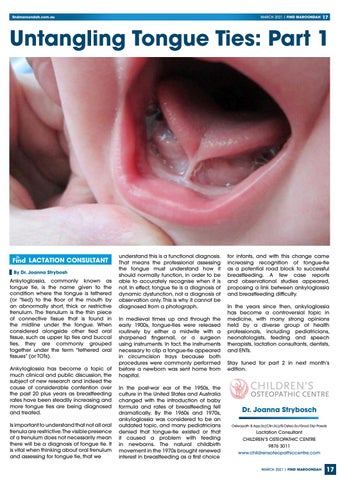
Ankyloglossia, commonly known as tongue tie, is the name given to the condition where the tongue is tethered (or “tied) to the floor of the mouth by an abnormally short, thick or restrictive frenulum. The frenulum is the thin piece of connective tissue that is found in the midline under the tongue. When considered alongside other tied oral tissue, such as upper lip ties and buccal ties, they are commonly grouped together under the term “tethered oral tissues” (or TOTs). Ankyloglossia has become a topic of much clinical and public discussion, the subject of new research and indeed the cause of considerable contention over the past 20 plus years as breastfeeding rates have been steadily increasing and more tongue ties are being diagnosed and treated. Is important to understand that not all oral frenula are restrictive. The visible presence of a frenulum does not necessarily mean there will be a diagnosis of tongue tie. It is vital when thinking about oral frenulum and assessing for tongue tie, that we
understand this is a functional diagnosis. That means the professional assessing the tongue must understand how it should normally function, in order to be able to accurately recognise when it is not. In effect, tongue tie is a diagnosis of dynamic dysfunction, not a diagnosis of observation only. This is why it cannot be diagnosed from a photograph. In medieval times up and through the early 1900s, tongue-ties were released routinely by either a midwife with a sharpened fingernail, or a surgeon using instruments. In fact, the instruments necessary to clip a tongue-tie appeared in circumcision trays because both procedures were commonly performed before a newborn was sent home from hospital. In the post-war ear of the 1950s, the culture in the United States and Australia changed with the introduction of baby formula and rates of breastfeeding fell dramatically. By the 1960s and 1970s, ankyloglossia was considered to be an outdated topic, and many pediatricians denied that tongue-tie existed or that it caused a problem with feeding in newborns. The natural childbirth movement in the 1970s brought renewed interest in breastfeeding as a first choice
for infants, and with this change came increasing recognition of tongue-tie as a potential road block to successful breastfeeding. A few case reports and observational studies appeared, proposing a link between ankyloglossia and breastfeeding difficulty. In the years since then, ankyloglossia has become a controversial topic in medicine, with many strong opinions held by a diverse group of health professionals, including pediatricians, neonatologists, feeding and speech therapists, lactation consultants, dentists, and ENTs. Stay tuned for part 2 in next month’s edition.
Dr. Joanna Strybosch Osteopath B.App.Sc(Clin.Sc)/B.Osteo.Sc/Grad Dip Paeds
Lactation Consultant CHILDREN’S OSTEOPATHIC CENTRE 9876 3011 www.childrensoteopathiccentre.com
MARCH 2021 | FIND MAROONDAH
17
18
FIND MAROONDAH | MARCH 2021
findmaroondah.com.au
Green Housing Around the World ARCHITECT By Kathy Ismail
When we think of housing in Australia, many can immediately picture the cream brick veneer home of the 1950s that their parents might still live in in. Others may imagine an Edwardian inner suburban villa, the ‘mission brown’ brick 1970s apartment or a more funky, repurposed warehouse. Nowadays, there is a growing global trend on ‘green’ construction. This means so much more than sticking a few solar panels on your roof! What happens in countries with much larger populations than Australia? We asked two experts: Amit Dongre, an architect from India; and Ar Izzny Ismail, Senior Lecturer at MARA University of Technology, Perak Campus and Principal of Izzny Ismail Architect Malaysia. India India has a variety of rich architecture styles, from Indo-Saracenic and Islamic to British Raj bungalows. These can be attributed to different foreign rulers at different periods of history. After independence in 1947, India saw rapid industrialisation and growth throughout the construction industry. Among many other challenges, India has one of the largest populations with housing needs, in climatic conditions ranging from the tropics to deserts and snowbound mountains. Concrete-framed construction has come out as the versatile winner that caters the best to such varied needs. A typical house or a low-rise development usually has concrete footings and brick walls with cement plaster. Prefabricated materials
engineered products and material. The limitation of using timber products by the local building development was due to the high cost, its poor durabilityand restrictive building codes, and was only famous for structural purposes. An aggressive promotion of encouraging timber products that have potential as construction materials is currently creating awareness among the industry players. Another factor that can alleviate concern over the use of timber products is to revise the building by-laws on the fire ratings of buildings that have not been reviewed for some time and are seen to be outdated. Thus, the effort to make timber as preferred choice will be a long-term attempt to gain back a positive outlook and support ‘green’ building initiatives.
and technologies are also on the rise to meet the timeline challenges in any particular project, along with keeping quality under control. In the recent past, the Indian government brought sustainability to the forefront and ‘green’ buildings are now promoted in commercial developments. The National Building Code, which regulates the building construction sector in India, places emphasis on innovative materials and construction technologies for future sustainable development. We hope to see more of the ‘green buildings’ with eco-friendly construction materials and innovative construction technologies, with a much needed, reduced impact on the environment. Malaysia Malaysia has moved forward to commit to green building initiatives that relate to an economy based on Sustainable Development Goals (SDG). Extensive effort to embrace these building and energy-related policies has been developed since 2012 up until today by the Public Works Department (PWD) on the PWD Green Rating Scheme (JKR Malaysia), and the Construction Industry Development Board (CIDB) on the Green PASS (Green Performance Assessment System in Construction). It was found that the local industry was already, unsurprisingly, dominated by non-environmentally friendly materials being used in building construction. The materials used were mainly steel and reinforced concrete, followed by glass, metal cladding and timber. Timber in building construction was a building material of the past that people moved away from in favour of
Australia Launched by Green Building Council of Australia (GBCA) in 2003, Green Star is Australia’s largest voluntary and truly holistic sustainability rating system for buildings. It encourages the construction industry to create buildings that are not just ‘green’ but are healthy, liveable, productive, resilient and sustainable. The focus is on initiatives that reduce water consumption, use low-impact materials, minimise the carbon footprint, enhance air quality, thermal and acoustic comfort, reduces greenhouse gases…and many more. On a smaller scale, new housing developments all across Australia are required to satisfy a minimum level of comfort, satisfying local Green Star codes. On the other end of the scale, established building systems from Europe, new technologies and knowledge, such as the Passive House movement, are making a positive impact in Australia. Contact KIR Architecture at contact@ kirarchitecture.com.au for help with planning your ‘green’ building projects. We are always happy to answer any inquiries.
Kathy Ismail ARCHITECT KiR Architecture www.kirarchitecture.com 0422 026 962
findmaroondah.com.au
MARCH 2021 | FIND MAROONDAH
19
Professional Indemnity Vs Medical Malpractice Insurance
GENERAL INSURANCE By Craig Anderson
Imagine you are in a new suburb and you ring a new medical clinic, and they allocate you a doctor. If something goes wrong during treatment or diagnosis, where does the claim fall? Will it be the clinic, the doctor, or both, and where does the insurer stand on this? In regards to the insurance, there are distinct differences between Professional Indemnity cover, and Medical Malpractice cover. A standard Professional Indemnity (PI) policy, is intended to indemnify the insured against third party financial losses incurred when the insured has, by error or omission, failed to provide a professional service. Some PI policies are not intended to cover physical loss or damage, as there is a full exclusion for bodily injury and property damage, and this is where main difference lies. A Medical Malpractice policy protects the insured against the same main elements included in the PI policy, and in addition covers errors related to physical treatment as well as the related advice. As the clinic or centre may be drawn into a vicarious liability claim created
by an error made by one of the medical professionals, it makes sense that the clinics policy should have the same treatment cover. In other words, a poorly chosen policy may expose the clinic to losses for which they are not insured, while at the same time the clinician may be fully covered. I will remind everyone that the Medical Malpractice policy and PI Policies will not cover your own first party losses experienced as a result of Cyber Hacking, email privacy breaches, Ransomware, Crypto Locking, Phishing, Phreaking, Social Engineering Fraud, and a host of other breaches resulting in the loss of personal medical information and other identifying information belonging to patients and clients. We might save that as a Cyber article for another time. In short, the people and organisations who may benefit from Medical Malpractice cover may include: Alternative and Natural Medicine practitioners, Private hospitals, Day Surgeries and Medical Centres, Diagnostic screening including
Pathology and Radiology Clinics, Aged Care Facilities, Registered health practitioners, and NDIS Service Providers. If you are interested in a review of your cover, please contact us from 9-5 weekdays.
Any advice in this article has been prepared without taking into account your objectives, financial situation or needs. Because of that, before acting on the above advice, you should consider its appropriateness (having regard to your objectives, needs and financial situation).
Craig Anderson General Insurance Small Business Insurance Brokers www. heightsafetyinsurancebrokers.com.au
0418 300 096 MARCH 2021 | FIND MAROONDAH
19
20
FIND MAROONDAH | MARCH 2021
findmaroondah.com.au
What writing a book will do for your business ACCREDITED EDITOR By Susan Pierotti
Many thought leaders advocate writing a business book as an essential part of your marketing toolkit. But I can assure you from personal experience that writing and publishing your own book will change your business for the better. My book, Manuscript to Market: the lifecycle of getting your book into print, was published in 2017 and I have used it as a core product of marketing my business ever since. Besides the income stream from selling my book, there have been several other intangible benefits for me and my business, benefits that will also be yours when you choose to write a business book. Makes you look clever I am not the first person to write about the writing, publishing and marketing aspects of getting a book into print. I did not even have all the information when I began, nor even when I finished writing it, and there are others in my industry who know so much more than I do. Nevertheless, when I say I have written a book, people say to me, ‘Gee, you must be clever.’ Why? Somehow, being a published author equates in people’s minds with being intelligent! The good news is that you don’t have to be intelligent, you don’t have to know everything, you don’t even have to have good spelling and grammar! All you need is the willingness to write, to accept constructive advice and to keep at it. When people say that I’m clever, what they really are referring to is that I worked hard at producing something others chose not to invest time and money in doing. Makes you the expert Many of my clients are first-time authors who wanted to self-publish so I deliberately self-published my book so that I could describe every aspect of the process. People trust you more if you have ‘been there and done that’ before them.
I always carry a copy of my book with me. When I sit with a client who wants to know how to do this or that, I bring the book out as a reference tool. It shows that I know what I’m talking about. Theysee it, want to buy it and read about how book publishing works. They usually hire me as a result. Increases your professional profile There are accountants aplenty. However, how would you feel about your accountant if you walked into his or her office and saw on the reception desk a copy of the book they’d just written on tax law? Their reputation would certainly increase in your estimation. You might not even buy a copy or read it but you’d probably trust them more and even refer them to others. Now imagine what that could do for your business. After writing and publishing your book, all you need do is display it prominently for it to market you – without you lifting a finger. They make great Christmas presents and can be added to trade show bags or given to clients for free as part of your initial consultation process. As a book can travel anywhere, dream of how widely you could market yourself! Expands your business A business book will position you as the expert and therefore act as a lead funnel for you. However, there are several indirect ways that a book can promote your business.
The chapters and sections from your book could become education workshops, a new income stream that convert one-off sales into core business. You could use them as a basis for newsletter items and blogs. Journalists are always looking for news items for your local radio station or newspaper so ask them to interview you about your book. What a great way to get free advertising for your book and get it known to your local public! Always have a copy of your book on display and with you at all times, even on holidays. It arouses curiosity and elicits comments. A business book is a business card on steroids. Susan Pierotti at Creative Text Solutions partners with first-time authors to get from an idea in the head to a book in the hand. Contact her to discuss your business book idea.
Susan Pierotti Accredited Editor Creative Text Solutions 0437 127 159 www.creativetext.com.au
findmaroondah.com.au
MARCH 2021 | FIND MAROONDAH
21
Finance Solutions for the Self-Employed MORTGAGE BROKERING By Reece Droscher
For people who work for themselves being able to obtain finance to buy a home, grow their business or purchase another asset can be a very challenging exercise. For a lot of self-employed there is a delicate balance between showing the Bank enough income to be able to repay a loan and claiming as many expenses against their income to reduce the amount of tax they pay. Lenders also deem self-employed applications to potentially represent a higher risk as their income is not as predictable as someone in stable employment with a consistent income stream. It may also be difficult for some self-employed applicants to produce the financial information to satisfy a lender’s requirements. With the changing nature of the employment market seeing more people opting to work for themselves by either starting a new business or contracting their services to another party, lending money to the self-employed is also changing. New providers in the lending market are trying to make it easier for self-employed applicants to access credit. Outlined below are some of the options available for those selfemployed people who may fall outside the traditional lending options provided. LOW-DOC LOANS Low Documentation (Low Doc) loans are available for potential borrowers who are self-employed and don’t have access to the documents required to obtain a traditional mortgage. Usually borrowers cannot provide financial statements and tax returns to verify their income, so the lenders rely on other documentation provided by the applicant to determine whether they can afford to borrow the amount requested. The applicant would provide a declaration stating their level of income which would be supported by other forms of verification. This includes lodged BAS, trading account statements or a letter from the accountant for the business confirming the income declared is accurate. The level of information required may vary between providers, and these
types of loans are available for owneroccupied, investment and commercial properties. These loans usually have a slightly higher interest rate than standard loans where full documentation has been provided, and not all lenders provide this option as part of their suite of products. The amount of property equity you would need to have to secure this type of loan will also be greater than a standard loan. But, if your circumstances mean you don’t fit the traditional type of borrower, this can be a good option to consider, particularly for Home Lending. CASH-FLOW LENDING Cash-flow lending is usually a shortterm loan that self-employed applicants might use for any business purpose. This can mean covering a temporary cashflow shortfall, investing in new equipment or purchasing another business. The loan amounts are small, in most cases less than $100k, and in a lot of cases no security is required.
Some of the providers suggest that they can have funds available within 48 hours of receiving an application, and the number of providers in this market is growing, even including some of the major Banks who have developed a product to cater for these types of requests. Where a self-employed applicant can meet the requirements to obtain finance through traditional means then usually this is a less costly approach to take, although potentially more inconvenient. Lenders are risk-averse businesses so the more information a self-employed applicant can provide to verify their income is stable and secure the better. If, however you are in a situation where that is not possible, at least you know there are options available. If you would like to know any more about these products and whether they may be a suitable option please call me at SHL Finance on 0478 021 757, or come in and see us at 2/23 Ringwood Street Ringwood.
Where traditional business lending requires the applicant to provide two years of financials and tax returns, cashflow lending looks at things differently. The revenue performance of the business is used to determine the eligibility to borrow. The cost of these loans can be quite high, above 10% per annum before you factor in fees and charges, as these are primarily unsecured loans so the risk to the lender is higher. But cashflow lending is also one of the fastest ways to inject funds into a business.
Reece Droscher Managing Director of SHL Finance Pty Ltd reece@shlfinance.com.au www.shlfinance.com.au
MARCH 2021 | FIND MAROONDAH
21
22
FIND MAROONDAH | MARCH 2021
findmaroondah.com.au
Emergency Garage Door Assistance, 24/7 GARAGE DOORS By Chantal Djuric
The first few months of the year can be one of the busiest times for families. After relaxing throughout the summer holidays, we come home to a whirlwind of things that need to be done. As parents, we often don’t have much time or headspace to think of supplying our kids for school with all the stuff they need, to stock up on groceries and clean the house, let alone get our own minds into gear for returning to work. Then there’s the school timetable, sporting events and other activities to deal with.
BEFORE
At times like these, we rely on the car to get us where we need to be, so we have our cars serviced. But there’s another feature we all possess that also needs regular maintenance. A feature which no car, serviced or otherwise, can’t do without – our garage doors. There are many people who arrive home after the holidays but leave just one day to stock up on groceries and buy all that school stuff for the kids before going to work the next day. Imagine if that were you – how would you feel if, after parking the car in the garage overnight, the garage door won’t open the next morning. Angry? Frustrated? Desperate? You’d possibly be stuck with no means of getting your kids their school uniforms, with not enough food in the house for the next week and a long journey on unreliable public transport to get to where you work. There are a number of factors as to why a garage door won’t go up. It could have been installed incorrectly. It might need a new motor or simply need a bit of lubrication. But how do you know what’s wrong? How can you fix it? Can anyone fix it? Did you know that you can ring for 24-hour emergency repairs for garage doors? All garage door repairers should be able to identify your garage door problem within thirty minutes of being on site. The repair technician should be able to assess how long it will take to repair, how long it will take to supply replacement parts and, if relevant, explain how to prevent the problem for arising again. This real-life scenario happened to one of our customers. Why not put yourself in their place and consider how it would
AFTER affect you. The customer was on his way out as his family were going away for the weekend. As he opened up their panel lift garage door, the panels started falling apart and the whole door was coming out of the tracks. Not only that but parts from the panel lift door flew in all directions. When we arrived, we accessed the state of the garage door. The reason for this door breaking was that the plaster on the roof had collapsed and was falling on the panel lift door. Over time, this had compromised the panel lift door. We first made sure the panel lift door was not going to make any more damage and we were all safe from any flying panel lift parts. We then found all the parts of the damaged door and started assembling it all together. Even though the customer was worried he would not
be able to close the door for security reasons as they were going away, the main concern at this stage was to make the door safe by putting all the parts back and giving it some tender loving care. In this case, due to the damage sustained, a new door will be needed but we were able to reassure the customer that his garage and home would be safe while his family were away by making the garage door able to be closed and lockable for the customer. The before and after photos show you how superior garage door servicing can save you time and hassle. For 24/7 garage door servicing, give Cruzin Garage Doors a call on 0427 894 603 or email us at sales@ cruzingaragedoors.com.au.
findmaroondah.com.au
MARCH 2021 | FIND MAROONDAH
23
Did you know the most cost-effective way to advertise is with vehicle signs? SIGNAGES By Glenn Martin
From a single vehicle to an entire fleet, vehicle signs are an extremely costeffective way to be seen. With a oneoff investment lasting up to five years, it makes sense to turn your vehicle into a mobile billboard, spreading your message 24/7. A vinyl car wrap not only gives your vehicle a unique look, it also protects your factory paint job, ensuring that your vehicle stays as pristine as the day you bought it. Decals and spot graphics are a great option when you do not need a full vehicle wrap. Apply logos, lettering, images and elements individually onto the surface of your vehicle. Since spot graphics tend to focus on a small area of the vehicle, they are easier to clean and maintain. The cost of Spot Graphics depends on the scale and complexity of the job. A partial wrap or ¾ wrap covers part of the paintwork and generally excludes the bonnet. The two most common methods in this category include using digitally printed vinyl graphics or spot graphics, which can be a combination of digitally printed die cut graphic and computer cut solid colour vinyl graphics. Although it is most common to see a partial wrap done for a vehicle, we can also do partial wraps for buses, caravans food trailers and trucks. A full car wrap covers all paintwork with digitally printed vinyl graphics, excluding the roof. We can do a full wrap on vehicles, buses and trucks. Also, within this category is a full colour change, where we use high quality solid colour vinyl. This can be used on its own, or with complementary advertising graphics. This second layer is applied to the surface of the coloured vinyl, using digitally printed die cut graphics or computer cut vinyl graphics.
Basic Spot Graphic
Partial Wrap
3/4 Wrap
Full Wrap
inside of your vehicle, while anyone viewing from the outside will see your window graphics. We digitally print your design in full colour, then apply an optically-clear over laminate to protect your graphics from UV, water, dust, marks and scratches. How Does One Way Vision Work? The human eye tends to notice brighter colours over darker colours. The printed one way vision film contains areas of printed graphic (a print pattern) as well as unprinted see-through areas covering up to 50% of the film. The holes, where there is no film, have no ink and therefore are generally darker, almost black. When someone during the day looks at the rear window from the outside, their eye is drawn to the printed image, as it reflects more light than the see-through areas.
which looks like it is on a solid piece of vinyl. However, when viewed from the inside, a person will see the outside world through the holes. The secret here is ensuring the printed graphics are hidden from the other side of the glass. This is best achieved by having a black ‘backing’ that covers only the printed areas on the film, without blocking the unprinted areas. If your business is looking for ways to grow your reach, we would love the opportunity to discuss vehicle graphic options that may have an impact on your business growth in 2021. Contact us today to book a free consultation from one of our signage experts, and ensure you get current promotions by following us on Instagram @Signarama_Mitcham.
Go to https://signarama.com.au/store/mitcham to enter.
One-Way Vision Window Vinyl One Way Vision is an innovative window graphic made from perforated self-adhesive vinyl film. It is great for completing a full or partial vehicle wrap design onto windows. The tiny perforated (punched) holes allow visibility from the
MARCH 2021 | FIND MAROONDAH
23
24
FIND MAROONDAH | MARCH 2021
findmaroondah.com.au
What type of Coffee are you Drinking? COMMERCIAL COFFEE MACHINE By Ivana Smith
Melbournians sure love their coffee! Business deals are done over a couple of flat whites, mums socialise with a cappuccino or two, friends catch up with café lattes. Whatever your favourite place to meet or coffee brew to drink, have you ever wondered what it is you’re actually drinking? Ethiopia’s best gift to the world The original coffee beans were taken by Arabian merchants from the mountains of Ethiopia across the Red Sea to Mecca where it spread across the trade routes of the known world, eventually arriving in Melbourne centuries later. There are three types of coffee beans. Liberica (Caffea liberica) is the rarest form of coffee, coming from west Africa. Found also in Malaysia and The Philippines, it is a low-yield type of coffee compared to Arabica (Coffea arabica) and Robusta (Caffea canephora), the last two being the most popular in Australia. The different varieties take on different flavours while they are being processed and harvested. Robusta contains 2.5% more caffeine than other types, and has a strong taste, hence its name. Arabica, with low caffeine and a smoother taste, is aromatic and delicious. Eighty per cent of the coffee in the world is produced from these types of beans. While Arabica has become synonymous with high-quality, delicious coffee, highquality Robusta beans can make strong, sharp espressos with a fantastic crema. However, keep in mind that Robusta is far more bitter and contains more caffeine. Country of origin Many factors, such as temperature, height and where they are grown, affect the flavour of the coffee beans. Brazil (Arabica): One of the top coffeeproducing countries, Brazil produces over 2,594,100 tons of coffee a year. Brazilian coffee is so flavoursome due to the wide production The coffee produced in Brazil is often preferred because it has low acidity. Vietnam (Robusta): In Vietnam, people prefer the strong taste of Robusta coffee
beans. Vietnam is the world’s secondlargest coffee exporter in the world. Colombia (Arabica): Colombia, which claims a fair share of coffee production with 810,000,000 kg per year, is just behind Brazil in terms of taste with its Arabica coffee bean. Two of the delicious coffee varieties of Colombian coffee are Extra and Supremo. Indonesia (Robusta, Arabica): Although the quality and taste is weaker in comparison to Brazilian and Colombian coffees, Indonesia produces 660,000,000 kg of coffee per year. Ethiopia (Arabica): Coffee culture in Ethiopia dates back to the ninth century. According to folk tales, goats eating coffee beans in ancient times were observed by the dervishes who boiled the juice of the fruit the goats ate and drank it – and loved the effect! Ethiopia, which produces 384,000,000 kg of coffee per year, has prized coffee trees that yield delicious coffee. India (Arabica, Robusta): Arabica and Robusta coffee beans are grown abundantly in the south region of the country and are known for their soft taste and high levels of acidity. Papua New Guinea: Nearest to home, Papua New Guinea’s biggest export is coffee, employing around two and half million people. Produced mainly by small farmers who grow as few as twenty mild Arabica trees alongside subsistence crops per plot, the coffee is mostly certified as organic.
Other countries that produce coffee for export include Honduras, Mexico, Guatemala, Peru, Nicaragua and China. Getting that great flavour Before brewing, coffee beans must first be roasted. The original coffee was roasted slowly for eight hours and drunk warm. Nowadays, we like our coffee hot, and have many different types of coffee to choose from. Different roasts create different results in colour, taste and smell. •
• •
Light: light-coloured, more acidic tasting, more flavour from the bean, suitable for coffee with unique characteristics or of exceptional quality Medium: less acidity, more toasted flavour, darker in colour, the most typical roast Dark: darker colour, intense flavour, low acidity, bitterer, good for lower quality beans.
Blends can also be made combining two or more different roasts. Depending on the type of bean used and roasts combined, this can make for a unique flavour. For advice on coffee and how to supply it to office spaces and clubs, contact Ivana at ivana.smith@xpressodelight. com.au.
Ivana Smith Commercial Coffee Machine Xpresso Delight 0418 393 085 www.xdcoffee.com.au
findmaroondah.com.au
MARCH 2021 | FIND MAROONDAH
25
Financial Planning Fees set to rise again but Find Wealth is keeping them low FINANCIAL PLANNING By Warren Strybosch
Over the last 2 years financial planning fees have been on the rise. However, many customers and the general public are probably unaware of the associated costs of providing advice to consumers since the Hayne’s Royal Commission occurred. Whilst banks have had to pay out billions of dollars in fines for the wrong doings over the past decade, the average financial planner, not associated with a bank, has also been drawn into the fray with costs significantly increasing.
Whilst many financial planning businesses are looking to service high net wealth clients as the average fee charged is about $5,000 per year, Find Wealth Pty Ltd, has been deliberate in finding ways to keep fees affordable without sacrificing on the advice and services provided. As such, it enables the everyday dad and mum client to obtain appropriate advice without breaking the budget. Also, all super fees are charged directly from the industry fund account and not from cash flow.
Two years the average fee to hold an Authorised Representative (AR) authority to provide advice, similar to having a franchise licence, was around $20,000 per year. Now, most advisors who hold an AR will be paying close to $50,000 per year for no additional benefits being provided. Also, Professional Indemnity Insurances have increased to over $3,000 per advisor, then add on software costs to try and provide the appropriate legal documentation which can be around $10,000, with that association fees, professional development costs, the average advisor is now paying close to $70,000 per year to be able to open their doors and provide advice. This does not include rent, wages, and the other ancillary costs of running a business.
For instance, when it comes to superannuation, the average client will be paying 1% or more in fees directly to their superannuation fund. Super fees are made up of the administration fee, investment fee and other fees that do not have to be disclosed on the super statements but are listed in the PDS or Investment disclosure document (often hard to find). This 1% fee obviously rises as the super balance gets larger and larger. Whereas, Find Wealth Pty Ltd, working alongside industry funds, are able to get the super fund fees below 0.2% for most clients with super balances greater than $100,000.
Then you take into account the financial advisors own fees that are charged. Most advisors charge about $3300-$5500 per year for providing superannuation advice where shares are involved. Currently, Find Wealth charges $880 per six months and provides detail reports related to your investments. Also, Find Wealth manages the Corporate Action opportunities that become available throughout the year, providing value add to a client’s portfolio. Fees are continuing to rise, and these fees will be passed on to the consumer. If your superannuation and advisor fees are continuing to increase, then consider asking for a FREE Super Report from Find Wealth who will compare your current fees to those when moved to the new super fund managed by Find Wealth. Request your Free Super Report by emailing Find Wealth: warren@ findwealth.com.au. Here is an example of the real client’s savings when they moved from their previous super fund to the industry fund being managed by Find Wealth.
Now, the ASIC levy is set to rise above $2,400 per advisor; an increase of 60% on last year’s premium, advisors are really feeling the pinch when it comes to the costs of running a personal advice business. ASIC has confirmed that each licensee will pay $1,500 and each advisor an additional $2,426. Compare these costs to an accounting business where the biggest cost is their Professional Indemnity. Before staffing, rent and ancillary costs, the average cost to provide tax advice is less then $10,000. No wonder accountants are hesitant to want to step into the financial planning advice arena…they would have to recoup $70,000 in fees before making any money and this is not including hire a qualified financial planner.
This information is of a general nature only and has been prepared without taking into account your particular financial needs, circumstances and objectives. While every effort has been made to ensure the accuracy of the information, it is not guaranteed. You should obtain professional advice before acting on the information contained in this publication. Past performance is not an indication of future performance. © Copyright 2015-2021. Find Wealth Pty Ltd is a Corporate Authorised Representative (No. 468091) of ClearView Financial Advice Pty Limited ABN 89 133 59 012 AFSL. No 331367. Disclaimer: The fee savings disclosed above is based on a pure comparison of like-for-like funds and doest not include additional fees that may be incurred i.e adviser service fees.
MARCH 2021 | FIND MAROONDAH
25
26
FIND MAROONDAH | MARCH 2021
findmaroondah.com.au
When walking through bushland reserves, how do I know what vegetation matters? NATURE & CONSERVATION By Liz Sanzaro
Without specialised training, it is simply not possible to distinguish between areas of high conservation value from less valuable vegetation. Since many native species die back to a tuber over summer an area which may look like grass, weeds or even bare ground may have very high value, whereas an area of spectacularly flowering environmental weeds looks impressive, like Agapanthus or Wonga Vine both are serious issues for bushland reserves. If you happen to grow Agapanthus, after flowering it is best to remove the seed heads completely, since this plant keeps spreading and competes against our very fragile wildflowers.
Pandorea pandorana Wong vine
Agapanthus africanus Agapanthus or African lily
Wildflower seeding often happens in loose soil next to paths, where tiny seedlings of rare species (including orchids) germinate and grow.
reserves is protected by law, under the Planning and Environment Act 1987. Hefty penalties can result from infringing these laws. It is therefore, a very good reason not to tread or flatten or ride on the ground other than on the obvious goat tracks better still in single-file, so as not to encroach on the native bushland. Take time to stop and look for our tiny flowers, from late Spring into early summer.
Since those without specialised training cannot distinguish between high and low conservation areas, it is very important not to dig in bushland reserves for any reason. All native vegetation on Council
MORE WILDFLOWERS
Burchardia umbellata
Milkmaids
Pultenaea scabra Rough Bush-pea
Billardiera scandens Common Apple-berry
findmaroondah.com.au
MARCH 2021 | FIND MAROONDAH
27
Australia wants US back in TPP Agreement By Colin Brinsden, AAP Economics and Business Correspondents
(Australian Associated Press)
Australia wants the US back in the TransPacific Partnership as soon as possible under President Joe Biden to maximise the benefits of the trade agreement. While the US was an original member of the then 12-country agreement, former president Donald Trump withdrew soon after his election. “Ultimately, what we want to do is encourage the US to deepen its economic engagement in the region by the joining the Trans-Pacific Partnership,” Australia’s ambassador to the US Arthur Sinodinos told an online conference on Wednesday. “At the moment the Trans-Pacific Partnership is a bit like Hamlet without the prince.” The former Liberal senator says US needs to be there to maximise benefits of the agreement and strategic benefits of the US being in region.
the the the the
Along with Australia, the TPP is made up of Brunei, Canada, Chile, Japan, Malaysia, Mexico, New Zealand, Peru, Singapore and Vietnam Australia also wants the US to help reform the World Trade Organisation with other like-minded countries to encourage China, in particular, to co-operate within the existing rules-based order. “… rather than somehow seek to change the order in their own favour,” Mr Sinodinos
told the Committee for Economic Development of Australia economic and political outlook 2021 conference.
The ambassador was asked whether Prime Minister Scott Morrison has been invited.
One of President Biden’s first actions was to rejoin the Paris Agreement on climate change and to confirm a zero emissions target by 2050.
“Look, we haven’t see the invite list as yet. But if you want to influence countries to do something, you invite them to come,” he said.
Asked if this will put additional pressure on Australia to follow suit, Mr Sinodinos said there was no doubt this would be taken into account when forming domestic policy.
He said Australia already had a good relationship with the US, founded on deep historical ties, common heritage, trade investment relationships and shared values and interest.
But he says the Australian government is arguing that targets are one thing, getting there is another.
“We did well under the previous administration compared to many other countries but there is plenty of scope to deepen bilateral engagement and encourage the commitment to the IndoPacific,” Mr Sinodinos said.
President Biden is due to hold a climate leaders’ summit on April 22.
Support Local, Buy Local, Discover Maroondah Do you have photos from a local event or even a great story you would like to share? Maroondah editor@findmaroondah.com.au
SEND US YOUR NEWS! MARCH 2021 | FIND MAROONDAH
27
28
FIND MAROONDAH | MARCH 2021
findmaroondah.com.au
More information
Books for Beds - Fundraiser Come on down to Your Library’s giant book sale and help raise funds for ‘Backpack Bed for Homeless’! National charity Backpack Bed for Homeless provides LIFE SAVING Backpack Beds and Fire Retardant Sleeping Bags to street sleeping homeless without shelter. Pick up a mystery box of pre-loved books for $5. You can choose from Adult Fiction, Non-Fiction or Junior items. Two lucky boxes will contain a mystery prize! Boxes are available to purchase on Thursday 11 and Friday 12 March, 9am-5pm or until sold out. CASH ONLY! Head to rear of Eastern Regional Libraries Administration 1350 Ferntree Gully Rd, Scoresby (enter via Keith Campbell Court) Parking available on site. Tax deductible donations will be gratefully accepted on our fundraising page.
Relax and Unwind Meditation for Balance - Tues 9 & 16 March, 6:30pm | Realm Library Love, Peace, Harmony Meditation - Every Thursday, 10:30am | Belgrave Library Join us at the library and find your way back to inner peace and wellbeing. Booking essential as places are limited due to COVID-19 restrictions Book Now
findmaroondah.com.au
MARCH 2021 | FIND MAROONDAH
29
Book Now
More Storytimes at your Library Enjoy more Tiny Tots, Toddlers, Preschoolers, and Family storytimes from 1 March! In keeping with current government restrictions, the following conditions will apply to our Storytime sessions: • Bookings are essential for every adult and child over 12 months • Numbers are limited • Social distancing will be observed • Sessions will run for 20 minutes and include stories and rhymes and a take-home craft activity • Bookings open 3 days before the session • Masks are recommended for all Library visitors over the age of 12 • Conditions of entry to the library must be observed We can’t wait to see you at storytime!
Current Services With restrictions easing, we are able to have many more people in the libraries. Please continue to scan or log in for contact tracing. Face masks are recommended and must be worn in situations when you cannot maintain social distance – 1.5 meters Click+ Collect and Home Delivery Service are still available. Our website always has the current information - please check Current Services for any changes.
Learn More
MARCH 2021 | FIND MAROONDAH
29
2020 TA Small Business Entity Threshold to Increase Many more businesses will be eligible to access income tax concessions with the passing of legislation which extends thresholds currently reserved for small businesses. These concessions include: •
immediate deduction of certain start-up and prepaid expenses
•
exemption from FBT for car parking and work-related portable devices provided to employees
•
access to simplified trading stock rules
•
access to PAYG instalments based on GDP-adjusted notional tax
•
settle excise and excise-equivalent customs duties monthly, and
•
businesses will have a two-year amendment period to apply to income tax assessments for income
Passed (9-Oct-2020)
years starting from 1 July 2021, excluding entities that have significant international tax dealings or
Royal Assent (14-Oct-2020)
particularly complex affairs.
Date of effect
Announcement (6-Oct-2020) Consultation Introduced (7-Oct-2020)
A business will be eligible to access these concessions if their aggregated turnover is less than $50 million. Mostly, the change in aggregated turnover threshold will take place from 1 July 2021, with different dates to line up with the FBT year. Also, the eligible entity can access the simplified accounting method determination for GST purposes from 1 July 2021.
WA COVID-19 Stimulus Package A range of stimulus measures are being implemented in Western Australia to assist business with cash flow issues resulting from COVID-19. In particular, certain businesses in WA will receive grants, while others will be allowed a waiver of payroll tax for four months. A payroll tax exemption has been extended for new apprentices and trainees in the 2020-21 income year. Also, the future uplift of payroll tax thresholds
Announcement: 17-Mar-2020 Updated: 23-Dec-2020
will be brought forward to assist some businesses with their future obligations.
ACT COVID-19 Stimulus Package Starting in March 2020, the ACT government has announced a series of measures which provide waivers or deferrals of payroll tax. These waivers and deferrals are an attempt to combat the economic fallout from the COVID-19 pandemic. Waivers of ACT payroll tax are available for businesses in hospitality, creative arts and entertainment industries. Deferrals are available for other small and medium-sized
Announcement: 22-Mar-2020 Updated: 23-Dec-2020
businesses. Initially lasting 6 months, some of these assistance measures have been extended into 2021.
FBT Exemption for Retraining and Reskilling Proposed An employer may receive a future exemption from fringe benefits tax when providing employees with retraining or reskilling opportunities. This 2020 federal budget announcement will take affect from 2 October 2020, subject to the passing of legislation. The government has also released a consultation
Announcement (6-Oct-2020) Consultation (22-Jan-2021) Introduced
paper with respect to possible changes to the self-education deduction section for individual taxpayers.
Passed
These measures may provide a tax incentive for employees to change careers, in particular if they are
Royal Assent
about to be made redundant.
Date of effect
Reviewing Denied Jobkeeper or Cash Flow Boost Receipts A recent report into the ATO’s administration of JobKeeper and Cash Flow Boost payments has uncovered situations where the ATO has incorrectly denied entities access to the stimulus payments. Some new
Announcement (18-Jan-2021)
businesses were informed that they were ineligible due to not having informed the ATO of any taxable
Updated (20-Jan-2021)
supplies prior to the commencement date of 12 March 2020. However, the report acknowledges that this
Consultation
was misinterpreted by the ATO. In particular, the modified definition of taxable supply to include financial supplies. However, the report also acknowledges that the ATO will not be chasing up businesses who may have been incorrectly determined to be ineligible. Any affected clients of yours will need to go through the objection process, which can be extended if there is a likelihood of success.
Introduced Passed Royal Assent Date of effect
AX UPDATES Victoria COVID-19 Package for States Taxes Throughout the COVID-19 pandemic, the Victorian government has announced various assistance for businesses who are required to pay land tax or payroll tax. Assistance has been given in the
Announcement (20-Mar-2020)
form of reductions, refunds and deferrals of these state taxes. However, not all assistance is applied
Updated (3-Feb-2021)
automatically and requires direct application with the State Revenue Office. Most recently, a 12-month
Consultation
deferral of payroll tax applies to businesses with Victorian taxable wages under $10 million. Also, land tax relief has been extended into 2021 for landlords who provide qualifying rental reductions to their tenants. The impact statement and letters provide more detailed information for you to correspond with
Introduced Passed Royal Assent Date of effect
your clients, to ensure they receive all the assistance they are entitled to.
Simplified Fuel Tax Credits - Reduced Record Keeping A new simplified method of calculating fuel tax credits has been released by the Australian Taxation Office. Provided an entity follows this simplified method in good faith, the Commissioner of Taxation will
Announcement (5-Feb-2021)
administer the law in accordance with this approach. To be eligible to use the simplified method, an
Consultation (5-Feb-2021)
entity’s fuel tax credit claim for an income year should be $10,000 or less. If using this new simplified method, an entity cannot use another simplified method for calculating fuel tax credits, such as auxiliary equipment usage. However, an entity may choose which method best suits them each tax period.
Released (5-Feb-2021) Passed Date of effect
Temporary Full Expensing of Depreciating Assets The majority of businesses are eligible to claim an outright deduction for the cost and installation of new assets. To qualify for full expensing, the asset must be first held and first used, or installed ready for use, between 7:30pm AEDT 6 October 2020 and 30 June 2022. Unlike prior rules on instant asset write-offs, no limit applies to the cost of an asset under the full expensing rules. That is, an asset of any value may be fully deducted in the appropriate income year. For a business to qualify for the outright deduction, the entity must have an aggregated turnover of less than $5 billion. Certain large entities will have separate
Announcement (6-Oct-2020) Consultation (6-Oct-2020) Introduced (7-Oct-2020) Passed (9-Oct-2020)
eligibility criteria.Since the legislation has been enacted, further amendments will be made to the laws
Royal Assent (14-Oct-2020)
to allow businesses a choice in using full expensing or not. In certain situations, it may be beneficial to
Date of effect (6-Oct-2020)
spread out tax deductions over multiple years. The ATO has released a form for early balancers to lodge their full expensing claims for the 2020-21 income year.
Temporary Full Expensing of Depreciating Assets The majority of businesses are eligible to claim an outright deduction for the cost and installation of new assets. To qualify for full expensing, the asset must be first held and first used, or installed ready for use, between 7:30pm AEDT 6 October 2020 and 30 June 2022. Unlike prior rules on instant asset write-offs, no limit applies to the cost of an asset under the full expensing rules. That is, an asset of any value may be fully deducted in the appropriate income year. For a business to qualify for the outright deduction, the entity must have an aggregated turnover of less than $5 billion. Certain large entities will have separate
Announcement (6-Oct-2020) Consultation (6-Oct-2020) Introduced (7-Oct-2020) Passed (9-Oct-2020)
eligibility criteria.Since the legislation has been enacted, further amendments will be made to the laws
Royal Assent (14-Oct-2020)
to allow businesses a choice in using full expensing or not. In certain situations, it may be beneficial to
Date of effect (6-Oct-2020)
spread out tax deductions over multiple years. The ATO has released a form for early balancers to lodge their full expensing claims for the 2020-21 income year.
Loss Carry-back Available for Companies For three income years, many corporate tax entities will be eligible to claim a refundable tax offset when they incur a taxable loss. This optional offset is available only to business and is a recoupment of prior year income tax paid, but only available for recent income years. The loss carry-back is available to businesses with turnover under $5 billion. Any refundable tax offset is limited to prior year tax paid
Announcement (6-Oct-2020) Consultation (6-Oct-2020) Introduced (7-Oct-2020) Passed (9-Oct-2020)
and the balance of the franking account. An ATO form is now available for companies who are early
Royal Assent (14-Oct-2020)
balancers under a substituted accounting period.
Date of effect (1-Jul-2021) MARCH 2021 | FIND MAROONDAH
31
MARCH 2021 REALESTATE
REALESTATE FIND AUSTRALIA’S #1 PLACE FOR PROPERTY
HOUSE OF THE MONTH
PROPERTIES FOR SALE 132345 Feature Address Place Here A Short Description for this Property.
Offered at $000,000
ADVERTISE YOUR PROPERTIES HERE Email your Properties For Sale in the Find Maroondah and we will place it in the online community paper. Contact Warren for all of your advertising needs.
Warren Strybosch 1300 88 38 30
editor@findmaroondah.com.au
MARCH 2021 | FIND MAROONDAH
33
If you have questions, contact Warren on 1300 88 38 30 or email: editor@findmaroondah.com.au
NEW RENTAL LISTING
MARCH 2021
HOSKINS PREMIUM PROPERTY PEOPLE 142 Maroondah Highway Croydon VIC 3136
03 9722 9755 croydon@hoskins.com.au www.hoskins.com.au
$430 Per Week
$445 Per Week
Under Application
Available now
3/330 Mt Dandenong Road Croydon Vic 3136 2
1
1
MORE DETAILS
$380 Per Week
2
1
2
MORE DETAILS
$400 Per Week
Available now
Available now
20A Heads Road, Donvale, Vic 3111 1
1
1
MORE DETAILS
5/4 Barkers Road, Hawthorn, Vic 3122 2
1
1
MORE DETAILS
$950 Per Week
$415 Per Week
Property ID: 1P11108
Available now
2 Molly Close, Kilsyth, Vic 3137 2
Unit 2/886 Doncaster Road Doncaster East VIC 3109
1
1
MORE DETAILS
11 Homewood Rise, Warrandyte, Vic 3113 5
4
3
MORE DETAILS MARCH 2021 | FIND MAROONDAH
35
NEW RENTAL LISTING
MARCH 2021
NOEL JONES Level 1, 554 Whitehorse Road Mitcham VIC 3132
03 8892 3702 corporate@noeljones.com.au www.noeljones.com.au
$425 Per Week
$400 Per Week
Available 12/03/21
Available 17/02/21
1/15 Laurence Grove Ringwood East VIC 3135 3
1
1
MORE DETAILS
$365 Per Week
3
1
1
MORE DETAILS
$530 Per Week
Available 01/02/20
Available 01/02/20
65/280 Maroondah Highway Ringwood VIC 3134 2
3/1 Howship Court Ringwood East VIC 3135
1
1
MORE DETAILS
$425 Per Week
15 Mulberry Grove Keysborough VIC 3173 4
3
1
MORE DETAILS
It Begins With a Conversation
Property Research, Done Right Available 01/02/20
Whether you’re selling, buying or renting – it all starts with a conversation.
105/10 Main Street Blackburn 3130 2
2
1
MORE DETAILS
Engage with an agent near you, and profit from local agents armed with local knowledge. Visit Your Local Office
NEW RENTAL LISTING
MARCH 2021
MAX BROWN REAL ESTATE GROUP SURREAL PROPERTY GROUP Level 1/3941 Hewish Road Croydon 2/732 Mountain Highway BayswaterVIC VIC3136 3153
P: MAX (131 629) | F: 1300 3295288 629 03 9723 enquires@maxbrown.com.au croydon.vic@raywhite.com www.maxbrown.com.au www.surrealpropertygroup.com.au
$ 410 Per Week
Bond $2,500
Avail Now
Avail Now
2 / 33 Highland Crescent Mooroolbark VIC 3138 3
2
2
MORE DETAILS
$350 Per Week
1
3
MORE DETAILS
Avail Now
9 / 18 ‘Larjarra Rise’ Sundew Avenue, Boronia VIC 3155
1
1
MORE DETAILS
$450 Per Week
20 Orbell-Jones Court, Croydon VIC 3136 3
2
2
MORE DETAILS
$490 Per Week
Avail Now
Under Application
33 Long View Road Croydon South Vic 3136 4
3
$ 445 Per Week
Avail Now
2
9 Bona Street, Ringwood East VIC 3135
1
1
MORE DETAILS
34 Beatrice Street, Kilsyth VIC 3137 3
2
2
MORE DETAILS MARCH 2021 | FIND MAROONDAH
37
NEW RENTAL LISTING
MARCH 2021
MAX BROWN REAL ESTATE GROUP SURREAL PROPERTY GROUP Level 1/3941 Hewish Road Croydon 2/732 Mountain Highway BayswaterVIC VIC3136 3153
P: MAX (131 629) | F: 1300 3295288 629 03 9723 enquires@maxbrown.com.au croydon.vic@raywhite.com www.maxbrown.com.au www.surrealpropertygroup.com.au $ 395 Per Week
$ 345 Per Week
Avail Now
Avail Now
5 Bronhill Road, Ringwood East VIC 3135 3
1
5
MORE DETAILS
$ 315 Per Week
1
1
MORE DETAILS
Avail Now
4 / 15 Cambridge Road, Mooroolbark VIC 3138 1
1
MORE DETAILS
$350 Per Week
1 / 14 Browning Street, Kilsyth VIC 3137 2
1
1
MORE DETAILS
$385 Per Week
Avail Now
Avail Now
305 Hull Road, Mooroolbark VIC 3138 2
2
$ 325 Per Week
Avail Now
2
2 Gloria Close, Healesville VIC 3777
1
2
MORE DETAILS
1 / 126 Belmont Road East, Croydon South VIC 3136
3
1
0
MORE DETAILS
NEW RENTAL LISTING
MARCH 2021
SURREAL PROPERTY GROUP 2/732 Mountain Highway Bayswater VIC 3153
03 9723 5288 croydon.vic@raywhite.com www.surrealpropertygroup.com.au $500 Per Week
$325 Per Week
Avail Now
Avail Now
17A Baker Road, BAYSWATER NORTH VIC 3153 3
2
2
MORE DETAILS
2/47 Willow Road, UPPER FERNTREE GULLY VIC 3156
2
$350 Per Week
$580 Per Week
Avail Now
Avail Now
1/7-9 Ramsay, BAYSWATER NORTH VIC 3153 2
1
1
MORE DETAILS
5
$400 Per Week
Avail Now
Avail Now
2
2
0
MORE DETAILS
1
MORE DETAILS
107 Hayrick Lane, MOOROOLBARK VIC 3138
$400 Per Week
3/24 John Street, BAYSWATER VIC 3153
1
2
2
MORE DETAILS
54 Hedwig Drive, MOOROOLBARK VIC 3138 3
1
2
MORE DETAILS
MARCH 2021 | FIND MAROONDAH
39
NEW RENTAL LISTING
MARCH 2021
SURREAL PROPERTY GROUP 2/732 Mountain Highway Bayswater VIC 3153
03 9723 5288 croydon.vic@raywhite.com www.surrealpropertygroup.com.au
$305 Per Week
$525 Per Week
Avail Now
Avail Now
64C Hereford Road, MOUNT EVELYN VIC 3796 1
1
0
MORE DETAILS
5 Clyden Court, BURWOOD EAST VIC 3151 4
2
2
MORE DETAILS
FREE OPEN INSPECTIONS IN THE REAL ESTATE Email your Open Inspections to the Find Maroondah each week and we will update your Open Inspections in the online community paper for FREE Contact Warren for all of your advertising needs.
Looking to market your Building Company in Contact Warren for all of your advertising needs.
Warren Strybosch 1300 88 38 30 editor@findmaroondah.com.au
NEW RENTAL LISTING
MARCH 2021
FLETCHERS MAROONDAH 1 Seymour Street Ringwood VIC 3134
03 9955 4988 maroondah@fletchers.com.au www.fletchers.net.au
$400 Per Week
$ 480 Per Week
Available now
Available now
21 Bedford Road, Ringwood, Vic 3134 2
1
1
MORE DETAILS
95 Taylor Road, Mooroolbark, Vic 3138 3
2
2
MORE DETAILS
$400 Per Week
Available now
12 Eugenia Street, Nunawading, Vic 3131 3
1
2
MORE DETAILS
ADVERTISE YOUR PROPERTIES HERE Email your Properties For Sale in the Find Maroondah and we will place it in the online community paper. Contact Warren for all of your advertising needs.
Warren Strybosch 1300 88 38 30
editor@findmaroondah.com.au
MARCH 2021 | FIND MAROONDAH
41
NEW RENTAL LISTING
MARCH 2021
RAY WHITE CROYDON VICTORIA 71 Main Street Croydon VIC 3136 9725 744 croydon.vic@raywhite.com www.raywhitecroydon.com.au $245 Per Week
$250 Per Week
Property ID: CRY22905691
Property ID: CRY22830073
302/32-34 Lygon Street, Brunswick East, VIC 3057 1
1
0
MORE DETAILS
$300 Per Week
1
0
MORE DETAILS
Available now
214/1 Clara Street South Yarra VIC 3141 1
0
MORE DETAILS
$400 Per Week
202/3-5 Birch Street, Bayswater, Vic 3153 2
1
0
MORE DETAILS
$420 Per Week
Available now
Available now
3/18 Surrey Road West, Croydon VIC 3136 2
1
$400 Per Week
Available now
1
103/32-34 Lygon Street, Brunswick East, VIC 3057
1
1
MORE DETAILS
374 Dorset Road, Croydon, Vic 3136 3
1
2
MORE DETAILS
NEW RENTAL LISTING
MARCH 2021
RAY WHITE CROYDON VICTORIA 71 Main Street Croydon VIC 3136 9725 744 croydon.vic@raywhite.com www.raywhitecroydon.com.au $430 Per Week
$510 Per Week
Available now
Available now
14/195 Dorset Road Croydon 2
2
1
MORE DETAILS
$560 Per Week
127B Taylor Road Mooroolbark 3
MORE DETAILS
2
$560 Per Week
Available now
Available now
2/628 Whitehorse Road, Mitcham, Vic 3132 3
2
2
2
MORE DETAILS
73 Yarra Road Croydon Hills 4
2
2
MORE DETAILS
$630 Per Week
Available now
1/21 View Street, Croydon, Vic 3136 4
3
2
MORE DETAILS
MARCH 2021 | FIND MAROONDAH
43
FREE OPEN INSPECTIONS ADVERTISING
E L
P M
A S
SAMPLE SAMPLE SAMPLE OFFERED AT
$ 2,000,000
• 4 • 2 • 3 • 1
Modern Bedrooms Living Room Bathroom Kitchen
Email your Open Inspections to the Find Maroondah each week and we will update your Open Inspections in the online
Jessica Elaine Exclusive Broker 1300 88 38 30 email@addresshere.com.au www.company.com.au
community paper for FREE. Contact Warren for all of your advertising needs.
Warren Strybosch 1300 88 38 30 editor@findmaroondah.com.au
FREE OPEN INSPECTIONS ADVERTISING
E L
P M
A S
SAMPLE SAMPLE SAMPLE OFFERED AT
$ 2,000,000
• 4 • 2 • 3 • 1
Modern Bedrooms Living Room Bathroom Kitchen
Email your Open Inspections to the Find Maroondah each week and we will update your Open Inspections in the online
Krista Gilmour Exclusive Broker 1300 88 38 30 email@addresshere.com.au www.company.com.au
community paper for FREE. Contact Warren for all of your advertising needs.
Warren Strybosch 1300 88 38 30 editor@findmaroondah.com.au
MARCH 2021 | FIND MAROONDAH
45
March 2021
REAL ESTATE AGENT
www.findmaroondah.com.au
Rate My Agent Awards
• Agency of the year - Ringwood • Agency of the Year - Warranwood • Agency of the Year - Croydon Hills Noel Jones Maroondah is headed by the dynamic director team of Brett Freeman and Warren Paas, each bringing unique strengths, but a united desire to deliver an excellent real estate service to the City of Maroondah and achieving superior results on a consistent basis.
Warren Paas Agent of the Year - Croydon Hills Warren has spent his entire life in the Maroondah area and has seen first-hand how the area has developed over the years. With over 16 years sales experience Warren has intimate local knowledge and an educated and reliable understanding of the market. He communicates openly with his clients, matching buyers with the right property to ensure a stress-free experience.
Brett Freeman Agent of the Year - Ringwood & Warranwood It is in his blood, Brett just can’t help it. As the third generation of real estate agents in his family, the passion for buying and selling houses comes naturally to him. Having lived in the City of Maroondah for over 40 years, he knows this area like the back of his hand. Brett takes a progressive and broad-minded approach to his work, and you can depend on him to find the best outcome for everyone involved when the time comes to negotiate.
March 2021
REAL ESTATE AGENT
www.findmaroondah.com.au
We invite all Real Estate Agents to list their profiles here. First in, first page. Be known in your local community and help support all things Maroondah. For listing enquiries call 1300 88 38 30 or email editor@findmaroondah.com.au
Agent Name: 1234 568 75896 emailaddress@gmail.com.au
COMING SOON
www.insertwebsite.com.au
Agent Name: 1234 568 75896 emailaddress@gmail.com.au
COMING SOON
www.insertwebsite.com.au
MARCH 2021 | FIND MAROONDAH
47
Maroondah C
REALESTATE
Have your say: Draft Waste, Litter and Resource Recovery Strategy 2020-2030 As our city continues to grow and change, waste management plays an important part in building a sustainable city. To help plan for how we will manage and reduce waste and litter over the next 10 years in Maroondah, Council has developed a new Draft Waste, Litter and Resource Recovery Strategy 20202030, which is now open for community feedback until Thursday 4 March 2021. The draft strategy sets targets and identifies actions to reduce waste, increase resource recovery, lower greenhouse gas emissions and educate the community on the importance of avoiding waste. Councillor Marijke Graham, one of Council’s representatives on the Maroondah Environment Advisory Committee, said the cost of sending waste to landfill was increasing, as were the costs of processing recoverable waste. “In the 2019-20 financial year Maroondah sent 20,144 tonnes of waste to landfill and generated 11,259 tonnes of mixed recycling and 15,261 of garden waste. We need to look for alternatives, such as composting food waste with our garden waste and seeking advanced waste treatment alternatives for our landfill waste,” Cr Graham said. “This will reduce our reliance on landfill and create jobs to ensure resources in our landfill bins are circulated back through the economy,” she said. “Encouragingly, Maroondah households create less waste than the average Melbourne household, but as our population increases we risk sending more and more material to landfill, losing precious natural resources,” Cr Graham said. The four key outcome areas of this Strategy will provide the framework to achieve: • •
less waste being sent to landfill more resources recovered and recycled
• •
an informed community with capacity to make sustainable decisions clean streets, parks and public spaces.
“Thank you to everyone who contributed to the development of the draft Waste, Litter and Resource Recovery Strategy 2020-2030. We are now asking for the community’s feedback to ensure our proposed targets and actions align with community needs and aspirations,” Cr Graham said. “Reducing waste is something in all of our control and can be as simple as switching to reusable alternatives such reusable coffee cups, using a shopping list, composting our food waste, cooking with our leftovers, or shopping in bulk,” she said. Over the past two years, Victoria has been greatly impacted by the change in global markets for recyclable materials, which was largely the result of China introducing restrictions on the type of waste imports it will accept. “Australia’s federal and state governments have been undertaking a lot of work in the waste and recycling area since the recycling crisis highlighted some
of the systemic issues facing this sector, including measures by COAG (Council of Australian Governments) agreeing to establish a timetable to ban the export of waste, plastic, paper, glass and tyres,” Cr Graham said. “This ban provides an opportunity for us to reassess our sorting habits, making sure that what we put in the bin are acceptable items so that we can support our growing domestic recycling and reprocessing markets,” she said. “Creating less waste has many benefits, including less pollution from the extraction of raw materials, less chance of litter being created, more jobs to repair and recover resources, reduced greenhouse gas emissions and a sustainable environment for future generations,” Cr Graham added. The community is invited to provide feedback on the draft strategy and the proposed targets and actions up until the closing date of Thursday 4 March. This feedback will be considered and used to develop the final strategy, which will be presented to Council in July 2021. Have your say on the Draft Waste, Litter and Resource Recovery Strategy 20202030.
Council News MARCH 2021
Year 7 and 10 vaccinations sessions coming soon Year 7 and 10 secondary school students in Maroondah should soon be receiving an immunisation information and consent form pack to take home as part of free vaccinations provided at schools through the National Immunisation Program (NIP). The forms that students will bring home provide information on the scheduled vaccinations, with a consent card to be completed by the student’s parent or guardian and returned to the school. Councillor Tasa Damante, one of Council’s representatives on the Maroondah Community Health and Wellbeing Committee, said it was important for parents to read the information carefully, sign and return the consent card regardless of whether their child is being vaccinated at school or elsewhere. “Immunisation remains a core health service during the COVID-19 pandemic with routine schedule vaccinations for secondary school students continuing
to be provided under the guidance of the Department of Health and Human Services,” Cr Damante said. “Schools will distribute a consent form pack to all eligible students about the next round of immunisations that Council will be providing at all Maroondah secondary schools during March and April. If your child has already received their immunisation elsewhere, or if you simply choose not to use Council’s immunisation service, it is still important to complete the form and return them to the school,” she said. Year 7 students are offered vaccines to protect them against human papillomavirus (HPV) and diphtheriatetanus-pertussis (whooping cough), which are provided in a combined vaccine known as Boostrix®. It is recommended that both males and females in Year 7 receive the HPV vaccine Gardasil®9. This vaccine protects against seven types of human papillomavirus that cause over 90 per cent of cervical
cancer in women and over 90 per cent of HPV-related cancers in men. Year 10 students are offered a vaccine to protect them from meningococcal ACWY. The Meningococcal vaccine is a four-inone combined vaccine for protection against meningococcal A, C, W and Y strains. Studies have shown that the effectiveness of the meningococcal ACWY vaccine is between 80 to 85 per cent in adolescents. Local councils are required under the Public Health and Wellbeing Act 2008 to provide immunisation services to children living or being educated within their municipality. Vaccines are administered by immunisation nurses, employed by Maroondah City Council’s immunisation service, who visit local schools a number of times a year. Council’s Immunisation Service is fully accredited in compliance with AS/NZS ISO 9001 Quality Standards. MARCH 2021 | FIND MAROONDAH
49
Are you Not-For-Profit in Maroondah Area? Advertise your events for FREE on the following pages. Are you a NFP with an up-and-coming event? If so, email your event to editor@findmaroondah.com.au and we will place it in the paper for FREE.
Maroondah
SUPPORT YOUR LOCAL NOT-FOR-PROFIT
52
FIND MAROONDAH | MARCH 2021
findmaroondah.com.au
findmaroondah.com.au
MARCH 2021 | FIND MAROONDAH
MARCH 2021 | FIND MAROONDAH
53
53
54
FIND MAROONDAH | MARCH 2021
findmaroondah.com.au
Neighbourhood Connect Training and Mentoring Program
Make 2021 the year of connecting! 2020 was a year of change for many. Working from home, forced isolation from people we love and for many, a renewed connection with the people who live around us. The Covid-19 pandemic has reinforced the power of neighbour support to change lives and highlighted that many of us do better when we feel a part of a community. If you are ready to … • • • • • •
Turn the streets around you into a community… Help your neighbours feel like they belong…. Make new friends and support one another… Plan and run fun activities where you live… Get step by step help with individual mentoring… Build confidence at skill-building workshops
Please Register your interest
This exciting project is for you! Get free individual mentoring and workshops, as well as the support, tools and tips to create firstly a gathering of neighbours and then an ongoing group.
City of Port Philip, Victoria
City of Maroondah, Victoria
Register now, places are limited. Link to https://www.neighbourhoodconnect.org. au/projects/
Williamstown & surrounding sunurbs
findmaroondah.com.au
MARCH 2021 | FIND MAROONDAH
MARCH 2021 | FIND MAROONDAH
55
55
56
FIND MAROONDAH | MARCH 2021
findmaroondah.com.au
findmaroondah.com.au
MARCH 2021 | FIND MAROONDAH
57
Support Local, Buy Local, Discover Maroondah Do you have photos from a local event or even a great story SEND US YOUR NEWS!
you would like to share? editor@findmaroondah.com.au
Maroondah
MARCH 2021 | FIND MAROONDAH
57
58
FIND MAROONDAH | MARCH 2021
findmaroondah.com.au
findmaroondah.com.au
MARCH 2021 | FIND MAROONDAH
59
Maroondah Magic Basketball Club
We are one of the largest basketball clubs in the Kilsyth & Mountain Districts Basketball Association. As a club, we are proud of our volunteer coaches and their exper tise in player development. Our free skill development clinics for boys and girls born in 2012 or younger will run over four weeks, to give a strong introduction to the game of basketball. They will be held as follows: Melba Secondar y College Gym Girls - Tuesdays 2, 9th, 16th and 23rd March 2021 4.30pm – 5.45pm Boys – Fridays 5th and 12th March 2021 Early Session A – 4.30pm-5.30pm Later Session B – 5.30pm-6.30pm Dorset Primar y School Gym Girls – Tuesday 30th March 2021 4.30pm – 5.45pm Boys – Fridays 19th and 26th March 2021 Early Session A 4.30pm – 5.30pm Later Session B 5.30pm – 6.30pm
We will teach dribbling, passing, shooting, running & teamwork with the goal that interested boys & girls can join our club and play basketball in a team. FREE Magic star ter pack (including drink bottle, basketball and Magic socks)
for new under U7 miniball players that register for the Winter 2021 season. FREE pair of Magic socks for all other new players.
MARCH 2021 | FIND MAROONDAH
59
60
FIND MAROONDAH | MARCH 2021
findmaroondah.com.au
findmaroondah.com.au
MARCH 2021 | FIND MAROONDAH
61
Have we got a show for you! Morning Music show tickets now on sale at Karralyka If you’re looking for some fabulous highquality musical entertainment, there’s no need to head for the city - it’s all here in the City of Maroondah! Karralyka is delighted to welcome back seniors to its popular Morning Music program (formerly Toe Tapping Tuesday), with music and complimentary tea, coffee and treats throughout the year. Morning Music returns for season 2021 at Karralyka, with the online booking office now open for nine shows running from March through to December. The season kicks off with the Royal Australian Navy Band Melbourne led by Lieutenant David Coit and featuring a 35-piece wind and percussion orchestra playing traditional and contemporary music. In April, Karralyka welcomes back the ever-popular Melbourne Welsh Male
Choir with another fantastic collection of songs to delight and reminisce upon and sing along to. Enjoy an unforgettable music journey of three of the Grammy Award winning artists - Stevie Nicks, Carole King and Linda Ronstadt - in a brand-new tribute show by Melbourne singer-songwriter, Bloom, coming to the Karralyka in May. Australia’s much-loved dancing queen and musical stage veteran, Rhonda Burchmore, brings her show Legs 11 to the Karralyka stage, sharing with audiences a warm, funny and fascinating insight into an illustrious career spanning more than 25 years. He delighted audiences during Karralyka’s online streaming last year, now see star of the stage and screen Luke Alleva in the flesh as he dances up a storm with the backing of his jazzy three-piece band in The Dancin Man in August.
The second half of the year also sees the songs of Rodgers & Hammerstein’s Might As Well Be Spring featuring one of Australia’s most accomplished and bestloved sopranos, Antoinette Halloran; The Best of Gilbert & Sullivan in a special 25th anniversary tour of Promac Productions’ new show; while Glenn Starr’s The Hit Parade recreates the stunning sounds and timeless songs from the unforgettable gold age of music. And finally, Australia’s sweethearts Karla and Jono wrap up the year as they bring some Christmas cheer your way in ‘Tis The Season. To book your seat to an upcoming show, purchase a Morning Music Season pass or to learn more about what’s on offer this season, visit the Karralyka website or phone the team on 9870 2888.
MARCH 2021 | FIND MAROONDAH
61
Maroondah Competition MARCH 2021
WIN a $50 Gift Voucher • Simply send us a picture of yourself in your AFL colours to have a chance at winning a $50 Gift Voucher every month during footy season. • We will place the best photos in the March edition of the Find Maroondah. • This month you only have to be wearing the colours. Next month, you have to be wearing the colors and either be watching the game or attending an actual match. • We look forward to seeing your colourful and creative photos. Conditions Apply: 1. Take a photo of yourself displaying your team colors 2. Email the photo to editor@findmaroondah.com.au 3. Like and Follow us on Facebook.
Go the Bombers!! MARCH 2021 | FIND MAROONDAH
63
International Women’s Day Join us in celebrating the achievements of women within our community this International Women’s Day Here at Eastland we’re celebrating the wonderful strong women in our community this International Women’s Day on Monday 8 March.
1 MAR --------15 MAR
We believe all women deserve to be recognised, appreciated and celebrated this International Women’s Day! Let’s put our hands together and thank all our hardworking, strong and dedicated female figures in our lives. To celebrate, Eastland have highlighted three inspiring female leaders in the Maroondah community, sharing a little bit about their journey, what their role involves and what inspires them today! Introducing... Cr Kylie Spears Mayor - Maroondah City Council Kylie is married and has two daughters. This is her second term on Council following her election to the former Arrabri Ward in October 2016. Kylie has successfully run her own local business for the past 13 years; is a qualified workplace trainer and assessor with more than 15 years of event management experience; is President of Melbourne East Netball Association, sits on the Board of Netball Victoria and is the President of the Australian Local Government Women’s Association Victoria. She servedas Deputy Mayor in 2018/19 and will take on the role of Mayor for 2020/21. Kylie is representing Council on the Maroondah Business Advisory Committee, Maroondah Disability Advisory Committee, Maroondah Audit and Risk Committee and the Eastern Regional Group – Mayors and CEO’s Committee Cr Nora Lamont Deputy Mayor - Maroondah City Council This is Nora’s fourth term on Council. She represented the former Mullum Ward for three Council terms, and served as Mayor for 2012/13, Deputy Mayor in 2016/17, Mayor in 2017/18 and will serve as Deputy Mayor in 2020/21. Nora and her husband Ray along with their two
children have been long term residents in Maroondah. Nora is a Member of the Administrative Appeals Tribunal (AAT) in the Migration and Refugee Division. Prior to her appointment to the AAT by the Attorney General Nora operated a Migration Law Practice in Ringwood.
Nora is passionate about placemaking, planning and development issues, the tree canopy and native wildlife issues. Nora has been active in local not for profit boards and is the current Chair of the Maroondah Foundation.
Nora is representing Council on the Maroondah Access, Inclusion and Equity Advisory Committee, Maroondah Liveability, Safety and Amenity Committee and the Eastern Regional Group – Mayors and CEO’s Committee. Gitta Clayton Community Volunteer Gitta has worked within the migrant and refugee field for more than 20 years. She has 3 adult sons and has always been involved in committees such as the Multiple Birth Association, School Council, ABI Carer’s and Little Athletics. As the daughter of migrant parents from East Germany, she has had the experience of what life can be like growing up with parents from overseas who could not speak English and had to learn the Australian way of life. Gitta was employed with AMES Australia for 18 years managing the Volunteer Tutor Program in North East Melbourne. She had the pleasure of meeting over 1800 dedicated volunteers in that time and the privilege of meeting many newly arrived migrants and refugees. Gitta is a Director of Sharing Hope, a charity supporting Karen refugees on the Thai/Burma border and she has had several trips there where she has met the families of many of the Karen who have settled in Australia. Gitta is the Community Engagement Coordinator at Croydon Hills Community Care. The diverse role includes providing support and advocacy to the local Karen community, supporting the playgroups, Men’s Shed, managing a social enterprise cleaning and gardening business and coordinating Winter Shelter.
What’s On
Easter has Arrived!
Pandora Garden
Stack and Style MARCH 2021 | FIND MAROONDAH
65
RETIREMENT
LIFESTYLE
ACCOMMODATION
RETIREMENT ADVICE
RETIREMENT We will look after your financial affairs so you can enjoy your retirement. WHO WE ARE
WHERE WE WORK
Find Retirement is a part of the Find Group of companies offering Retirement Planning, Accounting, Super, and Insurance service to our clients.
We service clients throughout Melbourne, Bendigo and Geelong and surrounding areas. With access to the internet it does not matter where you live.
WHAT WE DO We don’t sell proucts but provide simple retirement planning solutions. Bendigo | Geelong | Melbourne
info@findretirement.com.au
Mon - Fri: 9am - 5:30pm
www.findretirement.com.au
1300 88 38 30
Sat: 10am -1pm
Sun: CLOSED
This information is of a general nature only and has been prepared without taking into account your particular financial needs, circumstances and objectives. While every effort has been made to ensure the accuracy of the information, it is not guaranteed. You should obtain professional advice before acting on the information contained in this publication. Superannuation, tax and Centrelink and other relevant information is based on our interpretation and continuation of law current as at the date of this document. The information contained in this document does not constitute legal or tax advice. You should seek expert advice in this regard. Warren Strybosch, Find Wealth Pty Limited ABN 20 140 585 075 trading as Find Retirement, Corporate Authorised Representative No. 236815 of ClearView Financial Advice Pty Ltd ABN 89 133 593 012, AFSL No. 331367.
findmaroondah.com.au
MARCH 2021 | FIND MAROONDAH
Best Place to Retire
RETIREMENT By Bernard Kelly
BEST PLACE TO RETIRE I want you to be the first to know that I’ve discovered a combination of sunshine, health care, stimulation, a community of modern elders too young to retire, and a destination that will entice friends and family to visit. LONGEVITY Society is now coming to terms with the concept of longevity, and given the continuing advances in medical science and technology, that’s those years, late in life, when a person remains free of significant disease or disability. While genetics is thought to account for about one third of how we age, other factors such as lifestyle, nutrition, socioeconomic status, social connections and environment all play important roles. But today we do know that over half of us will be living for many years yet.
67
Statistically, a man who lives to 65 has a probability of living to age 91. For a woman, same age, her probability is age 93.
You’ll also need mental stimulation and good health care facilities.
WISH LIST
Does a village in the south of France appeal?
So our first task, when planning for those 20-30 years after we leave the workforce, is to draw up a wish list. And the #1 question is “where is the best place to retire?” Of course, you’ll chase the sun – that’s the number one priority on any retiree’s check list. Then we’ll think about the cost of housing – it has to be moderate – and our dream destination will need to be close to a substantive airport. We’ll want the family, and particularly the grandkids, to be able to visit. And of course, we don’t want to be pioneers. So we’ll tend to go where other modern elders have already settled. National parks, waterways, boutique outdoor markets, theatres and a Mediterranean climate are all important to be able to maintain your zest for living.
A VILLAGE IN THE SOUTH OF FRANCE?
You know what to expect there. You’ve read the magazines and can recall idyllic images of open air markets, villages built centuries ago, the warm dry summers and the food – and yes, that other justification: “it’s not too far away”. Yup – that’s where it all comes together. You’ll have to agree - a village in the south of France is the best place to retire. What retirement issues do you have? Email me and I’ll try to assist.
Bernard Kelly Bernard Kelly is the author of “Towards Successful Aging”. bernardkellygeelong@gmail.com
MARCH 2021 | FIND MAROONDAH
67
PAGE
PROFESSIONAL SERVICES
PROFESSIONAL SERVICES INSURANCE HELPING TO PROTECT YOU AND YOUR FAMILY
Special Tax Return Offer
At Find we can help you find the ‘right’ personal insurance. Our aim is to help you obtain and retain the personal insurances that are appropriate for you and at cost that you can afford.
Personal Insurances Include: • Income Protection (IP) • Life Insurances or Death Cover • Total and Permanent Disability (TPD) • Trauma Insurance or Critical Illness Insurance
$99 Returns - PAYG Only
• Business Expense Cover • Child Trauma Cover
We have made it cheaper and easier for you to get your returns
When your insurance are in place, our services do not stop there. We will
completed & you can do it all from the comfort of your own home.
provide you with an after care service that includes policy notifications,
Here are the steps involved:
insurance report, help desk, reviews and help at claim time.
1. Email to returns@findaccountant.com.au requesting your PAYG return to be completed. Provide us with your full name, D.O.B and address.
We provide ourselves in providing honest advice that you can rely on.
2. A Tax engagement letter will be emailed to you for signing via your mobile (no printing or scanning
CONTACT
required). 3. You will be then sent a tax checklist to complete online. Takes less than 5 minutes.
1300 88 38 30
4. We will then require you to upload your documents to our secure portal. 5. Once we have received all your documentation, we will complete the return.
Warren@findinsurance.com.au
6. We will email you the completed return with our invoices. Once you sign the return and pay the
www.findinsurance.com.au
invoice we will lodge the return on your behalf.
248 Wonga Road, Warranwood VIC 3134
1300 88 38 30
Find Wealth t/as Find Insurance Corporate Authorised Representative (No.468091) of Clearview Financial Advice Pty Limited ABN 89 133 593 012 No. 331367
Important: This offer is only available new clients to Find Accountant Pty Ltd. Liability limited by a scheme approved under Professional Standards Legislation
INDEX
KiR ARCHITECTURE Creating bespoke masterpieces that you’ll love
PROFESSIONAL SERVICES • Architect ------------------------------ 60 • Find Accountant ----------------- 60 • Financial Planning ------------- 00 • Find Wealth ------------------------- 60 • Bookkeeping ---------------------- 61 • Editor|Copywriter --------------- 60 • General Insurance ------------- 61 • Signanges --------------------------- 62 • Mortgage Brokering ---------- 62 • Solicitor/Lawyer ----------------- 62
SERVICES WE OFFER ARCHITECTURAL DESIGN SERVICES
SCOPE OF SERVICES
1. Feasibility Studies
• Feasibility Studies
• Construction Documentation
2. Design Only
• Concept Design
• Building Permit Submission
3. Design and Document
• Design Development • Contract Administration
4. Full service package (and more)
• Town Planning
KATHY ISMAIL
• 3D Imagery
Architect
CONTACT US +61 426 188 744
PO Box 233 Eltham VIC 3095
contact@kirarchitecture.com
www.kirachitecture.com
Make your writing ZING! CONTACT susan@creativetext.com.au 0437 127 159 www.creativetext.com.au
SERVICES • Book Editing • Memoirs and Life Stories • Editing and Proofreading • Business Content Services • Indexing
PAGE
PROFESSIONAL SERVICES
Melbourne’s Best Kept Parenting Secret Einstein once said: “we cannot solve our problems with the same level of thingking we created them. Likewise we cannot solve our current issues for the generations today with the same thinking, rules and conditioning of the past! Disrupt your thinking and empower yourself with a Leadership Mindset today for the generations of tomorrow! Call Now 0432 848 418
Leadership and Parenting Disruptor Lesley Banton 0432 848 418 www.theparentwhisperer.com.au
Save Your Time & Grow Your Business CONTACT US
SERVICES WE OFFER:
Sum and Substance Bookkeeping,
• New and Micro Business Owners • Xero Training for Business Owners • Xero Health Check and Clean up • Virtual CFO • Training and Webinar • Small and Medium Size Business Owners • Setup, Training & Review • Phone and Email Support • Payroll • Bookkeeping
Training and VCFO services Neha Nayyar - Director 9/31 Dudbley St, Eltham VIC 3095 PO Box 759, Eltham VIC 3095 Office: (03) 9424 9447 Neha: 0401 409 573 Email: info@sumsubstance.com.au Website: www.sumsubstance.com.au
Australia’s Trusted Height Safety Insurance Brokers Height Safety Insurance Brokers Trust the insurance experts in covering your business against risks and losses. Let us create a specialised program for you to ensure any overlooked issues are covered. If you’d like us to handle insurance renewal get in touch with our friendly team. We also offer free assessments of your current program so you can make an informed decision for your business’ wellbeing.
0418 300 096 ABN: 26689211803
sales@heightsafetyinsurancebrokers.com.au www.heightsafetyinsurancebrokers.com.au
Small Business Insurance Broker is a registered business name for the Trustee for The Anderson Kerr Family Trust, (Height Safety Insurance Brokers Pty Ltd, a Corporate Authorised Representative (AFS Representative Number 0012482300) of Focus Insurance Brokers AFSL 426797.
MARCH 2021 | FIND MAROONDAH
69
Signarama Mitcham Signarama Mitcham your one sign shop. Using the latest signages technology and highest quality products, Glenn and team at Signarama Mitcham produce eye catching, quality custom signs. We can design, produce and install the perfect signs to advertise your product, or to inform your customer, while enchancing the image of your company. If you can think it, we can make it.
PRODUCTS • • • • • • • • •
Plans & Permits Sign Writing National Projects Project Management Fleet Graphics Installations Design Brand Audits & Consultation Manufacturing
SERVICES • • • • • •
Creative Services Installation Services Project Management Printing Resources Finance Option
We offer contact-free installation! Call or email to discuss your needs. we can meet via Zoom, Skype or FaceTime. Importantly, we’ll work out how to keep your staff and our installers safe while on the job.
Get in touch today. 03 9874 0543
We are open and here to support your business. Signarama Mitcham
Making Contracting, Subcontracting and intellectual property issues easy. SERVICES
CONTACT US
• Intellectual Property Law
David@heasleylawyers.com.au
• Business Law
David@heasleylawyers.com.au
• Government and Defence
0408 611 834
Contracts Lawyers
www.heasleylawyers.com.au
SHL FINANCE CAN HELP WITH ALL YOUR FINANCE NEEDS OUR SERVICES
Get the Morthgage You Deserve
•
FIRST HOME BUYERS
•
INVESTMENT LOAN
•
COMMERCIAL LOANS
•
STANDARD VARIABLE & FIXED RATE LOANS
•
HONEYMOON LOANS
•
BRIDGING LOANS
www.shlfinance.com.au
•
INSURANCE
•
DEVELOPMENT FINANCE
2/3 Ringwood Street, Ringwood VIC Australia 3136
reece@shlfinance.com.au 0478 021 757
PAGES
LOCAL TRADIES
We invite all who provide a Professional Services to advertise in the Find Pages - Professional Services section of the online paper. We want to support local tradies.
Email your ad to the editor@findmaroondah.com.au
INDEX
We are available for Emergency Repairs 24/7
PROFESSIONAL SERVICES • Garage Doors ---------------------- 58 • Builder ----------------------------------- 00 • Electrician ----------------------------- 00 • Painter ----------------------------------- 00 • Plasterer -------------------------------- 00 • Property Maintenance -------- 00
in Melbourne and Surrounding Areas
A Garage Door Specialist you can Trust Regardless of the type of garage door you own, we at Cruzin Garage Doors, have the skills and expertise to either repair or replace your current garage door. For new installations we are also the ones to call. • • •
Roller garage doors Security garage doors Electric garage doors
• • •
Wooden garage doors Garage door locks Up and over garage doors
Trustworthy 24/7 Garage Door Installation We’re a team you can trust when it comes to installation your new garage doors. We work to the highest of safety and is realiably secure. Not only that, but we are available 24 hours a day, 7 days a week. Contact us with you garage door emergencies at any time of the day or night.
CONTACT US 0427 894 603 sales@cruzingaragedoors.com.au www.cruzingaragedoors.com.au Hours of Operation • Mon to Fri: 9:00 am - 5:00 pm • Sat to Sun: CLOSED
MARCH 2021 | FIND MAROONDAH
71
100% FREE, TWO-WEEK TRIAL FOR YOUR WORKPLACE
MACCHIATO
CAPPUCCINO
WE'R
E SO CONFIDENT YOU’LL LOVE IT, LATTE OUR OFFER IS UNBEATABLE!
▪
State-of-the-art Swiss technology
▪
Sleek design that fits the modern office
▪
Grinds fresh beans for each cup, no powders
▪
Automatically heats and froths fresh milk for each cup
FLAT WHITE
MORE THAN JUST ESPRESSO
DELIVERY & INSTALLATION
BOOK YOUR FREE TRIAL NOW by calling
XPRESSO DELIGHT WARRANWOOD 0418 393 085
SHORT BLACK
LONG BLACK ....and many more! MARCH 2021 | FIND MAROONDAH
73
PAGES
HOME & GARDEN
We invite all who provide a Professional Services to advertise in the Find Pages - Professional Services section of the online paper. We want to support local tradies.
Email your ad to the editor@findmaroondah.com.au
INDEX PROFESSIONAL SERVICES • Specialist Tree Services ------- 00 • Interior Design ---------------------- 00 • Mowing --------------------------------- 00 • Building Inspection -------------- 00 • Nursery ---------------------------------- 00 • Flooring --------------------------------- 00
TRADIES - FREE ADVERTISING Email your artwork to editor@findmaroondah.com.au If you wish us to create your ad, we will do this for a minimal cost. Go to www.findmaroondah.com.au/graphic-design to upload your details and we will create this for you.
The Dimensions of the Ads are: 53 x 98 mm - 1/8 Small Size
139 x 96 mm - 1/4 Page Portrait
If you have any questions, contact the editor on 1300 88 38 30 or Email warren@findmaroondah.com.au *Available until your category is taken when a Tradie joins the Find Network Team.
PAGES
HEALTH & BEAUTY
We invite all who provide a Professional Services to advertise in the Find Pages - Professional Services section of the online paper. We want to support local tradies.
Email your ad to the editor@findmaroondah.com.au
INDEX PROFESSIONAL SERVICES • Lactation Consultant ----------- 61 • Hair Dresser --------------------------- 00 • Chiropractor ------------------------- 00 • Beauty Theraphy ------------------ 00 • Gym --------------------------------------- 00 • Massage Therapy ---------------- 00
The Children’s Osteopathic Centre is located within the grounds of the Melbourne Therapy Centre, a not-for-profit organisation. The Centre incorporates integrative doctors, nurses, naturopaths, masseurs, acupuncturist, maternal health nurse and a psychologist. Contact Us
Areas of Clinical Focus • Difficult Birth and Unsettled babies • Feeding and Tounge Tie • Baby and Child Muscoluskeleteal Check-Up • Head Preference to one side, Plagiocephaly and Torticollis • Tummy Time, Rolling and Crawling • Walking, Limping and Balancing • Sleep Challenges • Dental and Orofacial Myology • Breathing Retraining
Dr Joanna Strybosch Osteopath B.App.Sc(Clin.Sc)B.Osteo.Sc Grad Dip Paeds Lactation Consultant (IBCLC)
03 9876 3011 info@childreansosteopathiccentre.com www.childrensosteopathiccentre.com
• Growing Pain • Migraines and Headaches • Poor Posture • Sport Injuries • Special Needs • Retained Primitive Reflexes • Pregnant and Prostnatal Women
MARCH 2021 | FIND MAROONDAH
75
SPORTS
We invite a representative from each sporting club to submit team selections, results and any interesting stories relating to your club/sport.
SPORTS
Do you have Photos from a local sports event or even a great story you would like to share?
SEND US YOUR NEWS! For enquiries call 1300 88 38 30 or email editor@findmaroondah.com.au
MARCH 2021 | FIND MAROONDAH
77
MAROONDAH
Support your Local Not-For-Profit
Find Coffee
Find Dining
FundRaising
Buy 1 Get 1 Offers
Fine, Contemporary & Bistro
Support Your Local Community
Find Travel & Entertainment Fun for All Ages
Great Local Deals
Find Takeaway
Buy 1 Get 1 FREE Offers Up to 50% Off
Fine, Contemporary & Bistro
FREE
Find Brekky, Brunch, Lunch Cafés & Bistro
Contact your Not-For Profit to obtain your Find Card. Only Find Cards can be in conjuction with the offers and must be presented to participating businesses.
LOCAL COUPONS
31 January - 31 January 2022
Up to 50% of generated funds goes to Not-For Profit organisation.
FIND CARD LOCAL OFFERS
S
M A
E L P
PRESENT VALID FIND CARDS Registration of Find Cards Please go to www.findmaroondah.com.au/register Please refer to Page 71
LOCAL COUPONS OFFERS
TABLE OF CONTENTS BUSINESS NAME
CARD NO.
PAGE NO.
FIND COFFEE COMING SOON
CARD NO.
PAGE NO.
COMING SOON
CARD NO.
PAGE NO.
COMING SOON
CARD NO.
PAGE NO.
FIND BREKKY, BRUNCH & LUNCH Casalinga
001
63
The Burger Moore
005
73
CARD NO.
PAGE NO.
COMING SOON
FIND ENTERTAINMENT COMING SOON
CARD NO.
PAGE NO.
COMING SOON
CARD NO.
PAGE NO.
COMING SOON
CARD NO.
PAGE NO.
FIND TAKEAWAY Casalinga Vulcan Pizza Sofia Croydon The Burger Moore Cafe
001 002
67 67
003 005
75 78
COMING SOON
CARD NO.
PAGE NO.
COMING SOON
CARD NO.
PAGE NO.
COMING SOON
CARD NO.
PAGE NO.
FIND TRAVEL
FIND DINING Casalinga
001
68
Sofia Croydon
003
68
The Quiet Vegan
003
68
Dining
Part of the secret of success is to eat what you like and let the food fight it out inside. FIND ADVERTISING COUPONS editor@findmaroondah.com.au 1300 88 38 30
S S
M A M A
E L P E L P
Brekky, Brunch & Lunch The best memories are made when gathered around the table
FIND ADVERTISING COUPONS editor@findmaroondah.com.au 1300 88 38 30
NEW OFFERS COMING
MARCH 2021 | FIND MAROONDAH
85
Coffee
COFFEE WITH A FRIEND IS LIKE CAPTURING HAPPINESS IN A CUP.
FIND ADVERTISING COUPONS editor@findmaroondah.com.au 1300 88 38 30
S S
M A M A
E L P E L P
Takeaway
You don't need a silver fork to eat good food
FIND ADVERTISING COUPONS editor@findmaroondah.com.au 1300 88 38 30
MARCH 2021 | FIND MAROONDAH
89
NEW OFFERS COMING
NEW OFFERS COMING
S
M A
E L P
NEW OFFERS COMING
MARCH 2021 | FIND MAROONDAH
91
Entertainment
Dance is the poetic baring of the soul through motion FIND ADVERTISING COUPONS editor@findmaroondah.com.au 1300 88 38 30
S S
M A M A
E L P E L P
S S
M A M A
E L P E L P
S S
M A
M A
E L P E L P
Coupons &
Any changes or updates to these ‘Terms of Use’ of the
Non-Transfer The barter trade, sale, purchase, or transfer of the Find Coupons &/or Find Cards, by any person or entity, including but not limited to business placing offers in the Find Paper, printers, publishers, and distributors of the Find Coupons /Find Card, is strictly prohibited, unless expressly authorized by Find Pty. Ltd. Find reserves the right to make changes to the participants and their offers at its sole discretion. Members will be notified of these changes via email or via the Site. The Find Coupons and its Offers are intended for the non-profits use of the individual purchaser of the Find Cards &/or Find Coupons. Additionally, the use of the Find Coupons &/or Find Cards or any of the Offers placed in our Find Paper, for advertising purpose, in any form of fashion, is strictly prohibited. Any use of a Offers in violation of these Rules will render the Offer VOID, and violators will be prosecuted. Offers may not be reproduced and are void where prohibited, taxed, or restricted by law. Find, will not be responsible if any establishment breaches its contract of refuses to acccept the Find Cards / Offers with in the Find Paper: we will however, use our best efforts to secure compliance, Find, will not be responsible in the events beyond its control. © 2020 Find.
Find Cards Policy
e Find Cards and/or Find Coupons can be found here.
Valid Periods Find Restaurant, Find Cafe & Find Coffee offers can be used at participating businesses any time except the following days: *Christmas Eve *Christmas Day *Boxing Day * New Year’s Eve *New Year’s Day * Valentine’s Day *Good Friday *Easter Sunday *Mother’s Day. Some restaurant/Cafe/Coffe establishments will have additional terms and conditions on the page where the business is advertising their offer).
Present Find Card You are required to present your Find Card at any participating businesses if you wish to secure the discount or goods/service being offered.
Authentication Code & Customer Signature All Find Cards must display an Authentication Code and a members signature to be deemed VALID. If your Find Cards does not display your signature and the correct code, the business can refuse to provide the discount offer advertised. You will receive your Authentication code after registering your Find Card.
PRESENT VALID FIND CARDS
VALID
Valid Find Cards have four folds and contain six different categories. Valid Find Cards will have its Regions logo sticker placed in the circle at the back and has an Authentication code display in front of the Find Cards
NOT VALID
Find Cards that DO NOT display its Regions Sticker in the circle at the back and DO NOT display an Authentication code in front of the Find Card are INVALID. They will not be accepted at any participating businesses. Also, your signature must be present. You may be asked to present ID to verify that Find Card belongs to you.
Present the Find Card and ID prior to paying bill. Card is Non-Transferable. Each offer corresponds to a number on the card. Number will be crossed off once offer used. This is not a credit or charge card. Copyright 2021 Find© Pty Ltd.
March 2021
www.findmaroondah.com.au