Maroondah The
APRIL 2021
WHAT’S INSIDE: 03
LOCAL STORIES
13
COLUMNIST ARTICLES
32
TAX UPDATES
34
REAL ESTATE - RENTAL LISTINGS
50
MAROONDAH COUNCIL NEWS
62
FIND COMPETITION - FOOTY PHOTO
80
FIND CLASSIFIEDS
82
FIND COUPONS
SUPPORT LOCAL, BUY LOCAL, DISCOVER MAROONDAH
2020
SEE PAGE 04 FOR THE SPECIAL FEATURE
2021
MarkMogato
MarkMogato
TOGETHER IN ONE ACCORD WIN a $50 Gift Voucher
info@findaccountant.com.au | www.findaccountant.com.au
PL ATINUM SPONSOR
See Page 58 to join the Maroondah Competition
FOOTY PHOTO COMPETITION
SHL Finance 1300 689 962 2 23 Ringwood Street Ringwood, VIC 3134 www.shlfinance.com.au reece@shlfinance.com.au
APRIL SPONSOR
COLUMNIST CONTRIBUTORS FOUNDER | ACCOUNTANT
LIFE COACH | FACILITATOR
WARREN STRYBOSCH
LESLEY-ANNE BANTON
BOOKKEEPER
ARCHITECT
GENERAL INSURANCE
GARAGE DOORS
SIGNAGES
CHANTAL DJURIC
SUSAN PIEROTTI
CRAIG ANDERSON MORTGAGE BROKER
KATHY ISMAIL
NEHA NAYYAR
EDITOR | WRITER
LACTATION CONSULTANT
REECE DROSCHER
JOANNA STRYBOSCH SOLICITOR
COMMERCIAL COFFEE MACHINE HIRE
GLENN MARTIN
IVANA SMITH
NATURE & CONSERVATION
HERITAGE & HISTORY
ELECTRICIAN
MARKETING
LIZ SANZARO
RUSS HAINES
Are you our next electrician?
Are you our next Marketer?
DAVID HEASLEY
?
?
Maroondah The
EDITORIAL ENQUIRES: Warren Strybosch | 1300 88 38 30 editor@findmaroondah.com.au PUBLISHER: Issuu pty Ltd POSTAL ADDRESS: 248 Wonga Road, Warranwood VIC 3134 ADVERTISING AND ACCOUNTS: editor@findmaroondah.com.au GENERAL ENQUIRIES: 1300 88 38 30 EMAIL SPORT: editor@findmaroondah.com.au WEBSITE: www.findmaroondah.com.au
OUR NEWSPAPER The Find Maroondah was established in 2019 and is owned by the Find Foundation, a Not-For-Profit organisation with is core focus of helping other Not-ForProfits, schools, clubs and other similar organisations in the local community - to bring everyone together in one place and to support each other. We provide the above organisations FREE advertising in the community paper to promote themselves as well as to make the community more aware of the services these organisations can offer. The Find Maroondah has a strong editorial focus and is supported via local grants and financed predominantly by local business owners.
ALL THINGS MAROONDAH The City of Maroondah is a loacl government area in Victoria, Australia in the eastern suburbs of Melbourne. Maroondah had a population of approximately 118,000 as at the 2019 Report which includes 9000 business and close to 46,000 households. The City of Maroondah was created through the amalgation the former Cities of Ringwood and Croydon in December 1994.
ACKNOWLEDGEMENT The Find Maroondah acknowledge the Traditional Owners of the lands where Maroondah now stands, the Wurundjeri people of the Kulin nation, and pays repect to their Elders - past, present and emerging - and acknowledges the important role Aboriginal and Torres Strait Islander people continue to play within our community.
ADVERTISING RATES (INCLUDE GST) Available Sizes:
Rates:
• Double Page Spread (408 x 276mm)
$1650
• Full Page (198 x 276mm)
$1100
• Half Page Landscape (198 x 138mm)
$715
• Half Page Portrait (95 x 276mm)
$715
• Third Page (189 x 90mm)
$550
• Quarter Page (97 x 137mm)
$440
• Business Card Size (93 x 65mm)
$275
• Ads Smaller than (85 x 55mm) and Below
$121
• Design Services We can Create your ad for you. Prices start at $77 for the very first hour and $22 for each other thereafter.
DISCLAIMER
NEXT ISSUE
Readers are advised that the Find Maroondah accepts no responsibility for financial, health or other claims published in advertising or in articles written in this newspaper. All comments are of a general nature and do not take into account your personal financial situation, health and/or wellbeing. We recommend you seek professional advice before acting on anything written herein.
Next Issue of the Find Maroondah will be published on Friday May 10, 2021. Advertising and Editorial copy closes Monday May 6, 2021.
findmaroondah.com.au
APRIL 2021 | FIND MAROONDAH
3
About the Find Maroondah By Warren Strybosch
The Find Maroondah is a community paper that aims to support all things Maroondah. We want to provide a place where all Not-For-Profits (NFP), schools, sporting groups and other like organisations can share their news in one place. For instance, submitting up-andcoming events in the Find Maroondah for Free. We do not proclaim to be another newspaper and we will not be aiming to compete with other news outlets. You can obtain your news from other sources. We feel you get enough of this already. We will keep our news topics to a minimum and only provide what we feel is most relevant topics to you each month. We invite local council and the current council members to participate by submitting information each month so as to keep us informed of any changes that may be of relevance to us, their local constituents.
We will also try and showcase different organisations throughout the year so you, the reader, can learn more about what is on offer in your local area. To help support the paper, we invite local businesses owners to sponsor the paper and in return we will provide exclusive advertising and opportunities to submit articles about their businesses. As a community we encourage you to support these businesses/columnists. Without their support, we would not be able to provide this community paper to you. Lastly, we want to ask you, the local community, to support the fundraising initiatives that we will be developing
and rolling out over the coming years. Our aim is to help as many NFP and other like organisations to raise much needed funds to help them to keep operating. Our fundraising initiatives will never simply ask for money from you. We will also aim to provide something of worth to you before you part with your hard-earned money. The first initiative is the Find Cards and Find Coupons – similar to the Entertainment Book but cheaper and more localised. Any NFP and similar organisations e.g., schools, sporting clubs, can participate. Follow us on facebook (https://www. facebook.com/findmaroondah) so you keep up to date with what we are doing. We value your support, The Find Maroondah Team.
‘World-First’ Travel Bubble Announced At long last, the trans-Tas-man bubble will open on April 19.
pandemic. It’s also a shot in arm for New Zealand’s ailing tourism industry.
On Tuesday, New Zealand Prime Minister Jacinda Ardern revealed the keenly anticipated date for scrapping the quarantine requirement for Australian travellers, declaring it an ‘exciting day”.
Australia provides more visitors than any other country to New Zealand, and the announcement is expected to start a stampede across the Tasman.
“The trans-Tasman bubble represents the start of a new chapter in our COVID response and recovery. “One that people have worked so hard for,” she said. I know families, friends and significant part of our economy will become it as I certainly do.” As most Australian states have already ditched quarantine for visiting Kiwis, the decision creates the bubble for the first time since it was agreed last May. Ms Ardern defended her government’s tardiness in opening up, saying this was “exactly the right time” to do so. “We are now able to take this next step and it is a world-first,” she said. The decision will delight the hundreds of thousands of families separated by the
Australian Prime Minister Scott Morrison welcomed the bubble. “It’s something we have been talking about some time (and) the first of many more steps to come, I believed, as we got back to a more normal position,” he said.
The Australian and NZ border have been shut to almost non-citizens since March last year, with both countries requiring arrivals to spend a fortnight in quarantine before entering the community. Ms Ardern announced a new traffic lightthemed system to guide Kiwis, saying they may be subjected to prolonged stays in Australia or be required to produce a negative test before jetting off, but that may change. – BEN MCKAY OF AAP
“All in the time for Anzac Day which is tremendous to see that occur in the true Anzac spirit of our nations coming together again.” The New Zealand leader acknowledge those who had suffered due to the necessary border announcements. “One sacrifice that has been particularly hard for many to bear over the past year has been the separation from friends and family who live in Australia,” he said. “Today’s announcement will be a great relief for many.”
BUBBLE WELCOMED: Prime Minister Scott Morrison could be one of the first to utilize quarantine-free travel, with an AustraliaNZ Leaders’ Meeting to be scheduled imminently. APRIL 2021 | FIND MAROONDAH
3
4
FIND MAROONDAH | APRIL 2021
findmaroondah.com.au
2020
2021
We go to a game to forget but we need to remember lest we do forget By Warren Strybosch
Anzac Day is a national day of remembrance in Australia and New Zealand. We remember all of those Australians and New Zealanders who served and died in all wars, conflicts, and peacekeeping operations to protect our nations. Yet, it seems that sacrifice is being forgotten. On the day we are to pause and remember, Victoria and NSW will allow up to 70,000 people to attend a footy match but have restricted the number of people to below 10,000
who can march on ANZAC day around Australia. On the 25th of April, in 1915, over 620 Australians died. Have we forgotten? The Australian War Memorial states that of the 416, 809 Australians who enlisted, over 62,000 were killed and over 156,000 were wounded, gassed or taken prisoner in the wars we have taken apart in. Have we forgotten? Last
year
there
were
no
marches,
and many stood at their driveways to remember. This year, only a few will be able to march. Many will not be able to march, and it is likely no one will be standing in their driveways but will attend the footy. Have we forgotten? Let’s hope we don’t forget those who went before us. Let’s hope we are thankful for our freedoms and don’t take them for granted. So many seem to have fallen asleep. Lest we forget.
Support Local, Buy Local, Discover Maroondah Do you have photos from a local event or even a great story you would like to share? SEND US YOUR NEWS! Maroondah
editor@findmaroondah.com.au
findmaroondah.com.au
APRIL 2021 | FIND MAROONDAH
5
Snap......Send......Save......Species Start April 30th NATURE & CONSERVATION By Liz Sanzaro
You and your phone can help save species of insects, birds, frogs, beetles. A competition is now flying across the globe which will highlight how well species have survived while the humans were in lockdown. Starting in California from the Los Angeles Natural History Museum, it has now spread across the globe. From Friday April 30th for 4 days till Monday May 3rd, using your phone, snap as many live creatures as you can, then upload through an app called iNaturalist. Join by logging in, then upload your pics, with date, time, location and an identification if you can, if not others will identify it for you.
Teeny tiny froglet, just out of water
https://www.inaturalist.org/projects/citynature-challenge-2021-maroondah Maroondah Council along with seven other municipalities of, Boroondara, Greater Dandenong, Knox, Manningham, Monash, Stonnington and Whitehorse making up the Melbourne Eastern Metropolitan Area. Our list will be counted and compared to other regions, globally. You will be able to see how well we have done. Other Naturalist groups will be participating also, the outcome should be a really clear set of data from this citizen science project. If you are not sure where to look for inspiration, you can start close to the ground. Are you a “neat freak” in the garden? A neat and tidy property appeals to the common and more dominant species such as rabbits, foxes, cockatoos, galahs, and magpies. If your garden is devoid of fallen logs and its natural ground layer of dropped leaves and twigs under you are making life very difficult for the little creatures and insects that call leaf litter home. Skinks, spiders, crickets, millipedes, beetles, frogs etc. ‘Cleaning up’ leaf litter and bark is directly at the expense and loss of the native, smaller, and more vulnerable – and by far the more varied – array of woodland birds, insects, frogs and reptiles. The abundance and diversity of these species is dependent on us, through the way we share our environment. Making your garden neat as a new pin, isn’t doing the environment a
Fluorescent spider, on a cobweb broom favour, it is something that has serious consequences for the thousands of species that use and depend upon this important link in the food chain.
that these native species, many of which are found nowhere else in the world, can thrive in our landscapes and on our property.
Many of our native species live in hollow logs or use fallen logs as shelter, and the organic layer and decomposing wood provides habitat and food for a multitude of insects and invertebrates which, in turn, are needed for food by larger animals and birds. The ground storey is home for a multitude of native soil organisms, plants and animals, birds, and insects, that have evolved to adapt and utilise this habitat. As custodians of the land, it is up to each of us to ensure
Courtesy of a Publication called The Ground Story www.murrindindi.vic.gov.au/Your-Property/ Environment/The-Ground-Storey
Liz Sanzaro President of Croydon Conservation Society www.croydonconservation.org.au liz@sanzaro.com APRIL 2021 | FIND MAROONDAH
5
6
FIND MAROONDAH | APRIL 2021
findmaroondah.com.au
findmaroondah.com.au
APRIL 2021 | FIND MAROONDAH
7
Local Council Pet Owners Registrations Fees Rise Again By Warren Strybosch
Are you a dog or cat lover? If so, you might be interested to know that local council are benefiting from those who own a pet. Recently, residents on Facebook were questioning why dog rates had increased from $37 to $54 over a threeyear period and cats from $27 to $44. So, we decided to dig a little deeper to find out why. When we spoke to a local Council, we were told that “the state government charges us [the Council] a fee, so the amount goes through to them [Victorian Government]”. We enquired with the Victorian Government and found that under Part 6 of the Domestic Animals Act (1944), the Victoria Government does indeed charge a levy to local council for each resident who owns either a dog or a cat. Firstly, here is the list of fees charged by one of the local councils in Victoria. Taken directly from their website:
I asked State Government if it was lawful for Local Council to be able to charge such excessive fees to its local residences? They could not answer this question and directed me to ask our local council this question.
(Source: https://www.maroondah.vic. gov.au/Customer-service/Paymentsand-fees/Fees-and-charges)
So, is it lawful? I would like to know. Should pet owners be a revenue source for local council?
Here are the Levies the Victorian Government charges local council:
If you would like to have your say, then write your response to editor@findmaroondah. com.au.
Dogs - $3.50 (three dollars and fifty cents)* Cats - $2.50 (two dollars and fifty cents)*
Animal
*Each year this levy increases by roughly 2.5%.
•
So, let’s get this right. Council have increased the pet registration fee by over 20% in a 3-year period, but the levy increased only by 2.5% by State Government each year. The Victorian Government was asked if there were any other levies charged to council that related to dogs and cats. Their response was a categorical “No”. So, why are council gouging pet owners? There is a disparity between what Government is charging and what our local council is asking its pet owners to pay. As a pet owner, I have not received any additional benefit from paying these higher fees. I simply pay the fee so that I don’t get fined in the future.
Full Fee
Pension Concension Fee
$54
$27
Dogs (must be microchipped) Desexed OR over 10 years of age OR registered with Dogs Victoria •
Entire (undesexed)
$166
$83
•
Entire (undesexed) AND registered with Dogs Vitoria (for
$54
$27
breeding purposes) •
Entire (undesexed) under 6 months of age
$54
$27
•
Restricted Breed Dog, Declared Menacing or Dangerous
$265
Full fee only
Free
Free
$44
$22
Dog (Please note the above dogs cannot be proccessed online and you’ll need to phone Council on 1300 88 22 33 to make a payment)
•
Transfer from another council (proof of registration required)
Cats (must be microchipped) •
Desexed OR over 10 years of age OR registered with Feline Control Council
•
Entire (undesexed)
$126
$63
•
Entire (undesexed) AND registered with Feline Control
$44
$22
$44
$22
Council (for breeding purposes) •
Entire (undesexed) under 6 months of age
APRIL 2021 | FIND MAROONDAH
7
8
FIND MAROONDAH | APRIL 2021
findmaroondah.com.au
Ringwood Progress Associations
Building Heathmont railway station platform by the local Healthmonth volunteers in 1926. Canterbury Road in centre background, bridge to left.
HERITAGE & HISTORY By Russ Haines
Long before the official creation of Progress Associations in Ringwood, there were a number of committees or groups set up at various times to discuss problems of local interest, while attempting to look after the welfare of the district. The first meeting of a progress association took place in May 1889, under the name of the Ringwood Progress League, and met in Thomas Grant’s blacksmith shop, in west Ringwood, close to the Coach & Horses Hotel. As Ringwood was still governed as the south-west riding in the Lillydale Shire, together with limited budgets and the use of labour-intensive equipment, it was often the case that the Shire did not fix many things, often leaving it to the residents. Many of the early issues were to do with road maintenance, drainage and lighting around public places. Sanitation and providing household water were the responsibility of the ratepayer.
During WWI, and afterwards for a number of years, the Ringwood Progress League went into abeyance. It was resurrected in the early 1920s and published an annual report on their activities. In 1923 the report talked about a public meeting called to propose to build a new High School, possible on Mrs Pratt’s land. It didn’t happen until Ringwood High School was built 31 years later. Also matters of discussion were the railway station at Heatherdale, the purchase of Mrs Dawes 14-acre property for recreational purposes (Ringwood Lake), the bad condition of Wantirna Road and - the biggest news – of electrification of the railway. There was an amazing amount of activity, for a non-Government organisation, which probably led to the justification of Ringwood breaking away from Lillydale and forming the Borough of Ringwood in 1924.
Other progress associations formed after WWI. Ringwood East Progress Association was very active and was responsible for resolving many issues, as well the formation of the East Ringwood Tennis Club, the Football Club in 1930 and the railway station. The North Ringwood Progress Association reformed in 1950, while Ringwood South Progress League was active in 1924. Heathmont Progress Association had many achievements but the creation of the railway station was their biggest. Even after the Borough of Ringwood formed, the Progress Associations continued to be active for many years until the last disappeared in the 1960s/70s. In hindsight, groups are still formed to address issues and one wonders if the need for a progress association is still there.
findmaroondah.com.au
HERITAGE & HISTORY By Russ Haines
We can be assured that Nellie Mitchell, Australia’s Melba, passed through Ringwood many times, from her place at Coldstream into Melbourne. Maybe it was for a trip to Europe, visiting acquaintances or to give a concert. There are two stories of Melba’s connection with Ringwood.
APRIL 2021 | FIND MAROONDAH
9
Melba In Ringwood
“It was always an event when Melba drove through Ringwood, as she made liberal use of the distinctive horn on her very large car. Miss Paddock, who lived in Thanet Street and later had a long association with Ringwood Primary School, was taken as a child on regular visits to the then thriving Ringwood Market. On one particular visit, she heard the sound of the horn of Melba’s car and recognized the great singer as she swept into the market. However no one else did and Melba poked around the various items of furniture which was for sale, brushing aside the fowls and other livestock which were perched everywhere. She eventually purchased two cauliflowers and went out with one under each arm.” “On the day of Melba’s funeral, the children from the Ringwood State School were taken down to line the footpath as the cars passed by. The solemn occasion was marred however, by the fact that younger children started to cheer as the hearse came into sight. The infant mistress was deaf and didn’t know what was happening and no explained to the smaller children just what was happening. They had only ever been taken down to the town on festive occasions and many cars piled high with flowers looked to them to be a case for cheering.”
Melba’s funeral passing through Ringwood 1931
Making Contracting, Subcontracting and intellectual property issues easy. SERVICES • Intellectual Property Law • Business Law • Government and Defence Contracts Lawyers
CONTACT US David@heasleylawyers.com.au 0408 611 834 www.heasleylawyers.com.au
APRIL 2021 | FIND MAROONDAH
9
10
FIND MAROONDAH | APRIL 2021
findmaroondah.com.au
55 Million Scam Calls Busted a New Code Bites The Australian Communications and Media Authority (ACMA) has today revealed that telcos have blocked 55 million scam calls to Australian phone numbers since new rules requiring telcos to detect, trace and block scam calls were introduced in December 2020. This number includes nearly 11 million ‘Wangiri’ scam calls, where scammers ring once from an international number, resulting in high premium phone charges for those who call back, and 44 million calls using spoofed or made-up numbers. The Reducing Scam Calls Code (the code) was developed by the telco industry in response to the ACMA’s Combating Scams Action Plan. Chair of the ACMA’s Scam Telecommunications Action Taskforce Fiona Cameron said the new data showed the code is beginning to bite.
“Each scam call blocked is one less potential victim and a step towards rebuilding confidence for Australians that it’s safe to answer a ringing phone,” Ms Cameron said. “I am pleased to see the code having a real impact in its initial months, particularly in busting the ‘one ring’ Wangiri and Calling Line ID spoofing scams. “However, this isn’t a silver bullet. We are seeing scammers become increasingly sophisticated so it’s important that telcos stay vigilant and keep up the fight. “We expect to see the number of blocked scam calls increase as telcos enhance their technology and capability to protect their customers. “Consumers also play their part in stopping scammers. If something sounds too good to be true, it’s probably a scam.
If someone you’ve never heard from is asking for your personal details, it’s probably a scam. The best thing you can do is hang up,” she said. According to ACCC Scamwatch data, Australians lost over $48 million to scam calls in 2020. Phone scams accounted for 48 per cent of all scams reported. Phone scams are an ACMA compliance priority, and telcos face penalties of up to $250,000 for breaching ACMA directions to comply with the code. If you think you’ve been scammed, contact your bank and phone company immediately. Scams target everyone! For information on how to spot – and stop – phone scams, visit acma.gov.au/scams To report a scam visit Scamwatch.gov.au
findmaroondah.com.au
APRIL 2021 | FIND MAROONDAH
11
Ceasing To Be A Director
By Warren Strybosch
We wanted to let you know of upcoming changes that will affect lodgements you submit with us.
From 18 February 2021, companies can no longer cease the last remaining director on ASIC records.
From 18 February 2021, new requirements will apply when ceasing a company director.
To enforce this, lodgements submitted using a Change to company details, or Form 370 Notification by officeholder of resignation or retirement, to cease the last appointed director without replacing that appointment will be rejected. There are some exceptions to this, including if:
Background. In February 2020, the Treasury Laws Amendment (Combating Illegal Phoenixing) Act 2020 was passed by Parliament. Taking effect from 18 February 2021, this legislation introduces new offences and grants additional powers to ASIC and liquidators to help combat illegal phoenixing and avoid systemic fraud. The amendments aim to prevent illegal phoenix activity by holding directors accountable, preventing them from improperly backdating their resignation or leaving their company with no directors. What are the changes?
• • •
the last director is deceased the company is being wound up or under external administration; and the officeholder never consented to the appointment.
If you are ceasing a director under any of the above exceptions, you will need to contact us by phone, or submit an online enquiry with your details so we can assist. In addition to the above changes, if a director’s cessation date is notified to ASIC more than 28 days after the effective date (e.g. director resigned on 1 April 2020, they notify ASIC on 1 November 2020), then the effective date
will be overridden and replaced with the lodgement date (i.e. 1 November 2020). Late fees still apply to the Change of company details form in this scenario. Directors can apply to ASIC or the Court to change a resignation date. There will be an application fee for this. These changes are intended to stop directors deliberately backdating cessations to avoid legal responsibility to creditors. More information about these changes will be made available on our website in coming weeks. If you have any questions, please contact us. Kind regards, Australian Securities and Investments Commission
APRIL 2021 | FIND MAROONDAH
11
12
FIND MAROONDAH | APRIL 2021
findmaroondah.com.au
Australia Hits Right Balance in Recovery By Colin Brinsden, AAP Economics and Business Correspondent (Australian Associated Press)
Treasury chief Steven Kennedy believes few countries have experienced what Australia has achieved in responding to last year’s recession – relatively good health outcomes, smaller economic impacts and now, rapid recovery. “By any measure, Australian governments have struck the right balance,” Dr Kennedy told senators in Canberra. “Our outcomes have been world leading, both in the health and the economic sphere.” He said the economy has now recovered 85 per cent of the decline from its preCOVID level of output. “Growth will now begin to moderate as we move past the initial phase of the recovery,” he told a Senate estimates hearing on Wednesday. “While the economy is recovering strongly, well supported by fiscal and monetary policy settings, we are well below our pre-pandemic economic growth path and it will take some time to fully recover.” He said the peak in unemployment now appears to have passed following strong employment gains in recent months. In the mid-year budget review released in December, Treasury had predicted the unemployment peaking at 7.5 per cent in the March quarter. Instead, the unemployment rate has steadily fallen, dropping to 5.8 per cent in February. “Nonetheless, while outcomes to date have tended to surprise on the upside, there is still significant spare capacity in the labour market,” Dr Kennedy said. New figures show there remains strong demand to hire staff with job advertisements posted on the internet jumping by a further seven per cent in February to be 24.8 per cent over the year. This is the 10th straight month job ads, as compiled by the National Skills Commission, have risen after striking a record low in April 2020 and the depths of last year’s recession. Job ads grew in all eight broad occupational groups monitored by the commission and
recruitment activity increased across all states and territories. But Dr Kennedy expects the number of people defined as being in long-term unemployment – those who have been looking for, but been without, paid work for a year or more – will jump in coming months. “This reflects the flow-on impacts of the spike in unemployment at the onset of the crisis in March and April last year,” he said.
Meanwhile, Australia recorded its third consecutive goods trade surplus above $8 billion for the first time in history. Preliminary trade figures show exports grew by two per cent in February, buoyed by a record $1.3 billion of cereals exports, which helped offset a 12 per cent decline in iron ore shipments to China. Imports also grew by two per cent, led by a 24 per cent increase road vehicle inbound shipments.
Special Tax Return Offer 1300 88 38 30
$99 Returns - PAYG Only We have made it cheaper and easier for you to get your returns completed & you can do it all from the comfort of your own home.
Here are the steps involved: 1. Email to returns@findaccountant.com.au requesting your PAYG return to be completed. Provide us with your full name, D.O.B and address. 2. A Tax engagement letter will be emailed to you for signing via your mobile (no printing or scanning required). 3. You will be then sent a tax checklist to complete online. Takes less than 5 minutes. 4. We will then require you to upload your documents to our secure portal. 5. Once we have received all your documentation, we will complete the return. 6. We will email you the completed return with our invoices. Once you sign the return and pay the invoice we will lodge the return on your behalf.
Important: This offer is only available new clients to Find Accountant Pty Ltd. Liability limited by a scheme approved under Professional Standards Legislation
findmaroondah.com.au
APRIL 2021 | FIND MAROONDAH
13
Directors ID’s Will Be Mandatory ACCOUNTANT By Warren Strybosch
It is estimated that 2.5 million directors will be required to apply for a unique director identification number.
using key Australian identity documents e.g., Passport, Birth Certificate, Medicare Card, Driver’s Licence.
Currently directors do not have an identifier which has led to unscrupulous business owners, who owe money to others, to shut down their doors and reopen again the next day under new company structure. This is known as phoenixing and the government is hoping to put a stop to it with this new initiative. The government wants to also stop people using fictitious identities e.g. Elvis Presley, when setting up companies.
For those who are already directors, you will be given until 30 November 2022 to apply for the DIN, whereas those wanting to become a director for the first time, will have to apply for a DIN when this is all set up. For those who are directors of Indigenous corporations have until 30 November 2023 to apply.
The Treasury has revealed that directors will be required to provide the following details when applying for a DIN under the new Modernising Business Registers (MBR): • • • • • • •
Full Name Former Names Current Address Former Addresses Contact Details Date of Birth TFN (does not have to be supplied but you encouraged to do so).
At the time of registering for the DIN, applicants will have to prove their identity
The MBR program aims to unify the Australian Business Register and 31 business registers administered by the Australian Securities and Investments Commission onto a single platform. The platform will be administered by the Commonwealth Registrar under legislation and as a separate statutory function of the Australian Taxation Office.
many ‘family members’, more so in certain cultures, who would be willing to have their name ‘used’ in return for some financial support. Often these ‘family members’ have no real understanding of what being a director means and/or the responsibilities that come with it. Whilst the MBR is a good start, the government needs to somehow address the issue of these ‘family members’ who become pseudo directors on behalf of others. Doing that will provide more assurances to business owners when dealing with other business owners going in the future.
Warren Strybosch You can call them on 1300 88 38 30 or email info@findaccountant.com.au www.findaccountant.com.au
The initiative, whilst needed, has been received with mixed thoughts across the professions. Many agree that there needs to be a way to stop phoenixing, but unfortunately, they don’t believe the MBR will stop it all together. Some believe that the MBR does not address the issue of ‘family members’ becoming directors of the ‘new company’ and that there are APRIL 2021 | FIND MAROONDAH
13
14
FIND MAROONDAH | APRIL 2021
findmaroondah.com.au
Let’s Talk About Expense Claims BOOKKEEPER By Neha Nayyar
Let’s talk about expense claims. What are expense claims exactly? Reimbursements made to yourself or your staff for business expenses paid personally. You may already have processes in place but have you ever stopped to wonder if you’re using the most efficient and accurate method of reporting these expenses? Methods
of
reporting
expenses:
1. Manually - Submitting your expense claims manually is the oldest method in the book but many business owners still find this is what works best for them. This method may be ideal for those that aren’t the most tech savvy or for those businesses with only one or two employees who find they can comfortably manage their paper receipts and claim forms. If you’re running a micro business with only a few expenses to process then you may find an automated system is too much for your business needs. 2. Automated methods - For those of us who aren’t quite as organised, saving all of our paper receipts might feel like a time consuming and daunting task. Luckily there are a few excellent systems available which allow you to submit expenses digitally. Having these automated systems set up is so important for increasing workplace efficiencies and keeping accurate records of expenses. Few of our favorite systems are Dext (otherwise known as Receiptbank) and Xero:
Dext (otherwise known as Receiptbank) - Dext is our favourite method for submitting expense claims. The system is beautifully designed to allow employees to enter their expenses, which can then be added to their own individual expense reports in Dext. At the end of the month, or depending on your payment cycle you can submit the entire expense report to Xero which then turns the report into one bill. Once you’re familiar with this system you will be amazed at how easy and quick it is to use! There are others too
like hubdoc, Entryless etc. They all have their pros and cons. Xero - In addition to linking with Dext, Xero also has its own great inbuilt expense claim system. Submitting and approving expenses can all be done directly through the Xero Expenses app! Here at Sum and Substance we are passionate about helping businesses increase efficiency which allows business owners spend more time doing what they love. If you’re looking for advice on the best system for your business or you need help learning and setting up these systems please contact us. We can be reached at (03) 9424 9447 or info@ sumsubstance.com.au. You can directly book in a time to chat by clicking here.
Neha Nayyar Bookkeeper Sum and Subtance Bookkeeping and Training Services 0401 409 573
findmaroondah.com.au
APRIL 2021 | FIND MAROONDAH
15
Wills and Power of Attorney - Do I need them?
SOLICITOR By David Heasley
I get asked this on a regular basis. The short answer is yes, it is a good idea to have both a will and powers of attorney or you risk your estate being dealt with in ways you may not wish to have happen. The other thing I recommend is to have them reviewed and / or updated if a major life event occurs such as you acquire or dispose of substantial property, or upon a marriage or divorce. In some Australian jurisdictions divorce (not separation) can render parts of a will null and void. Similarly, a new marriage can render a will void. Under the Victorian Wills Act 1997 there are some important, but limited exceptions to your Will being void upon marriage. The first is where your Will explicitly states that it was made “in contemplation of marriage”. In such cases, your marriage will not revoke your Will. The second exception provides that marriage will not revoke any gifts or appointments made under your Will, as long as you are still married to that same person at the time of your death. A person who dies without a (valid) will is considered to have died ‘intestate’ and their estate can become subject to the rules in Part IA, or in the case of small
estates ($100,000 or less) Part II, of the Administration and Probate Act 1958 (Vic).
on your behalf. This includes anything related to your financial or property matters.
For example, in the situation where an intestate person has no partner or child, parent or sibling (or child of a sibling) but ‘leaves more than one aunt or uncle the residuary estate must be divided equally between the aunts and uncles’.
An enduring power of attorney differs from a general power of attorney in that the authority to act on your behalf does not cease if you become physically or mentally incapable of managing your own affairs.
This division of your estate may not in accordance with what you would have wished, and may result in persons who you would not have chosen to leave anything to, receiving part of your estate.
It is no longer possible to appoint someone as a medical agent under an enduring power of attorney, however existing medical powers of attorney (made and executed prior to March 2018) are still valid. These should be discussed with your lawyer, as it is critical the correct person be appointed.
It is also a good idea to have powers of attorney so that a trusted person can administer your affairs if you become unable to make financial decisions for yourself. There are two main types of powers of attorney. First is a general non-enduring power of attorney which authorises a person to act on your behalf for specific purposes. You can determine the scope and terms of the power by specifying in the appointment what you are authorising your attorney(s) to do. This may be to sell a home or operate a bank account. The second, an enduring power of attorney, authorises a person to make financial and/or personal decisions
Heasley Lawyers can of course assist you in making a will or Power of Attorney. Contact us for a free 15 minute initial discussion.
David Heasley Principal Solicitor HEASLEY LAWYERS www.heasleylawyers.com.au 0408 611 834 APRIL 2021 | FIND MAROONDAH
15
16
FIND MAROONDAH | APRIL 2021
Give your boundaries a voice! PARENTING By Lesley-Anne Banton
In recent times there has been light drawn to inappropriate and unwanted physical contact, at school, between young/ teenage children and in particular young girls.
findmaroondah.com.au
Then become curious and explore the standards around your values- your nonnegotiables. Become clear and certain about the standards making sure they empower you and not disempower you.
“Healthy boundaries are not walls. They are the gates and fences that allow you to enjoy the beauty of your own garden.” – Lydia H. Hall Imagine if you and each of your values were a rare tree that has rare creatures and insects on it and someone wants to graffiti on the trunk, cut some of its limbs off, poison the weeds and flowers around the tree, wants to cut the tree down with a chainsaw. ARE you OK with any of these actions?
it has caused distress and discussion about how we can support those who have experienced it and help prevent.
WHAT action are YOU going to take to prevent these actions from occurring? How are you going to give voice to that?
The following is to help give insight, to provoke thought and reflection yet is not the definitive guide to exploring boundaries and giving voice to them. There are many layers to this topic and encompasses all areas of our lives.
WHAT are YOU going to do stop the tree being chopped down with a chainsaw?
It may give reflection on where you may or may not have been shown, taught, and supported to give voice to your boundaries and where you can maybe learn to now give voice to them. It may help support your child to know what they look, sound, and feel like, and give voice and to their boundaries. Knowing boundaries, giving voice to them comes in partnership in having them respected, read further on to explore this. Why are Boundaries important? How do we become clear on our Boundaries? Your boundaries are an invisible line around you that protects the individual and unique you. They are the foundations to personal empowerment. Boundaries are different to rules, your rules (old and new) fall into your standards and expectations. First step is to gain clarity and understanding around your VALUES in whichever area of life you are focusing on.
When you are clear and certain about your values and the standards around your values you know your BOUNDARIES. And even more than this you know when they have been crossed and why that is not ok with you. Not everyone has the same boundaries and not everyone knows or believe they have the right to have boundaries and have them be respected. Give yourself the gift of clarity and certainty of having boundaries in all areas of your life- give yourself the certainty you cannot expect others to give you this.
“Daring to set boundaries is about having the courage to love ourselves, even when we risk disappointing others.” – Brene Brown There are many reasons we may not believe we have the right to have boundaries let alone have them respected. One of the reasons for this is as children we may have experienced having our boundaries being violated or not respected- unknowingly or knowingly by adults or older children than us. Some common violations are when young children are forced to kiss and or hug an Aunt or Uncle they may have only met once before (technically a stranger to the child) because that is what is expected, conditioned into us and it is rude not to- is it?
It is walking into your child’s bedroom without knocking. It is not being able to handle sadness or anger therefore shutting this down in a child. It is asking a sibling to modify their innate self because of another sibling. Sometimes children are told to shut up or stop crying- they get shut down and they do not feel like they are respected in that moment. And of course, there are many other violations of boundaries such as abuse (on any level, physical, emotional, psychological, neglect denial of basic human needs including love) that led some to believe they done have the right to have boundaries. Knowing boundaries, giving voice to them come hand in hand in having the respected. Teaching ourselves and our children’s personal boundaries must come in partnership with knowing how to identify and respecting them in others. It is helping a child to find ways of communicating, getting their needs met and feeling valued without disrespecting, ignoring, or violating other people’s boundaries to gain attention or connection with others. This is also known as meeting needs and getting attention in an unresourceful and dysfunctional way. How can you help your child to gain attention and feel connection with others in an appropriate, positive respectful way? How can you help your child create different values about themselves and others? I have by no means covered everything in this article that will help towards setting, respecting boundaries and having your needs met in a resourceful and functional way, yet my wish is that it has given thoughts, insights and starting points and conversations to enhance what you are already doing to empower yourself and your children. If this has awakened something in you and you are curious about yourself and making the next stretches to understand and empower yourself more, please reach out and contact me. Not everyone can create and maintain change by themselves, if this is you and you want to have a coach get you there quicker and with support, contact Lesley at theparentwhisperer1@gmail.com
findmaroondah.com.au
APRIL 2021 | FIND MAROONDAH
17
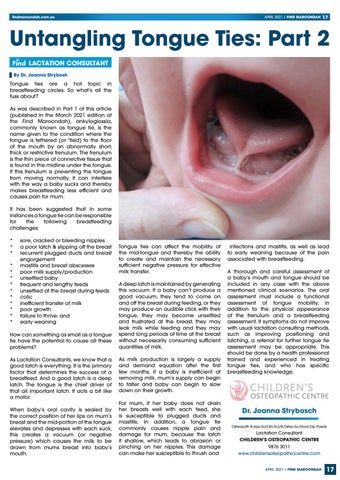
Untangling Tongue Ties: Part 2 LACTATION CONSULTANT By Dr. Joanna Strybosh
Tongue ties are a hot topic in breastfeeding circles. So what’s all the fuss about? As was described in Part 1 of this article (published in the March 2021 edition of the Find Maroondah), ankyloglossia, commonly known as tongue tie, is the name given to the condition where the tongue is tethered (or “tied) to the floor of the mouth by an abnormally short, thick or restrictive frenulum. The frenulum is the thin piece of connective tissue that is found in the midline under the tongue. If this frenulum is preventing the tongue from moving normally, it can interfere with the way a baby sucks and thereby makes breastfeeding less efficient and causes pain for mum. It has been suggested that in some instances a tongue tie can be responsible for the following breastfeeding challenges: * * * * * * * * * * * * *
sore, cracked or bleeding nipples a poor latch & slipping off the breast recurrent plugged ducts and breast engorgement mastitis and breast abscesses poor milk supply/production unsettled baby frequent and lengthy feeds unsettled at the breast during feeds colic inefficient transfer of milk poor growth failure to thrive, and early weaning
How can something as small as a tongue tie have the potential to cause all these problems? As Lactation Consultants, we know that a good latch is everything. It is the primary factor that determines the success of a breastfeed. And a good latch is a deep latch. The tongue is the chief driver of that all important latch. It acts a bit like a motor. When baby’s oral cavity is sealed by the correct position of her lips on mum’s breast and the mid-portion of the tongue elevates and depresses with each suck, this creates a vacuum (or negative pressure) which causes the milk to be drawn from mums breast into baby’s mouth.
Tongue ties can affect the mobility of the mid-tongue and thereby the ability to create and maintain the necessary sufficient negative pressure for effective milk transfer. A deep latch is maintained by generating this vacuum. If a baby can’t produce a good vacuum, they tend to come on and off the breast during feeding, or they may produce an audible click with their tongue, they may become unsettled and frustrated at the breast, they may leak milk while feeding and they may spend long periods of time at the breast without necessarily consuming sufficient quantities of milk. As milk production is largely a supply and demand equation after the first few months, if a baby is inefficient at removing milk, mum’s supply can begin to falter and baby can begin to slow down on their growth. For mum, if her baby does not drain her breasts well with each feed, she is susceptible to plugged ducts and mastitis. In addition, a tongue tie commonly causes nipple pain and damage for mum, because the latch it shallow, which leads to abrasion or pinching on her nipples. This damage can make her susceptible to thrush and
infections and mastitis, as well as lead to early weaning because of the pain associated with breastfeeding. A thorough and careful assessment of a baby’s mouth and tongue should be included in any case with the above mentioned clinical scenarios. The oral assessment must include a functional assessment of tongue mobility, in addition to the physical appearance of the frenulum and a breastfeeding assessment. If symptoms do not improve with usual lactation consulting methods, such as improving positioning and latching, a referral for further tongue tie assessment may be appropriate. This should be done by a health professional trained and experienced in treating tongue ties, and who has specific breastfeeding knowledge.
Dr. Joanna Strybosch Osteopath B.App.Sc(Clin.Sc)/B.Osteo.Sc/Grad Dip Paeds
Lactation Consultant CHILDREN’S OSTEOPATHIC CENTRE 9876 3011 www.childrensoteopathiccentre.com APRIL 2021 | FIND MAROONDAH
17
18
FIND MAROONDAH | APRIL 2021
findmaroondah.com.au
Volunteering for Open House ARCHITECT By Kathy Ismail
If you are looking at volunteering and would like to expand your knowledge of Melbourne and its architecture, why not volunteer for Open House? What is Open House? The Open House movement was founded in London in 1992 with the aim of opening examples of architectural excellence to the public so they could experience how a well-designed city could improve their lives. This led to the creation of the Open House Worldwide family of affiliated cities – 40 cities on 5 continents. Melbourne was the first member in the southern hemisphere. What is Open House Melbourne? On the much-loved Open House Weekend in Melbourne, held normally on the last weekend in July, tens of thousands of people come out to celebrate architecture and the city. The inaugural Open House Melbourne 2008 event saw 8 buildings open; the 2019 event featured over 200 buildings and 45 special events, tours and talks. At the heart of Open House Melbourne are the classic nineteenth -century buildings that make Melbourne an iconic Victorian-era city. But Melbourne also has modern award-winning buildings and other public spaces such as the Yarra River that engage the public. Each year, expressions of interest are run for historical and contemporary, public and private, and renowned and unknown buildings to be included in the Weekend, and there are always so many to choose from. This provides the public a free and rare opportunity to discover a hidden wealth of architectural, engineering and historic buildings nestled around the city. Residents, visitors, families, design buffs and architecture fans explore great contemporary, historic and sustainable buildings and spaces located in and around the Melbourne CBD, Carlton, East Melbourne, Southbank and Docklands. Well known buildings not usually open to the public are open for free public tours. Among the buildings included are historical landmarks, contemporary buildings, galleries, theatres, sporting grounds and places of worship. Volunteering for Open House Volunteers are the backbone of the Open House movement. Without their
generous support, the programs could not run. Volunteers distribute information, organise tours, promote events and much more. Welcoming visitors to the opened sites is a particularly important part of the role, as it allows Open House to fulfil its main purpose.
One of the best things was forging new friendships with fellow volunteers. I have had the chance to get to know more architecture enthusiasts. They are not just architects, but people who are just like you and me who share their love of buildings.
Why do I volunteer for the OHM? I can skip the queue to visit the buildings I want to see. One of the many buildings I got to visit this way was the Russell St Power Station and Substation J, on the corner of Spencer and Lonsdale Sts. Both are usually closed to public due to their engineering status. But once a year, people could come and marvel at the wonders behind what makes the city work.
Each year, expressions of interest are opened up for volunteers to help with The Weekend in Melbourne, as well as in Ballarat and Bendigo. The best way to stay informed is to subscribe to their newsletter, found at https://www.openhousemelbour ne. org/join/sign-up. Registrations for volunteering open in May: https://www. openhousemelbourne.org/join/
If you are after beautiful residential works, I encourage you to pre-book some of the private residences open for the public. I have visited some houses designed by Andrew Maynard and other big names in the Melbourne architecture scene. At times, I enjoy learning the history of the building I volunteered in; for example, the Capitol Theatre on Swanston St. The Art Deco building was once an openair cinema before the owner decided to add a ceiling and a roof while still operating as a cinema. How do I know this? The visitors who visited these places when they were dating in the 1960s. They told me about the original paint colours, when the new chairs were installed and many other details that I only discovered because I was there.
Volunteering for Open House is educational, awe-inspiring, worthwhile and great fun! If you would like more information about volunteering for Open House, contact KiR Architecture at contact@kirarchitecture. com.au. We can also help with planning your building projects. We are always happy to answer any inquiries.
Kathy Ismail ARCHITECT KiR Architecture www.kirarchitecture.com 0422 026 962
findmaroondah.com.au
APRIL 2021 | FIND MAROONDAH
19
Unpacking Jargon – TMD and DDO
GENERAL INSURANCE By Craig Anderson
Are you a retail or wholesale client? Most customers fall into a mixture of both, but if you are a pure retail client, read on. Whenever you purchase insurance, you are entering into a contract. The terms and conditions of the contract are the wording of the policy. For insurances such as car, home and contents or other personal insurance like travel cover, the wording/contract is called a PDS (Product Disclosure Statement).
the product is suited, and under what circumstances it is appropriate to sell it. This will help clients self-identify when a product is wrong for them. By comparing their circumstances to the target market determination (TMD) information supplied, they will be able to see easily if the product is not fit for its intended purpose. This will mean additional questions must be asked by providers, in an effort to ensure a good fit is achieved.
What is DDO? DDO stands for Design and Distribution Obligations, which will apply to insurers and intermediaries who are selling insurance. The purpose of these obligations is to make a clear distinction for all concerned as to who is responsible for determining what kind of product is offered, by whom it is distributed, and that it is fit for purpose. In other words, the DDO is a framework, which sets out obligations carried by the insurance providers and intermediaries and helps to prevent inappropriate transactions occurring.
You may wonder why this is relevant and why now? Europe has been working under this arrangement for some time , and we are catching up rather late. However, these changes are intended to sharply reduce the number of rejected claims resulting from the wrong policy being chosen and/or issued. Of course, this outcome relies heavily on the client answering honestly, and executing their duty of disclosure, which has always been an obligation for the client to shoulder.
What is TMD? TMD stands for Target Market Determination. This forces the insurer to look at a product and decide for whom
Changes will start taking effect later in 2021 as the renewal cycles start to kick in for policies binding in or after the last financial quarter. In the meantime enjoy
your newfound ability to decode this jargon as it appears.
Any advice in this article has been prepared without taking into account your objectives, financial situation or needs. Because of that, before acting on the above advice, you should consider its appropriateness (having regard to your objectives, needs and financial situation).
Craig Anderson General Insurance Small Business Insurance Brokers www. heightsafetyinsurancebrokers.com.au
0418 300 096 APRIL 2021 | FIND MAROONDAH
19
20
FIND MAROONDAH | APRIL 2021
findmaroondah.com.au
Simple Steps to Start Writing Your Own Book ACCREDITED EDITOR By Susan Pierotti
Sit back and imagine all the books in your local bookshop. Picture to yourself all the bookshops you know and all the books within them. Expand your vision and try to see all the books printed this century, then in the last century, the last millennium, all the books ever written…Why on earth would you want to contribute another one? However, if you feel deep within your inner being that you need to write a book, read on. Discover why you want to write Have you ever asked one or more of the following questions? • Our family have been influential, but who’s telling our story? • What skill am I particularly known for that people are talking about? • How can I give my knowledge and experience back into the community to inspire others? • Would collecting my blogs/talks/ whitepapers into a book market my brand better? • Why has no one written the sort of fantasy book that I want to read? If you said yes to any one of these questions, maybe it’s time to start writing! Discover your reader People still have a visceral urge to tell stories – it’s wired into our social DNA. Besides pure entertainment, stories provide strong community bonds, educate younger generations and promote memory and identity. How do you know who your readers will be? This could be determined by the subject matter. For instance, a retired construction manager could inform others coming up in the industry of work practices that you can’t and don’t learn at college. You may be writing your family history for others in the family to read. (If you are, don’t forget that local historical societies and libraries will also be keen to get a copy.) You may have a great idea for a detective story – there are millions who love a good whodunnit.
Discover the size of your book If you are going to use your book as promotional material to give away or sell after a public speaking event, it will have to be easily portable. Your new audience won’t thank you for giving them something the size and weight of a brick. Years of experience and wisdom could become a paperback of 200 pages. Or you could develop a series of smaller books around a theme, like the X for Dummies series. Coffee-table books will have more images with fewer words. This format is ideal for cooks, interior designers and landscape gardeners. Poems also have minimal text but will be much smaller and therefore cheaper to publish and print. Another factor to consider is how much it will cost to post. If the book is more than 1 cm in width, it could add 50% more on to the cost of book, a price that readers may be unwilling to pay. (Allow also for the fact that postage will go up, and factor in a ‘shipping and handling’ charge to cover that.) Why you should write your book In this heavily digitised age, more people than ever are writing their stories down. As soldier veterans are entering their eighties and nineties, their experiences of war could be lost forever. As the world has changed so rapidly in the last fifty years, the old world seems foreign, almost another planet and age from where we are now. It is vitally important
that we continue telling the stories of these times. Only you can tell your story your way. Charles Dickens wrote about the poor of London in over twenty novels, but George Orwell still found plenty to write about the London poor decades later in his own unique style. No one has ever commented that Orwell had wasted his time ‘copying’ Dickens. So don’t panic or talk yourself into not writing simply because others have done it before you. Your perspective is yours alone, and needs to be shared. So get writing! Creative Text Solutions offers book packages that include writing coaching, editing and publishing and marketing advice. Feel free to contact us any tine to discuss your book ideas.
Susan Pierotti Accredited Editor Creative Text Solutions 0437 127 159 www.creativetext.com.au
findmaroondah.com.au
APRIL 2021 | FIND MAROONDAH
21
Hope As Australian Environment Fights Back Aaron Bunch (Australian Associated Press)
The Australian environment has started a slow recovery from some of the toughest years on record, a new study has concluded. Researchers found robust species rebounded in 2020, despite the devastating ecological damage caused by the Black Summer fires, according to Australia’s Environment Report. “There’s reason to hope that our environment will get a chance to rebuild,” Australian National University environmental scientist Albert van Dijk said on Wednesday. “The extreme drought and heat conditions of 2019 and previous years eased after February (2020) thanks to increased rainfall, as La Nina climate conditions emerged,” he said. Prof van Dijk said rainfall across Australia had been about 10 per cent above the 20-year average and replenished dry soils. Despite the good news, Australia’s environmental conditions in 2020 were still well below average. “Recovery was patchy and not straightforward in delicate ecosystems that remain in a precarious state,” Prof van Dijk said.
“There was another mass bleaching event in the Great Barrier Reef, while the country’s list of threatened species grew by another 12 species.” The 2019/20 fire season also brought unprecedented fire activity to southeast Australia, with fires in southern NSW, eastern Victoria and the ACT in January and February. However, the area burned in NSW, ACT and Victoria in 2020 was less than in 2019, but still 2.2 times the 2000-2019 average. Continued very dry fuel and hot weather led to the high fire activity in southeast Australia, Prof van Dijk said. Despite the setbacks, the national environmental condition score for 2020 improved 2.6 points out of ten to reach 3.2 points. Scores improved in all states and territories except Tasmania. National vegetation condition returned closer to the average, up seven per cent on the previous year. But there were strong regional differences, with vegetation condition poorest in inland WA and fire-affected areas in southeast Australia. The strongest improvements occurred in the NSW tablelands. Population growth slowed down in 2020, growing by 188,000, which is 43 per cent below the average 2000-2019 growth rate.
This reduction was due to the effect of COVID-19 border closures on net immigration, Prof van Dijk said. The coronavirus also caused greenhouse gas emissions to decrease 3.2 per cent from the previous year. Temperatures were also lower than in the record hot year 2019 but remained well above average and in line with global warming. The poorest overall environmental conditions occurred in the Northern Territory and Western Australia due to continued drought. The largest improvements occurred in NSW and Victoria thanks to good rains, reaching above-average conditions. Conditions in the ACT were affected by large fires in early 2020. Researchers from ANU worked with the Terrestrial Ecosystem Research Network and analysed data from satellites and on-ground stations. The environmental condition score is a score between 0 and 10 expressing condition relative to previous years. It is calculated as the average rankings of component scores, including vegetation growth, soil protection, tree cover and the number of hot days.
APRIL 2021 | FIND MAROONDAH
21
22
FIND MAROONDAH | APRIL 2021
findmaroondah.com.au
What Lenders Look for When Assesing Your Home Loan Application MORTGAGE BROKERING By Reece Droscher
Applying for a Home Loan can be a nervous time for any prospective borrower. Whether you are hoping to buy your first home or your fifth, the process to get that final approval can be a difficult and frustrating experience. With greater regulation and the requirement to adhere to Responsible Lending Obligations, lenders are required to be more prudent than ever when assessing a new loan application. To help understand the process I have listed below the things a lender will look at to determine whether you are a suitable borrower. 1. SECURITY One of the first boxes you need to tick off with a lender is what security you are providing to satisfy the lender’s credit policy. They look at the type of property, the property value and your intended use of the property. There are different policies in place depending on whether you are securing your loan with a fully detached house, an apartment in the city or some vacant land. For example, if you were buying a house in the suburbs most Banks would lend you up to 95% of the property value. However, if you were buying vacant land with the intention to build a house in the future you would generally be limited to borrowing 90% of the security value. Your intended use of the property is also subject to different rules. Finance to buy an investment property will be restricted to a maximum of 90% of the property value with most lenders. Also, certain property types can also create challenges to obtain finance, such as large acreages, hobby farms and properties in regional areas. Some lenders will not accept these types of properties, so it is important to know up front where you can apply to give yourself the best chance at a positive outcome. 2. REPAYMENT CAPACITY Employment stability, the security of
your source of income, demonstrated consistency of earnings and a good repayment or savings history are the key indicators of an applicant’s ability to repay a loan. For the majority of applicants who have their applications declined it is the capacity to repay requirement that a lender believes has not been met to their satisfaction. Generally, a lender will prefer an applicant who is employed full-time and has been in their role for at least six months, so not on probation with their employer. They are earning an income which is sufficient to meet the proposed loan repayments, have demonstrated a history of meeting their previous loan repayments on time or have shown a willingness to save a deposit by allocating a consistent amount into their savings. This is just about the perfect scenario for a lender assessing a loan application. Unfortunately a lot of applicants fall into other categories which are treated differently due to their income sources. People who are self-employed, those in sales roles who earn commissions or bonuses, and casual employees may be looked at as potentially riskier borrowers, so their applications are assessed differently. For self-employed borrowers there is a delicate balance to negotiate. For a lot of people running their own business they look to minimize the amount of tax they pay, so they maximize their expenses to reduce their taxable income. However, when applying for a loan they need to show their last two years tax returns to demonstrate that their income level is sufficient to cover the new loan repayment. They may have shown unblemished loan repayment history and have ample security to provide, but without being able to show a consistent level of income which is high enough to satisfy the lender, they will not get their application approved. Borrowers in commission-based roles are also required to show consistency of commissions received, before a lender will consider that income as being a secure source that can be relied upon to repay the loan. Lenders have different
policies applied to this income type, however most will require at least twelve months history of commission earnings before they are prepared to rely on this income. Similarly casual employees are also generally required to have been in their roles for at least twelve months before they would be considered as a suitable borrower, as they have less employment security than those in permanent full or part-time roles. 3. LIVING EXPENSES One of the more recent changes to how lenders assess applications has been the verification of an applicant’s living expenses, and how they are accounted for to determine whether the loan is affordable. The lender requires an applicant to declare what they spend at the supermarket, on clothes, rates and utilities, transport, recreation, pets, etcetera. The lender is looking for anything that could impact negatively on the applicant’s ability to repay the loan they have applied for. It is important to be as accurate as possible when declaring living expenses, as lenders will request account statements to verify the information. Any discrepancy between what has been declared in the application and what is illustrated in the statements will need to be addressed with the lender, which causes delays in getting a positive response. 4. CREDIT REPORTS The recent introduction of comprehensive credit reporting has given lenders much greater information on an applicant’s credit history than ever before. With most lenders now participating in comprehensive credit reporting any current loans or credit cards an applicant has will be visible to the lender. They will also be able to see the conduct on those credit facilities, so any missed or late payments in your history, particularly in the last 24 months, will be looked at negatively and will impact on your credit score, thus reducing the chances of getting an approval.
findmaroondah.com.au
Before applying for any finance I would suggest obtaining a copy of your credit report, as you can see whether there are any old credit facilities that you thought were closed but are still open, giving you the opportunity to clean these up. 5. QUITY Equity represents the applicant’s investment in the transaction. Whether you are buying or refinancing you need to be able to demonstrate you have sufficient equity to be able to satisfy the lender. This category is related to the Security requirement as you need to have a minimum deposit (equity) before being considered for a loan. In the past you generally needed to have demonstrated an ability to save a minimum 5% plus the applicable purchase costs before being considered for a loan. However these requirements have been relaxed for borrowers, particularly first home buyers and applicants who have been renting. If you have access to a deposit through other means, such as a gift from parents or an inheritance, these are also acceptable sources of deposit. The amount of equity required will differ depending on the transaction proposed. As mentioned in the Security section if the proposed loan was to buy land or an investment property, you would need
APRIL 2021 | FIND MAROONDAH
to contribute a minimum 10% deposit, so there is a greater equity requirement than buying a home to live in. 6. CAPITAL Capital represents the applicant’s net worth, the value of your assets minus the liabilities. Effectively the lender will look at personal assets like cars, savings in your bank accounts, investments such as shares and any property that you own, and deduct things like credit cards, personal loans and any other loans or credit facilities you have at the time of submitting the application. The value left is your net worth.
23
It is important to emphasise that not all lender policies are the same. Different lenders may place a greater importance on some of these areas than others, which is why working with a Mortgage Broker to help guide you through the process, and ensure you are recommended to the most suitable lender to meet your individual circumstances, can give you the best opportunity to get your application approved. At SHL Finance we are ready and willing to help you achieve your Home Loan finance goals. Please call Reece Droscher on 0478 021 757 to discuss all of your Home Loan needs.
The lender considers this as it demonstrates an applicant’s ability to accumulate assets. It works in conjunction with other aspects mentioned earlier, such as credit history, as the willingness to repay debt should assist improve an applicant’s net worth. An applicant’s life stage will also influence whether an applicant passes the Capital test. A young applicant would not be expected to have accumulated as many assets when compared to a middle-aged applicant. Where an older applicant does not have a significant net worth it may indicate that they spend too much and haven’t allocated any money into savings or buying other assets. This will have a negative impact on their ability to obtain finance.
Reece Droscher Managing Director SHL Finance Pty Ltd reece@shlfinance.com.au www.shlfinance.com.au APRIL 2021 | FIND MAROONDAH
23
24
FIND MAROONDAH | APRIL 2021
findmaroondah.com.au
3 Helpful Hints For MaintainingYour Garage Doors With Changes In Weather
GARAGE DOORS By Chantal Djuric
With the COVID19 virus changing our everyday lifestyles, some people are finding it hard to focus on what they can do in a positive way to make their lives easier in these times. Working from home may be a strange way of being productive in the workplace. Schoolkids are having to be educated while at home. Shopping and socialising have changed. There are a few activities that will require a car – shopping for food, attending medical appointments and possibly keeping to education and work schedules. For these, you will probably still need your car so, with everything that is going on, the last thing that you need is for your garage door or gates not to work. Garage doors can be made out of many materials. In Australia, steel, aluminum, wood, copper, glass, and vinyl (polyethylene) are the most popular materials. Other materials include corrugated steel and transparent corrugated fibreglass. Some manufacturers incorporate foamed-inplace polyurethane insulation within the monolithic panel and sectional garage doors. With the change in the weather from summer to autumn to winter, and from bushfire dry to the coldest February since 1929 and the wettest March in Melbourne for ten years, these elements your garage door and gates
are made from will react differently to the temperature and humidity. Metal expands in cold weather – your garage door may go up and down but not be as reliably as you would expect. We at Cruzin Garage Doors have come up with three easy helpful tips to make access to your garages, and the things that you need in it, as stress-free as we can. 1 Look and listen to your garage door and/or gates. If something doesn’t look or sound right or if it is making a noise that is not common, it could have some broken components. When you think about it, garage doors open and close quite a lot. So a great tip is making sure all the hardware has been tightened – for instance, the brackets and bolts – and follow the manufacturer’s specifications and advice. If that doesn’t solve the problem, emergency repairs are available for garage doors 24 hours a day. Within thirty minutes of being on site, the repair technician should be able to assess how long it will take to supply replacement parts and, if relevant, explain how to prevent the problem for arising again. 2 Check the garage door’s balance. If the garage door isn’t balanced properly, it is working so much harder. How do you re-balance your garage door? Really, this is best left to the professionals to adjust your garage door so you don’t injury yourself.
3 During the changing weather, it is great to give your garage door tracks a good clean. To clean the tracks, get an old toothbrush and clear the inside of the tracks to dislodge any build-up of grease, grime or dirt. Spray cleaner into the tracks and then wipe out the tracks with a clean rag to remove the cleaner and debris. If you’re in doubt as to what cleaner you should use, ring your garage door repairer who can help you out as advice from the internet is not always reliable. If Now that we are self-isolating, many people are finding time to do those little jobs they’ve been putting off. Why not give your garage door a health check (and preserve its life span) by cleaning the tracks this month? If you feel anxious about climbing ladders or you don’t have the right cleaning equipment, Cruzin Garage Doors are here to look after all your garage door needs. For 24/7 garage door servicing, give Cruzin Garage Doors a call on 0427 894 603 or email us at sales@ cruzingaragedoors.com.au.
Chantal Djuric Garage Doors Cruzin Garage Doors 427 894 603 www.cruzingaragedoors.com.au
findmaroondah.com.au
APRIL 2021 | FIND MAROONDAH
25
Quality Solutions For Your Brand And For Safety SIGNAGES By Glenn Martin
At Signarama, we have the skills and experience required to work on anything from a simple car park sign to largescale building signs and on multiple sites, so you can rely on Signarama to deliver signage that meets your brand guidelines, with quality eye catching finishes, every time. With the right signage strategy, you can, convert large factory and warehouse buildings into permanent billboards for your business, assist people to find your location with pylon or exterior signage, add a ‘wow’ factor to an otherwise ordinary or unexciting space or catch the attention of pedestrians and motorists with high impact signage, such as threedimensional lettering and illumination. You can create a welcoming and professional reception area by adding brand personality to sometimes cold or uninviting spaces or minimise safety risks
to your workforce and visitors with floor graphics and highly visible warning and hazard signs. From large scale warehouse signs that put your mark on the skyline to small but essential safety and directional signage, we deliver innovative signs that look great for a long time. When people visit your workplace, you want them to find your location easily, navigate the site safely and leave with a positive impression of your business. Used well, signage is a powerful tool for achieving these outcomes. Warning and Safety Signs come in all shapes and sizes, from fully customised signage, to off the shelf standard signs, we can help you tick all the boxes to maintaining a safe and regulated environment. Our safety signs come in a variety of messaging, sizes, and formats. Our floor signs are made of industrialstrength materials that can stand up to water and chemical spills and can endure heavy foot and forklift traffic. Our wall signs come in durable material options such as aluminium, PVC, and adhesive-backed vinyl, so we can help
you choose the material that makes the most sense for your project. If there is a specific safety sign you are looking for, let us know. We can create custom signs to meet your business requirements. If your business is looking for ways to grow your reach, we would love the opportunity to discuss your signage options that will help you put your best foot forward for business growth in 2021. Contact us today to book a free consultation from one of our signage experts, and ensure you get current promotions by following us on Instagram @Signarama_Mitcham.
Glenn Martin Managing Director SIGNARAMA 0411 835 668 mictham@signarama.com.au
Go to https://signarama.com.au/store/mitcham to enter. APRIL 2021 | FIND MAROONDAH
25
26
FIND MAROONDAH | APRIL 2021
findmaroondah.com.au
The Benefits Of Having A Coffee Machine In Your Workplace COMMERCIAL COFFEE MACHINE By Ivana Smith
Covid restrictions have relaxed in Victoria to the point where employees are now returning to the office. Though many workers were forced to work from home during lockdown last year, many of them want to get out of the house and back into the office. The social aspects of working in the workplace cannot be ignored. People are enjoying meeting their work colleagues again after half a year online, and many with young families are certainly glad to able to interact with adults instead of having to home-school. The delight and enthusiasm of being part of a group, including a work environment, energises the workplace and a study done by Oxford University shows happy employees makes a business 13% more productive. This is especially important now to business owners and managers responsible for keeping the business afloat when JobKeeper and other government business subsidies will end soon. Anything that makes the business survive, let alone thrive, financially and keeps employees engaged is a bonus. It could be something as simple as installing a coffee machine in your workplace. Coffee promotes employee efficiencies! You may already have a machine that dispenses coffee when you slot a coin in…you hope! But does anyone you work with seriously enjoy the quality of the coffee that comes out? If you wish to keep your staff happy, you should consider getting rid of the machine with all the chocolate bars and potato chips and install one that makes only coffee and hot chocolate. The quality of the coffee will be far superior, and it will be much more cost-effective. How? Melburnians are famously fussy about their coffee. There are more ways to serve a coffee than letters in the alphabet, and everyone wants it served their own particular way – super hot, with crema, with no froth…The truth is, your employees
probably never drank the coffee from the dispensing machine. instead, they used to go outside at lunchtime and buy one from their favourite coffee shop. There’s nothing inherently wrong with that – after all, we’re all supposed to get up and get some gentle exercise every hour or so, and a walk outside to a café is better than glued to a desk all day. However, look at it from the business owner of managers’ point of view. A walk to the dispensing machine and back to the desk might take two minutes but walking to the coffee shop, standing in a queue, waiting for it to be made and paying for it might take as long as a quarter of an hour, and that’s not counting stopping for a chat or window-browsing. That quarterhour adds up to roughly over an hour per week which is five hours a month and nearly seven working days a year where your employee is not in the office working! It clearly pays to encourage your employees to remain within the office space. There are other several benefits to installing a quality coffee machine. People will gather around as they have around wells, pubs and other drinking ‘holes’ over the centuries. This is not only where people gossip but share ideas, give and receive information and speed up communications. Be green and full of flavour Some coffee machines on the market
are designed so that the coffee comes in non-biodegradable aluminium pods. However, why not improve your business’s ‘green’ credentials (a selling point to Gen Ys) and install a machine that is environmentally friendly, as the coffee is ground and served in paper cups. ‘Aha,’ you say. ‘Tried that, and the mess left in the office kitchen was appalling.’ There are not only coffee machines but coffee machine providers who install the machine, maintain it weekly and take care of all the consumables – lids, cups, teaspoons, coffee, chocolate and sugar. No mess, no fuss. The best thing about these types of coffee machines is that the coffee is superior in quality to most other machines, and even to the burnt-tasting luke-warm beverage from down the road. When your employees taste that finely brewed coffee from your new machine, they will want to hang around the office. They will probably love you even more! For advice on coffee and how to supply it to office spaces and clubs, contact Ivana at ivana.smith@xpressodelight. com.au.
Ivana Smith Commercial Coffee Machine Xpresso Delight 0418 393 085 www.xdcoffee.com.au
findmaroondah.com.au
APRIL 2021 | FIND MAROONDAH
27
The End of Protection As We Know It - 6 Months Left
FINANCIAL PLANNING By Warren Strybosch
The commencement of March was an interesting one for the Income Protection Industry, as it’s essentially 6 months period to the end of IP as we know it. Effective from 1st October (still to be confirmed), the current IP products will not be sold anymore to new clients. Only the new type of IP will be sold. Anyone with the older type of IP should consider holding on to it especially if you have an ‘Agreed’ product. So, why is APRA looking to make insurers change? There’s a lot of discussion going on between product managers and their legal departments to try and decipher what APRA has requested. Many things are on the table for review. These include, but are not limited to, the possible removal of some of the following benefits: • • •
•
Benefit period to age 70 Three-tiered definitions Ancillary benefits such as specific injury, bed confinement (these may be watered down, or scrapped completely) 75% coverage of income – may see 70% for first 24 months and then 60% loss ratio for the remainder of the benefit period.
As far as current interpretations go, APRA has stated that insurers need to develop a new product to counter-act the current
instability of the market. This includes a new form of IP, that must have a 5-year renewable term. At the conclusion of the 5 years, the insured will need to supply confirmation of their income and occupation, which will then be reviewed by the insurer before the policy can continue on. It’s worth noting that we don’t believe medical underwriting will be required at this 5th year renewal period. As you can appreciate, the above along with many other changes proposed, are creating lots of questions that we are endeavouring to get clarification about. No one really knows how the future of Income Protection is going to look going forward. What we do know for certain, is that what is currently on offer won’t ever be available again after the 1st of October. If you have deferred, declined or pontificated about getting IP, now is the time to have these discussions with your financial advisor before the inferior IP product is all that is available. To close off, I’d like to quote one of the greats of the 20th century, none other than Ferris Bueller who said; “Life moves pretty fast. If you don’t stop and look every once and a while, you could miss it.” I think Ferris was also talking about Income Protection!
that provides the cost of taking up the insurances you have selected. We will also compare your current insurances to see if anything else is cheaper in the marketplace for you. You can book an appointment via the following calendar link: https://calendly.com/findgroup/15minute-phone-conversation or simply call 1300 88 38 30 to talk to a financial advisor about getting a quote. This information is current as at September 2018. This article is intended to provide general information only and has been prepared without taking into account any particular person’s objectives, financial situation or needs (‘circumstances’). Before acting on such information, you should consider its appropriateness, taking into account your circumstances and obtain your own independent financial, legal or tax advice. You should read the relevant Product Disclosure Statement (PDS) before making any decision about a product. While all care has been taken to ensure the information is accurate and reliable, to the maximum extent the law permits, Clearview and its related bodies corporate, or each of their directors, officers, employees, contractors or agents, will not assume liability to any person for any error or omission in this material however caused, nor be responsible for any loss or damage suffered, sustained or incurred by any person who either does, or omits to do, anything in reliance on the information contained herein.
Warren Strybosch You can call them on 1300 88 38 30 or email info@findinsurance.com.au www.findinsurance.com.au
At Find Insurance, we would like to help you obtain the right type of personal insurances for your needs. All it takes is a 30-minute over the phone discussion. Once the discussion is over you will be provided with a FREE insurance report APRIL 2021 | FIND MAROONDAH
27
28
FIND MAROONDAH | APRIL 2021
findmaroondah.com.au
Good Environmental News NATURE & CONSERVATION
Blue-Billed Duck (Male).
By Liz Sanzaro
Using iNaturalist, which is mentioned in another article in this months edition, keen observers have been watching the blue billed duck at Knox wetland. You might have read about this in a previous issue of Find Maroondah. Now the breeding of this rare species which was recorded on March 5th with a new ducking emerging for the world to see, shows the habitat to be very suited. This special duck is breeding well at only 18 sites in Victoria. It is frequently found in water treatment facilities, but we should be able to provide much more suitable natural habitat than in our waste water, surely. Knox wetland is one such “natural habitat area” and everything must be done to protect it. Now the onus is on Development Victoria to not interfere in any way with this wetland, as the surrounding land is re-developed for housing. A recent assessment of the existing dam, by Development Victoria found
Image courtesy of Richard Hall Photography
• • •
•
The dam is structurally unsound, and at risk of collapse within two years The current dam does not provide for stormwater treatment and water retardation Untreated stormwater is currently flowing directly into the Blind Creek corridor, and there is a flood risk to the adjacent light industrial area The dam is very deep with steep banks — creating a safety risk making it inaccessible to the public
This is typical short sighted engineering speak, that treats rain water as a waste resource, to be drained from housing lots and industrial areas, shunted into a facility, which they can then make to look “pretty” for recreational walking and cycling, and the water is then sent on its way to Port Phillip bay. When will we change our mindset from this to this? It’s getting late to reverse Climate action.
Online Sellers Make Thousands During COVID (Australian Associated Press)
Australians selling items using virtual marketplaces made about $4300 each on average as COVID-19 kept people off the streets and online, according to research from sales platform eBay. Staying at home and de-cluttering proved lucrative for thousands of online sellers, with one in 10 making more than $10,000 trading second-hand gear. While some people continue to use eBay as a second-hand selling point, an increasing number are doing most of their shopping online, eBay said. Australian managing director Tim MacKinnon noted that traffic on the platform grew by more than a million users during the pandemic, to 12 million a month. “Nobody knew how consumers would respond when we first entered this crisis but one year on we’ve seen a rapid acceleration in e-commerce,” he said.
Victorians made almost $6000 on average selling second-hand goods, South Australians were pulling in less than a third of that amount, and in NSW two-thirds. The figures come from eBay sales numbers and a survey of more than 2000 Australians commissioned by the platform, conducted in January and February. While the Australian economy took a hit during 2020, consumer spending was fuelled by government support packages, low interest rates and mortgage payment deferrals. And on-again off-again lockdowns in different states saw some unusual spending patterns. During Victoria’s last lockdown eBay sales of kitchen equipment rose by 60 per cent, while during WA’s five-day shutdown, video game console sales
spiked by 342 per cent. Face mask sales increased by 700,000 per cent in March 2020 and spiked again in July, while hand wash sales increased almost 4000 per cent. As households bunkered down for winter lockdowns, sales of sewing items surged by 800 per cent, while sales of collectible card games such as Pokemon were up more than 12,000 per cent.
findmaroondah.com.au
APRIL 2021 | FIND MAROONDAH
29
Rising Confidence and Jobs to be Tested
Colin Brinsden. AAp Economics and Business Correspondent (Australian Associated Press)
Payroll jobs are now slightly higher than they were a year ago as the economy continues its recovery from last year’s deep recession. At the same time, consumer confidence has soared to a 16-month high. But both economic measures will be put to the test in coming weeks as a result of the JobKeeper wage subsidy coming to an end and the Greater Brisbane COVID 19 lockdown. As well, Wednesday will see the end of the $150 per fortnight coronavirus JobSeeker dole payment subsidy. Economists will also be looking at a spread of housing-related indicators over the next couple of days to gauge whether the country’s financial regulators may be any closer to tightening lending rules. Australian Bureau of Statistics payroll jobs figures rose 0.2 per cent in the fortnight to March 13, building on the 0.9 per cent increase in the previous two weeks. ABS head of labour statistics Bjorn Jarvis said most state and territory payroll jobs had either reached or passed levels of a year ago by mid-March.
The only exceptions were Tasmania and Victoria, remaining 1.1 per cent and 0.7 per cent lower, respectively, for the year. National Australia Bank economist Taylor Nugent said the report, and other indicators suggest, another strong employment result when the full March labour force report is released next month, although he warns payrolls are subject to substantial revisions. Tuesday’s data also pre-dates the end of JobKeeper on March 28. “We will have to wait until April to start to gauge the impact,” he said. Treasury estimates up to 150,000 people could be left without a job as a result of the scheme ending. There is uncertainty about whether the labour market has the momentum to absorb these potential job losses, or whether the steady drop in unemployment will grind to an abrupt halt over the next few months. Still, other new data suggests Australians have got over their initial anxiety about the end of JobKeeper, a program that successfully provided support during last year’s recession. The ANZ-Roy Morgan consumer confidence index – a pointer to future
household spending – jumped 1.7 per cent in the past week to its highest level since October 2019. This followed two weeks of consecutive declines as the deadline for the end of JobKeeper approached. ANZ head of Australian economics David Plank said receding rainfall and floodwaters along Australia’s east coast appears to have lifted the mood of the nation. However, the survey was taken at the weekend and prior to the announcement of a snap three-day lockdown in Greater Brisbane. Previous lockdowns across the country have taken their toll on business and consumer confidence, potentially undermining the economic outlook in terms of investment, hiring and spending. “Sentiment in Queensland may be tested by the emergence of a COVID-19 cluster in Brisbane,” Mr Plank said. “The rise in overall confidence to almost its long-run average is encouraging and points to the end of JobKeeper being successfully navigated overall, if not without some difficult individual circumstances.” APRIL 2021 | FIND MAROONDAH
29
30
FIND MAROONDAH | APRIL 2021
findmaroondah.com.au
Leap into the School Holiday The school holidays are here and so is the FUN! Explore a range of great activities to keep everyone entertained this April. Be sure to hop to it and book in to secure your place! Book Now
Looby: A Documentary To mark 100 years of the Archibald Prize, Looby tours Australia in 2021 Book Now
findmaroondah.com.au
APRIL 2021 | FIND MAROONDAH
Book Now
Book Now
Book Now
Book Now
Book Now
Book Now
31
Current Services • • • • • • • •
Face masks are optional We ask Library Users to try to maintain social distance of 1.5 metres where practicable You must register your visit by using the QR Code or by registering in the Visitors’ Contact Log The hand sanitiser provided must be used before entry to the library A family group can enter by one registration by using the QR Code or by registering in the Visitors’ Contact Log There is no time limit on a library visit Please do not enter the library if you are unwell. You may be requested to leave if you display any symptoms of being unwell Cash payments are no longer accepted. Only credit/debit card payment available
Learn More APRIL 2021 | FIND MAROONDAH
31
2020 TA ACT COVID-19 Stimulus Package Starting in March 2020, the ACT government has announced a series of measures which provide waivers or deferrals of payroll tax. These waivers and deferrals are an attempt to combat the economic fallout from the COVID-19 pandemic. Waivers of ACT payroll tax are available for businesses in hospitality, creative arts and entertainment industries. Deferrals are available for other small and medium-sized
Announcement: 22-Mar-2020 Updated: 23-Dec-2020
businesses. Initially lasting 6 months, some of these assistance measures have been extended into 2021.
FBT Exemption for Retraining and Reskilling Proposed An employer may receive a future exemption from fringe benefits tax when providing employees with retraining or reskilling opportunities. This 2020 federal budget announcement will take affect from 2 October 2020, subject to the passing of legislation. The government has also released a consultation
Announcement (6-Oct-2020) Consultation (22-Jan-2021) Introduced
paper with respect to possible changes to the self-education deduction section for individual taxpayers.
Passed
These measures may provide a tax incentive for employees to change careers, in particular if they are
Royal Assent
about to be made redundant.
Date of effect
Reviewing Denied Jobkeeper or Cash Flow Boost Receipts A recent report into the ATO’s administration of JobKeeper and Cash Flow Boost payments has uncovered situations where the ATO has incorrectly denied entities access to the stimulus payments. Some new
Announcement (18-Jan-2021)
businesses were informed that they were ineligible due to not having informed the ATO of any taxable
Updated (20-Jan-2021)
supplies prior to the commencement date of 12 March 2020. However, the report acknowledges that this
Consultation Introduced
was misinterpreted by the ATO. In particular, the modified definition of taxable supply to include financial
Passed
supplies. However, the report also acknowledges that the ATO will not be chasing up businesses who
Royal Assent
may have been incorrectly determined to be ineligible. Any affected clients of yours will need to go
Date of effect
through the objection process, which can be extended if there is a likelihood of success.
Victoria COVID-19 Package for States Taxes Throughout the COVID-19 pandemic, the Victorian government has announced various assistance for businesses who are required to pay land tax or payroll tax. Assistance has been given in the
Announcement (20-Mar-2020)
form of reductions, refunds and deferrals of these state taxes. However, not all assistance is applied
Updated (3-Feb-2021)
automatically and requires direct application with the State Revenue Office. Most recently, a 12-month
Consultation Introduced
deferral of payroll tax applies to businesses with Victorian taxable wages under $10 million. Also, land
Passed
tax relief has been extended into 2021 for landlords who provide qualifying rental reductions to their
Royal Assent
tenants. The impact statement and letters provide more detailed information for you to correspond with
Date of effect
your clients, to ensure they receive all the assistance they are entitled to.
Simplified Fuel Tax Credits - Reduced Record Keeping A new simplified method of calculating fuel tax credits has been released by the Australian Taxation Office. Provided an entity follows this simplified method in good faith, the Commissioner of Taxation will
Announcement (5-Feb-2021)
administer the law in accordance with this approach. To be eligible to use the simplified method, an
Consultation (5-Feb-2021)
entity’s fuel tax credit claim for an income year should be $10,000 or less. If using this new simplified method, an entity cannot use another simplified method for calculating fuel tax credits, such as auxiliary equipment usage. However, an entity may choose which method best suits them each tax period.
Released (5-Feb-2021) Passed Date of effect
AX UPDATES Temporary Full Expensing of Depreciating Assets The majority of businesses are eligible to claim an outright deduction for the cost and installation of new assets. To qualify for full expensing, the asset must be first held and first used, or installed ready for use, between 7:30pm AEDT 6 October 2020 and 30 June 2022. Unlike prior rules on instant asset write-offs, no limit applies to the cost of an asset under the full expensing rules. That is, an asset of any value may be fully deducted in the appropriate income year. For a business to qualify for the outright deduction, the entity must have an aggregated turnover of less than $5 billion. Certain large entities will have separate
Announcement (6-Oct-2020) Consultation (6-Oct-2020) Introduced (7-Oct-2020) Passed (9-Oct-2020)
eligibility criteria.Since the legislation has been enacted, further amendments will be made to the laws
Royal Assent (14-Oct-2020)
to allow businesses a choice in using full expensing or not. In certain situations, it may be beneficial to
Date of effect (6-Oct-2020)
spread out tax deductions over multiple years. The ATO has released a form for early balancers to lodge their full expensing claims for the 2020-21 income year.
Temporary Full Expensing of Depreciating Assets The majority of businesses are eligible to claim an outright deduction for the cost and installation of new assets. To qualify for full expensing, the asset must be first held and first used, or installed ready for use, between 7:30pm AEDT 6 October 2020 and 30 June 2022. Unlike prior rules on instant asset write-offs, no limit applies to the cost of an asset under the full expensing rules. That is, an asset of any value may be fully deducted in the appropriate income year. For a business to qualify for the outright deduction, the entity must have an aggregated turnover of less than $5 billion. Certain large entities will have separate
Announcement (6-Oct-2020) Consultation (6-Oct-2020) Introduced (7-Oct-2020) Passed (9-Oct-2020)
eligibility criteria.Since the legislation has been enacted, further amendments will be made to the laws
Royal Assent (14-Oct-2020)
to allow businesses a choice in using full expensing or not. In certain situations, it may be beneficial to
Date of effect (6-Oct-2020)
spread out tax deductions over multiple years. The ATO has released a form for early balancers to lodge their full expensing claims for the 2020-21 income year.
Loss Carry-back Available for Companies For three income years, many corporate tax entities will be eligible to claim a refundable tax offset when they incur a taxable loss. This optional offset is available only to business and is a recoupment of prior year income tax paid, but only available for recent income years. The loss carry-back is available to businesses with turnover under $5 billion. Any refundable tax offset is limited to prior year tax paid
Announcement (6-Oct-2020) Consultation (6-Oct-2020) Introduced (7-Oct-2020) Passed (9-Oct-2020)
and the balance of the franking account. An ATO form is now available for companies who are early
Royal Assent (14-Oct-2020)
balancers under a substituted accounting period.
Date of effect (1-Jul-2021)
New Guidance for Allocation of Professional Firm’s Profits New guidance has been released to assist a professional firm determine whether the allocation of their profits is appropriate with respect to alienation of income. In this draft guidance, the ATO has stated that compliance resources will not be allocated to firms that: * pass through 2 ‘gateways’relating to genuine partnership arrangements, and *are low risk in terms of a specified risk assessment framework. Arrangements outside the low risk rating will generally be considered to be at risk of giving rise to an inappropriate tax outcome. Professional firms will be required to self-assess their risk profile, with
Announcement (2-Mar-2021) Consultation (26-Mar-2020) Released
an understanding that any compliance review will start with contemporaneous documentation that substantiates the partnership agreement.
APRIL 2021 | FIND MAROONDAH
33
APRIL 2020 REALESTATE
REALESTATE FIND AUSTRALIA’S #1 PLACE FOR PROPERTY
HOUSE OF THE MONTH
PROPERTIES FOR SALE 132345 Feature Address Place Here A Short Description for this Property.
Offered at $000,000
ADVERTISE YOUR PROPERTIES HERE Email your Properties For Sale in the Find Maroondah and we will place it in the online community paper. Contact Warren for all of your advertising needs.
Warren Strybosch 1300 88 38 30
editor@findmaroondah.com.au
APRIL 2021 | FIND MAROONDAH
35
If you have questions, contact Warren on 1300 88 38 30 or email: editor@findmaroondah.com.au
NEW RENTAL LISTING
APRIL 2021
HOSKINS PREMIUM PROPERTY PEOPLE 142 Maroondah Highway Croydon VIC 3136
03 9722 9755 croydon@hoskins.com.au www.hoskins.com.au
$445 Per Week
$410 Per Week
Under Application
Under Application
1/60-64 Foch Street, Box Hill South 2
1
1
MORE DETAILS
$400 Per Week
1
1
MORE DETAILS
Available now
1/886 Doncaster Road Doncaster East VIC 3109 1
2
MORE DETAILS
$370 Per Week
20A Heads Road Donvale VIC 3111 1
1
1
MORE DETAILS
$995 Per Week
Available now
Available now
5/4 Barkers Road Hawthorn VIC 3122 2
2
$380 Per Week
Under Application
2
3/330 Mt Dandenong Road Croydon VIC 3136
1
1
MORE DETAILS
7/52A Lyndhurst Street Richmond VIC 3121 3
2
1
MORE DETAILS
APRIL 2021 | FIND MAROONDAH
37
NEW RENTAL LISTING
APRIL 2021
HOSKINS PREMIUM PROPERTY PEOPLE 142 Maroondah Highway Croydon VIC 3136
03 9722 9755 croydon@hoskins.com.au www.hoskins.com.au
$370 Per Week
Available now
5/3 Turnbull Court Ringwood VIC 3134 2
1
1
MORE DETAILS
FREE OPEN INSPECTIONS IN THE REAL ESTATE Email your Open Inspections to the Find Maroondah each week and we will update your Open Inspections in the online community paper for FREE Contact Warren for all of your advertising needs.
Looking to market your Building Company in Contact Warren for all of your advertising needs.
Warren Strybosch 1300 88 38 30 editor@findmaroondah.com.au
NEW RENTAL LISTING
APRIL 2021
MAX BROWN REAL ESTATE GROUP SURREAL PROPERTY GROUP Level 1/3941 Hewish Road Croydon 2/732 Mountain Highway BayswaterVIC VIC3136 3153
P: MAX (131 629) | F: 1300 3295288 629 03 9723 enquires@maxbrown.com.au croydon.vic@raywhite.com www.maxbrown.com.au www.surrealpropertygroup.com.au
$ 340 Per Week
$350 Per Week
Avail Now
Avail Now
9 / 14 Browning Street, Kilsyth VIC 3137 2
1
1
MORE DETAILS
$410 Per Week
1
2
MORE DETAILS
Avail Now
3/8 Dunlop Avenue Bayswater North VIC 3153 2
2
MORE DETAILS
$430 Per Week
4 / 57 Bayswater Road, Croydon VIC 3136 2
1
2
MORE DETAILS
$360 Per Week
Avail Now
Avail Now
18a Chapel Street, Lilydale VIC3140 2
2
$400 Per Week
Avail Now
3
305 Hull Road Mooroolbark VIC 3138
2
1
MORE DETAILS
9 / 17 Landale Avenue, Croydon VIC 3136 2
1
1
MORE DETAILS APRIL 2021 | FIND MAROONDAH
39
NEW RENTAL LISTING
APRIL 2021
MAX BROWN REAL ESTATE GROUP SURREAL PROPERTY GROUP Level 1/3941 Hewish Road Croydon 2/732 Mountain Highway BayswaterVIC VIC3136 3153
P: MAX (131 629) | F: 1300 3295288 629 03 9723 enquires@maxbrown.com.au croydon.vic@raywhite.com www.maxbrown.com.au www.surrealpropertygroup.com.au
$600 Per Week
$450 Per Week
Avail Now
Avail Now
13 Ashley Court Seville VIC 3139 4
2
2
MORE DETAILS
3 / 30 Colchester Road, Kilsyth VIC 3137 3
2
2
MORE DETAILS
$600 Per Week
Avail Now
14 Candlebark Circuit, LILYDALE VIC 3140 4
2
2
MORE DETAILS
Looking to market your Build Company in Contact Warren for all of your advertising needs.
Warren Strybosch 1300 88 38 30 editor@findmaroondah.com.au
NEW RENTAL LISTING
APRIL 2021
SURREAL PROPERTY GROUP 2/732 Mountain Highway Bayswater VIC 3153
03 9723 5288 croydon.vic@raywhite.com www.surrealpropertygroup.com.au
$435 Per Week
$350 Per Week
Avail Now
Avail Now
7 Skye Court, BAYSWATER NORTH VIC 3153 3
2
1
MORE DETAILS
2
1
1
MORE DETAILS
$450 Per Week
$525 Per Week
Avail Now
Avail Now
5 Clyden Court, BURWOOD EAST VIC 3151 4
1/7-9 Ramsay, BAYSWATER NORTH VIC 3153
2
2
MORE DETAILS
34 Heathwood Street, RINGWOOD EAST VIC 3135 3
2
1
MORE DETAILS
APRIL 2021 | FIND MAROONDAH
41
NEW RENTAL LISTING
APRIL 2021
NOEL JONES Level 1, 554 Whitehorse Road Mitcham VIC 3132
03 8892 3702 corporate@noeljones.com.au www.noeljones.com.au
$425 Per Week
$400 Per Week
Available 12/03/21
Available 17/02/21
1/15 Laurence Grove Ringwood East VIC 3135 3
1
1
MORE DETAILS
$365 Per Week
3
1
1
MORE DETAILS
$530 Per Week
Available 01/02/20
Available 01/02/20
65/280 Maroondah Highway Ringwood VIC 3134 2
3/1 Howship Court Ringwood East VIC 3135
1
1
MORE DETAILS
$425 Per Week
15 Mulberry Grove Keysborough VIC 3173 4
3
1
MORE DETAILS
It Begins With a Conversation
Property Research, Done Right Available 01/02/20
Whether you’re selling, buying or renting – it all starts with a conversation.
105/10 Main Street Blackburn VIC 3130 2
2
1
MORE DETAILS
Engage with an agent near you, and profit from local agents armed with local knowledge. Visit Your Local Office
NEW RENTAL LISTING
APRIL 2021
RAY WHITE CROYDON VICTORIA 71 Main Street Croydon VIC 3136 9725 744 croydon.vic@raywhite.com www.raywhitecroydon.com.au
$245 Per Week
$250 Per Week
Property ID: CRY22905691
Property ID: CRY22830073
302/32-34 Lygon Street Brunswick East VIC 3057 1
1
0
MORE DETAILS
$300 Per Week
1
0
MORE DETAILS
Available now
214/1 Clara Street South Yarra VIC 3141 1
0
MORE DETAILS
$400 Per Week
202/3-5 Birch Street Bayswater VIC 3153 2
1
0
MORE DETAILS
$420 Per Week
Available now
Available now
3/18 Surrey Road West Croydon VIC 3136 2
1
$400 Per Week
Available now
1
103/32-34 Lygon Street Brunswick East VIC 3057
1
1
MORE DETAILS
374 Dorset Road Croydon VIC 3136 3
1
2
MORE DETAILS APRIL 2021 | FIND MAROONDAH
43
NEW RENTAL LISTING
APRIL 2021
RAY WHITE CROYDON VICTORIA 71 Main Street Croydon VIC 3136 9725 744 croydon.vic@raywhite.com www.raywhitecroydon.com.au
$430 Per Week
$510 Per Week
Available now
Available now
14/195 Dorset Road Croydon VIC 3136 2
2
1
MORE DETAILS
$560 Per Week
2
2
MORE DETAILS
Available now
2/628 Whitehorse Road Mitcham VIC 3132 2
2
MORE DETAILS
$630 Per Week
Available now
1/21 View Street Croydon VIC 3136 4
3
$560 Per Week
Available now
3
127B Taylor Road Mooroolbark VIC 3138
3
2
MORE DETAILS
73 Yarra Road Croydon HillS VIC 3136 4
2
2
MORE DETAILS
NEW RENTAL LISTING
APRIL 2021
FLETCHERS MAROONDAH 1 Seymour Street Ringwood VIC 3134
03 9955 4988 maroondah@fletchers.com.au www.fletchers.net.au
$400 Per Week
$ 480 Per Week
Available now
Available now
21 Bedford Road Ringwood VIC 3134 2
1
1
MORE DETAILS
95 Taylor Road Mooroolbark VIC 3138 3
2
2
MORE DETAILS
$400 Per Week
Available now
12 Eugenia Street Nunawading VIC 3131 3
1
2
MORE DETAILS
Looking to market your Build Company in Contact Warren for all of your advertising needs.
Warren Strybosch 1300 88 38 30 editor@findmaroondah.com.au
APRIL 2021 | FIND MAROONDAH
45
NEW RENTAL LISTING
APRIL 2021
E L
P M
A S
SAMPLE SAMPLE SAMPLE OFFERED AT
$ 2,000,000
• 4 • 2 • 3 • 1
Modern Bedrooms Living Room Bathroom Kitchen
Email your Open Inspections to the Find Maroondah each week and we will update your Open Inspections in the online
Krista Gilmour Exclusive Broker 1300 88 38 30 email@addresshere.com.au www.company.com.au
community paper for FREE. Contact Warren for all of your advertising needs.
Warren Strybosch 1300 88 38 30 editor@findmaroondah.com.au
FREE OPEN INSPECTIONS ADVERTISING
E L
P M
A S
SAMPLE SAMPLE SAMPLE OFFERED AT
$ 2,000,000
• 4 • 2 • 3 • 1
Modern Bedrooms Living Room Bathroom Kitchen
Email your Open Inspections to the Find Maroondah each week and we will update your Open Inspections in the online
Jessica Elaine Exclusive Broker 1300 88 38 30 email@addresshere.com.au www.company.com.au
community paper for FREE. Contact Warren for all of your advertising needs.
Warren Strybosch 1300 88 38 30 editor@findmaroondah.com.au
APRIL 2021 | FIND MAROONDAH
47
APRIL 2021
REAL ESTATE AGENT
www.findmaroondah.com.au
We invite all Real Estate Agents to list their profiles here. First in, first page. Be known in your local community and help support all things Maroondah. For listing enquiries call 1300 88 38 30 or email editor@findmaroondah.com.au
Agent Name: 1234 568 75896 emailaddress@gmail.com.au
COMING SOON
www.insertwebsite.com.au
Agent Name: 1234 568 75896 emailaddress@gmail.com.au www.insertwebsite.com.au
COMING SOON
APRIL 2021
REAL ESTATE AGENT
www.findmaroondah.com.au
We invite all Real Estate Agents to list their profiles here. First in, first page. Be known in your local community and help support all things Maroondah. For listing enquiries call 1300 88 38 30 or email editor@findmaroondah.com.au
Agent Name: 1234 568 75896 emailaddress@gmail.com.au
COMING SOON
www.insertwebsite.com.au
Agent Name: 1234 568 75896 emailaddress@gmail.com.au
COMING SOON
www.insertwebsite.com.au
APRIL 2021 | FIND MAROONDAH
49
Maroondah C
REALESTATE
Council Adopts Maroondah’s COVID-19 Recovery Plan: Stronger Together - Our Way Forward from COVID-19 Maroondah City Council has adopted a new plan to drive the city’s economic, social and community recovery from the COVID-19 pandemic. The Recovery Plan outlines a range of priorities and actions to assist the community and businesses to access the support they need to recover from the pandemic, activate places and spaces to bring people back to Maroondah, leverage the city’s unique attractions and assets, and invest in a positive and sustainable future. Mayor of Maroondah, Cr Kylie Spears said strong partnerships between Council and a wide range of local and regional agencies, organisations and individuals will continue to be vital in helping the Maroondah community recover from the impacts of the pandemic. “The initial goals of Council in responding to the pandemic have been to prioritise the health and wellbeing of our community, mitigate the significant impacts of COVID-19 on our economy and business community, and prioritise the delivery of infrastructure that best supports our recovery, creates jobs, improves liveability and attracts people,” Cr Spears said. “We will continue to carry out this important role, but at the same time we are moving from a response phase to one of recovery,” she said.
Programs to facilitate community connections, reduce isolation, enhance mental wellbeing and connect with vulnerable residents, as well as supporting initiatives that reduce barriers to employment, particularly for young people, will also be delivered.
“This plan will assist Council, community organisations and service providers to work collaboratively to bounce back from the pandemic. Through shared planning and effort, we can support the recovery needs of our community to ensure we are stronger beyond COVID-19,” Cr Spears added.
“Months into the pandemic, Council asked the community about their hopes and plans after COVID-19. While a significant number of people stated that they hoped for a life returning to normal, the overall responses showed a strong emphasis on the importance of family,” Cr Spears said.
Among community initiatives will be building the capacity of community, clubs and organisations to assist them to apply for grants, expand volunteering pathways, and adapt the Be Kind Maroondah campaign and MaroondahConnect support service to a post-COVID environment.
“Recovery from pandemics, like any emergency, is a long, complex, dynamic and multidimensional process. The key to recovery is to focus on managing the consequences and ensuring that there are systems in place that adapt to changing and emerging community needs and strengths,” she said.
“Council will continue to actively engage with the community and key stakeholders throughout the implementation of the Recovery Plan to provide avenues for the community to continue to share their thoughts and experiences and be involved in community-led recovery,” Cr Spears added. The Maroondah COVID-19 Recovery Plan was developed through extensive research and community consultation, with more than 2,800 survey responses across various engagement activities and feedback from local agencies, organisations and specialist advisory committees and groups, including the University of Melbourne and the Australian Red Cross. Want to learn more about Council’s plan for recovery? View our Maroondah COVID-19 Recovery Plan
Council News APRIL 2021
A safe and happy Easter from all of us at Maroondah City Council With the Easter long weekend almost upon us, it is important that we focus on ways to keep ourselves, our families and those around us safe. While some will be attending church services to reflect and rejoice on the Easter story, for others it is an opportunity to get together with family and friends and indulge in a few hot cross buns and chocolate eggs. Throughout the Easter break, I urge all residents to enjoy their time off while keeping a number of factors firmly in mind. Stay connected to one another, whether it be by phone or online and check in on those who may be doing it tough over what is normally a festive period. Stay informed by regularly monitoring Australian Government updates on COVID-19 and any newly
implemented measures, especially if you plan to travel outside of Victoria. But most of all stay safe. It is essential that we all continue to adhere to social distancing rules by keeping 1.5 metres apart wherever possible when in public and practicing good hand hygiene; remembering that these measures have been put in place to keep you, your family, friends and the wider community safe from the ongoing threat of coronavirus. With an increased number of motorists expected on our roads during this period, I appeal to drivers to take care and drive with caution. If you’re planning on travelling long distances, please be sure to make use of the SES Driver Reviver sites. They’re a good opportunity to take a break and avoid fatigue, and ensure you arrive at your destination and return home to Maroondah safely.
A reminder that Realm, including our customer service centre, will be open on Easter Saturday (3 April) and on the Easter Monday (5 April), from 10am to 5pm. This includes the Realm library on Level one. Our Croydon customer service centre will be closed across the weekend. Also, don’t forget that Daylight Savings will end this Sunday, April 4. This means we need to turn our clocks back one hour at 2am Sunday morning, or before you go to bed Saturday night. And at least we’ll have the benefit of an extra hour of sleep. On behalf of my fellow Councillors, and everyone here at Maroondah City Council, we hope you have a wonderful Easter break.
APRIL 2021 | FIND MAROONDAH
51
Are you Not-For-Profit in Maroondah Area? Advertise your events for FREE on the following pages. Are you a NFP with an up-and-coming event? If so, email your event to editor@findmaroondah.com.au and we will place it in the paper for FREE.
Maroondah
SUPPORT YOUR LOCAL NOT-FOR-PROFIT
54
FIND MAROONDAH | APRIL 2021
findmaroondah.com.au
WEDNESDAY 5 MAY 2021 AT 7PM TOUR PRIOR AT 6.30pm Bookings essential: https://yarrardps.vic.edu.au/enrolment/ Or contact 9723 4182
Enrolments now open for Prep, 2022
findmaroondah.com.au
APRIL 2021 | FIND MAROONDAH
55
Yarra Road Primary School Warmly invites Prospective Prep 2022 Parents to our upcoming Prep Information Evening on Wednesday 5th May, Commencing at 7:00pm. A tour of the school will begin at 6:30pm prior to the information session.
(Bookings Requested). To Register your attendance
Click Here APRIL 2021 | FIND MAROONDAH
55
56
FIND MAROONDAH | APRIL 2021
findmaroondah.com.au
Let’s get neighbourly, Maroondah!
An exciting new project bringing neighbours together.
Free Book early as numbers are limited
Council is offering free workshops to the Maroondah community to help build local neighbourhood connections. Come to two workshops at the community house of your choice and learn the skills to start your own neighbourhood group. One-on-one support will be provided as you learn leadership skills and ways to plan and run simple activities in your area. Programs are open to all adults living in Maroondah.
Bookings
Bookings at www.neighbourhoodconnect.org.au/projects or call Irene on 0413 706 233.
Yarrunga Community Centre
Central Ringwood Community Centre
Arrabri Community House
76-86 Croydon Hills Dr, Croydon Hills Bedford Park, Rosewarne Lane, Ringwood
Online sessions
Workshop 1: Saturday 13 March, 10am to 12.30pm
Workshop 1: Wednesday 28 April, 10am to 12.30pm
Workshop 1: Wednesday 5 May, 7.30pm to 9pm
Workshop 2: Saturday 1 May, 10am to 12.30pm
Workshop 2: Wednesday 16 June, 10am to 12.30pm
Workshop 2: Wednesday 14 July, 7.30pm to 9pm
Bookings close Friday 12 March.
Bookings close Tuesday 27 April.
Bookings close Tuesday 4 May.
This program is being run in partnership with Neighbourhood Connect and Maroondah’s Community Houses.
Maroondah City Council
CityofMaroondah
maroondahcitycouncil
Maroondah City Council
1300 88 22 33 or 9298 4598 www.maroondah.vic.gov.au
findmaroondah.com.au
APRIL 2021 | FIND MAROONDAH
APRIL 2021 | FIND MAROONDAH
57
57
58
FIND MAROONDAH | APRIL 2021
findmaroondah.com.au
findmaroondah.com.au
APRIL 2021 | FIND MAROONDAH
APRIL 2021 | FIND MAROONDAH
59
59
60
FIND MAROONDAH | APRIL 2021
findmaroondah.com.au
findmaroondah.com.au
APRIL 2021 | FIND MAROONDAH
61
Do you have an upcoming events e.g. fair, sausage sizzle, production? Place your EVENT AD here for FREE in our community online paper.
SEND US YOUR NEWS! Simply upload your ad at www.findmaroondah.com.au/nfp-freeadvertising or you can email the ad to the editor@findmaroondah.com.au and we will do the rest for you.
APRIL 2021 | FIND MAROONDAH
61
Maroondah Competition APRIL 2021
WIN a $50 Gift Voucher • Simply send us a picture of yourself in your AFL colours to have a chance at winning a $50 Gift Voucher every month during footy season. • We will place the best photos in the May edition of the Find Maroondah. • This month you only have to be wearing the colours. Next month, you have to be wearing the colors and either be watching the game or attending an actual match. • We look forward to seeing your colourful and creative photos.
Conditions Apply: 1. Take a photo of yourself displaying your team colors 2. Email the photo to editor@findmaroondah.com.au 3. Like and Follow us on Facebook.
Go the Bombers!! APRIL 2021 | FIND MAROONDAH
63
Artisan Home Kids Easter Planter Workshops 8 APR --------15 APR
Let the kids explore their sensory skills with Easter Planter Workshops hosted by Artisan Home these school holidays Let the kids explore their sensory skills with this Easter Planter Workshop this School Holidays, hosted by Artisan Home. Designed for little hands, each child will receive their own Easter Bunny pot and small succulent to plant and take home. All materials will be provided including soil, spades, work mats and a guide to teach your child the benefit of plants and how to look after it. Limited seats so book early.
Note:
What’s included
Workshops run for 30 minutes. Walk-ins are also welcome subject to availability. A QR code is to be scanned on arrival to check-in. Maximum of 20 children per workshop.
• • • • •
1 x bunny pot from Artisan Home 1 x small plant Soil Tools will be provided to help pot your plant A plant expert will guide you through the experience
Price $20
Dates & Times Thursday 8 April,11.30am Thursday 15 April, 11.30am Cost $20 Location TO BE CONFIRMED.
BOOK 8 APRIL WORKSHOP HERE
Introducing: M.J. Bale’s Made-To-Move Our New Athleisurewear range A collection consisting of thermo-regulating base layer tees created from 100% Merino wool sourced from woolgrowers along Tasmania’s 42nd parallel south, as well as retro-inspired cotton jersey tops, organic cotton hoodies, sweatpants and superlight quilted gilets. M.J. Bale has engineered the range with a refined contemporary look to combine easily with blazers and suits, as well as jeans and chinos, for the man-on-the-move.
What’s On
Tooth Fairy Kids Check Ups by Aesthetik Dental
Hungry 4 Success
Holiday Croquet
Grill’d School Holiday
Doughnut Decorating
Order & Collect
APRIL 2021 | FIND MAROONDAH
65
RETIREMENT
LIFESTYLE
ACCOMMODATION
RETIREMENT ADVICE
RETIREMENT We will look after your financial affairs so you can enjoy your retirement. WHO WE ARE
WHERE WE WORK
Find Retirement is a part of the Find Group of companies offering Retirement Planning, Accounting, Super, and Insurance service to our clients.
We service clients throughout Melbourne, Bendigo and Geelong and surrounding areas. With access to the internet it does not matter where you live.
WHAT WE DO We don’t sell proucts but provide simple retirement planning solutions. Bendigo | Geelong | Melbourne
info@findretirement.com.au
Mon - Fri: 9am - 5:30pm
www.findretirement.com.au
1300 88 38 30
Sat: 10am -1pm
Sun: CLOSED
This information is of a general nature only and has been prepared without taking into account your particular financial needs, circumstances and objectives. While every effort has been made to ensure the accuracy of the information, it is not guaranteed. You should obtain professional advice before acting on the information contained in this publication. Superannuation, tax and Centrelink and other relevant information is based on our interpretation and continuation of law current as at the date of this document. The information contained in this document does not constitute legal or tax advice. You should seek expert advice in this regard. Warren Strybosch, Find Wealth Pty Limited ABN 20 140 585 075 trading as Find Retirement, Corporate Authorised Representative No. 236815 of ClearView Financial Advice Pty Ltd ABN 89 133 593 012, AFSL No. 331367.
findmaroondah.com.au
APRIL 2021 | FIND MAROONDAH
67
Why is Retirement so Difficult? RETIREMENT By Bernard Kelly
Retirement is difficult for most of us. The root cause is that there is no roadmap.
REMAINING RELEVANT To maintain relevant, the goal is to maintain progress in the general direction of achieving and maintaining connections.
We are the first generation who can expect to remain active and healthy well into our later years. Consequently we are pioneers, and there are no signposts to show us the way.
But this means creating new relationships. Which can be an effort.
We peer into the fog, and try to see a pathway forward.
As children, we had our parents to guide us.
Charles Lamb (best known as the coauthor with his sister Mary for “Lambs Tales from Shakespeare”) was an English essayist and when he retired from his job in the City of London with a pension of two thirds his salary, he didn’t know what to do with himself.
Then at school and college, we were students learning from our elders.
He wrote for prosperity Superannuated Man” in 1825.
It was the same during our careers – we were following an established pathway, and the boss told us about expectations and achievements.
It’s all about the anguish of being retired, and losing the routine of work, and losing the connections with his former workmates.
But now that we are retired, we each have to teach ourselves how plan for the next 25-30 years, and plot an individual route.
BIOLOGY OF AGING
LIFESTYLE EXPECTATIONS
Retirement can be so difficult. CHARLES LAMB – 1825
“The
From around our mid 40s, when our body accepts the reality that the creation of new cells is falling behind the death of older cells, we start to age.
Which explains why older people look, well, old. It’s inevitable that we age over time. So while we might still feel that we’re a young and vigorous and aged just 65, in reality our body is telling us that we’re 75, or even older. But no one ever told us to expect this – retirement is difficult because we’re the first cohort to be here in substantial numbers. SOLUTION Retirement is difficult if we worry about it. The solution is to ignore the concept entirely – ask yourself why self-employed professionals (for example race horse trainers and surgeons) don’t retire. They remain engaged, and appear to be able to live longer lives, better. We should follow their example.
Bernard Kelly Bernard Kelly is the author of “Towards Successful Aging”. bernardkellygeelong@gmail.com
APRIL 2021 | FIND MAROONDAH
67
PAGE
PROFESSIONAL SERVICES
PROFESSIONAL SERVICES INSURANCE HELPING TO PROTECT YOU AND YOUR FAMILY
Special Tax Return Offer
At Find we can help you find the ‘right’ personal insurance. Our aim is to help you obtain and retain the personal insurances that are appropriate for you and at cost that you can afford.
Personal Insurances Include: • Income Protection (IP) • Life Insurances or Death Cover • Total and Permanent Disability (TPD) • Trauma Insurance or Critical Illness Insurance
$99 Returns - PAYG Only
• Business Expense Cover • Child Trauma Cover
We have made it cheaper and easier for you to get your returns
When your insurance are in place, our services do not stop there. We will
completed & you can do it all from the comfort of your own home.
provide you with an after care service that includes policy notifications,
Here are the steps involved:
insurance report, help desk, reviews and help at claim time.
1. Email to returns@findaccountant.com.au requesting your PAYG return to be completed. Provide us with your full name, D.O.B and address.
We provide ourselves in providing honest advice that you can rely on.
2. A Tax engagement letter will be emailed to you for signing via your mobile (no printing or scanning
CONTACT
required). 3. You will be then sent a tax checklist to complete online. Takes less than 5 minutes.
1300 88 38 30
4. We will then require you to upload your documents to our secure portal. 5. Once we have received all your documentation, we will complete the return.
Warren@findinsurance.com.au
6. We will email you the completed return with our invoices. Once you sign the return and pay the
www.findinsurance.com.au
invoice we will lodge the return on your behalf.
248 Wonga Road, Warranwood VIC 3134
1300 88 38 30
Find Wealth t/as Find Insurance Corporate Authorised Representative (No.468091) of Clearview Financial Advice Pty Limited ABN 89 133 593 012 No. 331367
Important: This offer is only available new clients to Find Accountant Pty Ltd. Liability limited by a scheme approved under Professional Standards Legislation
INDEX
KiR ARCHITECTURE Creating bespoke masterpieces that you’ll love
PROFESSIONAL SERVICES • Architect ------------------------------ 60 • Find Accountant ----------------- 60 • Financial Planning ------------- 00 • Find Wealth ------------------------- 60 • Bookkeeping ---------------------- 61 • Editor|Copywriter --------------- 60 • General Insurance ------------- 61 • Signanges --------------------------- 62 • Mortgage Brokering ---------- 62 • Solicitor/Lawyer ----------------- 62
SERVICES WE OFFER ARCHITECTURAL DESIGN SERVICES
SCOPE OF SERVICES
1. Feasibility Studies
• Feasibility Studies
• Construction Documentation
2. Design Only
• Concept Design
• Building Permit Submission
3. Design and Document
• Design Development • Contract Administration
4. Full service package (and more)
• Town Planning
KATHY ISMAIL
• 3D Imagery
Architect
CONTACT US +61 426 188 744
PO Box 233 Eltham VIC 3095
contact@kirarchitecture.com
www.kirachitecture.com
Make your writing ZING! CONTACT susan@creativetext.com.au 0437 127 159 www.creativetext.com.au
SERVICES • Book Editing • Memoirs and Life Stories • Editing and Proofreading • Business Content Services • Indexing
PAGE
PROFESSIONAL SERVICES
Melbourne’s Best Kept Parenting Secret Einstein once said: “we cannot solve our problems with the same level of thingking we created them. Likewise we cannot solve our current issues for the generations today with the same thinking, rules and conditioning of the past! Disrupt your thinking and empower yourself with a Leadership Mindset today for the generations of tomorrow! Call Now 0432 848 418
Leadership and Parenting Disruptor Lesley Banton 0432 848 418 www.theparentwhisperer.com.au
Save Your Time & Grow Your Business CONTACT US
SERVICES WE OFFER:
Sum and Substance Bookkeeping,
• New and Micro Business Owners • Xero Training for Business Owners • Xero Health Check and Clean up • Virtual CFO • Training and Webinar • Small and Medium Size Business Owners • Setup, Training & Review • Phone and Email Support • Payroll • Bookkeeping
Training and VCFO services Neha Nayyar - Director 9/31 Dudbley St, Eltham VIC 3095 PO Box 759, Eltham VIC 3095 Office: (03) 9424 9447 Neha: 0401 409 573 Email: info@sumsubstance.com.au Website: www.sumsubstance.com.au
Australia’s Trusted Height Safety Insurance Brokers Height Safety Insurance Brokers Trust the insurance experts in covering your business against risks and losses. Let us create a specialised program for you to ensure any overlooked issues are covered. If you’d like us to handle insurance renewal get in touch with our friendly team. We also offer free assessments of your current program so you can make an informed decision for your business’ wellbeing.
0418 300 096 ABN: 26689211803
sales@heightsafetyinsurancebrokers.com.au www.heightsafetyinsurancebrokers.com.au
Small Business Insurance Broker is a registered business name for the Trustee for The Anderson Kerr Family Trust, (Height Safety Insurance Brokers Pty Ltd, a Corporate Authorised Representative (AFS Representative Number 0012482300) of Focus Insurance Brokers AFSL 426797.
APRIL 2021 | FIND MAROONDAH
69
Signarama Mitcham Signarama Mitcham your one sign shop. Using the latest signages technology and highest quality products, Glenn and team at Signarama Mitcham produce eye catching, quality custom signs. We can design, produce and install the perfect signs to advertise your product, or to inform your customer, while enchancing the image of your company. If you can think it, we can make it.
PRODUCTS • • • • • • • • •
Plans & Permits Sign Writing National Projects Project Management Fleet Graphics Installations Design Brand Audits & Consultation Manufacturing
SERVICES • • • • • •
Creative Services Installation Services Project Management Printing Resources Finance Option
We offer contact-free installation! Call or email to discuss your needs. we can meet via Zoom, Skype or FaceTime. Importantly, we’ll work out how to keep your staff and our installers safe while on the job.
Get in touch today. 03 9874 0543
We are open and here to support your business. Signarama Mitcham
Making Contracting, Subcontracting and intellectual property issues easy. SERVICES
CONTACT US
• Intellectual Property Law
David@heasleylawyers.com.au
• Business Law
0408 611 834
• Government and Defence
www.heasleylawyers.com.au
Contracts Lawyers
SHL FINANCE CAN HELP WITH ALL YOUR FINANCE NEEDS OUR SERVICES
Get the Morthgage You Deserve
•
FIRST HOME BUYERS
•
INVESTMENT LOAN
•
COMMERCIAL LOANS
•
STANDARD VARIABLE & FIXED RATE LOANS
•
HONEYMOON LOANS
•
BRIDGING LOANS
www.shlfinance.com.au
•
INSURANCE
•
DEVELOPMENT FINANCE
2/3 Ringwood Street, Ringwood VIC Australia 3136
reece@shlfinance.com.au 0478 021 757
PAGES
LOCAL TRADIES
We invite all who provide a Professional Services to advertise in the Find Pages - Professional Services section of the online paper. We want to support local tradies.
Email your ad to the editor@findmaroondah.com.au
INDEX
We are available for Emergency Repairs 24/7
PROFESSIONAL SERVICES • Garage Doors ---------------------- 58 • Builder ----------------------------------- 00 • Electrician ----------------------------- 00 • Painter ----------------------------------- 00 • Plasterer -------------------------------- 00 • Property Maintenance -------- 00
in Melbourne and Surrounding Areas
A Garage Door Specialist you can Trust Regardless of the type of garage door you own, we at Cruzin Garage Doors, have the skills and expertise to either repair or replace your current garage door. For new installations we are also the ones to call. • • •
Roller garage doors Security garage doors Electric garage doors
• • •
Wooden garage doors Garage door locks Up and over garage doors
Trustworthy 24/7 Garage Door Installation We’re a team you can trust when it comes to installation your new garage doors. We work to the highest of safety and is realiably secure. Not only that, but we are available 24 hours a day, 7 days a week. Contact us with you garage door emergencies at any time of the day or night.
CONTACT US 0427 894 603 sales@cruzingaragedoors.com.au www.cruzingaragedoors.com.au Hours of Operation • Mon to Fri: 9:00 am - 5:00 pm • Sat to Sun: CLOSED
APRIL 2021 | FIND MAROONDAH
71
100% FREE, TWO-WEEK TRIAL FOR YOUR WORKPLACE
MACCHIATO
CAPPUCCINO
WE'R
E SO CONFIDENT YOU’LL LOVE IT, LATTE OUR OFFER IS UNBEATABLE!
▪
State-of-the-art Swiss technology
▪
Sleek design that fits the modern office
▪
Grinds fresh beans for each cup, no powders
▪
Automatically heats and froths fresh milk for each cup
FLAT WHITE
MORE THAN JUST ESPRESSO
DELIVERY & INSTALLATION
BOOK YOUR FREE TRIAL NOW by calling
XPRESSO DELIGHT WARRANWOOD 0418 393 085
SHORT BLACK
LONG BLACK ....and many more! APRIL 2021 | FIND MAROONDAH
73
PAGES
HOME & GARDEN
We invite all who provide a Professional Services to advertise in the Find Pages - Professional Services section of the online paper. We want to support local tradies.
Email your ad to the editor@findmaroondah.com.au
INDEX PROFESSIONAL SERVICES • Specialist Tree Services ------- 00 • Interior Design ---------------------- 00 • Mowing --------------------------------- 00 • Building Inspection -------------- 00 • Nursery ---------------------------------- 00 • Flooring --------------------------------- 00
TRADIES - FREE ADVERTISING Email your artwork to editor@findmaroondah.com.au If you wish us to create your ad, we will do this for a minimal cost. Go to www.findmaroondah.com.au/graphic-design to upload your details and we will create this for you.
The Dimensions of the Ads are: 53 x 98 mm - 1/8 Small Size
139 x 96 mm - 1/4 Page Portrait
If you have any questions, contact the editor on 1300 88 38 30 or Email warren@findmaroondah.com.au *Available until your category is taken when a Tradie joins the Find Network Team.
PAGES
HEALTH & BEAUTY
We invite all who provide a Professional Services to advertise in the Find Pages - Professional Services section of the online paper. We want to support local tradies.
Email your ad to the editor@findmaroondah.com.au
INDEX PROFESSIONAL SERVICES • Lactation Consultant ----------- 61 • Hair Dresser --------------------------- 00 • Chiropractor ------------------------- 00 • Beauty Theraphy ------------------ 00 • Gym --------------------------------------- 00 • Massage Therapy ---------------- 00
The Children’s Osteopathic Centre is located within the grounds of the Melbourne Therapy Centre, a not-for-profit organisation. The Centre incorporates integrative doctors, nurses, naturopaths, masseurs, acupuncturist, maternal health nurse and a psychologist. Contact Us
Areas of Clinical Focus • Difficult Birth and Unsettled babies • Feeding and Tounge Tie • Baby and Child Muscoluskeleteal Check-Up • Head Preference to one side, Plagiocephaly and Torticollis • Tummy Time, Rolling and Crawling • Walking, Limping and Balancing • Sleep Challenges • Dental and Orofacial Myology • Breathing Retraining
Dr Joanna Strybosch Osteopath B.App.Sc(Clin.Sc)B.Osteo.Sc Grad Dip Paeds Lactation Consultant (IBCLC)
03 9876 3011 info@childreansosteopathiccentre.com www.childrensosteopathiccentre.com
• Growing Pain • Migraines and Headaches • Poor Posture • Sport Injuries • Special Needs • Retained Primitive Reflexes • Pregnant and Prostnatal Women
APRIL 2021 | FIND MAROONDAH
75
SPORTS
We invite a representative from each sporting club to submit team selections, results and any interesting stories relating to your club/sport.
TEAMS FOR BPL13 ANNOUNCED BY VAL FEBBO Despite a quick 53-day turnaround between the most recent Bowls Premier League and the impending BPL13 at Brisbane’s Club Pine Rivers, four team changes have been made in preparation form April 20-23, 2021. The Perth Suns, Adelaide Pioneers, Murray Steamers and the Brisbane Pirates have all announced alterations to their squads for the second of three BPL tournaments this year. As previously revealed, Perth will bring in Cody Packer and Kristina Krstic to replace Lee Schraner and Genevieve Delves, with Ray Pearse remaining from Moama. After finishing as runner-up last time out, the Pioneers have added Katelyn Inch to their roster, alongside reigning MVP Scott Thulborn and BCiB Jackaroo Wayne Ruediger, with Rebecca Van Asch stepping aside for this edition. Inch’s BPL12 team, the Murray Steamers, have filled her spot with Natasha Van Eldik, who will join stalwarts Ryan Bester and Michael Walker in the two-time champions’ squad. The host team’s Brisbane Pirates have regained the experienced head of Kelsey Cottrell, who replaces young superstar Kira Bourke. Jeremy Henry and Aaron Hewson will round out the Pirates camp, who will aim to get back into the finals, after narrowly missing out on the Murray. The defending champions Tweed Heads, three-time winners Sydney Lions and both Melbourne franchises, the Pulse and the Roys, go into BPL13 with an unchanged line-up. Aaron Teys, Chloe Stewart and Corey Wedlock will return for the Ospreys, while Aron Sherriff, Ben Twist and Karen Murphy complete the famous Sydney Lions trio. The top of the table Pulse retain Gary Kelly, Barrie Lester and Ellen Ryan, while the Roys will continue its quest for a maiden title with familiar combatants Matthew Flapper, Aaron Wilson and Carla Krizanic. Teams (#BPL13) Adelaide Pioneers: Scott Thulborn, Wayne Ruediger, Katelyn Inch (Coach – Les Carter) Brisbane Pirates: Jeremy Henry, Aaron Hewson, Kelsey Cottrell (Coach – Michael Breen) Melbourne Pulse: Barrie Lester, Gary Kelly, Ellen Ryan (Coach – Mark Casey) Melbourne Roys: Aaron Wilson, Matthew Flapper, Carla Krizanic (Coach – Ian Ewing) Murray Steamers: Ryan Bester, Michael Walker, Natasha Van Eldik (Coach – Kevin Anderson) Perth Suns: Cody Packer, Ray Pearse, Kristina Krstic (Coach – Pieter Harris) Sydney Lions: Ben Twist, Aron Sherriff, Karen Murphy (Coach – Steve Glasson) Tweed Heads Ospreys: Aaron Teys, Corey Wedlock, Chloe Stewart (Coach – Wayne Turley) Stay tuned to the Bowls Australia website for further updates regarding BPL13, beginning in just 27-days.
APRIL 2021 | FIND MAROONDAH
77
NATIONAL BOWLS CENTRE – EXPRESSIONS OF INTEREST BY AIDAN DAVIS The establishment of a National Bowls Centre (NBC) will become a major priority for Bowls Australia over the coming years, the organisation’s Board and Executive have declared in announcing an Expression of Interest (EOI) for potential venues. The national body has developed a comprehensive NBC Strategy, in consultation with external sports consultants, that will guide the future direction and process for the creation of the NBC, which aims to be much broader in scope than a traditional Centre of Excellence model. Rather than focus solely on High Performance athlete support, the NBC will be a headquarters for HP and events staff, an environment to support daily performance of national and state/territory-level bowlers, a hub for bowls coach learning and development, a venue for competitions, corporate functions and schools/community programs, a centre for bowls research, and the home for the Hall of Fame and Bowls Museum, amongst other initiatives (identified on page 9 of the Strategy). Bowls Australia CEO Neil Dalrymple said the NBC was an important initiative for the sport and called on clubs who meet the criteria and are interested in being a potential venue to submit an EOI. “The creation of a National Bowls Centre is an extremely exciting venture which will not only cater for our elite bowlers but also provide numerous other benefits including improved player pathways, talent identification, coach and official development, team building (Bowls and non-bowls), competitions and will act as a hub for other local, state, national and international Bowls and sporting organisations to enhance their performance,” CEO Neil Dalrymple outlined in the strategy. “This is a major piece of development with wide ranging benefits for the sport, so it’s critically important that we identify the most appropriate site for the construction of the facility. “We’ve developed a public form to canvass Expressions of Interest from potential bowls clubs, and I encourage any club that has a willingness to become the home of the NBC to review the Strategy, submit their expression or reach out for further discussion.” The NBC EOI will close on May 31, 2021, after which, Bowls Australia’s Advisory Group will provide oversight and shortlisting of candidate venues, followed by further discussions and more detailed assessments of potential sites. Enquiries for further information or discussion should be directed to Bowls Australia’s CEO Neil Dalrymple at ndalrymple@ bowls.com.au. • National Bowls Centre Strategy • National Bowls Centre – Expressions of Interest (closes May 31, 2021)
SPORTS
Do you have Photos from a local sports event or even a great story you would like to share?
SEND US YOUR NEWS! For enquiries call 1300 88 38 30 or email editor@findmaroondah.com.au
APRIL 2021 | FIND MAROONDAH
79
April 2021 Tel: 1300 88 38 30
Classifieds Email: editor@findmaroondah.com.au
Free Advertising is available related to Death Notices, Funeral Notices, Births and Marriages.
SEND US YOUR NEWS! For enquiries call 1300 88 38 30 or email editor@findmaroondah.com.au
April 2021 Tel: 1300 88 38 30
Classifieds Email: editor@findmaroondah.com.au
Free Advertising is available related to Death Notices, Funeral Notices, Births and Marriages.
SEND US YOUR NEWS! For enquiries call 1300 88 38 30 or email editor@findmaroondah.com.au
APRIL 2021 | FIND MAROONDAH
81
MAROONDAH
Support your Local Not-For-Profit
Find Coffee
Find Dining
FundRaising
Buy 1 Get 1 Offers
Fine, Contemporary & Bistro
Support Your Local Community
Find Travel & Entertainment Fun for All Ages
Great Local Deals
Find Takeaway
Buy 1 Get 1 FREE Offers Up to 50% Off
Fine, Contemporary & Bistro
FREE
Find Brekky, Brunch, Lunch Cafés & Bistro
Contact your Not-For Profit to obtain your Find Card. Only Find Cards can be in conjuction with the offers and must be presented to participating businesses.
LOCAL COUPONS
31 January - 31 January 2022
Up to 50% of generated funds goes to Not-For Profit organisation.
FIND CARD LOCAL OFFERS
S
M A
E L P
PRESENT VALID FIND CARDS Registration of Find Cards Please go to www.findmaroondah.com.au/register Please refer to Page 101
LOCAL COUPONS OFFERS
TABLE OF CONTENTS BUSINESS NAME
CARD NO.
PAGE NO.
FIND COFFEE COMING SOON
CARD NO.
PAGE NO.
COMING SOON
CARD NO.
PAGE NO.
COMING SOON
CARD NO.
PAGE NO.
FIND BREKKY, BRUNCH & LUNCH Casalinga
001
63
Bedford Coffee Co.
005
73
CARD NO.
PAGE NO.
COMING SOON
FIND ENTERTAINMENT COMING SOON
CARD NO.
PAGE NO.
COMING SOON
CARD NO.
PAGE NO.
COMING SOON
CARD NO.
PAGE NO.
FIND TAKEAWAY Casalinga Vulcan Pizza Sofia Croydon Bedford Coffee Co.
001 002
67 67
003 005
75 78
COMING SOON
CARD NO.
PAGE NO.
COMING SOON
CARD NO.
PAGE NO.
COMING SOON
CARD NO.
PAGE NO.
FIND TRAVEL
FIND DINING Casalinga
001
68
Sofia Croydon
003
68
The Quiet Vegan
003
68
Dining
Part of the secret of success is to eat what you like and let the food fight it out inside. FIND ADVERTISING COUPONS editor@findmaroondah.com.au 1300 88 38 30
S S
M A M A
E L P E L P
Brekky, Brunch & Lunch The best memories are made when gathered around the table
FIND ADVERTISING COUPONS editor@findmaroondah.com.au 1300 88 38 30
NEW OFFERS COMING
APRIL 2021 | FIND MAROONDAH
89
Coffee
COFFEE WITH A FRIEND IS LIKE CAPTURING HAPPINESS IN A CUP.
FIND ADVERTISING COUPONS editor@findmaroondah.com.au 1300 88 38 30
S S
M A M A
E L P E L P
Takeaway
You don't need a silver fork to eat good food
FIND ADVERTISING COUPONS editor@findmaroondah.com.au 1300 88 38 30
APRIL 2021 | FIND MAROONDAH
93
NEW OFFERS COMING
NEW OFFERS COMING
S
M A
E L P
NEW OFFERS COMING
APRIL 2021 | FIND MAROONDAH
95
Entertainment
Dance is the poetic baring of the soul through motion FIND ADVERTISING COUPONS editor@findmaroondah.com.au 1300 88 38 30
S S
M A M A
E L P E L P
S S
M A M A
E L P E L P
S S
M A
M A
E L P E L P
Coupons &
Any changes or updates to these ‘Terms of Use’ of the
Non-Transfer The barter trade, sale, purchase, or transfer of the Find Coupons &/or Find Cards, by any person or entity, including but not limited to business placing offers in the Find Paper, printers, publishers, and distributors of the Find Coupons /Find Card, is strictly prohibited, unless expressly authorized by Find Pty. Ltd. Find reserves the right to make changes to the participants and their offers at its sole discretion. Members will be notified of these changes via email or via the Site. The Find Coupons and its Offers are intended for the non-profits use of the individual purchaser of the Find Cards &/or Find Coupons. Additionally, the use of the Find Coupons &/or Find Cards or any of the Offers placed in our Find Paper, for advertising purpose, in any form of fashion, is strictly prohibited. Any use of a Offers in violation of these Rules will render the Offer VOID, and violators will be prosecuted. Offers may not be reproduced and are void where prohibited, taxed, or restricted by law. Find, will not be responsible if any establishment breaches its contract of refuses to acccept the Find Cards / Offers with in the Find Paper: we will however, use our best efforts to secure compliance, Find, will not be responsible in the events beyond its control. © 2020 Find.
Find Cards Policy
e Find Cards and/or Find Coupons can be found here.
Valid Periods Find Restaurant, Find Cafe & Find Coffee offers can be used at participating businesses any time except the following days: *Christmas Eve *Christmas Day *Boxing Day * New Year’s Eve *New Year’s Day * Valentine’s Day *Good Friday *Easter Sunday *Mother’s Day. Some restaurant/Cafe/Coffe establishments will have additional terms and conditions on the page where the business is advertising their offer).
Present Find Card You are required to present your Find Card at any participating businesses if you wish to secure the discount or goods/service being offered.
Authentication Code & Customer Signature All Find Cards must display an Authentication Code and a members signature to be deemed VALID. If your Find Cards does not display your signature and the correct code, the business can refuse to provide the discount offer advertised. You will receive your Authentication code after registering your Find Card.
PRESENT VALID FIND CARDS
VALID
Valid Find Cards have four folds and contain six different categories. Valid Find Cards will have its Regions logo sticker placed in the circle at the back and has an Authentication code display in front of the Find Cards
NOT VALID
Find Cards that DO NOT display its Regions Sticker in the circle at the back and DO NOT display an Authentication code in front of the Find Card are INVALID. They will not be accepted at any participating businesses. Also, your signature must be present. You may be asked to present ID to verify that Find Card belongs to you.
Present the Find Card and ID prior to paying bill. Card is Non-Transferable. Each offer corresponds to a number on the card. Number will be crossed off once offer used. This is not a credit or charge card. Copyright 2021 Find© Pty Ltd.
April 2021
www.findmaroondah.com.au