Maroondah The
JUNE 2020
WHAT’S INSIDE: 02
COLUMNIST CONTRIBUTOR SECTION
04
LOCAL STORIES
06
COLUMNIST ARTICLES
28
TAX UPDATES
37
MAROONDAH COUNCIL NEWS
41
FIND CACHE
58
FIND COUPONS
SUPPORT LOCAL, BUY LOCAL, DISCOVER MAROONDAH
BACK TO SCHOOL
PLATINUM SPONSOR
JUNE SPONSOR
LOCAL SPONSORS
JUNE SPONSOR
COLUMNIST CONTRIBUTORS FOUNDER | ACCOUNTANT
LIFE COACH | FACILITATOR
WARREN STRYBOSCH
LESLEY-ANNE BANTON
EDITOR | WRITER
BOOKKEEPER
SUSAN PIEROTTI
GENERAL INSURANCE
REECE DROSCHER
ARCHITECT
MARKETING CONSULTANT
KATHY ISMAIL
LACTATION CONSULTANT
MATHEW BENN EDIBLE BOUQUETS
GARAGE DOORS
JOANNA STRYBOSCH
?
MARI NGUYEN
CRAIG ANDERSON
NEHA NAYYAR
MORTGAGE BROKER
FINANCIAL PLANNING
CHANTAL DJURIC
TK SAUNDERS
?
?
SIGNAGES
SOLICITOR
ELECTRICIAN
BUILDER
GLENN MARTIN
Are you our next solicitor?
Are you our next electrician?
Are you our next builder?
Maroondah The
EDITORIAL ENQUIRES: Warren Strybosch | 1300 88 38 30 article@findmaroondah.com.au PUBLISHER: Issuu pty Ltd POSTAL ADDRESS: 248 Wonga Road, Warranwood VIC 3134 ADVERTISING AND ACCOUNTS: advertise@findmaroondah.com.au GENERAL ENQUIRIES: 1300 88 38 30 EMAIL SPORT: sport@findmaroondah WEBSITE: www.findmaroondah.com.au
OUR NEWSPAPER The Find Maroondah was establish in 2019 for the purpose of bringing together everyone in the community in one place. Our core focus is the support all the Not-For-Profits in the region by providing NFP’s with FREE advertise and helping them raise funds for their respective organizations. A core of business owners attend the Find Network luncheons held one a month to discuss the paper and how best to make it even better fo the local commnunity. The Find Maroondah has a strong editorial focus and is financed predominately by the business community.
ALL THINGS MAROONDAH The City of Maroondah is a loacl government area in Victoria, Australia in the eastern suburbs of Melbourne. Maroondah had a population of approximately 118,000 as at the 2019 Report which includes 9000 business and close to 46,000 households. The City of Maroondah was created through the amalgation the former Cities of Ringwood and Croydon in December 1994.
ACKNOWLEDGEMENT The Find Maroondah acknowledge the Traditional Owners of the lands where Maroondah now stands, the Wurundjeri people of the Kulin nation, and pays repect to their Elders - past, present and emerging - and acknowledges the important role Aboriginal and Torres Strait Islander people continue to play within our community.
DISCLAIMER Readers are advised that the Find Maroondah accepts no responsibility for financial, health or other claims published in advertising or in articles written in this newspaper. All comments are of a general nature and do not take into account your personal financial situation, health and/or wellbeing. We recommend you seek professional advice before acting on anything written herein.
ADVERTISING RATES (INCLUDE GST) Full Page: (283 x 196mm): $1100 Double Page Spread: (283 x 406mm) Half Page Landscape: (134 x 196mm): $715 Half Page Portrait: (280 x 95mm): $ 715 Third Page: (90 x 197mm): $550 Quarter Page: (139 x 96mm): $440 or Business Card Sized: (53 x 98): $121
(106.67mm x 253.87mm horizontal): $396
Design Services: We can create your ad for you. Prices start at $77 for the very first hour and $22 for each other thereafter.
NEXT ISSUE Next Issue of the Find Maroondah will be published on Friday, July 8, 2020. Advertising and Editorial copy closes Monday, July 3, 2020.
findmaroondah.com.au
Playgrounds re-open in Maroondah By Warren Strybosch
As stage Since the announcement by Premier on the 24th of May, restrictions have eased. Councils around Victoria have reopened certain facilities at their own discretion. Many facilities are yet to be reopened for at least another 2 weeks if not later. What’s reopened: • • • •
Playgrounds Skateparks Outside Exercise Equipment Eastfield Dog Park
Those facilities that remain closed are: • • • •
Karralyka Centre EV’s Youth Centre Customer Service Centres Aquatic and leisure centres e.g. Aquanation Ringwood
The Maroondah Council have reiterated that you should not gather in groups of 10 or more people and to still be at least 1.5 metres away from each other.
Whilst, we welcome the opening of certain facilities, it will be interesting to see how councils cope with the freedom that people will now experience. Already, since the restrictions have eased, parks have been forced to shut as thousands of people go outdoors when the sun is shining. Why? Not many people
are adhering to the social distancing requirements. The question being asked is it all necessary? What are your thoughts? Your responses can be written to the editior@findmaroondah.com.au.
BACK TO SCHOOL
By Warren Strybosch
On the 9th of June all children in Victoria will be able to go back to school. I am sure for many parents there will be the opening of champagne bottles around the state with the clinking of glasses and a sigh of relief. That is assuming there are any champagne bottles left to open after such a long period of time of home schooling. Given many parents were conscripted into become teachers of their own children, I think it is fair to say that many parents now have a greater appreciation of what teachers have to deal with on a daily basis. Personally, I am actually going to miss my children when they go back to school and I don’t look forward to the hectic schedule that is associated with school life e.g. all the extra curricula activities and running around. Unlike other parents who had primary school children that needed to be monitored regularly, I was fortunate enough to have children in secondary college and to have a large enough office space, separate to the house,
to be able to accommodate all of my children whilst they did their online schooling. During that time, I was only called upon every once in a while, to help when maths classes was on. What shocked me was that I had forgotten how to multiply decimals and as a result I set myself homework before the next maths class was on. I put it down to the head injury I sustained about 5 years ago which resulted in me receiving 35 staples and the resultant forgetfulness that occasional happens. That head injury has come in pretty handy when my wife has asked me to do something and I have totally forgotten to do it. This change in schooling for many families, has seen a significant rise in parents applying to the government to home school their own children. A lot of parents have realised that home schooling can work and that it suits their lifestyle, and more to the point, their children’s sense of wellbeing. it will be interesting to see what this means for conventional schooling in the future.
It is my belief that the school who first adopts a curriculum that is flexible enough to allow a mixture of conventional schooling and home schooling will be the school of the future. How did you fair throughout this period of time? Do you have a story you would like to share? If so, write to the editor@ findmaroondah.com.au and will share your story.
JUNE 2020 | FIND MAROONDAH
3
4
FIND MAROONDAH | JUNE 2020
Restaurant And Cafés To Resume Dining In By Warren Strybosch
From 11.59pm on 31 May, restaurants, cafes and other hospitality businesses have been able to resume dine-in services with the following restrictions: • •
•
Up to 20 seated patrons per enclosed space. Limits will be placed on entry to comply with the density requirements allowed within a single space – one customer per four square metres. Venues are required to request contact details, first name and phone number, of every customer to assist in rapid contact tracing.
The spaces specifically available for staff only (for example, behind bars or counters) are not included when calculating the density quotient for customers.
From 11.59pm on 21 June this will increase to 50 patrons per enclosed space. A further increase of up to 100 patrons per enclosed space is planned for the second half of July. Changes to these dates will be subject to the advice of the Chief Health Officer. Source: (See Link)
Four Square Metre Rule What is the ‘four square metre’ rule? As a way to limit the number of people who may gather in a premise at one time, retail operators must allow entry to no more than one patron per four square metres of available floor space in their shop.
In the directions the ‘four square metre’ rule is called the ‘density quotient’. Closed areas within venues (for example, gaming areas) cannot be calculated as part of the four square metre rule. Temporary structures should not be installed to create separate areas.
Does it apply to everyone in the space i.e. staff and customers? The four square metre rule applies to limit the number of customers/visitors in a space, but not the number of workers. Venues and facilities can have the number of staff reasonably required to operate, in addition to the limit in place for patrons. Workers are excluded from the calculation because employers have a duty to provide a safe workplace.
What are the penalties for noncompliance? Victoria Police can issue on the spot fines of up to $1,652 for individuals and up to $9,913 for businesses for:
For example, if an indoor space is 8 metres long and 2 metres wide, its total area is 16 square metres. Its density quotient is 4, so no more than 4 patrons would be permitted to be in the indoor space at the same time. The density quotient should be rounded down, for example a density quotient of 9.68 becomes 9 patrons.
• • •
Refusing or failing to comply with the emergency directions Refusing or failing to comply with a public health risk power direction Refusing or failing to comply with a direction by the Chief Health Officer to provide information.
Fines of up to $20,000 for individuals and $100,0000 for businesses are possible through the court system. Source:(https://www.dhhs.vic.gov.au/business-sector-coronavirus-disease-covid19#what-is-the-four-square-metre-rule)
6
FIND MAROONDAH | JUNE 2020
Rental Properties and COVID-19: Your Questions Answered. ACCOUNTANT By Warren Strybosch
The ATO has updated its Frequently Asked Questions webpage that addresses how the COVID-19 event has had an impact on those owning and renting investment properties. For the most part, COVID has not impacted those who rent out their properties to long term tenants however it has had a significant detrimental impact on those who were using their properties for short-term accommodation. As such, it is important for those who own a rental property to understand what their entitled to in the way of deductions and what needs to be reported for income purposes in the 2019-20 tax returns. We have provided here the more common questions and responses that clients may have in relation to their rental properties: Question 1: My tenants are not paying their full rent or have temporarily stopped paying rent because their income has been adversely affected by COVID-19. Can I still claim deductions on my rental property expenses? Answer 1: Yes. If tenants are not meeting their payment obligations under the lease agreement due to COVID-19 and you continue to incur normal expenses on your property, then you will still be able to claim these expenses in your tax return.
This question was last updated on 3 April 2020. Question 2: If I receive a back payment of rent or an amount of insurance for lost rent, is this amount assessable income? Answer 2: Yes. These amounts should be declared as income in the tax year in which you receive the amounts.
This question was last updated on 3 April 2020. Question 3: If the bank defers loan repayments for a period of time as a result of COVID-19, can I continue to claim interest on the loan as a deduction? Answer 3: Yes. If interest continues to accumulate on your loan, it will be an expense that you have incurred and is therefore deductible. Interest remains
deductible on the loan even if the bank defers the repayments.
This question was last updated on 3 April 2020.
• •
increased private use of the property by you, your family or your friends a decision to permanently stop renting out your property once the COVID-19 restrictions end.
Question 4: Can I access the new instant asset write-off for my property?
This question was last updated on 23 April 2020.
Answer 4: No. If you are a property investor, you cannot access the instant asset write-off deduction.
Question 2: I am using my holiday home privately for myself and my family so we can isolate during COVID-19. Can I continue to claim deductions for the property for this period, as I am unable to rent the property commercially?
Short-term rental properties Question 1: COVID-19 is adversely affecting demand, including cancellation of existing bookings, for a property that I currently rent out as shortterm accommodation. I have previously had some private use of the property. Will I be able to continue to deduct expenses associated with this property in the same proportion as I was entitled to claim before COVID-19 for the period that demand is adversely affected? Answer 1: The amount you can claim will depend on how the property had been used before COVID-19 and how you had planned to use it during the COVID-19 period. If the reason for the adverse effect on demand for your property is because of COVID-19 (or the bushfires before this), you can continue to deduct expenses associated with your property in the same proportion as you were entitled to deduct before COVID-19. If you had started to use the property in a different way than before COVID-19, the proportion of expenses you can claim as a deduction may change. Examples of changed use include:
Answer 2: No. If you are using the property yourself or providing it to friends or family, this will increase your private usage of the property and reduce the deductions you can claim. This question was last updated on 23 April 2020. For more information visit the ATO website related to rental properties and the impact of COVID-19.
Warren Strybosch You can call them on 1300 88 38 30 or email info@findaccountant.com.au www.findaccountant.com.au
findmaroondah.com.au
Use Covid Isolation To Write Your Business Book
ACCREDITED EDITOR By Susan Pierotti
Self-isolation has freed up some time to do those jobs we ‘were going to do one day’, including time for long-term projects. If you are a business owner, you may been thinking of starting to write a book to promote your business. You may have never thought of yourself as an author but writing your own book could be the best way to promote you and your business. Think of it as a business card on steroids! You may be a chartered accountant, a financial planner, a security systems specialist. You have been in your industry many years, and you are probably preeminent in your line of work. What steps are you taking to stay at the front of the pack? Are the younger generation snapping at your heels? Perhaps you are a young, bold, exciting entrepreneur with a vision to change the world. How do you know your ideas and business plan won’t be snapped up by someone else and touted as their own? Your book could be a product that would market you, provide you with income and even make you famous – while you sleep! You may say, with YouTube, podcasts and the internet, that reading books is a waste of time. But did you know that printed books have increased in sales compared to e-books over the last five years? Did you know that the Australian book publishing industry has been growing over the last five years?
Here are five winning ways a book will make you and your business a success. 1 Record If you have been in business a while, you have a fund of knowledge. There are so many things we don’t learn in trade school or university that we do every day to run our businesses better. Your book could be the one that everyone reads to find out what to do. It will also record your ideas before anyone else can pinch them! 2 Educate Many of my clients are first-time authors who are thinking of writing (you, for instance!) and need information on the writing, editing, publishing and marketing processes of book production. I wrote a book on how to get from an idea in the head to a book in the hand. Your book could be a thorough overview of your sector or an easy-to-read ‘how-to’ guide educating people in related industries. 3 Promote your expertise If you are a tax accountant, consider how many tax accountants you know who have written a book. Now imagine how impressed your customer will be if you have a book on display in the office – with your name on the front cover. Believe it or not, for some reason, people think that if you are an author, you must be smarter than everyone else in your industry. Capitalise on that!
you will need a book to promote yourself. (And you’ll never again have to think of what to give others for Christmas!) 5 Position Simon Sinek, Stephen Covey, Richard Branson – all have written books, none of them began as an ‘author’. Thoughts are fleeting, so if you want your words of wisdom to be permanently recorded for future generations, you will need to write a book. Podcasts, TED talks and YouTube clips are only as permanent as the software and search engine they appear on. A book can last hundreds of years. Easy to do! The good news is, it’s even easier to write and get published than ever before! You don’t even need to lift a finger to pick up a pen or to type. A professional writereditor, such as I am, can interview you or show you how to record your thoughts on your phone. Your words of wisdom can then be transcribed and written into readable chapters. All you will have to do is read it over and approve. How easy is that! Contact Susan Pierotti at Creative Text Solutions, susan@creativetext.com.au, for writing and publishing advice.
4 Take away Your book is a tangible product. How amazed will your prospective clients be when you give them a free book at your first consultation. Far more impressive than a business card! And if you are on the public speaking circuit, or want to be, JUNE 2020 | FIND MAROONDAH
7
8
FIND MAROONDAH | JUNE 2020
PARENTING By Lesley-Anne Banton
In these difficult and ever-changing times there is so much occupying our daily lives, thoughts and emotions. There are many challenges being faced by families, children going back to school adapting to new routines, feeling fearful at being a at school, children with additional learning needs navigating yet another change. Parents working from home, parents losing their jobs and being faced with financial difficulties and instabilities. Mental and emotional health being constantly challenged. The fear and uncertainty of contracting COVID and what it might do to you. More recently parents and professionals have shown their concerns for the younger generations coming through, during isolation and an economic crisis and what this might mean for them as they grow up. “I am worried for my children; I hope for them a better future” -which is totally rational based on what is currently happening. There is change, challenge and adversity right now; and there are many emotions
and feelings, stress, fear and hopelessness to name a few. Acknowledge your feelings and emotions right now and allow them to be there. Yet hope can emerge through this and despite this. Find the silver lining, your glimmer of hope that you can build on, help find the thing that is going to help recondition your mind, thoughts and beliefs that allows the feeling of optimism. Hope can be an empowering thought, belief and feeling. What is hope and what is it not?
to fruition. To create the vision of hope we must engage in the actions to generate the outcome we desire for ourselves and for our loved ones. Hope is not a mystical event that you wait to happen before you act or make change. If this is what you believe hope to be you could be setting yourself up for disappointment, sadness and frustration. There is not going to be a wave of a magical wand at the end the end of this where suddenly life is all as you hoped it to be for you and your loved ones.
Hope is not to be confused with expectation, hope is a projection from the heart and mind, vision of what you desire for yourself and for your loved ones around you. As opposed to wanting someone do to something that meets your approval or rejection (expectation).
Hope gives you a positive focus point at which to aim your heartfelt desires when current situations may dictate, they might not happen, such as the current pandemic and economic crisis, which seemingly having no end in sight. What is it that you can see a glimpse of? That vision of hope? What is it you hope for you and your family on the other side of this? Start moving to towards that now amidst the current circumstances. Start to take the actions to acquire the skillset and mindset needed to navigate and achieve your hopes.
Hope is also different from hoping, wishing, praying, putting something ‘out there’ , then waiting to see if it comes
Hope is allowing yourself to feel the feeling of having the joy and pleasure of achieving your hopes of the future, right
Hope is not something that presupposes adversity, it is use to find and create the possibility of joy, love, gratitude, positive focus and motivation in the face of adversity.
findmaroondah.com.au
now in this moment. Hope could be seen as escapism, yet the feeling of hope can help you see the possibilities and motivate you to take the actions needed for your future whilst being fully aware of your present. Hope is a feeling and thought of optimism when things around you seem bleak. Hope helps you identify the gaps in what you are not doing, believing and thinking, it helps you see the steps that are needed to build the courage, determination and resilience to achieve your vision of hope. Hoping your child child can find joy, you need to be the one who helps them find and see that now. Hoping your child has the resilience and resources to navigate through whatever times lie ahead
through COVID and the other side, you need to be the one to start building this now by showing them how to be resilient and get back up again with a positive focus. Hoping your child can face the economic challenges when they grow, start building good beliefs around money and finances, gratitude for what you have, how to manage it and be resourceful, no matter the amount. WHAT IF this is the moment, the opportunity right now, to start creating that better life you are hoping for, what if you can redefine who you are and who you want your children to be. To hope for a better future for your children you need to be the hero and be part of that. Have the vision of hope, taking the action – no matter how small. To lead and show your
children how to build the skills, mindset, drive, courage, tenacity and resilience and actions. To help them find the joy, love, fun, beauty and gratitude, so they can live the life you hoped for them. Be your own hero and start creating your vision of hope for the future, now!
Lesley-Anne Banton Leadership and Parenting Disruptor and Coach.
The Parent Whisperer 0432 848 418 www.theparentwhisperer.com.au
THE DUTY OF DISCLOSURE GENERAL INSURANCE By Craig Anderson
I’m sure if you’ve ever taken out insurance of any kind, you’d be aware of a vitally important notice making the insured aware of their “Duty of Disclosure”. Hopefully you’ve read that part, and are fully aware that the consequences of a failure to notify the insurer about Important information they use to determine you level of risk exposure could in fact nullify your policy completely if the insurer thinks this has been done intentionally. Even if unintentional, underreporting of asset values for instance can lead to the insurer applying the co-insurance rule. An example would be if you have a building which would cost $500,000 to replace if a total loss occurs, and you underinsure it by 50% at a value of $250,000. If there is a partial loss, like a $250,000 fire, and the insurer realises you are underinsured by 50%, they may only be obliged to pay $125,000 or 50% of the loss amount, or if they believe they have been deliberately misled, they may have a clause allowing them to treat the policy as if it never existed. Another example of where disclosure counts is when describing the business activities undertaken by a company. In leaving out of the description of an activity which would normally be declined by the insurer, or which would normally attract a higher fee, you risk the insurer rejecting a claim relating to that activity when it finally comes to light, and then cancelling the policy entirely.
I have been approached by several people over the last couple of years for car insurance who failed to report extensive claims histories to their new insurer, and when the next accident occurs, and the old claims come to light they are told that their claim is denied, their policy is cancelled, and they will not be considered for a new policy with that company. Invariably, no other insurers then want to take on the client for a 5 year period, leaving the client out in the cold. So, rather than be though to be potentially deliberately misleading the insurer, spend a little time on getting it right and seek advice where needed. The services of a reputable valuer can be especially useful when the assets become large and complicated, and the cost for the service is often very
reasonable compared with the cost of getting it wrong. Whilst we can fall into the habit of opening an envelope and paying an invoice in a “set and forget” way, stop and have a read, and a think, and call your broker for some advice. There s no time like the present. As always, any advice in this article has been prepared without taking into account your objectives, financial situation or needs. Because of that, before acting on the above advice, you should consider its appropriateness (having regard to your objectives, needs and financial situation).
Craig Anderson Small Business Insurance Brokers www.heightsafetyinsurancebrokers.com.au 0418 300 096
JUNE 2020 | FIND MAROONDAH
9
10
FIND MAROONDAH | JUNE 2020
Architect or Builder - What’s the difference? ARCHITECT By Kathy Ismail
When you plan to build your dream home, you may think of employing builders. But you’ve heard about others consulting with an architect. You might not want the trendiest home design so you may consider an architect would be an extra expense that you could do without. Think again. What does an architect do? An architect plans and conceives the building. They are the ones who will capture your vision and put it on paper. They will listen to what you want, advise on the practicalities, bounce ideas with you and design it, keeping your functional requirements in mind. Architects consider things like how many bedrooms you want, what rooms face the sun, is your office space near the kitchen of at the back of the house, open plan or separate rooms. Starting from the outside, architects can help decide on external appearances and work out how high, wide and long the building needs to be. They can work with you to design the floor plan including the sizes of rooms, doors, windows and staircases and and all internal facilities and spaces. Architects would have up-to-date knowledge on any particular design feature you may have in mind, such as passive solar design, passive house or Bushfire Attack Level requirements. They keep your budget in mind, and know and abide by current rules, regulations and by-laws. When they have had these discussions with you, they make conceptual drawings outlining all these proposals. When to engage an architect The most obvious time to employ an architect is when you’re either doing a new build, an extension to your property or into your backyard or converting an existing space, such as a loft. These are big projects, and probably going to be one of the most expensive things you will ever do. A builder cannot draw up your homes. An architect can, usually with the support of a structural engineer. A builder will have insight on costs and be able to build the home but both are needed for it to go smoothly. The work of an architect precedes the work of the engineer and the builder. You could save money by only employing a builder. However, building
contractors don’t need any formal training to build homes, whereas an architect is held to a statutory code of practice and undertakes years of training before entering the field. They have Professional Indemnity Insurance, meaning their clients are protected. All of this means you’re a lot safer with an architect drawing up your plans compared to a contractor. For instance, if you’re thinking of knocking down some walls for an open plan layout, we would recommend getting an architect on board. Chances are they’ll be able to spot opportunities you may have missed, along with being able to consider those big picture practicalities. These will probably include room-toroom views, how the doors are lined up to facilitate air flow and movement around the building, the amount of light coming through the windows and even mundane things like piping and vents. All of these an architect will be able to consider, making sure your home doesn’t suffer any annoying design flaws. Architects can also help to secure your project planning permission. Having an architect handle your planning process will give you the best chance of approval. This could help you save budget in the long run, as reversing planning refusal can be a costly process. Also, during construction, sometimes you need an extra pair of eyes to have a look through
the detail. This stage is called contract administration and it performs the check and balance, to ensure that your dream design gets build exactly as drawn on paper. Architects experience every level of the project. From design to planning, from budgets to contractors, an architect knows it all. That makes them the perfect port of call when starting out. Though architects cost money up front, the value they could add to your home make them a safe investment. Use them now – and reap the rewards when it comes to sell. Contact KiR Architecture at contact@ kirarchitecture.com.au for help with planning your building projects. We are always happy to answer any inquiries.
Kathy Ismail ARCHITECT www.kirarachitecture.com 0422 026 962
findmaroondah.com.au
GARAGE DOORS By Chantal Djuric
Garage door openers work via electronic signals to the door and the remote control. They last a long time but not forever. Most last from ten to fifteen years. If you’ve noticed that the motor isn’t running smoothly and that your garage door is not working as efficiently as it should, what do you do? You may be a weekend warrior who likes to have a go at fixing things around the house. Perhaps you had a Meccano set as a child and enjoy engineering projects. You may even relish a challenge. If you are one (or more) of these, you might think you can save money by deciding to fix your garage door opener yourself by installing a new motor. Surely, all you would need to do would be to go to your local hardware store, buy an opener and matching remote, watch a YouTube clip on how to install and away you could go… Don’t! Garage doors are not like cars that can be tinkered with. Besides the specific equipment required to install a garage door opener, it involves potentially dangerous activities such as climbing ladders and drilling in closely confined spaces. The door, the springs and the rest of the hardware are under a high amount of tension and could cause severe injury if inexpertly handled. Garage door motor installation should definitely be left to a garage door specialist to avoid damage to the garage door, the motor and yourself!
There is a large assortment of garage door motors for all types of garage doors. For instance, roller doors, panel lift garage doors and tilt-a-door openers all have different motors mechanisms. Not only that but each garage door motor caters for the particular size and weight of each individual garage door’s make and model. Each garage door motor has been designed to lift a certain load rating. So don’t make the mistake of buying and installing some cheaper brand than what you’re replacing as it may not be the suitable application for your garage door. You need to also be aware that installing an incorrect motor application on your garage door may void your warranty on your garage door and affect your insurance cover. Once an expert garage door mechanic has installed your garage door opener, it’s now time to check the remote control to your garage door. Here are five tips on keeping your garage door remote control working at its full potential: • •
•
Keep your garage door remote control away from direct sunlight. Change the battery in your garage door remote when you check your smoke alarm batteries; that is, at least once a year. Keep your garage door remote control away from extreme weather conditions. For instance, find a secure place to keep it inside at an even temperature, out of burning
•
•
heat in bushfire weather and frosty nights in winter. Keep your garage door remote control in a dry space. For example, don’t put it near where you park your morning cup of coffee cup, or outside where it could be rained upon. Teach your kids that the remote control is not a toy. Opening the garage door is not a game, but of course it can be done under adult supervision.
By the way, have a good look at your remote control. It may be missing a button or have a cracked cover. The battery hatch cover may be loose or the remote control isn’t reliable in opening the garage door, first time, every time. If your garage door remote control is starting to look worn out and tired, it may be time to look at purchasing a new one. For 24/7 garage door servicing, give Cruzin Garage Doors a call on 0427 894 603 or email us at sales@ cruzingaragedoors.com.au.
Chantal Djuric GARAGE DOORS www.cruzingaragedoors.com.au 427 894 603
JUNE 2020 | FIND MAROONDAH
11
12
FIND MAROONDAH | JUNE 2020
The 5 C’s of Lending - The Secret to Getting Your Mortgage Application Approved MORTGAGE BROKERING By Reece Droscher
There are many aspects to a Home Loan Application that financial institutions consider when assessing whether to approve or decline the application. Primarily the success or failure of an application will come down to the applicant’s ability to overcome the 5 C’s of credit: Character, Collateral, Capacity, Capital and Conditions. So what are these C’s and how do they impact on your ability to get a Home Loan. CHARACTER The first C of Character is based on your willingness to repay your mortgage. Lenders will refer to your credit history when determining whether you have a proven track record of repaying any previous credit facilities on time, or have operated a continuous credit line such as a credit card within the terms of the facility. Any issues identified on your credit history, such as payment defaults or bankruptcy, may immediately see your application fail this test and therefore it is declined. Other aspects of the Character test that are considered are: - - -
The applicant’s employment stability. Does the applicant change address regularly? Are bill payments made on time?
If your credit history is not great it does not mean you are unable to get a Home Loan. You may need to consider looking at non-conforming Home Loans, which are available for applicants who may not overcome the Character test when applied to credit. CAPITAL Capital is the second C and represents the applicant’s net worth, the value of your assets minus the liabilities. Effectively the lender will look at personal assets like cars, savings in your bank accounts, investments such as shares and any property that you own, and deduct things like credit cards, personal loans and any other loans or credit facilities you have at the time of submitting the application. The value left is your net worth. The lender considers this as it demonstrate
an applicant’s ability to accumulate assets. It works in conjunction with the first C, Character, as the willingness to repay debt should assist improve an applicant’s net worth. An applicant’s life stage will also influence whether an applicant passes the Capital test. A young applicant would not be expected to have accumulated as many assets when compared to a middle-aged applicant. Where an older applicant does not have a significant net worth it may indicate that they spend too much and haven’t allocated any money into savings or buying other assets. Most lenders will decline an application where the applicant’s net worth is below what is expected of someone of their age. CAPACITY Lenders use the third C of credit, Capacity, to determine an applicant’s ability to repay the proposed debt. They measure this by calculating all forms of income an applicant receives (salary, rental from investment properties, share dividends, some Government pensions) and compares this to the loan repayments or commitments an applicant currently has, including any living expenses, credit card limits, personal loans or other loans. Should there be enough income left over after deducting these repayments to meet the proposed repayment on the Home Loan requested, then Capacity
has been met. Please note that Banks will use a default interest rate, usually a margin of 2.5% above the advertised interest rate, when completing Capacity calculations as they like to see that the applicant will be able to meet the repayments should interest rates go up. COLLATERAL Collateral refers to the property that is used to secure the loan. For a Home Loan this is the property that you will be purchasing or, for a refinance, a property you already own. Typically, the value of the security should be greater than the size of the home loan requested. The fourth C is very critical to the success of your loan application as the lender must hold adequate security to ensure their risk of lending to you is mitigated. If you’re unable to make your mortgage payments as agreed, the bank has the right to seize your property to repay the debt after all other avenues have been explored. There needs to be sufficient value in the Collateral offered to clear the debt in full should this situation occur. There are other options available should you be unable to meet the Collateral requirements, such as guarantor loans, that you may be able to consider. CONDITIONS The final C is the one that can be the
findmaroondah.com.au
most challenging to meet as it is sometimes out of the applicant’s control. Conditions refers to the general market conditions that are present at the time you apply for the loan, such as the current interest rates available, perceived employment security and other events that may impact on your ability to meet the proposed loan repayments. This is particularly pertinent to the current situation we have for those people employed in the hospitality, retail and tourism sectors which have been severely affected by the pandemic. For example, some lenders have made the decision to remove from consideration any applications for finance which come from anyone employed in these sectors, as their short and medium-term income and employment prospects are potentially bleak. These applicants are seen as too risky for lenders to consider at
this time, even if the applicant is currently employed and earning an income. The purpose of the loan is also an important part of overcoming the Conditions component of the 5 C’s of credit. Buying an investment property is seen as a riskier proposition by some lenders, who have reduced the percentage they would lend for this purpose to 80% of the security value, whereas buying a home for owneroccupation would achieve a loan up to 95% of the security value (subject to mortgage insurance approval of course).
Your mortgage broker is best-suited to help you navigate through the market and find the most appropriate solution that meets your needs. At SHL Finance we are ready and willing to help you achieve your Home Loan finance goals. Please call Reece Droscher on 0478 021 757 to discuss all of your Home Loan needs.
Reece Droscher Managing Director of SHL Finance Pty Ltd 0478 021 757 reece@shlfinance.com.au
If you are able to pass all of the 5 C’s you should not have difficulty proving you are a credit-worthy prospect and would meet the criteria to have your application approved. However even if you don’t pass all of the 5 C’s there still may be options out there to assist you.
Grants of $25,000 offered to home builders Katina Curtis and Daniel McCulloch (Australian Associated Press)
Australians with grand designs on a dream home will get a $25,000 gift from taxpayers as the government looks to keep the ailing construction sector afloat. The $688 million HomeBuilder program will offer grants to people who sign contracts to build or substantially renovate their home until the end of the year. Prime Minister Scott Morrison says this will drive a “tradie-led recovery” of the economy. “If you’ve been putting off that renovation or new build, the extra $25,000 we’re putting on the table along with record low interest rates means now’s the time to get started,” he said on Thursday. The government anticipates the package will support 140,000 direct construction jobs and a million workers in the wider residential building sector. Opposition Leader Anthony Albanese rubbished the job-creation claims and said the scheme was restrictive and poorly targeted. He scolded the government for refusing to fund social or affordable housing projects. The construction sector faces massive job losses once projects already under way tail off, with people cautious about new home builds amid the economic downturn. To date, 30 per cent of work has been cancelled. The grants are open to people earning less than
$125,00 a year or $200,000 per couple. They can be used for new homes valued up to $750,000 including land, or renovations worth between $150,000 and $750,000 that will result in the property being priced at $1.5 million or less. The money can’t be used on investment properties or to build things outside the house such as swimming pools, tennis courts, outdoor spas and saunas, sheds or garages. Work has to be done by a licensed builder, so owner-builders and DIY renovators miss out. The program is demand-driven, but the price tag suggests the government expects about 27,500 people to take up the offer.` Before the virus, the sector forecast 171,000 new builds would start this year but that has now dropped to 111,000. Grants will be paid via the states once each jurisdiction signs up.
Treasurer Josh Frydenberg was confident ahead of the program’s announcement the states would come on board and perhaps complement the scheme with their own measures. Master Builders Australia chief executive Denita Wawn said the program would be a lifeline for the embattled industry. HomeBuilder is likely to come under fire from Labor and the Greens, who have been calling for an injection of funds into social housing as a way of supporting the construction sector. Opposition housing spokesman Jason Clare said this week a grants program might encourage an extra 10,000 or 15,000 people to sign building contracts, and failing to build or improve public housing and address homelessness would be a massive missed opportunity.
JUNE 2020 | FIND MAROONDAH
13
14
FIND MAROONDAH | JUNE 2020
SIGNARAMA MITCHAM SIGNAGES By Glenn Martin
Signarama Mitcham is your one stop sign shop. Our friendly and customer focussed team have over 60 year’s experience in the print and sign industry. Using the latest signage technology and highest quality products, the team at Signarama Mitcham produce eye catching, quality custom signs. We can design, produce, and install the perfect signage to advertise your products, while enhancing the image of your business. Illuminated signs, Car Decals, Vinyl Banners, Vehicle Graphics, Floor Graphics, Fabricated letters and logos, 3D logos, Digital Printing, Building Signs, Lightboxes, Directional Signs, Neon Signs, Reception Signs, A-Frames, Flags, Flyers, Business cards and more, the list is endless. Signarama is the leading innovator in the signage and graphics industry. Our expert team specialise in bringing your business to life through branded visuals throughout your building and beyond. At Signarama, we understand the value of creating quality signage to promote your brand and drive sales. We have worked with many well-known national and international brands across a wide range of industries. We understand that you are busy and want to achieve excellent results for your business with minimum time investment. Signarama is the world’s premier provider of a wide range of full-service sign and advertising products, with over 850 stores in more than 50 countries around the world. We are now over 100 strong across Australia and New Zealand, from Cairns to Hobart and Auckland to Perth, giving us unmatched international coverage. At Signarama, we believe in going the extra mile to give you a great signage experience. Every Signarama sign centre offers fullservice signage options that you simply cannot get anywhere else. Whether it is one sign or hundreds, temporary signage or corporate signs, we are committed to providing an exceptional experience for each customer every time. From concept to completion, let our dedicated professionals show you the way to grow your business. SPECIALIST GRAPHIC DESIGNERS Our design team will work closely with you so we can deliver a final product that will
meet and exceed your expectations. They will discuss your requirements, gather all the required elements such as logos, colours, photos, etc, then design some concepts for you to approve. PURCHASING POWER With over 850 locations across the globe, we also have the purchasing power of the world’s largest sign and graphics network. With our international resources, we utilise the latest technology and techniques to produce top quality results at the best possible price. RESEARCH & DEVELOPMENT Since 1986, Signarama has continued to research and develop new signage solutions for our customers. Our size and our exposure to national and international worldleading technologies, means that we can bring you some of the most creative solutions available for your business. HIGH QUALITY MATERIALS At Signarama, we always recommend the highest quality materials. Your business signage is a reflection of your company and what you stand for – and this should only be the best. PARTNERS IN BRANDING SOLUTIONS Signarama is more than just your signage company. We can brand everything from vehicles through to corporate head offices. Anything you can think to put a logo on, we can help! We are in the ‘branding solutions’ business. AUSTRALIA’S LARGEST NETWORK OF SIGN CENTRES We have more than 100 Signarama Sign Centres Australia wide. Chances are, wherever you have an office, so do we. Through our team of expert project managers, we can manage your signage nationwide through one single point of contact. While everyone has their own idea of what makes for a creative masterpiece, there are a few key ingredients to a great, effective sign. The Right Information Ask yourself: Does my sign include every detail people need? Is it all necessary? Can I leave it out? When it comes to type, keep it simple. Good Legibility When you’re designing on a screen, consider the scale of the design. What looks great at a small scale may not translate at a much larger size. Our photographic proofs give a good idea of how your sign will look when installed. Signs should consider how they will be viewed and read from different
modes of travel including people on foot, in a car, or bus. These people will only have a few seconds to look in that direction, so ensure everything is big and simple for maximum impact. Complement the architecture of the building in terms of style, scale, and proportion. Location, Location, Location Just as important as the scale of a sign is where it will be located. While you may not always have a specific answer or physical address, think about it in terms of primary placement. Will the design be featured in the sky, such as a billboard; on the ground, such as a flag or pull up banner sign; will it be indoors? Location also plays a role in determining other factors about signage. There may be restrictions placed by your local council. Always make sure to check regulations in your area before getting too far along in the process. Designing for location can be tricky if a single design is going to be used in a variety of different environments. Plan your signage for the most visible and highest traffic areas first and consider multiple versions of a similar design. Give me a sign! Visit our website www.signarama.com. au/store/mitcham or for a FREE, expert sign consultation contact Glenn and the team at Signarama Mitcham. They can advise the best sign solution to meet your needs. If you need signage or want to chat to our team of signage experts about solutions for your business, call us today. We are here to help grow your business.
Glenn Martin 0411 835 668 Glenn.mitcham@signarama.com.au
findmaroondah.com.au
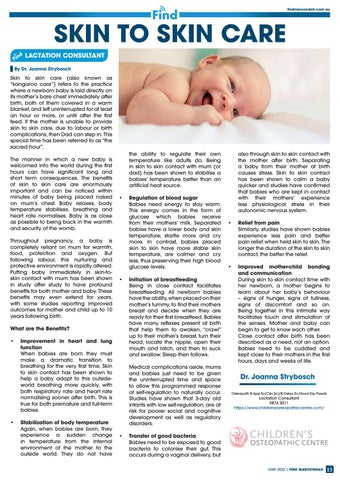
SKIN TO SKIN CARE LACTATION CONSULTANT By Dr. Joanna Strybosch
Skin to skin care (also known as “kangaroo care”) refers to the practice where a newborn baby is laid directly on its mother’s bare chest immediately after birth, both of them covered in a warm blanket, and left uninterrupted for at least an hour or more, or until after the first feed. If the mother is unable to provide skin to skin care, due to labour or birth complications, then Dad can step in. This special time has been referred to as “the sacred hour”. The manner in which a new baby is welcomed into the world during the first hours can have significant long and short term consequences. The benefits of skin to skin care are enormously important and can be noticed within minutes of baby being placed naked on mum’s chest. Baby relaxes, body temperature stabilises, breathing and heart rate normalises. Baby is as close as possible to being back in the warmth and security of the womb. Throughout pregnancy, a baby is completely reliant on mum for warmth, food, protection and oxygen. But following labour, this nurturing and protective environment is rapidly altered. Putting baby immediately in skin-toskin contact with mum has been shown in study after study to have profound benefits for both mother and baby. These benefits may even extend for years, with some studies reporting improved outcomes for mother and child up to 10 years following birth. What are the Benefits? • Improvement in heart and lung function When babies are born they must make a dramatic transition to breathing for the very first time. Skin to skin contact has been shown to help a baby adapt to this outsideworld breathing more quickly, with both respiratory rate and heart rate normalising sooner after birth. This is true for both premature and full-term babies. • Stabilization of body temperature Again, when babies are born, they experience a sudden change in temperature from the internal environment of the mother to the outside world. They do not have
the ability to regulate their own temperature like adults do. Being in skin to skin contact with mum (or dad) has been shown to stabilise a babies’ temperature better than an artificial heat source. • Regulation of blood sugar Babies need energy to stay warm. This energy comes in the form of glucose which babies receive from their mothers’ milk. Separated babies have a lower body and skin temperature, startle more and cry more. In contrast, babies placed skin to skin have more stable skin temperature, are calmer and cry less, thus preserving their high blood glucose levels. • Initiation of breastfeeding Being in close contact facilitates breastfeeding. All newborn babies have the ability, when placed on their mother’s tummy, to find their mothers breast and decide when they are ready for their first breastfeed. Babies have many reflexes present at birth that help them to awaken, “crawl” up to their mother’s breast, turn their head, locate the nipple, open their mouth and latch, and then to suck and swallow. Sleep then follows. Medical complications aside, mums and babies just need to be given the uninterrupted time and space to allow this programmed response of self-regulation to naturally occur. Studies have shown that 3-day old infants with low self-regulation, are at risk for poorer social and cognitive development as well as regulatory disorders.
also through skin to skin contact with the mother after birth. Separating a baby from their mother at birth causes stress. Skin to skin contact has been shown to calm a baby quicker and studies have confirmed that babies who are kept in contact with their mothers’ experience less physiological stress in their autonomic nervous system. • Relief from pain Similarly, studies have shown babies experience less pain and better pain relief when held skin to skin. The longer the duration of the skin to skin contact, the better the relief. • Improved mother-child bonding and communication During skin to skin contact time with her newborn, a mother begins to learn about her baby’s behaviour – signs of hunger, signs of fullness, signs of discomfort and so on. Being together in this intimate way facilitates touch and stimulation of the senses. Mother and baby can begin to get to know each other. Close contact after birth has been described as a need, not an option. Babies need to be cuddled and kept close to their mothers in the first hours, days and weeks of life.
Dr. Joanna Strybosch Osteopath B.App.Sc(Clin.Sc)/B.Osteo.Sc/Grad Dip Paeds
Lactation Consultant 9876 3011 https://www.childrensosteopathiccentre.com/
• Transfer of good bacteria Babies need to be exposed to good bacteria to colonise their gut. This occurs during a vaginal delivery, but JUNE 2020 | FIND MAROONDAH
15
16
FIND MAROONDAH | JUNE 2020
Let’s Talk About Systems
a folder or shoe box for your printed receipts, they can often fade over the years and become useless when it comes time for an audit. Using automation tools such as Receipt Bank or Hubdoc will help you collect your receipts on the cloud. They will even extract data from PayPal, Dropbox and your bank feeds. You can then have them automatically connect through to your cloud accounting software. Even more impressive is that you can also use this to capture employee expenses. 5. Taking Payments
BOOKKEEPER By Neha Nayyar
Ask any small business owner what they need more of and the answer is always TIME! Running a small business is time consuming and there is often never enough of it. The second response is probably around cash flow. Small businesses need to operate on a lean budget and every dollar counts. So what if there was a way to save both time and money? It all comes down to having the right systems in place to ensure your business is running smoothly and efficiently. With a new financial year on the horizon now is the perfect time to take a step back and review your accounting systems. Here are our points to consider when selecting your accounting system: 1. Customer Relationship Management
Managing and nurturing sales leads and relationships can be time consuming, and if you miss an opportunity it can be costly. Having a CRM software tool can help you manage and automate many of your relationships which is key to sales and growth. Most of these tools are designed for small businesses but have the ability to scale as you grow. 2. Invoices & Finances Gone are the days of sending out manual invoices and then chasing them up with phone calls and letters. Cloud based accounting softwares will remember client details, allow you to directly email
out the invoice and the system will automatically generate reminders for unpaid accounts. Many cloud based softwares even connect to certain CRM systems to allow for even more detailed reporting of the sales process. 3. Payroll & Super The ATO now requires more transparency and frequency when it comes to both payroll and super. While this takes a bit of focus to set up, in the long run it makes the process a lot easier and means that you are on top of your requirements. Using a cloud based accounting software is crucial to making these steps a click of a button to complete. 4. Collecting Receipts We all know that collecting receipts and ensuring that they are kept in a manageable way is difficult. We now get receipts in multiple forms such as online, email and printed making it even harder to keep track of. Even if you do have
Allowing multiple payment methods gives clients multiple ways to pay you. This means that you often get your money faster and easier. When sending out invoices include a number of payment methods such as direct deposit, credit card (through Stripe or similar) or PayPal. Payment through these methods also helps with reconciliation as they appear in your bank statement and your accounting software can identify the match to the invoice. We understand there are many accounting systems in the market and it’s about finding the right fit for you and your business. It is the right time to review and make the change and get ready for the new financial year. At Sum and Substance we are passionate about helping small businesses run smoothly and efficiently and will work with you to choose the best systems. If you would like our support in setting up your accounting systems or training your team on the software please contact us. We can be reached at (03) 9424 9447 or info@sumsubstance.com.au. You can directly book in a time to chat by clicking here.
Neha Nayyar Director, CPA and BAS Agent www.sumsubstance.com.au 401 409 573
findmaroondah.com.au
It’s not coming. It’s here! EDIBLE BOUQUETS By Tk Saunders
Yes Winter is here as of the 1st of June we are officially in the winter months, the nights are dark earlier, there is that certain smell in the air, that chilly wind that carries a hint of wood smoke from someone’s fire, and the sound, have you ever just stopped and listened to winter? I always think it has a slightly muffled affect to all those common noises, and if you are lucky enough (or unlucky depending on your view) to live where it snows that beautiful muffled snow sound! That is one of my all-time favourite sounds that slight whisper in the air from the snow falling and that calmness, oh boy I could go on about snow all day! Back to winter, I know personally winter brings thoughts of staying indoors with the fire roaring or the heating set just a little higher than is probably cost effective,,, but hey its winter! Thoughts of frost in the early hours, your breath misting, rugging up, 3 layers or 4? Do I need my umbrella today? Oh that’s right I still need to buy a new umbrella! Convincing your pets that yes they really do need to go out for a toilet break. Some of the other things that spring to mind Footy!!!! Sport, that weekend get together to watch the game! Have a few beers or wines chuck a snag on the Barbie and scream, yell, clap and rejoice as your team scores! That togetherness of sharing your joy, hugging a complete stranger at the stadium because your team just scored! And agreeing with that total stranger who is your new best friend that actually that Ref has no bl#$%^dy idea what he is doing and has he ever actually read the rules? It was clearly in the back! Oh boy I get shivers just thinking about it all,,, how exciting! Oh wait Covid is here! Covid is totally interrupting our winter month plans, no hang on its interrupting our lives! So now as we all pull together to flatten the curve we find we need to re think all of those game day get togethers etc, its easy to get upset or feel lonley but think of all the good! We did so well flattening the curve that we can now visit friends and family as long as we saty safe and don’t go crazy, we can start to reconnect, we can see our loved ones and spend a night in watching the game etc.
So where am l going with all this? Here at Bliss Bouquets we are still working and still delivering, we decided it’s time to celebrate how we as Aussie’s are doing during this time, so we decided to offer a $5 discount on our Meat and Cheese lover Bouquets, just mention this article while ordering and we will apply your discount. Now we think our meat and cheese bouquets are just perfect for a wintery day! They come in 3 sizes, we have the Mini, Medium and Large, now the mini as suggested is probably best for a more intimate gathering of 1, Medium will definitely cater to 2 maybe 3 people if you like to share, the Large will cover 5 to 6 no worries! Let me tell you all about these beautiful meaty bouquets! Just imagine you have decided on a day in with your family maybe watch a movie or the game, you are stoking the fire pouring a glass of wine or cracking a beer, now the next step snacks! Do you fancy a bag of potato chips? Or do you fancy some Salami, Twiggy sticks, some Brie? How about some olives and baby bell cheese, maybe a couple of wasabi peas? Maybe some prosciutto and dried apricots, hmmm some pistachios, some chocolate coffee beans, dates or yummy trail mix with all those yummy seeds? Kabana and cheese? And more? All Delivered to your door?
Is it possible? Yes, yes, it is, and the best part? We will deliver it right to your door! Yes! you heard that right, all that yummy goodness all in one bouquet! (please note mini and medium do not contain all ingredients see our page for variations) Now you might be thinking hmmmm I actually fancy chocolate. Not a problem we have something for everyone! So what ever you fancy check out our facebook page Bliss Bouquets, or instagram Blissbouquetsmelbourne or phone 0487823523 we do have a website in the making but of course covid slowed that right down so please hang in there with us! We make and deliver all fresh bouquets 7 days a week, please order before 3pm the day before you would like delivery, we also include a complimentary gift card. We can also cater for gluten free and vegan please mention any allergies at time of booking. As always stay safe, stay cool! Much love Tk and Marie, Bliss Bouquets the flavour of extraordinary!
Tk Saunders ---- Edible Bouquets ---
JUNE 2020 | FIND MAROONDAH
17
18
FIND MAROONDAH | JUNE 2020
The Trump Card = A Competitive Advantage!
MARKETING By Matthew Benn
I love card games, business and winning… but there’s no better feeling than knowing you are going to win – before it happens. The suspense and the excitement all bottled up inside is sometimes too hard to contain! We’re all looking for that ‘thing’ that will: - make life easier - allow us to do XXX - and take our businesses to the next level Making your business better is all about making your business more effective and efficient. There are a ton of ways to make your business more efficient, but effectiveness is much more difficult. A lot of effectiveness is about finding the right fit for your products and services in the market… which is really all about marketing and sales. To make both marketing and sales effective, you need to have a solid foundation to work with. A competitive advantage is a great place to start laying a solid foundation; because it gets right to the core of how a business positions itself in the market and develops itself to become more profitable. Efficiency and effectiveness are really all about increasing profitability and therefore finding the method of highest ROI to do that (and sustainable over the long term) is the key. A competitive advantage will give you many more benefits than just getting one over on your competitors.
Getting the right perspective to be able to forge a successful and therefore more profitable path is actually sometimes the most difficult part.
- -
What is a Competitive Advantage?
What makes your product/service unique and better than that of your competitors? Would a simple change from a competitor make it easy for a customer to leave you for them?
In simple form, a competitive advantage is, “the difference that affords you a favourable position with more sales leads, more revenue from sales or better margins than your competitors – attributed to a specific reason”.
At it’s most basic level, we break it all down under two major types of advantages
How does a competitive advantage work?
1). Comparative or Cost advantage: the business competes on price.
The way a competitive advantage works is that when used correctly (marketed and sold to), it creates greater perceived value for the products/ services and brand. Hence generating more value in revenue and profit for its shareholders because of the certain strengths and conditions which are leveraged for increased sales at higher margins.
2). Differential or Value advantage: the business provides a differentiated offering that is perceived to be of superior value.
The more distinct, sophisticated and therefore sustainable the competitive advantage, the more difficult it is for competitors to copy and therefore overcome your advantage. The two main types of competitive advantages are comparative advantage and differential advantage.
Competitive Advantage Examples
Think about this: If a prospective customer approached you and asked, “Why should I choose you over your competitor(s)?” Would you be able to give them an answer that would win you the deal on the spot?... or would you struggle? These are good questions to ask your customers and customer facing staff: - Why do customers pay for your product or service?
Main Categories of Competitive Advantages
These are the two main categories of competitive advantage by Michael Porter; one of the main scholars and cornerstones of teaching on competitive advantage strategies.
1. 2. 3. 4. 5. 6. 7.
Lower cost Larger delivery volume capacity Shorter delivery time Better customer service Higher quality product More technologically advanced More innovative (current and future aware) 8. More user friendly 9. Online Dominance How do we help clients with their quest for increased profitability? We start from the beginning… research, analysis and then develop a commercially advantageous position for them in the market, basically exploiting the gaps we’ve found!
findmaroondah.com.au
We call this a competitive analysis. It helps us (and you) understand the current state of affairs, the gaps in the market and also the rough diamonds for further development of a differentiator or two – which will allow your company to have a commercial advantage. A company must create clear goals, strategies, and operations to build sustainable competitive advantage. This type of analysis should be a fundamental part of any company’s strategic business planning process. When your business has a differentiator (that is significant enough to make your product or service seem superior in the eyes of your target market) the potential customers will see the value in buying from you (your competitive advantage).
Most of us are head down doing business, not looking out – finding new distinctive benefits for our solutions portfolio… that’s where we come in! Some Advantages are: 1. You have some benchmarks to use for comparison 2. You can play off your competitors weaknesses 3. You can advertise in ways and places that your competition is weak or poorly performing 4. Competitors that are strong in a particular, usually don’t try and hide what they are doing. This allows you to be able to easily track and keep an eye on them to make sure your “turf” is safe for the time being 5. Understanding different ways that competitors interact with your target
market allows you to assess any threats posed by both new entrants to your market and current competitors. For more information, please see our website https://abcselling.com.au/ competitive-analysis/ or send us an email to book a chat consult@abcselling. com.au
Matthew Benn Marketing Consultant www.abcselling.com.au 402 507 394
Changes to Work test to start on 1 July FINANCIAL PLANNING By Mari Nguyen
Amendments to the Superannuation Industry (Supervision) (SIS) Regulations to the Superannuation Legislation Amendment (2020 Measures No 1) Regulations 2020, allow people aged 65 and 66 to make voluntary super contributions without meeting the work test. The age limit for spouse contributions has also increased from the current level of Age 69 to Age 74 from 1 July 2020. Aaron Dunn, Smarter SMSF chief executive, stated the amendments will: •
Create a new age category of 65 to under 67. Contributions from members in this age category can include member contributions, mandated employer contributions, employer contributions, and or downsizer contributions.
•
Spouse contributions will be able to be made for a member who is under 75 years of age.
•
Spouse contributions in respect of a recently retired member who is eligible for the one-year work test exemption.
Dunn also suggested that changes to work test may also apply to the bringforward rule, which would allow up to $300,000 to be added into a super fund, however it still needs approval from Parliament.
“This measure has been introduced into parliament through the Treasury Laws Amendment (More Flexible Superannuation) Bill 2020 on 13 May 2020. It would appear likely that this bill would be finalised during the June sitting days.” If you think you would like to know more on this topic, why not give us a call and arrange an appointment.
Mari Nguyen Principal Financial Adviser Canopy Financial Group Pty Ltd
www.canopyfg.com.au 415 658 611
JUNE 2020 | FIND MAROONDAH
19
20
FIND MAROONDAH | JUNE 2020
Australian to host first human vaccine trials (Australian Associated Press)
The first Australian human trials of a coronavirus vaccine are about to kick off with more than 100 volunteers. The trials, which are being overseen by US biotechnology company Novavax, will take place in Melbourne and Brisbane with 131 healthy adults aged between 18 and 59 years. Infectious diseases expert Dr Paul Griffin from Brisbane’s Mater Health Services is one of the researchers overseeing the phase one clinical trials, which are the first step in human testing. “It is very exciting,” he told Nine’s Today show on Tuesday. “Healthy volunteers will receive this vaccine for the first time and it’s predominantly about safety. So we will carefully monitor them throughout.” Apart from safety, the trials will give researchers initial clues about the effectiveness of the vaccine developed by Novavax. Novavax expects to have some results to share in July and that could pave the way for phase two trials to look at the
impact on people with coronavirus and side effects.
vaccine an immune response that will then protect them from this infection.”
“We are, in parallel, making doses – making vaccines – in anticipation that we’ll be able to show it’s working and be able to start deploying it by the end of this year,” Novavax research head Dr Gregory Glenn told a virtual press conference in Melbourne from Novavax’ headquarters in Maryland.
“Potentially, by the end of the year, there will be a significant number of doses available,” Dr Griffin said. About a dozen experimental vaccines are in the early stages of testing, or due to start, in China, the US and Europe.
The Novavax trial involves a “recombinant” vaccine created by using genetic engineering to grow harmless copies of the coronavirus spike protein in giant vats of insect cells in a laboratory. Scientists extract and purify the protein and package it into virus-sized nanoparticles. “So it is something almost the same as the surface of the virus but doesn’t contain any live virus,” Dr Griffin said. “We hope that will then give these volunteers and people that receive this
Australian get flu shot in record numbers
findmaroondah.com.au
In times of crisis; we all need an UGG
(Australian Associated Press)
The profound economic impact of the COVID-19 global pandemic has forever changed lives and livelihoods but for Gold Coast business UGG Since 1974, resilience and the desire for consumers to buy quality, local Australian made product has been their silver-lining to this crisis. Hannah and Todd Watts are thirdgeneration owners of the Miami-based business which has manufactured premium sheepskin boots and accessories from their bespoke workshop for over 45 years. “When COVID-19 initially hit, it was a pretty tumultuous time because we’re heavily reliant on international tourists physically visiting our bricks and mortar stores. Literally overnight, our manufacturing staff went from 15 down to 2,” explains Hannah, co-owner and general manager. “Thankfully there has been a huge momentum shift in Australians really looking to where products are designed and manufactured.” The reinvigorated interest in finding, supporting, and buying local, quality Australian made products over cheaper imported versions from overseas has given UGG Since 1974 a lifeline.
“With Australians reassessing where their products are coming from and determined to support local industry or small business, within a few days of this momentum shift, we were able to put everyone back in work at the workshop,” says Hannah. “That’s 40-odd staff able to roll along thanks to Australians making the economy grow by choosing where to spend their money.” Buying Australian has a knock-on effect on other businesses too. “We source all of our sheepskin from Australian farmers. So, the demand for our brand increasing has that knock-on effect back to the farmers breeding the sheep themselves, the wool classers, the thread suppliers, packaging suppliers, and courier drivers, and so on,” says Hannah. “It’s massive, in terms of importance, on what Australian business can do when they’re supported.” The fact we’re all bunkering down at home as temperatures drop, can’t hurt sales of the humble sheepskin boot either. But, buyer beware, not all sheepskin boots are created equal and some products declaring they’re ‘Australian made’ might only be somewhat true.
“There are hundreds of companies that have UGG or some derivative of UGG in their name. As a consumer, shopping online, it is very difficult. You cannot touch or feel the quality and whilst many claim ‘Australian sheepskin’ or ‘Australian owned’ the truth is the majority of UGG boots are not made in Australia,” explains Hannah. “Companies can import fully constructed UGGs in flat packs from overseas, glue the soles on in Australia and put the green and gold, Australian Made tag on them.” Hannah estimates there are five UGG companies ‘doing the right thing’ from start to finish in Australia. Price is often a good indication. Quality Merino sheepskin and hand-crafted Australian UGGs will cost more than what you’ll find at Target. “I think people are also jumping on board with the ‘buy less, buy better’ philosophy. It’s better for the environment too,” says Hannah. “The only problem for us is, customers only need to buy a pair of our UGGS every ten years or so! They’re handmade from A-grade Merino sheepskin, they last for years and years!” * This feature has been produced in collaboration with City of Gold Coast JUNE 2020 | FIND MAROONDAH
21
22
FIND MAROONDAH | JUNE 2020
May 19 Coronavirus snapshot: The numbers, measures, developments, sport, economics CORONAVIRUS NUMBERS • •
•
•
Australia has recorded about 7068 cases, with 557 remaining active. The national death toll is 100 – NSW 49, Victoria 18, Tasmania 13, WA 9, Queensland 6, SA 4, ACT 3. (Two QLD residents who died in NSW have been included in both state’s counts). A 93-year-old woman from Newmarch House has become the 17th virus-linked death at the NSW aged care facility. Nearly 5.9 million of an estimated 16 million people have registered for the federal government’s COVIDSafe tracing app since April 26.
•
•
•
MEASURES •
• •
The federal government has announced a three-phase plan to ease off coronavirus restrictions in coming months, with states and territories to determine the exact timings. Social distancing and hygiene measures retained. NSW public school students will return to full-time classes on May 25. A staged return to school classrooms has begun in Queensland. In Victoria prep, grades 1, 2, 11 and 12 students return to their classrooms on May
•
26 with the rest returning from June 9. WA reinstated compulsory school attendance from May 18. Tasmanian schools to start reopening from May 25. NSW restrictions on outdoor gatherings and recreational activities, cafes, restaurants, clubs and pubs eased. People must stick to a group limit of 10 and maintain social distancing. Working from home is encouraged while public transport changes mean 12 people at most on two-door buses in Sydney, 32 commuters per train carriage and 245 people on the Manly ferry. Victorians may have up to five visitors in their homes. Gathering limits relaxed to 10 for outdoor activities including fishing, hiking and golf. Maximum of 10 guests at weddings, 20 at indoor funerals and 30 for outdoor services. From June 1, 20 people allowed inside restaurants, cafes and pubs, increasing to 50 diners from June 22 and 100 in the second half of July. In Queensland, shopping for nonessential items permitted while up to five members of one household can visit other homes. Up to 10 people allowed to congregate in parks, pools and playgrounds. The Queensland and NSW border could reopen in September.
•
•
•
•
•
South Australia has resumed elective surgeries and allowed regional accommodation to reopen. Alcohol-free dining with a 10-person limit allowed at cafes and restaurants. Seasonal workers must self-isolate before entering the state. WA has entered phase two of its recovery plan, allowing greater regional travel and encouraging people back to work while cafes, pubs and restaurants may seat up to 20 patrons. Further easing of restrictions expected on June 8. The Northern Territory has relaxed restrictions on parks, golf, fishing and swimming. Restaurants and bars can reopen with a two-hour limit, with entertainment venues to come. Restricted access to indigenous communities remains in place until at least June 18. In Tasmania,restaurants and cafes are allowed to seat up to 10 people with the same number allowed to gather for real estate purposes, religious gatherings and weddings. Premier Peter Gutwein is hopeful of making a call to reopen borders in July. The ACT has allowed outdoor gatherings of up to 10 people, easing restrictions on sport and recreation.
findmaroondah.com.au
STILL OPEN •
Supermarkets, pharmacies, banks, public transport, some schools, hairdressers, petrol stations, postal and freight services, bottle shops, newsagents, retail shops. Restaurants and cafes opened in most states.
•
•
OTHER DEVELOPMENTS •
•
•
China has agreed to support an international probe into the coronavirus but not before Beijing punished Australia’s push for the investigation by slapping an 80 per cent, five-year tariff on barley imports on Monday. There’s not enough evidence to support Donald Trump’s use of a malaria drug to protect himself against COVID-19, according to an Australian task force. Four nursing homes in Melbourne have gone into lockdown after a resident from each were tested for the virus. Victorian universities will receive a $350 million boost to help them recover from the pandemic
Meanwhile, the state’s police have stung more than 5600 people with $8 million in COVID-19 related fines since late March. One in eight Australians believe Microsoft founder Bill Gates is somehow responsible for the coronavirus and the 5G wireless network is to blame for spreading the disease.
ECONOMICS •
• •
SPORT • •
•
The NRL will resume competition on May 28 while the AFL will resume on June 11. The referees union will head for arbitration with the NRL later this week over the league’s decision to revert to one referee for the rest of the season. The International Cricket Council is set to update regulations prohibiting the using spit to polish cricket balls while Cricket Australia is considering reducing the Women’s Big Bash League by 16 matches this summer as part of virus cost cuts.
Tourism Minister Simon Birmingham has urged state and territory governments to open borders to domestic holiday-makers when safe. The federal government’s current free childcare plan is costing about $131 million a week. The local private health insurance industry lost nearly $300 million in income in the March quarter due to virus-linked losses on the stock market.
GLOBAL CORONAVIRUS • • •
Cases: at least 4,894,278 Deaths: at least 320,189 Recovered: at least 1,909,233
Data current as of 1730 AEST May 19, taking in federal government and state/ territory government updates. Johns Hopkins virus tracker.
COVID-19 resulted in global emissions declining by 17 per cent in April By Rebecca Gredley (Australian Associated Press)
The federal energy minister sees no difference with how the coalition has dealt with climate change and coronavirus in regards to listening to scientific advice. The Morrison government has credited its coronavirus response decisions to medical experts, with the nation’s top health officers front and centre. Energy Minister Angus Taylor says it’s the same with climate change. “We take enormous amounts of advice from scientists,” he told the ABC on Wednesday. But Mr Taylor believes the two problems are different as climate change is a global issue to solve. “Emissions know no boundaries,” he said. “Contagion happens at a local level of course, so that is a difference.” It comes as a new study reveals restrictions in place because of coronavirus resulted in global emissions declining by 17 per cent in April.
The preliminary analysis was published in Nature Climate Change on Wednesday and is the effort of a global team including researchers from the CSIRO. It found the peak decline of a 17 per cent drop in carbon dioxide emissions from fossil fuel sources occurred on April 7. The decrease is compared to the same time last year, and resulted in a level of emissions not seen since 2006. China, the US, India and other highemitters were all in high levels of lockdown at that point in April. Daily emissions between January and April have declined by 8.6 per cent compared to the same period last year. Data was used from 69 countries – including Australia – that make up 97 per cent of global emissions and have 85 per cent of the world population.
It recorded a 36 per cent decrease in emissions, equivalent to 7.5 megatonnes of carbon dioxide. “Across other sectors, the power sector ranked second and the industry sector, encompassing manufacturing and material productions, third in terms of their contributions to the global decrease in emissions in early April,” Dr Canadell said. There was also a 60 per cent decline in emissions from the global aviation industry in April compared to the year before, amounting to about 1.7 Mt of CO2. If restrictions are lifted by the middle of June, the overall decrease in emissions for the year is expected to be about 4.2 per cent, compared to 7.5 per cent if countries remain at some level of lockdown until the end of the year.
“Decreases in emissions in 2020 were largest in China where industry and communities first locked down, followed by the US, Europe, and then India,” CSIRO researcher and report co-author Pep Canadell said. JUNE 2020 | FIND MAROONDAH
23
24
FIND MAROONDAH | JUNE 2020
Library Update June 2020
More info
Click for Home Delivery! HAVE YOU HEARD?? Your reservations can now be posted to your home!
‘Click for Home Delivery’ is a new service that we’re offering to you, our wonderful members, in support of social isolation directives. Place holds on all your favourite items in the catalogue and get in contact with your library to arrange a delivery once they come in. Feel like mixing it up a little? Ask our staff to make a selection for you, whether that’s magazines, books, DVDs or games! Get in touch with your library to arrange a delivery: Call us Mon-Fri (9am-5pm) on 1300 737 277 or call your local branch. Contact us via our feedback form. Our return chutes remain open 24/7. Find out more about this service along with some handy FAQs here.
Storytime Live Eastern Regional Libraries Facebook Page Participate in an online storytime! Join us for plenty of reading, songs, dancing and fun. Storytimes premiere on Facebook everyday at 11am, so like our Facebook page to make sure you don’t miss a thing. Storytimes are also uploaded to our YouTube channel and accessible from our website, so you can watch anywhere, anytime.
Watch Now
findmaroondah.com.au
The Lawyer X Story with author Vikki Petraitis Wednesday 10 June | 4 - 5pm How did the Victoria Police come to use a criminal defense barrister as a police informer? Vikki Petraities, author of Cops, Drugs, Lawyer X and Me will tell the incredible behind the scenes story of the shocking deals done at the highest levels of the Victoria Police and the damage wrought by their use of Lawyer X. Reaching to the depths of Melbourne’s underbelly, the tale of Lawyer X includes outhlandish deals that defy belief. This event will be hosted via Zoom. Invites will be emailed the deatils in the days prior.
Bookings essential
New Books
JUNE 2020 | FIND MAROONDAH
25
26
FIND MAROONDAH | JUNE 2020
Facebook, Google forced to bargain on news By Matt Coughlan
Australia’s competition watchdog has promised to even up the market imbalance between news organisations and tech giants. The Australian Competition and Consumer Commission is seeking feedback on a wide range of issues with a mandatory code of conduct, which will be in place later this year. The rules will force Google and Facebook to pay for news content. ACCC chair Rod Sims says the new regime would allow media organisations to bargain with tech giants over fees. “We need to even up the bargaining,” he said on Tuesday. “We need to give that teeth and make that work, and see as best we can to come up with the sort of outcome you’d have in a competitive market.” Mr Sims declined to comment on News Corp Australia’s suggested price tag of $1 billion a year or Nine’s floated going rate of $600 million. He said collective bargaining would be the most straightforward way to determine fees, but it could still result in arbitration. “I’m not going to predict outcomes. What I am going to predict is we will even up that bargaining position and come out with a better position than we are in now,” he said.
Facebook and Google have a stranglehold on the digital advertising market and benefit greatly from the content of news publishers on their platforms. Google argues it doesn’t make money from searches because only clicks on ads drive revenue. Mr Sims said while direct benefits weren’t large, there were significant benefits stemming from the use of news. “If you want to be the allsinging, dancing search engine, you need news so that when someone types in coronavirus, you get all the news articles,” he said.
“Otherwise it’s a pretty limp search.” He said quality content from professional journalists was important to Google and Facebook. “If you don’t have the news, then you might get a whole lot of fake news,” he said. Notifying changes to the websites’ algorithms, data sharing, the use of content behind pay-walls, and the definition of news are among the other issues in the ACCC’s concepts paper. A voluntary code was torpedoed earlier this year after negotiations between the watchdog and Google and Facebook broke down.
Possible power bill relief during pandemic By Rebecca Gredley
Australians could get a helping hand with power bills through a proposal to the agency in charge of the energy market. The Australian Energy Regulator has asked the Australian Energy Market Commission to let retailers defer network costs for up to six months. The proposal would apply to network charges incurred from the start of July to December 31. While the rule would not directly benefit consumers it would help retailers, who could pass relief on to clients. Network costs range from making up about 30 per cent of an energy bill in the ACT to about 46 per cent in NSW. Energy Consumers Australia wants the federal government to back a public education campaign so consumers know they have help when it comes to their bills.
The group also want energy retailers and networks to back the push for the change. “Energy businesses have a social contract with the community and this is a time for a coming together in the best interests of consumers,” chief Lynne Gallagher said. “We need industry to work out any differences in a joined-up
response to avoid bickering, motivated by patch-protection or self-interest, and to get a workable arrangement fast. “The only interest that matters right now is the interest of Australians – our families and businesses.”
findmaroondah.com.au
Tax, how much should I pay? By Money and Life
One of the key determinants of how much income tax you pay, and how much you get back as a refund depends on how well you’ve maximised the deductions you’re entitled to claim. Some people are better at this than others, which explains why the amount paid in tax, based on tax rates alone, isn’t a level playing field. Most of these deductions relate to what the Australian Tax Office (ATO) deems to be claimable out-of-pocket costs, incurred on the job that your employer hasn’t already covered you for. But remember to retain all your receipts. What you’re entitled to claim as a legitimate work-related deduction can depend on many factors. But generally speaking, key criteria for deductibility tend to be around things like: travel, special clothing you’re required to wear at work, phone and internet costs, tools and other gear used on the job. Then there’s a plethora of additional job-related expenses you can also claim back, including certain training costs, fees for regulatory compliances or subscriptions/memberships to professional bodies or unions.
1. Other key determinants at the personal level However, the above-mentioned ‘deductibility’ is only half story when it comes to explaining why co-workers, earning the same income, can end up paying different amounts of tax. Drill down below these work-related expenses, and there’s another layer of variables that directly impact the tax people pay. How Australians are impacted by provisions – tax breaks and concessions – within the tax system are generally determined by their own individual circumstances. Given that the criteria for determining these provisions is subject to a complex set of ATO guidelines, those in doubt should seek early guidance of experienced industry professionals.
1. Some of the key measures relate to: 1. Occupation: The rules for claiming deductions differ between employees and independent contractors. There are also special rules for people who earn personal services income.
2. Employment status: Whether you’re an employee working part or fulltime, or self-employed can impact how much tax you pay. 3. Marital status and number of dependants: Specific tax treatments relate to anyone with a spouse, while family tax benefits help those raising children. 4. Government benefits: A beneficiary tax offset is available if you received certain Australian Government allowances and payments. 5. Financial activity: There are tax rebates for making a personal contribution to your super or by adding to your spouse’s fund before the end of the financial year. Specific tax considerations also relate to investors. But given the complexity associated with buying and/or selling assets, having a professional correctly review the appropriateness and timeliness of your strategy can be highly beneficial. There are also tax benefits associated with taking out income protection insurance. Having hospital cover, can also if you earn more than $90,000 (singles) or $180,000 (families and couples), help you avoid the Medicare Levy Surcharge (calculated at the rate of 1% to 1.5% of your income).
JUNE 2020 | FIND MAROONDAH
27
2020 TA • DPN regime extended to GST liabilities The Director’s Penalty Notice regime will be extended to include GST liabilities, with legislation now passed parliament. Also, the legislation extends the regime for LCT and WET, taxes which are paid as part of activity statement lodgements. From the quarter following royal assent (at this stage likely 1 April 2020), the Commissioner of Taxation would be allowed to declare a GST liability estimate. From there, the director has 21 days to ensure an outstanding amount is dealt with to avoid a personal liability of outstanding GST. The extension will mean that a director may become personally liable for PAYG withholding, superannuation guarantee or GST owed by the company they represent.
Announcement (20-Aug-2018) Consultation (27-Sep-2018) Introduced (04-Jul-2019) Passed (05-Feb-2020) Royal Assent (17-Feb-2020) Date of Effect (1-Apr-2020)
• Commercial rent relief code of conduct to assist COVID-19 businesses Eligible businesses will receive wage subsidies to pay staff as a result of being affected by the COVID-19 pandemic. The JobKeeper payment scheme will be available for sole traders, partnerships, trusts and companies. The payments under the scheme will be $1,500 per fortnight per eligible employee, for 13 fortnights beginning 30 March 2020.Businesses need to enrol for the JobKeeper payment via the ATO, using the Business Portal and myGovID. Tax agents can complete this task for their clients. Eligible businesses must identify eligible employees and provide monthly verifications to the ATO. All eligible employees must receive, at a minimum, a gross amount of $1,500 per fortnight.
Announced: 08-Apr-2020 Updated: 08-May-2020
• Artificial Schemes for JobKeeper Payment The ATO has released Practical Compliance Guideline PCG 2020/4 which covers schemes in relation to the JobKeeper payment. The main takeaway from the PCG is that the Commissioner will not apply compliance resources where an employer had a genuine impact on the revenue of the operating entity due to change in the external business environment. The PCG also includes examples where the ATO deems a scheme to be artificial with the sole or dominant purpose to access JobKeeper payments.
Announced: 09-Apr-2020 Updated: 15-May-2020
• Service Entities Accessing Jobkeeper Payments The ATO has released Practical Compliance Guideline PCG 2020/4 which covers schemes involving service entities in relation to the JobKeeper payment. The PCG provides guidance on how the ATO will apply its compliance resources to schemes used to access the JobKeeper payments. The main takeaway from the PCG is that the Commissioner will allow a service entity that employs workers, and receives a reduced service fee from the operating entity, to qualify for JobKeeper payments if there is a genuine impact on the revenue of the operating entity due to change in the external business environment.
Announced: 09-Apr-2020 Updated: 18-May-2020
• Spouse Contribution tax Offset eligibility To Be Extended Spouse contributions tax offset eligibility will be extended following the release of draft Bill and Regulations. The Bill and Regulations were made to give effect to the measures announced in the 2019 federal budget. From 1 July 2020, an individual is eligible for the offset where their spouse is under 75 years of age when the contribution is made. Connected with this new legislation is the extension to acceptance of contributions for individuals aged 65 and 66. The current law states that where the spouse is over 65 years, the spouse must satisfy the work test for the contribution to be accepted. Effectively, the work test is being pushed out to the Age Pension Age of 67. There are no announced changes to the income limit or the maximum contribution allowed. Also, the spouse contribution should not otherwise breach their non-concessional cap.
Announcement (1-May-2018) Consultation (3-Apr-2018) Introduced (13-May-2018) Passed Royal Assent Date of Effect
AX UPDATES • Super Contribution Age Limits To Change Members of regulated superannuation funds have no restrictions for making voluntary contributions prior to reaching 65 years of age. However, from 1 July 2020 changes to legislation and SIS regulations intend to increase the age limit to 67 years of age. The new legislation also extends the ability for members to make bring forward contributions, making more individuals eligible to make 3 years’ worth of contributions. The legislative and regulatory changes only relate to voluntary contributions, as employer contributions have different rules relating to individuals over the age of 65.
Announcement (17-Apr-2018) Consultation (3-Apr-2018) Introduced (13-May-2018) Passed Royal Assent Date of Effect
• Unpaid Present Entitlements and Extension of Repayments Unpaid present entitlements (UPE) to private companies initially under an interest-only loan may be extended on final repayment date. The practical compliance guideline deals with a UPE that was put in an investment deal in accordance with PS LA 2010/4. If there is a balance to be repaid at the end of the investment period, it may become a new Div 7A loan. 30 June 2018 is the first year in which an interest-only loan at benchmark rates is due to be repaid after the issuing of PS LA 2010/4. That is, 7 years after the initial UPE was put on a sub-trust from the 30 June 2010 year. The PCG relates to arrangements in the 2017/18, 2018/19 and 2019/20 income years. The ATO has recently stated that the lodgement date for the 2018/19 income year is 5 June 2020. This extension is due to blanket extensions to tax returns issued by the Commissioner. Family groups using this strategy may benefit from utilising this extension of time to repay the initial unpaid present entitlement from the 2009/10 income year.
Announcement (17-Apr-2018) Consultation (3-Apr-2018) Introduced (13-May-2018) Passed Royal Assent Date of Effect
• Victoria COVID-19 Package for Business Grants and Assistance Part of the Victorian economic stimulus package are grants and assistance for Victorian businesses. Registered businesses in the hospitality, tourism, accommodation, arts/entertainment and retail industries will receive tailored support. This is in the form of a grant, and specifically not a loan. Other measures announced include rent relief for businesses renting government premises, and banning of eviction for non-payment of commercial tenancies for six months.
Announced: 09-Apr-2020 Updated: 31-May-2020
• Victoria COVID-19 Package for State Taxes At the top of the Victorian economic stimulus package is a refund of payroll tax for small business. Effectively, the payroll tax threshold applies to Victorian entities with Australian taxable wages less than $3m for the 2019/20 income year. As well as the payroll tax refunds, other measures announced include deferral of certain land tax payments, and rent relief for landlords who provide rent reduction to their tenants adversely affected by the COVID-19 pandemic.
Announced: 20-Mar-2020 Updated: 29-May-2020
• SMSF Penalties for Underreported Expenses Legislated
Announcement (28-Jul-2018)
Non-arm’s length income (NALI) rules are bring strengthened. In particular, the NALI provisions are bring re-written to include situations where expenses of the fund are reduced in order to obtain a non-commercial benefit. This new law will strengthen rules which were previously only part of guidance released by the ATO for SMSFs. Specifically, an income tax liability will be enforced as opposed to previous interpretations of tax and super regulations in relation to super fund borrowings. Draft ATO guidance has provided further situations where an SMSF may have underreported nonarm’s length expenditure, including where it may apply to all income.
Introduced (24-July-2019)
Consultation (24-May-2018) Passed (19-Sep-2019) Royal Assent (2-Oct-2019) Date of Effect (30-June-2019)
REALESTATE
JUNE 2020
REALESTATE FIND AUSTRALIA’S #1 PLACE FOR PROPERTY
HOUSE OF THE MONTH
A short description about the property
ANNE LUXURIOUS VILLA | $3,300,00
PROPERTY FEATURES
INTERIOR FEATURES
Real Estate Agent Name Contact Details:
JUNE 2020 | FIND MAROONDAH
31
32
FIND MAROONDAH | JUNE 2020
REALESTATE
Do you have a local property that you would like to sell or Lease? Why not consider listing the property in the Find Maroondah? We invite all Real Estate business to support the Find Maroondah and their clients properties here.
REALESTATE
Do you have a local property that you would like to sell or Lease? Why not consider listing the property in the Find Maroondah? We invite all Real Estate business to support the Find Maroondah and their clients properties here.
JUNE 2020
REAL EST
TATE A GENT
We invite all Real Estate Agents to list their profiles here. First in, first page. Be known in your local community and help support all things Maroondah. For listing enquiries call 1300 88 38 30 or email editor@findmaroondah.com.au
Maroondah C
36
FIND MAROONDAH | JUNE 2020
REALESTATE
Council joins kindness movement with launch of Be Kind Maroondah campaign
The global COVID-19 response has brought many changes and challenges to our daily lives, but one thing rings true for residents of Maroondah – our sense of community spirit. “In these uncertain times, we know one thing for certain: kindness is powerful,” Mayor of Maroondah, Councillor Mike Symon, said. “We know that connections, relationships and networks are more important than ever. Connected communities are stronger communities, where people rally around each other in times of need,” Cr Symon said. To support our community during this time, Council has joined the Be Kind movement and has launched the Be Kind Maroondah campaign, a campaign aimed at promoting kindness and goodwill, and building the resilience of our community. We are encouraging residents to: Be kind to yourself, Be kind to others and Be kind to business. First launched by the City of Ballarat, the highly successful ‘Be Kind’ initiative has been actively embraced by other local government regions including Yarra, Baw Baw, Golden Plains, Moreland, Casey, Campbelltown, Central Goldfields and Frankston.
Share your stories “A few weeks ago, Council started a ‘Random acts of kindness’ social media campaign asking our community to share their stories. As we received many positive responses we decided to start the Be Kind Maroondah campaign,” Cr Symon said. Residents can ‘Be Kind to others’ by keeping an eye on neighbours, sharing recipes with family and friends or offering to pick up groceries or prescriptions for someone who is older or self-isolating. When it comes to supporting our local economy, the community can ‘Be Kind to business’ by choosing to purchase locally, whenever and wherever possible. Finding out whether the stores you typically frequent are still trading, how they have adjusted to social distancing measures and what products and services are still available are things we can all easily do. And remember to always ‘Be Kind to yourself’ by staying active and eating well, keeping up your social connections and taking time out for yourself by going for a walk, listening to music, reading or cooking. “Through these times of uncertainty and social isolation, it is more important than ever that we stay connected with our community,” Cr Symon said.
“We already know that the statistics of mental illness in our society have been steadily increasing with one in five (20%) Australians aged 16 to 85 experiencing a mental illness in any year. With the current situation these figures are expected to rise dramatically,” he said. “A recent study by YouGov shows that lockdown is having a devastating impact on our mental health with 57 per cent of Australians suffering stress during this time. Mental health services are under increasing pressure as they take an unprecedented number of calls, Lifeline received 3,200 calls on Good Friday – the busiest day in the history of the organisation, and Beyond Blue predicts the demand for its services will soar by 30 per cent by June. “However, through communication and practical tips, we can help educate our community in recognising the importance of good mental health and encourage them to look after the mental wellbeing of themselves, family, friends and neighbours,” Cr Symon added. Visit our Be Kind Maroondah page and social media channels for more ideas and ways you can be kind to yourself, be kind to others and be kind to business. Find out what else Council has been doing to support the community by visiting our COVID-19 Update Page
Council News
findmaroondah.com.au
Council refers Amendment C130 submissions to independent planning panel hearing
Council will request an independent panel be appointed to consider submissions received to Amendment C130 to the Maroondah Planning Scheme following a resolution at a Council meeting on Monday 18 May. Council has resolved to refer Amendment C130 – Ringwood Metropolitan Activity Centre (RMAC) Masterplan to the Minister for Planning, requesting that the Minister appoint Planning Panels Victoria to independently assess and review all submissions lodged with Council. A total of 42 submissions were received during the 27 February to 30 March 2020 public exhibition period. The majority of submissions received (90.5%) reflect total or partial support for the Amendment, with four (9.4%) opposed. Matters raised in the submissions related to intended built form, transport, landscaping and pedestrian access. Council is proposing to apply new planning controls to the Ringwood Metropolitan Activity Centre under the Maroondah Planning Scheme (via Amendment C130), to help manage future development and support employment growth in the area. Ringwood is a designated Metropolitan Activity Centre (MAC) – a priority of
the Victorian Government’s blueprint for Melbourne’s future growth, Plan Melbourne. As a key Metropolitan Activity Centre in Melbourne’s outer-east, Ringwood is the focus of significant public and private investment, employment growth and renewal.
WHAT’S NEW
Amendment C130 implements the objectives and strategies of the Ringwood MAC Masterplan through the application of local policy, zones and overlays for adoption into the Maroondah Planning Scheme, subject to approval by the Minister for Planning. The Masterplan is the primary guiding document for Council, stakeholders and the community to ensure coordination of development and enhancement of the activity centre to the year 2030.
Maroondah to celebrate National Reconciliation Week 2020 with online program activities
Following the appointment of an independent panel to review all submissions, Council will consider any recommendations put forward by the panel and decide to either adopt, alter or abandon the Amendment. Council will also consider any late submissions before referring them to the Minister. To find out more about Amendment C130 – Ringwood Metropolitan Activity Centre (RMAC) Masterplan visit the project page
Maintaining support for Maroondah’s homeless in the face of COVID-19 JUNE 2020 | FIND MAROONDAH
37
38
FIND MAROONDAH | JUNE 2020
NOT-FOR-PROFIT
SUPPORT YOUR LOCAL NOT-FOR-PROFIT
Are you Not-For-Profit in Maroondah Area?
Advertise your events for FREE on the following pages.
findmaroondah.com.au
NFP CALENDAR EVENTS JUNE 2020 SUN
MON
1
TUE
2
WED
3
THU
4
FRI
5
SAT
6
7
8
9
10
11
12
13
14
15
16
17
18
19
20
21
22
23
24
25
26
27
28
29
30
Are you a NFP with an up-and-coming event? If so, email your event to editor@findmaroondah.com.au and we will place it in the paper for FREE.
JUNE 2020 | FIND MAROONDAH
39
CACHE
1 2 3 4
BEGIN YOUR FIRST ADVENTURE IN FIND MAROONDAH
SEEK
AND YOU WILL
CACHE
WATCH AND READ THE CLUES
Find a cache
share you exprience
Each month we will provide clues in the location of the Find Cache.
Once you found the Cache please notify us.
The winner will be published in the next Find Maroondah.
CACHE
ABOUT FIND CACHE Each month we will be hiding a cache of items around Maroondah. Your job is to discover where the cache is hidden. The first person to find the container of items gets to keep it. Each week we will place a clue on the Find Maroondah facebook page to help you locate the cache of goodies. Make sure you Follow and Like the facebook page (https://www.facebook.com/findmaroondah/)
Find Cache Items: This month you have the chance to find $50 in cash
First Clue: The first Find Cache is hidden in one of the parks in Maroondah.
We will provide more clues on the facebook page throughout the coming month. JUNE 2020 | FIND MAROONDAH
41
Opening Hours
Store Directory
Eat
Centre Map
Gift Cards
Shop
Play
What’s On This Month
ARTICLE
Coronavirus Store Updates
ARTICLE
Food Delivery & Takeway Options
EVENT
Eastland Elementary at Home
RETIREMENT
ACCOMMODATION
LIFESTYLE
RETIREMENT ADVICE
This information is of a general nature only and has been prepared without taking into account your particular financial needs, circumstances and objectives. While every effort has been made to ensure the accuracy of the information, it is not guaranteed. You should obtain professional advice before acting on the information contained in this publication. Superannuation, tax and Centrelink and other relevant information is based on our interpretation and continuation of law current as at the date of this document. The information contained in this document does not constitute legal or tax advice. You should seek expert advice in this regard. Warren Strybosch, Find Wealth Pty Limited ABN 20 140 585 075 trading as Find Retirement, Corporate Authorised Representative No. 236815 of ClearView Financial Advice Pty Ltd ABN 89 133 593 012, AFSL No. 331367.
JUNE 2020 | FIND MAROONDAH
43
PAGES
We invite all who provide a Professional Services to advertise in the Find Pages - Professional Services section of the online paper. We want to support local tradies.
Email your ad to advertise@findmaroondah.com.au
INDEX PROFESSIONAL SERVICES • • • • • •
Builder Electrician Painter Plasterer Property Maintenance Cleaner
ADVERTISE HERE
ADVERTISE HERE
13
9x
13
96
9x
m
ADVERTISE HERE
m
m
ADVERTISE HERE
13
9x
ADVERTISE HERE
96
m
13
96
9x
m
m
96
m
m
ADVERTISE HERE
JUNE 2020 | FIND MAROONDAH
45
PAGES
PROFESSIONAL SERVICES
We provide ourselves in providing honest advice that you can rely on. 248 Wonga Road, Warranwood VIC 3134
1300 88 38 30
warren@findinsurance.com.au
www.findinsurance.com.au
Find Wealth t/as Find Insurance Corporate Authorised Representative (No. 468091) of Clearview Financial Advice Pty Limited ABN 89 133 593 012. No. 331367
INDEX
12
x7
PROFESSIONAL SERVICES • • • • • • • • • • • • • • • •
Photography Bookkeeping Find Accountant Find Wealth Minuteman Press Financial Planning Computer Repairs/ Services Solution Based Coaching Building Biology Marketing Consultant Garage Doors Human Resources Mortgage Brokering Lactation Consultant Architect Editor
ADVERTISE HERE
cm
12
x7
ADVERTISE HERE
cm
ADVERTISE HERE
JUNE 2020 | FIND MAROONDAH
47
PAGES
We invite all who provide a Professional Services to advertise in the Find Pages - Professional Services section of the online paper. We want to support local tradies.
Email your ad to advertise@findmaroondah.com.au
INDEX PROFESSIONAL SERVICES • • • • • •
Specialist Tree Services Interior Design Mowing Building Inspection Nursey Flooring
ADVERTISE HERE
ADVERTISE HERE
13
9x
13
96
9x
m
m
ADVERTISE HERE
m
m
ADVERTISE HERE
13
9x
ADVERTISE HERE
96
13
96
9x
m
m
96
m
m
ADVERTISE HERE
JUNE 2020 | FIND MAROONDAH
49
PAGES
We invite all who provide a Professional Services to advertise in the Find Pages - Professional Services section of the online paper. We want to support local tradies.
Email your ad to advertise@findmaroondah.com.au 12
INDEX
x9
PROFESSIONAL SERVICES • • • • • •
Hair Dresser Osteopath Chiropractor Beauty Therapy Gym Massage Therapy
ADVERTISE HERE
cm
13
9x
13
96
9x
m
ADVERTISE HERE
m
m
ADVERTISE HERE
13
9x
ADVERTISE HERE
96
m
13
96
9x
m
m
96
m
m
ADVERTISE HERE
JUNE 2020 | FIND MAROONDAH
51
SPORTS
We invite a representative from each sporting club to submit team selections, results and any interesting stories relating to your club/sport. For enquiries call 1300 88 38 30 or email editor@findmaroondah.com.au
findmaroondah.com.au
SPORTS
TITLE HERE
We invite a representative from each sporting club to submit team selections, results and any interesting stories relating to your club/sport. For enquiries call 1300 88 38 30 or email editor@findmaroondah.com.au
TITLE HERE
We invite a representative from each sporting club to submit team selections, results and any interesting stories relating to your club/sport. For enquiries call 1300 88 38 30 or email editor@findmaroondah.com.au
JUNE 2020 | FIND MAROONDAH
53
YOUR
DREAM CAR TOD AY
We welcome car sales businesses to advertise their vehicles here. Email your enquiries to advertise@findmaroondah.com.au
CAR NAME
CAR NAME
CAR NAME
PRODUCT DESCRIPTIONS GOES HERE IN THIS
PRODUCT DESCRIPTIONS GOES HERE IN THIS
PRODUCT DESCRIPTIONS GOES HERE IN THIS
Mail: email@mail.yourwebsitename.com
Call us, +012-345 567 890
Address: Your street address here
www.yourwebsitename.com
findmaroondah.com.au
CARS
TITLE HERE
We welcome car sales businesses to advertise their vehicles here. Email your enquiries to advertise@findmaroondah.com.au
TITLE HERE
We welcome car sales businesses to advertise their vehicles here. Email your enquiries to advertise@findmaroondah.com.au
JUNE 2020 | FIND MAROONDAH
55
TIMEEN We invite a students representative from each secondary college or private school write articles from a teen perspective. Email enquires to editor@findmaroondah.com.au or call 1300 88 38 30
findmaroondah.com.au
STORY TIMEEN
TITLE HERE
We invite a students representative form each secondary college or private school to write articles from a teen perspective. Email enquires to editor@findmaroondah.com.au or call 1300 88 38 30
TITLE HERE
We invite a students representative form each secondary college or private school to write articles from a teen perspective. Email enquires to editor@findmaroondah.com.au or call 1300 88 38 30
JUNE 2020 | FIND MAROONDAH
57
MAROONDAH
Support your Local Not-For-Profit
Find Coffee
Find Dining
FundRaising
Buy 1 Get 1 Offers
Fine, Contemporary & Bistro
Support Your Local Community
Find Travel & Entertainment Fun for All Ages
Great Local Deals
Find Takeaway
Buy 1 Get 1 FREE Offers Up to 50% Off
Fine, Contemporary & Bistro
FREE
Find Brekky, Brunch, Lunch Cafés & Bistro
Contact your Not-For Profit to obtain your Find Card. Only Find Cards can be in conjuction with the offers and must be presented to participating businesses.
LOCAL COUPONS
01 January - 31 December 2020
Find card
Up to 50% of generated funds goes to Not-For Profit organisation.
FIND CARD LOCAL OFFERS
S
M A
E L P
PRESENT VALID FIND CARDS Registration of Find Cards Please go to www.findmaroondah.com.au/register Please refer to Page 86
LOCAL COUPONS OFFERS
FIND ADVERTISING COUPONS info@findnetwork.com.au 1300 88 38 30
S S
M A M A
E L P E L P
S S
M A
M A
E L P E L P
S S
M A
M A
E L P
E L P
S
M A
E L P
NEW OFFERS COMING
NEW OFFERS COMING
NEW OFFERS COMING
BREKKY, BRUNCH & LUNCH DISCOVER A NEW LEVEL OF TASTE
The best memories are made when gathered around the table. FIND ADVERTISING COUPONS info@findnetwork.com.au 1300 88 38 30
S
M A
E L P
& Lunch
S
M A
E L P
S
M A
S
M A
E L P E L P
S S
M A M A
E L P E L P
S
M A
E L P
NEW OFFERS COMING
NEW OFFERS COMING
NEW OFFERS COMING
NEW OFFERS COMING
COFFEE
TODAY’S GOOD MOOD IS SPONSORED BY COFFEE FIND ADVERTISING COUPONS info@findnetwork.com.au 1300 88 38 30
S S
M A M A
E L P E L P
Takeaway
Food brings people together on many different levels. It’s the nourishment of the soul and body: It’s truly love. FIND ADVERTISING COUPONS info@findnetwork.com.au 1300 88 38 30
S
M A
E L P
NEW OFFERS COMING
FIND ADVERTISING COUPONS info@findnetwork.com.au 1300 88 38 30
S S
M A M A
E L P E L P
FIND ADVERTISING COUPONS info@findnetwork.com.au 1300 88 38 30
S S
M A M A
E L P E L P
S S
M A M A
E L P E L P
S S
M A
M A
E L P E L P
S
M A
S
M A
E L P E L P
S
M A
E L P
NEW OFFERS COMING
Coupons &
Any changes or updates to these ‘Terms of Use’ of the
Non-Transfer The barter trade, sale, purchase, or transfer of the Find Coupons &/or Find Cards, by any person or entity, including but not limited to business placing offers in the Find Paper, printers, publishers, and distributors of the Find Coupons /Find Card, is strictly prohibited, unless expressly authorized by Find Pty. Ltd. Find reserves the right to make changes to the participants and their offers at its sole discretion. Members will be notified of these changes via email or via the Site. The Find Coupons and its Offers are intended for the non-profits use of the individual purchaser of the Find Cards &/or Find Coupons. Additionally, the use of the Find Coupons &/or Find Cards or any of the Offers placed in our Find Paper, for advertising purpose, in any form of fashion, is strictly prohibited. Any use of a Offers in violation of these Rules will render the Offer VOID, and violators will be prosecuted. Offers may not be reproduced and are void where prohibited, taxed, or restricted by law. Find, will not be responsible if any establishment breaches its contract of refuses to acccept the Find Cards / Offers with in the Find Paper: we will however, use our best efforts to secure compliance, Find, will not be responsible in the events beyond its control. © 2020 Find.
Find Cards Policy
e Find Cards and/or Find Coupons can be found here.
Valid Periods Find Restaurant, Find Cafe & Find Coffee offers can be used at participating businesses any time except the following days: *Christmas Eve *Christmas Day *Boxing Day * New Year’s Eve *New Year’s Day * Valentine’s Day *Good Friday *Easter Sunday *Mother’s Day. Some restaurant/Cafe/Coffe establishments will have additional terms and conditions on the page where the business is advertising their offer).
Present Find Card You are required to present your Find Card at any participating businesses if you wish to secure the discount or goods/service being offered.
Customer Signature If you do not have the correct signature on the Find Cards and it does not match the signature on your license or another card with your photo on it, then the business has the right to not provide you with the discount. it is at the businesses discretion as to whether or not they allow the discount to apply if the Signature is incorrect.
PRESENT VALID FIND CARDS
VALID
Valid Find Cards have four folds and contain six different categories. Valid Find Cards will have the Find 2020 sticker placed in the circle and the “Find Ok” stamped on top of the sticker.
NOT VALID
Find Cards that DO NOT display the Find 2020 Sticker in the circle and DO NOT have the “Find Ok” stamp on the top of the sticker are INVALID. They will not be accepted at any participating businesses. Also, your signature must be present. You may be asked to present ID to verify that Find Card belongs to you.
Present the Find Card and ID prior to paying bill. Card is Non-Transferable. Each offer corresponds to a number on the card. Number will be crossed off once offer used. This is not a credit or charge card. Copyright 2020 Find© Pty Ltd.
www.findmaroondah.com.au