History Notes Issue 2 [April 1991]
The FCO: Policy, People and Places (1782 - 1995)
C:\Program Files (x86)\neevia.com\docConverterPro\temp\NVDC\D94976F4-2B8B-44E6-BBBA-6DB0CE97695B\History Notes COVERS.doc
piA
~
! • I
Foreign & Commonwealth Office
History Notes
laces 1782-2000 .
I· \
~
AN OUTLiNE IUSTORY OF THE FOREIGN AND COMMONWEALTH OFFICE *
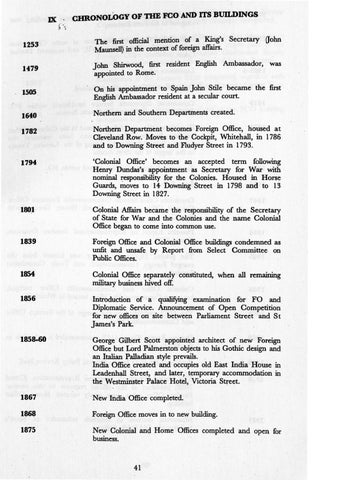
The office of the Secretary of State has developed from the royal household of the middle ages. The first official mention in the context of foreign affairs of a King's Secretary (John Mawisell) came in 1253. John Shirwood, the first permanent English ambassador, became resident in in 1479. In 1505 John Stile, appointed by Henry VII as ambassador to · Spain, became the first English ambassador resident at a secular court. By the · reign of Elizabeth I further resid~nt ambaSsadors had been appointed to Vienna, Venice, France and Constantinople and the outline of a network of foreign embassies was thereby established. · Ro~e
In 1534 Thomas Cromwell became the first layman to be appointed royal secretary and he largely began. the transformation of the office by be~ming in effect the chief· minister, with responsibility for all matters both domestic ~d foreign. In 1540 a second secretary was appointed to hold jointly with Cromwell the single office of Principal Secretary. By the seventeenth century the practice of having two Principal Secretaries, each responsible for both home and foreign ia.ffairs was definitely established. From 1640 their foreign functions were divided into two approximately geographical spheres, northern and southern, which roughly corresponded to the division of Europe into· Catholic and Protestant states in the Thirty Years War. The Northern Department covered the Holy Rom~ Empire, Holland, Scandinavia, Poland and· Russia and the Southern Department France, the other Latin countries and· Turkey. These two departments were united by, among other things, · shared archival facilities under a Keeper of the Papers. · Administrative reforms in 1.782 resulted in the Northern Department becoming the Foreign Office and the Southern Department emerging in effect as the Home Office but·with responsibility also for the colonies. Charles James Fox was the first Foreign Secretary with the playwright (and M.P. for Stafford) Richard Brinsley Sheridan as his Under-Secretary. The rest of the staff of the Foreign Office at this time comprised a second Under Secretary, a Chief Clerk and seven other clerks, two Chamber Keepers and their Deputy, and the 'necessary woman'. In 1782-3 the total cost of tlte establishment was £14,178, of which over one · third was the Secretary of State's salary. The home staff was matched by a correspondingly small network of diplomatic posts overseas, with 21 missions in 1785, only three 9f which (Paris, Madrid and Constantinople) were headed by Ambassadors. 178~ saw the end of a basic pay freeze for the Diplomatic Service which had been in force· for just over a century. In the nineteenth century the budget stretched to. the daily provision of a bread roll 'round in shape and slighdy sweet' in each room - known as the 'Prison Allowance'. The Secretary of State for War had been awarded formal · responsibility for colonial matters in 1801, and it was only in 1854 that a new Principal Secretary of • This is an abridgment of several papers produced over the years by Historical Branch, in particular 'An outline history of the Foreign and Commonwealth Office', 'Some notes on the hard lives of earlier Bri~ diplomats', 'The historical background to the Eden Rcfonns of the Foreign Service in 1943', and 'The interdependence of British trade and foreign policy'.
1
State was __created and a ·separate Colonial Office emerged. Responsibility for Indian affSU, passed fro~ the East India Company and the lndi~ Board of Control to the new India Office in 1858. By the late 1860s the staff of the Foreign Office had grown to about Sixty and the~e were five embassies and nineteen legations overseas.
In 1855 the Civil Service Commissioners requested the ·Foreign Office to introduce rules for adririssi<;>n to the Foreign Office and Diplomatic Service. Edmund Hammond, the Permanent Under Secretary, replied that certain consi.derations should be taken into account, such as, ·'whether the family of the candidate resides in town or not; for it is not desirable that a young man under twenty years of~ age should be appointed to a clerkship in the Foreign Office without his family having a home in the metropolis'. Hammond went ori: 'The labour required of the Foreign Office Clerks is great, the attendance long, and the hours late and uncertain ... The Foreign Office requires of the clerks great .sacrifices of time, of comfort, and of' amusement; and that they should take such an interest in the ·Office as to consider its credit and reputation as their own. Such a feeling ·is the mainstay of the Foreign Office; and . no person, however great his talents, would be useful or acceptable to the Office without it.' He concluded 'A candidate should be able to write a good bold hand, fonning each letter distinctly; to write quickly and correctly either English or French from dictation; to understand French well ... and to make a correct and clear precis or abstract of any set of papers placed in ,his hands.' Q1alifying examinations were duly introduced the following year and in 1892 examina~ons for these separate services became identical. But candidates for the two services were .still separately assessed, and· until 1919 aspiring diplomats, who were expected . to serve as unpaid attaches, were required to have a private income of £400 per annum. Moreover, applicants for both services had to be nominated by the Foreign Secretary. These procedures tried to ensure a homogeneity of the educational and to a lesser extent the social background of newcomers to the Office. By the end of the nineteenth century the vast majority of candidates came from the major public schools or Cramming establishments. Even after the First World War when entrance procedrires were liberalised, the Office continue~ to place great emphasis upon · an oral interview as a way of weeding out vnsuitable candidates. Contrary, however, to popular belief, the late nineteenth century Foreign Service was no more aristocratic in its composition than the Home Civil Service.
In 1905 the ForOgn Secretary, Lord Lansdowne, approved refo~ in the registering and filing of papers (the number of which had increased tenfold from 4,534 in 1821 to 47,948 by 1900). This meant that junior clerks, whose work had consisted chiefly of mundane copying and record-keeping, were given more scope to participate in the fonnulation of policy, thereby relieving the burden on senior clerks and making the execution of policy more efficient.. From earliest times the Foreign Office had reflected national commercial requirements (the Younger Pitt had proclaimed that 'British policy is British trade') but it was not until 1880 that the first commercial attache (Sir Joseph Crowe) was assigned to the Paris Embassy. In 1916 his son, Sir Eyre ·Crowe, headed a departmental committee which recommended the. ·establishment of a Foreign Trade Department within the Foreign Office. This proposal met resistance from the Board of T~ade and the resulting Department of Overseas Trade ·represented an uneasy ~ompromise. Further Foreign Office refonns in 1919 produced a separate Commercial Diplomatic Service, which ·contrasted with simultaneous
2
moves to amalgamate the Foreign Office and Diplomatic Service in order to make staff serving':P,t home ~d . abroad interchangeable. In 1934 the formation of the Economic Relations Section within the Foreign Office reflected its growing need for a firmer grip on economic issues. The trend towards a still more unified diplomatic service was followed through to its logiCal conclusion in the Eden reforms of 1943. The Commercial Diplomatic Service amalgamated with the Consular and Diplomatic Services with effect from May 1943.· Commercial concerns were but one consideration during the long and complicated evolution of the Eden reforms. Attention was also paid to broadening the basis of recruitment into the new Foreign Office through the introduction of pension rights for all, allowances for travel and ~ducation of children, and a new entrance exalnination less weighted towards those candidates with private means and the opportunity to make special preparations. for the exainination. The Eden reforms also gave added emphasis to the separation of the Foreign Service from the ·H ome Civil Service.
Significant developments were also affecting the administration of colonial affairs·. In 1925 the Dominions Offic;e had been created, to handle UK relations with Canada, Australia, New Zealand, South ·Africa, Newfoundland and the then Irish ·Free · State. Following the transfer of power to the independent governments of India and Pakistan in 1947, the Dominions Office and the India Office were transformed into the Commonwealth Relations Office. This absorbed the Colonial Office in 1966, and was renamed the Commonwealth Office. The winds of change blew with even greater force through the Foreign Office in the 1960s. In 1962 Harold Macmillan appointed the Plowden Committee on . Representational Service Overseas. Its report (Cmnd. 227 6) led to the merger of the Foreign, Commonwealth and Trade Commission Services into the present Diplomatic Service on 1 January 1965. Subsequently . the Conimonwealth Office was merged with the Foreign Office on 17 October 1968. The last Foreign Secretary, Michael Stewart, ·then bec3.me the first Secretary of State for Foreign and Commonwealth Affairs.
Against the background of Britain's changing position in the world, a second report on Overseas Representation was produced by the Duncan Committee in · · July 1969 (Cmnd. 4107). This recommended that the FCO should maintain fewer posts abroad and adopt a role of coordination in economic affairs. The world was to be divided into an inner 'Area of Concentration' · (which did not include any of the oil;..producing states) and an outer area of le$ser 'concentration. The FCO came under review again in the 1976-7 report of the Central Policy R~view Staff. Among other things it was suggested that the Diplomatic Service might lose its separate identity in a Foreign Service Group comprising members of the Foreign Service .and Home Civil Servants. While the official response, published in The United Kingdom's Overseas Representation (Cmnd · 7038, August l978), recognised the need for the closest possible cooperation between the Diplomatic Service and the Home Civil Service, emphasis was placed on the benefits accruing from the existence of the Diplomatic Service as a separate 'specialised service'. · The 1980s saw a significant rise in the demands placed upon the FCO's ~ted resources - co~er~ e~quiries .be~een 1982 and 1988/9 for example,
mcreased by 43°/o, and 1l'llilllglCltlOn applications between 1986 and 1989 rose by 19°/o. Between 1968-9 and 1993-4 the number of FCO-based staff decreased from
3
8,140 to 6,440 whilst the n\unber of countries covered rose from 136 to 183. In April 1994,{ ~bout 2500 were iri overseas posts, wi~ roughly 3800 serving ~ the UK. The 1990s continued to witness increasing demands on declining FC 0 resources. Despite the FCO opening or re-openjng 41 Posts, the UK-based staff complement fell by 11 °/o in that decade. In April 1999, FCO staff levels decreased again to 5,635 UK-based staff, of which 2,295 were ov~rseas jobs. Suggestions for farther reading Sir E. Hertslet's Recollections ofthe Old Foreign OfBce (London, 1901) is a ·lively and entertaining book, while Sir John Tilley and Stephen Gaselee's The Foreign Office . (London, 1933) is a .useful account of FO reforms, full of interesting anecdotes, written by a former Chief Clerk and a notable Librarian. Sir Cosmo Parkinson's The Colonial Oflice from within (London, 1947) is an amusing and affectionate memoir by a long-serving CO official who ended his. career as PUS, while Lord Garner's The CoiDDlODwealth Office 1925-1968 (London, 1978) 1S an authoritative acco~t by another former PUS. Algernon Cecil's 'The Foreign Office' in the CIUDbridge History of British Foreign Policy 1783-1919, Vol. ill, is a helpful .general swvey, as . is R.B. Pugh's 'The Colonial Office 1801-1925' in the Cambridge History ·o£ the BriU.h Elnpire; Vol III. Michael .Roper's -The Reco~ a£ the Foreign Oflice 1782-1939 ·(PRO Handbook No 13, 1969), Louise At:}lerton's 'Never complain, never ezplain'. Records aCthe Foreign Oftice .and the State Paper OfBce 1500-c.1960 (PRO Readers' Guide No 7, 1994) and R.B. Pugh's The Records of the ColoDial and DODUnioDS Offices (PRO Handbook No 3, 1964) include full descriptions of administrative and departmental development. · The evolution of the foreign service is traced in detail in:
M.S.
Anderson, .T he
Rise of Modern Diploauu:y 1450-1919 (London, 1993); D.B. Hom, The British Diplomatic Service 1689-1789 (Oxford, 1961 ); Roger Bullen (ed), The Foreign OfBce 1782-1982 (Frederick, Md., 1984); R. Middleton, The Administration of British Foreign Policy 1782-1846 (Durham, N.C., 1977); R.A. Jones, The British Dip1oiDBtic Service 1815-1914 (Ontario, 1983), and The Nineteenth Century Foreign OfBce: an administrative history (London, 1971 ); and Zara Steiner, The Foreip Oftice and Foreign Policy, 1898-1914 (London, 1969). See also for this period D.M. Young's The Colo~ Office in the early Dineteenth century (London, 1961 ).
A much neglected aspect of the history of Britain's foreign relations is. dealt with in D.C.M. Platt's The Cinderella Service: British Coasu1s since 1825 (London, 1971). Some useful insights into the role of the individual in the making of policy are provided in K.M. Wilson (ed), British Foreign Secretaries ~ Foreip Policy: FroDl Crimean War to First World War (London, 1987), and A. Schlaim et al (eds), British Foreign Secretaries since 1945 (London, 1977). See also Yoel Coh.en, Media Diplomacy: The Foreign OfBce in the Mass CoDUDUDiations Age (London, 1986) and Michael Clarke, British External Policy-Makiu,g ~ die 1990s (London, 1992). John Dickie's Inside the Foreign Oftice (London, . 1992) draws on 30 years of experience working as the Diplomatic Correspondent on the Dai!Y Mail. An examination of the role women have played in the Foreign Office can be found in Women in DiploJDaCY (FCO Historical Branch History Note No. 6, 1994). More gener~ books of ~terest include Peter .Hennessy's White~m~:I (London, Minister, and the second 1989), which has been descnbed as the thinking man's edition of Anthony ~~p~o.n'~ The Essential Anatomy at Britain Today (London, 1992) - the 1965 editlon. 1S still worth a glance, see in particular chapter 17 on
res
4
'Diplomats' . .See also Henry' Kissinger's Diplomacy (New York/London, 1994) for a broad swe~~- of the diplomacy practised by some of the 19th and 20th centuries' . great men accompanied by personal accounts of his negotiations with world leaders. Kissinger's Diplo11UUiJ recalls the brilliance of Sir Harold Nicholson's pithy philosophy of DiploJD&cy (Oxford, 1965 edn.), which remains a classic. For a snapshot of the ~evolution of diplomacy, diplomatic practice and brief sketches of some key Foreign Office figures such as Eyre Crowe, see the essays in DiploJDaey and Diploma1ists in the 20th Century (FCO Historical Branch Occasional Paper No 1994). For an assessment of the activities and accomplishments of diplomatS see Gordon A Craig &1.Felix Gilbert (eds), The Diplomats 1919-39 (Princeton, 1953) and Gordon A. :i Cr~g -·& Francis L. Lowenheim (eds), The Diplomats 1919-1979 (Princeton, 1<99.4).~An examination of the origins and practice of diplomacy can be found in Keith( Hamilton & Richard Langhorne, The Practice m Diplomacy: a history of its theory, practice and administration (London, 1994).
·a,
Sir E. Satow's magisterial Guide to Diplomatic Practice· has run to five editions, although the two volume edition of 191 7, illustrated by historical ·anecdotes, is the best source for early practice. The latest edition (London, 1979), by former PUS Lord Gore-Booth, includes details of recent attacks on embassies showing how the profession of. diplomacy has become increasingly dangerous. For a more light. hearted view~ :t0f diplomatic life see John Ure, Diplomatic Bag. An Anthology m Diplomatic . AzaeJCdotes and IDcidents ~ the Renai•sance to the Gulf War (London, 1994). Se '~·also "Ruth Dudley Edwards' True Brits. IDsicle the Foreiga Oflice (London, 199!4~- theJ book to accompany a 'fly on the wall' BBC television series about the Ofticie. . ;~,: . .. RHD's Retrieval Section at Hanslope Park holds large runs of FO Coa&dential Print (including Confidential General 4 on FO administration), Library Mmnoranda and Circulars with their relevant indexes. Bound volumes Gf the Librarian's General Conespcmdence and Memoranda ruri from the late eighteenth century until 1965, and contain a unique collection of complaints, recommendations, internal . circulars on departmental reorganization, and press-cuttings. One of the more unusual items in the Library collection is a bound copy of IDcODDDUDicado: the 3 issues of an illustrated weekly magazine compiled by
members of the British Legation at Bangkok during internment by the Japanese in 1942. Largely the work of Infonnation Officer Andrew Gilchrist with illustrations by the Vice-Consul John FISher, Incommunicado ranges from beauty hints (an easily prepared night cream consisting of half a pound of rice boUed with a large bone for. three hours) to recollections of life in the Foreign Office. ·
5
B·
SOME OFFICIALS, POLICIES AND PRINCIPLES •
~ '·• Throughout much of the nineteenth century the staff of the Foreign Office were more concerned with the administration than the formulation of foreign policy. Their primary function was to assist rather than advise the Foreign Secretary. Recurrent international crises in Africa and Asia during the 1890s and the consequent increased pressure of business did allow senior officials in Downing Street greater opportunities for taking initiatives, and some of the more deteJ!Ilined of them began freely to volunteer their views on general policy in . minutes and memoranda. Nevertheless, Sir Thomas Sanderson, the Permanent Under-Secretary from 1894 until 1906, displayed more interest in the smooth running of the Office than in encouraging the preparation of long policy papers by subordinates. His shaq> wit and cultured intellect probably appealed to Lord Salisbury, but Cecil Spring Rice, a rising star in the Diplomatic Service, echoed a common complaint when in January 1903 he wrote to a fanner foreign secretary that 'so long as he [Sanderson] is there the officials at home and abroad are simply useful as machines and the Foreign Office is like Johnson's definition of fishing: a line with a fool at one end and a worm at the other'. Such criticism was not wholly just, especially as Sanderson was in part responsible for initiating the reforms of 1906 which eventually freed many of the junior staff from the more mundane and tedious of their clerical duties. It is, however, perhaps not without some significance that on 1 January . 1907, the year following Sanderson's departure, Eyre Crowe, a senior clerk in charge of the Western Department, submitted his celebrated memorandum on relations with France and Gennany one of the most comprehensive and poignant analys~s of Britain's international position ever prepared by a Foreign Office official. The memorandum derives much of its importance from what Crowe had to .say about Anglo~Gennan relations in the wake of the Morocco crisis of 1905-6. But it is also of historical interest because of the way in which Crowe tried to define certain general principles underlying British foreign policy. He asserted that Britain's interest as a European and imperial power lay in the preservation of the 'independence of nations' and the freedom of cornrrierce, and he reasoned that it had 'become almost a historical truism' to identify England's secular policy with the maintenance of the balance of power. It was in a similar vein tha~ seven years later on the eve of the First World War Crowe, by then an AsSIStant UnderSecretary, contended that Britain must be prepared to participate in a m~jor conflict because a 'balance of power cannot be maintained by a state that:'· .is incapable of fighting and consequently cames no weight' . .Whether the preservation of the balance of power was as consistent a principle of British foreign policy as Crowe ~sumed is debatable. It could be argued that during the previous .century a more obvious feature of Britain's foreign relation~ had been readiness to . se·ek a modus vivendi with those powers which were perceived as poS:ing th~ greatest immediate threat to her interests. That after all was the original motivating force behind Britain's pursuit of ententes with France and Russia. And it was in ·the logic of Sanderson's 'Observations' on the Crowe memorandum, a document in which the former Permanent Under-Secretary advocated a more conciliatory approach
• This is not intended to be a comprehensive swvey of official thinking about principles and policy making but is meant as an introduction to archival printed matefial in the official series 'Documents on British Foreign Policy 1919-1939' and 'Documents on British Policy Overseas'. Source references for the above quotations are available on request from Historians. · .
6
towards German aspiratio~ and opposed a policy based upon the assumption that every change.in the status. quo was a menace to British ~terests.
As Foreign Secretary between 1905 and 1916 Sir Edward Grey sought and often heeded the advice of his officials. Nevertheless, during the Frrst World War other ministries encroached increasingly upon the Foreign Office's bureaucratic terrain·, and David lloyd George displayed a pench~t for· Prime Ministerial diplomacy which further limited the department's role in policy making. In the meanwhile, advocates of the so-called 'new diplomacy' poured scorn upon such notions as the balance of power, which they held in part responsible for the war, and \rrged its replacement by a community of power and collective security. lloyd George's pursuit after 1919 of what he termed the 'general appeasement of Europe' was · not, however, a policy alien to the Foreign Office, and after his fall from · power in 1922 diplomats and officials were actively engaged in trying to promote a reconciliation between former enemies and in attempting to overcome the divisions created by war, revolution and the .peace treaties. The accot:"ds concluded at Locamo in October .1925 were. one manifestation of this~ The aim now was to achieve stability and security in western Europe through mutual agreement on a common frontier without any reversion to alliances and alignments of the pre-war type. Yet a wide-rimging memorandum on British policy and interests whichj.D. Gregory, an Assistant Under-Secretary, submitted in .the spring of 1926, seemed to reflect a desire to many this new diplomacy with older precepts. It stated in terms of which Crowe would surely have approved: We keep our hands free in order to throw our weight in~o the scale on behalf of peace. The maintenance of the balance. of power and preservation of the status quo have been our guiding lights for . many decades and· will so continue ... At frrst sight it would seem that British foreign policy is altruistic, but in truth His Majesty's Government cannot lay this unction to their souls. The fact is that war and rumour of war, quarrels and friction, in any comer of the world spell loss and harm to British commercial and financial interests. It is for the sake of these interests that we pour · oil on troubled . waters. So manifold and ubiquitous are British trade and British finance that, whatever else may be the outcome of a disturbance of the peace, we shall be the losers ... This is the explanation and the reason for our intervention in almost every dispute th~t arises, and the justification for the maintenance of the armed forces which enable us to intervene prominently and with authority. Without our trade and our finance we sink to the level of a third class Power. Locarno and the unemployed have an intimate ~onnex1on.
Enthusiastic supporters of the ideals of the new diplomacy might have found Locamo and balance of power policies less compatible. ·Indeed, when just four years later Sir Robert V ansittart, the newly-appointed Permanent ·UnderSecretary, drafted his 'Old Adam' memorandum, 'An Aspect of International Relations in 1930', he drew .a clear distinction between the 'new order' based on the League of Nations and .disarmament which British governments had been trying to encourage, and the old diplomacy: 'The Old Adam' - with its 'alliances, insurance and reinsurance treaties, balance of ppwer, military virtues, and economic theories represented by tariff wars and tariff combinations'. At a time when Europe seemed· on the point of liquidating so m~y of the problems of the early post-war era V ansittart feared a retu~, parti~ularly ?n the part of Germany, France and Italy, 'to those pre-war concept:lons of mtematJ.onal policy which are in direct contradiction to the spirit of the League and the ideal of disarmament'.
7
V ansi~'s .prediction ~as ~oon proved to be correct. During the next four years the iareign om~ .had to grapple with the consequences of Japan's ~tary intervention in Ma:nchuria, Italy's invasion of Abyssinia, and the rise of Nanonal Socialist Germany. A memorandum by Orme Sargent and Ralph Wtgram of 21 November 1935 reviewed the alternative courses that Britain might pursue towar~ the new Germany and concluded that the best strategy would be to work for some kind of Anglo-German understanding. 'This', they observed, 'is the only constructive policy open to Europe - the alternatives of drift and encirclement are avowedly policies of negation and despair'. .I t was also, they noted, a matter of proceeding with. Britain's 'traditio~ policy'. Yet senior officials were eventually to weary of trying to find a satisfactory basis for an Anglo-German accord. Hider's pre-emptive diplomacy seemed· so <;>ften to rob them ·of their bargaining counters, and his conduct led them to doubt his word. It · was, nonetheless, in the spirit of this 'traditional policy' that Neville Chamberlain embarked · on his valiant but ultimately fruitless endeavour to find solutions to Germany's grievances. Even officials who no longer believed that such a policy could appease Europe found it difficult, given Britain's lamentable strategic position, to recommend ·alternative courses. Thus, on 31 December 1936, V ansittart summarised a classical dilemma of British diplomats when forced to .make up for the shortcomings of other departments of state. In a memorand\un entided 'The World Situation and British Rearmament', he observed: 'Time is vital and·we have started late. Time is the material commodity the Foreign Office· has to. buy. Our aim. must he to stabilise tJu situation. till 1939.' As in the Fli'St World War, so in the Second, diplomacy se.emed to play second fiqdle to grand strategy. It ·was therefore hardly smprising that the Foreign Office was in the words of one of its historians, Sir llewellyn Woodward, 'often disquieted at the subordination of long-term British political interests to imm~diate military considerations'. Its officials had to reckon with the emergence of new and competing governmental agencies and the increased readiness of Ministers to resort to more direct and para-diplomatic channels of communication. They had alSo to plaq for a post-war world whose political contours appeared more likely to be determined by the United. States and the Soviet Union than an exhausted British Empire. Nevertheless, there was a tendency to regard Britain's enfeeblement a.S a temporary phenomenon, and in any case something that could be overcome by the proper application of diplomatic skills. Accordingly, ·in his famous paper 'Stocktaking after VE-Day', produced at Anthony Eden's request in July 1945, Sir · Orme Sargent argued that Britain had to increase her strength diplomatically, ·:. ·-economically and militarily: · ·
We mwt· not be afraid of having a policy independent of our two great partner$ and not submit to a line of action dictated to us by either Russia or the United States, just because ·of their superior power or because it is the line of least resistance, or because we despair of being able to maintain ourselves without United States support tn Europe. And again, Sargent . appealed to tradition. Britain's foreign policy must, he contended, be in keeping with. British 'fundamental traditions', here interpreted as support for liberal against totalitarian regimes. 'In pursuance of this policy of liberation', he continued, 'we shall have to take risks, and even live beyond our political means at times ... [not hesitating] to intervene in the intemal affairs of other countries if they are in danger of losing the~ liberal institutions or their political independence'.
S~gent.. hoped that Britain might be able to maintain her position as a global power throUgh continued co-operation with the Soviet Union and the United States - or in effect through the operation of a modus vivendi with the two nascent superpowers. He · also recognised that Britain was unlikely to be treated as· an equal in such a combination unless she could enrol the Dominions and other western European powers as collaborators in this tripartite system: But even if it had been possible to achieve these preconditions it is doubtful if Britain's post-war plight would have permitted her to play the role that Sargent anticipated. 'Big Three' co-operation did not, in any event, long survive the advent of peace, ·and in his 1.9 47 update of Sargent's memorandum (FO 371/66546) Gladwyn Jebb, then an Assistant Under-Secretary, argued that while the necessity of an independent foreign policy remained valid, too great an independence of the United States was a luxury Britain could not afford. And although the Foreign .Secretary, Ernest Bevin, stressed that Britain could 'no longer stand outside Europe' and wor~ed · successfully for 'a consolidation of Western Europe' ('The ~list Aim of British Foreign Policy', 4 January 1948), his officials looked increasingly towards Washington for diplomatic and military support at a time when Britain's interests in Europe and Asia seemed threatened by the Soviet Union and the · advance of communism. This was apparent in Britain's role in the setting up of and membership of NATO. But it was a.Iso evident in the papers prepared by the Permanent Under-Secretary's Committee, a body established in 1949 under the chairmanship of the new PUS, Sir William Strang, with the express· purpose of considering long-term questions of foreign. policy. Thus a paper entitled 'A Third World Power or Western Consolidation', the final draft of which was completed in May 1949, rejected the notion that the Atlantic Pact should be considered merely as a temporary phase and that Britain's real object should be to organise Europe as 'Middle-Power' co-equal with and independent of the United States and the Soviet Union. It maintained, that for the present, the closest association with the United States was essential not only to meet the Soviet threat but also in the interests of Commonwealth solidarity and European unity. Likewise, two further papers, 'Anglo-American Relations: Present and Future' and 'British Overseas Obligations', which were prepared in March and April 1950, argued that the 'special relationship' with the United States was dependent on the Americans not losing faith 'in the power or the will of the British people to restore and maintain their strength' and that the United Kingdom could not afford to 'divest herself of her position as a World Power'. ·
A close, though not invariably cordial, association with the United StC~:tes remained an essential fea~e of Britain's foreign relations throughout the following decade. Moreover, when officials in Whitehall frequendy had to pay ~ore ~~~ntion to the balance of payments than the balance of power, and when mdigenous nationalisms challenged British interests ~d influence in Africa and Asia, Britain's. ability to play a global role steadily diminished. ·International politics seemed in any case to be set in a bipolar mould British diplomats still,. however, found time to ruminate over the condition · and future of the new world order. Gladwyn Jebb, in August 1959 in a speculative memorandum entitled 'East-West Relations: is "tension" neces8ary?' argued presciently that there was little chance of any profowtd change taking place in East-West relations. He could foresee no general political or territorial settleme'nt between the 'two worlds' for the next twenty or thirty years, although he thought there might be some progress towards arms ~tation and some. form of 'live and let live' arrangement between the blocs. Bu~ until some .new equivalent force emer~ed - probably China, conceivably a · Uruted Europe - he considered that 'the tension creating th~ situation [could] only · be changed by the defeat of one side or the other'. In these circumstances he concluded: 'What .. . our generation has to do is to see to it that the present ~orld 9
balance of power remains tinchange~ until the emergence of new factors presents the basis far'路JUl agreed plan for changing it.' This in Jebb's view implied 'long and agonising' negotiations With the Soviet Union. 'Strength of pwpose as regards the essentials', he observed, 'suppleness as regards the negotiations themselves, if the West sticks to these principles, then problems of "tension" will solve themselves'. Such styles and principles would not have been foreign to either Crowe or Sanderson.
10
. .
m
THE BUILDINGS OF THE FCO
When the Foreign Office was created in 1782, its small staff was· easily accommodated in two houses at Cleveland Row, StJames's, formerly occupied by the Secretaries of State of the Northern and Southern Departments. During the rest of the eighteenth century, with increases in both staff and business, the Office ·was obliged to move briefly to the Cockpit, Whitehall, and eventually to Downing . Street, where Lord Sheffield's house was acquired By the late 1820s, the Foreign Office had taken over ~ore houses in Downing Street, and in Fludyer Street which ran parallel with it, while the office of the Secretary of State for War and the Colonies was housed in the adjacent Nos 13-14 Downing Street which looked back on to StJames's Park. Downing Street and its environs was at that time far from being the select and salubrious home of central government it has since become. The· narrow streets and alleys were full of public houses, such as the Cat and Bagpipes and the Rose artd Crown, some of which could trace their origins back to mediaeval hostels set ~p for pilgrims seeking the shrine of Edward the Confessor at Westminster Abbey. These · rubbed shoulders with livery stables, dressmaking establishments, cheap lodging houses for Irish and Scottish MPs, private houses and major and minor departments of state, and both ministers and clerks worked to .an accompaniment of carriage wheels, horses' hooves and hawkers plying their wares. Stories abound of the FO clerks' unofficial activities - buying strawberries via baskets suspended on strings of red tape, throwing hot pennies to s~eet singers, and signalling with mirrors to pretty dressmakers across the way - giving rise to the comment that they, like the fowttains in Trafalgar Square, 'played from ten to four'. Critics forgot the long hours and weekend working imposed on the clerks, especially when Palmerston was Foreign Secretary. Worse than this, however, was the instability of the houses themselves. An underground stream had made the area very boggy, and the foundations of some of the houses in Downing and Fludyer Streets were so poor that one had fallen down and the rest· of the Foreign Office was shored up with wooden posts. Add to this the vibration from printing presses initially placed in the attic storey, and it will come as no swprise to learn that some houses were not expected to survive beyond the length of their ·teases, at best some twenty years. Dangerous cracks appeared in walls and ceilings, and the Librarian was especially afflicted by noxious odours wafting into his room from a faulty .sewer. . There were several plans to build a new Foreign Office on the Downing Street site, but nothing came of them until the 1850s, when it was decided to centralise' the major departments of state in Whitehall and to replace the warren of fine houses and tumbledown courts with purpose-built ministries. In 1856 a government competition for plans for new Foreign and War Offices on the Downing Street site was announced, and in 1858 after . a protracted argument on the form of the redevelopment {the 'Battle ·of the Styles' between those favouriJ:tg Gothic or Classical architecture) George Gilbert Scott was appointed as architect. Scott had envisaged a Gothic Foreign Office, but this was not approved by Lord Palmerston, and although a compromise Byzantine solution was offered, it too was rejected as 'a regular mongrel affair'. Palmerston refused to countenance anything other than ~ building in th~ classical style, and Scott finally succumbed and produced drawings for the building we know today. Work began on clearing the site and sinking foundations~ 1861-2, obliging the ·office to move to temporary accommodation in 11
the new Foreign Office ~ventually opened for business in
Whitehall Gardens, and July 1868. :·- . ~ .
.
.
The new War Office on the site next to the Foreign Office never materialised and the area was taken over by the newly created India Office. Scott was entrusted with 'the architectural superintendence of the building' in 1859, but .the · interior was designed by Matthew Digby Wyatt, Surveyor of the· former East India Company and subsequently Architect to the Council of India. Wyatt could draw upon the revenues of India,. as well as the proceeds from the sale of East India House, in Leadenhall Street in the City, and he could thus afford to decorate the interior courtyard ~f the India . Office with marble, tiled friezes and a wealth of . elaborate caiving; and the Council Chamber and the Secretary of State for India's Oval Room with mahogany, oak and gold leaf. The courtyard was used for a great reception for the Sultan of Turkey in the summer of 186 7, and the new India Office opened with an official breakfast on 29 November 1867. Scott proceeded with plans for the new Colonial and Home Offices, which would extend the block to WhitehalL The building of the new Foreign Office had further upset the foundations of the old Colonial Office, and its height had the unexpected effect. of stopping some of the co chimneys from drawing. Officials were either almost choked in rooms filled with smoke, or frozen by. keeping the windows open. As Scott had been criticised for designing such lofty and highly decorated rooms for the Foreign Office, he was given instructions to make the Colonial and Home Offices less elaborate, and he followed these strictures to such good effect that they were completed in 1875 for only very slightly more than the cost of the Foreign Office alone. · These four buildings were reasonably satisfactory offices until the FlrSt World War, when large incr~a.Ses in staff and business gave rise to serious shortages of space. Some relief was given by the building of another storey in the 1920s, but this gave only a temporary respite, and matters became much worse during and after the Second World War. The India Office courtyard, for example, (renamed Durbar Court in 1902, when it was the scene of some of King Edward VII's Coronation festivities) was taken over by the FO Communications Dep~ent and the marble floor disappeared under prefabricated huts and pipework. The suite of three reception rooms, magnificendy decorated and designed by Scott for diplomatic entertainment, had been used as offices during the FU"St · World War, but were subsequen~y cleared so that the Treaty of Locamo could be signed in the largest room . on I December 1~25. The suite was then redecorated, rechristened the Locamo Suite, and returned to its original purposes until 1939. During the Second World War, the Suite provided a home for the · FO Cyphering Department, and afteiWarC:fs, plas~erboard partitions divided the rooms into offices for the Legal· Advisers and others. After the India Office ceased to exist as a separate ministry in 1947, the Foreign Office took over the rest of its building, mainly for use by the now greatly enlarged German Department, but the shortage of space was still acute. Plans to build a new Foreign Office in Carlton House Terrace and a new Colonial Office in Broad Sanctuary came to nothing, and in 1963, Geoffrey Rippon announced that the whole of Scott's building had come to the end of its useful life and was due for demolition. As a result of the ensuing public debate on their architectural value, Scott's offices were classified as a Grade 1 Listed Building and · demolition w~ prevented ·
12 .
The merger of the Foreign and Commonwealth Offices in 1968 and the removal o£ the Home Otlice to Queen Anne's Gat~ in 1978, led in time to the occupation of the whole of Scott's building by the FCO. This allowed the formulation of plans to transform what had been four separate ministries into one interconnected and modernised block, while at the same time restoring historically significant areas to ~eir original glory. A rolling programme of restoration and refurbishment was completed in January 1997. Suggestions for further reading
Sir E. Hertslet's Recollections of the Old Foreign Oftice (London, 1901) is a rich source of anecdotes about early FO buildings, while FCO Buildings: A Chronology and Bibliography is a comprehensive guide for the period up to 1977 (Library Note 2(77): copies available from F~O Library ~d Historical Branch). The most detaile~ survey to date of the origins and construction of all four Old Public Offices is Ian Toplis's The Foreign Oftice. An Architectural History (London, 1987) although its illustrations are disappointing~. Cecil Denny Highton and Partners, The Old Public OSice London SWl (revised edition, London 1985) is the fruit of research by the 'consultant architects responsible ·for the refurbishment of the FC 0 from 1984 onwards, whereas David Church, the PSA architect chiefly responsible for the original · restoration programme, gives a brief account of achievements to date in 'Restoration · of the Foreign Office Buildings in Whitehall', Construction · PSA, No 74, March 1990, pp 9-11. John Martin Robinson's The Wyatts. An Architectural Dynasty (Oxford, 1979) is particularly useful for. Matthew Digby Wyatt and th~ India Office, as is John Cornforth's well-illustrated article 'The Old India Office' in Country Life, 12 November 1987, pp 164-9. Brief histories of the Locarno Suite, the Goetze murals surrounding the Grand Staircase, Durbar Court and the bust of Ernest Bevin can be supplied by Historical Branch, LRD, together with advice on the location of the pictures, ·prints and photographs of the exterior and interior of the FCO. A second edition of the booklet on the history of the FCO building, illustrated throughout in full colour, was published in 1993 and is available through HMSO bookshops (ISBN 0 11 580263 0).
13
IV
.Q.UOTATIONS ON DIPLOMACY AND FOREIGN POUCY
r. ·~
;
'Ambassadors are the eye and ear of States.' Guicciarclini, 1495
'There is no government on earth which divulges its affairs less than England, or is more punctually informed of those of others.' ·
.
Sagredo, Venetian Alnbassador, 16th century
'An ambassador is an honest man sent to lie abroad for the good of his country.' Sir
:aem-y Wotton, 1604
and
'An ambassador must be liberal and magnificent, but with judgement design, and his magnificence should be reflected in his suite. His table should be setved nearly, plen~fully and with taste. He should give frequent entertainments and parties to the chief personages of the Court and even to the Prince himself. A good table · is the best and ea.S1est way of keeping himself well informed The natural effect of good eating and drin.kin'g is the inauguration of friendship and the creation of familiarity, and when people are a trifle warmed by wine they often disclose secrets of importance.' de Callieres, L'Arl ck ugocier avec k• Prir&ce•, 1716
'May the pens of the diplomats not ruin again what the people have attained with · · such exertions.' · von Blii.cher, 1813
'We have no eternal allies, and we have no perpetual enemies. Our interests are eternal and perpetual, and those interests it is our duty ~o follow.'. 'The only use of a plenipotentiary is to disobey his instructions. A clerk or ·' messenger would do if it is necessary stricdy to follow them.'
Lord Pahnenton, 19th century
7.
'There is all the difference in the world . between good-natured, good-humoured effort to keep well in with your neighbours and that spirit of .haughty and sullen isolation which has been dignified by the name of "non-intervention".· We are part of the Community of Europe and we must do our duty as such.' . Lord Salisbury, 1888
'There is nothing dramatic in the success of a diplomatist. His victories are made up of a series of microscopic advantages: of a judicious suggestion here, of an opportune civility there, of a wise concession at one moment and a far sighted persistence at another; of sleepless tact, immovable ca.lmn:ess and patience that no folly, no provocation, no blunder can shake.' L9rd Salisbury, 19th century 14
'The Fore~ Office and the Colonial Office are chiefly engaged in finding new markets and in defending old ones.' Joseph Cluunberlaia, 1896
'Diplomacy, it is true, has been shorn of much of the importance which gave it in former times so prominent a position in the state service. The surprising progress made in the means of communication has deprived diplomats of many of the grave responsibilities with which they were formally charged. On the. other hand, in later yea.rS the prevailing and increasing desire to exhaust every possible means of 路 negotiation and have recourse to arbitration before finally resorting to war, has done much and will do more still to .rehabilitate the diplomatist and will perhaps in time conduce to elevate him to a higher position of importance than he has ever yet occup!ed.' Arthur Ponsonby, FO Library Mmnorand'IIID, 1900
'The general character of England's foreign policy .is determined by the 路immutable conditions of her geographical situation on the ocean flank of Europe as an island state with vast overseas colonies and dependencies whose existence and survival as an independent commu:ility are inseparably bound up with the possession of ~reponderant s~a power.' Sir Eyre Crowe, 1907
'The art of diplomacy, as that of water colours, has suffered much from the fascination which it exercises on the amateur-' 路 Sir Harold Nicolscm, 20th century
'Diplomacy is to do and say The nastiest thing in the nicest way.' baac Goldberg, 1930
'The policy of England takes no account of which nation it is that seeks the overlordship of Europe. It is concerned solely with whoever is the strongest or the potentially dominating. tyrant. It is 3: law of public policy whi~ we are following, and not a mere expedient dictated by accidental circumstances or likes or dislikes.' Sir Wmston Churchill, 20th century
'The "Great Game" is concerned with the destinies of nations than which there can be no higher hwnan interest. feel that one holds these destinies in the palm of one's hand, even if only for a few brief moments, is indeed a god-like experience which makes up for years of drudgery. _It is this which lifts diplomacy, compared with other professions, to the highest pinnacle of importance.'
To
Sir Victor Wellesley, Diplom.tJC.Y in Fetter., 1944
'Foreign policy isn't something that is great and big, it's common sense and humanity as it applies to my affairs and yo~.' Ernest Bevin, 1950
15
'Diplomacy is not one of the easiest professions. What it calls fi b all thin · patience.' :· ·~ or a ove gs IS Sir WilliUD Strang, 1951
'~ou will realize .~at I am sp~aking of the frequent suggestions that the United Kingdom should JOm a federation on the continent of Euro This · thin · our b ones, we cannot do We know th t ifpe. . IS some g which we know, m ·It, we should re1ax the spnngs · . · a we were to attempt of our actlon in the W t d · · th Atl · · · · . es em emocrat:J.c cause and m e antic assooatton which IS the expression of that F B · · · li r. cause. or nta.In's story an d h er mterests e tar beyond the continent of Europe 0 th h .. . . · ur oug ts move across th e seas to th e many commumues · · m which . OW' people piay the1r part, m every comer of th e world. These ·are our family ties. That is 0 1:r. • ·th . . ur we. W1 out 1t we sh ould b e no more than some millions of people living on an island ff th · which no bo d y wants to take any particular interest.' . o e· coast of E urope, m Anthony Edea, 1952
'In a world where war is everybody's tragedy and everybody's nightmare di ·1 is everybody's business.' ' P omacy £,
•
Lord Strang, 1959
'We are coming to realise that foreign operations in today's world call for a t tal diplomacy ... American ambassadors can no longer be content with wining ~d dining, reporting, analysing and cautiously predicting.' Chester B. Bowles, e. 1960
'Great Britain has lost an Empire and·not yet found a role.' Dean Achnon, 1962
'We are a world power, and a world influence, or we are nothing.' Harold Wilson, 1965
British foreign policy is defined as 'first, the comminnent to an increasingly integrated Western Europe on as wide a basis as possible, with the ~uropean Common Market as its core, and secondly a commitment to a North Atlantic Alliance under US leadership as the main instrument for the ~nduct of East-West relations ... Other broad aims. on which there is general agreement are the reduction of East-West tension, whenever circumstances in the Soviet bloc pennit this without weakening the Atlantic Alliance; the sustaining of Cqmmonwealth links in a form appropriate to contemporary requirements, including · Ollf relations with a number of small dependent territories for which the British Government will continue to be responsible; the improvement of e~onomic condi~ons in the less developed countries; and the strengthening of international organisations in which an effective dialogue can take place on issues which cause conflicts between nations.' Dunean Report 1969
'Foreign policy is what you do; diplomacy is ·how you do it. Of course the two ,get mixed up especially when a diplomat is advising on policy or a member of the Government normally engaged in policy decision takes over a diplomatic operation 16
which seems- to merit top l~vel or · summit discussion. But generally speaking the task ·of a g6vemlnent is tQ decide and and the task of a diplomat at any level is to try to make the decision work.' .
Lord
Gore-Boo~,
With Great Tndh and Respect, 1974
'Diplomacy has become more complex and its subject-matter more technical. It has lost most of its glamour.' Sir Michael PaDiser, 1975
'A British Ambassador today seldom acts, in matters of importance, without instructions from home. Yet communications work both ways; he may have more opportunity to influence those instrUctions than his predecessors 'had.' ditto
'Diplomacy has over the millenia evolved into a marriage institution of sorts. As in matrimony, the high points, the humdrum, the ecstasies ·and parturitions are all part of an enduring and uninterrupted relationship, .and have their rules, written und unspoken, for quarrel and for reconciliation too. With nothing but a summit diplomacy the nations risk exchanging marriage for a mere mating, an intermittent rut in·which a frenzied collision .of the parties briefly and single-mindedly interupts long intervals of mu~al aversion.' Sir GeofFrey Jackson, Ccmcortle Diplorruu:y, 1981
'In any country diplomacy and the press are · uneasy adversaries. The diplomat less said the better. The p~ess thrives on public utterances.' · believes
the
.
_
·
David Newsom, 20th century .
.
'Diplomats operate through deadlock, which is the way by which two sides can test eachother's determination. Even if they have egos for it few heads of government have the time to resolve stalemates, their meetings are too short and the demands of protocol too heavy.' Henry Kissmger, 20th century
'In the Diplomatic Service- the various elements - · commercial, information, political and consular - support and strengthen each other. And all for one pwpose: to further British interests, whether these are strategic or commercial or perhaps personal for the holiday maker mugged on his package tour. These are the reasons a strong Diplomatic Service is ne~essary- Britain may no longer be a global power, but it still has global interests, political and economic - and in a highly competitive world these interests have to be promoted and protected.' Sir Geoffrey Howe, 1984
'Our destiny is in Europe, as part of the Community. That is not to say that ·o ur future lies only in Europe.' Margaret Thatcher, Bruges, 1988
17
'Foreign and defe.n ce policy essentially has to be about the obtaining and manageme&t ~ of influence.~ Lord Carringtou, R.jkct on Thing• P~~Bt, 1988
'My aims for Britain in the community can be simply stated. I want us ·to be wher~ we belong. A~ the very heart of Etirope. Working with our partners in buildin the future. That 1s a challenge we take up with enthusiasm.' g Jolm Major, 1991
'Diplomacy is unfashionable in the world of knee-jerk reaction and the dogmatic sound bite on television.' ~ DougiU Hard, 1992
'Preventive diplomacy is quicker, more helpful to peoples about to be embroiled · conflict than-the most successful peace-keeping or peace-making operation whi: follows the outbreak of violence.' · ditto
'The function of the personal representative abroad is ·virtually obsolete in today's world; faxes, telexes and now face-to-face conference . telephone facilities could eaSily be installed in place of our smug, expensive diplomats. Similarly, with foreign ministers constantly jetting around and summits taking place almost monthly, the day of the grand embassy is over. The 18th century .concept of a large legation in every foreign capital has been made progressively redundant by technological advance; and if prestigious ambassadorial jobs were not expected and demanded by diplomats as the climaxes of their careers, half' of :the legations could be dosed down tomorrow.' Andrew Roberts, Daily Mail, 1993
'British foreign policy exists to protect and promote British interests. Despite all the changes in the world that underlying truth has not changed.' Douglas Hurd, 1993
'The·. Foreign Office is a splendid Rolls Royce, \Yhose owner keeps telling it to go faster, while cutting down on the fuel. Pride ensures that appearances are kept up: the chrome is as highly polished as ever and the exterior is kept perfect. But from time to time, although the owner needs the Rolls for prqfessional purposes, he gets embarrassed at owning such a status symbol, admiriisters an almighty kick to the . bodywork and tells them in the pub that he is thinking of scrapping it or. swapping it for a Ford Cortina.' Ruth Duclley Edwards, Tnur Brits, 1994
'In the world beyond parliaments, the press and think tanks, parochialism is being jettisoned; to survive, the fittest have to be international and manage change, not seek to defy.' Maleohn RifkiDcl, 1M Sunday
18
T~s,
1995
'We live in . a modem worid in which nation states are interdependent. In that modem wot\d foreign po~cy is not divorced frot:n domestic policy but a central part . of any political prograrilme.' Robin Cook, 1997
'Our foreign 路p~licy must have an ethical dirriension and must support the demands of other peoples for the democratic rights on which we insist for ourselves.' ditto
'Many people have no idea that the FCO is staffed by doWn-to-earth, unstuffy people working hard in Britain's interests ... The Diplomatic Service represents Britain abroad; I want it to represent all the communities 路 of modem Britain today.' ditto
Sources
in addition
to the usual Dictionaries of Quotations, see British Foreign Policy, A Brief Collection of Fact and Q.uotation (COl, revised editions, 1961, 1971 ), and D. Butler and A. Sloman, British Political Facts 190~1979 (London, 1980) which has a handy section on famous political sayings and their sources. D. Coveney and W.N. Medlicott, The Lion's Tail: aa anthology of criticism. and abuse (London, 1971) survey~ England 路and the English character as seen from abroad, and is a useful quarry for speeches.
19
V
SECRETARIES ,··· ,
CHARLES JAMES
FOX ...
OF STATE FOR FOREIGN AFFAIRS 1782-2000
LORD
GRANTIIAM ...
EARL TEMPLE
... MARQUESS
OF
CARMARTHEN ... LORD GRENVIlLE ... LORD HAWKESBURY ... LORD HARROWBY ... LORD
MULGRAVE ... LORD HOWICK ... GEORGE CANNJNG ... EARL BATHURST ... MARQUESS WELLESLEY ... VISCOUNT CASTLEREAGH ... VISCOUNT DUDLEY AND WARD ... EARL OF ABERDEEN ... VISCOUNf PALMERSTON ... DUKE OF WELLINGTON ... EARL GRANVIlLE ...
EARL OF MALMESBURY ... LORD JOHN RUSSEU.. ... EARL OF CLARENDON ... LORD STANLEY ... MARQUESS _OF SAUSBURY ... EARL OF RQSEBERY ... EARL OF
IDDESLEIG~
-· EARL OF
.
.
KIMBERLEY ... MARQUESS OF LANSDOWNE ... SIR EDWARD GREY ... ARTIIUR JAMES BALFOUR ... EARL CURZON ... JAMES RAMSAY MACDONALD ... SIR AUSTEN CHAMBERlAIN ... ARTHUR HENDERSON ... MARQUESS OF REAJ)ING ... SIR JOHN SIMON ... SIR SAMUEL HOARE
... ANIHONY EDEN ... VISCOUNT. HALIFAX ..• ERNEST BEVIN ... HERBERT MORRISON ... HAROLD MACMILLAN ... SELWYN llOYD ... EARL OF HOME ... RICHARD AUSTEN BUlLER ·PATRICK GORDON WALKER
... MICHAEL STEWART ... GEOR(;E
BROWN
... JAMES
CAlLAGHAN ... ANTHONY CROSLAND ... DAVID OWEN ... LORD CARRINGTON-· FRANCIS PYM ... SIR GEOFFREY HOWE ... JOHN MAJOR ... DOUGLAS
:m.iRD ...
MALCOLM RIFKlND ...
ROBIN COOK
A list of the 57 Secretaries of State for Foreign Affairs, from Charles James Fox (1782) to Robin Cook (1997 -), with dates and biographical sketches ~for 1782-1960 only) is available from Historians, RHD. The following abbreviated extracts have been taken 10 part from the list originally compiled (or the FO Bicentenary in 1982. ·. •··
Mar:Jul 1782
Fox, Charles I ames: · a brief but brilliant start to the line of Foreign Secretaries (Christopher Hobhotise, Fox - London: 1964; L. G. Mitchell, Charlesjames Fox- Oxford: 1992).
Jul 1.782-Apr 1783
Grantham, 2nd Lord, Thomas Robinson: 'a very agreeable, pleasing man', (H. Walpole); 'possessed solid though not eminent parts, together with a knowledge of foreign affairs and of Europe' (Dictionary of ~ational Biography).
Apr-Dec 1783
Fox, Charles Iames .
20
19-22 Dec 1783
Temple, 3rd Earl. George Nugent Temple Grenville, later 1st Marquess of Buckingham: holds . the record for the shortest tenure as .Foreign Secretary (DNB).
23 Dec 1783Apr 1791
Carmarthen, Marquess of, later 5th Duke of Leeds, Francis Godolphin Osborne: he brought to the Government more of polish than weight (Stanhope); 'his social graces, his heritage, and his good looks made him one of the dandies of his age' (C.R. Middleton, The Adminis~tion · of British Foreign Policy, 1782-1846 - Durham N.C ~ : .1977).
Apr 1791-Feb 1801
Grenville, Lord William Wvndham Grenville: 'As Foreign Secretary for nearly ten years, Grenville's will-power, patriotic pride and indomitable persistence provided the mainspring of the first two coalitions against France' {C&IIIbridge History o£ British Foreign Policy, vol. i Cambridge: 1923).
'
Feb 1801-May 1804 Hawkesbury, Lord, later 2nd Earl of Liverpool, Robert Banks I enkinson: evidently not a successful Secretary of State; 'He lacked imagination and was of so nervous a temperament that. Huskisson [seep. 27] referred to him as the grand figitatis' ~ddleton). May-Dec 1804
Harrowby, 2nd Lord, later 1st Earl of Harrowby, Dudley Ryder: an unlucky Foreign Secretary: at the end of 1804, having fallen downstairs on his head at the Foreign Office, ·he became at once ·'totally .diSqualified for so laborious a post' and was compelled by ill-health to resign {DNB).
Jan 1805-Feb 1806
Mulgrave, 3rd Lord, later 1st Earl of Mulgrave, Henry Phipps: like HarroWby he was little more than a functionary whose personal loyalty to Pitt was his outstanding characteristic. In the Office he immersed himself in minutiae and composed an ode upon the battle of Trafalgar, which was set to music by Arne (Middleton).
Feb-Sep 1806
Fox, Charles I ames
Sep 1806-Mar 1807 Hawick, Lord, later 2nd Earl Grey, Charles Grey: his brief tenure, as Lord Howick, gave little suggestion of his subsequent renown as Prime Minister at the time ·of the Reform Bill of 1832 (DNB; E. A. Smith, Life of Lord Grey 1764-1845 - Oxford 1990; John W. Derry, Charles, Earl Grey: Aristocratic Reformer - Oxford 1992). Mar 1807-0ct 1809
Canning, George: a brilliant and militant Foreign Secretary during the outbreak of the Peninsular War. Policy differences with his Cabinet colleague Castlereagh (Secretary of State for War) led to a duel in which Canning was wounded in the leg. This is thought to be the last time that two members of the Cabinet have literally fought it out (Harold Temperley, The Foreign Polley of Canning 1822-1827 - London: 1925). ·· · 21
Oct-Dec 1809 ..
t
BathUrst, 3rd Earl, Henry Bathu.rst: 'Though Lord Bat:}lurst did not .belong to that class of public men who le~v~ their mark behind them, he was an able and useful rmmster' (DNB).
Dec 1809-Jan 1812
Wellesley, Is~ Marquess.. ~chard Wellesley. said to be the most langmd of Bntish foreign secretaries ra.rdy corresponded with diplomats, and seldom attended' Cabinet meetings or spoke in Parliament (Middleton).
Feb 路1812-Sep 1822
Viscount Castl~reagh, later 2nd Marquis of Londondeny, Robert Stewart: .perhap~ no other British Foreign Secretary at a great mtemational conference has matched the sway of Castl~reagh, strong in will, cool in manner, at the Congress of VIenna. He inaugurated a tradition of finn but conciliatory diplomacy (Sir C. Webster, The Foreign Policy of Castlereagb, 1815-1822 - London: 1931; C. J. Bartlett, Lord Casdereagh: The Rediscovery or a StatesJDaD - London: 1971 ).
Sep 1822- Apr .1827 . Canning, George Apr 1827-May 1828 Dudley and W a.rd, 4th Viscount, later Earl of Dudley. Jolm William Ward: rehearsed to himself conversations in two voices, gruff and shrill, it was said, 'It is only Dudley talking to Ward'. In 1832 his increasing eccentricity ~used him to be placed under restraint (DNB ). May 1828-Nov 1830 Aberdeen, 4th Earl of, George Hamilton Gordon: a quiet, serious Scot and a great favourite of Queen Victoria (Muriel Chamberlain, Lord Aber~een, A Political Biography - London: 1983). Nov 1830-Nov 1834 Palmerston, 3rd Viscount, Henry John Temple: his gunboat diplomacy against Greece in 1850 over-reached itself in European estimation but clinched his hold upon British parliament and public, and led towards his first premiership. He believed that 'the furtherance of British interests should be the only object. of a British Foreign Sec~etary', and that 'it was a British interest to preserve the balance of power in international affairs, and that Britain had no permanent friends or permanent enemies' (K..路 Bourne, Palmerston: the early years, 1784-1841 - London: 1982; M. Partridge and K. Partridge, Lord Palmerston, 178~1865. A Bibliography- London: 1994). Nov 1834-Apr 1835
Wellington, 1st Duke of, Arthur Wellesley. Wellington's prescription for British foreign policy was 'to stand well with France and to distrust Russia' (Lady Longford, WeUington, 2 vols- London: 1971, 1972).
Apr 1835-Aug 1841
Palmerston, 3rd Viscount, Henry John Temple
Sep 1841-:Jul 1846
Aberdeen, 4th Earl of, George Hamilton qordon 22
Jul 1846-Dec 1851 .....
Palm~rston, 3rd VIScount, Henrv John Temple
~
..~
~
Dec 1851-Feb 1852
Granville, 2nd Earl, George Leveson Gower: Granville's handwriting was unclear, his French perfect, his policy patchy (Lord Edmond Fitzmaurice, Life of Lord Granville London: 1905).
Feb-Dec 1852
Malmesbury, 3rd Earl of, James Harris: on first becoming Foreign Secretary under Lord · Derby, Malmesbwy found that 'all staff were kindly disposed, but I could see that ili:ey expected me to give them much trouble and to ask their advice' (Earl of Malmesbury, MeJDoirs of an esMiDister -London: 1885).
Dec 1852-Feb 1853
Russell, Lord John, later 1st Earl: it fell to Russell to inspect the Foreign Office skeleton in the despatch box that of an office cat (G.P. Gooch, Ed., The Later Correspondence of LordJolm Russell 1840-1878, 2 vols London: 1925).
Feb 1853-Feb 1858
Clarendon, 4th Earl of, George Villiers: a professional diplomat, he was also one of the Foreign Office's most popular Foreign Secretaries, not least perhaps because of his immediate ~ of Palmerston's ban on smoking (H. Maxwell, Life of Clarendon - London: 1913).
Feb 1858:Jun 1859
Malmesbwy, 3rd Earl of, James Harris
Jun 1859-0ct 1865
~ussell,
Nov 1865-Jul 1866
Clarendon, 4th Earl of, George Villiers
Jul 1866-Dec 1868
Stanley, Lord, ·Edward Hemy, later 15th Earl of Derby: his for. policy was defined by Lord Salisbury as that of floating 'lazily down· a stream occasionally putting out a diplomatic boat-hook to avoid collisions' G.A.S. Grenville, Lord SalisbUry and Foreign Policy - London: 1964; K. Bourne, The Foreign . Policy of Victorian England 1830-1902 - Oxford, 1970; ·D~ ).
Dec 1868-:Jul 187~
Clarendon, 4th Earl of, George Villiers
Jul 1~70-Feb 1874
Granville, 2nd Earl, George Leveson Gower
Feb 1874-Apr 1878
Stanley, Lord Edward Henry, later 15th Earl of Derby
Apr 1878-Apr 1880
SalisbUry. 3rd Marquess of, Robert Cecil: a great Secretary of State who successfully combined the offices of Prime Minister and Foreign Secretary (Lillian Penson Foreign AmUrs under the .Third ~quis of Salisbury ~ London, 1962;J.AS. Grenville).
Lord John, later 1st Eatl
Apr 1880-Jun 1885 · Granville, 2nd Earl, George Leveson Gower
23
Jun 1885-Feb 1886 . Feb:July 1886
SalisbUry, 3rd Marquess of, Robert Cecil Rosebery, 5th Earl of, Archibald Primrose: said to have achieved his three principal ambitions by the age of 48: he had become Prime Minister, won the Derby and married a rich heiress (G. Martel, Imperial Diploii18.C)': Rosebery and the Failure of Foreign Policy - London: 1986).
Aug 1886:Jan 1887
lddesleigh, 1st Earl of, Stafford North cote: confessed to the British Ambassador in Berlin that he did not 'pretend to fathom the secrets or unders'tand the abstruse diplomacy of the day', a serious disadvantage when dealing with Bismarck (CJ. Lowe, The Reluctant lm.perialists. Volume 1: British foreign policy 1878-1902- London: 1967).
Jan
Salisbury, 3rd Marquess of, Robert Cecil
1887-Aug 1892
Aug. 1892-Mar 1894 Rosebery, 5th Earl of, Archibald Primrose Mar 1894-Jun 1895
Kimberley, 1st Earl of, John Wodehouse: a controversial appointment, despite his administrative competence and extensive ministerial experience. Caught between the rivalries of Rosebery and Harcourt (leader in the Commons) he had . an uncomfortable tenure of an office which he had once declared to be 'the object of his life' (K.M. Wilson, Ed., British Foreign Secretaries and For~ign Policy- London: 1987; G. Martel, op.cit.). ..
Jun 1895-Nov 1900
Salisbury, 3rd Margu~s of, Robert qecil
Nov 1900-Dec 1905 Lansdowne, 5th Marquess of, Hepry Fetty-Fitzmaurice: not a great Foreign Secretary but a successful one, he presided over a diplomatic revolution which included the conclusion of the Anglo-Japanese alliance and the nego~ation of the Anglo-French Entente (G.W. Monger, The End of ~solation: British Foreign Policy 1900-1907 - Lon~on: 1963).路 . Dec 1905-Dec 1916 Grey, Sir Edward, later VISCOunt Grey of 路Fallodon: holds the 'longest continuous term of any Foreign Secretary, and it was from his room that he observed 'the lamps .. . going out all over Europe' (K. Robbins, Sir Edward Grey. A Biography of Lord Grey of Falloc:lon .- London: 1971; F. H. Hinsley, Ed., British Foreign Policy under 路 Sir. Edward Grey - Camb~clge: 1977). Dec 1916-0ct 1919
Balfour, Arthur Tames, later lst Earl路 of Balfour: a former Prime Minister, he cultivated a fine taste for good food, lawn tennis and philosophy. At the Paris Peace Conference, his behaviour was likened to that of a choir boy at a funeral service (R.F. MacKay, Balfour: Intellectual Stateunan- Oxford: 1985).
24
Oct 1919-:J:an 1924 ...t· '··
Curz~n, Earl, later 1st Marquess of Kedleston: noted for his. aristocratic disdain and vitriolic wit, in the words of V ansittart he 'had a great presence, great ability, great application but not quite the greatness which he greatly desired' (K.. Rose, Superior Person: A Portrait of Carma London: 1969).
Jan-Nov 1924
MacDonald, James Ramsay. the only Prime Minister since Salisbury to be his own Foreign Secretary. As a founder member of the Union of Democratic Control, he had been. a wartime critic of the Foreign Office. One of his several achievements as Foreign Secretary was to instigate the publication of 'British Documents on the Origins of the War' (David Marquand, Ramsay MacDonald - London: 1977).
Nov 1924-Jun 1929
Chamberlain, Sir Austen: 'A great gentleman in politics', his subordinates found him unusually modest. He. nevertheless became the first British Foreign Secretary to win the Nobel Peace Prize, folloWing his successful negotiation of the Treaty of Locamo in 1925 (D. Dutton, Austen Chamberlain. Gendeman in Politics - Bolton: 1985).
Jun 1929-Aug 1931
Henderson, Arthur: known affectionately as 'Uncle Arthur', he was a teetotaller, a non-smoker and a Methodist lay preacher; an unusual combination · in the Foreign Office (D. Carlton, Macdonald versus Henderson -London: 1970).
16 Aug-Nov 1931
Reading,· 1st Marquess of, Rufus Isaacs: brilliantly affable· but at 71 he was too frail for the burly-hurlies of diplo~cy and departed after three months in office (D. Judd, Lord Reading- London: 1982).
Nov 193l:Jun 1935
Simon, Sir John, later 1st VJSCount: a lawyer, cool in manner and excessively correct, he once committed the error of saying in public that something made him 'boil', henceforth he was persistently caricatured by the cartoonist David Low with a kettle upon his head (Sir R. Vansittart, The Mist Procession - London: 1958).
~
Jun-Dec 193;>
Hoare, Sir .Samuel, later 1st Viscount Templewood: revelations about ·his negotiations at Paris over ~e fate of Abyssinia led to his resignation. When he delivered up his seals of office King George. V is said to have remarked 'no more coals for Newcastle and no more Hoares for Paris' A. Cross, Sir Samuel Hoare. A Political Biography 4r'London: 197 7).
a.
25
Dec 1935-Feb 1938 ..
·'
'
~
Edetb Anthony, later Sir Anthony Eden (1954) and 1st Earl of ~von: 'his great job' (Bevin on the .Eden Reforms, 1943) broa~ened the basis ?f recruitment into the new Foreign SeiVlce by the creanon of a self-contained service with pension rights for all, allowances for travel and education of chil~en, and ~ new e?trance examination requiring no speaal p;eparatt~n, e,.g. m languages. The way was opened for candidates With little or no private means to enter the Foreign Service (Lord Avon, The Eden Memoirs, 19381956 3 vols - London: 1960, ,1962, 1965; Robert Rhodes James, Anthony Eden - Loll:don: 1986; Victor Rothwell, Anthony Eden. A Political Biography 1931-57 _. Manchester 1992).
Mar. 1938-Dec 1940 Halifax, 3rd Viscount, later 1st . Earl: · along with Sir Samuel Hoare, he was one of two Foreign Secretaries from the 1930s to end his career as an Ambassador to Washington. At the important Anglo-German mee~ at Berchtesgaden in 1938, he mistook Hitler for a doonnan (Lord Halifax, Fullness of Days - London: 195 7; Andrew Roberts, The Holy Fox. A Biography of Lord Halifaz London: 1991 ). Dec 1940-Jul 1945
Eden, Anthony, later Sir Anthony Eden (1954) and lst Earl of Avon
Jul 1945-Mar 1951
Bevin, Ernest: 'A tum-up in a million' (Bevin ·o n 'himself) (Alan Bullock, Ernest Bevin. Foreiga Secretary - London: . .. 1983; Peter ·Weiler, Ernest Bevin- Manchester 1993).
Mar-Oct
19~ 1
Morrison, Herbert, later Lord Morrison of Lambeth: did not quite have a diplomatic touch: he once joked 'Foreign policy would be okay except for the bloody foreigners' (B. Donoughue and G. Jones, Herbert Morrison -London: 1973).
Oct 1951-Apr 1955
Eden, Anthony, later Sir Anthony Eden (1954) and 1st Earl of Avon
Apr-Dec 1955
his leading Macmillan, ·Harold, later Lord Stockton: contributions were not made during his brief tenure of the Foreign Office. As Prime Minister his ventures in diplomacy earned him the nickname of 'Superm~' · (Harold Macmillan, Tides of Fortune 1945-1955 - Lond9n: 1969; Alistair Home, MaCJDillan. 1894-1956 - London: 1988).
Dec 1955-Jul 1960
lloyd, .Selwyn later Lor? Seiwvn:-Uoyd: his . contribution was overshadowed by his close mvolvement m the Suez operation, of which he had not been the prime protagonist . (Selwyn lloyd, Suez, 1956 London: 1978; D.R. . Thorpe, Selwyn lloyd - London: 1989).
26
Jul 1960-~_ct 1~?3 .·'
'
;
Hom~. 13th Earl of, later Sir Alec Douglas-Home and Lord Home of the Hirsel: An able and tough negotiator with
the Russians. He ·once suggested to the SoViet Foreign Minister, Andrei Gromyko, that he should become next Chairman of the Conservative Party on the grounds that his views had not changed for decades (Lord Home, The Way the Wmd Blows- London: 1976). Oct 1963-0ct 1964
· Oct i964-Jan 1965
~· ·
...~!
'~. \_.
Jan
.. p.
Buder, Richard Austen, later Lord Butler of Saffron Walden: Parliamentary Under-S~cretary for Foreign Affairs in the late 1930s, 'Rab' Buder was said to be disappointed at his appointment as Foreign Secretary in 1963. He 'got high marks for his sense of duty, low marks for his lack of commitment' (Lord Butler,. The Art of the Possible London: 1971; Anthony Howard, Rab. The LiCe of R A Butler - London: 1987)~ Gordon Walker, Patrick, later Lord Gordon-Walker of Leyton: A good linguist, he was one of the few . British Foreign Secretaries this century who could converse in German with a German Foreign Minister (R. Pearce, Ed, Patrick Gordon . Walker. Political Diaries 1932-1971 London:. 1991).
. ·, ·)
1965-Aug 1966
Stewart, Michael, later Lord Stewart of Fulham: Formerly a schoolmaster, he held office as Secretary of State in three different Departments. Reserved in manner, but ~trong in his convictions, he spent a good deal of his two terms as Foreign Secretary ably defending the Labour Governmenes stand on Vietnam against criticism on the left-wing of the Party (M. . Stewart, Life and ~ ~ndon: 1980).
~- -·
Aug 1966-Mar 1968 Brown, George, later Lord George-Brown of I evington: Abrasive, abusive and ebullient, he was considered by some of his Cabinet ·colleagues not to have 'precisely the right temperament for the Foreign Office' (Lord George-Brown, In My Way - London: 1971; H. Wilson, The labour Governm.ent: 1964-70 - London: 1971 ). Mar 1968:Jun 1970
Stewart, Michael. later Lord Stewart of Fulham:
became
·first Secretary of State for Foreign and Commonwealth Affairs on 17 Oct 1968.
Jun
1970-Mar 1974
Home, 13th Earl of, later Sir Alec Douglas-Home .a nd Lord Home of the Hirsel
(Lord
L._.
(S. Crosland, Tony Crosland -
L.
Mar 1974-Apr 1976
Callaghan, James, later Lord Callaghan of Cardiff: Callaghan, TiDle and Chance- London: 1987).
Apr 1976-Feb 1977
Crosland, Anthony: London: 1982).
27
Feb 1977-May 1979 Owen, Dr David, later Baron Owen of the City of . \ Plvmouth: (David Owen, Thne to Declare - London: 1991). . May 1979-Apr 1982 Carrington, 6th Baton, Peter Carington: (Lord Carrington, Retlect on Things Past - London: 1988). Apr 1982~un 1983
Pym. Francis, later Lord Pym of Sand: (Francis Pym, The Politics of Consent- London: 1984).
Jun 1983-:Jul 1989
Howe, Sir Geoffrey: (Sir Geoffrey Howe, Conflict of Loyalty - London: 1994).
Jul 1989-0ct 1989
Gohn Major, John Major, John: Autobiography- London, 1999).
Oct 1989:Jul 1995
Hurd, Douglas, later Lord Hurd of W estwell: Hurd, The PubHc Servant- London: 1998).
Jul 1995-May 1997
Rifkind, Malcolm, later Sir
May 1997-
Cook, Robin
28
Major:
The
(Douglas
SECRETARIES OF STATE FOR .T HE COLONIAL AND WAR < ·~ DVARTMENTS FROM 1794-1854 .
Jul 1794-Mar 1801
Dundas, Hemy, later VIScount Melville
Mar 1801-May 1804 Hobart, Lord, later Earl of Buckinghamshire, Robert Hobart
May 1804-Jul 1805
Camden, Earl, later Marquess Camden, John Pratt
Jul 1805:}an 1806
Viscount ·Castlereagh, later 2nd Marquis of I.ondondeny, Robert Stewart
Apr 1806-Mar 1807
Wmclham, William ·
Mar 1807-Sep 1809
Viscount Castlereagh, later 2nd Marquis of Londonderry, Robert Stewart ·
Sept 1809:Jun 1812
2nd Earl of Liverpool. Robert.Banks Jenkinson
Jun 1812-Apr 1827
Bathurst, 3rd Earl, Heney Bathurst
Apr-Aug 1827
Robinson, Frederick, later Viscount Goderich and Earl of Ripon. ·
Sep 1827-May 1828 Huskisson, William May 1828-Nov 1830 Murray, Sir George Nov 1830-Apr 1833
Robinson, Frederick, later· VIScount Goderich and Earl of Ripon
Mar 1833-May 1834 S~ey, Edward, later Earl ofDerby Jun-Dec 1834
·
Spring Rice, Thomas, later Lord Monteagle
Dec 1834-Apr 1835 · Aberdeen, Earl of, George Hamilton-Gordon Apr 1835-Feb 1839
Grant, Charles, later Lord Glenelg
.Feb-Aug 1839
Normanby, Marquess of, Constantine Phipps
Aug 1839-May 1841
Russell, Lord John, later Earl Russell
May 1841-Dec 1845 Stanley, Edward, later Earl ofDerby 1845-1846
Gladstone, William Ewart
1846-Feb 1852
Earl Grey, Henry George Grey ·
Feb-Dec 1852
Pakington, Sir John, later Lord Hampton
Dec 1852:Jun. 1854
Newcasde, Duke of, Henry Clinton 29
SECRETARIES OF STATE FOR THE COLONIES 1854-1966 ,.~ 路
l
Jun 1854-Feb 1855
Grey, Sir George
Feb-Mar 1855
Herbert, Sidney, later Lord Herbert of Lea
Mar:Jul 1855
Russell, Lord John, later Earl Russell
Jul-~ov
Molesworth, Sir William
1855
Nov 1855-Feb 1858
Labouchere, Heruy, later~~Lord Taunton
Feb-May 1858
Stanley, Lord, later 15th Earl of Derby, Edward Stanley
May 1858:Jun 1859
Bulwer Lytton, Sir Edward later Lord Lytton
Jun 1859-Apr 1864
Newcasde, Duke of, Henry Clinton
Apr 1864-Jul 1866
Cardwell, Edward, later Viscount Cardwell
Jul 1866-Mar 1867
Carnazvon, Earl of, Henry Herbert
Mar 1867-Dec 1868
Buckingham & Chandos, Duke of, Richard Grenville
Dec
1868:]~:
1870
Granville, Earl, George Leveson-Gower
Jul 1870-Feb 1874
Kimberley, Earl of
Fep 1874-Feb 1878
Carnazvon, Earl of, Henry Herbert
Feb 1878-Apr 1880
Hicks-Beach, Sir Michael, lat~r Earl St. Aldwyn
Apr 1880-Dec 1882
Kimberley, Earl of
Dec 1882-Jun 1885
Stanley, Lord, later 15th Earl of Derby, Edward Stanley
Jun 1885-Feb 1886
Stanley, Colonel F.A., later Lord Stanley of Preston and subsequently Earl of Derby .路
Feb-Aug 1886
Granville, Earl, George Leveson-Gower
Aug
1886:]~
1887
Stanhope, Edward
Jan 1887-Aug 1892
Thurston Holland Sir Henry, later Baron Knutsford and subsequently Visoount Knutsford 路
Aug 1892:Jun 1895
Ripon, Marquess of
Jun 1895-0ct 1903
Chamberlain, Joseph
Oct 1903-Dec 1905
Lyttleton, Alfred
Dec 1905-Apr 1908
Elgin and Kincardine, Earl of
30
Apr 1908-r:fov 1910
Crewe, Earl 路of, later Marquess of Crewe
~ ~ .~
Nov 1910-May 1915 Harcourt, Lewis, later VIScount Harcourt May 19-15-Dec .1916 Bonar Law, Andrew Dec 1916-Jan 1919
Long, W.H., later Viscount long ofWraxall
Jan 1919-Feb 1921
Milner, Viscount
Feb 1921-0ct 1922
Churchill, Winston S.
Oct l922:Jan 1924
Devonshire, Duke of
Jan-Nov 1924
Thomas, James H.
Nov 1924-Jun 1929
Amery, Leopold (also Secretary of State for the Dominions from June 1925).
Jun 1929-Aug 1931
Passfield, Lord Sidney Webb (also Secretary of State for the Dominions to. 1930)
Aug-Nov 1931
Thomas, James H.
Nov 1931-:Jun 1935
Cunliffe-Lister, Sir Philip, later Viscount Swinton and Earl of Swinton
Jun-Nov 1935
MacDonald, Malcohn
Nov 1935-May 1936 Thomas, James H. May ~936-May 1938 Ormsby-Gore, W.G.A., later Lord Harlech May 1938-May 1940 MacDonald, Malcolm May 1940-Feb 1941
Lloyd Lord
Feb 1941-Feb 1942
Movne, Lord
Feb-Nov 1942
路cranbome, Viscount, later Marquess of SalisbUry
Nov 1942-Aug 1945
Stanley, Oliver
Aug 1945-0ct 1946
Hall, George, later Viscount Hall
Oct 1946-Mar 1950
Creech-Jones, Arthur.
Mar 1950-0ct 1951
Griffiths, James
Oct 195l:J~ 1954
Lyttleton, Oliver, later Viscount Chandos
Jul 1954-0ct 1959
Lennox-Boyd Alan, later Viscount Boyd
Oct 1959-0ct 1961
Macleod, lain 31
Oct 1961:J~ 1962
Jul 1962-0ct 1962
Maudling, Reginald Sandvs, Duncan (also Secretary of Commonwealth Relations from July 1962)
Oct 1964-Dec 1965
Greenwood, Anthony
Dec 1965-Apr 1966
Longford, Earl of
Apr-~ug 1966
Lee, Frederick
State
for
SECRETARIES OF STATE FOR COMMONWEALTH RELATIONS 1947-1966 Aug-Oc~
1947
Addison, VIScount, Christopher Addison
Oct 1947-Feb 1950
Noel-Baker, Philip, later .Lord Noel..Baker
Feb 1950-0ct 1951
Gordon-Walker, Patrick, later Lord Gordon-Walker
Oct 1951-Mar 1952
Ismay, Lord, General Sir Hastings Ismay
Mar-Nov 1952
Salisbwy, Marquess of, Robert Gascoyne-Cecil
Nov 1952-Apr 1955
Swinton, Viscount, later Earl of Swinton, Philip CunliffeLister
Apr 1955:Jul 1960
Home, Earl of, later Lord Home, S.i r Alec Douglas-Home
Jul
Sandys, Duncan, later Lord Duncan-Sandys (also Secretary of State for the Colonies from July 1962)
1960-0ct 1964
Oct 1964-Aug 1966
路Bottomley, Arthur, Middlesborough.
later
Lord
Bottomley
SECRETARIES OF STATE FOR COMMONWEALTH AFFAIRS 1966-1968 Aug 1966
Bottomley, Arthur, later Lord Bottomley of Middlesbrough
Aug 1966-Aug 1967
Bowden, Herbert, later Lord Aylestone
Aug 1967-Oct 1968
Thomson, George, later Lord Thomson
32
of
SECRETARIES OF STATE·FOR DOMINION AFFAIRS 1925-1947 {
'·•
Jun 1925:Jun 1929
Amery. Leopold (also Secretary of State for the _Colonies)
Jun 1929:Jun 1930
Passfield, L>rd, Sidney Webb (also Secretary of State for the Colonies)
Jun 1930-Nov 1935
Thomas, James (also Secretary of State for the Colonies, Aug-Nov 1931)
Nov 1935-May 1938 MacDonald, Malcolm May-.Oct 1938
Stanley, Lord. Edward Stanley
. Oct 1938-:Jan 1939
MacDonald, Malcolm.
Jan-Sep 1939
Inskip, Sir Thomas, later Viscount Caldecote
Sep 19S9-May 1940
Eden, R. Anthony, later E~l of Avon
May-Oct 1940 .
Inskip, Sir Thomas, later Viscount Caldecote
Oct 1940-Feb 1942
Cranbome, Viscount, later Marquess of Salisbury, Robert Gascoyne-Cecil
Feb 1942-Sep 1943
Attlee, Clement, later Earl .Attlee
Sep 1943-Aug 1945
Cranbome, Viscount, later Marquess of Salish~, Robert Gascoyne-Cecil
Aug
1945-19~ 7
Addison, Viscount, Christopher Addison
_33
VD
··
PERMANENT UNDER SECRETARIES OF STATE
..
Apr 1827-Apr 1842
FO~
FOREIGN AFFAIRS 1827-2000
Backhouse, John: the first Under-Secretary to describe his office as 'Permanent', and the first to define the functions associated with th~ position. His background was distinctly political rather than bureaucratic; he twice seiVed as Canning's private secretary before being appointed UnderSecretary in 1827. He continued to hold office despite the death of his patron and the disappearance of the Canningi~es from Wellington's govemmen~ in 1828 (C.R. Middleton, The .Admini•tratioa o£ British Foreip Policy 1782-1846 - Durham N.C.: 1977).
Mar 1842-Apr 1854 Addington, Henry U: nicknamed 'Pumpy', his early career in diplomacy was brought to an end by Lord Palmerston. He owed his appointment as PUS to the patronage of Lord Aberdeen and during his last two years in office he might be said to have partially prepared the way for the more positive and robust Edmund Hammond (Middleton).
Apr 1854-0ct 1873 Hammond Edmund Oater Lord): a vigorous administrator he considered the prime requirement of a Foreign om~ clerk to be that he should write 'a good bold hand fo~ · each letter distinctly'; he was opposed to the ·introduction of a career structure an~ resisted the introduction of ~lectric telegraphy complaining that nothing 'is sufficiently explained by it. It tempts hasty · decision. It is an .· unsatisfactory record for it gives no rea8on'· (R.A. jones, The Nineteenth CeDtury Foreign OfJice - London: 1971 ). Oct 187 3-Sep 1882 Tenterden, 3rd Baron, Charles Stuart Aubrey Abbott: made a ·name for himself as secretary to Lord Grey's mission to Washington during the AlabtiiiUl arbitration proceedings. .His opposition during the Near Eastern crisis of 1876 to Lord Salisbury's resort to personal diplomacy was denounced by the Prime Minister as 'Tenterdenism - a dusty affair, not suited to ~e time and things we _have to grapple with'. He died in office at the . age of 47 (R.A. Jones; H. Seton Watson, Disraeli, Gladstone and the Eastern (btestion- London: 1935).
Sep. l882-Apr 1889 Pauncefote, Sir Julian Qater Lord): .a lawyer by prof~on, able and popular, his appoin~ent was criticised by those who felt the post should have been filled . by a career official; he tired of the work and sought a IlllSSlon abroad; appointed Minister at Washington in 1889 he became the first British Ambassador to the United States when the legation was raised to the status of an Embassy four years later (DNB).
34
a career clerk who Apr 1889-Dec 1893 Currie, Sir · Philip aater Lord): acc;ompanied Lord Salisbury to the · Constantinople { '; Conference of 1876 and to the Congress of Berlin of 1878 and subsequendy seiVed as Salisbury's private secretary. He · was rapid in his work and clear in ·judgement but inclined to be implastic in his dealings with foreigners (R.A Jones, The British Diplomatic Service, 1815-1914 - Ontario: 1983; DNB). Jan .1894-Feb 1906
Sanderson, Sir Thomas aater Lord): better known to his colleagues as 'Lamps' or 'Giglamps' because of his thick-. lensed spectacles; a methodical and painstaking bureaucrat, his sharp wit and cultured intellect appealed to Lords Rosebery and Salisbury; he was regarded by the junior staff as a 'martinet of the old order'. He was, ·however, at least partially responsible for initiating the processes which led to a greater devolution of work within the Office (K.A. Hamilton, Bertie of Tluune: Edwardian Ambassador Woo~bridge: 1990).
Feb 1906-Nov 1910 Hardinge, Sir Charles aater Lord Hardinge of Penshurst): his meteoric rise was aided by his close connexions with the royal family, particularly Edward Vll. He was the first PUS to be appointed directly from a post abroad and the transfer involved heavy pecuniary sacrifice: he later recalled that 'the only way to get on in the service was to disregard material advantage· and to seek only power'. He · oversaw the introduction of a General Registry and became a close adviser of the Foreign Secretary, Sir Edward Grey. He was appointed Viceroy of India in 1910 but returned to the Office as PUS in 1916 when his second term was marred by his inability to cope with the prime-ministerial diplomacy of David lloyd George (Lord Hardinge, Old Diplomacy: Reminiscences .- London: 1947; B.C. Busch, Hardinge of Peushurst. A Study of Old Diplomacy - Hamden: 1980). Nov 1910-Jun 1916
generally Nicolson, Sir Arthur aater Lord Camock): regarded as a Russophile, he favoured tighter relations between Britain and her partners. He failed to establish a close working relationship with Grey and, dogged by illhealth, he had difficulty in coping well with an everincreasing workload. (H.. Nicolson, Sir A. . Nicolson London: 1~30).
Jun 1916-Nov 1920
Hardinge, Sir Charles aater Lord Hardinge of Penshurst)
35
Nov 1920-~pr i925 Crowe, Sir · Evre: hom in Leipzig of Anglo-German ~ ~ J:>~entage, he was almost forced to resign in 1915 owing to his German connexions. Best remembered for his . memorandum of 1907 on relations with France · and Germany,. he was also a powerful advocate of reform, eg. the establishment of a 'Research and Historical Section of the ~~rary': In .a memorandum of 1908 he argued in favour of gtvmg ~ton:ms more gen~rous access to the Foreign Office archives: We have nothing to lose as a nation and a g?od deal to gain, by ~e wi~est possible publici~ being gtven to our transactions With foreign countries.' His appointment as PUS marked the fulfillment of .a personal ambition nurtured since the age of 17 (Zara Steiner, Tbe Foreign Ofiice and Foreign Policy 1898-1914 - Cambridge: 1969; Sibyl Crowe & Edward Corp, Our Ablest PubHc Servant. Sir Eyre Crowe GCB, GCMG, KCB, KCMG, 1864-1924 - Braunton Deyon: 1993). t
May 1925:Jul 1928
Tyrrell, Sir William Qater Lord): the grandson of an Indian princess, he spent most of his formative years in Germany. Never the. best of administrators, he knew little about the internal workings . of the Office and as _PUS would rarely commit himself to any decision in writing; his private secretary once wrote on a minute, 'A decision is required on this matter', to which Tyrrell added, 'Yes it is' (C. Gladwyn, The Paris Embassy- London: 1976).
Jul 1928-Dec 1929
an unsuccessful PUS, ~ . relations were strained with the Labour Foreign Secretary, Arthur Henderson, who promptly nominated hiin as Ambassador to Washington as soon as the post became vacant (DNB ).
Jan 1930-Jan 1938
V ansittart, Sir Robert Qater Lord): known as 'Van' to many of his fiiends, he was one of the most controversial of modem PUSs. P~vate secretary to Stanley Baldwin and Ramsay MacDonald, he was, according to Anthony Eden, more 'a sincere, almost fanatical, crusader' than 'an official giving cool and disinterested advice'. His minutes .could be allusive, amusing and contorted, and his immediate successor had good reason to · complain of his 'dancing literary hornpipes'. Often associated with opposition to . 'appeasement' his strong views on European matters and his independent stance so irritated Eden and Chamberlain that · in 1937 he· was replaced through 'promotio_n ' to the new post of Chief Diplomatic Adviser (Lord V ansittart, The Mist Procession - London: 1958; N. Rose, Vansittart: Study ·of a Diplomat -London: 1978).
LindsaY, Sir Ronald:
36
Jan 1938-:.Jan 1946 { ';
Cadogan, Sir Alexander: setved in the Foreign Office for all .but two years between 1914 and 1946; Crowe thought him 'the best man in the Office' and he was appointed Head of the League of Nations Section. · He took comparatively litde interest in the formal maChinery or procedures, but valued promptitude, efficiency and gOod drafting and as a wartime PUS faced the Blitz with complete composure, often refusing to take shelter. In 1946 he was made Britain's first resident representative at the United Nations. His . diaries, published posthumously, caused astonishment by their outspokenness (D. Dilks, Ed., . The Cadogan Diaries 1938-1945- London: 1971).
Feb 1946-Feb 1949 Sargent, Sir Onne: like his predecessor, he spent the greater part of his career in the Foreign Office where he earned the nickname 'Moley'. Claustrophobia may have deterred hlm from foreign travel and he resisted all attempts to post him abroad. Dlll'ing the 1930s he headed the Central Department and there played a vital role in helping to frame British policy towards Nazi Germany and was the author of the influential memorandum 'Stocktaking after V-E Day' (cited on p. 8). He was not, however, inclined to press ·his views on ministers. As V ansittart later obsetved, ·he was 'a philosopher. who strayed into Whitehall. He knew all the answers; when politicians did not want to hear them he went out to lunch' (Dilks). Feb 1949-Nov 1953 Strang, Sir William Qater Lord): his career was for the most part spent in Whitehall, but he also participated in important negotiations abroad, accompanying Neville Chamberlain to Berchtesgarten, Bad Godesberg and Munich, and travelling to Moscow in 1939 in a vain effort to achieve an agreement with the Soviet Union. From 1945 to 1947 he was political adviser to· the ~in-C Germany, Field-Marshal Montgomery.· He was widely regarded as a first class administrator, and on his retirement The Tunes commented that he 'coupled a capacity· for hard work and very long hours with the analytical mind of a mathematician'. One · of his principal achievements as PUS was the establishment in 1949 of the Permanent UnderSecretary's Committee, a planning body discontinued by the incoming administration in 1951, which was intended to consider long-term questions of foreign ·policy. Mter leaving the Office he published a number of works on Qiplomacy, including 'The Forei~ Office' (London, 1955) and 'Home and Abroad' (London, 1956). G. Zametica, British ·Officials and British Foreign Policy, 1945-1950 - Leicester: 1990).
37
Nov 1953-Feb 1957 Kirlq)atrick, Sir Ivone: joined the ·Office in February 1919 . .. . . after spending the previotU thre·e years in wartime intelligence and propaganda work, an activity to which he returned when in 1941 he became foreign adviser to the BBC. After 1945 he was very much involved with German affairs, serving for a year as PUS of the Office's Germany Section and then, from 1950-1953, as High Commissioner ~ Bonn. His difficult period as PUS culminated in the Suez Crisis of 1956. A combative, even aggressive, Irishman, who had little time for discussion, he was not, according to some of his former colleagues, the easiest of men to work with. He would, Lord Gladwyn noted, have made 'an excellent general' (Sir lvone Kirkpatrick, Tbe Inner Circle - London: 1959; Lord Gladwyn, MeDlOirs London: 1972). Feb 1957-Feb 1962 Hoyer Millar, Sir Frederick Gater Lord lnchvra): his first experience of diplomacy was in 1922 when for a year he acted as Honorary Attache at the British Embassy · at Brussels; he later served in Cairo and W as~gton, and in 1952 became Britain's first- permanent representative to .. NATO. As Kirkpatrick's successor at Bonn, he was also Britain's Ambassador to the Federal Republic of Germany. He was a good committee-man and, after retirement, was a member of the Plowden Committee which reviewed British representation oyerseas (The Thnes, 19 October 1989).
Jan
1962-May .1965 Caccia, Sir Harold Gater Lord): of Italian descent, he spent what Wa$ perhaps the most exciting part of his career in the Mediterranean area, becoming involved in the forced escape of the British Legation from Athens in 1941 and the rescue of the Greek King from Crete. After the war, he chaired the Joint Intelligence Committee, and was subsequently High Commissioner at Vienna and Ambassadot at Washington. As PUS, he was to be the first head of the new unified diplomatic service, · and applied his robust common sense to tackling the problems associated with implementing the recommendations of the Plowden Co~ttee.· .A good shot and. keen sportsman, he use~ his many trophies to decorate his office walls (The Thnes, · 1 November 1990).
May 1965-Feb 1969 Gore-Booth, Sir . Paul Gater Lord): s~rved as a Deputy Under-Secretary from 1956 to 1960 and then . as High Commissioner at Delhi, before returning to the Office where in 1968 he oversaw its merger with the Commonwealth Office. In the spring of 1968 his performance as Sherlock Holmes in a re-enactment of .the great detective's combat with Professor Moriarty on the narrow path overlooking the Reichenbach Falls won him widespread media acclaim. He edited the latest edition of 'Satow's Guide to Diplomatic Practice' (P. Gore-Booth, With Great Truth and Respect- London: 1974). ·
38
Feb 1969-Nov 1973 Gree~, Sir Denis Oater. Lord): Lord Greenhill, More by ~ ':i Ac.;:ident ·- London: 1992). Nov 1973-Nov 1975 Brime1ow, Sir Thomas Oater Lord) Nov 1975-Apr 1982
Palliser, Sir Michael
Apr 1982:Jim 1986
Acland, Sir Antony
Jun . 1986-Jun 1991
Wright, Sir Patrick Oater Sir)
Jun 199l:Jul 1994
Gillmore, Sir DaVid Oater Sir)
Aug 1994-Nov 1997 Coles. Sir John Nov 1997-
Kerr, Sir John
VDI
CHIEF CLERKS 1782-2000
Mar 1782-Apr 1792
Sneyd, Jeremiah
Apr 1792-Sep 1817
Bidwell, Thomas
Aug 1804-Sep 181 7 · Rolleston, Stephen (Second Chief Clerk) Sep 1817:Jan 1824
Rolleston, Stephen
Feb 1824-Apr 1841
Bidwell, Thomas
Jul 1841-Nov 1866
Lenox Conyngham, George
Dec 1866-Nov 1890
Alston, Francis Beilby
Dec 1890-Feb 1896
Hervey, Henry
Feb 1896-Mar 1900
Dallas, Sir George
Jun 1900-0ct 1913
Cartwright, Sir ·W. Chauncey (Chief Clerk of Financi,al Dept. only) ·
Oct 1913:Jan 1919 · Tilley, John Oater Sir)
Jan
1919-Aug 1933
Montgomery, Sir C. Hubert (Acting); became Chief Clerk, Sep 1919.
Aug 1933-0ct 1939
Smith, Charles (Principal Establishment Officer)
Sep 1939-Aug 1940
Buder, Sir Frederick
Sep 1940-:Jul 1944
Ashton-Gwatkin, Frank 39
Oct 1944-J\ug 1946 . .
Crombie, James
Aug 1946-Dec 1949
Caccia, Harold
Dec 1949-Aug 1953
Clarke, H. Ashley Qater Sir)
Oct 1953-Aug 1956
Barclay, Sir Roderick
Aug 1956-Sep 1959
Allen, Sir Denis
Oct 1959-Sep 1963
Rundall, Sir Francis
Sep 1963-1965
Coulson, Sir John
1965-Sep 1968
Crowe, Sir Colin
Sep 1968-Apr 1970
Wilkinson, Peter Qater Sir)
May 1970-Dec 1972 Wright, John (revived the title Chief Clerk) Jan 1973:Jan 1976
Tebbit, Sir Donald
Feb 1976-Mar 1978
Keeble, Curtis Qater Sir) .
Apr 1978-Feb 1982
Youde, Sir Edward
Mar 1982-Mar 1984路 Day, Derek Qater Sir) Jun 1984-Sep 1986
Whitehead John Qater Sir)
Oct 1986-Jun 1989
Russell, Sir Mark
Jul
Boyd, John Qater Sir)
1989-Feb 1992
Apr 1992-Feb 1995
Wood Andrew Qater Sir)
Feb 1995-0ct 1998
Young, Rob Qater Sir)
Oct 1998-
Hum, Christopher. .
=
. 路.
IX . CHRONOLOGY OF THE FCO AND ITS BUILDINGS
1253
The first official mention of a King's Secretary (John Maunsell) in the context of foreign affairs.
1479
John Shirwood, first resident English Ambassador, was appointed to Rome. .
1505
On his appointment to Spain John Stile became the first English Ambassador resident at a secular court.
1640
Northern and Southern Departments created.
. 1782
Northern Department becomes Foreign Office, housed at Cleveland Row. Moves to the Cockpit, Whitehall, in 1786 and to Downing Street and Fludyer Street in 1793.
. 1794
'Colonial Office' becomes an accepted term following Henry Dundas's appointment as Secretary for War with nominal I_"esponsibility for the Colonies. Housed in Horse Guards, moves to 14 Downing Street in 1798. and to 13 Downing Street in 1827.
180l
Colonial Affairs became the responsibility of the Secretary of State for War and the Colonies and the name Colonial Office began to come into common use.
1839
Foreign Office and Colonial Office buildings condemned as unfit and unsafe by Report from Select Committee . on Public 路Offices.
1854
Colonial Office separateiy constituted, when all remaining military business hived off.
1856
Introduction of a qualifying examination for FO and Diplomatic Service. Announcement of Open Competition for new offices on site between Parliament Street and S t James's Park.
1858-60
George Gilbert Scott appointed architect of new Foreign Office but Lord Palmerston objects to his Gothic design and 路 an Italian Palladian style prevails. . India Office created and occupies old East India .H ouse in Leadenhall Street, and later, temporary accommodation in the Westminster Palace Hotel, Victoria Street.
1867
New India Office completed.
1868
Foreign Office moves in to new building.
1875
New Colonial and Home Offices completed and open for business.
41
1880
Sir Joseph Crowe, the First Commercial attache, was ~signed to the Paris Embassy.
1902
India Office Courtyard the scene of some Coronation celebrations for King Edward Vll, and renamed Durbar Court.
1905-6
Lansdowne reforms.
1917
Department of Overseas Trade formed.
1919
Commercial Diplomatic Service established within FO. Amalgamation of FO and Diplomatic Service.
1925
Dominions Office established, housed in the Colonial Office building. Foreign Office Reception Suite renamed the Locamo Suite following the signing of 路the Locamo Treaty in the largest of the three rooms. .
1934
Economic Relations Section created within FO.
1943
Eden Reforms.
1947
Dominions Office became Commonwealth Relations Office. Colonial 路 Office moves to Church House, Great Smith Street.
1964
Plowden .Report on Representational Services Overseas. (Cmnd 2276).
1965
The present Diplomatic Service was formed from the merged Foreign, Commonwealth and Trade Commission . Services. 路
1966
Colonial Office and Commonwealth Office merged, becoming Commonwealth Office, housed in Whitehall.
1968
The FCO established by the merger of the Foreign Office and Commonw~alth Office.
1969
Duncan Report (Cmnd 4107) recommended a reduction in the FCO's role . .
1976-7
Review of the FCO by the Central Policy Review. Staff.
1978
The United Kingdom's Overseas Representation. (Cmnd 7038) 路published as the official response to this review. Foreign Office takes over newly vacated Home Office building.
1981
Ministerial decision to refurbish remainder of Scott's building (the Old Public Offices).
42
1987
...
路.
Restoration 路of part of the India Office, including Durbar Court and the India Office Council Chamber completed.
1990
Additional areas of the India Office (including 路Muses Stair and Oval Room) restored, as well as a major part of the Foreign O~ce (including the Locamo Conference Room, the Grand Staircas~ and the Secretary of State's 路R oom).
1992
Restoration of the Locamo Suite completed, together with the remainder of the Foreign Office Downing Street West building.
1997
Restoration and refurbishment of rest o~ the FCO building .. . co_mpleted in January.
43
·.
....
j·
list ofpreviouslY puhlislzul FCO History Notes .
History Notes are produced by the Historians in Records and Historical Department (RHD) of the Foreign and Commonwealth Office (FCO). For information contact: FCO Historians, RHD, FCO, St Christopher House, Southwark Street, London SEI OTE; Tel. 020-7210-3862; e-mail: historians.rhd.fco@gtnet.gov.uk Already published:
·
·
I. Korea: Britain and the Korean War I9·s o-sx:June 1990 Second edition (revised) January 1995 ISBN 0 903359 5·3 7
2. The FCO: Policy, People and Places, I782-I995 April 1991. Fifth edition (revised) August 1997 ISBN 0 903359 72 3 3• Locarno 1925: Spirit, suite, and treaties: October 1991 Second Edition (revised) August 2000 ISBN 0 903359 82 0
4· FCO Records: Policy, Practice and Posterity, I782-1993 August 1992 Second edition (revised) November 1993 ISBN 0 903359 50 2 5· FCO Library: Print, Paper and Publications, I782-I993 March 1993 ISBN 0 903359 49 9 Wo~nen
in Diplolll&CY: The FCO, I782-199g: May 1994 Second edition (revised) May 1999 ISBN 0 903359 78 2
6.
7· "My Purdah Lady''. The Foreign Office and ~e Secret Vote, 1782-Igog: September 1994 ISBN 0 903359 52 9
8. FCO Ltorary & Records,
I782-1995]un~ 1995
ISBN 0 903359 55 3
9· Origins and Establishm.ent of the Foreign Omce ID:formation Research Department, I946-48: August 1995 ISBN 0 903359 60 X The Katyn JDaSsacre: an SOE Perspective: February 1996 ISBN 0 903359 64 2 . IO.
II. Nazi Gold: Inronnation fro~ the British Archives: September 1996 Second edition (revised) January 1997 ISBN 0 903359 69 3
12. Nazi Gold: lnfonnation CroJD the British Archives: Part ll: May 1997 ISBN 0 903359 71 5
13. British{p,olicy tow~ds enemy property during and after the Second World War: April 1998 路 ISBN 0 903359 75 8 14. "A 路m.ost extraordinary and mysterious business": The Zinoviev Letter of 1924: February 1999 ISBN 0 903359 774