BOTSWANA FIBRE NETWORKS
ANNUAL REPORT 2021
THE DIGITAL ERA IS NOW
Botswana Fibre Networks Annual Report 2021
INFORMATION 4
Chairperson’s Statement Board of Directors
8
CEO’s Statement
12
Executive Management
16
Corporate Governance
18
Internal Audit Services
22
Enterprise Risk Management Business Continuity Management Safety Health and Environment Strategic Planning
23
BoFiNet Operations
30
Products and Services
40
Market Performance
42
Marketing and Outreach
44
Strategic Partnerships
46
Infrastructure Projects Corporate Social Responsibility Human Capital
48
Future Outlook
56
Annual Financial Statements
64
24 26 27
Mission We enable social and economic transformation through innovative ICT solutions.
50 53
Vision
To be Africa’s Leader in Digital Transformation BoFiNet Values
WE BELIEVE IN ...
DOING THE RIGHT THING Fairness, honesty, integrity, accountability
BEING IN CONNECTION Love, belonging, family, community
CREDO:
LIVING WITH PURPOSE.
Hard work, having an impact, pride
We are proud to be BoFiNet B
THE DIGITAL ERA IS NOW
BoFiNet Customers BoFiNet provides wholesale telecommunications services directly to its customers, being licensed Internet Service Providers, Value Added Network Service Providers, Public Telecommunications Operators and International Operators. BoFiNet customers utilise the infrastructure to develop various connectivity products, bundled with various ICT solutions and retail them to end-users (consumers). Consumers can be individuals, businesses or any other organisation that utilises the telecommunications services directly.
BoFiNet – Service Provider – Consumer Relationship ISP A
BANKS
UNIVERSITIES
FARMS.
MINES
HOTELS
RESIDENTS
MANUFACTURERS
RETAILERS
HOSPITALS
ISP B
ISP C
BoFiNet
ISP
CONSUMER
• Builds the Telecoms National Infrastructure
• Buys services from BoFiNet
• Buys Service From ISPs
• Enables service providers (ISPs) to provide service to consumers
• Provides services to consumers • Responsible for service quality & relationship with consumers
• Deals directly with ISP as 1st point of contact
1
Botswana Fibre Networks Annual Report 2021
INFORMATION CONTINUED
2
THE DIGITAL ERA IS NOW
INTRODUCTION Botswana Fibre Networks Limited (BoFiNet) is a wholesale provider of National and international telecommunication infrastructure. Its mandate is to provide and operate a worldclass telecommunications backbone network infrastructure that drives connectivity and economic growth. As a Parastatal under the Ministry of Transport and Communications, the company provides services to retail organisations in the telecommunications industry. These organisations include licensed Public Telecommunications Operators, licensed Value Added Network Service Providers and International Communications Operators/Carriers. The Minister of Transport and Communications appoints members of the Board. The Board provides direction and oversight for BoFiNet regarding its mandate and how it conducts its business. Separating from the then Botswana Telecommunications Corporation (BTC), the Minister officially launched the company in August 2013. It has its Head Office in Gaborone, with technical offices in Francistown, Ghanzi, Gumare, Jwaneng, Palapye, Tsabong, Kasane and Maun. The company has grown from an initial asset base of just P1 billion and a staff complement of 73 employees in 2015 to around P2 billion with well over 200 staff members. BoFiNet Executive Management comprises the Chief Executive Officer (CEO) and four Executives, each responsible for a division: Technical, Commercial, Corporate Services and Project Management. The company provides wholesale telecommunications services by deploying telecommunications broadband backbone infrastructure (fibre and wireless) and providing wholesale telecommunication products and services. The company currently holds two licenses issued by the Botswana Communications Regulatory Authority (BOCRA); the Services and Applications Provider (SAP) Licence and the Network Facilities Provider Licence (NFP). These licenses allow it to build and operate the National telecommunications infrastructure network and develop telecommunication wholesale products and services. These products and services are sold directly to licensed Internet Service Providers (ISPs) and Public Telephony Operators (PTOs), who in turn develop consumer products and services.
The shareholder (Government of Botswana), through the Ministry of Transport and Communications, expects the company to deliver on the Government mandate - open and non-discriminatory access to broadband connectivity for all industry players whilst operating as a commercial entity geared towards self-sustainability in the long term. Specifically, shareholder expectations include the following: 1. Facilitate of the growth of the ICT environment in Botswana; 2. Improve access to knowledge; 3. Optimise and utilisation of the National telecommunication infrastructure; 4. Facilitate open access to services on the National telecommunications infrastructure; 5. Provision of focused services aligned to requirements from wholesale customers; 6 Affordable and accessible - high-quality telecommunication services for all; 7. Operation of a competitive, financially sustainable organisation; and 8. Elevate the telecommunication service and operational efficiency standards across the nation through demonstrated leadership and service delivery. BoFiNet is a consortium member of the West Africa Cable System (WACS) and the Eastern Africa Submarine Cable System (EASSy). Membership in these consortia provides international connectivity through submarine cables to local, regional and international operators. 3
Botswana Fibre Networks Annual Report 2021
4
THE DIGITAL ERA IS NOW
CHAIRPERSON’S STATEMENT I am pleased to present to you, our dear stakeholder, the 2021 Annual Report, which covers performance for the financial year 2020/21. The Report reflects a trajectory of continued success and growth that emanates from the company’s drive to excel in implementing its mandate, not only as a commitment to the ICT sector, but also to the socio-economic wellbeing of this country.
"In line with this, we have been aggressive in the deployment of the national backbone infrastructure. These Localities have been connected through fibre and high capacity microwave radio network"
206 Localities
connected to the national backbone infrastructure
5
Botswana Fibre Networks Annual Report 2021
CHAIRPERSON’S STATEMENT CONTINUED
The report is of great importance to us as a company because it portrays how we have performed in the first year of our compelling Strategy, UNLEASH 2025. BoFiNet, a company owned by Government through the Ministry of Transport and Communications, operates in a very unique and delicate market environment. Through its wholesaler mandate, it is expected to facilitate other ICT operators in delivering not only connectivity but a myriad of communications products and services that advance the goals of the country’s ICT landscape. However, the operators are, in many respects, also the company’s competitors who are at full liberty to provide the same wholesaler services and products and can also source such from alternative service providers inside and outside the country. This peculiarity puts BoFiNet on a delicate pedestal. We have, however, focused our energies on the opportunities presented by this arrangement, among them the push to evolve and continuously improve our offerings, leveraging our strengths and those of our partners to remain resilient and sustainable and enabling our fellow players to advance their goals. Through our new transformative, outward-andforward-looking and compelling Strategy, UNLEASH 2025, we look forward to a bright future, both in the business of the company and the ICT landscape. The Strategy takes over from where another of our great strategies, Strategy 2020, left off. Key in the development of the Strategy was the fact that it took effect at the onset of the COVID-19 pandemic, a factor which has a significant bearing on the goals of the Strategy. At the core of the Strategy is digital transformation, which is now the key enabler of socio-economic aspects of our livelihoods.
MAITLAMO ICT POLICY AND NATIONAL BROADBAND STRATEGY MILESTONES
BoFiNet continues to implement its mandate alongside the guiding principles of the Maitlamo National ICT Policy (Maitlamo) and the National Broadband Strategy (NBS). The goals of Maitlamo are (a) creation of an enabling environment for the growth of an ICT industry in the country and (b) provision of universal service and access to information and communication facilities in the country. We have endeavoured, over the years, to align to and support the fulfilment of these goals, in a number of cases, working together with other stakeholders. The NBS is unequivocal on the objectives of developing the National ICT infrastructure to enable and facilitate 6
services, applications and content for Botswana’s economic and social transformation. In line with this, we have been aggressive in the deployment of the National backbone fibre technology infrastructure, in the process covering in excess of 10,600km, across 206 localities in the country. These localities have been connected through fibre and high capacity microwave radio network. Funds permitting, the plan is to cover all the 399 established localities by the end of our UNLEASH 2025 Strategy. This deployment has ensured that residents of the localities have access to high-speed network infrastructure enabled by a network of local access infrastructure, namely Fibre-To-The-Business (FTTB) targeting businesses, educational institutions and Government buildings, and Fibre-To-The-Home (FTTH) access network infrastructure – aimed at providing high broadband access to residential/home users. As at the end of the year under review, a total of 6,956 commercial, Government and residential premises had been connected with FTTB and FTTH infrastructure in Gaborone. Notwithstanding the above milestones, much more still needs to be done in building and enabling the broadband ecosystem. There are, among others, issues of ensuring access by deploying high-speed networks to communities, businesses and farming areas; minimum download speed targets for the different services to be accessed; and development of local content; in line with the NBS targets and goals. Despite limited resources, BoFiNet is committed to, and will continue to play its part in ensuring that the above targets and goals are achieved.
DEVELOPMENT OF A NATIONAL DATA CENTRE Through its commitment to the development of the National ICT landscape, BoFiNet has undertaken to develop a National Data Centre - located at the Botswana Innovation Hub - the construction of which commenced in the last quarter of the 2020– 2021 financial year and will be ready for use by April 2022. It will be a Tier III category Data Centre and will be accredited by the Uptime Institute, a highly ranked and reputable Institute that administers the globally known and recognized Tier Standards for designing, managing and operating data center infrastructure. The Data Centre will play a key role in ensuring that National data and content reside within the country and closer to the users. This will go
THE DIGITAL ERA IS NOW
a long way in advancing not only the ICT landscape, but the country’s dream of a digital economy and a knowledge society by enabling key Government services like e-Government, e-Health, e-Education and facilitating eCommerce services.
BANDWIDTH SPEEDS AND COSTS
High connectivity costs for the country remain our concern as the Board of Directors and as an organisation. We continue to experience high transit backhaul costs, owing to the country’s land-locked nature, which have a direct bearing on the high bandwidth and associated ICT costs nationally. As we depend on the landing stations in neighbouring countries, we have had to take steps aimed at reducing costs. One such step is the continued exploration of partnership opportunities with other ICT players in the neighbouring countries, to reduce costs. We have already established a partnership with Paratus Telecom in Namibia on the Mamuno– Swakopmund and Ngoma–Sesheke fibre connection route. In South Africa, we have partnered with Broadband Infraco on the Tlokweng–Johannesburg fibre route. Engagements are ongoing to explore the Yzerfontein-Cape Town and Mtunzini-Durban routes. We will continue to engage the partners on more cost-effective options to drive down the costs.
CONCLUSION
As I conclude, let me express my deepest gratitude, and that of my fellow Board Members, for the continued and unwavering support you, our stakeholders, have accorded us. I implore you to keep supporting and guiding us to serve you and the country better. To the BoFiNet Executive Management and Staff, we appreciate your great efforts in representing us well. As one of our Values goes, let us keep doing the right thing; our UNLEASH 2025 Strategy is a journey for us to travel with pride and commitment. Thank you.
Ms. Pelani Siwawa-Ndai BoFiNet Board Chairperson
OPERATIONAL SUSTAINABILITY
I am pleased to announce that BoFiNet defied the odds and closed the financial year on an impressive financial performance, adding to a trajectory that spans four (4) consecutive years outside of Government support for its operational expenditure. What is more pleasing is that we have been able to use a very significant amount of our savings to fund key projects like the Data Centre project, the FTTH rollout and, to a large extent, deployment of Wi-Fi infrastructure around the country. This consistent financial performance is a result of the strategies that we have developed and successfully executed over the years. Key among the goals of Strategy 2020 was financial sustainability, which has now become a competency we want to keep nurturing. We continue to develop, review and enhance our corporate governance framework, supported by a healthy employee culture. This has set the company on a strong path to success. Whilst we boast of this success, we can never be complacent, for there is so much to be achieved on our mandate for the country’s ICT sector and the economy as a whole.
6,956 FTTB CONNECTIONS NATIONALLY
7
Botswana Fibre Networks Annual Report 2021
BOARD OF DIRECTORS 1.
PELANI SIWAWA-NDAI - BOARD CHAIRPERSON
YOLISA PHILIPS-LEJOWA - VICE-CHAIRPERSON
Ms. Pelani Siwawa-Ndai is the Chairperson of the BoFiNet Board of Directors. She is currently the Managing Director of Emergence Growth Botswana (Pty) Ltd. She is a Gallup Certified Strengths Coach and Consultant. Ms. Siwawa-Ndai spent many years working as a central banker at Bank of Botswana, where she rose through the ranks of Economist, Deputy Director of Banking Supervision Department and ultimately became Head of the Secretariat Department, a position she held at the time of her retirement.
Ms. Yolisa Philips-Lejowa is a Member of the Board of Directors of BoFiNet and serves on the Board Tender Committee and Board Human Resources Committee. She has over 22 years of experience in the banking industry, with extensive involvement in the Digital Banking environment. Her professional achievements include active roles in introducing innovative solutions such as online banking, cell phone banking, FNB e-Wallet, and mobile banking apps into the Botswana market.
As a Policy Analyst/Advisor at Business Botswana, a position she held on secondment from the Bank, Ms. Siwawa-Ndai was part of a team that led in articulating business concerns and policy issues for advocacy and engagement with the Government. Her areas of work are Strengths-Based Development and consulting in the Human Resources and Economic spheres. She possesses a Bachelor of Arts in Economics and Master of Arts in Economics from the Universities of Botswana and Kent at Canterbury, England, respectively. Furthermore, her other Board engagements are serving as a Board Chairperson at the Botswana Building Society and Emergence Growth Botswana.
8
2.
Currently, she is part of the Virtual Payments Solutions (VPS) team, providing integration and aggregation services to manage virtual payments and disbursement solutions.
THE DIGITAL ERA IS NOW
3.
4.
MR. GADZANI THANGWANE - BOARD MEMBER
MR. JOHN VASSILIADIS - BOARD MEMBER
Mr. Gadzani Thangwane serves as the Chairperson of the Board Tender Committee at BoFiNet and a Member of the Board Finance and Audit Committee. A telecommunications expert, he has 37 years of experience within a technical environment, including over ten years in management and executive positions. Mr. Thangwane holds an undergraduate degree in Electrical Engineering from South Dakota State University in the USA.
Mr. John Vassiliadis serves BoFiNet as a Member of the Board Finance and Audit Committee and the Human Resource Committee. He has a Masters in Information Security and Intelligence from Edith Cowan University (Australia), a Post Graduate Certificate in Telecommunications Regulation from Westminster University (UK), and a Bachelor’s Degree in Science (BSc) - Computer Science from the University of Botswana.
After graduation, he worked for Botswana Telecommunications Corporation, conceptualising, planning, and executing organisational strategies. He was elevated to the rank of General Manager Operations, responsible for service delivery and then General Manager Technology, responsible for planning and developing the entire network infrastructure. He is currently retired.
In addition, Mr. Vassiliadis holds several professional certifications, including a Datacentre Certified Expert (DCE) from EPI and Accredited Tier Designer from UPTIME. He is currently the ICT Director at HRDC. He was previously a director within the Government Implementation Coordination Office of the National Strategy Office in the Office of the President. Before that, he was also with the e-Government office within the Ministry of Transport and Communications - BTA (currently known as BOCRA) and had experience across the private sector.
9
Botswana Fibre Networks Annual Report 2021
BOARD OF DIRECTORS CONTINUED
5.
PROFESSOR SHEDDEN MASUPE - BOARD MEMBER
MR. OTHUSITSE LEBULETSWE - BOARD MEMBER
Professor Shedden Masupe is a Member of the Board of Directors of BoFiNet. He holds a BSc (Mathematics & Physics) from Mt Allison University (Canada), BSC Eng. Electrical – Communications and Fields from the University of New Brunswick (Canada), Ms.c. in Digital Systems from Cardiff University (UK), and a PhD in Electronics Engineering from Edinburgh University (UK). He is currently the Chief Executive Officer at Botswana Institute for Technology Research and Innovation (BITRI).
Mr. Othusitse Lebuletswe is a Member of the Board of Directors of BoFiNet. He holds a Master of Public Administration, a Bachelor’s degree in Accounting and Public Administration and a Diploma in Accounting and Business Studies. Appointed to the BoFiNet Board in June 2018, he was later made Chairperson of the Finance and Audit Committee.
He was previously a full-time Professor of Computer Engineering at BIUST and an Associate Professor of Digital Systems and Computer Engineering at the University of Botswana. Professor Masupe has worked extensively as a consultant in the ICT industry in Botswana and internationally.
10
6.
During his career, he rose through the ranks within the Ministry of Finance and Economic Development. In 2003, he became a Director of Procurement and later Deputy Accountant General in 2008, which he held until his retirement in November 2017. He has served on several Boards, having been a Board Member and Chairperson of the Finance and Audit Committee at BCL, Chairperson of the Board, Botswana Savings Bank and Member of the Standards and Setting Committee of Botswana Accountancy and Oversight Authority (BAOA).
THE DIGITAL ERA IS NOW
7.
8.
PROFESSOR MOSEPELE MOSEPELE - BOARD MEMBER
MS. KEETSEMANG NKOKO - BOARD MEMBER
Professor Mosepele Mosepele is a Member of the Board of Directors of BoFiNet, serving on the Human Resource Committee. Professor Mosepele has been engaged in more than 15 research grants funded by the United States Government, UK Government and European Union. Most of these projects focused on HIV infection, diagnosis, care, complications, and noncommunicable diseases among people living with HIV. A healthcare training professional, he has authored and co-authored more than 40 peer-reviewed publications and given more than 40 presentations at local and international academic meetings.
Ms. Keetsemang Nkoko is a Member of the Board of Directors of BoFiNet and serves as the Chairperson of the Finance and Audit Committee. She has over 18 years of experience in the accounting and investment field, managing an investment portfolio of over P4 billion. Beginning her career as an Accounts Officer at the Motor Vehicle Accident (MVA) Fund, she was later promoted to Senior Investment Officer in 2009.
Professor Mosepele has successfully mentored multiple Master’s Degree and Research and Clinical Fellows in general internal medicine and Infectious Diseases. He is currently the Chairperson of Botswana COVID-19 Vaccine Committee and the Deputy Coordinator for Botswana COVID-19 Presidential Task Force. He has also worked as a Medical Doctor for the Government of Botswana since 2006.
She is currently serving as a Financial Controller at Alexander Forbes Financial Services Botswana (Pty) Ltd. Her achievements include being rated the best in Internal Customer satisfaction and ensuring the Fund’s sustainability through prudent investment management.
11
Botswana Fibre Networks Annual Report 2021
12
THE DIGITAL ERA IS NOW
CHIEF EXECUTIVE OFFICER’S STATEMENT I am proud to present to you the BoFiNet 2021 Annual Report, which covers performance for the financial year 2020/2021. The year was a very significant one for us, as it marked the first year of our new UNLEASH 2025 Strategy, which runs from 1st April 2020 to 31st March 2025.
The Digital Delta Data Centre to host
400 R a c k s
13
Botswana Fibre Networks Annual Report 2021
CHIEF EXECUTIVE OFFICER’S STATEMENT CONTINUED
UNLEASH 2025 is a life-changing Strategy for us as an organisation, the ICT sector and the country at large. Core to the Strategy is a key focus on digital transformation and financial sustainability. While there had been a push for digital transformation over the years, the onset of the COVID-19 pandemic gave it a fresh impetus. Our Strategy, having been formulated during the pandemic, sought to position the company and the country to be able to leverage the opportunity brought by the pandemic and also being able to deal with the challenges thereof. In the midst of a competitive and constricting market space, customer experience and service innovation cannot be overemphasised. The transformative shift presented by the pandemic, the evolving customer needs and the rapid technological shifts taking place in the ICT sector compelled us to come up with an equally transformative and agile Strategy that is market ready and future-proof. BoFiNet’s mandate and goal have always been to transform the ICT sector and the country as a whole, as guided by the National Broadband Strategy and the Maitlamo ICT Policy (2007). The pandemic gave this drive a new perspective, clearly propelling us as the Government’s key agency to drive the ICT ecosystem in the country into a new direction.
50%
OF 16000 HOUSEHOLDS IN GABORONE TO BE FIBRELIT BY 2022
14
BoFiNet’s move to develop a National Data Centre - capable of hosting up to 400 racks – brings in a new dimension in the digitalisation drive, as content will be brought closer to users and bring them the best connectivity experience on cloud and related services. The Data Centre presents a great opportunity to leverage the over 10,600km fibre network for data hosting services. Opportunities exist for the integration of technologies such as the Internet of Things, Artificial Intelligence and even the 5G-powered applications targeting more efficient use of resources such as water, electricity and urban spaces, as well as efficient delivery of public services. Alongside the National Data Centre, BoFiNet has also undertaken a landmark initiative of developing and facilitating development of local content, through its online streaming platform, UPICTv. The initiative will see a carefully curated selection of - mainly local shows, movies, documentaries, kids entertainment, live entertainment, sports and others, that ensure procurement, revenue share and royalties’ payment for local content owners over time into the future.
THE DIGITAL ERA IS NOW
Since its launch in October 2020, the initiative generated a phenomenal growth in the sourcing of local content titles, recording a total of 90 local titles and 3,804 mostly youth jobs across the creatives sector. It would be noted that this sector generates ripple benefits and opportunities for those in other sectors, such as fashion designers, electricians, makeup artists, carpenters, interior and set designers.
the unwavering commitment and dedication of our human capital, we will continue to execute our Strategy in the remaining four (4) years, delivering a compelling customer experience through innovative and bespoke products and services. It is this commitment that propels us to keep evolving as an organisation, innovating and aggressively pursuing digitalisation.
During the year under review, we made great strides in expanding our National backbone infrastructure and the last mile local access infrastructure through FibreTo-The-Business (FTTB), Fibre-To-The-Home (FTTH) in Gaborone and Francistown and wireless broadband in all localities, including public Wi-Fi Hotspots and Wi-Fi infrastructure in dikgotla in all localities. At the end of the financial year, 1,237 households had been connected through the Phase 1 of the FTTH project in Gaborone, 4,125 business and Government premises in Bobonong, Francistown, Gaborone, Kasane, Kazungula, Lobatse, Maun, Mogoditshane, Palapye, Selibe Phikwe, Serowe, Tsabong, Kang and Hukuntshi had been connected through FTTB, 85 Wi-Fi hotspots in 16 localities and Wi-Fi infrastructure in 50 dikgotla across the country. As at the end of the financial year, a phenomenal 79.5% leap in the usage of the Wi-Fi hotspots was realised, with 107, 553 users recorded against the 22, 071 users in 2017 when the initiative started. All these milestones are in line with our desire, determination and commitment to prioritise critical infrastructure that will enable not only the ICT ecosystem but also the social and economic transformation of this country. Deployment of more FTTH will cover 16,000 households in Gaborone Block 10 and Extensions 15, 17, 18, 21, 22, 23, 24, 28 and Partial under Phase 2 of the project, giving Gaborone 50% of FTTH penetration.
Through our Strategy, we have set ourselves a very audacious financial goal, as a commitment to achieve financial results that ensure our sustainability outside of Government funding. We are steadfast in our resolve to deliver on the expectations placed on us by the Government, by our stakeholders and by our customers, while also remaining an operationally sustainable and growing entity and during the pandemic and going into the future.
Plans are underway to deploy more Wi-Fi and National backbone infrastructure in other localities and dikgotla of this country. This will provide the necessary platform for the advancement of the country towards its ambitions of a digital society and knowledge economy. Undoubtedly, the 2020/21 financial year presented a tough year for the country and for the ICT sector in general, owing to the COVID-19 pandemic. While there was an initial surge in demand for connectivity - triggered by the lockdowns - this was soon reversed by the negative impacts of the pandemic on businesses and employment in the different sectors of the economy. For BoFiNet, however, the year ended on a very positive note, with the company recording a favourable financial performance of BWP48.96million profit after tax, while achieving great milestones outlined above. This was, in no way, stroke of luck, but the results of a carefully planned and committedly executed strategies over time, including the current UNLEASH 2025 Strategy. Through
We have embarked on a digital transformation project aimed at bringing about efficiency and agility in responding to the needs of our UNLEASH 2025 Strategy and in turn those of our customers and stakeholders. The project will guide us in reviewing our business model and re-align and optimize resources. Alongside this, our Culture Transformation programme is being implemented, with the goals of supporting our UNLEASH 2025 Strategy and capacitate our employees to deliver on the commitments. I am proud to report that this is bearing fruits, as most of our staff members are appreciating the value proposition of the programme, not only to the organisation but also for their own personal lives. One of the expected outcomes of the programme is a culture of high-performance and innovation, anchored on a change-focused, result-driven and capable leadership. We also strive to provide a workspace that ignites pride, supported by strong employee wellness and welfare programmes, especially in the era of pandemic and the shift to remote working. I wish to conclude by reiterating our commitment to continue providing critical and enabling ICT infrastructure, products and services that are relevant to the needs and expectations of our customers and stakeholders. Our drive to expand our footprint and position ourselves as the leading enabler of the ICT ecosystem within Botswana and Africa is unwavering. May you enjoy reading this edition of our 2021 Annual Report, we look forward to giving you more great editions over the coming years. Thank you.
Mabua Lesego Mabua BoFiNet, Chief Executive Officer 15
Botswana Fibre Networks Annual Report 2021
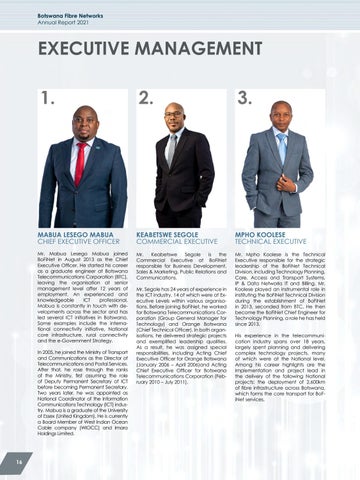
EXECUTIVE MANAGEMENT 1.
3.
MABUA LESEGO MABUA CHIEF EXECUTIVE OFFICER
KEABETSWE SEGOLE COMMERCIAL EXECUTIVE
MPHO KOOLESE TECHNICAL EXECUTIVE
Mr. Mabua Lesego Mabua joined BoFiNet in August 2013 as the Chief Executive Officer. He started his career as a graduate engineer at Botswana Telecommunications Corporation (BTC), leaving the organisation at senior management level after 12 years of employment. An experienced and knowledgeable ICT professional, Mabua is constantly in touch with developments across the sector and has led several ICT initiatives in Botswana. Some examples include the international connectivity initiative, National core infrastructure, rural connectivity and the e-Government Strategy.
Mr. Keabetswe Segole is the Commercial Executive at BoFiNet responsible for Business Development, Sales & Marketing, Public Relations and Communications.
Mr. Mpho Koolese is the Technical Executive responsible for the strategic leadership of the BoFiNet Technical Division, including Technology Planning, Core, Access and Transport Systems, IP & Data Networks IT and Billing. Mr. Koolese played an instrumental role in instituting the BoFiNet Technical Division during the establishment of BoFiNet in 2013, seconded from BTC. He then became the BoFiNet Chief Engineer for Technology Planning, a role he has held since 2013.
In 2005, he joined the Ministry of Transport and Communications as the Director of Telecommunications and Postal Services. After that, he rose through the ranks of the Ministry, first assuming the role of Deputy Permanent Secretary of ICT before becoming Permanent Secretary. Two years later, he was appointed as National Coordinator of the Information Communications Technology (ICT) industry. Mabua is a graduate of the University of Essex (United Kingdom). He is currently a Board Member of West Indian Ocean Cable company (WIOCC) and Imara Holdings Limited.
16
2.
Mr. Segole has 24 years of experience in the ICT industry, 14 of which were at Executive Levels within various organisations. Before joining BoFiNet, he worked for Botswana Telecommunications Corporation (Group General Manager for Technology) and Orange Botswana (Chief Technical Officer). In both organisations, he delivered strategic projects and exemplified leadership qualities. As a result, he was assigned special responsibilities, including Acting Chief Executive Officer for Orange Botswana (January 2006 – April 2006)and Acting Chief Executive Officer for Botswana Telecommunications Corporation (February 2010 – July 2011).
His experience in the telecommunication industry spans over 18 years, largely spent planning and delivering complex technology projects, many of which were at the National level. Among his career highlights are the implementation and project lead in the delivery of the following National projects: the deployment of 2,600km of fibre infrastructure across Botswana, which forms the core transport for BoFiNet services.
THE DIGITAL ERA IS NOW
4.
5
DOUGLAS MOJI PROJECT MANAGEMENT EXECUTIVE
OGONE K. MADISA-KGWARAE CORPORATE SERVICES EXECUTIVE
Mr. Douglas Moji is the Project Management Executive at BoFiNet. In this role, he works with a team of highly skilled and experienced project managers to manage BoFiNet’s strategic and customer-specific projects.
Ms. Ogone K. Madisa-Kgwarae joined BoFiNet in 2018 as the Corporate Services Executive after an extensive career in Banking. She is a Chartered Accountant (an Associate Member of the Chartered Institute of Management Accountants; ACMA) and a Fellow Associate with Botswana Institute of Chartered Accountants (BICA).
Mr. Moji has 27 years of experience in the ICT industry, holding management positions in five multinational companies. He joined BoFiNet in 2016 as a Project Manager for Infrastructure Projects and has since seen the implementation of over 30 large projects. Before that, he worked for the Motor Vehicle Accident (MVA) Fund as the Information Technology Manager and at Air Botswana in the Department of Civil Aviation as a Telecommunications Engineer. He completed his Post Graduate Diploma in Telecommunications Systems Management at Anglia Polytechnic University (United Kingdom) in 1994. He also holds a Bachelor of Science Degree from the University of Botswana and has completed multiple vocational courses, including the Mini MBA in Telecommunications and PRINCE2® Practitioner certificate.
Ms. Madisa-Kgwarae is an astute and result-oriented professional, as evidenced by her success in Strategy development and execution, resulting in sustainable financial performance. She is an agile and adaptable individual who can thrive in any environment and remains focused on providing leadership and guidance to deliver high-quality results. She is a passionate leader, promoting staff development through coaching and mentoring. Her specialities include Credit Risk Management throughout the value chain from origination to recoveries. These functions include credit governance, portfolio management, regulatory, debt restructuring and workout across all business segments. She has extensive Banking experience with specialties in Strategy development, Business Development, Relationship Management, Property Finance, Credit Risk Management across Retail, Commercial and Investment Banking.
17
Botswana Fibre Networks Annual Report 2021
18
THE DIGITAL ERA IS NOW
CORPORATE GOVERNANCE The Board of Directors and its Committees play a paramount role in ensuring the company’s compliance with laws, codes of best practices and regulations. This vital compliance role facilitates successful implementation of the company Strategy and performance review of the organisation and the Chief Executive Officer. The Board is implementing its functions beyond satisfaction; however, it needs to define and document the organisation Governance and Compliance Framework. Additional areas for attention include Board Protection and Evaluation. The Board ensures that adequate systems are in place.
19
Botswana Fibre Networks Annual Report 2021
CORPORATE GOVERNANCE CONTINUED
THE ROLE OF THE BOARD
The Board of Directors and its Committees play a paramount role in ensuring the company’s compliance with laws, codes of best practices and regulations. This vital compliance role facilitates successful implementation of the company Strategy and performance review of the organisation and the Chief Executive Officer. The Board is implementing its functions beyond satisfaction; however, it needs to define and document the organisation Governance and Compliance Framework. Additional areas for attention include Board Protection and Evaluation.
COMPOSITION OF THE BOARD
The Board comprises eight Non-Executive Directors. The selection and appointment of members of the BoFiNet Board is a prerogative of the Minister of Transport and Communications. Integral to good governance is responsible corporate citizenship through adherence to the company Constitution and applicable statutory requirements and international governance practices. To achieve this outcome, the Board ensures that adequate systems, processes, and human resources are in place. It also monitors the financial and operational performance of the company and the impact of its business on society.
BOARD CAPACITATION
BoFiNet is committed to ensuring that the Board Members are capacitated with Corporate governance tools, ensuring that they can deliver on their mandate. Due to circumstances associated with the COVID-19 pandemic. The organisation has since adapted to operating within the constraints imposed by the public health regulations necessary to combat the disease. Hence, Board capacitation will continue in the next reporting period. The company did not provide any training for the period under review.
20
THE DIGITAL ERA IS NOW
BOARD COMMITTEES
TENDER COMMITTEE The principal purpose of this Committee is to ensure that procurement principles, rules and regulations are observed throughout the procurement process. This outcome is achieved by adhering to principles of fairness, transparency and value for money throughout the procurement and disposal process. The Tender Committee concerns itself with the procurement of goods and services valued between P5,000,001 and P30,000,000.
The Committee comprises three Non-Executive members who, for the reporting period, were: Committee Chairperson • Mr. Gadzani Albert Thangwane Committee Members • Ms. Yolisa Philips-Lejowa • Mr. Othusitse Lebuletswe
BOARD FINANCE AND AUDIT COMMITTEE The Finance and Audit Committee serves to ensure, create and maintain an effective control environment for BoFiNet. It also conducts compliance management for the company, supported by the Enterprise and Risk Management department. The Committee reviews financial controls, accounting systems, and reports to external stakeholders. Importantly, it also provides oversight of the organisation’s Audit function, including the appointment and compensation of the External Auditor.
The Finance and Audit Committee consists of the following four Non-Executive members: Committee Chairperson • Ms. Keetsemang Nkoko Committee Members • Mr. Mr. Othusitse Lebuletswe • Mr. Gadzani Albert Thangwane • Mr. John Lovemore Vassiliadis
BOARD HUMAN RESOURCE COMMITTEE The function of this Committee is to assist the Board in fulfilling its corporate governance responsibilities regarding oversight of strategic human resource matters, including remuneration. The Committee regulates substantive and procedural administration of staff welfare issues, including the recruitment process; training and development; succession planning and talent management; industrial relations matters; remuneration; and compensation.
The Human Resource Committee consists of three non-executive members: Committee Chairperson • Ms. Yolisa Philips-Lejowa Committee Members • Mr. Professor Mosepele Mosepele • Mr. John Vassiliadis
21
Botswana Fibre Networks Annual Report 2021
CORPORATE GOVERNANCE CONTINUED
INTERNAL AUDIT SERVICES During the period under review, the Internal Audit Services function executed its mandate as enshrined in the BoFiNet Internal Audit Charter, overseen by the Board Finance & Audit Committee. The use of the BoFiNet Audit Management System (AMS) continues to improve work performance and information management. This system promotes effective businesses practices, which became critical during the COVID-19 pandemic, which dictated remote working and other new work processes. Access to these systems ensured that the Internal Audit division could quickly adapt to these unique circumstances, allowing the section to deliver its obligations during the year. The Management Risk and Audit Committee (MRAC) within the BoFiNet governance structure plays a critical role in monitoring and ensuring management commitments, supporting the closure of audit queries. The Committee also monitors the implementation of risk mitigation strategies across BoFiNet, dovetailing with the Board Finance and Audit Committee.
FRAUD AND CORRUPTION
BoFiNet is committed to fighting fraud, corruption, unethical behaviour and misappropriation of public funds, underpinned by high levels of integrity and a culture of good corporate governance. To support these principles, the company maintains an anonymous Fraud and Ethics tip-off hotline service. Cases reported through the service declined by 50% from 8 to 4 cases reported and investigated during the year under review.
Toll Free Fraud & Ethics Hotline
22
BTC/BeMobile
0800 600 644
Orange
1144
Mascom
71119794
bofinet@tip-offs.com
Website
www.tip-offs.com
Postal Address
PO Box 448, Gaborone, Botswana
THE DIGITAL ERA IS NOW
ENTERPRISE RISK MANAGEMENT BoFiNet operates in a highly volatile telecommunications industry, characterised by rapid changes in technology and market dynamics. These changes create uncertainty and present potential risks that could impede the company from achieving its objectives. However, the company continues to review and execute a comprehensive annual Risk Management Plan (RMP). BoFiNet Risk Management initiatives are guided by the Policy and Framework recommended by the Committee of Sponsoring Organisations of the Treadway Commission (COSO) framework, along with the King III Report on Corporate Governance of 2009 and the Botswana Code of Corporate Governance. BoFiNet manages risk by identifying, analysing and evaluating whether the risk should be tolerated, treated through the implementation of mitigation plans, transferred or terminated. BoFiNet communicates and consults with stakeholders throughout this process, monitors and reviews the controls/mitigation plans that modify the risk. This process ensures that the risk magnitude remains within acceptable levels and does not exceed BoFiNet’s predefined risk appetite and to ensure that it is between tolerance levels. The RMP is a tool that BoFiNet uses to communicate with its stakeholders on risk management processes and activities to be executed throughout the financial year. BoFiNet strives to achieve an appropriate balance between realising potential opportunities and minimising adverse effects in managing risk. The Risk Management Oversight structure of the Board - Finance and Audit Committee (FAC) - bears the overall responsibility for overseeing the company’s risk management processes. The Committee also reviews the effectiveness of the company’s internal controls, including the systems established to identify, assess, manage and monitor risk. The Risk Management Department and Divisional Risk Champions ensure that risk management processes implemented within operational and business units effectively encompass risk identification, assessment, mitigation, reporting and monitoring. BoFiNet’s Risk Management Policy requires that all operating and business units identify and assess the
risks to which they are exposed. Risk registers are used to document the identified risk events, their cause and the appropriate controls. During the year under review, BoFiNet conducted risk Management Awareness Workshops for new employees to create a risk-conscious culture. This team approach to risk management empowers every member of staff to actively identify, assess, mitigate, monitor and report risks.
23
Botswana Fibre Networks Annual Report 2021
CORPORATE GOVERNANCE CONTINUED
BUSINESS CONTINUITY MANAGEMENT Business Continuity Management (BCM) is a holistic management process that identifies potential threats to an organisation and the impacts to business operations those threats, if realised, might cause.
This process provides a framework for building organisational resilience. This framework enables effective responses, safeguarding the interests of key stakeholders, brand and value generation activities, as guided by the ISO 22301 standard.
24
In today’s global environment, the successful establishment of business continuity programmes within organisations depend on its integration with the company’s strategic and day-to-day management activities and alignment with business priorities and organisational culture.
THE DIGITAL ERA IS NOW
Therefore, BoFiNet recognises the need to retain an effective and agile BCM programme, continually embedding business continuity into its culture and day-to-day activities. This approach mitigates potential negative impacts on its operations and reputation in the event of a disruption. During the year under review, BoFiNet completed the design and implementation of its BCM programme. The programme’s outcomes enable it to continue business operations and respond and recover from unforeseen incidents or disasters as effectively as possible, with minimal to no disruption. BoFiNet developed this programme to align with leading global practices and guidelines from the International Standards Organisation’s (ISO) 22301 and the Business Continuity Institute’s Good Practice Guidelines (GPG; 2018). Executive Management established a BCM policy to provide the framework around BoFiNet’s BCM capability. The programme was designed and built. This policy has been embedded in BoFiNet culture and business activities. These commitments have enabled BoFiNet to integrate business continuity management as an essential part of its day-to-day operations. BoFiNet conducted Business Impact Analysis (BIA), and Threat Evaluation (TE) exercises during the year under review. These activities were intended to identify prioritised functions within each department - recovery during a disaster, critical internal and external dependencies, applications, systems and user requirements, human resources and specialised equipment. These solutions have been incorporated into our business continuity plans. Business Continuity Plans for BoFiNet’s Head Office and outstation offices have been developed to guide BoFiNet’s critical management operations, processes and procedures, following unplanned business disruptions.
BOFINETS COVID-19 BUSINESS CONTINUITY MANAGEMENT (BCM) PROGRAMME
The COVID-19 pandemic changed the way the world views and responds to every aspect of life and business. BoFiNet was not spared from the challenges that the pandemic presented. To ensure business continuity, BoFiNet implemented a comprehensive plan of action, including phases to be implemented during extreme social distancing, return to work, and operations moving forward. The areas covered included people (human resources), communication, health and safety.
BOFINET COVID-19 RESPONSE PLAN
The COVID-19 Response Plan was developed by the BCM Team, guided by Botswana Government Gazette, dated 20th March 2020. This publication provided direction on how to prevent the spread of COVID-19. The plan, also led by the pre-existing BoFiNet BCM Programme, was executed in March 2020, at the onset of the COVID-19 pandemic in Botswana. The BCM Programme also developed a communications plan to deliver critical messages to internal and external stakeholders. All developments that transpired were promptly communicated with staff, with updates sent to customers and stakeholders providing assurances and operational continuity plans during the pandemic. Customer and stakeholder engagement strategies were conducted using digital platforms, supported by virtual collaboration tools allowing staff and stakeholders to remain in constant business operation. BoFiNet implemented the communication plan throughout the lockdown period, conveying weekly messages from various internal departments. As per the BCM Programme, critical staff and contractors were identified as essential workers required to ensure continuity of BoFiNets services, operations and network operations maintenance. In response to the pandemic and guided by our BCM Programme, an operations plan was implemented, highlighting those staff members that would work remotely and those required in the office. On March 25th 2020, 162 staff members (74% of total staff count) began working remotely from their homes, while 57 (26%) worked from the office. BoFiNet partnered with CISCO to offer video and audio conferencing platforms to all staff for 90 days to facilitate seamless remote working. As a result, all staff members excluding fourteen (14) from Network Operations Centre (NOC) worked remotely during the national lockdown. To support effective operations, the BCM Programme shared remote working guidelines with all staff members. As the lockdowns were effected and lifted, BoFiNet implemented all Ministry of Health and Wellness public health requirements, measures and protocols in all offices to minimise infections where possible. Overall, BoFiNet’s response to COVID-19 ensured continuity of business operations and effective remote working during the financial year.
25
Botswana Fibre Networks Annual Report 2021
CORPORATE GOVERNANCE CONTINUED
SAFETY HEALTH AND ENVIRONMENT BoFiNet provides a safe and low-risk environment to its employees and visitors by retaining and enforcing high public health standards and providing training and education to all staff members. During the year under review, the COVID-19 pandemic took centre stage requiring the company to implement a response that ensured the health and safety of its staff and minimised exposure to the virus. Response measures included the provision of COVID-19 specific Personal Protective Equipment (PPE), screening facilities, awareness training and messages, and physical demarcation of office spaces amongst others. With a minimum of 75% of staff members working from home, efforts have also been made to provide staff with an option to loan office furniture to enhance ergonomic home workstations. The company appointed Safety, Health and Environmental (SHE) Champions to ensure the smooth implementation of Health and Safety measures across the company, including all outstation offices, warehouses and headquarters. Moving forward, the company will also train these Champions in First Aid and Fire Marshalling. A management-level SHE Committee was also established to assist the Board and Executive Management when considering SHE impacts and mitigation measures. As most staff members worked from home for a large part of the financial year, fewer incidents were recorded during the period under review than in previous years. Five road traffic accidents were recorded, with no injuries. Two minor injuries were also recorded resulting from past incidents. E-Waste continues to be collected from sites through thirdparty contractors. During the year under review, BoFiNet implemented key Emergency Management measures through the installation and commissioning of fire suppression systems Implemented at six critical sites across the country, these facilities are the first phase of a project to safeguard 15 sites in total.
26
WE HAD
74%
OF STAFF WORKING FROM HOME
THE DIGITAL ERA IS NOW
STRATEGIC PLANNING BOFINET’S APPROACH TO STRATEGY MANAGEMENT
BoFiNet has been developing and implementing medium-long term strategic plans aimed at driving and achieving its core mandate and the goals of the National Broadband Strategy and the Maitlamo Policy.
These strategic plans are anchored on the National Development Plans and the Ministry of Transport and Communications’ strategic plans. Over the years, the company has been developing 3-year strategic plans, outlining its Vision and Mission statements, Strategic Themes, Values, Strategy Map and Scorecards, using the Balanced Scorecard (BSC) Strategy Management Framework. It was only with the current Strategy, UNLEASH 2025, that the company broke the tradition and embarked on a 5-year Strategy. The scorecard acts as a planning and execution management tool, covering the Strategy plan period, with yearly targets for all the financial years and the strategic initiatives to be implemented. The company follows the 1st April – 31st March financial year cycles and consistently carries out mid-year performance reviews to inform alignment of subsequent-year targets. The Strategy formulation process involves rigorous engagement of the various organs of the company, covering Executive Management, Middle Management and Specialist cadres; the Board of Directors; and
selected external stakeholders, including the Ministry of Transport and Communications. BoFiNet has a Strategy Office, which manages the value chain of Strategy formulation and implementation development, cascading, monitoring and performance reviews and reporting. The company consistently carries out biannual Strategy reviews. This approach includes reviews of corporate performance and affirmation of objectives and indicators as part of the planning process for the next period. The high-level deliverables include market assessments, affirmed targets informed by financial year performance and finally, an updated corporate scorecard. The updated scorecard is further cascaded into divisional scorecards, which remain the basis for the business functions and individual performance contracts. Strategy management is critical for guiding the company in the execution of its mandate. BoFiNet and its entire Management Team have adopted a quarterly corporate performance review culture. This process supports the continuous assessment of the business environment and helps to identify emerging opportunities. 27
Botswana Fibre Networks Annual Report 2021
CORPORATE GOVERNANCE CONTINUED
BoFiNet STRATEGIC FOUNDATIONS VISION STATEMENT:
To be Africa’s Leader in Digital Transformation The BoFiNet Vision is inspirational and clearly defined. This Vision articulates the ultimate long term goal of BoFiNet represented by the significant contribution of the company to the digital transformation of Botswana (first) and Africa. Digital transformation requires the company to make change a core competency as the enterprise becomes customer-driven end-to-end. The primary focus of digital transformation is the customer.
MISSION STATEMENT:
We Enable Social and Economic Transformation through Innovative ICT Solutions The BoFiNet mission is to enable, in concert with other market players, the social and economic transformation of Botswana through innovative ICT solutions that are permissible within the set mandate and regulatory framework. Success within the Botswana market should present opportunities for future scaling and growth of the company within the African continent, based on a compelling business case and support of the shareholder.
STRATEGIC INTENT STATEMENT:
To be a P1 billion revenue entity while enabling 100% geographic broadband penetration, accelerating digital transformation and offering innovative new services by 2025.
28
THE DIGITAL ERA IS NOW
29
Botswana Fibre Networks Annual Report 2021
BoFiNet OPERATIONS
The year under review was an opportunity for BoFiNet to continue expanding its footprint in the country in terms of infrastructure development and has achieved significant progress in the following categories:
1. 2. 3. 4 5
30
NATIONAL BACKBONE INFRASTRUCTURE LAST MILE LOCAL ACCESS REGIONAL CONNECTIVITY INTERNATIONAL CONNECTIVITY INTERNET CONNECTIVITY AND WI-FI HOTSPOTS
THE DIGITAL ERA IS NOW
1.
2.
3. 4. 5. 31
Botswana Fibre Networks Annual Report 2021
1. NATIONAL BACKBONE INFRASTRUCTURE OPERATIONS
Over the years, BoFiNet has expanded its network infrastructure to reach underserved parts of the country. BoFiNet has recently installed fibre infrastructure from Kang to Hukuntsi, Tshane, Lehututu and Lokgwabe in the Kgalagadi North region. Microwave backhaul radio network infrastructure was also installed, covering Khudumelapye, Sorilatholo, Salabjwe and Kaudwane areas in the Kweneng District. This microwave radio technology also extended to Zhutshwa, Maake Monong, Ngwatle, Ncaang, Ukhwi, Kole, Ncojane and Makunda villages. As at the end of the 2020-2021 financial year, 206 out of the total 399 gazette localities had been connected to the National open-access backbone broadband infrastructure. The target is to roll out the open-access broadband infrastructure to cover the remaining 193 gazetted localities/villages by 2025. These continuous expansions will provision broadband backhaul capacity for 3G, 4G and 5G networks by mobile operators and support the school connectivity initiative driven through the Universal Access Service Fund (UASF) and other Government online connectivity initiatives for a future connectedBotswana. Table1: Number of Localities connected
Number of Villages & Towns Connected (Cum)
Number of Villages & Towns Connected (Cum)
32
450 400
399
350 300 250 200 162 132
206 171 132
206 192
206
100 132
175 161 132
132
134
19 8
19 10
19 11
28 11
28 11
52 20
200 150 100 50
130 105 98 3
0
2015/16 Target
2016/17
2017/18
Radio Localities P2P
2018/19 Fibre Localities
2019/20
2020/21
Repeater Sites
2021/22 Total Broadband Localities
THE DIGITAL ERA IS NOW
1. NATIONAL BACKBONE INFRASTRUCTURE OPERATIONS
J "
Kasane
Parakarungu(Mbalakalungu) ! H Kachikau
! H
Muhembo Shakawe ! H
! H
Gudingwa Gudigwa
! H
Gumare
! H
Maun
J "
Maitengwe
Nata
! H
! H Sehithwa
! H
! H
Tutume
Sowa
! H
Francistown
Orapa
J "
Letlhakane J" " J
! H
Tonota
! H
Ghanzi Malatswae
Serule
! H
! H
Tshimoyapula
! H Paje ! HSerowe
Charles Hill
! H
J "
Mmadinare
Bobonong
! H
JSelebi-Phikwe " J " ! H
Sefhophe
! H
Palapye
Tsetsebjwe
J "
Sherwood
Kalamare
! H Shoshong ! Mahalapye H ! H
Ncojane
! H
Tsetseng
Hukuntsi
! H
! HSalajwe ! H Takatokwane
Morwamosu
! H
! H
Sekoma
! H
J "
Letlhakeng
! H
Jwaneng
! H
Molepolole
Mochudi
! H
Sikwane Thamaga ! H! ! H ! HTlokweng H Moshupa Ramotswa ! H Kanye
! H
! H ! H
Werda
J " ! H
Mabule
Tshabong
J "
! H
TOWNS / MAJOR VILLAGES
J "
FTTX_COVERED
J "
FTTX_UNDERCONSTRUCTION
! H
Ramatlabama ! Phitshane H Molopo
BOFINET_CABLES STAGE IN PROGRESS PROPOSED
Struizendam
! H
BOTSWANA BOUNDARY
Bokspits
! H
10,600km
LEGEND
COMPLETE
McCarthy's Rust
! H
NATIONAL FIBRE COVERAGE
Lobatse
Bray
! H
Olifants Drift
J "
Maokane
! H
! H
Kaudwane
! H Kang ! H ! H
! H
Machaneng
•
BoFiNet has National fibre coverage in excess of 10,600 Km countrywide connecting cities, major towns and villages.
•
206/399 localities are connected to high-speed open-access network infrastructure.
•
193 villages still require BoFiNet open-access broadband network.
•
Additional 1,915 Km fibre is required to connect 85 more villages.
•
A further 70 villages outside fibre coverage will be connected with high-capacity broadband wireless solutions.
•
A further 38 villages require active equipment for them to be connected to the network.
33
Botswana Fibre Networks Annual Report 2021
2. LOCAL NETWORK DEVELOPMENT OPERATIONS
LOCAL NETWORK DEVELOPMENT - FTTB
institutions and Government premises are connected to the high-broadband network. As at the end of the year under review, a total of 4,249 commercial and Government institutions were connected.
Local access network infrastructure deployment remains a vital enabler of the ICT environment and economic growth in Botswana. Over recent years, BoFiNet has expanded local access network deployment through Fibre To The Premises Fibreto-the-X (FTTx) solutions with high-broadband infrastructure installed in Gaborone, Francistown, Maun, Kasane/ Kazungula, Phikwe, Serowe, Palapye, Mogoditshane, Tsabong, Bobonong, Lobatse and Kang. This progress shows that tremendous progress is being made through the growing business broadband connections and the provision of services. BoFiNet has also deployed fixed broadband wireless radio connectivity in 60 localities to complement the FTTx in 13 localities.
LOCAL NETWORK DEVELOPMENT - FTTH
In addition to standard Fibre To The Business (FTTB) which targeted businesses, educational institutions and Government buildings, BoFiNet has embarked on an extensive rollout of Fibre To The Home (FTTH) access network infrastructure. This initiative aims to provide high broadband infrastructure to residential/ home premises. To date, a total of 1,342 homes have been connected under Phase 1 of the project. Phase 2 has commenced and is targeting to connect over 16,000 residential premises in Gaborone by March 2022, thus covering almost half of the residential plots in the City.
Expansion of the Gaborone FTTx deployment has been completed. This project targeted an additional 2,202 sites, ensuring that businesses, educational Cumulative Broadband Access Infrastructure Growth
Cummulative Broadband Access Infrastructure Growth
8,000
Broadband connections
7,000
6,956
6,000 5,270
5,000 4,000
3,673
3,000
3,023
1,000 -
2,472
2,000
2,000 35
566 1,004 799 438
1,554
755
35
2014/15
ª·2015/16
2016/17
1,023
1,201 -
-
2017/18
2018/19
FTTh
Radio CPE
4,125
4,249
2,960 1,332
1,594
976
1,237
2019/20
2020/21
Yearly Broadband Access Connections FTTb
34
7,354
Total (FTTx & Radio)
1,547 1,558
2021/22
Johannesburg Internet Exchange (JINX), NAP Africa (Joburg) and Botswana Internet Exchange (BINX)
THE DIGITAL ERA IS NOW
2. LOCAL NETWORK DEVELOPMENT OPERATIONS
INTERNET CONNECTIVITY
4,249 commercial and Government institutions have been connected
I
To ensure great user experience and quality of service, BoFiNet owns and operates international Points of Presence (PoPs) in the following locations • South Africa: 2 PoPs • UK: 2 PoPs
I
BoFiNet also connects to the following major Internet Exchange Points • London Internet Exchange (LINX) • Johannesburg Internet Exchange (JINX) • NAP Africa (Johannesburg) • NAP Africa (Cape Town)
This ensures user experience is enhanced as well as providing content from these exchanges. 35
Botswana Fibre Networks Annual Report 2021
2. LOCAL NETWORK DEVELOPMENT OPERATIONS
BOTSWANA HOTSPOTS LOCATION MAP
Kasane CHOBE NGAMILAND Maun NORTH EAST CENTRAL Ghanzi Serowe
GHANZI
Francistown Selibe Phikwe Palapye
Mahalapye
KGALAGADI
KWENENG Molepolole Thamaga SOUTHERN Jwaneng Kanye
KGATLENG Gaborone Lobatse
Tsabong
Enjoy moments from a hotspot that is close to you
16
CITIES AND VILLAGES ARE Wi-Fi CONNECTED
1,342 homes have been connected under Phase 1 of the project
36
GABORONE Railpark Mall Main Mall Game City BBS Mall Airport Junction Riverwalk Mall Bus Rank Princess Marina Molapo Crossing Sir Seretse Khama Airport Westgate Mall Government Enclave MAHALAPYE Watershed Mall Mahalapye Hospital MAUN Letsholathebe Hospital Maun Airport New Mall Spar
FRANCISTOWN Nzano Mall Nswazi Mall Galo Mall Nyangabgwe Hospital Bus Rank Covering Francistown Airport KASANE Kasane Bus Rank Kasane Hospital Kazungula Border Post PALAPYE Engen Mall Palapye Hospital SEROWE Boiteko Junction Mall Sekgoma Memorial Hospital Serowe Bus Rank
THAMAGA Thamaga Hospital
SELIBE PHIKWE Selibe Phikwe Main Mall
TSABONG Tsabong Mall Tsabong Primary Hospital
GHANZI Ghanzi Hospital Ghanzi Centre Mall Ghanzi Tau Mall
MOLEPOLOLE Mafenyatlala Mall Scottish Livingstone Hospital MOSHUPA Moshupa Mall Moshupa Clinc LOBATSE Lobatse Athlone Hospital Lobatse Hill Side Mall JWANENG Choppies Mall KANYE Mongola Mal MOCHUDI Mochudi Mall
85
PUBLIC HOTSPOTS NATIONALLY
Internet for everyone
THE DIGITAL ERA IS NOW
3. REGIONAL CONNECTIVITY OPERATIONS
REGIONAL CONNECTIVITY I
Connectivity to all neighbouring countries is realised through fibre connectivity: • South Africa: three border crossings • Namibia: two border crossings • Zambia: two border crossings • Zimbabwe: one border crossing
I
There are seven multiple-entry connectivity to the neighbouring countries to provide redundancies and high availability of services.
I
This provides an advantage of hosting a Regional Internet Exchange Point (RXP) in Botswana.
SOUTHERN AFRICA CONNECTIVITY Tanzania Iringa
Dar es Salaam Mbeya Mbala
Kasama Songea
Mpika Luanda
Angola
Malawi
Serenje Dondo Benguela
Zambia
Mongu
Kabwe
Nampula Blantyre
Lusaka Lubango
Mozambique
Choma Mocamedes Katima
Kazungula
Ngoma Kasane
Ondangwa
Harare
Vic Falls
Zimbabwe Tsumeb
Maun
Beira
Bulawayo Ramokgwebana
Namibia Ghanzi Windhoek Mamuno
Francistown
Orapa
Botswana
Palapye
Swakopmund Gaborone Jwaneng
Tlokweng Maputo
Ramatlabama
Johannesburg
Karasburg Mtunzini Durban
South Africa
East Africa Submarine System (EASSy) West Africa Cable System (WACS) Existing Submarine Cable Existing Optical Networks Planned Optical Networks
Melkobosstrand
37
Botswana Fibre Networks Annual Report 2021
4. INTERNATIONAL CONNECTIVITY OPERATIONS
INTERNATIONAL CONNECTIVITY
BoFiNet is a consortium member of both East Africa Submarine System (EASSy) and West Africa Cable System (WACS) and has capacity entitlements of 206Gbps on EASSy and 191Gbps on WACS. This capacity presents competitive opportunities in connecting Botswana to the rest of the world. The company could leverage this position to ensure that the country realises its aspirations of becoming a knowledge-based economy. However, BoFiNet must traverse South African and Namibian territory to connect to this undersea cable system to reach the Landing Stations at the shoreline. To ensure competitive pricing and quality of service, collaborative partnerships to deploy fibre infrastructure within these two countries are being explored. The Namibia link is already complete and carrying traffic, while the South Africa link is still developing.
To connect to the rest of the world, BoFiNet is a consortium member of both WACS and EASSy
WACS
The East Africa Cable system (EASSy) connects African countries on the East coast of Africa. BoFiNet owns a 4 % shareholding in the consortium.
• BoFiNet is a consortium member of the West Africa Cable System (WACS) with a 4.5 % shareholding. London
• WACS connects Africa to Europe from South Africa to UK.
Highbridge
• The cable starts in South Africa and ends in Sudan. • BoFiNet, through its partners, has extended the service to UK.
Monaco Marseille
Gibraltar
• BoFiNet connects to this submarine cable in South Africa and Namibia.
Sesimbra Alexandria Tripoli
Canary Islands
Abu Talat
Suez
Zaafarana
Fujairah Muscat Jeddah
Mumbai
Port Sudan Cape Verde
• To connect to Landing Station in South Africa through this cable, there are two exit points, being the Tlokweng and Ramatlabama border posts.
Djibouti
Accra
Lagos Limbe Mogadishu
Mombasa Pointe-Noire Muanda
• BoFiNet connects to the submarine cable in South Africa.
• To connect to Landing Station in South Africa through this cable, there are two exit points, being; Tlokweng and Ramatlabama border posts.
Lomé Abidjan
• The Namibia connection is through Charleshill and Ngoma.
Dar es Salaam
Luanda Moroni
Swakopmund
Botswana
Toliary Jo’burg
Maputo Mtunzini Durban
Yzerfontein/Melkbosstrand
38
EASSy
Cape Town
Legend Europe India Gateway (EIG) EASSy WACS
THE DIGITAL ERA IS NOW
4. INTERNATIONAL CONNECTIVITY OPERATIONS
INTERNET TRAFFIC AND CONTENT GROWTH
BoFiNet Internet uptake has been growing steadily since 2014. As at end of 2020-2021 the average traffic growth was at 46,4 Gbps. The company also provides an internet content cache facility, which allows some content to be stored locally to reduce usage on the international backhaul links.
AVERAGE TRAFFIC GROWTH
46,4Gbps
IPT (Gbps) Total
60.00
50.00
42.00 40.23
40.00 34.41 32.97 31.47 31.59 30.40 30.5930.93 29.92 29.39 29.02 28.85 28.85 27.74 26.60 26.44 25.81 25.93 25.86 24.58 22.37 21.14 20.23 20.32 18.53 16.95
30.00
20.00
42.02 39.71 37.83 37.54 36.52
33.67
11.79
10.00
7.71 2.19
00.00
20 14 20 15 20 16 20 1 20 7 1 Fe 8 b M -18 ay Ju -18 n Ju -18 l-1 Se 8 p O -18 ct N -18 ov D 18 ec Ja 18 n Fe -19 bM 19 ar A -19 pr M -19 ay Ju -19 n Ju -19 l-1 A 9 ug Se -19 p O t-19 ct N -19 ov D -19 e Ja c-1 n 9 Fe -20 bM 20 ar A -20 pr M -20 ay Ju -20 n Ju -20 l-2 A 0 ug Se -20 p O t-2 ct 0 N -20 ov D -20 ec Ja -20 n Fe -21 b M -21 ar A -21 pr M -21 ay Ju -21 n Ju -21 l-2 1
Utilisation (Gbps)
49.18 49.12 46.49 45.40 45.50 45.70 44.70
48.97
Year
39
Botswana Fibre Networks Annual Report 2021
OPERATIONS (continued)
PRODUCTS AND SERVICES NATIONAL LEASELINE (NLL)
NLL is a dedicated point-to-point connection that provides a secure tunnel between two locations within Botswana. This technology allows providers to pass the content of their choice - Internet, data, voice and videos - by accessing the BoFiNet National fibre network. NLL can be used for backhauling traffic or access networks (FTTx and wireless radio)
FIBRE-TO-THE-X (FTTX)
Fibre-to-the-X is a fibre-based access network, enabling a service provider to deliver service to the last mile. This service is achieved by connecting businesses and homes to a central point known as an access node or Point of Presence (PoP). The ‘X’ is a collective term for various optical fibre delivery topologies categorised according to where the fibre terminates (e.g. FTTB; Fibre-to-the-Business, FTTH; Fibreto-the-Home). FTTx is available in capacities ranging from 5 to 100 Mbps.
INTERNET PROTOCOL TRANSIT (IPT)
IPT allows network traffic from a Service Provider to interconnect with the internet core through BoFiNet’s IP backbone for a premium, uncontended blend of regional and international content. This service is fully protected with redundant links Nationally and internationally.
FIBRE LITE
Fibre Lite is a bundled offering, including NLL and IPT, providing shared internet over FTTx with end-toend network configuration for controlled contention directly to the end-user targeting homes and businesses. The product is available in capacities ranging from 5 Mbps-100 Mbps.
INTERNATIONAL PRIVATE LEASE CIRCUIT (IPLC)
IPLC is a transit route through Botswana offering a secure and dedicated international point to point leased line. It connects customers to the rest of the world by seamlessly providing quality and reliable digital transmission, integrating data, voice and
40 40
imaging services. IPLC is suitable for organisations that want to communicate between their geographicallydispersed offices throughout the world with three (3) different options: Transit
From border to border within Botswana
Full Circuit
Through Botswana directly to a location outside Botswana, using another carrier
Half Circuit From a location in Botswana to the border
METRO (CARRIER ETHERNET)
Carrier Ethernet is a dedicated interconnection of two or more points (multipoint to multipoint). This system performs complex routings on the network on behalf of the customer, allowing sharing information, applications, databases, and Local Area Networks (LANs) at several locations with private IP networks. Metro offers a considerable reduction of operating costs due to the possibility of integrating services and other applications in the same network.
THE DIGITAL ERA IS NOW
WET SEGMENTS
Wet Segments are secure and dedicated international routes allowing connectivity on the so-called wet elements (undersea) using the WACS and EASSy submarine cables to connect countries to the rest of the world.
UPICTV
Botswana’s own Internet Protocol Television (IPTV) online platform sets the country on a digital transformation journey to support local creatives. The platform is available on the Google Play Store and the Apple App Store. The subscription-based streaming service hosts various local and international titles(dramas, movies, comedies, continuity programmes), including local television and radio stations. The platform can be accessed on www.upictv. co.bw
COLOCATION
Colocation is service that allows a service provider to rent space on BoFiNet premises and/or infrastructure. There are four different types on offer: BoFi Colo
Renting a 3 X 3 metre space on a BoFiNet site
BoFi Tower
renting space on a BoFiNet base station tower
BoFi Host
renting rack space within the main shelter, equipped with power supply, backup systems and cooling
BoFi Combo bundled offer, renting space both on the site and base station tower (BoFi Colo + BoFi Tower)
Wi-Fi VOUCHERS
Wi-Fi vouchers provide prepaid Wi-Fi internet service deployed in public areas across the country, offering high-speed internet at affordable prices and accessible to the end-users via vouchers. The vouchers are usage-based, which means that once the data has been depleted, the connection will be terminated, and a new voucher will be required.
INFRASTRUCTURE LEASE - SSID
This service allows ISP’s that have their own billing system to lease BoFiNet’s Wi-Fi infrastructure and offer customised products on the platform. This system can also offload mobile data traffic onto Wi-Fi infrastructure to maintain service quality in congested areas.
EVENTS Wi-Fi
Event Wi-Fi is a wireless internet service deployed at individual events by BoFiNet and resold by a service provider to event organisers or venue owners to allow attendees to utilise the internet for free.
PREMISES Wi-Fi
Premises Wi-Fi is a wireless internet service deployed in buildings or multi-tenant locations, such as an office block, multi-residential block of flats or a business location. It is sold to landlords or premises owners to allow the residents to utilise the Internet within the premises. 41
Botswana Fibre Networks Annual Report 2021
MARKET PERFORMANCE The mobile money sector witnessed the introduction of Botswana Post as a service provider in 2019. By year-end 2020, the mobile phone-based financial service had over 7,800 subscribers (1 % of the market share). Orange Botswana continues to lead the market in mobile money solutions. However, its market share decreased from 65% in 2019 to 52% in March 2020.
Number of Subscriptions
Mobile Money Subscriptions as at March 2020 1 500k
1 000k
500k
0k
Mar-15 Total
Mar-16
Mar-17
Mascom
Mar-18
Orange
Mar-19 BTC
Mar-20 Botswana Post
Entity
Mar-19
Market Share
Mar-20
Market Share
Mascom
397,459
35%
554,465
44%
Orange
751,974
65%
657,573
52%
240
0%
39,256
3%
BTC Poso Money Total
-
0%
7,888
1%
1,149,673
100%
1,259,182
100%
Source : https://www.bocra.org.bw/Telecoms.-statistics Mobile broadband subscriptions represent mobile subscriptions that allow access to the internet. Mascom continues to have the most significant market share, followed by Orange and BTCL, respectively. The number of users for the 3 PTOs, continue to increase. Amidst this increase, it has been reported that BOCRA will float a tender for the provision of mobile broadband wireless access services.
42
THE DIGITAL ERA IS NOW
According to BOCRA, the current networks, particularly mobile, continue to experience congestion as demand increases and BOCRA desires to license additional IMT and Fixed Service spectrum to alleviate this congestion and increase good customer service and experience. It is yet to be seen how the introduction of a fourth mobile network provider will impact the industry and performance of the existing entities. Mobile Broadband Subscriptions as at March 2020
Number of Subscriptions
1 250k 1 000k 750k 500k 250k 0k
Mar-15
Mar-16 Mascom
Mar-15
Mar-17 Orange
Mar-18
Mar-19
Mar-20
BTC
Mar-16
Mar-17
Mar-18
Mar-19
Mar-20
Mascom
654,314
764,653
859,516
857,632
895,976
959,955
Orange
444,999
450,204
415,312
539,253
701,096
864,564
89,327
145,379
129,237
126,660
155,475
212,840
BTCL
Source : https://www.bocra.org.bw/Telecoms.-statistics Botswana’s mobile market penetration is high in comparison to regional countries. According to www.datareportal.com, the number of mobile connections in January 2020 was equivalent to 150% of the total population.
Despite the negative effects of the COVID-19 pandemic on the economy in general, the local ICT sector thrived largely due to the increased internet usage. The recent changes by the regulator (BOCRA) to license service providers as Value Added Resellers (VAR) will allow the service providers to increase their purview to include value-added services. This will spur the digitilisation of service provision across the economy. The local ICT market will also be boosted by Government initiatives for village and schools connectivity, which include projects aimed at local ICT contractors and suppliers. As the world becomes increasingly digital, client privacy must be protected, hence the need for cyber security investments. The virtual cyber security symposium held during the year demonstrated commitment and launched Botswana on a path to build a local cyber security culture that promotes secure ICT usage. The Botswana International University of Science and Technology (BIUST) Virtual Cybersecurity Symposium held in early 2021 aimed to bring the Government, academia, parastatals, and the private sector together to engage on cybersecurity issues at a National level. Technological adoption and digitilisation accelerated during the year 2020, owing to the pandemic, to proportions that could informally be referred to as the great technological leap for Botswana. While Internet prices are falling, the most probable source of sustainable revenue for the ICT sector will be realised by those entities that have embraced digital transformation and are ready to meet the demands of technologyenabled consumer services. 43
Botswana Fibre Networks Annual Report 2021
MARKETING AND OUTREACH BoFiNet undertook the following outreach and marketing initiatives during the year to promote awareness and uptake of services by the public and the business community GABORONE CITY COUNCIL FREE Wi-Fi LAUNCH
BoFiNet entered into a strategic partnership with Gaborone City Council to provide free Wi-Fi at ten locations in Gaborone. This partnership was launched by Gaborone City Council on the 9th October 2020 at the Gaborone Main Mall and officiated by His Excellency The President, Dr. Mokgweetsi Eric Masisi. The ten Wi-Fi hotspot areas comprised malls and other public locations. • • • • • • • • • •
Main Mall Government Enclave Railpark Mall Bus Rank Molapo Crossing BBS Mall Airport Junction Mall Sir Seretse Khama Airport Riverwalk Mall Westgate Mall
His Excellency The President of Botswana, Dr. Mokgweetsi Masisi after pressing the launch pad button that symbolised the official opening of the Gabz City Free Wi-Fi
UPICtv LAUNCH
His Excellency The President of Botswana, Dr. Mokgweetsi Masisi and First Lady, Neo Masisi, receiving a token of appreciation from Minister of Transport & Communications Honourable Thulagano Segokgo and BoFiNet Board Chairperson, Ms. Pelani SiwawaNdai after officially unveiling the UPICtv logo and brand
44
In October 2020, BoFiNet launched Botswana’s first IPTV platform called UPICtv. His Excellency The President, Dr. Mokgweetsi Eric Keabetswe Masisi, presided over the launch event on 24th October 2020 at the Gaborone, GICC. This project aims to increase utilisation of BoFiNet network infrastructure, increase uptake of BoFiNet’s existing services, i.e. FTTx, Wi-Fi and IPT, and grow production and consumption of local content. This growth will lead to creative and employment opportunities across different industries for the youth in Botswana.
THE DIGITAL ERA IS NOW
FIBRE TO THE HOME (FTTh) - PHASE 1
Following the launch of the FTTh technology by BoFiNet in October 2019, the year under review focused on activation campaigns to sensitize the public on the availability of the new technology at Extensions 3,5,9,11 and 39, its benefits and contributions towards an enhanced internet experience. A total of 1,342 homes have been connected under Phase 1 of the project. As a continuation, twenty (20) more locations within Gaborone were selected for FTTH Phase 2, which commenced in June 2020
SUBMARINE NETWORK WORLD 2020
In this reporting year, BoFiNet was given an opportunity to participate virtually in order to create the sales leads through networking platforms availed at the Submarine Network World 2020 in Singapore. This opportunity allowed BoFiNet to tap into international markets and showcase potential business partnerships, discover innovation, and develop relationships with the additional network with partners in the international community.
DIGITAL DELTA DATA CENTRE GROUNDBREAKING CEREMONY
On the 14th of March 2021, BoFiNet held a ground breaking and brand launch for the Digital Delta Data Centre located at Botswana Innovation Hub Science & Technology Park in Block 8, Gaborone. This event was officiated by the Minister of Transport and Communications, Honourable Thulagano Segokgo. The Data Centre is positioned to enhance Botswana’s ICT ecosystem and bring the internet closer to Botswana. The state of the art facility will host approximately 400 racks for different entities who have interest in securing their data in the 1000 square metres of white space. BoFiNet Marketing and Sales teams are actively engaging customers to promote uptake on the services provided by the upcoming Digital Delta.#morethanjustdata
Minister of Transport & Communications Honourable Thulagano Segokgo and BoFiNet Board Chairperson, Ms Pelani Siwawa-Ndai leading guests in officially breaking ground of the Digital Delta Data Centre
45
Botswana Fibre Networks Annual Report 2021
STRATEGIC PARTNERSHIPS
The recent accelerated adoption of digital technologies requires collaboration among industry players and the formulation of win-win arrangements that benefit the needs of society, users and ultimately the industry. BoFiNet has identified the need to establish partnerships as a strategic initiative to fulfil its mandate and responsibilities towards its stakeholders. INTERNATIONAL AND REGIONAL PARTNERSHIPS
BoFiNet, through its membership in regional and international telecommunications bodies, continuously explores opportunities for partnerships that could advance its mandate and its business interests. The regional bodies provide platforms that bring together the industry players to engage and explore opportunities for partnerships. During the year under review, the company participated in a number of platforms that brought together industry players.
1. SOUTHERN AFRICA TELECOMMUNICATIONS ASSOCIATION (SATA)
As a wholesale telecommunications infrastructure provider, BoFiNet remains an active member of Southern Africa Telecommunications Association (SATA), a leading ICT industry association, including telecommunications network operators, service providers, and suppliers. During the year under review, the company participated in the 39th SATA Annual Conference, hosted by Mauritius Telecom under the theme ICT Connectivity and Service Delivery for the Benefit of All: Transforming our Society through Broadband and ICT Development. The SATA annual conference brought together influential industry players: CEOs, Directors, Managers and Experts in the ICT industry from various organisations within and outside the Southern African Development Community (SADC) region. More than 60 delegates from eleven countries attended this high-profile event.
46
THE DIGITAL ERA IS NOW
2. THE INTERNATIONAL TELECOMMUNICATION UNION (ITU)
BoFiNet is also a member of the International Telecommunication Union (ITU), a specialised United Nations agency for ICTs, driving innovation among 193 Member States and over 900 companies, universities, and international regional organisations. This membership provides opportunities for strategic partnerships for cutting-edge innovation and technology, business and future collaborative prospects.
BoFiNet IS AMONGST
900
ITU'S MEMBER ORGANISATIONS
47
Botswana Fibre Networks Annual Report 2021
INFRASTRUCTURE PROJECTS Despite the challenges presented by the COVID – 19 pandemic globally, BoFiNet continued to provide and operate world-class telecommunications backbone network infrastructure to drive connectivity and facilitate the economy, in line with its mandate. This undeterred focus on the mandate by the company resulted in the growth and increase in connectivity, as illustrated by the infrastructure deployment projects undertaken countrywide during the pandemic.
GOVERNMENT-FUNDED PROJECTS NATIONAL BACKBONE PROJECTS
The company endeavoured to ensure that the areas that were lagging behind in connectivity were connected. In this respect, the villages along the Kang - Hukuntsi, Kweneng West and Kgalagadi North routes were connected to the National backbone fibre network, covering a distance of 145km. The Kweneng West and Kgalagadi North villages are being connected, with completion targeted for 2021/22 financial year. In addition to the above projects, a satellite Police Office located at Hukuntsi Kgotla was established through the social investment initiative of the contractors and BoFiNet. This entailed procurement, installation and furnishing of a portacabin, fibre reticulation, provision of connectivity infrastructure (comprising of cables, access points, switches, routers and other components) and furnishing of the office with desktop computers to enable complete functionality.
PUBLIC INTERNET NETWORKS (DIKGOTLA Wi-Fi)
The Department of Tribal Administration has mandated BoFiNet to deploy and install public Wi-Fi infrastructure in the Dikgotla across the country. The project is being rolled out in phases. During the year under review, Wi-Fi infrastructure was installed in fifty (50) selected villages of the Kgatleng, Southern and South-Eastern districts. As with other projects and initiatives, the project was affected by the COVID -19 travel restrictions locally and abroad thus affecting the delivery of essential material and implementation. More rollout of the Wi-Fi infrastructure will be done in the other areas across the country in the subsequent financial years. Rationalisation and transfer of Government ICT infrastructure and assets from Water Utilities Corporation (WUC), Department of Broadcasting Services (DBS) and Botswana Power Corporation (BPC) to BoFiNet: In line with recommendations of the National Broadband Strategy, Cabinet authorised the transfer of Government ICT infrastructure assets from Water Utilities Corporation (WUC), Department of Broadcasting Services (DBS) and Botswana Power Corporation (BPC) to BoFiNet. Specifically, the recommendations were as follows: DBS Digital Terrestrial Network and Studios i. Government should authorise the use of DBS excess capacity on the television and radio terrestrial network and studios to other broadcasters and content producers to make use of this valuable National asset, for the benefit of broadcasters, content producers, consumers, the Government and the economy in general.
48
THE DIGITAL ERA IS NOW
ii. The DBS excess capacity on the television and radio terrestrial network and studios should be leased to broadcasters on non-discriminatory terms and conditions, fair and open principles. iii. Government should consider consolidating the DBS television and radio terrestrial network assets with other Government owned ICT assets under a single entity (BoFiNet). BPC and WUC Telecommunications Network Government should authorise the use of BPC and WUC excess dark fibre optic cables to (i) Telecoms. Operators to make use of this valuable National asset, increase the extent of the National backbone and access network, and provide redundancy for improved network security. (ii) The BPC and WUC excess dark fibres should be leased to the Telecoms operators on non-discriminatory terms and conditions, fair and open principles. (iii) Government should consider consolidating the BPC and WUC telecommunications assets with other Government owned ICT assets under a single entity (BoFiNet) for easier management and operations of such assets as well as availing the infrastructure to be shared with other ICT service providers. During the period under review, BoFiNet engaged an independent management consultant to guide this process, who drafted and submitted the Project Initiation Documents (PIDs), due diligence reports (which covered each entity's human, legal, financial, and regulatory aspects) to the Ministries under which all the three entities fall. The consultants also produced interim reports (covering impacted processes, monetisation models, valuations and projected financial impact) and submitted them to the Ministry of Transport and Communications for review and approval.
BoFiNet FUNDED PROJECTS LOCAL ACCESS PROJECTS Fibre to the Home (FTTh) In 2019, BoFiNet made the strategic decision to deploy FTTh to residential premises in a bid to improve access to high-capacity fibre-optic broadband infrastructure. The infrastructure is a passive optical access network, offered on a free access basis, whereby customers select their own service providers and can change them as and when they desire to. This provides fibre directly to the home, resulting in fast and stable connections for efficient ICT services. The project is being delivered in two phases, the first phase being direct – connect and the second phase being home pass. The first phase directly connected 1,342 households, whereby a household had access but still needed to order internet service from a service provider. To date, 1,065 households have been connected for services via the FTTh infrastructure. The second phase, being home pass, commenced in June 2020, targeting over 16,000 households in 20 selected areas of Gaborone. Challenges faced in the rollout of the project include denial of access to households and consent for works outside homes by homeowners. In addition to these, the COVID-19 pandemic forced BoFiNet to reduce manpower on site to minimise risks of transmission, which slowed progress. Further delays were caused by the effects of the pandemic in the procurement process of essential materials from suppliers abroad. Digital Delta Data Centre The project commenced during the year under review, including simultaneous procurement of associated specialised packages that will ensure the building’s optimal performance. The construction works are planned to be completed in April 2022.
49
Botswana Fibre Networks Annual Report 2021
CORPORATE SOCIAL RESPONSIBILITY
BoFiNet’s Corporate Social Responsibility (CSR) encompasses nurturing the relationships between the company, its partners and the communities within which it operates. This translates into contributing towards community development, sport and recreation development and business support - all aimed at improving livelihoods and impacting communities. This corporate investment is characterised by corporate donations (some in collaboration with infrastructure deployment project contractors) and environmental improvement initiatives. OUR CSR IS INSPIRED BY OUR THREE CORE VALUES OF:
1
DOING THE RIGHT THING
2
LIVING WITH PURPOSE
3
BEING IN CONNECTION
The Minister of Transport & Communications, Honourable Thulagano Segokgo officially handing over a Satellite Police Station to Botswana Police Services at Kang
50
THE DIGITAL ERA IS NOW
For the year under review, we focused on the following initiatives: BOFINET SCHOOLS BROADBAND CONNECTIVITY While it is not BoFiNet’s direct responsibility to connect schools, the company took it upon itself to assist the Ministry of Education to connect some schools across the country, as a corporate donation. Access to fast and affordable internet has become a necessity for every Motswana to access essential services online, as was the case during the COVID-19 lockdowns and restricted movements. Over the years, up to the year under review, BoFiNet has connected more than 60 primary and secondary schools countrywide. This expansion gives each school 5Mbps connectivity throughout the year, countywide. As a result, learners
and teachers in these schools can research, access educational resources, attend virtual meetings, online edutainment activities and access video content. In March 2021, BoFiNet partnered with Huawei Botswana to donate ten (10) desktop computers and twenty (20) tablets to Gaborone Secondary School for special-needs learners. This donation was complimented by 10Mbps internet connectivity for the main library’s audio visual lab, powered by BoFiNet. This was a CSR initiative for the FTTh Phase 1 rollout project in the area.
MORE THAN
60
Gaborone Secondary School learner receiving a special needs tablet donated by Huawei Botswana and BoFiNet
PRIMARY AND SECONDARY SCHOOLS CONNECTED BY BoFiNet 51
Botswana Fibre Networks Annual Report 2021
CORPORATE SOCIAL RESPONSIBILITY CONTINUED
SOFTBALL
Due to the company’s continued sponsorship for softball development in Botswana over the years, the BoFiNet brand is now easily associated with the sport. The 2020-2021 financial year marked the 7th year of the company's sponsorship of the Botswana Softball Association (BSA). At the onset of the COVID-19 pandemic, the company disbursed BWP 17,000 to each of the 41 softball teams in the league to prepare for the upcoming season. BoFiNet also set aside BWP 192 000.00 to procure COVID-19 compliant equipment for the teams, officials and audiences. March 2021 marked the end of the three-year Five (5) million Pula sponsorship for the association.
PRIZE GIVING CEREMONIES
Since 2017, BoFiNet has been supporting career dreams for the younger generation in their academic journey. Over the years, the company sponsored and attended prize-giving ceremonies for Khawa Primary School, Kgomodiatshaba Primary School, Motsumi JSS (Letlhakane) and Dukwi JSS; awarding prizes to the best performers at these schools. In 2018,
the company started adding a number of tertiary institutions to its portfolio of institutions recognised for academic excellence, starting with the Botswana International University of Science and Technology (BIUST), followed by Botswana Accountancy College (BAC) and University of Botswana (UB). In December 2020, the company sponsored the Women in ICT’s AMA Award 2019 during BAC’s Virtual Graduation Ceremony.
BOFINET COMMUNITY SUPPORT FOR DISADVANTAGED CHILDREN
On the 24th March 2021, BoFiNet and Tlokweng Council signed a Memorandum of Agreement (MOU) outlining an arrangement to support 29 children within the communities of Tlokweng. This MOU spells out the company’s promise and commitment to improving the lives of these children with the intent and mindset that "It takes a village to raise a child". Through nutritional, financial, psychological and emotional support, this collaboration aims to break the cycle of poverty and enhance the recipients' lives.
BoFiNet executives signing a Memorandum of Understanding of BoFiNet adopted children with Tlokweng Council Management
COMMUNITY SERVICE DAY
All Ministry of Transport and Communications staff members, including Parastatals, are encouraged to dedicate a day per year to render a social service to the community. In line with this, BoFiNet has dedicated a day in the month of June for this initiative. Over the years, BoFiNet has contributed to the livelihoods of Kgomodiatshaba community, Bontleng senior citizens, Dutlwe community and Kole Primary School Learners in the Kgalagadi District through different social initiatives. The company has committed to ensuring that “no child should go to school without a pair of shoes”, so that they can enjoy their learning journey. In partnership with Huawei Botswana, BoFiNet donated a Thermal Imaging Camera (which screens through body temperature measurements) to the Ministry of Health and Wellness in December 2020, as contribution towards efforts to control the spread of the COVID-19 virus. 52
THE DIGITAL ERA IS NOW
HUMAN CAPITAL
Over the past year, work dynamics have changed tremendously, largely due to the COVID-19 pandemic. The advent of COVID-19 saw a shift from working from the office to working from home for a large number of the company’s employees. This shift triggered review of conditions of service to facilitate continuous operation of the business and uninterrupted service delivery to our valued customers and stakeholders. Delivering a compelling customer experience has always been our strategic focus and under no circumstances do we want to compromise on this commitment. While the company strives to recruit the best skills and experiences to deliver this value, it has equally been critical to develop and grow this resource through implementation of development programmes that have been put in place. BoFiNet has developed a robust human capital Strategy that enables it to deliver it's value proposition. The Strategy is anchored on the strategic direction of the company and is future-ready for the fast-evolving ICT industry and market space. Putting people first and driving human capital priorities and initiatives to deliver a seamless employee experience across the value chain has always been an essential driver of value for BoFiNet. The 2020/2021
financial year marked the first year of implementation of our new UNLEASH 2025 Strategy, which outlines a clear roadmap for value creation, which incorporates our people-agenda and associated ingredients, as articulated in the human capital Strategy. At the commencement of our UNLEASH 2025 Strategy - which was the beginning of the financial year under review - our human capital focus was on nurturing an environment that supports a high-performance culture through the following sub strategies/actions:
1.
Providing a workplace that ignites pride
2.
Creating an attractive employee experience
3.
Growing leaders to become change agents
53
Botswana Fibre Networks Annual Report 2021
HUMAN CAPITAL CONTINUED
STAFF COMPOSITION
BoFiNet’s has been experiencing growth and evolution annually - in material assets, market, operations, business model and workforce dynamism. To this end, the company’s workforce has been characterised by a rich and diverse composition that can be observed through its culture, gender and age.
AGE ANALYSIS
Our workforce is predominantly a youthfull one, with a significant number in the mid-age category, and this brings to the organisation a rich mix of energy and experience. Given this dynamism, our human capital Strategy seeks to harness and channel this resource into the strategic direction of the company.
HEAD COUNT
120
Head Count
60 239
240 230 220
215
200 190
213
2016/17
2017/18
2018/19
2019/20
2020/21
Our workforce continues to be male-dominated, mainly due to the technical nature of our industry. However, BoFiNet is committed to providing platforms for our female employees to make their mark, advancing their careers to management levels and encouraging women to join the technical field. In this regard, we have adopted the Lean In Women Circle Programme, which brings together our women to share ideas and motivate each other to grow and excel in the ICT industry. Gender Analysis 200
155
174
150
0
57
51 52
40 3 18-35
36-45
46-55
2019/20
2020/21
5
56-60
CULTURE TRANSFORMATION
GENDER ANALYSIS
50
72
80
194
186
170
100
110
100
0
180 160
102
20
210
58
65
Female 2019/20
54
Age Analysis
While the company experienced a marginal decline in staff compliment between 2018/19 and 2019/20 financial years, the complement increased by 12.2% during the year under review. This increase, albeit at a time of negative economic and business impacts of the COVID-19 pandemic, was in line with the strategic goals of our UNLEASH 2025 Strategy.
Male 2020/21
During the year under review, the company consolidated on its culture journey by determining the ideal culture to be adopted and the necessary building blocks. The culture was defined in the context of values and pledges that the employees would adopt and use in the culture journey and experience. The rollout of the culture was led by the Executive Team and the Board who were coached and trained on the culture principles and initiatives. This was followed by training sessions and exercises for employees to guide them on the organisation's expectations in terms of the espoused values for the company.
STAFF ENGAGEMENT
BoFiNet places a premium on staff engagement and has established channels and structures that ensure employees play a crucial role in corporate decisionmaking processes. Employee engagement is critical for driving employee welfare and participation in the business of the company and the following platforms have been put in place to ensure that this is achieved: Quarterly Lekgotla sessions – modelled on the Setswana-kgotla setup, this structure continues to provide a pivotal platform for Executive Management and Staff to meet and engage on issues ranging from company performance, new developments and general staff issues. Premised on the Setswana norm
THE DIGITAL ERA IS NOW
of “Mafoko a Kgotla a Mantle Otlhe”, the sessions encourage open and frank participation in problem identification and solution. Employees’ Dikgosi representative body – also modelled around the traditional societal governance structure, this comprises of non-executive staff representatives of departments in the company comprising of Kgosi and Dikgosana. They are selected by the employee community to play a mediatory and conciliatory role among the employees and between employees and management. The Dikgosi body meets with Executive Management periodically to engage on company and employee issues. The Dikgosi then report back to the employee community and oversee implementation of resolutions and compliance. HR outstation roadshows - During the year under review, the Human Resource department, led by the Corporate Services Executive and a Dikgosi representative undertook an initiative of visiting the various out station offices to interact with th employees and engage on welfare and company issues.
STAFF DEVELOPMENT AND CAPACITATION
In line with the human capital Strategy, BoFiNet implemented critical initiatives aimed at developing the skills and capabilities of its staff across all levels: •
In 2020, BoFiNet rolled out an E-Learning platform to employees in partnership with Coursera. The key focus of this initiative was the upskilling of employee technical skills and vital behavioural competencies required to realise the new organisational Strategy and the new cultural transformation journey. This initiative provides staff with the opportunity to enroll and participate in courses to develop themselves Staff are continuously encouraged to utilise the platform to achieve their career plans and own their development.
•
Employees continue to advance professionally through seminars and conferences, providing broader personal and professional career development opportunities.
•
Professional Coaching has become one of the cornerstones of our leadership development program, as embodied in the human capital Strategy. The company continues to provide coaching and mentoring for Executives and Management.
EMPLOYEE WELLNESS
Our success in delivering a customer value proposition is underpinned by the highest level of employee health, wellbeing and safety. The company, led by the Board of Directors, partnered with ICAS Botswana (a local company providing wellness and psychological support), successfully launched an Employee Wellness Programme that caters for the employees and their families, including those residing in their households. This initiative was critical in ensuring the success of the employee wellness journey, recognising that for employees to be healthy psychologically, their families and those close to them must also be well. Furthermore, this programme provides systematic, dedicated professional counselling services to employees and their families. The programmme also includes awareness campaigns on health issues, ranging from physical, psychological, financial and emotional wellbeing. This service is aimed at ensuring that employees are kept informed and equipped, ready to deal with the emerging health issues and occurrences, one of which was COVID-19.
WORKING FROM HOME ARRANGEMENT
Due to the threats posed by the COVID-19 pandemic and National lockdowns, the company introduced the working-from-home arrangement to ensure that employees were enabled to work safely and remotely. To that end, home internet connectivity was availed to all employees, so that they could work efficiently from the safety of their homes. As was the case globally, the company adopted virtual platforms such as Microsoft Teams and Webex for continuity of the business. Alongside this, the company also developed a working-from-home policy that would guide staff on matters of reporting for work, performance appraisals, employee supervision and conduct.
55
Botswana Fibre Networks Annual Report 2021
FUTURE OUTLOOK Human Capital is pivotal for the success of the organisation. In line with our UNLEASH 2025 Strategy goals, we will continue to focus on creating and fulfilling employee experience by providing a workspace that ignites pride and growing leaders that become transformational change agents for the company.
56
THE DIGITAL ERA IS NOW
GOVERNMENT-FUNDED:
With the volatile ways of working that we face in the modern workspace, BoFiNet will continue to ensure employee readiness by deepening knowledge of technology and the relevant future work skills. This commitment includes promoting agility and resilience, emotional intelligence, a growth mindset, solving complex problems, critical thinking and effective communication. We will also seek to establish collaborative relationships that will ensure that our human capital can adapt, grow and be ready to take BoFiNet to the next level as a telecommunications company. The increasing number of young to mid-age workforce points to a future shift in conditions of service that the company will have to adapt to. Future patterns of work will include flexi-work, career breaks, and multiple career opportunities amongst others. This will have an effect on the policies governing employment. As an organisation, we need to be mindful of these new trends and make the required adjustments so as to remain competitive and be an employer of choice. Our new corporate culture will embed new ways of working, interacting and communicating that drive quicker decision making, clearer accountability and more collaborative approach to business. This approach will positively impact on the employee experience and organisational efficiency, ultimately delivering a compelling customer experience and operational sustainability. The digital transformation that has taken place during the COVID-19 pandemic, has had tremendous effect across the different aspects of life: the economy, ways of doing business, service delivery models and learning modes. The Government of Botswana and the retail sector experienced an accelerated adoption of digital technologies and implementation of online services, supported by innovation and investment in application platforms that facilitate e-commerce, e-learning and e-health amongst others. With restrictions on movements (locally and internationally) and in-person events, Over-The-Top (OTT) global market saw a rise in CAGR of 19.1% post COVID 19 projections versus16.7% forecasted pre the pandemic as reported by Research dive (2021). Other effects of the COVID-19 pandemic include: I People working from home which meant increased demand for broadband connectivity at homes I Increased use of social media as a medium of advertising and information dissemination I Change in corporate IT strategies that saw increased use of online meeting platforms like Microsoft Team Webex, amongst others I Increased demand for cyber security solutions as company information was being accessed from homes.
The Botswana ICT sector is anticipated to become one of the key factors in the acceleration of the Government’s major plans to drive transformation across the economy and society. One of the key initiatives led by Government is the delivery of SmartBots – an accelerated deployment of ICT connectivity to ensure universal connectivity for all. This initiative will lead to a landmark transformation, as per the 2021/2022 budget speech, that will see: I Implementation of online visa issuance system (e-Visas) I Upgrading of the National Identification System (NIS), a process that will lead to the development of a Biometric National Identity Card (Omang) I Digitisation of schools through use of ICT learning devices for all learners and teachers at primary and tertiary levels I Connectivity to all schools I Development of e-learning material and training teachers and school heads on basic ICT skills. As Botswana works towards a knowledge-based and digital economy, there will be heightened adoption of emerging ICT solutions due to the rapid implementation of Next-Generation solutions by both the public and private sectors, which include Internet of Things (IoT), Cloud Services, Big Data and Block Chain amongst others. BoFiNet, as the key enabler of ICT in Botswana, has a huge role to play to facilitate Government and the sector as a whole on the above. With the planned Fibre to the Home (FTTh), Fibre to the Business (FTTb) and the National backbone fibre infrastructure deployments in the coming years, Botswana’s digital transformation is poised to become a reality.
INTERNET OF THINGS (IoT)
IoT is the network of physical objects, that is used to connect and exchange data with other devices over the internet (Wikipedia). In December 2019, GSMA forecast that IoT connections will reach 25 billion globally by 2025, which is a significant. This spike has been attributed to the effects of the COVID-19 pandemic, which accelerated the adoption of consumer IoT connections, smart manufacturing, deploying IoT to automate production, streamline operations and increase productivity. The market is expected to reach a value of USD1.3 billion by 2026 from USD 761.4 million in 2020 at a Compound Annual Growth Rate (CAGR) of 10.53% according to a report by Mordor Intelligence (2020). IoT continues to change the world by making communication easier and monitoring simpler. It has had a great impact on the success of many sectors, such as Agriculture, Mining and Health. In the Health sector, the technology has made life easier by introducing applications that allow patients to monitor their drug usage, track their treatments and test for chronic diseases. Farmers are now able to use
57
Botswana Fibre Networks Annual Report 2021
FUTURE OUTLOOK CONTINUED
sensors to monitor soil, seeds and humidity by helping them fine-tune their processes to get the highest yields possible. In mining, IOT is creating a safer environment by allowing miners to go deeper than ever before, as reported by Anglo American, a British listed multinational mining company (2021). Africa continues to be recognised as one of the future drivers of IoT revenue through adoption by government and private sectors (Digital trends in Africa 2021 – ITU, 2020). Although entities are trying to find new, cheaper and more efficient deployment solutions, the major hurdle in Africa still remains the digital divide between urban and rural areas, which requires huge infrastructure investments to bridge the gap. Some of the examples of how IoT has revolutionised people’s lives in Africa include applications in the electronic e-toll system in South Africa to reduce traffic jams, product verification in Nigeria through Radio Frequency Identification tags to counteract proliferation of counterfeit drugs in the market. These few examples illustrate the limitless opportunities for Africa, due to the advancement in IoT, which a country like Botswana could adopt for its different sectors.
While the adoption of 5G technology continues to rise in the developed countries, as well as other parts of the world, the adoption of 5G in Africa remains very low. The adoption of 5G technology is expected to remain low for the considerable future, with GSMA predicting 3% for Africa by 2025. This is by far less than the anticipated global average of 22%. The slow adoption of the 5G technology is attributable to the fact that Service Providers are still trying to gain a significant return on their 4G investments, which is still in its early adoption stages, with a usage rate of below 30% despite the network coverage of 44.3%, as indicated by International Communication Union (2019). This disproportion in the adoption of the technology remains a key challenge for service providers, policy makers and stakeholders to come up with strategies that address affordability of internet service provision and digital literacy in the African continent. The investments in these strategies by the relevant stakeholders will be vital for the adoption of 5G technology in the future.
5G Adoption in 2025
50%
Developed Asia
48%
North America
34%
Europe
22%
Developing Asia
21%
GCC Arab States
12%
Russia and CIS
7%
Latin America Rest of MENA Sub-Saharan Africa
58
4% 3%
Global Average
THE DIGITAL ERA IS NOW
Another challenge is that mobile internet users in Africa have shown their satisfaction with the current 3G and 4G network speeds and value as indicated by Research And Markets (2021) which may lead to users foregoing the extra fees that come with adoption of 5G network for home and mobile usage. Furthermore, this makes the investments in 5G technology by the service providers less appealing in the African continent as compared to other continents where the demand is currently high with positive return on investment, with positive return on investment. Currently, the 5G network has been piloted in 18 countries in Africa but the roll out of the service is in South Africa (Vodacom and MTN) and in Kenya (Safaricom). Data Centres remain a key investment opportunity in the African continent due to an increased demand for connectivity, as content is being brought closer. The expansion of the African Data Centre capacity is important to reducing latency, optimising the intraAfrica traffic flows and slash the operating costs in the African supply chain. The Southern African region continues to be the most well-served region in Africa, accounting for 54% of Data Centre space across Africa, as indicated by Knight Frank (2021). This is influenced by the most hyper-scale Data Centres located in South Africa, which large corporations such as Amazon, Microsoft, Google, NTT, Huawei and Teraco. These investments are often made by teaming up with Africa-based firms such as Liquid Telecom and MTN. According to Turner & Townsend (2020) there are 52 colocation Data Centres located in South Africa. Further to these, Angola has seven (7) Data Centres all located in Luanda, while Zambia currently has three (3), overseen by Infratel. Zimbabwe has also recently launched its National Data Centre. The presence of large content providers in Southern Africa has set the standard and benchmark for the whole of Africa and it is estimated that Africa will need 1000MW of electricity and 700 Data Centre facilities to meet the growing demand, as stated by African Data Centres Association (ADCA) and Xalam Analytics Africa (2021). This shows that even though Southern Africa has big players in the industry, the rest of the continent still remains open and presents opportunities for investments and development. Currently, BoFiNet is building a Tier III Data Centre that will be accredited by the Uptime Institute, named Digital Delta, to service Botswana and the regional market. It is expected to be complete by April 2022 and will host cloud-services and other ICT solutions. This will give Batswana the best customer experience by bringing content closer to them.
The Data Centre will also play a crucial role for the Botswana Government initiatives aimed at digital transformation and building a knowledge-based economy and the business sector. The global cloud computing market continues to rise, in 2020 it was USD219 billion, with growth estimated to reach USD250.04 billion in 2021 and USD791.48 billion in 2028 as reported by Fortune Business Insights (2021). This growth is influenced by the rise in the implementation of technologies within the same ecosystem that complement cloud computing such as Artificial Intelligence, machine learning, IoT as well as the rising shift of enterprises towards cloudbased solutions. The outbreak of COVID-19 has also contributed to the adoption of cloud tech through the increased demand for remote work facilitation services, increased uptake of digital communications tools and adoption of cloud technology in business continuity strategies by enterprises. Investments in Data Centres have also influenced uptake of cloud solutions to reduce the costs incurred by firms in storing and managing their own data through expensive in-house server rooms as well as constant changes in the technological requirements. South Africa and Nigeria are experiencing rapid growth in the introduction of new cloud service providers such as, Microsoft Azure, Cloud and AWS, who are entering these markets as a gateway to the rest of Africa. In Africa, the manufacturing, financial services, and healthcare sectors are among the major contributors to data center investments, as these sectors are rapidly adopting cloud computing. The support from African Governments, through improvements of infrastructure and investments in digital economies, through the Smart Africa initiatives is key towards the increased adoption of cloud computing in the continent. Big players like Google Cloud do not have physical presence in Africa but have partnered with South African companies like Siatik, Opennetworks and Dotmodus to provide its platform. It is anticipated that with its new undersea cable “Equiano”, expected to be completed by 2021, that runs between Cape town-South Africa and Lisbon-Portugal. Google Cloud will have physical presence in a number of Data Centres in Southern Africa to leverage on this investment. This presents an opportunity for BoFiNet’s Digital Delta Data Centre to host Google and other players such as Microsoft and Amazon to offer cloud services across Southern Africa. The Data Centre will compete with regional market players such as Liquid Intelligent Technologies who have presence in Botswana and are offering intelligent cloud services.
59
Botswana Fibre Networks Annual Report 2021
FUTURE OUTLOOK CONTINUED
CLOUD-COMPUTING BOFINET CURRENT AND FUTURE APPLICATIONS
The plan started by the introduction of the data center which is due for completion in April 2022. BoFiNet is currently embarking on a plan to introduce Cloud computing as one of its service offering to the market.
EVOLUTION OF CLOUD COMPUTING
Cloud computing is the practice of using a network of remote servers hosted on the internet to store,
manage, and process data, rather than a local server or a personal computer. Cloud computing is all about renting computing services. This idea of cloud computing first came in the 1950s. In making cloud computing what it is today, five technologies played a vital role. These are distributed systems and its peripherals, virtualisation, web 2.0, service orientation, and utility computing.
SERVERS
APPLICATION DESKTOP
LAPTOPS
MONITORING CONTENT
COLLABORATION FINANCE COMMUNICATION
PLATFORM
IDENTITY OBJECT STORAGE
RUNTIME
QUEUE
DATABASE
INFRASTUCTURE
COMPUTE PHONES
60
BLOCK STORAGE
NETWORK TABLETS
THE DIGITAL ERA IS NOW
IOT-INTERNET OF THINGS EVOLUTION OF IoT
The Internet of Things (IoT) describes the network of physical object (things), that are embedded with sensors, software, and other technologies for the purpose of connecting and exchanging data with other devices and systems over the internet. Below are few examples of IoT products, smart mobiles, smart refrigerators, smartwatches, smart fire alarms, smart door locks, smart bicycles, medical sensors, fitness trackers, smart security system, etc. The term Internet of Things was invented in 1999, initially to promote RFID technology. The popularity of the term IoT did not accelerate until 2010/2011 and reached mass market in early 2014. M2M or the Industrial internet are not opposing concepts to the Internet of Things. Rather, they are sub-segments. At a high level, an IoT architecture comprises of four components: applications and analytics, integration, security and infrastructure. BoFiNet currently runs a high-speed fibre network that will enable the realisation of IoT in Botswana.
IoT MARKET STATUS
IHS Market 2020 predicts that between 2015 and 2025, nearly 50% of new connected devices will be categorised as building automation, lighting and industrial automation. Below is a breakdown of predicted new connected devices: Automotive: 202 million devices 22% CAGR 2015-2025 Communication: 6 billion devices 8.5% CAGR 2015-2025 Computers: 1.7 billion devices 2% CAGR 2015-2025 Industrial: 3.6 billion devices 27.8% CAGR 2015-2025 Medical: 319 million devices 17.8% CAGR 2015-2025 Military & aerospace: 5 million devices 12.9% CAGR 2015-2025
61
Botswana Fibre Networks Annual Report 2021
FUTURE OUTLOOK CONTINUED
IoT MARKET STATUS
According to Japan Ministry of Internal Affairs and Communication, top 5 countries occupy 83% of global IoT market share – China 25.4%, Japan 22.4%, US 21.4%, Korea 7.9%, Germany 6.1%. Below is a breakdown of IoT technology usage per sector for the countries deemed technologically superior:
62
Sector
Market Status
Technology superiority country
Smart city
Public purpose and commercial use case for digital signage are increasing. Surveillance camera application is increasing in public places such as airports, casinos and financial institutions.
Korea, US, China
Health Care
Asian manufacture’s entry into the health care IoT market lowers the price of wearable devices and drives market expansion. Supply of portable ultrasonography devices is increasing in places with high demand of telemedicine.
US, Japan
Smart Factory
Growing demand for industrial grade robots worldwide. Japan and the US utilise robots to the vehicle manufacture and China use it to the factory automation.
Japan, Germany
Connected Car
With the widespread of connected cars, cellular modules market for supporting navigation and communication is also expanding.
China
Smart Energy
Smart meter market is expanding by optimising the energy supply chain through the introduction of renewable energy and distributed energy systems Smart home and building growth drives the lighting market expansion.
US, China
THE DIGITAL ERA IS NOW
GLOBAL BROADBAND SERVICE TREND – TRAFFIC Cisco annual internet report 2018-2023 emphasises traffic growth of broadband, expanding of Wi-Fi hotspots and the M2M/IoT connections.
Cisco expects significant bandwidth demand growth in 2018 – 2023, triggered by video and other application requirements of the future.
Media traffic will occupy most of the access bandwidth, and high resolution-based services such as VR/AR will require more bandwidth and latency.
Massive traffic generator, VR and cloud gaming require hyper-low latency to increase responsiveness, and need to implement edge
Wi-Fi 6 (802.11ax) will be 11% of all public Wi-Fi Even though fibre-based access technology is widely implemented globally, average access speed is remaining at around 100 Mbps.
Cisco expects Wi-Fi hotspot expansion will be more accelerated by demand increase of the IoT, home Wi-Fi and In-car Wi-Fi.
63
Botswana Fibre Networks Proprietary Limited
64
Botswana Fibre Networks Proprietary Limited
ANNUAL FINANCIAL STATEMENTS General Information Directors' Report Directors' Responsibilities and approval Independent Auditor's Report Statement of Financial Position Statement of Profit or Loss and Other Comprehensive Income Statement of Changes in Equity Statement of Cash flows Notes to the Financial Statements
66 67 68 69 73 74 75 76 77
Annexures 1 and 2 do not form part of the financial statements and are unaudited: Detailed Income Statement
117-118
65
Botswana Fibre Networks Proprietary Limited
GENERAL INFORMATION
for the year ended 31 March 2021
66
Country of incorporation and domicile
Botswana
Nature of business and principal activities
Providing wholesale national and international telecommunication infrastructure services
Directors
Pelani Siwawa-Ndai (Chairperson) - (Appointed 7 October 2020) Mosepele Mosepele - (Appointed 7 October 2020) John Vassilliadis Keetsemang Nkoko Gadzani Thangwane Yolisa Phillips-Lejowa Othusitse Lebuletswe
Registered office
Plot 54352 Zambezi Towers West Avenue New CBD
Bankers
Absa Bank Botswana Limited BancABC Botswana Limited First National Bank Botswana Limited Stanbic Bank Botswana Limited
Auditor
PricewaterhouseCoopers Chartered Accountants
Secretary
Ms. Dudu Boshwaen
Botswana Fibre Networks Proprietary Limited
DIRECTORS REPORT
for the year ended 31 March 2021
The Directors report and the annual financial statements for the year ended 31 March 2021.
1. REVIEW OF ACTIVITIES
Main business and operations The company is engaged in providing wholesale national and international telecommunication infrastructure services and operates principally in Botswana. The operating results and state of affairs of the company are fully set out in the attached financial statements and do not in our opinion require any further comment.
2. EVENTS AFTER THE REPORTING PERIOD
The Directors are not aware of any matter or circumstance arising since the end of the financial year.
3. STATED CAPITAL
There were no changes to stated capital of the company during the year under review.
4. DIVIDENDS
No dividends were declared or paid to shareholder during the year.
5. DIRECTORS
The Directors of the company during the year and to the date of this report are as follows; Name Pelani Siwawa-Ndai (Chairperson) Mosepele Mosepele John Vassilliadis Keetsemang Nkoko Gadzani Thangwane Yolisa Phillips-Lejowa Othusitse Lebuletswe
6. SECRETARY
The secretary of the company is Ms. Dudu Boshwaen
67
Botswana Fibre Networks Proprietary Limited
DIRECTORS' RESPONSIBILITIES AND APPROVAL for the year ended 31 March 2021
The Directors are responsible for preparation of the annual financial statements of Botswana Fibre Networks Proprietary Limited, which are free from material mistatement, comprising of the statement of financial position as at 31 March 2021, statement of profit or loss and other comprehensive income, statement of changes in equity and the statement of cash flows for the year then ended, and the notes to the financial statements, which include a summary of significant accounting policies and critical accounting estimates and judgements. The Directors are also responsible for such internal control as the Directors determine is necessary to enable the preparation of financial statements that are free from material misstatement, whether due to fraud or error and for maintaining adequate accounting records and an effective system of risk management. In preparing the accompanying company's financial statements, International Financial Reporting Standards have been followed; suitable accounting policies have been used and applied consistently, and reasonable and prudent judgements and estimates have been made. Any changes in accounting policies are approved by the Board of Directors and effects thereof are fully explained in the financial statements. The financial statements incorporate full and responsible disclosure in line with the significant accounting policies of the company noted on pages 77 to 116. The Directors have made an assessment of the ability of the company to continue as a going concern and have no reason to believe that the business will not be a going concern in the year ahead. Our External Auditors conduct an examination of the financial statements in conformity with International Standards on Auditing, which include tests of transactions and selective tests of internal accounting controls. Regular meetings are held between management and our external auditors to review matters relating to internal controls and financial reporting. The external auditors have unrestricted access to the Board of Directors.
APPROVAL OF THE FINANCIAL STATEMENTS
The financial statements on pages 73 to 116 and the detailed income statements on Annexure 1 and 2 were authorised for issue by the Board of Directors on 29 November 2021 and are signed on its behalf by:
........................................................................... Director
68
........................................................................... Director
INDEPENDENT AUDITOR’S REPORT TO THE SHAREHOLDER OF BOTSWANA FIBRE NETWORKS PROPRIETARY LIMITED
Our opinion In our opinion, the financial statements give a true and fair view of the financial position of Botswana Fibre Networks Proprietary Limited (the “Company”) as at 31 March 2021, and its financial performance and its cash flows for the year then ended in accordance with International Financial Reporting Standards (“IFRS”). What we have audited Botswana Fibre Networks Proprietary Limited’s financial statements set out on pages 73 to 116 which comprise: • the statement of financial position as at 31 March 2021; • the statement of profit or loss and other comprehensive income for the year then ended; • the statement of changes in equity for the year then ended; • the statement of cash flows for the year then ended; and • the notes to the financial statements, which include a summary of significant accounting policies. Basis for opinion We conducted our audit in accordance with International Standards on Auditing (ISAs). Our responsibilities under those standards are further described in the Auditor’s responsibilities for the audit of the financial statements section of our report. We believe that the audit evidence we have obtained is sufficient and appropriate to provide a basis for our opinion. Independence We are independent of the Company in accordance with the International Code of Ethics for Professional Accountants (including International Independence Standards) (“IESBA Code”) issued by the International Ethics Standards Board for Accountants and other independence requirements applicable to performing audits of financial statements in Botswana. We have fulfilled our other ethical responsibilities in accordance with the IESBA Code and other ethical requirements applicable to performing audits of the financial statements in Botswana. Key audit matters Key audit matters are those matters that, in our professional judgment, were of most significance in our audit of the financial statements of the current period. These matters were addressed in the context of our audit of the financial statements as a whole, and in forming our opinion thereon, and we do not provide a separate opinion on these matters.
PricewaterhouseCoopers, Plot 50371, Fairground Office Park, Gaborone, P O Box 294, Gaborone, Botswana T: (267) 370 9700, www.pwc.com/bw Country Senior Partner: R Binedell Partners: A S Edirisinghe, L Mahesan, I M Molebatsi, S K K Wijesena
PricewaterhouseCoopers, Plot 50371, Fairground Office Park, Gaborone, P O Box 294, Gaborone, Botswana T: (267) 370 9700, www.pwc.com/bw
69
Key audit matter
How our audit addressed the key audit matter
Fair Valuation of Investment in West Indian Ocean Cable Company (“WIOCC”) The Company measures the fair value of its equity investment in WIOCC using a market methodology as per IFRS 13 - Fair Value Measurement (“IFRS 13”). As at 31 March 2021, the Company estimated the fair value of its investment in WIOCC at P89,270,873, which indicated a loss in fair value for the year then ended of P13,238,254. In determining the fair value of this investment, the Company considered the WIOCC Transaction Price, being a value per share determined through an exit price discovery process for an orderly disinvestment transaction suggesting a most likely transaction price between market participants in the most advantageous market. As set out in Note 29.1 the Company engaged an independent expert valuer to assist it in determining whether the WIOCC Transaction Price was a reasonable basis to determine fair value of this investment.
The degree of judgement and estimate involved in determining the fair value of investment in WIOCC; and The magnitude of the fair value and fair value loss recognised.
•
Refer to the following notes to the financial statements for detail: • •
70
Significant Accounting policies Note 3.4 Financial Instruments Investment in shares Note 3.6 Critical accounting estimates and judgements -Valuation of shares in WIOCC
We assessed the Company’s policies with respect to accounting for the investment in WIOCC against the requirements of IFRS 13 and found no material areas of noncompliance.
•
We evaluated whether there are any matters that might impact on the independent expert valuer’s objectivity or whether scope limitations may have been place on theire work by obtaining written confirmation from the valuer that: o o o o
We considered the determination of Fair valuation of investment in WIOCC to be a matter of most significance to the current year audit because of: •
•
all professional staff involved in the valuation process are in good standing with the relevant professional bodies; they are free from any direct or indirect shareholding or financial interest in the Company; the Company did not place any restrictions on the valuation process; and they are not aware of any information relevant to the valuation which had been withheld by the Company.
We identified no matters which lead us to believe that the independent expert valuer’s work may not be relied on. •
We read the independent expert valuer’s report and reconciled the fair value determined therein to the value recorded in the financial statements, with no exception.
•
We assessed the valuation methodology applied by the independent expert valuer against the requirements of IFRS 13 and noted no matters requiring further consideration.
•
We compared data inputs used in the independent expert valuer’s report to relevant underlying documents on a sample basis, with no significant exceptions.
PricewaterhouseCoopers, Plot 50371, Fairground Office Park, Gaborone, P O Box 294, Gaborone, Botswana T: (267) 370 9700, www.pwc.com/bw
Key audit matter • •
Note 7 Investment in equity instruments Note 28 Fair value measurement
How our audit addressed the key audit matter •
We ensured the mathematical accuracy of the independent expert valuer’s workings through independent re-computation of the fair valuation using the inputs applied by the valuer and noted no material differences.
Other information The directors are responsible for the other information. The other information comprises the information included in the document titled “Botswana Fibre Networks Proprietary Limited Annual Financial Statements for the Year Ended 31 March 2021”. Other information does not include the financial statements and our auditor’s report thereon. Our opinion on the financial statements does not cover the other information and we do not express an audit opinion or any form of assurance conclusion thereon. In connection with our audit of the financial statements, our responsibility is to read the other information identified above and, in doing so, consider whether the other information is materially inconsistent with the financial statements or our knowledge obtained in the audit, or otherwise appears to be materially misstated. If, based on the work we have performed on the other information that we obtained prior to the date of this auditor’s report, we conclude that there is a material misstatement of this other information, we are required to report that fact. We have nothing to report in this regard. Responsibilities of the directors for the financial statements The directors are responsible for the preparation of the financial statements that give a true and fair view in accordance with International Financial Reporting Standards, and for such internal control as the directors determine is necessary to enable the preparation of financial statements that are free from material misstatement, whether due to fraud or error. In preparing the financial statements, the directors are responsible for assessing the Company’s ability to continue as a going concern, disclosing, as applicable, matters related to going concern and using the going concern basis of accounting unless the directors either intend to cease operations or have no realistic alternative but to do so. Auditor’s responsibilities for the audit of the financial statements Our objectives are to obtain reasonable assurance about whether the financial statements as a whole are free from material misstatement, whether due to fraud or error, and to issue an auditor’s report that includes our opinion. Reasonable assurance is a high level of assurance, but is not a guarantee that an audit conducted in accordance with ISAs will always detect a material misstatement when it exists. Misstatements can arise from fraud or error and are considered material if, individually or in the aggregate, they could reasonably be expected to influence the economic decisions of users taken on the basis of these financial statements.
PricewaterhouseCoopers, Plot 50371, Fairground Office Park, Gaborone, P O Box 294, Gaborone, Botswana T: (267) 370 9700, www.pwc.com/bw
71
As part of an audit in accordance with ISAs, we exercise professional judgement and maintain professional scepticism throughout the audit. We also: •
•
Identify and assess the risks of material misstatement of the financial statements, whether due to fraud or error, design and perform audit procedures responsive to those risks, and obtain audit evidence that is sufficient and appropriate to provide a basis for our opinion. The risk of not detecting a material misstatement resulting from fraud is higher than for one resulting from error, as fraud may involve collusion, forgery, intentional omissions, misrepresentations, or the override of internal control. Obtain an understanding of internal control relevant to the audit in order to design audit procedures that are appropriate in the circumstances, but not for the purpose of expressing an opinion on the effectiveness of the Company’s internal control.
•
Evaluate the appropriateness of accounting policies used and the reasonableness of accounting estimates and related disclosures made by the directors.
•
Conclude on the appropriateness of the directors’ use of the going concern basis of accounting and, based on the audit evidence obtained, whether a material uncertainty exists related to events or conditions that may cast significant doubt on the Company’s ability to continue as a going concern. If we conclude that a material uncertainty exists, we are required to draw attention in our auditor’s report to the related disclosures in the financial statements or, if such disclosures are inadequate, to modify our opinion. Our conclusions are based on the audit evidence obtained up to the date of our auditor’s report. However, future events or conditions may cause the Company to cease to continue as a going concern.
•
Evaluate the overall presentation, structure and content of the financial statements, including the disclosures, and whether the financial statements represent the underlying transactions and events in a manner that achieves fair presentation.
We communicate with the directors regarding, among other matters, the planned scope and timing of the audit and significant audit findings, including any significant deficiencies in internal control that we identify during our audit. From the matters communicated with the directors, we determine those matters that were of most significance in the audit of the financial statements of the current period and are therefore the key audit matters. We describe these matters in our auditor’s report unless law or regulation precludes public disclosure about the matter or when, in extremely rare circumstances, we determine that a matter should not be communicated in our report because the adverse consequences of doing so would reasonably be expected to outweigh the public interest benefits of such communication.
Individual practicing member: Rudi Binedell Member number: 20140091
72
Gaborone 11 January 2022
PricewaterhouseCoopers, Plot 50371, Fairground Office Park, Gaborone, P O Box 294, Gaborone, Botswana T: (267) 370 9700, www.pwc.com/bw
Botswana Fibre Networks Proprietary Limited
STATEMENT OF FINANCIAL POSITION As at 31 March 2021
P
31 March 2020 Restated P
5 6 7
1,785,854,234 11,551,550 89,270,873 1,886,676,657
1,668,194,766 10,979,134 102,509,127 1,781,683,027
8 9 10 11 12
11,375,229 90,876,295 26,837,213 11,557,183 80,500,350 221,146,270
13,779,842 86,913,390 42,829,730 121,893,215 265,416,177
2,107,822,927
2,047,099,204
Notes
31 March 2021
ASSETS
Non current assets Property, plant and equipment Right of use asset Investment in equity instruments Current assets Inventories Trade and other receivables Amounts due from related companies Restricted cash Cash and cash equivalents Total assets
EQUITY AND LIABILITIES Equity Capital and reserves Stated capital Accumulated loss
13
747,244,423 (23,282,617) 723,961,806
747,244,423 (61,924,852) 685,319,571
Non current liabilities Capital grants Deferred revenue Lease liability Deferred tax liabilities
14 15 6 16
Current liabilities Capital grants Deferred revenue Lease liability Trade and other payables Amounts due to related parties
845,366,176 183,617,824 8,115,191 109,193,601 1,146,292,792
869,088,346 148,822,728 9,427,230 92,786,192 1,120,124,496
14 15 6 17 10
49,691,450 98,688,191 4,743,186 84,445,502 237,568,329 1,383,861,121 2,107,822,927
48,773,825 98,004,739 2,443,169 92,246,379 187,025 241,655,137 1,361,779,633 2,047,099,204
Total liabilities Total equity and liabilities
73
Botswana Fibre Networks Proprietary Limited
STATEMENT OF PROFIT OR LOSS AND OTHER COMPREHENSIVE INCOME For the year ended 31 March 2021
Notes
Revenue Cost of sales Gross profit
Restated 2020 P
18 19
360,642,172 (182,412,243) 178,229,929
327,590,764 (189,669,230) 137,921,534
20 & 29.5 9 29.4
75,745,040 (5,938,114) (179,114,104) 68,922,752
57,112,184 1,958,559 (211,475,857) (14,483,580)
Loss on disposal of property, plant and equipment Finance income Finance costs Profit / (loss) before taxation
5 22 23
(2,061,832) 2,067,176 (640,198) 68,287,898
6,187,385 (827,696) (9,123,891)
Taxation (Restated)
16
(19,319,825)
46,220,340
48,968,073
37,096,449
(13,238,254) 2,912,416 (10,325,838)
(2,583,873) 568,452 (2,015,421)
38,642,235
35,081,028
Other income (Restated) Impairment charge on trade receivables Impairment reversals on trade receivables (Restated) Operating expenses Operating profit / (loss)
Profit after taxation Other comprehensive income Items that will not be reclassified to profit or loss Fair valuation of investments in equity instruments Deferred tax on fair value loss Other comprehensive income Total comprehensive profit for the year
74
2021 P
7 16
Botswana Fibre Networks Proprietary Limited
STATEMENT OF CHANGES IN EQUITY for the year ended 31 March 2021
Notes Balance at 1 April 2018 Loss for the year Fair value adjustment on equity investment through OCI Balance at 31 March 2019
Stated Capital P
Total P
747,244,423
(26,539,898)
720,704,525
-
(67,142,246)
(67,142,246)
-
19,141,098
19,141,098
747,244,423
Loss for the year Fair value adjustment on equity investment through OCI Balance at 31 March 2020 as previously reported
Accumulated Loss P
672,703,377
37,096,449
37,096,449
747,244,423
(2,015,421) (39,460,018)
(2,015,421) 707,784,405
-
(22,464,834)
(22,464,834)
Restated balance at 31 March 2020
747,244,423
(61,924,852)
685,319,571
Restated balance at 1 April 2020 Profit for the year Fair value adjustment on equity investment through OCI Total comprehensive income for the year Balance at 31 March 2021
747,244,423 -
(61,924,852) 48,968,073
685,319,571 48,968,073
747,244,423
(10,325,838) 38,642,235 (23,282,617)
(10,325,838) 38,642,235 723,961,806
Impact of correction of error
-
(74,541,046)
29
75
Botswana Fibre Networks Proprietary Limited
STATEMENT OF CASH FLOWS
for the year ended 31 March 2021
CASH FLOWS FROM OPERATING ACTIVITIES:
Cash generated from operations Interest received Loss on disposal of property, plant and equipment Movement in deferred revenue (Restated) Movement in deferred revenue Net cash generated from operating activities
CASH FLOWS USED IN INVESTING ACTIVITIES: Purchase of property, plant and equipment Government funding/grant Net cash used in investing activities
Notes
2021 P
2020 P
25 22
148,892,390 2,067,176 2,061,832 35,478,548 188,499,946
137,563,076 6,187,385 24,734,602 168,485,063
(250,347,160) 35,080,867 (215,266,293)
(275,620,883) 92,020,964 (183,599,919)
174,106 (2,603,243) (640,198) (3,069,335)
(4,556,387) (2,845,912) (827,696) (8,229,995)
(29,835,682) 121,893,215 92,057,533
(23,344,850) 145,238,065 121,893,215
80,500,350 11,557,183 92,057,533
121,893,215 121,893,215
29.6 & 30
5 14
CASH FLOWSMFROM FINANCING ACTIVITIES: Changes in Government data network liability Repayment of lease liability principal Interest on lease liability paid Net cash used in financing activities
6 6
Total cash movement for the year Cash at beginning of the year Cash at end of the year Represented by: Cash and cash equivalents Restricted cash
76
12 11
Botswana Fibre Networks Proprietary Limited
NOTES TO THE FINANCIAL STATEMENTS for the year ended 31 March 2021
SIGNIFICANT ACCOUNTING POLICIES Presentation of Financial Statements Botswana Fibre Networks (Propriety) Limited “The company” is a company domiciled and registered in Botswana under the Companies Act, 2003. These financial statements represent the company’s statutory financial statements. The financial statements have been prepared in all material aspects in accordance with the International Financial Reporting Standards (IFRS). The financial statements have been prepared on the historical cost basis except where otherwise stated and incorporate the principal accounting policies set out below. These accounting policies are consistent with the previous year except where otherwise stated. The financial statements are presented and rounded to the nearest Botswana Pula, (P), which is the functional currency. These financial statements were approved by the Board of Directors on 29 November 2021. 1. Basis of preparation The financial statements have been prepared on a historical cost basis, except as modified by the measurement of certain financial instruments at fair value as indicated in the accounting policies below, and on the going concern basis. Statement of compliance The financial statements have been prepared in compliance with International Financial Reporting Standards (‘’IFRS’’) issued by the International Accounting Standards Board (‘’IASB’’), interpretations issued by the International Financial Reporting Standards Interpretation Committee and in the manner required by the Companies Act of Botswana (CAP42:01). 2. Revenue Revenue is measured based on the consideration specified in a contract with a customer and excludes amounts collected on behalf of third parties. The company recognises revenue when it transfers control of a product or service to a customer. Revenue is measured at the fair value of the consideration received or receivable and represents the amounts receivable for goods and services provided in the normal course of business, net of trade discounts and volume rebates, and value added tax. This applies to contracts to deliver services to a customer and provides a single, principles based five-step model to be applied to all contracts with customers. The five steps in the model are as follows: • Identify the contract with the customer • Identify the performance obligations in the contract • Determine the transaction price • Allocate the transaction price to the performance obligations in the contracts; and • Recognise revenue when (or as) the entity satisfies a performance obligation. The company identifies all performance obligations in their contracts with customers. Performance obligations are promises to transfer goods or services to a customer. When a performance obligation is satisfied at a point in time, then the company recognises revenue at the point in time at which it transfers control of the good or service to the customer. The company has control of a good or service when it has the ability to direct the use of, and obtain substantially all of the remaining benefits from the good or service. BoFiNet’s revenue streams are broadly categorized as follows: • IRU revenue (indefeasible right of use) Under this category, the client pays an initial capital amount (IRU capital) and gets access to the contracted network capacity all the time for the period of the contract. This is normally over a period of 10 to 20 years or over the economic life of the cable. This IRU capital amount is paid in full in on signing of the IRU contract.
77
Botswana Fibre Networks Proprietary Limited
NOTES TO THE FINANCIAL STATEMENTS for the year ended 31 March 2021
SIGNIFICANT ACCOUNTING POLICIES (CONTINUED) 2. Revenue (continued) The contract is identified through the signing of a service order form. Performance obligation is all-the-time provision of connectivity. The confirmation that performance has been done is through handover documents issued to and accepted by the client. Transaction price is always indicated in the service order form and the service order form provides a price for each performance obligation. The currency of the price is always clearly marked on the service order form. Recognition of the revenue is by spreading the contract price (transaction price) monthly over the period of the IRU contract since the company prepares its management accounts on a monthly basis and the performance is all-the-time. The revenue recognition start date is on acceptance of service handover which is supported by issuance of handover documents for each service. • Colocation Colocation service comprises the provision of access to power supply, security and conditioning of the infrastructure for the for the installation of client equipment and operation and maintenance services. Revenue is recognised over time as the service is provided. • National leased line National leased line (NLL) is a secured point connection established between the company’s customers and the end users. NLL revenue is recognised over time on a monthly basis over the contract period. • Wi-Fi products Wi-Fi products are split into a range of solutions (prepaid Wi-Fi internet services, premises Wi-Fi and events Wi-Fi), to best suite customer needs. Revenue from Wi-Fi products is recognised over time during the contract period. No significant judgments are required for the determination of the amount and timing of revenue from contracts with customers. 2.1 Cost of sales Cost of sales are recognized as an expense when incurred. This includes payments to other operators for network services and interconnection, depreciation of networks assets and related land and buildings, Intangible assets, support and maintenance contract costs for network systems, installations, and network repairs. 2.2 Employee benefits Severance benefits Employees are entitled to gratuities per employment contracts, and are entitled to severance benefits as regulated by the Botswana Labour Regulations. An accrual is recognised for the estimated liability for services rendered by employees up to the reporting date and are calculated at undiscounted amounts based on current wage and salary rates. Severance benefits are not considered to be a retirement benefit plan as the benefits are payable on completion of a continuous employment period of 5 years or on a pro rata basis on termination of employment. Short-term employment benefits The cost of short term employee benefits are recognised when the employee has rendered service to the company during the annual reporting year. The short -term employee benefits of the company include the following : salaries, paid annual leave and paid sick leave, bonuses and non-monetary benefits (car, housing, medical aid and subsidised goods and services). Termination benefits The cost of termination benefits are recognised at the earlier of: (a) when the company can no longer withdraw the offer of those benefits; and (b) when the company recognises costs for a restructuring that is within the scope of IAS 37 and involves the payment of termination benefits.
78
Botswana Fibre Networks Proprietary Limited
NOTES TO THE FINANCIAL STATEMENTS for the year ended 31 March 2021
SIGNIFICANT ACCOUNTING POLICIES (CONTINUED) 2.3 Deferred taxation Deferred income tax is provided using the liability method on temporary differences at the reporting date between the tax bases of assets and liabilities and their carrying amounts for financial reporting purposes. Deferred tax liabilities are recognised for all taxable temporary differences except when the deferred tax liability arises from the initial recognition of an asset or liability in a transaction that is not a business combination, at the time of transaction, affects neither the accounting profit nor taxable profit or loss. Deferred tax assets are recognised for all deductible temporary differences, carry-forward of unused tax assets and unused tax losses, to the extent that it is probable that taxable profit will be available against which the deductible temporary differences, carry-forward of unused tax assets and unused tax losses can be utilised. Such assets and liabilities are not recognised if the temporary difference arises from the initial recognition of other assets and liabilities which affect neither the tax profit nor the accounting profit at the time of the transaction. The carrying amount of deferred tax assets is reviewed at each reporting date and reduced to the extent that it is no longer probable that sufficient taxable profit will be available to allow all or part of the deferred tax asset to be utilised. Unrecognised deferred tax assets are re-assessed at each reporting date and are recognised to the extent that it has become probable that future profits will allow the deferred tax asset to be recovered. Deferred tax assets and deferred tax liabilities are offset if a legally enforceable right exists to set off current tax assets against current income tax liabilities and the deferred taxes relate to the same taxable entity and the same taxation authority and the company intends to settle its current tax assets and liabilities on a net basis. 2.4 Inventories Inventories comprises of Civil and Cable works maintenance material and are measured at cost less impairment losses, if any. The cost of inventories comprises of all costs of purchase, costs of conversion and other costs incurred in bringing the inventories to their present location and condition. The cost of inventories is assigned using the weighted average cost formula. The same cost formula is used for all inventories having a similar nature and use to the entity. 2.5 Related parties Government, parastatals and key management personnel (Directors of the company and Chief Executive Officer) are considered as being related to the company. The Government of Botswana is still a related party as the shareholding is 100% as at 31 March 2021. Significant management judgment is required to determine as to who qualifies for being a related party, based on the type of the relationship especially on entities also controlled by the Government. Botswana Telecommunications Corporation Limited "BTCL" is a related party of the Government of Botswana and constitutes a significant portion of the company's revenues. Other related parties are the members of key management personnel and the company's Directors. Note 10 Related parties provides additional information with regards to related parties. 2.6 Property, plant and equipment Property, plant and equipment are stated at historical cost less accumulated depreciation and subsequent accumulated impairment loss, where applicable. Property, plant and equipment includes all direct expenditure and costs incurred subsequently, to add to, replace part of, or major inspection thereof if the recognition criteria are met. Subsequent costs are included in the asset’s carrying amount or recognised as a component, as appropriate, only when it is probable that future economic benefits associated with the item will flow to the company and the cost of the item can be measured reliably. All other repairs and maintenance expenditures are charged to profit or loss during the financial period in which they are incurred. Where parts of an item of plant and equipment have different useful lives, they are accounted for as separate Items of plant and equipment. The company recognises in the carrying amount of an item of plant and equipment the cost of replacing of such an item when the cost is incurred, it is probable that future economic benefits embodied in the item will flow to the company and the cost of the item can be measured reliably. All other costs are recognised in profit or loss as an expense when incurred.
79
Botswana Fibre Networks Proprietary Limited
NOTES TO THE FINANCIAL STATEMENTS for the year ended 31 March 2021
SIGNIFICANT ACCOUNTING POLICIES (CONTINUED) 2.6 Property, plant and equipment (continued) An item of property, plant and equipment is derecognised upon disposal or when no future economic benefits are expected from its use or disposal. Any gain or loss on derecognition of the asset (calculated as the difference between the net disposal proceeds and the carrying amount of the asset) is included in profit or loss in the year the asset is derecognised. Capital work-in-progress (plant and equipment in the course of construction) comprises costs incurred in constructing property, plant and equipment that are directly attributable to the construction of the asset. Assets remain in capital work in progress until they have been put into use or are commissioned, whichever is the earlier date. At that time they are transferred to the appropriate class of property, plant and equipment. Further details are given in Note 5. Depreciation is provided on other property, plant and equipment on a straight line basis. This is from the time they are available for use, so as to write off their cost over the estimated useful lives taking into account any residual values. The residual value of an asset may be equal to or greater than the asset’s carrying amount. If it is the case, the asset’s depreciation charge is zero until its residual value subsequently decreases to an amount below the asset’s carrying amount. The estimated useful lives assigned to the company's property, plant and equipment are: Land and buildings Lease period Plant and machinery 5 to 20 years Other plant and equipment 3 to 20 years Motor vehicles 6 years Where the expected useful lives or residual values of property, plant and equipment have changed due to technological change or market conditions, the rate of depreciation is adjusted so as to write off their cost or valuation over the remaining estimated useful lives to the estimated residual values of such property, plant and equipment. The useful lives, residual values and depreciation methods of property, plant and equipment are reviewed at each financial year end, and adjusted in the current period if expectations differ from the previous estimates. Depreciation of an asset ceases at the earlier of the date that the asset is classified as held for sale or asset held for distribution. Impairment of non-current assets At each reporting date, the company reviews the carrying amounts of its assets to determine whether there is any indication that those assets have suffered an impairment loss. If any such indications exist, the recoverable amount of the asset is estimated in order to determine the extent of the impairment loss, if any. Where it is not possible to estimate the recoverable amount of an individual asset, the company estimates the recoverable amount of the cash-generating unit to which it belongs. An asset's recoverable amount is the higher of an asset's or cash generating unit's fair value less costs of disposal and its value in use and is determined for an individual asset, unless the asset does not generate cash inflows that are largely independent of those from other assets or company's of assets. In assessing value in use, the estimated future cash flows are discounted to their present value using a pre-tax discount rate that reflects current market assessments of the time value of money and the risks specific to the asset. Management's estimates of future cash flows are subject to risk and uncertainties. It is therefore reasonably possible that changes could occur which may affect the recoverability of the company's assets. If the recoverable amount of an asset (or cash-generating unit) is estimated to be less than its carrying amount, the carrying amount of the asset (cash- generating unit) is reduced to its recoverable amount. Impairment losses are recognised as an expense in profit or loss immediately.
80
Botswana Fibre Networks Proprietary Limited
NOTES TO THE FINANCIAL STATEMENTS for the year ended 31 March 2021
SIGNIFICANT ACCOUNTING POLICIES (CONTINUED) 2.6 Property, plant and equipment (continued) An assessment is made at each reporting date as to whether there is any indication that previously recognised impairment losses may no longer exist or have decreased. Where an impairment loss subsequently reverses, the carrying amount of the asset (cash-generating unit) is increased to the revised estimate of its recoverable amount so that the increased carrying amount does not exceed the carrying amount that would have been determined had no impairment loss been recognised for the asset (cash-generating unit) in prior years. A reversal of an impairment loss is recognised as income immediately. 2.8 Foreign currency translation Transactions in currencies other than Botswana Pula are initially recorded at the rates of exchange prevailing on the dates of the transactions. Monetary assets and liabilities denominated in such currencies are translated at the rates of exchange approximating those ruling at the reporting date. Non-monetary items that are measured in terms of historical cost in a foreign currency are translated using the exchange rates as at the dates of the initial transactions. Non-monetary items measured at fair value in a foreign currency are translated using the exchange rates at the date when the fair value is determined. Profit or loss arising on translation of foreign currencies attributable to the company are dealt with in profit or loss in the year in which they arise. 2.9 Cost of sales - Indefeasible right of use (IRU) of assets The company entered into several capacity arrangements with infrastructure suppliers. As per the agreements, the respective suppliers grants the company an indefeasible, exclusive and irrevocable right of use of the transmission IRU. The transmission IRU is defined as a network capacity between such points as are referred to in the order forms, and in respect of which the company is granted an indefeasible, exclusive and irrevocable right of use. The expenses are recognised over the period in which the company receives the service. Payments are recognised as a prepayment if made in excess of the service received and accrued should the services received exceed the payments made. Refer to note 26 for IRU Payment commitment disclosure. 3. Government grants Grants are recognised where there is reasonable assurance that the grant will be received and all attached conditions will be complied with. Grants received by the company to specifically fund the acquisition or construction of property, plant and equipment are reflected as development grants and classified as noncurrent liabilities. Grants that are going to be used in the next financial year are classified as current liabilities. Where the grant relates to an asset, the fair value of the grant is credited to a deferred income account called development grants and is released to profit or loss on a systematic basis over the expected useful lives of such property, plant and equipment. A government grant that becomes receivable as compensation for expenses or losses already incurred or for the purpose of giving immediate financial support to the entity with no future related costs is recognised as income of the period in which it becomes receivable. Grants related to income are presented as a credit in the profit or loss (separately). Repayment of a grant related to income is applied first against any un-amortised deferred credit set up in respect of the grant. To the extent that the repayment exceeds any such deferred credit, or where no deferred credit exists, the repayment is recognised immediately as an expense. Repayment of a grant related to an asset is recorded by increasing the carrying amount of the asset or reducing the deferred income balance by the amount repayable. The cumulative additional depreciation that would have been recognised to date as an expense in the absence of the grant is recognised immediately as an expense. 3.1 Deferred Revenue The deferred revenue comprises of lease agreement in respect of indefeasible rights of use of assets with Botswana Telecommunications Corporation, WIOCC and Orange Botswana. 3.2 Stated Capital Ordinary shares are classified as equity. Stated capital is recognised at the fair value of the consideration received. Incremental costs directly attributable to the issue of ordinary shares, net of any tax effects, are recognised as a deduction from the initial measurement of the equity instrument. Dividend distribution to ordinary shareholders is recognised within equity upon approval by the company's Directors. 81
Botswana Fibre Networks Proprietary Limited
NOTES TO THE FINANCIAL STATEMENTS for the year ended 31 March 2021
SIGNIFICANT ACCOUNTING POLICIES (CONTINUED) 3.3 Current Income tax Taxation is provided in the financial statements using the gross method of taxation. Current taxation is charged on the net income for the year after taking into account income and expenditure, which is not subject to taxation, and capital allowances on fixed assets. Current income tax assets and liabilities are measured at the amount expected to be recovered from or paid to the taxation authorities. The tax rates and tax laws used to compute the amount are those that are enacted or substantially enacted at the reporting date in the countries where the company operates and generates taxable income. 3.4 Financial Instruments Financial instruments held by the company are classified in accordance with the provisions of IFRS 9 Financial Instruments. Broadly, the classification possibilities, which are adopted by the company ,as applicable, are as follows: Financial assets which are equity instruments: • Mandatorily at fair value through profit or loss; or • Designated as at fair value through other comprehensive income. (This designation is not available to equity instruments which are held for trading or which are contingent consideration in a business combination). Financial assets which are debt instruments: • Amortised cost. (This category applies only when the contractual terms of the instrument give rise, on specified dates, to cash flows that are solely payments of principal and interest on principal, and where the instrument is held under a business model whose objective is met by holding the instrument to collect contractual cash flows); or • Fair value through other comprehensive income. (This category applies only when the contractual terms of the instrument give rise, on specified dates, to cash flows that are solely payments of principal and interest on principal, and where the instrument is held under a business model whose objective is achieved by both collecting contractual cash flows and selling the instruments); or • Mandatorily at fair value through profit or loss. (This classification automatically applies to all debt instruments which do not qualify as at amortised cost or at fair value through other comprehensive income); or • Designated at fair value through profit or loss. (This classification option can be applied when it eliminates or significantly reduces an accounting mismatch; the liability forms part of a group of financial instruments managed on a fair value basis; or it forms part of a contract containing an embedded derivative and the entire contract is designated as at fair value through profit or loss). Note 27 Financial risk management presents the financial instruments held by the company based on their specific classifications. All regular way purchases or sales of financial assets are recognised and derecognised on a trade date basis. Regular way purchases or sales are purchases or sales of financial assets that require delivery of assets within the time frame established by regulation or convention in the marketplace. The specific accounting policies for the classification, recognition and measurement of each type of financial instrument held by the company are presented below: Trade receivables at amortised cost Trade and other receivables (including amounts due from related parties). Classification Trade and other receivables (note 9) are classified as financial assets subsequently measured at amortised cost. They have been classified in this manner because the contractual terms of these receivables give rise, on specified dates to cash flows that are solely payments of principal outstanding, and the company’s business model is to collect the contractual cash flows on these receivables. The company does not charge interest on its receivables. Recognition and measurement Trade and other receivables receivable is recognised when the company becomes a party to the contractual provisions of the receivable. The receivables are measured, at initial recognition, at fair value plus transaction costs, if any. 82
Botswana Fibre Networks Proprietary Limited
NOTES TO THE FINANCIAL STATEMENTS for the year ended 31 March 2021
SIGNIFICANT ACCOUNTING POLICIES (CONTINUED) 3.4 Financial Instruments (continued) They are subsequently measured at amortised cost. The amortised cost is the amount recognised on the related party receivables initially, minus principal repayments using the effective interest method of any difference between the initial amount and the maturity amount, adjusted for any loss allowance. Impairment The company recognises a loss allowance for expected credit losses on all receivable measured at amortised cost. The amount of expected credit losses is updated at each reporting date to reflect changes in credit risk since initial recognition of the respective receivables. The company measures the loss allowance at an amount equal to lifetime expected credit losses (lifetime ECL) when there has been a significant increase in credit risk since initial recognition. If the credit risk on a receivable has not increased significantly since initial recognition, then the loss allowance for that invoice is measured at 12 month expected credit losses (12 month ECL). Lifetime ECL represents the expected credit losses that will result from all possible default events over the expected life of a receivable. In contrast, 12 month ECL represents the portion of lifetime ECL that is expected to result from default events on a receivable that are possible within 12 months after the reporting date. In order to assess whether to apply lifetime ECL or 12-month ECL, in other words, whether or not there has been a significant increase in credit risk since initial recognition, the company considers whether there has been a significant increase in the risk of a default occurring since initial recognition rather than at evidence of an invoice being credit impaired at the reporting date or of an actual default occurring. For trade receivables and contract assets, the company applies a simplified approach in calculating ECLs. Therefore, the company does not track changes in credit risk, but instead recognises a loss allowance based on lifetime ECLs at each reporting date. The company has established a provision matrix that is based on its historical credit loss experience, adjusted for forward-looking factors specific to the debtors and the economic environment. For trade receivables containing significant financing components, the company applies the simplified approach explained above. Significant increase in credit risk In assessing whether the credit risk on a receivable has increased significantly since initial recognition, the company compares the risk of a default occurring on the receivable as at the reporting date with the risk of a default occurring as at the date of initial recognition. The company considers both quantitative and qualitative information that is reasonable and supportable, including historical experience and forward-looking information that is available without undue cost or effort. Forward-looking information considered includes the future prospects of the industries in which the counterparties operate, obtained from economic expert reports, financial analysts, governmental bodies, relevant think-tanks and other similar organisations, as well as consideration of various external sources of actual and forecast economic information. Irrespective of the outcome of the above assessment, the credit risk on a receivable is always presumed to have increased significantly since initial recognition if the contractual payments are more than 30 days past due, unless the company has reasonable and supportable information that demonstrates otherwise. Definition of default For purposes of internal credit risk management purposes, the company considers that a default event has occurred if there is either a breach of financial covenants by the counterparty, or if internal or external information indicates that the counterparty is unlikely to pay its creditors in full (without taking collateral into account). Irrespective of the above analysis, the company considers that default has occurred when an invoice is more than 90 days past due for Low risk debtors and over 120 days for Government and High risk debtors, unless there is reasonable and supportable information to demonstrate that a more lagging default criterion is more appropriate. 83
Botswana Fibre Networks Proprietary Limited
NOTES TO THE FINANCIAL STATEMENTS for the year ended 31 March 2021
SIGNIFICANT ACCOUNTING POLICIES (CONTINUED) 3.4 Financial Instruments (continued) Write off policy Procedurally, past due receivables are first subjected to internal collection procedures before they are handed over to external debt collectors for collection. Once all avenues have been exhausted, these are handed back to the company where the invoices are now recommended for write off to the Directors. The company writes off a receivable when there is information indicating that the counterparty is in severe financial difficulty and there is no realistic prospect of recovery, e.g. when the counterparty has been placed under liquidation or has entered into bankruptcy proceedings. Any recoveries made subsequent to write-offs are recognised in profit or loss. Measurement and recognition of expected credit losses The measurement of expected credit losses is a function of the probability of default, loss given default (i.e. the magnitude of the loss if there is a default) and the exposure at default. The assessment of the probability of default and loss given default is based on historical data adjusted by forward-looking information as described above. The exposure at default is the gross carrying amount of the receivable at the reporting date. Lifetime ECL is measured on a collective basis in cases where evidence of significant increases in credit risk are not yet available at the individual instrument level. Receivables are then compiled in such a manner that they share similar credit risk characteristics, such as nature of the receivable, external credit ratings (if available), industry of counterparty etc. The grouping is regularly reviewed by management to ensure the constituents of each group continue to share similar credit risk characteristics. If the company has measured the loss allowance for a financial instrument at an amount equal to lifetime ECL in the previous reporting period but determines at the current reporting date that the conditions for lifetime ECL are no longer met, the company measures the loss allowance at an amount equal to 12-month ECL at the current reporting date, and vice versa. An impairment gain or loss is recognised for all trade receivables in profit or loss with a corresponding adjustment to their carrying amount through a loss allowance account. The impairment loss disclosed separately in profit or loss as a movement in credit loss allowance (note 9). Receivables from related parties Classification Receivables from related parties are classified as financial assets subsequently measured at amortised cost (note 27). They have been classified in this manner because their contractual terms give rise, on specified dates to cash flows that are solely payments of principal outstanding, and the company’s business model is to collect the contractual cash flows on trade and other receivables. The company does not charge interest on its receivables. Recognition and measurement Receivables from related parties are recognised when the company becomes a party to the contractual provisions of the receivables. They are measured, at initial recognition, at fair value plus transaction costs, if any. They are subsequently measured at amortised cost. The amortised cost is the amount recognised on the receivable initially, minus principal repayments using the effective interest method of any difference between the initial amount and the maturity amount, adjusted for any loss allowance. Impairment, measurement and recognition of expected credit losses and write off Unlike the other trade and other receivables, receivables from related parties are not subjected to the normal "arms length" impairment assessment explained above on trade and other receivables, external debt collection and accordingly the issue of measurement and recognition of credit losses unless they relate to disputed transactions. In such instances, all such amounts are immediately provided for in full if no resolution between the parties is not reached. This is the case since based on history, all balances from related parties are eventually paid, albeit with some of the payments occurring after the agreed payment terms All balances that become past due have been subjected to the 12 months ECL where the time value of money is factored into the outstanding balances. 84
Botswana Fibre Networks Proprietary Limited
NOTES TO THE FINANCIAL STATEMENTS for the year ended 31 March 2021
SIGNIFICANT ACCOUNTING POLICIES (CONTINUED) 3.4 Financial Instruments (continued) Cash and cash equivalents Cash and cash equivalents are initially measured at fair value and subsequently at amortised cost, which is deemed to be the approximate fair value. Cash and cash equivalents in the statement of financial position comprise cash at bank, demand deposits, and other short-term highly liquid investments with an original maturity of three months or less , that are readily convertible to a known amount of cash and are subject to an insignificant risk of changes in value. For the purpose of the statement of cash flows, cash and cash equivalents consist of cash and deposits, net of outstanding bank overdrafts. Restricted cash and cash equivalents Restricted cash and cash equivalents comprise of amounts placed with reputable financial institutions and pledged as interest earning security for a performance guarantee facility. The facility will subsist for a period of 15 years and is renewable annually. These amounts are initially measured at fair value and subsequently at amortised cost, which is deemed to be the approximate fair value. Gains and Losses for Financial Assets Financial Liabilities and Equity Instruments Financial liabilities and equity instruments are classified according to the substance of the contractual arrangements entered into. Gains and losses are recognised in profit or loss when the receivable is derecognised or impaired as well as through the amortisation process. Financial Liabilities and Equity Instruments Financial liabilities and equity instruments are classified according to the substance of the contractual arrangements entered into. Trade and other payables Liabilities for trade and other payables are subsequently measured at amortised cost using the effective interest rate method which is the present value of the consideration to be paid in the future for goods and services received, whether or not billed to the company. Gains and Losses for Financial Liabilities Gains and losses are recognised in profit or loss when the payable is derecognised as well as through the amortisation process. Investment in shares Equity instruments are recorded net of direct issue costs. Investment in shares are invested for an indefinite period. These investments are carried at fair value through other comprehensive Income as per IFRS 9 requirements. Impairment charges are written off to the profit or loss statement as incurred. Offsetting of financial assets and financial liabilities (Interconnect balances) Financial assets and liabilities specifically in relation to interconnect charges are offset and the net amount reported in the statement of financial position when there is a currently enforceable legal right to set off the recognised amounts and there is an intention to settle on a net basis, or realise the asset and settle the liability simultaneously. Derecognition The company derecognises a financial asset when the right to receive cash flow from the asset have expired and it has transferred its rights to receive cash flows from the asset or has assumed an obligation to pay the received cash flows in full without material delay to a third party under a pass through arrangement and either the company has transferred substantially all the risks and rewards of the asset or the company has neither transferred nor retained substantially all the risks and rewards of the asset but has transferred control of the asset.
85
Botswana Fibre Networks Proprietary Limited
NOTES TO THE FINANCIAL STATEMENTS for the year ended 31 March 2021
SIGNIFICANT ACCOUNTING POLICIES (CONTINUED) 3.4 Financial Instruments (continued) Derecognition of financial assets and liabilities The asset is only recognised to the extent that the company has a continuing involvement in the asset. A financial liability is derecognised when the obligation under the liability is discharged or cancelled or expires. When an existing financial liability is replaced by another from the lender on substantially different terms, or the terms of an existing liability are substantially modified, such an exchange or modification is treated as a derecognition of the original liability and the recognition of a new liability, and the difference in the respective carrying amounts is recognised in profit or loss. Dividends Management determines the amount of dividends to be distributed to the shareholders. Dividends shall be declared in respect of each financial period based on the operating results of the period, financial position of the company, investment strategy, future capital requirements and other factors. The liability to pay dividends is recognised when dividends are declared. The dividend will be paid net of applicable withholding taxes (7.5%) under the Botswana Income Tax Act. Impairment of non-financial assets The company assesses whether there are any indicators of impairment for all non-financial assets at each reporting date. Non-financial assets are tested for impairment when there are indicators that the carrying amounts may not be recoverable. Management expresses judgement and estimates on the impact of technological changes and expected nature of use of the respective assets in the generation of revenue in the near future. When value in use calculations are undertaken, management must estimate the expected future cash flows from the asset or cash-generating unit and chooses a suitable discount rate in order to calculate the present value of those cash flows. Initial Fair Value of financial Instruments Financial liabilities have been valued based on the expected cash flows discounted at current rates at grant date applicable for Items with similar terms and risk characteristics. This valuation requires the company to make estimates about expected future cash flows and discount rates, and hence they are subject to uncertainty. 3.5 Leases (IFRS 16) The company assesses whether a contract is, or contains a lease, at the inception of the contract. A contract is, or contains a lease if the contract conveys the right to control the use of an identified asset for a period of time in exchange for consideration In order to assess whether a contract is, or contains a lease, management determines whether the asset under consideration is “identified”, which means that the asset is either explicitly or implicitly specified in the contract and that the supplier does not have a substantial right of substitution throughout the period of use. Once management has concluded that the contract deals with an identified asset, the right to control the use thereof is considered. To this end, control over the use of an identified asset only exists when the company has the right to substantially all of the economic benefits from the use of the asset as well as the right to direct the use of the asset. Company as a lessee A lease liability and corresponding right-of-use asset are recognised at the lease commencement date, for all lease agreements for which the company is a lessee, except for short-term leases of 12 months or less, or leases of low value assets. For these leases, the company recognises the lease payments as an operating expense on a straight-line basis over the term of the lease unless another systematic basis is more representative of the time pattern in which economic benefits from the leased asset are consumed. The various lease and non-lease components of contracts containing leases are accounted for separately, with consideration being allocated to each lease component on the basis of the relative stand-alone prices of the lease components and the aggregate standalone price of the non-lease components (where non-lease components exist). 86
Botswana Fibre Networks Proprietary Limited
NOTES TO THE FINANCIAL STATEMENTS for the year ended 31 March 2021
SIGNIFICANT ACCOUNTING POLICIES (CONTINUED) 3.5 Leases (IFRS 16) (continued) Details of leasing arrangements where the company is a lessee are presented in note 7. Lease liability The lease liability is initially measured at the present value of the lease payments that are not paid at the commencement date, discounted by using the rate implicit in the lease. If this rate cannot be readily determined, the company uses 5.25% as its incremental borrowing rate. Lease payments included in the measurement of the lease liability comprise the following: • variable lease payments that depend on an index or rate, initially measured using the index or rate at the commencement date; • the amount expected to be payable by the company under residual value guarantees; • the exercise price of purchase options, if the company is reasonably certain to exercise the option; • lease payments in an optional renewal period if the company is reasonably certain to exercise an extension option; and • penalties for early termination of a lease, if the lease term reflects the exercise of an option to terminate the lease. Variable rents that do not depend on an index or rate are not included in the measurement of the lease liability (or right-of-use asset). The related payments are recognised as an expense in the period incurred and are included in operating expenses. The lease liability is presented as a separate line item on the Statement of Financial Position. The lease liability is subsequently measured by increasing the carrying amount to reflect interest on the lease liability (using the effective interest method) and by reducing the carrying amount to reflect lease payments made. Interest charged on the lease liability is included in finance costs (note 23). The company remeasures the lease liability (and makes a corresponding adjustment to the related right-of-use asset) when: • there has been a change to the lease term, in which case the lease liability is remeasured by discounting the revised lease payments using a revised discount rate; • there has been a change in the assessment of whether the company will exercise a purchase, termination or extension option, in which case the lease liability is remeasured by discounting the revised lease payments using a revised discount rate; • there has been a change to the lease payments due to a change in an index or a rate, in which case the lease liability is remeasured by discounting the revised lease payments using the initial discount rate (unless the lease payments change is due to a change in a floating interest rate, in which case a revised discount rate is used); • there has been a change in expected payment under a residual value guarantee, in which case the lease liability is remeasured by discounting the revised lease payments using the initial discount rate; • a lease contract has been modified and the lease modification is not accounted for as a separate lease, in which case the lease liability is remeasured by discounting the revised payments using a revised discount rate When the lease liability is remeasured in this way, a corresponding adjustment is made to the carrying amount of the right-of-use asset, or is recognised in profit or loss if the carrying amount of the right-of-use asset has been reduced to zero. Right-of-use assets Right-of-use assets are presented as a separate line item on the Statement of Financial Position. The initial measurement of the right-of-use assets includes the lease payments in the measurement of the lease liability, which comprise of the following: • the initial amount of the corresponding lease liability; • any lease payments made at or before the commencement date; • any initial direct costs incurred; 87
Botswana Fibre Networks Proprietary Limited
NOTES TO THE FINANCIAL STATEMENTS for the year ended 31 March 2021
SIGNIFICANT ACCOUNTING POLICIES (CONTINUED) 3.5 Leases (IFRS 16) (continued) • any estimated costs to dismantle and remove the underlying asset or to restore the underlying asset or the site on which it is located, when the company incurs an obligation to do so, unless these costs are incurred to produce inventories; and • less any lease incentives received. Right-of-use assets are subsequently measured at cost less accumulated depreciation and impairment losses. Right-of-use assets are depreciated over the shorter period of lease term and useful life of the underlying asset. However, if a lease transfers ownership of the underlying asset or the cost of the right-of-use asset reflects that the company expects to exercise a purchase option, the related right-of-use asset is depreciated over the useful life of the underlying asset. Depreciation starts at the commencement date of a lease. For right-of-use assets which are depreciated over their useful lives, the useful lives are determined consistently with Items of the same class of property, plant and equipment. Refer to the accounting policy for property, plant and equipment for details of useful lives. The residual value, useful life and depreciation method of each asset are reviewed at the end of each reporting period. If the expectations differ from previous estimates, the change is accounted for prospectively as a change in accounting estimate. Each part of a right-of-use asset with a cost that is significant in relation to the total cost of the asset is depreciated separately. The depreciation charge for each year is recognised in profit or loss unless it is included in the carrying amount of another asset. 3.6 Critical Accounting Estimates And Judgements The preparation of financial statements in conformity with IFRS requires management to make judgements, estimates and assumptions that affect the application of policies and reported amounts of assets and liabilities, income and expenses. The estimated and associated assumptions are based on historical experience and various other factors that are believed to be reasonable under the circumstances, the results which for the basis of making the judgements about carrying values of assets and liabilities that are not readily apparent from other sources. Actual results may differ from these estimates. The estimates and underlying assumptions are reviewed on an ongoing basis and relate mainly to the evaluation of trade and other receivables for possible impairment, assessment of residual values and depreciation rates applied to property, plant and equipment Items and fair value determination for investment of shares. Revisions to accounting estimates are recognised in the year in which the estimate is revised if the revision affects only that year or in the year of the revision and future years if the revision affects both current and future years. Key sources of estimation uncertainty Valuation of shares in WIOCC BoFiNet have estimated the fair market value of equity of a telecommunications business known as West Indian Ocean Cable company (WIOCC) based in Mauritius as of March 31, 2021 for financial reporting purposes in line with IFRS 13 Fair value Measurement and IFRS 9 Financial Instruments: Recognition & Measurement. BoFiNet holds a 5% shareholding in an unquoted company being the subject of valuation. a) Basis of determining fair value of the WIOCC investment The determination of fair values for WIOCC shares which are not listed on public markets is performed annually. In valuing the company, we have applied a market methodology by using the WIOCC Transaction price. An exit price discovery process for an orderly transaction had been completed suggesting a most likely transaction price between market participants in the most advantageous market. This methodology is different to the methodology applied in the prior year as information was available in the current financial year that better supported the fair value estimate from the position of a market participant. Two prices were set in the WIOCC Transaction, a primary and secondary price. Those existing WIOCC shareholders that would be disposing of 88
Botswana Fibre Networks Proprietary Limited
NOTES TO THE FINANCIAL STATEMENTS for the year ended 31 March 2021
SIGNIFICANT ACCOUNTING POLICIES (CONTINUED) 3.6 Critical Accounting Estimates And Judgements (continued) their WIOCC equity shares through the WIOCC Transaction would receive the secondary price and the primary price would be applicable to all other WIOCC shareholders. The purchase consideration most representative of the exit price to be received by WIOCC Shareholders indicating the best economic outcome for WIOCC, that does not take into consideration specific circumstances of individual shareholders, but rather the broad body of WIOCC shareholders, was considered to be the weighted average post bonus WIOCC Equity Valuation. After applying the weightings implied in the pre bonus amounts, the IFRS 13 WIOCC Transaction Price for all the WIOCC equity is USD166m. The table below shows fair value estimate of BoFiNet’s shares in WOCC. BOFiNet’s WIOCC Shares - IRFS 13: Fair value estimate Most likely transaction price for all WIOCC Exchange rate (bank Buying rate of Measurement Date of BWP:0.0934USD) Most likely transaction price for all WIOCC Number of WIOCC ordinary shares in issue IFRS 13 fair value estimate per WIOCC ordinary Number of WIOCC ordinary shares owned by BoFiNet IFRS 13 fair value estimate of BoFiNet’s
Currency / Unit USD
Amount 166,000,000.00
Formula a
USD:BWP BWP #shares BWP #shares BWP’m
10.7066381156 1,777,301,927.19 10,950 162,310.68 550.00 89,270,873.06
b axb=c d c d=p q pxq
➗
b) Impairment loss on trade receivables The company uses a provision matrix as a determination of expected credit losses on Trade receivables. Expected Credit Loss ("ECL") has been assessed by grouping customers with shared credit risk characteristics and days past due. The assumptions and judgements applied includes the determination of probability of default(PD) using historical default rates and the determination of Loss Given Default(LGD). The determination of PD is considered a critical accounting estimate because the assessment of the correlation between historical observed default rates and forecast economic conditions is judgemental and based on future events that can change. The determination of LGD is based on historical credit loss experience which may not be representative of customer’s actual default in the future. Expected loss rates are determined based on historical losses adjusted to reflect current and forward looking macroeconomic factors, where relevant, affecting the customer’s ability to settle the outstanding amount. c) Impairment loss for Property, plant and equipment At each reporting date, the company reviews the carrying amounts of its assets to determine whether there is any indication that those assets have suffered an impairment loss. If any such indications exist, the recoverable amount of the asset is estimated in order to determine the extent of the impairment loss, if any. Where it is not possible to estimate the recoverable amount of an individual asset, the company estimates the recoverable amount of the cash-generating unit to which it belongs. An asset's recoverable amount is the higher of an asset's or cash generating unit's fair value less costs of disposal and its value in use and is determined for an individual asset, unless the asset does not generate cash inflows that are largely independent of those from other assets.
89
Botswana Fibre Networks Proprietary Limited
NOTES TO THE FINANCIAL STATEMENTS for the year ended 31 March 2021
SIGNIFICANT ACCOUNTING POLICIES (CONTINUED) 3.6 Critical Accounting Estimates And Judgements (continued) d) Residual value and useful life of property, plant and equipment The company follows the guidance of IAS16 and determines the residual values and useful lives of property, plant and equipment at each statement of financial position date. This determination requires significant judgement. In making this judgement the management evaluates amongst other factors, the purpose for which the respective asset is acquired, market conditions at the statement of financial position date and the practice adopted by similar companies. e) Deferred taxation asset on assessed losses The company has recognised a deferred tax asset for the carry forward of unused tax losses to the extent that it is probable that future taxable profit will be available against which the unused tax losses can be utilised. This assessment requires significant management judgements and assumptions. In determining recognition of a deferred tax asset on assessed losses, the company has reviewed its future profitability information, primarily its deferred tax position as a result of taxable temporary differences arising from property, plant and equipment. As at 31 March 2021, a deferred tax asset of P45,26m was recognised relating to the prior year's assessed losses of P205,73m. This adjustment has been made retrospectively by adjusting the financial statements as at 31 March 2020. Refer to note 29.6 Correction of errors. f) Classification of Money Market Funds as cash and cash equivalents The company has invested in money market funds with Vunani Fund Managers and BIFM. The investments have been classified as cash and cash equivalents on the following premise; • the funds invested are highly liquid instruments with an accessibility period of 2-3 working days from the time a withdrawal is initiated, and are convertible to known amounts of cash. This high liquidity feature (without any penalty) makes it similar to a call account, therefore practically cash; • the objective of these investments is cash preservation , wherein the initial capital invested is preserved does not fluctuate and the amount of initial capital invested does not go below the initial investment. This is primarily because the investment strategy does not take price risk and is categorized as a low-risk investment with cash and near cash liquidity characteristics. Bofinet considers and manages these investments as part of its liquid funds, to be utilised in the ordinary course of operations as the need arises In determining the classification of money market funds as cash and cash equivalents, management has employed judgement and suitable assumptions and also enlisted the advice of its fund managers. The underlying assumptions are reviewed on an ongoing basis.
90
Botswana Fibre Networks Proprietary Limited
NOTES TO THE FINANCIAL STATEMENTS for the year ended 31 March 2021
SIGNIFICANT ACCOUNTING POLICIES (CONTINUED) 4. New Standards and Interpretations 4.1 Standards and interpretations effective and adopted in the current year In the current year, the company has adopted the following standards and interpretations that are effective for the current financial year and that are relevant to its operations: Interest Rate Benchmark Reform: Amendments to IFRS 9, IAS 39 and IFRS 7 Temporary exceptions have been created by the IASB concerning the application of specific hedge accounting requirements as a result of the interest rate benchmark reform. These exceptions apply only to those hedging relationships which are directly affected by the reform, being those where the reform gives rise to uncertainties about: Temporary exceptions have been created by the IASB concerning the application of specific hedge accounting requirements as a result of the interest rate benchmark reform. These exceptions apply only to those hedging relationships which are directly affected by the reform, being those where the reform gives rise to uncertainties about: (1) the interest rate benchmark (contractually or non-contractually specified) designated as a hedged risk; and/or (2) the timing or the amount of interest rate benchmark-based cash flows of the hedged item or of the hedging instrument. The exceptions are as follows: (a) When determining whether a forecast transaction is highly probable, it shall be assumed that the interest rate benchmark on which the hedged cash flows are based is not altered as a result of the reform. (b) When assessing the economic relationship between the hedged item and the hedging instrument, entities shall, in their prospective assessments, assume that the interest rate benchmark on which the hedged item, hedged risk and/or hedging instrument are based is not altered as a result of the reform. (c) Entities applying IAS 39 for hedge accounting are not required to undertake the IAS 39 retrospective assessment for hedging relationships directly affected by the reform. (d) For hedges of a non-contractually specified benchmark component of interest rate risk, an entity shall apply the separately identifiable requirement only at inception of such hedging relationships. Entities shall cease applying the exceptions when the uncertainty arising from the reform is no longer present or when the hedging relationship is discontinued. The effective date of the amendment is for years beginning on or after 01 January 2020. The company has adopted the amendment for the first time in the 2020/2021 financial statements. The impact of the amendment is not material. Definition of a business - Amendments to IFRS 3 The amendment: • confirmed that a business must include inputs and a processes, and clarified that the process must be substantive and that the inputs and process must together significantly contribute to creating outputs. • narrowed the definitions of a business by focusing the definition of outputs on goods and services provided to customers and other income from ordinary activities, rather than on providing dividends or other economic benefits directly to investors or lowering costs; and • added a test that makes it easier to conclude that a company has acquired a group of assets, rather than a business, if the value of the assets acquired is substantially all concentrated in a single asset or group of similar assets. 91
Botswana Fibre Networks Proprietary Limited
NOTES TO THE FINANCIAL STATEMENTS for the year ended 31 March 2021
SIGNIFICANT ACCOUNTING POLICIES (CONTINUED) 4.1 Standards and interpretations effective and adopted in the current year (continued) The effective date of the amendment is for years beginning on or after 01 January 2020. The company has adopted the amendment for the first time in the 2020/2021 financial statements. The impact of the amendment is not material. Amendments to IAS 1. “Presentation of financial statements” and IAS 8, “Accounting policies, changes in accounting estimates and error” and the definition of materiality The amendment clarify and align the definition of ‘material’ and provide guidance to help improve consistency in the application of that concept whenever it is used in IFRS Standards. The effective date of the amendment is for years beginning on or after 01 January 2020. The company has adopted the amendment for the first time in the 2020/2021 financial statements. The impact of the amendment is not material. 4.2 Standards and interpretations not yet effective The company has chosen not to early adopt the following standards and interpretations, which have been published and are mandatory for the company’s accounting periods beginning on or after 01 January 2021 or later periods: Classification of Liabilities as Current or Non-Current - Amendment to IAS 1 The amendment changes the requirements to classify a liability as current or non-current. If an entity has the right at the end of the reporting period, to defer settlement of a liability for at least twelve months after the reporting period, then the liability is classified as non-current. If this right is subject to conditions imposed on the entity, then the right only exists, if, at the end of the reporting period, the entity has complied with those conditions. In addition, the classification is not affected by the likelihood that the entity will exercise its right to defer settlement. Therefore, if the right exists, the liability is classified as non-current even if management intends or expects to settle the liability within twelve months of the reporting period. Additional disclosures would be required in such circumstances. The effective date of the amendment is for years beginning on or after 01 January 2023. The company expects to adopt the amendment for the first time in the 2023/2024 financial statements. It is unlikely that the amendment will have a material impact on the company’s financial statements. Annual Improvement to IFRS Standards 2018-2020: Amendments to IFRS 9 The amendment concerns fees in the ‘10 per cent’ test for derecognition of financial liabilities. Accordingly, in determining the relevant fees, only fees paid or received between the borrower and the lender are to be included. The effective date of the company is for years beginning on or after 01 January 2022. The company expects to adopt the amendment for the first time in the 2022/2023 financial statements. It is unlikely that the amendment will have a material impact on the company’s financial statements.
92
Botswana Fibre Networks Proprietary Limited
NOTES TO THE FINANCIAL STATEMENTS for the year ended 31 March 2021
SIGNIFICANT ACCOUNTING POLICIES (CONTINUED) 4.2 Standards and interpretations not yet effective (continued) Property, Plant and Equipment: Proceeds before Intended Use: Amendments to IAS 16 The amendment relates to examples of items which are included in the cost of an item of property, plant and equipment. Prior to the amendment, the costs of testing whether the asset is functioning properly were included in the cost of the asset after deducting the net proceeds of selling any items which were produced during the test phase. The amendment now requires that any such proceeds and the cost of those items must be included in profit or loss in accordance with the related standards. Disclosure of such amounts is now specifically required. The effective date of the company is for years beginning on or after 01 January 2022. It is unlikely that the amendment will have a material impact on the company’s financial statements. Onerous Contracts - Cost of Fulfilling a Contract: Amendments to IAS 37 The amendment defined the costs that are included in the cost of fulfilling a contract when determining the amount recognised as an onerous contract. It specifies that the cost of fulfilling a contract comprises the costs that relate directly to the contract. These are both the incremental costs of fulfilling the contract as well as an allocation of other costs that relate directly to fulfilling contracts (for example depreciation allocation). The effective date of the company is for years beginning on or after 01 January 2022. The company expects to adopt the amendment for the first time in the 2022/2023 financial statements. It is unlikely that the amendment will have a material impact on the company’s financial statements. Interest Rate Benchmark Reform - Phase 2: Amendments to IFRS 4 An insurer applying the temporary exemption from IFRS 9 shall apply the new requirements of IFRS 9 concerning situations where a change in the basis for determining the contractual cash flows of a financial asset or financial liability is required by interest rate benchmark reform. The company expects to adopt the amendment for the first time in the 2021/2022 financial statements.It is unlikely that the amendment will have a material impact on the company’s financial statements.Interest Rate Benchmark Reform - Phase 2: Amendments to IFRS 7. The amendment sets out additional disclosure requirements related to interest rate benchmark reform. The effective date of the company is for years beginning on or after 01 January 2021. It is unlikely that the amendment will have a material impact on the company’s financial statements. Interest Rate Benchmark Reform - Phase 2: Amendments to IFRS 9 When there is a change in the basis for determining the contractual cash flows of a financial asset or financial liability that is required by interest rate benchmark reform then the entity is required to apply paragraph B5.4.5 as a practical expedient. This expedient is only available for such changes in basis of determining contractual cash flows. Additional temporary exemptions from applying specific hedge accounting requirements as well as additional rules for accounting for qualifying hedging relationships and the designation of risk components have been added to hedge relationships specifically impacted by interest rate benchmark reform. The effective date of the company is for years beginning on or after 01 January 2021. The company expects to adopt the amendment for the first time in the 2021/2022 financial statements. It is unlikely that the amendment will have a material impact on the company’s financial statements.
93
Botswana Fibre Networks Proprietary Limited
NOTES TO THE FINANCIAL STATEMENTS for the year ended 31 March 2021
SIGNIFICANT ACCOUNTING POLICIES (CONTINUED) 4.2 Standards and interpretations not yet effective (continued) Interest Rate Benchmark Reform - Phase 2: Amendments to IFRS 16 If there is a lease modification as a result of the interest rate benchmark reform, then as a practical expedient the lessee is required to apply paragraph 42 of IFRS 16 to account for the changes by remeasuring the lease liability to reflect the revised lease payment. The amendment only applies to modifications as a result of the interest rate benchmark reform. The effective date of the company is for years beginning on or after 01 January 2021. The company expects to adopt the amendment for the first time in the 2021/2022 financial statements. It is unlikely that the amendment will have a material impact on the company’s financial statements. Interest Rate Benchmark Reform - Phase 2: Amendments to IAS 39 Temporary exemptions from applying specific hedge accounting requirements as well as additional rules for accounting for qualifying hedging relationships and the designation of financial Items as hedged Items have been added to hedge relationships specifically impacted by interest rate benchmark reform. The effective date of the company is for years beginning on or after 01 January 2021. It is unlikely that the amendment will have a material impact on the company’s financial statements. COVID-19 - Related Rent Concessions - Amendment to IFRS 16 The COVID-19 pandemic has resulted in an amendment to IFRS 16 Leases. Lessees may elect not to assess whether a rent concession that meets the conditions in paragraph 46B is a lease modification. If this election is applied, then any change in lease payments must be accounted for in the same way as a change would be accounted for if it were not a lease modification. This practical expedient only applies to rent concessions occurring as a direct consequence of the COVID-19 pandemic and only if: • the change in lease payments results in revised consideration for the lease that is substantially the same as, or less than, the consideration for the lease immediately preceding the change; • any reduction in lease payment affects only payments originally due on or before 30 June 2021 and • there is no substantive change to other terms and conditions of the lease. The effective date of the company is for years beginning on or after 01 June 2021. The company expects to adopt the amendment for the first time in the 2021/2022 financial statements. It is unlikely that the amendment will have a material impact on the company’s financial statements.
94
Botswana Fibre Networks Proprietary Limited
NOTES TO THE FINANCIAL STATEMENTS for the year ended 31 March 2021
5.
Property, Plant and Equipment Land & Plant and Other Plant Capital Work Motor 2021 Buildings machinery & Equipment in Progress Vehicles Total P P P P P P COST At beginning of the year 129,220,549 1,849,456,130 98,517,162 163,735,806 21,077,502 2,262,007,149 Additions - 250,347,160 - 250,347,160 Transfers 2,134,421 77,978,956 11,341,747 (91,455,124) Disposal (10,157,121) (10,157,121) At end of the year 121,197,849 1,927,435,086 109,858,909 322,627,842 21,077,502 2,502,197,188 ACCUMULATED DEPRECIATION At beginning of the year Disposal Depreciation charge for the year At end of the year
30,681,873 (7,465,438)
491,506,552 -
59,666,809 -
-
11,957,149 -
593,812,383 (7,465,438)
7,087,223 30,303,658
110,669,679 602,176,231
9,373,544 69,040,353
-
2,865,563 14,822,712
129,996,009 716,342,954
NET BOOK VALUE At beginning of the year
98,538,676 1,357,949,578
38,850,354 163,735,806
9,120,353 1,668,194,766
At end of the year
90,894,191 1,325,258,855
40,818,556 322,627,842
6,254,790 1,785,854,234
2020 COST At beginning of the year Additions Transfers WIP expensed At end of the year ACCUMULATED DEPRECIATION At beginning of the year Depreciation charge for the year At end of the year NET BOOK VALUE At beginning of the year At end of the year
Land & Buildings P
Plant and Other Plant Capital Work machinery & Equipment in Progress P P P
122,011,105 1,668,266,605 7,209,444 181,189,525 129,220,549 1,849,456,130
Motor Vehicles P
Total P
88,861,012 92,562,738 16,765,892 1,988,467,352 - 275,620,883 - 275,620,883 9,656,150 (202,366,730) 4,311,610 - (2,081,085) (2,081,085) 98,517,162 163,735,806 21,077,502 2,262,007,150
28,179,180
383,912,867
51,533,475
-
8,886,704
472,512,226
2,502,693 30,681,873
107,593,685 491,506,552
8,133,334 59,666,809
-
3,070,445 11,957,149
121,300,157 593,812,383
93,831,925 1,284,353,738 98,538,676 1,357,949,578
37,327,537 92,562,738 38,850,354 163,735,806
7,879,188 1,515,955,126 9,120,353 1,668,194,766
The reclassification follows an asset verification and unbundling exercise resulted in some iItems of Land and Buildings being reclassified to other asset classes. No disposal took place, but only a reallocation of the cost to other classes.
95
Botswana Fibre Networks Proprietary Limited
NOTES TO THE FINANCIAL STATEMENTS for the year ended 31 March 2021
6.
2021 P
2020 P
Leases - company as a Lessee Details pertaining to leasing arrangements where the company is a lessee are presented below. The company enters into building leases based on operational requirements. The average lease term for building is 5 years (2020: 5 years) and the leases do not contain purchase options at the end of the lease term. None of the leases have been pledged as security or have a restricted title.
7.
Right-of-use assets Balance of cost at the beginning of the year Additions Total Accumulated depreciation at beginning of the year Depreciation for the year Balance at the end of the year
13,888,615 3,591,221 17,479,836 (2,909,481) (3,018,805) 11,551,550
13,773,800 114,815 13,888,615 (2,909,481) 10,979,134
Lease liabilities Balance at the beginning of the year Additions Interest on lease liability Lease payments Balance at 31 March 2021
11,870,399 3,591,221 640,198 (3,243,441) 12,858,377
13,773,800 114,815 827,696 (2,845,912) 11,870,399
Maturity analysis – contractual undiscounted cash flows Within one year Two to Five years Total undiscounted lease liabilities Less: Total finance cost allocated to future periods Lease liability at the end of the year Current portion Non-current portion
4,743,186 10,282,555 15,025,741 (2,167,364) 12,858,377 4,743,186 8,115,191
7,881,289 13,730,648 21,611,937 (9,741,538) 11,870,399 2,443,169 9,427,230
Investment in equity instruments Investment in shares represents shareholding in WIOCC (West Indian Ocean Cabling company). The company holds 550 ordinary shares valued at 1000 US Dollars each in WIOCC. BoFiNet holds a 5% shareholding in an unquoted company. Refer to Note 28 Correction of errors for a detailed description of the prior period error and restatement thereof. Balance at beginning of the year as previously reported Balance at beginning of the year as restated Fair value (loss) / gain as a result of revaluation Adjustment for prior period error Closing balance
102,509,127 (13,238,254) 89,270,873
150,993,000 (2,583,873) (45,900,000) 102,509,127
Valuation methodology Refer to Note 27 Fair value information for detailed descriptions of the fair value hierarchy and Accounting Policy 3.6 Accounting estimates and assumptions for principal assumptions used.
96
Botswana Fibre Networks Proprietary Limited
NOTES TO THE FINANCIAL STATEMENTS for the year ended 31 March 2021
8.
Inventories Components: Civil and Cable works maintenance material Provision for obsolete inventory Inventory as at year end
2021 P
2020 P
11,375,229 11,375,229
12,892,050 887,792 13,779,842
-
887,792
Amount of inventories recognised as an expense in profit or loss The cost of the above inventory is assigned using the weighted average cost formula. 9.
Trade and other receivables Trade receivables Impairment (charge)/ reversals on trade receivables Other receivables Total trade and other receivables Other receivables comprises Sundry customers Prepayments and deposit Imprest control Other receivables
82,847,026 (17,683,613) 65,163,413 25,712,881 90,876,295
68,448,877 (11,745,499) 56,703,378 30,210,012 86,913,390
1,685,770 21,747,563 135,659 2,143,412 25,712,404
10,950,305 11,648,809 222,076 7,388,822 30,210,012
Impairment (charge)/ reversals on trade receivables have been reclassified from operating expenses and disclosed separately on the Statement of profit or loss and other comprehensive income. Refer to note 29.4 Exposure to credit risk Trade receivables inherently expose the company to credit risk, being the risk that the company will incur financial loss if customers fail to make payments as they fall due. The company applies the IFRS 9 simplified approach to measuring expected credit losses which uses a lifetime expected loss allowance for all trade receivables. To measure the expected credit losses, trade receivables have been grouped based on the days past due. In accordance with the simplified approach adopted, the loss allowance on trade receivables is determined as the lifetime expected credit losses on trade receivables. These lifetime expected credit losses are estimated using a provision matrix, which is presented below. The provision matrix is a probability-weighted model which applies an expected loss percentage, based on the net write-off history experienced on receivables, to each ageing category of receivables at the end of each month in order to calculate the total provision to be raised on the receivable balances. It also incorporates forward looking information and general economic conditions of the industry as at the reporting date. The credit period on trade and other receivables is 30 days (2020: 30 days). No interest is charged on outstanding trade and other receivables . A loss allowance is recognised for all trade and other receivables, in accordance with IFRS 9 Financial Instruments, and is monitored at the end of each reporting period. In addition to the loss allowance, trade receivables are written off when there is no reasonable expectation of recovery, for example, when a debtor has been placed under liquidation.
97
Botswana Fibre Networks Proprietary Limited
NOTES TO THE FINANCIAL STATEMENTS for the year ended 31 March 2021
9.
Trade and other receivables (continued) As per the company credit policy, past due receivables are first subjected to the internal collection process until all available avenues are exhausted. They are then handed over to external debt collectors for collections. Any balances uncollected are returned back to the company at which point an assessment is made for write off. A loss allowance is recognised for all trade receivables, in accordance with IFRS 9 Financial Instruments, and is monitored at the end of each reporting period. In addition to the loss allowance, trade receivables are written off when there is no reasonable expectation of recovery, for example, when a debtor has been placed under liquidation. Trade receivables which have been written off are not subject to enforcement activities. The company measures the loss allowance for trade receivables by applying the simplified approach which is prescribed by IFRS 9. In accordance with this approach, the loss allowance on trade receivables is determined as the lifetime expected credit losses on trade receivables. These lifetime expected credit losses are estimated using a provision matrix, which is presented below. The provision matrix has been developed by segmenting customers into appropriate groupings based on historical credit loss experience and the use of general economic conditions as at the reporting date. Debtors have been grouped into Government customers, low risk and high risk customers. The segmentation of customers and related determination of probability of default (PD) were assessed as on the table overleaf. The loss given default (LGD) for low risk and high risk groupings was considered to be all outstanding amounts in the subsequent period as a percentage of those outstanding at year end. This is the actual loss that the company would incur given the amounts in default. The LGD calculated was then used to adjust the probability of default initially calculated across the age brackets. Government, being a related party, was determined to have low credit risk. The Government of Botswana has a strong capacity to meet its contractual cash flow obligations in the near term, and adverse changes in the economic and business environment such as effects of the COVID-19 pandemic, in the longer term might, but will not necessarily reduce Government’s ability to fulfil its obligations. For this reason, trade receivables due from Government were considered to have low credit risk, and therefore, low probability of default. BoFiNet has further assumed that given the low credit risk at the reporting date, there has been no significant increase in credit risk since the receivables were first recognised, and has calculated a 12 month expected credit loss for Government debtors under stage 1 of the general model. The expected credit loss for Government debtors was calculated as the product of probability of default (PD) and the loss given default (LGD) The table overleaf gives more detail on how the probabilities of default and loss given defaults were determined.
98
Botswana Fibre Networks Proprietary Limited
NOTES TO THE FINANCIAL STATEMENTS for the year ended 31 March 2021
9.
Trade and other receivables (continued) Customer grouping
How the grouping was determined
How the loss rate was determined
These are customers from Government-owned entities and carry a low risk of default, as backed by credit rating agencies. The company also considered that Government is a related party and therefore the risk of non-recovery was low.
A default period of 121 days was determined based on Government’s invoice settlement period. The rebuttable presumption in IFRS 9 was also employed in determining default period as Government debtors have historically been settled 120 days from invoice date. The probability of default was determined at 3,34%, being Botswana’s 2020 ‘B’ credit rating as published by Standards and Poor in April 2021, that qualifies for low credit risk in the context of IFRS 9. The loss given default was determined at 100% as there is no collateral, guarantee or other credit enhancement available to the company in the event of default.
Low risk customers
Low risk customers are customers who have historically settled their invoices on a timely basis and continued do so even during unprecedented times such as during Covid-19 pandemic when most customers were faced with cash flow challenges. The risk of default or non recovery from these customers was therefore considered low.
The default period for these customers was determined to be 91 days past due as historically there was no demonstration of factors that could lead to settlement after more than 90 days. Any outstanding amounts older than 90 days were considered to have a default rate of 100%. The LGD for low risk customers was calculated at 16%.
High risk customers
Customers in the high risk grouping are those considered to be delinquent customers who have historically settled their invoices late or did not settle their invoices in full. The grouping also includes customers who were unable settle any of their invoices during the Covid-19 era. Debtors in this grouping were considered to carry a high risk of default or could eventually fall into non-recovery.
Based on these customers' delayed payment patterns, a default period of 121 days was determined. Similarly, all outstanding amounts over 120 days were considered to be in complete default and a loss rate of 100% was assigned to these amounts. The loss given default was calculated at 55%. These debtors had significant amounts still outstanding in the subsequent period.
Government Customers
The impairment was calculated as the difference between the carrying amount and the present value of the expected future cash flows
99
Botswana Fibre Networks Proprietary Limited
NOTES TO THE FINANCIAL STATEMENTS for the year ended 31 March 2021
9.
Trade and other receivables (continued)
Current
Government customers Low risk customers Balance Balance Loss as at as at rate ECL 31/03/2021 Loss rate ECL 31/03/2021 3.3% 171,880 5,146,111 7.5% 1,437,114 19,040,710
High risk customers Loss rate 40.1%
ECL 1,402,122
Balance as at 31/03/2021 3,496,736
Total loss allowance 3,011,116
31-60 Days
3.3%
118,104
3,536,052
8.7%
1,239,528
14,312,527
41.8%
760,195
1,818,728
2,117,827
61-90 Days
3.3%
118,104
3,536,052
16.3%
1,158,381
7,099,358
48.0%
1,789,275
3,726,830
3,065,759
91-120 Days
3.3%
118,104
3,536,052
16.3%
540,348
3,311,629
54.5%
83,742
153,571
742,194
> 120 days
3.3%
616,507
18,458,291
16.3%
573,038
3,511,972
54.53%
7,557,192
13,858,813
8,746,737
1,142,699
34,212,557
4,948,409
47,276,197
11,592,526
23,054,677
17,683,634
Expected credit loss as at 31 March 2021 Low risk customers
Current
Loss rate 0.1%
ECL 9,190
Balance as at 31/03/2021 15,506,344
17,683,634
High risk customers Loss rate 43.4%
ECL 507,261
Balance as at 31/03/2021 1,168,309
Total loss allowance 516,451
31-60 Days
0.1%
5,728
7,503,801
50.5%
567,174
1,122,453
572,902
61-90 Days
0.1%
6,285
5,473,119
55.1%
596,592
1,083,196
602,877
91-120 Days
0.2%
27,906
15,744,075
60.1%
630,592
1,049,987
658,498
> 120 days
0.4%
2,575
721,039
66.8%
9,170,885
14,391,683
9,173,460
51,684
44,948,378
11,472,504
18,815,628
11,524,187
Expected credit loss
11,524,187
Covid-19 Impact
221,333
Expected credit loss as at 31 March 2020
Reconciliation of impairment loss allowances Opening balance as at 1 April 2020 Provision raised on new trade receivables Balance at the end of the year
2021 P 11,745,520 5,938,114 17,683,634
11,745,520
2020 P 13,704,079 (1,958,559) 11,745,520
The fair value of trade and other receivables approximates their carrying value. 10. Related parties Government of Botswana Botswana Telecommunications Corporation Limited (BCTL) Board members Executive management
Shareholder Common shareholder (Government of Botswana) Key personnel Key personnel
Government of Botswana owns 100% shares in Botswana Fibre Networks (Pty) Ltd. The related party transactions are interest free and unsecured. The transactions were conducted on mutually agreed terms and conditions.
100
Botswana Fibre Networks Proprietary Limited
NOTES TO THE FINANCIAL STATEMENTS for the year ended 31 March 2021
10.
Related parties (continued) Related party balances Amounts owing (to) / by related parties Amounts (due to )/ from Government of Botswana Amounts due from BTCL Amounts due to BTCL Related party transactions Government of Botswana Funding(Related to acquisition of PPE) BTCL Revenue recognised during the year Revenue recognised through IRU Revenue recognised outside IRU Expenses relating to utility charges Key personnel remuneration Short term employee benefits (salaries and allowances) Directors fees
11.
Restricted cash Deposits with banks
2021 P
2020 P
10,461,242 16,375,971 26,837,213
4,487,395 38,342,335 (187,025) 42,642,705
35,080,867
96,508,360
71,866,667 (66,166,667) 34,430,198 5,593,543
69,966,774 (66,166,667) 31,841,695 -
5,692,376 381,660
4,418,408 372,820
11,557,182
-
Restricted cash relates to cash placed with BancABC as security for a performance guarantee in favour of a customer. The deposit earns interest at 1.25% per annum. 12.
Cash and cash equivalents consist of: Cash and cash equivalents consist of: Cash in hand Call account-BWP Short term deposit Bank
7,580,081 71,794,100 1,126,169 80,500,350
2,597 7,089,434 96,736,224 18,064,960 121,893,215
Short term deposit represents a fixed deposit of P504,989 held with Banc ABC for 179 days at an interest of 4.75%, which matured on 30 July 2020. It also includes Money Market Funds of P45,000,000 held with Vunani Fund Managers and P26,289,111 held with BIFM.
101
Botswana Fibre Networks Proprietary Limited
NOTES TO THE FINANCIAL STATEMENTS for the year ended 31 March 2021
13.
Stated Capital Issued 1 000 000 ordinary shares at no par value
2021 P
2020 P
747,244,423
747,244,423
The holders of the ordinary shares are entitled to receive dividends as declared from time to time and they are entitled to one vote per share at the meetings of the company. All shares rank equally with regards the company’s residual assets. All shares are fully paid up. 14.
Capital grants a) Government grant Botswana Fibre Networks was set up as part of the asset separation exercise in the privatisation of a local company. The funding received relates to assets taken over and cash received from the Government of Botswana for setup and initial operating activities. These amounts are interest free and are not expected to be repaid. Opening Balance Funding Cash received Amortisation of Government Grants b) Other grant-UASF Opening balance Amortisation Closing balance Total Grants
913,175,849 10,461,242 35,080,867 (63,660,331) 895,057,627
864,277,843 4,487,395 92,020,964 (47,610,353) 913,175,849
4,686,322 (4,686,322) -
5,849,794 (1,163,472) 4,686,322
895,057,627
917,862,171
The Universal Access Services Fund (UASF) Grant relates to the capital subsidy provided by the Fund for the implementation of WIFI Hotspots in key strategic public areas in Botswana. BoFiNet rolled out the project in partnership with the Fund. Non current liabilities Capital Grants Current liabilities Capital Grants
102
845,366,176
869,088,346
49,691,451
48,773,825
Botswana Fibre Networks Proprietary Limited
NOTES TO THE FINANCIAL STATEMENTS for the year ended 31 March 2021
15.
Contract liabilities Non-current liabilities Current liabilities Total contract liabilities - IFRS 15
2021 P
2020 P
183,617,824 98,688,191 282,306,015
148,822,728 98,004,739 246,827,467
Contract liabilities are recognised when the company has received advance payment for goods and services that have not transferred to the customer. The contract liabilities primarily relate to the advance consideration received from customers for customer contracts on goods and services which are not distinct performance obligations. Contract liabilities comprises of long term capacity arrangements for indefeasible rights of use of assets with BTCL, WIOCC and Orange Botswana. The future lease payments receivables are detailed as follows: Balance as at 01 April 2020 BTC IRU invoiced during the year WIOCC IRU invoiced during the year Orange IRU invoiced during the year Recognised revenue for BTC IRU Recognised revenue for WIOCC IRU Recognised revenue for Orange IRU
246,827,487 70,033,226 19,015,607 45,000,000 (66,166,667) (5,403,639) (27,000,000) 282,306,015
203,588,115 69,966,774 12,076,258 45,000,000 (66,166,667) (4,136,994) (13,500,000) 246,827,487
121,042,739 342,312,137 55,584,103 518,938,979
128,102,596 393,366,625 72,628,430 594,097,651
The future payments receivable are detailed as follows: Receivable with one year Receivable between two and five years Receivable after five years
103
Botswana Fibre Networks Proprietary Limited
NOTES TO THE FINANCIAL STATEMENTS for the year ended 31 March 2021
2021 P 16.
2020 P
Income Tax The components of income tax expense for the period ended are: Statement of Comprehensive income Taxation expense Corporate tax Deferred taxation Deferred tax on fair value loss Taxation expense Deferred taxation Accelerated depreciation for tax purposes IFRS 16 Leases Prepayments Deferred tax assets on fair value gain (Restated) Deferred income Deferred tax on assessed losses (Restated)
(19,319,825) 2,912,416 (16,407,409)
46,220,340 568,452 46,788,792
(198,381,457) 621,071 (456,572) (18,345,474)
(167,820,870) (2,834,158) (436,825) (21,257,890)
62,107,323 45,261,508 (109,193,602)
54,302,043 45,261,508 (92,786,192)
(92,786,192) (16,407,409) (109,193,602)
(163,010,150) 46,788,792 23,435,166 (92,786,192)
Movement in deferred taxation (Restated) Opening balance Movement in Profit and Loss Net movement due to correction of error Closing balance
All income taxes and deferred tax were computed at the statutory tax rate of 22%. 17.
Trade and other payables Trade payables Other payables
50,757,151 33,688,351 84,445,502
72,048,183 20,385,221 92,433,404
Trade payables and accrued expenses are non interest bearing and are normally settled on 30-60 day terms and are not secured. Other payables are non interest bearing and have an average settlement date of three months and are not secured. Other payables comprises: Payroll related accruals Sundry payables
104
32,817,110 871,241 33,688,351
26,482,944 (6,097,723) 20,385,221
Botswana Fibre Networks Proprietary Limited
NOTES TO THE FINANCIAL STATEMENTS for the year ended 31 March 2021
18.
Revenue Revenue from contracts with customers
2021 P
2020 P
360,642,172 327,590,764 360,642,172 327,590,764 The Botswana Fibre Network’s revenue disaggregated by pattern of revenue recognition is as follows: Service transferred over time National Lease Line Internet Protocol Transit International Private Lease Circuit Metro Ethernet Wi-Fi Other
166,959,952 92,479,300 29,246,572 20,199,370 4,223,901 47,533,076 360,642,172
171,787,428 92,263,835 26,266,086 15,480,306 3,852,542 17,940,567 327,590,764
Revenue recognised in relation to contract liabilities The following table shows how much of the revenue recognised in the current reporting period relates to carried-forward contract liabilities. Revenue recognised that was included in the contract liability balance at the beginning of the period. BTCL - IRU WIOCC Orange
66,166,667 5,137,746 27,000,000 98,304,413
66,166,667 4,136,994 13,500,000 83,803,660
Unsatisfied long term IRU contracts The following table shows unsatisfied performance obligation resulting from fixed payments to be received from BTCL, WIOCC and Orange Botswana Future lease payments receivables are detailed as follows; Receivable within one year Receivable after one year
121,042,739 397,896,240
128,102,596 465,995,056
BoFiNet typically satisfies its performance obligation by availing the right to use the assets to BTC and WIOCC. The BTCL payments terms are for a period of 10 years for IRU 2, Orange IRU paid over 6 years, and WIOCC IRU 2 payable over a period of 1 year. 19.
Cost of sales Cost of services rendered Depreciation
62,728,208 119,684,035 182,412,243
78,818,464 110,850,766 189,669,230
105
Botswana Fibre Networks Proprietary Limited
NOTES TO THE FINANCIAL STATEMENTS for the year ended 31 March 2021
2021 P
2020 P
63,660,331 161,736 4,686,322 7,236,651 75,745,040
47,610,353 302,535 1,163,472 8,035,824 57,112,184
20.
Other income Amortisation of Government Grant Tender Fees and Sundry Income Amortisation of UASF Cost of works revenue
21.
Operating profit Operating profit for the year is stated after charging /(crediting) the following, amongst others: Auditor’s remuneration Salaries, wages and other benefits Directors’ emoluments Consulting and other professional fees Net foreign exchange gains Trade receivables credit losses
98,590 98,519,929 381,660 5,315,330 (14,358,624) 5,938,114
1,258,045 94,643,143 372,820 21,283,992 (6,975,560) (1,958,559)
Operating profit for the year is stated after charging /(crediting) the following, amongst others: Depreciation: Depreciation - property, plant and equipment 10,311,974 13,358,874 Depreciation - right-of-use assets 3,018,805 2,909,481 Total depreciation expensed in operating expenses 13,330,780 16,268,355 Net foreign exchange gains (14,358,624) (6,975,560) Other expenses 92,246,894 200,224,499 187,114,050 209,517,294 22.
Finance Income Bank
23.
Finance cost Finance cost on lease liability
24.
Taxation Major components of the tax expenses Deferred taxation Deferred tax movement
2,067,176 (640,198)
-
6,187,385 (827,696)
-
No provision for normal company taxation was made as the company has a calculated accumulated tax loss of P493,657,496 (2020: P452,647,837) to be offset against future taxable income.
106
Botswana Fibre Networks Proprietary Limited
NOTES TO THE FINANCIAL STATEMENTS for the year ended 31 March 2021
2021 P 25.
Statement of cash flows Operating profit before working capital changes: Profit / (Loss) before tax Adjustment for non cash movements: Depreciation Interest income Finance costs Non cash movement on Capital Grants Amortisation of government grant and UASF Effects of changes in working capital
68,287,898 133,014,815 (2,067,176) 640,198 10,461,242 (68,346,653) 6,902,067 148,892,390
2020 P
(9,123,891) 121,300,157 (6,187,385) 827,696 37,561,939 (48,773,825) 41,958,386 137,563,076
Net cash and cash equivalents at end of the year: Cash at bank and on hand
26.
8,706,250
25,156,991
Short term deposits
71,794,100
96,736,224
Cash and cash equivalents at end of the year
80,500,350
121,893,215
IRU payment commitments Indefeasible right of use (IRU) The company entered into several capacity arrangements with infrastructure suppliers. As per the agreements, the respective suppliers grant the company an indefeasible, exclusive and irrevocable right of use of the transmission IRU The expenses are recognised over the period in which the company receives the service. Payments are recognised as a prepayment if made in excess of the service received and accrued should the services received exceed the payments made. Below is disclosure of future lease payments to be made by Botswana Fibre Networks to the respective network infrastructure suppliers. No later than 1 year
16,027,388
17,824,082
Later than 1 year and no later than 5 years
25,939,604
28,853,111
Total payments
41,966,992
46,677,193
107
Botswana Fibre Networks Proprietary Limited
NOTES TO THE FINANCIAL STATEMENTS for the year ended 31 March 2021
27.
Financial risk management
27.1 Financial risk management objectives and policies The company has exposure to interest rate, liquidity, foreign currency and credit risk which arises in the normal course of the company’s business. This note presents information about the company’s exposure to each of the above risks, the company’s objectives, policies and processes for measuring and managing these risks, and the company’s management of capital. Further quantitative disclosures are included. The Board of Directors has overall responsibility for the establishment and oversight of the company’s risk management framework. The company’s risk management policies are established to identify and analyse the risks faced by the company, to set appropriate risk limits and controls, and to monitor risks and adherence to limits. Risk management policies and systems are reviewed regularly to reflect changes in market conditions and the company’s activities. The Board of Directors oversees how management monitors compliance with the company’s risk management policies and procedures and reviews the adequacy of the risk management framework in relation to the risks faced by the company. The following table shows the carrying amounts and fair values of the company’s financial assets and liabilities. Categories of financial instruments Financial assets Trade and other receivables Amounts due from related parties Cash and cash equivalents Restricted cash Investment in equity instruments Financial liabilities Trade and other payables Amounts due from related parties Lease liabilities
2021 P
2020 P
Amortised cost Amortised cost Amortised cost Amortised cost FVOCI
90,876,295 26,837,213 80,500,350 11,557,183 89,270,873 299,041,914
131,701,679 42,829,730 121,893,215 102,509,127 398,933,751
Amortised cost Amortised cost Amortised cost
84,445,502 12,858,377 97,303,879
92,433,404 187,025 11,870,399 104,490,828
IFRS 9 category
27.2 Liquidity risk Liquidity risk is the risk that cash may not be available to pay obligations when due at a reasonable cost. The company is exposed to daily operational payments, payments of trade payable balances and payment of amounts due to related companies. The company's approach to managing its liquidity risk is to ensure as far as possible that it will always have sufficient liquidity to meet its liabilities when due under both normal and stressed conditions without incurring unacceptable losses or risking damage to the company's reputation. This excludes the potential impact of extreme circumstances that cannot reasonable be predicted, such as natural disasters. The company utilises funds placed in call accounts to ensure that liquidity risk is managed appropriately. Management monitors rolling forecasts of the company's cash and cash equivalents on the basis of expected cash flow. Maturities of financial liabilities The tables below analyse the company’s financial liabilities into relevant maturity groupings based on their contractual maturities for all non-derivative financial liabilities. The amounts disclosed in the table are the contractual cash flows. Balances due within 12 months equal their carrying balances as the impact of discounting is not significant. 108
Botswana Fibre Networks Proprietary Limited
NOTES TO THE FINANCIAL STATEMENTS for the year ended 31 March 2021
27.
Financial risk management (continued)
2021 Contractual maturities of financial liabilities Trade payables Other payables Lease liabilities 2020 Contractual maturities of financial liabilities Trade payables Other payables Lease liabilities
Within 1 year P
Contractual cash flows P
Carrying amount P
50,757,151 33,688,351 4,743,186 89,188,688
50,757,151 33,688,351 4,743,186 89,188,688
50,757,151 33,688,351 4,743,186 89,188,688
54,042,792 5,018,237 2,443,169 61,504,198
54,042,792 5,018,237 5,018,237 64,079,266
54,042,792 5,018,237 5,018,237 64,079,266
27.3 Credit risk The company has exposure to credit risk, which is the risk that a counterparty will be unable to pay amounts in full when due. Exposure to third parties is monitored as part of the credit control process. The maximum exposure to credit risk is presented by the carrying amount of each financial asset in the statement of financial position. Reputable financial institutions are used for investing and cash handling purposes. All money market instruments and cash equivalents are placed with financial institutions registered in Botswana. Banks in Botswana are not rated but the banks concerned are regulated by Bank of Botswana. Credit risk is the risk of financial loss to the company if a customer or counterparty to a financial instrument fails to meet its contractual obligations and arises principally from the company’s trade and other receivables, amounts due from related parties, investments in equity instruments and its investments in cash and cash equivalents. The company limits the levels of credit risk that it accepts by placing limits on its exposure to a single counterparty or group of counterparties. The carrying amount of financial assets represents the maximum credit exposure. The maximum exposure to credit risk at the reporting date is analysed as follows:-
Net trade receivables Other receivables Amounts due from related parties Cash and cash equivalents Restricted cash and cash equivalents Investment in equity instruments
Not rated Not rated Not rated Not rated Not rated Not rated
2021 P 65,163,413 25,712,881 26,837,213 80,500,350 11,557,182 89,270,873 299,041,913
2020 P 56,703,378 30,210,012 42,829,730 121,893,215 102,509,127 354,145,462
109
Botswana Fibre Networks Proprietary Limited
NOTES TO THE FINANCIAL STATEMENTS for the year ended 31 March 2021
27.
Financial risk management (continued)
27.3 Credit risk (continued) Trade receivables are considered irrecoverable where; - the customer has not made any payment within 180 days from the date of invoice, (at which stage the amounts are considered to be in full default), - no alternative payment arrangements have been made, and adhered to by the customer during the first 180 days from invoice date; and, - alternative collection efforts (mainly through external debt collection agencies), initiated once the invoice has been outstanding for more than 180 days, have failed. On the above basis, the expected credit loss on trade receivables as at 31 March 2021 and 2020 was as disclosed in Note 9. Fair value, impairment and risk exposure Information about the methods and assumptions used in determining fair value is provided in note 8 and information about the loss allowance recognised on trade receivables and the company’s exposure to credit risk is provided in note 9. The fair value of financial instruments that are not traded in an active market is determined using valuation techniques. The company uses its judgement to select a variety of methods and make assumptions that are mainly based on market conditions existing at the end of each reporting period. For details of the key assumptions used and the impact of changes to these assumptions see note 8. 27.4 Market risk Market risk is the risk that changes in market prices, such as foreign exchange rates and interest rates will affect the company's income or the value of the company's holdings of financial instruments. The objective of market risk management is to manage and control market risk exposures within acceptable parameters, while optimising the return. 27.4a Interest rate risk Financial instruments that are sensitive to interest rate are cash and cash equivalents. Interest rates applicable to financial instruments fluctuate with movements in the Botswana prime interest rate and are comparable with rates that are currently available in the market. An increase of 50 basis points in interest rates during the period would not have had a significant impact on the results of the company. Finance costs relate to interest on the company's finance leases which do not give rise to interest rate risk. Financial instruments subject to interest rate risk are summarised as follows: There have been no significant changes in the interest rate risk management policies and processes since the prior reporting period. At the reporting date the interest rate profile of the company's interest bearing financial instruments was:
Call account
110
Interest rate per annum 2021 1.00%
Interest rate per annum 2020 1.00%
Balance at period end 2021 1,538,025
Balance at period end 2020 23,688,860
Botswana Fibre Networks Proprietary Limited
NOTES TO THE FINANCIAL STATEMENTS for the year ended 31 March 2021
27.
Financial risk management (continued)
27.4 Market risk (continued) 27.4a Interest rate risk (continued) Interest rate risk sensitivity analysis The following sensitivity analysis has been prepared using a sensitivity rate which is used when reporting interest rate risk internally to key management personnel and represents management’s assessment of the reasonably possible change in interest rates. All other variables remain constant. The sensitivity analysis includes only financial instruments exposed to interest rate risk which were recognised at the reporting date. No changes were made to the methods and assumptions used in the preparation of the sensitivity analysis compared to the previous reporting period. 2021 P Increase Increase or decrease in rate by 1% Impact on profit Interest income
20,672
2021 P Decrease
(20,672)
2020 P Increase
61,874
2020 P Decrease
(61,874)
27.4b Foreign currency risk The company is exposed to foreign currency risk for transactions which are denominated in a currency other than Pula. The company does not take cover on foreign currency as it regards the Pula as a stable currency. The company’s exposure to foreign exchange risk, based on notional amounts, is analysed as follows:-
Net payables -USD Trade payables - ZAR Trade payables - GBP Trade payables - EUR
Foreign currency 2021 P (1,878,075) (3,164,150) 64,271 (369,247) -
Pula equivalent 2021 P (21,463,719) (2,451,119) 1,005,964 (5,011,502) (27,920,376)
Foreign currency 2020 P (4,211,301) (861,508) (16,159) -
Pula equivalent 2020 P (52,055,640) (594,964.00) (244,437.00) (52,895,041)
The following exchange rates were used at reporting date: US Dollar - 0.0875/BWP (2020: 0.0809/BWP) ZA Rand - 1.2909/BWP (2020: 1.448/BWP) GBP - 0.0639/BWP (2020: 0.066107/BWP) Euro - 0.0737/BWP (2020: 0.072761/BWP) Sensitivity analysis A 10 percent strengthening of the Botswana Pula against the above currencies at the reporting date would have increased the company’s profit before taxation by the amounts shown below. This analysis assumes that all the other variables, in particular interest rates remain constant. A 10 percent weakening of the Botswana Pula against the above currencies at the reporting date would have had the equal but opposite effect on the company’s profit before taxation, based on the assumption that all other variables, in particular interest rates remain constant. The sensitivity analysis includes only outstanding foreign currency denominated monetary Items and adjusts their translation at the period end for a 10% change in foreign currency rates.
111
Botswana Fibre Networks Proprietary Limited
NOTES TO THE FINANCIAL STATEMENTS for the year ended 31 March 2021
27.
Financial risk management (continued)
27.4 Market risk (continued) 27.4b Foreign currency risk (continued) The analysis below gives a combined impact of assets and liabilities. 2021 Effect on profit USD (180,765) ZAR (4,493,080) GBP 4,517 EUR (29,929)
2020 Effect on profit USD 3,236,910 ZAR 43,245 GBP (78,195) EUR (30,174)
27.5 Capital risk management The company’s objectives when managing capital are to safeguard the company’s ability to continue as a going concern in order to provide returns for the shareholder and benefits for other stakeholders and to maintain an optimal capital structure to reduce the cost of capital. The capital structure of the company consists of cash and cash equivalents and equity, comprising the stated capital and accumulated losses as disclosed in the statement of financial position. The company has no externally imposed capital requirements and the company’s targeted gearing ratio is 0% for the foreseeable future. The gearing ratios at 31 March 2021 and 31 March 2020 were as follows;
Total borrowings Total cash and cash equivalents Net debt Equity Gearing 28.
2021 P 92,057,533 92,057,533
2020 P 121,893,215 121,893,215
723,961,806 0%
685,319,571 0%
Fair value measurement Fair value hierarchy Financial instruments carried at fair value are categorised into three levels by valuation method. The different levels have been defined as follows: - Level 1: Quoted market price in an active market for an identical instrument. - Level 2: Valuation techniques based on observable inputs, either directly (i.e. as prices) or indirectly (i.e. derived from prices). ‘This category includes instruments valued using quoted market prices in active markets for similar instruments; Quoted prices for identical instruments in markets that are considered less than active; or other valuation techniques where all significant inputs are directly or indirectly observable from market data. - Level 3: Valuation techniques using significant unobservable inputs. This category includes all instruments where the valuation technique includes inputs not based on observable data and the unobservable inputs have a significant effect on the instrument’s valuation. This category includes instruments that are valued based on quoted prices for similar instruments where significant unobservable adjustments or assumptions are required to reflect differences between the instruments. The company’s financial instruments carried at fair value are categorised as 2021 level 2 (2020: level 3.)
112
Botswana Fibre Networks Proprietary Limited
NOTES TO THE FINANCIAL STATEMENTS for the year ended 31 March 2021
28.
Fair value measurement (continued) Recognised fair value measurements Fair value hierarchy This section explains the judgements and estimates made in determining the fair values of the financial instruments that are recognised and measured at fair value in the financial statements. To provide an indication about the reliability of the inputs used in determining fair value, the company has classified its financial instruments into the three levels prescribed under the accounting standards. Recognised fair value measurements are as follows: Valuation based on unobservable inputs ((2021:Level 2) 2020:Level 3) Financial assets at fair value through Other Comprehensive Income Investment in equity instruments (Restated) Investment in equity instruments
2021 P
2020 P
89,270,873 89,270,873
102,509,127 102,509,127
Refer to Note 29 Correction of errors for a detailed description of the prior period error and restatement thereof. For the financial under review, the fair value of WIOCC shares was estimated by applying a market methodology by using the WIOCC Transaction price. An exit price discovery process for an orderly transaction had been completed suggesting a most likely transaction price between market participants in the most advantageous market. This methodology is different to the methodology applied in the prior year as information was available in the current financial year that better supported the fair value estimate from the position of a market participant. The value negotiated between independent parties on a willing buyer willing seller basis is dependent upon considerations, including but not limited to, relative positions of strength, emotive issues, differing views of trading projections, growth potential, different assessments of risk, human resource issues, warranty conditions, etc., all of which can only be determined through a process of negotiation. The determination of a price through such a process meets the IFRS 13 requirements as soon as the key concepts per the IFRS 13 definition are met. Negotiation and price discovery process for the WIOCC transaction had been concluded through Project Skynet during the financial year under review and the WIOCC transaction for which a binding offer had been concluded, met the criteria for market participants under IFRS 13, establishing the most advantageous market, determining a price from the point of view of the market participants, as well as establishing a most likely price at which the market participants would transact.
The purchase consideration most representative of the exit price to be received by WIOCC Shareholders indicating the best economic outcome for WIOCC (c.17%) higher than the next best offer) that does not take into consideration specific circumstances of individual shareholders but rather the broad body of WIOCC shareholders, was determined to be the weighted average post bonus WIOCC Equity Valuation (IFRS 13 WIOCC Transaction Price). After applying the weightings implied in the pre bonus amounts the IFRS 13 WIOCC Transaction Price for all the WIOCC equity is USD166m.
113
Botswana Fibre Networks Proprietary Limited
NOTES TO THE FINANCIAL STATEMENTS for the year ended 31 March 2021
29.
Correction of errors
29.1 Investment in WIOCC shares valuation At measurement date, based on 10,950 ordinary WIOCC equity shares in issue, the 550 BoFiNet WIOCC shares owned and the applicable USD:BWP exchange rate, the estimated IFRS 13 fair value of BoFiNet’s WIOCC Shares was P 89 270 873. A reconciliation of opening to closing balances and fair value changes reported in other comprehensive income is disclosed in Note 7. For the year ended 31 March 2020, management had engaged two independent expert valuers for the WIOCC shares valuation, previously valued at P 148 409 127. During the financial year ended 31 March 2021, new information came to light during the ‘WIOCC Transaction’ and management engaged another independent expert valuer to validate the WIOCC share valuation. The company discovered that the investment in equity instruments was erroneously overstated in the 2020 financial statements. As a consequence, investment in equity instruments and the related fair value gains and deferred tax thereof were overstated. The errors have been corrected by restating each of the financial statement line Items for prior periods. The following tables summarise the impacts on the company’s financial statements. 29.2 Deferred taxation on fair value movements of equity instrument For the year ended 31 March 2019, a deferred tax liability of P 31,924m was recognized on the fair value gain of WIOCC shares. However for the year ended 31 March 2020, the deferred tax liability was erroneously reversed and a deferred tax asset of P0,568m was then recognized on the fair value loss of P 2,583m. The error has been corrected by restating the deferred taxation liability of P21,257m for the prior years. The following tables summarise the cumulative impacts on the company’s financial statements. 29.3 Recognition of deferred tax asset on assessed losses A deferred tax asset is recognised for the carry forward of unused tax losses to the extent of the existing taxable temporary differences, of an appropriate type, that reverse in an appropriate period. The reversal of those taxable temporary differences enables the utilisation of the unused tax losses and justifies the recognition of a deferred tax asset. As at 31 March 2020, BoFiNet had accumulated tax losses of P452,647m, and to align with the provisions of IAS 12 Income Taxes, the company has performed an analysis of its future taxable income in the current financial year and has determined that P205m of these losses will be utilised within the five-year mandatory period, resulting in a deferred tax asset of P45,262m being recognised on the statement of financial position. The recognition of a deferred tax asset has been accounted for retrospectively by restating 31 March 2020 financial statements. i. Statement of financial position
Non current assets Property, plant and equipment Right of Use Asset Investment in equity instruments Non current liabilities Capital grants Deferred revenue Lease liability Deferred tax Equity Accumulated losses 114
Impact of correction of error As previously reported As restated 31 March 31 March 2020 Adjustments 2020 1,668,194,766 10,979,134 148,409,127 1,827,583,027
- 1,668,194,766 10,979,134 (45,900,000) 102,509,127 (45,900,000) 1,781,683,027
869,088,346 148,822,728 9,427,230 116,221,358 1,143,559,662
869,088,346 148,822,728 9,427,230 (23,435,166) 92,786,192 (23,435,166) 1,120,124,497
(39,460,018)
(22,464,834)
(61,924,852)
Botswana Fibre Networks Proprietary Limited
NOTES TO THE FINANCIAL STATEMENTS for the year ended 31 March 2021
29.
Correction of errors (continued) ii. Statement of profit or loss and other comprehensive income For the year ended 31 March 2020 Impact of correction of error As previously As restated reported 31 March 31 March 2020 Adjustments 2020 Statement of profit or loss Deferred tax on assessed losses
-
45,261,508
45,261,508
Other comprehensive income Fair valuation of investments in equity instruments Deferred tax on fair value loss
(2,583,873) 568,452 (2,015,421)
(45,900,000) (21,826,342) (67,726,342)
(48,483,873) (21,257,890) (69,741,763)
Total comprehensive income
(2,015,421)
(22,464,834)
(24,480,255)
As the errors occurred in financial year 2020, the earliest comparative year has not been restated. There is no material impact on the total operating, investing or financing cash flows for the year ended 31 March 2020. 29.4 Impairment losses on trade receivables Previously, impairment losses on trade receivables were classified as operating expenses. In the current year the company has reclassified impairment losses on trade receivables from operating expenses and disclosed them separately on the Statement of profit loss and other comprehensive income in compliance with IAS 1 Presentation of Financial Statements para 82 (ba). There has been no impact on the primary financial statements as a result of this reclassification. In addition, there has been no impact on the total operating, investing or financing cash flows for the year ended 31 March 2021. 29.5 Amortisation of Government grants In prior years, amortisation of the Government grant was classified as revenue. During the financial year under review the company determined that this amortisation does not meet the definition of revenue per the requirements of IFRS 15 Contracts with customers. To comply with the accounting standard, the company has reclassified this amortisation to other income on the Statement of profit or loss and other comprehensive income. There has been no impact on the primary financial statements as a result of this reclassification. In addition, there has been no impact on the total operating, investing or financing cash flows for the year ended 31 March 2021. 29.6 Classification of movement in deferred revenue as cash flows from financing activities The company has previously classified movement in deferred revenue as cash flows from financing activities. BoFiNet has in the current year determined that movements in deferred revenue are principal revenue producing activities in the entity, therefore are neither investing nor financing activities. This error has been corrected in the current financial year by reclassifying prior cash flows as appropriately determined. There has been no impact on the primary financial statements as a result of this reclassification, however there has been an impact on the total operating and financing cash flows for the year ended 31 March 2020.
115
Botswana Fibre Networks Proprietary Limited
NOTES TO THE FINANCIAL STATEMENTS for the year ended 31 March 2021
30.
Changes in liabilities arising from financing activities Reconciliation of liabilities arising from financing activities - 2021 Opening balance
Non- cash Additions movements
Cash flows
Closing balance
Other liabilities
-
-
-
-
-
Total liabilities from financing activities
-
-
-
-
-
Non- cash Additions movements
Cash flows
Closing balance
Reconciliation of liabilities arising from financing activities - 2020 Opening balance Other liabilities
203,588,115
-
70,819,866 (27,580,514) 246,827,467
Total liabilities from financing activities 203,588,115
-
70,819,866 (27,580,514) 246,827,467
31.
Contingent liabilities The company has obtained a guarantee facility for the amount of P45,7m from Banc ABC Botswana Limited to facilitate performance for the Indefeasible Right of Use Agreement. The agreement was entered into with a customer, for the provision of the National Leased Line (NLL) Service. The facility has been secured by a pledge of P11,425m held as cash security by the bank and earns interest of 1,25% per annum. The directors are not aware of any material event which may preclude the company from discharging its obligations to the customer in respect of the IRU agreement entered into.
32.
Events after the reporting date The directors are not aware of any material event which occurred after the reporting date and up to the date of this report. Going concern Management has considered the consequences of COVID-19 and other events and conditions, and has determined that they do not create a material uncertainty that casts significant doubt upon the entity’s ability to continue as a going concern.
116
Botswana Fibre Networks Proprietary Limited
DETAILED INCOME STATEMENT
for the year ended 31 March 2021
2021 P
2020 P
360,642,172 360,642,172
327,590,764 327,590,764
(182,412,243) 178,229,930
(189,669,230) 137,921,534
63,660,331 161,736 4,686,322 7,236,651 75,745,040
47,610,353 302,535 1,163,472 8,035,824 63,299,569
(187,114,050) 66,860,920 2,067,176 (640,198) 68,287,898 (19,319,825) 48,968,073
(209,517,294) (8,296,191) 6,187,385 (827,696) (9,123,887) 46,220,340 37,096,453
Annexure 1 Revenue Rendering of services Cost of sales Cost of Sales Gross profit Other income Amortisation of Capital Grant Tender Fees and Sundry Income Amortisation of UASF Other Income Expenses (Refer to next page) Operating profit /(loss) Interest received Finance costs Profit /(loss) before taxation Taxation Profit for the year
This detailed income statement does not form part of the audited financial statements covered by the audit opinion on pages 69 to 72.
117
Botswana Fibre Networks Proprietary Limited
DETAILED INCOME STATEMENT
for the year ended 31 March 2021
2021 P
2020 P
Annexure 2 Operating expenses Advertising Auditors remuneration Bank charges Car rentals Cleaning Consulting Fees COVID-19 expenses Consumables Depreciation Depreciation relating to right-of-use assets Directors’ Fees Entertainment Foreign Exchange Gains and Losses Fuel Insurance Legal expenses Levies Loss allowance movement Loss on disposal of property, plant and equipment Medical expenses Motor vehicle expenses Other Expenses Printing and stationery Recruitment Costs Rentals Repairs and maintenance Salaries and Wages Security Seminars and Events Sponsorships (Social Responsibility) Staff welfare Subscriptions Telephone and fax Tender Costs Training Transport and freight Travel Uniform and Clothing Utilities TOTAL EXPENSES
3,143,825 98,590 866,482 174,401 1,084,741 5,315,330 2,935,399 253,314 10,311,974 3,018,805 381,660 29,440 (14,358,624) 2,694,944 2,987,316 145,098 379,328 8,923,030 2,061,832 3,489,406 905,700 14,040,932 90,150 68,373 284,996 1,799,776 98,519,929 6,420,817 159,076 718,232 1,311,442 10,744,829 1,169,009 301,854 1,540,230 818,952 1,195,795 145,138 12,942,527 187,114,050
8,828,923 1,258,045 278,268 140,706 1,151,584 21,283,992 205,182 13,358,874 2,909,481 731,468 66,586 (6,975,560) 2,972,837 2,806,860 301,704 479,686 (794,217) 3,487,902 1,787,007 2,760,261 277,755 115,152 2,252,646 2,198,072 94,643,143 6,415,889 1,849,347 4,199,076 2,721,864 10,319,834 1,092,039 504,716 2,563,733 962,692 4,890,417 44,300 17,427,030 209,517,294
This detailed income statement does not form part of the audited financial statements covered by the audit opinion on pages 69 to 72.
118
Botswana Fibre Networks Proprietary Limited
NOTES
119
Botswana Fibre Networks Proprietary Limited
NOTES
120