EDUCATION & SKILLS:
STEELING THE WORKFORCE OF TOMORROW PLUS
LATROBE VALLEY GOVHUB: THE LARGEST LIGHT GAUGE STEEL FAÇADE IN THE WORLD INQUIK REVOLUTIONISES THE FUTURE OF BRIDGE DESIGN BISALLOY STEELS CELEBRATES 40 YEARS OF OPERATION
Winter 2020 Vol. 33 | No. 2 ISSN 2208-7486 (online) ISSN 1447-5359 (print)
1
PERFORMANCE
THE NEW VOORTMAN V807 ONE-PASS DO-IT-ALL STEEL PROCESSING •
FOOTPRINT REDUCED OVER 50%
•
FULLY AUTOMATED PROCESSING FROM LOADING TO UNLOADING
•
UNRIVALED POSITIONAL SPEED AND ACCURACY ON 4 SIDES
•
HOLES, SLOTS, COPES, RAT HOLES, BLOCK OUTS, WELD PREP, SEISMIC CONNECTIONS, LAYOUT MARKING & MORE
•
RAPID INSTALLATION & DELIVERY
SEAMLESSLY INTEGRATED IN A FULLY-AUTOMATED PROCESSING SYSTEM
Voortman Australasia Pty Ltd
VOORTMAN STEEL MACHINERY
Unit 18, 7-9 Grant Street Grant Street Business Centre Cleveland, 4163 QLD, Australia
(e) info@voortman.net.au (t) 1300 798 998 (w) www.voortman.net.au
Vol. 33 No. 2 | Winter 2020 ASI HEAD OFFICE
26 CONTENTS
Level 3, Building 3 Pymble Corporate Centre 20 Bridge Street Pymble NSW 2073 T: (02) 8748 0180 E: enquiries@steel.org.au W: https://www.steel.org.au
INDUSTRY INSIGHTS
Message from the Chair
Message from the Chief Executive
Victoria, Tasmania & South Australia Michael Dawson on (03) 9694 4499 Western Australia James England on (08) 9355 1544
Watkins Steel and Voortman: Accelerating Performance Through Technology
ASI STATE OFFICES
New South Wales & ACT David Varcoe on 0419 136 720
28
Understanding Liquidity and Your Superannuation Optimise Space with Combilift
How Automation Doubled ACA's Capacity Ficep: Delivering Nine Decades of Experience to their customers On the Beam
Queensland & Northern Territory John Gardner on (07) 3853 5320
5 6 8 10 11 13 14 15
ShedSafe Neil Creek on (07) 3853 5204
FEATURE: EDUCATION & SKILLS: STEELING THE WORKFORCE OF TOMORROW Education and Skills
18
STEEL AUSTRALIA CONTACTS
Building Brands that Attract Talent
20
ASI Vocational Training Initiatives
24
Editor Sally Wood on sally@wordly.com.au Advertising and Distribution Julie Fidler on (02) 8748 0104
32
DISCLAIMER
While every effort has been made and all reasonable care taken to ensure the accuracy of the material contained herein, the Publisher does not assume any responsibility or liability for any loss or damage which may result from any inaccuracy or omission in this publication, or from the use of the information contained herein and the Publisher makes no warranties, express or implied, with respect to any of the material contained herein. COPYRIGHT
ASI MEMBER PROFILES
NEPEAN Engineering & Innovation: Quality Outcomes for Complex Projects
26
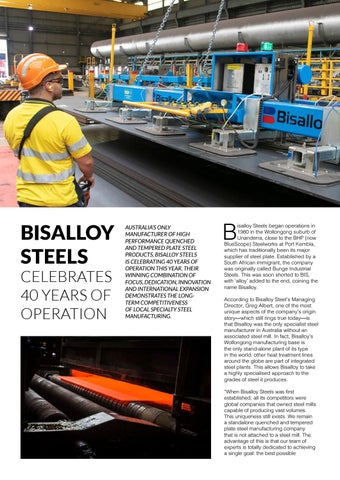
Bisalloy Steels Celebrates 40 Years of Operation
28
Bondor® to Recycle Waste Plastics into Building Products InQuik Revolutionises Bridge Design
32 36
Reproduction of the material is permitted only with the express permission of the Publisher and due acknowledgment of steel Australia.
CONTENTS | STEEL AUSTRALIA | WINTER 2020
steel Australia
32 36
PROJECT CASE STUDIES
Latrobe Valley GovHub: One of the Largest Light Gauge Steel Façades in the World
40
Quay Quarter Tower: Sydney's Engaging, Innovative High-Rise
44
INSIDE THE ASI
ASI Welcomes Three New Board Members
49
ASI Book Shop Update
50
New ASI Members
51
ABOUT THE ASI
steel Australia is published by the Australian Steel Institute (ASI)—the peak national body of the steel industry. The ASI works to increase the awareness of the benefits of steel and promote Australian made steel as the material of choice. Increasing the competitiveness of the Australian steel industry and its member companies is central to that vision. The organisation conducts engineering seminars and disseminates relevant, timely and detailed information. Expert technical advice, a library and a resource centre are available to all members, along with a range of other member benefits. For further information, please visit: https://www.steel.org.au
40 Cover image: Bondor® to Recycle Waste Plastics into Building Products. Story on page 32.
3
INDUSTRY INSIGHTS | STEEL AUSTRALIA | WINTER 2020
MESSAGE FROM THE CHAIR Over the past three months, Australia has come a long way in containing the COVID-19 pandemic. As a nation, we are doing far better in flattening the curve and containing the virus as compared to some of the world's other developed countries. This deserves due recognition. However, at the time of writing, case numbers have spiked in some areas of the country. As a result, both State and Federal Governments are considering whether to continue restrictions and border closures for a longer period. Clearly, COVID-19 remains a risk, both to Australia, and to our industry. It is a risk that needs to be monitored and managed moving forward. GOVERNMENT SUPPORT FOR INDUSTRY
The building, construction and manufacturing industries have managed to continue their operations in the wake of the COVID-19 pandemic. The State and Federal Governments have shown considerable support for our industries—the Governments are certainly listening to our advice, recommendations and calls to be classified as an 'essential' industry. The fact we have been allowed to continue operating demonstrates that the State and Federal Governments consider our industries to be essential, not only from the view point of employment, but as a critical contributor to the prosperity of the Australian economy. Furthermore, Prime Minister Scott Morrison recently announced increased spending on infrastructure, including a priority list of 15 major projects to be fast-tracked. Under an agreement by the Commonwealth, states and territories, the approval process will be sped up on projects such as the $10 billion inland rail project from Melbourne to Brisbane, the Marinus Link between Tasmania and Victoria, and the expansion of Olympic Dam in South Australia.
Bernie Landy Chair, Australian Steel Institute
This increased infrastructure spending is in addition to the launch of the HomeBuilder grant program, which will provide much-needed support to the residential construction industry. All the actions undertaken by the Federal Government will be helpful to the Australian steel industry in the medium to long-term. The real challenge for industry, particularly in the residential building sector, is a potential downturn later this calendar year, possibly running into 2021. Our Chief Executive, Mark Cain, his colleagues at the ASI, and other industry leaders from our member companies have done a great job in engaging with the Federal and State Governments on our industry's behalf over the past few months. TRADE MEASURES
Recently, there has been some commentary in the media related to trade measures in Australia. Some journalists have singled out the steel industry, implying that Australia’s dumping regime is protectionist in nature. Our industry leaders have performed exceptional work in clarifying this misconception, emphasising that there are international laws in place
governing free trade. Australia’s laws around trade measures and our dumping regime are simply designed to ensure that our trading partners act fairly in matters relating to the pricing of goods imported into Australia. The ASI, and the broader Australian steel industry, agrees that international trade must be competitive, but the rules of the game must be fair.
“
The fact we have been allowed to continue operating demonstrates that the State and Federal Governments consider our industries to be essential, not only from the view point of employment, but as a critical contributor to the prosperity of the Australian economy.” 5
MESSAGE FROM THE CHIEF EXECUTIVE THE AUSTRALIAN STEEL INSTITUTE (ASI) RECOGNISES THAT THE RAPIDLY CHANGING BUSINESS ENVIRONMENT CAUSED BY THE COVID-19 PANDEMIC HAS CREATED CHALLENGES FOR ALL PARTICIPANTS IN THE AUSTRALIAN STEEL VALUE CHAIN. DESPITE THESE CHALLENGES, THE MARKET HAS REMAINED SURPRISINGLY STRONG. IN THESE TIMES OF UNCERTAINTY, THE ASI IS WORKING TO SUPPORT ALL ITS MEMBERS AS EFFECTIVELY AS POSSIBLE.
The COVID-19 pandemic has had an impact on everything about life and work as we know it. Amid this rapidly changing business environment, the Australian Steel Institute (ASI) is working to support members as effectively as possible. In particular, we have been advocating for the essential nature of the steel industry and its supply chain, acting as a conduit for information for government bodies, and working to move our services to online platforms. If the ASI can assist you or your business, please contact your local State Manager directly, or contact the ASI Head Office in Sydney on 02 8748 0180 or membership@steel.org.au. Above all, stay safe and healthy. RECENT ADVOCACY ACTIVITY
The Australian Steel Institute (ASI) is the steel industry’s voice, championing its many attributes and assisting in driving the prosperity of the industry. As the peak body for the businesses engaged in steel manufacture, fabrication, distribution and erection, the ASI advocates for better and fairer conditions across the steel sector and for the benefit of all. In the wake of the COVID-19 pandemic, better and fairer conditions for the steel industry are more important than ever. As such, we have focused on the dissemination of information to key stakeholders, including Federal Government Ministers and Commissions. Over the last couple of months, the ASI has met with the Minister for Housing and Assistant Treasurer Michael Sukkar, the Minister for Industry, Science and
Technology Karen Andrews, and the Leader of the Australian Labor Party, Anthony Albanese. We have attended meetings with Federal Commissions, including several members of the National COVID-19 Coordination Commission, including Neville Power (Chair), Andrew Leveris (Special Advisor) and Greg Combett (Commissioner), as well as Michael Brennan (Chair, Productivity Commission). The ASI has made submissions to several Federal Government commissions, including the Anti-Dumping Commission. We also led the Building Products Industry Council (BPIC) submission to government on the need for a residential building stimulus. At a more local level, the ASI continues to work with various State Governments, focused on issues such as local content procurement, compliance and steel quality and safety. Given the current economic climate, the ASI believes that working alongside other key industry bodies to advocate on behalf of the Australian steel industry, particularly around the continued operations of the steel supply chain, is vital. As such, we issued a joint statement with the Australian Workers Union (AWU) on the essential nature of the steel industry. ONLINE PLATFORMS ACCELERATED
With the COVID-19 pandemic eradicating opportunities for face-to-face events, the ASI has turned its attention to several online platforms.
Above Mark Cain Chief Executive Australian Steel Institute
“
The ASI is working to support members as effectively as possible. In particular, we have been advocating for the essential nature of the steel industry and its supply chain, acting as a conduit for information for government bodies, and working to move our services to online platforms.”
Importantly, the eLearning platform is designed to help meet the Continuing Professional Development (CPD) needs of steel industry professionals. With a variety of engaging online courses available, you can learn and earn CPD points whenever and wherever best suits your lifestyle. There is a pool of 17 courses online via the eLearning platform, which are suitable for architects, engineers and fabricators, from apprentices and students right through to highly experienced professionals. Additional courses will be added every few weeks. For further information on the eLearning platform, visit: https://learn.steel.org.au or see the article on page 28. Publication of eBooks The ASI recently released its first eBook. We now have a total of six eBooks available, with the publication of new
titles such as Australian Steelwork Corrosion and Coatings Guide, Economical Structural Steelwork, and Worked Examples for Steel Structures. ASI eBooks are accessed via your personal Dashboard, when logged into the ASI website, from a state of the art eBook reader called tekReader. Navigation within the eBook is optimised with contents, tables, figures and references all linked. You can add notes to your publication and access it from any device. To purchase any of these publications, please visit: https:// www.steel.org.au/resources/bookshop Webcast Seminars With face-to-face seminars currently not possible, the ASI is facilitating a series of webcast seminars. Facilitated by Patrick Meehan (Senior Mechanical Engineer, FE Consultants), the first webcast seminar was held in late April on the topic Prevention of Failures in Steel Tanks, Bins and Silos. Held in June, the second seminar covered the Design of Light Gauge Cold-formed Steel in Industrial and Commercial Buildings. This seminar was presented by Tim Messer, Director of Northern Consulting Engineers. Both of the seminars were very well attended and received very positive feedback.
SAFETY
|
2020 STEEL EXCELLENCE AWARDS
I am pleased to confirm that the 2020 ASI Steel Excellence Awards are going ahead. Before moving forward with this year’s Excellence Awards, we solicited feedback from members on whether to proceed, and received overwhelming support to do so. Whilst state-based award presentations and events have been cancelled, nominations, finalists and winners will still be celebrated. We are planning virtual awards ceremonies for each state, which are likely to be held in September. All nominees and finalists will then be invited to attend the 2020 Australian Steel Excellence National Awards Gala, which will be held in Sydney in November 2020 (conditions permitting). This year’s award categories include: • Buildings (Large Projects) • Buildings (Small Projects) • Steel-Clad Structures • Engineering Projects • Young Designer, Detailer or Tradesperson
INDUSTRY INSIGHTS | STEEL AUSTRALIA | WINTER 2020
eLearning Platform We accelerated the launch of our new eLearning platform. The ASI’s eLearning portal brings together—in one easyto-access repository—highly relevant, superior quality learning material for all steel industry stakeholders. The ASI believes that education is one of the best opportunities available to support a highly effective and efficient Australian steel supply chain.
I encourage all members to submit their entries as soon as possible. Please keep in mind that all entries must be submitted by 5pm on Friday 31 July 2020 via the ASI website: http://awards.steel.org.au.
STORAGE
|
EFFICIENCY
Safer product handling Optimised production space Improved storage capacity Increased productivity & output Enhanced profits Contact us today to schedule a free virtual site survey.
1300 552 422
www.combilift.com
7
WATKINS STEEL & VOORTMAN: ACCELERATING PERFORMANCE THROUGH TECHNOLOGY ONE OF AUSTRALIA’S LEADING FABRICATION AND STEEL PROCESSING COMPANIES, WATKINS STEEL HAS INVESTED HEAVILY IN ADVANCED AUTOMATED ROBOTICS TO ENSURE THEIR STEEL IS PROCESSED ACCURATELY AND EFFICIENTLY. WITH THE INSTALLATION AND INTEGRATION OF VOORTMAN’S COPING AND DRILLING MACHINES, AND BAND SAW, WATKINS STEEL NOW OWNS AND OPERATES ONE OF THE MOST AUTOMATED BEAMLINES, WITH POSSIBLY THE HIGHEST OUTPUT CAPACITY ALONG AUSTRALIA’S EAST COAST. PLUS, WATKINS HAS SAVED OVER 5,000 MAN-HOURS PER MONTH.
In 1968, Des Watkins Senior established ASI member firm Watkins Steel in Brisbane, specialising in metalwork for residential and unit developments. Doubling in size every 10 years since they commenced operations, Watkins Steel built their first 400m2 factory in 1978 in Northgate, before moving to a larger factory site at Eagle Farm in 1988, and then again in 1998—this time to a 1,500m2 factory in Northgate. In 2004, Des Watkins Junior commenced as the company’s Managing Director, and relocated the business to its current 3,500m2 factory in Banyo in 2008. After 50 years in operation, Watkins Steel knew it needed to embrace technological change to safeguard the future of the company. As just one of over 400 fabricators in South-East
Queensland, Watkins was competing on both man hours per tonne and price. According to Managing Director Des Watkins, “We had to come up with a way to be different to the other 400-odd fabricators against whom we were competing. So, we embraced technological change and transformed our traditional processes through innovative thinking.” THE AUTOMATION JOURNEY
In 2014, Watkins commenced the automation of their fabrication processes, investing in a Voortman V808 coping robot line. This technology proved so successful that in 2017, Watkins Steel invested in a Voortman V630 drilling machine and VB1050 band saw. According to Watkins, “Specialising in small structural steel, we use the Voortman V808 coping machine to ensure that steel is fabricated to an accuracy of within 1mm over 12m. It also allows for layout marking of all four sides of a steel structure.” “We use the combination of the V630 drilling machine and VB1050 band saw to begin the process. The Voortman V630 drilling machine uses three independent drilling heads and automatic tool changing for four-side processing of steel. While the Voortman VB1050 band saw is specially designed to produce high quality cuts of structural steel at optimal cutting speeds,” said Watkins. All three machines are integrated into Watkins Steel’s existing automatic line with the help of Voortman’s Multi System Integration (MSI). Each Voortman machine is equipped with its own stateof-the-art VACAM Control Software. By interconnecting the handling systems and the VACAM software on the machines, an integrated production system is created. “The benefit of this technology is that model-based information from Tekla Structures 3D Software can be imported directly to the Voortman machines for processing and fabrication. This process ensures the consistent, reliable and accurate transfer of information between the shop drawing and fabrication process. In addition, the quality of structural steel is improved as rectification work is significantly reduced with the precision of automated robotics,” said Watkins. This increases productivity, saving on man-hours. The whole system is equipped with additional detection and sensors to monitor every operation and motion, resulting in full buffer control. With increased productivity and capacity, Watkins was able to
process steel for several suppliers and fabricators in the area. In 2019, when Watkins Steel acquired a new 7,000m2 factory nearby in Banyo, Voortman was again enlisted to help. Voortman undertook detailed design of a modular system that enabled Watkins Steel to move and reconfigure their existing processing line. This reconfigured processing line doubled Watkins’ output capacity, while utilising all their existing machines. In addition, Watkins invested in a new, V550-7 fully-automated flat and angle bar line, complete with punching, marking, drilling, tapping, cropping, and sorting functionality. The design of the V550-7 eradicates side loading of the punch cylinder, so that overlapping and nibbling with the punches is possible when producing long slots and edge punching for stiffeners. According to Brett Mathieson (General Manager, Watkins Steel), “As a result of investing in advanced technology, Watkins Steel has removed around 5,000 man-hours per month from their business. We now operate two shifts covering 20 hours, five days per week, rather than 24 hours per day. Plus, we are competitive with some overseas markets on price.” Watkins Steel is winning contracts for work that was being completed overseas, bringing work back to Australia. Watkins now has over 70 staff and has moved from a very traditional business working in steel fabrication, to providing risk and time management for their customers. This is achieved by using a unique end-to-end digital workflow. Watkins Steel can now complete their projects with near 100% accuracy, first time every time. They have tackled some of the most high-profile projects around Queensland, including the Commonwealth Games athletes’ village, and have recently started working on projects overseas, including in New Zealand. The Watkins Steel story proves that investing in state-of-the-art automation and technology enables structural steel companies to become more competitive, grow and prosper in, at times, challenging markets. For further information, please contact Voortman Australasia on: • T: 1300 798 998 • E: info@voortman.net.au • W: www.voortman.net.au This article was supplied as part of a paid advertising package.
The Voortman automatic split system beam line at Watkins Steel is generally considered to be the most advanced, automated, and highest capacity beam line on the market. To commission such a system is a complex, sizeable task, even with the most experienced factory engineers on-site. Moving, reconfiguring, and recommissioning an existing system, without any factory engineers on-site at all, is even more of a challenge.
Watkins Steel employees at their factory in Banyo.
With the outbreak of the COVID-19 pandemic, factory installation engineers were simply not allowed into Australia. As such, Watkins Steel and Voortman investigated the latest technology to help tackle the installation without the usual expert engineers on-site. The solution involved the use of Augmented Reality MS Hololens and MS Teams, combined with TeamViewer and Voortman’s VACAM software. This set-up enabled Voortman’s factory engineers in Europe, the US and Russia to work seamlessly, in real time, with Australian-based engineers. The entire installation ran very smoothly and was successfully completed 14 days ahead of schedule.
INDUSTRY INSIGHTS | STEEL AUSTRALIA | WINTER 2020
USING AUGMENTED REALITY TO TACKLE THE COVID-19 LOCKDOWN
The Voortman automatic split system beam line at Watkins Steel.
Voortman lines are designed from the ground up for the lowest possible downtime. This is achieved by minimising mechanical complexity and optimising the diagnostics and remote support capability, using 100% in-house developed software. Voortman VACAM software enables extremely fast and accurate diagnostics and allows their in-house engineers to change or upgrade almost anything in the software remotely. VACAM Software is based on decades of experience building steel machinery and is continuously refined based on the feedback provided by steel fabricators from around the world. Moving forward, by embracing technology such as MS Hololens, Voortman will be able to further minimise downtime, improve the quality of after sales service, and easily train their new operators.
Voortman beam welding line running full automatic production.
Voortman’s Multi-System Integration.
Voortman’s V550-7 flat and angle steel processing system.
9
UNDERSTANDING LIQUIDITY AND YOUR SUPERANNUATION YOU MAY HAVE SEEN THE TERM 'LIQUIDITY' USED IN RECENT WEEKS IN THE MEDIA, IN REGARD TO SUPER FUNDS. BUT WHAT DOES IT MEAN – AND HOW DOES IT IMPACT YOUR SUPER BALANCE? THESE HEADLINES ARE LARGELY IN RESPONSE TO THE IMPACT OF COVID-19 (CORONAVIRUS) WHICH HAS RESULTED IN A DOWNTURN IN INVESTMENT MARKETS, A RISE IN UNEMPLOYMENT FOR MANY AUSTRALIANS, AND THE GOVERNMENT’S POLICY RESPONSE THAT ENABLES SOME MEMBERS TO ACCESS THEIR SUPERANNUATION EARLY IN RESPONSE TO THE COVID-19 CRISIS.
WHAT IS LIQUIDITY?
of liquidity risk is a key element of our investment process. Our approach to managing liquidity is outlined in a series of policies which are approved by the Board and implemented by the investment team. The Fund’s approach is consistent with superannuation legislation and the prudential standards from the regulator, the Australian Prudential Regulation Authority (APRA).
WHAT ARE ILLIQUID ASSETS?
AustralianSuper is required by law and APRA’s regulations to ensure we have enough liquidity at all times. This includes in extreme times of change such as the global financial crisis, and the current COVID-19 crisis.
Liquidity is the proportion of an investment portfolio which is held in cash, or in investments that can readily be sold to raise cash. All of AustralianSuper’s PreMixed investment options invest in liquid assets. These include cash, and assets traded on public markets, such as listed shares and government bonds. Illiquid assets are assets which cannot be easily converted to cash. They take longer to trade or to find buyers willing to transact at a given price. These assets include direct property (such as commercial buildings and shopping centres), infrastructure (including toll roads, airports, ports, electricity distribution networks), credit (such as direct loans to companies) and private equity investments. Unlisted assets play an important role in a diversified portfolio. They often have an investment horizon of decades, rather than years. This makes them attractive for long-term investors, such as super funds, as they can provide stable and predictable cash flows and long-term growth across economic cycles. Importantly, in periods of strong economic growth, their values do not rise to the same extent as listed shares, and in downturns they do not typically fall to the same extent, offering some stability for portfolios. AustralianSuper has a long-standing track record of investing in unlisted assets both in Australia and across the globe. These assets have contributed to AustralianSuper’s history of strong longterm performance for members. WHAT IS LIQUIDITY RISK AND HOW DO WE MANAGE IT AT AUSTRALIANSUPER?
Liquidity risk is the risk that an entity may not be able to meet its financial obligations as they fall due. It is a key investment risk managed by all superannuation funds in balancing short-term liquidity requirements with the long-term investment objectives of each investment option. At AustralianSuper the management
A LONG-STANDING APPROACH TO MANAGING LIQUIDITY
We’re focused on the effects of the global COVID-19 pandemic and are monitoring it as it unfolds. AustralianSuper has a long-standing approach to managing liquidity, which has not changed: • We actively manage each Investment Option in line with its long-term investment strategy • We continue to monitor and respond to global investment markets • We manage the Fund’s cash flow on a daily basis • We prepare for events that may affect our liquidity position • We stress-test the portfolio for a range of possible scenarios While short-term periods of volatility and uncertainty can be concerning, we encourage members to stick with their long-term investment strategy. We encourage you to carefully consider your personal objectives, situation or needs before working out what is right for you. And, if you need to, you should seek professional advice. To read the full article please visit australiansuper.com/investment-articles Sponsored by AustralianSuper Pty Ltd ABN 94 006 457 987, AFSL 233788, Trustee of AustralianSuper ABN 65 714 394 898. Investment returns are not guaranteed. Past performance is not a reliable indicator of future returns. This information may be general financial advice which doesn’t take into account your personal objectives, situation or needs. Before making a decision about AustralianSuper, you should think about your financial requirements and refer to the relevant Product Disclosure Statement, available at australiansuper.com/pds or by calling 1300 300 273.
WITH COMBILIFT FOR SAFE DISTANCING IRISH SPECIALIST MATERIALS HANDLING MANUFACTURER, COMBILIFT, HAS ADOPTED A NEW APPROACH TO BUSINESS IN THE WAKE OF COVID-19. NOT ONLY IS COMBILIFT REPLACING INPERSON SITE VISITS WITH STATEOF-THE-ART VIRTUAL AND DIGITAL CONSULTATION SERVICES, THEY ARE ALSO COLLABORATING WITH THEIR CUSTOMERS TO HELP THEM ACHIEVE ADDITIONAL SPACE ON THEIR PRODUCTION FLOORS TO ENABLE SAFE SOCIAL DISTANCING.
SPACE OPTIMISATION ON PRODUCTION FLOORS
Many of Combilift’s customers in the manufacturing sector are facing operational challenges in the COVID-19 environment. In particular, as manufacturers attempt to return to normal production levels, many are finding it difficult to increase the space within their production areas so that their employees
“Most factories comprise three areas: raw materials storage, production and storage for finished products. The production area is where companies generate profit. With Combilift products in place, the storage areas for raw materials and finished products are narrowed, which increases the production area and, therefore, output and profit,” said McVicar. “If clients can increase their production area to solve social distancing issues, this additional production space will allow them to grow in the medium term – in the following year or two – so it is definitely a worthwhile investment. These measures are really all about increasing efficiency and productivity, and reducing storage costs.” VIRTUAL AND DIGITAL CONSULTATION
Combilift’s free design and layout service has always been essential in helping to resolve customer problems and maximise space. Prior to the outbreak of COVID-19, these design and layout services were carried out via in-person technical visits. Combilift has now replaced the in-person visits with remote virtual and digital consultations. Using readily available technology such as WhatsApp, combined with advanced software developed in-house, Combilift design engineers are able to take a virtual tour of client facilities. As
Combilift’s facilities in Ireland, with COVID-19 safe measures in place.
customers walk around their premises, taking shots of specific areas, Combilift engineers obtain an overview of requirements. Using measurements supplied by the customer, Combilift delivers 3D designs and animations within just 24 hours. “We have seen a much increased take up of our free warehouse service,” said McVicar. “Many companies are not encouraging in-person vendor visits, but they are making time available to communicate with us. Within 24 hours of speaking to a customer we can produce a 3D design that demonstrates how they can use space more efficiently, and free up production area for increased output." SAFETY MEASURES AT COMBILIFT
Combilift has introduced several safety measures within their own production facilities since the outbreak of COVID-19, including a two-shift system instead of its traditional one shift operation. This means that there are only around 350 employees per shift on-site in their 46,500m² facility.
INDUSTRY INSIGHTS | STEEL AUSTRALIA | WINTER 2020
OPTIMISE SPACE
can maintain safe distances from one another. Speaking during a virtual press conference, Martin McVicar (CEO and Co-founder of Combilift), stated that Combilift’s new approach will allow customers to benefit from their expertise in space optimisation and warehouse layouts. “We can help ensure that our customers make optimum use of one of their most precious commodities – space.”
Employees are scanned by thermal cameras when they arrive on-site to check their temperature. Clocking in is now done via a touchless key fob and doors are kept open whenever possible. Those doors that cannot remain permanently open have been fitted with copper coatings which significantly reduce the time that a virus can be harboured on the surface compared to steel. There are multiple hand sanitisers strategically placed across the whole facility, floor markings indicate the 2m distance to be maintained by employees and it is mandatory to wear face masks. For further information, visit: www.combilift.com This article is part of a paid advertising package.
Martin McVicar (CEO and Co-founder of Combilift).
11
Superior Quality, Compliant, Structurally Sound Steelwork Steelwork Compliance Australia (SCA) provides compliance certification for the supply, fabrication and erection of structural steelwork. SCA certification gives clients peace of mind that their steelwork fabricator has the capability to achieve compliance with Australian Standards, and deliver superior quality, structurally sound steelwork.
Need further information? Looking for advice? Want to get certified? Contact Steelwork Compliance Australia: www.scacompliance.com.au +61 2 8748 0180 sca@scacompliance.com.au
BASED IN INGLEBURN, NEW SOUTH WALES, ACE CONSTRUCTION AUSTRALIA (ACA) SPECIALISES IN FABRICATION AND INSTALLATION OF STRUCTURAL STEEL AND METALWORK. SINCE THE COMPANY’S INCEPTION 15 YEARS AGO, ACA HAS EARNED A SOLID REPUTATION FOR HIGH-QUALITY WORKMANSHIP, AND HAS EXPANDED RAPIDLY AS A RESULT. TO AUGMENT THIS EXPANSION, ACA RECENTLY BECAME THE FIRST COMPANY IN NEW SOUTH WALES TO INVEST IN A HGG COPING ROBOT 3D PROFILE PLASMA CUTTING MACHINE. THIS INVESTMENT HAS DOUBLED ACA’S CAPACITY, BROADENED THEIR MARKET SHARE, AND HELPED TO FUTURE PROOF THE BUSINESS. According to Mohamed Elomar (General Manager, ACA), when he first established the company, the only automated machinery in the workshop was a saw, punch and shearing machine. “We decided that, to keep pace with the industry, we needed to invest in automation. So, we purchased a CNC machine. While this helped to augment our operations, we really wanted to move to a machine that could do it all—plasma cutting holes, on all profiles including SHS and RHS, complex coping and add-on-part layout marking without requiring re-work by the boilermaker." “That’s why we decided to invest in a HGG coping robot. The HGG replaces the drilling machine, band saw, angle machine, flat bar machine, plate machine, layout marking, and stamping. So I can push more work through the one machine,” said Elomar. The in-built capabilities of the machine have offered a range of benefits to ACA. For instance, the HGG’s laser measuring system is essential when it comes to plasma cutting through the radius between the web and the flange on universal beams. Its plasma torch is readily able to regulate the amperage and voltage to process the radius on the universal beams when following the exact profile measured with the laser, without rework or loss of quality. And, when profiles are bowed, twisted, or cambered, or flanges are not parallel, the HGG is still able to achieve full
penetration butt welds and parallel mitre cuts as the cutting torch never uses a touch probe to measure the profiles. “The machine follows the exact profile of the beam, no matter how much it is twisted. It performs a scan, indicates how far the beam is out, and then adjusts itself accordingly. When it comes to the SHS or RHS, there is another laser sensor attached to the end of the robot arm, which has a two step measuring process all the way around the SHS or RHS to ensure maximum accuracy and allow bevel cutting for these profiles.” Consumables expenditure is also relative. “Traditional machines leave a cross mark. This means you might end up with four marks per plate, which is eight ignitions. In comparison, the HGG places a full contour line where the plate will sit in one single ignition,” said Elomar. THE RESULTS
ACA has doubled the capacity of its workshop. “Prior to the installation of the HGG, we produced 50 tonnes per week. Now we can produce 100 tonnes per week—all without increasing either our workforce or our footprint,” said Elomar. This increased capacity means that ACA can meet clients’ project timeframes much more easily, and is even able to sell its excess capacity to some of the local steel service centres. Often, the work ACA carries out for these steel service centres is quite complicated. Luckily, HGG offers exceptional aftersales service. “HGG has engineers in
their workshop in the Netherlands who can help with complicated profiles. We send the details off to the Netherlands, and they respond within 24 hours with a software update that enables us to cut even the most complicated profiles quickly and easily,” said Elomar.
INDUSTRY INSIGHTS | STEEL AUSTRALIA | WINTER 2020
HOW AUTOMATION DOUBLED ACA’S CAPACITY
Importantly, the HGG can be programmed directly from over a dozen 3D model providers, like Tekla. “The HGG is able to read STEP and AutoCAD files. We have a lot of clients that draw plans in AutoCAD or Autodesk Inventor, which means they can only produce STEP files—not NC files. As a result, the HGG has opened up a whole new market for us. Clients prefer to work with us in STEP files, rather than reprogram their plans for fabricators with traditional coping machines that cannot read the files.” “When tendering, I know I have a higher chance of winning projects now—everyone else is relying on traditional fabrication methods or traditional coping robots that just cannot supply the same quality, at the same speed, for the same price. Investing in the HGG means that I win more work and increase my profits,” said Elomar. For further information, visit: https://www.smsales.com.au This article is part of a paid advertising package.
13
FICEP: DELIVERING NINE DECADES OF EXPERIENCE TO THEIR CUSTOMERS WITH MORE THAN NINE DECADES OF EXPERIENCE, FICEP'S MISSION IS TO DELIVER HIGH QUALITY STEEL CONSTRUCTION LINES THAT EXCEED THEIR CUSTOMERS' NEEDS. FICEP DELIVERS ON THIS MISSION THROUGH ITS DEDICATION TO INNOVATION, CONTINUOUS IMPROVEMENT, AND SUPERIOR QUALITY CUSTOMER SERVICE. Ficep is an Italian company with nine decades of experience, innovative products, superior quality customer service, extremely qualified personnel and the capacity to understand the customers’ needs. Ficep is todays’ global leader in the production and supply of complete solutions, offering a wide range of highly technological lines for the steel construction industry and for the forging and stamping industry. Ficep's management team has always been dedicated to ensuring the continuity of the vision and values of the company—through the past, present and future—adapting the organisation to the evolving market.
Ficep's Excalibur makes CNC drilling possible for metal profiles.
to listen and engage the market, is the perfect way to build even more intimate and supportive customer relationships. INNOVATION AND OPTIMISATION
As a family owned and run business, Ficep believes that success is based on innovation, continued understanding of market conditions and optimisation of customers' production processes.
Since 1930, Ficep has had a presence in Europe, America, the Middle East, Africa, Russia, Oceania and Asia. Today, the company has more than 500 employees and 17 subsidiaries. This global network has been vital to expanding the distribution of their products worldwide.
The heart and brain of Ficep's innovation capacity is its Research and Development Office, where the company studies and experiments with solutions for the future. Their research activity involves a dedicated staff of 50 people, including engineers, technicians and CAD and Cam operators, all whom can rely on the direct support of Ficep's production departments when it comes to the construction of prototypes.
Oceania is an exciting region for Ficep; in fact, the company has recently enhanced its presence, appointing a highly experienced, local Area Sales Manager, Francis Lee. Ficep prides itself on fostering close relationships with all its customers. The combination of a long time collaborating agent, Ron Mack Machinery, and now a local manager
Ficep's commitment to effectively evaluating every customers’ production needs makes their offer unique within the market. Ficep focuses its attention on a global service offering that extends to both 'pre' and 'post' sale, and development and supply of PLM (Product Lifecycle Management) software, together with their latest CNC Ficep's Gazzada Schianno headquarters.
generation lines. It's no surprise that Ficep delivers unprecedented solutions. In fact, it is not unusual for Ficep's customers to need help with the design and construction of entire factories— rather than just single machines. Ficep's ability to design complete layouts for entire factories to meet client production needs is becoming increasingly indispensable. From analysing the specific sector in which the customers operates, through to the required annual production capacity and key success factors (like quality, efficient and sustainable processes, speed and optimisation of order processing), Ficep is able to manage the smallest details. Ficep operates actively and efficiently to obtaining the best possible result. EXTENSIVE STAFF TRAINING
Another of Ficep's strengths, that has played a vital role in the growth of the company, is the extensive training provided to all staff. This ensures all staff have the experience and know-how to deliver the best possible advice to clients. Ficep has followed this philosophy for many years, constantly increasing the experience and know-how of its staff. In fact, eight years ago, Ficep inaugurated the new Ficep Academy of Technology. The launch of the Academy was part of the modernisation of the Gazzada Schianno headquarters, which also included the construction of a new, dynamic 2,400m2 showroom. FURTHER INFORMATION
For further information about Ficep, contact Francis Lee +64 (0) 21 448 567 and Darryl Mack +61 (0) 419 383 376. This article was supplied as part of a paid advertising package.
EACH QUARTER, THE AUSTRALIAN STEEL INSTITUTE BRINGS YOU NEWS AND VIEWS FROM AROUND THE STEEL INDUSTRY IN OUR REGULAR COLUMN: ON THE BEAM. FROM PROJECTS WON AND COMPLETED, THROUGH TO NEW PRODUCT LAUNCHES AND COMPANY ANNOUNCEMENTS, YOU CAN FIND IT ALL HERE.
Bisalloy recently announced the signing of a memorandum of understanding (MoU) with Axiom Precision Manufacturing and K-TIG to jointly develop a sovereign capability in welding for the Australian defence industry. Development of an Australian sovereign capability in the welding of specialist defence steels will allow Australian industry to maximise its participation in upcoming defence procurements, such as the LAND 400 program, that will see the Australian Defence Force’s existing Australian Light Armoured Vehicle and M113 Armoured Personnel Carrier fleets replaced with new vehicles that deliver improved levels of firepower, protection and mobility. Bisalloy Chief Executive Officer and Managing Director, Greg Albert, said, “Bisalloy has a long history of successfully collaborating with partner companies to develop new and innovative solutions in steels. Our capabilities extend far beyond product supply, it extends to technical and product development assistance. As such, we are committed to offering our customers everything they need for future success.”
NATIONAL COVID-19 COORDINATION COMMISSION ADDRESSES ASI QUESTIONS
The Australian Chamber of Commerce and Industry (ACCI) recently facilitated a video conference with Neville Power, Chair of the National COVID-19 Coordination Commission. During the conference, Power provided an update on the activities of the Commission. Neville also responded to questions posed by conference attendees, including the ASI’s Chief Executive, Mark Cain. With local manufacturers frequently failing to win government project work, Cain asked Neville how the NCCC will help ‘level the playing the field’, and give more weight to the broader economic benefits of local supply, thereby encouraging investment to meet future needs? According to Power, “The Commission is providing practical advice to government on policy and regulatory reform that will be needed to grow the economy and increase productivity. The COVID-19 outbreak has highlighted the importance of domestic capabilities, and companies will be considering their supply chain vulnerabilities and reliance on overseas inputs. We are looking at all levers available to support business and accelerate our recovery; that includes things like incentivising investment.”
INDUSTRY INSIGHTS | STEEL AUSTRALIA | WINTER 2020
ON THE BEAM
BISALLOY SIGNS MOU WITH AUSTRALIAN CONTRACTORS
U VALIANT Automatic CNC drilling, drilling and band sawing, drilling and robotic coping line for profiles
ABC123
The brand new Valiant is equipped with numerous innovations compared to previous models, like an advanced pincher clamping system and a new hold down system with two independent cylinders that allows the best processing of the beam head and end. Another advantage is the enhanced auxiliary axis with 300 mm stroke on each independent drilling unit, which permits a wide variety of operations including special milling features and “rat holes” being made simultaneously on all sides without moving the beam. Valiant can be configured with an automatic tool-changer holding up to 14 positions per head: a significant increase of tools availability that allows completing all necessary operations on the beam without any operator intervention (drilling, milling, four side scribing, threading, etc.).
Area Sales Manager Mr.Francis Lee Mobile: +64 (0) 21 448 568 E-mail: francis.lee@ficep.it www.ficepgroup.com
Darryl Mack +61 (0) 419 383376 • E-mail: dmack@ronmack.com.au David Sharp + 61 (0) 439 901646 • E-mail: david@ronmack.com.au Andrew Barker + 61 (0) 400 219634 • E-mail: andrew@ronmack.au www.ronmack.com.au
15
Gow-Gates is a proud partner of the Australian Steel Institute
Gow-Gates Insurance Brokers Gow-Gates has the size, history and experience combined with the resources, expertise and relationships needed to manage multinational accounts, iconic brands, high net worth individuals and private businesses. Our specialists brokers and risk managers pride themselves on being an extension of your team, helping you weather downturns and providing stability - so you can focus on core business. We understand that every business, asset and personal circumstance is unique. Whether our specialised team of brokers are assessing and managing business risk, providing professional insurance advice, or managing a claim for start to finish, you can be confident we are always acting as an advocate on your behalf. Please contact us to discuss your insurance inquirers and our risk management services. Suzana Strbac, Director of Client Engagement
0410 507 973 | gowgates.com.au | sstrbac@gowgates.com.au Gow-Gates Insurance Brokers Pty Ltd | ABN 12 000 837 785 | AFSL 245432
BLUESCOPE CHOSEN FOR SHIPBUILDING CONTRACT
BlueScope has been chosen by ASC Shipbuilding, a subsidiary of BAE Systems Australia, to supply steel for the prototyping phase of a program to build defence ships in Australia. This is an important step towards the potential future supply of more than 30,000 tonnes of steel from the Port Kembla Steelworks into nine defence ships. BlueScope Chief Executive, Australian Steel Products, John Nowlan, welcomed the contract. “BlueScope is very pleased to be chosen by ASC Shipbuilding to supply steel into the prototyping phase of the Hunter Class Frigate Program. The company has a long and proud history of supplying steel into defence projects – in the 1990s we supplied more than 20,000 tonnes of steel into the original Anzac Class frigate fleet that the Hunter Class ships will replace. Manufacturing is a key part of Australia’s history and today BlueScope is not only a world class manufacturer but we are also internationally competitive,” said Nowlan. The Hunter Class will be based on BAE Systems’ Type 26 Global Combat Ship design, the world’s first bow-tostern digitally-designed anti-submarine warfare frigate. Modified to meet Australian requirements, the Hunter Class Frigate will be constructed on an acoustically quiet hull and feature unique sonar capabilities, modular digital design and open systems architecture to facilitate through-life support and upgrades.
NSW LAW TO REGULATE ENGINEERING PASSED
New laws designed to reform the New South Wales building sector and introduce a registration scheme for professional engineers recently passed New South Parliament. The laws outlined in the Design and Building Practitioners Bill 2020 are expected to come into effect from 1 July 2021. It will become compulsory for professional engineers to be registered to practice. It will be offence for a person to use the title ‘registered professional engineer’ unless they have the correct qualifications and level of competency. This means that Australia’s three largest states now have laws that make it compulsory for engineers to be registered. The compulsory registration of engineers is designed to help minimise the risk of more major incidents, such as Opal and Mascot Towers or bridge collapses that have been seen in Australia and around the world. The Design and Building Practitioners Bill is intended to deliver on the reforms committed to by the 2019 Government response to the Building Confidence Report, authored by Professor Peter Shergold AC and Ms Bronwyn Weir. The Australian Steel Institute (ASI) contributed a submission to the New South Wales Government on the draft Design and Building Practitioners Bill in mid-2019.
BLUESCOPE NAMED WORLDSTEEL SUSTAINABILITY CHAMPION
BlueScope was recently recognised as a worldsteel Sustainability Champion for its performance and efforts in 2019. Champions demonstrate commitment to sustainable development and the circular economy, and to making a tangible impact. The worldsteel Sustainability Champion program encourages companies to increase their efforts, set higher standards, and make further progress. To qualify, companies must meet the following criteria: • Committing to the worldsteel sustainable development charter. • Providing data on six of the worldsteel Sustainability Indicators and submitting Life Cycle Inventory data to worldsteel’s data collection program (data should cover more than 50% of the company’s crude steel production and should be less than five years old) • Publishing a sustainability-related report and being shortlisted in one of the five categories of the worldsteel Steelie Awards
INDUSTRY INSIGHTS | STEEL AUSTRALIA | WINTER 2020
ON THE BEAM
BlueScope has met the first two criteria for several years in a row. However, they qualified for recognition as a Sustainability Champion after their Australian Steel Products’ Power Purchase Agreement was nominated in the Excellence in Sustainability category of worldsteel's 2019 Steelie Awards.
The Hunter Class Frigate will be based on BAE Systems’ Type 26 Global Combat Ship design.
17
EDUCATION & SKILLS: STEELING THE WORKFORCE OF TOMORROW AUSTRALIA’S FUTURE ECONOMIC PROSPERITY DEPENDS ON ITS DEVELOPMENT OF A HIGHLY SKILLED WORKFORCE CAPABLE OF BUILDING GLOBALLY COMPETITIVE INDUSTRIAL AND COMMERCIAL ENTERPRISES. INVESTMENT IN SKILLS-BASED AND VOCATIONAL TRAINING IS ESSENTIAL FOR THE FUTURE DEVELOPMENT OF AUSTRALIA’S STEEL AND ALLIED INDUSTRIES, AND FOR ENABLING THE DELIVERY OF THE INFRASTRUCTURE THAT IS SO VITAL TO UNLOCKING AUSTRALIA’S ECONOMIC POTENTIAL. THE ASI SUPPORTS STATE AND COMMONWEALTH GOVERNMENTS’ INVESTMENT IN TRAINING PROGRAMS TO EQUIP OUR YOUTH AND UPSKILL OUR WORKFORCE WITH THE SKILLS NEEDED TO MAINTAIN A GLOBALLY COMPETITIVE STEEL AND WIDER INDUSTRIAL SECTOR.
Australia's long-term prosperity, particularly in an increasingly global economy, is heavily dependent on ongoing investment in workforce development. In addition, the changing structure of the labour market and the fast pace of technological change, requires Australia's workers to not only maintain, but also improve and broaden their employment related skills.
of Jobs and Small Business, employers generally had difficulty filling engineering trades vacancies in 2018, with just 49% of vacancies filled. Skills shortages have been a key issue in this labour market over the past two years—only 45% of job applicants were qualified for the role for which they applied. These figures are compounded by a strengthening demand for engineering trades workers.
Apart from formal qualifications undertaken through the education system, work-related training plays a crucial role in developing and sustaining skilled and competent employees. For the individual, work-related training may help enhance personal and professional development and build new capabilities. For businesses, it can improve workplace performance and productivity.
It is little wonder then, that in a recent survey of Fabricator Members conducted by the ASI, 93% of respondents indicated that they were interested in accessing eLearning courses tailored to steel fabrication. Interestingly the topics most in demand were those related to 'softer' skills (rather than practical hands-on subjects), such as product and materials traceability systems, tender preparation, legal contracts, principles of lean manufacturing, estimating, operational efficiencies, implementation of AS/NZS 5131, and sustainable work practices.
According to worldsteel, on average, steel companies around the globe provided each employee with 6.4 training days in 2018. This is in line with general workforce profiles. For instance, according to the 2018 Training Industry Report (which represents a cross-section of industries and company sizes in the United States), on average, employees received 6.6 days of training per year. However, given the impacts of skills shortages and rapid technological advancement, education and upskilling are becoming increasingly important to the Australian steel industry. THE IMPACT OF SKILLS SHORTAGES
With skills shortages in many occupations that are essential to the future prosperity of the steel industry, education and upskilling is more important than ever. Take, for example, the Engineering Trades. According to the most recent data from the Department
THE IMPACT OF INNOVATION
Ernst & Young recently released a study that indicated 40% of existing university degrees will soon be obsolete. Technology is forcing professions to evolve at a pace the traditional university model can’t keep up with. It is predicted that the future of university education will involve degrees made up of ‘microcredentials’ that are directly relevant to the work students want to do. As the steel industry continues to introduce technological innovations, the profile of the workforce will evolve and require higher levels of education and training than ever before. This is particularly true with the development of 'breakthrough', or next-generation steelmaking technologies that will be low in CO2 emissions and result in significant changes to the way that steel is made. In this context, the demand for engineers, computer scientists, business major, and skilled production workers is expected to remain strong. This requires a significant skill level throughout the industry for electrical and mechanical systems, as well as software and programming.
Steel Tanks, Bins and Silos; Prevention of Failures Presented by Patrick Meehan (Senior Mechanical Engineer, FE Consultants) in May 2020, the ASI's first seminar focused on the Prevention of Failures in Steel Tanks, Bins and Silos. It provided an understanding of the design of steel tanks, bins and silos, with an emphasis on understanding the manner in which they’re loaded, the response of the structure to these loads, and the methods available to prevent failures. The loading experienced by steel tanks, bins and silos and their response to these loads requires special considerations not found in typical structural steel design handbooks or standards. Steel tanks, bins and silos use membrane action to resist internal pressures generated by the contents. This is an efficient use of material, but typically results in structures that have
“
The presenter is excellent and I was impressed with the facts and methodology presented (not just anecdotal as I’ve seen elsewhere) and he’s put up actual structures. I couldn’t flaw any of the information presented – spot on!” ~ Attendee of the Steel Tanks, Bins and Silos Seminar
thin walls. This presents problems with buckling under external pressure and longitudinal stresses due to overturning. In addition, the connection of supports for elevated tanks, bins and silos whether they be saddles, skirts or discrete columns requires consideration to ensure the walls don’t fail locally either through yielding or buckling. Design of Light Gauge Cold-Formed Steel in Buildings Held in June 2020, the ASI's second seminar delved into the Design of Light Gauge Cold-Formed Steel in Industrial and Commercial Buildings.
Presented by Tim Messer (Director, Northern Consulting Engineers), the seminar was developed to improve designer knowledge and confidence in the correct application of loading codes and appropriate design of light gauge cold formed steel in industrial and commercial buildings. Particular areas of focus included: determination of site wind speed and software for assistance, purlin and girt design, portal frame analysis and design, footing design, roller door framing and door design, and connections for haunches and bases.
“
"The training platform is easy to navigate and learn from. The subjects provide information in accordance to the relevant Australian Standards and also advice gained from practicing engineers. It is especially useful for people not based in capital cities who cannot attend ASI seminars in person". ~ Recent user of the ASI eLearning Platform
LEARN ONLINE: ASI LAUNCHES eLEARNING PLATFORM The Australian Steel Institute (ASI) recently launched its new eLearning platform. The platform is designed to provide steel industry stakeholders with continuing professional development opportunities and proficiency in steel design and construction. The platform delivers a complete suite of online training using the latest principles in eLearning, ensuring students gain and retain knowledge in an enjoyable, engaging and effective way.
FEATURE: EDUCATION & SKILLS: STEELING THE WORKFORCE OF TOMORROW | STEEL AUSTRALIA | WINTER 2020
THE ASI'S WEBCAST SEMINARS With face-to-face events cancelled in the wake of COVID-19, the ASI has developed a series of webcast seminars. Supporting Continuing Professional Development (CPD) requirements, all the seminars feature a recorded webcast, combined with a live Q&A facilitated by the speaker. In the longer term, the content from all the webcast seminars will be made permanently available via the ASI's newly launched eLearning platform.
The ASI’s eLearning portal brings together—in one easy-to-access repository—highly relevant, superior quality learning material for all steel industry stakeholders. The ASI believes that education is one of the best opportunities available to support a highly effective and efficient Australian steel supply chain. There is a pool of 17 courses online, with more slated for development, including: • Full courses: These vary from two to six hours and include several lessons covering specific focus areas. Each lesson runs for approximately 20 minutes, followed by a quiz. • Modules: These range from 20 to 60 minutes, and comprise one or more lessons. • Tech Bytes: These are short sessions that run for up to 20 minutes, designed to cover a very specific technical issue. For many of the ASI’s courses, course notes are available to view and download. Some courses also include additional supporting material. ASI members and non-members alike are free to browse the ASI eLearning portal. Many of the courses have a ‘sample lesson’ that is completely free of charge. This sample lesson provides an introduction and defines the scope of the course, allowing you to make an informed judgment as to whether the course is right for you. Importantly, the eLearning platform is designed to help meet the Continuing Professional Development (CPD) needs of steel industry professionals. With a variety of engaging online courses available, you can learn and earn CPD points whenever and wherever bests suits your lifestyle. Don't forget, ASI student members receive a substantial 80% discount on the full price of all eLearning courses. Access the ASI eLearning Portal today: https://learn.steel.org.au
19
BUILDING BRANDS THAT ATTRACT TALENT FOR MANY AUSTRALIAN COMPANIES, ATTRACTING AND RETAINING TALENTED STAFF IS AN ONGOING CHALLENGE. HIRING TIMEFRAMES HAVE NEARLY DOUBLED SINCE 2010, WITH IT NOW TAKING AN AVERAGE OF 68 DAYS TO FILL A VACANT POSITION. PLUS, THE AVERAGE COST OF EVERY NEW HIRE IS $5,000, INCLUDING RECRUITMENT, TIME LOST TO FILL THE POSITION, AND TRAINING AND INDUCTION COSTS. IN THIS ARTICLE, SOME OF THE STEEL INDUSTRY'S LARGEST AND MOST EMPLOYEE-CENTRIC COMPANIES—INCLUDING AHRENS, DBM VIRCON AND NEPEAN ENGINEERING & INNOVATION— DELVE INTO THEIR RECRUITMENT, RETENTION AND EMPLOYER BRANDING STRATEGIES.
AHRENS
In 1906, Wilhelm Ahrens borrowed 100 pounds from his father-in-law to purchase a cottage and blacksmith shop on three acres of land at Sheaoak Log in the Barossa Valley, South Australia. This was the beginning of Ahrens. Over the last 100 years and more, Ahrens has diversified and expanded to become a national full-service construction, engineering and mining services company. Ahrens’ team of dedicated people, backed by their strong company culture, has been key to the company’s success and expansion. Ahrens’ culture is founded on the idea of working together to get the job done, about being accountable, and acting with integrity. Ahrens is focused on innovation and efficiency, and rewards those who passionately work toward realising the company vision. Phil Poole (Ahrens General Manager HSQE and People) explained, “At Ahrens, people are our power. We value the contribution that our employees bring to the table, and encourage all our employees to strive for their personal and professional best. We help our people do this by providing internal and external training sessions, apprentice programs, and emerging leaders programs.” “Our people know that working at Ahrens isn’t just about doing a job and going home, it’s a place they belong and can grow to be the best they can. Our people understand their contribution makes a difference and will go the extra mile to get the job done. This is what it means to be a part of the Ahrens family,” said Poole. DBM VIRCON
DBM Vircon is a premier construction modelling, detailing and digital engineering company. With over 50 years’ experience on projects in more
One of Ahren's recent projects: the Cavpower facility in South Australia.
than 25 countries worldwide, DBM Vircon boasts a team of over 850 highly-trained professionals in ten offices across four continents. Their experience is built on the legacy of the three companies (PDC, BDS VirCon and Candraft) that came together in 2019 to form DBM Vircon. According to Vinod Muthanna (Chief Executive Officer, DBM Vircon), “The key to DBM Vircon’s success in attracting and retaining talent is a collegiate atmosphere — it’s all about our company culture. We strive very hard to maintain a company culture in which people treat one another in the way they want to be treated. Every member of our team is encouraged to be friendly and helpful.” “We foster an environment in which employees value the opportunity to work on major projects—projects that have the power to alter an entire cityscape and also iconic buildings for major global companies and brands. Employees are keen to work for a business that has an international footprint, driven by local values,” said Muthanna. NEPEAN ENGINEERING & INNOVATION
Opening its doors in 1974, NEPEAN Engineering & Innovation is one of Australia’s largest privately owned engineering service providers. Over 45 years in operation, NEPEAN has built an elite design and project management team that understands the diverse nature of engineering. They have done this by maintaining a culture that recognises and respects the importance of all participants in the business, focused on building lasting relationships with employees, as well as customers. According to NEPEAN’s General Manager, Peter Buckley, “Our success is aligned with our customers’ success. To ensure we can deliver successful
“Team members resourced to each job are hand-picked according to specific project requirements in terms of experience, specialist skills and problem-solving capabilities. We are proud of the deep relationships with our employees, with many engineers, project managers and tradespeople employed with our company for over 25 years,” said Buckley. ATTRACTING TALENT
Hiring talented individuals is critical to any organisation’s success. The first step in hiring the most talented employees is recruiting them, and this can be challenging. It can be difficult to fill certain types of jobs, to decide who to target, what message to convey and which platforms to use. These difficulties are compounded by skills shortages. A recent McKinsey Global Institute study suggests that employers in developed economies worldwide will face a shortfall of 45 million workers with secondary-school educations and vocational training in 2020 and beyond. Companies may not be able to fill one in ten roles they need, much less fill them with top talent. As such, without a clearly defined strategy, a company’s recruitment efforts can produce candidates who are unqualified and inexperienced, or who fail to identify with a company’s core values. These same applicants tend to be prone to turnover if hired. A poorly designed recruitment process can even fail to attractive the best candidates— including those competitor employees— because they never find out that a position is open.
It is for these reasons that, when it comes to attracting the right talent, NEPEAN has devised a tailored approach.
business, we’re focused on making sure our employees share the same values as us,” said Poole.
“One of the core things we did was devise a strategy, as part of our overarching business plan, that outlines exactly how we will invest in young people, and attract talent,” said Buckley. “We have three avenues for the employment of young people: through apprenticeships, through the graduate engineering program that we created ourselves, and through traineeships for roles such as accounts and administration.”
“We are constantly building and refining strategies to attract talented people. Our strategies are focused on communicating the opportunities that we have to offer, the diverse range of work we have, and the training programs that we offer to our staff to keep them interested in our industry.”
“By voicing our approach, and having a clear strategy in place, we were then able to establish the right partnerships to tap into the right talent. These partnerships fall into three streams: universities and TAFEs, local high schools, and employment agencies.” “This year, we’ve also focused on improving our marketing. We have a new website, as well as an improved presence across social media, including LinkedIn, Instagram and Facebook. These measures are, in part, designed to attract new and younger talent. More and more, we’re investing in digital marketing platforms, which aren’t necessarily traditional to engineering, because these platforms are relevant to younger people and high performing talent,” said Buckley. As a result, NEPEAN taken on five new apprentices in 2020, along with two graduate engineers and additional professional staff. Ahrens has adopted a similar approach, with documented strategies and processes in place to attract people who share the core principles that define their culture and influence the way in they conduct business. “Ahrens is always looking for talented people. As a family
“We try to target school leavers and are in regular contact with local organisations that foster the skills of young people, like the Duke of Edinburgh program. Lots of young people head off to university after school, but we are focused on reaching out to school leavers wherever possible, and providing on-the-job training,” said Poole. By implementing sound recruitment strategies, both Ahrens and NEPEAN are able to mitigate the implications of a poor hire. These implications extend beyond the monetary element, extending to the corporate culture and overall performance of a workplace. According to the latest independent research from recruitment specialist Robert Half, more than half (55%) of Human Resources managers say that loss of productivity is the biggest problem associated with making the wrong recruitment decision. Almost a quarter (23%) confirm that a poor hire reduces staff morale while almost one in five (19%) alleges it has resulted in significant financial costs. These costs extend to: the employee’s salary failing to reflect performance; education and training costs; impacts on the productivity of the employee, Continued over page
FEATURE: EDUCATION & SKILLS: STEELING THE WORKFORCE OF TOMORROW | STEEL AUSTRALIA | WINTER 2020
outcomes to all our clients, we employ and train the best. To continually develop our organisation and deliver quality project outcomes, it is vital to invest in our people.”
“
At Ahrens, people are our power. We value the contribution that our employs bring to the table, and encourage all our employees to strive for their personal and professional best." 21
An Ahrens welder hard at work.
colleagues and management; potential loss of revenue; and the ultimate cost to re-recruit for the role.
and detailing—DBM Vircon is virtually the only large training house,” said Muthanna.
RETAINING TALENT
Clearly a common denominator to employee retention, Ahrens also boasts a graduate program—one with an added degree of flexibility and innovation.
Retention of positive and motivated employees is just as important for a company’s success as recruiting the right talent. High employee turnover increases company expenditure and can severely reduce overall morale. Retention programs are an effective way to ensure that workers remain employed and engaged, while balancing and maintaining job performance and productivity. For Buckley, retaining the right talent is equally as important as attracting the right talent. To ensure that younger talent assimilate into the business as smoothly as possible, NEPEAN has tailored a mentorship program.
“We have one graduate program during which we place young people in different areas of the business for a short amount of time to see what type of work they enjoy the most. A graduate might join Ahrens thinking that they’d enjoy a project manager role, but after working in a different area of the business, they find that they want to focus on engineering. So we facilitate this because we know that the employee will be more productive, more enthusiastic and more engaging if they’re focused on what they really enjoy,” said Poole.
“NEPEAN supports talent with talent. We partner first year apprentices with fourth apprentices. We partner graduate engineers with senior engineers to help them learn more about factors like design elements, and project management,” said Buckley.
Ahrens employees also attend internal training sessions and external training in many disciplines, from finance and business development to safety and site supervision. Ahrens also has a learning academy at its head office in Kingsford, South Australia.
Similarly, DBM Vircon offers a cadet program for detailers. “We have a cadet program that we advertise through local TAFEs. Our four year cadet program is very comprehensive and highly structured, with in-depth manuals and a well-thought through process. It’s hands-on, pragmatic, and practical. Cadets work on live projects, so when they finish the program, they should be able to manage some of our smaller projects. The objective of the program is to help younger people grow into the field,” said Muthanna.
“We invite our senior leadership team, as well as external subject matter experts, into our Kingsford Learning Academy to speak to, and inspire, our younger talent and emerging leaders. It is the perfect way to bring likeminded people together, to demonstrate that we’re keen to invest in the future of our workforce, and therefore retain talented individuals,” said Poole.
“We can’t buy talent – we have to develop it. We are unable to poach from competitors, and there is no school that delivers the requisite modelling training. So, we have to recruit younger talent directly from TAFE and provide them with training. That’s how it’s always been. There is no one that provides training in modelling
EMPLOYER BRANDING
In today’s competitive marketplace, employer branding is essential in both attracting and retaining talent. Employer branding is simply a company’s reputation as an employer—it describes the value that a company has to offer its employees. Put simply, positive employer branding helps to attract and retain quality employees. As Buckley explains, NEAPEAN’s employer brand is expressed in their
DNA. “The NEPEAN DNA—or core values—are based on making our customers successful, taking ownership and being entrepreneurial. Our DNA guides all our actions, from those of our CEO, through to our apprentices. By emphasising our DNA in all our communications and actions, employees come to understand our values and why we exist, and better connect with the business.” Having a clear set of values helps employees understand what the company stands for. Company values also give employees guidance for decision making processes, as well as a sense of security. With strong company values in place, employees are more likely to make decisions that are aligned with achieving the company's vision and goals. In addition, a strong sense of company values helps employees better identify with the company. “People want to be part of a larger organisation that means something to them. In particular, young people want to understand the ‘why’. For NEPEAN, the ‘why’ is serving our customers and helping them solve complex problems,” said Buckley. “We’re solving real manufacturing problems – we’re not just a repetitive shop, doing the same thing day in, day out. Our employees are being stimulated, working on challenging projects for a company that truly believes in their workers and cares about their welfare." For DBM Vircon, emphasising the quality and value that the company adds to any project or client outcome is key to their employer branding. “Our emphasis has always been on quality. We are a premium service provider that values accurate, high-quality work for discerning clients on meaningful projects,” said Muthanna. “Our team works on iconic buildings and structures, all around the world, which is attractive to employees in itself. Just some of our iconic projects include the Salesforce Tower and the Chase Stadium in San Francisco, Stanford
“It depends on the individual, but most of the people who work for DBM Vircon value stability. People want to work for a company that is stable, has an international footprint, and works on major iconic projects. That is what we offer our employees. DBM Vircon has been around for over 50 years and we offer a high degree of security, which means our attrition rate is quite low,” said Muthanna. Ahrens is a keen advocate for the importance of a strong company brand and market awareness in attracting talented employees.“Here at Ahrens, we have a diverse range of skills, all aligned on a shared set of values. It is vital that when people join Ahrens, they understand our values, so that we can better support them in building a lasting career.” “To build a strong brand, we share our successes. We know that our people are our biggest power. So, we create a culture through which we can demonstrate the power of our people. We put our people first, as the driving force of our business.” The right leadership is also essential in attracting the best talent. “The right leadership drives people, innovation, and productivity. It creates a strong culture. Visible, energetic, dedicated leadership is a powerful motivator,” said Poole. THE IMPORTANCE OF ATTRACTING YOUNGER TALENT “Attracting younger talent is vital to the regeneration of the industry. I believe
that, post-COVID-19, there will be a real surge in Australian manufacturing and whilst NEPEAN is in a fortunate position, with over 120 team members, we still need to invest in our future. I walk around our workshops and see experienced tradespeople who have honed their ability to undertake complex work. We cannot lose that experience and ability – not just NEPEAN, but the Australian manufacturing industry as a whole. The next three to five years will be vital to regenerating the industry’s workforce— it presents huge opportunities,” said Buckley. Phillip Poole is living proof of the importance of attracting younger talent into the steel industry. “I’m a product of Ahrens dedication to attracting younger talent into the steel industry. I am keen to grow with the business and demonstrate to younger talent that the steel industry is one that will enable them to grow and develop, both personally and professionally.” “The steel industry is an important contributor to Australia and its economy. We have a lot of older workers in the industry, which is great in terms of experience and expertise, but we need to support the industry and for long-term success and longevity. This means that we need to bring young people into the industry.” “We want to encourage young people to work in the steel industry, to work for us. We have plenty of opportunities for young people. We understand that they’re looking for growth opportunities, job security and flexibility. Ahrens provides all this, through a variety of programs. Our people are what make Ahrens successful, so we want to contribute to their personal success,” said Poole.
THE ROLE OF THE ASI
Michael Dawson (ASI State Manager for Victoria, Tasmania and South Australia) believes the ASI has an important role to play in attracting talented individuals and the best performers to our industry. “The ASI team recognises we have a critical role and great opportunity during this COVID and economy rebuild era to work closely with our key member groups on community awareness strategies, which based on good evidence are directed at target groups with a clear message on the terrific career opportunities and jobs available in steel sectors." "During 2020 we have worked with our Fabricators to prepare a ‘careers in Fabrication’ video and presentation to alert school leavers and people looking for new career paths that they should consider Fabrication as a great option. Members of the National Rollforming group are also working on awareness campaigns for the fantastic opportunities in that sector. Change will continue to take place quite rapidly, and our industry will continue to evolve, innovate and adapt to meet new challenges and growth opportunities, particularly involving technology. We are competing against other industries for talented performers looking for exciting career paths with great companies, and our industry needs to position itself accordingly,” said Dawson. References • https://www.afr.com/leadership/ management/hiring/average-time-to-hirestaff-hits-68-days--twice-as-long-as-in2010-20150629-gi0y9h • https://www.mckinsey.com/businessfunctions/organization/our-insights/ attracting-and-retaining-the-right-talent
FEATURE: EDUCATION & SKILLS: STEELING THE WORKFORCE OF TOMORROW | STEEL AUSTRALIA | WINTER 2020
University in Colombia, Perth Stadium, and major Australian mega projects for the mining and oil companies. Working on meaningful projects, such as these, keeps our employees excited and engaged.”
ASI Environmental Sustainability Charter The Charter that Helps Sustain Australian Fabricators The ASI’s Environmental Sustainability Charter rewards and encourages steelwork contractors who find real ways to lighten their environmental footprint, whilst reducing costs. Established in conjunction with the Green Building Council of Australia, one Green Star credit point may be earned where 60% of the fabricated structural steelwork on a project is supplied by a fabricator or contractor accredited under the Environmental Sustainability Charter. Further Information For information or to become an Environmental Sustainability Charter member, visit: https://www.steel.org.au, or contact: 02 8748 0190 or esc@steel.org.au
23
ASI VOCATIONAL TRAINING INITIATIVES BY DAVID VARCOE, ASI STATE MANAGER - NEW SOUTH WALES AND ACT MANY ASI MEMBERS WILL HAVE ATTENDED A TECHNICAL EDUCATION SEMINAR AT SOME POINT. THIS POPULAR IN-SERVICE TRAINING CAPABILITY IS NOW BEING AUGMENTED WITH A RANGE OF MORE PRACTICAL, HANDS-ON AND VOCATIONAL TRAINING COURSES. IN RESPONSE TO FEEDBACK FROM MEMBERS, THE ASI IS FACILITATING AN INDUSTRY-LED TRAINING AND CERTIFICATION PROGRAM DESIGNED TO DEVELOP MUCH-NEEDED SKILLS AND EXPERTISE IN VARIOUS ASPECTS OF STEEL MANUFACTURING, ASSEMBLY AND INSTALLATION.
T
he initial areas identified for focus include steel shed assembly, bolt installation, and roll-forming operation. Successful completion of the associated training modules will result in a nationally recognised Certificate II qualification. The Steel Roll-forming Certificate II in Engineering has 14 modules, which each require approximately two hours of classroom style learning with a teacher and one hour on a factory floor to observe and confirm competence. Engineering Manager at Australian Rollforming Manufacturers (ARM), Henry Wolfkamp, said, “Courses on roll-forming tend to become very tooling design oriented or, the practical ones tend to share experiences that are based on the type of industry that the particular teacher comes out of, or the type of machine they gained that experience on. These learnings rarely transfer successfully to other sectors.”
Wolfkamp is a member of the core team working closely with registered training organisation Kangan Institute and content developer, Frontline Group, to ensure that the training modules meet the needs of industry. As someone that has spent most of his working career in the roll-forming industry, Wolfkamp is well placed to observe that, “Roll-forming has traditionally been seen as a bit of a black art with very little science attached. Operators rely on having varying degrees of experience to learn what to do (or not to do). The better operators develop a few rules of thumb to make their set-ups and adjustments a little more predictable. Learning tends to be a bit of a ‘try something and see what happens.’” In explaining why he is committed to helping develop the Certificate II course, Wolfkamp said, “The purpose of the roll-forming course is to draw on
the learnings of various R&D groups to impart a deeper level of understanding into the operator so they can see why things happen and not have a kneejerk reaction to trying to fix a problem in some haphazard or ad hoc manner. If we can do this in a structured format, we will hopefully achieve a consistency of understanding across the industry. This will enable operators to discuss roll-forming issues based on a common understanding of why something occurs and how to efficiently troubleshoot.” Andrew Spence, National Operations and Supply Chain Manager at BlueScope Building Components (BBC) is another member of the rollforming course development team. He highlighted the potential career path and staff recruitment benefits of a nationally recognised qualification. According to Spence, “The technical skills needed to operate roll-forming equipment are not well documented
“
A vocational training program...will improve our ability to provide high quality, consistent products for our customers and it will reinforce our commitment to delivering this through engaged and capable people.”
Andrew Spence, National Operations and Supply Chain Manager, BlueScope Building Components
FEATURE: EDUCATION & SKILLS: STEELING THE WORKFORCE OF TOMORROW | STEEL AUSTRALIA | WINTER 2020
ROLL-FORMING: AN IMPORTANT SEGMENT IN THE AUSTRALIAN STEEL INDUSTRY As an essential manufacturing process used to transform sheet steel into profiled shapes, rollforming is an important segment within the Australian steel industry.
Products resulting from the roll-forming process include: • Corrugated roof sheeting • Guttering and downpipes • Wall cladding • Structural purlins and girts • Steel building frames • Garage doors • Fence posts and panels • Highway guard rails and posts • Structural decking and formwork for concrete slab construction • Water tanks • Culverts for drainage • Racking and shelving In addition to creating the required shape and profile for the intended application, roll-forming imparts improved mechanical properties that increase strength. The increased strength results in greater load-bearing or spanning capacity in service. The profiles achieved through rollforming may be quite challenging to accomplish, requiring complex multi-stage rolling assisted by state-of-the-art computer control. The tooling required to produce these profiles demands a scientific understanding of metal deformation and flow under load.
or able to be consistently transferred to new operators. Our internal training doesn’t deliver any recognisable qualification for our people, creating an additional challenge when trying to attract talent. A vocational training program that addresses these issues will improve our ability to provide high quality, consistent products for our customers and it will reinforce our commitment to delivering this through engaged and capable people.”
site-based classroom training. Steeline Chief Executive, Andrew Walsh, welcomed the possibility of online deployment, commenting that, “Many of our Steeline Group members are located in regional areas, so the possibility of gathering enough numbers to make classroom style training worthwhile just isn’t practical. We are watching with interest to see what will be possible with internet delivered training.”
Representatives from ASI member companies, Apex, ARM, BBC, Dematic, Metroll, Rondo, Steeline, Stramit, and Stratco have been providing guidance and teaching resources to the initiative as it takes shape. This same steering group is now investigating online deployment of the training course as an alternative delivery method to traditional
FURTHER INFORMATION
For more information on ASI vocational training initiatives contact: • Bolt Installation: Dr Peter Key peterk@steel.org.au • Steel Shed Assembly: Neil Creek neilc@steel.org.au • Roll-forming Operation: David Varcoe davidv@steel.org.au
Above Operator observing purlin mill operation. Image courtesy of Stramit Building Products. Left Operator supervising automated stacking of roll-formed building components. Image courtesy of Stramit Building Products. Below Excerpts from one of the ASI’s training modules.
25
NEPEAN ENGINEERING & INNOVATION: QUALITY OUTCOMES FOR COMPLEX PROJECTS OPENING ITS DOORS IN 1974, NEPEAN ENGINEERING & INNOVATION IS NOW ONE OF AUSTRALIA’S LARGEST PRIVATELY OWNED ENGINEERING SERVICE PROVIDERS. WITH AN ELITE DESIGN AND PROJECT MANAGEMENT TEAM THAT UNDERSTANDS THE DIVERSE NATURE OF ENGINEERING, NEPEAN HAS THE DEPTH, DIVERSITY, CAPABILITY AND EXPERIENCE TO SUCCESSFULLY DELIVER ON THE LARGEST AND MOST COMPLEX ENGINEERING PROJECTS.
For over 45 years, NEPEAN Engineering & Innovation has maintained a culture that recognises and respects the importance of all participants in the business, focused on building lasting relationships with employees, subcontractors and customers. According to NEPEAN Engineering & Innovation
8 CHIFLEY SQUARE IN SYDNEY
The highly distinctive appearance of the high-rise is largely due to the massive, colourful steel elements supplied by NEPEAN – the braces on the façade and the struts that help create a five-storey public space at ground level. Through their Mastermesh® Brand, NEPEAN also supplied over 3,000m2 of perforated metal panels to clad two external stairs on both façades. The two largest mega struts supplied by NEPEAN on 8 Chifley Square weighed a massive 37 tonnes and 30 tonnes, with each strut measuring 18.5m in length. The installation window for the 37 tonne mega strut was just three to four hours, and only one hour for the 30 tonne strut, including all reinforced steel cage connections.
General Manager, Peter Buckley, “The organisation was founded in 1974 by David Fuller. With humble beginnings, it grew from a small engineering company into a highly successful and respected integrated engineering business. Today, NEPEAN employs over 1,500 people across eight countries worldwide, and is led by CEO Miles Fuller, son of David. NEPEAN Engineering & Innovation employs over 150 employees at our site in Narellan.” NEPEAN’s engineering services are supported by extensive facilities, including over 50,000m2 of workshop space, in-house design, a fully equipped state-of-the-art CNC and machine shop, steel fabrication workshop, laser cutting, sheet metal, shot blasting, painting and powder coat finishing. “With large CNC machines, precision manufacturing and structural steel capabilities, through to laser cutting, our own blasting and painting facilities and installation capabilities, we are truly an integrated engineering business—we really do have everything under the one roof,” said Buckley. “Our consultative approach ensures the delivery of superior product outcomes, meeting even the most demanding specifications for our global customers. Longevity in the market provides peace of mind that the processes, equipment and suppliers we use are tried and tested. Our competitive advantage is the ability to leverage our deep engineering domain expertise and unique capabilities. This includes our heavy machining, CNC and high precision tool-room, along with design-for-manufacture, installation and commissioning of complex components, products and structures.”
COMPLEX PROJECTS
With a reputation as a trusted partner in the delivery of high value, innovative and sustainable engineering solutions, NEPEAN Engineering & Innovation has worked with some of Australia’s leading construction firms to deliver complex projects. “We’ve always worked with the best customers, providing the highest quality products for some of the most complex projects. We regularly work with industry experts like Lendlease and Hutchinson Builders on projects requiring upwards of 2,000 tonnes of steel,” said Buckely. One of their most recent projects was NorthConnex, which linked the M1 Pacific Motorway at Wahroonga to the Hills M2 Motorway at West Pennant Hills. NEPEAN Engineering & Innovation was awarded the structural steelworks subcontract, which encompassed some 300 tonnes of steel. Their scope of works included the detailing, supply, fabrication and installation of the HS01 substation and southern vent facility. The building at the southern ventilation facility consisted of steel framing, structural beams and metal decking. NEPEAN also fabricated all access platforms, stairs, handrail and gratings. NEPEAN Engineering & Innovation also played a key role in designing and engineering the large-scale structural steel elements on the 60 Martin Place building in Sydney. NEPEAN Engineering & Innovation manufactured, erected and assembled many facets of the complete project, including three 43 tonne steel transfer trusses measuring 4.5m high and 21m long for the building’s plantroom. The challenging five-level steel frame clad staircase in the foyer was also fabricated and installed by NEPEAN.
The 60 Martin Place project was fast tracked. As such, one of the biggest challenges was the tight timeframe. Constant reviews and adjustments were undertaken throughout the project, with NEPEAN working closely with the builder to develop customised site solutions. A STRONG FUTURE
Buckley believes that the future of Australian manufacturing is strong, and expects the industry to rebound from the COVID-19 impact, with NEPEAN well-placed to support existing and new customers. “I am really optimistic about the manufacturing sector as a whole as a result of the COVID-19 pandemic.” “Over the last few months, we’ve really seen companies going back to Australian manufacturing as a core principle, instead of relying on cheaper imports from overseas. Clients are, once again, starting to recognise the value of a guaranteed local supplier, and seem to be willing to pay that little bit more for Australian quality and service. In fact, one of the biggest challenges for us at the moment is expanding to meet our customers’ needs. Just within the last few weeks, we have put on two shifts. Our facilities are now operating around the clock to ensure we can keep up supply for customer’s demand,” said Buckley.
ASI MEMBER PROFILES | STEEL AUSTRALIA | WINTER 2020
60 Martin Pace, Sydney.
ULTIMATE MOBILE RiPOD NEGATIVE PRESSURE ISOLATION ROOM
Together with Rescue Pods, NEPEAN Engineering & Innovation recently announced the launch of their new mobile RiPOD Negative Pressure Room. The RiPOD can be used for containment of infectious airborne pathogens caused by various medical procedures, during the treatment of a patient with an infectious disease, as a laboratory testing facility, and an autopsy room. Designed and tested to local and international ICU Guidelines, the RiPOD can also be used at mine sites and aged care facilities, in remote areas, to cope with COVID-19 outbreaks, hospital overflow and more. The RiPOD has an Air Management System (AMS) that autonomously controls and sterilises the airflow in the room so that the number of airborne infectious particles is reduced to a level that ensures cross-infection of other people within a healthcare facility is highly unlikely. RiPOD achieves this by: • • • • •
Controlling the quantity and quality of intake or exhausted air, to maintain an internal negative pressure relative to the outside atmospheric pressure. Automatically maintaining different air pressures between compartments, with automated pressure controlled locking doors. Specifically designed airflow patterns for particular clinical procedures. Killing airborne infectious pathogens through ultraviolet germicidal irradiation. Supplying clean air through a high-efficiency particulate air (HEPA) filter.
A RiPOD is an adapted shipping container with four negative pressure compartments: secure entry and exit room, patient room and en-suite. These compartments can be tailored to meet client needs. To learn more about the RiPOD system, visit: www.rescuepods.com.au
27
BISALLOY STEELS CELEBRATES 40 YEARS OF OPERATION
AUSTRALIA’S ONLY MANUFACTURER OF HIGH PERFORMANCE QUENCHED AND TEMPERED PLATE STEEL PRODUCTS, BISALLOY STEELS IS CELEBRATING 40 YEARS OF OPERATION THIS YEAR. THEIR WINNING COMBINATION OF FOCUS, DEDICATION, INNOVATION AND INTERNATIONAL EXPANSION DEMONSTRATES THE LONGTERM COMPETITIVENESS OF LOCAL SPECIALTY STEEL MANUFACTURING.
B
isalloy Steels began operations in 1980 in the Wollongong suburb of Unanderra, close to the BHP (now BlueScope) Steelworks at Port Kembla, which has traditionally been its major supplier of steel plate. Established by a South African immigrant, the company was originally called Bunge Industrial Steels. This was soon shorted to BIS, with ‘alloy’ added to the end, coining the name Bisalloy. According to Bisalloy Steel’s Managing Director, Greg Albert, one of the most unique aspects of the company’s origin story—which still rings true today—is that Bisalloy was the only specialist steel manufacturer in Australia without an associated steel mill. In fact, Bisalloy’s Wollongong manufacturing base is the only stand-alone plant of its type in the world; other heat treatment lines around the globe are part of integrated steel plants. This allows Bisalloy to take a highly specialised approach to the grades of steel it produces. “When Bisalloy Steels was first established, all its competitors were global companies that owned steel mills capable of producing vast volumes. This uniqueness still exists. We remain a standalone quenched and tempered plate steel manufacturing company that is not attached to a steel mill. The advantage of this is that our team of experts is totally dedicated to achieving a single goal: the best possible
over the years, we’ve worked hard to adapt to market needs and have developed a range of products that are extremely well regarded and trusted by our customers across a range of industries. Our high-strength steels have enabled our customers to design products that would not have otherwise been possible,” said Albert. Albert, cites the company’s innovation, talented staff and loyal customer base for its ongoing success. “Achieving 40 years in business is a wonderful milestone and as a company we’re immensely proud to have an Australian manufacturing base that produces world-class products.” quenched and tempered products. Our focus is not split across a variety of different product lines,” said Albert. While Bisalloy does not operate its own steel mill, it works closely with neighbouring steel mill, BlueScope. “BlueScope has been a big supporter and partner of ours. Together, we push the boundaries of steel design and steel quality. When we have specialised needs, we go to BlueScope. Together, we assemble joint technical teams to work on major projects like Snowy Hydro 2.0, or for major clients like Naval Group and Rheinmetall. BlueScope has been essential to our success.” Bisalloy also maintains that their Wollongong location has been essential. “At its heart, Wollongong is an industrial city—a steel city. In Wollongong, Bisalloy has access to a deep pool of highly talented individuals. The locals all want to be successful. They want Bisalloy to be successful. They want Wollongong to be successful. It’s just a great environment to work in.” Listing on the ASX in 2003, Bisalloy Steels counts some of the world’s leading mining, quarrying and exploration companies, industrial and commercial equipment manufacturers, defence organisations and others amongst its clients. “While Bisalloy originally started out servicing Australia’s booming mining industry,
PROTECTING AUSTRALIA’S DEFENCE FORCE
The strength and reliability of Bisalloy armour steel has long been selected to protect Australia’s defence forces—an achievement of which Bisalloy Steels is justifiably proud. “Around 25 years ago, Bisalloy was tasked by the Federal Government to produce armour grade steels for Australia’s protected Infantry Mobility Vehicle—the Bushmaster—that were designed to withstand a variety of threats from mine blasts and small arms fire. The Bushmaster boasts a unique distinction: it is the only military vehicle in the world that has never had a death in it,” said Albert. Bisalloy’s internationally recognised armour capability continued with an order for hull plates for the local construction of two FFG 7 guided missile frigates. The company developed HY 80 steel plates in cooperation with (then) BHP Port Kembla and the Defence Science and Technology Organisation (DSTO) to a US specification that significantly outperformed the equivalent USmanufactured steel plate. Australia’s four US-built FFG 7 frigates were subsequently retrofitted with the HY 80 plate. Bisalloy produced a total of approximately 1,000 tonnes of steel for the FFG
program. It went on to supply the Collins Class submarine program with more than 8,000 tonnes of hardened steel of excellent low-temperature impact properties — also developed with BHP and the DSTO. More recently, Bisalloy has been working closely with Rheinmetall on the LAND 400 Phase 2 project. In June, Bisalloy announced that the first of their two high performance armour steel grades had passed stringent German Government certification after two years of research, development and testing in collaboration with Rheinmetall Defence Australia. This qualifies the steel to be manufactured for Rheinmetall’s Australian-built BOXER 8×8 Combat Reconnaissance Vehicles (CRV).
ASI MEMBER PROFILES | STEEL AUSTRALIA | WINTER 2020
“
Over the years, we’ve worked hard to adapt to market needs and have developed a range of products that are extremely well regarded and trusted by our customers across a range of industries.”
Bisalloy developed a new type of ‘O-grade’ armour steel in order to meet the protection levels required for the BOXER 8×8 CRV. Testing of even stronger ‘Z-grade’ armour steel will soon take place in order to meet the exacting protection levels required for each BOXER 8×8 CRV and ensure the best protection for Australian soldiers. Final phases of testing are scheduled to commence in Germany in July 2020, with final certification expected this year. As Albert describes it, this certification process was no mean feat. “We simply didn’t know whether Bisalloy and our supplying partners, BlueScope, would be able to achieve certification.” “I remember the first technical audit, when representatives from Germany visited our facilities. As we progressed through the audit, I could see that Bisalloy needed improvements across the business to be ready for the certification. I made a commitment to Rheinmetall’s VP of Procurement that Bisalloy would do whatever was required to become the supplier of the armour plate for these important defence projects.” “There were so many times when we could have decided it was all just too Continued over page
29
hard, however, as a team we would overcome obstacles and kept reminding ourselves that the project and the certification had the power to transform the company.” “Gaining certification has really put Bisalloy on the world stage. These defence projects are incredible for us – they’re watershed moments for the company. These projects are an opportunity to develop local capabilities in Australia’s manufacturing supply chain, and to enable small businesses, like Bisalloy, to take a technological leap and participate in projects with huge global companies. Several international defence forces have already approached us, impressed that we fulfilled all the requirements of the strict German standard,” said Albert. Bisalloy is also working closely with both Rheinmetall and Hanwha (the two shortlisted bidders) on the $10 billion LAND 400 Phase 3 program, which will see more than 400 Infantry Fighting Vehicles (IFVs) supplied to the Australian Defence Force. Regardless of who is successful in securing the Phase 3 contract—Rheinmetall’s Lynx IFV or Hanwha’s Redback IFV—Bisalloy Steel’s armoured plate will play a key role.
INTERNATIONAL PARTNERSHIPS
Employing over 80 people locally and a further 160 internationally, Bisalloy Steels has grown considerably since its inception. Bisalloy’s Australian production site has the capacity to produce over 60,000 tonnes per annum, and the company now not only services Australia, but a growing number of international markets. Albert explained that, to facilitate continued global growth, the company has majority-owned distribution channels in Indonesia and Thailand, as well as distribution networks in the United Arab Emirates, Sweden, South Africa, Mexico and China. “As a relatively small company, we seek out partners to fill gaps in our portfolios and help us develop products for emerging markets. For example, we have a partner company in Sweden—Swebor Armour—that specialises in civilian protection armour, such as that used by police, or for riot control,” said Albert. One of Bisalloy Steels’ first international ventures was the establishment of a 50/50 joint venture with Shandong Steel in China in 2011. Today, Bisalloy Shangang is the sixth largest steel
“
Bisalloy wants to be the go-to, number one company for quenched and tempered steel in both Australia and China. We want to be seen as an employer of choice. We want people to want to work with us because of our vibrant, exciting culture.”
Bisalloy’s most recent international partnership was signed with Salzgitter AG. “Salzgitter is due to commission a new quenched and tempered line in Germany at the end of the year. We’re currently negotiating with them to produce Bisalloy in Germany and then supply into countries where we don’t have a presence. If Bisalloy hadn’t diversified it’s footprint and entered the international markets in
“
The days of buying cheap imported steel have got to change. Australia might be a small market, but there is no reason why we cannot be innovative.”
this way, we would be struggling to survive in the Australian marketplace today. Our international business is a really important factor in our success,” said Albert.
might be a small market, but there is no reason why we cannot be innovative. We used to be. The world used to look at us, particularly during the mining boom, and think ‘Wow!’”
THE NEXT 40 YEARS
“Not only are we developing new products, we’re also working on a wider range of products, including different sizes and grades. All this development and innovation will see us increase our exports and international partnerships. One of our targets is the Americas—there are no tariffs in Americas, and not a great lot of competition. We want to invest in long-term supply agreements with our customers. We want to position ourselves as their manufacturing arm and work with their designers to create the best possible products and outcomes.”
Product development is high on the list of priorities for Bisalloy. “I don’t think we’ve ever developed this volume of new products at any one time in the company’s history. Locally we’re working with BlueScope, and the University of Wollongong on new products. Some of the most important innovations that are driving the future of steel and manufacturing are coming out of the biggest manufacturing market in the world—China. And, because Bisalloy has a joint venture in China, we are part of that innovation,” said Albert. “Bisalloy Steel recently changed its company vision to ‘Enabling innovations in steel’. We want to collaborate with our customers to enable them to be as innovative as possible in their use of steel.”
“Bisalloy wants to be the go-to, number one company for quenched and tempered steel in both Australia and China. We want to be seen as an employer of choice. We want people to want to work with us because of our vibrant, exciting culture.”
“The days of buying cheap imported steel have got to change. Australia
“We will realise the full potential of this true Aussie success story,” said Albert.
ASI MEMBER PROFILES | STEEL AUSTRALIA | WINTER 2020
company in China, and the second largest premium quench and tempered brand in China for wear and structural steel markets.
31
®
BONDOR TO RECYCLE WASTE PLASTICS INTO BUILDING PRODUCTS
THE BONDOR® METECNO GROUP (BONDOR®) AND ITS RESEARCH PARTNERS WERE RECENTLY AWARDED A $2.7 MILLION GRANT BY THE FEDERAL GOVERNMENT’S COOPERATIVE RESEARCH CENTRE PROJECTS PROGRAM. BONDOR® PLANS TO USE THIS FUNDING TO, AMONGST OTHER THINGS, TRANSFORM PLASTIC WASTE INTO LIGHTWEIGHT PREFABRICATED BUILDING PRODUCTS.
A
ustralia’s construction sector consumes over 700,000 tonnes of plastic waste each year, but now an Australian manufacturer of building panels is looking at ways to recycle it.
National manufacturer Bondor®, together with Pipemakers Australia, will work with M Modular and the University of Melbourne to boost the local recycling of plastic waste and improve the productivity of Australia’s construction industry. The project Recycling Plastic Waste for Manufacturing Prefabricated Building Components is expected to cost $8.76 million in total and run until mid2023. The $2.7 million grant was funded as part of round eight of the Cooperative Research Centres Projects (CRC-Ps).
•
•
•
ASI MEMBER PROFILES | STEEL AUSTRALIA | WINTER 2020
“
Australia’s building and construction sector consumes around 700,000 tonnes of plastic per year. Less than 12% of that is recycled and more than 40% is disposed of in landfill. The first objective of this project is to improve the sustainability of the construction industry by increasing the use of recycled plastics.”
of buildings and their key components made with lightweight prefabricated building products (LPBPs) under various loading conditions. The model will capture several multi-physical phenomena, including structural dynamics, smoke and fire development, and thermal-acoustic propagation in a simple building that is manufactured with the developed LPBPs. Development of a comprehensive design guideline for incorporating local minerals and recycled plastic materials in LPBPs. Investigation of advanced manufacturing techniques and Industry 4.0 automated manufacturing processes, including in-line monitoring using non-destructive testing equipment to minimise defects. More than 20 master’s students, three PhD students and three postdoctoral research fellows, who will be co-supervised by experts from the project partners.
ADVANCED MANUFACTURING
The adoption of advanced manufacturing techniques, automation and Industry 4.0 offers Australian manufacturers a raft of benefits, from reduced costs, through to increased productivity.
The roof and walls of Bondor®'s Metecno PIR factory in Campbellfield, north of Melbourne, is clad entirely in Bondor® panels.
According to Bondor®’s Executive General Manager, Geoff Marsdon, “Australia’s building and construction sector consumes around 700,000 tonnes of plastic per year. Less than 12% of that is recycled, and more than 40% is disposed of in landfill.”
“The second objective of the project is to help secure local supply chains and deliver supply chain reliability. Some of the materials required to manufacture plastics are imported from offshore suppliers; we want to augment this with a reliable, local supply.”
“The first objective of this project is to improve the sustainability of the construction industry by increasing the use of recycled plastics. One way to achieve this is to evaluate the manufacturing process itself. Another is to investigate how we can utilise plastic in downstream products, like lightweight prefabricated building materials, to reduce the volume of plastic that is sent to landfill.”
The project will include: •
•
•
The replacement of core materials and combinations including recycled plastics, which will be assessed by Bondor®. The replacement of original plastic materials with recycled plastics (such as PE and PVC), which will be assessed by Pipemakers. Development of a Finite Element model for the simulation
Through this CRC-funded research project, Bondor® plans to capitalise on these benefits. “This project will help us improve the efficiency of our production processes via implementation of Industry 4.0 philosophies, computerisation, and automation. We will also investigate the use of real-time data to improve our predictive maintenance measures,” said Marsdon. “In moving to a ‘Smart Factory’ approach and using the industrial Internet of Things, we are looking to leverage data around aspects like product quality off the line, change overs between products and material thicknesses, and consumable usage. We can optimise a lot of these factors.” “We have a network of nine factories across Australia, manufacturing a range of insulated panel products. If there are opportunities to implement machine diagnostics across our nine factories to ensure uniformity in processes, reporting, planning, and maintenance through intelligent use of information, I think it’s something we can realistically hope for,” said Marsdon. Continued over page
33
A PROUD LEGACY OF R&D
This is by no means the first research and development project in which Bondor® has been involved. Bondor® has been heavily involved in the ARC Training Centre for Advanced Manufacturing of Prefabricated Housing. Administered by the University of Melbourne, the Centre is the focal point for collaborative, eco-friendly, prefabricated housing research in Australia. The Centre strives to deliver breakthrough product and process innovations that will enable the Australian housing industry to compete on a global stage. “We’ve developed some good relationships with the university sector over the last 10 years. We’ve worked on a number of R&D projects with different universities, particularly the University of Melbourne—we’ve undertaken several studies with them around improving the thermal performance of buildings. The current project was a natural progression from that,” said Marsdon.
“All our R&D projects aim to enhance Australia’s overall built environment, as well as the buildability of the residential sector in Australia. This approach has worked well for us in the past. We’ve been able to develop new products, and improve the performance of existing products,” said Marsdon. Bondor®’s approach to research and development illustrates the importance of collaboration between industry and research partners for greater commercial outcomes, increased connections into global supply chains, and the development of advanced skills. “Through our R&D projects, we’re able to tap into areas of expertise that we don’t necessarily have on-hand in our business, such as the engineering and academic research expertise that the universities provide. By collaborating with the research sector, we’re able to leverage its experience, expertise and facilities to develop our products and processes—to really take them to the next level.”
Above (Left) Narellan Town Centre, in New South Wales, is the new hot spot for shopping, food, and entertainment. With a total size of 72,000m2, the façade is clad in MetecnoInspire® panels. Above (Right) Leading architectural firm, TONIC Design, created a series of layered spaces for this home in Brisbane, using Bondor®’s ‘all-in-one’ designer wall and roof system: InsulLiving®. Above (Below) A housing estate for the mining community in Moranbah, Central Queensland, constructed entirely from Bondor® panels.
ENORMOUS POTENTIAL
The scope of opportunity afforded by this project is enormous. The inherent beneficial qualities of Bondor®’s insulated panels (from lightweight construction and airtightness through to improved insulation and longevity) make them perfect for an exhaustive range of applications: architectural, commercial, industrial, educational, agricultural and residential. “We are really only limited by our imagination. Our products can be used across a wide range of applications—anywhere that improved thermal performance, good spans, and solid structural performance are needed,” said Marsdon.
ABOUT BONDOR
Founded in the 1950s, Bondor offers the most comprehensive range of insulated panel products and systems available. Australia’s leading manufacturer of complete thermal building solutions and lightweight architectural panels, Bondor® has exceptional experience in design and construction. ®
As Australia’s only manufacturer and distributor of EPS-FR cored panel, Factory Mutual Approved PIR cored panel and Factory Mutual Approved Mineral Fibre cored panel, Bondor® is able to offer impartial advice on the right insulated panel solution. Bondor® insulated panels feature outer pre-painted skins of COLORBOND® steel from BlueScope®, bonded to a central insulating core. The outer face takes the compressive and tensile loads; whilst the core transfers shear load between the faces, providing a high bending stiffness. The physical properties of the insulated panel are significantly different to either component on its own; the panels can span much further than they would as separate elements, resist higher loads and reduce or remove the need for structural framework.
A HISTORY OF INNOVATION
Bondor® has continually worked to develop new products, improve manufacturing techniques and invest in new facilities. From developing the ‘Slip-Joint ’in the 1980s—a change that revolutionised the performance of insulated panels and opened up new markets for the product—to developing Australia’s largest range of insulated roof panels, Bondor® has led the way in innovation. Bondor® is the only panel business in Australia with its own NATA approved structural testing facility, which gives it great freedom to stress test and optimise its products. More recently, Bondor® has developed an insulated panel residential building system InsulLiving®—Australia’s next step towards zero energy housing. The InsulLiving® product offers builders and designers a fully engineered, Building Code of Australia compliant system that is purpose-designed for use in Australia. It is even acceptable in cyclonic regions.
ASI MEMBER PROFILES | STEEL AUSTRALIA | WINTER 2020
“In addition, the funding that accompanies these research projects enables the universities to fund a number of PhD and Masters students. We are then able to provide these students with realworld, commercial projects to sink their teeth into. We’re really excited about being involved in a project that helps inject skills and knowledge into the Australian workforce. It’s win-win for everyone involved—Bondor®, the universities, and the individual PhD and Masters students,” said Marsdon.
To learn more about Bondor®, visit: http://bondor.com.au
“ This house in Queensland features Bondor®'s InsulWall® panels for both the internal and external walls, SolarSpan® insulated roof panels, and DesignerWall® fencing.
We are really only limited by our imagination. Our products can be used across a wide range of applications— anywhere that improved thermal performance, good spans, and solid structural performance are needed.”
35
INQUIK REVOLUTIONISES THE FUTURE OF BRIDGE DESIGN ESTABLISHED BY BRUCE MULLANEY IN 2015, AND RUN BY HIS SONS LOGAN AND BEN, INQUIK'S INNOVATIVE SYSTEM ENABLES BRIDGES OF VARYING LENGTHS TO BE BUILT FROM MODULAR COMPONENTS. THESE COMPONENTS ARE MANUFACTURED IN THE HUNTER REGION AND BRISBANE, AND CAN THEN BE ASSEMBLED BY LOCAL TRADESPEOPLE TRAINED BY INQUIK. GAINING RAPID MOMENTUM OVER THE LAST FEW YEARS, INQUIK IS SET TO OVERSEE CONSTRUCTION OF ITS 70TH BRIDGE, WITH MANY MORE PROJECTS ON THE HORIZON.
A
modular bridge construction methodology, the InQuik Bridge System was invented and developed by Bruce Mullaney, Logan Mullaney and Jim Howell in 2015. The System is based on a standard reinforced concrete bridge methodology, which has been used around the world for more than 100 years. It is currently the most widely used bridge construction methodology in every country, especially due to advancements in pre-casting and tensioning cables. The key idea behind the InQuik system is that a welded steel reinforcing cage is connected to a permanent steel formwork so that the construction load from the concrete is transferred to the internal reinforcing. Thus, the structure is fully self-supporting and concrete
can be poured on-site. This simple concept has numerous constructability and product quality advantages, and the structure has a minimum 100-year design life (achieved by using 40 MPa concrete, or 50 MPa in a B2 coastal environment), with minimal to no longterm maintenance requirements. The maximum single span currently offered by InQuik is 18.5m. However, multi-span options are available, using the InQuik headstock to build bridges with no real limit on the total length achievable. REVOLUTIONISING BRIDGE DESIGN
As Bruce describes it, he and Jim never intentionally set out to revolutionise the engineering and construction of bridges. "My brother in-law Jim and I were developing a new fire-rated high-
rise housing system that used concrete suspended floors. When we looked at the drawings, we realised that the system could also be used as a bridge. And so our bridge journey began," said Bruce. InQuik was keen to work with other local companies from the outset. According to Logan, "We looked to team up with Australian companies to get off the ground. That's one of the reasons why, in 2015, we partnered with SMEC —the originally state-owned company that built Snowy Hydro." SMEC undertook the engineering and certification work for the system. "Our engineers analysed the concept behind the system using advanced finite element analysis programs and adjusted our designs to be compliant with the relevant national bridge codes," said Bruce.
With design and certification finalised, the team moved onto manufacturing. Once again, InQuik looked to partner with a local company. It was not long before leading manufacturer and supplier of steel reinforcing, Australian Reinforcing Company (ARC) got involved. According to David Hardy (Regional Manager NSW, ARC), "We’ve been associated with InQuik right from the outset. While InQuik had the design and IP, they needed to partner with a company that could do the manufacturing for them."
Images: Snowy Monaro Shire Parsonage Creek bridge replacement is the largest project InQuik has completed to date.
It's little wonder ARC and InQuik were such a good fit: the two companies share many of the same values. Classifying itself as a 'true blue Australian company', in 1920, ARC became the first to produce steel fabricated mesh in Australia at their Sunshine site near Melbourne. Over the years, ARC has supplied the steel built into many of Australia's most iconic structures, from the Sydney Harbour Bridge and Opera House, and the MCG and Marvel Stadium in Melbourne, through to Parliament House in Canberra. "Today, all our steel products remain 100% Australian made with international quality assurance and in compliance with Australian Standards," said David.
“
Everyone who attended the event, including the road authority engineers, highlighted that we had achieved something bigger than we realised, and this would change the future of bridge engineering.”
PROTOTYPING AND GAINING TRACTION
The team then moved onto testing. "We tested our initial ideas by installing a demonstration bridge on our family farm," said Bruce. "This testing exercise was critical to the system’s success, as we ended up completely changing the self-supporting method. We had a tight timeline for the demonstration bridge, as we had planned an opening event where state and federal politicians would cut a ribbon. It snowed while we were pouring concrete two days before the opening."
ASI MEMBER PROFILES | STEEL AUSTRALIA | WINTER 2020
As a result, the InQuik Bridge System was designed and certified by SMEC to comply with the requirements outlined in the Australian Standard AS 5100 Bridge Design, including SM1600 and HLP (Heavy Load Platform) 320 and 400 loadings, as required.
"Everyone who attended the event, including road authority engineers, highlighted that we had achieve something bigger than we realised, and this would change the future of bridge engineering. I didn’t think much of it at the time, but the more I refine and develop our system, the more I can see how different the system is to conventional bridge construction, and the advantages it has to its predecessors." The System first entered the Australian market in 2017. Since then, it has rapidly gained local market share as the product’s ease of installation and structural advantages are converting customers to using it as their preferred option for new and replacement bridges. Logan explained how quickly the System has gained traction within the market. "Our first bridge sale was part of the Snowy Hyrdo 2.0 project—that was the first commercial bridge we ever completed. It only took 12 hours to build, including pouring all the concrete. In 2017, in our first year, we built three bridges. The year after, we built eight bridges. In last 12 to 18 months, we've built over 50 bridges." Continued over page
37
"It's really been quite humbling to see how rapidly the System has been adopted and how revolutionary the market perceives the idea," said Logan. INCREASING STEEL CONSUMPTION
50% more steel compared to a conventional bridge of this type. Based on InQuik's forecasts, in Australia, the system is likely to consume between 20,000 and 150,000 metric tonnes of steel, each year, over the next five years.
The formwork is made from a coated steel product, which is left in place for the life of the bridge. More conventional concrete construction uses temporary formwork, which is not typically made from steel and is reusable.
ARC has already seen an uptick in the demand for their reinforcing solutions. As David explained, "Our input has definitely increased as the InQuik product has become more well-known. To begin with, we were manufacturing the InQuik bridges from our Newcastle facility. Now, we make the bridges at both our Newcastle and our Brisbane facilities. This has improved our capacity, and gives us a more economical reach on the northern New South Wales and Queensland coast from a transportation perspective."
The InQuik System includes a variety of steel elements, from galvanised and zinc-alloy-coated steel, through to stainless steel and reinforcing bar. The steel consumption is approximately 70% pre-fabricated steel reinforcement, 25% coated steel product, and 5% stainless steel and ancillary steel elements.
The use of permanent steel formwork increases steel consumption of the InQuik system by approximately 25% compared to conventional methods. Furthermore, in order to have sufficient steel for the structure to be selfsupporting, an additional 30% of reinforcing steel is required compared to conventional methods. Additional reinforcing is consumed for the integral InQuik bridge design and there are numerous stainless steel connectors, supports, and so on used in the concrete cover zone. These steel elements mean the InQuik Bridge System consumes an additional
"The InQuik Bridge System is a really good example of how Aussie companies can be successful when competing in the heavy manufacturing space. The InQuik System was invented, designed, engineered and manufactured, right here in Australia, using Australian steel. It demonstrates true innovation and shows that, even the most traditional materials and methods can be advanced," said David. THE INQUIK ADVANTAGE
The benefits afforded by the InQuik System are considerable, from faster and simpler installation, and reduced maintenance, through to improved
quality control and workplace safety. The globally patented InQuik Bridge System is a steel-reinforced, concrete bridge where the concrete cover is guaranteed in the factory and the concrete is fully poured on-site. It is lightweight to install and there is no propping required. For the bridge construction, the components are simply placed in position on-site and filled with concrete. This rapid construction time means a bridge can be installed in a matter of days. The short installation time using factory-produced, pre-engineered and certified components also offers a greatly reduced construction risk. The deck panels include a reinforcing truss in the girders, which has thick cords at the top and bottom, connected by steel webbing. As the girder is placed between supports, and it takes the construction load of the concrete, this puts the bottom cords into tension for both dead loads and live loads, and the top cords are put into compression. The truss therefore takes the entire dead load of the structure and the concrete sets and remains in a neutral state until it has a live load. As the concrete dead load is entirely supported by the steel, this means the full compressive and tensile strength of the concrete is retained for live loads, leading to better performance. This considerably reduces the concrete crack width under dead loads and live loads, which increases the overall durability and life of the bridge.
BRIDGES DESTROYED BY NEW SOUTH WALES BUSHFIRES REPLACED ‘INQUIK’ TIME
Bridges destroyed by bushfire are being replaced in record time and at a fraction of the cost by local tradies and suppliers, thanks to InQuik's world-first LEGO-like modular system. InQuik is currently helping local councils and workers to plan and construct 14 bridges in Clarence Valley, Eurobodalla, Oberon, Queanbeyan, and Shoalhaven, with more projects likely to follow. According to Deputy Premier and Minister responsible for Disaster Recovery, John Barilaro, “Local contractors and council crews are trained up to assemble the bridges, which means councils can directly engage subbies, putting larger pay packets in their pockets with the added benefit of upskilling and delivering new business to local suppliers. Around 80% of the bridge is concrete, which is sourced from the region where the bridge is being built while transporting the modular sections to the site creates work for freight companies, and geotechnical studies and site-specific engineering are also completed by locals where possible.” Barilaro said work to replace destroyed bridges was underway quickly, in one case within two days of an order being placed. “Work on two bridges that were on and near Armidale Road for Clarence Valley were fast-tracked thanks to Ballina and Hilltops councils, which asked InQuik to use the components already ordered for their own bridges to build the Clarence Valley bridge."
Manufacture and assembly of an InQuik Bridge System.
Manufacture and assembly of an InQuik Bridge System.
ASI MEMBER PROFILES | STEEL AUSTRALIA | WINTER 2020
“
"We're a true family-owned Australian business. The fact that we're family owned plays a major role in how we run the business and treat our people. We're definitely not about profits before people. It's all about living the dream and enjoying the ride."
The first InQuik Bridge delivered by ARC.
One of ARC's assembly teams finishes an InQuik Bridge System.
According to Logan, "The big difference is that we use pre-fabricated formwork, and the steel is broken down into modular components. Those components are then transported to site and filled with concrete while in position. Some of the big benefits afforded by this process are reduced crane usage and manual handling. The 'place and pour' methodology means that an InQuik bridge can be installed in two to three days, over a total project timeline of one to two weeks." "Transportation is also easy. We can transport a whole bridge on one truck, reducing logistics considerably. One of our 12m units weighs about 5 tonnes. In comparison, if it was full of concrete, it would be closer to 35 tonnes." "In addition, the InQuik System creates a much better quality of bridge because it is one single mass of concrete. A lot of pre-cast bridges are comprised of smaller elements tied together—it is not one monolithic structure. As a result, our bridges require little to no required maintenance," said Logan. "The biggest differentiator with our system is that local, low-skilled people can construct the bridges. We’ve found that local councils are building our bridges with their own staff, or contracting them out to local residential builders or civil contractors," said Logan.
GLOBAL OPPORTUNITIES
Bridges are an integral part of society and economic growth, and will always be needed. Throughout the world, there is an enormous volume of aging infrastructure. In the United States, there are some 600,000 bridges on public roads. According to InQuik, approximately 40% of these bridges are past their original 50-year design life and roughly 10% are classed as structurally deficient. The InQuik System addresses nearly 80% of the US bridge replacement market. It is estimated that the current backlog requires an investment of US$123 billion, and would consume approximately 1.2 million metric tonnes of steel if built using the InQuik System. Similarly, in Europe, InQuik estimates that there are approximately one million road bridges, with around 50% past their design life. This means that in the coming years, some 500,000 bridges will need to be replaced or upgraded. The InQuik Bridge System is a globally patented technology. InQuik's technology could enable governments, all across globe, to deliver largescale construction programs, with local low-skilled labour, while keeping funds in the local community, and delivering long-term infrastructure cost-effectively. The scope and scale of the international markets means that many millions of tonnes of steel could
be consumed every year in supplying InQuik bridges across the world. InQuik is also investigating how to apply their technology to other markets. "At the moment, we're focused on roadway bridges, but we also have designs for pedestrian crossings, rail crossings, as well as wharves and jetties. We’re looking at expanding into multi-storey high-rise buildings and a range of other sectors," said Logan. "We're a true family-owned Australian business. The fact that we're family owned plays a major role in how we run the business and treat our people. We're definitely not about profits before people. It's all about living the dream and enjoying the ride," said Logan. InQuik took out the 2019 T.C. Graham Prize, which is awarded by the Association for Iron and Steel Technology (AIST) to recognise innovative applications of iron and steel. The purpose of the contest is to encourage, generate and potentially incubate ideas that may lead to the development of new markets for steel. REFERENCES
Mullaney, B. and Mullaney, L., 'The InQuik Bridging System: Semi-Modular Steel Reinforced Bridge System' in Iron and Steel Technology, February 2020 Blyth, A.L. 'The 2019 T.C. Graham Prize Recipients Introduce the Future of Bridge Engineering' in Iron and Steel Technology, February 2020
39
LATROBE VALLEY GOVHUB ONE OF THE LARGEST LIGHT GAUGE STEEL FAÇADES IN THE WORLD
THE $30 MILLION LATROBE VALLEY GOVHUB WILL BE A THREE-STOREY REGIONAL EMPLOYMENT HUB, SUPPORTING ECONOMIC GROWTH, CREATING JOBS AND DRIVING THE INDUSTRIES OF THE FUTURE. TOGETHER, INDUSTRY CLADDING & ROOFING AND DYNAMIC STEEL FRAME HAVE ENGINEERED A FAÇADE FRAMEWORK DESIGN THAT FEATURES 18 LIGHT GAUGE STEEL MODULES, WHICH WILL BE CRANED INTO POSITION AND HOOKED ONTO THE BUILDING. EACH MODULE IS 8M WIDE AND 14.5M HIGH, AND COMPRISES OVER THREE TONNES OF BLUESCOPE'S TRUECORE® STEEL, TO FORM WHAT COULD BE THE WORLD'S LARGEST LIGHT GAUGE STEEL FAÇADE.
A $30 million project, the Latrobe Valley GovHub will be a three-storey regional employment hub supporting economic growth, creating jobs, and driving the industries of the future. Once complete in late 2020, the 4,000m2 property will accommodate up to 300 workers, including 200 new local public sector jobs. Located on the corner of Church and Fleming Streets in Morwell, the GovHub will feature modern office spaces, shared meeting rooms, a community hub, business incubator zones, an exhibition space and a locally-run café. The GovHub will also be one of the most energy efficient buildings in the Latrobe Valley, holding a minimum 4.5 star energy rating. The GovHub will be built to industry leading standards in sustainability, and will utilise the expertise of its anchor tenant, Solar Victoria, to ensure the building creates and uses solar energy. The WMK Architecture design has incorporated the Latrobe Valley’s industrial history with the building’s roof taking cues from the bucket wheel dredges that have been a feature of the region for generations. As part of their design methodology, WMK
PROJECT CASE STDUIES | STEEL AUSTRALIA | WINTER 2020
Architecture’s material palette was selected so that materials could be sourced from within the local region, and any trades required could largely be supplied by local builders. As a result, the project is expected to create 100 jobs during construction, with more than 75% of building materials and services sourced locally. Steve Tillinger, Director of Architecture at WMK Architecture, said the GovHub will revitalise Morwell. “The building of the Latrobe Valley GovHub plays an important role in the reactivation of the Morwell community, generating both enterprise and employment, an initiative WMK are very proud to be a part of.” Castlerock Property, the developers of the GovHub, said the project will support local businesses and contractors across the Latrobe Valley. “The Latrobe Valley GovHub is an opportunity to create a building with character that truly belongs to Morwell, and with the design work now complete we’re looking forward to working with as many local contractors as possible to make the GovHub a reality,” said Adam Bronts, Director of Business Development at Castlerock Property. LIGHT GAUGE STEEL FRAME: ENGINEERING AND DESIGN
Industry Cladding & Roofing was engaged by Castlerock Property to supply and install: over 4,000m2 of COLORBOND® standing seam cladding and roofing; as well as over 2,000m2 of LYSAGHT KLIP-LOK® roofing, box gutters and ridge capping. Established in Bacchus Marsh, Victoria, in 2012, Industry Cladding & Roofing specialises in architecturally designed wall cladding, façade and metal roofing projects. Equipped with their own rollforming capabilities for cladding panels and flashings, Industry Cladding & Roofing offers complete control over the quality of finishes and tight timeframes. According to Grant Wright (Director, Industry Cladding & Roofing), "We were engaged by Castlerock to construct a prefabricated lightweight façade that could be pre-clad before being craned into position." It was not long before Industry Cladding & Roofing brought Melbourne-based light gauge steel frame manufacturer Dynamic Steel Frame into the project. "We'd worked with Dynamic Steel Frame in the past, which is why we were very keen to get them on-board again. Their team is extremely thorough and professional, and they always hit their targets, which makes our life on-site so much easier," said Wright.
Dynamic Steel Frame pioneered the use of automated framing systems to create 3D façade and balustrade modules some seven years ago. According to Peter Blythe (Managing Director, Dynamic Steel Frame), "We were the first company in Australia to use FRAMECAD software to manufacture large scale 3D façade elements. Prior to this, they were handmade by cutting up purlins and studs. We thought outside the box and automated the process. Our first project was the Tip Top bakery site in Brunswick, Melbourne. We made compound curved, lightweight balustrades that were craned up onto the building. From there, we pushed the boundaries, working with a range of innovative cladding and façade contractors, like Industry Cladding & Roofing, to get to where we are today." Together, Industry Cladding & Roofing and Dynamic Steel Frame ironed out the design and engineering of the light gauge steel frames. "After completing the engineering and a prototype, we came up with a design that features 18 modules, each of which will be Continued over page
Above (Top) One of biggest challenges was tilting each module from horizontal to vertical . Above (Bottom) Each module separates into five pieces, which are bolted together with laser cut strong backs. Left The platform at Morwell with the prefabricated and fully clad façade modules.
“
We were the first company in Australia to use FRAMECAD software to manufacture large scale 3D façade elements."
41
The largest of the 18 prefabricated modules is 8m wide and 14.5m high, and comprises over 2.2km or three tonnes of BlueScope's TRUECOREÂŽ 1mm thick, 89mm wide steel.
"The façade sits on 600mm stubs that are welded onto the side of the building. Because the frame is so light, not a lot of additional engineering was needed to ensure these stubs were structurally sound," said Blythe.
The first module is craned into place.
More modules are erected on-site.
“
Light gauge steel is significantly lighter and has a much higher tensile than any other product that could have been used to achieve the desired outcome on this project."
craned into position and hooked onto the building to form a fully constructed system. That's how we achieved the world's largest light gauge steel façade modules," said Blythe. The largest of the 18 prefabricated modules is 8m wide and 14.5m high, and comprises over 2.2km or three tonnes of BlueScope's TRUECORE® 1mm thick, 89mm wide steel. "There are four individual designs, which are then flipped and mirrored to create the 18 large-scale modules. There are also simpler end sections," said Blythe. TRANSPORTATION AND ERECTION
The transportation process was simple. Once Dynamic Steel Frame had manufactured the modules at their factory in Dandenong, they were transported to the Morwell site in pieces. "Each module separates into five pieces, which are bolted together with laser cut strong backs. We place the two side pieces on one semi-trailer, the top and bottom sections on another semi. Then, the fifth section, which is basically an undercroft, on a third," explained Blythe. Obviously, the sheer size of the modules presented some challenges, particularly when it came to erection. "One of biggest challenges was tilting each module from horizontal to vertical and then
getting it onto the building. This is due to their size, rather than their weight, as their fully clad weight is five tonnes. It is the volumetric size of each module that makes manual handling and lifting difficult. That being said, the installation and erection has been a relatively straightforward process." "When we did a test lift in our yard, it only took us four hours to assemble one module. And, we were working with tolerances that were not identical to the actual construction site. This meant we had to adjust some of the frames to ensure they matched exactly. Now that we are on-site, it is only taking about one and half hours to erect each module, which is exceptionally fast given their size and scale," said Blythe. WHY LIGHT GAUGE STEEL?
Light gauge steel was selected because it was the lightest, most accurate way to create the complex shapes specified for the project. "This was a design and construct job, so the methodology was completely open to any technology. Light gauge steel is significant lighter and has a much higher tensile than any other product that could have been used to achieve the desired outcome on this project," explained Blythe. "The structure itself is a combination of structural steel, with concrete floors, so, the system used to support the façade
"The light gauge steel frames were prefabricated using an automated CNC machine. This ensures the design is recreated perfectly to the millimeter. Nothing else provides the accuracy and total repeatability that manufactured light gauge steel does. The rigidity and strength of the steel means that the designers' intent is precisely what is created by the machines."
PROJECT CASE STUDIES | STEEL AUSTRALIA | WINTER 2020
had to be lightweight. It would have been almost impossible to use either concrete or wood as both these materials are more than twice the weight of lightweight steel and nowhere near as accurate."
According to Wright, light gauge steel also afforded benefits in terms of the construction schedule and on-site costs. "The benefits of prefabricating the modules included speeding up the construction process, saving on access equipment and scaffold costs, and watertighting the façade faster compared to alternative methods." Blythe concurred, "If the façade had been fabricated on-site, the scaffolding costs would have been approximately $1 million. Also, it would have added an extra four or five months onto the construction schedule." Industry Roofing & Cladding is keen to continue exploring the benefits of light gauge steel. "We would use lightweight steel frames again due their straightness, design potential and workability," said Wright.
PROJECT TEAM CLIENT: Castlerock Property ARCHITECT: WMK Architecture ENGINEER: Structerre Engineering BUILDER: Castlerock Property FAÇADE CONTRACTOR: Industry Cladding & Roofing STEEL FRAME MANUFACTURER: Dynamic Steel Frame STEEL MANUFACTURER: BlueScope
43
Q QUAY QUARTER TOWER
uay Quarter Tower is bordered by Young, Phillip, Bridge and Alfred Streets in the heart of Sydney's central business district. The most significant building within the precinct will be a 200m tall, 49-storey office tower for AMP Capital at 50 Bridge Street: Quay Quarter Tower (QQT). Designed by Danish practise 3XN, along with BVN and Arup, 3XN was named the winner of an international design competition in September 2014.
SYDNEY'S ENGAGING, INNOVATIVE HIGH-RISE QUAY QUARTER SYDNEY IS A MAJOR REDEVELOPMENT OF TWO COMPLETE CITY BLOCKS IN THE HEART OF THE SYDNEY CBD. WITH OVER 150,000M² OF FLOORSPACE, IT INCLUDES THE REGENERATION AND ADAPTIVE RE-USE OF THE 1970S 50 BRIDGE STREET TOWER, MORE THAN DOUBLE THE SIZE OF THE EXISTING BUILDING. THE DEVELOPMENT ALSO INCLUDES A RANGE OF NEW RESIDENTIAL BUILDINGS AND A RETAIL NEIGHBOURHOOD, AS WELL AS REVITALISATION OF HERITAGE BUILDINGS. THE QUAY QUARTER TOWER IS THE CENTREPIECE OF THE DEVELOPMENT.
An innovation in high-rise towers, 50 Bridge has been designed as a unique and attractive addition to the Sydney skyline. Offering over 90,000m2 square metres of premium-grade office space, the tower will set new benchmarks in office design. FIVE STACKED AND ROTATED VOLUMES
mass, enhanced views over the Opera House and Harbour, and a greater real estate value for the lower floors through maximising the potential of the views. Rotating the tower also creates a collection of exterior terraces that are directly linked to the multi-level interior atria, which will contain shared amenity spaces for tenants in each block. These common amenity spaces provide stunning views both vertically and horizontally and bring daylight deep into work spaces while promoting collaboration and interaction. As an additional benefit the rotated volumes help self-shade the northern façade from harsh afternoon sun, creating a passive sustainability feature. EACH VOLUME IS A VILLAGE
Once complete, QQT won't feel like a high-rise at all, but a vertical village that catalyses life and community feeling. The design looks at the ‘high-rise’ in an entirely new way, every architectural solution aiming at creating added value for people—both the users inside the building, and the people outside and around it.
By dividing the building into five separate volumes, architects 3XN have managed to achieve the best of both worlds: an optimal balance between 49 individual floors and one large open atrium—a balance that offers the best of both intimacy and connectivity. Each volume and its atrium have been appropriately sized for a more intimate feel, breaking down the massing of the entire tower into vertical communities.
Instead of one large volume or 49 separate floors, the design of QQT envisions five volumes stacked upon each other, each connected by a large atrium. Rather than face directly into the tower at 33 Alfred Street, the lower levels of the tower are angled westward to capture the energy and movement from the Loftus and Yonge neighbourhood, looking up and over the Custom House. As the building rises, the northern façade shifts to the east. The result is a rotating building with a minimal perceived
The visual transparency of the open atrium spaces allows for easy visual access to the surrounding areas, departments and colleagues, thus, positively affecting the levels of knowledge sharing and social interactions within each part of the building. In addition, the visual contact makes each part of the building easily legible. It becomes a spatial reference point that allows the users to always know where they are, a reference point that affords a view of the spatial layout
PROJECT CASE STUDIES | STEEL AUSTRALIA | WINTER 2020 making way-finding and discovery of different areas within the building easier. INTEGRATED DESIGN
The building is divided into a high-rise and a podium. The podium holds public and semi-public functions such as green gardens, restaurants and retail. Spatially and programmatically, the podium is arranged quite simply around a large voluminous atrium. All points of entry have at least a double height space that extends into the large, Market Hall and Food Court atrium at which it then visually extends into the first commercial block’s atrium space above. The podium has multiple points of entry from Bridge Street and Phillip Street. Its permeability as well as its retail offerings encourage pedestrian
flow through the building and animates the public domain. This connection results in a vibrant, active space, which extends beyond the daily work cycle with retail, food and beverage offerings that become part of the city movement network. Its design will encourage after work socializing; thus, promoting the area as a destination and enhancing the street life and retail value in the precinct. SUSTAINABILITY: UPCYCLING EXISTING CORE
QQT will feature the latest in commercial office technology and is targeting 6-star Green Star and 5.5 Star NABERS ratings. The design incorporates approximately two thirds of the structure of the existing 188m tall building located on the site. Continued over page
ďƒœ
Above QQT is divided into a high-rise and a podium. The podium holds green gardens that are accessible to the public. Below 3XN, with local partners BVN and Arup, is designing the 200m high, 49-storey tall QQT, which is located close to the Sydney Opera House. Below (Left) The Quay Quarter precinct, as masterplanned by 3XN.
45
Structural Assemblies
K2 Class 10.9 Sizes
M16 - M36
HOT DIP GALVANISED / EN 14399-3:2005 » Premium Range – Class 10.9 » Unique batch head marking Manufacturer’s mark
Unique Trace Code for link to test certification Property Class as per ISO 898-1 and HR
» Tolerances tightly controlled during manufacture.
Refer details on the label for k factor and torque method
K2
» Torque values able to be used for tensioning
» Full Quality Assurance documentation online
No.9000117
No.18918
CONTACT US: hobson.com.au Bolt Tension
| engineering@hobson.com.au
| Anti-Vibration | Corrosion Resistance | Product Reliability | Traceability
QUALITY FASTENERS SINCE 1935
2006181
10.9
STEEL BOLTING
ASI member, Hobson Engineering, has played a small but crucial role in QQT, supplying the bolting that holds the structure together. Established in 1935, Hobson Engineering is one of Australia's leading distributors of hex bolts and nuts, screws, allthread, stainless fasteners and hardware to the commercial, construction, mining, manufacturing and petrochemical industries. Hobson carries out the most comprehensive independent fastener testing program in Australia. All structural bolting assemblies are batch tested by an independent ILAC (International Laboratory Accreditation Cooperation) laboratory that is certified for the testing of fasteners. According to Graham Bush (Senior Executive, Hobson Engineering), "Hobson Engineering, an Australian, family-owned company, is extremely proud to supply
structural bolting to the Quay Quarter Tower, another iconic building in Sydney’s central business district." "Hobson Engineering is heavily invested in leading the industry to supply quality structural bolting that meets the latest Australian Standards. The Hobson K0 class 8.8 bolting supplied to QQT project meets the latest Australian Standard AS 1252:2016 High-strength steel fastener assemblies for structural engineering - Bolts, nuts and washers technical requirements." "The introduction of this Standard significantly raised the quality bar over the previous 1983-1996 iteration of the Standard. The addition in the 2016 Standard of mandatory assembly testing is designed to test the quality aspects of the structural assembly to provide a statistical indication that the batch is fit for purpose. That being said, it has taken many years for the industry to catch up. Our belief is some product sold in the Australian market will not consistently pass mandatory assembly testing." "Hobson's structural assemblies are manufactured in CE certified factories and verification testing must be completed in an ILAC accredited laboratory certified for the assembly test. Hobson K0 class 8.8 structural assemblies are supplied to meet the AS 1252:2016 standard requirements with Part 1 and Part 2 (Independent Verification testing) with the addition of a unique trace code on every bolt assembly, to ensure full traceability
once the product leaves the box. We are fortunate to have a forward thinking CEO who understands the market, keeping up with all planned developments and willing to invest in holding large stocks to complete these projects." "Although this seems pretty insignificant, bolting seems to be the last consideration in most instances— the expectation is that it is an off-theshelf product. Without the forward thinking and planning of Hobson, I believe many projects would struggle with supply causing delays. Fasteners are a very small part of any project, but no project can proceed without them," said Bush. Once complete in 2022, QQT will reshape Sydney’s skyline and stand as a powerful demonstration of how to transform two city blocks to develop greener, more connected city neighbourhoods.
PROJECT CASE STUDIES | STEEL AUSTRALIA | WINTER 2020
The AMP Centre located at 50 Bridge Street which dates to 1976, was in need of a significant upgrade to meet modern market demands. In an act of radical sustainability, QQT will incorporate the majority of the existing structure, adding four new elevator shafts to the core. By reusing significant portions of the original structure, the overall carbon footprint of the building's construction is being significantly reduced as compared to a complete rebuild scheme. In addition, while many new premium-grade office towers are now costing well in excess of a US$1 billion to construct, QQT is expected to cost much less than that – at approximately US$700 million.
PROJECT TEAM
CLIENT: AMP Capital
ARCHITECT: 3XN, BVN and Aspect Studios HERITAGE AND PLANNING: Urbis BUILDER: Multiplex
STRUCTURAL AND CIVIL ENGINEER: Arup STEEL SUBCONTRACTOR: Samaras Group
47
AU S T R A L I A N S T E E L E XC E L L E N C E
Presented by the Australian Steel Institute
CALL FOR ENTRIES NOW OPEN The 2020 Australian Steel Excellence Awards promote excellence in Australian steel, profiling the beauty and versatility of Australian steel as a design and prime building material.
FIVE AWARD CATEGORIES
Whilst State Award presentations and events will not take place face-to-face, nominations, finalists and state winners will be celebrated via the ASI website and social media channels. All nominees and finalists are invited to the 2020 Australian Steel Excellence National Awards Gala to be held in late 2020, conditions permitting.
1
Buildings – Large Projects
2
Buildings – Small Projects
3
Australian Steel-Clad Structures
4
Engineering Projects
5
(over $5,000,000) for application component
(up to $5,000,000) for application component
(Warehouses, Industrial Building, Façades, etc)
(Infrastructure, Resources and Mining)
Young Designer/Detailer/ Trades Person
ENTRIES MUST BE SUBMITTED BY FRIDAY, 31 JULY 2020 via the Australian Steel Institute website portal: http://awards.steel.org.au/awards
Should you have any queries regarding the 2020 Australian Steel Excellence Awards or your nomination please contact your Australian Steel Institute State Manager: QLD/NT
John Gardner +61 418 788 870 johng@steel.org.au
NSW/ACT
David Varcoe +61 419 136 720 davidv@steel.org.au
VIC/TAS
Michael Dawson +61 456 628 813 michaeld@steel.org.au
SA
Michael Dawson +61 456 628 813 michaeld@steel.org.au
WA
James England +61 423 614 860 jamese@steel.org.au
THE ASI WOULD LIKE TO WELCOME THREE NEW MEMBERS TO ITS BOARD OF DIRECTORS: AL BAXTER (PRINCIPAL, POPULOUS), TIM BROXHAM (EXECUTIVE GENERAL MANAGER, STRAMIT), AND SHAN KANJI (DIRECTOR, UNITED STEEL). The Australian Steel Institute (ASI) is governed by a Board of Directors elected from its members. Board Members are experienced industry professionals, whose primary responsibilities are to monitor the performance of the institute and the implementation of Board-approved strategies and policies. The ASI's three new Directors join existing Board members Chairman Bernie Landy (BlueScope), Stefan Ahrens (Ahrens Group), Mark Cain (ASI), Professor Emad Gad (Swinburne University of Technology), Shane Murphy (Infrabuild), Dr Kourosh Kayvani (Aurecon), Dr Russell Keays (Keays Engineering), Mark Lewin (Infrabuild Metalcentre), Maria Mavrikos (Structural Challenge), Tony Schreiber (Orrcon Steel), and Peter Smaller (Southern Steel Group).
AL BAXTER (PRINCIPAL, POPULOUS)
Al Baxter is both a registered architect and an ex-professional sportsman who was the most capped prop in the history of Australian Rugby Union, when he retired in 2011. Since retiring from rugby, Al has worked as an architect on major sports, leisure, transport and exhibition projects in Australia and internationally. As a Principal at Populous, Al led the team for the delivery of Australia’s newest stadium, Bankwest Stadium and more recently led the team for the design of the Stadium Australia Redevelopment. Al is also involved with lecturing on stadium design for the University of Canberra, and has a published paper with Western Sydney University. Outside of architecture, Al maintains his connection with rugby as the President of the New South Wales Rugby Union (NSWRU) and Chair of the Metropolitan Rugby Advisory Committee. Al has previously held Board roles with Sydney Living Museums, SLM Foundation and RUPA. Al lives in Sydney with his wife and three sons.
TIM BROXHAM (GENERAL MANAGER, STRAMIT)
Tim Broxham’s 30 year career has been predominantly in the building products industry. He has held senior roles in retail, wholesale, property, distribution and manufacturing in both the United Kingdom and Australia. Since moving to Australia 15 years ago, Tim has held Regional General Manager and National General Manager roles with Westfield, Woolworths, and Fletcher Building. Tim was also the General Manager of Tradelink and Oliveri for four years, where he oversaw a significant turnaround program. Tim then moved to Stramit in 2019, taking on his current role of General Manager. Tim is passionate about the steel industry, hailing from Sheffield in the United Kingdom, and the son of a metallurgist who devoted his career to steel. Tim is a keen advocate of facilitating careers within the steel industry, from roll-forming through to shed design and erection. He believes the ASI has a critical role to play in this.
INSIDE THE ASI | STEEL AUSTRALIA | WINTER 2020
ASI WELCOMES THREE NEW BOARD MEMBERS
SHAN KANJI (DIRECTOR, UNITED STEEL)
Shan Kanji is an experienced senior leader in the steel industry, having worked across Australia, Asia and the Pacific. With continued exposure and in-depth expertise in steel rollforming, reinforcing, distribution and processing, Shan boasts more than 15 years industry experience. Shan is also a Non-Executive Director of a substantial Information Technology (IT) services business in Australia. Shan has, amongst other qualifications, a Bachelor of Law from the University of New South Wales and is a practicing lawyer, predominantly in the area of mergers and acquisitions. He has been responsible for a number of merger and acquisition transactions across Oceania, Asia and Europe.
49
ASI BOOK SHOP UPDATE: THREE NEW EBOOKS RELEASED THE AUSTRALIAN STEEL INSTITUTE (ASI) RECENTLY LAUNCHED ITS FIRST THREE EBOOKS. FOLLOWING ON FROM THESE, WE HAVE RECENTLY RELEASED THREE MORE EBOOKS: AUSTRALIAN STEEL CORROSION AND COATINGS GUIDE, ECONOMICAL STRUCTURAL STEELWORK, AND WORKED EXAMPLES FOR STEEL STRUCTURES.
ASI RELEASES THREE NEW EBOOKS
In addition to the release of Design Capacity Tables for Structural Steel, (vol. 1), Australian Steel Detailers’ Handbook, and Standardised Structural Connections as eBooks, three more popular publications are now available from the ASI Bookshop: • • •
Australian Steelwork Corrosion and Coatings Guide (2nd edition) Economical Structural Steelwork (5th edition) Worked Examples for Steel Structures (4th edition)
There are flexible options for access to ASI eBooks: • An individual user licence, or • An annual subscription for your company, through which you can choose the most appropriate number of concurrent user licences (ie. how many of your staff members can view a publication at any given time) ASI eBooks are accessed via your personal Dashboard, when logged into the ASI website, from a state of the art eBook reader called tekReader. Navigation within the eBook is optimised with contents, tables, figures and references all linked. You can add notes to your publication and access it from any device. FURTHER INFORMATION
To purchase any of these newly released publications, please visit: https://www.steel.org.au/resources/ bookshop For more information about the ASI’s eBooks, please visit: https://www.steel.org.au/resources/ bookshop/about-asi-ebooks/
NEW ASI LIBRARY RESOURCES
New resources are added to the ASI library all the time, including those below. Books (loan delivery via express mail): • Clean ironmaking and steelmaking processes. Efficient technologies for greenhouse emissions abatement, 2019 – Cavaliere, P. • Fatigue design of steel and composite structures, 2nd edition, 2018 – Nussbaumer, A., Borges, L. and Davaine, L. • Guide to historical steel reinforcement in Australia, volume 1: 1895 to 1963; volume 2: 1963-2019, 2019 – Steel Reinforcement Institute of Australia • Introduction to steels. Processing, properties and applications, 2019 – Angelo, P.C. and Ravisankar, B. • Structural performance of coldformed steel composite beams, 2019 – Dar, A.R. • Structural steel reuse. Assessment, testing and design principles, 2019 - Brown, D.G., Pimentel, R.J. and Sansom, M.R./Steel Construction Institute. Research papers and articles (delivery via email): • Design of transverse fillet welds in the lapped joints of thin steel plates, 2018 - Torabian, S., Xiao, F. et al. In: International Journal of Steel Structures, vol. 18, no. 1, pp. 337-348.
•
•
•
•
•
•
Effect of prying action forces on design method of rigid bolted connections with circular end plate, 2018 – Farajour, M.R. and Sabouri, J. In: International Journal of Steel Structures, vol. 18, no. 1, pp. 127-138. Innovative high-strength steel construction using mixed connections, 2018 - Spiegler, J. and Kuhlmann, U. In: Steel construction design and research, vol. 11, no. 4, pp. 272-277. Manufacturing buildings for people and planet, 2020 – Campbell, A., Cooper, M. and Waugh, A. In: The Structural Engineer, vol. 98, no. 1, pp. 43-49. Nothing is lost, nothing is created, everything is reused: structural design for a circular economy, 2020 – Fivet, C. and Brutting, J. In: The Structural Engineer, vol. 98, no. 1, pp. 74-81. Optimisation-driven conceptual design: case study of a large transfer truss, 2019 – Fairclough, H., Gilbert, M. et al. In: The Structural Engineer, vol. 97, no. 9, pp. 20-26. Structural performance of CHS X-joints fabricated from high strength steel, 2018 – Lee, C-H. and Kim, S-H. In: Steel construction design and research, vol. 11, no. 4, pp. 278-285.
MEMBERS THE AUSTRALIAN STEEL INSTITUTE (ASI) WOULD LIKE TO WELCOME SEVERAL NEW MEMBERS WHO JOINED OVER THE LAST QUARTER. ASI OFFERS INNUMERABLE MEMBERSHIP BENEFITS, FROM ACCESS TO ADVISORY SERVICES, TO DISCOUNTS ON TRAINING AND EVENTS. TO BECOME AN ASI MEMBER, VISIT: HTTP://STEEL. ORG.AU/ MEMBERSHIP
ASSOCIATE MEMBERS InQuik T: 1300 467 845 E: enquiries@inquik.com.au W: inquik.com.au A: Suite 6.10, 55 Miller Street, Pyrmont New South Wales Specialist Machinery Sales T: 1300 262 123 E: tellmemore@smsales.com.au W: smsales.com.au A: PO Box 5350, East Victoria Park Western Australia MANUFACTURER MEMBERS Milspec Manufacturing T: 02 6022 7100 E: info@milspec-mfg.com.au W: milspecmanufacturing.com A: 874 Knight Road, Albury New South Wales PROFESSIONAL MEMBERS The Bloomfield Group T: 02 4930 2600 E: info@bloomcoll.com.au W: bloomcoll.com.au A: PO Box 4, East Maitland New South Wales
HMV Structural T: 08 8447 7380 E: admin@hmveng.com W: hmvengineering.com.au A: 150 Eastern Parade,Gillman South Australia
Vision Designs T: 07 5437 7022 E: sales@superiorgarages.com W: superiorgarages.com A: 35 Production Avenue, Warana Queensland
JJP & M Enterprises T: 08 8280 3104 E: steve.m@jjpmenterprises.com.au W: jjpmenterprises.com.au A: 11 Angle Vale Crescent (Unit 5) Waterloo Corner, South Australia
FABRICATOR MEMBERS
JDM Steel Fabrication T: 08 8359 7834 E: admin@jdmsteelfabrication.com.au W: jdmsteelfabrication.com A: 16 Cardiff Court, Cavan South Australia
APR Structural Steel T: 03 5977 5474 E: estimate@aprsteel.com.au W: aprsteel.com.au A: 2 Arduina Street, Somerville Victoria
Lanez Engineering T: 03 9359 4979 A: 52 Paulson Road, Campbellfield Victoria
INSIDE THE ASI | STEEL AUSTRALIA | WINTER 2020
NEW ASI
Ezequote T:07 5510 9554 E: enquire@ezequote.com.au W: ezequote.net.au A: Suite 9, The Boardwalk, Rialto Drive Hope Island, Queensland
Brian Fisher Fabrications T: 08 9727 2688 E: admin@brianfisherfabrications.com.au W: brianfisherfabrications.com.au Leed Steel A: 8 Ilmenite Court, Capel T: 02 6041 9111 Western Australia E: admin@leedsteel.com.au W: leedsteel.com.au Caneland Engineering A: 513 Atkins Street, Albury T: 07 4151 5129 New South Wales E: admin@caneland.com.au W: caneland.com.au Metal Projects A: 25 Production Street, Bundaberg T: 02 9756 1096 Queensland E: info@metalprojects.com.au W: metalprojects.com.au Engineering Fabricators A: 3/211 Newton Road, Wetherill T: 02 4023 4578 Park, New South Wales E: info@efnewcastle.com.au W: efnewcastle.com.au Outdoor Fabrications A: 56 Forbes Street, Carrington T: 02 9622 5567 New South Wales E: projects@outdoorfabrications.com.au W: outdoorfabrications.com.au Erod Engineering A: 12 McCormack Street, Arndell T: 02 9681 6666 Park, New South Wales W: erod.com.au A: 13-15 Cann Street, Guildford South East Conveyors & New South Wales Engineering T: 08 8349 7818 Fabrellas Industries E: adelaide@seconveyors.com.au T: 0404 058 171 W: seconveyors.com.au E: info@fabrellasindustries.com A: 45-47 Wing Street, Wingfield W: fabrellasindustries.com South Australia A: 4/12 Anderson Street, Banksmeadow New South Wales Veolia Fabrication T: 132 955 Gen X Engineering W: veolia.com/anz T: 08 9726 0011 A: 16-18 Enterprise Drive, Tomago W: genxengineering.com.au New South Wales A: 30 Clifford Street, Davenport Western Australia
51
SMS CLIENTS KNOW THAT OUR MACHINES WILL DELIVER EFFICIENCY, OPTIMISATION AND IMPROVED REVENUE FOR THE NEXT 10 YEARS.
SUPERIOR MACHINERY STRATEGIES KALTENBACH PREFABRICATION & STEEL PROCESSING AUTOMATION Australian fabrication history has been created with the first fully automatic shotblasting and beamline synchronised together working in lights out automation. The fabricator selected Kaltenbach 133 year pedigree for powerful machines and passionate people.
Request a time study or 3D layout
Prefabrication and steel processing expertise with shotblasting, drilling, 3D complex machine or plasma coping, layout marking plus automatic handling.
Watch the robotic fabrication webinar & virtual openhouse
ZEMAN STRUCTURAL STEEL BEAM ASSEMBLY AND WELDING MACHINES Plus Automatic Guided Vehicle delivering sorted parts to the SBA or welding benches Zeman has increased their smart factory and robotic structural machinery portfolio including the latest technology and software.
HGG COPING ROBOT & 3D PROFILE, PLATE & PIPE CUTTING
Assemble and weld more from less floor space and skilled labour. Another two Zeman’s are currently on order for Australia.
Request a software or machine demonstration
Flexibility plus productivity equals profitability when all steel profiles, plate and pipe can be processed on one HGG machine instead of six. If it can’t be cut on the HGG it can’t be cut on any machine!
Increase capacity and improve schedules when removing layout marking, stamping and manual rework from your workshop floor.
Contact Specialist Machinery Sales today to discuss a superior machinery strategy for your business.
P: 1300 262 123 Int: +61 8 6500 6880
smsales.com.au