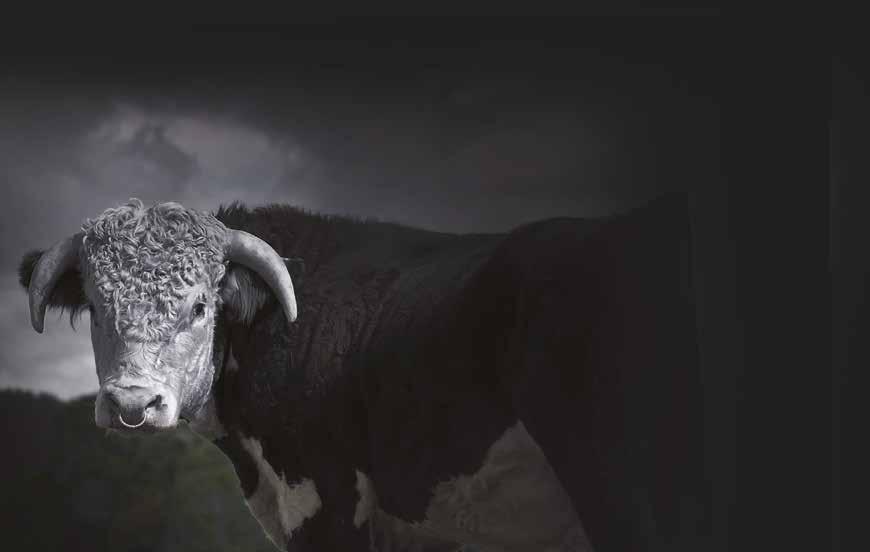
ON THE COVER Rissington farmer Ben Absolom surveys the damage from Cyclone Gabrielle.
Photograph by Richard Brimer Design by Julian Pettitt
This publication is printed on paper made from pulp that is environmentally certified, and from renewable and sustainable sources using vegetable-based inks. It is Elemental Chlorine Free (ECF) and manufactured under strict ISO 14001 Environmental Management Systems (EMS). The plastic wrap is 100% recyclable in the New Zealand soft plastic recycling scheme.
This publication has been printed by Webstar, a Toitū enviromark diamond certified company and a winner of a Green Ribbon Award “Minimising our Waste”.
The information contained in this publication is given in good faith and has been derived from sources perceived to be reliable and accurate. Whilst every effort is made to ensure the accuracy and correctness of the information, Farmlands gives no warranties, express or implied, regarding the information nor does it accept any liability for any opinion or information (including the accuracy or completeness thereof) or for any consequences flowing from its use. The information and views expressed in this publication are not necessarily the views or opinion of Farmlands, its editorial contributors, freelancers, associates or information providers. Independent advice is recommended before acting on information or suggestions contained herein. Readers who rely on this information do so at their own risk. Reference to any specific commercial product, process, or service whether by trade name, trademark, manufacture, or otherwise does not constitute an endorsement or recommendation by Farmlands. No part of this publication may be reproduced in any form without the prior written permission of the publisher. Prices and offers apply only in the time-period stated on the front cover of this publication and while stocks last. Not all products are available at all Farmlands stores. All prices include GST unless otherwise stated.
Bang for your buck
Welcome to the winter edition of Farmlander magazine. Designed to give an insight to what’s going on in the lives of our customers and how to maintain profitability, Farmlander is also a guide for how to live a better rural life.
This issue we focus extensively on the response to and recovery from Cyclone Gabrielle, meeting the people who’ve worked tirelessly to help our extended whānau get back on their feet. We also look to the future with new ways of working, from regenerative agriculture and diversifying income to bringing a high-performance athlete mindset to the shearing shed.
“Tightening our purse-strings” is also a theme you’ll find running through the mag. It’s a phrase you’re sure to hear up and down the country, whether you’re a townie or on thousands of hectares. We’re all trying to work out how to get the best bang for our buck and Farmlands is on that mission too, to provide even better value to our customers and shareholders. We go into detail on that, in a continuation of our Supply Chain series.
We hope you enjoy the latest issue. It’s our best yet and we’d love to hear your thoughts on what you read, or what you’d like to see more of.
Have a great season.
Ian & Deborah
Got something to share with the team at Farmlander ?
Email farmlander@farmlands.co.nz
Keep up-to-date with the latest news from across the co-operative via our website and social media. @farmlandsnz @farmlandsnz
Farmlands Co-operative Society Limited
Ian Turner and Deborah Allan.
FROM TANYA
Tēnā koutou katoa,
I hope you all enjoy the Winter 2023 Farmlander – there’s probably no better time of year to sit down with a hot drink and a good magazine.
Firstly, I’d like to call out to all those impacted by Cyclone Gabrielle and recognise the tremendous levels of resilience you are showing. This sudden and violent weather event will affect farmers and growers from Northland, through Hawke’s Bay and across the East Coast for a long time. As you repair your land and rebuild your businesses, I commit that we will continue to support you and work with you during the long journey ahead.
When the cyclone hit, the Farmlands Board and Executive were down in Southland meeting with customers. We spent a lot of time checking the news to try and understand the level of impact. At the time we felt a long way away and, at the same time, immediately realised Farmlands had the reach, scale and power as your co-op to help – especially with passionate, supportive shareholders. I’d like to thank every Farmlands customer who has contributed to our support efforts in recent months.
The reality is that weather events, such as Cyclone Gabrielle, are likely to become more common across our country. As an industry, we need to work closely with Government to be better prepared. Our commitment is to continue to play our part in ensuring the supply of your critical farm inputs when these situations arise. We have just employed Caleb Nicolson as our new Chief Supply Chain Officer, who will have a significant role to play in ensuring we deliver on this for you.
In my last introduction, I talked to the economic headwinds our industry is facing, and unfortunately, these have become stronger since then. We know that agriculture is a cyclical industry, with ups and downs. Interest rates have continued upwards, most sector inputs still face inflationary pressure and commodity prices are tracking down. As we all expect, farmers and growers are cutting spending to protect their businesses, managing costs
closely until economic conditions improve. This is the right thing to do – we understand it and feel it too as we manage our business to respond to these pressures. These are tough times and we’re facing them alongside you.
We’ve set a business plan for the coming year to navigate this period effectively, while continuing to provide the most value we can back to our customers. We will be more efficient in supplying the essential rural supplies you all need, through our supply chain transformation programme and the continued introduction of our consistent product range. We’ll stop some short-term investments in our business, and only make those that are essential to set us up for future success. Just like you, we will be reducing our costs wherever we can to keep a strong cashflow and EBITDA position, ensuring we can deliver on our aim to provide value for our customers and shareholders.
Most importantly, we will continue to focus on growing our share of the rural supplies market, by delivering on being your co-op – that means being the best buying group we can be for all our customers. This is about the best pricing, high stock availability, great service, being easy to buy from and providing the best technical advice.
Farmlands has been here for you through difficult economic times in the past, and we will be here for you through this period as well. Working together is how we win together, in good times and challenging ones.
Nga - manaakitanga (With
best wishes)
WINTER Inside our issue
4 From the CEO
Tanya Houghton reflects on the Cyclone Gabrielle recovery effort, and how Farmlands is helping customers manage economic headwinds and high input costs.
18 Clippings News, views and reviews from across the business.
26 Farewelling Dr Warren Parker
Retiring Farmlands director reflects on his time on the Board, and looks at what lies ahead for the co-operative.
8 Cyclone relief and recovery
In this special feature, we look at the devastation caused by Cyclone Gabrielle, and the role Farmlands played in supporting rural communities through the crisis.
PHOTO: FRANCINE BOER
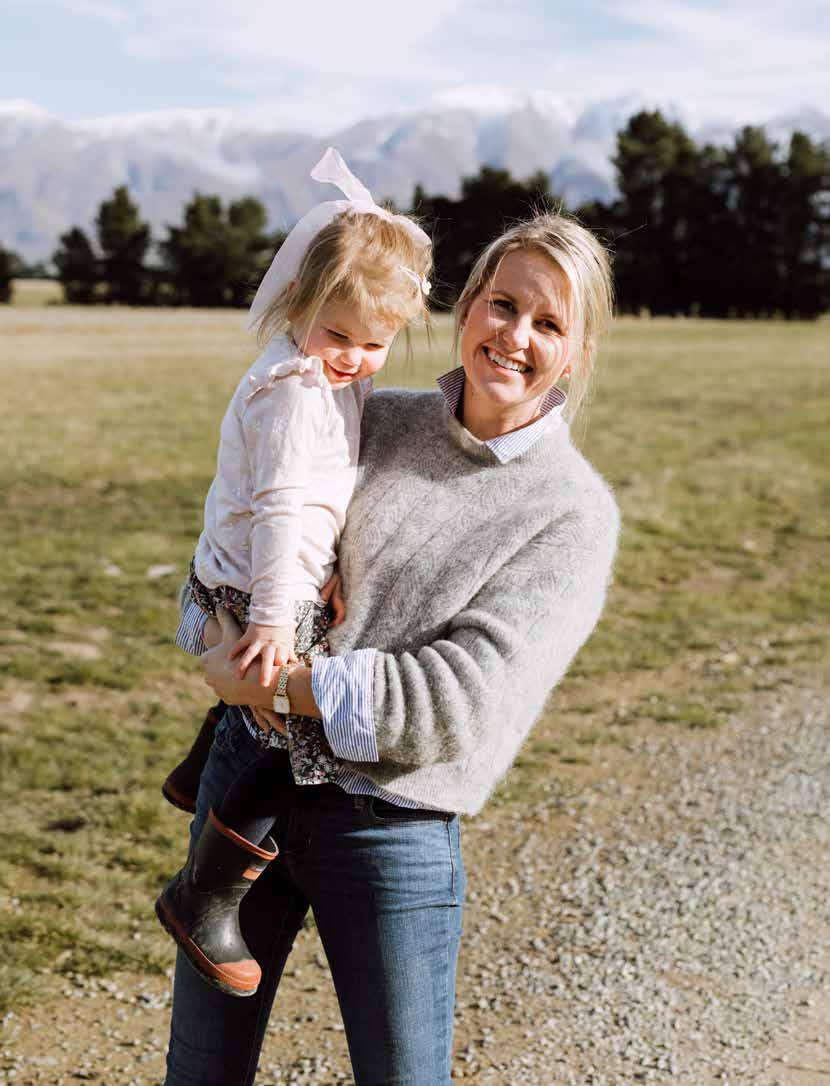
Bex Hayman, founder of jewellery brand Whistle & Pop, with her daughter –
the Land The Big Picture
We meet a South Island family that has transformed its farm with a ‘regenerative’ approach focusing on soil health.
How a wedding gift inspired entrepreneur and farmer’s wife Bex Hayman to start a rural-themed jewellery business.
With more Kiwis growing their own vegetables, this handy guide will help you get started on your backyard vege patch.
Lay
Assessing cyclone impact
We look at the economic impact of Cyclone Gabrielle on the horticulture sector and meet some of the growers affected.
dairy costs
As dairy input costs rise, we speak to experts and farmers about strategies to manage inflation.
Range
Learn about how Farmlands is overhauling its purchasing and inventory systems to deliver better deals for customers.
New way to pay
Farmlands teams up with NZ Safety Blackwoods and fintech company Centrapay on a new payment solution.
Embracing sustainability
Farmlands takes the lead on sustainability with several new initiatives.
Fuel
Fern Fuel CEO Bryan Jamison gives an update on fuel market trends affecting the rural sector.
word: Rob Hewett
Farmlands Board Chair Rob Hewett discusses how the new co-op business model will support shareholders into the future.
Now that you have sorted your vege patch (see page 46), Dr Rob gives you a step-by-step guide to raising backyard chickens.
Movement coach Laura Hancock on why farmers should think of themselves as ‘elite athletes’ when it comes to looking after their bodies.
Patsy Bass, founder of Reefton Distilling Co., speaks about the company’s journey and growth plans.
Brought to you by Century Farms, we explore the origins of one of New Zealand’s iconic centennial farms.
Farmlands fronts up with CYCLONE SUPPORT
Cyclone Gabrielle caused devastation across much of the North Island in mid-February. Described by Prime Minister Chris Hipkins as the worst storm to hit New Zealand this century, the cyclone hit rural areas particularly hard. We look at the recovery effort, and how Farmlands supported its staff, shareholders and the wider rural community during the crisis.
WORDS BY NIKO KLOETEN RICHARD BRIMER
When Farmlands shareholder John Chittick woke up on Tuesday, February 14, he thought Cyclone Gabrielle might have blown over. John, who owns helicopter services provider HeliAg Hawke’s Bay, lives on a lifestyle block near Hastings with his wife Lisa. He had grown increasingly nervous watching reports of heavy damage, as the storm worked its way down the country over the previous couple of days.
First it hit Northland, causing widespread flooding and taking out State Highway 1 through the Brynderwyns. Although Auckland initially looked to be in the firing line, the cyclone turned eastward, largely sparing the City of Sails, which was still recovering from a record-breaking flood only a few weeks earlier. Other coastal areas, including Coromandel and Gisborne, were not so lucky.
But perhaps the hardest hit area of all was Hawke’s Bay. “It was meant
to hit the night before and we woke up the next morning and we still had power, still had internet,” John says. “Then at about 10am we lost power, wifi, everything, and then no-one could ring us. We didn’t have any idea really how big it was until the following day, because we couldn’t contact anyone.”
Although John describes the damage to their property as “minimal” compared to what others suffered, the Chitticks were cut off from the outside world for a couple of days by a swollen river at the bottom of their property. It was only once they got out that they could see the extent of the devastation elsewhere, he says. “From what the weather was saying, it looked like Gisborne was going to get smashed and we would get the side of it, but we ended up getting smashed.”
Over 70,000 residents in the Hawke’s Bay region were left without vital services including power,
roading, wastewater, drinking water, internet, and cellphone networks.
For those in isolated rural areas, a helicopter was the only way to get supplies in. “The phone started ringing and it was really for food, water, generators, that sort of thing,” John says. “It was basically emergency supplies, feed supplies, getting food to people and medication, just the little things like heart medication, high blood pressure pills that people really needed.”
Fortunately, John’s helicopter base was undamaged, and road access from Hastings was maintained, enabling people in that area to get there with supplies. “We were honestly just coming and going all day. People like Farmlands would come out and drop things off and we would just say ‘put it in this spot and name it and it will get to them’. We would get it to them the same day, but there was so much stuff turning up like donations of timber for fencing. People were really trying to help out.”
BECS EDWARDS CHIEF PEOPLE OFFICER
Some of those cut off from the outside world by the cyclone were Farmlands shareholders and Farmlands staff, who were among the nearly 7,000 people listed as ‘unaccounted for’ directly after the storm. Farmlands Chief People Officer Becs Edwards says due to communication being cut off, it took a few days to realise just how badly some Farmlands staff had been affected in areas such as Hawke’s Bay.
“As soon as we knew, there was no question about the support that was going to go to our people,” she says. “Our teams were on the phones trying to contact people who were unaccounted for, texting to reach next of kin, trying to get some confirmation from someone that they were okay.”
When they couldn’t get hold of the Wairoa store, they enlisted the help of the brother of a local regional manager, who happened to be driving through the area with a satellite phone and a big four-wheel-drive vehicle, to make contact with the store. Although all the staff were safe and well, there were some whose lives had been upended by the storm. “Around 150 team members were considered ‘moderately impacted’. That’s more than 10 percent of the 1,300 employees we have nationwide. Four were ‘severely impacted’, including two who lost everything,” Becs says.
“We made the decision very quickly that financial support was required. Everyone impacted got a $250 payment, and we also set up the Helping Hands fund, which allowed our staff to contribute some of their wages to help their fellow team members. This raised nearly $10,000
“Our teams were on the phones trying to contact people who were unaccounted for, texting to reach next of kin, trying to get some confirmation from someone that they were okay.”
with support and positive messages coming in from across the country.”
With communication finally restored in most areas by the weekend following Cyclone Gabrielle, one need became clear: with Eftpos down, affected Farmlands stores were running out of change. On the Sunday, as a team of senior executives prepared to fly up to visit Napier and Gisborne, staff from the support office in Christchurch rushed around ATMs and retailers in the garden city withdrawing as much cash as they
could to send up on the flight. They managed to take up around $12,000 with them in their luggage.
Another need was fresh water, with water supplies taken out by the storm in several areas. Through mutual contacts, Farmlands managed to get hold of Luke Firmin from Waikato Water, based in Hamilton. He dropped everything to drive to Wairoa and park at the store for a week, providing desperatelyneeded water supplies for local residents. Luke sent another tanker over to Gisborne to do the same.
JESS STRANGE CHIEF CUSTOMER OFFICER
Wairoa and Gisborne were two of the Farmlands stores worst affected by Cyclone Gabrielle. Napier and Hastings both suffered minor damage while Whakatu, a specialist horticulture supplies store ten minutes out of Hastings, suffered severe damage and was red-stickered. “Flooding got into the back dock area and because it is chemicals, they have to be stored at ground level,” says Jess Strange, Farmlands Chief Customer Officer. “The water came in and couldn’t get out.”
Jess says there was a “really inspiring story” in Wairoa, where the hard work of staff saved potentially millions of dollars’ worth of product. “The riverbanks broke and staff stayed until the last minute sandbagging and lifting product up, literally leaving as the floodwaters were raging in the carpark. Due to their amazing efforts, they saved the stock. A lot of our products are high-value, especially when you look at things like drench and chemicals and even fencing.” They were assisted by a local Farmlands shareholder, who rescued the forklift on the back of his trailer before the water could damage it.
Jess says the priority for Farmlands in the aftermath of the cyclone was getting supplies to team members. “We flew choppers into Gisborne and Wairoa with food and medical supplies for team members but also product for stores. We also did a convoy by ute taking product into Hasting, Napier and Waipukurau. We continued to do that for probably the week afterwards, with a daily run into those regions.”
Jess says they could get product in reasonably quickly to these stores through normal means because roads from the south were fine, but it was a lot harder to get product into Gisborne and Wairoa. “It was a good couple of weeks before we could get first trucks through with anything substantive.”
Although the executive team were quick to get on the ground and visit affected stores, staying up there for a couple of days, Jess says they didn’t stay longer because they didn’t want to become a distraction. “The local teams are super capable, and they are quite resilient, adept people in their own right. They need to focus on their customers and focus on themselves.”
What they did see while they were up there left a lasting memory. Jess says when she first visited the Napier store, customers were coming in covered head to toe in mud. “There was just mud everywhere. Because we’re
it launched the Post Your Support campaign, which has raised and distributed nearly $2 million to 440 Farmlands shareholders. Each grant from the Post Your Support fund will help repair or replace damaged fences and growing infrastructure.
Farmlands invested significant internal resources into Post Your Support. It did not charge for any administration costs, ensuring all the funds delivered were quickly distributed to those farmers and growers impacted.
The campaign was kickstarted with $380,000 from Farmlands’ Cyclone Response Fund, which was set up quickly following the devastation caused by Gabrielle. Altogether the fund raised around $650,000, with other donations including $50,000 to the East Coast Rural Support Trust and $25,000 to the Northland Rural Support Trust to
“The riverbanks broke and staff stayed until the last minute sandbagging and lifting product up, literally leaving as the floodwaters were raging in the carpark.”
a co-op and customer-owned, when customers come in, they share their grief and pain. On that first morning I saw at least three customers crying. It’s really hard on our team because they have their own issues at home, but they want to support their customers for whom they feel passionate. They take a lot of their pain on board.”
Jess saw this first-hand, when she walked into the Hastings store and received a hug from a staff member she barely knew. “We sat in his ute for about an hour, and he said, “I’ve just been talking to my biggest customer and they’ve lost everything”. Because of the way I’d driven from Napier to Hastings I hadn’t driven through the most affected area. He took me to visit that customer and it was devastating.”
Farmlands was quick to support its shareholders and the wider rural community. In partnership with Federated Farmers and Stuff,
use for mental health and wellbeing.
Farmlands also allocated a pool of $100,000 to the five stores that had been the most impacted.
Another way Farmlands supported hard-hit areas was by offering exclusive pricing to customers in Hawke's Bay and Gisborne regions on key infrastructure products – thanks to the support of Farmlands suppliers.
“Farmlands has an incredibly strong connection with these areas, and particularly Hawke’s Bay. The Esk Valley (one of the hardest-hit regions) was where a group of farmers got together and created the beginnings of our co-op over 60 years ago,” says Tanya Houghton, CEO of Farmlands.
“Words are simply inadequate to express the scale of the devastation in the region and the hardship being felt by our farmers, growers and rural communities. I’ve witnessed the bravery and resilience being shown
Hawke's Bay farmer Ben Absolom lost around 8.5km of fencing from Cyclone Gabrielle.
across the region and the heartwarming community spirit in my time spent there.”
One of the Post Your Support recipients, Ben Absolom, is part of a fourth-generation cattle farming family at Rissington Station, about 30km from Napier. Their 1,400ha farm suffered severe damage from the storm, with an estimated 8.5km of fencing destroyed and around 60ha of paddocks covered with between half a metre and two metres of silt. Ben says he is grateful for the Post Your Support campaign, which helped start the massive project of rebuilding their farm’s fencing.
“I’m happy to talk to anyone about it because it makes me feel good that there are people out there who want to get money where it needs to go,” he says. “It helps with mental wellbeing because we are able to get stuff done. Farmlands were the first people to front up within a very short space of time and give us money – within ten days they said my application had been accepted; we’ve now got $5,000 worth of fencing to get started with. Little things can make a massive difference to people in the fight.”
Ben says the farm has an “effective area” of about 1,000ha, with roughly 400ha of forestry and wetlands. The damage to the property makes it look like “a bomb has gone off”, he says. “We have a bit of everything - steeper stuff, easy rolling and flat country. Anything steep and along the river has been hammered.
The main issues have been silt and access. Most bridges and culverts got hammered, so we are trying to get those in place before winter because if you lose those, you lose time.”
With the farm already affected by staff shortages, Ben says “tanks are running low” dealing with the aftermath of Cyclone Gabrielle. “We are hoping we have a kind winter to try and get through to next year. We have 60ha that we have just put in a box and said: ‘we will worry about that next summer’. We are sitting and waiting until we get a steer on what the Regional Council is going to do.”
The speed of Post Your Support was in stark contrast to some aspects of the official response from councils and government, according to Ben. He says the decision-making process has been too slow, leaving farmers facing uncertainty. “Any decision is better than no decision, because you can have a discussion and a debate about it. Some people will be happy and some won’t, but at least people will be able to move forward.”
Helping customers apply for Post Your Support grants was a big part of the job when Jeni Wadsworth joined the Napier Farmlands team as a Technical Field Officer in late February, less than a fortnight after Cyclone Gabrielle hit. “Over 100 shareholders in my area have received a grant,” she says. “That’s where my involvement has been, getting orders in and getting fencing supplies under Post Your Support.”
Jeni, who has had an extensive career as a farm environmental consultant, admits that her introduction to Farmlands has been somewhat of a baptism by cyclone. The territory she covers includes some of the worst-hit areas like Patoka and the Esk Valley, making it hard to get out and about in her early days in the role. “Getting out on farm in the TFO role has been massively affected because when I started you couldn’t get to any of them. I haven’t been to Tutira at all, and I had a customer come in from Putorino who hadn’t been out since the cyclone at all. He took the risk of driving through the river to get there.”
One of the big ongoing issues in cyclone-hit areas is animal welfare, Jeni says. “There is an animal welfare concern in the sense there are still farms that are higher stocked than they should be, because of the lack of transportation for the animals. They haven’t been able to get them away. I don’t know how some of these farmers have been able to get the ram out, so the carry-on effect for next year will be huge.”
Another concern emerging, as the storm damage is slowly repaired, is the mental toll on those affected by the cyclone. Jeni says it is important to keep an eye out for the wellbeing of friends, family and others in the community. “I’ve been in this type of role a number of years, so I look out for it,” she says.
“People are still probably overwhelmed with the enormity of it all, but in a way they are upbeat. I’d say in six to twelve months’ time it could be a very different scenario. Also, the cyclone has hit in a time of year when the follow-on effect of it is huge. Down the track we are going to have to keep an eye on people and be very supportive. The one positive from the cyclone is that it has brought communities together, brought back some of that old-fashioned community spirit.”
The spring issue of Farmlander will have more about how farmers and growers are 'building back better' following Cyclone Gabrielle.
Jeni Wadsworth, Technical Field Officer.
/
At Farmside, we’ve been been delivering wireless broadband solutions to rural New Zealand for the last eleven years. And now, with the launch of our competitive Endless Mobile plans, its never been easier to stay connected in the places that matter to you.
Give our Timaru-based team a call today to find out more about our broadband and mobile offers.
/ month
WORKING TOGETHER AND
USING OUR POWER TO MAKE A DIFFERENCE
Since 2006 Meridian has partnered with Farmlands – becoming an exclusive energy partner last year – and we’re thrilled to keep it going, to benefit Kiwis like you.
YOUR EV JOURNEY, MADE EASY
Charge up your EV at Farmlands
At Meridian, electric vehicles get us pretty charged up. Together with Farmlands, we're passionate about the positive impact vehicle electrification has on building a more sustainable future for New Zealand.
Meridian has installed two Zero-AC chargers at Farmlands Invercargill, to help make your electric vehicle journey easier. These chargers are publicly available, and each charger has dual sockets so they can charge two vehicles at the same time.
Rebecca Curgenven, Meridian’s Agri and Medium Business Sales Lead, says: “It’s exciting to be working with Farmlands on their decarbonisation journey, and what better way to kick that off than with installing EV chargers at the Invercargill store”.
Farmlands has a rich history of supporting and helping farmers and growers prosper and is committed to its part in helping decarbonise Aotearoa, protect our precious water and soils, and increase biodiversity.
“At Farmlands, we’re keen to not only reduce our own environmental footprint, but those of our customers too. These new EV chargers are just one of the ways our partnership with Meridian is delivering positive results for our customers, shareholders and the planet too,” says Scott Brown, Farmlands GM Strategy and Business Performance.
Stay in the know, about Zero
Zero is Meridian’s EV charging network – expanding to over 500 charging points – available to EV drivers nationwide, in the places you work and play. To get started, download the Zero App and register so you’re ready to charge when you arrive.
Cheaper charging
for EV drivers
Meridian’s EV Plan offers you cheaper charging rates from 9pm to 7am, PLUS get an AC charging cable or $200 credit*. Find out more here meridianenergy.co.nz/for-home/ev-plan
Energy you can feel good about
All the energy Meridian generates comes from 100% renewable sources – wind, water and sun. We’re a power company who believes in doing the best we can for people and the planet. We believe it’s the only way forward for the future of our planet and we’re in it for the long haul. Working with Farmlands, we’re another step closer on this journey – we hope you join us for the ride.
Switch to Meridian and pay your electricity bill through your Farmlands account. And when you sign up to our five year Fixed Rate Plan, you'll get an exclusive offer we’re sure you won’t want to miss.* Get in touch with our Agribusiness experts today on 0800 496 777 or visit meridian.co.nz/ farmlands *Terms and conditions and eligibility criteria apply
CLIPPINGS
Industry news and development updates
TRAINING
Technical trio
join AgronoME programme
Farmlands Co-operative has launched AgronoME, a new twelve-month development programme for experienced TFOs to advance their careers and move towards an agronomist role within Farmlands. The first-ever ‘AgronoME’ cadets are Gemma Dorotich from Culverden, Wazza Pope from Hāwera and Gerrard Pile from Oamaru.
“These three experienced Technical Field Officers are about to embark on a 12-month journey which will see them taking part in hands-on workshops, in-field coaching and supplier accreditation, all while partnered with an experienced Farmlands agronomist,” says Nova Knight, Farmlands Head of Technical Training.
“After successfully completing the programme, these three will graduate as Farmlands’ newest agronomists.”
Monthly coaching, technical talks and workshops await the cadets, along with assessments and supplier accreditation. Here's what our cadets had to say:
• “It's so cool that Farmlands has put together a career advancement program for those who want to take steps into the agronomy field. I have the ambition to grow, and I wanted to specialise. I’m looking forward to learning. No matter who you are or what you do, there are always knowledge gaps, so it’s about filling them and learning from others."
• “This program will allow me to use my knowledge in crop and plant physiology, a certification achieved through Lincoln, and it feels like I'm giving back to Farmlands. We’ll each be bringing different skills. It’s not just about agronomy knowledge; it's about developing your people skills, too."
• “This type of opportunity doesn't come around often, and if you don’t take it when it arises, it may never happen again. I’m looking forward to gaining new skills and working on how the information can be shared with the wider team.”
We will have an update on the AgronoME program in the spring issue of Farmlander
Rural Contractors and Farmlands join forces
Farmlands has come on board as a major sponsor of Rural Contractors NZ, which in turn has become a Farmlands Card Partner. Gavin Foulsham, General Manager – Card & Partnerships for Farmlands, says the co-op’s primary role is to support farmers and growers through their collective buying power.
“Contractors working on farms is a multi-billion dollar industry in its own right and through our partnership with RCNZ we can support farmers and growers with another significant input in rural productivity and profitability.”
“RCNZ being a Farmlands Card partner is a unique way we can bring our sponsorship to life. We are also keen to work with rural contractors to see more of them become Card Partners – as there are significant benefits to these contractors and their customers.”
Card Partners are listed on Farmlands online Card Partner Directory, making it easy for Farmlands shareholders to find a local contractor and work with them.
An added benefit for both the shareholder and partner is the information that Farmlands supply in their monthly statement and remittances, which are all IRDapproved and can be loaded straight into accounting systems like Xero and MYOB if needed.
RCNZ CEO Andrew Olsen, who has led the engagement with Farmlands, says the new relationship is a win-win for his members.
“Contractors get the benefits both ways – when they use their Cards to buy a wide range of goods and services and when they’re paid by Farmlands, which means not having to worry about chasing unpaid invoices.” Andrew Olsen.
Meet the trio of new members of our whanau
Farmlands recently welcomed three new members to its leadership team: Blair Robinson joined us as Chief Sales Officer, Gavin Foulsham has taken over the role of General Manager – Card & Partnerships, and Chris Binns is the new Head of Horticulture Sales and Strategy. Niko Kloeten spoke to Blair, Gavin and Chris about their roles, the experience they bring to Farmlands and how they will add value for shareholders.
What does your role at Farmlands involve?
Blair – I’m in charge of the wider sales team, so everything that faces our core farmer/grower customer, such as advice on agronomy and nutrition as well as day-to-day sales. We work closely with the retail team to provide a seamless service for customers, and with the merchandise team to make sure we have the right products at the right price for shareholders.
Gavin – I lead the team that manages the relationships with our Card and Strategic partners. The focus of our
team is to make sure that if a farmer or grower needs something for their property or business – and we don’t stock it in-store - we can find a Card Partner that does, and that it’s a quality product at a good price.
Chris – My role is leading the horticulture team within Farmlands and looking at what we have in that sector, where the deficiencies are (if any) and how to go about building that into a successful, sustainable horticulture business for the future. I work closely with Graeme Lee, Team Leader Horticulture Nothern, and will also be leaning on the technical specialists.
How does your role add value for shareholders?
Blair – Firstly, to make sure they get the best deal possible, and get back to that core value of lowering farmgate costs; secondly, providing the right advice at the right time, to make sure they have the right information and know what’s available to improve productivity and therefore profitability.
Gavin – If I get my job right the shareholder has lower input costs, the partner gets business, and the co-op can transact. If a farmer needs a water pump that we don’t stock in-store, but there’s a local pump supplier, they can go along with their Farmlands Card and grab it and the cost is put back on their Farmlands statement.
Chris – First and foremost, the value will be in streamlining our offering, growing our technical expertise and our supply sureties. At the moment we have some regions that are doing very well with our offering to the shareholder, such as the Bay of Plenty, which gives us a massive base to build from and follow the lead in other regions, where we know there is room for growth.
What is your career experience prior to this role?
Blair – I am brand-new to Farmlands, but I have been working primarily in sales and marketing over the last 15-20 years, with the last 10 in the primary sector. I headed up the sales team for
Gavin Foulsham.
Blair Robinson.
OUR TEAM
Villa Maria for five years, then headed up global sales for Sanford for the last five years prior to joining Farmlands.
Gavin – I spent about 15 years in healthcare, then in 2009 I moved to Hawke’s Bay to take on the GM Card role with Farmlands. I was here for about four years, then from there I was CEO of a red meat genetics company, breeding rams, bulls and stags for meat production and meat quality. Prior to coming back here I spent five years running a tannery in Hawke’s Bay.
Chris – I’ve always been involved in horticulture, right from when I grew up on an apple orchard in Mapua. My career started out 26 years ago at CRT (Combined Rural Traders) supporting the Technical Advisors in the field, so coming to Farmlands feels like a bit of a homecoming. I spent a couple of years at Wrightson, then the last 22 years I have been with Horticentre.
What are you looking to achieve for the co-operative, and shareholders?
Blair – We need to get back to having the core farmer/grower at the heart of our business and making sure we’re true to the original value proposition of the co-op, which is to benefit the shareholder and get lower farmgate costs. What I am looking to achieve
is a much greater share of that farming industry, which then scales the co-operative up and benefits both the co-operative entity and the shareholders with better commercials for the longer term.
Gavin – It’s bloody good being able to save shareholders some money, make their businesses more profitable and make the co-op a bit more profitable as well, because we’re able to get some great deals in place that make a difference for them. We’re basically giving our shareholders corporate buying privileges at some of these big retailers. If we can do that and they can save some money and then spend that money on other things they need, or it just helps their profitability, then that’s all good.
Chris – Hopefully I can help build a horticulture business for Farmlands that is sustainable long-term and takes this business into the future.
I want to give our shareholders confidence that the support they get from Farmlands to help them grow, will be of the highest quality, from technical support right through to product supply and of course price. Farmlands is in a unique position to have an offering for our customers that covers absolutely everything they need to grow their crop.
OUR TEAM Farmlands welcomes new Chief Supply Chain Officer
Farmlands has also welcomed Caleb Nicolson as its new Chief Supply Chain Officer. He is based in Christchurch and joined on Monday 3 July.
Caleb has over 20 years’ experience in supply chain and retail leadership, including with major retail brands such as the Warehouse and Kathmandu. For the last three years, he’s been New Zealand General Manager for business transformation consultancy, TMX. He’s worked closely with leadership teams in businesses from across Asia/ Pacific to support supplychain transformation, to better support customers and business outcomes.
Caleb knows Farmlands well having worked with us in his role at TMX. He’s very excited about and committed to the Paragon programme and what it means to be the buying group for New Zealand farmers and growers.
“This is an ideal time for someone with Caleb's expertise to be joining us. Having him lead our supply chain team will enable Farmlands to be the most efficient and cost-effective buying group we can be,” Farmlands CEO Tanya Houghton says. “His focus is on improving our cost of operation and supporting the delivery of Paragon, our supply chain and buying transformation.”
Chris Binns.
EVENTS WRAP
Century Farms
Farmlands is the Foundation Sponsor of the New Zealand Century Farm and Station Awards. The awards were held Saturday 20th May at Simpson Park, Lawrence.
The Century Farm Awards are about celebrating families who have worked the land for over 100 years. The stories are fascinating and sometimes harrowing. It is a night for the people who invested their blood, sweat and tears in an unprofitable bit of land and turned it into something that has sustained families for generations.
These awards are about the ancestors that scrimped and saved to become farmers and persevered to make ends meet. They are about the succession planning, the conversions, the successes and fighting through the difficult times. Through drought and flood, through low prices and boom times, these families have been ever-present in the fabric of our rural history.
Invited guests at the event included:
• Bryan Cadogan, Mayor of Clutha District
• Hon Jo Luxton, Associate Minister of Agriculture.
EVENTS WRAP
Over the Fence
Farmlands organised a community event designed to get farmers and growers off the farm, catch up with friends, and hear from Harold Hillman, who talked about “Resilience and Wellness”.
On the night there were key industry people in the room to provide guests with the opportunity to connect and talk about Cyclone Gabrielle, with a focus on the future. We wanted to ensure our farmers and growers can get back to doing what they do best – producing and growing products that are the envy of the rest of the world.
The event was held on Tuesday 9th May at Napier War Memorial Centre. It featured representatives from the MPI, EQC, Rural Support Trust, Fencing Contractors Association, HORT NZ, Beef and Lamb, Balance, Arable Research, FERN, Property Brokers, Ravensdown Foundation of Arable Research, Wool Works, Hawkes Bay Fruit Growers Association, Hawkes Bay Regional Recovery, and Napier Council.
Over the Fence was jointly sponsored by Farmlands, FMG, and Federated Farmers, and the meat was supplied by First Light Foods and Silver Fern Farms.
REVAMPED AWARD
The Tom Cranswick Memorial Award is back for 2023 and will be helping one tertiary student, with a grant of $10,000 towards their ongoing studies within the primary sector. The award is in honour of Tom Cranswick, a founding Farmlands Director and 20-Year Chairman, whose passion and dedication helped establish Farmlands.
The award is open to an under-25 age bracket, with another criteria being a relationship with Farmlands, either through employment, shareholding or being the child of a shareholder, like Tim Sheed, a recipient from 2021. “My family connection to Farmlands is well established, with my parents being shareholders for over 20 years. (Tom Cranswick) is a prestigious award and I felt very fortunate to be named as one of the recipients. The grant helped alleviate some of the financial burdens associated with tertiary studies and
allowed me to fully embrace the learning opportunities offered at Lincoln” Tim says.
Grace Moscrip, a 2020 recipient, has also made the most of her grant. “I’m currently studying a Master of Management in Agribusiness after completing my Bachelor of Agriculture (science) at Lincoln University. The Tom Cranswick Award has been incredibly influential in my studies, providing a network of support and financial assistance. I thoroughly enjoyed meeting the fellow scholars and being able to network with the team from Farmlands over the years.
“The financial assistance allowed me to focus on achieving my academic goals, where I was awarded the Top Academic Student for the Bachelor of Agricultural Science at Lincoln University in my second year. A massive thank-you to the team at Farmlands for supporting me” Grace says.
Grace Moscrip.
SHOP ONLINE. ANYTIME.
Use your Farmlands Card online at selected Card Partners and access exclusive savings and rebates.
Scan the QR code to see where you can shop online with your Farmlands Card
Farmlands farewells
Dr. Warren Parker is retiring from the Farmlands Board of Directors after more than five years overseeing positive change at the co-operative.
WORDS BY KATE BAILEY GRAEME MURRAY
How did you start your Board journey/career?
During my career as a Chief Executive in the Crown Research Institutes, I was involved in governance of technology-related ventures, agri-education and our local Bay of Plenty Council-controlled organisation Quayside Holdings.
What do you think is the main difference between serving on a board contributing in that way and being like a manager of a business or CEO?
The essence of governance is to work with the Executive to set the direction of the co-operative, so that it'll be successful over the long term. The second aspect is to ensure we appoint the right CEO. During my tenure, I was Chair of the People Committee and we recruited Tanya, who was the first woman CEO of a major co-operative in New Zealand.
Being involved in decisions like that would make those types of roles quite rewarding?
Yes. I think one of the things is you can contribute. It really is a great opportunity to contribute your knowledge and expertise to get a better outcome for all co-op members.
What kind of people make the best board members?
You've got to have a deep, abiding belief in the co-operative and its purpose. In my case, my father-inlaw was one of the early founding members of Farmlands.
The whole idea of farmers operating a co-operative – as a buying group – is to get the best product prices, on average, for farmers, for its members. Second is to provide services with those products so that farmers can operate more effectively and improve their profitability. So important for people to have a clear understanding of what's most important about the work that the co-op does and understand how to make that happen in the real world? Exactly – a co-operative, while it has many features similar to a corporate, it has a membership, and meeting the needs and understanding the needs of the members is very important. Equally important, in terms of governance, is looking over the horizon, and preparing for future needs.
What are the most important things on the horizon ahead for people getting involved in rural governance? The reality of climate change and changes in weather patterns are significant; our production systems are very dependent on weather and changing weather changes the ability to produce products, as we've seen through extreme weather events, droughts, wind storms. The second big issue is water; the need to manage farms in a way that has less direct impact on water, whether through sediment or nutrients. But also increase the use of water storage in a way that buffers the effects of drought.
Do you think the next generation is interested in governance opportunities?
Many people aspire to governance – just look at the success of the ‘To The Core’ programme. There's always been an excellent crop of candidates that are interested in governance careers and in time we expect some of those participants will put their hand up. In fact in this election cycle, hopefully some of those that have been through the To The Core programme will do just that.
If you were forced to be a recruitment agency for people on the board, what would you say?
The opportunity to work with management to help shape the future direction of the co-op so that it continues to succeed and meet its members needs, is a real privilege. The second point of governance is that you can bring the voice of members to the table. That's one of the things that I'm conscious of now that I'm less directly involved and living in a more urban context, is that the farmer voice around the practicalities of what is needed on-farm, is an important dimension of governance.
Would it be possible for someone who hasn’t got a strong farming background but has other leadership skills or related expertise, to make a contribution?
Absolutely. In some ways, I was not a practicing farmer, but I was very heavily involved in Farm Management Research, agricultural systems, teaching graduates when I was at Massey University. Many of my former students are now CEOs and farmers in their own right and some sit around the board table with you.
We’re particularly interested at this juncture of Farmlands' development in people who have backgrounds in or knowledge of emergent sectors like horticulture, Māori agribusiness and integrated land use, such as forestry and farming together.
If an organisation had capable management, CEO, executives and other staff but not very good board,
do you think it's possible for that organisation to succeed?
It's hard to make a silk purse out of a sow’s ear! Good governance enables excellent management. I’ve always viewed governance and management working together in a complementary way. The ability of the governors to bring alternative perspectives, different points of view, accountability and constructively challenge, can help a good management team be even better.
Is it important for boards to make a connection with the workers on the ground?
Yes, I think visibility and approachability of directors is important, but the big challenge in doing that is to be accessible but equally don't get confounded, conflicted and mixed up in operational matters.
Are there any unique challenges or opportunities for a business where the customers are the shareholders?
One of the big challenges has been separating being a member and being a governor. You need to make sure you maintain the separation of governance and management, but this doesn't mean that you don't understand what's going on at individual stores, where the issues are and that you can’t meet with staff, and talk about health and safety, product service, all of those things are a director’s duty.
When you come onto the Board of Farmlands, you have the opportunity to sit with experienced directors. One of the things about Farmlands is you have planned succession and you have independent directors. You don't have to know it all – you can grow and develop.
What's on your agenda coming up? I have quite a number of other governance responsibilities, and I've got some other opportunities. It’s been a real privilege to serve on the Farmlands Board. One of the big projects we had to deal with which was challenging but absolutely essential was putting in a new national IT system. This was a major capital investment of some $90 million and took three-and-a half years.
Another significant challenge during my time at Farmlands was, of course, during the 2020 lockdown. Associated with this has been the supply chain issues, which all of the Farmlands shareholders will understand. The ability to anticipate some of these challenges and be prepared for them is very important, but equally important, is having the ability to adapt and change in response to unexpected events. The notion of resilience, and building organisational resilience, in a world of increasing volatility, uncertainty, complexity and ambiguity (VUCA), is also vital to effective governance.
If you’re a Farmlands shareholder, remember to vote and have your say in the Farmlands Director Elections before 1st August 2023.
CARING FOR YOUR CANINE IN THE COLD
In winter, taking care of your dog is especially important, whether they’re used for farm work, hunting and sports, or they're a family pet. We talked to Tiffany Menzies, in-house vet at Farmlands, about the necessary measures to ensure your dog stays warm, healthy, and happy during the colder months, whatever their vocation.
WORDS BY AYLA MILLER
When taking care of your dog, their age, life-stage and of course breed - which determines a dog’s size –impacts their exercise and nutritional needs. You must remember too, the need for mental stimulation and environmental enrichment. One of the most important responsibilities a dog owner has is to provide a kennel that is warm, dry, and elevated to prevent contact with parasites.
“Kennels should be right for the dog’s breed and size. Draught-free but ventilated and insulated to provide
warmth in winter but still cool in summer, and kept clean,” Tiffany says.
When it comes to older dogs, extra warmth is necessary as colder temperatures can have adverse effects on any arthritic joints. Additionally, supportive bedding should be provided to help alleviate pressure on bony prominences like elbows and hips.
“If it's colder or they’re working hard they may need to eat more as well,” Tiffany adds. “Monitor their weight
and check that they're not losing it, particularly through that winter period.”
“A balanced diet that provides the correct levels of vitamins, minerals and quantity of nutrients suitable for the dog’s requirements is also essential, along with access to fresh water at all times. This is especially important for a young growing pup to avoid overfeeding or inducing any mineral/nutrient imbalances which
PHOTO BY SHANICE SAHIN
Verse, Chapter, Era & Axle.
can lead to developmental problems, particularly of bones and joints.”
“If they're working out in the snow just keep an eye that they're not getting too cold. Usually if they are out being active, their muscles will be generating that heat internally, but keep an eye on how they are going in really cold conditions and don’t overdo it.”
Particularly for farm dogs, Tiffany emphasises the importance of preventing access to raw carcasses that may lead to tape worms and sheep measles. It's vital to ensure that the animals are regularly dewormed, she adds.
In addition to consulting with informed members of the Farmlands team, Tiffany suggests that dogs receive annual health evaluations from their veterinarian and that owners ensure that dogs’ vaccinations are current.
Regular flea treatment and worming are also advised and Farmlands has a range of these treatments available, including flea treatments from Pet Science & Evance and worm treatments from Aristopet and Drontal. You can also find products such as dog kennels, bedding, jackets and leads in-store.
It’s also important to keep dogs from accessing any toxins, with particular care taken at this time of year when rat baits are in use, as well as other poisons and products used for controlling pests.
Regardless of whether the animal is a busy working dog, or a pampered family pet, all dogs need to be kept physically and mentally stimulated. “Even on those days off it's important to let them out of their kennel, and give them a bit of a run-around with the opportunity to go the toilet.”
She adds that exercising a young dog needs to be done carefully, especially with a large breed dog, to avoid joint damage which can lead to issues later in life.
Tiffany advises that, if possible, owners should avoid letting their dogs swim in dirty water, especially flood or stormwater runoff which can be quite contaminated. If it is impossible to deter them from bathing in the filthiest of puddles, it’s a good idea to give them a thorough
washdown afterwards to remove any contaminants from their haircoats.
It’s also recommended that owners keep an eye on their dogs’ paws and pads to ensure they are staying in top condition, particularly if they have been walking on rough surfaces for an extended period or out for prolonged periods in really icy conditions.
“Paws and pads are at risk of injury when jumping fences or gates, or getting grass seeds in the wrong places,” she says.
Another thing to keep in mind in winter, and all year around, is how best to safely transport your dog.
“Unless in the process of actively working on farm, it is advisable to make sure all dogs are safely secured when in/ on a moving vehicle so they’re safe from injury or misadventure,” says Tiffany.
By taking extra precautions to ensure warmth, hydration, and adequate exercise and nutrition, as well as utilising winter-specific pet gear and being mindful of winter hazards, dog-owners can ensure their dogs are kept safe and healthy during the colder months.
FEATURED PRODUCT
Unleash the clean
The Washbar range of natural pet care products, available at Farmlands, consists of natural soaps, shampoos, and a Paw Balm formulated especially for dogs.
Alice Smiley, Operations Manager at Washbar, says Paw Balm is particularly useful during winter when dogs’ skin, particularly on their feet, can become dry and cracked.
Washbar’s Paw Balm uses a unique blend of essential oils and beeswax to alleviate dry or cracked paws caused by extreme temperatures. This can help to relieve any discomfort and repair damage while moisturising the skin.
“Extreme weather conditions like snow and ice can be just as damaging to paws as road grit and salt can cause pads to become dry, cracked and ultimately infected,”
extra special ingredients in our Paw Balm that you won't find in any other. Each ingredient is carefully chosen for its healing properties. Kanuka oil is a natural antiseptic and anti-inflammatory and Copaiba oil is a natural anti-haemorrhagic to help stop bleeding and weeping, and to speed up healing.”
Paw Balm is 100 percent natural and therefore safe for pets that like to lick.
Rain.
Celebrating the Farm’s Best Friend
We’re getting overly excited about the Farmlands 2024 Calendar. It’s going to be a tough choice figuring out which family pets or hardworking team-members will be featured in each month, and you can see some of the pawsome entries scattered through this article.
The calendar couldn’t have happened without your support. We’ve had hundreds and hundreds of photos come through – all special in their own way. But we must also thank our sponsors, Chunky, Black Hawk, CopRice and Washbar, for helping bring these good boys and girls into your home next year.
Keep a look out for the calendar. It’ll be posted out with the Summer issue of Farmlander, so should be turning up in mailboxes around the start of December.
Possyum Supreme from Superior Pet Food Co.
A nutritionally dense and highly palatable dog roll naturally high in omega 3 and 6 unsaturated fatty acids. Dogs are drawn to novel proteins, and possum meat in their diet can help support skin and coat health.
Black Hawk Dog Food
Every ingredient matters to Black Hawk. Only the highest quality meats, grains, fresh vegetables and fruit are used in production. It’s nothing but the best for your best friend. Black Hawk tastes great and provides complete nutrition for superior health and vitality.
CopRice
Offering something for every dog and puppy in your care, CopRice believe your best mates deserve nothing but superior quality nutrition. With highly digestible starch and animal fats, high quality protein and over 23 vitamins and minerals for good health.
Frost and Nugget.
Moses and his favourite human.
Bertie.
Snoop.
Your new farm bike is only one swipe away.
Use your Farmlands Card to secure your new Honda* . For over 50 years Honda has provided generations of kiwi farmers with products to help keep their operations running. Use your Farmlands Card at your local Honda store to purchase motorcycles, power equipment and get access to genuine Honda servicing.
*Terms & Conditions apply. See farmlands.co.nz for more information.
The Big Picture
In this section
From inspirational tales of sustainability to rapidly-growing industries and market outlooks – this section showcases shareholders’ stories and beyond.
Photo: Camilla Rutherford
34 We meet a South Island family who have transformed their farm with a ‘regenerative’ approach.
40 How a wedding gift inspired a rural-themed jewellery business based in the Hakataramea Valley.
62 Patsy Bass, founder of Reefton Distilling Co., speaks about the company’s journey.
Absorbing harsh lessons in farming
As input prices rise and farmers struggle with issues around soil, water and climate, some are rethinking their approach. Niko Kloeten talks to a South Island family who have embraced ‘regenerative agriculture’, while telling the story of others doing the same.
WORDS BY NIKO KLOETEN CAMILLA RUTHERFORD
How friendly is the climate in Tarras, near Wanaka? Not very. For starters, it’s dry – the long-term average rainfall is only about 450mm (a foot and a half) per year. It’s also very cold. Although the area was one of the first in New Zealand to be irrigated, the hard soils can make absorbing the water – or anything else of use – a bit of a problem.
It’s no surprise, then, that modern agricultural philosophy and methods may not work as well in an area like Tarras as they would in more optimal climates.
The Point Partnership, which runs 5,000 merino sheep and 120 breeding cattle on a roughly 5,500ha station, has been finding out that lesson the hard way.
Tim Rutherford is the fourth generation to run the family farm, with guidance from his parents Alastair and Suzanne.
“The farm’s been in the family since 1910,” he says. “It was originally part
of Morven Hills, which used to go all the way to Clyde and Lake Hawea, so it was about half a million acres back then. It got broken up in the early 1900s, so it was one of the first blocks to be occupied. They have had irrigation since they hand-dug the races after the First World War, in the early 1920s. There are some irrigated flats and the rest is high country, going from 280m elevation to 1,600m at the top.”
The conditions would be a tough adjustment for most people moving to the area, but Tim’s wife Camilla is used to cold weather, having been born in Scotland. “I grew up rurally outside of Edinburgh and my father was an agronomist,” she says. “We lived on eight acres, had a few sheep but definitely not a farm, it was more lifestyle block as you would call it. I started travelling after school and went to Wanaka during ski seasons.
I met Tim in 2010 and moved to the farm in Tarras from Wanaka a couple of years later.”
When the newly-married couple made the move, one of the first issues that needed to be dealt with was a water right. “We had to renew it because it was an original goldmining right and we’ve literally only just finished the process. Last year we got our final decision,” Tim says. “It’s been a long battle there, so when I got home I was trying to up the production, growing more crops and trying to get more of the marginal land to produce more through the cropping. We do all our own stuff, so I was handling the fertiliser and the chemicals and everything.”
While this approach was not getting the results Tim wanted, it wasn’t until he and Camilla had their two kids that they decided to make real change. “We were running into a whole bunch of problems – we seemed to be having more and more insect pressure and a lot of problems we never used to have, because the family’s been here such a long time.”
With the climate so dry, cultivation was too hard on the soil. Tim looked into direct drilling, which they had tried previously, and they were struggling to make it work. “I was researching more on that and realised most of the problems we were running into I was probably creating, so I started researching soil health and once I went down that rabbit hole, I pivoted 180 on my approach to farming,” he says.
Tim did a lot of research online, watching videos, reading books and listening to podcasts while in the tractor. He learned about regenerative agriculture, which uses techniques such as cover cropping and rotational grazing, to enhance soil health and reduce the need for chemicals and fertilisers.
“I just took my worst paddocks and started doing a bit of cover cropping,
The Rutherfords have seen great results on their farm since focusing on soil health.
putting a really diverse mix of annual plants in, and using roots to break up the soil and feed the soil microbes and increase biodiversity,” he says. “It really restarts it when you’re rock-bottom. The paddocks had nutrients but they just weren’t available. The soil was tight and compacted and the water inflitration was poor.”
To help with compacted soil, Tim used a lot of plants like sunflowers, chicory and plantain for deep tap roots, cereals such as oats, rye and corn for mycorrhizal fungi and then legumes like peas and clover to fix nitrogen. He also used annual clovers and brassicas, turnips and kale, as well as buckwheat, which is good for phosphorous release. “There’s no point putting more nutrients on a soil that doesn’t function - you’re just wasting your money. We’ve started focusing on the soil health so that when we do put nutrients on you get a really good response.”
The next biggest change has been grazing, with Tim learning new methods at a holistic grazing course. “We completely changed our grazing, particularly down the bottom on the irrigated paddocks. Even on the hill we try to do short, sharp grazes and let the plants actually recover before coming back in. It’s a balance. Irrigation hides a lot of your sins because you can get away with a lot more. I think people are going to start running into that, particularly those who have only been irrigating for the last 20 years or so.”
Tim says the changes have allowed them to significantly reduce their spending on farm inputs. “We’ve reduced our chemicals to pretty much only herbicide now. We’re not using
“There’s no point putting more nutrients on a soil that doesn’t function - you’re just wasting your money. We’ve started focusing on the soil health so that when we do put nutrients on you get a really good response.”
any other insecticides and we’re using more soil-friendly fertilisers like fish fert and fine lime and just getting away from the soluble phosphorous to try and promote better soil health and water infiltration. We got to a stage where we were so hard and dry and bare after 10 years of low rainfall that any rain we did get, we were either losing or it was evaporating very quickly because we ran out of ground cover.”
Documenting their regenerative farming journey has been Camilla, who has been a freelance photographer for 15 years. “I’m from a vague agricultural background but never gave too much thought about what it meant to be a farmer and a custodian of the land until I moved out to this farm and observed how hard Tim and his father worked, and the labour and stress and inputs they were putting into the land to try and make a profit,” she says.
“I just thought that was how it was to be a farmer. When Tim started to do his research into a different way of farming and a different mentality, lightbulbs went off and we both could see a future on this land for our family.” Camilla says they are both environmentalists at heart. “I was really inspired that we could farm this way with natural systems and be part of nature while producing healthy food. This is something we are very
passionate about, especially since becoming parents, we want to nourish them in a way that is going to set them up for life.”
Camilla started to ask herself why more people weren’t farming this way and why more people didn’t know about it. “Why is there this underground movement that should be the norm?” she says. “When I started an Instagram page for the farm, the pickup was quite overwhelming and I realised the story was bigger than just us – there are really amazing people out there across New Zealand doing really inspiring things. I wanted to tell their story, too,
and spread the word and inspire other farmers to make this change.”
Camilla’s Heal the Earth Project website ended up documenting the regenerative farming journeys of half a dozen other Kiwi farmers who had also made the switch. “I wanted to share positive farming stories and highlight how these farmers are doing their very best every day to produce nutrient rich food, with nature as their ally.”
And as for the results on their own farm? Tim says focusing on soil health and increasing absorption capacity has made for a much more efficient use of the farm’s irrigation system. He says the contrast with neighbouring farms is noticeable whenever it rains. “We can get 10-15mm and the neighbours can have water running across the road. When you have 10-15mm it should be going straight in, not running off.”
Tim says they are growing more grass than ever, with little to no spend on inputs, which he says is a “great result” in the past couple of years considering inflation and the cost of fertiliser. “I think that’s starting to push people to regen farming now. For us, everyone gets so focused on production and yield but doesn’t look at what you’re making at the other end. If you can run a few less stock but you’re not spending a whole heap on fertiliser, and you focus on grazing management, you’ll come out with more money at the other side.”
Regen farming: the final frontier
As more farmers embrace a ‘regenerative’ approach to farming, suppliers too are seeing an opportunity in that space. Niko Kloeten speaks to a fertiliser and nutrient specialist that was among the first to focus on this growing market segment.
When you have been doing something for over 50 years before it becomes fashionable, it is hard to accuse you of jumping on the bandwagon. For Biolchim, an international group of companies specialising in fertiliser, terms like ‘sustainability’, ‘organic’ and ‘regenerative farming’ are not just buzzwords. According to Biolchim Country Manager Steve Cully, they have been part of the company from the beginning.
One of the companies inside the Biolchim group has had this vision since the 1960s. “Being organic is now in fashion, so we were really ahead of the curve,” Steve says. “It’s not something that ‘there’s the demand, and now here’s the product’, it was something inherent in the Biolchim Group from the beginning.”
Biolchim offers several products in New Zealand, with some of them specifically geared towards organic and regenerative farming. One of these is the Protamin line , which is a range of certified organic solid fertiliser products made from waste from the fashion industry. “Protamin is a patented trademarked slow-release organic BioGro Certified fertiliser now available in New Zealand,” Steve says. “It is truly a circular business or product in the sense that it’s made from a lot of the excess cutoff from materials from leather or fashion industry in Italy. We’re picking up someone else’s rubbish and then making it into an organic fertiliser. It’s a great story.”
Biolchim offers a suite of other products that are BioGro Certified. Steve says they often demonstrate their value in conventional farming first and then register them as organically certified with BioGro. “Organics has traditionally been viewed as not efficient, a philosophical approach, but now we’ve got supermarkets driving how we do things. Our approach was always, well let’s professionalise the organic approach by demonstrating the value of all these products in conventional farming. We just happen to fit into that space very well.”
Steve says organic farming was initially philosophical, but with supermarkets stepping into the game, corporate farmers are being forced to change some of their farming practices. However, he says the corporate farmers do not feel like they have enough tools in the toolbox to go completely organic or have a softer approach while maintaining a business and a balance sheet. “That’s where the regen farming is kind of sitting in the middle - let’s try and do things a bit softer, a bit better, let’s try to reduce our carbon footprint, reduce leeching into our waterways, we’ve got a nitrogen cap, etc.”
Steve says one of the biggest issues for a lot of farmers operating in the agriculture space is the prospect of nitrogen budgets and regulations to protect waterways. “In the current political environment, our product fits into this space beautifully. We’re currently investigating performing some R&D with Farmlands to measure the aspects of leeching and to quantify our line of products with regards to this issue .”
Biolchim also produces a range of biostimulants, which are in liquid form and can distributed through centre pivots whilst irrigating and to keep crops going during tough periods such as droughts. “With changing climatic conditions, we have a lot of stresses related to too much rain, not enough rain, a lot of wind,” Steve says. “Not only are these fertilisers feeding the plant, but they are also helping with an anti-stress function. During crop production process there are many factors that can affect our potential production percentage rates; with products like biostimulants we can limit the reduction of some factors and we can essentially lift returns.”
Biolchim has a strong and collaborative relationship with universities and research institutes in Italy, and is constantly undertaking a lot of new development work. “We are developing the IP, the formulated product and delivering the product to market,” Steve says. “We currently have a R&D program in place where we are looking at other raw materials, plant-based materials to try and create alternate inexpensive forms of nitrogen because we would like to reduce costs the growers/farmers.”
He also comments New Zealand farmers need to avoid getting complacent and look at more innovative methods, or we risk getting left behind other parts of the world in some aspects of farming. “In New Zealand we do a particularly good job of marketing our brand to the world, we just need to back it up. The wonderful thing is we are on that cusp of changing our mentality, and we’ve got a lot of younger farmers and growers coming with this approach through taking on management roles in farms. Change is inevitable, because the supermarkets and consumers we export our fruit to are demanding it.”
SEEDS ONLINE: Extending the offer
When cropping or re-grassing rolls around, there probably isn’t a farmer out there that hasn’t asked their TFO “Where is my seed?” or “How soon can I get it?”. Challenges over the last few years with Covid disruptions, weather events impacting seed availability and transport difficulties put pressure on what is already a very busy time of year. Now more than ever, it’s highlighted a need for up-to-date, accurate information that can be accessed anytime, to pass onto farmers in what is always a time-sensitive part of the year. PGG Wrightson Seeds recognised that the ordering process for seed needed to be more efficient, transparent, and easier, and has developed an industry first seed ordering app called ‘SeedsOnline’.
SeedsOnline gives TFO’s the most up-to-date information at their fingertips, allowing them to place seed orders on the go and receive more information about products and orders than ever before. Two of the significant benefits of the SeedsOnline app is live seed availability - knowing if or when something is in stock - and tracking order details, so your TFO knows where your order is and when it will arrive. The goal is to create efficiencies right throughout the order process, reducing bottlenecks getting product to farm on time.
Not only this, but the app also provides resources such as a crop yield calculator which gives data for preparing a feed budget report.
Initially SeedsOnline was launched with all Farmlands TFO’s nationwide for ordering Cleancrop and Raphno products. The success of that has led to PGG Wrightson Seeds and Farmlands collaborating on a project to extend the capability of SeedsOnline for TFO’s , so they can order all their seed products through the app. This includes small seeds (grasses, clovers, herbs, brassicas), fodder beet, Supreme Packs and cereals.
This project began last spring, working closely with a ‘Test & Learn’ group of 11 TFO’s across 9 stores, to ensure the extension was both
functional and easy to use for everyone. The feedback from the TFO’s enabled us to make several changes to SeedsOnline to ensure it meets the needs of Farmlands and its shareholders. The resounding feeling was that SeedsOnline saves them valuable time over the busy Spring and Autumn periods. Hawera based Senior TFO Jamie Hancock said “For me the key benefits are the ease of ordering and the visibility both for product availability and following up on orders. It’s really streamlined things, and has been fantastic for large orders, saving me hours of work.”
So, what does this mean for you as a shareholder?
Because SeedsOnline is an ‘at your fingertips’ system, your TFO can stay up-to-date with your ordering. Whether that’s availability of a product or when it’ll arrive at your gate, SeedsOnline also provides your TFO with more time to be on farm adding value to your business.
For more information on real time availability and order tracking, talk to your local TFO.
WHISTLING UP A FASHION SUCCESS STORY
When someone says ‘fashion’, you may think of New York, Paris or even Milan. You probably don’t think of the Hakataramea Valley in South Canterbury, but this farming community is home to a growing rural fashion brand. We spoke to Whistle and Pop founder Bex Hayman about showcasing farming with style.
WORDS BY NIKO KLOETEN FRANCINE BOER
When Bex married sixthgeneration farmer Tom Hayman and moved to his sheep station in Cattle Creek, about an hour’s drive from Oamaru, she knew her life would change forever. What the former singer didn’t know was that their wedding day would inspire her to build a nationwide jewellery and fashion business out of her home office.
Gifting Tom a silver dog whistle instead of the traditional ring, Bex realised there was a gap in the market for rural-focused jewellery. “I started with just the dog whistle and some bullet jewellery that a friend who was a jeweller in Fairlie started doing for me, and that’s how it all began. We were taking the tops off bullets and doing it that way. I have stopped doing that now because it was getting difficult to post bullets around the country! We just do imprints of the bullets now.”
From those humble beginnings, Whistle and Pop has since expanded its product range to more than 100 items including jewellery such as chains, necklaces and earrings as well as fashion accessories like hats, belts, scarves and neckties. In the age of
the internet, Bex can run the business almost entirely from home, selling through the Whistle and Pop website as well as a handful of wholesalers.
“We live in a young community of rural people, and I was becoming one, so I wanted to be creative and still do something on my own as well as helping Tom on the farm,” she says. “Obviously with children, or at that stage planning on having children, it was good to think up something that I could do from home.”
Although she has no formal qualifications in business or marketing, Bex has learned on the go. “There are a lot of people that will share tips about what they’ve done and what not to do, so that’s kind of how I’ve learned. It’s quite easy now to build a website, not $20,000 like it used to be. You’ve just got to build a community of followers and Instagram and Facebook have made that possible for us.”
The photoshoots for Whistle and Pop are very different from what you would see at major fashion houses. There are no supermodels or worldfamous photographers, no $1,000-anhour stylists and no elaborate
costumes or sets. The location? The Hayman family farm, which stretches from near the Hakataramea River to the foot of the Kirkliston Range.
“We’ve got some great photographers around our area, and we just get local girls to come and model for us,” she says. “I love the photoshoots. My favourite part of the business is doing that creative side of it, and it brings people together. Everyone comes up to our place and we go out on the farm, get the photos and feed everyone and have a drink and everyone goes home.”
Whistle and Pop’s products are inspired by the Hayman family farm, which features cross-bred sheep and Angus cattle, as well as some cereal crops such as wheat and barley. “We’ve just had our harvest here so we’ve released a new harvest collection,” she says. “I didn’t know how well it would do but it’s been very popular. There’s obviously a lot of women that are into harvest throughout the world!”
In typical Kiwi DIY fashion, Bex has been out and about on the farm doing all the drone footage of the harvest, to use for social media and
promotional material. “It’s one of my new favourite things to do - to follow the combines around with the drone,” she says. “The whole idea is that it’s not only about jewellery and hats and accessories, it’s about promoting farming. I will share things about the farm and about our harvest because we’re all proud farmers and it’s something for people to wear and feel proud about what they do.”
Bex also saves money by avoiding expensive market research and instead relying on her own gut instincts as to which products to sell. “All the stuff I design it’s all because I would wear it, so if I look at it and think, “ooh nah I wouldn’t wear that” I’m not getting it.”
She gets the chance to talk to customers at her two big outings each year: the Wanaka Show and the Christchurch Show. “That’s where we have our face-to-face with the customer and we absolutely love that,” Bex says. “It’s our favourite time
of year because you actually see the community it’s become, and people really appreciate the fact you’ve created something just for them.”
Events in Auckland may have to be added to the itinerary, with the ‘City of Sails’ proving to be a city of sales for Whistle and Pop. Bex admits she has been surprised by the popularity of her products in New Zealand’s biggest city. “Canterbury is huge and then the Auckland area is right up there under it. Every time we see that on our stats we’re blown away. We’re slowly pushing it into Australia and we get the odd order from Sweden or the UK or America, but we’re trying to focus on New Zealand.”
Tom says he is “immensely proud” of the Whistle and Pop brand and what Bex is doing. “It’s fantastic that she can showcase what we’re doing on farm as well, because I think it’s been bloody easy over the last few years for farmers to be the villains. What she’s doing is all connected to the land and showcasing the good that we are doing. We are just food and fibre producers really and it’s there in the flesh.”
The Hakataramea Valley is a “place of extremes” when it comes to climate, says Tom, who purchases farm
supplies from Farmlands Kurow, and sells Farmlands some of his wheat and barley. “Summer is very hot and dry and winter is pretty cold, snowfalls are not uncommon, we have a few good frosts getting down to double figures in the minuses. It’s a pretty unique valley, from dairy farms at the bottom end to high country sheep stations to arable cropping operations, you name it, the valley’s got it.”
Bex and Tom originally met when they were at different boarding schools in Christchurch. “We have a bunch of close friends we kept in touch with, and we ran into each other socially and I guess the rest is history,” Tom says. They now have three children, two of them schoolage. “I don’t actually do too much work on the farm but Tom’s busy every day with his staff,” Bex says. “I’m quite busy with the children as well, so I don’t get a lot of time to go up there.”
Tom says it is a “privilege” for them to be able to bring up their children in such an environment. “I was fortunate to grow up on a farm and it’s great to be able to bring our three children up in the countryside and on the property,” he says. “Life’s always busy but it’s great, I love it. We try to get them out on farm where we can, where it’s safe to and get them involved. We love getting out, all five of us, and doing a job like feeding or moving some sheep, having a cup of tea under a hill or something, so we try and do that.”
As for Whistle and Pop’s future plans, Bex is trying to keep things “simplified”, but she would like to eventually do something with the wool from her farm. “We’ve got wool hats, but they’re made overseas and it’s Australian wool, because there’s nowhere in New Zealand that felts the wool hoods we use for the fedora hats. I’d love to use our wool one day, but it’s a big task that maybe I’ll tackle when the children are at boarding school!”
Her advice for other would-be rural entrepreneurs? “You’ve got to give these things a go. You might fail the first time but succeed the second time. My saying is ‘don’t be afraid to fail, be afraid not to try’.”
Above: The jewellery range is inspired by rural life. Left: Bex models a coat by The Clip, her neighbours’ wool clothing brand.
the competitioncountry
Enter your best rural project and win!
Resene and Farmlands are on the hunt for the country’s best rural Resene projects. Send in your photos and the stories behind your kitchen, shed, barn or bedroom – anything inside or outside that's painted, stained or wallpapered with Resene products! The winning projects will not only win a $250 Resene ColorShop voucher
and a $250 Farmlands Gift Card, but will also feature in an upcoming issue of Farmlander magazine.
Resene
Quarter Rice Cake
Resene
Half Rice Cake
Resene Quarter
Thorndon Cream
Resene Titania
Resene Sandwisp
Resene Brandy Rose
Resene Mine Shaft
Resene Ash
Resene Emerge
GROW IT YOURSELF
IWith food prices soaring, more and more Kiwis are starting their own backyard vegetable patches. Farmlands Technical Advisor Laurence Frost talks about the dos and don’ts of home-grown vegetables.
WORDS BY NIKO KLOETEN
f you rub your eyes in disbelief every time you go to the supermarket, you are not alone.
According to Statistics New Zealand, the average New Zealand household experienced a 7.7 percent increase in costs in the year to March 2023. For those of us who like to eat, the
numbers are especially grim, with food prices overall up 12 percent and vegetables up a whopping 21 percent.
The high cost of food has driven increased interest in backyard vegetable growing to supplement budgets. But while farmers and lifestyle block owners have more room
than the average Kiwi to plant a food garden, Farmlands Technical Advisor Laurence Frost says there are some common mistakes beginner gardeners make that can hamper their results.
The most common mistake, he says, is failing to pick the right site to plant your vegetables. “Lots of morning sunlight would be my preference, and then we’ve got lots of sunlight through the daytime. If you’ve got raised gardens, they can be very productive because you’re taking care of one of the other main problems, which is overwatering.”
Laurence says people often put their gardens in cold or poorly-lit places because it works within their housing landscape. “They say, ‘We’re not going to use the nice prime piece of lawn the kids play on to put a vege garden. Why would we want to put our weedy vege garden where someone can see it?’ They end up hiding it away somewhere and they are doomed to fail because they’ve not given it the best opportunity to thrive.” Safe access to the site is another factor to consider, he says.
Once your new garden site has been carefully chosen, the next step
LAURENCE FROST TECHNICAL ADVISOR
is to turn or ‘dig in’ the soil, Laurence says. “You’re digging and then inverting the spade 180 degrees so what was at the top is now spade depth underground. You bury your weeds and provide organic matter where it can provide food for the plants when the roots get there.”
If your garden is already established, you can use a ‘green crop’ between harvests to provide that green organic matter to turn into the soil. Morton Smith-Dawe’s Blue Lupin, Mustard and Grain mix is one product that could be used for this function. Laurence also recommends using quality tool brands like Dewitt and Farmyard, which are more durable.
Once the soil has been dug in, he advises to wait for about a week or so before adding fertiliser, such as Tui Blood and Bone or Daves Sheep/ Chicken + Humate Range along with Agricultural Lime. “I suggest using about a handful per square metre, not scientific but you don’t have to be. Work that into your topsoil about 10cm, building up the bed, so it’s looking nice and level.”
A common mistake he sees people make with backyard gardens is not understanding their nutrient requirements. “People are either heavyhanded or do not apply anywhere near enough,” he says. “If I need to get from here in New Plymouth up to Auckland, and I try to do it on
half a tank, I might get to Piopio but I’m never going to get to Auckland because I haven’t put enough in it. The same applies to plants.”
The next step is to plant the plants, which can be either bought from a Card Partner or grown yourself. Laurence says gardeners often make the mistake of buying poor-quality plants because they are cheap. “Why don’t you just buy good stock and be done with it?”
When planting, gardeners should use a string-line such as Donaghys Builders Line to make good straight rows. Laurence warns not to plant the crops too close together, as things can get crowded when they grow. “Allow for the fact that if you plant a cabbage it’s going to be fairly big, so don’t put your carrots next to it because they’re going to get drowned out by the cabbage leaves.”
Once the garden is ready and the plants are in the ground, the next challenge is to protect them from predation. “You need slug bait, such as Yates Blitzem and various other kinds of slug and snail baits. Also consider blackbirds, they can sometimes hook out your seedlings while they’re trying to get a worm. If you’ve got pukekos, they just terrorise seedlings, they pull them out for fun,” Laurence says. “We sell Grazers Rabbits, Possums and Birds Spray, which comes in a 750ml bottle and is harmless to pets and humans.”
Another method of pest control is called ‘companion planting’, where crops are placed next to other plants that can repel their predators. “Companion planting is a good thing,” Laurence says. “For example, you should plant marigolds where carrots are because the marigold exudes an oil the carrot fly doesn’t like. It doesn’t affect us but makes it a bit funky for them.”
Depending on the season and where you are located, frost protection such as Cosio Frost Cloth, or even straw, may be needed for some plants. “Cabbages and others in the crucifer family handle frosts okay but there are some veges that are frost-tender,” Laurence says. “With pumpkins and cucumbers and courgettes, along with early potatoes, they’re definitely a bit more frost-prone, frost-tender than you’d like them to be. The grower needs to have proactive systems in place prior to any frosty weather conditions.”
Follow these steps and you will have homegrown vegetables on the dinner plate in no time. But how do you select the best vegetables to grow in your area? Laurence says local knowledge is crucial. “The easiest thing you can do is to ask, what do all the other growers in the neighbourhood grow? There’d be a reason for it. Talk to your community or go to your local garden centre because they are pretty knowledgeable about it.”
Top tips for your vegetable patch:
1. Pick a warm, well-lit part of your section
2. Tap into local knowledge about which plants to grow
3. Buy quality seeds and seedlings
4. Don’t skimp on fertiliser
5. Allow enough room for plants to grow
Increasing EGG production at home
The egg shortage has seen Kiwis rushing out to buy chickens for their own egg supply. Dr Rob Derrick looks at what you should do to get the most out of your backyard egg operation.
DR ROB DERRICK HEAD OF PRODUCT DEVELOPMENT
If you wish to start keeping laying hens, or to increase your existing output, winter is a good time to review the options. The egg shortage in New Zealand is predicted to end by the start of next year, but the shift to barn and free-range birds is likely to raise the price of eggs long-term by 14-28 percent compared to cage systems.
Light triggers a hen’s pituitary gland to produce eggs. Regular egg laying requires 14-16 hours of light; supplementary lighting in the winter can help bring birds back into lay earlier than if just relying on the sun. Ensure the hen house is an appealing place for your birds to lay their eggs, whilst minimising diseases and mites by regular cleaning and disinfecting. Natural shade from vegetation can shelter birds from the sun and passing hawks; a dust bath and swing can enrich your birds’ lives and reduce aggression.
Ewes and cows become more productive as they get older, but younger hens are more prolific egg layers than older birds, with egg production dropping after their first moult and each moult thereafter. If egg production is your primary goal, more birds, younger birds and modern hybrid birds are the key to success. Demand has pushed up the price of point-of-lay birds (pullets), day-old chicks, fertile eggs and mature birds, but waiting lists are likely to shorten.
The majority of commercial birds in New Zealand are either Hy-Line Brown or Brown Shavers that lay brown eggs up to about 90 weeks of age. Modern hybrid pullets can produce an average of over five eggs per week from 18 weeks to first moult, but they tend have a shorter lifespan than heritage breeds. They can be purchased as sexed, vaccinated day-old chicks or pullets. Hatching home-laid eggs requires the services of a cockerel, which may be prohibited in some by-laws.
Incubation can be by broody hen – more likely with bantams and the heavier breeds of chickens - or incubator. A good hen will also take responsibility for keeping chicks warm without the need for a broody box with heat lamp or pad which will be required for bought-in chicks. Laying hens should not have access to medicated chick starter feed, so the broody hen and chicks should be separated from the laying flock until the chicks learn to access their feed in a creep area only they can access.
Giving a second chance to birds from housed commercial units gives access to high genetic merit birds, but they face a higher risk of getting sick when faced with diseases and parasites they have been protected from in a controlled environment. Attention to hygiene in the chicken house, feeders and water and minimising scraps is especially important when birds are adapting to life outdoors. Poultry nipple water dispensers, for example, can avoid problems associated with bowls and troughs.
For more information check out the NRM Chook Book online. You can download the Chook Book, and other handy animal feeding guides, at nrm.co.nz/products/lifestyle
4 BAY KITSET SHED
4 x 4.5m open-front bays
18.0m long, 9m deep + 900mm extended front included
3.0 - 4.0m high lean-to
Rafters upsized – no diagonal props
* After shareholder rebate applied. High wind, 0.9kpa snow (or 0.0kpa if applies), Good Ground assumed. Kitset materials and council ready plans included. Concrete, council fees and assembly not included. Extra freight may apply for remote locations. GreenWood T&Cs apply. Photo illustration only. Hundreds of other specifications and dimensions are available. EXCLUSIVE SHAREHOLDER PRICING $15,797 +GST*
Extra girts – min 4 rows of girts in back wall to keep walls stronger for longer Barge flashing included Zinc, for coloursteel - add $2,691+GST
Very high wind – add $1,230+GST
Meet the author: PHILIPPA CAMERON
Philippa Cameron is the station cook at Otematata Station in the Waitaki Valley in South Canterbury. She has turned her experience as a cook into a popular recipe blog and two books, including the recently released title Winter Warmers Her husband Joe is the fifth generation to farm at Otematata, where they are raising their two girls, Flora and Evelyn. Niko Kloeten spoke to Philippa about inspiration, her future book plans and tips for feeding hungry farm workers.
What was the inspiration for your second book, Winter Warmers? The stories were inspired by all the people who got in touch after my first book, A High Country Life. I received lovely cards, letters and even voicemails from past employees or families who had a connection to Ōtemātātā Station.
How did writing your second book compare to writing your first? It was a much harder experience as I knew the process and had higher expectations of myself.
When did you develop your love for cooking?
It was very much a process over time and one that is still continuously growing. I am not a trained cook, so I am still learning so much. The important thing is that I still enjoy it and want to learn more.
What is your top tip for those cooking for hungry farm workers? Find three or four robust recipes that are well liked. Keep them in a weekly rotation and they will soon become automatic. Perfect for when time is scarce or when you’re required to whip up something quick.
Have you got plans for future books? I think we’ll get over the chaos of
fitting a book launch in with cooking for the Autumn Muster before we think about the chaos of writing a third!
Where do you get the ideas for your recipes?
They are recipes that I have adapted from friends, or that have been inspired from old fundraiser cookbooks. Tried and true recipes that have been tastetested by many over the years.
Your favourite kitchen appliance? The magic pot of course! I have written about how best to use it in Winter Warmers
Be in to win!
To go into the draw to win a copy of Winter Warmers, email farmlander@farmlands.co.nz with the subject line “Win”. Please include your name and shareholder account number.
Yellow Duck Curry
Serves 4–6 people
INGREDIENTS
2 ducks
2 carrots
2 onions
1 bay leaf
Oil for frying
250 ml (9 fl oz) chicken stock
400 ml (14 fl oz) can coconut cream
2 tbsp brown sugar seasonal green vegetables or frozen green beans
CURRY PASTE
1 onion
1 bulb garlic
1 tsp ground coriander
1 tsp ground chilli
4 tsp curry powder
1 tsp turmeric
2 tsp honey
STOVETOP METHOD
• Place the ducks in a large pot on a low heat and cover with cold water. Roughly chop the carrots and one of the onions and add to the pot with the bay leaf. Simmer for 2 hours.
• While the duck is cooking, prepare the curry paste. Blitz the onion, garlic, coriander, chilli, curry, turmeric and honey into a paste.
• When the duck is falling apart (you want the meat to fall off when you attempt to pick it up) and has separated from the duck carcasses, remove all of the meat. Shred using two forks and set aside. Discard the rest of the pot’s contents and give the pot a quick wash.
• Put the oil in the bottom of the pot on a low heat. Heat the curry paste for 5 minutes until fragrant. Keep an eye on it, as it will easily burn. If it looks to be too hot, add some of the stock to stop it from catching.
• Roughly chop the remaining onion and add it to the pot. Stir in the coconut cream and brown sugar. Return the meat to the pot with the stock, and gently stir.
• Simmer for 45 minutes until the sauce thickens.
• Add the green vegetables and simmer for 5 minutes before serving.
For the magic pot method, check out Winter
Warmers, on sale now.
ULTIMATE viewing experience
With a feast of sporting action set to occupy our screens over the next four months, it's crucial your home or entertaining area is set-up for guests and great viewing. We've asked our Partners at NOOD and Smiths City for their product recommendations, to help you create the Ultimate Viewing Experience.
Inge Medium Tray
Ripples Glassware
Whimsically charming, the Ripples Range invites you to escape the ordinary and create an atmosphere of light-hearted fun across your table. Available in a range of styles there’s a piece for every entertaining need - your aperitif has never looked so good!
Sideboard
The Tray Top Ottoman has it all! Good looks, great storage and a reversible top that makes this ottoman either a tray or a seat. It is the practical, spacesaving ottoman everybody needs.
Elgin Coffee Table
Retail: $849.00 CARDHOLDER PRICE
$569.25
The Elgin coffee table uses contrasting, layered table top design to create subtle details that make this table stand out. The ceramic table top is made up of two colour layers for smart, contrasting detail. The powder coated metal frame is sturdy with stunning modern look.
Sunbeam Pie Magic®
Traditional Size 4 Up
Retail: $179.00 CARDHOLDER PRICE
$111.43
Retail: $429
Compact and convenient, this Euromaid EBF 126W bar fridge is a great addition to any home bar, rumpus room or garage. 121L capacity, 7 temperature presets, reversible door & vegetable crisper.
OH BUBBLES Sparkling
Drink Maker - Wood Finish
Panasonic 65" 4K OLED TV
Retail: $3,499
CARDHOLDER PRICE
$3,402.00
LZ980 Series 4K OLED TV brings content to life. Enjoy accurate detail, brilliant colours and deep blacks, thanks to the OLED panel. Hear it all with Dolby Atmos® surround sound. Connect with HDMI 2.1 for a thrilling gaming experience.
At long last you can make pies in the traditional size you want. Simply use pastry and any pre-cooked filling to create sweet or savoury pies. Ideal for lunches, meals or generous desserts. Levante Powered Fabric
Retail: $299.00
CARDHOLDER PRICE $253.90
Carbonates any beverage, anytime, anywhere you like. Quickly and easily carbonate water, juices, iced tea or coffee, energy drinks, wine, cocktails, and even flat soda or beer.
Recliner Corner
A modern high-leg corner sofa, the Levante features a powered recliner on the end seat, a chaise to stretch out on, plus manually adjustable headrests on all seats. Available in 3 fabric colour options.
Smiths City is a proud Farmlands Card Partner.
The ‘athlete’ mindset
Farmers should think of themselves as ‘rural athletes’ when it comes to looking after their bodies, movement coach and presenter Laura Hancock says.
WORDS BY ALICE SCOTT RICHARD BRIMER
Laura, who has developed the ‘Rural Athlete Mindset’ programme, works with rural companies and individuals providing proactive and preventative strategies, to help them move better, perform better and reduce injury risk.
“Many farmers I talk to think they need to take a block of time out of their day to work on their fitness. But instead, I encourage farmers to do
what I like to call ‘movement snacks’; where throughout the day they do 30 seconds to two minutes of conscious movement or stretching. That habit of adding in movement snacks just becomes part of their day rather than something else they need to try and squeeze in,” she says.
Laura has worked extensively with shearing contractors and their staff to help them move better in their work
and prevent injury. “Shearers are true athletes, yet unlike a professional athlete who has a coach, nutritionist and a customised training regime, the vast majority of shearers will just go to work, do a big day on the handpiece, go home, eat, sleep and repeat. They don’t have easy access to that expert guidance to improve their performance and manage injury risk.”
Laura has since extended her expertise to all workers in the food and fibre sector. “I would like to challenge people who work in the sector to rethink how they see themselves.” She says the definition of an 'athlete' is a person possessing natural skill or who trains in activities that require physical strength, agility, or endurance.
“They are paid to use the tools of their trade; their body and mind, to perform daily. To me, these descriptors sound exceedingly like any farmer, grower, shearer, wool handler, forestry worker, fisherman, or any other food and fibre sector worker that I know.”
Laura says that although farming is becoming more automated, there are certain physical and repetitive manual tasks that farmers still have to do. She says movement health, physical health and mental health are all integrated.
“If we can understand our mindset, and be able to adapt it, this can have positive effects on our health and wellbeing and can reduce our stress levels. We can build resilience and be better able to deal with the unique challenges of the food and fibre sector, adverse events, stresses of isolation in rural communities and personal problems,” she says.
“At the heart of the work I do is my desire to see a paradigm shift in thinking in the food and fibre sector. I hope to see a mindset shift to where individuals acknowledge that they are the most essential tool of their trade.”
It's this proactive approach to health and wellbeing of those in the food and fibre sector that will have a knock-on positive effect in growing happy and healthy rural communities. “When you look after yourself like an athlete, you will feel better, move better, and perform better,” Laura says.
Top tips from mum
To celebrate Mother’s Day this year, Farmlands held a Facebook competition to give away limited-edition Skellerup Pink Band gumboots and socks. To go into the draw, readers had to submit their favourite piece of “mum knows best” advice. The competition attracted hundreds of entries, with six lucky winners. Here are 10 of our favourite pieces of mum wisdom:
I got told life is too short for mistakes. You can stuff up but as long as you learn from them, they're life lessons. If you repeat them, that’s when they become mistakes.
It doesn't matter how good-looking he is, somebody somewhere is sick of him.
Enjoy life, make the most of it, sometimes we don't get another chance.
If you watch too much TV, you'll get square eyes.
It's better to try and fail than wonder ‘what if’.
Learn how to cook. You don't want to be in your 30s and only know how to burn two-minute noodles.
Being kind is always better than being right!
You don't have to be the best, but always give it your best.
“You’re not made of sugar” - in response to not wanting to walk home from school in the rain.
Chocolate always makes things feel better!
SECURITY MADE MOBILE
The Arlo Go2 is an advanced security camera that offers several features and benefits for rural property owners in New Zealand. These cameras are designed to provide high-quality video footage and real-time monitoring of your property, helping you keep your property or business safe and secure. In this article, we will discuss the features of the Arlo Go2 and how it can benefit Kiwis living rurally.
Firstly, the Arlo Go2 comes with 4G* and Wi-Fi connectivity, which is a crucial feature for rural property owners. Many areas in New Zealand do not have access to traditional networks, making it difficult to find and install a reliable security system. However, with 4G connectivity, the Arlo Go2 can operate independently, providing you with real-time monitoring of your property, no matter where you are.
Go2 is designed to withstand harsh weather conditions, including rain, snow, and high winds. This is especially important for Kiwis living in rural locations, where weather conditions can be unpredictable. The weather-resistant design ensures that your cameras will continue to function, even in extreme weather conditions.
The Go2 is equipped with a rechargeable battery that can last for several months, depending on usage. The long battery life ensures that your cameras will continue to function, which is a significant benefit for properties that may not have access to a power source.
Go2's advanced motion detection technology is another significant benefit for rural property owners in New Zealand. It can detect movement and trigger an alert, allowing you to monitor your property at the tap of a button in real-time. This is particularly
important in rural areas where wildlife or trespassers may be present.
The camera is equipped with advanced night vision capabilities, allowing you to monitor your property even in low light conditions. This benefits Kiwi property owners where street lighting may be limited. With the Arlo Go2's night vision capabilities, you can be sure that your property is being monitored, even in the darkest of conditions.
Arlo additionally offer cloud storage options through their Secure Plans. This is a great way to ensure if your camera is ever tampered with, it will continue to record and upload the footage directly to the cloud.
Arlo Secure plans also help you enhance your security experience with intelligent alerts that tell you when a person, vehicle, animal, or package has been detected by your camera.
The Arlo Go2 security camera offers several features and benefits
well suited for rural property owners. Its 4G connectivity, weather-resistant design, long battery life, night vision capabilities, and motion detection technology make it an ideal choice for keeping your property safe. With the Arlo Go2, you can be sure that your property is secure and protected, no matter where you are.
Offer
Visit your nearest Spark store and take advantage of this amazing offer: obtain a free solar panel when purchasing the Arlo Go2 with your Farmlands Card.
Arlo Go2: RRP $489
The Arlo Solar Panel Charger keeps your battery charged with direct sunlight. Its weather resistant design, 2.4m magnetic power cable, and adjustable mount makes installation easy anywhere.
A HEAVY-DUTY PASSION FOR THE TASK AT HAND
It’s almost 100 years since Henry Ford presented Milwaukee Tool founder A.H. Petersen with the challenge of replacing the large and cumbersome two-handed drills used on Ford assembly lines with a lighter, more portable innovation. The Milwaukee Hole-Shooter – designed to solve a specific user task – was just the beginning. Today, Milwaukee Tool’s focus remains on improving the way people work.
This commitment to users is just one of the reasons why Milwaukee products are now available at Farmlands stores nationwide. This partnership helps bring unparalleled levels of performance and productivity to everyday farming and growing situations. It also offers extensive product availability through the depth and breadth of Farmlands’ retail offering.
Milwaukee Tool New Zealand General Manager Geoff Polkinghorne says, “This focus on the end user is in our DNA. Milwaukee Tool does not engineer tools for the sake of it.
We’re always asking, “How can we use emerging technologies, rigorous design and extensive field testing to aid our users to complete jobs faster and to a higher standard”
Their dedication to providing the end user with the best tool for the job led to Milwaukee Tool developing the world’s first Lithium-ion cell for use in power tools. This innovation gave users optimal tool runtime, fade-free performance and battery compatibility across numerous tools. It also opened the door to countless new ways to advance cordless tools. “It’s a race with no finish in terms of technology and improvements,” says Geoff. “A farmer can head out with 16 different tools from a platform like our M18™ cordless system and use the same batteries for all of them. You’d be surprised how many tasks can be completed with the hundreds of solutions on our cordless platforms, like M18™, M12™ or MX FUEL™.”
Milwaukee Tool is pleased to offer Farmlands shareholders a thorough review of tool use and the daily obstacles faced through a property visit from a Milwaukee Tool specialist. The Specialist will provide tailored solutions to your tool inventory and recommend the right Milwaukee products needed to solve your challenges.
Book a test drive today with a Milwaukee Tool specialist at milwaukeetool.co.nz/jss or phone 0800 645 928
WINTER WEATHER WATCH
New Zealand has had a wild start to the year weatherwise. NIWA recently released its winter weather forecast, which suggests it will be wet and windy.
• ENSO-neutral conditions persisted during May, but oceanic and atmospheric indicators trended closer to El Niño thresholds. El Niño will continue to develop during winter with the potential for a strong event developing by spring.
• Despite a trend toward El Niño, warmer-than-average sea temperatures remain present in the western Pacific. This is expected to continue to fuel moisture-rich disturbances in the Aotearoa/New Zealand region through at least June, some of which will bring heavy rainfall, snow, and strong winds.
• Higher-than-normal air pressure is forecast to develop in the Tasman Sea during July and/or August, leading to more southwesterly quarter winds than normal and periods of below normal rainfall, particularly in the north and east of both islands.
• For the winter season, rainfall is most likely to be near normal in the west of the North Island and north and west of the South Island. In the east of both islands, rainfall is about equally likely to be near normal or above normal, with June looking particularly wet. In the north of the North Island, rainfall is about equally likely to be near normal or below normal.
• Winter temperatures are most likely to be above average in the west of the North Island and north
and west of the South Island. Temperatures are about equally likely to be near average or above average in all other regions.
• Marine heatwave conditions persisting in New Zealand’s coastal waters will likely prevent a sharply colder than average winter, although more frequent southerly-quarter winds may cause winter 2023 to be colder than recent winters.
• Coastal sea surface temperatures (SSTs) ranged from 0.4˚C to 1.5˚C above average during May. The warmer than average seas will likely have an upward influence on air temperatures, particularly around the start of winter.
• Soil moisture levels are most likely to be near normal in the west of the North Island and north and east of the South Island and about equally likely to be near normal or above normal in all other regions.
• River flows are most likely to be near normal in the north and west of the North Island and north of the South Island. River flows are about equally likely to be near normal or above normal in all other regions.
For a more up-to-date and detailed forecast specific to your region, visit www.niwa.co.nz
Winter apparel
With winter in full swing, it may be time for a wardrobe check. Here are some quality items of apparel that will help you get through the colder months on the farm in comfort.
Swanndri Men’s Hudson Hoody
Enjoy the outdoors everyday with our Hudson wool hoody, a contemporary take on our original bush shirt with a cotton lining and 100% NZ wool outer.
SKU: 1025703
Buy two and save 20%, buy three and save 30%
Tussock
Creek
Winter MoleSkins
Men's heavyweight and durable moleskin trousers.
SKU: 1024244
Now $124.95 –save $24.96
Skellerup Men’s Red Band Gumboots
Mid-calf length boot suitable for general farming conditions.
SKU: 1024227
Now $79.99 – save $10
LIQUID GOLD LIFTS SPIRITS ON THE WEST COAST
Reefton Distilling Co. is bringing income, jobs and tourists to the historic West Coast town, while supporting local growers. We spoke to founder and Chief Executive Patsy Bass about the company's journey and future plans.
WORDS BY NIKO KLOETEN
Not many New Zealand towns can be accused of peaking in the 19th century, but Reefton is surely on that brief list. Located about 80km northeast of Greymouth, it boomed during the gold rush of the late 1800s, at one stage having three competing daily newspapers and more than 20 schools in the area. In 1888 Reefton became the first town in the Southern Hemisphere to receive a
town supply of electricity, generated by the Reefton Power Station.
Reefton’s fortunes ebbed with the end of the gold rush, and not much has been happening since. According to the 2018 census, the town had only 927 people, down 12 percent since 2013. It wouldn’t seem the obvious place to start a thriving business, but when Reefton-born businesswoman Patsy Bass moved back to her hometown,
she was determined to launch a new venture to help revitalise it. She just didn’t know what it would be.
“We were looking at five different ideas,” she recalls. “There were things to do with gold, tourism… some of those other ideas we might even still pursue. But we went with the distillery.”
After raising more than $1.3 million in a share equity offer, Patsy and her team – including her husband Shane Thrower – launched Reefton Distilling Co. in 2017. It initially focused on gin, producing a ‘Little Biddy’ brand inspired by a famous Irish gold fossicker who arrived in Reefton in the 1800s named Bridget Goodwin. The distillery also produces vodka and a range of liqueurs, using locally-sourced fruit and botanicals.
The most recent step in its evolution is the launch of its whisky brand, Moonlight Creek, with the first bottles due on the shelves in 2025. “The whisky is the big part of our business, that’s a main focus for the next number of years,” Patsy says. “We’ve got other ideas in the pipeline, when we get the capacity to explore those, but at the moment we make spirits.” Reefton Distilling Co. also does contract distilling, and during the Covid pandemic it even produced an ethanol-based hand sanitiser.
The company has room for growth, having moved from its initial premises to a much bigger 1.6ha site. This expansion also helps to accommodate the other side of the business: guided tours where aficionados of Reefton Distilling Co.’s products can see how they are made. Hundreds of visitors come through every month, and Patsy says they come from all over the country and overseas.
“We get a lot of visitors because they love our product and they love our story; with a lot of visitors from Australia,” she says. “Last month I spoke to a woman from Auckland who had seen us at the Auckland Food Show years earlier and had decided she wanted to come down and visit us.”
The visitors bring a much-needed injection of spending to Reefton, which has experienced a postpandemic visitor boom. In contrast
to the national trend, visitor spending in Reefton was up by 33 percent –jumping from $5.03m in pre-Covid 2019 to $6.67m in 2021, according to data from MarketView. The closure of borders saw Reefton lose around $394,000 in annual spending from international visitors, but an influx of domestic visitors more than made up for it – injecting an additional $2.03m into the economy in 2022 alone.
Development West Coast chief executive Heath Milne says Reefton Distilling Co. is an important tourist attraction in the area. “Tourism is an important part of the Reefton economy, and Reefton Distilling Co. has played a big role in the recent visitor boom,” Heath says. “A visit to the distillery has become a must-do.”
The statistics line up with Reefton Distilling Co.’s own experience. “Covid has been reasonably kind to us, because with the borders closed, we had all the Kiwis buying caravans and travelling around and coming to the West Coast, where they didn’t previously tend to holiday,” Patsy says. “We knew once the borders opened it would make things a bit interesting, because everyone wanted to reconnect with family and head overseas and so we got that lull, which we expected.”
Patsy notes that even in her own family, there were babies born overseas during the pandemic who
had never seen their grandparents. But while Kiwis have embraced the opening of borders to head overseas, there have been plenty of people coming the other way. “We’ve been surprised at how quickly we’ve got back to 50/50 tourists versus Kiwis coming through,” she says. “We’d been told it would be about 18 months before we saw internationals pick up, but that hasn’t been the case. There’s quite a few coming through.”
In a country where binge-drinking can almost be considered a cultural tradition, the merging of distilling and tourism suggests an increasingly sophisticated attitude from at least some Kiwi drinkers. Patsy says Reefton Distilling Co. produces
premium products that are designed to be savoured rather than quaffed. “The feeling in the industry is that the bottom shelf $20-$30 bottle of spirits is more likely to be abused,” she says. “If you are buying a bottle between $80 and $250 you are far more likely to be savouring that.”
A big part of the distillery’s success has been the quality of the ingredients used in its products. Patsy says they use local suppliers of spray-free blueberries and tayberries, and have a team of foragers who
PHOTO
Above: Patsy Bass, founder and Chief Executive of Reefton Distilling Co.
PHOTO BY KIERAN SCOTT
gather fresh, native botanicals. While Reefton Distilling Co.'s own berry supply is secure, Patsy says she is aware of several growers in other parts of the country who have sold their land for subdivision.
“We are fortunate not to be affected by this trend, but it may be of concern to others in that industry. Conditions are tough for many growers and we are proud to support our local suppliers.”
Another group Reefton Distilling Co. is supporting is local teenagers looking for a first job. Students have been employed as Production Assistants, filling, hand-labelling and packing bottles. Patsy says she has been pleasantly surprised by her
Gen-Z recruits, saying they are keen to work. “They put some of us adults to shame in terms of their work ethic and attitude, they’re phenomenal. They’re hard workers, in here grafting, they’ll do as much work as we can give them.”
Patsy says parents stop her and Shane in the street to thank them. “They say, ‘Thanks for giving Johnny a job, he’s now keeping his room tidy and helping mum with the dishes without being asked’. They attribute it to a bit of maturity, there’s no-one cleaning up after them. They do that themselves.”
One of the parents told her their child had saved up $25,000 for tertiary study. For others, it offers the chance to stay in their hometown long term.
Reefton Distilling Co. puts time and effort into making a premium product.
“We want to grow our own talent,” Patsy says. “It’s tricky to get people to want to uproot their lives and move to Reefton, but if we can develop these students into future distillers, hospitality or retail specialists and whatever else, if they have roots here and family here, that’s ideal.”
With gold mining now flourishing again in the area, there are signs Reefton could be having a renaissance. According to data from Infometrics, Reefton’s GDP rose from $39.4m in 2019 to $56.9m in 2022. Heath, of Development West Coast, says the region and its towns are “steeped in a rich history full of colourful characters”, and entrepreneurs like Patsy are embracing this sense of place to help their brands stand out.
“Just look at what Reefton Distilling Co. are doing. With their ‘Little Biddy Gin’ you are not just buying an award-winning gin. You are buying gin made from pristine West Coast rainwater and native botanicals sourced from West Coast rainforests. You are not just buying a product; you are buying an experience steeped in the history and people of the West Coast. This is an absolute masterclass in branding. But most importantly it is completely authentic.”
Get a 1.5% rebate when you shop the Little Biddy range
NEED ANYTHING SHIPPING CONTAINER RELATED?
SEA Containers now accepts Farmlands Card when hiring a shipping container nationwide
Nationwide depots Local to you
until 31st July 2023 rebate does not include transport costs Shareholder rebate on all containers purchased
FROM DEVON TO DAIRY LEGACY
John and Grace Luxton arrived onboard the Castle Eden from Devon, England in 1851 after 134 days at sea.
Their fifth child, Charles John, was the first Luxton born in New Zealand and he married Mary Jane Winters. They farmed in Rangiora and Hawera.
Charles and Mary’s fifth child, Arthur John and his wife, Lily purchased the 174-acre Waitoa Farm in 1920, transporting 65 cows by rail from their property in Taranaki. At the time the land was described as covered in rushes and fescue. The farm supplied the Waitoa Cheese Factory, which paid two shillings and six pence a pound of butterfat at the beginning of the season, reducing to 9 pence by the season’s end.
During 1921, the Waitoa Factory notified Arthur that they could not guarantee that they would accept his milk supply. This prompted Arthur and his neighbour to join the Tatua Dairy Company – the property is situated between the two factories. This was the beginning of a 100-year association with Tatua.
Nineteen twenty-one saw a crash in dairy factory payments throughout New Zealand. This was essentially caused by the supply of heifer calves from young farmers of Britain (who had been encouraged to rear as many as possible after the Great War) coming into production.
A five-bedroom homestead named Naumai was built on the farm in 1928 costing £1,400 which became an icon in the district. The telephone number 1 Waitoa was transferred from the old
CENTENNIAL FARM
2020NEW ZEALAND Luxton WAITOA, WAIKATO 1920
house to the new home. It was very unusual at the time to have a private line, not a party line.
In 1952 Arthur’s son Jack and his wife, Margaret, purchased 113 acres as the other 61 acres had been purchased by another member of the family. Arthur had paid £50 per acre and Jack would pay £52 per acre, 32 years later.
In 1978, Jack and Margaret’s son Bruce and his wife, Pauline, bought the 113 acres (45ha) making it three generations continually living and working on the property. Neighbouring properties have been purchased in recent years expanding the farm to 306 acres (124ha). Bruce and Pauline have three married children and six grandchildren and still reside in the homestead today.
The Luxtons have lots to celebrate: 170 years in New Zealand, more than 100 years living on the same property and supplying Tatua Dairy Company for 100 years.
The New Zealand Century Farm and Station Awards aim to capture and preserve the history of our country’s farming families. We share stories from Farmlands shareholders who have worked their land for 100 years or more.
A.J. (Pat) and J.F Luxton on a dray in the late 1920s with a load of milk for delivery.
Above left: Bruce and Pauline in front of the homestead built in 1928. Above right: Life-sized sculptured cows throughout the town of Morrinsville showcase the history and heritage of the area. “Moolux” represents aspects of the family’s history.
Rural spaces for rural places
Portabuild supports Kiwi farmers and growers who need practical, functional, and comfortable building solutions to hire or buy.
We have the solution to suit you:
• Worker housing
• RSE Accommodation (15 to 150 people)
• Lunchroom and Office Blocks
• Ablution Blocks
Advantages of our spaces:
• Fully customisable (interior and exterior)
• Manufactured off-site
• Delivered on-site for immediate use
Lay of the land
In this section
Expert advice on topics across farming disciplines to help you have a successful season, whatever your field.
Photo: Francine Boer
70 A look at the economic impact of Cyclone Gabrielle on the horticulture sector and the growers affected.
78 How dairy farmers can deal with rapidly rising input costs on-farm
96 Farmlands Board Chair Rob Hewett on how the new co-op business model will support shareholders into the future.
CYCLONE CRIPPLES HORT SECTOR
Cyclone Gabrielle hit the horticulture sector particularly hard, especially in the Hawke’s Bay. We look at the damage estimates, and speak to some of the growers affected.
WORDS BY NIKO KLOETEN RICHARD BRIMER
Many orchards in the
Hawke's Bay have had their crops wiped out.
Stuart Kilmister.
The Hawke’s Bay horticulture sector needs nearly a billion dollars in government support to recover fully from Cyclone Gabrielle, according to a recent report by management consultants Boston Consulting. “The sector has been rocked by this crisis,” the report says.
“After two challenging growing seasons in 2022–2023 with unseasonably high rainfalls, it is in a highly fragile state. Many growers have low capital reserves and lack the ability to fund clean-up and replanting, and given the extreme nature of Cyclone Gabrielle, many of the losses, including crop yields and growing infrastructure on land (e.g., posts, wires) are not covered by traditional insurance. As a result, in the absence of interventions, the sector is not expected to fully rebuild.”
The report says without interventions the sector is estimated to lose $3.5 billion in cumulative value over 2024-2030, as investment is reduced and land is not regenerated or is put to lower value uses (e.g., cropping, sheep farming) which have lower capital outlay.
difficult decisions after suffering significant damage from the cyclone. About 6.5ha of their apple orchard was under silt. “We had it from both angles, with two different rivers. The Tutaekuri was the one with all the silt and the dirt and the mud, and the Ngaruroro was probably cleaner but we lost infrastructure and trees.”
Stuart says out of an expected harvest of 6,000 bins they only got 1,200, and of those 500 were done before the harvest. “The water level was so high it basically contaminated the crop. The dirty water washes in and you can’t get it out.” He says 15% of his trees are completely gone, 5% of other blocks have had the fronts taken off and others have tipped over. “We’ve stood them back up, so they’re alive at the moment, but when we go to crop them next year they might just die. It’s just a time thing, a wait and see process.”
He says due to having their income for the year destroyed, they don’t have the money to fix a lot of the infrastructure damage and get back up to full capacity, leaving them with some tough decisions. “It’s up to the government - without government
“We had it from both angles, with two different rivers. The Tutaekuri was the one with all the silt and the dirt and the mud, and the Ngaruroro was probably cleaner but we lost infrastructure and trees.”
“With targeted support from private and public sector stakeholders, there is opportunity to support the sector to 'grow back better' – restoring and protecting industry participants in the short-term, and creating a higher value, more resilient and innovative sector in the medium-to-long-term.
“To deliver the solutions outlined in the Grow Back Better plan, growers in the sector require $650 - 960 million of government funding support to address the constraints on recovery and maintain downstream volume capacity and in-market demand.”
Stuart Kilmister of Kilhaven Orchards is one of those facing
support for the replanting of the lost/ damaged orchards, it will take years to recover fully from this event.”
Mark Ericksen of Waima Orchards, who was featured recently on Country Calendar, is another to have suffered significant damage to his crops and infrastructure. “We have suffered extensive damage, with houses, buildings and machinery - all our crops went on the ground, bar a little bit at the very start. We’ve had to remove silt and debris, and we’ve already removed apple blocks that suffered structural damage. We will have to redevelop about 20 percent of the properties’ blocks.”
Dairy sector also hit
While not as severely impacted as the horticulture sector, dairy was also hit hard by Cyclone Gabrielle.
Sarah Speight, General Manager Farm Performance at DairyNZ, says the challenge with Cyclone Gabrielle was it hit so many areas at once. “For the dairy industry there were a number of farms affected in the Hawke’s Bay - 30 had to cease milk production for the season because the roading access wasn’t there. However, for the dairy industry in totality, Northland was a much bigger problem for us because there were hundreds of farms affected up there.”
In total over 1,000 farms across Northland, BOP, Coromandel, Waikato, Gisborne, Hawke’s Bay suffered at least some impact on their ability to produce milk. “The power supply thing was a major, particularly in areas like Northland where there are not a lot of generators,”
Sarah says. “Certainly in the first few days that had a big impact on milk production.”
Sarah says the storm has highlighted the need to focus on the resilience of infrastructure in rural areas. She notes one positive from Cyclone Gabrielle was the low number of stock losses, which she attributes to early warnings about the severity of the storm.
Sarah Speight.
“The clean-up is ongoing, we have tackled a fair chunk of it already, and we are reinstating things for the crop ahead, then we are re-establishing blocks, so it’s a bit of everything really. It’s just a continual living document.”
Mark says about 80 percent of their apples and 100 percent of their kiwifruit harvest was wiped out by Cyclone Gabrielle. “The clean-up is ongoing, we have tackled a fair chunk of it already, and we are reinstating things for the crop ahead, then we are re-establishing blocks, so it’s a bit of everything really. It’s just a continual living document.”
Mark says his biggest concern is the lack of support by the government
to date. He blames the failure of infrastructure, not just the cyclone itself, for causing the devastation. “It was luck of the draw who got dealt the short straws and now we are having to pay for it. This past three months has been a living hell for all those who have suffered loss, but we growers will build back stronger and better as we have the expertise and the great teams to do so.”
Market gardening hit
Market gardening operations were also affected by the storm. LeaderBrand was right in the middle of their busiest harvest period of the year when Cyclone Gabrielle hit, hard on the heels of Cyclone Hale and one of the wettest summers on record. The Gisborne farm was halfway through harvesting their major seasonal crops like sweetcorn, squash and watermelons, and right at the beginning of their vineyard harvest. Maize and seed maize were flowering and their year-round planting and harvesting programme was at the peak of supply.
Whilst some of the vineyards were flattened to the ground, others were only flooded. Some crops were destroyed
Mark Ericksen.
whilst others were just wet. The farm team were able to salvage a lot of crops and get back to their regular planting schedules as quickly as possible.
The biggest impact to the business was Gisborne’s infrastructure. There was no water, power, or telecommunications and LeaderBrand had to charter a flight from Auckland with seven Starlink systems, so its staff could talk with the rest of the country.
Water remained an issue for months, with restraints on businesses in the region that required water for production. LeaderBrand had to use a little Kiwi ingenuity to get their salad processing plant back up and running. As part of LeaderBrand’s 11ha covered greenhouse project, they also built a self-sufficient 40 million litre dam which not only helped to get their own Salad House getting back up and running, but also supplied water to several businesses in the region.
“We had two water tankers running between the dam and town’s factory all day, every day for several weeks,” says Leaderbrand CEO Richard Burke. Roading continues to be a huge disruptor to LeaderBrand and the region's supply chain. “We have road access out via Opotiki and we are getting everything out that we can to markets but we're a region
that plays a significant part in this economy, in this country, particularly with food and food security.”
Richard believes it is now time to stand up and think about how the region can get more resilience into its infrastructure. “The time has come for the community to puts its foot down
and say, ‘how do we spend our money on infrastructure to make our roading, power, water and communications networks better?’” he says. “Because they are the things that are going to support us in this region. We really need at least one pathway out of this region that is really secure.”
Leaderbrand's 40 million litre dam supplied water to other businesses in Gisborne.
Richard Burke.
Grab your Maize & Bag A Bonus
Order your Pioneer or VPMaxx Maize through Farmlands this winter, and get a $50 Farmlands Chem Card for every 10 Bags of Pioneer or 16 Bags of VPMaxx maize seed you buy*
Talk to your agronomist or TFO today, or head into your local Farmlands store.
PIONEER OFFERS MAIZE REPLANT GUARANTEE
Ordering maize seed in the early-bird window is a no brainer. Pioneer has one of the best germplasm libraries in agriculture, which means topperforming seed choices to fit the way you farm. Pioneer brought you the first commercial hybrid seed corn in 1926 and globally Pioneer continues to innovate to push the limits of what’s possible and give New Zealand farmers the hybrids they need to succeed.
Growing an excellent maize crop requires good planning and following best practice processes. However, sometimes failures can occur. In these uncertain times of climate and economic
Maximising potential yield
There are four main factors to help maximise radiation interception –which maize then converts to biomass.
1. Location
Temperature and radiation are different around the country. Often your growing location is fixed, but if leasing or buying land for maize, investigate the site's climatic conditions.
2. Sowing time
Radiation peaks late in December, so aim to sow your crop for full canopy cover by this stage. In general, early sowing has higher yields than late. However, this should be balanced against: frost risk, soil conditions and pasture harvested pre-crop.
pressures, having the reassurance of 100 percent seed replant cover will give the grower peace of mind.
When you work with Pioneer and your local Farmlands team, you gain a hardworking partner that knows your region and will be there throughout the season, every season, working directly with you and for you.
This ‘Long Look’ promise remains at the heart of the Pioneer brand and makes honesty and fairness the bedrock of Farmlands' relationship with them. Maize orders must be made by the 31st July 2023 to qualify for the Plant Back Bonus.
3. Hybrid
The main difference between hybrids are the number and size of leaves, crop maturity (growing degree days (GDD) before the crop is ready to harvest), and ability to cope with stresses such as drought. Short season hybrids tend to yield less because they have fewer smaller leaves than long season hybrids. They also tend to need fewer GDDs to reach maturity so are in the ground for fewer days.
4. Plant population
More plants mean more leaf area. Typical populations for maize silage are 100,000-120,000 seeds per hectare. Final populations are normally 5,000/ha less than what was originally sown.
MAIZE: MORE THAN JUST A SUPPLEMENT
South Waikato dairy farmer Graham Lamb has navigated a tough year for growing maize with carefully selected hybrids, excellent support from his Farmlands and Pioneer farm teams, and a good sense of humour.
Graham and wife Jeanine farm 390 cows on 114ha at Lichfield, near Putaruru, producing 570kgMS/cow.
Back in 2007, a change in the way they grazed their animals was the catalyst to their journey using maize silage.
“We were grazing 200 cows off over winter, and our grazier decided to finish up,” Graham says. “We had to think of a different way to manage our business.”
The first year, they bought in 100 tonnes of maize to feed the increased cow numbers wintering on farm.
“It just evolved from there,” Graham says. “We’ve grown maize on farm since 2008, and seven years ago bought a runoff. This season, we’ve planted 4.5ha of P8666 at home, and 14.5ha of P0640 on the runoff.”
He admits it has been a hard season for growing maize this year, with wet weather and Cyclone Gabrielle reducing his yield to around 20 tonnes DM/ha.
The Lambs feed maize throughout the year on a feed pad. Winter milking means after the dry summer period, and the season shoulder months of March, April and May, the herd continues to be fed maize silage from June to August. After that, they start “dialling off”, Graham says.
In addition to the standard benefits of increased Body Condition Score, better reproduction rates and an all-round healthier cow, Graham says growing maize on farm gives them some measure of control over an important part of their business.
“When we came to the crossroads of wanting to increase cow numbers and milk production, we knew we didn’t want to buy another farm; the lack of farmland for sale close by and the labour challenges that come with owning another farm cemented that decision,” Graham says. “So, we decided to intensify and buy the runoff.”
Graham says Pioneer South Waikato & Central Plateau area representative Ben Gordon is not only a “neat guy” whose company he enjoys, but a professional who has been really helpful.
“He helps at all stages of the growing season, from hybrid selection to determining when the crop is ready to come off,” Graham says. “Nate Claasen from Farmlands has also been fantastic; they are two like-minded people who work together to help us.”
monitoring and containment and towards control of FAW. “It’s pretty much everywhere – the North Island is the worst place for it, but it has also been found in places like the West Coast and Canterbury. It's likely to continue to spread but will depend how well it has survived over winter.”
Fall armyworm is a destructive and damaging pest, however consideration needs to be made around the thresholds for economic damage. Control methods need to be strategic, using integrated pest management (IPM) techniques, which include biological, chemical and cultural control methods. There is a parasitic wasp known to attack other caterpillar species, and it appears to be effective on FAW as well.
Lisa says a key development in the fight against FAW is the arrival of a registered product specifically targeted towards the pest. “Last time Farmlander did an article on fall armyworm there wasn’t a product registered for control. Sparta™ from Corteva Agriscience is now registered and can be used via both ground and aerial applications, so we’ve got a product registered to spray across the crop,” she says.
With maize planting season fast approaching, Lisa says maize and sweetcorn growers need to be vigilant and monitor their crops for signs of FAW. “It can come in at any stage from seedling to harvest, with the potential to affect the whole life cycle of the plant,” she says.
While FAW has a strong preference for maize and sweetcorn, Lisa says it could potentially affect other crops, depending on the availability of their preferred snack. “It's important to monitor all crops for signs of fall armyworm damage, particularly in the early stages of crop establishment.”
Efforts to eradicate the invasive insect species fall armyworm from New Zealand have failed. Niko Kloeten looks at what’s next for managing the pest, which has a taste for maize crops and can fly from Pukekohe to Hamilton in a night.
WORDS BY NIKO KLOETEN
Fall armyworm (FAW) (Spodoptera frugiperda) was first detected in New Zealand in February last year and is thought to have been carried over here from Australia on the wind. Biosecurity New Zealand and sector partners ran a biosecurity response to limit its spread and try to eradicate it from New Zealand.
However, it became clear that FAW was widespread, particularly in the North Island, and that eradication was unlikely. In April this year, the biosecurity response ended, and New Zealand switched to long-term management of the now endemic pest.
Lisa Lunn, Category Manager – Crop Protection at Farmlands, says this means the focus has shifted away from
One of the other factors farmers and growers need to be aware of is the fall armyworm’s impressive flying range as a moth, she says. “It can fly really far – it can migrate up to 500km before laying its eggs and can fly up to 100km in a night. You can’t just say, ‘It’s okay, it’s not in our region’.”
Speak to your local TFO or agronomist on what to look out for and how to protect your crop this season.
FEATURED PRODUCT Sparta Insecticide
• Exceptional control of FAW, diamondback moth caterpillar, white butterfly caterpillar and leaf miner
• IPM Compatible
• Winner of the Presidential Green Chemistry Award
• Unique mode of action
• Safer to end users, the environment and most beneficial insects
WATERWATCH IS BECOMING HiLo
Waterwatch has been a trusted name in tank-level monitoring since 2016. Our team have now supplied over 5,000 liquid-level monitors to farmers, homeowners, industry leaders and government organisations across New Zealand and Australia.
We’re super proud of what we’ve achieved as a grassroots NZ company and we’re even more proud that all of these products were designed, manufactured and shipped from our Dunedin office.
We’ve found our ground-breaking radar level monitor to be useful across a range of liquids and industries, so it makes sense to change our name - we no longer just watch water! We are excited to announce that Waterwatch is becoming HiLo, an industry leader in radar liquid level monitoring.
The rebrand marks another milestone in our company, as we welcome the opportunity to extend our footprint to include a wider set of industries. Our HiLo water division will continue to serve the agriculture industry with a robust, easy-to-use tank monitor, designed for New Zealand farmers and growers.
We’re still here for you with the same technology and exceptional service. We’ve made our mark in monitoring livestock water schemes by taking an industrial-grade solution and delivering it as an easy-to-use product. If you can use a drill you can install it! Most tank monitors on the market have used a cable pressure
probe immersed in the tank to detect the level.
Through talking with farmers, we found that these probes were prone to failure due to corrosion, build-up of calcium, slime, silt etc and require regular cleaning to achieve longevity. The cable connection also adds a potential point of failure and a chance of water leaking into the electronics of the unit.
HiLo solved this using innovative radar technology to track the water surface from above. This means no more cables hanging into the tank, no corrosion, and no more seasonal maintenance.
We also regularly heard of farmers struggling with line-of-sight solutions. These point-to-point monitors can require outside antennas to try and increase range and for someone who loves the DIY approach, they can be challenging and problematic.
Another common complaint was that farmers couldn’t check their tank levels when they weren’t on the farm. HiLo uses the 4G mobile network, or
WiFi, to send your tank levels back to your phone, so you can keep an eye on your water from anywhere. And for those extra remote tanks, keep your eyes peeled for our new satellite-based monitor coming out later this year! We took no shortcuts when designing a militarygrade product to be loved by all users. Our monitors blend into the environment seamlessly with a matte black finish, perfect for users who value discrete design.
As HiLo, we’ll continue to establish ourselves as the premium option in liquid-level monitoring. From installation advice, all the way to helping with a forgotten password, our Dunedin-based team of engineers and specialists go the extra mile to ensure customer satisfaction.
Chat with your TFO about your monitoring needs, or check out our monitors at your local Farmlands store today.
Inflation frustration for dairy farmers
Dairy farmers face a struggle to maintain profitability, with input costs rising at more than twice the general rate of inflation.
WORDS BY NIKO KLOETEN & ALICE SCOTT MERRIN EASTON
Figures from Statistics New Zealand’s Business Price Index show dairy farm input costs (excluding livestock) rose a walletemptying 17.3 percent in the year to December 2022 (see graph on next page), compared to overall Consumer Price Index inflation of 7.2 percent.
Fuel was up 28.7 percent, fertiliser costs were up 27.7 percent and animal feed costs (including cultivation, harvest and purchase) were up 23.3 percent year-on-year. Some of these increases were actually smaller than in previous quarters; for instance, fuel costs increased more than 63 percent in the year to June 2022. However, this was outweighed by a rapid increase in interest rates.
Interest costs, which make up 20 percent of the overall dairy farm expenses price index, were up 43.5 percent after the Reserve Bank began hiking the Official Cash Rate from its record low of 0.25 percent. By April 5 the Reserve Bank had lifted the OCR to 5.25 percent, the highest level since December 2008, as it fought to bring down inflation from levels not seen for decades.
The high cost of feed and fertiliser is putting extra strain on more intensive dairy farms, which use a higher proportion of imported feed. However, Farmlands NRM Head of Product Development Dr. Rob Derrick says with milk prices remaining high, most farmers should still be profitable. On May 25 Fonterra revised its forecast Farmgate Milk Price for the 2022/2023 season to between $8.10 and $8.30 per kg of milksolids, compared to a final Farmgate Milk Price of $9.30 in 2021/2022 (see graph on page 80). It also announced an opening forecast Farmgate Milk Price for the 2023/2024 season of $7.25 to $8.75 per kg of milksolids.
“Costs have gone up and farmers certainly are under financial pressure, but you don’t want to throw the baby out with the bathwater,” Dr. Rob says. He points to DairyNZ’s Economic Survey, which compares profitability per hectare across five farming systems: System 1 (no imported feed, approximately three percent of owner-
DAIRY FARM EXPENSES PRICE INDEX
Farmers innovating to cut costs
Horowhenua dairy farmers Richard and Emma McIntyre sharemilk 450 cows and rear about 600 calves each season. With the rising costs in on-farm working expenses, Richard says they are constantly analysing and reviewing their systems to find greater efficiencies and cost savings. “It probably helps to have a bit of debt over your head, that certainly keeps you on your game and motivated to take a pretty hard look at where there can be savings made.”
operator herds), System 2 (1-10 percent imported, 24 percent of herds), System 3 (11-20 percent imported, 47 percent of herds), System 4 (21-30 percent imported, 20 percent of herds) and System 5 (31-50 percent imported, six percent of herds).
“On a profit-per-hectare basis, the high-input systems produced more profit in fourteen out of the last sixteen seasons,” Dr. Rob says. “Even then, when you look at the losses on the high-input farms during those two seasons, it’s not that big. In difficult years low input farms may cut cow numbers which can shift the cost of rebuilding numbers into future years.”
He says there has been no sudden shift towards the more intensive systems; although consumption of supplemental feed has been rising, consumption of pasture per hectare is also up. “It’s tonnes of Dr.y matter per hectare, so we must be growing more grass, that might be irrigation and conversion of better farms to milk production. In the global scheme of things we’re still at the low end, and cows must be eating more grass, so we haven’t turned into high-input Israeli or US farms.”
While supply chain disruptions and increased overseas demand push up
prices for products like palm kernel, farmers are looking for alternative feed options. Dr. Rob points to the arrival of citrus pulp pellets. “They’re a new option and they’re a really interesting, useful byproduct from the fruit juice industry. As long as people want to Dr.ink orange juice there will be a mountain of peel left that’s got to go somewhere.”
He says citrus pulp is an ideal feed for dairy farms, because it has too much fibre for pigs or chickens. “A lot of people eat pork and chicken, so global markets tend to be Dr.iven by monogastrics. If you’ve got something not well suited to chickens that’s good because it leaves it to cows.”
Dr. Rob says the use of precision feeding techniques can help to contain costs and reduce wastage, such as putting minerals directly into feed rather than on the paddock. “Why put magnesium on the paddocks when you can put it in the feed and leave us to deliver it more accurately? If weather is bad you need three times as much magnesium. If the cows are coming into the shed to feed anyway, you might as well put the minerals in there, rather than putting three times as much out on the paddock to get washed away.”
Last season the couple upgraded their calf-teria feeding system so the calves could be fed in larger groups. “It cost about six to seven thousand to change it over, but it’s paid for itself pretty quickly as it’s reduced our labour cost by at least an hour a day. It has also freed up our own time and we can focus our energy elsewhere on the farm.”
Supplementary feeding has also been a big area where the couple have made changes. With the price of fertiliser going up, they have shifted to growing more maize on the paddocks where effluent is spread. “It’s making good use of the nitrogen that’s already there.”
The maize has been cut into silage and stored away, reducing the need to buy in palm kernel. “At the peak of
MILK PRICES vs FEED PRICES
the palm kernel prices, we were saving about $100 per tonne of Dr.y matter. It also gave us peace of mind with our feed stores and surety of supply; we had it sitting there ready to go – during Covid there was a huge amount of disruption and consistency of supply for palm kernel was very disrupted. It made for some stressful times,” he says.
The cost/benefit analysis of baleage versus silage has also been another area of change.
The McIntyres have typically run a baleage system, as the practicality of baleage outweighed the cost of making it, but with rising costs that has been flipped on its head and the couple has moved to a grass silage system.
“We have also just had to be really business smart,” Richard says. “We have gone out and tested the water for the products we buy in and made sure they are the best product for our needs. It’s not a fun exercise, especially when you have good working relationships with your
suppliers, but it’s just something that we needed to do to make sure we are keeping our farming expenses as low as possible.”
Animal health has been another area where the couple have looked to make gains. Using an Allflex collar system, Richard says they have been working hard to be proactive rather than reactive with animal health and ensuring they are spending in the right areas. “The technology is always changing, and we need to be sure we are making the best use of the data. Questioning whether our culling regime is as good as it could be; are we spending enough on keeping our cows in optimal health? We have been focusing on injury prevention rather than injury repair,” he says.
What’s next?
With commodity and international shipping costs falling, Dr. Rob says dairy farmers should be able to budget to strategically support
pasture-based systems. “Feeding to balance limiting factors without adding to excesses will be crucial.”
Following the MPI’s recent discussion document on climate change and the primary industries, Dr. Rob says methane inhibitors will become part of the equation for dairy farmers. “As exporters of milk product it is important that we maintain our global position as an efficient milk producer. As other countries are gaining access to methane inhibitors, a registration pathway for methane inhibitors here which work in pasture based systems may help us keep our competitive advantage.”
He says Farmlands has a strong and growing team of Nutrition Specialists who can help dairy farmers with expert advice on their feeding needs. “Local knowledge is important to give the best advice about the most appropriate supplements to balance forages and understand the challenges faced by cows in each region.”
The milk replacers of choice for generations
*Bag design may var y from what is shown
A proudly 100% New Zealand owned and operated family business based in Oamaru, North Otago, Milligans Feeds is one of New Zealand’s leading suppliers of animal nutrition products.
Having over 30 years’ experience in producing high quality, top performing milk replacers, Milligans Feeds have been the choice for generations.
With a growing range of milk replacers and animal health supplement products, Milligans has you covered!
Available nationwide from Farmlands stores - Check out www.milligansfeeds.co.nz for more information.
BUYING OVERHAUL
Farmlands is investing heavily in improving the way it buys, moves and stores rural supplies. CEO Tanya Houghton says the changes are aimed at getting the best deals for New Zealand farmers and growers.
WORDS BY ALICE SCOTT
In a difficult trading environment, the number one goal for many in the food and fibre sector is to simply keep their heads above water. While New Zealanders battle a cost of living crisis, farmers and growers have had to contend with price hikes for inputs often well above the national inflation rate.
Farmlands CEO Tanya Houghton has listened to feedback from shareholders and after taking a hard look
at the business model, she and her team have recognised an opportunity to generate major savings. “Just as our shareholders and customers are, we have looked at the way Farmlands has been operating, identifying opportunities to adopt new technology and systems leading to vastly-improved efficiencies, lower operating costs and improved buying,” she says.
The main goal for a co-operative is to achieve bulk price deals for a large group of shareholders all wanting the same product, Tanya says. “Over the years as the company has evolved, the buying power became more and more decentralised. Regionally we have had stores working in together to get a better price deal, but it has been ad hoc.
“We haven't always been achieving the best price possible as we haven't centralised our buying volumes to the level now possible, maximising that impact for our customers and shareholders.”
Building on the investment made into the Farmlands operating platform Microsoft D365, Farmlands can now create a nationally centralised ordering system where product is bought in bulk and then distributed from its distribution centre.
Part of this system is Farmlands’ new Core Range, and shareholders will know that the products promoted under this banner are being offered at competitive prices nationwide.
“It does mean the shelves will start to look a little bit different. We are looking to move away from offering multiple brands of the same product, which allows us to focus on getting the best value for the total volume of product our customers use. There is no slow-moving stock sitting around as the product offered moves quickly. By doing this we will be able to sharpen up on pricing,” Tanya says. “This is all about us being a buying group, getting back to exactly why our co-operative was created in the first place: to offer a smaller range but with deeper volume and at a better price.”
It has been the job of Head of Commercial Services –Merchandise, Troy Ballantyne, to lead the team through the product tenders for the Core Range. Troy reckons this story comes about two months too early for him to indicate just how sharp the new Core Range prices are going to be, but he does predict they will be “considerable”.
“We started this whole process with the needs of the shareholders; analysing what they buy and where, and then we condensed this information down to what we now have as the Core Range. It has meant we can meet the needs of our shareholders and leverage our buying power with our suppliers.”
The process also involved working with Technical Field Officers who are out there talking with shareholder clients every day. “We wanted to ensure the brands offered were going to be backed by our TFOs and we wanted to give them access to price breaks for their clients who are buying in volume.”
The quality and reliability of the Core Range has been just as important as the price point. “Every product in the Core Range is from a reputable supplier and has the backing of its own technical team,” he said.
“We have been really focused on creating strong partnerships with suppliers that we know will 100% support our shareholders.”
Troy points out there will still be flexibility at store level for products outside of the Core Range. “We recognise there are different product trends at a regional level, and we want to ensure our stores have enough autonomy that what they stock in-store reflects the true needs of their local customers.”
Richard McIntyre.
BY
Shareholder backs move
Dairy farmer Richard McIntyre and his wife Emma sharemilk 450 cows in Horowhenua and rear about 600 calves each season. They also lease a drystock farm. Growing up in the city, Richard always enjoyed the outdoors and after university he decided to try dairy farming. He hasn’t looked back. The couple have been slowly growing their farming enterprise always with an eye to reduce farm working expenses and remain profitable.
“It’s not always acceptable for a supplier to increase costs just because the price of the goods has gone up. The challenge is to find a way to become more efficient and pass those savings on to your customer. I appreciate that Farmlands has listened to this and risen to the challenge.”
Richard is happy with a smaller selection of brands to choose from if it means significant savings. “That’s the trade-off I suppose, if it means I end up with lower farm working expenses then it’s a compromise I am willing to make,” he says.
Tanya says she is pleased to get support from shareholders for what is a significant change for Farmlands. “Originally we had 53,000 products, with 84,000 product variants. At the end of this process we are expecting to get down to between 12,000 and 15,000 products for our full rural range. This will lead to significant efficiency, without compromising on the quality of product our shareholders expect.”
She says over the years Farmlands has been guilty of “trying to be everything to everyone”, rather than focusing on what it is best at. “That just doesn’t make sense when you aren’t necessarily getting any of it any cheaper than what you might at another shop down the road. I have always liked the co-operative model and I am excited to see Farmlands going back to its roots; to get the best deal for the shareholder.”
PHOTO
MERRIN EASTON
New payment system arrives
Farmlands has teamed up with a fast-growing New Zealand fintech business to launch a new digital point of sale (POS) payment solution, now being used at NZ Safety Blackwoods stores.
Farmlands continues to invest in its payment ecosystem to deliver better and more secure digital payment experiences for customers and the Farmlands Card Partner network. Its latest digital solution, developed in collaboration with Centrapay, is now live within 33 NZ Safety Blackwoods stores throughout the country. Centrapay, an independent payment network, is a home-grown expert in ‘next-generation’ digital payment infrastructure, challenging decadesold plastic card technology.
Tracey Sparrow, Farmlands’ Head of Payment Innovation, says: “The completion of this collaboration is a big step forward as we expand our range of digital payment solutions. Developing
a unique and robust payment platform from the ground up, that meets Farmlands payment requirements while also enabling more secure Card checks, is no mean feat. We are proud of the teams from Farmlands and Centrapay who have delivered this.
It is an exciting time for Farmlands as the uptake of this initiative by Card Partners will lay the foundations needed to deliver a digital payment application, providing an alternative to plastic card technology, for our customers in the future.”
The new platform offers a solution to challenges facing Farmlands non-EFTPOS Card Partners like NZ Safety Blackwoods. Using the new integrated platform means they can now gain an authorisation for a Card instantly and securely send full invoice details to Farmlands from within their point-of-sale system. This increases confidence when accepting Farmlands Card as payment, while reducing exposure to card fraud and processing costs for all parties.
The itemised purchases from the Partner’s invoice are automatically included on the shareholder’s taxreturn-ready Account statements, along with the savings made when shopping with a Partner.
Centrapay Chief Executive Greg Beehre says that increasing protection for customers is essential. “Card security risk is very real, with increasingly sophisticated fraudsters constantly targeting all kinds of card systems. Around $50 billion is lost globally every year to card fraud and this is just going to keep increasing.”
A web-based portal solution is also available to enable smaller Card Partners to securely authorise transactions, without the need to integrate to their point-of-sale system.
Chris Mason, NZ Safety Blackwoods Head of Customer Experience and Marketing, is enthusiastic about the benefits to Farmlands Cardholders.
“We’re always looking to improve customer experience at NZ Safety Blackwoods. The integration of the Centrapay solution within our POS systems means that Farmlands customers can rely on their transactions to be efficient and hassle-free with live updates and security protocols in place.”
Chris adds, “This system does the heavy lifting when it comes to due diligence, making transacting easy for
everyone. We look forward to seeing Farmlands customers in-store and checking out NZ Safety Blackwoods extensive range of tools, workwear, footwear and office supplies and using the integrated POS in real time.”
The new Centrapay initiative adds to the current payment platforms that Farmlands supports for Card Partners, including EFTPOS (Worldline) and Ecommerce (Windcave) solutions.
Greg Beehre, Centrapay Chief Executive.
Chris Mason, NZ Safety Blackwoods Head of Customer Experience and Marketing.
Farmlands enter bag recycling scheme voluntarily early
Farmers and growers are now able to bring their LDPE plastic (#4) and woven polypropylene (PP) plastic (#5) soft plastic feed and seed bags to their local Farmlands store for recycling, thanks to a new scheme.
WORDS BY NIKO KLOETEN NIKO KLOETEN
The Small Bag Recycling Scheme, which has been developed by Agrecovery and launches in August, allows farmers and growers to bring a range of small plastic bags back to their nearest Farmlands store for recycling –including Farmlands’ own Reliance, NRM, and McMillan brands.
The introduction of this new scheme is great news for those looking to find positive end-of-life solutions for packaging that may have otherwise ended up burnt, buried, or landfilled. The move will be particularly welcomed by those commercial farmers and growers needing to demonstrate their good recycling practices to export markets, with the Agrecovery scheme making it possible for them to track what, and how much, they have recycled.
Farmlands’ Chief Merchandising Officer Chris Fisher says opting into the scheme was a no-brainer for the co-operative.
“We’re increasingly hearing from our customers that they want better end-of-life solutions for the packaging they’re left with from products they purchase from us. Being able to do this through the small bag recycling scheme is an exciting step for us,” Chris says.
The scheme has been established with the support of manufacturers, including Farmlands, who are voluntarily paying a 20c levy for
each bag they produce. The levy will become mandatory from mid-2024 when farm plastics regulations are expected to come into effect.
“Joining the scheme a year ahead of when it is expected to become mandatory does require an investment, but it’s an investment we’re willing to make. It’s important that we continue to support organisations and schemes that are critical to creating a truly circular economy,” Chris says.
Farmlands has also invested in making the scheme available to farmers and growers across Aotearoa, with recycling collection cages installed at a number of its stores.
Farmers and growers keen to start recycling their small bags
can contact Agrecovery to arrange delivery of large bin liners and their own unique, farm-specific tags which can be attached to each full liner. Full liners can then be placed in the soft plastics recycling cages at any Farmlands store.
LDPE and woven PP bags do need to be kept separately to ensure they can be recycled, so one bin liner per plastic type is recommended.
For lifestyle farmers, or those who don’t use large quantities of feed and seed, individual bags can be placed in the smaller soft plastics bin available in-store.
For more details about the scheme, the brands that can be recycled, and how to get in touch with Agrecovery, visit: www.agrecovery.co.nz
Pukekohe Farmlands salesperson Joanne Steele in front of the store’s soft plastics cage
IMPROVING YOUR FARM WITH FORESTRY
With the right advice, forestry can help to optimise farm profitability, improve business resilience, offset carbon emissions, and even provide a pathway to farm ownership and succession planning. PF Olsen is proud to partner with Farmlands to encourage landowners and rural advisors to consider the benefits forestry can provide as part of a mixed land use approach.
Forestry can provide significant benefits to landowners, including the potential to generate returns from carbon and timber. Land eligible for the Emission Trading Scheme (ETS) can provide outstanding returns with positive cash flow as early as four years after planting. Under "Carbon Averaging", radiata pine can provide excellent returns out to age 16 and new accounting rules mean there is no liability at harvest, provided the forest is replanted.
Forestry in the ETS diversifies farm income streams and provides cash flow flexibility. You can sell carbon units when you need the income. Forestry assets can also help with family succession planning, providing valuable income and assets that can be easily separated from the land value.
PF Olsen encourages landowners to be bold in their thinking when considering forestry. We suggest identifying areas large enough to get economies of scale and undertaking a proper feasibility assessment. This
allows landowners to make informed decisions about what is best for the future of their property and business.
Native forest planting is an attractive option for permanent riparian and aesthetic planting and can provide environmental benefits like stock shelter, improved water quality, biodiversity and soil and erosion protection. But at present, the high cost of establishment and low rates of carbon sequestration make it a tough choice financially. For land suitable for plantation forestry our advice is almost always to target a timber crop with carbon as a bonus.
At PF Olsen, we do not support large-scale permanent exotic forestry. It relies solely on the ETS for any economic return and is therefore exposed to policy changes and carbon price movement. We are concerned that permanent exotic forests will promote poor land management if the temptation to plant and walk away is too great. If all the carbon is sold, future generations could be left with land that has little
or no productive value but still carries carbon liabilities and risks.
Through our partnership with Farmlands, we have designed a forestry appraisal service to help landowners understand how these opportunities apply to their property and provide investment analysis to support good long-term decision making. A rebate of 7.5% applies when this service is purchased with your Farmlands Card.
If you are interested in exploring the opportunities that forestry can provide for your farm, we encourage you to take advantage of our forestry appraisal services. With our expertise, we can help you make informed decisions about the future of your property.
Visit nz.pfolsen.com/farmlands or e-mail info@pfolsen.com to find out more.
Mitigating stress to avoid economic loss
Calving is a stressful time for cow, calf and humans. Stress burdens can cause diseases like coccidiosis, primarily through sub-standard hygiene and poor weaning transition management.
WORDS BY KAREN FRASER & STACEY COSNETT
Coccidia can infect the digestive tract and commonly occurs as the result of stress from either overcrowding, poor nutrition, insufficient water, or even stormy weather. Coccidiosis can cause considerable issues in youngstock and costs, for both dairy and beef rearing systems. However, by using some simple management principles and preventative measures, you can effectively avoid significant economic losses.
To optimally meet your calf's needs for growth and development, you need to feed it the right amount of nutrition as hard feed and milk, with a balance in terms of nutrient quality and quantity and containing a registered coccidiostat. These parasites and often other opportunist bugs take hold onto calves that are underfed through being a slower calf or a calf with multiple stress loads. A well-fed animal can have some parasites present but can stay healthy and have an immunity that can cope.
FollowTheCalf Experts onFacebook
Once the calf has ingested the parasite, it starts to invade the lining of the intestines. It can destroy the cells lining the intestine, causing inflammation of the gut, making it hard for nutrients to be absorbed to keep calves thriving. Calves that have a high loading of coccidial infection will strain to pass faeces, may pass mucous and blood (typically diarrhoea), will have dehydration and, in clinical cases, infection can potentially cause death. Early symptoms can manifest subtly as reduced daily gains, dullness and often a poor appetite.
Things to remember:
• Calves can ingest the coccidial oocysts in feed or water that is contaminated by faeces of other calves or older cattle.
• Diarrhoea starts 10 days to 3 weeks after the initial ingestion of the oocysts but depends on the loading.
Use electrolytes like Reliance Blue Boost to help with re-hydration.
• The oocysts can survive for up to two years or more in the environment, often calf paddocks that are continuously used will have a higher risk.
• Oocysts are extremely resistant to detergents and disinfectants; great hygiene practises will help. Hot steam-wash sheds between batches and leave to dry out.
• Coccidia thrives in warm, wet conditions in the pens and in cold shivering calves.
• Even treated calves continually shed oocysts in their faeces, further contaminating their environment. Keep severely affected scouring calves away from healthy calves.
• Testing faecal oocyst counts (FOC’s) helps monitor the burdensome presence is ok. If the calves are happy and receiving the right nutrition, they can start to build up an immunity.
• Blanket-treating calves that do not have a high challenge can interfere with development of immunity against the disease.
Farmlands is committed to supporting responsible parasite drench use in the face of increasing resistance to the actives available.
Faecal egg counts are recommended prior to drenching any mob of calves but especially if they have not been on pasture for at least 28 days. Premature and improper use of anthelmintics increases the risk of accelerating drench resistance – especially on intensive units. Always use faecal monitoring as your tool to help make drenching decisions especially when monitoring parasites once weaned and in the first year of life.
To help make decisions around best prevention for whole milk usage, nutrition, FECPAK parasite monitoring and to keep you on track this spring, contact your Farmlands TFO or local Nutrition Specialist.
MAXIMISE EFFICIENCY IN THE DAIRY SHED
To get the most from your dairy shed this season, it pays to correctly set up your shed and perform regular maintenance checks to maximise efficiency. Now is an ideal time to check and renew your rubberware. Follow these useful tips to troubleshoot common issues in the dairy shed.
Cup Slip
Poor cluster alignment can lead to cup slip, check the cluster is sitting squarely under the udder during lactation. Secondly, ensure you are using the right liner mouthpiece size to fit your herd. Skellerup milking liners are available in three mouthpiece sizes to comfortably fit the teats of New Zealand cow breeds, to achieve an airtight seal for effective milk out.
Alignment Issues
Ensure the cluster weight is evenly distributed across the udder’s four quarters. This is essential to provide a stable vacuum around the teat for even, fast, and complete milking.
• Our Technical Specialists often come across connecting hoses that are too long, too short, twisted, or poorly aligned in relation to the cow
• Check your tubing is the correct length. Tubing should not be so long it sags, or so short that it pulls a cluster out of alignment
• The long air tube should be the same length as the long milk tube
2,500 Liner Change
DairyNZ recommends changing liners after 2,500 milkings. Liner shape, tension and inner surface condition deteriorate over time, affecting their milking performance. The expectation that liners should last a full season does not consider the growth in farm sizes in recent years.
We’ve made it simple for you. Check out our Liner Change Calculator to find out when your liners need changing and to set a calendar reminder:
Distorted Liner Mouthpieces
Use the liner change calculator Scan here to find out when your liners need changing and to set a calendar reminder.
After plant washing procedures, ensure clusters are removed from the jetters - a measure to safeguard the condition of your liners and prevent cup slip.
Rubberware Care
Avoid rubberware degrading too quickly by following Skellerup recommendations and using approved chemicals. Wash rubberware with a strong, hot alkaline detergent twice weekly to remove milkfat deposits and rinse thoroughly. Regularly check the internal condition of milk tubing for rubber deterioration. For rotary sheds, remember to include the centre of the platform in routine maintenance checks.
For expert advice and recommendations on your rubberware requirements this season, contact us for a free consultation of your dairy shed. Book a farm visit today with your local Skellerup Technical Specialist, visit skellerup.co.nz/book-a-farm-visit
Sandra Matthews is encouraging people to identify and nominate local heroes and people making a difference in the red meat sector for the Beef + Lamb New Zealand Awards.
Celebrating success through the
BEEF + LAMB NEW ZEALAND AWARDS
When Sandra Matthews won the FMG Rural Champion Award at last year’s Beef + Lamb New Zealand Awards, the only person who was truly surprised was Sandra.
Like so many people living and working in rural communities, Sandra took her extensive community and industry involvement for granted.
“It’s just what you do; you just roll your sleeves up and get stuff done.”
In Sandra’s case, getting stuff done includes co-founding the hugely successful Farming Women Tairāwhiti, a charitable organisation that gives women within that region a support network as well as education and development opportunities.
Sandra also works with the AgriWomen’s Development Trust, is board
Chair of Rural Women New Zealand, Chair of Rural Communities Trust and has numerous other community and industry roles.
Farmers and rural communities are at the heart of everything Sandra does, and as a skilled communicator, her focus is to ensure their voices are heard.
This has been particularly important this year as farmers in Northland, Coromandel and the East Coast of the North Island have had to deal with the widespread destruction wrought by two successive cyclones and ongoing bad weather.
Despite her own family farm being badly impacted by Cyclone Gabrielle, Sandra has spent the past few months driving up farmers’ driveways, checking on people and distributing care-packages put together by members of Rural Women NZ sent from around the country. She is also part of the Tairāwhiti Rural Coordination Group working to ensure no farmers or farming families are being left behind in what is going to be a long recovery process.
“We need to ensure that everyone is getting the help they need.”
These weather events have come on top of what has already been a stressful time for farmers facing significant legislative changes, the uncertainty of emissions pricing as well as soaring input costs and interest rates.
Sandra says the combination of all these factors is having a massive impact on all farming communities and that is why it is so important to take opportunities to celebrate farmers and the people who are doing so much work behind the scenes within the rural sector.
She says the Beef + Lamb New Zealand Awards are an opportunity to shine a light on the many local heroes, who like Sandra, don’t think they are doing anything special.
“You don’t do it because you want an award, you just do it.”
Sandra says there are so many people out there who go under the radar, who deserve to be recognised.
“It is so important for our industry that we celebrate each other and people who are working away behind the scenes, as well as those who lead from the front, for the benefit of our farmers and rural communities.”
Nominations for the 2023 Beef + Lamb New Zealand Awards are now open and Sandra is encouraging people to identify and nominate their local heroes and people who are making a difference to their communities and the red meat sector.
For more information go to www.beeflambnz.com/awards
Celebrating the people, the innovation, the technologies and management systems that make New Zealand’s grass-based red meat industry world-leading.
ENTRIES OPEN
“We have so many people achieving amazing things in our industry. Let’s lift each other up and celebrate incredible talent. Think about the people in your circles making an impact and nominate them for one of the eight B+LNZ Awards categories. Let’s shine a light on the people making a difference in our sector.”
Sandra Matthews, 2022 FMG Rural Champion Award Winner
Find out more about the eight award categories by scanning the QR code
What you need to know for a successful
lambing season
Farmlands in-house vet Tiffany Menzies shares some practical tips on how to prepare for lambing season, including nutrition and health management.
Proper nutrition for ewes is critical during the last four to six weeks of gestation to ensure that the developing foetuses receive the necessary nutrients for healthy growth and development, while also supporting the ewe’s nutritional needs and health. This means feed planning well ahead is essential to aid the health and survival of your flock, and to provide them with the dietary protein, energy and essential minerals they need for optimal performance, says Tiffany. Ultimately, among other factors, what is fed prior to lambing depends on pregnancy rates – singles verses multiples (twins or triplets) –and due lambing date.
This is when scanning can come in handy, so you can tell how many lambs each ewe is carrying and then adjust
feeding levels accordingly to help avert feed-related issues arising. It is equally important to strike the balance between feeding enough, but not too much or too little. When the ewe is over-fed, the unborn lamb can grow too big, which can lead to birthing difficulties, the loss of the lamb or even the ewe. Equally, in the latter stages of pregnancy if ewes are underfed in terms of both quantity and quality of feed, problems can arise for both the ewe and her lamb.
It is also advised that you keep an eye on the body condition score of the sheep, Tiffany says. “You want to keep them at a body condition score above three. Pre-lamb, you might consider drafting out the thinner ones to a separate mob if you have the space, so you can better manage their feeding levels.”
Although ruminants need some long fibre for maintaining efficient rumen fermentation, in the late stages of pregnancy higher fibre and less nutritious feeds such as hay, baleage or mature winter-saved grazing may be too bulky to meet the needs of some classes of ewes, who will benefit from more concentrated supplements. Free-access salt blocks and molasses blocks are a good way to maintain essential trace mineral intakes. Farmlands has compound feed options available, including a speciallyformulated triplet nut for triplet bearing ewes which can be fed three weeks prior to lambing, and afterwards to assist good milk production.
Vaccinations are another thing to keep in mind. They can help protect the ewes against blood poisoning that can occur around birthing. “By giving [vaccinations] at the recommended time pre-lambing, the colostrum will have higher levels of antibodies to give protection to the lamb in its early life stage before it gets vaccinated. So, you're protecting the ewe through her lambing risk period, and you're protecting that lamb through the colostrum,” Tiffany says.
Tiffany also suggests stocking up on supplies that might be needed for an assisted birthing process. This should include some lubrication, some antiseptic, a lamb’s teat and feeding bottle, freeze dried colostrum, ear tags and aerosol marker. You should also provide good shelter or even some lamb coats to protect the newborns from extreme weather.
FERN ENERGY The future of fuel
Fern Energy is a nationwide bulk fuel supplier to the primary sector, formed last year from a 50/50 joint venture between Farmlands Fuel and Southfuels. Farmlander spoke to the new company’s CEO Bryan Jamison about the merger, trends in the fuel market and what Fern is doing to support farmers.
WORDS BY NIKO KLOETEN
Ask a farmer about Fern Energy, and you may get a blank stare. Although many farmers are still not familiar with the new brand name, Bryan says it was “logical” for Farmlands Fuel and Southfuels to come together.
“We were both distributors for Z, both operating nationwide, both delivering predominantly to rural communities, and there was a lot of overlap; we had two trucks going down the same road. With Farmlands being a big provider of inputs for farms, and
fuel being a big part of that, it made sense to bring the two of us together.”
With the merger now bedded in, Fern is looking for growth opportunities. One of these is in changes of land use, which Bryan says can lead to increases in fuel consumption. However, he says biggest growth potential lies in getting Farmlands shareholders who are not already using Fern to switch over.
“One of the big benefits of using Fern is you can put it on the one bill alongside all your other Farmlands purchases. It’s also very easy to set
up with us if you are a Farmlands shareholder. Your account’s already open, so all you need to do is call us and we will do the rest.”
The merger will mean better service for farmers, Bryan says, going back to the question of what farmers want from their fuel provider. “They want to make sure every time they go to the tank, there is fuel in there and the fuel is of good quality. This merger allows us to leverage our economies of scale to provide much better service than we could have alone, and to be able to
negotiate better value, which we can then pass on to our rural customers.”
Farmers need all the help they can get, during a challenging time for the rural sector. Bryan says when he talks to farmers, there are usually two main things on their mind. “One is increasing input costs – and fuel is one of those – and the other one is the cost of regulation and compliance,” he says. Another issue that has come up more recently, as the price of fuel has risen, is an increase in fuel theft.
But he sees some sunshine amidst the clouds, particularly for the majority of Fern’s rural customers who use diesel as their main fuel. “The good news is that since peaking last June, the price of diesel has come back by nearly 90c per litre, which is a 40 percent reduction,” Bryan says. “That’s going to help farmers, because most of their other input costs have not decreased.”
So why did the price of diesel rise and fall so quickly? He puts it down to the “simple economics” of supply and demand. “We are beholden to what happens in the international market, and there’s very little New Zealand can do to influence the direct cost of fuel. Due to a number of factors including the war in the Ukraine, the demand for
always have fuel, and making it very easy to do business with us.”
Fern uses a combination of technology and knowledge of the market, and its customers, to ensure tanks never run dry. “Tank telemetry and gauging give us real-time information on how much fuel is in the tank. We can look at that and say the usage pattern has changed, or it has got down to a level where we need to top it up,” Bryan says. “We also use a sophisticated forecasting tool, which accounts for factors such as historical usage and weather patterns to predict when customers are likely to need to use fuel.”
Technology also plays a key role in Fern’s efforts to help farmers address the issue of fuel theft. “One of the tank monitoring systems we have allows people to put alarms on it, so in the middle of the night if fuel is being drawn out of the tank, the alarm will alert the farmer. We have also been working with communities and the police on prevention strategies.”
Fern’s efforts to help farmers on the compliance front are less about technology and more about knowledge and training. “A lot of farmers come to Fern saying, ‘I’m putting in a new tank, what do I need to do?’” Bryan says. “All our sales
“One of the big benefits of using Fern is you can put it on the one bill alongside all your other Farmlands purchases. It’s also very easy to set up with us if you are a Farmlands shareholder. Your account’s already open, so all you need to do is call us and we will do the rest.”
diesel became higher than there was supply, and it has come down since because that imbalance has started to right itself.”
Given the weaknesses in the global economy, farmers may be hoping for further reductions, but Bryan warns there are a lot of variables at play. “I don’t like to predict the future. If I could do that, I would be a very wealthy man! What we need to focus on the things we can control, which are making sure our customers
reps are dedicated fuel experts, so they know about tanks and what compliance is required. All our drivers are also trained to identify issues regarding health and safety.” Operating nationwide, from Kaitaia to the Bluff, Fern’s customer needs differ significantly by region.
Bryan says they have all types of customers. Up north there is a lot of horticulture such as avocados, while areas like the Hawke’s Bay and Marlborough have a bigger focus on
viticulture. “You’ve got your traditional sheep and beef, which is up and down the country, mainly on the east coast of both islands, and of course you’ve got dairy and arable farms. We also supply a lot of the contractors supporting our rural customers.”
Some of these areas were devastated by Cyclone Gabrielle, which according to Bryan has highlighted the “fundamental role” fuel plays in these communities. “Generators were being put in, but they don’t run without fuel,” he says. “Same thing with the cell towers: they didn’t go down because they were damaged, they went down because they had no power. From day one we were in there, working with local councils, the army and the port, and our whole focus was on getting fuel to people.”
Fern’s efforts to support the recovery even led the TVNZ news bulletin one evening. With the help of a local contractor, Fern managed to get a fuel truck to Patoka, a small town in the Hawke’s Bay that had been cut off after the roads were washed away. “It got a lot of publicity, but that was quite a small part of what we have been doing,” Bryan says.
Bryan Jamison.
THE LAST WORD
Responding to the global market
Rob Hewett, Board Chair of Farmlands and Co-Chair of Silver Fern Farms, shares his unique perspective on the global agribusiness market and how Farmlands is responding to its customers’ needs.
What are you seeing in our key international markets?
Generally, they’re showing signs of recovery – at varying levels. The USA is buying a lot of grinder beef for hamburgers on the back of a once in 1,200-year drought and their local growers having to reduce capital stock. China is bouncing back postCOVID, but not quite at the expected rate. Europe faces a cost-of-living crisis and demand is flat.
Is “quality over quantity” still the Kiwi ag mantra?
Most of our discerning global consumers choose our products for special occasions, not every day, because it’s premium quality and it’s expensive. We must understand this and meet their needs, or they’ll walk past our offer to something else that does.
As a country, we don’t want to play the commodity price game as a producer of premium protein like grass-fed lamb or beef – we’ll lose out to cheap factory-farmed meat and non-animal proteins.
Our pastoral agriculture products must meet the highest quality standards in sustainability, animal welfare and biodiversity. Our consumers will hold us to account - in a cynical fake news world “trust but verify” is as good as it gets. We must be able to prove that what we say we do is what we do. Without this reassurance, we won’t keep our products in the premium space.
How well does Farmlands understand the market conditions?
The company strategy is strong, and Tanya and her team are bringing in the discipline needed. At Board level, we know how important the strategy is and how challenging the economic conditions are making the roll-out. Farmlands needs to react to tough market conditions, while also better servicing your needs – as the farmers and growers who earn their living from the land and choose to live on it.
Fortunately, thanks to our business transformation programme, we possess a lot of data and insight into customer’s changing needs and can review and pivot quickly. We know that when customers face challenges, we’re facing the same ones – we really are all in this together.
Is Farmlands practicing what it preaches – understanding and building trust with its customers?
Farmlands and our customers are part of the same supply chain – ultimately with the same end-consumer in Dubai, London or New York buying our milk, meat or fruit. Ultimately these customers pay for Farmlands inputs – so we need to understand their needs as well.
Right now, Farmlands is in what the change management gurus call the “trough of disillusionment” – when the benefits of positive change take time to be realised. Every company undertaking strategic change goes through this. We’ve made difficult
changes across our business to adapt to your changing needs – it’s been right thing to do. It takes time for the benefit of these changes to flow.
We’re changing our store network with the new layouts and new and better managed ranges, plus new retail disciplines to uplift store performance. We’re bringing in new technical expertise and we’re reshaping our sales teams to better meet your needs. These are significant changes all focused at benefitting the customer, which is how I know we have the right blueprint.
We’re moving to a different business model; jumping from one horse to another mid-race – it’s not always a smooth ride. Stick with us and we’ll get to where you need us to be. Farmlands is a great company operating in a great sector of significance to Aotearoa.
Kia kaha.
Rob
Rob Hewett.
Produce heavier ewes and lambs with Cydectin® Long Acting Injection for Sheep. Cydectin LA has been shown to increase average weaning weights in ewes by 3.2kg and lambs by 2.6kg1, helping you get your ewes up to mating weight fast. With a shorter withholding2, you can quit terminal ewes earlier and free up valuable feed for fattening lambs. Available from Farmlands stores nationwide. Tip