10/9/06
6:12 PM
Page 217
Collection of the National Museum of the Marine Corps
Preservation
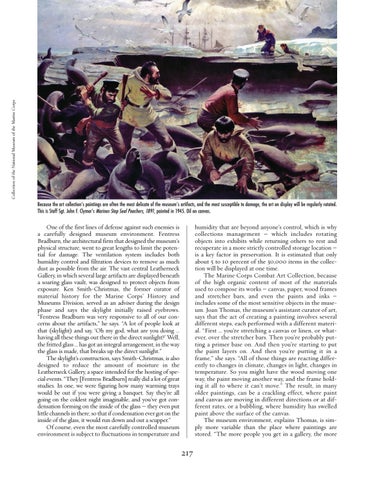
Because the art collection’s paintings are often the most delicate of the museum’s artifacts, and the most susceptible to damage, the art on display will be regularly rotated. This is Staff Sgt. John F. Clymer’s Marines Stop Seal Poachers, 1891, painted in 1945. Oil on canvas. One of the first lines of defense against such enemies is a carefully designed museum environment. Fentress Bradburn, the architectural firm that designed the museum’s physical structure, went to great lengths to limit the potential for damage. The ventilation system includes both humidity control and filtration devices to remove as much dust as possible from the air. The vast central Leatherneck Gallery, in which several large artifacts are displayed beneath a soaring glass vault, was designed to protect objects from exposure. Ken Smith-Christmas, the former curator of material history for the Marine Corps’ History and Museums Division, served as an adviser during the design phase and says the skylight initially raised eyebrows. “Fentress Bradburn was very responsive to all of our concerns about the artifacts,” he says. “A lot of people look at that (skylight) and say, ‘Oh my god, what are you doing … having all these things out there in the direct sunlight?’ Well, the fritted glass … has got an integral arrangement, in the way the glass is made, that breaks up the direct sunlight.” The skylight’s construction, says Smith-Christmas, is also designed to reduce the amount of moisture in the Leatherneck Gallery, a space intended for the hosting of special events. “They [Fentress Bradburn] really did a lot of great studies. In one, we were figuring how many warming trays would be out if you were giving a banquet. Say they’re all going on the coldest night imaginable, and you’ve got condensation forming on the inside of the glass – they even put little channels in there, so that if condensation ever got on the inside of the glass, it would run down and out a scupper.” Of course, even the most carefully controlled museum environment is subject to fluctuations in temperature and
humidity that are beyond anyone’s control, which is why collections management – which includes rotating objects into exhibits while returning others to rest and recuperate in a more strictly controlled storage location – is a key factor in preservation. It is estimated that only about 5 to 10 percent of the 30,000 items in the collection will be displayed at one time. The Marine Corps Combat Art Collection, because of the high organic content of most of the materials used to compose its works – canvas, paper, wood frames and stretcher bars, and even the paints and inks – includes some of the most sensitive objects in the museum. Joan Thomas, the museum’s assistant curator of art, says that the act of creating a painting involves several different steps, each performed with a different material. “First … you’re stretching a canvas or linen, or whatever, over the stretcher bars. Then you’re probably putting a primer base on. And then you’re starting to put the paint layers on. And then you’re putting it in a frame,” she says. “All of those things are reacting differently to changes in climate, changes in light, changes in temperature. So you might have the wood moving one way, the paint moving another way, and the frame holding it all to where it can’t move.” The result, in many older paintings, can be a crackling effect, where paint and canvas are moving in different directions or at different rates, or a bubbling, where humidity has swelled paint above the surface of the canvas. The museum environment, explains Thomas, is simply more variable than the place where paintings are stored. “The more people you get in a gallery, the more
217