Autumn Term 2022ISSN 2753-7013 The EVC Magazine Learn Share Evolve Slide into the autumn term


Inside... 4 A Letter from the Editor The dos and don’ts for school trip planning THE IMPACT AND IMPORTANCE OF RESIDENTIALS AFTER COVID Stove Safety Duty of care Wellbeing Planning your overseas trip 6 10 16 18 32 38 If you would like to advertise in the next issue of The EVC Magazine, please drop us an email to find out our rates theevc@evolveadvice.co.uk We are also always looking for interesting news, articles, student stories or engaging pictures. Please get in touch if you would like to feature in any of our upcoming issues. EVOLVE Advice Ltd 21 Market Place Long Buckby NN6 7RR Editor & Designer Jake Wiid theevc@evolveadvice.co.uk Adviser Clive Atkins CMIOSH Content Standards Suzanne Holroyd Advertising & Commercial theevc@evolveadvice.co.uk ISSN ISSN 2753-7013 Digital Version www.theevcmagazine.online Disclaimer: Whilst we take care to ensure the accuracy of the content contained in this magazine, the publishers do not accept any responsibility, including loss, due to inaccuracies in this magazine. Any legislation, employer or school guidance take precedence over that which is included in the articles contained within. Advertise & Contribute
First word…

for me as one of my former school


(Eddie Aylett) has written an article for us. I was fortunate to be supported by my teachers and head teacher when I was at school, allowing me to pursue my hobbies and make those into a career. I have stayed in touch with several of my teachers and can’t express how much gratitude I have towards all teachers who change the lives of young people every day.


look at some critical areas of school visits in this issue, with top tips, Q&A and National Guidance updates.

This issue is exceptional
teachers
We
I hope you enjoy this issue and welcome any feedback on the email below.
Thanks to our supporters who have made this issue possible
@EVOLVEadvice facebook.com/EVOLVEadvice theevc@evolveadvice.co.uk 4
To join the EVC Hub visit
What is the EVC Hub?
The EVC Hub is the only professional network dedicated to the role of Educational Visits Coordinators. We exist to provide networking, peer support, updates, resources and CPD opportunities, to empower EVCs to provide the best Learning Outside the Classroom coordination within their schools.

The EVC Hub is run by a team of Educational Visits Advisers and EVCs. Please note that this is not a replacement for advice and guidance provided by your employer or adviser.
So why join?
Aside from the opportunity to network, share resources and discuss with colleague EVCs around the world, we have put together a raft of benefits:
• News updates and a library of useful articles, blog posts and documents;
• Access to free or exclusive webinars and recordings;

• Early and discounted access to face to face events;
• Discounts of up to 40% from outdoor equipment providers;
• Discounts or exclusive offers from educational providers.
TO
www.theevchub.com THE EVC HUB
FREE
JOIN
The Dos and Don’ts for School Trip planning
By Eddie Aylett
During the pandemic, schools could not organise day trips, residential trips and any international travel. For me, this has been a challenging time for education. I genuinely believe that a world without travel makes us all vulnerable.

Educational tours allow students and staff to think about current affairs, tolerance, equality and diversity, and the type of Curriculum they may or may not deliver. Of course, we know that the National Curriculum underpins the model within our schools, but trips bring it to life. In fact, a parent asked me only the other day what would happen if they took their child out of education.
I was in a conundrum, as I didn’t understand the parent/carers’ point of view. However, once we passed the cost-saving ideas, I began to remember why travel across the globe is so important.
I know that relationships and rapport on trips can forge relationships that last a lifetime.
So I have compiled a list of dos and don’ts for those staff who want to reengage and build cultural capital in their Curriculum with trips and activities.
The Dos
1Does the trip/activity or tour underpin the main Curriculum?
The school’s Curriculum, in my mind, would allow staff to make sure the Curriculum is ambitious and enjoyable.
2
Check your school policy.
What do you need to do, complete, or what training do you need? Each and every school is different.
3
4
Check the school calendar.
Does your trip clash with other events, as this may be a staffing issue?
Do your research.
What, how, and who with! Are you able to book yourself or through an agent or a tour operator?
5
Get the right team/staff.
You need an experienced staff team or a plan to train additional staff.
6
Check lead in time.
Your Adviser needs a certain amount of weeks to approve a trip on EVOLVE.
7
8
What support do you need?
Who is booking the Minibus/Coach to the airport, for example?
Are you doing a pre-visit?
This is a great way to plan and check for the points above.
6
The Don’ts
1Leave it to the last minute.
This can cause you to rush and make mistakes.
Foregt to update or retrain as a first aider.

You will need to be in charge of all medicine, pastoral and emotional issues.
Promise the world.
The quote and itinerary says what’s included. Do not oversell the trip.
Plan and risk assess alone.
The planning and risk management should be a whole team role, ensure efficient time is set aside to meet, discuss and plan the trip.
Forget your camera.
Trips are often a once-in-a-lifetime opportunity, and you don’t want to miss the wow moments.
Eddie Aylett is a Vice Principal at Bower Park Academy in Romford, Essex. He received his BA Honours in Physical Education with QTS from Greenwich University, London, in 2000. He has taught Secondary Education in the London Borough of Havering and has also taught overseas in The Netherlands. In addition to teaching Physical Education, Drama and Science, he is the school’s International School coordinator and global leader. He leads on Curriculum and Teaching and learning. The academy has a solid Global Vision, enabling students to travel internationally, and the academy also hosts international guests. He would like to share his global education experiences and hopefully inspire others to educate outside the classroom. He also believes in a multicultural society that embraces all, and educational tours allow such cultures and communities to develop within days!

2
3
4
5
Who is Responsible?
By Suzanne Holroyd
Using an external provider to run activities for students is a common occurrence for schools as not many schools have staff who are qualified to run adventurous activities. Visit leaders and EVCs must follow their employer’s policy when choosing and employing the services of a provider.
The suitability of a provider should be checked via the LOtC Quality Badge website or the use of a provider form. Referring to the website Kaddi and/or a conversation with your Educational Visits Adviser may also be useful.
The responsibility for the safety of participants during an adventurous activity will rest with the provider but the accompanying school staff members continue to retain a pastoral duty of care. The pastoral duty of care cannot be delegated to a provider; they do not know the students and will be mostly unaware of any behaviours/triggers/abilities amongst the students. Statistics show that handover times are when incidents are more likely to occur and so the visit leader must have a dialogue with the provider beforehand to ensure that all parties are clear about who is responsible for what and when; there must be no ‘grey areas’.

It is good practice for school staff to be involved in or observe activities led by a provider in order to monitor the quality of provision and to check that all students
are coping and behaving appropriately. If school staff are asked to take on a supervisory role alongside the provider’s staff, then it must be made clear who has responsibility for which aspect of the session.
If there are enough members of school staff on a visit to allow one or two to have a break whilst an activity is taking place, then this could be deemed acceptable if the visit leader has done a dynamic risk assessment. For example, if there are 5 members of school staff on a residential visit and the visit leader considers that 3 members of staff is a sufficient number to carry out the pastoral duty of care for the duration on the activity then the other 2 could have a rest for that length of time. This can allow members of staff to ‘recharge their batteries’ and perhaps catch up on rest that has been interrupted during the night by excitable young people not wanting to sleep!
Should school staff consider that a provider is running an activity in a way that causes them concern, they must consider intervening or stopping the activity at the first appropriate moment. Any intervention should be done with sensitivity and discretion.
Adventurous activities run by competent providers are statistically very safe and students can get a lot from them, especially if school staff also take part if possible. It’s a great leveller for the students to see members of school staff learning something new alongside them and can change the dynamics between staff and students in a way that cannot be achieved in school.
OEAP National Guidance document
4.4h - Using External Providers - includes detailed guidance on roles and responsibilities during a visit and
3.2a - Underpinning Legal Framework - expands on duty of care.
8
The amazing potential of a World Scout Jamboree
Hi, my name is Nate Harding and I’m aged 15 and attend school in Woodford Green, Essex. I’ve been part of the Scouting movement since I was a small child - where else can you make so many different friends and do so many varied activities?


When I discovered I could apply to join the World Scout Jamboree taking place in South Korea in 2023 I leapt at the chance – it’s a bit like the Olympics of Scouting in that it takes place every 4 years in a different host country. I had to go through a selection process and was lucky enough to be picked to join with over 40,000 Scouts from all over the world. It’s completely mindblowing!
Since then, my life has been a complete whirlwind as I have to actively fundraise nearly £4,000 myself to get there, but I wouldn’t change any of it.
Each Jamboree runs with a theme, and ours will be a ‘Promise to the Planet’, where we all come to together to share ideas. We will talk about global issues and learn more about sustainable issues and development in different communities, how to create a more harmonious world, and how to promote diversity and inclusion.
The most amazing thing about the World Scout Jamboree though is that it will empower the young people ourselves, to develop all the necessary skills to campaign about the issues that affect our own future.
My hope is that I will come away from this unique Jamboree experience equipped with so many more life skills to see me through the rest of my educa tion and my future beyond. I’m hoping to challenge myself as much as I possibly can whilst there, and make new and hopefully lifelong friendships. I really want to learn so much more about the world outside my own and become more confident in myself and what I can offer.
I can’t wait to see what the impact on me will be after being immersed into such a huge and diverse event.
Please follow me at: www.nategoestosouthkorea.com

10
Using your local learning area
By Kim Hudson - Council for Learning Outside the Classroom Accreditations and CPD Manager

The local area around your school provides a wide range of learning opportunities for no or low cost. Kim explores how you can discover your Local Learning Area and make it easy for staff to access it.


Do you ask your staff to consider the question, “Where is the best place for this learning to take place - is it in your building, your grounds, a local learning area or further afield? Considering this question, you can embed LOtC of all types into your curriculum when they are writing their long-term plans.
Often staff are confident teaching on your school grounds but taking your lessons beyond your gates into your local learning opens up many more learning opportunities. Identifying your Local Learning Area allows your school to redefine its boundaries to include areas, generally within walking distance, that are used for regular, curriculum-based learning. Once this area is defined, your setting can develop standard operating procedures for working in the area, in the same way as inside the setting’s buildings and grounds. Your Educational Visits or Outdoor Education Adviser should be able to guide you through this process, or Council for Learning Outside the Classroom can offer training and resources on how to do this through their Learning Beyond support for schools www.lotc.org.uk.
The first step is to work as a staff team to identify what you are already doing in your local area and consider what other opportunities it presents for learning and personal development. You might place a google map of your locality on a noticeboard in your staff room for all staff to add notes to or work together during a staff meeting to
Better still, why not take a walk around the area as a staff teaching team to identify learning opportunities and discuss any health and safety issues – areas to avoid, safe road crossing, and toilets you can use. It is helpful to involve other staff in identifying your local learning area, including support staff, cleaners, and site managers, as they may have contacts and knowledge of the area that your teaching staff don’t.
Staffing off-site visits can be challenging, so recruiting a team of education volunteers for your school is a good approach. These could be parents, grandparents, governors, non-teaching staff or broader community members. Given the necessary checks and training on risk management and how to manage a group of students, they can help to extend your LOtC opportunities.
annotate a map of the area on Google Earth/Maps or an Ordnance Survey map.
12
A
So what learning opportunities could your local area offer?

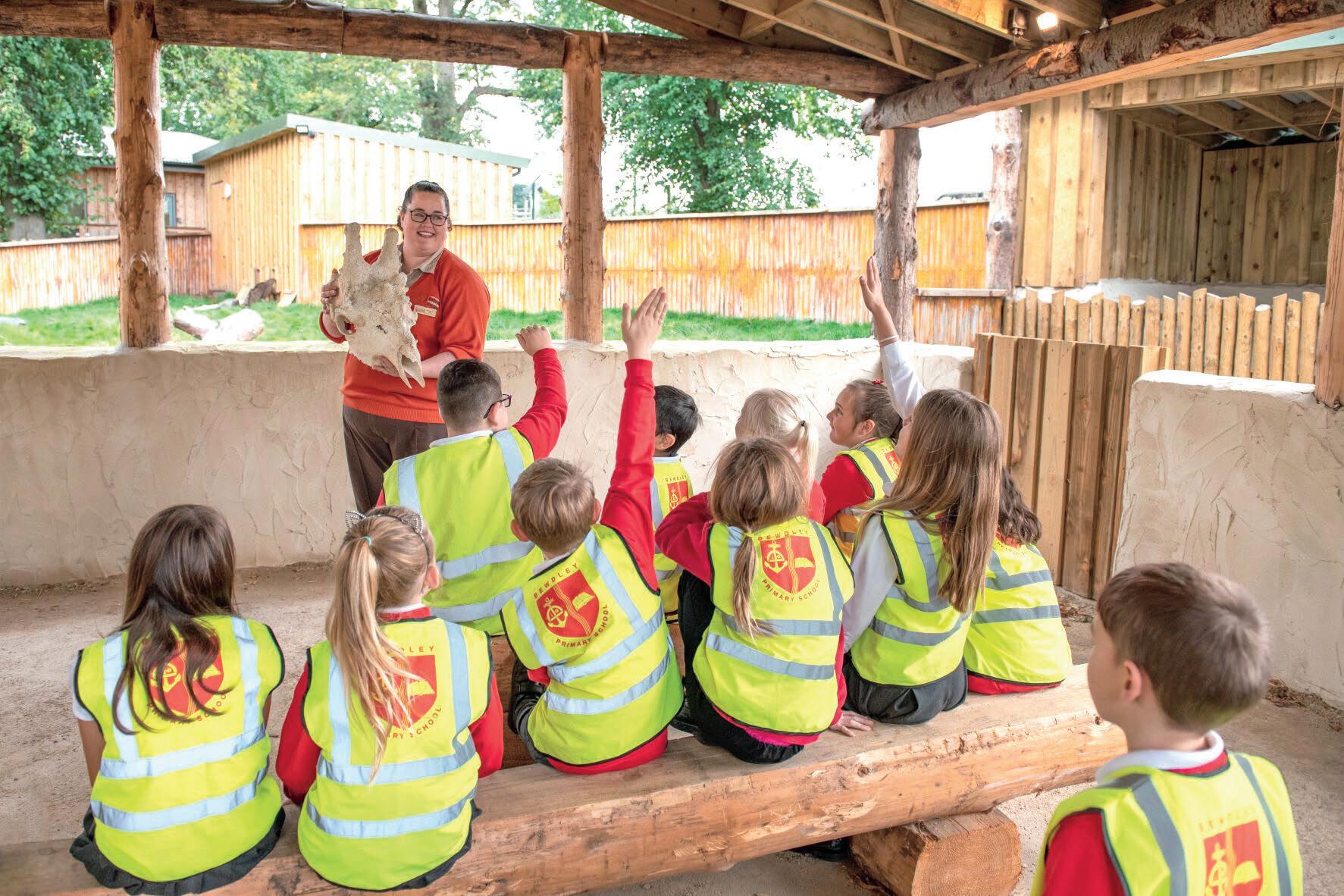
You should consider all businesses, attractions, natural and built environments, and how these locations might support specific curriculum areas and learning objectives, including cross-curricular links, personal development, and well-being.

The list is endless, depending on what you have around you, but here are a few that might be possible in your local area. For example, looking at:
• buildings for Maths recognition – spotting numbers, angles, repeating patterns;
• a local history/geography tour – doing re-photography of historic pictures from your area or remapping the area;
• using graveyards for geology and biology;
• using local footpaths for orienteering or nature trails;
• creating trails for local people or other classes to use;

• visiting woodlands or parks for a comparison of wildlife or an alternative space to your grounds;
• walking along local waterways for flood defence debates, water speed calculations, nature observation, conservation work;

• visiting local shops/businesses to find out about careers, to handle money or investigate food miles.

If your school is in the West Midlands area, Council for Learning Outside the Classroom can offer you free membership and mentoring in partnership with Canal and River Trust to consider your local waterways for learning and look at embedding all LOtC, so do visit their website to find out more www.lotc.org.uk/schools/ projects/
There are so many opportunities that your local learning area of

n d o u t m o r e a n d r e g i s t

C L O T C C O N F E R E N C E N A T I O N A L T h u r s d a y 2 n d M a r c h 2 0 2 3 0 9 . 0 0 A M 4 . 4 5 P M W e s t M i d l a n d S a f a r i P a r k F e a t u r i n g : I n s p i r a t i o n a l s p e a k e r s , e n g a g i n g w o r k s h o p s , d i s c u s s i o n g r o u p s , n e t w o r k i n g , e x h i b i t i o n z o n e , a n d s a f a r i t o u r s A c h i e v i n g q u a l i t y l e a r n i n g b e y o n d t h e c l a s s r o o m w w w . l o t c . o r g . u k / c l o t c n a t i o n a l c o n f e r e n c e F i
e r Thanks
to our supporters
n e v e n t d e d i c a t e d t o l e a r n i n g b e y o n d t h e c l a s s r o o m t h a t b r i n g s t o g e t h e r u p t o 3 0 0 t e a c h e r s , h e a d t e a c h e r s , s e c t o r l e a d e r s a n d p r o v i d e r s f r o m a c r o s s t h e c o u n t r y w w w . l o t c . o r g . u k / c l o t c n a t i o n a l c o n f e r e n c e
National Guidance, what is it and why is it useful?
By Steve Lenartowicz
Steve is a former Outdoor Education Adviser and part of the team which produces National Guidance. Here he talks about the benefits and history of National Guidance.

National Guidance is published by the Outdoor Education Advisers’ Panel (OEAP) at oeapng.info. It is the key source of information and advice for the management of safe high-quality outdoor learning, educational visits and adventurous activities by schools, colleges, youth services and other settings. It underpins EVC training, and every EVC should be familiar with it.
OEAP National Guidance replaced the Department for Education publication “Health and Safety of Pupils on Educational Visits” (HASPEV) and its associated supplements, which had been developed with the support of OEAP, after they were withdrawn by the government in 2011. The Department for Education and the Welsh Government both refer to National Guidance in their advice to schools, but it receives no government funding and is funded solely by OEAP with contributions from supporters.
OEAP National Guidance is a collection of short documents written by experienced advisers, based on the extensive knowledge and experience of OEAP members, in consultation with other experts when necessary. It is continually updated to stay abreast of changes in legislation and developing good practice.
It also includes a number of documents, including research reports and examples of good practice, which provide evidence for the effectiveness of highquality outdoor learning and educational visits.
Because National Guidance is so comprehensive, it can be difficult to know where to start if you are not familiar with it. However, it is easy to find your way around and there
are several ways to do so.
• If you know the subject you are looking for, you can use the search function at oeapng.info/search.
• You can browse the full contents at oeapng.info/guidance-documents
• You can browse the documents that are marked as essential for your role (such as EVC) at oeapng.info/guidance-by-role

When using National Guidance, it is better to download documents as you need them, so that you are sure that you are using the latest versions. If you save documents offline for future use, you should always check that they are still up to date when you come to use them.
If you are looking for one National Guidance document as a starting point, a good place is document 4.3a “Good Practice – the Basics”, which you can find by searching or browsing as above. It summarises the basics of good practice, and provides links to many other National Guidance documents for more detailed information.
Although National Guidance is comprehensive, it is still essential that EVCs have access to advice from an Outdoor Education Adviser or other expert appointed by their employer.
If you are not sure who is your employer’s adviser, or if your employer does not have an adviser and is looking for one, you can find all OEAP advisers at oeapng.info/find-an-adviser-home.

www.oeapng.info 14


✓ 65 years’ experience in outdoor adventure activities ✓ 15 residential centres across the UK ✓ Smaller activity group sizes of up to 12 ✓ Tailor-made activity programmes to suit your pupils ✓ A dedicated PGL ‘Groupie’ to support throughout your stay ✓ Free teacher preview visits Start planning your trip 0333 321 2106 schools@pgl.co.uk pgl.co.uk/schools SCAN ME! into the next adventure LAUNCH
Halsbury Introduces New Multi-Trip Loyalty Scheme –save thousands on future trips!
How can we save on future trips?
For every additional trip your school books with Halsbury after the first, you’ll earn a discount of £100 x the number of trips booked with them at that point.
So, the second trip your school books with Halsbury will earn a discount of £200.
And the third trip your school books with Halsbury will earn a discount of £300.
The total discount earnt by your school will accumulate with every trip booked with Halsbury, so when you book that third trip, the total discount will be £500 (£200 + £300)!
And there’s no limit to the discount so, for example, ten trips could earn your school a total discount of £5,400!
If you’re the Educational Visits Coordinator for your school, planning multiple trips through Halsbury could make it a lot simpler and mean you make much bigger savings than if you were to use multiple providers.
If your school doesn’t have an EVC, make sure your colleagues and finance team are aware of this offer and start working together to build up your discount today!
How can we use the discount?
The discount you build over this academic year can be used towards booking a trip or multiple trips with Halsbury Travel in the following academic year. But how you use the discount is totally up to your school!
Discount on multiple trips
The discount can be shared equally among multiple trips, so all students benefit from a discounted trip.
Discount on a single trip
Or you could use the discount towards a free or heavily discounted trip for students from lower income backgrounds who wouldn’t otherwise be able to go on a school trip.
Free places for staff or students
Alternatively, you could reserve some extra free places for those students, or extra members of staff, on the trips already planned for the year.
What trips do Halsbury offer?
Halsbury Travel is the school trip company designed by teachers, for teachers, and offers trips both in the UK and abroad.
As well as educational, curriculum-focused school trips, Halsbury has specialist divisions for school ski trips, music tours and sports tours.

Originally founded by former teachers, and with many former teachers still working there, Halsbury understands the level of support you need when arranging a school trip and they’ll be with you every step of the way.


With so many pupils missing out on school trips recently, your school no doubt has plans to run many trips over
the next couple
of
years
to ensure your pupils get to enjoy these invaluable experiences. With this in mind, Halsbury Travel has just launched its brand-new multi-trip
loyalty scheme which could save your school
thousands of pounds on future trips.
Book your trip with confidence today! halsbury.com 0115 9404 303 enquiries@halsbury.com 16

Affordable Residentials and Educational Visits
By Martin Smith - Senior Adviser – Academic Resilience at Greenwood Academies Trust
Martin is currently a Senior Adviser for Academic Resilience within the Greenwood Academies Trust responsible for supporting Academies in the delivery of Personal Development and Outdoor Learning, he is also the Outdoor Education Adviser. Martin is also a Lead Practitioner in Outdoor Learning and currently Chairs the Outdoor Council and Adventure UK. In this article Martin looks at the impact of Covid and how to achieve affordable eductional visits.

The impact of COVID
Over the last few months, as Chair of the Outdoor Council, I have been working with eduFOCUS to analyse the vast data set generated by the EVOLVE system to see how well educational visits are recovering after the pandemic. To do this, we have been looking at comparative figures of all the visit data, over the last four years, from the start of the year to the end of June. The graphs, and statsitics, show how all visits covered by the EVOLVE system have ‘bounced’ back after COVID, which is very encouraging and illustrates that schools are keen to ensure young people are ‘out and about’ following 18 months of restrictions. The ‘bounce back’ will, in part, be due to schools recognising the positive impact such activity has on the mental health of pupils, which we all know has been sadly affected by the lockdown restrictions. For many, just being outside or going beyond their immediate communities will be valuable experiences in themselves, in addition to the added value they contribute to the wider curriculum as well as being both memorable and fun! To view this full report visit www.theevcmagazine.co.uk
Responding to the Challenges
Post pandemic our challenges are continuing, and they will all have a disproportionate impact on our vulnerable communities. Not only are there lingering impacts from COVID but the current financial squeeze will only add to increased costs in running visits from both providers and venues as well as the increased costs of transport. In terms of the communities themselves many will struggle to pay for the additional costs involved in both day visits and, especially the more expensive residential and overseas visits. We can only expect these challenges to get harder in the coming months as the cost pressures mount not just on the communities we serve but the academies themselves, as well.
When presented to our senior management team and Trust Board they immediately recognised that pupils at our schools were likely to be at a disadvantage to many others and we began to explore what we could do to support them.
Affordable Residential and Educational Visits
One of the responses we have made is to begin work on establishing ‘Academy Camps’ that can provide a cheap alternative to the traditional residential. Our Trust Board has now released some funding that will be used to purchase camping equipment enabling a number of standing camps to be established within some of our Academy grounds. These will not only be used by the host academy themselves but by other academies in our Trust. We are particularly lucky to have a number of academies on the East Coast many of whom have excellent grounds that can be used for camping. So that the East Coast academies don’t miss out, we will also establish camps in some of our inland regions within the East Midlands.
Planning for these camps will begin in the next couple of months and training for staff will follow. However, this only focuses on one element of educational visits and support will be wider than this. Guidance on how to effectively use the local area to develop opportunities for learning beyond the classroom through educational visits has been prepared. This focuses on making the most of ‘local’ resources as well as other academies. The Trust recently arranged for the British Orienteering Federation to map all of our school grounds, for example. As well as being a resource for each academy, other academies in the local area can also use each other’s grounds and maps as a means of extending their own
18
orienteering programme, much of which is linked to the wider curriculum in addition to PE.

As highlighted above, many of our academies have excellent grounds which we have never really opened up to other academies across the Trust, this will be another approach we will look into. It is really a question of how well we use our own recourses to develop learning beyond the classroom. There is certainly no shortage of ideas and curriculum material that can support such learning much of it free of charge, which can be used either in the academy grounds or just away from it in local woods, parks, beaches, or even our other academies.
Looking at how we might make visits further afield more accessible, some of our primary academies have been using minibuses owned by our secondary academies, to save on transport costs, a trend that might grow. Of course, there will be opportunities to walk to some venues such as local parks, libraries, places of worship etc. However, being able to use transport from another academy opens up visits just that bit further away such as local employers, heritage and cultural sites, many of which often offer free activities. In Nottingham, I have been supporting the development of a handbook for schools, in the City, that highlights all the arts and cultural partners across the City and their ‘offer’ to schools, who often provide activities either free or at a low cost. For such City schools public transport links are very good and are regularly utilised. We may look to develop such ‘handbooks’ for our academies in other cities and regions.
Focusing on residentials, further afield, one of our academies has been regularly using local Scout campsites to deliver their residential offer. Many County and District Scout campsites often have bunk rooms as well as options for camping and provide a good extension from any academy based residential experiences. Many Scout sites are not used during the week and they provide a very affordable ‘next step’ in terms of residential experiences, something we will look to build on into the future.
In recent years we have developed a partnership with the Youth Hostel Association. Through this partnership we have begun to build a clearer understanding of our joint needs resulting in more of our academies accessing hostels in quieter periods of the year when visits are more cost effective. The YHA have also helped with some targeted support through their Breaks programme, where we have worked with them to develop Year 7 Transitional residentials. The research that supported this later programme will be available shortly. We also work closely with a many of our local employers,
our partnership with DHL being of particular note. They have developed a ‘Look into Logistics’ programme to help young people develop key work skills and as part of this programme we take away 30 young people from each of our secondary schools to the Outward Bound Trust, each year. DHL mentors, who have been working with the young people, accompany them on a week-long residential at the Outward Bound Trust where they further refine and apply many key work and life skills.
All this provides a useful progressive model to take us forward as we search for more options that will enable us to continue to offer our young people a range of residential and educational visit options.

Final thoughts…
In her article for the last EVC Magazine Anita KerwinNye outlined some key considerations when developing an Educational Visits and Activity passport. Many of the underlying concepts are ones we would relate to as we look to ensure that all of the young people we work with have access to the type of opportunities more readily available to their peers. All of our academies are addressing the issues they face in their own way, responding to local need. Centrally, we are encouraging them to do this and facilitating access to wider opportunities offered through learning beyond the classroom and educational visits. We work to ensure such experiences link back to the curriculum followed by our academies and that such experiences should be progressive. We look to develop partnerships for the benefit of our young people and widen their horizons in terms of the world of work and the opportunities that lie beyond for their own development. In the coming year we will continue to provide the necessary training to support staff in their delivery and further fine tune our offer, always on the look-out for new opportunities. And of course, as Anita highlights, we will ensure we have ‘fun’ on our journey!
Using External Providers
By Jake Wiid
Using external providers and visiting venues are often a big part of school trips, but understanding the relationship between providers, venues, and schools is essential.

In her article, Suzanne has spoken about the duty of care concerning providers, which is one element of working with external providers and venues; the other is how you choose and vet the places you intend on visiting.
Before exploring this further, let’s first look at differentiating between a ‘venue’ and a ‘provider’. Employers and advisers may have differing views on this so, for the benefit of this article, we are using
National Guidance States
“A ‘provider’ means any person or organisation external to your establishment contracted to organise and/or lead all or part of a visit or activity.
For example:
• A museum or other venue where their staff lead educational activities;
• An activity instructor or guide;
• A tour operator;
• An activity, field studies or outdoor education centre;
• A ski school;
• A Duke of Edinburgh Award centre or activity provider;
• An expedition company.
A ‘facility’ is a venue or resource external to your establishment which you use for a visit, but which does not organise or lead any part of the visit. For example:
• Museums, galleries, theme parks, theatres, climbing walls, skate parks, bike tracks, ski slopes, swimming pools, when the venue does not provide teaching or instruction to the group;
• Hired or borrowed equipment.”
the definition set out in the OEAP National Guidance document ‘4.4g Selecting External Providers and Facilities’, where they use the terms ‘External Provider’ or ‘Facility’.
When using a facility, amongst other things, you should consider:
• Does it meet the learning objectives you have set for the trip?
• Is it good value for money?
• Do they have a good reputation?
• Is it close enough for us to access easily?
Using a provider may have more significant risks due to the activities provided, so you should take care in your due diligence on the provider. As well as the above you should also consider:
• How do they manage the activities? Have the staff been trained? Are they qualified and/or competent? Do they meet the Health and Safety and safer recruitment requirements?
• The safety of the accommodation if they are a residential provider. Are your rooms all on one floor? Does the public have access? Where are the staff rooms located?
• Do they sub-contract to third parties?
• Are they appropriately insured and, if relevant, bonded (ABTA, ATOL)?
• Do they require waivers?
20
• Are their risk assessments suitable and sufficient?
This list is not exhaustive but gives a flavour of the role of the visit leadership team when planning visits to providers.
For many, this may be outside of their expertise and they find themselves asking things like ’What does a good climbing risk assessment look like? Is £5m public liability insurance enough? Does the third party need an AALA licence?’
The easiest way to review if a provider meets the above requirements is to check if they have a LOtC Quality Badge. This looks at the elements covered above and, where required, is assessed by a competent assessor; this helps put your mind at rest.
If a provider does not hold a LOtC Quality Badge, it does not mean they are a ‘bad’ or an ‘unsafe’ provider; however, it requires you to do further due diligence. One way to do this is to ask the provider to complete a provider form or statement (The OEAP has a template for this, available to download at www.oeapng.info).
The final consideration is around providers’ risk assessments. Many providers send or are asked to send schools their risk assessments, and often all that happens is the school prints and staples this to their trip pack or uploads it to the trip form without considering its contents. With this in mind, we advise schools not to request the risk assessments unless your visit leaders or school staff are competent to understand the contents of what may be a technical document. This stance is clarified in National Guidance.
In short, providers may be essential to achieving your learning objectives for a trip and with some checks, accreditation or experience, you can enjoy a safe and enjoyable visit.


For further reading on the subject, please visit www.oeapng.info and search for:
4.4g Selecting External Providers and Facilities
4.4h Using External Providers
6a FAQs: Asking for a provider’s risk assessments
6c FAQs: Duty of care when working with providers
The benefit of a good night’s sleep…outdoors
And some top tips on how to make it even better by Pat Milston Managing Director, Active Learning Centres ALC
Pat has over 35 years’ experience of delivering, designing and managing outdoor learning experiences for young people. As Managing Director of Active Learning Centres, Pat‘s focus is on building a portfolio of outdoor centres, each operating in a unique environment, with a core focus of developing essential skills and charac ter while promoting wellbeing. Pat looks at the benefits of sleeping under the stars and some top tips in making it a better experience.

Over the past few years, it has become a bit of a tradition in our house that we choose one or more nights a year to sleep outside – no tent, simply us and our bedding. Some of our friends completely understand and in fact I’d go so far as to say they are quite envious; others are absolutely horrified at the thought of being away from their familiar and comfortable (indoor) beds and facilities.
Why do we enjoy it so much? The answers are many, but it’s worth listing a few.
Firstly, it’s a chance to do something different: an old friend once told me that ‘everyday life is no life at all’, which obviously extends to nights too. The fun in seeking out a new patch in the fields or the woods – we usually do this some weeks or days in advance – makes the whole process one of exploration and this adds to the sense of doing something out of the ordinary.
Secondly, it’s the chance to reconnect with nature, and the choice of location for the overnight ‘bivvy’* will dictate what you hear and see through the evening, night and into the next morning. Do you want to be immersed in the sights and sounds of the woods? Would you prefer the open skies that gives you a full view of the stars as they move their position – and possibly the skimming lights of a
meteor shower? Or perhaps the aim is to look down from a lofty perch in the mountains on a cloud-filled valley and watch the sun rise? All are incredible experiences and mean that you can be connected to your world in a wholly different way.

Thirdly, the escape to the outdoors takes you away from the always available, device-driven world of electronics and connectivity. Just a few hours being stimulated by natural shapes, light and sounds has a proven beneficial effect on wellbeing which is one of the reasons wild camping and nights out under the stars has become so important to so many over the past 18 months. Even the simple process of falling asleep as it darkens (assuming you don’t take torches or have a fire) and walking as it becomes light puts you back into a natural balance with nature. This may be a short-lived experience at the time but will nevertheless give a longer lasting benefit. Having chosen your spot, which should be as discreet as possible, whether in the woods or up a mountain, you then need to consider what you take to make sure you get a good night’s sleep.
*A bivvy bag (also known as a bivouac, bivi or bivvy) allows you to go camping without a tent. It’s basically a thin, lightweight, waterproof sack that slides over your sleeping bag. It can also significantly improve the warmth of your sleeping bag.

22
1Concentrate on the basics
A sleeping bag, sleeping mat and, if you want to be sure of staying dry, consider a breathable bivvy bag. In choosing these items think about the type of ground you’ll be sleeping on: the forest floor can be made up of many sharp objects, so an inflatable mat might not be the best choice – a closed foam mat may be preferable. Being under the tree canopy gives some protection from rain, but it also helps to avoid a build-up of dew, which can sometimes catch people out when they sleep in an open field. Either way, a bivvy bag is a great investment if you plan to make sleeping out a regular occurrence. The final essential is a pillow, although I usually just take on old pillowcase and stuff a couple of extra bits of clothing into it for the padding. If you do want some shelter from the elements try taking a tarp, but make sure you know different ways to rig this prior to hitting the great outdoors.

2Water
While it’s entirely up to you whether you take food and cook yourself an evening meal and/or breakfast (and why not??), water is often overlooked. Make sure you’ve got enough to last you through the evening and for the morning – trust me, you never can drink enough water. Going back to food, you do sleep better if you’ve got some food inside you. It can get a tad chilly if you’re not prepared and those calories before bedtime will help to keep you at the right temperature.
3
Groundwork
Spend time working out which is the most level area of your site. Time spent on this is never wasted and you can help yourself to get a better night by having your head just slightly above your feet and not laying across a slope – obvious stuff, but an easy thing to get wrong and you’ll end up shifting things around in the middle of the night if you’re not careful.
4Answering the call of nature
Finally, the thing that everyone thinks about but often goes unsaid; what to do about ‘the poo situation’. There are many books and articles on the subject (yes, really). Unless there is access to a nearby toilet, then poo is best buried reasonably shallow, where it can break down faster…you can bury paper with it, although many people think that the paper should be burned or even carried home in a sealed plastic bag. Whatever you do, please think of others that may spot your special sleeping spot and therefore be considerate, especially with respect to avoiding the pollution of any water course!
As with most things, experience breeds confidence. While it can seem quite daunting to set out on a first great sleeping outside adventure, why not start gently and close to home? Even a night in the garden can bring its own rewards. For those who don’t yet have the confidence, or indeed the equipment or access to a suitable local venue – a first foray into ‘sleeping wild’ could be on a residential school trip. Providing young people with the opportunity to experience a night under canvas can be the first step towards gaining the confidence to go solo. A provider that enables the opportunity to sleep in a tent is also providing an opportunity to connect with nature in a safe yet exciting way – being separated from the sounds of woods or a nearby stream by a thin layer of canvas can be a liberating and novel experience for students that have never done this, or have never witnessed a darkness not punctuated by street lighting.
Follow Pat @milston on Twitter (An earlier version of this blog post appeared on the Active Learning Group Website at https://activelearninggroup.co.uk/news/).

So,
my top tips for making your experience as pleasurable as possible are:
The benefits of Snowsport Visits
For many schools, Snowsports
Visits are seen as a jolly or a holiday, but this could not be further from the truth. Of course, skiing in the beautiful alps on fresh powder with friends sounds like a wonderful holiday, but a tremendous amount of learning takes place behind this. There are huge benefits from undertaking a snowsport trip, and consideration should be given to making space in the school calendar for these visits. Some benefits include:
1. Getting outdoors and active

Snowsports such as skiing and snowboarding are a great way to inspire children to experience the outdoors and get them away from mobile phones, games consoles and TVs!

2. Learning a new skill
Trying something new on a school ski trip means there will be lots of children learning at the same time, so everyone can share the ups and downs together.
3. Experiencing a different country

Ski trips also introduce children to new countries, cultures and customs. It’s a great opportunity to try out a few local phrases and sample the local cuisine.
4. Improving confidence
As well as learning new skills, a school ski trip is a great opportunity for children to experience staying away from home becoming more independent, confident and self-reliant.
5. Sharing success
Confidence also comes from conquering the mountain and experiencing success with friends - children learn so much in a week and will enjoy celebrating their achievements together.
6. Value for money

School ski trips are a great value way of enabling children to try a snowsport, especially if a family ski holiday is not possible or there are family members who don’t want to go.
Original: PGL
Find out more about EVOLVE Advice’s Snowsport Visit Leader Training here 24


nstgroup.co.uk 0845 293 7979 Enriching school trip experiences with NST Scan me! Great learning happens everywhere Creating expertly planned school trips for over 50 years Tailormade itineraries to destinations in the UK, Europe & beyond Making it easier for you with our online school trip organiser & travel app In destination NST representatives & 24-hour support Peace of mind – we’re ABTA & ATOL protected
School Travel Forum - What is it? Why is it important? How does it help?
Wehad the pleasure of speaking with Gill Harvey from The School Travel Forum about all things overseas, including Brexit, covid, visas and some top tips.
www.schooltravelforum.com
QLet us start at the beginning. What is The School Travel Forum, and why is it important to schools?
AOrganising a school trip is a big undertaking, especially if you are taking a group overseas.

Teachers and the school leadership team, and parents, need to be confident that the trip will be well managed and offer a high-quality experience. The School Travel Forum (STF) was founded in 2003 to give teachers this confidence and assurance.
The STF is a membership organisation for school tour providers. To be a STF member, a school travel company must meet the requirements of the LOtC Quality Badge, be regularly audited by an independent third-party

company and be members of ABTA. This means that a school choosing a STF member for their educational visit can be confident that the company meets the necessary standards with regards to health, safety, educational outcomes and their trip is financially protected.
We also lobby and work with Government on issues relating to safeguarding of children whilst on school visits.
QWhat are the benefits of a school using a provider and, of course, a member of STF rather than just organising it themselves?
AWe can all book planes, trains and hotels with the touch of a button so on the face of it, organising a school trip should be something anyone can do however rules, regulations and requirements for school and group travel frequently change. Keeping on top of these
26
changes and making sure you are legally compliant is challenging for anyone who doesn’t frequently organise trips.
Using a school tour provider removes this stress from teachers. The provider will alert a group leader as to any passport or visa changes. The provider is responsible for ensuring transport and accommodation is appropriate for the group, they will make all necessary bookings for excursions, visits and experiences, they will ensure any external leaders have the appropriate checks and qualifications. If there is any travel disruption – train or ferry strikes, cancelled flights and so on, the tour provider will organise replacement transport or appropriate accommodation. This means teachers can concentrate on their group free from worries about what is happening next or where they need to get to.
Aside from the practicalities of a trip, school tour providers have many years of experience in organising school trips so understand the specific needs and requirements of schools. They also have detailed in-country knowledge so can recommend new opportunities and advise on the best trip to meet your learning objectives.

QThere has been much talk around package travel regulations, particularly COVID and refunds. Can you explain very briefly how this applies to schools?
AAs with most regulations it is a rather tricky area to navigate and each situation will be unique. However, in general if a school has booked a package with a tour provider and the tour provider has cancelled the trip because they are no longer able to fully operate the trip due to COVID restrictions, then the school could claim a refund from their tour operator. We recommend that schools take advice if they are using the Package Travel Regulations to claim a refund. The ABTA website (abta.com) is a good source of further information on this subject.
QOn the 31st of January 2020, Brexit came into force, immediately followed by COVID restrictions, now we are out of COVID restrictions, and overseas travel is back; what are the critical issues with schools travelling in a Brexit world?
AWe all saw the news over the summer – there are new passport checks for anyone travelling into Europe. As well as allowing extra travel time, you will need to ensure that:
Passports are valid for six months or longer from the date of your departure
Passengers in the group have not spent more than 90 days in Europe in a 180-day period
From 2023, UK citizens will also need to apply to the European Travel Information and Authorisation System for authorisation to travel.
Once done, the authorisation will be valid for three years.
QWho should schools speak to around visas and entry requirements for particular countries, particularly if they have non-UK citizens travelling with them?
ATeachers should check the government foreign travel advice at gov.uk/foreign-travel-advice for information on the specific country they are travelling to. Here they will find details of what visas are needed and how to apply.
QThe statistics on the page overleaf show a considerable number of overseas trips undertaken during the last academic year. What would you say to encourage those schools that may still be a little apprehensive about overseas trips?
We understand teachers may be cautious about taking a school group overseas, however these experiences are such valuable learning and personal development opportunities for young people, who have missed out on so much over the last two years. As well as helping to make classroom learning real and relatable, countless studies show that these experiences help children to grow and become more independent.
Many of the people working for our members are former teachers, they understand the nervousness and can empathise. Working with a school tour provider means you have someone on hand to answer your questions and guide you through each stage of the booking and travel process. Many providers also offer the opportunity to have a rep accompany your trip so they can manage the in-country experience on your behalf.
School trips, going away with friends, discovering new places and countries – these are the things that standout in our mind when we look back on our school days. Isn’t it fair that young people today are able to enjoy and benefit from the same experiences and opportunities that we did?
QFinally, can you tell us about your best overseas trip when you were at school?
AMy best school visit was my very first in the last year of Primary school. The school took us to France, my parents never holidayed overseas, so this was my very first journey to another country. I can still remember the butterflies in my stomach, more from excitement than nerves, I think my Mum was nervous though, waving me off from the school gates watching the old bus the school had hired rumbling down the road.
There are so many images I can still remember vividly, the ferry crossing, trying to buy sweets and having to speak French, the food, sharing bedrooms with my friends. The whole experience made me feel so grown up and started my love for travel.
We were all able to buy a present to take home to our parents, I bought a baguette, needless to say there wasn’t much left by the time I got home, but most importantly my teacher did not stop me, I learnt the hard way not to waste my money!
Gill, thank you so much for taking the time to talk with me. If you want to find out more about STF and their members, please visit www.schooltravelforum.com
A 28
Visits Statistics

Educational
Below are statistics provided by eduFOCUS, the providers of the EVOLVE systems. The data is taken from their Local Authority, Trust, Academies and Independent School users for Academic Year 2021-22. The data shows a strong bounce back of school visits for 2022/23. Overseas Residential Adventure Other 2403 (166) Academic Year 2021-2022 (2020/21 comparison) With thanks to For more information on the EVOLVE tools for schools, please visit www.edufocus.co.uk 33,030 (6,609) 111,177 (61,248) 1,325,806 (581,072)
THE IMPACT AND IMPORTANCE OF RESIDENTIALS AFTER COVID
By Rachel Purdy, Research and Evaluation Manager at The Outward Bound Trust


There is no doubt that the pandemic has had a severe impact on young people’s social and emotional development. However, recent conversations within the Outward Bound community show that there is a cautious optimism that significant long-term damage to our young people’s social and emotional wellbeing and life prospects can be averted if they are given the right support and investment
WHY DO WE NEED RESIDENTIALS?
In 2015, The Learning Away Consortium and York Consulting made significant headway in identifying key elements that comprise a ‘Brilliant Residential’ 1, including providing an experience where participants are equal, where participants are given time and space to develop relationships and community and the memorability of the experience. More recently a PhD study by Jo HickmanDunn 2 has highlighted the importance of the physical elements of an Outward Bound residential in creating impact, such as the geography providing contrast to a young people’s norm and the immersive nature of the course, together with the important social elements of the residential.
At Outward Bound, we know that the locations of our centres and experience of our instructors, combined with the ethos underpinning each of our courses, results in positive outcomes for young people. However, these two pieces of research have added a new dimension to our understanding of how impact for young people occurs during and following a residential and why these kinds of experiences allow each young person to leave having been impacted by the experience in very different ways.
HOW DO RESIDENTIALS IMPACT YOUNG PEOPLE?
Unpicking the components comprising the whole residential experience (not only the activities), helps us begin to answer the questions of how a residential has the impact it does on individuals regardless of their home situations or starting points and why an Outward Bound residential is perfectly poised to provide young people with the experiences, challenges and inspiration that many have been lacking in their lives over the last two years.
Recently, myself and our research and evaluation team have been talking to teachers and collating feedback from young people who have been on our courses to understand exactly what it is about a residential that provides a learning experience for young people regardless of their context.
Our research 3 shows that the following elements hold particular importance for young people and highlight why an outdoor learning residential is able to support young people in repairing some of the damage caused over the last two years:
• The contrast of the surroundings, exposure to different people and immersion in nature captures young people’s attention, prompts questions and nurtures their independence
30
• Unfamiliar surroundings encourage different behaviours, mindsets and challenge perceptions of themselves and others
• A residential presents an opportunity for adventure, not only in the physical sense, but socially and emotionally too
• The residential experience broadens young people’s horizons and widens their understanding of the world, it gives young people confidence that that their future is something they can influence
• Shared experiences help to build stronger connections with others, to feel safe, accepted and a sense of belonging
• Physical, emotional and social challenges demonstrate to young people how persevering through fears and discomfort can be a positive opportunity from which to learn and reflect. Being less fearful of challenge leads to new perspectives, possibilities, and opportunities.
The overarching message from our latest research is how travelling away to a residential, the immersion in new surroundings and social circles, the space and time
away from normal pressures and labels, together with the physical and emotional challenges of the activities, provide young people with a richness of experience that reframes perceptions of self and others, broadens horizons and nurtures belonging in a unique and purposeful way.
A carefully designed residential is tailored to support not only the needs of each cohort of young people, but each individual within the cohort - the skill and experience of an Outward Bound instructor to identify support needs and work on an individual level means that each and every young person, whether they’re a privileged highflyer, a coasting, under-achiever, or an individual for whom their socio-economic situation means they face numerous challenges, leaves an Outward Bound residential having been positively impacted in some way - a way that will influence their attitude, wellbeing and life’s trajectory.
To read more about our findings, and to download our latest reports, go to www.outwardbound.org.uk/impact-of-residentials
1. http://learningaway-org-uk.stackstaging.com/wp-content/uploads/LA-FinalReport-May-2015-1-1.pdf
2. https://www.outwardbound.org.uk/assets/pdf/uploads/Impact/PeopleProcess-Place-The-Geographies-of-Outdoor-Education-in-The-OutwardBound-Trust.pdf

3. https://www.outwardbound.org.uk/assets/pdf/uploads/Impact/Reconnectingrelationships-reawakening-minds-and-restoring-confidence-impact-report.pdf

Exercise, Nature and Health
Beth is Group Wellbeing Director at Cognita, the global schools group, and an experienced media commentator on young people’s wellbeing. In this article she explores the importance of balancing digital devices and the outdoors.

There is an obvious consensus among educators and parents alike about the importance of a wellrounded education, but there is also a shared worry about the declining mental health of our children. Schools have responded by providing specialist training for teachers about how to recognise and support children who might be suffering from mental health conditions, while continuing to provide the best possible education for their students.
However, when one considers how fundamental physical activity is to both academic success and good mental health, it seems reasonable to question if its status reflects its importance.
We know that exercise plays a crucial role in brain development, creating a favourable physiological environment for adaptive neuroplasticity. It also impacts brain functioning - improving cognitive performance and mood.
“Natural outdoor environments can offer a very special kind of learning experience: the opportunity for discovery and learning through touching and feeling, the chance to explore and take risks, the stimulations of the fresh air and limitless skies.” - Sir David Attenborough
Despite this, over 70% of young people in the UK do not undertake an hour of exercise a day, and it is a concern that childhood obesity remains on the rise both in the UK and globally. One hypothesis for this is that children today lead a far more sedentary lifestyle, fuelled by technology in its many forms, something that the following fact reported by The Child Mind Institute, is testament to :‘The average American child spends about 4 to 7 minutes a day playing outside and over 7 hours a day in front of a screen!’
However, although such data is alarming, the relationship between technology and levels of physical activity is not well understood, with much of the research highlighting correlations rather than causations.
Joe Wicks, the Body Coach, recently brought this complicated relationship to life when he wrote this post: ‘I am addicted to my phone. I am unable to stay focused on a single task without getting distracted by my phone. My brain is constantly seeking some other form of distraction and stimulation and it’s 100 per cent of the time coming from me picking up my phone”.
Evidently, you can be very physically active - and addicted to your phone!
Cognita has recently been talking with Tanya Goodin to better understand the relationship between technology and wellbeing. Tanya is a trailblazing author, pioneering thinker and campaigner on digital wellbeing and technology ethics and founder of the digital detox movement Time to Log Off. She is an expert in the field of tech-life balance and a regular media commentator, helping a global audience forge a healthier, happier relationship with digital devices.
Her recent article titled ‘Do parents need to let their children go outside more?’ highlighted how much less freedom this generation of children have to go outside and she gives some expert tips on redressing the balance in the excerpt overleaf:
32
This image below shows very clearly how the boundaries for the areas children are allowed to explore on their own have been gradually narrowing over time.

Parents who are concerned about the amount of time their children are spending on screen-based activities could consider reviewing the amount of time they let their children play outside. If children’s physical horizons are narrowed then they are likely to try and expand them digitally.

Simple steps to encourage outdoor play include;
• Invite their friends to play outside.
• Provide safe places to play and explore.
• Agree boundaries to roam and extend those with age.
• Send children on simple age-appropriate errands to encourage independence
• Get outside toys and games.
• Make an outdoor activity jar.
• Design a nature scavenger hunt in your neighbourhood.
Gently monitor the amount of time your children are spending outside and set incremental targets to increase it. Replace your focus with getting them off screens to a focus on spending more time in nature – turn your attention to the positive habit change you want to see. If you would like to read the full article and others that Tanya has written, they can be found on her website www.tanyagoodin.com.
It is a difficult time to be a parent or an educator, navigating an ever-changing digital world that is fundamentally impacting the way we communicate, work and live. Therefore, we should perhaps take comfort in the simplest truth – the human body is designed to move and spend time outside. It is up to us to provide and promote opportunities for our children to do both.
“I
PARTNER FOR EDUCATIONAL TRIPS

Start
• Book With Confidence
• School Travel Forum


• Award winning service from an Investors In People Gold



• Guide To
• In
•
only
YOUR TRUSTED
planning your educational trip for 2022–2023 with Next Generation Travel and discover a whole range of new benefits.
Covid Promise
travel insurance cover
team, the
educational tour operator with Customer Service Excellence accreditation
Risk Assessment Pack to assist you in completing your risk assessments
Safe Hands toolkit and tips developed with STF to help you with your planning
Loyalty Scheme to support your work with student wellbeing
have used WST for a number of years for a variety of tours. Throughout, they have been excellent in their organisation and planning, and in making everything so easy for school staff. Always 5 Star service!” The Vale Academy Visit ngttravel.com for more information Primary, Secondary and Sixth Form Trips FE Colleges and Universities Guided History Tours Educational Events for Secondary and Sixth Form Sports Tours for Schools and Clubs 34
Over the years, there have been some significant injuries due to the incorrect use of liquid fuel stoves. The EVOLVE Advice team, in conjunction with our Technical Adviser, Clive Atkins, has produced some safety information cards to be attached to Trangia stoves (strap/bag) with the aim of reducing the number of incidents.


One side has 3 key points for USING the stove; the other has 4 key bullet points for REFILLING.
The plastic cards are FREE to schools, and can be ordered on the QR code below.

Do this when USING Trangia Stoves
• Use a stable surface

• Keep away from tents
• Tie clothing and long hair back
SafetyDo this when REFILLING Trangia Stoves
• Check burner is out and cool to touch
• Only fill from bottle that has safety cut-off valve
• Do not fill to the top
• Mop up spilt fuel before lighting
Stove To order FREE copies of the safety cards please scan the QR code or visit: www.evolveadvice.co.uk/trangia-safety
The value of school trips and travel cannot be overstated
By Graham Yandell
Graham Yandell of School Travel Organiser magazine, who also organise the annual School Travel Awards, considers some of his own experiences and says that in today’s climate, learning outside of the classroom is more important than ever.

As a specialist in group travel media, Yandell Publishing has been at the forefront of highlighting the benefits of school travel for well over 25 years. The importance of giving pupils of all ages and social backgrounds the opportunity to engage in a myriad of activities and experiences away from school cannot be overstated and thankfully, these benefits are being increasingly recognised by government and various key organisations.
I am of a generation where school days were very different in comparison to today. Thankfully, things have changed and changed for the better. But even then, as now, school trips took place and for me, and I know for many others, school trips foster fond and lasting memories. In fact, school trips and visits still remain clear in the memory, when other experiences fade with the passage of time.
Somewhat unfairly, in my day, the boys and some parents sometimes saw these trips as a ‘jolly’ for the teachers. They certainly are not as we know, but for teachers they can and do often represent rewarding experiences as they see many young people grow and benefit from new experiences, often revealing and encouraging positive personality traits and qualities that might otherwise remain hidden in a classroom environment.
My own first experience of travelling abroad was on a school trip to Ostend. A modest undertaking compared to many trips on offer these days, but it made a huge impact on me and on many of my classmates. As a Bristolian I remember with great pleasure visits to Bristol Zoo or Bristol Museum and local theatre way back when attending St Gabriels junior school, and later on wonderful visits to the Mendips and Cheddar Gorge and Caves when at Greenbank school (plus the exciting Ostend overseas visit). My brother Brian went one better and
participated on a trip to Switzerland when at Bristol Technical School, and the family still have souvenirs kept from that magical experience so many years ago.
Not only did these trips widen knowledge and awareness, and encourage confidence, but they also helped develop social skills and a better understanding of ones classmates. We also saw teachers differently and the change of environment meant we considered them in a different way on a different level. Consequently, relationships often improved and strengthened – much for the better.
For some pupils, this type of experience was only exclusively available to them through school and even today, sadly, there are many children who would not engage with even the most basic of travel and visit experiences if it were not for school trips. When I consider the range and scope of trips that my teenage grandson can now experience including West End theatre, skiing in Canada, cultural trips to Paris and New York, or the Menin Gate in Bruges, to name just a few, I am amazed at what is being done.
It is also to the credit of many venues and destinations that they offer curriculum linked themes and packages, or workshops, with hands on opportunities for pupils, including follow up projects, to really get much more out of a visit than just the basics. Some have specialists educational teams and this adds value and enhances the experience, and can be a great asset to teachers when forward planning.
At School Travel Organiser our own mission is to inspire teaching professionals and school visit coordinators and help them by providing a diverse and wide range of great content. A good deal of this content is curriculum linked and, very importantly, included in the editorial mix are the experiences of others for readers to share.
Our School Travel Awards have been a remarkable success and this initiative is generously supported by a range of partners including Evolve Advice, and has been an inspiration over the years, particularly the School Trip Champion Award and My Best School Trip Award categories, which not only recognise brilliant trips and visits, but also many fantastic people. It is a unique annual opportunity to highlight and profile the many unsung heroes who do such wonderful work through the educational and life experiences provided for young people via school travel and learning outside of the classroom.
36
In today’s world, which has changed almost beyond recognition when I look back to my own schooldays, and in-particular following the recent unprecedented pressures of the pandemic and lockdown, the benefits of learning outside the classroom for pupils, and the positive effects on their mental health cannot be overstated.


School travel has changed and continues to evolve, especially with all the due diligence required and the varied aspects of planning. Therefore for those in education organising group trips it brings various pressures and responsibilities. But remember, the school trips planned today will long be remembered and valued by so many, as well as widening educational and life experiences.


To paraphrase Sir Winston Churchill – Never in the field of human education has so much been done for so many by so few.
We at School
forward to
the fantastic people who undertake the task of organising
and

Travel Organiser look
supporting this increasingly key area of inspiration, experience and education for young people,
helping
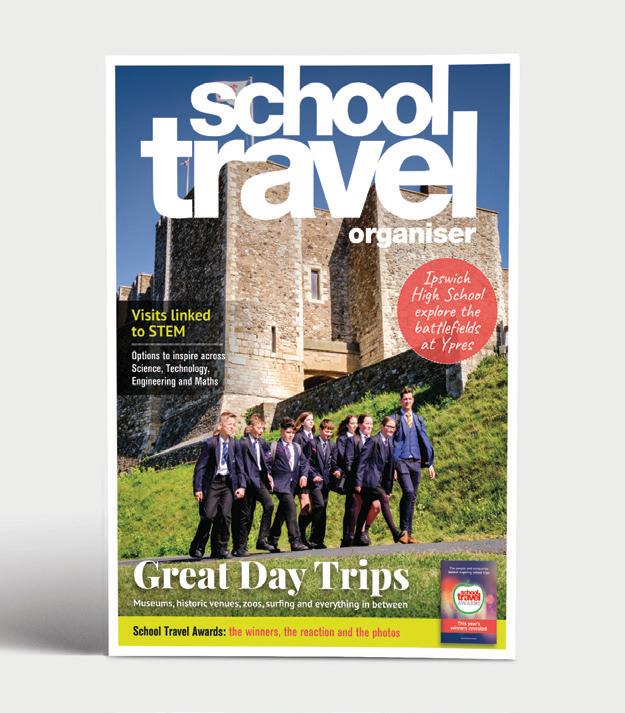
it. Take a look at the latest issue at: Summer 2022 School Travel Awards 2022: the winners, the reaction and the photos Options to inspire acrossScience, EngineeringTechnology, and Maths GreatDayTrips Museums,historicvenues,zoos,surfing and everything in between Visits linkedto STEM HighIpswichSchool explore battlefieldsthe at Ypres www.schooltravelorganiser.com organiser The best ideas and expert advice for school trips that inspire Teachers and EVCs can subscribe FREE to the magazine in print and / or online, get full access to the website, receive the regular newsletter, and the annual Learning Outside the Classroom Yearbook. Through the post, at your desktop or in the palm of your hands, School Travel Organiser delivers to all the right places to help teachers and EVCs create learning outside the classroom. Click to www.schooltravelorganiser.com/register or scan the QR code TEACHERSFREEFOR
PLANNING YOUR OVERSEAS TRIP
By Ellie Ross
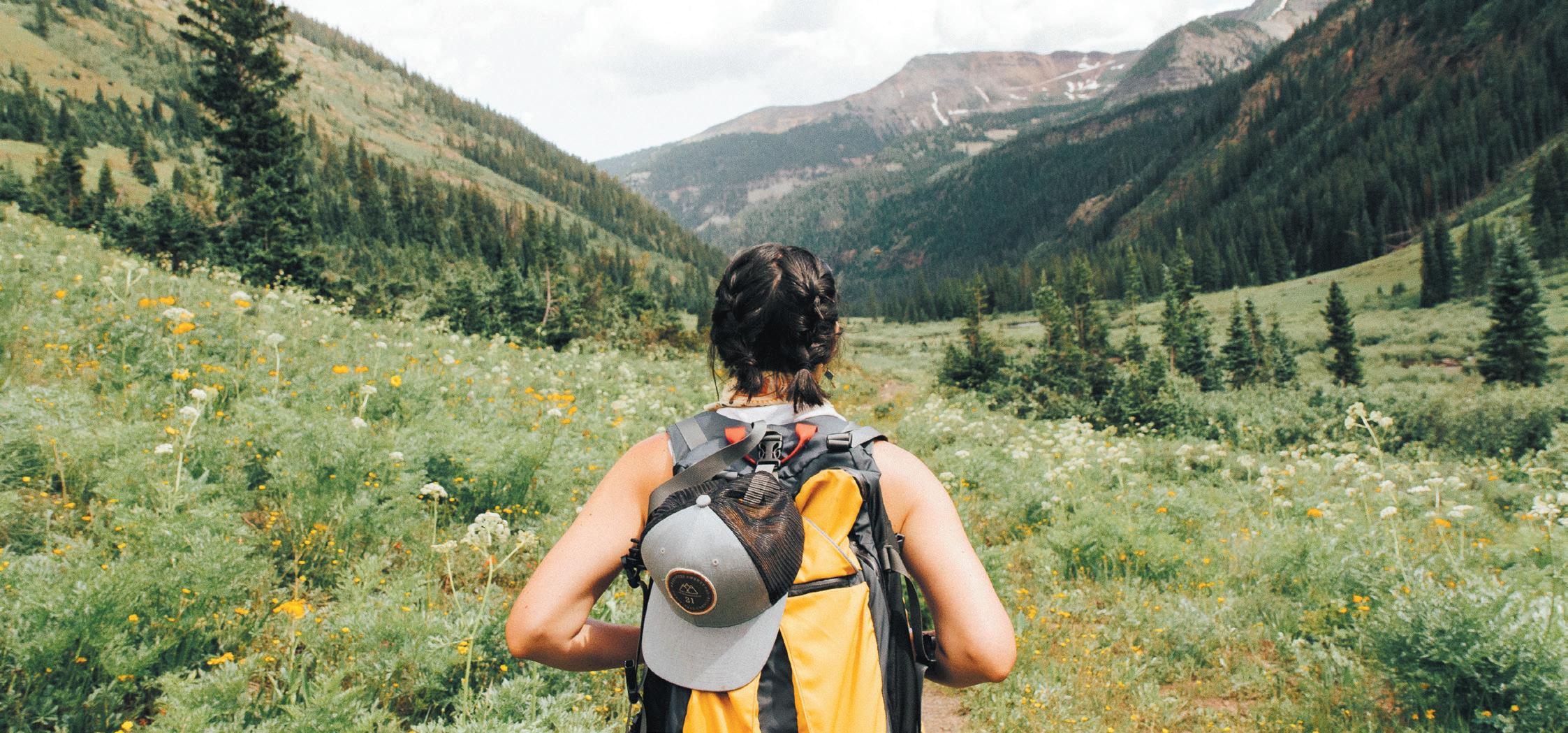
Planned well, overseas school trips provide a learning experience like no other. When students step outside the classroom for the adventure of a lifetime, they discover how to explore the planet independently and safely, making new friends and returning home forever changed.

Taking a group abroad is also an opportunity for teachers to develop. “You must be ready to problem-solve and leap outside your comfort zone, which can be incredibly rewarding,” says Stuart Morris, Global Operations & Product Director at World Challenge. “These enriching experiences with friends and colleagues will stay with you for a long time.”
The success of overseas school trips all comes down to preparation. Here are five things to consider in the planning stages.
Start planning early
Ideally, start planning your trip 12-18 months in advance. There is a lot to organise, so give yourself – and your students – ample time in order to reduce stress. Know what travel documents and vaccinations may be required. Some visas and vaccinations need to be organised 6-8 weeks in advance, so check the Foreign Travel Advice and the Fit For Travel websites (gov.uk/foreign-travel-advice; fitfortravel.nhs.uk).
You may need to adjust your diet and fitness regime if you’re going to be taking on something physically demanding, such as a trek at altitude. It’s also a good idea to avoid injury-prone sports like skiing and downhill mountain biking in the run-up to the trip.
Research your destination
Yes, you want to know what the currency is, which language is spoken and what the food’s going to be like. But do some deeper research, too, so you can fully embrace the culture. For instance, in India, the left hand is considered unclean so make sure everyone knows they should eat using their right hand instead. In many parts of Asia, showing the soles of your feet is a rude gesture. Getting to know these local customs before you leave will help you to avoid being a mere tourist once you arrive.
Identify your trip objectives
Trip leaders should identify learning opportunities on a trip abroad. Teachers may draw parallels to the curriculum on a geography trip to Iceland or a history trip to Vietnam, for example. But these don’t have to be formal, sit-down debriefs – try to be creative in the way you do these reviews. For instance, after a particularly tough trek, ask the group to pinpoint the positives, notice who stepped up and reflect on how this might impact the rest of the trip. Consider where these trip objectives might fit in before setting off.
Consider the “what ifs”
Think about what might crop up overseas – and what to do if necessary. Illness can put a downer on a trip, so be stringent with hygiene. Consider health risks and medical conditions, including any physical and mental health challenges. It’s important to be open about these things well in advance to make sure the right support is in place.
Pack light
Overpacking is a common problem, so only pack what you need. Remind students that they can wash their clothes and don’t need to bring ten pairs of socks! Kit lists are written with this in mind. Allow yourself a little luxury, like an inflatable pillow for long journeys.
38

Unique experiences to inspire and energise your students BEAUTIFUL PLANET EXPLORE OUR weareworldchallenge.com We’ re clim ate positiv e FIND OUT MORE
A New Kind Of Sponsored Walk
Strider is a new free smartphone app that enables anybody to contribute to charity fundraising without having to make any cash donations themselves.

Easy Fundraising For All
It couldn’t be simpler; just download the app, choose your charities, and go about your normal day. The more you walk the greater your donation. Absolutely anybody can get involved because the size of your donation is down to how much you walk, rather than how much money you have or spend.
A New Kind Of Sponsored Walk
Strider essentially turns your daily life into a big sponsored walk where businesses are the sponsors.
All ‘Striders’ have access to the Marketplace where shops and brands provide exclusive discount codes and special offers. Every time a discount code is used, that brand/shop donates money to your chosen charities.
Users get access to exclusive discounts and save money, shops and brands gain an automatic mechanism to support great causes and demonstrate social responsibility, and charities get funded. Win, win, win.

Striders & Schools
Strider provides schools with a unique way to encourage students to live an active lifestyle, and evidence a strategy to support the requirements of the Ofsted education inspection framework, and the ‘Healthy Schools’ Rating Criteria. What’s more, breaking the link between personal income/wealth and donating provides a truly inclusive way for students to support great causes.

Strider, Schools & EVOLVE ‘Walks’ are a great way to collaboratively get active and raise funds for charities that your school wants to support. Everyone that joins your walk (e.g. all of your pupils) automatically adopts your chosen charities enabling you to harness the power of your school community to fundraise with Strider.
To make it as easy as possible, Strider has partnered with EVOLVE (the educational management system for schools provided by eduFOCUS Limited) so that you can create and manage your walks from your existing EVOLVE account. You can create groups (e.g. tutor groups, year groups, houses etc.) within a school ‘Walk’ so that you can monitor progress, and even introduce an element of competition.
Creating ‘Walks’ as a school is a great way to harness the power of your community and make a difference!
Any questions? Email: info@striderapp.co.uk.
You can also check our website for any updates: www.striderapp.co.uk.
40


euro-study-tours.co.uk 0330 838 4120 Explore a whole new world of learning Creating educational trips for schools & colleges for over 40 years Dedicated team of travel experts to tailor-make your group’s perfect trip Support at all stages including 24-hour emergency cover whilst away Travel with confidence with our ABTA & ATOL protection Exclusive LIVE! student learning events in UK, Disneyland® Paris & New York 40 Scan me!


42





www.theevcmagazine.online