Environmental Science & Engineering Magazine | February 2025
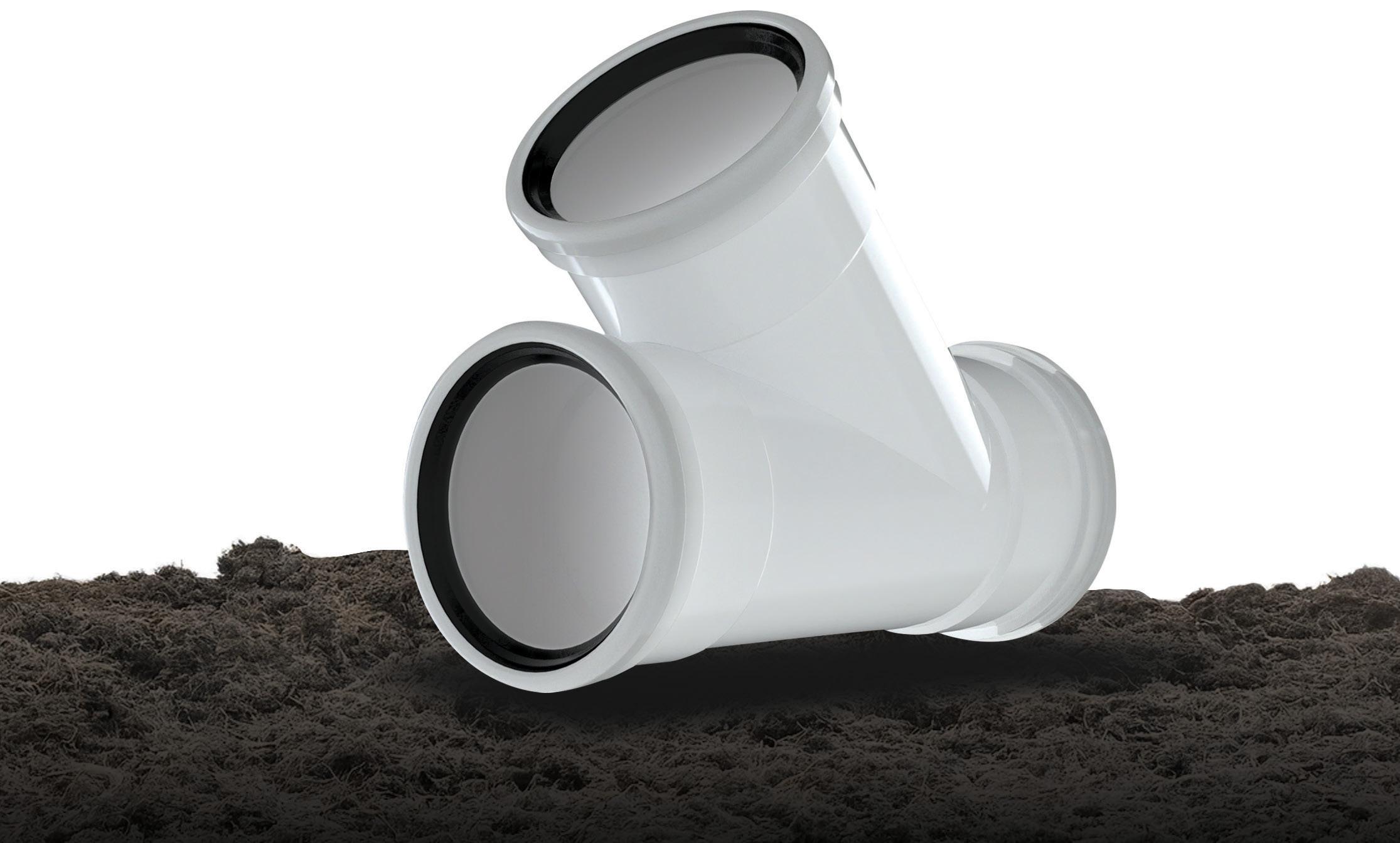
SUPERIOR SEALING
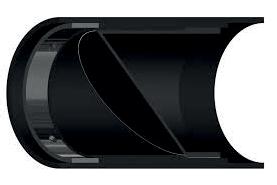
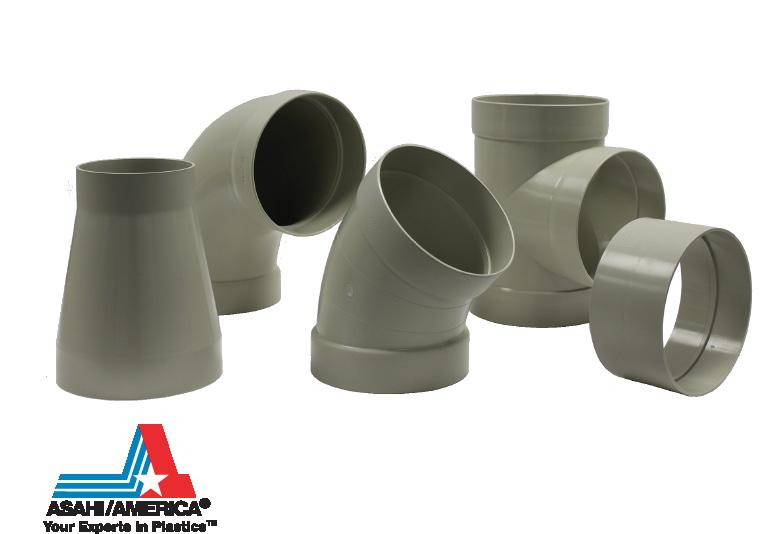
Our unique gasket design ensures a leak-proof seal, providing you with peace of mind.
DURABILITY
Made from high-quality materials, Ring-Tite fittings are built to withstand the toughest conditions.
VERSATILITY
Suitable for a wide range of applications, including sewage and industrial systems.
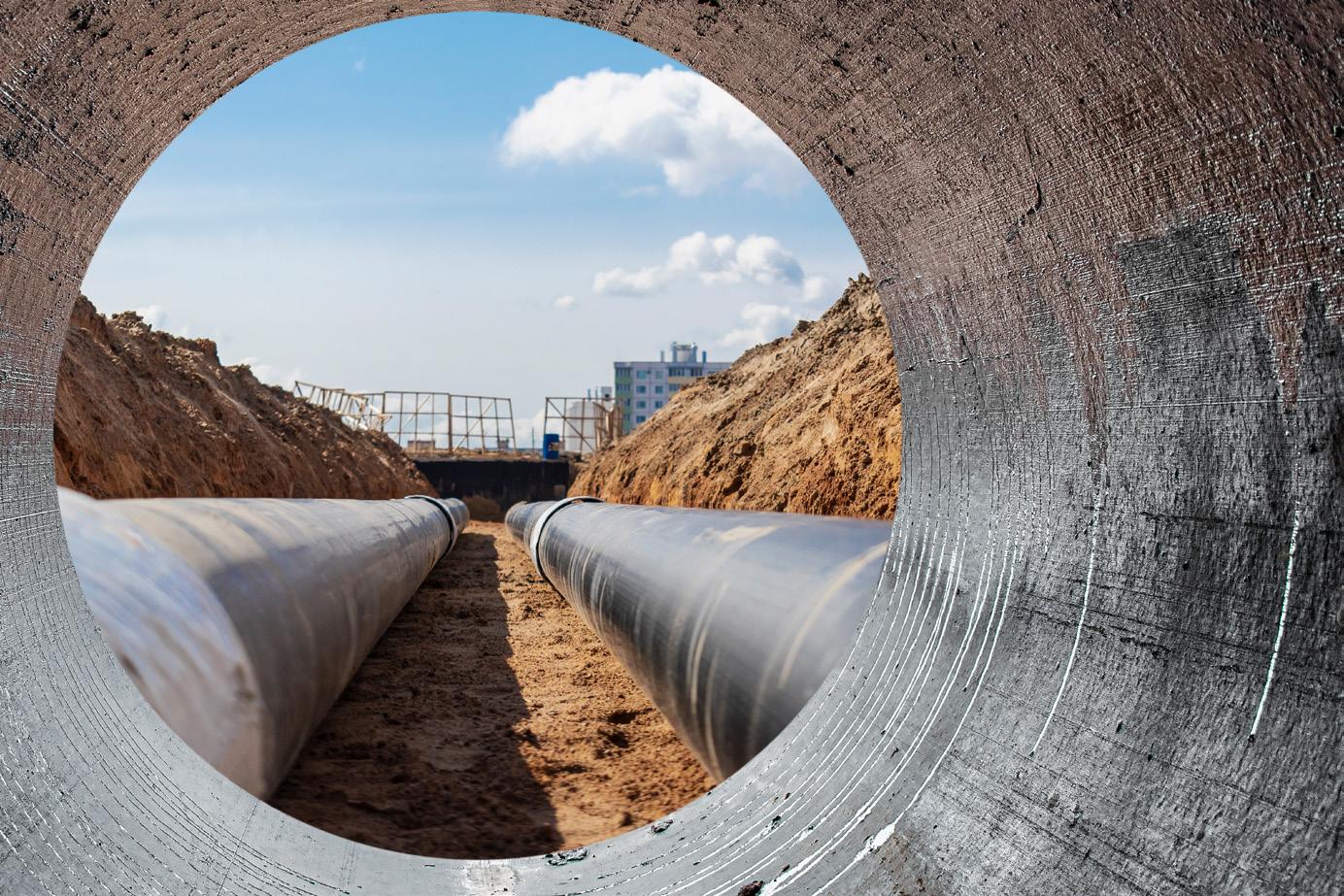
Discover the Strength & Reliability
Experience unmatched durability and reliability with Ring-Tite fittings. Designed for easy installation and superior sealing, these high-quality fittings ensure leak-proof performance in a variety of applications. Trust Ring-Tite for your sewer pipe and fitting system needs. Choose Ring-Tite fittings and enjoy peace of mind with every connection! To Learn
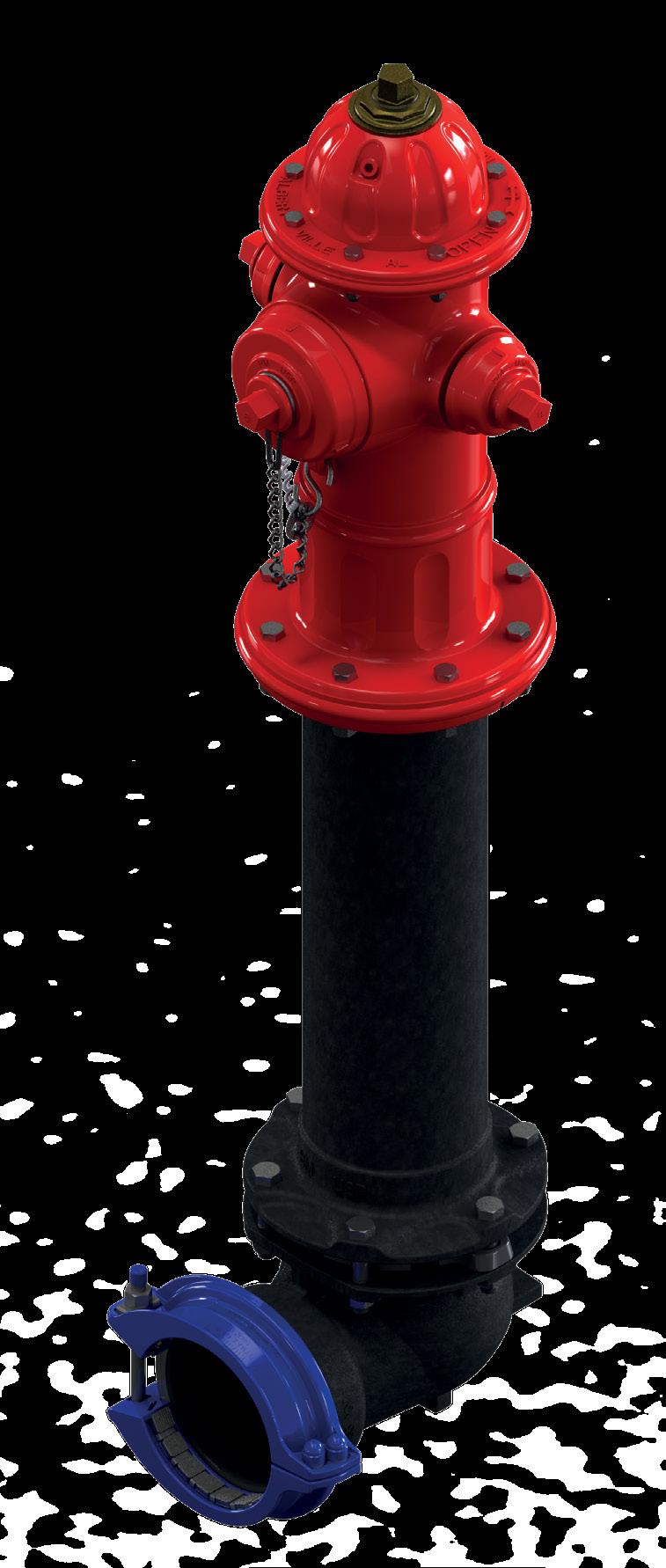
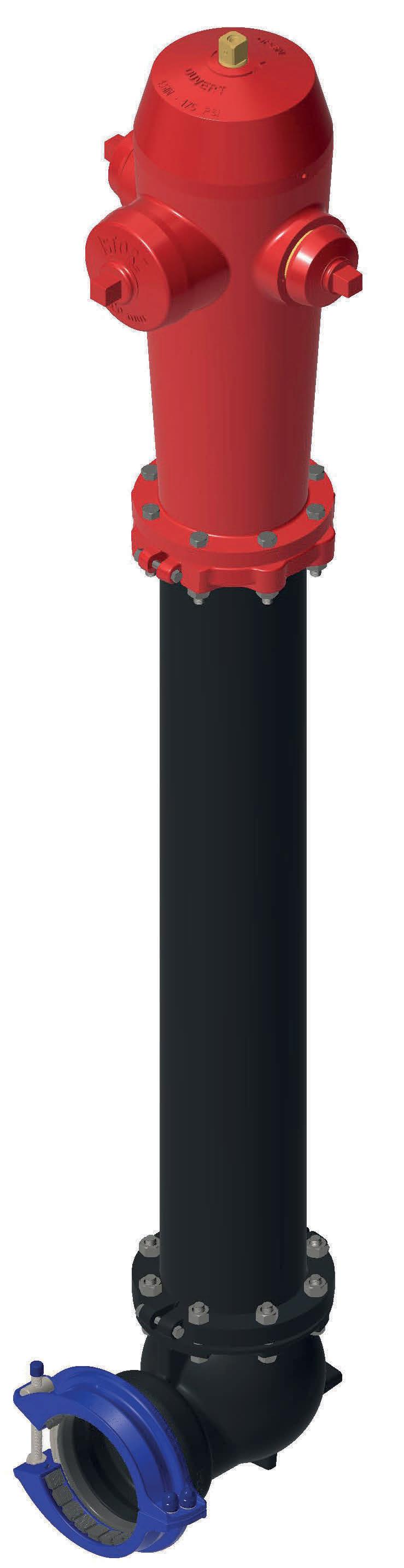
THE CANADA VALVE HYDRANT IS JOINING THE GRIP WORLD
Introducing the Canada Valve Hydrant with Hymax Grip. This hydrant is more versatile and capable of joining a wide selection of pipe types and diameters, resulting in easier, more flexible installations.
Ready to learn more? For more information contact us at 1-800-423-1323 or visit us online at muellercompany.com
Editor and Publisher STEVE DAVEY steve@esemag.com
Managing Editor PETER DAVEY peter@esemag.com
Contributing Editor DAVID NESSETH david@esemag.com
Design & Production MIGUEL AGAWIN miguel@esemag.com
Circulation BRIAN GILLETT ese@mysubscription.ca
TECHNICAL ADVISORY BOARD
Archis Ambulkar, Toledo Technology Academy of Engineering
Gary Burrows, City of London
Patrick Coleman, Stantec
Bill De Angelis, Metrolinx
Mohammed Elenany, Urban Systems
William Fernandes, City of Toronto
Marie Meunier, John Meunier Inc., Québec
Tony Petrucci, Black & Veatch
Environmental Science & Engineering is a bi‑monthly business publication of Environmental Science & Engineering Publications Inc. An all Canadian publication, ES&E provides authoritative editorial coverage of Canada’s municipal and industrial environmental control systems and drinking water treatment and distribution.
Readers include consulting engineers, industrial plant managers and engineers, key municipal, provincial and federal environmental officials, water and wastewater plant operators and contractors.
Information contained in ES&E has been compiled from sources believed to be correct. ES&E cannot be responsible for the accuracy of articles or other editorial matter. Articles in this magazine are intended to provide information rather than give legal or other professional advice.
Canadian Publications Mail Sales Second Class Mail
• Biological – SBR, MBR, RBC, MBBR, MABR, Oxidation Ditch, BioMag, CoMag Polymer – Liquid and Dry Systems
• Digester Gas – Gas Holders, Gas Conditioning: chilling; compressing; and removal of moisture, sulphur, carbon dioxide and siloxane, complete Co-Generation facilities
How a Canada-U.S. trade war could impact the water and wastewater sector
At the time of writing, U.S. President Donald Trump had just announced a 25% tariff on Canadian steel and aluminum products. This would be part of the general 25% tariff on all Canadian exports to the U.S., scheduled to take effect in early March.
In turn, our federal government has threatened retaliatory but unspecified tariffs on U.S. imports. While no one knows the length and extent of this ever-evolving political situation, it is already having consequences for equipment suppliers and municipalities.
The Federation of Canadian Municipalities (FCM) says it “strongly condemns new U.S. tariffs on Canadian products and warns of the severe consequences they will have on local economies across the country.”
“Municipalities are the backbone of the Canadian economy and the engine that drives growth, productivity and jobs,” said FCM President Rebecca Bligh in a February 1 statement. “Tariffs put local businesses, workers and supply chains at risk. Any response to the actions of the U.S. administration must be coordinated across all orders of government, as municipalities play a crucial role on Team Canada.”
Green Building Canada is a network connecting sustainability-focused professionals, homeowners and the green building community across Canada. On its website it says that Canada’s proposed retaliatory tariffs on U.S. goods target a wide array of products crucial to the Canadian construction and manufacturing sectors.
These retaliatory tariffs could have significant ripple effects throughout Canada’s construction industry, warns Green Building Canada. For projects that rely heavily on U.S. imports, the increased costs could delay timelines, raise overall expenses and jeopardize projects entirely.
Green Building Canada added that “the potential [retaliatory] tariffs could encourage a shift towards sourcing materials domestically or from alternative international suppliers.”
The Ontario Sewer and Watermain Construction Association represents 750 companies, including contractors, manufacturers, distributors, and consulting engineers from across the province. In a February 5 bulletin, it said, “there remains questions about the implications of future potential tariffs to Canada’s construction and infrastructure industry, as the costs of products essential to construction could immediately increase upon the introduction of any such tariffs.”
It advises members and the industry to check if contracts include, “provisions for price adjustments due to changes in taxes and customs duties.”
The idea of Canadian retaliatory tariffs and a “Buy Canadian” attitude is not new, nor is the cautious warnings of trade and industry associations. In 2009, there was
a lot of concern over the implications of the Obama Administration’s “Buy American” provisions contained in the American Recovery and Re-investment Act (ARRA).
In a survey taken in the fall of 2009, less than one in three member companies of the Ontario Pollution Control Equipment Association (OPCEA) supported the FCM’s “Fair Trade” Resolution that was crafted in response to the ARRA. This resolution encouraged Canadian municipalities to adopt procurement policies that excluded the use of products in infrastructure projects that were imported from countries that did not allow free and unfettered access to Canadian-made products.
Like many supplier associations, OPCEA is comprised of companies that manufacture equipment and supplies in Ontario, as well as companies that sell, or distribute imported equipment and supplies. While the association recognized the need to support free access to the U.S. market for its Canadian manufacturing members, it also supported member companies that sell American products into the Ontario market.
It was the opinion of OPCEA in 2009 that Canadian and U.S. markets are inextricably linked, and that any policy restricting market access in either direction is counterproductive and will ultimately negatively affect Canadians.
In writing this article I reached out to several current OPCEA members and they expressed the same sentiment with the current trade war situation. Also, they noted that Canadian equipment manufacturers still do not have either the range of products, nor the capacity, to fill the void that would be created if U.S.-made wastewater and water infrastructure products could no longer be purchased.
Maintaining and expanding water and wastewater treatment plants and their infrastructure systems to meet demand still needs to happen regardless of tariff cost increases. Municipalities are already under pressure to support ambitious housing targets that are a priority to Canadians, and the tariff chaos is only complicating matters. Improved efficiencies will help somewhat, but commodity and equipment prices will always be a key factor.
While the current situation is serious and unpredictable, there is some consolation to be found in the fact that this is not the first time Canada’s water, wastewater and environmental industries have faced trade complications with our southern neighbour. Let us hope that any tariff-induced project delays (and sleepless nights) are short lived.
Steve Davey is the editor and publisher of ES&E Magazine. Email: steve@esemag.com
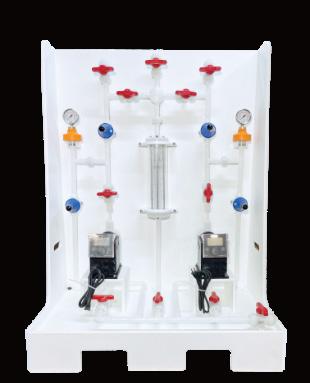
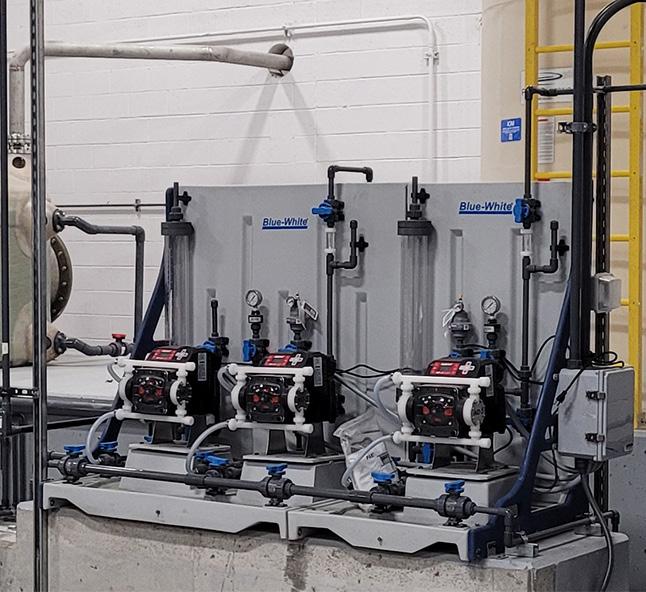
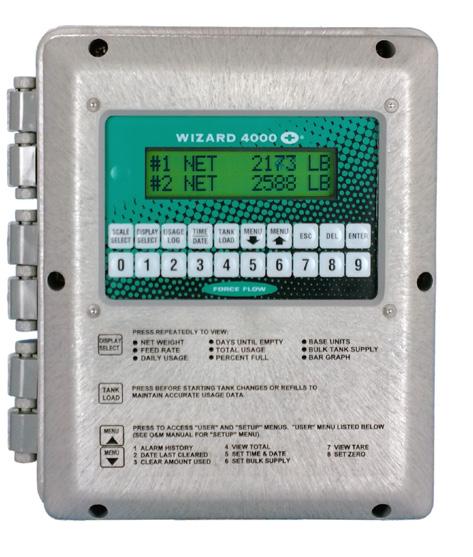
Dependable Chemical Feed & Flow Measurement
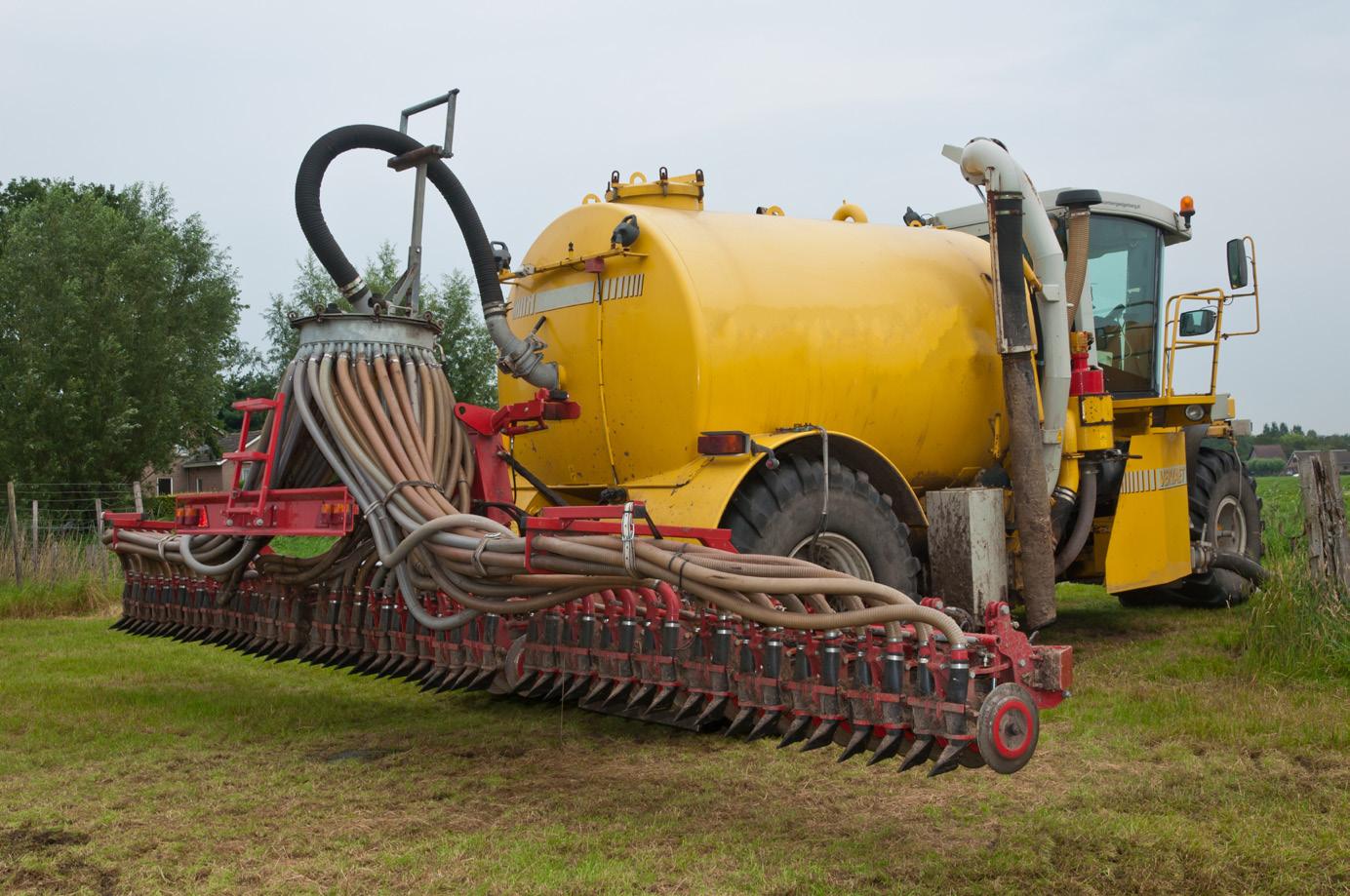
The value of land applied biosolids to farmers is $500 per hectare.
Credit: ruudmorijn,stock.adobe.com
Biosolids are the solution, not the problem
By Phil Sidhwa
Over the last several months, some community groups have questioned the safety and efficacy of biosolids being applied to farmland. The Ontario Biosolids Council, which is drawn from organizations representing the industry who manage the application of biosolids as a fertilizer, and some of the municipalities that produce these biosolids for agricultural use, want to correct the misinformation about biosolid use.
Opinions are not facts, and the use of biosolids to enhance the soil quality and nutrient levels of Ontario farmlands is a well-regulated agricultural practice that is the very definition of environmental sustainability and our collective drive for a circular economy. The experts are not only those working in the industry, aca-
demia, governments and their agencies, but also a large group of scientists that have scientifically researched the safety and efficacy of biosolids for decades (and continue to do so, across Canada and the United States).
First, the terms biosolids and sewage sludge are not interchangeable. Biosolids are produced when municipal wastewater treatment facilities treat wastewater from residential, industrial and commercial sources into treated water and leftover solids. Treated water is normally discharged to a nearby stream or river, while the solids go through an additional treatment process to reduce the presence of potentially harmful micro-organisms and odours. Treated solids that meet the regulatory requirements, including quality standards, are known as biosolids.
It is only at this point that Ontario’s Ministry of the Environment, Conservation and Parks (MECP) and Ontario’s Ministry of Agriculture, Food and Agribusiness (OMAFA) will consider allowing these biosolids to be applied to farmlands. Ontario’s comprehensive Nutrient Management Act is then followed to pro-
vide a strict and effective regulation for their safe and productive use.
The province is not the only regulator. At a federal level, the Canadian Food Inspection Agency (CFIA) provides a further level of oversight through the Fertilizers Act when biosolids are processed into pellets and used like any other traditional fertilizers. Here, the level of regulation has addressed the emerging concern of any possible contamination of fertilizers from PFAS.
In October 2024, this new regulation limited the amount of PFAS that can be found in fertilizers derived from biosolids to 50 parts per billion. For context, that is the equivalent of three drops of water into an Olympic sized pool. Protecting both farmers and all Canadians even further, this same regulation bans the import of any such fertilizers that don’t meet this rigid standard from being allowed into the country at all.
This level of belt-and-suspenders regulation and oversight is important. As an industry, we welcome it and support its enforcement. That’s because the continued availability of biosolids is crucial to the farmers that use them and to the municipalities that produce them. It’s a win-win relationship.
The alternatives to land application — landfilling or incineration — are neither environmentally friendly nor sustainable. Moreover, they would unnecessarily add costs to municipal taxpayers while taking away real financial benefits from farmers (the value of land applied biosolids to farmers is $500 per hectare — that’s thousands and thousands of dollars a year of cost savings to each participating farmer).
The land application of biosolids is a science-based, historically safe, and well-regulated solution to two problems. These are the need to provide on-going nutrients to farmlands and the need to beneficially use a by-product of our municipal wastewater treatment systems. Just as we treat wastewater and then return it to the ecosystem from where it was originally drawn.
Phil Sidhwa is Chair of the Ontario Biosolids Council.
For more information, visit: www.ontariobiosolidscouncil.ca
B.C. community shifts design, location on new WWTP to reduce cost overruns
By ES&E Staff
The City of Kimberley, British Columbia, is moving forward with plans to build a new wastewater treatment plant, but the project team identified challenges with the original design, which would have exceeded the budget by an estimated $40 million.
The updated plan includes shifting to an aerobic granular sludge (AGS) process as a cost-efficient and environmentally sustainable wastewater treatment method, local officials announced in an update. The plant had initially been set as a Food Chain Reactor facility, which is a type of fixed-film activated sludge treatment.
The community of just under 9,000 residents will now focus on optimizing construction and process methods, as well as proposing to build the plant closer to the existing facility than initially planned.
“The proposed treatment process is designed to comply with environmental standards, address odour concerns, and allow for future growth,” said City of Kimberley Wastewater Treatment Plant Project Manager Shane Castle. “The updated location, near the existing facility, will help manage costs, while supporting longterm environmental safety and resilience against the impacts of climate change. We understand that these changes may raise questions and concerns, and we are dedicated to providing clear and transparent information as we move forward.”
These adjustments will support the goal of staying within the original budget while maximizing the use of available grant funding. Visual comparisons of the original and revised locations, as well as renderings of the updated design, will be shared with the public once avail-
able, according to local officials.
Funding for the initial project comes from a $90.6 million investment commitment from federal, provincial, and municipal governments announced in December 2023.
The new facility will replace the aging
pollution control centre, built in 1967, with modern infrastructure that minimizes environmental impacts on the St. Mary’s River and downstream communities.
For more information, email: editor@esemag.com
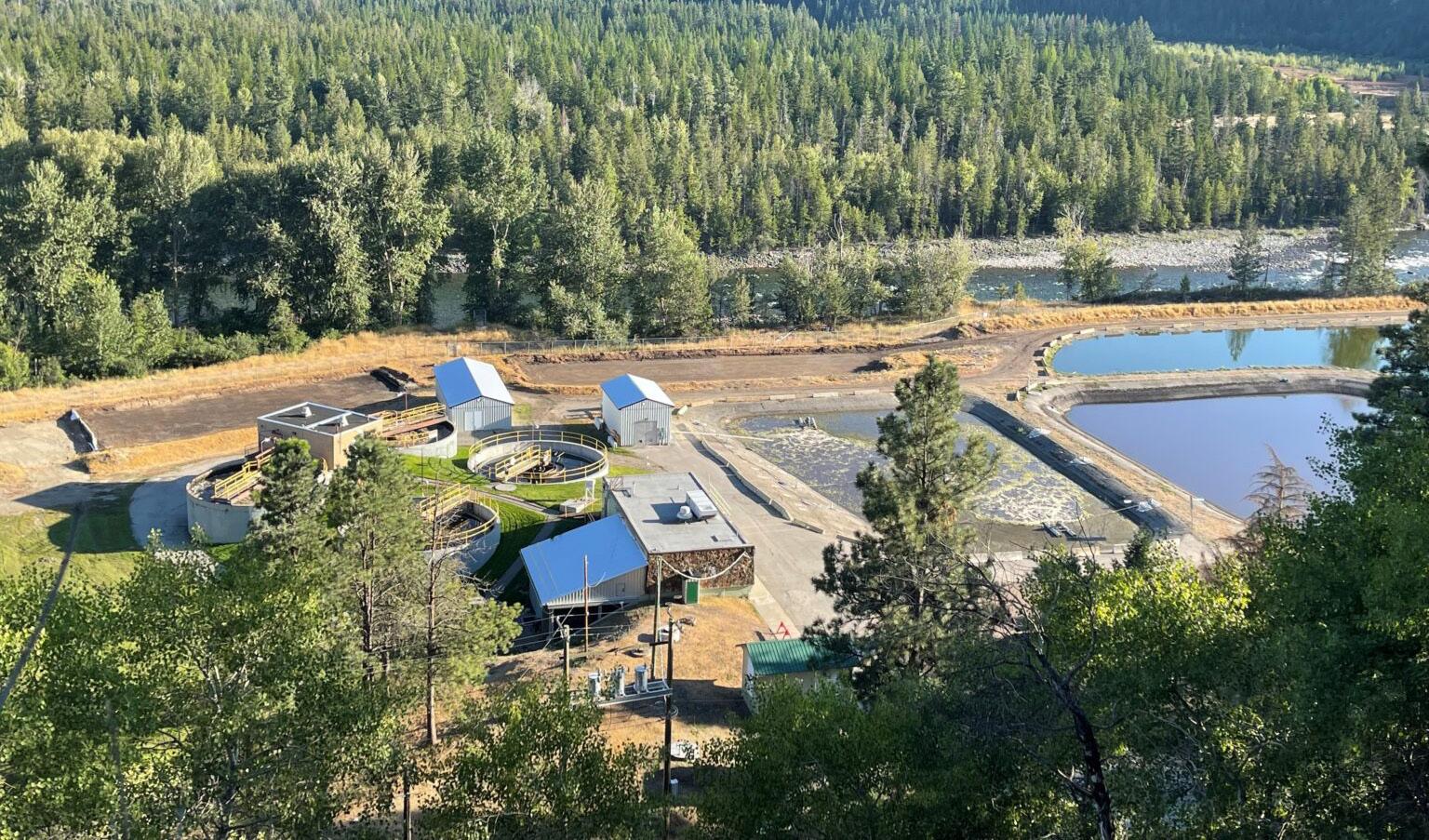
The new facility will replace the aging pollution control centre, built in 1967. Credit: City of Kimberley
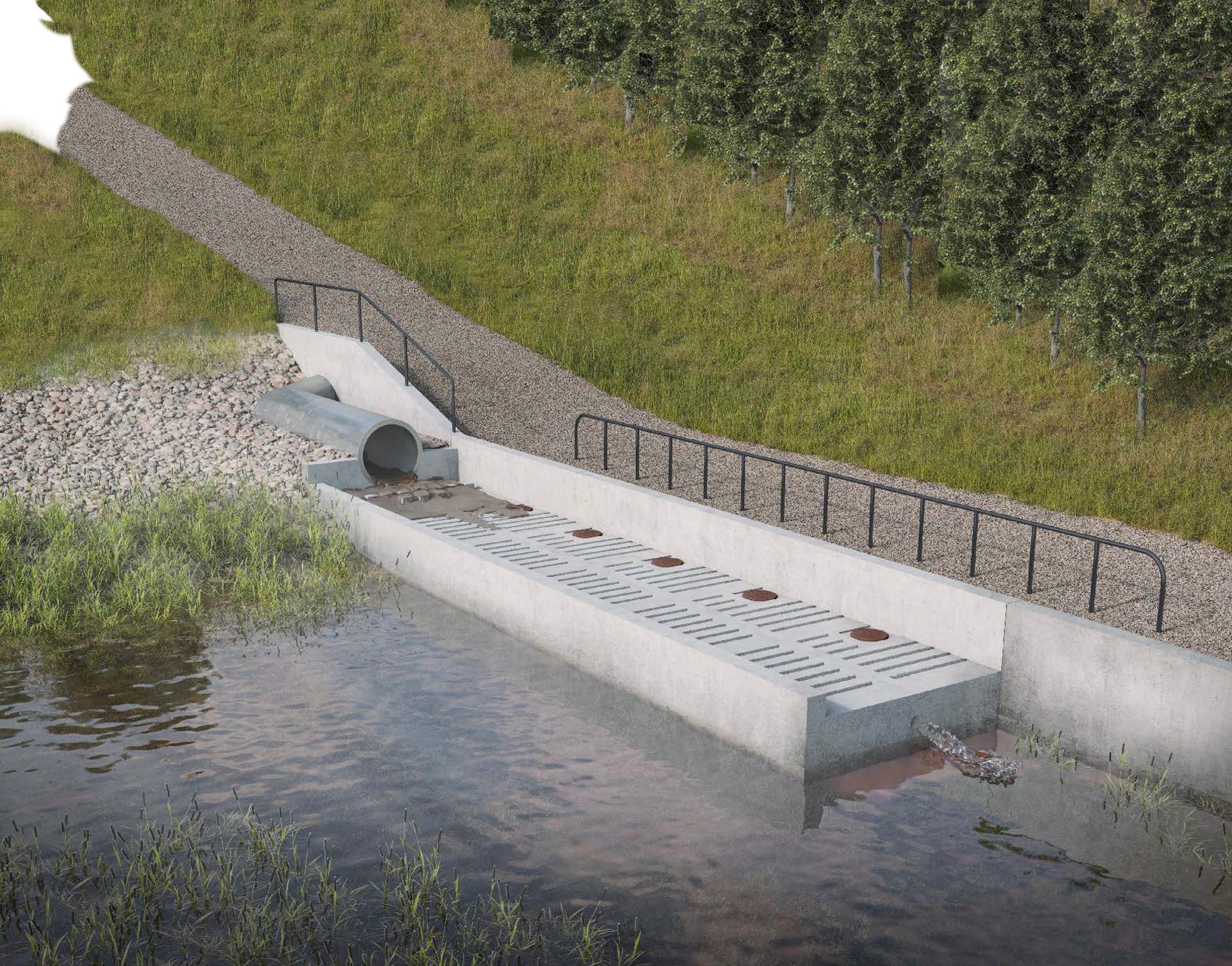
Ajax secures stormwater pond funding as it works to complete master plan study
By ES&E staff
The Ontario government is investing $278,312 for the Town of Ajax to rehabilitate its Bradbury stormwater pond, which would enhance flood protection and facilitate the construction of new homes as local officials set out to create their first stormwater master plan.
This funding comes through the Housing-Enabling Water Systems Fund, which includes $970 million to help municipalities develop, repair, rehabilitate and expand drinking water, wastewater and stormwater infrastructure.
The Nottingham South (Bradbury) Pond is one of many stormwater management ponds in the community that collect and store stormwater to reduce flooding and erosion by limiting the release of water to nearby creeks and rivers. Ajax contains 12 sub watersheds that eventually drain to Lake Ontario. Its stormwater system is not connected to the sanitary system, and the water is not treated at wastewater treatment facilities.
“The province’s investment in Ajax and the Durham Region will provide critical upgrades to stormwater management, ensuring we have the right infrastructure in place to support the growth of our community,” announced Patrice Barnes, MPP for Ajax.
Late last year, Ajax began developing its first stormwater master plan study, expected to be completed by summer 2025. The plan will identify stormwater management policy and guidelines, address stormwater infrastructure, and identify and prioritize identified projects.
Ajax, which has a total of 52 active private and municipal stormwater management facilities, implemented its first
stormwater fee in 2023. The town also has three rain gardens near Lake Ontario to improve surface water runoff infiltration. Two bioswales also serve to improve surface water infiltration.
Ajax also boasts the Greenwood Conservation Area, where residents can explore 283 hectares of naturalized green space, nature trails, walking paths and playgrounds.
Local officials celebrated the stormwater funding as they announced to the town of 127,000 residents that 2025 will be the town’s 70th anniversary.
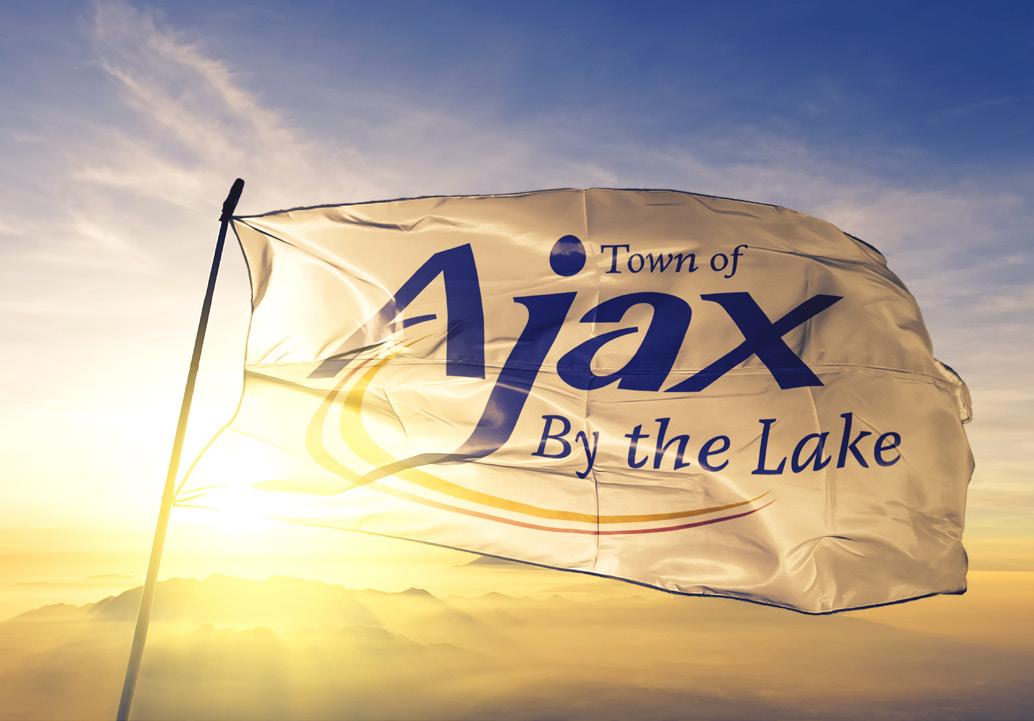
The Town of Ajax, which has a total of 52 active private and municipal stormwater management facilities, implemented its first stormwater fee in 2023. Credit: oleksii,stock.adobe.com
PONDS EXPENSIVE AND MESSY TO CLEAN?
WE HAVE AN EASY
SOLUTION
INSTALL A SWM SHIELD TO PRE-TREAT YOUR POND
Safety shut off valves can prevent costly water damage during construction
By Ryan Spooner
As insurance premiums for construction projects continue to rise, pushing deductibles into six figure territory, companies are looking for ways to reduce their risk during a build.
Large construction projects, like ViewStar’s in Richmond, British Columbia, with 12 buildings providing 941 residential units and 200,000 ft² of commercial space, are bustling sites, with many contractors coming and going.
It is not uncommon for water leaks to occur during any construction, and the risk multiplies by the number of floors, sub-contractors and complexity. Pipes can burst, fittings can leak, plumbing elements can be left open. If this happens at nighttime when no one is around, the damage can be extensive, particularly the closer the project is towards completion.
“With so many people on site, installing plumbing elements like valves, faucets, toilets, hoses and so on, there is a lot of potential for parts to fail or mistakes to happen,” said Andy Ciecielski, mechanical superintendent for ITC Construction Group (ITC), whose primary focus was to reduce damage and insurance claims during construction by mitigating risks and putting in protection measures.
“We have had some catastrophic water leaks in the past which cause huge time delays and add significant cost,” he added.
Unauthorized after-hours workers pose a serious health and safety risk as daytime resources and personnel are not on site to ensure safety protocols are being followed.
Colin Robins, with Summit Valve and Controls Inc., worked with Cla-Val to put together a package that would monitor the domestic water supply to the site, while providing drip tight isolation when required, and instantaneous alarms and feedback related to afterhours site conditions.
This package included a Cla-Val Series
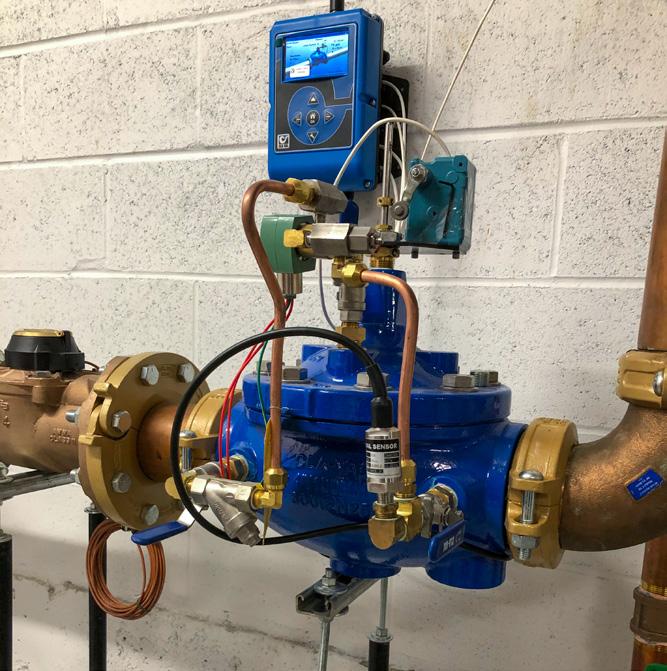
ViewStar’s package included a Cla-Val Series 136 solenoid control valve, a VC-22D valve controller and various Cla-Val instrumentation and communication equipment.
136 solenoid control valve, a VC-22D valve controller and various Cla-Val instrumentation and communication equipment. A custom controller app was developed to monitor the instrumentation, control the valve action sequences, and create an alarm for the site.
The construction safety valve package is installed on the main water feed of each residential tower. This drip-tight, solenoid activated, on-off control valve effectively operates to shut off water to the building after hours. Activation of the control valve has the ability to be controlled locally via the VC-22D controller, remotely through the building management system, or in the case of the ViewStar project, via a user adjustable time-based program.
ITC selected to open the valve at 6 a.m., at the start of construction hours and close at 8 p.m., after construction hours, Monday to Saturday. The system was set to remain closed on Sunday when no construction was taking place. Besides controlling the water to the building, the package effectively adds a layer of supervision to the site by monitoring the pressure when there are no personnel on site.
If there is a pipe burst or leak, or unau-
thorized water use during the off period, it will result in a change in system pressure. The valve package will sense the change and will activate an alarm sequence. In addition to a siren alarm to alert on-site security to prompt an immediate investigation, the system will also send out a notification via cellular to building management. Multiple people can instantly be informed of the event.
In addition to the pressure monitoring, the valve package also monitors valve position and flow. The combination of feedback from these instruments gives the system the ability to sense unexpected flow events and activate alarm sequences for immediate attention. Once an alarm has been triggered, the valve will remain closed until the system is reset, ensuring water does not enter the system until the issues are resolved.
Water usage is usually not measured on a construction site, making it difficult to identify when it is being used. This valve package also helps prevent unauthorized use of water after hours, mitigating health and safety concerns associated with working outside of fully resourced operational hours.
“By monitoring pressure, flow and valve position, we now have better on-site water intelligence that reduces our risk of flood damage, and in turn lowers the potential for insurance claims,” said Ciecielski. “Going forward, we hope to install this construction safety valve on new construction sites.”
The valve is compact and can be designed for portable use so that once the construction is completed, it can be removed and installed on a new site. If the building management chooses to keep the valve, they can add further accessories to build in another layer of water shut-off safety for unplanned events like earthquakes or pipe bursts.
Ryan Spooner is with Cla-Val. For more information, visit: www.cla-val.com
Flood control protects the vibrant New Orleans community from rising waters. At the world’s largest drainage pumping station along the Gulf Intracoastal Waterway (GIWW), 11 Pentair® pumps help NOLA play on.
Above:
95
Swiss WWTP has been generating power from biogas for over 50 years
By Uli Merkle
Ever since it was commissioned in 1974, the Echallens wastewater treatment plant in the Swiss canton of Vaud has been generating power from the recovery of biogas.
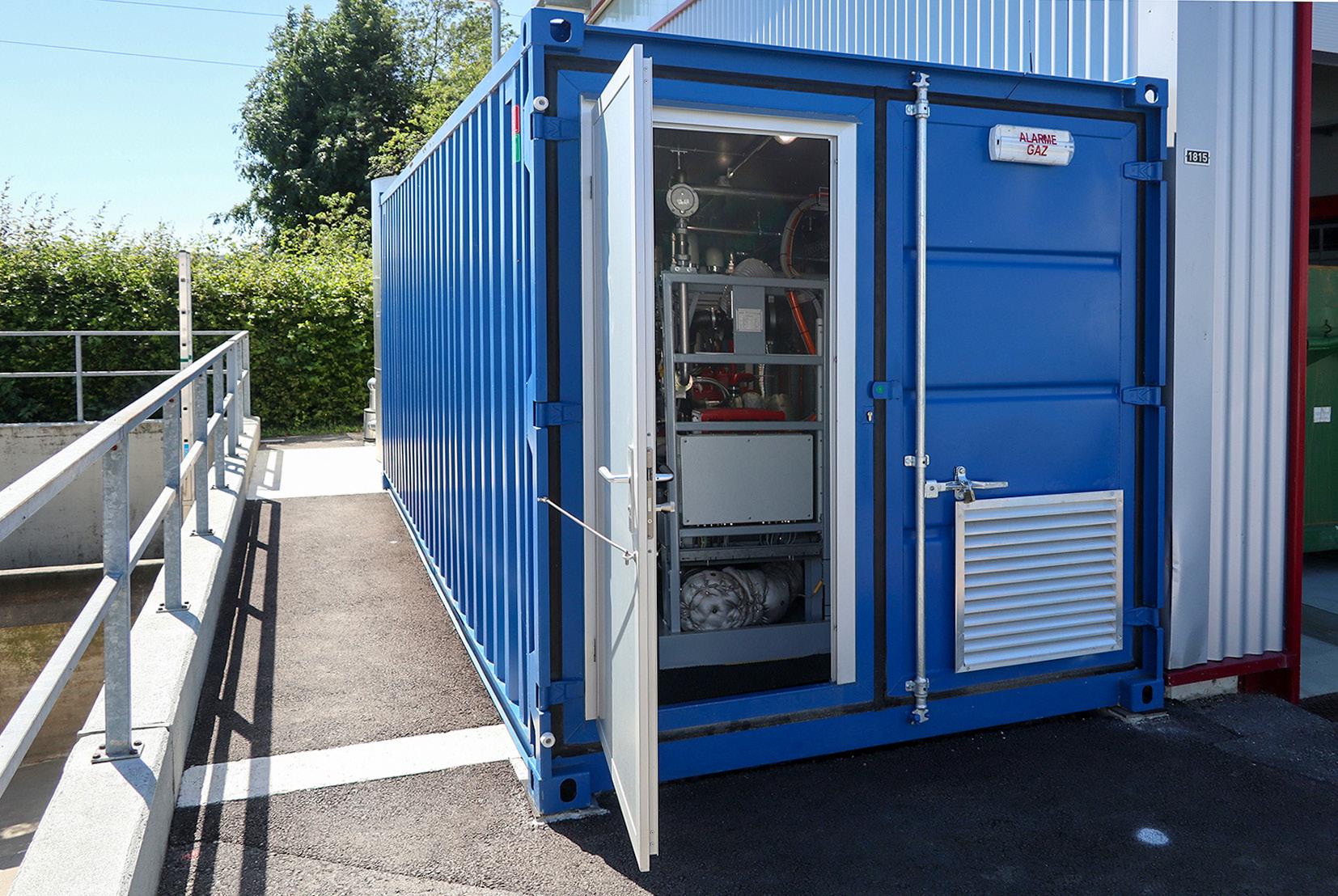
In 2019, a new biogas cogeneration unit was built, which generates 150,000 kilowatt-hours of power annually. Warm water recovered from the cogeneration unit is mainly used for the plant’s own needs, for instance, to warm up the sludge in the digester or heat indoor areas.
To make the process more economically efficient, a decision was taken to optimize the circulation of biogas within the digester. A portion of the biogas generated in the digester is fed back into the sludge. To do this, biogas is suctioned out of the top part of the digester, compressed and fed back into the sludge at the bottom of the digester.
The biogas flows through the sludge and then collects back up at the top of the digester, where it is fed through a line and into a gas tank as an interim reservoir. From the gas tank, the biogas then goes straight to the cogeneration unit. This currently runs for 20 hours a day and is only switched off for a few hours at night.
Circulating biogas has the following benefits:
• Concentrated sludge is heated to 38° Celsius in the digester. Flooding the sludge with biogas helps to ensure that the heat is evenly distributed.
• Mixing the sludge also helps to avoid deposits collecting and compacting at the bottom of the digester.
• The rising of the gas bubbles up through the sludge improves the microbiological degradation processes in the sludge, which ultimately leads to a higher gas yield.
• Circulating biogas through the sludge also means that it does not have to be mixed mechanically.
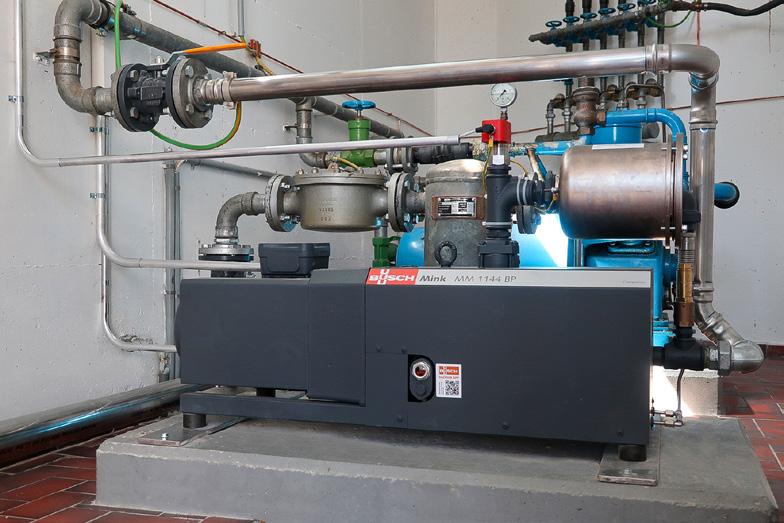
In May 2020, two old oil-lubricated piston compressors from the original facility used to mix the sludge in the digester were replaced by one MINK claw compressor from Busch Vacuum Solutions. This enabled the amount of power required for this process to be reduced by up to 40%.
MINK claw compressors are ATEXcertified, which means that flame arresters are no longer required. Furthermore, they are equipped with a variable speed drive so that the volume flow can be adapted pre-
cisely to the requirements in the digester. These units compress biogas without using any oil at all. This is made possible by the compressors’ contact-free operating principle, which means that the internal moving parts do not come in contact with each other or the housing. As a result, no oil changes are needed, unlike the original oil-lubricated piston compressors which required two each year.
Plant personnel also noted that the claw compressor is much quieter than the original piston compressors.
Uli Merkle is with Busch Vacuum Solutions. For more information, email: danie.lemay@busch.ca
Left: The new cogeneration unit at Echallens wastewater treatment plant is installed in a container.
Up to
cubic metres of biogas per hour are transported by the MINK claw compressor at an overpressure of 0.6 bar.
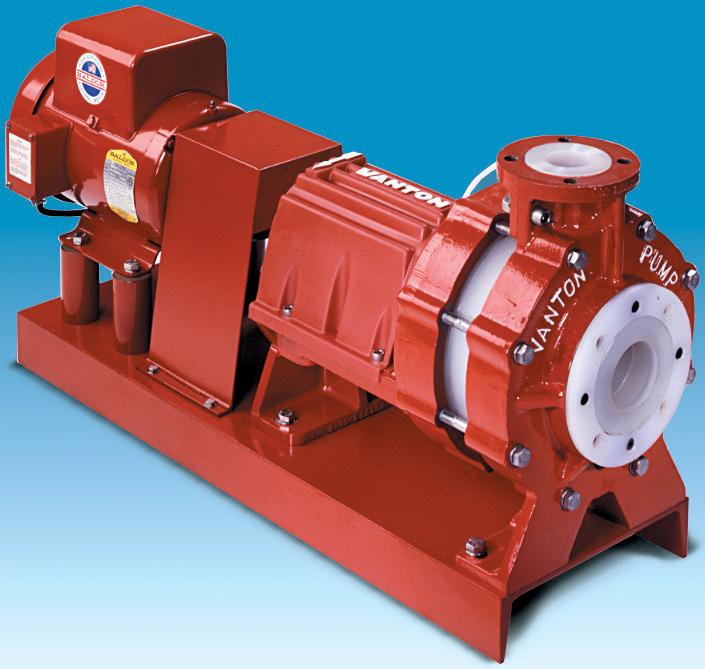
The Vanton AdVantage
The Key to Ending your Pumping Problems
• No Corrosion or Contamination
• No Chemical Absorption or Wicking
• No Tearing, Cracking or Peeling
• No Significant Abrasion
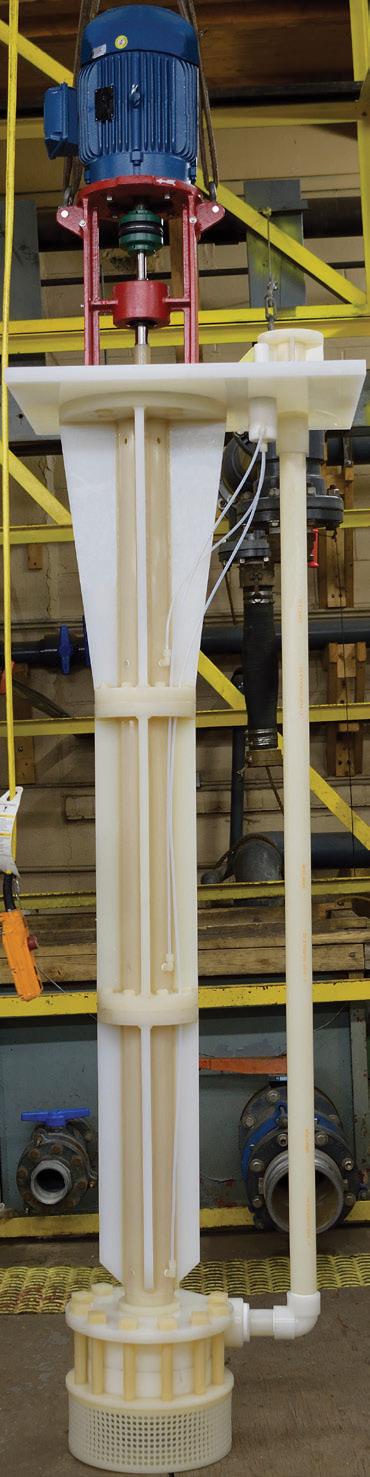
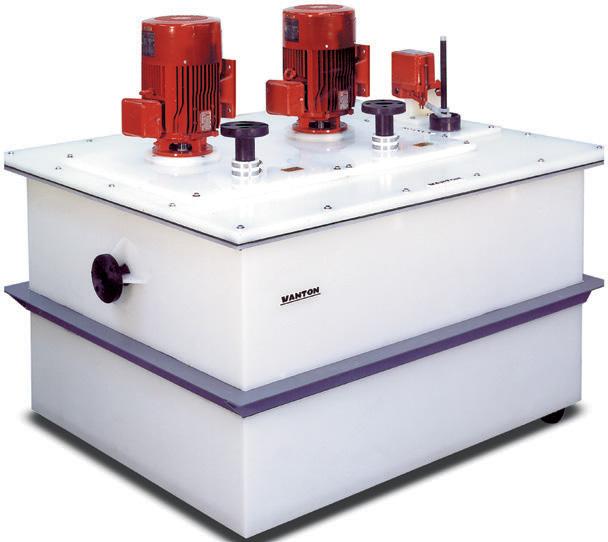
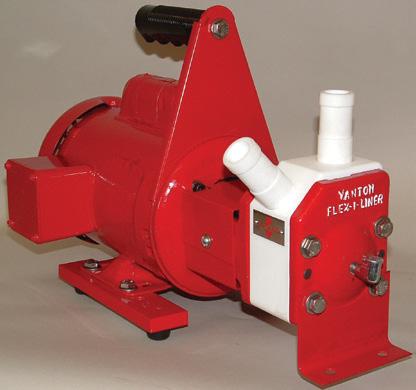
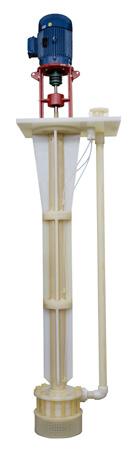
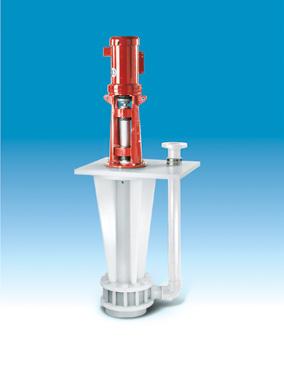
Each Vanton thermoplastic pump features wet-end components that are inert to corrosive chemicals across the full spectrum of pH, will not contaminate ultra-pure liquids, and are also abrasion resistant.
Handling flows to 1150 gpm (261 m3/h) heads to 185 ft. (56 m) and temperatures to 275o F (135o C), Vanton pumps are ideal for:
• Chemical Transfer
• Neutralization
• Dosing
• Effluent Control
• Lift Stations
• Odor Control
• Recirculation
• OEM Applications
LED proves to be green replacement for mercury bulbs in wastewater treatment, study says
By ES&E Staff
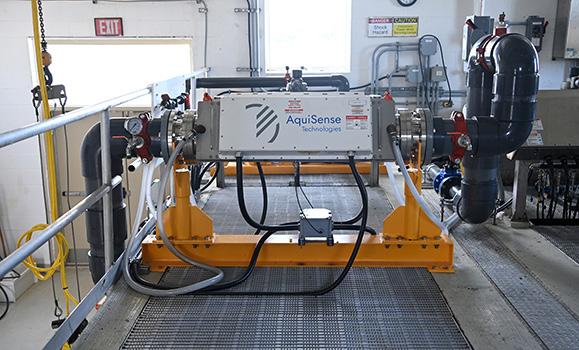
Dalhousie University researchers are piloting what may be the world’s first municipal-scale UV LED reactor for wastewater treatment, which they say could replace the energy-intensive mercury vapour bulbs that dominate the industry.
Halifax Water is also studying LED technology in collaboration with Dalhousie engineering researchers and AquiSense, the project’s industrial UV LED partner and supplier.
“The bulbs produce a lot of heat, and in a wastewater system, you can imagine there’s a lot of material in the water that builds up on them as a result, causing fouling,” says Halifax Water’s acting director of environment, health and safety, Dr. Wendy Krkosek, speaking about mercury vapour bulbs. “And so, there’s a very large operation and maintenance cost in cleaning the bulbs. It’s a significant burden on operations.”
The researchers also note that the UN Environment Programme’s Minamata Convention will put a stop to mercury mining by 2032, interrupting the supply needed by industry. The European Union banned the use of the chemical element, only making an exception for wastewater treatment due to a lack of alternatives.
Even when they are permitted, the researchers say that responsibly disposing of mercury bulbs is costly and complicated. As a result, they often end up stockpiled, racking up storage costs, along with potential risks.
Enter LEDs, the tiny points of light-emitting diodes that make up our screens and many modern illuminated environments. They are also the light source that Dalhousie University researchers want to see as a feasible replacement for mercury bulbs.
Graham Gagnon, director of Dalhou-
the technology. Now, he’s working with an NSERC Alliance Advantage grant to explore scaling up systems to meet the needs of drinking water disinfection at municipal and industrial levels. The researchers worked with Halifax Water to make the larger system a reality, teaming up with the utility to install and operate it at its Eastern Passage wastewater treatment facility.
The UV LED reactor is working so well that it’s difficult to know exactly how much power is actually needed for it to get the job done.
sie’s Centre for Water Resources Studies, explains that, unlike mercury vapour bulbs, which emit light and heat in all directions, UV LEDs are far more “disciplined”. They direct light one way and radiate heat the other.
“This means that as wastewater flows past the thousands of tiny diodes in a UV LED reactor, it is bathed in pure, targeted UV light without the high temperatures that lead to the buildup of effluent that fouls traditional mercury bulb systems,” explained the researchers in a statement.
In 2019, Gagnon took a single-diode unit to Nunavut for field research, which kindled a stronger interest in
The reactor has been integrated into the utility’s infrastructure since January 2024, allowing it to function at a municipal scale over an extended period of time. Students collect samples, working alongside Halifax Water employees and allowing researchers to closely study its efficiency, both in terms of its ability to disinfect water and the energy required to do it.
Their findings, published in the the journal, Water Research X, are positive, proving for the first time the ability of a UV LED system to meet the needs of municipal water disinfection.
Krkosek says the UV LED reactor is working so well that it’s difficult to know exactly how much power is actually needed for it to get the job done. The goal now is to find the sweet spot for operating the reactor with the least amount of power and greatest volume of water to achieve full disinfection without wasting energy, she says.
“Our research shows that we are using energy much more efficiently and so that will be much better from a greenhouse gas emission standpoint,” says Gagnon. “We don’t use any harmful chemicals, we consume less CO2, we consume less space, and we can deliver the same volume of water with at least the same quality, if not better.”
For more information, email: editor@esemag.com
Halifax Water is also studying LED technology in collaboration with Dalhousie engineering researchers and AquiSense, the project’s industrial UV LED partner and supplier.
Renée Arlow, PMP, Manager, Power & Automation
Renée has over 21 years of experience as a Technologist and Project Manager on large industrial projects, primarily in the high voltage electrical industry. Her experience and insights help clients manage costs and deliverables while ensuring project delivery. Associated Engineering announces
Eric Gaudet, P.Eng., CEM, M.Sc., Division Manager, Water
Eric has over 21 years of experience, and has served as a Project Engineer, Project Manager, and Group Manager. He has a diverse experience in engineering and project management, and will take on leadership of the Water Division in Saskatoon.
David Sorenson, P.Eng., Group Manager, Mechanical & Hydraulic Modelling
David has over 15 years of experience as a Mechanical Engineer, including process piping, pump systems, HVAC design, and storage tank design. He will be the Group Manager for the Mechanical & Hydraulic Modelling Group in Saskatoon.
Jamie Fitzgerald, P.Eng., Division Manager, Water Resources
Jamie has over 25 years of experience specializing in stormwater management, drainage. Jamie will lead a large and diverse team based in Vancouver, providing services in water resource management.
Josh Thiessen, P.Eng., Group Manager, Drainage & Stormwater Management
Josh has 17 years of protection, stormwater management, drainage, and hydraulic analysis. He will lead a team focussed on urban, highway, and airport drainage, and stormwater management plans.
David Forde, M.Eng., P.Eng., Group Manager, Floodplain & Coastal
David has 13 years of experience, specializing in management, stormwater management, and hydrological analysis. David will lead our and mapping, and coastal engineering.
— while beneficial to public health — may not be its purview.
Credit: anusorn.stock.adobe.com
Montreal’s fluoride sunset highlights the technical challenges of managing a controversial additive
A
look inside the city’s technical arguments against fluoridation
By David Nesseth
As Montreal squeezes the tube on its last supply of fluoride from the two remaining treatment plants that apply it, two major reports from the city’s water department are linked to the policy shift by detailing scores of logistical challenges posed by fluoridation.
They are also some of the same challenges faced by Halifax Water, a utility that struggled in secret in recent years with fluoridation, and just made its technical challenges public. Calgary, too, has faced hurdles in its bid to resume fluoridation after shelving the tooth decay prevention tool for more than a decade, mirroring the story of Windsor, Ontario. It all starts with space. Water depart-
ments in both Halifax and Montreal have cramped chemical rooms that make it difficult to manage huge volumes of fluoride that require very particular storage, both in dry and liquid form. Then come more concerns. These include water treatment plant worker safety when handling the chemical compound, the impact of its corrosiveness on equipment, complex maintenance concerns, regulatory monitoring, dosing challenges, environmental impact, and, of course, cost.
However, many municipalities view the cost of fluoridation as being less than the potential healthcare costs of dental problems.
The reasons behind Montreal’s decision to reconsider fluoride, whether sparked by a citizen petition linked to RFK Jr.’s advocacy against fluoride in the U.S., or new studies about potential neurological impacts on children, have fueled many online searches of late. However, less attention has been given
to the significant technical challenges of being one of the most fluoridated countries in the world. The experiences of Montreal and other Canadian cities shed light on these challenges, without the intention of diminishing acknowledged oral health benefits.
The City of Montreal’s water department, known as Service de l’eau, begins one of its exhaustive reports on fluoridation by setting some ground rules. Translated to English, staff noted in March 2024 that their approach to the matter is “based on technical, operational and economic considerations, from the point of view of an asset owner and operator, namely the water department; health considerations are beyond the scope of expertise of the water department’s expert.”
Water fluoridation has been practiced at the Pointe-Claire and Dorval drinking water production plants since 1955 and 1957, respectively. Montreal’s water department reports left municipal officials needing to choose between new investments in the restoration and reconstruction of infrastructure, or ending fluoridation at both plants. In the end, Montreal’s Agglomeration Council voted on November 21, 2024 to stop fluoridation, which doesn’t occur elsewhere in Quebec, apart from Saint-Georges in the Beauce region.
Notably, Laval stopped fluoridation in 2000 due to operational problems with its fluoridation equipment.
“Is it justified that only a fraction of the population of the Montreal metropolitan area has access to fluoridated water?” the water department asked in a report, noting that in the Montreal metropolitan area, just over 100,000 people receive fluoridated water, while nearly two million do not.
SPACE AND SAFETY
The space needed by fluoridation equipment has impacted Montreal. At the Dorval plant, the fluoridation facility was redone in 2008 to bring it into compliance with standards. Also, a building extension was built to house the equipment at a cost of some $400,000, which also allowed for the installation of a new reservoir with a daily tank and dosing system. The water department suggests
Montreal’s water department reports suggest that the addition of chemicals not necessary for drinking water
To build your financial future
The Engineers Canada-sponsored Group Savings and Retirement Program offers a range of plans with Canada Life to help you grow your savings then turn your savings into income for your retirement years.
Personalized guidance to help you reach new heights
As an engineer or geoscientist, you know that nothing should be built without a solid foundation. That’s where your personal health and wealth consultant comes in. They’re licensed professionals who can:
Meet with you online – when it’s convenient for you
Help guide you through all stages of your financial journey
Talk to you in more than 12 languages
Plus, being part of a group plan means you get to enjoy lower-than-retail fees* – which means more money for you!
Take it from those** who have met with a health and wealth consultant:
97% said they felt valued
98%
felt they were spoken to in a way that was easy to understand
98%
said all their questions were answered on their personal needs
that repurposing the space currently used for fluorination at the Pointe-Claire plant will improve safety and access for lime dosing equipment operations.
In the U.S., where the great fluoride debate seems ready to reach a fever pitch, the process of fluoridation has been considered so complex as to require at least one full-time fluoridation specialist for each state. Some of this is necessary to manage the risks around fluorosilicic acid systems.
In Montreal, the Dorval plant uses fluorosilicic acid, which is highly corrosive and presents potential worker safety issues in the case of a spill. Also, toxic vapours could occur through reactions with other stored products during a mishap. The water department warns that it is a particular concern due to the slope and design of the Dorval plant’s unloading area for deliveries.
“Due to the nature of the product, Dorval plant personnel are reluctant to work on the system,” states the water department report. “However, no workplace accidents or ‘near misses’ have been recorded in the last six years in connection with this process.”
The water department continues to note that indirect costs are incurred by the need to adjust the pH at the Dorval plant outlet because of the use of fluorosilicic acid.
More difficult to quantify, Montreal’s water department reports, is an increase in corrosion of equipment “on the periphery” of fluorine dosing installations. “Acid vapours can attack glass and concrete surfaces, plumbing, control devices and analyzers, requiring more frequent renewal of this equipment.”
Fluoride’s connection to corrosion, however, remains highly in question in the view of many experts, who cite a lack of direct evidence.
For the Dorval plant, a supply chain issue of fluorosilicic acid led to a total of 163 days of shutdown in 2021 – 2022, or 88% of the time for which the process was not in operation, according to the water department. The product typically needs to be transported by truck from the U.S.
The Point-Claire plant instead utilizes sodium hexafluorosilicate (Na2SiF6 in dry form) for fluoridation, often shipped from China. So, the water department
also makes the case that ending these fluoridation-based shipments will further the city’s greenhouse gas reduction goals.
In Halifax, intermittent leaks have plagued the J. Douglas Kline (Pockwock Lake) water supply plant since 2021, creating safety risks around the storage and use of fluoride, the utility announced on November 29, just a week removed from Montreal’s major fluoride decision. The plant resumed fluoridation in December, after shelving the application for more than a year.
As for the Lake Major water supply plant, Halifax Water revealed that the system hasn’t had fluoride in it since 2020, when it was nearing the end of its useful life after nearly 20 years.
“The health and safety of our employees is a top priority at Halifax Water, and we are continually evaluating and mitigating risks throughout the business,” Jeff Myrick, Halifax Water’s senior manager of communications and corporate Strategy, told ES&E Magazine. “Fluoride is considered a hazardous material even during normal operations, and the storage and handling of the product are heavily regulated. Given the safety risks presented by these operational issues, the decision was made to take it offline.”
Since 2020, plans to resume Lake Major’s fluoridation have been complicated by significant changes in lake water
chemistry due to severe rainfall events. The changes required the utility to use more alum to meet regulatory standards for safe drinking water. The need for additional alum storage created a space constraint. “While alum is needed to meet regulatory requirements for water treatment, fluoride is not, and we must determine an alternative solution before it can resume,” added Myrick.
EQUIPMENT AND SUPPLY COSTS
The City of Calgary is yet another example of fluoridation’s complex logistics and high cost. As the city looked to reintroduce fluoridation after previously abandoning it, local officials saw project costs triple in 2023. They realized they needed to spend more than $28 million on an entirely new building to house fluoridation equipment at the Bearspaw Aayer Treatment Plant. This is a significant cost, when considering that emergency repairs from the disastrous summer watermain break could cost a similar amount. Supply chain issues further delayed the project into 2024, but fluoride is expected to return to Calgary in 2025 at a cost of $1 million per year.
The City of Windsor, Ontario, has been another chapter in Canada’s fluoride history. Like Calgary, the city decided to resume the additive after pre-
In Montreal, the Dorval plant uses fluorosilicic acid, which is highly corrosive and presents potential worker safety issues in the case of a spill. Credit: City of Montreal
viously stopping it. When the border city prepared for its return to fluoridation, it ran a study in 2021 using a pipe test loop to ensure no adverse effects to the Windsor Utilities Commission corrosion control program.
Out west, the British Columbia city of Prince Rupert is yet another example of local officials facing issues with fluoridation equipment. When the injection system failed years ago, they decided to shelve fluoridation until new funding could be secured. Earlier in 2024, the city received a federal investment of more than $77 million to fix high priority watermains and address the separation of the combined sewer system. However, fluoridation remains offline.
“Now that we have achieved substantial grant funding for system upgrades, treatment is our next objective for funding,” a Prince Rupert spokesperson told ES&E Magazine, noting that fluoridation may be next on the to-do list.
Montreal has also experienced maintenance issues with its fluoride analyz-
Health Canada maintains its support for drinking water fluoridation as a safe, universal and accessible method of preventing tooth decay. Credit: steveyoung, stock.adobe.com
ers, prompting them to switch manufacturers. They have also struggled with interference during readings and use a flow meter in addition to a continuous fluoride analyzer. “The dosing system must be accurate, calibrated and maintained with care, by personnel with the
required skills,” states the water department. “The required dosing range is rather narrow.”
In addition to Montreal’s annual operating costs for fluoride, city officials peg other related fluoridation equipment refurbishments at around $19 million, as these systemst reach the end of their useful life. This cost is also on top of some $100 million in modernization projects planned for the Pointe-Claire plant and $8.2 million at Dorval.
This is all coming off of a year where the City of Montreal’s water department struggled with major watermain breaks, which will mean fast-tracking millions of more dollars for repairs. Also of note is that dosing pumps were replaced in 2012, and again in 2020 in at least one of the plants.
FOCUSING ON WATER QUALITY, NOT HEALTH
Maja Vodanovic, Montreal’s executive committee member responsible for water, told the Agglomeration Council
that the upcoming water treatment plant refurbishments at the Pointe-Claire and Dorval drinking water treatment plants have complicated an already problematic issue with fluoride. She said that in addition to the $100,000 per year price tag to maintain fluoridation, plus the supply chain issues, it was a case of the technical challenges simply leading officials back to a more water quality focused position over a health one.
“We do not believe that our water filtration system should be used for other things than to provide the best quality water,” she told council. “That is already a very noble and a very complicated goal.”
Vodanovic added that maintaining the equipment to add fluoride has become unnecessarily costly and potentially wasteful. This is because it delivers fluoridated water that mostly ends up washing cars and people, fighting fires, or flushing toilets. Only an estimated one percent is used for personal consumption.
Then, the fluoride ends up in the rivers, says Vodanovic. From there, the city
contends that there are still too many unknown environmental and aquatic life concerns about oxidative stress, since the city’s Jean-R.-Marcotte wastewater treatment plant does not remove fluoride.
Ultimately, officials like Vodanovic justified their decision based on the water department’s technical cautions. They framed it as a matter of consistency and uniformity in approach.
“I have to say that the city of Montreal took this decision to be coherent,”
Vodanovic said in English just before the final vote passed. “We do not put fluoride in our water and we don’t intend to put fluoride in our water. We produce the water. We are competent in the matter and we want to produce the best quality water for all of Montreal.”
In its reports, the water department presents a similar position that suggests the addition of chemicals that are not necessary for drinking water but are beneficial to health, may not be its purview.
“What is clear however is that the practice of fluoridation is not essen-
tial to fulfilling the mission of the water department,” the March report states.
Health Canada maintains its support for drinking water fluoridation as a safe, universal and accessible method of preventing tooth decay. As does Dr. Mylène Drouin, Regional Director of Public Health for Montreal, who wrote to the impacted communities following the agglomeration council’s decision to note that she supports fluoridation and the evaluation of expanding fluoridation throughout the Montreal region.
Montreal’s decision reflects a growing trend of cities re-evaluating the feasibility of water fluoridation. As other municipalities face similar infrastructure challenges, the debate over fluoride’s role in public health is unlikely to end soon.
David Nesseth is a writer with Environmental Science & Engineering Magazine. Email: david@esemag.com
How Canada’s chemical distributors can navigate evolving regulations
By Shane McCarthy
In the first major update to the Canadian Environmental Protection Act (CEPA) since its enactment more than 20 years ago, a key amendment passed in June 2023 focused on the Right to a Healthy Environment.
The amendments were driven by a growing recognition of environmental justice and the need to protect vulnerable communities affected by pollution and environmental degradation. While the new legislation is intended to protect Canadians from harmful and hazardous substances, it represents a major challenge for chemical distributors and other related businesses.
CHANGES IN THE REGULATIONS
The changes acknowledge that all Canadians have a right to a healthy envi-
While the new legislation is intended to protect Canadians from harmful and hazardous substances, it represents a major challenge for chemical distributors and other related businesses. Credit: grispb,stock.adobe.com
ronment. As a result, the government body will develop a framework detailing how that right will be integrated into CEPA’s administration. This framework
will be the starting point for everything that comes later.
This initiative will identify substances that may not currently be classified as toxic but could pose future risks. Substances and chemicals that have been negatively assessed will be added to the list and later restricted or prohibited from the public. It is a multi-year, integrated plan that specifies how the government will assess and manage chemical substances over time. This plan will be complete by June 2025.
For chemical distributors, these amendments present several concerns. Most obviously, new regulations always lead to greater scrutiny, which creates risk. Chemical distributors will require greater investment of time and money to achieve compliance with the new frame-
work. At the same time, there is a tremendous amount of uncertainty, since it is not yet clear which substances will ultimately be categorized as restricted or prohibited. Uncertainty will complicate business planning for many organizations. (Currently, some 30 chemical proposals have been made. Visit www.esemag.com/hazardous-materials/canada-proposes-risk-assessments-for-more-than-30-chemicals/ for more information.)
As substances are added to the watch list, or labelled as toxic, there may be increased liability risk for chemical distributors to face. For example, a product that becomes a restricted one may be a challenge to market.
STRATEGIES TO MITIGATE THE RISK
The stakes are high for chemical distributors. Organizations will need to prepare their teams for this new stage as much as possible ahead of time. As there may be new and evolving risks, it is always best practice to keep on top of any updates from Environment and Climate Change Canada regarding CEPA amendments, especially concerning the Watch List and Plan of Priorities.
Implementing a compliance program will ensure adherence to existing regulations and prepare for upcoming changes. Be sure to conduct regular audits of products for potential environmental impacts.
Engaging in advocacy work is one way to support environmental protection and also shape the public discussion. Participating in the conversation with policymakers creates an opening for business leaders to have an impact on the practical realities. It may also be worth considering adopting safer alternatives to hazardous substances in order to meet regulatory trends as well as enhance market competitiveness.
Insurance can play a crucial role in transferring some of the risk associated with regulatory compliance. Consider securing appropriate coverages, such as environmental liability insurance, which protects the organization against claims arising from environmental damage caused by chemical products or operations. It can cover legal costs, cleanup expenses and damages awarded in lawsuits. Also, product liability insurance can help cover claims related to injuries
or damages caused by a chemical product that is later found to be harmful.
Look for a broker who specializes in environmental risks to be sure you are addressing all risks adequately, whether it’s risk mitigation practices or insurance protections. As each organization is different, a broker can help identify appropriate coverage options tailored to your organization’s specific needs and risk appetite.
Shane McCarthy is with HUB International’s Complex Risks Unit in Toronto, Ontario. For more information, visit: www.hubinternational.com
Editor’s note: If this topic is of interest to you, please check out details on CANECT 2025 at www.canect.net
Pilot project aims to determine the viability of collecting and storing rainwater for reuse
Apilot project on a Quebec farm is now underway to determine the viability of collecting and storing rainwater for sanitary facilities, and for irrigating crops during droughts and hot weather. The farm is on Île d’Orléans, which is roughly twice the size of Manhattan and has some 7,500 residents.
The prototype underground retention unit has a 35 cubic metre capacity, that can supply bathroom water for 200 workers. This project was funded through the Sector Development Program under the Canadian Agricultural Partnership, an agreement between the governments of Canada and Quebec.
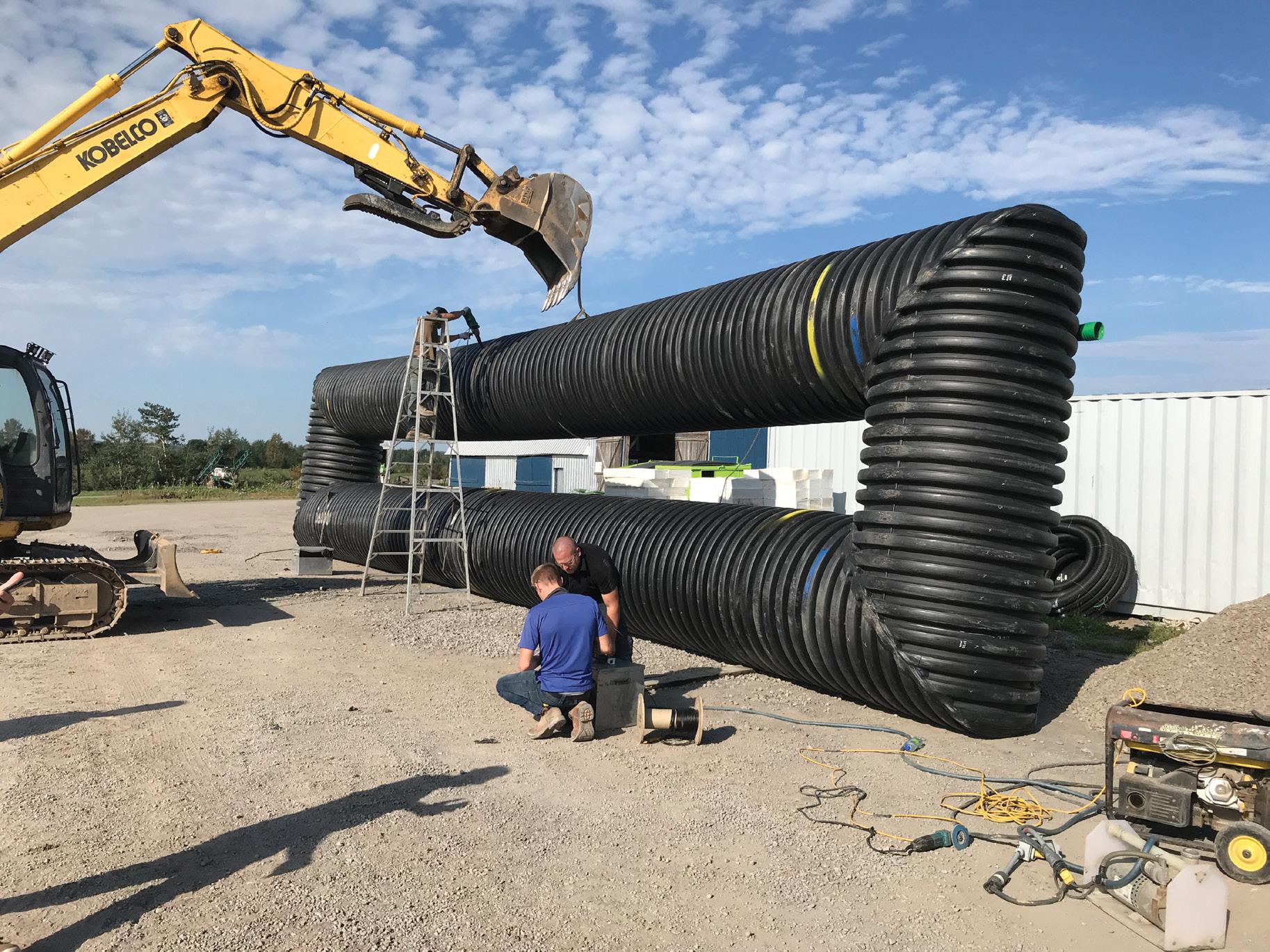
According to Richard Bossinotte of Soleno Inc., the main problem was a lack of space, as much of the farm as possible is dedicated to growing and processing crops. To get the desired supply capacity of 35,000 litres, the solution was to use pipes to construct an underground retention system. This customized tank was assembled on-site using Soleno high-density polyethylene (HDPE) pipe.
The system used 24 metres of 1200-mm diameter Solflo® Max corrugated HDPE pipe from Soleno’s Saint-Jean-SurRichelieu plant. A 900-mm diameter chimney provides access for inspection and maintenance. Heat fusing the pieces on-site provided the required watertightness.
The corrugated HDPE pipe meets the material standards of AASHTO M294 and ASTM F2306, and complies with Canadian Standards Association, CAN/CSA B182.8. Made with recycled HDPE, this underground tank is resistant to corrosion and abrasion, is inert to chemical elements, and has a lifespan of over 100 years.
The project was sponsored by the Institute for Research and Development in Agro-Environment (IRDA) in Quebec, which works to reduce the vulnerability of infrastructures to hydric deficit and rainwater storage.
It selected Ferme Onesime Pouliot, which grows raspberries, strawberries and blueberries on some 200 acres. The family-run operation also has individual areas of agronomy, agroeconomics and agri-environmental engineering. It hires several hundred temporary foreign workers annually, who live in houses located on the property.
Vertical Turbine Pumps
For more information, visit: www.plasticpipe.org/drainage
This 35,000 litre customized rainwater storage tank was assembled on-site using HDPE pipe.
Investigation into Calgary feeder main break reveals factors that degraded structural integrity
By ES&E Staff
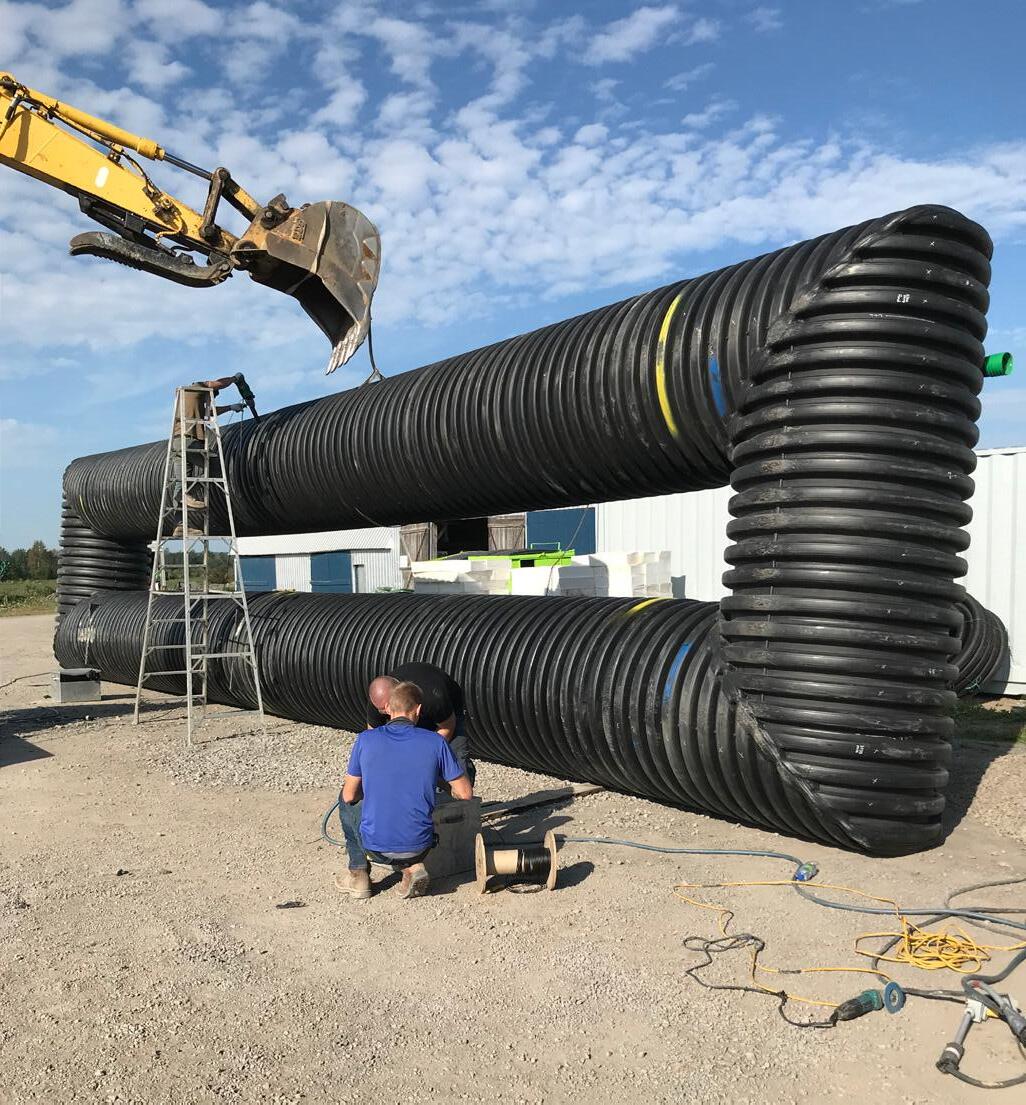
An investigation overseen by Associated Engineering has revealed some of the critical factors, but no definitive single cause, that led to the catastrophic break of Calgary’s Bearspaw South Feeder Main last June.
The nearly 600-page report, released to city council in late 2024, points to several factors that degraded the structural integrity of the pipe and led to several months of water restrictions for Calgarians as the city conducted emergency repairs.
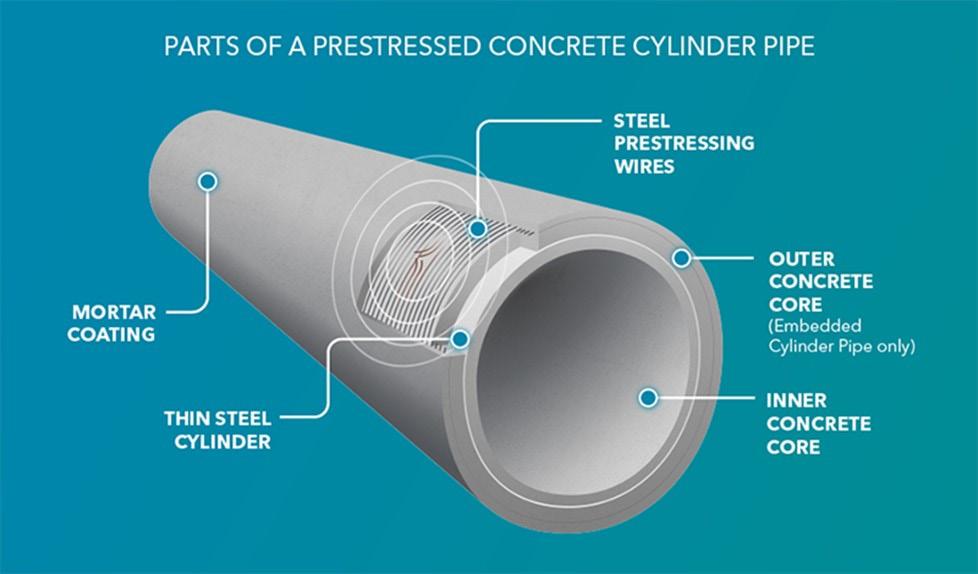
the protective mortar outer layer of the pipe, high chloride levels in the soil at various locations, as well as severe damage and corrosion impacting the pipe’s prestress wires, all played roles in the pipe’s eventual failure.
“The findings from this investigation have provided valuable insights into the causes of the failure and the steps needed to prevent similar events in the future,” said Steve Wyton, Calgary’s manager of asset management planning, in a statement. “Our priority now is planning for the long-term rehabilita-
Credit: Associated Engineering/City
Preliminary findings from the new report suggest that microcracking along continued overleaf…
While a small number of wire breaks contributed to the initial failure, the report estimates that some 200 wires broke after the rupture.
of Calgary
tion of the feeder main and implementing proactive measures to ensure a reliable and resilient water distribution system for Calgarians. By combining advanced monitoring technologies, contingency planning, and strategic investments, we’re taking meaningful steps to safeguard this critical infrastructure and support our city’s growing water needs.”
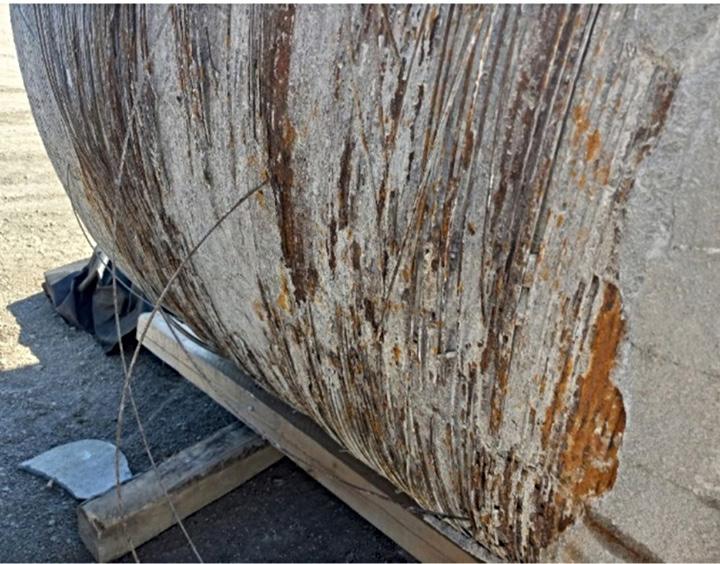
While a small number of wire breaks contributed to the initial failure, the report estimates that some 200 wires broke after the rupture. These are protected with a 20-mm thick layer of cement mortar, and were believed to be damaged from corrosive soil interaction. The report states that stress corrosion cracking (or hydrogen embrittlement) of the prestress wires resulted in brittle wire failures.
The report, which also utilized data from Calgary-based Pure Technologies (owned by Xylem), notes a “dramatic shift” in soil chemistry between 2014 and 2024 in the same sampling area. Whereas chloride levels were negligible a decade ago, recent samples show “significant chloride levels in the thousands of milligrams per litre”.
“High concentrations of chlorides in the soil are not always required to cause pipe distress if there is a fluctuating water table, as fluctuating water tables can deposit chlorides on to the mortar leading to higher concentrations on the mortar itself,” the report states.
The report notes that some elevated soil chloride concentrations may be related to road de-icing activities using sodium chloride. Further soil sampling is recommended in the Associated Engineering report.
Calgary officials expect to deliver an implementation plan for the feeder main by mid-2025 to strengthen system redundancy.
Overall findings at the site of the original break and the five “hot spots” showed that some of the pipes had visible cracks and peeling in their mortar (outer layer of the pipe) when they were dug up, while others had mortar that was still in good condition. Lab tests revealed that some damaged pipe sections had chlorides penetrate their mortar, but other pipes did not
The report suggests that microcracking along the protective mortar outer layer of the pipe, high chloride levels in the soil at various locations, as well as severe damage and corrosion impacting the pipe’s prestress wires, all played roles in the pipe’s eventual failure.
Credit: City of Calgary
show any signs of this.
The wires that help keep the pipes strong showed severe damage, including deep pits, corrosion, and many brittle wire breaks. There was evidence of two types of wire damage: hydrogen embrittlement and stress corrosion cracking. Both types of damage appear to be caused by chloride penetrating the mortar or small cracks in it.
Soil testing around the feeder main showed some areas with high levels of chlorides. The cause of increased chloride levels requires further study.
Utilization of pressure sewer systems in cold climates
By Mackenzie May
Wastewater collection in cold regions requires additional consideration for the design, installation and operation of a system to ensure cost-effective, uninterrupted service. The primary concern with wastewater collection in cold climates is freezing. Whether the ground is freezing to significant depths, complicating installation and maintenance of a sewer system, or the pipes and components are freezing, leading to blockages, pipe bursts and system failures, cold climates can have an impact on the design, installation and operation of a collection system.
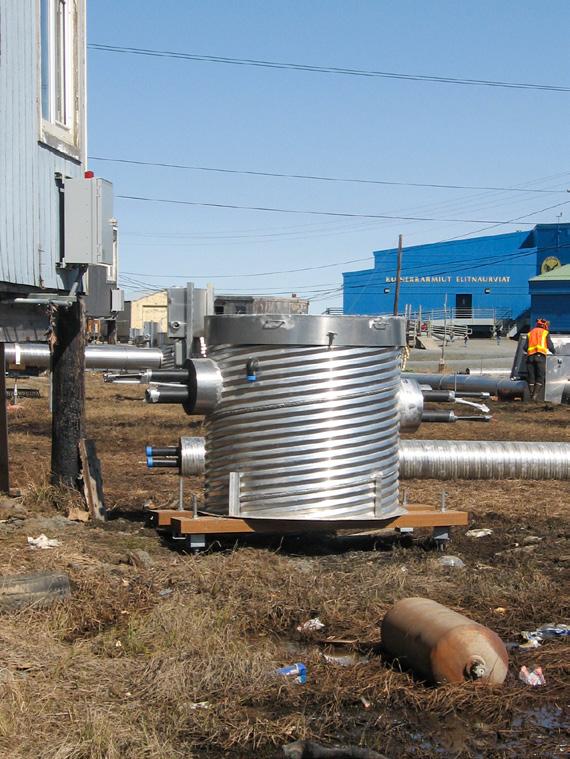
Pressure sewer systems were designed as an alternative for applications where gravity sewer systems were less feasible or economical. It provided a means to combat difficult terrain such as rocky, hilly, or long flat land. The primary differences
solids size in wastewater at each residence.
Pressure sewer systems utilize a network of grinder pumps to transport wastewater through small diameter pipes, directly to a sewer main, lift station or treatment system. A grinder pump is a submersible pump designed to reduce particulates in a waste stream into a fine slurry using a grinding mechanism and pump the waste at a high pressure. In order to overcome challenging terrain, pipes are installed just below the frost line and follow the natural landscape.
The frost line is the depth at which the ground freezes in the winter, which varies based on geographic location. This is a critical factor to understand when planning wastewater management systems. It is essential to install pipelines below this line to prevent freezing. Local climate data, soil composition and historical weather patterns can be used to determine the depth.
minimize damage or environmental impact.
Mackenzie May is with Crane Pumps & Systems. Email: mmay@cranepumps.com
Remote Ontario township faces ongoing challenge sustaining management of its water and wastewater operations
By Jessica Sweeney and Lindsay Wolfenberg
The Township of Pickle Lake lies within the remote landscapes of northern Ontario, approximately 540 kilometres north of Thunder Bay. It has been facing an ongoing challenge in sustaining in-house management of its water and wastewater operations.
Headquartered in Ottawa, Clearford Water Systems was retained to provide support in managing these critical services in a safe and reliable way. Representatives from the company met virtually with Pickle Lake’s management team to develop a comprehensive solution to secure the operation of the water and wastewater treatment systems.
OPERATIONAL UNCERTAINTY
Originally known for its gold mining, Pickle Lake is the most northerly community in Ontario that has year-round access by road. However, the region’s geographical remoteness has deterred some operators from committing long-term to the management of the Township’s water and wastewater systems. The struggle to retain skilled operators has resulted in high turnover rates, leading to a precarious operations situation.
Clearford’s team in Thunder Bay recognized the water challenge this small town of approximately 400 people was facing. An initial dialogue between Clearford and Town Council took place to thoroughly understand the Township’s need for certified operators and how they could work together to tailor a viable solution to provide reliable operations. Having an existing operations hub in Thunder Bay, Clearford was able to immediately extend on-site operations support to Pickle Lake.
With operator training at the forefront of this tailored plan, Clearford stationed an on-site experienced operator to temporarily guide and educate the Township’s Operators-in-Training (OITs) on industry best practices in managing the systems. During the training phase, one of the newly hired OITs opted to resign, citing the familiar reason of geographical isolation. As a result, roles quickly reversed and Clearford shifted from a support role to the primary on-site operator, now with support from the Township’s remaining OIT.
SECURING THE FUTURE
Leaning on its extended in-house operations, engineering, and compliance support staff in eastern and western Ontario, Clearford successfully developed a long-term, five-year operations plan. It outlined a solid rotational schedule to ensure consistent management of the treatment systems. This included supervision from an overall responsible operator (ORO), man-
agement of the Township’s compliance with Ontario's Drinking Water Quality Management Standard (DWQMS), heavy compliance support, and a full-time operator dedicating 40 hours weekly to daily operations, a rarity in the industry.
Alongside the challenges of water operator retention, managing a municipal system poses its own obstacles. Pickle Lake’s project marked Clearford’s first municipal water system contract. Navigating these uncharted waters required a collaborative effort and taking a closer look into operator experience with municipal treatment plants.
Speed and precision were essential when addressing the imminent water and wastewater challenges in Pickle Lake. Strong levels of interdepartmental communication helped
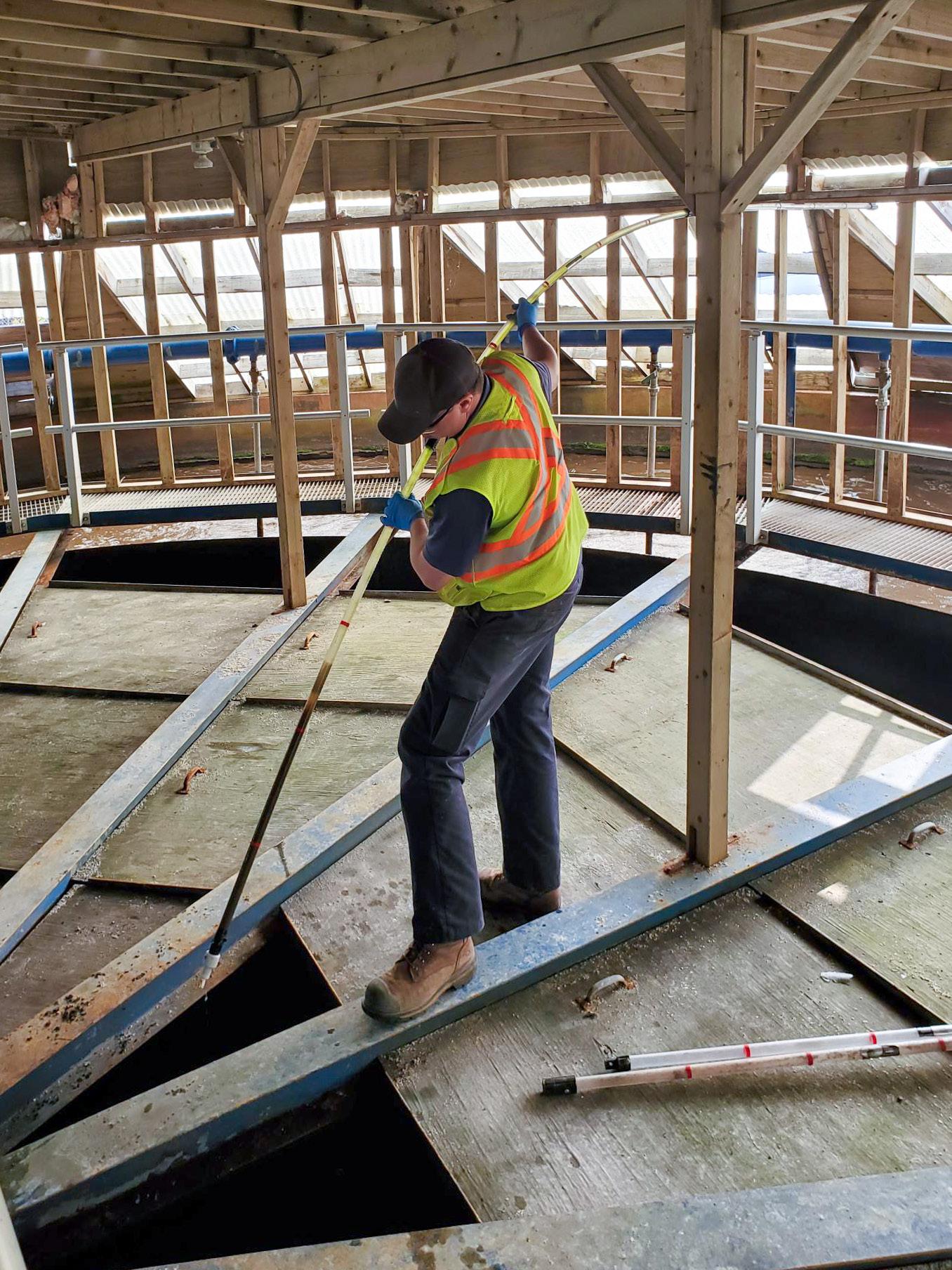
An operator conducts clarifier level measurement at Pickle Lake’s wastewater treatment plant.
streamline the process of task delegation among Clearford’s specialized teams.
The compliance team reached out to its established network at the Ontario Ministry of the Environment, Conservation and Parks, which accelerated Clearford’s understanding of what needed to be accomplished to operate the Pickle Lake systems. This included acquiring registrations, obtaining proper Environmental Compliance Approvals, fulfilling DWQMS requirements, and other various essential tasks.
EXPANDING REMOTE OPERATIONS
What began as a provisional solution quickly evolved into a sustained partnership between Clearford and Pickle Lake. The company’s presence not only solidified uninterrupted management of the water and wastewater systems, it also secured the Township’s operations for the coming years.
This project builds on Clearford’s involvement with remote operations,
which started in 2021 with a project situated in the Yukon. Since then, Clearford has continued to expand its support for Northern communities and remote mining sites to discuss their water-related objectives and reliable solutions.
Jessica Sweeney and Lindsay Wolfenberg, are with Clearford Water Systems. Email: jsweeney@clearford.com, lwolfenberg@clearford.com
Operator retention has been a major issue at Pickle Lake’s water treatment plant.
Environmental implications of road salts and de-icing chemicals
By Dhruv Bhushan, Purnima Singh and Bharat Bhushan
In North America, one of the most common ways to de-ice the roads is by using snow salts and chemicals. They help lower the freezing point of water, thereby preventing ice formation and making it easier to remove snow and ice from the road surfaces.
Currently available materials and technologies can’t eliminate the use of snow salts and de-icing chemicals, but their usage can be reduced with proper management. According to the annual overview of data reported by Environment and Climate Change Canada for the environmental management of road salts between 2019 – 2022, it was observed that there was a gradual decline in the usage of road salts, abrasives and de-icing liquids, largely because of proper storage of materials and optimization of their usage. About five million tonnes of road salts are used in Canada each year.
SHORT-TERM ENVIRONMENTAL & ECONOMIC IMPACTS
The chloride ions from snow salts eventually find their way into waterways, either by direct runoff into storm sewers, rivers, and waterbodies, or by moving through the soil into the groundwater. Chloride ions disrupt ecosystems and adversely affect species sensitive to variations in salinity. In surface water, snow salts can harm freshwater plants, fish and other organisms that are not adapted to living in saline waters.
Snow salts spread on the driveways and sidewalks in the Greater Toronto Area during the wintertime have been reported as a threat to aquatic life in the city’s rivers during the warmer months. Furthermore, the introduction of high salt concentration into soil can lead to degradation of structure, fertility and nutrient imbalance which ultimately threatens vegetation, especially those plants situated along roadsides. In addition, the salty snow can lure wildlife like
About five million tonnes of road salts are used in Canada each year. Credit: Milan,stock.adobe.com
deer and moose to the roadways, thereby increasing the likelihood of vehicle accidents while posing a toxicity risk to certain animals that may ingest it.
Heavy use of road salt can cause potholes and cracks in the road, and in some cases, salt can compromise the structural integrity of concrete as it soaks in. In areas where railroad crossings are common on the roadway, salt can corrode train tracks as well.
Snow salt can also infiltrate surface and groundwater and can contaminate drinking water reservoirs and wells by increasing sodium and chloride levels. High sodium levels in drinking water affect people with high blood pressure.
LONG-TERM EFFECTS
Over time, the cumulative effects of salt pollution may lead to a decline in biodiversity as sensitive species struggle to adapt to changing conditions. Increased chloride concentrations in freshwater can be toxic and may lead to substantial changes such as increased lethality, altered food webs, and biotic homogenization where only robust species survive.
Not only do chlorides take a longer time to break down further, they are
toxic to aquatic life such as fish, amphibians, invertebrates, and insects. For amphibian species who respire through their skin, chlorides can interfere with their ability to breathe properly.
Fish exposed to chlorides can show signs of hypoxia, gill tissue necrosis and neurologic signs, including trouble swimming, incorrect body positioning and sudden death. Also, chlorides appear to decrease the biodiversity of aquatic animals, zooplanktons and plants but favour the growth of phytoplankton, especially cyanobacteria.
Zooplankton are the key connectors of the aquatic food web that links microscopic producers to fish. Their loss triggers cascading effects that can affect fish populations, while benefiting algae at the base of the food web, which can lead to eutrophication.
One of the key findings of a five-year study by Environment Canada highlighted that the loss of plants near salted roadways can affect wildlife and ultimately the whole ecosystem.
ECO-FRIENDLY ALTERNATIVES
Alternatives to snow salts and de-icing chemicals include sand, gravel,
wood chips, and sawdust. These materials don’t help melt ice and snow, but they can provide some traction on the slippery surfaces, thus enhancing road safety without contributing to environmental pollution.
In Switzerland, a road salt alternative technology has been developed and effectively deployed for the last eight years. It utilizes an engineered wood chip, specially coated with a pH-neutral formulation of which magnesium chloride is the active ingredient. The coating sets the chip into the ice or snow which then re-freezes to lock the chip in place. The result is a surface with traction and grip.
Other eco-friendly alternatives are liquid de-icers composed of calcium magnesium acetate (CMA) and/or sodium or potassium acetate or formate. These offer a lower environmental impact compared to traditional salts and they are proven to be effective at preventing ice formation. CMA is less corrosive and toxic for plants and animals, but it may cause oxygen depletion in lakes. Potassium formate is biodegradable and can potentially help diminish the negative impacts of road winter de-icing on groundwater without jeopardizing traffic safety.
The third alternative is grit blends. Mixing traditional salt in smaller amounts with other materials such as agricultural byproducts can reduce the overall quantity of salt needed, while still
The
achieving the desired safety outcomes. Likewise, other secondary options to choose from are de-sugared beet molasses that is used as a de-icing product for roads and bridges in parts of Canada.
De-icing the roads with pickles, beets, and cheese has also been proposed as unorthodox, but environmentally-friendly options.
Potato juice, marketed as Magic Salt, is a waste byproduct of vodka and rum distillation. It has been used as a de-icing agent in the mountain roads of Ten-
nessee. It is mixed with traditional salt brine and is far less corrosive to vehicles than salt alone.
Another option is heated pavement systems, which harness solar energy to melt snow and ice without the use of chemical de-icers.
Dhruv Bhushan, Purnima Singh and Bharat Bhushan are with Alpha Cleantech Labs Inc. For more information, email: bob@alphacleantech.com
annual tonnage of road salt and abrasives used in Canada declined between 2019 – 2022. Credit: Environment and Climate Change Canada
Greywater recycling can reduce the demand on freshwater resources
By Sofia Corsetti
With the Great Lakes right at its doorstep and a web of rivers and streams crisscrossing its landscapes, it’s easy to believe that Ontario has all the water it needs. However, many areas in the province face challenges in managing water sustainably.
Decentralized greywater recycling can conserve water, reduce the strain on municipal infrastructure, and fit seamlessly into the growing green building movement. With Ontario’s Housing-Enabling Water Systems Fund investing $970 million in 54 water infrastructure projects, now is the perfect time for developers to look at this technology. These investments are set to enable the construction of over 500,000 new homes, and smart water management will be key in supporting this massive expansion.
HOW GREYWATER RECYCLING WORKS
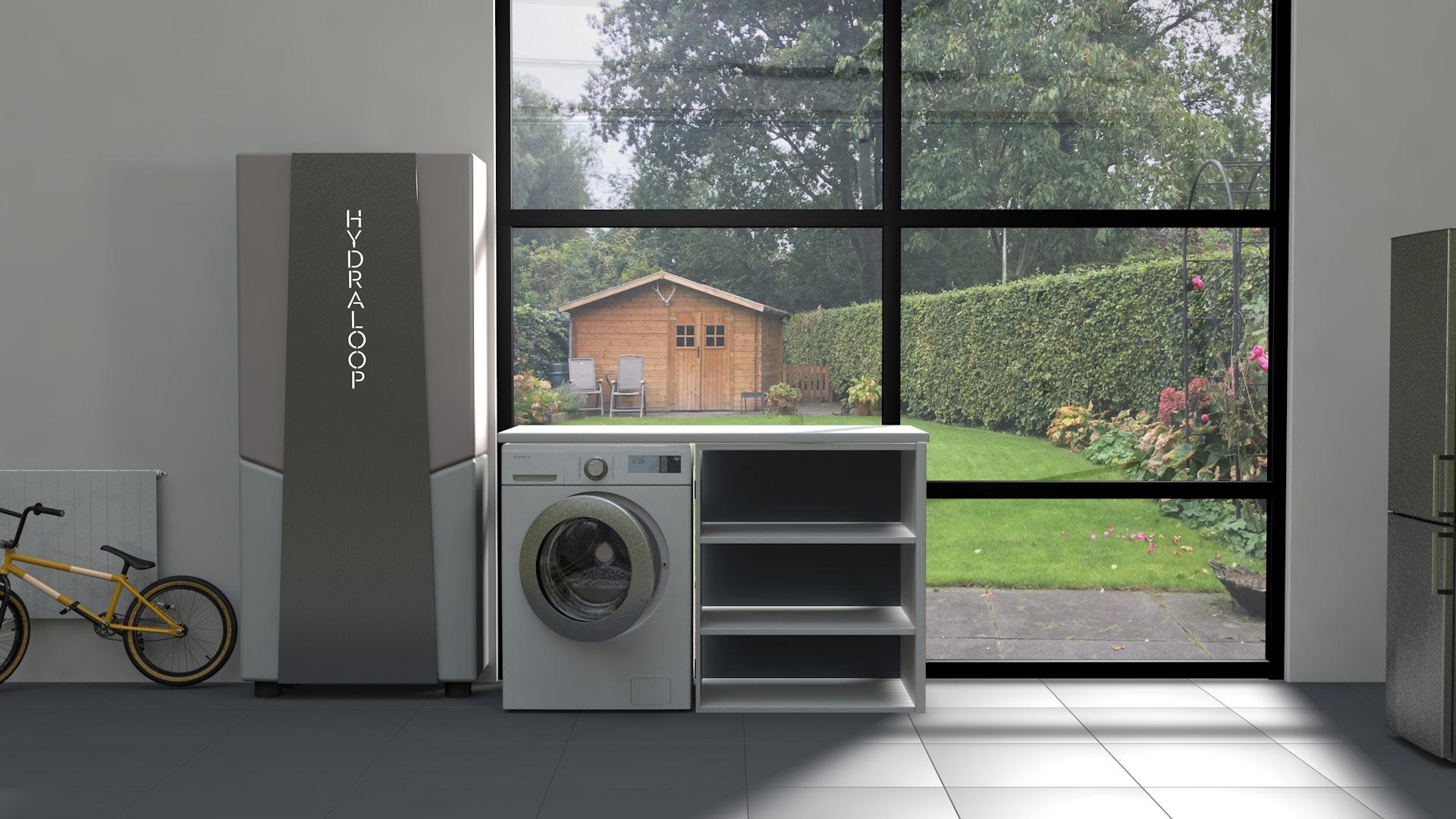
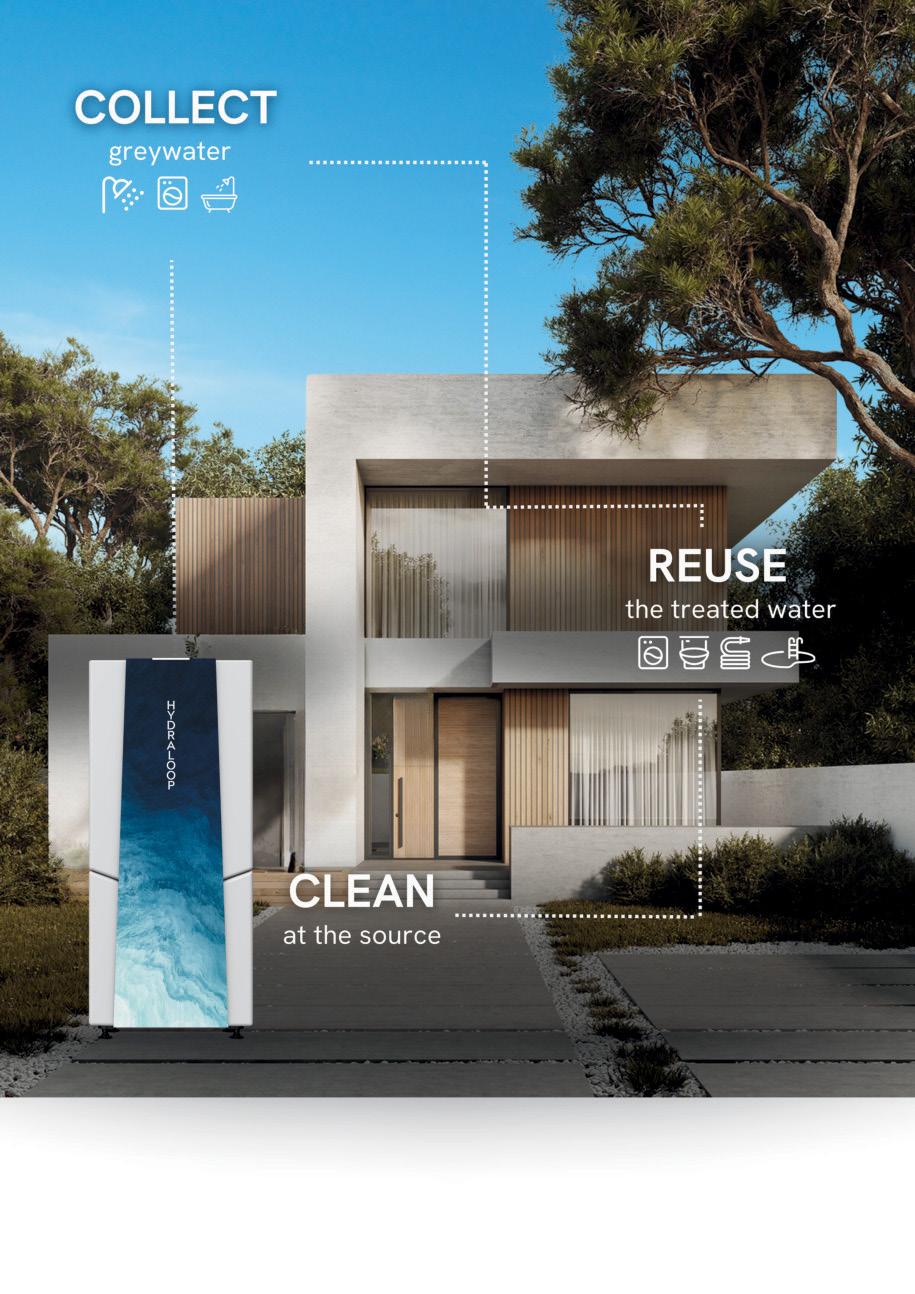
Hydraloop’s greywater recycling systems utilize a proprietary, filterless technology to treat wastewater from showers, baths, and, optionally, washing machines, as well as condensation from HVAC systems. The treatment process employs six sustainable methods: sedimentation, flotation, dissolved air flotation, foam fractionation, an aerobic bioreactor, and UV disinfection.
This multi-stage approach effectively removes contaminants, producing clean, non-potable water suitable for toilet flushing, laundry, garden irrigation, and pool top-ups. By integrating these systems, buildings can reduce water consumption by 25 – 45%, contributing to significant utility savings and promoting sustainable water management. Additionally, Hydraloop devices are IoT-enabled, allowing for real-time monitoring and control to ensure optimal performance and user convenience.
Not only does this drastically reduce
the demand on freshwater sources, but it also allows developers to build more water-efficient homes and buildings, future-proofed against increasing regulations around water conservation.
One of the most promising examples of this is an ongoing pilot project with the Region of Waterloo and Ontario developer, Activa. This collaboration is exploring how integrating Hydraloop systems into residential homes can help recycle up to 45% of household water.
Other municipalities across Ontario are beginning to show interest in creating similar rebate programs, recognizing the mutual benefits for both builders and local water management.
Ontario’s developers have an enormous opportunity to lead the charge toward sustainable housing. Hydraloop offers flexible solutions for a variety of residential, commercial, and mixed-use developments. The H300 can manage the greywater recycling needs of a household, while the H600 can be scaled up to accommodate multi-unit buildings. For large-scale developments, the Cascade system provides an integrated solution, supporting multi-residential, commercial and hospitality applications.
Hydraloop systems can save up to 45% of water, depending on the application, all while reducing a building’s carbon footprint and operational costs. Transporting water requires massive amounts of energy, therefore reducing the need for both freshwater and wastewater through greywater recycling, will result in significant energy savings. These systems not only conserve water but they also reduce the amount of wastewater discharged.
This technology can be used in a wide range of applications, including residential, commercial, hotels, offices, and sports facilities.
With Ontario’s Housing-Enabling Water Systems Fund and the growing interest in greywater recycling across municipalities, there has never been a better time to act.
Sofia Corsetti is with Hydraloop. For more information, email: sofia.corsetti@hydraloop.com, or visit: www.hydraloop.com
The Hydraloop H300 device fits into the home like a luxury appliance.
THE DICE
THE EVOLUTION OF THE CHEMICAL
BEFORE complex. cluttered.
AFTER simple. intuitive. Made in Canada!
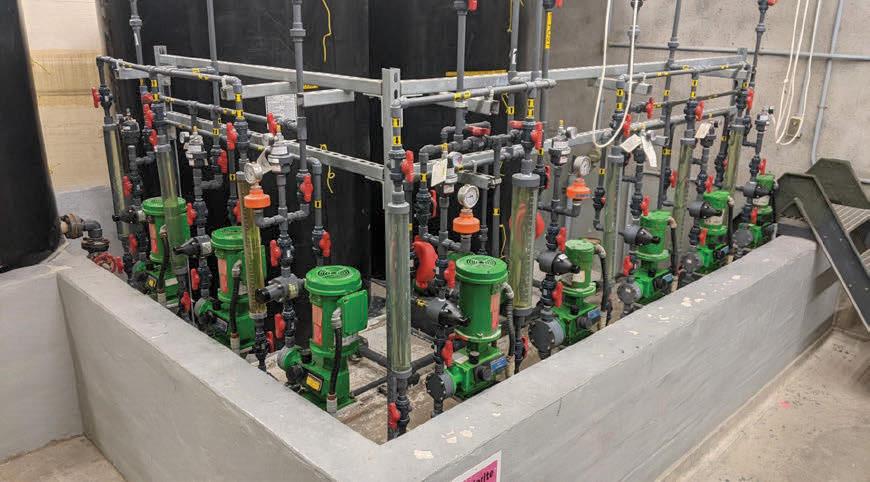
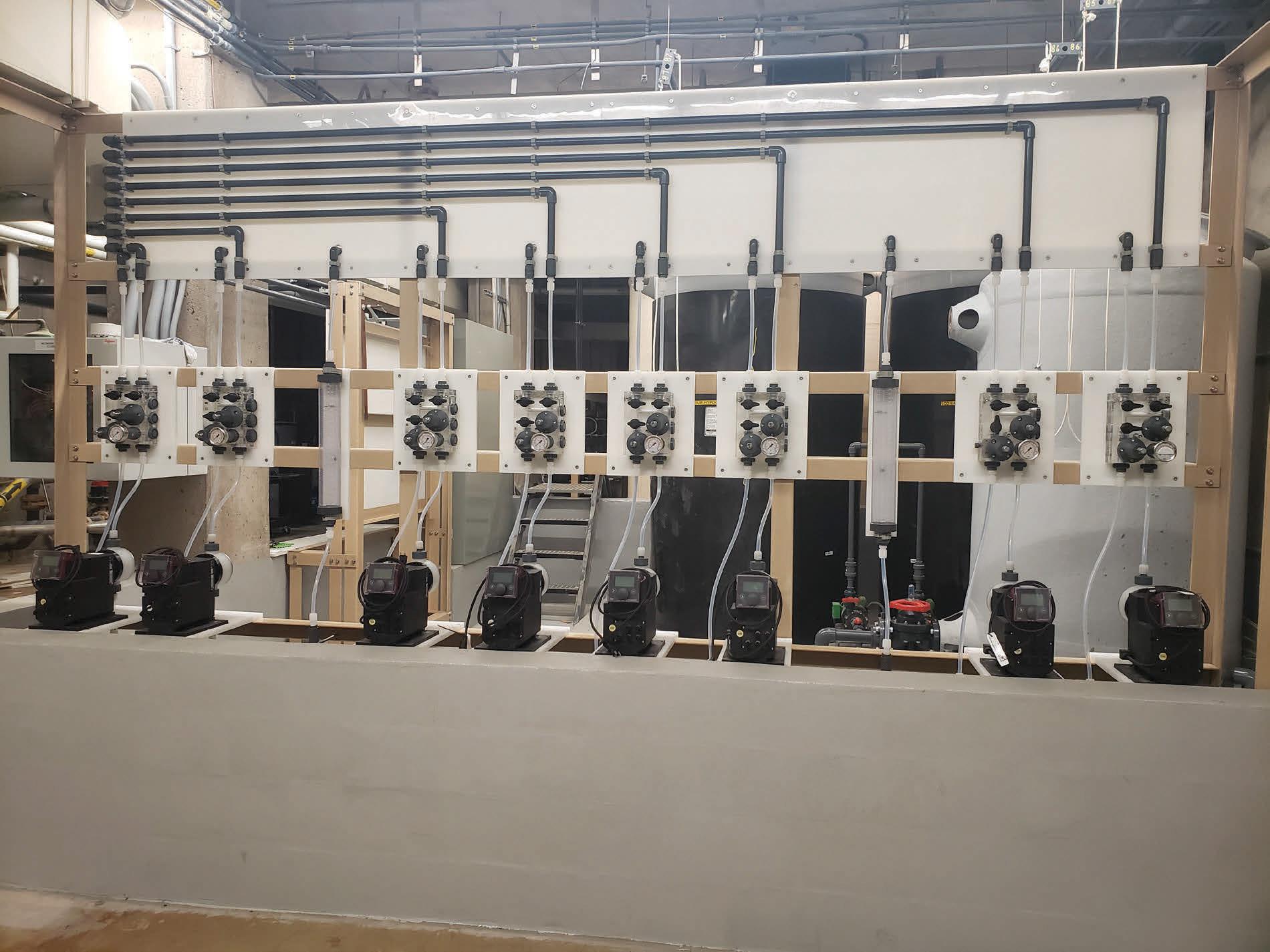
Up to 50% reduction in mechanical room space required 90% fewer joints = 90% less risk of leakage
Simple, consolidated operation
Support Canadian Industry - Buy DICE
Evaluating treatment options to help utilities prepare for increasing PFAS drinking water regulations
By Miles Menyhert
Governments around the world are using regulation to reduce the risk of human exposure to the harmful effects of PFAS. By setting limits on the permissible levels of these compounds in drinking water, regulators are forcing water suppliers to undertake advanced treatment to ensure compliance.
To proactively address the threat of PFAS in drinking water, many utilities are upgrading their systems using three primary technologies: activated carbon (AC), ion exchange resin (IER) and reverse osmosis (RO). These technologies can be used independently or collaboratively to mitigate PFAS. Depending on water quality, some of these treatment technologies (mainly AC and RO) can be used to treat additional contaminants as well, increasing their value and cost-effectiveness in water treatment.
ACTIVATED CARBON
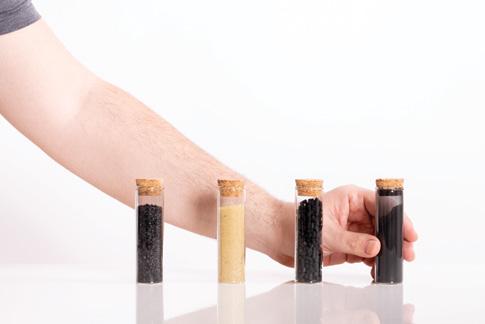
Granular activated carbon (GAC) is widely used in water treatment applications for trace contaminant removal and is effective for mitigating long-chain PFAS to non-detectable levels. It’s a highly porous adsorbent that starts with a carbon-rich raw material such as coal, coconut shell, or wood.
These materials are converted into char using high heat in an oxygen-starved environment in a process known as pyrolysis. The char is then “activated” with steam to create a highly porous structure. Activated carbon’s range of pore sizes (micropores, mesopores and macropores) impart unique transport and adsorptive characteristics.
This allows for the reduction of organic pollutants by firmly attracting them to the internal surface created by these pores. Once activated, the final product is dried, crushed and sieved into spe-
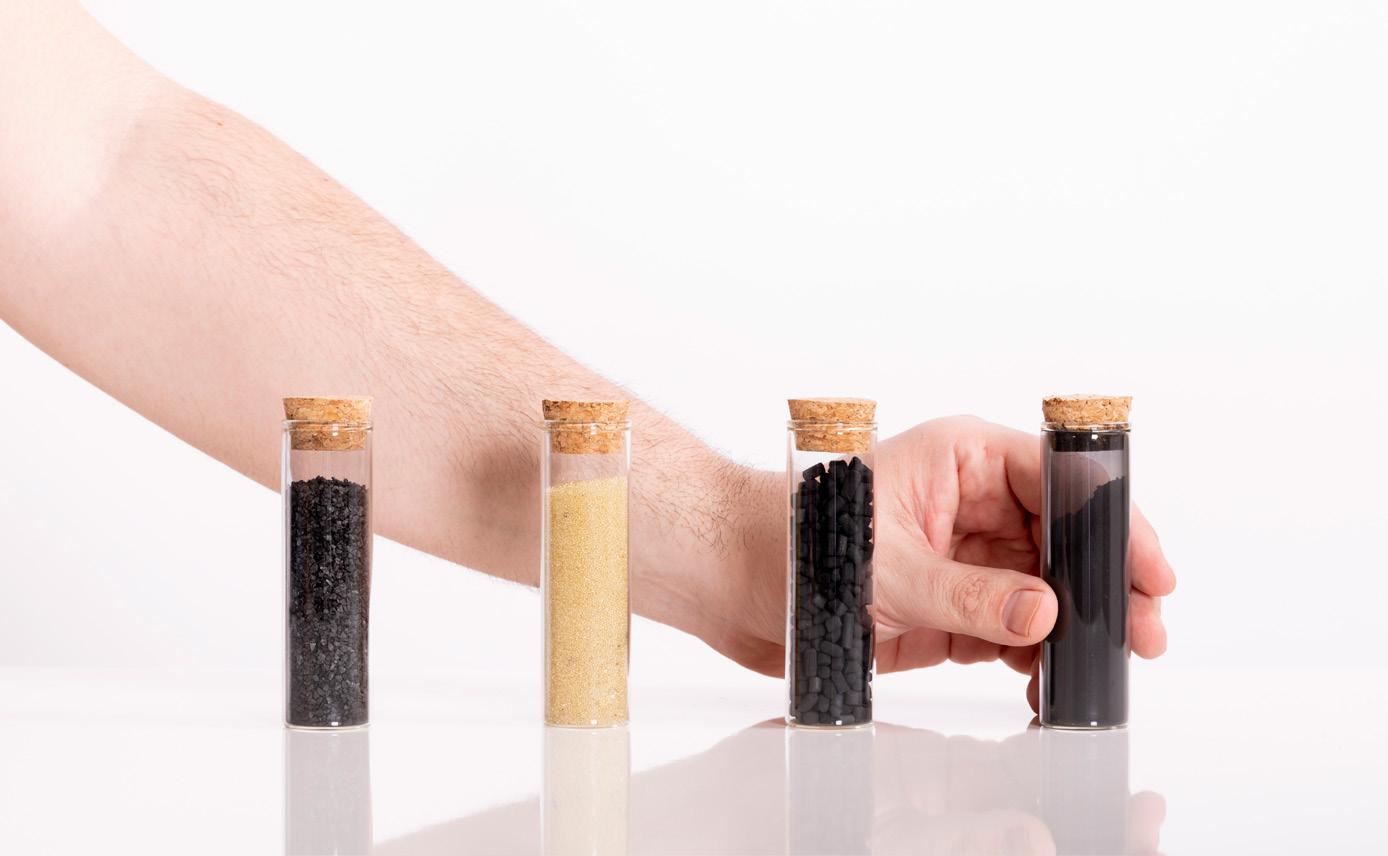
Using activated carbon followed by ion exchange resin can be a robust approach for treating PFAS.
cific-sized granules or powders that are matched to various applications. When activated carbon is used in vessels, water is percolated through the bed to allow for adsorption.
Alternatively, when the activated carbon is applied as a powder, it is more analogous to a chemical dosage. The powder is dosed into the system, mixed with the water, separated, and discarded after the desired contact time.
Powdered activated carbon (PAC) is the pulverized version of GAC and can be used without requiring the installation of pressure vessels or gravity contactors. Because of its smaller particle size, PAC has faster adsorption kinetics than GAC. The smaller particle diameter decreases the diffusion path length by 10 to 100 times when compared to GAC.
PAC is dosed directly into the water as needed to combat contamination spikes, then removed with physical filtration methods such as coagulation/flocculation and sedimentation. This bypasses the capital expenditure and lengthy design/instal-
lation process required for GAC pressure vessels, making PAC an attractive, adaptive solution with a low barrier to entry.
Many utilities already use PAC for other purposes, such as taste and odour control. So using it for PFAS treatment may require just a simple dosing adjustment or transition to a higher performance grade. PAC can allow drinking water facilities to start treating for longchain PFAS right away, while they consider more permanent, long-term treatment strategies.
However, GAC has some advantages over PAC when it comes to PFAS reduction and drinking water treatment in general. Because GAC is applied in a flow-through system, and sometimes in lead-lag systems, a higher utilization of the available capacity on the GAC is possible. This leads to lower carbon usage per treated volume.
Secondly, GAC can be reactivated. The reactivation process takes the spent media and burns off (and in many cases destroys) adsorbed contaminants,
thereby refreshing the life of the media. A small portion of GAC is lost in the process. Fresh GAC (also known as make-up carbon) can then be supplied to fill in the lost portion of media. Generally, this requires only 10 – 30% make-up, saving 70 – 90% of the initial media.
BEWARE OF LOW-COST CARBON
When it comes to activated carbon, quality matters. Carbon characteristics can vary significantly among vendors, and the difference in quality can have remarkable implications for the buyer.
High-quality carbon performs more reliably across batches, allows for lower dosages, and lasts longer before needing replacement or reactivation. Lower quality, poorer performing carbon may appear cost-effective on a dollars-per-kilogram basis but can easily end up costing a plant more money. Increased consumption of lower quality carbon leads to increased costs such as more labour, more frequent deliveries/increased site traffic, a larger storage footprint, and greater disposal and/or reactivation costs.
A high-quality carbon has more adsorption capacity and longer life because of a well-balanced pore size distribution that can better transport and capture contaminants. Special care is taken when manufacturing certain brands of GAC, like Jacobi’s AquaSorb™ line, to ensure that it is safe and suitable for use in water treatment.
This special care can include sourcing of high purity raw materials or pre-treatment, such as acid washing, to limit the introduction of unwanted extractable content into the water. Outside of inadequate porosity, improper sourcing or insufficient washing can cause low-quality carbon to contain more impurities like heavy metals, which can pass into the treated drinking water.
To ensure limited levels of extractables are leached into the drinking water from low-quality carbon, excessive backwashing of the media during commissioning could be required. Depending on extractable constituents, all backwash water could require specialized disposal.
With specific regard to PAC, pore distribution is a key performance aspect. Due to the relatively short contact time of the PAC with the treatment water, the adsorption kinetics and capacity must be tuned
to the contaminants in the source water. This is most properly explored through jar testing. Jar testing can be done to compare dosage and contact time requirements for different carbon grades, allowing for fine tuning of the carbon to your process. This exercise can help a utility save money by generating a price vs performance metric for each carbon.
ANION ION EXCHANGE
Ion exchange resin (IER) is another leading filtration technology commonly used in PFAS treatment. IER beads are tiny, polymeric, highly porous beads. For PFAS removal, specialized functionality is applied to the media to provide selectivity for trace amounts. The positively charged functionality attracts the continued overleaf…
CE, ASME B30.16, AS1418.2
FREE SPARE SET OF LATCHES
negatively charged functional groups of the PFAS compounds, pulling them out of the solution. IER reduces both shortand long-chain PFAS effectively, while utilizing a shorter contact time than activated carbon.
When identifying whether activated carbon or ion exchange is the right choice for a facility, the first step must be to understand the specific water quality to be treated. In the water quality analysis, other substances that can interfere with PFAS removal must be identified as well as PFAS compounds that must be targeted.
For ion exchange, these other substances would be sulfate, chloride/chlorine, nitrate and TOC. For activated carbon, these compounds would include organics (TOC, DOC, BOD). If possible, speciation of these compounds in the influent stream is useful for the selection of the appropriate media.
High molecular weight components will be more readily adsorbable onto the carbon’s surface and push off any pre-
By setting limits on the permissible levels of PFAS in drinking water, regulators are forcing water suppliers to undertake advanced treatment to ensure compliance. Credit: francescoscatena,stock.adobe.com
viously adsorbed PFAS, while blocking adsorption sites for additional PFAS adsorption. If the analysis of PFAS compounds indicates mainly long-chain and sulfonated PFAS species, carbon may be a more viable option.
If the PFAS contamination is shortchain and tending towards carboxylic acid functionality, ion exchange should be considered a stronger performer. Of
OPTIMIZE WATER
course, rapid small scale column testing or pilot scale testing, would better highlight true performance and operational differences between the media types.
USING ACTIVATED CARBON AND ION EXCHANGE TOGETHER
Using activated carbon followed by ion exchange resin can be a robust approach for treating PFAS. Activated carbon treatment in front of a PFAS-specific ion exchange media will extend the life of the ion exchange resin. It can protect the resin from fouling prematurely and the IER can protect the system from early short-chain PFAS breakthrough.
As Canada’s PFAS regulations turn greater attention to drinking water, municipal water treatment operations should start planning now to explore treatment technologies that fit their needs and budgets.
Miles Menyhert is with Jacobi Carbons Inc. For more information, visit: www.jacobi.net
Consortium leads biosolids facilities upgrade project in Winnipeg
By ES&E Staff
An Aecon Group Inc. consortium will lead the design and construction of a new Winnipeg biosolids facility, as well as modifications to the existing primary clarification at the North End Water Pollution Control Centre (NEWPCC).
The biosolids facilities upgrade project will be led by Red River Biosolids Partners General Partnership, a consortium comprised of Aecon, Oscar Renda Contracting of Canada Inc. (a subsidiary of Southland Holdings Inc.), and MWH Constructors Canada Ltd., of which Aecon is the lead partner and holds a 33.3% interest.
“Building on our team’s work at the NEWPCC since 2021, this contract for another important component of this project augments our strong roster of projects being delivered under collabo rative contract models,” announced JeanLouis Servranckx, president and CEO of Aecon Group Inc. “We look forward to safely delivering this project and working with our client and partners to extend the operating life of this essential facility.”
wastewater treatment. The three major upgrades include a new facility to process biosolids, a new facility to remove nitrogen and phosphorus from wastewater, as well as a new power substation and new headworks facility.
The design and construction of the headworks facility will include a raw sewage pump station, a micro-tunnel extension of existing interceptor sewers, a grit removal system, a main control room, fine screens and compactors, and a plant emergency generator facility.
In 2022, a joint investment of more than $550 million was announced for the second phase of upgrades to the NEWPCC which includes the biosolids facilities upgrade project. Construction will be substantially finalized by 2030, according to Aecon.
three major upgrades include a new facility to process biosolids, a new facility to remove nitrogen and phosphorus from wastewater, as well as a new power substation and new headworks facility.
Credit: City of Winnipeg
For more information, email: editor@esemag.com
Stantec is leading the design of the project alongside Hatch Engineering. The biosolids facility will be built on a greenfield site using thermal hydrolysis processing (THP) technology, which sustainably treats biosolids resulting from wastewater treatment. Once constructed, the facility will turn wastewater sludge into pathogen-free, Class A biosolids that are safe to use as fertilizer.
“We know how vital this effort is as the City continues to adapt to new environmental regulations and changing population dynamics,” said Gillian Edwards, Stantec’s regional growth leader for Water in Western Canada. “We are so happy to have an experienced, collaborative, and innovative team in place and are ready to get to work on this notable project.”
First commissioned in 1937, the NEWPCC provides 70% of Winnipeg’s
BUILTON
The
Achieving ultra-fine grit removal in wastewater operations
By Rich MacGregor
The rising demand for high-efficiency grit removal systems is driven by the need to protect plant infrastructure. This trend is particularly noticeable with the increasing adoption of technologies such as membrane bioreactors (MBRs), specialized pumping equipment, and fine bubble diffusers.
Effectively removing ultra-fine grit can yield a substantial return on investment by preventing line blockages, as well as deposition in downstream channels, process basins, while reducing the fouling of diffusers and membranes. This, in turn, extends the lifespan of downstream equipment, significantly lowers maintenance costs, and enhances overall operational efficiency.
Ultra-fine grit can also present significant challenges to aeration systems. Accumulated grit disrupts oxygen circulation, decreases the efficiency of biological treatment, and increases compliance costs associated with effluent regulations. This buildup limits the volume necessary for optimal retention times in biological treatment and sludge digestion.
The necessity to tackle ultra-fine grit differs by region and season. Geographic location and environmental factors significantly affect the grit size distribution encountered by wastewater treatment facilities. Coastal regions and agricultural areas face elevated levels of ultrafine particulate matter, and seasonal factors such as winter road salt and sanding also influence particle size distribution.
As the diameter of grit decreases, the challenge of removal increases. Currently, there are two approaches to ultrafine grit removal available in the market, each employing a distinct method.
STACKED TRAY SYSTEMS
Around 15 years ago, the stacked tray system was developed, raising expectations for the removal of ultra-fine grit through gravity-based separation. This
The INVORSOR combines hydraulic forces vortex to remove large, medium and fine parties with an upper chamber with inclined plates to achieve 95% grit removal down to 75 microns, at flows up to 50 MGD.
method utilizes a series of vertically-mounted trays to expand the surface area in a square settling tank, allowing grit particles to settle gradually from wastewater.
The design features a notable head loss throughout the system, primarily due to the inlet distributor, which evenly disperses the incoming flow across the multiple trays (up to 300 mm). Typically, a continuously operating remote pump is used to remove the grit that accumulates at the bottom of the tank.
While high removal efficiencies are touted for particles as small as 75 microns, efficiencies are typically derated down to 85% during peak flow conditions in many of the installations. At such peak flow rates, manufacturers of stacked-tray systems will often only guarantee performance specifications for the removal of particles as small as 212 microns.
Stacked-tray systems are sized and designed based on surface area and particle settling rates, which determine the number of trays and tank depth required. Increased flow demands more
surface area to sustain a surface overflow rate (SOR) that effectively removes fine and ultra-fine grit.
Practical limitations on available surface area restrict system capacity. The largest stacked tray systems can accommodate a maximum of approximately 50 million litres per day (MLD) for 75-micron removal. To manage larger flows, multiple systems are necessary: 75 MLD requires two systems, while 190 MLD requires four systems. This not only increases the footprint significantly, but also necessitates the duplication of ancillary equipment, such as pumps and grit washing and dewatering systems.
INTEGRATING FORCED VORTEX TECHNOLOGY WITH INCLINED PLATES
As the market began to recognize the importance of ultra-fine grit removal while grappling with the capacity limitations of stacked tray systems, engineers at Smith & Loveless Inc. (S&L) developed a scalable system that could provide consistent and efficient removal of
ultra-fine grit across all flow rates, without any performance degradation at low, average, or peak flows.
They developed the PISTA® INVORSOR® system, which can achieve 95% grit removal at 75 microns across all flow conditions, from low to peak flows, accommodating flow up to 190 MLD per chamber.
It builds on the features of S&L’s PISTA® grit removal system, which can capture 95% of particles down to 105 microns.
Forced hydraulic systems aren’t settling devices like most other grit sys-
The INVORSOR features an additional stage to remove ultra-fine particles by augmenting the hydraulic forced vortex with integrated inclined parallel plates. Flow transitions from the hydraulic vortex to an upper hopper, optimized through computational fluid dynamics to effectively remove particles as small as 75 microns. Inclined plates in the upper chamber disrupt the vortex, facilitating a sedimentation process under quiescent conditions.
By augmenting the hydraulic forced vortex with the upper chamber of the inclined parallel plates, the INVOR-
enables the automatic maintenance of optimal velocity to consistent high-efficiency grit removal across a range of conditions, from minimal flow to peak flow.
Maintaining the optimal velocity is essential for effective grit removal. If the flow rate falls below this threshold, grit will settle excessively, leading to accumulation in the approaching channel (i.e., grit trapped prior to the grit chamber).
No additional downstream control devices are required to keep the velocity in the preferred range during both peak flow and minimum flow, as the system possesses up to 10:1 turndown.
The Future of Environmental Solutions in Canada
•Sustainable Water Solutions
•Site Assessment, Remediation and Closure
•Air Quality and Emissions Services
•Environmental Planning and Natural Resources
•Digital Services
Ontario’s Excess Soil Registry prices increase 30% for soil volume fees in 2025
By ESE Staff
The fees associated with soil volume management have seen an increase from 2024 to 2025 across various categories, according to new data released by Ontario’s Resource Productivity & Recovery Authority (RPRA).
Overall, the fee structure for soil volume management has increased significantly, particularly in the variable fee categories, reflecting a consistent trend of approximately 30% increases across most volume brackets. The flat fees also experienced notable hikes, ensuring that pricing is adjusted to accommodate changes in service costs and market conditions, according to RPRA.
RPRA consulted on the proposed fees from September 27 to November 12, 2024. The regulator hosted five webinars that provided overviews of the fee proposals and provided an opportunity for attendees to ask questions and make comments on the proposal.
The 2025 program fee rates took effect on January 1, 2025.
For soil reuse sites, fee rates are increasing by an average of 5% due to decreases for predicted volumes and filings for 2025.
In RPRA’s consultation report, it states that three main fac-
tors impact year-over-year rate increases: volume estimates, program cost allocations, and the impact of the application of prior year program surpluses and deficits.
“RPRA will continue to strive for predictability in fee rates; however, some annual variability is unavoidable,” the regulator stated in the consultation report.
While fees are up for 2025, they don’t match the substantial increases seen in 2024, when for instance the largest generators of excess soils (volumes greater than 500,000 m³) saw fees jump by 400% from $30,000 to $150,000.
For a detailed breakdown of fees, visit: www.rpra.ca/ program-fees
* To learn more about Ontario’s excess soils regulation, attend the upcoming CANECT Environmental Compliance and Due Diligence Training Event, taking place April 29 –May 1 in Vaughan, Ontario. Browse courses and speakers at: www.canect.net
PFAS removal water treatment project breaks ground in Minnesota
By ES&E Staff
One of the largest water treatment facilities in the U.S. for the removal of per- and polyfluoroalkyl substances (PFAS) is now under construction in the City of Woodbury, Minnesota.
Late last year, the city hosted a groundbreaking ceremony for a new water treatment plant that could approach US$350 million. The plant and associated pipeline infrastructure will treat up to 21,133 cubic metres of water for PFAS removal. Jacobs provided design services for the project with AE2S Engineering and is now delivering the construction management services.
The City of Woodbury is a community located in the southeast Minneapolis / St. Paul Metropolitan Area (Twin Cities) and home to approximately 85,000 people.
PFAS were first detected in drinking water supplies in the eastern Twin Cities area in 2004, with subsequent research helping to identify the source and level of contamination. Most of the contamination was traced to dump sites or landfills that had been used by 3M manufacturing facilities to dispose of PFAS-laden wastes, according to Jacobs.
The State of Minnesota recently settled a lawsuit with 3M requiring financial support for residents and municipalities impacted by the PFAS contamination plume, including the City of Woodbury and its contaminated groundwater supply.
In response, the city is pursuing a long-term water treatment solution to remove PFAS contaminants from its drinking water and restore production capacity in a fast-growing area. Average water samples taken at all the city’s wells exceed the Minnesota Department of Health’s 2024 Health-Based Values for perfluorooctanoic acid (PFOA), while all but three wells exceed the U.S. Environmental Protection Agency’s Maximum Contaminant Levels for PFOA.
Woodbury currently treats six wells through a temporary water treatment plant and has three additional wellhead treatment facilities. All wells that have received Minnesota Department of Health issued health advisories are being treated.
The main project component is the construction of the new water treatment plant for PFAS removal and 27 kilometres of new raw and distribution system piping.
Overall project cost will approach US$300 – $350 million, paid for in large part by the Minnesota State Settlement with 3M. The plant is designed to be expanded to a future treatment capacity of 181,700 cubic metres per day and provide flexibility for conversion to ion exchange or alternative absorptive media to adapt to changing regulations and treatment technologies.
For more information, email: editor@esemag.com
Construction of this new water treatment plant for PFAS removal is now underway. Credit: Jacobs
High Level Alberta approves MIEX upgrade for its WTP
By ES&E Staff
The Alberta Town of High Level will begin construction later this year on a $6.6 million Magnetic Ion Exchange (MIEX) process upgrade to its water treatment facility. Local officials passed a resolution to move forward with the new pretreatment process at a council meeting in January. They say the MIEX upgrade could save the community hundreds of thousands of dollars in water treatment costs.
“The Town of High Level has some of the highest water treatment costs in the province,” High Level Mayor Crystal McAteer said in a statement. “This is an important project that will improve the quality of life for our community as well as for our water users, and at the same time will save us money further into the process on carbon and chemical costs.”
A pilot study was completed at the water treatment plant in 2023 in coordination with Associated Engineering. The study found that the MIEX process led to reduced coagulant use, decreased organics loading on treatment filters, and reduced disinfectant byproducts.
Local officials described the MIEX process as a pre-treatment process “similar to a water softener”, except its purpose is to remove naturally occurring organic carbons, colour, sulphates, and bromide from the water before it enters
the primary water treatment process. The pretreatment process improves the final disinfection and lowers activated carbon demand, while reducing overall operational costs, according to the municipality.
The MIEX system had its first largescale implementation in Australia in 2002. It is now a standard pretreatment practice in more than 70 water treatment plants in 12 countries, including the U.S. and Canada.
Conklin, a hamlet in northern Alberta, has also found recent success using MIEX for pretreatment.
Construction of the MIEX project in High Level will begin in 2025, with the renovation of the water treatment plant to accommodate the new system. Project completion and commissioning is expected in the spring of 2026.
For more information, email: editor@esemag.com
The facility is a Class 3 plant capable of producing 9,000 m3 per day and has a 4,000 m3 treated water storage reservoir. Credit: Town of High Level
April 29 – May 1, 2025
The Venetian Banquet & Hospitality Centre Vaughan, ON
ENVIRONMENTAL COMPLIANCE AND DUE DILIGENCE TRAINING EVENT
“Always money well spent attending CANECT to stay up to date on environmental issues.” — ERCO Worldwide
Why You Should Attend CANECT25
For over 30 years CANECT courses have helped to shape the expertise of Canada’s environmental managers, practitioners, and supervisors.
Recent years have seen an increased trend in environmental enforcement as well as record-setting fines and penalties for environmental violations in Canada.
Update your knowledge of new regulations and obligations
Networking opportunities
Connect with industry experts and speakers
Earn hours toward Continuing Professional Development requirements
Maintain your organization’s due diligence
SAVE OVER $230 when you register with promo code ESE15. For information on group discounts or courses, contact Denise Simpson, 905-727-4666, Ext. 21, denise@esemag.com
Zhiibaahaasing First Nation breaks ground on water treatment plant
By ESE Staff
After more than 30 years of water advisories, Zhiibaahaasing First Nation, located on Manitoulin Island in Ontario, is breaking ground for the construction of a new water treatment plant and celebrating major upgrades to its water distribution system.
Indigenous Services Canada supported the projects with an investment of nearly $50 million.
The community has relied on a temporary package water treatment plant over the last five years. Site Water Manager and operator, Jonathan Riberdy, earned the 2021 National First Nations Water Leadership Award for his role in making the system operational.
Riberdy said he worked alongside Indigenous Services Canada, First Nations Engineering Services Ltd. and BI Pure Water to get a temporary water treatment plant for Zhiibaahaasing in 2020. The plan, he explained, was to have a shipping container built as a portable package plant to ensure the community had water. A distribution line was placed in the
There are no clear words to express the emotions and joy. To know our children will be able to have clean water to bathe in and to drink. To know it will be safe.
ground to connect the package plant to the low lift station that pulls water from Lake Huron.
“I’m excited we are finally here,” Riberdy said at the groundbreaking ceremony for the new water treatment plant. “We worked hard together to get to this point and now we can actually move forward to get clean water to our community. This has been many years in the making.”
Zhiibaahaasing First Nation Band Manager, BobbiSue Kells-Riberdy, said the next two years will require a lot of hard work to get the new facility operational, but the community of about 200 residents is up to the task.
“Chief Irene Kells and her Councils over the years have been advocating for clean drinking water for the last 33 years,” said Kells-Riberdy. “There are no clear words to express the emotions and joy. To know our children will be able to have clean water to bathe in and to drink. To know it will be safe.”
Indigenous Services Canada is investing $24.9 million for the water treatment plant and an additional $24.7 million for the distribution system upgrades.
For more information, email: editor@esemag.com
Community members gather to break ground on a new water treatment plant in Zhiibaahaasing First Nation. Left to right: Councillor Kevin Mossip, Chief Irene Kells, Councillor Richard Mitchell, Band Manager BobbiSue Kells-Riberdy, Water Plant Manager Jonathan Riberdy. Credit: CNW Group/Indigenous Services Canada
North Shore WWTP project back on track
By ES&E Staff
Metro Vancouver officials say that construction is ramping up on the site of the beleaguered North Shore Wastewater Treatment Plant, following confirmation of new contract details with PCL Construction.
Within the contract with PCL, Metro Vancouver expects that about half of the work to complete the project will be competitively bid among subcontractors, vendors, and suppliers. The latest estimated total contract price of $1.95 billion is within the approved budget for the program.
PCL was hired in 2022 for early construction works on the North Shore plant under a competitive bidding process, with the option to negotiate a contract for completing the full project. Now, work is ramping up as PCL expands its construction program and continues to mobilize staff, equipment, and materials to the site, according to local officials.
The project’s full anticipated price tag remains at $3.86 billion.
In the fall of 2024, Metro Vancouver officials initiated an independent audit of ballooning costs around the development of the plant and hired a former judge to lead the process.
Metro Vancouver officials remain embroiled in a lawsuit with original Spain-based contractor Acciona Wastewater Solutions LP, who in turn, is suing the region.
The new North Shore Wastewater Treatment Plant will serve over 300,000 residents and replace the existing Lions
Gate Wastewater Treatment Plant, one of the last plants on the west coast of Canada and the U.S. that provides only primary-level wastewater treatment.
For more information, email: editor@esemag.com
The North Shore project completion date has now been delayed until 2030. Architectural rendering pictured. Credit: Metro Vancouver
Major Miami stormwater path project reaches final phase
By ES&E Staff
Apublic-private partnership in the City of Miami is transforming a 16-km-long strip of contaminated land beneath the city’s elevated mass transit system into a multi-modal path and green infrastructure project that features bioswales, rain gardens, stormwater ponds, and micro-forests to protect a storm-prone urban area.
Known as The Underline, the projected $150-million project is a partner-
ship between the Department of Transportation and Public Works (DTPW), the Parks, Recreation and Open Spaces (PROS) Department, Friends of the Underline, the City of Miami, and the City of Coral Gables.
Set to be complete in 2026, the stretch
of land was formerly host to a railroad before it became the Miami Metrorail. That history meant developers faced arsenic contamination in the soil that needed to be addressed through each stage of the multi-year project.
The Underline is expected to utilize a Japanese afforestation method called Miyawaki, which can create a diverse forest ecosystem quickly by planting some 24,000 seedlings that can grow 10 times faster than the average urban forest. When the project is done, the path’s various green infrastructure elements will feature more than 500,000 native plants and trees.
Stormwater ponds along the path will naturally guide, absorb, and allow stormwater from the Metrorail and nearby areas to percolate back into the aquifer. “The rain gardens are natural flood mitigation systems, temporarily collecting stormwater in rocky shallow areas and utilizing multiple sediment layers to filter out pollutants,” states The Underline’s website. “The depressed rock gardens manage stormwater and filter it as it seeps into the aquifer. Additional features include insect hotels, bird houses, and elevated pathways to encourage the exploration of these innovative systems.”
The project has been under construction for several years and opened its first phase to the public in 2021. The Underline is being built in three phases.
For more information, email: editor@esemag.com
When the project is done, the path’s various green infrastructure elements will feature more than 500,000 native plants and trees, according to project officials. Credit: The Underline
Federal government announces new infrastructure council
By ES&E Staff
After four years, the federal government has announced the composition of the newly established Infrastructure Council of Canada, an initiative that aims to lead a national infrastructure assessment and has been a longstanding advocacy priority for the Canadian Construction Association (CCA).
CCA members took to Parliament Hill to engage with federal MPs on the need for a comprehensive, long-term infrastructure plan. They say the new announcement marks a significant step forward, but concerns remain about the council’s scope and representation.
The Infrastructure Council of Canada is set to prioritize infrastructure projects that address housing needs, including clean water and wastewater systems, public transit, active transportation, and waste management. However, the CCA argues that this focus, while promising, does not fully address the broader infrastructure challenges facing the country.
Transportation and trade facilitation projects, essential for economic growth and community connectivity, remain outside the council’s current mandate.
One major concern highlighted by the CCA is the lack of representation from the construction and finance industries on the council. The association has repeatedly called on the Minister of Housing, Infra-
structure, and Communities to appoint an independent construction industry representative. Without such voices, CCA warns that critical challenges and opportunities in building resilient and effective infrastructure may be overlooked.
The CCA has vowed to closely monitor the development and progress of the Infrastructure Council and has expressed its commitment to continued consultations with both the government and the broader industry.
The minister has announced that the Canadian Infrastructure Council will be composed of 11 experts in relevant infrastructure sectors across the country. Each member will serve on the Council on a part-time basis until March 31, 2027. The council will engage key partners and stakeholders from industry, provincial, territorial, municipal, and Indigenous governments to seek their knowledge and expertise.
For more information, email: editor@esemag.com
Victoria Gold ordered to address water management due to cyanide contamination
By ES&E Staff
Victoria Gold Corp. has been issued an enforcement directive to develop two critical water management plans for its Eagle Gold Mine site, as the company grapples with ongoing water contamination issues following a major heap leach failure last year.
The order issued by a Yukon Energy Mines and Resources enforcement officer required Victoria Gold to submit a groundwater interception plan to identify all groundwater interception infrastructure and provide detailed information about the volume and quality of water being intercepted.
A second plan, due by April 15, 2025, must address sur-
face and groundwater management during the spring melt to ensure adequate storage capacity for snow runoff and to prevent the uncontrolled release of untreated water. Some 500 million litres of water from snow and ice could melt in the spring, which would further overwhelm the system.
Victoria Gold has been under the management of PricewaterhouseCoopers (PwC) since entering receivership last August. It still faces significant challenges after approximately 4 million tonnes of cyanide-treated ore slid from the heap leach pad, with about half escaping containment. Contaminated water storage has since become a pressing issue.
Late last year, a court approved amendments to the receivership order for Victoria Gold Corp. to allow the next phase of remediation work at the Eagle Gold Mine. This includes a $55 million increase to the borrowing limit available to the receiver, from $50 million to $105 million, to fund remediation work until March 31, 2025.
According to Yukon officials, results from samples collected up to November of last year show that levels of cobalt and cyanide continue to increase in Haggart Creek, while mercury levels have stabilized.
As of early November 2024, PwC reported that the mine site was holding approximately 508 million litres of cyanide-contaminated water in storage ponds. An additional 250 million litres are being recirculated onto the heap leach facility, with more stored in the in-heap pond.
This volume continues to grow by an estimated 2 million litres per day due to regular inflows, and crews are intercepting an additional 3 million litres of groundwater daily, further straining capacity.
PwC successfuly applied for an emergency water license amendment to temporarily discharge water that is “nonacutely toxic” but exceeds current contaminant thresholds. The company is also working to upgrade the site’s water treatment plant to handle cyanide-contaminated water, though these upgrades are still in progress.
This is the fourth directive issued to Victoria Gold since the heap leach failure, underscoring the severity of the environmental and operational challenges at the site.
For more information, email: editor@esemag.com
A diffuser installed at a discharge point to Haggart Creek. Credit: Yukon Water Board
UWaterloo researchers say ‘bacterial sex’ may help WWTPs degrade microplastics
By ESE Staff
Researchers from the University of Waterloo (UWaterloo) added DNA to several species of bacteria found in wastewater, allowing them to biodegrade polyethylene terephthalate (PET), a persistent microplastic found in carpet, clothing and food containers that has been linked to health problems.
The researchers use a natural process they refer to as “bacterial sex”, where bacteria share genetic material with each other when multiplying. It enables the introduction of a new trait into the target bacteria, giving them the ability to break down microplastics.
“Think of these bacteria that already exist in water systems to clean up microplastics as biorobots that can be programmed to get the job done,” said Dr. Marc Aucoin, a professor in UWaterloo’s Department of Chemical Engineering. “Microplastics in water also enhance the spread of antibiotic resistance, so this breakthrough could also address that concern.”
PET plastics take hundreds of years to degrade in the environment. Over time, they break down into microplastics that enter the food chain. Chemicals in these plastics are associated with insulin resistance, cancer and decreased reproductive health, according to the researchers.
Dr. Brian Ingalls, a professor in UWaterloo’s Department of Applied Mathematics, said that the team intends to use modelling to understand how well the bacteria transfer the new genetic information under different environmental conditions.
“The long-term vision is to break down microplastics in wastewater treat-
Credit: Pcess609, stock.adobe.com
ment plants at scale,” he said.
Aaron Yip, a PhD candidate in UWaterloo’s Department of Chemical Engineering, said that microplastic degradation in wastewater treatment plants is a safer application to target, but the researchers also hope to find ways to clean up plastic waste accumulating in bodies of water.
“Many of these facilities are already designed to neutralize bacteria in wastewater, which would kill any engineered bacteria prior to discharging water back
into the environment,” noted Yip. He added that the team will later assess the risks of using engineered, plastic-eating bacteria in the natural environment.
The study, Degradation of polyethylene terephthalate (PET) plastics by wastewater bacteria engineered via conjugation, appears in the journal Microbial Biotechnology
For more information, email: editor@esemag.com
PET plastics break down into microplastics, which can enter the food chain.
Holistic, science-based strategies to revitalize lake water quality
Water quality in many lakes across Canada is declining at an alarming rate.
Observable indicators of this deterioration include the emergence of symptoms such as invasive weeds, algae blooms, unpleasant odours and fish kills.
When a crisis occurs, specialists are called in to evaluate and oversee the situation. Diagnostic tests are performed to confirm the presence of a harmful algae bloom (HAB) and the application of chemicals like biocides is advised. While the notion of quickly eradicating algae to improve the lake’s appearance is enticing, this can lead to a detrimental cycle that accelerates deterioration of the lake’s ecosystem.
Eliminating algae results in the release of toxins, leading to the destruction of more beneficial organisms and favouring the proliferation and dominance of the harmful organisms in the lake. Over time, continued application of algaecides causes lake algae blooms to worsen.
Experts are urging a different approach and a more permanent solution.
Wayne Carmichael, PhD, a retired professor and prominent expert in aquatic toxicology believes the solution is a multifaceted approach that addresses the root causes of water quality degradation. Ultimately, this approach can improve water quality, enhance recreational opportunities, and preserve aquatic ecosystems for future generations.
ROOT CAUSES OF LAKE DETERIORATION
The decline in lake health is driven by several interconnected factors, described in general as eutrophication. This is the process that occurs when water bodies become overly enriched with nutrients, resulting in sediment nutrient accumulation. These nutrients are recycled back into the water, fueling further algae growth and creating a feedback loop that perpetuates the cycle of degradation.
A tipping point is eventually reached when sediment nutrient recycling is suf-
ficient to sustain eutrophic conditions and facilitate a switch to cyanobacteria dominance.
According to Carmichael, the cause of eutrophication is well established. While some levels of nutrients are natural, human activities such as agriculture and urban runoff have accelerated eutrophication to dangerous levels, overwhelming nature’s capacity to clear them out and maintain balance. Whether caused by climate change or not, the water temperature of lakes is increasing, further fueling eutrophication.
MORE PERMANENT SOLUTIONS
According to Carmichael, effective restoration of lake and water reservoir health begins with monitoring key metrics that go beyond confirming the poor condition of the lake. These metrics should assess the entire ecosystem and provide indicators that can be used to evaluate sustained improvement. “We have done a good job of monitoring, but now we need to get more serious about remediation and prevention,” says Carmichael.
This does not include simply applying air, flocculating/binding agents or algaecides as a quick fix. Treating the symptoms in this way often causes a rebound effect, where the underlying issues become more severe over time. “Chemical and physical methods either dampen, or shorten the effects of a bloom, but do not prevent them.” says Carmichael.
Biocides, whether herbicides or algaecides, only make the problem worse in most cases. Algaecides are more effective against beneficial algae than cyanobacteria, and cyanobacteria are better able to recover after each application. By killing algae and cyanobacteria cells, toxins are also released, and the dead cells sink to the bottom and compound nutrient recycling when they decompose.
As algae die and decompose, oxygen is consumed in the water, leading to hypoxic conditions, “dead zones,” where aquatic life cannot survive. Hypoxia is a major driver of fish kills and the loss of biodiversity in lakes. “In most cases, the nutrients become part of the sediment, which becomes part of the permanent
The RADOR system uses compressors of various sizes, along with self-sinking airline and diffusers that maintain full oxygenation from the bottom to the surface of the water.
morphology of the lake,” says Carmichael.
An important first step is to identify methods that naturally recycle nutrient rich sediments, without just physically removing and dumping them. They are needed in the lake ecosystem for organisms to grow, says Carmichael. He adds that “most of the nutrients are organic and can be recycled back through the food web to benefit the natural cycle of the lake — not the HAB cycle of the lake.”
Numerous studies have demonstrated that high, stable oxygen levels reduce nutrients and minerals in the water column and can keep phosphorus locked into the organic sediments.
Although there are many different solutions that can be used to help revive a lake ecosystem, one involves utilizing Rapid Acting Dissolved Oxygen Restoration (RADOR) technology from CleanFlo International. By increasing dissolved oxygen levels throughout the water column, the RADOR system initiates a sequence of events that bio-dredge mucky sediment, control aquatic weeds, improve
water quality, and reduce organic muck, nutrients, odour, harmful gases, and coliform bacteria. This helps to restore the nutrient clearing capacity of the food web by improving fish growth and health.
The RADOR system uses compressors of various sizes based on the lake and application, along with self-sinking airline and diffusers that maintain full oxygenation from the bottom to the surface of the water.
Another important step in restoring balance to a lake is bioaugmentation, which involves the use of enzymes to
break down organic muck, like a compost pile. Boosted by natural enzymes, aerobic bacteria and microorganisms consume the organic muck and nutrients, while aquatic insects feed on the bacteria, increasing the natural food source for fish.
Critical micronutrients can also be introduced to stimulate the growth of organisms that form the foundation of a productive food web. This enables balance to be restored at the level of phytoplankton, so that beneficial algae can out-compete the toxic cyanobacteria, preventing HABs and providing better nutrition for the food web. The food web becomes more productive so that nutrient clearance is restored, and sediment nutrient stockpiles are depleted as they are bio-dredged away.
Consistent use of these products over time reduces nutrient availability and helps maintain clean, healthy water.
For more information, visit: www.clean-flo.com
Tackling PFAS contamination at Canadian military bases and airports
By Michel France and Jennifer Kirk
PFAS first went into widespread use after the U.S. government, responding to a deadly fire aboard a U.S. Navy aircraft carrier during the Vietnam War in 1967, commissioned a handful of major chemical companies to develop a firefighting foam that could quickly and dependably extinguish jet fuel fires. They came up with aqueous film forming foam (AFFF), which contains PFAS. This foam has since been used at military bases, airports and refineries and other industrial and commercial sites all over the world.
AFFF is made up of a mix of fluorocarbons, surfactants and solubilizers. The fluorochemical surfactant helps lower the surface tension of water, allowing the foam to create a thin film on top of liquid fuels. This film stops vapours, cuts off the fuel’s oxygen supply, and prevents fuel from evaporating and catching fire again. AFFF was also designed to spread quickly and smoothly over liquid fuel, making it very effective at putting out petroleum hydrocarbon fires.
However, the environmental impacts and potential health effects of PFAS are under intense scrutiny, and we are seeing the promulgation of PFAS guidance and criteria leading to broader regulations and lower thresholds and standards in Canada and North America, in general.
REGULATORY TRENDS
As the presence of PFAS is already widespread and ubiquitous in the environment, it is key to incorporate “background concentrations” into the assessment, delineation and remediation considerations of impacted sites.
Of concern is that regulatory bodies, in particular in Europe and the U.S., have continued to lower the acceptable limits for PFAS in water, soil and air, at the same time that they have banned or limited their use in AFFF and are moving towards restricting their use in cer-
PFAS first went into widespread use after the U.S. government, responding to a deadly fire aboard a U.S. Navy aircraft carrier during the Vietnam War in 1967, commissioned a handful of major chemical companies to develop a firefighting foam. Pictured above is the USS Carl Vinson. Credit: daisuke.s,stock.adobe.com
tain consumer products. In fact, the U.S. has set PFAS limits at concentrations that are below what would typically be found in rainwater in rural and remote areas around the country.
While PFAS-contaminated sites all across Canada are at varying stages of investigation, risk management, and remediation efforts, the federal government is starting to initiate regulations and programs to phase out PFAS and transition to safer alternatives, including AFFF. The country is primarily following a risk-based approach, with top priority given to locations where drinking water supplies and other sensitive receptors have been affected.
In fact, Health Canada has already set an objective of 30 ppt for the sum of 25 PFAS in drinking water, signaling the beginning of tighter regulatory controls to come.
In the meantime, some provinces are
taking the initiative to establish their own PFAS regulations. British Columbia, Alberta and the Atlantic provinces have already implemented a broad set of standards or guidelines, and Ontario has proposed a drinking water screening value for PFAS.
However, the emergence of varying provincial regulations could lead to the kind of enforcement challenges seen in the U.S. with their state-by-state regulatory differences. In particular, the federal government is now requiring businesses to report on the presence of PFAS in their supply chains.
Given this regulatory backdrop, many industries are proactively seeking alternatives to PFAS-based products and are phasing out PFAS from their supply chains. This shift is not only a response to government actions but also to heightened public awareness of the health risks associated with PFAS exposure.
Thus, the demand for, and adoption of safer, environmentally-friendly solutions like fluorine-free firefighting foams (F3s) continues to grow, while a number of countries, including Canada, have been initiating regulatory programs to completely phase out AFFF use.
ASSESSING CONTAMINATION AT AIRPORTS AND MILITARY BASES
The potential environmental liabilities brought on by decades of AFFF use creates a challenge when investigating and evaluating the possible risks to receptors and in developing an appropriate strategy to mitigate those risks when it’s deemed appropriate to do so.
Regulatory pressure is put on airports and military bases where foam has routinely been used in firefighting and training exercises and each facility may be associated with multiple potential source areas. Because of the persistence, mobility and toxicity of PFAS, they are increasingly the subject of environmental investigations to evaluate the
potential risks and determine whether a remediation or risk management strategy should be implemented.
In Canada, where the investigation of many federal sites like military bases and airports has been conducted across the country, PFAS impacts in source areas have been observed in soil and groundwater. The downgradient impacts from source areas often also include surface waters, sediments, and biota found in streams and ditches that eventually flow into larger water bodies that may represent potential drinking water sources and/ or commercial or recreational fisheries.
These investigation programs have typically extended beyond simply determining whether there is a presence or absence of PFAS to incorporate forensics analyses meant to establish the source of impacts, as well as to make a distinction between any observed site-related impacts and any potential off-site sources or background concentrations.
Such forensics programs typically rely on multiple lines of evidence, including
evaluating the chemical mixture and concentration gradients of the detected PFAS, as well as looking at the mobility of the PFAS within the context of the site hydrogeology.
Risk assessments, including evaluating both the potential risks to human and ecological receptors, are also often completed to inform potential mitigation strategies. The use of a risk-based approach that considers exposure and risk from site and background exposures is key, especially given the cost, challenges, and uncertainties associated with remediation of these compounds.
REMEDIATION STRATEGIES
The typical go-to source zone remediation strategy for PFAS-impacted soil is excavation. Materials are typically either stored on site in containment cells or transported and placed in specialized landfills. However, excavation is expensive, energy-intensive, and depending on scale of efforts, disruptive to the local continued overleaf…
community and not always practical for larger-sized source zones. It is also important to note that simply moving PFASladen material from one location to another doesn’t necessarily solve the problem in the long term.
Source zone treatment involves addressing PFAS impacted soils and the continued leaching of PFAS to groundwater that may represent a risk to receptors downgradient of the source area. The two technologies discussed below offer cost-efficient alternatives to excavation and landfilling of PFAS-impacted soils as well as greatly reducing long-term liabilities and potential cost that may be associated with off-site disposal of PFAS impacted soils.
Soil washing: This volume reduction process involves “washing soil” to transfer PFAS from the soil to the rinse water. This allows for reuse of the soil, while the rinse water can be treated using conventional water treatment technologies. Soil washing is being evaluated at several sites in Canada.
Stabilization and solidification: This approach involves mixing soils, either in-place or after excavation, with commercially available stabilization agents like carbon or organo-clay and solidifying the treated soils with cement. The approach reduces the leachability of PFAS by several orders of magnitude and limits the infiltration of water. This particular method is being tested at sites in Canada, including evaluating its effectiveness under a variety of climatic conditions.
The current de facto water treatment technologies that are being implemented include granular activated carbon and/ or ion exchange treatment of PFAS containing water. However, liquids containing high concentrations of PFAS as well as water with more complex chemistry, represent a challenge for PFAS treatment, both in terms of efficiency and cost. A treatment train approach involving separation and concentration followed by destruction offers a solution to the challenge.
This process, aimed at reducing treatment cost involves separating the PFAS into a small volume of concentrated liquid that can be targeted using a PFAS destructive technology. It takes a lot of energy to destroy PFAS and therefore volume reduction and concentration is key.
Fractionation is a demonstrated technology to separate and concentrate PFAS. The process involves bubbling the impacted liquid with a gas, typically air or ozone, and taking advantage of PFAS’ preference for the air-water interphase. PFAS will be concentrated in a foam at the top of the fractionation vessels and skimmed.
The resulting volume reduction may be on the order of 98% and multiple orders of magnitude increase in PFAS concentrations in the “reject.” The “reject” is the focus for destruction. There are multiple destructive technologies on the market at varying stages of development, commercialization, performance and cost-efficiency.
Examples of destructive technologies include sonolysis and supercritical water oxidation (SCWO). Sonolysis uses sound waves to break down the chemical structure of PFAS, while SCWO operates like a high-temperature pressure cooker to destroy PFAS. Whereas SCWO is commercially available, sonolysis is still in the earlier stages of commercialization.
At Arcadis, we have been working on a range of destruc-
tive technologies in collaboration with some noted academic research partners in the U.K. and in the U.S. and are currently conducting demonstrations at military bases across North America.
TRANSITIONING FROM PFAS
While risk management and remediation can be viable means of dealing with PFAS accumulations in the natural environment, prevention is the key to ensuring no further occurrences happen in the future. In Canada, airports and military bases are transitioning away from AFFF to fluorine-free foams. However, this change is much more complicated than merely replacing one type of foam with another.
PFAS residues in the AFFF systems are typically very hard to remove and result in significant PFAS concentrations in the new fluorine-free foam. Without proper and thorough cleaning or replacement of existing firefighting equipment and fire suppression infrastructure, there will continue to be significant environmental liabilities associated with the fire suppression systems, as well as challenges meeting the evolving regulations regarding PFAS.
To address this challenge, Arcadis has developed a foam transition process that involves rigorous cleaning of all existing firefighting systems before fluorine-free foams are introduced. The process, which is made up of a five-step program, begins with a cost-benefit analysis on replacing or cleaning the components of a system. It ensures that very little PFAS remain in firefighting apparatus or pipes. As a process, it has been successfully applied at more than 250 sites worldwide over the past eight years.
In Canada, the federal government has already listed several PFAS chemicals as toxic, banning their import or use, although limited exemptions have been allowed, including firefighting foam. Moving forward, stricter regulations will likely incentivize further reductions in PFAS use across all sectors. The current mandatory reporting requirement for Canadian companies who imported, manufactured, and/or used products containing certain PFAS in 2023 suggests the potential for more restrictions to come.
REGULATORY DEVELOPMENTS AND INDUSTRY IMPACT
As Canada takes further steps to regulate PFAS, there are opportunities for industries, airports and military bases to reduce their potential liabilities by transitioning away from PFAS-containing products and prioritizing action on PFAS-impacted sites that pose the greatest risk to receptors. At the same time, mitigation efforts should be driven by a level of pragmatism that limits the potential introduction of high-cost strategies that provide only short-term or inefficient solutions.
Michel France and Jennifer Kirk are with Arcadis. Email: michel.france@arcadis.com, jennifer.kirk@arcadis.com
COLLEGES, UNIVERSITIES, RESEARCH CENTRES & TRAINING
The following institutions offer post-secondary education in fields relating to water, wastewater, environmental protection and environmental remediation. Also included in this guide are research centres affiliated with Canadian universities, and training companies.
COLLEGES
ɗ ALBERTA
Keyano College Fort McMurray www.keyano.ca
Lakeland College
Vermillion, Lloydminster www.lakelandcollege.ca
Lethbridge College
Lethbridge www.lethbridgecollege.ca
Medicine Hat College Medicine Hat www.mhc.ab.ca
Portage College Lac la Biche www.portagecollege.ca
Southern Alberta Institute of Technology Calgary www.sait.ca
ɗ BRITISH COLUMBIA
British Columbia Institute of Technology Burnaby www.bcit.ca
Camosun College Victoria www.camosun.ca
Douglas College New Westminster www.douglascollege.ca
Okanagan College Kelowna www.okanagan.bc.ca
ɗ MANITOBA
Assiniboine College Brandon www.assiniboine.net
Red River College Polytechnic Winnipeg www.rrc.ca
ɗ NEW BRUNSWICK
New Brunswick Community College Miramichi www.nbcc.ca
ɗ NEWFOUNDLAND AND LABRADOR
College of the North Atlantic Corner Brook cna.nl.ca
ɗ NORTHWEST TERRITORIES
Aurora College Various www.auroracollege.nt.ca
ɗ NOVA SCOTIA
Nova Scotia Community College Various www.nscc.ca
ɗ NUNAVUT
Nunavut Arctic College Various www.arcticcollege.com
ɗ ONTARIO
Algonquin College Ottawa www.algonquincollege.com
Cambrian College Sudbury www.cambriancollege.ca
Canadore College North Bay www.canadorecollege.ca
Centennial College Toronto www.centennialcollege.ca
Conestoga College Kitchener www.conestogac.on.ca
Confederation College Thunder Bay www.confederationcollege.ca
Durham College Oshawa www.durhamcollege.ca
Fleming College Lindsay www.flemingcollege.ca
Georgian College Barrie www.georgiancollege.ca
Loyalist College Belleville www.loyalistcollege.com
Mohawk College Hamilton www.mohawkcollege.ca
Niagara College Canada Niagara-on-the-Lake www.niagaracollege.ca
Northern College Various www.northerncollege.ca
Sault College
Sault Ste. Marie www.saultcollege.ca
Seneca Polytechnic Toronto www.senecapolytechnic.ca
Sheridan College Oakville www.sheridancollege.ca
St. Lawrence College Cornwall www.stlawrencecollege.ca
ɗ PRINCE EDWARD ISLAND
Holland College Charlottetown www.hollandcollege.com
ɗ QUEBEC
Cégep de Saint-Félicien Saint-Félicien www.cegepstfe.ca
John Abbott College Montreal www.johnabbott.qc.ca
Vanier College Montreal www.vaniercollege.qc.ca
ɗ SASKATCHEWAN
Luther College Regina www.luthercollege.edu
Saskatchewan Polytechnic Various www.saskpolytech.ca
ɗ YUKON
Yukon University - Diploma and Certificate Programs Whitehorse www.yukonu.ca
UNIVERSITIES
ɗ ALBERTA
Concordia University of Edmonton Edmonton www.concordia.ab.ca
Mount Royal University Calgary www.mtroyal.ca
The King’s University Edmonton www.kingsu.ca
University of Alberta Edmonton www.ualberta.ca
University of Calgary Calgary www.ucalgary.ca
University of Lethbridge Lethbridge www.ulethbridge.ca
ɗ BRITISH COLUMBIA
Kwantlen Polytechnic University Various www.kpu.ca
Royal Roads University Victoria www.royalroads.ca
Simon Fraser University Vancouver, Burnaby www.sfu.ca
Thompson Rivers University Kamloops www.tru.ca
University of British Columbia Vancouver, Kelowna www.ubc.ca
University of Northern British Columbia Prince George www.unbc.ca
University of Victoria Victoria www.uvic.ca
ɗ MANITOBA
Brandon University Brandon www.brandonu.ca
Canadian Mennonite University Winnipeg www.cmu.ca
University of Manitoba Winnipeg www.umanitoba.ca
University of Winnipeg Winnipeg www.uwinnipeg.ca
ɗ NEW BRUNSWICK
Mount Allison University Sackville www.mta.ca
Université de Moncton Moncton www.umoncton.ca
University of New Brunswick Fredericton www.unb.ca
ɗ NEWFOUNDLAND AND LABRADOR
Memorial University of Newfoundland St. John’s, Corner Brook www.mun.ca
ɗ NOVA SCOTIA
Acadia University Wolfville www.acadiau.ca
Cape Breton University Sydney www.cbu.ca
Dalhousie University
Halifax www.dal.ca
Saint Mary’s University Halifax www.smu.ca
St. Francis Xavier University Antigonish www.stfx.ca
University of King’s College Halifax www.ukings.ca
ɗ ONTARIO
Brock University St. Catharines www.brocku.ca
Carleton University Ottawa www.carleton.ca
Lakehead University Thunder Bay, Orillia www.lakeheadu.ca
McMaster University Hamilton www.mcmaster.ca
Nipissing University North Bay www.nipissingu.ca
Ontario Tech University Oshawa www.ontariotechu.ca
Queen’s University
Kingston www.queensu.ca
Redeemer University
Ancaster www.redeemer.ca
Toronto Metropolitan University Toronto www.torontomu.ca
Trent University Peterborough www.trentu.ca
University of Guelph Guelph www.uoguelph.ca
University of Ottawa Ottawa www.uottawa.ca
University of Toronto Toronto www.utoronto.ca
University of Waterloo Waterloo www.uwaterloo.ca
University of Windsor Windsor www.uwindsor.ca
Western University London www.uwo.ca
Wilfrid Laurier University Waterloo www.wlu.ca
York University Toronto www.yorku.ca
ɗ PRINCE EDWARD ISLAND
University of Prince Edward Island Charlottetown www.upei.ca
ɗ QUEBEC
Concordia University Montréal www.concordia.ca
Polytechnique Montréal Montréal www.polymtl.ca
McGill University Montréal www.mcgill.ca
Université de Montréal Montréal www.umontreal.ca
Université de Sherbrooke Sherbrooke www.usherbrooke.ca
Advancing Canadian Water Assets University of Calgary www.ucalgary.ca/acwa Annacis Research and Event Centre Delta, B.C. www.metrovancouver.org/services/ liquid-waste/annacis-research-andevent-centre
Brace Water Centre McGill University www.mcgill.ca/brace
Canadian Rivers Institute University of New Brunswick www.canadianriversinstitute.com
Canadian Underground Infrastructure Innovation Centre University of Alberta in Edmonton www.cuiic.ca
Centre for Environmental Engineering Research and Education University of Calgary www.schulich.ucalgary.ca/ceere Centre for Water Resources Studies Dalhousie University www.centreforwaterresourcesstudies. dal.ca
ECO Canada www.eco.ca
Global Institute for Water Security University of Saskatchewan water.usask.ca
Global Water Institute Carleton University www.carleton.ca/gwi
Ontario Rural Wastewater Centre University of Guelph www.ontarioruralwastewatercentre.ca
Ontario Water Consortium www.ontariowater.ca
Pacific Water Research Centre
Simon Fraser University www.sfu.ca/pwrc
Pulp and Paper Centre University of British Columbia www.ppc.ubc.ca
Walkerton Clean Water Centre Research and Technology Institute www.wcwc.ca
The Beaty Water Research Centre Queen’s University, Royal Military College of Canada www.waterresearchcentre.ca
The Centre for Advancement of Water and Wastewater Technologies Fleming College www.cawt.ca
Urban Water TMU
Toronto Metropolitan University www.torontomu.ca/water
Water & Climate Impacts Research Centre University of Victoria www.uvic.ca/research/centres/wcirc
Water Institute
University of Waterloo www.uwaterloo.ca/water-institute
TRAINING PROVIDERS
Accessible Water & Wastewater Solutions Ltd. Atlantic Canada www.awws.ca
ACUTE is committed to partner with our customers to exceed corporate and legislative requirements by providing our services from motivated and knowledgeable people. ACUTE assists our customers with health and safety services for more than just legal compliance, but to help their employees stay safe and work successfully. ACUTE believes in developing strong partnerships with our clients to ensure that we are meeting their health and safety requirements and exceeding their corporate safety goals.
Alberta Water & Wastewater Operators Association Alberta www.awwoa.ca
Arcadis Training & Ops Ontario training.arcadis.com
Associated Environmental Site Assessors of Canada Inc. Canada www.aesac.ca
Atlantic Canada Water & Wastewater Association Atlantic Provinces www.acwwa.ca
BC Water & Waste Association
British Columbia www.bcwwa.org
Canadian Association for Laboratory Accreditation (CALA) Canada www.cala.ca
Canadian Water Quality Association Canada www.cwqa.com
Colleges and Institutes Canada Canada www.collegesinstitutes.ca
ECO Canada Calgary, AB www.eco.ca
Environmental Training Institute Atlantic Provinces www.etivc.org
Keewaytinook Centre for Excellence Ontario www.watertraining.ca
Manitoba Water and Wastewater Association Manitoba www.mwwa.net
Ontario Clean Water Agency Ontario www.ocwa.com
Team-1 Academy Ontario www.team1academy.com
Walkerton Clean Water Centre
Ontario
866-515-0550
519-881-2003 inquiry@wcwc.ca
www.wcwc.ca
WCWC is an agency of the Government of Ontario, established in 2004, to help safeguard water resources. WCWC coordinates and delivers education and training for water system owners, operators, operating authorities and First Nations communities, including hands-on, correspondence and e-learning options. WCWC also provides information and advice through pilot tests, with a focus on systems in small and First Nations communities.
World Water Operator Training Company Inc. Ontario www.wwotc.com
Barrie
2025 GUIDE TO
CONSULTANTS AND EQUIPMENT/SERVICE SUPPLIERS
Environmental Consultants .... 62 Equipment & Service Suppliers .... 68
NOTE: This guide is intended as a service for ES&E readers only. No claims are made that it is a comprehensive review. ES&E relies on information supplied by companies and reader information.
Guide to Environmental Consultants & Laboratories CONSULTANTS
In-depth knowledge of water and wastewater processes and extensive experience with instrumentation and SCADA projects have allowed Actemium Toronto Summa to provide quality goods and services to Canadian industrial and municipal markets for over 44 years.
ACTIVE EARTH ENGINEERING LTD.
201 - 3989 Henning Dr Burnaby BC V5C 6P8
T: 778-737-3488
www.activeearth.ca
AECOM CANADA LTD.
105 Commerce Valley Dr W Markham ON L3T 7W3
T: 905-886-7022
www.aecom.ca
AEL ENVIRONMENT
302-2233 Argentia Rd E Tower Mississauga ON L5N 2X7
AET Group is a multi-disciplinary environmental consulting, auditing and scientific services company providing professional services to the built and natural environments in the following core service areas: Air, Audits, Building Sciences,
Compliance, Energy, GHG, Home Flood Protection, Management Systems, Mitigation, Sustainability, Waste, and Water.
AGAT LABORATORIES
2910 – 12 St NE Calgary AB T2E 7P7 www.agatlabs.com
17816-105 Ave NW Edmonton AB T5S 2H5 T: 1-844-423-7648
info@alphaadroit.ca | www.alphaadroit.ca
Contact: Mohammadali Kia, Ph.D., P.Eng.
ARCADIS
12-121 Granton Dr Richmond Hill ON L4B 3N4 T: 905-764-9380
www.arcadis.com
ASSOCIATED ENGINEERING
500-9888 Jasper Ave Edmonton AB T5J 5C6
T: 780-451-7666
mahl@ae.ca | www.ae.ca
Contact: Lianna Mah, Vice President, Business Development
At Associated Engineering, our vision is to shape a better world for future generations by creating sustainable and resilient solutions. This is our commitment to building better communities. Sustainability is part of every project we undertake, including how we operate our business. We provide consulting services in the water, infrastructure, environmental, transportation, energy,
and building sectors. Our services include planning, engineering, landscape architecture, environmental science, project management, asset management, and strategic advisory services. We have twice received Canadian consulting engineering’s highest honour, the Schreyer Award, for technical excellence and innovation, and have also been recognized with the Tree for Life Award for outstanding environmental stewardship.
ATKINSRÉALIS
455 René-Lévesque Blvd W Montreal QC H2Z 1Z3 www.atkinsrealis.com
AUREUS SOLUTIONS INC.
224-120 Clarence St Kingston ON K7L 1X4
T: 613-893-3680
info@aursi.ca | www.aursi.ca
AZURA ASSOCIATES INTERNATIONAL INC.
300-22 King St South Waterloo ON N2J 1N8
T: 1-877-298-7288
info@azuraassociates.com www.azuraassociates.com
Contact: David Ellis, Principal Engineer
B. M. ROSS AND ASSOCIATES LIMITED
62 North St Goderich ON N7A 2T4
T: 519-524-2641 www.bmross.net
BANTREL
2800 – 700 2nd St SW Calgary AB T2P 2W2 T: 403-290-5000 www.bantrel.com
BCI ACADEMY
2201-250 Yonge St Toronto ON M5B 2L7 T: 416-206-0366 clients@bci-academy.com | www.bci-academy.com
Contact: Abbas Yousefi, Operations Manager
BCL ENGINEERING LTD.
200-302 Wellman Lane Saskatoon SK S7T 0J1 bcl@bcl-eng.ca | www.bcl-eng.ca
BECKINGHAM ENVIRONMENTAL LTD. 1206 20 Ave SE Calgary AB T2G 1M8 T: 403-775-6059 info@beckinghamenviro.com www.beckinghamenviro.com
500-980 Howe St Vancouver BC V6Z 0C8 T: 604-684-5900 www.bgcengineering.ca
BINNIE
300-4940 Canada Way Burnaby BC V5G 4K6
T: 604-420-1721
www.binnie.com
BINPAL ENGINEERING LTD.
215 8232 – 120 St Surrey BC V3W 3N4
T: 604-596-3815
info@binpaleng.com | www.binpaleng.com
Contact: Jas Binpal
BIO-LIMNO RESEARCH & CONSULTING, INC.
28 Stone Gate Dr Halifax NS B3N 3J2
T: 902-425-8989
magbeti@bio-limno.com | www.bio-limno.com
Contact: Michael Agbeti, PhD, President Bio-Limno Research & Consulting is an environmental consulting firm that provides a variety of services related to water quality. We specialize in algal analysis (including diatom algae), zooplankton analysis, interpretation of water quality data, and writing of scientific reports.
BIONEST
55 12th St PO Box 10070 Shawinigan QC G9T 5K7
T: 1-866-538-5662
www.bionest-tech.com/qc-en/home.html
BIOREX INC.
295 Ch Sainte-Foy Quebec QC G1R 1T5
T: 418-522-4945
www.biorex.com
BIOTHERMICA
426 Sherbrooke Est Montréal QC H2L 1J6
T: 514-488-3881
www.biothermica.com
BLACK & VEATCH CANADA
501-50 Minthorn Blvd Markham ON L3T 7X8
T: 905-747-8506
www.bv.com
BLUE HERON ENVIRONMENTAL
246 Mountjoy St South Timmins ON P4N 1T4 T: 705-264-4342
info@blueheronenv.com | www.blueheronenv.com
BLUMETRIC ENVIRONMENTAL INC.
1682 Woodward Dr Ottawa ON K2C 3R8 T: 613-839-3053 www.blumetric.ca
BPA
200 – 8580 De l’Esplanade Ave Montreal QC H2P 2R8 www.bpa.ca/en
BUREAU VERITAS
6740 Campobello Rd Mississauga ON L5N 2L8 T: 905-817-5700
www.bvna.com
C&S GRANT ENVIRONMENTAL CONSULTING INC.
Toronto ON T: 416-417-9190, 647-284-8219 cathy.csgenv@gmail.com
Contact: Cathy Grant, P.Eng.
C5 ENGINEERING LTD.
519 Diamond Dr SE Calgary AB T2J 7B5 T: 403-271-2045
kmanly@c5engineering.com
CALA
102-2934 Baseline Rd Ottawa ON K2H 1B2 T: 613-233-5300
communications@cala.ca | www.cala.ca
Contact: Andrew Adams, President & CEO
CAMBIUM INC.
194 Sophia St Peterborough ON K9H 1E5 T: 705-741-4109 www.cambium-inc.com
CAMBIUM INDIGENOUS PROFESSIONAL SERVICES
1109 Mississauga St
Curve Lake First Nation ON K0L 1R0 T: 705-657-1126 spirit@indigenousaware.com www.indigenousaware.com
Contact: Michael Jacobs
CANARAIL CONSULTANTS INC.
1050 – 1140 Boul De Maisonnneuve O Montreal QC H3A 1M8 www.systra.com/canada
CANDETEC INC.
12 – 111 Fourth Ave Suite 325 St. Catharines ON L2S 3P5 T: 905-516-9009 dgregor@candetec.ca | www.candetec.ca
Contact: Dennis Gregor
CASKANETTE UDALL CONSULTING ENGINEERS
248-675 Queen St S Kitchener ON N2M 1A1 T: 519-745-5066
bob@caskanette.on.ca | www.caskanette.on.ca
Contact: Bob Caskanette
CATTERALL & WRIGHT CONSULTING ENGINEERS
1231 8th St East Saskatoon SK S7H 0S5 T: 306-343-7280
cw@cwce.ca | www.cwce.ca
Contact: Shaun McLeod, P.Eng., M.Sc.
CBCL LIMITED
PO Box 20040 14 King St Suite 420 Saint John NB E2L 5B2 T: 506-633-6650 www.cbcl.ca
CDM SMITH
675 Cochrane Dr East Tower 6th Fl Markham ON L3R 0B8 www.cdmsmith.com/en
CEGP CONSULTANTS LTD. T: 647-987-1384
rakesh@cegp.ca | www.cegp.ca
Contact: Augustine G. Cheng
CENTRE FOR ADVANCEMENT OF WATER AND WASTEWATER TECHNOLOGIES
200 Albert St South Lindsay ON K9V 5E6 cawt@flemingcollege.ca | www.cawt.ca
Contact: Barbara Siembida-Losch, Manager
CF CROZIER & ASSOCIATES
200 1 First St Collingwood ON L9Y 1A1 T: 705-446-3510 www.cfcrozier.ca
3901 Highway 7 Suite 500 Vaughan ON L4L 8L5 T: 416-238-7681 ext. 480 d.radulj@hydratek.com www.hydratek.com
Contact: Djordje Radulj, M.A.Sc., P.Eng. (ON, AB) HydraTek specializes in hydraulic and energy investigations in water and wastewater systems. With its roots in hydraulic transient analysis, its service offering has expanded into field testing and data collection, pump performance and efficiency testing, computational fluid dynamic (CFD) modelling, amongst other specialized activities. In addition, HydraTek also offers education, training and research services, enjoying strong linkages with the University of Toronto. Based in the Toronto area, HydraTek has provided analytical and field services on assignments throughout Ontario, across Canada, and internationally since its origination in 1988.
HYDROMANTIS ENVIRONMENTAL SOFTWARE SOLUTIONS, INC.
1601-1 James St South Hamilton ON L8P 4R5
T: 905-522-0012 ext.224
beres@hydromantis.com | www.hydromantis.com
Contact: Robert P. Beres, Executive VP
ICF CANADA
700 200 Laurier Ave West Ottawa ON K1P 6M7
T: 613-523-0784
www.icf.com
INTROBA
380 Wellington St Toronto ON M5V 1E3
T: 416-488-4425
www.introba.com
INTUITIVE WATER SYSTEMS INC.
1375 Kirk Rd Binbrook ON L0R 1C0
T: 905-692-1973
www.intuitivewater.com
ISL ENGINEERING
4015 7 St SE Calgary AB T2G 2Y9
T: 403-254-0544
www.islengineering.com
J.L. RICHARDS & ASSOCIATES LTD.
1000-343 Preston St Tower II Ottawa ON K1S 1N4 T: 613-728-3571 www.jlrichards.ca
Contact: Brian Hein, P.Eng.
JACOBS
400-245 Consumers Rd Toronto ON M2J 1R3 T: 416-499-9000 www.jacobs.com
JADE ACOUSTICS INC.
411 Confederation Parkway Concord ON L4K 0A8
T: 905-660-2444
general@jadeacoustics.com www.jadeacoustics.com
Contact: Dalila C. Giusti, Principal/Owner
JFM ENVIRONMENTAL LIMITED
318 Neptune Crescent Unit 1 London ON N6M 1A1 T: 519-951-9191
info@jfmel.com | www.jfmel.com
Contact: Frank Colozza, M.Sc., P.Geo., Principal & Senior Hydrogeologist
JNE CONSULTING LTD.
176 Shaw St Hamilton ON L8L 3P7
T: 905-529-5122 www.jnegroup.com
JOHANSSON ENGINEERING LTD.
9-16728 115 St NW Edmonton AB T5X 6G6 T: 780-476-9670 johanssonengineering@shaw.ca www.johansson.engineering Contact: Bob Johansson
JOHNSTON-VERMETTE GROUPE CONSEIL INC.
6110 Rue Christophe-Pelissier Trois-Rivieres QC G9A 5C9
Montrose is a leading environmental solutions company focused on supporting commercial and government organizations as they deal with the challenges of today and prepare for tomorrow. With ~3,400 employees across 100+ locations worldwide, Montrose combines local knowledge with an integrated approach to design, engineering, and operations to respond effectively and efficiently to the unique requirements of each project. Services range from comprehensive air measurement and laboratory services to regulatory compliance, emergency response, permitting, engineering, and remediation.
MORRISON ENVIRONMENTAL LTD.
1-1087 Meyerside Dr Mississauga ON L5T 1J4 T: 905-564-8944
MPE, A DIVISION OF ENGLOBE
300-714 – 5th Ave South Lethbridge AB T1J 0V1
T: 403-329-3442
lethbridge@mpe.ca | www.mpe.ca
MSR SOLUTIONS INC.
125-662 Goldstream Ave Victoria BC V9B 0N8 www.msrsolutions.ca
MTE CONSULTANTS INC.
520 Bingemans Centre Dr Kitchener ON N2B 3X9 T: 519-743-6500
dwilhelm@mte85.com | www.mte85.com
Contact: Dave Wilhelm
NADINE INTERNATIONAL INC.
2325 Skymark Ave Mississauga ON L4W5A9 T: 905-602-1850
info@nadineintl.on.ca | www.nadineintl.com
NEEGAN BURNSIDE LTD.
307 Commerce Dr Winnipeg MB R3P 1B3 T: 800-595-9149 www.neeganburnside.com
NORTH SHORE ENVIRONMENTAL CONSULTANTS
134-12143 40 St SE Calgary AB T2Z 4E6 T: 403-228-3095 www.northshoreenv.com
243 Glasgow St Kitchener ON N2M 2M3 T: 519-744-8879 nortonengineeringinc@gmail.com www.nortonengineeringinc.ca
Contact: Barbara Robinson, President
OGEE SOLUTIONS INC.
501-77 City Centre Dr East Tower Mississauga ON L5B 1M5 oliver@ogeesolutions.com www.ogeesolutions.com
Contact: Oliver U. Gonzalez, P.Eng.
ORTECH ENVIRONMENTAL 804 Southdown Rd Mississauga ON L5J 2Y4 www.ortechconsulting.com
PARACEL LABORATORIES LTD.
318 Neptune Crescent Unit 2 London ON N6M 1A1 T: 1-800-749-1947 dvanbakel@paracellabs.com www.paracellabs.com
Contact: Dan Van Bakel (Business Development Manager-Southwestern Ontario)
PARKLANDGEO LTD.
102 4756 Riverside Dr Red Deer AB T4N 2N7 T: 1-888-252-1638 www.parklandgeo.com
PARSONS INC.
100-1223 Michael St North Ottawa ON K1J 7T2 T: 613-738-4160 www.parsons.com
PETO MACCALLUM LTD.
165 Cartwright Ave Toronto ON M6A 1V5 www.petomaccallum.com
PGL ENVIRONMENTAL CONSULTANTS
1500-1185 Georgia St W Vancouver BC V6E 4E6 www.pggroup.com
PILOT PERFORMANCE RESOURCES
MANAGEMENT INC.
7-27111 0 Ave Aldergrove BC V4W 2S9
T: 604-381-3313
jpilot@pilotims.com
Contact: Jayne Pilot, President
PINCHIN LTD.
2-2360 Meadowpine Blvd Mississauga ON L5N 6S2 T: 905-363-1396
achan@pinchin.com www.pinchin.com
Contact: Andrew Chan, Operations Manager
PINTER & ASSOCIATES LTD.
710A 48th St East Saskatoon SK S7K 5B4
T: 306-244-1710
www.pinter.ca
PLURITEC LTEE.
200-1100 Place du Technoparc Trois Rivières QC G9A 0A9 T: 819-379-8010 www.pluritec.qc.ca
PREVENTION AND REGULATORY SOLUTIONS LTD.
PO Box 322 Maitland ON K0E 1P0
T: 613-348-3403
info@pandrs.com | www.pandrs.com
Contact: John McGeough, President
PROFICIENCY TESTING CANADA
(PTC)
102-2934 Baseline Rd Ottawa ON K2H 1B2
T: 613-233-5464
communications@ptcanada.org www.ptcanada.org
Contact: Ken Middlebrook, Executive Director Proficiency Testing Canada (PTC) is a notfor-profit organization that builds confidence in laboratory data through proficiency testing. PTC schemes have been operating since 1991 helping laboratories monitor performance and compare results amongst peers. PTC samples are not concentrated so they are ready for analysis reducing the chance of error; four samples per round twice a year. PTC has significant experience coupled with competitive prices and excellent reporting. Shipping is free for all Canadian labs.
R.E. POISSON ENGINEERING INC.
784 Scottsdale Dr Guelph ON N1G 3L8
T: 519-767-2004
robert@repoisson.com www.repoisson.com
Contact: Robert Poisson, P.Eng., President R.E. Poisson Engineering has been providing engineering services to the municipal and industrial markets since 2001. Services include water and wastewater process design, process mechanical design, process controls, project management, environmental assessments and contract administration. We also have expertise in water and wastewater policy management, and sewer use bylaw administration.
R.J. BURNSIDE & ASSOCIATES LIMITED
15 Townline Orangeville ON L9W 3R4
T: 519-941-5331
www.rjburnside.com
R.V. ANDERSON ASSOCIATES LIMITED
300-2001 Sheppard Ave E Toronto ON M2J 4Z8
T: 416-497-8600
toronto@rvanderson.com | www.rvanderson.com
Contact: Shawn Scott, Zoran Filinov, Vincent Nazareth, Peter Langan, Nick Palomba
RAMBOLL CANADA INC.
100–2400 Meadowpine Blvd Mississauga ON L5N 6S2
T: 289-290-0600
www.ramboll.com
RESOURCE ENVIRONMENTAL ASSOCIATES LTD.
617-18 Wynford Dr Toronto ON M3C 3S2 T: 416-495-1314 www.rea.ca
RICE RESOURCE TECHNOLOGIES
9333-41 Ave NW Edmonton AB T6E 6R5
T: 780-469-1356 www.riceresource.com
RISKCHECK ENVIRONMENTAL LTD.
2235 Sheppard Ave East Toronto ON M2J 5B5 T: 416-640-2444
www.riskcheckinc.com
RIVERCOURT ENGINEERING INC.
4 Beechwood Cres Toronto ON M4K 2K8 T: 647-479-4104 info@rivercourt.ca | www.rivercourt.ca
301 - 1095 McKenzie Ave Victoria BC V8P 2L5 T: 250-704-4428
info@westernwater.ca | www.westernwater.ca
WILLIAMS ENGINEERING INC.
200-10065 Jasper Ave Edmonton AB T5J 3B1 T: 780-424-2393
www.williamsengineering.com
WOOD PLC
100-3450 Harvester Rd Burlington ON L7N 3W5
T: 905-335-2353
www.woodplc.com
WSP
100 Commerce Valley Dr W Thornhill ON L3T 0A1
T: 905-882-1100
www.wsp.com
ES&E’s Guide to Environmental Equipment & Service Suppliers
To search the Directory and Buyers’ Guide by Product or Service visit www.esemag.com/directory
NOTE: This guide is intended as a service for ES&E readers only. No claims are made that it is a comprehensive review. ES&E relies on information supplied by companies and reader information.
ABB INC.
3450 Harvester Rd Burlington ON L7N 3W5 T: 905-639-8840
redir.a.obaji@ca.abb.com | www.new.abb.com/ca
Contact: G.A. (Redir) Obaji
ABB is a technology leader in electrification and automation, enabling a more sustainable and resource-efficient future. The company’s solutions connect engineering know-how and software to optimize how things are manufactured, moved, powered and operated.
4024 7th St SE Calgary AB T2G 2Y8 T: 403-874-3762 rschnell@accuflo.com www.accuflo.com
Contact: Rod Schnell
ACCUWORX INC.
220 Superior Blvd Mississauga ON L5T 2L2 T: 416-410-7222 info@accuworx.ca | www.accuworx.ca
ACI INSTRUMENTATION LIMITED
5-14 Gormley Industrial Ave Gormley ON L0H 1G0
T: 905-888-0063
sales@aciltd.ca | www.aciltd.ca
Contact: Angelo Valente, President
ACLARUS OZONE
1901 Fisher Dr Peterborough ON K9J 6X6
T: 888-705-8801
adoran@aclarus.ca | www.aclarusozone.com
Contact: Adam Doran
ACME ENGINEERING PRODUCTS LTD.
5540 Pare St Mont-Royal QC H4P 2M1
T: 514-342-5656
info@acmeprod.com | www.acmeprod.com
Contact: Robert Presser
Acme Engineering is a Canadian company founded in 1956. We provide customized engineering solutions to simplify our clients’ complex product requirements. We have operations in Canada, the United States, India and China and a worldwide network of representatives for our product lines. Acme Engineering manufactures three distinct product lines: Gas detection systems for building ventilation control; Electric process heating equipment for large commercial and industrial applications; Automatic scraper-strainers for intake, process, and effluent filtration.
ACUTE ENVIRONMENTAL & SAFETY SERVICES
3-730 Bridge St Waterloo ON N2V 2J4
info@acuteservices.com | www.acuteservices.com
Contact: Rob McManus
ACUTE is committed to partner with our customers to exceed corporate and legislative requirements by providing our services from motivated and knowledgeable people. ACUTE assists our customers with health and safety services for more than just legal compliance, but to help their employees stay safe and work successfully. ACUTE believes in developing strong partnerships with our clients to ensure that we are meeting their health and safety requirements and exceeding their corporate safety goals.
ADS ENVIRONMENTAL TECHNOLOGIES
1 Whitmore Rd Unit 27 Vaughan ON L4L 8G4
T: 203-725-4062
adsinfo@idexcorp.com | www.adsenv.com
Contact: Eric Lott
ACG-ENVIROCAN INC.
7-131 Whitmore Rd Woodbridge ON L4L 6E3 T: 905-856-1414
sales@acg-envirocan.ca www.acg-envirocan.ca
Contact: Mike Nelson
Suppliers of water and wastewater treatment equipment for municipal and industrial applications, including AquaNereda® granular sludge process, headworks screens/compactors, septage receiving systems, sewage/sludge grinders, grit removal systems, fine and coarse bubble aeration systems, lagoon aeration systems, lagoon cold weather nitrification technology, jet aeration and mixing, mechanical aerators, P.D., centrifugal and turbo type blowers, tertiary filters, DAF equipment, centrifuges, belt presses, ozone disinfection, tank covers, hatches, chain and flight clarifiers, circular clarifiers, shaftless and shafted screw conveyors, odour control systems, iron & manganese removal systems, open channel and insertion magnetic flow meters & data loggers, package water treatment plants for municipal and industrial applications, SL-RAT acoustic sanitary sewer condition instrumentation.
ACO SYSTEMS, LTD.
2910 Brighton Rd Oakville ON L6H 5S3 T: 877-226-4255
info@acocan.ca | www.acostormbrixx.ca
Contact: Dinu Filip
ACO StormBrixx® is a unique and patented plastic geocellular stormwater management system designed for surface water storage and infiltration. Its versatility allows it to be used in applications across all construction environments as a standalone solution or as part of a Low Impact Development (LID) design. ACO Stormbrixx can be brick bonded and cross bonded during installation for optimal stability and maximum strength.
ADS empowers our customers to See, Understand, and Act. We visualize that which our customers cannot normally see to prevent problems that they normally cannot anticipate. ADS is the proven industry leader for bringing the most comprehensive and integrated platform of technology, support services, experience, and expertise to our customers for understanding their collection system behavior.
AERZEN Canada specializes in manufacturing high-performance positive displacement blowers, hybrid blowers, turbo blowers, and compressors for a wide range of applications, including water and wastewater treatment, pneumatic conveying, and industrial processes. With over 160 years of engineering expertise, AERZEN is a
trusted leader in delivering innovative and energy-efficient solutions. Our service network spans Canada with facilities in Montreal, Ancaster, and Calgary — offering service, parts, overhauls, and more, all directly from AERZEN.
AESAC INC. (ASSOCIATED ENVIRONMENTAL SITE ASSESSORS OF CANADA INC.)
Anguil Environmental provides highly engineered, environmental equipment and service solutions that help solve complex industrial air and water challenges across the globe. From thermal and catalytic oxidizers for air pollution control applications, to custom integrated solutions for wastewater treatment projects. Anguil is committed to protecting the environment with unmatched engineering, innovative equipment, guaranteed compliance and reliable service.
Filter media replacement across North America since 1976. Service to all types of filters including: gravity, pressure, traveling bridge and others. Removal, disposal, supply and installation. Anthracite filter media, filter sands and gravels, garnet, greensand, activated carbon, etc. Quality, efficiency, customer satisfaction.
ANUE WATER TECHNOLOGIES
5123 S Royal Atlanta Dr Tucker GA 30084
T: 760-727-2683
info@anuewater.com | www.anuewater.com
APG-NEUROS
1270 Michele-Bohec Blainville QC J7C 5S4
T: 450-939-0799
Contact: Lina Balafoutis
APMIXING LTD.
72 Hawkdale Close NW Calgary AB T3G 3A6
info@apmixing.com | www.apmixing.com
Contact: Li Wang
AQUA TECHNICAL SALES INC.
55 Undermount Ave Hamilton ON L8P 3Z7
T: 905-528-3807
brian.gage@aquatsi.com | www.aquatsi.com
Contact: Brian Gage
AQUA-AEROBIC SYSTEMS
6306 N Alpine Rd Loves Park IL 61111 www.aqua-aerobic.com
AQUABLAST CORP.
77 Orchard Rd Ajax ON L1S 6K9
T: 905-619-3009 ext.215
john@aquablast.ca | www.aquablast.ca
Contact: John Eecloo, President/General Manager
AQUABLOK, LTD.
175 Woodland Ave Swanton OH 43558
T: 419-825-1325
kstubleski@aquablok.com | www.aquablok.com
Contact: Katie Stubleski
AQUAFY WATER TECHNOLOGIES INC.
116 Glebemount Ave Toronto ON M4C 3S1
T: 416-487-2898
max.rao@aquafy-wt.com www.aquafy-wt.com
Contact: Max Rao
Aquafy is a distributor and manufacturer’s representative of a diverse range of innovative environmental equipment used in the water and wastewater treatment industries. Aquafy
services both the Municipal and Industrial market segments. Aquafy offers dry and emulsion polymer makedown and feed systems, odour control systems, emergency valve closure systems, chemical feed systems, ORP & pH controllers, headworks equipment, pre-fabricated FRP shelters, container scales, sensors for biological activity, N2O, Nitrite and Nitrate, and membrane technology (MABR, MBR, UF, RO). Aquafy services include design assistance, project management, start-up and commissioning, training, and aftermarket support.
Asahi/America, Inc. is a diversified ISO 9001:2015 certified manufacturer and leading supplier of corrosion resistant thermoplastic valves and piping systems. Headquartered in Lawrence, Massachusetts, Asahi/America maintains a vast inventory of valves, actuation, pipe and fittings, which can be shipped directly to customers or incorporated into custom spools and skids by our fabrication department. What makes Asahi/America special is our ability to provide fluid handling solutions individualized to meet any customer's need.
ASL ENVIRONMENTAL SCIENCES INC.
1-6703 Rajpur Place Victoria BC V8M 1Z5 jbuermans@aslenv.com www.aslenv.com
Avensys Solutions Inc. is an industry leader providing instrumentation and integrated solutions for the monitoring of industrial processes and environmental surveillance applications for air and water in the Canadian marketplace. Avensys’ team of highly knowledgeable professionals is committed to providing cost-effective, customer-driven solutions, and high quality products, from single instrument to integrated customized systems. We offer solutions for the following sectors: Water and wastewater, Industrial processes, Air quality and pollution control, Power generation, Waste to energy, Natural resources monitoring, Hydrological and meteorological monitoring, Research.
AWI (ANTHRATECH WESTERN INC.)
432 2880 – 45 Ave SE Calgary AB T2B 3M1
T: 403-255-7377
info@awifilter.com | www.awifilter.com
Contact: Sonia Braganza, Marketing Specialist AWI’s innovative filter optimization products include the Phoenix Underdrain and Panel Systems. These custom-engineered solutions guarantee uniform backwash water flow distribution, ensuring sustainable filter performance and long-service life of your media bed. With AWI’s site-specific approach to filter optimization, you can expect improved filter performance and the training and technical support to maintain your filters in optimum condition.
AWT TECHNOLOGIES, INC.
39164 Cardinal Dr Squamish BC V8B 0V3
T: 604-390-1394
nigel@awt-technologies.com
www.awt-technologies.com
Contact: Nigel Slater
AXINE WATER TECHNOLOGIES
108 - 2386 East Mall Vancouver BC V6T 1Z3
T: 604-336-8900
info@axinewater.com
www.axinewater.com
B.N.W.
VALVE MANUFACTURING LTD.
524 6th Concession Rd W PO Box 47 Millgrove ON L0R 1V0
T: 905-689-4713
sales@bnwvalve.ca | www.bnwvalve.com
BADGER METER
www.badgermeter.com/en-ca
BARR PLASTICS INC.
31192 South Fraser Way Abbotsford BC V2T 6L5
T: 800-665-4499
info@barrplastics.com | www.barrplastics.com
Contact: Vlad Yelizarov
Focused on Stormwater Management, Rainwater Harvesting and Wastewater Treatment Systems, BARR Plastics is committed to being the leading supplier of environment-enhancing solutions. Our approach is centered on our customers’ needs and challenges they face, consistently reviewing our processes and the products we supply. Check out our website for our entire lineup of products and systems.
BDP INDUSTRIES
354 State Route 29 PO Box 118 Greenwich NY 12834 T: 518-695-6951
info@bdpindustries.com | www.bdpindustries.com
Contact: Dan Fronhofer
BDP Industries is a leading supplier of dewatering, thickening, and composting equipment with thousands of installations worldwide. Products include: Belt Press, Screw Press, Gravity Belt and Rotary Drum Thickeners, Composting Equipment, and Biodrying Equipment. All products custom designed and manufactured in the USA.
BELZONA GREAT LAKES HOLDINGS LTD.
51-588 Edward Ave Richmond Hill ON L4C 9Y6 T: 905-737-2225
BESTOBELL AQUATRONIX
2880 Argentia Rd Unit 3 Mississauga ON L5N 7X8 T: 800-668-3979
salesdesk@bestobell.com | www.bestobell.com
Contact: Nick Hribar
BI PURE WATER, INC.
2 - 9790 190th St Surrey BC V4N 3M9 T: 604-882-6650 www.bipurewater.com
palities, towns, and cities treat their wastewater in an environmentally conscious manner. We supply NSF certified products that digest dead organic waste (including grease), are 100% harmless to living organisms, and most importantly the environment.
BIOAIR SOLUTIONS, LLC
303-110 Kresson-Gibbsboro Rd Voorhees NJ 08043
T: 856-258-6969 ext.132 www.bioairsolutions.com
BIOMAXX WASTEWATER SOLUTIONS INC. 1-7163 Vantage Way Delta BC V4G 1N1
T: 855-940-5556
Contact: Chris Haley
BIOREM TECHNOLOGIES INC.
7496 Wellington Rd 34 Puslinch ON N0B 2J0 www.biorem.biz
COMPOST WITH CONFIDENCE. Achieve optimal composting performance and efficiency with Bioworks’ patented Airfloor® system – proven technology for over 20 years; rooted in science; an innovative solution for odor control, leachate reduction, and faster composting. Meet regulatory compliance. Full system design and support services available. Available: Aerated Static Pile (ASP), Covered ASP Process Containment Systems; Compost covers; Aeration equipment; Composting controls.
BIRKSCO
25 McCurdy Rd Guelph ON N1G 4Z9 T: 905-691-0981
candrews@birksco.com | www.birksco.com
Contact: Claire Andrews
BIO PRO DISTRIBUTIONS LIMITED
103-287 Lacewood Dr Suite 236 Halifax NS B3M 3Y7
www.bio-pro.ca
Contact: Colin Brushett, President
Bio Pro Distributions Limited is a company dedicated to bringing municipal operators the best bioaugmentation products. Our product range is custom developed to assist Canadian munici-
Supplier and manufacturer of Aqualoader bulk water and septage stations, including the Attendant control system. Full start to finish, turn-key solutions. Custom designs and solar options available to suit all needs. Pre-paid, billing, and remote communication options available. Manufacturer Representative for Kupferle Foundry sampling stations. Also carry manual, automatic, and intelligent flushers and yard hydrants, Hot Box enclosures, Febco backflow preventers, and more.
BISHOP WATER TECHNOLOGIES
203-16 Edward St S Arnprior ON K7S 3W4
T: 343-361-0463
info@bishopwater.ca | www.bishopwater.ca
BLUE-WHITE INDUSTRIES
5300 Business Dr Huntington Beach CA 92649
T: 714-893-8529
info@blue-white.com | www.blue-white.com
Contact: Danny Sanders, Director of Sales
BLUE-WHITE® INDUSTRIES, located in Huntington Beach, California, USA, is entering into their 68th year as a leading manufacturer of products used in municipal and industrial water and wastewater treatment; processing industries; rural water systems; agriculture, swim pool and more. Product lines include: Several types of Chemical Feed Pumps which are designed and engineered to meter exact doses of chemical into treatment systems. Included are our diaphragm and peristaltic lines, FLEXFLO® and CHEM-FEED®. In addition the company manufactures complete and fully assembled single pump, dual pump and triplex pump Skid Systems. Flow measurement equipment includes Variable Area Flowmeters, Digital Paddlewheel Flowmeters, and Ultra Sonic Flow Measurement. Blue-White Industries products are sold and serviced worldwide.
BOERGER, LLC
2860 Water Tower Place Chanhassen MN 55317
T: 612-435-7300
america@boerger.com | www.boerger.com
Contact: Jeff Seaton
Boerger specializes in reliable and cost-effective Rotary Lobe Pumps and Macerating Technology for the conveyance of low to high viscous and abrasive materials. Boerger's core product is the patented Rotary Lobe Pump, which is a self-priming, valveless, positive displacement pump available in 20 different models with flows up to 5,000 gpm. All wear parts can be easily replaced without the removal of pipe or drive systems.
Contact: Marc-Anthony Fortuna Busch Vacuum Solutions offers vacuum and overpressure solutions, from individual vacuum pumps, blowers and compressors to vacuum systems. Busch Canada has acquired a great experience in the wastewater treatment plant market — to help produce energy with less energy, to improve the treatment of micro-pollutants, or to make the process of recovering biogas more efficient. With four sales and service centres in Canada located in QC, ON, AB and BC, we offer an extensive range of services.
CANADIAN INFRASTRUCTURE PRODUCTS
905 Joseph Schoerg Pl Kitchener ON N2P 2X8
T: 519-212-9161
msmith@c-i-p.ca
www.c-i-p.ca
Contact: Mark Smith
CANADIAN PLASTICS PVF
PO Box 172 Campbellville ON L0P 1B0
T: 905-864-8910
sales@canadianplasticspvf.com
www.canadianplasticspvf.com
Contact: P.J. Miller
Canadian Plastics PVF Inc. is an approved and certified Asahi/America valve distributor in Canada. Along with Asahi valves, Canadian Plastics complements its offerings with AGRU piping and fittings and provides a full fleet of available welding tools for rental or purchase. Canadian Plastics focuses on providing outstanding customer service through our years of experience and expertise in the plastics market. We pride ourselves on educating engineering firms and end-users on best practices while prioritizing safety through innovation and product development. Canadian Plastics along with our world class manufacturers can provide solutions and best practices for all plastic valve and piping markets. Our team strives to be your application specialist for any solution-based needs across Canada.
C&M ENVIRONMENTAL TECHNOLOGIES INC.
PO Box 424 Barrie ON L4M 4T7
T: 905-612-8980 / 705-725-9377
info@cmeti.com
www.cmeti.com
Contact: Tonia Van Dyk, Rob Anderson Representative and distributor of water and wastewater treatment equipment including: screens, grit removal, screenings washers/compactors, centrifuges, circular/rectangular clarifiers, clarifier covers, launder covers, chain and flight collectors, fine/coarse bubble and mechanical aeration, IFAS systems, lagoon systems, tertiary filters, filter underdrain systems, odour control, digester covers/mixers, screw conveyors, live bottom bins, silos, sludge screens, sludge thickeners, package treatment plants, tablet chlorinators, tube settlers, slide and sluice gates, FRP weirs and baffles.
CAMERON INSTRUMENTS INC.
103-173 Woolwich St Guelph ON N1H 3V4
T: 519-824-7111
sonja@cameroninstruments.com
www.cameroninstruments.com
Contact: Sonja Bosshard
CANADIAN ENVIRONMENTAL AUDITORS
35 Lakeshore Blvd Gilford ON L0L 1R0
T: 705-456-1255
oldjeepsteer@gmail.com
Contact: John Sciberras, President
CANADIAN SAFETY EQUIPMENT INC.
3-2865 Argentia Rd Mississauga ON L5N 8G6
T: 800-265-0182
info@cdnsafety.com
www.cdnsafety.com
Contact: Ross Humphry
Canadian Safety Equipment specializes in confined space entry and rescue equipment including fall protection, gas detection, communication systems and respiratory protection. In addition, we offer the GRACE Lone Worker Monitoring Systems used to monitor lone workers, and in the event that they are hurt or rendered unconscious, will immediately call for assistance. Systems are available for water or wastewater treatment plant monitoring, pumping stations, and can also monitor mobile workers.
CANADIANPOND.CA PRODUCTS LTD.
570 Knowlton Rd Lac-Brome QC J0E 1V0
T: 1-866-249-0976
info@canadianpond.ca
CAN-AM INSTRUMENTS
2851 Brighton Rd Oakville ON L6H 6C9
T: 905-829-0030
support@can-am.net
www.can-am.net
Contact: Mark Reeves
Can-Am Instruments provides sales, service, rental, and installation of environmental monitoring equipment. As the Authorized Distributor for Hach, we sell/rent samplers and flow meters with many options including wireless/web based monitoring. Additionally as the Canadian Rep for Arjay Engineering, Atlantium UV, and Highland Tank, we provide specialty equipment for the monitoring and removal of oil in water as well as HOD UV water treatment systems. Our experts are here to help with your application. Give us a call today.
CANCOPPAS LIMITED
2-2595 Dunwin Dr Mississauga ON L5L 3N9
T: 905-569-6246
controls@cancoppas.com
www.cancoppas.com
Contact: Jake Alaica
Marketing, sales and service of process control and environmental instrumentation throughout Canada. Specializing in technologies for flow, level, pressure, temperature and on-line analysis for water and wastewater processes. By focusing on products that employ leading edge and unique technologies, Cancoppas is able to provide solutions to problems where other suppliers fall short.
CANLON LTD.
977 Melsetter Way London ON N6G 0S5
T: 519-649-7578
sales@canlon.ca www.canlon.ca
Contact: Nathan Orr, President
CANNON WATER TECHNOLOGY
T: 916-315-2691
csd@cannonwater.com www.cannonwater.com
Contact: David Cannon
CARBOLINE
2150 Schuetz Rd St. Louis MO 63146
T: 314-644-1000
www.carboline.com
CATALYTIC PRODUCTS INTERNATIONAL, INC.
980 Ensell Rd Lake Zurich IL 60047
T: 847-550-4106
sklostermeyer@cpilink.com www.cpilink.com
Contact: Steve Klostermeyer
CB AUTOMATION INC.
110 Snow Blvd Unit 2 Vaughan ON L4K 4B8
T: 905-760-9399 ext.236
lmclean@cbautomation.com www.cbautomation.com
Contact: Larry McLean
Process Instrumentation and Automation: Flow Meters, Level and Pressure Transmitters, Signal Converters, Pumps, Chemical Feed Systems, Pressure Gauges, Pressure Switches, Barriers, Relays, Functional Safety Devices, Heat Trace Cables, Electric Heaters. SCADA Systems, Industrial HMI Solutions, Inflow and Infiltration (I&I) Systems.
CB SHIELD
39 Uplands Dr Brantford ON N3R 6H5
T: 226-802-1749
hal.stratford@cbshield.com | www.cbshield.com
Contact: Hal Stratford
A CB Shield® turns a regular street catch basin into a reliable stormwater quality treatment device. Existing streets can be retrofitted in minutes without disturbance, providing immediate and effective sediment and nutrient control. Existing maintenance programs can benefit overall, with longer intervals between cleanings and just minimal adjustments. ETV Verification (ISO 14034:2016) ensures approvals, backed up by many field studies. Also see SWM Shield™ which is an effective way to manage pond cleanout costs. LID Shield™ is an at grade life-cycle extender for bioswales and other SWM practices.
CD NOVA LTD.
110-19353 22 Ave Surrey BC V3Z 3S6
T: 800-663-0615
sales@cdnova.com | www.cdnova.com
CEMATRIX (CANADA) INC.
18075 Hurontario St Caledon ON L0N 1C0 www.cematrix.com
CENTAXIA INDUSTRIAL AIR SOLUTIONS INC.
4-250 Harry Walker Parkway N Newmarket ON L3Y 7B4
T: 1-888-656-0444
sales@centaxia.com | www.centaxia.com
Contact: Yaser Husain, General Manager and Yasir Taki, Account Manager
CENTRAL PRECAST INC.
25 Bongard Ave Ottawa ON K2E 6V2
T: 613-225-9510
info@centralprecast.com www.centralprecast.com
CENTURY WELL SOLUTIONS LLC
1007-800 Country Place Dr Houston TX 77079
www.centurywellsolutions.com
Contact: Kate Jurick
CHEMLINE PLASTICS LTD.
55 Guardsman Rd Thornhill ON L3T 6L2
T: 800-930-2436
request@chemline.com | www.chemline.com
Contact: Eric Benoit, Vice President of Sales Canada's trusted source of thermoplastics since 1968. Chemline offers a complete line of corrosion resistant solid thermoplastic valves and controls, piping and tubing systems. The ChemFlare™ system, offers a leak free solution for chemical systems in waste and water treatment plants. Included are valves, fittings and tubing, either single or double contained. ChemFlare™ has had application success on sodium hypochlorite and other chemicals. Other environmental applications are landfill leachate and gas collection systems, soil remediation and air monitoring. Many products are NSF/ANSI Standard 61 certified for drinking water.
CompreVac is your one stop shop for quality high pressure compressed air, low pressure blowers and vacuum products and services since 1975. Elmo Rietschle vacuum pumps and systems, we design & build water priming systems; Gardner Denver PD bare blowers and blower packages; Atlas Copco rotary screw compressors & dryers; Keltec quality compressed air filters, separators and coalescers; Summit compressor lubricants; Thomas and Welch vacuum pumps; air & vacuum receivers; Champion & Techquip reciprocating compressors. Vacuum pump priming systems. Accessories – inline filter housings, pressure switches, vacuum gauges, check valves, auto drains and much more.
CON CAST PIPE
299 Brock Rd South Puslinch ON N0B 2J0
T: 519-763-8655
www.concastpipe.com
CONTECH ENGINEERED SOLUTIONS
400-9025 Centre Point Dr West Chester OH 45069
T: 800-338-1122
info@conteches.com
www.contechese.com
CONTINENTAL CARBON GROUP
321-1100 South Service Rd
Stoney Creek ON L8E 0C5
T: 905-643-7615
sales@continental-carbon.com
www.continental-carbon.com
CON-V-AIR
1191 rue Nobel Sainte-Julie QC J3E 1Z4
info@con-v-air.com
www.con-v-air.com
Contact: Frédéric Noël
CONVAL PROCESS SOLUTIONS INC.
D 1-3 - 3375 North Service Rd Burlington ON L7N 3G2
At the CSPI, we are the information resource for water and soil management. CSPI continues to innovate in the areas of new materials which have successfully addressed durability and sustainability issues for culverts, storm sewers and buried bridges. Research with DOTs has resulted in new coated bolts, field repair methods, and new rehabilitation techniques. With budget constraints and municipalities looking for alternatives, savings, and lowering their environmental footprints, CSP products provide that and more. For information on what we are doing on climate change, please contact CSPI at rjwilcock@cspi.ca.
CRANE PUMPS & SYSTEMS CANADA
83 West Dr Brampton ON L6T 2J6
T: 905-457-6223 ext.2001
argupta@cranepumps.com
www.cranepumps.com
Contact: Arpan Gupta
Crane Pumps & Systems is a world-class manufacturer of pumps, accessories, and services. CP&S provides solutions for Municipal, Commercial, Industrial, Residential and Military market segments. CP&S is a recognized leader in meeting the ever changing needs of today’s worldwide marketplace. Crane products include–Brands-SITHE®-BLADE®-RAZOR® BARNES®, CROWN®, PROSSER®, BURKS®, DEMING®, WEINMAN® along with EcoTrans Pressure sewer systems. Submersible Solids handling pumps including Class 1, Groups C & D, Div 1 X Pruf®, versions, along with split case pumps vertical and horizontally installed.
CST INDUSTRIES, INC.
903 E 104th St Suite 900 Kansas City MO 64131 www.cstindustries.com
DAVIS CONTROLS LTD.
2200 Bristol Circle Oakville ON L6H 5R3
T: 905-829-2000
info@daviscontrols.com www.daviscontrols.com
DECAST
8807 County Rd 56 Utopia ON L0M 1T0 www.decastltd.com
Denso — the global leader in corrosion prevention for over 130 years. Denso offers the highest quality, most economical, long-term corrosion protection for all above and below ground metal surfaces. The Denso petrolatum tape system consists of Denso paste as an initial corrosion inhibitor; Denso mastic fillers to eliminate localized corrosion cells; Denso petrolatum tape as the long-term corrosion barrier.
DEZURIK, INC. (DEZURIK, APCO, HILTON, WILLAMETTE, RED VALVE, TIDEFLEX, RKL CONTROLS)
250 Riverside Ave N Sartell MN 56377
T: 320-259-2000
info@dezurik.com www.dezurik.com
DIRECTRIK INC.
405 Industrial Dr Units 18&19 Milton ON L9T 5B1
T: 905-565-9606
sales@directrik.com | www.directrik.com
Contact: Josie Morales
Directrik Inc. has successfully designed, supplied and serviced water and wastewater equipment in municipal, industrial and food processing industries. With thousands of installations across Ontario from pumps, heat exchangers, gas compressors, screw conveyors, valves, Sludge and Scum Collection System and more — our relationship with you is the measure of our success!
At ECO Canada, we act as the steward for the Canadian environmental workforce across all industries. From job creation and wage funding, to training and labour market research, we champion the end-to-end career of all environmental professionals. We aim to promote and drive responsible, sustainable economic growth, while also ensuring that environmental best practices remain a priority. We challenge the status quo by existing outside the typical activist mentality.
ECOFLUID SYSTEMS INC.
1800-200 Granville St Vancouver BC V6C 1S4
T: 604-662-4544
rjohnson@ecofluid.com | www.ecofluid.com
Contact: Rick Johnson
EDI (ENVIRONMENTAL DYNAMICS INTERNATIONAL)
5601 Paris Rd Columbia MO 65202
T: 573-474-9456
patrick.ely@wastewater.com www.wastewater.com
Contact: Patrick Ely
EHS CANADA INC.
2964 South Grimbsy Rd 18 Smithville ON L0R 2A0
T: 905-643-3343
info@ehscanada.ca | www.ehscanada.ca
Contact: Bill Abbott, Manager
EHS Canada Inc. provides industry leading and cost-effective industrial standby rescue and occupational health and safety training services. Our professional confined space and high angle rescue teams are second to none. Comprised of highly trained and experienced rescue personnel, EHS Canada Inc. can supply your company with fully equipped and professional rescue teams.
ELEMENT WATER SYSTEMS
445 Quebec St Regina SK S4R 1K8
T: 306-206-1778
rschatz@elemenwater.ca www.elementwater.ca
Contact: Randy Schatz
ELMRIDGE ENGINEERING INC.
15 Allaura Boulevard Aurora ON L4G 3N2 T: 905-726-7730
Environmental Science & Engineering Magazine (ES&E) has covered Canada’s multi-billion dollar a year water, wastewater and environmental protection sectors since 1988. In both print and online, ES&E is vitally important to some 15,500 readers and thousands of web visitors responsible for the design, construction and operation of water treatment and distribution systems, sewerage systems, and industrial and hazardous waste management systems. ES&E also organizes the CANECT Environmental Compliance and Due Diligence Training Event.
EPCOR WATER SERVICES, INC. 20th Floor EPCOR Tower 2000-10423 101 St NW Edmonton AB T5H 0E8 www.epcor.com
ERE INC
8605 rue Champ D’eau Montreal QC H1P 3B8 sales@ereinc.com | www.ereinc.com
Contact: Mary Baccari, Manager
ERIS — ENVIRONMENTAL RISK INFORMATION SERVICES
38 Lesmill Rd Unit 2 Toronto ON M3B 2T5 T: 416-510-5243 info@erisinfo.com | www.erisinfo.com
Contact: Brayden Ford, Director of Sales ERIS is Canada’s #1 resource for environmental risk information. Since 1999, ERIS has been a leading provider of environmental property data, historical products and digital solutions for properties in Canada, and in the United States since 2013. Our depth, accuracy and variety of data, coupled with our innovative digital tools
like ERIS XPLORER, and our MOBILE field app, make Phase I ESAs and other environmental due diligence easier and more efficient than ever.
EVOQUA WATER TECHNOLOGIES LTD.
2045 Drew Rd Mississauga ON L5S 1S4
T: 905-944 2800
www.evoqua.com
FABRICATED PLASTICS LIMITED, A DENALI COMPANY
2175 Teston Rd Maple ON L6A 1R3
T: 905-832-8161
www.fabricatedplastics.com
FCI – FLUID COMPONENTS INTERNATIONAL
1755 La Costa Meadows Dr San Marcos CA 92078
T: 760-744-6950
eflow@fluidcomponents.com www.fluidcomponents.com
Contact: Mary Pund
FCI is a world leading manufacturer of air/gas flow meters, flow switches and level switches used in industrial and commercial applications. Rugged designs, international approvals and certifications, FCI products are ideal for industry's most demanding processes and environmental measurements. FCI products are calibrated in our NIST traceable flow laboratory to your exact specifications and conditions. Our products are installed and supported worldwide.
Contact: Larry Pascucci, Business Development Manager
FISHCULVERT
T: 519-212-1252
penny@fishculvert.com | www.fishculvert.com
Contact: Dave Penny, BES
FLOMATIC VALVES
15 Pruyns Island Dr Glens Falls NY 12801 T: 518-761-9797 www.flomatic.com
features, state-of-the-art efficient drive systems and unparalleled customer service. Flottweg’s C Series decanter centrifuge is designed specifically for cost-effective thickening and dewatering of municipal water and wastewater residuals and biosolids.
FLOVAL EQUIPMENT LTD
250 Rayette Rd Unit 1 Concord ON L4K 2G6 kluegger@floval.com | www.floval.com
Contact: Kris Luegger
FLOWFINITY WIRELESS INC.
206 - 1275 West 6th Ave Vancouver BC V6H 1A6 T: 604-878-0008 ext. 2101 wastewater@flowfinity.com www.flowfinity.com/solutions/water-wastewater.aspx
Contact: Marc Simms
FLOWMETRIX TECHNICAL SERVICES
1000 Edgeley Blvd Concord ON L4K 4V4 T: 866-491-5156
Contact: André Quesnel, Environmental Industry Manager
Flottweg Separation Technology is a leading manufacturer of high solids thickening and dewatering centrifuges. Flottweg is known for high quality manufacturing, innovative
Force Flow is the leading manufacturer of scales for monitoring water treatment chemicals. Accurately track feed rate, amount used and remaining amount. See real-time chemical status locally at the vessel and remotely from your PLC or SCADA. Digital and hydraulic systems for day tanks, bulk storage tanks, volumetric feeders, ton containers and 150 lb cylinders. Automatic on-site chemical dilution systems, automatic dry tank refill systems.
Contact: Ron Trivett, President Soil and Groundwater Remediation Contractors. In-situ, ex-situ, permeable reactive barriers, soil mixing, mobile treatment units. Wide array of injection and soil mixing applications. Provides oxidants and biological amendments for ISCR/ ISCO and bioremediation programs. Residential, Commercial, and Industrial contaminated sites. Mobile ECA.
Goslyn GRD Grease Interceptor delivers pollution prevention & wastewater sustainability for the foodservice sector. Municipalities are strengthening their position on wastewater effluent discharge limits. Foodservice operators must meet compliance or face paying fines and surcharges. The innovative Goslyn surpasses compliance; it delivers the highest efficiencies in grease & waste removal. Rated the best “GREASE TRAP SYSTEM” by foodservice operators! Easy to maintain, delivers significant cost savings. Specify Goslyn for your clients. NSF Certified CSA B481.
GRANDE WATER MANAGEMENT SYSTEMS
3950 Montee Masson Laval QC H7B 1C4
T: 855-315-1115
info@grandeinc.com | www.grandeinc.com
Contact: Francis Grande Grande Water Management Systems specializes in stormwater management, wastewater management and CSO abatement. Our products have been used in over 6000 installations around the world. We provide engineered systems for: tank and sewer flushing, overflow control, overflow screening, flow regulation and flood protection. Equipment types: tank & sewer flushing (tipping bucket, flushing gate), overflow control (bending weir), overflow screening (passive & active overflow screen), flow regulation (passive & active flow regulator), flood protection (flap), floatables retention (baffle), etc.
GREATARIO ENGINEERED STORAGE SYSTEMS
715647 Oxford Rd 4 Innerkip ON N0J 1M0
T: 866-299-3009
info@greatario.com | www.greatario.com
Contact: Jeff Rodger
GREATARIO Engineered Storage Systems is the
leading provider for Liquid Storage and Covers solutions in Canada. We provide a complete line of glass-fused-to-steel and factory coated epoxy tanks, aluminum covers and Hydraulic Mixing Systems for the Municipal and Industrial water and wastewater market. We can provide many types of covers including aluminum domes and flat covers, glass-fused-to-steel covers, flexible membranes and floating covers. Greatario's Service Team also inspects, services and cleans all reservoir types. In addition, we are the Exclusive dealer for IXOM Watercare products in Canada; including the complete GridBee™ and SolarBee™ line-up and THM Removal Systems. Let's Build Something GREAT!
GRUNDFOS CANADA INC.
2941 Brighton Rd Oakville ON L6H 6C9
T: 905-829-9533
jgauthier@grundfos.com | www.grundfos.com
Contact: Jamie Gauthier, Senior Sales Engineer Founded in 1945, Grundfos, one of the world's largest manufacturers of pumps and pumping systems, focuses on innovation and sustainability. Serving a wide variety of pumping applications, Grundfos' water utility products cover the complete water cycle from raw water supply, water treatment, water distribution, wastewater transport and wastewater treatment in municipal and industrial processes. Supported by a global network of sales and service partners, Grundfos meets the needs of all your pumping requirements.
H2FLOW EQUIPMENT INC.
580 Oster Lane Vaughan ON L4K 2C1
T: 905-660-9775
info@h2flow.com | www.h2flow.com
Contact: Jeff Dobbin, Director of Sales & Marketing H2Flow provides water & wastewater treatment equipment for industrial & municipal applications with start-up assistance, service, and spare parts. Equipment includes: grinders, screens, conveyors, grit removal, aerators, diffusers, blowers, clarifiers, sludge presses, centrifuges, digesters, mixers, thickeners, tertiary treatment, gravity and pressure filters, package plants, UV disinfection, drinking water plants, filters, underdrains, strainers, dissolved air flotation (DAFs), CSO, odour control biofilters, oil/water separators. Specialized in biological treatment with SBR, MBBR and MBRs. Containerized and remote treatment plants.
Fused-to-Steel tanks, typically used as anaerobic digesters, water tanks, EQ tanks, fish farm tanks, water towers for wastewater, sludge & leachate storage, clarifiers. Custom engineered tanks with Published Quality Standards and Zero Defects. Stainless steel or powder coated steel material also available. Tank covers in aluminum, stainless & glass fused to steel. Complete treatment systems such as SBR, MBBR, MBRs, mixing and aeration systems integrated within tanks. Mixers to prevent ice formation in cold weather. PERMASTORE is the world leader in Glass Fused to Steel technology. H2Flow has over 100 project installations from the Atlantic to the Pacific to the Arctic Oceans.
HACH SALES & SERVICE CANADA LTD.
3020 Gore Rd London ON N5V 4T7
T: 800-665-7635
HALLIDAY PRODUCTS INC.
6401 Edgewater Dr Orlando FL 32810
T: 800-298-1027 ext.105
www.hallidayproducts.com
Contact: Armond Bordeau
HALOGEN VALVE SYSTEMS
1342 Bell Ave Suite 3C Tustin CA 92780
T: 925-686-6700
info@halogenvalve.com | www.halogenvalve.com
Contact: Christina Rumbel, Project Manager
Emergency valve shutoff systems for chlorine, SO2, ammonia & other gases. Halogen Valve Systems is the leading manufacturer of electronically actuated emergency valve shutoff systems for chlorine and sulfur dioxide. Emergency chlorine valve shutoff systems from Halogen provide your plant with a critical extra measure of safety when feeding chlorine from cylinders or ton containers. Systems instantly stop a dangerous leak and confirm that valves were torqued closed to Chlorine Institute recommended standards.
HANNA INSTRUMENTS CANADA INC.
3156 Industrial Laval QC H7L 4P7 www.hannacan.com
HANNAH ENVIRONMENTAL EQUIPMENT INC.
Suite 200 144 Wescar Lane Carp ON K0A 1L0
T: 613-254-7475 www.hannahequipment.com
HARMSCO FILTRATION PRODUCTS
7169 49th Terrace N Riviera Beach FL 33407
T: 800-327-3248
sales@harmsco.com | www.harmsco.com
H2FLOW TANKS & SYSTEMS INC.
580 Oster Lane Vaughan ON L4K 2C1
T: 905-660-0649
tanks@h2flow.com | www.h2flowtanks.com
Contact: Darrin Hopper, General Manager
Sales and installation of PERMASTORE Glass-
Contact: Joel Holzberg
Established in 1958, Harmsco Filtration Products manufactures innovative and cost-effective solutions for liquid filtration challenges. As a pioneer in the filtration industry, Harmsco holds numerous U.S. Patents, offering the largest
selection available of NSF certified filter housings and cartridges. Our industrial, commercial, municipal and residential products have a global footprint. Made in America, family-owned business, providing energy savings, proven products enduring value and equality.
For over 70 years Hoskin Scientific has provided expert consultative support to find the right product to fit your application needs. Whether you require monitoring or testing instrumentation, rentals or service, we are where you need us to be across Canada. Our Environmental Department provides solutions for monitoring and sampling biological and chemical parameters in the environment. Specific areas include: water quality, water quantity, soil moisture, plant science, weather stations, indoor air quality, aquatic sampling, and oceanography. Hoskin Scientific offices are also located in Edmonton, Oakville and Montreal.
HRS HEAT EXCHANGERS
740-1395 South Marietta Pkwy SE Building 700 Marietta GA 30067
130 King St W Toronto ON M5X 1E4 T: 416-564-9813 shane.mccarthy@hubinternational.com
HUBER TECHNOLOGY, INC.
1009 Airlie Parkway Denver NC 28037
T: 704-949-1010
marketing@hhusa.net
www.huber-technology.com
HUBER Technology services the US & Canadian municipal and industrial wastewater treatment markets with high quality liquid-solid separation technology. HUBER Technology offers the complete chain of screening, grit and sludge handling processes. Manufactured and sourced in the USA at its Denver, NC facility, the company is a BABA compliant original source manufacturer specializing in stainless steel fabrication of technologies for water and wastewater with proven experience and expertise with over 40,000 installations worldwide.
HUGUENOT LABS
101 Riverdale Rd Point Jervis NY 12771
info.huguenotlabs@gmail.com www.huguenotlabs.com
HYDRALOOP
T: 437-607-3206
sofia.corsetti@hydraloop.com www.hydraloop.com
Contact: Sofia Corsetti, Strategic Growth and Partnerships Manager
Hydraloop is revolutionizing water sustainability with its award-winning greywater recycling system. It purifies water from showers, baths, and washing machines, making it reusable for toilets, irrigation, and more — cutting water consumption by up to 45%. Combining advanced technology with modern design, Hydraloop reduces reliance on potable water, decreases wastewater production, and supports sustainable living. Ideal for homes and businesses, it empowers users to conserve precious resources while contributing to global water and environmental resilience.
2925 NE Aloclek Suite 140 Hillsboro OR 97124 T: 866-615-8130
questions-aww@oldcastle.com www.hydro-int.com
Contact: Ben Paetel
Hydro International supplies environmentally
sustainable products that control and treat municipal and industrial wastewater and stormwater using advanced vortex and complementary technologies. Hydro International is the leading provider of municipal grit removal and stormwater treatment technologies to control flows within collection systems and wastewater treatment facilities throughout Canada. Wastewater products: HeadCell, Grit King, OpTeaCup, TeaCup, SlurryCup, Hydro GritCleanse, Grit Snail, SpiraSnail, Hydro-Sludge-Screen, and Storm King as well as compact Advanced Grit Removal systems tailored for smaller treatment facilities. Stormwater products include the Downstream Defender, First Defense, and Up-Flo Filter.
One IDEXX Dr Westbrook ME 04092 T: 1-800-321-0207 www.idexx.com/en/water
IMBRIUM SYSTEMS INC.
407 Fairview Dr Whitby ON L1N 3A9 T: 416-960-9900 info@imbriumsystems.com www.imbriumsystems.com
Contact: Reagan Davidson
Imbrium® Systems is an engineered stormwater treatment company that designs and manufactures stormwater treatment solutions that protect water resources from harmful pollutants. By developing technologies to address the long-term impact of urban runoff, Imbrium ensures our clients’ projects are compliant with government water quality regulations. Imbrium is the only stormwater technology company in Canada to offer four stormwater treatment products with the ETV verification, including the Stormceptor® EF, Stormceptor® EFO, the Jellyfish® Filter, and the Filterra® Bioretention system.
INDUSCONTROL INC.
11-3170 Ridgeway Dr Mississauga ON L5L 5R4
T: 905-608-0070
info@indus-control.com www.indus-control.com
Contact: Vaibhav Arora
INDUSTRIAL PLASTICS FABRICATORS LTD.
75 Selby Rd Brampton ON L6W 1K5
T: 905-454-7632
sales@ipflimited.com www.ipflimited.com
INFINITII AI INC.
488-1090 West Georgia St Vancouver BC V6E 3V7
T: 778-379-0275
info@infinitii.ai www.infinitii.ai
Contact: Nathan Rudyk infinitii flowworks software from infinitii ai enables water utility and industrial operations to consolidate time series data from virtually any data source for real-time reporting, alarming and analytics. Delivered on a Software as a Service (SaaS) basis, infinitii flowworks includes powerful machine learning tools that create complex predictive data channels. infinitii ai works directly with customers as well as through a trusted engineering services partner network to deliver deep insights that make your data smarter.
Contact: John A Harris, P.Eng., President Groundwater Engineering. Pump Application Engineering. Municipal/Industrial line shaft and submersible turbine pumping equipment, sales, installation, inspection, testing and maintenance. Municipal/Industrial well design, construction, and performance testing. Well video inspection using colour dual view camera. Well maintenance rehabilitation and re-development programs.
INTERPROVINCIAL CORROSION CONTROL COMPANY LTD.
930 Sheldon Court Burlington ON L7L 5K6
T: 905-634-7751
contact@rustrol.com www.rustrol.com
Contact: Ray Thoroski, Manager, Customer Service
IPEC — JWC ENVIRONMENTAL
2889 Norland Ave Burnaby BC V5B 3A9
T: 604-291-7150
sales@ipec.ca
Contact: Chuck Frappier
IPEX INC.
6810 Invader Cr Mississauga ON L5T 2B6
T: 905-670-7676
www.ipexna.com
IPEX Inc. is a leading supplier of thermoplastic piping systems, offering complete systems of pipe, valves and fittings for a broad range of markets and applications including plumbing and mechanical, municipal and industrial process piping. Backed by over 50 years of experience, the IPEX name is synonymous with quality, innovation and performance.
Distributor of thermoplastic and fluid handling products, piping systems, tubing, hose & fittings, valves & actuation, pumps, tanks, sheet rod & tube. 54 years providing our customers precision parts. With decades of material knowledge and experienced in-house machinists and technicians who can build anything from custom tanks to complete custom plastic assemblies, including machining services, extrusion welding, cut to size materials, heat bending, hot air welding, socket and butt welding methods, CNC routing, custom plastic fabrication and repairs.
Contact: Kristofer Gaal, President and General Manager
KG Services is a fully licensed, insured, bonded and experienced environmental remediation firm that services Ontario, Canada. Our firm has been in business since 2005. The company is 100% privately and Canadian owned. KG Services has successfully completed thousands of remediation and excavation projects Ontario wide. Projects include but are not limited to environmental site remediation, facility decommissioning and demolition, underground storage tank decommissioning, excavating, earth moving, grading, aggregate compaction, soil relocation/disposal and aggregate supply.
KGO GROUP LTD.
2172 Wyecroft Rd Units 4 & 5 Oakville ON L6L 6R1
T: 905-847-1544
info@kgogroup.com | www.kgogroup.com
Design, fabricate and service chemical feed, liquid and dry polymer systems, mineral dispersing, biogas pump systems and equipment, tanks and mixers.
KISTERS NORTH AMERICA
180-2999 Douglas Blvd Roseville CA 95661
T: 916-723-1441
kna@kisters.net | www.kisters.net
KROHNE
55 Cherry Hill Dr Beverly MA 01915
T: 978-535-6060 ext.531213
r.lowrie@krohne.com | www.krohne.com
Contact: Richard Lowrie
KSB PUMPS INC.
5205 Tomken Rd Mississauga ON L4W 3N8
T: 905-568-9200
canada@ksb.com | www.ksb.ca
Contact: Anna Vezina
KUSTERS WATER, DIVISION OF KUSTERS ZIMA CORP.
101 Zima Park Dr Spartanburg SC 29301
T: 800-264-7005
jim.weidler@kusterszima.com www.kusterswater.com
Contact: Jim Weidler
LAFARGE
Calgary, Edmonton, Saskatoon and Winnipeg
T: 780-410-3675
www.lafarge.ca/en
Software
LAKES ENVIRONMENTAL SOFTWARE
1-170 Columbia St W Waterloo ON N2L 3L3
T: 519-746-5995
sales@weblakes.com | www.weblakes.com
Contact: Cheryl Porter
Lakes Environmental is recognized internationally for its advanced environmental modeling software and data products. Since 1995 we remain dedicated to providing industry and the regulatory community with exceptional service and cost-effective environmental IT solutions. Our products increase productivity and provide unique solutions to the challenges encountered in a regulatory constrained world. Expertise includes software solutions for dispersion modeling, real-time/forecast modeling, emissions inventory, ambient air monitoring and reporting along with meteorological data services and hands-on training.
LimeGREEN Equipment Inc. Canadian owned and operated, environmental equipment rental house. With equipment yards in Sudbury, Thunder Bay, Hamilton, Trenton and Ottawa, ON, and Saint John, NB, LimeGREEN specializes in storage tanks, filtration equipment, pumps, berms and flow meters, etc. Whether your application is industrial services, construction, remediation, pipeline, municipal, mining or emergency response, LimeGREEN’s experience has you covered. Contact us to see how we can work with you, to help save you time, and money.
LUMINOR ENVIRONMENTAL INC.
80 Southgate Dr Unit 4 Guelph ON N1G 4P5 T: 519-837-3800
sales@luminoruv.com www.luminoruv.com
Contact: Brock Lupal, President & CEO
LUMINOR Environmental is a Canadian manufacturer of ultraviolet disinfection solutions for home, industry, and regulated markets around the world.
LYSTEK INTERNATIONAL
1-125 McGovern Dr Cambridge ON N3H 4R7 T: 226-444-0186 info@lystek.com www.lystek.com
Contact: Mike Beswick
Lystek is North America’s leading provider of Thermal Hydrolysis solutions for sustainable biosolids and organics management. The Lystek THP® technology transforms residuals into value-added products to enhance resource recovery and optimize wastewater treatment processes. These products include LysteGro®, a nutrient-rich Class A quality fertilizer; the LysteMize® process for enhancing digestion, and increasing renewable biogas production; and LysteCarb®, an alternative carbon source. Lystek offers design-build services, regional processing solutions, and comprehensive LysteGro product management services.
M CON PIPE & PRODUCTS INC.
PO Box 1191 2691 Greenfield Rd Ayr ON N0B 1E0
T: 866-537-3338 ext.201
skirby@mconpipe.com www.mconproducts.com
Contact: Scott Kirby
MADOK MANUFACTURING LIMITED
82 Morrell St Brantford ON N3T 4J5
T: 519-756-5760
www.madok.com
MAKE-WAY ENVIRONMENTAL TECHNOLOGIES INC.
168 Thames Rd West Exeter ON N0M 1S3
T: 866-625-3929
bert@makeway.ca
www.makeway.ca
Contact: Bert Knip, President Make-Way Environmental Technologies Inc. has been offering advanced wastewater treatment solutions for residential, commercial and communal applications since 1996. In 2018 Make-Way became the Ontario representative for the Graf line of products offering stormwater management solutions and rainwater harvesting systems for detention, LID and reuse. For wastewater inquiries call Bert at 519-709-0681. For Stormwater or Rainwater inquiries call Roddy at 613-314-7597.
We champion transformation through learning to create confident, collaborative, and engaged teams that are empathetic and aligned. Professionals are under pressure with tighter budgets, higher demands, and smaller teams. Our training addresses workplace challenges by creating cultures of effective workplace communication. For over 40 years, we and our global partners in over 30 countries, have helped over 1.5 million clients globally by transforming how they think, write, speak, and lead in over 13 languages.
MCMASTER UNIVERSITY W. BOOTH SCHOOL OF ENGINEERING, PRACTICE AND TECHNOLOGY www.mcmaster.ca
1102-16 Ave Nisku AB T9E 0A9 T: 780-955-2120 www.michelscanada.com
MINOTAUR STORMWATER SERVICES
566 Lynden Rd RR8 Brantford ON N3T 5M1
T: 519-647-3729
service@minotaurltd.com | www.minotaurltd.com
Contact: Aaron Shaver, CEO
MLM
19609 96th Ave Langley BC V1M 3C9 T: 416-277-4262
www.mlmconveying.com
MOBILTEX DATA LTD.
36 56 Freeport Cres NE Calgary AB T3J 0T7
T: 844-689-3282
info@mobiltex.com | www.mobiltex.com
MOBILTEX Data Ltd. is proud to serve hundreds of industrial, municipal, and commercial customers around the globe – delivering mission-critical integrity monitoring solutions on over 260,000 km of pipeline assets. The MOBILTEX CorTalk and GCRTech brands are built on over 35 years of cathodic protection system monitoring innovation and technical instrumentation engineering experience. MOBILTEX’s
innovative field and cloud-connected technologies deliver significant benefits to Water Utilities, Energy, and Critical Infrastructure operations. MOBILTEX is widely recognized for innovation, reliability, and world-class service and support.
MS FILTER SYSTEMS INC.
31 Graham Lane Fenelon Falls ON K0M 1N0
T: 905-713-7875
info@msfilter.com | www.msfilter.com
Contact: Kristof Karpiuk, Director of Operations and Robert LeCraw, President
MS Filter Systems Inc. was founded in 2001 to provide practical and sustainable water treatment solutions designed specifically for small communities. Our robust system produces the highest quality drinking water with low operating costs, while requiring no chemical inputs and minimal maintenance. With 25 years of experience and over 40 successful water treatment plants across Canada and the U.S., the MS Filter enhanced slow sand package plant is simply a better solution.
MSU MISSISSAUGA LTD.
300-2222 S Sheridan Way Building 3 Mississauga ON L5J 2M4
T: 905-823-4340
www.msumississauga.com
MUELLER WATER PRODUCTS
1200 Abernathy Rd Atlanta GA 30328
T: 800-423-1323
www.muellerwaterproducts.com
Mueller Water Products, Inc. (NYSE:MWA) is a leading manufacturer and marketer of products and services used in the transmission, distribution and measurement of water in North America. Our broad product and service portfolio includes engineered valves, fire hydrants, metering products and systems, leak detection and pipe condition assessment. MWP brands include: Mueller®, Echologics®, Hydro Gate®, HydroGuard®, HYMAX®, i2O®, Jones®, Krausz®, Mi.Net®, Milliken®, Pratt®, Pratt Industrial®, Singer®, and U.S. Pipe Valve & Hydrant.
MYRON L COMPANY
2450 Impala Dr Carlsbad CA 92010
T: 760-438-2021
www.myronl.com
Since the 1960s, the Myron L. Company has established itself as the leading manufacturer
of high quality and simple to operate conductivity and pH instrumentation for municipal, commercial and industrial water quality control, chemical concentration testing and process control.
NAPIER-REID LTD.
95 Mary St Aurora ON L4G 1G3
T: 905-475-1545
info@napier-reid.com | www.napier-reid.com
Contact: Frank Li
NATIONAL STORAGE TANK
4137 Santa Rosa Ave Santa Rosa CA 95407 www.nationalstoragetank.com
NEOTHANE/MAGNASEAL
19 Sandwell Dr Toronto ON M9R 3P9 www.neothane.com
Contact: Elliott Chewins
NEPTUNE TECHNOLOGY GROUP CANADA CO. 7275 West Credit Ave Mississauga ON L5N 5M9 T: 905-858-4211
Oldcastle Infrastructure is North America’s leading provider of infrastructure solutions for projects that span the water, communications, energy, and transportation markets. Backed by CRH, the world’s leading building materials business, we’re prepared to bring you one complete solution for your job site as your trusted partner. Solutions include: Advanced wastewater grit management; Sludge pre-treatment; Industrial wastewater treatment; Collections system infrastructure; Piping, connections & fittings; Flow control and flood mitigation; Precast concrete tanks & structures; Leak detection & smart water; and Stormwater treatment.
ONTARIO ASSOCIATION OF CERTIFIED ENGINEERING TECHNICIANS AND TECHNOLOGISTS (OACETT)
700-10 Four Seasons Place Toronto ON M9B 6H7
T: 416-621-9621
info@oacett.org www.oacett.org
ONTARIO CLEAN WATER AGENCY
500-2085 Hurontario St Mississauga ON L5A 4G1 T: 905-491-4000 ocwa@ocwa.com | www.ocwa.com
ORGANICS USA INC.
30 North Gould St Suite R Sheridan WY 82801 T: +66 2 564 0828
comms@organics.co.uk www.organicsusainc.com
ORIVAL WATER FILTERS
213 S Van Brunt St Englewood NJ 07631
T: 201-568-3311
filters@orival.com | www.orival.com
Providing automatic self-cleaning filtration systems for the removal of suspended solids from water is more than a job for Orival — it’s a way of life. For over 35 years, Orival has supplied thousands of filtration units for a wide variety of customers in over 85 countries around the world. Single units, flange-to-flange systems, complete skid mounted or containerized packages, and specifically fabricated filters are all common products for Orival.
OZ Lifting Products is a trusted partner for safe, efficient material handling in wastewater and environmental infrastructure. From sludge dewatering to tank installation, our wide range of lifting solutions tackle any challenging application. Headquartered in Winona, Minnesota, our lifting equipment has been handling material globally since 2004. Our products are expertly engineered with innovation, safety and quality in mind. Our team of experts will find the right lifting solution for your specific application.
PARKSON CORPORATION
1401 W Cypress Creek Rd Suite 100 Fort Lauderdale FL 33309
T: 954-974-6610
technology@parkson.com
www.parkson.com
Parkson Corporation is a prominent wastewater and water treatment equipment supplier. We provide numerous, cost-effective solutions for potable water, process water, and industrial and municipal wastewater applications. Parkson designs, engineers and manufactures products that provide customers with advanced solutions for: screening, aeration, biological treatment, clarification, filtration, enhanced nutrient removal, pumps, and biosolids management. Parkson also has a highly trained field service and aftermarket team capable of completely rebuilding aging equipment or retrofitting equipment to include the latest technological advancements. Our Water Research Facility can additionally provide laboratory analysis and pilot testing.
PAX WATER TECHNOLOGIES INC.
860 Harbour Way South Richmond CA 94804
T: 866-729-6493
PENCON EQUIPMENT COMPANY
F2-109 Thomas St Oakville ON L6J 3A7
T: 905-845-1727
jpenny@pencon.ca
Contact: Brian Penny
PENTAIR CANADA
490 Pinebush Rd Unit 4 Cambridge ON N1T 0A5
T: 800-363-7867
orders.cacam@pentair.com | www.pentair.com
Contact: Peter Reinhardt, Regional Sales Manager Global manufacturer of pumping, filtration and control equipment covering residential, commercial, industrial, oil and gas, mining and municipal markets. Pentair brands have been providing application solutions since 1870.
PFAS-SOL
7-19122 27 Ave Surrey BC V3Z 5T1
T: 250-203-0867
budivey@iveyinternational.com
www.iveyinternational.com
PICA CORPORATION
4909-75 Ave Edmonton AB T6B 2S3
T: 780-469-4463
drussell@picacorp.com
www.picacorp.com
Contact: Dave Russell
PINE ENVIRONMENTAL
6580 Kestrel Rd Mississauga ON L5T 1Z9
T: 905-795-9700
www.pine-environmental.com
POLLARD WATER
521 Butler Farm Rd Hampton VA 23666 T: 516-746-0842
POLY PROCESSING COMPANY
PO Box 4150 Monroe LA 71211
T: 866-765-9957
sales@polyprocessing.com www.polyprocessing.com
Poly Processing stands at the forefront of innovative and economical chemical storage solutions. We are committed to creating advanced liquid storage systems that align with our customers' needs for user-friendliness, durability, and eco-friendliness. Our tanks hold NSF/ANSI/ CAN 61 certification for 38 of the most commonly used chemicals. Explore our offerings at: polyprocessing.com.
PR'EAUTECH
2070 Chemin des Patriotes Richelieu QC J3L 6M1 T: 514-826-7767
info@preautech.com | www.preautech.com
PRECISION WRITING LTD.
27144 Schooner Way Pender Island BC V0N 2M2 info@precisionwriting.ca | www.precisionwriting.ca
Premier Tech Water and Environment brings sustainable local septic and rainwater harvesting solutions to life. Around the world and in your backyard, our people and technologies make a difference. We proudly offer Ecoflo, the most sustainable septic solution on the market. It has a renewable, compostable filter and needs no energy for treatment. We are also experts in large-scale decentralized systems, including our moving bed biofilm reactor (MBBR), membrane bioreactor (MBR), and sequence batch reactor (SBR) technologies.
RATS Inc. is Eastern Canada’s premier provider of acoustic sewer line assessments. Our industry leading experts have years of real-world practical experience.
Contact: Keith Munsey, Northwest District Technical Manager
RICE RESOURCE TECHNOLOGIES
9333 41 Ave Northwest Edmonton AB T6E 6R5 T: 1-855-474-2378
sales@riceresource.com www.riceresource.com
RINKER MATERIALS
2099 Roseville Rd Cambridge ON N1R 5S3
T: 519-622-7574
www.rinkerpipe.com
Contact: Eugenio Favaro
Rinker Materials is a leading manufacturer of pipe and precast products for use in water-related infrastructure, as well as stormwater management solutions and specialty precast products. We employ a specialized technical force, which enables us to deliver a high degree of customer service and create tailored solutions. Rinker Materials responsibly delivers industry-leading service, quality, and innovation with passion and commitment, as we pursue our mission to build the longest lasting foundations for our communities’ infrastructure, today and tomorrow.
RTS Plastics is recognized as a leader in plastic tank manufacturing and the distribution of storage tanks for industrial and agricultural markets. We have a wide variety of fiberglass tanks, polyethylene tanks (poly tanks) and double wall tanks, as well as the option of custom fabrication. RTS polyethylene tanks are manufactured in Ontario to strict ISO 9001:2015 quality guidelines, ensuring years of customer satisfaction.
RUNNALLS INDUSTRIES
1275 Cardiff Blvd Mississauga ON L5S 1R1
T: 905-453-4220
www.runnalls.com
SANECOTEC
5636 Manotick Main St Ottawa ON K4M 1B3 www.sanecotec.com
SCADALLIANCE
6855 Ave de l'Epee Suite 303 Montreal QC H3N 2C7
T: 514-448-4422
rbonfils@scadalliance.com www.scadalliance.com/en
Contact: Robert Bonfils
SCENTROID
70 Innovator Ave Unit 7 Stouffville ON L4A 0Y2
T: 416-479-0078
hesam.k@scentroid.com | www.scentroid.com
SERVICE FILTRATION OF CANADA LTD
2172 Wyecroft Rd Unit 1 Oakville ON L6L 6R1
T: 800-565-5278
sales@service-filtration.com
www.service-filtration.com
Contact: Chadi Halahel
Service Filtration of Canada has been successfully supplying thousands of companies across Canada for over 35 years by supplying the best equipment available on the market. We stock, distribute, assemble, and repair: pumps, filtration equipment, liquid heaters, and much more. We represent industry leading manufacturers and have a team dedicated to your liquid handling needs. Authorized distributor and service center for: Serfilco, Process Technology, Finish Thompson, Iwaki, Price Pump, Goulds Water Technology, Harmsco, Shelco, Hanna, Pentair, and more!
SCG PROCESS
19855-98 Ave Langley BC V1M 2X5
T: 866-394-5574
www.scgprocess.com
At SCG Process, we can help you implement more solutions to support your municipal and industrial facility’s process performance and aging infrastructure needs including chemical feed, measurement & control, disinfection, filtration, packaged treatment systems, rebuild services for large pumps/blowers and process equipment part rebuilds to extend the life of old assets.
SCHONSTEDT INSTRUMENT COMPANY
100 Edmond Rd Kearneysville WV 25430
T: 800-999-8280
schonstedt.info@spx.com www.schonstedt.com
SCICORP INTERNATIONAL CORP.
13-3300 Ridgeway Dr Mississauga ON L5L 5Y6
T: 905-829-1749
derk@scicorp.net www.scicorp.net
Contact: Derk Maat
SEAMAN CORPORATION
1000 Venture Blvd Wooster OH 44691
T: 800-927-8578
info@seamancorp.com www.seamancorp.com
SEEPEX, INC.
511 Speedway Dr Enon OH 45323
T: 937-864-7150
sales.us@seepex.com www.seepex.com
SENTRIMAX CENTRIFUGES INC.
9440-60th Ave Edmonton AB T6E 0C1
T: 780-434-1718
tim.maxwell@sentrimax.com www.sentrimax.com
Contact: Tim Maxwell
SEW-EURODRIVE
210 Walker Dr Bramalea ON L6T 3W1
T: 905-791-1553
marketing@sew-eurodrive.ca | www.sewcan.ca
Contact: Suzanne Mamo
No matter where you are located across Canada, SEW-EURODRIVE is there for you. With three assembly plants in Toronto, Montreal and Vancouver we stock more product inventory than all our competitors combined. We also have 38 technical sales representatives and hundreds of distribution product specialists and industry specialist locations. Located regionally, our applications engineers understand the power transmission challenges your business and industry are facing — and how to optimize your drive application to meet them. Combined with our local product distribution, this leading expertise means we can get you up and running fast.
Contact: William Flores, Vice President Municipal Division
SOURCE ONE ENVIRONMENTAL / FERNCO INC
850 Phillip St East Sarnia ON N7T 1Z6
T: 519-332-6711
kate.stephenson@fernco.com
www.s1eonline.com
Contact: Kate Stephenson
SPARTAN RESPONSE
41 Brockley Dr Hamilton ON L8E 3C3
T: 905-573-1010
info@spartanresponse.com
www.spartanresponse.com
Contact: Kevin Wallace, P.Eng.
SUMMIT WATER
4-405 Maple Grove Rd Cambridge ON N3E 1B6
T: 519-843-4232
info@summitwater.ca www.summitwater.ca
SNF CANADA LTD.
4 Director Crt Suite 101 Vaughan ON L4L 3Z5
T: 416-486-7853
gbunjevac@snf.com www.snf.com
Contact: Gojko Bunjevac, Area Manager
SNF is the world’s largest manufacturer of organic coagulants and flocculants and focuses on the supply of these products to the municipal and wastewater treatment industry. Polymer applications include sludge dewatering, thickening and primary/secondary clarification. SNF Canada’s equipment group offers end users dry and emulsion polymer preparation systems, solution tanks and feed pump packages designed specifically for use in industrial and municipal applications.
SOILFLO
2-1552 Bayview Ave Toronto ON M4G 3B6 T: 833-967-7645
For over two decades, the SPD Sales Ltd. team has remained dedicated to the promotion, supply and support of instrumentation and chemical feed products for the process control market. Our highly trained and qualified personnel provide full technical application and product support to industries and municipalities, putting forward the highest quality products and instrumentation solutions for our clients. Chemical feed systems; disinfection systems; flow meters; level meters; metering pumps, analyzers, turbidity, ozone generators, odour control; field service.
1928-6A-170 The Donway W Toronto ON M3C 2E8 T: 815-941-4549
SUEZ
8007 Discovery Dr Richmond VA 23229
T: 804-756-7600
sales.usa@suez-na.com | www.suez-na.com
SULZER INC.
151 Superior Blvd Unit 3-7 Mississauga ON L5T 2L1
T: 905-670-4677
landy.lu@sulzer.com www.sulzer.com/en
Contact: Landy Lu
Summit Water is a leading provider of water solutions for municipal, industrial, and commercial applications, dedicated to delivering clean and reliable water resources. With a focus on sustainability and efficiency, we offer a wide range of products, including pumps, filtration systems, and water management technologies. Summit Water’s team of experts collaborates with clients to tailor solutions that meet unique needs while ensuring environmental responsibility. Committed to quality and customer satisfaction, Summit Water plays a vital role in enhancing water accessibility and resource management.
SYNTEC PROCESS EQUIPMENT LTD.
77 Pillsworth Rd Unit 12 Bolton ON L7E 4G4
T: 905-951-8000
info@syntecpe.com www.syntecpe.com
Contact: Roger Sinclair, President Syntec is a manufacturers’ representative in both municipal and industrial sectors. The combined expertise of Syntec and our manufacturing partners enables Syntec to provide solutions in all aspects of valving, controls and instruments. We provide competitively priced, quality products in an ethical and professional manner and deliver excellent service to our clients, from a knowledgeable, caring staff.
TANK CONNECTION
3609 N 16th St Parsons KS 67357
T: 620-423-3010
sales@tankconnection.com www.tankconnection.com
TANKTEK ENVIRONMENTAL SERVICES LTD.
970 Third Concession Rd Pickering ON L1V 2P8
T: 905-839-4400
inquiries@tanktek.com | www.tanktek.com
Contact: Thomas Burt
TAPFLO CANADA INC.
12464 Odette-Oligny Montreal QC H4J 24R canada@tapflo.com www.tapflo.com
The Master of Environmental Science program is a 12-month course-based professional program that aims to educate practitioners of environmental science to meet the needs of industry, government and NGOs. Students spend the last 4 months in a work place internship or carrying out an environmentally related research project. Students specialize in either: Conservation and Biodiversity, Climate Change Impacts and Adaptation, or Terrestrial and Aquatic Systems. Part-time studies are also available. Follow us on Instagram.
VALLEY INTEGRATION INC.
12-3170 Ridgeway Dr Mississauga ON L5L 5R4
T: 905-930-1100
sales@valley-int.com www.valleyintegration.com
VAL-MATIC VALVE & MFG. CORP.
905 Riverside Dr Elmhurst IL 60126
T: 630-941-7600
valves@valmatic.com www.valmatic.com
USABLUEBOOK
PO Box 9005 Gurnee IL 60031
T: 800-548-1234
export@usabluebook.com www.usabluebook.com
Contact: Alejandro Ontiveros
USABlueBook is the water and wastewater industry's primary source for equipment and supplies. With over 64,000 products available, it's easy to see why thousands of industrial, private and municipal operations rely on USABlueBook each year. Call 1-800-548-1234
Monday through Friday, 6 am to 7 pm CST, to speak with a live customer service representative who can answer your questions, place your order, quote pricing or track your shipment. Request your FREE 1,760-page catalog today!
USF FABRICATION
3200 West 84th St Hialeah FL 33018
www.usffab.com/usffab
VAHN-TECH INTERNATIONAL INC.
2608-88 Bluejays Way Toronto ON M5V 0L7
T: 416-342-0001
www.vahn-tech.com
VANTON PUMP AND EQUIPMENT CORP.
201 Sweetland Ave Hillside NJ 07205-1793
T: 908-688-4216
mkt@vanton.com www.vanton.com
Since 1950, Vanton Pump and Equipment Corp. has been manufacturing the most comprehensive line of non-metallic, thermoplastic pumps the industry has to offer. Vanton’s product line includes: Sump-Gard vertical centrifugal sump pumps, Chem-Gard horizontal centrifugal pumps, Flex-I-Liner® rotary pumps. The wet-ends of all Vanton pumps are constructed of injection molded, homogenous, corrosion-resistant, thermoplastic materials that are chosen for their inert characteristic to fluids across the full pH range. These materials are available in polypropylene, PVC, CPVC, PVDF, among others.
VAUGHAN COMPANY, INC.
364 Monte Elma Rd Montesano WA 98563
T: 360-249-4042
info@chopperpumps.com www.chopperpumps.com
Contact: Derek Vaughan
Established in 1960, Vaughan Company is the industry leader in reliable chopper pumps and mechanical hydraulic mixing systems. With more than 60 years of experience, Vaughan Company remains committed to giving their customers outstanding service and the most dependable product solutions in the world. All Vaughan products are proudly made in the USA at our factory in Montesano, WA. Find your reliable pumping solution by calling 888-249-CHOP or by visiting www.chopperpumps.com.
VEGA’s full product line of level, pressure, density, and weight measurement solutions allows us to provide one of the most complete ranges of measurement solutions in the industry. We are proud to apply our products and solutions to serve a wide variety of industries, including energy, petrochemical, chemical, oil and gas, pulp and paper, pharmaceutical, mining, plastics, food and beverage, bulk solids, and water and wastewater. We believe the future of instrumentation lies in the ability to produce high quality, innovative products that keep pace with technology, and provide service and value to our customers.
VEOLIA WATER TECHNOLOGIES CANADA INC.
4105 Sartelon Saint Laurent QC H4S 2B3
T: 905-286-4846 / 514-334-7230
salescanada@veolia.com
www.veoliawatertech.com
Contact: Nadine Mourad, Marketing & Communication Team Leader Veolia Water Technologies Canada has helped Canadian municipalities and industries solve water, wastewater and sludge treatment challenges since 1948. We design, manufacture and service over 350 proprietary technologies, offer-
ing solutions ranging from mobile and urgent temporary plants, to treatment equipment, to integrated systems delivered under a wide range of procurement methods. By delivering solutions that minimize resource consumption and maximize resource recovery we help customers achieve their sustainability targets.
VFOLD INC.
65 Gerald Parkway Thorndale ON N0M 2P0
T: 877-818-3653
sales@vfoldinc.com
www.vfoldinc.com
Contact: Mark Thomas
Manufacturer of sludge dewatering systems for industrial & municipal. Specializing in small to mid-sized applications with equipment built for simplicity, low maintenance & cost-effectiveness. Dewatering systems capable of handling sludge produced from: Clarifier underflow, DAF float, biological treatment, MBRs, lagoons. Manufacturer of VFold folding belt press; rotating drum thickener; polymer make-down systems.
VICTAULIC
500 Deerhurst Dr Brampton ON L6T 5H9
T: 905-884-7444
www.victaulic.com
Contact: Rehman Khan
Since 1919, Victaulic’s pipe joining and flow control solutions have optimized construction productivity and reduced risk, ensuring projects are completed safely, on time and within budget. Driven by a spirit of continuous innovation, Victaulic’s portfolio of 100,000+ products and patented technologies promote freedom of design, as well as simplified inspection and maintenance for the life of any system.
VISSERS SALES CORP.
20 - 220 Industrial Pkwy S Aurora ON L4G 3V6
T: 905-841-4073
greg@vissers.on.ca
www.visserssales.com
Contact: Greg Vissers
Vissers Sales Corp. serves a wide variety of industrial, municipal, power, oil & gas, and OEM customers. Focusing on liquid handling applications, our process specialists have years of experience in assisting our customers in making: Manufacturing processes operate more efficiently; Drinking water safe; Wastewater safe for discharge; Boilers and cooling towers scale-free; Buildings more energy efficient; Buildings more water efficient; Commercial swimming pools clean and crystal clear.
The Walkerton Clean Water Centre (the Centre) is an agency of the Government of Ontario, established in 2004, to help safeguard drinking water across Ontario. The Centre provides education, training and information to owners, operators and operating authorities of drinking water systems, with a focus on small systems, throughout the province. Through partnerships, the Centre also provides training and continuing education to operators of First Nations drinking water systems. The Centre’s Technology Demonstration Facility is an effective platform for hands-on training and pilot testing
WARREN'S WATERLESS PRINTING INC.
711 Clayson Rd Toronto ON M9M 2H4 www.warrenswaterless.com
Contact: Glenn Laycock
WASTECORP PUMPS INC.
50 Shorncliffe Rd Toronto ON M8Z 5K1
T: 888-829-2783
info@wastecorp.com | www.wastecorp.com
Wastecorp Pumps, an ISO 9001/14001:2015 certified company, is known worldwide for manufacturing heavy duty, high performance fluid process pumps in the areas of municipal, industrial, construction, chemical, food process, mining, oil and gas, refineries, environmental remediation and marine industries. Wastecorp's fluid process product line includes: Plunger, diaphragm, self-priming centrifugal, dry prime centrifugal, double disc and vacuum pumps. Power sources: Electric, engine, hydraulic, pneumatic. Mounting: Mobile & stationary.
WASTE'N WATERTECH LTD.
309 11979 40th St SE Calgary AB T2Z 4M3
T: 403-252-9056
dominic@watertech.ca | www.watertech.ca
Contact: Dominic Janssen
WATERLOO BARRIER INC.
180 Bayfield St Meaford ON N4L 1G6
T: 519-856-1352
robin@waterloo-barrier.com
www.waterloo-barrier.com
Contact: Robin Jowett
Waterloo Barrier® is a containment wall for the control of contaminated groundwater or soil gases. The Barrier can also be used as a structural wall for construction dewatering or the excavation of contaminated soils. Formed of steel sheet piling with specially designed sealable joints, the Barrier offers a long service life, exceptionally low hydraulic conductivity, and documentable construction quality assurance/control. Installation is clean and rapid with minimal site disturbance. Interlocking joints are sealed in place, in the ground.
Supplier of industrial and municipal wastewater treatment systems. Manufacturing innovative technologies to achieve compliance. All systems are designed for ease of operation, maintenance and durability, including: Industrial pre-treatment systems — continuous and batch, sludge dewatering equipment, clarifiers, dissolved air flotation, indexing filters, multimedia filters, customized chemical treatment programs.
WORLD WATER OPERATOR TRAINING COMPANY INC. (WWOTC)
202-1214 Ottawa St Windsor ON N8X 2E6
T: 866-622-6535
ctaylor@wwotc.ca
www.wwotc.arlo.co/w/on/upcoming
Contact: Chase Taylor
WTP EQUIPMENT CORP.
83 Nuggett Ct Brampton ON L6T 5A9
T: 905-799-3403
sales@wtpcorp.com | www.wtpcorp.com
Contact: Ken Argyle, Engineering Manager
Canadian manufacturer of wastewater headworks equipment, including: mechanical bar screens, heavy duty deep well bar screens, continuously cleaned fine (to 1 mm) filter belt and perforated plate screens, conveyor screens, septage screens, screenings presses, screw conveyors, aerated tank and vortex chamber grit collectors and grit classifiers. Customer service is provided from our Brampton, Ontario, facility.
JOIN US for AWWA’s 2025 Annual Conference & Exposition (ACE25) and be part of the journey to ensure clean, safe water for all. This year’s conference will focus on innovative solutions, elevated standards, and collaborative efforts shaping the future of water.
Let’s come together to learn, connect, and inspire change. Don’t miss this opportunity to network with water professionals from around the globe and discover the latest advancements driving our industry forward.
CLOTH MEDIA FILTER
Aqua-Aerobic Systems, Inc. has added a new cloth media filter, the AquaDrum® Pressure Series Cloth Media Filter. This pressure filter is a pressurized vessel consisting of a perforated, vertically oriented drum, utilizing the OptiFiber® Cloth Filtration Media. Some of its features and advantages include: high flow rates, high solids loading capacity, low capital and operating and maintenance costs, and a small footprint. Represented by ACG-Envirocan
T: 905-856-1414
E: sales@acg-envirocan.ca
W: www.acg-envirocan.ca
Aqua-Aerobic Systems, Inc.
T: 815-654-2501
F: 815-654-2508
E: solutions@aqua-aerobic.com
W: www.aqua-aerobic.com
PFAS REMOVAL SYSTEM
Aqua-Aerobic Systems, Inc. has introduced the first in a line of PFAS Solutions, the AquaPRS™ PFAS Removal System. It utilizes a unique sorbent suspension to adsorb per- and polyfluoroalkyl substances (PFAS) and a robust separator to produce clean water from the suspension. The suspended adsorbent slurry prevents biofouling and controls solids and mineral buildup. Represented by ACG-Envirocan
T: 905-856-1414
E: sales@acg-envirocan.ca
W: www.acg-envirocan.ca
Aqua-Aerobic Systems, Inc.
T: 815-654-2501
F: 815-654-2508
E: solutions@aqua-aerobic.com
W: www.aqua-aerobic.com
THERMOPLASTIC GATE VALVES
The Asahi/America gate valve is a widely used on/off valve for large diameter, full port applications. When the valve is fully open, it allows straight-through passage through an opening that is essentially the same size as the inside diameter of the connecting pipe, resulting in little pressure drop. Available in 1-1/2" – 14" sizes in high impact PVC.
Asahi/America
T: 800-343-3618
F: 800-787-6861
E: asahi@asahi-america.com
W: www.asahi-america.com
VARIO FLEX SHAFT SYSTEM
Wondering how to maintain or clean modular stormwater detention tanks? Discover the Vario 800 Flex Shaft System by GRAF, offering easy maintenance access for long-term functionality. It efficiently manages stormwater, reduces flood risks, controls soil erosion, and conserves water. Its adaptable design complies with HS-20 ratings and allows for flexible installation in diverse conditions. BARR Plastics Inc.
T: 800-665.4499
E: info@barrplastics.com
W: www.barrplastics.com
VARIABLE AREA FLOW METERS
Many types of flow meters are available, including variable area, positive displacement, ultrasonic, and mass flow meters. Variable area flow meters offer several advantages over more costly and technical types, making them the flow meter of choice for many flow measurement applications. Blue-White manufactures in-line panel mounts and models for closed pipes and units for metal-free installations such as R.O. and D.I. water systems.
Blue-White Industries
T: 714-893-8529
E: info@blue-white.com
W: www.blue-white.com
SAY GOODBYE TO LEAKY PLUMBING
CHEM-FEED engineered skid systems are simple to operate, easy to order, and include everything needed for precise chemical feed. Say goodbye to leaky plumbing causing hazardous work environments with leak-free threadless connections. Blue-White’s® lightweight, chemical and UV resistant, polyethylene triple skids ship fully assembled to save installation time and include a built-in drip container, wall/floor mounting brackets, and a visual flow indicator.
Blue-White Industries
T: 714-893-8529
E: info@blue-white.com
W: www.blue-white.com
NEW MACERATING TECHNOLOGY
Introducing the OrbitGrinder, a compact, powerful cutting basket macerator with our Constant Cutting System for consistent maceration results. Customizable components and adjustable perforations allow tailored performance. Designed for Maintenance In Place (MIP®) and energy efficiency, the OrbitGrinder ensures optimal solids management, reducing downtime and operational costs. Ideal for any operation requiring precise maceration.
Boerger, LLC
T: 612-435-7300
E: america@boerger.com
W: www.boerger.com
Y SEDIMENT STRAINERS
Chemline’s YD Series True Union Y Sediment Strainers are safety filtration devices designed to entrap occasional solid impurities. This protects equipment with small orifices and prevents damage to pumps or control valves. With a large filtering area, more sediment can be trapped. Available in clear PVC or opaque CPVC, with replaceable filter screens in a choice of meshes in polypropylene or stainless steel.
Chemline Plastics
T: 800-930-CHEM (2436)
F: 905-889-8553
E: request@chemline.com
W: www.chemline.com
CHEMICAL MONITOR
The Force Flow Wizard 4000™ advanced multi-channel indicator monitors any chemical in your treatment plant. Using our scales or ultrasonic sensors with your tanks and cylinders, the Wizard will display amount remaining, amount used, daily used, feed rate, days until empty and other critical data. Outputs include 4-20mA, MODBUS serial communication and control and alarm relays.
Force Flow
T: 925-893-6723
F: 925-686-6713
E: info@forceflow.com
W: www.forceflowscales.com
TANK INSPECTIONS
Greatario Services offers expert tank inspections for any tank type, regardless of manufacturer. With nearly 40 years of experience in tank construction, their skilled team includes NACE Certified Coating Inspectors who ensure optimal tank performance and longevity. Trust Greatario for reliable evaluations and maintenance solutions that safeguard your investment and keep your storage systems operating efficiently. Contact us today!
Greatario
T: 866-299-3009
E: info@greatario.com
W: www.greatario.com/services
FILTER HOUSINGS
Harmsco® Hurricane® housings provide effective performance, with up to 20% in energy savings. Their patented design combines one unit with three technologies, cyclonic separation, upflow filtration, cartridge filtration, into one compact housing, with flow rates to 2,400 GPM. The outer chamber induces cyclonic separation of dense solids prior to up-flow cartridge filtration, resulting in extended cartridge life and increased dirt-holding capacity, fewer maintenance intervals, and reduced overall operating costs.
Harmsco Filtration Products
T: 800-327-3248
E: sales@harmsco.com
W: www.harmsco.com
CHLORINE EMERGENCY SHUTOFF
Stop a chlorine leak within seconds of detection by automatically closing the ton container or cylinder valve. The actuator quickly mounts to valve without the use of any tools, and still allows the valve to be manually opened or closed.
Halogen Valve Systems are the only systems that confirm that the valve was torqued closed to the institute recommended standard.
Halogen Valve Systems
P: 877-476-4222 or 949-261-5030
F: 949-261-5033
E: info@halogenvalve.com
W: www.halogenvalve.com
GREYWATER RECYCLING SYSTEM
Hydraloop is an innovative greywater recycling system that transforms household and commercial water use, reducing consumption by up to 45%. By purifying water from showers, baths and washing machines for reuse in toilets, irrigation, and more, Hydraloop supports sustainable living. It combines cutting-edge technology with sleek design to conserve potable water, reduce wastewater production, and promote environmental resilience.
Hydraloop
T: 437-607-3206
E: sofia.corsetti@hydraloop.com
W: www.hydraloop.com
OGS/HYDRODYNAMIC SEPARATOR
The new Stormceptor® EF is an oil grit separator (OGS)/hydrodynamic separator that effectively targets sediment (TSS), free oils, gross pollutants and other pollutants that attach to particles, such as nutrients and metals. The Stormceptor EF has been verified through the ISO 14034 Environmental Management – Environmental Technology Verification (ETV).
Imbrium Systems
T: 800-565-4801
E: info@imbriumsystems.com
W: www.imbriumsystems.com
STORMWATER QUALITY TREATMENT
Inspection and maintenance are fundamental to the long-term performance of any stormwater quality treatment device. The Stormceptor EF/EFO design makes inspections and maintenance an easy and inexpensive process conducted at grade. Once serviced, the Stormceptor EF/EFO is functionally restored as designed, with full pollutant capture capacity. Learn more at: www.imbriumsystems.com
Imbrium Systems
T: 800-565-4801
E: info@imbriumsystems.com
W: www.imbriumsystems.com
VORTEX FLOW INSERTS
The IPEX Vortex Flow™ Insert (VFI) revolutionizes vertical sewer drops by eliminating odorous emissions and minimizing corrosion. With no moving parts and zero maintenance, VFIs offer significant cost savings for municipalities across North America.
IPEX
T: 866-473-9462
W: www.ipexna.com
EXPAND-IN-PLACE LINER
NovaForm™ offers a durable, cost-efficient solution for sewer and culvert rehabilitation. This styrene-free, expandin-place liner eliminates the need to capture and treat contaminated curing liquid. Made from engineered thermoplastic, it is installed using steam, with water as the only job site discharge.
IPEX
T: 866-473-9462
W: www.ipexna.com
CARTRIDGE-LESS SCREEN FILTERS
Orival Water Filters remove unwanted organic and inorganic suspended solids to protect nozzles, RO and ion exchange units, ozone and UV treatment systems or chlorination systems. With models from ¾" to 24" and filtration degrees from 5 to 3,000 microns, Orival Automatic Self-Cleaning Filters are designed to withstand the day-in and day-out rigours of POTWs and stay on-line during the rinse cycle, providing uninterrupted flow of clean water.
Orival
E: filters+ese@orival.com
W: www.orival.com
FACILITY MAINTENANCE SYSTEM
Boost efficiency with OZ Lifting Products’ Facility Maintenance System. The Tele-Pro davit crane’s innovative telescoping boom delivers precise adjustments under load, and with multiple base and winch options, this system is fully customizable to your exact requirements. Tested to 125% capacity and made in the USA, it’s built to be a safe and reliable material handling solution for any facility.
OZ Lifting Products
T: 507-474-6250 / 800-749-1064
E: sales@ozliftingproducts.com
W: www.ozliftingproducts.com
WATERTIGHT DOORS
HUBER, a proven German manufacturer, now provides watertight doors that allow safe access to tanks for construction and/ or maintenance. Doors can be provided as round or rectangular for installation onto existing concrete surfaces or cast-in-place in new concrete. They can handle heads up to 30 m and hold pressure in seating and unseating directions. HUBER’s watertight doors can greatly reduce construction and maintenance costs and dramatically improve safety/access.
Pro Aqua, Inc.
T: 647-923-8244
E: aron@proaquasales.com
W: www.proaquasales.com
HYPERBOLOID MIXERS
Invent Environment is the manufacturer of hyperboloid mixers which have revolutionized anoxic and swing zone mixing. Invent provides low-shear, efficient mixers with no submerged motors or gear boxes for easy access for maintenance. They have now released the Hyperclassic Mixer Evo 7 which has increased the number of motion fins and adjusted the geometry of the mixer to maximize mixer efficiency, reducing operation costs even further.
Pro Aqua, Inc.
T: 647-923-8244
E: aron@proaquasales.com
W: www.proaquasales.com
LINESHAFT TURBINE PUMPS
Goulds Water Technology VIC Lineshaft Turbine Pumps deliver reliable performance, with hydraulic coverage ranging from 50 to 20,000 GPM. Ideal for municipal water supply, wastewater treatment and irrigation, these pumps feature a vertical design and external motor-driven gearbox, ensuring high efficiency and smooth operation across a wide range.
Summit Water
T: 519-843-4232
E: info@summitwater.ca
W: www.summitwater.ca
VERTICAL THERMOPLASTIC SUMP PUMPS
Vanton’s vertical thermoplastic sump pumps are engineered for the dependable handling of corrosive, abrasive, and ultra-pure process fluids, plant effluents and wastewater, over broad temperature and pH ranges. These rugged pumps are widely used by various manufacturing industries and water treatment facilities. They are available in polypropylene, PVC, CPVC, or PVDF. Every Vanton pump is performance tested to the specified service condition intended.
Vanton Pump & Equipment Corporation
T: 908-688-4216
F: 908-686-9314
E: mkt@vanton.com
W: www.vanton.com
VERTICAL SUMP PUMP WITH RUN-DRY CAPABILITY
Vanton cantilevered vertical thermoplastic SGK pumps are engineered for the dependable handling of corrosive process fluids, plant effluents and wastewater, over broad pH ranges. Available in polypropylene, PVC, CPVC or PVDF, these rugged pumps are widely used across various manufacturing industries and water treatment facilities. Every Vanton pump is performance tested to the specified service condition intended.
Vanton Pump & Equipment Corporation
T: 908-688-4216
F: 908-686-9314
E: mkt@vanton.com
W: www.vanton.com
Unlocking infrastructure potential by implementing smarter government funding
By Nadia Todorova
Recent announcements, including $1.8 billion in water and wastewater funding and the $3 billion Building Ontario Fund, demonstrate that the Ontario government recognizes the importance of comprehensive infrastructure investment. While the province’s funding commitments are commendable, current program requirements have inadvertently created barriers. Under existing rules, municipalities can only secure funding for projects that have not yet broken ground.
As a result, many local governments were forced to delay or withhold projects scheduled for tender this year, awaiting word on whether they would receive funding. More than 200 projects were submitted for provincial funding,
but only 54 received approval. This left dozens of shovel-ready projects on hold, which ultimately increases costs, exacerbates the infrastructure deficit, and holds back housing development.
A simple but effective solution would allow funding to apply to projects started within the same calendar year. This change would give municipalities the flexibility to move forward with priority projects, while still accessing the resources they need. By aligning program rules with the realities of municipal planning and procurement, the province could unlock the full potential of its investments.
The Building Ontario Fund has the potential to transform how projects are financed. By leveraging public funds to attract institutional capital, this fund can amplify the province’s investments and create opportunities for more infrastructure projects to get underway.
Innovative funding models like this are essential in addressing Ontario’s growing infrastructure needs. For exam-
ple, large pension funds and private investors can partner with governments to deliver projects more quickly and cost-effectively. Integrating these new financing approaches into long-term planning would allow Ontario to stretch every dollar further and ensure that critical projects are completed on time and on budget.
To realize the full potential of the Building Ontario Fund, continued collaboration with municipalities and industry stakeholders is crucial. The success of this program will hinge on clear guidelines, transparent processes, and a shared commitment to unlocking the resources needed to meet Ontario’s infrastructure challenges.
Ontario is one of the fastest-growing regions in North America, expecting to add 2.8 million residents over the next 25 years. This growth demands forward-thinking investment not just in housing, but in the infrastructure that enables communities to function. Water and wastewater systems, in particular, are foundational.
Without modernized systems, housing developments cannot move forward, and existing communities face increasing strain.
For municipalities, new funding will help address years of underinvestment. Ontario’s 2021 Financial Accountability Office (FAO) report revealed that nearly half of municipal infrastructure assets are not in a state of good repair. This backlog, along with the rising costs of climate adaptation for stormwater management, highlights the urgency of strategic investment.
Water infrastructure projects offer an opportunity to integrate new capacity with upgrades to aging systems. For example, municipalities can replace outdated pipes and improve stormwater management, while laying the groundwork for new housing developments.
When done right, these investments not only support growth but also enhance the quality of life for current residents by reducing flooding risks and ensuring reliable access to clean water.
The recent funding announcements underscore the importance of industry and municipal advocacy. The success of
Water infrastructure projects offer an opportunity to integrate new capacity with upgrades to aging systems. Credit: Anoo, stock.adobe.com
COMPANY
Modern water and wastewater systems are essential for the 1.5 million new homes Ontario aims to build
these efforts lies in their ability to frame infrastructure investment as essential for both economic growth and quality of life. Advocacy has helped shift the conversation from incremental improvements to transformative solutions.
The Residential and Civil Construction Alliance of Ontario (RCCAO) has consistently called for smarter funding models, streamlined program requirements, and greater collaboration between all levels of government. These priorities are reflected in the province’s recent measures, including the acknowledgement that housing cannot be built in isolation.
Every new home requires supporting infrastructure, and every community needs reliable systems to sustain growth.
Infrastructure funding is not just about shovels in the ground — it’s about creating the conditions for sustainable, inclusive growth. Modern water and wastewater systems are essential for the 1.5 million new homes Ontario aims to build over the next decade. These systems connect communities, support local economies, and improve public health.
At the same time, housing and infrastructure investments must go hand in hand. Building new homes without adequate infrastructure leads to bottlenecks, delays, and frustration for residents.
Conversely, investing in infrastructure without addressing housing needs can leave communities unable to attract the people and businesses they need to thrive.
The integration of housing and infrastructure planning is already yielding results in Ontario. For example, transit-oriented development projects are creating new housing near major transit hubs, reducing commute times and supporting regional growth.
Similar approaches can be applied to water infrastructure, ensuring that new developments are efficiently connected to existing systems while upgrading
capacity for future needs.
The success of these initiatives depends on collaboration. Municipalities, already stretched thin by post-pandemic budget pressures, need provincial and federal partners to bridge the funding gap. Local governments lack the taxing and borrowing authority to fund large-scale projects on their own, and their budgets do not grow automatically with economic recovery like those of higher levels of government.
Collaboration must also extend to program design. Ensuring that funding programs are flexible, transparent, and aligned with municipal priorities is essential for getting projects built. Programs that are overly restrictive or out of sync with local planning cycles risk leaving valuable dollars on the table and delaying much-needed infrastructure improvements.
The $1.8 billion in water and wastewater funding and the $3 billion Building Ontario Fund are encouraging steps toward addressing Ontario’s infrastructure challenges. But these measures must be part of a broader, sustained effort to modernize and expand critical systems across the province.
Smarter program design, innovative funding models, and integrated planning will allow Ontario to build the infrastructure necessary for economic competitiveness and community well-being.
Nadia Todorova is the executive director of the Residential and
Construction Alliance of Ontario (RCCAO).
THE ONE AND ONLY.
TRUE AEROBIC GRANULAR SLUDGE TECHNOLOGY
With over two decades of installed experience at more than 100 facilities worldwide, Nereda® technology is the One and Only true aerobic granular sludge on the market today.
Since its introduction to the U.S. and Canada in 2017, more than 40 AquaNereda® plants are currently in design, under construction or in operation throughout North America.
Consultants and end-users continue to realize the process and cost saving benefits associated with AquaNereda technology through on-site pilot testing, installation visits and technical seminars.
ADVANTAGES OF AQUANEREDA ® TRUE AGS TECHNOLOGY:
• Design MLSS of 8,000 mg/l greatly reduces footprint
• Capable of enhanced nutrient removal
• Suitable for retrofits and greenfield sites
• Exceptional effluent without chemical addition
• Robust process that adapts to changing conditions
• Applicable for municipal and industrial waste streams
• Significantly less construction cost compared to conventional treatment
• Energy and chemical savings results in lowest cost of ownership
Represented by:
www.acg-envirocan.ca sales@acg-envirocan.ca
SVI5 comparison of aerobic granular sludge (left) and conventional activated sludge (right)
AquaNereda® Installation: Wolcott WWTP at Wolcott, KS
EFO
The most complete oil-grit separator on the market
• High flow sediment removal
• Scour prevention of collected sediment during high flow
• 99% oil/hydrocarbon retention during high flow
• Canada ISO 14034 Environmental Technology Verification (ETV)
PRODUCT RECOMMENDATIONS
SIZING & DESIGN ASSISTANCE
TWO LEVELS OF STORMWATER TREATMENT
Imbrium® has been synonymous with stormwater treatment in Canada for decades. With the Stormceptor® EF oil-grit separator and the Jellyfish® Filter membrane filtration system, Imbrium® provides engineers and regulators options for all levels of stormwater treatment.
Filter
The highest level of sediment and nutrient removal using membrane filtration
• Removal of 90% TSS and 77% TP
• Low driving head of 457mm
• Lightweight, rinseable and reusable cartridges
• Canada ISO 14034 Environmental Technology Verification (ETV)