Edition Edition 23 25
Summer 2025
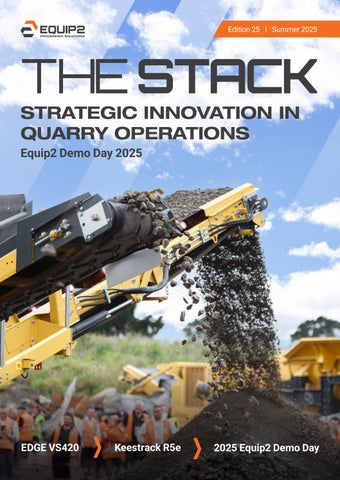
THE STACK
STRATEGIC INNOVATION IN QUARRY OPERATIONS Equip2 Demo Day 2025
EDGE VS420
Keestrack R5e
2025 Equip2 Demo Day
/// OPINION
WHAT QUARRY LEADERS TOOK AWAY FROM DEMO DAY 2025 The real value of Demo Day 2025 wasn’t confined to what machines could do — it was what people learned by seeing systems, teams, and decisions play out in real time. Over two days, attendees didn’t just observe 14 machines running live across multiple pits; they experienced how different configurations behave under varying material conditions, how rapidly adjustments can be made, and how performance changes when theory meets reality. That kind of learning can’t be replicated in brochures or boardrooms. Just as important was the opportunity to engage directly with the Equip2 team in action. Watching equipment run is one thing. Watching knowledgeable technicians, sales engineers, and after-sales specialists diagnose, explain, and optimise in real time is another. For many quarry managers, this demonstrated the difference between buying machinery and entering a technical partnership — one that protects uptime, quality, and long-term return on capital.
openly comparing challenges, solutions, and hard-earned lessons from their own operations. In an industry where mistakes are expensive and downtime unforgiving, Demo Day delivered clarity. Attendees walked away with sharper insight into equipment selection, first-hand experience with emerging electric solutions, and confidence grounded in live performance rather than sales claims. With Demo Day running only once every two years, it’s not an event to skip or postpone. It’s a rare opportunity to step out of day-to-day operations and refocus on smarter decisions, stronger partnerships, and long-term advantage. For quarry leaders serious about staying ahead, Demo Day isn’t just valuable — it’s essential.
The networking dimension was equally powerful. Demo Day brought together quarry managers, operations leaders, and decision-makers facing the same pressures — compliance, margins, labour, and energy costs. Conversations between demonstrations often proved as valuable as the machines themselves, with attendees
Edition 23
Winter 2025
THE STACK THE ST DEMO ACK DAY 2 025
CRUSHING IT: OPERATIONAL SMARTS INTO SUCCESS Case Study: Tony Dowd
Edit Edition ion 23 24
Novemb er
11th or 17 th
De mo Da y 20 25
Wheels at Wānaka
Case Study: Kuru Crushing
Aggstorm Deep Div 8 e
- you choose show
pieceDelays prod in uct
Sec ure yo the ur tic N E kets WD f AT or ES
Bauma Highlights
Case Stu dy: Silvertre e Bio
mass
Case Stu dy: Crushing the Sta
ndard
Spring 202 5
WE'VE GONE DIGITAL
Stay in the loop - scan to get the digital edition every quarter.
Bert Hart General Manager
PROJECTS ON THE GO! Tag us on Facebook, Instagram or Linkedin if you are working on a project and using Equip2 equipment.
@equip2solutions #equip2 Winestones Otaki
Fulton Hogan CSP-12 sand plant and new aggregate plant in background
Wakefield Quarry with their new K3
Edridges new double deck R3
K8e screening hard
Gain clarity on common industry questions Click the QR code to watch the how to videos
CRUSHING EFFICIENCY, BUILT FOR OPERATORS In a quarry, profitability isn’t won in the boardroom. It’s won in the pit—minute by minute—when the plant keeps running, the belts keep tracking, and the crusher keeps eating without choking. Because downtime doesn’t just pause production. It inflates your cost per tonne. Every unplanned stop triggers the same chain reaction: the excavator keeps feeding until someone calls it, the loader starts reshuffling, the crew drifts into fire fighting mode, and your
tonnes-per-hour target bleeds out through a dozen “little” issues that never show up clearly on a spreadsheet. That’s why Bert’s walkthrough of the R5e lands with quarry owners who care about margin. He focuses on the real enemy: stoppages, blockages, slow maintenance, and wasted crushing energy. And the R5e’s role is simple—be the machine that keeps you producing when conditions, wear, and randomness try to slow you down.
/// KEESTRACK R5E
Profit starts with flow: running hard without blockages If you’ve operated an impactor circuit, you know the pain: feed surges, fines packing, and blockages that turn a productive day into a stop-start mess. That’s not just annoying—it’s expensive. Bert points straight at a key design intent that quarry owners will immediately understand as profit protection: the discharge arrangement that lets you push consistent feed rates and reduce the downtime that comes from choking.
It’s built so the plant “can run at maximum feed all the time,
to minimize any blockages.”
That one line is a quarry owner’s music. Maximum feed isn’t bravado—it’s stability. And stability is what reduces trips, reduces clearing events, protects belts, protects operator rhythm, and ultimately protects output. When a machine runs consistently, your crew stops reacting and starts producing.
/// KEESTRACK R5E
The big money lever: bypassing material that doesn’t need crushing In most quarries, one of the quietest margin killers is crushing rock that didn’t need crushing. Every unnecessary pass through the impactor means: • Extra wear on blow bars and liners, • Extra load on the drive, • Extra recirculating material, • Extra fuel/electricity, • and more risk of a stoppage. Bert explains the pre-screen/bypass philosophy in operational terms—but the profitability message is loud: “I’m trying to maximize the amount of [material] to pull out or to bypass the impactor. So that makes a huge difference to our cost and our total throughput.” If you’re a quarry owner, translate that into cost-per-tonne control. You’re not paying to reduce rock that’s already in spec. You’re preserving the crusher for value-adding reduction, reducing wear cost, and increasing plant capacity because the impactor isn’t being forced to do pointless work. This is where the R5e becomes more than a machine. It becomes a margin strategy.
Throughput you can actually bank: conveyors and screening that don’t bottleneck Every quarry has a theoretical capacity number. Owners care about what lands in the stockpile. Bert’s walkthrough backs throughput with the two parts that often decide the “real” rate: conveyor capacity and screening capacity. If either is undersized, your crusher can be a beast and you’ll still bottleneck. He highlights the sheer carrying ability of the system: “We see… up to 600 tonnes per hour on these conveyors.” That’s not just speed. That’s headroom. Headroom is what prevents the plant from feeling “on edge” all day. It’s what lets you stay ahead of surges. It’s what protects you from constant fiddling, throttling, and micro-stoppages that quietly rob production. And the screening capacity? He puts it plainly: “Our screening capacity on this five is absolutely massive.” In quarry terms, that means better scalping, better separation, less carryover, and less reprocessing. It also means you’re better equipped to hit grading targets reliably without turning your loader into a full-time “blend and pray” operation.
/// KEESTRACK R5E
Downtime wins are usually maintenance wins Quarry owners know a hard truth: maintenance time is production time. What you can service quickly is what you can keep running. Bert spends time on service access because he knows exactly where downtime comes from—wear parts, belts, and awkward jobs that take longer than they should. On the under-screen conveyor, he highlights a design choice that directly reduces downtime during belt issues: “That whole conveyor can slide out of the back of this machine… making [it] a lot easier for a belt.” That’s not small. Belt work is one of those “simple” issues that can ruin a day if access is poor. A slide-out conveyor can mean the difference between a managed maintenance event and a shift-destroying shutdown. He reinforces this theme again in screen media handling: “We move three bolts, and then that screen media can slide out the back.” This is how you keep downtime from spreading. Fast, repeatable servicing keeps the plant from becoming fragile.
What is a E Machine? Click the QR to learn more.
/// KEESTRACK R5E
The profitability headline: cost per tonne (not just fuel) Quarry owners don’t buy machines to feel good. They buy machines to lower cost per tonne and raise effective production. Bert’s most owner-relevant line is the one that ties efficiency and output directly to the metric that matters most: “Not only getting fuel savings and energy savings but also getting that increase of production… it’s what makes the difference to our cost per tonne, At the end of the day.” This is the story in one quote. Fuel savings alone are nice. But increased production is the multiplier because it spreads fixed costs over more tonnes. When you raise tonnes-per-hour and reduce stops, your whole operation gets cheaper per tonne—even if nothing else changes. That’s how quarries get more profitable without chasing price rises.
Turning one feed into multiple revenue streams The smartest quarries don’t just produce rock—they produce options. They make multiple products and sell to multiple markets, so margins don’t depend on a single spec. Bert frames this capability with a line that’s pure value: “We can make four products in one… go.” Four products in one run changes your commercial flexibility: • You can meet varied customer specs without constant changeovers, • You can build multiple saleable stockpiles in parallel, • And you can keep selling even when one product line slows. It’s not just volume. It’s resilience.
/// KEESTRACK R5E
Reliability isn’t just steel — it’s electrics protected from dust and vibration Quarry downtime often comes from the environment: dust ingress, vibration fatigue, random electrical faults that waste hours while everyone hunts for a cause.
He sums it up like this: “There’s a lot of detail that's gone into, that makes all the difference.” And in a quarry, “all the difference” usually looks like this: • Fewer blockages,
Bert points to protection engineered into the electrical system:
• Faster maintenance,
“Spring mounted… doesn’t get affected by vibration… [with] a positive airflow… pressurized… keeps out the dust.”
• Less unnecessary crushing,
Owners may not geek out on electrical cabinets—but they understand what electrical faults cost: time, labour, lost production, and operator confidence.
• Higher real throughput,
• More saleable products, • And a lower cost per tonne that shows up in the month-end numbers.
Protection here is uptime insurance
The takeaway: “little details” that stop big profit leaks Bert’s walkthrough keeps returning to one core idea: the difference between a “good” machine and a profitable one is the detail that prevents downtime from happening in the first place.
Watch the video to see the full benefits of the R5e
“Not only getting fuel savings and energy savings but also getting that increase of production… it’s what makes the difference to our cost per tonne, at the end of the day.”
EQUIP2 DEMO DAY 2025: STRATEGIC INNOVATION IN QUARRY OPERATIONS November 25th & 27th 2025 – Wairarapa
The competitive advantage in modern quarrying doesn't come from working harder—it comes from deploying smarter systems. Equip2's Demo Day 2025 proved this beyond doubt. Over two days, 250+ quarry managers and operations directors witnessed what separates market leaders from the pack: the ability to match precise equipment configurations to specific operational challenges. From the K6 and R5h crushers to the VS420 and Slayer XL, over a dozen machines processed diverse feedstock across three dedicated demonstration pits—but the strategic value emerged in the technical consultations happening throughout.
/// DEMO DAY 2025
Engineering ROI, Not Just Processing Tonnage The most successful quarry managers attending Demo Day weren't simply watching machines run—they were calculating payback periods, evaluating throughput optimization, and stress-testing configurations against their own material challenges. When the R3h impactor paired with the K4 scalping screen demonstrated consistent gradation control across variable alluvial feed, astute operators immediately recognized the downstream value: reduced reprocessing, tighter spec compliance, and premium product pricing. When the R5 impact crusher maintained particle shape consistency through alluvial and concrete aggregate production, managers saw quality control that protects market reputation. These aren't incremental improvements—they're competitive differentiators.
/// DEMO DAY 2025
The Electric Imperative: Strategic, Not Aspirational The electric machinery demonstrations delivered numbers that demand boardroom attention: 95% energy efficiency versus 75% for hydraulic systems translates to $156,000 in annual operating cost reductions while eliminating 156 tonnes of CO2 emissions. For forward-looking operations, this isn't environmental theater—it's capital efficiency. The premium on electric equipment delivers ROI that strengthens balance sheets while positioning your operation ahead of inevitable regulatory tightening. Early adopters aren't taking risks; they're securing advantage.
/// DEMO DAY 2025
Technical Partnership as Competitive Asset Equip2's differentiation isn't in their machinery catalog—it's in their operational intelligence. Their technical team doesn't sell configurations; they architect solutions to specific material processing challenges. During Demo Day, this expertise manifested in real-time troubleshooting, customized setup recommendations, and frank assessments of equipment fit for specific applications.
This consultative depth transforms equipment acquisition from capital expenditure into strategic investment. Customer feedback consistently validates this approach: "Their after sales service is second to none, great bunch of guys to deal with, very well knowledgeable on their product." In an industry where downtime costs thousands per hour, that relationship represents quantifiable value.
/// DEMO DAY 2025
Strategic Outcomes The quarry managers who invested two days at Demo Day 2025 departed with competitive intelligence:
• Risk mitigation through proven equipment partnerships.
• Throughput optimization strategies that increase revenue per operating hour.
In today's market—where material specifications tighten, environmental compliance intensifies, and margin pressure mounts—these insights separate operations that survive from those that dominate.
• Quality control configurations that command premium pricing. • Cost reduction pathways through electric equipment deployment.
Watch the Demo Day Wrap Up video here
/// DEMO DAY 2025
For strategic consultation on optimizing your operation: Phone Equip2 on 06 929 7593 | www.equip2.com
EDGE VS420 High Torque Shredding Power for MSW, C&D, Organics & More In the waste and recycling industry, performance is everything. Machines need to be tough, flexible, and efficient—not just powerful on paper. That’s exactly where the EDGE VS420 makes its mark. This isn’t just another shredder; it’s a machine built for the realities of today’s high-demand waste environments. With the highest torque in its class, the VS420 delivers sheer shredding power that makes light work of the toughest materials. From bulky waste to green waste, construction debris to commercial materials, this machine doesn’t hesitate—it dominates.
The VS420 isn’t just a shredder; it’s the next generation of waste processing.
Versatility Meets Customisation Every site is different. That’s why the VS420 was designed to adapt. Its versatile configuration options and customisable setup mean you can tailor it to fit your operation, not the other way around. Need flexible loading? No problem. Looking for specific rotor or chamber setups? The VS420 has you covered.
Built to Withstand the Tough Stuff When the job gets heavy, the VS420 doesn’t flinch. Its highly resistant build ensures reliability even under the harshest conditions, cutting downtime and keeping your site productive.
Smarter, Not Harder Efficiency isn’t just about muscle; it’s about brains too. The VS420’s intelligent load management system ensures smooth operation, protecting the machine from overload while maximising output. This translates into lower operational costs and consistent, high-capacity shredding that pays dividends over time.
The VS Status Link With the VS Status Link, operators get real-time insights and control, taking the guesswork out of operations. It’s part of EDGE’s focus on building machines that don’t just work hard—they work smart.
The waste industry is evolving, and the EDGE VS420 is built to keep you ahead of the curve. Strong, smart, and versatile, it’s the shredder that works as hard as you do.
Click here to watch the VS420 Video
USED EQUIPMENT EX-DEMO MCCLOSKEY S130 RINSER
KEESTRACK K5 SCALPING SCREEN
KEESTRACK B3
Hours: 200 +/· 13’ x 5’ Triple-Deck Rinser Screenbox · Integrated Spray Bars on all decks · Diesel-Hydraulic Drive (CAT engine) · Heavy-Duty Hopper with controlled feed
Hours: 135 +/· Plate Apron Feeder with Split Blackwall · 65mm Punched Plate TD · 40mm Woven Wire Screen mesh BD · Main Conveyor 5000x1200mm
Hours: 1,878 +/· Punch plate top deck pre-screen 40mm · 3-section folding side belt conveyor · Toothed jaw plates 18Mn2Cr, reversible · Radio remote control, 10 functions
Asking Price: $470,000 NZD + GST
Asking Price: $530,000 NZD + GST
Asking Price: $520,000 NZD + GST
KEESTRACK K3
BARFORD SM312 SCREENER
KEESTRACK K4
Hours: 460 +/· Double Deck scalping screen · 2.7m x 1.2m screen box · 3 way split · 17 Tonnes · Hydraulic adjustments
· Power unit: CAT 2.2 37kw · Screen box on coil springs · Head motor on conveyor 400cc · 27CC Pump
Hours: 2,000 +/· Punched Plate Topdeck 100mm HB450 Set · Woven Wire Screen mesh BD 40 x 40 x 8 · Main Conveyor - SXL 7000 x 1200 mm Hydr. Slidable, Turnbuckle Hanging, 11 kW · Radio Remote Control 10 Functions (EU)
Asking Price: $300,000 NZD + GST
Asking Price: $97,000 NZD + GST
Asking Price: $405,000 NZD + GST
Call us to find out more about these machines and how we can improve your profit margin. Paul Thompson: 027 404 4430 Bert Hart: 021 244 5797
0800 100 684 equip2.com