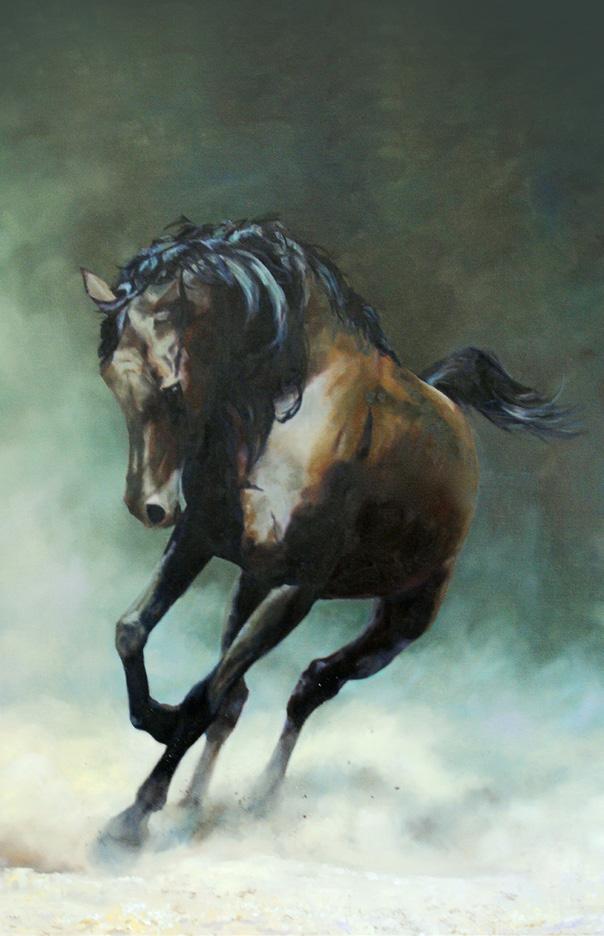
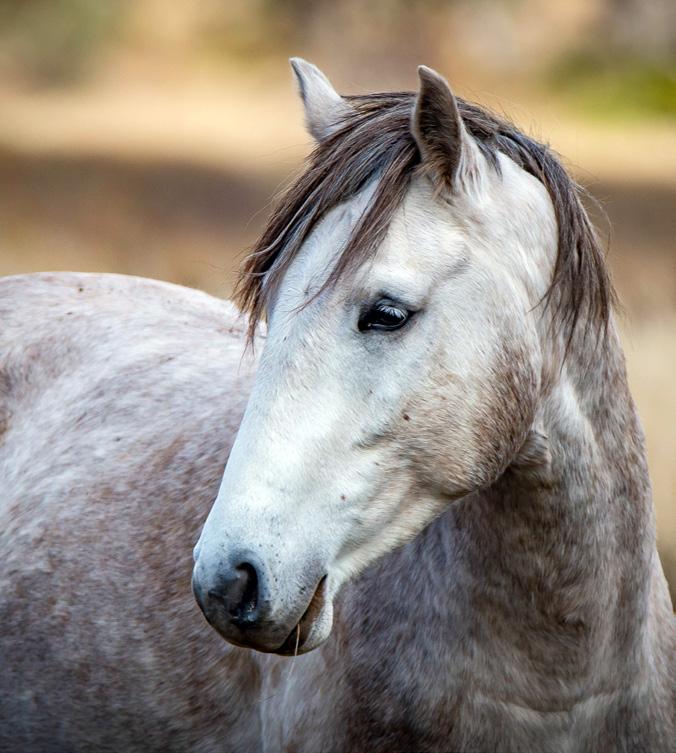
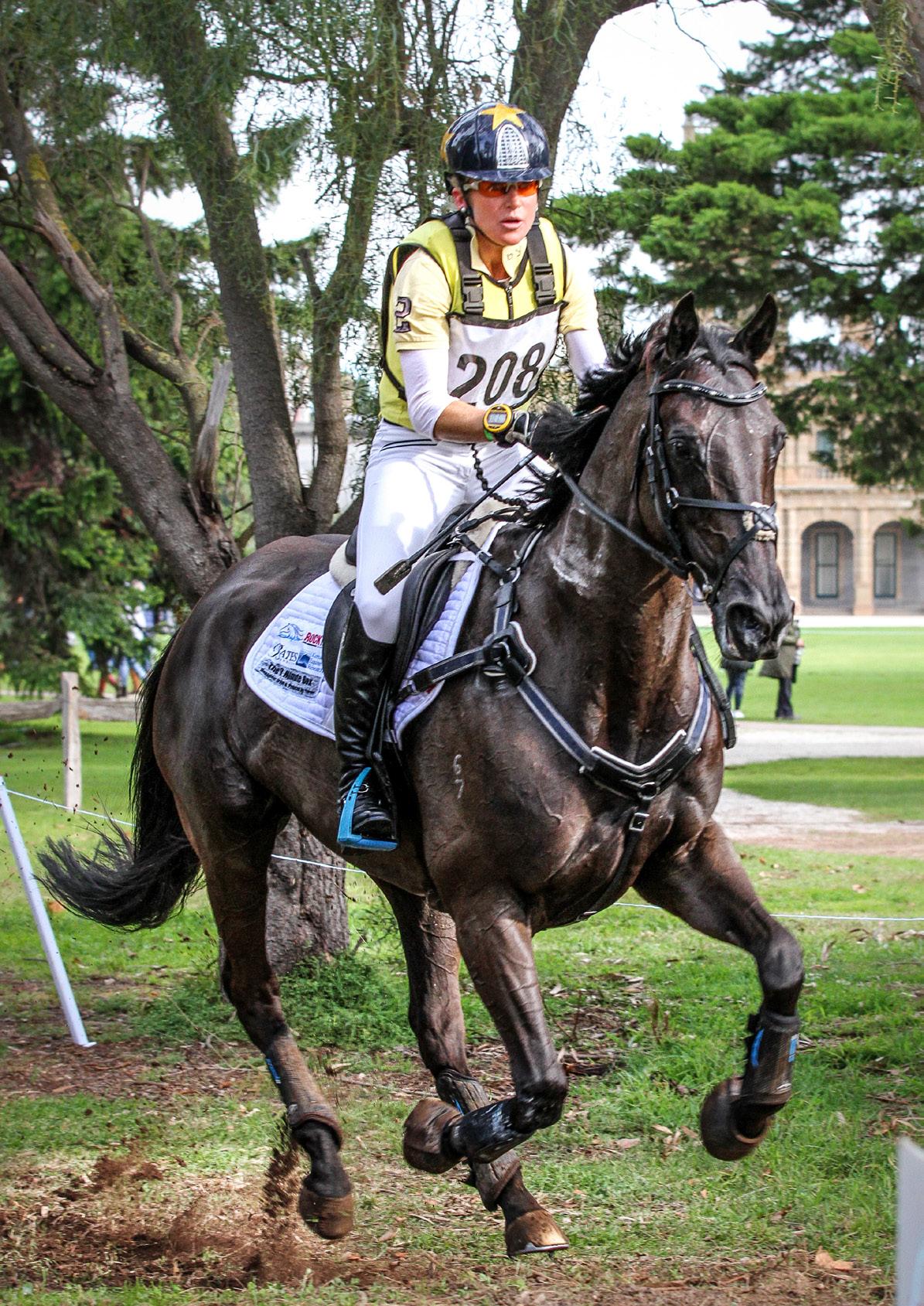
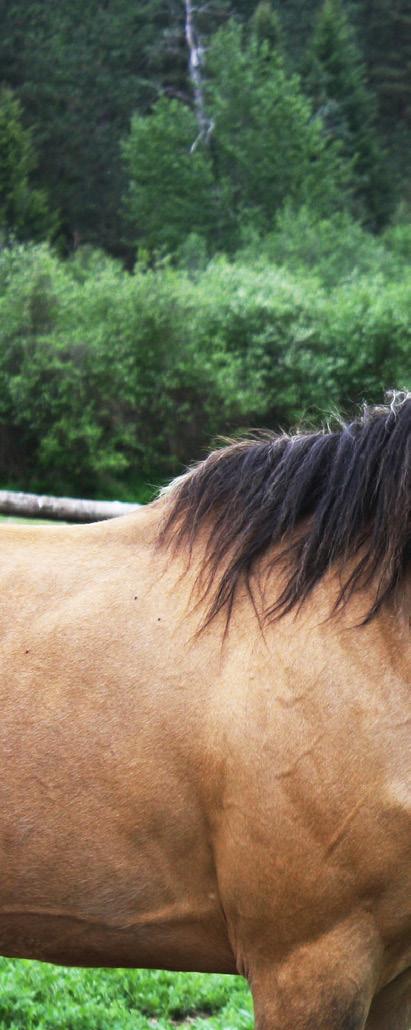
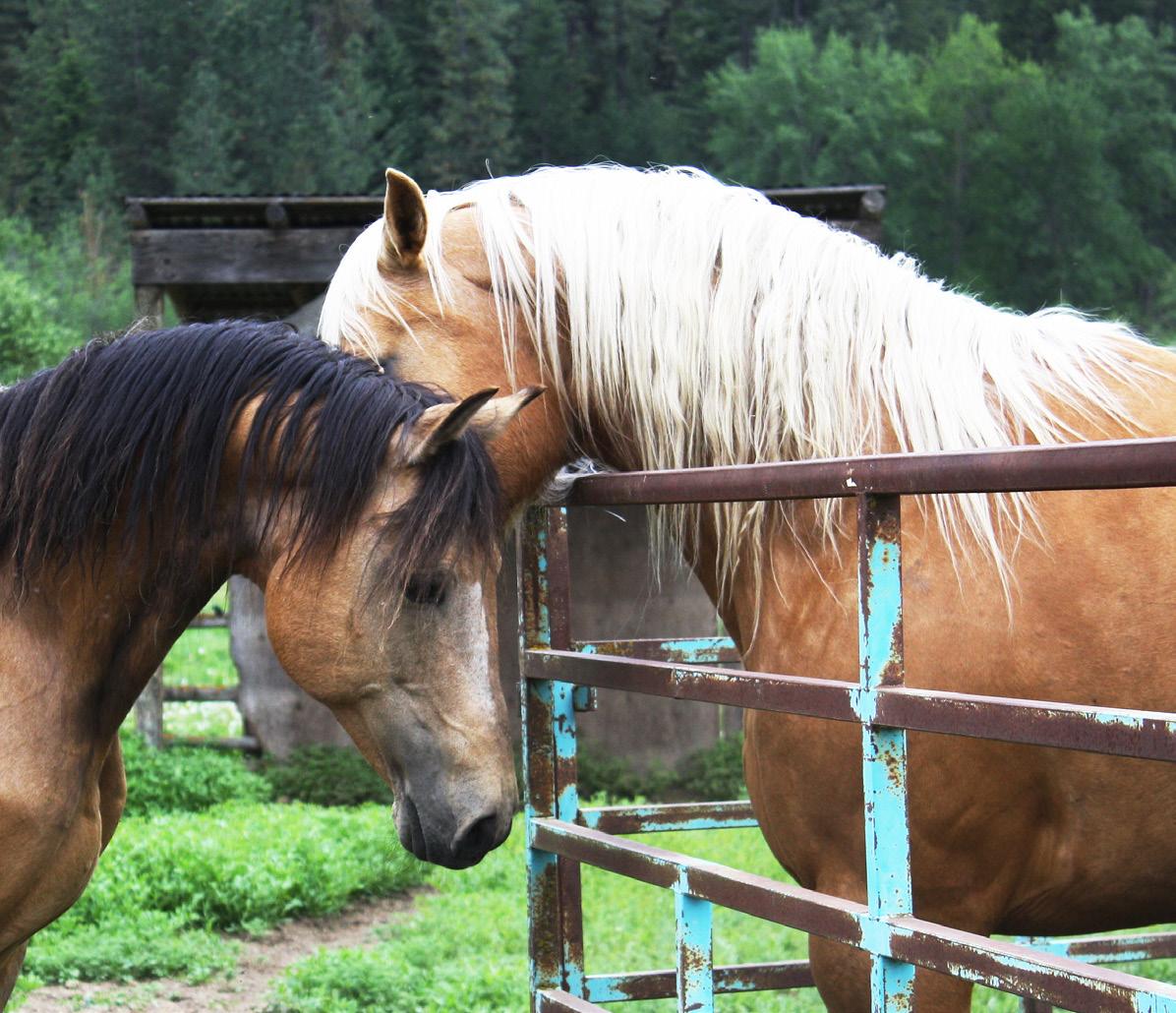
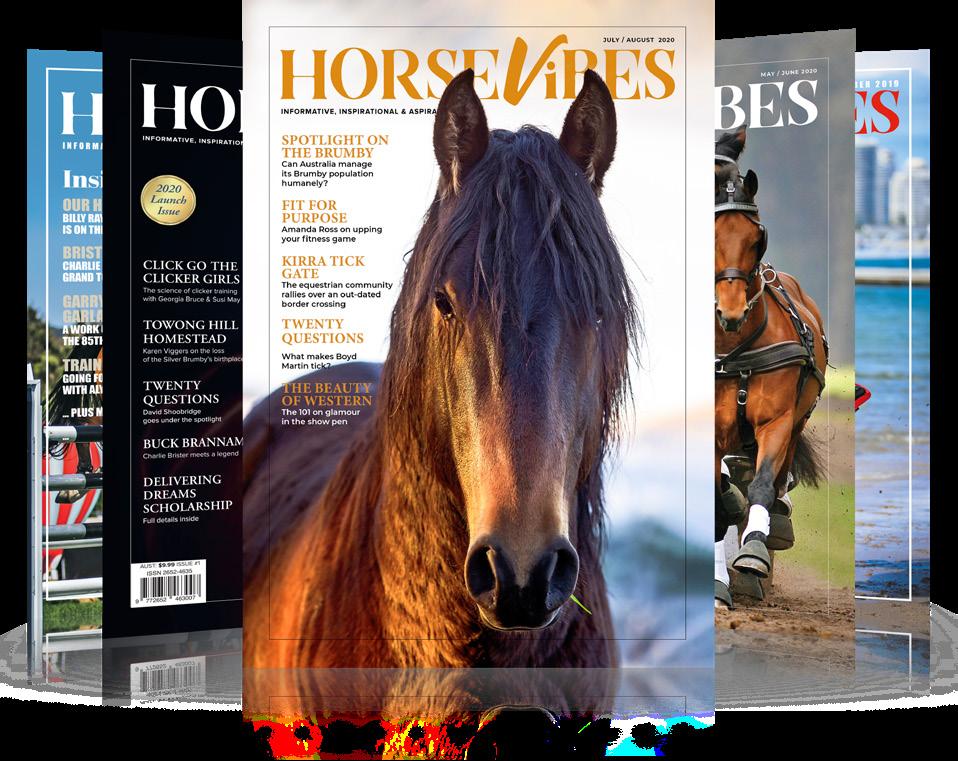
Can Australia manage its Brumby population humanely?
FIT FOR PURPOSE
Amanda Ross on upping your fitness game
KIRRA TICK GATE
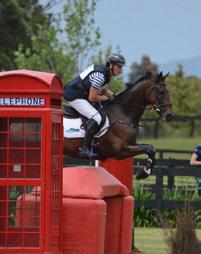
The equestrian community rallies over an out-dated border crossing
TWENTY QUESTIONS
What makes Boyd Martin tick?
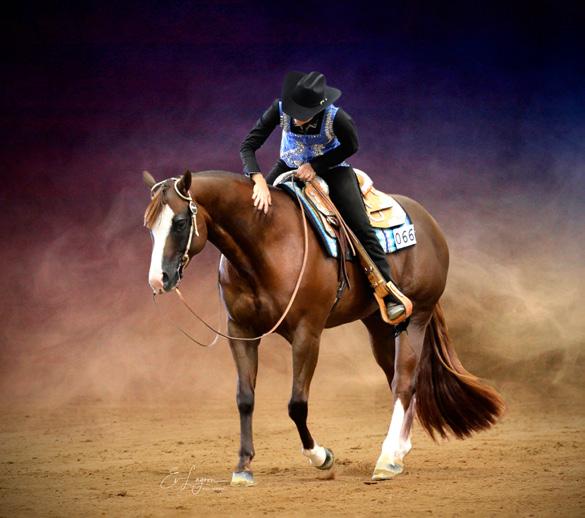
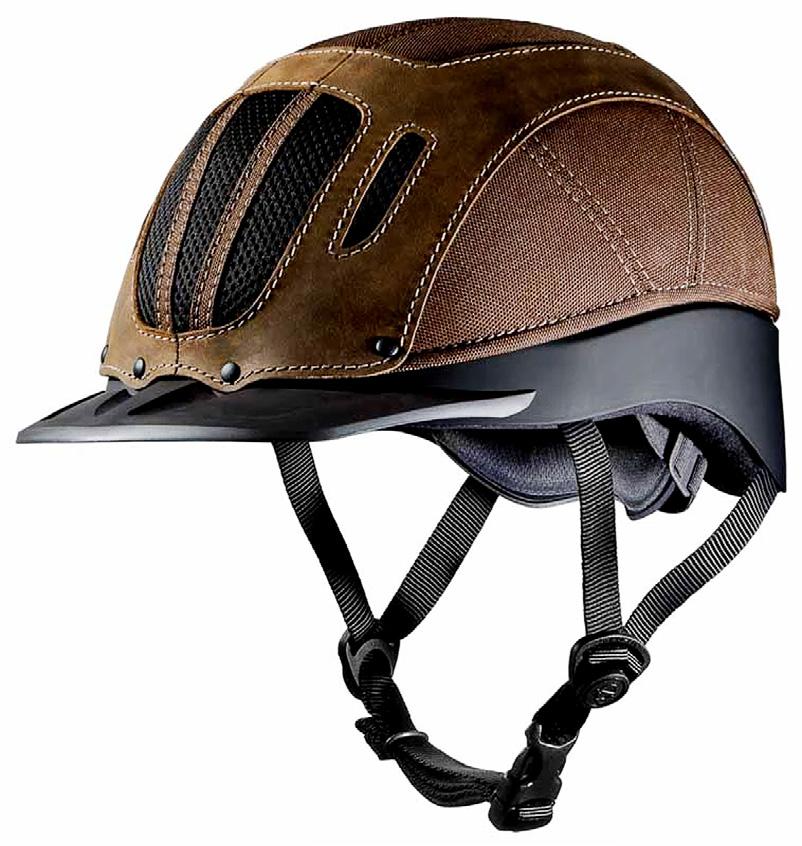
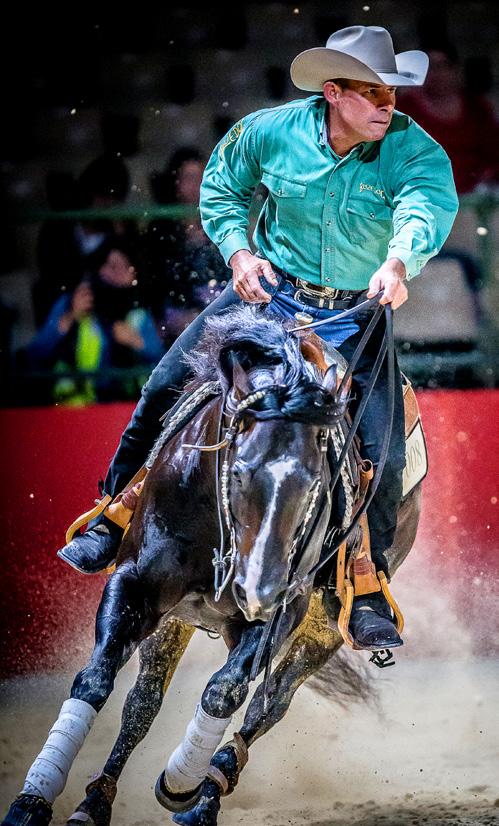
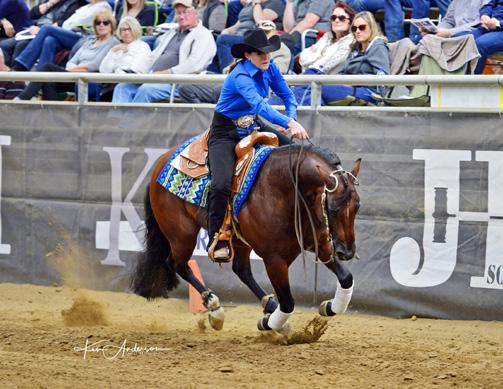
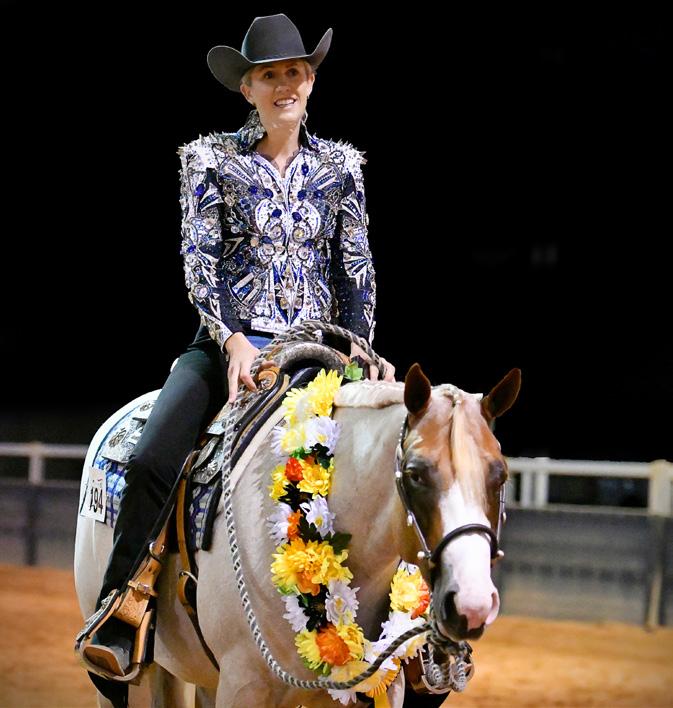
THE BEAUTY OF WESTERN
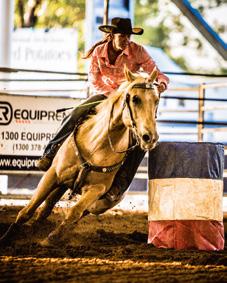
The 101 on glamour in the show pen
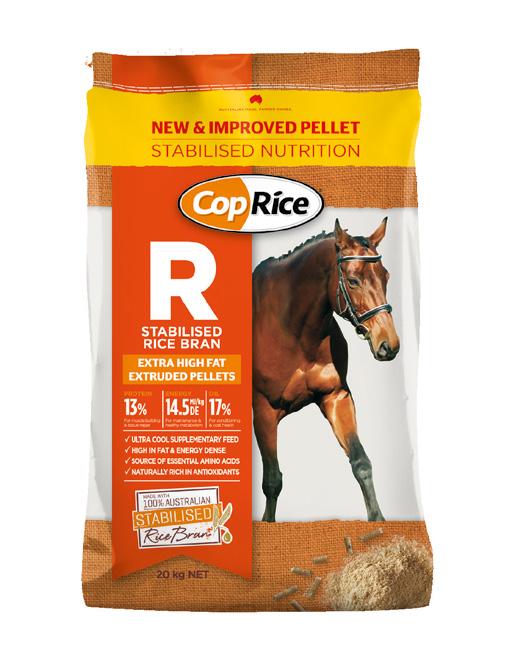
WHEN QUALITY & NUTRITIONAL VALUE MATTER.
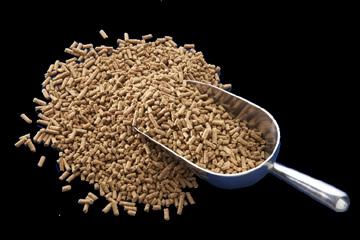
CopRice R – Rice Bran is an extra high-fat extruded feed supplement, containing 100% stabilized rice bran for superior digestion and nutrient availability.
An exceptionally ‘cool’ energy-dense feed, rich in protein, omega fatty acids and natural antioxidants, it is ideal to support muscle development, topline and conditioning. Suitable for horses and ponies of all disciplines and life stages.
Exceptionally ‘cool’ energy-dense extruded feed
Quality sources of protein, for muscle build, tissue repair and hoof integrity
Natural antioxidant; gamma oryzanol, to support immunity and assist with muscular problems such as ‘tying up’
Natural vitamin E for aiding neuromuscular function
Rich in omega 3 and 6 fatty acids, to support heart and blood vessel health, and conditioning
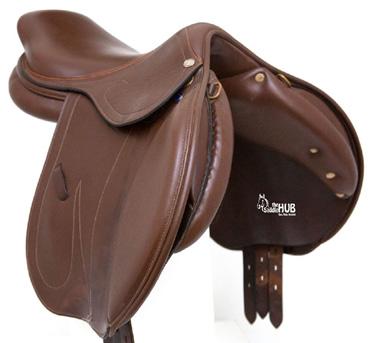
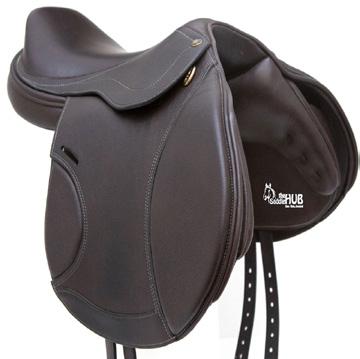
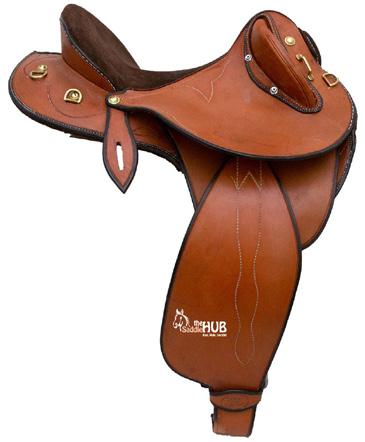
The Saddle Hub Sales Enquiries: Shae Herwig info@equestrianhub.com.au
Website/subscriptions: www.horsevibes.com.au
Published by Equestrian Hub PO Box 13, Tintenbar NSW 2478 info@horsevibes.com.au www.equestrianhub.com.au
Follow HorseVibes horsevibes @horsevibesmag
On the Cover:
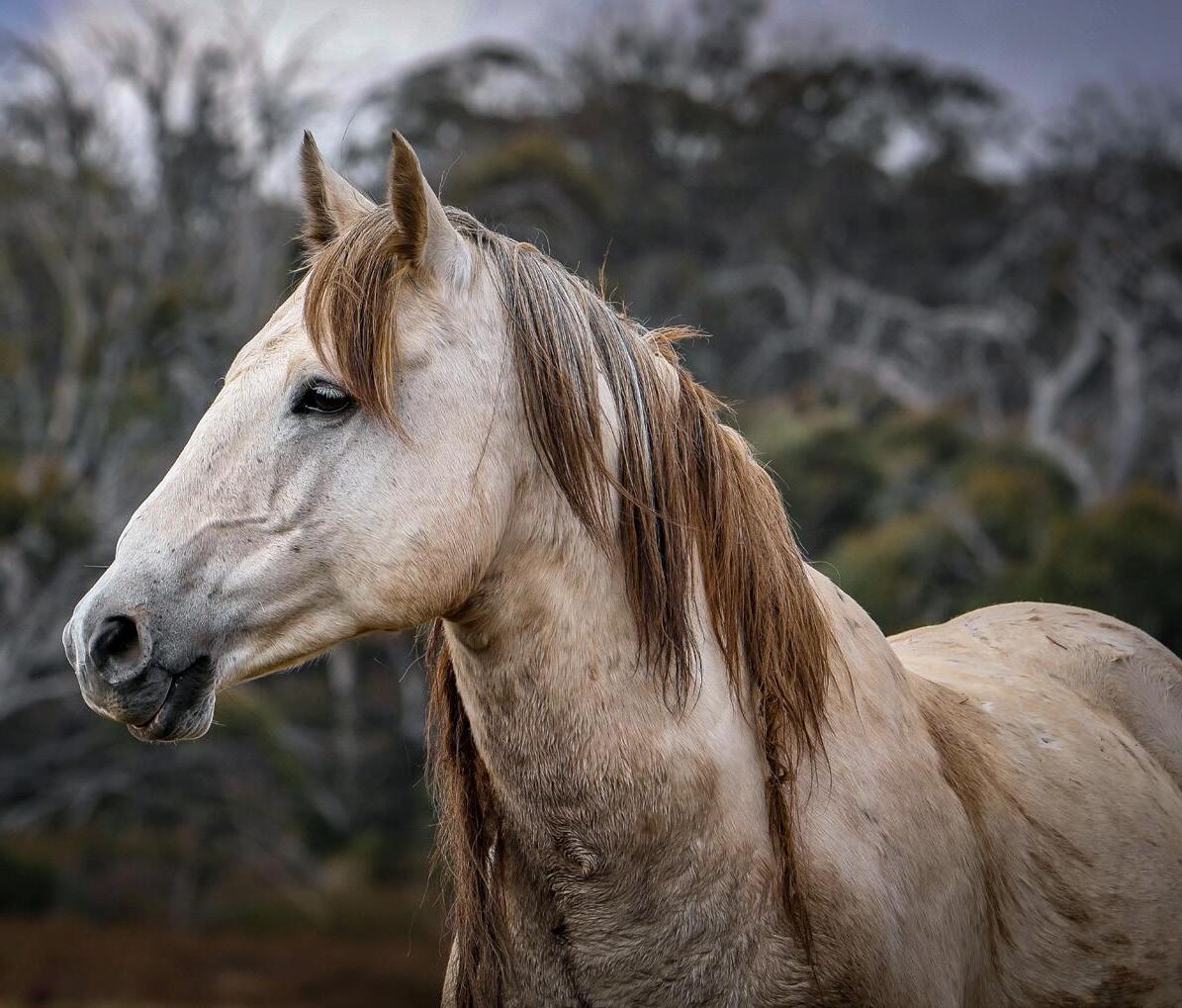
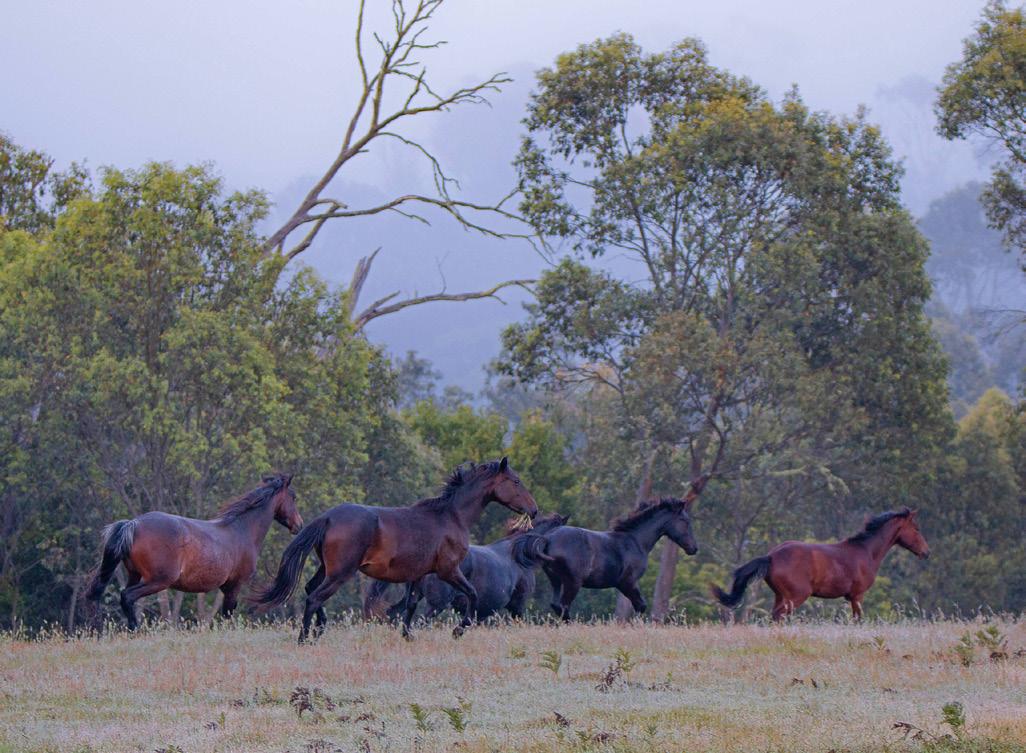
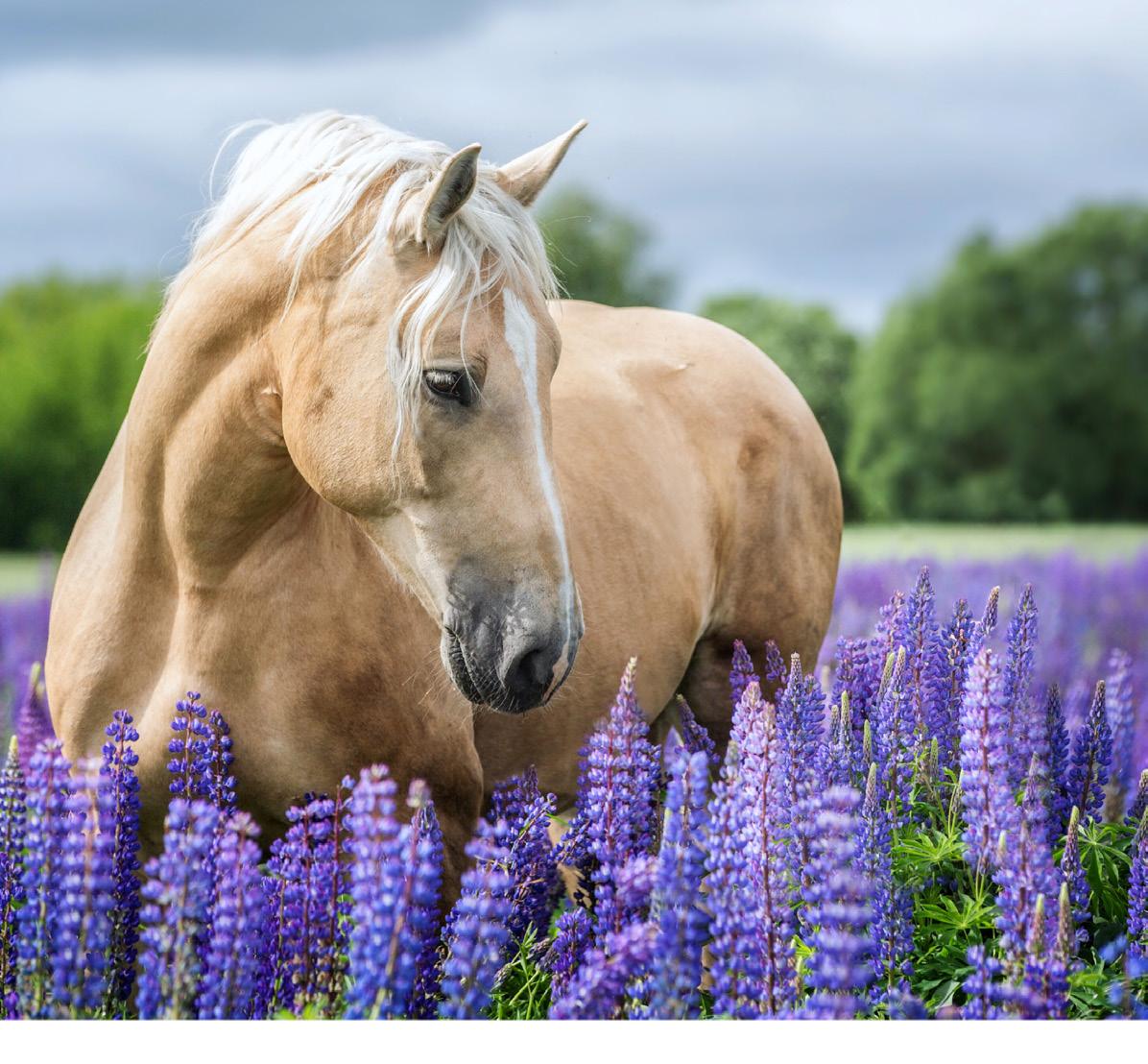
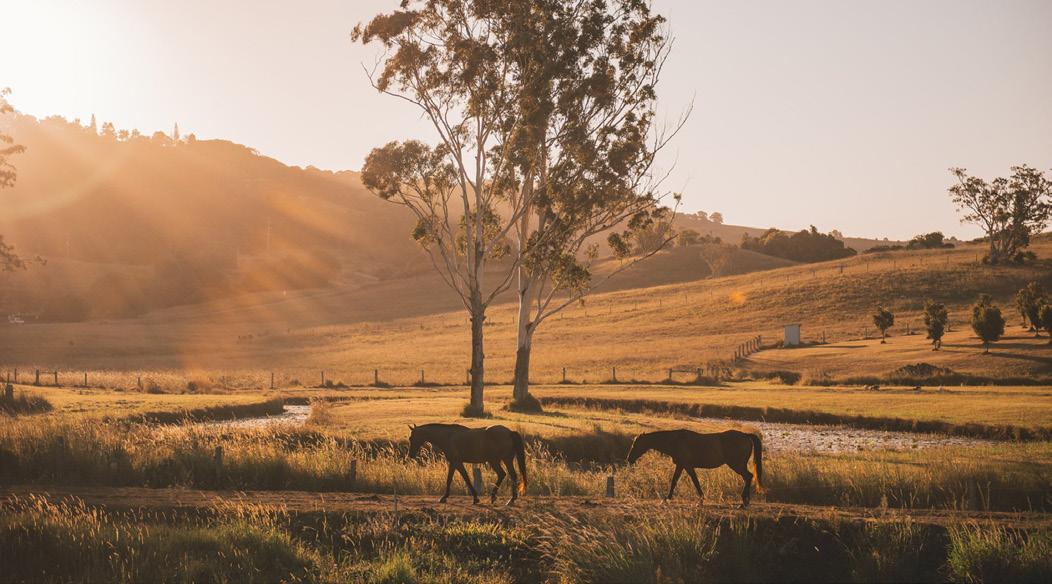
One of Carol Hancock’s iconic Brumby images, taken at first light in Kosciuszko National Park.
Magazine Layout: Ailebo Consulting www.ailebo.com
OUR CONTRIBUTORS
Leisa Hofstetter
Happily combining her passion for horses and for words, Amanda is the editor of HorseVibes. In this issue she delves into the fascinating world of renowned equine artist Lyn Beaumont, and chats to Amanda Ross on just what it takes to be fit for purpose.
A journalist, editor and writing workshop facilitator, Sonia’s love of horses has been life-long. Sadly, she doesn’t own any so lives out her passion vicariously through equestrian friends. Sonia found investigating the Kirra Tick Gate story to be both a worrying and frustrating experience.
With a mix of excellent advice and wicked humour, Brister’s Brief is always a great read. In this issue, Charlie, an equestrian coach specialising in re-training problem horses, offers ten top tips to help you get back into full competition mode and finish off 2020 in style.
Jo Mckinnon
A horse-lover since age eight, Geoff is a freelance journalist, photographer and consultant with a passion for horse sports. Now semi-retired, his great joys in life include family, his dogs, cooking, gardening and cycling. In this issue, he investigates the success story behind Mount View Stud.
An Equine Nutritionist and founder of Hof Equine, Leisa has a Bachelor of Equine Science, specialising in nutrition. In this issue, she looks at the ways in which nutrition affects important aspects of reproduction, and how to feed your mare in preparation for the breeding season.
Candida travelled from Byron to Ballarat in search of answers for her Spotlight feature on Australia’s iconic Brumbies, and the complex issue of whether we can manage their populations humanely. In her Horse Listener column, she explains why negative palmar angles can cause joint issues, and looks at possible solutions.
An equestrian coach and world-class eventer, Amanda competed in the 2000 Sydney Olympic Games and is shortlisted for Tokyo. A highly capable, all-round athlete, she took time out from a crazily busy schedule to give us some invaluable tips on improving our fitness.
A multi-award winning horse racing and equestrian broadcaster and documentary maker, Jo is a former top-level show rider who has competed all over Australia. In this issue, she chats with Jane Gollan, one of Australia's greatest advocates for off the track Thoroughbreds.
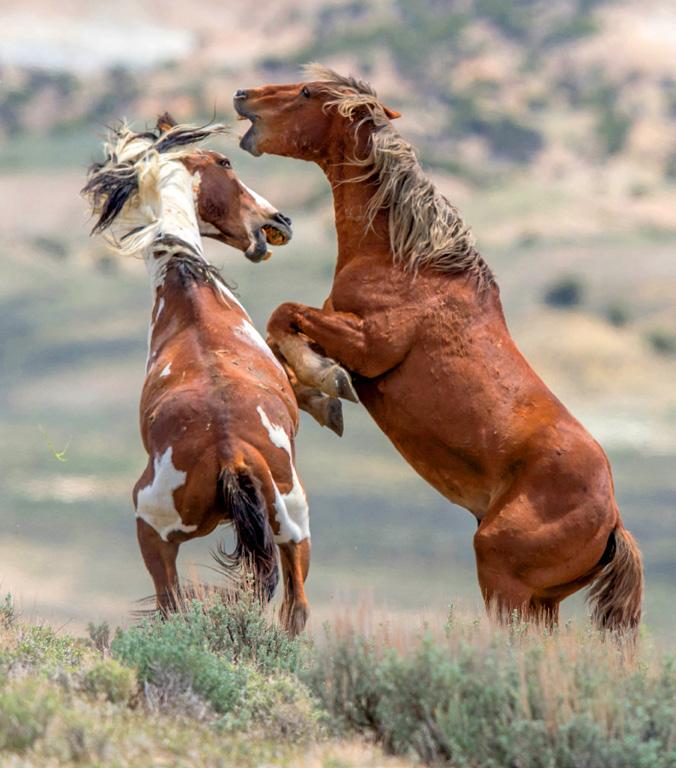
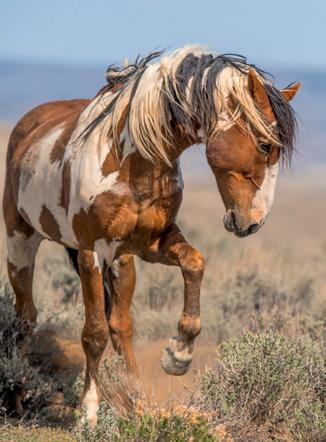
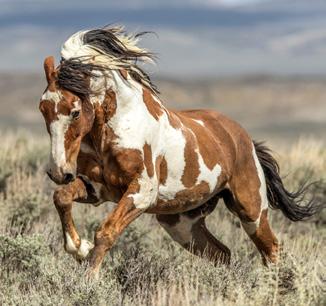
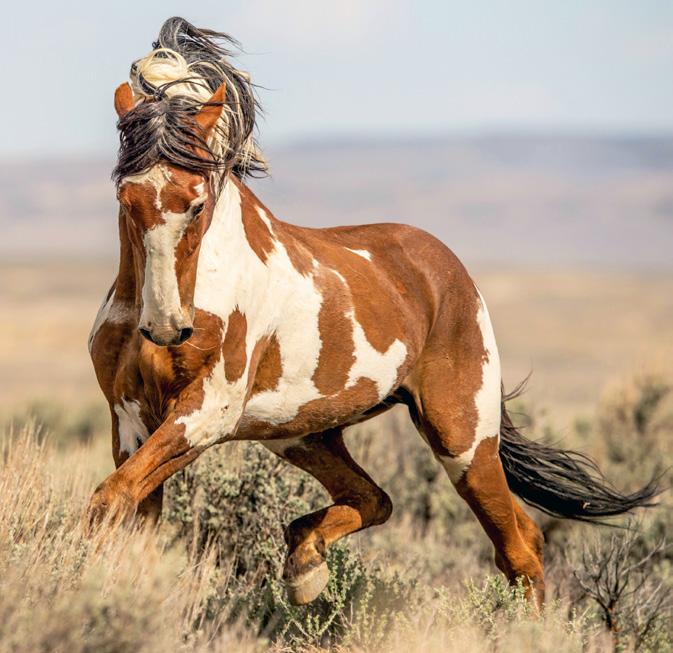
N.G. Quinlan, otherwise known as ‘Q’, is a writer, musician, and poet. A resident of the Northern Rivers of New South Wales, he has been contributing to HorseVibes since 2019. In our Horses in History feature, he tells the tale of Picasso, America’s most famous wild mustang.
Francine is a freelance writer and horse enthusiast. Following her retirement from a lengthy print media career, she’s enjoying writing about her personal passion: the horse. And after researching AngloArabians for our Breed feature, she’s fallen in love with these equine superstars.
Charlie Brister
Geoff McLean
Francine Pullman
N. G. Quinlan aka ‘Q’
Sonia Caeiro Alvarez
Amanda Ross
Candida Baker
Amanda Mac
DreamsDeliveringScholarship
As COVID-19 travel and social distancing restrictions slowly lift, we are delighted to announce that the Delivering Dreams Scholarship is back on track!
The Scholarship is a HorseVibes initiative designed to help equestrians from a variety of disciplines achieve their dreams. We are dedicated to connecting with communities around Australia to ensure that our Scholarship recipients receive the help and inspiration they truly need to move to the next level.
Applications for the next Scholarship round will close on 31 August 2020, and our recipient will be announced in the November/December edition of HorseVibes
To find out more, visit: horsevibes.com.au/horsevibes-delivering-dreams-scholarship
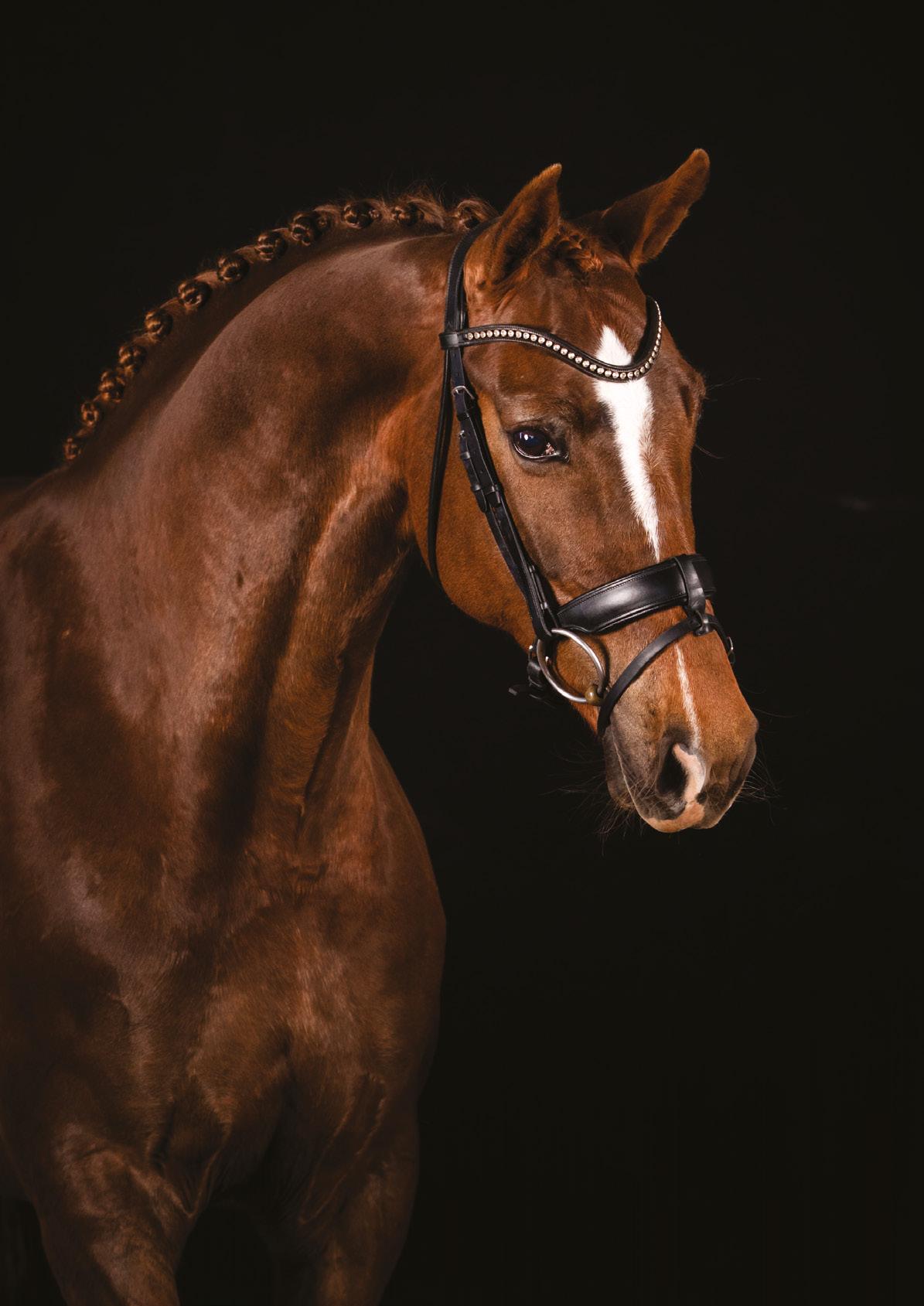
David Shoobridge’s Warmblood, Flame. Photo: Jessica Atkins, JA Studios.
PUBLISHER’S LETTER
From the Horse’s Mouth
With Fiona Todd
I’m pretty sure I heard a collective sigh of relief across the nation as lockdown rules slowly relaxed and we started getting out and about again with our ponies. I can’t wait to see everyone’s Facebook feed with competition photos and smiling faces. As we all know - it’s been a while!
In this edition, Equestrian Hub launches its new member platform: look for magazines, training tips, prize draws, and loyalty points, with much more to be added as we follow our vision for making the Equestrian Hub your virtual equestrian hang out.
To help you get back into the swing of things - and to make sure you and your mounts enjoy the experience - resident coach Charlie Brister offers his top 10 tips for making your journey back to post-COVID life as smooth as possible. And while we’re on the subject, best grab the opportunity afforded by the transition period to up the game on your own fitness! Champion eventer Amanda Ross has all you need to know to lift your riding to the next level.
Candida Baker has been down in the Snowy Mountains to investigate the plight of our beautiful Brumbies. Let’s do all we can to support our national treasure – and thank you, Carol Hancock, for our gorgeous cover image.
Editor Amanda Mac talks to internationally recognised artist Lyn Beaumont in Culture Corner –and stay tuned, because we have some seriously amazing creatives lined up for future issues.
Those of us who float horses between Queensland and NSW will be well aware of the truly dreadful stop at the Kirra Tick Gate. Journalist Sonia Caeiro Alvarez investigates the many facets of this problem and speaks to some of those affected, including change spokesperson Melinda Rechichi.
On the subject of our horse’s feet, the Horse Listener looks at Palmer angles and Master Farrier David Farmilo hops onto this issue’s Tackbox to talk about horse’s legs and, you guessed it, their hooves. What should you be looking for when buying a new horse? Here’s a clue: no hoof, no horse!
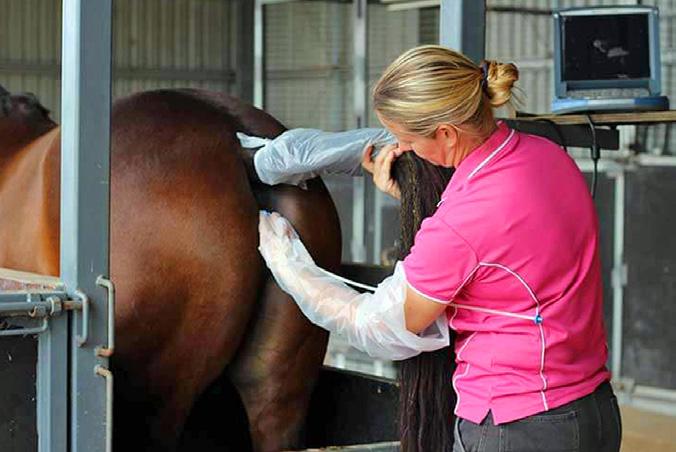
With the breeding season approaching, equine nutritionist Leisa Hofstetter explains how your mare’s fertility can be supported with correct nutrition, and we talk to Agnes Banks Equine Vets about insemination.
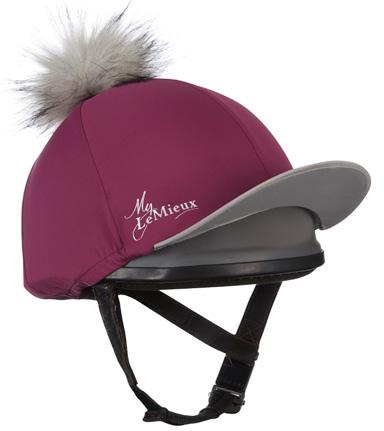
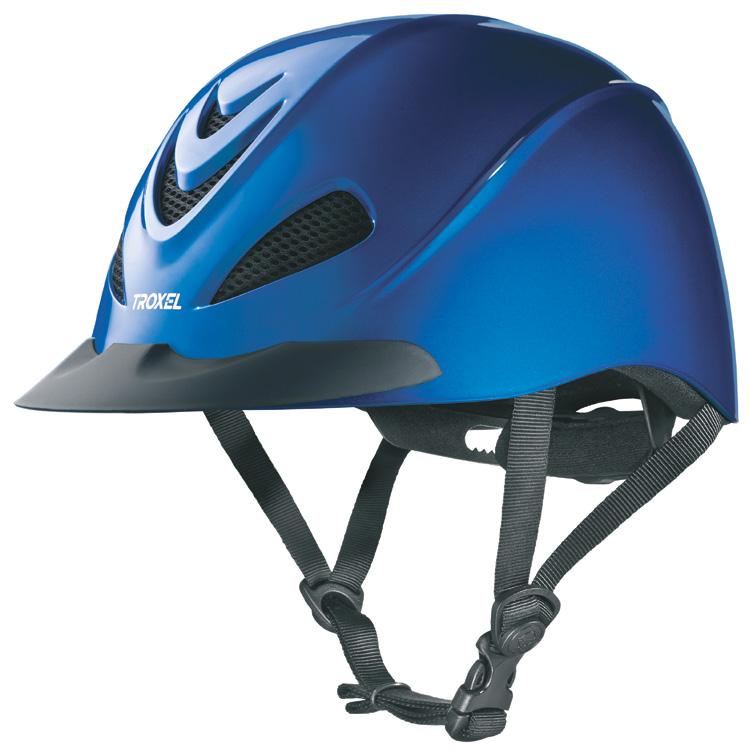
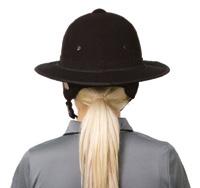
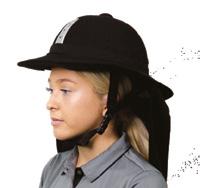
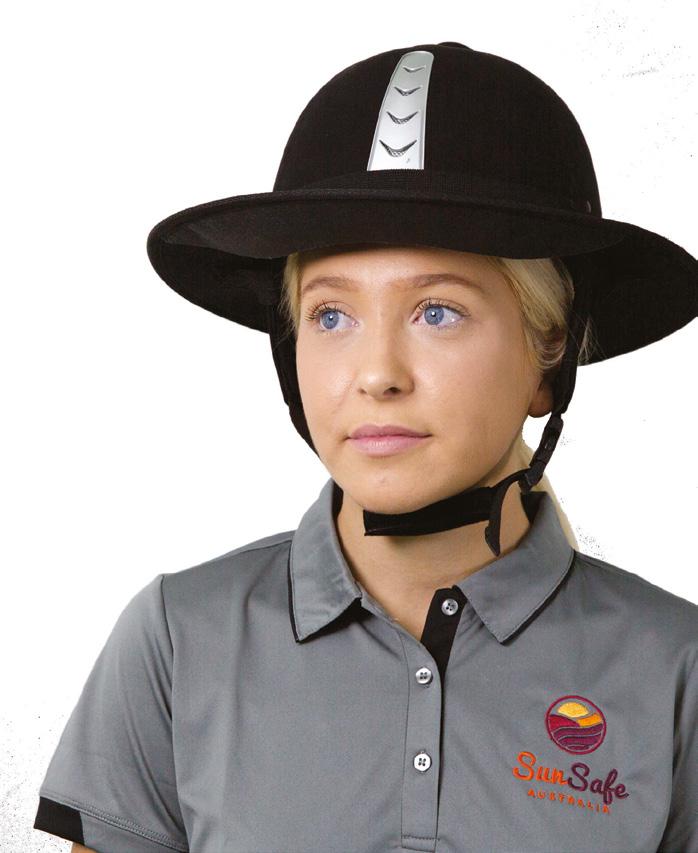
New Zealand’s Mount View Stud is renowned for breeding internationally successful show jumping champions. Geoff McLean takes a look at the story behind that success story, while new columnist Francine Pullman writes about the magnificent AngloArabian in our regular Breed feature. Kristen Fleet keeps her head firmly on her shoulders with this issue’s equipment piece on all things helmet, and also explains why she’s added an Icelandic riding holiday to her bucket list … just wait till you see the photos!
In her regular Life After Racing column, Jo McKinnon talks to Queenslander Jane Gollan to find out more about the journey a Thoroughbred makes as it transitions into civilian life. She also reveals a brand new initiative designed to maximise the successful re-homing of our OTT friends.
Training Tips is all about Western presentation – which is pretty spectacular by anyone’s standards –and our Young Rider is the high flying Amelia Douglass. And this issue’s Horse in History offers a bit of a mystery! Neil Quinlan has written a fascinating article on Picasso, America’s most famous wild mustang. But is Picasso really a horse in history, or is he still roaming the wide open spaces of the Colorado plains?
Then to close HorseVibes’ jampacked July/August issue, Charlie asks champion eventer Boyd Martin twenty very interesting questions, and gets some equally interesting answers!
So as usual, pour your favourite tipple, sit back and enjoy!
Lock down is over – so let’s get riding!
With the first six months of the riding year lost to bushfires and the pandemic, CHARLIE BRISTER offers a few tips to get you back into full competition mode.
Hopefully you had a horse at home to make social isolation easier and more fun. After all, who is lonely and bored when they have a horse? Broke, frustrated, exhausted perhaps – but never lonely or bored!
Even if you’ve been able to ride regularly, without competitions there hasn’t been that intensity of training. Focus has been hard and coaches have been difficult to get to on a regular basis. So now that we’re gearing back up to normal, everyone is champing at the bit and ready for some competitions and fun.
Getting back into full throttle competition
mode might take a bit of work, so here are some tips to help you finish off 2020 better than it started:
1 RIDER FITNESS: Have you been focusing on keeping up your fitness with all that home-time during the pandemic? In reality, who hasn’t been indulging in an extra bit of Netflix? Surely no-one will ever be the same again after watching Joe Exotic! After slouching on the couch you might need to go to the chiropractor or physio so that you’re able to sit up straight and balanced in the saddle. Always make sure that you’re doing the right thing before you start worrying about your horse.
2 HORSE ATTENTION: The next point of order will be checking your horse’s responsiveness on the ground. Leading horses is a basic skill which is overlooked 99% of the time. Does your horse come forward calmly and promptly when you apply lead pressure? Are they paying attention to you, or are they just hanging around at the end of the lead? Training basics need to be finely tuned. If your horse has also been enjoying a little bit of couch time over the competition break, let him know you are back in business. No more slacking off.
3 CHECK OUT ALL YOUR GEAR:
Do your jodhpurs still fit? Seriously, quite a few people have relaxed their waist lines during social isolation. And while you’re checking circumferences, are your float tires fully pumped up?
4 TRANSPORT MANNERS:
Remember, it’s been a while since you went out so don’t leave it till the morning of the competition or your coaching clinic before checking that your horse remembers how to load on the trailer (the August 2019 issue of HorseVibes includes an in-depth article on floating). Older horses with a history of being good floaters will probably go straight on like it was yesterday. Younger horses might need a couple trial runs in the lead-up to going out. So, don’t leave it to the last minute.
5 LESSONS AND COACHING: Getting a bit more variety in your training while under the hopefully watchful eye of your coach will be the best starting point in developing your competition plan. This will also test your fitness – can you ride a full 45 minutes without collapsing?
6 FROM ADRENALIN TO CALM: It can be easy to ask your horse to remain nice and calm and steady when you’re in the home paddock all the time. Preparing for the excitement of new places means that you practice revving them up a bit then bring them back to the calm and steady way of going they had earlier. This will help get them
ready for the extra adrenalin and speed they’ll have to deal with out in public. Sometimes you just need to go for a hoon in an area where you and your horse already feel comfortable and safe. You can adjust to that really ‘forward feeling’ and practice bringing the horse back to a long and low trot or walk.
7
RIDE MORE: It’s the day before your first show back, and this is where you need to be riding your horse more than brushing it. My personal motto: Brush less, ride more. Yes, presentation is important but not getting bucked off is importanter (and yes, that’s now a word!). This doesn’t mean lunge them into the ground and get them overtired, but make sure you put in the time required to get your horse listening and relaxed.
8
FRISK-FREE OUTING: The same idea applies on the morning of the show. Make sure you get the horse on the float nice and early so you have time for a slightly longer warm-up ride. Again, you don’t want to overtire them, especially since their fitness may not be at its peak. That extra warm-up time might just be another ten minutes of walking. If in doubt, ask your coach. They know best. No bias here ;)
Getting a bit of variety into your training.
BELOW: Brush less, ride more! Charlie and Beatrix back into training.
9
START LOWER: Some riders might still be aiming for their original end of year goals despite this extended time between competitions. It’s unlikely that your horse knows what your plan is though. Starting one level or height down from where you left off is always a low stress way to start out. That way, you can keep the horse confident and also get over any first day nerves yourself. Don’t over-face your horse or yourself – we’ve still got another
six months of 2020 ahead of us! 10
TAKE CARE: Many organisers are anticipating a bit of mayhem as riders descend like locusts on the first fresh paddock of the year. Although you haven’t seen anyone for six months, that’s no reason for you not to keep an eye on your horse – the day out is also about them, so not too much human socialising. Also watch out for other fresh horses!
And just before I head out to give a cross country clinic, can I please say thank you to everyone who tolerated this lock down so that we are now all incredibly healthy and ready to ride. What a great community of riders and Australians!
Charlie Brister of Brister Equestrian is an all-round horseman based in western Sydney. His expertise is in re-training problem horses, as well as coaching riders in the art of cross country, show jumping and dressage.
Where Charlie leads, Stormy follows.
Preparing your foal for a healthy life begins at conception, through gestation and into their first few years of growth. The right nutrition in pregnant mares reduces complications at birth.
Likewise, the correct diet for foals reduces their risk of Developmental Orthopaedic Diseases (DOD), ensuring they grow up to be healthy and sound horses.
In late pregnancy, gauge diet through weekly body condition scoring
Increase vitamins and minerals but not calories
Increase calories and trace minerals in the last three months of gestation for vital foal bone and cartilage development
THROUGHOUT
Provide your pregnant mare with access to clean water and salt.
When in doubt ask an equine nutritionist.
Know your pregnant mare’s body condition score. A Barastoc body conditioning score above 4 adds unnecessary weight to their limbs.
You can find this tool and others under the ‘Resources’ section of our website: barastochorse.com.au
1-7/8 months
8-11/12 months
the
AROUND THE TRAPS
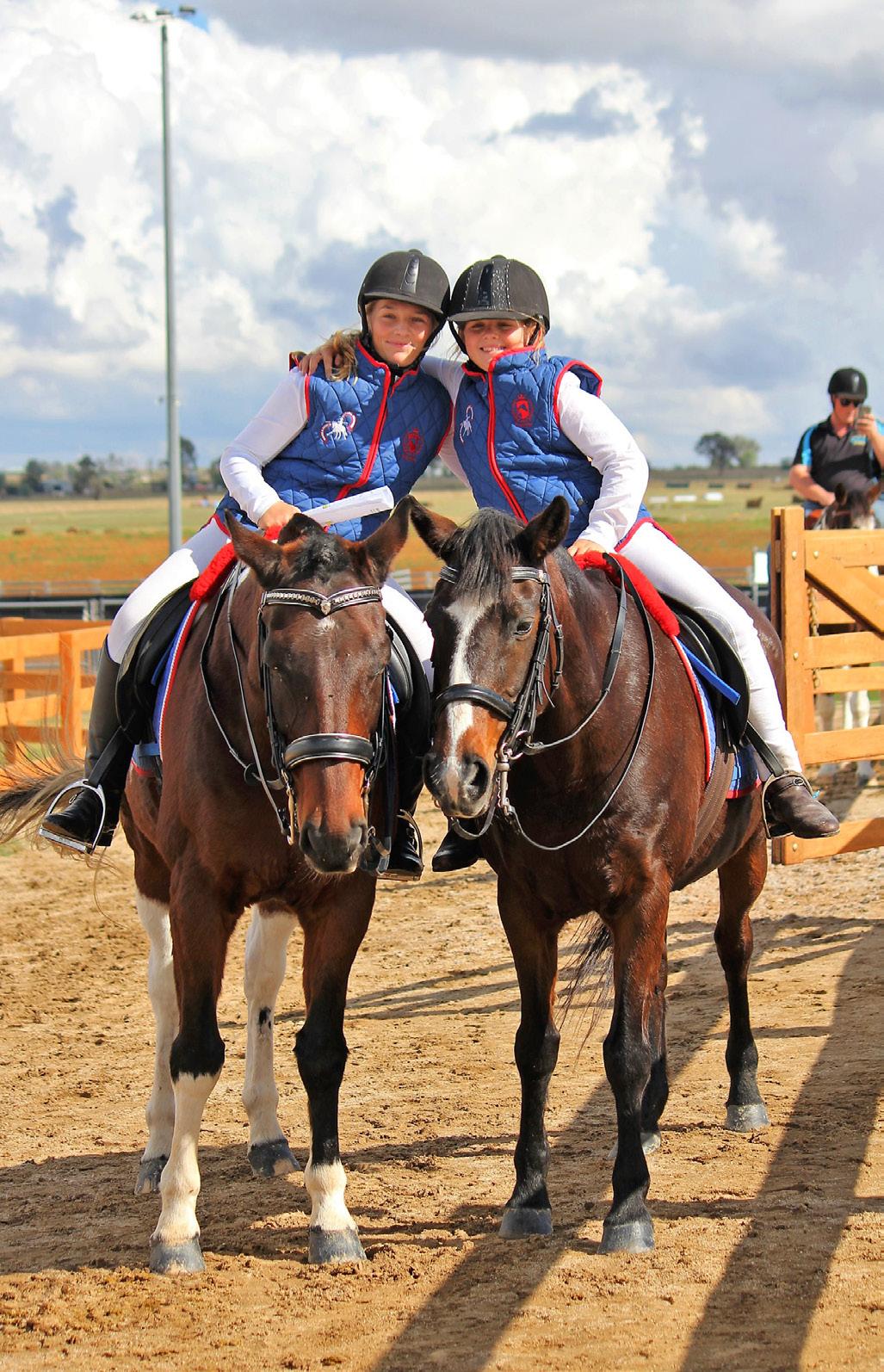
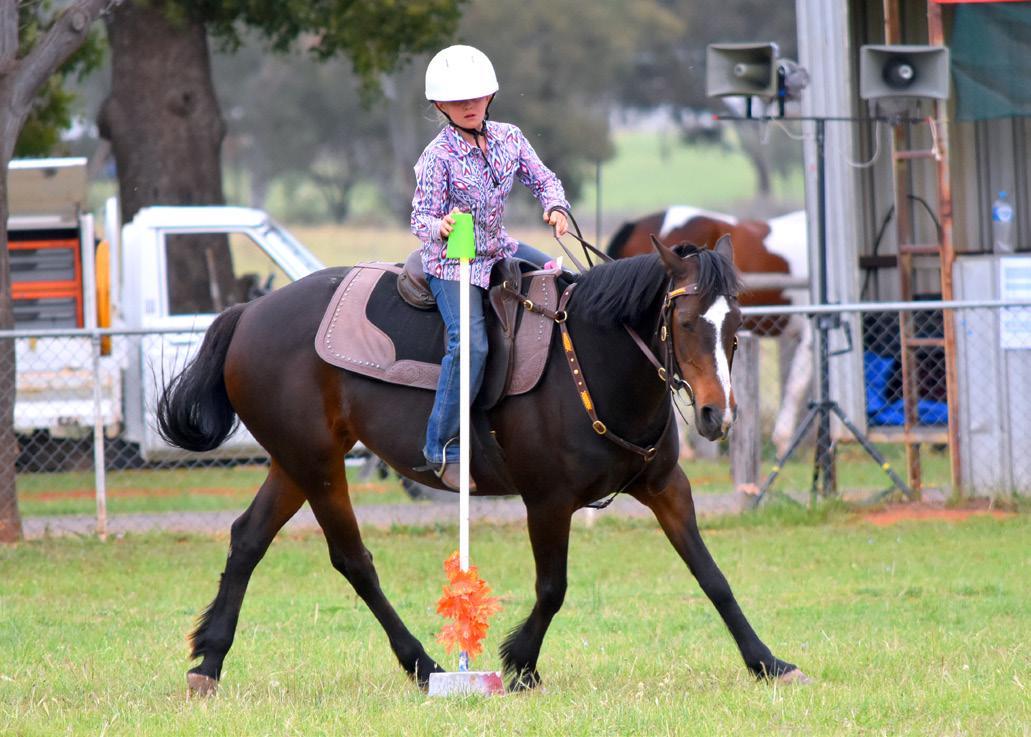
Poppy Douglas and Clancy in the speed event at
2019 Mudgee & Districts Working Equitation Championships (Image by Ruth Glover).
AROUND
ABOVE:
TOP: Jamie Hewitt-Toms aboard Devereaux Sea Salt at the 2019 NSW State Showjumping Championships (Image by Brittany Grovenor).
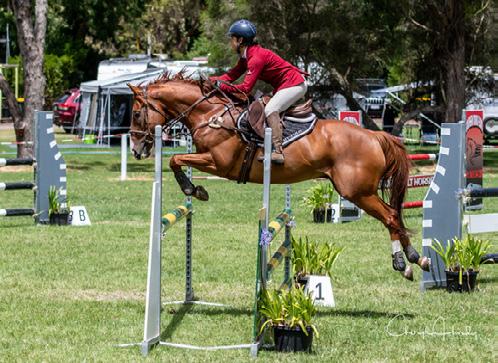
Danni Blismas and OTT Thoroughbred Aeroboyz at the Mortlake Showjumping Festival (Image by Cheryl Hardy).
LEFT: Paton Simpson riding Port Commands at the Coffs Coast Jump Club Spring Showjumping Festival (Image by Oz Shots).
Is there a fair future for Australia’s Brumbies?
Brumbies are a beloved national icon, but they are also considered a feral pest by some, writes CANDIDA BAKER of the troubled future facing the horses that carry so much of Australia’s cultural heritage.
It’s almost forty years ago that I first saw Brumbies. I was on a week-long wilderness ride in the Barrington Tops riding a young Thoroughbred, Bassie. It was his first trek, and he decided to jog-trot for the entire time, which did a lot for my core and leg muscles, and not so much for my sore rear end.
A rest day meant a chance to explore the Tops on the horses and as we made our way through tracks amongst the gum trees, we suddenly spotted a small herd of bay Brumbies, their colour in sharp contrast to the white snow which had fallen the night before.
The horses showed little concern for our presence, until we got too close for comfort, and the stallion went on red alert, galloping his mob off for the shelter of the wooded hills and into invisibility.
The sight of them left me with a curious wistfulness – they were so free, so much part of the landscape.
Where had they come from I wondered, these particular horses? How long since their ancestors had pulled carts, provided transport and ploughed the land for their human companions? Bassie’s gangly uncoordinated moves
made him seem like an entirely different creature to these small, sturdy, swift ponies.
That was in the early 1980s, before the park was turned into a Wilderness area, and the Brumbies removed – although I understand from the Hunter Valley Brumby Association that around 150 remain in the lower reaches, in the park rather than in the Wilderness area.
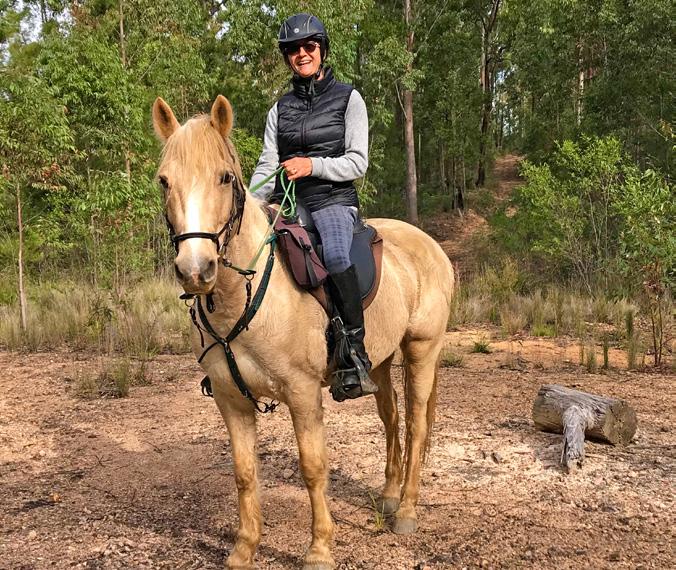
Fast forward to 2020, (with a few wilderness rides in the intervening decades), and here I am again, riding on a Guy Fawkes Heritage Brumby, Guy Fawkes Carnaby, now renamed Mello, through the state forest near Kendall, not far from Port Macquarie.
Kathy Holtrust, who runs Southern Cross Horse Treks has always used Arabians as her steed of choice, but recently decided to take two Brumbies - Mello and Guy Fawkes Dodge - to train up as trail-riding horses. The pair had been passively trapped in the Guy Fawkes National Park a few years before and had gone through the Guy Fawkes Heritage Horse Association, run by Erica Jessup. The Association offers the horses for sale to the public, keeping a formal register and a Stud Book and
Paleface, a Brumby stallion sadly lost in the catastrophic bush fires (Image courtesy Michelle J Photography).
both Mello and Dodge went through their initial training with horseman Taphyl Stewart before Kathy purchased them in 2019.
As we travel through the forest, taking some winding steep drops covered with vines and branches, what strikes me is Mello’s spatial awareness. We squeeze between saplings that are only a millimetre from my leg and my mind flashes back to the Australian Brumby Challenge at Equitana in Melbourne in 2018. If one word was going to leap out at me from all the images of Brumbies competing in the Challenge, it would be ‘brave’.
Kathy agrees. “The Brumbies are much less reactive than the Arabians,” she says. “They’re quickly turning into
steady and safe horses. They have great hooves, and they keep weight on well.”
I’m impressed with Mello. His walk is so free and easy, I just sit there; his trot is steady and his canter remarkably comfortable. He’s keen to have a gallop when there’s one available, and equally happy to walk along the forest tracks, his nature kind and inquisitive and obviously happy in this new life.
It’s this potential ‘new’ life for Brumbies that made the news that Parks Victoria was planning a cull by ground-shooting with ‘noise suppressors’ and ‘thermal imaging equipment’ of the Eastern Victorian Alps High Plains Brumbies so distressing - the shooting announced by Parks Victoria the same day as the Australian Brumby Alliance lost its case
against Parks Victoria in an attempt to prevent the removal of significant numbers of Brumbies from the Eastern Victorian Alps and the removal of all Brumbies from the Bogong High Plains. The cull was met by stiff opposition from Brumby supporters around Australia, most publicly by Omeo horseman Phil Maguire and his wife Louise, who raised money against their family homes to try and prevent the slaughter of the Bogong High Plains Brumbies.
Despite the fact that ultimately they were considered not to have legal ‘standing’ and were therefore unable to proceed with their case, Phil is adamant that their actions achieved their goal.
“We knew from the start that Parks Victoria only had an opportunity to shoot
between May and June 22,” he says, “so we don’t want the focus to be on the court case, and winning or losing, all we cared about – and still care about – is saving the lives of those horses. These Brumbies carry a priceless cultural heritage. Generations ago our family would breed Walers up in the High Country for the Waler sales, and these horses are descendants of those horses.”
There has never been a commercial goal to their desire to save the Brumbies, Louise stresses. “We don’t want to sell them, or take them off and re-home them, if you do that they’re not Brumbies anymore. We know that country, our property literally backs on to it – we don’t even have fences – they
were burnt out in the last two bushfires, but we put salt out for the horses to encourage them to come on to our property.”
What Phil and Louise achieved in a short space of time in terms of financial and public support was extraordinary, and what they hope is that they have bought a permanent reprieve.
“Once the window is closed for this year’s shooting, the current management plan runs out next June,” Phil says, “and there will have to be community consultation. We believe that we’ve created enough publicity and outcry for Parks Victoria to take how they manage Brumby populations very seriously.”
(The million-dollar question remains however, as to whether Parks Victoria, with no legal impediment to stop them, may shoot through winter anyway.)
Jill Pickering, President of the Australian Brumby Alliance, is resolute in her belief that the presence of Brumbies in the National Parks of Victoria should continue in sustainable numbers.
“It‘s critical that Parks Victoria separate deer impact from horse impact,” she explains. “It actually became clear
during the case that it’s the deer that wallow, pull up plants and rub on trees, but Parks Victoria don’t want to acknowledge the difference between horses and deer. It’s estimated that there are a million deer in the Victorian Alpine parks, which based on the 2019 Cairns count, minus recent bushfire deaths in the same area means there are 300 deer to one Brumby, and yet somehow it’s Brumbies that are facing extermination. We urgently need another
independent count of Brumby numbers since the drought and bushfires.”
The opposing arguments for and against the continuing existence of Brumbies in our National Parks are pretty simple – the anti-Brumby groups believe that Brumbies are part of the feral animal problem in Australia that pose a threat to returning the land to what is often referred to as a ‘pristine’ environment. (In Victoria, for example, Section 17(2)(a) (iii) of the National Parks Act provides that exotic fauna must be controlled in national parks, with Brumbies being classified as exotic fauna.)
Those for the Brumby argue that the National Parks in Australia have already been manipulated and changed beyond repair since the first white pioneers arrived to build their new lives. In Australia, that evidence is perhaps clearest in both the Kosciuszko National Park, and the Alpine National Park where the sub-alpine plains were used for grazing for cattle for well over a century, and where mining, the development of hydro power, the creation of numerous ski resorts and the continued presence of four-wheel drive vehicles, hikers, skiers and fisherfolk have already permanently changed the
Lin Baird of Bogong Horse Adventures demonstrating some natural horsemanship skills before our trek (Image courtesy Candida Baker).
BELOW: Candida’s second Brumby ride on Phoenix at Bogong Horse Adventures (Image courtesy Candida Baker).
eco-system. It is an eco-system, Brumby supporters argue, that has created a symbiotic relationship over the past 150 years between the horses and the flora of the parks.
Justine Curatolo, President of the Heritage Brumby Advocates Australia Inc, believes that a large part of the misinformation surrounding Brumbies is related to a lack of knowledge about the benefits of nomadic herbivores.
“In Europe, where they are undertaking ‘rewilding’ programs they’ve discovered that landscapes with wild horses are recovering much more quickly than those without,” Justine says. “The natural principle is that wild horses promote vegetation regeneration, and we can see this in areas after the bushfires have passed through. Due to the nature of their monogastric, single-chambered stomachs, their seed dispersal and seed regeneration through
their nutrient-rich manure is very high compared to other large herbivores.”
It’s impossible to mention the word ‘bushfire’ without paying tribute to one of the most-recognisable stallions of the Kosciuszko National Park. Cooma-based photographers Michelle and Ian Brown have been photographing Brumbies in the Alpine Parks for years, and like many other lovers of the mountain Brumbies, have been devastated by the disappearance of the great Paleface, his son Bogong and their herds.
“We’ve had to accept that they perished in the fires,” Michelle says. “Paleface was so strong, so beautiful – he was the Silver Brumby of our time in a way, and those of us that love the Brumbies miss him terribly.”
As a species which allegedly (according to Wikipedia) numbers no more than 400,000 Australia-wide, the Brumby is considered to be only a moderate pest,
and yet somehow seems to attract more than its fair share of negative attention from authorities, which is curious to me because an obvious difference between horses and other feral animals, is that once rehabilitated, Brumbies adapt to their domestic life remarkably well.
To put the figure of 400,000 in perspective there are, for example, 1.5 million feral camels in Australia, and over one million deer in the Alpine National Parks alone, according to an ABC news report. According to the then Federal Department of the Environment feral pigs have been considered to be the worst mammalian pest of Australian agriculture since 1987, and according to their figures there are five million feral donkeys in Australia.
Horses arrived here in 1788 with the First Fleet, and by 1860 there were 160,000 in Australia. For a long time it was survival of the fittest, gradually
A herd of Brumbies in the High Country (Image courtesy Ian and Michelle Brown).
resulting in the appearance of the Waler - so-called because it had its origins in New South Wales. The Waler soon earned the title of ‘breed’, developing into an extremely hardy horse. (In the First World War 120,000 horses, many of them Walers, went to war – only one, Sandy, came back.)
In the meantime, out in the bush natural selection was creating a very similar horse - the Brumby - a wild horse differing in each state depending on its environment and founding stock mix, from the Percheron-like Brumbies of the northern parts of Western Australia, where horses had often come from the huge stations, to the petite ponies of Coffin Bay in South Australia. The rare Pangaré Brumbies on the coast of Western Australia, south of Geraldton, with their curious light patches of colouring, appear to have adapted well to their coastal environment, and don’t appear to be damaging their main diet of saltbush, with the Department of Environment and Conservation and the Outback Heritage Horse Association of Western Australia (OHHAWA) monitoring these particular Brumbies to ensure the careful management of this unusual breed.
When the decision was made to remove the Coffin Bay ponies from the National Park, a solution was found by providing them with their own private reserve, and a solid re-homing program – similar to New Zealand’s management of their wild horses, the Kaimanawa. All of these outcomes suggest that with a bit of goodwill Brumby populations can in fact be managed.
What Australian Brumby supporters desire is a carefully managed fertility control and passive trapping program of reduction, with no shooting or aerial culling, and small, sustainable populations to keep the legend of the Brumby, complete with all its cultural, eco-tourism and potential environmental advantages alive.
We urgently need another independent count of Brumby numbers since the drought and bushfires
For a long time culling in any way –aerial culling, ground-shooting, Brumbyrunning and sending the captured Brumbies to slaughter was seen as the right of National Parks and State Governments around Australia, until in October 2000 in the short space of three days, 600 Brumbies were shot by aerial cull in the Guy Fawkes River National Park by National Parks and Wildlife Service contractors in helicopters. The public outcry, and the painful deaths those horses suffered, resulted in the NSW Government
banning aerial shooting of Brumbies, and brought the plight of the Brumby to national and international attention.
It was the recent controversy around the High Plains Brumbies that took me to my second Brumby ride with Bogong Horseback Adventures who are based at Tawonga, not far from Mt Beauty.
The Baird family have been running a trekking operation since the 1980s and have been at Spring Spur, their current home, since 1986.
Lin Baird, the current general manager, gave me Phoenix as my mount, an eightyear-old 14hh bay Brumby, born on their property to a Brumby mare trapped on the Bogong High Plains. With a licence to take riders into the Victorian or Alpine National Parks, Lin and his family have spent decades observing Brumbies, and absorbing some of their hardy bloodlines into their riding herd.
Paleface’s son Bogong also fell victim to the fires (Image courtesy Michelle J Photography).
Baluga (imp) hanovarian
Balou Du Rouet /Clarisimo
Chilled and fresh semen
$2000 lfg
Diamond B Chinook
Contendro 1 / Vivant
Clinton/Heartbreaker
(imp)
Frozen semen
$1200
Phoenix was every bit as willing and sweet to ride as Mello, and I was intrigued if there was a difference starting a Brumby that has been trapped, such as Mello, with one born on a family farm, such as Phoenix.
“I think all Brumbies have a genetic tendency to be a bit more sensitive,” Lin tells me. “They’re naturally attuned to be a bit more aware of their surroundings, so they always need careful handling, but if they are started correctly they make fantastic horses, and the guests love them.”
The guests also, of course, love the sight of the Brumbies on the Bogong High Plains. “To my mind the deer are a far worse problem than the small herds of Brumbies that are on the plains,” Lin says.
* * * *
My last stop on my whistle-stop research trip was near Ballarat, to Beaufort, where Colleen O’Brien runs the Victorian Brumby Association (VBA), formed in 2007.
“We have three key aims,” says Colleen, “firstly, to rescue and home Brumbies caught from the wild on public lands; secondly, to lobby and work with the
government agencies who have to manage the Brumbies, and thirdly, to educate the public through programs such as our very successful Australian Brumby Challenge, and our Wild Brumby Gentling Clinics.”
On the beautiful property that houses the VBA, herds of Brumbies live in large paddocks, only gradually brought into
the smaller paddocks, and then to yards as the gentling process begins. Visiting a paddock full of young (and very quiet) stallions, I was impressed with how friendly and curious they were for horses that were so recently out of the wild and not yet handled. As we walked away from the group, one of them followed me, and nudged me on the back. I stopped, and he did it again – just the gentlest of greetings. It was a beautiful out-of-the-blue moment.
I can only speak from personal experience, but both days I visited Kiandra in the Kosciuszko National Park and saw three or four small herds of Brumbies, I also saw anglers fishing in the clear-running creeks, and visitors delighted by the sight of the 20 or so Brumbies in view. Just as when I had seen them for the first time 40 years ago, something about the sight of them made my heart sing.
Surely Brumbies, an iconic symbol for the wild soul of Australia, have earned the right to be protected from inhumane slaughter in a landscape they have now been part of for over 200 years?
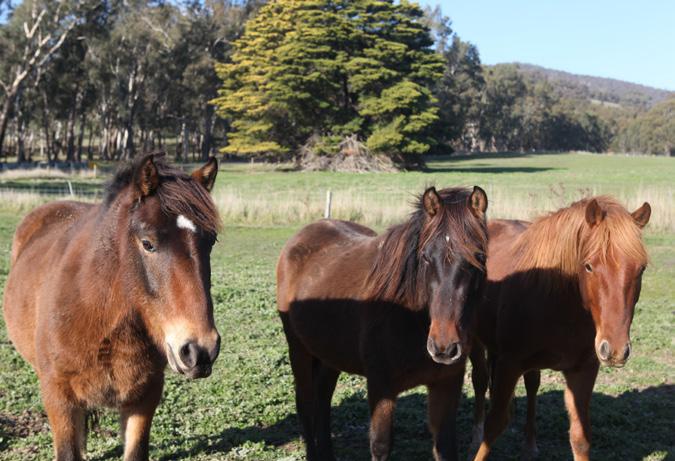
Safe at the VBA – three young Brumbies at the beginning of their new lives (Image courtesy Candida Baker).
A ride on Guy Fawkes Carnaby, aka Mello (Image courtesy Candida Baker).
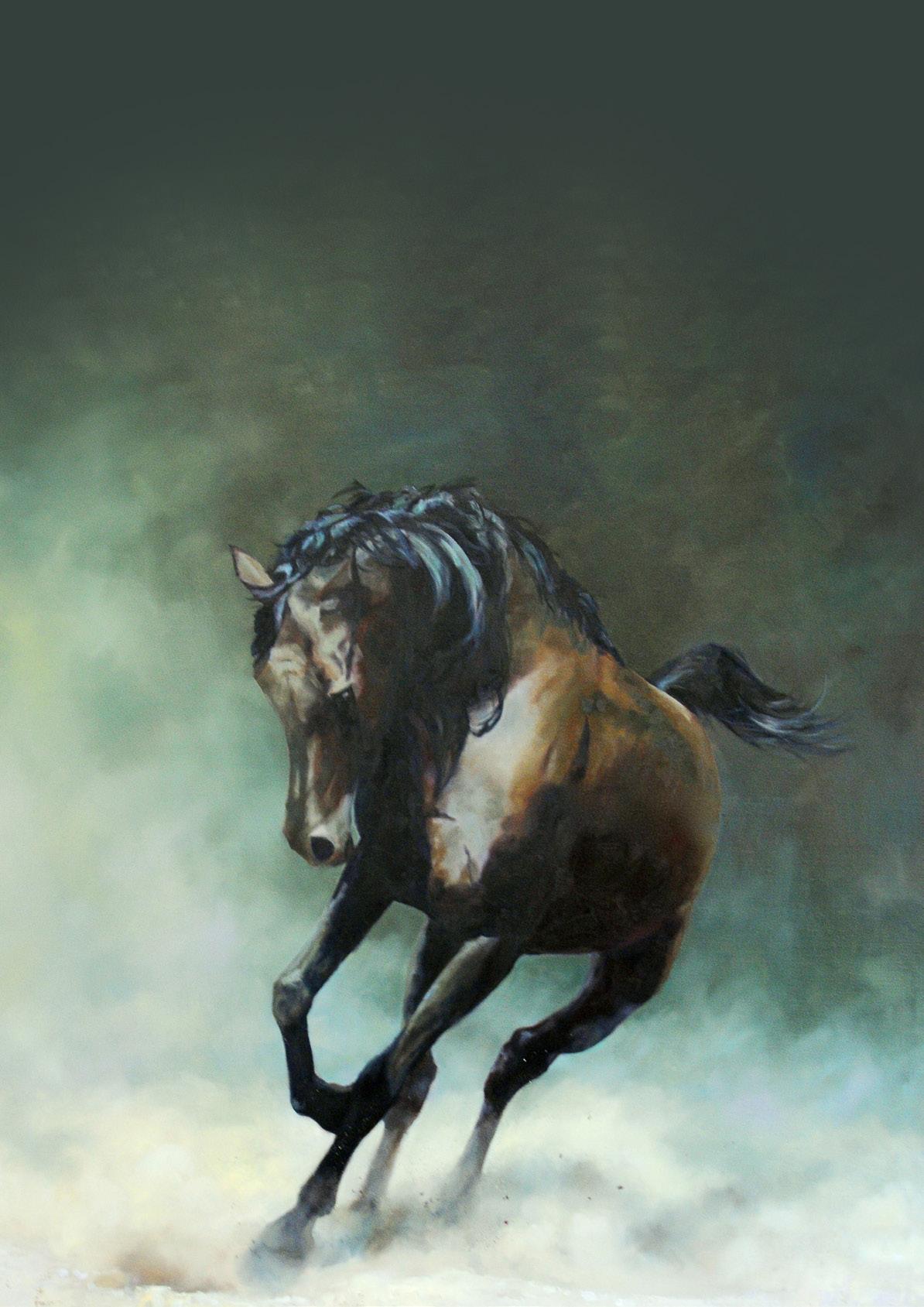
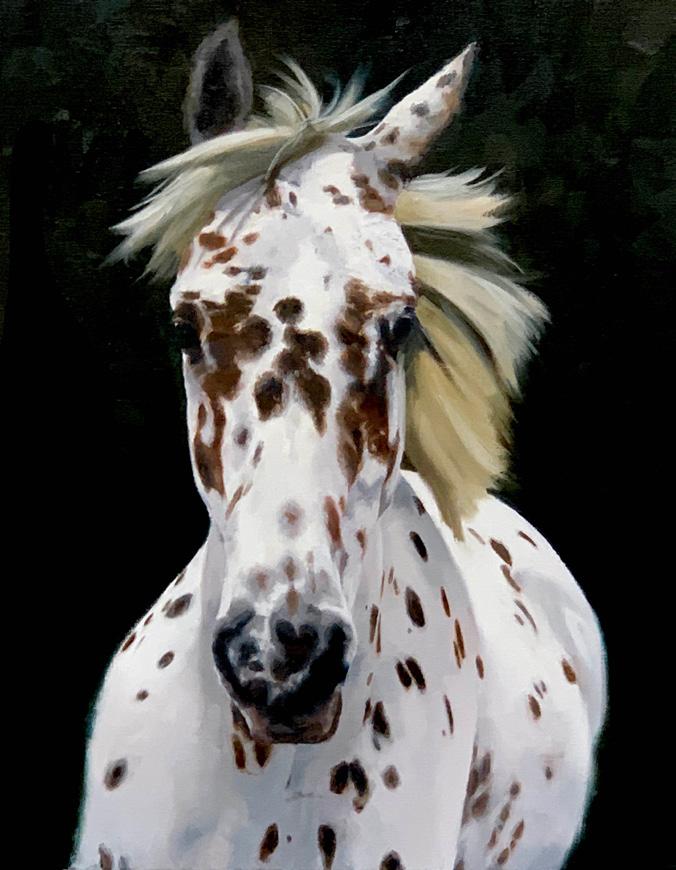
MAIN: ‘Arabian Aura’ painted for exhibition in Dubai (photograph reference by and courtesy of Wojtek Kwiatkowski).
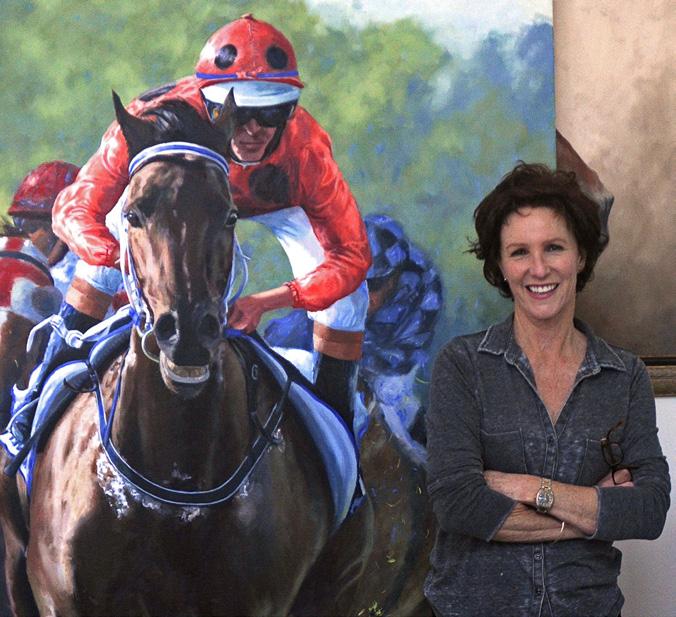
FACING PAGE: Lyn and Black Caviar (Image by Bronwen Healey).
CULTURE CORNER
Picture perfect
With her work hanging in the homes of HRH Princess Anne and the Duchess of Bedford, Lyn Beaumont is clearly an equine artist of considerable repute. AMANDA MAC spoke to Lyn recently about her remarkable equine portraiture.
There are, of course, many gifted portrait painters: artists whose work gives us pause for thought - a moment to appreciate, enjoy and acknowledge their considerable talent. But occasionally you discover an artist who has succeeded in capturing not just their subject’s physical appearance, but something else entirely: something very subtle, almost ethereal, which some might call the soul. And that’s what immediately stands out in Lyn Beaumont’s equine portraiture. Her subjects’ personalities, clearly visible in their intelligent eyes, are right there, caught on the canvas.
This ability to recognise and capture a horse’s essence is perhaps a facet of her passion for them, which is something that has always been: “I think I was born with it,” she says. “My grandfather was a horseman and I was horse mad from a very early age. But my parents wouldn’t buy me a horse so I had to beg rides from friends with horses, or even from strangers riding past! If given the chance, I’d ride anybody’s horse – even if they were having trouble with it, I would ride it.”
Her first horse didn’t arrive until she was 18 with a job and income of her own. This horse, an ex-racer with an unfortunate attitude, almost killed her – so she bought another, also an ex-racehorse, who became a close and loyal companion until he was well into his 30s.
I’m curious to know if there was ever another career for Lyn other than painting, and her response is an indication of the way things were when she was a young woman: “In another life I was a nurse. In those days you had to be practical and you couldn’t make a living from artwork in the same way young people are directed to it today. But I still enjoyed drawing.”
However, everything changed when by chance, Lyn heard of a highly acclaimed
one colour, much as you would see in a pencil sketch.
I have to liaise quite closely with the person commissioning the work so that I can perfect the image and be absolutely sure that I’m capturing the horse’s character and personality.
local artist offering oil painting lessons in his home. The artist, Glenn Hoyle, was a gifted landscape painter and a great teacher. He fostered the early days of Lyn’s now 30-year-long career, teaching her to approach landscapes using the tonal technique, essentially a rendering of the subject in various shadings of
Predictably, as Lyn later developed her own unique style as an equine artistwith oils as her preferred medium - it was shaped by that early training: “I started to paint horses by myself, no one taught me that. But the tonal training I had did influence my style in the way I laid down and blended colours. The result is a lot softer, subtler,” she explains.
As her reputation as an artist grew, Lyn was commissioned by the Victorian Racing Club to paint the then Horse of the Year, the first of four such commissions. Of course, the jockey was a necessary addition to the portrait, sending Lyn on a steep learning curve: “I had to paint a human face, so I decided to take portraiture lessons from Brian Armstrong and Lee Machelak, who were both winners of the prestigious A.M.E. Bale Art Award, and both proponents of the tonal technique. My equine work developed from that point with the softness and tonality I learned in human
portraiture,” she explains.
But make no mistake, while Lyn’s work has that entrancingly ethereal quality, it also demonstrates a realism and precision that stems from her painstaking attention to both detail and anatomical accuracy.
A testament to her talent, Lyn’s work hangs in the private residences of HRH
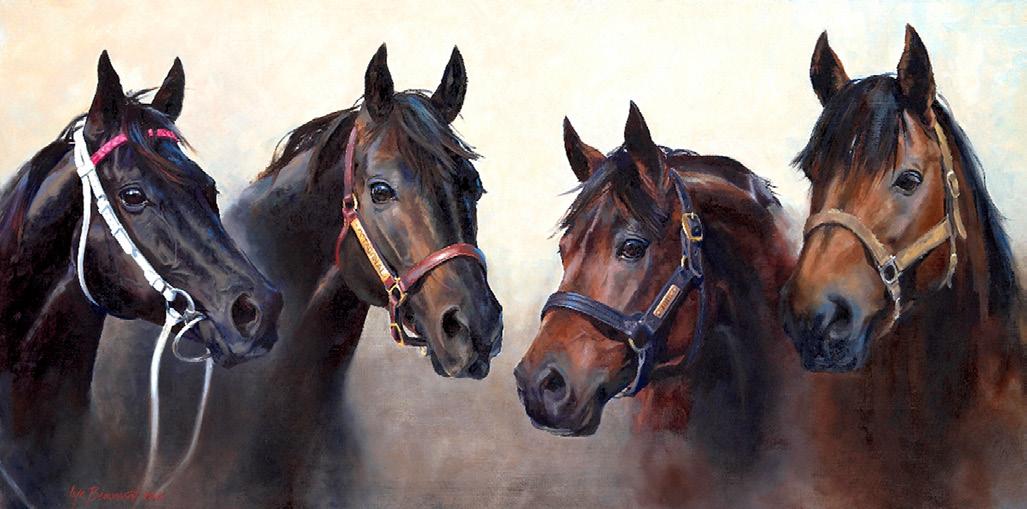
ABOVE: ‘Dynasty of Kings - Sir Tristram’, Sir Tristram, Zabeel, Octagonal, and Lonhro. A print of this painting hangs in the home of HRH Princess Anne (prints are available).
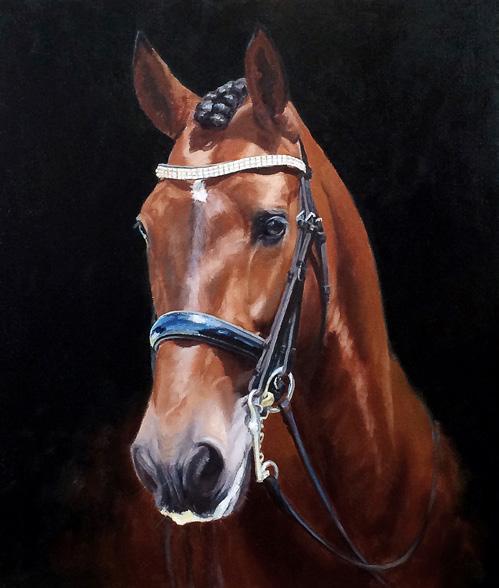
RIGHT: A commissioned portrait of the Andalusian stallion GrandiosoMG.
Princess Anne and the Duchess of Bedford, as well as in the boardrooms of the Victoria, Moonee, Melbourne and Mornington Racing Clubs. She has on several occasions been commissioned to paint Black Caviar, and the Australian Stud Book and Equine Federation of Australia have both purchased her work. Her paintings hang in private collections around Australia, UK, the USA, Ireland,
New Zealand and Japan, and have been exhibited in Melbourne, Brisbane, Sydney, Dubai and New York.
With this kind of success, you’d imagine that a relaxed, grounded home life might be an advantage - and that appears to be the case. Lyn and husband Neil live in Victoria on a property they share with eight horses (nine if you count the one currently holidaying with them), including a couple of Warmbloods, an Arabian, some Thoroughbreds, and the odd cross or two, as well as two dogs, seven cows and a colourful Brazilian parakeet that’s been with them for the past 20 years. “The bird is very pretty but very angry,” quips Lyn, “it’s lovely with us but definitely doesn’t like anyone else!”
Lyn’s passion for horses is all consuming: “My life revolves around them. I’ve broken one in, trained and reeducated quite a few, and I spend a lot of my time either dressage riding or trail riding. If I’m not painting them I’m either riding or working with them,” she laughs
Even with COVID-19 restrictions in place, as they were at the time of writing, Lyn remains busy: “I just shipped off the portrait of J.J. the Stockhorse and I’m now painting a picture of our two dogs as a gift for Neil.”
BOOST IMMUNE SYSTEM
It seems that many of Lyn’s commissioned pieces are created as gifts for a loved one, something that she finds particularly touching. “It’s a very personal gift,” she says thoughtfully. “When I accept a commission, whether it’s for a gift or otherwise, I have to liaise quite closely with the person commissioning the work so that I can perfect the image and be absolutely sure that I’m capturing the horse’s character and personality. And that takes a commitment from them to give me the time and details I need.”
Despite her considerable talents and enviable success as an artist, Lyn’s approach is remarkably modest. “For me, to be able to paint someone’s horse is both a privilege and a compliment because a portrait is something that’s really precious, it becomes a treasured possession. It’s lovely if I can actually see the horse but often I can’t, either because of distance, or because it’s a posthumous portrait – which inevitably brings tears to my eyes - or because someone has commissioned a painting as a surprise for their spouse. But these circumstances are never an issue because even if I have had the opportunity to see the horse, I always paint from photographs.”
Lyn finds that by working this way she achieves a far more accurate representation of her subject, particularly given that horses, unlike human portrait subjects, don’t stay still for very long!
I can’t help but ask Lyn about the way she feels as she paints, and her response is instant: “I feel inspired because I just love horses. They’re all so different and they each have their own story – I see them as individuals, as personalities. And to be able to give something back to people who love their horses is an absolute pleasure.”
Personally, I think that the pleasure is all ours.
View more of Lyn’s work at www.lynbeaumont.com – or for portrait enquiries, email lyn@lynbeaumont.com
One of Lyn’s most recent commissions, Jungle Juice the Stockhorse.
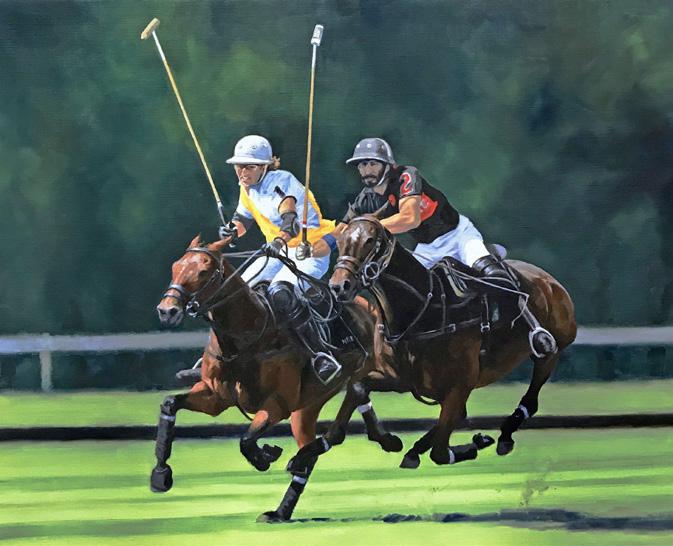
Capturing all the action of a fast fought polo game (photograph reference by and courtesy of Tony Ramiriz).
FEATURE
Tick gate death trap
With every good reason, the equestrian community is rallying over an out-dated border crossing. SONIA CAEIRO ALVAREZ investigates.
Melinda Rechichi and daughter
Chloe with Jazdan Raphaela (L) and Kenlock Sylvestro (R) (Image courtesy Mahalia Ashforth).
On a steamy Sunday afternoon, just before a storm breaks in Queensland’s southeast corner, a dozen horse floats, goosenecks and semitrailers line up along Miles Street, a high traffic residential Gold Coast road. They are queuing to get into the Kirra Tick Yard facility for the mandatory check and preventative cattle tick spray required for all horses crossing into NSW. It’s the end of an event day, and there’re a few hundred horses on the highway behind them. Temperatures are reaching the mid-30s, and horses are overheating and becoming distressed as they wait to enter the facility.
Dressage horse owner and competitor Jane Russell* remembers vividly the last time she entered the tick gates as it was her last. “My goose neck just fitted in but exiting was a nightmare,” she says. “There’s a lot of traffic, it’s hard to see past parked cars, and the slope is very steep as you edge out onto the road. As I was turning out a car came flying past. I slammed on the brakes and my horses banged against each other. They were ok, frightened and a bit bruised, but I was freaked.”
Sandy Thomas* also has vivid memories. In a similar incident, the oncoming vehicle collided with her float, significantly damaging the vehicle and terrorising the filly inside. She no longer attends Queensland events.
Stories about the perils surrounding this facility abound: the horse that died a few years ago after a collision; the woman who had a flat tyre, missed the 8.00pm closing time and had to camp out for the night with her daughter and horses at Mt Tambourine; the young woman who broke a finger leading a fractious, terrified horse into the crush; the woman whose horse slipped its head collar and galloped down the road into traffic.
Almost all horse owners cite safety for horses, vehicles, owners and handlers,
as well as bad traffic management and community impact as issues of extreme concern. Not least of which is why horses, at their owner’s expense, need to be subjected to Bayticol, a toxic spray containing flumethrin, an acaricide pesticide designed to kill cattle ticks.
The perceived death trap on suburban Miles Street is considered by the horseowning community to be a dangerous, out-dated facility that’s been the subject of complaint and controversy for years. An equine community Facebook page set up in late 2019 – ‘The Change the Kirra Spray Yards Fiasco – Tell your story’ – gathered thousands of views and hundreds of testimonies from aggrieved horse owners in just a few short months: from the perils of navigating much loved and often highly valuable animals through the gauntlet of trucks mounted on kerbs, and leading horses across a high traffic road, to staff donning hi-viz vests to aid traffic control, and being drenched with chemicalsthe efficacy of which is questionable according to the latest science.
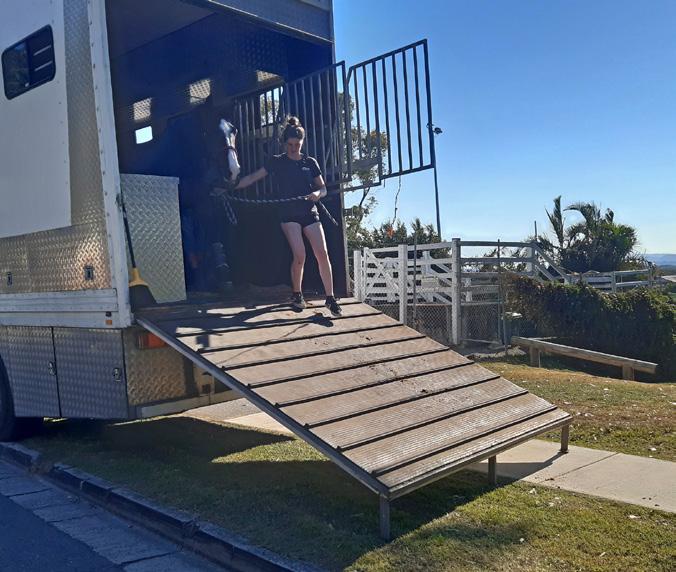
“There are many problems with the site and the main issue is that it’s just not fit for purpose,” Melinda Rechichi says, a competition horse owner based just south of the border in the Tweed Valley, and instigator of the community Facebook page. “Many people can literally not fit into the facility due to the size of their vehicle. They have no choice but to park across the road and lead the horses through traffic and manually take them through the spray yards. It’s incredibly dangerous but they have no other option.”
Melinda mentions being inundated with hundreds of stories: “Not just about fitting vehicles in, but the fast traffic, the football grounds next door with loud crowds and blasting horns spooking horses, injuries, vehicle damage, local foot traffic in danger, and of course, why we have to do this in the first place. It’s cattle tick, not horse tick. Why are we paying the price for a cattle industry problem?”
Going through the facility currently costs
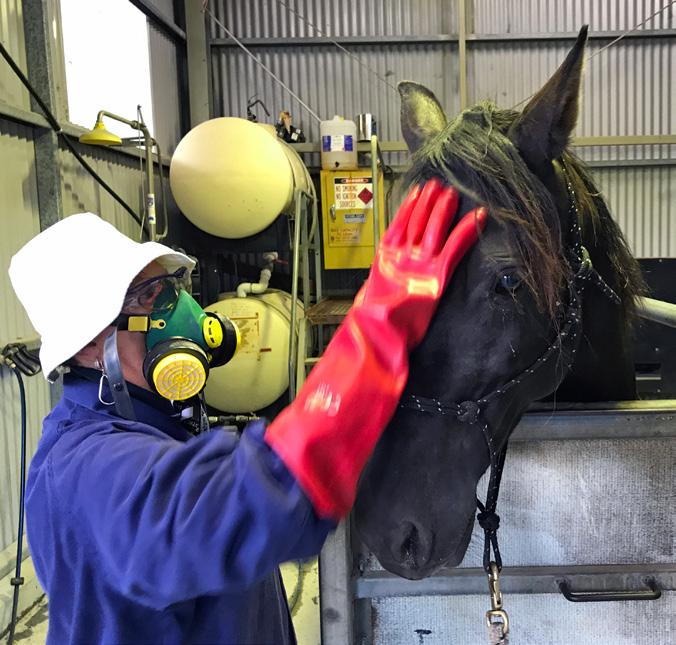
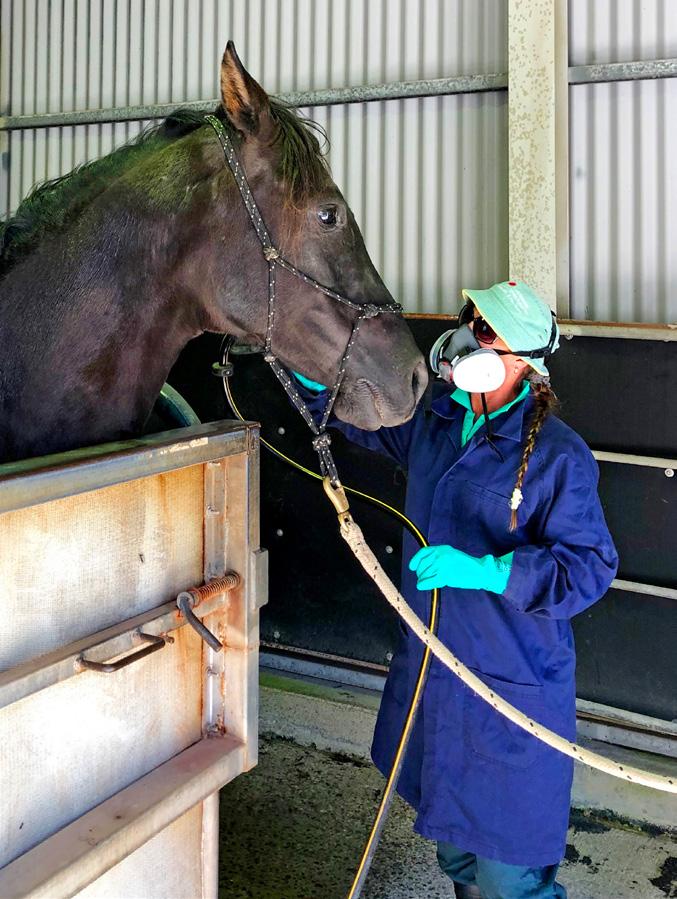
Workers wear protective gear when spraying with Bayticol (Image courtesy Angela Delgiacco).
$5.50 per treatment. Failing to do so results in hefty fines and a visit from a DPI inspector. With 500 to 600 horses going through the border gates each month the revenue is significant. The local equestrian community is paying up to $40,000 a year, a fraction of the total when including income from fines, for a problem widely considered to be the responsibility of the cattle industry.
That problem is the cattle tick. Horses, amongst other animals are classified as low-risk secondary carriers, so why vaccinating cattle isn’t the primary control mechanism remains an unanswered question. That horses are possible secondary carriers is understood. However, no department contacted while researching this story could say why other secondary carriers such as dogs are not subject to mandatory inspection and spraying.
Despite the latest CSIRO evaluations on acaricide resistance, which according to some experts was the basis for altering the policy on the Northern Territory/Queensland border, NSW persists with out-dated science, in an out-dated facility that poses high risk
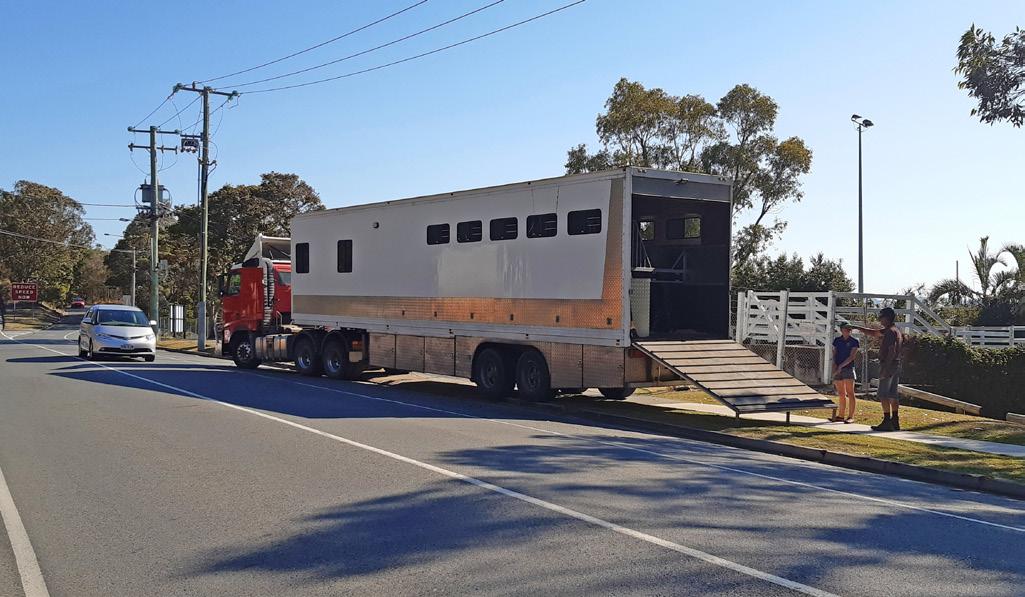
With a truck too large for the facility gates, owners have no option other than to unload their horses next to a busy road (Image courtesy Katrina Parlevliet).
DPI. During this bureaucratic tennis match, questions remain unanswered, solutions uninitiated and frustration in the equine community deepens.
Melinda and others have written to various departments, and if responded to at all, have received almost identical letters of dismissal.
and is dangerously unfit for purpose. Complicating the matter is the number of public service and government departments involved in managing the facility. The NSW Department of Primary Industries which owns and operates it, and the Gold Coast City Council (GCCC) that manages the land are the two primary stakeholders. However, the Tweed Shire Council, Queensland Department of Agriculture and Fisheries, Queensland Roads and Transport, Workplace Health and Safety Queensland (WHS), the Environmental Protection Authority, Biosecurity Queensland, Business Queensland, and the Federal Department of Agriculture, Meat and Livestock Australia all have involvement, or a stake in the border policy.
The politics are complex. The current policy black hole between the two states and the many departments involved results in the various bodies responding to questions by suggesting it’s another organisation’s remit. Queensland Roads and Transport directs traffic issues to GCCC, which directs access issues to the NSW
The office of Mark Furner MP, the QLD Minister of Agricultural Industry Development and Fisheries, responded to her correspondence in late 2019 by stating that the NSW DPI had advised him that it was “committed to the highest possible work, health and safety standards”, which included signage regarding unloading only in the facility, signage on non-admission, rubber matting in booths, lockable gates, and a widening of entrances and exits (which would alleviate the issues of large vehicle access but not the turning angles for large vehicles in high traffic). At the time of writing most of this had not occurred.
This response was repeated in letters from the NSW DPI and other bodies. Local MPs and councils have all redirected queries back to the DPI. None of the correspondence addresses any of the core concerns of horse owners. The circular buck passing is almost laughable were it not so serious.
Melinda has sent several letters to GCCC with no response and finally submitted an official complaint to the Division 14 Councillor around the perilous exit of large vehicles from the facility. When Council was contacted regarding the issues raised, including land ownership, WHS management, lack of road signage on speed, and safety warnings regarding livestock movement, a GCCC spokesperson explained the site was not ‘leased’ but was State land set apart as a reserve for stock dip purposes under the control of the Director General of the NSW Department of Primary Industries as Trustee.
The spokesman said that “the city’s road safety team has assessed the site and signage on site and advises that ‘All livestock must be unloaded within the compound’. WHS at the facility is a matter for the respective Agriculture Departments in QLD and NSW as is the query on the facility being moved to a ‘safer’ site. We trust all horse owners/ transport carriers to abide by this signage to ensure there are no safety issues. Should the horse carrier be unable to abide by the conditions, they are advised to contact the facility to make the necessary arrangements.”
Horse owners with vehicles too large
to access the facility have limited alternatives. They can arrange for private spraying before leaving QLD, which is expensive and not practical for many. There is also the option of a second border crossing at Mt Lindesay, 140kms west of Kirra and a five-hour round trip, which is simply not feasible for those travelling from South East Queensland to northern NSW.
Of primary concern for all those who can fit through the gates is the steep slope and fast-moving traffic - a combination causing anxiety to drivers, and damage to vehicles and animals as large carriers lurch onto Miles Street attempting to
avoid oncoming traffic. To this, GCCC issued a statement stating that, “the City has been working with DPI and the Divisional Councillor to improve road safety in the area. We will soon install a yellow no stopping line on the eastbound side of Miles Street to improve access into the facility and improve visibility for vehicles leaving.”
Unhelpfully, the letter also indicates the installation of additional signage on the westbound side of Miles Street ‘to remind users that livestock should not be unloaded on the roadway.’ This response once again failed to address the perennial issue of large vehicle access and the facility being unfit for purpose. At the date of writing, there is still no warning sign to drivers of a livestock facility, and once again Council directed all further enquiries to the DPI.
One ‘Change the Kirra Spray Yards’ Facebook post was a video of a large Sydney Horse Transport vehicle and the trauma experienced by valuable horses. Spray yard staff prohibited the witness from taking images and video on site so she moved to the main road, and with the driver’s permission continued filming.
“On the side of the road yesterday at Kirra spray yard,” her post says.
“Two colts, two racehorses and four very frightened yearlings - scared and rearing in the crush … then having to be loaded again with the gates open, across the sidewalk with people walking their dogs. It was scary to watch as they were obviously not used to being loaded. The lovely driver said he is usually by himself but was lucky that a strapper caught a lift with him and helped. He said that the Queen had more of a chance of getting a tick then from where these horses were from.”
The frustration, and the devil, is in the detail. Complex DPI guidelines state that while a manual inspection is mandatory, as is carrying a Movement Record to comply with risk minimisation requirements and
In the crush (Image courtesy Angela Delgiacco).
making an inspection appointment, nowhere does the document state that compulsory preventative spraying is required, particularly in the case of stabled competition horses that did not travel to a tick zone.
According to Biosecurity Queensland, chemical sprays are not mandatory on low risk carriers unless manual inspection discovers evidence of ticks. The department states that: ‘Low risk tick carriers must be manually inspected and found tick free to meet the ‘tick free manual inspection’ risk minimisation requirement as stated in the biosecurity manual from the Department of Agriculture and Fisheries.’
To add to the frustration, despite DPI requirements for booking the facility to reduce waiting times and the subsequent build-up of trucks along the road, most interviews conducted, and anecdotal Facebook page stories, point to inefficiencies, particularly after large events when traffic returning to
If someone does get killed there it’s a potential manslaughter offence under WHS legislation, due to known risks, negligence and no adequate corrective actions
NSW is heavy and bookings make no difference to access and availability. Lydia Plim, Kuluha Stud owner and Managing Director of Safety Makers, an independent risk and safety assessor specialising in equestrian safety, believes the facility is extremely dangerous and refuses to take her
own horses through. Like many horse owners she no longer participates in events north of the border.
Her evaluation of the Kirra spray yards is blunt. “The facility has an Extreme Risk level,” Plim says. “I stopped taking horses through there after a horse died a few years ago and traffic increased to a dangerous level. It was a tough decision but I will not move horses through that gate until it’s relocated and operational practices are improved. If someone does get killed there it’s a potential manslaughter offence under WHS legislation, due to known risks, negligence and no adequate corrective actions.”
NSW DPI staff are capped and gowned in the treatment bays. Horse handlers are not. Aside from human health impacts, research into acaricide resistance has not been made available in NSW as it has in the NT, where border control guidelines differ from those of NSW. The NT government
A large horse truck parked on the verge of a busy road – dangerous for horses, handlers, traffic and pedestrians alike (Image courtesy Katrina Parlevliet).
recently released information detailing resistance to Bayticol, asserting that, ‘the more often ticks are exposed to the chemical, the more likely they will develop resistance to it ... the treatment of European cattle in eastern Australia every three weeks has resulted in rapid development of acaricide resistance … under-dosing risks survival, enhancing tolerance/resistance to the chemical, as does the persistent use of one chemical group for tick control.’
A senior vet* with decades of equine experience and working knowledge of the biosecurity policies in several states agrees, saying that there are better ways to deal with cattle tick control.
“There is clear, available evidence that NSW DPI operates against all recommendations from NT DPI on reducing chemical resistance for cattle tick,” she says. “It also disregards the independent CSIRO assessment for the QLD Government’s introduction of the 2016 biosecurity bill. This legislation supersedes the 1915 Stock Act that required ‘inspect and spray’ which is the antiquated policy NSW still use.”
She adds that it must be proved that groomed show horses can sustain or instigate an infestation and thus justify the spraying program. “NSW needs to explain why they spray horses despite the NT and QLD’s better practice. There are long lasting cattle vaccines. Implications of resistance are serious. Certain strains of ticks in QLD are already totally resistant to Bayticol. NSW persists with out-dated and possibly harmful practices of continuing to spray ‘low risk secondary species’ despite warnings from other agencies that it could be disastrous and costly for the cattle industry.
“It’s odd that two states can have different requirements for the same issue - but one has a huge impact on safety, chemical complications, cost, inconvenience, animal welfare, road safety, and WHS, while assessing the
identical issues. Why has NSW chosen the more arduous, costly and risky impact? All horse owners should be given a MDSA safety data sheet on the chemical used and give consent based on that data … nothing about this is open or transparent,” she says. But there are possible solutions. The DPI could restructure the facility to allow larger vehicles to move through safely, or relocate it to a safer area. The spray regulations could be reviewed in line with the latest evidence. The onus for cattle tick control could be on the cattle industry instead of the equine sector.
A comprehensive review of the facility is vital, especially in the space that has emerged with the COVID-19 border closure. It would give the equestrian community and the various government departments a chance to resolve a polarising situation that appears to serve no one.
As Melinda says, “If they can’t move it, all we want is for it to be at the very least accessible for all vehicles, based on best practice and science, and safe - for us and our horses. Why is that so hard?”
*A number of interviewee names were changed or omitted for this story.
Melinda Rechichi and Kenlock Sylvestro (Image courtesy Mahalia Ashforth)
MAIN: Amanda and Koko Popping Candy gallop through the woods with Werribee Mansion in the background during the CCI2* at the 2017 Melbourne International 3 Day Event.
FACING PAGE: Holding on as Loxley launches an early take off in the CCI* at the 2013 Melbourne International 3 Day Event. (Images by Michelle
Photography).
Terlato
FEATURE
Fit for purpose
She’s an equestrian coach, world class eventer, and she rides for Australia. Amanda Ross’ career has been extraordinary, and her commitment to fitness absolute. AMANDA MAC asked her for tips on how to up your fitness game to help take your riding to the next level.
Amanda Ross first sat on a horse when she was two-year-old. Her mother, a keen hobbyist rider, popped her onto a pony and then had to endure Amanda’s howls of protest when she was taken off. A pony of her own followed when she was eight, and a lifelong passion began.
Amanda has been competing in equestrian sports for more than 30 years. She was a reserve for the World Equestrian Games in 1998, 2010 and 2018, and a member of the Australian team for the Oceana Eventing Team in 1999 and 2019. She competed in the 2000 Sydney Olympic Games and is shortlisted for Tokyo. Add FEI Dressage and Grand Prix jumping to her resume, and a picture emerges of a highly capable, all-round equestrian athlete.
Amanda is an enthusiastic proponent of fitness: “We are doing a sport and in any sport you do you need to be fit for purpose. As equestrians, we are fortunate that we can ride for a very long time, we’re not restricted by age. But no matter how old you are, the fitter you are the less likely you are to fall off and the better you’ll recover if you do.”
Dressage
As an eventer, Amanda has the fitness
angle of all three disciplines covered, and is more than happy to share the basics: “For dressage, we need to have great posture. We’re generally trying to keep our bodies still on a moving object, so we need to be flexible particularly through the spine and the hips but still strong enough in the core to maintain good posture.”
She points out that cardiovascular fitness is also vital, as anyone who has tried to sit to the trot on a really
big moving horse will tell you, but cannot emphasise enough the need for flexibility, balance and a strong core. “If I was focussing on dressage, I would do a lot of pilates and yoga. Body symmetry and awareness is super important because you need to feel when your body’s off balance. If you sit slightly asymmetrically, your horse is going to become crooked and won’t move off the aids correctly. Yes, definitely include some kind of cardiovascular work - some skipping, burpees, or a circuit training activity – but always with added pilates and yoga so you’re aware of your symmetry, strong through the core, and also very flexible.”
Showjumping
The conversation then turns to showjumping, a very different proposition from a fitness perspective in that a jumping round might be up to two minutes at the most, preceded by a warm-up of possibly 20 minutes, and a further quick warm up if your horse is going back in for a jump off. Quite a different scenario to dressage, where you might warm up for anything up to 50 minutes before riding a five minute or longer test.
From an aesthetic viewpoint, Amanda
FACING
Because showjumping requires short bursts of agility, Amanda’s focus is more on circuit training orientated fitness. “You might consider a Tabata or F45 style training program that includes some cardiovascular and strength work - and because you only need a couple of minutes of effort in the showjumping ring, short sharp efforts when you train will be ideal. I’d mix up bursts of cardio and strength, with flexibility exercises such as Animal Flow.”
To add to this, balance and reaction time are imperative for speed rounds against the clock. Amanda advises working on your balance using a bosu ball, wobble board, or simply single leg work combined with ball games (think juggling whilst standing on one leg!), which are all fun and easily accessible methods for improving reaction time.
Cross-Country
And then there’s cross-country, where you need sustained cardiovascular fitness over a longer period. “I took my heart rate once on an eight minute track and it was over 180 beats per minute for the entire course,” Amanda recalls, “obviously a lot of that is adrenalin, but what it shows is that you’re sustaining quite a high heart rate as well as performing skills on top of that, so you need to have very good base fitness.”
suggests that posture in showjumping isn’t as important as in dressage: “You’re not going to be judged for your posture in the jumping ring,” she explains, “but that said, we all know that better posture is going to make you a better rider, a more effective rider.”
A cross-country course asks a lot of a rider: “It requires you to ride in two point position for an eight to twelve minute period, negotiate 40 plus jumps using a variety of jumping positions, react to unexpected slips or bumps, remember where you’re going, as well as plan A, B and C, all while you stay sharp and focussed on the course. Those activities require long continuous work, and for that you need muscular endurance and appropriate cardio fitness. The shorter, sharper jumping and turning bursts need muscular strength, reaction time and balance, as well as the flexibility to maintain a solid enough position to remain both
ABOVE: Competing with Dondiablo in the CCI4* dressage at the 2019 Melbourne International 3 Day Event.
PAGE: Amanda and Koko Popping Candy go clear to win the 2018 Melbourne International 3 Day Event CIC3* (Images by Michelle Terlato Photography).
effective and on board!” she says.
Remember that if you’re not fit, the first thing your body does is go into fright or flight to protect itself. “So if you start getting really tired, your body’s number one priority is to try to stop you from falling off, and that’s when things go out the window,” Amanda warns.
Have you noticed that when people get really nervous in a competition they often lose their way?: “That’s because their body has lost its ability to think outside the basic survival mode, and that makes it difficult to retain information or problem solve, so you’re not actually able to think about where you’re going, nor will your reactions be sharp. It’s at this point that riders become slow to react, both mentally and physically, which often results in run-outs, stops and falls, because the riders don’t set the horse up very well,” she explains.
Clearly, cross-country requires more cardio in your workouts – but Amanda doesn’t mean jogging or cycling: “I go for shorter, sharper bursts of intensity, with a variety of functional, whole body movements. It’s HIIT (High Intensity Interval Training) style fitness. I also have a bosu ball, a foam roller and an Indo Board, which are all great for working on my balance.”
Core considerations
We’ve all heard that core fitness is important – but really, is it such a big deal? Amanda has absolutely no doubt on that’s point! “Your core is really important because it’s the muscle group around the lower spine and pelvis, and your pelvis is at the very centre of everything. Your legs come out from your pelvis and they form the anchor between you and the ground. Your spine comes out of your pelvis and that’s what holds your body upright and attaches your arms and head. So if your core is weak, your body will not be stable.”
But there’s another issue: “When you’re sitting on a moving object and you’re
trying to remain still, there’s got to be something that allows movement and absorbs movement, so your spine and pelvis need to be both strong and flexible through the core to allow you to sit smoothly,” she explains.
To keep her core strong, Amanda likes a range of exercises involving static, rotating, flexing and extending movements. Think planks, twists, leg lifts and lowers, and for an added bonus: “anything where you have to balance yourself will engage your
core. I like to mix exercises together. If I’m doing squats, or rows, or anything that’s isolating one part of my body, I try the exercise while standing on an unstable surface and it immediately recruits my core,” she says.
And for the finale … it’s flexibility
If you were to tell Amanda she could pick only one type of exercise for flexibility, then hands down, it would be yoga. She’s a serious
fan – and that’s because when it comes to flexibility, yoga delivers.
“Being flexible is so important. When you’re trying to sit steadily on a moving horse you need to be able to flow with
that movement. If you’re stiff through the back and shoulders, then you’re more likely to jar your spine, if you’re tight through the muscles in your hips, sitting on a wide horse can reduce your leg strength when delivering the aids. And
Agnes Banks Equine Clinic was established with the aim of providing the best available veterinary care and advice for horses and their owners and trainers. The practice accepts surgical and medical cases from the surrounding areas.
Agnes Banks Equine Clinic offers a high level of professional skills and has a particular interest in lameness, poor performance evaluations and dentistry.
We offer advanced breeding procedures including semen freezing, insemination & embryo transfers.
if you have one side that’s less supple than the other, you’ll lack symmetry which will create crookedness in both you and the horse,” she explains.
Whether it’s going to the gym, or working out at home during the COVID-19 lockdown, Amanda ensures she does something to maintain her physical fitness and flexibility every day. She absolutely practices what she preaches – and we hope that whatever your discipline, you’re now inspired to commit to a fitness program of your own.
You can find Amanda Ross on her Amanda Ross Eventing Fit Facebook page and YouTube channel, or visit her blog: www.amandarossequestrian. wordpress.com
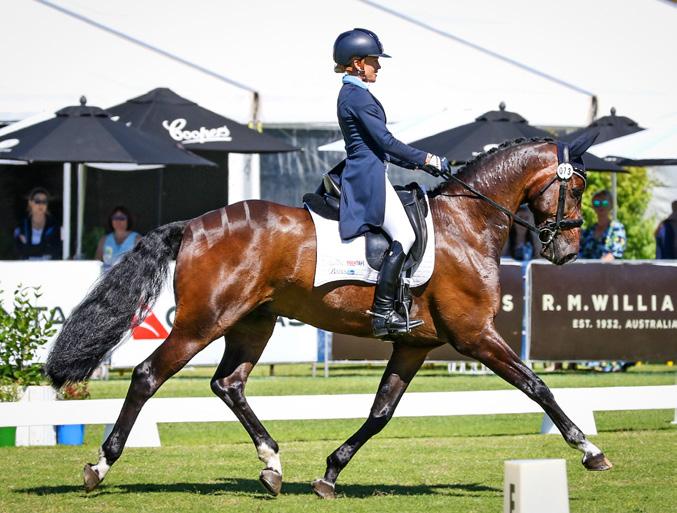
Amanda and Dicavalli Diesel in the dressage phase of the RM Williams CIC3* at the 2018 Adelaide International 3 Day Event (Image by Michelle Terlato Photography).
Our services include:
24 Hour Emergency Service
Equine surgery & medicine specialists on staff
Complete Blood Laboratory
Lameness diagnosis & treatment
PRP and IRAP therapy
Nuclear Scintigraphy (Bone Scanning)
Digital Radiology & Ultrasound
Exercising video endoscopy
Pre Purchase Examinations
Equine Dentistry
Equine Reproduction
Telephone: (02) 4588 5200
Facsimile: (02) 4878 1458
Web: www.abec.net.au
Email: clinic@abec.net.au
AROUND THE TRAPS
Rose Douglas and Quandy, with Maddie Dale and Warrior at the Working Equestrian Nationals in 2019 (Image by Renee Muller).
ABOVE: 10-year-old Rose Douglas and Quandy also competed in the speed event at the 2019 Mudgee & Districts Working Equitation Championships (Image by Ruth Glover).
RIGHT: As COVID-19 restrictions eased, Teagan Christie and Digby enjoyed a local jump club day out (Image by My Focussed Photography).
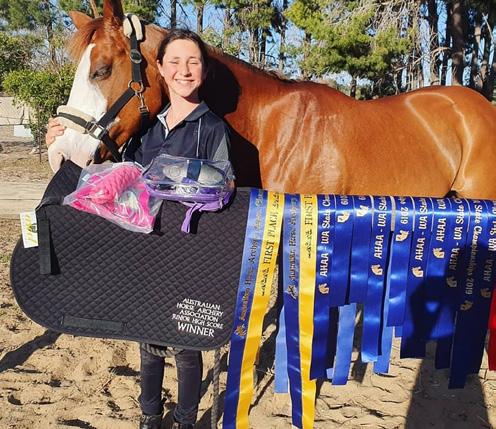
BELOW: Horse archer Madison Price with Memphis. Madison is a member of the Horse Archery Association of WA and is the WA State High Points winner (Image by Sharon Price).
THE HORSE LISTENER
The importance of a balanced hoof
Flat feet is a much worse problem for horses than it sounds, writes CANDIDA BAKER who is currently rehabilitating a horse with negative palmar angles.
Acurious little item to start this column with - did you know that your horses can get dehydrated in sudden cold weather just as quickly as they can in extreme heat?
Writing this in the generally balmy climate of the Northern Rivers seems a little odd – you wouldn’t think it would be a problem in the tropics or sub-tropics, but a sudden plunge in temperature can confuse a horse’s system, and it can forget to drink.
A local vet who had treated three horses in a week told me about this condition (not mine fortunately). Doing a bit of research I found it was quite common. There is a simple way to help your horse ‘remember’ to drink - provide clean, fresh drinking water every day. If your horse seems just a little off-colour, but the symptoms don’t seem to be colic, pinch a little bit of skin on the neck in front of the shoulder and if it doesn’t spring back within two seconds it means your horse may be slightly (within 4-8%) dehydrated. Another sign is if the horse’s gums are paler than the normal bubble-gum pink. In this case offer your horse fresh water, perhaps with a bit of molasses in if they like a treat.
Be warned – if a horse has slightly sunken eyes, or a tucked-up tummy then the dehydration has increased to over 8% and you need a vet to
x-ray
administer fluids. If your horse has colic, it will exhibit pain in some way rather than lethargy but of course, if in any doubt call a vet anyway.
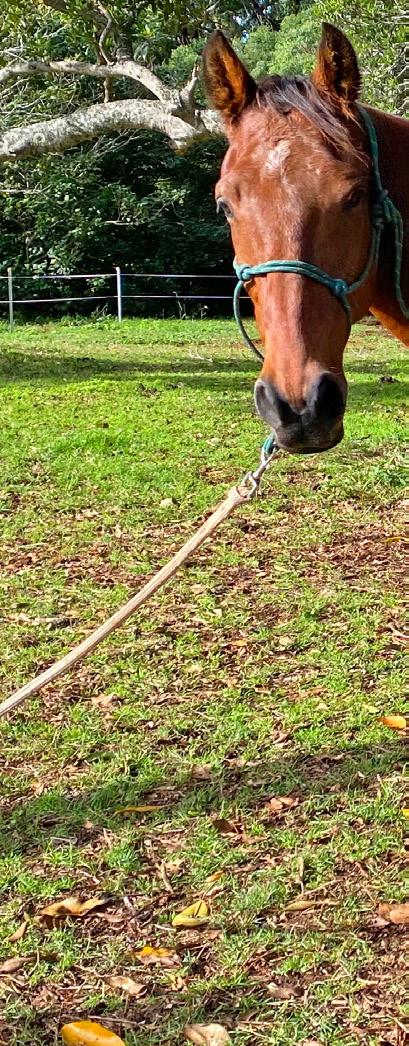
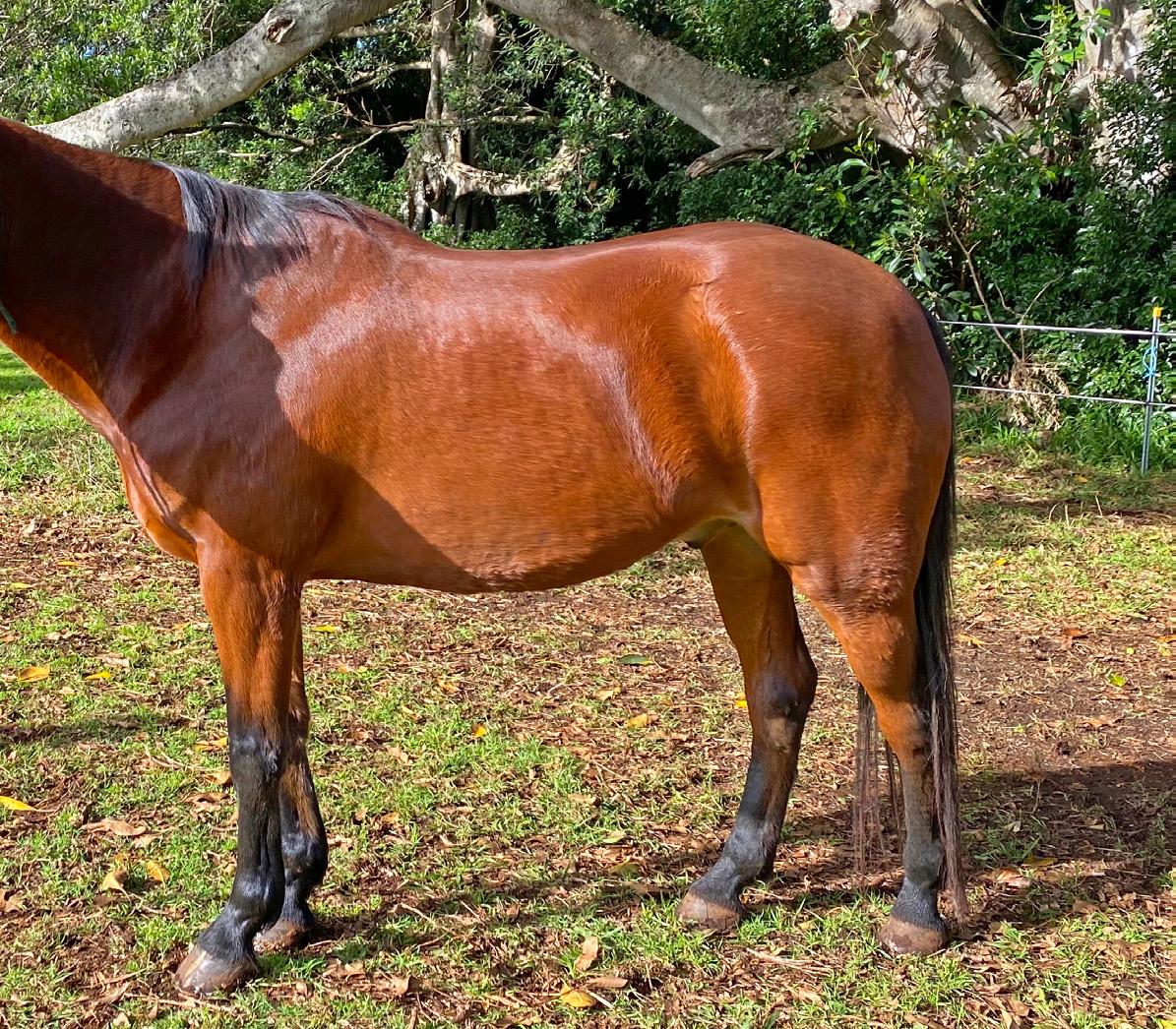
From fluids to feet. As President of a small equine charity, Equus Alliance, I’ve recently been caring for two ex-Riding for the Disabled horses, who were retired from riding classes, one because of his age –20 – the other, Phoenix, because of an ongoing intermittent lameness.
Now, we knew, because we had the vet records that Phoenix, a beautiful nine-year-old 15hh bay Stockhorse, had already had an operation to have a small bone-spur removed, so we weren’t in any doubt that full
Phoenix is a beautiful nine-year-old Stockhorse who has been diagnosed with negative palmar angles, or flat feet, which has resulted in joint issues (Image courtesy Candida Baker).
rehabilitation back to being a riding horse might not be possible, but we wanted to leave no stone unturned.
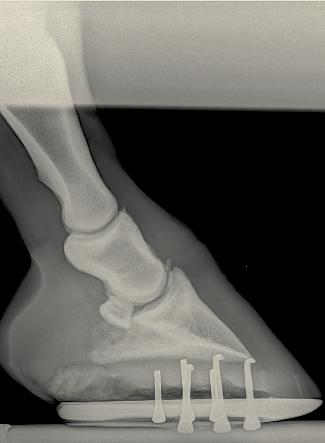
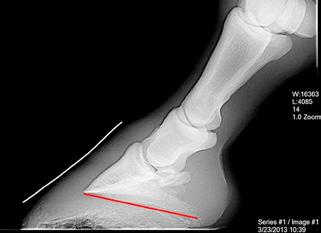
The turning included, of course, an extensive set of x-rays, which revealed that Phoenix has low – in fact negative –palmar angles on his two front hooves.
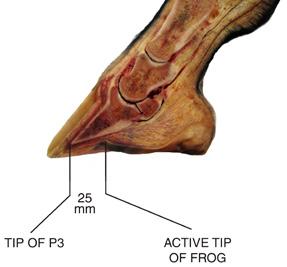
In case you’re not aware, the triangular bone inside the hoof is known as the distal phalanx, or P3, or the coffin bone, or the pedal bone – just to confuse you! In the front feet, the two corners of the coffin bone that are closest to the heels are known as the palmar processes, and in the back feet the plantar processes.
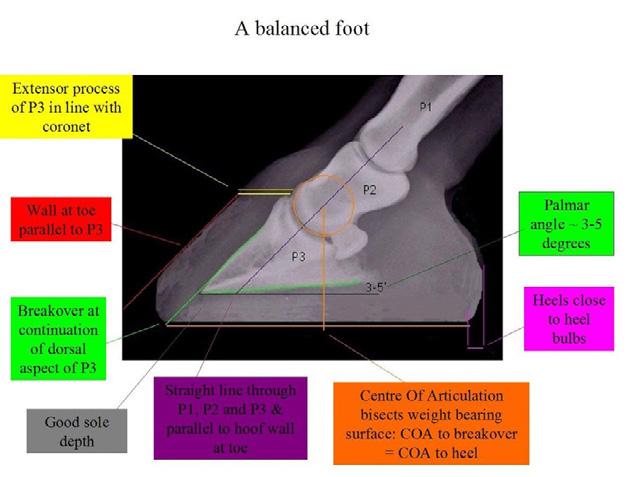
Ideally, when viewed from the side in a an x-ray the lower perimeter of the coffin bone should be positioned
An
of Phoenix’s hoof.
so that the heel end is slightly higher than the toe end of the bone, up to about 5º. This allows the back of the bone to drop at the same time as the heels of the hoof capsule expand when the horse is moving.
In some horses the coffin bone has repositioned itself so that the palmar or plantar processes are too low, and may even lie below the horizontal plane. This is known as ‘low palmar angle’ in the front feet and ‘low plantar angle’ in the back feet, and may occur in either the fore or hind feet, or sometimes in all four feet.
The resulting excessive pressure on the joints, and the fact that the bottom three joints of the leg (P1, P2 and P3)
are not in alignment, creates structural discomfort throughout the body as the horse tries to adjust to the pain coming from its hooves. The condition can often account for a stiff or uneven gait, or a reluctance to trot is noticeable when there’s no obvious answer for it. (Tip: watch for a horse that places its toe on the ground first rather than its heel.)
So what can you do if you suspect this might be the case with your horse? The first thing you could try is to place a folded face-cloth on the back of your horse’s hooves, secure it with duct tape around the hoof, and see if this makes an immediate difference to your horse in terms of its comfort when it’s walking or trotting. If it does, then you’re probably on the money,
which means you will need to actually spend the money to get the x-rays done because it’s very important to know at what degree the low palmar or plantar processes are lying.
An obvious next step is corrective shoeing – with shoes that have a wedge in them of usually between 1 to 4 degrees. This takes pressure off the front of the leg through the P1, 2 and 3 joints, and can offer your horse huge relief. But there is increasingly a school of thought – not unknown throughout the world of farriers, vets and more holistic horse practitioners - that long-term use of wedges can be detrimental in itself, causing the unsupported frog to sink or prolapse down between the wedged heels,
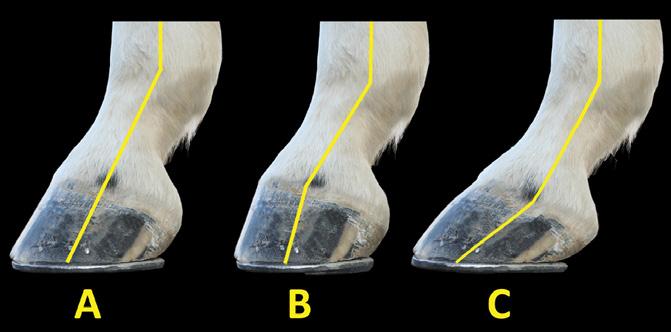
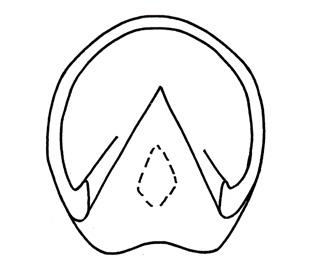
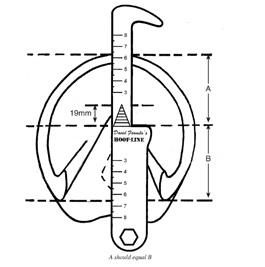
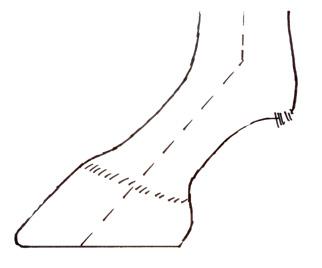
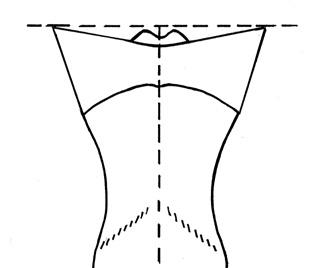
ABOVE: A) Aligned foot, B) Club foot, C) Negative palmar angle (Image courtesy The Essential Hoof Book).
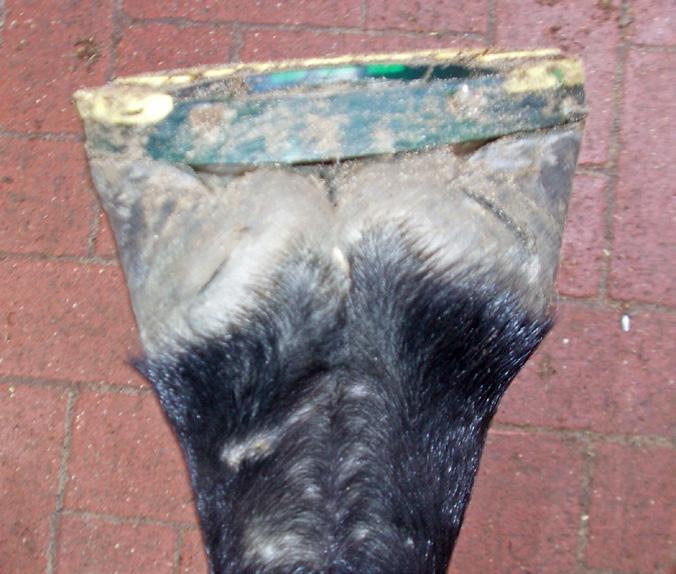
RIGHT: Example of a negative hoof angle.
BELOW: A balanced hoof.
which, in the long-term, can actually worsen the structural weakness.
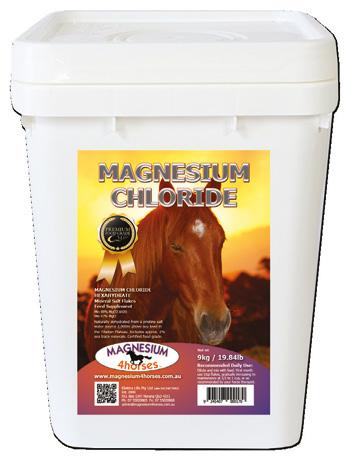
One interesting thing that all the research points to is that just as in humans whose physical bodies are put under stress, the horse with this condition has a MUCH higher need for magnesium, and if you haven’t discovered the miracle of magnesium for your equine companion (and even for yourself) I would suggest a trip down the Google rabbit hole.
What researchers have found is that, in the same way humans respond to orthotics, horses given boots to wear with foam wedges inserted into them, for four-to-five hours a day gradually increasing until they are wearing them all day, and with a maximum dose of magnesium given daily, often begin to self-correct.
Boots with a soft or elasticated heel area are apparently ideal because the raised wedge pads will place the heel bulbs higher up within the boot. Be warned that boots that fitted when the hoof was flat on the ground may not fit when wedge pads are inserted.
Once the feet and body are pain-free, the horse can begin using its feet more normally, including striking the ground with the heels first, rather than the toe, which is what horses with low palmar or plantar angles will do to avoid the pain. Correct movement in turn stimulates development of fibrocartilage, gradually creating a stronger and more functional back-of-the-foot.
Low palmar or plantar processes can be
genetic, or caused by too much pressure on joints through exercise when a horse is too young and their bones have not yet formed properly, or by soft or stringy laminae in the hoof.
It’s not the easiest condition to diagnose, and it’s not the easiest to treat, but –and it will be interesting to see, since this is the way Equus has decided to go long-term with Phoenix – there are reports that the magnesium given daily and ongoing, and the wedges in boots can make a big difference over a period of time, sometimes short, sometimes longer depending on the angle needed to correct the condition, the age and condition of the horse.
We’ll let you know how Phoenix goes. At his young age, it’s well worth taking the time to try and correct this problem for him.
As well as from our farrier, vet and other practitioners, much of the material in this article was sourced from: www.gravelproofhoof.org
Candida Baker has a Facebook Page: www.facebook.com/TheHorseListener1/ and is the President of Equus Alliance: www.facebook.com/equusalliance/
Feeding before breeding
Knowing how and what to feed your mare can have a huge impact on whether or not you breed from her successfully. LEISA HOFSTETTER offers some expert advice on the subject.
In mares, there are several ways in which nutrition can affect important aspects of reproduction, including the regularity of reproductive cycles, fertility and conception rates. Some of these nutritional considerations are to do with the energy and vitamins supplied by the diet, and the action of certain compounds in feeds on the hormones involved in the reproductive cycle. It is important to remember that each mare is different, and will therefore have different needs.
The condition of mares during the breeding season certainly plays a role in conception rates. The best way to assess any horse’s condition is with the help of the Hennecke Body Condition Score system. In this system, the
distribution of fat, or lack thereof, around certain parts of the body is assessed to help achieve a more reliable overall idea of the horse’s condition. The overall condition is then assigned a score from one to nine. Using this system, the ideal condition score for a horse would be around four to six. The best fertility and conception rates for mares are achieved at a condition score of around five.
Mares with a body condition score of less than five have reduced fertility rates for a few reasons. Horses are of course seasonal breeders, which means most mares will only come into heat at a certain time of the year. During the
A horse with 24/7 access to fresh grass will usually have most if not all of their Vitamin A and E needs met.
FACING PAGE: It’s important to make sure your mare’s dietary needs are met prior to breeding.
breeding season, a mare will continue to cycle through ovulation like a human does, unless they have managed to conceive. Between the breeding season (oestrus), and the off season (anoestrus), there is a period of transition in which the mare will behave erratically and will stand for the stallion, but often will not conceive. The tendency not to conceive during this phase makes the transition period an undesirable time to breed your broodmare. Thin mares, with a condition score of less than five, tend to have a longer transition period, reducing the length of the breeding season and reducing opportunities for conception. In addition, the conception rate for mares with a condition score lower than five is decreased, even in the peak of the breeding season.
Mares with a body condition score higher than five also have decreased reproductive performance. Overweight mares tend to have longer periods of time in between coming into heat (oestrus). This essentially decreases the opportunities for conception during the breeding season. They are also more likely to have cycles in which ovulation does not occur due to anovulatory follicles (follicles that never release an egg), which further decreases the chances of conception. This is a huge missed opportunity – but that’s not all. Overweight mares are also more likely to have pseudo-pregnancies.
When feeding mares prior to breeding, it is important to make sure that their dietary needs are met. Malnutrition does not only adversely affect their chances of conception, it can also lead to early embryonic death (early pregnancy loss). Certain feed components such as vitamins and the quality of protein in a mare’s diet may make the difference between a fertile mare and one that’s sub-fertile. Though there is scarce research on the effect of specific proteins on the reproductive performance of mares, research done
These compounds mimic the hormone estrogen, which plays a crucial role in the eproductive cycle of both mares and humans.
with animals such as rats indicates that a deficiency of the proteins needed for growth and maintenance will negatively affect reproductive performance.
The vitamins that have an impact on a mare’s fertility are those involved in the hormones that play a role in the mare’s reproductive cycle. The main vitamins are A and E. Vitamin A in particular plays a huge role in reproductive hormones, so a deficiency or oversupply can definitely have an effect on reproductive performance. Supplementation with Vitamins A and E is only beneficial in a fertility sense if the mare was deficient in the first place. Besides this,
supplementation for every mare is not always the best approach, as oversupply can have just as detrimental an effect as undersupply.
Usually, a horse that has 24/7 access to fresh grass will have most if not all of their Vitamin A and E needs met. If fresh grass is not available, or is limited, Vitamins A and E may need to be supplemented. It is important to assess a broodmare’s diet to determine if supplementation is required. Your equine nutritionist can assist you with this assessment and design a ration for your broodmare that best suits her needs.
A mare’s reproductive cycle is actually the result of a complicated balance of hormones. For each stage of the cycle to occur normally, many different hormones are required at precisely the right levels. Knowing this, it’s easy to see why foods containing compounds that cause an imbalance in any of the hormones involved in the reproductive cycle will also affect a mare’s fertility.
A prime example of a component in feed that might impact fertility is a group of compounds called phytoestrogens.
These compounds mimic the hormone estrogen, which plays a crucial role in the reproductive cycle of both mares and humans. In order for the right things to happen at the right time within the mare’s reproductive cycle, estrogen levels must fluctuate - so there are parts of the cycle in which the estrogen levels are low and parts in which the levels are high. If a mare is consuming enough phytoestrogens to alter the normal levels of estrogen, the action of estrogen will not be what it should during that particular part of the reproductive cycle and irregularity will occur, essentially having a negative effect on fertility.
Phytoestrogens and other factors that affect the regularity of the oestrus cycle are a particular problem in the breeding season’s transition period. This is when irregularity of the reproductive cycle will have the most profound consequences. Some feeds commonly fed to horses contain phytoestrogens, but not all types of phytoestrogens will cause problems for mares. The phytoestrogens found in soy and clover are called isoflavones, and according to research, these will not disturb the mare’s reproductive cycle. However, the phytoestrogen coumestrol, which is found in lucerne hay, has been shown to have a negative effect on the reproductive cycle of mares by decreasing their fertility rates.
In summary, feeding broodmares the right feeds for their individual needs can assist in regulating reproductive cycles and improving fertility and conception rates. Your equine nutritionist can help you to develop the best feed program for your broodmare this breeding season, not only improving her ability to conceive, but also helping to make for a healthier, happier horse.
Leisa Hofstetter holds a Bachelor of Equine Science and specialises in equine nutrition. Find her on Facebook at Hof Equine Health and Nutrition, or email hofequine@gmail.com
Be sure that the hay you feed your mare will support her fertility rather than decrease it.
FACING PAGE: A healthy well-nourished mare is more likely be fertile, and to produce a beautiful foal.
B-COMPLETE BY BANANA FEEDS AUSTRALIA- THE GUT HEALTH REVOLUTION
Banana Feeds Australia has developed ‘B-Complete™, Nature’s Elite Equine Supplement’.
100% Australian owned, 100% Australian made, and a family business, Banana Feeds Australia has made waves within the equine supplement market in a truly short time. A 100% natural supplement focused on Equine Gut Health, and indeed a world first has resonated with the masses.
The patent protected product, consists of whole dried green bananas, including the skin, the pulp, the stem and the flower ends, and horse owners across the country are expressing disbelief about the positive results they are seeing.
WHY GREEN BANANAS AND WHY B-COMPLETE™?
Green bananas have long been the subject of intrigue, from use in the Sydney Olympics, to consumption in space, but with correct dosages of B-Complete™ the true benefits become obvious.
EQUINE GUT HEALTH -The health benefits that derive from supplementary feeding of dried green bananas are broad and include:
Green bananas have been shown to have antiulcerogenic properties, an
area widely accepted as needing a solution in the equine industry, other than expensive medications.
The insoluble fibre act as prebiotics to favour the nourishment of microflora in the gut (particularly the hindgut) to stabilise the microbiome.
This stability in the gut promotes immune competence allowing horses to counter bacterial, fungal, viral, or parasitic challenges whilst also improving digestion, feed utilisation and temperament. Other reported benefits include: Antimicrobial, Hypoglycemics, and Anti-lithiatic (prevent kidney stones).
GENERAL WELL-BEING Active compounds like dopamine, norepinephrine and serotonin all act to calm the animal and promote a sense of well-being, helping to make the animal more relaxed and easier to manage.
ANTIOXIDANT CAPACITY Green banana is recognised as antioxidant rich, with a wide spectrum of antioxidant compounds (phenolics, carotenoids, ascorbic acid or Vitamin C, tocopherols or Vitamin E, dopamine, flavonoids, norepinephrine) which are primarily located in the peel. All improve gut health.
“B-Complete is widely used in our stable. It has had a profound impact on the performance of our horses. I consider it a game changer. Our horses are working better, performing better, getting better results - particularly the ones we know are ulcer-prone. Very happy.”
- David Tootell
“Since I have been using B-Complete, our racehorses have better gut digestion, are healthier & maintain their condition easily. Their coats are amazing. We also found it extremely beneficial for highly-strung horses, making them safer and more manageable.”
- Rob Wilkinson
The story behind a stellar brand
It is not by chance that Wendy Keddell has developed a breeding formula that’s producing internationally successful show jumping champions. GEOFF McLEAN of Gone Riding Media spoke to Wendy and dug deep to discover more.
Located on New Zealand’s North Island with views of the historic harbour city of Tauranga, Mount View Stud, owned by husband and wife team Richard and Wendy Keddell and operated by Wendy, is internationally renowned for producing world class show jumping champions. Eldorrado, Carrado, Miranda, Lincoln and other Mount View horses, all bearing the stud’s MVNZ brand, are making their mark in Australia, the United States, Asia, and across Europe.
As a young woman, Wendy, a Tauranga girl born and bred, moved to Australia to study physiotherapy at the University of Queensland. It was ten years before she returned to New Zealand to pursue her career, marry and raise a family. But what brought about the leap from physiotherapy to breeding world class sport horses?
It turns out back in the day, Wendy’s father owned two Standardbred stallions which stood at an Auckland stud. She would often stay at the stud, helping the knowledgeable old stud manager foal down mares - an experience she holds dear to this day, and one that would ignite her fascination with breeding.
When Wendy’s young daughters
developed an interest in horse riding and show jumping, she quickly recognised a need for better horses. At the time, most jumping horses in New Zealand were Thoroughbreds, Thoroughbred Clydesdale crosses, Anglo Arabian derivatives, or station-bred horses. But were these the best options?
Wendy began to research other possibilities – quickly arriving at European bred Warmbloods, specifically Holsteiners. Clearly, here was an opportunity to significantly improve the quality of show jumping horses in New Zealand, but there was a problem: Wendy had never been
to Europe and had no experience with Warmblood horses.
But as fate would have it, she was introduced to an equine veterinarian interested in bringing Warmbloods to New Zealand. He asked Wendy if she’d like to import some mares, but with six young children at home at the time she thought: “Go to Europe import mares and start breeding – a really bad and stupid idea!”
However, after six more months of research with her veterinarian friend and two local riders, Phillip and Sally Steiner, it was decide that the Steiners
would go to Europe on a shopping trip.
After a lengthy search and much discussion with Wendy, a purchase of three three-year-old mares, Sereedom, Seremonie and Solette, and Senator, a stallion, was finally made from the VDL Stud in the Netherlands. Another mare and stallion, seven-year-old Charming Princess and five-year-old Pico Bello, were subsequently purchased in Belgium.
The horses arrived in New Zealand in 2002, and when the three mares produced foals - Whittaker, Wimbledon and Wembley - Wendy’s aim was to train and compete the youngsters to prove her theory that Holsteiners were
the breed show jumping needed. The Belgium bred horses were older and began competing when they arrived. Both proved to be outstanding jumpers, taking out many major competitions including the Olympic Cup, the prestigious Norwood Gold Cup, plus many Grand Prix wins and placings.
And the trio of foals? They were standouts. During a very successful 2010 season, Whittaker won the seven-yearold series and the seven-year-old Horse of the Year title, while Wimbledon won the Horse of the Year and the 1.30 championship title. Both were sold overseas and went on to compete very
successfully in the USA and Asia.
As Wendy studied her imported horses’ bloodlines, she realised that most had their foundation lines in Holstein, Germany. She decided to visit the region as soon as was possible. The opportunity arrived in 2006. After attending the World Equestrian Games in Aachen and the famous Bundeschampionate horse show, Wendy and Richard travelled to Holstein to visit some of the old farm breeders: Harm Thörmalen (Capitol and Capitano) and Hermann Claussen (Cassini I and II) also Hobe Bernhard (Cabrio, Crawford, Corofino I and II), Timm Peters (Concerto I and II, Casario I
MAIN: Izabella Stone and Lincoln MVNZ competing in the 2020 Australian Jumping Teams League.
FACING PAGE: Wendy Keddell at the 2019 Australian Jumping Championships (All images by Geoff McLean, Gone Riding Media).
Horselines
and II, Concept, Cisco and Quick Nick).
While there, Wendy noticed that rather than keeping stallions, all these breeders had strong mare families. She was inspired – and over the next six years imported five more Holsteiner mares. With these foundation mares came the potency and genetic critical mass of the great European stallions - Nimmerdor (Dutch stallion of the 20th Century), Landgraf I (Stallion of the Century), Cor de la Bryere (Reserve Stallion of the Century), and Capitano. Those bloodlines were also evident in the original VDL imports Sereedom, Seremonie, Solette and Senator, Wendy’s much loved stallion.
So what is critical mass and why is it important? It’s when superior genetic traits become so concentrated over four to six generations that quality horses are regularly produced.
Without realising it, Wendy had inadvertently stumbled across the methods practised by Frederico Tesio, the famous 19th Century Italian master Thoroughbred breeder. Tesio rarely
kept a stallion, choosing instead to focus on broodmares carrying specific bloodlines. Whilst Tesio never shared his secrets, analysis of his methods has revealed a seven step process:
• Research pedigrees.
• Establish a breeding goal and determine which bloodlines will help you achieve it.
• Line breed: ensure the presence of an ancestor occurs twice or more in a horse’s pedigree with at least one strain present from each parent
• Balance the bloodlines: find a mate among the daughters and sisters of your good male lines, or the brothers and sons of the female lines.
• Consolidate the bloodlines by engaging the background strength of the pedigree.
• Bring in siblings: full if possible, or 7/8, 3/4, 5/8 or ½ (statistics show that full or 3/4 siblings send the genetics into high gear).
• Repeat the process to ensure the best outcomes in the progeny.
Wendy’s breeding program is a process of understanding, matching and complementing the ‘soft characteristics’ of both the mare and stallion to produce sound, trainable, resilient, athletic and rideable horses.
But there’s more to Wendy’s formula. She believes each young horse is an individual and should be treated as such, while at the same time receiving solid foundational training. Long before going to the breakers, Wendy’s foals have good ground manners and are accustomed to being handled.
It’s this shared philosophy that has helped forge a productive partnership between Mount View Stud and Glenwood Park (owned by Brook and Angela Dobbin) in Victoria’s Yarra Valley. At Glenwood Park, each individual horse’s temperament, as well as their mental and physical maturity, is assessed before work with them begins. “Brook and Angela are thoughtful, compassionate, yet have exacting standards. My horses are
Brook Dobbin and MVNZ Carrado competing at the 2020 Boneo Classic.
Angela Dobbin and Gabrielle MVNZ in the Open 135cm at the 2020 Boneo Classic.
Lincoln MVNZ
Seerdom VDL
Senator VDL
Seremonie VDL
Solette
BELOW: Brook
all very happy and relaxed in their care. In return they learn quickly and perform well,” Wendy explains.
Wendy’s diligence and thoughtful breeding is clearly evident in the stunning 16.2hh stallion Lincoln MVNZ.
Paired with Australian rising star show jumper Izabella Stone for the past two years, the partnership came about after Angela Dobbin showed Izabella a video of Lincoln. A trip to New Zealand for a test ride followed, with Izabella quickly realising Lincoln was indeed something special. She was equally impressed with his impeccable breeding, especially the mare line. The pair has since successfully progressed to 140-150cm classes, but unfortunately have had their first World Cup jumping start, as well as their Jumping with the Stars campaign put on hold due to COVID-19.
Looking to the future, Wendy’s goal is to travel to Europe every two years to keep a close eye on developments. With jumping undergoing rapid changes there - the European competition is fierce and the courses are tough and technical – riders can’t afford to put a rail on the ground. Consequently, the horses she breeds will need to
be adaptive, athletic and resilient.
On a personal level, Wendy and Richard have just celebrated 35 years of marriage. They are an active couple, both love hiking and cycling, and love cooking, but it is Richard who stars in the kitchen. According to Wendy, her favourite dish that Richard prepares is: “His duck in orange sauce on a bed of kumara with a side of bok choy.” And now their six much loved children are all adults with successful careers of their own, there
have been additions to the family joy in the shape of four grandchildren, with hopefully more on the way!
Where to next for Wendy? Her dream is for her horses to reach the very top in the world of show jumping, including Olympic Gold. There’s no doubt her current horses have the potential to deliver. On a day-by-day basis her focus remains on breeding the best of breed: sound, reliable, resilient, rideable, sport horses.
From a breed improvement perspective, Wendy continues her research into generations of bloodlines, looking at specific couplings and the resulting progeny to see whether they’re a match for the athleticism, temperament, trainability and resilience she seeks to establish through her own breeding program. As she succinctly points out: “You can’t just say let’s make a baby from this dam and this sire because they are champion jumpers” – it doesn’t work that way.”
But thankfully, through her research and by tapping into the knowledge of the old Holstein farm breeders, Wendy has learned a way that frequently delivers champions!
Visit Mount View Sport Horses at mvnz.co.nz/horse-stud
Brook Dobbin and Gina MVNZ in the 140cm at the 2020 Boneo Classic.
Dobbin piloting Miranda MVNZ to victory in the 2019 Future Stars Class at the Elms World Cup.
helmets
Value your head! You only have one and damage to it can result in life changing consequences.
KRISTEN FLEET takes a look at what’s what in the protective headwear department.
When I was a child helmets were never compulsory, nor was wearing them enforced at any of the riding schools I attended in the early days. When I think of some of the stupid things I used to do on my pony, I am amazed I have a head left at all!
As equestrian sports became more competitive (think harder and faster), more schools, trainers, and mothers, recognised that helmets were a necessity rather than an accessory! It wasn’t long before peak bodies across most riding disciplines included the wearing of helmets in their competition rules. But not just any helmets. These
helmets had to comply with the most recent safety standards, and as designs and standards improved, the rule books were updated to reflect those changes.
Helmet history trivia
Protective helmets in one form or another have been around for hundreds of years. The ancient Greek and Roman armies did battle in protective headwear, and the word ‘helmet’ is itself derived from ‘helm’, a medieval term for protective combat headgear. Jump forward a century or two to 1911, and Englishman Charles Owen, driven by a desire to ‘make products for a safer world’, began manufacturing cork helmets for the
military. By 1928, the cork helmet had been given a hard exterior shell and was reborn as a motorcycle helmet. Ten years later and the first horse racing helmet was developed, changing the equestrian world forever.
Current Global Standards
Many equestrians were taken by surprise when in 2016, Equestrian Australia (EA) announced that new safety standards for helmets would come into force from 2017 onwards, and in order to compete in any EA event, a rider must wear an approved helmet with the chin strap fastened at all times (of course, this is recommended whenever you ride a horse). But how do you know if your helmet complies with the standards?
Because helmets are imported from a number of different countries, the EA rules list several globally recognised standards, and at least one of them should appear on the labelling inside your helmet:
• Current Australian standard AS/ NZS 3838 (2006 onwards) provided they are SAI Global marked.
• New Australian standard ARB HS 2012 provided they are SAI Global marked.
• Current American standards ASTM F1163 (2004a and any subsequent updates) provided they are SEI marked.
• Current American standard SNELL E2001 (and any subsequent updates).
• Current British standard PAS 015 (1998 or 2011 and any subsequent updates) provided they are BSI Kitemarked.
• Interim European Standard VG1 (01.040: 2014-12) with or without BSI Kitemark.
(See our sidebar for more info on standards and markings.)
Protect your head
Helmet manufacturers usually
recommend replacing your helmet every five years, but if you’ve had a hard-blow impact accident, you should replace your helmet immediately - and there’s a very good reason for this.
The part of the helmet that protects your head is the liner. Usually made from high grade polystyrene, it’s a bit like microscopic bubble wrap. The liner itself is protected by a hard fibreglass or plastic exterior. If you have a fall, the exterior shell diffuses the impact while the liner reduces bruising to your brain by increasing the length of time it takes for the shock to reach your head, thereby lessening its intensity. During this process, layers of bubbles actually burst - and if the impact is hard enough, the liner will collapse. And that’s why if your hat has been subjected to a severe impact, including being dropped on a hard surface, it should immediately be replaced.
So which helmet should you buy?
There’s a wide variety of safety standard compliant helmets on the market for both adults and children. The price can range from around $65 to over $1,000, and when it comes to styles, colours, and fabrics, you’ll be spoiled for choice. Knowing what you’re looking for from the point of view of safety standards is essential, but after that, the fun begins!
Kaminski Fur Felt Top Hat $275.00 (Image courtesy Equestrian Online).
That said, accepted styles vary from discipline to discipline, and are also dependant on the level at which you’re competing, and on whether you’re showing under a breed society or in costume.
Some disciplines, dressage for example, are very clear about the style of headwear approved for competition, but eventers, endurance and pleasure riders have a myriad of options, including helmet covers in an array of colours and prints, reflective covers for night riding and novelty covers. There are
Troxel Liberty Cobalt Gloss $134.95 (Images courtesy Just Country Australia).
Troxel Rebel
Turquoise Rose $159.95.
Troxel Avalon Rose Gold $219.95.
Troxel Fallon Taylor Lavender Chevron $209.95.
Troxel Sierra Brown Rugged Nylon and Distressed Leather $279.95.
LeMieux Pom Pom Hat Silks are available in a range of great colours $49.95 (Images courtesy Ashbree Saddlery).
Newcastle Hats Australian-made Horse Riding Brims protect against the sun. The rear neck flap is optional (Image courtesy SunSafe Australia).
even stylish helmets available for western and stock riders who have traditionally worn a cowboy or stockman’s hat.
You might be a traditionalist who opts for velvets and simple styling, or you might prefer the modern look of a ‘skunk’ helmet with its decorative ventilation strip running down the centre. And if bling’s your thing, you’ll love the crystals and reflective laser or placement prints offered by many helmet manufacturers. Some companies also offer personalised designs, embossing and logo treatments for a truly individual look.
But before you get totally carried away, here are some discipline orientated points to ponder:
DRESSAGE
All riders competing in an EA dressage competition must wear an approved safety helmet with the chin strap fastened. Riders 26 years and over, riding Prix St Georges and above, have the option of wearing a top hat. As a dressage rider, you don’t have many choices regarding the colour of your helmet, which should match the jacket colour you’ve selected from EA’s list of acceptable colours. However, you could always break out with a touch of bling!
SHOWJUMPING
It’s compulsory for all riders competing at EA showjumping events to wear approved and properly
fastened protective headgear with a three point retention harness at all times when mounted.
EVENTING
Event riders must wear properly fastened protective headgear at EA or FEI events in Australia. Obviously the helmet should comply with the approved standards, but as of January 1st 2020, your helmet must also be tagged with a current and visible EA helmet tag to show that the helmet has been inspected and has been found to comply with the required safety standards.
Some eventers like to stand out from the field with helmet covers in their own stable colours or in a personal design. Covers are readily available in a wide array of styles, colours and prints, and can easily be removed for the dressage and show jumping phases. For eventing, a sturdier cradle or harness is used for the chinstrap and it should be worn tight to ensure the helmet stays put!
ENDURANCE
There are quite a few popular styles for endurance riding. You should look for one that’s lightweight, super breathable, and able to withstand extreme conditions. These types of helmets are making their way into mainstream riding, and are especially comfortable in warmer or more humid climates. Endurance riders can also make use of lightweight waterproof visors which fit easily over the helmet for extra protection. Many
Low Profile Schooling Helmet
FEATURES
Fit System: DialFit™
Headliner:
+ Removable and washable
+ FlipFold™ fit adjustment
+ Air-Channel technology
Ventilation:
Mesh covered vents
Certification:
ASTM/SEI-certified
Sizes:
S (53 - 56cm)
M (56 - 58cm)
L (58 - 59cm)
Kask Star Lady Swarovski on the Rocks Helmet $1,949.
endurance helmets have reflective tape for safe riding at night, as well as a three point harness or chin strap for added comfort and stability.
WESTERN/STOCKHORSE – TRAIL RIDING
There are few innovations in this space. However, some manufacturers have come up with a helmet and removable visor combination which still looks like a cowboy/stockman’s hat but is also a safety helmet. If required, the visor removes easily, and the hat can be used both in competition and for pleasure riding. These helmets are
The skinny on STANDARDS
If reading through the standards leaves you more confused than clear, let’s take a moment to break it down.
The markings referred to in each of the standards approved by Equestrian Australia (EA) are quality compliance marks. Your helmet label should include the wording of at least one of the EA approved standards, along with the required mark.
Each of these marks represents the organisation responsible for not only auditing manufacturers to ensure the prescribed safety standards are met during the manufacturing process, but also for rigorously batch testing
available in adult and children’s sizes and some have adjustable ratchets on the inside to ensure a snug fit.
But there’s more
Once you’ve chosen your safety standard compliant headwear, you might want to consider a helmet cleaner and conditioner, or a polish for outer polycarbonate shells. There are anti-odour and anti-microbial sprays for the inside lining and removable padded strips to help you customise your fit. Helmet covers and travel cases are also available to keep your investment clean and safe.
helmets to check that the finished product complies with the standard.
SAI Global: the five ticks in their symbol represent the Standards Mark for the Quality Assurance Scheme of Australia.
SEI: refers to the Safety Equipment Institute where helmets are tested to ensure they’re manufactured to either meet or exceed ASTM standards.
Kitemark: is the mark of the British Standards Institute (BSI). The overall look of this compliance mark can vary depending on your helmet’s year of manufacture. But no matter what the year, if your helmet is BSI approved, this symbol will appear as part of the mark:
And just in case you were wondering about the letters that appear as part of
Since the 1930s, helmets have come a long way with regards to function, fit and fashion, and are continuing to evolve as more high-tech and innovative materials are developed. There’s never been a safer time to be an equestrian!
Please note: the safety standards listed in this article were sourced from Equestrian Australia’s (EA) website: www.equestrian.org.
au and were correct at the time of writing. However, the standards may change to reflect ongoing improvements to safety headwear.
each standard, AS/NZS refers for the Australian and New Zealand Standard, while ARB HS is the Australian Racing Board Helmet Standard. ASTM stands for the American Society for Testing and Materials, SNELL is the standard developed in America by the Snell Institute, and PAS is the Product Approval Specification developed by the British Standards Institute (BSI). As for the Interim European Standard VG1, search as we might, we could not discover what VG stands for! Nonetheless, we hope that by now those strangely worded standards aren’t such a mystery!
Kask Star Lady Helmet $899 (Images courtesy Kentaur Australia).
KEP Como T Helmet $819.
Photographer: Ashley Grant @theblachat
Kentaur Australia is the thought-child of Lucy Galovicova, an equestrian entrepreneur from Slovak Republic.
Originally an agent for wellknown and highly regarded European brand KenTaur, the business has now grown into far more. As well as KenTaur, we now co-operate with numerous other international equestrian brands; House of Montar, Cavalleria Toscana, KEP
Italia, KASK, Lorenzini, FairPlay and more.
Kentaur is a well-known and respected supplier of high quality, sought after brands and has cultivated a market of satisfied consumers not only in Australia but worldwide.
We aim to provide variety and quality to the equestrian customer, with free shipping available worldwide and numerous interest-free finance options.
AROUND THE TRAPS
ABOVE: Dean Morris riding Belrock Nadal at the NSW State Championship (Image by Jessica Kennedy).
BELOW LEFT: Olivia Hewitt-Toms and Gypsie Queen competing at the 2019 North QLD Showjump Club Day (Image by Peter Collins).
BELOW RIGHT: Tasha Voss with Trick or Treat, looking the part for an online show ring styling photo competition (Image by TJV Photography).
The land of ice and fire
Defined by its volcanoes, glaciers, geysers, hot springs and lava fields, KRISTEN FLEET has already added an Icelandic holiday on horseback to her bucket list.
ANordic island nation, Iceland is renowned for its dramatic landscapes and wealth of unforgettable attractions, many of which run all year round: from nature and wildlife walks, whale watching, music festivals, and incredible restaurants, through to more extreme adventures such as glacier hikes, snowmobiling and cave diving. If you are very lucky you may even see my favourite bird, the Atlantic Puffin.
Most of the population lives in the capital, Reykjavik, which runs on geothermal power and is home to the National Museum of Iceland and the Saga museum, where you can explore Iceland’s intriguing history, interwoven as it is with epic tales of Vikings and the unique Icelandic horse.
Immortalised in Norse mythology, the Icelandic horse (and despite its somewhat diminutive size, it’s never referred to as a pony) can be traced all the way back to the late 9th Century when Vikings arrived on the island’s shores. With them they brought horses of mostly Germanic descent – horses that proved to be indispensible to early settlement and have served the human population faithfully ever since. These horses were vital to all aspects of life, transporting people and goods across glaciers and inhospitably rugged terrains in all kinds of weather. Although their role has changed quite dramatically in the last 100 years, they are still an important part of Icelandic culture, and experiencing Iceland on horseback is truly an adventure of a lifetime.
Today, the Icelandic, as it’s commonly referred to, is known for being surefooted, and despite their pony-sized stature, exceptionally strong, agile and with huge personalities. They’re friendly, quick to learn, usually very easy to handle, and cooperative both on the ground and while ridden.
Interestingly, they are a so-called gaited breed, meaning that in addition to walk, trot, canter and gallop, they have two extra gaits: the tölt and the skeið, also known as the flying pace. By lifting only one foot at a time, a tölting horse can keep the rider comfortable over considerable distances, so there’s no need to worry about booking a two, three (or possibly more) day riding tour if you haven’t been in the saddle for a while. The tölt is so comfortable and relaxing you’ll want to take an Icelandic home with you! Their other pace, the skeið, is fast and smooth, with some horses able to reach up to 50 kilometres an hour. It’s not a gait for long-distance travel, but it is something you might want to experience.
Horse riding is a great way to explore any country and Iceland’s unspoiled panoramic landscapes certainly won’t disappoint. There are many different riding tours on offer, many of which are only a few minutes outside of Reykjavik. The tours suit all levels of experience and can last anywhere from a half day to nine days. For obvious reasons, some riding tours may not be offered during winter, but to be absolutely sure, check with your chosen tour operators.
General tips
Australian citizens do not require a visa if their visit is for 90 days or less. You’ll fly into Keflavik International Airport, located on a peninsula around 50 kilometres south of Reykjavik, with flights from Sydney taking approximately 22 hours.
The Icelandic currency is the króna (sometimes called the Icelandic crown), but the card is king with cash
rarely used even for tipping. Although English is widely spoken, it always helps to learn a few words relevant to your riding holiday. You never know when ‘Hér er gulrót vinsamlegast ekki peninga’ (Here is a carrot, please don’t buck) might come in useful!
Doing your pre-trip research
There are so many tour options and so many extraordinary things to see and do, extensive pre-trip research is a must. Most horse tour operators allow you to book in advance, which is advisable, particularly if you’re planning to visit during the height of the season. Weatherwise, from May through to August you can expect pleasant temperatures and long days. April and September are reasonable alternatives
with decent weather, shorter days, fewer visitors, and cheaper prices.
Where to go
With so many different tours available, you’re likely to find making a decision quite difficult - so here are a few suggestions to get you started:
Fosshestar: One of the newest tour operators is Fosshestar, which translates to ‘Waterfall Horses’, the perfect name for a company close to the river Fossá (Waterfall River) and Lake Fossavatn (Waterfall Lake).
Located in the beautiful Engidalur Valley, just five minutes’ drive from the town of Isafjordur in Iceland’s Westfjords region, Fosshestar specialise in short riding tours designed for
FACING PAGE: The land of fire and ice (Image courtesy Unsplash).
beginners and the inexperienced, but advanced riders are also welcome. The guided tour meanders through the Engidalur Valley, with its majestic mountains and abundance of rivers and waterfalls. At the bottom of the valley you’ll find the Fossavatn, Isafjordur’s first hydroelectric power station. But while that might sound a bit industrial for the average nature-lover, don’t worry! With sheep roaming free throughout the valley, extraordinary birdlife and beautiful scenery, you’re guaranteed a wonderful experience.
Fosshestar provide all the equipment you’ll need, including helmets (a non-negotiable requirement), and offer a variety of delightful accommodation options. Plus, the
welfare and care of their horses is a top priority - good to know.
And so you can share your adventure with the folks back home, Fosshestar will send you a film and photos of your tour within two weeks of your visit.
Íslenski Hesturinn: Translating to ‘Icelandic Horse’, this is a horse rental and tour company located
enjoy a summer’s evening ride across a scenic lava landscape complete with pseudo craters and mountain views? Alternatively, there’s the Horses and Spa package that yes, offers scenic landscapes and the opportunity to experience the tölt, but adds to the experience a fabulous spa visit after you finish your ride (we like!).
Viking Horses: This is a family owned
“Don’t call me pony!” The Icelandic may be small in stature, but they’re big on personality (Image courtesy Íshestar Riding Tours).
LEFT: The company’s friendly and the landscape wild and free (Image courtesy Íshestar Riding Tours).
BELOW LEFT: Rugged up and enjoying the ride (Image courtesy Íshestar Riding Tours).
BELOW RIGHT: The very best way to see the countryside (Image courtesy Viking Horses).
just 15 minutes from Reykjavik. They’re proud of their happy horses, high-quality riding equipment, professional service, and the unique riding adventures they offer for small, private groups. Mountains, abundant nature and the not to be missed volcanic red hills of Rauðhólar are all within easy reach of their stables.
Choose their Sleipnir Tour if you fancy
a relaxing, fun morning ride that includes stunning views over mountains, lakes, Reykjavík city and volcanic formations, followed by a light meal. They also offer an afternoon ride, or you might like the sound of their tailor made private riding tours for individuals, closed groups or families.
Íshestar Riding Tours: After running riding tours for more than 30 years, Íshestar’s focus is on exceptional service, excellent horses, a safe ride, and sustainability. Essentially their operation is divided into day tours and multi-day tours. Day tours are run out of their stables in Hafnarfjörður, which is around 15 minutes from Reykjavík and surrounded by lava, lakes, and wilderness. These rides are for beginners to experienced riders and range from one to seven hours in length. Their multi-day tours, which can be up to nine days long, are operated out of farms located all over Iceland. Depending on which tour you choose, you’ll have the opportunity to experience the stunning Icelandic Highlands, volcanos, glaciers, beaches, a traditional sheep round up, or the
magic of the Northern Lights. And if you plan to see the Northern Lights book from September through to March when the sky is at its darkest - but that’s also winter, so you’ll need to rug up.
And finally ...
Many tour companies will help you to plan your adventure and assist with bookings. If you’re thinking of visiting during the May to August peak season, hotels, tours, and flights should be booked many months in advance to avoid disappointment. The colder weather from April through to
September usually means that demand isn’t as high - but don’t leave it until the last minute. Plan your trip and book accordingly! You might even want to consider hiring a camper or car before setting out on a self-drive holiday so you can experience riding adventures in all parts of the country.
But no matter what you decide, you can be pretty sure ég sé þig þar fljótlega (I‘ll see you there soon)!
For more information visit www. fosshestar.is, www.islenskihesturinn.is , www.vikinghorses.is, and www.ishestar.is
LIFE AFTER RACING
MAIN & RIGHT: Jane Gollan, off the track advocate and keen event rider, is excited by her new initiative’s potential (Images courtesy of Andrew Thurtell, Thurtell Photography).
LIFE AFTER RACING
Advocate for off the track
Have you ever wondered how an off the track Thoroughbred is transitioned into ‘civilian’ life? As you may have guessed, it’s quite a process. JO MCKINNON spoke to Jane Gollan to find out more.
Queensland's Jane Gollan is one of Australia's greatest advocates for off the track Thoroughbreds.
Married to Tony Gollan, Brisbane's leading horse trainer, Jane, 36, has been at the coal face of a major stable for many years – and knows how important it is to find suitable homes for horses when their racing careers end.
A keen eventing rider herself, Jane is about to launch an exciting new equine welfare initiative: the Transitioning Thoroughbreds Foundation.
A not-for-profit organisation, the Foundation will begin by focussing on rehoming horses that have competed in the Queensland racing ranks.
"Essentially, we will assess the
horse off the track and get a good understanding of its history both mental and physical by talking to riders, getting vet reports and talking to farriers and dentists," she explains.
Selected horses will then embark on a 12-week training program run by several experienced equestrians including wellknown eventer Kate Drevernan, who used to ride trackwork for Gollan Racing.
"They will be doing everything from de-sensitising to classical dressage training, flatwork, and things that they have not been exposed to as a racehorse such as being hard tied, floating and lunging,” says Jane.
Each horse’s progress will be carefully monitored on a week to week basis. Once they have completed the program, horses will be assessed
to determine which discipline they are best suited to. They will then be adopted out for a low fee.
"The most important part is the marrying of that horse to the most suitable owners," she says, "hopefully they will go into long and lasting homes. We don't look to make money out of it and will trace them for life."
The Foundation initiative was sparked by the ABC's horrific exposé on racehorse welfare in Australia that aired late last year, and Jane is more than enthusiastic about this vital program.
"These horses are so versatile and what we want to get out of this 12week program is to see how they can be placed and find their purpose. If you are dealing with a fairly sound prospect off the track then I believe
you can find a purpose for them," she says. "There's a risk we can't move them on and that's why our system has to be right from the start."
Jane, now a mother of two young children, has been instrumental in a number of off the track success stories. She was responsible for placing LA Confidential, now one of Australia's most successful show hacks.
"He was one that retired with no race starts. He was a chocolate-box goodlooking horse that was liver chestnut and turned heads. You could see straight up he wasn't going to be an eventer and make it in the show ring," Jane recalls.
Another horse that came through the Gollan stable is Staturbo. He was retired at the ripe old age of ten after 68 starts
and is now enjoying camp drafting.
Jane recognises the benefit of Thoroughbreds being exposed to a variety of situations during their racing careers: “It's important that they are handled the right way of course, but if you get a horse that has been there and done that, he doesn't usually turn a hair at anything."
A racehorse called I'm A Ripper, who has been a great flag-bearer for Gollan Racing, earning over $1 million in prize money, will be the first official project horse for the Transitioning Thoroughbreds Foundation.
"I get a great kick out of seeing exracehorses perform. If we want to attract new owners to racing, we have to show that we are doing our bit by the animal. These horses become part of families and if you can make a difference to not just the horse's life but a person's life then that's really special," says Jane.
The Transitioning Thoroughbreds Foundation will be launched very soon so stay tuned. We wish Jane and her team the very best of luck with this great initiative.
TOP: Horses undergo careful assessment before being selected for the program.
ABOVE: New beginnings: learning the ropes.
LEFT: After re-education, OTT Thoroughbreds can go on to enjoy life as safe and sensible pleasure horses. (Images courtesy of Andrew Thurtell, Thurtell Photography).
HORSE BREED
All hail the Anglo-Arabian
From the grandeur of Grand Prix dressage to the stamina of endurance and eventing, the AngloArabian has been a shining star in the equestrian world, as FRANCINE PULLMAN discovered.
Athletic, powerful, fast and magnificent, it’s hard not to fall in love with the Anglo-Arabian.
One of the oldest developed breeds in the world, it has its origins in 18th Century France where the foundation studbook featured the Thoroughbred (hence the Anglo) Arabian cross.
More recently, reports that the true breed is dying out with no original
lineage left has had French enthusiasts scrambling to re-establish the purity of the breed they claim as their own.
Essentially a high level sport horse, the Anglo-Arabian has found its way into endurance, racing, jumping, dressage, carriage driving and cross country. Typically around 15-16hh, it’s a good all-rounder, and thus as equally coveted among enthusiasts
for three-day eventing as it is for endurance and the show ring.
What is an Anglo-Arabian?
The Anglo-Arabian is considered by many to be a superior athlete, exhibiting the endurance and stamina of the Arabian combined with the larger frame and speed of the Thoroughbred.
As an all-rounder, it’s particularly suited to jumping and endurance but is equally impressive in the show ring and dressage arena. Throughout its history, the breed has also been successful in speed events and has been used in the military.
But it’s not athletic prowess alone that makes for a great athlete, even among horses! Temperament contributes to trainability and as you might have heard, the Anglo-Arabian does not always exhibit the Arabian’s milder manners, making it potentially unsuitable for beginner riders. But while not as calm as the cool Arabian, neither is it as hot headed as the Thoroughbred. It is said to be a spirited, smart and sometimes stubborn horse, but also a very willing performer.
Breed standards
While the studbook breed was being refined in France more than a hundred years ago, breeders experimented to find the best cross and discovered that the offspring from an English Thoroughbred mare to a pureblood Arabian was of a better type than that of a Thoroughbred stallion to an Arabian mare.
They also determined that the offspring from a 50/50 Anglo-Arabian mating was less favourable than that of a good Anglo-Arabian mare put to a pure Arabian stallion. French studbook records indicate that the best results occurred when purebred Arabian stallions were put over an English Thoroughbred, with the progeny then bred back to a purebred Arabian to yield 75 per cent Arabian genetics and a top
quality horse. This led to their accepted breed standard: to be registered as Anglo-Arabian, the horse must have 25 to 75 per cent Arabian genetics.
Anglo-Arabian Characteristics
In appearance, the Anglo is an elegant, balanced saddle horse with highly veined skin and fine hair. Any height or colour is acceptable. In profile, the small, fine head may vary from straight to slightly concave, but should not be overly dished. The neck is long and elegant, with a clearly defined poll, matching arch of throat, and a welldefined wither. Their sturdy, compact body is deep-chested, with a short to medium back strongly coupled to long hindquarters and usually a rounded croup. With good bone structure and strong hooves, they hold condition easily. Overall, the body appearance is a series of curves with no sharp angles.
The Anglo-Arabian’s gait is smooth, with rhythmical, flowing paces. These eye-catching horses are often shown in hand, with manes and forelocks plaited. Although English style show halter or bridles are usually used, Arabian show halters are acceptable.
Anglo-Arabian health and care
Not surprisingly, the Anglo-Arabian is a relatively easy horse to keep in good health, making it a good choice for amateur and professional rider alike. It can be a little hotter than an Arab but it is generally hardy and doesn’t have the health issues common in the more delicate Thoroughbred.
However, Arabians can suffer from a number of genetic defects, some of which may prove fatal, posing a risk for the unsuspecting Anglo-Arabian breeder or buyer. To ensure the progeny is healthy, breeders and buyers of Anglos under the age of five should check the Arabian parents’ genetic profile for these diseases:
MAIN: Warrawee Grandee, an Australian National Champion AngloArabian Stallion (Image courtesy of Warrawee Stud).
Sired by Concherto FF, Justified FF was Runner Up in the Anglo-Arabian class at the East Coast Arabian Championships (Image courtesy of Jodi Dinucci).
• Severe Combined Immunodeficiency Disorder
• Cerebellar Abiotrophy
• Lavender Foal Syndrome
• Occipital Atlanto-Axial Malformation
A reputable breeder will be able to confirm the Arabian parent is free from these genetic defects, but it’s always good to check the horse’s profile with the registering body.
Apart from those issues, the positives for the breed are many. Anglo-Arabians in the spotlight
For more than 70 years Anglo-Arabians have been coveted for their eventing talent, especially in the US and Europe, but they’ve also earned accolades in many other disciplines worldwide. They were first recognised as great
athletes, as well as being among the most beautiful of horses, during the 1936 Olympics. Two of the three French silver medal-winning dressage team’s horses were Anglo-Arabians, while Rumania and Portugal, also with Anglos on the team, collected showjumping medals. And if you were in any doubt at all over the Anglo-Arabian’s prowess, read on:
Aiglonne: In the 1948 London Olympic Games, Captain Bernard Chevalier took out gold for individual eventing on the French bred AngloArabian stallion Aiglonne.
Askar: In the 1996 Atlanta Olympic Games, Anglo-Arabian stallion
Askar won gold in the speed and endurance events. He died at the age of 17 but not before siring some top
performing Anglo-Arabian progeny.
Tamarillo: UK Anglo-Arabian Tamarillo was one of the world’s most successful eventing horses. His breeding gave him a ‘light and extravagant movement in dressage’ yet he also had speed, endurance and agility in cross-country and in the showjumping ring.
Tamarillo began his illustrious career in 1995 as a three-year-old, when he won Champion Part Bred Arabian at his first national show. By 2002 he had placed second at the Badminton Horse Trials and had gone on to represent the UK at the World Eventing Championships in Jerez. This was followed in 2004 by a win at Badminton and inclusion on the British Olympic team bound for Athens. In 2005, he came second at Badminton and at Blenheim, before winning the individual silver medal at the European Championships, as well as gold for the British team.
Vassily de Lassos: An Australian equestrian hero, Andrew Hoy finished 4th in the Individual Eventing at the 2018 Wembley Equestrian Games on Vassily de Lassos, his much loved French bred Anglo-Arabian gelding. More recently, the duo helped the Australian equestrian team to qualify for the 2020 Olympics (now postponed to 2021).
Hill Dream: Another super-athlete is Anglo-Arabian Hill Dream, who, as a 15-year-old won two gold medals at the 2010 FEI Junior European Eventing Championships in Bad Segeberg, Germany
Athena: Anglo-Arabians have also made their mark in the US. Californian rider Rita Mason bought AngloArabian filly Athena as a yearling in 1998, thinking the horse might be a good endurance prospect. She never thought for a moment that the little grey filly would one day become a Grand Prix dressage horse.
Concherto FF
15.2hh Anglo Arabian stallion
AVAILABLE AT STUD
Fever FF
16hh Arabian Warmblood/ISSA stallion
AVAILABLE AT STUD
Killimanjaro (Imp NL)
17hh KWPN Warmblood stallion
AVAILABLE AT STUD
Anglo-Arabian stallion Concherto FF, a multi-state, Royal, national, East Coast and Australian champion in both halter and performance (Image courtesy of Holly Hess Ricks).
As a three-year-old, Athena was too young for endurance events, so Rita, a dressage novice, began training them both for the dressage ring. They steadily worked their way up the levels, eventually winning the Fourth Level National Championship in 2004.
Origins of a breed
Where did Anglo-Arabians acquire that winning streak? It’s apparently in the genes! Although there is little to document this, it’s believed that as early as the 1750s, Anglo-Arabians were being bred in Normandy as strong and agile war horses.
It wasn’t until the early 19th Century that a breeding program began in earnest. The breed studbook was officially established in 1833, under the auspices of the French National Stud Service. The breed grew in popularity, and by the end of the 19th Century, the visually appealing and athletic Anglos had found their niche in a variety of disciplines.
Since then, Anglo-Arabians have been used to improve many other breeds, including the German Warmblood.
The Anglo-Arabian in Australia
Arabian horses were introduced into Australia in the earliest days of European
settlement. When the Arabian Horse Society of Australasia was established in 1957, its newly formed Studbook catered for purebred, part-bred and Anglo-Arabians. Under the rules of the now Arabian Horse Society of Australia (AHSA), an Anglo-Arabian horse is one derived exclusively from horses of Arabian and Stud
Book Thoroughbred breeding, with a minimum 12.5 per cent Arabian blood.
The horse can have two registered Anglo-Arabian parents, or one registered Anglo and one registered purebred Arabian, or be the result of a mating between a registered Thoroughbred and a registered Arabian. It’s these standards that help keep the bloodlines of the breed pure, thus maintaining the qualities of the Anglo-Arabian horse.
According to the AHSA, there are currently just over 4,500 registered Anglo-Arabian mares, with about 3,900 stallions and geldings. One of the most notable breeders is Future Farms in Victoria, a stud specialising in Arabians and Anglo Arabians. Also of note is Warrawee Stud in Lancefield Victoria. Although no longer focussing on the Anglo, in the past the stud produced many show winning Anglo-Arabians horses.
Visit the Arabian Horse Society Australia at www.ahsa.asn.au for more information on the Anglo-Arabian and other Arabian derivative horses.
Warrawee the Maestro, a champion in ridden and led classes (Image courtesy of Warrawee Stud).
SADDLE REVIEW
Hennig
As many
of us can testify,
when the horse bug bites, it can bite early - and Cara Kwiecien was definitely no exception to the rule!
Now based on Queensland’s Sunshine Coast, Cara Kwiecien clearly remembers her early obsession with horses: “I just wanted a pony! My parents had to erect a fence around our backyard to stop me from disappearing when I went to visit the horses that were kept just down the road,” she recalls.
And by the time Cara was nine, there was a pony! Although her parents were not in the position to take her to Pony Club, the fact that she could ride laps around the backyard was more than enough.
Now an equestrian with more than 25-years’ experience, Cara has a passion for dressage, but wants to try out Working Equitation. And
her partner in this endeavour is Doc, an OTT Thoroughbred formally known as Doctor Keys.
very expensive, and usually designed to fit a much broader backed Warmblood.
Doc, grandson of the famous New Zealand-bred Octagonal, was simply not cut out for racing. “My husband, then an equine photographer, was taking photos of OTT horses to help rehome them. And that’s when we met Doc, who despite his excellent bloodlines had not distinguished himself on the track, unless you count achieving a second to last,” Cara laughs. “Racing wasn’t his thing, but we loved him.”
At just shy of 16hh, Doc is quite narrow with a short saddle area – so fitting a saddle was always going to be challenging. Cara had her heart set on a Hennig, but knew they were very rare,
“I was searching through second hand saddle sites when I came across The Saddle Hub – and that’s where I found an excellent Hennig at an excellent price! After a number of emails back and forth to establish whether the saddle would be a likely fit for Doc, I decided to go ahead with the 14 day free trial,” Cara explains. “I really liked that Shae at The Saddle Hub was happy to answer all my questions –that really gives you peace of mind.”
And was the Hennig a good fit?
“I adored the saddle from the first,” says Cara. “The twist was very narrow so I could easily have that long draping leg. I found that I had to adjust to how much I could feel Doc’s musculature through the saddle – a feature I now love - but the cut away section at the front was instantly perfect for him. It allows plenty of horse in front of the saddle without interfering with his back.”
We think it’s safe to say that Cara is delighted with her Hennig saddle!
The Equestrian Hub has a wide variety of second-hand saddles, so be sure to visit www.equestrianhub.com.au and browse through their fantastic range.
All saddles come with a twoweek trial, finance options, and a courier right to your door.
Cara and Doc, blissfully happy with their beautiful Hennig saddle (Image courtesy of Averil Crebbin, Picture the Moment Photography).
Breeding 101
You’ve decided to breed a foal! But before you do, there are a few important basics to consider. To help you on your way, we sourced the expert advice of Mark Wiggett and Jenny Watts, veterinarians at the Agnes Banks Equine Clinic.
What is there about a foal that’s not to adore?
Absolutely nothing!
Long-legged, frisky and mischievous, there’s not a horse lover among us whose heart isn’t melted by the sight of a foal alongside its dam. But as appealing as the idea is, if you’re contemplating breeding a foal from your mare there’re are a number of factors you should consider seriously before you put your plan into action. And to be clear, not weighing up your options, and not seeking out expert advice could result in disappointment, not to mention an investment of your hard earned cash that produces nothing in return.
First things first
Horses are seasonally polyoestrous, which means that they have more than one cycle of coming into season (sometimes known as coming into heat) each year. These cycles usually occur in spring and summer when the daylight hours are longest. A mare’s cycle lasts for approximately three weeks, during which time she will be in oestrusmeaning she is getting ready to ovulate and to mate - for up to eight days. To work out when’s the best time to breed your mare, either watch closely for signs of her being in season, or alternatively ask a veterinarian to examine her, possibly through the use of a rectal ultrasound.
Problems with fertility
But before you go ahead with your plans to breed, do you know if your mare is likely to be fertile? Some are more so then others, and rather than waste time and money attempting to get a subfertile mare in foal, it may be wise to get a fertility assessment.
The Agnes Banks Equine Clinic offers advanced techniques in equine reproduction and veterinarians Mark Wiggett and Jenny Watts both have a keen interest in this field. Mark explains that an assessment could include a number of approaches: “We assess the mare’s confirmation and I would probably suggest a uterine culture and cytology (the examination of cells under a microscope). These tests potentially identify if there’s a problem such as a bacterial yeast or fungal infection – and if that’s the case we can treat it with antibiotics or by lavaging the uterus. Essentially, the tests give us a clue as to whether the mare may be fertile and able to carry a foal to term.”
There are occasions when a culture shows no sign of an infection, and that’s when a uterine biopsy might be helpful: “Sometimes a biopsy can give you answers that a culture doesn’t. For example, it can tell you how healthy the uterus is. So if a biopsy does come back abnormal then you may then want to investigate further,” Jenny says.
So the take home message here is that even if your mare does have issues that are interfering with her fertility, it’s not the end of the road - there are treatments available that could help overcome the problem.
The next stage
Once you’ve ascertained that your mare is a viable breeding proposition, your next decision will be how best to get her in foal: will you opt for a natural progression, or investigate the option of artificial insemination (AI)?
Paddock Breeding
Given the closer control offered by AI – which has increased the number of mares that can be covered by a single stallion - paddock breeding is not as usual as once it was. It’s a method that
You want to breed a foal? Then one of your first decisions is between paddock breeding, live cover, or artificial insemination (AI).
requires little explanation: a stallion is turned out with one or more mares, and nature takes its course. Some experts believe that the advantages of this method are that little handling is required and there is arguably an increased conception rate. However, Mark is not a fan of paddock breeding because of the possibility of injury to both mare and stallion, the fact that what you see in the paddock might not actually be mating, as well as the potential for sexually transmitted diseases. Jenny offers further detail on this potential for disease: “If you’ve got a mare or stallion that’s carrying an infection of some kind, when you paddock breed you’re not necessarily treating them for any post-mating
infections, so you could actually be increasing infertility problems, and that’s not ideal if you’ve got valuable stock.”
Live Cover
In this situation, the stallion physically covers the mare, but this occurs in a controlled environment. A breeding shed specifically designed for the process is usual, with an area large enough to safely accommodate both the horses and their handlers, and with flooring that provides good footing as well as being easy to clean and disinfect. An advantage of live cover is that there are typically better conception rates. However, the process is significantly more dangerous for the stallion, the mare, and their handlers, plus coordinating the availability of horses,
handlers and a vet can be difficult to say the least.
But the advantages of the method are definitely there: “The up side is that in some instances you’re getting a large amount of semen deposited hopefully into the uterus, with the added benefit of a dilated cervix. The down side is that you don’t necessarily know the quality of the semen unless you get a post-mating sample, and that can be tricky. Also, the complications with live cover are the same as with paddock breeding in terms of injuries and sexually transmitted diseases,” says Mark.
Another potential issue with live cover is the lack of the semen extender present in chilled or frozen semen. While some vets believe that the
ABOVE: AI is safe, minimally invasive, and allows you to choose the best stallion for your mare (Image courtesy of Exclusively Equine Veterinary Services).
BELOW: A stallion dummy is used to collect semen, which can then be used fresh, chilled or frozen (Image courtesy of Exclusively Equine Veterinary Services).
extender is beneficial for mares, others disagree. “Semen extender is a mixture of antibiotics and other elements that prolong the life of semen. The presence of antibiotics can be helpful for some mares, while others have reactions to it - and they’re the mares that are better off with fresh semen or live cover,” Jenny explains.
Artificial Insemination
AI is now a very common breeding option, one of the main advantages of which is that it removes both the need to transport valuable horses, and the potential for injury inherent in paddock breeding and live cover. The procedure also allows you to choose a stallion that may, for whatever reason, not be available for live cover. It’s minimally invasive and safe for your mare, and can maximise the chances of breeding success as it eliminates uncertainty regarding whether or not the stallion has actually ejaculated, an issue present in both paddock breeding and live cover. Additionally, you can choose the peak moment of your mare’s breeding cycle for insemination.
AI can be performed using fresh, chilled or frozen semen. Fresh semen obviously
needs to be inseminated as soon as it is collected, while chilled semen remains viable for some hours following collection. However, organising the transportation of chilled semen so that its arrival coincides with the mare’s ovulation can be difficult. So unless the mare and stallion are located within a relatively short distance of each other, the best option might be frozen semen.
While frozen semen does require an experienced AI technician to ensure successful post-thaw handling, there are definite advantages with the approach
as Mark explains: “This technology allows you to send semen to different parts of the country and the world. You can also freeze semen from a stallion who’s going to be castrated to preserve its genetic material. Freezing semen is also an insurance policy in that if a stallion were to die, you’d still have its genetic material stored. From that aspect, they’re the big benefits of AI. On the down side, I think that you have the risk of a lower conception rate with frozen semen.”
Clearly AI has made a considerable difference to equine reproduction, with apparently other new methods on the way. As Jenny says: “I think technology’s revolutionised the way we’re able to breed and I think that it’s a good thing. It allows you to choose the very best stallion for your mare.”
And at the end of the day, isn’t that what we all want.
For further information, visit the Agnes Banks Equine Clinic’s website - www. abec.net.au – email clinic@abec.net. au ,or call the team on (02) 4588 5200. Exclusively Equine Veterinary Services in Hatton Vale, Queensland offers a range of reproduction services and can be contacted on (07) 5411 4554 or visit www. eevs.com.au
- BREEDING SEASON -
What to feed foals
Foals require high fibre; low GI feeds like Barastoc Breed N Grow. Breed N Grow contains all the necessary ingredients and nutrients to produce healthy horses.
Barastoc Breed N Grow
A low to moderate starch feed which has a lower glycaemic index (GI) response to feeding.
High fibre content encourages digestive safety, especially when horses are fed in groups and may consume their feeds at a faster rate.
Safe to feed without chaff.
Pelleted design making it ideal for economical paddock feeding.
Formulated with bio-available Silicon for optimal bone and cartilage development
Uniquely formulated to meet the requirements of mares throughout pregnancy and lactation as well as all phases of growth in the young horse
Contains natural Vitamin E for foal immunity
FOAL RISK FACTORS
Developmental Orthopaedic Diseases (DOD)
DOD’s are a range of conditions that can occur in a growing horse. Including OCD.
Osteochondritis Dissecans (OCD)
OCD is an interruption in bone development. During normal bone growth, cartilage is remodelled into bone, however, this process can go wrong, which leads to OCD lesions.
One of the causes of OCD is the wrong nutrition, particularly deficiencies, excesses, and imbalances of nutrients. Feeding a high grain diet to achieve the greatest growth in your foals will increase the risk of DOD problems. Feeds that have a lower glycaemic index are associated with a lower incidence of OCD.
AROUND THE TRAPS
Grace Norley riding Vanessa Harland’s Henry. The pair scooped Child’s Hunter Hack over 16hh and Rider Class 15-17 years at the SHC SA Rising Star Show (Image by Cecilia Norley).
ABOVE: Paige Dempster achieved a great result with her ponies at the 2019 Leighdale Pony Club May Day Showjumping competition –a 1st with Diesel and a 4th with Braefoot Park Bordeaux (Image by Kylie Dempster).
RIGHT: Madeline Wilson and Lake Muir Lieutenant had a fantastic day at the Manjimup Agricultural Show (Image by Samantha Stevens).
No hoof, no horse
Never were there truer words spoken. Accredited Master Farrier DAVID FARMILO is on a mission to encourage horse owners to gain a better understanding of the horse’s hoof as an essential part of its well-being and performance.
Writing now as a retired farrier after 65 years of shoeing and competitive riding much of that time, it still surprises me how few horse owners pay any attention to the condition or conformation of the lower leg and hoof when considering the purchase of a horse.
I have advocated for decades that prospective horse owners should have to pass a knowledge test about the bone structure and tendons and ligaments especially of the lower leg prior to owning a horse or pony. I constantly make the statement that at least 90% of all lameness in any horse originates from the knee down. Anyone owning or buying a horse has a duty of care to that horse for the rest of its life.
A very simple visual inspection will show if the coronary band on the front hooves is an even round or oval shape and the hoof wall at ground should be a mirror image of that coronary
band (see pictures 1, 2, & 4). The hind coronary bands should be diamond shape and the bottom of the hoof wall should be a mirror image of that diamond shaped coronary band.
Viewed from the side on there should be a parallel line down the front of the pastern and the front of the hoof wall (see picture 3). When lifting the leg and viewing down the back of the pastern, it must show that the heels are of equal heights and that they form a ‘T’ square
with the centre line of the pastern (see pictures 5 & 6) - thus allowing the hoof to land evenly and stand straight.
Once we have an understanding of what is normal, we can begin to assess what might go wrong with our potential purchase of this horse or pony.
Consider the predictability of hoof related lameness. Long toes cause low and crushed heels, also tripping and stumbling as well as back strain. High heels cause a shortening of stride and/or a stilted action in front as well as shoulder pain.
When the shape of the bottom of the hoof is not a mirror image of the normal coronary band, it means the hoof is flared and out of shape, so the flight of the leg is crooked and will travel in the direction of its longest point, causing interference, joint strain and bad attitude through pain.
Standing the horse squarely on a level surface we should see all four hooves pointing straight towards the front, the cannon bone should be centred directly under the knee joint, and the pastern should be centred under the fetlock joint. If all this is so then the hoof will point straight forward.
Conformation faults can be minimised to a degree by a good farrier, but avoiding a horse with conformation faults is much better.
The hinds should also point forwards and be in line with the fronts, however if the hind hooves have been allowed to flare to the outside they will be pointing to the outside i.e. cow hocked, and this
1: The ideal shape of the hoof capsule
Parallel hoof/pastern angle 2: Perfect balance in the hoof
causes back strain in the hip area.
Always ask if you can pick up the back feet when looking at a prospective horse purchase – nothing scares a farrier away quicker than a horse that has never had its back feet picked up. Ditto for shoeing – there is always a reason and while it is rarely the horse’s fault, if you buy into it you may have an extensive retraining program ahead of you.
If the horse is for competition and passes all these checks, then you have made a good start. For the pleasure rider - check if the horse is the right build for the rider; too many riders are ‘underhorsed’ to put it politely.
Many owners and riders have also never considered the left or right handed tendencies of their horse. Many farriers will refute it and it is rarely explained how critical this is for performance. In brief the horse will always be more athletic when working to the side of their dominant (larger) hoof. There are very few ‘ambidextrous’ horses. Apply that principle to a racehorse running clockwise or anti-clockwise and you can begin to see the flow-on effect.
The time we spend evaluating the horse and getting feedback from owner or rider before we pick up that first leg is very important in planning a course of action for the trimming or shoeing of that horse.
To the horse owner who may feel intimidated when asking questions of the farrier - don’t be shy, just remember that YOU are the expert when it comes to recognizing a difference in the way the horse is working, or travelling, or
4: Internal bone structure demonstrating alignment of P1, P2 and P3 (the three phalangeal bones of the lower leg).
the way it feels. The farrier only visits once every six weeks or so, making it difficult for them to assess these minor changes that you observe daily. It is your right to query these changes in the horse’s behaviour or in its working. It is so important to have a good relationship with the vet, farrier and rider as a team.
If you think I am just preaching to the converted, I sincerely hope I am. But I have had dozens of new horse purchasers over the years tell me they didn’t know a horse needed its feet trimmed, they didn’t know the hoof was at all important, they didn’t know that a foal should have its feet picked up regularly, or that behavioural problems generally lie directly on the shoulders
5: Perfect T-square down the back of the pastern and across the heels
of the owner, or the past owner. And always get a vet check if one hoof is a ‘little bit boxy’ – you would be amazed at the number of breeders who deny a mild club foot. But that is a story for another time.
I make no apology if my comments upset any breeders or farriers as my platform is for the horse, and the horses’ reactions dictate my comments.
Located in South Australia, David Farmilo is an Accredited Master Farrier. Understanding the horse’s hoof has been a passion since the day he commenced shoeing as a jackeroo in outback South Australia at the age of 15. Over the following 65 years, David built up a vast understanding of the horse's hoof and was also a very successful competitor in all forms of equitation.
Follow Horsefarrier on Facebook, visit www.horsefarrier.com.au or email David at djf@horsefarrier.com.au
6: Incorrect T-square
If you have had a great photo taken of you and your equine partner while you've been out and about enjoying yourselves, submit your photo to info@horsevibes.com.au to be considered for a starring role in our next issue!
If your image is selected it will be published in the print and digital magazines and on the HorseVibes website!
www.horsevibes.com.au
ABOVE: Poppy Douglas and Clancy, Maddie Dale and Jed, and Monique Dale and Oak practising their working equitation moves (Image by Sue Geering).
LEFT: Nicole Johnson competing with Star of Isaac at the Tamworth ODE (Image by Oz Shotz).
RIGHT: Nellie Rogers on Rocket Rod competing at the Warrnambool Show (Image by Cheryl Hardy).
AROUND THE TRAPS
ABOVE: Chloe Stewart and Water Lily training at Natalie Siiankoski Equestrian in preparation for the lifting of COVID-19 restrictions (Image by Helen Stewart).
LEFT: Neve James riding Sorbeaux in their first Grade 2 trials at the 2020 State Pony Club Trials in Tasmania (Image by Sarah Walker).
AROUND THE TRAPS
LEFT: Grace Norley and Serenepark Pony Express competing at the Nanua Gymkhana (Image by Cecilia Norley).
BELOW: Sarah Shelverton competing with Sir Beau Gart at the 2020 PCT State Trials (Image by Sarah Worsley).
The beauty of Western
If you compete in either Western Reining or Western Pleasure riding, this is the article for you!
CAROL BACKHOUSE and NATASHA HUMPHRIES
are
experts in creating a showstopping look and kindly took the time to share some of their top tips.
Before we dive into some winning tips on preparing both yourself and your equine partner for the show pen, let’s first define exactly what‘s meant by Western Reining and Western Pleasure riding for those of us who might not be quite as western savvy as others.
Western Reining is a competition in which the rider guides the horse through a precise pattern of very athletic movements at speed: fast circles, flying lead changes, spins, and sliding stops are all carried out with a high degree of precision and control.
Western Pleasure, on the other hand, is a competition style in which horses are evaluated on manners, and their ability to produce a relaxed but collected cadence coupled with a relatively slow speed of gait, plus a calm, responsive disposition. In other words, the horse is comfortable, smooth and, you guessed it, a pleasure to ride.
Carol and Warren Backhouse own and operate Backhouse Training Stables and Five Star Reining. Warren is one of Australia’s leading reining trainers and clinicians, while Carol is the maestro of turnout.
“We take great pride in our horses and as you might guess presentation from
our property to the show pen starts from the inside out. A good feeding program, rugging, housing, and regular shampooing with a good quality shampoo and conditioner are all essential,” she explains.
If you’ve seen a reining competition, you’ll know that many reining horses have long manes – and these require particular attention and regular grooming. “We have a regular cleaning and maintenance program for all our horses’ coats, manes and tails,” Carol says, “with manes kept plaited, and tails plaited and bagged all the time. And a reining horse with a strong hair gene makes this job a lot easier!”
Prior to a completion, the Backhouse horses are shampooed and conditioned, clipper trimmed, and have their tails, manes and forelocks dyed if necessary. But as Carol points out, the preparation doesn’t end there: “We usually arrive at a show a week before the competition. Reining surfaces differ greatly, so to prevent injury we find it necessary to arrive early so we can get the horses accustomed to the new surface.”
But there’s more: “On the day of competition the horses are shampooed thoroughly, manes are re-plaited, and
Natasha and CP Surely The Best (unbeaten as a three and fouryear-old) in colour co-ordinated vest and saddle pad at the 2017 Summer Sizzler (Image courtesy Ev Lagoon Photography).
Warren Backhouse in his signature green shirt with Rocin on the Ranch at the 2013 Equitana Reining Masters. The pair were Champions in the Open Reining class (Image courtesy Stephan Mowbray Photography).
tails plaited and bagged. The clippers come out and any extra trimming is taken care of. Facial makeup is applied and hooves are blackened. Then they’re saddled up, the plaits come out, they’re brushed and wiped over, and they’re ready to go,” Carol explains.
Well, nearly ready. The horses are also kitted out in front and back leg protection boots – but not just any boots: “The boot colour depends on the colour of your horse, but we tend to prefer white front boots and leather skid boots for the back,” she says.
All Carol and Warren’s show gear –saddles, bridles, boots and saddle pads - is well-maintained, clean, and kept for just that purpose. “We have saddles for working in and show saddles that are only for showing. We prefer a bit of
and
the Non-Pro Futurity at the 2018 Reining Australia National Championships. In true Hayley style, her blue shirt is a perfect match for her saddle pad (Image courtesy Ken Anderson Equine Photography).
silver on all our show saddles because it makes for better presentation when entering the show pen,” Carol explains.
And the same goes for their show bridles, which are kept spotlessly clean with the silver shined to perfection.
Now that the horses look dazzling, how about the humans! In Western reining, men generally wear a smart shirt in a colour that matches their saddle pad. Warren’s signature colour is green, so he usually rides in a shirt of that colour.
The Backhouse’s daughters Ashleigh and Hayley work and show with their parents and are very fashion conscious when it comes to showing: “Our girls like a shirt or a jacket with lots of bling and they do look great wearing them. There’s beautiful variety and choice when it comes to saddle pads,
Ashleigh Backhouse and Smart Nu Georgie, beautifully presented with matching saddle pad and shirt (Image courtesy Ken Anderson Equine Photography).
and the colour of your shirt and pad really comes down to personal choice,” Carol says, “but just make sure that they match and also suit your horse.”
And a handy tip: using a thin pad under your show pad will help to keep it clean and protected.
The Backhouse’s also show in western style chaps. Again, these come in a variety of colours, some are plain while others have stamped leather inserts. The type you choose is down to personal preference, as long as you ensure that they work well with the rest of your outfit.
And one final word from Carol: “Our family motto when we arrive at a show is whether you win or lose, you have to look great doing it!”
Hayley Saunders-Backhouse
RU Ready For This winning
But now it’s time to meet another Backhouse daughter, Natasha Humphries, who along with husband Travis owns and operates the TNT Training Stables, a professional Western horse training facility.
Natasha’s area of expertise is in Western Pleasure riding, including the Hunter Under Saddle classes.
They too leave their property several days before competition so that their horses become used to the new environment and are settled in the arena.
But as Natasha explains, there’s plenty to do before departure: “Before we go, we want our horses look their absolute best, and that includes washing, clipping and making sure their feet are freshly shod. Then the night before we show them, we wash them thoroughly and whiten their socks”.
On the morning of the show, the horses have their manes either plaited or banded. “That takes about an hour and
Sporting a stunning $6,000 hand-made jacket featuring intricate Swarovski crystal and bead embellishments, Natasha and a perfectly groomed MTC Locked Out Of Heaven made a winning impression in the 2019 Western Breeders Group Two-YearOld futurity (Image courtesy Ev Lagoon Photography).
sure that we chose colours that are a good match for our jackets and the horse’s colour,” she adds.
When buying a show saddle, the first and foremost concern is that it fits your horse properly, as well as being comfortable for you to sit in while allowing easy leg contact. Good saddles are a substantial investment, so keeping them in bags when you travel to a show will help protect them from scratches and dust.
Natasha always ensures that saddles and bridles are spotlessly clean with the silver polished before they leave for a show: “The way you present your horse and gear to the judge should deliver a clear message that you mean business,” she says.
yes, you end up with very sore fingers but it’s well worth it,” she says.
Tails also need attention. The Humphries horses’ wear false tails into the show pen, which are washed and blow-dried the night before to ensure they’re thick and glossy. When it comes to face makeup, Natasha says it’s a must, particularly on a horse with a pretty head, but suggests that you always opt for good quality products.
“On show morning, it’s normally a 3:00am wake-up call to allow time to get all the horses lunged down, and to give them one last time in the arena to make sure everything is perfect. There’s no room for mistakes,” says Natasha.
“We ride in high quality western saddles with a lot of silver on them for the Western Pleasure classes, and good quality jumping saddles for Hunter Under Saddle classes. Saddle pads have to stand out, and ours are tightly woven and usually come from the US. We make
Wearing black chaps over black show jeans so that they blend to create an unbroken silhouette, Natasha also dresses in dazzling jackets. Jackets embellished with crystals make an eyecatching statement, but given that good quality jackets start at around $3,000, they’re not a statement that’s cheap to make!
However, vests and shirts are now a popular alternative and these give you the option to mix and match: “But make sure that they do match,” she advises, “and that includes your vest, shirt and saddle pad. And remember that in major classes it’s important to stand out, so when you’re deciding on colours for your outfit, make sure that they also complement your horse so that they bring out its best too.”
And a final word from Natasha: “When you enter the show pen, you have to ensure that the judge is drawn to you by the way your horse is presented –well-rounded, shiny and polished to perfection. Remember, first impressions last.”
Visit www.fivestarreining.com.au and www.facebook.com/ tnttrainingstables for contact details and further information.
YOUNG RIDER
A jump ahead
With a stellar year behind her, showjumper Amelia Douglass has no intention of slowing the pace. She spoke to AMANDA MAC about the story so far and her plans for the future.
In 2019, Amelia Douglass had a big year! She won the NSW State Titles Championship (where she was also runner-up) and the NSW Indoor Championship. She was awarded Equestrian Australia’s Young Rider of the Year, was both Champion and runner up in the Stal Tops Australian Young Rider Series, and placed third overall at the Australian Championships. She also rode in her first three World Cups, placing tenth in one of them, plus, in a victory that’s probably one of her biggest to date, came third to Tom McDermott’s first place and Chris Chugg in second at the Aquis Silver Final. “That was pretty exciting,” she says.
And that’s quite an understatement given that 19-year-old Amelia was once
terrified of jumping. “I started riding at riding school and school riding camps when I was about six and got my first pony a year later. I thought jumping was the scariest thing because I was put on ponies that didn’t like to jump. I kept persevering though, because I wanted to keep up with the other kids in Pony Club. By the time I was 12, I had a pony that actually wanted to jump and I loved it! I loved the thrill of it and didn’t want to do anything else,” she laughs.
When she was 17, Amelia, who comes from a family in which she’s the only rider – “my younger brother used to ride but gave it up” – moved from her family home in the Southern Highlands of New South Wales to Chatham Park in the Hawkesbury to become
a working student for jumping great George Sanna. “I brought my four horses with me and worked with the Chatham Park clients,” she says.
Since then, Chatham Park has become a private business with three riders lucky enough to have George as their coach, and a team of horses.
Amelia’s current horses are all Warmbloods. There’s 13-year-old Sirius du Granit and eight-year-old Upper Class Z, both from Edwina TopsAlexander’s stables in Europe, and two others: “Barrichello is also from Europe and he’s my World Cup horse, and then there’s Cassis Z Ten Halven, who’s Kathy Ward’s horse,” she explains.
No stranger to hard work, last year Amelia rode five horses, this year it’s been four. In summer, she rides from 5:30am to around 10:00, when it becomes too hot to ride. In winter it’s generally from 7:30 to 11:30am spent in the saddle, plus Pilates once a week and currently a lot of home workouts including cardio and resistance training. “I spend quite a bit of time working on my core strength and legs,” she says.
For the future, Amelia has her sights set firmly on Europe: “One of my biggest goals is to compete on the Longines Global Champions Tour on one of the teams.”
And just as it’s been teamwork that has supported her success so far, it’ll be teamwork that will help her to achieve her dreams. “I’d really like to thank Mum and Dad,” says Amelia, “they’ve been massive supporters, as well as George, of course, and Amber Fuller, Kate Hinchsen, Tess Anderson our head groom, and the rest of the team at home.”
Once COVID-19 restrictions ease and competition begins, we have no doubt that Amelia Douglass’ name will be front and centre. Congratulations Amelia, on all you’ve achieved so far and our very best wishes for the future.
FACING PAGE: On the podium at the 2019 Aquis Champions Tour Young Rider Final. LtoR: Jamie Priestley, Amelia, Sophie Smith, and Hamish Douglass, Amelia’s dad (Image by Oz Shotz Photography).
LEFT: Riding Sirius Du Granit at the 2019 Chatham Park Summer Classic (Image by Oz Shotz Photography).
BELOW: At the 2019 NSW State Titles with Cassis Z Ten Halven (Image by Brittney Grovenor).
BOTTOM LEFT: Amelia and UpperClass Z competing in 2020 at Takapoto Estate (Image by Cheleken Photography).
BOTTOM RIGHT: Amelia and Barrichello competing at the 2020 Boneo World Cup (Image by Samuel Noakes Photography).
HORSES IN HISTORY
Picasso
Songs have been written about him, photographers adore him, and horse lovers travel long distances in the hope of catching a glimpse of him. N.J. QUINLAN brings us the remarkable story of Picasso, a living legend and America’s most famous wild mustang.
In the pre-dawn light he sniffs the air, nickering softly. As the first rays of sunlight bathe the high desert plain, the wild pinto catches the scent of winter on the breeze. He knows that the cold will be coming soon, yet he will survive this winter as he has survived many before. He will find shelter among the gullies with a few trees to block the bitter wind, and perhaps a hiding place with a little vegetation for food. In this way, the old scarred stallion may yet see another spring thaw.
In the human imagination, nothing evokes the essence of pure freedom more than the words ‘wild horses’. Songs, poems and books have been written about their raw power and untamed beauty. It is estimated that there are over 71 thousand wild horses in the western United States. The Sand Wash Basin in the northwestern corner of Colorado is home to over seven hundred of them, yet there is one who has captured the hearts of people everywhere. His name is Picasso and he is the most famous mustang in America.
Picasso, who has several Facebook pages dedicated to him, is followed by thousands of fans around the worldyet there was a time when he was just another wild mustang roaming free across the desert of the Sand Wash Basin. In 2008, when the Bureau of Land
Management was conducting a routine roundup, one of the workers spotted a pinto with unusual markings. The stallion’s hide was a rich shade of brown and cream, and his striking two-toned mane was black and white. The worker remarked that he looked ‘like a Picasso’ and that’s been his name ever since.
Though he is one of many, Picasso has been called the ‘Dean of Sand Wash Basin’. His age is estimated to be thirty years – a remarkable age for any horse, and especially rare among the wild mustangs of the West. These horses endure extreme weather conditions, struggling for survival under the baking summer sun and through the freezing depths of winter. Picasso’s face and body are pocked
with many scars, reminders of battles lost and won as he fought with other mustangs for territorial rights and the chance to mate with the finest mares.
It has been said that perhaps one of the secrets of Picasso’s longevity is that he knows when to step away from a fight. His battle-worn hide, pitted by rips and tears and with chunks of hide taken out by the teeth of some adversary, are testimony to his courage - yet a mustang does not live in the wild for nearly three decades without an uncommon degree of intelligence. Whereas many other stallions will fight to the death over a mare, the wily Picasso seems to realise when he is beaten and retreats to fight another day.
In 2014, after a long-term romance with a mare named Mingo, Picasso was usurped as leader of his band and dwelt in lonely exile for almost four years. Then in 2018 he fought several pitched battles with a stallion known as Voodoo. The two mustangs were fighting over a filly named Spirit Dancer and their fierce contest spanned several weeks. In the end the younger stallion wore Picasso down, sending the old pinto away bleeding but not broken. Sadly, within a year, both Voodoo and Spirit Dancer were gone, both having been euthanased because of injuries. Picasso, the Dean of Sand Wash Basin, outlived them both.
Picasso’s legacy stretches to more than twenty descendants, many of them bearing the echoes of their sire’s striking colours. Even in the company of other wild mustangs with names like Tashunka, Cimarron, Tango, Flame and Corona, the old stallion stands out. Through social media and the work of photographers like Scott Wilson, Nadja Rider and Carol Walker, Picasso has become a favourite among horse lovers the world over. Many people travel thousands of kilometres in the hope of catching a glimpse of him.
It remains to be seen whether or not
Picasso will make it through another winter, but we can hope that at the end, he will be left alone and allowed to die as he lived – wild, free and unbroken.
“Picasso is just pure, raw, wild horse. He has such a swagger about him … this arrogant, cocky, bring-it-on kind of attitude, and it’s absolutely wonderful to see.”
Scott Wilson
All the images in this article are the work of Scots-born photographer Scott Wilson, a multi-year finalist in the UK Landscape Photographer of the Year competition. Now located in Colorado, his iconic images of Picasso have become the subject of numerous news and equine photography features. See more of Scott’s stunning work at www.wilsonaxpe.com
FACING PAGE: Picasso with that unmistakeable bring-it-on attitude.
ABOVE LEFT: Doing battle with long-time rival, Voodoo.
RIGHT: Sand Wash Basin’s iconic wild mustang.
20 Questions with Boyd Martin
With a career that’s spanned several continents and includes an impressive list of three day event successes, we were curious to know what makes the remarkable Boyd Martin tick.
Q: How old were you when you started riding?
A : I started around 12-years-old in the Terrey Hills area. Figured it was a good way to meet girls.
Q: Who do you most look up to in the equestrian world?
A : Heath Ryan in Australia and Phillip Dutton in America.
Q: What do you think can give you an edge as a competitive rider?
A : With age comes wisdom. Riding a lot of different horses and having the extra experience over the young guns is invaluable.
Q: What are the names and breeds of the horse you’re aiming to ride in Tokyo?
A : Tserterleg (Trakehner), On Cue (Selle Francais), Long Island T (German), Luke 140 (Holsteiner) and Blackfoot Mystery (American Thoroughbred).
Q: When you’re not riding, how do you relax?
A : I move cross country jumps around the paddock at the end of the day. There isn’t much time for anything else.
Q: Which three day event has the toughest cross country you’ve ever ridden?
A : Burghley would have to be the toughest (cross country).
Q: During COVID-19, is there anything in particular you’ve been working on?
A : Working hard on my crutches. I’ve just had surgery on both hips so I’m seeing how fast I can hobble.
Q: What past horse of yours would you most like to ride on again?
A : True Blue Toozac. I won Adelaide with him when I was quite young but would love to have him back and see how much more I could get out of him.
Q: You’ve ridden at the Olympics and WEG, what are your next long-term goals?
A : There’s plenty left in the tank. I still feel fresh and new here in America. Really enjoying riding at the 5* level and hopefully winning some more.
Q: If you had to stop riding completely, what would you do?
A : That’s a scary thought. Managing the farm I’m on would be enough to keep me busy without riding horses.
Q: What is the wisest piece of advice you’ve ever received?
A : The key is consistency and sticking to your program. Also, staying hungry to improve. Hardest thing as you get older is to stay as hungry, focused and sharp as you were in your twenties.
Q: You bought an elementary school in Pennsylvania, built a gallop track and cross country course, what’s next for your horse farm?
A : Hopefully an indoor to make riding in the snow a little easier, or to set up a new stable down the road.
Q: Do you have a ‘go to’ motto?
A : Who dares wins.
Q: Does dressage ever get easier?
A : The key is to marry a dressage rider. It’s amazing how much your horses seem to improve after that!
Q: Any advice for young riders,
besides sending them to Heath Ryan for a baptism of fire?
A : The number one thing is to understand that this is a long process, and to really learn the craft well takes about ten years. You need to find someone that is very, very good that you emulate, can learn from, and work with for a long period of your life. Make sure the person you select is very good. They are the people you want to gravitate towards.
Q: What’s the greatest number of horses you’ve ridden in a day?
A : Early on when I came to America I rode 18 horses at Fair Hill Horse Trials. Nine horses doing all three phases on Saturday, and another nine doing all three phases on Sunday. I promised
myself I would never do that again!
Q: The name of your farm is ‘Windurra’ - where does that come from?
A : It’s an Aboriginal name which means ‘flying horse’.
Q: How many broken bones have you had?
A : Stopped counting after 22 surgeries. Not all of them were horse related and could’ve been avoided.
Q: The ideal pet?
A : Our Russian blue cat from the Amish breeder down the road. His name is Kostya Tszyu. Best thing in the world.
Q: Do you force vegemite on the Americans?
A : No, but my kids have to eat it!
TOP LEFT: Cross country with Long Island T, 2020 Wellington Showcase.
BOTTOM LEFT: Boyd and Ray Price in the dressage phase at the 2019 Bromont 4*.
ABOVE: Winning ways with Long Island T, 2019 Bromont 4*.
FACING PAGE: Boyd and Long Island T competing at the 2020 Wellington Showcase. (All images courtesy of Cindy Lawler.)
By Australian horse people
BREED FOR SUCCESS…
Nairobi De Muze
(Elvis ter Putte x Vigo D’Arsouilles)
proudly offer a comprehensive range of the most outstanding stallions from finest European studs. Sandro Hit, Totilas, Quaterback, Vitalis, Furstenball, Escudo 1, , Londonderry, De Niro, Fidertanz, Balou du Rouet, Sir Donnerhall, Floriscount Stakkato are just a few who have become legends. We have over 150 dressage and jumping sires from which to choose, including sons of Donnerhall, Rubinstein 1, Contender, Fidermark, Cornet Obolenski, Chacco Blue, Casall, Zonik and Kannan
Established since 1989 our conception rates are internationally revered; we average a pregnancy approximately every 2 inseminations Australia-wide.
We invite you to discuss your breeding aspirations this season. Talk to our many enthusiastic and successful clients and benefit from extensive research and expertise
We look forward to your enquiry. Please ask for either