THE LATEST IN DIGITAL HEALTH
CONTINUOUS FLOW BENEFITS
A GUIDE TO PROCESS EQUIPMENT
July/August 2019
UNSURE WHO TO TRUST? Contec explains where to place your trust when it comes to EU Biocidal Products Regulations
Science on demand Make us an integral part of your supply chain and allow us to help you achieve your Continuous Production or Just-In-Time Production goals. Schedule your analysis at our FDA and MHRA approved contract analytical laboratory to ensure that your workflow runs to plan.
Sarah Healy, Analytical Chemist
To find out more call +44 (0)20 8977 0750 email info@butterworth-labs.co.uk
butterworth-labs.co.uk
Contents
July /August 2019 | Volume 19 Issue 5 REGULARS 5: EDITOR’S DESK Reece Armstrong flies the flag for LGBT+ people working in science and engineering.
6: A SMALL DOSE A brief round-up of some of the latest developments in the industry.
8: IN THE NEWS A short selection of stories from the world of science.
10: OPINION Why labelling is an unassuming challenge for pharma manufacturers.
14: COVER STORY Contec guides readers on what to look out for when complying with EU Biocidal Products Regulation (BPR).
20: ANALYSIS How new drug development platforms are boosting innovation in pharma.
FEATURES 16: DIGITAL HEALTH The three laws of drug development and how technologies are improving medications.
22: SINGLE-USE The benefits continuous flow brings to manufacturers.
24: IN PROFILE Marcus Knöll from Bosch Packaging Technology tells us about the challenges of working in the industry.
34: FROM THE FACTORY Five of the latest developments for manufacturing facilities.
5 HEAD OFFICE Carlton House, Sandpiper Way, Chester Business Park, Chester, CH4 9QE.
FLYING THE FLAG The recent news that Alan Turing will be the next face of the £50 note should be a welcome boon to members of the LGBT+ community.
Tel. +44 (0)1244 680222 Fax. +44 (0)1244 671074 Web: www.epmmagazine.com
EDITORIAL
At the time of writing, Pride Month has ended and companies around the world have put their rainbow coloured branding back into the proverbial closet.
editor reece armstrong reece.armstrong@rapidnews.com group editor dave gray david.gray@rapidnews.com head of content, life sciences lu rahman, lu.rahman@rapidnews.com
It’s easy to be cynical and dismiss companies’ efforts towards LGBT+ inclusivity as money-making PR stunts, but in the pharma industry at least progress is being made.
publisher duncan wood
PRODUCTION head of studio and production sam hamlyn design robert wood
ADVERTISING robert anderton tel: +44 (0)1244 952359 robert.anderton@rapidnews.com head of media sales, plastics & life sciences lisa montgomery lisa.montgomery@rapidnews.com
SUBSCRIPTIONS subscriptions@rapidnews.com qualifying readers Europe - Free, ROW - £249 outside qualifying criteria UK - FREE, ROW - £249 please subscribe online at www.epmmagazine.com Address changes should be emailed to subscriptions@rapidnews.com European Pharmaceutical Manufacturer is published by Rapid Life Sciences Ltd. European Pharmaceutical Manufacturer is distributed in electronic and print formats to a combined readership of 14,000 pharmaceutical manufacturing professionals. Volume 19 Issue 5 © June 2019
While every attempt has been made to ensure that the information contained within European Pharmaceutical Manufacturer is accurate, the publisher accepts no liability for information published in error, or for views expressed. All rights for European Pharmaceutical Manufacturer are reserved and reproduction in part or whole without written permission is strictly prohibited.
BPA Worldwide Membership ISSN No - 2052-4811
Without financial donations, supportive policies and inclusive workplace atmospheres, companies will continue to simply fly the flag every year without supporting any LGBT+ efforts.
In the UK, GSK’s efforts into improving workplace culture and life for LGBT+ employees have been recognised by Stonewall’s Global Workplace Equality Index. The company’s policies, which protect workers from discrimination on the grounds of their sexual orientation and gender identity, align well with the words of Brian McNamara, CEO, GSK Consumer Healthcare. “Innovation in healthcare happens when groups of people who are different join together with a common aim. Supporting LGBT+ inclusion is just one of the ways that organisations can
EDITOR’S DESK celebrate difference and spark innovation.”
Other pharma companies too are promoting a healthy culture for the LGBT+ community. Johnson & Johnson for instance has been named as one of the best pharmaceutical companies to work for and in 2018 was championed for its LGBT policies.
Not only does J&J offer same-sex parents the same benefits as heterosexuals, it provides transgender health insurance coverage and offers same-sex spouses assistance with fertility treatments, adoption and surrogacy. Besides this, the company has also donated over $1 million to LGBT+ charities. And yes, for a business that makes billions in profit every year this may seem like a paltry amount. Yet without financial donations, supportive policies and inclusive workplace atmospheres – things that actually make a difference – then companies will continue to simply fly the flag every year without supporting any LGBT+ efforts. BUT WHY IS THIS IMPORTANT? A report released in June by the Institute of Physics, Royal Astronomical Society and Royal Society of Chemistry highlighted that 28% of LGBT+ scientists have considered leaving their jobs because of discrimination. More so, the survey of over 1,000 employees working in physical sciences, demonstrated that almost half (49%) believe there is an overall lack of awareness of LGBT+ issues in the workplace. In engineering diversity is even more limited. A survey of almost 7,000 engineers in the UK shows that only 4% of these are LGBT, with another 5% preferring not to declare their sexual orientation. While this doesn’t necessarily correlate to a culture of exclusion, it certainly doesn’t help the argument that engineering is dominated by straight white men. So just remember the next time you see Turing’s face on the front of a £50 note, that science is at its best when people of all sexual orientations, genders and identities work together, and that nobody should be excluded from any industry based on who they are.
6
A small dose
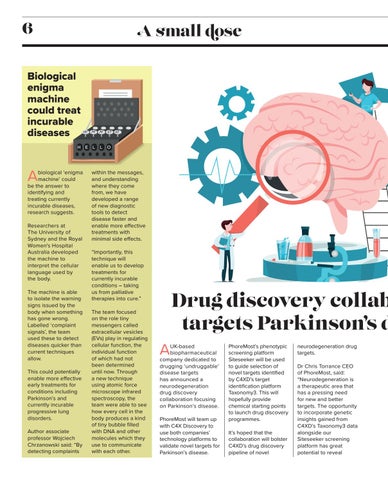
Biological enigma machine could treat incurable diseases
A
biological ‘enigma machine’ could be the answer to identifying and treating currently incurable diseases, research suggests. Researchers at The University of Sydney and the Royal Women's Hospital Australia developed the machine to interpret the cellular language used by the body. The machine is able to isolate the warning signs issued by the body when something has gone wrong. Labelled ‘complaint signals’, the team used these to detect diseases quicker than current techniques allow. This could potentially enable more effective early treatments for conditions including Parkinson’s and currently incurable progressive lung disorders. Author associate professor Wojciech Chrzanowski said: “By detecting complaints
within the messages, and understanding where they come from, we have developed a range of new diagnostic tools to detect disease faster and enable more effective treatments with minimal side effects. “Importantly, this technique will enable us to develop treatments for currently incurable conditions – taking us from palliative therapies into cure.” The team focused on the role tiny messengers called extracellular vesicles (EVs) play in regulating cellular function, the individual function of which had not been determined until now. Through a new technique using atomic force microscope infrared spectroscopy, the team were able to see how every cell in the body produces a kind of tiny bubble filled with DNA and other molecules which they use to communicate with each other.
Drug discovery collab targets Parkinson’s d A
UK-based biopharmaceutical company dedicated to drugging ‘undruggable’ disease targets has announced a neurodegeneration drug discovery collaboration focusing on Parkinson’s disease. PhoreMost will team up with C4X Discovery to use both companies’ technology platforms to validate novel targets for Parkinson’s disease.
PhoreMost’s phenotypic screening platform Siteseeker will be used to guide selection of novel targets identified by C4XD’s target identification platform Taxonomy3. This will hopefully provide chemical starting points to launch drug discovery programmes. It’s hoped that the collaboration will bolster C4XD’s drug discovery pipeline of novel
neurodegeneration drug targets. Dr Chris Torrance CEO of PhoreMost, said: “Neurodegeneration is a therapeutic area that has a pressing need for new and better targets. The opportunity to incorporate genetic insights gained from C4XD’s Taxonomy3 data alongside our Siteseeker screening platform has great potential to reveal
7
www.epmmagazine.com
CRO
RECOGNISED FOR CONTRIBUTION TO WELSH ECONOMY
A
fast-growing contract research organisation (CRO) has been recognised for its contribution to the Welsh economy. CatSci was named ‘International Business of the Year’ at the Cardiff Business Awards, which recognises outstanding export performance in South Wales.
boration disease highly relevant novel drug targets. We are tremendously excited by the complementarity of our technologies. C4XD’s Conformetrix approach is ideally suited to use the 3D biological shape information derived from Siteseeker and convert this into small molecules starting points that will lead to the next generation of therapeutics.”
The company was also named as one of the ‘50 Most Exciting Companies in Wales’ by Wales Business Insider magazine. CatSci says that the awards reflect the longterm internationalisation strategy that is targeting key markets across the world. Simon Tyler, chief operating officer, said: “These accolades are a testament to the talent and hard work of all our staff. Both demonstrate CatSci’s growth into a globally-recognised partner for pharmaceutical innovation, and its commitment to life science in South Wales. We are proud to be an integral part of research and development efforts that lead to life-changing new therapeutics.”
CERTARA LAUNCHES GLOBAL SCHEME FOR DRUG DEVELOPMENT G
lobal drug development consultancy Certara has launched a new practice area to help accelerate medicines for people around the world who need them most. Certara Global Health will take an interdisciplinary approach to accelerating drug development across a range of areas. These include model-informed translational medicine; innovative clinical trial designs; regulatory science approaches to accelerate reviews and more. One area Certara Global Health will tackle is in delivering quality medicine to low-middle income countries through by bringing in new chemistry,
manufacturing and control (CMC) talent to tackle CMC challenges. Certara Global Health has been launched as a new product inspired by the company’s drug development and scientific work for the Bill & Melinda Gates Foundaiton. “Certara Global Health will bring together talent, technology, software, systems and processes to accelerate the development of medicines for those that need them most,” said Craig Rayner, co-lead of CGH. “Working closely with the foundation and other leaders in the global health sector, CGH will focus on creating novel and impactful drug development, regulatory science and patient
access approaches that will deliver effective and affordable therapies to populations in need around the world. A triple bottom line practice across the global health product development ecosystem.” “Developing medicines is expensive and difficult at the best of times, and securing talent and capital is an extra challenge for the global health sector,” added Kevin Hershberger, co-lead of CGH. “But we are confident that we can play a catalytic role in bringing creative thinkers together with leading-edge technologies and methodologies, to support solving medicine development and access challenges in global health.”
8
IN THE NEWS
Cervical cancer screening gap for lesbian women perpetuated by myth Up to 50,000 lesbian, gay and bisexual women (LGB) are missing out on screening tests for cervical cancer due to believing they are not at risk.
M
MAKE YOUR DREAMS COME TRUE WITH THE MEDTALK PODCAST
T
he MedTalk Podcast’s latest episode has landed! This episode sees the editors sit down to discuss a recent report looking into the future of global healthcare and the technologies shaping the ways we take care of ourselves. Find out what a recently launched service by pharmacy John Bell & Croyden means for holistic healthcare and how a new wearable could let you take control of your dreams.
isinformation spread in the past by charities warned that women who have sex with women don’t need to be screened. However, the human papillomavirus (HPV), which causes cervical cancer, can be transmitted through any type of sexual activity. A survey conducted by the LGBT Foundation revealed that nearly one LGB women in five has never been to a cervical screening appointment. Speaking at Pride Week, the NHS’ national advisor for LGBT health, Dr Michael Brady,
said: “The misleading information that gay and bisexual women aren’t at risk of this disease is one of the most dangerous myths around, because it has created a screening gap for thousands, which is a major concern for our community.
need to be inclusive of lesbian, gay, bisexual trans and non-binary people, and I’m delighted to have been asked to help the NHS address these issues and more.”
Data from the World Health Organisation (WHO) and UNICEF show that 20 million children around the world missed out on lifesaving vaccines last year.
“Let’s be clear: cancer does not discriminate. If you’ve got a cervix, you can get cervical cancer, and as cervical cancer is preventable people should take up their regular screening appointments. “We also know that NHS screening services
Did you know?
According to the Centers for Disease Control and Prevention, HPV is the most commonly spread sexual transmitted infection (STI).
Nearly all cases of cervical cancer can be linked back to an HPV infection.
Millions of children missing out on lifesaving vaccines
There are over 100 types of HPV viruses most of which are relatively harmless.
Poor or conflictaffected countries were found to have the most unvaccinated children with the Ukraine suffering from the highest number of measles cases in 2018. Dr Tedros Adhanom Ghebreyesus, director-general of the World Health Organisation said: “While most children today are being vaccinated, far too many are left behind. Unacceptably, it’s often those who are most at risk– the poorest, the most marginalised, those touched by conflict or forced from their homes - who are persistently missed.”
10
Opinion
By centralising and digitising labelling, pharmaceutical companies can create an efficient, streamlined process for producing accurate, compliant labels.
HOW A CENTRALISED LABELLING SOLUTION CAN IMPROVE PHARMA PROCESSES
T
he pharmaceutical industry arguably faces more challenges than most other industries. Regulatory compliance is part and parcel of working in the sector, but, in a business where bringing a drug to market carries such a large investment, cost pressures, particularly when a drug comes off patent, are perhaps higher than other industries.
Ken Moir Marketing Director at NiceLabel
Therefore, finding the balance between complying to regulation, driving efficiencies in the manufacturing process and maintaining quality can mean the difference between being competitive or not. A critical part of maintaining compliance and safety standards for any drug manufacturer is the labelling process. Not only does the label act us a unique identifier to prove authenticity to healthcare professionals and consumers, it also ensures that active ingredients and concentrations are clearly understood. And there can’t be any margin for error as the consequences of inaccurate doses or ingredients are too high.
www.epmmagazine.com
In fact, it’s estimated that 50% of pharmaceutical recalls are due to errors in product labelling or packaging artwork. Therefore, it makes sense to ensure labelling technology is a priority, so it can address any inconsistencies in processes, mitigate human errors, enhance label quality and improve business agility in order for the company to produce compliant, high-quality labels in a cost and time-efficient manner.
By introducing role-based access, configurable approval workflows, and document versioning and electronic signatures, a modern label management system helps prevent unauthorised label changes and provides the necessary documentation to comply with regulatory requirements. It includes label variant technology that can help pharma companies drastically reduce the number of label templates they have to maintain.
Typical pharma labelling challenges
A modern label management system can also be integrated with Manufacturing Execution Software (MES) and Enterprise Resource Planning (ERP) systems. This integration provides a single source of the truth for label data.
Traditionally, pharmaceutical companies have purchased label printers locally, on a plant and country level. This has resulted in many fragmented and disparate label software and printing solutions within the same organisation. This fragmented landscape is further complicated by the fact that plants often use separate printing systems for labelling and direct marking tasks. Add to this the need to comply with market and country specific labelling requirements, and the result is a label database containing thousands of label variants. Creating multiple label templates across multiple systems in various regions is a costly and laborious process, even when that process is digitised. The more manual the procedure, the higher the likelihood for errors. A fragmented labelling environment also makes it challenging to process label change requests in a timely, efficient manner. This can cause many issues, especially when regulations in some markets, such as FDA CFR 21, require documenting every change in the system, including new and updated label templates. A modern label management system can address these issues. By centralising and digitising labelling, pharmaceutical companies can create an efficient, streamlined process for producing accurate, compliant labels. Benefits of a modern label management system A modern label management system digitises the entire label management process, from label design to printing and management. It includes a centralised, digital label catalogue that controls and streamlines label lifecycle management. It eliminates the need for paper-based catalogues and prevents the creation of data silos.
It also solves the challenge of a fragmented label printer landscape by introducing universal templates that work across all label and direct marking printers. This means pharma companies get one, centralised labelling system that can guarantee correct labels regardless of the printer make, brand or location. How pharma companies benefit from modern label management An example of how pharma companies can benefit from implementing a modern label management system can be seen in the case of Boehringer Ingelheim. It has been able to implement a global, standardised labelling process with digital quality control and ERP integration. This has enabled Boehringer Ingelheim to eliminate its manual quality control procedures and institute a centralised way of updating label information, therefore processing change requests more quickly than before. A solution for now and the future Going forward agility, accuracy and compliance will be key to pharmaceutical companies competing successfully in a very challenging marketplace. A modern label management system is a vital component in achieving this; however, the benefits don’t end there. By putting the right system in place now, and removing inefficiencies from their labelling process, pharma companies will have a solid foundation for manufacturing process improvement. And they will also be in a far better position to address future regulatory changes, such as serialisation. With the right framework in place, pharma companies will be well positioned to meet current, and future, challenges.
11
12
AN INSIDE LOOK
at Norgine Peter Stein CEO, Norgine
In June this year, European pharmaceutical company Norgine held a 50-year anniversary for its global manufacturing site in Hengoed, Wales. Following the event, European Pharmaceutical Manufacturer editor Reece Armstrong caught up with Norgine’s CEO Peter Stein to discuss pharma trends, US and EU drug approvals and the company’s approach to improvement.
S
tein begins by explaining the roots of the Hengoed site its 50-year history born from small beginnings with a team of around 20 employees. Now, the site is responsible for producing over 30 million packs of medicine every year, a fact recognised at the event as well as the ‘unique position Hengoed has in Wales as a major manufacturer for the world,’ according to Stein.
Norgine itself has a rich history. A family owned business founded in the early 1900s, Norgine was the first company in central Europe to start manufacturing insulin but fell dormant in World War II until it was eventually revived by Walter Stein after the war. Norgine serves markets in the US and Japan but Stein explains that what the company has really done is build a European platform
‘that’s able to develop, register, manufacture and market products on a European scale’. During Stein’s time in the industry, the biggest change he’s seen ‘is the extent to which the industry is much less fragmented by national markets and standards and it’s more focused on regional or global standards’. Indeed, it’s these harmonised standards – introduced by the European Commission in 2008 to help companies market products in the EU and European Economic Area - that Stein believes has enabled Norgine’s success in Europe. Another area Stein is keen to emphasise is just how differentiated new therapies need to be if they are to really add value to patients and healthcare systems. In fact, what quickly becomes evident during our chat is just how advantageous Stein believes the EU healthcare system to be compared to that of the United States’. Originally from the US himself, Stein’s time in Europe has really made him appreciate the European system. “It’s a good thing that the industry is obliged to focus on products
13
www.epmmagazine.com
that actually add value and actually change patient care and actually deserve to be added to medical practice,” he says. This focus on ‘added-value products’ ensures companies focus their R&D effort ‘towards things that are going to make a difference,’ Stein adds.
a life science company. You have academic institutions that are very strong and that can form highly trained workforces,” Stein says. That workforce, Stein adds, has helped drive Norgine through a culture that is dedicated to learning and developing.
But perhaps the major advantage for manufacturers is the immediate access they gain to the EU marketplace once they receive reimbursement. While this benefits patients through the access they get to medicines, the United States’ system of private healthcare still leads to patients being unable to afford medicines, even though they’re still technically available.
When questioned on the potential of workers being left behind by the introduction of new technologies, Stein has absolute admiration for the way Norgine’s workforce have upskilled.
But while the EU certainly holds many benefits for both pharmaceutical manufacturers and patients, the conversation is quickly derailed by Brexit and the uncertainty it presents. For Norgine, its priority has been in ensuring patients will always be able to access its medicines, Stein iterates. “Continuity of supply has been first and foremost in our thinking. We’ve been preparing for it [Brexit] since 2016. Unfortunately it’s costing a lot of money, it’s costing a lot of time but I think we are in a position that we will be able to make sure our patients continue to receive our products in any scenario.” Not wanting to get caught up in the complexities of Brexit we move on to talk about Norgine’s base in Wales and the country’s perhaps under-recognised contribution to pharma. “I think it’s one of the things that deserves more attention. Wales is actually a fantastic place to locate
“The shop floor employee of 20, 30 years ago would not be able to cope with the technology they’re using today and almost universally people have embraced it because it is essential for the future of the site.” Moving on, Norgine sees itself focusing on two avenues of growth which will help bolster its European base and also bring medicines over from the US into the European market. So for the UK and in particular Wales, Norgine’s success is bolstering the Welsh life sciences industry and bringing attention to an area which in Stein’s view, deserves more recognition.
The shop floor employee of 20, 30 years ago would not be able to cope with the technology they’re using today and almost universally people have embraced it because it is essential for the future of the site.
AN INSIDE
L
K
14
COVER STORY
Unsure who to trust? Biocidal products manufactured in or imported into the European Union (EU) must be authorised for compliance with the requirements of the EU Biocidal Products Regulation (BPR) and any relevant national legislation before being placed on the market. Here, Karen Rossington and Siobhan Murphy from Contec guide readers through the implications on life science cleanroom users.
B Karen Rossington and Siobhan Murphy from Contec
iocidal products have been regulated in the EU by the EU Biocidal Product Regulation 528/2012 (BPR) since 1 September 2013.
BIOCIDAL PRODUCT AUTHORISATION PROCESS There are two consecutive steps required to gain EU BPR biocidal product authorisation:
The aim of the BPR is to improve the consistency of the biocidal products available in the EU and ensure a high level of protection for humans and the environment via a two-stage process of active substance approval followed by biocidal product authorisation. The provisions of the BPR set out to harmonise the market at EU level and simplify the approval of active substances and authorisation of biocidal products. The BPR acts directly in all EU Member States, meaning that local legislation does not need to be created to implement the requirements.
1. The active substance(s) in the biocidal product must be approved under the appropriate product-type. This process takes place at EU-level.
BIOCIDAL PRODUCT DEFINITION Article 3 of the BPR defines a biocidal product as, “any substance or mixture, in the form in which it is supplied to the user, consisting of, containing or generating one or more active substances, with the intention of destroying, rendering harmless, preventing the action of, or otherwise exerting a controlling effect on any harmful organisms by any means other than mere physical or mechanical action.”
The EU BPR consists of four product groups including 22 different biocidal product types covering: disinfectants, preservatives, pest control and specialty biocides. The group relevant to life science cleanroom users is Main Group 1: Disinfectants and PT2: — disinfectants and algaecides not intended for direct application to humans or animals. This includes products used for the disinfection of surfaces, materials and equipment, which do not come into contact with food
If the intended use of a wipe pre-saturated with 70% IPA is for surface disinfection, even if the manufacturer makes no biocidal efficacy claims, the product is classified as a biocidal product according to the BPR.
2. Each biocidal product containing or generating the approved active substance(s) must then be authorised under the appropriate product type at industry level. When active substances are approved, they are listed in EU BPR Article 9: Approved List of Active Substances (Union List).
When a disinfectant has been authorised under one producttype it cannot be used in another product-type unless authorisation is also granted for the second product-type.
ARTICLE 95 OF THE BPR As well as the approval process described above, from 1 September 2015, Article 95 of the BPR has applied to active substances placed on the EU market, either on their own or in biocidal products. Biocidal products cannot be made available on the EU market unless the active substance is sourced from an approved supplier on the so-called Article 95 list maintained by the European Chemicals Agency (ECHA). For example, if a wipe containing 70% IPA is imported from a manufacturer outside of the EU, either the active substance supplier, the product manufacturer or the EU importer must be listed on Article 95. If none of the above are listed on Article 95, the product cannot be sold legally in the EU as a biocidal product. KEEPING TRACK OF THE BPR The active substance approval process is ongoing and is gradually replacing national regulations. Each biocidal active substance is at a different stage in the regulatory process and keeping track of the status of the active substances in your biocidal products is critical to ensure continuity of supply. Biocidal products, which are not going through the authorisation process can no longer be placed on the market from 180 days after the date of approval of the active substance, and they can no longer be used from 365 days after the date of approval. Where the
15
www.epmmagazine.com
biocidal product contains more than one active substance, the relevant phase- out periods begin on the date of approval of the final active substance to be approved, or not-approved. An unauthorised biocidal product discovered by regulators could immediately be withdrawn from the market leaving the end user without a validated disinfectant. As a worst-case scenario, product manufacture could be delayed whilst a replacement disinfectant undergoes months of validation. Any company about to start, or whom has an on-going disinfectant validation project needs to ensure that the biocidal product under investigation is already, or is intended to be, authorised under the EU BPR by the manufacturer or importer. The costs associated with the EU BPR will most likely lead to a contraction in the market, specifically in the number of biocidal products available. The costs to approve active substances and authorise biocidal products are significant. The costs to gain approval of an active substance can be several million euros and a simple disinfectant product could potentially cost €750k to €1m to authorise.
STEP BY STEP There is currently no definitive list of authorised disinfectant products and the BPR active substance approval process is expected to still take several more years before completion. However, biocidal product users can do the following: 1. List all products being used for microbial control (these might be products not currently supplied with efficacy claims such as IPA presaturated wipes). Review the SDS for these products and note the ingredients. If unsure, confirm with the supplier the active microbiocidal ingredients in the formulation. 2. Find out the suppliers of each active substance in the disinfectant formulation. Ask the supplier to provide details of the active substance manufacturer’s inclusion on the ECHA Article 95 list. The Article 95 list is available online (https:// echa.europa.eu/ information- on-chemicals/ active-substance- suppliers). 3. Ensure the active substance is listed under the correct product-type for its use.
4. If the active substance has been approved and is listed on the Union list of approved active substances, then a manufacturer of an existing biocidal product has approximately two years to submit a dossier for either National or Union Authorisation of the formulation. The list of currently approved active substances can be checked online via https://echa. europa.eu/information-onchemicals/ biocidal-activesubstances. 5. For common disinfectant actives used in cleanrooms, such as IPA, PAA, hypochlorites and hydrogen peroxide, the actives have already been approved and the deadlines for submission of product authorisation
Although a listing of these products is not currently publicly available, cleanroom operators should ask their disinfectant supplier about the process followed for submitting the dossiers.
dossiers have passed. Any products for which a dossier was not submitted by the relevant deadline must remain off the EU market until authorisation is granted; after the phaseout periods. a. Propan-2-ol (70% IPA) Deadline 1 July 2016 b. Hydrogen Peroxide Deadline 1 Feb 2017 c. Active chlorine/ Hypochlorites Deadline 1 Jan 2019 6. The list of currently approved active substances and upcoming deadlines can be checked online via https://echa.europa. eu/regulations/ biocidalproducts-regulation/ authorisation-ofbiocidal- products/unionauthorisation/ -unionauthorisation- applications.
This will uncover any lack of knowledge of the authorisation process and will also give the end-user the opportunity to ensure their uses of the product, and usage areas, are included in the authorisation application. The manufacturer should also confirm whether they are submitting a dossier for a Union Authorisation (all countries) or a National Authorisation, which may or may not be followed by Mutual Recognition applications. If a lack of knowledge of the BPR from a manufacturer’s standpoint is apparent, cleanroom operators should start a revalidation plan to ensure continuity of a legal supply from a different manufacturer.
The aim of the BPR is to improve the consistency of the biocidal products available in the EU.
16
DIGITAL HEALTH
Dr Ramin Rafiei Director of Digital Healthcare, SHL Group
Smarter, Faster, Better – The Next Frontier In Drug Delivery At the confluence of Moore’s law and Metcalfe’s law the next frontier in drug delivery becomes data-driven, personalised and outcome-based.
O
ver the past few decades, the cost of bringing new drugs to market has been doubling every nine years. This exponential trend, measured as the number of FDA approvals per billion USD spent on R&D, is known as the Moore’s law of the pharmaceutical industry and labelled Eroom’s law1 – Moore spelt backwards. Compounding this diminishing return on pharmaceutical R&D investments is the gap between clinical efficacy of medications as determined in a randomised controlled trial (RCT) setting and their real-world effectiveness.
Medication adherence is the key factor for the gap between RCT efficacy and real-world effectiveness as typically 50% of patients with chronic conditions fail to take the recommended therapeutic dose consistently, resulting in poor health outcomes and increased healthcare costs2. As a result, solely relying on the clinical efficacy of new medications
is not the solution to chronic disease management; rather, we need to find ways to help patients self-manage existing conditions. This also presents pharmaceutical companies with a $600 billion-plus opportunity, which is otherwise lost revenue due to medication nonadherence3. Moore’s law, attributed to cofounder of Intel Gordon Moore, has transformed computing through exponentially decreased costs and increased performance. There are already a number of examples across the healthcare industry where the impact of Moore’s law has resulted in exponential change, such as the cost of genome sequencing, adoption of DNA testing and utilisation of telehealth services4. As technology continues to get smaller, lighter, more efficient and intuitive, computers and sensors are also making their way into drug delivery devices. Today, connected injectable therapies
REFERENCES 1 Vinay Kini, P Michael Ho, “Interventions to improve medication adherence”. JAMA, 2018; Vol 320(23), pp 2461-2473. 2 Thomas Forissier and Katrina Firlik, MD, “Estimated Pharmaceutical Revenue Loss Due to Medication Nonadherence”. Health Prize and Capgemini Consulting, 2012. 3 Thomas Forissier and Katrina Firlik, MD, “Estimated Pharmaceutical Revenue Loss Due to Medication Nonadherence”. Health Prize and Capgemini Consulting, 2012.
4 Shubham Singhal and Stephanie Carlton, “The era of exponential improvement in healthcare?” McKinsey Insights, 2019 5 Rich Karlgaard, “Ten Laws of The Modern World”. Forbes, 2005
are still in their infancy when compared to respiratory and oral therapies. However, studies across these three therapeutic categories have consistently demonstrated that when drugs are augmented through sensors and connectivity, patient adherence and health outcomes improve. So could the application of Moore’s Law to drug delivery be the solution to medication non-adherence? Adherence is multifactorial and stems from the diversity of patient behaviours and barriers. Connected drug delivery devices, which measure dose-level (true) adherence in real-time, are the necessary first step towards a solution. However, improvements in adherence can only be realised when real-world data (RWD) from connected devices is applied effectively towards supporting patients with self-managing their condition outside the clinic setting.
www.epmmagazine.com
The first application is behavioural support by targeting and tailoring interventions designed to change behaviour and improve patient adherence to therapy. RWD from connected devices create a feedback loop by providing a mechanism to learn which interventions are most effective. Today machine learning models are being applied to deliver interventions, measure the effect of each intervention on the target behaviour, and improve the accuracy of the next intervention based on real-time adherence data. Dose-level adherence data also enhances remote treatment support, in which the data is used to improve clinical treatment decisions, and support ongoing dose titration until the optimal treatment regimen for each patient is reached.
Metcalfe’s law, proposed by Robert Metcalfe the inventor of Ethernet, states that the value of a network grows exponentially as a function of network size5. When RWD is actively used to improve the patient experience, increase their engagement with their care plan, and improve adherence to therapy, Metcalfe’s Law predicts its value will grow exponentially for all stakeholders across the care continuum. For pharmaceutical companies, this benefit will best manifest itself in an ability to measure and improve the realworld effectiveness of drugs. This next frontier in drug delivery combines Moore’s and Metcalfe’s laws to become data-driven, personalised, outcome-based, and accessible. This next frontier is connected therapeutics (CTx).
Solely relying on the clinical efficacy of new medications is not the solution to chronic disease management; rather, we need to find ways to help patients self-manage existing conditions.”
17
18
DIGITAL HEALTH – SPONSORED FEATURE
UNLOCKING THE VALUE IN CONNECTED HEALTH Kevin Deane Vice-president, Innovation, Phillips-Medisize
Connected health offers promising potential for pharmaceutical companies and drug delivery device developers and manufacturers to create a more positive patient experience that can help improve medication adherence and facilitate better outcomes. However, only a few connected health solutions tied directly to medication have made it to market so far, even as healthcare becomes increasingly digital. Filling the Data Void As healthcare systems worldwide start to implement outcome-based reimbursement, the ability to measure medication effectiveness – and patient adherence – plays an even more important role in managing and improving patient health. Unfortunately, little actual data exists that pinpoints when, or even if, patients take their medication, despite new prescription drug development costs estimated to be as high as $2.6 billion1. A range of research has demonstrated, though, that adherence rates are typically lower for patients with chronic conditions, and even clinical trials report average adherence rates of only 43 to 78%2. Poor medication adherence is also the cause of 33 to 69% of all medication-related hospital admissions in the United States alone.2
REFERENCES 1 Sullivan, Thomas. A Tough Road: Cost to Develop One New Drug is $2.6 Billion; Approval Rate for Drugs Entering Clinical Development is Less Than 12%. Policy & Medicine. March 21, 2019. 2 Osterberg L, Blaschke T. Adherence to medication. N Engl J Med. 2005 Aug 4;353(5):487-497.
Integrating connectivity into innovatively designed, patientcentric drug delivery devices can help fill this data void and support increased adherence by making it easier and simpler for people to take their medication on-time and as prescribed. Connectivity provides an efficient way to monitor patients’ adherence and condition, as well as to share both real-time and historical data with patients, clinical researchers, healthcare providers, caregivers and payers.
The Connected Health Ecosystem The connected health ecosystem includes three primary components: connected devices, such as inhalers and injectors; digital interfaces, including patient and caregiver apps, and dashboards for healthcare professionals; and a cloud platform, enabling data integration with multiple sources including diagnostic devices, IoT sensors and EHRs in order to generate insightful analytics. Four years ago, Phillips-Medisize developed the first connected health system registered with the FDA for a specific drug. Since then, the number and popularity of connected health pilots has grown, but pharmaceutical companies sometimes struggle with how to scale the model, and extract and quantify the value created, which can impede additional investment. Recognising the increased interest and demonstrable benefits that connected systems provide, Phillips-Medisize decided to invest in developing a highly scalable platform to service the expanding market, rather than developing and maintaining oneoff, application-specific solutions for each new project.
The Benefits The resulting cloud-based connected health platform provides a scalable medical device data system (MDDS) for pharmaceutical companies and drug delivery device developers. By reducing the risk, time and cost associated with developing connected health solutions, it helps accelerate time to market. Additional benefits include: • Comprehensive informationsharing and analytics capabilities. It connects pharma companies, clinical researchers, providers, patients and payers, sharing and displaying information from connected drug delivery devices, biosensors and regulated Mobile Medical Applications (SaMD/ MMA). Dashboards can be customised quickly and easily at any point, which saves time and money, adds high-value flexibility and streamlines connection with other supported external analytic systems. It also integrates medication, diagnostic and therapeutic data from multiple sources as well as supports global comparisons by normalising data across geographies. • Robust cybersecurity. A connected health platform can be deployed in a secure private cloud with a credible legacy of health data security, in a cloud hosting option selected by
www.epmmagazine.com
the pharmaceutical company, or in the company’s own data centre. In addition, cost-effective and secure collaborative environments are available for situations where crossindustry partners want the ability to share data. • Streamlined regulatory documentation. Full regulatory documentation services included with the connected health platform support premarket submissions for 510(K), combination products and CE mark to help lower project costs and speed time to clinical trial, regulatory approval and market – ahead of the competition. • Modular approach. Working with a manufacturing partner who can deliver connected health solutions that incorporate devices with embedded electronics and sensors also speeds the development process and keeps costs low, for both reusable and disposable drug delivery devices. Connected health platforms that come with a software development toolkit and defined, extensible API allow any device to be connected to the system. Pairing a configurable app with the connected health platform and deploying it across multiple products using a standard Bluetooth interface further supports a rapid, low-cost path to clinical trial and market. • Massive scalability. Building on a flexible, scalable platform rather than starting from scratch for each new drug makes it highly cost efficient to add or refine infrastructure for future projects. Because the price per user declines as the patient population increases, the costs for integrating connectivity for medications used to treat common chronic conditions also decrease. A Case Study A leading pharmaceutical company recognised the need to update its
current drug injection device in order to retain existing patients and attract new ones. The company's drug had established safety and efficacy, but its injection device lagged in user friendliness. The company sought to use electronics to improve the injection experience but also wanted to help patients better manage their disease by offering seamless integration between the device and a patient app that could track injections and remind patients when and where to take them. Teaming with Phillips-Medisize, they developed and manufactured an innovative electromechanical autoinjector connected to the cloud, featuring: • Ergonomic design operated with one hand • Secondary control functions hidden on the inside • A dashboard for healthcare professionals to easily monitor patients • Bluetooth connectivity that ensures data on injection time, volume and body location are synced with the patient app and dashboard
• Personalised, localised messages and reminders for patients on their device and in the app The integrated system was introduced in countries worldwide after its initial launch in Europe. It has made injections more intuitive for patients, made it easier for caregivers and healthcare providers to coordinate and follow up on treatment, and helped the company retain its market position. Meeting Market Needs The pace of development continues to accelerate as pharmaceutical companies and drug device developers and manufacturers seek to meet market needs. The opportunity to develop innovative connected health solutions using a secure cloud-based platform that provides a safe and scalable MDDS helps reduce risk, cost and time to market. At the same time, by demonstrating a clear pathway to value creation, these cost models can bridge the gap between pilot and program and encourage additional investment in connected health.
19
20
ANALYSIS
ALTERNATIVE APPROACHES TO PHARMA INNOVATION Tyler Golato Scientific Lead at Molecule
T
he cost of drug development has increased steadily and significantly over the past 40 years. In the 1970s, a drug could be brought to market for approximately $54 million in the United States. Today, estimates for the cost of bringing a single drug to market range from $800m - $2.5b. Patent protection and market exclusivity attempt to incentivise the shouldering of this cost by providing the opportunity for a return on investment. However, while patent protections are often a key focus for pharmaceutical companies in terms of their business strategy, they are problematic for collaborative research. Patents are closed source and monopolistic by nature. Increasingly, the business model for drug discovery and development is predicated on recouping costs barely manageable for first-world, affluent nations. In an effort to combat this trend, various stakeholders in the drug discovery ecosystem - academia, industry, foundations, governments, and regulators - have been identifying and exploring novel models based on collaboration and distribution of risk that provide new schemes for incentivising and rewarding drug discovery. However, no breakthrough model has yet led to transformative change in the industry, and patents are still the primary means of ensuring exclusivity over new drugs that are brought to market. This has had severe consequences on innovation: industry is increasingly moving away from research in
riskier areas and revenue has become the primary driver of research efforts. Despite these challenges, a new generation of projects, such as OSP, M4K, and Molecule, have emerged which are attempting to rethink the current pharma business model. One model that shows promise for creating sustainable change in the industry is that of fractionalising IP ownership. This entails the creation of an open, multi-sided marketplace for drug development with a platform for IP creators to generate public markets for new drugs and therapeutics to attract funding. At its core, systems such as these can use curation markets and crowd-intelligence to discover valuable therapeutics and direct resources towards them. The underlying asset of each market is a patent, or combination thereof, and shares in individual markets represent ownership rights. The overarching goal is to create incentives for a more open source R&D process that will bring down costs, accelerate development, bring more diverse treatments to market, and move stakeholders towards collaboration: new business models for the current broken pharma industry. These types of platforms can also generate novel funding opportunities for parties with an interest in drug development. For example, organisations can access funding and liquidity from underutilised IP, or alternatively, distribute ownership in IP currently under development to garner funding and further their projects. This fractionalised IP distribution
is achieved by providing the infrastructure for individual markets to be established around a single piece of IP (e.g. a patent), similar to the way markets exist for shares in specific companies. This model distributes risk and cost, thereby allowing smaller organisations, such as universities, to collaborate with other institutions via shared ownership models to research and develop therapeutics. It effectively lowers the barrier of entry to drug development, allowing stakeholders that have been priced out of traditional drug development practices to participate and compete. This shift toward a more transparent, open, and collaborative future for drug development is similar to what open source did for software. As innovation continues to decline in the pharmaceutical industry, open source models could prove useful in reversing the trend.
@makingpharmamilano
Exhibition & Conference
18-19 September
2019 UNAHOTELS Expo Fiera Milano
www.makingpharma.it PROCESSING DATA MANAGEMENT INGREDIENTS / EXCIPIENTS NEW TECHNOLOGIES REGULATORY OPERATIONAL EXCELLENCE MICROBIOLOGY AND PHARMA BIOSIMILARS SERIALISATION PHARMACEUTICAL QUALITY PHARMACEUTICAL ENGINEERING CONTINUOUS PROCESSING CLINICAL TESTING MEDICAL DEVICES PACKAGING BIOPHARMA Supporters:
Meet. Network. Engage. Register now at www.makingpharma.it. The event is FREE to attend. For more information, call +44 (0)1892 518877 or email makingpharmamilano@step-exhibitions.com Media Partners:
22
SINGLE USE
Go with the flow Dr Shawn Conway Engineering R&D Director of Cambrex
The rising trend of continuous flow is bringing economic and safety benefits to manufacturers, says Dr Shawn Conway.
T
he economic and safety benefits of implementing continuous flow retrospectively on a commercial scale for a single process step are widely known and have been well documented, with the replacement of traditional batch-based manufacturing by continuous flow chemistry continuing apace. Many major pharmaceutical corporations, including Lilly, GSK and Novartis, are actively investigating and investing significant sums in the use of continuous flow. There is also an emerging use of continuous flow processes in early clinical development, where the need is to manufacture enough of a drug compound so that the development process can begin.Â
REFERENCES 1 Kevin P. Cole Kilogramscale prexasertib monolactate monohydrate synthesis under continuous-flow cGMP conditions, Science 16 Jun 2017: Vol. 356, Issue 6343, pp. 1144-1150; http:// science.sciencemag.org/ content/356/6343/1144.long
Introducing continuous flow at this point enables the use of specific types of reactions that are very difficult to accommodate with the traditional batch process. This means that a compound can typically be obtained in a quicker, cleaner manner; it also makes it possible to start building a process that can be commercially viable from the outset, reducing the potential multiple iterations of a development cycle as the compound progresses from phase to phase. The ability to optimise the process from the outset is a major advantage as it means that the best route can be used, rather than one best suited
to a batch operation. Commercial scale batch processing imposes limitations in terms of the types of equipment that may be available and the processes that could be used. With continuous flow, all routes can be explored to find the most appropriate synthesis that can then be progressed through all the different stages of development. In general, continuous flow offers a process that is scalable from the beginning, allowing the manufacture of a few hundred grams or perhaps a kilogram of a compound, and this can be quickly increased to larger quantities of material for a later phase, by increasing the scale of the equipment, or by extending the processing time. This scale up can be done multiple times through to commercial quantities, as opposed to batch manufacturing, where process optimisation would have to be carried out each time production is scaled up. Applying continuous flow in early phase development also allows greater control over the reaction. A batch reaction can introduce significant variations within the vessel that can lead to incomplete conversion, side reactions and degradation, whereas with continuous flow, parameters such as residence time, temperatures, pressures, concentration and pH, can all be tightly controlled resulting in a high degree of
consistency. Avoiding these impurities gives a more streamlined process that is easier to take on to subsequent phases. Similarly, the increased monitoring of the process and the ability to take samples in real time increases the understanding of what is happening during the synthesis. Monitoring the process across a range of time points creates a much better picture of the reaction compared with leaving a batch to process for 12 or 16 hours and then sampling the result. Although cost savings cannot be quantified precisely, making an intermediate sized batch of product could be in the region of hundreds of thousands of dollars, so any technology that can streamline this process and reduce or remove this spend is obviously advantageous. Furthermore, reducing the development timeline and shortening the development phases can mean that a compound reaches the market faster, bringing forward the time when a drug gets to the patient and the company starts to make a return on its investment. There is increasing demand for drug substances with higher potencies which require, smaller doses and therefore, potentially smaller manufacturing campaigns. Smaller volume batches can be relatively expensive using
www.epmmagazine.com
traditional batch production, due largely to the overhead costs of the facility, so lend themselves well to continuous flow technology where capital costs tend to be much lower. Rather than converting a batch process into a continuous flow-based analogue, exploring flow synthesis in the early development stages allows for the subsequent steps to be streamlined, saving time and money in the long run, as previously noted. Multiple process steps in flow, such as reactions, work-up, extractions, crystallisations and distillations with different equipment requirements can be developed and connected in a small footprint facility as opposed to over several large assets in a production facility with the associated handling challenges and costs. Eli Lilly's highly potent oncology drug Prexasertib demonstrates the practice of employing continuous flow in early phase development, where the technology was adopted for the final four steps of the synthesis1 throughout clinical
scale manufacture, and now on to commercial production at a rate of three kilograms a day. Specific challenges that needed to be addressed, that have been published and discussed, included the use of hydrazine at elevated reaction conditions to drive purity and performance, as well as avoiding issues surrounding isolation and handling of potent toxic intermediates. Concurrent analytical monitoring also enabled rapid trouble-shooting during the manufacturing process. The recognised benefits of this process were numerous and allowed eight continuous operations to take place in series, within small continuous reactors, extractors, evaporators, crystallisers and filters. A continuous reactor type was developed and utilised, as was a method for in-process filtration and redissolution. The process included the ability to operate at high temperature in a low-boiling solvent, afforded improved safety for a hazardous reaction, better
23
With continuous flow, all routes can be explored to find the most appropriate synthesis that can then be progressed through all the different stages of development.
yield and an improved impurity profile. The containment of highly potent materials was achieved through the use of dedicated and disposable equipment; and synthetic efficiencies were seen with enhanced product stability, the elimination of one isolation step, and the elimination of solids handling in another isolation step. The advantages described above and illustrated in the example from Eli Lilly demonstrate that continuous flow drastically minimises, if not eliminates, safety and quality complications that arise from inhomogeneity and it should therefore be regarded as a truly enabling technology and a powerful development tool.
24
IN PROFILE
ACHIEVING THE PERFE Marcus Knöll, who holds a Ph.D. in pharmacy and heads Bosch Packaging Technology’s Pharma Service Solid, has been supporting customers in all development and production phases of solid dosage forms for the past 12 years. And he knows exactly what they need for a fast time-tomarket: efficiency, quality and extensive experience in formulation development.
WHAT ARE YOUR CUSTOMERS’ MAIN CONCERNS? The pharmaceutical industry is dominated by a high cost pressure. This is not only true for production; it already starts in the development phase. A fast introduction of new products, in other words a fast time-to-market, is essential. Pharmaceutical manufacturers cannot afford any delays; competitors will overtake them. However, efficiency is not everything. At the end of the day, product quality also has to measure up. WHAT CHANGES CREATED THIS COST PRESSURE? For instance in Germany, the drug prescription process has changed fundamentally. In the past, doctors simply wrote the name of a given manufacturer’s product on the prescription, patients bought it at the pharmacy – and some producers made a lot of money. Later, pharmacists were obligated to offer a product from the bottom third of the price range. Today, it’s all up to the health insurance companies. They conclude agreements with one or more manufacturers for short time frames. This puts the manufacturers under enormous pressure to keep the unit price as low as possible, so they are
rewarded the contract. We can see similar trends in various markets – either in calls for tenders, or other price-dropping mechanisms like state-dictated price caps. WHAT IS THE GREATEST CHALLENGE FOR MANUFACTURERS? For generics manufacturers, the hurdle – besides price and time pressures – is bioequivalence studies, in which the generic must demonstrate the same effect as the original medication. If the study fails, it means the company not only wasted a great deal of money, but also roughly a year of development time. The key to minimising the risk of failure is extensive experience and know-how. That’s precisely what we offer our customers as a partner. Every year, we conduct roughly 1,000 experiments with substances for various indications at our development centre in Schopfheim. Our customers, in turn, benefit from the insights from these tests. Of course, some of the tests are a dead end. But mistakes don’t have to be repeated. This experience helped us develop products like Tamsolusin and Venlafaxin, rapidly and at affordable prices. We can also rely on our global network
and contacts to universities and higher education institutions to incorporate the latest findings, as well as the lessons learned by partners like excipient suppliers. All these aspects improve our chances of success. WHAT ARE THE MOST IMPORTANT PREREQUISITES FOR SUCCESSFUL DEVELOPMENT? All pharmaceutical disciplines must be closely interlinked. We offer customers everything from a single source: from formulation and analytical development, to stability tests and bioequivalence studies. Plus, we recently added another important aspect: dossier preparation. We support our customers from start to finish, which saves them a great deal of time and energy. We particularly focus on technology transfer, which means developing a product that our customers can then manufacture on their own equipment. That is our scale-up guarantee. HOW DOES THE BOSCH OFFER DIFFER FROM THAT OF CONTRACT MANUFACTURERS? The aim of our service is to help customers help themselves. Bosch Packaging Technology has a long mechanical engineering
www.epmmagazine.com
ECT FORMULA tradition. However, we have continuously expanded our expertise beyond the machine. We share this pharmaceutical expertise with our customers, for example in seminars where they can learn about topics like granulation and coating. WHAT OTHER CHALLENGES DO CUSTOMERS COME TO YOU WITH? Many customers are familiar with small-scale production but struggle with scale-up to larger volumes. This often requires large investments and bares some risks. With our NextStep software, we offer concrete support in just one day. In addition, many customers are now considering a switch to continuous manufacturing. We have our own continuous manufacturing platform, Xelum. But we can also design their manufacturing process so they can switch to continuous manufacturing at a later point in time. And of course, many of our customers are thinking about digitisation but don’t know how to get started with low budget. WHICH FIRST STEPS TOWARD INDUSTRY 4.0 WOULD YOU RECOMMEND? In many cases, even older systems offer enough data for analyses.
The challenge is to not only generate machine data, but to precisely analyse that data and draw the right conclusions. We combine our equipment, processing, pharmaceutical and software know-how with data mining to gain valuable insights that help us optimise production processes.
The key to minimising the risk of failure is extensive experience and know-how. Dr Marcus KnĂśll Bosch Packaging Technology
25
for medical devices, pharmaceutical manufacturing and digital health. Keep up to date with key developments that matter.
AVAILABLE IN PRINT, ONLINE AND DIGITAL FORMATS
ADVANCING HEALTHCARE
CONNECTING PHARMA
Advancing Medical Plastics
Intelligence for professionals involved in the design and production of Class I, II & III medical devices
Intelligence for the pharma and biopharma manufacturing supply chain – from clinical trial to mass production, regulations, and logistics and distribution
The essential information source for anyone involved in the design, manufacture and supply of plastic medical devices
www.med-technews.com @medtechonline
www.epmmagazine.com @EPM_Magazine
HEALTHTECH FOR HEALTHCARE Insight into technology to advance professionals in the medical, pharma and healthcare markets
www.medicalplasticsnews.com www.digitalhealthage.com @MPN_Magazine @digihealthnews
part of Rapid Life Sciences Ltd
27
PROCESS EQUIPMENT
A buyer’s guide to process equipment Rachel Morgan Adelphi Group of Companies
Rachel Morgan from the Adelphi Group of Companies provides an insight into what buyers need to look for when purchasing process equipment.
W
ith all the furore in the UK and beyond surrounding the ‘B’ word, companies in the pharmaceutical industry are looking to the future with an increasingly concerned eye. From start-ups to multi-national corporations, businesses need their process equipment to stand the test of time. Investing once and investing right takes the weight off peoples’ minds, leaving them free to grapple with the wider challenges facing their business. “So how can I make sure I shop smart?” It sounds like the oldest mistake in the book, but don’t buy the cheapest process equipment you come across! Purchasing cheaper or plastic process vessels and equipment can become false economy in the long run, as such alternatives are largely less hygienic and less durable. They can also be susceptible to rusting, pitting and corrosion.
It sounds like the oldest mistake in the book, but don’t buy the cheapest process equipment you come across!
For the pharmaceutical manufacturing industry, process equipment needs to have been created with a specific eye for hygiene. Look for products with a pit and crevice-free design, to avoid potential bug traps. 316 medical grade stainless steel is the apex, but you need to make certain sure that if you ask for 316, that’s what you get. We hear all sorts of horror stories about vessels being delivered to a medical production environment which are entirely 316… apart from the base, or apart from the lid! Save yourself the hassle; companies who provide
material traceability and testing certification should shoot to the top of your supplier list, as they are guaranteeing the quality of the goods you receive. At PHP, our X-ray analyser confirms the metal alloy makeup of your process equipment, while our Surface Finish Analyser checks out surface smoothness, ensuring that those unhygienic nasties have nowhere to hide. Another major factor to consider when searching for the quality you need, is the challenges presented by an increased focus on sustainability. ‘Environmental footprint’ has gone from a secondary to a primary concern, and businesses are coming under pressure to show that they are willing to invest in making environmentally aware improvements. This is one concern which shows no sign of abating (indeed, it looks be exponentially increasing), so when looking to future-proof your business, your process equipment is a great place to start. “Stainless steel is one of the most environmentally efficient raw materials available”, states Life Without Plastics, “because of its durability and ability to be recycled”. Over the past twenty years, improved process technology has enabled manufacturers to significantly reduce the quantities of energy required to produce stainless steel. Stainless steel products should last significantly longer than their plastic counterparts under normal usage. Even once their service life
is over or they become irreparably damaged, stainless steel items should never enter the waste stream. Stainless steel is 100% recyclable and can be reused to make new products without loss of any of the original properties, such as tensile strength, ductility and corrosion-resistance. On average, most stainless steel items are made of approximately 60% recycled material, with 25% of that derived from end-of-life products, and the other 35% from manufacturing processes.
28
SPONSORED WHITEPAPER
F&T -70° Why deep freeze? The storage of high-quality biopharmaceuticals is a major challenge for the industry. Proteins are easily affected by changes in ambient conditions and react sensitively to changes in their environment. The complex threedimensional protein structure is held together by weak, intra-molecular interactions and is therefore particularly delicate. The native folding of protein substances is essential for their efficacy: only if a protein is correctly folded will the right molecules be bound. Changes in the structure will have fatal consequences; in certain cases, they do not only result in a loss of efficacy, but may even cause pathological effects.
This means the process of storing an active protein substance must be the result of an exceptionally careful and sophisticated design process and all influencing factors must be known since the substance will often need to be stored for years.
All Photographs: F&T Services ŠZETA.
The pharmaceutical industry has found deep-freezing to be a stable method of storing protein solutions. The active ingredient is cooled in freezing chambers or in controlled freezing containers until the whole bulk solution has reached the required
temperature level. However, we know from practice that rearrangements and structural effects will occur in proteins even in the frozen state, which can also result in changes to their native structure. Damaging alterations may, for example, lead to increased aggregate formation or flocculation. In order to preserve the product quality, freezing at very low temperatures is required. A change in the protein structure is to be prevented by choosing temperatures below the glass transition temperature. The change in product quality and the various freezing effects depend on the one hand on the process parameters selected, and on the other hand they are strongly influenced by the composition of the protein solution. In most cases, quality changes caused by the effects described above will entail additional process steps and drug losses. Product loss must in any case be reduced to a minimum. Identifying the relationships between the composition of the protein solution, concentration, pH value, additives, cryo-protectors or additives and the behaviour of the quality of the protein solution after one or more freeze and thaw cycles is the basis for advanced understanding of the F&T process. More risk management, less product loss The frozen protein solution becomes increasingly concentrated as ice crystals form during freezing. The auxiliary substances, such as buffer salts, gradually lose their effect depending on their solubility. The pH value of a sodium phosphate buffer can, for example, drop from 7.0 to below 4.0 during freezing. The ionic strength can also increase significantly. In addition to that, the formation of ice crystals leads to an ice-liquid interface which can impact protein folding. The influencing
parameters and their effects differ widely for each substance. This is why they are examined for each product individually in the lab, using tailor-made F&T equipment. The aim is to understand the product behaviour in one freeze and thaw cycle in order to be able to derive optimum process understanding from this knowledge. Once the basic behaviour of the protein solution during freezing has been understood, the F&T processes developed in the lab will be scaled to pilot scale. The freezing process is analysed, optimised further and precisely defined. The specified process is the basis for industrial processing and thus an important element in the development of optimum storage of the protein substance. The pilot scale allows for various analytical methods and represents a valuable intermediary scale. The most suitable process parameters for the product need to be determined and optimised. Contrary to initial, business driven assumptions this does not necessarily have to be the speed of freezing, because one thing is for sure in the F&T process: quality takes precedence over efficiency. As explained above, the PilotFreeze examines the processes that were previously developed in the laboratory to prepare them on a larger scale for industrial processing. Practical applications have shown that the PilotFreeze can also be used to verify existing industrial F&T processes. The processes are then checked again and optimised in the course of optimisation or retrospective process validation before they are fed back to industrial production by means of a technology transfer. In summary we can say the PilotFreeze analysis is as important for the process development of new protein solutions as it is for the optimisation of current processes.
29
www.epmmagazine.com
Does deep-freezing guarantee optimum product quality? Only at temperatures below the glass transition temperature can it be assumed that there will be no more movements and structural changes in the structure of the proteins in solution. Consequently, a temperature of below -70°C was defined as a prerequisite for the freezing system for particularly sensitive products.
This special requirement is owed to the product itself, which as a highly active drug calls for special precautions in worker protection. Theoretical calculations on freezing rates were empirically confirmed in the test series. These results enabled BI to develop a concrete calculation model, which is the central element of a scientific publication commissioned by BI.
While freezing containers on an industrial scale of up to 500 l are already established practice for an industrial freezing process in the moderate temperature range, the large-scale solution for freezing highly sensitive and active pharmaceutical proteins in a low temperature range of <-70°C needed a new development. The first 200 l freezing container for freezing down to -85°C emerged in a cooperation project, which was yet another result from the many years of cooperation between ZETA and Boehringer Ingelheim in the field of freezing processes. In a series of tests with the proven ZETA PilotFreeze, the freeze and thaw processes were investigated and the effects on product quality in the form of aggregation, fragment formation, turbidity or particle formation were analysed. The efficiency of the process was the prime objective of designing the vessel geometry. Important parameters for this were the consideration of product throughput, achievable temperatures, the geometric conditions in the tank and the ice layer thicknesses achieved. Calculations for achievable cooling and thawing rates were carried out and later verified by means of experiments. The development of the new vessel included some major challenges for the ZETA engineering team; they had to find materials suited for the low temperature range that would allow a stable and safe freezing process and withstand long storage time. Another important criterion for the right choice of material was personal safety.
About ZETA: With a staff of more than 500 people and its headquarters in Lieboch/Austria and nine subsidiaries in Europe, the ZETA Group is one of the biggest suppliers of engineering, automation and process technology for biopharmaceutical applications. The product range includes high-tech equipment, pilot plants and turnkey industrial plants for the biotechnological production of pharmaceutical substances. ZETA is your expert in the development of customised process solutions along the entire development and production process for aseptic applications, from laboratory to industrial scale.
Together with the freezing systems, which serve the different process volumes, ZETA covers the entire development process of a freezing unit – from the product investigations to the freezing plant on an industrial scale. Professional project teams take the current stage of every project product into account. In this way, the mutual knowledge gain can be maximised through cooperation, the product quality can be maintained in the best possible way and the time to implement processes and set up plants can be accelerated in an optimum manner. Birgit Pittermann, Head of R&D at ZETA, sums it up: "From ZETA's point of view, the success in developing freezers for very low temperatures is due to the joint efforts made by both cooperation partners."
The ZETA facility in Lebring, Southern Styria, develops and builds products that support ZETA customers along the process of producing pharmaceutical agents. ZETA is specialised in the development, enhancement and improvement of mixing technologies and freeze & thaw systems. The solution experts of the ZETA R&D department develop innovative products and patent them together with their customers and in cooperation with research centres and universities.
CONTACT: Birgit Pittermann, Head of R&D ZETA birgit.pittermann@zeta.com
Daniela Eustacchio Marketing Specialist – Team Leader Daniela.eustacchio@zeta.com
30
PROCESS EQUIPMENT
TIME IS MONEY
The legacy that single-use pumps are leaving on processing systems. Dr Andreas Frerix Product Manager for Quattroflow Fluid Systems
T
oday’s most common biopharmaceuticalmanufacturing systems require the handling, transferring, processing and purification of large-molecule drugs produced in living organismlike animal-cell cultures, bacterial cells or yeast. This must be done in a liquid phase with the handling of these materials performed by pump technologies that can reliably provide volumetric consistency and accuracy, pressures and flow rates, and lowpulsation, which are required in the process, and low-shear, low-heat input and material compatibility that protects the biological drug from being harmed. Traditionally, multiple-use (cleanable) stainless-steel pumping and processing systems have been used for these operations, but the time and cost needed to operate, clean, maintain and quality control the system before the next production run could commence became prohibitive. That led to a true innovation for the industry, the creation of singleuse systems including pumps that feature a disposable pump head and chamber that can be easily removed and replaced between production runs, eliminating the time and cost needed for cleaning validation the equipment in a stainless-steel system. While single-use pumps have been an undoubted boon to biopharmaceutical manufacturers – with positive displacement quaternary (four-piston) diaphragm pumps becoming
a go-to technology choice for many manufacturers – there were still improvements that could be made in optimising their changeover times and simplifying the installation process. A breakthrough in this area came in 2017 with the development of a pump-chamber replacing system that reduces the time needed to replace a disposable single-use pump chamber to mere seconds. KNOW YOUR UNIT OPERATIONS The foundation of biopharmaceutical manufacturing rests on various types of unit operations. While each unit operation features its own set of operational criteria, they are alike in that they can only produce a viable, contaminant-free biological drug suitable for human administration if the manufacturer strictly adheres to an unbending set of operational parameters and structures. Some of the most common unit operations in biopharmaceutical manufacturing include tangential flow filtration (TFF), column chromatography and virus filtration. The common thread between these various types of unit operations is their need for and use of a pumping technology that can satisfy their specific operational parameters. Again, these unit operations are processes in which the quaternary diaphragm pump excels, while competitive technologies, such as peristaltic (hose), lobe, centrifugal and piston pumps, may struggle to meet a series of strict product-handling and -transfer requirements.
THE SINGLE-USE SOLUTION Some additional mention must also be given to the advantages that utilising single-use quaternary diaphragm pumps in biopharmaceutical manufacturing can deliver. The main advantage for these pumps – whether used in traditional stainless-steel or single-use setups – are their unique form of operation: The four quaternary diaphragms are driven one after another by a connector plate, which moves back and forth out of its central position in a stroke generated by an eccentric shaft, with the length of the stroke determined by the angle of the eccentricity. The four pumping chambers, which actually operate in the same way the human heart does, keep the product flow constantly moving forward in a volumetrically consistent low-shear and low-pulse manner. The pump’s chambers also contain no rotating parts that can be subject to friction, meaning that there is minimum heat buildup that can compromise the product. This mode of operation means that the pumps can run dry, are selfpriming, and produce low shear because of minimal slip. In addition, they offer low-pulsation, leak-free operation while having great dry/ wet suction-lift capabilities. This turndown capability and range for quaternary diaphragm pumps is also unique in the biopharmaceutical industry. As the products go from development to clinical trials and then to commercialisation, proper scaleup
31
www.epmmagazine.com
is essential. In other words, the same pump in a lab may need to handle flow rates as low as 1/2-ounce per minute while also being able to deliver commercial production flow rates of 50 gallons per minute or more. The quaternary diaphragm pump is also easily adaptable to singleuse production configurations. A single-use pump enables biopharmaceutical manufacturers to essentially eliminate the oftentimes-prohibitive cost of validating the cleaning of their pumps and systems. The result is a quicker and more cost-effective production process and one that still delivers preferred levels of product purity and safety with no chance for cross-batch or crossproduct contamination. The fulcrum of the single-use pump is its product-wetted plastic pump chamber that can be replaced as a complete unit.
retrofitted on existing motor drives, which also makes upgrades quick and easy to perform. CONCLUSION Many skills are needed to produce biopharmaceuticals, but in the end the final product must be one that is unquestionably safe to use while simultaneously allowing the manufacturer to reap the financial benefits of a limited patent window. The arrival of single-use pumps on the scene has virtually eliminated the cost and downtime that were previously required to validate the cleaning efficiency of pumping systems. A further leap ahead has been taken, however, with the creation of the pump-chamber replacing system, an innovation that will continue to optimise time, cost, reliability and safety capabilities in the biopharmaceuticalmanufacturing industry.
Many skills are needed to produce biopharmaceuticals, but in the end the final product must be one that is unquestionably safe to use while simultaneously allowing the manufacturer to reap the financial benefits of a limited patent window.
£
THE NEXT STEP FORWARD So, now we arrive at the next step in the evolution of the single-use quaternary diaphragm pump used in unit operations within biopharmaceutical manufacturing. While single-use pump technology conquered the question of how to reduce time and costs for cleaning after production runs, there was still more ground that could be plowed in the realm of reducing the time needed for pump-head replacement.
£
The breakthrough came last year with the development and release of a pump-chamber replacing system which essentially eliminates downtime in the productionchangeover process. This allows manufacturers to replace a singleuse pump chamber in 30 seconds or less without the need of torque wrenches, or other special tools and equipment. Pump-chamber replacing systems can also be
£
£
£
£ £
£
£ £
£
£ £
£
£
32
DATA
Light it up
Patrick Kenny Product marketing specialist, Thermo Fisher Scientific
Why the storage and access of chromatography data is vital to pharmaceutical manufacturing chains.
A
nalytical workflows underpin many of the most essential processes in the pharmaceutical manufacturing chain, from the analysis of raw materials and final products, through to method development and validation checks. These workflows often involve gas or liquid chromatography techniques, coupled to robust detection methods such as mass spectrometry, which generate large volumes of data. Organising, accessing and sharing the complex information generated by chromatography workflows can be challenging, particularly if production and quality control (QC) teams are located across multiple locations. With regulatory authorities putting increased focus on the accuracy, consistency and completeness of pharmaceutical manufacturing data, these workflows must be managed in a way that not only maximises operational efficiency and provides space to innovate, but supports full regulatory compliance too. As a consequence, many pharmaceutical organisations are re-evaluating the systems and methods they use to manage and control their chromatography data. Modern pharmaceutical manufacturing chains are highly integrated and inherently dependent upon the free flow of information between teams. To ensure the release of safe, highquality products, decision-makers need timely access to reliable and consistent QC data they can trust.
Maintaining the integrity of production line data has long been a priority for pharmaceutical manufacturers. However, regulatory bodies such as the United States Food and Drug Administration (US FDA), European Medicines Agency, and UK Medicines and Healthcare products Regulatory Agency (MHRA) are now tightening their guidance to safeguard data integrity at every stage of the pharmaceutical pipeline. This includes manufacturing, product testing and packaging steps, and all require robust solutions for managing workflow information.
parameters and calibration checks, or use separate spreadsheet software to process and report results, can be vulnerable to errors, requiring time-consuming validation and checking steps to mitigate these issues.
For organisations with production lines working across multiple territories and continents, keeping track of chromatography data while maintaining its integrity in line with regulatory guidelines isn’t always straightforward. Pharmaceutical manufacturing footprints have expanded considerably in recent years: teams may be located in different buildings, sites or even countries. While dispersed manufacturing chains can result in reduced operational costs and shorter times for products reaching end-users, they can unintentionally lead to poorly harmonised processes and inconsistencies in data.Â
Many pharmaceutical manufacturers now recognise the challenges associated with fragmented chromatography workflows and are adopting CDS software solutions that integrate their workflows to centralise the storage of data and harmonise processes company-wide.
These issues are further compounded if fragmented approaches to managing and controlling chromatography data are used. Workflows that employ partially paper-based systems to store chromatograms, method
With seamless information exchange key to achieving the highest standards of data integrity and operational efficiency, pharmaceutical manufacturers therefore need effective solutions for chromatography data management that bring their workflows, instruments and users together.Â
Among the many benefits of organising chromatography workflow information centrally, one of the most important is in terms of improved data consistency. With standard operating procedures stored centrally, modern CDS solutions allow users to download parameters and method details to instruments directly, reducing the need for manual processes, minimising the potential for human error, and ensuring the same practices are followed across the organisation. Some CDS solutions take this a step further
www.epmmagazine.com
and incorporate sophisticated algorithms that can perform userdefined tasks such as dilutions or reinjections to obtain highquality chromatograms first time around. Advanced systems, such as Thermo Scientific Chromeleon CDS Software, can even automate the integration of chromatogram peaks, further enhancing the consistency and reliability of data. Storing chromatography information centrally can also help teams work more efficiently by maintaining a single version of the data, eliminating the inconsistencies that can be introduced if multiple versions of files are used. CDS solutions that facilitate centralised storage also allow data to be securely accessed by colleagues wherever they are, allowing them, for instance, to initiate and check on sequences remotely. With easy access to the latest chromatography data at the click of a button, results can be shared faster, helping teams make decisions around manufacturing and batch release more quickly and, ultimately, accelerating the delivery of therapeutics. The increased complexity and footprint of modern pharmaceutical manufacturing processes means regulators are putting an increased focus on the traceability and transparency of the data associated with chromatography workflows. Regulations such as U.S. FDA Title 21 CFR Part 11 and UK MHRA ‘GXP’ Data Integrity Guidance and Definitions require pharmaceutical manufacturers to ensure traceability from measurement to reporting. For large organisations with multiple moving parts, maintaining full accountability across the manufacturing chain can be challenging; demonstrating compliance in the event of an audit even more so.
33
The latest CDS software solutions make it straightforward for pharmaceutical manufacturers to achieve end-to-end oversight of chromatography workflows and avoid the complexities associated with harmonising audit trail information when fragmented solutions are used. Most CDS solutions will store a complete history of interactions with the system. However, some of the more advanced CDS solutions offer powerful audit trail functionality to enable users to quickly and easily search and review events in order to help detect unusual or non-compliant user behaviour. Some platforms, like Chromeleon CDS, allow all events to be easily key-word searched and filtered based on action, and even allow audit trails to be added to reports for review. With the right tools to support complete workflow transparency right across the manufacturing chain, businesses can reduce time searching and focus more on innovation. Chromatography workflows play a central role in pharmaceutical production processes and manufacturers need effective solutions that make managing, accessing and sharing this information between teams seamless, secure and regulatorycompliant. The latest CDS software solutions are helping to maintain the highest standards of data integrity to help the pharmaceutical industry accelerate the manufacture of safe and effective medicines for patients.
While dispersed manufacturing chains can result in reduced operational costs and shorter times for products reaching end-users, they can unintentionally lead to poorly harmonised processes and inconsistencies in data.
34
FROM THE FACTORY
5 FACTORY DEVELOPMENTS Catalent breaks ground on new facility Catalent has broken ground on a new $112 million drug product manufacturing facility in Indiana. The site will increase the company’s fill/finish capacity in Bloomington and will house a range of technologies to support production. Catalent Biologics will create up to 200 new jobs to support the increased production. The new facility is expected to be completed by the end of 2024. Production of anti-cancer drugs boosted by new cleanroom Production of new anti-cancer drugs at ADC’s Bio North Wales manufacturing facility has been boosted by a new cleanroom, designed and built by WHP. The new facility supports the production of antibody drug conjugates through a stringently controlled environment, eliminating any risks during antibody modification and conjugation.
A key feature of the development by WHP was to install a bespoke low maintenance toxic waste system to remove cleanroom waste to a holding tank, where it is transported to an off-site incinerator. The system incorporates dry break couplers to seal off both ends of the pipeline to prevent the possibility of any onsite contamination. Wasdell commences operations in Dundalk The Wasdell Group has commenced operations at its EU headquarters after receiving its Manufacturer’s/Importation Authorisation licence (MIA) from the Health Products Regulatory Authority (HPRA). The new headquarters is located at the IDA Technology & Science Park in Dundalk, Ireland and is thought to be the fastest custom-built site to achieve cGMP approval. Vincent Dunne, CEO said: “This is another significant
milestone for Wasdell, and I am extremely proud of our team and the efforts made to open this facility.” GSK dedicated to Singapore to advance technologies GSK has opened a new $130 million manufacturing facility in Jurong as part of a company roadmap dedicated to developing advanced technologies in Singapore. The investment comes as part of the GSK-Economic Development Board 10-year Singapore Manufacturing Roadmap. GSK has expanded one of the production buildings on its Jurong site in an effort to accelerate the supply of new medicines to patients. Mr Chng Kai Fong, managing director, Singapore Economic Development Board said: “Over the years, GSK has continually partnered with Singapore to develop advanced manufacturing technologies, such as continuous manufacturing
and digital manufacturing. They have also been a strong partner in training our local talent. These efforts have supported the growth of the industry as a whole and in turn has created diverse and attractive job opportunities for Singapore.” Onyx Scientific to expand UK facility Onyx Scientific has strategically invested in its UK facility to position the company for a commercial API license. The investment is driven by a growing demand for flexible, specialist and small-scale API manufacture. The company will expand its UK facility to put in place the infrastructure to manage and commercialise customer projects. Onyx is working with the Medicines and Healthcare Products Regulatory Agency (MHRA) and is expecting licence approval later this year.
Pharma Packaging and Labelling Europe 2019 10th & 11th September 2019, Munich, Germany Following a successful comeb ack to Europe last year, we are delighted to present stimulating discussions and presentations devised to tackle recent regulatory challenges and explore innovations within packaging and labelling within the pharma and device industry. Experts from all over Europe will gather in one room across two days for close knit networking, open deb ates and interviews.
Key Speakers 2019
Key Highlights 2019
•
Gideon Brunner, Senior Global Packaging Engineer, Roche
•
Analysing the EU MOR and its implications for Labelling and Artwork
•
Dr Robert Wenzel, Director Of Labelling & Translation, Fresenius Medical Care
•
E-Labelling: accessing digital information from a packaging barcode using a standardised approach
•
Paulina Onzaga, Associate Director Supply Chain, Allergan
•
Minimizing the confusion and clarifying the future of FMD for packaging and label design
•
Yves Steffen, Head Packaging & Device Commercialisation BTDM, Novartis
•
Improving artwork change implementation across supply chain, tools and stakeholders and interactions across functions
•
Jette Byg, Head Of Regulatory Affairs Support, Coloplast
•
Regulation on MOR & IVDR: Deadlines approaching, are you complaint to the regulation?
S littP.s:/lwww.arena-interiri1ational.comlP.liarimaP.acl<agingeuroP.e
m
ev.ents@atieri1a-internatiori1al.com
You get more with Natoli.
TABLET TOOLING | TABLET PRESSES | REPLACEMENT PARTS
|
ACCESSORIES CATALOG | TABLET PRESS REFURBISHING | TABLET DESIGN | TECHNICAL TRAINING | ENCAPSULATION PARTS | FORMULATION SUPPORT & DEVELOPMENT |
AIM™ SOFT WARE
NATOLI ENGINEERING COMPANY, INC.
natoli.com • info@natoli.com • +1 636.926.8900