EBA JOURNAL Summer 2021 | Volume 6, Issue 2
A new look and design for the EBA Journal!
EBA Journal – Summer 2021 Edition
EBA and Authors Copyright Disclaimer These documents and resources are provided solely to members of the Environmental Bankers Association, Inc. (EBA) for informational purposes only. EBA members are authorized to use these materials for internal reference or training purposes, but are not authorized to disseminate or publish any portion of the document to non-EBA members or the general public without prior written consent from EBA. Non-EBA members are not authorized to use these materials for any purpose without the prior written approval of the EBA. Neither the EBA, nor any of its directors, officers, employees or agents, nor any of the Authors makes any representations or warranties, express or implied, or assumes any legal liability for the completeness, reliability, timeliness, currency, accuracy or usefulness of the information provided herein, or for the applicability of the information provided herein to the facts and circumstances particular to any specific use, including but not limited to information found through any links or references to resources, case studies, projects and/or services referred to within these resources. The viewpoints and information provided by the Authors is their personal viewpoints and information, and not the viewpoints or information of the organizations of which they are employed or affiliated. Any action taken based upon the information provided in or through these documents and resources is done so strictly at your own risk. Neither the EBA nor any of the Authors shall be liable for any damages of any nature incurred as a result of or in connection with the use of this information. These materials and the information herein do not constitute legal or other professional advice or opinion. It is recommended that you seek appropriate legal or other professional advice to determine whether any advice, actions or practices referenced within these resources is appropriate or legally correct in your jurisdiction.
EBA Journal
Summer Edition Volume 6, Issue 2, July 2021
EDITOR/ COMMITTEE CHAIR
Ruxandra Niculescu COMMITTEE
Lizz Barringer Lagomarsino Claudia Biedenharn Brenna Houston Tina Huff Elizabeth Krol Holly Neber Mike Nesteroff Tori Newhouse Bill Sloan
Some of the material provided herein has been published with permission of the copyright holder and is not the copyrighted content of the EBA. Where applicable, attribution to the copyright holder has been given herein. No permission is granted to republish any such content without seeking express permission of the copyright holder.
Magazine | Page 1
EBA Journal – Summer 2021 Edition
Table of
Contents Past, Present, and Future of the EBA
4
What Did You Miss?
5
A message from the EBA President, Bill Sloan.
New to the EBA, or want to catch up? A quick recap of everything you need to know now!
Mid-Year Market Outlook
6
Light at the End of the Tunnel, Optimism High in 2H2021
ASTM Updates
8
Have you heard? There is an update to ASTM E1527 coming this year! Here are the top 7 things you need to know.
Ask An EBA Member
We ask Lenders and Consultants topical questions for contrast and compare.
10
SBA Loans Offer Flexibility in Challenging Times 12 Lenders should take note of little-known changes in the latest SOP.
2021 ALTA/NSPS Survey Standards 14 What Developers and Lenders Should Know.
A Storm May be Coming
16
As a Lender are you prepared?
2
EBA Journal – Summer 2021 Edition
Table of
Contents PFAS CORNER
18
A Window Into Our Daily Human Exposure to PFAS Are PFAS an Impact to your Property?
Adapt to Survive
21
Business transformation in a time of uncertainty.
Quality Corner – The Facts of Life
23
Quality vs. Utility
Case Corner
25
A Day Care Center built on Coal Ash Residuals…yikes!
EBA Spotlight Q&A
27
Meet an environmental industry emerging leader.
Committee Updates
28
All EBA members are invited to join these open committees and get involved!
EBA Journal Spotlight 29 Bring Your Content Ideas to Fruition and Become a Published Author!
3
A Message from the President
Past, Present and Future of the EBA
EBA Journal – Summer 2021 Edition
EBA President
Bill Sloan
I must first put on my glasses just to see my crystal ball. And I really don’t trust my memory to accurately inform me of my own past, not to mention the past of a vibrant trade association. Happily, I won’t concern myself too much with accuracy and instead stick with the emotions related to my limited perception. The EBA started without me a long time ago. I was a latecomer, an interloper to a party and without an invitation. Jeff Telego even kindly asked me to leave the “Bankers Only” session because I was a stranger and therefore could be an affiliate? Hmmm. He of course corrected himself immediately when I showed him my nametag. I reminded Jeff of that sometime after we became devoted friends, and he laughed as only he can – loudly. So, my first EBA memory was of a somewhat exclusive club made up of people who knew each other well but were sometimes distant from newcomers. Sure, I sat in the back and didn’t interact well, being a very shy, geekish, reformed consultant trying to emulate any one of the golden seasoned bankers. The perceived distance was replaced soon enough with a long list of great friends and loud laughter. And the leadership of the EBA changed. Affiliates were placed on the Board of Governors. The membership of the EBA started to expand and grow. The content of the presentations at a conference seemed to get better and better. Mike Kulka gave us a glimpse of his inner Dallas Cowboys Cheerleader. We set records for attendance. Then COVID threw a wrench into our business model. I assure you the COVID wrench bounced around making a lot of noise, and still may, but due to the foresight of leaders like Sharon Valverde the EBA had already planned for the unplannable by making financial stability the first goal of the EBA. We made it, we’re making it and since the COVID wrench hit some of us on the head, we’re thinking strategically about our future. From where I sit, the future of the EBA looks very bright. The EBA I wandered into about 10 years ago seemed more like a club than an association. We’re more inclusive now. We reach farther outside the EBA than we have before. EBA Leadership is partnering more and more with our own members. It’s very hard to build a conference, but we’ve learned that even planning a conference is easier when volunteers are engaged and empowered. The EBA is evolving. The Board of Governors is currently challenging everything from our business model to our deliverables with a long-term strategic mindset. The EBA is seen as an industry leader by many, including several agencies, most notably the SBA. We must accept that leadership role and position ourselves as THE leader of our industry. As I write this, we’re considering new goals for the EBA. Stay tuned. If you want evidence of our potential, consider the 200+ bankers that signed up to attend the last winter virtual conference. Never in our history have we had a conference where the attendance of banker members outpaced the number of affiliates. There’s a message there and for me it’s a sign of things to come. Thanks for taking me along for the ride. Bill Sloan
4
EBA Journal – Summer 2021 Edition
What Did You Miss? New to the EBA, or want to catch up? A quick recap of everything you need to know now!
Ruxandra Niculescu, REM Normally, we would look back at the previous conference and present highlights to those who couldn’t be there in person. But in January 2021, we continued the virtual trend, and had a staggering turnout of over 200 banker members tune in for the conference. Once again, the EBA’s presenters delivered fantastic and informative content; and we encourage EBA members to revisit the presentation slides on the EBA website. You do need to be a member to view the content, but access to prior conference presentations is only one of many valuable resources gained from joining our growing community. There have been many updates behind the scenes, and if you haven’t had a chance to read all the EBA e-newsletters, you might have missed out on some exciting new changes. To support our members and provide the community feel during a time when we were all stuck at home, EBA launched the Zoom Around series, tailored after the famous dine arounds. At least once a month, the Zoom Arounds give members a chance to turn acquaintances into friends and engage with friends we haven’t seen in too long. If you haven’t signed up for one yet, you’re missing out! Our online presence has also grown to include an Online Seminar Series and a Community Blog, all accessible via the EBA Online Community. It’s a great way for members to say “Hi!”, learn from each other, and share resources on industry best practices. That’s just a small look at the changes happening at EBA, and there’s a lot more in store. Our world has changed, and whether we wanted to, we’ve changed along with it. Being a part of EBA’s ever inclusive community is an opportunity to make that change be a positive one.
5
EBA Journal – Summer 2021 Edition
Mid-Year Market Outlook: Light at the End of the Tunnel, Optimism High in 2H2021 Dianne P. Crocker, Principal Analyst, LightBox With the summer season in full swing, the market’s recovery from the pandemic marches on. When the COVID-19 health crisis hit 15 months ago, the impacts were widely felt across the commercial real estate sector—from listings activity to due diligence to deal closings, and it is in those metrics where the market now shows the strongest signs of rebound. Commercial property listings are up across the board. The LightBox ScoreKeeper model shows environmental due diligence activity dramatically improved over 2020 through mid-year. Investor confidence is at its highest levels in more than a year, bolstered by the rapid vaccine rollout, continued economic stimulus, and the easing of pandemic-related restrictions on business operations and travel. Virtually every EBA member I reached out to in writing this mid-year update reports that staff is working full throttle as capital moves back into play. In fact, economic momentum has gained sufficient strength that forecasts for the second half of 2021 by firms like Moody’s, JLL, Cushman Wakefield and others are being revised upward, positioning the market for a busy second half. Now, of course, attention shifts from: When will the market recover from the shock of the COVID-19 health crisis? to: How long can the market sustain this robust level of activity?
Industrial Still Leads the Pack In terms of property transactions, activity has rebounded sharply from one year ago across all asset classes, but some are still not back to pre-pandemic norms. Real Capital Analytics reports that deal activity this year through May totaled $169.9B, still 15% below the $199.4B prepandemic average in the years 2015-2019. (continued)
6
EBA Journal – Summer 2021 Edition
continued: Mid-Year Market Outlook: Light at the End of the Tunnel, Optimism High in 2H2021 One market condition that hasn’t changed since my previous update is that industrial still leads the race relative to other major property types. Demand is highest for warehouses, distribution facilities, and other industrial properties, particularly those located in last-mile hubs. The health crisis only accelerated the reliance on e-commerce that was boosting industrial prior to COVID, and as a result, investors are aggressively looking to build out their industrial holdings for strong returns. Like industrial, multifamily is drawing strong investor interest, particularly given the strong forecast for rents, prices and vacancy rates, especially in strong population-growth secondary metros. Retail, office, and segments of the hotel market, however, are likely to continue to struggle. From a lending perspective, the Mortgage Bankers Association reported that lending in retail was down 45% in 1Q21 vs. the corresponding quarter of 2020. Office lending was down 34%, and hotels fell by a more significant 82%. In contrast, multifamily property lending was down by only 5%, and debt for industrial properties increased 66%. The outlook for office is still hazy as we wait to see what the protracted period of work-fromhome means for office rents and occupancy rates. With many tenants transitioning staff back into office settings by fall or year-end 2021, more clarity on demand for office properties will emerge over the next few quarters. It seems clear that outdated office assets that do not offer tenant amenities, energy-efficient systems and flexible workspaces will face pressure to upgrade in order to compete post-pandemic with more modern properties.
Distressed Asset Forecasts Downgraded Investors who have been lying in wait to pounce on distressed asset opportunities may be disappointed. Given how sharply the health crisis hit, particularly hotels and retail properties, investors expected to see distressed asset and loan sales surface in abundance this year. Although distressed deals are happening, the price decline expectations have moderated. According to Moody’s chief analyst Victor Calanog, “I expect the pandemic-driven declines in property pricing to be much less severe, except for office and retail, and hotel may well be past the worst of the declines. The reason for this is that commercial real estate market participants, in general, were well-behaved prior to the onset of COVID, and that translates into less pressure to sell at bargain basement pricing post-pandemic.” It is important to note however that a significant volume of property assets remain that still need to be dealt with, where troubled borrowers are struggling to make payments. Some of these will recover, and others will need to be dealt with in the form of foreclosures, distressed loan sales or other avenues of resolution.
CONTINUE READING ON WEBSITE >>>
7
EBA Journal – Summer 2021 Edition
ASTM Update Have you heard? There is an update to ASTM E1527 coming this year! Here are the top 7 things you need to know
Julie Kilgore, Elizabeth Krol & Lizz Barringer-Lagomarsino
Our members are eager to hear from the experts working on the ASTM E1527 Phase I Environmental Site Assessment (ESA) update. Julie Kilgore, President, Wasatch Environmental, Inc. presented to the Environmental Bankers Association (EBA) Risk and Technical Management (RTM) Committee on March 30, 2021. Julie is the Chair of the ASTM E1527 Task Group and was a Member of the EPA Federal Advisory Committee established to develop the proposed “All Appropriate Inquiry” (AAI) regulation. Julie began with an overview of the E1527 revision process. The primary objective of the process is for Producers and Users to agree on a consistent process that is expected to result in a consistent Phase I ESA deliverable. The secondary objective is to improve the ASTM standard to reflect good commercial and customary industry standard practice. Examples are proposed to be included in the final standard to give guidance and direction to the Environmental Professional (EP) preparing the report, as well as for the User who is reviewing the information provided by the report. (continued)
8
EBA Journal – Summer 2021 Edition
The Task Group formally convened in February 2018 with two objectives: • •
Clarify existing language Strengthen the deliverable
In the intervening three years, two Subcommittee Ballots have been completed, and a third is currently out as the concurrent main committee/subcommittee ballot. Based upon expected feedback to the current ballot and additional balloting, the Task Group anticipates an updated E1527 late fall 2021. The primary drivers for the revision process are based on the following: Ø
Federal law requires that All Appropriate Inquiries be conducted “consistent with good commercial and customary practice”
Ø
Review of recent litigation and claims also provide insight for areas where the standard can be improved.
Ø
ASTM is a process of consensus among Users and Producers to agree on a consistent process that is expected to result in a consistent deliverable.
Ø
Inconsistencies in process and quality are signals of areas where the standard can be improved.
Anticipating a variety of comments, Julie reported that the focus during Committee Week (April 14, 2021) was to address any negative comments, and then re-issue one final ballot. The final E1527 would then be submitted to the USEPA for review with the ultimate goal of EPA publishing in The Federal Register that the updated E1527 is compliant with the EPA All Appropriate Inquiries regulation. #1 Can “Likely” Be Defined?
The Task Group took on the difficult task of providing guidance on applying “likely” in the context of evaluating the presence or “likely” presence of a release. This guidance is intended to help consultants more consistently apply professional judgement to set facts that may indicate that a release has occurred. The proposed guidance may read something like the following: CONTINUE READING ON WEBSITE >>> 9
EBA Journal – Summer 2021 Edition
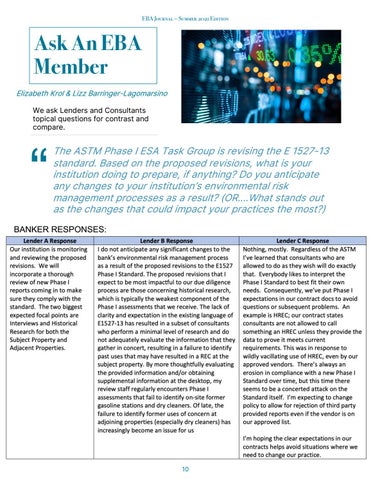
Ask An EBA Member Elizabeth Krol & Lizz Barringer-Lagomarsino We ask Lenders and Consultants topical questions for contrast and compare.
“
The ASTM Phase I ESA Task Group is revising the E 1527-13 standard. Based on the proposed revisions, what is your institution doing to prepare, if anything? Do you anticipate any changes to your institution’s environmental risk management processes as a result? (OR….What stands out as the changes that could impact your practices the most?)
BANKER RESPONSES:
10
EBA Journal – Summer 2021 Edition
(continued) Ask An EBA Member
CONSULTANT RESPONSES:
“
We just passed the one-year anniversary of the pandemic-led shutdown. What have you found to be the most challenging aspect of working remotely? The most positive?
CONTINUE READING ON WEBSITE >>> 11
EBA Journal – Summer 2021 Edition
SBA Loans Offer Flexibility in Challenging Times Lenders should take note of little-known changes in the latest SOP Derek Ezovski, President, ORMS LLC With a freshly minted administration in Washington, the Small Business Administration is prepared to tackle the many challenges facing the country’s small- to medium-sized businesses – our nation’s economic heartbeat. For lenders, this means new opportunities to help small business borrowers obtain the funds they need to grow, expand, or simply get back to business following a historically challenging year. SBA lenders have long understood the benefits these government-guaranteed loan programs offer to both banking institutions and their small business borrowers. They allow lenders to offer qualified borrowers more flexible loan terms and collateral requirements, while providing institutions with guarantees ranging from 50% to 85%, depending on the specific program. The SBA already played an outsized role in 2020 when it was charged with administering the massive Paycheck Protection Program (PPP) and ensuring that financial institutions were able to funnel hundreds of billions in relief funds to cash-strapped businesses and their employees. Despite technical challenges, the program was widely recognized as a success, and with passage of the Economic Aid to Hard-Hit Small Businesses, Nonprofits, and Venues Act at the end of the year, Congress released an additional $325 billion in PPP funding, this time aimed at the smallest and hardest-hit businesses. The Act also provided emergency enhancements to the SBA’s lending programs, including temporary guarantee increases, fee reductions, and deferrals of principal and interest. To cap off a busy year, the SBA also released updated standard operating procedures (SOP 50 10 6) effective October 1, 2020, covered in detail below.
(continued) 12
EBA Journal – Summer 2021 Edition
continued: SBA Loans Offer Flexibility in Challenging Times
New Enhancements Designed to Support Recovery Specifically, the SBA has enhanced several features of its flagship 7(a) loan program, including a temporary increase in loan guarantees from 75% (or 85%, depending on loan size) to 90% and reduced or eliminated fees for both the borrower and lender. Fees for the CDC/504 loan program have also been temporarily eliminated. The Act also extended the Small Business Debt Relief program, Section 1112 of the CARES Act, deferring payments of principal and interest on new and existing SBA 7(a), 504, and Microloan programs for eligible businesses. Per SBA Procedural Notice 5000-20095 dated February 16, 2021, the Economic Aid Act amended these provisions and revised the eligibility criteria for assistance to include all 7(a), 504, and Microloans approved up to September 27, 2020, even if not fully disbursed. Those funded on or after September 28, 2020 would be eligible to receive three months of relief. Moreover, loans approved between February 1, 2021 and September 30, 2021 are now also eligible for three months of debt relief. Note that any loans approved between September 28, 2020 and January 31, 2021 are not eligible for any relief, regardless of when funded. Congress also extended the authority to make PPP loans through May 31, 2021 and revised certain PPP requirements. Passed by Congress in March 2021, The American Rescue Plan Act provides additional relief for small businesses and heavily impacted industries, including $7.25 billion in additional PPP funding, $28.6 billion for the Restaurant Revitalization Fund, and additional funds for the Shuttered Venue Operators Grant program. In addition to these temporary enhancements, the SBA has signaled that under the leadership of its new Administrator, Isabel Guzman, it will be heavily focused on increasing lending to businesses in underserved and minority communities.
SBA’s Latest SOP Contains Some Surprises Whether you are a veteran SBA lender or considering offering SBA loans for the first time, you must be familiar with and stay up to date on all program guidelines and requirements, including the SBA’s latest standard operating procedures for 7(a) and 504 loans. These guidelines are wide-ranging and are particularly valuable in ensuring you perform proper environmental and collateral due diligence before consummating any new deal. CONTINUE READING ON WEBSITE >>>
13
EBA Journal – Summer 2021 Edition
2021 ALTA/NSPS Survey Standards: What Developers and Lenders Should Know Diane McDermott, Maria de la Motte, David Cahill & Dianne R. Phillips
Introduction The American Land Title Association (ALTA) and the National Society of Professional Surveyors (NSPS) have updated the Minimum Standard Detail Requirements for ALTA/NSPS Land Title Surveys (the “Standards”), effective February 23, 2021. The stated purpose of the Standards is to promote a clear understanding between the insured, the client (if different from the insured), the title insurance company, the lender, and the surveyor professionally responsible for a survey of real property, and the 2021 Standards aim to further this goal. The Standards were last revised in 2016, and a redline is available on the NSPS website showing the 2021 updates. Some changes are stylistic; for example, Section 3.D clarifies that the property that is the subject of a survey is now expressed as either “the surveyed property” or “the property to be surveyed.” Other changes are clarifying; for example, Section 4, Records Research, has rearranged the list of documents which a surveyor must be provided, which include the current record description of the property to be surveyed, complete copies of the most recent title commitment (or, if not available, other title evidence satisfactory to the title insurer), and specific public record documents, including current record descriptions of any adjoiners, any recorded easements benefiting the property, any recorded easements, servitudes, or covenants burdening the property, and, if desired, any unrecorded documents affecting the property. If the documents stated above are not provided to the surveyor, but are required to complete the survey, the surveyor must now conduct that research which is required by the jurisdiction where the surveyed property is located. This article highlights some of the key substantive changes of which developers, lenders, and other survey clients and users should be aware.
Title Documents An important change in the 2021 Standards is that Section 6.C.ii, covering easements, servitudes, rights of way, access, and documents, no longer requires the surveyor to list every exception shown on the title commitment, but rather, the surveyor is only required to list survey-related matters. The surveyor is required to include a statement regarding whether a right of way, easement, or other survey matter lies within or crosses the surveyed property, with a related note regarding whether its location is shown, cannot be determined from the record document, there was no observed evidence at the time of the fieldwork, it is a blanket easement, it does not affect the surveyed property, it limits access to an otherwise abutting right of way, the documents are illegible, and/or the surveyor has evidence of release or termination. (continued) 14
EBA Journal – Summer 2021 Edition
The revised Section 6.C.ii.(e) also clarifies that while surveyors should provide information on rights of way, easements, and other survey-related matters, and may opine on the effect of such matters on the surveyed property, such opinions may only be based on the description contained in the record document. This change was made in an effort to prevent surveyors from opining on the legal effect of such matters. Section 6.C.viii imposes a new requirement that if a surveyor becomes aware of a recorded easement not identified in the title evidence provided, the surveyor must advise the title company of the easement. If no evidence of a release or termination is provided, that easement must be shown on the face of the survey with a note that the insurer has been advised of its existence. The revised Section 6 also includes some changes as to what information must be included. For example, Section 6.C.vi now requires the inclusion of a tax parcel number for adjoining properties, where available.
Utilities Subsections 5.E.ii, iii, and iv of the Standards have been modified to reflect that utility locate markings should be located and shown, and that the survey should include a note as to the source of the markings. Additionally, utility poles on or within 10 feet of the surveyed property must be shown. The survey should include the extent of all encroaching utility pole encumbrances or overhangs, but without expressing a legal opinion on the ownership or nature of the potential encroachments. Relatedly, Section 5.C.ii, which generally requires the surveyor to observe improvements within 5 feet of each side of the boundary lines in the process of conducting fieldwork, has been modified to reference Section 5.E.iv with respect to which utility poles need to be located, those within 10 feet of the surveyed property. CONTINUE READING ON WEBSITE >>>
15
EBA Journal – Summer 2021 Edition
A Storm May be Coming – As a Lender are you prepared? John Thomas Rybak, Lizz Barringer Lagomarsino, Bill Tryon, Jimmy Kirkland, Brenna Durden, Jessica Crutchfield, and Kathryn Peacock
Introduction Part I of III A team of Environmental Bankers Association (EBA) Members are collaborating on this three-part series of articles about foreclosure due diligence. In Part I, this article, we focus on things lenders can do to prepare for the challenges ahead. There are a variety of considerations for lenders including what types of due diligence to perform, how to avoid liability that comes with owning real estate, and what to do when Recognized Environmental Conditions (RECs) and other concerns have been identified on a property. Related future articles will include updates written from the vantage points of environmental legal counsel and consultants on common pitfalls and best practices and how to best advise lenders. (continued) 16
EBA Journal – Summer 2021 Edition
(continued) A Storm May be Coming – As a Lender are you prepared?
In Part II, our legal team will dig deeper into the various federal, state, and local environmental laws and programs that lenders need to be aware of, and strategies for identifying and avoiding liability. No foreclosure article would be complete without at least a cursory discussion of the Comprehensive Environmental Response, Compensation and Liability Act (CERCLA), which establishes strict, joint and several liability for owners and operators of contaminated sites. As we will cover in Part II, the Secured Creditor Exemption and Landowner Liability Protections can help to protect lenders from CERCLA liability, although liabilities resulting from the Resource Conservation and Recovery Act (RCRA), and the Clean Water Act (CWA) can also be significant. In addition, many states and local governments have separate statutes that may impose requirements and liabilities beyond the federal statutes and may impact the secured collateral. Careful assessment of the applicable federal, state, and local laws and regulations is an essential component of the foreclosure decision-making process. In Part III, our consultant team will explore what to consider during foreclosure due diligence, as well as ways to mitigate risks identified in the due diligence process. When the foreclosure process begins and it becomes clear that a distressed asset may soon become a bank-owned asset, the due diligence process begins to look a bit different than during loan origination. Performing thorough due diligence at the pre-foreclosure stage is critical. In fact, the due diligence a lender completes at this stage should go above and beyond what was completed during the origination of the loan. Each lending institution should consider their baseline Phase I Scope of Work and include amended scope items case by case. Considerations may include, but are not limited to, compliance status, temporary closure of USTs, evaluation of asbestos, lead-based paint, radon and mold, maintenance issues, stormwater management, hazardous waste inventories, construction status safety issues and building issues. You can look forward to further discussion on Part II and Part III in future EBA Journal submissions by this group. Now we will return our focus to Part I, preparing a lender for foreclosures.
Foreclosures, as a Lender are you prepared? Preparing for the Storm When a storm is on the horizon, it is important to prepare to minimize damage and batten down the metaphorical hatches. For nature-based storms the Red Cross advises to listen to the national weather forecasts, be prepared, check your disaster supplies, stronghold your house, turn up your refrigerator/freezer, charge your communication devices, make sure backup charging devices are 100% and stock up on non-perishable food and water. A similar process should be undertaken to prepare for business storms. CONTINUE READING ON WEBSITE >>>
17
EBA Journal – Summer 2021 Edition
PFAS CORNER
18
PFAS CORNER:
EBA Journal – Summer 2021 Edition
A Window Into Our Daily Human Exposure to PFAS
Ryan Moore, REGENESIS
And a Novel Method for Eliminating Risk Long-Term
Public concern surrounding per- and polyfluoroalkyl substances (PFAS) continues to mount as their persistence, toxicity, and potential risk to human health and the environment becomes more widely realized. Common in many consumer products, studies have linked exposure to "forever chemicals" to cancer, developmental problems, thyroid, kidney and liver diseases, and immune system malfunction. As public attention to PFAS continues to rise, it’s alarming to consider the many places one might encounter these toxic chemicals in daily life, their fate in the environment, and what, if anything, might be done to reduce the exposure risk. Using a typical everyday scenario, we will shadow Sara, a hypothetical working mom, throughout her normal weekday, journaling encounters with PFAS contaminants.
A Day in the Life of PFAS Exposure It's 6:00 a.m., and the alarm rings. Rising out of bed, Sara places her feet on the plush carpet, her first exposure to PFAS as she starts her day. This carpet is a familiar retail brand using a well-known stain-repellant – a feature Sara appreciated. She had lost count of the number of times her child had spilled a drink crawling into bed for a story or when she herself had knocked over her coffee. After a shower and gulping down a quick breakfast, Sara brushes her teeth and flosses with PFAS-treated dental floss. She applies makeup, using foundation and eyeliner, representing brands recently banned in some countries after testing revealed PFAS chemicals.
CONTINUE READING ON WEBSITE >>>
19
PFAS CORNER:
EBA Journal – Summer 2021 Edition
Are PFAS An Impact to Your Property?
John Burkart, GRS Global
What are PFAS? A PFAS is a per- and poly-fluoroalkyl substance that has been manufactured around the globe since the 1940s. PFAS are hardy in the environment and in the human body. PFAS do not break down but accumulate over time. New evidence suggests that PFAS can lead to adverse health defects in the human body. PFAS is an active ingredient in Class B firefighting foams. The foams must contain fluorine to have PFAS as fluorine free foams do not contain PFAS. Responder Help has a map of each state. In my state, North Carolina, beginning July 1, 2022, no person may discharge or uses AFFF (Aqueous film-forming foam) for training purposes. Manufacturers may not manufacture, sell, or distribute AFFF. Beginning on July 1, 2022, a manufacturer that sells PPE to any person, local government or state agency must provide written notice to the purchaser at the time of sale if the PPE contains PFAS chemicals. PFAS can be found in food packaged in PFAS-containing material, processed with equipment that uses PFAS, or grown in PFAS-contaminated soil or water. PFAS in household products includes stain and water repellent fabrics, non-stick products (Teflon), polishes, waxes, paints, cleaning products, and fire-fighting foam as noted above. Workplace uses of PFAS includes chrome plating, electronics manufacturing, or oil recovery operations. Drinking water from firefighter training facilities, waste-water treatment plants, landfills and manufacturing facilities can all contribute to PFAS contamination. PFAS can be found in living organisms such as fish, animals, and humans where PFAS have accumulated and persisted over time. In the United States, PFAS chemicals are no longer manufactured under the PFOA Stewardship Program where eight major chemical manufacturers agreed to eliminate PFOA and PFOA-related chemicals from their products and as emissions from their facilities. However, PFAS is still produced internationally and can be imported into the US in consumer goods such as carpet, leather, and apparel; textiles; paper and packaging; coatings; rubber; and plastics. PFAS have been linked to liver and kidney issues, reproductive and development problems, cholesterol levels, low infant birth weights, adverse effects on the immune system, cancer, as well as thyroid hormone disruption.
CONTINUE READING ON WEBSITE >>> 20
EBA Journal – Summer 2021 Edition
Adapt to Survive:
Business transformation in a time of uncertainty Submitted by James M. Donovan, CEO of Envirosite Corp and ADEC Innovations With permission on behalf of GEO for Business, a UN Environment Programme publication We are witnessing dramatic changes worldwide in the environment, technology, the economy, and in society. The COVID-19 pandemic has amplified concerns about the highly interconnected and vulnerable state of the global economy and has made it clear that a resilient economy must be one that prioritizes and supports the well-being of nature and people. The scale of global environmental challenges is unprecedented. In fact, the World Economic Forum’s 2020 global business risk reports identified environmental risks as the main threat to economic growth and prosperity in stark contrast to its 2010 assessment, in which environmental risks were not even discussed. The more climate changes, air and water are polluted, and biodiversity is lost, the greater the damage to health and the economy. Business transformation is critical and shifting towards a nature positive approach is the best way for business to transform. While business has been severely disrupted by the COVID-19 pandemic and the associated economic crisis, this moment does not have to be a return to business as usual. Businesses that are able to leverage this time to explore, experiment, collaborate and ultimately begin to adapt to change will be ahead of the others. This is as true for small- and medium-sized enterprises as it is for large corporations. What this means in practice will be different for every business, as the policy, market and social drivers that accelerate sustainability transitions are context- and sector-dependent. Failing to create an individual transformative pathway risks a business’s future. Transformation in the world is already happening, albeit slowly. Some incumbents have leaned into this change with great success. Denmark’s Dong Energy, rebranded as Ørsted, sold almost all of its fossil fuel interests, and is now thriving as a sustainable energy business, on track to be carbon neutral in energy generation and operations by 2025. Others, such as RWE and Eon have had to write off billions of dollars and break up to separate stranded assets, mainly investments in coal and lignite, from cleaner parts of their business. Many major energy players are now rapidly shifting course. In August 2020, BP announced its plan to transform itself into an integrated energy company, investing $5 billion per year in low carbon energy and raising its renewable generating capacity to 50 gigawatts by 2030, up from 2.5 gigawatts in 2019. And major food manufacturers such as Unilever are driving sustainability principles in their supply chains. (continued)
21
(continued) Adapt to Survive
EBA Journal – Summer 2021 Edition
The global push for sustainability transition creates an enabling business environment for new types of entrepreneurship: for purpose driven businesses that are committed to delivering positive impact for societal challenges. For those that fail to adapt, survival is at stake. Amplified by a global pandemic, there is now a struggle for business survival and recovery. Initiatives, such as the United Nations Principles for Responsible Investment (over 3,000 signatures), offer metrics and reporting frameworks to further strengthen corporate transparency and accountability, better track progress, inspire leadership, foster goal setting, and provide learning opportunities. The United Nations set out six principles to ‘Build back better’ capturing what is required: 1. 2. 3. 4.
5. 6.
The huge amounts of money to be spent on recovery from the COVID-19 pandemic must deliver new jobs and businesses through a clean, green transition. Where taxpayers’ money is used to rescue businesses, it must be tied to achieving green jobs and sustainable growth. Fiscal firepower must drive a shift from the grey to the green economy, empowering societies and people to be more resilient. Public funds should be used to invest in the future, not the past, and flow to environmentally sustainable sectors and projects that help the environment and the climate. Fossil fuel subsidies must end, and polluters must start paying for their pollution. Climate risks and opportunities must be incorporated into the financial system as well as all aspects of public policy making and infrastructure. All need to work together as an international community.
Other initiatives, like the Taskforce for Climate-Related Financial Disclosures (TCFD) framework, allow business leaders, investors, insurers, and others to better understand a company’s exposure to climate-related risk. CONTINUE READING ON WEBSITE >>>
22
EBA Journal – Summer 2021 Edition
Quality Corner – The Facts of Life: Quality vs. Utility
“
How much environmental due diligence is necessary for a commercial real estate loan to determine if the collateral is impaired due to environmental risk?
Generally, just enough to understand the potential for risk or to quantify the risk. Occasionally, just enough due diligence to ease a purchaser’s liability concerns, or just enough for a bank to lend money to a borrower. For most generic property loans, the lender starts with a Phase I Environmental Site Assessment (ESA) to determine if an environmental condition is present. If the Phase I ESA states that an environmental condition is not present, the loan is good to go, right? That is the impression of most relationship managers, but they’re in production, not risk management. Their view of environmental risk is obstructed by the location of their seat in the lending theater. Environmental risk managers know that not all Phase I ESAs are created equal; while a report prepared for a borrower might conclude there is “no recognized environmental condition,” the environmental risk manager for a lender might not agree with the borrower’s consultant. Further, if there is an environmental condition, the Phase I ESA might not include enough detail to establish any mitigating factors, thus failing to meet the lender’s needs. This deficiency can occur even if the report is consistent with the ASTM standard or the consultant’s scope of work. The EBA Quality Committee has been mulling over this dilemma for two years now and has reached out to lenders and consultants in two polls to drill down to solutions. A third poll will be conducted with live polling during the 2021 EBA Summer Virtual Conference. (continued)
23
(continued) Quality Corner
EBA Journal – Summer 2021 Edition
A new twist in thinking has come up. Can ESAs that don’t meet the lender’s needs be fully attributed to Low Quality? Or is the problem really Low Utility? o
Quality is defined as: Having a high degree of excellence. (Meeting or exceeding an established standard).
o
Utility is defined as: Being useful, profitable, or beneficial. (Adequately addressing a need).
Who needs excellence when we really just need something that adequately (not perfectly) characterizes environmental risk (just enough to meet the lender’s risk tolerance)? Economists have spent a lot of time studying the concept of utility, including establishing the “law of diminishing marginal utility,” which, among other things, suggests that the third donut is just not as satisfying as the first. I know everyone is craving a donut right now, but first let’s consider the importance of utility in the review of a Phase I ESA.
Is it possible that a Phase I ESA may be of both low quality and high utility? Yes. We commonly see Phase I ESAs that don’t fully meet bank policy requirements but are adequate to determine the bank’s environmental risk. In reality, in the past year, how many Phase I ESAs have been determined to be of such low quality that they could not be used to determine risk? Almost all Phase I ESAs purporting to be ASTM-compliant have some utility because they provide some environmental risk information. Even imperfect ESAs, however, can be supplemented with other information or factors to become adequate to meet the User’s risk tolerances.
So, why struggle for the perfect Phase I ESA? In business, the brutal truth is that sometimes you don’t get any return from extra effort or quality. Warren Buffet once said:
CONTINUE READING ON WEBSITE >>>
24
EBA Journal – Summer 2021 Edition
Case Corner
Mike Minett, Vice President, Nova Group GBC.
An ASTM E1527-13 Phase I Environmental Site Assessment for a Day Care Center built on Coal Ash Residuals…yikes! At first blush a Phase I on a Day Care Center, near Charlotte, North Carolina, is not a big deal. There are no complicated industrial processes, no waste streams, often no underground or above ground storage tanks. The Subject Property ground surface is all paved, under the building, or a mat covered playground (with small plantings outside the front of the building). I was curious to research the former coal ash residuals reuse as structural fill, (a common practice until around 2005), and come up with my own conclusions about this and current possible impacts: both regulatory and to the occupants of the building. The Subject Property was built on twenty feet of coal ash residuals, called in the industry coal combustion residuals (CCR) structural fill that was from a nearby power plant…is that a Recognized Environmental Condition (REC) or even a Business Environmental Risk (BER)? The client was concerned as they had seen the database with a coal ash listing and had obtained a document titled "DRAFT Regulatory Impact Analysis, READOPTION OF 15A NCAC 13B SECTION .1700 REQUIREMENTS FOR BENEFICIAL USE OF COAL COMBUSTION PRODUCTS" by the North Carolina Environmental Management Commission. This is a document discussing the regulatory changes and requirements for permitted structural fill locations that used CCR after 1983, with over 10,000 cubic yards of fill. It appears the resulting impact of this document (which is still in the rule making process) will be to require a proper cap be maintained over any such fill; it will not exempt the owner of the Property from potential groundwater contamination responsibility. (continued)
25
EBA Journal – Summer 2021 Edition
(continued) Case Corner
.
In North Carolina, environmental groups have sued the energy producers and petitioned the State to close out coal ash basins which house the CCR from burning coal in steam plants to produce electricity. They have also tried to get coal ash listed as a hazardous waste, which the State and EPA have declined to do. The activists cannot use the term coal ash without the preface of “toxic.” Of course, many things that are part of our daily lives are toxic, without requiring the toxic precursor: gasoline for instance. However, after an ash basin collapsed into a ruptured stormwater pipe, and discharged its contents into the Dan River, coal ash got a bad reputation in North Carolina. The EPA “supports the environmentally sound recycling of coal ash and has developed regulations on the safe disposal of coal ash in landfills and surface impoundments.” In fact, the EPA supports the beneficial use of CCR under controlled conditions. The CCR is regulated as an “industrial nonhazardous secondary material.” The EPA describes “secondary material” as not being the primary products from manufacturing or industrial processes. In the case of CCR, they also describe “beneficial use” as one that provides a functional benefit and does not pose concerns to human health or the environment. That appears to defy the definition of REC. Beneficial use of CCR is described in 40 CFR 257 as: “Beneficial use of CCR means the CCR meet all of the following conditions:
CONTINUE READING ON WEBSITE >>>
26
EBA Journal – Summer 2021 Edition
EBA SPOTLIGHT: Emerging Leader The EBA Journal Committee is pleased to spotlight Krishna Madhav, a high school student who has expressed an interest in the environmental industry. Mr. Madhav wrote a fascinating article on Maxeon Solar Technologies, and the role they play in the renewable energy arena. His article will be available on the EBA Website, along with a link to his LinkedIn profile. In this Q & A, we delve a little deeper into what drew Mr. Madhav to the environmental field, and specifically, the Environmental Bankers Association.
CONTINUE READING ON WEBSITE >>>
27
EBA Journal – Summer 2021 Edition
COMMITTEE CORNER Conference Committee Plans the EBA conference agenda and conference experience. 2021 Chair: Bill Sloan, Regions Bank
Content Committee
The EBA has several committees meeting regularly. In fact, it is due to our volunteer members who dedicate their time, talent, and expertise, that most of the EBA's content exists, including this Journal!.
Plans and organizes EBA educational content, including webinar planning and execution, and recommended topics for conference sessions 2021 Chair: Georgina Dannatt, Bank of the West
DEI Committee Identifies and organizes opportunities we can make EBA and our industry more diverse, equitable, and inclusive. 2021 Chair: Lori McKinnon, Zions First National Bank
Gives Back Committee Identifies and organizes opportunities where our members can make an impact through contributions to charitable organizations. 2021 Chair: Mike McGeehan, EBI Consulting
Membership Committee
All EBA members are invited to join these open committees and get involved! Contact eba@envirobank.org to learn more.
Builds connections with members to ensure they’re making the most of their EBA membership, as well as identifies and makes initial outreach to future members. 2021 Chair: John Rybak, Truist Bank
Journal Committee Collects, writes, edits, and assembles articles our members contribute to our 2x annual publication. 2021 Chair: Ruxandra Niculescu, GSI
28
EBA Journal – Summer 2021 Edition
EBA JOURNAL SPOTLIGHT: Bring Your Content Ideas to Fruition and Become a Published Author! by Tammy Ribaudo, with introduction by Lizz Barringer Lagomarsino and Elizabeth Krol
Introduction The Environmental Bankers Association (EBA) has been a leader in providing industry news, information and technical updates critical to the environmental risk management community since its formation more than 25 years ago. The original Bank Notes periodic newsletter was enhanced in 2015 when the EBA News Committee was formed and began the formal publication of the EBA Journal.
(continued)
29
EBA Journal – Summer 2021 Edition
(continued) EBA Journal Spotlight
.
The EBA Journal spotlights and reflects the expertise of our members, while also serving as an important platform to help our members improve their effectiveness in their respective roles. In addition, the EBA Journal is both a valued member benefit and a recruitment tool to invite new lenders and affiliates to join our esteemed organization.
EBA members have been contributing content throughout the EBA Journal’s history, yet we know that there are members who may be reticent to participate. So, for those of you who have ever wanted to contribute to the EBA Journal but just don’t know where to start, or perhaps you are a technical person looking to utilize your creative writing skills, we can help! As the EBA Journal continues to evolve in 2021, we intend to continue to create a document with more and intriguing content for our members.
How can you get started writing an article for the EBA Journal? I recently shared with EBA members how to bring an idea to fruition so that more members can contribute and become published authors. Here we provide an overview of my recommendations for writing topical and technical content for the EBA Journal, including insights on how to turn your idea into an article.
CONTINUE READING ON WEBSITE >>>
30