The Engineer
Nova Scotia’s source for engineering news
Nova Scotia’s source for engineering news

CBRM Healthcare Redevelopment Project

An Engineer’s Journey: Naufil Sayed, P.Eng



Engineers Nova Scotia Council 2024-2025
Dr. Jennie Rand, P.Eng.
Andrew Thalheimer, P.Eng.
Dr. Sue Molloy, P.Eng.
Martin Corbett, P.Eng.
John Crane, P.Eng.
Aaron Kennedy, P.Eng.
Wayne MacDonald, P.Eng.
Malcolm Palamarek, P.Eng.
Krista Phillips, P.Eng.
Kayleigh Rayner Brown, P.Eng.
Brian Ward, P.Eng.
Ex-Officio Members
Denise Pothier, FEC, P.Eng.
DS (Pal) Mann, FEC, P.Eng.
Zone Representatives
Darrin McLean, FEC, P.Eng.
Oliver Browning, FEC, P.Eng.
Vivek Tomar, FEC, P.Eng.
Conrad LeLièvre, FEC, P.Eng.
Ron Marks, FEC, P.Eng.
Andrew Polegato, FEC, P.Eng.
Harry Daemen, FEC, P.Eng.
Committee Chair Persons
Legislative Committees
Denise Trim, FEC, P.Eng.
Bob MacDonald, FEC, P.Eng.
George Goad, FEC, P.Eng.
Dr. Sue Molloy, P.Eng.
Committees of Council
Jeff Knapp, FEC, P.Eng.
Andrew Thalheimer, P.Eng.
CEO Committees
John Eisnor, FEC, P.Eng.
Jade Farr, EIT
Thomas Simmons, EIT
Darrell Marsh, P.Eng.
Browren Allard, P.Eng.
Craig Arthur, P.Eng.
Audrey Hiscock P.Eng.
Alan Ehrenholz, P.Eng.
Alexandra MacDonald
President
Vice-President
Past-President
Councillor
Councillor
Councillor
Councillor
Councillor
Councillor
Councillor
Councillor
Engineers Canada Director
CEO & Registrar
Cape Breton/Victoria Colchester
Halifax/Hants
Kings/Annapolis
Pictou
Cumberland
Antigonish/Guysborough
Board of Examiners
Complaints
Discipline
Nominating
Finance & Audit
Honours & Awards Committee
Continuing Professional Development
Emerging Professionals
Emerging Professionals
National Engineering Month
Professional Practice
Public Safety Advisory
Student Affairs
Sustainability
Youth Engagement

Dr. Jennie Rand, P,Eng., President, Engineers Nova Scotia

Pal Mann, CD, FCSSE, FEC, P.Eng., ICD.D, CEO & Registrar, Engineers Nova Scotia
Celebrating an inspiring annual gathering
Closing off the 2024/25 Council year, this year’s Annual Conference, Business Meeting, and Awards Gala reflected our shared theme—Engineers Open Doors. Over two inspiring days, engineers in every stage of their careers came together to exchange ideas, celebrate excellence, and strengthen the bonds that make our community thrive.
Our speakers, drawn from Nova Scotia and beyond, explored technical innovation, professional practice, and future-focused regulatory issues. The Gala was a highlight, honouring remarkable contributions that demonstrate how engineers truly open doors—creating opportunities, improving lives, and advancing the well-being of all Nova Scotians.
“Our conference theme, Engineers Open Doors , captures the essence of what we do—transform ideas into impact and create pathways to a stronger, more sustainable province.”
While we have celebrated our past successes and reflected on all that has brought us here, Council and staff now turn our attention to the work ahead. The coming months will bring both challenges and opportunities for renewal as we continue to open doors for the profession and the public. To that end, we will focus on several key initiatives that will shape our collective future.
Among the many topics sparking conversation, artificial intelligence (AI) is at the forefront. AI is transforming how engineers design, analyze, and innovate. As these technologies evolve, they are opening new doors for creativity, safety, and efficiency across every field of engineering.
Engineers Nova Scotia is examining how best to support safe and responsible AI use. Through national collaboration, professional guidance, and continuing education, we aim to help registrants confidently navigate this rapidly changing landscape.
As we transition into this next phase of growth, our commitment to strong governance remains unwavering. We are examining our governance framework to ensure it remains clear, accountable, and aligned with best practices. In tandem, we are engaging with government to modernize our Act - an essential step in opening doors to a more adaptive and effective regulatory system.
These initiatives will work to ensure that engineering in Nova Scotia continues to operate with transparency, professionalism, and public trust.
continued from page 4
Our office at 1355 Barrington Street has long served as a hub for collaboration, but the time has come to explore a more modern and accessible space. A new office will help open doors to new ways of working - supporting innovation, connection, and service excellence as we adapt to registrants’ evolving needs.
Your input will be vital as we shape this future together, ensuring that our next chapter builds on the momentum and tradition of excellence that define engineering in Nova Scotia.
“Modernizing how we work is about more than space—it’s about opening doors to new possibilities for engagement and collaboration.”


Shaping the next Strategic Plan
Looking beyond 2027, we are paving the way for a new strategic plan that will chart Engineers Nova Scotia’s course for the years ahead. This process represents another door opening - a chance to align our goals with the needs of the profession and the public we serve, with a commitment to including voices that have historically been underrepresented in engineering.
As we move forward, we invite every engineer to take part in shaping what comes next. Your expertise, insight, and passion are what make our profession vibrant and resilient. By volunteering with Engineers Nova Scotia, you help open doors for others - students, peers, and the communities who rely on our collective knowledge. Over the next coming months, we will share opportunities to contribute through sharing innovative ideas and perspectives to regulate and shape our profession.
Together, we are building a future where engineers continue to open doors - to innovation, opportunity, and public trust.
our website
update personal information or email info@engineersnovascotia.ca
It’s a registrant’s responsibility to keep their info up-to-date.
engineersnovascotia.ca





We encourage all registrants to log in to their portal and ensure that all personal and professional information is up to date.

Engineers Nova Scotia’s Annual Business Meeting and Awards Gala was held at the Halifax Tower Hotel on October 22. Engineers Nova Scotia COO Kris Dove, FEC, P.Eng., and CEO and Registrar, D.S. (Pal) Mann, CD, FCSSE, FEC, P.Eng., ICD.D,., are pictured avove during the Town Hall.
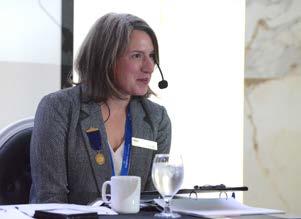
Registrants heard from the new Engineers Nova Scotia President Dr. Jennie Rand, P.Eng.. about upcoming initiatives.
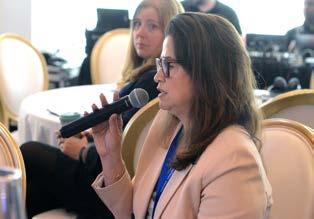
During the Town Hall, registrants helped shape the profession by joining open discussions on the path forward for our organization.
The 2024-2025 Annual Report, Audited Financial Statements and Budget are available for download here
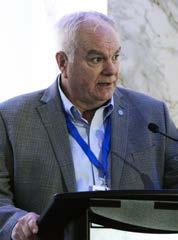
Following the Town Hall, the Annual Business Meeting focused on the business of the organization and included a review of the financial statements, an introduction of the new Council members and an opportunity for registrants to ask questions regarding the business of the association.
Left: Jeff Knapp, FEC, P.Eng., presents the Finance and Audit Committee’s 2024/25 Annual Report.
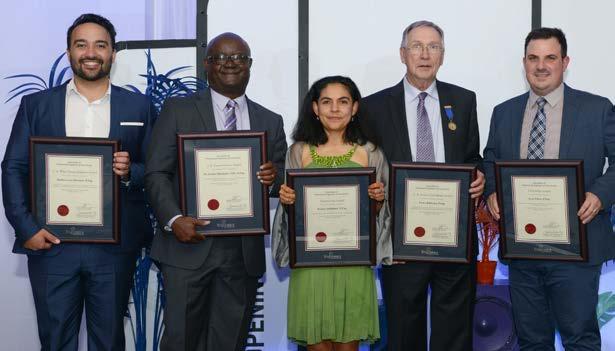
After the Annual Business Meeting, our Gala for the engineering profession in Nova Scotia was held where we celebrated our 2025 Engineering Award Winners. You can read about all eight winners beginning on Page 31.
Featured below: award winners Levi Morrison, P.Eng., Dr. Emeka Oguejiofor, FEC, P.Eng., Denisse Justiniano, P.Eng., Victor Belliveau, P.Eng., Greg Peters, P.Eng.
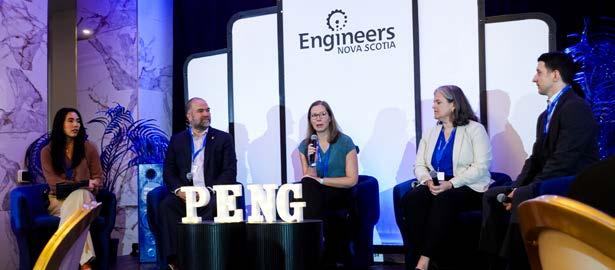
Our Professional Development Conference was held on October 21 at Halifax Tower Hotel. Pictured above is the Emerging Professionals Panel Discussion: Creating Culture Through Mentorship, with moderator Jade Farr, EIT, and panelists Chris Davis, FEC, P.Eng., Chrissy Duggan, P.Eng., Christine Bonnell-Eisnor, FEC, P.Eng., and Matt Glynn, P.Eng.
Professional Development presentations covered a broad range of topics including a focused regulatory breakout session on the professional conduct process, and how the FBI’s Behavioural Change Stairway Model can strengthen leadership and communication skills.
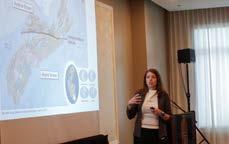
Pictured to the right is Maureen Matthew, giving her presentation on how rock type and structure influence foundation design, excavation, slope stability, and construction materials.
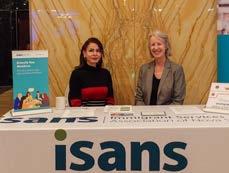
We would like to thank ISANS and Dalhousie University for providing information booths at our event and would also like to recognize our Conference partners who supported our event:
Affinity Partner: TD Insurance
Innovate Partners: CBCL Limited, Canada Life Co
Connect Partners: Victor Insurance, Manulife, On-line Computer Services, Dalhousie University — Faculty of Management, Faculty of Engineering, Faculty of Engineering - Department of Process Engineering and Applied Science
À La Carte Partners: Cox & Palmer, Bird Construction, Eastpoint Engineering, Lindsay Construction, Build Nova Scotia
Thank you to all our Conference presenters: Melissa Fortunato (Managing Director at Negotiations Collective and Retired FBI Special Agent), Ann-Marie Flinn (President and Founder at Champion Change Agency), David Benoit, P.Eng. (President and CEO at Build Nova Scotia), Andrew Feener, P.Eng. (Senior Director Project Delivery & Chief Project Officer at Build Nova Scotia Healthcare Infrastructure Division), Maureen Matthew, PhD, P.Geo. (Senior Engineering Geologist at BGC Engineering) and to each of our event volunteers.

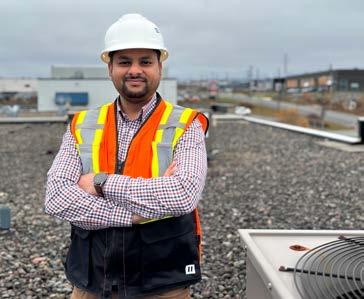
“My 15-year career journey has taken me across three countries, and the last decade has been an incredible journey.” For Naufil Sayed, P.Eng., these words capture a path that has spanned continents and cultures. From India to Dubai, and now Canada, mechanical engineer Naufil began a new chapter in Halifax in August of 2022. After a 28-hour flight, he stepped off the plane carrying not just luggage, but determination, passion, and a vision for growth in a city he now calls home.
Naufil’s curiosity in science from an early age naturally drew him to engineering. “I’ve always been fascinated by how things work, how systems connect, and how everything fits together.”
Another big influence was his uncle, who worked in HVAC and encouraged
him through hands-on projects that sparked his interest in the field. That early exposure guided him to complete his mechanical engineering degree in Mumbai and to spend a year teaching as a lecturer at Rizvi College of Engineering. Looking back on his time in Dubai, “That’s where my long-term journey in HVAC truly began.”
After nearly a decade of managing complex engineering projects, he realized his focus had become heavily technical. Seeking to complement his technical expertise with business and management skills, he decided to pursue an MBA at the Sobey School of Business at Saint Mary’s University. “It gave me a broader lens to approach projects and navigate leadership roles.”
Naufil now works as a Sales Engineer at E.H. Price Solutions in Dartmouth, NS. His role combines technical expertise, project collaboration, and client engagement within a company that represents and distributes products from several leading manufacturers of HVAC equipment. “My work is all about collaboration.” Naufil partners with consulting engineers from the very beginning of a project, helping with equipment sizing, selection, and system design. He is actively involved throughout the process, providing technical guidance and support from design to execution. When it comes to the Canadian work culture, he describes it as process-oriented. “Roles and responsibilities are clearly defined and highly collaborative. Everyone is really polite and willing to support.”
Settling in a new country wasn’t without its surprises. Naufil recalls one chilly autumn day shortly after arriving in Halifax: “I was shopping around Costco, wearing just a T-shirt, when the weather suddenly turned cold. I had no idea how quickly the weather could change,” he laughs, “so I walked into a store and bought a jacket right there.”
But it wasn’t just the weather. ‘Small talk’ — a key part of North American workplace culture, initially felt unfamiliar. “As someone who wasn’t born or raised here, it took time to understand what works and how to adapt to the nuances of professional communication in Canada, especially the soft skills part.”
To adapt, he enrolled in programs and courses through the Immigrant Services Association of Nova Scotia (ISANS) and regularly attended networking events in Halifax. “For me, learning has
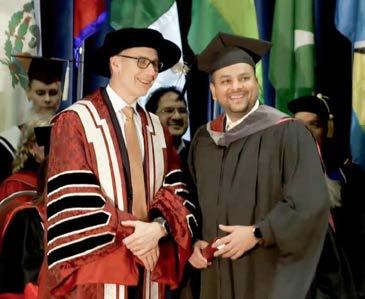
been continuous, especially in a customer-facing role where soft skills are vital. The more you practice, the more natural it becomes.” Naufil also emphasizes the value of persistence in networking for engineers new to Canada. “You never know which connection will lead to an opportunity,” he notes. “Sometimes you meet hundreds of people and nothing comes of it, and other times, just a few conversations can open doors. The key is to keep showing up, engaging, and building relationships.”
The first major milestone in Canada came in 2024, when Naufil earned his P.Eng. designation from Engineers Nova Scotia and was featured in the Winter issue. “It felt truly special and made me feel genuinely welcomed by the Canadian engineering community,” he recalls. He shares that becoming
a Professional Engineer was both an incredible achievement and a proud moment, particularly as someone with international experience. “It gave me the credibility and connections I needed as an immigrant and the opportunity to collaborate, grow, and contribute meaningfully to Canada’s engineering community.”
Reflecting on his path to licensure, Naufil highlights the ISANS Orientation for Engineers program as especially valuable. “Dennis Callahan, the instructor, made the learning practical and engaging,” he says. Today, he remains closely connected with ISANS, mentoring EITs and guiding them through the licensing process, from the National Professional Practice Exam (NPPE) to professional reports, and helping them to know what to expect
and how to prepare. Having navigated the system himself after moving countries, he understands how valuable guidance can be.
“If I can make someone’s life a little easier, it feels truly fulfilling. It just makes me happy.”
Recently, Naufil earned his Certified Energy Manager (CEM) designation and the ASHRAE Certified HVAC Designer credential. At the same time, his personal life has been filled with joy and new beginnings. He and his wife are raising two sons and welcomed a baby daughter three months ago. This is his family’s first year in Canada, and they are gradually finding their rhythm as they settle into their new home. “My son loves going to school here and has a great time,” he shares. Outside of work, he enjoys going to parks or spending time with his family. “Just watching my kids play brings happiness to me and my wife.” Balancing a busy career with family life, he finds pride and fulfillment in both. “Sometimes I return from networking events at 8 or 9, and my kids are still waiting for me. It’s important to give love back to my family as well.”
Having embraced a new culture and found purpose in mentoring others, Naufil calls his three-year journey in Canada “rewarding and gratifying,” and looks forward to continuing his contributions to the profession and community.

A drone shot of the Northside Healthcare Complex shows construction progress on the new health centre, laundry facility and long-term care home. Photo: Nova Scotia Health
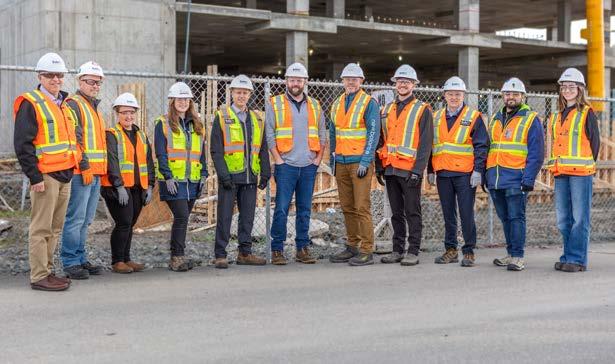
Members of Engineers Nova Scotia with Build Nova Scotia and Nova Scotia Health who work on the CBRM Healthcare Redevelopment Project. From left to right: Jeff Slipp, P.Eng., Kendall Murphy, P.Eng., Lindsay Hawco, EIT, Leanne Stone, P.Eng., Peter MacDonald, P.Eng., Ken LeBlanc, P.Eng., Ian McDiarmid, P.Eng., Shaun Dieltgens, P.Eng., Darrell MacKinnon, P.Eng., Anas Tahir, P.Eng., Madison LeVatte, P.Eng. Photo: Nova Scotia Health
Over his 40-year engineering career, Darrell MacKinnon, P.Eng., has been part of many projects across Cape Breton, but nothing like the Cape Breton Regional Municipality (CBRM) Healthcare Redevelopment Project. A civil engineer, Darrell is a project manager with the redevelopment team. He acts as a critical link between design leads, clinical leaders and construction teams.
“The project is an opportunity to help shape healthcare delivery locally,” he says. “To be part of the patient-centered design and construction of these facilities
is exciting. New and improved facilities should attract medical professionals and provide additional medical services locally.”
The CBRM Healthcare Redevelopment Project is a partnership between Nova Scotia Health, Build Nova Scotia and the provincial government. It includes expansions and renovations at Glace Bay Hospital; a new health centre, 60-bed long-term care home and laundry centre on the Northside; and a community hub model in New Waterford with a health centre, 60-bed long-term care home, school,
community wellness centre and recreational amenities. At Cape Breton Regional Hospital–the island’s main trauma centre–a new Cape Breton Cancer Centre is under construction as well as a clinical services building that will house an emergency department, critical care department, inpatient beds, cardiac catheterization lab, maternal/ newborn services and surgical suites.
Some of the project’s engineering and design features include biomass boilers to collectively reduce oil dependency by about 70 percent, marking a major step toward cleaner, renewable energy
use across the region. Each facility is designed for the digital age, with wired and wireless data infrastructure supporting advanced systems like Nurse Call, Real-Time Location Services (RTLS), and integrated security management— all ensuring safer, smarter care delivery. On the Northside, the upper floors of the building open onto balconies overlooking Sydney Harbour, blending functionality with restorative design for seniors in long-term care. In New Waterford, the community hub is an architectural example of community wellness to support the social determinants of health for future generations.
Leanne Stone is an industrial engineer, P.Eng., who has more than 15 years of experience working in healthcare with Nova Scotia Health and the IWK Health Centre and has been with
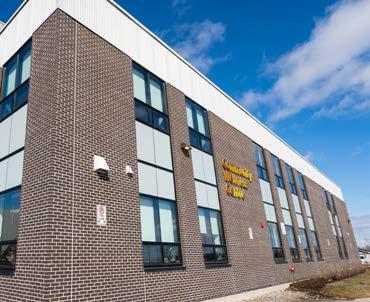
The new Community Wellness Centre opened in March 2025 as part of the New Waterford Community Hub project. The project also includes a school, health centre, long-term care home and recreation fields.
the project since it was announced in 2018. Like Darrell, she works with architects, contractors and frontline staff to determine space requirements, furniture, equipment and other essential elements to help the new spaces function for patients and staff.

“The project has been a unique opportunity to help bring the longterm vision for healthcare in Cape Breton to life, by working alongside staff, physicians and the community,” she explains. “Our staff and physicians provide excellent care, but they are sometimes limited by their working spaces. New technology and modern facilities provide new opportunities.”
Construction is underway at three of the project sites. As the new facilities welcome patients in the coming years, the team will be opening and operationalizing over one million square feet in healthcare space.
“The projects are a major investment in core community infrastructure, and their impacts will be felt for generations to come,” says Darrell. “It’s an exciting time for Cape Breton!”
To learn more about the projects, visit Healthcare Infrastructure | Build Nova Scotia.
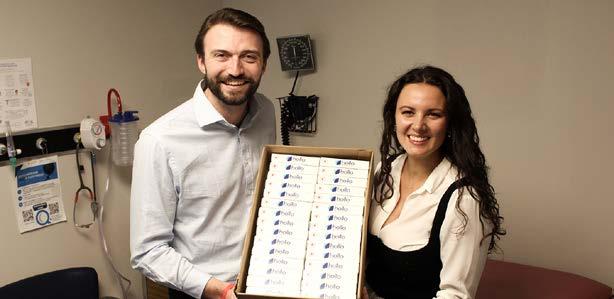
In the middle of a pandemic, two engineers asked a simple question: why are inhaler spacers still so cumbersome? The answer led to Hollo Medical—a start-up blending mechanical design, medical insight, and patient feedback to reinvent a decades-old device. With a flow control (FloCtrl™) valve that delivers medication consistently with each use and a form factor that fits in your pocket, Hollo is engineering a breath of fresh air.
The founders behind the innovation
Sara Fedullo, EIT, studied chemical and process engineering at Dalhousie University before joining a local
medical start-up focused on radiotherapy solutions. “That role gave me a window into what it takes to bring a medical device to market,” she says. “I realized this was the path I wanted to follow.”
Dr. David Hodgson, P.Eng., began in mechanical engineering, worked in the automotive industry, and later joined ABK Biomedical—a Halifax success story in medical devices. “I realized how thrilling it was and the impact that you can have as an engineer,” Hodgson explains. That passion led him to study medicine at Dalhousie, where he’s now midway through his residency. It was during medical school, during COVID19, that Hollo was founded.
The problem: Barriers to effective treatment
Through Dal Innovate’s Ready to Launch program, the founders interviewed thousands of patients and clinicians. The feedback revealed why existing inhaler spacers often fail:
• Bulky design: Current devices are too large for pockets, forcing families to buy multiple units for home, school, and travel.
• Embarrassment: Teenagers and adults avoid using spacers in public, leading to poor medication delivery.
• Maintenance burden: Devices with seven or eight components require weekly washing by hand.
Most patients skip this step, reducing effectiveness.
• Technique dependency: Existing spacers rely on patients to breathe at the correct speed. Indicators like whistles confuse users, especially children or those with hearing impairments.
The result? Over 90% of patients skip the spacer entirely, meaning medication coats the mouth and throat instead of reaching the lungs—reducing relief and increasing risks like infections from steroid residue.
The solution: compact, intuitive, and effective
Hollo’s device addresses these pain points with a dishwasher-safe valved holding chamber made from a single material and one transformative feature: a FloCtrl that ensures patients breathe properly each time.
The design also introduces haptic feedback, discovered during prototyping. “It was only during iteration that we discovered this unintentional feature—and we leaned into that,” Hodgson explains.
Patients don’t want to have to think about breathing speed during an asthma attack. “A lot of times they’ll breathe in too quickly and the result of that is poor drug deposition to the lungs,” Hodgson says. The valve ensures slow, proper inhalation every time—without relying on visual or auditory cues.
From 3D printing to market-ready design
Early prototypes were 3D-printed— a cost-effective way to demonstrate the concept to investors, clinicians, and patients. “We were an extremely new start-up,” Fedullo notes. “3D printing is a fantastic technology to be able to bring your thoughts to life.”
The biggest challenge? Integration. “Everything was being developed independently, all the different features, the valve, the chamber, the interface, how the patient would interact with it. The biggest struggle all along was integrating every feature into a device that’s almost the size of a cell phonethen doing it in such a way that’s mass manufacturable,” Hodgson explains.
“We were really trying to put ourselves in their shoes having an attack while they were at home… trying to take deep, slow breaths, but without, in that moment of panic, also having to worry about technique.”
Medical devices face strict regulatory scrutiny. Hollo’s is classified as a Class II device, meaning no full-scale clinical trials are required, but rigorous bench testing and documentation are essential. The team has already engaged the FDA for feedback and aligned their milestones with regulatory expectations.
To validate design decisions, Hollo partnered with the IWK Health Centre for an observational study involving pediatric patients. While formal results are pending publication in 2026, early findings confirm strong patient preference for Hollo’s device and improved
performance of the flow control valve. “It was a great boost of confidence. We really wanted to make sure that before our product hit the shelves, we stayed focused on what was right,” Fedullo says.
Looking ahead: personalization and empowerment
Beyond functionality, Hollo aims to make inhaler spacers less clinical and more personal. “If you had to carry a chamber around all day, it is important that you actually like what it looks like!” Fedullo explains. Plans include aesthetic customization—colors, patterns— and functional personalization for patients with unique needs.
mission rooted in empathy
For Hodgson, the mission is personal. His father developed chronic lung issues after severe pneumonia, transforming everyday tasks into exhausting challenges. “You take breathing for granted until you can’t do it anymore,” he reflects. “Seeing that struggle made this problem real.”
Fedullo is grateful for the trust patients and clinicians have placed in them. “What I think truly keeps us going is knowing that there are patients who are looking forward to having this with them.”
From a kitchen-table prototype to a near-market product, Hollo Medical exemplifies how engineering and empathy can solve overlooked problems. For patients living with asthma or COPD, that convergence could mean fewer barriers, better outcomes, and a breath of fresh air.
For more information on Hollo Medical, visit: hollomedical.com
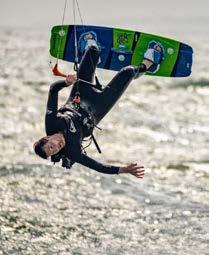
The idea for Salty Hair began as a simple curiosity: could the feeling of your hair after a dip in the ocean be bottled? In 2018, Michael Petrosoniak, P.Eng., finalized his first salt spray recipe and placed it on a local salon shelf. By 2019, the product was in several barbershops and salons across Nova Scotia.
“I had a basic website, but my plan was to drop off some product, have a bit of a discussion in person with barbers and stylists and follow-up afterwards about feedback — then came COVID,” Petrosoniak recalls.
Rather than retreat during the pandemic, Petrosoniak used this time to rethink packaging. Plastic bottles gave way to glass, aligning with his vision of sustainability. “Switching to glass was a big step toward reducing waste and moving towards a circular economy that I had in mind when building out the product.”
The original salt spray underwent more than 80 formulations before Petrosoniak found the sweet spot. “My first prototype was literally ocean water in a bottle,” he laughed. “It did nothing.”
From there, he experimented with:
• Controlled Salinity: Ocean water alone wasn’t enough. Petrosoniak concentrated the salt content to achieve the desired texture and hold, testing ratios from 1× to 10× ocean salinity.
• Filtration Process: To ensure purity without stripping essential minerals, seawater from Seaforth beach passes through a three-stage filtration system:
o Ceramic filter: Removes microbes and particles larger than 0.5 microns.
o Activated charcoal: Eliminates organic impurities.
o Final ceramic pass: Ensures clarity while preserving sodium, calcium, and magnesium ions.
• Natural Thickeners: Instead of synthetic gels, Petrosoniak turned to plant-based mucilage from aloe, flax, and seaweed to create viscosity, improve hold and add moisture to the hair.
• pH Balancing: Hair thrives in a slightly acidic environment (pH 4.5–5.5). The salt spray uses lemon juice to achieve this range, protecting hair cuticles and scalp health.
Each step was iterative. He would test low, medium, and high concentrations for every new ingredient to see how they interacted.
The three-stage filtration process preserves the ocean’s natural mineral blend—sodium, calcium, magnesium, and other ions—while ensuring purity.
Nova Scotia’s coastline offers no shortage of breathtaking beaches, and Petrosoniak explored several before settling on Seaforth for Salty Hair’s salt spray. “Crystal Crescent - that’s an awesome beach - very picturesque. Conrad’s Beach is where I would first kiteboard when I first moved to Nova Scotia,” But when it came to production, purity and consistency mattered most. Seaforth offered the ideal conditions: less traffic, minimal river outflow, and fewer contaminants, ensuring a stable mineral profile.
Innovation through collaboration
Petrosoniak’s partnership with Dalhousie’s engineering Capstone program has been pivotal.

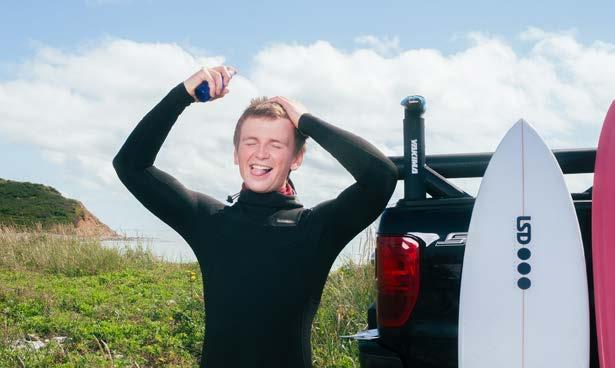
The collaboration produced Salty Hair’s second product: a pH-balanced shampoo bar packaged in cardboard. Unlike soap-based bars that leave residue, this formulation uses shampoo-grade ingredients to match the natural pH of hair and scalp (around 4.5 to 5.5). A sustainable product that doesn’t perform won’t succeed, Petrosoniak surmises, “If it doesn’t feel good, who’s going to buy it? The big thing was ‘Let’s make it functional.’”
An engineer with a passion for sustainability
Petrosoniak’s academic roots trace back to Western University, where he earned his undergraduate degree in chemical engineering. After a brief hiatus teaching skiing and sailing in destinations as far-flung as the Caribbean, he returned to academia with a renewed focus on sustainability. His Master of Resource and
Environmental Management (MREM) at Dalhousie University opened his eyes to the complexities of resource use and waste reduction.
“I’ve always been interested in energy and material waste,” Petrosoniak explains. “The program really focused on effective ways to manage those resources.”
That ethos—balancing functionality with environmental responsibility—has become the cornerstone of Salty Hair.
Petrosoniak frames his approach around four pillars: functionality, salongrade quality, innovation, and sustainability. Each informs decisions from ingredient sourcing to packaging. Glass bottles, aluminum lids, and cardboard boxes dominate the lineup, with only one plastic component remaining—the spray nozzle. “With more ability to fund projects, I would love to design out how
to get rid of this plastic sprayer” he says. Even production methods are under review. Current processes rely on boiling seawater to concentrate salts, but Petrosoniak has explored passive solar evaporation and reverse osmosis to reduce energy use.
For Petrosoniak, Salty Hair combines sustainability and consumer preference. “If people don’t like it, people will not buy it and then we’re not going to move the needle in terms of more environmentally friendly products,” he asserts.
From the waters of Seaforth to the shelves of 13 retailers and counting, Salty Hair exemplifies how engineering principles can transform everyday products. Petrosoniak’s blend of technical expertise and environmental commitment offers a blueprint for a future of cosmetics—one where performance and sustainability go hand in hand.
Submitted by Mark Fernandes, P.Eng.

EPC Manager, Government Relations and Public Safety, CWB Group – Industry Services
Maintaining competitiveness in the construction industry while ensuring compliance with Canadian rules and regulations is a challenge faced by organizations working with buildings, bridges, and other structural components. One proven strategy is to obtain CWB (Canadian Welding Bureau) certification, which applies to welding, fabricating, or erection organizations in Canada, the USA, or internationally, provided they supply structural welded products for use within Canada.
Canada’s construction sector is governed by a range of regulations at the national, provincial, and municipal levels. CWB certification, while voluntary, is often mandated for structures and components fabricated to meet
Canadian building codes, bridges, occupational health and safety codes, and other specifications. The certification process involves a thorough review of personnel qualifications, welding procedures, documentation, and quality control programs to ensure compliance with the applicable CSA standard.
Individuals may register for courses and must pass exams to qualify as welding supervisors or engineers. Welders are required to pass performance qualification tests and maintain their skills by retaking these tests every two years. Certified organizations are audited bi-annually to ensure they maintain the necessary skills, knowledge, and quality control systems for high-quality welded fabrication.
CWB certified VS. non-certified organizations
The following characteristics can assist organizations in determining if obtaining CWB certification can be beneficial.
CWB-certified organizations distinguish themselves from non-certified counterparts by demonstrating an unwavering commitment to building customer confidence in an ever-evolving business environment. These organizations implement the correct welding procedures while upholding high-quality structural welding standards. CWB certification gives clients and stakeholders the assurance that the organization
adheres to Canadian-recognized welding-related standards. Additionally, CWB’s independent assessment and approval of an organization’s welding processes and personnel reinforces trust in the reliability and consistency of the organization’s work. In a business world where trust and credibility are critical, this validation becomes an important business tool.
Structures are inspected for compliance during and after installation. Sitebuilt structures undergo inspections at key stages by the engineer of record and authority having jurisdiction. A certification program helps consumers and reduces reliance on regulators to confirm compliance with requirements.
On the other hand, non-certified organizations may struggle to communicate the same level of commitment to quality, which could lead customers and stakeholders to question the quality and reliability of their products and services. Furthermore, non-certified organizations may encounter difficulties in effectively resolving issues, potentially resulting in product failure, customer dissatisfaction, and increased expenses for additional engineering and inspection services.
CWB certification is a crucial tool for organizations to attain and uphold operational excellence. It fosters a culture of efficiency and transparency by providing a roadmap for continuous improvements. CWB-certified organizations can streamline procedures and
processes, pinpoint inefficiencies, and take necessary measures to enhance productivity and decrease welding defects by using qualified and competent personnel and procedures. By doing so, the company maintains a strong foundation that can withstand and adapt to the challenges of the ever-changing market and customer needs.
On the other hand, non-certified organizations may lack the structured welding processes and qualified personnel that CWB certification promotes. This can lead to inconsistent operations, reduced efficiency, and increased operational risks.
CWB-certified organizations are required to follow applicable CSA welding standards that ensure both the personnel and the companies involved in the design and construction of structures follow standard practices. This helps minimize the risk of failure and potential harm to the public. By obtaining certification, these organizations provide an additional level of trust and assurance that their documentation, weld quality, and the level of knowledge their fabricators and erectors have are independently verified against the requirements of applicable CSA standards. This, in turn, helps to reduce public safety concerns and liability.
On the other hand, non-certified organizations may not prioritize risk management and compliance in the same way as CWB-certified organizations.They may not use accepted welding procedures and could potentially lack the qualified welders and other personnel needed to provide the necessary support for safe and effective welding operations. As a result, non-certified organizations may face an increased risk of operational disruptions, quality
issues, and legal non-compliance. This can leave non-certified organizations vulnerable to fines, legal repercussions, and irreparable damage to their reputation.
CWB certification is crucial for organizations looking to enhance their credibility and reputation. By obtaining CWB certification, organizations ensure that their welding processes adhere to Canadian welding standards, which guarantees that high-quality welded fabrication is carried out safely and effectively. CWB certification can provide a competitive edge and open new markets and business opportunities, as numerous industries and regulatory bodies stipulate CWB certification.
CWB-certified organizations find it easier to navigate complex regulations, as their welding processes align with or exceed international standards and expectations. Being a CWB-certified organization demonstrates a commitment to quality and safety, which can be a valuable marketing point for potential customers, as the requirements of CWB certification meet and/or exceed the requirements of many national and international codes. CWB certification can also assist organizations in accessing new international markets.
On the other hand, non-certified organizations may face significant obstacles when expanding into new markets. They may be excluded from markets where regulations or contracts require organizations to be certified. Conforming to Canadian standards and regulations without CWB certification can be a daunting task, resulting in delays in processes, quality issues, or even legal complications.
Quality management programs are an inherent aspect of a CWB-certified organization, setting them apart from others that do not have this designation. CWB-certified companies have qualified welders, approved welding procedures, and qualified supervisory and welding engineering personnel. CWB independently verifies all elements of the welding operation with regular frequency. Clients view certified companies as reliable, due to their commitment to strict standards, which translates into confidence in the quality of their welded products offered.
On the other hand, non-certified organizations may lack structured quality management programs, leaving them more susceptible to inconsistencies and performance challenges. CWB certification equips organizations with the necessary tools and culture to consistently improve their processes and maintain quality. Non-certified organizations may struggle to maintain the same level of quality and throughput.
Obtaining CWB certification is a crucial business decision, offering more than just a certificate—it’s a symbol of quality and competence. Certification demonstrates the ability of individuals and companies to weld metal structures safely and effectively. It augments safety and is essential for organizations seeking to enhance operations, gain customer trust, and expand business.
CWB-certified organizations benefit from increased quality, reduced waste, and cost savings. Clients gain confidence knowing products meet Canadian welding standards.
For questions or comments, contact Mark.Fernandes@cwbgroup.org
Celebrate your







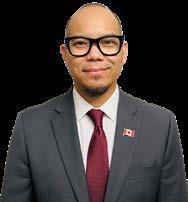










Discipline: Civil Engineering University: Dalhousie University

What inspired you to pursue a career in engineering?
I was inspired to pursue engineering from a young age. Seeing large bridges and buildings always sparked a sense of curiosity in me as I wanted to understand how such complex structures came together. That early fascination grew into a passion for problem-solving and building purposeful, lasting infrastructure.
What are your long-term career goals?
My long-term career goal is to become a respected construction professional who plays a meaningful role in developing infrastructure that strengthens communities. I hope to contribute to projects that are not only technically sound but also improve quality of life and support long-term societal growth.
Discipline: Industrial Engineering University: Dalhousie University

What inspired you to pursue a career in engineering?
I have always been fascinated by how technology can bring people closer together and transform communities. That passion for problem solving led me to engineering, where I designed and built fiber networks that keep people connected.
What are your long-term career goals?
I aim to lead large scale fiber optic projects that expand high speed internet to rural areas. By integrating emerging technologies, I hope to create smarter, more connected communities in the future.
Discipline: Mechanical Engineering University: University of Lagos LinkedIn

What inspired you to pursue a career in engineering?
I was inspired by machines and systems work, and a desire to create efficient, sustainable environments that improve people’s lives.
What are your long-term career goals?
My long-term goal is to become a leading mechanical engineer specializing in energy-efficient building systems, sustainable design, and project leadership across Canada and beyond.
Discipline: Electrical Hardware Engineering University: CIT – University

What inspired you to pursue a career in engineering?
I’m drawn to engineering because it’s always evolving. The chance to keep learning, adapting, and contributing to new innovations is what excites me most about the field.
What are your long-term career goals?
I aspire to drive innovation in electrical hardware engineering by developing advanced, high-reliability systems. I’m committed to continuous technical growth, impactful project leadership, and delivering solutions that advance industry standards and create meaningful value.
Discipline: Mechanical Engineering University: Dalhousie University

What inspired you to pursue a career in engineering?
I have always had a strong interest in math and science so when I learned about engineering as a career path, I knew that I would enjoy the challenge of applying those subjects to the real world. There are so many opportunities that can be explored with a career in engineering, which also excited me.
What are your long-term career goals?
My long-term career goals are to make Nova Scotia a safer, better, and more sustainable place to live, and to continue contributing to Nova Scotia’s bright future in the energy industry.
Discipline: Chemical Engineering University: University of New Brunswick

What inspired you to pursue a career in engineering?
I became an engineer because I’ve always been driven by a desire to solve meaningful problems, help others through practical solutions, and apply knowledge in ways that make a real-world impact. It’s a career that constantly challenges me to learn and grow.
What are your long-term career goals?
I’m driven by a desire to make a meaningful impact on how complex systems and processes operate and improve over time. While my long-term goals may shift, I’ll continue seeking opportunities where I can help organizations solve problems, empower people, and create lasting value.
Discipline: Electrical Engineering University: Federal University of Technology, Owerri

What inspired you to pursue a career in engineering?
I am driven by a passion for addressing real-world challenges through practical and impactful solutions.
What are your long-term career goals?
My goal is to drive innovation by developing sustainable, efficient, and resilient solutions. I aim to leverage emerging technologies and data-driven approaches to optimize system performance, foster collaboration, and mentor early-career engineers.
Discipline: Electrical Engineering University: Gujarat Technological University

What inspired you to pursue a career in engineering?
I chose engineering because I wanted to work in a field that directly impacts people’s lives. Engineers have the ability to design and improve systems that make the world more efficient, sustainable, and connected. The idea that my work can contribute to solving real-world challenges was a big motivation.
What are your long-term career goals?
After earning my P.Eng., my long-term goal is to take on greater responsibility in leading complex engineering projects and mentoring junior engineers. I want to continue developing my technical expertise while moving into a role where I can influence design decisions, ensure quality standards, and contribute to the strategic direction of my organization.
Discipline: Materials Engineering University: Dalhousie University

What inspired you to pursue a career in engineering?
I was inspired by a deep curiosity about how materials behave and how their properties influence performance. This interest grew into a passion for solving real-world engineering problems through materials characterization, failure analysis, and improving component reliability. I find great satisfaction in applying scientific principles to ensure the safety, efficiency, and longevity of engineering systems.
What are your long-term career goals?
My goal is to further specialize in materials integrity and reliability engineering, contribute to developing best practices in failure prevention, and take on greater technical leadership while mentoring future engineers.
Discipline: Civil Engineering University: University of Western Ontario

What inspired you to pursue a career in engineering?
From a young age, I was curious about how structures like roads, buildings and bridges come to life and how good infrastructure can transform communities, and that inspired me to study civil engineering so I could be part of creating safe and sustainable infrastructure that improves people’s everyday lives.
What are your long-term career goals?
My long-term goal is to continuously develop my technical and leadership skills while contributing to sustainable infrastructure projects that improve the quality of life for communities. I aim to implement innovative and eco-friendly engineering solutions in infrastructure projects.
Discipline: Structural Engineering University: Dalhousie University

What inspired you to pursue a career in engineering?
I’ve always had a passion for math, physics, and problem-solving. These passions led me to the world of structural engineering where I can use these skills in the real-world and learn how to design the infrastructure we rely on every day.
What are your long-term career goals?
To grow and be a leading expert in the field of bridge engineering and dedicate my work to deliver world class bridge projects in an innovative and sustainable way.
Discipline: Civil Engineering University: Universidad Central del Ecuador

What inspired you to pursue a career in engineering?
From a young age, guided by principles of social awareness, I discovered that the best way to contribute to society was through engineering. Through my participation in numerous projects of civil engineering over several years, I feel that I have been able to repay society for the trust it placed in my professional development.
What are your long-term career goals?
Considering my years of experience as an engineering professional, my intention is to establish myself as a professional civil engineering consultant, with the aim of training new professionals and continuing the development of this great country.
Discipline: Mechanical Engineering University: Dalhousie University LinkedIn

What inspired you to pursue a career in engineering?
I was drawn to engineering by my love of technical problem-solving, my strengths in math and science, and the versatility of the field. What inspired me most was the idea that innovative, systems-driven work could lead to tangible outcomes that make a real impact.
What are your long-term career goals?
My long-term goal is to help strengthen Atlantic Canada’s private sector by empowering growing enterprises to reach their full potential. I’m passionate about driving innovation and productivity in Nova Scotia through creative, systems-driven solutions that build lasting economic success.
Safety
isn’t just a priority—it’s a necessity
.
Learn from Dalhousie University safety experts— self-paced online courses now available!
Laboratory Safety – Work smart in research settings����
WHMIS 2015 – Handle hazardous materials safely
Biosafety – Safe practices for biohazardous work ...and many more!

The F.H. Sexton Gold Medal is Engineers Nova Scotia’s highest honour, awarded to a professional engineer who has demonstrated exceptional achievement and distinguished service in their field. Recipients are recognized for outstanding careers and for advancing the economic and social well-being of Nova Scotia through engineering excellence.
Victor Belliveau, P.Eng., has spent more than 50 years quietly shaping the mechanical systems that support Nova Scotia’s public infrastructure. His work has touched nearly every corner of the province—from hospitals and schools to university campuses and community facilities. Though his name may not be on the buildings, his designs have helped them breathe, heat, and function with efficiency and care.
Belliveau’s engineering journey began in 1972 when he joined A.H. Roy and Associates in Antigonish. Over the decades, he rose to Vice-President and eventually co-owner, guiding the firm through growth and transition while remaining deeply involved in technical design. His specialty in HVAC and fire protection systems made him a go-to
expert in building design and renovation, particularly in healthcare—a sector where his influence is most visible.
Belliveau led mechanical design on major hospital projects, including Cape Breton Regional, Valley Regional, and St. Martha’s, and continued to support these facilities through decades of upgrades and redevelopment. His knowledge of legacy systems and ability to deliver cost-effective, flexible solutions made him an indispensable partner to Nova Scotia Health. His work extended to nearly every hospital in the province, from large regional centres to smaller community facilities.
Belliveau’s contributions to educational infrastructure are equally significant. He supported campus expansions at Nova Scotia Community College and St. Francis Xavier University, becoming a trusted resource for facilities teams navigating complex mechanical challenges. His responsiveness and problem-solving skills earned him a permanent spot on NSCC’s speed dial.
Mentorship has been a cornerstone of Belliveau’s career. Since 2008, he has supported over 30 students through Dalhousie University’s Work Integrated Learning program, six of whom joined the firm full-time. His guidance is hands-on and grounded in ethics, preparing young engineers for the realities of the profession.
Belliveau’s service to the profession includes decades of involvement with ASHRAE, where he served as Halifax Chapter President and helped organize the annual golf tournament for over 25 years. He contributed to fundraising efforts for ASHRAE’s International Research and Scholarship Funds and
is now a Lifetime Member, recognized for more than three decades of active participation.
Outside of engineering, Belliveau has been a dedicated community volunteer. He has served with the Antigonish Lions Club since 1980, holding executive roles and supporting fundraising efforts locally and at the district level. Belliveau coached his son’s junior curling team, which brought them to Ontario to represent Nova Scotia in the junior curling field. He curled himself and helped build the curling rink in St. Andrew’s, Nova Scotia, during his weekends, and was involved in preparing the ice for the season and every week of the season. He represented Nova Scotia in the senior men’s curling and the 55+ play. He has played golf year-round in Nova Scotia with his friend Phil Cox, making sure to golf every month of the year, which can be difficult in Nova Scotia and has remained a steady presence in his community.
Belliveau has always been a family man, married for 52 years with 3 children and 7 grandchildren. Victor has taught his children that hard work, dedication and understanding are a big part of life.
For his outstanding career in mechanical engineering, his leadership in healthcare and educational infrastructure, and his enduring commitment and contributions to professional service, Victor Belliveau, P.Eng., receives the 2025 F.H. Sexton Gold Medal in recognition of his singular service and lasting contributions to the engineering profession in Nova Scotia.

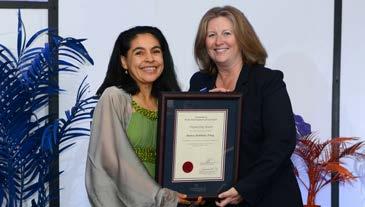
The Engineering Award is presented to an engineer who has achieved distinction in the practice of engineering. The achievement may be a single event or a series of events that set a benchmark for others in the profession.
Denisse Justiniano, P.Eng., has built a career that spans continents, disciplines, and communities—but at its core, it’s a story of engineering excellence, resilience, and leadership. From low-income housing in Mexico to high-rise towers in Alberta and marine infrastructure in Newfoundland, Justiniano’s work reflects a deep commitment to solving complex problems with clarity, compassion, and technical precision.
Originally from Bolivia, Justiniano earned her bachelor’s in civil engineering, followed by a master’s in business administration in Spain and a Master of Science in Structural Engineering in Mexico. Her graduate thesis led to the construction of 83 homes and a patented dome formwork—early proof that her designs don’t just live on paper, they change lives.
Her professional journey has taken her across South America, the U.S., and Canada. She’s led structural design on
residential, military bases, refineries, heliports, and towers, including the WhiteRose Extension Project and Hebron Project in Newfoundland & Labrador, the Yanbu refinery in Saudi Arabia, and a 25-storey concrete tower in Kelowna. She’s also contributed to affordable housing in Banff, military bases and training facilities in Greenwood NS, Gagetown NB, Comox & Esquimalt in BC and supporting public work locally in Nova Scotia.
Since 2020, Justiniano has served as Structural Lead for Eastern and Western Canada at AtkinsRéalis, where she oversees multidisciplinary teams and complex building portfolios. Her leadership is collaborative and handson—she’s known for setting high standards while creating space for others to grow. Her ability to navigate technical challenges, mentor junior staff, and lead diverse teams has earned her the respect of clients, contractors, and colleagues across the industry.
Justiniano’s contributions to the profession extend beyond project delivery. She’s a member of multiple
provincial engineering associations and has served on the PEGNL board, where she promoted wellness and recreation among engineers. She’s also developed and delivered lectures on structural systems and regularly mentors engineers-in-training, especially women entering the field.
Her commitment to community is equally strong. She founded a running club to promote wellness in the workplace, even while recovering from a knee injury. She’s coached others through training programs, organized hikes, and inspired colleagues and friends to embrace movement and health. Her passion for wellness is personal, but her impact is shared.
Justiniano’s career reflects what engineering can be—technically rigorous, socially responsive, and deeply human. For her distinguished achievements in structural engineering, her leadership across disciplines and regions, and her commitment to mentorship and professional growth, Denisse Justiniano, P.Eng., receives the 2025 Engineering Award.
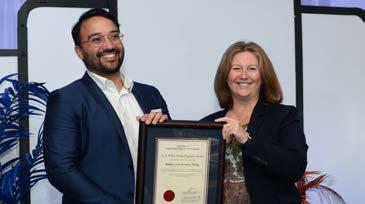
The L.A. White Young Engineer Award recognizes early-career engineers who demonstrate exceptional leadership, innovation, and service to the profession and community.
Levi Morrison, P.Eng., is redefining what it means to be a young engineer in Nova Scotia. With a career that blends technical excellence, social impact, and inclusive leadership, Morrison is helping shape a future where engineering is not only innovative—but also accessible, community-driven, and deeply human.
After earning his Bachelor of Civil Engineering and Master of Applied Science from Dalhousie University, Morrison began his career at Martec (Lloyd’s Register), where he quickly became known for his expertise in structural analysis and digital engineering. He contributed to high-profile marine and naval projects, including the deployment of the OpenHydro turbine in the Bay of Fundy and evaluations of Canadian naval vessels. His graduate research on ship-to-offshore platform collisions led to new methods for improving finite element simulations.
At Lloyd’s Register, Morrison helped develop a digital twin platform that creates dynamic replicas of real-world marine assets. He also led automation initiatives that improved modeling efficiency and supported renewable energy companies like OpenHydro and Schottel. His technical leadership earned him a place in the company’s Executive Acceleration Program, preparing him for future leadership in the sector.
But Morrison’s impact goes far beyond engineering models. His passion for equity and education led him to Ulnooweg, an Indigenous-led organization where he led multidisciplinary teams in developing STEM programming grounded in Two-Eyed Seeing—integrating Indigenous knowledge systems with Western science. He led planning for the launch of mobile makerspaces, created robotics and AI modules, and helped design a 3D-printed turbine for greenhouse irrigation. His operational systems for project management and execution were so effective that they were adopted across multiple departments.
Since 2021, Morrison has co-instructed a project management course at Dalhousie University, bringing real-world consulting practices into the classroom. He mentors licensed engineers, Engineers-in-Training, and youth outside the profession, offering guidance in leadership, business, and career development.
In 2023, Morrison became Director of Innovation at COVE, where he leads projects at the intersection of sustainability and digital technology. His portfolio includes climate solutions, sustainability initiatives, and the development of the Digital Harbour platform. He’s also led the development of initiatives in AI-powered marine monitoring, eelgrass ecology, and seasonal vessel tracking—projects that blend environmental stewardship with cutting-edge engineering.
Morrison’s leadership is collaborative and inclusive. He’s known for creating space for others to grow, for translating complex ideas into accessible solutions, and for showing up—whether it’s in a boardroom, a classroom, or a community event. His work with organizations like Unity Charity and P-TECH reflects his belief that both creative programming and technical education are powerful tools for empowering youth and strengthening communities.
For his career excellence, his leadership in marine innovation and inclusive STEM education, and his commitment to community-driven engineering, Levi Morrison, P.Eng., is the recipient of the 2025 L.A. White Young Engineer Award.
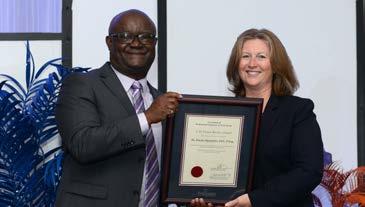
The J.D. Fraser Service Award recognizes engineers who have made a substantial and sustained contribution to Engineers Nova Scotia through volunteer service and leadership.
For more than three decades, Dr. Emeka Oguejiofor, FEC, P.Eng., has been a steady and influential presence in Nova Scotia’s engineering community. His career has been defined by service— both to the profession and to the people it serves.
As an associate professor at St. Francis Xavier University, Dr. Oguejiofor has taught and mentored thousands of students, many of whom have gone on to become practicing engineers across Canada. He served as Chair of the Engineering Department for nine years, guiding curriculum development and fostering a culture of ethics, collaboration, and community engagement. His second-year design course became a hallmark of outreach, connecting university students with high school classrooms to introduce young learners to engineering through hands-on activities and mentorship.
His academic leadership extended beyond the classroom. He served on the
university’s Senate for multiple terms, including two as Chair—an exceptional distinction for an engineer. He also contributed to the Rank and Tenure Committee, the Budget Committee, and numerous other governance bodies, helping shape the university’s academic direction and support for engineering education.
Dr. Oguejiofor’s service to Engineers
Nova Scotia is both deep and enduring. He served three terms on Council and has been a member of the Student Affairs Committee for 28 years, consistently advocating for student engagement, ethics, and professional development. He’s also a familiar face at Antigonish zone events, including the annual lobster supper, where he’s helped foster connection and camaraderie among engineers in the region.
His outreach work includes more than a decade of involvement with Imhotep’s Legacy Academy, a university-community partnership supporting African Nova Scotian youth in STEM. In Antigonish, he coordinated local programming and continues to mentor
new leaders in the initiative. Through this work, he’s helped bridge achievement gaps and inspire future engineers from underrepresented communities.
Beyond academia and professional service, Dr. Oguejiofor is deeply involved in his local community. He has served on the Parish Pastoral Council, was a Religious Education Instructor, and has been a Eucharistic Minister at St. Ninian’s Cathedral Parish since the late 1990s. He is a member of the Knights of Columbus Council 1105 and was a member of the Antigonish Committee of the Black Educators Association for six years.
His commitment to mentorship, education, and outreach has made a lasting impact on students, colleagues, and the broader community. For his decades of volunteer service and leadership within Engineers Nova Scotia, and his dedication to advancing the engineering community and the profession, Dr. Emeka Oguejiofor, FEC, P.Eng., receives the 2025 J.D. Fraser Service Award.

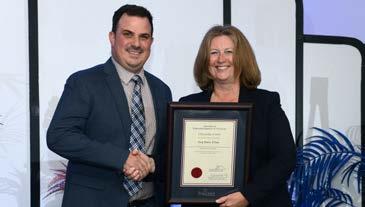
The Citizenship Award recognizes engineers who combine a successful professional career with outstanding service and leadership in their community.
Greg Peters, P.Eng., has spent more than two decades shaping marine infrastructure across Atlantic Canada, the Arctic, and the Caribbean—and just as much time shaping the lives of those around him. His career and volunteer work reflect a deep commitment to mentorship, inclusion, and service, both within the profession and far beyond it.
After earning his Bachelor of Engineering and Master of Applied Science in Civil Engineering from Dalhousie University, Peters joined CBCL in 2004. He quickly became a key figure in the firm’s marine division, helping grow the department into a regional leader. Today, he serves as Manager of Ports & Marine, overseeing complex projects and guiding multidisciplinary teams.
His technical leadership spans major infrastructure projects like the Marine Atlantic Transformation Project, the South End Container Terminal Extension, and the Liberty Pier Cruise
Terminal in Sydney. He’s led work in Nunavut, the Caribbean, Ontario, and across Atlantic Canda, often navigating international marine codes and challenging site conditions. His reputation as a thoughtful, highly technical designer is matched by his ability to mentor junior engineers and foster collaboration across disciplines.
Peters’ mentorship extends beyond the office. He’s a regular contributor to Dalhousie’s capstone program, developing marine-focused projects and delivering guest lectures to senior civil engineering students. He also participates in CBCL’s internal mentorship program and Engineers Nova Scotia’s professional mentoring initiative, supporting engineers-in-training across the province.
Outside of engineering, Peters is deeply involved in his community— especially through youth hockey. For over 12 years, he’s volunteered with the Dartmouth Whalers and Metro East Inferno minor hockey teams, coaching multiple teams and coordinating programs that introduce young players
to the game. His commitment to hockey has been especially impactful, helping grow female sport and advocating for fair play and inclusion. He’s the kind of coach who brings “Santa” to the rink after a game, organizes team-building events, and makes sure every child feels part of something bigger.
Peters’ community service doesn’t stop at the rink. He’s volunteered with Square Roots, a food security initiative that redistributes surplus produce to families in need. He’s supported fundraising efforts for minor soccer and diabetes research, and he’s known for stepping in to help colleagues and friends during difficult times—offering not just technical support, but genuine care.
Whether mentoring engineers, coaching young athletes, or supporting local families, Peters brings the same steady presence and thoughtful leadership to everything he does. For his his mentorship of emerging professionals, and his enduring commitment to community service, Greg Peters, P.Eng., is the recipient of the 2025 Citizenship Award.
VERIFY BEFORE YOU HIRE.

If you suspect that you have been dealing with someone who is NOT a professional engineer, check their status in our Member and Company Directory.