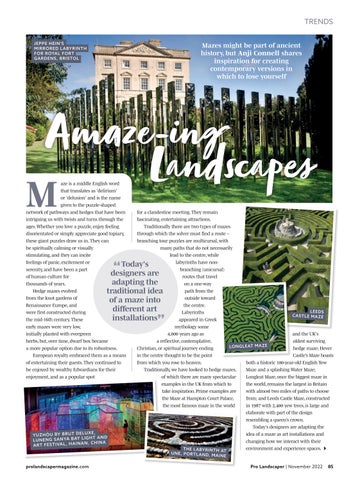
TRENDS JEPPE HEIN'S MIRRORED LABYRINTH FOR ROYAL FORT GARDENS, BRISTOL
Mazes might be part of ancient history, but Anji Connell shares inspiration for creating contemporary versions in which to lose yourself
Amaze-ing pes Landsca M
aze is a middle English word that translates as 'delirium' or 'delusion' and is the name given to the puzzle-shaped network of pathways and hedges that have been intriguing us with twists and turns through the ages. Whether you love a puzzle, enjoy feeling disorientated or simply appreciate good topiary, these giant puzzles draw us in. They can be spiritually calming or visually stimulating, and they can incite feelings of panic, excitement or serenity, and have been a part of human culture for thousands of years. Hedge mazes evolved from the knot gardens of Renaissance Europe, and were first constructed during the mid-16th century. These early mazes were very low, initially planted with evergreen herbs, but, over time, dwarf box became a more popular option due to its robustness. European royalty embraced them as a means of entertaining their guests. They continued to be enjoyed by wealthy Edwardians for their enjoyment, and as a popular spot
for a clandestine meeting. They remain fascinating, entertaining attractions. Traditionally there are two types of mazes through which the solver must find a route – branching tour puzzles are multicursal, with many paths that do not necessarily lead to the centre, while labyrinths have nonbranching (unicursal) routes that travel on a one-way path from the outside toward the centre. LEE DS Labyrinths CA STL E MA ZE appeared in Greek mythology some 4,000 years ago as and the UK's a reflective, contemplative, oldest surviving LON GLE AT MAZ E Christian, or spiritual journey ending hedge maze; Hever in the centre thought to be the point Castle’s Maze boasts from which you rose to heaven. both a historic 100-year-old English Yew Traditionally, we have looked to hedge mazes, Maze and a splashing Water Maze; of which there are many spectacular Longleat Maze, once the biggest maze in examples in the UK from which to the world, remains the largest in Britain take inspiration. Prime examples are with almost two miles of paths to choose the Maze at Hampton Court Palace, from; and Leeds Castle Maze, constructed the most famous maze in the world in 1987 with 2,400 yew trees, is large and elaborate with part of the design resembling a queen’s crown. Today's designers are adapting the idea of a maze as art installations and changing how we interact with their environment and experience spaces. TH E LA BY RIN TH AT
Today's designers are adapting the traditional idea of a maze into different art installations
UXE , YUZ HÒ U BY BRU T DEL LIG HT AN D LUN ENG SAN YA BAY N, CHI NA ART FES TIVAL, HA INA
UN E, PO RT LA ND , MA INE
prolandscapermagazine.com
Pro Landscaper | November 2022
85