12 – UK maritime services’ expertise in the spotlight at Athens event
14 – Newbuilding prices climb 3% to 16-year high: BIMCO
16 – IRI marks half-century of Piraeus office
19 – ICS and HK Government to host high-level summit
20 – SHIPMAN 2024 – Evolution, not revolution
25 – Mark O’Neil President & CEO, Columbia Group and President, InterManager
HOW I WORK
22 – Updated ISM Code will need to be consistently enforced to have value
28 – Deborah Layde, Chief Executive, The Seafarers’ Charity
30 – The perils of piracy, an evolving threat
P&I AND LAW DISPATCHES
33 – Salvors remain vital to free flow of trade
DIGITALISATION
36 – Due diligence needed for digital transformation, says OrbitMI
38 – Nordic data skills shortage looms
MARITIME SAFETY
40 – Going from A to B: Ferries’ unique safety challenges and the role of data
REGIONAL FOCUS ALTERNATIVE VIEWPOINT
Singapore
44 – Singapore strengthens as an IMC but higher costs are beginning to bite
55 – Tanker pools: why they work for the industry
SHIP REPAIR
58 – Repair yards adapt to constant change
AD HOC
70 – Our regular diary section
TECHNICAL
73 – European ferry sector charts new course
ANALYSIS
76 – Coal trades defy the odds
SMART & AI
78 – Orca AI moves autonomous shipping forward
79 – Syroco’s new generation weather routing and voyage optimisation tool uses digital twins, data and AI
80 – Autonomy for marine surveys
Next issue
81 – Dr Martin Stopford The container market super-boom and beyond
EDUCATION
82 – New Ship Management course launched by BIMCO and CBS
CLEAN OCEANS
84 – Tackling marine plastic pollution
OBJECTS OF DESIRE
86 – Our pick of the most coveted creations
REVIEW
88 – Bringing you the best in arts & culture
LIFESTYLE
90 – The ‘new servant class’ as trappings of luxury
The July/August issue of Ship Management International magazine (SMI 110) wiil be the one going to the SMM exhibition in Hamburg and will include a special feature on Germany, as well as technical reports on Navigation and Communications.
At the halfway stage between London International Shipping weeks LISW 2023 and LISW 2025, there will also an update on the state of the UK Shipping & Maritime Services sector.
For advertising enquiries, please contact Sales by emailing sales@elaboratecomms.com You can also keep abreast of news and subscribe to our daily newsletter at shipmanagementinternational.com
The shipping business magazine for today’s global ship owners and ship managers
Issue 109 | May/June 2024
STRAIGHT TALK
Sounding a warning note on seafarer safety
This year’s Posidonia was characterised by a whole raft of announcements relating to design and development of ammonia-fuelled vessels and even liquid ammonia carriers. While there may turn out to be no single ‘winner’ among alternative fuels, it’s clear that ammonia is among those making the early running.
But in this ‘dash for ammonia’, as we might dub it, spare a thought for seafarers having to handle this highly corrosive substance. Exposure to high concentrations of ammonia in the air, according to the New York Health Department, “causes immediate burning of the eyes, nose, throat and
respiratory tract and can result in blindness, lung damage or death.”
The message was underlined by Posidonia’s Greek shipping hosts. Hundreds of thousands of seafarers will need retraining in order to handle future fuels and their technologies safely, Chairman of INTERCARGO and of the Union of Greek Shipowners (UGS) Technical Committee Dimitrios Fafalios pointed out during a Greener Shipping Summit. And that figure excludes shoreside staff who are also vital to the safe and green operations of fleets worldwide, he said, adding: “We cannot achieve the IMO’s goals without safety.”
Fafalios’ other main point during the summit, about the fundamental
difference between the liner and tramp ship models that regulators must understand, is also relevant here. While major container hubs – Singapore, for example – are doing sterling work preparing for the handling of future fuels like ammonia, will the same best practices apply at minor ports where the cross-trading vessels so favoured by Greek owners call?
Any appreciation of shipping as “the backbone of the global economy, supporting the welfare of humanity” - as UGS President Ms Melina Travlos put it in her welcome address to Posidonia – and of the “seamanship” she said it requires, must surely begin and end with the safety and wellbeing of seafarers. l
Sales Enquiries
Julian Berry Phone: +44 (0) 1296 682 051
Email:jberry@elaboratecomms.com
Editorial
Bob Jaques Phone: +44 (0) 1296 682 089
Email: editorial@elaboratecomms.com
Email: bjaques@elaboratecomms.com
Finance
Lorraine Kimble Phone: +44 (0) 1296 682 051
Email: accounts@elaboratecomms.com
Publisher: Sean Moloney
Editor: Bob Jaques
Sales Manager: Julian Berry
Finance: Lorraine Kimble
Design and Layout: Diptesh Chohan
Regular Contributors: Michael Grey
Felicity Landon
Ian Cochran
Margie Collins
Ema Murphy
Motoring Journalist: Rob Auchterlonie
Technical Editor: David Tinsley
Editorial contributors: The best and most informed writers serving the
Wingbury Courtyard Business Village, Upper Wingbury Farm, Wingrave, Bucks, HP22 4LW, United Kingdom
Published by
Notebook
FuelEU Maritime – Achieving compliance: banking, borrowing, pooling and paying
While the shipping industry is still coming to terms with the EU Emissions Trading System (EU ETS) the next decarbonisation initiative, FuelEU Maritime (FuelEU), is rapidly sailing into view, write Antonia Panayides and Alexander Drury of global law firm Reed Smith.
FuelEU is part of the EU’s Fit for 55 Package and aims to support decarbonisation in the shipping industry by setting and gradually reducing, emission targets from journeys to/from EEA (European Economic Area) ports. The scheme targets the greenhouse gas intensity of energy used on a vessel. This is largely determined by the fuel used, with the Regulation rewarding cleaner fuels.
FuelEU enters into force from 1 January 2025 but monitoring plans for vessels already calling at EEA ports must be submitted by 31 August 2024.
What is the compliance process?
To comply, a ship must not exceed its set emission target, expressed as greenhouse gas emissions per megajoule of energy used on board. If a ship is at, or under, the target stipulated by the EU, it will receive the important FuelEU document of compliance. However, if a ship is over the emissions limit, it can still achieve compliance through a
few different mechanisms and receive a FuelEU document of compliance.
Paying the price
On 1 June of the verification period, a company’s administering State shall ensure that any ships with a compliance deficit, i.e. those that are over polluted during the year, are issued with a FuelEU penalty.
If the penalty is paid by 30 June, the ship will receive a FuelEU document of compliance. If a ship has a compliance deficit for consecutive reporting periods, an uplift multiplier is applied to the penalty.
Using the bank
Where a ship has a compliance surplus, and therefore does better than the EU’s target, the company may ‘bank’ the unused emissions for the next reporting period. The decision to bank is subject to the appointed verifier’s approval and must be made before a FuelEU document of
compliance is issued. The banked surplus can be used to achieve compliance the next year.
Borrowing from the future
A ship with a compliance deficit may borrow a proportion of the next year’s emission allowance to help it achieve compliance. However, this borrowed allowance and a premium is deducted from the following reporting period, making it even harder to achieve compliance that year. A ship cannot borrow in two consecutive years.
Pooling
Finally, a ship can enter a pool. This is not to be confused with a commercial pool. A pool for the purposes of compliance with FuelEU is a voluntary mechanism allowing ships to share their compliance surplus/deficit – as long as the pool’s total emissions result in a compliance surplus. Pools can consist of ships from different companies, but every company
must approve the pool composition and allowance distribution across the pool.
The compliance is then assessed across the entire pool rather than looking at individual ships. This allows a cleaner ship to share any compliance surplus with more polluting ships.
Verifiers will confirm a ship’s emissions by 31 March and companies then have until 30 April to finalise their pooling arrangements, which the verifier must also confirm.
Consequences of non-compliance
A FuelEU document of compliance allows a ship to trade in EEA ports for 18 months, or until the next FuelEU document of compliance is issued. However, Member States must lay down rules on sanctions for non-compliance. If a ship has no FuelEU document of compliance for two consecutive years, it could be detained or expelled from EEA ports. l
UK maritime services’ expertise in the spotlight at Athens event
H.E. Matthew Lodge, UK Ambassador to Greece, delivered a keynote address at the ‘Securing Your Ships from External Disruptions: Safety and Decarbonisation Perspectives’ event organised jointly by Maritime London and the British Embassy at the Stavros Niarchos Foundation Cultural Centre in Athens as part of Posidonia 2024.
Alluding to shipping’s role as a major pillar of the Greek economy, Ambassador Lodge pointed out that “the maritime sector is also one of the major income generators for the United Kingdom and the City of London. The UK today is one of, if not the, leading global centres for maritime services with around a 25% share of the overall market.
“Greek shipowners are amongst the City’s biggest clients for legal, insurance, financial and brokerage services,” he continued. “Many made London their home during the first half of the past century and even if they have now moved elsewhere, many connections still endure.
From major legal firms, marine insurance, P&I clubs and brokerage services to one of the largest shipclassification societies, the UK offers “a wealth of worldclass companies providing expertise across all maritime services sectors,” he added, also referencing the growing number of UK maritime technology companies. offering innovative, cutting-edge solutions in line with the need for green shipping.
At the ensuing seminar, the opening session on ‘Ensuring Safety in a Heightened-Risk Environment’ (pictured) considered the commercial implications of global trade disruption as a consequence of the well-publicised choke points in key shipping routes, and how the industry could work smarter to ensure the safety of assets and importantly seafarers.
The panel included Eline Muller, Senior Executive, Multraship Towage & Salvage and Chair, International Salvage Union (ISU) Salvage Sub-Committee; Ben Palmer OBE, President of Inmarsat Maritime; Dr George D. Pateras, Deputy Chairman, Contships Management Inc and President, Hellenic Chamber of Shipping; Gordon Robertson, Head of Greece, NorthStandard; and Sally-Ann Underhill, Partner, Transportation, Reed Smith LLP.
Panel moderator Jos Standerwick, Chief Executive, Maritime London, said: “Global supply chains are under a perfect storm of geopolitical pressures and ships and seafarers are quite literally caught in the crosshairs. While the shipping industry has once again demonstrated the flexibility and resilience that is taken for granted, we need to learn lessons from the past and be more proactive.”
Entitled ‘Tramp Shipping - the Elephant in the Decarbonisation Room?’ the second session started with a scene-setting presentation delivered by Stephen Gordon, Managing Director of Clarkson Research, followed by a discussion. The panel included Nick Brown, Chief Executive Officer, Lloyd’s Register; Harry Fafalios, Chairman, Greek Shipping Cooperation Committee (GSCC); Michael Parker, Chairman, Global Shipping, Logistics & Offshore, Citi; and Charis Plakantonaki, Chief Strategy Officer, Star Bulk Carriers Corp.
Proceedings were rounded off by the UK Ambassador’s Reception - traditionally one of Posidonia’s ‘hottest ticket’ social occasions - this year held at the Stavros Niarchos Centre as well.
The Maritime London/British Embassy event was organised in partnership with Inmarsat, Lloyd’s Register, Lloyd’s List and UK Shipping Concierge, and supported by the UK Department for Trade & Business. l
Newbuilding prices climb 3% to highest level in 16 years: BIMCO
“Since the start of the year, newbuilding prices have risen 3% to their highest level since 2008. Compared to their most recent low in late 2020 they are up 53%. During the same period, the order book has grown by 72%, reaching its highest level since early 2012 and is up 2% year-to-date,” says Niels Rasmussen, Chief Shipping Analyst at BIMCO.
Shipyards’ global order book currently stands at 133m Compensated Gross Tonnage (CGT), an increase of 56m CGT compared to the order book’s most recent low in late 2020. LNG and container ships have accounted for respectively 35% and 30% of the increase while bulk carriers, tankers and LPG have accounted for the rest.
The order book for container ships, however, peaked during the first quarter of 2023 and has fallen since. Year-to-date, the container ship order book has fallen 16%, deviating from the overall growth trend together with the bulk carrier order book which is down 3%.
“So far this year, the tanker and LNG segments combined have been the main drivers of growth in the global order book. In addition, the LPG tanker, cruise ship, chemical tanker and RoRo ship order books have seen double digit growth,” says Rasmussen.
Between 2010 and 2020, the shipyard industry was plagued by overcapacity. Therefore, prices only varied +/- 10% from the period’s median price.
Assuming that the available shipyard capacity in a year equals the maximum delivered in the past five years, we can illustrate both the past overcapacity and how the situation has improved.
Between 2010 and 2020, the median order book vs capacity ratio was 2.2, declining to 1.7 during the
second half of 2017. Since then, the ratio has climbed from 2.1 in late 2020 to 3.7 currently, the highest since 2010.
This improvement has helped fuel the price increases. The 53% price increase in just 3.5 years may seem dramatic but it is worth remembering that the average annual price increase between 2010 and 2024 has only been 2.3% even though manufacturing wages in China have more than tripled.
“Looking ahead, the need to start replacing the large generations of ships built in the 2000s, as well as the need to decarbonise, appear to bode well for future contracting. Avoiding a massive build-up of shipyard capacity like in 2000s will be critical if shipyards are to avoid a rise in overcapacity and a scenario where prices fall back to the levels seen in the 2010s,” says Rasmussen. l
IRI marks half-century of Piraeus office
Posidonia 2024 marked the 50th anniversary of the Piraeus office of IRI, which provides service and support to owners and operators not only in Greece but throughout the globe.
Located along the historic Akti Miaouli, the Piraeus office opened in 1974 as a marine safety centre supporting clients of International Registries, Inc.’s (IRI’s) predecessor company offering services in local time, a unique client benefit in the days before digital technology.
The office grew to become a regional hub and today is the Republic of the Marshall Islands (RMI) Registry’s largest regional office offering not only marine safety services, but also administrative, technical, seafarer, and other maritime operations services for clients throughout the world.
“Recognising the five decades of contribution from the Piraeus office at Posidonia 2024 is very special for me,” noted Theo Xenakoudis, Chief Commercial Officer and Managing Director, Piraeus. Theo joined IRI more than 20 years ago when the office was only four strong and led by his father Capt. Costas Xenakoudis together with Capt. John Giannopoulos. “It is humbling to look back on how far we have come and recognize the hard work, focus on client service, and dedication it has taken to get here,” he commented.
Today, IRI provides administrative and technical support to the RMI Registry through its decentralised structure of 28 offices worldwide. The Registry continues to be favoured by many Greek owners and operators who choose a foreign flag.
As of 31 March 2024, the RMI fleet had 1,506 vessels weighing 66.2 million gross tons that were either managed or owned by a Greek company, representing 32.9% of the
total gross tons of the RMI fleet. Sharing expertise and intelligence with team members throughout IRI’s global network of offices, the Piraeus team also provides significant support for corporate and ancillary services.
The RMI Registry and corporate regime function in compliance with the rules and regulations of the Organisation for Economic Co-operation and Development (OCED), the European Union (EU) and European Commission (EC), and the guidelines of the Financial Action Task Force (FATF). The RMI jurisdiction constitutes a solid contemporary and commercially oriented legal framework that is globally recognized and preferred by private and publicly listed shipping companies and organizations worldwide.
“When the Piraeus office opened, this business was still conducted mainly through handshakes and paper,” continued Theo Xenakoudis. “Today, the industry is completely digital – from our online seafarer program to our critical inspections checklist. With the immediate responsiveness of digital technology, we’re able to provide 24/7 service to clients throughout the world, support to our other 27 offices, share the voice of our clients at international regulatory meetings, and ensure that our clients have access to the information, technical support, and client service they need to meet the future.”
“The Greek community has always been an important market for us,” said IRI President Bill Gallagher. “Over the years we have built a strong local team in Piraeus, one that not only understands the Greek shipping market, but also actively identifies opportunities to strengthen, support, and enhance this community.” l
Bill Gallagher
Theo Xenakoudis
ICS and HK Government to host high-level summit
The Hong Kong Special Administrative Region Government and the International Chamber of Shipping (ICS) announced their commitment to host a high-level summit during Hong Kong Maritime Week 2024 in November, highlighting the critical role of global trade in today’s ever-changing landscape.
This commitment was solidified during a recent meeting between Guy Platten, ICS Secretary General, and Lam Sai-Hung, Hong Kong’s Secretary for Transport and Logistics. Recognising the importance of collaboration and of addressing the unprecedented challenges facing global trade, both agreed to facilitate dialogues amongst industry leaders and policymakers to promote efficiency, sustainability, and resilience in global trade and shipping.
The summit, organised by ICS, will bring together senior leaders, ministers, government shipping ministry DGs, as well as representatives from ports, logistics, regulators, development banks, international agencies, and invited experts. Building on the success of previous summits, it is intended to
provide a platform for discussion, encourage unique perspectives, and facilitate the development of actionable solutions to address the challenges facing the industry.
“As an international maritime centre, Hong Kong is well-positioned to serve as a global platform that fosters cross-border exchange and synergy,” said Mr Lam. “We express our gratitude for ICS’s continuous support to the Hong Kong maritime industry, as revealed by its active participation in the annual flagship event HKMW over the past several years. Hong Kong looks forward to welcoming the Summit later this year.”
“We are seeing significant challenges to the system of trade rules that have ensured growth and prosperity for all,” said Guy Platten. “This partnership marks a significant step towards in the maintenance of an efficient and sustainable framework for the maritime industry and for global trade. We are excited to work closely with the Hong Kong government to address mutual issues and explore potential solutions which can then be implemented on a global scale.” l
SHIPMAN 2024 –Evolution, not revolution
By Robert Hodge, General Manager at ITIC
One of the most important and widely used standard form contracts in shipping has now been revised. BIMCO SHIPMAN was last updated in 2009. ITIC was honoured to be part of the drafting team in 1998, 2009 and now 2024. The drafting panel consists of third-party ship managers, ship owners, lawyers and insurers. As ITIC insures the vast majority of third-party ship managers globally, we must be a part of the process. Moreover, the professional indemnity insurance that ITIC provides is on the condition the management agreement is on terms no more onerous than SHIPMAN. So, what is new? It is important first to discuss what has remained the same. SHIPMAN has been in place since 1988; it is a very well-understood and litigated contract, so the changes are one of evolution, not revolution.
Firstly, the contract remains one of agency, and the managers are given the authority to act for and on behalf of the owner. The manager must maintain their agency status with suppliers. If they do not clarify to a supplier that they are an agent acting for and on behalf of the owner, they can be held liable for non-payment. Secondly, the standard of care the manager owes to the owner is that they shall use their best endeavours to provide sound ship management. Some lawyers comment that SHIPMAN is manager-friendly. This is nonsense, as the standard of best endeavours is onerous and goes beyond the usual standard of reasonable skill and care. Thirdly, and importantly, the liability section broadly remains unaltered. The limitation is ten times the annual management fees, there is an indemnity from the owner to the manager, and the manager is not liable for the crew’s negligence.
There have been some important changes. The agreement took well over a year to draft, as much of the time was spent drafting the European Union Emissions Trading Scheme (EU ETS) clause. This was
complicated as the EU initially targeted the manager as the sole party responsible for surrendering the EU Allowances (EUAs). The clause was drafted to suit this situation. The EU then (quite rightly) decided that the registered owner should be responsible unless the owner mandates the manager to provide the services. ITIC has recently noticed owners requesting managers to agree to a wide variety of EU ETS clauses not drafted by BIMCO. ITIC advises that the EU ETS clause from SHIPMAN must be used as it might not be insured if you agree to something more onerous.
A second major revision is to allow the manager to provide pre-delivery services and have the protection of the contractual terms. A manager may provide services several months in advance of delivery. If the agreement has not commenced and a mistake is made, none of the contractual protections will be enforceable. The solution was to define predelivery services and allow the parties to agree on remuneration. The ship is deemed to be delivered once the ISM manager is named on the Class Certificates – a clearly defined date.
While the revised contract includes several other changes, it’s important to note that the contractual protections that ship managers benefit from remain unaltered. ITIC encourages all users to read BIMCO’s explanatory notes carefully. l
InterManager Outlook
Updated ISM Code will need to be consistently enforced to have value
As the IMO discusses updating the ISM Code, InterManager Secretary General Captain Kuba Szymanski considers the progress
InterManager is pleased that the International Safety Management (ISM) Code is being updated.
Adopted in 1993 and entering into force on 1 July 1998, the purpose of the ISM Code is to provide an international standard for the safe management and operation of ships and for pollution prevention. The Code was last amended in 2013.
We feel the ISM Code review needs to address many of the existing gaps that have allowed or resulted in industry groups creating their own standards, processes, and systems for working at sea.
We see significant value in reviewing and updating the “Application of” documents, upon which many of the maritime agencies base their interpretations and audits/inspections.
However, unless the IMO is prepared to step-up and consistently enforce the implementation of the ISM Code by Flag States, Class Societies, Port State Control etc, then we do not see any value in making the Code more complex. Effective enforcement is essential.
In addition, we see a need to hold IMO accountable for regular and effective updates of all same, and with thorough stakeholder engagement, to ensure the Code and its application remains relevant and fit-for-purpose moving forward.
InterManager’s ISM Committee has been considering the detail of the review
and has identified the following as key areas for consideration:
• Better detail on the roles and responsibilities for all key stakeholders including the Master, the designated person ashore (DPA), ship owners, ship managers
• Better guidance on how to determine critical systems and equipment, and thus correct identification and management of associated spares
• Inclusion of open reporting, a just and fair culture, and well-being (including mental health), cyber security, and connectivity – all in relation to safe, efficient operation of vessels
• Stronger guidance on minimum safe manning levels, and determination of same for different vessel types and operations
• Better governance on incident reporting and investigation standards, and around reporting of statistics and associated programs. These must be shared, industry wide, to be of any value
• Detailed review and alignment on definitions, calculations, and metrics associated with incidents
This is an important opportunity to review and improve the ISM Code and to effectively implement it throughout the shipping industry. The ultimate objective is to develop a widespread safety culture with every individual feeling responsible for actions taken to improve safety and performance, which we applaud. l
First Person
Mark
O’Neil
President & CEO, Columbia Group and President, InterManager
The President of ship management industry association InterManager since November 2020, as well as Columbia Group President and CEO, Mark O’Neil has a clear vision for the future of his sector.
Addressing a Round Table organised by SMI entitled ‘Future Proofing Quality Ship Management’ earlier this year, he elaborated on the importance of the General Principles that InterManager had just introduced for its Members to endorse.
“We’re a service provider”, he began by saying, “and fundamentally, we’re talking about future proofing ship management to ensure that we remain relevant to our clients.” At the same time, those clients are having to change their businesses - most notably in having to comply with ever stricter environmental regulations, transition to alternative fuels and harness the benefits of digitalisation.
All this means clients “actually have to use us,” he continued, “because we have that suite of services, and we have the resources available. So, I think staying relevant and compelling, aligned and in partnership, albeit in different models to the traditional third-party management is really, really important.
“We have to improvise, adapt and overcome whatever challenges we might face and be client facing. Do what the client wants, the particular client, not a commoditised service, but what the particular client wants and needs us to do.
“We’re in an industry which is undergoing huge transformational change. We’re an industry that is consolidating. We’re an industry that’s digitalising. We’re an industry where some of the traditional liner companies are not calling themselves liner companies
anymore. They’re calling themselves logistic companies, and they’re buying airlines and they’re buying trains and they’re buying haulage companies.
“Is the term ‘ship manager’ going to become a misnomer in two, three, four, five years’ time? Definitely at some stage being a ship manager will no longer be relevant and certainly not be compelling. So, the ship managers of today not only have to achieve scalability and efficiencies and effectiveness but also develop that integrated platform of services so that the client - whoever that might be in whatever shape - is able to utilise, and has to utilise, our services.
“The client may be an asset owner, may be a train operator, may be a plane operator, may be a vessel operator, but it’s all going to be integrated and we somehow have to fit into that mix and offer our services and manage those assets and optimise the operation of those assets.”
All the above requirements represent “a big challenge in the future”, he added, but clients will expect ship mangers “to be able to deliver on all of those bases and that’s what we’ll have to do.”
Earlier O’Neil had referred to the multiple disruptions facing shipping, quipping that “the world is never a dull place for ship managers.” He went on to suggest that in fact there are very few industries “that are more risk exposed than ship management. We take on a huge amount of risk for very, very little reward. In fact, anybody looking at the outside would say, why do they do this for such little reward? They take if something goes wrong, we’re hugely exposed.
“So, yes, we can change the model and we should change the model and we should look at every client on their own and get away from the commoditised offering. It may be that it’s a different type of partnership, or it may be a different type of remuneration, or it may be a different sharing in the upside of the vessel’s operation. We have to be open to every single model that makes sense, not sacrificing the quality. I think if you sacrifice the quality, then we are on an inevitable downward slope. “
O’Neil has been prone to using the term ‘second party’ rather than ‘third party’ for this type of customised client service – or ‘partnership’. In data terms, second party refers to information that is compiled by an outside party for a specific user (such as one-to-one in-depth interviews) rather than ‘off-the-shelf’ material such as mailing lists, and the analogy with ship management services seems apt.
‘Partnerships’
“That is why the InterManager General Principles are so important,” O’Neil told the Round Table. “If ship managers are going to attack more of the market, we only have 16% of the shipping market. If we want to get ourselves up to
40% or 50%, then we’re not going to do that by a ‘race to the bottom’ and trying to take vessels from each other. We have to get out there and persuade the market that we are as good as they are in managing their vessels and we can do it for less and do it better. That’s why these General Principles are so vital to us, to get that message out there and at least aspire for better.”
Elsewhere, the InterManager President has explained that the association’s General Principles of Conduct and Action – to give them their full name – introduced in late 2023 “will enable operators to be discerning and choose between the managers who aspire to comply with a higher standard of operation and are willing to open themselves up to third party audit, and those who are not. Compliance by the manager must surely affect, and be a factor in, a vessel’s rating by commercial rating agencies.
“Our General Principles are intended to distinguish between players in the ship management sector, between those who talk the talk and those who walk it. You have to ask yourself what is there not to support? Why would a manager not be a member of InterManager and aspire to the standards set out in the General Principles” – requiring initial self-assessment of compliance and later leading outside audit of the same, together with a commitment to self-improve as necessary, he queried.
Those General Principles are available on the InterManager website: www.intermanager.org
Hosting a Columbia Group party at the outset of this year’s Posidonia fortnight, O’Neil elaborated further on the importance of such partnership or ‘second party’ management to his audience of predominantly Greek owners, a group traditionally averse to letting others look after their ships.
“We don’t want to just manage your ships, we want to manage our partnerships,” he said. “If there is one thing which distinguishes this fantastic company from any other ship management company out there, it is the ability to really forge strong partnerships. It is about the value of these partnerships that matters and that is what the Greek market is opening up to. Not to third party ship management but to real collaboration with real partnerships that drives optimisation where one plus one equals three or four and that is what we are all about.
“Only through this partnership can one really work together as a team with our clients and we want that teamwork, those partnerships and those common goals, and we want those common successes. We want common ownership as if they were our own vessels. But as importantly, we want to share the upsides and the downsides,” he emphsised. l
How I Work
SMI talks to industry leaders and asks What motivates them and how they deal with the rigours of the shipping industry
Deborah Layde Chief Executive, The Seafarers’ Charity
“Working in a charity is different from the corporate world and I absolutely love it!” says Deborah Layde. “As Chief Executive of The Seafarers’ Charity, I have found my ideal job as the sea is deeply rooted in my heritage.
“My father, a Yorkshire-born RN Captain in the fleet air arm, died in a helicopter crash whilst in command of HMS Osprey, Portland Naval Base in 1984. I was just 19. My mother was from Mousehole, Cornwall and many of her extended family worked at sea in various capacities, from fishing, lifeboat volunteering to merchant mariners.
“I really value being able to help improve the lives of those who work at sea.”
Deborah herself moved up from southwest England to London at an early age, working in a number of different jobs – including for design guru Sir Terence Conran and later heading up a commercial company employing 400 people –
before finding her way into the charity sector. There she initially worked for an employment training and advisory body that focused on leadership and workplace improvement, where she says she “learnt a great deal, not least from our Trustees who were senior leaders from both industry and Trade Unions.”
Work of The Seafarers’ Charity in its support for seafarers and their families, both working and retired, is “as broad as the exciting variety of roles in maritime,” she says. “Put simply, we believe that a career at sea should be fulfilling, rewarding, safe and free from the unique hardships that can be part of life onboard.
“Everything that we do is about charting a course to make this a reality. We provide funding support for the essential running costs of many of the large well-known maritime welfare charities such as Sailors Society, Mission to Seafarers, Stella Maris and the International Seafarers Welfare Assistance Network (ISWAN).
“In addition, we innovate and drive new improvements in the lives of seafarers, globally.”
One such example, she says, is the charity’s funding for a new ‘allyship’ campaign with ISWAN, co-funded with UKP&I Club. The campaign targets the psychological safety of women seafarers by urging everyone onboard and ashore to call out inappropriate behaviours. “Inspired by our funded research on ‘The Port-based Welfare Needs of Women Seafarers’ by the Seafarers International Research Centre at Cardiff University,” she relates, “we discovered that women, particularly on cargo ships, often fear for their personal safety and isolate themselves.
“Rising reports of bullying, harassment, and sexual violence at sea are alarming,” she continues. “We are committed to ensuring all seafarers feel safe and experience better working lives. By funding charities like Safer Waves and Salute Her UK, we address sexual violence; prevention is our goal. The onboard culture that normalises such behaviours must change. In this regard, we support the Nautical Institute’s new leadership and management training courses by providing bursaries for seafarers in between jobs and from low GDP countries to enhance their leadership skills.”
Founded as King George’s Fund for Sailors, thereafter known as Seafarers UK, the charity changed its name to reflect its support for a global seafaring workforce. Deborah says the
Charity is “proud to champion the full breadth of maritime careers for their diversity, unique histories and cultures, and their huge contribution to our global economy and society.”
The charity itself is “incredibly diverse”, she adds, with a head office team (pictured) that comes from 12 different nationalities and speaks 13 languages, as it discovered when it celebrated International Mother Tongue Day.
“I invest in terms of both time and money to encourage and educate my staff to improve understanding and appreciation of our differences,” says the Chief Executive. “Monthly, we gather to learn with a clear DEIB (Diversity, Equity, Inclusivity, Belonging) focus. Recently, we shared interesting facts about our places of birth and celebrated different cultural foods. We do not shy away from complex and under-discussed issues in the maritime sector. We are driven by integrity, and we are bold and live by what we espouse.
“Supporting seafarers requires valuing everyone as equal and equity, diversity and inclusion are central to our Charity’s mission. When reviewing grant applications, we assess the diversity of the charity’s leadership and governance. Simply put, a Trustee board lacking diversity (visible and invisible) risks potentially underperforming in its work for seafarers and we can’t have that.”
The Seafarers’ Charity has two major fundraising challenge events each year. One is the 24 Peaks Challenge, which it has hosted for nearly 20 years in the UNESCO World Heritage site of England’s Lake District. Here it welcomes teams from all sectors of the maritime industry to elevate seafarers’ welfare. In addition, it has places for charitable long-distance runners to participate in the iconic London Marathon.
“Challenge events engage participants on a personal level, create memorable experiences and generate a sense of accomplishment,” Deborah explains. “The competitive yet social aspects of these events enhance community
engagement and visibility of the charity to a wider audience. This leads to increased awareness and support for seafarers. We fundraise through corporate partnerships, individual contributions via appeals and legacies too.”
In her spare time the Chief Executive is a keen on athletic pursuits herself. Together with two friends she co-founded a Racy Riders cycling group, which now has six regular rides and explore various routes around northwest & central London. The group is planning a week-long cycling trip to the Loire valley in September.
“In addition, I am a passionate walker,” Deborah adds, “especially long coastal walks” where she aims to complete the entire South West Coast Path – which stretches some 600 miles around the coastline of the mainly the counties Cornwall and Devon before reaching her native Dorset. She also counts herself fortunate in having many long-standing friends whom she sees regularly.
Recently The Seafarers’ Charity was proud to announce King Charles III as its new patron, a royal tradition dating back 100 years to George V and carrying on through the reign of Elizabeth II. “While our relationship and some of our funding of maritime welfare charities has a history that is as long as our existence, we aim to innovate and remain relevant to the needs of the modern seafarer and welcome new grant applicants,” says the Chief Executive.
“We raise funds to make impactful grants, informed by our deep knowledge of the sector. The Seafarers’ Charity is at the centre of an ecosystem of support for seafarers - committed to making the whole system stronger and more resilient through our fundraising and impactful grant-making. To do this, we want to engage with the wider maritime community. We welcome new corporate partners with whom we can collaborate with to ensure seafarers and their families thrive. Get in touch.” l
P&I and Law
The perils of piracy, an evolving threat
Global piracy incidents are on the increase after a twoyear slowdown. Kristin Urdahl, Senior Loss Prevention Executive of GARD, explores where current piracy hotspots are and what shipowners and crew can do to reduce their risk.
Global piracy and armed robbery are on the increase again. The resurgence of Somali pirate activity raises concern and, worryingly, there is an uptick in the number of reports of violence on ships’ crew.
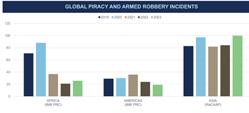
Figures from the International Maritime Bureau’s Piracy Reporting Centre (IMB PRC) show that the number of piracy and armed robbery incidents increased by 4% in 2023 compared to 2022. In the first quarter of 2024, 33 incidents of piracy and armed robbery against ships were recorded, up from 27 incidents in the comparable period last year, hence continuing the trend of 2023. And while these may seem like relatively small increases, the numbers reveal some alarming developments.
ASIA: MAJOR CONCERN
The latest reports from the Regional Cooperation Agreement on Combating Piracy and Armed Robbery against Ships in Asia Information Sharing Centre (ReCAAP ISC) show that there were 100 incidents recorded in Asian waters in 2023, up from 84 a year previously. All these incidents were classified as armed robbery/petty theft.
The Straits of Malacca and Singapore (SOMS) remains a major area of concern, with 63 incidents in 2023 compared to 55 in 2022. The Malacca Strait in particular has seen an uptick of incidents, with as many as five incidents last year compared to only two during the entire period of 2016-2022.
Bulk carriers are the most frequently targeted vessel type, and most of the SOMS incidents took place in the eastbound lanes and at night. While these incidents were mostly reported as low-level, opportunistic thefts with few injuries, perpetrators are often armed with weapons that are used to threaten crew. Hence, the severity of these incidents is on the increase, and ReCAAP ISC warns vessels to exercise enhanced vigilance in the region.
AFRICA: SOMALI RESURGENCE
In 2023, the number of recorded incidents in African waters increased to 26 from 21 the previous year, with 22 of them occurring in Gulf of Guinea waters.
The enhanced naval presence and cooperation between coastal authorities in the Gulf of Guinea has clearly borne fruit in recent years, with the number of piracy incidents in the region dropping from 84 in 2020, to 35 in 2021 and 19 in 2022. But the slight upward trend noted during last year may signal the end of this encouraging trajectory.
The IMB PRC highlighted Takoradi Anchorage, Ghana, as one of the world’s top five locations for piracy and armed robbery in 2023. It is important to note that some 80% of the incidents that occurred in Gulf of Guinea waters last year took place when the vessel was anchored or berthed.
The number of crew kidnappings in Gulf of Guinea waters is also on the increase, with 14 crew members kidnapped in three separate incidents over the course of 2023, compared to just two in a single incident in 2022. IMB PRC statistics show that the region accounted for some 75% of all reported hostages in 2023, and the kidnapping of another nine crew in the region in January 2024 serves to further highlight the risks in Gulf of Guinea waters.
An uptick in piracy incidents off the coast of Somalia is cause for concern. While the number of attacks had been dropping in recent years, prompting the shipping industry to lift its Indian Ocean High Risk Area in January 2023, incidents appear to be picking up once more. In December 2023, the IMB PRC reported the first successful hijacking of a vessel off the coast of Somalia since 2017. Since then, the first quarter of 2024 saw five more incidents in the Western Indian Ocean, including two hijackings and a vessel being fired upon. All five of these incidents were attributed to Somali pirates and
all occurred between 500 nm and 1,000 nm of the Somali coastline. There have also been reports of more incidents in these waters in April and May of 2024.
The IMB PRC emphasises the importance of conducting thorough threat and risk assessments before traversing these waters and of following recommended best practice guidelines.
The Indian Ocean Voluntary Reporting Area (VRA), which is managed by the UK Marine Trade Operations (UKMTO), remains in effect. Vessels entering the VRA are encouraged to report that to the UKMTO and register with the Maritime Security Centre for the Horn of Africa.
AMERICAS: CALLAO CAUTION
South and Central American and Caribbean waters saw another year of welcome improvement for the region, with just 19 incidents. Sadly, however, the lion’s share – 14 of these incidents – took place at Callao anchorage in Peru.
According to IMB PRC, seven crew were taken hostage at Callao anchorage over the course of 2023, and guns and knives were reported in most of the incidents. This region therefore continues to represent a significant risk for crew.
HOW TO PREPARE
It’s important to remember that the level of threat from piracy and armed robbery, as well as the modus operandi of pirates, differs from one region to another - and it may change quickly.
Before entering a piracy-prone area, it is vital that vessels obtain the most up-to-date information about threats from security experts and local sources. The ship’s security plan should be reviewed in the light of any new information received and a voyage-specific risk assessment carried out.
Crews must be briefed and trained on these plans and the vessel’s emergency communication plans should also be regularly tested.
Given that vessels may be particularly vulnerable while at anchor, crews should be hyper-vigilant when at high-risk ports. A proper lookout remains one of the most effective methods to protect a ship, enabling potential attacks to be identified and defences to be deployed swiftly.
A longer version of this article was first published on www.gard.no. – ‘Piracy and armed robbery at sea – Gard’. l
Dispatches
Salvors remain vital to free flow of trade
By James Herbert, Secretary General, International Salvage Union
Some years ago, the Executive Committee of the International Salvage Union (ISU) was considering the key messages that the industry should adopt to ensure that its value was recognised by the wider shipping community. Naturally saving lives and protecting the environment were foremost along with saving property –both ship and cargo. But it was also agreed that we should make more of the role ISU members play in “keeping ports open and trade flowing”.
We do not need to rehearse again the importance of shipping to world trade: it is fully recognised. And destabilising events like the wars in Ukraine and recently the Middle East - leading to attacks on merchant vessels in the Red Sea and its approaches - only serve to remind politicians and consumers how much we rely on a small number of shipping lanes (often passing through choke points) many of which are subject to threat.
But in recent years we have also seen several notable incidents in which casualty vessels themselves have caused the interruption. This has been demonstrated very clearly in the recent case in Baltimore (more anon).
However, the DALI’s Allison with Baltimore’s Key Scott Bridge was preceded by perhaps a string of other incidents.
In 2016 the 19,000 TEU boxship CSCL INDIAN OCEAN grounded in the river Elbe with potentially serious consequences for trade into and out of Hamburg. She was refloated by ISU member Smit Salvage after many days of dredging and with a dozen tugs. The channel did remain open to the significant port but there were restrictions, and it does not take a great leap of imagination to see the potential consequences had the main channel to Hamburg been blocked.
Similarly, in 2017, the CSCL JUPITER grounded in the Scheldt outbound from Antwerp. Salvors, ISU member Multraship Towage & Salvage, assessed a grave risk of
serious structural damage and worked quickly with an array of tugs to rapidly refloat the containership. Had she been unable to refloat, Antwerp – the second largest port in Europe – would have been blocked as the grounded JUPITER was a hazard to navigation and interfering with the main channel of this difficult waterway.
And the world looked on at the grounding of the EVER GIVEN in 2021 which blocked the Suez Canal for six days causing significant trade interruption. Again Smit Salvage re-floated the containership.
Not long after the Suez incident the EVER FORWARD grounded in the Chesapeake Bay in the US in 2022. She was refloated by ISU member Donjon-Smit after lightening of some 500 boxes by crane barge and substantial dredging operations.
And now we have seen in real time the DALI Francis Scott Key Bridge disaster at Baltimore. The response involved substantial assets and clearance work by Donjon and others and the vessel was refloated by ISU member, Resolve Marine.
The common theme of all these incidents is the actual, or potential, interruption to trade in blocked or impeded ports; the stranding of large values of cargo on the vessels and the wider disruption to other shipping.
These incidents also all involved containerships which, in the ‘just in time’ logistics model, are the world’s warehouses as well cargo carriers. And the
enormity of these vessels makes handling them as casualties very challenging - for example, reaching up and over the top containers on the deck (maybe 150 or more feet above water level) to remove them, then to transport them to available wharfage for temporary storage and backload them.
It is testament to the ability, experience, people and equipment of the professional salvors - the ISU membersthat all of these incidents had a satisfactory conclusion.
But there is concern about the sustainability of the industry. ISU statistics show that gross income for all ISU members was down by some 40 per cent in 2022. We await the 2023 numbers but a major turnaround is not expected. Returns in the salvage industry have always been variable but any sector facing that kind of contraction must be concerned. And we know that our key stakeholders recognise that the industry must be sustained – they say so publicly. But it needs adequate funding.
The ISU position is that awards under Article 13 of the 1989 Salvage Convention - that is to say ‘no cure, no pay’ with the contractor talking all the financial risk and only being paid based on an assessment of the value of the ship and cargo saved - must remain the cornerstone of the industry. It is essential to fund the investment in people, training and equipment that is needed to continue to provide professional services around the world.
CSCL JUPITER is refloated after grounding in the Scheldt outside Antwerp
The best contract for most emergency response situations remains the Lloyd’s Open Form and the ISU promotes and encourages its use and has worked had with other to increase its use even though there is no expectation of a return to the days of 100 or more LOFs each year.
Increasingly we hear insurers worried about the cost of salvage but when considering awards, we must encourage owners and insurers to recognise the value preserved by salvors and not focus on the cost.
No piece on the salvage industry is complete without reference to the vital contribution that the salvage industry makes to protecting the marine environment. In many situations it is only the professional salvors that stand between a casualty and an environmental catastrophe. In 2023 ISU members provide services to vessels carrying 1.9 million tonnes of potential pollutants. It included 187,000 tonnes of crude oil and 400,000 tonnes of containerised cargo likely to include various hazardous and
toxic materials as well as plastic nurdles which have been identified as one of the most damaging pollutants due to their persistence and difficulty in recovery if lost.
With increasing vessel size the quantity of bunkers involved in casualties can be substantial. The cases ISU members deal with annually typically include about a dozen cases with more than 2000 tonnes of bunkers on board. In an era where, rightly, one tonne of bunkers over the side is unacceptable this is a huge contribution to environmental protection, to say nothing of the huge costs and reputational damage that might otherwise be incurred.
Considering the ISU’s key messages, it is not difficult to make the case for the professional salvor. And the cases highlighted above, and so visible to the general public, show clearly the importance of the professional salvor in keeping ports open, trade flowing and the environment clean and preserving the value of property. l
Scale of the problem faced after March 26 M/S DALI accident
Round-the-clock DALI salvage operations undertaken
Digitalisation Due diligence needed for digital transformation, says OrbitMI
Rapid technological change, complex regulation and competitive pressures are driving digital transformation in the shipping industry. But navigating a confusing software landscape can be difficult and sound decision-making is essential to minimize innovation risk, according to OrbitMI.
Industry spending has soared in recent years on intelligent process automation solutions geared to boosting efficiency, reducing costs, curbing emissions and improving safety for shipping companies, with research firm Thetius estimating this market will grow at a CAGR of 13.8% to reach $26bn by 2027.
The benefits of these solutions, intended to automate timeconsuming manual tasks and eliminate human error, are clearly evident, with Thetius citing a 95% increase in productivity, a 30% reduction in costs and time savings of up to 30% among companies surveyed for its study ‘Avoiding the digital divide’.
Inevitably, this has given rise to a frothy digital marketplace with an ever-growing array of applications in areas such as voyage optimization, vessel performance monitoring, cargo and vessel tracking, pre- and post-fixture, procurement, crew and vendor payment, as well as other administrative tasks.
The latest overview of the maritime technology landscape from Skysail Advisors shows there are now around 160 software vendors - of which 24 alone are offering vessel performance monitoring solutions - with ongoing merger & acquisition activity and company exits affecting the composition of this market.
Against this backdrop, OrbitMI’s CEO Ali Riaz emphasizes the importance of due diligence in decision-making processes when making software investments, with the potential longevity of the vendor a key factor.
“Companies need to dive deeper before deciding by determining what they want to achieve at a strategic and tactical level. Think quality over haste. There is risk on both the buyer and vendor side, so finding the right product fit and focusing on long-term partnership are beneficial for all parties,” he says.
SUSTAINABLE SOLUTIONS
New York-based software-as-a-service (SaaS) company OrbitMI, which was spun out of Stena Bulk five years ago, is
now investing in product development to expand its suite of applications predicated on the Orbit vessel performance monitoring platform after recently forging a landmark partnership with class society Bureau Veritas.
Riaz believes the collaboration with BV strengthens OrbitMI’s position in the marketplace as a trustworthy supplier of sustainable solutions, giving clients clear visibility about its ability to cater to their requirements over the long haul as technology evolves in tandem with shifting regulation. This is especially important given the need for new data-driven solutions for decarbonization to gain compliance with green regulations such as the EU ETS, CII and upcoming FuelEU Maritime, he adds.
According to Thetius’ recent study ‘Navigating new financial seas’, among the challenges with digital adoption are sourcing and implementing future-proof technology that remains relevant and delivers value over time due to rapid technological evolution, as well as adopting solutions that are integrable with existing systems and can be adapted in line with changing business needs. Consequently, it states that new solutions should be “high-impact, agile and scalable”.
Given financial risks, shipowners and operators must carefully assess the cost-benefit ratio in making digital investments, considering potential efficiency gains, operational improvements and long-term savings to justify the initial outlay. Return on investment (ROI) can be a moving target, dictated by how well aligned the digital solution is with the actual needs of the business, integration with existing systems and compatibility with the end-user, which can all prolong the time to payback.
Maritime technology specialist Jochem Donkers, principal consultant with Skysail Advisors, believes a lot of technology adoption is “more push than pull”, with some opportunistic vendors looking to capitalize on market demand by promoting products that are innovative yet do not have a product-market fit and may not meet the requirements of the shipowner to tackle a specific task.
Donkers says, while any IT project will have a degree of uncertainty, shipping companies need in-house competence to evaluate vendor offerings when
developing digital systems, in the same way as a naval architect is needed to design a ship.
“There needs to be an understanding of the scope of what is needed and an assessment of risk. The more one understands about the opportunities and limitations of technology, the more one can understand and de-risk digital investment projects,” he says.
DECISION-MAKING FRAMEWORK
Thetius proposes a decision-making framework that entails identifying the challenges of technology adoption, assessing the potential of digital tools and reflecting on the process through a feedback loop to determine whether these tools are performing in line with expectations and business needs.
The research firm’s strategy director Nick Chubb told a recent ‘All hands on tech’ webinar that Thetius hosted: “Often we can end up with a sub-optimal solution because we do not ask the honest reflective questions: is this working effectively and doing what was intended, and are we getting the expected return on investment? Having that reflective process means better decisions can be made going forward.”
The price of failed IT investments is not only lost time and money, but also that technology adoption becomes stalled and companies may be left with systems that can quickly become outdated amid the fast pace of innovation and a shifting regulatory environment.
Riaz says: “The most acute pain point for shipowners is opportunity cost due to time wasted on implementing a solution that did not work, especially with the clock ticking on new regulation.”
OrbitMI is easing the process of technology adoption and mitigating financial risk through its subscription-based SaaS platform that can be trialled with no upfront costs, unlike ‘black box’ solutions that typically require heavy investments in IT infrastructure and can often entail protracted implementation processes with lots of trial and error.
In contrast, the Orbit platform is essentially a suite of scalable and adaptable solutions that are compatible with existing systems, which enables rapid onboarding. Multiple APIs from various vendors are integrated into the platform to facilitate data-sharing with intelligent connected workflows and actionable insights that can deliver greater productivity, versus siloed data systems that hinder interaction between company departments and slow down business efficiency.
“To make effective progress with innovation, shipping companies must have a clear understanding of their requirements and definite criteria to evaluate vendors based on their longevity, credibility and ability to provide futureoriented, flexible and collaborative solutions tailored to the needs of the end-user that can deliver value in the long run,” Riaz concludes. l
Ali Riaz, CEO, OrbitMI
Nordic data skills shortage looms
By Kenneth Johansen, Business Development Manager at online freight-fixing platform Sea.
While the maritime industry may not be synonymous with being at the cutting edge of innovation, the Nordics have historically bucked this trend. Compared to other regions, we see a more progressive approach to technology adoption and a greater willingness to embrace digitisation. In fact, with Finland, Denmark and Sweden regularly featuring in the top four spots of the Digital Economy and Society Index (DESI), its unsurprising to see this naturally translates into their maritime sector as well.
However, analysis from the Norwegian Shipowners Association reveals a growing shortage of digital skills, which could slow the region’s digital transformation - and perhaps the long-term prosperity of this sector as a whole. And while the region leads on digitisation, data standards remain another important obstacle that may slow the adoption of connected technologies in the coming years.
Like in other industries, the adoption of emerging technology such as AI, IoT or advanced analytics is crucial to driving growth and improving efficiency.
But while digitisation underpins these technologies, data standards are the foundation of digitisation in shipping.
This means that a shortage of data skills will stunt innovation in the maritime sector. Luckily, when speaking to our clients and peers in the Nordics we see a growing acknowledgement of this. A staggering 80% of ship owners believe expertise in IT and digital competency will be paramount in the coming decade.
As an industry, we must address the scarcity of data experts. This way, we’ll be ideally positioned to implement the innovations that are already delivering efficiencies and new revenue streams in other industries. After all, implementing analytics to bolster decision-making is undermined if an organisation lacks the capabilities to understand and action those insights. Admittedly, addressing this will take time. But through partnerships with leading universities, proactive upskilling and training, that skill gap will narrow, if not close eventually.
Data standards needed
With these skills in place, the maritime industry will be much better placed to come together and agree on
the standards that govern the collection, use, and exchange of data across shipping workflows.
From there, data standards can go a long way in streamlining processes, improving our progress towards sustainability, and reducing potentially costly disagreements. For example, when a ship is chartered, factors like fuel consumption, speed, and emissions will be monitored by a number of parties. If everyone is referring to the same source of truth, the chances for differing data on emissions are slim, reducing the impact of inconsistent grades and ratings for vessels.
Adopting data standards is a challenging, industry-wide endeavourbut a worthwhile one. It’s the first step in truly modernising one of the world’s most ancient industries. In essence, these standards are a bridge, connecting the Nordic maritime industry’s aspirations for digital transformation with the reality of its digital skill gap. Through strategic investments in talent development and technology infrastructure, the Nordics are poised to lead the charge towards a digitally empowered maritime future. l
NAVTORma!< s ni;i asy B�autom,niullyga n,ina,..lg io1mnauon (s.uch. :s. ceel o.ln�.EIDandEJA;.,etc�) I ml in.p1.ns: ndg1.1ard . anerror.'·__Jv,•hour,of orik- �:ay.wl't!flN ,
Going from A to B: Ferries’ unique safety challenges and the role of data
TBy Markus Tompuri, Chief Stability Officer, Safety Solutions, NAPA
he global ferry industry transports over 4.3 billion passengers every year, which puts it at par with the commercial aviation sector, according to a study conducted by Oxford Economics on behalf of Interferry. It is a vital service for many communities, but as one of the shipping industry’s most ‘visible’ segments to its end customer, ferry operators are also under increasing public and regulatory pressure to transform their operations to become more efficient, safe and sustainable, while maintaining profitability.
Unlike the rest of the industry, however, ferry operations have their own safety and stability challenges due to multiple daily loading and unloading to tight schedules, compounded by the task of transporting heavy vehicles and potentially dangerous cargo. In addition to this, operators need to accommodate frequent changes in vessel weight distribution, due to fluctuations in passenger bookings.
Above all, ferries transport people which means continuous investment in safety is non-negotiable.
The inherent complexity of the ferry sector comes to the fore in the face of shipping’s digital transformation and decarbonization. Cloud-based stability management, rising
reporting and regulatory requirements are all changing the way organizations operate, from the bridge to the boardroom, and are pushing the sector towards greater accountability and transparency. The industry is already tackling these challenges and adopting digital tools to empower crews to make better informed, time-critical decisions on passenger safety that are grounded in data.
Why now?
Data has always had a key role to play in ensuring ferries remain stable, safe and efficient. Today, with the introduction of cloud-based technologies, crews and their colleagues ashore can tap into new opportunities for more streamlined data collection, analysis and reporting, and do more with the data they have. This includes better day-to-day communication between shoreside and offshore teams and access to live shipboard data on all safety aspects of a fleet, from loading conditions and stability margins to watertight doors status.
This enhanced communication between teams provides vital, real-time information for the continuous monitoring and dynamic adjustment of the ship’s stability
Tallink Silja’s Baltic Queen
NAPA Stability for Ferries
parameters by crew and shoreside teams alike, which is critical in case of an emergency.
Data and advanced stability software can also be used to help ferry operators perform rapid stability and loading calculations to account for dynamic cargo loading. This is why we launched NAPA Stability for Ferries, to respond to the sector’s unique demands. The platform’s calculations are based on NAPA’s advanced 3D modelling, which accounts for the ship’s unique design, and uses this to cover a wide range of calculations related to hydrostatics, intact stability, damage stability, and longitudinal strength.
Recently, Grandi Navi Veloci (GNV) and Tallink Silja Line announced their adoption of NAPA Stability for Ferries, with installations already confirmed on seven GNV vessels and ongoing sea trials for Tallink Silja Line on their vessels Silja Serenade and Baltic Queen. Their investment in digital tools reflects a commitment to enabling their crews to make faster, easier and more reliable decisions that enhance operational efficiency.
These safety insights can boost operational efficiencies, allowing operators to do more with the data that they already have at their fingertips. NAPA’s partnership with Stena Lines is testament to the long-term benefits of cloud-based performance monitoring and reporting systems in enabling a smooth exchange of information between ships and shore, supporting improved decisionmaking, predictive maintenance, and operational optimization.
Next stop: Tighter regulations
The world we operate in is changing and ferry operators are not immune to the universal challenge facing the shipping industry for compliance with reporting requirements. But what does make the ferry sector unique is factors such as crossing multiple jurisdictions
within a short time, high passenger volumes, strict environmental regulations especially near highly populated busy waters, and complicated customs and immigration requirements.
Navigating this complexity and managing tightening record-keeping requirements is where electronic record-keeping and cloud-based data management are critical. Digital data-capturing tools such as NAPA Logbook take some pressure off the crew by automating data entries and simplifying all technical and environmental reporting, like EUMRV, MARPOL, ESG, CII, and more. Building on experiences in the cruise sector, the same data collected through electronic logbooks for regulatory compliance also opens new opportunities to optimize all areas of ship operations, from ESG, greywater management, and seafarer workloads and downtimes.
Given that vessels typically travel short distances on regular routes and return to the same ports, ferries have unique decarbonization challenges and opportunities. The sector faces limited options to optimize routes because vessels travel on pre-defined itineraries. This means it can’t rely on weather routing to save fuel and emissions.
Nevertheless, the sector can still accelerate its decarbonization and is one of the most promising shipping segments for batteries and fuel cell technologies. Back in 2015, the sector saw the entry into service of the world’s first electric ferry in Norway, and many more since.
Alongside this, digital stability management solutions can also help with deadweight optimization to reduce fuel consumption and remain safe and stable. This is done by reducing unnecessary ballast water or adjusting the vessel’s speed and trim to minimize resistance and improve efficiency. In the longer run, this performance data can be analyzed to build operational models that are tailored to each ship and will help maximize their fuel efficiency on a given route.
Towards better data management
Data has and always will be the cornerstone for informed and reliable decision-making. It will continue to ground safety, environmental, operational and commercial decisions based on each vessel, fleet, and the sector’s unique operational profile and challenges.
While the sector continues to enhance its reporting and transparency on the journey to net-zero, advancements in digital technologies are allowing teams to be more ambitious and assured in their strategies than ever. Ferry operators, and the industry more broadly, can rely on digital solutions to inform their decarbonisation efforts in the immediate term, while gaining the data and insights to plan for the longer term.
This is driven by the conviction that there doesn’t need to be a trade-off between good business and doing good. l
Grandi Navi Veloci vessel serving Italian islands
Regional Focus
Singapore strengthens as an IMC but higher costs are beginning to bite
According to the latest edition of the Menon Economics Leading Maritime Cities of The World 2024, Singapore continues to be the leading maritime city in the world unaffected by the global conflicts and the rising environmental changes of the industry.
Singapore has retained its spot as a worldleading maritime hub due to being ranked as number one in three out of five pillars.
It continues to maintain its leading position in the Attractiveness and Competitiveness pillar, and has reclaimed its top spot in Shipping Centres and Ports and Logistics, overtaking Athens and Shanghai respectively. A consistent strategy for innovation and investment in green transformation
and digital technologies has enabled Singapore to regain its position. On the Maritime Finance and Law pillar, Singapore has climbed significantly, going from 8th to 4th Place. However, Busan overtook Singapore and has the leading position in the Maritime, Technology, leaving Singapore in 2nd Place.
Singapore’s position as a major international maritime centre continues to remain unchallenged but the spectre of rising costs still refuses to go away, forcing many companies to reassess the way they use the City state to their maritime advantage.
As one industry leader told SMI, companies are still choosing Singapore because of its
geographical position and its influence in the region, but they are outsourcing a lot of their services to cheaper centres in the region such as Manila and India, leaving Singapore as the base for the senior director, the ‘strategists of the businesses’.
From the Columbia Group’s perspective, Singapore remains very important because it gives the Group a regional base for managing Asia. And there is no other jurisdiction in Asia which gives companies like Columbia, the tools it needs to operate a central base. It has the international credentials that other countries in the Far East still struggle to emulate.
Cracking the Far Eastern market has been a strong priority of the Columbia Group and
according to Demetris Chrysostomou, Managing Director Asia region, the Group has succeeded in being viewed as a global entity with a strong presence in Asia. Shedding previously held perceptions of being a European shipmanagement company has resulted in a larger and more effective footprint in the region. All of this against the backdrop of the Group having a major presence in Singapore; a ship management office and representation in Shanghai; a representative offices in Japan, Korea and Taiwan as well as a CSM Manila office and Columbia Aurus Shipmanagement in India. In addition, the Columbia Group also owns/ partners and operates Manning Agencies in Philippines, China, Indonesia, Vietnam and India.
“So if you look at the developments over the last couple of years, our footprint in Asia is becoming pretty big,” said Mr Chrysostomou.
“These regional offices are actively pushing in the market, raising the profile and we are starting to see clients in the region viewing Columbia as a global company with a significant Asian presence and capabilities. As a global group, I think this is also coming across pretty nicely. People are starting to understand that shipmanagement is a core but we are actually an integrated maritime services, logistics, energy and leisure platform with a lot of value to bring to clients and through these group companies we are developing business directly with ship owners actively in Asia. So, we are also managing to get traction on that. It’s not just the message. We’re also starting to see business being developed for some of these platform companies in Asia,” he added.
But how is the market is Asia changing and what are the principals demanding?
Demetris Chrysostomou again: “I think there are a number of factors at play. If we look at the Chinese market, it is maturing but we have always had a challenge with this market because while there are a lot of large shipowners there, a lot of things were carried out in a localised way. Yes, the Chinese market has matured rapidly and grown rapidly but with this maturity and growth, they have also become more international.
“The Chinese market at least, is looking more and more to international ship managers. Yes, it’s still third party ship management they’re looking for, but whereas before they were looking for it on their terms with managers working in the localised way they did things, with impetus more from the commercial side, they’ve become more global and international ship managers are becoming more important. But of course at the same time.
“They still expect management out of China because it is important to them. Therefore, we see our Chinese
office in Shanghai Office getting a lot of traction here.
“Taiwan is very similar in that more and more vessels are being outsourced. So third party management is becoming more and more important to them and they are becoming more interested in the value added services,” he said.
As with countries like Japan and Korea, where the managers there are not that international, groups like Columbia can offer the access to international products and markets that they may not have access to themselves, he stressed.
Goodwood Ship Management has seen its fleet grow to 45 vessels, with the emphasis on tankers – 24 VLCCs, four Suezmaxes and one LR tanker, not to mention 13 bulk carriers and three containerships – but it is adamant that it remains a mediumsized ship management company, mostly catering for the needs of its shareholders plus third-party clients. A target fleet number of 50-60 ships seems reasonable, believes
Kamal Uddin Ahmed, company Chief Executive Officer.
Goodwood’s major customer is DHT, Norwegian-based but publicly listed in the US. As well as being a customer, they are also a large controlling shareholder at more than 50%. Because they are the controlling shareholder, there is a tenuous link between Goodwood and the US equity markets. Another larger customer is NGM from Greece, as well as SINGFAR in Singapore as well as Norse Management, owners of the three containerships.
“So we are actually basically a tanker operator, from the very beginning, we opened the company in 2008, we are mostly focusing on tankers. NGM also started with us with the many tankers, but over the last couple of years, the
tankers were not doing that great business, so they diverted to the bulk carrier sector and they asked us to manage their ships because we were managing their tankers before.
“So that’s how we ended up with bulk carriers. But we are not very keen to expand on the bulk carrier side actually, we are very keen to expand on the tankers side.
“So we want to be a boutique ship management company, we are not here to expand and increase the number of ships, we don’t have that strategy at all. Our board is very, very clear on that. We will be focusing with only the quality ship owners, those who are similarlyminded to us, and we can control our standard, the Goodwood standard. And our standard is to
Kamal Uddin Ahmed, CEO, Goodwood Ship Management
comply with all the requirements of the oil majors. So we want to work with ship owners who are in line with our thinking,” he said.
It is important that the Goodwood team is able to manage its vessels to its standards, so there is uniformity across the fleet. “Because if we do not have full control of every aspect of the ship management process, then the quality changes, and we don’t want to see that. We are very much focusing on that, to maintain a standard quality across the fleet. We want to do business with quality ship owners, and we want to maintain our reputation in the oil industry,” he added.
Headquartered in Singapore, Goodwood has a crewing office in Mumbai where it sources all its officers from.
“No, this is the headquarters, this is the head office. We have our subsidiary office in Mumbai, only for crewing. This is our own company in Mumbai as well as a dedicated training centre, we have got all officers from India. Investing in its officers from cadets is important to the company “and we try to maintain this unless we suddenly see an expansion of our fleet, when we have to hire people in from outside,” he said.
But in line with the industry, the main concern facing companies like Goodwood is sourcing quality crews. Especially on the bulk carrier side.
There are not too many shipping companies that can boast a lifeline as long as Wallem but at 120 years old it has a lot of experience and knowledge at its disposal. But despite this, its Managing Director of Ship Management Ioannis Stefanou remains focused on what fleet growth means for the company.
“We’re very much positioning ourselves as a medium size ship management company being able to provide the tailor-made solutions we don’t think that the biggest ship management companies are able to provide.
“They say they can, but I don’t really believe they’re able to give that attention to the owners that we can give as a medium-sized manager,” he said.
“Our key focus is to understand our ship owners’ strategy and growth plan and see how we can partner with them, to actually support them and to actually support them to achieve their aims, and, of course, support them to actually make money to meet their targets,” he added.
According to Mr Stefanou, the company currently manages between 170 and 180 ships and is looking at a 50% sustainable growth pattern over the next three to four years. Certainly targeting shipowners with 10 to 20 ships, fleet sizes that are just that little bit too small to offset the higher in-house management charges related to the increased regulatory environment.
As Mr Stefanou added, its all about being transparent: “Its about playing with open cards with the shipowners and not about us telling them this is the Wallem way. We look at how they conduct their business and see how we can add value”.
And it is the Asian and European market where the growth can come from, according to Wallem.
“Many of the European owners see us as an extension of their technical teams and work more closely with us on a day-to-day basis. One thing we have seen change over the last four to five years is that some owners have a preference on making sure that their management team is sitting fairly close to where they are.”
Pressures over crew availability will mean that more and more ships will start to move into third party shipmanagement, as owners look to take advantage of their supply of competent seafarers. Having a manager for your vessels allows you to scale up or down your fleet as required,” he said.M.T.M. Ship Management is another ship management company with realistic growth strategies on its mind as well as a sensible attitude to the decarbonisation debate. Managing a fleet of over 70 chemical and product tankers as well as handysize to supramax bulk carriers, it recently established TristarMTM Ship Management, a joint venture ship management company with a major UAE energy provider to expand services in the Middle East.
“The environment was always very important but now the regulators have forced the environmental regulations on us, which I think is good because we should protect the environment for future generations. But I see decarbonisation as an opportunity, not a problem,” said Capt Rajiv Singhal, Managing Director.
Rajiv Singhal began his sea career in 1983, sailing as Captain on OBOs and large crude tankers with Orient Ship Management (Hongkong) and Acomarit Ship Management (UK) until 1998. In 1999, he came ashore for Eurasia Ship Management where, between 1999 and 2007, he held
various positions in Ship Management, Marine Insurance, Post Chartering & Consultancy Services, with his last role having been the head in Eurasia’s business development activities in Europe & Asia. When Eurasia merged with parent company – Bernhard Schulte in 2007, Rajiv was appointed Director Crewing Services.
In 2011, he joined M.T.M. Ship Management Pte Ltd in Singapore as General Manager for their ship management services & worked in that function until 2020 when he was appointed Managing Director of M.T.M. Ship Management.
“We have implemented a very robust energy management plans for ship and shore, individually and together, something that is being monitored on a daily, weekly and monthly basis by the shipowners.
“The industry is moving towards cleaner fuels like LNG, ammonia and methanol and there are ships on the water burning ammonia, methanol and good LNG. This definitely requires a lot of training for the ship’s crew as well as the shore staff because they are not conventional fuels,” he said.
Agreeing that the process was more of an evolution, Capt Singhal said that in his opinion biofuel was the best alternative for existing ships. “We have conducted experiments with biofuel on our ships and we have seen a
reduction in our emissions. Technically, it is also the most economical solution,” he added.
Executive Ship Management takes its ESG responsibilities very seriously and works in close collaboration with its ship owners and partners to operate vessels in an environmentally-friendly and more efficient manner.
One of its ongoing projects focuses on navigational operations aimed at reducing emissions from ships. Aiming for a lowering of fuel consumption by 0.25% to 1.5%, and consequent reduction in emissions, the company has implemented the optimum tuning of a ship’s autopilot system on selected vessels in collaboration with its affiliated maritime training institute, SIMS. Optimum tuning of the autopilot system helps in reducing fuel consumption and the associated wear and tear to the ship’s steering gear.
The project aims to develop adaptive systems to be incorporated into the autopilot that allow for
some small and negligible deviations to the courseline, but in turn, optimise rudder movements. It is well-established in the industry that the timely management of hull and propeller cleanliness contributes positively towards fuel performance and reduction of carbon emissions. The shipboard team regularly monitors engine performance to identify if there is increasing hull and propeller resistance due to fouling or other reasons. If the engine performance and diagnosis prompt a need for such course of action, propeller cleaning and/or polishing as well as hull cleaning is undertaken as soon as time and schedules permit. Other strategies include encouraging its ship owners to adopt low friction anti-fouling paint that help the vessels become more operationally efficient and benefit the environment by emitting less carbon into the atmosphere, the company said.
This approach is slowly but steadily gaining ground as a good number of ship owners-taking
Tanker pools: why they work for the industry
Incorporated in early 2009, WOMAR began as a 50/50 joint venture between Heidmar, Inc and other investors. Headquartered in Singapore, it operated the Marida Tanker Pool (10-14kdwt Coated IMO II Tankers) and later expanded its partners to include other tanker pools – Stainless Tanker Pool (19-25kdwt Stainless IMO II ships) and Sakura Tanker Pool (Aframax Tankers).
April 2014 marked a new milestone when BW Group acquired Heidmar’s 50% stake in WOMAR. The Group made a purchase of 11x 20kdwt Stainless Steel IMO II chemical tankers, entrusting the commercial management of the entire fleet to WOMAR.
Manish Jain
In Sep 2019, FDX Offshore based in Westport, Connecticut acquired Womar. The purpose of the Womar/ FDX Offshore relationship is to build the best independent pool operator in the shipping industry. Anchored in Womar’s current chemical tanker pools, the partnership intends to both expand its chemical tanker & product tanker pools by adding Orca Tankers Pool (25- 29k DWT IMO II ships) and Denali Tankers Pool (30- 40k DWT ships) as well as initiate and grow independent pools in other classes of ships.
Today, it continues its founding quest as specialists in the commercial asset management of chemical and oil tankers and trades worldwide with a focus on chemicals, vegetable oils, clean and dirty petroleum products and crude oil.
SMI caught up with Manish Jain, Chief Operating Officer at Womar Logistics in Singapore to explain the motivation behind the pool strategy.
“The pools make a perfect platform for owners who do not have sufficient fleet to open worldwide offices. They are pure investors and ship owners who want to enjoy market earnings rather than giving the ship up on fixed time charter.
“So, we will pool all the ships from some investors and ship owners and once we have the fleet of ships, we can take cargo contracts and provide services to the charterers. If a vessel breaks down, we can provide another ship. So, there’s the reliability on the service side and after that it is down to your track record, your earnings, your transparency, and how good you are.
Your performance, your reputation and the fees you charge and the earnings are delivered,” he said.
“It’s all about the commercial management of the ships but in a pool you will definitely offer way more than what a time charter can offer because a pool is like a partnership for certain reasons,” he added.
But the adverse effects of a rising market are that some owners will sell their vessels because they can secure higher prices. What is your view on this?
“You have to have a constant supply of ships and you need to have skin in the game. So we are buying ships ourselves – 30% of the ships in the fleet are owned by us. The rest are very close partnership owned, old time-chartered or long-term arrangements,” he added. l
heed of the potential benefits to the environment despite the forbidding initial cost - are coming forward to coat the vessels with low friction anti-fouling paint. This, undoubtedly, is one initiative which will pay rich dividends in the long run.
In a joint effort with its ship owners, ESM has proposed and retrofitted vessels with greener technology that will help to reduce emissions of particulate and carbon. Out of all its managed vessels, around 35% are fitted with an Exhaust Gas Cleaning System (ECGS) which has significant benefits in reducing SOx content from emissions. Its vessels are also fitted with other energy-saving devices and techniques that indirectly reduce emissions such as Mewis Duct, Propeller Boss Cap Fins, Emulsified Fuel System, Rudder Bulb, Variable Frequency Drive Motors, and Waste Heat Recovery Optimisation.
The process of fitting Engine Power Limitation on board vessels is also currently underway to meet the
requirement of Energy Efficiency Existing Index (EEXI) which will also be a major factor in reducing emissions from our managed vessels. In addition, as an initiative to minimise the environmental damage due to emissions, a number of its managed vessels are fitted with an exhaust gas recirculation (EGR) system which reduces the production of NOx. Biofuel Trials Alternative fuel is another route that the industry is exploring through a wide range of research and technology. ESM has collaborated in such exploration, providing valuable live data and feedback from ships towards validating the research findings. Since 2020, ESM has been conducting trial runs with biofuel, VLSFO, B-30 and LSMGO B-50 and has received the green light from classification societies, flag states, and engine makers. It has explored the potential of implementing the use of biofuels with one of the largest ship owners, Trafigura. With the switch to alternative fuel, ESM is hopeful for a reduction of 25% in carbon emissions after deducting biogenic carbon. l
Ship Repair
Repair yards adapt to constant change
Bolstered by demand for environmental-led upgrades to vessels, the ship repair industry continues to prosper, despite ongoing disruptions such as the Red Sea crisis and new technical demands of alternative fuels
“Generally, the shiprepair and conversion market in West Europe, and whole of Europe, has been very positive,” says Gibdock MD Richard Beards, with the yard “exceptionally busy” since November 2021.
“This year has seen a full occupancy rate of all three drydocks,” he continues, together with a strong orderbook for the future. “So both shiprepair and Gibdock are in a very solid place.”
Of course, one reason that the yard has not noticed any downturns due to disruptions such as vessels choosing the longer Cape route rather than risking passing through the Red Sea is Gibraltar’s geographical position at the entrance to the Mediterranean, requiring little diversion in either case. “It reinforces Gibraltar’s strategic location,” says Beards. “In times of change location is key, and Gibraltar is second to none in that respect.”
On the subject of environmental technology refits, Gibdock has still been undertaking “the odd scrubber and ballast water treatment systwm installation,” he relates. “but what we’re seeing more is paint applications, where owners are trying to be a bit more advanced with higher technology of paint.”
As regards the increasing adoption of alterative fuels, Beards feels that both Gibdock and the shiprepair industry generally are well equipped. “In port here we have undertaken LNG dual-fuel retrofits,” he says, “and if we can conquer that then I’m sure we can meet future demands. The industry generally is very good at reinventing itself and moving with the times.”
In terms of Gibdock’s own facilities, it is currently completing an upgrade of its 60 Hz shore power capabilities at the yard, “which is good for owners and the environment.” Also, in conjunction with the Government, it is improving its apprenticeship scheme, where ideally it will
have six per trade – steelwork, mechanical and electrical –giving 18 in all.
The yard counts itself fortunate going forward in being fully booked with a varity of clients – military, ferry, offshore (including windfarm and cable-laying) and superyachts. This represents “a nice blend of markets,” concludes Beards, “which is important to us.”
Attending the Asia Pacific Maritime event in Singapore this April, representatives from Colombo Dockyard in Sri Lanka likewise highlighted the yard’s strategic position, close to the main Asia-Europe trade route but far enough away from the Red Sea to avoid the turbulence in that
area. Sri Lanka also requires only minimal diversion for vessels calling the Indian coast, they pointed out, with the yard’s newly formed Rapid Response Afloat repair team able to be mobilised swiftly at any of the country’s major ports (Colombo, Trincomalee Galle and Hambantota) to attend to multiple types of afloat repair.
Colombo Dockyard is celebrating its 50th anniversary this year, having clocked up over 30 years of collaboration with Onomichi Dockyard of Japan in 2023. Last year also saw it complete a notable contract in the form of carrying out drydock repairs on a Very Large Gas Carrier belonging to Ravi Mehrotra’s UAE-based Foresight Group and managed by Wilhelmsen Shipmanagement, Malaysia.
Across in Greece, Chalkis Shipyards is also embracing innovation and digitalisation, signing with MTIS to implement an all-in-one digital platform, utilising a 360-degree approach to operations management. This strategic move is set to boost end-to-end productivity, it says, delivering substantial sustainability gains and operational efficiencies through smarter operation, production, and supply chain management. The advanced digital platform will also enable realtime updates on vessel work progress, enhancing transparency and communication with clients.
ONEX Shipyards, with facilities on the island of Syros and at Elefsis, is one of Greece’s oldest and largest shipyard groups and one of the larger groups in the Mediterranean, carrying out repairs as well as newbuilding. It has been investing heavily in green technologies and has just joined the Green Award programme incentivising environmental frontrunners, in order to “help shipping companies make a just energy transition by cutting down their emissions to meet the net-zero target before 2050,” says Group President and CEO Panos Xenokostas, also President, Hellenic Shipyards Association.
“Whether it be consultation, design, construction, or maintenance, we provide tailored support to make it possible,” he adds, a comment that might well apply to the highly versatile and innovative shiprepair & conversion sector in general. l
Foresight Group VLGC at Colombo Dockyard
SGS completes propeller shaft replacement and class-approved rudder horn repair while afloat
Subsea Global Solutions (SGS) recently completed a challenging underwater repair for a commercial shipowner whose vessel had suffered severe grounding damage including a badly damaged propeller, partial loss of the rudder horn, rudder damage, and even a bent main tail shaft. Due to delays in receiving the replacement shaft line and rudder on-site, the emergency drydock slot to complete the repair works ran out and the vessel had to be towed out unfinished to make way for the shipyards existing priority commitment. With high costs and insurance implications for towing to a distant drydock, an alternative option was needed.
Kevin Peters, Director of Technical Sales & Environmental Services explained: “Leveraging our extensive experience, we submitted a comprehensive proposal, embodying our ‘thinking in the water’ philosophy. Our Technical Services team and in-house project managers crafted a detailed plan which was meticulously reviewed and accepted by all relevant stakeholders, including the vessel owner, classification societies, manufacturers, and hull and machinery insurers where applicable.”
To enable the in-water repairs, our in-house diver technicians fabricated
and installed a customized cofferdam to accommodate the damaged rudder horn at the pier-side lay berth. This cofferdam was carefully planned to allow for the safe and efficient installation of a 10 ton plus main propulsion tail shaft and enable inspections of the shaft line and its bearings to be completed. New bushes and bearings were fitted and after all laser alignment checks and replacements were completed and signed off, it was time to install the new replacement propeller tail shaft neatly within the stern tube, something rarely if ever done with a ship afloat before.
Back inside the cofferdam, the damaged rudder horn needed to be permanently repaired by welding on a newly cast steel section to the existing structure. This task required technical design modelling of what part of the rudder horn would be removed and the qualifying a new DNV weld procedure to meet class approval for the permanent repair. This task also highlights Subsea Global Solutions leading commitment to quality and safety – very few commercial diving companies or underwater service providers possess inhouse technical services expertise that include a dedicated welding engineer and design project team.
Upon the completion of the rudder horn repair and its detailed Magnetic Particle (MP) inspections and nondestructive testing and evaluation of results (NDE), the final safety and environmental checks and respective approvals were given. This allowed the cofferdam to be removed, enabling SGS to proceed with the manufacturerapproved reinstallation of the new replacement rudder.
Finally, each of the new variable pitch propeller blades were fitted one-by-one by rotating the new propeller boss above water to restore the vessel’s propulsion system to optimal functionality. Project close out checks of all systems and rigorous testing confirmed the success of the repair work and smooth operation of the systems, ready for the crew to sail again.
This repair project combined several regular repairs that Subsea Global Solutions undertakes multiple times a year. By avoiding the need for drydocking, SGS minimized downtime and knock-on costs for the vessel owner, ensuring the vessel could return to service swiftly and safely. The project’s success underscores SGS’s expertise, dedication, and capability to deliver high-quality, cost-effective solutions in the marine industry. l
Left to right: Rudder horn before and after repair; new tailshaft and propeller boss installation
In the maritime industry, the integrity of a vessel’s propulsion system is essential/paramount. If not addressed promptly, a bent shaft can lead to significant downtime, costly repairs, and even more severe long-term damage. This is where the innovative technique of cold straightening comes into play, offering a lifeline to ships worldwide.
Cold straightening is a specialized process that restores bent shafts to their original condition without the need for heat. MarineShaft, a leader in this field, specializes in the technique, which is fully approved by all major classification societies. Their method involves the use of a hydraulic press capable of exerting up to 8,000 tonnes of force, straightening shafts ranging from 20 mm to 1,500 mm in diameter, regardless of length. The work is truly craftsmanship and requires years of know-how and training.
MarineShaft’s pioneering expertise in cold straightening is backed by years of experience. Their service has been recognized since 1972 when Bureau Veritas first approved their cold straightening method.
The advantages of cold straightening are numerous and include:
• Permanent Repair: Classified as a permanent solution, the process returns shafts to a near-new condition, with a maximum deviation of just 5/100 mm.
• Speed: Often, repairs can be completed within 24-48 hours, minimizing downtime.
• Cost-Effectiveness: It is a more economical alternative to manufacturing new shafts.
• Material Integrity: The metallurgy of the shaft material remains unaltered, ensuring longevity.
• Environmental Impact: Cold straightening is an ecofriendly option, significantly reducing CO2 emissions compared to new production.
MarineShaft’s services have a global reach, with shafts being straightened from all corners of the world. The universal approval of their technique means that wherever a vessel suffers propeller or rudder damage, cold straightening often emerges as the most profitable solution. MarineShaft is based in Denmark and receives rudder and propulsion equipment from all over the world.
NG Explorer shafts cold straightening and crack test before and after (Liquid penetrant testing)
Paglia Orba propeller shaft bent after casualty
Paglia Orba propeller shaft after cold straightening
MarineShaft offers a large variety of repair services both in-house and on-site. However, cold straightening is only performed in-house. MarineShaft prides itself on its in-house cold straightening capabilities, ensuring that every repair is up to the highest standards of quality and precision. The fully equipped workshop ensures fast access to other repairs that may be needed, such as laser cladding, lathe machining, and raw materials in stock for the replacement of liners, etc. MarineShaft’s comprehensive inventory includes a 27-metre lathe, 200-ton lifting capacity, and two laser cladding units.
Approximately 100-200 shafts are cold straightened by per year. Even minor deflection can cause huge damage to the vessel’s operation.
REFERENCE CASES
A recent job was for the famous National Geographic Explorer, which sails in the waters of Antarctica in wintertime and the Arctic in summertime.
The vessel was in drydock in Denmark when on-site runout measurements revealed deflection to both propeller and intermediate push rods measuring about 12 metres in length and Ø90mm in diameter.
The push rods were sent to MarineShaft workshop in Hirtshals for cold straightening.
This repair case also included manufacturing new push rod assembling flanges, and the advantage of in-house facilities came to bear with raw materials in stock for fast manufacturing. The intermediate push rod was also modified with bonze liners, which were delivered from the manufacturer. In only 4 days the work was completed and with class approval from the involved classification society DNV.
One of the worst bendings MarineShaft has repaired was a bent propeller shaft belonging to the ferry Paglia Orba, that a few years back damaged its propeller equipment due to a casualty.
The almost 19-metre-long propeller shaft had a deflection of 7.7 degrees - almost 250 mm out of centerline at the worst area. The intermediate shaft and twine tubes were also cold straightened. In this case additional repair of bearing journals was carried out by laser cladding, another in-house repair method.
MarineShaft’s cold straightening method is not only environmentally friendly and cost-effective but also time efficient. It’s a decision that keeps vessels operational and profitable, underscoring the company’s commitment to providing top-tier service with minimal disruption to their clients’ operations. l
Hydraulic press force 8000 tonnnes max diameter of shaft 1500 mm and no limitation to length
Lathe capacity of 27-metre-long shafts
Belzona repairs propeller shaft on ship carrying Olympic torch
Historic ship the Belem navigated into the bustling port city of Marseille in May, marking the arrival of the Olympic torch in France. Over 150,000 spectators gathered to witness as the Ship sailed into the bay, accompanied by over a thousand boats.
Last year, Alliatech, one of Belzona’s French distributors, had been involved in the restoration of this historical vessel, considered to be the last great French merchant ship, thereby allowing the Olympic torch-carrying voyage to take place.
As well as possessing an impressive 22 sails with a huge surface area of 1,200 m2 (1,435 yd 2), Belem has two 575 horsepower diesel engines, blending tradition with modernity.
Upon inspection, the propellor shaft on this 19th Century naval ship was found to be severely damaged, suffering from heavy corrosion and pitting. The customer was keen to preserve the shaft, given its historical significance; replacing it would be extremely costly, and they were reluctant to lose a piece of the original vessel. It was vital that the chosen solution could reconstruct the damaged areas of the shaft and protect it from future seawater corrosion.
Alliatech, a Belzona-authorised distributor with over 40 years of experience, was chosen to carry out the repair. The application took place whilst the Belem was in dry dock in the Saint-Nazaire Shipyards as part of the Ship’s extensive restorations. After grit-blasting and salt-washing the surface, the damaged propeller shaft needed to be reconstructed back to its original profile. Belzona 1111 (Super Metal), a repair composite for metal repair and resurfacing, was chosen for the rebuilding.
Two coats of Belzona 5821 were then applied to protect the shaft from future seawater corrosion. This product was specially designed to offer long-term protection from erosion and corrosion under immersion, thus providing excellent defence against the effects of salt water.
The application of these two Belzona products allowed the original 127-year-old shaft to be retained, avoiding the costly replacement, and maintaining an important piece of Gallic naval history. l
The Belem made her maiden voyage in 1896, the same year as the first Olympic Games
Propeller shaft showed heavy wear due to seawater corrosion
Propellor shaft rebuilt using Belzona 1111 (Super Metal) after first coat of Belzona 5821
First ever IMO Gender Equality Award
Ms Despina Panayiotou Theodosiou, co-CEO of Tototheo Global, was honoured with the first ever IMO Gender Equality Award, presented by Secretary-General Arsenio Dominguez, for her role in empowering women during her tenure as President of WISTA International.
Ms. Panayiotou Theodosiou commented that it was a tremendous honour to have been chosen for the award. “Over the last 10 years raising awareness of the incredible work women are undertaking within the maritime industry and the importance of gender diversity, equity and inclusion have been a key focus for me on both a personal and professional level,” she said.
“With that said, we still have a long way to go, and I’d like to take this opportunity to encourage everyone to continue to break down the barriers, acknowledge the need for change and work together to create a more inclusive and diverse maritime industry,” she added.
The award recipient also extended her gratitude to the Cyprus President Nikos Christodoulides and Shipping Deputy Minister Marina Hadjimanolis for having supported her nomination. l
RNLI celebrates 200 years with mile-long flotilla
As the UK’s Royal National Lifeboat Institution (RNLI) celebrated its 200th anniversary this year, more than 40 rescue vessels, including both current and historical RNLI lifeboats as well as international boats, came together to form a flotilla more than a mile long.
The flotilla, which closed the two-day event held in Poole, Dorset, consisted of more than 20 historic RNLI lifeboats, the current lifeboat fleet including the most modern 25-knot lifeboat, the Shannon class, alongside current inshore lifeboats and the RNLI inshore rescue hovercraft.
International lifeboats were welcomed as part of the two-day event having travelled from France, Netherlands, Germany and Sweden. The oldest rescue craft taking part was a Swedish rowing lifeboat from 1868 (pictured). l
InterManager ExCom member runs London Marathon for seafarers
InterManager Executive Committee member Karen Avelino successfully completed the London Marathon in late April to raise funds for The Seafarers’ Charity (see also How I Work p.28-9).
Philippines-based Karen, who is Executive Director of Business DevelopmentShipping for Philippine Transmarine Carriers (PTC), ran alongside her daughter Karmel Avelino, a graphic designer at Carnival Cruise Line.
The mother-daughter team have run several marathons in the Philippines but this was their first oversea. The world-renowned London Marathon covers 26.2 miles (42.2km) and takes in famous landmarks such as Buckingham Palace, The Cutty Sark and Tower Bridge.
Karen said: “I have accumulated 17 years’ of experience in the maritime industry at PTC, the largest crew management company in the Philippines. My daughter and I are determined to do all we can to help raise funds for our maritime professionals. Running the London Marathon under the banner of the Seafarers’ Charity is our way of expressing gratitude to the valued seafarers we serve.” l
Posidonia 2024 breaks records, underlines greening of Greek fleet
The 28th edition of the biennial Posidonia Exhibition attracted the biggest turnout of its 55-year existence with 32,527 visitors and a record 2,038 exhibitors from 82 countries and 23 national pavilions at the Athens Metropolitan Expo venue.
Opening the event was Prime Minister Kyriakos Mitsotakis, accompanied by Minister of Maritime Affairs and Insular Policy, Christos Stylianides; Union of Greek Shipowners (UGS) President Ms Melina Travlos; and Theo Vokos, MD of Posidonia Exhibitions.
Some 68 different maritime conferences took place at the exhibition and in Athens during so-called Posidonia ‘week’ - really more a fortnight these days - including a panoply of sporting events, including sailing, soccer, golf, basketball, running and cycling.
Posidonia 2024 also hosted its normal wealth of parties and receptions, featuring elements of the old and and new. The traditional British Ambassador’s Reception, for example, was held at the Lighthouse rooftop venue atop the Stavros Niarchos Foundation Cultural Centre this year because the Ambasador’s Residence – one of Athens’ finest neo-classical buildings, formerly the home of Prime Minister Eleftherios Venizelos – was undergoing renovation.
Lord Mountevans of the UK House of Lords, also Chair of the Baltic Exchange and Honorary President of Maritime London, delivered one of the welcome addresses.
Meanwhile, Columbia Group had got the fortnight off to a flying start with its glittering evening reception for more than 260 guests at iconic venue the Four Seasons Astir Palace Hotel in Vouliagmeni (pictured). Navios then held a series of eve-of-exhibition events at its offices on the famed Akti Miaouli waterfront of Piraeus.
Another major Greek shipowner prominent at the event was Evangelos Marinakis’ Capital Maritime, which placed an order for six LNG dual-fuel-capable VLCCS with a Chinese yard during Posidonia, signalling Greece’s willingness to adopt environmentally friendly shipping solutions.
As events unfolded, Marshal Islands flag administrator IRI (International Registries, Inc.) celebrated the 50th anniversary of the opening of its Greek office (see p.16), while longstanding classification partner of Greek shipping ABS announced its plans to open a Hellenic Ship Safety Center to help maritime training in Greece adapt to the new era of alternative fuels.
Proceedings came to a close with the traditional UGS press conference pictured, where Melina Travlos stressed Greek owners’ commitment to sustainability, as well as to a strong social footprint. l
Technical European ferry sector charts new course
By David Tinsley
Current fleet investment by European ferry specialists gives ample expression to strategies addressing a low-carbon future. The ‘sustainability’ drive, informed by legislative and corporate decarbonisation goals, is grounded in the bid to ensure long-term viability and profitability, as the capital and ongoing expenditure associated with ensuring green credentials places unrelenting pressure on net earnings power.
P&O Ferries has opened a new chapter in the annals of the cross-Channel passenger and freight business through the introduction of the world’s largest doubleenders, dubbed the Fusion class. Melding the company’s UK operating expertise with advanced Nordic design, engineering and propulsion solutions, P&O Pioneer and consort P&O Liberte are innovative in the blend of technologies embraced.
The hybrid power and propulsion system uses electrical energy from four 9,600kW diesel generators complemented by a considerable battery installation of 8.8MWh capacity. P&O Pioneer made her commercial debut on the Dover/Calais service last June, followed in March this year by P&O Liberte. Results to date endorse the company’s projection that the Fusion newbuilds would cut fuel consumption by 40% relative to the 30-year-old ships hitherto employed on the run, with a corresponding saving in carbon emissions.
The battery banks have been sized to provide the capability to deliver full power for harbour manoeuvring and during the period alongside. Overall manoeuvring time on each
For Polish service: the latest iteration of the long-running, Visentini-built series
sailing has been reduced through the adoption of a doubleended configuration with two bridges, obviating the need to go about (turn) in port. The requisite handling precision has been conferred by the use of fully-azimuthing, Azipod electric propulsion units, two at each end of the hull.
Based on a design developed by the shipowner in conjunction with Danish consultancy OSK-ShipTech, the vessels had been ordered from Guangzhou Shipyard International in September 2019, at a total price of EUR 260 million (now equating to $280 million). Each ferry offers a freight payload equivalent to some 2,600 lane-metres, plus dedicated space for nearly 200 cars, and has an adjustable passenger capacity, up to a maximum 1,500 during peak periods.
Coupled with the changes in crewing arrangements dramatically imposed in 2022, the commissioning of the new generation should have a pronounced effect on the economics of P&O’s flagship route, a primary conduit for trade between the British Isles and continental Europe, and one subject to intense competition.
The ships have been conceived to be carbon-neutral at some stage in the future, contingent on the development of ‘plug-in’, electric shore charging stations at Dover and Calais. In keeping with the ultimate, zero-emission goal, the Fusion design has been prepared for adaptation whereby the battery plant would be extended, removing diesel-generator capacity.
P&O will have a competitive edge for only a limited time on the eastern Channel, as DFDS has announced plans for ferries featuring exceptionally large battery installations, also anticipative of the development of shore-based infrastructure at the port terminals in the UK and France. Such facilities would need to be sized for feed rates commensurate with extremely demanding ferry turnaround schedules. Cooperation between the shipowners and ports, and government bodies, on both sides of the Channel is accordingly critical to the realisation of such investments that are bound in with decarbonisation goals.
Following discussions with French and UK government officials, DFDS has affirmed its commitment to the ‘electrification’ of cross-Channel transport in the long-term. The initial stage of the strategy is to be realised within the
company’s Vessels of Tomorrow programme, which calls for investment of around DKr 7.3 billion ($1.05 billion) over the next six years in a total of six, so-called ‘green’ ro-pax ferries. Two of these will be battery-powered, while two will be specified with methanol fuel capability and two with an ammonia capability.
The pair of battery-electric ferries are expected to be deployed in eastern Channel service by 2030, and long-term planning foresees the eventual introduction on the Channel of six fully electric newbuilds. The relatively short crossing distances involved provide a practicable basis for vessels designed to run wholly on battery installations, and the scale of the systems envisaged is implicit in the DFDS claim that the ships would rank as the world’s largest all-electric ferries.
Although hydrogen is not embraced by the Vessels of Tomorrow initiative, DFDS is involved in research on hydrogen as part of the company’s ongoing analysis of possible net-zero scenarios for both vessels and road transport. With support from the Danish Maritime Fund, and in conjunction with Lloyd’s Register and H2 Energy, the company is looking at the feasibility of hydrogen propulsion using the ro-ro freight vessel Magnolia Seaways on the Esberg/Immingham route.
In the meantime, Brittany Ferries has made a commitment to two Stena E-Flexer ro-pax vessels under construction in China, each of which will have an energy storage system of 11.3MWh capacity, significantly in excess of that of P&O’s fleet entrants. The first of the 195-metre newbuilds, SaintMalo, is due for handover by the end of this year, with a view to commencement on the Saint-Malo/Portsmouth service
240-metre Stena Estelle, the largest of the 13 E-Flexer ro-pax ferries ordered to date
Changing order on the Channel: P&O Ferries’ Fusion-class double-enders
in February 2025, and is expected to be closely followed by the Guillaume de Normandie on the Caen (Ouistrehamn)/ Portsmouth route.
The E-Flexer type, conceived by Stena RoRo and developed in conjunction with consultancy Deltamarin of Finland and China, has attracted wide market favour. The series now spans a total of 13 vessels, 10 of which have been delivered to date.
The commercially adept design approach has been such that the programme displays a high degree of customisation and adaptation within a standard platform yielding cost benefits from serial production. Stena RoRo has secured longterm charters for the E-Flexer generation not only from Stena Line and Brittany Ferries, but also DFDS, Corsica Linea and Marine Atlantic.
Long-run efficiency and viability, and intertwined environmental considerations, have been elemental in the planning for the E-Flexer type, which yields about 25% less CO2 emissions per freight unit relative to existing ro-pax vessels.
Propulsive power is based on two medium-speed engines rather than the four-engine configuration widely favoured for large ferries, with geared-down drive to twin propellers for speeds of around 22 knots. The fully feathering nature of the controllable-pitch screws means that, when running in economy mode at less than 18 knots on a single propeller, the other propeller can be feathered so as to reduce resistance.
Always a most determined negotiator with shipbuilders, Stena RoRo has looked to China to realise the E-Flexer concept, and the performance to date of the shipyard contractor CMI Jinling Weihai (formerly AVIC Weihai) has vindicated that decision.
The November 2019 handover of the Stena Estrid for Irish Sea service with Stena Line signalled the beginning of deliveries, and the 13th order was confirmed in January 2024, under an agreement with French western Mediterranean operator Corsica Linea.
Although the ‘standard’ E-Flexer has a length overall of 214.5 metres, tonnage completed so far has included two longer ships of 240m, while the 10th in the series, delivered this year into eastern Canada service with Marine Atlantic, embodies a modified form of just under 203 metres, to meet the 204-metre length restriction imposed at Port-aux-Basques, Newfoundland. The three outstanding E-Flexer newbuilds booked by Stena RoRo for long-term charterer to Brittany Ferries and Corsica Linea will also be shorter variants of the ‘standard’ design.
Stena RoRo has recently embellished its offering with a range of versions incorporating much smaller passenger accommodation but larger freight capacity. Designated the E-Flexer 300-500 series, the designs are between 190 and 240 metres in length, embracing passenger complements of 300 to
500 and ro-ro intakes of 2,800-4,600 lane-metres. Furthermore, a new C-Flexer type of 216 metres, using multi-fuel battery hybrid propulsion, covers freight carrying applications from 3,500 to 5,050 lane metres.
Chinese production is providing Stena with a costcompetitive means of realising a sophisticated and versatile series of vessels. At the same time, the programme has elevated Chinese shipbuilding’s standing in a specialised sphere of the market. The shipyard has shown its mettle in meeting challenges as regards noise and vibration control, undertaking outfitting and accommodation in keeping European passenger standards and expectations, and ensuring lightship weight parameters while maximising payload lane-metres, while also adjusting the design platform as required to individual contractual criteria determined by charterer requirements.
Privately-owned Cantiere Navale Visentini, one of the last remaining bastions of European large ferry production in the face of the Chinese shipbuilding industry’s global domination of the ro-pax sector, is nearing completion of its largest-ever vessel. Destined for long-term charter to Polferries, the 216-metre Varsovia is the latest iteration of a design platform that has been continually enhanced and adapted over the past 30 years. True to the Visentini marque, the latest ship from the northeast Italian yard is powered and formed to make 24 knots with nearly 2,900 lane-metres of freight and 920 passengers.
Besides the incoming Varsovia, Polferries will account for one of three dual-fuel, hybrid/electric ro-pax ferries ordered through Polskie Promy from Remontowa Shipbuilding at Gdansk. Each of the trio of domestic newbuilds will be laid out for about 200 trucks and 400 passengers, and feature Azipod electric azimuthing main propulsion units and an LNG dual-fuel power plant supplemented by a battery installation.
As with Varsovia, the 196-metre Remontowa-designed vessel for Polferries, and the two other ships to be operated by PZM subsidiary Unity Line, will serve the Swinoujscie/Ystad seabridge linking Poland with Scandinavia. Deliveries are scheduled in 2025, 2026 and 2027.
Each shipset of four main generators will be driven by Wartsila 31DF dual-fuel medium-speed engines, which give added, future fuel flexibility by allowing operation on bioLNG either on its own or blended with standard LNG. The inclusion of an energy storage system provides redundancy as well as conferring a boost power capability and peakshaving function, and will obviate the need to fire-up an extra engine in certain situations.
Long-term financial success in the intensely competitive European short-sea ferry market hinges more than ever on the most circumspect consideration of market, cost and legislative evolution, and of practical solutions to energy transition requirements. l
Analysis Coal trades defy the odds
By Ian Cochran
Despite the political clamor for the banning of fossil fuels, the global coal trade has seen an increase in recent months.
By the middle of May, it was back up to pre-Covid levels, Italian broking house Banchero Costa said in a recent report.
Through 2023, global seaborne coal loadings increased by 5.8% year-on-year to 1,339.5 mill tonnes (excluding cabotage), based on AXS Marine tracking data.
In the first quarter of 2024, this firm trend continued, as global coal loadings rose by 3.2% y-o-y to 329 mill tonnes, from 318.6 mill tonnes recorded in the same period last year.
Analysing the coal exporters, in 1Q24, exports from Indonesia increased by 6.3% y-o-y to 128.2 mill tonnes, whilst Australian exports were up by 8.5% y-o-y to 84.4 mill tonnes.
However, Russian exports declined by 17.8% y-o-y to 37.7 mill tonnes during the same period, while US exports increased by 4.8% y-o-y to 21.9 mill tonnes, and South Africa’s exports rose by 5.3% y-o-y to 15.1 mill tonnes.
Elsewhere, Colombian shipments increased by 20.6% y-o-y to 15.4 mill tonnes in 1Q24, but Canadian exports fell by 1.5% y-o-y to 11.6 mill tonnes, and Mozambique registered a drop of 9.7% y-o-y to 4.4 mill tonnes.
Looking at imports, Mainland China’s share increased by 16.6% y-o-y to 94 mill tonnes in the first quarter of this year, while Indian imports rose by 20.4% y-o-y to 60 mill tonnes. However, Japan’s imports declined by 11.6% y-o-y to 38.9 mill tonnes, and South Korea’s share fell by 2.2% y-o-y to 29.7 mill tonnes. European Union member importers saw a slump of 49%, falling to 15.3 mill tonnes.
As for this year, overall coal shipments could fall by 1-2% and 2-3% in 2025, BIMCO said in another report.
Whereas India has continued to ramp up coal mining, China saw its domestic production fall 4.1% y-o-y during the first quarter of 2024, thus supporting imports.
Overall, Chinese coal mining could increase by only 1% this year, according to the China Coal Transportation and Distribution Association.
BIMCO also said that between January and April, 2024, China’s electricity generation from renewables surged 12% y-o-y, significantly outpacing the 6% growth in generation from fossil fuels.
Thus far this year, Chinese electricity generated from renewables has accounted for 25% of the country’s production. This is a record for this time of year when renewables are typically weaker.
RENEWABLES PRESSURE
While steam coal shipments to China rose 29% y-o-y, they are starting to feel the pressure from stronger renewables.
“Between March and April, shipments fell 7% y-o-y as electricity generation from fossil fuels
only rose by 1% y-o-y,” said Filipe Gouveia, BIMCO shipping analyst.
“Drybulk shipping has benefited from weak hydro power and a 4% y-o-y decrease in Chinese coal mining, due to safety concerns. While hydro power already rose 22% y-o-y in April, it is uncertain when coal mining could recover.
“Stronger domestic mining in the second half of 2024, combined with strong electricity generation from renewables, would cool steam coal shipments into China,” Gouveia warned.
Panamax and Supramax bulkers would be most affected by a potential reduction in Chinese steam coal shipments. Overall steam coal accounts for 14% and 9% of all cargoes carried by these bulker types, respectively, BIMCO said.
Looking ahead, the International Energy Agency (IEA) estimated that China will account for almost 60% of the world’s new renewable energy capacity by 2028.
This would be enough not only to cover the growth in electricity demand, but also to replace some of the existing electricity generation from coal power plants.
“The medium-term outlook for coal shipments rests in the Chinese government’s hands. To successfully continue to shift towards renewable energy, they must increase investment in China’s electricity grid and improve energy storage.
“If these investments are successful, we may soon see peak steam coal demand in China and a gradual decline in shipments,” Gouveia added.
Turning to India, coal imports have remained strong, due to firm electricity demand and import mandates from the government to ensure sufficient power plant inventories. Electricity demand is expected to continue growing rapidly in India, but strong domestic mining could limit import demand growth going forward.
In April, Australia’s Bureau of Meteorology announced the end of El Niño and said that La Niña could follow sometime from July. This shift is expected to negatively impact coal demand in South and Southeast Asia, BIMCO said.
Under El Niño, the region typically experiences a warmer and drier climate, boosting electricity demand from air conditioning plants, and weakening hydro power generation.
Coal needed by the larger Asian power plants is usually shipped on Capesize or Panamax size bulkers from dedicated export facilities, such as those to be found at Australia’s Newcastle (NSW) and South Africa’s Richards Bay.
Australia is the world’s largest shipper of metallurgical coal used to make steel, and the second biggest exporter of thermal coal, used mainly to generate electricity.
The maximum coal carrying bulker size is around 205,000 dwt, such as the so called ‘Newcastlemaxes’.
As mentioned above, coal cargoes are also transported on smaller bulkers, including Handymaxes and Supramaxes. These are favoured in China, due to the country’s relatively shallow draft ports with the exception of the giant import terminals, which were built to handle VLOCs. l
Smart & AI Orca AI moves autonomous shipping forward
Orca AI describes its operational platform for ships as the first step in introducing autonomous features to vessels already on the water. In 2022, it powered the world’s first autonomous commercial ship voyage with NYK, and is now working on the second phase of fully autonomous ship technology to be rolled out in 2025.
Founded by naval technology experts, Yarden Gross (pictured above) and Dor Raviv, Orca AI’s platform maximises voyage safety, operational efficiency and sustainability for ships and fleets. It features a fully automated watchkeeper that processes multiple sources of visual information during navigation at sea, mimicking and enhancing human watchkeeping at the most complex marine traffic situations in real time.
In 2023, there were over 2,500 significant marine incidents. In the same period, working with the biggest global shipping companies including MSC, NYK, Maersk and Seaspan, Orca AI reduced close encounters by 33% and crossing events by 40% across 15 million nautical miles.
By detecting and alerting crew to high-risk marine targets, Orca AI optimises operations to avoid unnecessary manoeuvres and speed drops, reducing fuel burn and emissions. The improved navigational decisions enabled by Orca AI resulted in an average $100 - 300k saving in fuel per vessel per year (3-5%) and 172,716 tonnes of CO2 reduction last year.
Orca AI also enables proactive threat mitigation from diverse threats such as drone attacks and piracy by empowering personnel of vessels, to anticipate and counteract these risks, bolstering vessel security and protecting crews and sensitive cargo.
Yarden Gross, Orca AI CEO and co-founder, says: “Innovations in high-speed, low cost, global connectivity, such
as with Elon Musk’s Starlink have opened the door for advanced technologies such as AI on board vessels to improve operational efficiency and safety.
“It’s a welcomed pivotal moment, as despite the majority of global cargo [being] transported by sea, the maritime industry has lagged behind industries such as aviation when it comes to keeping up with technological innovations.
“Ships deal with increasingly congested waterways, severe weather and low-visibility conditions creating difficult navigation experiences with often expensive cargo. We’ve recently proven forward-thinking companies that adopt our technology have seen huge operational improvements from year to year, in creating a safer and more efficient shipping industry. These Improvements are crucial for shipping companies in meeting corporate sustainability targets, but importantly the benefits are far reaching beyond just the customers.”
Catherine Leung, Co-Founder & Partner at MizMaa Ventures, an investor in Orca AI, adds: “It’s clear that AI has a crucial role in advancing the maritime sector and I’m excited to see Orca AI pushing the boundaries of what’s possible in shipping. Making smarter navigation choices not only boosts safety but also cuts down on fuel use and CO2 emissions. That’s what makes the Orca AI platform stand out and be trusted by the leading shipping companies in the world.”
Leading P&I Club NorthStandard also endorses Orca AI’s platform having recently entered into an agreement whereby its Members are incentivised by reduced premia to adopt the solution in order to improve safety. l
Syroco’s new generation weather routing and voyage optimisation tool uses digital
France-based Climate Tech startup
Syroco has announced that TotalEnergies, in cooperation with Socatra, has chosen to deploy its weather routing and voyage optimisation platform on M/T Alcyone. This installation uses digital twin, data and AI (Artificial Intelligence) to optimise the energy efficiency of the vessel during voyages to reduce fuel consumption and greenhouse gas emissions.
Owned by Socatra and chartered by TotalEnergies, Alcyone is a 183-metre tanker sailing under French flag and operating on transpacific routes. Built in 2022, the ship has just been equipped with two rotating masts (Rotor Sails) from manufacturer Norsepower.
At the heart of the Syroco platform, a digital twin calculates and simulates precisely the behaviour of the vessel depending on the conditions in which it operates. The twin, based on data and artificial intelligence, takes into account elements such as the shape of hull and appendage, hydrodynamic studies, propulsion efficiency, use of wind by rotating masts, energy consumed on board, etc.
Leveraging precise weather and sea data, Syroco calculates an optimised routing at any time. The proposed route, updated as often as necessary, accounts for
twins, data and AI
operating constraints including arrival time and sea conditions allowing safe navigation. When the vessel is equipped with wind propulsion assistance, which is the case with Alcyone, the routings integrate the optimal conditions to make the most of the wind assistance on the route.
Alex Caizergues, CEO and cofounder of Syroco, comments: “We are proud to be selected by TotalEnergies for this deployment. Our collaboration with Socatra demonstrates the ease of use of our solution and precisely measures the gains it brings.”
Sébastien Roche, General Manager Shipping Performance and Innovation at TotalEnergies, confirms: “The use of the best digital tools and weather routing available today makes it possible to optimise the performance of the vessel and her rotating masts. The fuel and emissions savings contribute to reduce immediately and sustainably the environmental footprint of our maritime transportation activities.
‘We selected Syroco for this first installation after an in-depth study of existing solutions and are particularly optimistic about the gains brought by the solution.”
Hector Firino Martell, Fleet Manager at Socatra, concludes: “The Syroco solution is very quick to deploy on a ship, and its adoption by the crew is
particularly simple. The ability of the digital twin to take into account the different modes of propulsion - including wind - and to address demanding operational constraints also makes it a valuable tool to support exchanges between the crew, the shipowner and the charterer.”
Syroco is a Climate Tech startup that uses the challenge of innovation to support the energy transition of maritime transportation by providing fleet owners and operators with a platform to evaluate and improve the efficiency and impact of their ships.
The company was born from the complementary expertise of its founders in the scaling of hypergrowth startups, data and artificial intelligence, naval architecture and racing boat design, extreme sports and offshore racing. Alex Caizergues, Syroco’s co-founder, is a kitesurfer and two-time sailing speed world champion. l
Autonomy for marine surveys
By Matthew Ratsey, MD of
the world’s first charter firm for high-endurance uncrewed surface vessels, Zero USV.
As the ‘blue economy’ grows apace, so too does the potential of uncrewed surface vessels (USVs) in the quest to reduce pressure on human capital and improve productivity on the oceans. Furthermore, with the onboarding of artificial intelligence (AI) alongside much developed satellite connectivity and navigation, USVs are going further and longer with ever greater reliability and precision.
Marine surveying is a high-growth sector. Over the next 10 years, global offshore wind capacity alone is projected to increase almost tenfold, from 34GW to 330GW, driving the installation of more than 80,000 new fixed or floating moored turbines. Each of these will require accurate sea-floor data for the life of their installation, potentially for up to 30 years. The marine survey and mapping industry is set to remain in rude health for some years to come. And there are many other industries requiring hydrographic and geophysical surveying, from seabed-extraction to utilities, biotechnology, power, telecoms, to subsea wrecks and exploration.
Traditionally, marine surveying has relied heavily on crewed vessels. It’s long been the assumption, from navigation itself, to deployment and recovery of sensors, to data-collection, interpretation, and reporting. The complexity of these tasks in parallel with dealing at the same time with often physically challenging environments might naturally lead one to rule out USVs, and yet the opposite is true as autonomy proves itself increasingly capable of boosting productivity, safety and economy of physical, financial and human resources.
Whilst it may still be argued by a few that USVs and marine autonomy is restricted to areas away from structural or geophysical ‘hazards’, I’d argue strongly that this isn’t the case, with advances both in AI and in connectivity technology, particularly in providing robust communications ‘over the horizon’. With the ushering in of low earth orbit (LEO) satellites such as Starlink, and hybrid connectivity solutions hitting the
market which bond multiple bearers (4G, LTE, satellite, etc) autonomous navigation and edge collation of survey data are becoming much less of an issue, and certainly this will continue to develop.
With AI, survey companies can automate and optimise speed, in addition to immediate-course and whole voyage routing for fuel optimisation and vessel safety. This yields costsaving benefits for vessel owners, fleet managers, insurers, and cargo customers.
Furthermore, with AI, survey companies are ingesting data the entire time and whether it is object data from the CV (computer vision) system or the data from the radars and AIS, all of it can be used to train the AI data sets and curate these for improvements in the field.
As for the USVs, they need to deploy the sensors that are fit for purpose, such as Navtech’s high-definition W-band radar which significantly aids near range situational awareness and obstacle detection & avoidance for LOMO’s (Low observable marine objects) such as fishing pot markers.
By dint of their much lighter payload (no crew with all their attendant food, water and accommodation) USVs help reduce carbon emissions, so they are greener, as is their energy source, the sun, meaning that they can travel further, and longer, without shifts and other human dynamics.
Without a full understanding of the power and reliability of AI, it’s easy to see why some still fear the deployment of USVs in congested shipping lanes, and yet as The Mayflower proved, with its autonomous Atlantic crossing in 2022, the reality is very different, and it’s only going to get better. USVs can also work in pairs or even fleets, looking out for out each other, or in tandem with crewed vessels if needs be.
Whatever the future, get ready for more computers to take the helm of survey vessels exploring ever further corners of the ocean. l
The container market super-boom and beyond
By Dr Martin Stopford, leading maritime analyst and economist
Mark Levinson concluded his book about containerisation (The Box) with a chapter entitled “The Shipper’s Revenge”. Containerisation changed the world, he says, with savings for shippers and consumers that cannot be calculated. But by the 1970s, hard-nosed shippers and non-conference shipping lines had undermined liner tariffs, gradually manoeuvring liner companies into the free market of low returns.
As a result the container lines got earnings which Jeremy Clarkson (of Top Gear fame, now a farmer) would describe as “diddly squat”. From 1981 to 2019, the average container’s net revenue before interest, depreciation and tax (EBITDA) was roughly $200/ TEU (Figure 1). A bargain for shippers but hardly covers fleet capital costs!
In the last three years, however, things have changed. Figure 1 shows that containerships, like tankers and bulkers, can generate immense wealth. In 2020 revenue jump to $259/ TEU; in 2021 it surged to $819/TEU; and peaked at $1,416/ TEU in 2022; before falling to $291/TEU in 2023.
This classic super-boom sends a multi-billion dollar message to shippers. The modern container fleet, with its crucial cargo, is not just a docile cow waiting to be milked. Delayed delivery of car components was all over the news and shipping even got blamed for global inflation - who would have thought it! The message is simple economics – get container customers competing for slots, and the sky’s the limit.
Of course booms like this are infrequent. There was a similar one a century ago, in 1920, caused by a desperate shortage of cargo steamers after World War 1. A 7,500 tonne cargo steamer, which had cost £40,000 before the war, peaked at £258,000 in 1920, then fell to £60,000 in September 1921.
Thirty-five years later, the Suez Canal closed in the summer of 1956 causing a tanker super-boom, during which Aristotle Onassis reputedly made $80 million trading his tankers spot. Egypt had blocked the canal with sunken ships, and both Onassis and the oil companies believed it would go on for least five years. But they were wrong. By April 1957, Egypt had cleared the canal and the tanker market dived into a long and unpleasant recession.
Fast forward to 1973 and another tanker super-boom saw record spot rates and time chartering. Tankers accumulated an enormous order book, with disastrous bad timing. In October 1973 the Arab oil embargo and record oil prices pushed tanker
demand over the cliff (crude shipments fell 30% in the 1980s). VLCCs contracted for $60 million went to layup, or in a few cases, to scrap.
Another thirty-five years later, in 2007/8 bulkers hit the jackpot. In June 2008 Capesize rates peaked at $300,000/ day and by October, when the Credit Crisis struck, the bulker orderbook was 80% of the fleet. Luckily, thanks to financial easing and China’s growth, the collapse was not as bad the 1980s. But it was a miserable decade, eroding dry bulk equity.
And so to the box ship super-boom, which appeared out of nowhere. In 2019 the world economy was looking tired, and so were container investors - their orderbook had at last shrunk to 8% of the fleet (after having had 50% on order in 2008).
Then as the pandemic struck in March 2020, the global network of box services was violently disrupted. First ships backed up in China, with no cargo to load, but global cargo kept moving, so rates rocketed (Figure 1). When, in March 2021, the Ever Given blocked the Suez Canal for six days it was the cherry on the cake. Cash poured in and containers had their day in the sun.
So what is the message? There are two. The first is that super booms are rare, so shippers can relax (the orderbook is back up to 20% of the fleet). The second is that containerisation is too important for shippers to ignore. Container transport is susceptibility to disruption and when that happens, its market power is formidable. Maybe they need to rethink the container logistics system as the industry enters the brave new world of decarbonization and geopolitical change. It takes two to tango and although the new system, like the old one, may not create super profits, but it might create a safer world. l
Education
New Ship Management course launched by BIMCO and CBS
In a unique collaboration, BIMCO and the Copenhagen Business School (CBS) Blue MBA Alumni Association have unveiled a new Ship Management Diploma Program. A first five-day course is to be taught at the CBS facilities in Frederiksberg, Denmark this September 15-20.
Under a ‘Ship Management Academy’ branding, the new programme is described as a comprehensive and intensive course designed to equip participants with the essential knowledge and skills required in the dynamic world of ship management. This program covers various topics, ranging from the commercial context of ship management to the intricacies of operational excellence and the latest advancements in the maritime industry.
From the outset, participants will explore the fundamentals of ship management, including its history, core stakeholders, and the role of a ship manager as both an asset and risk manager. They will examine the competitive landscape and crucial aspects like reputation,
performance, and relations management. The programme also includes insights into the global maritime industry, geopolitical trends, and the expectations of shipowners, cargo owners, and operators.
Participants will explore principles in ship management, legal aspects, and vessel operations, emphasising the importance of customer-centric approaches, organisational structures, and the need for scale and efficiency. Practical sessions, including case studies, will provide students with hands-on experiences, such as analysing the business case for outsourcing ship management services.
The program also covers regulatory frameworks, energy efficiency measures, and alternative fuels, reflecting the industry’s commitment to environmental sustainability.
It explores performance management, key performance indicators (KPIs), and the role of digitalisation in enhancing service delivery excellence in depth.
Upon completing the entire programme, all participants can take an online test and receive a certificate of Completion issued by BIMCO.
The course organisers say the Ship Management Academy presents an unparalleled opportunity for professionals seeking to navigate the intricate waters of contemporary ship management. The combined maritime academic expertise of the CBS Blue MBA Alumni Association and BIMCO’s commercial and practical experience provide a unique learning opportunity. Participants will:
• Understand the operational and legal implications of the contractual relationships between ship managers and their principals.
• Gain and insight into how standard ship management contracts develop and learn about the changes between the previous and the newly revised forms.
• Understand the legal concept of “Agency” and the importance of clarity when acting on behalf of a named principal.
• Recognise the factors affecting the supply and demand of seafarers and the effect on crew managers.
BIMCO and CBS will issue electronic course files as Adobe PDF files, enabling participants to make personal notes. All documentation and presentations will be in English. Course access details will be provided upon completion of registration.
After the training, participants can take a final assessment (open-book test). If they pass, they will receive a Certificate of Achievement with a grade (distinction, merit, or pass). Those who do not take the assessment will receive a Certificate of Attendance.
Course price is €3,800 for a BIMCO member, €4,550 for a non-member. A 10% group discount is available for registering three or more participants. l
CBS’ BLUE BOARD LEADERSHIP PROGRAM
The Copenhagen Business School also recently introduced a Blue Board Leadership Program (BBLP), funded and supported by the Danish Maritime Fund, as an initiative of CBS Board Leadership Education and the Blue MBA Alumni Association.
BBLP benefits from the involvement of specialist professors from CBS and other international universities and business schools, of experienced board members, of partners from EY (Ernst & Young) versed in annual report and finance practices, and of law firm Kromann Reumert.
The course is fully aligned with latest industry developments. For example, CBS points out how the Environmental, Social and Governance (ESG) agenda is of increasing importance, saying: “ESG standards measure the impact of a business or other organisation on society and the environment while seeking to show how transparent, well-grounded, and accountable a company’s governance is in leadership, executive pay, audits, internal controls, shareholder rights and other indicators.” Shipping companies are increasingly being expected to make self-assessments in terms of ESG, making it vital that Blue Boards stay abreast of best practice in these areas.
The next Blue Board Leadership Program will take place in two modules of four days each: Class of 2025 module 1 from December 2-5, 2024; module 2, from January 27-30, 2025, both held at CBS facilities. Further information is available from program directors Kim Vestergaard kv@cbs-executive.dk and Irene Rosberg ir.mba@cbs.dk. l
Clean Oceans
Tackling marine plastic pollution
Marine plastic pollution is already recognised as a major issue but continuing to discuss the sources of litter from shipping, the future of regulation and enforcement mechanisms are key, says Emma Forbes-Gearey, Loss Prevention Officer at West P&I Club.
Plastic production surged from 5 million tonnes in the 1960s to 460 million tonnes by 2019. Its durability, versatility, and lightweight nature have led to widespread use. However, these benefits have also resulted in plastic being spread worldwide, and enduring plastic waste is significantly contaminating marine ecosystems.
About 80% of marine plastic debris originates from land-based sources such as waste and litter, while around 20% results from accidental ship discharges, ship waste, and lost fishing gear known as ghost gear. This ocean pollution impacts aquatic ecosystems, human health and maritime industries. Although ship-sourced plastic represents a smaller percentage of pollution, it is still substantial, and the shipping industry has the regulatory nous and capabilities to help combat this source of pollution. Plastic also poses some risks to shipping, for example ghost gear being caught in propellors, disrupting vessel operations and navigational hazards and delays.
Plastic debris, being mostly buoyant, accumulates in ocean currents, forming large patches like the ‘Great Pacific Garbage Patch’, which is about 4.5 times the size of Germany. However, floating plastic is just a small part of the issue. The United Nations Environment Programme estimates that only 15% of marine litter floats on the surface, another 15% stays in the water column, and the rest sinks to the seabed. The concerning reality is, we are only really seeing the tip of the plastic iceberg.
The National Oceanic and Atmospheric Administration states that a plastic bottle can take about 450 years to decompose, while a fishing line can last up to 600 years. Plastics, being largely non-biodegradable, persist for decades, breaking down into microplastics (particles less than 5mm) that are ingested by marine life. The Environmental Investigation Agency warns that by 2050 there could be more plastic than fish in the oceans.
Meanwhile, the United Nations Environment Programme estimates there are already at least 51 trillion microplastic
particles in the oceans. These particles can absorb toxins, concentrating them up to a million times more than the surrounding water, and potentially entering the human food chain, raising major human health concerns.
For nearly 30 years, the International Convention for the Prevention of Pollution from Ships (MARPOL) Annex V has banned rubbish disposal from ships. Plus, additional guidelines for MARPOL Annex V to address single-use plastics onboard ships were developed and adopted in 2017. However, recognising the need for stricter measures, the IMO has also adopted an action plan to improve port reception facilities and developed guidelines for managing single-use plastics on ships.
Another key regulatory framework is the 1972 London Dumping Convention, which prohibits the intentional dumping of waste from ships, except for materials on the ‘reserve list’, which excludes persistent plastics. Through this convention, deliberate dumping of fishing gear is prohibited unless necessary for vessel or human safety.
Enforcing these regulations in international waters is challenging though, as flag states often lack incentives to comply. However, there are positive examples of proactive measures. For instance, Canada mandates gear loss reporting and gear marking for traceability, and the Thai Union, a major seafood company, requires tuna suppliers to mark non-biodegradable equipment.
Plastic pollution from cargo and fishing gear is as hazardous as oil pollution, a bold claim but one that is supported by the fact that plastic will endure for hundreds of years longer than oil, is a more widespread issue and is being absorbed into food chains. Despite this, in general regulations lack enforcement mechanisms and have not been aggressively enforced.
However, recent developments indicate a positive shift. In March 2022, the UN Environment Assembly began creating new legally binding legislation on plastic pollution, focusing on the marine environment, with a target completion date of December 2024. Additionally, the IMO has drafted recommendations for transporting plastic pellets, pending approval by the Marine Environment Protection Committee.
The scale and damaging impact of marine plastic pollution on marine ecosystem cannot be overstated and, while it is the minority, plastic from ships and shipping must be effectively regulated and tackled.
It is not all doom and gloom however as the issue of shipdischarged plastic pollution is gaining prominence within the international shipping community. Continued coordinated efforts from international regulators, national lawmakers, and private maritime companies are essential, with significant progress anticipated and needed in 2024. l
Objects of Desire
» New-depths drone
With 360° omnidirectional movement and hovering capabilities, this underwater robot will carry out tasks with complete freedom and flexibility. Equipped with a 176° ultra-wide-angle camera lens, the E-GO is achieving an industry-leading 146° field-of-view underwater. The newest ROV from Qysea, the Fifish E-GO comes with robotic arm with parallel gripper and 200 metres of cable and features a sleek and curved exterior inspired by the hammerhead shark.
E-GO Underwater Drone
€7,995.00 store.qysea.com
» Evolutionary classic
Top binocular maker Leica has managed to improve its range even further. With a new glass allowing for more light to pass through for observing in twilight, its high-performance binocular allows for more brighter images and better colour reproduction than ever before. In a stylish and robust design, made from magnesium and titanium, the HD-Plus Zagato is coated in a rubber armouring for extra protection on the most active expeditions. Wind and weather resistant, these binoculars can withstand the hardest rain and high humidity and they are both compact and lightweight.
Binoculars Ultravid 8x32 HD-Plus
£3,090.00 astroshop.eu
» Luxury leisure
This ultra piece of freedom can be combined in several ways to offer an amazing additional space on the water whatever the activity. With its unique handle connection system you can easily build your ideal docking station for your Jet Ski, Tender, Seabob, SUP, Foil board and much more. Aesthetic soft, non-skid, durable saltwater and UV resistant materials guarantee luxurious and long-lasting comfort, providing the pinnacle of comfort and joy on the water. Featuring a platform, cover, table, sofa, backrest and mesh for protection, it has everything covered.
Floating pavilion Separates from $300 theyachtbeach.com
» Padel anyone?
Sometimes referred to as padel tennis, this relatively new racquet sport of Mexican origin, is played in doubles, great fun putting a slightly different ‘spin’ on tennis and squash. Sharing similar scoring as tennis, the courts have walls and the balls are played off them like in squash using stringless bats. Since 2023 over 25 million players take part in over 90 countries, with Padel’s popularity growing in the pandemic. So for anyone who fancies something new, sporty and fun, Padel’s your game. New courts start off at around $25,000 each.
Padel court
From $25,000 each alibaba.com/pla/super-padel
» Sustainably slick
This exquisite jewellery for men is crafted in France using recycled precious materials. Inspired by industrial design and, more specifically, by the architecture of cable-stayed bridges, the iconic cable bracelet juxtaposes minimalist design with high technicality. A creative approach where form follows function results in a twisted precious metal cable sealed by a cylindrical clasp with an invisible screw.
Döttling has created a standout among the outstanding with the GranCircle safe. Fifty-two individual controllable watch winders enclose a limited, hand-made Naeschke pendulum clock with an unusual runtime of four weeks after one winding. The base accommodates the world’s smallest hi-fi sub-woofer by Elac, a VDS high-security safe with certified fire protection, eight additional watch winders and jewellery drawers, a climate-controlled humidor made of Spanish cedar wood and an exclusively implemented minibar. An absolute masterpiece.
GranCircle Safe Price on request doettling.com
Wolfs Junge
Zimmerstraße 30, Hamburg, 22085, Germany
wolfs-junge.de/
Led by chef Sebastian Junge, the accent here at this Michelin star restaurant in the beautiful city of Hamburg, is on sustainable, regional cuisine as the epitome of ‘nose to tail’ eating. The ingredients are sourced from selected producers with some of the vegetables and herbs grown by the restaurant itself. Serves simple midday fare such as home-made bratwurst and an ambitious, creative set menu including Angeln Saddleback, kimchi and fermented onion in the evenings. Using organic produce from Gut Wulfsdorf and sourcing ingredients from urban gardening around the restaurant, the season dictates the menus and highly recommended with one fine star to prove it.
The Light Between Oceans, by M.L. Stedman4
Random House, Australia
A poignant exploration of love, loss, and moral ambiguity the scene is set against the haunting backdrop of the Australian coast. The novel’s connection to the sea is not just a setting but a central character that shapes the lives and destinies of the protagonists, Tom and Isabel Sherbourne. The story unfolds and is set in the 1920s on a remote island where Tom, a WWI veteran, is the lighthouse keeper. One day, a boat washes ashore carrying a dead man and a crying baby. Raising the baby girl as their own the decision sets off a chain of events that brings joy, conflict, and ultimately, moral dilemmas as they grapple with the implications of their choice. The sea symbolises the unpredictable nature of life and the consequences of human actions.
As one of the most visited galleries in London and the world, Tate Modern consistently satisfies the highest of expectations. 2024 is no exception as Tate is poised to meet and exceed them with a promising lineup ranging from Yoko Ono to ongoing showcases from last year, including the retrospective of Philip Guston and the extended run of Yayoi Kusama’s Infinity Mirror Rooms. ‘Modern Visions’ also features Banksy’s provocative street art, with this immersive exhibition running from July 10 to September 15, offering a must-see for art enthusiasts.
Billy Joel and Sting
Las Vegas , Nov. 9, 2024
See two of the most respected recording artists in history - who are headed to Allegiant Stadium for a one-night-only performance. These iconic musicians will each perform their most beloved songs from throughout their careers. The show promises to be an unforgettable evening of live music and will mark Billy’s first show in Las Vegas since performing at Allegiant Stadium in February of 2022, and Sting’s return following his critically acclaimed ‘My Songs’ show that ran at The Colosseum at Caesars Palace in 2021-2023. Tickets are on sale now at allegiantstadium.com
Miss Saigon
Sands Theatre, 10 Bayfront Ave, Singapore 018956
Aug 15 – Sept 15, 2024
A sung-through stage musical by Claude-Michel Schönberg and Alain Boublil, with lyrics by Boublil and Richard Maltby Jr. It is based on Giacomo Puccini’s 1904 opera Madama Butterfly, telling the tragic tale of a doomed romance involving an Asian woman abandoned by her American lover. The setting of the plot is relocated to 1970s Saigon during the Vietnam War, and Madame Butterfly’s story of marriage between an American lieutenant and a geisha is replaced by a romance between a United States Marine and a seventeen-year-old South Vietnamese bargirl. It’s a highly acclaimed production known for its powerful performances and stunning stage design and one to see in Singapore this summer.
Lifestyle
The ‘new servant class’ as trappings of luxury
By Margie Collins
It is arguably true, as Harvard psychologist Steven Pinker wrote, that human welfare has improved dramatically by almost any measure – longevity, health, prosperity, education, literacy and leisure. It is also true that there is no amount of money or income beyond which one does not aspire to have more. Witness the super-rich setting themselves apart from those who are merely affluent.
Over the past year, the world’s richest people became significantly even richer. Billionaires added a whopping $2tn to their wealth, with 2,781 of them making it to Forbes’ much-anticipated annual list; 14 of them classed as centibillionaires. Altogether, they are worth more than $14tn.
It says in the Bible that those at the bottom of the income-distribution scale will always be with us. But even as wages have started to grow faster, life satisfaction has declined with levels of prosperity stagnating; people feeling left behind and insecure. The rise of AI and automation is already posing grave threats to jobs and to wellbeing. Jobs are just not catching up with people’s ambitions, aspirations and spending necessities.
“Wealth work”, said MIT economist David Autor, is when the economy is not producing enough jobs, creating what The Atlantic calls the “new servant economy” – when the super-rich have others do what they can’t – or won’t – do for themselves. “Some of these folks are content with these tasks as they provide income and flexibility,” wrote Derek Thompson. “Others find themselves stuck in a cycle of jobs [aka gigs or side hustles] beneath their education and career-experience levels.
The longer they stay in a servant-class role, it becomes almost impossible to break free and obtain a well-paying corporate position with a future.”
‘Super fixers’ can get their clients into private islands, members-only clubs, Michelin-starred restaurants; enrol their children into top boarding schools; acquire highly coveted Hermes Birkin and Kelly bags, art and jewellery; sign up super pop stars to sing at weddings, bar mitzvahs, birthday bashes – anywhere in the world, any time; dirhams no object.
“For Jeffrey Epstein,” wrote The Times’ Gerard Baker, “it was essential that he rehabilitate himself. In New York there is no cleaner bill of social health than being friends with all the important people in this furiously ambitious city – Wall Street chiefs, media figures, entertainment moguls, top-flight lawyers, professional socialites – all eager to advance their own careers that they’ll scramble a mountain of ordure to get ahead, holding their noses as they slip and slide through the muck.”
‘Wealth therapists’ – aka ‘money shrinks’ – are the go-to agony aunts and uncles of the stupendously wealthy who manage their clients’ assets, finances, taxation, investments and philanthropy. They serve at the pleasure of grand poobahs who have become so excessively wealthy they are in danger of losing any sense of the value of money. Wealth therapists mediate between warring multigenerational, multiparental family factions, educate and guide clients’ children and grandchildren on wealth management as the younger generation begins to count on their inheritance in what economists are calling the global great wealth transfer of some $48tn when the older generation shuffles off their mortal coil.
Some of these wealth therapists have to deal with the ‘gold-digger problem’ as when their client acquires a new lover or spouse. How much financial information should a client divulge when they acquire a new partner, posits Diana Chambers, family-wealth adviser. And should they know the private jet on the runway is yours?
A round-the-clock team of doctors, therapists, nutritionists, chefs and butlers tends to the needs of clients who spend weeks, months at some of the most expensive rehab facilities in the world, including Zurichbased Paracelsus. People suffering from burnout, addictions, depression, the loss of mirth and purpose in life, and too exhausted to function normally receive discreet care and treatments at the hands of the founder, Dr Werner Gerber, and his team. A patient, he said, moved into his house seeking help; if it had become known he was having problems, there would have been a devastating impact on the share price and his entire company would have collapsed.
For a fee of £9,900 a year, London-based Solice Health offers its members fast-track private medicine: part-private
GP surgery, part-wellness clinic, part-longevity adviser. Medical-care concierge is staffed by doctors, consultants, nurses, therapists who provide unlimited doctors’ at-home or in-clinic appointments. “Modern private medicine is no longer just about discreet clinics and ensuring patients get to see consultants quickly,” wrote Harry Wallop in Times Magazine. “Although it is that.” An increasing number of doctors are setting up their own private-medicine companies offering clients personalised health services, immediate attention, care and convenience required for their healing and wellbeing.
People worried about the progressing deterioration of their bodies and faculties are turning to fitness/health and longevity coaches and gurus who treat ageing as the ‘ultimate disease’, hence their motto: “Don’t die.” Mining the ‘secrets’ to living the longest and healthiest lives, their clients are subjected – variously – to fasting, vegan or paleo diets, cryotherapy, stem-cell injections, fresh-blood transfusions, rejuvenation therapies, surgical and laser tweakments.
“There are more than 700 companies [backed mostly by billionaires] in this field curing the disease of ageing and they have no problems attracting money,” said scientist Venki Ramakushnan of the MRC Laboratory of Molecular Biology in Cambridge, to The Times. “We’re all worried about growing old and dying. A lot of companies capitalise on this anxiety.”
Inundated with calls to tend to the beauty needs of the wealthy, Charlie McCorry launched Perfect 10 beauty concierge because she found that “there are many rich people who want massages in the middle of the night, mani-pedis, spray tans, blow-dries on the other side of the world.” She has beauticians, hair and make-up stylists, masseuses who are flown in by private jets, spend months on one job or client alone, and called upon at any time of day or night to perform costly ministrations that selfimportant wealthy people indulge in.
“We have more butlers, more domestic servants in the UK now than in either the Georgian or Victorian era,” said Alex Lawrie, property PR adviser to the super-rich, to The Times. “It’s half social prestige, half Mary Poppins’ romance.” It’s also a characteristic of ‘learnt helplessness’ in the face of the stern simplicity of life.
Since 2021, demand for household staff has increased by 400%, making it the era of the un-sackable worker. Staff can include pet minders, personal shoppers, gardeners and landscape artists, event and party planners – in a nearperfect country of extravagance, froth and bubble.
Butlers who are responsible for the management and operations of a household and its staff can earn up to and over £100,000 a year (with perks). Housekeepers of town and country houses are expected to be well-versed in etiquette, silver service and the maintenance of homes that resemble palaces and luxury hotels, with prize-winning gardens fit for Architectural Digest.
Over the years, houses of the ultra rich have become complex and technologically complicated to run as they began to include cinemas, gyms, wine cellars, equestrian paddocks, temperature-controlled walk-in wardrobes, iceberg basements, ballrooms, outdoor/indoor swimming pools, laundry blocks, security tech, staff quarters and guest cabins. Some homes are so big they require two worker shifts daily and back-up for weekends and holidays.
“People are buying large houses with no idea how they work,” said Nuria Cantera, md of Manto Household Management, to The Times. “I see husbands giving servants a set of instructions so sophisticated you want to cry. It takes at least two people to change a Savoir bed. People want to know literally how to do the laundry as they’ve never used a washing machine before, or how to change the loo roll.”
Not to be confused with butlers, a valet (aka ‘gentleman’s gentleman’, the female equivalent being a lady’s maid) serves the male head of the household, responsible for his clothing and grooming. “High levels of personalised care and attention beyond polishing shoes or steaming a garment before an event is required of a valet,” said Alexandra Parker-Larkin who teaches aspiring candidates. “The best valet pre-empts what their client needs; he is paid to think for them.” Valets and ladies’ maids save their principals from humiliation arising from poor social manners, wearing the wrong apparel or using the wrong cutlery.
Servants are signifiers of wealth and privilege; advertisements of one’s income bracket. These include nannies to whom parents subcontract parenting, and who have sole charge of their children. Many highly experienced nannies (£120,000 a year) have master’s degrees in child psychology and speak several languages; some are given their own apartments and cars. Increasingly built into their contracts these days are stipulations that they should not expose their charges to anything with a screen, to limit how much tech minors use.
Sarah Thomas, who spent years tutoring children of wealthy families, wrote “Queen K” based on her experience of working for a Russian billionaire’s peripatetic family, moving between a Monaco penthouse, a Tuscan holiday home, a ski chalet in Courchevel and a superyacht moored in the Maldives. “A lot of these families lean quite heavily into fortune tellers, acupuncturists, hairdressers, people who can talk to them about themselves. But it’s not equal. They think of these people as friends, but they are paid to suck up to them,” she wrote.
Tutors prepare children for school exams and supervise their free time and extra-curricular activities which can include ballet, polo, piano, tennis. They help parents get their children into pukka boarding schools or prepare them for Oxbridge or the Ivy League. According to the Sutton Trust, demand for tutors is soaring; 30% of pupils are now being tutored, up from 18% in 2005. Super-tutors – some are former teachers fed up with unruly pupils, collapsing school buildings and complex curriculum changes – are highly paid. Young graduate tutors earn between £40-50/ hour or anything from £36,000 a year.
Meanwhile, according to a recent report by the Institute of Student Employers on the salaries of graduates impacted by the cost of living crisis: “Prospects for graduates are increasingly bleak with entry-level pay at poor levels. Some jobs which were once golden tickets to stable careers are just not there anymore.”
Then there are people who charge upwards of £2,000 just to clear their throats. This echelon of a very discreet and secretive servant class includes PR practitioners, crisis and reputation managers who can edit a client’s past, add a legend or three to their profile, rescue them from the sewers of social media and the maw of scandals. Hook them up with the right charities and causes that may lead to honours, a knighthood or a peerage. These enablers – lawyers, accountants, bankers, tax experts – help oligarchs, dictators, social mountaineers, arrivistes, wildly controversial figures as well as global entrepreneurs obtain golden visas, ascend heights of respectability, wash their money in the laundry of respected financial centres and ease their way into the gilded ‘Establishment’, all the while extending their largesse and patronage along the way.
But remember, a wide industry of Stakhanovites (workers in the Soviet Union who regularly surpassed production quotas and were specially honored and rewarded) depends on these ultra-rich and their very conspicuous consumption. It’s not written in the Bible, but sometimes the fate of the 99% is bound up with how the 1% lives – and spends. l