comment Spreading more than just a virus? the courier
Monday 17 February 2020
@courier_latest courier.comment@ncl.ac.uk thecourieronline.co.uk/comment Comment Editors Aastha Malik, Joe Molander & Kelly Corcoran
Patrick Young discusses the arrival of discriminatory attitudes towards East-Asians in light of the Coronavirus outbreak
Many East-Asian people may have never even visited China, let alone Wuhan, where the outbreak started
The evident racial attitudes targeting people of EastAsian heritage, inferring a “go back to where you came from” attitude, makes the lives and experiences of EastAsian British appear invalidated, reducing them to what they are perceived as being, immigrants. This is particularly unjust and ignorant considering that some may have lived in the UK for multiple generations. But even if they are immigrants, or have come to the UK to study as many do, we should be accepting, supportive, and embracing of this community, particularly at a time of such difficulty. Instead, despite this disaster potentially being from a country that is not even associated to their heritage the East-Asian community are being maliciously targeted for a disaster that is out of their control. This racism and Sinophobia needs to stop. Yes, the Coronavirus is worrying, but the government and NHS has published ways in which the virus can be prevented, and the threat to British lives is still low. Rather than leav-
ing them to feel isolated and alienated, we must bridge the divide and work to create an environment where these vulnerable students feel accepted, not shunning them due to their nationality.
Threat to British lives is still low
Britain really needs to open its mind, we should embrace other cultures, instead of actively trying to remove certain groups from our country because of a disease that poses little risk to our lives. Our country is built on the backs of cross-cultural exchange and we must not let our fear of a little foreign virus blind us from the significance and celebration of this. To do so would make Britain a place that I, for one, would hate to live, devoid of any vibrancy, or life (other than the local Wetherspoons of course). It is this crosscultural exchange that makes Britain interesting, and alive. If we decide to give in to these racists and the spreading Sinophobia, we are losing not only the culture that British-Asians bring with them, but their minds too, their creativity and ingenuity. What we must remember is that if any of the groups and communities that exist in our nation were to be removed or lost due to rac- ist feelings, sparked or brought to light by diseases or other causes, Britain could become like a jigsaw puzzle with a missing vital piece; incomplete and incredibly disappointing.
De-radicalisation, rehabilitation, and reform
Image: Pixabay
L
ate 2019 saw an outbreak of Coronavirus in China; the disease spreading globally shortly after and following through into the first few months of the new decade. This disease, however, has highlighted not only gaps in our disease prevention systems but has also shone a light on apparent systemic racism and prejudice prevalent in the UK. Since the outbreak of the disease in Wuhan, people around the world have been living in fear of a virus that may not impact their lives in the slightest. Parallel to the disease this fear has grown and spread, taking root in people’s minds and instilling more than just an anxiety for their wellbeing, but has sparked a prejudice and hate towards those of East-Asian heritage. Blaming a disease on an entire demographic of people is unfair, immoral, and blatantly problematic. Many East-Asian people may have never even visited China, let alone Wuhan where the outbreak started; East-Asia also encompassing Mongolia, Japan, and Korea which are diverse countries in their own rights.
In light of the stabbing in Streatham, London, Lorcan Flahive considers how we should change how prisons operate in the UK
O
n Sunday 2 February, 20 year-old Suddesh Amman was shot dead by London Metropolitan Police on Streatham High Road after having stabbed two people. He was released from jail only 10 days prior. The incident has re-opened a debate surrounding the purpose of prison sentences, and the success of both rehabilitation and de-radicalisation programmes within UK jails. Naturally, there is no clean-cut, sugar-free, guaranteed way to achieve either of these objectives. Further, this article will adopt the position that the purpose of prison is to facilitate both punishment and genuine character reform.
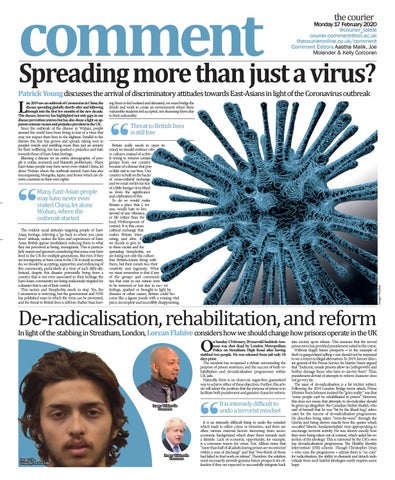
Image: Wikimedia Commons
Image: The Telegraph on YouTube
Image: Wikimedia Commons
It is intensely difficult to undo a terrorist mindset
It is an intensely difficult thing to undo the mindset which leads to either crime or terrorism, and there are often various external factors stemming from socioeconomic background which draw them towards such a lifestyle. Lack of economic opportunity, for example, is a common reason for crime. Eric Allison notes that “more than half of all adults leaving prison are reconvicted within a year of discharge” and that “two-thirds of those had failed to find work on release”. Therefore, the solution must necessarily provide genuine future prospects for offenders if they are expected to successfully integrate back
into society upon release. This assumes that the served prison term has provided punishment suited to the crime. Without (legal) future prospects – in the example of theft or gang-related selling – one should not be surprised to see a return to illegal alternatives. In 2019, former director general of the Prison Service Sir Martin Narey argued that “Indecent, unsafe prisons allow no [self-growth] and further damage those who have to survive there”. Thus, punishment devoid of attempts to reform character does not go very far. The issue of de-radicalisation is a far trickier subject. Following the 2019 London Bridge terror attack, Prime Minister Boris Johnson insisted the “grim reality” was that “some people can’t be rehabilitated in prison”. However, this does not mean that attempts to de-radicalise should be given up altogether: the Canadian Mubin Shaikh, who said of himself that he was “bit by the Jihadi bug”, advocates for the success of de-radicalisation programmes. He describes being taken “verse-by-verse” through the Qur’an and being shown exactly how the quotes which so-called ‘Islamic fundamentalists’ were appropriating to encourage terrorist activity. He was shown exactly how they were being taken out of context, which aided his rejection of the ideology. This is mirrored by the UK’s own top de-radicalisation programme, ‘the Healthy Identity Intervention’ (HII) scheme. Though Christopher Dean – who runs the programme – admits there is “no cure” for radicalisation, the ability to dissuade and detach individuals from such hateful ideologies surely inspires some hope.