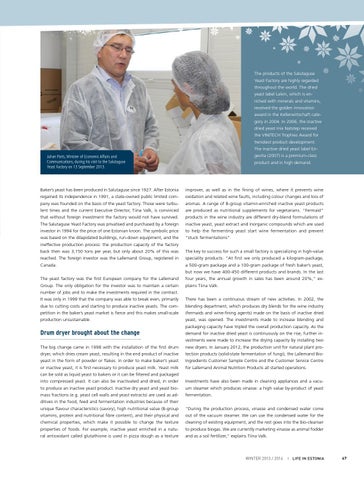
Juhan Parts, Minister of Economic Affairs and Communications, during his visit to the Salutaguse Yeast Factory on 13 September 2013.
Baker’s yeast has been produced in Salutaguse since 1927. After Estonia regained its independence in 1991, a state-owned public limited company was founded on the basis of the yeast factory. Those were turbulent times and the current Executive Director, Tiina Valk, is convinced that without foreign investment the factory would not have survived. The Salutaguse Yeast Factory was privatised and purchased by a foreign investor in 1994 for the price of one Estonian kroon. The symbolic price was based on the dilapidated buildings, run-down equipment, and the ineffective production process: the production capacity of the factory back then was 3,150 tons per year, but only about 20% of this was reached. The foreign investor was the Lallemand Group, registered in Canada. The yeast factory was the first European company for the Lallemand Group. The only obligation for the investor was to maintain a certain number of jobs and to make the investments required in the contract. It was only in 1999 that the company was able to break even, primarily due to cutting costs and starting to produce inactive yeasts. The competition in the baker’s yeast market is fierce and this makes small-scale production unsustainable.
Drum dryer brought about the change The big change came in 1998 with the installation of the first drum dryer, which dries cream yeast, resulting in the end product of inactive yeast in the form of powder or flakes. In order to make baker’s yeast or inactive yeast, it is first necessary to produce yeast milk. Yeast milk can be sold as liquid yeast to bakers or it can be filtered and packaged into compressed yeast. It can also be inactivated and dried, in order to produce an inactive yeast product. Inactive dry yeast and yeast biomass fractions (e.g. yeast cell walls and yeast extracts) are used as additives in the food, feed and fermentation industries because of their unique flavour characteristics (savory), high nutritional value (B-group vitamins, protein and nutritional fibre content), and their physical and chemical properties, which make it possible to change the texture properties of foods. For example, inactive yeast enriched in a natural antioxidant called glutathione is used in pizza dough as a texture
The products of the Salutaguse Yeast Factory are highly regarded throughout the world. The dried yeast label Lalvin, which is enriched with minerals and vitamins, received the golden innovation award in the Kellerwirtschaft category in 2004. In 2006, the inactive dried yeast mix Natstep received the VINITECH Trophies Award for trendiest product development. The inactive dried yeast label Engevita (2007) is a premium-class product and in high demand.
improver, as well as in the fining of wines, where it prevents wine oxidation and related wine faults, including colour changes and loss of aromas. A range of B-group vitamin-enriched inactive yeast products are produced as nutritional supplements for vegetarians. “Fermaid” products in the wine industry are different dry-blend formulations of inactive yeast, yeast extract and inorganic compounds which are used to help the fermenting yeast start wine fermentation and prevent “stuck fermentations”. The key to success for such a small factory is specializing in high-value speciality products. “At first we only produced a kilogram-package, a 500-gram package and a 100-gram package of fresh baker’s yeast, but now we have 400-450 different products and brands. In the last four years, the annual growth in sales has been around 20%,” explains Tiina Valk. There has been a continuous stream of new activities. In 2002, the blending department, which produces dry blends for the wine industry (fermaids and wine-fining agents) made on the basis of inactive dried yeast, was opened. The investments made to increase blending and packaging capacity have tripled the overall production capacity. As the demand for inactive dried yeast is continuously on the rise, further investments were made to increase the drying capacity by installing two new dryers. In January 2012, the production unit for natural plant protection products (solid-state fermentation of fungi), the Lallemand BioIngredients Customer Sample Centre and the Customer Service Centre for Lallemand Animal Nutrition Products all started operations. Investments have also been made in cleaning appliances and a vacuum steamer which produces vinasse: a high value by-product of yeast fermentation. “During the production process, vinasse and condensed water come out of the vacuum steamer. We can use the condensed water for the cleaning of existing equipment, and the rest goes into the bio-cleanser to produce biogas. We are currently marketing vinasse as animal fodder and as a soil fertilizer,” explains Tiina Valk.
WINTER 2013 / 2014
I LIFE IN ESTONIA
47