I CREATIVE ESTONIA
Photo by Vallo Kruuser / Eesti Ekspress
Half a Century of Design Education The roots of the design are probably in Finno-Ugric soil but everything changed when a new design department, led by Bruno Tomberg, was created at the Estonian Arts Institute. New students who came to change the world were admitted with harsh scepticism – ‘forget your dreams of becoming a star, if you’re lucky you will be the foundation of a new field’ − but there was a passionate, obstinate kind of optimism behind them. Slogans such as ‘Less is more’, and ‘We do not pollute, we improve the environment’ were abundant. The ideology that clearly opposed the prevailing conditions led to the formation of a half-secret united opposing front, whose goal was to improve the miserable Soviet environment. Back then it was crazy to hope that such idealism would triumph. Today we know that only such reckless courage and determinism can lead to the birth of real global design. Matti Õunapuu stood out from other students with his strong and practical attitude. Whereas most students considered their activities a futurist game, Õunapuu started to open doors in real life. Before the 1980 Moscow Olympic Games, when the Olympic yachting regatta was held in Tallinn, he worked together with the City Design Group, designing exceptional objects. His top design − the base for the Olympic fire − still stands in Pirita.
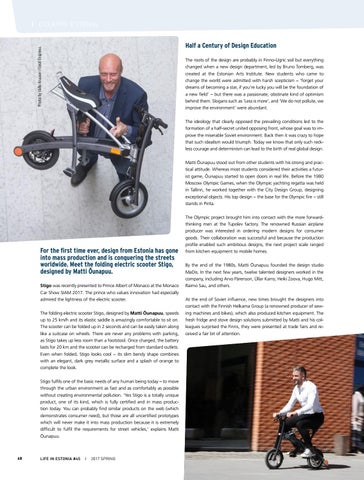
For the first time ever, design from Estonia has gone into mass production and is conquering the streets worldwide. Meet the folding electric scooter Stigo, designed by Matti Õunapuu. Stigo was recently presented to Prince Albert of Monaco at the Monaco Car Show SIAM 2017. The prince who values innovation had especially admired the lightness of the electric scooter. The folding electric scooter Stigo, designed by Matti Õunapuu, speeds up to 25 km/h and its elastic saddle is amazingly comfortable to sit on. The scooter can be folded up in 2 seconds and can be easily taken along like a suitcase on wheels. There are never any problems with parking, as Stigo takes up less room than a footstool. Once charged, the battery lasts for 20 km and the scooter can be recharged from standard outlets. Even when folded, Stigo looks cool − its slim bendy shape combines with an elegant, dark grey metallic surface and a splash of orange to complete the look. Stigo fulfils one of the basic needs of any human being today – to move through the urban environment as fast and as comfortably as possible without creating environmental pollution. ‘Yes Stigo is a totally unique product, one of its kind, which is fully certified and in mass production today. You can probably find similar products on the web (which demonstrates consumer need), but those are all uncertified prototypes which will never make it into mass production because it is extremely difficult to fulfil the requirements for street vehicles,’ explains Matti Õunapuu.
68
LIFE IN ESTONIA #45
I
2017 SPRING
The Olympic project brought him into contact with the more forwardthinking men at the Tupolev factory. The renowned Russian airplane producer was interested in ordering modern designs for consumer goods. Their collaboration was successful and because the production profile enabled such ambitious designs, the next project scale ranged from kitchen equipment to mobile homes. By the end of the 1980s, Matti Õunapuu founded the design studio MaDis. In the next few years, twelve talented designers worked in the company, including Arvo Pärenson, Üllar Karro, Heiki Zoova, Hugo Mitt, Raimo Sau, and others. At the end of Soviet influence, new times brought the designers into contact with the Finnish Helkama Group (a renowned producer of sewing machines and bikes), which also produced kitchen equipment. The fresh fridge and stove design solutions submitted by Matti and his colleagues surprised the Finns, they were presented at trade fairs and received a fair bit of attention.