Featured in this Issue
Student Awarded 2022 Children’s International Peace Prize EARCOS 52nd Leadership Conference Theme: “Together Again” Cover Story Preparing a School Community for DEIJB Work Through Developing Social and Emotional Competencies
EARCOS Triannual JOURNAL A Link to Educational Excellence in East Asia WINTER 2023
EARCOS
The
The ET Journal is a triannual publication of the East Asia Regional Council of Schools (EARCOS), a nonprofit 501(C)3, incorporated in the state of Delaware, USA, with a regional office in Manila, Philippines. Membership in EARCOS is open to elementary and secondary schools in East Asia which offer an educational program using English as the primary language of instruction, and to other organizations, institutions, and individuals.
OBJECTIVES AND PURPOSES
* To promote intercultural understanding and international friendship through the activities of member schools.
* To broaden the dimensions of education of all schools involved in the Council in the interest of a total program of education.
* To advance the professional growth and welfare of individuals belonging to the educational staff of member schools.
* To facilitate communication and cooperative action between and among all associated schools.
* To cooperate with other organizations and individuals pursuing the same objectives as the Council.
EARCOS BOARD OF TRUSTEES
Andrew Davies, President (International School Bangkok)
Stephen Cathers, Vice President (International School Suva)
Rami Madani, Treasurer (International School of Kuala Lumpur)
Margaret Alvarez, Past President (Director Emeritus ISS International School, Singapore)
Saburo Kagei (St. Mary’s International School)
Barry Sutherland (American International School Vietnam)
Laurie McLellan (Nanjing International School)
Kevin Baker (American International School Guangzhou)
Elsa H. Donohue (Vientiane International School)
Catriona Moran (Saigon South International School)
Andrew Hoover (ex officio), Office of Overseas Schools REO
EARCOS STAFF
Edward E. Greene, Executive Director
Bill Oldread, Assistant Director
Kristine De Castro, Assistant to the Executive Director
Elaine Repatacodo, ELC Program Coordinator
Giselle Sison, ETC Program Coordinator
Ver Castro, Membership & I.T. Coordinator
Edzel Drilo, Webmaster, Professional Learning Weekend, Sponsorship & Advertising Coordinator
Robert Sonny Viray, Accountant
RJ Macalalad, Accounting Assistant
Rod Catubig Jr., Office Staff
East Asia Regional Council of Schools (EARCOS)
Brentville Subdivision, Barangay Mamplasan, Binan, Laguna, 4024 Philippines
Phone: +63 (02) 8779-5147 Mobile: +63 917 127 6460
THE EARCOS JOURNAL
In this Issue
2 Welcome
Message from the Executive Director
4 Press Release
- EARCOS Student Awarded 2022 Children’s International Peace Prize
6 EARCOS Leadership Conference 2022 “Together Again”
10 EdThought
- Can we, please, shelve the traditional strategic plan now?
- Getting Started as an Instructional Coach
18 Cover Story
- Preparing a School Community for DEIJB Work Through Developing Social and Emotional Competencies
22 Curriculum
- Embracing Diversity through Differentiation
- Instructional Techniques within STEM Education
- Translanguaging and Linguistic Diversity: Practices for the International Classroom
- Beyond Rubrics and Ratings: Cultivating Agency and Coaching Teachers to Excellence With the Danielson Framework for Teaching
- Collaborating with Room to Fail

- Opening DORS: A Collaborative Learning Project
- Students at The International School Yangon Make an iMPACT
- Literary Gourmands Teaching genre to improve students’ literary response and enjoyment
- Salinometers in Seconds
50 Wellbeing: Formative data and ongoing student goal support for wellbeing 54
Service Learning
- Inspire Citizens: Whole School Models for Global Citizenship Transformation
- Christian Academy in Japan
- Building a Bridge Across Borderlands
- Need Journals: A Tool For Seeding the Service Learning Cycle
- Grade 3 Service Trips: Developing “pitch-in” attitudes and an appreciation for the natural world
- Developing Partnerships: from Local to Global
66 Building a Bibliography of Our Schools
68
69
Green & Sustainable: Composting at The International School of Yangon (ISY)
Global Citizen Community Service Grant
- Go Green
- Made to Change: Obstacles to Opportunities
69
Student Writing: Far Beyond Your Physical Borders
71 Action Research
- How Does Differentiated Instruction Enhance the Inclusiveness of Math Classrooms? —an Approach to Address Linguistic and Neuro-Diversity
- Student College Readiness: Empowering Students Futures
76 Poetry
77 Press Release
- International School of Busan, Green Flag Award
- SENIA celebrates 20 years
- Concordia Environmental Science students meet GIZ energy expert
81 Campus Development: Mont’Kiara New Futsal Court 82
Middle School Art Gallery
Winter 2023 Issue 1
Message from the Executive Director
Eye on the Prize
As educators, we carry an incredible responsibility for building bridges to the future. This is good work, important work, and it is best suited for those who are fueled by a deep sense of optimism. There are days, and I am sure you have them as well, when my optimism is threatened by a never-ending cycle of bad news. From hate crimes and inexplicable wars, to catastrophic climate events, to the horrors of poverty and starvation, to crimes against children, to ongoing threats to democracy and freedom--being hopeful about the future requires a huge dollop of optimism if not a spoonful of naivete. And yet, every so often something remarkable appears and you realize that, yes, there is an abundance of good in the world, and every reason to be hopeful.
I certainly felt that was the case last autumn when I was contacted about Rena Kawasaki, a 17-year-old student at EARCOS member school Osaka International School of Kwansei Gakuin. Ms. Kawasaki was awarded the Children’s International Peace Prize for 2022 for her groundbreaking work in the pursuit of a better world. (Please see the article on the following pages for more about this extraordinary story).
To be clear, the Children’s International Peace Prize is comparable in significance to the Nobel Peace Prize—but for young people. It is in the upper stratosphere when it comes to awards for people of any age. Past winners include an array of truly remarkable young people, including at least two who have become global household names—Greta Thunberg and Malala Yousafzai. Rena Kawasaki is in the very, very best of company! She was selected from a dynamic cohort of 175 applicants from 46 nations. When you consider just what so many young people are achieving in their efforts to address the challenges facing humanity, you cannot help but become filled with optimism and humility.

I know our readers will join me in congratulating and celebrating Rena’s achievements and the recognition she has received. We must also offer very special congratulations to her teacher and advisor, Jennifer Henbest de Calvillo—and to the Osaka International School of Kwansei Gakuin--for supporting Rena’s development and efforts. I would encourage you to take a moment to visit the website about her project, Earth Guardians Japan, which Rena founded when she was only 14 years old!
The acclaim that Rena has received reflects upon her family, her teachers and the culture of the school where she has learned and grown. It also reflects a growing commitment by schools across our region, to embrace the voices of the young people who grace our school communities. As the Netherlands-based KidsRights organization that sponsors the prize explains:
We ensure that children are being heard. Together with children, we ask global attention for their power as changemakers and children’s rights issues. Also, we empower children as positive and resilient changemakers. We act with children, amplifying and accelerating their actions in their communities and beyond.
Rena Kawasaki’s message to all of us in EARCOS is loud and clear: we must continue and expand ways to listen to the voices of our schools’ most valuable resources—our students—in their efforts to reshape the world—their world. Amid today’s turmoil and the steady stream of discouraging news, the voices of our students, and their vision of what is possible, are indeed sweet, sweet music.
Edward E. Greene, Ph.D. Executive Director

2 EARCOS Triannual Journal



TEACHERS' CONFERENCE 2023 M A R C H 2 3 - 2 5 , 2 0 2 3 S U T E R A H A R B O U R H O T E L K O T A K I N A B A L U , M A L A Y S I A V i s i t w w w . e a r c o s . o r g / e t c 2 0 2 3 1 8 t h A N N U A L E A R C O S STRANDS Literacy / Reading ESL Early Childhood Technology Special Needs Children's Authors Modern Languages Child Protection Counselors General Education Media Technology/Libraries
CEO
Zero
Michelle
Winner Creator and CEO of Social Thinking
Author of Teaching Life Save the date
Cathy
Jennifer
Klein
Ramirez
HT E M E : C REATING A CU L T U RE OFCARE
|
| Poet | Advocate
KEYNOTE SPEAKERS Nicholas Carlisle
for
Bully
Garcia
Todd Shy
GUEST SPEAKERS Susie Boss Greg Curtis Sarah Park Dahlen Stephen Holmes Lee Ann Jung
Berger Kaye
D.
Lori Langer de
Russell Lehmann Marc Tyler Nobleman Jon Nordmeyer Stephen Shore Ying Chu & Huali Xiong Matt Harris & Sian Jorgensen
Russell Lehmann Speaker
Writer
PRESS RELEASE
EARCOS Student
Awarded 2022 Children’s International Peace Prize: What we dream–
As educators we hope to see connections in learning, service and leadership grow in all our students as they mature. We might ask our students to reflect on: What their learning is for? How do they learn to be better people through their education? How do they find ways to access all areas of the curriculum? How do they find their passion and use this passion to help others? How do educators, schools and communities help them stand up and have a voice, to speak for what is right? How do they know what is fundamentally right? How can they dream for a better future and take action in this world?
Rena Kawasaki is a young girl of 17, who answered these questions and lives her dreams through action.
By Jennifer Henbest de Calvillo
She has been at our international school (Osaka International School of Kwansei Gakuin) since Kindergarten. Throughout her education she has proved what action and service can do to get youth involved in public service and improve the lives of future generations. She is an advocate for the voiceless and a role model to jumpstart youth action in Japan and internationally. We saw her on several TV programs, watched her become Euglena’s youngest ever CFO (Chief Future Officer) a leading youth advocate for a bio-fuel company in Japan. She has worked with Youth Summits, Polichats, University political groups. She is precocious, inclusive and a hardworking leader for U18 and “Let’s Talk to a Politician”. She is a recent winner of the prestigious Rise scholarship (run by Rhodes Trust and Schmidt Futures).
Rena and her friend Tanishka Murthy started Earth Guardians Japan, an organization that created connections regionally and internationally connecting kids in conversations about what they want to see happen in the world. One of the ways this was achieved was by connecting schools and local political representatives through virtual meetings. Earth Guardians used online platforms to help kids to connect and encouraged young Japanese to become more involved in politics, having a more direct say in their future through government interaction. Rena is officially working with the Japanese
when we think of a better future.
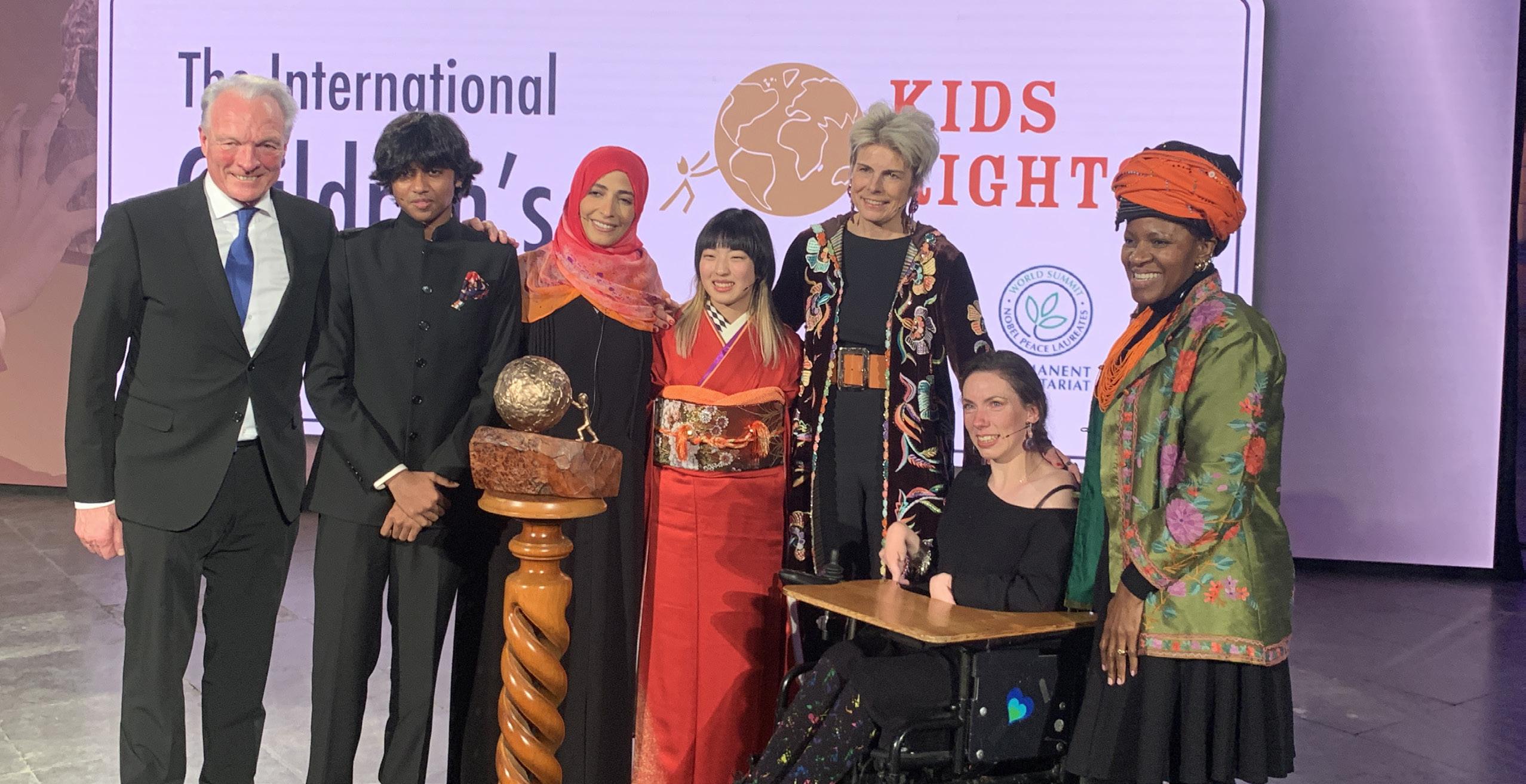
KidsRights director, previous winners Nav Agarwal, Tawakkol Karman, Rena Kawasaki, Netherlands Princess, previous winner Chaeli, and Tutu’s daughter.
4 EARCOS Triannual Journal
government ministry of environment to include the voice of young people in governmental operations. Tokyo’s government approached her to advise their team on reforming the city to be more sustainable.
This has led to her inclusion within the government’s major Tokyo Bay Environmental Social Governance infrastructure project. Rena is now working on the Tokyo eSG Project, which looks for future urban development aimed at creating a sustainable city. The future of Tokyo must combine nature and convenience projecting into the next 100 years. This will affect over 37 million people in the region. Rena also participated in the ‘Niihama project’, where she collaborated and created a QR code that would ensure that younger people’s voices are incorporated into government ideas. This was adopted by the Mayor and will impact the entire population of the city of Niihama. Rena’s ultimate goal is not only to ensure her generation has better opportunities, but that future generations have them too.
Rena recently won the esteemed International Children’s Peace Prize in the Netherlands. One could compare it to getting a Nobel peace prize for children. The prize was launched by KidsRights during the 2005 World Summit of Nobel Peace Laureates in Rome, chaired by Mikhail Gorbachev. Since then, the prize has been presented annually by a Nobel Peace Laureate.
It comes with large prize money 100,000 euros to be used for her self directed projects, and a scholarship fund for herself and her siblings. Rena, her family and me (as the educator who nominated her) were flown to The Hague for the ceremony. Not only did she meet previous prize winners like Nav Agarwal And Chaeli Mycroft and their families but we had the opportunity to talk about One Step Greener founded by Nav and his brother Vihaan and receive a copy of Chaeli’s new book “Unapologetically Able”. Rena had the opportunity to meet and speak with the princess of the Netherlands and Desmond Tutu’s daughter as
the head of the Tutu scholarship fund. Rena also had the distinct honor to be handed the prize by Nobel Laureate Tawakkol Karman
The KidsRights Expert Committee selected Rena as a winner from 175 nominations with entries from 46 countries world wide. Rena has gained an important platform through which she encourages youth to speak and have a voice for public service. She inspires young people in Japan and across the planet to be risk takers and stand up for what they believe could help others in the future.

At our school we start educating about kids rights and the rights of the child in our PYP program in Grade 3/4. Rena is an advocate for right number
12. Children have the right to give their opinions freely on issues that affect them. Adults should listen and take children seriously. The Rights of the Child are an integral part of our curriculum and many other international schools in the EARCOS region. Our schools are filled with changemakers like Rena who thrive with support and numerous opportunities that educators can help provide.
During the filming for the Children’s International Peace Prize, Rena spoke eloquently about her cooperative adventure. She spoke about working together with various groups in her journey to change society for the better. One of Rena”s outstanding gifts is her ability to work in new collaborative groups. She spoke how none of this could be done alone. Her determination and ability to inspire youth in Japan has resulted in her being a spokesperson for youth all around the world.
Marc Dullaert, Founder and Chair of the KidsRights Foundation said: “Rena is an extraordinary pioneer in her country, ensuring the voices of young people are heard and converting this into tangible impact and better opportunities for both her generation and future generations. Education and the environment are of paramount importance to Rena and are topics she sets high on the agenda, in a unique way, in her society and globally.”
The International Children’s Peace Prize highlights the remarkable achievements of youth fighting bravely for children’s rights across the world. Previous winners include March for our Lives Initiators, Malala Yousafzai and Greta Thunberg. Kids Rights also has a board called State of Youth, and opportunities for clubs and organizations through a chapter of young people to apply for grants and work towards their dreams.
You can nominate someone in your school for the Children’s International Peace Prize until March 1, 2023.
As educators we can facilitate, support and encourage our students to take action for a better world. Our future depends on us working and acting together.
Winter 2023 Issue 5
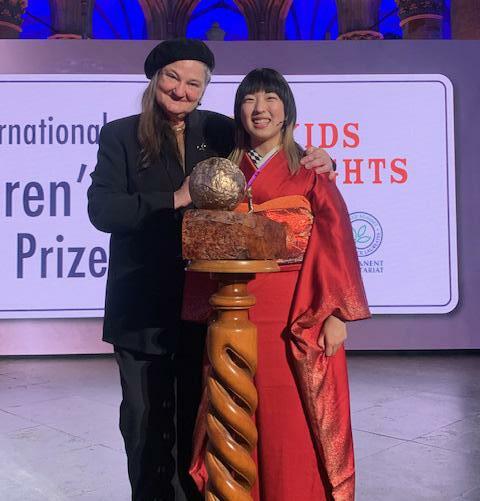
Rena Kawasaki recipient of the 2022 International Children’s Peace Prize with Jennifer Henbest de Calvillo.
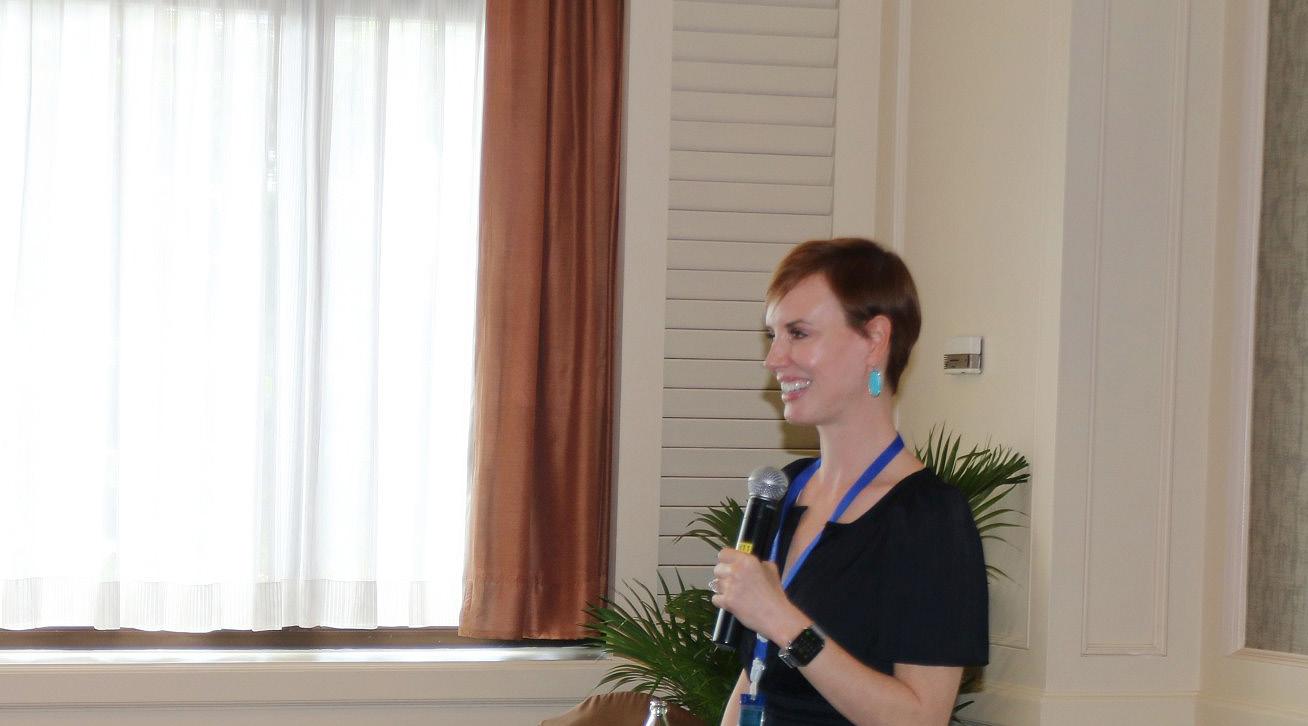
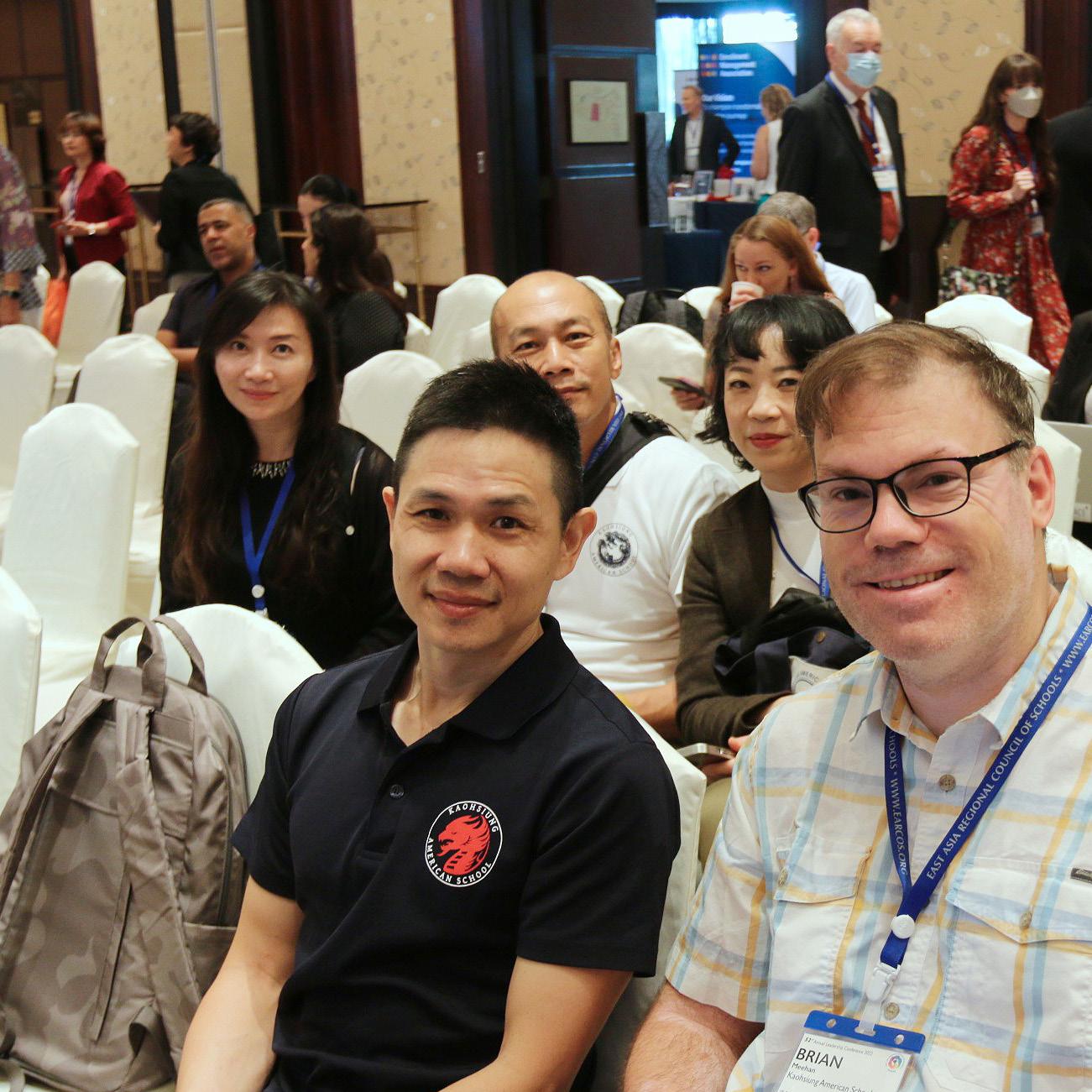
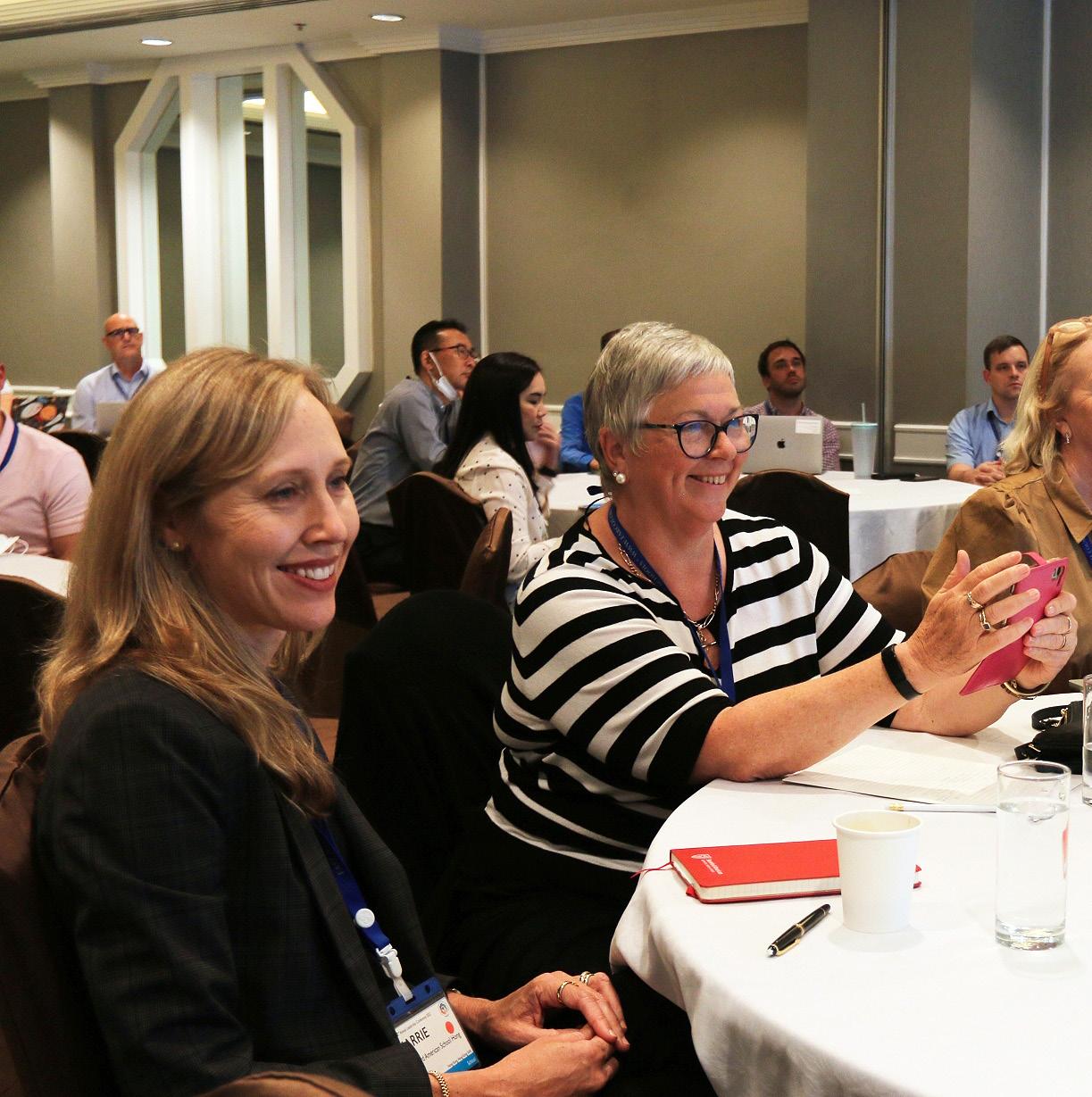
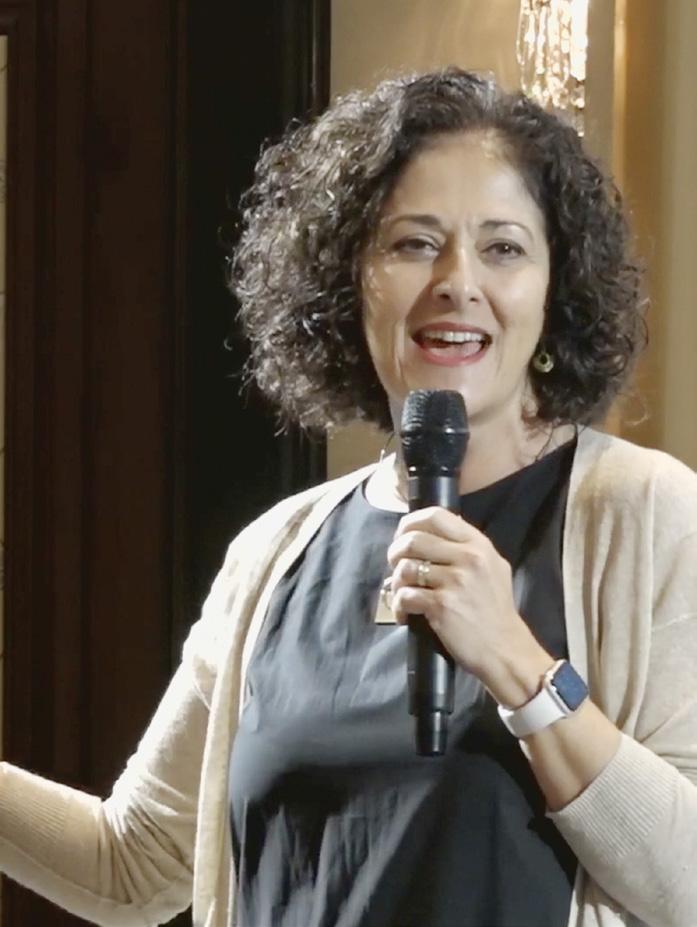
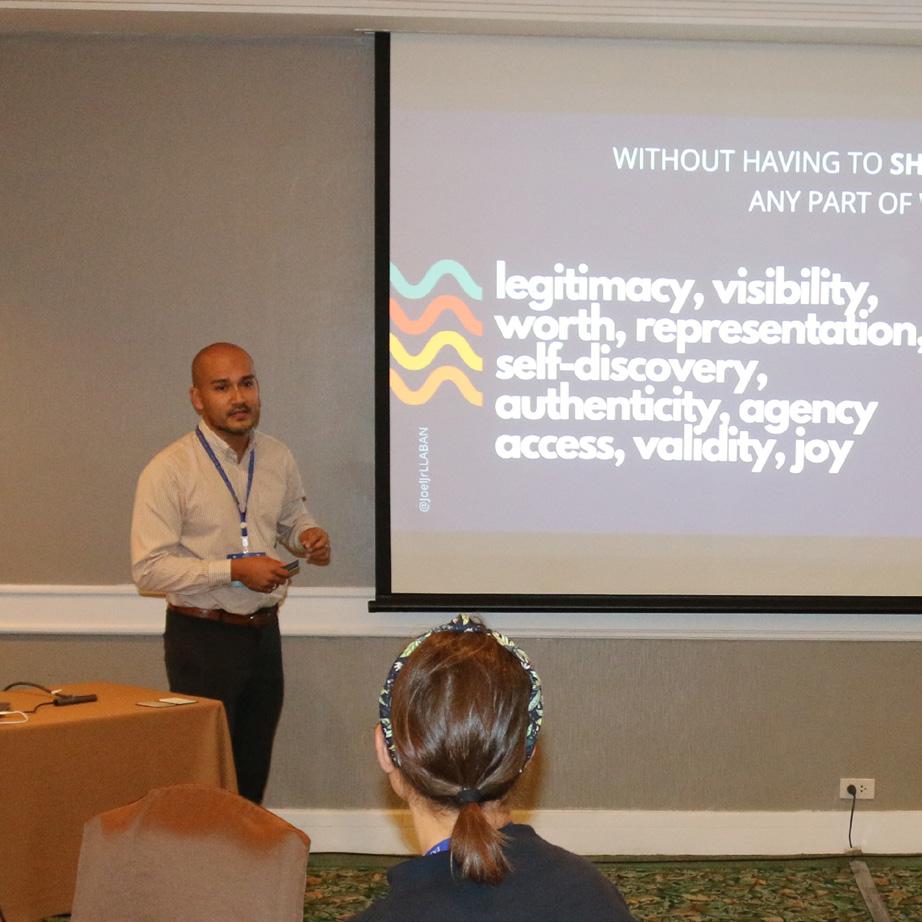
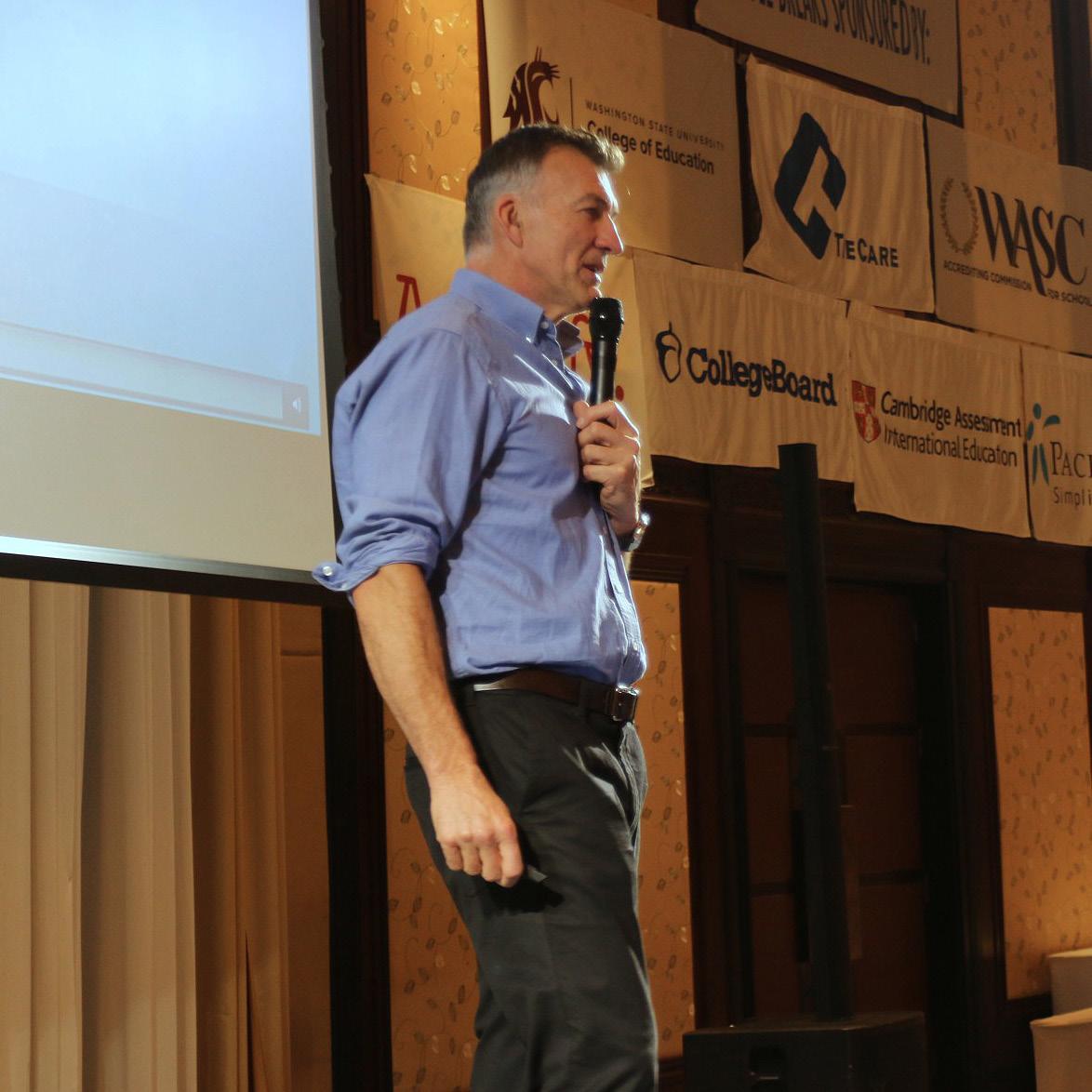
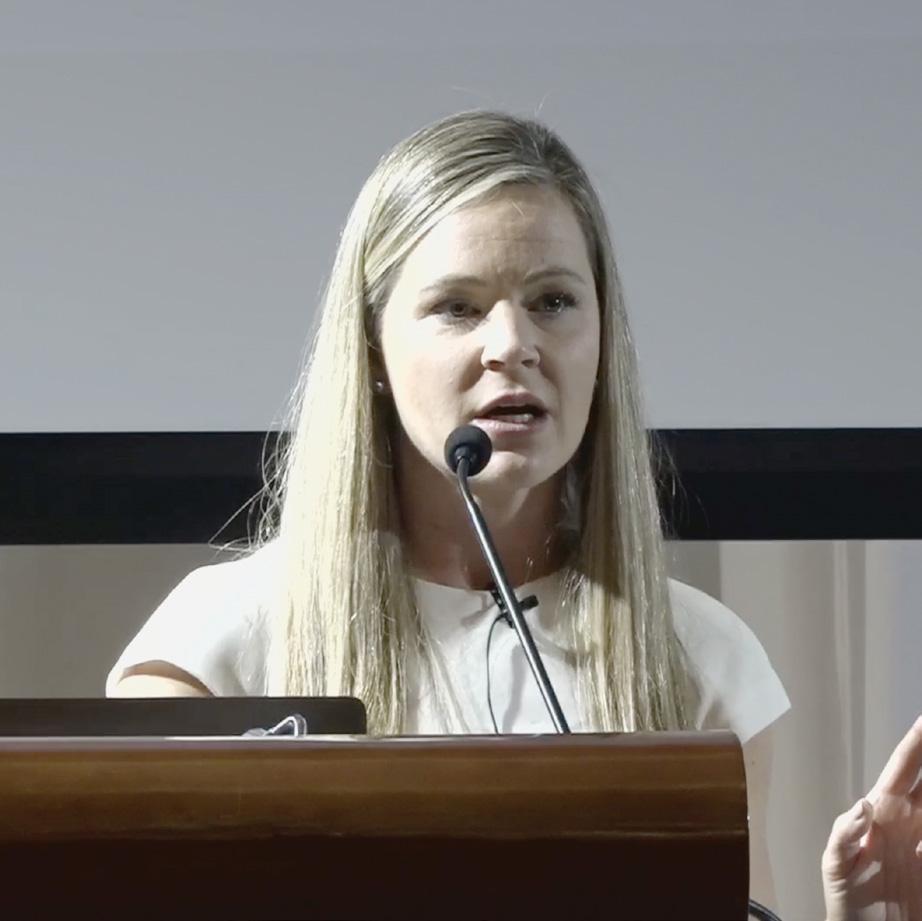
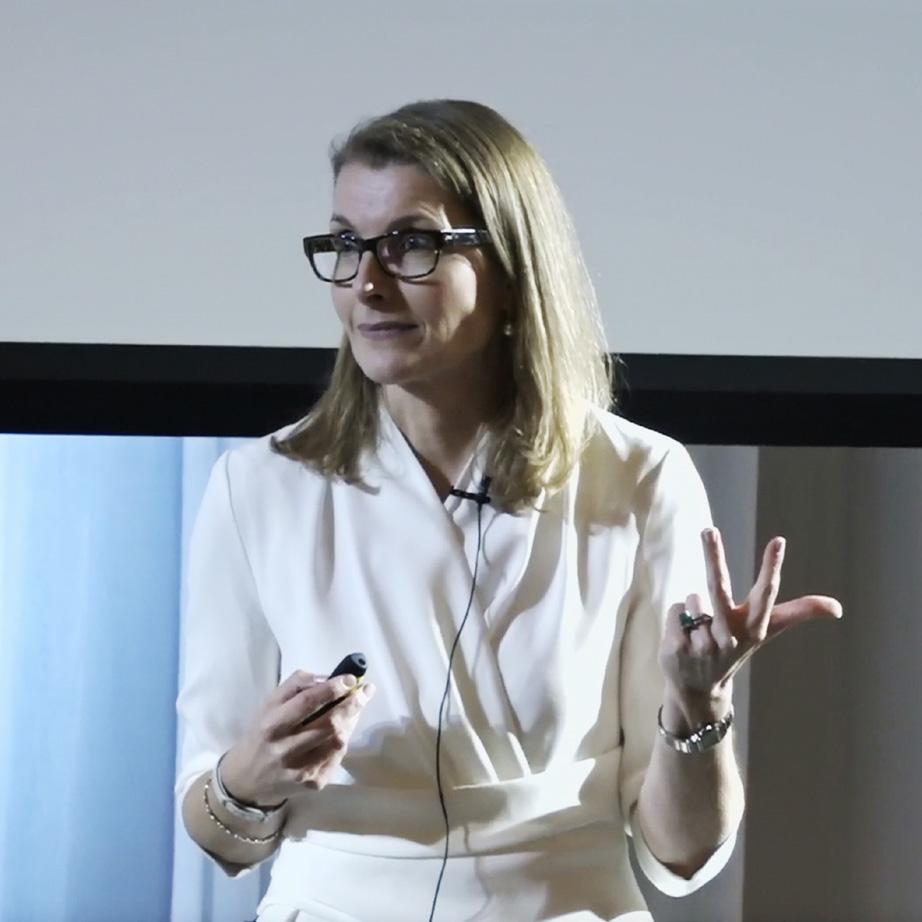
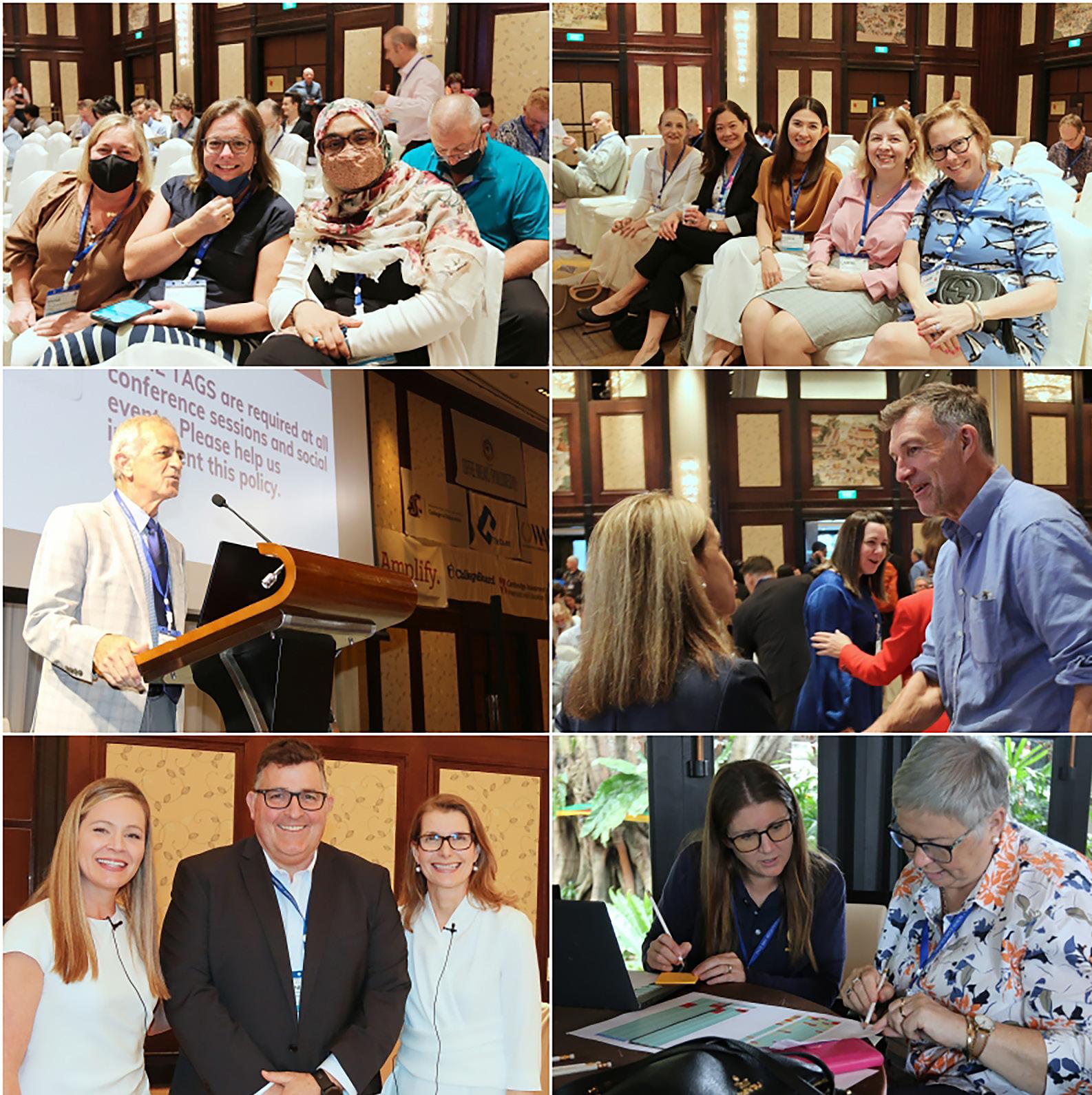
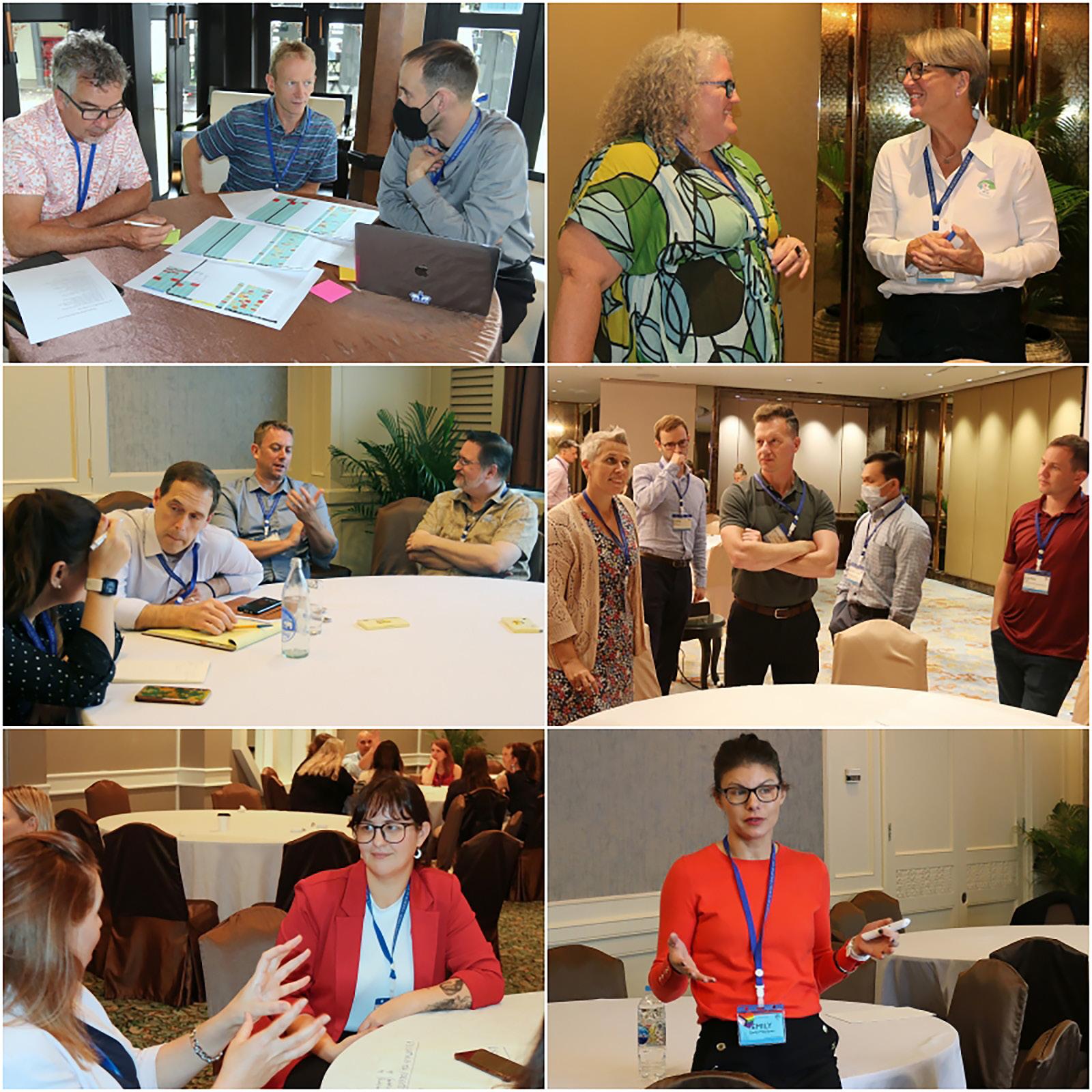
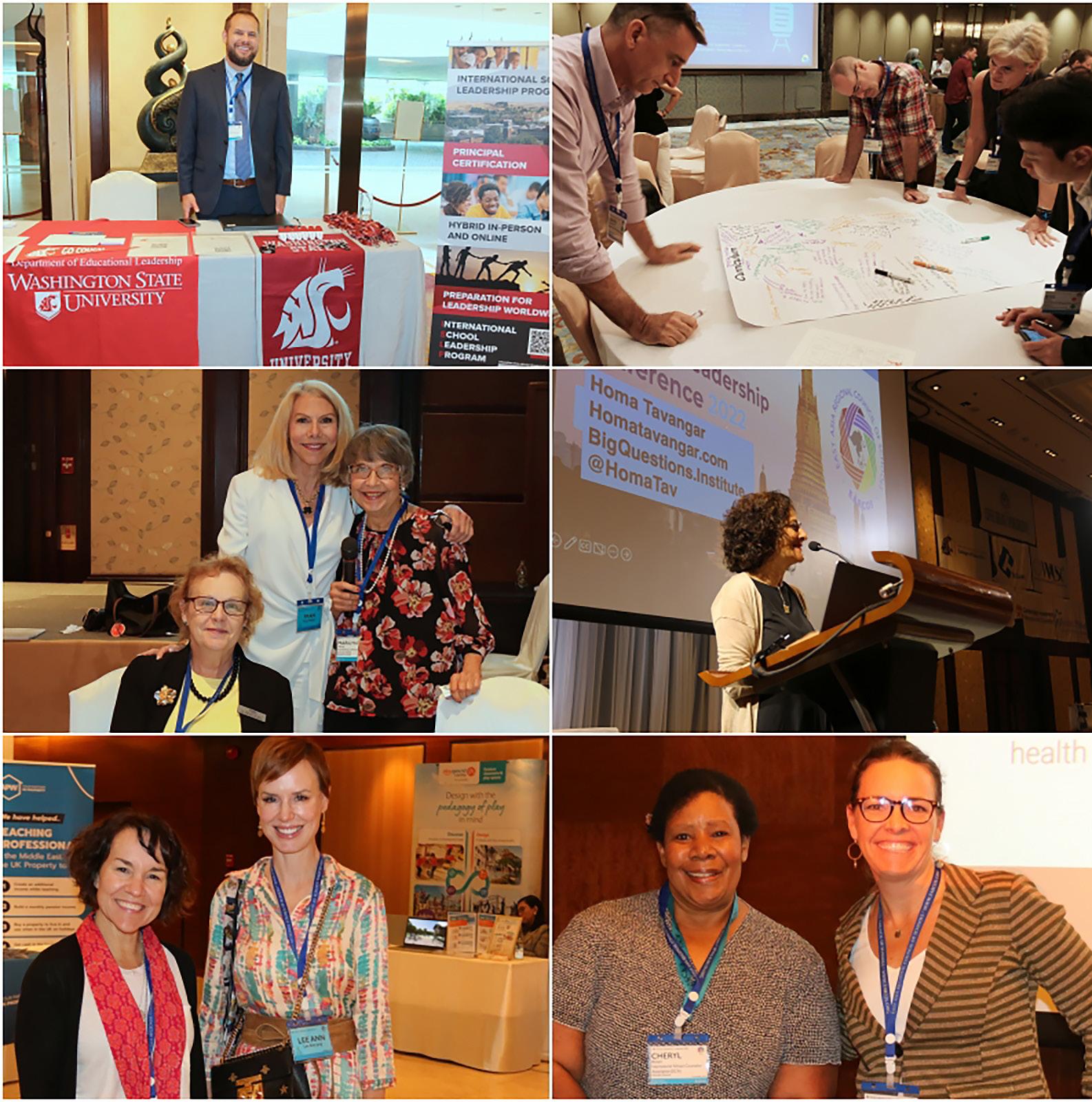
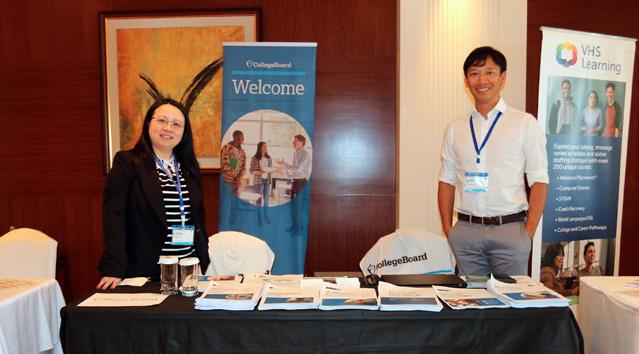
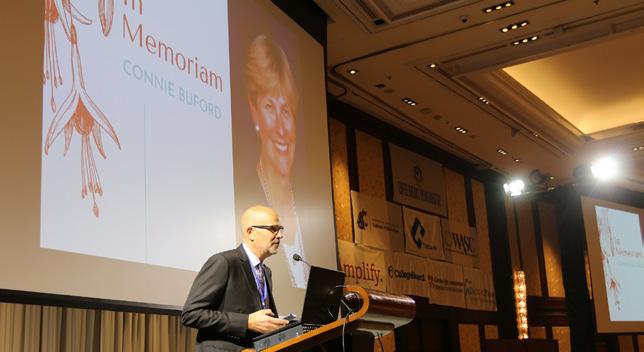
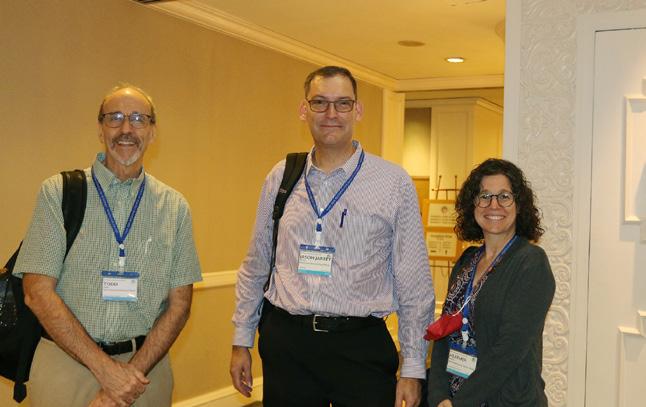
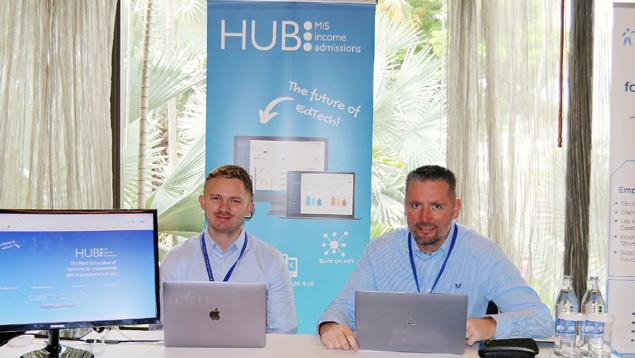
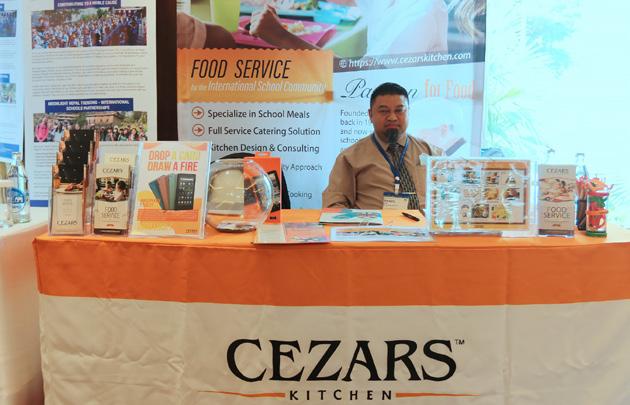
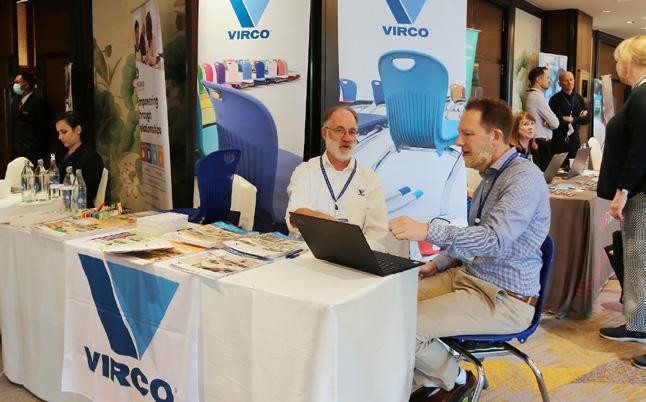
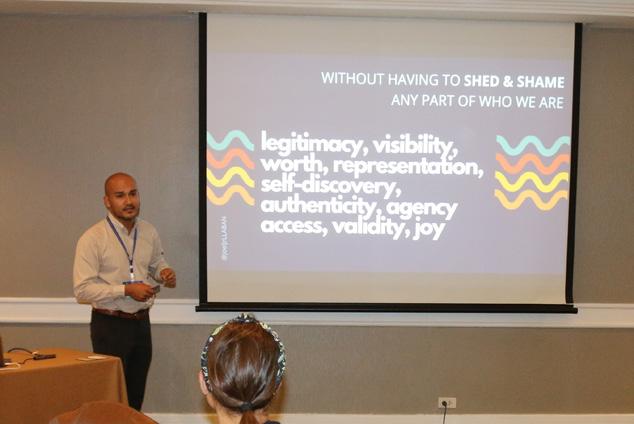
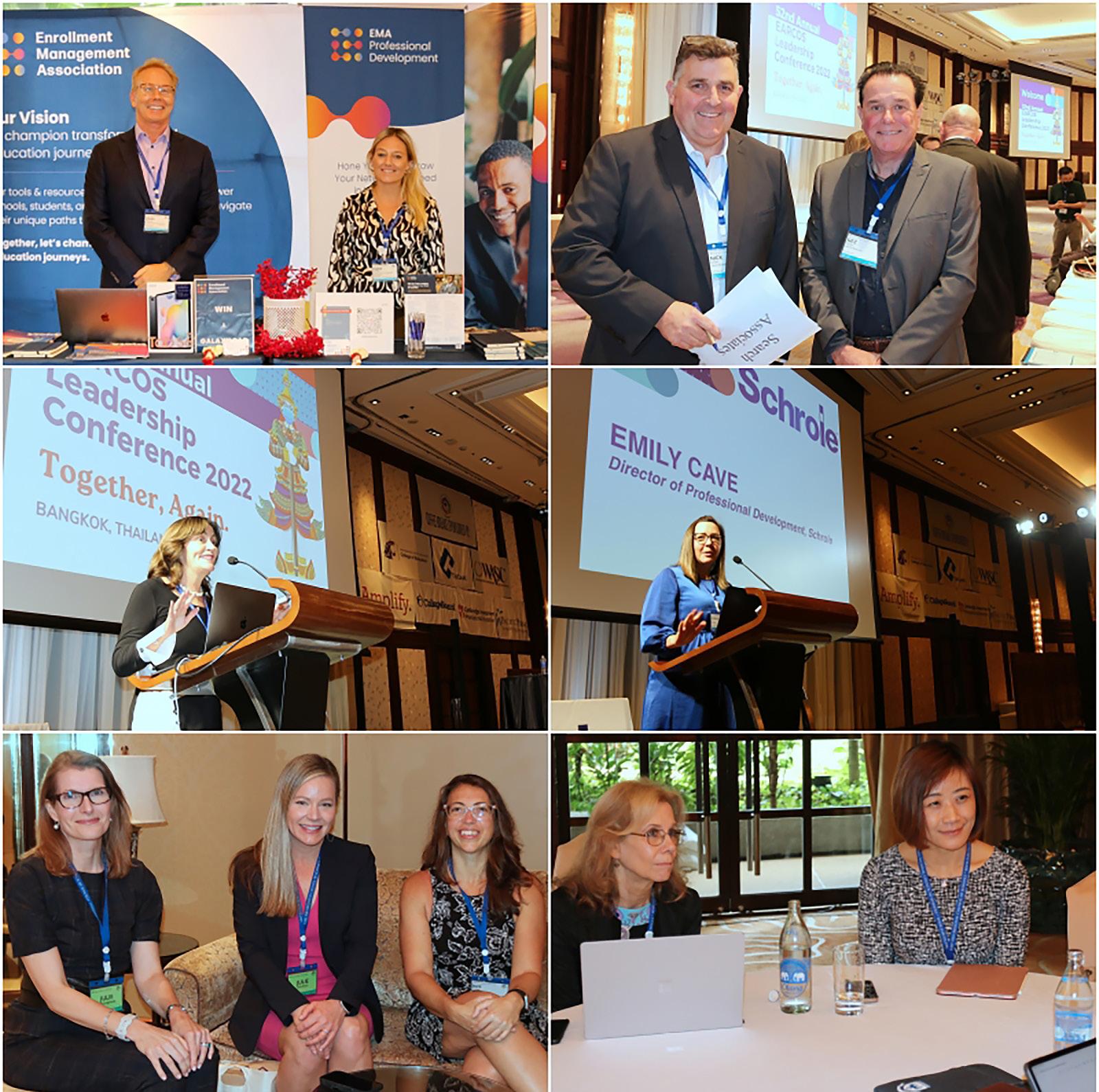
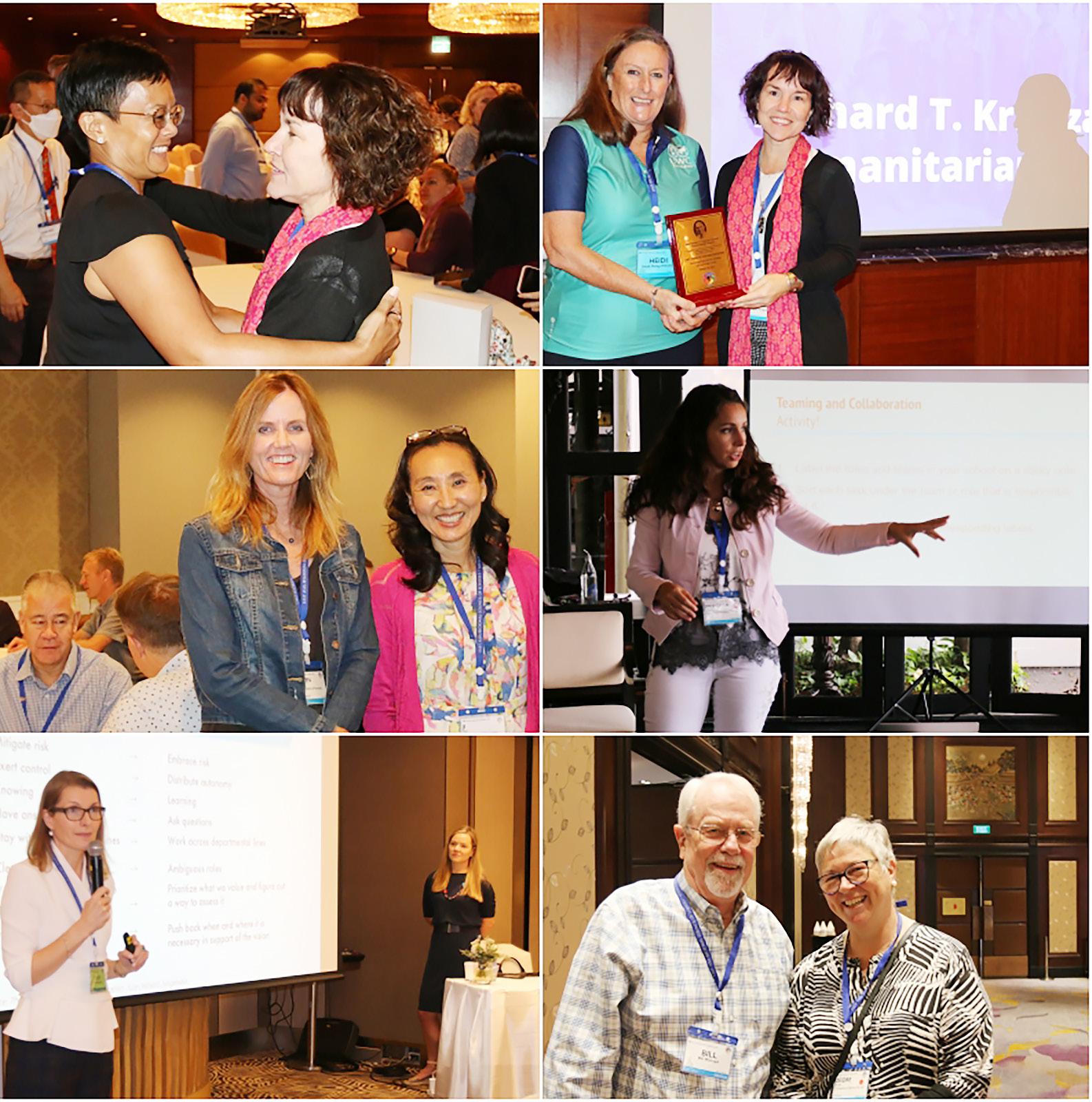
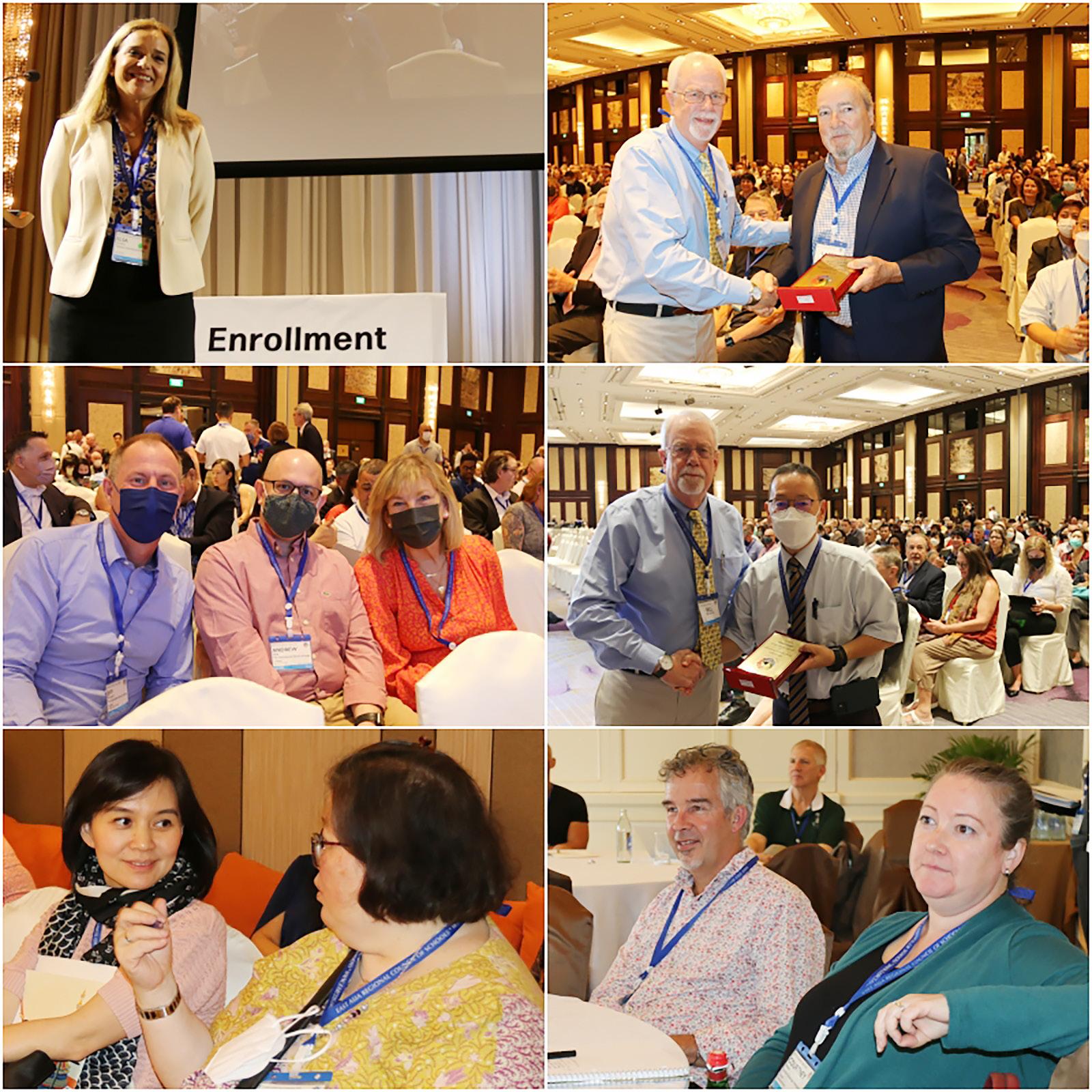
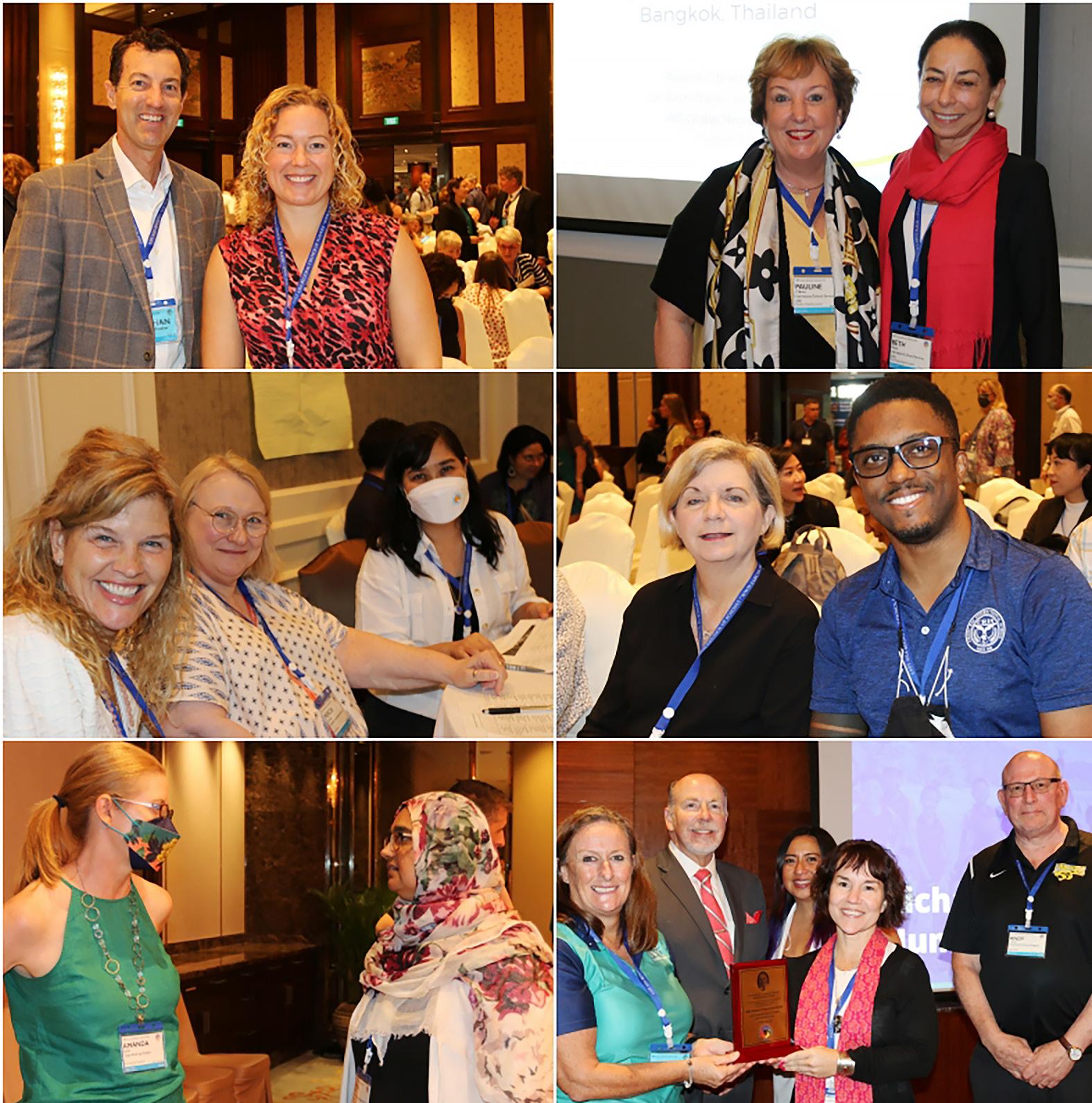
The 52nd EARCOS Leadership Conference, ELC, seemed a long time coming. The planning began in 2019 for 2020, and then again for 2021. The delay of course was due to the Covid pandemic. Then finally, with the theme of “Together Again”, the 52nd ELC became a reality from October 26-29 at the beautiful Shangri-La Hotel in Bangkok, Thailand. This year’s conference hosted 860 school board trustees, heads of school, principals, directors of learning, athletic directors, business managers, admissions officers, and Associate members from the EARCOS region and worldwide.

EARCOS Leadership Conference 2022
“Together Again”
By Bill Oldread, Assistant Director
Each day of the conference opened with a plenary session highlighted by a keynote talk by an outstanding educational thinker and practitioner. The opening day also included an additional afternoon keynote. Dr. Michael Thompson, noted author and school psychologist opened day one sharing his experiences working with adolescent boys. Julie Jungalwala and Julie Stern shared their expertise during the afternoon keynote of day one. Tim Jarvis, who retraced a portion of Earnest Shackleton’s heroic escape from Antarctica stressed the role of endurance in all that we endeavor led off the second day. Our day three keynote was presented by Homa Tavangar, author of Growing
Up Global. She shared her strategies for surviving and thriving as global learners.
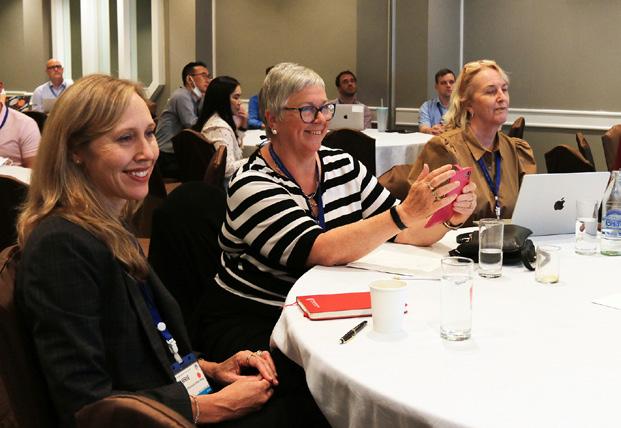
In addition to the exceptional keynote speakers, the 3-day conference offered over 140 workshop sessions on board governance, intercultural leadership, child protection, assessment, curriculum, DEIJ, admissions and marketing, and school change. The conference provided excellent learning experiences and abundant opportunities for networking. Both the opening night reception and the closing reception were well attended. The food, as always, was superb, the band was terrific, and the camaraderie was special.
During the Annual General Meeting (AGM), five new members were elected to the Board of Trustees to replace retiring and term-limited trustees. Newly elected members are Dr. James Dalziel, NIST International School, Thailand, Karrie Dietz, Stamford American School, Hong Kong, Gerald Donovan, North Jakarta Intercultural School, Indonesia, Dr.Jim Gerhard, Seoul International School, Korea, and Dr. Greg Hedger, International School Yangon, Myanmar. Those leaving the board in April are Andy Davies, President, Steve Cathers, Vice President, Saburo Kagei, Secretary, Laurie McLellan, and Barry Sutherland.
6 EARCOS Triannual Journal
We applaud these retiring trustees for their outstanding leadership and guidance during their terms.
Once again the staff of the Shangri-La treated our delegates as VIPs. Our sincere thanks go to Urasa Nicrothanon and her people for their outstanding service and hospitality.
Thank you to all those who attended ELC 2022. We invite you to join us again next year when ELC 2023 will be held once again at the lovely Shangri-La Hotel, Bangkok, from October 26-28, 2023.
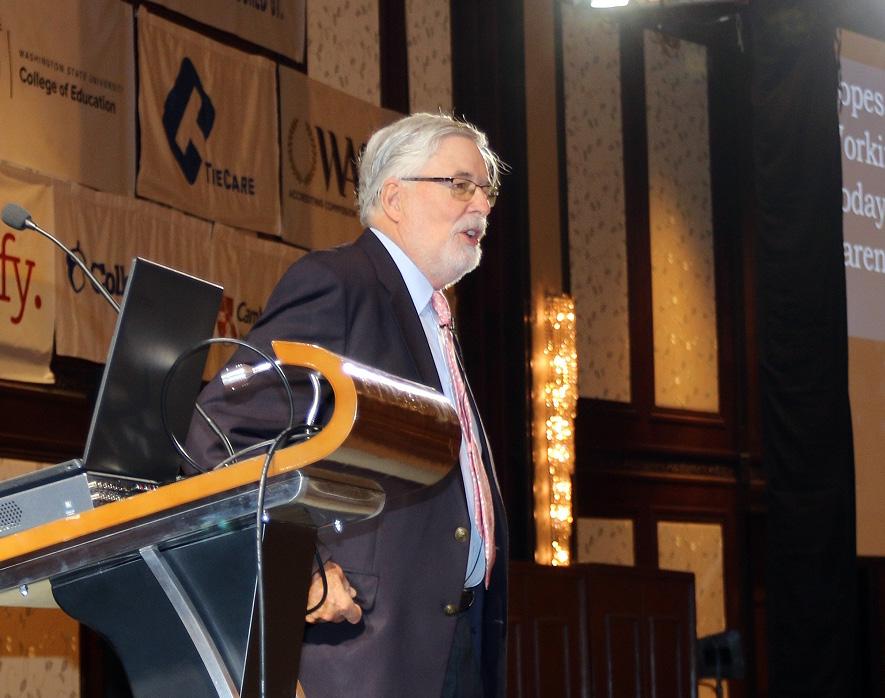
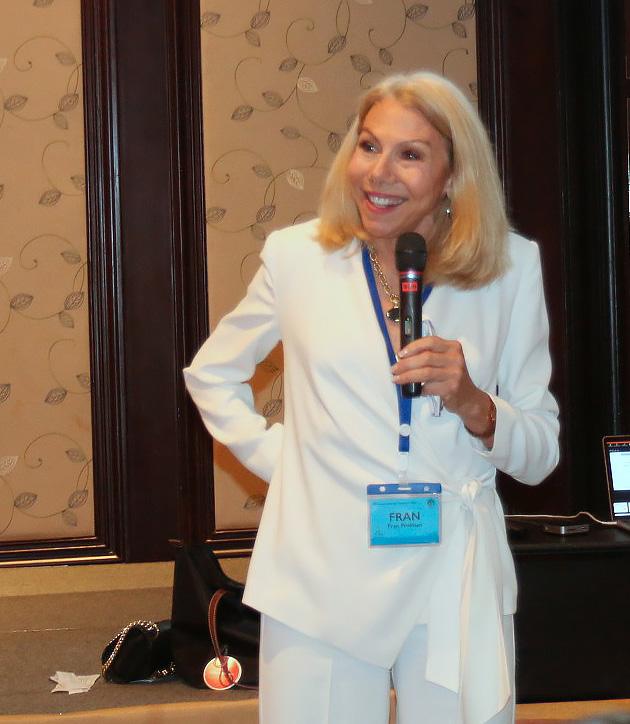
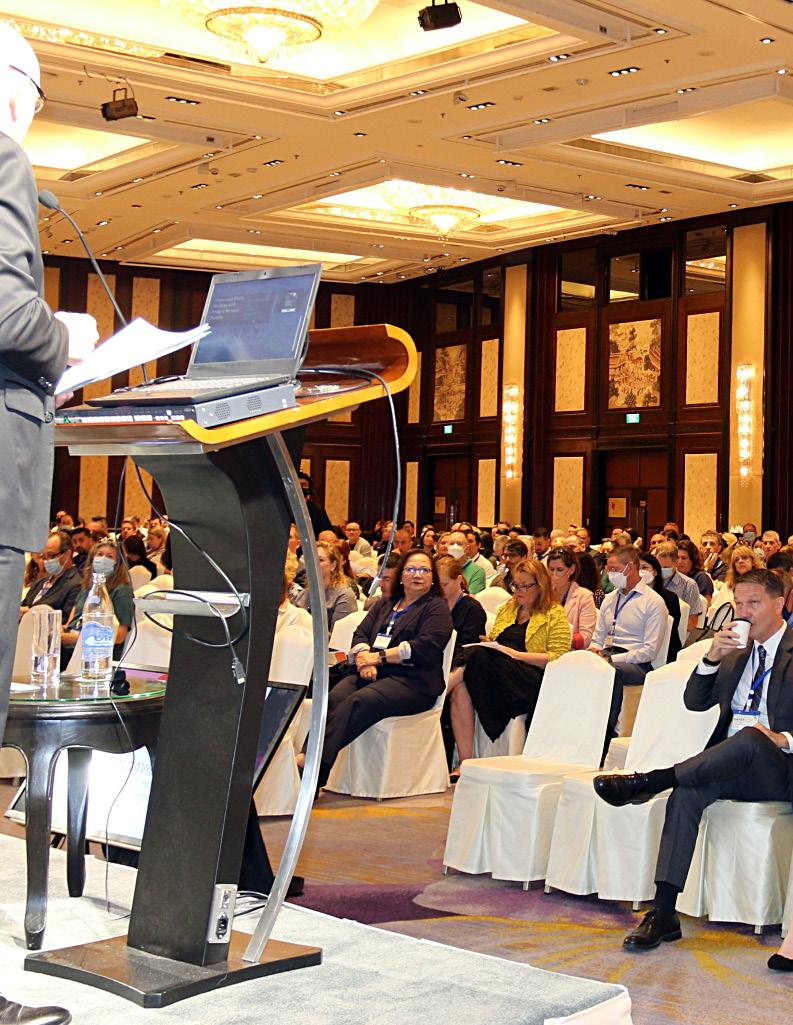
Winter 2023 Issue 7
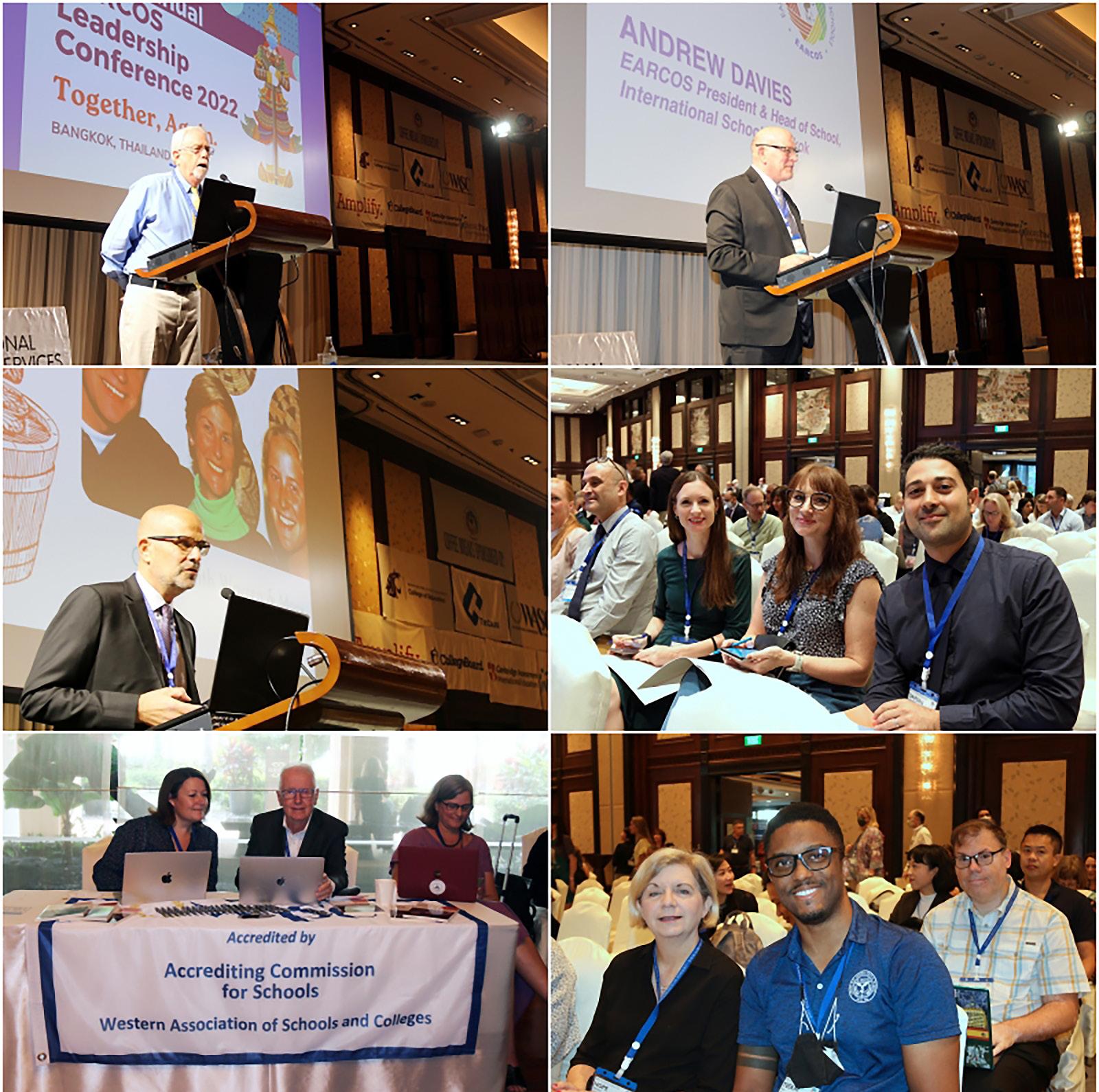
EDTHOUGHT Can we, please, shelve the traditional strategic plan now?
By Greg Curtis Author and Consultant
Picture walking into your school, picking up the thick, dusty binder marked “Strategic Plan: 2018- 2023”, leafing through its ponderous pages and muttering, “Yup, nailed it!” Tough to imagine, isn’t it?
Our traditional way of operating, at a strategic level, has not had a significant positive effect on learning. The efforts that have gone into change initiatives have not, by and large, been commensurate with the expectations of real change in the classroom. We have been very busy, but the effects are often underwhelming. (Curtis, 2018)
I won’t spend a lot of time outlining the reasons why traditional, static strategic plans are not helpful tools . . . most of us know this by now. They tend to keep schools and its people very busy, even if in isolated bursts. But we should not confuse busyness with progress. In fact, busyness is often the enemy of meaningful progress.
Also, they become painfully dated very quickly. As Henry Mintzburg wrote almost 30 years ago, traditional strategic planning falls prey to “the Fallacy of Prediction”.

According to the premises of strategic planning, the world is supposed to hold still while a plan is being developed and then stay on the predicted course while that plan is being implemented. (Mintzberg, 1994)
This “Phallacy of Prediction” is something that Mintzburg and others have expressed frequently. If there is one thing that the past 3 years have brought into stark relief, it’s that we truly are living in a VUCA world (volatile, uncertain, complex and ambiguous). It’s not just a buzzword. Are our traditional strategic plans equipped to handle this? Have they ever been?
The purpose of this article is not to simply malign the traditional strategic plan; they have been falling out of favour in the business and educational sectors for quite a long time. However, some schools may be happy with their traditional strategic plans and that’s great. The purpose of this article is not to tear down “the old plan”, but to investigate a more agile, future-focused, and on-going process.
I would like to explore an alternative move to “rolling” strategic thinking and agile planning as an alternative. As Mintzberg also states, “Strategic planning isn’t strategic thinking. One is analysis, and the other is synthesis.” (Mintzberg, 1994). Strategic thinking is at the heart of the shift from fixed plans to “rolling” strategic processes.
10 EARCOS Triannual Journal
A Strategic plan . . . Strategic thinking . . .
Is a product Is a process
Is completed as a task, whether isolated or participatory Is initiated as part of a larger shift towards engagement, a future focus and ideation
Seeks to define, delineate and “freeze” everything in one place
Is usually assessed as to whether the boxes have been checked and all of the actions contained carried out
Is usually spearheaded by committees who work to carry out implementation plans
Is seldom truly strategic, with many operational issues mixed in
Seeks to be a catalyst for ongoing engagement in thoughtful and iterative exploration and design
Is usually assessed as to whether clear mission-critical learning goals and desired transformations are being achieved
Is usually guided by design teams seeking ways to effectively achieve learning goals in a modern and fluid context
Is always strategic if the focus remains on the achievement of mission-critical goals for learning and, thereby, achievement of mission
Rarely, if ever, changes over its life span Is always being developed and, by definition, is agile
Usually focuses on fixing perceived deficits in past or current practice
Is future-focused and directed towards creating new solutions and opportunities
In order for a rolling strategic process to have a positive transformative effect, it is helpful to keep the following characteristics in mind.
Create “future first” mindset and process
• Most traditional strategic planning processes begin with a close analysis of the present state of the organization. Perhaps a SWOT analysis (strengths, weaknesses, opportunities, threats) may explore the surrounding landscape somewhat, but we usually begin our process firmly rooted in the present as if everything was going to remain the same in the future. We often use the strategic planning process as a way to “fix” that which we currently judge as “broken”. This is all rear-view mirror stuff.
• Strategic thinking should begin not with an analysis of where we are, but an inquiry into where the world of our students may be headed. We need to build a knowledge base about the potential future they will inhabit, through processes such as Futures Thinking, to better understand what we need to do to help them to thrive and contribute in their lives. We need to envision a desired destination years ahead to set our sights on the real goal . . . only then can we look at where we currently are and design ways to move from the present towards the future.
Anchor long-term strategic thinking in concrete and stable strategic goals for learning
• Fixed-term strategic plans tend to be static. Once they are written, they are rarely revised based on progress and appropriate evidence with a frequency that would be considered “agile”.
• A rolling strategic process needs to be anchored in long-term goals for learning. These are usually identified through Futures
Thinking processes (see above) and consolidated into a desired future destination for the community. This helps to keep us from jumping to the how without clarity on the what, a flaw I often see lead to untethered and unproductive busyness in schools.
Focus on Impacts, not Inputs and Outputs
• My Input-Output-Impactô framework is an attempt to help differentiated between means and ends.
The Input-Output-Impactô Framework (Curtis, 2016)
• The traditional strategic plan tends to focus on Inputs and Outputs, often without a clear connection to what these are designed to achieve (our mission through Impacts). Without goal clarity, how can we design appropriate responses to achieve them? How will we know if we have been successful? Static strategic plans trap us in a seemingly never-ending Input-Output loop, often without achieving anything truly important.
• Often, a traditional strategic plan measures its success against itself – Did we do all of the things we said we would do? This is simply a measure of implementation, not the a measure of the achievement of strategic goal.
We may measure inputs and outputs by the completion of action steps and implementation plans. The achievement of desired impacts, however, should be evidenced through the artifacts and products of student learning. The measure of success is not that we did the work, but that students learned and can demonstrate their growth and achievement related to stated Impacts. (Curtis, 2018)

Initiate processes that are highly participatory and lead to desired shifts
in culture
• Strategic plans are usually devised through a contained and fixed process over a relatively short timeframe (picture the “strategic planning committee retreat”, if you will). Everything decided via this limited process then becomes fixed and is usually passed on to various committees to implement, often in isolation.
• Strategic thinking is on-going and engages multiple groups in designing the best systems and solutions in order to achieve the desired destination for its students. The process is iterative and cyclical, giving many opportunities for real engagement
Winter 2023 Issue 11
and contribution. It is not a document handed to committees, but more of a relay race where the baton is passed to various collaborative teams at various times to carry for a lap of on on-going journey.
Engaging productively with Complexity
• Dated methods of strategic planning treat the future as if it were linked to the present through logical, linear relationships. “If we simply do A, B and C, then D will result.” However, the future does not unfold in a linear process. Traditional plans also often overlook culture as an important element to cultivate in order to achieve success. Most of us will have experienced the fall-out from neglecting culture at some point in our careers.
• Schools are complex ecosystems made up of many interacting systems. As such, linear causality should not be relied upon. Complex environments are nonlinear and require a different way of thinking to help ensure that the desired changes come to the surface as “emergent properties”. A rolling process is more attuned to complexity and better suited to massaging various elements of the overall complex environment, including culture, to help bring about desired change.
Initiate
and sustain a cyclical process
• Rolling strategic processes are not one-time events. They epitomize a new way for the organization to engage and function in an on-going and iterative manner. It requires a cyclical process to keep things moving in productive and consistent ways. Below is a simple illustration of such a cycle.
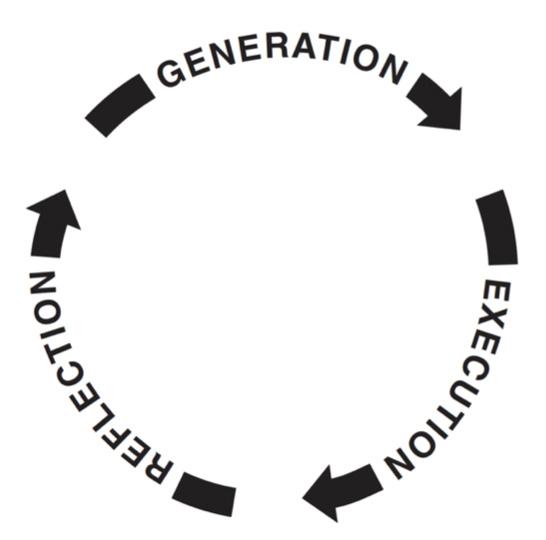
future design and implementation efforts. Finally, a true reflection stage, based in the interpretation of appropriate evidence, allows us to keep learning and refining.
Guided by process roadmaps

• While dealing with adaptive strategies in complex environments may not be linear, we still need to establish stages and benchmarks within the process. Whereas traditional plans often deal with each initiative as an isolated set of tasks, rolling processes need to function with multiple processes happening simultaneously and across different systems or workstreams.
• Roadmapping provides a way to orchestrate the Inputs and Outputs of different teams across different projects at various stages of the rolling cycle. It helps us to be more strategic in our thinking and to connect the dots across various teams, projects, and phases. It is a “whole is greater than the sum of its parts” scenario.
Most educators understand that traditional, fixed-term strategic plans are not adequate to help schools truly move forward in agile and resilient ways. And yet, many struggle to accept an alternative to the static plan while continuing to follow at model that is flawed and hoping for the best. This is a large topic to address in a relatively brief article. I hope these thoughts helped to introduce some concrete ways in which strategic thinking and rolling strategic process differ and can support on-going improvement now and for our future.
Sources
Curtis, G. (2018). Moving beyond busy: Focusing School change on why, what, and how. Solution Tree Press.
McTighe, J., & Curtis, G. (2018). Leading modern learning: A blueprint for Vision-Driven Schools, Second Edition. Solution Tree Press and ASCD.
Mintzberg, H. (2014, August 1). The fall and rise of Strategic Planning. Harvard Business Review. Retrieved December 4, 2022, from https://hbr.org/1994/01/the-fall-and-rise-of-strategic-planning
Sample of a Rolling Strategic Process (Curtis, 2018)
• The advantage of such a cycle is that various design processes and initiatives can exist at various stages of the process. Each stage has its own characteristics, goals, and processes. This helps to tie things together and keep our thinking, design, and implementation agile. It also allows us to learn from experience and allow this collective experience to influence current and
About the Author
Greg Curtis is an author and consultant collaborating with schools on school change efforts including strategic processes. He can be reached at Greg@gregcurtis-consulting.ca
The Power of Digital Storytelling
Presented by: LeeAnne Lavender Saturday, January 28, 2023 9:00 - 10:00 AM HKT visit website
12 EARCOS Triannual Journal
• Start and manage a school

• Supply a school
• Recruit teachers
• Recruit school leaders
• Streamline accounting and finance functions
• Learn through professional development (PD)
• Support diversity, equity, inclusion, and justice (DEIJ)
full

International
See where ISS can take you and your school
International Schools Services (ISS) provides you with the
range of services necessary to deliver an outstanding global education: Explore upcoming job fair and PD opportunities at ISS.edu/events Find more at ISS.edu #ISSedu
Winter 2023 Issue 13
Getting Started as an Instructional Coach
By Kim Cofino
In a previous article I shared big picture visioning steps to build a thriving coaching program at your school. Having those long term plans in place to develop a coaching program is the first step, but once you are hired as a coach, and once you have coaches in your school community, how do you start making those plans into reality?
Over the past eight years of working with coaches and school leaders to develop coaching programs in schools around the world, the number one question I get asked is: “Now that I have the job, how do I get started as a coach? Where do I start? What do I do to begin to build a coaching culture? And how can I make an impact as just one coach in a school?”
When making the transition from a classroom role to a coaching role, there are so many different new responsibilities, and you need to transition your perspective from the micro view of one classroom or department to a whole division or whole school. Although you’re still focusing on improving student learning, you’re now looking at it through the lens of teacher professional growth.

In my work with coaches in The Coach Certificate and Mentorship Program (and based on my own personal experience as a coach for over a decade in international schools), I have found that the following 10 steps will start the ball rolling and enable you to see where you’re able to make the biggest impact so you can adapt, adjust and refine from there. This is not the only way to get started, but it’s worked for many coaches, and if you’re feeling like something is not moving in the right direction, you may find that you need to bring in one of these elements.
Step 1: Focus on building relationships Relationships are the foundation of everything: build them with teachers, with your school leaders, with support staff, with department heads. When you move into a coaching role, you no longer have the luxury of “only” working with the people on your team or in your department. As a coach, you need to think about how you will connect with all stakeholders in the school community. Being proactive and strategic about how you build these relationships, document the conversations and connections that you have, and continue to cultivate them is essential.
So many future coaching cycles, or great parent connections, or new school initiatives can begin because you spent time cultivating relationships with all stakeholders. As Joellen Killion says: “All models of coaching are valuable. Coaching light is coaching for relationships. Coaching heavy is coaching for results. Results can build relationships just as relationships can build results.” (Cofino, 2020)
Step 2: Be intentional about being visible
It can be easy for teachers to develop a perception that coaching is a “desk job” or “mini admin”. To counteract that misconception, be intentional about being visible. Be where teachers are: in their classrooms, on duty, in the staff lounge, the lunch room, in team meetings (if you can). Help them see that you’re part of the school community every day. This will go a long way towards building relationships as well.
EDTHOUGHT
14 EARCOS Triannual Journal
Recently presented at the EARCOS Leadership Conference 2022 in Bangkok, Thailand
With my clients in The Coach Certificate and Mentorship Program
we often talk about specific strategies to be intentional with your time to ensure that visibility is structured into your day as a coach. Focusing on a small strategy like this can have a big impact (as my own coach often says “small hinges open big doors”).
Step 3: Make a mindset shift
One of the potentially challenging parts of becoming a coach is realizing that you were not hired to create “mini me’s”. Even if you are an expert in your field and you were doing amazing things in your classroom prior to becoming a coach, the goal is not to create an “army of you” (sorry, Bjork). Coaching is about listening & supporting others growth (not “fixing” or making everyone just like you.
The beautiful thing about making this mindshift is that you’re no longer hung up on the outcome of coaching conversations. You are walking the path with the teacher, but you don’t need to be personally invested in the specific journey it takes to get there (as long as student and teacher safety are assured). You can be a thought-partner and an idea inspirer without holding attachment to which ideas get adopted. This is about teacher growth not compliance.
Step 4: Take time to articulate your vision or philosophy
Because we all have our own preconceived notions of what coaching means, it’s essential to define what it means in this context, for this school, at this point in time. Taking the time to clarify what your vision for coaching is will help you not only align with your school leader, but also be consistent in your communication with coachees.
Once you have your own vision clarified, clearly define your role & align with your school leader so you’re both working towards (and expecting) the same outcomes. In my work with coaches and school leaders around the world, the majority of any potential issues with coaches or a coaching program stems from a lack of clarity around the role, it’s intention, purpose and expectations. If you can come to alignment early on with your school leaders, you will prevent much of those potential “downstream” challenges.
To quote my coaching superhero, Joellen Killion again: “If I can describe it with specificity, it is far more likely to be achieved, than if I don’t have the capacity to be specific. More time on the what what what, and less time on the how. We do that backwards in schools. We spend a lot of time on the how without clarity on the what.” (Cofino, 2022).
Step 5: Use a needs assessment to determine your services
As coaches, we likely have ideas for the kind of support we would like to provide teachers. However, you’re far more likely to see teachers coming to you for coaching if you start by uncovering exactly what they think they need support with, as well as the language they use to describe it.
When you start communicating your services to teachers, be sure to include the outcome of the needs assessment so that you are directly targeting your teacher’s perceived needs. You can always include more than what they identified, but when you give teachers what they ask for, they will be more likely to seek you out for support.
Another advantage of conducting a needs assessment first is that
you will be able to tell how teachers describe the support they would like. As a coach, you may have more specific language to describe the work you do, but if this vocabulary isn’t how teachers describe it, they might not recognize it as the support they feel they need.
In my work with the Phoenixville Area School District in the US, conducting a needs assessment was a huge turning point for their coaching program. Several years later, their team has since doubled in size and their coaching program is flourishing. As K12 Instructional Coach, Ashley Martin, mentioned on a #coachbetter podcast conversation with me: “It’s been amazing to think back to where it started and to see the layers adding on as we grew. It all started with the needs assessment that we did with you in The Coach.” (Cofino, 2020)
Aligning your services and language to what teachers recognize they need, and how they describe it, is the first step in helping teachers see working with you as a valuable investment of their time.
Step 6: Actively & consistently communicate your role Once you know what teachers believe they need, you can create a coaching menu to communicate your services, in the language of your teachers. Many coaches change up their coaching menu on a regular basis to help teachers recognize all the different valuable services they provide. The key here is to consistently communicate your role to your teachers as regularly as you can (without overwhelming them).
Teachers are busy, and they may not see the value of investing their time in coaching unless they can clearly see how that time will be spent, and that there will be a tangible positive impact in their classroom. The more you can do to provide clarity around the work you do, the easier it is for teachers to “say yes” to coaching.
Step 7: Recognize that not everyone is ready for coaching (yet) As much as you may want to work with every teacher, or any specific teacher, coaching is an invitational practice. Compulsory coaching usually does not work out well. As a coach, your goal should be to create an environment where teachers feel comfortable and invested in their professional growth, so there is a willingness to take risks, try new things and invite someone else into their classroom.
As Diane Sweeny said in her #coachbetter interview: “If we set goals for student learning, we’re sending a message that I’m here to be a partner. The type of goal you start with can really mitigate against reluctance. It can’t be an external agenda put on a teacher by someone else.” (Cofino, 2020). Ultimately, coaching requires vulnerability, and vulnerability requires trust. Which is why this article started with building relationships first.
Step 8: Support teachers in sharing their successes
In order to spread the great work that coaching supports, it’s essential to both track the work that you’re doing and share it. However, not everyone likes to share, or to be celebrated publicly, it’s worth finding a variety of ways to celebrate the accomplishments of your coachees.
You may find that teachers appreciate being mentioned in your weekly newsletter or podcast, or that they prefer to speak for them-
Winter 2023 Issue 15
selves in a faculty meeting or on a PD day, or maybe just asking one coachee to connect with another teacher in the department to share their experience with you is just right. Develop a variety of strategies that work in your community to share success stories so you can build momentum around coaching.
Sharing also has a side benefit of helping teachers see that coaching is for everyone, and gives them specific people to talk to about their experiences coaching.The goal is that you, as the coach, are not the only person in the community talking about coaching and how impactful it can be.
Step 9: Seek feedback regularly & take action
In order to continually grow and improve, it’s important to seek feedback on your practice. There are many ways to collect this kind of data, you can:
• Conduct surveys (annually, and after specific events or experiences)
• Ask for feedback at the end of a coaching session (I like the question: “What was most helpful for you today?”)
• Touch base with department heads and other school leaders to see what they’re hearing
The key is, as Jordan Benedict said in our #coachbetter podcast conversation: “The goal with data is to start measuring and start taking action. The questions don’t have to be perfect at the start. You can fine tune your actions over time.” (Cofino, 2019). You only need one data point to move forward!
Step 10: Track your time & focus on what makes the most impact Along with tracking the work you’re doing in an effort to share coaching success, it’s important to track your time to help you focus on what type of work makes the most impact in your school community.
For most of my clients in The Coach, one of the key “aha moments” is understanding the different types of coaching (or coaching stances) that we can be doing. We follow Laura Lipton’s model of the Continuum of Practice: Consulting, Collaborating and Coaching (most other coaching researchers have a very similar breakdown, but with different labels), and most coaches can benefit from tracking the amount of time and impact based on the different stances they take.
As Laura said in our #coachbetter podcast conversation: “Colleagues want you to be consulting. In order to create commitment and ownership, it’s a dance. Don’t discount the value of the information of the consultant, because it is a resource. To transition to coaching, offer chunks of information with the opportunity to process.” (Cofino, 2020).
If you are aware of coaching stances, and tracking your time based
on the work that you do, you’ll be able to work towards transitioning your conversations to deeper coaching over time.
Bonus: Share coaching data
As you are tracking your time to measure your impact, make sure you’re also sharing this data with the wider school community & specifically school leadership. Because coaching is a non-teaching position, often with little to no classroom time, it is an easy position to cut. When things are going well, it can be harder to realize the impact that having a position like coaching can make. Be intentional about tracking and sharing this data with decision makes so they recognize the value you bring to the school community.
Working Towards Clarity & Consistency
Instructional coaching is a hugely valuable and influential position for schools, but it’s complicated and complex to get it right. Here in the EARCOS region, we see these positions come and go due to a lack of clarity and consistency in both vision and implementation. Hopefully these articles will start a dialogue about the positive impact coaching can have in our region so we can begin to see these positions have more longevity, along with clearer expectations and implementation. If you’re interested in being part of that conversation, please let me know!
References
Cofino, K. (Host). (2022, Jan 26). What Makes Coaching Work with Joellen Killion (146). [Audio podcast episode]. In #coachbetter. Eduro Learning. https://coachbetter.tv/episode-146/
Cofino, K. (Host). (2019, Aug 7). Measuring Your Impact as an Instructional Coach with Jordan Benedict (47). [Audio podcast episode]. In #coachbetter. Eduro Learning. https://coachbetter.tv/episode-47/
Cofino, K. (Host). (2022, Nov 2). Building an Intentional Coaching Program with the PASD Team (178). [Audio podcast episode]. In #coachbetter. Eduro Learning. https://coachbetter.tv/episode-178/
Cofino, K. (Host). (2022, Jan 12). How to Coach Reluctant Teachers with Diane Sweeney (144). [Audio podcast episode]. In #coachbetter. Eduro Learning. https://coachbetter.tv/episode-144/
Cofino, K. (Host). (2022, Feb 23). The Continuum of Practice for Instructional Coaches with Laura Lipton (150). [Audio podcast episode]. In #coachbetter. Eduro Learning. https://coachbetter.tv/episode-150/
About the Author
Kim Cofino recently presented at the EARCOS Leadership Conference 2022 in Bangkok, Thailand and at past Teachers’ Conferences. She can be contacted at mscofino@gmail.com
Can We Finally Shelve the “Strategic Plan”?
Presented by: Greg Curtis Saturday, February 4, 2023 9:00 AM HKT visit website
16 EARCOS Triannual Journal
inclusive leadership program

L E A D I N G F O R E Q U I T Y I N I N T E R N A T I O N A L S C H O O L S
P R O G R A M O V E R V I E W
T h e p u r p o s e o f t h i s 1 8 - m o n t h , E A R C O S - s p o n s o r e d p r o g r a m i s t o b u i l d d e e p u n d e r s t a n d i n g a n d s k i l l s i n t e a c h i n g a n e u r o d i v e r s e p o p u l a t i o n T h e i n t e n t i s f o r s c h o o l l e a d e r s a n d t e a c h e r l e a d e r s , i n t u r n , t o d e v e l o p s u c h s t r o n g f a c u l t y c a p a c i t y a n d c o l l e c t i v e s e l fe f f i c a c y i n t h e i r s c h o o l s t h a t t h e r e i s n o l o n g e r a q u e s t i o n o f w h e t h e r a w i d e r d i v e r s i t y o f n e e d s c a n b e m e t w i t h i n t h e s c h o o l
T h e p r o g r a m o f f e rs a s h a r e d u n d e r s t a n d i n g o f t h e p r a c t i c e s , s y s t e m s , a n d s t r u c t u r e s n e e d e d t o f a c i l i t a t e a s c h o o l c o m m u n i t y v i s i o n t h a t v a l u e s i n c l u s i o n a n d s e e s t h e b e n e f i t s f o r a l l s t u d e n t s T h e c o u r s e s c h a l l e n g e t h i n k i n g a r o u n d w h a t n e u r o d i v e r s i t y m e a n s a n d f a c u l t y i d e n t i t y a s i n c l u s i v e e d u c a t o r s . P a r t i c i p a n t s l e a r n t o d e v e l o p t i e r e d s y s t e m s o f s u p p o r t , i m p l e m e n t u n i v e r s a l d e s i g n f o r l e a r n i n g , d e s i g n i n t e r v e n t i o n , m ea s u r e p r o g r e s s , s u p p o r t m e t a c o g n i t i o n a n d e m o t i o n a l r e g u l a t i o n , a n d h o w t o c o a c h a n d l e a d i n c l u s i v e p r a c t i c e s .
W e w a n t p a r t i c i p a n t s t o l e a v e p r e p a r e d a n d e n t h u s i a s t i c t o l e a d s c h o o l s c o u r a g e o u s l y t o d e s i g n i n s t r u c t i o n " t o t h e e d g e s " i n a w a y t h a t e l e v a t e s o u t c o m e s f o r e v e r y s t u d e n t i n t h e s c h o o l . T h e g o a l o f i n c l u s i v e , u n i v e r s a l l y - d e s i g n e d s c h o o l s i s t o p r e p a r e n o t o n l y e x p e r t s i n c o n t e n t , b u t a l s o e x pe r t l e a r n e r s , w h o e n g a g e i n t e n t i o n a l l y i n l e a r n i n g , s e t t h e i r o w n g o a l s , a n d k n o w h o w t o t a k e c h a r g e o f t h e i r o w n l e a r n i n g - - i n s c h o o l , a n d i n l i f e b e y o n d s c h o o l .
D E L I V E R Y
E a c h c o u r s e i n c l u d e s a c o m b i n a t i o n o f l i v e f a c i l i t a t i o n a n d s e l fp a c e d , o n l i n e l e a r n i n g F o u r o f t h e c o u r s e s a r e h y b r i d , w i t h a p o r t i o n o f t h e c o u r s e t a u g h t i n p e r s o n a t a n E A R C O S c o n f e r e n c e o r a s a w e e k e n d w o r k s h o p . T h e r e m a i n i n g f o u r c o u r s e s a r e e n t i r e l y o n l i n e C o u r s e s c a n b e t a k e n i n d i v i d u a l l y , b u t r e g i s t r a t i o n p r e f e r e n c e i s g i v e n t o t h o s e e n r o l l i n g i n t h e f u l l p r o g r a m
M A S T E R ' S D E G R E E O P T I O N
P a r t i c i p a n t s c a n t a k e c o u r s e w o r k f o r p r o f e s s i o n a l d e v e l o p m e n t o n l y , o r f o r a M a s t e r o f A r t s i n T e a c h e r L e a d e r s h i p f r o m S a n D i e g o S t a t e U n i v e r s i t y M a s t e r ' s s t u d e n t s t a k e a n a d d i t i o n a l 3 c o u r s e s o n l i n e , a n d d e v e l o p a c a p s t o n e p o r t f o l i o ( i n l i e u o f a t h e s i s ) G r a d u a t i o n i s a t t h e c o n c l u s i o n o f t h e s u m m e r 2 0 2 4 s e m e s t e r .
T U I T I O N
T h e f e e f o r t h e p r o g r a m o f 8 c o u r s e s i s $ 5 2 0 0 f o r E A R C O S m e m b e r s , p a i d a t $ 6 5 0 p e r c o u r s e ( $ 7 5 0 f o r n o n - m e m b e r s ) T h e a d d i t i o n a l f e e f o r t h o s e i n t h e S D S U m a s t e r ' s p r o g r a m i s $ 6 , 3 7 8
S C H E D U L E
C O U R S E 1 : M a r c h 2 0 2 3 * U n i v e r s a l D e s i g n f o r L e a r n i n g - r e p e a t e d M a y 2 0 2 3 o n l i n e
C O U R S E 2 : J u n e 2 0 2 3 M u l t i - T i e r e d S y s t e m s o f S u p p o r t & R T I
C O U R S E 3 : J u l y 2 0 2 3 T e a m i n g w i t h F a m i l i e s
C O U R S E 4 : O c t o b e r 2 0 2 3 * M a s t e r y A s s e s s m e n t & G r a d i n g
C O U R S E 5 : J a n u a r y 2 0 2 4 * F r o m G o a l s t o G r o w t h
C O U R S E 6 : M a r c h 2 0 2 4 * C o m p a s s i o n a t e C l a s s r o o m s
C O U R S E 7 : M a y 2 0 2 4 C o a c h i n g & C o n s u l t a t i o n i n I n c l u s i v e S c h o o l s
C O U R S E 8 : J u n e 2 0 2 4 O r g a n i z a t i o n a l C h a n g e f o r E q u i t y & I n c l u s i o n
R E C O G N I T I O N : O c t o b e r 2 0 2 4 i n p e r s o n d u r i n g t h e E A R C O S f a l l l e a d e r s h i p c o n f e r e n c e
C O N T A C T S : T o r e g i s t e r f o r t h e p r o g r a m , c o n t a c t F o r q u e s t i o n s a b o u t t h e p r o g r a m , c o n t a c t M e l a n i e M e z i c k a t m e l a n i e @ l e a d i n c l u s i o n . o r g .
* denotes hybrid in-person and online delivery of the course
Winter 2023 Issue 17
Lee Ann Jung,PhD, is founder of Lead Inclusion, Clinical Professor at San Diego State University, and a consultant to schools worldwide.
REGISTER NOW! CLICK HERE
Preparing a School Community for DEIJB Work Through Developing Social and Emotional Competencies
By Amy Marsh Garden International School
Diversity, equity, inclusion, justice and belonging (DEIJB) is a prominent topic of discussion in schools worldwide, and momentum has been gathering as awareness of the need for this work grows. Following the Black Lives Matter movement, numerous books and publications have highlighted the structural racism that continues to exist across the globe. International schools are under the spotlight as data emerges showing the inequities in hiring practices and recruitment. Colonial roots need to be reckoned with as schools consider their values and place in the world.
DEIJB work is difficult: it can be confrontational as organisations and individuals are forced to consider their biases and behaviours. But it is necessary. There are wonderful organisations supporting schools with DEIJB work and plenty of advice within networks. Many schools and organisations are approaching this work through the lens of Belonging, to allow all members of a community to be included in the work, as we can all contribute to the idea of creating a sense of belonging. The book Belonging: The Key to Transforming and Maintaining Diversity, Inclusion and Equality at Work by Sue Unerman, Kathryn Jacobs and Mark Edwards, states the following as one of the prerequisites for everyone feeling they belong in their workplace:
“Organizations should train their people to develop their emotional intelligence and empathy, their self-awareness and their awareness of others. Individuals must also take responsibility to behave in an emotionally intelligent way”
Here I talk about some of the SEL (Social and Emotional Learning) work that schools can do to prepare their staff to hear the voices of marginalised groups in their communities, and help forge a sense of belonging for all.
Social and Emotional Learning
SEL is defined by CASEL (the Collaborative for Academic, Social and Emotional Learning) as the process through which all young people and adults acquire and apply the knowledge, skills, and attitudes to develop healthy identities, manage emotions and achieve personal and collective goals, feel and show empathy for others, establish and maintain supportive relationships, and make responsible and caring decisions.

COVER STORY DEIJ
18 EARCOS Triannual Journal
There are five core competencies: self-awareness, self-management, social awareness, relationship skills and responsible decision making. These are the competencies that we as educators try to instil in students. The biggest gap in SEL instruction is modelling, as adults continually model their own behaviours to children, whether they want to or not!
Adult SEL
There has been research over the last 25 years into the impact of teacher behaviours on student outcomes, with the oft-cited The Prosocial Classroom (Jennings and Greenberg, 2009) proposing a model of implementation in the classroom to support the development of these skills. Jennings and Greenberg also describe the characteristics of socially and emotionally competent teachers, and these are very useful to consider when looking at DEIJB work:
• Self Awareness: the ability to recognize your own thoughts, patterns, behaviours, motivations, strengths and weaknesses.
• Social Awareness: knowing how your emotions affect interactions with others and recognize emotions in others.
• Culturally Sensitive: the ability to see and understand different perspectives as a result of our cultural backgrounds and biases.
• Prosocial behaviours: understanding how your decisions will affect others and taking into account multiple factors when determining actions.
• Managing Emotions: the ability to regulate your own emotions in healthy ways to facilitate positive outcomes.
For organisations looking to develop adult SEL competencies, these five areas provide a good framework. Here I will outline some basic skills to consider in these areas, but this is just a starting point. Each of these characteristics could, and should, be explored in depth in order to make this work meaningful and purposeful.
Self Awareness
Self awareness is the starting point for SEL work: it is highly unlikely you can consider how your emotions are affecting interactions with others if you don’t recognise your own emotions in reaction to situations. Dr Tasha Eurich has written extensively on self-awareness, including the distinction between internal and external. Her book, Insight, gives a good foundation in this competency and describes constructive ways to self-reflect rather than ruminating. Spending time reflecting on your own self-awareness and gaining feedback from others can help us recognise our biases and motivations, which will be important for DEIJB work.
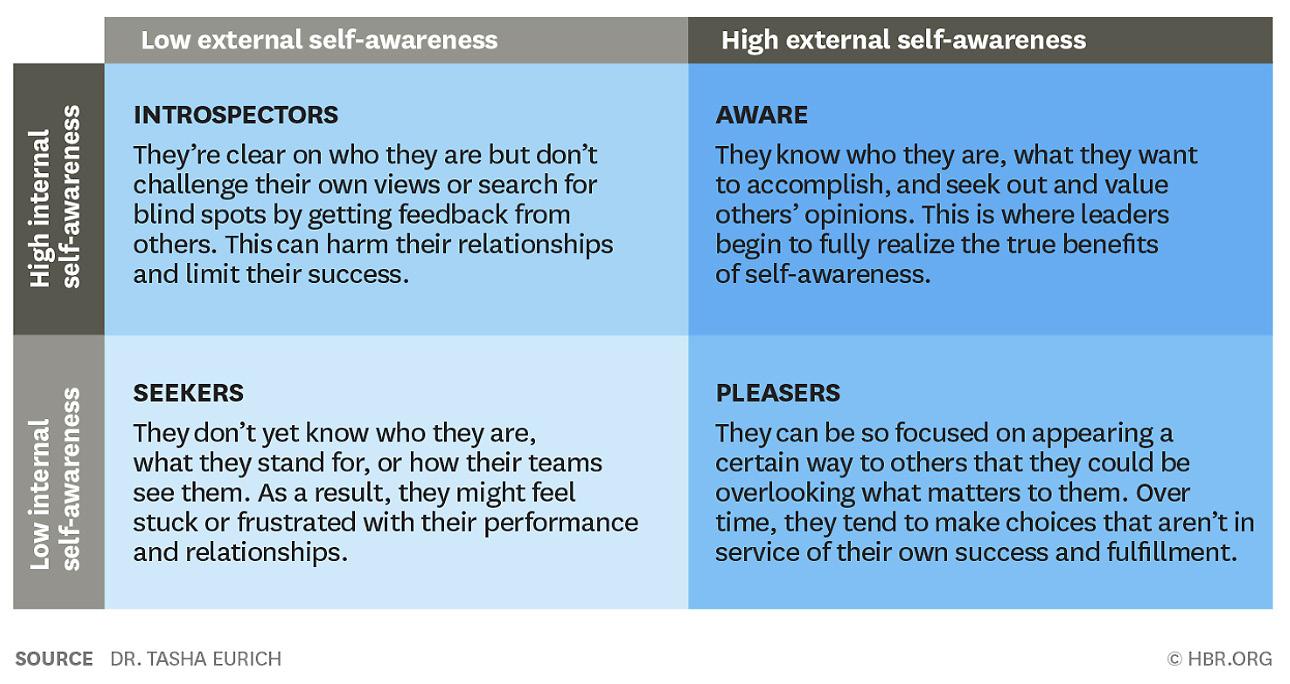
Social Awareness
Being socially aware means being able to listen and take the perspective of others. This includes being able to recognise emotions. Listening skills are key to being able to interpret verbal and non-verbal cues to recognise what is not being said. The book Difficult Conversations also highlights the importance of understanding your own identity (part of self-awareness) in being able to truly listen to others, and outlines three conversations which are happening in every difficult conversation. These consist of:
1. The ‘what happened’ conversation which takes up mostif not all - of the time, discussing who did/said/meant what.
2. The feelings conversation: what emotion is each person experiencing?
3. The identity conversation: what internal debate is caused by the conversation and how does it relate to the selfconcept each person has?
Each of these can be explored in detail to help us to develop more social awareness in reading other people, but also in understanding how our own emotions can impact others.
Culturally Sensitive
As schools are faced with tackling inequity surrounding race and nationality, awareness of cultural differences and working interculturally has increased. Systemic discrimination is at the heart of DEIJB work, and many schools have started to take measures to look at their curricular offerings, and representation of their student body in the materials they use to teach. During this work, if the aim is the ability to see and understand different perspectives as a result of our cultural backgrounds and biases, then we need to be aware of ourselves to begin with. We also need to be aware of alternative perspectives and different identities.
Winter 2023 Issue 19
Examples of the types of learning teachers can do include looking at different cultures (such as using work by authors such as Erin Meyer, The Culture Map) and finding ways to authentically listen to the marginalised voices in their communities (for example, using an approach such as Street Data: A Next-Generational Model for Equity, Pedagogy, and School Transformation by Shane Safir and Jamila Dugan).
Prosocial Behaviours
In order to give all students a voice in an equitable classroom, it is important for teachers to model respectful behaviour and communication across cultural differences. This does not require the teacher to be an expert, but to exhibit humility in trying to understand cultural norms. To understand how your decisions will affect others it can be as simple as asking them, and preferably inviting a diverse group of people into any planning so that different perspectives are recognised and accounted for. It is very hard to see how your behaviour would affect somebody else if you have no background information about their norms. Diversity is recognised as a strength in organisations (eg How Diversity Makes us Smarter) and a useful analogy from Susan Scott’s book, Fierce Conversations, is the idea of each person standing on a different stripe of a beach ball and only seeing their colour. Without hearing each viewpoint, you can’t zoom out and see all of the different colours. In the classroom, teachers who develop strong relationships with students by listening to their lived experiences provide a foundation for effective learning and respectful interactions.
Managing Emotions
DEIJB work requires listening to difficult truths and acknowledging individual responsibility in perpetuating injustice and inequity. It can be hard to manage our own emotions when acknowledging systemic injustice requires you to acknowledge the ways in which you have benefitted unfairly from the system. This leads people to defend their position and take a stance which is counterproductive to moving forwards with transparency. In Minal Bopaiah’s book, Equity, she talks about the potential pitfalls of provocative language. Unifying a community through highlighting similarities and interdependence can allow for a lowering of defensive barriers and an openness to understanding inequity. She highlights that using blanket statements about privilege as a result of race can be counterproductive:
“because they assume a knowledge of the system or privilege that most people don’t have. If we want to make such statements we must first explain the how behind them... You need to explain the causal links between ways of thinking and the results you see in our organisations and the world around us.”
This links back to the other competencies: to understand other people’s emotional reactions we need to develop a cultural understanding of their lived experience through our listening skills and social awareness. To manage our own emotions on hearing those experiences we need to understand our own identity and the triggers that cause an emotional reaction in ourselves so that we can become cognizant of those and develop ways to manage them.
So Where to Start?
Self-awareness is key, as all other work relies on an understanding of ourselves and our role in interactions and systems. However, DEIJB work is ultimately about understanding others. Organisations shouldn’t try to move too quickly because of the potential for staff to react defensively (and ultimately set back progress) if understanding has not been built up sufficiently for positive engagement. This is where SEL comes in and the foundational work that has to be done. Of course, in any organisation there will be individuals who are far ahead in this work and can move forward, but you want to be able to bring everybody along on the journey to avoid issues down the line.
Encouraging all staff to engage with self-awareness and managing their own behaviours can be a good place to start. One way could be to choose a small practice for people to focus on, such as recognising and labelling emotions (other examples in the article: SEL for Adults), and building from there. Those who are further ahead in this work could be working on clear communication strategies to help others understand those causal links between implicit biases and institutional practices. School leadership must be part of driving this work, and joining a collective who are on the same journey can be helpful in sharing reflections and practical support in enacting institutional change to address inequities in the system.
SEL work is just the start of the process; once you have listened to individuals and recognised the bias in your organisation you do need to take steps to address it. This is not a quick undertaking. There will be points at which this feels difficult, frustrating, and overwhelming; but by keeping coming back to why you are doing this, planning for incremental change over a period of time, and by having a supportive network, significant change is possible.
Biography
Jennings, Patricia & Greenberg, Mark. The Prosocial Classroom: Teacher social and emotional competence in relation to child and classroom outcomes. Review of Educational Research. 491 (2009).
Eurich, Tasha, (2017). Insight (New York: Crown Business, 2017).
20 EARCOS Triannual Journal
Unerman, Sue, Jacobs, Kathryn & Edwards, Mark. Belonging: The Key to Transforming and Maintaining Diversity, Inclusion and Equality at Work (USA: Bloomsbury, 2022).
Stone, Douglas, Patton, Bruce & Heen, Sheila. Difficult Conversations, How to Discuss What Matters Most (UK: Penguin, 2021).
Meyer, Erin. The Culture Map, (UK: Hachette, 2014).
Safir, Shane & Dugan, Jamila. Street Data: A Next- Generation Model for Equity, Pedagogy, and School Transformation. (USA: Corwin Press, 2021).

Phillips, Katherine. How Diversity Makes us Smarter (Scientific American, 2014).
Scott, Susan. Fierce Conversations: Achieving Success in Work and in Life, One Conversation at a Time. (UK: Hachette, 2011).
Bopaiah, Minal. Equity (USA: Berrett-Koehler Publishers, 2021).
About the Author Amy Marsh is the Director of Professional Learning at Garden International School.
SCAN to learn more Courses Online That Fit Any Schedule & Time Zone The University of Nebraska does not discriminate based upon any protected status. Please see go.unl.edu/nondiscrimination. 2208.014 AP® is a trademark registered by the College Board, which is not affiliated with, and does not endorse, the University of Nebraska High School. U.S. diploma Accredited, college-preparatory program 100+ core, elective, AP®, dual enrollment & NCAA-approved courses Open enrollment Self-paced, independent study Responsive staff highschool.nebraska.edu/earcos (402) 472-3388 Winter 2023 Issue 21
Embracing Diversity through Differentiation

 By Amin Bin Abu Bakar MYP Science & DP Physics Teacher International School of Nanshan Shenzhen
Differentiated Instruction
Differentiated instruction (DI) is one of the strategies I use to create an inclusive environment for diverse learners in my classes. As a trainee teacher in Singapore, I did not recall encountering DI during my initial training. However, we were introduced to the concept of multiple intelligences that Howard Gardner popularized. As Gardner (2000) noted, intelligence tests are just the “tip of the cognitive iceberg” (p. 11). This infers that many aspects of intelligence remain to be addressed. DI is one way I can acknowledge the various spheres of intelligence and cater to the diversity of my learners. I was first introduced to DI during a professional development course I attended as a beginning teacher in Singapore. Initially, I was intimidated by it as I thought I had to create individual lessons for each student in my classes. In Singapore, a typical classroom could reach 33 students in the late 2000s. It was only through experience and interactions with more experienced teachers that I learned that DI could be further chunked into four aspects. Tomlinson (2014) identified them as (1) Content, (2) Process, (3) Product, and (4) Affect / Environment. This was a massive revelation to me as this meant I could focus on specific aspects of DI, and it was no longer as overwhelming as before.
Getting to know your students
For DI to be effective, I must first get to know my students. I always hold Theodore Roosevelt’s quote - People don’t care how much you know until they know how much you care - close to me. By getting to know my student’s readiness, interests, and learner profile, as recommended by Tomlison (2014), I will be able to plan better. At the same time, I would set up my classroom to appeal to students as suggested by (McFarland-McDaniels, n.d.). I do this by decorating my Physics laboratory with students’ work. This serves a two-fold purpose; it helps improve the laboratory’s aesthetic and gives students a sense of pride to see their best work displayed. Since my laboratory has fixed benches, I am unable to rearrange the bench-
CURRICULUM
22 EARCOS Triannual Journal
es. Thankfully the laboratory has been designed to accommodate group work and other differentiated activities like activity centers and flexible grouping. Once I have gotten to know my students and arranged my classroom’s physical layout, I address the other three aspects identified by Tomlison (2014) earlier. Taylor (2014) refers to them as the “what” (content), “how” (process), and “evidence” (product).
Differentiating Content
When I first started, I was confused about how to differentiate content since the International Baccalaureate (IB) Diploma Program (DP) Physics had prescribed learning outcomes that I needed to cover. Tomlison (2014) reminded teachers that differentiating the content doesn’t mean that the learning goals are changed but rather how these contents are shared with the students. In my case for Physics, there are times when I am in front of the class explaining certain concepts to them. I make use of other modes of content delivery as well. When I am physically in class, I can get my students to carry out experiments to verify or infer certain Physics principles. When I was teaching remotely, I used simulations to allow them to explore physics principles at their own pace.
Differentiating Process
For “process”, I use several strategies. One of them is through the use of flexible grouping. I find that students learn better when they collaborate. What I do is to have students of varying abilities to be in the same group. Sometimes, students understand their peers’ explanations better than their teachers. This could perhaps be attributed to generational gaps. I also usually combine flexible grouping with another strategy which is the use of Activity Centers. I find that Activity Centers help learners who tend to learn experientially. Estes (2004) shared that experiential learning allows learners to leverage their experiences to construct new understandings. Thus Activity Centers will enable individual students to build their own approach to understanding the concept to be shared.
Differentiating Product
Finally, for “product”, IB encourages students to develop their learner profile attributes. And one of these attributes is “communicators”. This attribute encourages students to use different forms of communication. For instance, in Criterion D of MYP Sci-
ence. I allow my students to come up with their own ways of reflecting on the impacts of Science. I have had students submit essays, animations, videos, and PowerPoint presentations, amongst others. While this might seem trivial, as a teacher, it is exciting to see what the students have in store for you at the end of the task. I have been blown away by moving videos edited by my students. It was a timely reminder that students might not be able to express themselves well in a medium of our choosing. Instead, allowing them to choose their product can remove the barriers to fully expressing themselves.
Conclusion
In conclusion, teachers should familiarize themselves with differentiated instructions as each student in the class is unique. Once DI has been chunked, it is not as intimidating as it seems. It makes learning more personal as students get the opportunity to showcase their individuality.
References
Estes, C. A. (2004). Promoting student-centered learning in experiential education. Journal of Experiential Education, 27(2), 141160.
Gardner, H. E. (2000). Intelligence reframed: Multiple intelligences for the 21st century. ProQuest Ebook Central
McCarthy, J. (2015). 3 Ways to Plan for Diverse Learners: What Teachers Do. McFarland-McDaniels, M. (n.d.). How to organize a classroom for diverse learners. Classroom.
Taylor, B.K. (2015). Content, process, and product: Modeling differentiated instruction. Kappa Delta Pi Record, 51(1), 13-17.
Tomlinson, C. A. (2014).The differentiated classroom: Responding to the needs of all learners. ProQuest Ebook Central
About the Author
Amin is originally from Singapore. He graduated from Nanyang Technological University with a Bachelor of Science degree, majoring in Physics and minoring in Chemistry.
Chika’s Test for divisibility by 7, patterning and coding
Presented by: Ron Lancaster Saturday, February 11, 2023 9:00 AM HKT visit website
Winter 2023 Issue 23
CURRICULUM Instructional Techniques within STEM Education
 By Samuel Lee Mao Hua MYP/DP Chemistry Teacher International School of Nanshan Shenzhen

Introduction
The STEM’s aims (Morrison, 2006) are focused on cultivating passion, interest, ability to apply STEM-related knowledge and cultivating creativity, and problem-solving skills within the STEM area, i.e. Science, Technology, Engineering and Mathematics and in recent years arts were also included to become STEAM. The IB Learner’s Profile encourages values that aim to cultivate for their students to learn in general and in facing various challenges in life and is not focused on STEM discipline.
However, certain values that STEMs incorporate are similar to what the IB Learner’s profile (IBO, n.d.) aims to cultivate which essentially shows the trans-disciplinary nature of VALUES. The approaches to learning (ATL, n.d.) promoted by the IBO in the context of teaching and learning also helps to realize the IB Learner’s Profile through the following skills,
• Thinking skills
• Self-Management skills
• Social Skills
• Research Skills
• Communication skills
The virtues within the IB learner profile are intrinsic values that are universal and will apply across any situation such as students’ academia, living experiences and career. As an IB Chemistry teacher and where Chemistry is considered an experiential science, what amazed me with the values of STEM is that alike the IB pedagogy used in the approaches to learning, it emphasizes the importance of application, innovation, and synthesis of knowledge rather than just recalling of knowledge.
We need to see that we are in an age where knowledge is no longer for the privileged but open to all, hence as teachers, we are no longer the sole authority of the content that we are teaching (in my case Chemistry). There is a paradigm shift in our role as “depositors of knowledge” to become “facilitators of learning” (Alam, 2013).
Instructional Models of STEM
There are many instructional models to help teachers who often find difficulties to deliver/relate their knowledge to students and most of the instructional strategies that I have attempted in my past 10 years being an international school teacher were recommended by Bouchrika (n.d.) in the following,
• Gagne’s Nine Events of instruction
• Bloom’s taxonomy
• ADDIE model
24 EARCOS Triannual Journal
Out of which my favourite would be the Gagne’s Nine Events of instruction. However, in recent years, Bybee et al. (2006) proposed the 5E model which is also in one way or another similar to other models of instruction but specifically designed in interest for the teaching of STEM. In my opinion, all the instructional models available to us ultimately attempt to help the teacher to create a positive learning environment so that students can understand, accept, accommodate and apply knowledge learnt in class (Bouchrika, n.d., p. 1).
Firstly, the 5E model helps students to develop ownership of their learning progress through participating and engaging in lesson activities (Empowering students: The 5e model explained, n.d.). The role of the teacher is transformed from the sole authority of knowledge to a facilitator who is just there to help when there are issues during learning, this shifts the responsibility from the teacher to the student in constructing his/her knowledge through experiential learning where the learners engage, explores, explain, elaborate and evaluates.
For example in the video, the learners are given opportunities at each stage in modifying to reach their assessment objectives - for the Car, and we can see that these learners were trying to engage, explore, explain to assimilate and accommodate knowledge into their existing schemata (Lee & Kwon, 2001).
The second advantage would be to develop teamwork, communication skills and problem-solving skills. In the video, we can see that students collaborate to investigate how their model failed to work and shared ideas to troubleshoot and solve issues that went wrong. In the process, they learn how to listen to one another, respect differing points of view and critically analyse to select the best possible approach to solve the problem. In the 21st century where knowledge is readily abundant, it is not about what we know but rather how we use knowledge to solve issues and to progress as a society
One disadvantage of this model according to Pham (2014) is that he cannot provide immediate help when he witnesses students committing “stupid mistakes” since allowing mistakes to happen is part and parcel of the learning experience. Furthermore, this can lead to the “construction of wrong knowledge” and if not acknowledged and realised at an early stage will lead to disastrous results if the student goes on to apply “wrong knowledge”.
This model is helpful for an inquiry-based approach, particularly for IBDP teachers in guiding the Group 4 internal assessment and the extended essay.
• Engagement: Teachers assess students’ knowledge and get them to interested through a context. Similar to Gagne’s nine events of instruction as described by Wong (2018)
• Exploration: Students explore the topic. Materials used for exploration can be prepared by either students or teachers. Teacher to facilitate discussion and exploration.
• Explanation: Students explain the findings and teachers facilitate by guiding students in the correct direction and providing corrections only when necessary.
• Elaboration:
Students are to come out with the final piece of evidence to show the totality of their understanding, use and application of knowledge. This phase could be the assessment phase
• Evaluation: This will be the stage where teachers provide evaluative feedback to correct students and to enable them to try applying the knowledge/ concepts again if there were any previous mistakes.
The 5E model like other models is very helpful in the project or problem-based approach used in the teaching of STEM as it helps to systematically divide the delivery through five distinct phases for students to engage in different activities in constructing their knowledge. 5E model also allows teacher-centric approaches and studentcentric approaches to be used concurrently but at different phases in the model so that the benefits from both approaches can be yielded. Through an engaging learning process, students will achieve holistic understanding and learnt better (Iwamoto et al., 2107).
Project-Based Learning in STEM
Project-based learning, a part of experiential learning (Bates, 2015) is an approach where students construct knowledge within their learning process as they are usually allocated to work in groups to brainstorm and discuss ideas in providing solutions for a given problem. Both Piaget’s cognitive constructivism and Vygotsky’s social constructivism can be seen within the context of project-based learning.
Edwards (2002) advocates for the lesson-planning approach and made the statement “It is not what you do that your student learnt from you, but what you have them do” (p.1). This is very telling regarding the nature of project-based learning as a teacher-directed approach rather than a student-direct approach.
With a student-directed approach, teachers are facilitators that acts to help out or guide in small issues/problem, the teachers do not serve as knowledge banks but help to point out where to find content knowledge but in a teacher-direct approach, the teacher leads the learning and instruct whenever necessary at an appropriate pace and depth. If the teacher follows the Vygotsky (1980) approach, the teacher being the more knowledgeable other (MKO) will instruct/ scaffold appropriately so that students can also construct knowledge in overcoming their zone of proximal development (ZPD).
Bloom’s taxonomy is also used by Edwards (2003) in creating SMART lesson objectives (Felder & Brent, 2004) where it helps to categorize lesson objectives to different skill sets at an increasing pyramidal level. Using Bloom’s, the teacher can choose the relevant instructional objectives that are usually within the “higher-order level” since students are mainly addressing solutions and evaluating solutions in the project-based learning context.
Edwards (2002) also mentioned the 3Ps which are namely Preparation, practice and performance which are mainly used with standards-based instructions (Thompson, 2009). Edwards (2002) showed the use of 3Ps together with the Colorado state standards in his articles which is necessary because if teachers do not create objectives according to their curriculum standards, the project-based
Winter 2023 Issue 25
learning will not serve the needs of the curriculum, i.e. teacher had not created a lesson experience to meet the objectives of his syllabus!
Within my classroom experience, as an IB Chemistry teacher, I am familiar with the use of project-based learning as I facilitate the group 4 projects with my diploma students and the personal project with my MYP students. However, in this case, the project-based learning experience as described above is more alike to the Group 4 project conducted in IB Group 4 Sciences. IBDP requires students to undergo a Group 4 project which is not included in the summative assessment, but rather to incorporate research skills, thinking skills, communication skills and other skills within the “approaches to learning (ATL)” so that students get a good introduction of the model used in IB for learning.
In the group 4 project, the school helps to allocate students who represent different subjects into groups, where biology, chemistry and physics students must be present in all of the groups allocated. These groups would be provided with a theme where they would brainstorm a topic within the theme of their interest and solve issues within the topic.
It is carried out in 3 stages where in the first stage, the group 4 project is introduced, and students go into their grouping to brainstorm, plan and proposal. This takes about 2 hours.
In the second stage, students conduct a 6 hours worth of action plan upon their approved proposal and collect data for their research & analysis. In the third stage, they will present their solution to the school. These stages are conducted separately during “block-offs” in the academic calendar. O’Donnell (2013) suggests that Group 4 project helps the students to see that content knowledge under different disciplines is related and appreciates the overarching nature of science (p.341).
For example, in my school’s recent Group 4 project, “Clean water” was suggested as a theme by the teachers. Students worked to revolve topics around “clean water” such as in “how to produce clean water?”.
Physics students would design pumps to transport dirty water across filters and clean water from filters to household, while Chemistry students would brainstorm ideas about what filters to use for separating dirty contents in dirty water through different techniques such as reverse osmosis, biology students would evaluate the drinkable-ness of the water and the possible health effects associated with it.
Students will then present an overarching solution to the problem with respect to their disciplines and many students begin to appreciate the ATL skills they picked up in this experiential learning process.
Project-based learning is not just a STEM learning environment it helps students realize how people in society work together to address issues and allows learners to learn many transferable skills that will enable them to engage the content at a level that is unseen in regular classrooms. By adopting project-based learning, students will acquire 21st-century skills to face future challenges that are unknown to them.
Conclusion
In conclusion, I have presented that STEM is not just “an extra lesson” that is used as a co-curricular activity but rather a set of values that are applied interdisciplinary within the STEM domains. It also promotes a set of pedagogy that is student-centric and increases engagement among students. As STEM teachers, we need to equip ourselves and provide students with the opportunity to excel in STEM in an increasing STEM workforce.
References
Approaches to Teaching and Learning. (n.d.). Retrieved 21 June 2021, from https://www.ibo.org/programmes/primary-years-programme/ curriculum/learning-and-teaching/
Bates, A. T. (2015). 3.6 Experiential learning: learning by doing (2). Teaching in a Digital Age. https://opentextbc.ca/teachinginadigitalage/ chapter/4-4-models-for-teaching-by-doing/\
Bouchrika, I. (n.d.). Instructional Design Models: ADDIE, Gagne’s, Merrill’s, and Bloom’s Methodologies. Guide 2 Research. https:// www.guide2research.com/research/instructional-design-models.
Bybee, R. W., Taylor, J. A., Gardner, A., Van Scotter, P., Powell, J. C., Westbrook, A., & Landes, N. (2006). The BSCS 5E instructional model: Origins and effectiveness. Colorado Springs, Co: BSCS, 5, 88-98. http:// sites.nationalacademies.org/cs/groups/dbassesite/documents/webpage/dbasse_073327.pdf
Edwards, G. J. (2002). Make Your Own Project-Based Lesson Plan. Educator and Curriculum Development Specialist Unlimited Learning, 12–13. http://www.integratelearning.org/Lesson%20Bank/GloriaILearn/lessontemplate.pdf
Empowering students: The 5e model explained. (n.d.) Lesley University. https://lesley.edu/article/empowering-students-the-5e-modelexplained
Felder, R. M., & Brent, R. (2004). The ABCs of engineering education: ABET, Bloom’s taxonomy, cooperative learning, and so on. In Proceedings of the 2004 American society for engineering education annual conference & exposition (Vol. 1). American Society for Engineering Education.
International Baccalaureate Organization. (n.d.). Learner profile for IB students. International Baccalaureate®. http://www.ibo.org/benefits/learner-profile
Iwamoto, D. H., Hargis, J., Taitano, E. J., & Vuong, K. (2017). Analyzing the efficacy of the testing effect using KahootTM on student performance. Turkish Online Journal of Distance Education, 18(2), 80-93. https://dergipark.org.tr/en/download/article-file/294456
Lee, G., & Kwon, J. (2001). What Do We Know about Students’ Cognitive Conflict in Science Classroom: A Theoretical Model of Cognitive Conflict Process. In Proceedings of 2001 AETS Annual meeting (pp. 309-325). http://files.eric.ed.gov/fulltext/ED472903.pdf
26 EARCOS Triannual Journal
Morrison, J. (2006). TIES STEM education monograph series, attributes of STEM education. Baltimore, MD:TIES, 3. http://daytonos.com/ pdf/stem.pdf
O’Donnell, T. J. (2013). IB Chemistry: An Introduction. CHEMISTRY & EDUCATION, 61(7), 338-341. https://www.jstage.jst.go.jp/article/ kakyoshi/61/7/61_KJ00008761628/_pdf
Pham,T. (2014). The 5E Model: A Strategy for the High School Chemistry Classroom. SadBdo City Schools. https://youtu.be/0BL1eXzKFDo
Tamim, S., & Grant, M. M. (2011). How teachers use project-based learning in the classroom. In The Annual Convention of the Association for Educational Communications and Technology Sponsored by the Research and Theory Division Jacksonville, FL. https://members. aect.org/pdf/Proceedings/proceedings11/2011I/11_20.pdf

Thompson, C. J. (2009). Preparation, practice, and performance: An empirical examination of the impact of standards-based instruction on secondary students’ math and science achievement. Research in Education, 81(1), 53-62. http://myweb.astate.edu/sbounds/

Statistics/1r_Standards_Based_Math.pdf

Vygotsky, L. S. (1980). Mind in society: The development of higher psychological processes. Harvard university
Wong, Y. L. (2018). Utilizing the principles of Gagne’s nine events of instruction in the teaching of Goldmann Applanation Tonometry. Advances in medical education and practice, 9, 45. https://www.ncbi. nlm.nih.gov/pmc/articles/PMC5768193/
About the Author
Samuel Lee is a Malaysian who grew up in Singapore. He graduated from Newcastle University with a Bachelor of Engineering (Hons) in Chemical Engineering with a focus on Environmental and Sustainability Studies.
M Y CM MY CY CMY K 2024 Winter 2023 Issue 27
C
Translanguaging and Linguistic Diversity: Practices for the International Classroom
By Cara Templeton Head of the Intensive English Programme Prem Tinsulanonda International School


“We are faced with the bizarre scenario of schools successfully transforming fluent speakers of foreign languages into monolingual English speakers, at the same time as they struggle, largely unsuccessfully, to transform English monolingual students into foreign language speakers.”
- Cummins, 2015
affected the ability of students to identify with the mainstream language and culture (Cummins, 2001) and it seems that more recent policy has yet to move away from such a perspective. Indeed, current educational policies largely fail to acknowledge the multilingual nature of students and subsequently linguistic variation.
Although the rhetoric of these policies appears to reflect positivity towards multilingualism, there is a concerning attachment to linguistic and cultural homogeneity; and there is little to no provision for the maintenance or promotion languages (and cultures), which are associated with minority or indigenous varieties (Yiakoumetti, 2014).
TRANLSANGUAGING
Cen Williams first coined the term translanguaging (in Welsh) to refer to pedagogical practices in which English and Welsh were used for different activities and purposes (Garcia & Ofelia, 2017). Baker (2001) translated the term into English as “Translanguaging” and it is now widely understood to refer to how bilingual (plurilingual) people fluidly use their linguistic resources—without regard to named language categories—to make meaning and communicate (García, 2009).
Translanguaging pedagogy both views and promotes language as fluid and transferable; allowing students are able to make connections between, across and beyond language. Although most research thus far has been in bilingual contexts, there is a strong argument to be made for the consistent use of translanguaging in international school classrooms.
Translanguaging pedagogy can be used to celebrate our students’ plurilingualism as part of their personal and cultural identity. As such, we should design instruction to leverage students’ plurilingualism as a resource (moving away from deficit and towards asset).
POWER & PRIVILEGE
“English only!
Who has heard this before… or perhaps even said it?
I know myself that when I first joined the world of international education, I not only defended but argued for this practice, thinking that if my students wanted to learn English, they needed to use English and only English. No excuses.
Whilst this is not a complete fallacy, as teachers we should not isolate students’ prior knowledge and experience from present opportunities for learning. By restricting the language used, we are restricting their thinking.
We live in an increasingly diverse world and yet, this is not reflected in education policy or classroom practices and it actually misaligned with the current goals of international education, which are to promote global citizenship and international mindedness.
While this is a complex issue it can largely be attributed to relations of power and cultural capital. Historical assimilationist policies sought to discourage/eradicate native voices due to the belief that it
CURRICULUM
28 EARCOS Triannual Journal
Fig. 1 My students were having difficulty understanding how to structure an information text. By utilizing a translanguaging approach, I was able to “bridge the gap” by engaging learners with their home language first. I modelled the activity to the class, students then researched and answered in their home language and then we worked together to translate it into the target language.
STRATEGIES TO SUPPORT EAL STUDENTS
Small Group and Pair Work
Collaborative activities are great for EAL learners because they encourage speaking and listening whilst reducing anxiety related to attempting answers in the target language. Also, collaborative learning is a key feature of inclusive classrooms and highlights the importance of social interaction and active participation in language acquisition (it also allows students to hear language from different sources - not just the teacher).
Think, Pair, Share
A major benefit of Think-Pair-Share is the wait time. This initial phase of silent thinking provides students with an important opportunity to retrieve their prior knowledge (in whatever language!) This strategy gives every student a low-risk opportunity to formulate a response and practice it with a peer before ‘going public’.
Modelling
Modelling is providing a strategy whereby learners are provided with a written or oral model of the language that the teacher would like the learner to produce. It is important to note that EAL learners need to notice language in order to be able to practice using it effectively. Providing learners with modelled texts allows teachers to be explicit about the key features of the target language.
Pre-teach vocabulary
This strategy introduces students to new vocabulary words before reading them for the first time in a text. Examples include pronouncing the new word, giving students the meaning, writing the word on the board, using the word in a sentence or creating a word wall/ glossary.

Research has shown that this strategy helps in improving their comprehension (Miller and Veatch, 2011, p.19) as it reduces the number of unfamiliar words the students will encounter when reading. It also boosts vocabulary acquisition when combined with visuals and repeated exposure.
Using pictures
Fig. 2 It might seem counterintuitive but picture books (rather than text heavy options) can provide a rich environment for supporting EAL learners through provocations, predictions, inferences and more. I employed two different learning strategies with my students - Harvard’s Project Zero Visible Thinking Strategies and Calhoun’s Picture Word Inductive Model (PWIM). Each method promotes student agency even with teacher modelling or teacher led questioning.
VALUES & ACTIONS
“There is a tendency to characterise EAL learners from a position of deficiency rather than asset – that is, a preoccupation with students’ lack of English, while failing to recognise and value the skills and experiences they have developed through their home language.”
- Cummins, 2005
EAL learners deserve the opportunity to draw from their entire language repertoire and by nurturing a translanguaging mindset, we are demonstrating through our actions, that we recognise and value students’ native languages.
Indeed, if we wish to understand what our students know and what they can do with language, we must separate their ability to use certain forms of one language from the ability to use language, period (adapted from Ofelia Garcia).
References: Baker, C. (2001). Foundations of bilingual education and bilingualism. Bristol, U.K: Multilingual Matters.
Cummins, J. (2005). A proposal for action: Strategies for recognising heritage language competence as a learning resource within the mainstream classroom. The Modern Language Journal, 89(4), 585–591.
García, O. (2009). Bilingual education in the 21st century: A global perspective. Malden, MA: Wiley-Blackwell.
Miller, M. & Veatch, N. (2010). Teaching Literacy in Context: Choosing and Using Instructional Strategies in The Reading Teacher, Vol. 64, No. 3, Reading in Grades 4-6: Focus on Expository Reading, pp. 154-165 (12 pages). Published By: International Literacy Association
Vogel, S. & Garcia, O. (2017) Translanguaging: Languages and Literacies Online DOI: 10.1093/acrefore/9780190264093.013.181
Yiakoumetti, A (2014). Language Education in Our Globalised Classrooms: Recommendations on Providing for Equal Language Rights in Language Education and the Challenges of Globalisation: Sociolinguistic Issues. Edited by Martin Solly and Edith Esch. Cambridge Scholars Publishing.
About the Author Cara Templeton is the Head of the Intensive English Programme at Prem Tinsulanonda International School. She can be contacted at carat@ptis.ac.th
Winter 2023 Issue 29
CURRICULUM Beyond Rubrics and Ratings: Cultivating Agency and Coaching Teachers to Excellence With the Danielson Framework for Teaching
By Lindsay Prendergast and Lynn Sawyer
Arms crossed. Toes tapping. Eyes lowered. Andrew sat across from his principal, awaiting his judgment. Or so he assumed. Teacher evaluations had recently resumed cadence after a few years of inconsistency and even long spans of no observations while the leadership grappled with seismic interruptions to instruction and operations. But teaching had not stopped, nor had learning. Andrew knew the evaluation was coming, but he lacked any understanding of a crucial factor: what were his observers looking for?
The complexities of teaching are not new, yet the contemporary ecosystem in which education of the world’s children is situated has evolved at a seemingly warp-speed in recent years. It is incumbent upon school leaders - directors, principals, and all others who serve in a supervisory or coaching role for teachers - to possess a deep understanding of the skills and practices of effective teaching. Grounded in this collective understanding, teachers like Andrew can be afforded utmost transparency around what leaders agree are the teaching skills and practices
upon which his professional growth will be fostered and supported, not solely evaluated. Clear, agreed-upon understandings of teacher’s professional practice empower everyone in the community to participate in a culture of excellence. The Danielson Framework for Teaching (FFT) has been a trusted, research-based tool to catalyze such understandings for over 25 years. Through a common language around the continuum of professional expertise employed by teachers across content areas and grade levels, the FFT bridges understanding between administrators and teachers, such as Andrew, and supports high levels of student learning in every single classroom.
Fostering teacher growth with clarity and support, not scores
Teaching is recognized as one of the most complex, challenging professions, and not one to be chosen lightly. Teachers work hard to cope with those complexities, juggling the demands of planning and executing instruction and assessing the results of student learning all while dealing with expectations
outside their classrooms. The Danielson Framework for Teaching offers educators an opportunity to examine professional practice through four distinct domains that foster teachers’ growth on a continuum of skills and expertise. The domains, newly articulated in 2022, reflect the evolution of students’ and teachers’ needs and include: Planning & Preparation, Learning Environments, Learning Experiences, and Principled Teaching. As supervisors, mentors, and teachers strive to ensure high learning outcomes for every child, the components and critical attributes within each domain provide the foundation for meaningful, growth-oriented, and productive conversations about effective teaching. For example, within the Component 3c, Engaging Students in Learning, teachers such as Andrew and the leaders who observe him engage in examining the critical attributes such as “rich learning experiences” or “collaboration and teamwork”. Through a clear and common understanding about the trajectory of teacher performance, Andrew recognizes his learning path and his leaders recognize explicit areas to provide support.
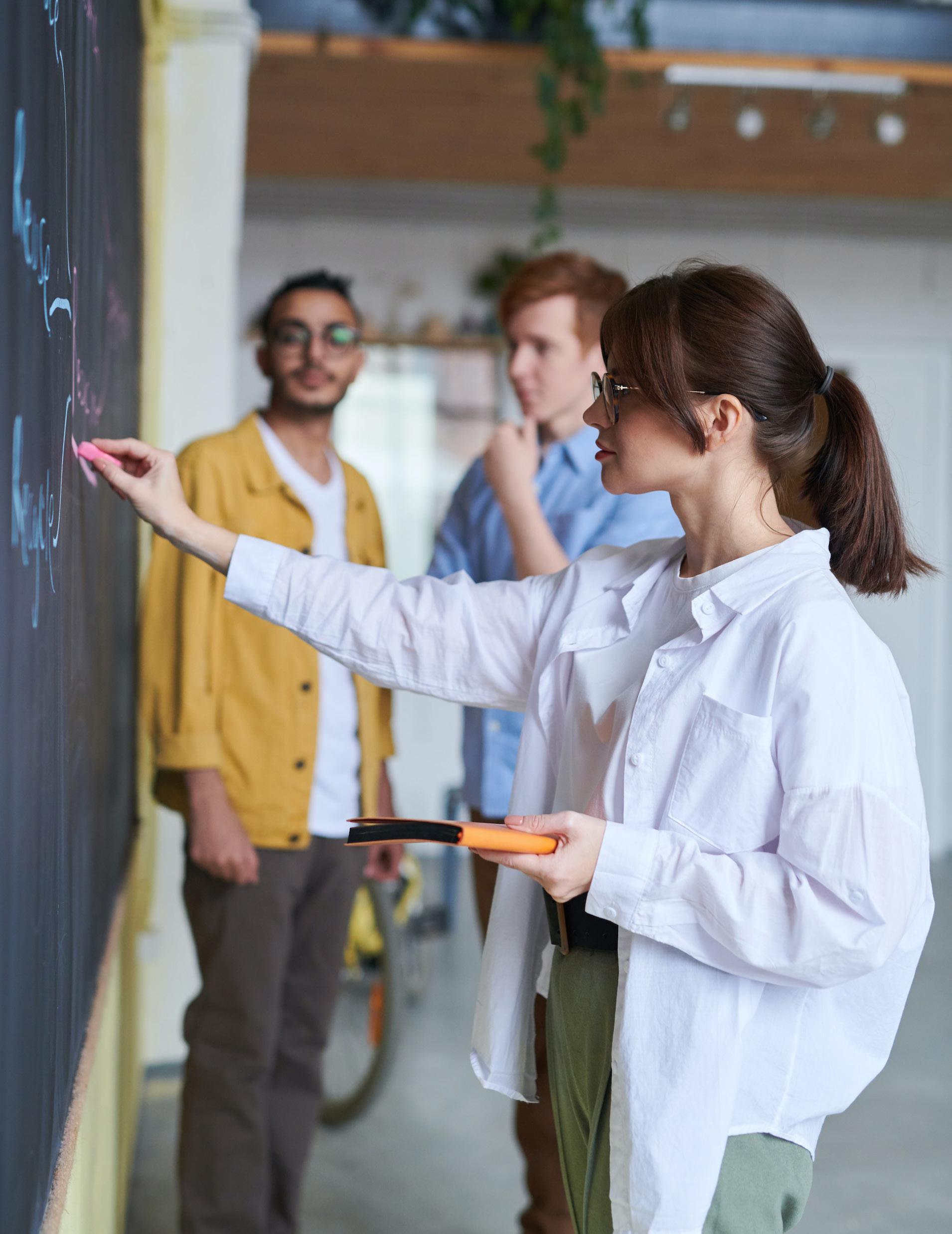
30 EARCOS Triannual Journal
Everyone in the learning system works in sync towards a collective vision.
Common language and coaching to develop teacher agency
Empowering teachers to grow and thrive amidst the complexities of the work rests upon supporting their ability to become ever more self-directed, self-monitoring, self-managing, and self-modifying (Costa & Kallick, 2004). While the FFT provides a clear, research-based description of the knowledge base on teaching, or what teachers should know and be able to do, teacher agency is fostered when teachers and supervisors use the Framework as a guide for zeroing in on areas of excellence and opportunities for growth. “For teachers, having clearly stated performance standards provides an external instrument with which to calibrate their own perceptions, thought processes, and teaching decisions.” (Sawyer, 2003). Charlotte Danielson maintains that in addition to having clearly defined standards for teaching, the planning and reflecting conversations such as those practiced in Costa and Garmston’s Cognitive Coaching (2014) invite teachers to monitor their own practices and make modifications as they move toward expertise. “The tension that exists when using external performance criteria while working toward the overarching goal of self-directedness can be reconciled by committing to the practice of Cognitive Coaching. Simply identifying standards of performance will not change teacher behavior. Coaching enhances the what of teaching as described in the FFT by providing a model for examining the how of teaching through professional dialogue. ” (Sawyer, 2003).
Trust-based conversations with students at the center
In support of effective teaching, it is incumbent upon administrators to develop trusting relationships with their team. By collecting evidence as opposed to imposing opinions, we mitigate the anxiety and apprehension experienced by teachers such as Andrew and facilitate an objective conversation around the practice, not the person. In doing so, observations become powerful catalysts for lifting the focus toward student learning. For example, in Domain 1 of the FFT, Planning and Preparation, teacher and observer examine evidence addressing, “in what ways are students’ identities and cultures incorporated and reflected in learning experiences and environments?” (FFT, 2022). Teachers are the architects striving to create this supportive classroom ecosystem for every learner, and the shift in the updated FFT creates a continuum of expertise against which effective resource use (1d), coherent instructional planning (1e), and knowing and valuing students (1b) are considered. The language of the Framework provides sophisticated reflection opportunities and emphasizes how, “thorough preparation considers students’ academic, social, and emotional needs and development, as well as their contexts, and it is grounded in a strong, culturally responsive curriculum” (FFT, 2022).
Components of a high-quality evaluation system
As we consider teachers like Andrew grappling with the assumption that an evaluation experience is an isolated event subject to the philosophy of their latest supervisor, there is a tremendous opportunity missed to promote outstanding classroom instruction across a school. With unquestionable certainty we believe “when teachers thrive, students thrive” (danielsongroup.org, 2022). Teachers deserve meaningful, evidence-based, actionable feedback and the support to achieve excellence in their practice to deliver on high goals for all students to learn. Through clear and well-understood standards of
performance, highly skilled observers to support evidence-based judgments, and reflection experiences aimed at teacher development, not remediation (Lipton & Wellman, 2014), we can ensure a rewarding and sustaining profession for all teachers.
The Danielson Framework for Teaching has been revitalized in 2022. Find the new FFT at www.danielsongroup.org and connect with the authors for inquiries or to learn more at lindspren@gmail.com (Lindsay Prendergast) or lynnsawyer50@gmail.com (Lynn Sawyer).
References
Costa, A. & Kallick, B. (2004). Launching self-directed learners. Educational Leadership, 62, 51-57.
Costa, A. & Garmston, R. (2015). Cognitive coaching: Developing self-directed leaders and learners, 3rd ed. Rowman & Littlefield Publishers.
Danielson Group. (2022, December 14). The Framework for Teaching. https://danielsongroup.org/the-framework-for-teaching/
Lipton, L. & Wellman, B. (2014). The MiraVia learning-focused supervision model: Rationale & research. http://www.miravia.com/wp/wpcontent/uploads/2017/10/LFSRationaleandResearch_000.pdf
Sawyer, L. (2003). Integrating cognitive coaching with a framework for teaching. In J. Ellison & C. Hayes (Eds.), Cognitive coaching: Weaving threads of learning and change into the culture of an organization (pp. 151-162). Rowman & Littlefield Publishers.
About Authors
Lindsay Prendergast has served schools and districts across the globe for nearly two decades as a Principal, Counselor, and Special Education teacher. She currently supports one of the largest districts in the US as a leadership coach for NWEA. Lindsay is also a Framework Specialist for The Danielson Group, an ASCD Emerging Leader, and a fellow with the Association for the Advancement of International Education (AAIE). Lindsay frequently presents and publishes on leadership development, growth-focused supervision, and assessment practices at conferences including ASCD, AMLE, Learning Forward, Cognia and others across nearly a dozen countries.
Lynn Sawyer is an international educational consultant, presenting workshops and seminars on learning-focused conversations for mentoring and supervision, facilitating collaborative groups, and data-driven dialogue for over 35 years. She is a charter member of The Danielson Group and has led schools and systems across the U.S., Europe, Canada, and the Middle East in creating learningfocused supervision models. Lynn is a Training Associate for Thinking Collaborative (Cognitive Coaching and Adaptive Schools); MiraVia (Mentoring Matters, Data Driven Dialogue, Learning-Focused Supervision); and, The Danielson Group.
Winter 2023 Issue 31
Collaborating with Room to Fail
By Stephanie Burkard Taylor & Erin Wilson International School Dhaka
It all started with…
…one central idea: “who we are impacts the music we produce”. Within the Primary Years Programme in the International Baccalaureate framework, there are six transdisciplinary Units of Inquiry. This was my (Stephanie) and my co-teacher Pijush’s adapted central idea from the Grade 5 Who We Are Unit of Inquiry back in September. Great!
We can give the students agency to choose a musician based on their interests and conduct an inquiry based project. The students can connect the musician’s musical and social background with what kind of music they produced and how that music impacted society.
I started with my own research project on Nina Simone, learning about her musical upbringing, her social setting, her struggle to become an established musician, and finally, what drove her to be involved in the Civil Rights movement. Excited by my findings, I presented the project requirements to my class, complete with a list of musicians to consider researching and an outline of required information to include in their presentations. I then shared my exemplar project on Nina Simone.
Present on a musician exploring how their background and social situation impacts the music they create
Projecy Description
• Example of the artist’s music
• Musical background
• Social setting
• Style of music produced
• Connection between their created music and their background and social setting
• Impact on society (locally and/or globally)
• Proper citation of information presented Research project description with a list of required information.
The students’ masked faces conveyed bewilderment. What are we going to do? Clearly no one had asked them to research and present like this before. Pijush and I were asking these Grade 5 students, coming out of a few years of online school during COVID, to step up to the plate for a Grade 6 quality research project. Clearly we were going to need an expert researcher familiar with the secondary school requirements for projects like this.
I caught Erin between classes in the hallway a day later. “Hey, I’m doing this research project with Grade 5s. How do we format here at school? What are the expectations in secondary school?”
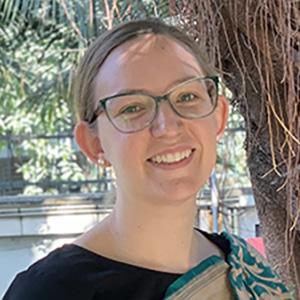
“We use MLA. Oh, you know what, the school has a subscription to a great research and citation manager called NoodleTools. Maybe I could do a lesson for them on how to use it.”
Just like that, we were off to the races. We planned for students to come to the library for one music class period. Little did we know that we would end up collaborating on the entire unit.
Collaboration and Research
We quickly scheduled the students to visit the library weekly. Students arrived at the library with their laptops ready to begin. We started with a discussion of the three basic points of research including formulating keywords and searches, identifying reputable sources, and citing. We used a natural process for researching, not using a particular research model. Every class students started by reflecting on where they were in their research, what they needed, and by creating an action plan for the duration of the class. This natural process gave students the agency to decide what to focus on and what their tasks were for the class period.
In each lesson, I (Erin) taught a basic skill, yet this single lesson wasn’t enough for the students to independently apply the targeted skill. Luckily, while Stephanie, Pijush, and I were collaborating on this pro-


CURRICULUM
32 EARCOS Triannual Journal
ject, the students were simultaneously researching ancient civilizations in another class. Because I was collaborating with the ancient civilizations class on research skills, I was able to teach students a lesson on a specific skill multiple times. Often on the repeated lesson students were able to apply the skill independently.
For example, I modeled with students how to set up notecards in NoodleTools with a quote or paraphrased fact. When students began to create their slides, I saw a lot of plagiarism. Instead of only marking it in their slides, we stopped and had a mini-lesson with clear examples reviewing how to cite and paraphrase properly. Within the class period, students got to work fixing their quotes and paraphrasing. Later that week during their ancient civilizations class, we dug deeper with a step by step lesson on paraphrasing. The opportunity to work on the same research concept in different topics enabled them to apply research skills in different contexts.
to use Noodle Tools at an early age so I can use it later on.”
“I wonder if I had chosen different partners, how my presentation would have looked like.”
The three of us conferenced with students one on one, discussing what the process was like for them, asking them to make steps for the next time they are asked to research and present. Because students reflected prior to their conference, the students noticed every great thing about their own project along with every weakness.They knew exactly what had gone well and where they had not succeeded. Our feedback conferences were easy for the most part, simply asking students how they would “level up” during their next project. Where students identified skills they lacked, we took note to reteach the skill.
A sample digital notecard with a quote and student paraphrasing.
All in all, we worked on the project for 8 weeks, co-teaching a lesson in the library and then applying research skills in music class weekly. This was a much longer project than originally expected, but it became clear as we taught each necessary skill that the students needed more time to practice.
The week of the presentations came. For the most part, the presentations were subpar. Yes, many of the groups did meet the required outline, but they showed no depth of understanding. Many struggled to paraphrase sources because they struggled with understanding their sources in the first place. Presentations were read from scripts or directly from the slides.
If our desired outcome was for students to create a polished presentation having become experts on their topic, all metrics would point to failure. However, everyone involved feels differently.
Student Reflections
We had students reflect on their project through journaling. They wrote on three topics: their individual research process, the group research process, and their final presentations, all using the sentence starters “I noticed”, “I wonder”, and “I value.” We also asked them to end with a “I used to think… but now I think…” statement. Here are some of our student reflections.
“I noticed we did our best in the presentation.”
“I noticed we had a lot of confusion in doing our presentation.”
“I noticed that I was struggling with paraphrasing.”
“I wonder if I could add more emotion when presenting.”
“I value having a group that I can work well with and learning how
I (Stephanie) was nervous as the project took longer and longer to complete. I wondered if we were not using our music and library times wisely, but again and again, I saw a reflection that reassured me our project was a valuable use of time and an important skill building unit for our Grade 5s.
“I used to think researching in groups is going to be hard, but now I think it is not that hard.”
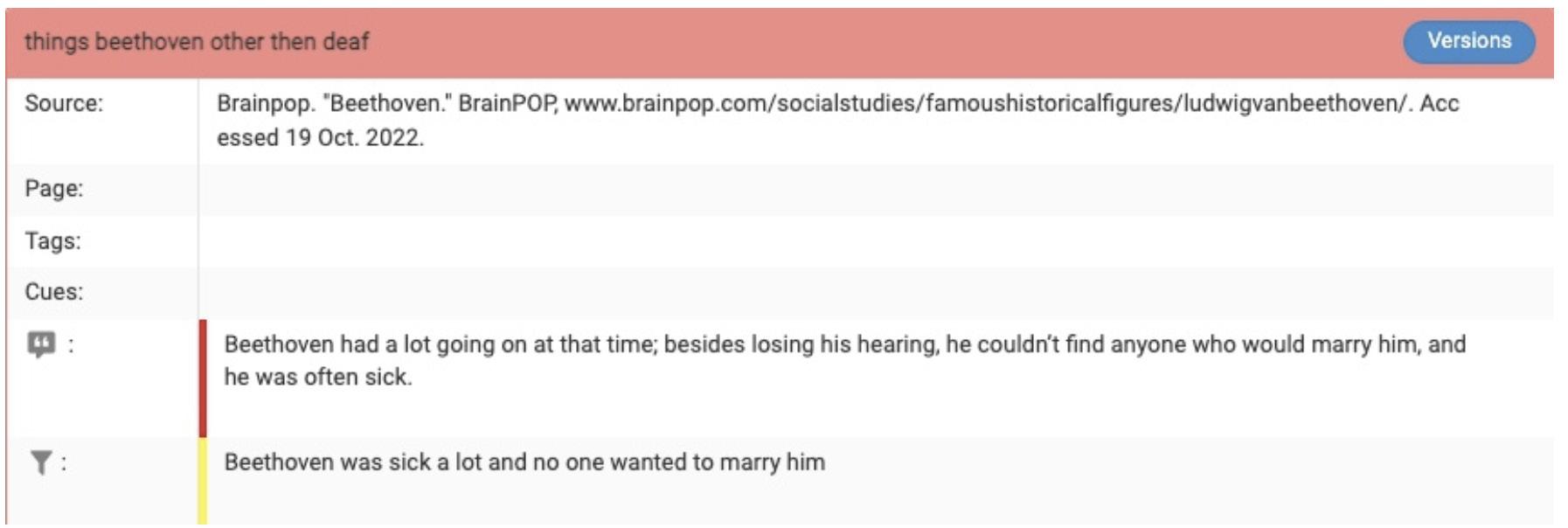
“I used to think researching was hard, but now I think it’s pretty simple.”
“I used to think it is going to be difficult, but now I think it is going to be ok.”
Teacher Reflections
Being involved in this project from start to finish gave me (Erin) such insight as to how students respond to researching as well as the need for teachers across a school to be consistent in the language of research. I decided to introduce NoodleTools, a student friendly citation manager, because they’ll need it for future research projects. Stephanie and Pijush continued referring to it with students in music class which solidified the students’ ability to use it. It was natural to add their ancient civilization projects too. Their knowledge of NoodleTools transferred well from one project to another, and the students saw the value in using it for all research needs. This in turn led them to explore the different functions of NoodleTools, such as color-coding their notes for organization.
The homeroom teachers were not involved in the music research but as their ancient civilization project was ramping up, they saw opportunities to discuss and suggest additional lessons for their stu-
Winter 2023 Issue 33
dents. Paraphrasing became an important topic for the homeroom teacher and thus was reinforced in the classroom. In fact, a week after a lesson on paraphrasing, I popped into the students’ homeroom and heard the students discussing if they had paraphrased the sentence correctly.
Collaboration between the music teachers and myself worked naturally and having the time was our golden ticket to making this happen. We would touch base weekly and briefly mention what the students needed to focus on for the week. If by chance we didn’t have this exchange, I would ask the students what they needed to consider. In one discussion with the students, they seemed concerned they didn’t have enough information about an aspect from the rubric. As time was on my side, I had the flexibility to listen to the students’ needs and support them.
In conclusion, there were many situational factors that made our library and music collaboration a success.
Firstly, the three of us have time in our schedules to collaborate. On a typical teaching day, we have at least two teaching blocks open for collaboration. No matter how well intentioned you are, without the time for teachers to collaborate during the school day, it is unrealistic to take on large projects (such as an entire unit spanning two months).
Secondly, we adjusted to the needs of the students frequently. This project started as a product based project with an emphasis on a presentation informed by research. Very quickly into the project, we realized something; student-led learning requires room for students to not fully succeed.You might even need to leave space for students to, heaven forbid… fail.
For example, we intentionally did not preassign research groups. We asked students to think about who they would work best with, knowing that they may choose their friends and not be as successful. Guess what? They chose their friends. Some did not succeed. We had one group of friends, thick as thieves, realize that a group member was messing around with the slides that they had carefully crafted. They solved their own problem without consulting teachers
Middle
by taking away this group member’s ability to edit the presentation. The meddler thought the computer was just acting up. (We are not condoning this. We only found out after the fact, but all the same, we must admit we were impressed). Upon reflection, this group of friends realized they were not great research project partners. Two of these students’ next steps included working with more serious students next time. Of course we’d warned them beforehand about choosing certain friends to work together with, but either we had to step in and assign groups or allow them to make an unwise choice and learn from it. Experience teaches more lasting lessons than we do.
We shifted our assessments from grading a product to assessing student learning. We asked students to create next steps for themselves. We reflected regularly on student progress, responding to their needs as they arose, communicating and adjusting frequently.
For our students, this project was the first step into a world of researching and presenting that will no doubt be a large part of their education going forward. For Pijush, Erin, and Stephanie, it was a first step into collaborating in an unexpected, transdisciplinary way to bring about meaningful student learning.
About the Authors
Erin Wilson is a teacher librarian currently at the International School Dhaka. She’s spent her career teaching in the United States, China, India, and Bangladesh. In addition to being a teacher, she is a dancer, having studied Indonesian dance as a Fulbright Scholar and Indian classical dance. She can be contacted at erin.wilson@isdbd. org
Stephanie Burkard Taylor is a music educator, also at the International School Dhaka. She grew up in Japan and the Philippines and has taught in the United States and Bangladesh. She is a conference presenter and is training to be an Orff-Schulwerk certified teacher. She can be contacted at s.bee.taylor@gmail.com
(left)
“Animal Portrait”
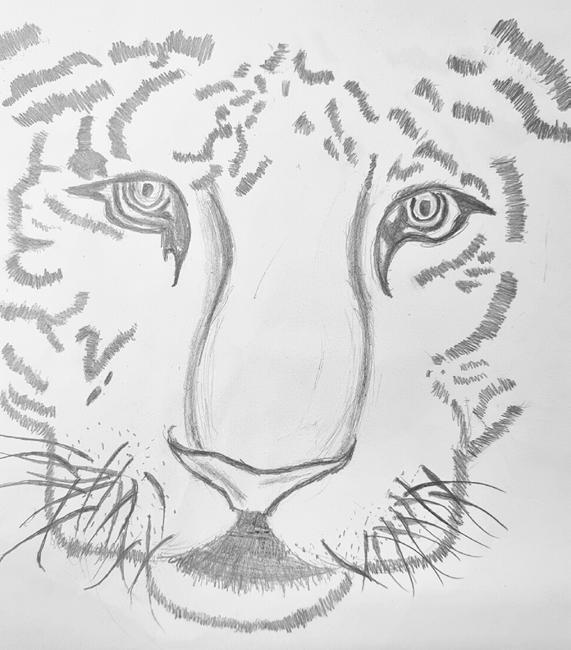
Graphite on Paper, 8x11
Margaux Andrea Salamat, Grade 6
(middle)
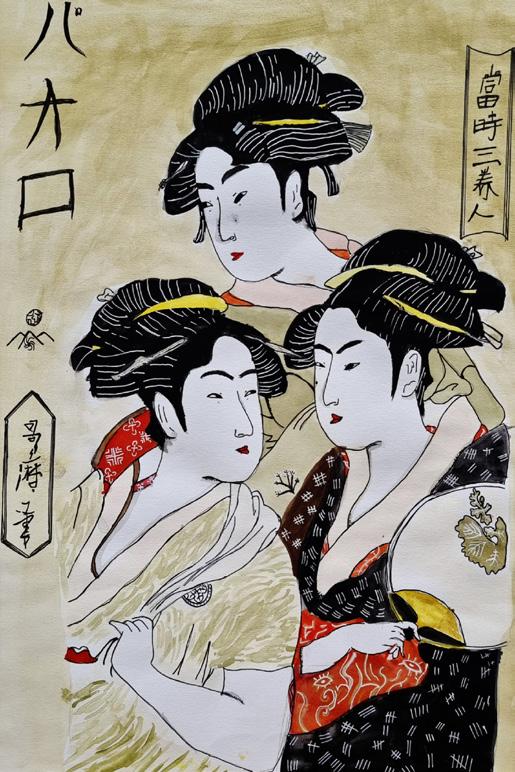
“Benguet Mountain”
Coffee on Paper, 9x12

Deborah Jochebed Bangsoy, Grade 8
(right)
“Three Beauties of the Present Day”
Watercolor and Ink on Paper, 12x18
Paolo Federico Marquez, Grade 8
Baguio
School Art Celebration Brent International School
34 EARCOS Triannual Journal
Winter 2023 Issue 35
CURRICULUM
Opening DORS: A Collaborative Learning Project
 By John Helgeson, PhD Taipei American School
There are several types of professional learning structures. Determining a process that is effective for educators may be daunting for some individuals seeking ways to improve their practice and the experiences for their students. The desire to collaborate with other teachers is an activity that occurs frequently; however, the success of the collaboration may be dependent on the structure in place. In other words, the absence of a structure and effective protocols may lead to failure or the misinterpretation of collaborative work results. The collaborative learning project described here utilizes common practices in education:

• Discussing topics and questions of practice
• Observing teachers via learning walks
• Reading a common text to ground conversations
• Selecting strategies to apply to the classroom
Getting Started
Finding a Partner Knowing how to get started in a collaborative learning project may seem challenging, but the size of the group involved can start with as few as two people and expand to as many individuals as possible forming a learning team. If one is interested, all they need to do is to locate another person, perhaps a teaching partner, to collaborate. In this particular case, the initial partnership consisted of a content area teacher and an instructional technology coach. This partnership collaborated on brainstorming and developing several student learning projects, often team teaching these projects together, and reflecting on the process. The three components: brainstorming and development, collaborating, and reflecting became the foundation for wanting to explore school-wide teaching practices utilizing technology that impacts student learning.
Brainstorming a Topic Even if the learning partnership or team already knows the topic members want to explore, it is worthwhile to brainstorm additional topics or elaborate on potential subtopics. Brainstorming can ensure the concerns of all members are validated. In this particular example, the learning partnership brainstormed several topics they were interested in exploring. After the brainstorming session, they looked for common themes. They then searched for books that could provide guidance or a foundation for one of the common themes. Since they wanted to expand their learning team, and keep the content manageable, they narrowed their search to quick reads and easily accessible books. The book selected for this learning project was Classroom Management in the Digital Age by Heather Dowd and Patrick Green.
Increasing the Partnership While a learning team can consist of as few as two people, it can be advantageous to open the team up to additional members. In order to increase the potential outcomes of the professional learning, once the pair selected the book they wanted to explore, they determined a potential schedule for learning walks and a book study to propose to the divisional staff at a staff meeting. In-
36 EARCOS Triannual Journal
terested staff members submitted a Google Form, and books were purchased based on the number of interested participants.
Initial meeting The initial meeting is crucial to proposing goals and the process for the professional learning team moving forward. In this particular example, general group goals and the general topic of classroom management were overviewed with input from team members.
Pre-Learning Walk
The goal of Learning Walks is to visit classrooms to see what students are learning and how they are learning it. “After spending a short time in each classroom (no more than 15 minutes, and often less), participants meet again to engage in a reflective conversation led by the facilitator. They are asked what they noticed, what was surprising, and what was held in common with their own practice. Importantly, this reflective conversation ends with insights about their own classrooms” (2014, Fisher and Frey). The learning walk protocol was overviewed in the initial meeting and learning team members scheduled times to complete a minimum of three observations with a partner or small group. Additionally, learning walk partners scheduled times to discuss their observations. The mission of the learning team in this example was to identify strategies that promote promising practices that provide common language and systems across classrooms.
Teachers were given a two week window to complete the initial learning walk. After which, the learning team met and shared their observations. Information gathered provided a snapshot of classroom management with and without the inclusion of technology resources.
Book Study
The goal of the book study is to provide common language and research to explore the application of practices in the classroom using an inquiry model. The inquiry model includes baseline research, selecting a strategy, applying the strategy, analyzing data, drawing conclusions, and then repeating steps of the process as needed. There are multiple approaches to when a line of inquiry is determined. Sometimes teams establish a line of inquiry during the initial meeting, sometimes it is already proposed to them, and sometimes it occurs after viewing some data. In this case, the team used individual reflection and learning walk observational data as the foundation for developing a line of inquiry. This coupled with the book title and chapter headings led this group to explore the following question: Which classroom management practices help students use technology devices and tools in a productive manner?
Protocols Discussion protocols help facilitators better ensure that all voices have the opportunity to be heard. It is important to build
a level of trust within a learning team in order to appropriately and effectively address the line of inquiry. The School Reform Initiative (https://www.schoolreforminitiative.org/) and The National School Reform Factory (https://nsrfharmony.org/) have several protocols available for facilitators to use and adapt.
Application The book study and the discussion protocols provide context and common language to answer the initial question. As with any line of inquiry, additional study, observations, and discussion may lead to additional questions. The material gathered from the text and from collegial conversations along with self reflection lead to a discovery of application to the classroom. In this collaborative learning project, each book study session provided time for reflection and brainstorming for classroom application. The goal for each session was to determine what could be refined or revised within one’s own classroom.
Post-Learning Walk
The purpose of the second learning walk is to provide participants with an alternate lens when visiting classrooms. This time, participants have a common experience and language guiding their observations and discussions. Similar to the first learning walk, participants in this example were given two weeks to complete the post-learning walk. The learning team met and shared their observations with the common texts studied and the discussions that followed as a lens.
Action Steps One of the most important components of a professional learning experience is the overall outcome and next steps. To facilitate effective practice, applying learning helps to ensure greater impact in one’s classroom or school role. After the second learning walk experience in this collaborative learning project, the learning team discussed and proposed an action plan for the division as well as individual action plans to apply practices within their own classrooms.
In conclusion, the DORS collaborative learning project is an adaptable professional learning structure suitable for small and large teams. The process honors all voices, personalizes topics, and applies learning.
Reference
Fisher, D., & Frey, N. (2014). Using teacher learning walks to improve instruction. Principal Leadership, 14(5), 58-61.
About the Author
John Helgeson is a History and English teacher at Taipei American School. He can be contacted at helgesonj@tas.edu.tw
Resilience, Ganas and Problem Solving
Presented by: Ron Lancaster Saturday, February 25, 2023 9:00 AM HKT visit website
Winter 2023 Issue 37
Leveling Up our Approach to Education: Let’s Play!
By Liz Reale Taipei American School
Laughter. Collaboration. Storytelling. Strategy. Movement. Some students are furiously typing on their laptops while others are drawing sketchnotes by hand. All students, or dare I say “detectives”, attempting to be the team who discovers “who dunnit?” in Doctor Helgeson’s CLUE inspired game in 7th grade History. The “detectives” work through a series of tasks based on immigration to earn their badges, gather their clues, and hopefully, uncover the mystery.
To play this game, the class is divided into teams of four-five students. One student excitedly rolls the dice and is handed a clue to bring back to their team. Team members ask each other “what’s the website?” in order to quickly access their first assignment, eager to get ahead of the competition. Each clue is associated with a task, either analog or digital. While one team creates a script to make a team video on Flip, another team is participating in an engaging conversation with Doctor Helgeson. As an onlooker, I have a birdseye view as the entire class comes alive with constant collaboration and creativity.
Welcome to gamification and game-based learning at its finest. While it’s easy to confuse the two, gamification and game-based learning are conceptually different. Gamification is the use of game mechanics (i.e., points, quests, rules, competition, badges) in non-traditional environments to make learning fun and engaging. Popular educational games like Quizizz, Blooket, and Gimkit are great examples of gamified activities. While in game-based learning, the game itself is a learning experience, and by playing the game, students reach the instructional objectives. It tends to be a more immersive experience like building an ancient civilization in Minecraft Education Edition
Another example would be students acting as “coaches” and drafting their fantasy team of benevolent leaders in U.S. history. Students would create player cards explaining how their draft picks earned such a title and present their crew to the “league commissioner”, also known as the teacher. The “league commissioner” then decides which historical team is really the best “dream team”.
Over the last several years, both gamification and game-based learning have risen in popularity and are trending in the classroom. Some educators might argue that these methods of teaching are of little substance or they may be uncomfortable with the idea of organized chaos, but research has shown that students are more engaged in a classroom that incorporates games.

Traditional classrooms no longer fit the needs of today’s students, especially with advances in technology and the plethora of professional opportunities available to students post-college. The educational system was originally created to train factory workers. However, in order
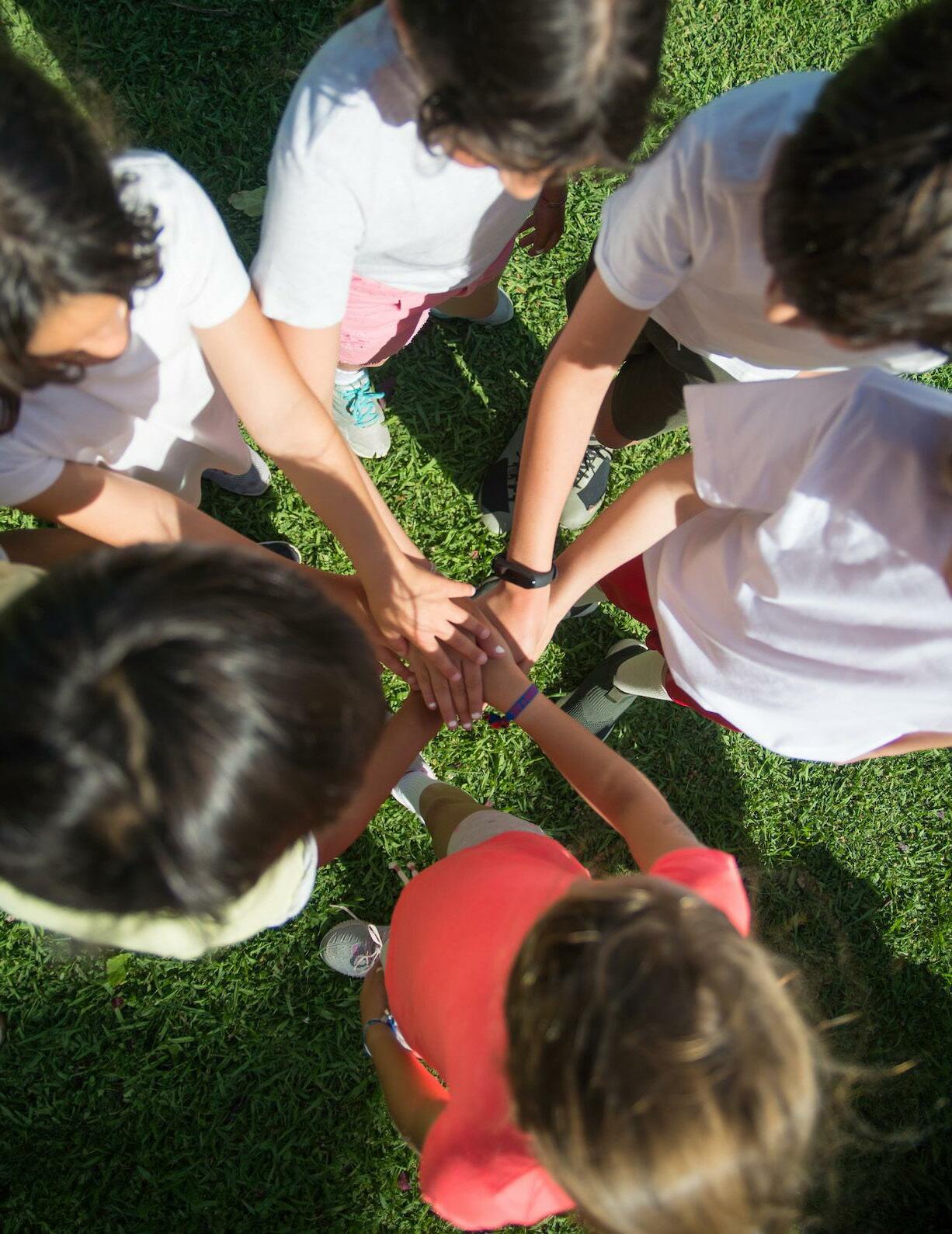
CURRICULUM
38 EARCOS Triannual Journal
to be successful nowadays, students need to develop critical thinking, collaboration, media literacy, communication, and leadership skills as cited by EdSurges’s 21st Century Skills Employers Want Across Industries. As educators, we want to shy away from having students be good at the “game of school”, where there is more emphasis on the grade itself as opposed to the learning process. We also know that in this post-pandemic world, the way students socialize and entertain themselves has also changed. According to Common Sense Media’s 2021 Census, “between 2019 and 2021, the total amount of screen media used each day went from 4:44 to 5:33 among tweens, and from 7:22 to 8:39 among teens. This is a much faster increase in just two years than was seen in the previous four years.”
Don’t get me wrong, I am not advocating for endless incorporation of technology in the classroom. I will always believe in purposeful integration of technology in the classroom and the consideration of tasks before apps when designing learning experiences. This same kind of care and attention needs to be brought to our educational system, as the function of the system has changed along with the students of yesteryear. Therefore, it’s imperative that we meet students where they are now. Cue games. Both analog and digital. We can even get really wild and smash the two together.
At the beginning of this school year, I had the pleasure of facilitating three workshops on gamification and game-based learning at Taipei American School (the first set of a series of game-based learning and gamification workshops). In these sessions, teachers worked together to discuss the benefits of these two methods of teaching in the classroom, better understand their differences, and connect the ISTE Student Standards to game-based learning and gamification in the classroom.
ISTE is the largest educational technology organization in the world, and they have created future-ready standards for different educational stakeholders like administrators, coaches, teachers, and students. We focused on the Empowered Learner standard and drew parallels between the effects of gaming and the meaning of this standard. This standard emphasizes students playing an active role in choosing and achieving their learning objectives which sounds a lot like a child’s goal and role when playing a game.
Teachers also took on the role of students and actively participated in the #eggdashchallenge competing in a teacher trivia game where the team earned points for every correct answer. Teacher teams raced against the clock (and each other) retrieving one plastic egg at a time for their team. Then they’d crack open the plastic egg to find a slip of paper with a trivia question about their colleagues.The team who earned the most points was declared the winner! This simple,
low-tech game is a great way to spice up any worksheet or review, and takes no time to implement.
Towards the end of the workshop, I revealed my game-based learning and gamification playbook. This playbook is a compilation of over 20 ideas, activities, and apps for incorporating gamification and game-based learning in any classroom. In follow up workshops, I plan on highlighting other games from the playbook so that teachers can have a more immersive experience and brainstorm ways they can incorporate these games into their classrooms.
As I stated in the introduction of my playbook, play is a mindset. Playing games is a great source of motivation in learning and an excellent way to retain important information. Not to mention, games are just another method to deliver, connect with, and assess content. In the classroom setting, incorporating games can build confidence, increase engagement, foster collaboration, and develop perseverance. By incorporating game mechanics and game dynamics, students can become more motivated to learn and get lost in the immersion of the game.
While we all know that teachers’ plates are already quite full and time is the most valuable asset of any teacher, incorporating gamification and game-based learning in the classroom can be simple and may only require a few tweaks to lessons that have already been created. The increased levels of engagement teachers will witness from their students and the success of their students will bring a sense of satisfaction to educators as well. While we all agree that the road to success is not a linear path, incorporating games creates a safe place for students to make mistakes and persevere through inherent challenges.
We learn best by doing and games provide immediate feedback, give students the opportunity to make more informed decisions, navigate failure, and increase their empathy. Games provide a space for choice, teamwork, and fun. Let’s energize and celebrate our students!
About the Author
Liz Reale is a middle school technology, learning & design coach at Taipei American School. She can be contacted at realel@tas.edu.tw
A Common Vision for Teaching Excellence: Introducing the 2022 Danielson Framework for Teaching Presented by: Lindsay Prendergast Saturday, March 11, 2023 9:00 - 10:30 AM HKT visit website
Winter 2023 Issue 39
Students at The International School Yangon Make an iMPACT
By Danny McCamlie Middle School Coordinator The International School Yangon
(A teacher’s perspective)
“I learned that a small change makes a big impact and how we can influence a positive change for the community” - Ivy, Grade 7, iMPACT of Anxiety on People
The International School Yangon (ISY) is a community of compassionate global citizens. We aim to develop lifelong learners who will be a force for positive change in the world. Staying true to this compassionate Mission allowed us to successfully navigate a difficult two years of disrupted, online learning.
Upon returning to campus in the second half of the 2021-2022 school year, we wanted to provide our students with a unique opportunity to place service at the heart of school life once again, and to have an iMPACT on the lives of those around us. We took COVID’s disruption of schedules as an opportunity to rethink the traditional schedule and create a new learning experience for our students. We did this in the form of the iMPACT Festival.
“This really has changed my point of view of the problems around the world, it changed my point of view by making me see that for every problem there has to be a solution so I don’t stop when I face a challenge. Instead I overcome it” - Lukas, Grade 8, iMPACT of Food Insecurity on People
Over the course of 3-weeks the entire middle school student body investigated SDG-focused community issues, prepared interventions, began to act for change in the community and had an opportunity to reflect on the difference they can make. From reducing stigma around mental health in the community to repurposing plastic waste as indoor lighting solutions for underprivileged areas - the students were driven, focused and passionate about positive change.
“I learned that making an impact on the world may be overwhelming, stressful, and humbling at times, but the end result always makes it all worth it” - EK, Grade 6, iMPACT of Mental Health on People
The iMPACT Festival was brought to life by a group of compassionate Grade 9 and 10 students, many of whom had become tired of online MUN conferences. They wanted to talk less and act more. It highlighted to us that our young people wanted to do more to support the world, especially during such challenging times. So we asked them, what would they do better?
Deciding on the theme of ‘It Starts With Us’ eleven Grade 9 and 10 students collaborated with a team of faculty facilitators to identify 9 SDG focused issues within the community that they were passionate about. From food insecurity and job loss to indoor air pollution and inorganic waste, these students created and published summary re-
CURRICULUM
40 EARCOS Triannual Journal
ports on their chosen issues under SDG umbrellas of People, Planet and Prosperity. These reports acted as calls to action, inspiring middle school students to rally around the issues.
In week 1 of the iMPACT Festival that’s exactly what happened, middle school students met beneficiaries of social enterprises from the community, they interviewed local social enterprise founders and staff, they learnt skills such as Gantt chart management and logical matrix building, and by the end of the week they applied to join teams addressing one of the 9 issues.
work better in balance, and talk to my teammates without getting frustrated or mad.” - Ain Grade 7, iMPACT of Inorganic Waste on the Planet
They did all of this whilst driving for change in the community, and beginning to experience success in the face of challenges that have daunted actors from UN Agencies to individual families for decades.
“I was more driven because I could never imagine myself going through not having clean safe water, so I did hands-on work such as writing the matrix, plans, and building a prototype water filter. I learned that hard work actually pays off, and it feels great looking back at the work you’ve done.” - Sammy, Grade 6, iMPACT of WaSH on the Planet
Week 3 of the iMPACT Festival culminated in an exhibition of the students’ projects, showcasing their progress to the community and experts from various NGO fields. Many of the student teams quickly realised that 3 weeks was not long enough to achieve the change they saw for the world, but that did not stop them finding success in the present and planning further success for the future.
“Over the time of the festival I didn’t waste food at all. As I wasn’t wasting food I felt grateful that I went to sleep with a full stomach and my group has been trying to calculate the cost that will be needed to start the impact garden as an ASA (after school activity). I am also giving ideas to the group about the cost so they can start something that can be considered as a helping hand for the rural communities in Yangon, Myanmar.” - Srija, Grade 6, iMPACT of Malnutrition and Poor Land Management on the Planet
“I do not want anyone to be embarrassed about their menstruation, nor do I want anyone to not be able to properly attend to it… I really want to help stop the issue and reduce the number of people under the effects of period poverty. I want to help change peoples’ mindset and help make people have more access to menstrual products. I want more people to be educated in how to deal with their menstruation and for them to have no shame towards this topic.” - Kyi Sin, Grade 8, iMPACT of Period Poverty on Prosperity
In week 2 of the iMPACT Festival, students delved deeper into their issues using the framework of M.I.S.O. (media, interviews, surveys and observations), compiled situational reports, identified potential interventions, and constructed logical matrices based around SMART objectives. In their personal time, students began to advocate at home for greater awareness and involvement, stepping into the communities around them as they prepared their interventions.
“Me and my family went on a trip to Hlaing Tharyar where we got to meet an NGO where we saw a real water treatment plant in action, giving practically free water to the residents there.” - Dylan, Grade 7, iMPACT of WaSH on the Planet
By Week 3 of the iMPACT Festival, students were learning more about themselves and the communities around us than any of the faculty could have hoped for,
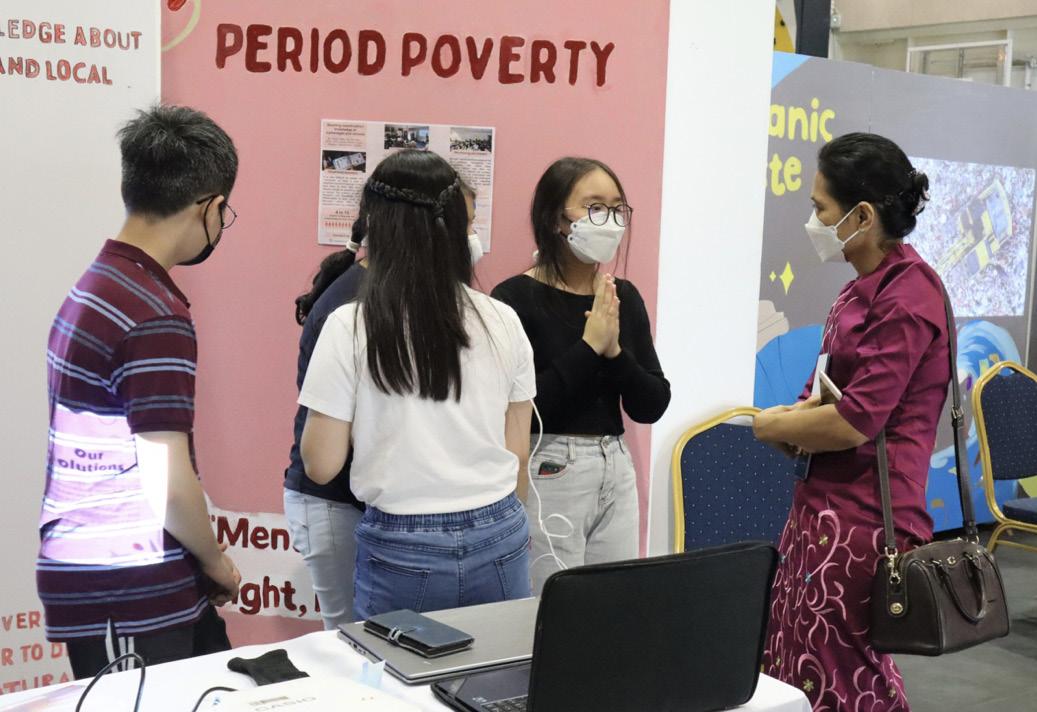
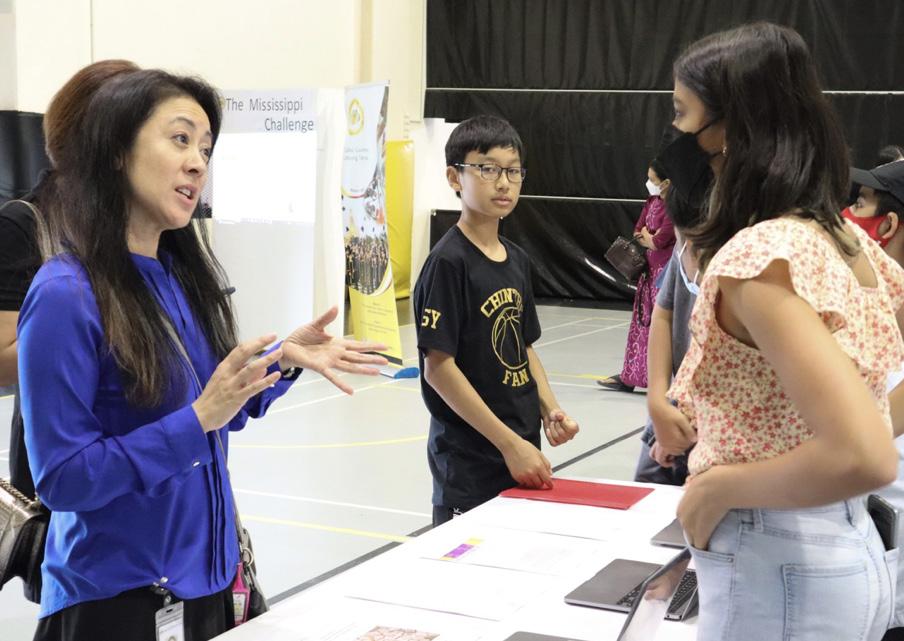
“I think I learned a lot about teamwork. At first, as the ‘dictator’ I was mad at the teammates not doing anything and messing up the writing or other things. However, I learned how to divide the
So what does the future hold for ISY’s iMPACT Festival? We feel one of our student’s says it best:
“Next year I would take a step back and rethink all the decisions I’ve made this year and ask myself “is this sustainable? Is this a good plan? what can be better?” and make those changes.” - Let Ya, Grade 7, iMPACT of Food Insecurity on People
The iMPACT Festival truly did start with our students, and at ISY we are excited to see what iMPACT our students can have as the program develops and grows.
Winter 2023 Issue 41
(A student perspective)
By Ingyin, Shwe, Angelina, Maggie, Ben, Ethan, Cola, Zheng, Cyrus, Isabel, Piyawan The iMPACT ‘22 Student Leadership Team
iMPACT 2022 was developed over the course of the 2021-2022 school year to influence and inspire middle school students at The International School Yangon (ISY) to tackle real-world local issues.
The iMPACT Festival, a three-week-long service learning event, was held at the end of the 2021-2022 school year. During the festival, groups of middle school students created service learning projects to address various SDG related issues.
Inspired by the opportunity to change the community during a very challenging time in Myanmar, we, a team of high school students, supported by members of faculty, worked to design an event that would help our city.
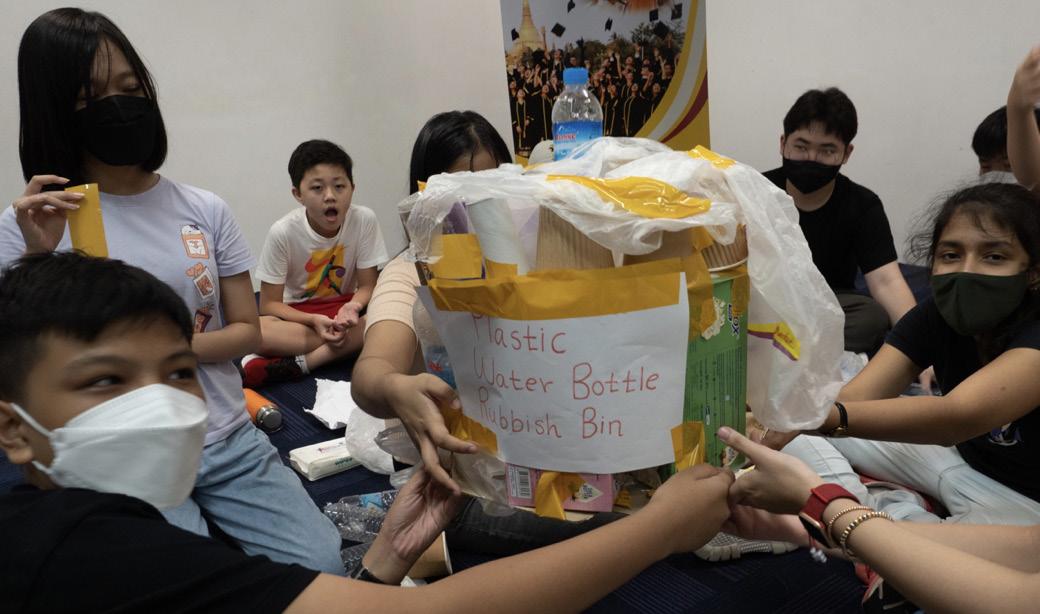
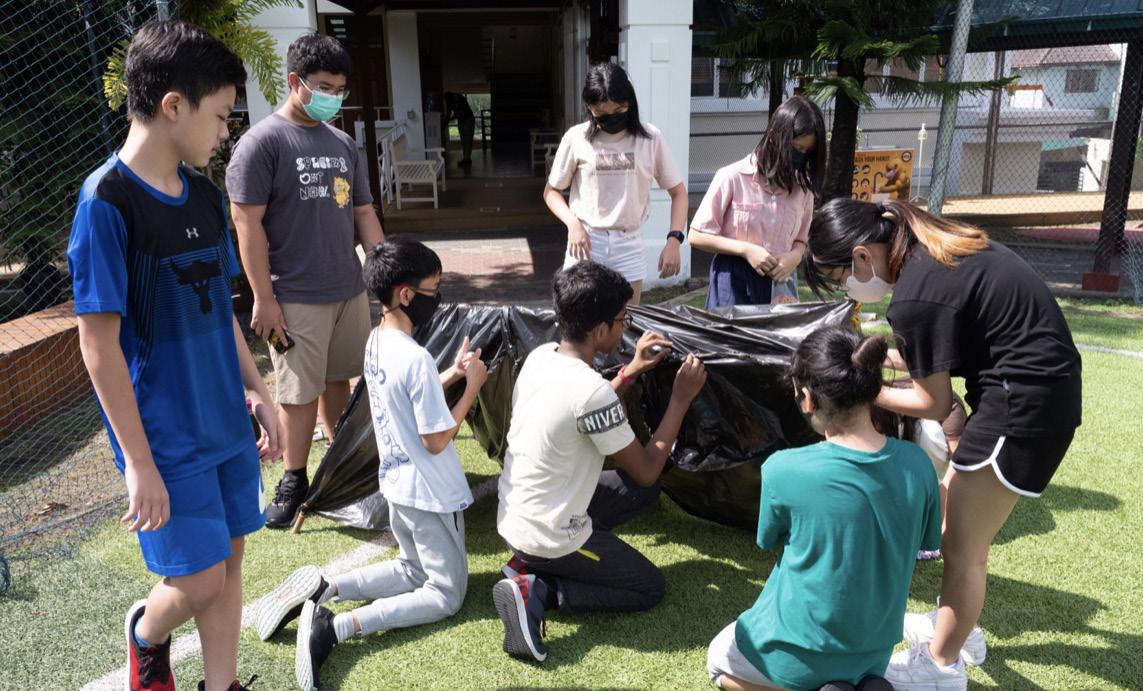
iMPACT identifies local problems and uses them to teach middleschoolers that they can be a force for positive change in the world as per ISY’s vision. The main goal of iMPACT for us was to share with the younger students our experience during hands-on activities and lead teams to address issues we felt were most important. We wanted to guide and support middle school students to come up with their own solutions.
“Personally, I wanted to join iMPACT because I was looking for service groups to join and iMPACT had a new, interesting concept: allowing middle school students to create real-world change as a part of their schoolwork.”
—Maggie, Grade 9, high school supervisor for Period Poverty
“I was really surprised at how efficient and collaborative our middle schoolers were. They were also really inclusive of other grades— it was an honor to work with them.”
—Ingyin, Grade 9, high school supervisor for iMPACT of WASH
When preparing for the iMPACT festival, we were tasked with writing iMPACT reports, introductory documents that acted to orient readers to why our topic was worth addressing. This involved collecting official statistics, framing the problem both locally and internationally, and introducing some solutions from elsewhere in the world that the middle schoolers could draw inspiration from. During the iMPACT festival, our iMPACT leadership team of eleven was spread out over several days taking turns to present our topic to over a hundred students—we collaborated with the teachers and worked our hardest to inspire every
middle schooler.
After the introductory week, each middle school student chose one of our issues to work on and got started.
“iMPACT brought together a lot of perspectives from both the middle schoolers and the high schoolers both as members of the ISY community and individuals with their personal opinions and ideas. It was really refreshing.” —Shwe, iMPACT Prosperity team overseer
In week 2 of the iMPACT festival, we could see the students jumping into action - organizing and familiarizing themselves with their issues, forming situational reports, joining discussions and developing strong teamwork capabilities. As individual issue leaders, we spent time with the middle schoolers to lend a helping hand - whether this was to provide more information about the issue we were leading, to look over their content, or to add to their discussions and potential solutions.
“Watching the middle schoolers throughout the event was like seeing our efforts towards creating the festival come to life. We witnessed discussions of constructive and original ways that students thought of to tackle these world issues.” - Angelina, Grade 9, high school supervisor for iMPACT of Mental Health
Week 3 of the iMPACT Festival was quite a whirlwind of a week: we saw students rushing about ensuring every detail of their project was finalized in preparation for their iMPACT showcase. We helped them out as they went through their slide presentations, evaluation reports, and backdrops for their upcoming showcase. The original aim of the festival was to launch changes in the community, but we quickly saw students wanted to create and launch projects that were longer than single events or campaigns, many working hard to lay groundwork for service learning activities that will run next year. After 3 weeks of students anticipating and worrying about their projects, they made it to the presentation day.
“I think both the high school team and the middle schoolers felt a huge sense of accomplishment and relief at the end of the festival. I know that everyone in the high school iMPACT team was very proud at seeing the middle schoolers make it through their first iMPACT festival - and hopefully many more!!” - Isabel, Grade 10, high school supervisor for iMPACT of Malnutrition
As iMPACT 2022 came to a close, our high school team got together to reassess and reflect on this festival - what we thought of it and what could come for the future of iMPACT. We hope that following iMPACT 2022, students will continue to be inspired and learn from this festival to harness their collaborative skills and be a force for positive compassionate change in their community.
42 EARCOS Triannual Journal
Winter 2023 Issue 43
Literary Gourmands: using genre teaching to increase students’ appetite for literature
 By Dhrupal Goldman & Bhavini Goldman Garden International School
“All I could discern distinctly by the moonlight was a colourless, youthful face, meagre and sharp to look at about the cheeks and chin; large, grave, wistfully attentive eyes; nervous, uncertain lips; and light hair of a pale, brownish-yellow hue.”
This extract, from Wilkie Collins’ The Woman in White, proved to be a source of some confusion when it was included in an English Language mock exam. Having been provided with a glossary of terms which defined “meagre” as “thin and undernourished”, students were asked to explain how language and structure had been used by the writer to convey the narrator’s thoughts and feelings. Many students were able to identify that the “suspiciously late hour [...] in that suspiciously lonely place”, coupled with the sudden appearance of a “nervous” and “grave” ethereal figure, would be the cause of some consternation for the narrator.
However, a notable number of students read the narrator’s emotions quite differently. For them, the slim figure of a woman, seemingly adorned in matrimonial white, and a man, stunned and drinking in every detail of her face, had all the ingredients of a lovers’ tryst. What had caused them to misinterpret her thin form as beautiful, his confusion as attraction, and, most pressingly, what had led them to overlook the Gothic
CURRICULUM
44 EARCOS Triannual Journal
iconography with which this scene is laden?
Crucially, it seemed that not all students had understood the genre with which they had been presented, and therefore, did not have the tools to accurately make sense of the text. This misconception prompted a rethinking about how we taught literary genre within our KS3 curricula, and has subsequently resulted in the creation of a programme of study which explicitly and implicitly fosters this understanding.
“Intellectual Velcro”
“What you know is like intellectual Velcro; new stuff sticks to it, so, the more you know, the more you learn. The more you learn, the more you are.” (Didau, 2017)
As David Didau seems to suggest, knowledge is fundamental to acquiring more knowledge. Using this premise as the foundation for our curriculum design, we have set about equipping students with an understanding of ‘generic codes’ –symbols or signposts of a genre – which act as points of reference by which they can make sense of new texts, limit the scope of misconception and, ultimately, make informed decisions about what they read beyond the classroom (Bawarshi, 2003). However, the dilemma presented by reimagining the curriculum in this way is how to teach the conventions of literary genre without reducing them to a series of formulae for decoding an unseen exam extract, thereby removing all the nuance and design from the crafting of the text.
After all, teaching genre is about more than ‘exam-readiness’. Learners who possess an “expanded view of genre”, as readers beyond the classroom, are able “to account more fully for what writers do when they write, why they do it and what happens to them” as readers when they encounter such texts (Bawarshi, 2003). This insight into the relationship between writer, text and reader is valuable in the context of all reading experiences, not just academic ones. Moreover, understanding what we like to read is an important step in forming a reading identity. What we choose to read reveals a lot about us and our relationship with the world, much like many of the other choices we make - the music to which we listen, the clothes we wear, the types of cuisine we eat.
Indeed, the analogy of food offers a useful metaphor for understanding this process. Imagine a diner in a restaurant, familiar with the cuisine. Their knowledge of the flavour palate enables them to make an informed decision about a dish they will enjoy, much like a reader who understands which genres they prefer. The diner’s confidence with the menu may even encourage them to choose an item which they have not tried before. However, for a diner who is unfamiliar with the cuisine, making a choice may seem overwhelming and fraught with unpalatable risk. It could even seem easier not to make a choice at all. Such a scenario may be familiar to teachers who have attempted to help their students
choose a reading book, and whose question of ‘What types of books do you like?’ is met with a bewildered, or even indifferent, shrug.
Our hope has been to move students away from such shrugs and more towards becoming literary gourmands. To achieve this, we have adopted the following strategies within our curricula.
Framework rather than Formula Choosing genres and texts to explore with our students presents an opportunity to select diverse writing which has popular appeal, will pique their interests, and will offer them cultural capital. In order to foster learners’ understanding of the common conventions of these genres, we explicitly explore the recurring symbols of such narratives - character types, settings, events and themes - so that students can begin to recognise patterns across texts of the same genre, understand the purpose and significance of these elements within the narratives, and use their knowledge to make predictions about new texts. Students also learn to reflect on their own tastes by discussing which texts they would read further and why.
Such critical reflection creates space for us to undo narrow perceptions of genre - the dreaded ‘formula’ to which we alluded earlier. Any exploration of a breadth of texts necessarily prompts the question ‘How is this one different?’. Thus, students learn that writing within a genre is more nuanced than simply following a formula, and whilst the conventions of a genre offer a framework, writers (our students included) can and should take risks within that.
Remember, Spell, Define
Each genre calls for a subject-specific vocabulary, but there is an important distinction to be made between vocabulary belonging to a genre, and vocabulary used to discuss that genre. Teachers should facilitate students’ learning of both by helping them acquire language which fulfils each of these aims. An effective strategy to address this is the use of cloze activities which we refer to as ‘Remember, Spell, Define’. Students learn genre-specific words and then practise using these words, from memory, to complete sentences in a cloze activity. Teachers then continue to model the use of the vocabulary, verbally and in writing, and call upon students to do the same when formulating analytical responses to individual texts. It is only through spaced, retrieval practice that a secure knowledge of this vocabulary is acquired. Dual-coding is a particularly effective way to help students recall their new vocabulary and, while this is important for all learners, as teachers of a large number of EAL students, we have found this method to be especially supportive of those for whom English is not a first language.
Winter 2023 Issue 45
seen this before?’
If our objective is for students to use their knowledge of genre as a springboard for making sense of new texts, we must create opportunities for them to explore intertextual connections, and model asking the questions that we want them to pose: Where have we seen this before? How did we respond then? Why has this writer used it now? Recurring signposts (take, for example, the locked room in crime and detective fiction) serve as points of reference, not only signalling the genre of the writing, but also prompting the reader to consider where they have seen them before, why the writer has employed such methods now, and how it shapes their response. As such, by fostering moments when students can explore intertextual links, ask questions of their prior learning, and use them to make new connections, we explicitly model the implicit strategies we want them to develop.
Text Transformations
We know that for students to fully appreciate how writers craft a text, they too need to be immersed in the writing process. This is not achieved through the analysis of an extract, nor does assessing learners’ knowledge of genre need to be reduced to a PEE paragraph. The explicit teaching of genre can be coupled with text transformation - rewriting an extract from one genre in the style of another - to give students the opportunity to creatively apply the wealth of knowledge that they have acquired. Here, teachers give students an extract which distinctly reflects the conventions of one genre and ask them to convincingly rework these conventions into another. They do this by drawing upon their knowledge of genre-specific vocabulary. In this way, students learn to fully exploit their understanding of genre by creating the very signposts that readers (themselves included) look for when making sense of a text.
Food for Thought
The understanding students acquire when learning about genre is transformative, and therefore worth building in to an English curriculum. By explicitly and implicitly teaching literary genre, we can empower learners with knowledge and - to return to the analogy of the diner - ultimately guide them to sample confidently from the varied buffet of literature available to them.
References
Bawarshi, A. S. (2003). Genre and the Invention of the Writer. Utah State University Press.
Collins, W. (1999). The Woman in White. Penguin Books Ltd.
Didau, D. and de Bruyckere, P. (2017). Learning Myths. In Hendrick, C. and Macpherson, R. (ed.) What Does This Look Like in the Classroom? Bridging the Gap Between Research and Practice. John Catt Educational Ltd.
About the Authors
Dhrupal Goldman is the Head of English Faculty at garden International School in Kuala Lumpur. (goldman.d@gardenschool.edu.my)
Bhavini Goldman is Head of English at Upper Shirley High School in Southampton (bhavini.goldman@ushschool.org).
‘Where have we
46 EARCOS Triannual Journal
KEYNOTE SPEAKERS


GUEST SPEAKERS
Winter 2023 Issue 47 TEACHERS' CONFERENCE 2023 M A R C H 2 3 - 2 5 , 2 0 2 3 S U T E R A H A R B O U R H O T E L K O T A K I N A B A L U , M A L A Y S I A V i s i t w w w . e a r c o s . o r g / e t c 2 0 2 3 1 8 t h A N N U A L E A R C O S STRANDS
/ Reading ESL Early Childhood Technology Special Needs Children's Authors Modern Languages. Child Protection Counselors General Education Media Technology/Libraries
Literacy
Save the date
Nicholas Carlisle CEO for Zero Bully Michelle Garcia Winner Creator and CEO of Social Thinking Todd Shy Author of Teaching Life
Susie Boss Greg Curtis Sarah Park Dahlen Stephen Holmes Lee Ann Jung Cathy Berger Kaye Jennifer D. Klein
E M E : C REATING A CU L T U RE OFCARE
Lori Langer de Ramirez Russell Lehmann Marc Tyler Nobleman Jon Nordmeyer Stephen Shore Ying Chu & Huali Xiong Matt Harris & Sian Jorgensen HT
Russell Lehmann Speaker | Writer | Poet | Advocate
CURRICULUM Salinometers in Seconds

 By Danielle Richmond, Brittany Stapley, and Adam Stapley Concordia International School Hanoi
During a 2nd grade Physical Science Unit, Grade 2 students at Concordia International School Hanoi embarked on a series of design challenges with one idea in mind: escape a deserted island.
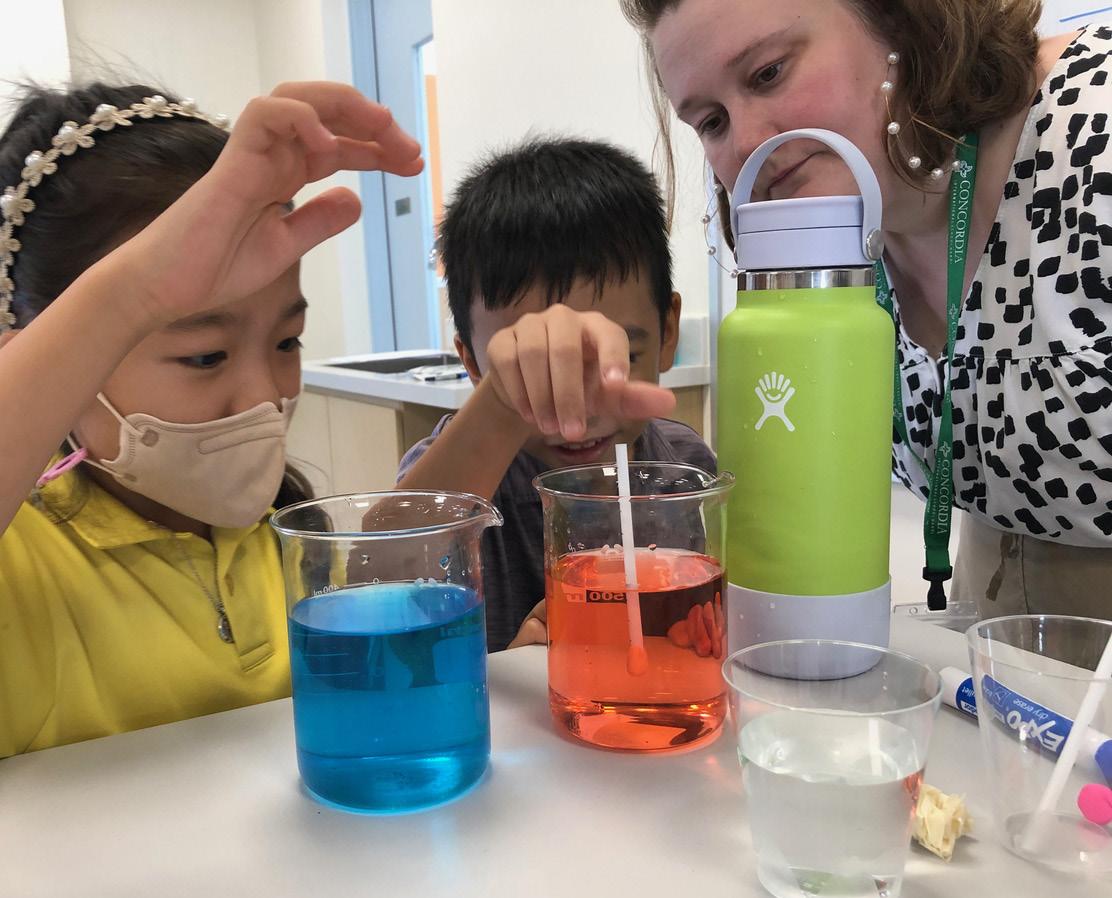
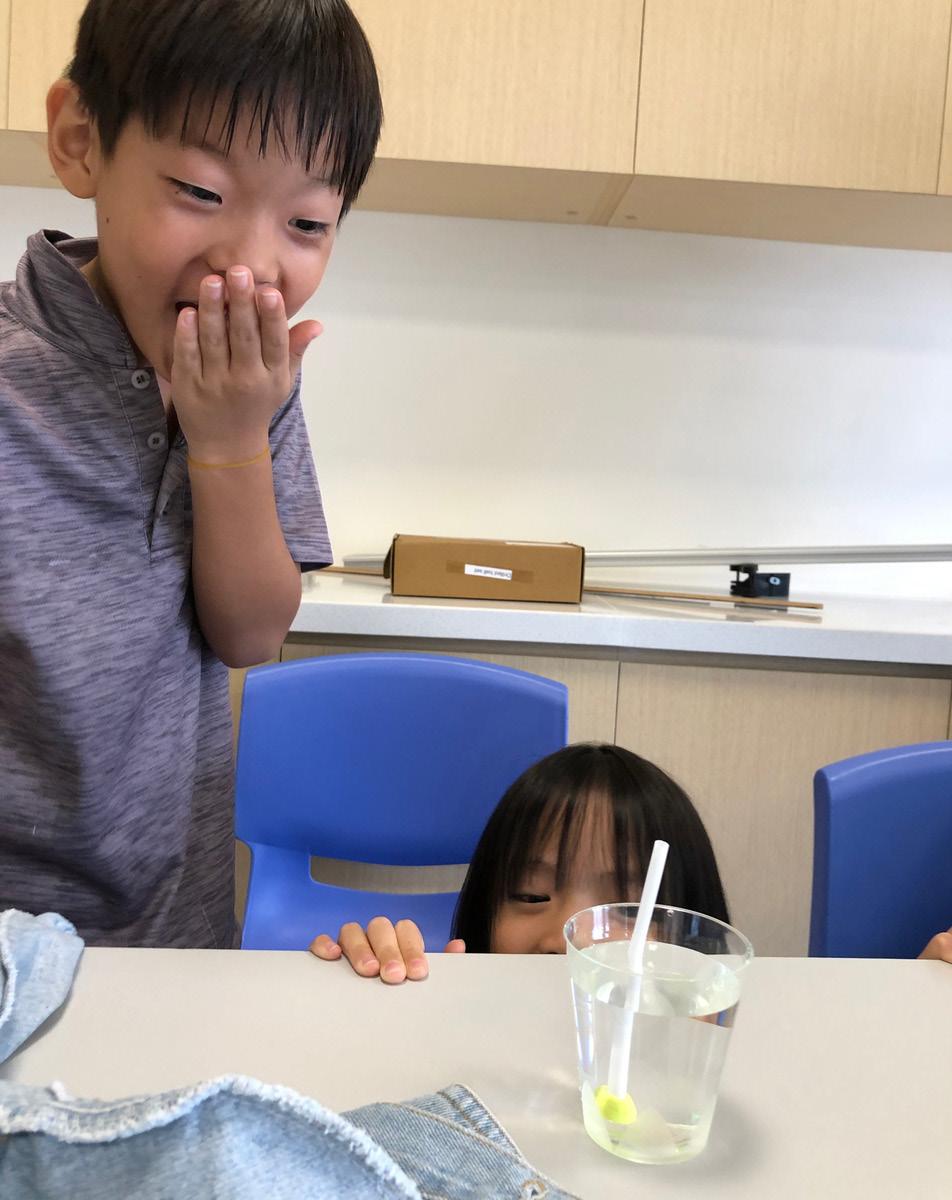
During the unit, students imagined they were stranded on a deserted island. In collaboration with Concordia’s STEM teacher, the Grade 2 Homeroom teachers guided the students through several STEM design endeavors. Using materials such as aluminum foil, cardboard, and straws, they used the design process and their understanding of properties of materials to develop and build miniature models of structures to
protect them from sun and rain while on the island and boats to escape. Additionally, they developed plans for containers to hold and carry water.
As a culminating activity, the classes visited Mr. Stapley in the High School science labs for an opportunity to see density in action. Our challenge while in the High School was to build our own rudimentary salinometers – a tool for measuring the saltiness of water – and use them to determine which “water source” would be acceptable for drinking: basically, which water would students want to fill their container with as they set off on their rafts to escape the island.
First, students learned about the concept of density, and how salty water has a different density than fresh water. Students then built simple salinometers out of straws and clay and calibrated them using drinking water. To do this, students stuck the ball of clay to the bottom of the straw and dropped it into drinking water to see if it would float. If it did not, they adjusted the amount of clay attached to the straw until the straw and ball creation would float and stay upright in the water. Students marked on the straw with a permanent marker at the spot where the straw touched the water line. One 2nd grader, Chaelin, said, “It was exciting…I didn’t know that it would float.”
Once their salinometer was calibrated, they were ready to test water samples to determine which one had high salt con-

48 EARCOS Triannual Journal
tent and which one was fit for drinking. Students dropped their salinometers into each sample. The sample where their test line met the water was the potable water and the sample where the line was above the water indicated the overly salty water. In this way, the students were able to say if they would want to bring the red or blue water with them and discuss how they knew which water would be best to fill the container for their boat. A second grader named Lina reported, “First I thought that the salt water was the red, but I figured out that it was blue because it floats up higher and in the red it floats lower.”

This activity was compelling in its simplicity. A student named YoonSeo wondered, “How did the straw float with a lot of clay on it?” The salinometers were easy to make and use, but a powerful tool to help students understand the properties of the water they were testing. As an added benefit, some students began to think about what was happening around them in a new way. Minh, for example, explained that, “I didn’t know that there is air inside the straw.” An important part of the unit was to consider that different properties are suited to different purposes. In this case, the property of drinkability was paramount.
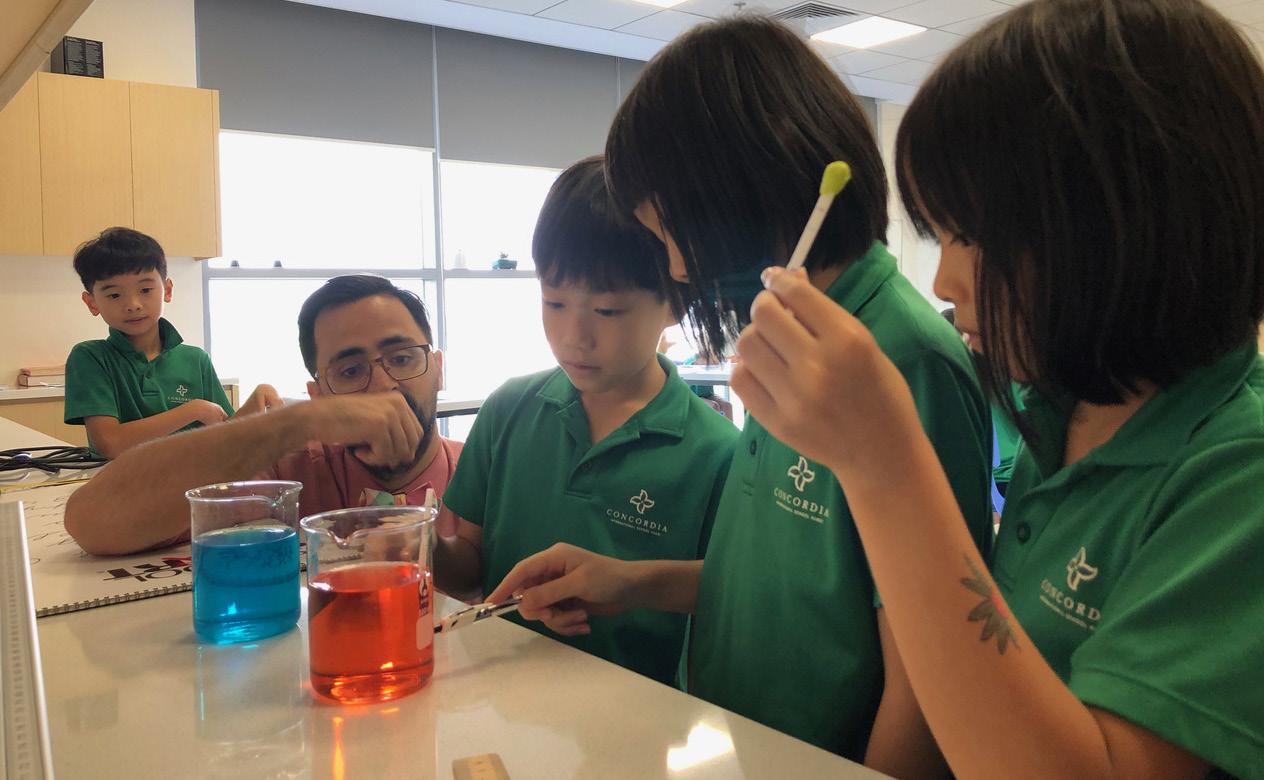
Winter 2023 Issue 49
Formative data and ongoing student goal support for wellbeing
By Michelle Liu Shen Wai International School
Introduction
Sustainability and wellbeing are no longer tokenistic with an increasing mission-led school wide approaches (Fraser & Cook, 2021). An IB wellbeing policy research report (Balica, 2021) highlighted Seligman’s (2011) wellbeing model PERMA featuring “feeling good and functioning well”, and states that “wellbeing encompasses a set of skills that can be intentionally and explicitly cultivated and developed through education and with appropriate support” (p.7).
A range of approaches examine student wellbeing from different perspectives. The program for International Student Assessment (PISA) measured children’s wellbeing alongside their academic outcomes in 2015 (Cambridge Assessment International Education, 2022). Some schools organize summative wellbeing assessment at year end, using external or school-based tools, to evaluate school practice impact. A couple of scales and applications are available online, i.e. Flourishing at School and ACER Social-Emotional Wellbeing Survey.
Understanding how student individuals feel in their school lives is important.Taylor et al. (2022) caution based on their research that it is crucial to consider student subjective wellbeing since it can be different from adult’s view. Its key areas are life satisfaction, experience and feelings, purpose and meaning. They proclaim that “there is a place for both whole-school approaches and targeted interventions”; and “family interactions are very impactful on children wellbeing” (p.2). “Focus on subjective wellbeing as the practical, measurable approach that gives the school an opportunity to make a difference in the lives of young people” (p.4).
Context
School work related anxiety and sense of achievement appear to constantly affect student wellbeing. They can associate with self-management skills and motivation.
Result of a grade level survey about major reasons that drive students to do things (Figure 1) was discussed at our advisor team meeting in January 2022. We were then preparing for the upcoming advisory unit of Positive Achievement involving goal setting. In general, this data echoed our knowledge of this cohort and alerted a tendency of extrinsic motivation in students. Also addressing having meaningful goals at a low rate just yet, the team reflected and decided to inquire about ongoing goal support in the unit of work.
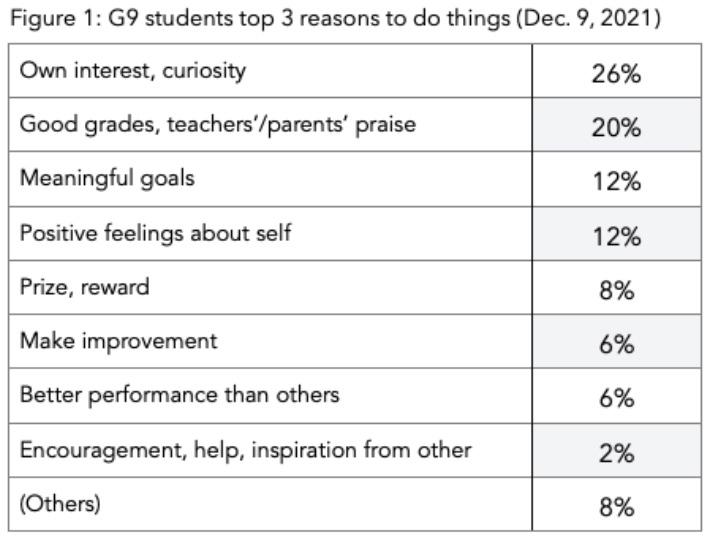
WELLBEING
50 EARCOS Triannual Journal
Focus question
How can the advisory goal practice enhance G9 students’ sense of achievement for wellbeing?
Design & Methods
The Positive Education Enhanced Curriculum (PEEC) adopted for the school advisory program and lessons anchors in the PERMA wellbeing mode (Seligman, 2011) that consists of five pillars: positive emotions, engagement, relationships, meaning and achievement.
Change Dynamics
Interactions were designed in three areas from late January to end of March in 2022: advisory unit learning, advisor and peer goal support, and family goal support (Figure 2-A). Students were expected to develop ideas, skills and practise learning in their goal effort so as to experience enhanced sense of achievement which was tracked during the process. Key learning engagement included performance and mastery goal orientations, goal setting, grit, goal strategy support, and progress and accomplishment review as well as sense of achievement measurement.
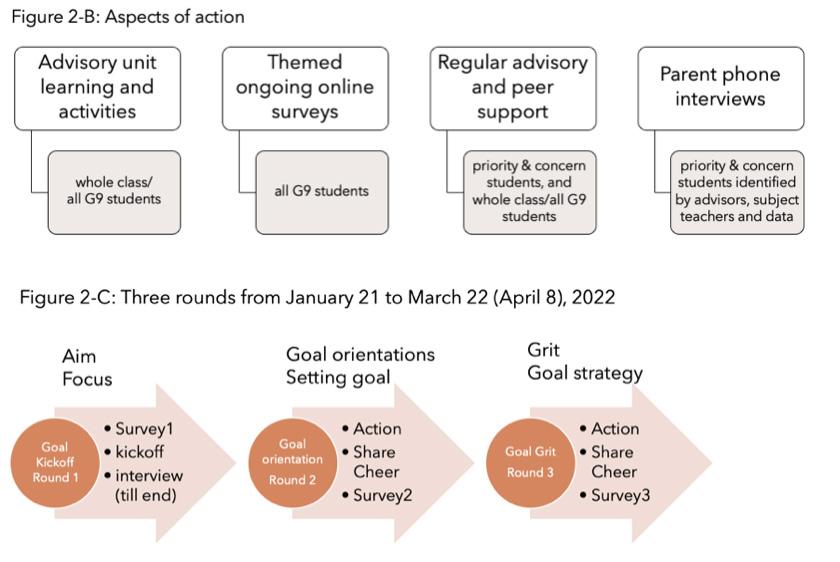
Inquiry Methods
“Wellbeing is an outcome of interactions among complex factors influenced by various contexts” (Balica, 2021, p.8). A combination of qualitative and quantitative study applied in data collection from surveys and in-depth interviews focusing on goal setting, support strategy and self-reported feelings.
Triangulation approach applied in examining other complementary student involvement and performance such as in peer and class work, whole grade activities and community presentations.
Action in three rounds
Results
Round I Aim & focus: goal & achievement
Fig. 2-A Change Dynamics
Three self-created online student surveys with Likert scale questions and open-end questions were issued for all 68 students to take. Survey 1 was an initial assessment to identify concern students who reported low sense of achievement and priority students who reported to have rarely experienced sense of achievement in recent months. Survey 2 and 3 were at the end of each round of action to track change and result. Development in tracked student individuals were monitored and discussed.
Semi-structured parent interviews were conducted via phone calls. The objective was to gain parent support and to influence goal strategy at home. All interviews covered topics including a) student wellbeing check in; b) parent’s view on goal setting; c) parent’s expectation or suggestions on child’s goals; and d) home support for goal achievement.
Figure 3-A: Survey 1 initial assessment result (n=48)
Figure 3-B: Survey 1 result
Top three perceived reasons why setting goals did not lead to accomplishment: 1) lack of self-motivation; 2) lack of feedback and support; and 3) lack of relevant strategy.
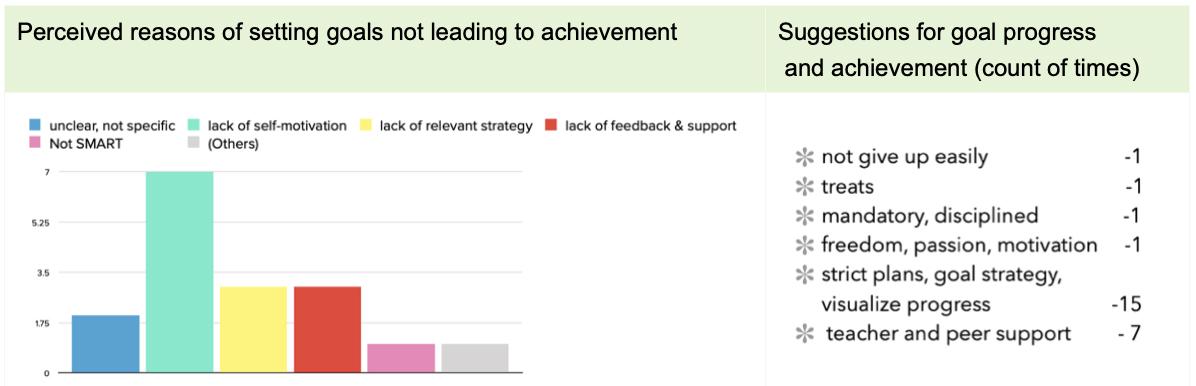
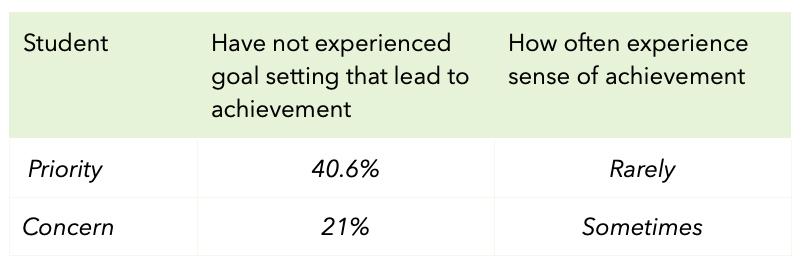
Sample student suggestions of approaches for monitoring and supporting goal achievement were: “make sure you desire the final outcome enough” -Student A “ask students to show their progress” -Student B “books on self-motivation” -Student C “break large goal into small step by step goals” -Student D “check in with students and talk to the students about their goals” -Student E
“supportive environment “- Student F
PEEC Unit Positive Achievement learning
Enhance & track student sense of achievement for wellbeing
Winter 2023 Issue 51
Advisor & peer goal support Family goal progress support
Have recently experienced sense of achievement 44% 31.3% 24.7%
Set goals of mastery orientation /ATL skills 60.9% 20% 19.1%
Figure 4: Survey 2 result (n=50)
Round III Grit, goal strategy & sense of achievement
Description High rate student
I accomplish things I consider important, experience sense of accomplishment 63.7%
I feel proud of myself, i.e. my work and effort, my character strengths and the ways I do things 51%
I am on the right track working towards my goals with some effective strategies 50%
I am satisfied with how I feel and function 36.3%
Rewards and recognition help me have stronger sense of achievement 59.9%
Figure 5: Survey 3 result (n=63)
Discussion
1.Understanding goal orientations strengthened meaning and purpose
As Round 1 finding suggested, a number of students had ideas about methods to help achieve goals. Those could be random or sporadic to some extent. During Round 2, some fantastic development occurred. Learning about performance and mastery goal orientationsestablished by Elliot & Dweck, and discussing difference and connection between the orientations raised students’ awareness of goal significance and deepened their critical thinking in own goal setting. Excitingly, this led students to analyze their goal orientations and strategies and consider the impact on own wellbeing.
“When I was talking about wanting to get more 7 points in subject grade this semester, my goal buddy asked me how I should develop what important skills and qualities to obtain the marks, and how it will affect my motivation and wellbeing,” one student shared. “My goal is to read more books I enjoy and feel connected to. … I want to be able to fully understand and connect to the contextual elements or historical standpoints for me to enjoy the reading. I choose this mastery goal because I want to discover literature myself”, another student posted.
Round II result revealed a rise in the number of students who reported setting meaningful goals, experiencing progress and positive feelings.
2. Parent communication positively related to improvements found in tracked students
Almost all parents responded well over phone calls, which took an average of 40 minutes each. The interviews corroborated what Cohen et al. (2000) posited that interview in research marks a move away from seeing human subjects as data as somehow external to individuals, and towards regarding knowledge as constructed between participants, often through conversations.
Majority of the parents interviewed acknowledged merits of setting and working for identified goals.
By communicating child’s character strengths, needs and goal support, the interviews fostered parents’ better understanding of our advisory unit objectives and practice, and encouraged more explicit home support for skill development and positive emotions. Consequently, we saw several cases of tracked students respond more actively and productively and they reported improved sense of achievement in Round III.
3. Ongoing goal support enhanced relationship and sense of achievement
Our advisory practice kept an emphasis on facilitating interactions to build a supportive community. Due to local pandemic case outbreak, an abrupt distance learning period interrupted as this unit began. This phase, potentially related with anxiety, loneliness, stress and lack of motivation and purpose, intensified our emphasis. Regular, ongoing goal support took various forms across the grade, i.e. goal self-portraits, goal buddy, knee-to-knee review, progress visual, “my grit motto”, journaling, photo story, Share & Cheer, assembly presentation, etc. Echoing Round III result of an increase in sense of achievement, students commented, “We felt connected and cared for”, and the goal support “was motivating and challenging”.
Implications
1. There is benefit to design and utilize context-based surveys for ongoing tracking and support
Student wellbeing can be measured with well-chosen tools which is consistent with how wellbeing is defined in school (Balica, 2021). Utilizing locally generated tools to inquire into the correlation between specific factors not only helped elicit formative data and meaningful information for us to better understand student wellbeing influencers, but also builds school data culture and facilitates change action. Survey 2 as well as Round II result provided us with timely and pertinent feedback, encouraging and informing our next round action. Survey 3 were tailor made incorporating recognized components of Accomplishment in PERMA, and reinforcing the curriculum and the unit objectives. Noticeably, taking the surveys stimulated student reflection and articulation of learning development in this particular unit environment.
2. Building essential skills improves sense of achievement and wellbeing
Schools should teach both the skills of wellbeing and the skills of achievement (Seligman et al. 2009). High-order dimension of wellbeing can be developed through a range of specific interventions helping students to develop skills. Over time, accumulation of these more concrete skills builds the high-order capacity, a core aspect
Round II Goal orientations & setting goals
Student Positive Neutral Negative
52 EARCOS Triannual Journal
of wellbeing” (Waters & Loton, 2019). Engaging with authentic student life scenarios and essential psychological needs, our practice ensured to explicitly connect with and address ATL skills, i.e. thinking, self-management and social skills, in other words, the development of critical thinking, socio-emotional skills, resilience and metacognitive abilities (Balica, 2021). Competence, autonomy and relatedness proposed in self-determination theory (Deci & Ryan, 2000) makes a guideline for motivation strategies.
3. Activate advisors’ contextual learning and practice
Besides consulting goal strategies with student individuals and groups, fostering goal related orientations, values and behaviors turned out to be the significant leverage in our work to strengthen student selfregulation. It is salient that advisors are supported to actively seek and practise approaches as personalized class and student support. Our case saw some diversity, such as delving in learning theoretical knowledge for deeper reflection and new habits; creating healthy social environment for students to adjust cognition by searching, responding and evaluating; regular review feelings and accomplishments with creative visuals and presentations, etc. These become our toolbox inviting continuous learning and sharing while advisors’ student knowledge and capacity keep growing.
Conclusion
Setting goals is a key component of a well-functioning life. Enhancing student’s sense of achievement for wellbeing through supporting their goal progress has worked in our case. Formative data is instrumental, building skills and relationship are indispensable. Areas for growth can lie in: diverse formative approaches and tools to measure and track wellbeing; documenting individual student’s wellbeing data and key evidence as a collective practice; and synthesizing formative and summative wellbeing data to map wellbeing influencers in the community to inform school strategic plans.
References
Balica, M.(2021). What is well-being? International Baccalaureate. https://ibo.org/research/policy- research/what-is-well-being/
Cambridge Assessment International Education. (2021) Education brief: Learner wellbeing. https://www.cambridgeinternational.org/ Images/612684-learner-wellbeing.pdf
Cohen, L., Manion, L., & Morrison, K. (2000). Research Methods in Education (5th ed.). Routledge. https://doi. org/10.4324/9780203224342
Deci, E., L., & Ryan, R., M. (2000). The “what” and “why” of goal pursuits: Human needs and the self- determination of behavior. Psychological Inquiry, 11(4), 227–268.
Fraser & Cook, (2021, July, 5). Top 10 shifts happening within the international schools market. [Video]. ISC research. https://www.youtube. com/watch?v=lSzqhfNYvGE
Seligman, M.(2011). Flourish: A visionary new understanding of happiness and well-being. New York, NY, USA: Free Press.
Taylor, L., De Neve, J., DeBorst, L., & Khanna, D. (2022). Well-being in education in childhood and adolescence. International Baccalaureate Organization. https://ibo.org/research/policy-research/well- being-ineducation-in-childhood-and-adolescence-2022/
Waters, L., & Loton, D. (2019). SEARCH: A Meta-Framework and Review of the Field of Positive Education. International Journal of Applied Positive Psychology, 4(1-2), 1–46. https://doi.org/10.1007/ s41042-019-00017-4
About the Author
Michelle Liu has years of experience leading and facilitating secondary advisory curriculum implementation at grade levels. Advisory class can be a most joyful time in a school day and benefits all. Other involvements include teaching English and I&S, coordinating community engagement and supporting student affairs. Wellbeing and curriculum, school culture and change are among her interests. She can be contacted at michelleliu.class@gmail.com.
American International School of Guangzhou Director of Admissions Appointment - Bojana Borović Džogazović
We are pleased to announce that Bojana Borović Džogazović has been appointed to assume the role of Director of Admissions at AISG in July 2023. Bojana has over 15 years of experience in an international school environment and is a long-serving professional in the field of international education, admissions, communications and marketing.
American International School of Guangzhou Secondary Principal Appointment - Craig Monaghan
We are pleased to announce that Mr. Craig Monaghan has been appointed to assume the role of Secondary Principal at AISG in July 2023. Craig has over 32 years in education with 16 of those years as Principal/Head of School/Executive Principal in his home country of New Zealand and in international schools in Germany, Egypt, Portugal and China.
Winter 2023 Issue 53
PRESS RELEASE
Inspire Citizens: Whole School Models for Global Citizenship Transformation
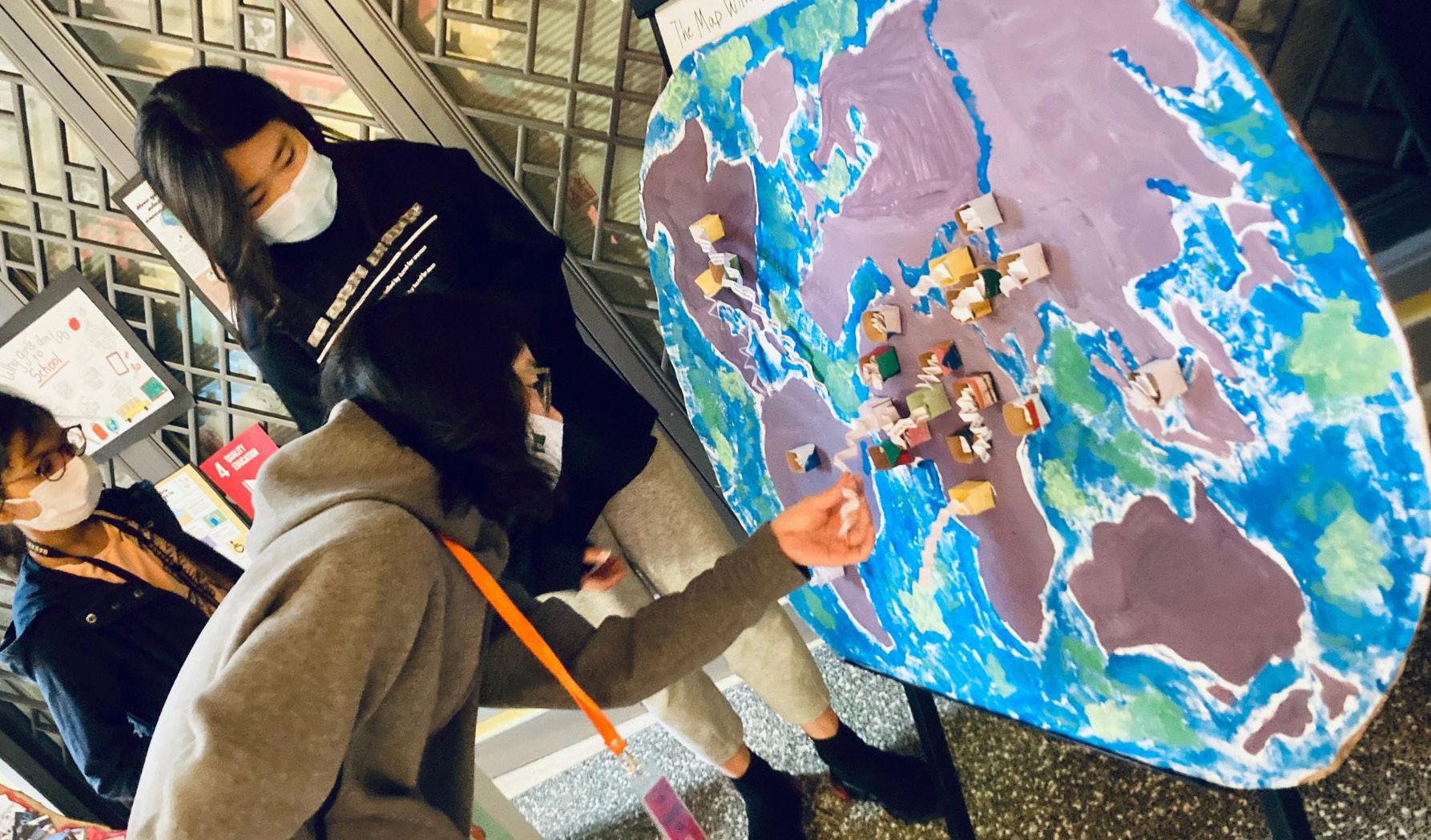
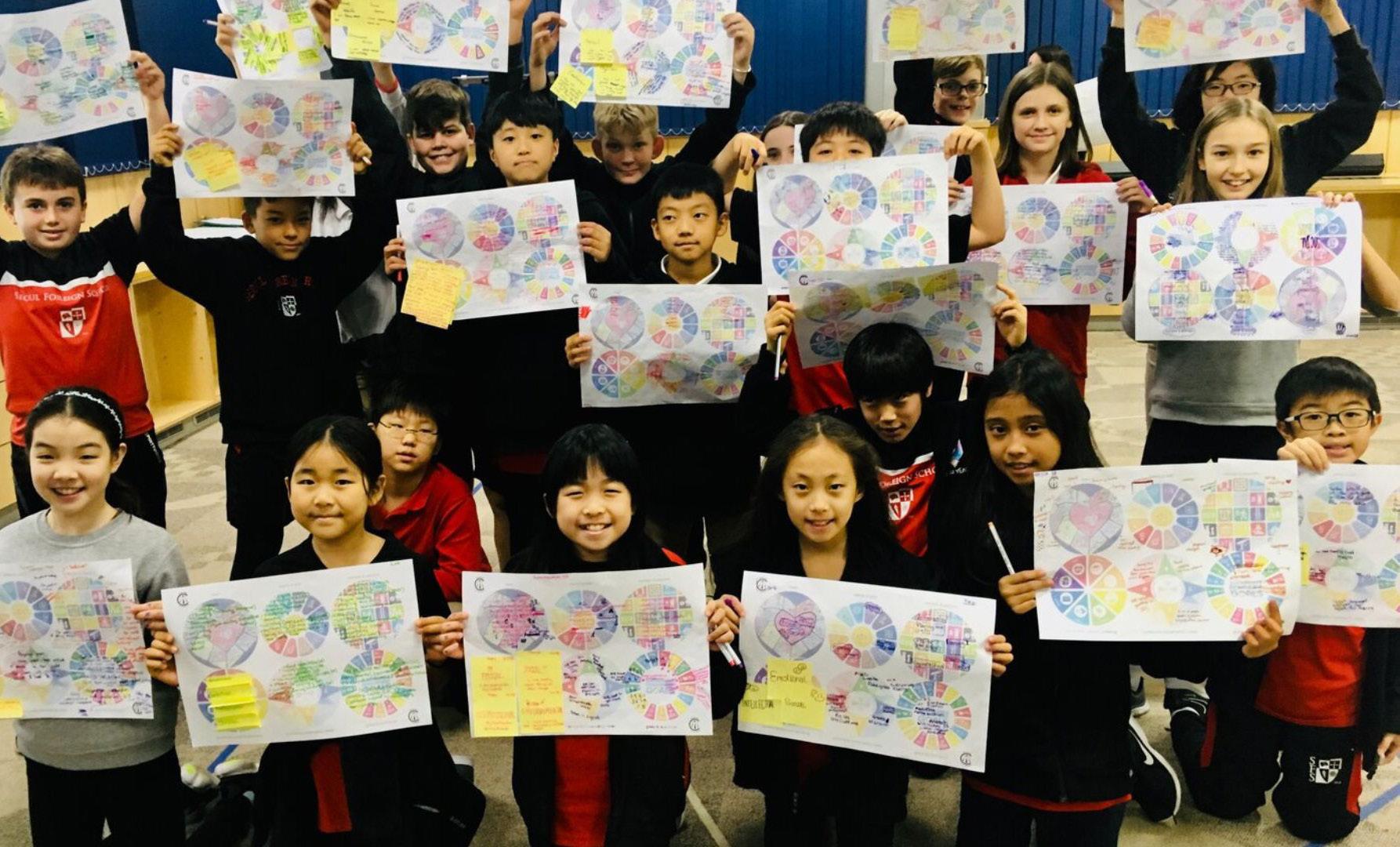 By LeeAnne Lavender Storytelling & Service Learning Coach & Facilitator
If you look at your school’s mission and vision statements, do you see anything connected to global citizenship, global competencies and/or service?
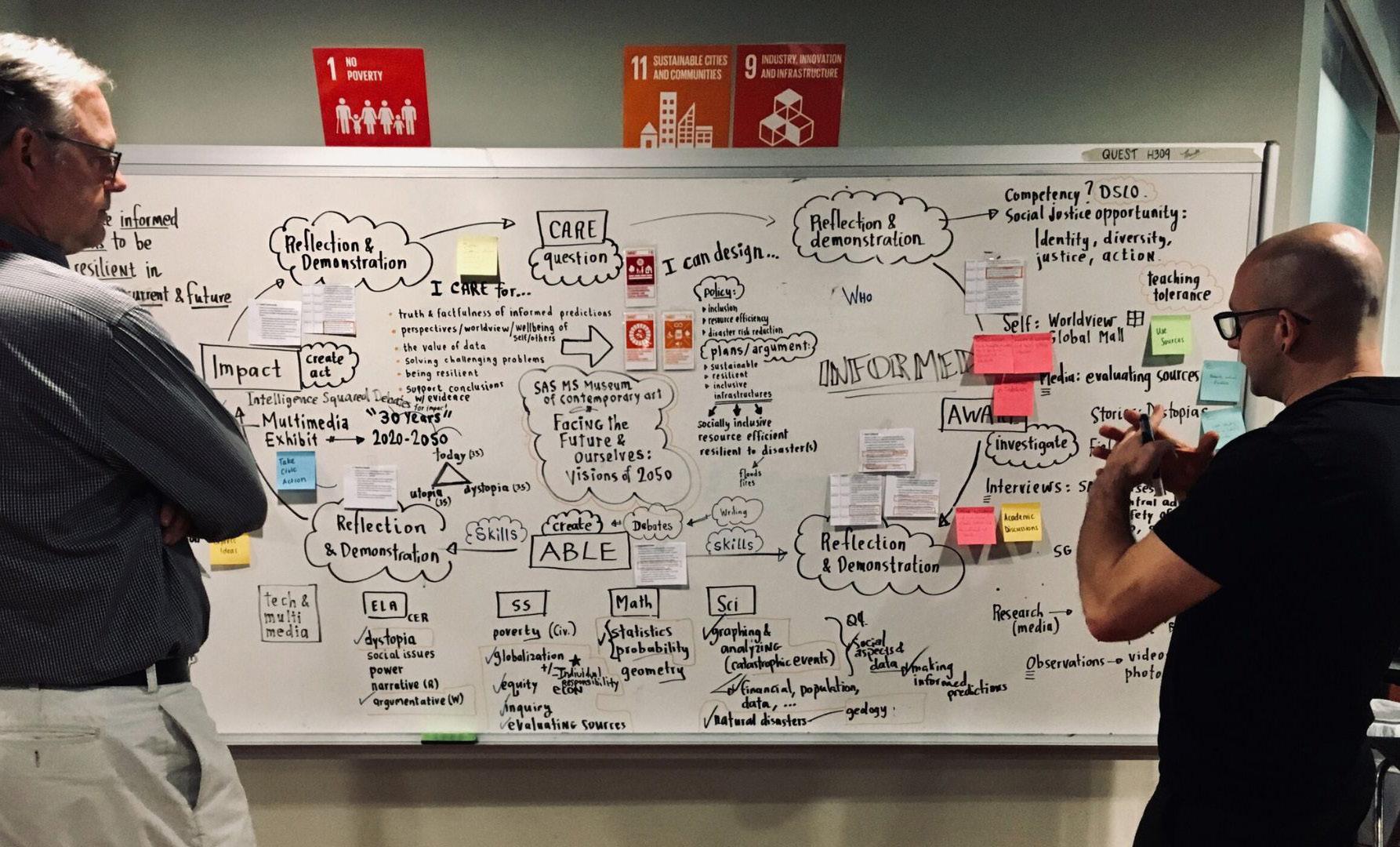
Most international schools will include something about these principles in their guiding statements. Why? Because we all care about teaching in a way that is relevant, meaningful and impactful today and for the future. We want our students to understand the complex world around them, and to be equipped to act in sustainable and equitable ways.
If your mission and vision statements include these concepts, that is a good start. The question then becomes: how do we approach global citizenship to achieve these ends and to make the mission and vision come to life for all students on our campuses?
This process, the “how” of global citizenship, is the passion that fuels the work of Inspire Citizens founders Steve Sostak and Aaron Moniz.
“We want to help teachers in a tangible, meaningful way,” says Aaron. “Our work is built around the vision of helping teachers equip students to be the kinds of global citizens the world needs, and to support educators in the process of transforming what they teach and how they teach it.”
For the last five years, Steve and Aaron have been partnering with educators around the world to transform curriculum using their simple and effective “Empathy to Impact” model. As a result, thousands of students have been able to transfer curricular knowledge and skills to real-world contexts and community settings, and hundreds of teachers have transformed their approach to teaching and learning through the lens of holistic global citizenship.
“Holistic global citizenship, in the end, has to be about transformative learning,” says Steve. “We have created a model for this that is like our learner profile (graphic below), and this has become a road map for articulating global citizenship. This is key at the whole-school level as we help teams articulate their vision for global citizenship, and then as we help educators approach and design learning experiences to reach the objectives and goals on that map.”
The Inspire Citizens team is releasing a new and updated whole school approach this year, and it will include four phases to empower transformation across all levels of teaching and learning.
SERVICE LEARNING
54 EARCOS Triannual Journal
“For educators as well as students, what does it mean to be engaged, to learn and live mindfully, to use heartfulness to build learning experiences with embedded compassion and action?” Steve reflects. “This is what we stand for with schools; it’s what is at the heart of what we do, and it gives us a through-line to bring divergent initiatives together in a cohesive way.”
For many schools, managing multiple priorities (such as literacy, curriculum design, assessment practices, wellness and well-being, service learning, community-building and more) can lead to exhaustion and confusion. Teachers can feel pulled in several directions at once and it can be difficult to see what is most important.
Aaron and Steve help school leaders and teams slide everything into a connected whole using holistic global citizenship as an anchor.
“This leads to more deep work being done in a short time,” explains Aaron. “We consider the personalized implications for each school and, when you can give people what they actually need and build a system of support, this leads to successful implementation. It’s pretty amazing to watch this happen.”
Nick Glab, School Director at the Colegio Jorge Washington (COJOWA) in Cartagena, Colombia, is involved in a K-12 partnership with Inspire Citizens, and his comments reflect the deep work of Steve, Aaron and the Inspire Citizens team.
“I really want our students to develop a true sense of social responsibility,” says Nick, adding that COJOWA has developed a new strategic plan rooted in this idea. “Our partnership with Inspire Citizens is powerful because they are transforming our curriculum and getting teachers excited about the process. My dream is that our entire community has [this] mindset shift and believes that creating social impact is a responsibility for all of us.”
You can see many examples of the type of work that Aaron, Steve and the Inspire Citizens team does on the Vignettes page of their website. Each vignette tells a story of a school, team or teacher impacted by the transformative energy and skill of the Inspire Citizens team.
“On our home page we explain nine paths to engaged global citizenship,” says Aaron. “We’re interested in culture shifts to make engaged global citizenship the core of educational experiences. There’s how the inner side of things is driven by questions like ‘who are we as sustainable people in our inner thoughts and systems?’ and then there’s the outer realm in terms of how we engage and act with and in the world.”
Do these ideas and concepts resonate with you? Do you find yourself nodding to any of these questions:
• Is global citizenship in your mission at your school? If so, what is your implementation plan?
• How do you know that you’re creating the type of global citizens that your mission and vision statements indicate?
• How are you empowering all community stakeholders consistently over time?
• Which capacity-building measures do you have in place?
• How is your global citizenship implementation being informed by data and action research?
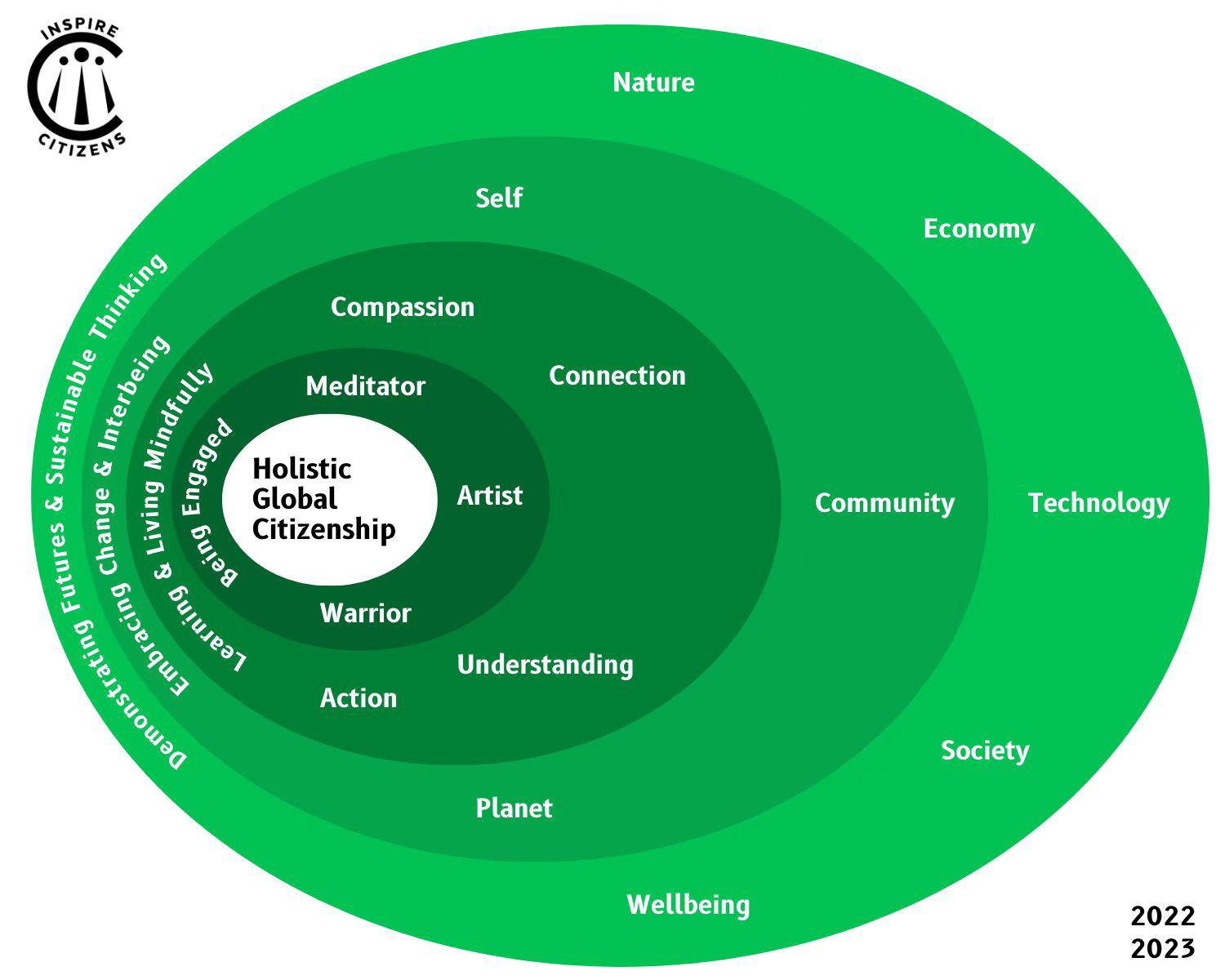
If you find yourself nodding yes and feeling like you want to do more for your students and the world in this space, Inspire Citizens has many resources and learning opportunities to help you on your journey.
This is a global calling and it is our responsibility as a union of schools to try and implement, share practices, and come together for the betterment of self, community, and the planet. You can learn more about Inspire Citizens here and reach out to any members of the Inspire Citizens team to grow your practice.
About the Author
LeeAnne Lavender is a Storytelling & Service Learning Coach & Facilitator. She can be contacted at leeanne@leeannelavender.com
 Inspire Citizens now partners with 30-40 schools worldwide, from Prague and Frankfurt to Cartagena, New Delhi, Shanghai and Beijing. Their network of impact truly stretches around the globe, with projects on all continents.
Winter 2023 Issue 55
Christian Academy in Japan
By Christine Iijima
At Christian Academy in Japan, on the western edge of Tokyo, we continually seek out ways to make learning real and practical for students. For students, this might potentially be called “fun”. Even during the pandemic when we could not do as much off-campus, our elementary teachers put their creativity to the test and tried new ideas that would connect young learners to the middle and high school students and staff.
While I was still teaching fifth grade three years ago, I observed our kindergarteners passing out hearts with phrases like “I love you” and “You are awesome”. They walked down the hallway led by their teacher, Mrs. Turner, and randomly handed out paper hearts to the “big kids”-middle and high schoolers, the ladies in the office, the three principals and head of school, two cleaning ladies, and a teacher-mom of one of the students. Each time, the receiver couldn’t help but feel the love and instantly shone with smiles and words of gratitude. The five and six year olds looked like they were bursting with pride. Through this small act of kindness, young students found purpose in preparing this simple paper card, writing newly practiced words, loving on their older schoolmates and staff, and practicing their writing skills. It was heartwarming to observe and much needed when they continued the tradition during the pandemic years.
Our elementary school financially supports two children with Compassion International, one from Indonesia and the other from Kenya. Throughout the year, different classes take time to construct a short letter to each child and send encouragement, as well as share a little about life in Japan. In third grade, students chose to raise funds by selling Candy Grams at Christmastime. The teacher arranged a Google Form which was shared with the entire school community. Interested persons could choose who to send a candy to (a candy cane or something similar), then third graders attached a “to and from” tag, and finally, delivered them to students and staff around the school. What a wonderful way to use math skills to calculate how many candies to prepare and the cost of the items, as well as the planning required to make and attach the tags, find out where each recipient was in the school with the academic office personnel, then coordinate delivery times. The candies were selling for ¥50 or 35 cents so you can imagine how popular this has been! Don’t tell my daughter that she gets one too...
A few years ago, our principal, Jean Hino, was finding that a number of fifth grade students were struggling to model good behaviors to our younger students who looked up to them. So she began to meet with the fourth grade students in the spring semester for lunch in
their classroom or on the nearby patio. While eating, she talked with them about what responsibility meant and looked like and how other students naturally look up to “the big kids”. She and the counselor, Junko Takahashi, met with them several times, discussing ways to lead and model behaviors. Then when they became fifth graders, they had already been prepared for their leadership role.
This soon followed up with a collaborative effort with the PE teacher, Jared Johnson, and fifth grade teacher, Ranaye Prevatt as they paired a math unit on data collection with a jump rope test with each grade. Our school desired to create flexible learning experiences and these two teachers planned a year long event. In its first year, the fifth graders were paired up with a child or two in each grade (we have one class per grade) and counted jumps during jump rope tests once a month. This year they opted to count four times in a year instead, about once a quarter. As the kindergarten teacher this year, I have enjoyed seeing the immediate bond between the little ones and their “buddy” in fifth grade. “That’s my buddy!” is a common declaration as fifth graders walk by our window. Because the fifth graders have taken time to count for their younger schoolmates, the kindergarteners feel so proud to know them. As the fifth graders have taken this data to record and graph, they are developing real-life data collection skills and modeling responsibility in relationships. They also check in with their young buddies at recess and in passing during a school day. Math skills and social emotional learning are building in one fell swoop.
In second grade, during their healthy eating unit, they collaborated with the school chef, Hayden of Cesar’s Kitchen, to create a healthy lunch menu for a week in December. Through this, they wanted to encourage others to “eat the rainbow” at school. Then the students created videos to introduce the daily menu and plan to play them for the elementary, middle, and high school lunch periods.
There are other stories to be told, fourth graders researching, reporting, collecting or creating articles representing their interests and passions, and then setting up displays in the atrium of the middle and high school building and presenting to anyone passing by in an hour’s time. Before the Covid pandemic, kindergarten, first and second grade built a relationship with an old folks home within walking distance of the school. Each Christmas, the students practiced their singing voices, made small crafts to give to the grandpas and grandmas, and sang Christmas carols for them as an encouragement to these sweet Japanese elderly.
In each of these experiences, the giving students learned the benefits of sharing a bit of kindness to others as well as building confidence connecting back to academics of math, language, singing or planning skills. The recipients also benefit from the community connections to the different student groups. This is just a taste of some of the creativity happening at our school as there are many other learning experiences led by students and teachers in the middle and high school divisions as well.
About the Author
Christine Iijima has taught at Christian Academy in Japan since 2013. She is currently participating in the Research and Development team. Recently, she received a Masters in Education from Augustana University. She is married to Steve and has two daughters, Grace and Sofia, has two portable dogs, Button and Kiki, and has lived in Japan for 20 years.

SERVICE LEARNING
56 EARCOS Triannual Journal
SERVICE LEARNING Building a Bridge Across Borderlands
By Dianne Gamage, Service-Learning mentor NIST International School
View From the Borderline
In an international school classroom in central Bangkok, 20 teenagers watched a documentary film, transfixed and slightly unnerved, as they followed 26 Burmese teenagers in a makeshift jungle classroom.
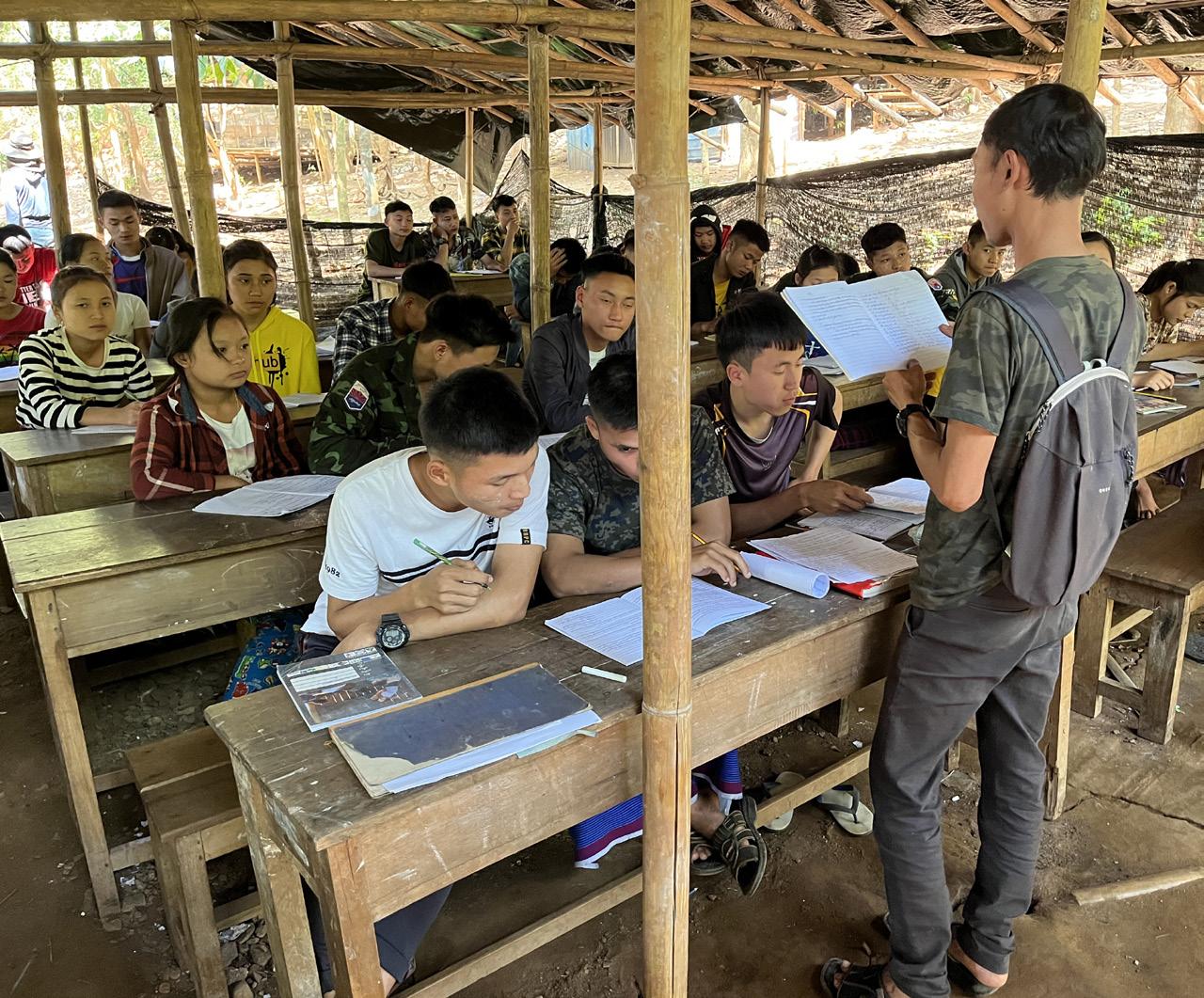
Although the same age, these young people were separated by more than 800 kilometres and the politics of geography and chance.
The film director is shortening that distance, if only metaphysically, by explaining to the group how she developed her project before asking them for their help.
“These kids are just like you, hoping that through education they will achieve their hopes and dreams,” she tells them.
The students in this Bangkok classroom were not new to refugee issues or the plight of villagers often shelled by military attacks in the ethnic states of neighbouring Myanmar. But, in their Bangkok school, the urban teenagers had formed themselves into the Phu Li Phay service group as part of the NIST’s International Baccalaureate service learning programme.
Before the Covid-19 pandemic hit Thailand, the students would typically collect and deliver donations of dried food to refugees, including those held in Bangkok’s Immigration Detention Centre.
Even when you are far away from a place you cannot go to, it means a lot to the people there to know they are seen. Not just literally seen but also in your heart. It acknowledges that they are there, and it bridges the distance between all of you.
Jeanne Hallacy on student agency
But in this chance close-up encounter, the lives and possibly even the life trajectories on both sides seem influenced in new directions. So it is education at its fullest intent.
Preparing for the Border Crossing
One month later, the students invited award-winning director Jeanne Hallacy to Zoom into their meeting. She is travelling back from the Thai-Myanmar border and is eager to follow up on the previous discussion on her recent film, “Rain of Shadows”, with the same Bangkok students. Her short film highlighted the resilience of the Burmese students in the jungle school. They were driven out of their villages and schools amid aerial bombardments by the Myanmar military, intent on smashing ethnic opposition to the authoritarian government. They are now run by military officers who seized power in a coup in early 2021.
Award-winning film producer Jeanne Hallacy captured on Zoom.
Students studying in the Jungle school classroom,
Winter 2023 Issue 57
Photo courtesy of Kirana Productions
Jeanne suggests that the students could create a short video greeting using WhatsApp for their counterparts in the jungle school. She asks the students to use their privilege and, through this project, bring awareness to their community about the escalating refugee situation. Her parting words echo through the room: “Let them know that someone outside sees them, not just literally but seeing them. Also, you could send a message of encouragement to let them know you share the same hopes and dreams.”
Moved by the film, by Hallacy’s infectious passion and a budding but undefined sense of philanthropy, her call to action triggers brainstorming about other ideas – and eager discussions about ways to align their desire to help with their abilities or interests. Following the service learning programme at NIST, prepare to map a learning journey they will navigate with the Jungle School, the storyteller, and connecting to the UN Sustainable Development Goals as a global community. The outcome will be a service project that inspired and worked for them.
Bridging Differences Across Borderlands
The students settled on creating video vignettes based on important issues related to the refugee situation: displacement, advocacy, human rights and challenges. This decision closely aligned with the aim of the service programme in providing authentic opportunities for students to act as global citizens by showing awareness and advocacy on issues related to social justice. As planning sessions moved beyond the students to encompass volunteer professionals, the service group became the key to telling this bigger story. Through their vignettes, the students hoped they could bring awareness and support back to that small school in the jungle and the ongoing refugee crisis. As the discussion in that earlier session drew closer, all eyes turned to Hallacy on the big screen. In turn, she was excited watching the adrenaline in the room and moved to share more ideas.
Borderland Mentors
Hallacy, whose professional and personal world is full of journalists and storytellers, moves with mental agility and encourages the students to pursue their ideas. She suggests collaborating with the students and local videographers to help them create their video vignettes. As advocacy is a core component of the Phu Li Phay mission, the students view the vignettes as an important resource for their service group to use in classrooms and within the service community. Not to be confined by corridors and classrooms, some students in the group are already planning a film launch to more directly support their counterparts in the Jungle School. Jeanne continues her car trip to the border as the students start the research journey that will give flight to their rising enthusiasm.
For the vignettes, each student becomes a roving investigator, interviewing journalists and humanitarian aid workers familiar with the situation in Myanmar. Their eyes opened to new directions with input from members of the foreign media and humanitarian aid workers who would potentially challenge their ideas and biases on important global issues related to the refugee situation.
Gwen Robinson, editor-at-large with Nikkei Asia Review, discussed a spectrum of issues faced by refugees during their journeys, including economic hardship, forced labour and vulnerability to traffickers.
However, it was her mention of the difficulties of refugees with disabilities that grabbed Aly, a student who had interviewed her for the project. He focused on those difficulties in his video and then made his research the subject of a keynote speech at the November 2022 ServICE conference in Bangkok. The annual event enables international school students like Aly to learn from each other and share innovative service projects.
During the following two months, the Bangkok students completed nine professional interviews across different time zones for their video series.
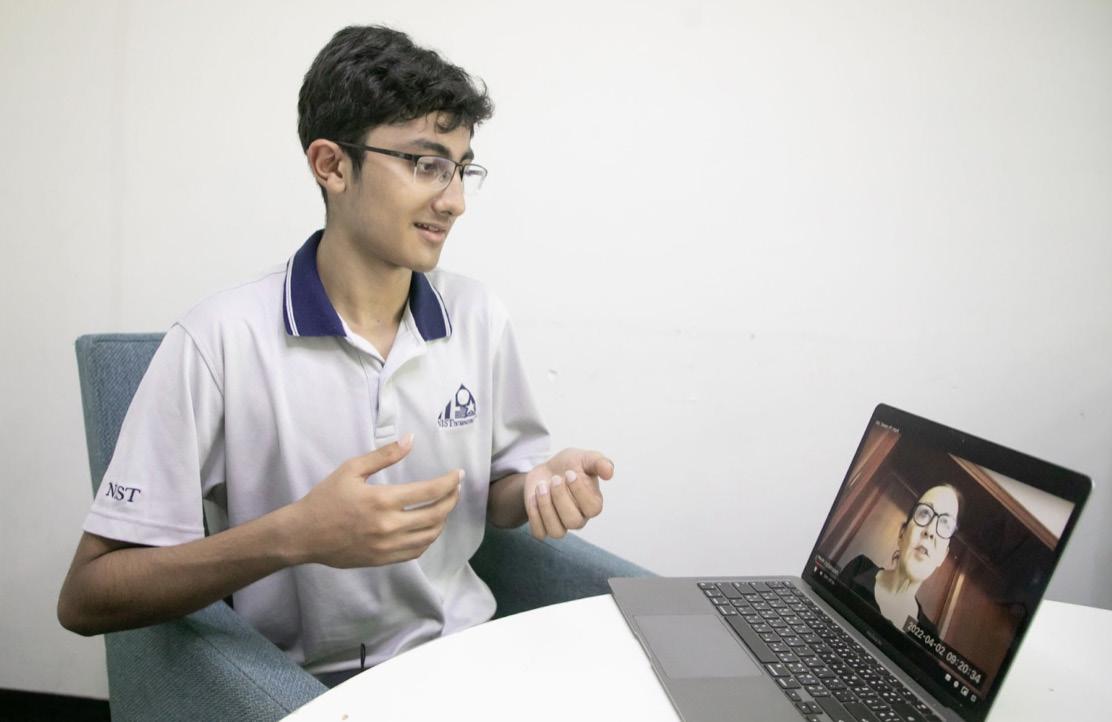
Professional producers and film technicians worked collaboratively and patiently with the students over Zoom to help them cut their nine hours of video into what they saw as “meaningful film clips.” At times, it was a delicate balance for students as they combined the demands of the International Baccalaureate course with enthusiasm for learning new skill sets in this service project.
The buzz during meetings was contagious as students discussed their roles in storyboard drafting, meeting editing timelines, finding extra film footage and afterschool voiceover recording sessions. Listening from afar, our production specialists gently and humorously shepherded the students into the discipline of actual content and how to shape awareness and advocacy on these vital issues creatively. In true production style, the students wanted to rework the musical soundtrack on all vignettes. Australian composer Deirdre Ditton, a former colleague of a teacher mentor, worked tirelessly with the students to produce thoughtful pieces authentic to the themes. In addition, the students completed their video vignettes inspired by the students in the Jungle School.
The Border Crossing
Impatience begins to permeate the meetings as these students, driven by hope, compassion, commitment and pride in their work, await an opportunity to bring closure to this project. But, importantly, they want to showcase their vignettes to the community in ways that remain true to the Phu Li Phay mission of drawing awareness and advocacy for refugees’ social challenges. Therefore, the students welcome visitors to the classrooms as they proudly weave their activities with narratives of the urban refugees living within the community. This vignette project will become a vital resource that will transfix and slightly unnerve students in their audiences, just like these students were before commencing this project eight months earlier.
This project was made possible for this group of committed students
58 EARCOS Triannual Journal
Aly, during a Zoom interview with Gwen Robinson, editor-at-large with Nikkei Asia Review.
through collaboration with various community stakeholders, including media and film professionals and humanitarian workers. All the professionals involved showed how much they value the role of education in raising awareness of social problems. In addition, several students stayed longer than their mandatory CAS commitment, injecting energy into the project and inspiring younger members with their role modelling of the agency within us. When empowered, it can lead to change.
Shoham, another student who worked on the videos, explains, “Even if we do not get to the level of commitment as Jeanne, we can still do something and positively impact others in our immediate society. I take that to heart and want to encourage other students in their role as global citizens to do the same. “
By late 2022, while students eagerly awaited their video launch, they voiced continuing commitment to strengthening connections and collaboration with the students in the jungle school. Looking back, it is clear that the ‘initial spark’ was the link between the shared hopes and dreams of the two very different groups of teenagers, catalysing a growing partnership beyond borders.
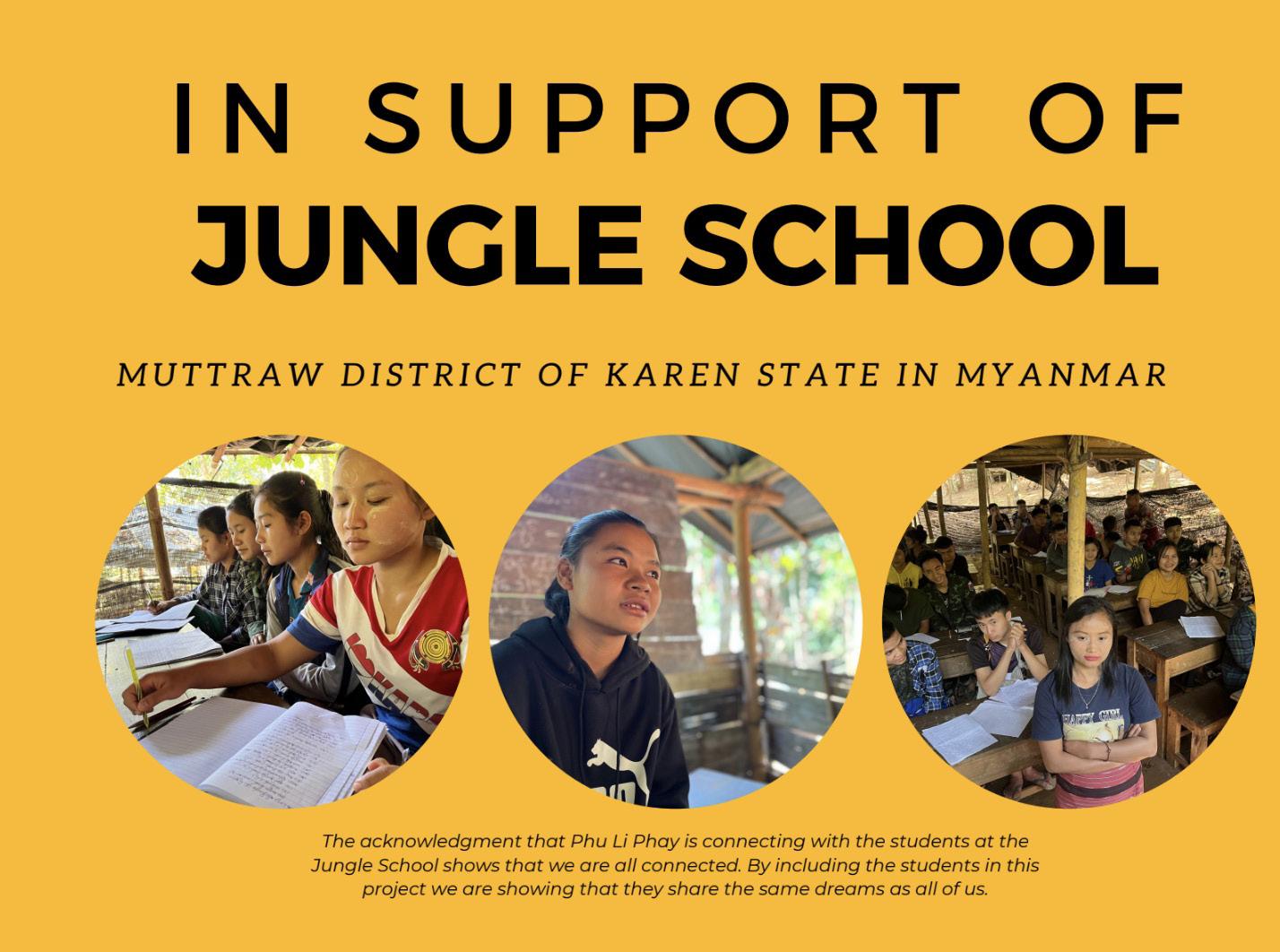
There is growing curiosity within the team about the hopes and dreams of these children confined inside Internal Displacement school camps spread along the Thai-Myanmar border.
So, another project was unfolding. Jeanne arrived in Bangkok to promote the “Art to Ease” Exhibition project--Opening Doors of Opportunities for Myanmar Children from Internally Displaced People (IDP) camps. A project that supported children to express their dreams, hopes and aspirations in the camps through artworks.
Another ‘spark’ went off in that inner city room as students brainstormed ways to connect and honor the children’s artworks and their hopes and dreams of living in a peaceful world. There have been many serendipity moments throughout this project, where conversations have led to meaningful connections. Again, the Phu Li Phay students became entwined in Jeanne’s network as their border journey continued for another few months.
A new humanitarian contract worker in the IDP camp shared the IDP children’s artwork with their stories. In addition, Lukas and Davis shared their ideas for designing and printing a collaborative calendar
that would support students at the jungle school and in the IDP camp.
The marketing team are working hard to promote their latest campaign. At the same time, sales have moved beyond expectation, much to the excitement of the production team. However, the symbolism of the partnership and the inspiration, commitment and skills-learning it generated go far beyond a simple desk calendar and video vignettes.
Karen people loves nature and forest. They would like to live in peaceful environment.
Artist Zion IDP camp
Photo courtesy of Don Tajaroensuk
Connections, collaboration and opportunities to show and grow in compassion have provided rich opportunities for the Phu Li Phay students in urban Bangkok, initially guided by an array of generous professionals.
The imprint of the connections grew visible as the student’s bridge crossed into borderlands that illuminated new experiences in service learning.
We can still have hope and compassion for a situation afar that may appear hopeless because we are not there to see it daily, but through our shared stories we can connect to the lives of our fellow humans in different situations to our own.
(above) Photos courtesy of Kirana Productions
(left) “As Salween peace park is symbolic for everlasting peace in Karen state, we love it, we value it” Artist Unknown, IDP camp.
Photo courtesy of Don Tajaroensuk
(right) Davis and Lukas proudly show off the Phu Li Phay 2023 calendar
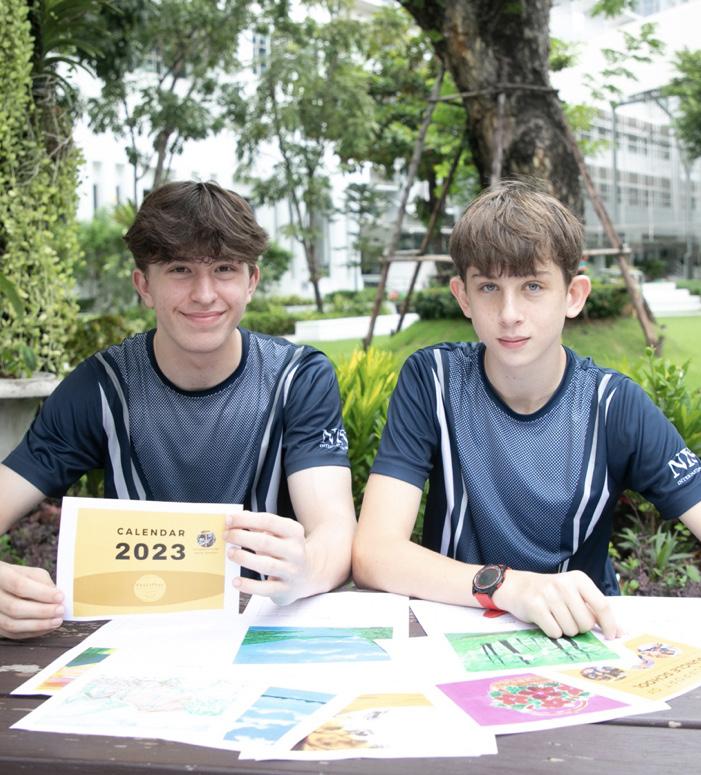
Winter 2023 Issue 59
Need Journals: A Tool For Seeding the Service Learning Cycle
 By Nate Samuelson Korea International School
A changemaker recognizes the issues and events happening around them and their interest is piqued. When they notice injustice or inequality, they ask themselves questions about how they might effect change. Oftentimes, they explore those questions with others; sometimes they continue to reflect on those moments alone; but every time, an aspiring global citizen should consider using a Need Journal.
Need Journal
Noun
1. A journal in which a person notes the date and records the needs that they notice in the world around them.
Usage
1. Need Journals are voice notes, stickies, a google document, or any other digital or physical space that a person maintains.

2. Need Journals are populated with recognitions of need as they happen, ongoing reflection, or any spontaneous thought the recorder has about how to effect change to meet a need.
The Need Journal is an integral first step for teachers and students to move from empathy (recognition of need) to ideation (seeds for projects) to action (making an impact).
The Service Learning Cycle/Process
Design Your Impact (DYI), an elective at Korea International School, is an inquiry-based course with the enduring understanding that one should be curious about, explore, and take action on the issues of our world. We explore issues under the umbrella of the United Nations Sustainable Development Goals framework (UN SDGs), most of which are student selected. Outside of class, students are asked to be curious about the issues they see day to day and take note in their Need Journal. This serves as a jumping off point to help verbalize and organize their thoughts, passions, and observations about the needs in the world around them.
SERVICE LEARNING
60 EARCOS Triannual Journal
Empathy is developed through this process, and students have more agency and ownership over the issues that they choose to investigate. The Need Journal seeds the research phase of the service learning cycle during which students dive deeper into the issues and decide which need they would like to try to impact through direct or indirect service, research, and/or advocacy. Here are some examples of this process.
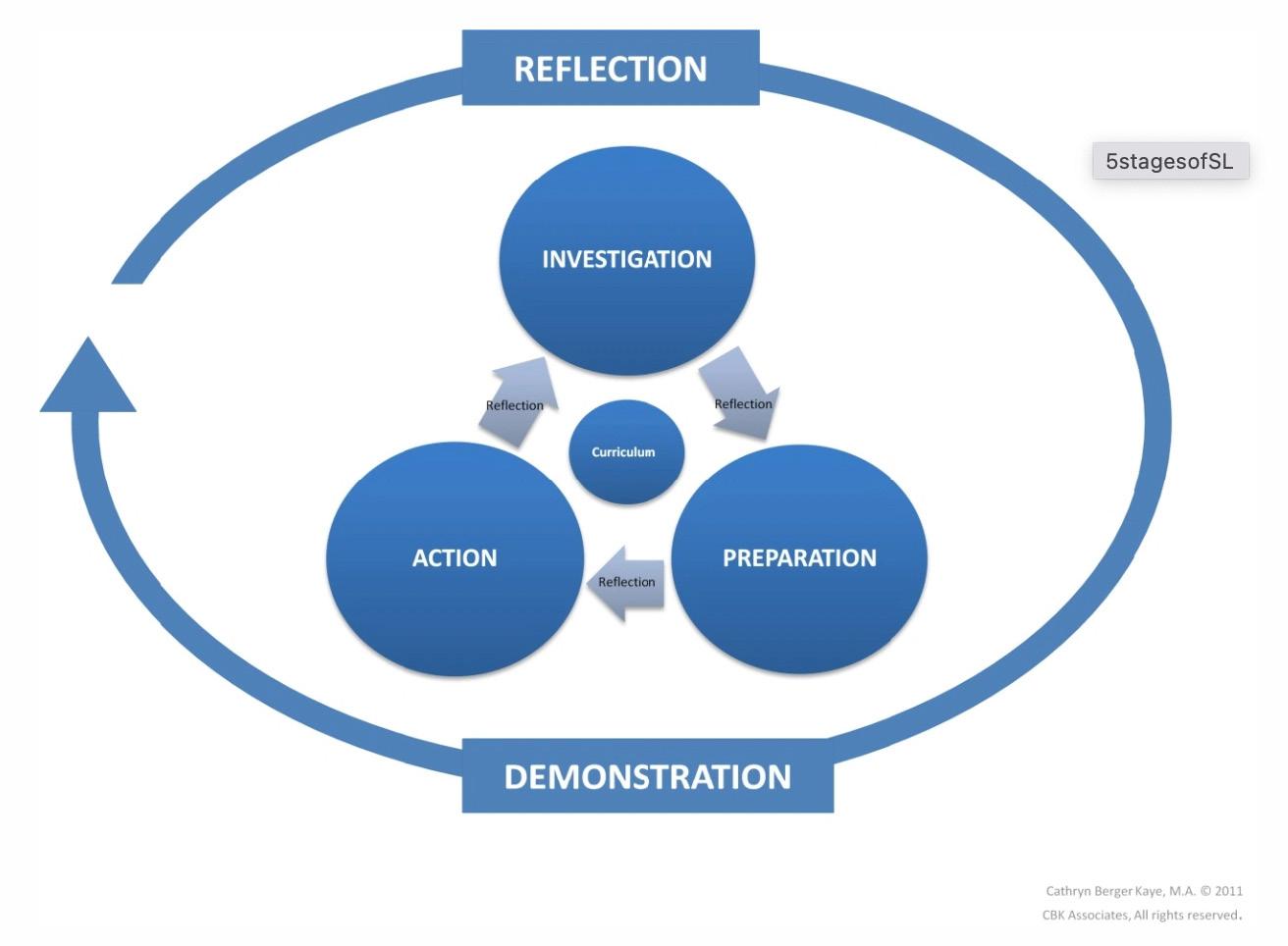
Need Journals in Service Learning
Project 1: A Lesson in Tech
Need To close the technology gap for seniors (65+) in Korea
Seed To build technology education for seniors (65+) in Korea Action Design and implement technology courses through local senior centers
This project started with a need that a student wrote down after having a conversation with her grandma about how to use her phone. Grandma wanted to connect with her granddaughter more regularly, but she could hardly turn on her phone let alone leverage the technological capacity of an app to connect with her granddaughter more effectively. The student noted a technology gap for seniors in Korea in her Need Journal, and after some thought and research, she realized she wanted to build technology courses for seniors.. The planning and preparation phase had her working alongside local senior centers to design 4 week technology courses for senior citizens in Korea which she will implement and refine over the summer of 2022.
Project 2: Recycling Everything That Comes With Delivery
Need To do something with all those ice packs from food delivery
Seed Provide information and options for the community to properly recycle ice packs Action Build a bilingual website with information about different types of ice packs, as well as where and how to properly recycle them
Two students noticed that, due to an increase in pandemic ordering, their freezers were full of ice packs. They recognized that something needed to be done with all of them. After researching, they found
that there were at least five or six different types of ice packs, and that not all of them could be disposed of or recycled in the same way. They made an informative video about the challenge of ice packs, designed a website with information about the different types, and even added a map that used location tracking to show the user their closest option for recycling ice packs. Their next step has been reaching out to companies to encourage them to use the most ecofriendly and easiest to recycle ice packs.
Project 3: FemSTEM
Need To increase the number of females in the STEM field Seed Create opportunities for young girls to see STEM content created or taught by females Action Partner with a female elementary school teacher to run a 10-week after school club doing science experiments with elementary school students.
One of our students noticed the imbalance of male and female students in the STEM classes at the high school level. She set out to create a program called FemSTEM that would help to increase the number of young girls who see females in the STEM field. Additionally, she is connecting with other schools in the area to introduce her ideas and program to help them develop a commitment to FemSTEM, further expanding her reach and impact.
Watching Seeds Grow
It is often forgotten that a huge impact often starts with something as small as a seed, a curiosity. Keeping a Need Journal doesn’t take much time, and, as is evidenced by the projects above, the return on investment can be very high. There are needs constantly present in the world, but if the recognition of them is never recorded, they become fleeting moments. Need Journals provide the opportunity to capture those fleeting moments to plant seeds that may grow into incredible impact.
About the Author
Nate Samuelson is currently the service and sustainability coordinator at Korea International School. He is committed to empowering students to explore their passions, take action, and connect with like-minded student leaders and changemakers.
Winter 2023 Issue 61
Grade 3 Service Trips: Developing “pitch-in” attitudes and an
appreciation for the natural world
By Tiffany Eaton UWC Thailand International School
As Grade 3 student Karate looked over the watering hole at the Phuket Elephant Sanctuary, she remarked, “I’ve learned a lot of things [from these weekly service trips] that I could not read in books. After all, books keep secrets and can’t tell the whole truth or experience that we have seen with our own eyes here.”
Each week, students learn more about their service project and support daily tasks such as making banana elephant balls, collecting greens, planting banana trees and cleaning.
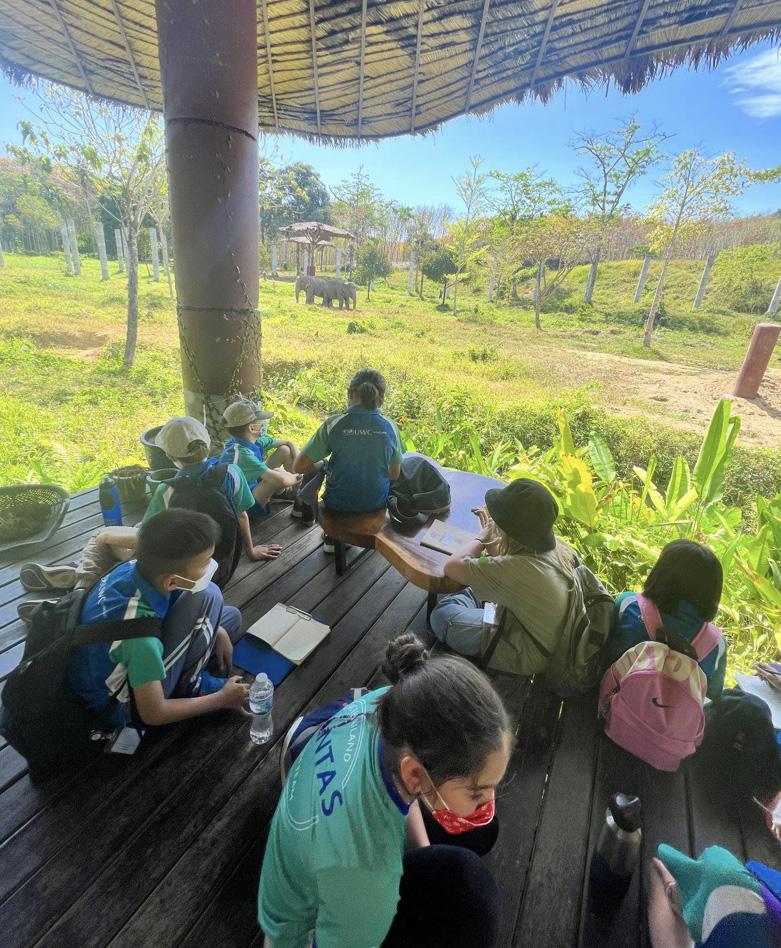
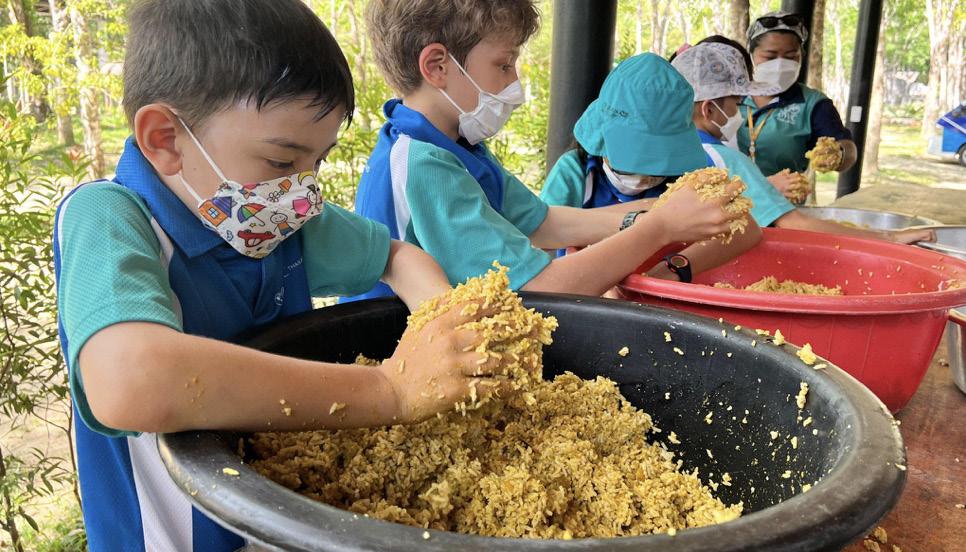
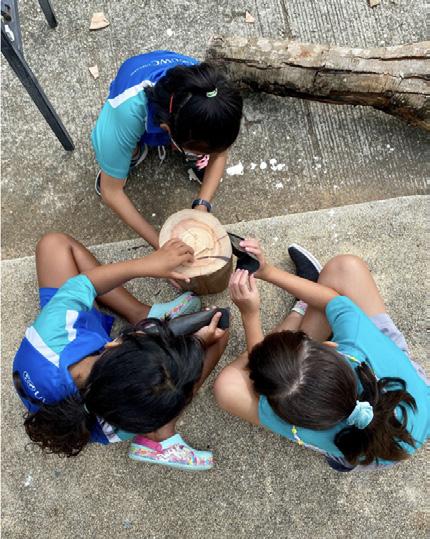

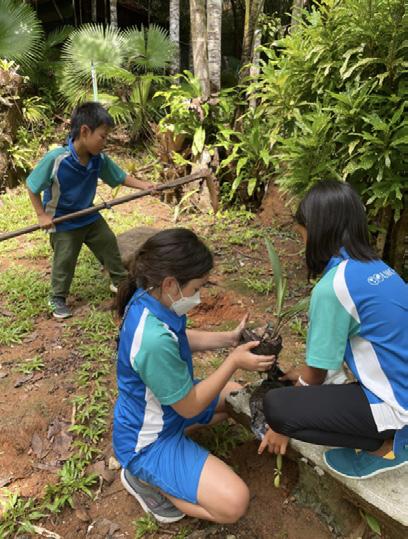
Over the past six weeks, Grade 3 students have been actively supporting two of our UWC Thailand service partners: the Gibbon Rehabilitation Project and the Phuket Elephant Sanctuary. Each week, students have been challenged with various physical tasks ranging from hiking in order to collect natural plants to feed the animals to planting banana trees, making rice balls, scrubbing and sweeping cages, removing trash from mangrove forests and even fertilizing the trees they planted with elephant dung! With the knowledge of primates from our PYP Coordinator, Jen Friske, and the support of John Lancett and the school Design and Technology team, students designed and hand-crafted enrichment items for the gibbons to encourage them to develop the foraging skills they will need to achieve the centre’s goal of successfully rehabilitating and releasing gibbons in families (Paddock, 2020) in nearby Khao Pra Theaw forest (adjacent to UWC Thailand).
After learning that gibbons need to rebuild their muscles and skills in order to be released into the wild, students create enrichment activities to go in the gibbon cages.
At times, the ‘work’ has been neither fun nor glamorous, but each trip has been the catalyst for growth; that is, growth in each child’s perseverance, growth in their “I can do it” attitudes and growth in our class’ teamwork. This growth and perseverance has directly transferred to the classroom, where students have begun to realize that “There is more in us than we know. If we can be made to see it,” words from UWC founder Kurt Hanh. Grade 3 students can take detailed notes, use multi-stepped problems to solve real-life situational math questions, consider perspectives outside their own, and take meaningful action to make a difference in our classroom, on our campus, and beyond.
Kurt Hanh wasn’t the only person who advocated for opportunities to develop self-discovery and mutual compassion. Numerous research studies, such as the Harvard Grant, the longest-running
SERVICE LEARNING
Grade 3 students engage in a Mindfulness practice focusing on awareness nearby the elephants
62 EARCOS Triannual Journal
longitudinal study in history (spanning 75 years from 1938 to present), have demonstrated that raising successful children is as simple as imparting unconditional love and developing a “pitch-in attitude” through regular chores from an early age (Weller, 2015). Through hard work, children start to realize that “I have to do the work of life in order to be part of life,” said Julie Lythcott-Haims, the former Dean of Freshmen at Stanford University (Weller, 2015).
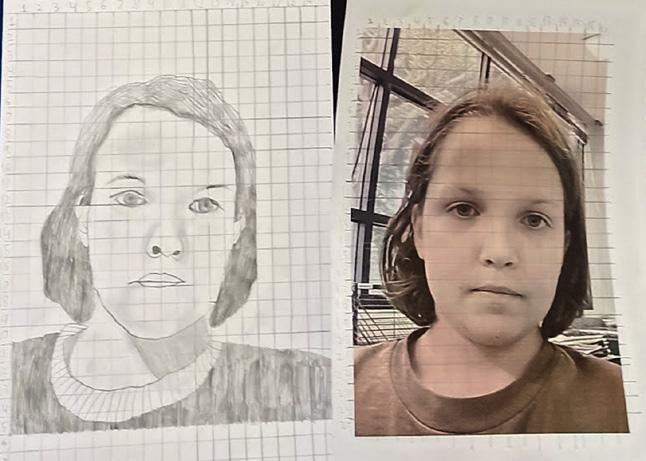
“I’ve been saving my pocket money to sponsor a gibbon,” Karate told me the other day. “I’ve worked out the finances if others want to pitch in,” she announced to the class. “Yeah, I used to think it would be super hard, and now I know it can be hard, but it gets easier as you keep doing it,” said Leo. “But now I know that if we all work together, it all adds up,” added Rajvir.
References
Dewar, G. (2021, May 8). Kids who feel connected with nature are happier -- and more likely to befriend, help, and share. PARENTING SCIENCE. Retrieved November 29, 2022, from https://parentingscience. com/kids-connected-with-nature/
Paddock, R. C. (2020, December 22). After bars and beaches, gibbons await a new home in Thailand. The New York Times. Retrieved November 29, 2022, from https://www.nytimes.com/2020/12/22/world/asia/ gibbons-thailand-forest.html
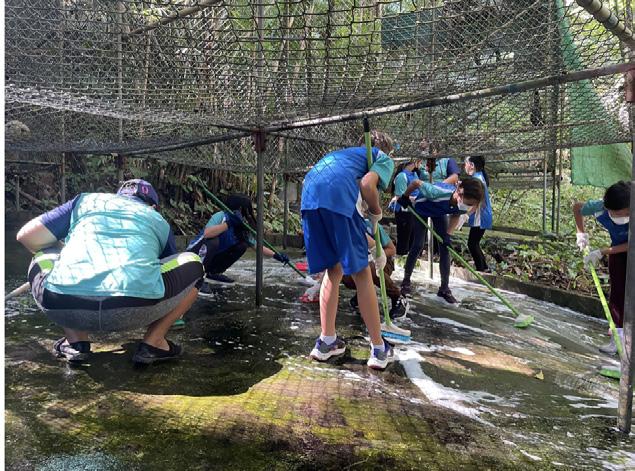
Sobel, D. (2019). About David Sobel. David Sobel. Retrieved November 29, 2022, from https://www.davidsobelauthor.com/about-david-sobel
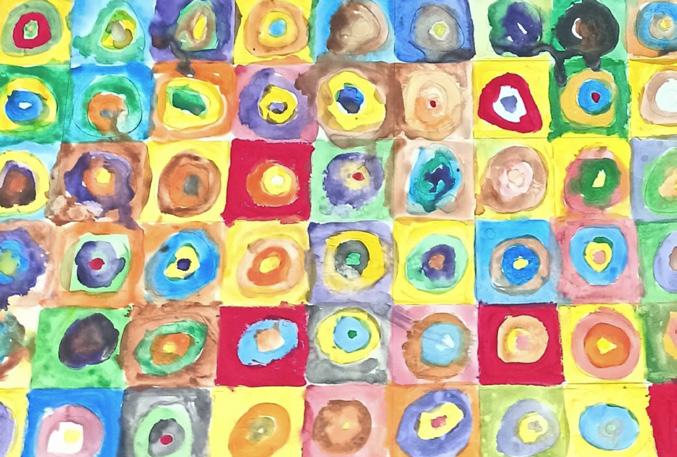
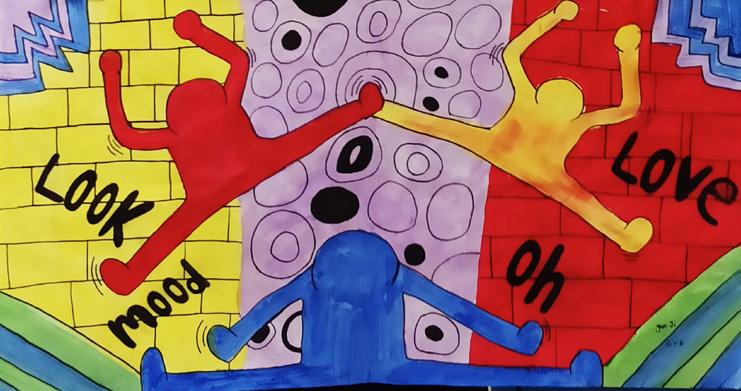
“If we want children to flourish, to be truly empowered, then let us allow them to love the earth before we ask them to save it,” states David Sobel (Sobel, 2019). Increasing research illuminates that access to nature and green space “...Provides children with a myriad cognitive, emotional, and physical benefits” (Faber Taylor & Kuo, 2006; Kellert, 2005, Lieberman & Hoody, 1998; Louv, 2007; Wells & Evans, 2003 in Strife & Downey, 2009). While developing an appreciation for the natural world is strengthened by regular service trips like these – they have worked in conjunction with other opportunities UWC Thailand students are afforded. Students are encouraged to explore our green campus daily and are regularly involved in rich Outdoor Education excursions and camps. Using the outdoors as our classroom is part of UWC Thailand’s larger, more strategic goals that sow the seeds to develop each learner’s understanding of concepts central to life, such as empathy, discovery, interdependence, perspective, challenge, balance and sustainability (Dewar, 2020). By facilitating opportunities for our students to test their natural sense of wonder, it is common for them to show an intrinsic desire to protect what they have come to love so deeply (University of British Columbia Okanagan campus, 2017).
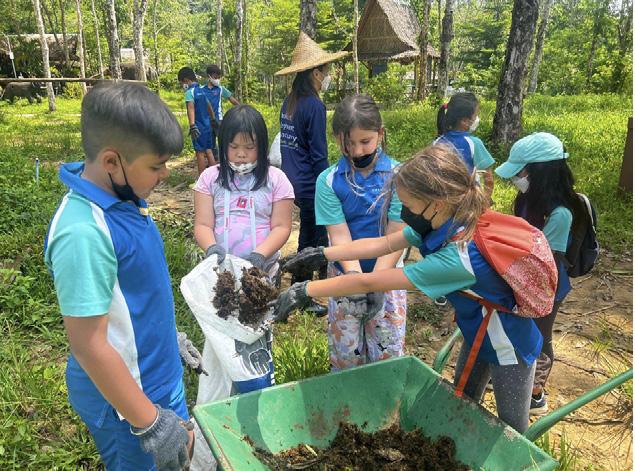
Watch video here
After all, what you believe, you value; what you value, you do.
Strife, S., & Downey, L. (2009). Childhood Development and Access to Nature: A New Direction for Environmental Inequality Research. Organization & environment, 22(1), 99–122. https://doi. org/10.1177/1086026609333340
University of British Columbia Okanagan campus. (2017, March 17). Children who play outside are more likely to protect nature as adults. ScienceDaily. Retrieved November 28, 2022 from www.sciencedaily. com/releases/2017/03/170317102447.htm
Weller, C. (n.d.). The single best thing parents can do to make sure their kids are successful. Business Insider. Retrieved November 29, 2022, from https://www.businessinsider.com/the-most-important-thing-forkids-to-be-successful-2015-11
About the Author
Tiffany Eaton is a Grade 3 teacher at UWC Thailand International School in Phuket where Service, Social & Emotional Learning, Academics, Outdoor Education and Sports & Activities are central pillars to the school’s learning. Tiffany holds a Master of Education from Queen’s University, Canada. She is also the UWCT Primary School Mathematics Coordinator and an IB-PYP Workshop Leader. Tiffany can be contacted at tiffany.eaton@uwcthailand.ac.th
(left) students work together to collect elephant dung to bring back to campus for our student-led gardens. (right) Working together, students and staff clean the gibbon cages with gibbon calls overhead.
Middle School Art Celebration “Graffiti Art” Da In Kim, Grade 6 >> click here for more art pieces “Realistic Portrait” Lucas Crowe, Grade 7 “Kandinsky’s Style Color Theory” SeungHu Jeong, Grade 6 Surabaya Intercultural School Winter 2023 Issue 63
Developing Partnerships: from Local to Global
By Jocelyne Pérut International School of Ulaanbaatar, Mongolia
I was appointed as Global Citizenship Coordinator at the International School of Ulaanbaatar two years ago. One of my aims was to connect with fellow professionals and my community.
I attended many professional development workshops to understand better the position and demands of the role (Teaching and Learning for a Sustainable World with Compass, Global Citizenship and Intercultural Learning workshop with CIS, Acamis Peer-Learning Network on Global Citizenship and Service Learning).
As a result, I decided to get more involved with my community (school managers, teachers, students, parents (Parent Teacher Group); Primary Action, Service Action, and CAS Coordinators.) Little by little, I started to build up a positive relationship with local NGOs, other local and international schools.
Then, I reached out to international partners such as CNN (Call to Earth Day), the United Nations of Mongolia (SDG Open-Day), the Global Citizenship Foundation & UNESCO MGIEP. All of these experiences and partnerships were amazing to raise awareness of global citizenship in our community. We, at ISU, are instilling a sense of global citizenship amongst all our stakeholders and it can be seen through our actions.
Being a Global Citizen goes beyond the confines of our classrooms and our students have collaborated well in teams on six important topics related to our ISU Philosophy and guiding statement: “Diversity, Responsibility, Sustainability, Connection, Action, and Well-Being.”
Secondary students and staff embarked on an eight-week journey to explore, reflect, act on Global Citizenship on Framerspace, a safe platform. The Global Citizenship course’s curriculum comprises six modules that cover issues such as freedom, human migration, governance, citizenship rights and duties, identity and stereotype, violence, and ways to navigate it towards developing SEL (social emotional learning) competencies such as Empathy, Mindfulness, Compassion & Critical Inquiry. Upon successfully completing the course, learners automatically received a certificate from UNESCO MGIEP.
“I really enjoyed learning through the Global Citizenship course, International Food Night and the combined advisories with 3rd graders about well-being. I learned what activities we can practice to make sure our physical, mental and emotional well-being is good.
I have learnt a lot about what it means to be a global citizen and the different values that everyone has as a global citizen including our responsibilities in society and in the environment.”
Greer G. (Grade 8) completed the Global Citizenship Course with UNESCO-MGIEP.
On 10th September 2022, the United Nations of Mongolia hosted its SDG Open Day at Sukhbaatar Square. It was an amazing event! We were excited to be able to showcase the great work that our ISU community is doing.
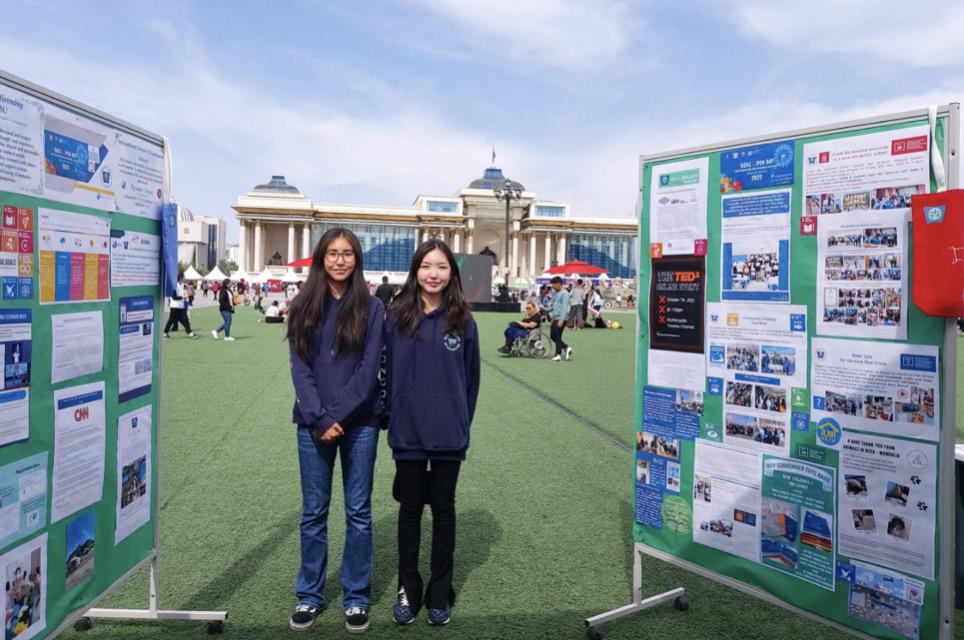
A group of two ISU Student Ambassadors, Ninjin Tsegmid (DP1 student) and Oyundari Gansukh (DP2 student) helped make this event successful by answering people’s questions and guiding them through the diversity of our actions (SDG 4 - Quality Education).
(above left) SDG Open-Day, 10/09/2022 organized by the United Nations of Mongolia - Sukhbaatar Square Mongolia. Left: Oyundari Gansukh (DP2 student) and Right: Ninjin Tsegmid (DP1 student)
(above right) Saranzaya G., Gr.9 student at the International School of Ulaanbaatar led a group of volunteers to pick up trash (13/11/2021). She posted a bilingual sign (English/ Mongolian) to raise awareness “Do not litter!”
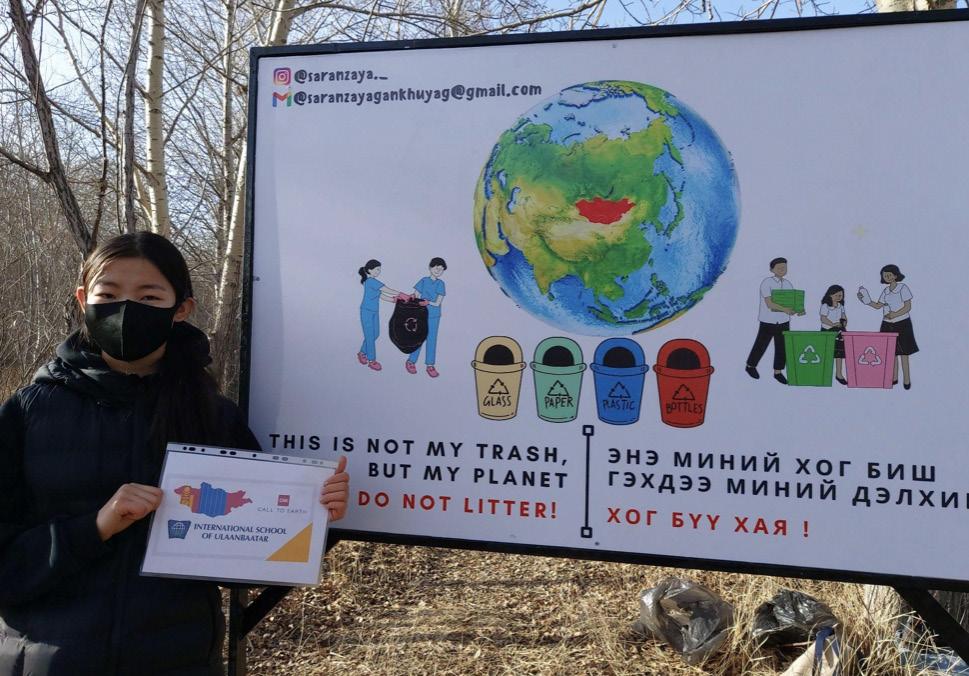
(bottom) Left: Saranzaya G., Gr.10 student the International School of Ulaanbaatar (29/10/2022) Middle: Ulziibileg D., NGO Mongolian Sustainable Development Bridge Right: Jocelyne P., Global Citizenship Coordinator
“I started this initiative last year (2021) and this year, we do it again.The biggest difference, we selected and collected more rubbish because we have a lot more volunteers. We partnered with more schools and NGOs to raise awareness of not littering the Tuul River! The next step is to choose a different location and invite more schools to participate.” (Saranzaya G., Grade 10 student, International School of Ulaanbaatar.)
“We didn’t only pick-up their waste, we also recycled it. We tried to re-
SERVICE LEARNING
64 EARCOS Triannual Journal
duce it to landfills, which is really beneficial to recycling companies, the economy and saving natural resources.” (Ulziibileg, NGO Mongolian Sustainable Development Bridge)
“It was an incredible experience to build up connections in Mongolia with different international schools, NGOs, the community and CNN. We hope we raised awareness about preserving the Tuul River. Our school was very proud of taking part in CNN Call to Earth Day 2022!” (J. Pérut, Global Citizenship Coordinator, International School of Ulaanbaatar)
“The Tuul River Cleanup is an ongoing event, and this is its 2nd year. The water from the Tuul River is heavily utilized, mostly for domestic and industrial use. It also provides drinking water for both people and livestock.
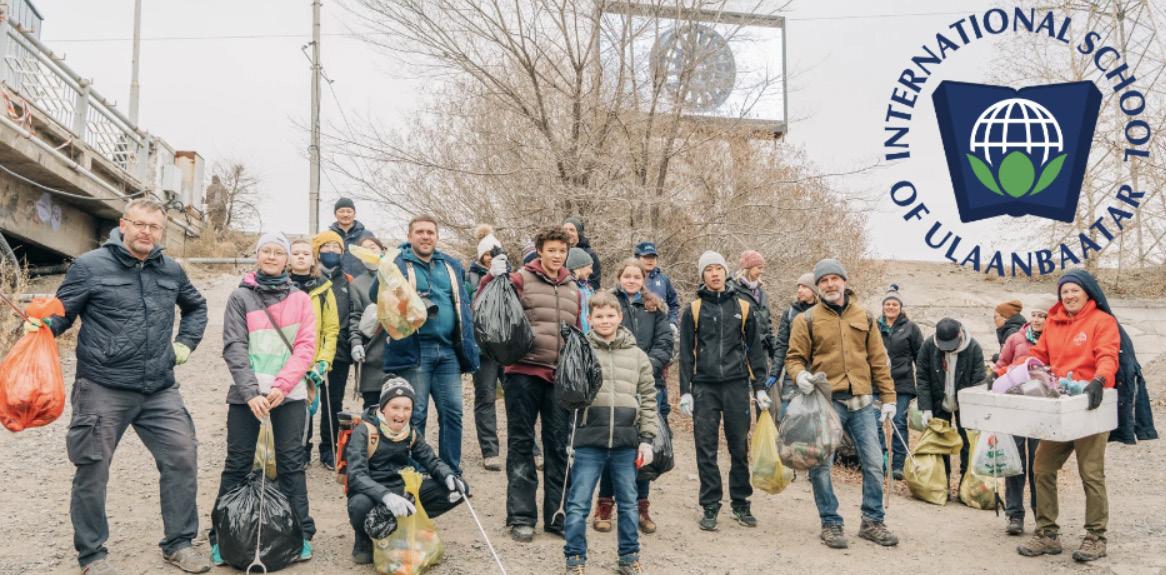
The Tuul River is the principal water source for Ulaanbaatar. Waste can contaminate local waterways, endanger wildlife, and make our water hazardous to drink. As well as this, trash that is left by the river may be dangerous for animals or children who may pick up rubbish, step on it, or eat it. By cleaning up at least a small part or the river, we can make a difference.
The aim of this activity is to help clean an area of the Tuul River and positively impact the environment. Through participating in this activity, I was able to work collaboratively with others, raise awareness about the issue of rubbish being left near or in waterways, and understand the ethical implications of my own actions if I litter for example.”
Amy G., Grade 10, International School of Ulaanbaatar
The Mongolian and International Community worked together to collect trash and recycle them!
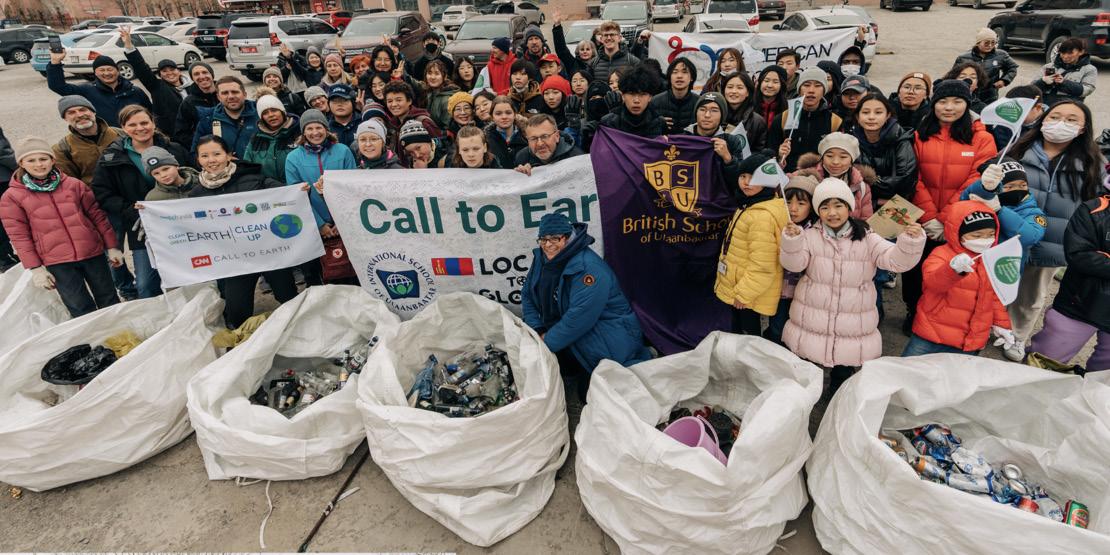
We cleaned-up the Tuul River responding to “CNN Call to Earth Day”
Our actions made a difference: We picked up trash along the Tuul River, one of the main water supplies in Mongolia.
• We collected, selected, recycled any materials we found (glass, paper, plastic, metal) - Tuvshin Saikhan Munkh NGO came to collect and dispose of them.
• We donated recycled plastic to the Plastic Center Mongolia to reuse and turn them into septic tanks and manhole covers for the Ger District.
• The Mongolian Sustainable Development Bridge NGO educated us on ways to protect our environment, by raising awareness of sorting out waste in English and Mongolian, and encouraging us to sign a “Pledge - 5 steps I can take against climate change”
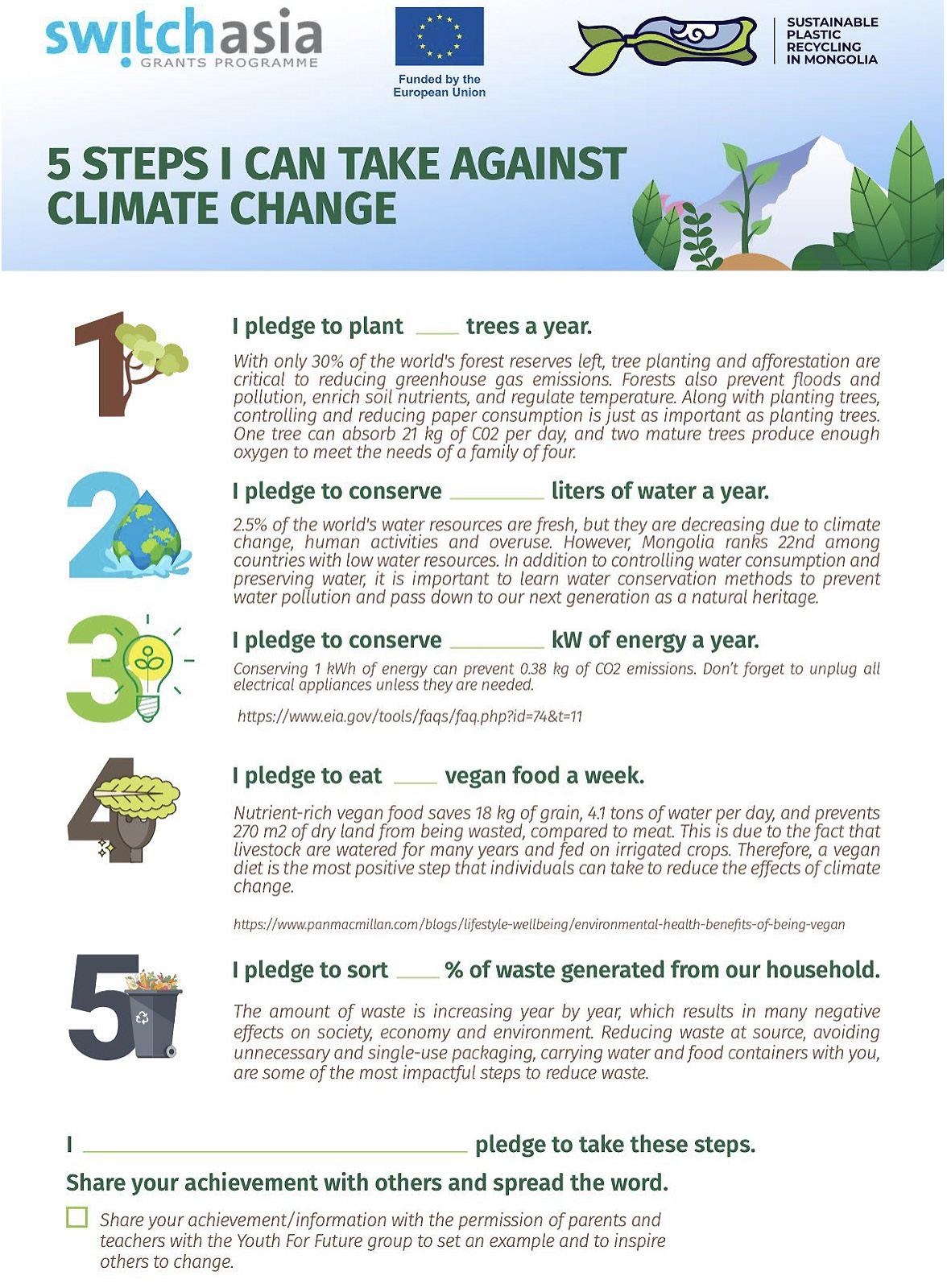
• A local artist and musician Duulal B. used recycled instruments (Mongolia Got Talent Finalist and Golden Buzzer Winner), he demonstrated we can make music out of trash!
“We only have one planet, so let’s preserve it! It is not our trash, but it is our planet!”
our rivers and lakes in Mongolia!”
Saturday 29th October 2022, the local and international community joined together to CNN Call to Earth Day.
Actions taken by eco-friendly citizens, students, parents, teachers, NGOs, International Schools (the International School of Ulaanbaatar, the British School of Ulaanbaatar and the American School of Ulaanbaatar)
Winter 2023 Issue 65
“Let’s preserve
Building a Bibliography of Our Schools

 By Jared Rock Seoul International School
One of the great pleasures that I found working at International College (IC), Beirut was immersing myself in a collection of institutional writing that helped me to better appreciate the personal experience of my own short tenure at the school through its contextualization in the school’s long and noble tradition. A virtual library of histories and memoirs helped me to understand and value my school and its culture, and to better appreciate my own contributions to the institution by entering into its story as one in dialogue with its members and aware of its peculiar twists and turns that made it what it was, and what it is ever on its way to becoming. In an articleI authored for the Fall 2022 issue of the ET Journal, I threw out the claim that “published memoirs and institutional histories are a relatively lacking area in international education, but have much to offer in binding us in shared journeys” (Rock, 2022, p.21). I would like to encourage more EARCOS schools, their faculty members, and their alumni to add to a collective library on the rich experiences of international education in the region.
First, it is worth pointing out that the publication of memoirs and histories is not something unusual to the world of education. A quick search for works on practically any major university will produce a fairly robust bibliography of institutional histories. Even the more obscure and small colleges often have at least one monograph of the school’s history (see, for example The Electric Edge of Academe by Newell on the little-known Deep Springs College). A slightly broader search will reveal a variety of memoirs that tell the personal accounts of presidents, teachers, and students who shaped and were by their schools. It is true that the projects of capturing experiences and institutional histories are less extensive at the level of primary and secondary schools, but many prominent high schools do share in this tradition. To take one example, Eton College has no fewer than ten published histories (and a long tradition of carrying on this project; Cust’s book on the subject is older than almost any of our schools), and memoirs either in whole or in part dedicated to people’s times at Eton. To maintain such a healthy and growing collection of works is a sign and a responsibility of an academic institution that takes itself and its role in the world seriously.
In preparing this article, I sent a request to all EARCOS member schools for published works on their histories or about/by their faculty’s and students’ experiences. I will include the works gathered here as a rough starter guide to our collective bibliography, though I am sure the list is still missing many entries from schools that did not share or are unaware of their full collection of published works.
Institutional Histories
During my time at IC, the monographs on the school’s history came through older works only, some accounts buried as sub-histories in books on the history of the American University of Beirut, to which we were tied for over 50 years. I was fortunate enough to have access to a wealth of these older (some out of publication) books through our library, but they were more items of later interest than go-to works for a new teacher who wants to get oriented to the school. In 2019, Reem Haddad’s excellent I Am IC, filled that gap with a current history. The book is both an exemplar an international school’s institutional history, and a communitybinding text that could (and should) be given or referred to every incom-
66 EARCOS Triannual Journal
ing faculty member. The lessons on institutional histories are: schools should have at least one current history (either authoritative or of equal standing), schools should share these books with their communities (especially with new teachers), and school libraries should keep copied of all publications on their institutions.
The works in this category that were shared by EARCOS schools include:
• Christian Academy in Japan 1950-1994 by June Habbestad (1994)
• CIS at 90 - Continuing a Journey to Greatness by Jennifer Basa & Lucena Gervasio (2014)
Cebu International School (CIS), which published a small photo history to celebrate its 90th anniversary, may soon add a new publication to celebrate its centenary in 2024.
Memoirs
Back at IC, some of the most rewarding reads came from the memoirs of school presidents (I did not encounter any from our teachers or students, though I hope international schools will produce a good number of these as well). Reading through first-hand experiences of work, problems, and progress from a different perspective and from different points in history helped me to feel connected to these individuals and better understand how and why our school functioned as it did. A great example of writing in this genre is Robert F. Ober Jr.’s Seeing Arabs through an American School (2003); it brings readers through the decision-making processes that demystify the school’s inner workings as well as a history of the school itself and the personal goals and beliefs that motivated Ober as a leader. (Ober currently contributes regular articles on the history of his alma mater, Kent, to its magazine, Kent Quarterly). Just as we expect memoirs from leaders in other walks of life (political, military, sports, etc.), it is incumbent upon heads of school to leave a public record of their time at our schools so we can understand and learn from their examples, decisions, successes and failures. I would go as far to argue that it should be a requirement of the principal and head of school jobs to at least leave a thorough narrative report of one’s time at a post with a school’s historian, to be collected and made available to the school community. It is not just leaders though whose personal stories matter, being able to share in the lived ex-
Middle School Art Celebration
periences of real people from our schools, other teachers, students, etc. help us to see the value and impact of our work and feel more connected to one another.
• Chess Child: The Story of Ray Robson, America’s Youngest Grandmaster by Dr. Gary Robson (2010), author is head of school at Ayeyarwaddy International School, Mandalay
• Growing Up Gaijin: an American Kid in 1960s Japan by Ladd McDaniel (2019), author from CAJ class of 1976
• An International Education at Yokohama International School - from Theory to Practice by Dennis Stanworth (1996)
• The Real Game That Matters by Tine Hardeman (2007), from Faith Academy
Concluding Comments
The published histories of our schools and the personal experiences of its members is what help us to understand ourselves as people carrying on worthy institutions, reflect on who we are, think more critically about where we are going, and most importantly it helps to build a sense of community across place and time bound together by our common calling to work in international education and/or by what we gained from our alma matres
I hope that more of our members will contribute to the genres of international education literature. Each school should keep a full and public list of works about it and by its past and present members. Current histories should be given to the community, especially incoming teachers. We should read about our own schools, and we should read about each other’s schools. Whether our oldest member school, by far the Saint Maur International School, or our newest, each institution has a story (or, put better, a collection of stories) worth preserving, sharing, and continuing to update.
Finally, I hope that in the spirit of collegiality, EARCOS can help maintain a public comprehensive list of all histories, memoirs, and other publications of interest (school-inspired novels, educational philosophies, etc.) on all of its member schools.
About the Author
Jared Rock is a HS Communications, Research, and English Teacher at Seoul International School.
Wells International School
3-Point Perspective Drawing
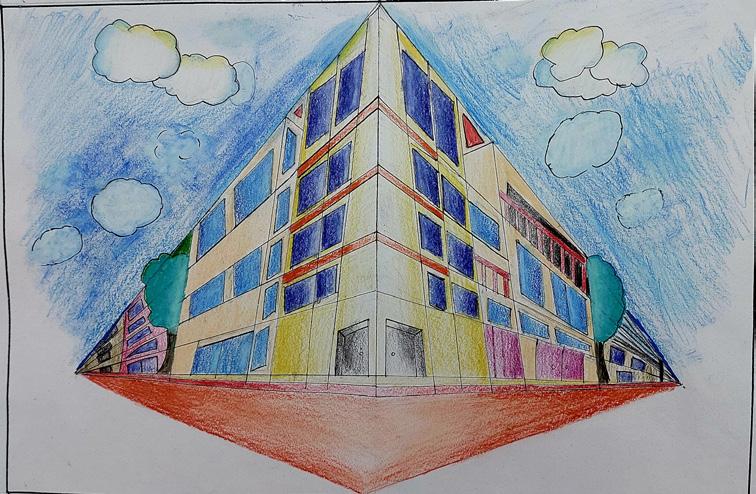

(left) Karnsiree Boonchaipanichwatana Grade 8
(right) Bibhuti Bhattarai, Grade 8
Winter 2023 Issue 67
& SUSTAINABLE
Composting at The International School of Yangon (ISY)
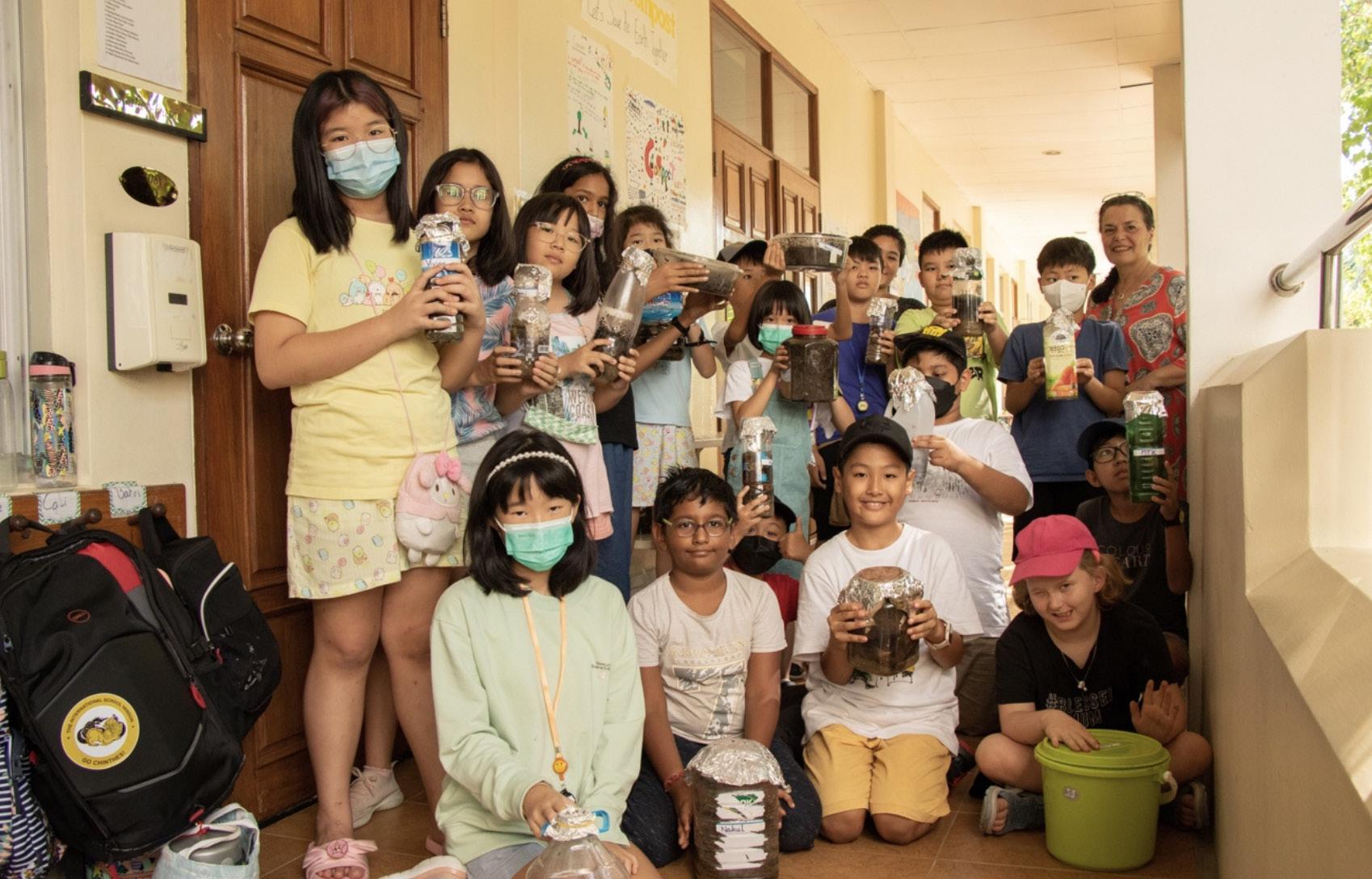 By Isabel Davis & Ian Nixon The International School Yangon
At ISY, we aim to develop lifelong learners who will be a force for positive change in the world.
In support of the Sustainable Development Goals (SDGs) around Climate Action, and Sustainable Cities and Communities, our Grade 4 students conducted a compost project during their science classes. While compost is not a new concept at ISY, we wanted to make our students aware of the impact of food waste generated both at home and at school and what can be done in order to reduce it and reuse it.
Our young students can be oblivious to how much waste can be generated until we take the time to look into it. We first discussed how decomposition works in nature by observing how nature works in cycles over and over again. Our students observed the changes in nature, such as the leaves of trees and the quality of the soil. They noticed that places were polluted by all kinds of waste and that negligence affected the soil negatively. They also noticed how well cared for ISY’s grounds looked and thrived when our gardeners took good care of them using compost and keeping it clean.
Our goal as grade 4 teachers was to give them the opportunity to study the decomposition of food waste and to observe and document the changes that had taken place during the observation period. They were asked to bring various food waste from home. Teachers indicated beforehand what should not be included and why. They used recycled containers from home to make their compost, which made them aware of the importance of not only recycling
but also the need to reduce the use of non-biodegradable and nonreusable materials at home.
Our students made a list of the type of food scraps they used, the size of the pieces, and the quantities they used for their composting. They collected different types of fallen leaves from either our school or their homes. They put it all together and started a series of observations in the following weeks. This study generated a lot of discussions from them:
• They questioned why people burn leaves instead of using them for compost and the impact of the smoke generated by it in our environment.
• They noticed that ISY has many recycling bins around the campus, including bins in the cafeteria for food scraps to use for composting at school.
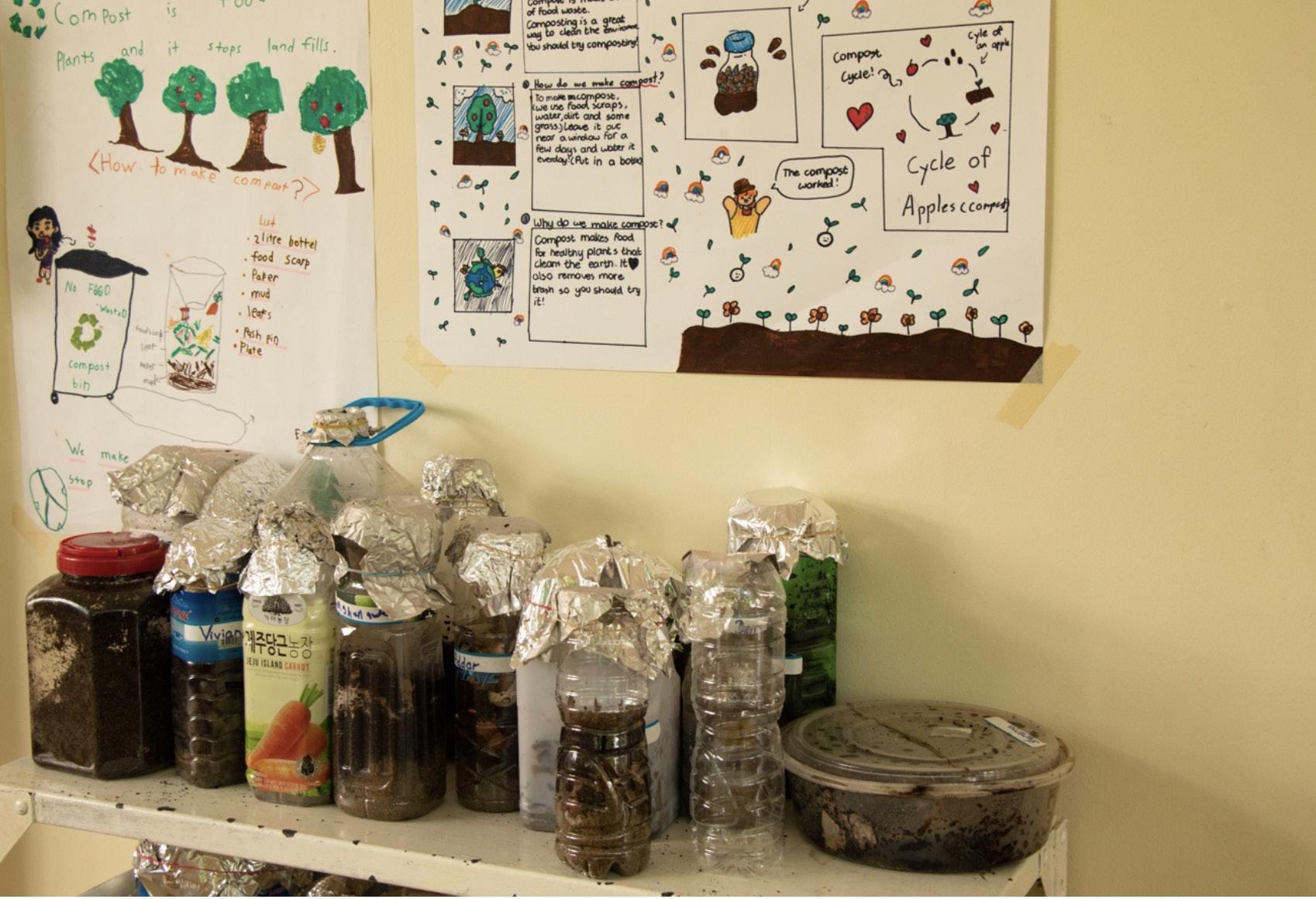
• They commented on the effort made by ISY to use reusable cutlery and plates by the vendors and in our classrooms.
This composting project is not limited to our Grade 4 students. It has also been supported by service learning groups in our Elementary and High Schools. The project is still ongoing as the students continue to observe the changes occurring in their compost, but when their compost is ready, they will choose different places in the ISY gardens to put it and then observe the impact it has on the plants. They have already shared their projects in an Elementary School Assembly and they will also use their observations to write information reports.
Ultimately, the hope is that the students will share their findings with their parents and start their own composting at home. By encouraging the students to share their learning outside the classroom for the benefit of others, we will be helping to develop lifelong learners who will be a force for positive change in the world.
About the Authors
Isabel Davis and Ian Nixon are both grade 4 teachers at The International School Yangon.
GREEN
68 EARCOS Triannual Journal
GLOBAL CITIZEN COMMUNITY
SERVICE GRANT Go Green
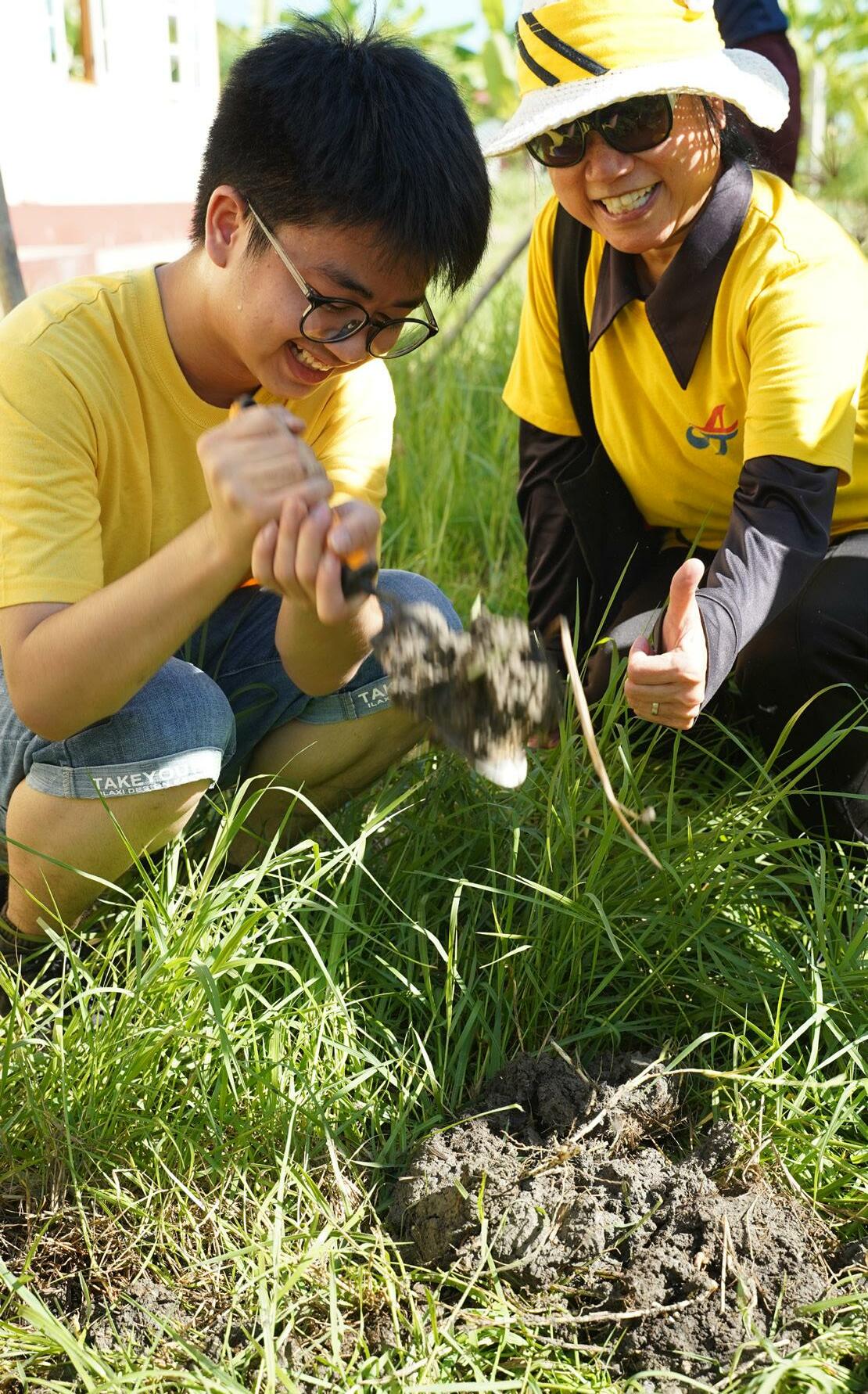 By Ahkar Min Thant Ayeyarwaddy International School
Electricity - as we all know - is an essential source for our daily lives. It gives us light in dark rooms; it gusts cold air during hot days; it powers our wifi to connect us to the world. When we transition to the business side of the world, electricity becomes even more important - a necessity in some cases. A theater, a restaurant,an icecream shop need electricity to function the projector, to power the electric stoves, and to run the fridges. Electricity being such a fundamental block of our modern world, power outages certainly have a profound impact on businesses as is the case in Myanmar.
Since many businesses cannot operate without electricity, they have to turn to a different source of electricity during blackouts - mainly, electric generators. Although solar power is quite popular for home
usages in Mandalay, Myanmar, it couldn’t provide enough electricity to highly consuming places such as offices, restaurants and stores. Therefore, it leaves businesses no alternative but to rely on electric generators to keep them in operation when the electricity is out. Such electric generators emit not only loud noises but also copious amounts of harmful gasses like carbon dioxide. Although businesses may only have one option in their operations, we youths have multiple ways to help protect the environment. As leaders of the future, we should be actively participating to protect and preserve our community for the long-term future.
The option we have decided to take on at our community-based group Youth Empowering Youth (Y.E.Y.) is planting trees. As we know, plants are able to get rid of carbon dioxide from the atmosphere because they need to take CO2 in through photosynthesis. With high usage of generators in Myanmar, having more plants to purify the air is incredibly important; moreover, having access to fresh air is crucial for a person’s well-being, especially during a global pandemic. In addition to the fresh air, trees also provide shade for people to rest underneath. In a hot country like Myanmar, having a place to cool off is very welcomed and trees are able to provide great areas of shade.
Therefore, Y.E.Y went to Yellow Generation Wave Orphanage and planted trees of various kinds. Although newly-planted trees are not massive carbon sinks just yet, they will surely play a vital role in a few short years; they will become massive trees, giving shade on sunny days and releasing tremendous amounts of oxygen. We purposefully selected an orphanage because it houses hundreds of youths; in addition to planting trees, we also wanted to enlighten the youths there about the importance of preserving our planet and planting trees. Such planting trips are also highly beneficial for us volunteers: we experience a deep sense of appreciation for nature - something which we might have been taking for granted. Often, the feeling of guilt for our potentially large carbon footprint encompasses us but such activities help us counter that feeling.
Finally, we also encourage others to actively engage in preserving our precious world for not only the short-term but also the longterm, so future generations can enjoy the breath-taking sights of a pristine nature that we had the privilege to experience. No matter how small our actions are, they are important. A global change can only be achieved when people are willing to contribute to the cause. At the end of the day, a problem of “not enough change” is better than a problem of “no change”.
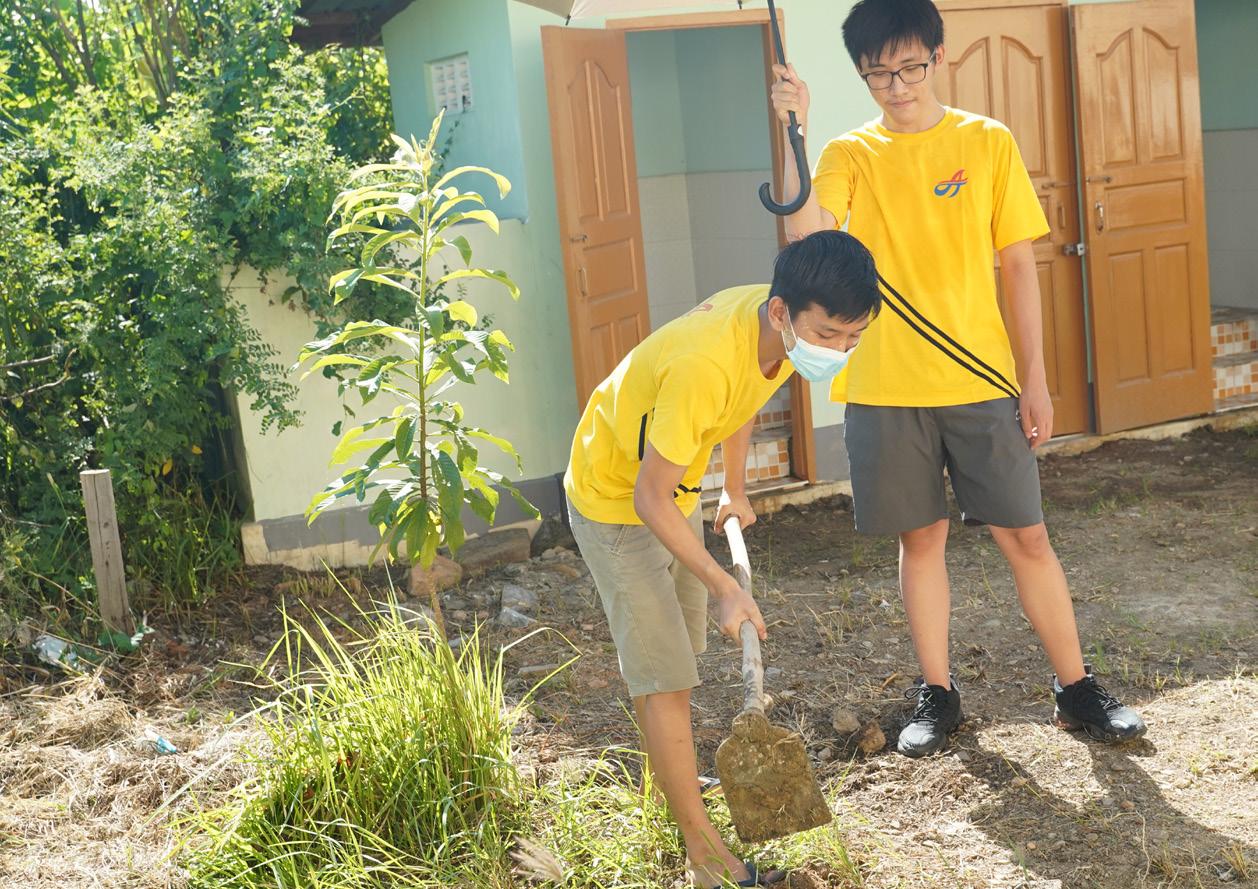
Winter 2023 Issue 69
GRANT
Made to Change: Obstacles to Opportunities
By Angel Gunaman Bandung Alliance Intercultural School
According to Roy T. Bennett, one should “turn obstacles into opportunities and problems into possibilities.” Facing the issues associated with the pandemic, I struggled to see what this quote meant. Throughout the challenges faced during online school, I’ve noticed how my passion for learning has been affected. However, after seeing the bigger picture and realizing that younger students, who had transitioned to online school during their elementary years, were also losing their zeal for learning, I knew I had to change something. So, being a science lover, I decided to teach science in a fun new way, utilizing it as a vessel to cultivate a passion for learning in younger students.
With that in mind, I founded my non-profit, Made to Change. In Made to Change, our team aims to cultivate a passion for learning by providing free science webinars and online courses for students from first to sixth grade. Experiencing how online school has affected the hands-on aspect of science education, I knew I had to change how science was done online. Thus, I sought ways to replicate the preCOVID explorative classroom environment at home. Our webinars (on ZOOM) feature an interactive science experiment, where kids would get to conduct experimentations at home through the guidance of our student-mentors. Within the webinar, students would also be encouraged to share their observations and questions with
their peers. In total, students get to conduct a science experiment at home, partake in learning through discussions with student mentors, and participate in other game-like activities in the span of one webinar. Furthermore, our online courses focus on the explanation aspect of learning. In them, our student mentors describe scientific concepts and provide specialized worksheets. Through our various science resources, we aim to provide many opportunities for kids to experience a love for learning.
Being a new “teacher,” I am always pleasantly surprised whenever parents comment on how much their children enjoy the webinars. Whenever they ask me what makes our webinars so interesting (and yes, parents I happen to run into do ask,) two things come to mind: the learning atmosphere we create and our unique reward system.
Firstly, I believe that the learning atmosphere we create separates us from other educational webinars. With our mentors believing in the motto of “no such thing as stupid answers,” our programs are more centered around encouraging collaborative conversations and fostering critical thinking skills, rather than getting the “right answer.” Made to Change’s student-mentors have worked hard to cultivate a unique relationship with our students, where students feel safe to ask questions or fail. This unique learning environment shows in our webinars, as our students are from different grades and schools, yet everyone is open to creating scientific conversations and building upon each other’s ideas. By creating this cooperative environment, I believe we contribute to cultivating a passion for learning in our students.
Another factor of student enjoyment (I believe) is linked to Made to Change’s unique reward system: our badges. Yes, you read that right, we award badges to our students. For our regular webinars, we have four badges: The Knowledgeable Scientist Badge, The Avid Scientist Badge, The Scientific Exploration Badge, and the Curiosity Badge. Each of these badges embodies a unique and essential characteristic of a scientist. In each webinar, we will choose three to four students who’ve stood out and award them a badge. From actively engaging in their curiosity, asking questions about concepts they don’t yet understand, or trying the experiment under new circumstances, our team has seen how these badges have encouraged students to step outside their comfort zones and actively take part in their learning. As an organization, we continually strive to cultivate a passion for learning in students, even though it means rewarding badges to keep them motivated.
All in all, Made to Change started as a very far-fetched passion project. Desiring to turn an “obstacle into an opportunity and a problem into a possibility,” I founded Made to Change to encourage students to be excited to learn. Looking back, I never thought Made to Change could become what it is now. With students from all over Indonesia, ranging from Bali to Jakarta and Bandung, I now understand the impact that can happen when someone has a genuine desire to make a positive difference. I hope that Made to Change can continue to inspire kids to discover their passion for learning for many years to come.
Citations: Bennett, Roy T. The Light in the Heart: Inspirational Thoughts for Living Your Best Life. Roy T. Bennett, 2020.
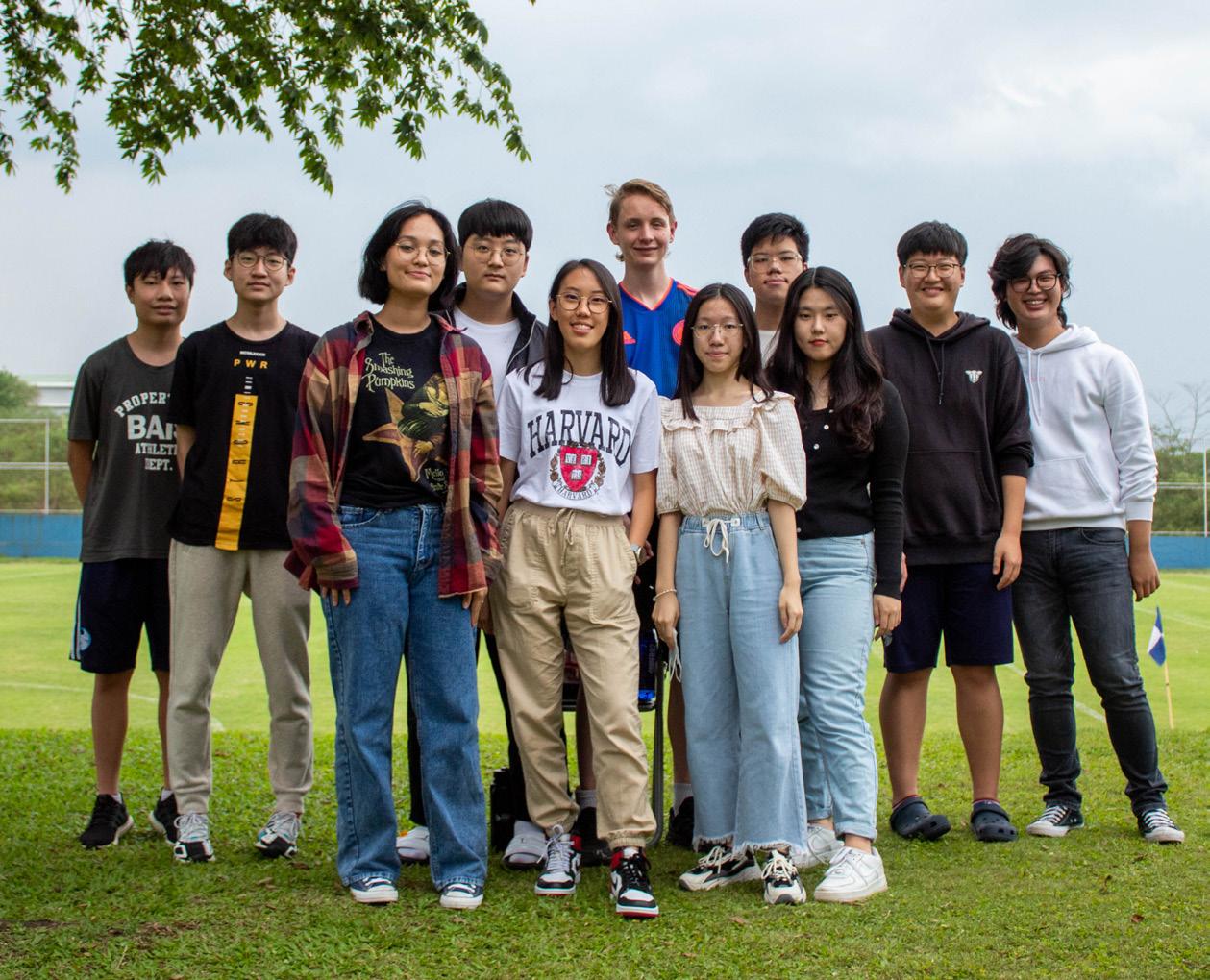
GLOBAL CITIZEN COMMUNITY
SERVICE
70 EARCOS Triannual Journal
Far Beyond Your Physical Borders
The adventure of using your second language in a real setting
By Antonio Melgar Cebu International School
What is a civilization? What is beauty?
These were powerful yet simple and direct open-ended questions our grades 12 and 11 IBDP students are confronted with across their curriculum. With the aim of trying to reach for an answer, our learners were presented with an array of possible options. Among those options was the website of the Museo de Cadiz, Spain, promoted by the Junta de Andalucia, with the amazing inclusion of the Colecciones Admirables.
Providing students with the wide array of possibilities of using the foreign language in formal and informal real settings, under the controlled environment of a classroom but applying their learnings by interacting with native speakers, is a liberating and enlightening experience.
An eye opener that shows us what we learn in the four walls of our classroom will enable us to touch other realities, cultures, and sensibilities.
‘Why is this relevant?” you might ask.
The answer is simple. Students not only learn the theory of how to communicate in a formal written setting with a person, but also, (thanks to the generosity of the Museo de Cadiz representative, Miss Maria Jose Castro) apply it and receive a real reply, with feedback and comments from another perspective, far beyond from the teachers’ points of view. This helps them to consider the requirements of handling the grammar and rules of the usage of the target language but allows them to be more focused on the interaction and process of communication.
The students were hesitant when they were asked to press the send button. In fact, we even had to have a countdown to email it at the same time, copying each other. And when the replies came back, the enthusiasm and excitement, the comments and comparisons, the discoveries of new ways to express themselves made the classroom come alive. The students internalized that what we are learning together is not a subject we need to pass for our scorecard but a tool that might impact our future in ways we can’t even foresee at this point in life.
Through breaking the physical barriers and helping the learners to discover the metacognitive purpose of learning a foreign language by acting upon it- exchanging correspondence with the personnel in charge of an educative institution, call it a museum, art gallery, another school, etc. we can reach the common aim of all foreign language coaches, teachers, facilitators, and educators around the world.
Facilitating this kind of profound humane encounters in the 21st century is possible due the advancements in technologies. They allow us to interact with persons and institutions far beyond our physical reach, to enrich our teaching and learning experiences and, ultimately, our lives.This is attainable by letting our imagination and creativity take their rightful place in the process of the teaching and learning process. Perhaps, more importantly, it permits our students to explore new, exciting, and provocative venues.
About the Author
Antonio Melgar is a MYP and IBDP Spanish B High and Standard Levels in the Diploma Program at Cebu International School. He is a published author, blogger and multilingual translator for international events and organizations.
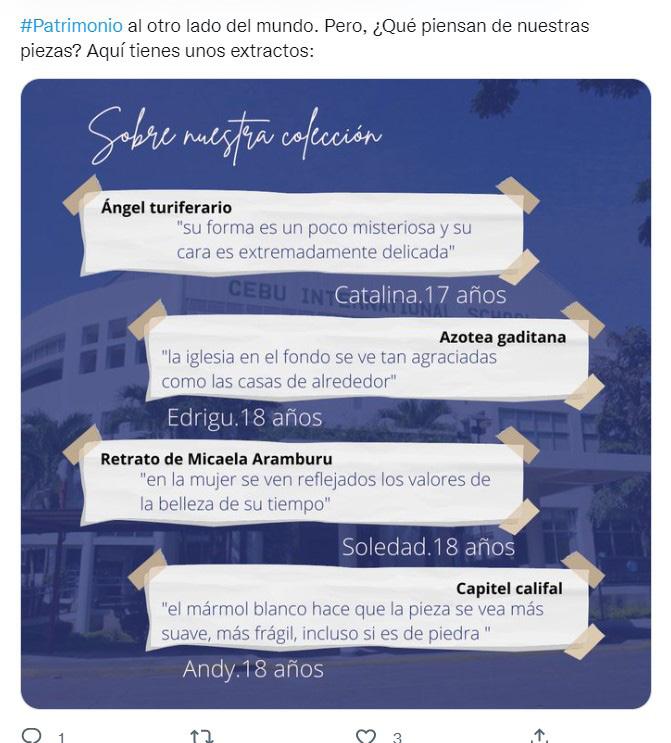
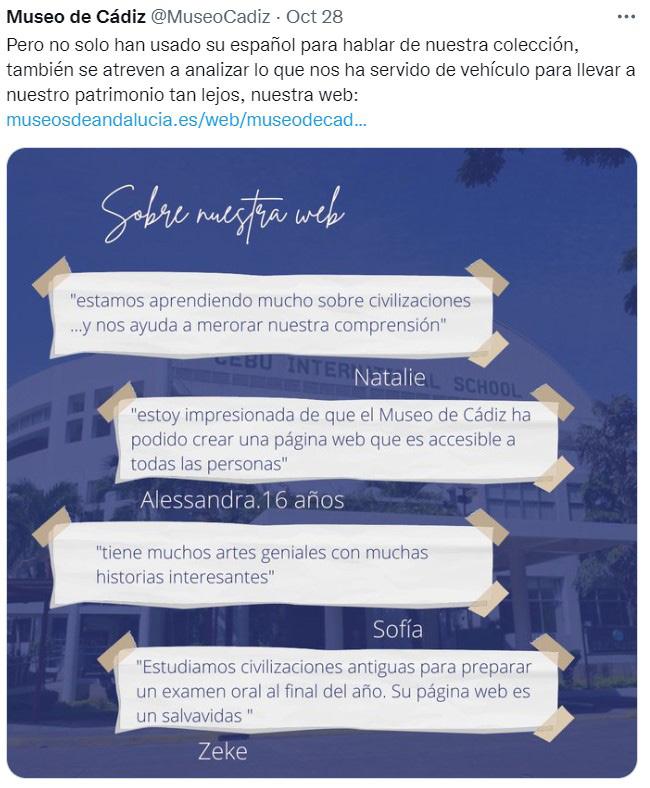
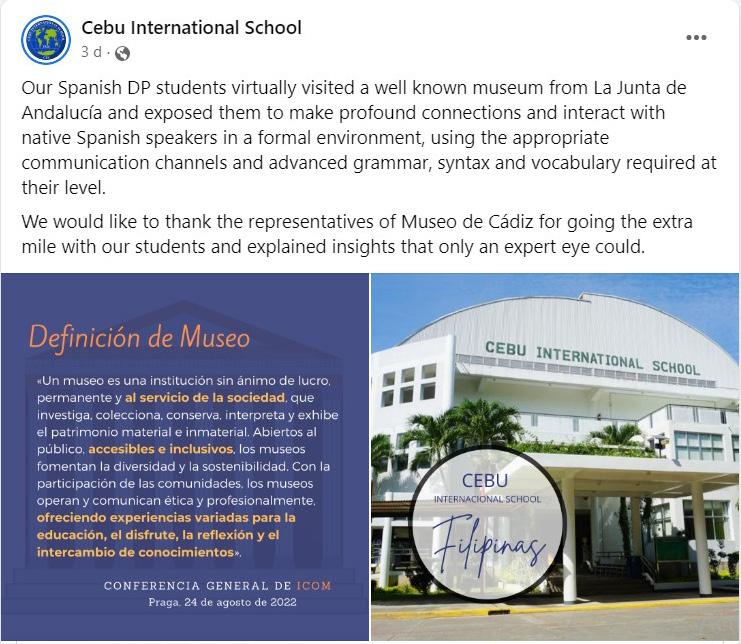
STUDENT WRITING
Winter 2023 Issue 71
ACTION RESEARCH
How Does Differentiated Instruction Enhance the Inclusiveness of Math Classrooms? —an Approach to Address Linguistic and Neuro-Diversity
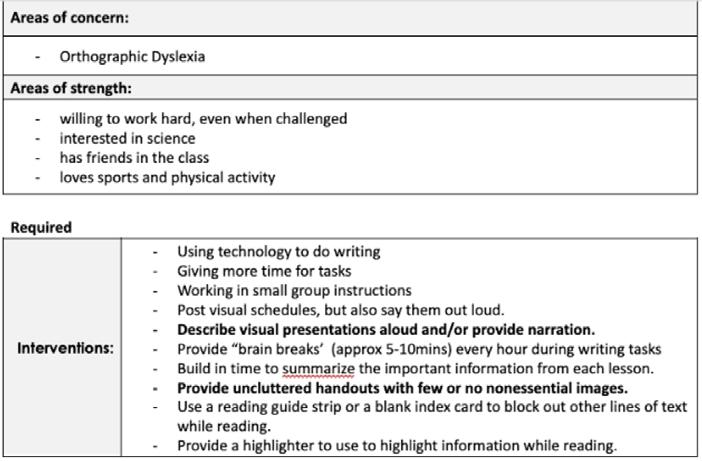
 By Carol Lai American International School Vietnam
Introduction
Inclusiveness in education has recently been a buzzword in various educational settings— school policy making, teacher recruitment, academic research, to name a few. In my ongoing literature review, however, it shows that inclusive education—in order to accommodate students with special education needs— has been in practice since the 1970s in multiple countries (Aldakhil, 2019; Alves, 2019; Civitillo, de Moor, & Vervloed, 2016; Redford, 2017; Saloviita & Consegnati, 2019). Nevertheless, many normal classroom teachers still feel under-prepared and anticipate further continuing education. In essence, inclusive education highlights accommodating diverse learners through various approaches. When I look into inclusive teaching in math classroom—while digital technology, hands-on activities, and reallife connections are usually prioritized, some researchers update educators with supporting strategies for ELLs and individuals with dyscalculia/ dyslexia. The variety of approaches may makes one feel disoriented initially, but it also suggests hopes in empowering both students and teachers. In this action research project, I aim at approaching these two questions: (1) How does an inclusive mathematics classroom look like in an MYP program? (2) What challenges might a mathematics teacher with an inclusive approach encounter, while the study body is linguistically, culturally and cognitively diverse?
Motivation
I was motivated to complete the research as a response to the inclusion policy at my current school, American International School Vietnam (AISVN) and to the Diversity, Equity and Inclusion (DEI) statement from the IBO. The IBO embrace learner variability so that our learners are not excluded on the grounds of any of their characteristics, and so that our stakeholders can develop and thrive in a culture of equal opportunities for learning, personal growth, and developing the ability to make positive change (Diversity).
This statement prompts IB educators to investigate how to establish an inclusive and safe classroom for each student, regardless of their learning needs and cultural/linguistic backgrounds. Based on the uniqueness of each learner, I argue that differentiated instruction lies in the core of 21st-century teaching. Existing strategies about differentiated instruction mainly focus on teaching methods, learning materials and assessment variety. I would add conceptual learning to the toolkit. In mathematics education, there has been a debate between advocates for procedural math learning and those for conceptual math learning for years. Focusing more on procedural math learning might enable teachers to cover the content on time. However, students’ diverse learning needs and thinking styles are dismissed among the standard steps towards the “right answer.” Conceptual math learning, on the contrary, empowers students to independently pave the path to the solution.
Considering the vision of inclusive education at AISVN, the disciplinary nature of mathematics education, the IB philosophy and the diverse student population, I attempt to use this project to document my classroom findings, propose a model for creating an inclusive mathematics classroom and attract more fellow teachers for further discussions and implementation.
Methodology
I mainly used qualitative research methods in this project: first, I went through literature review on inclusive education, differentiated instruction, conceptual learning in mathematics and data-informed teaching. The literature review provided the theoretical foundation in my classroom practices and analyzing students’ learning outcomes. Secondly, I investigated into students’ available learning data—past academic records, individual learning plans (ILPs), teachers’ anecdotes, etc.. Thirdly, I had bi-weekly meetings with EAL specialists in my school, comping up with classroom activities to build up students’ literacy and mathematical thinking skills. Finally, I collected and analyzed students learning outcomes through their sample works and reflections.
Findings and Discussions
Data-informed teaching is not unfamiliar to many educators, as we attempt to utilize assessments, portfolios, anecdotal notes—among many others— to draw well-rounded portraits of our students and support their daily learning. This played a key role in guiding my Grade 6 students to transition from elementary to secondary school, especially in the midst of challenges caused by strict lockdowns and months of distance learning. During my research, I found that reading anecdotal notes from other teachers helped me to understand students’ learning habits and later build a safe classroom. With the support from EAL specialists, I learned to interpret students’ English skill levels and form differentiated instruction/communication. Upon reading several students’ individual learning plans (ILPs—see Figure 1), I was impressed by the continuous effort in documenting students’ learning and/or behavioral issues and coping strategies. However, I also felt slightly overwhelmed by the student diversity, wondering how to deliver mathematical content and develop thinking skills throughout the year.
Figure 1: This is a typical ILP in my school. Students meet with the Student Support Team quarterly to identify areas of concern and strengths, as well as interventions. I was provided a folder of ILPs, with 2-3 years of documentation, before the school year started.
Understanding the challenges, I established explicit differentiation early in the year. My typical lesson included a short lesson video, a variety of practices and task options, and sufficient time for small-group discussions and/ or individual coaching. While the lesson video focused on concepts/skills of the day and drew upon age-appropriate visuals, various tasks and practices existed to empower student choices. While discussions existed to highlight social emotional support from peers, coaching targeted at strategies for
72 EARCOS Triannual Journal
reducing math anxiety. Also, I included estimated time for finishing each task in my daily lesson (see Figure 2). A sense of achievement and personal accountability were cultivated while students completed smaller chunks of tasks routinely.
Figure 2: Managebac is used as the learning management system at my school. To accommodate students’ learning in a Covidimpacted/distance- learning year, I aimed at structuring my daily lessons precisely and giving students space to digest learning constantly.
Considering that 95% of my students were ELL, I intentionally used strong verbs, short sentences, and bullet points to describe each learning step. Command terms (IB-specific academic vocabulary) were provided bilingually and accompanied by mathematical examples and visuals (see Figure 3). Students were also encouraged to use their mother tongues to help one another to understand challenging problems and concepts. Additionally, while mathematical investigation and communication were featured in MYP Mathematics (and also in my classroom), sentence starters were present while students learned to describe patterns, generalize rules and justify their findings.
Figure 4: Mini-whiteboards were used for students to document their discussions. “Calculate” features the linguistic diversity in one cohort (the mother tongues include English, Chinese, Vietnamese, Korean and Dutch). “Pattern” shows students’ growing conceptual thinking— to draw examples from various aspects. “Red” highlights students’ diverse opinions on a debatable question—if students should memorize formulae.
In our geometry unit, students were first asked to investigate the relationship between parameters and areas of rectangles, and later encouraged to design a park with given geometric shapes creatively. The independent numerical investigation challenged even the most passionate math lovers in my classroom, because they had to explain how numerical changes led to various results and brainstormed how such new understanding could be applied in everyday life (see Figure 5). The park design, on the other hand, catered to creative thinkers and team work lovers. Students were given 3 weeks to assign tasks to suitable team members, complete tasks on time, and self-evaluate before the final submission (see Figure 6)
Figure 3: At my school, 95% of the students come from Vietnamese families. On top of comprehending daily English-taught lessons, learning academic vocabulary is also challenging for most of my students. I provide 30 mini- posters of IB command terms to build students’ mathematical communication skills
As for students with ILPs, I openly discussed with them at the beginning of the school year, attempting to share my awareness of their learning needs and willingness to support them individually. For example, one student with dyslexia and dyscalculia was given extended time and access to a calculator in certain tasks/exams. Several students, who could be easily disturbed by peer pressure or math anxiety, were provided with “quiet corners” to stay focused.
While everything was difficult during the semester-long distance learning, I started to see a growing community of inquirers and open-minded learners as we returned to in-person learning. In our regular small-group discussions on command terms and inquiry questions, students utilized knowledge and skills from other aspects of life to demonstrate new mathematical under standing (see Figure 4). Even those with shyness and less confidence became braver to share their ideas openly and provided peer feedback.
Figures 5 and 6 illustrates the cognitive diversity among my students. While some students feel reassured to think logically and to verbalize their reasoning, others feel satisfied to discover mathematical beauty. To me, creating safe space for such a diverse group is what an inclusive Math classroom means.
At the end of the school year, students were given 4 reflection questions upon their uneventful year of learning: (1) What was your proudest moment in Grade 6 Math learning? Describe the moment in 2-3 sentences, and tell us why this was the case (2) What was the most challenging moment in your Grade 6 learning? It does not need to be Math-related (3) What did you benefit the most from Ms. Carol’s Math class this year? And why? (4) What do you wish that Ms. Carol could have done further for you?

While most students shared their growth in mathematical knowledge, collaboration skills, and real-life applications (see Figure 7)—especially in the shadow of extended distance learning, I felt touched by the reflections from a few students with ILPs:
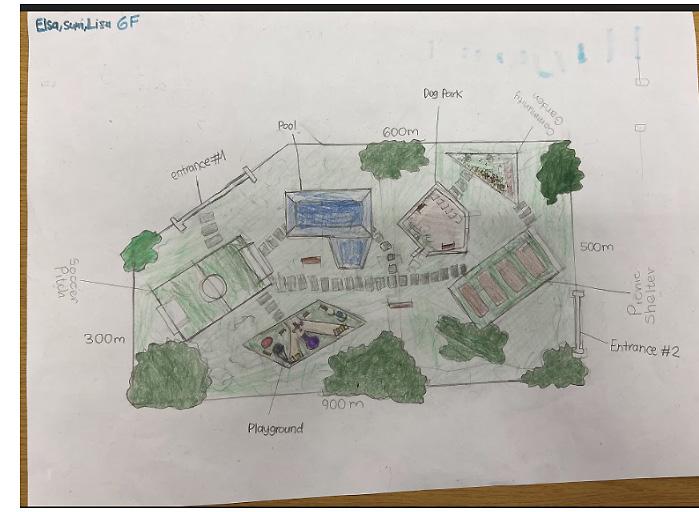
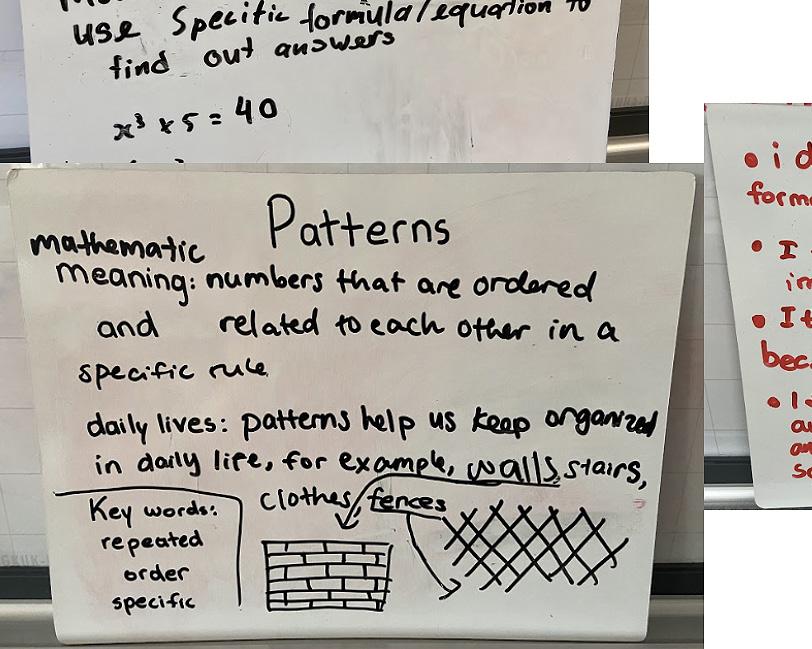
“When I struggle at something in math, I was able to get help and Ms. Carol helped me overcome a little of my math anxiety by going slowly during explaining the work which helped me understand them better.”
“I think Ms carol is always ready for us to ask questions, and answer the question for us clearly.”
“I think my participation because in online classes I was mostly shy and scared by now I’m fine by working with anyone.”
“Her understanding my learning disability.” “She taught me how to be very organized.”
“I benefited when I was struggling and stressing during the summative she helped me calm down.”
Winter 2023 Issue 73
Figure 7: The two word clouds were generated from students’ responses to the end-of-year reflection. It is not difficult to see that distance learning may linger on students’ minds for awhile. And yet, feeling included and proud of their growth also made them more resilient to future hardships.
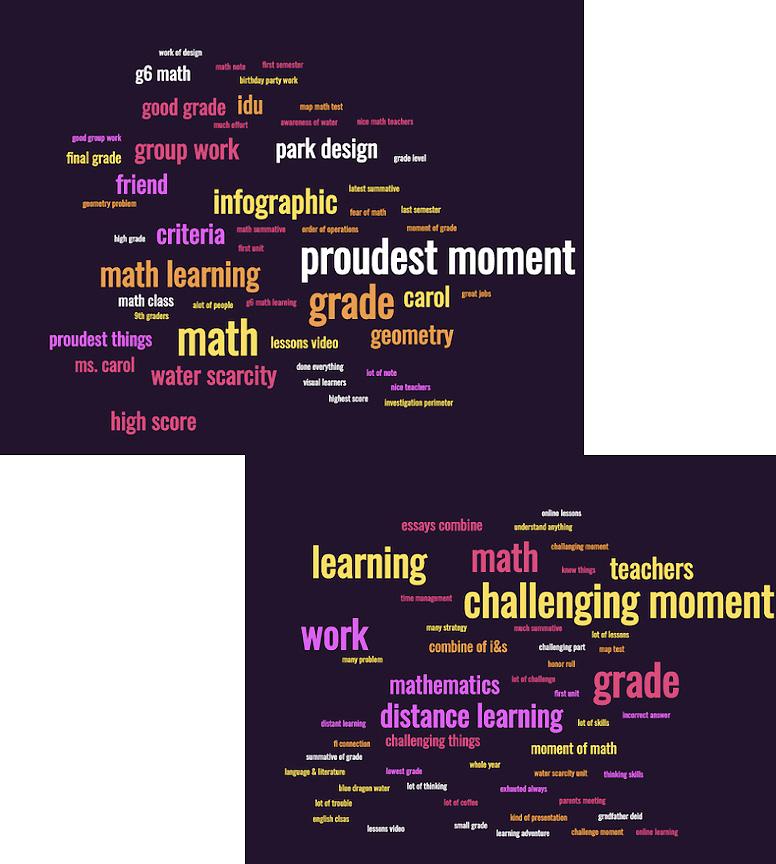
Conclusion
Upon completing this project, I am moving onto a new challenge in my professional life— becoming a team leader of Mathematics. Navigating through various school databases and consulting with various specialists helps me to guide new teachers to locate existing resources, familiarize themselves with the school culture and empower one another’s classroom teaching. When my data-informed teaching transforms into data-informed leadership, it enables me to listen from the heart, speak from the heart and take feedback openly. Returning to my own classroom, cultivating an inclusive mindset is an ongoing journey. I would not naively conclude that it is an easy journey for me and my fellow teachers. Some challenges include: (1) Understanding our students through the lens of linguistic, cultural and cognitive diversity is timeconsuming. How to balance between such effort and teaching mathematics (which is content-heavy discipline) can be overwhelming for any teacher. (2) Collaborating with specialists takes our humbleness to acknowledge that we need others’ expertise to transform students’ lives. (3) Dyslexia and dyscalculia, among other learning needs, can be foreign for many classroom teachers. Getting prepared to support students with ILPs might not be prioritized for some teachers. Building up inclusive mathematics classroom coherently is difficult for some school contexts.
Nevertheless, seeing significant progress in my students, I feel fortunate to bring inclusiveness into my daily practice with sufficient support. I am also inspired to study further into up-to-date research on neuro-diversity and linguistic diversity, as well as their impact on Mathematics education and changes in future pedagogies. “A problem isn’t finished just because you’ve found the right answer” (Ogawa, p.49)— the right answer might have been found for my students in this research project, but this project has led to more intriguing problems to ponder and act upon for myself and you, dear readers.
References
Acquah, E. O., Szelei, N., & Katz, H. T. (2019). Using modelling to make culturally responsive pedagogy explicit in preservice teacher education in Finland. British Educational Research Journal, 46(1), 122–139. https:// doi.org/10.1002/berj.3571
Aldakhil, A. (2019). Disablism in Saudi Mainstream Schools: Disabled Teachers’ Experiences and Perspectives. International Journal of Disability, Development and Education, 67(5), 536–546. https://doi.org/10.1080/10 34912x.2019.1620923
Alves, I. (2019). Enacting education policy reform in Portugal – the process of change and the role of teacher education for inclusion. European Journal of Teacher Education, 43(1), 64–82. https://doi.org/10.1080/0261
9768.2019.1693995
Cabus, S. J., Haelermans, C., & Franken, S. (2015). SMART in Mathematics? Exploring the effects of in-class-level differentiation using SMART board on math proficiency. British Journal of Educational Technology, 48(1), 145–161. https://doi.org/10.1111/bjet.12350
Civitillo, S., de Moor, J. M., & Vervloed, M. P. (2016). Pre-service teachers’ beliefs about inclusive education in the Netherlands: An exploratory study. Support for Learning, 31(2), 104– 121. https://doi org/10.1111/1467-9604.12119
Clark, J. S., Porath, S., Thiele, J., & Jobe, M. (2020). Action Research [E-book]. Diversity, equity and inclusion statement. (2022, June 8). International Baccalaureate®. https://www.ibo.org/about-the-ib/diversity-equityinclusion/ Edwards, F., & Ogle, D. (2020). Data informed leadership: the work of primary mathematics lead teachers in New Zealand. Teacher Development, 25(1), 18–36. https://doi.org/ 10.1080/13664530.2020.1837217
Faber, H. (2021). Code Green on Dyscalculia: A Guide for Educators, Parents, Counselors, and other Professionals. Notion Press. I, J. Y., & Martinez, R. (2020). Teaching Math for Emergent Bilinguals: Building on Culture, Language, and Identity [E-book]. https://doi.org/10.31274/is Montague, M., Krawec, J., Enders, C., & Dietz, S. (2014). The effects of cognitive strategy instruction on math problem solving of middleschool students of varying ability. Journal of Educational Psychology, 106(2), 469–481. https://doi.org/10.1037/a0035176
Musti-Rao, S. (2015, May 23). Comparing Two Classwide Interventions: Implications of Using Technology for Increasing Multiplication Fact Fluency. SpringerLink. https:// link.springer.com/article/10.1007/s10864-0159228-x? error=cookies_not_supported&code=d4d0a485-884b-4b04a9bf-0a1cfdd641ca
Naziev, A. (2018). The Role of Language in Teaching and Learning Mathematics. BRAIN: Broad Research in Artificial Intelligence & Neuroscience, 9(1), 114–124.
Ogawa, Y., & Snyder, S. (2009). The Housekeeper and the Professor (1st ed.). Picador.
Orchard, R. K. (2019). Experiences from a Data-informed Approach to Configuring Online Assignments. Journal of Educational Technology Systems, 48(2), 276–290. https://doi. org/10.1177/0047239519863000
PhD, O. B. (2014). A Mind for Numbers: How to Excel at Math and Science (Even If You Flunked Algebra) (Illustrated ed.). TarcherPerigee. Qvortrup, L. (2016). Capacity building: data- and research-informed development of schools and teaching practices in Denmark and Norway. European Journal of Teacher Education, 39(5), 564–576. https://doi.or g/10.1080/02619768.2016.1253675
Redford, K. (2017). Dyslexia: Disability or Difference? Educational Leadership, 74(7), 64–67.
Saloviita, T., & Consegnati, S. (2019). Teacher attitudes in Italy after 40 years of inclusion. British Journal of Special Education, 46(4), 465–479. https:// doi.org/10.1111/1467-8578.12286
Selbach-Allen, M., Williams, C., & Boaler, J. (2020). What Would the Nautilus Say? Unleashing Creativity in Mathematics! Journal of Humanistic Mathematics, 10(2), 391–414. https:// doi.org/10.5642/jhummath.202002.18
Stevens, J., & Vaudrey, M. (2016). The Classroom Chef: Sharpen Your Lessons, Season Your Classes, Make Math Meaningful. Dave Burgess Consulting, Incorporated.
About the Author
Carol Lai is a MYP/DP Mathematics Teacher at the American International School Vietnam.
74 EARCOS Triannual Journal
Student College Readiness: Empowering Students Futures
 By Ms. Kettelene Eloissaint Kang Chiao International Secondary School
were not informed about how complicated and tedious the process is. As educators, we tell our students to work hard, and the ultimate prize is to get a higher education than a good job that will enable them to live comfortably. But are we really equipping them with the tools to do so?
A worldwide survey was created and sent out to high school students, college graduates and non-graduates, and parents in the USA, China, South America, South Africa, Europe, and Taiwan. The data collected to this project through the survey is designed to provide information for specific variables that are essential factors in establishing a solution to this ongoing issue and solutions by creating an APP/Website that will assist students preparing for college as early as middle school.
304 participants took part in the online survey from the United States, Taiwan, China, Egypt, South Africa, and Japan. Survey respondents are from various economic and educational backgrounds. Reported incomes range from $0-110,000+ USD.
As an educator that has taught within after-school programs, public, private, and international schools in three different countries with various cultural and economic backgrounds, there has been one commonality that has yet to change over the years; the lack of college readiness that is prevalent amongst our students. The data that has been accumulated provides evidence of this disparity amongst our students around the world. Since technology is at its peak and communication can be established in various ways and forms, why hasn’t this problem been resolved?
After numerous conversations with other students, there was a unanimous consensus that they were being categorized based on their background. It made no difference for most, who accumulated thousands of community service hours, led sports and school clubs, and participated in various organizations while maintaining high GPAs as Honors and AP students on the honor roll. The hard facts were that very few minorities were attending college at the time, not because of their lack of education but the knowledge and process of going to college. Most minority parents were unaware that early admission is required for specific programs, SAT/ACT testing, FAFSA, personal statement, application fees, etc., are mandatory requirements. One meeting was held for parents on college readiness that most worked nights could not attend and wouldn’t understand because of the language barrier. Unlike most minorities that fell victim to this dilemma, teachers, coaches, and others’ assistance proved otherwise in my case.
As a result, I am an educator and the first to graduate in my family with multiple degrees. The experience has helped numerous students, friends, family members, and siblings attend college. These individuals’ journey was the same year after year; it is still physically, mentally, and emotionally demanding. The changes in procedures, terminology, acronyms, and abbreviations are hard to grasp with bombarding deadlines. Then there are the constant phone calls to various departments and the insurmountable amount of paperwork, which become cumbersome and overwhelming. Instead of celebrating with friends, students are still consumed by those responsibilities on the weekends, during free time, and after school in the classroom. Many students always find themselves in the same predicament today because they
Survey results showed that students are still getting minimal surfacelevel information from their resources. The struggle, fight, and concerns for our students is still a real issue, and others are like-minded and sincerely want to provide relief to mainstream society. Student responses varied but still showed concern when asked What area of preparation would you have liked additional help to better prepare you for college? (scholarships, decisions, application documents, etc.)
“I still remember you taught us about college research in our English LIT class a few years ago. That was actually dome enlightening for me to think about the universities and colleges I would attend. Thanks for that!”
“I would have liked additional help to better prepare by providing example decisions and ideas from other students that have already taken the class about certain colleges.”
“I would like the scholarship and additional activity in the field I selected to help me better prepare for the college I prefer to get in.”
The survey result is not an exhaustive list of all reasons students may not feel prepared for the college process. However, it gave a snapshot of some of the issues that can be addressed through the APP by making resources available to students in one spot. The top three resources respondents would like to have in a website or app were college counselors’ assistance, links to universities, and links to scholarships and grants. The APP would have resources to assist schools, parents, and counselors in these areas. Most respondents who answered the College Readiness Students Survey said an APP would be helpful for the college process. Some respondents would be willing to pay for such services to assist with the college process.
The research results provided data that brought awareness and possible solutions to help parents and professionals in all educational sectors who lack guidance. This data and solution are to alleviate the pressure that most students experience in this area of their academic careers.
About the Author
ACTION RESEARCH
Kettelene Eloissaint is the Cross-Curricular Subject Group Coordinator at Kang Chiao International Secondary School Taipei.
Winter 2023 Issue 75
Taipei
A Slow Decay
My days repeat like broken records, A cacophony of sounds haunting me, The splintering of glass, the dripping of blood, From knuckles to toes, it paralyzes me.
Each week, we belie this ruinous journey, Failing to fix the years in months, We drink out of new glasses, like old ones weren’t broken, Pretending nothing on earth is left unspoken.
I’m told to move on, Why don’t you listen to some music or go for a walk, But you see my soul has been sucked out of me, And the voices in my head won’t let me be.
I stare holes into the ceiling, And sob while screaming ‘I don’t understand’, I’m tormented by memories, I’m trying to forget, I end up branded with bloodshot eyes instead.
“Be civil, be kind, be above it all”, It’s too bad I’m human, Because this rage slips out the metal cage, But of course it’s my fault, I’m hallucinating it all,
Insomniatic little me, unable to find peace, Autopilot emotions and I’ve lost the keys, I search and search through this winding maze, But instead of hope, I find darkening shadows resting on my face.
Day by day I’m lowered further into a grave, Knowing I’m so far gone is the only saving grace, I want to stitch up the thousand cuts within my mind, But the blood floods out as I run out of time.
The
A Puddle in New York
Lying on the sidewalk
I am admiring the city of New York The Empire State Building rises from the street A marvel with whom the skies meet
Last night’s storm has wiped the city The vibrancy is back ever-so pretty Sidewalk glistens under the morning sun The chatter, the stroll approaching one by one
New York has a rhythm and a beat People flow as a river on the street The footsteps have a wet squelchy sound Carefully avoiding me on the ground
From afar I can hear someone Someone who has not learnt to walk Each step is chaotically spaced from the last No rhythm at all
He stood towering above me His reflection waving back with glee His soles launch into the air aiming for me How crippled and rippled my soul would be
Splash!
The city emerged in an instantaneous spiral New York is in a swirling spin! Never like it had been The mix of the sky and buildings
The open clarity of blue Blends with the concrete hue Sounds of honks, chirps and steps Unify into a chaotic melody
After fighting the storm within myself My sense of calm is restored I find myself still once again Gazing at the buildings, as I slowly wither away
Khadija Soomro
The British School New Delhi
Avishi Gupta
British School New Delhi
Poetry 76 EARCOS Triannual Journal
International School of Busan, Green Flag Award
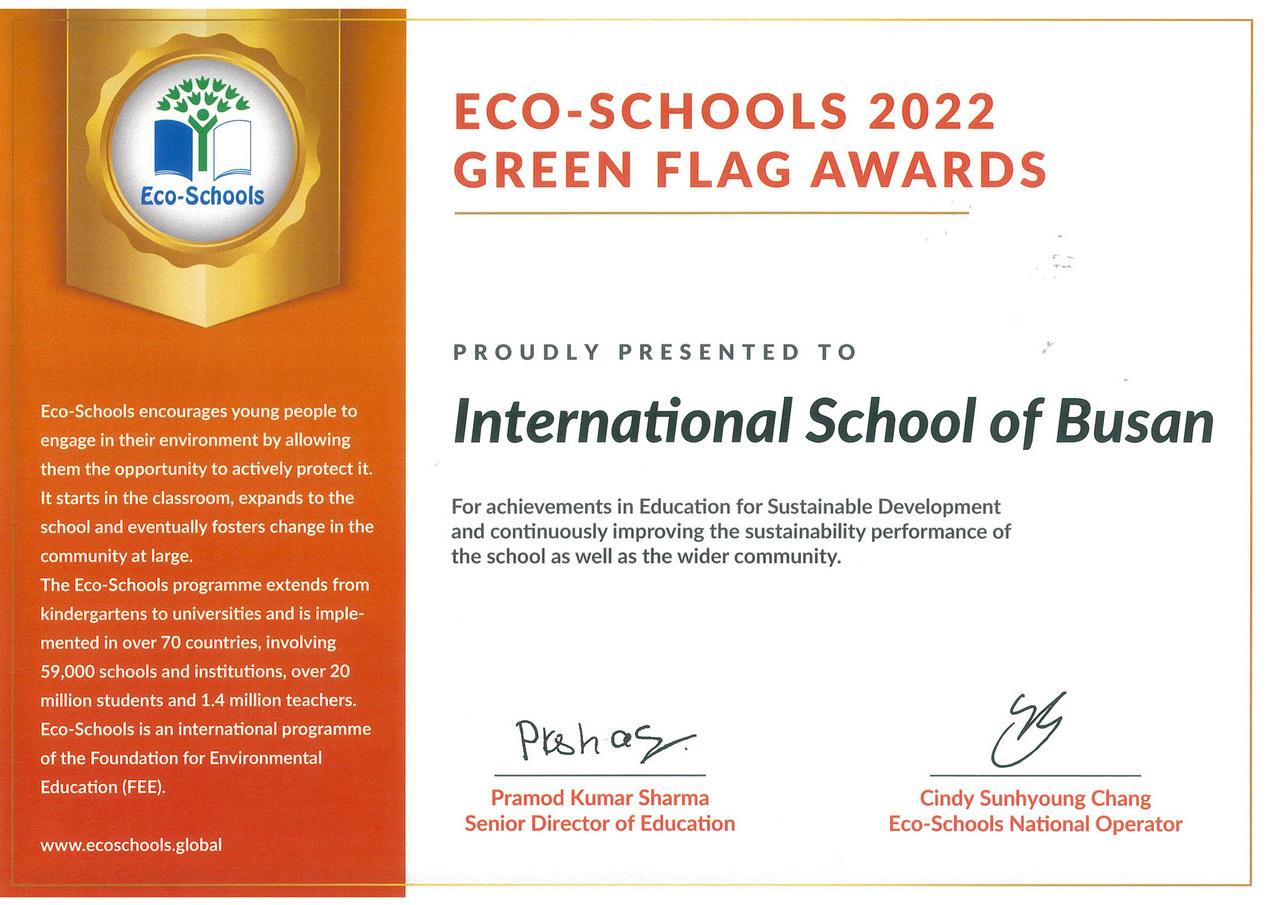
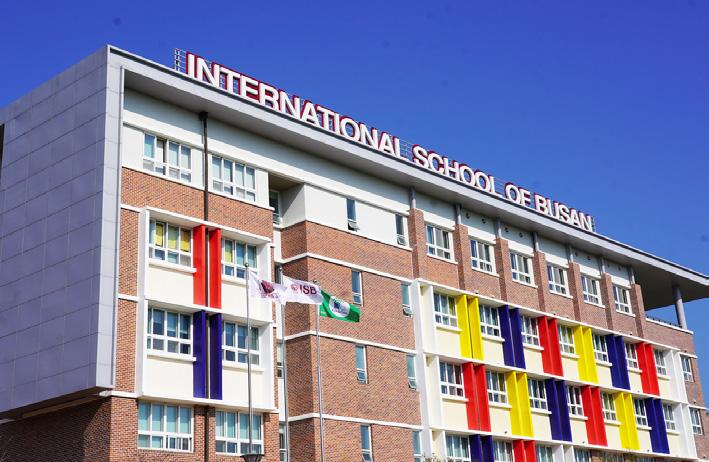
The International School of Busan (ISB) has received the prestigious Green Flag Award for its ongoing commitment to environmental sustainability. On November 7th, the official certification and plaque was awarded and displayed at the school.

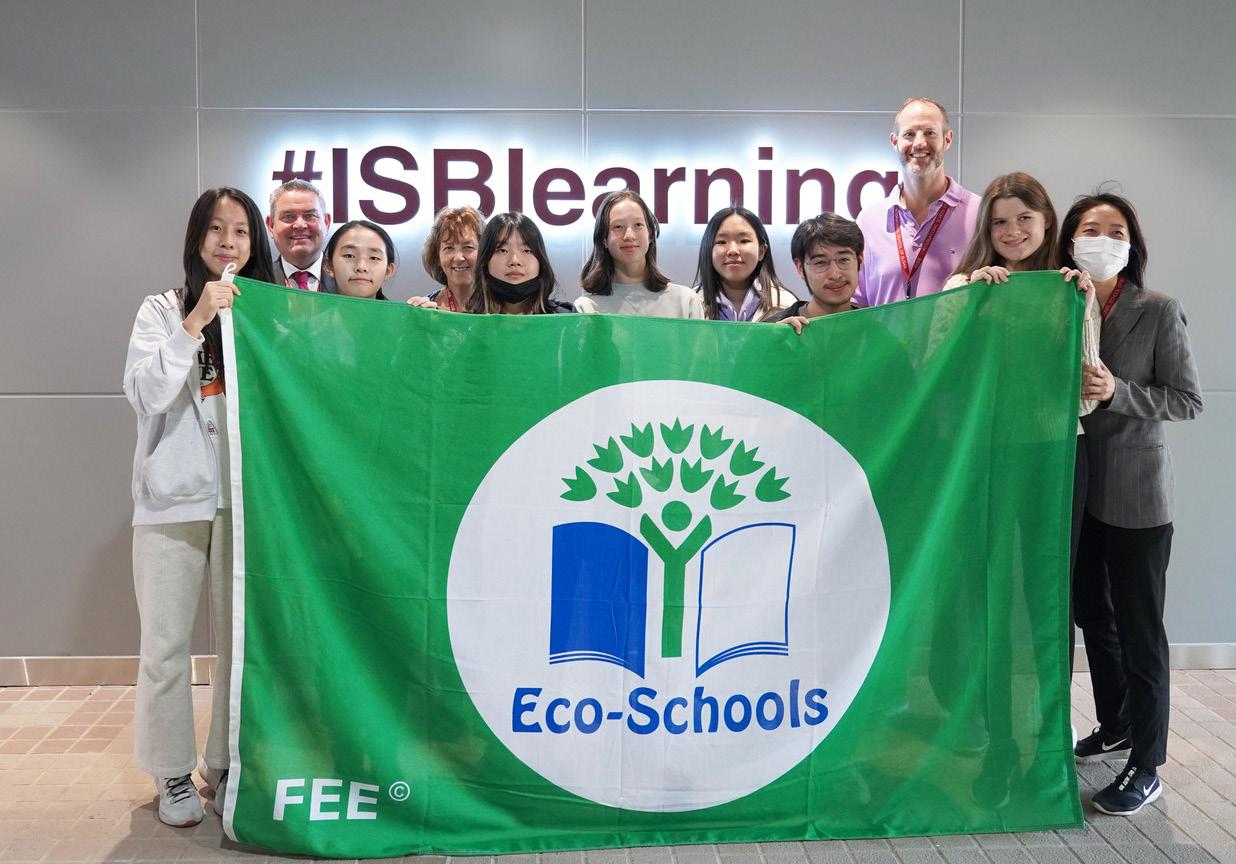
The International School of Busan (ISB) has been officially awarded the Green Flag Award for its ongoing commitment to environmental sustainability. In order to achieve this award, members of the ISB community went through a rigorous application process followed by the development and implementation of a multi-step action plan to achieve their goals. The progress that the school has made was assessed during a Green Flag Assessment Visit led by members of the Foundation for Environmental Education (FEE). On November 7th, ISB received the official certification and plaque, which is now proudly displayed at the front of school.
Last year, International School of Busan students and teachers formed an Eco Committee that meets regularly to discuss a range of environmental improvement projects. The actions of the committee have resulted in tangible improvements on campus such as a reduction in food waste, use of more environmentally friendly products, installation and use of dedicated composting bins, a new nature trail at school, new trees planted, installation of energy efficient lights and new outdoor recycling bins. Solar panel installation is also planned for the new year.
Members of the ISB community have also created and maintained connections with external organizations, so that students and staff can continuously further their knowledge of environmental issues.
Some of ISB’s biggest successes in implementing the Eco-Schools program was to identify and map environmental sustainability in the curriculum. Entire units of work are dedicated to the U.N. Sustainable Development Goals (SDGs) including climate action, energy use and consumption, biodiversity, and environmental awareness. ISB community members take pride in the ongoing commitment to include topics related to the protection and maintenance of our planet, and the efforts of the Eco Committee are a reflection of that. Conversely, there were challenges met along the way. The Covid-19 pandemic, and the subsequent shift to temporary online learning, caused delays and disruptions in the action plan. There were limitations to the amount of visitors allowed on campus, and, at times, it made making strong connections with outside organizations challenging.
Nevertheless, the committee persevered, and continued to inform, and involve, the whole school about the program, not only through the curriculum, but through various forms of social media and news
outlets. ISB engaged the larger community by collaborating with organizations such as the European Chamber of Commerce in Korea, the Korea Institute of Ocean Science and Technology, and the Marine Stewardship Council, just to name a few.
Head of School, Simon McCloskey said “We are very proud of the excellent work our students and teachers have done to secure this prestigious award. The International School of Busan is committed to raising awareness and taking action to work towards a sustainable future. This commitment is evident in ISB’s Guiding Statements (Vision and Mission) which drive all decision making at the school”.
PRESS RELEASE
Winter 2023 Issue 77
SENIA celebrates 20 years - twenty years! - advocating for inclusion
By Lori Boll SENIA Executive Director
In 2022, SENIA (Special Education Network and Inclusion Association) celebrated its 20th year, and we invite everyone to join the Inclusion Revolution. Our non-profit organization’s vision is to live in an inclusive world where every individual is supported, resources are accessible, potential is maximized, and action is inspired.
It is truly amazing what we can do together. Our organization that began with a meeting of 8 educators in a Beijing school basement celebrated our 20th anniversary by organizing three conferences, awarding $10,000 worth of scholarships and awards, creating a membership program for schools and individuals, and introducing a level one certification program.
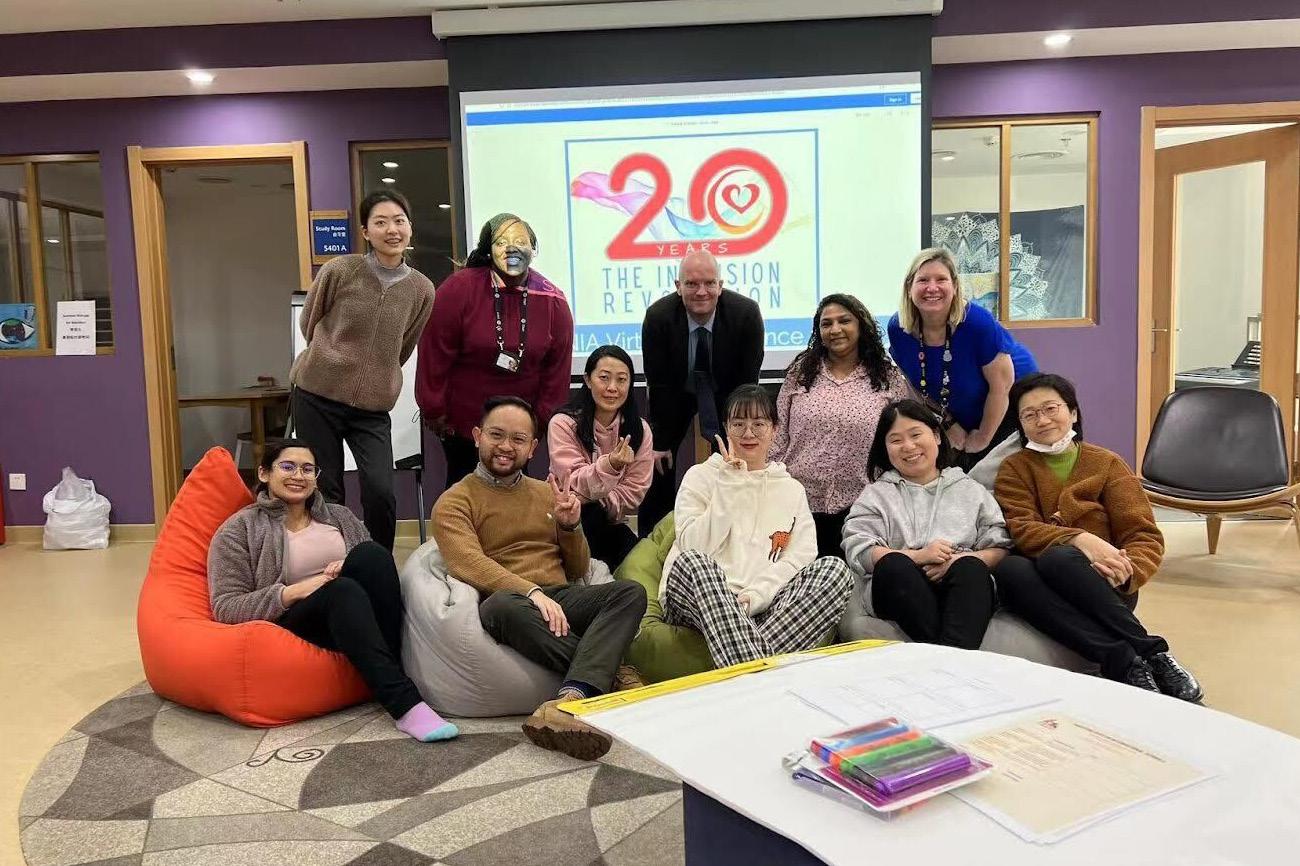
SENIA would like to congratulate our two student award scholarship winners, Charlotte Holme, from Bangkok, Thailand, and Bridgette Yasin, from Malaysia. Both students advocate for themselves and others with disabilities and are true inspirations. These students were awarded with scholarships to help support them in their future endeavors.
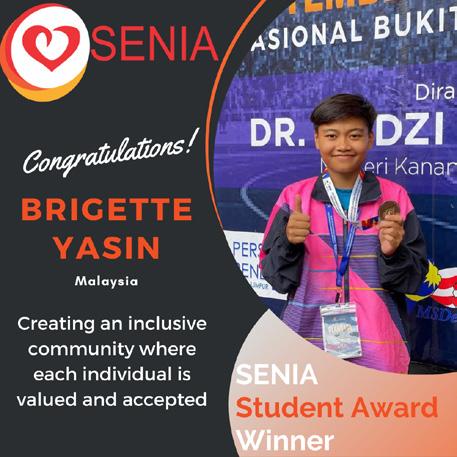
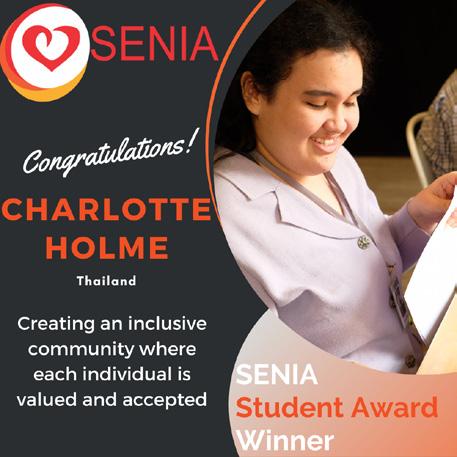
ward to continued years of partnership.”
- Maya Nelson, Head of School, Jakarta Intercultural School
For more information on membership, go to www.seniainternational. org/membership
SENIA congratulates the 25 graduates of the inaugural level one certification program started in January 2022. With a continued goal of supporting all educators, SENIA created a level one certification program which dives into the key areas of Universal Design for Learning, Multi Tiered Systems of Support, individual education plans, behavior, and coteaching. These classes are helpful for general education teachers, beginning to intermediate level learning support teachers, and administrators wishing to learn more about school-wide systems of support.
“I found all courses to be excellent! The six courses (from February through July) covered important areas of student support and presented information, backed by research and best practice, in an engaging manner. A big thank you to those involved in organizing and arranging the material.”
- Tony McLean, American International School Dhaka.
More information on our certification programs can be found at https:// www.seniainternational.org/certification/. In the new year, SENIA will introduce a certificate program for Teacher Assistants.
SENIA has also awarded both certification program and conference attendance scholarships to education professionals worldwide.
Schools wishing to begin or continue along their inclusion journey are invited to become a SENIA Member School where they will enjoy many benefits such as:
• question & answer sessions with SENIA board members
• access to a private networking channel
• discounts to all in-person conferences.
Jakarta Intercultural School was SENIA’s first member school.
“It is a great privilege to be able to join the SENIA team. As inclusive international schools, we have the opportunity to learn about best practices for students with neuro-diversities through this organization. SENIA provides superb professional learning experiences and supports not only for teachers in their growth as educators and practitioners, but also for students, parents, and school communities in understanding how to best create environments suitable for all individuals. JIS is proud to be a SENIA school and looks for-
SENIA continues to hold both virtual and in-person conferences suitable for all educators, parents, and support professionals. Our 2022 virtual conference launch weekend was December 2 to 4, and its content is continuously available on demand for four months. 2020 individuals participated and many schools such as International School of Kuala Lumpur, Jakarta Intercultural School, International School of Manila, Hong Kong Academy, Asociación Escuelas Lincoln, and UNIS Hanoi, registered their entire faculty and are using 4 months of conference content as school-wide professional development.
Be sure to check out all our conferences at www.seniaconference.org or follow us on LinkedIn, Twitter, Facebook, Instagram, and our newsletter for regular updates. We’d love for you to join us in February for our next in-person conference at the American International School of Johannesburg.
You can join SENIA International in the Inclusion Revolution by joining as a member school or individual, donating to our scholarship fund, or coming to a future conference. SENIA looks forward to partnering with you!
PRESS RELEASE
78 EARCOS Triannual Journal
The

EARCOS
Conference
SAVE THE DATE! Winter 2023 Issue 79
53rd
Leadership
2023 October 26-28, 2023 Shangri-La Hotel Bangkok, Thailand
PRESS RELEASE
Concordia Environmental Science students meet GIZ energy expert
“I learned we save 30-50% of electricity each year by using motion sensors to shut off the lights when no one is around.”
Read what #ConcordiaHanoi students learned from a visiting GIZ energy efficiency expert and what makes Concordia’s buildings “green.”
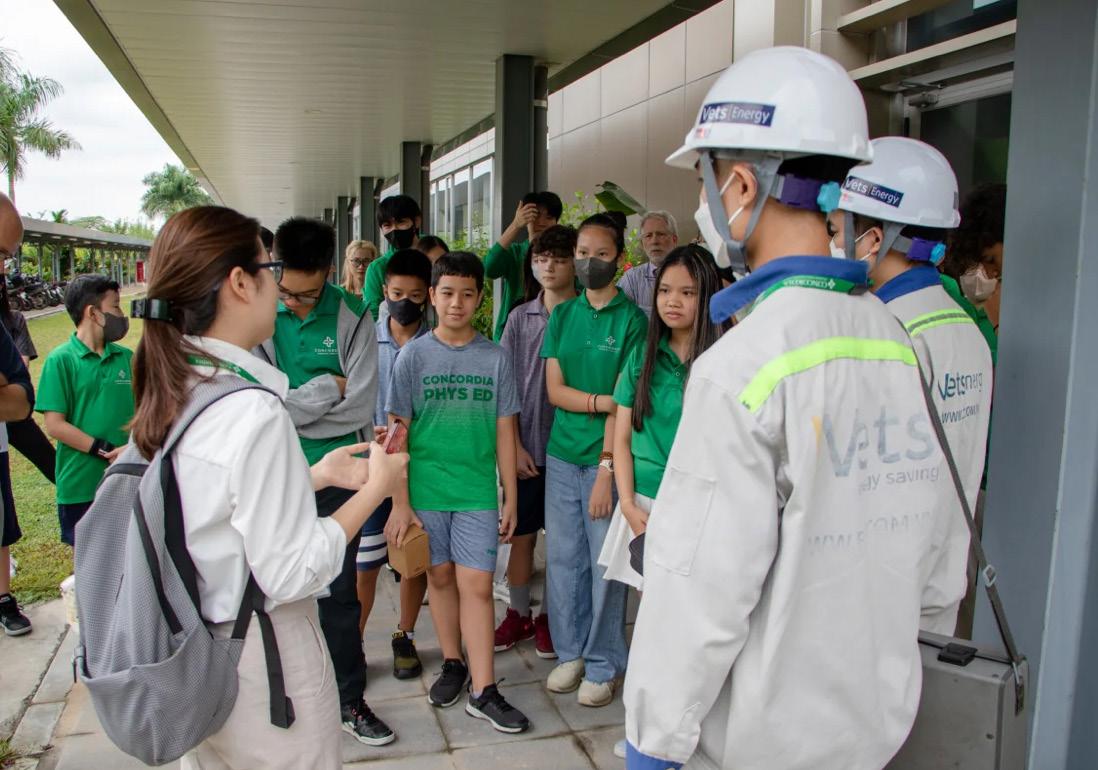
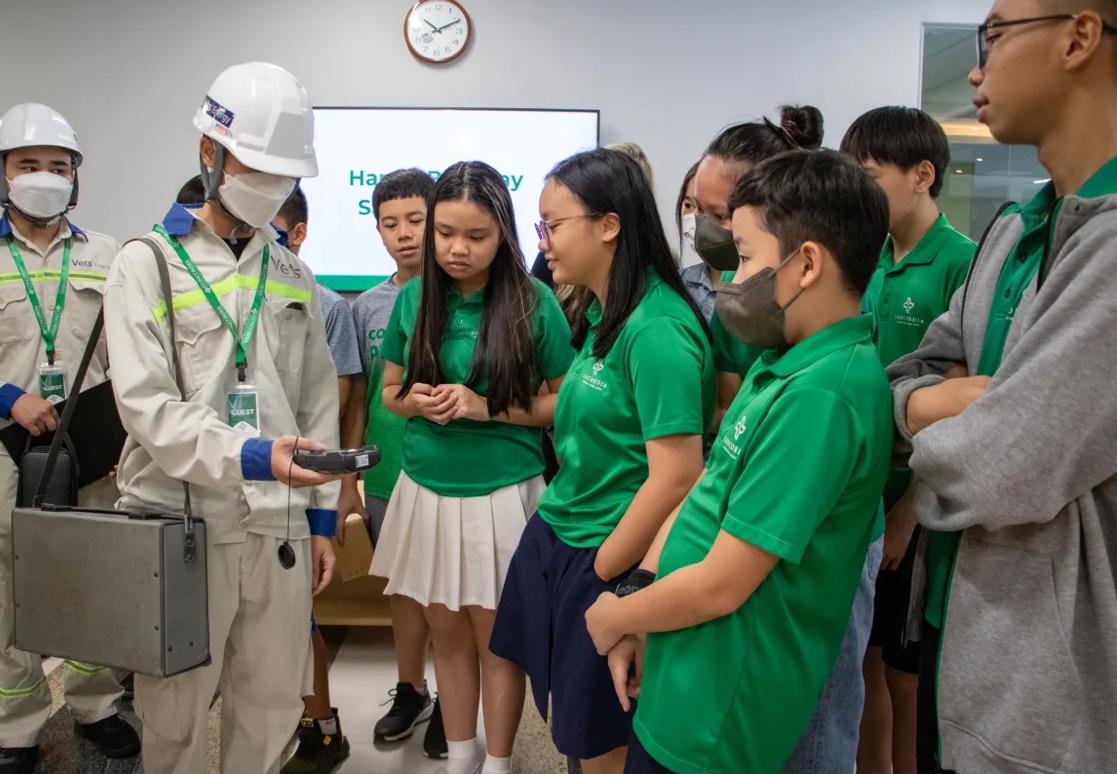
Concordia Environmental Science Students Meet GIZ Energy Experts
#ConcordiaHanoi high school students in AP Environmental Science and middle school environmental students got the chance to meet an expert in energy, Mr. Markus Bissel, with GIZ, the German aid organization.
Students learned about energy efficiency and what makes a building “efficient” while touring the Concordia campus to see some of our energy efficiency criteria, such as lighting, wastewater treatment and solar heating.
Read what students learned:
“Concordia automatically recycles water and the process takes around 5-7 hours. The water is well-filtered so you can drink water from basically any tap,” said Chau (G12).
“I learned about how almost all of our water is treated. I learned the usage of the treated wastewater, and I learned about how our school gets hot water from solar panels,” said Minh (G7).
“I learned that we save 30-50% of electricity each year by using the motion sensors to shut off the lights every 1-10 minutes when no one is around,” said Nata (G11).
“The water from the toilets gets filtered so we can water plants with it,” said Tung (G6).
“I didn’t know that this school puts so much effort into water and light treatment,” said Mason (G6).
“Aircon in the school is more complex than I thought,” said Ben (G8).
“I learned about the process of filtering water and the usage of water inside our school. It was interesting to hear that the water in the sinks is the same filtered water with fountain water,” said Vivian (G8).
“Wastewater from the water fountains, toilets and sinks doesn’t go to waste, but instead is repurposed to water campus plants,” said Luna (G8).
Concordia is a member of the Small Energy Efficiency Group (SEEG) led by the Ministry of Industry and Trade (MOIT) and GIZ, and works with the program to help educate students about energy efficiency and environmental sustainability.
Concordia Hanoi students learn how light is measured.
80 EARCOS Triannual Journal
GIZ experts and visiting energy auditors show Concordia students the school’s wastewater recycling system.
Mont’Kiara New Futsal Court
Mont’Kiara International School is excited to announce the official opening of its new futsal court! They had a ribbon-cutting ceremony in early September to inaugurate the new rooftop space. Staff and students have been putting the space to good use.
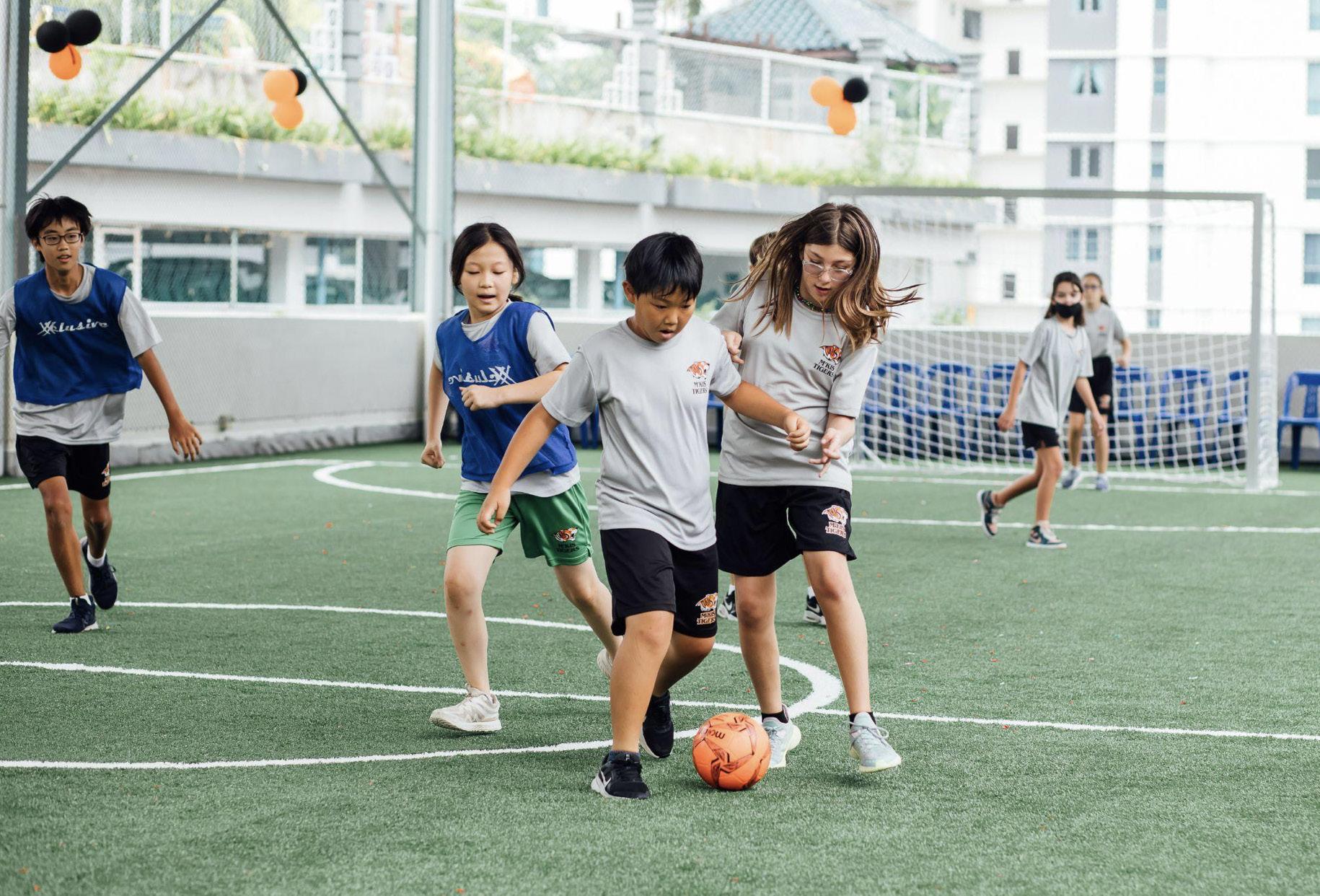
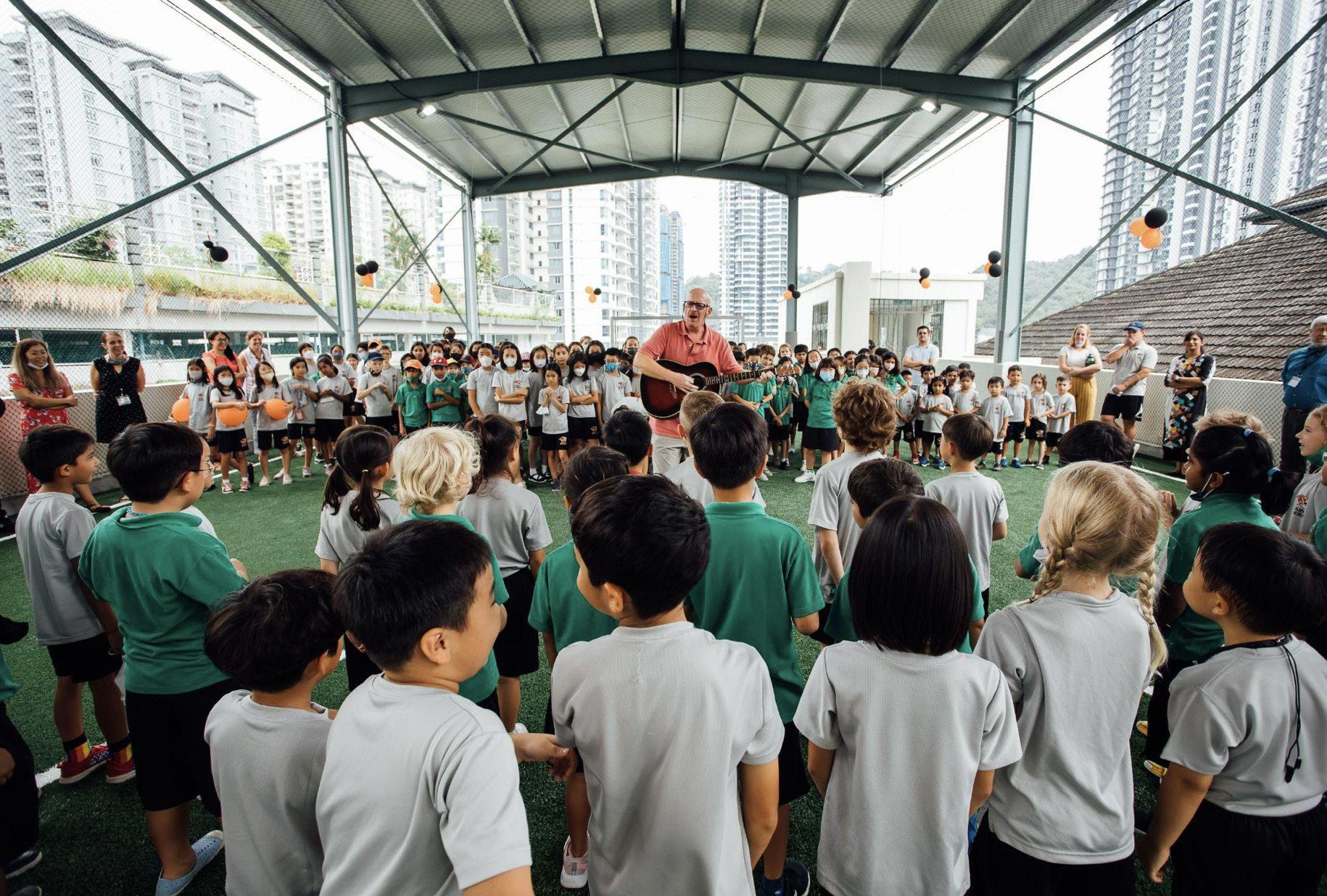
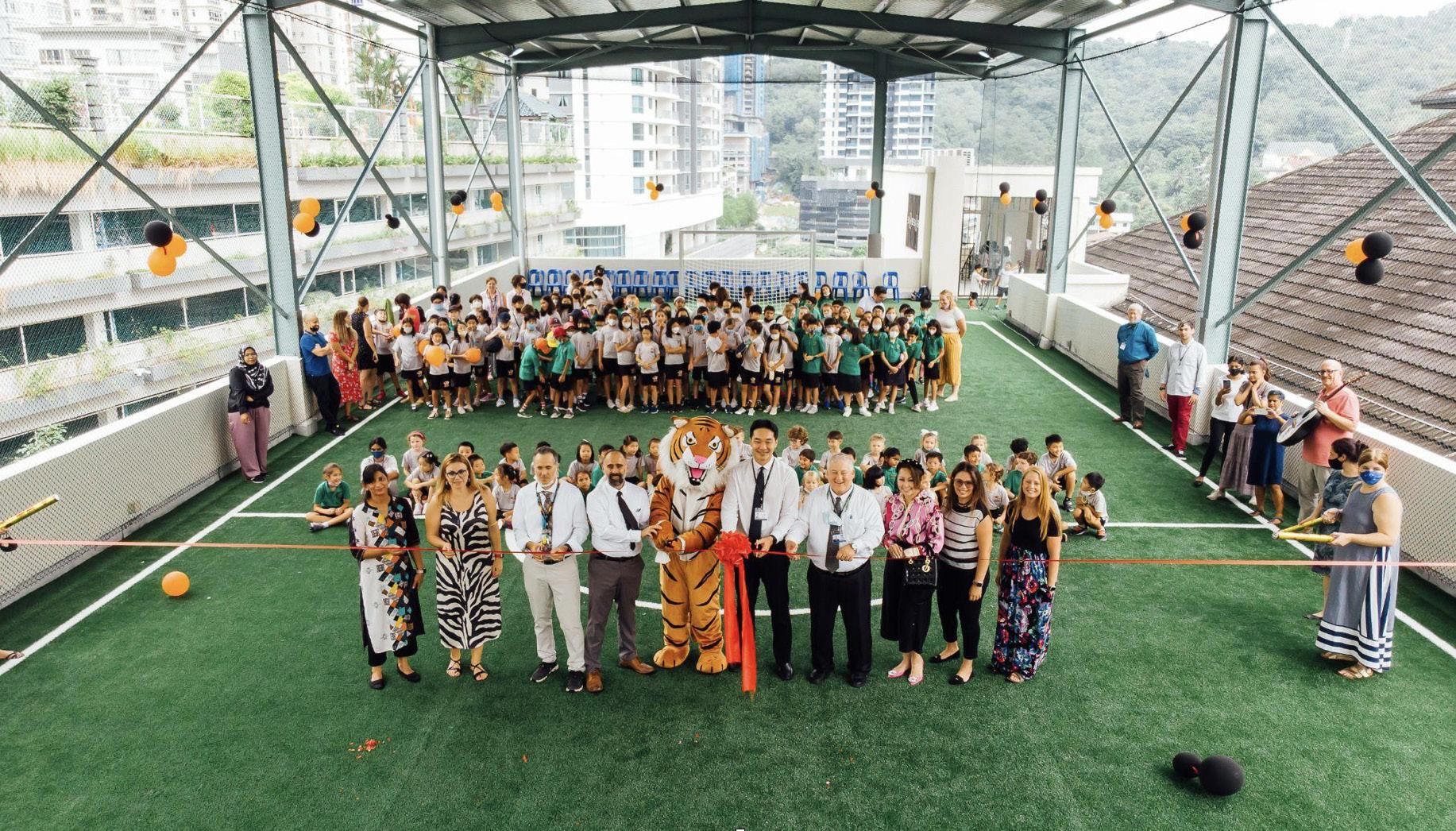
(left)
(right) Middle school students play the first-ever game on the court to officially open the space.
Fall 2021 Issue 37
CAMPUS DEVELOPMENT
Music teacher Dan Miller leads the second graders in singing the school song as part of the opening ceremony.
Winter 2023 Issue 81
Mont’Kiara administration, Parent association, and mascot Stripes cut the ribbon to mark the official opening of the futsal court.
Middle School Art Celebration
“Reflecting My Future”
Jia Choi, Year 10 Acrylic on Canvas This appropriation of Rene Magritte’s painting reflects my vision, hope and positivity not just for my future but for the world.
“Identity”
Tisha Tiwari, Year 10 Pen and ink on paper Finding balance between nature, society, aspirations and dreams.
(left)
(right)
Self-Portrait Parrot
Eunho Choi, Grade 8
Azariah Ramappa, Grade 6 Medium: Graphite Medium: Colored Pencil

Concordia International School Hanoi
The Fast Snail Cole Dziuban, Grade 3

82 EARCOS Triannual Journal
Bandung Alliance Intercultural School
The British School New Delhi
The British School New Delhi
Osaka International School of Kwansei Gakuin
Obasan/Grandmother
Helene 26 x 36.5 cm
United Nations International School of Hanoi Endangered Species of Vietnam - Digital Art Hannah Motojima, Grade 6
Osaka International School of Kwansei Gakuin
Ms Pyke Soo Hyun 36.5 x 26 cm

United Nations International School of Hanoi Contour Watercolor composition Hayoon Kim, Grade 8

Concordia International School Hanoi
Shadows on my Face Seoyeon Ka, Grade 4
Winter 2023 Issue 83