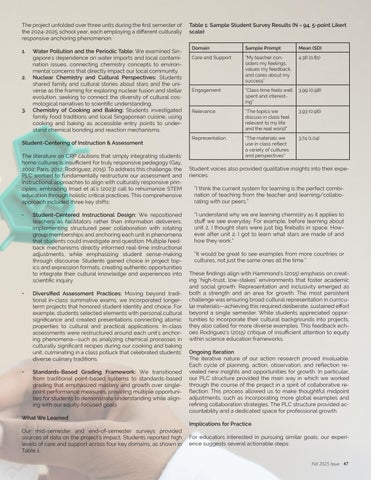
The project unfolded over three units during the first semester of the 2024-2025 school year, each employing a different culturally responsive anchoring phenomenon: 1.
2.
3.
Water Pollution and the Periodic Table: We examined Singapore's dependence on water imports and local contamination issues, connecting chemistry concepts to environmental concerns that directly impact our local community. Nuclear Chemistry and Cultural Perspectives: Students shared family and cultural stories about stars and the universe as the framing for exploring nuclear fusion and stellar evolution, seeking to connect the diversity of cultural cosmological narratives to scientific understanding. Chemistry of Cooking and Baking: Students investigated family food traditions and local Singaporean cuisine, using cooking and baking as accessible entry points to understand chemical bonding and reaction mechanisms.
Student-Centering of Instruction & Assessment The literature on CRP cautions that simply integrating students' home cultures is insufficient for truly responsive pedagogy (Gay, 2002; Paris, 2012; Rodriguez, 2015). To address this challenge, the PLC worked to fundamentally restructure our assessment and instructional approaches to align with culturally responsive principles, embracing Imad et al.'s (2023) call to rehumanize STEM education through holistic critical practices. This comprehensive approach included three key shifts: •
●Student-Centered Instructional Design: We repositioned teachers as facilitators rather than information deliverers, implementing structured peer collaboration with rotating group memberships and anchoring each unit in phenomena that students could investigate and question. Multiple feedback mechanisms directly informed real-time instructional adjustments, while emphasizing student sense-making through discourse. Students gained choice in project topics and expression formats, creating authentic opportunities to integrate their cultural knowledge and experiences into scientific inquiry.
● •
Diversified Assessment Practices: Moving beyond traditional in-class summative exams, we incorporated longerterm projects that honored student identity and choice. For example, students selected elements with personal cultural significance and created presentations connecting atomic properties to cultural and practical applications. In-class assessments were restructured around each unit's anchoring phenomena—such as analyzing chemical processes in culturally significant recipes during our cooking and baking unit, culminating in a class potluck that celebrated students' diverse culinary traditions.
● •
Standards-Based Grading Framework: We transitioned from traditional point-based systems to standards-based grading that emphasized mastery and growth over singlepoint performance measures, providing multiple opportunities for students to demonstrate understanding while aligning with our equity-focused goals.
What We Learned Our mid-semester and end-of-semester surveys provided sources of data on the project's impact. Students reported high levels of care and support across four key domains, as shown in Table 1.
Table 1: Sample Student Survey Results (N = 94, 5-point Likert scale) Domain
Sample Prompt
Mean (SD)
Care and Support
“My teacher considers my feelings, values my feedback, and cares about my success"
4.36 (0.81)
Engagement
“Class time feels well spent and interesting”
3.99 (0.98)
Relevance
“The topics we discuss in class feel relevant to my life and the real world”
3.93 (0.96)
Representation
“The materials we use in class reflect a variety of cultures and perspectives”
3.74 (1.04)
Student voices also provided qualitative insights into their experiences: “I think the current system for learning is the perfect combination of teaching from the teacher and learning/collaborating with our peers.” “I understand why we are learning chemistry as it applies to stuff we see everyday. For example, before learning about unit 2, I thought stars were just big fireballs in space. However after unit 2, I got to learn what stars are made of and how they work.” “It would be great to see examples from more countries or cultures, not just the same ones all the time.” These findings align with Hammond's (2015) emphasis on creating "high-trust, low-stakes" environments that foster academic and social growth. Representation and inclusivity emerged as both a strength and an area for growth. The most persistent challenge was ensuring broad cultural representation in curricular materials—achieving this required deliberate, sustained effort beyond a single semester. While students appreciated opportunities to incorporate their cultural backgrounds into projects, they also called for more diverse examples. This feedback echoes Rodriguez's (2015) critique of insufficient attention to equity within science education frameworks. Ongoing Iteration The iterative nature of our action research proved invaluable. Each cycle of planning, action, observation, and reflection revealed new insights and opportunities for growth. In particular, our PLC structure provided the main way in which we worked through the course of the project in a spirit of collaborative reflection. This process allowed us to make thoughtful midpoint adjustments, such as incorporating more global examples and refining collaboration strategies. The PLC structure provided accountability and a dedicated space for professional growth. Implications for Practice For educators interested in pursuing similar goals, our experience suggests several actionable steps:
Fall 2025 Issue 47