The EARCOS Triannual JOURNAL
A Link to Educational Excellence in East Asia FALL 2023
Featured in this Issue
Service Learning
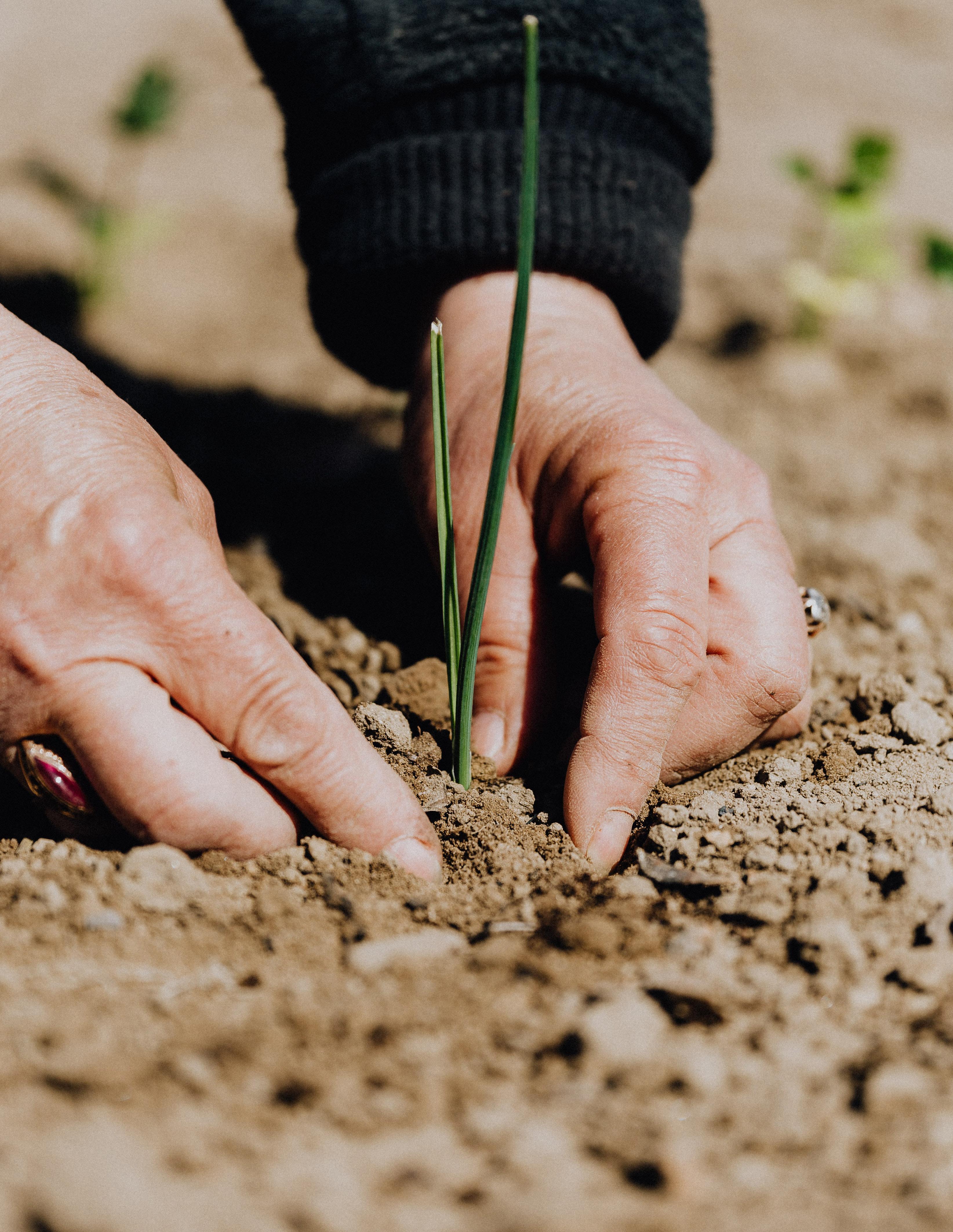
Farming Nagomi
Unveiling the Transformative Tapestry: Where Collaboration Meets
Community-Inspired Beginnings
Multi-Tiered Systems of Support
Leading Strategic Change: Building A Culture Of Inclusion
Instructional Coaching
The Social Mind at Work in the Classroom
THE EARCOS JOURNAL
The ET Journal is a triannual publication of the East Asia Regional Council of Schools (EARCOS), a nonprofit 501(C)3, incorporated in the state of Delaware, USA, with a regional office in Manila, Philippines. Membership in EARCOS is open to elementary and secondary schools in East Asia which offer an educational program using English as the primary language of instruction, and to other organizations, institutions, and individuals.
OBJECTIVES AND PURPOSES
* To promote intercultural understanding and international friendship through the activities of member schools.
* To broaden the dimensions of education of all schools involved in the Council in the interest of a total program of education.
* To advance the professional growth and welfare of individuals belonging to the educational staff of member schools.
* To facilitate communication and cooperative action between and among all associated schools.
* To cooperate with other organizations and individuals pursuing the same objectives as the Council.
EARCOS BOARD OF TRUSTEES
Kevin Baker (American International School Guangzhou), President
Catriona Moran (Saigon South International School),Vice President
Rami Madani (International School of Kuala Lumpur),Treasurer
Elsa Donohue (Vientiane International School), Secretary
Margaret Alvarez (WASC / ISS International School), Past-President
James Dalziel (NIST International School)
Karrie Dietz (Australian International School Singapore)
Gerald Donovan (North Jakarta Intercultural School)
Jim Gerhard (Seoul International School)
Gregory Hedger (The International SchoolYangon)
Andrew Hoover (Office of Overseas Schools, REO, East Asia Pacific)
EARCOS STAFF
Edward E. Greene, Executive Director
Bill Oldread, Assistant Director
Kristine De Castro, Assistant to the Executive Director
Maica Cruz, Conference Program Coordinator
Ver Castro, Membership & I.T. Coordinator
Edzel Drilo, Webmaster, Professional Learning Weekend, Sponsorship & Advertising Coordinator
Robert Sonny Viray, Accountant
RJ Macalalad, Accounting Assistant
Rod Catubig Jr., Office Staff
East Asia Regional Council of Schools (EARCOS)
Brentville Subdivision, Barangay Mamplasan, Binan, Laguna, 4024 Philippines
Phone: +63 (02) 8779-5147 Mobile: +63 917 127 6460
In this Issue
38 International Taskforce on Child Protection MAKE THE CALL! Verifying References: An Essential Practice for International School Leaders
By Jane Larsson & Pauline O’Brien
40 School Change
Connecting Key Elements to Rapidly Transform Schools
By Brian Lalor
Unveiling the Transformative Tapestry: Where Collaboration Meets Community-Inspired Beginnings
By Raquel Acedo-Rubio
By Mark William Barnett
16 MTSS
Multi-Tiered Systems of Support Leading Strategic Change: Building A Culture Of Inclusion
By Johanna Cena, Cheryl Hordenchuk, and Nitasha Crishna
18 Instructional Coaching
The Social Mind at Work in the Classroom
By

Michelle Garcia Winner
20 Project-based Learning
Using Purpose Learning to Increase Belonging in the Classroom By Jessica Catoggio
24 School Experience
Introducing the Future of Parent Feedback to Schools By David
Willows
International Teachers Teaching: Why We Stay By Aleksa Moss
28
Mindfulness
Let’s Talk: Critical Intellectual Discussion Beyond the Curriculum By Jared Rock
Creating a coherent curriculum with the International Primary Curriculum (IPC)
By Jacqueline Harmer and Andy Freeman
42 ISLES: Strategic Leadership for Inclusive Student Support By Cindy Warner-Dobrowski, Priscilla Leighton, Kristel Solomon-Saleem and Trina Cobbledick
44 Action Research
Kagan Structures to Enhance Oral Mandarin Proficiency: The Impact of Organizing Classroom Talk
By Pham Ngoc Mai Anh
How Does Kinesthetic Skill Acquire More Knowledge?
By Gloria Natalia
The Impact of Differentiated Instruction and UDL on Secondary Students’ Critical Thinking Skills
By Thressye N Nainupu, Kustiani Widyarti & Andre Yulianto
53 Global Citizenship Community Service Grant
Triple A Mission: Empowering Youth to Raise Awareness and Promote Mental Health Initiatives Globally
By Suhani Chawla
The Dolmaa Ling Soup Kitchen (see page 56)
By Bilguunzaya Chuluunbaatar
54 Global Citizenship
A Recipe for Whole School Transformation Towards Active Global Citizenship By LeeAnne Lavender
58 Green & Sustainable
Growing a Green Movement By Paul Escott
60 Press Release
Yokohama International School Facilitates Collaboration and Innovation at JISTG Conference
62 Memoir
The 100th Year Commemoration of The Great Kanto Earthquake By Jeanette K. Thomas
65 Remembering Sr. Maria Zenaida Ancheta
66 Elementary Art Gallery
Fall 2023 Issue 1
2 Welcome Message from the Executive Director 3 What’s in Store for 2023-2024? 4 Welcome New Heads, Principals, Associates, and Individual Members 8 Global Citizenship Awardees & Community Grant Recipients
Service Learning
10
Farming Nagomi By Emi Hisamatsu
Artificial
14
Intelligence
What can you learn about yourself while exploring AI?
26 Teacher Retention
Equity
Warrior
Mindfulness
Can I be an equity warrior? By Matthew Militello & Carrie Morris 30
Curriculum
I know it would be good for me, but… By Michel Thibeault 32
Message from the Executive Director
The Tie That Binds
Welcome to the Fall edition of the EARCOS Tri-annual Journal. All of us at EARCOS hope that this finds you and your school communities thriving, happy and well. We also hope that you will find much to enjoy and think about in this issue. We are grateful to the many colleagues who have taken time to share their thinking with us. It underscores, again, what a very dynamic region this is.
As we move into the second full school year of this post-pandemic era, international educators in every region are embracing every opportunity possible to re-connect in person. It is easy to understand why.
During the pandemic we took advantage of technologies that allowed us to meet virtually, but it became obvious that we humans need to be together in real time and real place. Just thirty minutes of the evening news on any day is enough to tell you that the fabric that has (barely) held the world together in our lifetimes is coming undone. Faced with so many threatening developments can there be any question why there is such a powerful need for educators to join together to share our questions, our worries and ideas? How will we provide the young people whose futures are entrusted to us the essential skills, values and the understanding they need to combat the escalating issues of the 21st Century?
Zoe Weil, President of the Institute for Humane Education, may have said it best in her book The World Becomes What We Teach: Educating a Generation of Solutionaries (see humaneeducation.org). Are we preparing a generation that will be able to solve the challenges we are bequeathing to them? In Socratic terms, are our schools empowering young people to value, seek and live a ‘good life’ or are we preparing them for a life in a world that will no longer exist when they get there?
If you agree that educators touch the future, just what kind of future are our children and students being asked to grab on to? Creating a better world for and with our students is the reason so many of us accepted the call to become educators in the first place--and why so many remain deeply committed to education. Touching the future and creating a better world are ideas that resonate. Those ideas can flourish within every classroom today. The changes we can affect in one classroom or in one school year may be minutely incremental, but they are multiplied time and time again each day and reverberate across time and space as more and more educators join hands together to create a better world.
Consider the lasting impact programs like the Global Issues Network, Stories that Move, Inspired Citizens, Roots and Shoots, Facing History and Ourselves and #MyFreedomDay have on students. Consider, too, the power of the service-learning programs in our schools (a number of which are featured in this issue). I must admit to feeling a sense of awe when I talk to people who have created projects like the After the Wave Fund at IS Bangkok and the Leading Young Women initiative at St. Joseph’s International in Singapore and the EJAAD Afghan Project at Osaka International School—and so many other student-driven initiatives that make the world a better place. Programs such as these truly touch the future—and the hearts and minds of everyone associated with them.
The future our students need requires nothing less than a highly principled generation with the deep knowledge, understanding, empathy, will and confidence to act together across boundaries and across and within cultures. Schools may have a jambalaya of mission statements, visions, goals and objectives, but we must agree that the singular calling of touching tomorrow and creating a better world for everyone is, as it has always been, the true heart and soul of all international educators. It is the tie that binds.
We welcome your contributions to this journal and in person on initiatives you and your community are taking to prepare students for the world that hungers for their active citizenship and leadership. Our students, our children--and this fragile world of ours--need and deserve nothing less.


With continued best wishes to you, your students and communities for a happy and healthful school year.
Edward E. Greene, Ph.D. Executive Director

2 EARCOS Triannual Journal
Here is our list of sponsored value-packed webinars, filled with International School insights provided by leading edge panelists and subject matter experts. Topics addressed are leadership, governance, assessment, curriculum, and many more.
OCTOBER
Professionally Networking to Enrich Conference Learning
Presented by: Michael Iannini
Wednesday, Oct 11, 2023
4:00 - 4:30 AM HKT
Establishing a Student-Staffed & Managed Learning Center Workshop
Wednesday, Oct 14-15, 2023
VENUE: International School of Tianjin | Tianjin, China
NOVEMBER
Why and When Do Independent School Boards Become Dysfunctional
Presented by: John Littleford
Saturday, November 4, 2023
9:00 - 10:30 AM HKT
Empowering Core Instruction in Mathematics: Integrating Generative AI and UDL Principles in Lesson Planning

Presented by: Erma Anderson
Saturday, November 7,14, & 21 2023
6:00 PM HKT
Exploring the Cycle of Socialization
Presented by: Margaret Park
Saturday, November 11, 2023
9:00-10:30 AM HKT
Measuring the Experience of Families in Your School
Presented by: David Willows & Suzette Parlevliet
Saturday, November 25, 2023
9:00 - 10:30 AM HKT
DECEMBER
Decolonization 101: How to Decolonize Your Classroom and Curriculum
Presented by: Dr. Soojin Pate
Saturday, December 2, 2023
9:00 - 10:30 AM HKT
Strategic Planning: Necessary, often Exciting and sometimes Risky
Presented by: John Littleford
Saturday, December 9, 2023
9:00 - 10:30 AM HKT
JANUARY
Reading and Evaluating Asian American Youth Literature
Presented by: Sarah Park Dahlen
Saturday - January 20, 2024
9:00 - 10:30 AM HKT
FEBRUARY
Women in Leadership
Presented by: Nitasha Crishna
Saturday, February 17, 2024
9:00 - 10:30 AM HKT
MARCH
How to Intentionally Integrate Students’ Languages in Any Class
Presented by: Tan Huynh
Saturday, March 9, 2024
9:00 - 10:30 AM HKT
APRIL
Identity Centered Learning
Presented by: Daniel Wickner
Saturday, April 13, 2024
9:00 - 10:30 AM HKT
MAY
Culturally Responsive and Sustaining Learning
Presented by: Joel Llaban
Saturday, May 25, 2024
9:00 - 10:30 AM HKT
For more information please visit https://earcos.org/2023_upcoming_events.php
Fall 2023 Issue 3 WHAT’S IN STORE FOR 2023-2024
Welcome New Schools >>
American International School Vietnam
Australian International School Pte Ltd
Cheongna Dalton School
German European School Singapore
International School of Western Australia
ISHCMC - American Academy
QSI International School of Dili
Ramkhamhaeng Advent International School
Reedley International School
Shattuck-St. Mary’s Forest City International School
The International School of Penang (Uplands)
Thalun International School
The Winstedt School
VERSO International School
Jon Standen, Executive Principal www.aisvietnam.com
Karrie Dietz, Head of School www.ais.com.sg
Jiho Park, Head of School http://daltonschool.kr/
Stefan Pauli, Principal / Schulleiter www.gess.sg
Caroline Brokvam, Principal www.iswa.wa.edu.au/
Nathan Swenson, Head of Campus www.aavn.edu.vn/
Audra Phelps, Director www.dili.qsi.org
Mary Megan Lartey, Head of School www.rais.ac.th
Rene McQuillin, Head of School www.reedleyschool.edu.ph
Gregg Maloberti, Head of School www.ssm-fc.org/
Marc Mesich, Head of School www.uplands.org
Winsome May Saldanha, Director www.thaluninternationalschool.com
Chris Raymaakers, Head of School www.winstedt.edu.sg
Ryan Persaud, Head of School www.verso.ac.th/
Xi’an Liangjiatan International School Dr. Lily Liu, Head of School https://xalis.com/
Welcome
New Heads >>
American International School, Vietnam
Aoba-Japan International School
Bandung Independent School
Berkeley International School
Canadian Int’l School of Hong Kong
Cheongna Dalton School
Dulwich College Suzhou
East-West International School
Ekamai International School
Chandra McGowan
Jake Madden
Marci Russell
Paul Pallister
Tim Kaiser
Jiho Park
David Massiah
Kate O’Connell
Rachaniphorn Ngotngamwong
Gyeonggi Suwon International School Tiffeney Brown
International Bilingual School of Hsinchu
Int’l Christian School-Hong Kong
International School Bangkok
International School Dhaka
International School of Brunei
International School of Dongguan
International School of Kuantan
Int’l School of Nanshan Shenzhen
Charles Chang Chien
Nicholas Seward
Sascha Heckmann
Steve Calland-Scoble
Stephen Kendall-Jones
Mark McCallum
Chin Hui Kee
Addie Loy
International School of the Sacred Heart Anne Wachter
ISHCMC - American Academy
Nathan Swenson
ISS International School Mun-E Chan
KIS International School
Carolyn Mason Parker
Medan Independent School Gregory McGuire
Mont Kiara International School Robert Cody
Osaka YMCA International School Kazuki Yamane
QSI International School of Dili Audra Phelps
Ramkhamhaeng Advent Int’l School Peter Munasinghe
Reedley International School René MacQuillin
Renaissance International School Mark Sayer
Shattuck-St. Mary’s Forest City Gregg Maloberti
International School
Stamford American School Hong Kong Marco Longmore
Stonehill International School Joe Lumsden
Taipei American School Evelyne Estey
The Int’l School of Penang (Uplands) Marc Mesich
The Sultan’s School Nigel Fossey
The Winstedt School Chris Raymaakers
UWC Thailand International School Lural Ramirez
XCL American School of Bangkok Sean O’Maonaigh
XCL World Academy Tammy Murphy
Xi’an Hanova International School Lucas Roberts
Yew Chung International School of Beijing Shelley Swift
Yew Chung Int’l School of Chongqing Jessie Xiao
Yogyakarta Independent School
Welcome New High School Principals >>
American International School of Guangzhou Lori Marek
American International School Vietnam Lee Parker
American Pacific International School Shaun Henriksen
Australian International School Pte Ltd Adam Patterson
Beijing City International School Natalie Harvey
Brent International School Manila Brett Petrillo
Elia Nugraha Ekanindita
Brent International School Subic Todd Wyks
Canadian Academy Brian Combes
Canadian Int’l School of Hong Kong David Butler
Canggu Community School Rick Odum
Cebu International School Benjamin Martin
Cheongna Dalton School Marisa Montelibano
4 EARCOS Triannual Journal
Christian Academy in Japan Tyrone Fambro
Dalat International School Scott Uzzle
Ekamai International School
Armin Kritzinger
European Int’l School Ho Chi Minh City John Horsington
Fukuoka International School Ken Forde
Global Jaya School Howard Menand
Grace International School Anne Spohnhauer
Hong Kong International School
Aimmie Keller
Hsinchu International School Timothy Hicks
International Christian School - HK Tom Penland
International School of Beijing
Will Paananen
International School of Kuantan Kee Chin Hui
ISHCMC - American Academy
Jakarta Intercultural School
Jenn Pratt
Edward Wexler
Korea International School Christina Powers
Nagoya International School
Lisa Michelle Nnadozie
Nanjing International School Sara Morrow
Northbridge Int’l School Cambodia Sarah Newton
Punahou School
Gustavo Carrera
Raffles American School Mark Hemphill
Reedley International School Jerome Fernando Castro
Renaissance International School Andy Roberts
Ruamrudee International Sc-hool Nathan Meisner
Shanghai Community Int’l School Ken Kitchens
Shanghai Qibao Dwight High School Robbie Shields
Shattuck-St. Mary’s Forest City Int’l School Lianne Dominguez
Shen Wai International School Aloha Lavina
Springboard Int’l Bilingual School Mark Munro
St. Mary’s International School Kimberly Fradale
St. Paul American School Hanoi TJ Shiers
Stonehill International School Manpreet Kaur
Suzhou Singapore International School Patrick Phillips
Taipei American School Becky Read
The Int’l School of Penang (Uplands) Emily Vallance
The International School Yangon Mike Simpson
The Sultan’s School
The Winstedt School
THINK Global School
Lori Carpenter
Tara Beck
Andy Jenkinson
Tianjin International School Jacob Way
United World College of South East Asia Seema Desai (Dover)
Xi’an Liangjiatan International School Jaimala Quinlan
Yew Chung Int’l School of Beijing Tanya Nizam
YK Pao School James Lyng
Welcome New Middle School Principals >>
Australian International School Pte Ltd
J Dianne Brederson
Beijing City International School Natalie Harvey
Canadian Academy
Canadian Int’l School Bangalore
Canadian Int’l School of Hong Kong
Cebu International School
Chiang Mai International School
Christian Academy in Japan
Ekamai International School
European Int’l School Ho Chi Minh City
Fukuoka International School
Grace International School
International Bilingual School of Hsinchu
International School of Kuantan
International School of Myanmar
Keystone Academy
Brian Combes
Andrew Nicholson
Ange Molony
Benjamin Martin
Troy Regis
Renee Van Druff
Christy Perera
John Horsington
Ken Forde
Cindy Morphis
Pingchun Wu
Kee Chin Hui
Mark Weber
Houming Jiang
Welcome
Korea International School Molly Burger
Nagoya International School Lisa Michelle Nnadozie
Nanjing International School Sara Morrow
Nishimachi International School Craig Cantlie
Reedley International School Maria Andrea De Guzman
Renaissance International School Andy Roberts
Ruamrudee International School Dr. Nathan Meisner
Shanghai American School Erica Curry
Shattuck-St. Mary’s Forest City Int’l School Lianne Dominguez
Shen Wai International School Aloha Lavina
Springboard Int’l Bilingual School Mark Munro
The Int’l School of Penang (Uplands) Emily Vallance
The International School Yangon Mike simpson
The Winstedt School Alastair Dawson
Xi’an Liangjiatan International School Jaimala Quinlan
New Elementary School Principals >>
American Int’l School of Guangzhou Virginia Udall
American Pacific International School Stephanie Dracz
Ascot International School
Australian International School Pte Ltd
Branksome Hall Asia
Canadian Int’l School of Singapore
Cebu International School
Cheongna Dalton School
Concordia Int’l School Shanghai
Daegu International School
Nicola Holloway
Emma McAulay
Peter Row
Andrew Marshall
Maureen Juanson
David Hill
Angela Beach
Steve Vis
Dalat International School Lizzy Neiger
Dalian American International School David Jones
Dwight School Seoul Serena Geddes Aguilar
Fukuoka International School Ken Forde
German European School Singapore Kristyn Holland
Gyeonggi Suwon International School Jeannie Sung
Hong Kong International School Duncan FitzGerald
International Bilingual School of Hsinchu Erica Ro
International School of Kuantan Kee Chin Hui
Int’l School of Nanshan Shenzhen Thomas Tucker
International School of Tianjin Cameron Wallace
Keystone Academy Beryl Nicholson
Fall 2023 Issue 5
Welcome
New Elementary School Principals >>
Korea International School Taryn Pereira
Nagoya International School Holly Johnson
Nishimachi International School Craig Cantlie
Northbridge Int’l School Cambodia Aidan Stallwood
Oberoi International School Gunilla Bengtsson
Raffles American School Suzanne Thibault
Reedley International School Maria Andrea De Guzman
Seisen International School Serrin Smyth
Shanghai Community Int’l School Molly Myers
Shattuck-St. Mary’s Forest City Int’l School Lynne Morrin
Springboard Int’l Bilingual School Sandra Lopez
St. Mary’s International School Barry Ratzliff
Welcome
St. Paul American School Hanoi Myong ‘Moo’ Eiselstein
Stamford American School Hong Kong Rae Lang
Stonehill International School Peter Spratling
Thalun International School MazenR.DGuzman
The Int’l School of Penang (Uplands) Jacqueline North
The Sultan’s School Robin Cummings
The Winstedt School Sonia Pathela
Xi’an Hanova International School Sandy Venter
Xi’an Liangjiatan International School Marly Song
Yew Chung Int’l School of Beijing Geoffery Ross
Yew Chung Int’l School of Chongqing Graham Mayes
YK Pao School Rosalie Pietsch
Early Childhood Principals >>
Access International Academy Ningbo Charity Yi
Australian International School Pte Ltd
Eromie Dassanayake
Beijing City International School Jackie Becher
Canadian International School of Singapore Angela Spiers
Concordia International School Shanghai Robert Cantwell
Daegu International School Steve Vis
Ekamai International School Hazel Ilao
Hangzhou International School Lynn Pendleton
International School Bangkok Honey Tondre
International School of Dongguan Fiona Teh
Welcome
Int’l School of Nanshan Shenzhen Michael Lattimore
NIST International School Lauren Hateley-Crowe
Reedley International School Maria Andrea De Guzman
St. Johnsbury Academy Jeju Carla Chavez
Thalun International School Theingi Aung
The Int’l School of Penang (Uplands) Jacqueline North
The Winstedt School
Karina Estiningdiyah
UWC Thailand International School Kurtis Peterson
Vientiane International School Regina Alcorn
Yongsan International School of Seoul Susannah Wilcox
New Individual Members >>
Ericson Perez, Head of School
The Vanguard Academy
Lady Bernadette (Didi) Dolandolan, School Director Canadian American School
Johnny Mendola, CEO University Curriclum for Independent Learning
Kaanwarin Polanunt, School Director
Satit Pattana School
6 EARCOS Triannual Journal
Welcome
New Associate Institutions >>
Adobe Systems
Adobe Software for Education
Anatomage
Educational and Medical Technology

Avvanz Pte Ltd
1. Individual Background Checks including Education, Employment, Criminal, Civil, Financial, ID, Social Media covering 150+ countries
2. Company Due Diligence (When appointing Vendors or Contractors)
3. Customized elearning solutions development”
Clipboard Information Technology
EduChange, Inc.
Interdisciplinary Secondary Science Curriculum & Professional Development, Competency-based Assessment, STE(A)M, Disciplinary Literacy Methods
ELi Publishing
K12 Foreign Languages (ELT, LOTE) publisher and content supplier
Intellischool
Educational data analytics, data ops and identity management
Millie Group LTD

Careers & University Guidance for international schools
Onboard 360
Onboarding coaching, consulting, and applications
RED DRAGON BUSINESS CONSULTING
Online Teacher Training Courses at University
Toddle Education Technology
The FUTURE of
SCIENCE LEARNING
Our professionally designed curriculum ensures vertical coherence and elevates rigor without anxiety.
Multi-year models begin as early as Grade 8/Age 13.
Connects the personal, local & global (#TeachSDGs)

Prepares students for advanced exam-based courses
Customized for schools, modifiable by teachers & students
Robust English literacy, engineering, laboratory & data work
Coaching by experienced Intl School science teachers
Fall 2023 Issue 7
EARCOS
the
for
webinar.
info@educhange.com
is an
affiliate member. Start
conversation now
a 2024-25 launch! Schedule a 30-minute
+1-310-736-1300 https://educhange.com/intsciwhat
Has Arrived... and it’s INTEGRATED
Global Citizenship Awardees >>
List of Global Citizenship Award 2023Winners

This award is presented to a student who embraces the qualities of a global citizen. This student is a proud representative of his/her nation while respectful of the diversity of other nations, has an open mind, is well informed, aware and empathetic, concerned and caring for others encouraging a sense of community, and strongly committed to engagement and action to make the world a better place. Finally, this student is able to interact and communicate effectively with people from all walks of life while having a sense of collective responsibility for all who inhabit the globe.
Access International Academy Ningbo Kaiyun Zhang
American Int’l School Hong Kong Hiromichi Sasaki
American Int’l School of Guangzhou Mika Goldman Shayman
American International School, Vietnam Phuong (Hannah) Nguyen
American School Hong Kong Edric Nazareno
American School in Taichung Dalin Daniel Guh
Ayeyarwaddy International School Ye Htut Win
Bali Island School
Caspia Nadapdap
Bandung Independent School Hayun Lim
Bangkok Patana School Ansh Narula
Beijing City International School Sijia (Sophia) Hou
Brent International School Baguio Angeli Eirene Balagot
Brent International School Manila Chaewoo Lee
Brent International School Subic Jihwan An
British School Manila Mikaela Lim
Busan Foreign School Grace Bo Kyung Chun
Canadian Academy Eva Isabel Bonnier
Canadian Int’l School of Singapore Imma Tao Martinez Leger
Canadian International School, Tokyo Shao-Han Veronica Huang
Cebu International School Liam Cergneux
Chadwick International School Yun-Chen (Jin) Wu
Chatsworth International School Trinh Trong Nguyen
Christian Academy in Japan Sunwoo Park
Concordia International School Hanoi Van Anh Nguyen
Concordia Int’l School Shanghai Diya Prashantham
Concordian International School Pei-ying (Melody) Chuang
Daegu International School
Dylan Wang
Dalat International School Caleb Jun
Dalian American International School Samuel Liu
Dominican International School Rachel Junseo Park
Dwight School Seoul Hansung Kim
European Int’l School Ho Chi Minh City Hwajun Song
Garden Int’l School Kuala Lumpur Bryan Lim
German European School Singapore Linda Jaschik
Hangzhou International School Sera Bajaj
Hanoi International School Minseo Kang
IGB International School Thesya Thiruchelvam
International Bilingual School of Hsinchu Shiue-Lang Chin
Int’l Christian School - Hong Kong Clement Chin Cheung Chan
Int’l Christian School - Pyeongtaek HaYeon Lee
International School Bangkok Ayaka Bijl
International School Dhaka Marcelle Karina Lamarche Valenzuela
Int’l School Eastern Seaboard (ISE) Taejun Park
International School Manila Reyn Bungabong
International School of Beijing Alexander Domingo
International School of Busan Charlene Kim
International School of Dongguan Pao-Chia Hsu
Int’l School of Nanshan Shenzhen Gordon Nie
International School of Phnom Penh Bisruti Pandey
International School of Ulaanbaatar Bilguunzaya Chuluunbaatar
International School Suva Joy Clark
Kaohsiung American School Wilson Yu
Keerapat International School Thiranat Elaine Kittikhunkhongkha
KIS International School Franciszek Maurer
Korea International School-JeJu Campus Hajin Ruy
Lanna International School Thailand Aran Tantinipankul
Marist Brothers International School Rina Okazaki
Medan Independent School Sara Henao
Mont’Kiara International School Zeynep Cetingul
Nagoya International School Judy Joo
Nanjing International School Sofia Brevigliero
Nansha College Preparatory Academy Ray Kairui Ou
NIST International School Zenia Mistry
Osaka International School Ayami Nozaki
Osaka YMCA International School Anju Manfred
Prem Tinsulanonda International School Sonam Choki Lhamo
Ruamrudee International School Thitilapa (Ivy) Sae-Heng
Saint Maur International School Yura Kitamura
Seisen International School Mika Kato
Sekolah Ciputra Cheryl Loemantoro
Seoul Foreign School Isabella Jia Dunsby
Seoul International School John Kim
Shanghai American School-Pudong Campus Vivian Chou
Shanghai American School-Puxi Campus Connor Tai-Chi Chen
Shanghai Community Int’l School - Ying-Shan Pinkgua Mao Hongqiao Campus
Shanghai Community Int’l School - Federico Cordischi
Pudong Campus
Shen Wai International School Hanqi (Angel) Wang
Shenzhen College of Int’l Education Xiwen Liang
Shenzhen Shekou International School Athena Zhiyi Wang
Singapore American School Gio Park
Singapore Int’l School of Bangkok Panthira Polcharoen
St. Johnsbury Academy - Jeju Aman Shajee
St. Joseph’s Institution International Angelica Claudia
8 EARCOS Triannual Journal
St. Marys International School
St. Paul American School Hanoi
Kevin Oh
Khuat Minh Hoi Tran
Surabaya Intercultural School Ji Woo Chae
Taejon Christian International School Mu Jun Kim
TEDA Global Academy Lin Ting-Wei
Thai-Chinese International School Annie Natganthima Hsu
Thalun International School
The American School in Japan
Wai Yan Win Aung
Sena Chang
The British School New Delhi Arnav Gupta
The Int’l School of Kuala Lumpur Pulkit Chaudhari
The International School Yangon Hmwe Hmwe Aung
Tianjin International School
SoHee Choi
Tohoku International School Yu Iwamoto
United Nations Int’l School of Hanoi Tanuska Bora
United World College of South East Asia
Jaeim (Jamie) Paik East Campus
Utahloy Int’l School Guangzhou Ayako (Catherine) Nozue
UWC Thailand International School
Ornkanya Kaengkan
Victoria Shanghai Academy Shi Yao (Anna) WEI
Vientiane International School
Thanakrit Nolintha
Western Academy of Beijing Hannah Garabito-Silva
Western Int’l School of Shanghai Thomas Liu
Wuhan Yangtze International School Luke Paul deMena
XCL World Academy Boon Xuan Cheah
Xiamen International School Min Sung Kim
Yangon International School
Thant Thawdar Thwin
Yantai Huasheng International School Jungwon Moon
Yew Chung International School of Shanghai Yilun Allen Li
Yongsan International School of Seoul Kyra Yeun Jun
Global Citizenship Community Grant Recipients >>



All of us here at EARCOS wish to extend our sincere congratulations to the following Global Citizens who have been chosen to receive an EARCOS Global Citizen Community Service Grant of $500 to further their excellent community work during this upcoming academic year. The recipients are:
NAME
Reyn Bungabong
Bilguunzaya Chuluunbaatar
SCHOOL
International School Manila
International School of Ulaanbaatar
Angelica Claudia St. Joseph’s Institution International
Sena Chang
Phuong (Hannah) Nguyen
Suhani Chawla
The American School in Japan
PROJECT NAME
The Wagon School
The Dolmaa Ling Soup Kitchen
Aku Bisa (‘I can’ in Indonesian)
ASIJ Sustainability Steering Committee
American International School, Vietnam Service Pals
Shanghai Community International School - The Triple A Hongqiao Campus
Fall 2023 Issue 9
SERVICE LEARNING Farming Nagomi
 By Emi Hisamatsu Aoba Japan International School
For centuries, the Japanese have been defining the meaning of life through the concept of nagomi which refers to being in a state of “balance, harmony and wellbeing in the mind and in the physical body” (Dickinson, 2023). Empathy is integral in achieving a balance in a world where mental health is on the decline and where people can easily become focused on their own needs while forgetting the needs of others (COVID-19 Mental Disorders Collaborators, 2021). Jamil Zaki, a Stanford University psychologist, defines empathy as “the ability to share and understand one another’s feelings— a psychological “superglue” that connects people and undergirds cooperation and kindness” (Zaki, 2019). In most International Baccalaureate (IB) schools, empathy forms the foundation for many of its underpinnings. There is a drive to foster international-mindedness, encourage servicing the community, as well as to take part in inquiry-based learning where empathy can assist in considering different perspectives. I believe that we can find nagomi through turning our attention to the natural world surrounding us and through starting from the basics of growing our own food. In a complex world, where it may seem difficult to find the right path, the simple initiative of farming can teach us the values of patience, hard work, compassion, and respect for our local community.
To gain a deeper understanding of empathy, we need to delve into how it is separated into three distinct categories: cognitive, emotional and compassionate empathy (Miller, 2022). Cognitive empathy is being able to understand someone else’s thinking and feelings, emotional
empathy is being able to feel someone else’s joy or pain, and compassionate empathy is being able to provide support to another person. Although it is hard to make generational comparisons with regards to the level of empathy that individuals hold or express, some researchers have tried to look at the relationship between the change in our society and our self-perception of empathy. A study led by a group of researchers at the University of Michigan found that, among American college students, the level of empathy has declined from the 1980’s to the 21st century (Konrath et al., 2010). To address the reason for the decline, the authors mention a few possibilities: increase in expectations for success, changing parental styles, rising importance of personal technology and social media use, as well as a rising emphasis on the self instead of others. On the other hand, the fact that empathy among people can decline is indicative of the fact that empathy is fluid and can change over time. From this, we gain hope in understanding that our surroundings and everyday experiences can influence our motives and inclinations for taking action.
In the field of education, teachers are in a good place to model empathy to students, be it through teaching perspectives, communicating empathetically, or listening actively. IB Service as Action (SA) in the Middle Years Programme (MYP) focuses on compassionate empathy that is student-driven, in the form of actions that are taken to address the needs of a community. When living in a metropolitan city like Tokyo, and coming from an affluent background, some students find that issues within the community may not be very conspicuous. A recent study used brain scans to demonstrate that adolescents have lower cognitive and emotional empathic abilities compared to adults (Kim et al., 2020). When adolescents can relate to another person’s experience, then they are more likely to feel empathy towards that person. So as a child, initiating community service may sound like a chore or a daunting task at hand. But once they understand how others live, they are better able to put their own challenges in perspective.
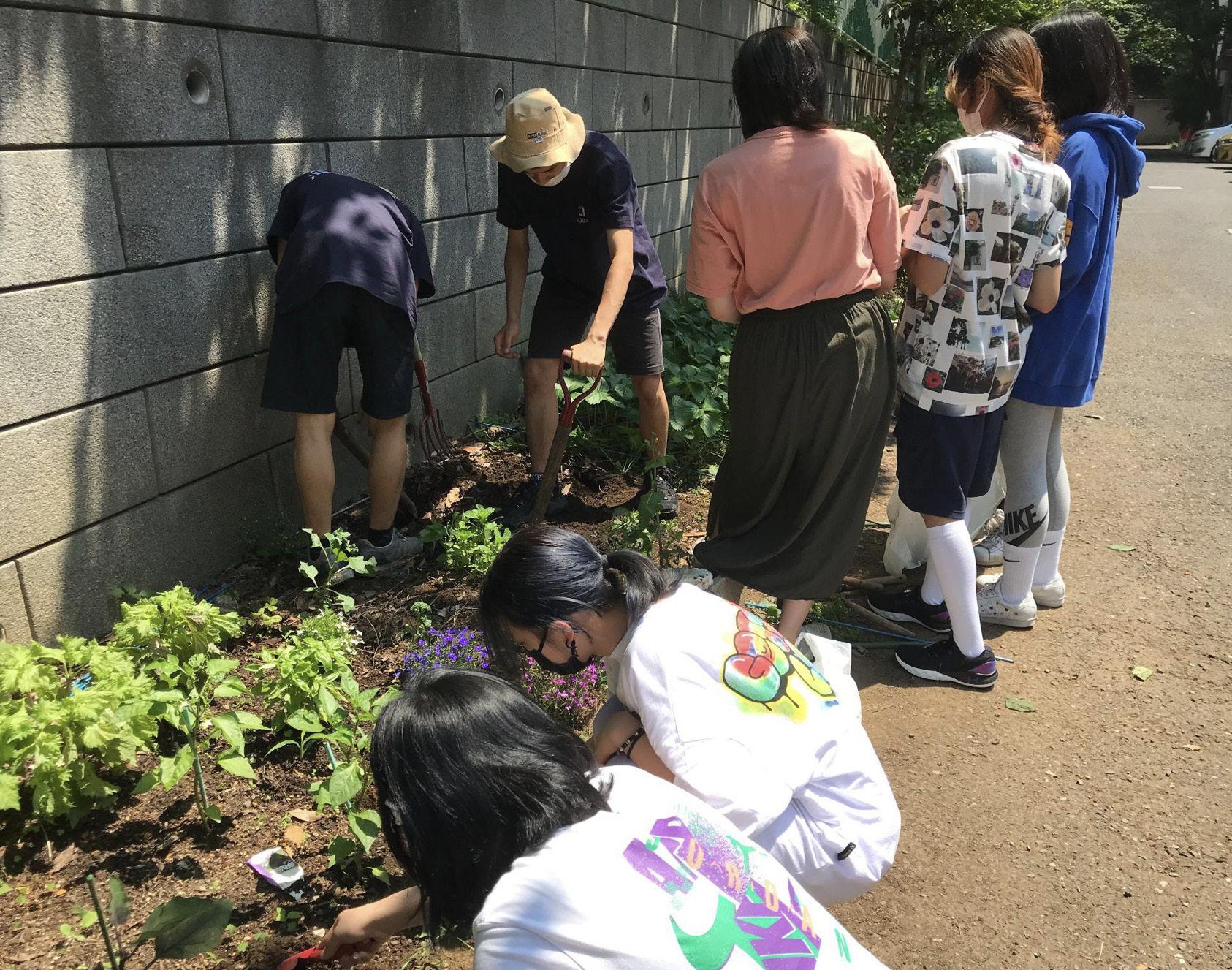
While teaching middle school science in 2019 at Aoba Japan International School (A-JIS), I was lucky to have met Jon Walsh, a Tokyobased urban farming and sustainability consultant, who inspired me into starting a student-led farming project on school campus. The first farm project launched in the fall season of that year, where a cohort of Grade 7 students used available spaces around the campus to grow simple foods such as leafy greens, herbs, tomatoes and peppers. To align with the concepts of sustainability, animal ethics, and health, the first rule of thumb was to grow food without the use of pesticides and synthetic fertilizers. Most students came with limited experience in growing food, but something about the energy that emanates from nature rekindled their curiosity. Those who feared insects and soil animals slowly changed their perspectives through observing the power of nature in turning a seed into a flourishing plant. The nature of the language being used to address the living creatures changed from that of disgust to that of respect. In taking care of the farm, students were assigned roles and responsibilities for care and maintenance and also learned about composting for the health of the soil. The level of commitment in taking care of the farm really varied by student, but the common attribute was that everyone cooperated and worked as a team.
Farming is all about establishing a balanced relationship with the land and the wild animals, which allows for the personality of the plants to be expressed (Pywell et al., 2015). Every season turns out to be a different experience, with some being better than others due to unforeseen circumstances like typhoons, insect attacks and extreme
10 EARCOS Triannual Journal
Students working on the back garden and transplanting seedlings.
heat. During good seasons, students were able to donate up to 6 shopping-bags’ worth of vegetables to Tokyo’s largest food bank, Second Harvest. Forming a connection with the local food bank was great because not only did students gain a deeper understanding of the poverty and homelessness situation in Japan, but the possibilities for compassionate empathy opened up through being able to share food with others and to volunteer at their food donation kitchens for meal distributions. In addition to making use of the produce for donations, the staff at Cezar’s Kitchen (the catering service at AJIS), often collaborates with our student farmers to utilize the vegetables for school lunch as well as for cooking demonstrations. In the process of taking something from the farm to the table, there is laughter, pride, compassion, connection to the Earth, as well as a sense of community. Being involved in the farming project has provided an opportunity for the students to empathize with the people in their community, with the other species in nature, and to feel harmony through a healthy ecosystem being created right in front of them.
Over the past 3 years, the Covid-19 pandemic has no doubt taken a huge toll on school children around the world. A European study saw signs of an increase in mental health problems and decrease in quality of life among children and adolescents in the year 2021 (Barbieri et.al, 2022). In many cultures around the world, the discussion around mental health is often stigmatized and this can lead to an environment that challenges the seeking of nagomi (Thornicroft, 2006). In 1982, the Japanese coined the term Shinrin-Yoku, which refers to a holistic approach of healing through immersion in nature. Shinrin Yoku is also referenced as Forest Bathing, and in a recent meta-analysis, has been shown to improve mental health in the short term, particularly by reducing anxiety (Kotera et al., 2020). The act of nature walking and growing food have homogeneous elements and bring about the benefits of instilling a sense of mindfulness and a deeper appreciation for nature. A recent study by the University of Colorado found that those who started taking part in community gardening ate more fiber, engaged in more physical activity, and saw a decrease in stress and anxiety levels (Litt et al., 2023). This can be a good encouragement for schools to start implementing programs to get children outside more often. There are challenges to objectively knowing the extent to which someone is in a calm state, free from stress and anxiety, partly due to both internal and external factors being at play. Nevertheless, it is fair to say that regardless of age, allowing children to engage in farming can be a valuable experience in enhancing their overall wellbeing.
As educators, we have the responsibility of modeling core values such as inclusion and respect, and to ensure that students are supported as best as they can in order to achieve a level of balance in their academic and social lives. Farming can bring us back to reality, make us feel grounded, and help us realize our most important capability, which is to let empathy guide our decisions and actions. While schools around the world strive towards incorporating inclusion and wellbeing in their educational systems, they should not underestimate the power of farming programs, whether it is on-campus or renting out a community garden, for the abundance of skills and values that the experience can bring to the students. Farming is not just about growing food with others, but it is also about giving the students the agency to make healthy and informed decisions to serve themselves, their communities and the planet.
About the Author
Emi Hisamatsu works at Aoba Japan International School as an MYP
Math teacher, Science teacher and Grade 7 Homeroom teacher. She can be contacted at emi.hisamatsu@aobajapan.jp
References
COVID-19 Mental Disorders Collaborators. (2021, November 6). Global prevalence and burden of depressive and anxiety disorders in 204 countries and territories in 2020 due to the COVID-19 pandemic. The Lancet, 398(10312), 1700-1712. https://www.thelan cet.com/article/S0140-6736(21)02143-7/fulltext
Dickinson, K. (2023, April 27). Nagomi: The Japanese philosophy of finding balance in a turbulent life. Big Think. Retrieved August 9, 2023, from https://bigthink.com/the-learning-curve/nagomi/
Kim, E. J., Son, J. W., Park, S. K., Chung, S., Ghim, H.-R., Lee, S., Lee, S.I., Shin, C.-J., Kim, S., Ju, G., & Park, H. (2020, July 1). Cognitive and Emotional Empathy in Young Adolescents: an fMRI Study. Journal of the Korean Academy of Child and Adolescent Psychiatry, 31(3), 121130. https://www.ncbi.nlm.nih.gov/pmc/articles/PMC7350548/
Konrath, S. H., O’Brien, E. H., & Hsing, C. (2010, August 5). Changes in Dispositional Empathy in American College Students Over Time: A Meta-Analysis. Personality and Social Psychology Review, 15(2). https:// journals.sagepub.com/doi/abs/10.1177/1088868310377395
Kotera, Y., Richardson, M., & Sheffield, D. (2020, July 28). Effects of Shinrin-Yoku (Forest Bathing) and Nature Therapy on Mental Health: a Systematic Review and Meta-analysis. International Journal of Mental Health and Addiction, 20, 337–361. https://link.springer. com/article/10.1007/s11469-020-00363-4
Litt, J. S., Alaimo, K., Harrall, K. K., Hamman, R. F., Hebert, J. R., Hurley, T. G., Leiferman, J. A., Li, K., Villalobos, A., Coringrato, E., Courtney, J. B., Payton, M., & Glueck. (2023, January). Effects of a community gardening intervention on diet, physical activity, and anthropometry outcomes in the USA (CAPS): an observer-blind, randomised controlled trial. The Lancet Planetary Health, 7(1), e23-e32. https://www. thelancet.com/journals/lanplh/article/PIIS2542-5196(22)00303-5/ fulltext
Miller, M. (2022, March 14). The 3 Parts of Empathy: Thoughts, Feelings and Actions. Six Seconds. Retrieved July 29, 2023, from https://www.6seconds.org/2022/03/14/3-parts-of-empathy/
Mogi, K. (2022, November 14). “SUCCESS ISN’T A PREREQUISITE FOR HAPPINESS”. THE Stylemate. Retrieved August 9, 2023, from https://www.thestylemate.com/erfolg-ist-keine-voraussetzung-fuerglueck/?lang=en

Pywell, R. F., Heard, M. S., Woodcock, B. A., Hinsley, S., Ridding, L., Nowakowski, M., & Bullock, J. M. (2015, October 7). Wildlife-friendly farming increases crop yield: evidence for ecological intensification. Proceedings of the Royal Society, 282(1816). https://doi.org/10.1098/ rspb.2015.1740
Thornicroft, G. (2006). Shunned: Discrimination Against People with Mental Illness. Oxford University Press.
Zaki, J. (2019, June 7). How to increase empathy and unite society. The Economist. Retrieved July 29, 2023, from https://www.economist. com/open-future/2019/06/07/how-to-increase-empathy-and-unitesociety
Fall 2023 Issue 11
Unveiling the Transformative Tapestry: Where Collaboration Meets Community-Inspired Beginnings
By Raquel Acedo-Rubio Head of
Learning
Mount Zaagkam School, Indonesia
At the core of Mount Zaagkam School’s approach to community involvement lies a profound commitment to the defining principles of the IB learning community (IB, 2023). Embracing a holistic educational environment, the school honors and values its entire community ecosystem, from students and families to the broader community. This outlook lays the groundwork for a thriving philosophy of collaboration, nurturing an environment dedicated to the inclusion and well-being of all members.
At times, in contrast to best practices, educational institutions have segregated the roles of parents and teachers in the child’s development. However, this distinction overlooks the reality that children absorb both values and academics within and beyond the classroom walls. Students’ observations of adult interactions, decision-making, and problemsolving, whether in school or the community, significantly shape their self-esteem, beliefs, and worldview. Collaborative efforts between parents and the school foster an inclusive environment that recognizes both individual differences and shared experiences. Witnessing a harmonious partnership between home and school cultivates positive attitudes toward education, resulting in enhanced achievement
Parent involvement and representation through school communities such as the Parent-Teacher Association (PTA) occupy a central role in MZS’ educational approach. The PTA serves as a vital conduit, solidifying connections between students, teachers, parents, guardians, and the larger educational community, and strengthening a sense of partnership. It acts as a dynamic catalyst for advocating initiatives that prioritize and nurture student well-being and a sense of community and belonging.
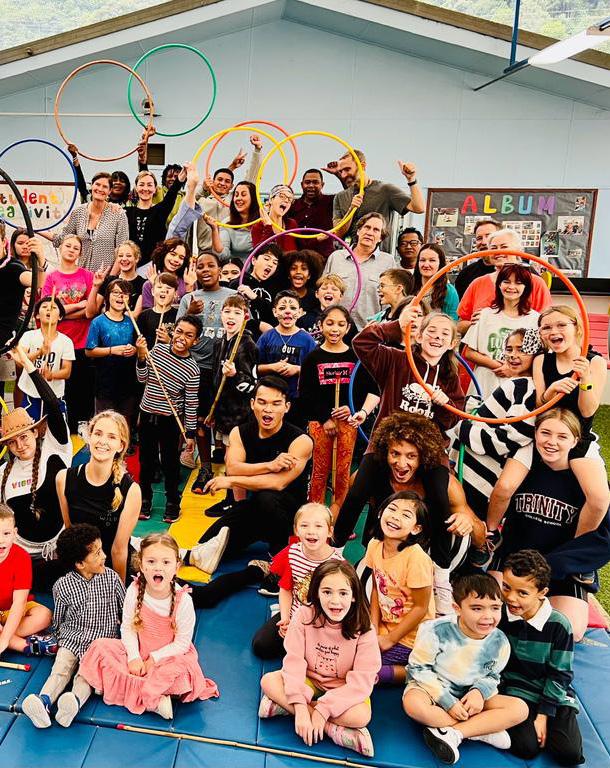
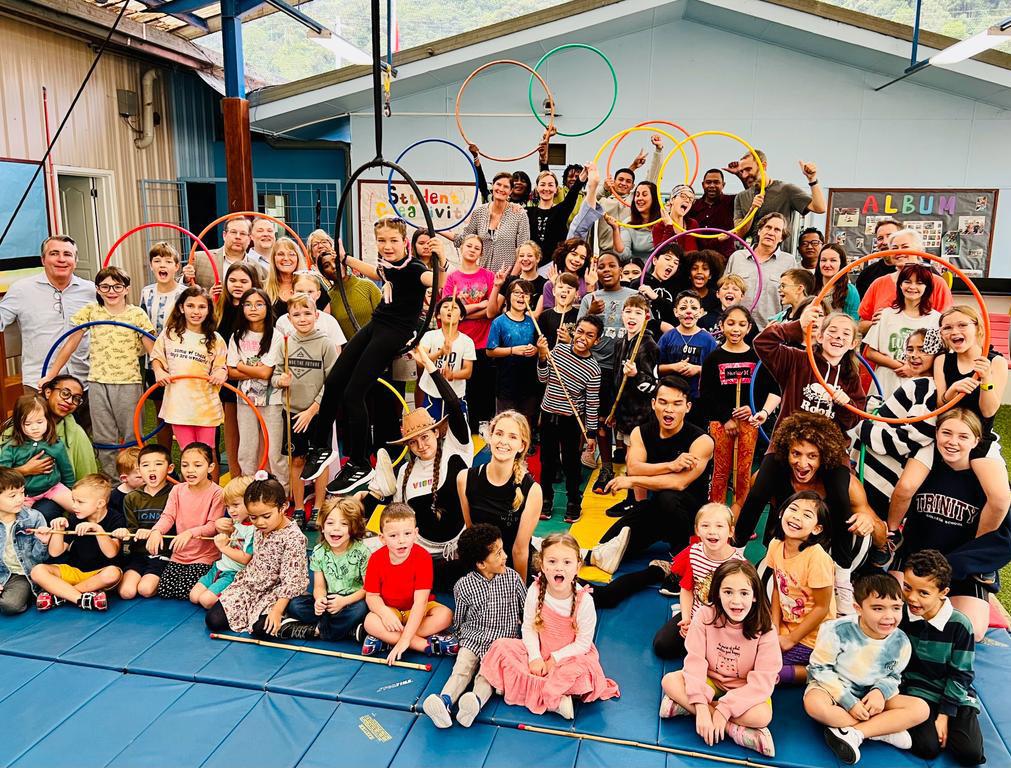
From MZS’ vantage point, the distinction between a “traditional” start to the academic year and an innovative departure was illuminated by an organic collaboration with the school’s PTA. Members of the MZS community orchestrated a week-long series of captivating circus-related events designed to gently immerse students into the year. This approach was envisioned to lay the groundwork for an academic year marked by collaboration, inclusiveness, growth mindset, and an unyielding readiness to tackle the challenges ahead. Much like the interconnected circus performers crafting mesmerizing human formations, students, parents and educators were encour-
aged to come together, fostering unity and collective support.
The captivating performances mirrored the palpable excitement and enthusiasm for the endless possibilities the upcoming year held. As the curtain drew to a close on this inaugural week of acrobatics and wonder, the stage was perfectly set for a year of unparalleled engagement and collaboration, where every member of the school community plays a pivotal role in shaping the narrative of who we are and who we become.
References
International Baccalaureate Organization-IB (2023). The learning community. International Baccalaureate Organization. Retrieved August 25, 2023 from https://www.ibo.org/ programmes/primary-years-programme/ curriculum/the-learning-community/
Comer, J, and Haynes, N. (1997). The Home-School Team: An Emphasis on Parent Involvement. Edutopia professional learning. Retrieved August 24, 2023 from https:// www.edutopia.org/home-school-team

SERVICE LEARNING
and growth, irrespective of background (Come and Haynes, 1997).
12 EARCOS Triannual Journal
The 19th EARCOS Teachers’ Conference 2024
Theme: Awareness, Agency, and Action
MARCH 21-23, 2024
SHANGRI-LA HOTEL BANGKOK, THAILAND
SAVE THE DATE!

What can you learn about yourself while exploring AI?

 By Mark William Barnett Vice President of Education and BSD Education
ARTIFICIAL INTELLIGENCE
14 EARCOS Triannual Journal
As a PhD student delving into the realm of Artificial Intelligence’s impact on classrooms, I recognized the challenges and possibilities it could bring for both educators and students. My investigation into how students respond to AI tools began just before the COVID-19 pandemic, a time when AI had limited applications beyond computer science and engineering education. However, the swift and profound educational influence of ChatGPT, launched in November 2022, took me by surprise. It is conceivable that we are only at the cusp of the disruptive effects posed by ChatGPT and similar advanced AI tools on the workforce and in the field of education.
As generative AI tools like ChatGPT and Midjourey have started to shift the culture of work and education, I think it is important to take a step back to understand the roots of AI, and what might be a beneficial way to look at how humans and AI can learn from each other. My understanding of the roots of AI started with reading and researching about how pioneers in the field shared their vision. In 1959, Marvin Minsky and Seymour Papert were both faculty at MIT who launched the now famous Artificial Intelligence Lab to develop primitive models of Neural Networks. Minsky and Papert started developing what came to be known as the “Society of Mind Theory”. The theory attempts to explain how what we call intelligence could be a product of the interaction of non-intelligent parts (Minsky, 2007). Minsky and Papert were both deeply interested in how intelligence is derived and how humans can learn from machines.
Eventually Seymour Papert would go on to further elaborate on his ideas through an educational pedagogy that he called “constructionism” which suggests that learning happens best when students have the agency to create artifacts, reflect on those artifacts and connect their learning to prior knowledge, thus developing deeper understandings of themselves and the learning. While Papert shifted his focus more towards computer programming for children, he never left his ideas of Artificial Intelligence behind. Papert created a programming language for children called “Logo” that required students to program a moveable turtle around the screen through a series of written computer commands like “move forward,” “turn right,” “repeat,” etc (Papert,1980).
While observing how students interacted with the on-screen turtle, Papert came up with a concept that he called “Body Syntonicity” that explains how children relate their own bodies to the movements of the turtle. So, if they wanted to program the turtle to move in the shape of a square, they would first think about how they would move their own body in the shape of a square, causing students to think about the steps before writing the code.
In my research with currently available AI, I have developed an analogous concept called “Neural Syntonicity” that describes
the relationship between a person and how they interact and learn from AI to learn more about themselves. For example, when students learn that AI is trained on a data set that contains bias, the bias is reflected into the output of the AI. With this in mind, my research aims to see if students can begin to see how human biases are caused by the quality of their training data. Human training data is simply a collection of your memories, events and knowledge. In my first stage of research, I worked only with AI Image Recognition tools to study relationships between visual information and how people label and predict image data, which is remarkably similar to how AI completes the same task.
In my upcoming research on Neural Syntonicity, I will be further exploring the concept, using chatbots like ChatGPT to see how people can learn more about their own learning process by interacting with chatbots, to further validate and bring credibility to the idea of Neural Syntonicity and to breathe life back into Marvin Minsky and Seymour Papert’s original vision of students and teachers using AI as instruments to enhance learning, not to replace it.
You don’t have to wait for my research to be published to start thinking about this on your own or experimenting with your students. I highly recommend that you begin to learn as much as you can about AI chatbots, generative AI and the newly emerging field of “Prompt Engineering”, which just means the art of writing clever chatbot-prompts to get what you want with ease. What you will likely experience is that when prompting chatbots, you will encounter situations that cause you to have to re-state your intention, re-write your instructions, seek clarity, ask follow-up questions or scrap everything and start over. There are extremely valuable lessons in communication that can be learned from interacting with AI chatbots that both teachers and students can start to explore.
Keeping true to the legacy of Seymour Papert’s vision of AI and Constructionism, I suggest that you approach using AI chatbots with a sense of playfulness, making space for creativity and self-exploration, asking yourself “What can I learn about myself through this process?”
About the Author
Mark William Barnett is the Vice President of Education and BSD Education, an EdTech company aimed at providing digital-skills solutions for educators all over the world, including courses on AI, prompting and coding. Mark lives in Chiang Mai, Thailand and is set to complete his PhD at Chiang Mai University in 2024 studying in the legacy of Seymour Papert on the topic of Neural Syntonicity. He spent 20 years in the education space working at International Schools as a Design and Technology teacher and provides consultant services for makerspaces, design thinking, constructionism, robotics and AI.
Fall 2023 Issue 15
Leading Strategic Change: Building A Culture Of Inclusion At UNIS Hanoi
 By Johanna Cena, Cheryl Hordenchuk, and Nitasha Crishna
It was a hot Hanoi day in April 2021 when educational leaders, Cheryl Hordenchuk and Nitasha Crishna, at the United Nations International School (UNIS) in Hanoi, first met with the Student Success Team from across the school. While they knew that their team consisted of committed and experienced professionals, they quickly learned that they first needed work on articulating a shared vision and common understanding of how UNIS approached success for every student at UNIS Hanoi before the school could move forward.
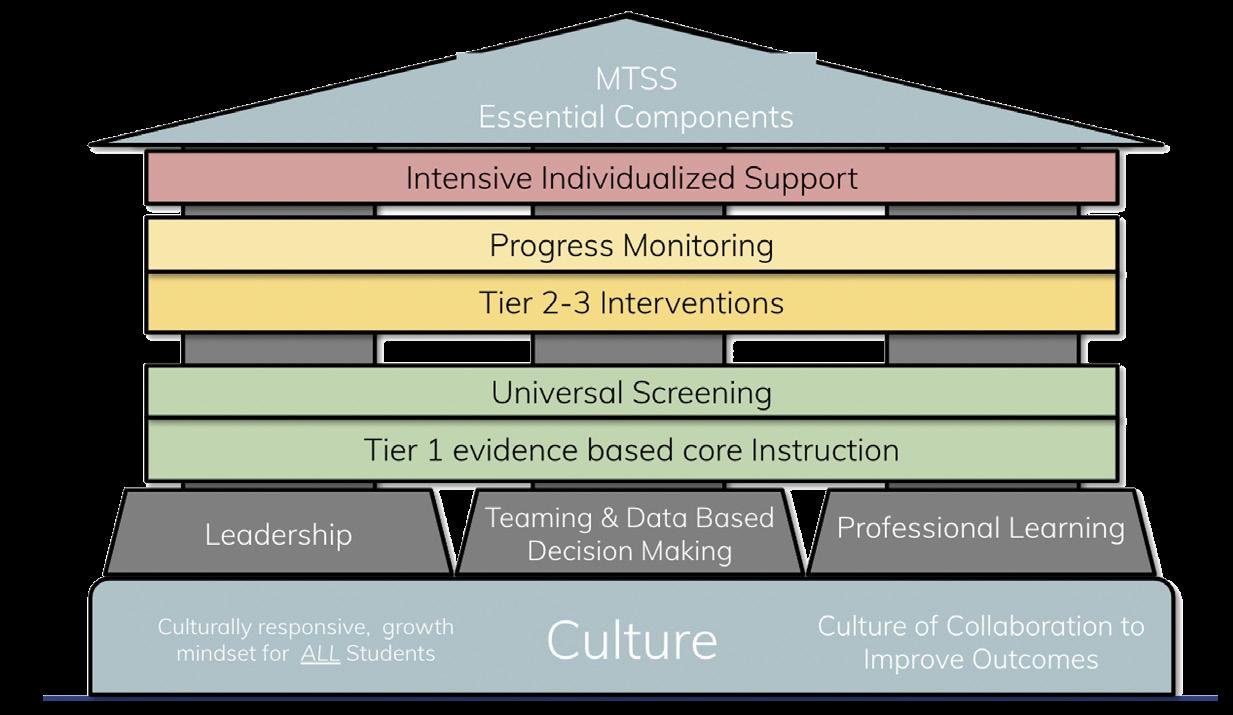
As the world continues to navigate the repercussions of the COVID-19 pandemic, the importance of inclusive educational practices in international schools has become more critical than ever before. Cheryl and Nitasha saw this first hand as their students and staff came back to in-person learning. Collaborating with Lead Inclusion consultant, Johanna Cena they took a closer look at how a multi-tiered systems of support (MTSS) could help to create a more inclusive culture of care and belonging so that all students could get the support they need. “MTSS is a proactive and preventative framework that integrates data and instruction to maximize student achievement and support students social, emotional, and behavior needs from a strengths-based perspective” Center on MTSS at the American Institute on Research.
Over the 2021-22 school year of distance learning and school closures, Nitasha and Cheryl engaged in leading the schoolwide Student Success teams, composed of the Learning Support teachers, the Speech Learning Pathologist and the School Psychologist, centered around helping the team work with a schoolwide perspective. They were guided by UNIS’s strategic directions which focused on an alignment of systems, their commitment to inclusion and neurodiversity and promoting the wellness of all members of the community.
Much of Nitasha and Cheryl’s leadership during what was a long and challenging year online was ensuring that the virtual meetings had time for people to connect, that they used the capacity and strength of team members to have generative conversations and then intentionally broke the work up into small manageable chunks.They knew the cognitive and the emotional load was heavy and as leaders they were very aware of the pace and balancing the needs of the team.
MULTI-TIERED SYSTEMS OF SUPPORT
Fig 1- Essential components of Multi- Tiered Systems of Support. Photo credit Lead Inclusion
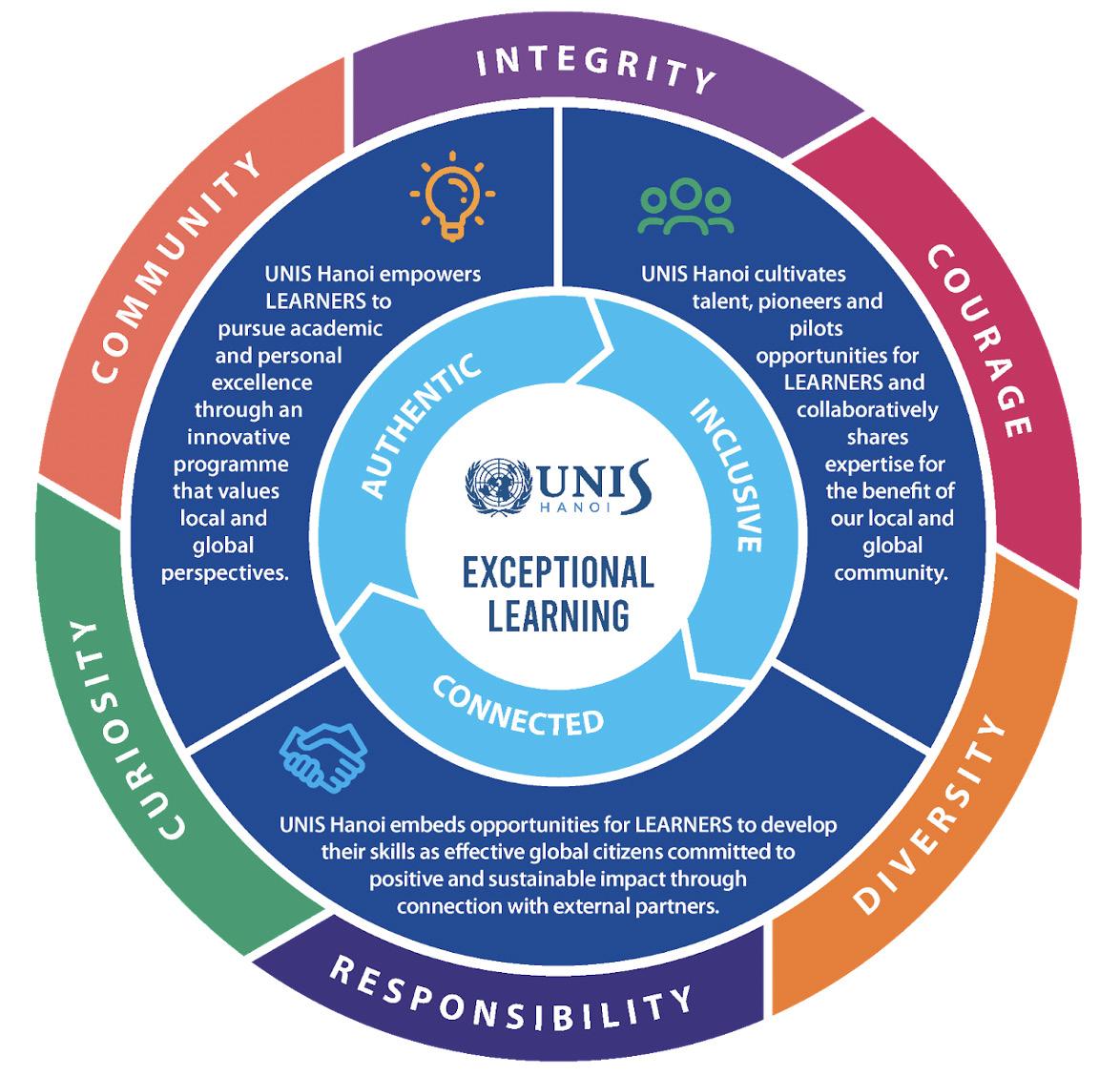
Fig 2- UNIS Hanoi’s values and strategic directions
16 EARCOS Triannual Journal
Image of yearly overview from the proposal to adoption of MTSS as a school
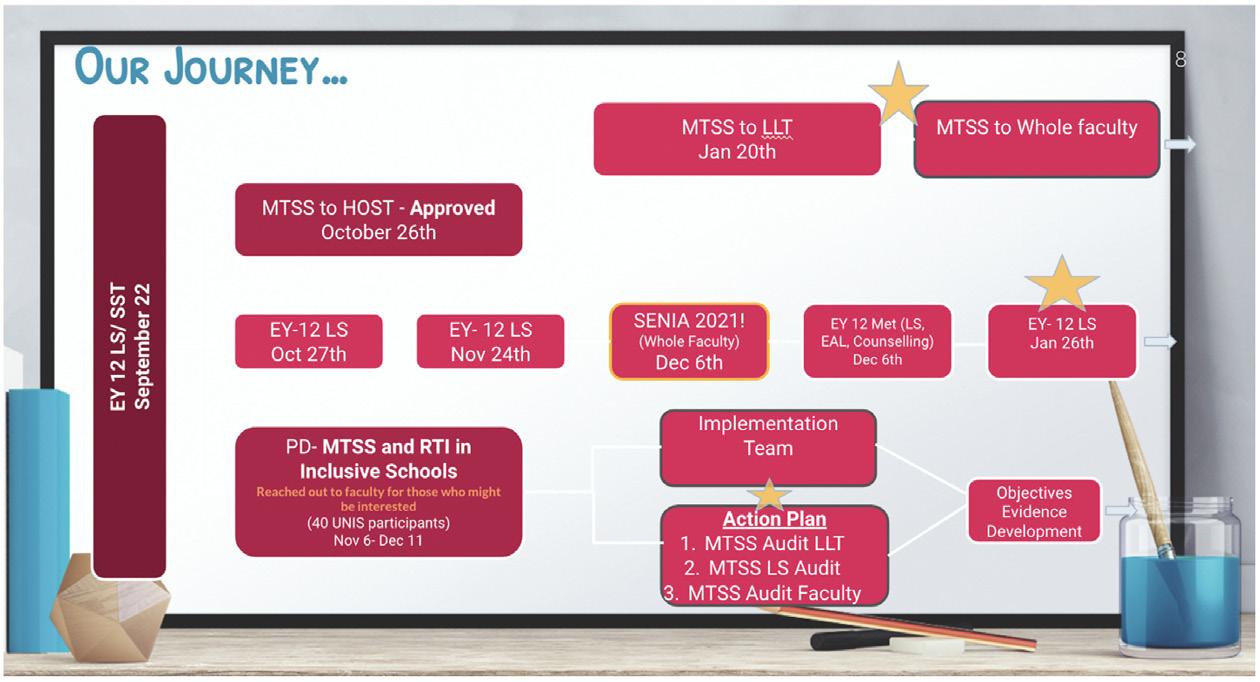
A big outcome of their work together was the recommendation to their senior leadership team that the school adopt the MTSS framework for the school. This recommendation stemmed from the six week professional development that a group of 45 cross divisional faculty members engaged in to learn the elements of MTSS. The Professional Development was facilitated by Johanna Cena and Nitasha and Cheryl could see how having a systems-based approach to creating the right conditions for MTSS would be most beneficial.
Once approved by the Senior Leadership Team, Nitasha and Cheryl got busy creating and writing an Action Plan. Working with the Elementary and Secondary Team Leaders and capitalizing on the wealth of expertise with MTSS in the UNIS faculty, they co-created an Action Plan to support the implementation of MTSS over three years.
UNIS Journey continued…Professional learning design for all.
A critical component of the action plan was to provide a schoolwide MTSS course for all staff. Cheryl and Nitasha reached back out to Johanna and in the fall of 2022 UNIS launched a schoolwide MTSS courses for all staff: assistants, specialists, teachers, and leaders. The course was implemented over a six month period of monthly online meetings and asynchronous learning between sessions. The model emphasized the shared belief that all students are our students, and focused on creating a shared culture and understanding of inclusive practices through MTSS. Throughout the course, staff collaborated in a variety of different group structures and sizes across departments, grade levels and divisions both online and in person.
It was important to create a space for staff to ask questions, understand multiple perspectives and to clarify ideas after each session by using a shared document which then drove adjustments to subsequent sessions and school documentation.
One of the foundational features of this model was the importance of providing time for all faculty to define common key terminology together and develop a UNIS hanoi terminology document accessible in Vietnamese and English.The definitions document ensures that all of the work UNIS does is now front loaded with clarity around what the different technical vocabulary means. This was one of the big successes of the work.“The definitions were a wonderful piece of the puzzle that pulled so much together for me.” UNIS teacher.
Another key element and success of the program design was providing prompts, tasks and collaborative time for teams to work on developing shared tools and resources for MTSS implementation catered to the needs of UNIS Hanoi. In these conversations, staff explored ideas around effective universal tier 1 instruction, data based decision making, problem solving and intervention support. From these collaborative conversations came the creation of a school wide behaviour matrix also co-written by all faculty. The behavior matrix was created by all teachers inputting what acceptable expectations of behavior look like and after several iterations has evolved into articulated behaviour expectations from the Early Years to Grade 12.
Having had the opportunity to have the entire faculty contribute to these foundational resources has meant that it belongs to everyone.
The intentional program design continued to balance the big understandings of schoolwide MTSS and each faculty member’s role in the system which helped to build a strong MTSS foundation.
What we learned
As leaders, it can be challenging to meet the professional learning needs of all staff. One of the key successes of this experience was the rich collaborative planning between Johanna, Nitasha and Cheryl.They had clear outcomes, open communication and the flexibility to adjust to the needs of the staff. Because ALL staff attended over multiple sessions, this was a transformative professional learning experience for the school. However, one important take away was the reminder that “less is more”. Asking staff to complete learning modules between sessions took away from the motivation and cohesion of the learning experience. The power of the learning was in the dialogue amongst staff.
Nitasha and Cheryl learned that leading UNIS in articulating a shared vision and common understanding of MTSS is challenging work, but approaching professional learning from the same inclusive mindset that educators aspire to for students empowers all staff to feel valued, connected and invested in a system that best supports all students
References:
https://mtss4success.org/essential-components
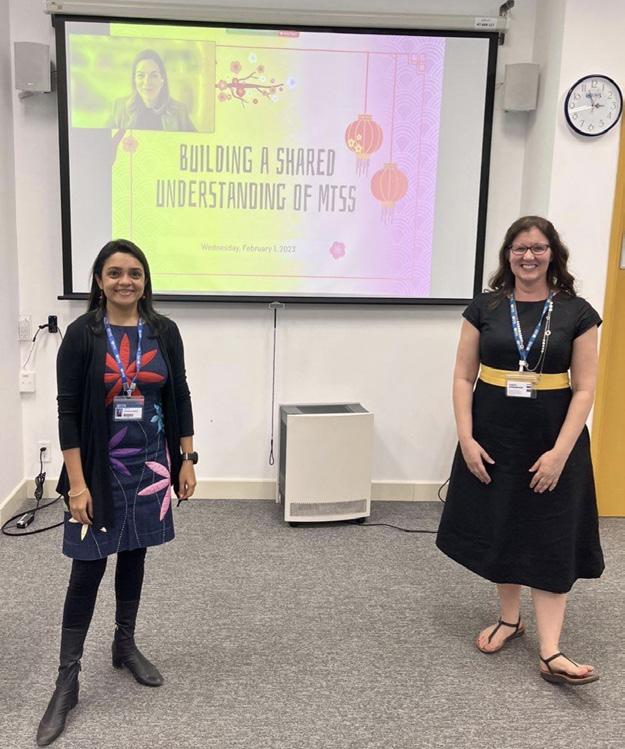
Fig 3 (From L-R) Nitasha, Johanna and Cheryl jointly presenting at the culminating faculty event at UNIS Hanoi
Fall 2023 Issue 17
INSTRUCTIONAL COACHING The Social Mind at Work in the Classroom
 By Michelle Garcia Winner, MA, CCC-SLP
Copyright 2023, Think Social Publishing, Inc.
Early in my career, as a speech-language pathologist working with students in a high school district, I found that many of them were perplexed by the social world. They felt left out and lonely. It was not uncommon for them to also struggle with aspects of academics, particularly when they were required to summarize and interpret socially based information presented in their curricula, or when asked to engage in written expression beyond journal writing. They also struggled with organizational skills and social initiation, as well as deciphering the main idea, whether they were conversing with others or asked to write a topic sentence. Informed by research and my students’ experiences, I created an acronym, ILAUGH, to illuminate different factors at play within the social mind that contribute to academic and social success. Now, more than 20 years later, the ILAUGH Model of Social Cognition continues to guide individuals, family members, and professionals to consider different aspects of the social mind and how each of these may be relevant to understanding and possibly helping individuals with different types of social learning styles.
ILAUGH Model defined:
I = Initiation of asking for help, connecting with others, as well as getting started on doing things that one finds harder to accomplish.
L = Listening with one’s eyes, ears, body, and touch
A = Abstracting and inferencing socially based information, whether it’s spoken, written, or presented visually
18 EARCOS Triannual Journal
U = Understanding and/or imagining one’s own and others’ perspective (thoughts and feelings)
G = Getting the main idea (also referred to as gestalt processing), getting organized, getting things done
H = Humor and human connection
The reality is, when most people hear the word “social” they are likely to think about activities that involve people meeting up, such as when students hang out at school, or meet up for school dance. Yet, the social mind is not all about friendship, but it is all about making sense of people in context. Developmentally, beginning in infancy, neurotypicals emerge in their ability to form social competencies. To better understand this process, the Social Thinking® Methodology provides the Social Competency Model (SCM), a tool that encourages us to explore the real-time social cognitive (i.e., social thinking) process through which we interpret and possibly respond to socially based information across the vast range of contexts experienced in our lives and through what we read, hear, or see in text or media. The SCM explores the research-informed process through which we socially attend to interpret information, leading us to socially figure out (problem solve) what’s going on to determine whether a social response is needed or desired, or whether it should be withheld. Ultimately, how we make sense of ourselves in the social world leads to our ability to socially self-regulate our feelings and actions– which is what we refer to as “social cognitive self-regulation.” The easiest way to consider this information is through the graphic below:
The Social Thinking-Social Competency Model summarized in a graphic:
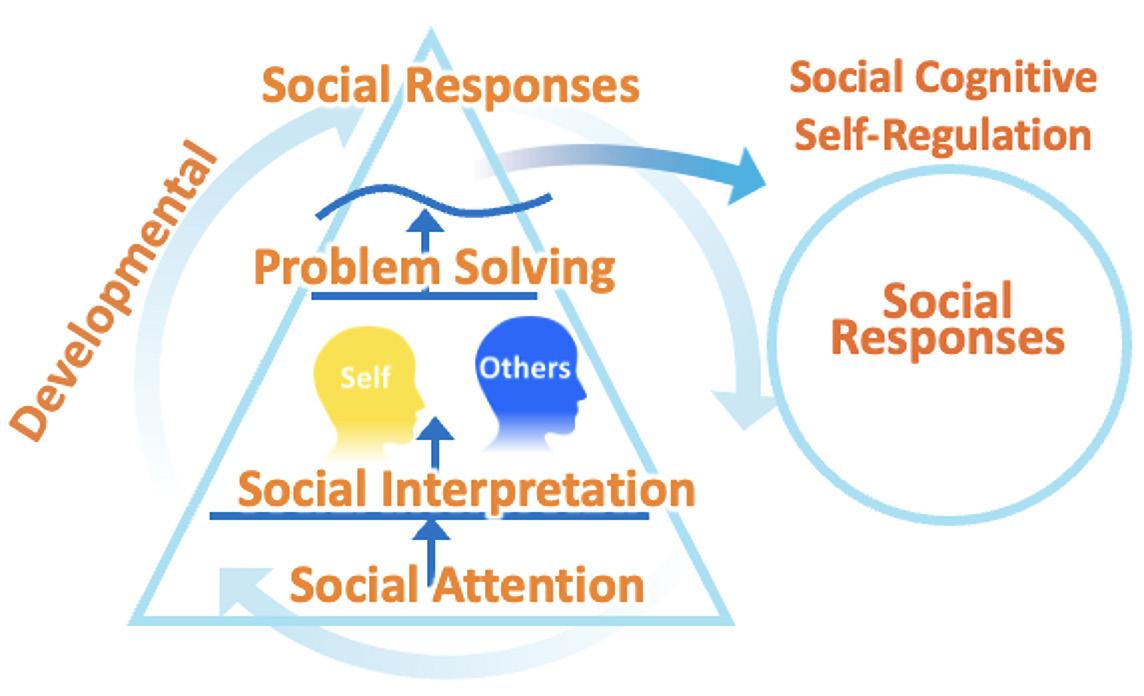
walk quickly, leading to this social response.
• When shopping in a grocery store and ready to purchase what you’ve gathered, you attend to where you should go to initiate the purchase and then interpret how to make that happen, problem solving whether this involves communicating with others and then producing the social response to gather your possessions and leave the area in a timely manner, so that others can efficiently move through this same process themselves.
• In classrooms, on playgrounds, in the community and at homestudents and adults are expected to attend, interpret, problem solve and respond to socially self-regulate their behavior, based on the situation.
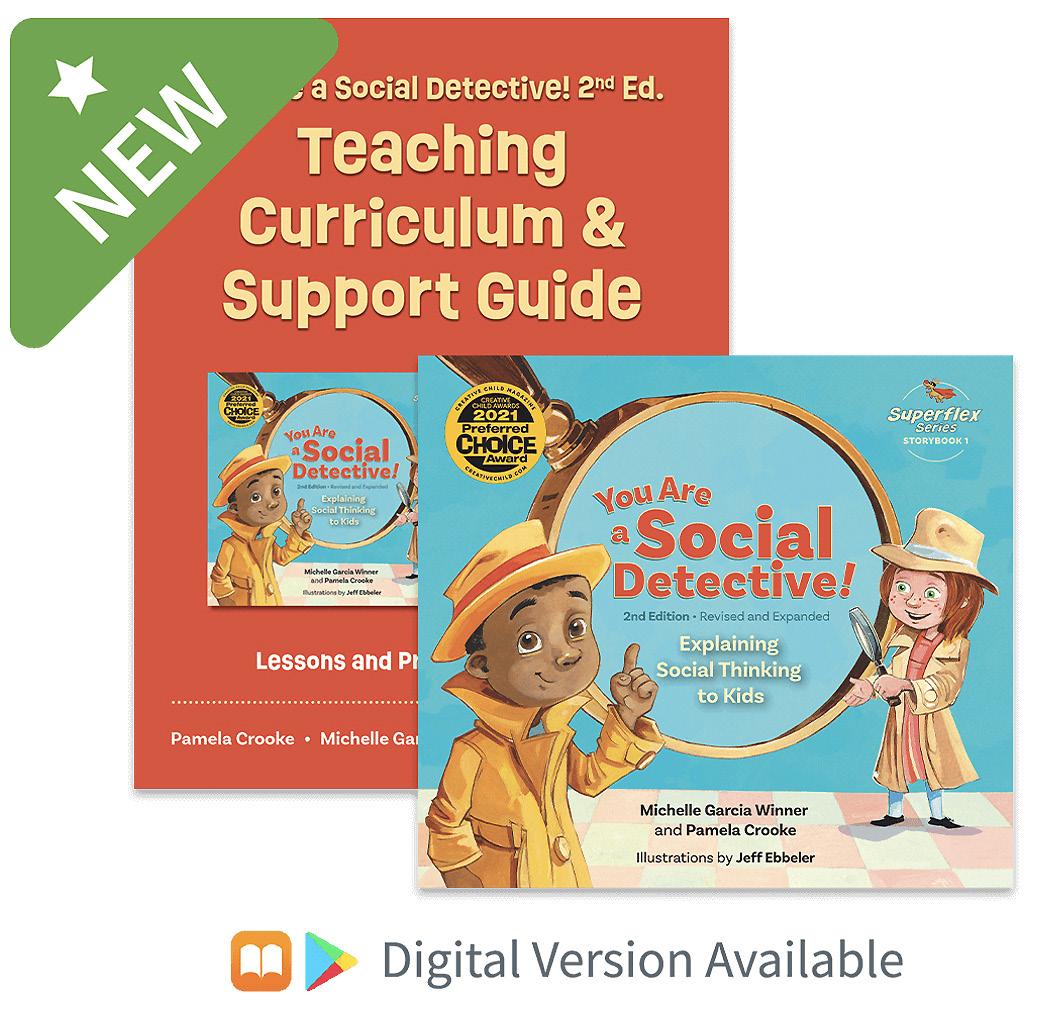
Through our company, Social Thinking Publishing, Inc. We bring these ideas alive through story books. A very popular book that has been adopted for use into mainstream/general education classrooms for students roughly 6-8 years old is our, You are a Social Detective, 2nd edition paired with the related Teaching Curriculum and Support guide
While this information seems technical and somewhat sterile when exploring the graphic, now consider how this information plays out in real life:
• When a pedestrian crosses a street at an intersection, they attend to cars and, more specifically, the eyes of a drivers, who are stopped at the sign/signal, to make sure they are attending, interpreting, and then problem solving your actions, which should then lead to their refraining from moving forward. Simultaneously, you are also interpreting their desire to drive through the intersection. Therefore, you problem solve that you should
We offer many opportunities to learn more about the Social Thinking Methodology for free, through the exploration of our free articles and webinars that can be viewed anytime on our website, along with many more ideas for teaching all different age groups starting at 4 years old and spanning across adulthood through a range of products, all of which can be found on our website, www.socialthinking.com.
About the Author
Michelle Garcia Winner, MA, CCC is a speech-language pathologist who specializes in the treatment of students with social cognitive challenges, including but not limited to diagnoses such as Autism Spectrum Disorder, Asperger syndrome, ADHD/ADD, Twice Exceptional and Non-verbal learning disorder. She has a private practice in San Jose, California where she works with clients, consults with families and schools and she travels internationally giving workshops as well as being invited to train psychiatrists, psychologists, counselors, and state policymakers. She presents many different all-day workshops and helps to develop programs for implementation in schools and classrooms.
Fall 2023 Issue 19
PROJECT-BASED LEARNING “Using Purpose Learning to Increase Belonging in the Classroom”
By Jessica Catoggio, Director of Professional Learning World Leadership School

Over a decade ago, project-based learning transformed my teaching practice. It allowed me to make space for student agency while still addressing my curriculum, it gave me the opportunity to assess students in alternative ways, therefore genuinely reaching more students than I ever had before.
I believed so deeply in it that I became an instructional coach, supporting dozens of fellow educators as they implemented these practices in their classrooms, trained parents on the ins and outs of “how teaching and learning have changed”, and became a fierce advocate for PBL in as many administrative offices as I could gain entry in order to tout its benefits.
Fast-forward more years than I’d like to admit, and I now am the parent to two adolescents, each on their own educational journey, AND have the great privilege of serving as the Director of Professional Learning for World Leadership School a purpose-driven, North American-based organization whose mission is to:
“Partner with K-12 schools to reimagine learning and create nextgeneration leaders.”
Diving head-first into this role at the height of the pandemic gave me the opportunity to deeply examine the ways in which we partner with schools, and more importantly, the work we do directly with teachers. Weaving my own experience into WLS’ well-established work around purpose and purpose learning quickly became the piece of the pedagogical puzzle I wasn’t aware had been missing from my own entrenched PBL practice: Belonging.
Purpose learning, with its deep roots in the best practices of both project-based learning and Design Thinking, provides a space for belonging in learning. Repeat: Belonging in learning. Learning in which all students belong, and have the opportunity to connect content to themself as an individual, and allows them to have real-world impact at the same time. Revolutionary. This is the meaningful environment I want for my own vulnerable, adolescent children on their formational journey to becoming world citizens.
Before one can understand purpose learning, however, it is important to understand purpose itself. Stanford University’s Center on Adolescence’s body of work is the most significant research to date on this important topic. As such, at World Leadership School, we base our work on Stanford’s definition of purpose:
20 EARCOS Triannual Journal
“…a sustained commitment to an identity-relevant life goal that is both meaningful to the self and intended to contribute to the world beyond the self.” (1)
Simply stated, purpose is a journey inside to understand oneself- gifts, identity, goals, and to contribute to something outside the classroom. Blue Zones research alongside Stanford and many others tell us that purpose-driven individuals are happier, live longer, and engage in healthier relationships.(3) Blue Zones, too, remind us that purpose in life is an ancient human practice spread across most cultures. The quest to understand “why I get out of bed in the morning” is called Ikigai by the Okinawans and “plan de vida” by the Nicoyans in Costa Rica. Likewise, we see this in our work with teachers and students. A clarified and articulated purpose is a priceless tool on the path toward happiness and resiliency.
“Blue Zones” are areas in the world that report the highest number of centenarians, and report “extreme longevity.” Scientists have studied these zones and have identified lifestyle habits that residents of these regions share in common.(2)
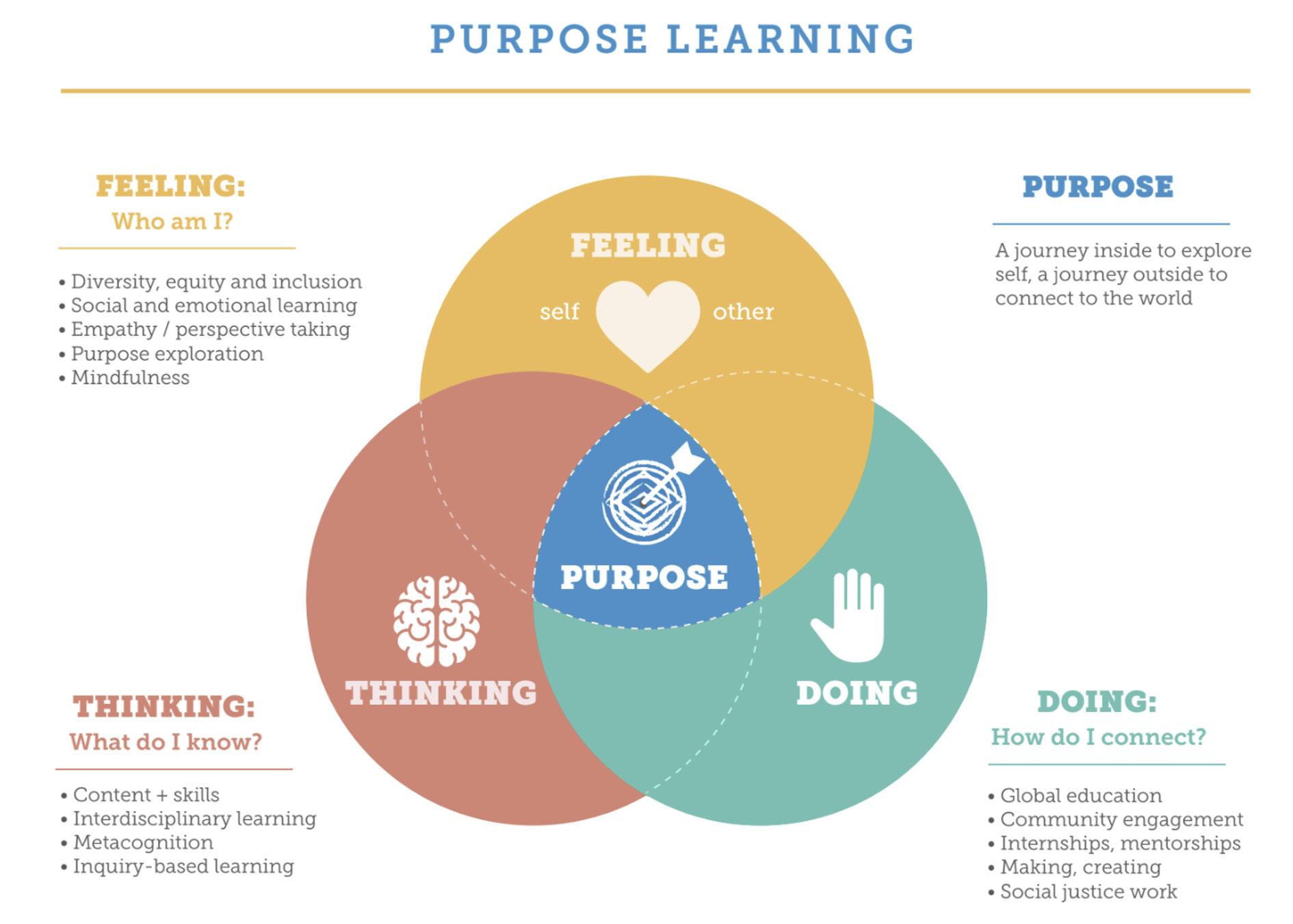
As purpose is a two-way journey, Purpose Learning is analogous to a busy, two-way street in which the “drivers” dynamically change lanes, detour at will, travel in the fast lane or slow depending on the road conditions, navigate roundabouts, and thoughtfully make return trips. Traveling one way on this busy street, “drivers” internalize and connect learning to self. In the other direction, the journey allows students to connect learning to the world outside of self in ways that are rich and meaningful. Additionally, as shown in the graphic below, the learning is no longer solely about the “thinking” (content, memorization) or the “thinking” plus “doing” (hands-on, community engagement, global ed) as my beloved PBL was. The learning journey in purpose learning brings in the crucial piece I was missing- “feeling”. (Identity, SEL, empathy, perspective taking). All of which leads to our key piece: belonging.
Purpose is an individual journey that is present in a community of belonging. Therefore, the importance of belonging cannot be understated. Belonging is also a Blue Zone habit, and a key indicator of student achievement, adolescent growth, and a basic human need. Recent research around culturally responsive teaching from Zaretta Hammond and others reminds us of what we already know and remember from our own school journey: belonging matters. Studentfacing organizations like Challenge Success share data that makes this impossible to dispute. An alarming number of adolescents do not feel a sense of belonging in their school community. One 2019 study showed “Between 17–29 percent of high school students and 14–27 percent of middle-level students say they do not feel that they belong.”(4)
There are a number of ways to schools today are increasing belonging- advisory programs that create safe spaces often top this list. Denise Pope at Challenge Success attests that “...when teachers intentionally design lessons that are meaningful to their students, build an authentic climate of respect into their classrooms, listen closely to students and incorporate their input, and grade in a way that students consider fair, students’ sense of belonging and academic engagement are more likely to be high.”(5) Purpose Learning.
The Purpose Learning tools we have developed at World Leadership School, such as the Purpose Planner below, support educators seeking to increase belonging. As such, Purpose Learning is taking on many exciting forms in schools with whom we partner. For example, one of our schools launched an entire middle school in which memorization has been replaced by agile, self-expressive, and community-connected learning, and an AP History class in which students now think empathetically about content, tie it to their own personal or family history and then use an informed perspective to raise awareness in their community. No matter what form it takes these are classrooms in which students belong. They belong because learning is a two-way journey: connected to each student’s identity and also to the world outside the classroom
Fall 2023 Issue 21
I still believe that project-based learning is an important pedagogical tool. It remains beneficial in all the ways and for all the reasons I first came to believe in it. What we see in our hallways and read in the research, though, is that in this unique moment, our adolescents need more. They need learning environments that are celebratory of their identities, reflective of the world around them, and inspiring. They need classrooms in which they can experiment, fail safely, understand, and engage with the world around them. Students need to believe that they belong.
About the Author
I come to World Leadership School with extensive experience coaching teachers around project-based learning. I am passionate about building communities and aim to connect with others through differences and similarities. I value inquiry, curiosity, and in-depth questioning and helping teachers create dynamic classroom communities in which all students thrive. I am a teacher with 20 years of experience in both public and independent schools, including the last 13 years as a lower school teacher at Collegiate School in Richmond, VA. While at Collegiate, I evolved my project-based approach after taking multiple PBL trainings and receiving my coaching certificate from the University of Virginia’s Curry School of Education. At Collegiate, I coached my colleagues through the stages of project-based learning and helped lead an effort to establish capstone projects. I earned my Bachelor of Business Administration in Marketing from James Madison University in Harrisonburg, Virginia and went on to receive a Masters of Arts in Teaching from Johns Hopkins University in Baltimore, Maryland.
Citations:
Colby, A., & Damon, W. (2018). The meaning and importance of family purpose. The Meaning and Importance of Family Purpose | Center on Adolescence. https://coa.stanford.edu/meaning-and-impor tance-family-purpose
unknown. (2021, April 30). History of blue zones. Blue Zones. https:// www.bluezones.com/about/history/
unknown. (2021, April 29). How finding your purpose can improve your health and life. Blue Zones. https://www.bluezones.com/2011/08/ the-right-outlook-how-finding-your-purpose-can-improve-yourlife/
Miles, S. (2020, October 1). Why student belonging matters: October 2020. NASSP. https://www.nassp.org/publication/principal-leader ship/volume-21-2020-2021/principal-leadership-october-2020/ why-student-belonging-matters-october-2020/
Pope, D. C. (2022, September 29). A caring climate that promotes belonging and engagement. kappanonline.org. https://kappanonline. org/caring-climate-belonging-engagement-pope-miles/
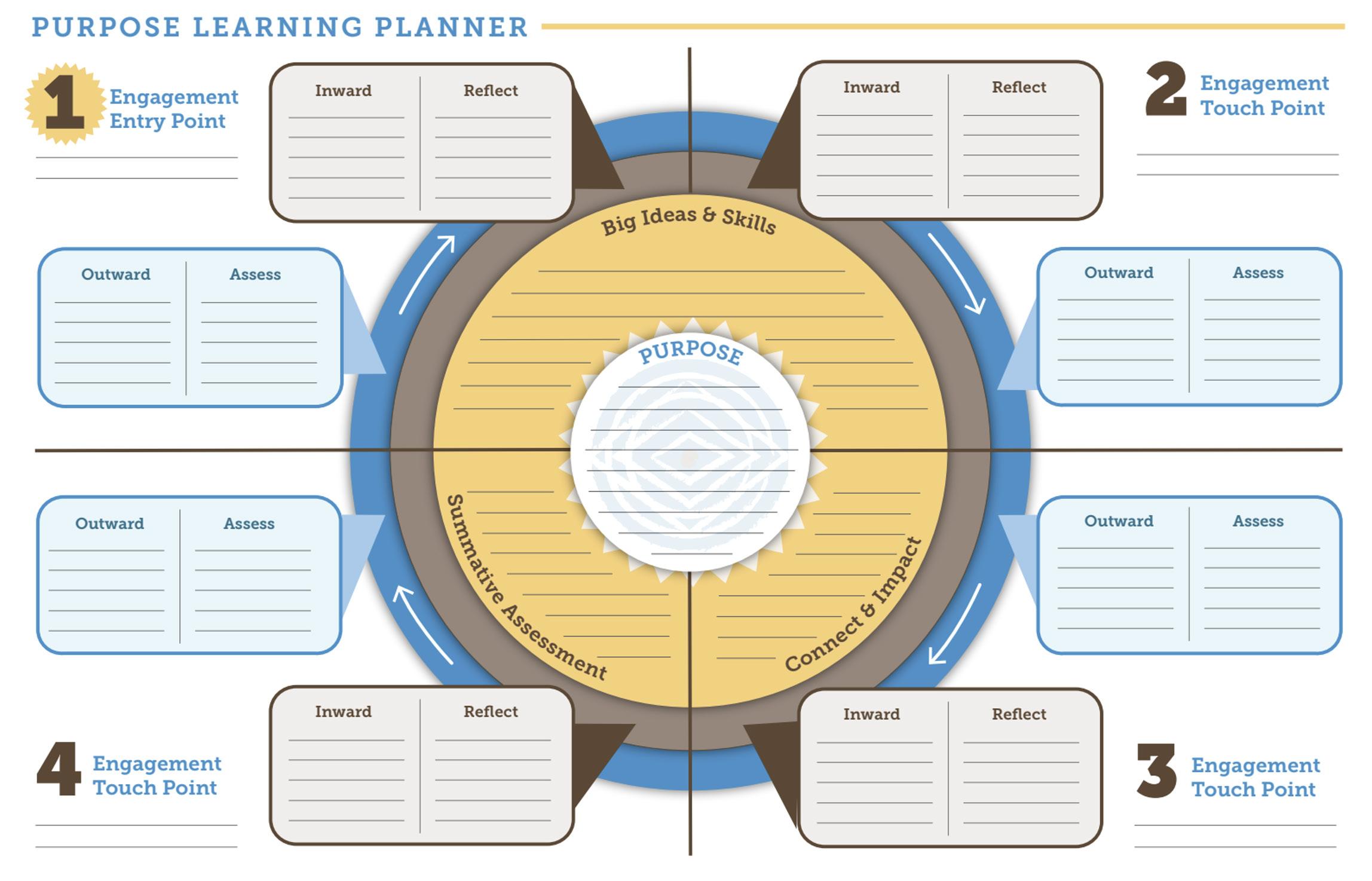
22 EARCOS Triannual Journal
•
•
•
•



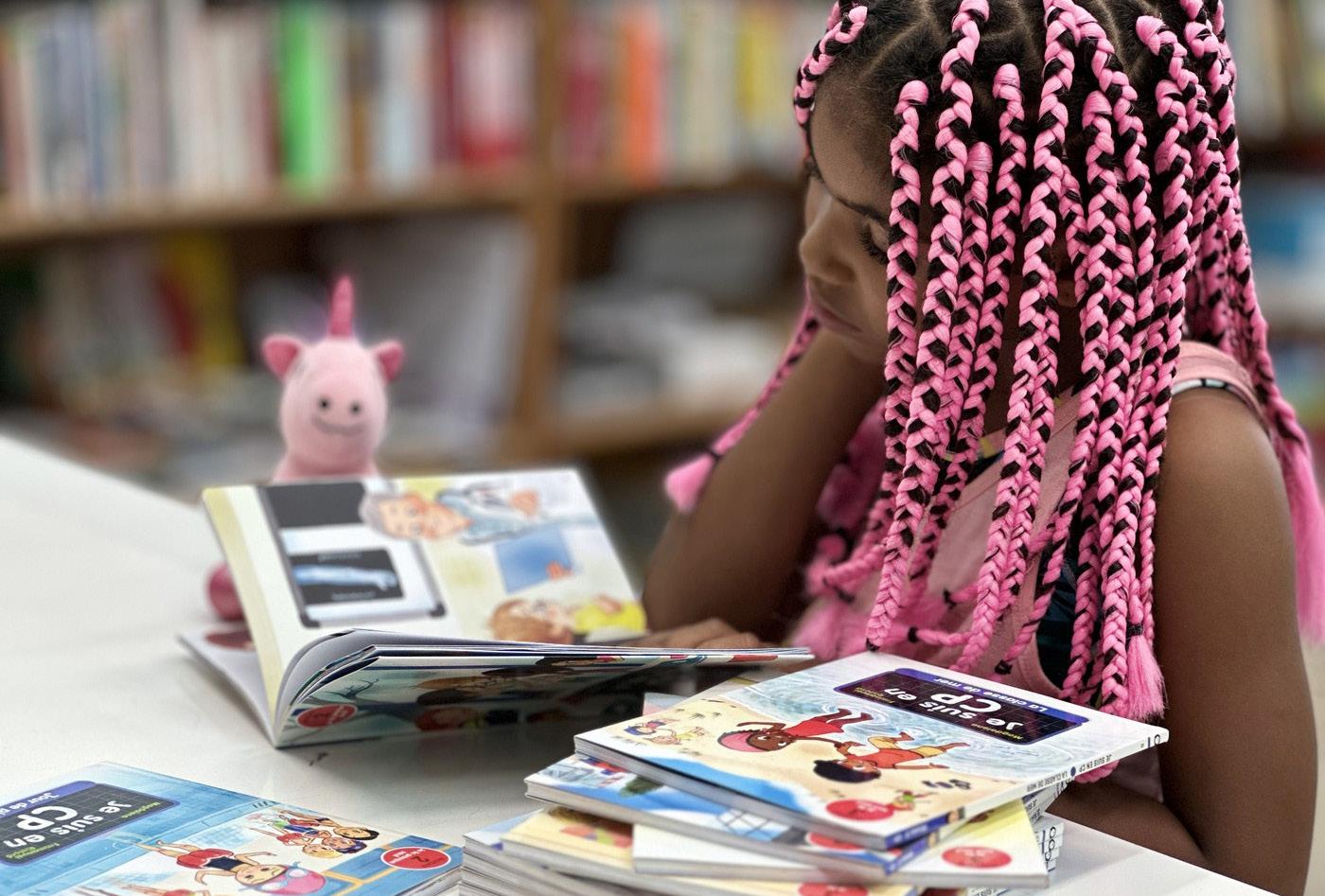
See where ISS can take you and your school International Schools Services (ISS) provides you with the full range of services necessary to deliver an outstanding global education: Explore upcoming job fairs, PD courses, and more at ISS.edu/events Find more at ISS.edu #ISSedu • Start and manage a school
Supply a school
Recruit teachers
•
•
Recruit school leaders
Streamline accounting and finance functions
Learn through professional development
Fall 2023 Issue 23
Support diversity, equity, inclusion, and justice
SCHOOL EXPERIENCE
Introducing the Future of Parent Feedback to Schools

 By David Willows Co-founder and Strategic Director [YELLOW CAR]
24 EARCOS Triannual Journal
If you’ve recently made a purchase, chances are that by the time you got home there was an email waiting for you to open.
Thanks for being a customer, it typically begins. While you’re here, can you tell us on a scale of 1 to 10 how likely you would be to recommend us to someone else?
My own response, if I do decide to play the game, is usually to provide a low number on the basis that this kind of one-dimensional, impersonal customer engagement only detracts from any positive experience I might have had.
And yet, the Net Promoter Score (NPS) that is calculated on the basis of how customers answer this question still remains an industry standard when it comes to measuring customer experience. Even in schools, it is often used to gauge family loyalty and levels of parental satisfaction.
But can we reasonably reduce the experience of investing many years and (often) considerable expense into a child’s education to a 10-point scale on whether we’d recommend a school to someone else? Or, if we do, is this really telling us very much about how well we are doing at different stages of the family journey through our schools? So how do those of us who work in schools start to move beyond both the NPS and the ubiquitous parent satisfaction surveys that we’ve become so (depressingly) accustomed to?
ality to the feedback that we gather from families at each stage of the Lifecycle of School Experience. From the moment that parents join our community, they should be clear on how we will check in with them, how their feedback will impact our understanding of their needs, and how these moments of reflection will provide opportunities for transformation as they transition between each stage of their journey through the school.
The Middle Circle
When we think about our experience of school, there is a progression from Expectation and Promise to an eventual End and a residual Memory. But, equally, at each stage of the journey our parents are moving through each of these phases. This helps us to think about just some of the questions that we should be asking: What did you expect? What was your impression? How well did it end? What will you remember? Was it time well spent? and Did we get the job done for you?
The Outer Circle
So far so good, but the more that we think about this framework, the more we keep coming back to the need to define what it is that we are trying to accomplish. What, in other words, do we actually want families to feel at each stage of their journey with us? Are there some objectives that might just be universal to all families choosing a school for their child? And, if so, shouldn’t we be designing questions that measure the extent to which we are reaching these goals? So at the risk of someone telling us otherwise, we are putting it out there that most of the parents that we’ve ever met are looking for 6 distinct dimensions to their experience of school. They might be described as follows:
My child and we as a family are happy.
We feel connected and welcomed as members of the community.
This is a place where we belong and feel at home.
We understand how our child is learning and information flows effectively between us and the school.
We are confident that this was a good choice for us and our children.
We feel grateful for this opportunity to be a part of this learning community.
Our sense is that we should be looking for each of these feelings at each stage of the Lifecycle of School Experience.
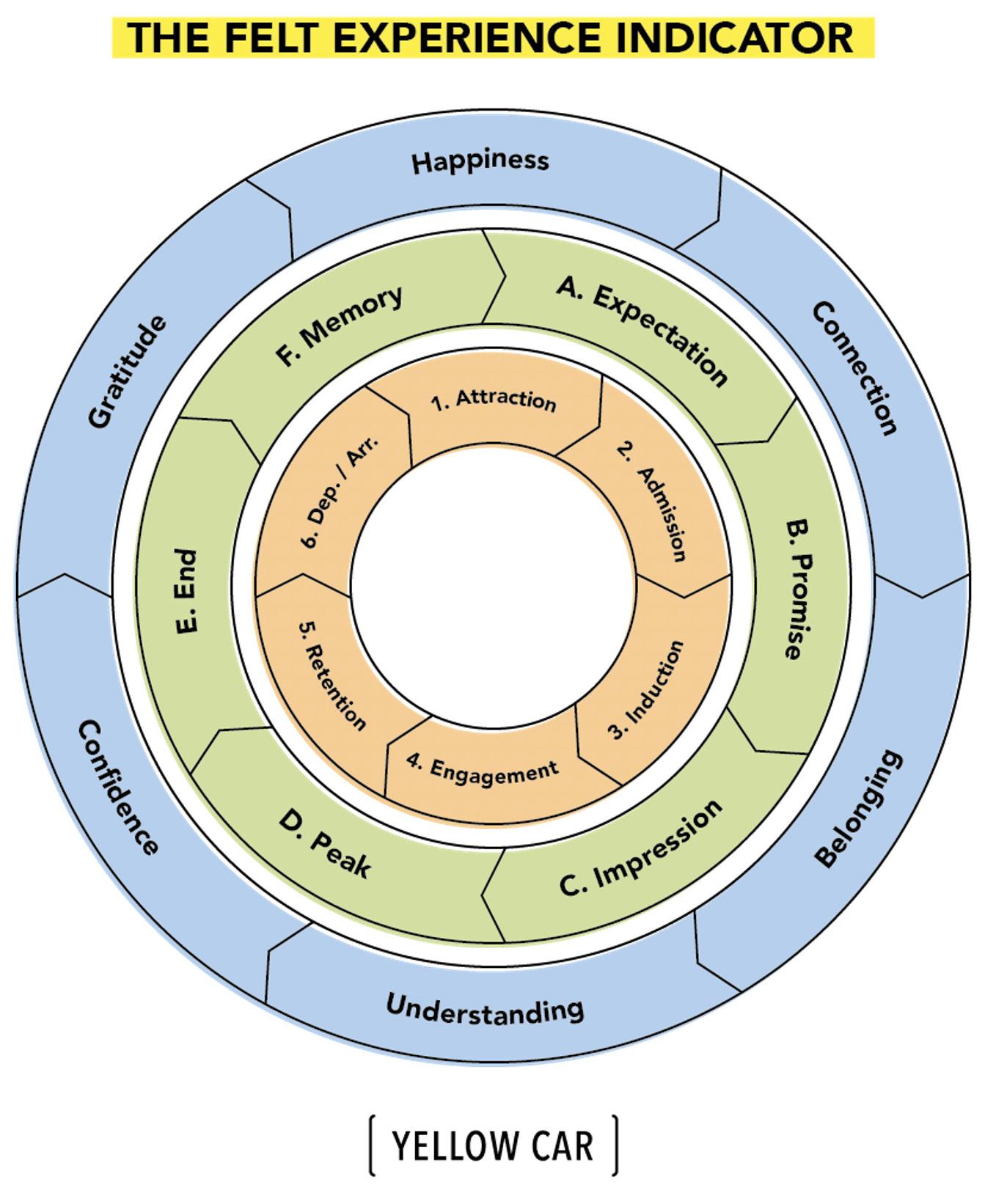
One last thought.
The Felt Experience Indicator illustrated above offers a conceptual framework designed to help us think about the questions that we are asking parents. There’s a lot to unpack and, to be honest, some of our ideas are still “a work in progress”. But here are some of the headlines that we hope will be enough to get the conversation started.
The Inner Circle
Just as the experience of school should be intentionally designed, we are convinced that we should offer the same degree of intention-
As educators, we know that our students need opportunities for feedback and reflection as they grow as learners. We call it assessment. In the same way, I guess that one of the things that we are proposing here is that our families will transition effectively through our schools precisely to the extent that they are given these moments of feedback and reflection along the way. And what we happen to learn ourselves at exactly the same time will also be completely invaluable.
About the Author
Dr David Willows is Co-founder and Strategic Director at [YELLOW CAR], the leading experience strategy training and consultancy firm for schools. For more information, visit yellowcar.io.
Fall 2023 Issue 25
TEACHER RETENTION
International Teachers Teaching: Why We Stay
 By Aleksa Moss Head of Early Years
Utaloy International School Guangzhou (UISG)
By Aleksa Moss Head of Early Years
Utaloy International School Guangzhou (UISG)
I began my doctoral research journey in a time when there was a boom for international schools in Asia. Growth and expansion were the norm, and no one needed to fight for enrollment. My study into teacher retention wrapped up in the 2018-2019 academic year and as you will read in this article, everyone was comfortable with their salaries, and the key indicators for longevity were in the ‘bonus’ funds of autonomous professional development money, and retirement lumpsums. The biggest shift in the years between 2019 and now is of course the global pandemic. Push and pull factors for mobility were greatly impacted by the pandemic, which were not a reality at the time of this research.
With turnover rates ranging from 0-60% in international schools, there is a need for more research into teacher retention. International
schools face unique hiring challenges including difficult governmental and visa procedures, the strain of expatriation, and the costs associated with bringing in foreign teachers. By studying the possible relationship between incentive package elements and teacher retention in international schools in Asia, there is a chance to establish proactive school policies regarding elements shown to be significant. Understanding international teachers’ motivation in the context of their salary package may help schools better understand how to capitalize on sustaining motivational factors such as personal economic stability. Overall, this study will discuss economic theory, teacher motivation factors, teacher attrition and retention, and the international experience seeking to prolong teachers’ tenure at international schools in Asia.
Keywords: international schools, teacher retention, international school teacher retention,

teacher longevity, incentive packages, human capital retention theory.
This study homed in on motivation theories, specifically Strategic Human Capital theory which breaks down the push and pull factors faced by employees. Campbell, et al., (2017) summarized a common theme across strategic human capital theory as understanding of labour market frictions—which constrain voluntary employee mobility—are needed for institutions to gain value from employees. The idea can be simplified to say, as employees willingly leave their companies, other companies benefit from hiring them for their experience and knowledge. Put in the context of international schools, mobility is viewed first and foremost as a threat because mobility is rooted in the loss of human capital and institutional knowledge and training. Overall, by applying adjustments to the incentive found in this study, the goal for schools would be aiming for a healthy
26 EARCOS Triannual Journal
5-15% annual employee turnover rate.
Teacher retention is a global challenge faced by many schools, and the issue has only intensified during the pandemic. Despite proposed solutions, the problem still persists. This study focused on the reasons why teachers leave their schools in international schools in Asia and explored potential factors that could encourage them to stay. The longevity of teachers in these schools is important for both the school culture and economic stability. Motivation is a key factor in employee retention, and while previous studies have explored motivation theories, this study revealed a complexity related to indecisiveness that has not been addressed in the past. Understanding teachers’ motivation, particularly in relation to their salary package, can help schools better understand how to retain them. However, the high percentage of teachers who are indecisive about their longevity may require a different approach than simply offering higher salaries. The study reviewed economic theory, teacher motivation factors, teacher attrition and retention, and the international experience in international schools. The problem statement highlighted the lack of understanding about the primary motivations behind high teacher turnover in international schools.
The prolonged hiring process for foreign teachers makes replacing them arduous and costly. The study aims to address the role of administrative leadership and incentive packages in teacher retention and long-term commit-
ment. The significance of the study lies in providing data to establish a connection between teacher retention and incentive package elements such as salary, retirement contributions, and health coverage. Improved understanding of teachers’ motivations related to their compensation can aid in effective human resource planning. Additionally, international schools and recruitment agencies can benefit from understanding teachers’ needs and distinguishing themselves from competitors.
The findings of the study indicate that there is no systemic relationship between incentive packages and teacher retention. However, when individual incentives were analyzed, there were indications of irregularities in retirement contributions and professional development funding across the surveyed population which included international schools in Asia defined as south of Russia, west of Guam, north and inclusive of Indonesia, and east of India. The results are consistent with the inconclusive nature of previous research, highlighting the complex decision-making process for teachers considering whether to stay or leave a school.
The study is grounded in strategic human capital theory, which suggests that market frictions impact employee mobility, but it also aligns with motivation theories that argue additional incentives are ineffective once employees have achieved a suitable level of financial comfort. The study concludes that there is a need for further research into the decision-making process of international school teachers and
suggests increasing attention to professional development and retirement funds to improve longevity. The implications for leadership include a better understanding of faculty perceptions regarding incentives and salary packages and the need for increased focus on professional development and retirement funds. In conclusion, this study provided insights into the relationship between incentive packages and teacher longevity in international schools and recommends further research and attention to specific areas such as school culture, working conditions, and personal satisfaction, beyond the basic salary package to improve retention rates.
For a deeper dive into the data collection for the incentive package elements of the study, the following scale was used for dependent variables.
About the Author

Dr. Moss is an early childhood expert with more than 17 years in the field of education. With degrees and experience in teaching, administration, and international leadership, Aleksa applies her knowledge working as a school leader and workshop presenter. She works as a school administrator in Guangzhou, and maintains ties to the international school community in China and Asia through work with ACAMIS and EARCOS.
The full published research is available for free on Amazon. Title: International Teaching: Why We Stay, Away by Aleksa J Moss
Dependent Variables Compensation Incentive Package Variables Low Moderate High Salary (USD) 30,000- 30,001-39,999 40,000-49,999 50,000-59,999 60,000+ Annual Retirement Contribution (USD) 0-999 1,000-1,999 2,000-2,999 3,000-3,999 4,000 + Health and Wellness No Coverage Local Coverage Global Coverage Housing None 25% of rent 50% of rent 75% of rent Full Rent Flight None Start and end of contract flights Yearly round-trip return to home country Annual Personal Professional Development Funds (USD) 0-499 500-999 1,000-1,499 1,500-1,999 2,000 + School-directed Professional Development/Training No Yes Shipping allowance start of contract No Yes Shipping allowance end of contract No Yes Rest and Recuperation, Paid Leave No Yes Other Fall 2023 Issue 27
School teachers and leaders frequently ask us, “How do I become an equity warrior?” There are two important caveats to the question. First, often, these educators are predominately white. They hold places of privilege but want to be actively involved in disrupting inequities. Second, they find current politics restrict their engagement in equity issues. This question and the caveats are true in rural Northeastern North Carolina and international schools worldwide.
What is an equity warrior? Larry Leverett (2002) says, “Equity warriors are people who… passionately lead and embrace the mission of high levels of achievement for all students, regardless of race, social class, ethnicity, culture, disability or language proficiency.” Bettina Love calls these educators “co-conspirators… [educators] who want to understand the conditions that normalize oppression and uproot those conditions.” We agree with both. Regardless of demographics, equity warriors are tasked with creating schools students deserve (Perry & Richardson, 2022). We would add the necessary condition of engagement, what Guajardo and colleagues (2016) call the power of place and wisdom of people. Context matters, and traditionally marginalized voices must be heard to make improvement efforts with, not for, people.



Luckily, there are several models to engage white educators seeking to become equity warriors or co-conspirators. Many of the frameworks are empirically based, leveraging voices in various contexts. Table 1 highlights
Can I be an equity warrior?
By Matthew Militello, Wells Fargo Distinguished Professor in Educational Leadership, East Carolina University & Carrie Morris, Associate Director for School Leadership, East Carolina University
resources for educators seeking to engage in this work.
Issues of equity exist in culturally diverse settings as well as homogeneous settings. The international schools we have worked in have a different student and faculty cultural diversity than we experience in the United States. White educators lead many international schools and classrooms, and staff from the local community hold supportive roles, such as teacher aides or custodians. This creates equity issues at multiple levels, including the optics of institutional colonization and economic concerns of similarly trained Western and local employees making different salaries.
Equity issues such as these are the focus of practice for ECU International Educational Doctorate students. Students identify a focus of practice rooted in creating a more equitable and accessible learning environment and use participatory action research dissertations to engage local educators and community members. Examples of equity-focused dissertations in practice include:
• Dr. Tosca Killoran (2019) examined the relationship with local teacher aides within an international school in China.
• Dr. Kacey Molly (2023) focused on amplifying marginalized voices to inform culturally responsive school improvement efforts in Kenya.
• Gender equity issues in an international school in Brazil were explored by Dr. Shannon McMahon (2023).
• Finally, two studies in different international
schools in Bangkok concentrated on different equity issues. Dr. Prerna Paryani (2019) worked with teachers on equitable academic discourse in the classroom, and Dr. James (Ronny) Welch (2019) listened to middle and high school students to better understand the middle-to-high school transition.
In each of these studies, previously silenced voices were amplified to better understand and address equity issues.
A true equity warrior does not proclaim their title but is committed to internal reflection and external actions leading to more equitable and accessible learning environments. Kim and Maudlin (2022) problematize school leaders with heroic leadership discourses. Dr. Carrie Morris’s study (2023) highlighted five white women educational leaders who maintained their core values by critically reflecting on their identities, contexts, and roles and responsibilities for dismantling historical, political, and sociocultural systems of oppression. While they recognized they were not responsible for solving systemic issues, they did not want to be culpable for perpetuating inequities. The women met together to increase their critical consciousness about existing power structures, and the study’s findings outlined how they implicitly embodied antiracism by reflecting on their actions to lead in different ways.
Educators are uniquely positioned to be equity warriors. Educators are teachers and leaders who have daily contact with students and staff and are linked to the surrounding
28 EARCOS Triannual Journal
Implications for Educators
Decoteau Irby Irby explores the concept of “stuck improving” for leaders in predominantly white school communities pursuing racial equity initiatives.
Sharon Radd and Colleagues A practical guide for leaders to “disruptive practices” that interfere with inclusion, marginalization, and access through a set of unique equity-based practices that provide educational excellence for all students.
H. Richard Milner Milner provides guidance to “liberal minded” and “forward thinking” white colleagues who were seeking healing from civic unrest of the past several years.
Shane Safir and Jamila Dugan Street Data both highlights the need for stat-driven decision making to include voices from the community, but it also offers pragmatic insights into common traps and tropes white educators commonly fall into.
Muhammad Khalifa Khalifa offers authentic leadership practices for understanding the communities leaders aim to improve by focusing on the contexts and histories of the students and their communities.
Resmaa Menakem Menakem, a trauma expert, reminds readers that our bodies aim to protect us from harm and that white-body supremacy harms people of all races. This book provides body practices to uncover the ways our body reacts to discomfort and practices to reflect and heal.
Miguel Guajardo and Colleagues
This book provides specific protocols for leaders to facilitate Community Learning Exchanges (CLE). These CLEs create spaces for all community members to discover answers to local concerns building on their assets.
Elena Aguilar Aguilar provides a coaching model built upon the principles of compassion, curiosity, connection, courage, and purpose in order to build capacity as well as the cultural competence and emotional intelligence necessary to engage in equity-focused conversations.
Mark Gooden and Colleagues
Table 1.
This reports analyzed the literature of school leadership standards, preparation, and practice with a culturally responsive school leadership framework that includes: Developing critical consciousness, ensuring inclusive school environment, providing culturally responsive instructional leadership, and enacting culturally responsive leadership emgagement in community contexts.
community. Everyone can take part in acting on injustices. We do not need superheroes; we need collaborators and facilitators who cross boundaries and bridge the assets of the school and the surrounding community with the need to educate all students. As Levertt reminds us, “Equity is hard work and requires the collective commitment and energy of the entire… community.”
So, how do you become an equity warrior? Together! Educators engage others by listening and planning collaboratively, shifting unequal power structures. This requires the desire to disrupt injustices and the courage to work with a diverse community of coconspiring equity warriors.
References
Aguilar, E. (2020). Coaching for equity: Conversations that change practices. Jossey-Bass.
Gooden, M., Khalifa, M., Arnold, N., Brown, K., Meyers, C., & Welch, R. (2023). A culturally responsive school leadership approach to developing equity-centered principals. Wallace Foundation.
Guajardo, M., Guajardo, F., Janson, C., & Militello, M. (2016). Reframing community partnerships in education: Uniting the power of place and the wisdom of people. Routledge.
Irby, D. (2021). Stuck improving: Racial equity and school leadership. Harvard Education Press.
Khalifa, M. (2018). Culturally responsive school leadership. Harvard Education Press.
Kim, T., & Mauldin, C. (2022). Troubling unintended harm of heroic discourses in social justice leadership. Frontiers in Education, 7(796200), 1-12.
Leverett, L. (2002). Warriors to advance equity: A case for distributing leadership. The Mid-Atlantic Educational Laboratory.
Love, B. (2019). We want to do more than survive: Abolitionist teaching and the pursuit of educational reform. Beacon Press.
Menakem, R. (2017). My grandmother’s hands: Racialized trauma and the pathway to mending our hearts and bodies. Central Recovery Press.
Milner, H.R. (2023). The race card: Leading the fight for truth in America’s schools Corwin Press.
Perry, G. S., & Richardson, J. (2022). Equity warriors: Creating schools that students deserve. Corwin Press.
Radd, S., Gernerett, G., Gooden, M., & Theoharis, G. (2021). Five practices for equity-focused school leadership. ASCD. Safir, S., & Dugan, J. (2021). Street data: A next-generation model for equity, pedagogy, and school transformation. Corwin Press.
Dissertations
Killoran, T. (2019). Equity agents: Creating an innovative learning culture with foreign teachers and laoshi within an international school context (Unpublished Doctoral Dissertation). East Carolina University.
McMahon, S. (2023). Educators for gender equity: Promoting gender equity in an international elementary school (Unpublished Doctoral Dissertation). East Carolina University.
Molloy, K. (2023). Honoring cultural diversity in an international school: How culturally responsive practices support teacher collaboration (Unpublished Doctoral Dissertation). East Carolina University.
Morris, C. (2023). White women educational leaders: Embodying antiracism in eastern North Carolina (Unpublished Doctoral Dissertation). East Carolina University.
Welch, J. (2019). Moving from the middle: An exploration of student experiences transitioning to high school in international settings (Unpublished Doctoral Dissertation). East Carolina University.
Author(s)
Fall 2023 Issue 29
By Michel Thibeault, M.Ed. Panyaden International School
• Systemic and individual circumstances guide or impede the creation of healthy habits
• The benefits of meditation and mindfulness practice are well established
• We need to develop tiny habits to support our own wellbeing
• Leaders can foster supporting systemic conditions for individuals to build healthy habits for life
• If we want students to embrace a healthy lifestyle, we have a duty to model it!
How many times did this kind of thought pop up into your head in the last month? If you think “many”, you’re not alone. Whether the activity we’re considering could bring physical, mental, or socio-emotional benefits, work or other social obligations often take precedence. The truth is that, when it comes to building a healthy habit, there are always two kinds of forces at play: systemic and individual. Fortunately for us, early adopters have already blazed a trail to one particularly beneficial habit: mindfulness moments or, for some, its big brother meditation. While it has gained in popularity in recent years, it still resembles the practice of wearing a seatbelt or a motorbike helmet: it is still weak in some parts of the world! With an overwhelming set of data supporting the benefits of mindfulness and meditation practices, we wonder why it’s not more established in schools. What is getting in the way of this becoming part of every curriculum?
Systemic hurdles
The system can work for us, or against us. Consider for example the fact that, while the first bristle toothbrush was invented in China around the 8th century, we had to wait almost 10 centuries before tooth brushing became a popular habit in Europe. What finally made this habit stick? An English company started to mass-produce toothbrushes in 1780! We find a more recent example in sports. When people realized that not moving their bodies was killing them, they started jogging, going to the gym, or joining non-competitive sports teams. However, this only became popular when entrepreneurs from the 1960s-70s started building health and fitness centres in every neighbourhood.
The mindfulness movement seems poised to become part of everyone’s life, but without the support of leaders, this is bound to be a slow process. Milestone books such as “Emotional Intelligence by Daniel Goleman strengthened the presence of social emotional skills programs in schools. John Kabat-Zinn’s MBSR (Mindfulness-Based Stress Reduction) and MBCBT (MindfulnessBased Cognitive Behavioural Therapy) have been reaching thousands of people since the 1990s. It is however relatively recently that authors such as Patricia A. Jennings have popularised similar programs for teachers. Without the support of school leaders, this is often limited to the initiative of individual teachers and have limited impact on the school as a whole.
Paradigm Shift Needed
This article uses the term “meditation” as one of the tools used to develop “mindfulness” as defined by John Kabat-Zinn “Mindfulness is awareness that arises through paying attention, on purpose, in the present moment, non-judgmentally, in the service of self-understanding and wisdom.”

When it comes to implementing well-being and mindfulness programs in school, we need to move from student-centered to leader-centered. The diagram below illustrates the domino effect we can expect to see when school leaders personally embody the changes they want to see. In fact, a systematic review of research has revealed that in schools where leaders prioritize staff wellbeing, teachers transfer the benefits to students. As such,

Mindfulness I know it would be good for me, but…
30 EARCOS Triannual Journal
school leaders are powerful agents of change when they put in place systems that generate benefits for students, not to mention the positive impact on the school culture and a sense of safety at work that is lacking in so many organizations! With all the demands on educational leaders in the fast-changing education landscape, the only way they will actively promote something as personal as developing a mindfulness practice is when they have adopted such practice in their own lives.
The intellectual knowledge of the benefits of meditation can only take us so far. Its role is to inspire us to action and to start a mindfulness program. For us to build and maintain a regular practice, we need to commit to tasting it for a period! Only then will we truly understand its value and want to share it with others.
About the Author
Michel Thibeault is the Mindfulness Director at Panyaden International School.
Bibliography
Bell, M. (2018). The history of the toothbrush. The Health Science Journal1
Berger, E., Reupert, A., Campbell, T. C. H., Morris, Z., Hammer, M., Diamond, Z., Hine, R., Patrick, P., & Fathers, C. (2022). A systematic review of evidence-based wellbeing initiatives for schoolteachers and early childhood educators. Educational Psychology Review, 34(29), 2919–2969
Bungay Stanier, M. (2016). The coaching habit: Say less, ask more & change the way you lead forever. Box of Crayons Press.
Clear, J. (2018). Atomic habits: Tiny changes, remarkable results: an easy & proven way to build good habits & break bad ones. Avery, an imprint of Penguin Random House.
Duhigg, C. (2012). The power of habit: Why we do what we do in life and business. Random House Trade Paperbacks.
Davidson, R., & Goleman, D. (n.d.). The science of meditation: How to change your brain, mind and body.
Mindfulness as a Healthy Individual Habit

So, there is no system in place to promote mindfulness in your school, and, as a leader, you are giving it some thought. You then face the 2nd factor that limits change: personal motivation to make it happen.
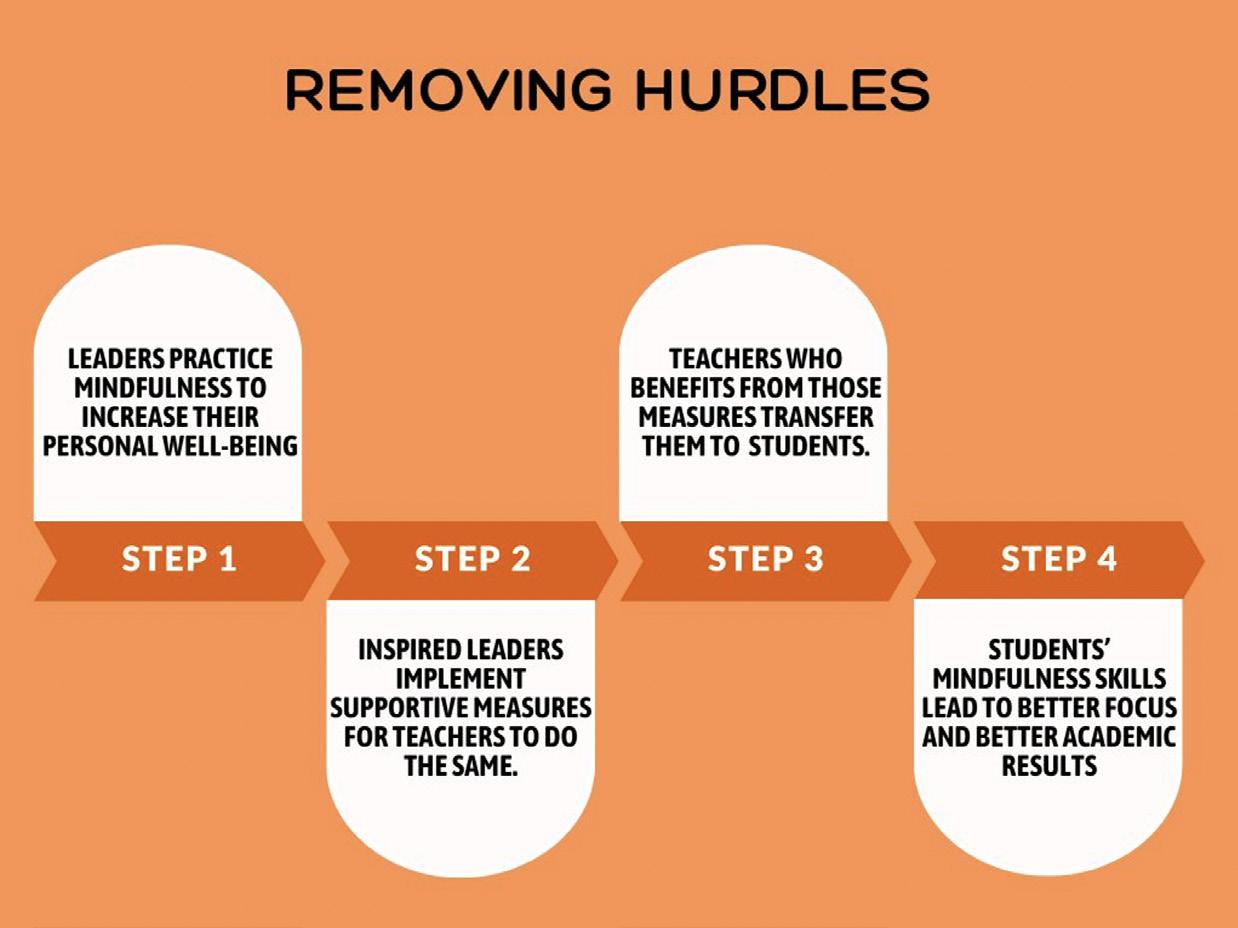
When it comes to creating and maintaining habits, a few key factors come into play. Neuroscientist Andrew Huberman points out that the availability of distraction that yields some pleasure without effort, phone, tv, etc., is a major obstacle. Yes, we can probably all attest to the addictive character of our electronic devices. To paraphrase Michael Bungay (The Coaching Habit), when we say yes to 30 minutes of mindless scrolling, what are we saying no to?
From another perspective, most people already realized that aiming too high at the start was also detrimental. “Start small” is a key feature promoted by writers about creating habits, from social scientist BJ Fogg (Tiny Habits) to James Clear (Atomic Habit) to Charles Duhigg (The Power of Habit), to Sarah Harvey (Kaizen: The Japanese Secret to Lasting Change). So, before trying to build a 1-hour a day meditation practice, why not start with 30-second mindfulness moments? Once a day. You can afford the time. Soon enough, you will feel like extending that time… because it feels good! Go easy. Make it one minute. Maybe you can take a 1-minute mindfulness break 2 or 3 times a day! If you want to make it easier on yourself, stack those mindful minutes on top of other routine activities, such as before brushing your teeth or before you start the car!
Fogg, B. J. (2019). Tiny habits: The small changes that change everything. Ebury Publishing.
Goleman, D., & Davidson, R. (2017). Altered traits: Science reveals how meditation changes your mind, brain, and body. Penguin.
Gu, J., Strauss, C., Bond, R., & Cavanagh, K. (2015). How do mindfulness-based cognitive therapy and mindfulness-based stress reduction improve mental health and wellbeing? A systematic review and meta-analysis of mediation studies. Clinical Psychology Review, 37, 1-12.
Harvey, S. (2018). Kaizen: The Japanese secret to lasting change. Vermilion.
Huberman, A. (Host). (2022, January 17). The Science of Setting & Achieving Goals In Welcome to the Huberman Lab Podcast. Huberman Lab. The Science of Setting & Achieving GoalsHuberman Lab
Kabat-Zinn, J. (2013). Full catastrophe living: Using the wisdom of your body and mind to face stress, pain, and illness. Random House.
Marsh, A. (2022). Preparing a school community for DEIJB work through developing social emotional competencies. EARCOS Triannual Journal, Winter 2022-23.
Sleilaty, J. (2022). The impacts of a regular mindfulness practice on teachers: A critical review. Werkbund School of Education, University of Calgary.
Tharrett, S. How gyms have evolved through the ages. Available online at www.lesmills.com.
Fall 2023 Issue 31
Let’s Talk: Critical Intellectual Discussion Beyond the Curriculum
 By Jared Rock Seoul International School
Introduction:
Over the past four academic years, teachers at Seoul International School (SIS) have offered a running series of open discussion seminars titled Let’s Talk. The Let’s Talk series is loosely held together by its roots in the principles of discussion-based learning and its open invitation to all high school students and faculty. The goal underlying this initiative is twofold: to enrich non-curricular active learning within our liberal education program and to cultivate a vibrant intellectual community through the exploration of timeless ideas and their relevance to our daily lives. Seminar topics are selected by faculty and student interest. Groups that represent a cross-section of grade levels, faculty departments, and areas of expertise have brought life to eight Let’s Talk seminars, on the topics of: Confucianism, Meritocracy, Ethics, Populism, Social Contracts, Free Will, Death, and DEI (Diversity, Equity, Inclusion). The series has shown the potential for an optin group dedicated to open discussion on issues of intellectual and social importance to forge a greater sense of community-belonging and to demonstrate the power of informed discourse at the high school level.
History of Let’s Talk at Seoul International School:
In February 2020, three students and three faculty members met in a small SIS classroom to have an open discussion on Confucianism. Preceding this gathering, SIS hallways were gripped in debates concerning the impact of Confucianism on Korean school culture, its place within an international school, and the role of non-Asian faculty in embracing Confucian practices or teaching its traditions. A high school administrator and teacher made a proactive effort to diffuse tensions by inviting all interested members of the school to a three-week open seminar where participants could voice their opinions and experiences and respond to one another directly in a safe environment, engaging in critical discussions based on mutual respect and prompting intellectual growth.
It is out of that initial seed that Let’s Talk has flourished, periodically meeting to discuss timely, and timeless, topics. Participation rates
range from a low of four (populism) to a high of nineteen (meritocracy), with fifty-one members of the school community having participated in at least one seminar to date (remarkable considering SIS’s student population is roughly 300), many of whom joined multiple seminars. Contact with the wisdom of 123 notable thinkers, from pre-Socratic philosophers to twenty-first-century artists, has enriched seminar discussions by helping participants see how their ideas fit within a greater intellectual tradition, while critically engaging with this very tradition to examine, defend, and form their own ideas. The elements that have tied all of these seminars together under one series are (1) its voluntary nature, which inspires and requires active engagement and critical challenging of one another, and (2) its focus on making big ideas applicable to our lived experience and local communities. This sets high-stakes for discussion, as the relevance of ideas and beliefs to our immediate conditions is always foregrounded.

Benefits:
The benefit of Let’s Talk to the school community is, at least, threefold:
1. First and foremost, it nurtures an atmosphere of shared intellectual community, ideally the core of any school. The seminar provides an egalitarian platform within our structured hierarchical system, where students and faculty of different standings can enter a conversation with one another to tackle hard problems as a team.The openness of this communal pursuit of knowledge that confers no grade, no penalties, and no accolades, makes for fertile and safe ground upon which to explore ideas and challenge the status quo. Each iteration has resulted in a sense of supportive community between its members, one that can last well beyond the formal seminar itself.
2. Second, seminars connect the intellectual with the personal. This enables students to grapple with topics normally reserved for counseling, advisory, school committees, and home-life in a more rigorous, critical, open-ended, and participatory manner
CURRICULUM
32 EARCOS Triannual Journal
Promotional fliers for all of SIS Let’s Talk seminars.
than usual. Students can critically question school policies, social norms, and the purpose of institutions (including the school itself). This open invitation to argue, confront, and reflect exemplifies the roles of intellectual friendship and dialogue as indispensable in pursuit of the good life. Let’s Talk’s discussioncentered model places responsibility on its members to see themselves as active creators and communicators of knowledge. That, in turn, promotes real-life applicability of the ideas and beliefs formed and defended through this intimate process.
3. Finally, these groups are conduits and/or incubators of action. Praxis is always an explicit goal of the seminar, whether immediate or delayed, whether personal or shared. Some groups have even taken up action as part of the seminar itself. Such was the case with the DEI seminar, which sent a report of considered points to the school’s (fully-adult) DEIB committee. This both asserted the importance of considering student perspectives when undertaking a school initiative, and the ability for citizens of any community to take responsibly to deliberate and be heard. Other seminars have left shared understandings to inspire personal action; like the social contracts seminar, which pushed students to become more aware of their role in a dayto-day school social contract, making them more empowered members of the community and the education process, as well as looking for avenues for greater impact, such as being more involved in a school-wide strategic planning initiative.
The value of Let’s Talk unquestionably resonates with our students, who appreciate the freedom it affords them to question, criticize, and create in ways that develop greater agency in directing their own growth and impact on the school and other communities. As one student participant put it, “[Let’s Talk is] the best event that I ever had at our school!” The enthusiasm for this voluntary series reveals that it has a place for young minds seeking a venue that expects them to think and be challenged as adults joining the serious, highstakes conversations of our times.
Running an Open-Invitation Discussion Seminar:
Some form of open discussion seminar can benefit any high school seeking to impart a liberal education. The discussion seminar is a low-cost way of opening an opportunity to apply the skills and knowledge of school to our lives. While there is no one correct model, drawing upon insights from Let’s Talk offers some suggestions:
1. Relevant topics: Seminars should focus on some topic or question that lends itself to disputation. Relevant topics may link with school initiatives, issues of current social discourse, or classic problems your school body is likely to find interesting. The only criteria here are to find topics that will draw a dedicated group and keep up a prolonged and nuanced discussion for the planned length of your seminar.
2. Freely hosted and freely attended: The seminar should exist for its own sake, inspiring intrinsically motivated participation. Seminars should be set by faculty members as they please, not assigned, not a duty. If no one has a topic of interest for a whole academic year, let the series slip into hiatus until inspiration strikes. The key to the success of the program is keeping it entirely voluntary, not to fulfill any curricular or other school requirement, nor confer extra credit, nor ties to any club. Let the seminars appear periodically and organically, and allow any
member of the faculty to host one merely by advertising it.
3. Number of sessions: Consider how many times you need to meet to discuss your chosen topic. Narrowing the scope and preparing several questions or dilemmata for discussion will help give you an emerging sense of session breakdowns. In general, three or four one-hour sessions will allow for good coverage of a topic without losing too many members to waning interest.
4. Timing: Allotting enough time for engaged discussion is essential. Ideally, each meeting will be at least 40 minutes. It is important to place the sessions consistently accessible within your school’s weekly schedule so that the same participants will be able to join all meetings. Consider how much time you want to leave between each meeting for reading and/or reflection (once per week is a good spacing). Look for a time that is open to a good cross-section of your school community; remember you want various perspectives! At SIS, we used the lunch hour for our seminars, as that was the shared time where most members of our school were free to join.
5. Promoting & Preparing: Get the word out about your seminar! Use posters, announcements, and school-wide emails to target and reach everyone you want. Consider who you want to join the discussion (do you want non-faculty staff to come, parents, local community members?) and make sure your promotion reaches them. It is advisable to have people sign-up, which is easy to do with QR codes on advertising material and links in emails. A sense of who is coming lets you prepare the physical space, distribute pre-session reading material, and send calendar reminders. Preparing some good guiding questions ahead of each session will help to get things rolling, though it is advisable to let the discussion develop on its own from there, playing moderator as much as possible.
6. Rules: Set ground rules that promote respectful discussion, especially for disagreeing with and challenging others’ views. Guide members to respond to one another, consider all perspectives at (and, ideally, some that are absent from) the table, and build/ deconstruct arguments together in a sustained manner. Clearly relate the opportunity for personal growth of voicing disagreement with arguments and of submitting your own ideas to be challenged.
7. Praxis, praxis, praxis: Get participants to share how the ideas formed, expressed, and defended in seminars have real-life applications. Explicitly encourage moving from the realm of discourse/theory to action, as both a civic duty and a key to the good life. Decide if it is appropriate for the group to take collective action. If so, help facilitate this, for example, by petitioning your city council, critically examining the school’s handbook and sharing a report with the faculty, creating a new party for student government with a specific platform or mission, etc. Instilling a proactive sense of agency in participants not only empowers them personally, but also nurtures a broader culture of responsible and engaged citizenship.
8. Branding: Come up with some series title to unify the disparate seminars. As the series grows, this label will signal the voluntary and dynamic essence of these events. Once a brand is established, communicate this with the faculty and open it up for use to all in promoting their own seminars. This will allow the team to collectively contribute to the identity and vision of a seminar series within the school community.
Fall 2023 Issue 33
Conclusion:
The voluntary open discussion seminar model is a tool that builds a caring intellectual community and spurs active involvement in selfgrowth. Its synergistic fusion of scholarship with practical application is a powerful embodiment of the mission of a liberal education. The success of SIS’s Let’s Talk may stand as an example for emulation, or to inspire even more innovative approaches to this type of voluntary shared learning. It is easy to implement in any school in ways that take your unique community and needs into account. Best of all, it can be started by anyone. All that is required is that one passionate
faculty member plan, promote, and host a seminar on a topic he or she wishes to explore in open discussion with others. This may indeed be the spark that ignites a new tradition at your school.
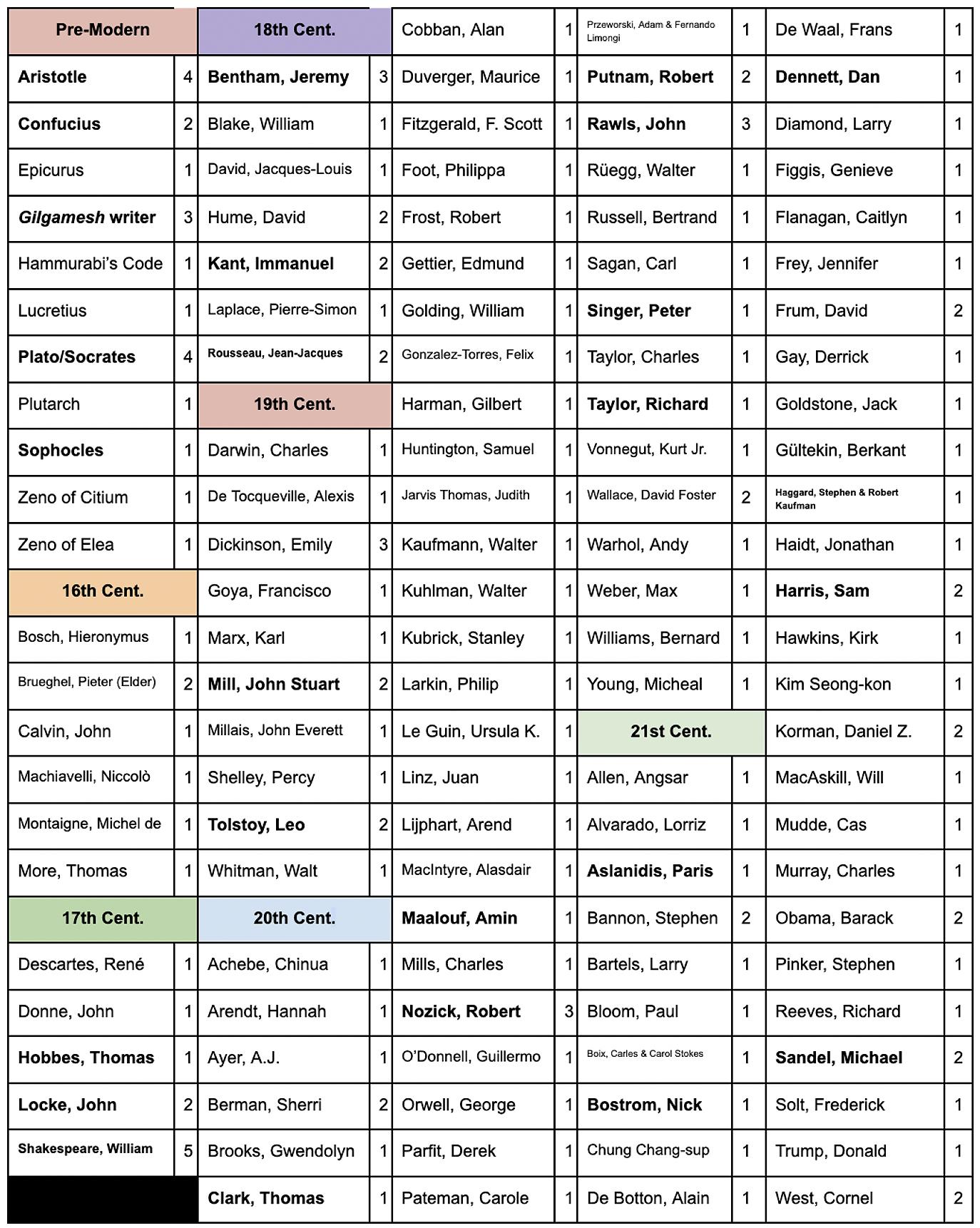
About the Author
Jared Rock worked at Seoul International School as a high school teacher in English, Communications, and AP Research. During his time at SIS, he led several extra-curricular seminars in the Let’s Talk series.
34 EARCOS Triannual Journal
All prominent thinkers featured in Let’s Talk seminars since 2020, including the number of seminars in which their ideas were referenced. Thinkers whose ideas were central to discussions in at least one seminar have their names bolded.

SCAN to learn more Courses Online That Fit Any Schedule & Time Zone The University of Nebraska does not discriminate based upon any protected status. Please see go.unl.edu/nondiscrimination. 2308.016 AP® is a trademark registered by the College Board, which is not affiliated with, and does not endorse, the University of Nebraska High School. U.S. diploma Accredited, college-preparatory program 100+ core, elective, AP®, dual enrollment & NCAA-approved courses Open enrollment Self-paced, independent study Responsive staff highschool.nebraska.edu/earcos (402) 472-3388
CURRICULUM
Creating a coherent curriculum with the International Primary Curriculum (IPC)

 By Jacqueline Harmer and Andy Freeman
Many national curricula around the world publish learning outcomes to be achieved within a certain age range, this concept of curriculum provides teachers and leaders with the ‘what’ of the curriculum but none of the ‘how’ and ‘why’.
Schools that choose to or are required to teach national or regional curriculum need to make research-informed choices to help make learning happen or select a curriculum solution that can meet the needs of both their learners and teachers while fulfilling any outcome requirements. The need for consistency and ease of transition for expatriate learners was one reason for the adoption of English National Curriculum (NC) outcomes within international schools. The International Primary Curriculum (IPC) Learning Goals have been cross-referenced to the English National Curriculum outcomes to allow schools to check for coverage and be confident they have a rigorous approach to teaching and learning.
Below Andy Freeman from Seoul Foreign School shares how the integration of the International Primary Curriculum (IPC) with the National Curriculum (NC) engages and benefits both teachers and learners. Andy’s first encounter with the IPC as a vehicle for meeting NC outcomes was back in 2006. Having come from British International schools he was very familiar with the NC requirements but eager to embrace a new way of teaching and learning.
As Andy’s leadership journey continued so did his love and appreciation for the IPC. “The love came from it being more about a philosophy, a belief, and a way of sharing learning in more engaging impactful ways for students. Yes, it provides thematic units you can follow, a Process to Facilitate Learning, an approach to assessment that informs learning and content that you can use, but it is so much more
36 EARCOS Triannual Journal
than that”. Since beginning his journey with the IPC, alongside his school leadership role, he has become a trainer, mentor, and accreditation team member for the International Curriculum Association. At Seoul Foreign British School, where Andy is currently the Principal of the British School, the implementation of the IPC provided a flexible framework that created a space for educators to explore, be innovative and create new opportunities to better support children’s learning and invite parents into the process. Andy explains, “This could be creating new content that is more contextually relevant, new approaches to teaching-learning that remove barriers for children so that all can access the learning outcomes and be successful, or even creating new opportunities beyond the classroom that allow children to explore and connect with learning that is relevant.”
One example he shared from a previous school, is where the whole school engaged with units on the same theme of habitats and environments. Each milepost (2 years of schooling) was learning at its own level but able to connect to broader ideas as they visited other classrooms which had each been turned into a different habitat from around the world. This approach also supported International Learning as children developed a sense of why places are like they are, and which animals and plants thrive in different locations.
As a school leader, Andy values how IPC teachers are encouraged to be creative within themes and can collaborate across different age groups to provide motivating opportunities and improve learning for all. “The same is true of students, i.e., they are encouraged to be creative within themes and can collaborate across two age groups.” Making these connections between previous and current learning is encouraged because of the benefits for knowledge retention and developing deeper and broader understanding.
For Seoul Foreign British School, as with other schools, the appeal of the IPC is that it can be adapted to meet any curriculum requirements or goals and also crafted to meet the school’s contextual needs. While teaching in a small school in Nigeria, Andy took an innovative approach to bring the community together and promote collaboration to enhance learning experiences. He shared an example where a contextually relevant Milepost 2 (7–9-year-olds) unit was expanded for the whole school. Connected Learning Goals from Mileposts 1 (5–7-year-olds) and 3 (9–11-year-olds) were identified and age-appropriate tasks were designed around those goals under the shared theme. “We tracked what Learning Goals were or were not covered through the year as we ‘played’ with different units at different ages to make learning relevant whilst also bringing the community together. As with everything, we didn’t force this approach for each unit and would teach different units where appropriate to ensure coverage. This was very impactful on uniting a community.”
A key aspect of the IPC is the focus on children being internationally minded and globally competent. Learning about the similarities and differences between cultural backgrounds instils empathy which supports children to be globally competent, socially conscious, and motivated individuals that positively contribute to the world they live in.
Each IPC unit can include learning related to the host, home, or heritage countries, with which learners have a connection. This brings a world perspective and develops local and global cultural understanding. The importance of this is acknowledged by the OECD, “At
work, at home and in the community, people will need a broad comprehension of how others live, in different cultures and traditions, and how others think, whether as scientists or as artists” (Education & Today, 2020).
For Seoul Foreign School “The IPC allows us to consider the goals of the NC but design the content to be relevant to the learners in our classrooms who may be from different cultural backgrounds. This allows us to engage students in ways that are more relevant to them and help with their sense of belonging.”
Andy is positive that the school’s choice of curriculum solution improves learning through engaging, relevant content coverage and flexibility in practice. “The IPC framework allows us to design with confidence in coverage in mind, but with the flexibility to cover them when relevant and impactful.”
How do you know which curriculum solution will improve learning in your school?
Leaders should consider both the quality of the product but also how well it will fit with their school’s context. Some questions they need to ask include the following:
• Does the research basis of the curriculum align with those valued by the school?
• Is the activity design based on research to best suit the age range of the learners?
• Does it make the teachers’ job of planning and delivery easier? Does it facilitate collaboration?
• Is the curriculum flexible and adaptable to meet learner needs and learner interests?
• Does the curriculum provide opportunities for learners to ‘see’ themselves in the curriculum?
• Does the curriculum meet the requirements of any chosen written curriculum?
To find out more about the International Primary Curriculum visit our website here
With thanks to Andy Freeman Head of British School, within Seoul Foreign School, South Korea.
About the Authors
Jacqueline Harmer is the Head of the IPC and Andy Freeman is the Head of British School, within Seoul Foreign School, South Korea.
Reference
Education, O., & Today, S. (2020, October 22). Are students ready to thrive in an interconnected world? The first PISA assessment of global competence provides some answers. OECD Education and Skills Today. https://oecdedutoday.com/students-ready-thriveinterconnected-world-first-pisa-assessment-global-competence/
Fall 2023 Issue 37
MAKE THE CALL!
Verifying References: An Essential Practice for International School Leaders
 By Jane Larsson, Council of International Schools (CIS) & Pauline O’Brien, International Schools Services (ISS)
INTERNATIONAL TASKFORCE ON CHILD PROTECTION
38 EARCOS Triannual Journal
International schools face a unique set of challenges when it comes to hiring qualified and trustworthy individuals to work with children. The need for qualified and experienced teachers and leaders is paramount, but so is the responsibility of ensuring the safety and wellbeing of every individual working with children. Unfortunately, many school leaders are still not conducting thorough reference check calls during the hiring process, posing significant risks to the safety and development of children and the school community.
The verification of references via direct calls is a key step in the hiring process that provides valuable information about an individual’s past experiences, working style, and interactions with children as well as an opportunity to check out any issues brought to light in a written reference. While system-generated references from recruiting agencies can provide important initial guidance in the screening stage of the selection process, they are not enough. Calls made to verify what has been written or shared in other ways may uncover potential warning signs that were not immediately apparent, such as a history of misconduct or unsuitable behaviour around students. From our experience, we know that referees are often reluctant or simply will not write about unsuitable behaviour when completing standard reference forms.
Given the vital importance of these reference checks, why are many school leaders not taking the time to ‘make the call’? Many leaders cite time constraints and logistical challenges, but not making these calls can result in the hiring of individuals with a history of misconduct, who may continue to display inappropriate behaviours in their new roles, potentially harming children. If it is found that the school did not conduct reference checks, this can result in a loss of trust and confidence in the school’s ability to prioritize the safety and well-being of its students and staff.
The reputation and credibility of the school can also be damaged in the event of a child safeguarding or protection incident, with the school’s response and handling of the situation coming under scrutiny. This scrutiny often includes legal and financial consequences. Our experience shows that taking the time initially to ‘make the call’ for new hires is a fundamental means of reducing the number of instances of problematic behaviour by adults that could follow.
Over the past school year, International School Services (ISS) conducted research to explore how many school leaders are making reference verification calls. ISS had the opportunity to speak with over 70 school leaders, gathering invaluable insights into their expe-

riences. Of the 70 school leaders surveyed, 60 of them reported that they had not received any reference verification calls about their former staff. Eight had received at least one call. Two of these leaders had taken the initiative to call the hiring school to provide information after learning a former colleague had been hired.
When we asked these school leaders if they themselves made reference verification calls, they responded that they did. Each of them had at least two leaders and teachers moving on from their schools. This suggests inconsistent practice using reference checks as part of the hiring process, highlighting the need for further exploration.
The International Taskforce on Child Protection (ITFCP) Committee for Recruitment, Reporting, and Regulations highlights the importance of reference calls as a key part of a recruitment process which leads to the development of a safer community. We are committed to supporting school leaders in fulfilling their collective responsibility to prioritize child safeguarding and protection and ensure they are hiring qualified and trustworthy individuals to work with children.
As a next step, the ITFCP Recruitment Committee will collaborate with Accreditation agencies to ensure that reference verification calls are recognized as a core standard of safer recruitment policy and practice.
Let us take this call to action seriously and do our part in safeguarding the future of our children. We ask that every school leader commit to the completion of thorough reference checks in discussion with the leaders of other schools to ensure that every individual we hire is deserving of our trust and confidence. Together, we can create a culture of safety, accountability and excellence that will benefit our students for years to come. Make the call to help us all make a positive impact through international education and in the lives of the students we serve.
About the Authors
Jane Larsson, ITFCP Chair; Executive Director – Council of International Schools (CIS)
Pauline O’Brien, ITFCP Committee Chair on Recruitment, Regulations and Reporting; Director of Global Recruitment Strategy and Business Development – International Schools Services (ISS)
Fall 2023 Issue 39
SCHOOL CHANGE
Connecting Key Elements to Rapidly Transform Schools

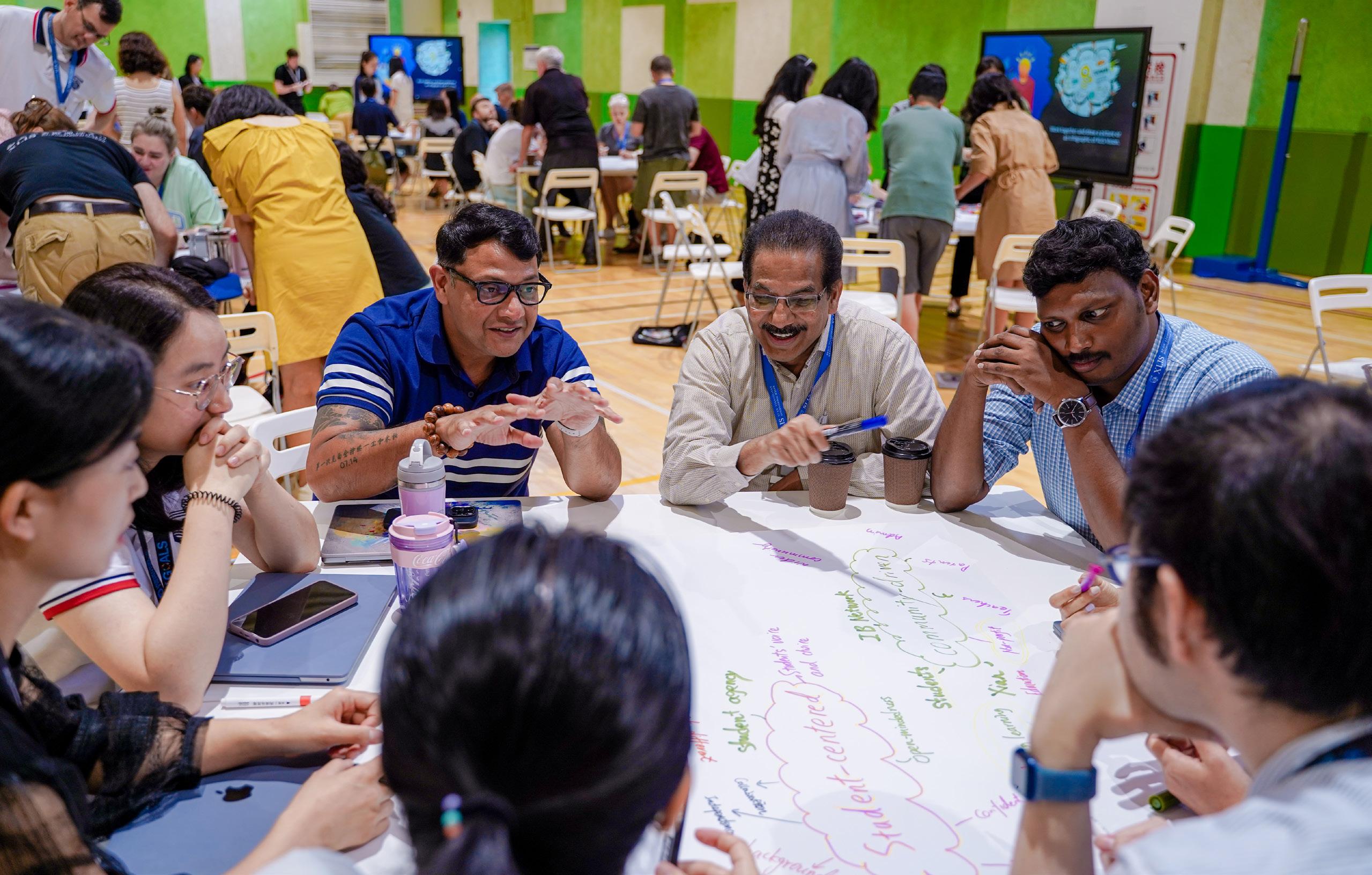 By Brian Lalor (M.Ed.) Deputy Head of School Xi’an Liangjiatan International School
Vision to Action
This past April, I had the opportunity to lead a workshop at the ACAMIS Spring Leadership Conference. It was based on a theme which has been the focus of my life for the past two decades – organizational transformation. I studied this as part of my graduate degree and have been putting it into practice in two different schools. Change is always happening in schools; the question is whether the change is being directed to align with the school mission. I have come to realize that through connecting key elements of a school, rooted in the mission, intentional, organization transformation can take place.
EARCOS member schools have an advantage in the area or organization transformation, they are accredited. During the accreditation process the school community, which includes parents, the governing body, teachers, students, and support staff undergo a thorough self-study process. During this process agency is given to the school community to triangulate data to identify strengths of the organization and areas for growth. From the areas for growth, an action plan is developed. Focusing the energy of the organization on this action plan is the key. This is done by connecting the self-study findings/action plan to two important areas.
The first of these is Professional Development (PD). Connecting PD to the schoolwide action plan and any authorization reports will help the school develop at a much faster rate. If PD is being planned that is not furthering the school mission it is potentially a waste of time. I cannot stress how important it is that PD be connected to the action plan, rather than being planned on the whims of individuals. Schools in the EARCOS region may have recommendations from multiple IB programs
40 EARCOS Triannual Journal
to address as well as areas for growth from accrediting organizations such as ACS WASC. These should be mapped into an annual strategic plan to be systematically developed during the proceeding self-study cycle.
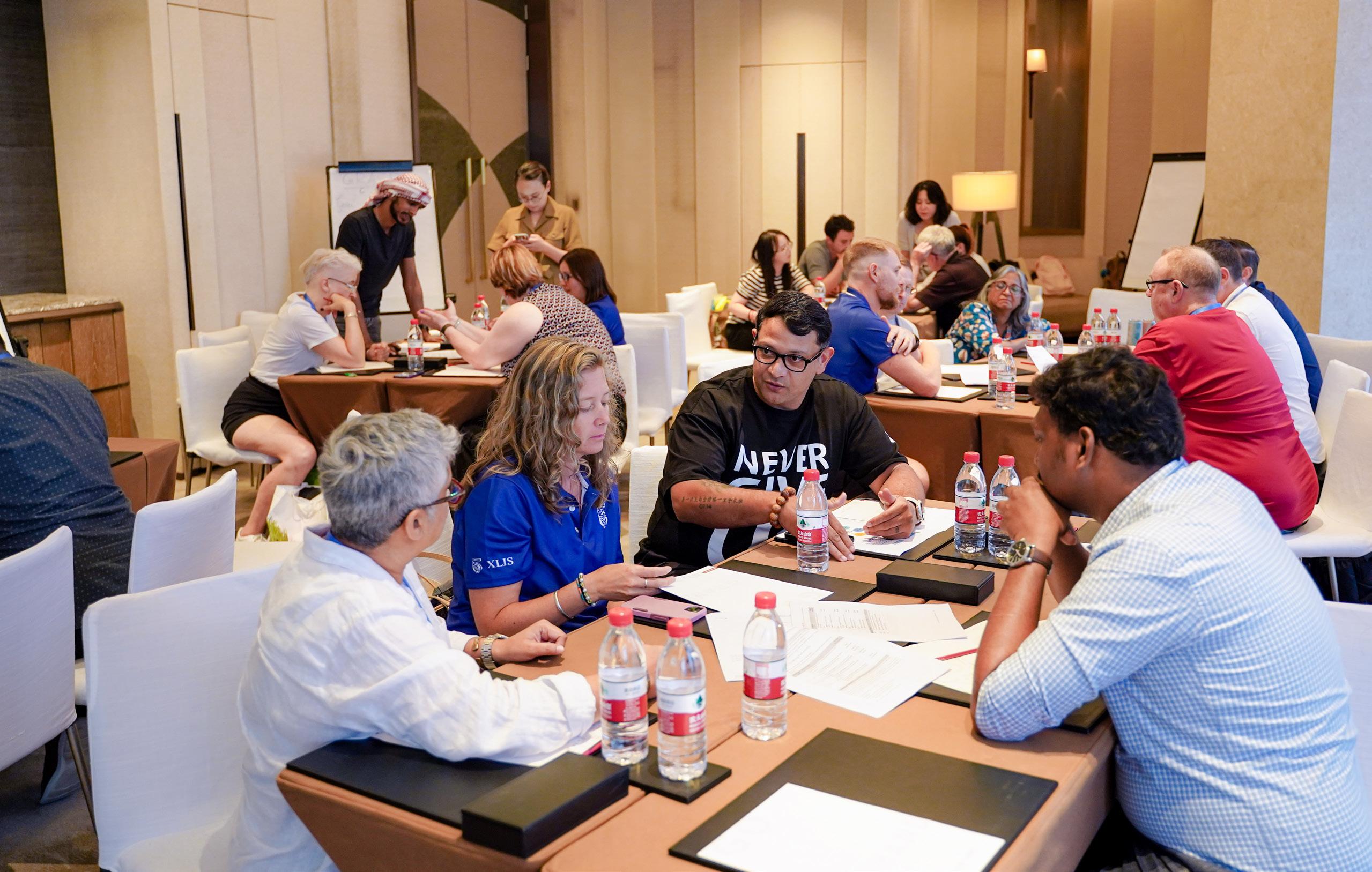
Schools may develop these goals through professional development workshops, orientation week or in home groups. Another excellent way to further the action plan is through the staff Professional Growth Program (PGP). This program is usually based on a set of standards such as those developed by Charlotte Danielson, (Danielson, 2022) or James Stronge (Stronge, 2023). Dr. Stronge will be leading a pre-conference workshop at the upcoming EARCOS Leadership Conference. During the PGP the administrator leading the session may focus on standards which are connected to the schoolwide action plan, thus further accelerating, intentional organizational change.
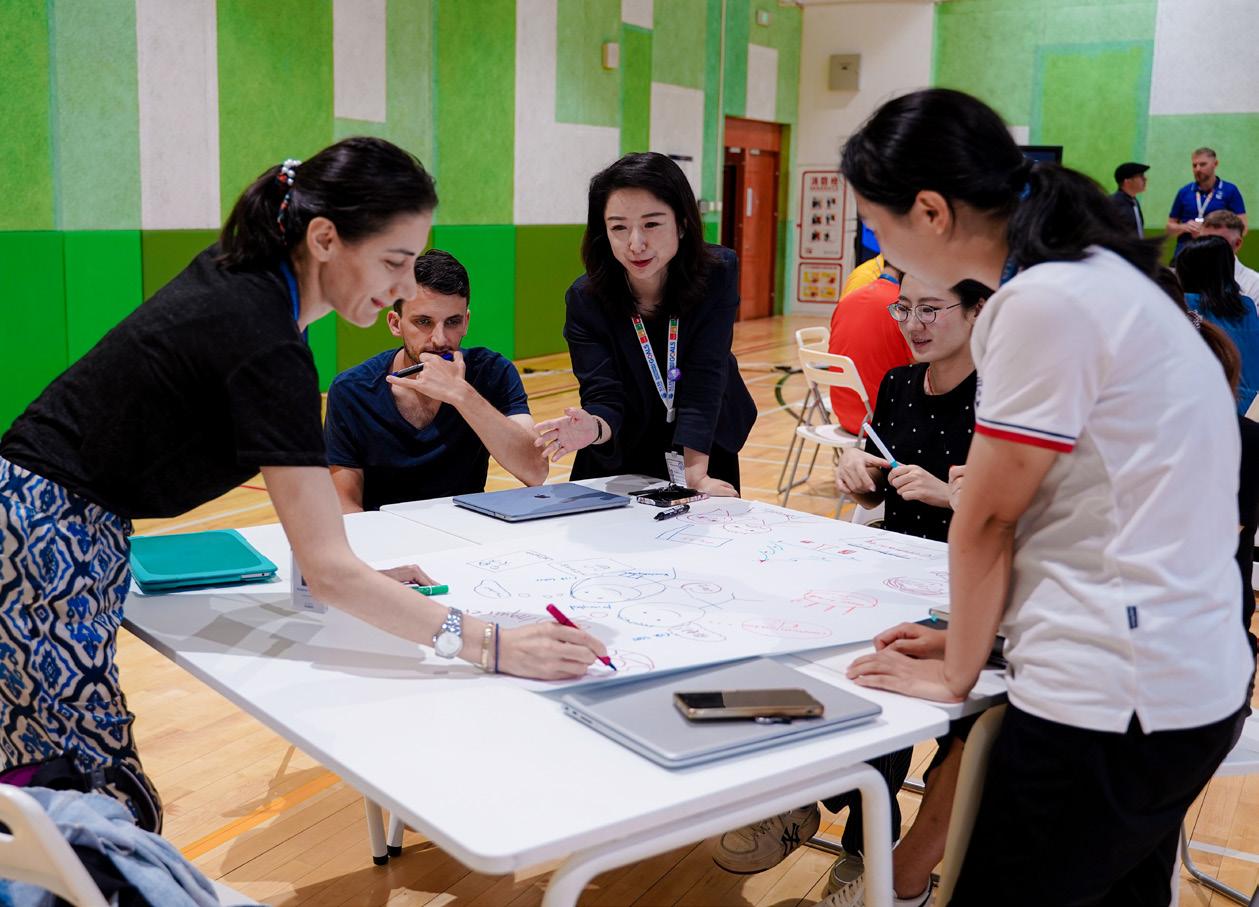
In conclusion, if a school wants to make rapid development the key concept is connection. Give the community agency by conducting a thorough self-study to identify strengths and areas for growth. Do not waste time, immediately develop an action plan and direct the professional development energy of the school towards these goals. Further strengthen this connection by following up on PD through the school’s professional growth program. This way the organization is working systematically and intentionally towards achieving the school mission.
References
Danielson, C. (2022, April 5). The framework for teaching. Danielson Group. https://danielsongroup.org/framework/
Groves, B., & George, M. S. (2022). Connecting the dots of accreditation: Leadership, coherence, and continuous improvement. Rowman & Littlefield.
Stronge, J. (2023). Stronge & Associates, LLC. https://www.stronge andassociates.com/evaluating.html
Fall 2023 Issue 41
Assessment Focused PD
ISLES: Strategic Leadership for Inclusive Student Support
 By Cindy Warner-Dobrowski, Priscilla Leighton, Kristel Solomon-Saleem and Trina Cobbledick Graphics by Kimberley Fung and Michael Sawatsewi
International schools have been on a journey to become more inclusive over the past several years. A 2020 survey found that learning support programs are “an established feature of most international schools” (ISC Research, 2020, p. 24). However, the definition of inclusion has evolved from a relatively narrow definition about student learning needs to one that encompasses all aspects of diversity. According to Next Frontier Inclusion (NFI), “[a]n international school is inclusive when it has made the intentional decision to develop diverse student & faculty populations that reflect society as a whole, including multilingual learners & students with diverse learning profiles. These schools take a systems approach to building capacity amongst stakeholders, offering universal design for access to all aspects of school life.” (NFI, 2020, cited in ISC Research, 2020, p. 4.) Students learn best when all aspects of their identity are considered in the development of programs, curriculum and lesson design. While much progress has been made in admitting students with diverse support needs into international schools, the next step is to ensure that all students have access to support that facilitates them in meeting their learning and personal potential, and experiencing a sense of belonging in their school community.
Our Why
The International Schools Leaders of Educational Support (ISLES) Collaborative was founded in recognition of the need to support school leaders in the strategic development of high-quality support programs in international schools, and the aspiration to support each other in attaining this goal.
We began with a small group of international school-wide support leaders gathering in Singapore in February 2020, weeks before the world shut down due to the global pandemic. ISLES hosted the International MTSS conference online in 2020-21. Today, ISLES continues to be the go-to source of support and community for over 70 leaders of learning support worldwide.
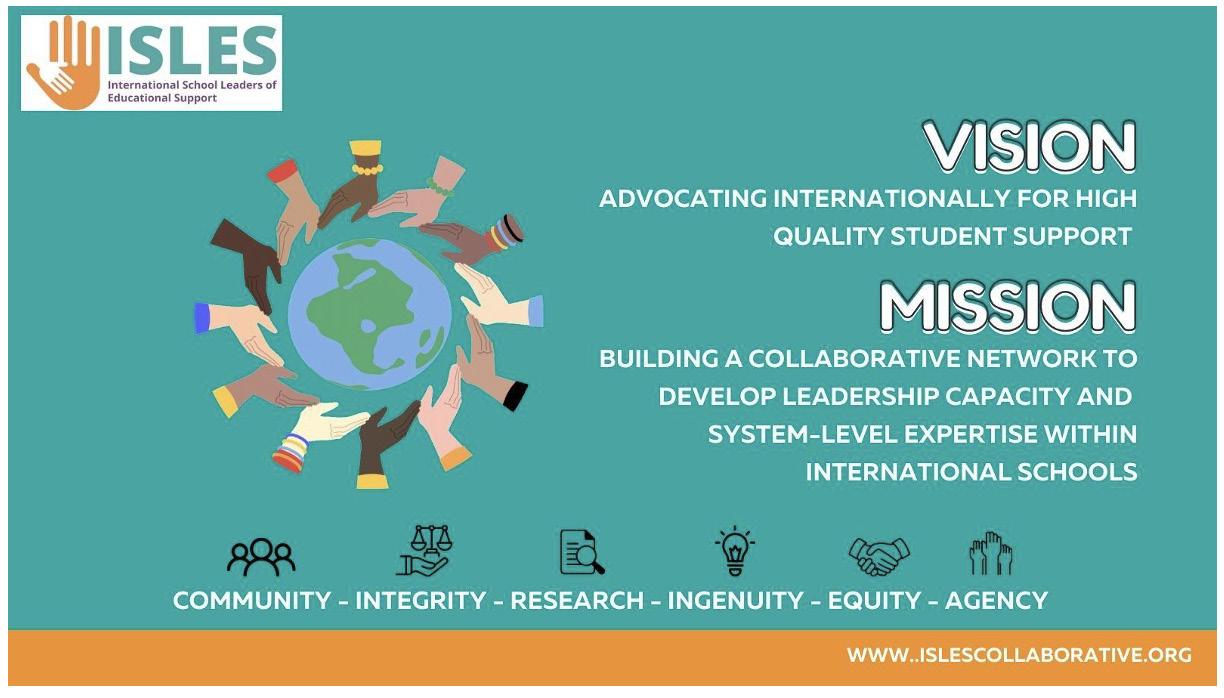
20 EARCOS Triannual Journal
42 EARCOS Triannual Journal
Who We Are
We are K-12 school leaders dedicated to high quality student support within the international school community. We strategically enhance support programs in international schools around the world. Current and former educational support school leaders serve on our board.
ISLES Members and the ISLES Community are included in our Collaborative. ISLES Members are individuals in student support leadership positions at their school. We currently have over 50 schools represented by an ISLES Member. The ISLES Community is made up of other individuals who are interested in attending our professional learning events. There are ways for all educational leaders in the international setting to become involved.
Most recently, we developed a Neurodiversity Position Statement for international schools. In partnership with Next Frontier Inclusion, ISLES created a joint position statement on the role of generative AI in Learning Support. Additionally, we surveyed numerous international schools about their support program and summarized this data in an interactive dashboard. Learning Support Leaders use this tool to enhance their own systems by learning about programs, resources and systems in other schools.
Join Us!
• Visit us virtually at https://www.islescollaborative.org/ or meet us in-person at the upcoming EARCOS Leadership Conference.
• Becoming a member by completing the online membership form
• Attend an ISLES Professional Learning or ISLES Connect virtual meeting

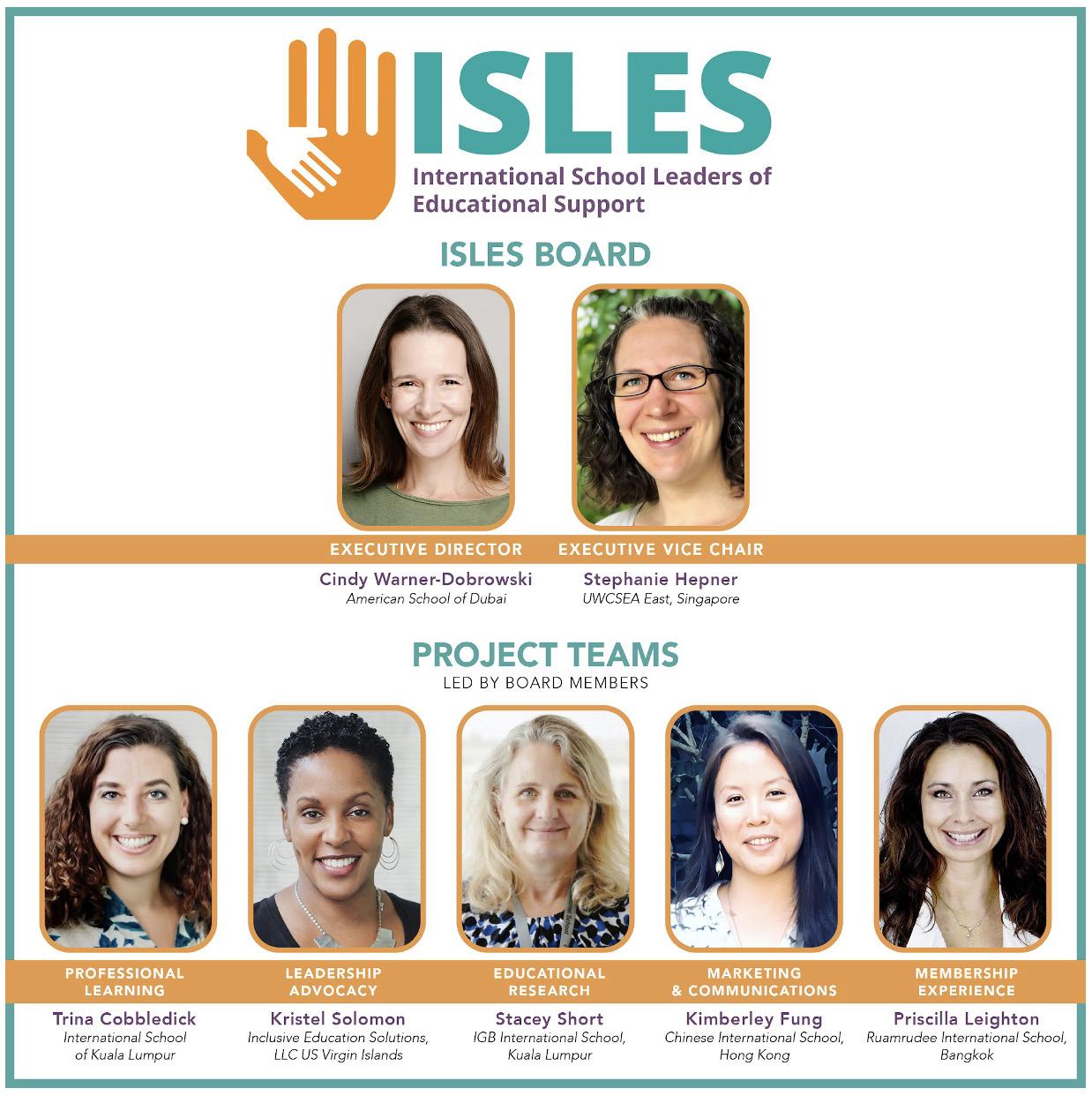
As a collaborative, the ISLES Board has developed multiple entry points for connection and involvement. Anyone can join the ISLES community by signing up to receive updates and accessing resources available on the public website. As a current or former K-12 Support Leader, we invite membership for deeper resource exchange, mentoring and professional learning opportunities. Membership is open to educators in schools with well established student support programs as well as those who are looking to develop/grow their approaches to becoming more inclusive. To become involved with Project Teams, an ISLES member can attend an ISLES Connect meeting then sign up for an area of interest. For more information or to sign up for membership, we encourage you to visit our website. https://www.islescollaborative.org/ or find us at the upcoming EARCOS leadership conference.
References
ISC Research and NFI (2020). Inclusion in International Schools:
What We Do
Our mission is to build a collaborative network, develop leader ship capacity and system-level expertise within international schools. ISLES Board members lead these efforts through project teams that provide resources, data, professional learning, mentorship and net working. Quarterly online professional learning sessions are open to all while members have the opportunity to join mentorship trios and ISLES Connect sessions.
Fall 2023 Issue 43
Kagan Structures to Enhance Oral Mandarin Proficiency: The Impact of Organizing Classroom Talk
By Pham Ngoc Mai Anh International School Ho Chi Minh City (ISHCMC)
ing of Kagan structures and their impact on foreign language learning. Ultimately, this research seeks to equip educators with the tools to promote classroom talk through cooperative learning strategies.
Literature Review
Input, output and context - the three principles of language acquisition
Second language acquisition revolves around three vital components: input, output, and a conducive learning environment (Kagan and McGroarty, 1995).
Input: Language acquisition begins with ‘comprehensible input’ slightly above the learner’s current proficiency (Krashen, 1985). Kagan (1995) suggests it should be ‘developmentally appropriate,’ aligning with learners’ Zone of Proximal Development, and ‘redundant,’ ensuring varied exposure (McGroarty, 1995).
Introduction
How is language acquisition best promoted? The answer lies in the fundamental factor of every classroom: talk. Language acquisition thrives in dialogues, in which the learning environment is “rich in opportunities for practicing and developing language” (Graf, 2011, p.45). Structured conversations, therefore, are pivotal for students’ language development (Gallagher, 2008; Gibbons, 2014; Graf, 2011; Sharples, 2021).
Recent studies emphasize cooperative learning’s role in additional language education (McGroarty, 1995). Kagan structures,
in particular, are claimed to be a “powerful alternative” to the traditional instructional strategies for its ability to increase the percentage of cooperation and communication in the classroom, boost students’ motivation and maintain their interest in classroom interaction.
This action research explores the synergy between cooperative learning and language development. It implements Kagan’s Cooperative Structures (2009) in Grade 2 Mandarin B (Mandarin for non-native speakers) lessons, amplifying student engagement and oral skills. The aim is a profound understand-

Output: While input is crucial, learners need ‘comprehensible output’ through interaction and negotiating meaning (Swain, 2000; Kagan and McGroarty, 1995). Interaction offers chances for communicative, functional exchanges, while negotiation clarifies language forms (McGroarty, 1995).
Learning Environment (Context): A positive learning environment reduces the ‘affective filter,’ fostering language acquisition (Krashen and Terrell, 1983). It must be ‘supportive and motivating,’ ‘developmentally appropriate,’ and ‘feedback rich’ (Kagan, 1995; Kagan and McGroarty, 1995). Establishing a positive learning environment, for that reason, involves opportunities for collaborative learning in which everyone is included and actively engaged (Graf, 2011).
ACTION RESEARCH
44 EARCOS Triannual Journal
Promoting talk and active participation through the structural approach - the four principles of Kagan cooperative learning structures
Classroom talk, the ‘basic formula’ for language learning, combines input, output, and meaningful interaction (Sharples, 2021). Well-established and effectively used, talk is conducive to the language acquisition process as it allows learners to organize their thoughts and find the language to express them, otherwise it becomes a distraction that denies all the resources fostering language development (Johnson and Johnson, 1999; Gibbons, 2014; Sharples, 2021).
Kagan (2002) suggests the key to successful classroom interaction lies in the cooperative structures of classroom talk to implement the four Basic Principles of Cooperative Learning (PIES), which together make cooperative learning truly effective (Kagan, 2002):
Positive Interdependence occurs when students are on the same side working towards the same goal so “a gain for one is associated with a gain for another and students cannot succeed alone” (Kagan, 2002).
Individual Accountability means that every member in the group must participate and contribute to the group’s success, which is satisfied if students are required to perform their own in front of at least one other.
Equal Participation is accomplished when each member of the group shares equal responsibility and participation.
Simultaneous Interaction refers to the percent of the students that are overtly active at any one moment, which will go up when the teacher chooses simultaneous rather than sequential structures.
operative learning and the theories of input, output and affective filter was employed to guide the observations. Assessment of students’ speaking skills were carried out using the rubric suggested by the AERO (2018) to obtain numerical data, covering four criterias of comprehensibility, language control, pronunciation and communication strategies.
Data Collection and Analysis
This research consists of two cycles, each lasting for two weeks.
Cycle 1 - Diagnosis of the problem: Classroom talk during circle time: Students learned to describe body parts. In the first week, the teacher modeled the language and asked for volunteers. This approach failed to promote Positive Interdependence as students were competing instead of collaborating to answer questions. For those students who were shy or a bit struggled, they simply chose not to participate and therefore the demand of both Equal Participation and Individual Accountability were not met. In the second week, students passed a bean bag in a circle, discussing a friend’s body parts, ensuring everyone’s participation. However, Simultaneous Interaction remained low (1 out of 10 students at any moment), hence less opportunities for language use and occurrence of disruptive, off-task behavior. The amount of input and output facilitated from the two types of classroom talk structures in cycle 1 were undoubtedly not sufficient to create a language rich environment (Graf, 2011), which was evident in the results of students’ End of Unit Oral Assessment since those who participated the least turned out to get the lowest scores. In both scenarios, classroom talk was unsuccessful to build a lower-filtered learning environment as highlighted by Krashen and Terrell (1983). While students in the first week were disappointed if not picked, the second structure of classroom talk aroused anxiety in the shy and lower-level students since they had to present themselves in front of the class.
Data collected showed that all students participated and were responsible for their own contribution as explained in the Individual Accountability principle (Johnson and Johnson, 1999; Kagan, 2009). Active involvement at any moment rose remarkably from 10% in cycle 1 to 50% in cycle 2, assuring the Simultaneous Interaction principle as described by Kagan and High (2022), which led to the richness of input and output produced (Krashen, 1985; Swain, 2000). The activity also offered a source of “redundant communication” (Kagan, 1995, p.2) - an indispensable component of language input, because students had to repeat their answers to different partners as the circle turned.
Information from the researcher and the colleague’s observations confirm that students presented supportive attitudes towards one another, and this is because the structures were more collaborative than competitive, reflecting Positive Interdependence by Johnson and Johnson (1999) and Kagan (2009). Students in the lower-achieving group felt more comfortable talking with their peers, which means the ‘affective variables’ that block the language learning process were lowered to facilitate language acquisition (Krashen and Terrell, 1983).
Students’ oral language skills were assessed based on the teachers’ observation of how the students used the language in interaction with their peers and how they demonstrated their language skills in the exit tickets. It was witnessed that improvements were made mostly among the lower-ability students whose participation increased significantly compared to cycle 1, which is evidence of how Kagan structures are beneficial to their language development.
Conclusion
Methodology
This study follows Moroni’s five-step process of an action research, in which data is collected via mixed methods for triangulation (Moroni, 2011). Observations, including participant (with field notes taken) and nonparticipant (from colleagues), yield insights into student interactions and linguistic competences. A checklist with success criteria developed from the PIES principles of co-
Cycle
2 - Peer talk
using
Kagan
structures: Students were learning about places in a school and practicing a simple conversation about places to go in school. Classroom talk was organized through the structure Insideoutside Circle. Students were split in half, forming two circles inside and outside discussing the topic provided. On the teacher’s signal, the inside circle moved to their right, talking to the new partners.
This study has investigated that with the assistance of cooperative learning constructed by the four basic PIES principles, classroom talk plays a significant role in stimulating a language rich environment of comprehensible input, output and lowered affective filters - the three key aspects of language acquisition.
Using the structural approach advocated by Kagan (2009) and through the application of the structure Inside-outside Circle, the research has reached its goal of promoting effective talk and broadening the level of ac-
Fall 2023 Issue 45
tive participation in all students by satisfying the characteristics of the PIES principles. It has also been found that the success in the execution of the structure led to an improvement in students’ oral language competencies, mostly among the lower-achieving group.
For future cycles of the action research process, the researcher would like to focus on how to activate the resources from peer support to make cooperative learning and classroom talk more effective.
Bibliography
AERO. (2018). AERO Based Units. Projectaero.org. http://projectaero.org/AERO-Based-Units/worldlang.htm

Gibbons. (2014). Scaffolding language, scaffolding learning : teaching English language learners in the mainstream classroom (Second edition.). Heinemann.
Graf. (2011). Including and supporting learners of English as an additional language. Continuum International Pub. Group.
Johnson, & Johnson, R. T. (1999). Making cooperative learning work. Theory into Practice, 38(2), 67–73. https://doi. org/10.1080/00405849909543834.
Kagan, S. (1995). We Can Talk: Cooperative Learning in the Elementary ESL Classroom. Kagan Online Magazine. https://www.kaganonline.com/free_articles/dr_spencer_kagan/ASK40.pdf.
Kagan, S., & McGroarty, M. (1995). Principles of Cooperative Learning for Language and Content Gains. In Cooperative Learning: A Response to Linguistic and Cultural Diversity. (pp. 47–66). Center for Applied Linguistics.
Kagan, S., & High, J. (2000). Kagan Structures for English Language Learners. Www.KaganOnline.com; Kagan Publishing. https://www. kaganonline.com/free_articles/dr_spencer_kagan/279/KaganStructures-for-English-Language-Learners.
Kagan, S., & Kagan, M. (2009). Kagan cooperative learning. Kagan Publishing.
Krashen, S. (1985). Second Language Acquisition and Second Language Learning. Pergamon Press.
Krashen, S. D., & Terrell, T. D. (1983). The Natural Approach: Language Acquisition in the Classroom. The Alemany Press.
McGroarty, M. (1995). Cooperative Learning and Second Language Acquisition. In Cooperative Learning: A Response to Linguistic and Cultural Diversity. (pp. 19–46). Center for Applied Linguistics.
Moroni. (2011). Action Research in the Library : Method, Experiences, and a Significant Case. JLIS.it : Italian journal of library and information science, 2(2), 1–24. https://doi.org/10.4403/jlis.it4702.
Sharples. (2021). Teaching EAL : Evidence-based Strategies for the Classroom and School. (1st ed.). Channel View Publications.
Swain, M. (2000). The Output Hypothesis and Beyond: Mediating Acquisition Through Collaborative Dialogue. In Sociocultural Theory and Second Language Learning (pp. 97–114). Oxford University Press.
Upcoming Weekend Workshops
Building a School’s Reading Culture: How to Design Classroom, Library and School Environments to support Students’ Independent Reading
October 21, 2023
Nansha College Preparatory Academy
Consultant: Prof. Loh Chin Ee visit website
Advancing Service Learning: From Ideas to Action
November 4-5, 2023
Kaohsiung American School
Consultant: Cathryn (Cathy) Berger Kaye visit website
DEIB Practices in Action: Sessions for Educators and Student Leaders
November 11, 2023
Daegu International School
Consultant: Jessica Huang visit website
Beyond Examinations: Unlocking the Secrets of a Vibrant Curriculum
November 11-12, 2023
Dulwich International High School Suzhou
Consultant: Mary Myatt visit website
The Model Minority Myth: Its Impact on International Schools
November 11-12, 2023
Korea International School
Consultant: Dr. Leighanne Yuh visit website
Click here for more weekend workshops
>>
46 EARCOS Triannual Journal
How Does Kinesthetic Skill Acquire More Knowledge?
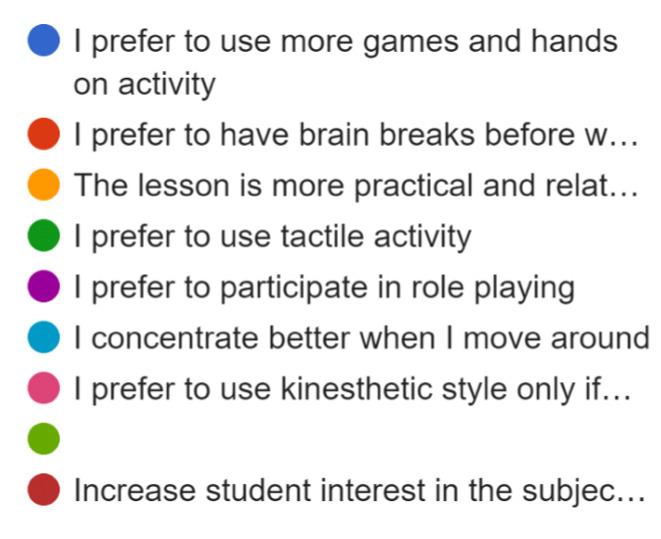 By Gloria Natalia Visual Art and Design MYP Teacher Sekolah Ciputra, Surabaya, Indonesia
Background
The COVID-19 pandemic forced a shift to online learning in March 2020, affecting students without internet access, and leading to challenges like shyness, reduced motivation, and a lack of supervision (WHO, 2020). The provided materials were often unengaging, resulting in distractions, procrastination, and understanding issues, causing student depression and burnout. Kinesthetic learners, who learn through physical activity, face difficulties in traditional online learning. It’s crucial for students to understand their learning style, as suggested by Leonard Enid (2005).
Post-pandemic, the education system should focus on developing kinesthetic learning and engaging materials to enhance learning engagement. Matching teachers’ and students’ learning styles improves learning outcomes, as noted by Husin (2016). Research shows that physical activity benefits brain function, memory, concentration, and behavior, as stated by Suzuki (2021) and the Institute of Medicine (U.S.), Committee on Physical Activity and Physical Education et al. (2013). Incorporating physical activity into lessons improves attention and academic performance.
This approach aligns with Sekolah Ciputra’s annual plan to embody the Ciputra Group’s values, emphasizing professional development through kinesthetic learning and engaging activities. It supports the IB standard by encouraging students to take an active role in their education, fostering attributes such as knowledge, inquiry, critical thinking, communication, open-mindedness, risk-taking, and reflection (International Baccalaureate, 2014).
Goal, expectation, and research process
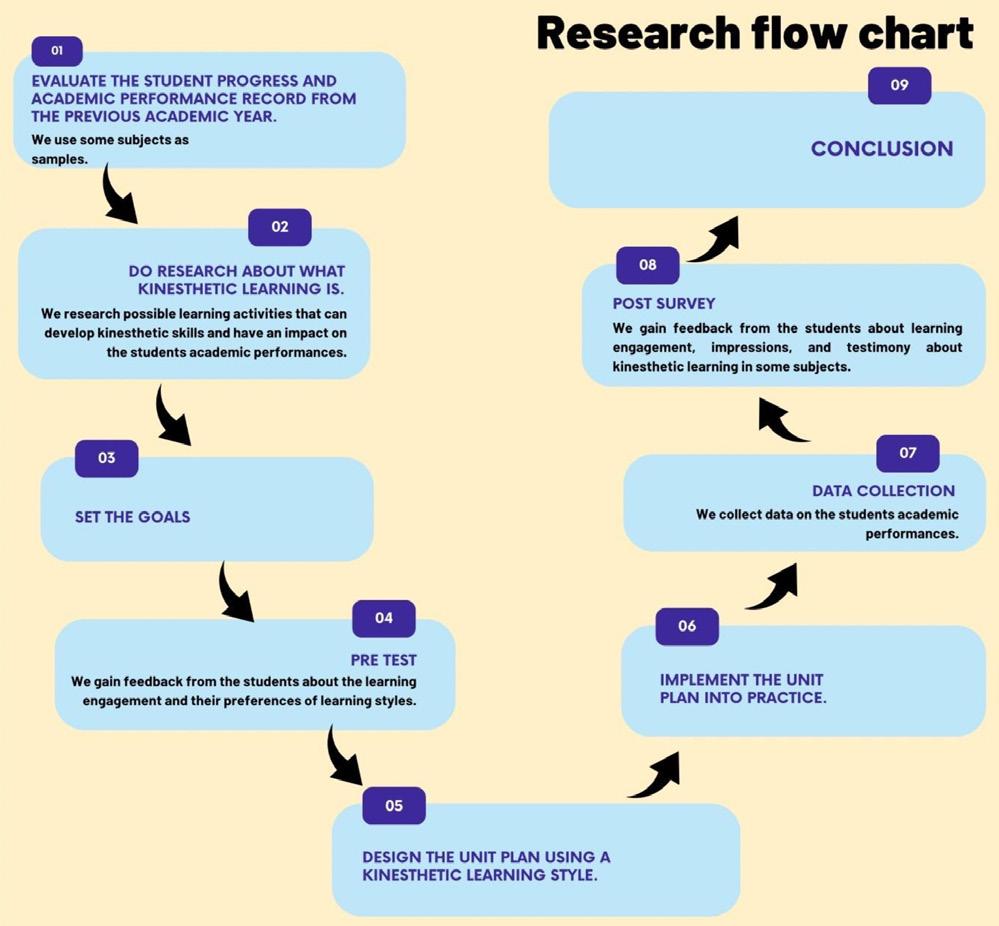
The research conducted at Sekolah Ciputra during the 2022-2023 academic year aimed to investigate the impact of kinesthetic learning on students’ knowledge acquisition. This impact was measured through improved grades resulting from the implementation of kinesthetic learning. The study also sought to highlight the relevance of kinesthetic learning and physical movements in students’ daily lives for more effective learning.
What is your expectation for this subject to learn using kinesthetic style?
92 responses
The research began with an evaluation of students’ progress based on grades data collection and academic performance in design classes from the previous academic year (2021-2022). It then explored kinesthetic learning, identified potential learning activities, and made predictions about their effect on students’ academic performance. Following this, a unit plan was developed based on the kinesthetic learning style and identified activities, which was implemented over the academic year’s first to third terms.
During the unit plan’s implementation, data on students’ academic performance in the academic year 2022-2023 was collected and compared to grades from the previous academic year. Feedback from students was also gathered regarding their engagement in the learning process and their perception of knowledge acquisition in the design class. The research’s findings revealed that a significant portion of surveyed students (45%) preferred using games and hands-on activities for learning, with others expressing preferences for movement, brain breaks, and practical and real-life-relevant lessons.
The research analyzed 30 grade 9 MYP students’ semester grades in the years 2021–2022 and 2022–2023. Among these students, 27 improved their grades in the 2022-2023 academic year compared to the previous year. Specifically, 11 students achieved grade
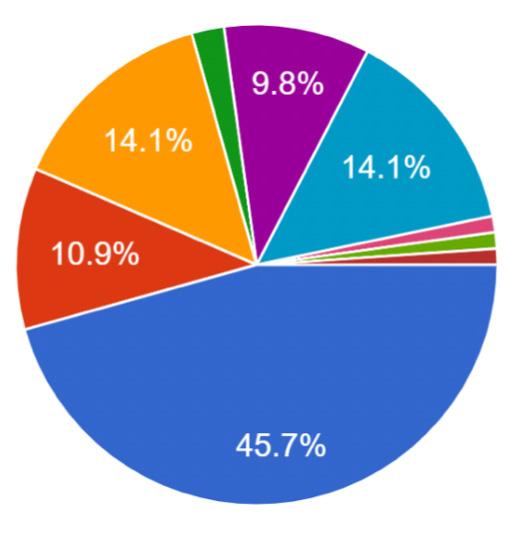
ACTION RESEARCH
Flowchart of the research steps.
Diagram 1: Pre-test of students expectations
Fall 2023 Issue 47
increases of three points or more, 10 students had grade increases of two points, and six students had grade increases of one point. This suggests that 90% of the students benefited from kinesthetic learning, with some excelling in design class, attaining grades of six or even seven, indicating substantial progress in knowledge acquisition and the application of design skills, including digital applications and physical product creation.
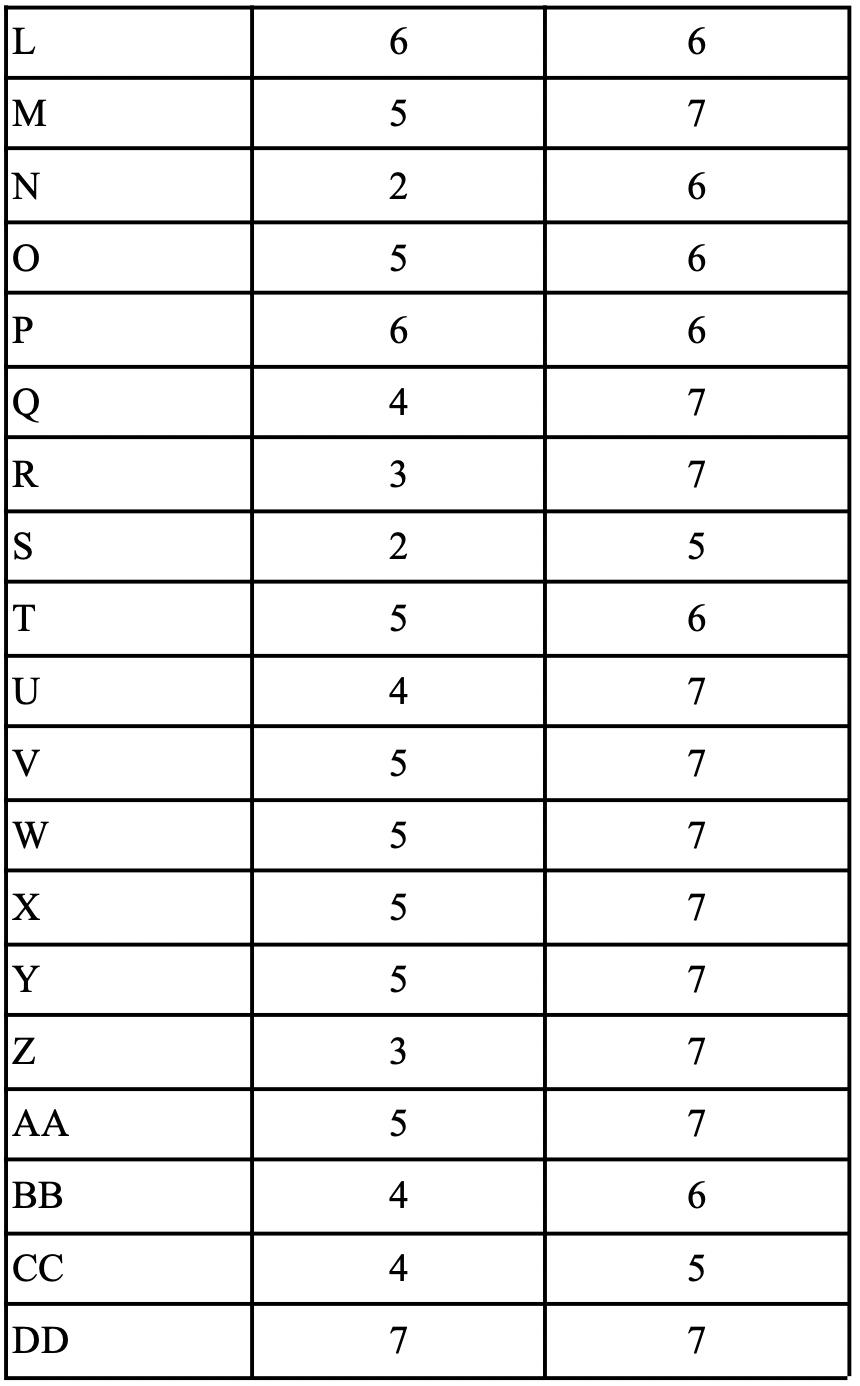
Discussion and post-test result
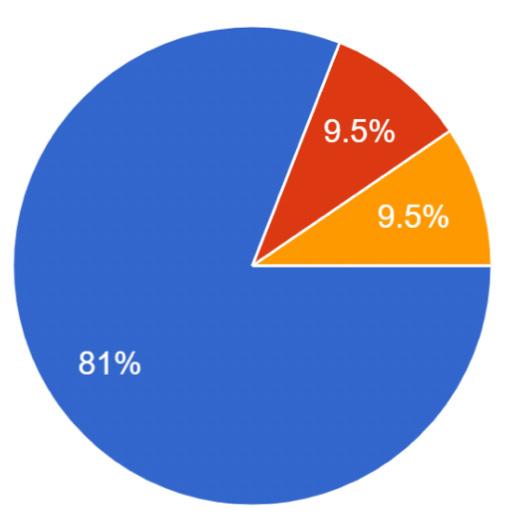
The research found that 80% of students in the design class reported improvements in their brain-body connection, attention, and academic performance due to kinesthetic learning activities. These activities boosted engagement between students and teachers and encouraged problem-solving, logical thinking, and creativity. The study also described various kinesthetic activities undertaken during the academic year, such as creating a catapult, designing a kinesthetic toy for individuals with mental health challenges, and simulating architectural design tasks.
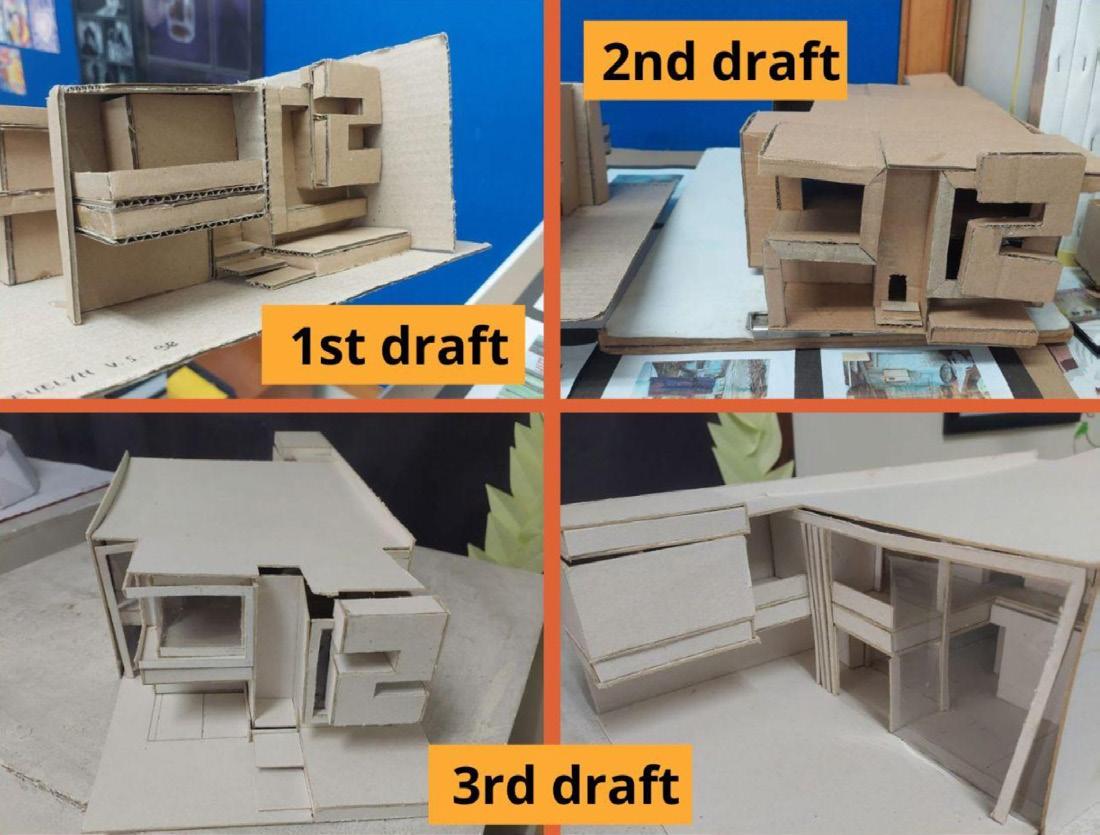
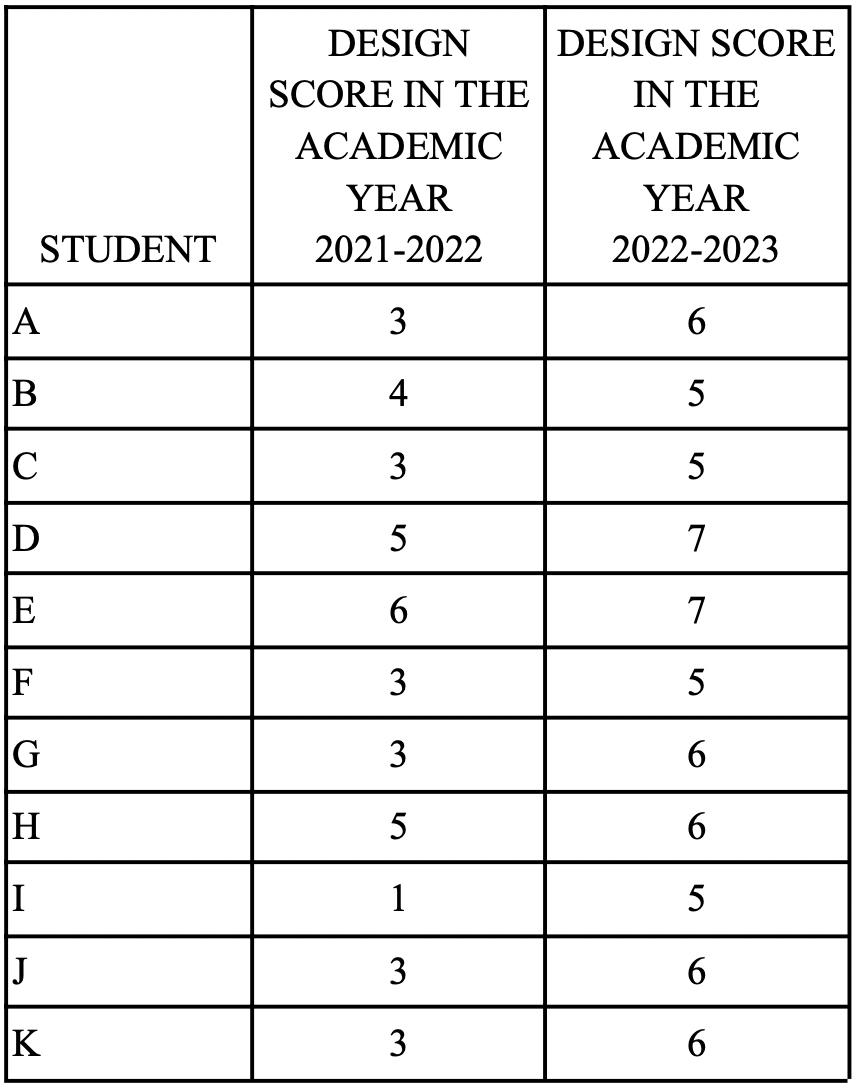
Do you think these activities (bean bag war, making kinesthetic toy, and the maqutte) will improve your brain-body connection, better attention, and academic performance? 21 responses
In the first term, students learned to build catapults, inspiring enthusiasm and active participation. They applied math and science concepts to make functional catapults, and their increased interest and willingness to revise their work marked a notable improvement compared to the previous year.
In the second term, students created kinesthetic toys for individuals with mental health issues, enhancing their communication skills and problem-solving abilities. They used various materials and tools and learned the importance of precision.
Table 1: Student grade result sample for a design class in the academic years 2021-2022 and 2022-2023
Diagram 2: Post-test of students’ feedback in grade 9 about design class in the academic year 2022-2023
48 EARCOS Triannual Journal
Picture 5: Sustainability House Maquette by Evelyn Valerie Setiobudi, Jason
Stanfin Honggowarsito, Joyceline Prajnadevi Canrinesia, Nathasia Angeline, Sherryn Putri Tanudjaja, and Christie Feodora Suanthie. In the third term, students tackled an architectural design challenge, exploring alternative locations, materials, and structures while considering sustainability aspects. Teachers facilitated group discussions, encouraging open-mindedness and collaboration. Students used software like AutoCAD and Sketchup, and they were motivated to excel independently, improving their problem-solving skills and metacognition.
Overall, these hands-on activities enriched students’ learning experiences, fostering knowledge acquisition in subjects like sustainability and engineering while making learning engaging and enjoyable. Utilizing kinesthetic learning methods, such as hands-on activities in teaching, offers several advantages. Firstly, it enhances student engagement, transforming abstract concepts into tangible projects, thus facilitating knowledge acquisition. Secondly, it improves knowledge retention through physical interaction and muscle memory. Thirdly, in design class, hands-on activities stimulate curiosity, foster a deeper interest in learning, and ignite enthusiasm in students to excel and meet teacher expectations. Ultimately, the impact of kinesthetic learning is the cultivation of confident, active, and hands-on learners, which will affect their academic performance too.
About the Author
Gloria Natalia is a Visual Art and Design MYP Teacher at Sekolah Ciputra, Surabaya, Indonesia. She can be contacted at glorianatalia@ sekolahciputra.sch.id
References
Enid Leonard. (2005). Learning styles inventory. Teaching and Learning Center. Husin, S. A. (2016). Matching Teaching Styles with Students’ Learning Styles (A Survey of Indonesian Students’ habits of learning), 6(2).
Institute of Medicine (U.S.). Committee on Physical Activity and Physical Education, Food and Nutrition Board, & Institute of Medicine. (2013). Educating the Student Body: Taking Physical Activity and Physical Education to School (H. W. Kohl & H. D. Cook, Eds.). National Academies Press.
International Baccalaureate. (2014, January 1). Program standards and practices. International Baccalaureate. https://www.ibo.org/ globalassets/new-structure/become-an-ib-school/pdfs/pro gramme-standards-and-practices-en.pdf



Suzuki, W. (2021, October 22). A neuroscientist shares the 4 brainchanging benefits of exercise—and how much she does every week. CNBC. https://www.cnbc.com/2021/10/22/neuroscientist-sharesthe-brain-health-benefits-of-exercise-and-how-much-she-does-aweek.html
WHO. (2020, March 11). WHO Director-General’s opening remarks at the media briefing on COVID-19 - 11 March 2020. World Health Organization (WHO). https://www.who.int/directorgeneral/speeches/detail/who-director-general-s-opening-remarksat-the-media -briefing-on-covid-19---11-march-2020
C M Y CM MY CY CMY K 2024 Now Accepting Applications! Visit the ECU Table at the EARCOS Leadership Conference 2023 Fall 2023 Issue 49
ACTION RESEARCH
The Impact of Differentiated Instruction and UDL on Secondary Students’ Critical Thinking Skills
 By Thressye N Nainupu, Kustiani Widyarti & Andre Yulianto
Introduction
There has been much research conducted in the field of Differentiated Instruction (DI) and Universal Design of Learning (UDL). Though most research focused on the impact of both approaches in students’ achievements, there are critical evaluations to consider. Most of the DI studies found impacts of DI on general students’ achievement (e.g., Beecher & Sweeny, 2008), with only a few of those studies examining a specific skill of the general achievements reported. Most studies also investigated the application of DI in the context of primary education, and very little was done in the secondary education setting (Kiley, 2011; Smale-Jacobse, et. al., 2019; Bondie, et. al., 2019). Among those studies in secondary settings, many studies failed to clearly describe how both DI and UDL were incorporated into teaching and learning (Saleh, 2021; Smalle-Jacobse, et. al., 2019; King-Sears, et. al., 2023).

50 EARCOS Triannual Journal
The present study, therefore, aims to investigate the impact of DI and UDL on a specific skill, which is critical thinking, in secondary school students. In the International Baccalaureate (IB) approach, critical thinking is one of the Approaches to Learning (ATL) skills that should be taught in the MYP (IBO, 2014; Lister, 2020). As Kettler (2020) noted, to assess critical thinking, there should be a differentiated rubric that would show the spectrum of this skill, which is fully applied in the IB context.
This present study attempted to answer the following question: Is there a significant difference between the implementation of DI and UDL in its impact on students’ critical thinking? In order to answer this question, a clear operationalisation of DI and UDL were incorporated, as well as a clear rubric and task specific clarification criteria of critical thinking skills. It is hypothesised that if DI and UDL approaches are incorporated in the secondary school classroom, there will be significant improvements in students’ critical thinking.
Methodology
This research study involved 39 MYP Grade 10 students, aged 1516, from three different Individuals and Societies (I&S) classes. These students were divided into three groups: a control group (n=12), a DI group (n=15), and a UDL group (n=12). Three male teachers participated in the study.
Four teaching tools (ATL Skills, 2022), (i) Role - Audience - Format - Topic (RAFT), (ii) Hexagon thinking skills, (iii) Point - Quote - Comment (PQC) and (iv) What - How - Why (WHW), were used in both the DI and UDL class. Assessments were designed to measure students’ critical thinking skills based on the IB MYP Year 5 I&S Rubric and Task Specific Clarification. Students were given choices to express their understanding and critical thinking skills in multiple ways based on their learning preferences.
Results
Data was collected through two summative assessments (pre and post treatment). The UDL post-treatment group showed a higher average score compared to the DI group. A one-way ANOVA revealed
Differentiated Instruction
Planning & Organisation:
Setting different levels of process students to take to express their understanding accordingly: Students were divided into three groups (beginner, middle, advanced) based on their previous Critical Thinking (Criterion D) report.
Components presented:
• Process modification
• Product modification
that there was a statistically significant difference in critical thinking between at least two groups (F(2, 36) = [16,42], p = 0.00). Tukey’s HSD Test for multiple comparisons found that the mean value of critical thinking was significantly different between UDL and control group (p < 0.01, 95% C.I. = [1.71, 4.45]) as well as between UDL and DI (p < 0.01, 95% C.I. = [0.97, 3.57]).
Additional qualitative data was gathered to gain more insights on students’ and teachers’ perceived enjoyment of the approaches. A total of seven students (nDI = 3) voluntarily participated in the followed up questionnaire. A varied answer of perceived enjoyment was reported. Most of those students participating in the UDL class admitted a more flexible approach to the unit as well as learning options provided. The freedom of choices in exploring the topics provided them with better understanding, but also difficulty to choose what’s best for learning. Moreover, the interaction between teachers and students as well as among students, is reported to support the process.
“The various teaching methods help me to memorise and recall the unit better.”
“What makes this unit better is the increase in group work and freedom in options.”
“The more freedom, the harder it is to choose”
“The interactive communication between teachers and students which then makes a deeper understanding regarding the topic and makes us understand better how to write or follow certain instructions to create a detailed or explained task.”
The teachers’ survey (DI and UDL) revealed the enjoyment of the variety of teaching tools as well as the freedom of choice students had. The least enjoyable experience involved the planning and time spent to choose the preferred learning experience.

Discussion
UDL has shown a positive trend towards students’ ability to synthesise information to then create valid and justified arguments. Consistent with previous studies (King-Sears et al, 2023; Ok et al., 2007), this positive trend might link to the fact that students are given some
Universal Design of Learning
Planning & Organisation:
Providing options for students to choose from different levels of process (beginner, middle, advanced), to express their understanding accordingly.
Components presented: (UDL Guidelines, 2018)
• Multiple means of representation: Perception (Checkpoint 1.2; 1.3); Language & symbols (Checkpoint 2.1; 2.5); Comprehension (Checkpoint 3.1; 3.2; 3.3)
• Multiple means of engagement: Sustaining effort & persistence (Checkpoint 8.2; 8.3)
• Multiple means of actions and expression: Executive Functions (Checkpoint 6.1; 6.3; 6.4)
• Prior Information to see students’ needs: Previous report cards & initial survey (learning preference and attitudes towards the subject)
• Duration and intensity of intervention: Each class has six periods per fortnight, which are 55 minutes each. The unit was delivered in four weeks.
• Support for teachers: Briefing, feedback, development of material, class observation
Fall 2023 Issue 51
degree of freedom in choosing their own preferred learning experience. This is echoed in the students’ survey of their perceived enjoyment. These personalised lessons might be a significant component in ensuring student agency in class. Nevertheless, based on the reflection from teachers and students applying UDL, the variety of choices presented to students can also be a possible constraint that limits students’ critical thinking. Further research is therefore required to explore this possibility.
Meanwhile, different from previous studies on DI, this study did not find any significant impact of this approach to students’ critical thinking. Although surprising, this reflects what Smalle-Jacobse, et. al. (2019) found in their study, that DI might have different effects depending on how the approach is operationalised. This present study attempted to provide clear operationalisation on the DI and UDL components utilised with the hope that it will be easier to replicate the study and measure the impact. Nevertheless, there might still be possible errors in student grouping or classification. The pre-test data used by teachers to decide students’ learning might not resemble their actual level of skills and needs. This shows the need to conduct further studies on how to better use data to inform teaching and learning. However, this result might also reflect the limitation of this present study, where only one specific set of summative assessments was used as the pre-test or baseline score.
Another possible cause of this insignificant result might have come from the planning and execution process. As noted from the teacher report, one of the most challenging aspects of implementing this differentiated instruction came from the planning developed by the faculty head. Beecher and Sweeny (2008) found a positive impact of DI in elementary schools, where teachers are provided with the liberty to build their own planning. Though it might be premature to predict, the opportunity for teachers to develop their own planning might also have impacted findings in this present study, thus creating another possible variable to be explored further.
Conclusion

This present study attempts to answer the limitation of previous studies on DI and UDL by providing clear operationalisation of both approaches. All in all, UDL showed a promising impact on developing students’ ability to synthesise information to make a valid argument. The possibility of providing freedom for students to assess their own ability and make decisions on their learning experience might significantly link to better enjoyment and critical thinking skills gained in Individual and Societies topics. Further exploratory research on students’ enjoyment of both DI and UDL approach, the number of options provided for students in the UDL setting, as well as teachers’ liberty to personally tailor their lesson should arise from this study.
References
Beecher, M., & Sweeny, S. (2008). Closing the achievement gap with curriculum enrichment and differentiation: One school’s story. Journal of Advanced Academics, 19(3), 502-530.
Bondie, R. S., Dahnke, C., & Zusho, A. (2019). How does changing “one-size-fits-all” to differentiated instruction affect teaching? Review of Research in Education, 43(1), 336-362. doi:10.3102/0091732x18821130
IBO. (2014). MYP: From principles into practice. International Baccalaureate Organization (UK) Ltd.
Kettler, T.(2020). A Differentiated Approach to Critical Thinking in Curriculum Design. In book: Modern Curriculum for Gifted and Advanced Academic Students (pp.91-110)Publisher: Prufrock Press. DOI:10.4324/9781003236696-8
Killey, D. (2011). Differentiated instruction in the secondary classroom: Analysis of the level of implementation and factors that influence practice. Dissertation
King-Sears, M. E., Stefanidis, A., Evmenova, A., Rao, K., Mergen, R. L., Owen, L. S., & Strimel, M. M. (2023). Achievement of learners receiving UDL instruction: A metaanalysis. Teaching and Teacher Education, 122(103956), 1-15. https://doi.org/10.1016/j. tate.2022.103956
Lister, C. (2020) Four ways to implement ATL skills in the classroom, News from around the IB community. Available at: https://blogs.ibo. org/2020/06/24/four-ways-to-implement-atl-skills-in-the-classroom/ (Accessed: April 30, 2023).
Ok, M. W., Rao, K., Bryant, B. R., & McDougall, D. (2016). Universal design for learning in pre-K to grade 12 classrooms: A systematic review of Research. Exceptionality, 25(2), 116-138. doi:10.1080 /09362835.2016.1196450
Saleh, A.H.A.E. (2021). The Effectiveness of Differentiated Instruction in Improving Bahraini EFL Secondary School Students in Reading Comprehension Skills. Journal of Research and Innovation in Language, 3(2), 135-145. DOI: https://doi.org/10.31849/reila.v3i2.6816
Smale-Jacobse, A. E., Meijer, A., Helms-Lorenz, M., & Maulana, R. (2019). Differentiated instruction in secondary education: A systematic review of research evidence. Frontiers. Retrieved April 1, 2022, from https://www.frontiersin.org/artcles/10.3389/ fpsyg.2019.02366/full#h2
UDL Guidelines. (2018, January 12). Retrieved April 25, 2023, from https://udlguidelines.cast.org/representation/?utm_ source=castsite&utm_medium=web&utm_campaign=none&utm_ content=aboutudl&_gl=1%2Any50qa%2A_ga%2AMjExMjczNTI1 OS4xNjYzNTU2MzUy%2A_ga_C7LXP5M74W%2AMTY4MjQx Njc3NS4zLjAuMTY4MjQxNjc3NS4wLjAuMA..
ATL Skills (2022) alisonyang.com. Available at: https://alisonyang.com/ atl-skills/ (Accessed: 19 February 2023).
52 EARCOS Triannual Journal
GLOBAL CITIZENSHIP COMMUNITY SERVICE GRANT
Triple A Mission: Empowering Youth to Raise Awareness and Promote Mental Health Initiatives Globally
By Suhani Chawla Shanghai Community International School - Hongqiao Campus
Mental health has become an increasingly urgent issue for today’s youth as mental illness is becoming more prevalent, particularly in the wake of the COVID-19 pandemic. The importance of addressing this issue cannot be overstated, and therefore it is crucial to establish a secure and nurturing environment wherein individuals can openly converse and acquire knowledge pertaining to mental health.
The Triple A initiative aims to do just that. Triple A’s approach is founded on three core pillars – one for each “A” -- Awareness, Acceptance, and Assistance. By raising awareness of mental health issues and promoting open dialogue, the initiative aims to reduce the stigma surrounding mental illness. The next step is encouraging acceptance, which is key to building a supportive community, where individuals feel safe and understood. Finally, by providing assistance, the initiative offers young individuals with the tools and resources they could utilize to take care of and prioritize their mental health. We offer articles published by experts for easy read, our community page offers a safe place for young people to connect, and we have mapped organization globally aiding mental health. Our mission and community network can be found on our website.
What sets Triple A apart is its emphasis on youth empowerment. This initiative is driven by a team of 25 student ambassadors from all over the world, implementing change in 7 countries and 12 schools, all sharing a common passion for promoting mental health and wellbeing. These ambassadors work collaboratively to implement smaller initiatives within their local communities, building a global support network and fostering a safe space free of judgment for students during such challenging times.
Triple A’s initiatives take many forms, ranging from workshops to community events, podcasts, and more – all of which can be found on Triple A’s website. Each initiative is designed to meet the specific needs of the community it serves, while also contributing to the wider goal of promoting mental health awareness and reducing stigma on a global level. Triple A is honored to have received EARCOS’s esteemed Global Citizen Community Service Grant to further these initiatives. Triple A will use the funding to organize local and global events, ranging from customized workshops to digital conferences.
These events will provide individuals with the opportunity to connect with others, learn more about mental health, and gain access to necessary resources as Triple A aspires to provide a platform for experts to share their knowledge, and attendees to share their own experiences and perspectives on mental health.
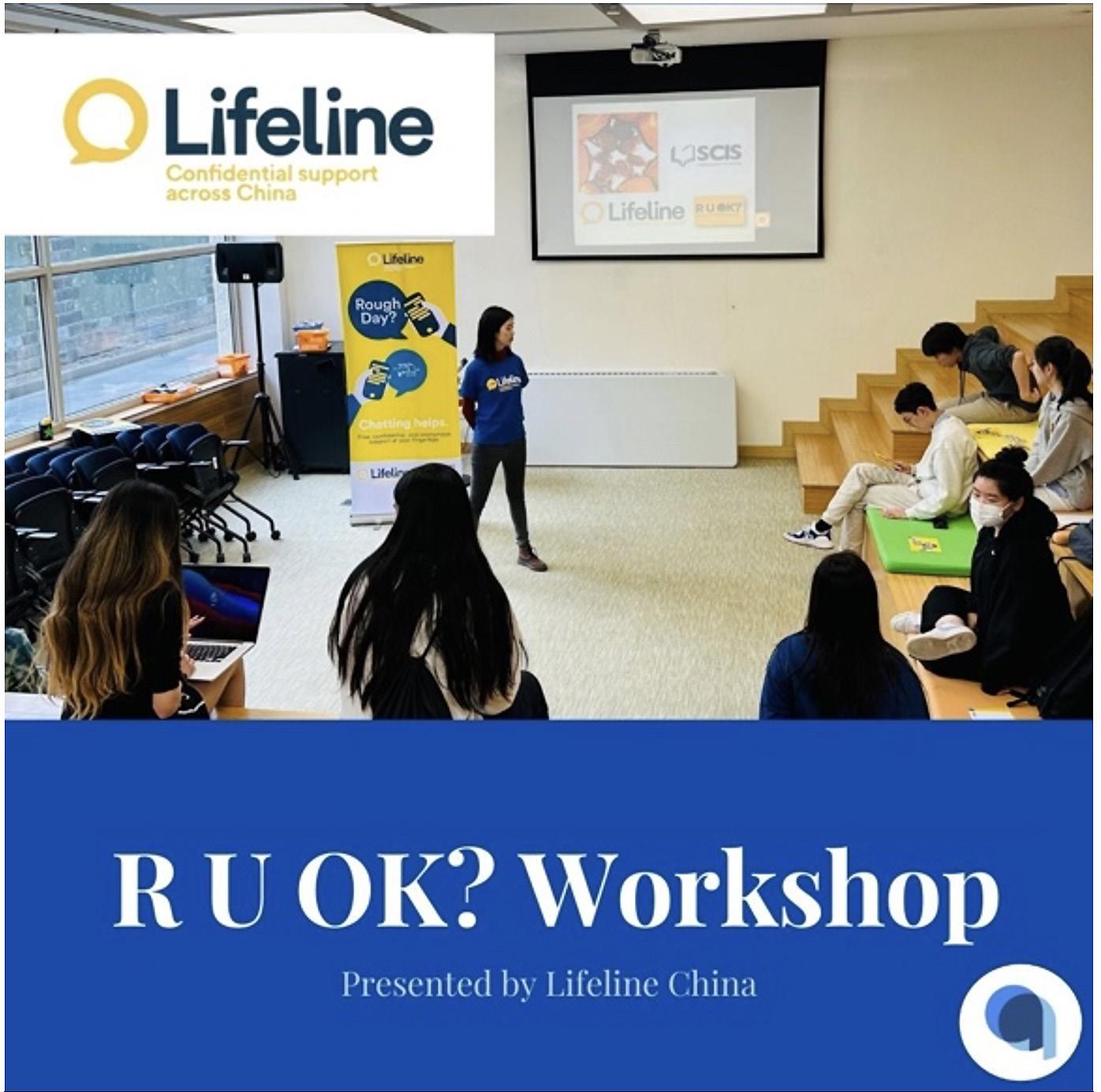
Triple A aims to use part of the grant money for funding keynote speakers, social media marketing, and advertising in hopes to increase the outreach. These initiatives will be implemented in partnership with leading mental health organizations to ensure that the events provide the most impactful and useful information.
We also hope to continue fundraising to promote and allocate more resources to the different projects being led by our ambassadors, which can be viewed on our Action page. Through these initiatives, the ambassadors are creating a positive impact, not just in their own communities, but across the world, and by receiving more funding, we will have the opportunity to further our initiatives.
Lastly and most importantly Triple A invites all students in international schools to become an ambassador and participate in this initiative to become an agent of change!
Check out Triple A’s Instagram, @aaa_mentalhealth
Triple A Ambassadors attending Lifeline China’s R U OK? Workshop in Shanghai, China.
Fall 2023 Issue 53
CITIZENSHIP
A Recipe for Whole School Transformation Towards Active Global Citizenship
By LeeAnne Lavender Inspire Citizens Storyteller
The word “transformation” has energy and power, doesn’t it? The idea of radical change and positive metamorphosis is compelling and, when paired with creating opportunities for students to engage in authentic changemaking, can inspire and empower all educators.
Inspire Citizens co-founder Aaron Moniz and all Inspire Citizens facilitators spend a lot of time thinking about transformation in the context of schools. Their goal? Redesigning teaching and learning to kickstart and sustain active global citizenship for all learners. By making everyday teaching and learning relevant and meaningful in relation to local and global issues, Aaron and the team help educators and learners experience a deep transformation.
“We are really committed to this work,” says Aaron. “When we founded Inspire Citizens in 2018, we wanted to use our many years
of classroom experience and passion for changemaking to impact as many schools and classrooms as possible so students feel equipped to lead the positive change we need in our world.”
Aaron and late co-founder Steve Sostak developed a four-step recipe for schools to build cohesive curriculum that can activate PreK-12 global citizens. In partnership with schools, Aaron and the team help educators experience these four stages in a way that makes sense and allows them to tap into their own deep desires to help students understand the world in all of its complexity, beauty and potential.
Step 1: Mission and Vision Articulation
Most international schools have a mission statement that involves some component of global citizenship, service and/or globalmindedness. To begin a process of whole

school transformation, this is where the Inspire Citizens recipe gets started: identifying the parts of your school mission related to global citizenship or designing a new mission statement if it’s time to update this core guiding statement.
The mission statement for a school invested in global citizenship should point towards:
• desired learning outcomes related to engaged global citizenship
• evidence that can be collected about growth towards those outcomes
• tools, resources and approaches based on an understanding of global citizenship that grows out of the mission
“It’s essential to be clear and consistent about this so every stakeholder in the school knows what this means and how to do it,” says Aaron. “One of the biggest struggles for schools is how to achieve the mission for global citizenship with no guidance.
GLOBAL
54 EARCOS Triannual Journal
You need to have a road map based on defining global citizenship for your school with clear targets so teachers and students know where they’re going.”
Step 2: An Integrative Approach
International schools are busy places, and achieving transformation related to global citizenship curriculum means approaching change in an integrative – not additive – way.

“Look at what you’re already doing with curriculum, instruction, professional growth and systems for assessment; from there, successful global citizenship programming needs to be holistic, not something separate,” explains Aaron.
When global citizenship becomes the foundation of a school’s strategic plan, educators can see multiple entry points for curriculum design and experiential learning that can serve to develop and foster core areas (like literacy, numeracy, digital and global competencies, social and emotional learning, DEIJ/B, and sustainability).
During this stage of an all-school transformative global citizenship experience, Aaron and the team guide and coach teachers through curriculum design and redesign. They also share approaches, resources and strategies to help busy teachers reframe curriculum in efficient, effective and sustainable ways.
Step 3: Build capacity for sustainable outcomes
Programming and curriculum development at international schools can sometimes feel like there’s a revolving door of new initiatives and goals. Aaron says it’s key to have an implementation plan for transformative global citizenship education so schools can weather shifts and maintain focus.
“You have to look at how you’re building capacity so the work sustains over time,” he reflects. “Every human organization is dynamic and you have to build flexible and responsive systems to sustain the work.”
To do that, Aaron recommends:
• Ensuring professional development opportunities for teachers so there is widespread clarity what global citizenship education (GCE) looks like.
• Celebrating successes and creating a culture that deeply values the impact of GCE.
• Evaluating leadership structures so change can be championed and managed over a number of years.
• Creating accountability systems so it’s clear who is responsible for specific targets and goals.
• Coaching the coaches or training the coordinators so that they can carry on the work in the absence of the consultant.
• Having a scheduled roll out/sharing protocol, starting with the school’s global citizenship champions as a pilot team, and eventually involving students, parents, and community stakeholders. With a purposeful roll-out, you can focus on deep work with specific teams during a specified time period and give others time to observe and understand what the pilot team is experiencing; this helps others get excited about their turn in participating in the next pilot team.
• Sharing conversations and dialogue about GCE so educators and students can learn, grow and develop ideas, approaches and mindsets as well as share common language about global citizenship.
Step 4: Reflect and Grow
When you have teachers guiding students towards everyday teaching and learning tasks and assessments that are based on the development of GCE skill sets, it’s key to evaluate the evidence of the learning that is taking place. Reflection is vital and rich in this stage.
“When teachers have collaborative planning opportunities, access to new teaching and learning tools, and support from instructional coaches and middle leaders, they can experience immense success equipping students to connect content with local and global assets and needs,” says Aaron. “Once they’ve had a chance to reflect on a unit and the learning that occurred, it’s good to run a unit back through steps 1 – 3 so teachers become more experienced and confident. That’s how teachers - and schools as a whole - go from working with a coach to being self-directed over time.”
The whole school model
In the work that Inspire Citizens does with schools around the world, there are multiple examples of transformative all-school approaches for active global citizenship. From
COJOWA in Cartagena, Colombia to the AES (American Embassy School) of New Delhi and Seoul Foreign School in South Korea, the Inspire Citizens team has served as an accountability partner for multi-year transformation plans that have radically shifted teaching and learning. Just this past year, the International School of Kigali brought Aaron in to begin the process at their small school, and innovative learning experiences are already emerging.
“It looks different in each school,” says Aaron. “Many schools will begin by creating pilot teams and equipping those teams to redesign curriculum with a focus on active global citizenship and community engagement. This shows the rest of the school what this can look like, and then others can be invited into the work through celebrating and sharing successes.”
As more and more teams come on board and get excited about student engagement and learning related to GCE, momentum grows and the school culture becomes deeply connected to the school’s mission. Once this happens, transformation has occurred and is sustainable because multiple stakeholders care deeply about maintaining and extending the work of changemaking.
“We love to work as an accountability partner for schools to make sure this process stays on track,” says Aaron. “Working with an organization like ours costs a fraction of what it would cost to hire a full-time staff member to take this on, and we ensure consistency and energy throughout the process. We love what we do, and it’s a privilege to help schools develop or realize their mission with students.”
To learn more about transformative wholeschool approaches to active global citizenship, check out some of these Inspire Citizens vignettes that showcase what’s happening on specific campuses around the globe:
COJOWA in Cartagena, Colombia
AES in New Delhi, India
SFS in Seoul, South Korea
NIDO in Santiago, Chile
About the Author
LeeAnn Lavender is a Storytelleing & Service Learning Coach & Facilitator. She can be contacted at leeann@leeannlavender.com
Fall 2023 Issue 55
GLOBAL CITIZENSHIP COMMUNITY SERVICE GRANT
The Dolmaa Ling Soup Kitchen
 By Bilguunzaya Chuluunbaatar, Grade 12 International School of Ulaanbaatar
56 EARCOS Triannual Journal
ISU bus with student volunteers arriving at the entrance of the soup kitchen.
My name is Bilguunzaya Chuluunbaatar, and I am currently a rising golia. I enjoy doing volunteer work, especially volunteering for the things I am deeply passionate about such as The Dolmaa Ling Soup
The Dolmaa Ling Soup Kitchen is located in Gatchuurt, Mongolia, inside the Dolmaa Ling Nunnery.They have been operating the soup kitchen for 20 years now, working 5 days a week aiming to feed the homeless and less fortunate hot soup. Fortunately, through a partnership with my school (ISU) which started all the way back in 2015, they began to operate on Saturdays for ISU students to come and help during their weekends. They serve an estimated 50-60 people soup each day, and 5-7 student volunteers attend the soup kitchen every Saturday to help out.
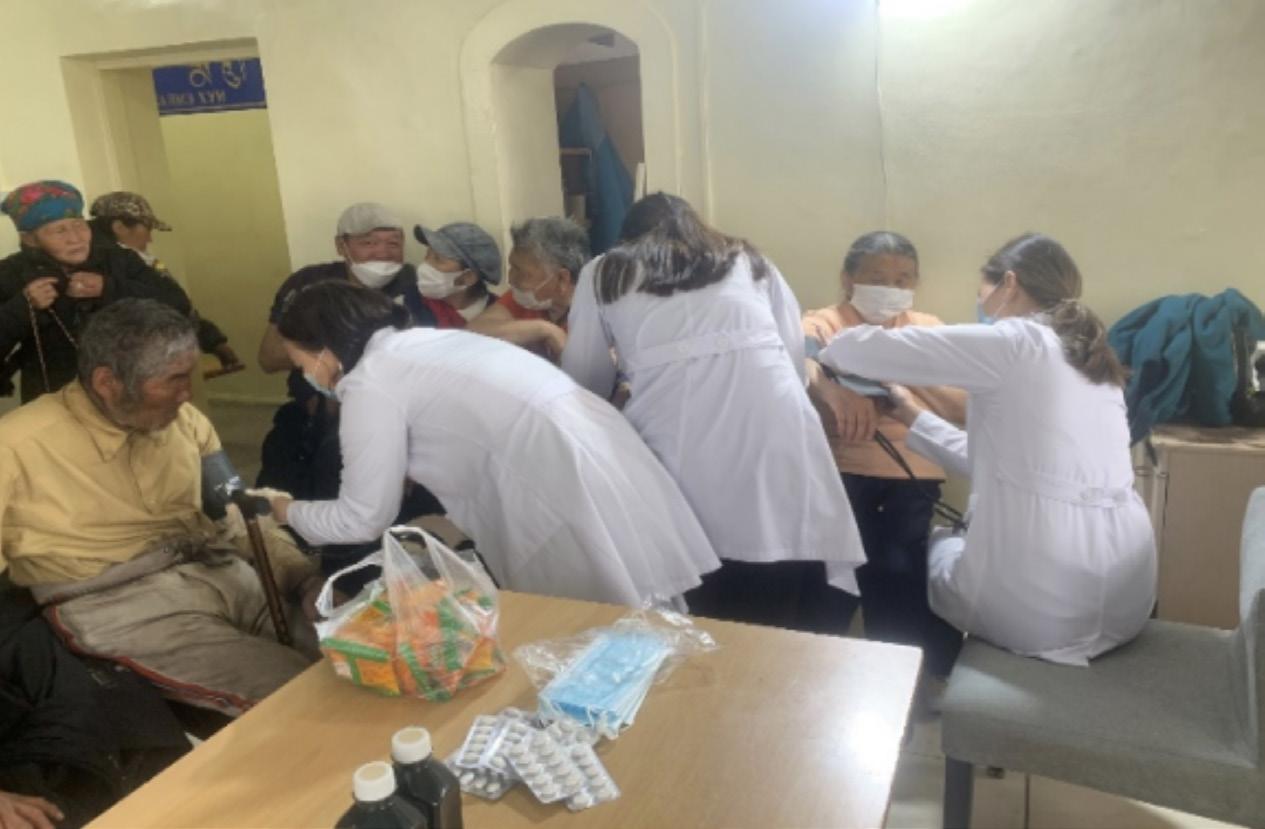
I have been involved in Dolmaa Ling Soup Kitchen since November 2022 and plan to be involved up until I graduate in 2024, and hopefully much beyond graduation. My role and responsibilities last year, as the lead student manager was to organize volunteers from our school and communicate with the soup kitchen. As well as lead the volunteers on Saturdays when we go to volunteer. Student volunteers sign up on a weekly basis on a signup sheet, and we contact them a few days prior to remind them and give further information.
Soup kitchens in Mongolia are extremely rare, The Dolmaa Ling soup kitchen is one of the only sustainable and longstanding soup kitchens operating in Mongolia. Their specialty is serving hot traditional Mongolian soups, as in the cold and harsh winters of Mongolia hot meals are a necessity to survive. To many people, the meals they eat at the Dolmaa Ling soup kitchen are the only meals they get to eat during the day, which is why many of them travel long distances and come from all parts of the city just to enjoy a hot bowl of soup.
Due to the restrictions of Covid, my school was not able to help the soup kitchen for three years. Last year all restrictions were lifted and I wanted to restart my school’s relationship with Dolmaa Ling and

Thus being able to continue our established longer term relationship with the soup kitchen. This also helped me to give opportunities to students in our school to volunteer outside our school community.
Lastly, I would like to add how the soup kitchen has grown from being just a soup kitchen to a bigger more impactful place in the community. Not only do they serve soup on a weekly basis to the less fortunate but they also conduct weekly free medical and health check ups for those that come to eat food. They invite doctors and nurses to help provide primary medical care for their beneficaries. During the Covid period they also conducted food distributions and second hand clothing distribution to the poor families in the neighbourhood helping them to be suitably clothed and protected during the harsh winters in Mongolia.
In addition they have also built two greenhouses outside the soup kitchen to grow their own produce and use the vegetables in the soups they make. Making it cost efficient, and the soup much more nutritious. With produce they have grown in the greenhouse they slice, pack and freeze it to store them for use in the winter.
Every year The Dolmaa Ling Soup Kitchen is growing in exponential ways, going above and beyond to help their community, and I hope to be involved in this growth for years to come. With the help of EARCOS’s grant I hope to make a greater impact and help the soup kitchen to stay sustainable.
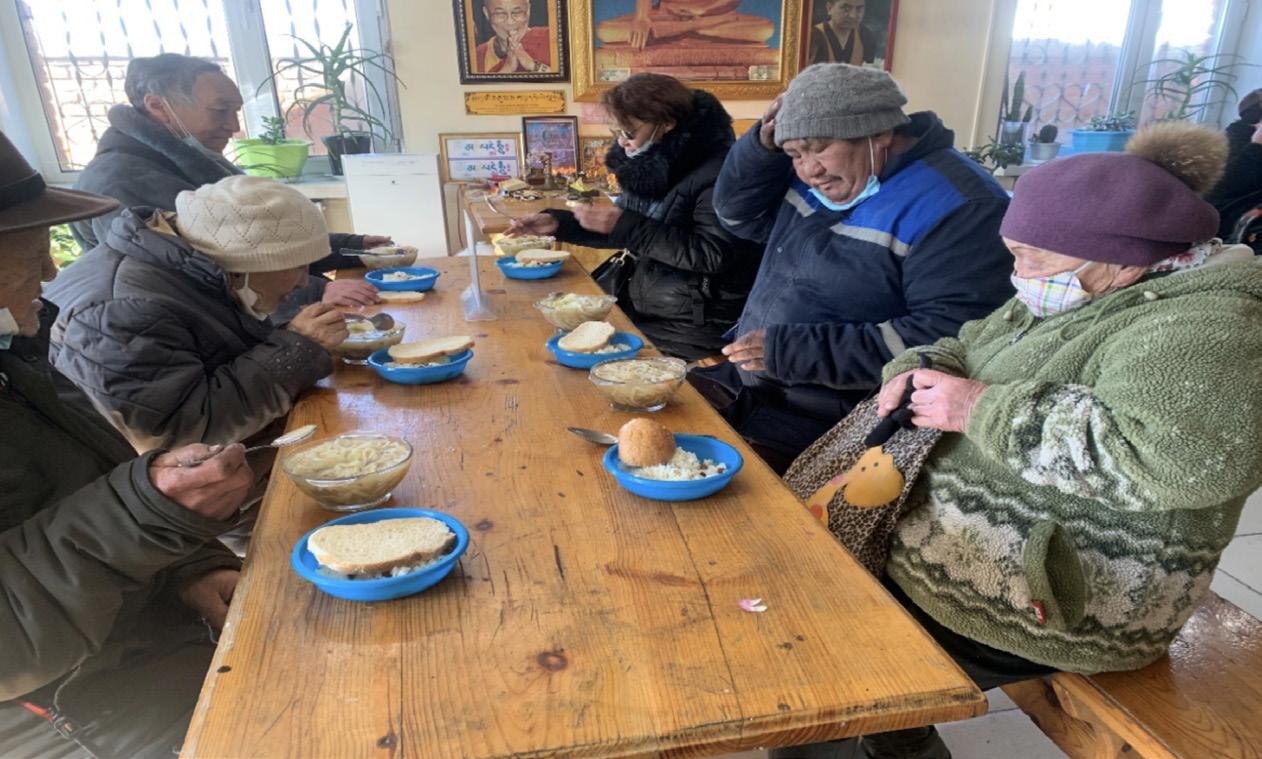 bring back the tradition of helping Dolmaa Ling to the ISU community.
Inside the soup kitchen, eating hot soup.
ISU student volunteers washing the dishes after food has been served.
bring back the tradition of helping Dolmaa Ling to the ISU community.
Inside the soup kitchen, eating hot soup.
ISU student volunteers washing the dishes after food has been served.
Fall 2023 Issue 57
Healthcare workers conducting monthly checkups at the soup kitchen.
GREEN & SUSTAINABLE Growing a Green Movement

 By Paul Escott Tsukuba International School
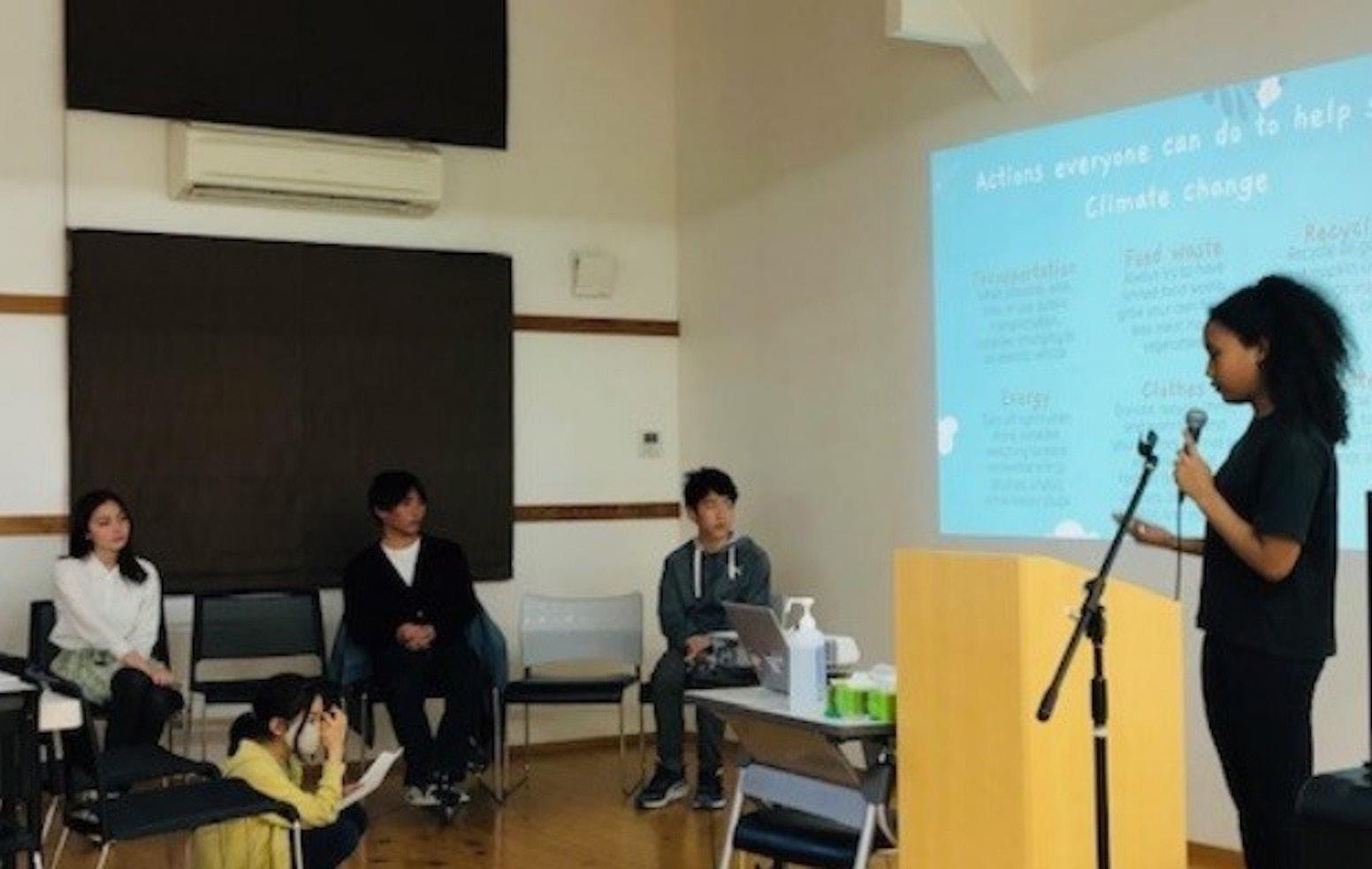
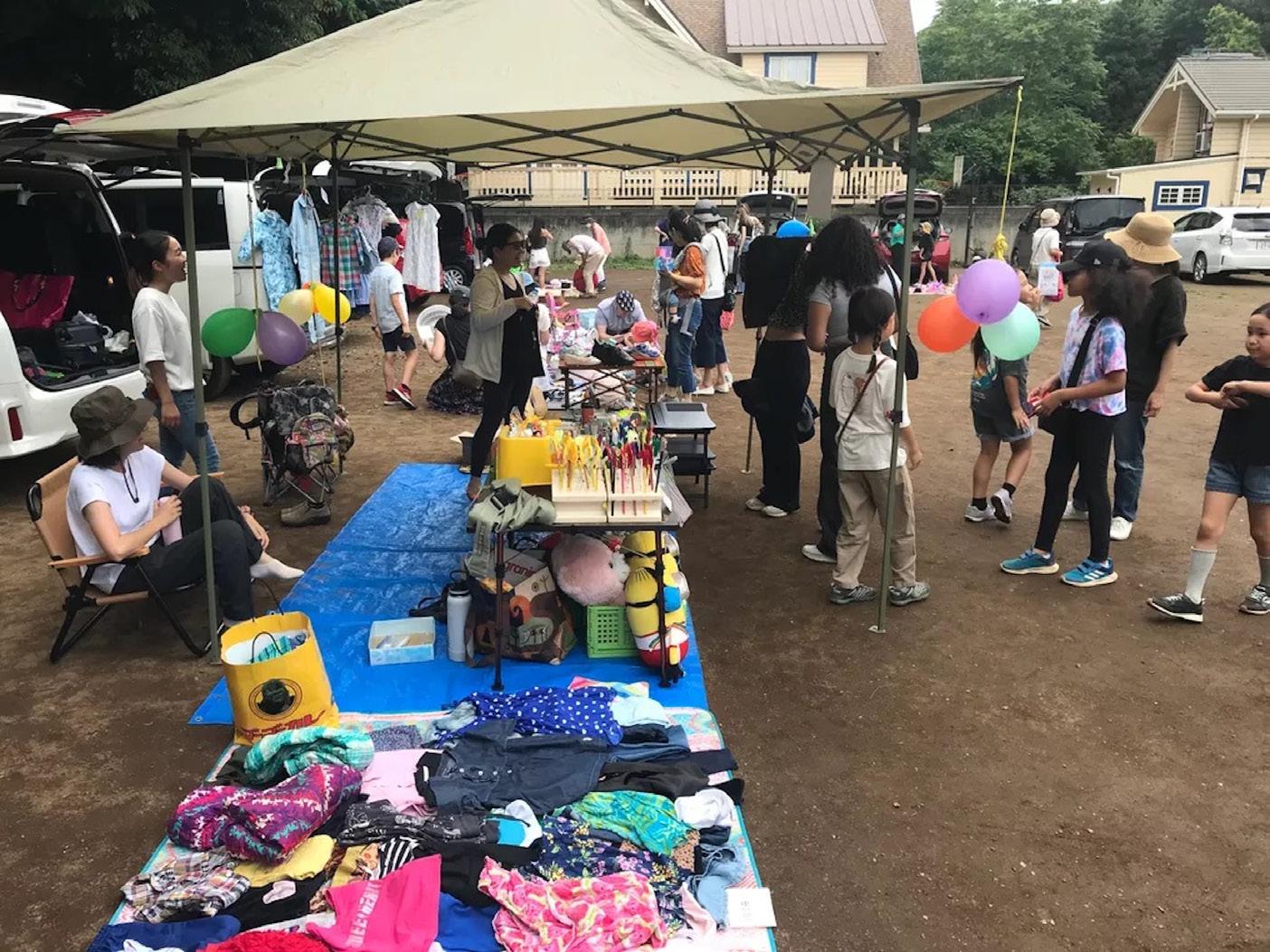
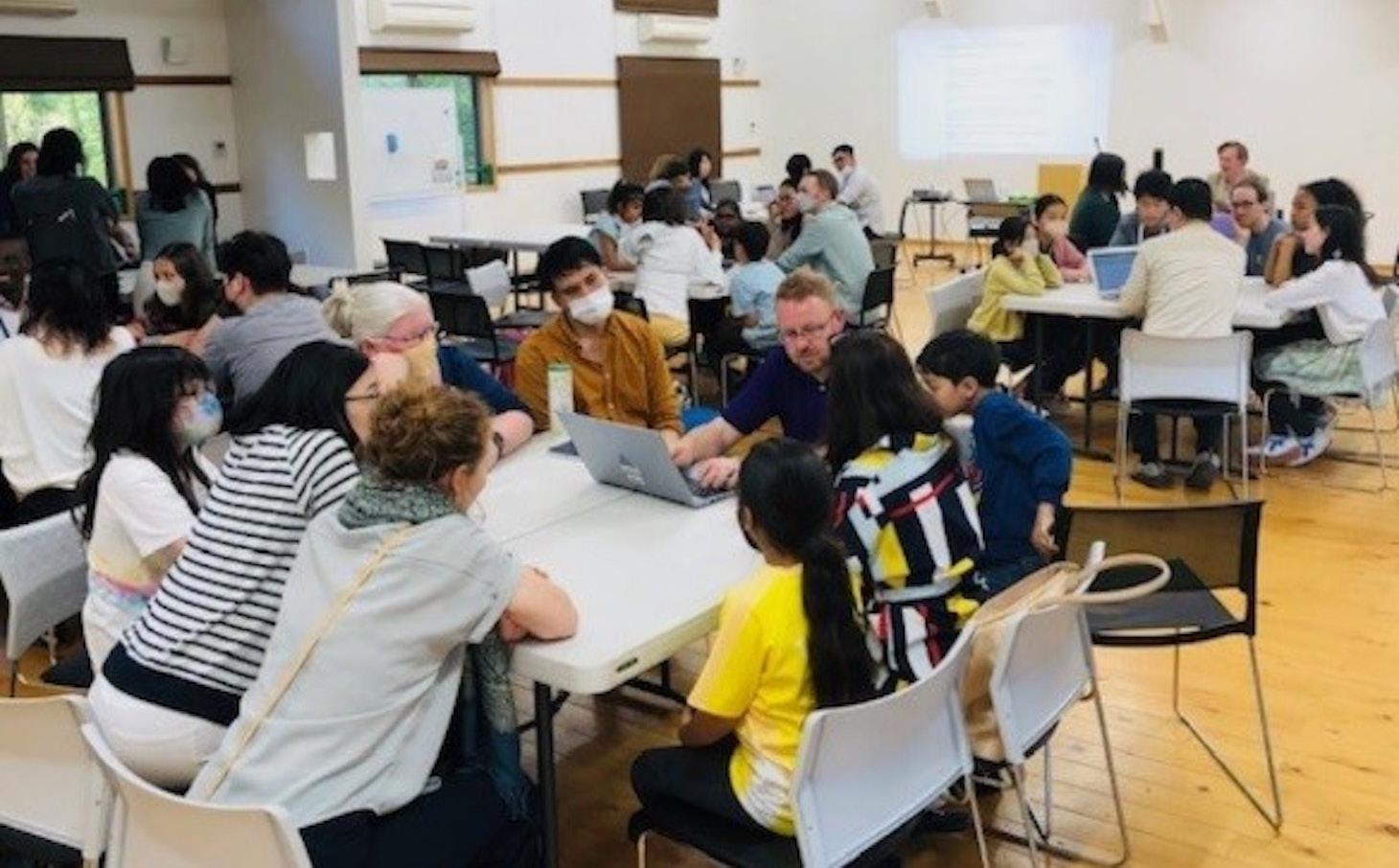
58 EARCOS Triannual Journal
At Tsukuba International School, we are fortunate to be surrounded by nature. In an effort to nurture professional growth and development within our school community, we set ourselves a goal of respecting, protecting and conserving our natural world. This endeavor is not confined solely to our campus but extends to our response to the global climate crisis. Our initial step involved the formation of a collaborative professional learning team, comprising members from the primary school, middle school, high school, and library. This diverse team immediately shared countless suggestions for embedding sustainable practices into school life. However, we understood that ownership of these initiatives should be shared by all in the school community rather than through simply responding to staff directives. Through a more extensive assembly of people, we knew that there would be a broader spectrum of ideas and perspectives to draw upon. The inaugural fruit of all these endeavors was the Tsukuba International School Green Conference. We elicited volunteers to step forward and learn more about the nuances of the climate crisis. Notably, a contingent of students drawn from Grades 3 through 11 engaged in virtual meetings with a Fiji-based climatologist, amplifying their understanding of the crisis.
The students, armed with newfound knowledge, kicked off the conference with splendid presentations, showing how the climate crisis affects us not only locally in Japan, but in low-lying Pacific island nations as well. They were also able to communicate a sense of urgency for taking action. Attended by parents, students, and staff, the conference also featured a keynote address brimming with pragmatic solutions. Subsequently, the attendees convened in groups to delve deeper into discussions on bolstering sustainability within our school. These conversations bore rich fruit into the form of new ideas and actionable steps.
A significant outcome was the collective effort of the attendees to create a Green Agreement document. Each student pledges their commitment to a prescribed set of actions within this agreement over the academic year. These actions, selected at the commencement of the year, undergo reflection at the end of the year, celebrating successes and identifying areas to develop. From avoiding the use of disposable utensils, finishing meals to reduce food waste, using recycled
supplies, reducing energy consumption in class, reducing meat consumption to learning more about sustainability, the agreement encompasses a holistic array of eco-conscious practices. Notably, students embrace this pact by signing an electronic version of the agreement, aligning with our commitment to save paper!

Another outcome of the conference was the beginning of a student-led green club. It was heartening to see authentic agency in action when primary students who had attended the conference proactively approached us to establish the club. Furthermore, older students conducted a feasibility study into starting a high school composting program, poised to commence soon. An innovative suggestion to minimize consumption and waste materialized as the TIS Green Market. This event witnessed more than a dozen families setting up sales pitches, offering visitors the opportunity to procure pre-loved items at bargain prices. Students enjoyed the vibrant experience of trading and better yet, books, toys, clothes and more could find new homes in the community instead of being thrown away. We look forward to a repeat of the market soon, as well as implementation of further conference-inspired suggestions such as the expansion of our gardening initiatives.
The conference, agreement, and market have all formed part of the initial year of our Green Movement. With steadfast commitment, we aspire to magnify our efforts over time, nurturing the hope that the lifelong learners in our school community will carry forth these sustainable practices in their custodianship of our planet.

About the Author
Mr Escott graduated with BA (Hons) in French Language and Literature from UEA in England.
Fall 2023 Issue 59
Yokohama International School Facilitates Collaboration and Innovation at JISTG Conference
With the lifting of COVID-19 restrictions in Japan in March 2023, educators from across Japan gathered at Yokohama International School (YIS) for the annual Japan International Schools Technology Group (JISTG) conference. This two-day event, held at YIS’s newly built campus in Honmoku, Yokohama, offered a platform for collaboration, innovation, and professional growth. By bringing together educators, technology specialists, and industry experts, the event stimulated dialogue, provided insights into emerging trends, and fostered a community of professionals dedicated to leveraging technology to enhance education.
Building on the success of the previous year’s online event, the 2023 conference saw a remarkable 60% increase in participants, re-
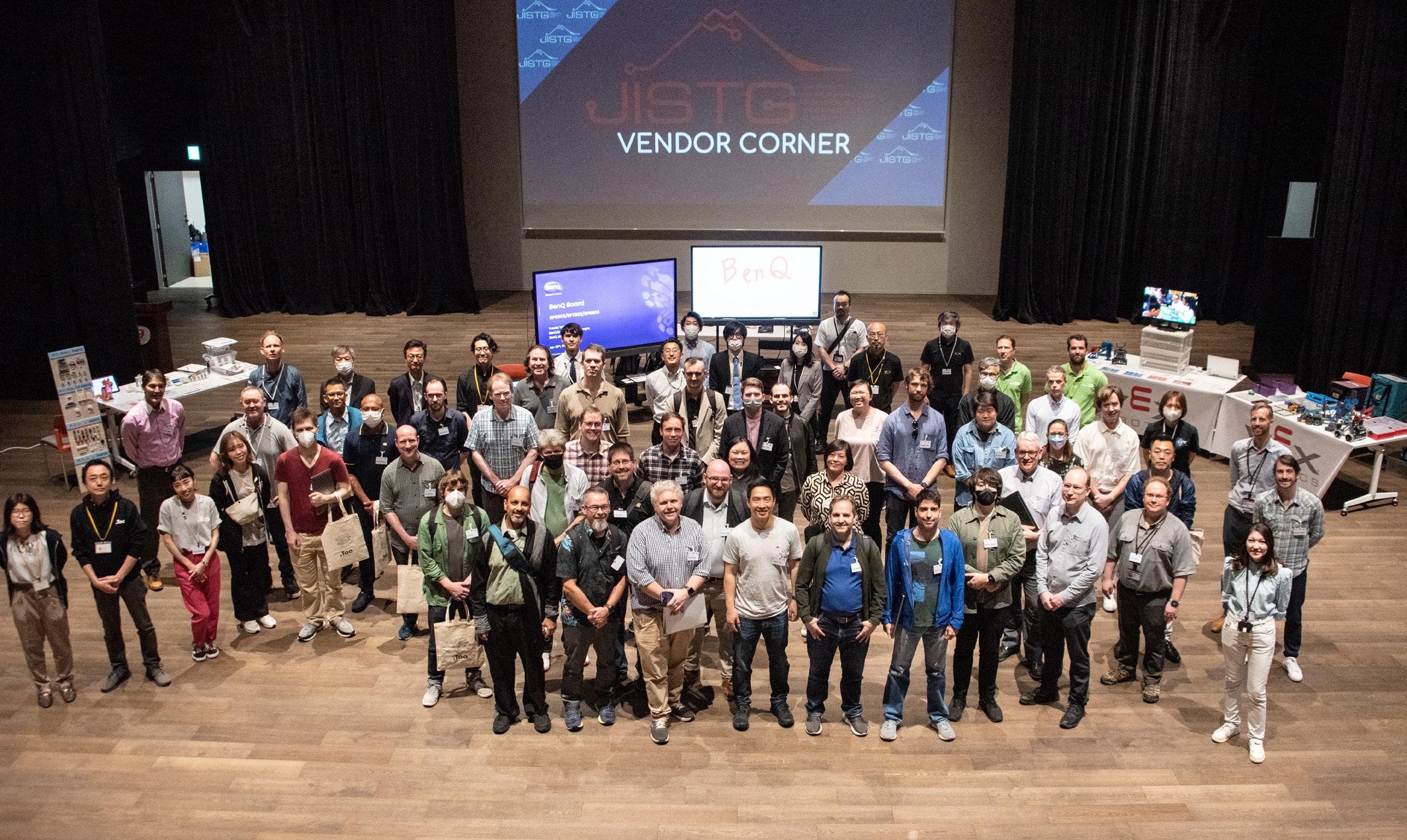
turning to its roots as a practical and informative intersection for various roles working with technology in international schools. The JISTG conference embraces an interactive format, allowing educational technology specialists, school systems operations staff, teachers, and other industry professionals to actively engage with one another and delve into current challenges and emerging trends.
Matt Broughton, Director of IT at YIS, explained the purpose of the conference: “Evolving from its predecessor, Beyond Laptops for educators also hosted by YIS, JISTG in its current form was first held in 2018 to help share the expertise individuals possess. The framework of the event is quite simple. Schools raise issues and topics they want to know more about. Participants with experi-
ence and expertise in those issues provide insight, solutions, and guidance that allow schools to create their own specific solutions to those issues.”
The conference covered a wide range of topics, reflecting the evolving landscape of educational technology. One major theme that garnered significant attention was the use of Artificial Intelligence (AI) in schools. Participants were eager to explore how schools were integrating AI into classrooms and curriculum work, the tools educators were utilizing to detect the use of AI by students, and how official school policies about AI were structured. YIS’ Education Technology Coach, Nick Soentgerath, shared his expertise through in-school sessions about Chat GPT and AI use in schools, providing
PRESS RELEASE
60 EARCOS Triannual Journal
All-school Technology Learning Coach, Nick Soentgerath, runs a session on AI use in schools.
valuable insights and resources to fellow educators. Nick is developing an online Technology Hub for YIS staff to learn from. This experience allows tech staff from other schools to get a jump start on what they could possibly do in their own schools to benefit their faculty and students.
In addition to AI, the participants were keen to learn about effective strategies and best practices in teaching digital citizenship. Popular discussions included the topic of lesson plans for digital citizenship, focusing on equipping students with the necessary skills and knowledge to navigate the digital world responsibly.
Beyond pedagogy, the conference also delved into the realm of information and operating infrastructure. As schools increasingly turned to live streaming during the COVID-19 pandemic, enhancing performing arts recording systems became a priority. Participants explored topics such as training students in operating cameras, soundboards, and lighting equipment, ensuring a seamless and engaging experience for virtual audiences. Furthermore, cyber security, data protection and compliance, device purchasing programs, and telephone systems emerged as critical components for the smooth operation of international schools in today’s integrated and connected working environment.
To provide participants with firsthand knowledge and insights, industry vendors such as Fuji Film, a networking infrastructure provider for YIS, as well as digital display and robotics companies, were invited to the conference. Their presence allowed
educators to engage with technical experts in their respective fields and gain practical knowledge to implement in their schools.
Recognizing the crucial role played by dedicated professionals in the successful implementation and management of technology, the conference emphasized the importance of collaboration among tech teams. From small two- to three-person teams to large multi-person teams specializing in operational systems, the JISTG conference facilitated close interaction between tech team directors and managers, technical operations staff, data and database specialists, educational technology coaches, tech support staff, teachers, administrators, and even students.
A highlight of the event was a three-way panel discussion involving students, teachers, and administrators, hosted by Technology Learning Coach Nick Soentgerath, to provide the opportunity for all cohorts to gain an understanding of how we use technology at YIS in innovative ways on a daily basis. This unique session encouraged an exchange of experiences, perspectives, and challenges faced by each group, fostering a deeper understanding of each other’s situation and collaborative problem-solving approach. Students were able to offer a unique perspective about their experiences using tech, and educators gained valuable insights into their needs and aspirations, allowing for more student-centered technology integration strategies.
Genki Unno, YIS’ IT Operations Manager, highlighted the spirit of knowledge sharing and ongoing professional development within the international school tech community. “While the JISTG conference is held
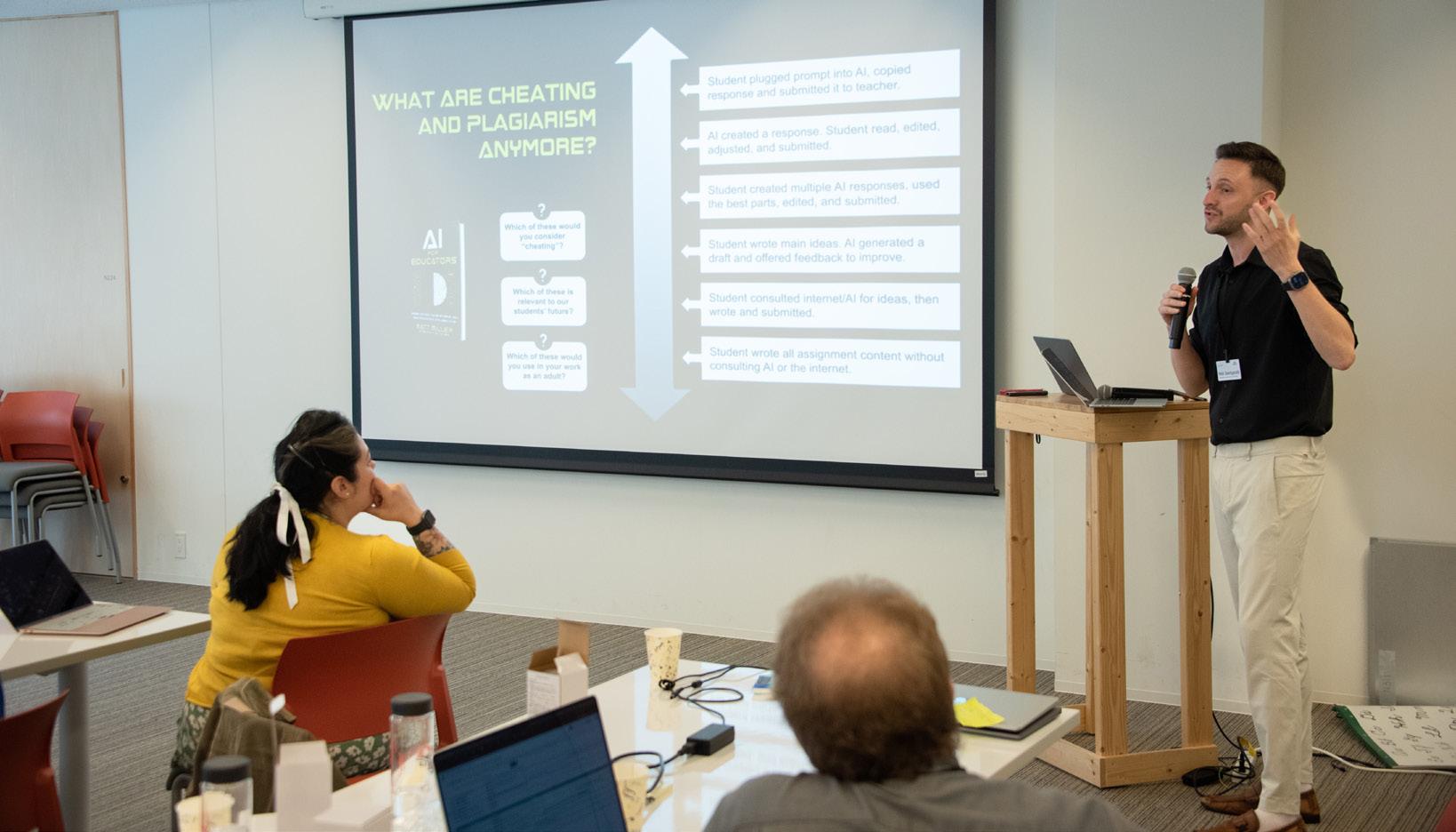
annually, the conversations and collaboration continue beyond the event through online forums, emails, and in-person interactions. There is always some new information that someone comes across that they know needs to be shared with their counterparts in other schools.”, Unno stated. YIS takes pride in facilitating this exchange of ideas and experiences among tech professionals in international schools in Japan.
With YIS having relocated to a newly built campus in January 2022, the school had firsthand experience implementing new operational systems to meet the needs of an expanded campus and student body. The trials and successes of this transition positioned YIS’ tech staff as valuable sources of information and guidance for their counterparts in other schools. With several schools in Japan undergoing campus expansions, the JISTG conference is poised to continue serving as a practical and relevant source of information for the international school industry in Japan. We look forward to meeting our counterparts and providers next year to broaden our education and experience through their education and experience, at Aoba-Japan International School, the host of the 2024 JISTG.
The members of the YIS IT Department and tech team are (left to right in the picture below):
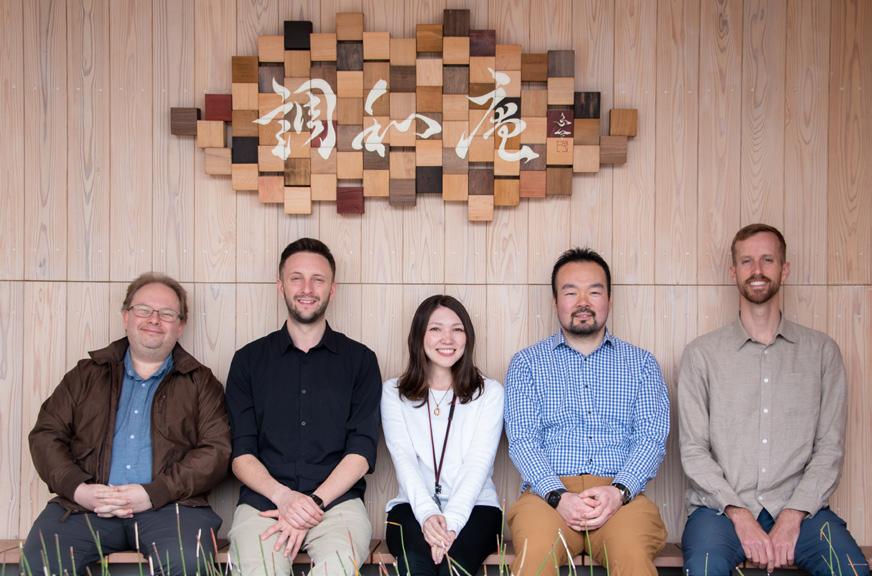
Aaron Marlin, Data Systems Administrator: 12 years at YIS, originally from Yokohama, Japan. Nick Soentgerath, All-school Technology Learning Coach: first year at YIS, certified multimedia teacher, former High School PE teacher, former High School English teacher, originally from Calgary, Alberta, Canada.
Yui Nikaido, IT Help Desk Supervisor: YIS graduate, 2007; 10 years working at YIS, originally from Yokohama, Japan.
Genki Unno, IT Operations Manager and Yearbook Supervisor: 16 years at YIS, originally from Seattle, Washington.
Matt Broughton, Director of IT and Data Protection Officer: seven years at YIS, certified ES teacher, former YIS Technology Learning Coach, originally from Kentucky, U.S.A.
Fall 2023 Issue 61
MEMOIR The 100th Year Commemoration of The Great Kanto Earthquake

 By Jeanette K. Thomas, MBE St. Maur International School

Japan, as one of the countries within the Pacific Ring of Fire, experiences regular seismic activity throughout the year, causing earthquakes, tsunamis, and volcanic eruptions. Until the Great Eastern Japan Earthquake, which struck the Tohoku coast at 2:46 p.m. on March 11, 2011, the Great Kantō Earthquake of September 1, 1923 at 11:58, was the strongest earthquake ever to have taken place in Japan. While the latter registered 7.9 on the Richter scale, the Tohoku earthquake registered a magnitude of 9.1. Both caused devastating tsunami waves many meters high. While 140,000 lives were lost in the 1923 earthquake, the 2011 disaster saw almost 20,000 perish, with the tsunami accounting for 90% of deaths, and another 2,600 missing.
So many souls were lost during the Great Kanto Earthquake due to quickly moving fires, worsened by high winds, causing leaking gas pipes to ignite. More than two-thirds of the houses in Tokyo and Yokohama were burned down, leaving more than three million people homeless. The fewer deaths incurred during the Tohoku disaster can be attributed to the many lessons learnt from the Great Kanto Earthquake. Thanks to its development of one of the most advanced early warning systems in the world, and through ingenuity, creativity, and the significant investment made in overall infrastructure, including new building methods, architecture and engineering, Japan became better prepared for earthquakes and other natural disasters.
Those who lived through the Great Kanto Earthquake did not have the benefit of sophisticated communication systems which existed in 2011, such as wi-fi or mobile phones. A lack of reliable and timely information resulted in a cacophony of misinformation, causing chaos and widespread panic. This in turn impacted on social order when unfounded rumors circulated, claiming that Korean immigrants were planning an uprising. Such rumors contributed to the Kanto Massacre in which, according to estimates, over 6,000 were killed: Koreans, Chinese, and Japanese mistaken as Koreans. However, both the Kanto and Tohoku earthquakes saw many unsung heroes courageously risk their lives to help others. In some cases, they lost their lives to prevent even bigger catastrophes from occurring. For example, during the Tohoku earthquake, brave individuals sacrificed themselves by staying inside the Fukushima Daiichi nuclear power plant during the disaster to stabilize the nuclear reactors.
Saint Maur after the Great Kanto Earthquake ‘destroyed in 10 minutes’.
62 EARCOS Triannual Journal
Saint Maur before the 1923 Great Kanto Earthquake.

During its long 150-year history, Saint Maur International School contended with numerous disasters, natural and manmade. The resolve, resilience, and faith of the Sisters and the lay staff were tested on numerous occasions. However, nothing was more harrowing than the experience of having lived through the Great Kanto Earthquake, as evidenced in the personal testimonies of the events of September 1, 1923. The following excerpts are from the written memories of Sister Denis Twohig, an Infant Jesus Sister, born in Ireland in 1897, who came to Yokohama in 1920; and from an unnamed Saint Maur teacher, whose account of the Kanto earthquake was published on September 20, 1923, in The Japan Weekly Chronicle
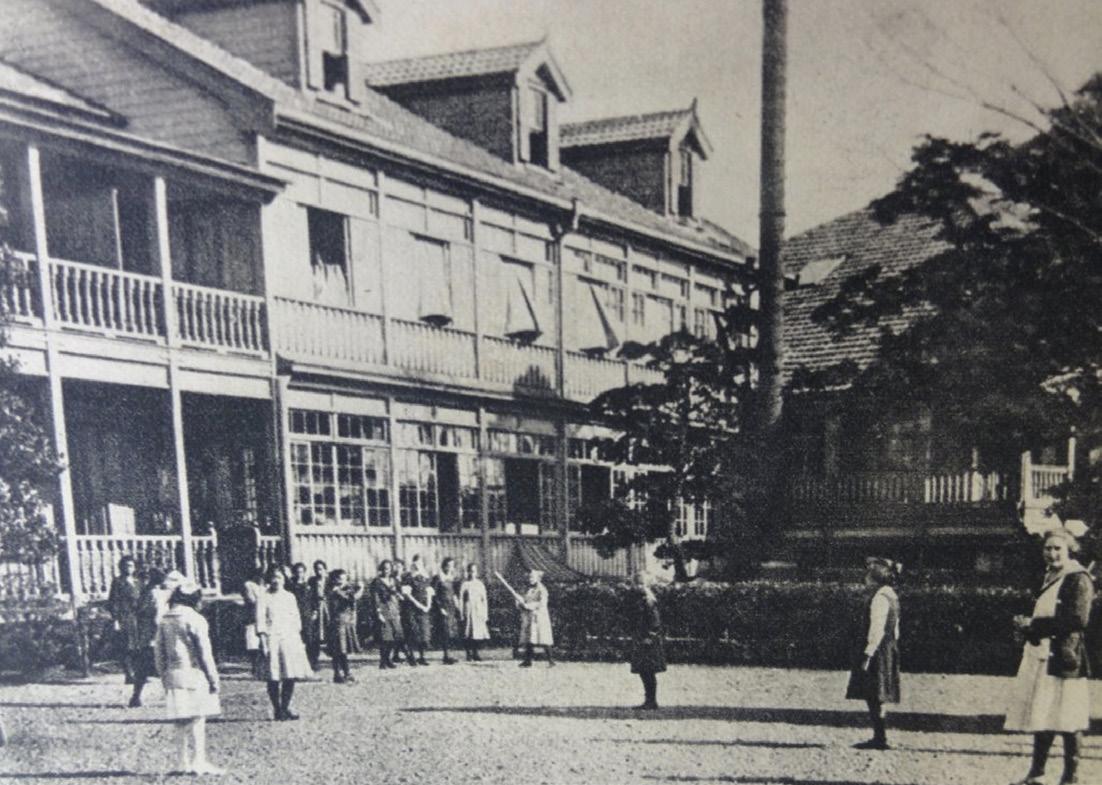
Sister Denis recalls, “on that memorable Saturday of September 1, 1923, it seemed as if a typhoon was gathering. A few minutes before noon, I went to the attic to hang up some freshly-washed linen, when suddenly there was a rumbling sound which grew louder. I ran back towards the attic door and was pitched out onto the staircase, the handrail of which pinned me down. For a while I did not realize what was happening but was confident that the other Sisters would come and find me. However, the tremors increased, and as I tried to release myself, I could see objects being flung around the attic as well as the sky and chimneys becoming visible. After sometime, I managed to get myself free and crawled through a big picture frame and eventually slid down closer to the garden area several feet below. Walking down below was a man whom I recognized as being the bookseller who delivered books to the school. I called out to him for help.
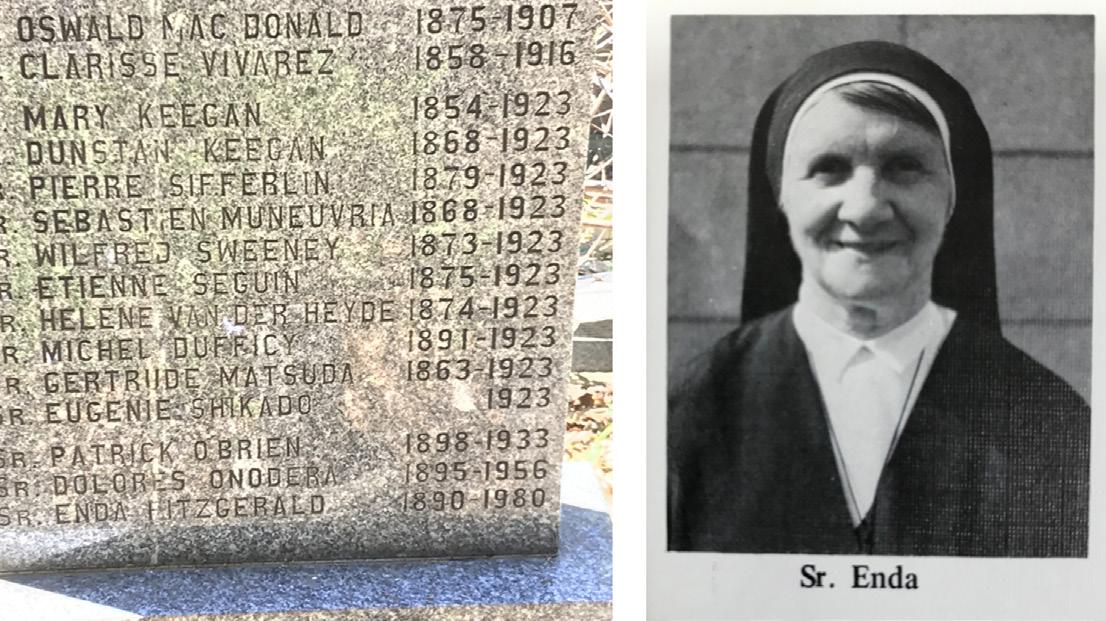

He was astonished to see me and in a matter of moments he made his way up the ruined building to rescue me.” Sister Denis shares her observations of the damage done to the chapel and the rest of the buildings and goes on to write: “After some time I saw Sister Xavier trying to shelter and comfort a group of orphans, and in the boarding school area, I found Sister Patrick O’Brien who was taking care of seven children in the boarding section who had remained in the school for the vacation while their parents were travelling. Most of them had been pinned under desks and beds that had fallen down from the floor overhead. They were crying frantically for help,
and Sister was doing her utmost to comfort them, while at the same time praying for assistance. It eventually came, but not before six of her little flock had died. She was heartbroken and was never the same again.”
Sister Denis writes that, “The surviving Sisters, with the aid of some St. Joseph Marianist Brothers, did their best to rescue those who were trapped; however, because of the raging fires they were unable to rescue all, and eventually had to leave those trapped, knowing the awful fate of those left behind.” Although ten Sisters from the Yokohama convent perished, young Sister Enda Fitzgerald was one of the lucky ones rescued and consequently was able to continue her mission until her death at the age of 93. At her request, she was buried with the sisters who had perished during the earthquake. Their graves can be seen today in the Yokohama Foreign General Cemetery.
The anonymous female teacher’s account published in The Japan Weekly Chronicle echoed the traumatic experience of Sister Denis. She writes, “We of the convent were early risers. At about 5:30 a.m. while at prayers, we noticed a slight earthquake, one of those little ones which we had been led to regard as a sort of seismic safety valve, but which were in fact a warning of the great catastrophe to come. It caused us no more than the usual mild concern and subsequent relief. At 11:58 a.m. the boarders of the foreign girls’ school (St. Maur), seven in number owing to the holidays, were in their recreation room in the charge of a Sister waiting for the tiffin bell, while most of the nuns were in the chapel. The Japanese orphans, some hundred all told, were mostly in the playground. I was in my quarters sewing when the shock took us all without warning.
“I put down my work and flew to the door with the intention of escaping down a flight of stairs into the garden. However, the violence of the motion threw me down them, and I was shot violently into the next building and buried in debris which pinned down my hand. Try as I might, I could not release my hand. I knew that the building was on fire and I prayed that something would fall and kill me before the flames reached me. When the second great shock hit us, miraculously the force of the movement enabled me to release my hand and dig myself out of the rubble.” She continues, writing that she joined the Sister who was with the foreign boarders; however, when it became evident that the building was about to collapse, the Sister instructed the students to follow her through the building towards the Japanese students’ quarters. Sadly, only one student made it, as the others went in another direction.” She continues to write, “We ran round to the side of the building where their voices could be
Gravestone at Yamate Foreign Cemetery & portrait of Sister Enda.
Fall 2023 Issue 63
Sister Denis
heard screaming and sobbing and begging for help. They seemed to be uninjured, with the exception of one girl who kept crying, ‘I have a great stone on my chest, oh please take it off.’ Without more workmen and tools to move the debris, we were unable to get to them. All we could do was to offer comfort, prayers, and encouragement while waiting for help. As the flames of the raging fires threatened to surround us, it became a matter of saving ourselves or perishing with them, so we were sorrowfully obliged to abandon them to their fate.”
The author notes that “the Japanese orphans proportionately fared much better, although twenty of those little ones were lost. In all 36 members of our community in Japan perished, including eight European and two Japanese Sisters in Yokohama.”
Apart from the physical, emotional and psychological impact the Great Kanto Earthquake had on the people in Japan, the damage done to buildings, businesses, and the overall infrastructure was significant and estimated to have been in the region of 6.5 billion yen, four times more than the 1922 budget.
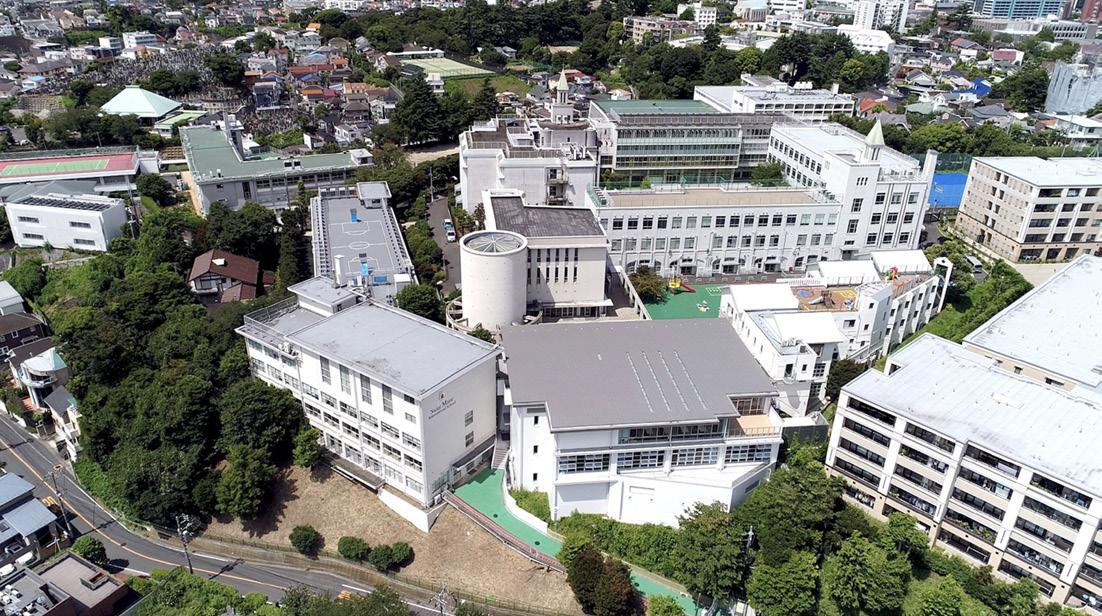

In all, twenty-six Infant Jesus Sisters, ten of whom were in Yokohama, were killed along with twenty-eight orphans and six boarders. With limited personnel and financial resources available, the Sisters restructured their work resulting in the orphanage Sumire and the boarding section of Saint Maur being closed. Thanks to the dedication of the Sisters and their continues faith in their mission, and with the support and efforts of the school and local community, both Saint Maur and Koran Jogakko, now Yokohama Futaba Gakuen, were rebuilt.

On the following day, fires continued to burn out of control, so at 3:00 p.m. the police ordered all to make their way to the Bluff Gardens [now Yamate Park] situated behind the Sacred Heart Church. However, soon after having arrived, they were told to move on, as the fires were enflamed by strong winds and were rapidly approaching the area. The Sisters decided to make their way towards Negishi in the hope of later reaching Akobara, where the Sisters had a small house they often used for rest and recreation, up on the hills overlooking Isogo. One Sister set off walking to Akobara, while the others remained with the 30 children taking refuge on the veranda at the home of one of the Japanese teachers. The aftershocks continued for some time, leaving the children very traumatized. Since their early morning breakfast, their only meal had been one plum rice ball (umiboshi)
The next day a messenger brought word for the group to make their way to the Port near the French Consulate, where the French Ambassador welcomed them and handed out bananas, which were most welcome.
Later they boarded the crowded Andre Lebon vessel, where they remained for about a week while other refugees joined them. Ships from the U.S., England, and elsewhere arrived to assist and take people to Kobe, including 2,000 evacuated from China Town. The ship arrived in Kobe on September 9, where the Sisters were guests of the Sisters of the Child Jesus of Chauffailles. Eventually they were able to get a train to Shizuoka where they were able to join their own Infant Jesus Sisters at their Shizuoka convent and school.
As we commemorate the 100th anniversary of the Great Kanto Earthquake and remember those who sadly perished, let us also give thanks to those who, through their ingenuity and skills, contributed to making Japan the safest earthquake-prone country in the world.
Jeanette K. Thomas, MBE
64 EARCOS Triannual Journal
The Saint Maur International School Campus Today.
Remembering Sr. Maria Zenaida Ancheta

The Principal/Directress of the Dominican International Schools in Taipei and Kaohsiung, Sr Maria Zenaida Ancheta of the Order of Preachers, passed away on July 17th 2023.
It was with shock and great sadness that teachers returned to school for the new school year after the passing of their beloved principal during the summer vacation.
Sr Zenaida was the Principal of the Dominican Catholic School in Guam from 1996 to 2014, with a short spell of four years from 2004 to 2008 at Dominican International School in Taipei. In 2014 she returned to Taipei where she remained until July 2023. She was well known in Asia where she was instrumental in the initial accreditation and continued ACS WASC accreditation of Dominican schools in Guam and Taiwan. The late Dr K visited Dominican International School, Taipei, when he was in Taiwan, because he knew Sr Zenaida and made the detour specially to see her.
The joy that she took in every aspect of the school’s life served as an example to everyone. Nothing was too unimportant for her. She listened to everyone and shared her wisdom wherever it was needed. However, she was also constantly involved in very large projects. The construction of the Taipei school’s new administration building, which also houses a gym, an auditorium, a new cafeteria, all the administration offices, plus workspace for teachers, happened under her watch. Whether teachers relax in the teachers’ lounge, have a serious meeting in the auditorium, or take a walk round the recently upgraded sports fields, her planning, and the execution thereof, is evident everywhere. In Kaohsiung, preparations for the construction of a new school building has started. She was the driving force behind the expansion of the school and she inspired and enthused everyone around her.


On January 4th 2023, Sr Zenaida celebrated fifty years of religious life. Several educators and clergy travelled from far and wide to join her for this auspicious occasion. In the years that she gave to her vocation, she gained the love and respect of so many. On this occasion one could very clearly see the appreciation for the love, kindness and wisdom which she always exhibited.
Her religious faith shone through in all aspects of her life. The last large project she initiated in Taipei, was to successfully mentor a chapter of the St. Martin de Porres Dominican Laity.
She will be missed, and her legacy will become part of the schools’ long and admirable history. We salute you, Sr Zenaida Ancheta. Requiescat in Pace
Fall 2023 Issue 65
Elementary Art Celebration
“Ocean Life”, Fuko - Grade 1
Mixed media on canvas
International School of Ulaanbaatar
“Friendship”, Nuri and Evlin - Grade 4
Paper Mache Sculpture
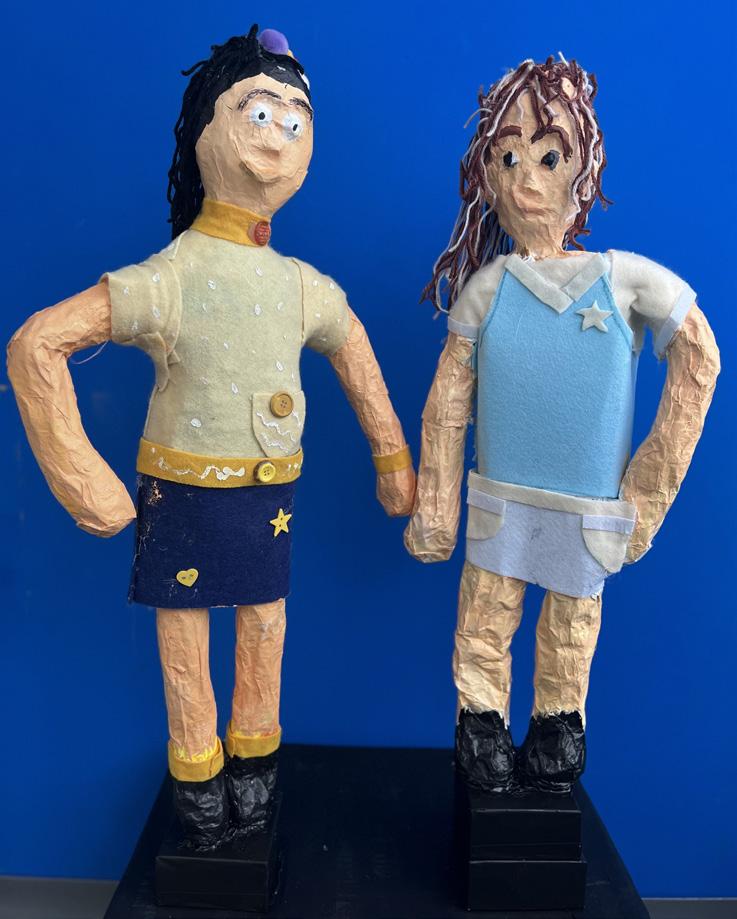
International School of Ulaanbaatar
“Space Cat”, Evlin - Grade 4
Mixed media on paper

International School of Ulaanbaatar
“My landscape”
Rhianna Littlewood, Grade 5
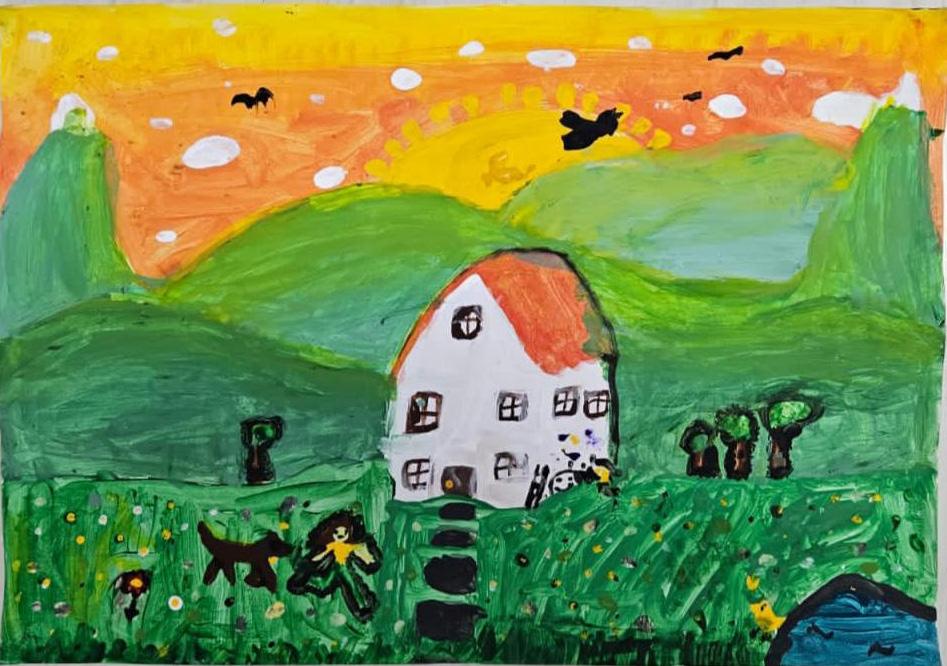


Mount Zaagkam School, Indonesia
“Exploring the elements of Art”
Silas Hulagrocki, Grade 1
Mount Zaagkam School, Indonesia
66
EARCOS Triannual Journal
Submit an Article to The EARCOS Journal
As you can see from our previous issues, we have moved to more of a magazine format with regular features. We invite you to share the great things going on at your school with the other schools in the EARCOS region.
What can be Contributed?
Here are some of the features:
Faces of EARCOS – Promotions, retirements, honors, etc.
Campus Development – New building plans, under construction, just completed.
Curriculum Initiatives – New and exciting adoption efforts, and creative teacher ideas. Green and Sustainable – Related to campus development and/or curriculum.
Service Learning Projects – Educational approach where a student learns theories in the classroom and at the same time volunteers with an agency (usually a non-profit or social service group).
Action Research Reports - Summaries of approved action research projects
Student Art – We will highlight ES art in Fall issue, MS art in Winter issue, and HS art in Spring issue.
Student Writing – Original short stories, poetry, scholarly writing.

If you would like to submit an article please email Bill Oldread at boldread@earcos.org OR Edzel Drilo at edrilo@earcos.org

Fall 2023 Issue 67
Patt, Y2 Acrylic and paint marker on canvas NIST International School
Willa, Y2 Acrylic on Canvas NIST International School
Buster, Y2 Acrylic on Canvas NIST International School