Featured in this Issue Cover Story Three Transformative Outcomes Achieved with Mentoring Action Research Supporting Student Social and Emotional Learning through RULER Curriculum Purposeful Grade Reporting in the Student-Centered Classroom The EARCOS Triannual JOURNAL A Link to Educational Excellence in East Asia FALL 2022
The ET Journal is a triannual publication of the East Asia Regional Coun cil of Schools (EARCOS), a nonprofit 501(C)3, incorporated in the state of Delaware, USA, with a regional office in Manila, Philippines. Membership in EARCOS is open to elementary and secondary schools in East Asia which offer an educational program using English as the primary language of instruc tion, and to other organizations, institutions, and individuals.
OBJECTIVES AND PURPOSES
* To promote intercultural understanding and international friendship through the activities of member schools.
* To broaden the dimensions of education of all schools involved in the Council in the interest of a total program of education.
* To advance the professional growth and welfare of individuals belonging to the educational staff of member schools.
* To facilitate communication and cooperative action between and among all associated schools.
* To cooperate with other organizations and individuals pursuing the same objectives as the Council.
EARCOS BOARD OF TRUSTEES
Andrew Davies, President (International School Bangkok)
Stephen Cathers, Vice President (International School Suva)
Rami Madani, Treasurer (International School of Kuala Lumpur)
Margaret Alvarez, Past President (Director Emeritus ISS International School, Singapore)
Saburo Kagei (St. Mary’s International School)
Barry Sutherland (American International School Vietnam)
Laurie McLellan (Nanjing International School)
Kevin Baker (American International School Guangzhou)
Elsa H. Donohue (Vientiane International School)
Catriona Moran (Saigon South International School)
Andrew Hoover (ex officio), Office of Overseas Schools REO
EARCOS STAFF
Edward E. Greene, Executive Director
Bill Oldread, Assistant Director
Kristine De Castro, Assistant to the Executive Director
Elaine Repatacodo, ELC Program Coordinator
Giselle Sison, ETC Program Coordinator
Ver Castro, Membership & I.T. Coordinator
Edzel Drilo, Webmaster, Professional Learning Weekend, Sponsorship & Advertising Coordinator
Robert Sonny Viray, Accountant
RJ Macalalad, Accounting Assistant
Rod Catubig Jr., Office Staff
East Asia Regional Council of Schools (EARCOS)
Brentville Subdivision, Barangay Mamplasan, Binan, Laguna, 4024 Philippines
Phone: +63 (02) 8779-5147 Mobile: +63 917 127 6460
THE EARCOS JOURNAL
In this Issue
2 Welcome
Message from the Executive Director
4 Welcome New Heads, Principals, Associates, and Individual Members
8 Global Citizenship Awardees & Community Grant Recipients
Cover Story
Leadership
10 Three Transformative Outcomes Achieved with Mentoring By Michael Iannini
12 Storytelling & Deep Learning
How Stories Can Be Used in Any Discipline By LeeAnne Lavender
14 DEIJ
#NotSemantics By Suhana Singh Madia
16 Portrait of a Graduate
How Does Your Community Define Student Success?
By Susie Boss
18 Curriculum
Implementing UDL in Early Years: My UDL Journey By Pooja Kakkar
20 A Plea for Paideia in International Education
22
By Jared Rock
Purposeful Grade Reporting in the Student-Centered Classroom By Yujiro Fujiwara
24 Top Ten SEL Strategies for the Secondary Teacher
By Ruth Poulsen
26 Instructional Coaching
Building a Thriving Coaching Program: 8 Steps to Success
By Kim Cofino
28 Social and Emotional Needs
Ensuring a Welcoming Learning Environment All Year Long By Lauren Harvey, Rebecca Austin-Castillo, and Carl Brenneman
32 Student Well-being
From Data to Action: One School’s Journey to Meaningful Change By Jon Kleiman & Drew Schrader
34
Action Research
An English-Immersion School’s Experience with Data Wise and its Implications to the Work of Professional Learning Communities
By Maria Domingues & Emily Sherwood
36
40
42
44
Promoting Middle School Multilingual Learners’ Willingness To Communicate in the Classroom By Eunae Kim
Exploring the Impact of 360-Degree Feedback on Teachers’ Professional Learning By Melissa Burnell
The Role of Motivation and Memory in Second Language Acquisition By Leandro Venier
Strategic Choice of Specific Co-teaching Models for Scaffolding the Delivery of Content and Language Integrated Learning (CLIL) Experiences
By Lisa Boulestreau & Jamie Bacigalupo
48
52
56
Assessing the Value Added by Online Mathematics Homework By Nathan Warkentin
Supporting Student Social and Emotional Learning through RULER By Brenda Perkins
International Mindedness: Intercultural Appreciation of Physical Beauty By Paolo Euron

Global Citizen Community Service Grant
58
An Artificial Reef Research and Education Project Acquisition By Celicia Cordes
60 Energy Connector By Vansh Kakra
62 One BUK at a Time By Dohyun Kim
64 Enlight the ID By Rindhiya Vishnu Shankar
65 Ch4nge the Cycle By Sadie App
66 Light Up Noveleta By Dylan Yap
67 Child Doctor Project By Tamami One
68 Reef Relief By Sabhyata Joshi
69
Service Learning
Promoting Inclusive Environments Within Conservative Cultures By Eli Hisamatsu & Nami Holderman
72
Film Review
Alien Citizen: An Earth Odyssey By Dana Tanu
Elementary Art Gallery (see page 55)
Fall 2022 Issue 1
Message from the Executive Director
It is a pleasure to welcome each of you to this issue of the EARCOS Tri-Annual Journal–as well as to welcome you to what promises to be a more positive and happier year in so many ways across this region. Following nearly three years of unprecedented hard ship for our schools, that proverbial ‘light at the end of tunnel’ is really (and finally) visible for most. The simple fact that most of our schools are open for in-person teaching and learning is cause for celebration. Many have reported that enrollment has begun to inch back closer to pre-pandemic levels. While there is still a bumpy road ahead, the general mood across the region has shifted noticeably toward the positive. Continued patience and resolve, and continued support of one another, will ensure that everyone in the EARCOS region continues to move forward.
Our organization has not had the easiest of times these past three years. Time and again we built Leadership and Teacher Confer ences only to have to cancel them. It has now been three years since we have held the ‘annual’ Leadership Conference and even longer since we had a Teachers’ Conference. Our popular in-person Weekend Workshops disappeared since no one was able to travel. In their stead, we were fortunate to be able to establish a robust webinar program, having offered well over 150 webinars on topics ranging from DEIJ to Leadership to Assessment and UDL, to mental health, imaginative approaches to mathematics, Board Trus teeship, Child Protection and so much more. For so many of us, the webinars became the glue that bound us together through times of worry and isolation and unexpected change. The webinars are now a regular feature of what EARCOS offers our members—so a very positive development in the face of unwelcomed disruption.
The EARCOS Leadership and Mentorship program, headed by Dr. Chris Jansen of the Leadership Lab in Christchurch, New Zealand, continues to serve as a vital forum for scores of school leaders across our region. In a similar vein, for the past two years we have worked closely with the Truman Group, an organization of psychologists who have led small groups of EARCOS school Heads as they confronted leadership and personal challenges from the pandemic. This school year, thanks to a generous grant from the US Office of Overseas Schools, we have been able to create similar Truman cohorts for counselors.
Perhaps the most positive news of the year, for us, is the return of four annual in-person gatherings.
The popular EARCOS-CIS University Admissions Conference will take place in late September in Bangkok with nearly 100 university rep resentatives and nearly 200 counselors. This will be the first time the event has been held since the autumn of 2019.
From October 27-29, the 52nd EARCOS Leadership Conference will be held at the Shangri-La in Bangkok. With a superb set of present ers, this event promises to help us take a giant step forward as we seek ways to increase our collaboration and professional learning and personal support of one another. How incredible will it be to see one another again!

Another shining indicator of improving times is the EARCOS Teachers’ Conference in gorgeous Kota Kinabalu, Malaysia now confirmed from March 23-25, 2023. There is a great line up of speakers and presenters as well as rich opportunities to make or renew connec tions with other international educators from across the region and globe.
And, don’t forget the return of the Annual Heads’ Retreat scheduled for Luang Prabang, Laos from April 28-30, 2023.
Another reason for genuine hope is right in front of you. This issue of ET offers a conference in its own right. It has been inspiring to see the number and variety of manuscripts that have been submitted. The pandemic did nothing to dampen the curiosity and commitment of the region’s educators and students! The Action Research articles, based on awards provided by EARCOS each year, speak volumes about the interests and innovation of so many in our region’s classrooms. And--the articles about the Global Citizens Award-winning Service projects must give you a booster shot of hope. There is so much good going on in the service dimension of our region’s schools. I encourage you to take time to read about these projects—and to consider sharing what your school is doing with service learning in an upcoming issue.
There is so much to be grateful for as we launch the 2022-2023 school year. But it is also true that there are many challenges remain ing. The good news is that no matter where you are and no matter the challenges, EARCOS exists to support you. Please let us know what we might do to support you and your school in your vital work of forging the future.
With best wishes to each of you for the year ahead—and happy reading!
 Edward E. Greene, Ph.D. Executive Director

2 EARCOS Triannual Journal

Fall 2022 Issue 3 52ND ANNUAL EARCOS LEADERSHIP CONFERENCE 2022 TOGETHER, AGAIN. October 27-29, 2022 Shangri-La, Bangkok Bangkok, Thailand www.earcos.org/elc2022REGISTER NOW!
Welcome New Schools >>
Ascot International School Donnah Ciempka, Head of School www.ascot.ac.th East-West International School Jeffrey Kane, Head of School www.ewiscambodia.edu.kh Oasis International School - Kuala Lumpur Benjamin Hale, Head of School www.ois.edu.my Okinawa Christian School International Megan Roe, Head of School www.ocsi.org Panyaden International School Pran Indhapan, Head of School www.panyaden.ac.th Sekolah Ciputra Martin Blackburn, Head of School www.sekolahciputra.sch.id Stamford American School Hong Kong Karrie Dietz, Head of School www.sais.edu.hk Tokyo West International School Yukiko Kawasaki Kristofferson, Headmistress www.tokyowest.jp XCL World Academy Sean O’Maonaigh, Head of School www.xwa.edu.sg
Welcome New Heads >>
Alice Smith School
Sian May American School Hong Kong Chris Coates Ayeyarwaddy International School Mark Pleasants Bali Island School Michael Miller Bandung Alliance Intercultural School Travis Julian Bangalore International School Geeta Jayanth Branksome Hall Asia Blair Lee Canadian International School of Singapore Allan Weston Canadian International School, Tokyo Kent MacLeod Canggu Community School Ben Voborsky Chiang Mai International School Cherie Kinnersley Christian Academy in Japan David Mawhinney Dalat International School Shawna Wood Dalian American International School Richard Swann Ekamai International School Jarun Damrongkiattiyot Hanoi International School Daun Yorke International School Dhaka Thomas Van Der Wielen International School Eastern Seaboard Roberto Santos International School Manila William Brown International School of Brunei Tony Macfadyen International School of Phnom Penh Eileen Niedermann International School of Qingdao Chris Peek Kaohsiung American School Jim Laney Jr. Keystone Academy Emily McCarren Kyoto International School Myles Jackson
Marist Brothers International School Shawn Hutchinson Medan Independent School Terry Swain Mont’Kiara International School Gary Melton Osaka International School Kurt Mecklem Osaka YMCA International School Dwayne Primeau QSI International School of Shenzhen Claire Berger Seoul International School Jim Gerhard Shanghai American School James Nelligan Kirsta Zavits (Pudong Campus)
Christophe Henry (Puxi Campus)
Shenzhen Shekou International School Harish Kanabar St. Johnsbury Academy - Jeju Corey Johnson Thai-Chinese International School Michael Purser Tohoku International School Kathryn Simms Utahloy Int’l School Guangzhou Dean Croy Sebastien Pelletier (Head of UISZ) Western Int’l School of Shanghai David Edwards Xiamen International School Inna Klein Yantai Huasheng International School Elliot Miller Yew Chung Int’l School of Beijing James Sweeney Yew Chung Int’l School of Qingdao Stephen O’Connor Yew Chung Int’l School of Shanghai Ryan Peet (Puxi)
Cathy Morris (Primary Puxi)
Yogyakarta Independent School Ismail Sumantri
Welcome New High School Principals >>
Access International Academy
Ningbo Glen Porritt American School Hong Kong Amanda Shepherd American School in Taichung Kelly Konicki Ascot International School Mark Allen
Asia Pacific International School Andrew Ris Australian International School Vietnam Ben Armstrong
Ayeyarwaddy International School Kirk Holderman Bali Island School
Michael Miller
Beijing International Bilingual Academy Myles Airelle
Berkeley International School
Jake Varley
Brent International School Manila Todd Wyks
Canadian Int’l School Bangalore Jay Langkamp
4 EARCOS Triannual Journal
Canadian Int’l School of Singapore Daniel Smith
Canggu Community School Max Henson
Chadwick International School Joseph Levno Concordia Int’l School Shanghai Eileen Beckman Dulwich Int’l High School Suzhou Nadir El-Edroos Dwight School Seoul Cameron Forbes Ekamai International School Ronald Mendiola German European School Singapore Claudia Dicken Hangzhou International School Fursey Gotuaco International Bilingual School of Hsinchu Karen Wu International Pioneers School Parminder Kongvattanawong International School Dhaka Chris Boyle International School Eastern Seaboard Joe Hepworth International School Ho Chi Minh City Caleb Nathanael Archer International School Manila David Birchenall International School of Beijing Julie Lemley International School of Busan Gilles Buck International School of Dongguan Ms. Alissa Gouw Int’l School of Nanshan Shenzhen Chelsea Donaldson International School Suva Paulinus Horkan Keystone Academy Regine de Blegiers KIS International School Keegan Combs Korea International School-JeJu Campus Alissa Kordprom Kunming International Academy Jason Chong Mont’Kiara International School Kevin Ritchlin Nansha College Preparatory Academy Sarah MacRoberts Oasis Int’l School - Kuala Lumpur Jessica Hale
Oberoi International School
Subhash Chander Bhatia
Osaka YMCA International School Mark Beales
Panyaden International School Daiju Vithayathil Prem Tinsulanonda International School Shaun Hudson Raffles American School David Hornby Sekolah Ciputra Christopher Allen Seoul International School Gray Macklin Shanghai American School Stephen Caskie Shenzhen Shekou International School Matthew Doige St. Johnsbury Academy - Jeju Justin Boyd Stamford American School Hong Kong Teresa Foard Thai-Chinese International School Kevin Curran
United World College of South East Asia Damian Bacchoo (East) Utahloy Int’l School Guangzhou Fritha Jameson
Victoria Shanghai Academy Shirla Sum Vientiane International School Andrew Ferguson Western Int’l School of Shanghai Evi Singleton XCL World Academy Mark Petterson Xian Hanova International School Aristipo Rodriguez Yantai Huasheng International School Jonathan Van Santen Yew Chung Int’l School of Beijing James Sweeney Yew Chung Int’l School of Chongqing Tim Noblett Yew Chung Int’l School of Qingdao Brendan Bourne Yogyakarta Independent School Ismail Sumantri Yongsan International School of Seoul Jeff Marquis
Welcome New Middle School Principals >>
American School in Taichung Kelly Konicki Asia Pacific International School Judy Park Bali Island School Michael Miller Bangalore International School Anjali Nair Beijing International Bilingual Academy Myles d’Airelle Branksome Hall Asia Patricia Long Concordia Int’l School Shanghai JJ Akin Dalat International School Beverly Stevens Dwight School Seoul Cameron Forbes Ekamai International School Frederick Milton Lee European Int’l School Ho Chi Minh City John Veitch German European School Singapore Sarah Thomas (European Section) Hangzhou International School Fursey Gotuaco
Hanoi International School Mark Schoemer Hong Kong International School Casey Faulknall International Bilingual School of Hsinchu Karen Wu International School Dhaka Chris Boyle International School of Beijing Anne Sweet International School of Busan Gilles Buck Kaohsiung American School Chelsea Armstrong Nansha College Preparatory Academy Hanson Yeung
Nishimachi International School Kalpana Rao Oasis Int’l School - Kuala Lumpur Jessica Hale Oberoi International School Priyadarshini Ramteke Panyaden International School Daiju Vithayathil Punahou School Todd Chow-Hoy Seisen International School Kyoko Sato Seoul International School Michael Gohde Shanghai American School John Ashenden Shenzhen Shekou International School Matthew Doige Singapore American School Chris Beingessner St. Johnsbury Academy - Jeju Eric Beck Thai-Chinese International School Richard Poulin Utahloy Int’l School Guangzhou Fritha Jameson Vientiane International School Andrew Ferguson Western Int’l School of Shanghai Evi Singleton XCL World Academy Mark Petterson Yantai Huasheng International School Jonathan Van Santen Yew Chung Int’l School of Qingdao Brendan Bourne YK Pao School
Ada Wang
Fall 2022 Issue 5
Welcome New Elementary School Principals >>
Access International Academy Ningbo Charity Yi American International School, Vietnam Joe Aldus Ascot International School Laura Rennard Asia Pacific International School
Judy Park Ayeyarwaddy International School Holly Hunt Bali Island School Michael Miller
Bangalore International School Jayati Ashok George Berkeley International School Karen Hendren Canadian International School of Singapore Colleen Drisner Canggu Community School Mike Hopaluk Dulwich College Suzhou Georgina Gray Dwight School Seoul Beth Overby Faith Academy, Inc.
Tara Santos
German European School Singapore Sarah Thomas Global Jaya School Lavesa Devnani Hong Kong International School Ben Hart International Bilingual School of Hsinchu Karen Wu
International Community School - Singapore Samuel Goh International School Dhaka David Longworth International School Eastern Seaboard (ISE) Allison Donohue International School of Beijing Dustin Collins International School of Tianjin Justin Lobsey
Kaohsiung American School
Molly Fitzgerald
KIS International School Chye de Ryckel
Kunming International Academy Jean Bannen Nanjing International School Jacqui Patrick
NIST International School Iain Macfarlane
Oasis International School - Kuala Lumpur Rebecca Unruh
Panyaden International School Erin Michelle Threlfall Punahou School Todd Chow-Hoy
Saigon South International School Melanie Sylvester
Shenzhen Shekou International School Leda Cedo
St. Johnsbury Academy - Jeju Carla Chavez
St. Marys International School
Charles Myers
Stamford American School Hong Kong Rose Chambers
Thai-Chinese International School Scott Dennison
The American School of Bangkok Jenny Sabin
The International School Yangon Sandy Sheppard
Western Academy of Beijing Catherine Pierre Luois
XCL World Academy Edna Lau
Yangon International School Heather Kissack
Yew Chung International School of Beijing Jane Kang
Yew Chung International School of Chongqing Darren May
Welcome Early Childhood Principals >>
Ascot International School Tom Green Bali Island School Michael Miller Canadian International School of Singapore Colleen Drisner Chadwick International School Timothy Tuttle East-West International School Heather Abernathy German European School Singapore Emma Horsey Hong Kong International School Geoff Heney International School Eastern Seaboard Allison Donohue International School of Beijing Dustin Collins Kunming International Academy Jean Bannen NIST International School Iain Macfarlane
Panyaden International School
Erin Michelle Threlfall
QSI International School of Shenzhen Penny Blackwell
Shanghai American School Sharon Townshend Shanghai Community International School Heather Knight Shenzhen Shekou International School Karen Brown-Miller Singapore International School of Bangkok Marion Barbe
TEDA Global Academy Cindy Li
The British School New Delhi Cally Stockwell
XCL World Academy Edna Lau
Yew Chung International School of Beijing Margaret Zhang
Welcome New Individual Members >>
Natalie Chan, Founder
OWN Academy Andrew Gordon, Director LOGOS International School and ASIAN HOPE International School Priscilla Koh, Principal Havil International School Diane Lewthwaite, Head of School Beacon International School Foundation (The Beacon School) Michael Lambert, Head of School True North School
6 EARCOS Triannual Journal
Welcome New Associate Institutions >>
9ine
Technology, Cybersecurity, Privacy
Benchmark Education
English Literary Programs, Early Learning, Inter vention, Leveled Texts
Class Technologies
Edtech
DataClassroom, Inc. Digital lesson content and web application for teaching data skills
DLR Group
Educational Facility Planning / Architectural Design Consulting

Dynatex
Cloud based communications platform for schools to create, manage and distribute content to web mobile and email
Edpuzzle, Inc. Video Learning Platform


Education Perfect Education Technology
Harmony Education Solutions
Curriculum Support, Assessments, STEM Model, Professional Development, American School Model, Consultation, Leadership Development etc.
International School Counselor Association (ISCA)
Provider of professional development services and membership for international school coun selors.
Komodo Student wellbeing software solutions
NOVALEARN LIMITED STEAM Extracurricular Learning Platform
Playground Centre Recreational Facilities Manufacturer and Supplier
Sovereign Group
Financial services - we provide occupational and personal international pensions and savings
Steelcase Office Solutions Ptd Ltd Furniture manufacturer and provider for Office and Learning Envirnoments
TheHagwon.Com
ACT SAT Online Learning Platform
The Jane Group Crisis Communications Consultants
The Safeguarding Company Ltd Safeguarding Services
TheKnowledge-Lab Pte. Ltd. Education technology
William & Mary School of Education University
eiw architects | eiwarch.com.au learning space design Vientiane International School building ideas Fall 2022 Issue 7
Global Citizenship Awardees >>
List of Global Citizenship Award 2022Winners

This award is presented to a student who embraces the qualities of a global citizen. This student is a proud representative of his/her nation while respectful of the diversity of other nations, has an open mind, is well informed, aware and empathetic, concerned and caring for others encouraging a sense of community, and strongly committed to engagement and action to make the world a better place. Finally, this student is able to interact and communicate effectively with people from all walks of life while having a sense of collective responsibility for all who inhabit the globe.
Access International Academy Ningbo Yanbing Hu American Int’l School Hong Kong Sabhyata Joshi American Int’l School of Guangzhou Wei Ying Gwynnie Guo American Pacific International School Kayin (Bonnie) Lau American School Hong Kong Himani Vasnani American School in Taichung Lydia Chen American School of Bangkok, The Sein Sandar Tun Ayeyarwaddy International School Ahkar Min Thant Bali Island School Manon Pecquery Bandung Alliance Intercultural School Angel Gunaman Bandung Independent School Rose Ashworth Bangkok Patana School Rie Aiyama Beijing City International School Yutong Ren Berkeley International School Celicia Cordes Brent International School Baguio Cassey Denise Cunanan Brent International School Manila Katyann Baldwin Brent International School Subic Yuan Wang Busan Foreign School Brian Choi Canadian Academy Manori Koto Canadian Int’l School of Hong Kong Yoyo Yeuk Sze Pang Canadian Int’l School of Singapore Arishya Jindal Cebu International School So Yi (Selly) Park Chadwick International School Yujin (Eugene) Lee Chatsworth International School Minami Mochizuki Christian Academy in Japan Shun Tanaka Concordia International School Hanoi Yu Hyeon Kim Concordian International School Anna Binabdullah Daegu International School Ricky Junyoung Jang Dalat International School Benjamin Wong Dalian American International School Raymond Bian Dominican International School Jason Chun Yu Shih Dwight School Seoul Curie Lee Fukuoka International School Junze Lyu Garden Int’l School Kuala Lumpur John Ling Hangzhou International School Flora Moon Hong Kong International School Yoonjung Choi Hsinchu International School Pei Pei Kuo IGB International School Rindhiya Vishnu Shankar Int’l Christian School - Hong Kong Hiu Ching Ma Int’l Community School - Singapore Josette Hwang International School Bangkok Sutikarn (Aeoi) Thamthiwat International School Dhaka Mursalina Munir
International School Eastern Seaboard Soo Yeon Lim International School Ho Chi Minh City Ha Pham International School Manila Dylan Patrick Ng Yap International School of Beijing Annarosa Li Yee Lam International School of Busan Phillip Pibernat-Park International School of Dongguan Michael Chen International School of Kuala Lumpur Lamija Mrndic Int’l School of Nanshan Shenzhen YaLin Jiang International School of Phnom Penh Kunvecheada Blain International School of Ulaanbaatar Oyundari Gansukh International School Suva Zubeyda Dadasheva K. International School Tokyo Sara Ashida Kaohsiung American School Anne (Ling-Yi) Wu Korea International School-JeJu Campus Yoonseo (Bennie) Ko Korea Kent Foreign School Angelina Koh Kunming International Academy Gabriel Seksig Lanna International School Thailand Min Yoo Marist Brothers International School Joshua Whitney Mont’Kiara International School Taekyoung Kim Nagoya International School Rinka Lee Nanjing International School Yutong Wang Nansha College Preparatory Academy Chenxin Gao NIST International School Rei Tangkijngamwong North Jakarta Intercultural School Abigail Wu Oberoi International School Vansh Kakra Osaka International School Tamami Ono Osaka YMCA International School Sehyeon Kim Prem Tinsulanonda International School Chenxun Zhang Renaissance International School Chi Tran Kim Ruamrudee International School Manyasiri (Pear) Chotbunwong Saigon South International School Phuong-Anh Do Saint Maur International School Isheeka Prabhu Seisen International School Zarah Mathew Sekolah Ciputra Wenny Wibisono Seoul Foreign School Grace An Seoul International School Alice Hyoeun Lee Shanghai American School Nathan Chan Shanghai American School-Puxi Campus Sejin Oh Shanghai Community Int’l School Huai-Yin (Ingrid) Yao Shanghai Community Int’l SchoolPudong Campus Vaishvi Shah Shen Wai International School Ya Qing Su
8 EARCOS Triannual Journal
Singapore American School
Renee Paris Dan Xinh Phan
Singapore Int’l School of Bangkok Natthanun Tonprasert St. Marys International School Roy Igwe
Surabaya Intercultural School Shafira Novianti Adi Dwi Putri Taejon Christian International School Dohyun (Jennifer) Kim TEDA Global Academy Sharon Russel
The American School in Japan Moeka Sugiyama The British School New Delhi Tara Bhattacharya The Harbour School Arial Brookhart
The International School Yangon Rose Zin Tianjin International School MinAh Park Tohoku International School Michael Yamaguchi United Nations Int’l School of Hanoi Carmen Cortizas UWC Thailand International School Alyx Mastor Vientiane International School Diogo Godoi Wells Int’l School - On Nut Campus Shaina Paryani Western Academy of Beijing Yufei (Sophie) Yi Western Int’l School of Shanghai Juhwan Han Wuhan Yangtze International School Jean Iris Deguilmo Lauron Yangon International School Tenzin Gyeltshen Wangyel Yantai Huasheng International School SuJin (Angela) Kim Yew Chung Int’l School of Chongqing Cherry Pan Yew Chung Int’l School ShanghaiPudong campus Zeke McDaniels Yongsan International School of Seoul Priscilla Kang
Global Citizenship Community Grant Recipients >>



All of us here at EARCOS wish to extend our sincere congratulations to the following Global Citizens who have been chosen to receive an EARCOS Global Citizen Community Service Grant of $500 to further their excellent community work during this upcoming aca demic year. The recipients are:
NAME SCHOOL
PROJECT NAME
Rose Ashworth Bandung Independent School Rumah Ruth Nathan Chan Shanghai American School Law Association for Crimes Across History (LACAH) Yoonjung Choi Hong Kong International School For Girls Celicia Cordes Berkeley International School
ATMEC: An Artificial Reef Research and Education Project Angel Gunaman Bandung Alliance Intercultural School Made to Change Sabhayata Joshi American International School Hong Kong Reef Relief Vansh Kakra Oberoi International School
Energy Connector Sadie Kapp KIS International School ch4nge the cycle Dohyun (Jennifer) Kim Taejon Christian International School BUK Time for South Sudan Curie Lee Dwight School Seoul El Salvador Coffee Project Alyx Mastor UWC Thailand International School Plastic Free Phuket Tamami Ono Osaka International School Child Doctor Rindhiya Vishnu Shankar IGB International School
Enlight the ID (Intellectual Disability) and Shine Light on Mental Health Ahkar Min Thant Ayeyarwaddy International School Go Green Yuan Wang Brent International School Subic Shining Through Service Dylan Yap International School Manila Light Up Noveleta
Fall 2022 Issue 9
Three Transformative Outcomes Achieved with Mentoring
A leader’s most important responsibility is to develop leaders.
By Michael Iannini Council of International Schools Affiliated Consultant ACAMIS PD Consultant and Leadership Facilitator
70-20-10, this is the golden rule for successfully develop ing leaders. We know from research that senior leaders are the most proven and powerful tool for empowering aspiring leaders to be accountable for 70% of their own develop ment. Aspiring leaders realize 70% of their leadership de velopment by accepting responsibility for challenging tasks, such as:
• Starting something from nothing,
• Fixing something broken, and
• Being responsible for influencing others without author ity.
However, to ensure aspiring leaders develop from these challenges, which may include failure, senior leaders need to accept 20% of the responsibility for an aspiring leader’s development. This requires senior leaders to regularly in teract with aspiring leaders, in the capacity of a mentor, to clarify roles and expectations, keep them focused on the bigger picture and help them to reflect and learn from their experiences. The role of the mentor is a distinctly different relationship than what might be assumed under a typical ap praiser or manager interaction, even if the persons involved are the same.
10% of any leader’s development is related to structured learning activities, such as workshops, book studies, profes sional reading, and conferences. Structured learning activi ties, over a long period of time, have the least amount of influence on a leader’s development, but when introduced at critical junctures in the development journey, can be amazingly powerful for broadening perspective, pro viding inspiration, and introducing new ideas. Often, aspiring leaders need input from senior leaders to identify appropriate learning activities to stimu late their development journey.
Aspiring leaders, when empowered, will be the most effective tool in ensuring transformative and sustained change. It is the influence of senior leaders, as well as role modelling, that serves as the catalyst to ensure aspiring lead ers use the knowledge, tools, and strategies to build and sustain a collaborative team

COVER STORY LEADERSHIP
10 EARCOS Triannual Journal
culture. Such cultural impacts go beyond the direct partici pants of mentoring and speak volumes to the broader work force.
Three Transformative Outcomes Achieved with Mentoring
Over the course of this school year, from August to June, I have been facilitating a Mentoring program that included five campuses from the Yew Chung Education Foundation (YCEF). This program is in its second year and has grown consider ably, taking into consideration all of the obstacles schools have faced with the pandemic. Claire Peet, YCEF’s Senior Manager L&PD and Quality Assurance, has been instrumental in work ing with me to develop and document the results of this pro gram. Originally, Claire was seeking to improve the number and type of candidates that were applying for leadership roles and various whole school projects. Most candidates had very little evidence leading any significant transformative changes within their team or beyond. Claire was concerned that if YCEF didn’t invest more time in developing promising aspir ing leaders, then those leaders would go elsewhere to seek development.
Since the program’s inception, what we are learning and achieving is far exceeding our original aspirations. In Febru ary 2022, at the midway point of the program, all participants completed a survey to share their experience in the program. These were the areas of the participant experience that the survey focused on and where we believe the transformation in both the leader’s and the school’s development is rooted:
• Leadership Development Projects: What were partici pants working on and how had it evolved over the course of the program? What was their relative level of confi dence to complete their project?
• Relationships: How has the program influenced their re lationship with each other and to the school?
• Retention: To what extent had the program influenced their desire to stay at their school and their belief that they could effect change in the organization?
Data collected for Leadership Development Projects indicat ed that a majority of projects had changed over the course of the school year, most of them only moderately, but 9 of 22 projects had changed significantly. On a scale of 1 to 4, with 1 indicating Not Confident and 4 indicating Very Confident, 5 of 22 mentees were not confident they would successfully complete their projects at the start of the year and no one was very confident they would successfully complete their projects. By February, everyone felt they would complete their projects, with 9 of 22 participants feeling very confident they would successfully complete their projects. There is an intrigu ing correlation between mentee confidence growth and pro
ject evolution. When exploring this with school principals in each of the 5 schools, they noted increased resilience as an unanticipated outcome from the program.
Data collected relating to Relationships was very positive. 14 of 18 mentors participating in this program indicated that this program positively influenced their relationship with aspiring senior leaders. Even more encouraging, considering the strain educational leaders experienced during the pandemic, was that there was a high level of trust between all mentoring pairs. 30 of 40 participants rated their relationships very trust ing, a 4 on a 1 to 4 scale, and 10 rated the relationships as a 3.
Lastly, regarding data collected for Retention, all participants indicated that this program had positively influenced their per ception of being able to effect change in YCEF. On a 1-4 scale, 22 of 40 participants selected 3 and 9 participants selected 4. More promising was that on a 1-4 scale indicating how likely participants would stay at their school as a result of this pro gram, 32 (both aspiring leaders and senior leaders) indicated that the program had a positive influence on their decision to stay at their school with 9 participants selecting 4, indicating it had a significant influence. This was further verified by partici pating school principals, one of whom noted that all mentees and mentors involved in this year’s programme had commit ted to remaining in the organisation for next academic year, despite the challenging circumstances in Shanghai.
If you would like to learn more about this mentoring pro gram and how your school can implement one, please email Michael Iannini and Claire Peet or visit this link, where Mi chael Iannini outlines the program in more detail, which also includes a downloadable PDF.
Claire Peet is an experienced Senior Leader, Coach and Learn ing Professional. In her current role she supports colleagues with their growth and development, as well as oversees pro jects that promote consistency in pedagogical standards, cur riculum and, most importantly, YCEF’s mission, principles and practices.
About the Author
Michael Iannini, founder and Managing Partner of PD Academ ia, is recognized by the Council of International Schools as an expert in Governance, Strategic Planning, Human Resource Management and Leadership Development. He is also author of Hidden in Plain Sight: Realizing the Full Potential of Middle Leaders. He can be contacted at michael@pdacademia.com
Fall 2022 Issue 11
STORYTELLING & DEEP LEARNING
How Stories Can Be Used in Any Discipline
By LeeAnne Lavender Storytelling & Service Learning Coach & Facilitator
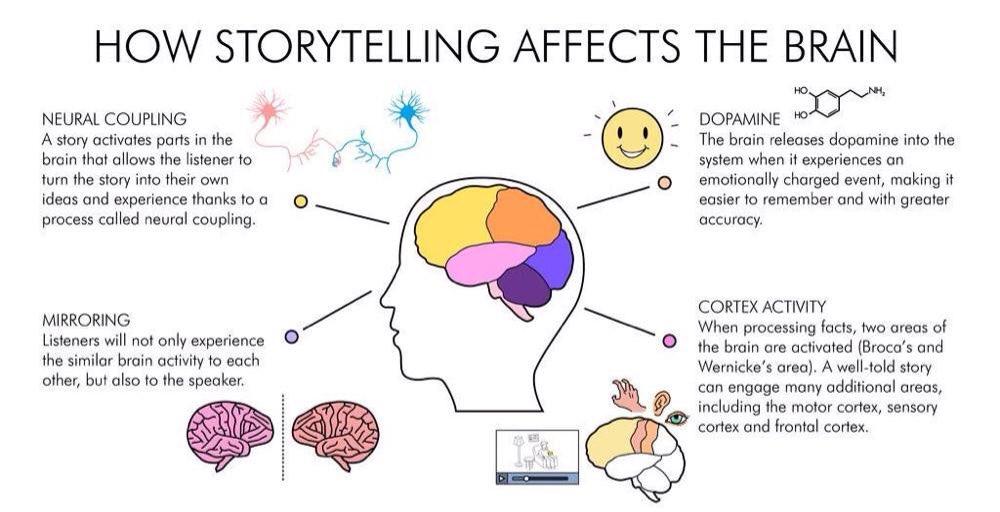
Did you know that storytelling affects the brain in the ways depicted in the image above? Isn’t that amazing? There are nu merous articles you can read online that explain the ways our brains respond to stories, including the article that served as the source of this image. It’s fascinating reading, and I’ve included some links at the end of this article.
Maybe you are a math teacher and you’re not sure how stories relate to your curriculum. Or you’re an IB teacher trying to fit all of your content into a busy school calendar. Where, you ask, would you find the time to tell stories? And how would that lead to deeper learning for your students?
The brain science around storytelling suggests that if we want students to really learn what we’re teaching (in any content area), stories are a key strategy for evoking engagement, em bedding information into our memories and creating compas sion and trust in our classroom. This isn’t an add-on but an essential way we can reframe our curriculum so it is meaningful and purposeful for our students.

What could this look like?
A group of educators from the Educators Consortium for Ser vice Learning (ECSL) recently engaged in a workshop where storytelling was used as a way to connect and reflect on key experiences from teaching during Covid. The primary tool for the workshop was a simple plot mountain (the five main com
12 EARCOS Triannual Journal
ponents of a story’s plot are exposition, rising action, climax, falling action and resolution).
Educators mapped their experiences from the past year us ing the plot mountain and then shared their stories in groups of four in breakout rooms. When they returned to the main Zoom discussion room, many similarities were noted amongst the shared stories. Most educators had experienced upheaval as a result of Covid-19 and experienced climax moments where their jobs changed significantly. Many learned they had strength to persist and keep going in the face of numerous obstacles. In sharing these stories, the teachers connected and felt a shared sense of catharsis and belonging.
Were our brains producing dopamine, cortisol and oxytocin? Absolutely. And this created an impactful experience that al lowed us to feel supported and heard, one that we will re member for a long time.
In your math, history or art classroom, you could use this sim ple plot mountain exercise to help students reflect at the end of a unit, or to review existing knowledge before launching into a new lesson. Your students could create a plot mountain that captures the story of an electron or a significant moment in history.
This is one simple way of incorporating stories into your curriculum in any subject area. You could also take curricular content and transform it into narrative. Are there historical figures in your subject area that relate to what students are learning? Tell those stories, have students watch videos about those people, or maybe even have students create digital sto ries in response to what they’re learning.
Stories will help your students learn and remember. Stories will help your students understand the world in ways that are more rich and purposeful. Stories will open up intercultural understanding and empathy.
Below are links to some excellent sites that provide additional resources for storytelling in your classroom. I hope they are helpful, and I hope you’ll experiment with telling and creating some stories in your classroom.
Storytelling Links for Further Exploration:
1. How Stories Connect and Persuade Us (NPR Article)
2. Storytelling as a Teaching Strategy (TeachHub Article)
3. Twelve Ways to Integrate Storytelling in the Classroom (Vis ta Higher Learning Article)
4. Storytelling Games for Elementary Classrooms (YouTube Video)
About the Author
LeeAnne Lavender is a Storytelling & Service Learning Coach & Facilitator. She can be contacted at leeanne@leeannelavender.com
Infographic highlighting the efectiveness of using ‘Whiteboard Animation‘ for storytelling @atayingaliveuk - www.staingaliveuk.com
Fall 2022 Issue 13
#NotSemantics
By Suhana Singh Madia, 11th Grade Singapore American School

Throughout middle school at Singapore American School (SAS) I had looked forward to becoming a highschooler, finally wearing the “cool” hoodie and accessing High School cafeteria. Yet calling myself a “Freshman” seemed like referring to some one else. To check if I was being unnecessarily sensitive, I asked my twin brother how he would like to be called a “Freshwom an”? His reaction – laughter fol lowed by a look of disgust. I also spoke to many girls in my grade. Some had not even noticed the term and while it made many others uncomfortable, they did not want to raise a concern. It was clear that a change was required. Equally clear was the fact if a change was to be made, I would have to be the one to voice it. I decided to bolster my conviction and belief with research.
Gender equality and women empowerment was prominently brought into focus when it was included amongst the 17 sustainable develop ment goals (SDGs) in 2015 (UN, 2015). Though efforts on gender equality have been made at national, regional and global fronts even prior to announcement of the SDGs, progress has been uneven. Measured on a scale of 0 to 1, where 1 denotes complete parity be tween men and women, gender parity was assessed at 0.68 by the World Economic Forum’s Gender Equality Report (WEF, 2021). This represents just a 3.6% improvement since 2006 and on the current trajectory, gender parity is not expected to be achieved for another 135years! A study of gendered languages (i.e. language which identi fies objects as masculine or feminine or sometimes neuter) spoken by 38% of the world population identified its association with low female labour force participation rates and regressive gender norms (World Bank Group, 2018). United Nations too has highlighted the role of lan guage in shaping societal attitudes and use of gender-inclusive language to promote gender equality (UN Women, 2017). I also came across increasing adoption of gender-inclusive guidelines (European Parliament, 2018) and precedents of prestigious institutions such as Cornell, Yale, Columbia and Dartmouth, which had replaced the term “Freshman” with gender-neutral alternatives.
Armed with the research and precedents, I approached the SAS School Leadership to replace the term “Freshman” with a gender-neutral alter native. The School Leadership kindly agreed and I am forever grateful to our High School Principal, Ms Nicole Veltze, Counselor, Ms Tina Forbush and High School Dean of Student Life, Ms Renee Green and for their encouragement and support.
During this process, I realized that the issue is far broader as American schools around the world continue to use this term. I therefore decided
to expand the initiative. I first contacted all international schools around the world assisted by the United States Department of State (more than 200 schools). On the advice of Dr Darrell Fine, Chair of Diversity, Equity and Inclusion (DEI) at SAS, I have also started reaching out to around 1,000 independent schools in the US. Request is for these schools to consider the SAS example and replace the term “Freshman” with a gender-neutral alternative.
Response so far has been truly gratifying. Three schools, one in Africa and two in the US, which use the term have already agreed to replace it while five others are actively reviewing its continued use as a result of the outreach. Some are pushing the initiative forward and many are reviewing their broader DEI practices.
While I had not expected it, this journey has been fulfilling in completely unexpected ways. Students from schools as far apart as Ivory Coast and Bangladesh have reached out for guidance on their DEI initiatives. The initiative also brought me in contact with two amazing mentors, Ms Laura Light, Executive Director at The Association for the Advancement of International Education(AAIE) and Dr. Emily Meadows, LGBTQ+ Consultant for International Schools, whose guidance and encourage ment has further fueled my passion for the cause.
The experience has also enriched me with lessons I will forever cher ish. I have realized that standing for a cause is not about oneself but the impact it can have on others. If I believe in something, I will need to take the initiative instead of looking to others to take the responsibility. Being comfortable with putting myself out there, I know there may be resistance or even rejection, but I have to persevere.
Changing the term “Freshman” was never a battle of semantics or just changing one word. It was one of changing mindsets. The advocacy journey has made me alive to subtle biases which seem hidden in plain sight. Designating business leaders as “ChairMAN”, giving out “Business MAN” of the year awards when participants could be from any gender and using the term “KING size” to refer to something bigger, are just a few of the many examples out there.
While I have made a start with “Freshman”, it is clearly just a step in a long journey. Much more remains to be done but I draw inspiration from the famous proverb that “a journey of a thousand miles begins with a single step”.
References European Parliament. (2018). Gender neutral language in the Euro pean Parliament. https://www.europarl.europa.eu/cmsdata/151780/ GNL_Guidelines_EN.pdf
United Nations (UN). (2015, September). Summit Charts New Era of Sustainable Development. https://www.un.org/sustainabledevelopment/ blog/2015/09
UN Women. Guidelines on gender-inclusive language. https://www.unwomen.org/sites/default/files/Headquarters/Attach ments/Sections/Library/Gender-inclusive%20language/Guidelines-ongender-inclusive-language-en.pdf
World Economic Forum (WEF). (2021, March, 30). Global Gender Gap Report 2021. https://www.weforum.org/reports/global-gendergap-report-2021/
14 EARCOS Triannual Journal DEIJ

How Does Your Community Define Student Success?
 By Suzie Boss Author and Educational Consultant suzieboss@gmail.com
In schools around the globe, new visions are emerging of what stu dents should know and be able to do by the time they graduate. Of ten described as a portrait of a graduate (POG) or learner profile, these student-centered visions have the potential to be much more than attractive graphics or catchy taglines. When fully embraced across a school community, a POG can align your entire system with a shared North Star that can transform teaching and learning.
So far, only an estimated 10 percent of school systems in the United States and a smattering of international schools have started on this journey. But momentum is growing, fueled by pressures to prepare stu dents for the challenges and opportunities ahead.
To better understand this nascent movement, co-author Ken Kay and I interviewed more than 200 school leaders, teachers, students, parents, and community partners who have engaged in visioning work. Their insights help to explain why today’s POG is different from vision state ments of the past. In Redefining Student Success: Building a New Vision to Transform Leading, Teaching, and Learning, we describe how this 21st century visioning process is reshaping everything from instruction and assessment to hiring and professional development.
This movement comes at a critical time, as schools around the world continue to wrestle with the challenges caused by the pandemic—from overcoming learning losses to addressing students’ social and emotional needs. At the same time, global comparisons show a continuing short age of pedagogies to develop and assess students’ abilities to be effec tive collaborators, communicators, critical thinkers, and creative prob lem solvers (Taylor, Fadel, Kim, & Care, 2020).The pandemic has likely set us further behind when it comes to transforming teaching and learning to meet these 21st century goals.
Where Bold Visions Can Lead
Despite the challenges of the moment, there is cause for optimism. In schools that have embraced a bold vision, students are learning deeply
by tackling real-world challenges in contexts ranging from sustainability to invention to global citizenship.
Elementary students in a community that values problem solving, for ex ample, created video tutorials during the early days of the pandemic to help their parents support them with online learning. In a school with a focus on global citizenship, students have created tiny lending libraries in neighborhoods they identified as “book deserts.” High school students concerned about climate change are helping to develop new curriculum focused on environmental justice—a goal that aligns with their school system’s POG. Their peers in a school where creativity is a learner goal have invented a breathalyzer bracelet to prevent drunk driving. Middle schoolers in a school that values critical thinking have partnered with scientists to identify the causes of pollution in a local lake and advocated for policymakers to invest in remediation efforts. These diverse examples are a reminder that well-defined visions do not shoehorn students into conformity. As Jennifer Klein and Kapono Ciotti explain in The Landscape Model of Learning, “The power and potential of using tools like the portrait of a graduate is to inspire students to deter mine their own definition of the horizon” (Klein & Ciotti, 2022, p. 109).
How to Get Started
The POG process typically starts with engagement of diverse stake holders in the broader school community. Together, they define the es sential competencies that students need to thrive in college, careers, and as engaged global citizens. Everyone in the community—teachers, students, parents, community partners, board members—needs to have a voice in these discussions so that everyone has ownership of the result. To encourage equity, school leaders may need to reach out to community members—including students—whose voices have not been heard from in the past.
The visions that emerge from these conversations tend to reflect wellestablished goals for 21st century leaning, yet are unique to each com munity. For example, at Mid-Pacific Institute in Honolulu, Hawaii, the
PORTRAIT OF A GRADUATE
16 EARCOS Triannual Journal
goal is for students to become innovators, artists, and individuals. In ternational School Dongguan in China has adopted goals for students to communicate effectively, demonstrate personal management, work collaboratively, become complex thinkers, and demonstrate global citi zenship. The vision at American International School of Johannesburg in South Africa is for students to be resilient, mindful, curious, globally connected thinkers and contributors.
To communicate their shared vision, school systems typically develop a graphic that conveys learner goals in a memorable way. In Armenia, where Teach for Armenia has led a visioning process to transform edu cation, a folk dance known as the kochari—performed by dancers who link hands—has provided a culturally relevant way to design a unified vision of student success. (To see examples of POGs from diverse con texts, visit the gallery at portraitofagraduate.org).
Bringing Your Vision to Life
Once a school community has adopted a POG, it’s time to begin the backward design process that will bring the vision to life. There’s no one path or timeline that will work in every context, but a few strategies are helpful to keep in mind.
Attend to culture: In our interviews with schools on the leading edge of transformation, we heard again and again about the importance of fostering the right culture to encourage innovation. In systems that have what we call a “green light culture,” strategies that have potential to transform teaching and learning are valued and encouraged. Barriers to collaboration are removed. Good ideas are shared, and “failures” are reframed as opportunities to learn. The green light reaches everyone in the system—from the head of school and division leaders to teachers, students, families, and extended community members.
A word of caution: Cultivating this culture doesn’t mean giving the green light to every wild idea that comes along. That can lead to distraction or initiative overload. The challenge is to encourage innovation that has the potential to advance your shared vision.
Empower teachers: Teachers are on the frontlines when it comes to bringing a new vision of student success to life. They need time and space to collaborate on problems of practice, along with professional learning to help them adopt new strategies. If the goal is for students to engage in real-world problem solving, for example, teachers need time to plan projects across content areas and, perhaps, with participation of community partners. If the student goal is self-management, teachers need to consider what that means at different developmental stages. In some cases, teachers have identified grade-level “look-fors” to help make POG goals more concrete.
Existing structures—such as professional learning communities (PLCs), learning walks, and peer-led professional development—can be refo cused on POG goals. To pursue a shared goal of deeper learning, one school leader recognized a need to replace traditional assessments that focused only on recall of required content. To rethink assessment, teach ers leveraged the existing structure of PLCs. Already comfortable us ing protocols and norms for collaborative inquiry, they used PLC time to critically examine assessments. That was a first step toward creating performance assessments that gave students more flexibility to demon strate their mastery of deeper learning goals.
Keep students at the center: By definition, the portrait of a graduate is a student-centered vision. Schools that are part of this movement are adopting more personalized learning strategies to keep students at the center. That includes giving students more choice over when and how
they learn, along with more voice in assessment. Project-based learning, student-led conferences, portfolios of student work, capstone projects, and mastery transcripts are among the practices on the rise in schools that are serious about redefining student success.
Keep your community engaged: Stakeholder engagement doesn’t stop when the POG is created. Especially in international schools, where staff and student turnover is anticipated, it’s important to revisit the vision regularly. Introduce parents who are new to the school community to the POG. Invite them to connect this vision with their hopes and dreams for their children. Share the POG with potential community allies. Invite them to partner with your students to solve authentic problems. Many schools also use their POG during the hiring process, asking applicants how they might support students in developing key competencies. Simi larly, the POG can inform professional learning. Schools that emphasize a growth mindset for students also encourage educators to set their own learning goals.
Embracing a bold vision for your school community takes courage and commitment. When you see students discovering their passions and honing new competencies that will prepare them for the future, take time to celebrate their successes. Document and share their compelling stories to breathe life and hope into your portrait of a graduate.
*
To encourage community conversations about Redefining Student Suc cess, download our free discussion guides for students and parents, avail able in both English and Spanish
References
Kay, K., & Boss, S. (2021). Redefining student success: Building a new vision to transform leading, teaching and learning. Thousand Oaks, CA: Corwin.
Klein, J., & Ciotti, K., (2022). The landscape model of learning: Designing student-centered learning experiences for cognitive and cultural inclusion Bloomington, IN: Solution Tree.
Taylor, R., Fadel, C., Kim, H., & Care, E. (2020, Oct.). Competencies for the 21s century: Jurisdictional progress. Center for Curriculum Redesign and Brookings Institution. Downloaded from https://www.brookings.edu/re search/competencies-for-the-21st-century-jurisdictional-progress
About the Author
Suzie Boss is an author and educational consultant from the United States who has worked with educators around the globe who are shift ing from traditional instruction to real-world project-based learning. She is the author of 10+ books, longtime contributor to Edutopia, frequent conference presenter, and PBLWorks National Faculty emeritus. Her newest book, Redefining Student Success: Building a New Vision to Trans form Leading, Teaching, and Learning, co-authored by Ken Kay, focuses on how schools are designing learning experiences that build students’ readiness to tackle future challenges.
* *
Fall 2022 Issue 17
After attending eye opening sessions with Ms. Katie Novak on UDL, I felt enlightened. At first, I was a teacher unaware of many helpful learning tools, and I always thought I was doing the best possible to nurture my students. However, when I took the course, it upgraded me to a new level of assisting my students in becoming expert learners. The most valuable takeaway I had was when Ms. Katie said, “Not one size fits all.” It has made me realized that different teaching strategies are needed to suit the diverse learning styles of students. The Course brought my attention to the necessity of teaching learners, showing me that true teacher should consider UDL as Understand ing the Diversity of Learners and providing ways to assist them move to wards becoming expert learners.
Understanding the diverse needs of leaners
CURRICULUM
Implementing
UDL in Early Years: My UDL Journey
By Pooja Kakkar Early Years Educator Stamford American International School pooja.kakkar@sais.edu.sg
Providing them with varied options to Learn and communi cate their knowledge
Becoming expert learners

Understanding the diverse needs of learners and responding to it with range of tools and strategies: Living in an era of globalization, students in our class come from diverse cultural backgrounds and have diverse needs. I always believed that making healthy connections with students is a vital investment for understanding their needs. Students will learn only if they feel connected to their peers and teachers, and safe to voice their opinions. Giving listening ears to their situations, feelings, emotions and attending to the same builds up their social emotional learning and simultaneously gives a chance to teachers to understand their needs.
However, the barrier that I was facing initially was to connect with those who have EAL needs, and English is not their first language, and students who have special needs. To cater to such students, the UDL framework helped me discover different ways of communicating with them and building that vital secure relationship. In order to make them familiar about the classroom routines I made google slides which displayed the classroom routine visu ally as well as spoke it using an audio in their language. After going through the instruction verbally, I played the audio in different languages. This was exceptionally useful in making students feel respected and included in their classroom environment. As students in my class are too young to be able to determine their choice of learning, observing them over time and keeping notes on different learning styles that work best for them helps in embracing variability in the classroom.
Following UDL framework, I could respond to their diverse needs in an ap propriate way. The framework stresses the importance of nurturing a child’s executive function development. This in turn assists children in remembering and following multiple step instructions, and carrying out their routine con fidently. Executive function and self-regulation skills provide critical support for learning and development. I made an action plan for my learners that included establishing clear goals and displaying visual routines to support their independence.
This truly helped my students perform multiple step tasks without needing repeated instructions. Using the power of visualisation was a very effective technique which taught them problem solving skills and to become inde pendent in their early years. Visual support:
• Helps children understand where to find things and where they belong.
• Ensures that directions are provided both verbally and visually, a crucial aspect of UDL within an early childhood classroom.
18 EARCOS Triannual Journal
You must have heard of teachers using the rhyme “Criss cross apple sauce” during circle time. I was one of them. I had visuals with the rhyme on them, and I made sure students sat that way. It never oc curred to me that my ways could be wrong. However, I felt so guilty after getting to know about UDL framework. I learnt that there is no reason to use that rhyme if my students are on the carpet with me and attending the session well. If they are attentive and love to learn in their own ways, then why not? It doesn’t stop them from learning if their legs aren’t crossed.
the concept, they were simply not in the mood to demonstrate their knowledge. I removed such barriers with ‘Multiple Means of Action and Expression.’ Instead of having just one means for students to rep resent their knowledge, we provided students with different ways to display their knowledge. The students could now either point, name or engage themselves in their preferred activity to give their response. Stu dents who needed support to strengthen their skills and have better understanding of the concept were engaged in collaborative activity. This helped build confidence in them to participate without being the centre of attraction.
While reading is a skill we must learn, picture processing is an ability we’re all born with, and the language of pictures is universal.
Engaging the five senses of the pre-schoolers provided a unique way to represent the information. In my class, there were students who were auditory, some preferred learning by seeing and then there were oth ers who preferred to touch to learn the concept. To meet the diverse needs of the learners, I began to present the concepts being taught in different ways. For example, to teach them the basic concept of hard and soft, a cooking session was organised, technology was incorporated, and we also visited PE room to have a physical experience.
Providing children with varied options to learn and communicate their knowledge
UDL framework talks about three principles:

1. Multiple means of engagement
2. Multiple means of representation
3. Multiple means of action and expression
These 3 principle are the guidelines of the UDL framework.
As pre-schoolers require lots of encouragement to interact with peers, they are taught through role modelling and different collaborative activi ties that assist them in befriending other classmates. Once I realized this was the educational need of each learner in my class, I made it my goal to meet this need, and began to engage them in collaborative work and games. These were helpful but not for those who required extra assis tance in using words to communicate their needs. Those students were left behind in my efforts. There were also those who were not confi dent yet to participate and tried to avoid taking the spotlight. I Recog nised these barriers, and to overcome them, the UDL principle ‘Multiple means of engagement’ guided me. I began searching for engagements of different difficulty levels to help my student with their social-emotional skills and encourage them to actively participate in activities. I initiated activities ranging from sensory to art to free exploration. I also began to use the voting system in my class so children could vote their favour ite learning centre and give feedback on what exploration they like to continue or try. Multiple engagements also helped my EAL students engage and attend for longer time periods. After employing this tech nique, I saw that all of my learners were engaged in what they are doing, and the activities they were participating in were suited to them and were at the right level for them. To ensure that activities are personally meaningful we can, for example, connect them with students’ previous knowledge and experiences, highlighting the value of an assigned activity in personally relevant ways. Also, adult or expert modelling can help demonstrate why an individual activity is worth pursuing, and when and how it is used in real life.

Assessment has always been a part of every curriculum. We observe children on regular basis and discuss as a team what best can be done for them. However when it came to the point where pre-schoolers occasionally had to demonstrate their knowledge, it became a tricky situation. This was because even when they knew everything about
UDL coursework ultimately guided me in the direction of empower ing my students to become Expert Learners. It facilitated creating a safe environment where students feel a strong sense of belonging in the classroom, a setting where they feel safe and confident enough to express their ideas and explore. It assisted in creating a sense that it is alright to fail or make mistakes amongst the students. It helped them take ownership of their work and ask relevant questions to build their knowledge. All students will become expert learners if barriers are re moved When we …
- give our students choices, - help them reflect on the effectiveness of those choices to better un derstand themselves as learners, - support them in applying what they learned about themselves to new situations
- build their ability to do these independently over time … … then they are able and willing to take ownership of their own learn ing for their lifetime and become EXPERT LEARNERS.
About the Author
Pooja Kakkar is a passionate Early Childhood Professional with Masters in Early Childhood Education and a Diploma in Montessori Education and extensive International School experience across different func tions. Over the course of her career, she have developed exposure in international settings having lived in the United States, Singapore and India.
Fall 2022 Issue 19
CURRICULUM
A Plea for Paideia in International Education
By Jared Rock HS Communications and English Teacher Seoul International School
Introduction
The major guideposts of current educational practice come in lists of skills and standards, under the umbrella of some curriculum or program, whether it be IB, College Board AP, Common Core, or any variety of others. When talking to teachers, administrators, students, or parents it is common to hear pronouncements like “we’re an IB school” or “this is an AP school,” so that the branding of a school through its (often purchased) package of skills and standards appears readily accepted as some sort of definitional description of the institution itself. A moment’s reflection reveals that such definitions are more deflection than clearly pointing to who and what we are. The ability to overlook such lapses is, I believe, symptomatic of (as a convenient shortcut for) a pervasive distraction we currently face.
I will start by asserting what I think will strike most readers as an un controversial claim: neither skills nor standards, on their own or under a program of any kind, are sufficient to good education. The reason for this insufficiency is that good education is always holistic, and the lists by which we make curricula are necessarily atomistic. Atomizing learning into its building blocks has practical benefits, but it would be foolish to pat ourselves on the back for a job well-done having guided our stu dents through these steps merely. Good education is both infinite and unfinishable, its outcomes always more than the sum of its parts.
The question of finding the real value of education against the program matic roadmaps of skills and standards must come back to each indi vidual school itself, to the living, interacting community that constitutes it. Here, at our institutional homes, we know its value through our daily work, one that comes in the growth of each person as a person. Paideia is the beating heart of good education, its prizes are inner growth, good character, and wisdom.
Is there a problem?
The relationship between paideia and the curriculum of standards and skills is not one fraught with antagonism by default, but I will propose to readers that a current dilemma does present itself in a classic “wood for the trees” problem of focus. The amount of time we are apt to spend discussing skills and standards for their own sakes threatens to over shadow our larger goals and color our daily actions as educators, per haps imparting upon pupils and parents the wrong lessons about what education is and should be. When a class becomes a set of standards to complete and skills to master, with an end-goal of preparing students to enter another such class and repeat the process, when school’s purpose
is to equip students with a skillset so that they can be successful in col lege and the workplace, then it is easy to drift into treating skills and standards themselves as the primary value in education.
The classic conceptualizations of techné and paedia as two currents in the river of education, the former concerned with scientia and the latter with sapientia, can be of some use in recognizing a problem of focus and balance, if one exists. A skills focus is the realm of techné, and derives its value and justification by its utilitarian telos. Of course, this contributes invaluable benefit to a healthy society, and it is institutionalized as the highest priority of our universities’ professional schools, our vocational schools, and our job training programs.
We should, however, ask ourselves the extent to which our schools un derstand and communicate their purposes and values through college acceptances, workforce preparation, appeals to nurturing critical think ing, and the like. If this is the main value we flag in our program then it is likely to become the magnetic north we set to the life compasses that will guide alumni beyond our halls. Consider then the outcomes of such a view of life and of education: the picture becomes one of a highly learned and clever person who knows how to play the game and has a well-lit path for success in professional life, beyond which darkness lies, leaving a trail of fleeting accomplishments and the frustration of being so capable and intelligent yet so utterly lost in life. Of course, the outlook for real people is never so bleak because our human interac tions fill those gaps to some extent, but the exaggerated picture is the unalluring promise techné alone, and should give us pause to consider the extent to which it drives our decisions. If our students are seen as some product to be filled with skills and critical thinking capabilities, we risk viewing such “filling up” as good education. The really pernicious thing about this oversight is not to be found in any malicious intent or negligence, but how constant distraction blows us so gently off-course to eventual dehumanization without us ever realizing it.
The telos of our schools’ education should be helping our members live a good and fulfilling life, a purpose and value far beyond just the profes sional utility of schooling. The tradition of paideia comes in here, going to the very core of active interrogation, reflection, and formation of the self. Paideia rests upon knowledge and skills; it is informed by scientia and exists comfortably alongside techné, but its path extends to sapientia. The problem is not one of mutual incompatibility, but how we act out and understand our purpose.
To consider whether or not a problem exists, each school must examine itself to see what it talks about as the source and value of education, and what it shows as its purpose through daily work in classrooms, depart ments, and faculty meetings. While paideia is probably what most of us claim to be education’s ultimate value, it may be that it gets scant atten tion in many of our schools. My plea here is that if we find our practices misaligned with our higher goals that we use the language of paedia to adjust the attention of our meetings, classes, and other interactions. The purposeful use of language to drive educational practice and priorities and communicate common understandings and goals is a known tech nique. Consider some of the previous and current jargon that saturate our profession, such as SMART goals, learning styles, formative and sum mative, transfer skills, transversal skills, scaffolding, thinking routines, and so on and so on. My proposal is to use the same technique to discuss more durable, perennial issues of education as we carry out its work in this globalized century and in our varied contexts.

Paideia in our schools
Paideia will look different in every school, especially as each international school will use its own unique meeting of cultures and perspectives to
20 EARCOS Triannual Journal
In the abstract, Emily Dickinson’s “Evenings of the Brain” (Dickinson, line 10 in F4281 ) provides a rich conceit for a universal conception of paid eia. It is in this unsettling internal darkness that “the Bravest” will “grope a little” (Dickinson, line 13 in F428) and through that effort end up adjust ing their inner sights, expanding the known territory of one’s self. The rewards are perhaps best expressed in another of her poems, with the paradoxical discovery of “finite infinity” within each person (Dickinson line 8 in F16962 ), but to get there one must make a continual habit of this kind of self-probing, and teachers and peers are constant compan ions pushing one another to these points of growth. While there is no one correct path, all paideiaic practice emphasizes the importance of the examined life.
One thing that clearly distinguishes the paths of paideia and techné is that paideia is necessarily intense and uncomfortable, pushing us to know ourselves more intimately (in-line with that most famous of the Delphic maxims), which also means letting go of much we hold dear or find comfort in, continually questioning ourselves, and facing vulner ability along our outer limits by pushing ourselves and one another to aporia. We constantly ask what is right and wrong, how to live good lives, how to make good choices, and what it means to be human.
The process for the individual is much the same as the process for the school community as a whole. A school that commits itself to paideia should tend to the reflection and growth in all of its members and organization as a whole. This can give schools a firmer sense of mission and common purpose, and lead to better collaborative forging of vision, community, and good governance. The most influential modern con ceptualizations of paideia for today’s schools are probably those found in Dr. Mortimer J. Adler’s pedagogical theory, though the living voices of paideia’s central role in a good life and good society can be heard in our contemporary intellectual powerhouses like Dr. Cornel West and Dr. Roosevelt Montás. The one common necessary element is that our schools must be true learning communities with teachers whose mo tivation to teach rests on their desire to continue their own learning, and school practices that facilitate and require progress in the learning journeys of all its members.
1https://www.brinkerhoffpoetry.org/poems/we-grow-accustomed-tothe-dark
2 https://hellopoetry.com/poem/3700/there-is-a-solitude-of-space/
I would add to that necessary foundation some suggestions. Adler (1982) makes a good case against administrative principals or directors, that these positions should be held only by practicing teachers who work to set the school’s educational direction and organization. Another suggestion is to increase our own sharing of stories, our successes and lessons. Journals like this one are a great place for cross-institutional conversations by a community of educators. Published memoirs and institutional histories are a relatively lacking area in international educa tion, but have much to offer in binding us in shared journeys.
Paideia and current issues
There are some current topics of interest in international education that a paideiaic lens may help schools and teachers to confront more purposefully. One example is helping inform more meaningful, reflective, and permanent commitments to social justice, both as moral individuals and morally-guided institutions. We have recently seen expressions en masse supporting DEIJ initiatives with seminars, workshops, and official statements.
The process of thinking through such social justice topics, asking hard questions, and knowing one’s self better in connection with humanity can make great strides for our schools at all levels. Another example is the perpetual stress of students, something that has become a topic of increased focus since Gleason’s At What Cost (2017) made its rounds in most administrative circles. A paideia-driven school fosters a mentality and mission that can counter the detrimental effects of hypercompeti tiveness that characterizes so much of today’s schooling. Other issues such as GPA obsession, genuine community service action, and insulat ing against market forces that affect our schools are all examples where paideia-centered practices promise to spur progress.
Conclusion
The purpose of this article is not to argue for any one concept of paideia, nor for any particular program or set of rules. Instead, it is just written in hope that this will inspire some conversations between col leagues, teachers and students, teachers and administrators, and schools and their broader communities.The great thing about paideia in practice is that, while it is best when there is large scale buy-in, real progress can happen at very local levels and we need not wait for larger buy-in to put this into practice in our classes, our professional learning communities, or our departments. I hope that some conversations will spark up in our EARCOS schools as a result, and perhaps lead to changes in how we talk about and view our purpose as educators and institutions.
Bibliography
Adler, M.J. (1982). The Paideia Proposal: An educational manifesto. Simon & Schuster.

Gleason, D.L. (2017). At What Cost?: Defending adolescent development in fiercely competitive schools. Developmental Empathy LLC.
R.W. Franklin’s The poems of Emily Dickinson, Variorum edition. (1999). Johns Hopkins University Press.
About the Author
Mr. Rock joined SIS in 2019. He teaches Communications, English 9, and 12th grade Research. Mr. Rock also advises the G.I.N. club and coaches SIS’s Lincoln-Douglas and Public Forum debate teams. He can be contacted at rockj@siskorea.org
create a distinct paideia program appropriate to guiding its students and faculty to become knowledgeable selves and citizens in a global society.
Manuscript facsimile of Emily Dickinson’s poem “We grow accustomed to the dark” (F428)
Fall 2022 Issue 21
Purposeful Grade Reporting in the StudentCentered Classroom
 By Yujiro Fujiwara, Ph.D. High School Teacher Concordia International School Shanghai
Progress reports are an important way for schools to communicate stu dents’ academic growth and associated learning behaviors. Regardless of the particular grading philosophy of a school, a framework for useful and effective progress reports needs to be clearly established by school administration and communicated to teachers well be fore students enter the classroom. What should teachers be assessing and why? How will results of assessments be reported and to whom? Answering these questions will clarify the learning/teaching process for teachers, students, parents, and other interested parties. From a student’s perspective, such clarity could be a tool that helps them to take control of and enhance their own learning.
Creating a student-centered classroom that allows learners more auton omy over what they study has been shown to be a great motivator for deeper and ongoing learning (McCombs, 2007). In this type of diversified learning environment, what might be an effective way to assess students’ progress?
Let us consider a framework that describes a purposful instruction/learn ing/assessment cycle in four stages:
Stage 1. Co-Establishing Learning Objectives and Conditions: The teach er and students co-establish learning objectives provided that the curricu lum requirements are in place. Learning objectives then answer the ques tions: What are the unit’s learning objectives? (curriculum requirements), what does success look like for me (student/s)? (Teacher expectations), how do I know when I am successful? (Student self-expectation). It is cru cial for the teacher and the student to mutually agree on those objectives. The role of the teacher then is to provide the means of learning (e.g., en gaging activities, learning materials) and allow the conditions for learning to evolve through the unit. Co-establishing the learning objectives offers an opportunity for students to self-regulate their learning.
Stage 2 Formative Assessment: It is only after the learning objectives and the learning conditions have been established that the teacher can pro vide continuous feedback (i.e., formative assessments.) (Wiggins, 1998). Formative assessments should not be only one point in time as the unit advances. Formative assessments continue throughout the instruction and assessment cycle as these inform the teacher about their practices.
CURRICULUM
22 EARCOS Triannual Journal
Stage 3. Summative assessment and reporting: Due to time constraints during the learning period (e.g., semester, quarter), the teacher reports students’ progress to inform students and parents regarding mastery. This report is one place in time in the cycle regarding mastery of the learning objectives. This progress report can be in the form of a grade average, a letter grade, a summary, or a rubric report. Nevertheless, it has to be done organically and purposefully so that the report instills self-regulation even after the learning period is over (Guskey, 2014; Hat tie & Timperley, 2007). Thus, in this manner, assessing and reporting stu dents’ progress is not only a way to keep students accountable but also becomes a tool that provides an opportunity for students to learn how to self-regulate (Wiggins, 1998). Additionally, because self-regulation is learned through accountability, the progress report serves as a tool to inform other interested entities (e.g., administrators, colleges, universi ties) about the students’ progress (Guskey, 2014, Guskey & Bailey, 2009).
For many students, parents, and even teachers, the complex process of learning being defined by a single letter grade or an average of test scores becomes problematic in the student-centered classroom. This reductive summary of a student’s progress leaves out the process of learning and does not acknowledge the growth in significant areas as part of the grade. For a more useful and meaningful assessment, Guskey (2014) suggests multiple grades based on criteria grouped into 3 broad categories— product (e.g., reports, projects, culminating exams), pro cess (e.g. learning behaviors, formative assessments), and progress (e.g. improvement over time). Progress reporting divided into these three categories provides a more distinctive and complete picture of the mas tery and achievement of students’ learning objectives.

Stage 4. Reflective teaching and learning stage: In this stage, the teacher and students reflect on the objectives achieved and growth realized. Summative and formative assessments should be used to inform stu dents and effectively inform the instructor about any adjustment in in structional strategies to assist students in their journey toward mastery (Curtin, 2009; Popham, 2017; Guskey & Bailey, 2009). Assessment needs to be of varied formats as well as strategies to measure achievement. This progress status can be provided by but is not limited to traditional quizzes and tests, poster evaluation, presentations, labs, community ser vice, student-centered goal-achievement, and self-assessment. Also, pro gress should be self-reported by the student through student-led con ferences or a portfolio for self-evaluation (Guskey & Bailey, 2001). Figure 1 shows an illustrative diagram of the cycle presented in this article.
Conclusion
It is important for educational leaders to explain to their community the purpose of assessment reporting as students, teachers, and parents navigate each school’s approach to reporting progress. In this way, the teacher can serve as an advocate and coach, guiding students to achieve their full potential. Students can see the pathway to reaching their goals more clearly. Collaboration among teachers, students, and parents be comes a more meaningful endeavor as students’ progress becomes a purposeful tool of communication and accountability.
References
Curtin, M. J. (2009). The new teacher’s guide to a better assessment. Educational Leadership, 67(3).
Guskey, T. R. (2014). On your mark: Challenging the conventions of grading and reporting. Solution Tree Press.
Guskey, T. R., & Bailey, J. M. (2001). Developing grading and reporting sys tems for student learning. Thousand Oaks, CA: Corwin Press.
Guskey, T. R., & Bailey, J. M. (2009). Developing standards-based report cards. Thousand Oaks, CA: Corwin Press.
Guskey, T. R., & Link, L. J. (2022). Feedback for teachers: What evidence do teachers find most useful? Journal of Scholarship & Practice, 4(4), 9–20. http://dx.org.ezproxy.library.und.edu/10.1080/0969594X.2018.1555515 Hattie, J., & Timperley, H. (2007). The power of feedback. Review of Edu cational Research, 77(1), 81-112.
Link, L. J., & Guskey,T. R. (2022). Is Standards-Based Grading Effective? The ory Into Practice, (just-accepted). DOI: 10.1080/00405841.2022.2107338.
McCombs, B. L. (2007). Balancing accountability demands with re search-validated, learner-centered teaching and learning practices. In C. E. Sleeter (Ed.), Educating for democracy and equity in an era of account ability (pp. 41-60). New York: Teachers College Press.
Popham, J. W. (2017). Classroom assessment: What teachers need to know (8th ed.). Boston, MA, Pearsons.
Wiggins, G. (1998). Educative assessment. Designing assessments to inform and improve student performance. Jossey-Bass Publishers, San Francisco.
About the Author
Yujiro Fujiwara is a High School Teacher at Concordia International School Shanghai. He can be contacted at yujiro.fujiwara@concor diashanghai.org
Figure 1. The assessment and progress reporting cycle in the student-centered classroom.

Fall 2022 Issue 23
Top Ten SEL Strategies forthe TeacherSecondary
By Ruth Poulsen, MS Assistant Principal International School of Beijing
Strategy #1. Make check-ins a habit - Checkins are a tool that we have adopted through out our school, inspired by IFSEL. As you can see from this example, these can take just five minutes or so, or they could extend and be an entire Mentoring lesson. Check-ins help you to get to know your students as people and give them a chance to get to know each other, building community within your classroom.
Around the world, educators are facing a wave of mental health concerns in our students. As we grapple with this epidemic, one key inter vention has been the adoption of Social and Emotional learning (SEL) programs, which explicitly teach vital skills such as self-efficacy, stress management, and conflict resolution. Embedding SEL into the curriculum is impor tant; however, just teaching SEL skills is not enough.
In fact, in the absence of a reflective approach to how we teach SEL, simply delivering SEL curriculum can actually backfire. Teenagers are primed to react strongly to any whiff of hy pocrisy. If students hear that your school val ues their wellbeing, but then their day is full of piled-on homework and constant stress, they won’t believe you care. Instead, they will re spond with cynicism and disengagement.
So, what does an effective approach to SEL look like in secondary school?
The following ten SEL strategies emerge from my experience developing and implementing an SEL program at International School Bei jing. We based our work on Self-determination theory, which posits that everyone has three basic needs in order to thrive: a sense of be longing, autonomy, and competence. In line with that research, each of the following ten strategies serves one of these three goals.
Part 1: Nurture Belonging
The first step toward student wellbeing is that they need to feel like they belong. As Nick Haisman-Smith, director of IFSEL, states, “SEL is the onramp to learning.” So how can you create that sense of belonging?
An example “check in” activity.
We find that check-ins work best with what Haisman-Smith calls “a light touch.” Don’t overuse them, keep the conversation moving, and a bit of silliness or humor goes a long way.
Strategy #2. Model emotional self-manage ment when faced with frustrations - All the check-ins in the world won’t make your stu dents feel a sense of belonging if they don’t feel safe in your classroom. And you are the decisive factor in building that safety.
How do you respond when a student does something frustrating or disruptive? For in stance, what if one walks in late? Do you tell them to hurry? Get irritated at the interrup tion? Of course, when a late student interrupts your flow, it’s normal to feel annoyed. But this one tiny moment speaks volumes to your stu dents, whether you mean to or not. You have a chance to model for your students how to manage your own emotions and treat others with compassion. What about responding, “I’m glad you’re here!”?
With every small interaction, you have the chance to tell your students, “You’re important to me, you belong here.” Modeling patience and kindness when you’re frustrated sends powerful messages to your students of safety and belonging.
Strategy #3. Maintain a stance of humble in quiry about your students’ cultures and iden tities - The vast majority of educators have all the good intentions in the world to nurture and support all students. But despite our best
intentions, SEL can be like “white supremacy with a hug,” according to Dena Simmons. She writes about a time that an instructor, wellversed in the importance of SEL, was dis missive and rude about her culture and herit age. This happens far too often. International teachers sometimes bristle at the suggestion that we might harbor unconscious bias—after all, we are the ones who left our home coun tries immerse ourselves in foreign cultures. It’s so easy to be blind to our own privilege, and loudly complain about our host country. It’s vitally important that we approach our students’ languages, cultures, and gender identities with a spirit of inquiry and humility. Building a true culture of belonging in your classroom requires you to ask hard questions about your own assump tions. This internal work is vital for building a welcoming community where diverse students can feel they belong.
Strategy # 4. Adopt inclusive language - One way you can live out this stance of humble in quiry is to reflect on your use of language. It’s very easy to make comments that hurt our students without ever meaning any harm at all.
For instance, when I was a teenager, we would say “that’s lame” for anything we didn’t like. Now I cringe at how ableist that term is. Was I trying to be rude and biased? No, not at all, but my intent didn’t matter nearly as much as the negative impact I had on people who are disabled.
Fortunately, it costs us teachers very little to update our language. Linked here are some great resources on reducing your use of racist, homophobic, transphobic, and ableist language.
It might feel awkward to change our long-em bedded speech patterns. But the payoffs are huge for your students’ feeling of belonging.
Part 2: Foster Autonomy
According to self-determination theory, after belonging, the second prerequisite for wellbe ing is that we all need to feel some sense of control over our own lives. Teenagers especial ly have an intense psychological need to exert their autonomy. This is a need that is rarely honored in some schools, as students are told how to dress, what to learn, even when they can go to the bathroom. No wonder students check out!
CURRICULUM
24 EARCOS Triannual Journal
The good news is this: you don’t have to choose between chaos and rigid authoritari anism.
Our next two SEL strategies build up students’ autonomy in the classroom, with positive rip ple effects both for their wellbeing and their learning.
Strategy #5. Co-create classroom norms with your students, and uphold them with dignity - There’s nothing less inspiring on the first day of school than a list of rules and consequences. In fact, as Alfie Kohn’s research shows, a focus on rewards and punishments can undermine students’ intrinsic motivation for pro-social behavior.
Instead, try asking your students, “What kind of classroom do we want this to be? There fore, what classroom norms should we agree to?” Display the agreements on the wall, then refer back to them often. When you do need to have disciplinary conversations, try to have them in ways that avoid shame and show the student you know that they can do better. Stu dents need to be able to trust that you will uphold the group norms, and that you won’t let mean behavior slide. The goal here is to combine high support with high expectations.
Strategy #6. Value student voices in your cur riculum and instruction - Embedding more student voice and choice sends students a powerful message that you value them and what they bring to your classroom. Maybe it’s incorporating a “Genius Hour” where students can work on projects of their choosing. Maybe it’s giving them opportunities to choose how to share their learning. Or maybe it’s simply small opportunities to share their thinking, ask questions, and reflect, like these optimistic clo sures.
Whether in large ways or small, students will thrive when they feel like they own their own learning, rather than feeling like it’s something that’s happening to them. When students gain some autonomy over their own learning, both their motivation and their wellbeing increase.
Part 3: Build Competence
After belonging and autonomy, the third psy chological need we all have is competence. Humans have an innate desire to work toward mastery. In the right contexts, learning itself is intensely rewarding.
Often, we educators think of assessment and grading as something totally separate from SEL. However, for many teenagers, grades are the most stressful aspect of their lives. Think about this: sending your teenager to a high-achieving
school actually increases their risk of anxiety and depression. I have to wonder if the way we approach grades is at the core of this disparity.
If we say we care deeply about students’ well being, we need to take a hard look at our homework, assessment, and grading policies. What might an SEL approach to these look like? The next three strategies, which come from the field of standards-based grading and reporting, are a way to start.
Strategy #7. Use formative assessments to build trajectories of success - In order to build students’ sense of competence, students need to be working in a “goldilocks zone”: not too easy, not too hard.
Use formative assessments early and often to ensure that every student is working within this magic zone. Keep formative assessments low stakes by sharing with students that these assignments are “practice.” These messages lower the stress and allow student permission to take risks in their learning.
Note, this doesn’t mean that your class should be easy! Think of video games. No one ever marketed a video game by calling it easy. No, as humans, we relish a challenge, especially if we experience early wins in tackling that challenge. Using formative assessments, you can provide students with a string of wins. This strategy is great for student wellbeing AND great for learning.
Strategy #8. Don’t use grades to try to mo tivate students - It’s easy, as adults, to forget just how stressful grades can be. We might have a performance review a few times a year, and it’s stressful! How teachers communicate to students about grades matters deeply to student wellbeing.
Here’s one easy tweak you can make: are you docking points for late work? Stop! The conse quence for not completing work should be to ... complete the work. Keep academic grades out of it.
Instead, give students separate grades for be haviors that interfere with their learning.
Strategy #9. Be flexible with deadlines and sparing with homework - And since we’re talking about late work: be as flexible as you can manage, offering extensions and reassess ments when students need them. You simply don’t know what else might be on their plate at the same time.
Or what about homework? What if your boss gave you assignments to complete every night
after a full day’s work? The levels of homework that international schools regularly assign stu dents can be off the charts.
Some teachers feel pride about being the “tough” teacher. There’s a cache that comes with being the one who really pushes kids to excellence.
But there’s a right kind of “tough” and a wrong kind. The best teachers master the art of be ing a “warm demander”: spurring students to excellence while also providing accommoda tions and support to prevent toxic stress and burnout.
Assessment and grading do not have to be so painful to students. You can have high expecta tions AND give high levels of support.
And Last...
Strategy #10. Prioritize Your Own Wellbeing The final SEL strategy on this “top ten” list is all about you. In order to be fully present for your students, you need to make your own wellbe ing a priority.
Too often, teachers run themselves ragged to give their very best, working all evening or weekend. We all care so deeply about students; it’s easy to burn ourselves out if we never take time to recharge.
So, what can you do to make sure that you get the rest that you need? Here are a few suggestions:
• Establish times when you will not be checking email: then stick to those!
• Spend more class time giving feedback, taking fewer piles home to grade.
Teaching is an intensely relational job: you sim ply can’t be present and responsive to your students’ SEL and academic needs if you are exhausted and overwhelmed.
These “top ten” SEL strategies are just a few of the ways that secondary teachers can show their care for their students. SEL doesn’t have to be complicated. Together, we can build schools with wellbeing at the center, where all of us, students and faculty alike, can flourish and thrive.
About the Author
Ruth Poulsen is the middle school assistant principal at the International School of Beijing. She can be contacted at RPoulsen@isb.bj.edu.cn
Fall 2022 Issue 25
INSTRUCTIONAL
Building a Thriving Coaching Program: 8 Steps to Success
 By Kim Cofino Founder and CEO Enduro Learning: Where Teachers Become Leaders

Many schools in the EARCOS region either currently have or are in the process of building an instructional coaching program. Instructional coaches are extremely valuable members of the staff because they usually have a division- or school-wide perspective on professional learning and they have non-evaluative relationships with teachers across the school.
However, in some schools coaching is a huge success, and in others it fizzles out and fails in just a few years. What makes the difference?
The reality is that a coaching program does not simply exist once schools hire coaches. There are structures and frameworks that need to be in place to create an environment where coaches can be successful and a coaching culture can thrive.
As the host of the #coachbetter podcast, I’m fortunate to interview lots of school leaders, coaches and experts in the field about what makes coaching work.
Recently, I interviewed Joellen Killion, author of Coaching Matters, and my personal instructional coaching hero. In our conversation we talked about 8 essential steps to build a successful coaching program. These steps can provide an opportunity for coaches and leaders to reflect on the process of building a coaching culture in their unique school context. Also highlighted in this post are quotes from #coachbetter podcast conversations I had with Diane Sweeney, author of Student Centered Coaching, and Laura Lipton, author of Mentoring Matters, which tightly align with this vision of building a successful coaching program.
1. Define Your Purpose
As with all programs in schools, it is essential to start with a vision and pur pose for this work. Coaching is an easy word to assume others understand, come to clarity around why this program is in place, what is the value, and what you hope to achieve.
COACHING
26 EARCOS Triannual Journal
Diane Sweeney notes that for coaches to be successful, “coaches need to get clear on your own beliefs and then disseminate during coaching cycles and to principals. Clarify what coaching is and what coaching isn’t to the whole division and then grade level.” (Cofino 2022).
2. Build Shared Language
Once you have a vision in place, begin to build shared vocabulary around the roles and processes that are part of this program. Joellen points out, “If I can describe it with specificity, it is far more likely to be achieved, than if I don’t have the capacity to be specific. More time on the what what what, and less time on the how. We do that backwards in schools. We spend a lot of time on the how without clarity on the what.” (Cofino 2022)
This may start with the coaches and leadership team, but this potentially new lexicon needs to be shared with all stakeholders in the school. This may be especially important if teachers, or the community, has had experience with coaching in the past, and this new vision for coaching differs than that previous experience.
3. Have a Hiring Strategy
Many times the coaching program begins here: hiring coaches. If your school has coaches now, but is missing some aspects of the previous steps, it will be important to go back and define or refine those ele ments. Once vision and definitions are clear, you can begin to exam ine how to ensure you’re hiring the right coaches to meet the specific needs of this school at this time. Joellen highlights that it’s important to note that “the effectiveness of coaching is results for kids. The effective ness of a coach is not results for kids.The person vs the action. It’s critical that we separate coaching and coaches.” (Cofino 2022).
Potentially even more importantly, this includes planning to support and develop them as coaches once they join your school community. Many coaches are hired directly from the classroom with very little coaching training, this puts unnecessary stress and pressure on those coaches who were likely very successful in their classroom but now have to learn an entirely new skill set.
4. Prioritize Coaching Responsibilities
Deciding what coaches will do each day will ultimately determine their ability to be successful in their roles. Considering how much scheduled teaching time is necessary may be a first step, but beyond that, defining which of the coaching roles they will prioritize is essential. For further research, see Joellen’s article: The 10 Key Roles of Coaches. It’s impor tant to note that coaches shouldn’t be doing all 10 roles at the same time. As a school, you need to decide which two or three roles are most important and those become the priority for the coach at that time.
5. Train Principals
When coaches are hired, it is likely their direct supervisor, often the principal, that will have the biggest impact on their success. It is essential that the principals understand the purpose of coaching, the roles of coaches, how coaching is going to work, and especially their role in supporting coaches. Once all of that is clear, principals can also set clear expectations for staff in working with coaches.
Diane Sweeney advises, “if you’re not collaborating with your principal, you’re only going to be able to coach so many people so far.” (Cofino 2022). If the coach and principal are not in alignment about the role, it’s going to be a real struggle for coaching to be successful (as those who are in coaching positions without leadership alignment already know all too well!)
6. Schedule Coaches
As you are building a coaching program you need to think about where and how coaches work, who they work with and what is their time spent doing. These are all essential questions to answer so that you can decide how that time is put into the calendar for the structure of the school day. We all know that what gets scheduled is what happens, so it is essential to put time in the schedule for coaching to happen, as a regular part of professional learning and curriculum planning.
As Joellen points out, “If coaches are doing non-coaching related work, before you know it, the resource of coaching is lost, yet the investment of coaching is still present without seeing the benefit.” (Cofino 2022)
7. Build a Culture of Coaching
To create a successful coaching culture, you need to create an environ ment where teachers want to be coached. Where coaching is respected and valued by teachers and school leaders. In this process, it’s essential that the implementation of your coaching practice is consistent. Diane Sweeney notes “Coaching needs to be consistent. Teachers need to know that there’s a predictable structure to this work.” (Cofino 2022).
As your program develops over the years, you’ll need to refine and ad just based on the growth of the school. You’ll need to figure out what’s working, and then assess what’s missing and what needs to be tuned up – on a regular cycle. This also includes identifying who is going to be responsible for making it happen.
8. Evaluating Coaches
Develop an evaluation system for coaches and the coaching program so that everyone is clear on what the expectations are, and there is a framework in place to conduct evaluations. In a #coachbetter interview with Laura Lipton, she points out that “in evaluating the success of a coaching program, remember to separate the act of coaching with the coaching program.” (Cofino 2022) Those are two separate things!
As coaches and leaders work together to design an instructional coach ing program that truly supports teacher professional growth, in a way that is sustainable and personalized, it is essential that all of these factors are considered. No matter where you are in your coaching program development, one coach can take the lead and start having these es sential conversations. Coaching is such a unique and valuable position in our schools, it’s worth the time and energy to make those programs grow and thrive. The impact coaches make on professional growth and student learning goes far beyond the individual teachers they work with. Investing in coaching is investing in student learning!
References
Cofino, K. (Host). (2022, Jan 26). What Makes Coaching Work with Joellen Killion (146). [Audio podcast episode]. In #coachbetter. Eduro Learning. https://coachbetter.tv/episode-146/
Cofino, K. (Host). (2022, Jan 12). How to Coach Reluctant Teachers with Diane Sweeney (144). [Audio podcast episode]. In #coachbetter. Eduro Learning. https://coachbetter.tv/episode-144/
Cofino, K. (Host). (2022, Feb 23). The Continuum of Practice for Instruc tional Coaches with Laura Lipton (150). [Audio podcast episode]. In #coachbetter. Eduro Learning. https://coachbetter.tv/episode-150/
Fall 2022 Issue 27
Ensuring a Welcoming Learning Environment All Year Long
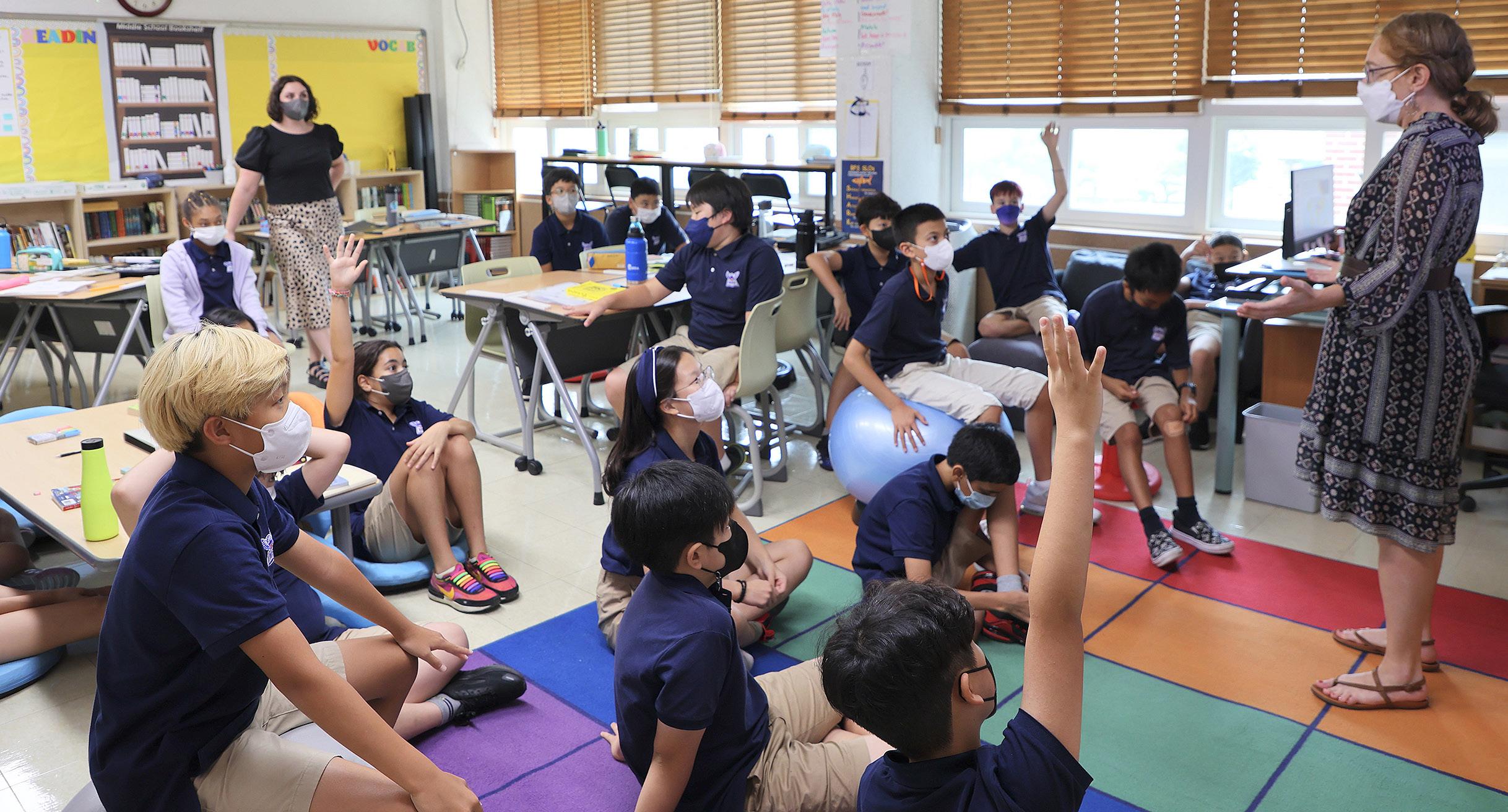 By Lauren Harvey, Early Childhood & Elementary Principal Rebecca Austin-Castillo, School Counselor Carl Brenneman, MS/HS School Principal Busan Foreign School
Introduction: Developing a welcoming learning environment to support students’ men tal health and socio-emotional well-being is more important than ever as we return to in-person learning after the pandemic. In order to ensure a safe and supportive environment, students need to be physically and emotionally regulated; socially and emotionally connected through strong relationships; and ready and able to engage in learning (REL West, 2021).
As part of our school’s recent ACS-WASC self-study process, student social-emotional health and safety was identified as a critical learner need, and our action plan has focused on the goal of broadening support for students in this area. Busan Foreign School has been commended by ACS-WASC for having a warm and welcoming community where stu dents feel known, cared for, and have a deep sense of belonging. This welcoming environment, which provides the foundation for social, emo tional, and academic learning, has been developed through the intentional implementation of programs such as Responsive Classroom, Second Step, and Advisory. “Students who feel seen, heard, and appreciated work to gether to create a positive learning community. Ensuring positive relation ships allows students to focus on their learning” (Doner, 2020). As an American international school with a diverse student population, all staff at Busan Foreign School play a critical role in the emotional and social safety of students. This article will discuss the importance of ensuring a welcoming learning environment and will provide strategies to facilitate students feeling seen and cared for throughout the school year.
Ensuring that students feel a sense of welcome and belonging in their classroom and school building begins on the first day of school. Questions that teachers and school staff can ask themselves in the beginning weeks of school include:
Are we welcoming all students, not just the dominant cultural, linguistic, socioeconomic, or ability group?
Are we establishing unconditional positive regard to ensure stu dents know we approve of them as individuals even when we disapprove of their behavior?
Do we understand that every student behavior serves a purpose and that we must grasp the root cause before knowing how to
SOCIAL AND EMOTIONAL NEEDS
28 EARCOS Triannual Journal
See where ISS can take you and your school
International Schools Services (ISS) provides you with the full range of services necessary to deliver an outstanding global education:

• Start and manage a school

• Supply a school
• Recruit teachers
• Recruit school leaders
• Streamline accounting and finance functions
• Learn through professional development (PD)
Find more at ISS.edu
#ISSedu

Explore great job fair and PD opportunities at ISS.edu/events
International
continued from page 28.
address the behavior? Are we providing adaptive options for students to maintain con trol and get their needs met?
Reflecting on these questions helps teachers to establish a positive class room climate in which all students feel welcome and supported. Teach ers’ reflections as they consider these questions can also inform strate gies that can be used to ensure a welcoming environment throughout the school year. Focusing on best-practice aligned strategies related to physical environment, verbal and non-verbal communication strategies, and identity inclusivity helps students feel welcome and send the mes sage to students that, “I see you, I care about you, and I want you here.” Specific strategies for each area are outlined below.
Physical Environment
It is important to be purposeful about creating a physical learning en vironment in which students are affirmed, comfortable, challenged, and encouraged to take responsibility for their learning (Danielson, 2022).To improve the physical environment for students, teachers may:
• Provide flexible seating options related to proximity to teacher or friends, and types of chairs. In upper elementary and middle school, flexible seating is especially important to accommodate for rapidly growing bodies.
• Personalize the classroom with names, pictures, birthdays, goals, student work displays.
• Maintain a clean, organized room with accessible supplies.
• Include a safe space or calm corner within the classroom with age-appropriate supplies for students to decompress when overwhelmed.
• Clearly display the schedule and objectives for each day so students know what to expect.
• Engage students in co-constructing classroom rules and learning visuals.
Communication Strategies
It is critical that teachers’ communication with students is clear and ac curate, supports their active engagement in a learning experience, and models effective use of language (Danielson, 2022). To improve verbal communications teachers may:
• Ask open-ended and inviting questions such as: “How can I help” versus “Do you need help” and “What questions do you have?” versus “Do you have any questions?”.
• Consider when to address problematic behaviors as a group versus one-on-one.
• Establish that saying “I don’t know” or “Can you come back to me?” is an acceptable student response.
• Ask students what they need to be successful learners and to enjoy learning.
• Catch students being good (e.g., ensure that you praise each student regularly).
• Repeat and rephrase oral questions and instructions as needed and provide written support.
• Express interest in students’ lives outside of the classroom (e.g., recreational activities, interests).
Teachers can also use a variety of non-verbal communication strategies to engage and support all students in learning such as when they:
• Allow think-time and use pauses between statements to create space for others to speak who may need more processing time.
• Are conscious of tone of voice (e.g., encouraging, sincere).
• Use body language (e.g., use of expressive gestures, open arms/open body posture versus crossed arms, nodding head when listening to a student speak).
• Make eye contact (e.g., length of time gaze is maintained with a student).
• Use facial expressions (e.g., smile, calm/relaxed expression as you wait for a student’s response).
• Teach students to use non-verbal signals to alert the teacher of their needs (e.g., taking a break, having a ques tion, using the bathroom).
• Signal that you are available (e.g., keep the classroom door open when possible).
Identity Inclusivity (culture, gender, sexuality, ability)
Knowing and valuing students’ social, emotional, and personality strengths is at the heart of great teaching, and successful teachers consistently seek to understand, honor, and leverage students’ identities - including their racial, cultural, religious, and gender identities, among others. Teach ers use knowledge of their students to systematically affirm student identities and construct learning experiences that are meaningful and purposeful in students’ lives (Danielson, 2022). Teachers show they are inclusive and accepting when they:
• Ensure diverse representation in the classroom by inten tionally displaying and discussing a variety of resources that reflect different identities.
• Ensure correct pronunciation of students’ names.
• Utilize students’ linguistic and cultural funds of knowledge to support learning.
• Ask for preferred names/pronouns; if mistakes are made, correct and move on.
• Are mindful of how success is defined in the classroom, and encourage effort and growth over high test scores.
• Ensure balanced discussion of different identities (e.g., at tend to who is the “good” and “bad” in the narratives you share).
Supporting student emotional growth and safety by creating a welcom ing school environment is essential. The pandemic showed more than ever that students learn best when they are together, and that schools must be intentional in creating a warm environment that welcomes all learners. International schools can create a more welcoming environ ment that supports students’ social, emotional, and academic learning by attending to physical environment, verbal and non-verbal communica tion, and supporting students’ diverse identities in the classroom. These practices have been effective in our school community as we continu ously live our school motto: Embracing Diversity, Striving for Excellence.
References
Danielson Group, 2022. The Framework for Teaching Intellectual Engagement
https://danielsongroup.org/resources/the-framework-for-teaching-intellectu al-engagement/
Doner, 2020. Using the Responsive Classroom Approach to Support ALL Students
https://www.responsiveclassroom.org/using-rc-approach-to-support-allstudents/
REL West, 2021. Supporting the Social and Emotional Needs of Educa tors and Students
https://ies.ed.gov/ncee/edlabs/regions/west/relwestFiles/pdf/REL-WestWebi narHandout-508.pdf
30 EARCOS Triannual Journal
STRANDS
Literacy / Reading
Early Childhood
Special Needs (SENIA)
Modern Languages
Media
Counselors
ESL Technology
Children's Authors
Child Protection
General Education
TEACHERS' CONFERENCE 2023 M A R C H 2 3 - 2 5 , 2 0 2 3 K O T A K I N A B A L U , S A B A H , M A L A Y S I A V i s i t w w w . e a r c o s . o r g / e t c 2 0 2 3 1 9 t h A N N U A L E A R C O S
Technology/Libraries
From Data to Action: One School’s Journey to Meaningful Change
 By Jon Kleiman, Senior School Program Director, Challenge Success & Drew Schrader, M.Ed., School Program Manager

STUDENT WELL-BEING
32 EARCOS Triannual Journal
When Ann Bonitatibus took over at Thomas Jefferson High School for Science and Technology (TJHSST), she knew she was inheriting a strong academic program with a rich history of student success, an outstanding faculty, and a supportive parent community. She also learned early on that this success was often coming at the expense of the overall student and staff well-being.
One of the most common issues she heard about during her inter view process was the extremely competitive nature of the school and its culture. While the toll on student well-being seemed clear to someone coming in with fresh eyes, Bonitatibus recognized that as a community they had not yet “named and claimed” student well-being as a challenge and opportunity to pursue.
Following a review of the available programs and approaches that address wellness, TJHSST found Challenge Success to be the best fit for self-exploration and next steps. TJHSST formed a Challenge Suc cess Team to spearhead and coordinate the work.
Administering the Student Survey & Data Analysis
As a first step, the team had students take the Challenge Success Student Experience Survey. After conducting the survey, the team reviewed the data with researchers and program staff at Challenge Success. This data review provided critical context for student re sponses as well as guidance for continued team-level analysis and suggestions for particular areas to pursue. As the team further ana lyzed their data, three themes emerged as promising places for them to take action:
• Decoupling workload from their understanding of rigor to ease pressure on student time.
• Educating the community around the importance of sleep to improve collective health and well-being
• Strengthening relationships between and among all stake holder groups, in large part by revisiting expectations related to workload and well-being.
These initial focus areas created a bridge from general concerns around student well-being to concrete goals and ideas they could begin to pursue as a community.
Identifying Next Steps and “Just One Thing”
After sharing the data and the emerging focus areas with the school community, the Challenge Success team helped the TJHSST staff move forward together by asking them to “pick just one thing” to try in the coming year that was:
1. Different from the previous year and
2. That they thought could help with one of the focus areas.
Teachers pursued a number of strategies ranging from student shad ow days, where they would follow a student through their day to get a deeper understanding of their experience, to experimenting with project-based learning and more authentic assessments.
The team at TJHSST attributes this “just one thing” approach to much of their early success with staff. Setting the expectation that they only needed to try one thing made the process feel manage
able and approachable, even with busy schedules.
Empowering teachers to choose what they wanted to try created a strong sense of buy-in, but it also leveraged important improve ment science fundamentals. By starting small and then iterating and sharing as they went, the team was able to learn more about the student experience and effective strategies. This has led to stronger and more enduring changes in practices as well as culture.
Iterating Over Time
Often schools take the opposite approach, launching large, complex initiatives only to discover nuances and important factors after ma jor investments of time and goodwill. TJHSST’s “start small and learn fast” approach nicely illustrates an effective and engaging approach to enduring school change, one that is also used by Challenge Suc cess schools during the School Program.
To be clear, the change was not overnight, and school closures with COVID also paused some of the momentum. However, the pro gress to that point made many of the academic adaptations in the virtual environment a natural transition for staff.
Bonitatibus figures it took about two and a half years for the team to really start “firing on all cylinders,” but the results have been clear. One of their favorite indicators of growth is the fact that “fun” jumped into the top 3 words used by students to describe their experience at TJHSST on a recent internal survey modeled after the original Challenge Success student survey. This, along with seeing a continuously improving culture around sleep, use of time, and engag ing pedagogy has helped the team sustain energy and enthusiasm for the work.
Curious about how a story like this could play out in your com munity? Already asking and answering some of these same ques tions? Reach out here to find a time for an informal chat with a member of our program team for thoughts and guidance on how to take your work to the next level.
About the Authors
Jon Kleiman, M.A., is a Senior School Program Director. He oversees the operation of the school program, providing coordination, re sources, and management to Challenge Success schools on the East Coast. Jon has worked in the education space in several capacities, from creating curriculum for the opening of a school for Rwandan women to developing and teaching design thinking courses to un dergraduates.
Drew Schrader, M.Ed., is a School Program Manager. He has worked to help educators across a wide range of contexts redesign their systems around deeper learning for all students with a particular focus on project-based learning and authentic assessment. Prior to working at Challenge Success, he served as the Director of Assess ment and a School Development Coach for New Tech Network. He was also a founding teacher and local teacher advocate at The Academy of Science and Entrepreneurship in Bloomington, IN. He has particular interests in improvement science and organizational change.
Fall 2022 Issue 33
An English-Immersion School’s Experience with Data Wise and Its Implications to the Work of Professional Learning Communities

Research promotes that Professional Learning Communities (PLCs) have three big ideas: ensuring that students learn, collaboration, and result-ori entation (Dufour, 2004). PLCs are built upon the work of Bolivar (2014), who maintains that teachers in schools should learn in a collaborative manner, talk about their teaching, and have opportunities to share experi ences. Volkel & Chrispeels (2017) found that high-functioning PLCs con tribute to high levels of teacher collective efficacy, the belief that school staff can “achieve collective goals and overcome challenges to impact student achievement” (Donahoo, 2017, p. 1). Hattie’s (2018) meta-anal ysis found that collective teacher efficacy is the factor in education that has the most influence on student achievement among 252 influences. Thus, PLCs can be a major player in helping students achieve academic excellence. During a successful PLC, teams must collaborate, respond to school challenges, and agree on the standards of quality in analyzing data (Fisher, Frey, & Uline, 2013).
Our study was at Nansha College Preparatory Academy (NCPA), a sec ondary English-immersion international school in South China. All stu dents are English Language Learners, Chinese nationals. NCPA employs a majority of native English-speaking teachers, mostly from North America as well as local (Chinese) teaching assistants. The school utilizes the Data Wise Improvement Process (DWIP) (Boudett, City, & Murdane, 2017) to facilitate the work of its PLCS. This process guides teams to work collaboratively, understand and make connections between data and in struction, and develop action plans and assessments to improve teaching and learning. Teams must agree to specific norms and protocols to help make the inquiry process less intimidating and promote teachers’ buy-in as they move into the next category, gathering and discussing data. The DWIP strongly promotes the idea of an equity lens, which means telling the stories of all students and working towards the success of all stu dents (Bocala & Boudett, 2022 p. 3). During the school year 2021-2022, 8 teams were engaged in using the DWIP at NCPA.
Our research question is: How do teaching staff from various backgrounds in Professional Learning Communities (PLCs) perceive the Data Wise Im provement Process as enhancing student learning? Ten participants, both foreign and local staff, were randomly chosen for qualitative interviews, collected in 2021. This data was viewed in a paradigm of discovering staff members’ perceptions of how DWIP influenced staff members’ work in a PLC, and how that work was related to staff members’ cultural back grounds and experiences.
By Dr Maria Domingues and Dr Emily Sherwood Nansha College Preparatory Academy (NCPA)
Participants were generally positive about the DWIP’s effect on the PLC component (Dufour, 2004) of collaboration. Most of the staff members and, strikingly, all local staff stated that the DWIP was helpful for improving collaboration.There was the sense in this research that DWIP allowed for more equal voices and improved teamwork. DWIP participants reported that, of all the PLC components (Dufour, 2004), the DWIP improved collaboration the most. For teaching assistants, the DWIP was especially empowering because they felt more open and felt they had a reason and impact in student learning. Collaboration was enhanced by protocols and the structure of the DWIP agenda meetings (Boudett & City, 2014). The DWIP provided a chance to share and helped staff to focus on the tasks at hand to improve student learning.
ACTION RESEARCH
34 EARCOS Triannual Journal
Several staff members noted that, of all the PLC components, pro fessional learning was the most helpful component provided by the DWIP. Teachers learned about differentiation in the classroom and how to develop an increased instructional impact. Staff also felt that the DWIP led to more teacher problem-solving and gave a chance to share resources and ideas. Participants stated that the DWIP helped teachers to become more reflective in their practice, and teachers became more credible for students. Teachers also used more feedback in their teaching after the DWIP. Key to this, as per ceived by teachers, is helping teachers to discover the problems of the students and solve them.
Staff appreciated the focus on data in the DWIP. Staff recognized that there was less bias in data using multiple sources, including class room data, student behavior, and formal and informal assessments. For some staff, DWIP was an opportunity to learn how to collect and analyze data from student work. The data analysis skills learned will be helpful for future teacher planning.
We found from the interviews that there were multiple confusions about what a PLC is, its role, and how it connects to the DWIP. Multiple staff members, both foreign and local, did not understand what a PLC was; several thought, for instance that a “learning team,” a traditional form of professional development where teachers learn from a teacher-trainer, was the only PLC that took place at school. Multiple content-area teachers and EAL specialists equated PLCs solely with planning, and many participants did not understand how the DWIP led to PLC growth. This shows us that the school should do a better job of educating teachers about the role and expecta tions of a high-quality PLC.
Multiple local and foreign participants also struggled with defin ing and understanding equity, which is not the same as equality, or getting the same input, but individuals getting what they need to ensure equal access and fairness (Brandeis University, 2022). First, many participants did not understand what the term equity meant. Secondly, many participants believed that equity was not possible in the classroom. As the DWIP strongly promotes an equity lens (Bo cala & Boudett, 2022), these findings suggest that the school needs to work towards a shared view of equity and work towards teacher collective efficacy to reach every student (Donahoo, 2017).
Overall, participants were positive about the DWIP and its effect on students; many noted that they had negative views of the DWIP before starting work and changed to positive ones. Our mostly posi tive findings are somewhat like our previous study (Sherwood et. al, 2020). The experiences of these participants suggests that the DWIP is one powerful way to help PLCs ensure higher levels of student success.
References
Bocala, C., & Boudett, K.P. (2022). Looking at data through an equity lens. Retrieved from: https://www.ascd.org/el/articles/looking-at-da ta-through-an-equity-lens
Bolivar, A. (2014). Building school capacity: Shared leadership and professional learning communities: A research proposal. International Journal of Educational Leadership and Management2(2), 147-175.
Boudett, K. P., E. A. City, and R. J. Murnane (2017). Data wise: A step by step guide to using assessment results to improve teaching and learning. Cambridge, MA: Harvard Education Press.
Boudett, K. P., and E. A. City (2014). Meeting wise: Making the most of collaborative time for educators. Cambridge, MA: Harvard Educa tion Press.
Brandeis University (2022). Our social justice definitions. Retrieved from: https://www.brandeis.edu/diversity/resources/definitions.html.
Donahoo, J. (2017). Collective efficacy: How educators’ beliefs impact student learning. Thousand Oaks, CA: Corwin.
DuFour, R. (2004). What is a” professional learning community”? Edu cational leadership, 61(8), 6-11.
Fisher, D., Frey, N., Almarode, J., Flories, K., & Nagel, D. (2019). The PLC+ Playbook, Grades K-12: A Hands-On Guide to Collectively Improv ing Student Learning. Corwin.
Fisher, D. Frey., N., & Uline, C. (2013). Fisher, Douglas, and Nancy Frey. Common Core English Language Arts in a PLC at Work®, Leader’s Guide. Solution Tree Press.
Hattie, L. (2018). Hattie ranking: 352 influences and effect sizes re lated to student achievement. https://visible-learning.org/hattie-rank ing-influences-effect-sizes-learning-achievement
Sherwood, E., Domingues, M., Elsen, G., Tagessen, J., Wang, H., Xie, W. S., ... & Cyrus, M. (2021). Collaboration for Literacy Improvement: The Experiences of Teacher-Researchers in the First Stages of an Inquiry Process. The Clearing House: A Journal of Educational Strategies, Issues and Ideas, 94(3), 128-136.
Voelkel Jr., R. H., & Chrispeels, J. H. (2017). Understanding the link between professional learning communities and teacher collective efficacy. School Effectiveness and School Improvement, 28, 505-526.
About the Authors
Dr Maria Domingues is an Assessment Coordinator, and Dr Emily Sherwood is a Reading Specialist both in Nansha College Prepara tory Academy (NCPA). They can be contacted at mariajcastro@ gmail.com and sherwood561@gmail.com
Fall 2022 Issue 35
Promoting Middle School Multilingual Learners’ Willingness
To Communicate in the Classroom
By Eunae Kim PYP/MYP MLL Teacher Bandung Independent School eunae.kim@bisedu.or.id
Introduction
What makes students want to speak up or stay quiet in class? Since March 2020, due to the COVID-19 pandemic, the school where I teach had to transition to teaching online/hybrid. As a teacher, I noticed that the students in my class became quieter and unwilling to share their ideas freely. This research has been my journey as a teacher supporting students through challenging times. Understanding that students have the choice to speak up and the act of speaking is “volitional (freely chosen)” (MacIntyre 2007, p.564) made me wonder what practical strategies I, as a teacher, could use to support my students better. The research questions are what factors affect Willingness To Communicate (WTC) and how teachers can encourage middle school multilingual learners to increase their WTC in the classroom.
Literature Review
The concept of the WTC for second language (L2) learning was extended from the first language concept by MacIntyre et al. in 1998. They started investigating what made students willing to communicate and discovered that it was not just about their language competence. WTC integrated psychological, linguistic, educational, and communicative approaches to L2 learning (MacIntyre et al.,1998, p. 245). MacIntyre et al. suggested that a reasonable goal of L2 learning is to increase WTC (MacIntyre et al.,1998, p. 558). Interestingly, learners will start communicating with specific peo ple in a particular environment whenever they feel ready. (MacIntyre et al.,1998). The three most important variables “as predictors of WTC are anxiety, perceived language competence, and motivation” (MacIntyre and Wang, 2021, p. 882).
Studies show that when students feel that their English is not good enough (low perceived competence) and are anxious about the situa tion (high anxiety), they are less willing to express themselves (MacIntyre et al.,1997). When students think their English is not good compared to their peers, they will not speak up in front of them. In a recent study, Mac Intyre and Wang (2021) suggested that teachers should “consider learner beliefs and emotions aroused by teaching techniques” (p. 894) because emotions can encourage or discourage students’ engagement in learning. This implies that if teachers focus on increasing students’ perceived com petence and lowering anxiety with ample comprehensible input, students’ willingness to communicate can increase.

Context and Approaches
I taught an English pull-out program where students take English Lan guage Acquisition classes. Most observations and interactions happened online. The participants were six middle school students between the grades 7-10, Phases 2-4 of the IB Middle Years Programme (MYP) Lan guage Acquisition level, ranging from 1 to 4 years of English language learning experience. Students’ nationalities consisted of Korean, Indone sian, and Japanese. I observed students’ communication in class, took field notes and recorded classes for reference to collect data. The WTC scale, survey questionnaire, students’ assessments, and teacher reflection jour nals were used to measure students’ WTC.
Results
WTC Scale
The WTC scale from McCroskey and Richmond (2013) was adopted and modified to specific English language speaking situations to meas ure the students’ level of WTC. The students were asked about their comfort level of speaking and presenting in English with close friends, teachers, acquaintances, and strangers in small and large group settings.
ACTION RESEARCH
36 EARCOS Triannual Journal
One student showed the lowest level (1) for all situations indicat ing that her WTC was very low. Most students preferred talking to people rather than presenting ideas, regardless of group settings. All students except one showed higher WTC to their favorite teacher and close classmates. The students expressed that they were willing to communicate when they felt more comfortable with the setting: smaller group, favorite teacher, and close classmates.
Assignments-Focusing on students’ interests and passion
In an assignment on researching one hero, I created a reading list of people like Malala who were famous. However, students asked me if they could choose their own heroes instead - a baseball player and a singer from their cultural group. Their eyes sparkled when they started researching them.The summative assessment was to present their heroes to the class. The slides the students used were rich with many images and colors, the information was very detailed and pro found, and students shared information more than required. In the unit reflection, ‘Amy’ mentioned that she realized she could write bi ographies for anyone she admired, not just for famous dead people.
Working with parents
I learned that four of my students were taking outside lessons after school. Ironically, their engagement in classroom activities and forma tive assessments were getting low. ‘Amy’ confessed that she wanted to give up since she thought there was no hope in trying to do better. When parents were worried that their child would not do well in school, it caused them to look for more outside support, not realizing that it could add more stress and extra burdens on their child. Through open communication with parents about their child’s abilities and needs, the parents could evaluate the impact of outside support and adjust workloads, and my students started being on track with assignments.
Students’ emotional and physical well-being
‘Daniel’ would always answer, “So so,” when asked, “How are you to day?” He stayed quiet in class most of the time. Sometimes, he would doze off during class. I created a “Health and Well-being” unit and introduced how to evaluate and create social advertisements. We explored topics like sleeping habits, a healthy diet, and self-esteem. I learned that ‘Daniel’ only slept 4 hours the night before because he was playing video games with his friends and only had water for breakfast and snack. No wonder he would feel miserable every time he joined my class first thing in the morning. ‘Daniel’ repeatedly mentioned that he wanted to eat healthier, add more hours to his sleep, and build his time management skills. On the 5th week of this action research, he finally answered, “Good!” to my question about how he was doing. He smiled, and his engagement in class improved, becoming the first person to speak up.
WIDA results
Students took the World-Class Instructional Design and Assessment (WIDA) Measure of Developing English Language (MODEL) assess ment at the end of last semester. They reviewed where they were in each English skill: listening, speaking, reading, and writing. I provided feedback individually and time to set a goal for each skill. ‘James’ was proud to find out that his reading level was at 5 out of 6, and he shared that he would like to read more books to get even better, while his writing level was 2. Seeing other skills at higher levels, he became ambitious, setting his goal to reach 4 in writing, believing that he could get there soon. Instead of seeing themselves as students
who were not good at English, the students realized that they were improving in particular English skills and started focusing on what they could do instead of what they could not.
Pedagogical Implications
First, to lower anxiety, the class should be predictable. Students felt more confident when I provided specific assignments with clear di rection to help them prepare what they wanted to present or share.
I learned that students answered questions much better if I could provide them time to organize their thoughts. I used asynchronous time to let students prepare for their presentations, and I started my synchronous class with them “showing off” their knowledge.
Second, teachers should provide opportunities for students to ex press who they are in class.
I witnessed students come alive when they were offered to share their personal experiences and passions. ‘Rick’ is in love with baseball. He wants to be a baseball player and knows everything about base ball. He is an expert, and I can learn much from him, even though his English is limited in expressing his profound knowledge. It is easy to forget to give multilingual learners voices to verbalize where they are from, what they cherish, and what they love in life.
Third, students feel much more comfortable and confident when they can inquire as agents of learning. In studying the novel The Breadwinner, I asked my students what they already knew and want ed to know about Afghanistan, thinking they would all share some thing about war, terrorism, or refugees. To my surprise, what they shared differed significantly from what I expected. They wanted to know more about the life of teenagers, whether or not they love idols like BTS, their traditions, cultures, delicious food, family life, and beautiful places. I asked them to choose one topic they liked about Afghanistan, research, and share it with the class. ‘Hanna’ was excited to share what she learned about the food and the culture. She men tioned, “This is interesting because we always talk about war and ter rorism when we think about Afghanistan. I wanted to find something I could connect to.”
Fourth, teachers should implement ways to build positive relation ships with students to lower anxiety. Mercer and Dörnyei (2021) argued that building a Teacher-Student Rapport is essential for stu dents’ engagement in language classrooms.Teachers should prioritize personal check-in time with students. I have learned that promoting WTC is much more complex than just implementing quick-fix strat egies. By performing this action research, I could hear students’ chal lenges. Some were overwhelmed with their overloaded schedules and assignments; some were experiencing negative emotions like anxiety or low self-esteem. We should remember that when stu dents have low anxiety and motivation to communicate, they often prefer to communicate with a specific person. I was amazed that my students showed the highest WTC with their favorite teacher.Teach ers can be the people students are willing to talk to when building deeper relationships. When teachers learn more about their stu dents and develop meaningful relationships, they effectively promote students’ engagement in class (Kim & Aguskin, 2022, p.77).
Finally, let your students know how much they have progressed and celebrate the progress. Using the WIDA assessment and goal setting effectively made students know where they were in learning English. Instead of thinking, “I am terrible at English,” students started
Fall 2022 Issue 37
to see what they could do to improve certain areas. Also, using read ing tools like Readtheory, students could track their progress and see how much they improved. I also compiled students’ speaking and writing practices, allowing them to see their progress over time.
Conclusion
My initial focus was to support students’ WTC and engagement in class. However, through this action research, I evaluated my way of teaching, and it was pretty humbling. I often wondered why students did not speak up much in class but did not realize that I was not giving them enough time to process what they wanted to express. I could understand their struggles, challenges, and how unique and precious they were as people. Some days I feel like a total failure because my students do not speak up, but now I know that that is okay. My job is to continuously research what affects my students and how I can support them in this long journey.
References Kim, E., & Aguskin, L. (2022). The Role of the Teacher-Student Relation ship in Promoting English Language Learners’ Engagement for Online Learning during the Covid-19 Pandemic. Atlantis Press. https://www. atlantis-press.com/proceedings/teflin-icoelt-21/125970066
MacIntyre, P. D., Noels, K. A., & Clément, R. (1997). Biases in Self-Rat ings of Second Language Proficiency: The Role of Language Anxiety. Language Learning, 47(2), 265–287. https://doi.org/10.1111/00238333.81997008
MacIntyre, P. D., Clément, R., Dörnyei, Z., & NOELS, K. A. (1998). Conceptualizing Willingness to Communicate in an L2: A Situation al Model of L2 Confidence and Affiliation. The Modern Language Journal, 82(4), 545–562. https://doi.org/10.1111/j.1540-4781.1998. tb05543.x
MacIntyre, P. D. (2007). Willingness to Communicate in the Sec ond Language: Understanding the Decision to Speak as a Volitional Process. The Modern Language Journal, 91(4), 564–576. https://doi. org/10.1111/j.1540-4781.2007.00623.x
MacIntyre, P. D., & Wang, L. (2021). Willingness to communicate in the L2 about meaningful photos: Application of the pyramid model of WTC. Language Teaching Research, 25(6), 878–898. https://doi. org/10.1177/13621688211004645

McCroskey, J. C., & Richmond, V. P.. (2013) . Willingness To Communi cate (WTC). Measurement Instrument Database for the Social Sci ence. Retrieved from www.midss.ie
Mercer, S., & Dörnyei, Z. (2020). Engaging Language Learners in Con temporary Classrooms (New ed.). Cambridge University Press.
About the Author Eunae Kim is a PYP/MYP MLL Teacher at Bandung Independent School. She can be contacted at eunae.kim@bisedu.or.id
38 EARCOS Triannual Journal
ACTION RESEARCH
Exploring the Impact of 360-Degree Feedback on Teachers’ Professional Learning
By Melissa Burnell
EMA is a Grade 5 PYP teacher Chadwick International School

The lack of purposeful feedback is the leading reason professionals leave organizations (Brown, 2012, as cited in Stone & Heen, 2014). In the absence of effective feedback, the selection of professional growth goals, appraisal inquiries, and professional development resources may lack di rection and purpose. To support an organizational culture of continuous learning and improvement, feedback should be integrated into a school’s professional development processes. The 360-degree feedback ap proach uses feedback from multiple perspectives to render a clear pic ture of an individual’s professional behavior and potentially reveals blind spots (Goleman et al., 2013). The purpose of this study was to explore the impact of 360-degree feedback on faculty professional learning.
Research Question
How does 360-degree feedback inform teachers’ professional learning decisions?
Methodology
The 360-degree feedback approach detailed by Ainsworth (2016) was the primary guide used to design the process for this study. The method includes the following steps:
1. Select a framework for feedback and develop criteria for evaluation;
2. Design feedback forms;
3. Collect feedback from stakeholders;
4. Hold one-to-one discovery sessions;
5. Move from discovery to planning and implementation
Select Framework for Feedback and Develop Criteria for Evaluation
The school’s six teacher traits, shown in Table 1, were selected as the framework for the 360-degree feedback process. A committee of teachers collaborated to unpack the six traits into specific actionable criteria (Scott, 2019). Inviting participating teachers to take part in the authoring of the criteria was important for fostering ownership (Ains worth, 2016).
Table 1
Teacher Traits Used in Developing Criteria
Teacher Traits
Student-centered Collaborative
Professionally grounded
Innovative
Globally minded
Technologically competent
Design Feedback Forms
Google Forms was selected as the primary 360-degree feedback collec tion tool for its utility and familiarity within the organization. A six-point scale was used to avoid the potential misuse of a midpoint (Chyung et al., 2017). Each criterion was followed by an open-response space in which evaluators had the option to provide specific examples of be havior.
Collect Feedback from Stakeholders
In addition to completing a self-assessment, participating teachers select ed an administrator, peer teachers, current students, and parent evalua tors to provide feedback. Table 2 exhibits the number of evaluators that could be selected.
Table 2
Number of Evaluators by Stakeholder Group
Self Administra tor Colleagues Students Parents 1 1 3-5 3-5 3-5
Hold One-to-One Discovery Sessions
The purpose of the discovery session was to unpack the teacher feed back with support from the researcher. Teachers were given online ac cess to their feedback 48 hours prior to their discovery session to allow for independent data exploration. At the start of each discovery session, the researcher gathered information on the career path of the teacher along with career goals that could be used to provide direction for the 360-degree feedback data (Ainsworth, 2016).
Teachers were given the choice of how their data would be explored during the discovery session. The majority of the participating teach ers requested to compare their self-evaluations with the feedback from another stakeholder group, such as from their colleagues. Feedback was reviewed together, and time was given for teachers to share their im pressions of the data along with potential implications. At the conclu sion of discovery sessions, key conversational points were outlined, and teachers were asked to share possible areas for professional learning based on the data.
40 EARCOS Triannual Journal
Move from Discovery to Planning and Implementation
At the commencement of the following school year, participating teach ers set professional goals, selected yearlong inquiries, and chose profes sional development opportunities per annual requirements. Optional tools were provided to aid in planning professional inquiries. Coaching support was offered to participating teachers as well.
Results
Participants reported a positive correlation between receiving feedback and making informed decisions about teaching and professional learning throughout the year. One teacher participant reflected:
“I was able to set my professional goals for the current year and professional inquiry for this year based on the feedback I received from last year during this process, which has in turn helped me to intentionally take professional learning opportunities that best address some areas of improvement out lined in the 360 degrees feedback.”
The feedback provided new insights on how stakeholder groups per ceived the teachers. Multiple teachers shared that 360-degree feedback increased their confidence. One teacher remarked:

“The 360-degree feedback I received has made me feel more confident in my teaching and collaborative practices. Receiving the feedback has made me realize that my voice is valued in my team and I should be more confident with my instincts as an educator, even as a new teacher intern.”
A theme that emerged from the participant responses was the way in which the 360-degree feedback prompted ongoing reflection. Teachers commented:
“The feedback given allowed me to reflect on my own perspective of my performance at work and the noticings of others. This experience also gave me insight into the reflective process that is needed for self-improvement.”
“After the 360-degree feedback, I think about how my teaching will impact on my team, students and families.”
Several unexpected benefits developed from the 360-degree feedback process. One administrator that provided feedback to participating teachers acknowledged that the process also provided deep reflec tion opportunities for school leaders. When applying for a homeroom teaching position, a teacher intern was able to share specific 360-de gree feedback they received with interviewers. Two teacher interns also integrated 360-degree feedback into their professional portfolios to improve networking and career development.
Overall, the reflections of participating teachers demonstrated that 360-degree feedback was valuable to their professional learning and was a positive experience. Receiving feedback from administrators, col leagues, students, and parents also contributed to increased professional reflection and confidence.
Discussion and Implication for Future Practice
Learning starts with facing our limitations (Kegan & Lahey, 2016). Or ganizations should support teachers in identifying “a personal chal lenge—meaningful to [them] and valuable for the [organization]—that [they] can work on in order to grow” (Kegan & Lahey, 2016, ch. 3, para. 8). The 360-degree feedback process provides teachers with the op portunity to gain insights from those they work most closely with, such as colleagues and students.
To successfully implement 360-degree feedback, organizations need to be committed to supporting people through the process. Reflections from participating teachers suggested that supportive check-ins would help with applying 360-degree feedback to professional learning. Ad ditionally, referencing 360-degree feedback in goal-setting meetings with administrators would amplify the benefits.
References
Ainsworth, E. (2016). 360° Feedback: A transformational approach. Pan oma Press Ltd.
Chyung, S., Roberts, K., Swanson, I., & Hankinson, A. (2017). Evidencebased survey design: The use of a midpoint on the Likert scale. Perfor mance Improvement, 56(10), 15-23.
Goleman, D., Boyatzis, R., & McKee, A. (2013). Primal Leadership: Unleash ing the power of emotional intelligence. Harvard Business Review Press.
Kegan, R., & Lahey, L. L. (2016). An Everyone Culture. Harvard Business Review Press.
Scott, K. (2019). Radical Candor: Be a kick-ass boss without losing your humanity. St. Martin’s Press.
Stone, D. & Heen, S. (2014). Thanks for the Feedback: The science and art of receiving feedback well. Penguin Group.
About the Author
Melissa Burnell, EMA is a Grade 5 PYP teacher at Chadwick Interna tional School in South Korea. She may be contacted at mburnell@ chadwickschool.org.
Fall 2022 Issue 41
ACTION RESEARCH
The Role of Motivation and Memory in Second Language Acquisition
 By Leandro Venier Faculty, World Languages Head of Department (HS) The International School of Kuala Lumpur

It is often said that to learn is to remember. It is not uncommon, however, for teachers to observe the difficulties related to retrieval practices of students not being able to communicate at the level that we are expecting them to. How many times have we taught the same concept only to find that students struggle to recall it? This action research project focuses on the role of motivation and memory and aims to give some plausible answers to the following question: what role does motivation play in memory retention?
While memory encoding and consolidation processes have been studied within the context of second language acquisition for a long time, the role of motivation in memory retrieval remains an area mostly unexplored. While it is well known that an understanding of how memory works is paramount for teaching and learning, this ac tion research project aims to explore the role that motivation has in promoting enhanced performances in relation to memory and sec ond language acquisition.
In order to do so, we have taken a look at both concepts separately and then brought them together within the framework of our classes and collaboration in the High School World Languages Department at the International School of Kuala Lumpur (ISKL) through research, ad-hoc strategies and activities for International Baccalaureate Spanish B Year 2 students at the end of their coursework and during revision before external examinations.
Our experiments and discussions show possible implications of teach ing and learning and shed some light in relation to a key proposition: we began with our assumption that motivation had no impact on memory and designed, implemented and analyzed tasks between a control group and a regular class to see if indeed this our assumption was correct.
Our results not only show that motivation has a measurable effect on memory but also that student choice and ownership of their own learning while incorporating meaningful planning and student involve ment in classroom decisions do lead to an enhanced performance of working and long term memory.
In sum, an approach to teaching and learning which includes consid erations raised within this action research project has the potential to increase students’ motivation and also memory retention in second language learning. In times of Covid 19 where motivation in education is severely lacking, it is interesting to discuss how we can find ways to promote motivation thus enhancing our memory processes in terms of second language teaching and learning. We have seen in our action research project that learning is indeed a motivated activity and that motivational states with a growth mindset can have a clear impact on memory performance.
Read full action research article (click here)
42 EARCOS Triannual Journal
Strategic Choice of Specific Co-teaching Models for Scaffolding the Delivery of Content and Language Integrated Learning (CLIL) Experiences
By Lisa Boulestreau, EAL Specialist & Jamie Bacigalupo, MYP/DP Language and Literature Seoul Foreign School
Context:
Like many inclusive classrooms, our school uses a collaborative teach ing approach to respond to the increase in diverse language pro files entering the high school and to foster language development in multilingual learners. In our context, subject-area teachers and EAL specialists work in tandem combining expertise to impact teaching and learning. In order to provide students with both content and language integrated learning (CLIL), we set out to examine how each part of the collaborative teaching cycle (CTC) could shape our in struction and choice of co-teaching models (CTM) to deliver a more scaffolded delivery of lessons and to help us to answer our research question:
• How can we strategically choose which co-teaching model to ef fectively facilitate content and language integrated learning (CLIL)?
Participants: Our action research into co-teaching models was car ried out in two sections of MYP 4 Language and Literature. Section A has 19 students: 7 of whom have various levels of English lan guage proficiency ranging from expanding (2 students), bridging (3 students), to reaching (2 student) on the WIDA proficiency scale. Section B has 16 students. Four students have levels of proficiency on the WIDA scale: expanding (2 students) and bridging (2 students) and three students in this section also receive learning support in Tiers 2 and 3 respectively.
Study Design and Data Collection: With our research question and participants in mind, we engaged in the CTC (co-planning, co-teach ing, co-assessment of student work, and co-reflecting) consistently over five months from November 2021 to April 2022. In Novem ber, we also participated in a one-month long online co-teaching workshop by WIDA called Co-Teaching: Stretching your co-teaching not only to help guide us through the process of the CTC, but also to ensure a shared understanding of what effective co-teaching entails. We gathered student feedback in the form of 2 surveys in December and April to determine student perception of collaborative teaching and effectiveness of our lessons meeting content/language objectives.
Co-planning: impact on Content and Language Integrated Instruc tion (CLIL)
When there is relational trust amongst teachers, the greater chance of collaboration will happen (Robinson, 2015) and the CTC can be gin with the impactful step of co-planning. Using a collaborative coplanning document helped us focus on crafting language and content objectives to meet student needs and build awareness of each oth ers’ roles and expertise in the process and the delivery of the lessons. Below is an outline of our co-planning document, (from WIDA: Virtual Collaboration Course: Stretching Your Co-Teaching, 2021

ACTION RESEARCH
44 EARCOS Triannual Journal
•
Content: What are students supposed to learn?
• Language: What language will students need to learn the content?
• Process: How will they learn?
• Product: How will they demonstrate their learning?
• Co-teaching delivery
• Co-teaching model
• Scaffolds
• What is each teacher’s role?
• Responsibilities and Prep:
• Subject specialist
• EAL Specialist
• Assessment criteria
• Next moves (reflections)
Emphasizing these CLIL components establishes more balance and eq uity within the teachingpartnership, where both teachers will drive the lesson.
Co-planning, co-teaching, co-assessing, and co-reflecting: bringing it all together.
Once we defined the unit goals, we then considered CTMs based on ongoing formative assessment. Our choice of CTMs was dependent on the co-evaluation of student work. Additionally, through co-reflection using the 4-Square Reflection Protocol (see below), we asked ourselves to what degree students met lesson objectives and how we could help students access the curriculum both academically and linguistically.
4-Square Reflection Protocol
What did students do academi cally? Linguistically?
Where do students need to im prove academically? linguistically?
Why? What did we do as coteachers to make that happen?
How? What might we do as coteachers to make that happen?
We found that using formative assessment and considering student per formance in both content and language was the key factor in choosing CTMs for our MYP 4 classes.
For example, in our recent Maus unit, we co-assessed student para graph writing, which revealed three distinct groups at different stages of learning. Group 1: students needing additional instruction with analy sis; group 2: those meeting expectations in analysis, needed to refine language/develop their ideas; group 3: needed an additional challenge. With this data, we reviewed the co-teaching models from Honigsfeld and Dove (2019):
1. One group: One leads, one teaches on purpose
2. One group: Two teach, same content
3. One group: One teaches, one assesses
4. Two groups: Two teach, same content
5. Two groups: One pre-teaches, one teaches alternative information
6. Two groups: One reteaches, one teaches alternative information
7. Multiple groups: Two monitor/ teach
After careful review of the CTMs and the data from the formative as sessment, reteaching to two specific small groups (consisting mostly of EAL and students in learning support) was needed. Consequently, we combined the ideas from models 4 and 5 to create our own co-teach ing model: “two reteach, same content”- a more flexible co-teaching model to adapt to our students’ needs and scaffold and differentiate the lesson purposefully. While we retaught those designated groups, the other students were divided into two separate groups. Group A used a
ladder of feedback scaffold to help guide peer work for language refine ment and development of ideas, and Group B worked to preview the upcoming lesson independently by reading an essay and outlining the essay’s structure.
Our findings from the retaught groups revealed that the students ben efited from small group intentional instruction. In fact, students saw improvement in their writing from writing descriptions of evidence to using evidence to analyze. In contrast, the data from Groups A and B was inconclusive. We only used observation as an evaluation tool of these two groups, which did not indicate whether the students had real improvement in their language refinement and development of ideas or if Group B felt challenged. What was missing was adequate time to co-assess the work from these two groups. Therefore, we cannot say with certainty that the choice of this particular co-teaching model was effective for all students. The significance of the data, along with the ab sence of data we did not collect, solidified the idea that co-planning and co-assessing student work frequently go hand in hand. In other words, through formative assessment, teachers are able to discover learning gaps in content and language attainment through student work, which informs future instruction and lesson design.
In a recent lesson we used the CTMs, “one teaches, one assesses”, “two teach, same content” to teach compare and contrast writing. To meas ure the effectiveness of this lesson, students completed a brief survey in response to the following statement on a 5-point Likert scale: Ms. Baci and Ms. Boulestreau’s lessons were effective in my understanding of compare and contrast writing. The results (see below) showed that 75% of the class agreed lessons were effective based on our chosen CTMs. 24% remained neutral and no one disagreed with the statement. In sum, the large majority felt confident entering the upcoming summative assessment and that our choices in lesson design were meaningful to students’ learning.
Neutral 24.2%
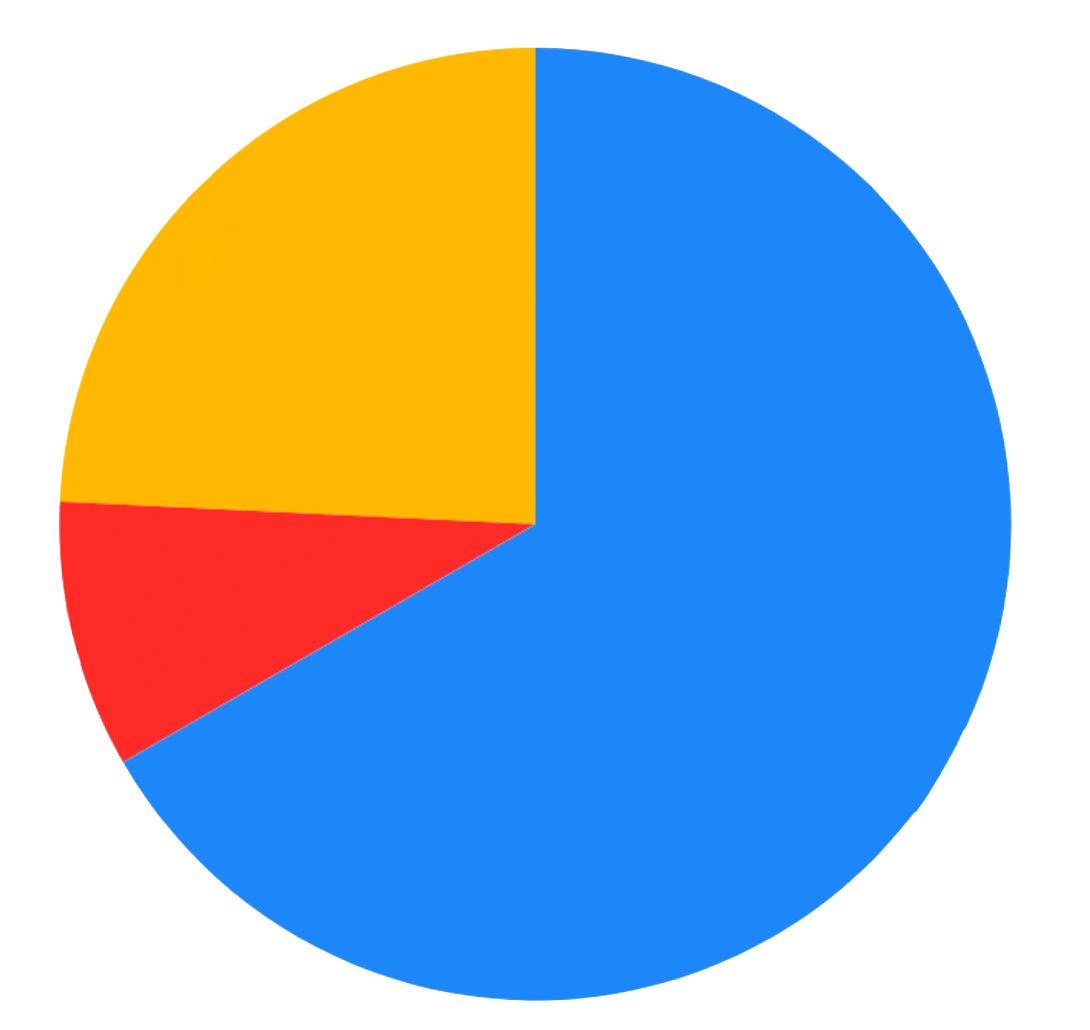
Strongly Agree 9.1%
The students’ voice and perceptions of this collaborative teaching were also important in our reflections: “Having two teachers benefits my learning as I’m able to gain a wide range of perspectives and more knowledge on the topics we are learning.” Indeed, when we are able to combine language and content by using formative assessment to evalu ate student needs, both teachers are used in meaningful ways. Overall, our findings revealed that co-teaching and the choice of CTMs is flex ible and creative.
Agree 66.7%
Fall 2022 Issue 45
Final Insights
The aim of our action research was to investigate the impact of using the CTC to choose CTMs in order to facilitate CLIL. After a year of working in tandem and gathering qualitative data about our practice, we noted that the entire collaborative teaching cycle needs to be re spected, notably co-planning. This time was one of the essential factors in developing our relational trust and enabled co-planning and lesson design to be intentional.
With experience and relational trust, co-teachers are able to collabo rate and move with the ebb and flow of a lesson to facilitate a type of delivery. Whether the planning of the CTMs happens prior to the lesson or shifts in the moment, the main goal is that the choice of CTMs adjusts to the students’ needs at all times and that teachers respond with the proper scaffolded instruction. We hope that our readers are able to take these lessons and insights from our experiences and create a simi lar synergy in their co-teaching partnerships to design more intentional lessons for CLIL.
References
Building Relational Trust/ Viviane Robinson COK 2015 [Video]. (2015, May 28). YouTube. https://www.youtube.com/watch?v=jDLi7tTiY9U
Davison, C. (2006). Collaboration between ESL and content teachers: How do we know when we are doing it right? International Journal of Bilingual Education and Bilingualism, 9(4), 454-475.
Dove, M., & Honigsfeld, A. (2010). ESL Coteaching and Collabora tion: Opportunities to Develop Teacher Leadership and Enhance
Student Learning. TESOL Journal, 1(1), 52-58. https://doi.org/10.5054/ tj.2010.214879
Honigsfeld, A., & Dove, M. (2016, December/January). Co-Teaching ELLs: Riding a Tandem Bike Content-area teachers and ESL teachers can ad dress the needs of English language learners with a collaborative instruc tional cycle that starts with co-planning. Educational Leadership, 56-60.
Honigsfeld, A., & Dove, M. (2019). What Are the Essential Components of an Integrated, Collaborative Service Delivery for ELs? In Collaborating for English Learners: A foundational guide to integrated practices (2nd ed., pp. 69-105). Corwin Press.

Ivanova, I. (2018). Teacher Collaboration in CLIL Contexts: Challenges and Good Practices. Studies in Linguistics, Culture and FLT, 1, 78-89.
Nordmeyer, J., & Honigsfeld, A. (2020, July). Collaboration: Working To gether to Serve Multingual Learners. WIDA Focus Bulletin, 1-13.
Nordmeyer, J., & Honigsfeld, A. (Presenters). (2021, November). WIDA: Virtual Collaboration Course: Stretching Your Co-Teaching [Lecture]
About the Authors
Lisa Boulestreau is the EAL Specialist & Jamie Bacigalupo is the MYP/ DP Language and Literature at Seoul Foreign School. They can be contacted at lisa.boulestreau@seoulforeign.org and jamie.bacigalupo@ seoulforeign.org
46 EARCOS Triannual Journal SCAN to learn more Courses Online That Fit Any Schedule & Time Zone The University of Nebraska does not discriminate based upon any protected status. Please see go.unl.edu/nondiscrimination. 2208.014 AP® is a trademark registered by the College Board, which is not affiliated with, and does not endorse, the University of Nebraska High School. U.S. diploma Accredited, college-preparatory program 100+ core, elective, AP®, dual enrollment & NCAA-approved courses Open enrollment Self-paced, independent study Responsive staff highschool.nebraska.edu/earcos (402) 472-3388
Introducing Avenues The World School Press.
Avenues The World School Press is the first academic press operated by a private, independent PK-12 educational institution. In the tradition of a university-style press, our books seek to advance and extend Avenues' mission by promoting awareness and understanding of the role of education in addressing global-scale problems, and to make "available our discoveries, large and small, to colleagues in the cause of education."
View our current and upcoming titles, or download our new editions of classic works for free at press.avenues.org.

veteran teacher

Shy
Now
the he ight of his powers."

Sam Swope, Founder, The Academy for Teachers
Teaching Life Life Lessons for Aspiring (and Inspiring) Teachers Todd
"f ,.,!mired il�fuling. w11dor ,md e;,:r,1,u,,nu ,'.:,' r,r ·1sF.,•er,,;.,·a., .'. pe"- ,1�rk Fdmundson Available
': . . an eloquent love letter to teaching and to life, written by a
at
ACTION RESEARCH
Assessing the Value Added by Online Mathematics Homework
By Nathan Warkentin Seoul International School warkentinn@siskorea.org
Motivation
The importance and impact of high-quality formative assessment has garnered ever more attention in recent years. A number of high-profile studies have shown that the effect size of quality, engaging formative feed back is far larger than that of most educational practices (Black & Wiliam, 1998). Homework is often a substantial element in the suite of formative feedback tools, and online homework systems offer a variety of benefits to the schools which use them.
During the 2019-2020 school year, the mathematics department at Seoul International School (SIS) began the process of implementing the WeB WorK online homework platform (https://webwork.maa.org/). WeBWorK is a free and open-source utility which generates individualized versions of homework problems and delivers them to students via a web-based interface. Each student tackles his or her own version of a particular ques tion, and the software offers immediate right/wrong feedback, along with the opportunity for students to reattempt problems.

It is important to understand that WeBWorK is a platform, rather than a package. There are over 20,000 problems available in the WeBWorK open problem library, but SIS mathematics uses very few of them. Instead, the large majority of the questions have been custom-coded to corre spond with homework sets in the school’s 6-12 mathematics curriculum, College Preparatory Mathematics (CPM). In short, the online homework problems retain the value of the mixed, spaced practice emphasized by the existing curriculum, with the added benefits of immediate student feedback, improvement-oriented engagement, student access to many versions of the same problems, teacher access to rich data regarding stu dent achievement, and a substantial reduction in the time which teachers must spend marking.
Prior to the introduction of the WeBWorK platform, homework com pletion at SIS was – anecdotally –compliance-oriented, with few traits of genuine formative assessment. Little feedback was offered regarding actual work, because the quantity of marking necessary to do so would have been prohibitive. Instead, only completion was considered. Since homework completion was also used to determine access to reassess ment opportunities, student completion of homework was – again anec dotally –inauthentic. A few talented or sincere students would complete the problems and other students would copy the work.
In order to imbue homework with more meaning and value, WeBWoRK was adopted and is currently used in the school’s Pre-Calculus and Cal culus courses, for 11th- and 12th-graders, respectively. As the department looks at expanding usage of the platform to include other courses, it becomes important to evaluate the effectiveness of the implementation along a number of dimensions. Anecdotal evidence suggests that, when completing online homework, SIS students experience more productive struggle, but more concrete evidence is necessary. The purpose of the current study was to begin this evaluation by collecting and analyzing data regarding homework completion rates, performance on other formative measures, performance on summative evaluations, student affect, and stu dent perceptions of integrity. This study was motivated by the following questions:
• Does the system improve student learning? Do students who con sistently complete online homework demonstrate stronger recall and retention?
• Do students believe that online homework improves their learning?
• How does online homework impact students’ work habits? Are they more or less likely to complete assignments in a timely fashion?
• How does online homework interact with issues of academic in tegrity? Are students more or less likely to cheat when completing
48 EARCOS Triannual Journal
•
online homework?
Which student attitudes increase the likelihood that they will com plete the homework?
Literature Review
Online homework systems in mathematics courses are receiving an in creasing amount of attention in research literature. This is, in part, due to the increasing power, flexibility, and diversity of systems for imple menting online homework. Most of this research focuses upon early undergraduate courses such as Calculus.There are, however, some stud ies surfacing regarding applications of online homework in secondary school as well; see Albelbisi & Yusop (2018).
The research questions in this study can be roughly divided into two categories: understanding student affect and motivation, and the influ ence of online homework completion upon learning. Consequently, this literature review will focus upon two primary subdomains of the re search into online homework systems: factors affecting individuals’ will ingness to use such systems and the effect of online homework upon educational outcomes.
One of the most important models used in explaining people’s accept ance and usage of information technology innovations is known as the Unified Theory of Acceptance and Use of Technology (UTAUT). This model – introduced by Venkatesh et al. in 2003 – synthesized a number of important, and sometimes competing, models regarding acceptance and usage of technology. The variables in the UTAUT model are: perfor mance expectancy (the belief that online homework will lead to better learning), effort expectancy (the belief that the system is easy to use), social influence, facilitating conditions, behavioral intentions, and the ac tual behavior.
Performance Expectancy
Effort Expectancy
Social Influence Facilitating Conditions
Behavioral Intention Use Behavior
of assessment, can vary in quality (Dettmers et al., 2010). At minimum, there is enough uncertainty to justify further research, especially within specific student populations.
Methodology
In order to answer the research questions, performance and survey data were collected from 11th-grade students in Pre-Calculus over the span of an academic year. To avoid ethical concerns, one goal of the study was to leave curriculum delivery unmodified. Consequently, this was not a controlled trial; every participant completed homework and was assessed in the same manner. Instead, in order to generate a com parison between online and traditional homework, survey data regard ing attitudes toward offline homework were collected at the end of participants’ 10th-grade year, before they began using the WeBWorK online homework system.
The performance data collected include – for each of 7 units of study –an aggregate homework score, a quiz score, and a test score. The WeB WorK system automatically generated homework scores by awarding points for correct answers on problem sets, based upon a weighting assigned by the course instructors. The percentage of points earned by each participant for individual units of study was then recorded. In addi tion, at the end of each unit of study, the instructors administered a quiz and a test. Both assessments were scored on a percentage scale, the difference being that quizzes did not contribute to participants’ course grades, while tests did.
Figure 1. UTAUT model. Adapted from Venkatesh et al. (2003).
Schubert (2012) found that performance expectancy and effort ex pectancy were both positively correlated with actual behavior. Morgan (2013) additionally found that social influence was an important fac tor in students’ actual completion of online homework assignments. In short, there is some evidence that students’ willingness to complete homework is enhanced by: expected learning gains, ease of use, and impressions of whether peers are doing the work. All three of these variables were explored in this study.
Regarding online homework and its relationship to learning outcomes, there is some disagreement in the literature. Some studies have found that completion of online homework has a relatively small, positive ef fect upon learning outcomes (Weibel & Hirsch, 2002; Cooper et al., 2006), while others have failed to replicate that finding (Bonham et al., 2001). One of the confounding variables in the body of research is that not all homework is created equal. Indeed, the correlation be tween homework and educational outcomes in the broader context is a controversial topic, partially because homework, as with any form
The survey data collected concerned students’ beliefs regarding: selfefficacy, personal work habits, motivations for completing homework, impact of homework upon learning, impact of homework upon grades, and peers’ attitudes toward homework. All of these belief data were measured on 4- and 5-point Likert scales and then correlated with homework completion rates. In addition, a separate, anonymous sur vey asked students to report how much they cheated, as well as their impressions of whether other participants were cheating. The surveys were administered four times: once at the end of the participants’ 10thgrade year (when they were still completing traditional homework), once in the middle of the first semester of their 11th-grade year, once at the end of the first semester, and once near the end of the second semester. Homework scores for units prior to the survey were aver aged to generate a single score, so homework scores from units 1-3 were compared with responses to the first survey, scores from units 4-5 with responses to the second survey, and scores from units 6-7 with responses to the third survey.
After collection, all datasets – except the anonymous integrity survey responses – were checked for missing data. Only data points for stu dents who completed all four surveys (N=77) were included in the analysis. Afterwards, the datasets were analyzed using the linear regres sion tools from Microsoft Excel’s Data Analysis suite.
Results
During the course of the study, the 77 students included in the final results each participated in 7 units of study, generating 539 homeworkquiz-test triplets. Simple linear regression was then used to calculate the explanatory power of homework completion, with interesting results. First, the regression analysis of test and homework scores supports the existing research that homework completion generally has little ex planatory power regarding educational outcomes. The effect of home work completion upon test performance was statistically significant (p=0.00022), but the R2 value was just 0.025, meaning that just 2.5% of the variance in test scores can be explained by homework completion.
Fall 2021 Issue 37
Fall 2022 Issue 49
In other words, doing homework has a small, positive effect upon test outcomes.
Homework Score
Figure 2: Performance on end-of-unit test versus performance on unit home work
The correlation between homework and quiz scores, on the other hand, was dramatic. The scatterplot of data demonstrates a strong linear trend, with a negligible p-value and R2=0.5803, meaning that 58% of the variance in quiz scores is explained by homework completion. The potential implications of this finding will be discussed in the next section.
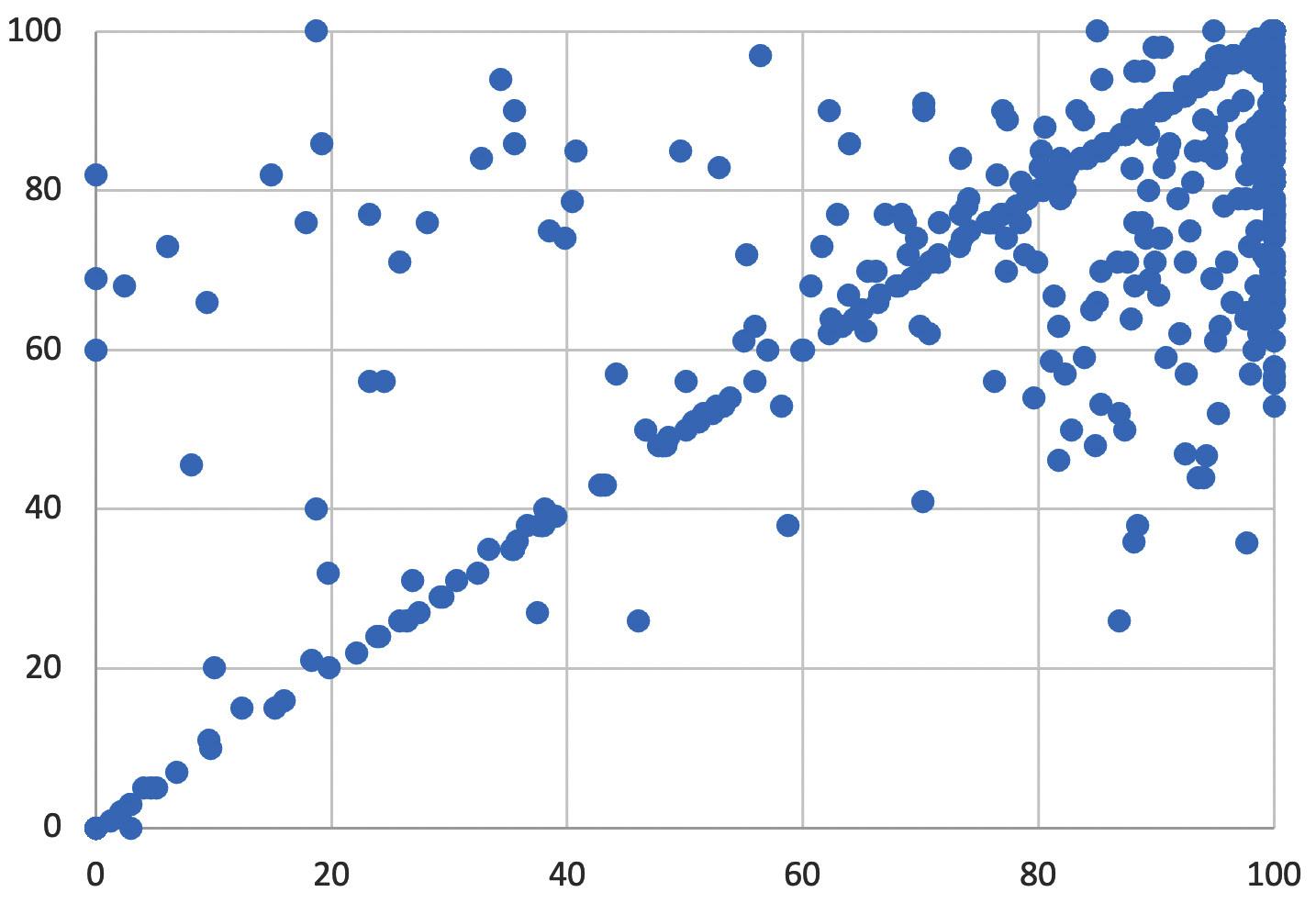
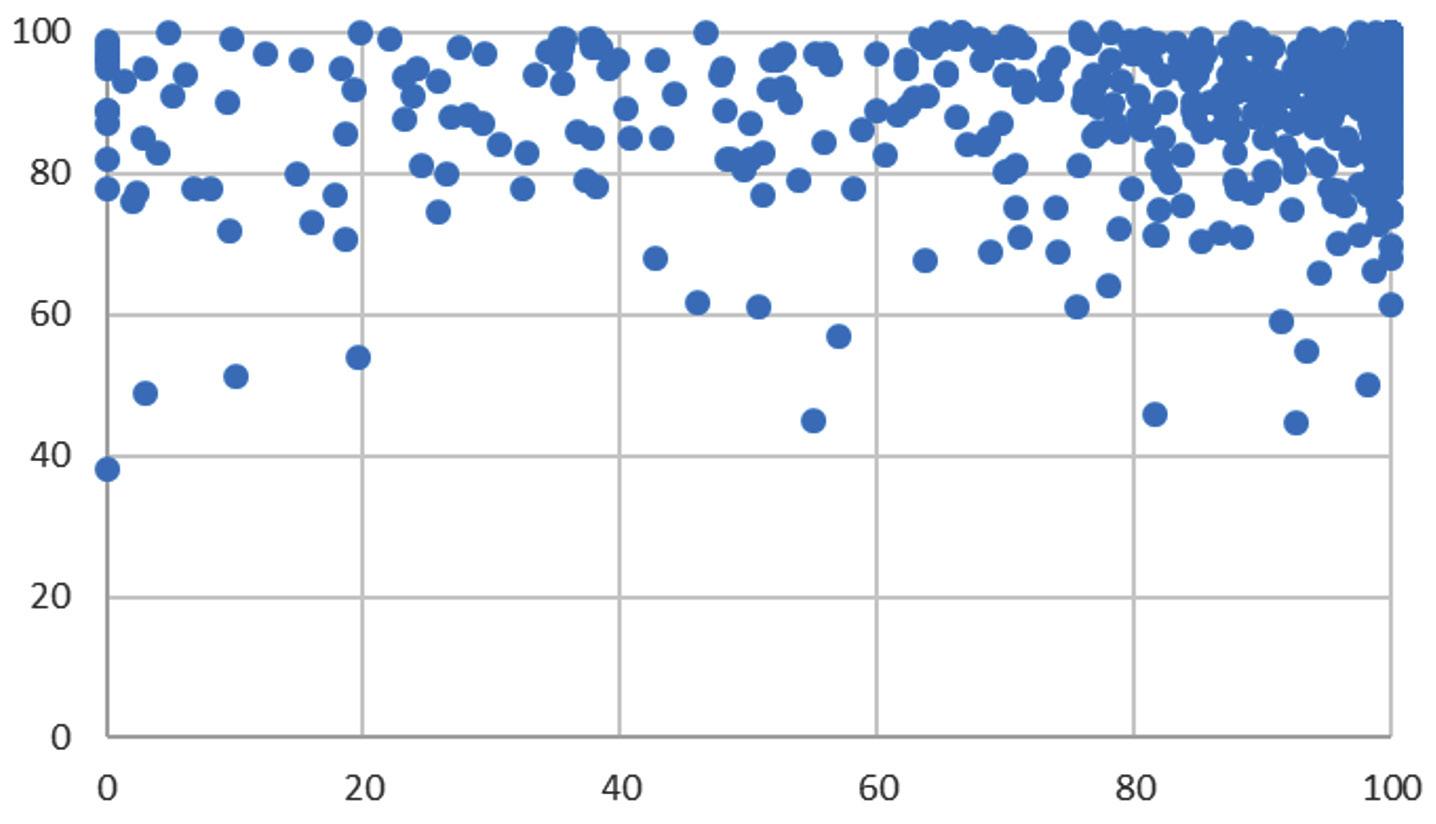
Contrary to expectations, social factors and ease of use were not found to have a noticeable effect upon homework completion. Indeed, the survey included items designed to measure both participants’ explicit and implicit beliefs regarding their peers’ homework habits, but the re sults were neither significant nor strong. Instead, the only factors with both statistical significance and substantial explanatory power related to performance expectancy – i.e. students’ desire to learn the material. The remaining research questions concern student perceptions, and several survey items were designed to answer the questions directly. In order to measure how effort changed when participants made the transition to online homework, students were asked to rate how many assignments into which they put serious effort on a scale from 0 (none) to 4 (all assignments). Regarding offline homework, the average re sponse was 1.96, but that improved to 2.74 when students transitioned to online homework. Students were also asked to rate how many as signments for which they procrastinated or were late submitting, on the same scale. Both measures were reduced by 0.25 points when students transitioned to online homework in 11th-grade.
Regarding educational outcomes, participants were asked to rate the impact that homework had upon their learning on a scale from 0 (no impact) to 4 (the most important aspect of the course). Average re sponses rose from 1.21 with offline homework to 2.34 with online homework. Similarly, participants were asked the extent to which they agree that homework helps them remember ideas for longer on a scale from 0 (strongly disagree) to 3 (strongly agree). When students were asked this question while completing traditional homework, the average response was 1.48, but that rose to 2.03 when students started com pleting online homework.
Finally, in the anonymous integrity surveys, participants were asked to compare the prevalence of cheating when completing online versus tra ditional homework. Somewhat surprisingly, the Likert responses strongly indicated that students generally thought cheating was equally prevalent in both, despite the fact that values in WeBWorK problems are ran domly generated in order to create individual questions.
Discussion
Figure 3: Performance on end-of-unit quiz versus performance on unit home work
In order to answer the research questions regarding student motiva tion, linear regression analysis was also performed upon survey Likert responses in various categories to test their ability to explain homework completion rates during the units prior to the survey administration. The results with statistical significance (α=0.05) are summarized in the table below.
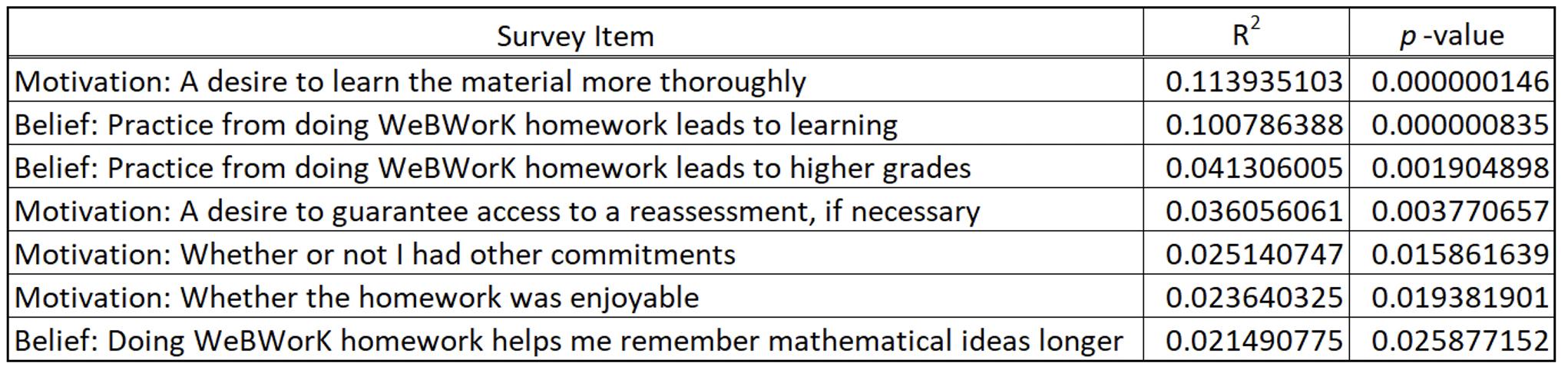
Figure 4: Correlation between Likert responses and homework scores
There are a number of meaningful results from this research study, with none more interesting than the fact that 58% of the variance in quiz scores can be explained by homework performance, whereas just 2.5% of the variance in test scores can be explained by the same. Of course, since the relationships described are only correlations, it is impossible to draw firm conclusions regarding the differences in these two statistics. Nonetheless, it is possible to make some informed guesses. Students at Seoul International School, like at many international schools, feel a great deal of pressure to record high grade point averages (GPA), and there is – anecdotally – a lot of last-minute cramming in order to attain high test scores. Because quiz scores are not incorporated into GPA, students generally do not prepare in advance. Thus, it is possible that quizzes are the more “honest” measure of a student’s learning. If this is the case, and more research needs to be done to make a convincing argument, then the data collected in this study strongly support the notion that online homework greatly improves learning outcomes.
Another major goal of this re search was to identify factors which explain stu dents’ motivation
Test Score
Quiz Score Homework Score 50 EARCOS Triannual Journal
to complete online homework, primarily in order to create effective interventions. Unfortunately, all of the measured variables were either statistically insignificant or had a small effect size. The only potentially meaningful avenue toward improving students’ willingness to complete homework seems to be an appeal to their intrinsic desire to learn con tent more thoroughly. Curiously, measures that were designed to corre late participants’ grade-orientation with homework completion did not demonstrate a meaningful effect, seeming to suggest that focusing upon students’ desire for better grades is not an effective way to increase their likelihood of completing homework.
Regarding the comparison between online and traditional homework, the survey data were clear and consistent: students take the online homework more seriously, believe that they are less likely procrastinate or submit it late, and believe that their learning and retention are sub stantially stronger. That having been said, the strength of these conclu sions is mitigated by two factors. First, 11th-grade is a challenging time which forces students to adapt and improve work habits. Thus, at least some of the improvement in the measured attitudes is likely to derive from maturation, rather than as a benefit of online homework. Second, the variables measured are students’ perceptions, rather than observa tional data. It is not necessarily true that students’ perceptions of efficacy and behavior are reflected in actuality.
The final research question concerns academic integrity. The data seem to indicate that cheating is equally prevalent in both online and offline formats, but this is highly suspect. Once again, the data collected are constituted of students’ perceptions, rather than reality. In addition, the randomized values in WeBWorK problems render copying of answers impossible; the only way to cheat is to ask someone else to solve your specific problems, which is more time intensive, so barriers to cheating are much greater. More importantly, before WeBWorK was implement ed in SIS’s upper-grade mathematics courses, virtually every student had 100% homework completion. Since its implementation, average com pletion hovers between 70% and 80%, with a fair number of students neglecting large swaths of the problem sets.
Unfortunately, to arrive at a more conclusive answer to the question of whether online homework reduces cheating, a study with a different de sign will be necessary. In the current study, the survey items themselves are one potential source of the problem. Students were not given the opportunity to identify the form which cheating took. It is possible that behaviors which many students considered cheating might actually be desirable help-seeking; there is no way to determine whether this is the case, especially since the integrity survey data are anonymous.
Conclusion
The results of this research study are encouraging; they lend credibility to the notion that the implementation of online homework at Seoul International School has been beneficial, both in terms of educational achievement and in terms of improved work habits.The results are suffi ciently strong to justify further extending the coverage to include math ematics courses at the lower grades.
That having been said, online homework is not a panacea. A great deal of time has been put into the system to adapt it to the needs, structure, and style of the school’s mathematics curriculum. Additionally, while on line homework has a number of unique, highly impactful features, it is just a single thread in the larger tapestry of formative assessment.
Moreover, more research needs to be done to fully demonstrate the ef ficacy of the WeBWorK homework platform’s implementation at Seoul International School. A variable that was not measured in the study was
effects of the system upon long-term recall. Intuitively, the difference in predictive power of homework completion between quizzes and tests makes sense – there will be a lower correlation between learning from homework and test performance when students are intensively cram ming knowledge right before an assessment. However, such cramming of knowledge tends not to lead to long-term retention, so we could reasonably expect that greater homework completion would be cor related with longer recall of knowledge. It would be beneficial to design a study to explore this question in particular.
Questions or Comments?
The author plans to continue collecting and analyzing performance data through the end of the current academic year in order to obtain a more complete picture and to explore time series patterns. If you are interested in hearing the results of that analysis, if you would like to see specific survey items, or if you would like to discuss the WeBWorK homework platform and SIS’s experience with it, please contact warken tinn@siskorea.org
References
Albelbisi, N. A., & Yusop, F. D. (2018). Secondary School Students’ Use of and Attitudes toward Online Mathematics Homework. Turkish Online Journal of Educational Technology-TOJET, 17(1), 144-153.
Black, P., & Wiliam, D. (1998). Inside the black box: Raising standards through classroom assessment. Phi delta kappan, 80(2), 139-144, 146148.
Bonham, S., Beichner, R., & Deardorff, D. (2001). Online homework: Does it make a difference?. The Physics Teacher, 39(5), 293-296.
Cooper, H., Robinson, J. C., & Patall, E. A. (2006). Does homework im prove academic achievement? A synthesis of research, 1987–2003. Re view of educational research, 76(1), 1-62.
Dettmers, S., Trautwein, U., Lüdtke, O., Kunter, M., & Baumert, J. (2010). Homework works if homework quality is high: using multilevel modeling to predict the development of achievement in mathematics. Journal of Educational Psychology, 102(2), 467.
Morgan, A. R. (2013). Factors Influencing Student Use of Online Home work Management Systems. Recognizing Excellence in Business Education, 98, 98-112.
Schubert, D. J. (2012). The effects of online homework on high school al gebra students (Doctoral dissertation, Teachers College, Columbia Uni versity).
Venkatesh, V., Morris, M. G., Davis, G. B., & Davis, F. D. (2003). User ac ceptance of information technology: Toward a unified view. MIS quarterly, 425-478.
Weibel, C., & Hirsch, L. (2002, July). WebWorK effectiveness in Rutgers calculus. https://sites.math.rutgers.edu/~weibel/ww.html
About the Author
Mr Warkentin joined SIS in 2018 to teach upper level mathematics, for which he has a great deal of passion. That and raising his own young SIS tiger, Sabin, occupy most of his time.
Fall 2022 Issue 51
Supporting Student Social and Emotional Learning through RULER: What is the Potential of the RULER Program to Support Student Emotional Well-being in International Schools?
 By Brenda Perkins Taipei American School
Figure 1:
acronym and skills
Introduction:
Academic research, anecdotal evidence and student reports indicate that teaching Social and Emotional Learning (SEL) explicitly to stu dents is helpful in many aspects of their school life, including academic performance, ability to direct and sustain attention, managing stress ful situations, sustaining positive peer relationships, developing resil ience and improving overall well-being. (Brackett et al, 2012). How ever, throughout my 25-year career in international schools I have observed that the availability of research-based SEL programming for students is limited in most international schools, where academic instruction competes directly for scheduled learning time with SEL instruction, and many teachers do not have formal training in SEL competencies. Instead, it is more common for teachers to be ex pected to deliver ‘home grown’ SEL lessons during homerooms or advisory periods, or request that counselors or health teachers teach students SEL lessons. In many international schools, SEL is treated as a separate subject area and not integrated wholly into the momentby-moment school experience.
RULER is widely used program in the United States that explicitly teaches the skill of emotional literacy and emotional regulation to im prove student and teacher well-being (Figure1). Developed by Marc Brackett and other researchers at the Yale Center for Emotional Intelligence, RULER has been implemented in thousands of public and private schools in the United States, and research has shown that RULER improves classroom and school climate (Hagelskamp et al., 2013) and increases student engagement (Brackett et al., 2012). Research has also shown that RULER improves student academic performance (Brackett et al., 2012) when teachers integrate RULER in their curriculum.
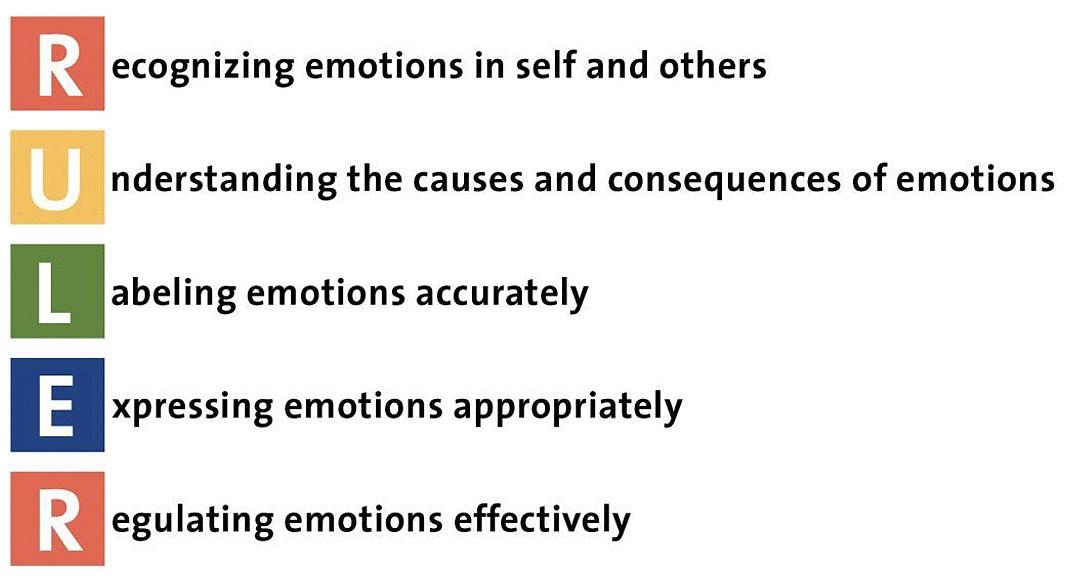
ACTION RESEARCH
RULER
52 EARCOS Triannual Journal
This research explores if the RULER approach makes a measurable dif ference in student emotional well-being, measured by the frequency of experiencing positive emotional states, negative emotional states, and degree of emotional control. The evidence of RULER impact at Taipei American School is explored and extrapolated to other Asian interna tional schools where students have a unique experience of being Third Culture Kids (TCK’s) in highly competitive environments.
What I’ve Learned from Distant Colleagues
The RULER approach has been researched quite extensively, with doz ens of research papers published in a wide range of journals including psychological and educational journals. While RULER has been imple mented in schools in the UK, Mexico, and Spain, any published action researched which supported the efficacy of RULER in a specifically in ternational school environment was not found. However, it is noted that research was conducted as to the efficacy of the RULER approach in both Mexico and Spain, with some of the schools involved in the study identifying as international schools (Castillo et al., 2013).
While there are many different types of international schools, typically these schools are understood to be schools that have an English lan guage instruction whose curriculum is different from the national cur riculum of the country the international school is located (Hayden & Thompson, 2008). While some international schools cater to elite host-country nationals, most also have a population of students whose parents are expatriates of the host-country and are considered Third Culture Kids (TCKs). However, current TCK research also includes hostcountry nationals, as these students share the third culture.
Students in international schools have unique challenges. Inman et al. (2009) found that one main area of counseling focus in international schools was on helping students cope with cultural transitions, including culture shock, loss due to frequent family moves, and difficulty adapting to a new language. Self-esteem was also an area where teachers spend time helping students. Participants stated that several of their students “experienced depression and anxiety in this regard” (Inman et al., 2009). Students also struggled with the intense pressure for educational suc cess. The Covid-19 pandemic also adds enormous stress to students whose education may have been interrupted or moved to online learn ing, expatriate families who may have been separated from each other, and general anxiety and uncertainty.
With so many challenges for students, international schools must find effective ways to help their students develop social and emotional competencies to support their well-being. SEL programs aim to help students develop skills and behaviours that support cognitive, social and emotional development. The Collaborative for Academic, Social and Emotional Learning (CASEL) is a global leader in research-based SEL and provides educators world-wide with a framework for SEL in schools. CASEL has identified five core SEL competencies: Self-Aware ness, Self-Management, Social Awareness, Relationship Skills and Re sponsible Decision Making (Figure 2).
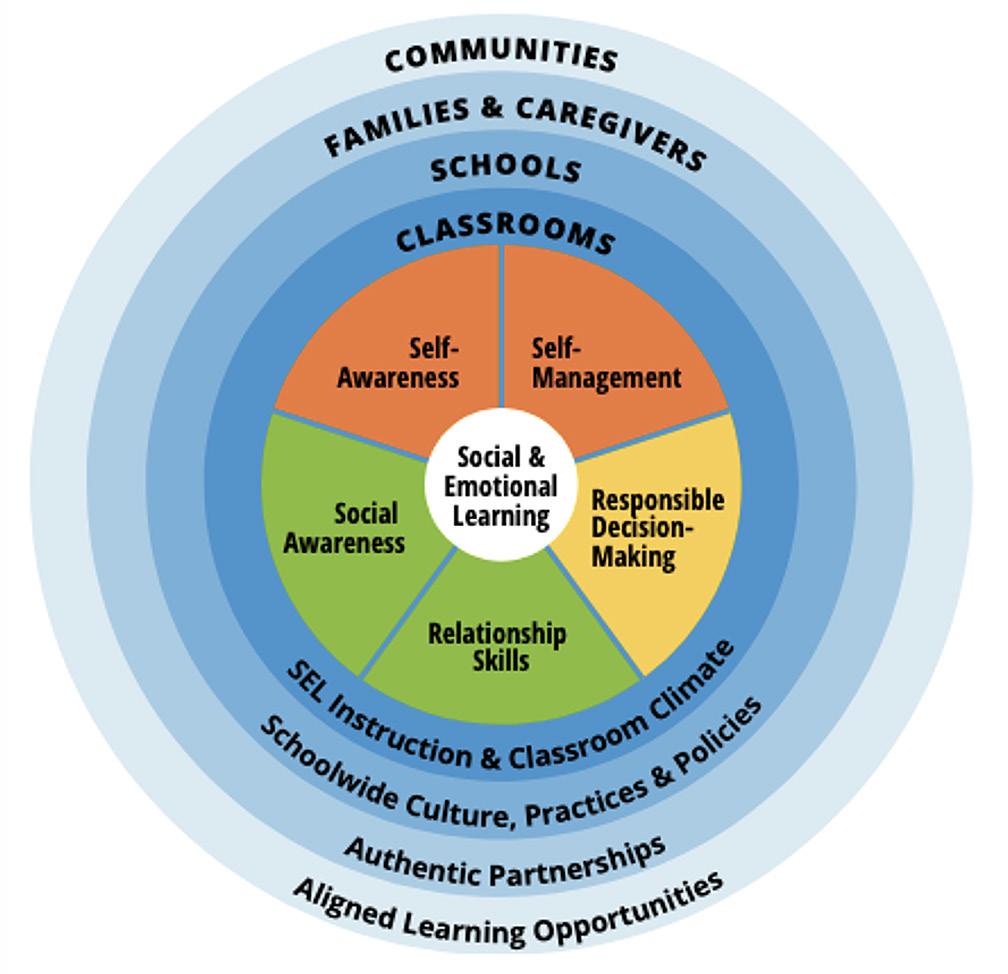
Emotional regulation requires both the skills of Self-Management and Self-Awareness. Students that can identify their emotional states, and then make choices that regulate them in a way that is helpful, show more academic success than students who do not (Ivcevic, M., & Brack ett, M., 2014).
Positive classroom climate and connected relationships between stu dents and between students and teachers are other factors contributing to student well-being and school success. Students who participated in RULER classrooms reported better relationships with teachers, less conflicts with peers, and better student autonomy and leadership (Riv ers et al., 2013).
Current research supports the implementation of the RULER pro gram in international schools to improve student well-being, academic achievement, emotional regulation, and relationships within the class room community and overall school community.
Action Research Project Design
In the 2021-22 school year, Grade 5 classrooms at Taipei American School were offered the opportunity to participate in a RULER early implementation program, ahead of all-school student implementation the following school year. Three classroom teachers worked with the grade level counselor to implement and deliver the RULER program with their students (n=64). The remaining 5 classrooms (n=110) en gaged in their regular SEL curriculum while also attending RULER imple mentation Professional Development throughout the school year.
Data on student emotional experiences and teachers’ interactions with students were collected over the course of the 2021-2022 academic year for 180 Grade 5 students and 9 teachers at Taipei American School. The “How I Feel” (Walden et. al, 2003) self-report measure was used to collect data about the emotional experiences of students as a meas ure of student well-being in three broad categories: positive emotions, negative emotions, and emotional control. It is assumed in this research that increasing the experience of positive emotions, decreasing the ex perience of negative emotions, and increasing emotional control is a direct reflection of increased student well-being. The “Emotion-Focused Interactions Scale” (Cipriano et al, 2019) was used to collect data from teachers about their interactions with students. Data was collected in September 2021, and again in April 2022.
Findings:
The initial data was somewhat surprising – the non-RULER classrooms showed students experienced similar levels of positive emotions, more negative emotions and greater emotional control in Spring 2022 as compared with RULER classrooms (Figure 3). This may be due to an unequal distribution of students with emotional needs in the RULER vs. non-RULER classrooms. As well, the teachers who volunteered to be early adopters of the RULER program may be teachers who have more students with SEL concerns in their classes, due to their interest and experience in SEL.
Figure 2: CASEL framework and SEL Competencies
Fall 2022 Issue 53
Figure 3: Graph showing the frequency of positive emotions, negative emo tions and emotional control in RULER and non-RULER classrooms. The scale is 0-4, with 0 being ‘not at all like me’ and 4 being ‘very much like me’. The higher the score, the higher the frequency of that emotional state.
However, in the Spring of 2022, when compared with the CHANGE in emotional experiences from the fall to the spring, RULER students had a smaller reduction in positive emotions, a greater decrease in nega tive emotions and more improved emotional control as compared with non-RULER students (Figure 4).
Figure 5: There is a positive difference in the frequency of emotions-focused interactions between RULER teachers and non-RULER teachers.
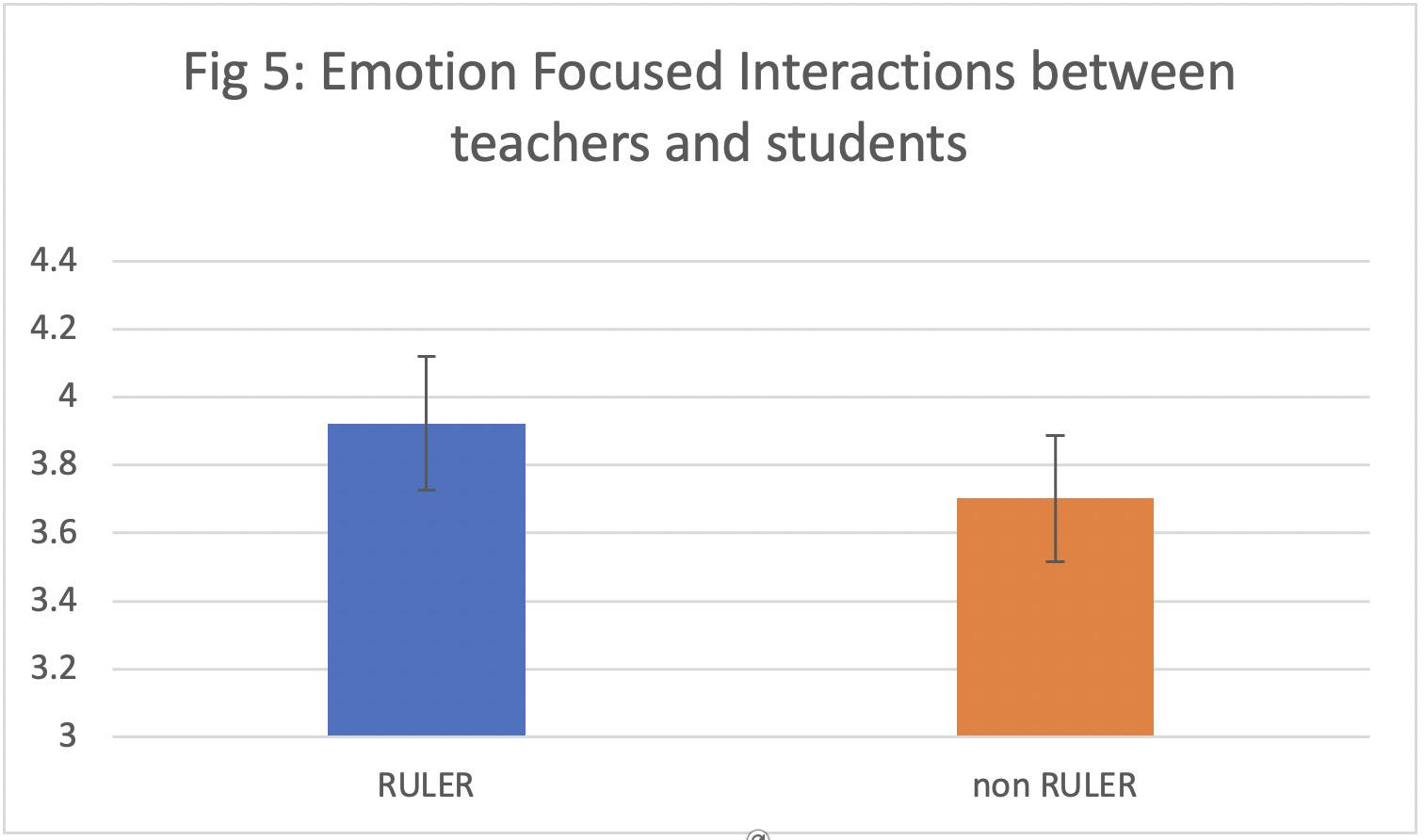
However, it is notable that the RULER teachers did not increase their emotions focused interactions significantly during the time of the study, although their frequency began relatively high at an average self-report of 3.88 (“a lot”) and stayed relatively stable at 3.92 at the end of the 6 month treatment. The non-RULER teachers showed more growth in this area throughout the year, from 3.54 to 3.70 (between “sometimes” and “a lot”) (Figure 6). This may be explained by an increased aware ness on the teaching team of RULER activities and professional develop ment for non-RULER classrooms throughout the school year.
Figure 4: The change in emotional experiences from Fall 2021 to Spring 2022 for RULER and non-RULER classrooms.
It’s interesting to note that the data for Positive Emotions shows a nega tive trend. Thus, students in Grade 5 experienced LESS positive emo tions in the Spring 2022 than they had experienced in the Fall 2021, with non-RULER classrooms experiencing a much larger decline in positive emotions comparatively. This may be due to the fact that many students are feeling an increase in anxiety and worry regarding moving to 6th grade and Middle School, as during the Spring data collection, the students had already begun initial transitions discussions during parentteacher conferences.
The degree to which teachers engaged with students on an emotional level was measured with the Emotions Focused Interactions Scale. This is a 1-5 point self-reporting measure, where 1 is ‘never’ and 5 is ‘all the time’. The RULER teachers were more likely to engage in emo tion focused communication between their students than non-RULER teachers (Figure 5)
Figure 6: Comparison of Emotions Focused Interactions between RULER and non-RULER teachers between Fall 2021 and Spring 2022, 6 months after RULER implementation
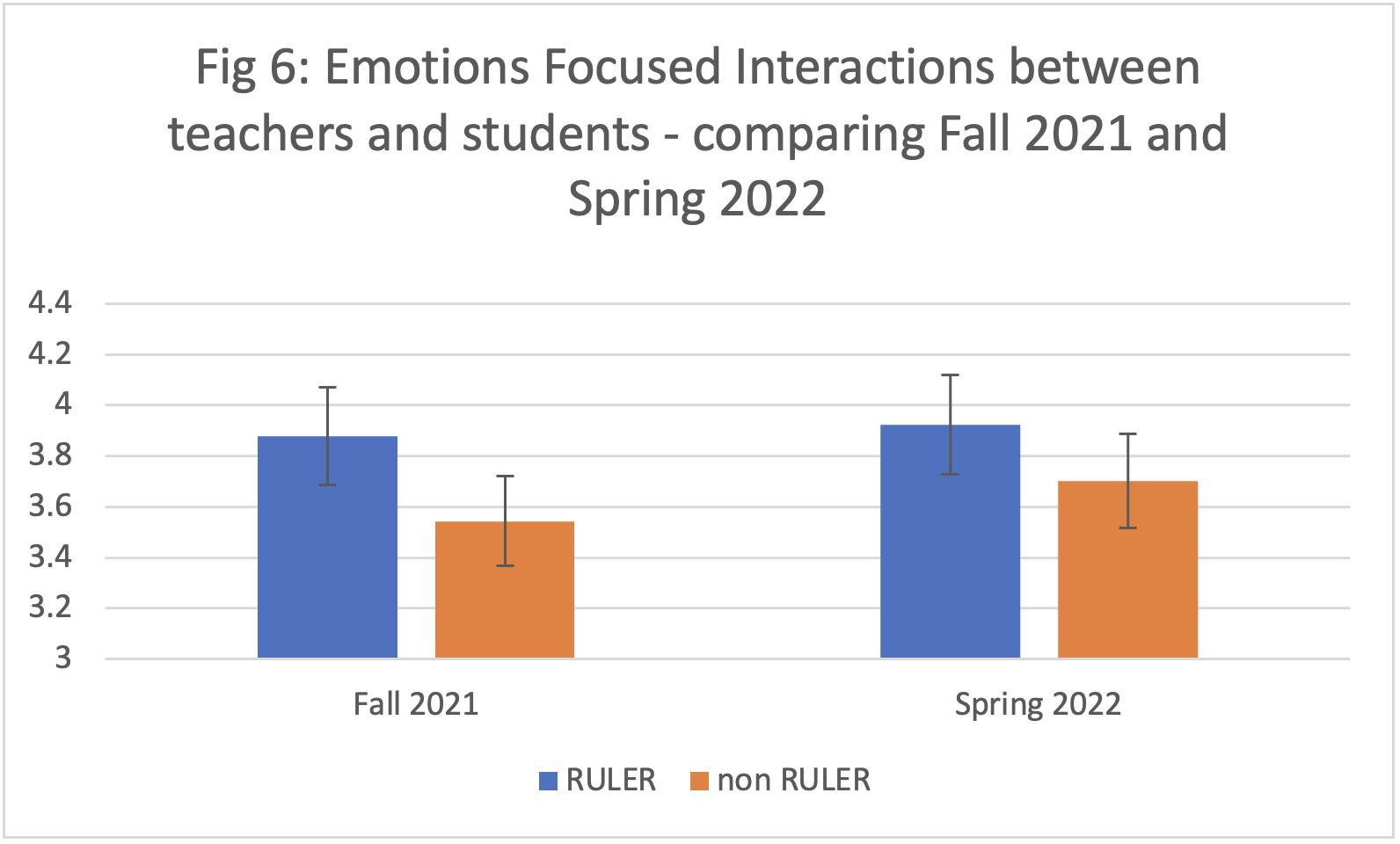
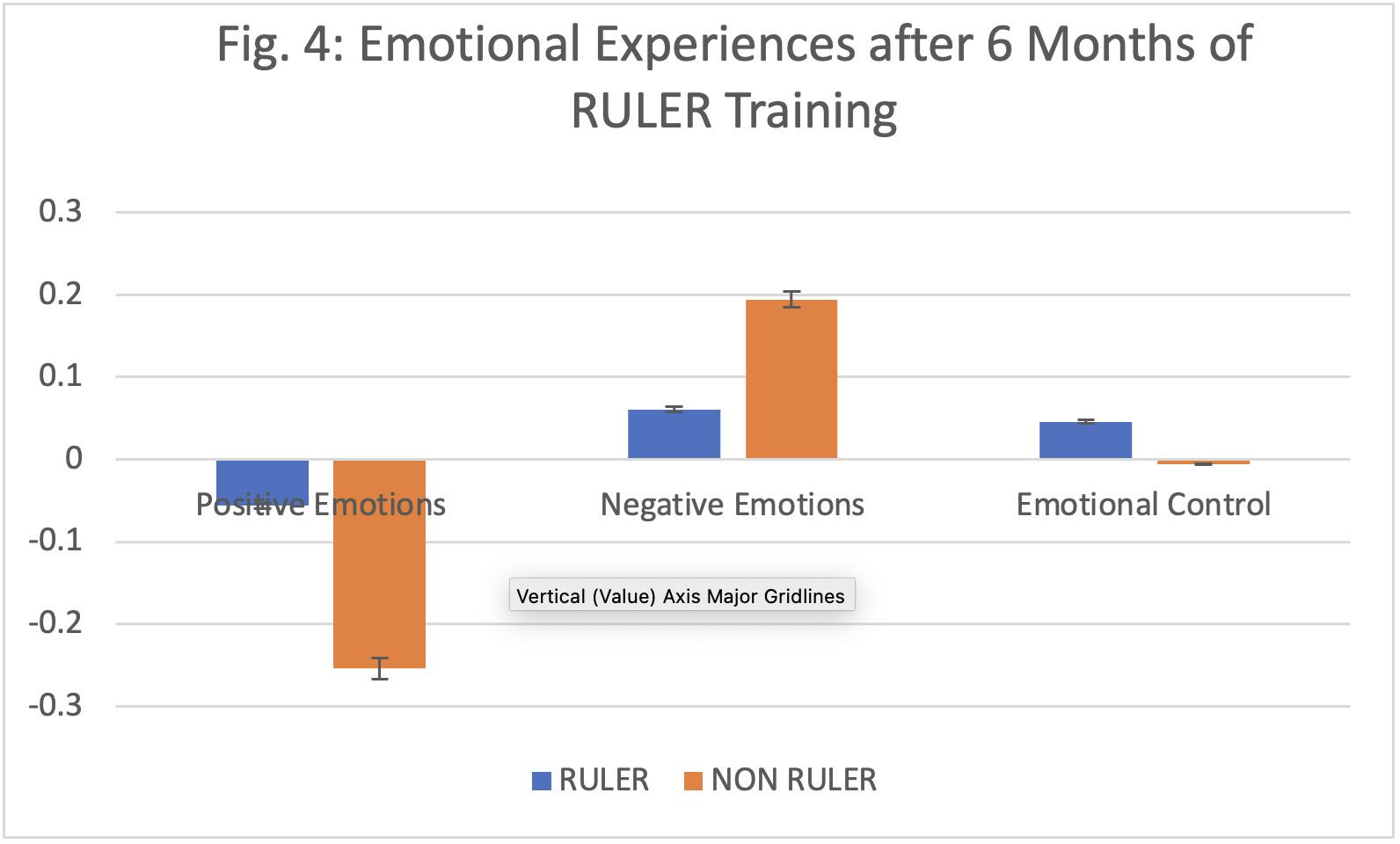
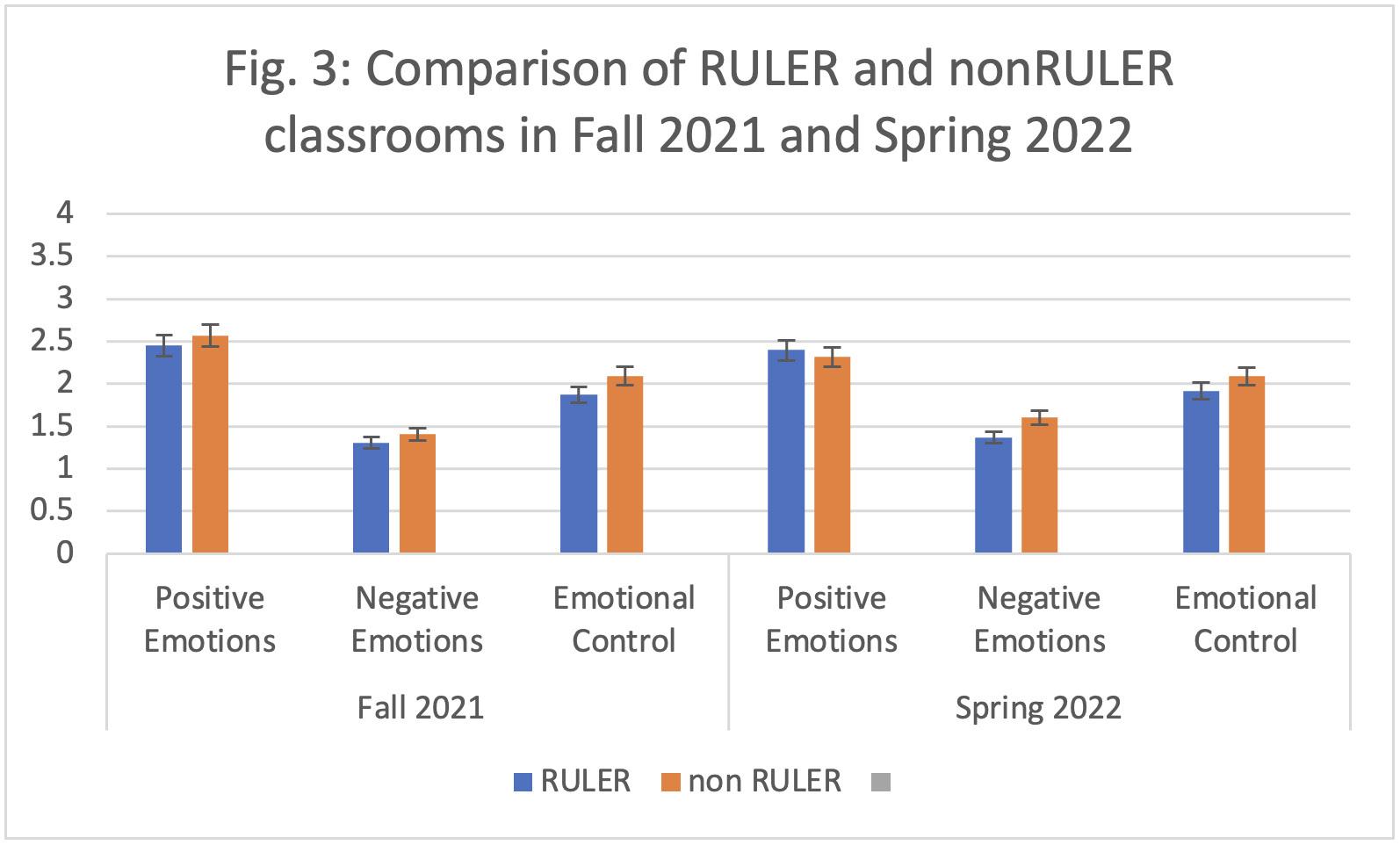
Further Reflection
The initial plan for this action research was to also collect data on stu dent academic achievement to better understand the influence of stu dent emotional well-being and learning. As a single researcher, I came to appreciate how and why teams of researchers collaborate to collect data. I simply didn’t have the time or resources to collect this data from our school databases! The data on student academic achievement could be invaluable to report, in particular in elite private schools where parents and administrators often expect a bottom line measured by student learning. The next project could also include overall scales of student wellness, and not just looking at student emotional experience. The most curious findings is the data which shows that RULER teachers have more emotions focused interactions with students. What impact does having more emotions focused interactions have on student wellbeing and learning?
54 EARCOS Triannual Journal
Final Insights
What is the potential of the RULER program to support student emotional well-being in international schools?
The RULER program showed positive correlations with improvements in positive emotions, decreased negative emotions and increased emo tional control with RULER classrooms as compared to non-RULER classrooms. An interesting further study would be to explore whether the positive effect of the RULER program on the emotions focused interactions between teachers and students contributes to improved student well-being. Based on this research, the RULER program shows promising potential to support student emotional well-being in interna tional schools. It is exciting to support our school community as we im plement and sustain the RULER program which emphasizes well-being and emotional health for all.
Acknowledgements: Thank you to our Lower School Counseling team – Jennifer Fisher, Bridget Hall and Cindy Teeters – for their support, guidance and encouragement during this project. Thank you to Taipei American School Head of School Dr. Grace Dodge for supporting and signing the research proposal, and Lower School Principal Dr. Tara Sime onidis for her support in gathering data from teachers during Faculty Meetings and providing data support. Thank you to the Grade 5 teach ing team and the entire LS Faculty for their support and patience in my data gathering!
References
Brackett, M. A., Rivers, S. E., Reyes, M. R., & Salovey, P. (2012). Enhancing academic performance and social and emotional competence with the RULER feeling words curriculum. Learning and Individual Differences, 22(2), 218–224. https://doi.org/10.1016/j.lindif.2010.10.002
Castillo, R., Fernández-Berrocal, P., & Brackett, M. A. (2013). Enhancing Teacher Effectiveness in Spain: A Pilot Study of The RULER Approach to Social and Emotional Learning. Journal of Education and Training Studies, 1(2), 263–272. https://doi.org/10.11114/jets.v1i2.203
Cipriano, C., Barnes, T.N., Kolev, L. et al. Validating the Emotion-Focused Interactions Scale for teacher–student interactions. Learning Environ Res 22, 1–12 (2019). https://doi.org/10.1007/s10984-018-9264-2
Elementary School
Art Celebration
Cipriano, C., Barnes, T. N., Rivers, S. E., & Brackett, M. (2019). Exploring Changes in Student Engagement through the RULER Approach: An Ex amination of Students at Risk of Academic Failure. Journal of Education for Students Placed at Risk (JESPAR), 24(1), 1–19. https://doi.org/10.108 0/10824669.2018.1524767
Hayden, M.,& Thompson,J. (2008). International schools: Growth and in fluence. Paris: UNESCO, International Institute for Educational Planning.
Hagelskamp, C., Brackett, M.A., Rivers, S.E. et al. Improving Classroom Quality with The RULER Approach to Social and Emotional Learning: Proximal and Distal Outcomes. Am J Community Psychol 51, 530–543 (2013). https://doi.org/10.1007/s10464-013-9570-x
Inman, A. G., Ngoubene-Atioky, A., Ladany, N., & Mack, T. (2009). School counselors in international school: Critical issues and challenges. In ternational Journal for the Advancement of Counseling, 31(2), 80-99. doi:http://dx.doi.org/10.1007/s10447-009- 9070-8.
Ivcevic, Z., & Brackett, M. (2014). Predicting school success: Comparing Conscientiousness, Grit, and Emotion Regulation Ability. Journal of Re search in Personality, 52, 29–36. https://doi.org/10.1016/j.jrp.2014.06.005 Rivers, S.E., Brackett, M.A., Reyes, M.R. et al. Improving the Social and Emotional Climate of Classrooms: A Clustered Randomized Controlled Trial Testing the RULER Approach. Prev Sci 14, 77–87 (2013). https://doi. org/10.1007/s11121-012-0305-
Walden, Tedra & Harris, Vicki & Catron, Tom. (2003). How I Feel: A SelfReport Measure of Emotional Arousal and Regulation for Children. Psy chological assessment. 15. 399-412. 10.1037/1040-3590.15.3.399.
About the Author
Brenda Perkins has over 25 years teaching experience in International Schools, including Canada, Egypt, Thailand and Taiwan. Her passion has grown from science teaching to the science of teaching well-being and mindfulness. Also certified by the UK-based Mindfulness in Schools Pro gram (MiSP), Brenda continues to pursue research-based teaching and counseling modalities which support the development of mindfulness skills for both students and teachers alike. Brenda currently is the Lower School Counsellor at Taipei American School
(Left)
Landscape Drawing
Using different types of lines.
pens
Matthew Hendrick Paayas, Grade 2
Brent International School Baguio
(Right)
Random Lines
Colored markers and pens


Emma Louise Orendain, Grade 3
Brent International School Baguio
Fall 2022 Issue 55
Color
ACTION RESEARCH
International Mindedness: Intercultural Appreciation of Physical Beauty
 By Paolo Euron, Ph.D. Instructor of Psychology (IB/DP) Wells International School (On Nut Campus) Bangkok
This research project on international mindedness, focused on the intercultural appreciation of beauty, has been conducted in the Wells International School, On Nut Campus, Bangkok, Thailand. Grade 11 students of Psychology, IB Diploma Programme, have studied the is sue, developed the material, carried out the tests and discussed the results. Participants in the tests and interview are mostly international students from the Wells International School.
The aim of this research was to determine how the cultural back ground affects our enjoyment of physical beauty. The project began when the researcher, with the help of students, planned an empirical research among the school population in order to collect data about the appreciation of physical beauty and how this appreciation is af fected by a different cultural background.
For the students, this research project was a unique opportunity to develop and carry out psychological research in a real life situation, taking advantage of the multicultural environment offered by the Wells International School.
Participants were asked to express their appreciation of physical beauty in two different tests.
The first one was a study based on priming in order to elicit an implicit answer. Participants had to look at different photographs representing physical beauty for five seconds, then they had to look at a second image which worked as a neutral stimulus. Researchers were able to consider how the exposure to the first stimulus image (physical beauty) influenced the participant’s response to the subsequent neu tral stimulus, even without any awareness of the connection.
56 EARCOS Triannual Journal
The second test was a Likert-scale test. Participants were asked to explicitly rate the beauty of a set of images on a scale of one to five. The Likert-scale test was based on the same images of the priming test and administered to the same participants in order to compare the implicit appreciation of beauty to the explicit one. Finally, a short interview collected a few answers about the reason for the aesthetic appreciation.
The researcher and the students decided to avoid a cultural catego rization of participants based on ethnicity or on citizenship. For this reason, students created a questionnaire for the self-identification of cultural identity.


For the tests we chose images representing different kinds of physical beauty according to three biological parameters which contribute to attractiveness, none of which is unique to any specific ethnicity: averageness, symmetry and sexual dimorphism. We also considered neotenia (faces that are baby-like) and physical indicators of fertility. The subjects presented well defined biological or somatic markers. We have selected images corresponding to culturally determined beauty-types according to which “beauty is constructed in different cultures.” (Frith et al., The Construction of Beauty: A Cross-Cultural Anal ysis of Women’s Magazine Advertising, in International Communica tion Association, 2005, p. 56) These beauty types consider feminine beauty according to cultural models. These are: Classic/Feminine (Western girls posed with more serious expressions, looking more defiant and independent); Sensual; Cute/“girlish” (Asian smiling and giggling)/Girl-Next-Door; and Trendy. These types which express a cultural origin (classic/Western and cute/Asian) or suggest a cultural context (sensual and trendy) are used independently from ethnicity.
In the priming test, participants with a self-assessed Western attitude generally reacted in a positive way to both Western and Asian ex amples of beauty. There was a negative response when primed by Eastern trendy image, by Western cute image and by Western classic feminine so that we can say that there is a meaningful difference of reaction after being primed by Eastern or Western images of beauty. There was no negative reaction to images with a strong ethnic con notation like Eastern feminine symmetry or Eastern cute.
Participants with a self-assessed Eastern attitude generally reacted positively to the Eastern cute image and slightly less positively to the sensual Western image and showed mixed reactions after been primed with the Western trendy image and the Western cute im age. In general, if asked implicitly, we can see a moderate negative reaction after experiencing some examples of Western beauty. In general, Asians appreciate Western beauty.
If we consider the explicit reaction to physical beauty, participants show more precise preferences. Participants with a self-assessed Western attitude generally find less beautiful images with a strong ethnic characterization, e. g. Eastern female symmetry, while par ticipants with a self-assessed Eastern attitude generally find them more beautiful. Asians show a slight preference for Eastern features. The Eastern feminine cute image is generally found attractive by Asians but far less attractive by Westerners. Interestingly, the West ern feminine cute image is strongly appreciated by Westerners and by Asians as well, with a few exceptions. It seems that Asians appreci ate beauty even with strong Western connotations, whereas West erners do not like too strong ethnic physical characterization. Asians
explicitly appreciate Western features more than Western do with Asian traits, even if the difference is slightly remarkable. The implicit appreciation of beauty of the Priming test revealed no significant dif ference. It seems that the preference for traits with a strong ethnic characterization is more a fact of explicit decision on the beauty of the subject.
The collected data allow an interesting insight in beauty apprecia tion across different cultural attitudes. In general, there are no big differences in beauty appreciation between participants with a selfassessed Eastern or Western cultural attitude. The only slight differ ences are in the appreciation of male sexual dimorphism and in the appreciation of neotenic traits, in which the cultural belonging seems to play a role.
Acknowledgments
I want to express my appreciation to the students of the Wells In ternational School, On Nut Campus, Bangkok, who participated in this research project.
Amonlirdviman, Mena Fukada, Chihiro
Hemmondharop, Thanchanok (Ting Ting) Iwamoto, Sana Mohammad Kaewpaithoon, Chankit ( David ) Sakulsacha, Panisra (Raina) Salter-Townshend, Mardtin Trisiripisal, Jidapa (GiGi)
Vetchayanvivat, Tanawan (Eng) Zaveri, Heer Sachinkumar
I want to express a special appreciation for my students Lin, Ting Yu (Katrina) and Sakkapannikon, Premyuda (Prem) for their constant help and their excellent work of organization and coordination.
Dr. Katina Grigoraskos, Deputy Head of Wells International School, IB Creativity, Activity & Service Coordinator, IB Theory of Knowledge Teacher, for her invaluable support and her work in this project.
A special thank you to the Wells International School, its Students and Staff, for helping in this research.
A thank you to the EARCOS for accepting the proposal of this research project.
Fall 2022 Issue 57
Aow Thai Marine Ecology Center: An Artificial Reef Research and Education Project Acquisition


 By Celicia Cordes Recipients of EARCOS Global Citizen Community Service Grant Award 2022 Berkeley International School Bangkok
Our story begins on a particularly special fringing reef off the coast of an island in the Gulf of Thailand.This island is called Koh Mun Nai and it is part of a larger group of islands that make up an archipelago. The significance of this island to my story is not just because it is a destination for rare migratory birds nor because of the sea turtle sanctuary that sits upon its beachfront. It is significant because Koh Mun Nai is the birthplace and field station of a research, conservation, and education initiative called ATMEC, or the Aow Thai Marine Ecology Center (‘Aow Thai’ translating to ‘Gulf of Thailand’). This initiative was created by the Love Wildlife Foundation and is aimed at providing education in marine biology and ecology to students of all ages and levels of SCUBA experience. ATMEC also conducts original research and conservation projects in collaboration with the Thai Depart ment of Marine and Coastal Resources (DMCR). As part of our project, we have been able to SCUBA certify a number of ATMEC students with the assistance and partnership of the Thai Ocean Academy (TOA). One of ATMEC’s more recent research papers on contrasting coral commu nity structures between natural and artificial substrates (Monchanin et al. 2021) has presented itself to be an amazing opportunity for me and my school’s SCUBA and marine science club which involves the deployment of different varieties of artificial substrate to study coral succession and the recruitment of baby corals in the Koh Mun Nai archipelago.
This is where the fun begins. As per the title of this project, our work encompasses both the theoretical knowledge of artificial reef deploy ment and the hands-on fieldwork required to conduct research for fur ther conservation efforts. The presence of stable substrate in the Gulf of Thailand plays a critical role in the health and biodiversity of not only the reef itself, but the health and wellbeing of communities that rely on coral reefs across the Gulf of Thailand. To fully understand the importance of artificial substrate in this project, one must know that the Gulf of Thailand is a large, shallow basin that is part of the Indo-Pacific region and is located near the ‘coral triangle’. Therefore, it is part of one of the most biodiverse marine ecosystems on the planet. The Gulf is particularly susceptible to high levels of sedimentation and turbidity due to the multiple rivers and streams that flow into the basin, carrying large amounts of minerals and silt into the Gulf. Because of the silt and sand that make up the majority of the sea floor of the Gulf, it is difficult for coral larvae (produced via sexual reproduction) to land and recruit onto a stable substrate, leaving many of these coral larvae to die. This is where the implementation of artificial substrate becomes beneficial to the reef environment; artificial reefs can provide an otherwise sandy, volatile sea floor with more stable space for reef-building corals to recruit on, thereby promoting coral growth in shal low waters.
GLOBAL CITIZEN COMMUNITY SERVICE GRANT
58 EARCOS Triannual Journal
Before this project, there have been a considerable number of initiatives by the Thai government and the DMCR in an attempt to deploy sev eral artificial substrates and plant corals to promote coral growth and ocean conservation. However, despite their good intentions, too many organizations such as dive schools and those from the private and public sector, including the DMCR, do not responsibly utilize the most benefi cial and successful methods of reef restoration. Consequently wasting time, effort, and money; inevitably doing more harm than good to the reef. Unfortunately, it is common practice for many of these restora tion initiatives to sink harmful or otherwise sub-optimal materials like PVC pipes, rubber tires, and paint-covered substrates due to the lack of proper research and professional consultation. On top of that, many of these conservation programs utilize the process of breaking off pieces of existing coral colonies to propagate these fragments and increase the relative abundance of corals on a reef. This process, colloquially called coral ‘fragging’, inescapably leads to a drastic decrease in the genetic diversity and biodiversity of a reef, making the colonies more susceptible to disease and decreasing overall survivability (Scott, 2019).
This is why our work in the Artificial Reef Research and Education Pro ject is so valuable and necessary for the future of Thai reefs. The two projects that this grant will be going towards are 1) The active and pas sive restoration of corals by ATMEC through their research on coral re cruitment and succession and 2) Working with ATMEC and the DMCR to allow Berkeley students to organise, build, and sink substrate in a 10m x 10m treatment site. Together with the assistance of ATMEC, we will work to gain high-quality education by undergoing a variety of SCUBA certification courses by Conservation Diver which allows for people of all ages and skill levels to pursue an interest in marine science. As part of project one, with the help of the research team at the ecology cen tre and permission from the DMCR, ATMEC has successfully deployed enough artificial reefs at the beginning of their last research semester to create nine individual treatment sites, all of which include varying types of artificial reef. This was done to study the abundance and diversity of coral recruitment and succession on an artificial reef versus a natural reef as an extension to the aforementioned research paper. In addition, students involved in project two at the marine conservation club at Berkeley International School have been permitted by ATMEC to de sign, create, and deploy artificial substrate in our very own 10m x 10m treatment site. Our students are being given full creative and scientific freedom over the configuration and layout of the site and will be col lecting data on the developing ecology of the new reef. Both of these projects are going to be recorded as long-term research papers; due to high levels of uncertainty regarding coral growth in the Gulf of Thailand because of an increased frequency of bleaching events and worsen ing ecological conditions, projects like these require consistent levels of funding, active participation, and maintenance.
We expect that the long-term effects of this initiative will lead to several benefits. These include a greater scientific understanding of the ecology
of both natural and artificial reefs, how best to restore decimated corals, a deeper understanding of coral succession after climate change driven disturbance, and most importantly, to use this research to educate those within the industry and government on the most beneficial ways to conduct their reef conservation programs. We hope that if the contents of this project are proven to be useful, it would indirectly affect the lives of thousands of tourists, Thai fishermen, locals, government agents, and business owners in and around the Gulf of Thailand. We envision that with the help of ATMEC and the Thai Ocean Academy, we will be able to inspire and educate passionate youth into joining the mission to help preserve and protect our marine environment.
Finally, we have come to the end of this outline on our Artificial Reef Re search and Education Project. I sincerely hope that you learned some thing fascinating about coral restoration and artificial reefs and I implore you to take a gander at the two works that are referenced in this essay (cited below) as well as the ATMEC website www.atmec.org. If you have any further questions or would like to get involved, please do not hesi tate to contact me at celiciacordes@gmail.com. Though for now, I would like to end this conclusion by thanking those involved with the program. Firstly, I would like to thank my teachers and school administration, spe cifically Mr Ashley Peek, for his recommendation of this project and my EARCOS nomination. Secondly, the Thai Ocean Academy team and Tim McCabe who first introduced me to the funky world of SCUBA and exploration. Also deserving mention is the Founder and President of the Love Wildlife Foundation, Nancy Gibson, who, two years ago, adopted me into her work family and took me on my first service trip to Koh Mun Nai where I met the slightly insane marine biologist that sparked my passion for marine science. This final bit of thanks goes out to Rahul Mehrotra who I am forever grateful for his teachings and undying sense of humour. Without these people, I would not be here today, and for that, I owe them everything. And thank you, dear reader, for sticking to the end. I hope the words of a young and aspiring marine scientist have inspired you the same way these people have inspired me into the con servation and the preservation of our natural world.
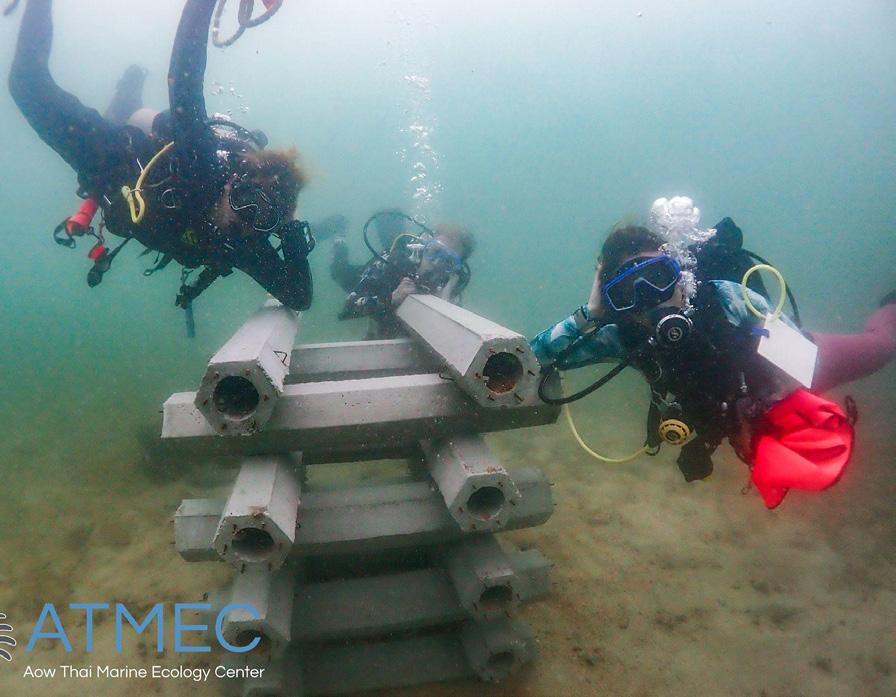
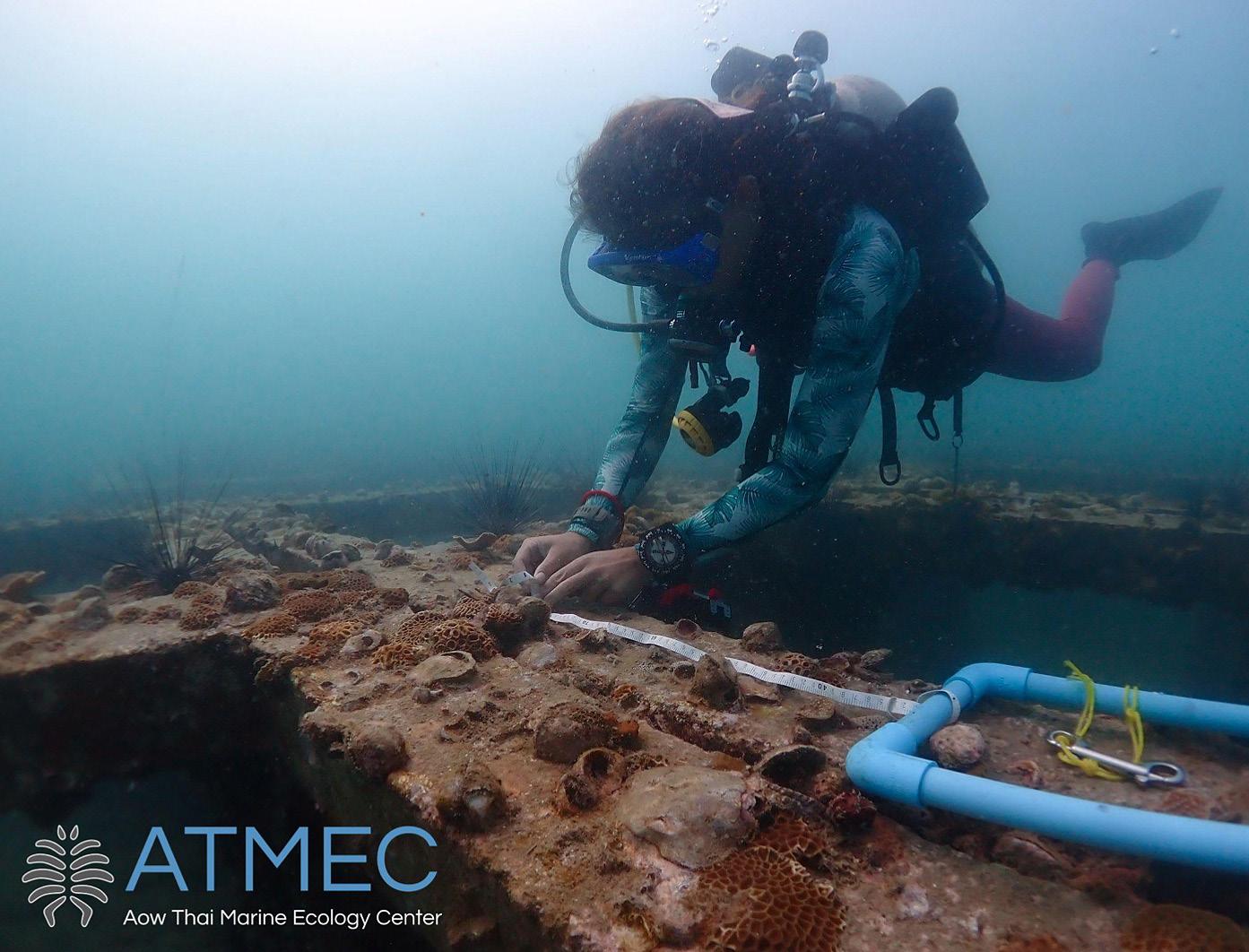
Citations:
Monchanin, C., Mehrotra, R., Haskin, E., Scott, C.M., Urgell Plaza, P., All church, A., Arnold, S., Magson, K. and Hoeksema, B.W., 2021. Contrasting coral community structures between natural and artificial substrates at Koh Tao, Gulf of Thailand. Marine Environmental Research, 172, 14pp.
Scott, Chad. “Coral Fragging Should Be Banned.” Conservation Diver, 10 Apr. 2019, https://conservationdiver.com/coral-fragging-should-bebanned/.

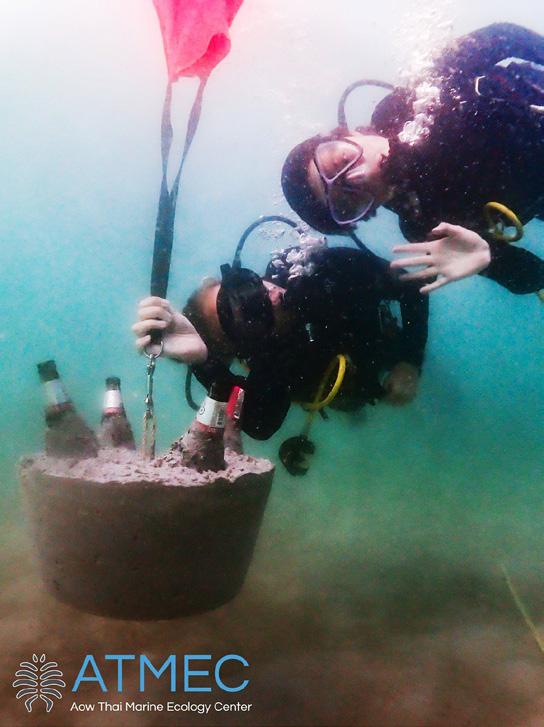

Fall 2022 Issue 59
Green & Sustainable Energy Connector

Energy Connector is a government-recognised non-profit organisation that strives to provide renewable energy to help develop a sustainable and self-sufficient rural India – The Forgotten Bharat. Our 5-year plan is to help Indian rural schools receive access to electricity through solar energy, thereby, enabling underprivileged students get equal educational oppor tunities and allowing them to overcome the vicious cycle of poverty. Since 2018, Energy Connector is working on this goal every day and aims to achieve 100% electrification of rural schools in India, one school at a time!
By Vansh Kakra Recipients of EARCOS Global Citizen Community
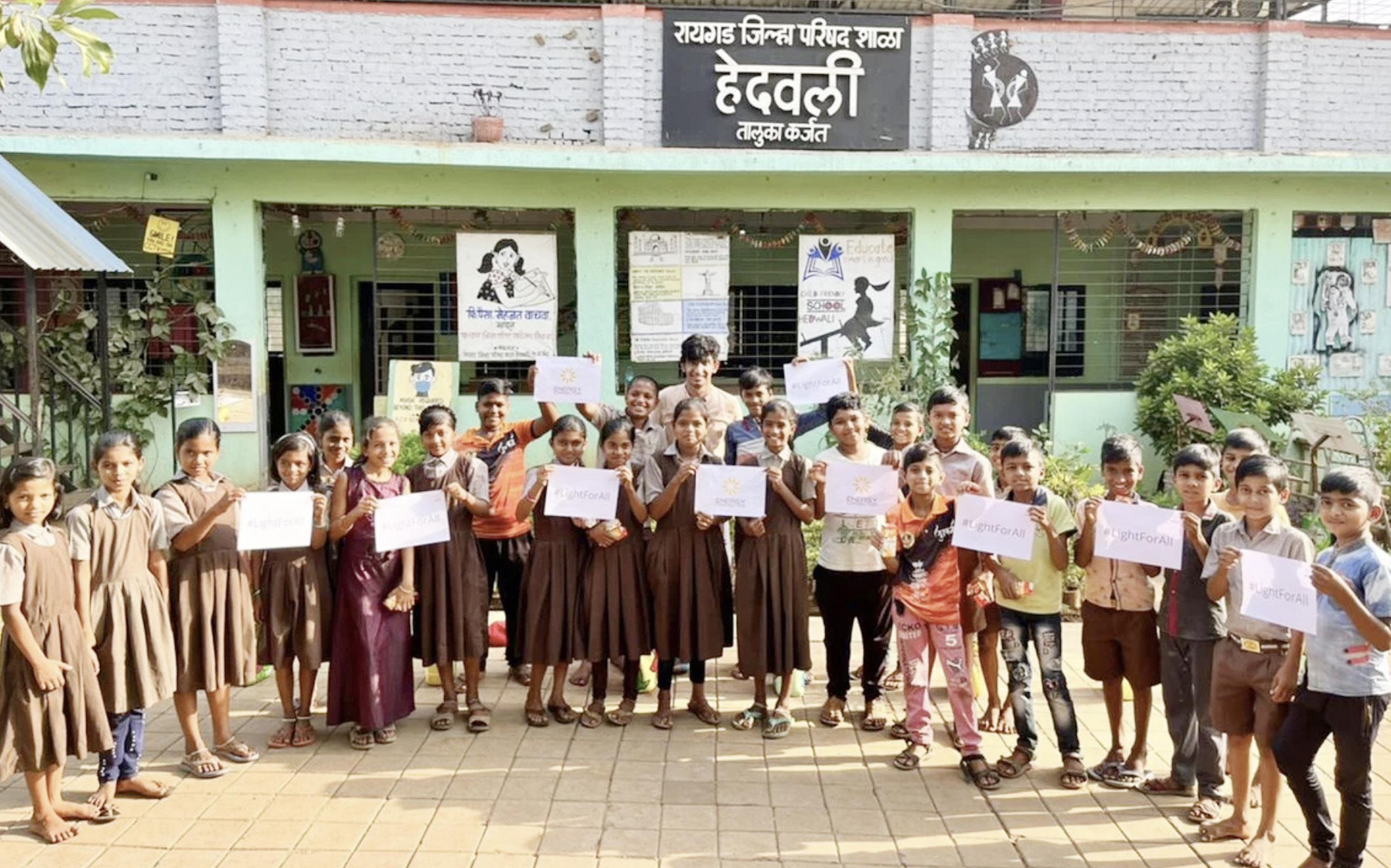
Grant Award 2022
School - JVLR Campus
GLOBAL CITIZEN COMMUNITY SERVICE GRANT
Service
Oberoi International
60 EARCOS Triannual Journal
The journey began in 2017 when I attended an extended-family func tion in a rural village in Rajasthan, where I saw students of my age study ing without electricity, under a kerosene lamp. The light did not defy the darkness but instead strained their eyes, made it difficult to focus and eventually led them to give up studying for the day. The profound impact led me to compare my life against theirs and ask a question: Isn’t the dream of seeing an educated future Bharat already getting curbed? It was this question that fueled my interest in providing electricity to students studying in rural areas.
Thinking of a creative solution for the electricity problem was not easy because it needed to be cost-efficient, sustainable and easily imple mentable in villages. Over time, by brainstorming, doing research, taking online courses and talking to experts, I realised that solar energy would be a novel solution to mitigate power shortages as it has the potential to give independent electrical supply.
To this end, in 2018, I undertook “Project Wada”. The aim was to help electrify a remotely located rural school through solar energy. With the assistance of an NGO, I identified a rural school that severely lacked electricity. In this school, during evenings, students were not able to study, girls were not able to use the washroom and since their nonelectrified classrooms got converted into dorm rooms at night, they were not able to sleep properly because of less ventilation and humid climate. This impacted their health and education. To solve the school’s electricity problem, I fundraised Rs.16,000 (USD 200) through my social circle and installed 5 customised solar home lighting solutions. Eventually, this helped the school get an uninterrupted electrical supply for the day, thereby, creating a positive change in the learning environment.
Later, my efforts got published in the IB World Magazine. Even though this recognition did boost my confidence, it was a post-installation visit that motivated me to help more students because seeing the happiness in their voices, the confidence in their personalities and their personal commitment to studies was an unparalleled feeling.
Moving on, in 2020, I gathered a team of like-minded volunteers to conduct “Project Boisar”. The aim was to fully assist a community school that faced a power shortage of 5-6 hours daily due to load shedding. Santosh Kadkar, a student in the school said “During power shortages, we use candles. Eventually, due to the lack of proper light, we cannot concentrate on our studies, our study time gets wasted and our teach ers are also unable to teach properly, which leads us to stop going to school and become dropouts”. Hearing this statement allowed us to reflect on how unfair it is for underprivileged students to not even get proper educational facilities. Therefore, to address their electricity problem, we fundraised Rs. 2.5 lakh (USD 3,125) through an online fundraising platform and installed a 2kW Solar Energy Solution. This so lution helped 49+ underprivileged students receive access to proper lighting, thereby solving their power shortage issue. Later, due to the sincere efforts and social impact created during the pandemic, I got appreciated by the NITI Aayog (National Institution for Transforming India), Government of India.
The journey of both the projects left me with mixed feelings: proud to help the students in need but concerned because there are 128 mil lion more students in India, who live without electricity. Therefore, to address the sheer need, I decided to convert this youth initiative into
a non-profit (under Section 8 of the Indian Companies act) in 2022, which gave birth to the “Energy Connector Foundation”.
Over time, I was able to scale up Energy Connector by making a team of 50+ volunteers, conducting 5 more projects and raising Rs.10+ lakh through grants and private-public partnerships.
Today, Energy Connector takes pride in its numbers because it has brightened up the lives of 1556 students, 314 villagers, 247 teachers by illuminating 5 schools and neutralising 60 metric tonnes of carbon.
For team Energy Connector, the journey from 2018 to now has been immensely successful because we see success as a measure of helping as many people as possible – the more impact you create, the better your community becomes.
In the near future, Energy Connector plans to launch a patented tech nology that we have been designing over the past 6-months. This tech nology has the potential to increase efficiency and reduce the cost of solar energy solutions, which can be used to electrify any rural area in an effective manner.

In conclusion, as a youth-driven organisation, Energy Connector aims to build a community of volunteers to help the entirety of rural India become sustainable but the only question remains, “Can we do it?”, the simple answer is “Yes, we can!”
#BETHECHANGE!
About the Author
Vansh Kakra has is a recipient of the Global Citizen Community Service Grant at Oberoi International School - JVLR Campus for 2022-23. He was recognized as a Young Changemaker by the Global Council of Im pact Leadership. He can be reached at vansh.kakra@oberoi-is.net.
Fall 2022 Issue 61
“One BUK at a Time”
By Dohyun Kim Recipients of EARCOS Global Citizen Community Service Grant Award 2022 Taejon Chirstian International School
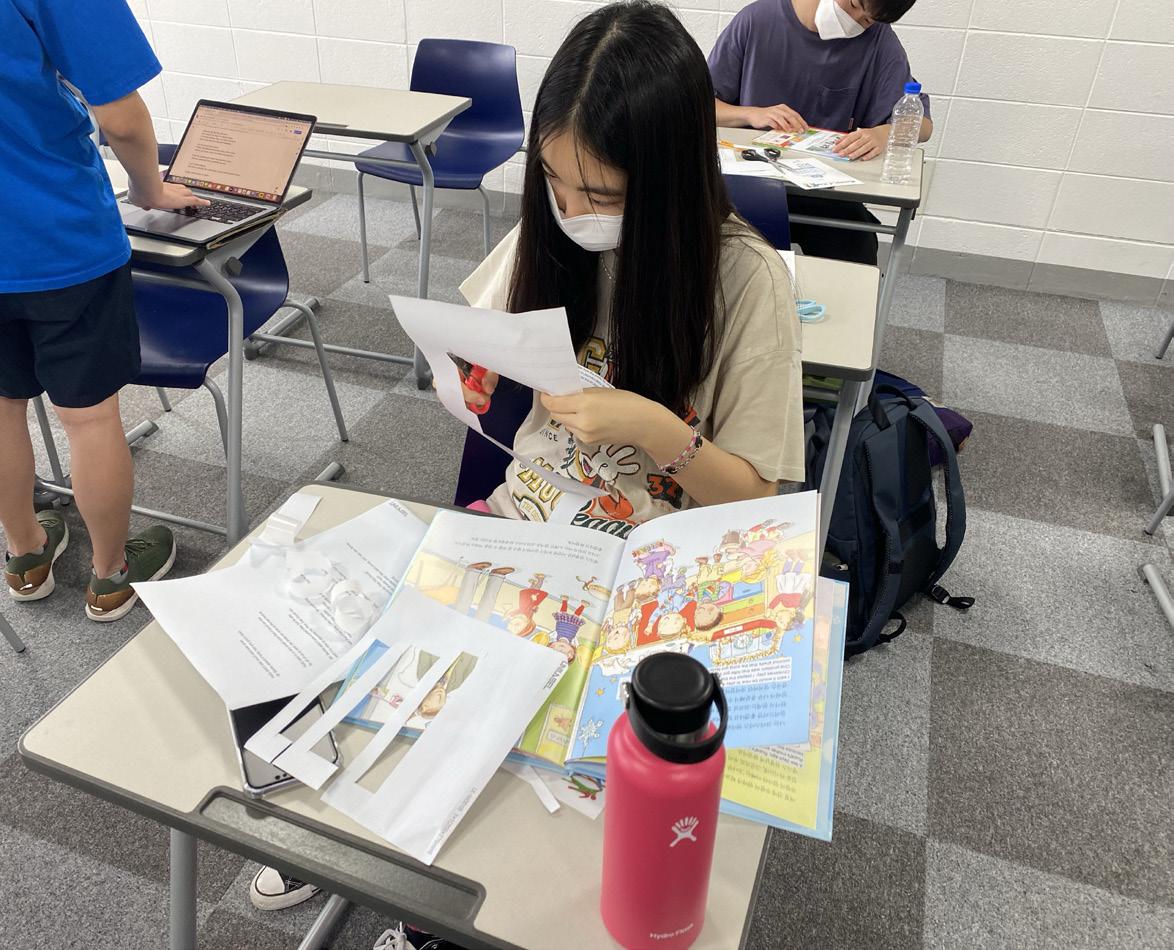

What do books mean to you? I believe books are a window to infinite possibilities. They give insight into the different perspectives and values we have in our world through approachable stories.Therefore, it is critical that every single child around the world is given this experience. How ever, according to the UN Sustainable Development Goals #4, quality education, COVID-19 has furthered a global learning crisis and has deep ened inequalities in education for children around the world.
During 9th grade, I stumbled upon an opportunity to translate Korean books to English through an organization named “Hope to the Future Association (HFA).” Hope to the Future Association is a non-profit or ganization in South Korea that fosters global competence of the domes tic and international youth. Their “Hope Plus Project” focuses on three key service opportunities given to students in Korea: English translation of Korean fairy tales and children’s books, drawing shoes of hope, and recycling used plastic cups to create light. The collected objects are then sent to children in South Sudan who are in need of these items. Person ally, I was interested in translating Korean fairy tales and children’s books because my childhood was always filled with the magical world of Korean traditional stories where tigers were eating rice cakes and goblins were dancing for gold. I was excited that I could share the stories and feelings of affection I felt while I was reading these folktales. I was also excited that I could use my bilingual skills for an action with true meaning, supporting kids in South Sudan and filling their empty libraries.
Last school year, I began to question whether I could share this meaning ful activity to students at our school. I knew that there were many clubs who would be really interested in participating since I felt this activity perfectly fitted to their goals. This is where “Project BUK (BUK Time for South Sudan) began. It was a project aimed to introduce the service of “Translating Korean Fairy Tales and Children’s Book”’ to the TCIS high school community, initiating a chance to use our bilingual ability and to grow awareness of global issues. To briefly explain the project name, “Buk” means drums in Korean but it also sounds like the English word
GLOBAL CITIZENSHIP COMMUNITY SERVICE GRANT
62 EARCOS Triannual Journal
“book.” Therefore I believed it matched the purpose of this project perfectly by spreading two meanings, one as in sharing “books” to the children living in a poor educational environment and then the booming of drums, representing the echo of Korean culture and literature through this activity.
As I started to mold the project together, however, I faced a key problem. In order to make this project come to life, I needed do nations to encourage as many students as possible and to make this movement bigger. Gratefully, this was the point where I met EARCOS and was supported with the $500 community service grant (Global Citizenship Community Service Grant) to use inside this project. I immediately reached out to the Hope to the Future Association. when I got the news, to see how we could be sup ported with books through the grant. Thankfully, HFA said that they would support us with thirty books through the $500 grant and told me to let them know. I then quickly contacted the officers of three clubs at our school, MAD (Make a Difference) Club, TIE (TCIS International Education) Club, and Korean Book Club, who I knew would be keenly interested in this project. To my relief all three clubs responded that they wanted to join in and we were able to gather a total of thirty students who wanted to translate with us.
When we got back to school during August after summer break, we went straight into forming three sessions to distribute and trans late the books together. To briefly explain the translation process, with each club we organized our first session where students could come and pick out their desired book.This was when I explained the project and “Hope to the Future Association” in detail to everyone participating so that we were on the same page. Then they shared their documents with club officers and myself and went straight into translating. We gave a firm deadline of Sunday night and many finished their translations by then. After proof reading through all of the thirty books, the club officers and I held a second session where we all printed out our translations on sticker paper. Then we cut and pasted them onto our books. We are planning to hold our third session next week to finally check through all of the books and then send them off to Seoul, where HFA’s headquarters are. There they will be shipped onto the “Container of Hope” to children in South Sudan to read.
I truly believe that this project enabled the merging of different stu dents inside our community to communicate amongst one another. Many were excited that they were contributing in making a positive influence for the children who would read the books. “Messages of Hope” written to the reader and inserted inside the books re vealed this, with many members wishing the children to feel joy and happiness through reading this book they translated. This project also brought together student leaders in our community, all deeply passionate about global issues. I wouldn’t have been able to finish this on my own without the collaboration and hard work with all three club presidents and officers. We created positive synergy. Ad ditionally, our school’s mission statement is “to cultivate internation ally minded learners who lead in purposeful change.” I firmly believe that this was a big footstep for each and every student in becoming actual “internationally minded learners” that our school strives to become.
It was a precious experience for me, and I can not be thankful enough that this opportunity of growth was given. It was an op portunity to share what I love with others in the community near me and in a community far away in South Sudan. An opportunity to extraordinarily connect with children I have a sheer chance of communicating with in real life. An opportunity to share my culture, knowledge, and education experiences with them. An opportunity to spread positive impact.
When I also asked the club officers who participated to share their thoughts they said, “It was an opportunity to reinforce the ground I share with others. It was an opportunity to grow our internationally mindedness through translation, and consider how we could serve others or fulfill their needs with our bilingual abilities.” One even mentioned, “It was an opportunity to be connected with friends from Sudan through the use of our language skills. I was very happy throughout the translation, thinking of my Sudan friends who would feel how we felt after reading the book we translated. It was such a pleasure to share opportunities to explore books that are published through a foreign language and foreign culture.” Another said, “It was an opportunity to use our skills to help bring quality education to kids in South Sudan and share South Korea’s culture.”
Reading opens up possibilities. Not one or even two ways, it cre ates millions of doors for growth. Learning is what connects humans and develops us together. So, I do not envision “Project BUK” to end here. I plan for the next coming officers and members of the clubs who participated in the project and new clubs, will continue this community service opportunity for many more years to con nect communities and build up infinite possibilities. Project BUK will continue to support the young and the education of the young, with genuine love and passion.
Fall 2022 Issue 63
GLOBAL CITIZEN COMMUNITY SERVICE GRANT
Enlight the ID
By Rindhiya Vishnu Shankar Recipients of EARCOS Global Citizen Community Service Grant Award 2022 IGB International School
One of the most sensational realities of the world is that every living organism is configured to be so similarly unique. While even identical twins don’t share the same fingerprints, any two human beings from an ywhere across the globe are said to be 99.9% genetically similar. Enlight the ID, a service project, sets it’s sights on breaking barriers between these ever-so-slight differences to create and ignite a more inclusive community. Enlight the ID envisions to debunk stereotypes and spread awareness to support intellectually disabled children with low socioeco nomic backgrounds.
In general, Intellectually Disabled children are mildly affected by three adaptive functions which include conceptual skills, social skills and practi cal skills. This does not lead to them being any less compared to other children. It simply means that their brain works in a different manner in contrast to the majority.

Despite minimal light being shed upon ID, there are a few organizations and schools around the world that provide early, ongoing interventions and great support to children which enables them to thrive in societies for a lifetime, independently. An example of such an incredible establish ment is Ritham School, located in Tamil Nadu, India.
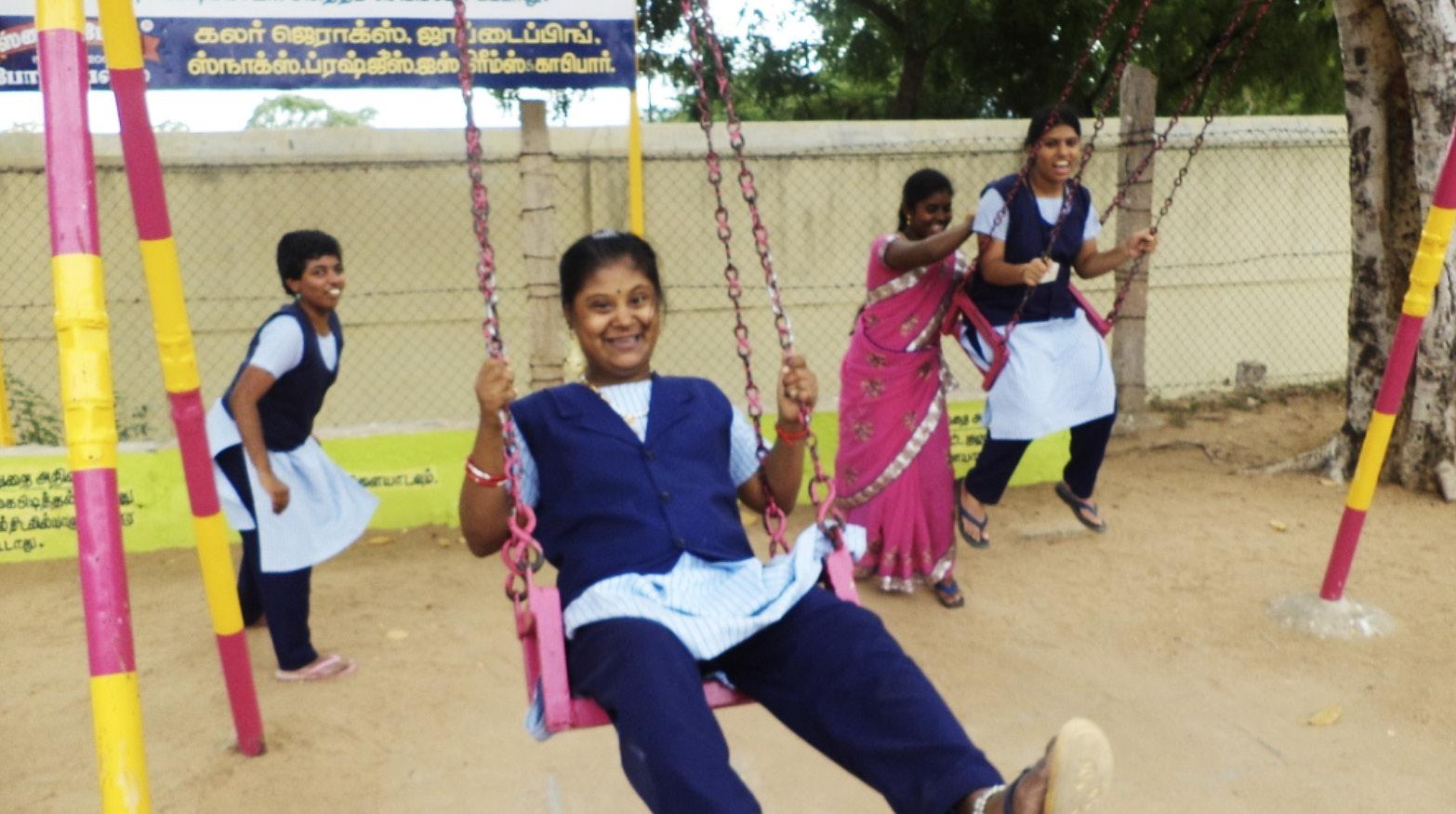
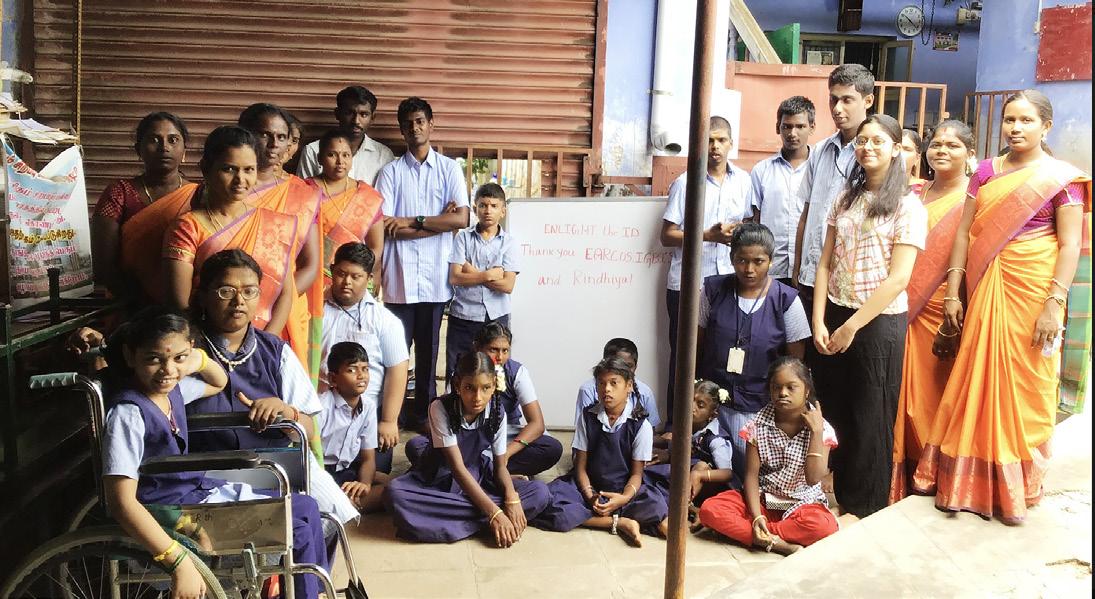
Ritham school was first founded in 2004, catering to 4 special needs children of poor economic backgrounds. It has now grown into a school with 200 students, catering to different age groups and levels of Intellec tual disability. It also recently invested in a bigger and safer school build ing for the children’s well-being. With their motive of “impacting lives” being very close to ours, we decided to join hands and make a difference.
The $500 grant which was generously donated by the EARCOS asso ciation was employed to purchase new equipment for the Ritham’s new school building. The one-time grant was used to purchase the following equipment seen on the table. Despite being simple equipment, there are various scientific purposes of the equipment.
EQUIPMENT PURCHASED USING $500
EQUIPMENT
SWING
TRAMPOLINE
PURPOSE
Stimulates diffrent parts of a child’s brain simultaneously and improves spatial awareness
Aside from improving their sense of balance and coordination, it improves the interpretation of external stimuli
BALLPIT
Strengthen muscles, develops fine motor skills of the children and the colorful balls help to calm hyperactive children
The $500 grant from the EARCOS has been of great help to the En light the ID project. Although this is only a one time grant, we believe that it can be used to benefit a great number of people from a variety of age groups because the equipment can be used repeatedly. In addition, the equipment purchased through the grant can be used for at least 5-6 years, benefitting Intellectually disabled youth, providing an enduring legacy.
Disabled children generally make up a small proportion of the popula tion ,however, it is extremely essential to assist and interact with them to make them feel included because they truly deserve more than neglect. The EARCOS grant has given us such a great opportunity to extend our help out to members of our community that need it.
Ritham school students after successfully receiving grant.
Students with such beautiful smiles using the swing.
64 EARCOS Triannual Journal
GLOBAL CITIZEN
GRANT
Ch4nge the Cycle
By Sadie Kapp Recipients of EARCOS Global Citizen Community Service Grant Award 2022 KIS International School
allowed for intentional yet minimal designs to be created and eventually printed onto t-shirts. Now, with over 10,000 THB raised from t-shirt sales and the EARCOS Global Citizenship Grant, the campaign is able to expand and increase its impact drastically.
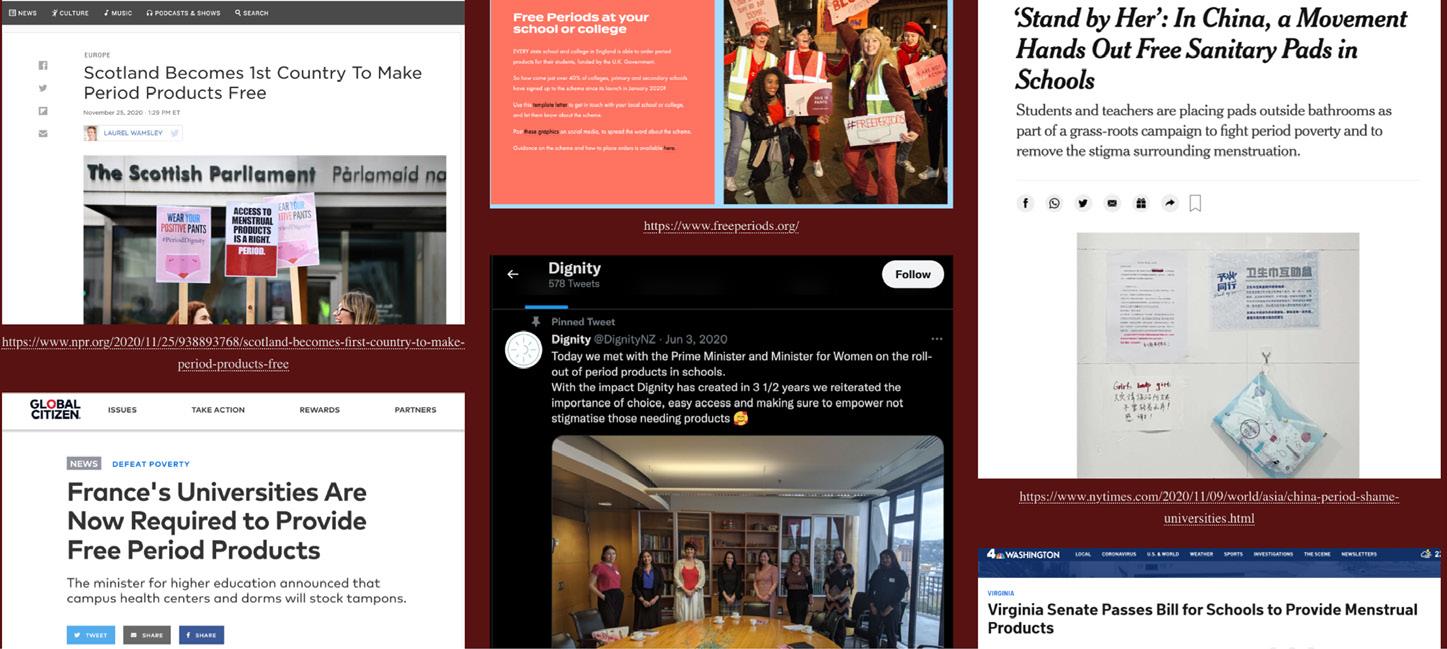
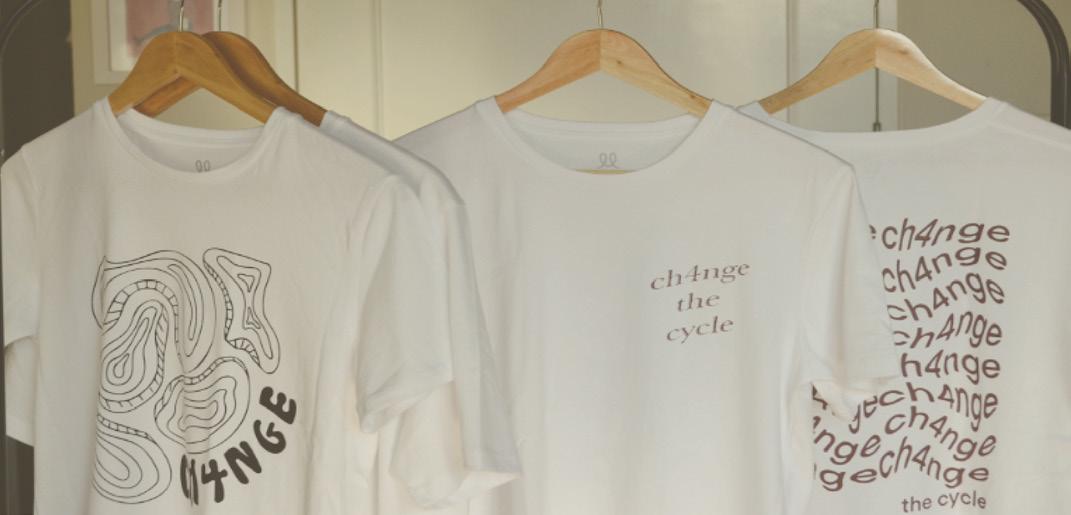
Our current priority/goal is to provide free period kit subscription boxes, either monthly or biannually, to as many schools as possible in Thailand. These can then be placed in bathrooms so that young menstruators have easy access when needed at school. With the $500 grant, ch4nge the cycle will be able to partner with local, sustainable period product brands in Thailand to help fill these kits with the needed products and ship them off across the country. This is the first step to achieving the long-term goal and will act as a stepping stone to helping us reach it.
Health issues that particularly (but not exclusively) arise in women, such as menstruation, are often overlooked by decision-makers, policymak ers, educators, and even medical establishments. Not only can this affect the education menstruators receive but also can make menstruation a confusing or difficult time in one’s life, where discrimination is faced and a detrimental norm that this kind of treatment is acceptable or tolerable is created.
“Human rights are rights that every human being has by virtue of his or her human dignity. Menstruation is intrinsically related to human dignity – when people cannot access safe bathing facilities and safe and effec tive means of managing their menstrual hygiene, they are not able to manage their menstruation with dignity. Menstruation-related teasing, exclusion, and shame also undermine the principle of human dignity.” (UNFPA)
The cycle in which menstruators time and time again are overlooked and denied access to basic rights that are necessary for their health and well being is in dire need of reform. This cycle spans across many areas such as stigmas around men struation, euphemisms, and period poverty. From noticing these obstacles, a campaign, ch4nge the cycle was born. Initially starting out as a passion project as a part of the IB MYP Personal Project, a collection of t-shirts was released to begin raising money for the cause and spreading awareness of the issue. The almost year-long Personal Project
ch4nge the cycle’s ultimate objective is to combine the right to education and good health, and petition the Thai government to join New Zea land, Scotland, and New South Wales, among an extremely other few regions, to provide free period products to all schools in Thailand. We hope that by creating a model that can be replicated on a larger scale, legislation can be passed to truly make this a long term solution. Men struators should not have to miss out on their education nor should their health and wellbeing be overlooked when it comes to having the products they need to prioritize their health and function in school.

COMMUNITY SERVICE
Fall 2022 Issue 65
Light Up Noveleta
By Dylan Yap Recipients of EARCOS Global Citizen Community Service Grant Award 2022 International School Manila

“We protect these mangroves because no one else will. This is our passion, and our life’s mission.” Fondly nicknamed ‘Tatay’ (father) by the mangrove and fishery community of Noveleta, our guide through the ver dant wetlands he was tasked to protect, stopping occasionally to inspect foliage damaged by illegal lumberjacks. Behind him, a troop of students from the International School of Manila (ISM) followed, distributing solar headlamps and teaching members of the community about the benefits of renewable solar lighting.
On July 30th, a group of ISM student volunteers took a trip to the dis aster-prone community of Noveleta, Cavite, hosting workshops on the benefits of clean energy and the dangers of using kerosene lighting. Fol lowing these workshops, volunteers distributed solar lights to over 70 households and provided instructional demonstrations on the potential uses of these lights in the daily lives of locals. Specifically, students spoke to the versatility of solar lighting, in emergency situations such as blackouts and electricity cut-offs, as well as in every-day situations such as cooking or doing homework at night.
This expedition, made possible from the generous $500 EARCOS Glob al Citizen Community Service Grant (GCCSG) won by incoming ISM senior Dylan Yap, opened up the floodgates for dialogue between the environmental stewards of Noveleta, and the aspiring sustainable justice advocates of ISM. Light Up Noveleta was designed by Dylan to provide classmates with an opportunity to become more strongly immersed in the global issues plaguing the surrounding FIlipino local communities. Dylan used a network established from his work as a UN SDG #7 Cli mate Delegate and Event Host, as well as a role as President of the ISM Sustainability Council, to ensure this project was a success, championing the EARCOS tenets of inclusivity and global-mindedness to inspire local action.
Within the Noveleta community itself, this project allowed for members of the community to feel recognized for their efforts. By equipping the fisherfolk with solar headlamps, they are now able to work productively during the night, tackling the issue of illegal lumberjacking and reducing the need for dangerous kerosene lighting.
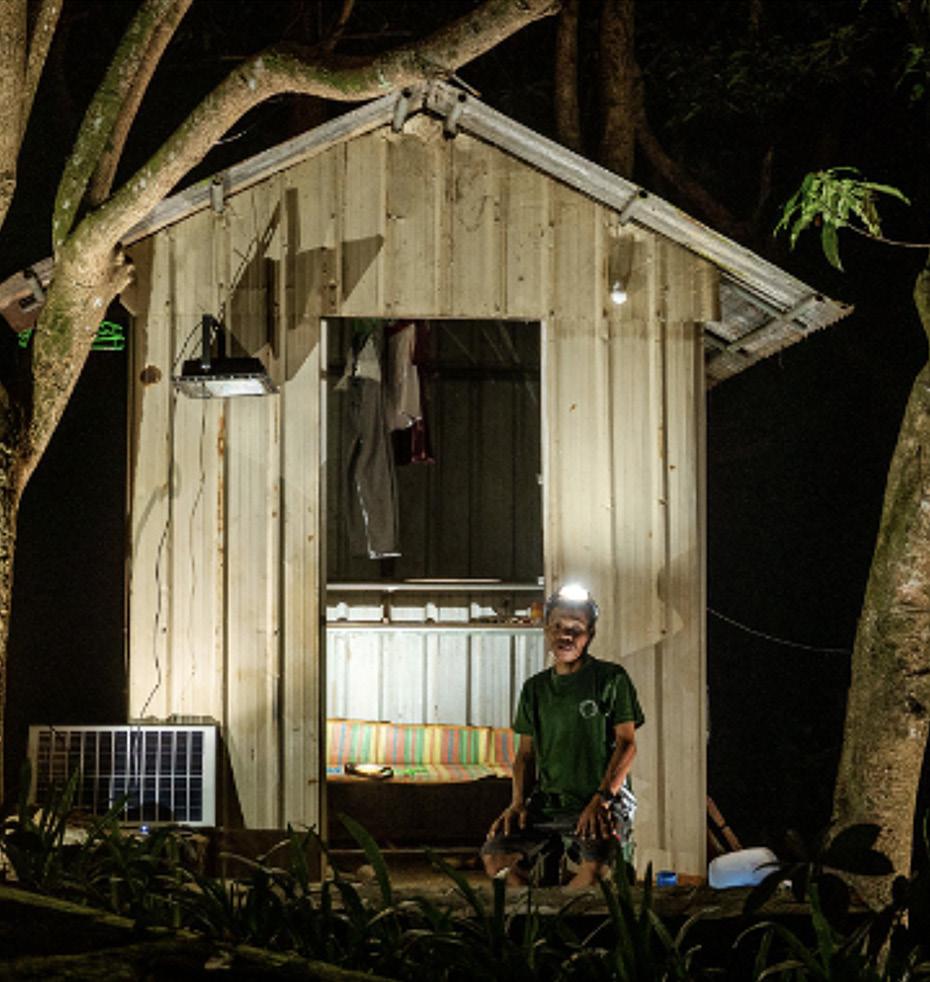
To many, terms like ‘sustainability’ and ‘environmental justice’ have become a buzzword. However, to the students of ISM, sustainability is at the fore front of almost all community service operations. As school-wide priority #1, ISM students strive towards sustainability by cultivating a strong level of cultural competency and awareness towards the rich local community their school is rooted in, embarking on actionable service projects to enact ever-lasting transformative change. Light Up Noveleta is just one example of the level of service our students strive for, and, equipped with the opportunities given by the EARCOS organization, brings our youth one step closer towards complete outreach towards the marginalized communities of our nation.
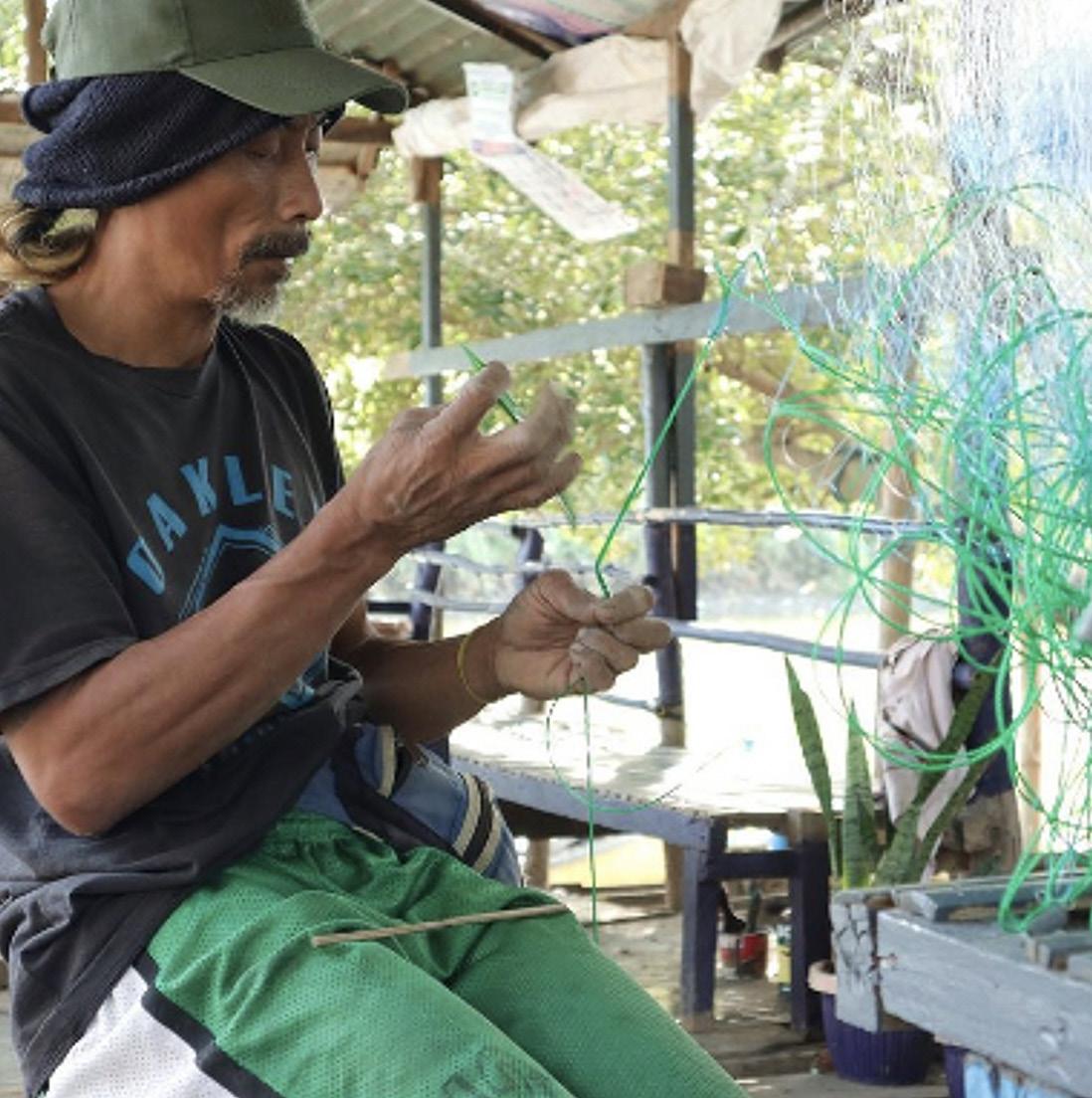 Tatay, preparing a fishing net under OLM’s solar lighting.
A member of the Noveleta Community using their solar Headlight.
Tatay, preparing a fishing net under OLM’s solar lighting.
A member of the Noveleta Community using their solar Headlight.
GLOBAL CITIZEN COMMUNITY SERVICE GRANT
66 EARCOS Triannual Journal
Child Doctor Project
By Tamami Ono, Grade 12, Class of 2023 Recipients of EARCOS Global Citizen Community Service Grant Award 2022 Osaka International School
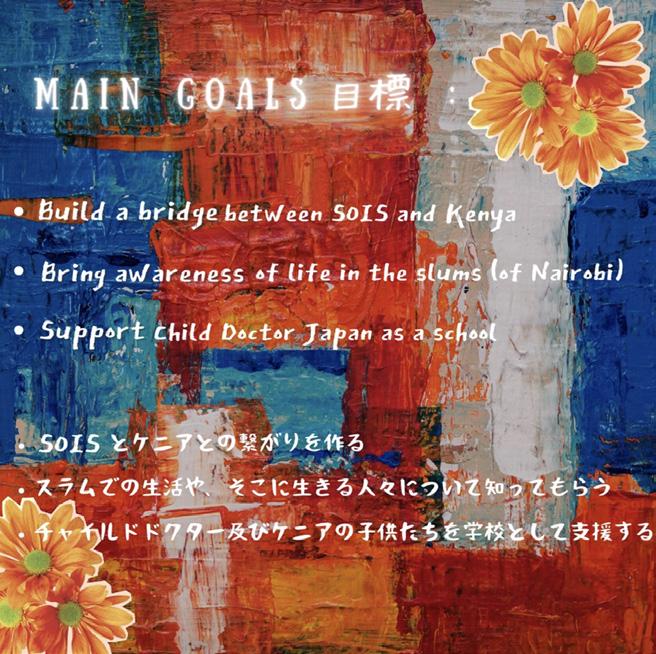
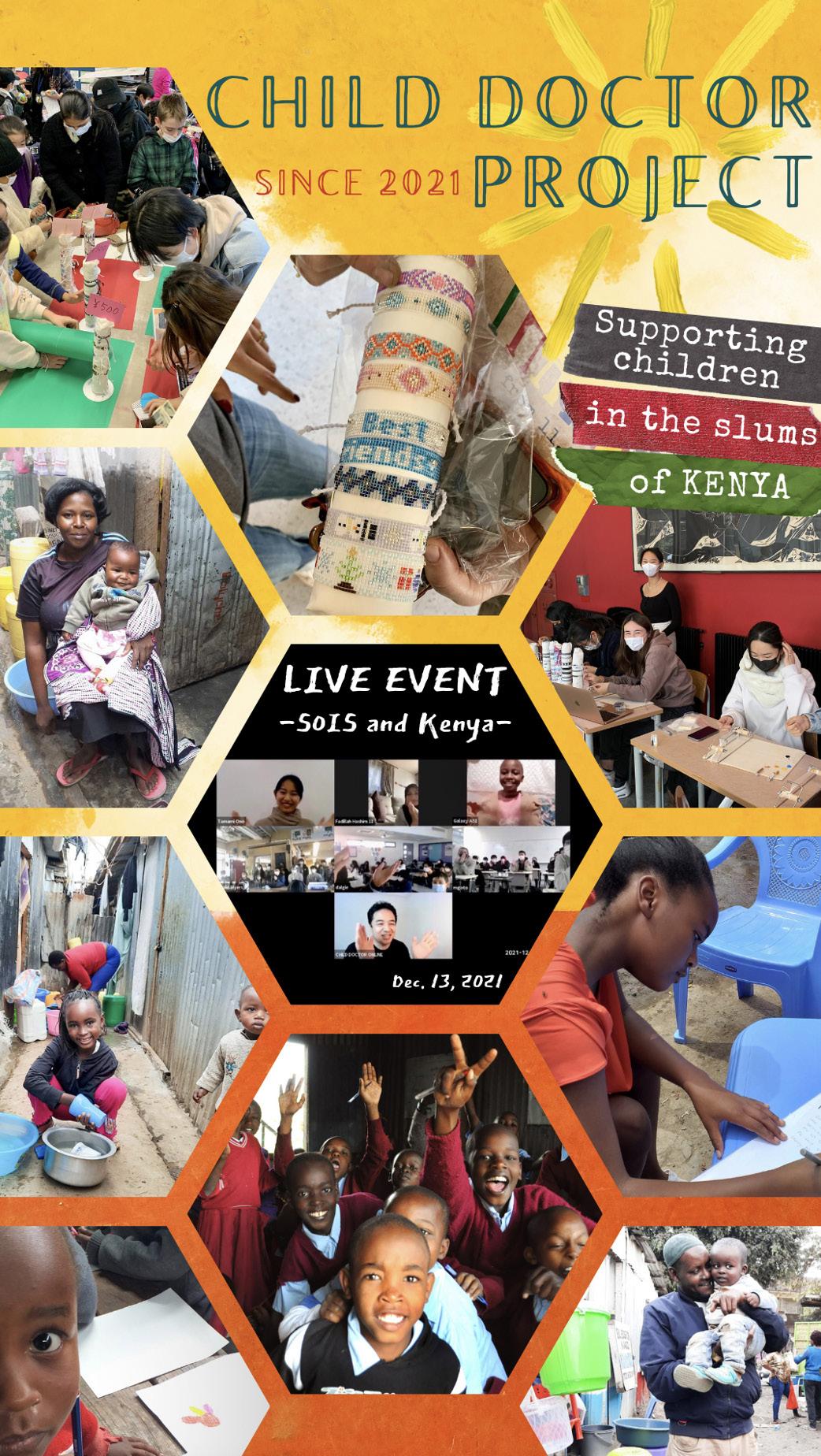
Child Doctor Project was founded as part of the fundraising and awareness-raising initiatives to support Child Doctor Japan — an NPO dedicated to providing free, quality healthcare to children living in the slums of Nairobi, Kenya, through the distribution of ‘medical vouchers’ sponsored by individual supporters in Japan. What makes Child Doctor particularly unique is its system of support; the interaction between the supporter (called Doctor) and the Child in Kenya does not simply end with donations, but continues through the online letter-writing program that creates a deep emotional connection between the two. To facili tate their communication, Child Doctor asks for volunteer translators to translate the exchanged letters, from English to Japanese and vice versa. My involvement with Child Doctor began when I first became a volunteer translator in 2020, and later a Doctor of an eight-year-old girl named Angel.
In the hope of promoting the work of Child Doctor at school, I started the Child Doctor Project in October 2021, which began with the fund raising activity of creating handmade bracelets with my friends (woven with hundreds of beads in customizable designs) and selling them in front of the cafeteria every Friday lunchtime. Thanks to the warm sup port from our school community, we were able to raise a total of over 120,000 JPY through the bracelet sales, all of which were donated to Child Doctor Japan to 1) cover the dialysis cost of one child, 2) purchase fire extinguishers for the residents of the slums, 3) become a Doctor as a school for two children — Dwayne and Abraham, and the rest dedicated to enhancing the healthy lives of the local children supported by Child Doctor.
While the main objective of this pro ject was to broaden the support for people living in the slums of Kenya, I also hoped to paint a broader pic ture of their life, and provide more nuanced, authentic narratives beyond the often misleadingly-simple media stories that portray negative, reduc tionist images of people in poverty. I figured one way to make such a dif ference was to enter their lifeworlds and see their lived experiences from their own perspectives. So last De cember, I was inspired to host a live event on ZOOM to connect my school community with the people in the Nairobi slum. It included an interview with a 14-year-old student named Grace, and a virtual visit to the community she lives in, through which we saw how people were going about their lives in real-time. Virtually walking through the streets
of the slum, we saw people living without running water and reliable electricity supplies to their houses, which demonstrated the hardships imposed by limited infrastructure and public services. Though, as much as it was informative of such challenges, it was a profoundly inspirational and moving event, for it presented people as active rather than passive actors in their daily lives. We were also able to make a genuine human connection with humor and friendship; at the end of the interview, with Grace leading, we all sang together a verse of ‘If You’re Happy and You Know it’. This interaction provided an insight into the reality of their narrative by making them the center of their own story, making visible their challenges, resilience, hope, and individual happiness through an unfiltered experience.
Anyone with bilingual/multilingual skills in Japanese and English is wel come to become an online volunteer to translate the letters for Child Doctor — or even a Doctor to support a child. It is my sincere hope that this project will establish a long-lasting bridge between our inter national community and those in Kenya, build a more balanced picture of their lives, and serve as a stepping stone to bring us all together in our common humanity. Please feel free to reach out to me at tama mio0443@gmail.com with any questions. Asante!
GLOBAL CITIZEN COMMUNITY SERVICE GRANT
Fall 2022 Issue 67
By Sabhyata Joshi, Grade 12 Recipients of EARCOS Global Citizen Community Service Grant Award 2022 American International School Hong Kong
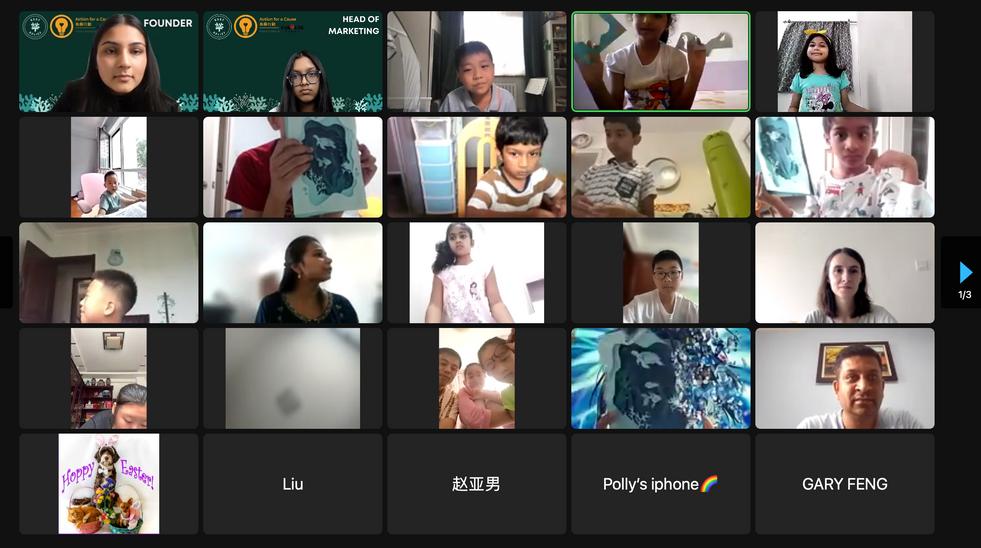
REEF RRELIEF EEF RELIEF OUR IMPACT
OUR STORY
Did you know Hong Kong's oceans have a coral biodiversity that is higher than the Caribbean Sea? Most people residing in Hong Kong remain unaware of the diverse ecosystem that lives a short while away causing coral degradation issues to be funnelled to divers alone. When our founder, Sabhyata Joshi, took on scuba diving, she was shocked to see what were bleached, fragmented corals. If Hong Kong's coral environment is so precious, we need to stop treating it so recklessly. Reef Relief aims to do just this! Recognising that not everyone has access to the ocean, we strive to bring coral conservation to the people through events, packages, media, and collaborations.
We hosted just under 100 participants at our very first event, raising 2,500 dollars for WWF Hong Kong! Reef Relief also received seed funding from Kids4Kids and was mentored by Ms Aurianne Ricquier The first event hosted marine conservationist Dr Vriko Yu and conservationist and engineer, Mr Ken Chew Further, Reef Relief is a fully student led and student run organisation!
OUR PLANS
As of summer 2022, we are working to tive newsletter Immerse which aims to allow those who interact with it to share what conservation means to them! With entries of informative articles on new revelations in the field of coral conservations along with artistic expression (including poems, songs, art, and more!) the newsletter is a one stop shop for all things Immersive!


68 EARCOS Triannual Journal
Promoting Inclusive Environments Within Conservative Cultures
By Emi Hisamatsu (MYP PHE/Math/Science/Homeroom Teacher) Nami Holderman (MYP Arts/Homeroom Teacher)
There is no direct word for “inclusivity” in the Japanese language. In recent years, schools in Japan are recognizing the need for inclusivity in the education systems and searching for ways to respect diversity and create a safe learning environment. One “Framework for Action” that UNESCO (2020) emphasizes is “inclusion and equity as laying the foundations for quality Education” (Harmon, 2019). Six years ago at Aoba Japan International School (AJIS), we started a club to support the LGBTQ+ community and called ourselves “Aoba Alliance.” One of the struggles that we faced within the international school setting was the latent tension between Japanese hospitality, “omotenashi,” and in clusivity. One interpretation of omotenashi is to provide warm-hearted hospitality for the guest, but it is intended for outsiders who come and go rather than long-term residents (Li, 2017). When outsiders decide to stay longer and become permanent residents in Japan, the Japanese would expect the outsiders to adjust their way of life to fit Japanese ways. Culturally speaking, from a Japanese perspective, standing out from the crowd has a negative connotation, as social conformity is a deeply rooted norm (Okada, 2018).
A study by Tamagawa (2017) found that individuals who identify as LG BTQ+ have a harder time coming out to their parents, compared to do ing so with classmates or workmates. Japanese parents are more likely to express feelings of homophobia and pressure LGBTQ+ children to conform to what is considered “normal”. This may be rooted in how Japanese society places family as the basic unit, and the parents may fear stigmatization as well as assume that this is part of their parental responsibilities.
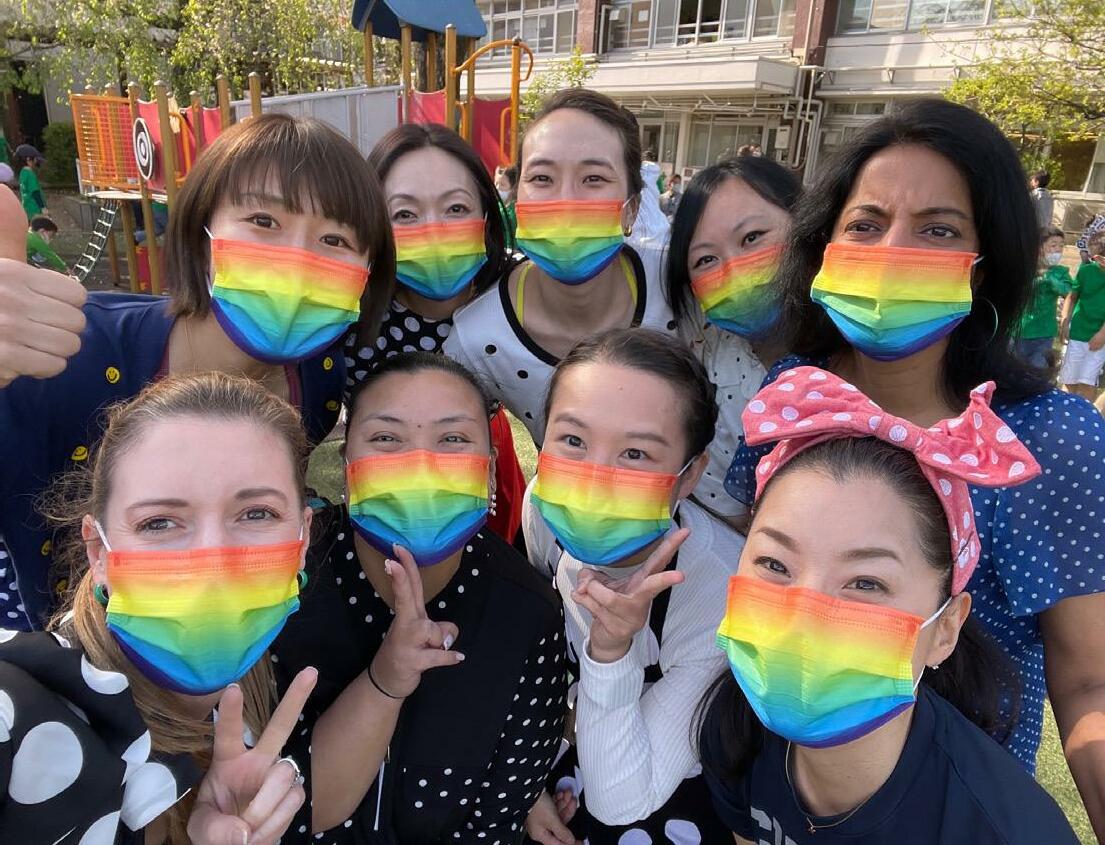
As a school, we first introduced inclusivity through Social Emotional Learning (SEL) in homerooms across the school (K-12). Students were curious to find out more about queer culture, although a significant portion felt that it was an inconvenience to become involved in inclu sive initiatives. Cultivating inclusivity within a conservative culture is a long process but there is hope in a younger generation that is open to new ideas and who takes curiosity in the world around them. When we initiated the idea of supporting an LGBTQ+ community at AJIS, we observed two types of reactions from the students: those who seemed to accept the idea publicly (omotenashi) and those who reacted with hostility due to feeling uncomfortable. One trait that we found that students had in common was the lack of confidence and understanding of this topic. We soon realized the importance of providing support to not only students but also the educators and staff in the community be cause if the educators are not certain about concepts then the wrong message will be delivered.
With the help of the Head of School, we shifted our school vision towards a broader definition of an inclusive mindset so that support can be provided for teachers and staff to better implement policies and practices to support LGBTQ+ members in our community. Broadening our definition has allowed everyone to see the value of inclusivity. Being consistent and persistent in raising awareness was the most effective
process in creating a safe working environment that minimizes the risks of exclusion, psychological harm, and violence towards anyone at school. As a result of this approach, open discussions about sexual orientation and other topics have become more commonplace among staff and students at AJIS.
Our school has revisited our vision statement to include the idea of “transforming education for learners in Japan and beyond.” Through a progressive mindset approach, the intention is to influence the group culture to value dispositions such as risk-taking and global leadership. In recent years, we have strengthened our SEL program to foster wellbeing among our diverse range of students. In addition to establishing a positive classroom environment, SEL can be powerful for developing self-awareness, self-discipline, as well as interpersonal skills (Vasiliou & Rios). To supplement SEL, we also include Sex Education that follows the UNESCO Sex Ed Scope and Sequence. Through Sex Ed, we hope to provide the resources and knowledge that can help a student to navigate through life with pride and respect for their own individuality while showing respect and empathy towards others. Aoba Alliance has grown over the years to support student minority groups and provide a safe space for discussions. Alumni students are also part of our team who help to manage our social media accounts, and some of them have gone as far as volunteering at an NPO and helping to create a bridge between Aoba Alliance and external organizations with similar missions. One of our senior graduates recently published a book titled “18歳イ ンタ歳生のPER歳スペクティブ (Perspective of an 18 year old inter national student)” to raise awareness on the importance of celebrating diversity. We also had a successful Spring Carnival event in 2021, the AJIS International Fashion Show where students did a runway walk with costumes representing their diverse cultures. Since 2021, the second ary students in AJIS are no longer required to wear uniforms. This new school rule has lifted unnecessary stress that may arise from students having to wear gender-specific uniforms, and in return allows freedom of expression. In addition, our school no longer mandates swimming lessons for secondary students in PE class. This decision is meant to ease the stress students may feel, especially for those who are body-con scious. Last year, a team of Grade 9 students did their MYP Community Project about inclusivity and created posters and published websites to educate others about inclusivity. They created a platform where teach ers and students can come together for discussions about topics such as gender equality and gender rights in schools and workplaces. This reflects the progress that we have made as a school through initiatives aimed at establishing a shared culture of empathy, self-discovery, and inclusion.
Rainbow mask sales by Aoba Allaince.
SERVICE LEARNING (DEIJ)
Fall 2022 Issue 69
In recent years, Japan has gone through a shift in providing more recog nition to LGBTQ+ individuals (Dale, 2022). More schools are encourag ing discussions around queer identities and modifying textbooks used in schools to be more inclusive. Same-sex partnership certificates were first legalized in Shibuya in 2015, and at the present moment, there are 215 other municipalities who have followed suit, although same-sex couples are still not given equal rights as married couples. The govern ment has encouraged schools to incorporate more awareness around the LGBTQ+ community, but in reality, the shift in mindset is a slow change and many still remain ignorant in terms of understanding the diversity that exists within the LGBTQ+ community. One issue may be the lack of training and education for those who are in the position to educate and spread awareness. Another issue is that Japanese are stuck with the idea of calling LGBTQ+ community as “Gender minori ties.” According to Nagata (2020), true inclusion isn’t about “accepting” the minorities. Calling any community as minorities can be seen as demeaning and instead we should see the world as a unified shared space. Those who are not accustomed to talking about these issues, especially those from the older generation, may be regarding LGBTQ+ individuals as having some sort of a disability. This highlights the need for a support system for everyone in the community in order to make effective change.
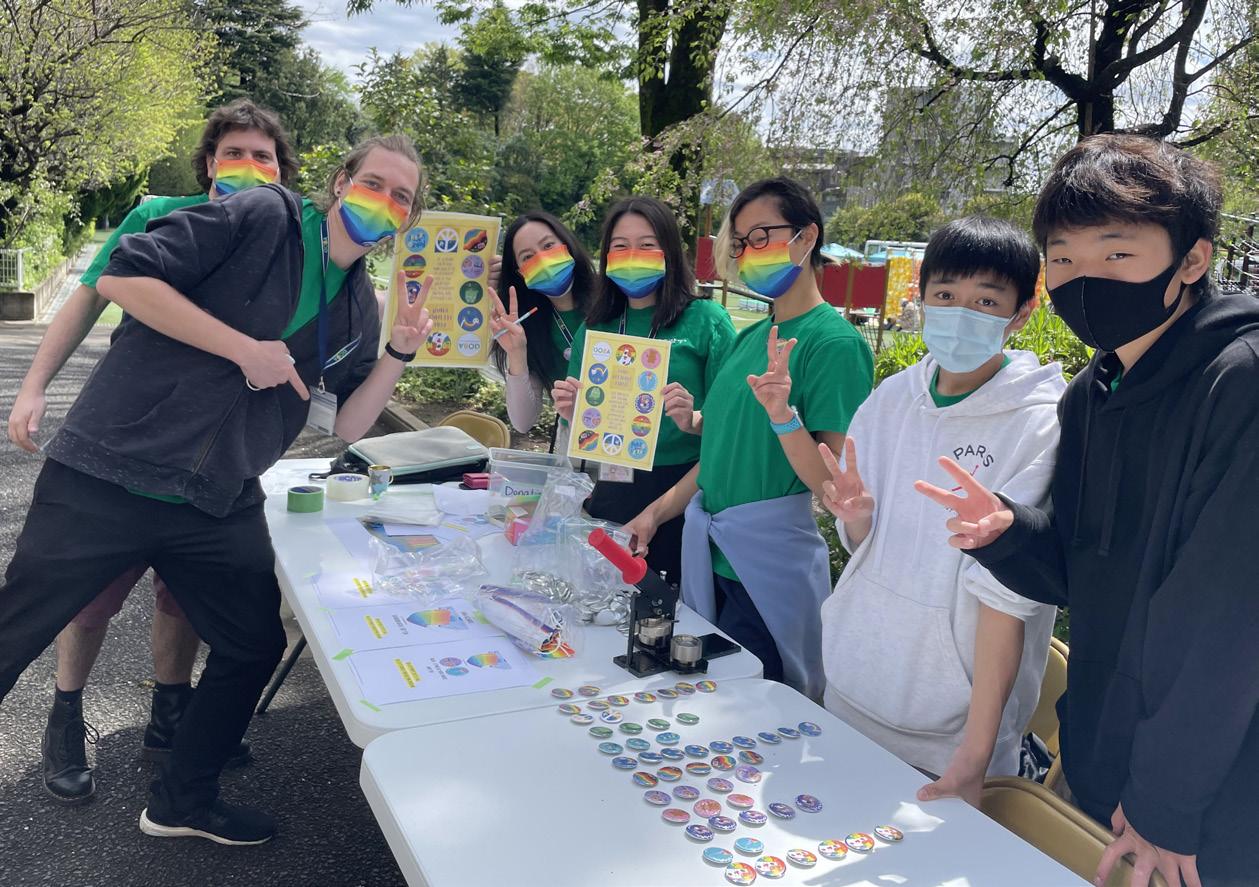
As a school we started out taking small steps, but eventually we saw a gradual shift from year to year in how the individuals in our community interact with one another. We observed less derogatory language being used among the students, whether written or verbal, as well as less gen der discrimination for everyday things such as dressing up, sports teams and heavy-lifting chores. Even among staff, we have non-binary teachers, one who likes to express their identity through clothing, cosmetics, and accessories, and another who regularly holds LGBTQ+-friendly story time sessions with grade 1 students. Change did not happen overnight but consistency and perseverance in the initiatives that aligned with our vision led to a positive change in our school community.
In order to create a safe environment at the school level, support sys tems need to be in place for everyone in the community. Incorporating SEL and Sex Ed into the curriculum is an important first step in driving towards that direction of acceptance. Facilities could later be remodeled to allow for inclusivity (eg. gender-free bathrooms, gender-free uniforms, and gender-free color labels for the students, etc). Campaigns and work shops can be organized to inform about the different identities within LGBTQ+, which can be targeted towards not only students but also the parent community.Because of the natural inclination towards social con formity, as long as more people start having these discussions, Japanese culture may undergo a shift towards inclusivity.
Schools need to focus on creating a safe space that fosters love, connec tion and passion so that every child can grow up with confidence and self-dignity. We must shift our mindset to support LGBTQ+ individuals the same way as gender equality (SDG #5) and reducing inequality (SDG#11). Since those values are commonly taught by most educators, it should not be a big challenge to expand on the broader meaning of inclusivity and have discussions about including the LGBTQ+ com munity (Suzuki, 2020). We hope to continue to promote and educate on creating an “inclusive” environment in classrooms and beyond to other communities in Japan. We want to spread the message that even with social and cultural constraints, there is hope for change. We urge all learning institutes in Japan to join forces in creating a shift towards an environment where diversity is celebrated and self-expression is ad mired.
References
Dale, S. P.-F. (2022). Teaching LGBT Rights in Japan: Learning from Class room Experiences. In Teaching LGBT Rights in Japan (pp. 219-232). Hu man Rights Education in Asia Pacific. hurights.or.jp/archives/asia-pacific/ section1/seven_3-4.pdf
Harmon, D. (2019). Decentred Hospitality: Omotenashi Culture and the Foreign Visitor in Japan 北陸大歳. Retrieved August 29, 2022, from https:// www.hokuriku-u.ac.jp/about/campus/libraryDATA/kiyo46/comm2.pdf
Li, M. (2017, April 4). MICHELIN Guide Magazine Features Omotenashi: The Reason Why Japanese Hospitality Is Different. MICHELIN Guide. Re trieved August 30, 2022, from https://guide.michelin.com/sg/en/article/ features/omotenashi
Nagata, T. (2020). 性的マイノリティの歳みは、差別や偏見だけで はない 社歳からの孤立を防ぐ、歳谷歳のLGBTQ施策. (2020, Sep tember 28). ログミ歳Biz. Retrieved August 30, 2022, from https://logmi. jp/business/articles/323220
Okada, M. (2018, June 18). Escaping Conformism and Keeping Individuality Alive | Nippon.com. nippon.com. Retrieved August 26, 2022, from https:// www.nippon.com/en/features/c05004/
Suzuki, S. (2020, August 22). LGBTQ支援は「カミングアウトありき ではない」 ゲイの小歳校歳師が語る、子どもたちの多歳性を尊重 する授業. (2020, September 29). ログミ歳 Biz. Retrieved August 30, 2022, from https://logmi.jp/business/articles/323221
Tamagawa, M. (2017). Coming Out of the Closet in Japan: An Explora tory Sociological Study. Journal of GLBT Family Studies, 14(5), 488-518. https://doi.org/10.1080/1550428X.2017.1338172. https://www.tandfon line.com/doi/full/10.1080/1550428X.2017.1338172
UNESCO. (2020). Towards inclusion and education: Status, trends and challenges. UNESCO Nations, 20-22. https://unesdoc. unesco.org/in/documentViewer.xhtml?v=2.1.196&id=p::usmarcd ef_0000374246&file=/in/rest/annotationSVC/DownloadWater markedAttachment/attach_import_1ebf7f67-108a-4e03-9b01dadd038c00f5%3F_%3D374246eng.pdf&locale=en&multi=true&ark=/ ark:/48223/pf
Vasiliou, N., & Rios, R. (n.d.). The Need for LGBTQ Social Emotional Learn ing Programs. ASU Center for Child Well-Being. Retrieved August 28, 2022, from https://childwellbeing.asu.edu/LGBTQLearningPrograms
Aoba Alliance Charity Event.
70 EARCOS Triannual Journal
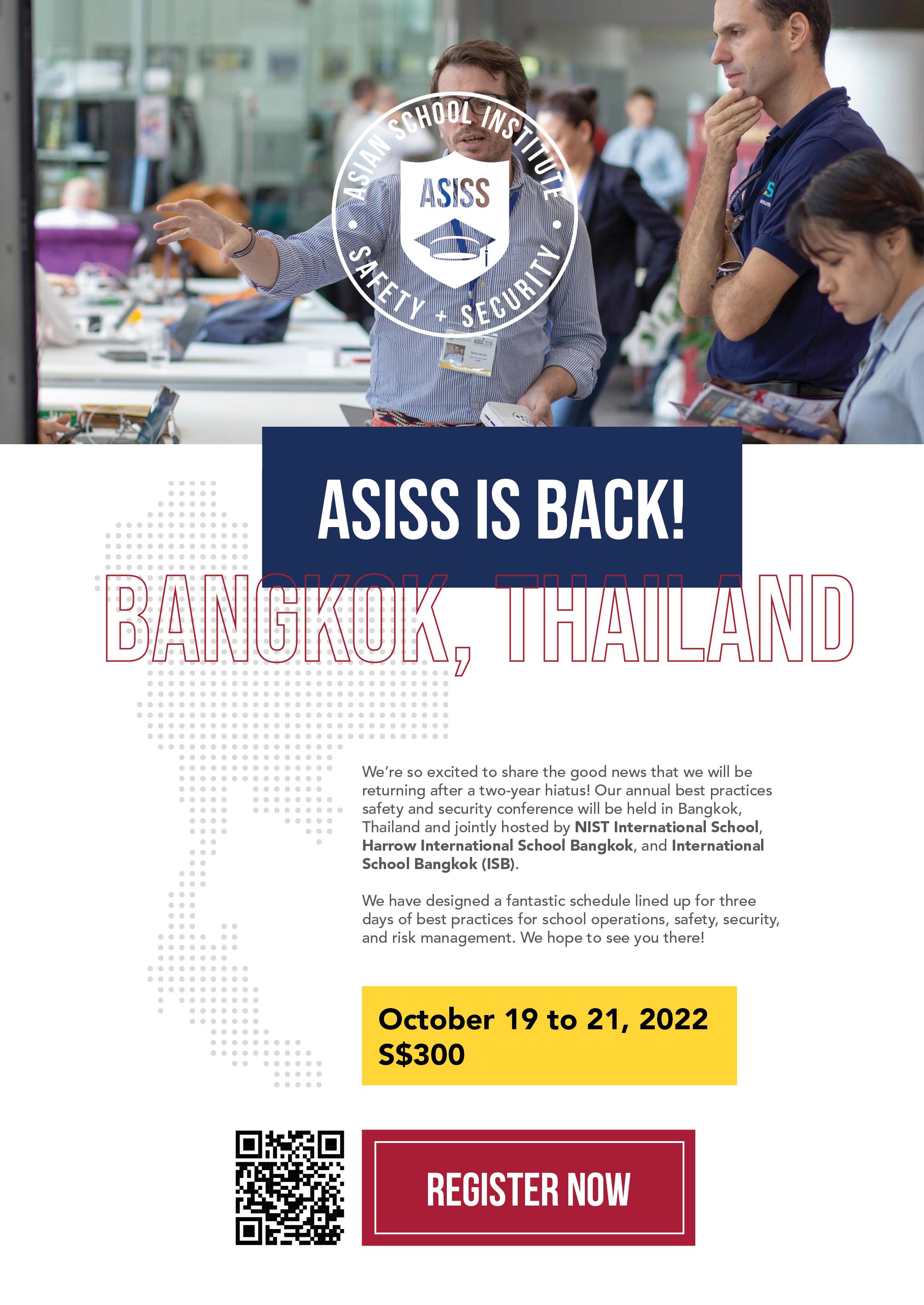
Fall 2022 Issue 71
Film Review of Alien Citizen: An Earth Odyssey
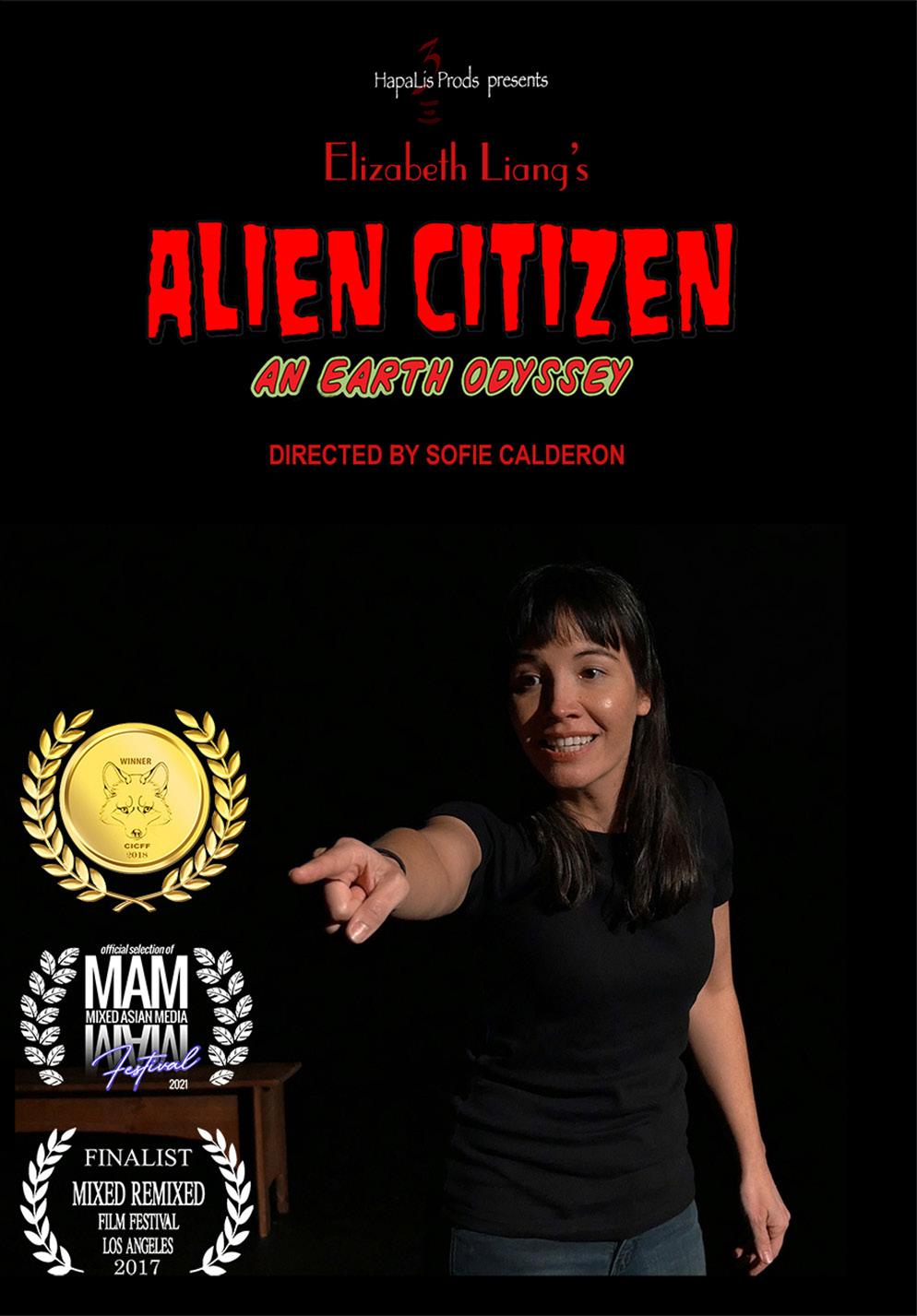 By Danau Tanu Visiting Research Fellow Waseda University
Alien Citizen: An Earth Odyssey is like an anthem for those who grow up internationally but its genius has thus far escaped the attention of the inter national school community. Elizabeth Liang’s gripping film and performance is a godsend for international educators grappling to find creative ways to address difficult, complex issues relating to racism and inequalities that speak to both children and adults.
Written and produced by Liang, Alien Citizen opens with a booming voice taunting her on stage to answer the unanswerable questions that Third Cul ture Kids (Pollock et. al., 2017) and mixed-race children often hear: ‘Where are you from? … What are you?’ It then follows Liang’s childhood of moving internationally with her ‘Guate’-Chinese-Irish-European-hodgepodge-Ameri can family, partly to escape the civil war in Guatemala in the 1970s at first and then later as a ‘business brat’ when Xerox posted her father up and down and across the Atlantic Ocean.


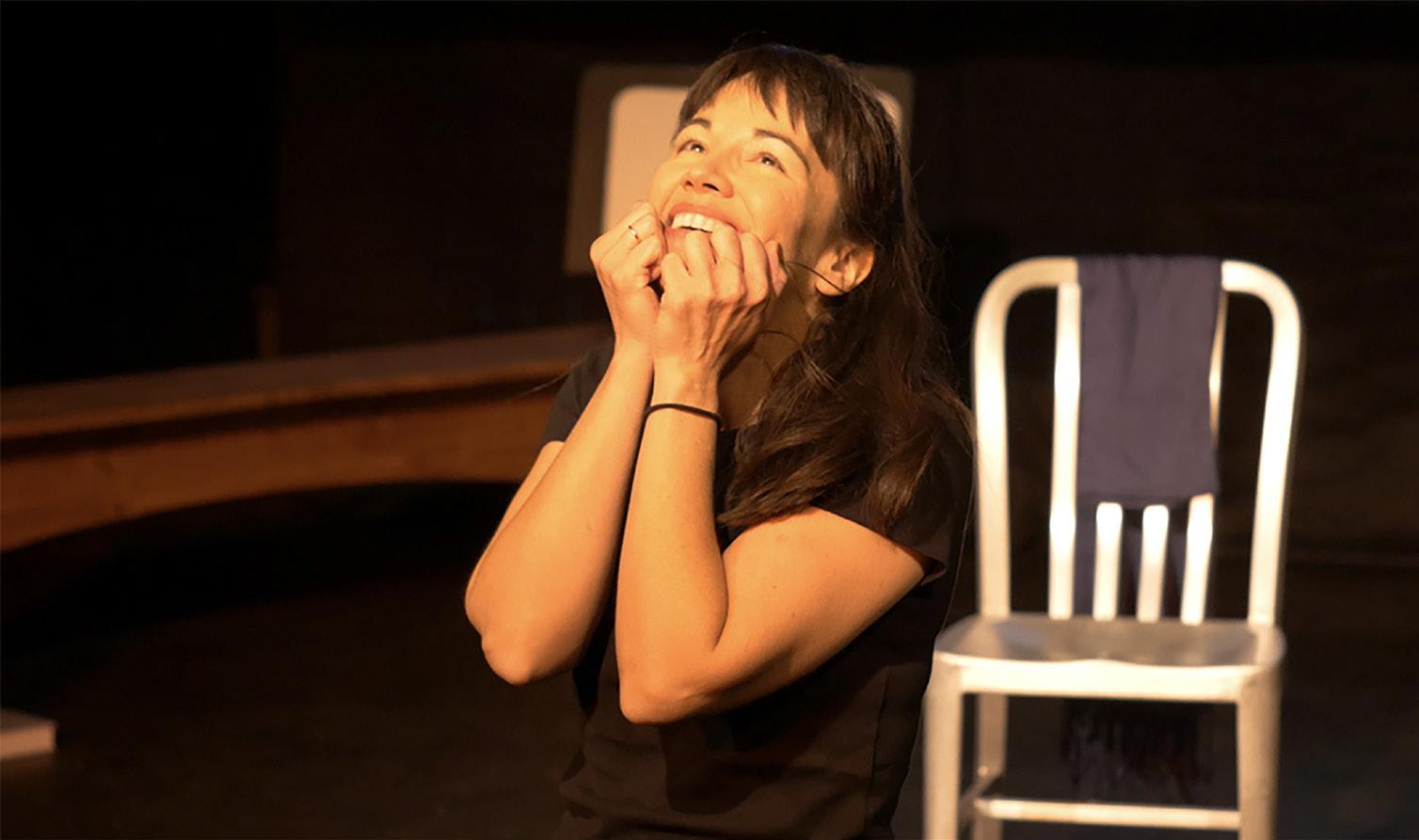
Liang—the sole actor in Alien Citizen—seamlessly switches from one charac ter to another as she humorously unearths a hoard of deep-seated pain that many children experience but have no words with which to express it. After moving to Fairfield County in Connecticut, USA, she notices that ‘nobody on TV looks like me, except maybe Spock on the Star Trek reruns!’ Just as Liang is feeling culturally displaced and in need for a sense of belonging, she begins losing her Spanish, the language that connected her to her father’s large and loving extended family in Guatemala.
But she does not stop there. Liang deftly places those same issues that have been covered a myriad times in expat memoirs squarely in the middle of a world riddled with social inequalities that spans across centuries. Liang spares no one from critique, not even herself.
In a poignant scene, after trying and failing to speak Spanish to their house keeper, five-year-old Liang takes a broom in an attempt to hit their house keeper, Filomena, while her older brother tries to stop her. My own doctoral research shows that when children are overwhelmed by language barriers, they sometimes express it in ways that look like the behavioural problems of a spoiled, privileged brat, such as by punching their classmate or yelling ‘shut up’ at their teacher (Tanu, 2018).
It is not lost on the adult Liang that ‘Filomena left her home in the highlands of Guatemala’ out of poverty to take care of her privileged family in ‘the cold est, unfriendliest town in New England’. Later, she alludes back to Filomena as Liang makes fun of her beloved Chinese Guatemalan family elders who were horrified by the dark tan she had picked up from playing in the sun at her
“Elizabeth Liang in Alien Citizen: An Earth Odyssey, (c) HapaLis Prods.”
FILM REVIEW
next home in Panama because they were ‘obsessed’ by anti-indigenous colorism (see Knight, 2015).
Liang’s brilliance lies in her ability to convey the child’s deep sense of loss at the exact same time that she exposes the absurdity of the prejudice borne out of vast, global inequalities. While many with similar interna tional childhoods like hers struggle to go beyond addressing identity or transition issues in generic terms, it is not so for Liang who is far too talented and fiercely honest for such a myopic focus.
A teenage Liang realises how tender she feels towards Egypt when she witnesses a group of Egyptian boys playing soccer appear helpless in the face of one European boy taunting them with ‘fake Arabic’. Liang delicately addresses the ambivalent feelings that emerge when social class hinders a child’s desire to build meaningful relationships with the local community.
In high school, Liang becomes ‘excellent friends’ with Hamed, a local stu dent who does not ‘speak any language without a foreign accent’—not even Arabic, thanks to his international schooling—and seems out of place in Egypt despite having never lived anywhere else. According to the psychologist Drs. Doug Ota (2014), ‘stayers’ are often forgotten by school transition programs even though they are repeatedly left behind by ‘expat’ classmates who come and go as though through a revolving door.
The goofy Hamed became my favourite character even though the Grease-loving Liang won’t dance with him at a school dance because he is not ‘cool’—never mind the fact that the teenaged Liang was just as awkward—because…high school is high school. Be prepared to cry and laugh (hard) at the same time.
In all this, Liang never loses sight of the child bewildered by the con stantly changing world around her. As she takes the audience with her from Guatemala to Costa Rica, the US, Panama, Morocco and Egypt, we see a young child gradually shut down from ‘transition fatigue’ as she turns into a teenager in her sixth country. All the while, her adolescent body is subjected to regular sexual harassment that she could neither fend off nor comprehend at that age.
Covering everything from mobility, identity confusion, racism, class prej udice and sexism to eating disorders, Liang is able to distill the essence

visual effects add welcome texture, with scenes changing to the sound of a Xerox photocopy machine.


What’s more, because Liang is a master storyteller of childhood emo tions, international school students would be able to instinctively pick up on the complex issues more than you might anticipate. In fact, Alien Citizen gives voice to what your students already know but are rarely invited to talk about. Indeed, it is a film that you ‘feel’ as much as you see.
It was a crisp evening in March 2014 near Washington D.C. in the US when I reluctantly dragged my jet-lagged body to the hotel ballroom of the Families in Global Transition (www.figt.org) conference to watch a live performance of Alien Citizen for the first time. I had initially thought, ‘What can one woman in a black T-shirt and jeans possibly do on a near empty stage?’ I came late and slumped into my chair.
But by the time the stage lights faded on Liang to signal the end, a third of the 142 attendees were bawling out our eyes.
‘It hit you hard, huh?’ It was the American international school educator who had been sitting next to me. He looked amused. I was a dripping wreck of snot while he looked curiously as fresh as when he first sat. So, I glanced around. The ones sobbing seemed mostly to be those who identified as having spent their childhoods ‘growing up among worlds’.
It was the first time we had heard our stories told with such compassion and brutal honesty.
About the Film
Alien Citizen: An Earth Odyssey is available on DVD and digital stream ing in Individual (home use) and Institutional versions: www.alienciti zensoloshow.com. The DVD includes a Q&A with Elizabeth Liang and director Sofie Calderon, and interviews with Liang’s brother and par ents. The Institutional DVD and Streaming License both include a digital toolkit with over 35 clips from the film, each followed by questions to promote learning and discussion.
References
Knight, D. (2015). What is colorism? Teaching Tolerance, Fall(51), 45-48. Retrieved from www.learningforjustice.org/magazine/fall-2015/whatscolorism
Ota, D.W. (2014). Safe Passage: How Mobility Affects People and What In ternational Schools Can Do About It. Stamford, Lincolnshire: Summertime Publishing. www.safepassage.nl/the-book
Pollock, D., Van Reken, R.E. & Pollock, M. (2017). Third Culture Kids: Grow ing Up Among Worlds (3rd ed.). Boston: Nicholas Brealey Publishing. (See also www.crossculturalkid.org)
Tanu, D. (2018). Growing Up in Transit: The Politics of Belonging at an Inter national School. New York: Berghahn Books. www.berghahnbooks.com/ title/TanuGrowing
About the Author
Danau Tanu, PhD, is the author of Growing Up in Transit: The Politics of Belonging at an International School. She is currently in Tokyo as a Japan Foundation Research Fellow at the Waseda University Institute of Asia-Pacific Studies (WIAPS). Learn more about Danau’s work at
Fall 2022 Issue 73