






By Darren Crawley
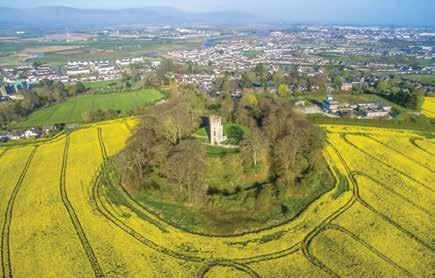
LOUTH County Council has granted planning permission for one of the largest housing developments ever approved in Dundalk, despite months of public opposition over its proximity to the historic Dún Dealgan national monument, commonly known as Cú Chulainn’s Castle.
The local authority has approved plans by Grandspect Ltd for a residential development comprising 1,025 homes on a 38-hectare site off Mount Avenue and the Castletown Road.
The development was approved subject to 51 planning conditions, including the creation of a 50-metre buffer zone around the recorded monuments, a prohibition on groundworks, boundary works and landscaping within that protected
area, and a requirement that the zone be fenced off throughout construction. The council also directed that one apartment block be reduced in height from five storeys to four.
The approved scheme represents a reduction from the original proposal, which sought permission for 1,058 dwellings.
The decision marks a significant milestone in a planning application that has generated considerable public debate since it was first lodged. Community campaigners have consistently argued that the scale and density of the development would have an unacceptable impact on the setting of Dún Dealgan, a national monument in State guardianship that is widely regarded in Irish mythology as the birthplace of the legendary warrior Cú Chulainn.
Continued on Page 2
local and national
in its current state

2
From Page 1
Opponents also raised concerns over the visual impact the development could have on the surrounding landscape and what they described as the irreversible effect of largescale construction beside one of County Louth’s most historically significant sites.
Before the council reached its decision, a petition opposing the development attracted more than 10,000 signatures, while the campaign generated widespread coverage
across local and national media. Support also came from An Taisce – The National Trust for Ireland –which formally wrote to the Minister for Housing, Local Government and Heritage requesting that Dún Dealgan be considered for special protection status.
Despite those objections, Louth County Council concluded that the development could proceed subject to the conditions attached to the planning permission.
Campaign organiser




Nicola Bishop said she was “deeply disappointed” by the council’s decision and confirmed that campaigners now intend appealing the permission to An Bord Pleanála.
Reacting to the news, Bishop said what began as a personal effort to protect the site had developed into a campaign that attracted support from thousands of people across Ireland and beyond.
“I started this campaign with one simple intention: to do my bit to help protect Cú Chulainn’s Castle and the surrounding landscape for future generations,” she said.
“I never imagined it would grow into what it has become.”
Bishop said she believed the strength of public support, together with the intervention of An Taisce, had demonstrated the importance of protecting the site.
“I was deeply disappointed by Louth County Council’s decision to grant planning permission,” she said.
“Before that decision was made, our petition had attracted more than
10,000 signatures, reflecting the strength of public feeling on this issue. The campaign also received widespread media attention, with people from across Ireland and beyond expressing their support for protecting this unique and historic site.”
She said the campaign had expanded well beyond the local community.
“The response went far beyond the local community,” she said.
“An Taisce formally contacted the Minister for Housing, Local Government and Heritage to request that the site be considered for special protection status. With such overwhelming public support, national media attention and the backing of one of Ireland’s leading heritage organisations, I genuinely believed we had done enough to ensure the right decision would be made.”
While acknowledging that the planning authority had attached extensive conditions to the development, Bishop believes they do not adequately protect the site’s archaeological,
A MAN who was caught on CCTV stealing a handbag from a pub was sentenced to three months in prison at Dundalk District Court.
Patrick Harty (52) with an address at Rossmanagher Road, Sixmilebridge, Co Clare admitted the offence at Fitzpatrick’s public house, Rockmarshal, Dundalk, on December 9th, 2023.
Gardai were called to the premises and after
viewing CCTV identified the defendant who was sitting beside the injured party before leaving with the handbag. The bag and contents were valued at €230.
Solicitor Fergal Boyle stated that Mr Harty, who had 240 previous convictions, was currently in custody and not due for release until 2030. In convicting, Judge Nicola Andrews imposed a three-month sentence.
cultural and historical significance.
“While I acknowledge that Louth County Council attached 51 conditions to the permission, I do not believe these go far enough to adequately safeguard the area’s heritage, landscape and historical significance,” she said.
Campaigners have now turned their attention towards an appeal to An Bord Pleanála, which Bishop says will require professional planning and legal expertise.
“Following that decision, it became clear that the next step would be an appeal to An Bord Pleanála,” she said.
“To give that appeal the strongest possible chance of success, we intend to hire an independent planning consultant to prepare and manage the appeal and, if necessary, engage a solicitor to provide legal assistance throughout the process.”
To help fund that work, Bishop launched a GoFundMe campaign last Friday, hoping to raise enough money to contribute towards the costs of the appeal.
Instead, she said the response had exceeded every expectation.
“With that in mind, I launched a GoFundMe campaign on Friday to help cover the costs of hiring the planning consultant and meeting the costs associated with the appeal. I hoped it might raise enough to make a small difference.”
“Instead, the response has been nothing short of extraordinary.”
Within just a few days, the campaign had raised more than €2,500, with supporters continuing to donate and share the fundraiser online.
“In just a few days, the campaign has raised more than €2,500, and I have been completely overwhelmed by the kindness, generosity and encouragement shown by so many people,” Bishop said.
“Every donation, every share and every message of support has strengthened our determination and demonstrated how deeply people care about protecting this important part of Ireland’s heritage.”
She also sought to emphasise that she has no po-
A DUNDALK man who was convicted of possession of drugs at Dundalk District Court was given the chance to avoid a prison term by performing Community Service.
Kyle Gray (31) of Kingswood, Blackrock Road, Dundalk, was found in possession of cannabis valued at €50 and cocaine valued at €140 at Kingswood on September 4th, 2024.
Judge Nicola Andrews imposed 80 hours Community Service in lieu of two months in prison.
litical or professional role in heritage conservation and became involved simply because she felt compelled to act.
“I want people to know that I am not a councillor, politician or heritage expert,” she said.
“I am simply a mam of three who believes our history is worth fighting for. I couldn’t stand by and do nothing, and I am committed to seeing this campaign through.”
As preparations for an appeal gather pace, campaign organisers are now establishing a formal committee to oversee both the fundraising and the wider campaign.
According to Bishop, the committee will ensure complete transparency in the management of donations while coordinating the appeal process and engagement with key organisations.
“To ensure the funds are managed transparently and the campaign is coordinated effectively, we are now establishing a committee,” she said.
“The committee will oversee the fundraising, manage expenditure, coordinate the appeal process, engage with organisations such as An Taisce and The Heritage Council, and continue constructive engagement with Louth County Council.”
Bishop said she will chair the committee, supported by a secretary and treasurer, and invited any-
one with relevant expertise to become involved.
“I would welcome anyone who wishes to contribute their skills and experience to get involved,” she said.
Although the granting of planning permission represents a significant setback for opponents of the development, Bishop believes the campaign has already demonstrated the strength of feeling surrounding the future of Dún Dealgan and its landscape.
“The level of public support has been truly humbling,” she said.
“What began as one person’s determination to protect Cú Chulainn’s Castle has become a community movement. We now have a genuine opportunity to bring this appeal forward and fight to preserve this remarkable place for future generations.”
The appeal to An Bord Pleanála is expected to be the next major stage in what has become one of the most closely followed planning issues in County Louth in recent years.
For Bishop, despite the council’s decision, the campaign is entering a new chapter rather than coming to an end.
“This campaign is far from over,” she said.
“Together, we will continue to stand up for our heritage, our landscape and the legacy we leave behind.”















Temporary posiTion, Fixed Term ConTraCT.
Gernord Ltd, Carrickmacross., established since 1968, are part of a French based multinational operation, and are one of the largest PVC flooring & wall Covering manufacturers in Europe.
We invite applications for the following positions
PRODUCTION OPERATORS: Required for effective and efficient running of the continuous manufacturing process, ensuring Quality plus Health & Safety levels are maintained to a high standard. It is important that candidates can be flexible, versatile, have good communication and team building skills, plus good attendance is expected. Honesty, accountability, and a good working attitude is essential. Forklift licence is important, not essential, training is available.
MAJORITY OF VACANCIES ARE FOR A FIXED EVENING SHIFT: 40 hr /week, €16.63/hr plus a 20% shift allowance from 4pm-12 mid-night.
SOME VACANCIES ARE FOR A FIXED DAY SHIFT: 40 hr /week, €16.63/hr from 8am to 4pm and 2 vacancies are for a Fixed Night shift, 40 hr /week, €16.63/hr plus a 35% shift allowance from 12 mid-night – 8am.
SUCCESSFUL APPLICANTS TO START AUGUST 17TH: As 4-6 weeks, training on the day shift from 8am – 4pm, is required, if a new employee or even a previous employee. Evening shift to start September 28th and finish end of year in December.
Please forward full CV details or complete application form, available at reception, and send to: FRANCIS DUFFY, General Manager, Gernord Ltd., Ballybay Rd, Carrickmacross, Co. Monaghan, A81YD83.
0876893662. francis.duffy@gerflor.com.
AN Taisce has renewed its call on the Minister for Heritage to grant Special Protection Status to Dún Dealgan, commonly known as Cú Chulainn’s Castle, following Louth County Council’s decision to approve a major housing development adjacent to the nationally significant monument.
The heritage organisation is urging the Minister to use powers contained in the Historic and Archaeological Heritage and Miscellaneous Provisions Act 2023 to designate the site and its surrounding landscape for enhanced protection. It argues that such a move would allow housing development to proceed in a manner that safeguards one of Ireland’s most important archaeological and mythological sites.
Planning permission has now been granted by Louth County Council for 1,025 homes at Castletown, a reduction of 33 units from the original application for 1,058 dwellings. The approved plans also include a 50-metre buffer zone around the monument.
However, An Taisce believes the revised proposals do not go far enough to preserve the historic character of the site.
The organisation argues that while a buffer has been introduced, it is inadequate given the scale of the surrounding development. It notes that the motte itself stands approximately 10 metres high, meaning visitors standing on the monument would look out over a large housing estate rather than the historic landscape that has surrounded the site for centuries.
An Taisce has also asked the Minister to refuse any licence permitting works within a future Special Protection Archaeological and Heritage Landscape until appropriate protections are in place. It says the extent of any buffer zone should be determined by archaeological and heritage considerations rather than commercial factors.
The organisation said it has yet to receive a substantive response from the Minister to previous requests and is calling for urgent action in light of the planning approval.
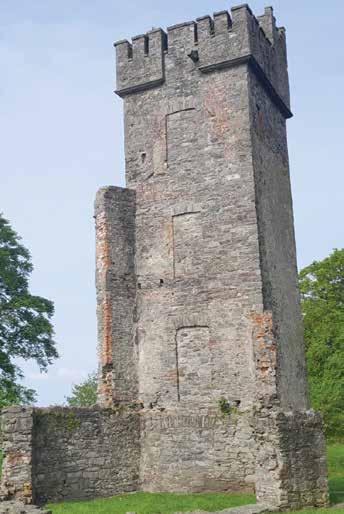
Dún Dealgan occupies a unique place in both Irish history and mythology. Located at Castletown on the outskirts of Dundalk, the site consists primarily of a Norman Motteand-Bailey castle believed to have been established by Bertram III de Verdun during the Norman period. Archaeological evidence suggests the Norman fortification was constructed on the site of an earlier Gaelic settlement, following the common Norman practice of establishing strongholds at the seat of local rulers.
The circular, steep-sided motte rises around 10 metres above the surrounding landscape and would originally have supported a timber fortification. The adjoining bailey was once complemented by a second, larger enclosed area to the east, highlighting the site’s strategic importance.
Beyond its archaeological significance, Dún Dealgan is inseparable from Irish mythology. It has long been associated with the legendary warrior Cú Chulainn and is tradition-
ally regarded as his birthplace and home. The site features prominently in the epic Táin Bó Cúailgne, with Dún Delga identified as Cú Chulainn’s abode within the ancient kingdom of Conaille Muirtheimne.
Adjacent to the castle stands the prehistoric standing stone known as Lia Lingadon, traditionally linked to Deichtine, the mother of Cú Chulainn. The later castellated ruins atop the motte, together with local folklore surrounding the site, further contribute to its rich historical and cultural significance.
An Taisce maintains that the surrounding landscape may also contain undiscovered archaeological remains and has reiterated its call for a comprehensive geophysical survey of the wider area. The organisation argues that any archaeological discoveries should, where possible, be preserved in situ rather than removed, ensuring the integrity of the historic landscape is maintained for future generations.

AS the summer months bring more people outdoors to enjoy parks, public spaces and the town centre, anti-social behaviour often becomes a more visible concern for communities. While the vast majority of people enjoy public spaces responsibly, incidents involving public disorder, vandalism, intimidation and alcohol-related nuisance can have a significant impact on residents, businesses and visitors alike.
In Dundalk, as in towns across Ireland, tackling antisocial behaviour is not solely the responsibility of An Garda Síochána. It increasingly relies on a partnership between Gardaí, local authorities, community organisations and members of the public working together to
create safer neighbourhoods. WHAT IS ANTI-SOCIAL BEHAVIOUR?
Anti-social behaviour is a broad term used to describe conduct that causes or is likely to cause harassment, alarm or distress to others. While some incidents amount to criminal offences, others may fall below the threshold of serious crime but still negatively affect the quality of life within a community.
Examples include public intoxication and disorderly behaviour, vandalism and criminal damage, graffiti, intimidation or threatening behaviour, persistent noise disturbances, public fighting, illegal dumping, harassment of neighbours and groups gathering in residential areas in a way that
causes fear or disruption.
In towns like Dundalk, reports of these behaviours can often increase during periods of good weather, school holidays or busy weekends when public spaces experience greater footfall.

Irish law provides Gardaí with a number of powers to deal with anti-social behaviour.
One of the most commonly used pieces of legislation is the Criminal Justice (Public Order)

Act 1994. It creates a range of public order offences, including intoxication in public places, threatening or abusive behaviour, offensive conduct and failure to comply with Garda directions.
Depending on the circumstances, Gardaí may issue fixed charge notices, make arrests or bring matters before the District Court.
For more persistent cases, Ireland also has Anti-Social Behaviour Orders (ASBOs). These are court orders aimed at individuals whose behaviour causes serious and ongoing distress within their community. Before an order is sought, Gardaí can issue AntiSocial Behaviour Warnings, with breaches of subsequent court orders carrying legal consequences.
Many people assume antisocial behaviour is solved simply by increasing Garda numbers. While visible policing undoubtedly plays an important role, modern community safety places equal emphasis on prevention.
Recent reforms have strengthened Ireland’s focus on community safety by encouraging closer collaboration between Gardaí, local authorities, public services and community groups to identify local problems and develop practical solutions.
This can involve youth diversion programmes, improved street lighting, CCTV where appropriate, better maintenance of public spaces, community engagement initiatives and closer working relationships with schools and youth organisations. Supporting vulnerable families before problems escalate is also recognised as an important part of preventing anti-social behaviour. These preventative measures often reduce problems more effectively than enforcement alone.
Like many regional towns, Dundalk benefits when residents actively report issues rather than assuming someone else already has.
Repeated incidents involving vandalism, intimidation or disorder can build a clearer picture for Gardaí, helping them identify patterns, allocate patrols and prioritise resources.
Residents can also make a positive contribution by reporting criminal behaviour promptly, becoming involved in community initiatives, supporting neighbourhood watch schemes where available and engaging with local community meetings. Encouraging young people to participate in organised sporting or recreational activities can also play an important role in reducing antisocial behaviour before it develops into more serious offending.
Community engagement helps ensure that public spaces remain welcoming for everyone.
Businesses throughout Dundalk town centre are often among the first to experience the effects of persistent anti-social behaviour.
Retailers, cafés, restaurants and licensed premises can all be affected by public disorder, shoplifting, intimidation or vandalism.
Many businesses now work closely with Gardaí by sharing information, reporting incidents quickly and investing in security measures such as CCTV, improved lighting and staff training.
A coordinated response between businesses and law enforcement often proves far more effective than isolated action.
Many incidents of anti-social behaviour involve young people. While accountability is important, early intervention remains a key principle of Ireland’s youth justice system.
Rather than relying solely on prosecution, youth diversion programmes seek to address the underlying causes of offending by
working with young people and their families.
These programmes aim to reduce repeat offending while supporting education, employment and positive community involvement.
This balanced approach protects communities while giving young people an opportunity to change direction before becoming involved in more serious criminal behaviour.
Anyone witnessing anti-social behaviour should report incidents to An Garda Síochána, particularly where public safety is at risk.
In emergencies or where violence is occurring, members of the public should contact emergency services immediately. Where issues are ongoing rather than urgent, keeping a record of dates, times and descriptions of incidents can assist Garda investigations. The more accurate the information provided, the easier it is for authorities to identify recurring problems and respond appropriately.
Anti-social behaviour can undermine confidence in public spaces and affect everyday life for residents, workers and visitors alike. Fortunately, Ireland’s legal framework provides Gardaí with a range of enforcement powers while placing increasing emphasis on prevention, partnership and community engagement.
For Dundalk, maintaining a safe and welcoming town is a shared responsibility. Effective policing, proactive local authorities, responsible businesses and engaged residents all have a role to play.
Whether enjoying a summer evening in the town centre, visiting local parks or supporting local businesses, everyone benefits when communities work together to discourage anti-social behaviour and promote respect for shared public spaces. Recent policing reforms continue to reinforce this partnership approach, recognising that long-term community safety is achieved through both enforcement and collaboration.



TWO new PEACEPLUS-funded programmes designed to promote cultural understanding, strengthen community relations and support entrepreneurship among Traveller and ethnic minority communities are set to be rolled out across County Louth following the signing of a contract between Louth County Council and Culture Connect CLG.
The projects, which are being delivered under the County Louth PEACEPLUS Action Plan, will focus on building stronger relationships between communities while encouraging greater participation in social and economic life.
The contract was formally signed at the Civic Offices in Drogheda and will see Culture Connect CLG deliver two initiatives over the next two years: a Multicultural/Intercultural Programme and an Entrepreneurship/Social Entrepreneurship for the Traveller Community and Ethnic Minority Communities Project.
The programmes are funded through PEACEPLUS, managed by the Special EU Programmes Body (SEUPB), under Thematic Strand 3: Celebrating Cultures and Diversity.
The Multicultural/Intercultural Programme will run over the next 18 months and involve around 150 participants from across County Louth. The initiative has been designed to encourage greater understanding, trust and respect between people from different cultural traditions and backgrounds through a range of multicultural activities and engagement opportunities.
According to Louth County Council, the programme was developed following consulta-
tion with multicultural representative groups, community organisations and local residents. It is intended to strengthen both cross-community and cross-border relationships while creating opportunities for meaningful intercultural engagement.
The second programme will focus on supporting members of the Traveller community and ethnic minority communities who are interested in developing entrepreneurial and social enterprise skills.
Running over two years, the initiative will provide participants with training in social entrepreneurship, mentoring opportunities and site visits aimed at helping them develop practical skills and confidence while encouraging greater participation in enterprise and community development.
The council says the project will also challenge perceptions, promote positive attitudes and create opportunities for greater social and economic inclusion.
Speaking at the contract signing, Cathaoirleach of Louth County Council, Cllr Dolores Minogue, said the programmes would make a significant contribution to building stronger and more inclusive communities.
“These projects will strengthen cross-community and crossborder relationships, encourage greater understanding and respect for diversity, and contribute to more inclusive and connected communities,” she said.
“Through these initiatives, we are helping to build stronger, more resilient communities while advancing the core PEACEPLUS goals of inclusion, reconciliation and positive change.”
Chief Executive of Louth County Council, David Conway,
DUNDALK is set to receive six new probationary Gardaí as part of a nationwide allocation of newly graduated recruits, providing a welcome boost to frontline policing in the town.
The six officers form part of a group of 14 new Gardaí assigned across County Louth following the attestation of 206 probationer Gardaí at the Garda College in Templemore. The remaining allocations see three Gardaí assigned to Ardee and five to Drogheda.

policing, helping to deter crime, reassure residents and businesses, and provide a stronger presence in local neighbourhoods.
victims and providing reassurance to local communities. Continued investment in Garda recruitment and resources is essential to ensure An Garda Síochána can meet the demands placed upon it.”
She added that the Government’s continued investment in Garda recruitment was beginning to deliver results.
said the initiatives reflected the council’s wider commitment to equality, inclusion and community development.
“These initiatives build on the success of previous PEACEPLUS-funded programmes and will help increase understanding, respect and appreciation of cultural diversity across County Louth,” he said.
He added that the work aligns closely with the objectives of both the Louth Local Economic and Community Plan and the council’s Corporate Plan by supporting democracy, equality and a citizen-centred approach.
Flora Okabi, Founder and Coordinator of Culture Connect CLG, welcomed the partnership with Louth County Council and said the organisation was looking forward to delivering programmes that empower participants and celebrate diversity.
“Through meaningful intercultural engagement and targeted enterprise supports, we aim to empower individuals, celebrate diversity and create opportunities for people from all backgrounds to contribute fully to community life,” she said.
The County Louth PEACEPLUS Action Plan represents an overall investment of €4.68 million in projects designed to strengthen peace, celebrate diversity and support community development across the county.
Over the lifetime of the Action Plan, almost 4,700 people are expected to participate in PEACEPLUS-funded programmes and initiatives, supporting greater inclusion, stronger community connections and longterm cross-border cooperation throughout County Louth.
The latest graduating class is the largest since 2019 and comes as An Garda Síochána continues efforts to rebuild Garda numbers nationwide. More than 15,000 applications have been received across three recruitment campaigns over the past 18 months, while a further intake of more than 200 trainees is expected to begin training in Templemore next week.
For Dundalk, the arrival of six additional Gardaí is expected to strengthen frontline policing and increase the visibility of officers throughout the community. Highvisibility patrols are regarded as an important element of
Welcoming the allocation, Fianna Fáil TD Erin McGreehan described the new appointments as a positive development for the county.
“The allocation of 14 new Gardaí to Louth is very welcome,” she said.
“Every additional Garda strengthens our local policing service and helps ensure our communities receive the support and protection they deserve.”
Deputy McGreehan also highlighted the importance of visible policing in supporting communities.
“High visibility policing remains a strong commitment for Fianna Fáil. Visible policing plays a vital role in preventing crime, supporting
“This is the largest Garda attestation since 2019 and, with more than 200 recruits due to enter the Garda College next week, it demonstrates that a strong pipeline is being built to increase Garda numbers in communities across the country.”
The Government has allocated more than €2.74 billion to An Garda Síochána under Budget 2026, with funding supporting continued recruitment of both Garda members and civilian staff.
As of 24 July 2026, An Garda Síochána comprises 14,733 sworn Garda members, 3,683 Garda staff, 304 Garda Reserves and 604 Garda trainees.
The additional officers are expected to join their assigned stations in the coming weeks following their graduation from Templemore.
1. In emotional scenes on Sunday, Mayo defeated Kerry to win their first All-Ireland championship since 1951. Can you tell me who did they beat to win their first?
2. The families in Gavin & Stacey are from which English & Welsh towns both beginning with a “B”?
3. What is the most expensive spice in the world by weight?
4. Which Irish author won the Nobel Prize in Literature in 1932?
5. – What is the highest peak
in the Cooley Mountains?
6. The Tour de France came to a close on Sunday evening. Which Irish cyclist claimed victory in the race in 1987?
7. According to the most recent census, how many inhabited islands are there off the coast of the Republic of Ireland?
8. What is the biggest selling music album in Irish history?
9. Which Irish town claims to have the oldest licensed whiskey distillery in the world? 10. July marks the 100 year anniversary of Irish radio. What was the name of the first station in the state? The Stinker: Coccinella is the Latin scientific term for what common garden beetle?

A significant increase in litter fines and a new national funding scheme aimed at improving dog waste facilities have been welcomed as positive steps for Dundalk and County Louth.
From September 1, 2026, the fixed-payment fine for littering will increase from €150 to €250 as part of new measures announced by Minister of State Alan Dillon. Alongside the increase in penalties, the Government has also launched a €250,000 Cleaner Communities fund to help local authorities provide additional dog waste bins, bag dispensers and related infrastructure in parks, beaches, greenways and other public spaces.
Local election candidate Ciarán Fisher said the package strikes the right balance between stronger enforcement and practical investment in community facilities.
“I welcome the announcement by Minister of State Alan Dillon of both the increase in on-the-spot litter fines and the creation of a dedicated national fund to provide more dog
waste bins,” Mr Fisher said.
“The increase in fines sends a very clear message that littering has consequences. The vast majority of people dispose of their waste responsibly, but the actions of a minority spoil our public spaces and leave local authorities and taxpayers footing the bill. The principle is simple – the polluter should pay.”
The Cleaner Communities fund, financed through the Circular Economy Fund, will allow councils to apply for funding to purchase additional dog waste bins and associated infrastructure. Details of the application process are expected to be circulated to local authorities in the coming weeks.
Mr Fisher believes the funding comes at an important time for Dundalk and the wider county, where he says there has effectively been a pause in the installation of new dog fouling bins in recent years.
“For a number of years there has effectively been a freeze on installing new bins in Dundalk and across Louth, and that has

been a source of real frustration for many residents,” he said.
“I have repeatedly called for additional dog fouling bins in areas where the issue is regularly raised with me, particularly in Seatown and along Mount Avenue.”
He said he and Cllr Kelly had recently requested that Louth County Council carry out a lit-
ter survey along Mount Avenue after concerns were raised locally about the lack of waste facilities.
“We were surprised when it was concluded that there was no requirement for another bin, particularly given how popular the area is with walkers and the number of people living nearby,” he said.
“Responsible dog owners need convenient places to dis-
pose of waste properly. When those facilities aren’t available, it makes dealing with the problem much more difficult.”
Mr Fisher said the new funding would not resolve every issue immediately but believes it offers an opportunity for Louth County Council to address some of the county’s most pressing locations.
“The new fund gives the council some much-needed flexibility,” he said. “It won’t solve every gap overnight, but it should allow for at least some additional dog fouling bins to be installed in priority locations, and that’s welcome progress.”
He is also encouraging members of the public to identify locations where they believe additional bins are needed.
“I would encourage anyone who knows of a particular area that badly needs a dog waste bin to get in touch with me,” he said. “Whether it’s a residential estate, a walking route, a green space or another public amenity, local knowledge is incredibly important. I’ll make sure
those suggestions are raised with the council as applications for this funding are being prepared.”
Alongside the new funding and tougher penalties, a national public awareness campaign carrying the message “Bin it or bring it home” is also being rolled out to encourage responsible disposal of litter and dog waste.
Mr Fisher said he would also continue to work with residents and the local authority to identify problem locations where pavement stencils could be installed as an additional reminder for dog owners to clean up after their pets.
“Cleaner communities are achieved through a combination of enforcement, investment and personal responsibility,” he said. “These measures are a practical step in the right direction, and I’ll continue pressing to ensure Dundalk and Louth receive the maximum possible benefit from this funding and that new bins are installed where they are needed most.”

THE inaugural Carlingford Adventure Race was launched at Cooley Kickhams GAC on July 7th last by local TD Erin McGreehan and Minister of State with responsibility for Sport, Charlie McConalogue TD.
The event will take place on Sunday October, 10th and will be across the Cooley Peninsula taking in the stunning views of one of Ireland’s most spectacular landscapes.
The Carlingford Adventure Race is a one-day multi-sport endurance event which combines cycling on scenic country roads with trail running through forests and moun-
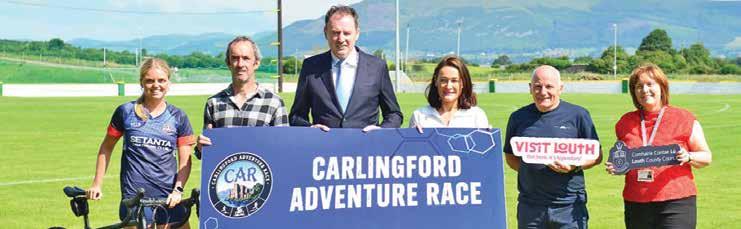
tain paths.
Participants can choose from the following two race formats:
• Sprint – designed for newcomers and recrea-
tional athletes.
• Expert – a more demanding challenge for experienced competitors.
The event is open to athletes of all abilities and
will appeal to road runners, trail and mountain runners, ultra runners, cyclists (road and mountain), triathletes, and anyone looking for a reward-
CARLINGFORD Heritage CLG
has been awarded the maximum available grant of €5,000 under the Government’s Small Scale Local Festivals and Summer Schools Scheme 2026, as almost €10,000 in funding was allocated to community organisations across County Louth.
The heritage organisation received the largest allocation in the county, with Friends of Ardee Bog awarded €2,250 and Queer Shed Louth/Meath receiving €2,500, bringing the total investment in Louth to €9,750.
The funding forms part of a national allocation of €371,792.25 to support 105 small-scale festivals and summer schools taking place across Ireland this year.
Welcoming the announcement, Fianna Fáil TD for Louth Deputy Erin McGreehan said the funding recognises the significant role local festivals play in bringing communities together while celebrating local culture, heritage and identity.
“These festivals are an important part of community life across Louth,” she said.
“They give people the opportunity to come together, celebrate our local heritage and enjoy events that showcase the best of what our communities have to offer.
“I also want to recognise the tremendous commitment of the volunteers and local committees who organise these festivals each
year. Their hard work strengthens our communities, supports local traditions and ensures these events continue to thrive for future generations.”
The €5,000 grant represents a welcome boost for Carlingford Heritage CLG, which continues to play a central role in preserving and promoting the unique history of one of Ireland’s bestpreserved medieval towns.
Carlingford has long established itself as one of the country’s leading heritage destinations, attracting visitors throughout the year to its medieval streets, King John’s Castle, historic town walls and rich archaeological landscape. The village’s calendar of heritage events has become an important part of its tourism offering, encouraging visitors to explore its history while providing opportunities for local businesses and community groups.
Funding secured through the Small Scale Local Festivals and Summer Schools Scheme will help support those efforts, enabling organisations like Carlingford Heritage to continue delivering events that celebrate the area’s history and engage both residents and visitors.
The scheme is specifically aimed at supporting smaller local festivals and summer schools that may not meet the criteria for larger funding programmes operated by organisations such as
Fáilte Ireland or the Arts Council. Grants of up to €5,000 were available through a competitive application process, with applications closing in April.
Friends of Ardee Bog, which works to protect and promote one of County Louth’s most important natural heritage sites, will receive €2,250 to support its activities, while Queer Shed Louth/Meath has secured €2,500 towards its programme of community events.
Across the country, more than 100 festivals and summer schools will benefit from this year’s scheme, helping communities organise events that celebrate local history, culture, language, arts and heritage.
For Carlingford, however, the funding is particularly significant. Heritage tourism remains one of the village’s greatest strengths, with community organisations continuing to invest time and expertise into preserving the town’s remarkable past while creating events that encourage people to experience it firsthand.
The latest funding will help ensure that work continues throughout 2026, supporting festivals and initiatives that showcase Carlingford’s unique character and reinforce its reputation as one of Ireland’s most important historic towns.
ing outdoor challenge.
The Carlingford Adventure Race is a new addition to Ireland’s sporting calendar and is intended to become an annual event,
showcasing the outstanding natural beauty, heritage, and hospitality of the Cooley Peninsula.
The event is supported by Louth County Council
through its Large Festival and Participative Events 2026 grant programme
The organisers would like to thank Cooley Kickhams GAC, Triathlon Ireland, Setanta Triathlon Club, Louth Tourism, Visit Louth, Visit Carlingford and Coillte for their invaluable support.
Entries for the new event are now open through Triathlon Ireland.
Further information, event news and race updates are available through the Carlingord Adventure Race Facebook page and their other social media channels.
SINN Féin TD Ruairí Ó Murchú has described the latest water outage affecting Shelagh residents as “completely unacceptable” after the area experienced its seventh disruption since the middle of June, with thousands of people left without water for almost two days during last week’s heatwave.
The latest outage began on Tuesday evening when residents contacted Uisce Éireann after discovering there was no water coming from their taps. It later emerged that the disruption was caused by the Dunbin reservoir, which supplies Shelagh, Knockbridge and Kilkerley, running empty. Shelagh residents were particularly badly affected as the village is located at the end of the supply network.
Around 3,500 people are understood to have been impacted by the latest interruption. Water service was not fully restored until late on Thursday afternoon, as the pumps at Callans could only begin operating once water levels in the reservoir had recovered sufficiently.
According to Uisce Éireann, ongoing maintenance works to make the pumps at the Hilltop pumping station easier to maintain, together with a generator reboot failure, contributed to the disruption. However, Deputy Ó Murchú said action was

not taken quickly enough after local residents first alerted the utility to the problem.
During the outage, the Louth TD said he contacted Uisce Éireann’s Chief Executive, the water network operations manager, on-site staff, communications personnel and senior officials seeking updates and pressing the organisation to provide residents with clear information on what had caused the repeated failures and what
measures were being taken to prevent a recurrence.
Deputy Ó Murchú said he has repeatedly raised the ongoing water supply issues affecting Shelagh in Leinster House and has been advised that Uisce Éireann is examining a number of long-term solutions. These include identifying alternative water supplies for the area, upgrading the pumping system and improving monitoring and alarm systems at the Dunbin reservoir.
He said: “People don’t trust the system and will draw off it when they do have water, that is the natural thing to do. Families, particularly those with small children, were badly affected, as well as farmers who were trying to water their livestock.”
The Sinn Féin TD said repeated outages have eroded public confidence and stressed that residents deserve a reliable water supply.
Calling for urgent action, he added: “How is this happening in Louth in 2026? How can people be without water for almost 48 hours in the middle of a heatwave? Uisce Éireann has to prioritise the work that is needed in Shelagh to ensure that this never happens again.”
LOUTH County Council has officially launched its Play Policy 2026-2031 during the county’s National Play Day 2026 celebrations at Cooley Kickham’s GFC, setting out an ambitious five-year plan to expand inclusive, accessible and high-quality play opportunities for people of all ages.
The new policy recognises that play is not only important for children but also contributes to the health, wellbeing and social connections of young people, adults and older people. It aims to ensure that opportunities for play are available across communities throughout County Louth, helping to create healthier, more active and connected places to live.
The strategy was developed following extensive consultation with children, young people,
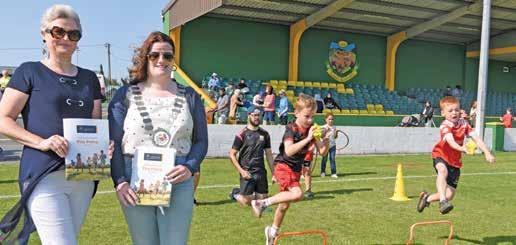
families, community organisations and other stakeholders. Feedback gathered during the process highlighted strong support for more inclusive, accessible and intergenerational play spaces, reflecting the growing importance of public spaces that can be enjoyed by people of all ages and abilities.
Launching the policy on National Play Day, Cathaoirleach of Dundalk Municipal District, Cllr Andrea McKevitt, said the occasion provided the perfect opportunity to unveil the county’s vision for the future of play.
“National Play Day is the ideal occasion to launch this important
policy for County Louth. Play brings people of all ages together, supports wellbeing and helps build stronger communities. Our vision is that by 2031, Louth will be a county where everyone can play everywhere.”
She said the policy outlines clear actions to help deliver more inclusive and accessible
play opportunities while encouraging communities to work together to create welcoming spaces where people can play, connect and enjoy active lifestyles.
Joanna Kelly, Director of Services with Louth County Council, said the strategy reflects the priorities identified by local communities and
provides a roadmap for future investment.
“Our focus is now on delivery through targeted investment, strong partnerships and collaboration, creating more inclusive, accessible and high-quality opportunities for people of all ages and abilities to play, connect and be active,” she said.
She added that investing in play is also an investment in healthier communities, improved wellbeing and a better quality of life for both current and future generations.
Louth County Council said the policy will guide its approach to developing play opportunities over the next five years through partnership working, community engagement and investment. The Play Policy is available to view on the council’s website at www. louthcoco.ie.
GOLFERS from across the region are invited to take part in the 35th Fatima Open 2026, incorporating The Gerry Gallagher Memorial and The Kevin Mathews Memorial, at Ballymascanlon Golf Course on Saturday, August 8.
The popular annual event will see competitors tee off between 2pm and 4pm, with an entry fee of €35. No advance booking or tickets are required, with participants simply asked to arrive during the designated tee-off times.
A presentation of prizes will take place afterwards in Clan Na Gael Bar from 8pm to 9pm.
Prizes will be awarded for first to fifth place, as well as Front 9, Back 9, Nearest the Pin and Longest Drive.
This year’s event is proudly sponsored by Cullen Auto Parts, Fastfix, John Laverty Motor Factors and MVI.
Organisers say everyone is welcome to attend and encourage golfers of all abilities to come along and support another memorable day of golf.
For further information, contact Paul Mathews (085 722 6163), Leo Martin (086 367 5618) or Paddy “The Caddie” Murtagh (087 933 7309).
FIANNA Fáil TD for Louth, Erin McGreehan, has welcomed the introduction of new Exempted Development Regulations for Residential Dwellings, which came into effect today, describing the changes as a practical step that will make it easier for homeowners to adapt their properties to meet changing family needs.
The new regulations reduce the number of household projects that require planning permission, cutting red tape for homeowners while allowing local authorities to concentrate their planning resources on larger and more complex developments that require greater oversight.
The reforms are designed to give homeowners greater flexibility to improve and adapt their homes through extensions, additional living space and internal alterations, while continuing to ensure that all work complies with Building, Building Control and Fire Regulations.

Among the most significant changes is a new exemption allowing the construction of a detached auxiliary habitable dwelling connected to the services of the main house. These units can range in size from 32 to 45 square metres and are expected to provide additional accommodation for family members while remaining within the same
property.
The regulations also introduce an exemption allowing homeowners to subdivide an existing house to create one additional self-contained residential unit within the current building envelope, provided each unit has a minimum floor area of 32 square metres. The measure is intended to increase housing flexibility without requiring major new construction.
Other changes include a new exemption permitting the addition of a dormer roof box or roof light to the principal dwelling, making it easier for homeowners to convert attic space into usable accommodation.
The maximum exempted floor area for house extensions has also increased from 40 square metres to 45 square metres, while the permitted size of rear garden structures such as home offices, gyms, sheds and storage buildings has risen from 25 square metres to 30 square metres.
Despite the relaxation of planning requirements, the Government has stressed that all relevant Building, Building Control and Fire Regulations will continue to apply. Homeowners carrying out exempted developments will still be responsible for ensuring their projects comply with all applicable safety and construction standards.
Welcoming the introduction of the regulations, Deputy McGreehan said the measures recognise that many families need greater flexibility as their circumstances change.
“These changes recognise that homeowners should be trusted to make practical decisions about their own property without having to navigate unnecessary planning processes. By reducing red tape, Minister Browne is making it easier for people to adapt their homes to suit their needs.”
She said the reforms would provide new housing options
for families while supporting people at different stages of life.
“The new exemptions will create more housing options for families. They will support people with disabilities who want to live more independently while remaining close to family, while also making it easier for older people to right size without leaving the communities they know.”
Deputy McGreehan also said the changes would improve the efficiency of Ireland’s planning system by reducing the volume of straightforward domestic applications being processed by local authorities.
“These reforms are also about making the planning system work more effectively. By removing straightforward household projects from the planning process, local authorities will be able to focus more of their time and resources on larger housing developments and other pro-
jects that are critical to meeting our housing needs.” She added that homes need to be capable of adapting as families grow and circumstances change.
“Our homes should be able to evolve as our lives change. These measures give homeowners greater flexibility to respond to changing family circumstances while ensuring appropriate building standards continue to be met.”
The updated regulations form part of the Government’s wider efforts to modernise Ireland’s planning system, increase housing flexibility and make it easier for people to adapt existing homes without unnecessary delays. Supporters of the changes say they will help families remain in their communities, make better use of existing housing stock and encourage more efficient use of residential properties, while maintaining the safety and quality standards required for all building work.
ONE of the brightest young football talents from Dundalk is about to embark on a once in a lifetime journey to enhance her career.
Ciara Whyte later this month will take up a scholarship with the prestigious Hofstra University in the state of New York.
Football is in the DNA of the Whyte’s as her father, John, was an accomplished player himself winning the FAI Cup with Dundalk in 2002. Ciara herself came through the ranks at Dundalk before joining Shamrock Rovers.
Speaking to the Dundalk Leader, she explains how the move came about.
“A scholarship was never really something I would ever consider, I am such a home person, love being with my family and my friends” she said.
“I never thought I would make this step to go outside my comfort zone and do something like this but how it really came about was teachers and friends asking me ‘would I ever consider it’ but one of my teachers in St. Louis pushed me to apply for scholarships for college in Ireland, that made me see where else I could take it so I decided to make a seven minute long video of all my clips with the help of Alan
McCardle and my cousin Maria.
“I sent it off to a few of my friends and my dad, got some feedback. A couple of days later I opened my emails and had a few from different colleges including Hofstra University. It came from Jerry Lucy, the assistant coach. I was just amazed and never expected it to end up in America, how a seven minute video that I thought nothing of got me this. They wanted to offer me a fully funded scholarship. “
It is an incredible opportunity and one that Ciara is extremely excited about.
“The opportunity to study and play in America is exciting, it gives me the opportunity of a new challenge, to meet new people and I get to play in a professional setup so hopefully that will develop me more as a player.
“The support has been phenomenal from everyone. That goes from my school, Alan McCardle and my cousin Maria for helping with the video, Cormac McCardle who gave me a lend of a journal back from when he got a soccer scholarship. That really helped in making my decision.
“It was a detailed journal showing the pros and the cons which was beneficial to see because not everything is as it looks, and he
put it like that in the book. Just the support from family and from people who have moved over to America from Dundalk has been great. I can’t even mention everyone because everyone has been so good, without my mam and dad I wouldn’t have been able to complete all the forms on time! So a huge thanks to them.”
The move for a teenager to America is something which can be daunting but Whyte is ready to embrace the challenge both on and off the pitch.
“Moving to America is a huge step but I am looking forward to challenging myself on the pitch and improving myself as a player.
“I am looking forward to the unknown, I have never experienced this before and I am looking forward to the new challenge.
“Off the pitch I am really excited to meeting the new people, not just on the team but also on my course and in my college as well, just building friendships and enjoying the college experience.”
Before departing these shores, the former Dundalk youth player spoke of how the game is growing across the world and offered some advice to those looking to emulate her.
“The growth of girls and wom-
en’s football has been amazing in the last couple of years has been amazing. The standard improving through the ranks is great to see. What I would say to anyone is challenge yourself and play with boys for as long as you can then go on to play at the highest level – I think it benefits you so much playing with the boys, your physicality comes on so much more. It is a challenge but it is one which most young girls need.
“Being mentally strong also is important. Take rejection as redirection Take all criticism on board – take it as a positive because not everything is perfect. Get out of your comfort zone, do things that make you feel weird because it benefits you in the future.
“From personal experience, I would say take time out. Don’t rush into things, take time to weigh up everything. Don’t take the first offer you get, go through the pros and cons, don’t make any rash decisions.
“I wouldn’t have been able to make this decision this time last year, I just wouldn’t have been ready for it but taking the year even out of college to mature is really beneficial as both a player and a person.”

TWO Dundalk entrepreneurs have earned national recognition after being selected as finalists in the inaugural Makers’ Academy, a new business development programme designed to help Ireland’s most promising independent brands grow into successful retail businesses.
Lina Liu of Cosy Life Ireland and Caroline Duffy of Caroline Duffy Designs are among just 25 finalists chosen from across 17 counties, highlighting the strength of creative enterprise in Dundalk and County Louth.
The Makers’ Academy is a new initiative delivered through a partnership between Kilkenny Design and the Local Enterprise Offices (LEOs). The programme has been established to support ambitious makers and designers who are ready to scale their businesses, building on the extensive supports already provided by Local Enterprise Offices through funding, mentoring, training and digital and sustainability grants.
The 25 finalists represent a broad cross-section of Ireland’s thriving creative sector, with businesses spanning homeware, jewellery, fashion, food, wellbeing and traditional craft. The programme aims to equip participants with the commercial knowledge and practical skills needed to take their businesses to the next level and

compete in the retail marketplace. Over the coming months, Lina Liu and Caroline Duffy will take part in an intensive programme of workshops, one-to-one mentoring sessions and business coaching. The initiative
will be delivered by Kilkenny Design’s senior leadership team, alongside experts from its buying, marketing and ecommerce departments, as well as leading figures from the enterprise sector.
Participants will receive tailored guidance across a wide range of business disciplines, including retail strategy, branding, financial planning, ecommerce, digital marketing and founder development. The pro-
gramme has been designed to provide practical, real-world advice that can help independent makers strengthen their brands, expand their customer base and achieve sustainable longterm growth.
For the two Dundalk businesses, selection for the programme represents a significant endorsement of both the quality of their products and the potential of their businesses. Being chosen from applicants across 17 counties places them among Ireland’s most promising emerging makers and gives them access to expertise and mentoring that would ordinarily be difficult for small businesses to access.
The initiative also shines a spotlight on the growing strength of the creative and craft sector in Louth, with local entrepreneurs continuing to demonstrate innovation, ambition and commercial potential on a national stage.
As the inaugural Makers’ Academy progresses, all 25 finalists will have the opportunity to refine their business strategies, strengthen their retail offering and prepare for future growth. For Dundalk’s two representatives, the programme offers an invaluable opportunity to develop their businesses while showcasing local talent among some of the country’s leading independent makers.


KELLY
Madeline
5th ANNIVERSARY
Owen
36th ANNIVERSARY
In loving memory of Madeline and Owen, a brother and sister reunited in death.
—Loved and remembered always by her son Owen, Aunty Marie, Uncle Gerard and Family.
Madeline and Owen’s anniversary Mass will be celebrated this Thursday, 30th July, at 6.15pm in The Friary Church.

Seán 5th ANNIVERSARY
With love and gratitude, we remember Seán Maguire, whose 5th anniversary occurs on Monday, 3rd August.
When a light is as bright as the light you shone there’s no such thing as truly gone.
When a smile is as precious as the one you wore you nestle in hearts forevermore.
When one so loved Is taken too soon the love that is left could outshine the moon.
So much love with no place to be truly at peace so we love you more bittersweet release. Sweet child you were here for so little time but the hole that you left grows ever wide.
—Loved beyond words and missed beyond measure by his dad, mam, partner, son, sister, brother, niece, nephew, nanny, aunts, uncles, cousins and true friends.
Seán’s fifth anniversary Mass will be held in the Redemptorist Church on Wednesday 5th August, at 7:30pm. Will those who think of Seán today, a little prayer to Jesus say.
NOVENA TO THE SACRED HEART
Dear Heart of Jesus, in the past I asked you for many favours. This time, I ask for this special favour (mention it). Take it, dear Heart of Jesus and place it within your own broken heart, where your Father sees it. Then in His merciful eyes, it will become your favour, not mine. Amen. Say this prayer for three days. Promise publication and favours will be granted. (Never known to fail).
C.L.
NOVENA TO THE SACRED HEART
Dear Heart of Jesus, in the past I asked you for many favours. This time, I ask for this special favour (mention it). Take it, dear Heart of Jesus and place it within your own broken heart, where your Father sees it. Then in His merciful eyes, it will become your favour, not mine. Amen. Say this prayer for three days. Promise publication and favours will be granted. (Never known to fail).
M.O’S.
NOVENA TO THE SACRED HEART
Dear Heart of Jesus, in the past I asked you for many favours. This time, I ask for this special favour (mention it).
Take it, dear Heart of Jesus and place it within your own broken heart, where your Father sees it. Then in His merciful eyes, it will become your favour, not mine. Amen. Say this prayer for three days. Promise publication and favours will be granted. (Never known to fail).
A.McP. NOVENA TO THE SACRED HEART
Dear Heart of Jesus, in the past I asked you for many favours. This time, I ask for this special favour (mention it). Take it, dear Heart of Jesus and place it within your own broken heart, where your Father sees it. Then in His merciful eyes, it will become your favour, not mine. Amen. Say this prayer for three days. Promise publication and favours will be granted. (Never known to fail). B.K.

ATTENTION LANDLORDS—We supply furniture & Beds for any rental properties you have. Beds from €180, Bedroom Furniture Sets from €249 Call us today www.bedstore.ie, Coes Rd, Dundalk Tel 042 932 0927.
M&S SOLID WOOD double wardrobe for sale. Excellent condition. Avenue Rd Dundalk. Please contact 083 1161297.
CHIMNEY & STOVE CLEANING—Tel Paul McArdle 087 6660094 / 042 9332491 Email: tribalky@yahoo.com
CHIMNEY CLEANER—The Clean sweep, clean & tidy, no dust. Brush & Vac. Also gutter cleaning. Contact - Cathal 087-2259799.
ADVERTISE YOUR SERVICE to over 60,000 readers for only €5 per week up to 20 words Phone Dundalk Leader 042 932 0888.
GRIMLEY’S DUBLIN ST. DUNDALK— Televisions, TV aerials, satellite, Freeview & Saorview, new installations, sales, service & repairs. Free estimates 042 935 4343.
DUNDALK GARDEN SERVICES—Tree topping, felling, hedge trimming, grass cutting & strimming. Rubbish Removals/ Garage clearance, House & Garden refuse. Permit holder. Contact Ben 085-840-7707.
FORTUNE TELLER—Available for appointment, private or group bookings. Tel. Alison 042 933 5102 or 087-67-51229.
ROOF LEAKS MASTER—We repair all types of roof/tile, slate, bangor blues. Repair torch on roofs, scrape & clean, clean Solar panels, chimneys & chimney pots, chimney bird guards, gutter facia & soffits. All work guaranteed, 25 years experience. Tel. 086 8184827.
CARPENTRY & JOINERY—Maintenance and repairs, roofing, 1st & 2nd fix carpentry, sash window repairs. No job too big or small. Contact Seandon Carpentry 087 298 5110.
MOBILE HOME TRANSPORT—Transported throughout 32 Counties. Contact Eugene 086-607-1702.
CARPET & OVEN CLEANING—Carpet, upholstery & specialist oven cleaning available. Call MVI Cleaning Dundalk on 042 94 21300 or visit www.mvicleaning.ie
TAKE THE HASSLE OUT of your garden. I do it all. Grass cutting, Hedge Cutting, Weeding, Strimming, Power washing, Gutter Cleaning, Fence Painting, General DIY, Flat Pack Assembly, Removals. Contact Catriona 087 3172109.
ROOFING & BUILDING contractor available. Repairs and new builds. Fully insured. Contact Mark Carney on 087 1302040 for enquiries.
TREE SERVICES—Tree surgery, stump grinding, wood chipping & pruning. Conifer hedge reduction and ash die back removal. Fully Insured & Certified. Contact Chambers on 087 2750825 Email rchambers2008@ yahoo.ie
QUALIFIED CARPENTER—Looking to transform your home.? I specialise in Architraves, Panelling, Doors, Flooring and all carpentry aspects. Contact Mark. R 083 4162364.
MAN WITH A VAN—Hedges, tree topping, painting, facia & Soffit, patios, concreting, garage clear-outs, outside taps. Call Kevin for a free & honest quote 089-4016728.
PAINTING SERVICES AVAILABLE— Interior and exterior plus Wallpapering, also sprayed and hand painted kitchens, all work carried out by professional trades men. Tel Brian 087 7558506.
PROPERTY MAINTENANCE—Repairs, building, plumbing, painting, roof repairs, tiling, bathroom refurbishments, plastering, gardening, power washing, PVC facia and soffits, Over 20 yrs experience. References available. Whatsapp or Tel 085762-3758 for quotation.
ALL-IN-ONE property maintenance, painting & decorating, general building maintenance carried out, domestic or commercial, gutter cleaning, dust free sanding, no job too big or too small, quality but affordable, contact Ian 0874158238.
CARPET AND UPHOLSTERY
CLEANING—Trusted for over 30 years. Expert care, sparkling results. Call Patrick on 0872492325 or visit www. carpetcleaningservices.ie
PAT THE PAINTER. Indoor & outdoor decorating. Wallpapering, Power Washing, Picture, Mirror and Curtain Pole Hanging, Painting Kitchen Units & Furniture, DIY. Free quotations Email patthepainter1@ gmail.com Mob 087 2951047.
DMC GARDEN Maintenance services. Hedges, shrub trimming, shaping or removal. Large lawns mowed ride on mower, strimming, weeding beds, moss removal, demolition and removal of old sheds, fencing etc and more. All works to a very high standard at keen rates. For free quote please call 087 7019178.
PLUMBER AVAILABLE— Bathroom renovations, Oil Boiler fitting and servicing, Attic Tanks and cylinder replacements. Can also install inside and outside taps etc etc. No Job too small. Contact Paul on 086 8897989.
ALL-SEASONS Gardening Services. Gardens cleaned and cleared, tree felling, hedge cutting, stone, gravel, chippings. Steam cleaning roofs & driveways. Roof repairs. Local, professional, fully insured Tel Sean 087 349 5477.
KEVIN McMAHON ELECTRICAL Dundalk, small household jobs, safe electrical approved Tel 087 2548221 after 5pm.
GRAVE CARE—We provide a reliable and caring service throughout Dundalk and surrounding areas. Grave Tending, Headstone Cleaning, Lettering Repainting, Flower and Wreath Placement and Regular Care visits available. - Caring for your loved ones’ final resting place - For enquiries please call 0892521646 or email grainne@ cherishgraves.com Follow us on Instagram cherish graves or check out our website www.cherishgraves.com
PLASTERING DONE to high standard. Small, internal jobs only. Contact Matt 086 8188277.
REFACE YOUR KITCHEN/wardrobes. Transform your old kitchen units with a respray. 40 years + experience. Tel Shanlis Kitchens 087 9839695.
SIDE GATES supplied and fitted. Made to Order. Fence panels supplied and fitted. Call Jessie 087 6429223 or Joe 087 2317666.
HERITAGE PAINTING & Decorating. Residential & Commercial. Reputation built on recommendations. Internal & External, dustless sanding system, wallpapering & Murals. Call Colin 087 7874173 Email colin@heritagepainting.ie
GRAVE AND GARDEN maintenance. Grass maintained on graves available at a yearly rate. Graves topped up, concrete repaired, stones supplied and fitted. Graves sodded or reseeded. Gardens maintained, hedges and bushes trimmed, grass cut, strimmed, edged, etc. Call or Whatsapp on 087 1881101 or find us on facebook.
CRUSHED STONE supplied and delivered. Small, medium and large loads. 6” down, 804, Quarry face, shale rock. Tel 087 6276423 or 048 30888194.
LOUTH COUNTY COUNCIL—I, Adrian McGlynn, intend to apply for outline planning permission for a single storey dwelling house, effluent treatment system with percolation area, soakaways, new vehicular entrance with all associated site development works at Newtownbalregan, Dundalk, County Louth. The planning application may be inspected, or purchased at a fee not exceeding the reasonable cost of making a copy, at the offices of the planning authority during its public opening hours. A submission or observation in relation to the application may be made in writing to the planning authority on payment of the prescribed fee, €20, within the period of 5 weeks beginning on the date of receipt by the authority of the application, and such submissions or observations will be considered by the planning authority in making a decision on the application. The planning authority may grant permission subject to or without conditions, or may refuse to grant permission.
LOUTH COUNTY COUNCIL—I, Aoife
Carroll, intend to apply for Permission for development at Minerva Villa, Dublin Road, Dundalk, Co Louth A91 EP3K. The development will consist of: Proposed alterations to an existing dwelling house to include: Alterations to external facades to include a new external finish, additional window openings to rear elevation, alterations to windows openings on front elevation and the blocking up of existing windows on both side elevations at first floor level, proposed canopy roof over the front door and adjoining window, new pitch roof above existing single storey garage, change of use of the existing garage to a habitable use and associated site development works. This planning application may be inspected or purchased at a fee not exceeding the reasonable cost of making a copy, at the offices of Louth County Council, Town Hall, Crowe Street, Dundalk, from 9. 30 am to 4.30 pm Monday to Friday. A submission or observation in relation to the application may be made in writing to the planning authority on payment of the prescribed fee €20.00 within the period of 5 weeks beginning on the date of receipt by the authority of the application, and such submissions or observations will be considered by the Planning Authority in making a decision on the application. The planning authority may grant permission subject to or without conditions, or may refuse to grant permission. Signed: P. Herr & Associates, Block 4, Third Floor, Quayside Business Park, Mill Street, Dundalk, Co. Louth. A91 KA9R. Tel. 042-9330019. E-mail info@pherr.ie
LOUTH COUNTY COUNCIL—I, Michael Mulligan, intend to apply for Full planning permission for Extensions and alterations of existing protected structure reference number D045 at No.5 Demesne Terrace, Carrickmacross Road, Dundalk, Co. Louth, A91 R9K2. Alterations and extensions to include alterations to existing single storey extension and modifications within existing protected structure and all associated site development works. This planning application may be inspected or purchased at a fee not exceeding the reasonable cost of making a copy, at the offices of Louth County Council from 9.30am to 4.30pm Monday to Friday. A submission or observation in relation to the application may be made to the Authority in writing within a period of 5 weeks from the date of receipt by the Authority of the application and on payment of the prescribed fee of €20.00.
LOUTH COUNTY COUNCIL—We, Annagassan Stores Ltd, intend to apply for planning permission for development at Mace, Annagassan, Dunleer, Co. Louth, A92 H9NA. The development will consist of permission for the change of use from retail use to retail with ancillary use as an off licence, and associated works. The planning application may be inspected, or purchased at a fee not exceeding the reasonable cost of making a copy, at the offices of the planning authority during its public opening hours. A submission or observation in relation to the application may be made in writing to the planning authority on payment of the prescribed fee, €20, within the period of 5 weeks beginning on the date of receipt by the authority of the application, and such submissions or observations will be considered by the planning authority in making a decision on the application. The planning authority may grant permission subject to or without conditions, or may refuse to grant permission. APS Consulting Engineers, Lackagh, Turloughmore, Co. Galway. www.apsconsulting.ie 091 737 458.
GET FIT the fun way and learn to dance, the Waltz, Quickstep, Foxtrot and Jive, now taking place in the Lisdoo, Dundalk Tuesday’s from 8pm - 10pm, no partner required. First wedding dance lessons and private lessons also available. Contact 086 357 3271 for further information.
DRUM LESSONS INCLUDING BODHRAN—For adults & children aged 8 years upwards. One to one lessons. Phone 087 414 4228.
KIDS SEWING CAMP 5 Days from 17th to 21st August at Bó Studios, Jocelyn Street, Dundalk. For bookings contact Bláthnaid on 086 0312003.
GENT, early 60s, wishes to hear from other males for friendship. Various interests, age unimportant, Louth area. Genuine advert. Text 087 3802671.
By LAUREN ROSS l lauren@dundalkleader.com
SEASONAL beach wardens
could help manage traffic, loose dogs and water-safety concerns at Templetown and Blackrock during the busy summer months, councillors have suggested at the July meeting of Dundalk Municipal District.
Cathaoirleach of Dundalk Municipal District, Cllr Andrea McKevitt (FF), first raised the idea pointing to the use of beach rangers in other tourist destinations and asking whether a similar approach could work at Templetown and suggesting the council could explore whether school traffic wardens might be offered seasonal duties during the summer holidays, providing a regular presence to help manage traffic and report problems.
“It could be something we could look at for them to control traffic or even report issues back, so they’re on the ground all the time, and maybe man the traffic,” she said.
Cllr McKevitt added dog fouling was also a “huge issue” at Templetown, along with dogs running loose on the beach.
“Especially at the weekends, there are constantly people with dogs on the beach, and people are going there because they think there are not going to be any dogs,” she said.
“Then there are ten dogs running wild, not on leads or anything, and there is nobody there to manage it.”
Responding, a council official said the authority would examine what might be possible in relation to school wardens assisting with traffic and would speak to the dog warden about carrying out patrols at Templetown.
The discussion then widened to Blackrock, where Cllr Robert Nash (FG) asked whether a beach warden could be considered because of the risks posed by the changing tide.
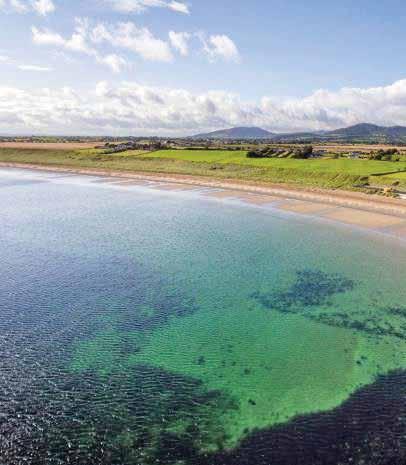
He said a warden would not necessarily have to remain there throughout the day, but could be present around the times when the tide was coming in and going out.
“I think it would be an excellent idea for Blackrock,” he said.
Cllr Nash told the meeting that he had seen the Coast Guard helicopter attending Blackrock more often than Templetown, with the council official describing Blackrock as “a very tricky beach”.
The council official agreed to take away the suggestion of a warden at Blackrock, while noting that the council already provides lifeguards at Louth’s three Blue Flag beaches, however, Blackrock is not one of those beaches.
Dog-waste facilities were also discussed after Cllr Ciaran Fisher (Ind) asked who councillors should contact about securing additional bins.
Under a new national fund, announced by Minister of State for the Circular Economy, Alan Dillion on 2nd July,
‘I wouldn’t feel
A DUNDALK councillor has said she would not feel comfortable cycling through the town centre, as concerns about worn and overgrown cycle lanes remain unresolved.
Cllr Sionnan McCann (SF) returned to the issue at the latest meeting of Dundalk Municipal District, a month after councillors raised problems with faded markings, overgrowth and sections they said were difficult to use.
“Last month, a number of us raised issues around cycle infrastructure around the town and the state of some of the cycle paths,” she said.
She asked when the work would be completed, adding that the recent fine weather made this “the ideal time to be cycling about the town”.
“I wouldn’t do it, to be quite honest,” she said. “I wouldn’t feel comfortable cycling around the town centre.”

Home Bakery, saying cyclists sometimes had to move back onto the road.
Cllr Seán Kelly (FF) also called for markings around Seatown to be urgently addressed, saying cycle lanes were “great” but needed upkeep.
light on Chapel Street separating the traffic from the cycle lane, which he described as being “bent all the way to the ground” as the result of what he thought had been a car crashing into it.
While he said the traffic light and bollard in question had been removed, he was concerned that cars were now able to drive into the cycle lane and park in the area.
Responding to Cllr McCann’s latest query, an official said the Active Travel programme had “a couple of million” available this year and that the plan was to begin works on new cycle lanes at the end of this year.
€250,000 is set to be made available to local authorities across the country, to help with the purchase of dog fouling bins and related infrastructure. However, the council official cautioned that Louth’s share would be limited as the allocation would be divided between all 30 councils nationwide, adding that he expected Louth County Council to get around €10,000 euro or less.
“We’re not going to get many,” the official said. “We’re not going to buy hundreds of bins, but we will get a few.”
Furthermore, with regards to better tackling dog fouling, fines for littering and dog fouling are also set to rise from €150 to €250 on 1st September, 2026, also announced by Minister Dillon.
No decision was made on appointing beach wardens, but the council official agreed to examine the proposals raised for both Templetown and Blackrock.
At the June meeting, Cllr McCann described some cycle lanes as “unusable”. She pointed to a tree growing in a lane on Jocelyn Street and faded markings near the
At the July meeting, the question of road markings was also raised again by Cllr Ciaran Fisher (Ind) who noted road markings at Chapel Street, the pedestrian crossing at the Square to the long walk in the town were also “very faded”.
He also highlighted a traffic
Regarding road marking, the meeting was told the council had €50,000 set aside to do road markings and it “had done a lot of road marking in the last couple of months but there was a bit more to do.”
The council said the areas raised by Cllr Fisher would be addressed “in due course”, while stop lines and centre lines were being refreshed where possible within the available budget.
CCTV cameras are “such a good deterrent” that Louth County Council is to spend €20,000 from its own resources to keep them in use at illegal dumping hotspots in Dundalk.
The update came after Cllr Antóin Watters (SF) asked at the July meeting of Dundalk Municipal District whether there had been any progress on placing cameras at a number of problem locations.
A council official said no funding had been awarded for CCTV under this year’s Anti-Dumping Initiative, despite the council normally
receiving about €20,000 for the measure.
However, he added, “We are going to use €20,000 from other funds to put cameras in the worst places.”
A small number of known hotspots will now be selected, including locations that have previously been raised with the council.
“We are going to put cameras out again, but we just have to fund it internally because they are such a good deterrent,” the official told the meeting.
Louth did receive €81,400 for four other anti-dumping projects this year, including
mattress and sofa collections in Dundalk, Drogheda and Ardee, with the official confirming at the meeting that those collections would go ahead as usual in September.
Councillors were also advised that the fixed-payment fine for littering and dog fouling is currently €150 and will rise to €250 from the start of September.
“The fines are going up to €250 from 1st September, so if you get caught now you are really going to get hammered for littering,” the meeting was told.
By LAUREN ROSS l lauren@dundalkleader.com
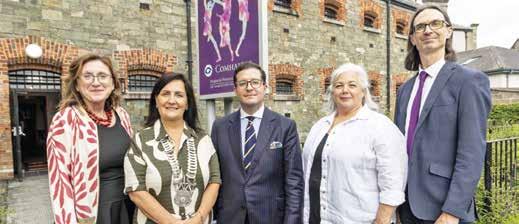
A SIX-month programme of cultural events across the county has been launched by Louth County Council as part of Ireland’s Presidency of the Council of the European Union.
Legendary Together will run from July until December 2026, bringing arts, heritage, storytelling, exhibitions, workshops and festivals to communities across the county.
According to the local authority, the programme will celebrate Louth’s heritage, creativity and community spirit while also fostering meaningful cultural connections with Europe.
The programme was formally launched by Cathaoirleach of Louth County Council, Cllr Dolores Minogue (FG), at a special opening event in the Oriel Centre in Dundalk and is being coordinated by Louth County Council in conjunction with Cultúr 2026, the national cultural programme for Ireland’s EU Presidency.
Attended by civic leaders, cultural partners and community representatives, as well as Henrique Sousa de Azevedo, Deputy Chief of Mission at the Embassy of Portugal, marking the first formal engagement in Louth’s official EU Presidency partnership with Portugal.
Cllr Minogue described the programme as a celebration of Louth’s identity and its links with Europe and the wider world.
“Over the next six months, communities across Louth will
come together to enjoy an inspiring programme of arts, culture and creativity that reflects both our local identity and our European partnerships,” she said.
“I encourage everyone, residents, visitors, families and community groups alike to get involved, attend events, and be part of this unique moment for Louth as we showcase our talent, heritage and welcoming spirit on a European stage.”
Ger Murphy, Director of Services with Louth County Council, said the programme “highlights the strength and diversity of Louth’s cultural sector and demonstrates the power of collaboration at local, national and European level.”
“Through our partnership with Portugal and our engagement with Cultúr 2026, we are creating opportunities for artists, communities and audiences to connect, learn and exchange ideas.
“Legendary Together will leave a meaningful cultural legacy for the county,” he said.
Under the programme, there will be a series of EU retrospective talks in Dundalk, Drogheda and Ardee libraries led by political broadcaster David McCullough, which will reflect on Ireland’s 50-year membership of the European Union.
The Highlanes Gallery in Drogheda will host Picturing the Border, co-curated by Dr Orla Fitzpatrick and Aoife Ruane, which explores artistic re-
SEAWEED gathering along the busy Blackrock shoreline has prompted a renewed call for Louth County Council to establish whether the decomposing material poses any potential risk to public health.
Cllr Sionnan McCann (SF) raised the question at the latest meeting of Dundalk Municipal District, saying there was “quite a lot” of seaweed in Blackrock after a run of busy weekends.
health assessment of that decomposing seaweed and, if not, are there plans to do it?”
A council official said he did not know whether an assessment had been carried out and would check with the council’s environment section. He explained that gases are naturally released as organic matter breaks down and described hydrogen sulphide as the gas associated with the smell of rotten eggs.
in previous years.
“Blackrock Beach is located within a Special Area of Conservation (SAC) and a Special Protection Area (SPA). As a result, the Council cannot remove this material from the beach. It should also be noted that Blackrock is not currently a designated bathing water. The designated bathing waters in County Louth are Shilling Hill/ Templetown, Port, Clogherhead and Seapoint,” it added.
sponses to the Irish border since 1922. Later in the year, the gallery will celebrate its 20th anniversary with Norah McGuinness: Pioneer, linking historic and contemporary artistic practice and examining Ireland’s longstanding artistic connections with Europe.
A series of creative workshops will also form part of the programme, with Illustrator Tarsilas Kruse and writer Juliette Saumande set to deliver EU Passport workshops for children and families, while Author Sadhbh Devlin will also work with schools across Louth to create pieces inspired by Irish mythology and ancient Iberian connections.
An expanded Culture Night programme is planned, including themed events with Roe River Books and Lourdes Brass Band, as well as the opening of Boyne Tradfest and FrenchIrish storyteller Fiona Dowling will deliver a series of bilingual storytelling sessions in local libraries.
Other events will include a food festival and a special closing celebration in December.
Further details are due to be announced in the coming weeks, with the programme expected to develop throughout the EU Presidency period as new events and information are added.
The full programme is available at CreateLouth.ie.
Cllr McCann referred to cases in parts of France where large deposits of green algae can release hydrogen sulphide as they decompose, which had been highlighted back in May at the full council meeting when Cllr Michelle Hall (Lab) asked for seaweed affecting Blackrock and other beaches in the county to be tested before it began to rot, since it had been creating a smell which meant “people didn’t want to stay on the beach”.
Cllr Hall had raised those concerns having read reports from Brittany in France, where decomposing seaweed and been linked to health and safety concerns and asked for seaweed to be tested “to make sure it wasn’t the same thing.”
At the July meeting of Dundalk MD, Cllr Mc Cann asked, “Did we actually carry out a public
While he said the gas can be “quite dangerous” in situations where it is contained, he believed concentrations produced in an open area would be “so, so small” and not enough to harm anyone, although an odour could still be noticeable.
The official at the latest meeting agreed to check with the council’s environment section whether a public health assessment had taken place.
Since the meeting, Louth County Council has told the Dundalk Leader that he accumulation of seaweed material along the shoreline is a natural phenomenon and is typical for coastal areas at this time of year and the situation currently observed at Blackrock and other coastal areas in the county is consistent with levels experienced on an ongoing basis
“In relation to concerns raised regarding reports from France, those cases involved exceptional circumstances where very large quantities of seaweed accumulated over extensive stretches of coastline, in some instances several miles in length and up to five feet deep. The scale of accumulation reported in those cases is not comparable to the conditions currently present at Blackrock.
“Based on the circumstances at Blackrock as outlined above, it is not currently the Council’s view that there is a health and safety issue of concern arising from the seaweed accumulation. However, we will consult with the Environmental Protection Agency (EPA) in relation to the matter and act in line with guidance they may provide.”
A SURVIVING stretch of cobblestones on Anne Street has been added to the council’s schedule after concerns were raised about weeds and a concrete slab laid through the original surface.
Cllr Sionnan McCann(SF) told the latest meeting of Dundalk Municipal District that the section, which she estimated at around 20 metres, was “in pretty shabby condition”.
“It’s completely covered by weeds and there’s stuff growing
through it at this point, and it’d be really great to get it cleared,” she said.
The councillor also raised concerns about works where the original cobblestones had been lifted and a concrete slab put down instead.
“They removed the original cobblestones, did the work they needed to do and then, instead of replacing it or putting it back, they put this concrete slab in the middle of it,” she said.
“There must be some sort of obligation on
workers to leave it as they found it, especially when you’re talking about pieces of heritage.
“It’s just really disappointing that they seem to have not done that on Ann Street.”
He said the concrete section had been put in around 20 years ago and it was now too far back to pursue the utility company involved.
“If it was done today, we would have far tighter control on what gets put back,” he said.
“We’ve got three engi-
neers working on roadopening licences and they don’t get away with it today, but unfortunately they got away with it back then.”
“If we had the money we could do it but it’s quite a specialist thing to do and even finding the right type of stone would be tricky,” he said. “So that’s the way it’s left unfortunately.”
On, the weed covered section, the meeting heard the area was already on the schedule to address that.

























Available in all sizes From 3 Cubic Yard to 40 Cubic Yard Call 042-932 2594 or email info@aceenvironmental.ie


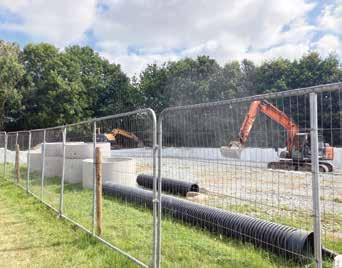
Tree Surgery, Stump Grinding, Wood Chipping & Pruning. Conifer Hedge Reduction. Ash Die Back Removal.

Fully Insured & Certified Contact 087 2750825 Email: rchambers2008@yahoo.ie




WORKS on Dundalk Athletics Track are entering their final stages, with floodlighting now under construction and hopes the facility could open before the end of the summer.
Dundalk Athletics Track has moved another step closer to completion, with work now underway on the installation of floodlighting as the long-awaited redevelopment enters its final phase.
The upgraded facility will include a new eight-lane 400-metre synthetic running track, a central field space, dedicated long jump and triple jump facilities, shot put, high jump, pole vault and javelin areas, together with equipment storage.
Construction has also commenced on an attenuation tank for storm drainage, while foundations and bases for the new floodlights were poured this week. The floodlights are currently on order, with the hope they will be installed and operational by the fourth quarter of 2026.
Independent Councillor Maeve Yore, who has campaigned for the redevelopment of the facility over a number of years, welcomed the latest progress and said she regularly visits the site to monitor the works.
“I go up to the Track bi weekly to check progress and am on first name terms with the contractors at this stage who keep me updated on developments,” she said.
The councillor also highlighted the specialist work currently being carried out to prepare the track for certification.
“Matthew’s company is doing the line marking and Track certification and Trackmaster International is accredited by World Athletics for onsite and laboratory testing as well as services for precision survey checking and track line marking globally.”
Cllr Yore said she believes the redevelopment will provide a significant boost for athletics across Dundalk and County Louth once completed.
“I am absolutely ecstatic that Dundalk Athletics Track is on ‘the final lap’ of works and hopes the opening will be before the end of Summer 2026. It will be a phenomenal, transformative asset to schools, clubs, athletes across our Town and County.” She also acknowledged the contribution of those involved in bringing the project to its current stage, including Louth County Council Senior Engineer and Project Lead Stephen [surname], Chief Executive David Conway and his management team, as well as representatives from local athletics clubs.
The redevelopment of Dundalk Athletics Track has been a long-running project and, once completed, will provide a modern athletics facility capable of supporting training and competition for athletes of all ages and abilities across the region.

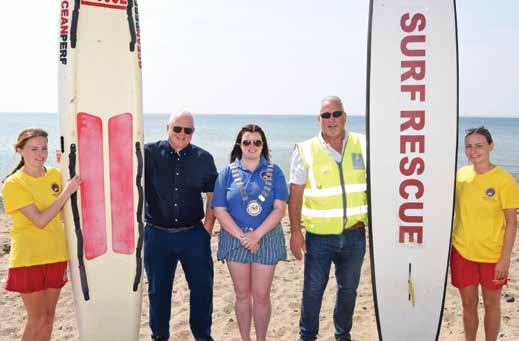
LOUTH County Council, in partnership with Water Safety Louth, is encouraging residents and visitors to stay safe in and around water ahead of World Drowning Prevention Day 2026.
County Louth has over 70km of stunning coastline, including three Blue Flag beaches at Clogherhead, Templetown and Port. Louth’s coastline and waterways attract thousands of locals and visitors each summer. While our waters are a valuable amenity, they can also be dangerous if people do not take care.
According to Water Safety Ireland, an average of 133 people lose their lives to drowning in Ireland each year. Each loss is a devastating and preventable tragedy. Through awareness, education, and shared responsibility, it is possible to reduce the risk of drowning.
Louth County Council and Water Safety Louth are asking everyone to follow these 10 simple water safety guidelines: Swim at lifeguarded waterways and always follow lifeguards’ instructions; Follow all water safety signs and do not swim in dangerous areas; Check the weather, tides and currents in advance; Avoid swimming alone and always supervise children closely; Do not use inflatables in open water; Always wear a lifejacket when boating, kayaking or paddleboarding;
Know the signs of cold water shock; Never enter the water under the influence of alcohol or drugs; Report missing or damaged lifebuoys to Louth County Council; If you see someone in difficulty in the water, call 999 or 112.
Cllr Andrea McKevitt, Cathaoirleach of the Municipal District of Dundalk and Chairperson of Water Safety Louth, said:
“Louth is fortunate to have such exceptional natural amenities, from our beautiful coastline to our rivers and waterways, which are enjoyed by thousands of people every year. However, we must never underestimate the risks associated with open water. Drowning can happen quickly and silently, and every life lost is one too many.
“Simple steps such as swimming in lifeguarded areas, wearing a lifejacket and understanding local conditions can make all the difference. We ask everyone to respect the water, avoid risks and look out for others.”
David Conway, Chief Executive of Louth County Council, added:
“Louth County Council is committed to ensuring that our beaches and coastal amenities remain safe and welcoming for residents and visitors alike. Through the provision of lifeguard services, the maintenance of lifebuoys and safety signage, monitoring our bathing waters, and working in


partnership with Water Safety Louth and other agencies, we play an active role in promoting water safety across the county.
“I would also like to acknowledge and thank our dedicated lifeguards and the operational teams across Louth County Council whose hard work throughout the bathing season helps to keep our beaches clean, safe, and enjoyable for everyone.
“As we mark World Drowning Prevention Day, we encourage everyone to enjoy our coastline responsibly, follow safety guidance and make informed choices when in or near the water.”
Jerome Lambe, Water Safety Development Officer, Louth County Council, said:
“Our beach lifeguard service operates during the summer months at Clogherhead, Templetown and Port beaches. We strongly encourage people to swim at these beaches during patrol hours, to follow the flag system and to listen to lifeguards. Choosing a lifeguarded beach can save lives.”
World Drowning Prevention Day takes place on 25 July each year. It is a United Nations initiative that raises awareness of drowning and promotes ways to prevent it.
For updates, safety advice and local information, follow Louth County Council and Water Safety Louth on social media.
HILL STREET, DUBLIN RD., DUNDALK. 042 9331515/086 2559201 NEWRY ROAD, DUNDALK (Rear of Go Petrol Station) Car & Van Servicing NCT Preparation Engine, Clutch and Brake Repairs Suspension and Steering Repairs Diagnostics for All Makes & Models Tel 042 9327201 - Mob 087 2852406 info@camworxauto.ie - www.camworxauto.com