VOLUME 1
2021/2022 SEASON
Northern Sounds THE MAGAZINE OF THE DULUTH SUPERIOR SYMPHONY ORCHESTRA
Photos: Steven R. Mattson Zenith City Photgraphy
Counsel that strikes just the right chord. Fryberger, Buchanan, Smith & Frederick, P.A. is proud to support the arts.
fryberger.com 26 D U L U T H S U P E R I O R S Y M P H O N Y O R C H E S T R A
2010 W SUPERIOR ST • 218.722.2433 • happysleepermattress.com 3 DULUTH SUPERIOR SYMPHONY ORCHESTRA
Pizza Lucé Duluth Dine-In, Free Delivery & Carry-Out
For more 46 D U L U T Hinformation, S U P E R I O R S Y M P H O N Y visit O R C H E Sus T R A at pizzaluce.com/locations/duluth
Passion + Commitment With just the right combination, we make more possible. Proud supporter of the Duluth Superior Symphony Orchestra.
5 DULUTH SUPERIOR SYMPHONY ORCHESTRA
nbcbanking.com
DSSO 2021-22 SEASON
TABLE OF CONTENTS 08
WELCOME LETTER 8 Music Director Dirk Meyer 9 Executive Director Brandon VanWaeyenberghe 11 Board of Directors 11 Staff and Administration
12
12-13 Meet the Orchestra
16
MASTERWORKS 1: TO DISCOVER
MEET THE ORCHESTRA
17 Claudia White Biography 18-21 Masterworks 1 Program Notes
24
POPS 1: CHILLS AND THRILLS 24 Pops 1 Program Notes
26
MASTERWORKS 2: TO EXPLORE 27 Jiji Biography 28-33 Masterworks 2 Program Notes
34
WAYS TO SUPPORT THE DSSO 34 How to Donate 35-41 DSSO Contributors
OUR MISSION Our mission is to enhance our community through the performance of symphonic music that engages and inspires.
OUR VISION
We envision a stronger community through the power of music and musicians’ artisty.
6 DULUTH SUPERIOR SYMPHONY ORCHESTRA
COME TOGETHER
2021-22 SEASON
An excellent performance can change your life. Our high level of care and stateof-the-art technology has earned us a 98 percent patient satisfaction rating. Remember Lakewalk Surgery Center for outpatient surgery excellence. It’s your health – it’s your choice.
20 Years of Excellence 1420 London Road, Duluth 218-728-0650 lakewalk.com
A symphony of excellence and care for the audience of you.
7 DULUTH SUPERIOR SYMPHONY ORCHESTRA
MUSIC DIRECTOR
From the Minnesota premiere of our season opener Rush by American composer Jonathan Leshnoff to the final sounds of the season, celebrating our ability to sing together again, this season invites us all to find ourselves in music.
DIRK MEYER G E R M A N C O N D U C T O R D I R K M E Y E R IS M U S I C D I R E C T O R OF D U L U T H SUPERIOR SYMPHONY ORCHESTRA ( D S S O ) IN M I N N E S O T A A N D A U G U S T A S Y M P H O N Y IN G E O R G I A .
Welcome to the Symphony! It is good to see you! This sentence never rang so true: It is good to see you! After the turbulent events of the past year, we are finally ready to enjoy life, together, once more. What better way to do so, than to experience the power of orchestral music and share this experience – in person – with our friends and fellow music lovers here at Symphony Hall. The DSSO’s 2021/22 season celebrates our return to togetherness. We celebrate our friendships and companionship. We celebrate the shared experience of music! In doing so, our new season bursts with breathtaking compositions – from the classics to the unknown. Each concert encompasses a wide range of emotions that let us celebrate, but also reflect, find peace, and learn something new.
Our year begins with two Sinfoniettas that couldn’t be more different. Poulenc’s colorful music gives us a wonderful taste of French harmonies, while Astor Piazzolla leads us into the passionate realm of the Argentinian Tango. Starting with the new year, we are finally able to continue the DSSO’s Beethoven Project: Symphony No.3 and No.5 are on the docket for this season, bringing our project close to its completion. Concerto highlights of the season include Tchaikovsky’s iconic Piano Concerto No.1, featuring internationally renown pianist Marika Bournaki, as well as Brahms’ Violin Concerto with the up and coming superstar Geneva Lewis. Geneva’s appearance is even more thrilling, as she will perform on the original Stradivarius violin on which this concerto was premiered in 1879. Finally, I’m excited to welcome our wonderful concertmaster Erin Aldridge to the soloist spot with the unknown, yet dazzling, Violin Concerto by José White, an Afro-Cuban composer of the late 19th century. I, personally, am very excited for the last two performances of the season: Bruckner’s absolutely amazing Symphony No.4 is on the program together with Poulenc’s wonderful Concerto for Two Pianos. And for our final concert of the season we created a real showstopper! Williams Dawson was one of the leading black American composers of the 20th century. His Negro Folk Symphony is based on spirituals and when you hear this incredible music, you truly hear the orchestra “sing” these emotional tunes. For the second half of the performance our beloved DSSO Chorus finally takes the stage again. And, because we haven’t been able to sing together for so long, we simply enjoy our reunification with some of the greatest chorus numbers ever written! There is much to celebrate in our lives and there is much to celebrate in music. We invite you to be a part of it: Real experiences, real emotions, real friendship. Best enjoyed in person!
Dirk Meyer, Music Director Duluth Superior Symphony Orchestra
8 DULUTH SUPERIOR SYMPHONY ORCHESTRA
WELCOME LETTER
2.8 viewers, so we estimate more than 600 viewers for each of our digital concert offerings. Our virtual concerts reached 37 states, with 61% of viewers being from the Duluth-Superior area and 17% from the Twin Cities. We had a total of 557 accounts who viewed at least one DSSO virtual concert this past season. One of the best comments we received was, “I enjoy attending live concerts, but it has become more challenging as my husband uses a wheelchair when we leave our home. Streaming the concerts in our home has been a real gift to us!!”
BRANDON VANWAEYENBERGHE EXECUTIVE DIRECTOR WELCOME LETTER
There are several words that could be used to describe the last season, and really the last 18 months. Challenging is an apt one, when we had to program the 2020-21 Season twice in order to accommodate the regulations and protocols placed around our performances. Restricted is another great one as we had to limit the number of musicians on stage to less than half of our traditional compliment and limit audiences to 10% of seating capacity at Symphony Hall. However, this last year can also be described as transformative. The DSSO and WDSE partnered to livestream seven concerts via our website, make them available for on-demand viewing, and had them broadcast over the air. The DSSO’s online audience averaged 190 households per livestream and 60+ ondemand views per concert. Each household averaged
9 DULUTH SUPERIOR SYMPHONY ORCHESTRA
I would also use the word steadfast to describe our work this past season. We continued to offer Twin Ports’ students’ musical instruction via our all-virtual Youth Orchestras program, reaching more than 100 students. In October 2020, the DSSO was one of, if not the first orchestra in Minnesota to perform to a live audience since the COVID-19 shut down concerts in March 2020. While our audiences were only around 150 for our first few shows, we ended the season with more than 400 inperson attendees for our May 2021 season finale. We have continued to produce musical experiences for our community, providing much needed art and entertainment during these unprecedented times, and doing it all in a fiscally stable manner. We could not be here without your support as subscribers, single ticket buyers, donors, youth orchestras parents, volunteers, and community music lovers. On behalf of our musicians, we look forward to being able to connect with you on stage through the language of music this season.
Brandon VanWaeyenberghe, Executive Diretor Duluth Superior Symphony Orchestra
2525 London Road | 218.724.1612 | www.blackwoods.com
in Duluth News Tribune ‘Best Of’ Awards!
濄濄濃濅澳濪瀂瀂濷濿濴瀁濷澳濔瀉濸澳瀏澳澳濅濄濋濁濊濅濇濁濃濃濄濃澳瀏澳澳瀊瀊瀊濁瀇濴瀉濸瀅瀁濷瀈濿瀈瀇濻濁濶瀂瀀澳 106 D U L U T H S U P E R I O R S Y M P H O N Y O R C H E S T R A
BOARD AND STAFF
BOARD OF DIRECTORS 2021-2022:
STAFF AND ADMINISTRATION:
Mark Monson, Board President Christabel Grant, Vice Chair John Berchild, Past Chair Robert T. Bennett, Treasurer Sandra Barkley, Secretary
ADMINISTRATION
BOARD OF DIRECTORS
Brandon VanWaeyenberghe, Executive Director Kelly Katzmarek, Marketing Director Jean Larson, Patron Service Manager Audrey Beyer, Development Assistant ARTISTIC STAFF
Dirk Meyer, The Charles A. & Carolyn M. Russell Music Director Andrew Kim, Assistant Conductor Heidi Lord, Director of Artistic Operations Maureen Breemeersch, Stage Manager Kristin Sande, Music Librarian
William Alexander Sandra Barkley Robert T. Bennett John Berchild Linda Boben Ruth Ann Eaton Beth Gilbert Christabel Grant Jeremy Hoglund Tina Koecher James McLeod Michael Mollerus Mark Monson William “Buzz” Palmer Fr. Andrew Ricci Branden Robinson Kathleen Sanders James Sebastian Nairi Stack Rajiv Vaidyanathan Christopher Virta Roberta Vose
LAYOUT OF NORTHERN SOUNDS
HONORARY LIFE DIRECTORS
Kelly Katzmarek
Elaine Killen Dexter Larsen Elisabeth MasonNancy MelanderJames Zastrow
MUSIC DIRECTORS Dirk Meyer (2012 – present) Markand Thakar (2001 – 2012) Yong-yan Hu (1995 – 2000) Taavo Virkhaus (1977-1994) Joseph Hawthorne (1967-1977) Hermann Herz (1950-1967) Joseph Wagner (1947-1950) Tauno Hannikainen (1942 – 1947) Paul Lemay (1932 – 1942)
11 D U L U T H S U P E R I O R S Y M P H O N Y O R C H E S T R A
CHORUS
Richard Robbins, Chorus Master Nikki Norland, Chorus Adminstrator Beth Sobczak, Chorus Accompanist YOUTH ORCHESTRAS
Melanie Sever, Administrative Director and Concert Orchestra Conductor Kristin Sande, DSSYO Administrative Assistant Andrew Kim, Youth Symphony Conductor Kevin Hoeschen, Sinfonia Coordinator Brett Jones, Percussion Ensemble Director Ronald Kari, Youth Orchestras Coordinator
PRINTING OF NORTHERN SOUNDS
Arrowhead Printing, Inc NORTHERN SOUNDS PROGRAM NOTES
Vincent Osborn, Program Notes Writer Ronald Kari, Performance Historian, now in his 60th Season. DULUTH SUPERIOR SYMPHONY ORCHESTRA
130 West Superior Street, LL2-120 Duluth, MN 55802 TICKETS
218–623–3776 tickets@dsso.com | www.dsso.com
MEET THE ORCHESTRA COMING TO YOU FROM THE ALLETE STAGE
DIRK MEYER, THE CHARLES A. & CAROLYN M. RUSSELL MUSIC DIRECTOR Sponsors: Harris & Diane Balko; Elisabeth C. Mason; The Charles A. & Carolyn M. Russell Foundation
FIRST VIOLIN: Erin Aldridge, Concertmaster Sponsor: Arend & Verna Sandbulte in support of the concertmaster chair through the Sandbulte Orchestra Leadership Fund Colin McGuire, Associate Concertmaster (On Leave 21-22) Sponsor: The Northern Mechanical/Plumbing Contractors Association Nicole Craycraft Sponsor: Glen Holt Kathleen Sanders Sponsor: Terry & Vicki Anderson Nairi Stack Sponsor: Stack Brothers Mechanical Contractors; Tom & Mimi Stender Joan Halquist Sponsor: James & Elizabeth Prest Amanda Wirta Sponsor: James & June Farkas Lindsey Bordner (On Leave 21-22) Sponsor: Joel & Catherine Koemptgen Daniel Radosevich Sponsor: Robert & Angelica Fryberger Steve Highland Sponsor: Thomas & Barbara Elliott
SECOND VIOLIN: Laurie Bastian, Principal Sponsor: Jacquie & James Sebastian Jean Leibfried, Assistant Principal Sponsor: Sandra Barkley; Marcia & Gary Doty Amy Eichers Sponsor: Thomas & Alice McCabe Michael Husby Sponsor: Brad Schmugge, CPA Olga Chernyshev Sponsor: Kay & Walt Gower Kina Ono Sponsor: Rose & Lester Drewes Michael Zellgert Sponsor: Vern & May Nordling Sarah Warner Sponsor: Kathy & James Sanders Kristen Anderson Sponsor: James Seitz & Diane Kolquist
12 D U L U T H S U P E R I O R S Y M P H O N Y O R C H E S T R A
Mary Negus Sponsor: Anonymous Friend of the DSSO Stephen Baillie Sponsor: Henry & Terry Roberts
VIOLA: Kevin Hoeschen, Principal Sponsor: Ruth R. Johnson in memory of Dr. Ted Johnson Ronald Kari, Assistant Principal Sponsor: Stephen & Lauri Cushing; Ruth Ann Eaton Clare Chopp Sponsor: Martha Aas Jonathan Kresha Sponsor: Nancy Odden & Doug Britton Kevin Peterson Sponsor: Robert T. & Barbara K. Bennett; Linda & Mark Boben; Ruth Frederick Kirsti Petraborg (On Leave 21-22) Sponsor: Anonymous Friend of the DSSO Judy MacGibbon Sponsor: J. Clark & Jean A. Laundergan in memory of Warren & Viola Askeland J. David Arnott Sponsor: Sylvia Jamar
CELLO: Betsy Husby, Principal Sponsor: Christabel & James Grant Lucia Magney, Assistant Principal Sponsor: Ann Mars Julia Morehouse Sponsor: Nancy Melander; Nancy & Mark Melhus Eric Graf Sponsor: Dean Peterson and Deb Rausch Rebecca M. Peterson Sponsor: Robert T. & Barbara K. Bennett Darin Anderson Sponsor: Dr. Michael and Sharon Mollerus Jesse Nummelin Sponsor: Anonymous Friend of the DSSO Elena Denny (On Leave 21-22) Sponsor: Anonymous Friend of the DSSO Scott Lykins Sponsor: Anonymous Friend of the DSSO
MEET THE ORCHESTRA
DOUBLE BASS:
HORN:
Vincent Osborn, Assistant Principal Sponsor: Lane Smith; Andrea Wahman & Lee Zimmerman Anthony Lischalk Sponsor: John Ivey Thomas & Mary Rees Thomas Family Fund James McLeod Sponsor: Branden Robinson Irving G. Steinberg Sponsor: Lurene Buhrmann Blake Bonde Sponsor: Carolyn Sundquist
James Pospisil, Principal Sponsor: James & Mary Zastrow Erika Hammerschmidt, Horn 2 Sponsor: Roger and Elaine Engle; Robert & Mary Evans Gwendolyn Hoberg, Horn 4 Sponsor: Susan Meyer
FLUTE: Claudia White, Principal Sponsor: Thomas & Janice Shuey Hannah Peterson, Piccolo/Flute 3 Sponsor: Anonymous Friend of the DSSO
OBOE: Michael Dayton, Principal Sponsor: Gary Foley Darci Griffith Gamerl, Oboe 2 Sponsor: Dr. Dennis & Donna Soukup Sarah Carmack, English Horn/Oboe 3 Sponsor: Anonymous Friend of the DSSO
CLARINET: Jennifer Gerth, Principal Sponsor: William & Saundra Palmer Kristine Peterson, Clarinet 2 Sponsor: Kay & William Slack Theodore Schoen, Bass Clarinet/Clarinet 3 Sponsor: Karl Diekman
BASSOON:
TRUMPET: Earl Salemink, Principal Sponsor: Sharon & Robert Wahman Charles Leibfried, Trumpet 2 Sponsor: Jeff & Vickie Cadwell; Marcia & Gary Doty; David and Patricia Mast Thomas Pfotenhauer, Trumpet 3 Sponsor: Mark & Grace Monson
TROMBONE: Larry Zimmerman, Principal Sponsor: Gale and Jeri Kerns; Roberta Vose James Erickson, Acting Trombone 2/Bass Trombone Sponsor: Mark Danielson & Theresa Smith
TUBA: Steve Grove, Principal Sponsor: Helena Jackson & Doug Dunham
TIMPANI: Fred Morgan, Principal (On Leave 21-22) Sponsor: Ellen Marsden Henry Eichman, Acting Principal Sponsor: Happy Sleeper
PERCUSSION: Gene Koshinski, Principal Sponsor: Susan J. Relf
HARP:
Michael Roemhildt, Principal Sponsor: Janet Sklaris in memory of Frank Sklaris Jefferson Campbell, Contrabassoon/Bassoon 3 Sponsor: Timothy Sandor
Janell Kokkonen Lemire, Principal Sponsor: Elaine Killen
SAXOPHONE:
KEYBOARD:
Gregory Kehl Moore, Principal Sponsor: Anonymous Friend of the DSSO
Beth Gilbert, Principal (On Leave 21-22) Sponsor: John & Kathy Berchild
13 D U L U T H S U P E R I O R S Y M P H O N Y O R C H E S T R A
Proud to Support DSSO Shops
A Place For Fido Duluth Kitchen Co. Fitger’s Brewhouse Beer Store Fitger’s Wine Cellars Gourmet Market Lotus on the Lake The Bookstore at Fitger’s The Snow Goose Trailfitters Whimsy
Restaurants Fitger’s Brewhouse Mexico Lindo The Boat Club
Nightclubs The Barrel Room Rex Bar
Services
Fitger’s Salon & Spa
Duluth’s Historic Fitger’s Inn ~ Proud sponsors of the featured artist! * FREE covered parking with validation!
146 D U L U T H S U P E R I O R S Y M P H O N Y O R C H E S T R A
15 D U L U T H S U P E R I O R S Y M P H O N Y O R C H E S T R A
MASTERWORKS 1
TO DISCOVER SATURDAY OCTOBER 9, 2021 7 PM DECC SYMPHONY HALL, ALLETE STAGE DIRK MEYER, MUSIC DIRECTOR CLAUDIA WHITE, FLUTE
LESHNOFF Rush* 8’ MOZART Flute Concerto No. 1 in G Major, K.313 Allegro maestoso Adagio ma non troppo Rondo: Tempo di Menuetto
25’
Claudia White
INTERMISSION BEETHOVEN Symphony No. 10 in E-flat Major Andante-Allegro-Andante
15’
Erika Hammerschmidt, horn; Brighton Beach
POULENC Sinfonietta 27’ Allegro con fuoco Molto vivace Andante cantabile Finale: Trés vite et trés gai
*MINNESOTA PREMIERE 16 D U L U T H S U P E R I O R S Y M P H O N Y O R C H E S T R A
MUSICIAN PROFILE
CLAUDIA WHITE Claudia White has been the Principal Flutist of the DSSO for over 20 years.
In 2019 she won the audition for Second Flute/ Piccolo with the Orlando Philharmonic, having preformed as a substitute musician with them for 13 seasons. In addition, she has performed with the Mill City Summer Opera, The Minnesota Orchestra, the Sarasota Opera Orchestra, The Florida Orchestra, and The Sarasota Orchestra. She is a founding member of Music Saint Croix, one of Minnesota’s premier chamber music ensembles. She maintains an active freelance career including performances with Yo-Yo Ma, John Williams, Andrea Bocelli, and many recording and performance projects at Walt Disney World.
Originally from Kansas City, Missouri she has degrees from Wichita State University and Northwestern University. When not performing, Claudia enjoys hiking and backpacking in the mountains and has a cooking website - idioitskitchen. com. Claudia is passionate about her job as the Director (aka Chief Kitten Pusher) of First Ladies Farm & Sanctuary, a non-profit cat and domestic poultry rescue near her home in Tampa, Florida.
CLAUDIA WHITE ALSO PERFORMED CARL NIELSEN’S FLUTE
CONCERTO WITH THE ORCHESTRA ON NOVEMBER 15, 2008.
17 D U L U T H S U P E R I O R S Y M P H O N Y O R C H E S T R A
MASTERWORKS 1
The opening measures of Rush present the core motive, which is furiously developed by each instrument group. Out of the frenzied propulsion an atmospheric clarinet solo rises over a foundation of shimmering strings. The orchestra returns, but its climax is thwarted by a harp solo. A final exclamation from the orchestra closes the work.
JONATHAN LESHNOFF
Rush is dedicated to David DePeters, a percussionist and the Iris Director of Institutional Initiatives. Iris Orchestra was founded in September 2000 by conductor Michael Stern as an ensemble for the 21st century and named after the state flower of Tennessee. The orchestra roster is assembled with some of the finest musicians culled from the country’s greatest orchestras and their guest artist list reads like a “Who’s Who” of the classical world, including: pianists Garrick Ohlsson and Emanuel Ax; cellist Yo-Yo Ma; and violinists Itzhak Perlman, Joshua Bell and Pinchas Zukerman.
RUSH JONATHAN LESHNOFF:
Flute Concerto No. 1 WOLFGANG AMADEUS MOZART:
BORN: September 8, 1973, in New Brunswick, New Jersey
BORN: January 27, 1756, in Salzburg, Austria
WORK COMPOSED: 2008
WORK COMPOSED: 1778
WORLD PREMIERE: January 31, 2009, in Germantown, Tennessee; Iris Orchestra, Michael Stern, conducting INSTRUMENTATION: Two flutes, two oboes, two clarinets, two bassoons, two horns, two trumpets, two trombones, timpani, percussion (snare drum, crotales, vibraphone, suspended cymbal), harp and strings. DURATION: 8 minutes Jeremiah German, a retired economics professor and long-time patron of Leshnoff’s work, asked Leshnoff to write several brief pieces for solo piano, each to last under two minutes. German was pleased with the result and later asked Leshnoff to incorporate a select group of the themes into an orchestral work. The completion of Rush marks the first of Leshnoff’s growing number of shorter orchestral works adding to a current oeuvre of over 35 compositions for all variety of ensembles.
ALL FOUR WORKS ON TONIGHT’S CONCERT ARE BEING PLAYED FOR THE FIRST TIME BY THE DSSO.
18 D U L U T H S U P E R I O R S Y M P H O N Y O R C H E S T R A
DIED: December 5, 1791, in Vienna WORLD PREMIERE: Undocumented, but most likely early 1778 in Mannheim INSTRUMENTATION: Two flutes (second movement only), two oboes, two horns, strings and solo flute. DURATION: 25 minutes Mozart and his mother set off from Salzburg on September 23, 1777, bound for Mannheim. Mozart and his father had just been dismissed from their positions and the goal was for Wolfgang to secure employment in Mannheim, which Leopold had described in a letter dated November 13, 1777, as ‘that famous court, whose rays, like those of the sun, illuminate the whole of Germany.’ Once employment could be found, then Leopold would join them and reunite the family. After arriving in Mannheim (no record exists as to their arrival date) Wolfgang befriended the concertmaster, Christian Cannabich, the music leader, Ignaz Holzbauer, and the flautist Johann Baptist Wendling. Although he was unable to secure employment, Mozart composed two keyboard sonatas, a flute quartet, five accompanied sonatas and two arias during this short time. Wendling, the principal flutist in Mannheim, introduced
M AMSAT SETREWR O WR OKRSK S4 1
Symphony No. 10 LUDWIG VAN BEETHOVEN/BARRY COOPER: BAPTIZED: December 17, 1770, in Bonn, Germany DIED: March 26, 1827, in Vienna, Austria WORK COMPOSED: Assembled from fragments by Cooper in 1988 WORLD PREMIERE: Unknown INSTRUMENTATION: Two flutes, two oboes, two clarinets, two bassoons, two horns, two trumpets, timpani and strings. DURATION: 16 minutes
WOLFGANG AMADEUS MOZART Mozart to Dr. Ferdinand Dejean (1731-1797), who worked as a surgeon for ten years on Dutch East India Company ships. Dejean, who was an amateur flutist, asked Mozart to compose three flute concertos and two flute quartets. Mozart wrote his father in December 1777 about this commission indicating that he was determined to complete the work in a couple of months. He also mentioned that he was promised a payment of 200 gulden (a sizable sum at that time). However, Mozart procrastinated and ultimately only completed about half of the commission. Even more damning was that he reworked an earlier oboe concerto (K. 314/285d) into the second flute concerto. Dejean paid him a little less than half of the promised 200 gulden, 96 gulden. He wrote an excuse to his father for not finishing the commission: “I never have a single quiet hour here. I can only compose at night. . . Besides, one is not always in the mood for working. I could, to be sure, scribble off things the whole day long, but a composition of this kind goes out into the world.” Another widely quoted reason he gave is: “You know that I become quite powerless whenever I am obliged to write for an instrument which I cannot bear.” Hard to imagine that Mozart could write such beautiful music for an instrument he disliked. Nevertheless, this G major concerto is a bargain at any price. It shows off the virtuosity of the player and the melodic atmosphere is delectable and elegant.
“ Y O U K N O W T H AT I B E C O M E Q U I T E P O W E R L E S S WHENEVER I AM OBLIGED TO WRITE FOR AN INSTRUMENT WHICH I CANNOT BEAR.”
19 D U L U T H S U P E R I O R S Y M P H O N Y O R C H E S T R A
One of the most frequent questions I am asked is how I approach writing these program notes. It’s a rather easy process, once I get past my chronic procrastination. I research the composer and the work in different sources, one being the indispensable Grove Dictionary of Music and Musicians. I also use Wikipedia (always verifying everything I read there), books from my own library, information from recordings and as many program notes as I can find. Listening to many different recordings of the work is another helpful tool. For the most part there is a plethora of information about different pieces of music. Then there is this work… Beethoven completed his Ninth Symphony in 1824. After that he devoted his energies largely to composing his late string quartets, although there are references to him working on another symphony. Barry Cooper (b. 1949), an English musicologist and Beethoven scholar, claimed that he found over 250 measures of sketches for the first movement. From this he wove together a complete movement, keeping as close as he could to Beethoven’s style. In The Guardian article by Tom Service, he writes of reading Memories of Beethoven by Gerhard von Breuning. “There’s an account of Beethoven talking with von Breuning’s father, who was a close friend of the composer, about pieces he was planning to write near the end of his life. …especially the form that he should give the 10th symphony he had in mind.” Beethoven said that it would be without chorus, but would create in it a “new gravitational force.” Just imagine, every symphony Beethoven composed went to where no composer had gone before; it makes one wonder what could be next? We can get a sense of Beethoven’s future ideas by listening to his last string quartets. As I write this I am listening to his Grosse Fuge, Op. 133. There are hints of his Ninth Symphony here, but more modern and exploratory than
EW RW OKRSK S1 4 MM A SATSETR OR
LUDWIG VAN BEETHOVEN one might expect at that time. There is a feeling that Beethoven is reaching up, grabbing for something that is unreachable and the effect is quite unsettling. In my opinion, Beethoven is so amazing because he constantly challenges us to listen closely and allow ourselves to be drawn into his world. If we go along for the ride, we will eventually discover even more about ourselves than we do about Beethoven. Cooper’s challenge is to take fragments of sketches and complete something that is representative of Beethoven.
However, as many musicologists have pointed out, Beethoven’s sketches hardly ever matched his final product. Cooper writes in his notes for the Wyn Morris recording: “The result is obviously not exactly what Beethoven would have written, and many questions still remain, but the reconstruction does provide at least a rough impression of what he intended…” Beethoven wrote some of his symphonies in pairs, such as the Fifth and Sixth, which present differing expressions at the same stage of his life. Cooper suggests that Beethoven “intended his Tenth Symphony to be introspective and personal (which may explain the apparent allusion to a theme from his Pathétique Sonata). In this respect it is diametrically opposite to the all-embracing Ninth, with which it was clearly meant to form a contrasting pair.” There are two recordings I have found of Cooper’s realization: Wyn Morris conducting the London Symphony Orchestra and Walter Weller conducting the City of Birmingham Symphony Orchestra. Morris’ recording clocks in at around twenty minutes and Weller’s at about sixteen minutes. In comparison (in my opinion), Weller brings out a lively performance that is reminiscent of a Beethoven symphony and the slower approach by Morris results in a lackluster performance. So… is it Beethoven? I think it is a very interesting piece of music and the realization is done very well. What do you think?
SINFONIETTA FRANCIS POULENC: BORN: January 7, 1899, in Paris, France DIED: January 30, 1963, in Paris WORK COMPOSED: 1947-48 WORLD PREMIERE: October 24, 1948, in London, BBC Third Programme broadcast by the Philharmonia Orchestra, Roger Désormière conducting INSTRUMENTATION: Two flutes, two oboes, two clarinets, two bassoons, two horns, two trumpets, timpani, harp and strings. DURATION: 29 minutes
FRANCIS POULENC
20 D U L U T H S U P E R I O R S Y M P H O N Y O R C H E S T R A
MASTERWORKS 1
Poulenc, the only son of Émile and Jenny Poulenc, was born in the 8th arrondissement of Paris (if you’ve been to Paris, this district is where the Champs-Élysées, Place de la Concorde, Arc de Triomphe and Élysée Palace (residence of the president of France) are located). Émile was joint owner, with his brother Gaston, of the successful manufacturer of pharmaceuticals, Poulenc Frères, later Rhône-Poulenc. Francis grew up in a musical household. His mother, a capable pianist, had a wide repertoire ranging from classical to lesser works, which he said gave him a lifelong taste for “adorable bad music.” He started piano lessons at the age of five and he was fascinated by the originality of the sound of Debussy’s music when he heard it for the first time at age eight. Although his inclination was to continue music at the conservatory, his father insisted that he have a more conventional education by attending the Lycée Condorcet, the most prestigious of the four oldest high schools in Paris. The intent was that Francis would follow his father in the family business. His life took a major change with his parents’ early deaths (his mother died when he was 16, his father when he was 18). From 1914 to 1917 Poulenc was a pupil of the Spanish pianist Ricardo Viñes (1875-1943). Viñes, who had magnificent technique and an extensive repertoire, performed the premieres of works by Ravel, Debussy, Satie, Falla and Albéniz. Poulenc would later say of Viñes:
“I admired him madly, because, at this time, in 1914, he was the only virtuoso who played Debussy and Ravel. That meeting with Viñes was paramount in my life: I owe him everything. … In reality it is to Viñes that I owe my fledgling efforts in music and everything I know about the piano. Viñes was a delightful character, some kind of strange Hidalgo with an enormous moustache, a brown sombrero in true Barcelona style, and button boots with which he used to kick me in the shins whenever I was clumsy at the pedals. No one could teach the art of using the pedals, an essential feature of modern piano music, better than Viñes. He somehow managed to extract clarity precisely from the ambiguities of the pedals. His staccato playing was equally remarkable. Marcelle Meyer, his most brilliant pupil, declared that he made even Petrushka seem easy.”
21 D U L U T H S U P E R I O R S Y M P H O N Y O R C H E S T R A
Poulenc’s initial attempts at composition found their demise in the fireplace, but soon he made the acquaintance of Erik Satie (1866-1925). Under his tutelage he became a member of the group of young composers known as Les Six (Georges Auric, Louis Durey, Arthur Honegger, Darius Milhaud, Germaine Tailleferre, and Poulenc). Satie was originally a member, but in September 1918 he withdrew from the group with no explanation. After composing the one-act ballet Les biches on a commission from Sergei Diaghilev, Poulenc found his fame. The ballet was an immediate success and remains one of Poulenc’s best-known scores. Poulenc’s new celebrity garnered him fame and substantial commissions. In 1947 the BBC commissioned a work for orchestra and he was asked to ‘avoid heavy topics.’ He wrote to Milhaud in the summer of 1947, “Now I’m about to write a Sinfonietta for orchestra for the BBC Third Programme (the classical music station that often commissioned new works). One might call this delightful piece a parody on the classical symphonic forms of Mozart and Haydn.” He was careful to call it a Sinfonietta, a little symphony, not because of its brevity but rather to describe its lack of gravitas and weightiness. It was performed numerous times during Poulenc’s first concert tour of the United States, further boosting his international reputation. It’s a delightful work that is full of his charm and wit, a gem of mid-20th century French music that can be easily appreciated.
@duluthsuperiorsymphonyorchestra @dssomn
Support Our Young Musicians Since 1940, young musicians throughout the Northland have found inspiration and expanded their musical talent in the Duluth Superior Symphony Youth Orchestras program. Members of the DSSYO work side by side with DSSO conductors and musicians in rehearsals, sectionals and performances throughout the season. For more information visit dsso.com/youth
226 D U L U T H S U P E R I O R S Y M P H O N Y O R C H E S T R A
HANFTLAW.COM
YOU MATTER
Hanft Fride is setting the stage for legal success. Trust our history and expertise to drive an excellent performance.
YOU MATTER HERE.
Law Firm DULUTH 218.722.4766 | CLOQUET 218.879.3333
237 D U L U T H S U P E R I O R S Y M P H O N Y O R C H E S T R A
POPS 1
Sponsored by
CHILLS AND THRILLS SATURDAY OCTOBER 30, 2021 2 & 7 PM DECC SYMPHONY HALL, ALLETE STAGE DIRK MEYER, MUSIC DIRECTOR
Casual Concert 2:00 pm Main Performance 7:00 pm
Offenbach Can-Can from Orpheus in the Underworld Webber/Custer Phantom of the Opera Mussorgsky Night on Bald Mountain Dukas The Sorcerer’s Apprentice Wagner Ride of the Valkyries Williams Flying Theme from E.T. INTERMISSION Williams Shark Theme from Jaws Saint-Saëns Danse Macabre Schwartz/Ricketts Highlights from Wicked Elfman/Bartek Batman Theme
Jackson/Holcombe Thriller Williams Harry Potter and the Sorcerer’s Stone Hedwig’s Theme Harry’s Wonderous World
24 D U L U T H S U P E R I O R S Y M P H O N Y O R C H E S T R A
Michael Dayton, Principal oboe; Moon
Parker/Holcombe Ghostbusters!
25 D U L U T H S U P E R I O R S Y M P H O N Y O R C H E S T R A
MASTERWORKS 2
TO EXPLORE SATURDAY NOVEMBER 20, 2021 7 PM DECC SYMPHONY HALL, ALLETE STAGE DIRK MEYER, MUSIC DIRECTOR JIJI, GUITAR
ROSSINI L’italiana in Algeri Overture 9’ MENDELSSOHN Hebrides Overture, Op. 26 (Fingal’s Cave) 10’ PIAZZOLLA Sinfonietta 17’ Dramatico: Allegro marcato Sombrío: Andantino Jubiloso: Vivace
INTERMISSION
Jiji
RAVEL Le Tombeau de Couperin 17’ Prélude Fugue Menuet Rigaudon
26 D U L U T H S U P E R I O R S Y M P H O N Y O R C H E S T R A
Vincent Osborn, Assistant Principal double bass; Canal Park Lighthouse
RODRIGO Concierto de Aranjuez 21’ Allegro con spirito Adagio Alledgro gentile
MUSICIAN PROFILE
The Kansas City Star described Jiji as “A graceful and nuanced player,” adding that “…she presented an intimate, captivating performance.” Career highlights include a wide array of venues, including Carnegie Hall, 92ndStreet Y, Festival Napa Valley, Krannert Center, Purdue Convocations, Virginia Arts Festival, National Sawdust, Miller Theater, Mass MOCA, Subculture NYC, Philadelphia Museum of Art, Princeton Sound Kitchen, and the Metropolitan Museum of Art. Her past 20-21 season highlights included performances at the Green Music Center, Market Square Concerts, University of Delaware and concerto performances with the Richmond Symphony and Sinfonietta Riga in Latvia.
JIJI JIJI IS CURRENTLY BASED IN TEMPE, ARIZONA WHERE SHE HOLDS THE POST OF ASSISTANT PROFESSOR OF GUITAR AT ARIZONA STATE UNIVERSITY.
Applauded by the Calgary Herald as “…talented, sensitive…brilliant,” Jiji is an adventurous artist on both acoustic and electric guitar, playing an extensive range of music from traditional and contemporary classical music to free improvisation. Her impeccable musicianship combined with compelling stage presence and fascinating repertoire earned the Korean guitarist First Prize at the 2016 Concert Artists Guild International Competition.
27 D U L U T H S U P E R I O R S Y M P H O N Y O R C H E S T R A
A passionate advocate of new music, Jiji has premiered a duo piece Talking Guitars by renowned composer, Paul Lansky, released on Bridge Records. She has premiered works by numerous emerging composers, including Nina C. Young, Gabriella Smith, Riho Maimets, Krists Auznieks, Gulli Björnsson, Andrew McIntosh, and Farnood HaghaniPour. She also performs her own compositions, incorporating electronic media and acoustic music. Her music is influenced by her regular activities as a DJ, where she highlights the electronic dance styles of happy hardcore and Berlin experimental electronica. As a chamber musician, she performed with members of Eighth Blackbird, Bang on a Can All-Stars, wild Up, and the Aizuri Quartet. Her performances have been featured on PBS, NPR’s From the Top, WHYY-TV, FOX 4-TV, Munchies, The Not So Late Show, and Hong Kong broadcast station RTHK’s The Works. Jiji is currently based in Tempe, Arizona where she holds the post of Assistant Professor of Guitar at Arizona State University. She is sponsored by D’Addario Strings.
MASTERWORKS 2
Overture to L’italiana in Algeri GIOACHINO ROSSINI: BORN: February 29, 1792, in Pesaro, Italy DIED: November 13, 1868, in Passy, Paris WORK COMPOSED: 1813 WORLD PREMIERE: (Full Opera) May 22, 1813, at Teatro San Benedetto, Venice PERFORMANCE HISTORY: The DSSO has performed this overture three times previously on the Masterworks Series: in 1968, 1976, and on October 11, 1991. INSTRUMENTATION: Flute (piccolo), two oboes, two clarinets, bassoon, two horns, two trumpets, timpani and strings. DURATION: 9 minutes The Italian composer Gioachino Rossini gained enormous fame for his 39 operas. He set the standard for both comic and serious opera before retiring from large-scale compositions while still in his thirties and at the height of his popularity. Rossini’s parents were musicians. His father played trumpet and his mother was a singer, and he began to compose by the age of 12. His education was at the music school in Bologna. By the age of 18, in 1810, he had his first opera performed in Venice. Only five years later, in 1815, he was engaged to write operas and manage theaters in Naples. From 1810 to 1823 he wrote 34 operas for the Italian stage that were performed in Venice, Milan, Ferrara, Naples and elsewhere. This level of productivity necessitated a formulaic approach for some of the components, such as overtures, and also a certain amount of self-borrowing. Some of his most famous works come from this period, including: Il barbiere di Siviglia, La Cenerentola and L’italiana in Algeri. The Opéra in Paris contracted him to produce an opera, Il viaggio a Reims, to celebrate the coronation of Charles X. He later reworked that opera into his first opera in French, Le comte Ory. His last opera was Guillaume Tell written in 1829. Why Rossini chose to retire from composing operas at only 37-38 years old is a bit of a mystery. Factors that may have contributed to that decision were: ill-health, the wealth his success had brought him, and the rise of grand opera through which he may have realized his own short-comings. He left Paris in the early 1830s and based himself in Bologna until he returned to Paris
28 D U L U T H S U P E R I O R S Y M P H O N Y O R C H E S T R A
GIOACHINO ROSSINI in 1855. During this period he wrote relatively little and his early retirement probably led to a boring life. His health and joie de vivre greatly improved after his return to Paris. Rossini became renowned for hosting Saturday music recitals (salons), which were regularly attended by musicians, artists and the fashionista of Paris. Attendees included Franz Liszt, Anton Rubinstein, Giuseppe Verdi, Joseph Joachim and Meyerbeer. He wrote the set of entertaining pieces Péchés de vieillesse (Sins of Old Age) for these performances. Most likely one of those ‘sins’ was his proclivity to enjoy the rich foods of Paris. The dish, Tournedos Rossini, is named for him. Apparently he was a militant connoisseur and his postulation about food might even reflect his view of music: I know of no more admirable occupation than eating, that is really eating. Appetite is for the stomach what love is for the heart. The stomach is the conductor, who rules the grand orchestra of our passions, and rouses it to action. The bassoon or the piccolo, grumbling its discontent or shrilling its longing, personify the empty stomach for me. The stomach, replete, on the other hand, is the triangle of enjoyment or the kettledrum of joy. As for love, I regard her as the prima donna par excellence, the goddess who sings cavatinas to the brain, intoxicates the ear, and delights the heart. Eating, loving, singing and digesting are, in truth, the four acts of the comic opera known as life, and they pass like the bubbles of a bottle of champagne. Whoever lets them break without having enjoyed them is a complete fool.
Rossini died on November 13, 1868, at the age of seventy-six. He had accumulated great wealth during his lifetime and his will provided for the establishment of a home in Paris for retired opera singers. His estate in Italy was eventually given to the Commune of Pesaro (his birthplace) for the establishment of a music conservatory.
MASTERWORKS 2
His funeral service, at the church of Sainte-Trinité in Paris, was attended by more than four thousand people. Rossini composed L’italiana in Algeri (The Italian Girl in Algiers) in less than a month when he was 21 years old. The overture reflects the light-hearted mood of the comic opera and has characteristics of Haydn’s Surprise Symphony. Any number of great composers have produced overtures that entertain and bring sparkle to a symphony concert, but Rossini’s wit and vivacity have hardly ever been excelled.
The Hebrides, Op. 26 (Fingal’s Cave) FELIX MENDELSSOHN: BORN: February 3, 1809, in Hamburg, Germany DIED: November 4, 1847, in Leipzig WORK COMPOSED: Begun on August 7, 1829 with the first version completed in December 1831. Mendelssohn would continue to revise the work until the full score was published in 1834. WORLD PREMIERE: May 14, 1832, in London, London Philharmonic Orchestra, Thomas Attwood conducting PERFORMANCE HISTORY: Tonight marks the Orchestra’s sixth Masterworks Series performance of this concert overture. It was also heard in 1946, 1950, 1967, 1974, and on April 25, 2009. INSTRUMENTATION: Two flutes, two oboes, two clarinets, two bassoons, two horns, two trumpets, timpani and strings.
After seeing the incredible scenery in The Hebrides, Mendelssohn sketched out the opening bars of this overture, which he sent to his sister Fanny. He included a short note, “In order to make you understand how extraordinarily The Hebrides affected me, I send you the following, which came into my head there.” The following day he and Klingemann rowed there in a skiff and sat at the mouth of the sea-level basalt formations and marveled at their awesomeness. Mendelssohn was extremely seasick from the journey, but that did not interfere with his appreciation of the experience. The concept of concert overtures existed in 17th and 18th century compositions. However, their function was to introduce a theatrical event and served mostly to get the audience’s attention, to get them to quiet down and prepare for the performance. There was a reinvention of the concert overture that expanded its function to serve as a stand-alone work in the 19th century, initially by Beethoven and Carl Maria von Weber (1786-1826), followed by Mendelssohn and Hector Berlioz (18031869). Mendelssohn was the first leading composer to produce a series of concert overtures. Although Mendelssohn began work on The Hebrides in 1829, he continued working on it during his trip to Italy a year later, and finished the first version on December 11, 1831, which he titled Overture to the Lonely Island. Five days later, another version with several adjustments was completed and was titled: Die Hebriden (The Hebrides). He is thought to have presented yet another version on June 6, 1832, to the Philharmonic Society of London
DURATION: 10 minutes Mendelssohn once remarked, “It is in pictures, ruins, and natural surroundings that I find the most music.” He enjoyed traveling around Europe and the walking tour of Scotland with his friend, Karl Klingemann, was no exception. Off the west coast of Scotland are a group of islands known as The Hebrides. One of the smallest is Staffa; the Vikings named it for its columnar basalt that reminded them of their houses, which were built from vertically placed logs. Staffa’s most famous feature is Fingal’s Cave, a large sea cave located near the southern tip of the island. It is about sixty-six yards high and seventy-six yards deep formed in cliffs of hexagonal basalt columns. From the early 19th century to current times Staffa and Fingal’s Cave draw visitors from around the world.
29 D U L U T H S U P E R I O R S Y M P H O N Y O R C H E S T R A
FELIX MENDELSSOHN
MASTERWORKS 2
and this one was called Overture to the Isles of Fingal. When the overture was finally published in 1834 it was called Fingal’s Cave (although the orchestra parts were all labeled The Hebrides). When it premiered in London The Hebrides was triumphantly received. A critic writing for the music magazine Harmonicon noted: “The idea of this work was suggested to the author while he was in the most northern part of Scotland, on a wild, desolate coast, where nothing is heard but the howling of the wind and roaring of the waves; and nothing living seen, except the sea-bird, whose reign is there undisturbed by human intruder. So far as music is capable of imitating, the composer has succeeded in his design.” Richard Wagner, who was no fan of Mendelssohn, said that the work showed “wonderful imagination and delicate feeling, presented with consummate art.” The Hebrides, or Fingal’s Cave, is a great example of musical scene painting. It starts with gently rolling waves and then throws the listener into the sea’s swirling waters. Careful you don’t get seasick. Mendelssohn’s finely crafted work continues to enjoy widespread popularity.
Sinfonietta ASTOR PIAZZOLLA: BORN: March 11, 1921, in Mar del Plata, Argentina DIED: July 5, 1992, in Buenos Aires WORK COMPOSED: 1953 WORLD PREMIERE: Undocumented PERFORMANCE HISTORY: Tonight’s performance of this work is the first by the DSSO. INSTRUMENTATION: Flute, oboe, clarinet, bassoon, horn, harp, piano, percussion (snare drum, xylophone, suspended cymbal) and strings. DURATION: 14 minutes Piazzolla studied with Alberto Ginastera (1916-1983) for five years beginning in 1941. During that time he mastered orchestration, which he later considered one of his strong points. At Ginastera’s urging, on August 16, 1953, Piazzolla entered his Buenos Aires Symphony in Three Movements in the Fabien Sevitzky (a nephew of Serge Koussevitzky and conductor of the Indianapolis Symphony) Award competition. A fight broke out among members of the audience at the end of the concert.
30 D U L U T H S U P E R I O R S Y M P H O N Y O R C H E S T R A
ASTOR PIAZZOLLA Some audience members were offended by the inclusion of two bandoneons in a traditional symphony orchestra. Nevertheless, Piazzolla’s composition won him a grant from the French government to study in Paris with the legendary composition teacher Nadia Boulanger at the Fontainebleau conservatory. At some point in 1953 Piazzolla composed his Sinfonietta (small symphony), not to be confused with the previously mentioned Buenos Aires Symphony in Three Movements. The genesis of the Sinfonietta may have come from Piazzolla wanting to present a sample of his work that would reflect his studies with Ginastera to Boulanger. Unlike the wild Buenos Aires Symphony (which is very influenced by Stravinsky), the Sinfonietta is more subdued. It does not use the bandoneon and the tango feel, while very present, is subtle and suggestive. The Sinfonietta has three movements: Dramatico, Sobrio and Jubiloso. Dramatico has a simple, rhythmic ostinato that provides the driving pulse throughout. Building on top of the ostinato is a somber melody that is interrupted with punctuated, Stravinsky-like rhythms by the xylophone and other instruments of the orchestra. The second movement, Sobrio, commences with a gloomy melody and fantastic contrapuntal writing that is more evocative of the writing of Roy Harris (1898-1979) or William Schuman (1910-1992) than of Piazzolla. Jubiloso opens with a dynamic 2in the strings, joined soon by the winds. Hints of his tango writing provide for the Argentinian characteristic, but the jubilant mood has dark undertones. Piazzolla’s Sinfonietta has to be approached
MASTERWORKS 2
with an open mind; any preconceived notions of his music need to be set aside. This is a great opportunity to hear a whole different side of this influential musician and composer.
JOAQUIN RODRIGO Concierto de Aranjuez JOAQUÍN RODRIGO: BORN: November 22, 1901, in Sagunto (Valencia), Spain DIED: July 6, 1999, in Madrid WORK COMPOSED: 1939 WORLD PREMIERE: November 9, 1940, at the Palau de la Música Catalana, in Barcelona, soloist Regino Sainz de la Maza with the Orquestra Filarmónica de Barcelona, César Mendoza Lasalle conducting PERFORMANCE HISTORY: There have been three previous DSSO performances of this concerto, the only guitar concerto every performed by our Orchestra. In 1973 Javier Calderon was the soloist and in both 2002 and on January 21, 2012, Sharon Isbin soloed. The latter concert date was conducted by DSSO Music Director candidate David Danzmayr. INSTRUMENTATION: Two flutes (one doubling piccolo), two oboes (one doubling English horn), two clarinets, two bassoons, two horns, two trumpets, strings and solo guitar. DURATION: 21 minutes
31 D U L U T H S U P E R I O R S Y M P H O N Y O R C H E S T R A
Joaquín Rodrigo Vidre (Rodrigo is the paternal surname and Vidre the maternal family name) was born in Sagunto on the feast day of Saint Cecilia (patron saint of musicians). Sagunto is a little north of Valencia and on the coast of the Gulf of Valencia in Eastern Spain. Rodrigo lost his sight at the age of three after contracting ophthalmic diphtheria. He began to study solfège (dore-mi), piano and violin at the age of eight. From the age of sixteen he studied harmony and composition with Francisco Antich (1860-1926), organist of Saint Catalina Church in Valencia. He wrote his compositions in Braille, then dictated them, note by note, bar by bar, alteration by alteration, to a copyist, and then revised them. His output was so prolific and much of his music so complex that his achievement can truly be considered unparalleled in classical music. The evolution of the classical guitar spans over four centuries. In Spain, the guitar evolved mostly from the vihuela de mano, an instrument from the 15th century which had five or six double-strings (pairs of strings with the same pitch). It was tuned identically to the contemporary Renaissance lute with Perfect 4ths and Major 3rds, similar to the modern guitar. A modern guitar is tuned E A D G B E with the 3rd between the 5th and 6th strings. The six-course (a paired set of equally tuned strings, similar to modern 12-string guitars) vihuela de mano was tuned either G C F A D G or C F B-flat D G C. The 3rd falls between the 3rd and and 4th strings (interestingly this is also the pattern of tuning for the sixstring violone, which was the predecessor of the modern double bass.) The vihuela was chromatically fretted, as is a guitar, but with moveable, tied-on gut frets. It has a bright sound, is rich in overtones and because of the double strings, has a unique sound texture. Unlike the lute, the vihuela was also shaped like the modern guitar. In 1927 Rodrigo studied with Paul Dukas (1865-1935) at the École Normale de Musique in Paris and after a short return to Spain, moved back to Paris in 1933 to study at the Conservatoire and the Sorbonne. He lived and worked in France and Germany during the Spanish Civil War (1936-39) and finally returned to Madrid in 1939. The Spanish guitarist, Regino Sainz (18961981), sat down with his fellow countryman Rodrigo at a Parisian restaurant in 1938 and after explaining that the last significant guitar concerto had been composed over a century before, begged Rodrigo to bring the classical guitar concerto into the 20th century. He accepted the challenge and completed Concerto de Aranjuez in 1939.
MASTERWORKS 2
For many the Concierto has become synonymous with the guitar and Spain. It was inspired by the gardens at Palacio Real de Aranjuez, the spring resort palace and gardens built by Philip II in the last half of the 16th century, rebuilt in the middle of the 18th century by Ferdinand VI. Rodrigo provided these comments: the first movement is “animated by a rhythmic spirit and vigor without either of the two themes… interrupting its relentless pace.” The last movement “recalls a courtly dance in which the combination of double and triple time maintains a taut tempo right to the closing bar.” For many years Rodrigo and his wife Victoria remained silent about the inspiration for the second movement. During the winter of 1938-39 Victoria learned that she was pregnant. Two months before her due date she suffered a miscarriage and was hospitalized for several days. Joaquín was devastated and a friend stayed over to ‘keep an eye on him.’ She remembered him spending the nights playing melodies on the piano, themes so sad they gave her the chills. The theme evolved into the slow movement of the Concierto. After returning to Madrid, life became better for the Rodrigos and in the last months of 1940 they celebrated the premiere of the Concierto de Aranjuez in Barcelona and the birth of their first child. In 1983, Rodrigo was awarded the Premio Nacional de Música, Spain’s highest award for composition. King Juan Carlos I raised Rodrigo into the Spanish nobility at the end of 1991 with the hereditary title of Marquess of the Gardens of Aranjuez, and in 1996 he received the prestigious Prince of Asturias Award, Spain’s highest civilian honor. Victoria, his wife of 64 years, passed away
in 1997 at the age of 92. Rodrigo died two years later at the age of 97. They are both buried in Aranjuez. The Concierto was tepidly received at its premiere in 1940. However, it has since taken in more royalties than any other Spanish work, surpassing Falla’s immensely popular El Amor Brujo. The middle movement, which for many is the defining moment of the piece, has been arranged by and for nearly everyone such as Miles Davis (Sketches of Spain album arranged by Gil Evans), Chick Corea (Spain), Plácido Domingo, Jose Carreras, the Swingle Singers, and many others. It was also one of the pieces the astronauts took to the moon in 1969. It is interesting to note that while he never mastered the guitar, Rodrigo is distinguished for elevating the Spanish guitar to dignity as a concert instrument. He composed over 100 works for various ensembles including six guitar concertos and 22 works for solo guitar. Rodrigo’s Concierto de Aranjuez continues to enchant audiences in its performances around the world.
Le Tombeau de Couperin MAURICE RAVEL: BORN: March 7, 1875, in Ciboure, Basses-Pyrénées, France DIED: December 28, 1937, in Paris WORK COMPOSED: Ravel began to write what he originally called a Suite française for piano in July 1914. World War I interrupted his work, and he did not return to this project, now titled Le Tombeau de Couperin, until June 1917. He completed the work that November. Ravel orchestrated four movements of Le Tombeau de Couperin in 1919, after the piano version premiere. WORLD PREMIERE: The four-movement orchestral version was first played on February 28, 1920, with Rhené-Baton conducting the Pasdeloup Orchestra of Paris PERFORMANCE HISTORY: The DSSO has only performed this piece twice. The first was on April 7, 1978, and the second two days later on a Family Concert at the University of Wisconsin – Superior. The late Taavo Virkhaus conducted.
MAURICE RAVEL
32 D U L U T H S U P E R I O R S Y M P H O N Y O R C H E S T R A
INSTRUMENTATION: Two flutes (one doubling piccolo), two oboes (one doubling English horn), two clarinets, two bassoons, two horns, trumpet, harp and strings. DURATION: 17 minutes
MASTERWORKS 2
François Couperin (1668-1733) was an icon of the distinctive tradition of French music. During the reign of Louis XIV he held the title of Organiste du roi (King’s Organist) and in 1717, two years after that monarch’s death, he was elevated to Musician-in-Ordinary as Harpsichordist for the King’s Chamber Music, at which point the king was the seven-year old Louis XV. Couperin is most famous for his harpsichord oeuvre, which comprises some 230 pieces, and an instructional treatise. Couperin’s writing is marked by fanciful imagination, meticulous craftsmanship and clarity - all of which might describe Ravel’s keyboard works. Le Tombeau de Couperin is a suite for solo piano that Ravel composed between 1914 and 1917. It’s the most substantial of his works from that period. The word tombeau in the title is used as a musical term commonly used in the 17th century, meaning “a piece written as a memorial.” Ravel stated that his intention was to pay homage more generally to the sensibilities of the Baroque French keyboard suite and not to necessarily imitate or pay tribute to Couperin himself. Based on a traditional Baroque suite, the piece is in six movements. Ravel was considered too small and delicate (63 inches tall and weighed only 108 pounds) for military service, but when his brother Edouard enlisted, Ravel wanted to do his part. In October 1914, at the age of thirty-nine, he managed to be accepted as a nurse’s aide. In March 1915, he became a truck driver for the 13th Artillery Regiment (he named the truck Adélaïde and signed his letters Chauffeur Ravel). This was a dangerous assignment and his health suffered. Life and death were more pressing than composing music during this time. He was dealt a terrible blow when his mother died in early 1917, which contributed to his physical and mental decline. The army discharged him a few months later. The experiences of the war had a huge influence on Ravel. A symphonic poem, Vien, meant to be light and free, became the bitter La Valse. And the piano suite that he envisioned to be a genial bit of nationalism now carried the heavy weight of tragedy. With each movement dedicated to a friend who died during the war, the work became a gentle tribute not to Couperin, but to victims of World War I. Ravel himself designed the title page for the score, which included a draped funerary urn. When faced with criticism that the work is light-hearted rather than somber, Ravel replied, “The dead are sad enough, in their eternal silence.”
33 D U L U T H S U P E R I O R S Y M P H O N Y O R C H E S T R A
THE FULL SIX MOVEMENTS ARE: I.
Prélude - in memory of First Lieutenant Jacques Charlot (who transcribed Ma mère l’oye for solo piano)
II. Fugue - in memory of Second Lieutenant Jean Cruppi (to whose mother, Louise Cruppi, Ravel had dedicated L’heure espagnole) III. Forlane - in memory of First Lieutenant Gabriel Deluc (a Basque painter from Saint-Jean-de-Luz) IV.
Rigaudon - in memory of Pierre and Pascal Gaudin (two brothers and childhood friends who were killed on the first day of their service by the same shell in November 1914)
V. Menuet - in memory of Jean Dreyfus (the stepson of one of his friends and at whose home Ravel recuperated after he was discharged) VI.
Toccata - in memory of Captain Joseph de Marliave (musicologist and husband of Marguerite Long, who gave the premiere of the piano version of Le Tombeau)
When Ravel orchestrated the work in 1919 he omitted two of the original movements. The four movements are, in performance order: Prélude, Forlane, Menuet and Rigaudon. Even through the depressing times of World War I, Ravel produced a work of such beauty that in it we experience peace and serenity.
HOW TO DONATE
WAYS TO SUPPORT THE DULUTH SUPERIOR SYMPHONY ORCHESRA
Just as it takes an ensemble to perform the great works of Beethoven, so it takes a collection of individuals to support the work of the Duluth Superior Symphony Orchestra. When you give to the DSSO, you are supporting an organization that is a cultural cornerstone of the Twin Ports region, bringing together the best of our local musicians to entertain, educate and enrich the lives of more than 20,000 individuals each year. Your ticket purchase tonight was important - but it only covers a quarter of our annual operating expenses. Individual donors play an important part in helping the Symphony bridge that gap. Each season, gifts from individuals provide more than 60% of our contributed income. That means donations of any size make a big difference and support our efforts to share great music with everyone in the community.
MOST COMMON WAYS TO MAKE A GIFT TO DULUTH SUPERIOR SYMPHONY ORCHESTRA In Person - Come say hello to us at the tables in the lobby. We want to hear your stories about concerts you have enjoyed over the years Call the Office - We are happy to process your donation over the phone and love it when people call. (Did you know more than 50% of all single ticket sales are done over the phone!?) (218) 623-3776 Donate Online - Give securely by visiting www.DSSO.com/give Mail Us a Check - We know it can be old-fashioned, but our office loves getting mail. 130 W. Superior St Suite LL2 - 120 Duluth, MN 55802
38 DULUTH SUPERIOR SYMPHONY ORCHESTRA 34 D U L U T H S U P E R I O R S Y M P H O N Y O R C H E S T R A
ADDITIONAL WAYS TO MAKE A GIFT Monthly Giving- Sign up for a monthly donation that can be automatically deducted from your credit card or checking account. Stock Donations- You can transfer appreciated stock as a gift that is fully tax-deductible. IRA Distribution- Make a distribution directly from your IRA to the DSSO.
PERPETUAL SUPPORT VIA THE LEGACY SOCIETY: The Legacy Society recognizes and honors the visionary individuals, couples, and families who have included the DSSO in their estate plans, ensuring that the music you care about continues into the future. To join the Legacy Society, you can make a bequest to the DSSO as part of your Will, name the organization as a beneficiary in a policy or retirement fund or provide a direct cash donation into our endowment. To begin, contact your attorney and ask for the DSSO to be included in your Will, Trust or policy. Then contact the DSSO office and we can provide you with a membership form so we can begin recognizing your generosity and including your gift in our future planning. In recognition of their support, Legacy Society members are listed in all concert Program Books and are invited to an exclusive annual benefit event each year.
BUSINESS SUPPORT: The Duluth Superior Symphony Orchestra (DSSO) is proud to be a part of the Twin Ports business community. The Symphony is an employer, a downtown tenant, a consumer, an advertiser, and a member of the Chamber of Commerce. We understand that each company has different needs and motivations, from marketing and brand identification to client and employee entertainment and recognition, and more. We welcome the opportunity to discuss your corporate objectives and identify customized ways we can work together for mutual benefits.
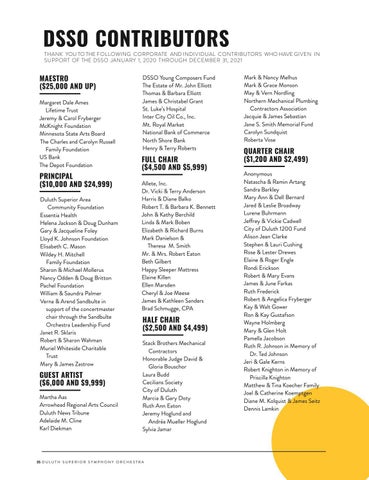
DSSO DSSO CONTRIBUTORS CONTRIBUTORS
THANK YOU TO THE FOLLOWING CORPORATE AND INDIVIDUAL CONTRIBUTORS WHO HAVE GIVEN IN THANK YOU TO THE FOLLOWING CORPORATE AND INDIVIDUAL CONTRIBUTORS WHO HAVE GIVEN IN SUPPORT OF THE DSSO JANUARY 1, 2020 THROUGH DECEMBER 31, 2021 SUPPORT OF THE DSSO JANUARY 1, 2019 THROUGH DECEMBER 31, 2020
MAESTRO ($25,000 AND UP) Margaret Dale Ames Lifetime Trust Jeremy & Carol Fryberger McKnight Foundation Minnesota State Arts Board The Charles and Carolyn Russell Family Foundation US Bank The Depot Foundation
PRINCIPAL ($10,000 AND $24,999) Duluth Superior Area Community Foundation Essentia Health Helena Jackson & Doug Dunham Gary & Jacqueline Foley Lloyd K. Johnson Foundation Elisabeth C. Mason Wildey H. Mitchell Family Foundation Sharon & Michael Mollerus Nancy Odden & Doug Britton Pachel Foundation William & Saundra Palmer Verna & Arend Sandbulte in support of the concertmaster chair through the Sandbulte Orchestra Leadership Fund Janet R. Sklaris Robert & Sharon Wahman Muriel Whiteside Charitable Trust Mary & James Zastrow
GUEST ARTIST ($6,000 AND $9,999) Martha Aas Arrowhead Regional Arts Council Duluth News Tribune Adelaide M. Cline Karl Diekman
DSSO Young Composers Fund The Estate of Mr. John Elliott Thomas & Barbara Elliott James & Christabel Grant St. Luke’s Hospital Inter City Oil Co., Inc. Mt. Royal Market National Bank of Commerce North Shore Bank Henry & Terry Roberts
FULL CHAIR ($4,500 AND $5,999) Allete, Inc. Dr. Vicki & Terry Anderson Harris & Diane Balko Robert T. & Barbara K. Bennett John & Kathy Berchild Linda & Mark Boben Elizabeth & Richard Burns Mark Danielson & Theresa M. Smith Mr. & Mrs. Robert Eaton Beth Gilbert Happy Sleeper Mattress Elaine Killen Ellen Marsden Cheryl & Joe Meese James & Kathleen Sanders Brad Schmugge, CPA
HALF CHAIR ($2,500 AND $4,499) Stack Brothers Mechanical Contractors Honorable Judge David & Gloria Bouschor Laura Budd Cecilians Society City of Duluth Marcia & Gary Doty Ruth Ann Eaton Jeremy Hoglund and Andréa Mueller Hoglund Sylvia Jamar
39 DULUTH SUPERIOR SYMPHONY ORCHESTRA 35 D U L U T H S U P E R I O R S Y M P H O N Y O R C H E S T R A
Mark & Nancy Melhus Mark & Grace Monson May & Vern Nordling Northern Mechanical Plumbing Contractors Association Jacquie & James Sebastian Jane S. Smith Memorial Fund Carolyn Sundquist Roberta Vose
QUARTER CHAIR ($1,200 AND $2,499) Anonymous Natascha & Ramin Artang Sandra Barkley Mary Ann & Dell Bernard Jared & Leslie Broadway Lurene Buhrmann Jeffrey & Vickie Cadwell City of Duluth 1200 Fund Alison Jean Clarke Stephen & Lauri Cushing Rose & Lester Drewes Elaine & Roger Engle Rondi Erickson Robert & Mary Evans James & June Farkas Ruth Frederick Robert & Angelica Fryberger Kay & Walt Gower Ron & Kay Gustafson Wayne Holmberg Mary & Glen Holt Pamella Jacobson Ruth R. Johnson in Memory of Dr. Ted Johnson Jeri & Gale Kerns Robert Knighton in Memory of Priscilla Knighton Matthew & Tina Koecher Family Joel & Catherine Koemptgen Diane M. Kolquist & James Seitz Dennis Lamkin
CONTRIBUTORS CONTRIBUTORS
J. Clark & Jean Laundergan in Memory of Warren & Viola Askeland Ann Mars David & Patricia Mast Tom & Alice McCabe Nancy Melander Susan Meyer Heather A. Muster Nordling Family Fund Dean Peterson & Deborah Rausch Father Andrew Ricci Timothy & Adeline Sandor in Memory of Joseph A. Sandor Kenneth Schoen Lane Fryberger Smith Donna & Dennis Soukup South Pier Inn Tom & Mimi Stender John Ivey Thomas & Mary Rees Thomas Family Foundation Fund Andrea Wahman & Lee Zimmerman Gudrun & Geoffrey Witrak
ACCELERANDO ($600 TO $1,199) Bill Anderson Jan Biga Karen Crowell Kate Dean Margaret Foss Patricia Gannon Robert Goodin Carlton & Judy Gustafson in Memory of Arlyne and Kalervo Kokkonen Joan & Thomas Hedin Mary Holm-Lund Mr. James Jarocki & Ms. Kristin Blakeslee Taylor Johnson Margaret Joynes Sharon & Jack Kemp Kiwanis Club of Friendly Duluth Mr. & Mrs. Knuti in Memory of Erik G. Knuti and in Honor of James Erickson John, Judith & James Lampi
Donn Larson Gary & Darla Meier Dirk & Paula Meyer William & Irene Moser Barbara L. Olson in Honor of Betty A. Melde & in Memory of R. James Melde Gerald & Mary Ann Ostroski David J. Ouse Ben & Jeanne Overman Susan J. Relf Gerald Ruona William & Kay Slack Tobin Sobaski Patrick Spott & Kay Biga Anita Swanson Valentini’s Vicino Lago Elaine Wickstrom
ADAGIO ($200 TO $599) Anonymous Benedictine Sisters of St. Scholastica Monastery Benedictine Health Center Benevity Fund Janet Akervik John & Cathy Ameel Evelyn M. Anderson Richard & Yvonne Anderson Allen Anway in Memory of Dorothy Anway Chuck & Judyth Babst Linda & Glen Backman Leonore Baeumler Judith & James Bailey Susanne & Johan Bakken Lee Ball Connie Barnabee Anthony Barrett Susan Bathory & Donald Lane Daniel & Marjorie Bergeland Anne Bier Dawn Boman Angie Bomier Jean & Tom Brozic Wendy Buczynski Doug & Karen Buell Jean Captain
40 DULUTH SUPERIOR SYMPHONY ORCHESTRA 36 D U L U T H S U P E R I O R S Y M P H O N Y O R C H E S T R A
Jan Carey Craig Carlson David Carroll Nancy Carroll Mark & Cathy Casper Terrence Clark John Congdon Marian Congdon Bill & Kathy Croke Dorene Degidio Kathleen Desanto Michael & Carol Donahue R. Craft & Ellie Dryer Julie & Phil Eckman Tom & Joanne Ellison Enbridge Dennis Falk Margaret Fawcett Martha & Conrad Firling David Flemming Flint Group in Memory of Donn Larson John M. Fochs Kayla & Dan Foley Julie A. Ford Claudia French Diane Dinndorf Friebe & Joseph M. Friebe Donald Gaalaas in Honor of the Youth Orchestras Program Debra Gergen John Gibbs Hilary Godard Richard & Karen Gran James & Christabel Grant in Memory of Laura Budd Barbara & William Gravelle Edwin Hall Hope Heikkinen Rose Heldt Robert & Lois Heller Jim & Shirley Herman Robert & Joyce Hickman Barbara & Bob Hjort Susan Hjort Karen Hoeschen Paul Holm Mary Ann & Oliver Houx Kenneth Jackson
OSR S C OCNOTNRTI R B IUBTUOT R
Dan Jaeckel in Memory of Mae Peterson Sylvia Jamar in Memory of Charlotte Moyer Jane & Jack Jarnis Austin Jarrow Dr. David Jennings Ellis Johns Dennis Johnson Julie Johnson Barbara Johnson-Kim Linda Jorgenson Ronald Kari in Memory of Bradley Bombardier Danette Kealey John & Beth Kelly Milka Kleiner Katie & Bob Kuettel Dr. Jerome Kwako Sharon Layon & Neil Nelson Cynthia Ledin Martin Lee, RN, MBA Paul Lee Charlie & Jean Leibfried in Honor of Tom & Mary Donahue Paul & Nancy Lokken Dr. John & Mrs. Michelle Magdsick Dean McCall Betty Melde Norma Miles Patricia Miller in Memory of David Miller Pam Moore & Jon Stephenson Wende & James Morrell Katherine Munck Dan & Cathy Mundt Susan Nelson Judith A. Newman Noelle Paulson in Honor of Dennis Paulson Kevin & Rebecca Peterson Suzanne & Brian Rauvola Paul Rigstad Branden Robinson Michael & Betsy Rosenzweig Karen & Jon Sande Dr. John Schrock & Mary Berube Helen Sever Mark T. Signorelli
Beth Sobczak Cindy S. Spillers James & Judith Stewart Thom & Cindy Storm Thirsty Pagan Brewing Thrivent Financial Kathleen Thibault Sharon L. Torrison in Memory of David Vose & Don Niemi Rajiv Vaidyanathan Sharon van Druten Pat Wellberg Claudia & Harry Welty Cathy & Kirby Wood Geiger Yount
TEMPO (UP TO $199)
Anonymous in Honor of Char & Bernie Nem Erin Abramson Gina Ademino Monica Ademino Pete Ademino Cigale Ahlquist John Alexander James J. Amato Ann Anderson Deb Anderson & Ed Herzog in Memory of Charlotte Moyer Bill Anderson Gwendolyn Anderson Jody Anderson Mary Anderson Patricia M. Anderson in Memory of Ralph Andres Paul Anderson Richard & Yvonne Anderson in Memory of Lorraine Johns The Anderson Family Patricia Anscomb Kathy Antilla in Memory of Marge Kuehn Allan Apter Judith Arnold Beth Arnson Jane & Thomas Barthell Lois Bauer Carla Bayerl
41 DULUTH SUPERIOR SYMPHONY ORCHESTRA 37 D U L U T H S U P E R I O R S Y M P H O N Y O R C H E S T R A
Barbara Bentz Roy Berg William Berglund in Memory of Ralph Andres Damita Beyer David & Karen Bjorkman Ronald & Terry Blaisdell Joanne M. Blakeslee Charles Block & Kathryn Nettleman David Blomberg Gary Boelhower & Gary Anderson Amity Borden in Memory of Beverly Wipson Shirleyann Brandser Kathleen Bray Elton Brown in Honor of Mark Monson Laura Budd in Memory of Charlotte Moyer Ronald Caple Jay Carlsgaard Nathan Carlsgaard Peggy Carlson in Memory of Ray E.Carson Joann Carmack in Memory of Mae Peterson Leah Carr Jeanne Carroll David Carter Timothy & Leslie Churchill Natalie Constance Julia Convissor Kathy Coughlin Ruth Cox in Memory of Ralph Andres Tim Craig Dianna Crandall Jerry Curnow Gwyn Curran Martyn Dahl Thomas Dahlberg Coralee J. Danielson Carolyn & Alan Diamond in Memory of Charlotte Moyer Karen Dingle Tom & Mary Donahue in Memory of Anne & Daryl Leibfried Jeanne Doty
CO TR T ORRS S CO NN TR I BI B UU TO
Mary Dragich Duluth Sister Cities International Nancy Eaton Duraine Egan Hendershot David Eichman Ronald A. Ellefson Joe Ehlers & Sarah Nelson Jeff Elliott in Memory of Laura Budd Paul Enenbach Gerald Erickson Geraldine Erickson in Memory of Ralph Andres Karen Erickson Russell Erickson Heather Fails Marie Fegley Diane Felde-Finke Sue Fena Peg Ferguson Edward Flenz Elizabeth Gaalaas Michael Galeski Eileen Gannon in Memory of Ralph Andres Geoffrey Gates Sandra Gazdus Mary Gdula Jane Gilley Neil Glazman Mary Godfrey Kay & Walt Gower in Memory of Mae Peterson Kay & Walt Gower in Memory of Charlotte Moyer Kay & Walt Gower in Memory of Laura Budd Betty Greene Sarah Greer Sarah Grosshuesch Steve Grove Ann Gumpper Paul Gustad Linda Haagensen Joanne Hagen Mary K. Hagen Elizabeth Hall Larry & Jean Hammargren Keith Hamre
Martha Han Lynne Harrington Hall Ellen Hedin Vernon A. Harrington David Helf Kathy Heltzer Barbara G. Hemenway Melissa Hendrickson in Memory of Ralph Andres Sandra & Thomas Henning Christine Hensolt Jill Hilliard Jill Hoag Mary Hoberg Lisa Hoch Kevin & Carol Hoeschen Karen B. Holden Patricia Holliday Diane Holliday-Welsh Sara Hollingsworth Sheryl Homan Timothy Horyza Robert D. Howe Rita Hughes Austin Jarrow Jenny Jensen Pat Jirsa Donald & Mary John Charles Johns Barbara Johnson Edna & George Johnson Mark Johnson Marlene Johnson Mary A. Johnson Matthew Johnson Patricia Johnson Marissa Kari Carol & Bob Kelley Lori Kersey-Dukat Robert Kidd Jane Killough in Memory of Mae Peterson Patti Kleimola Dorothy Knudsen Carol Kondrath Pat Kruschke Damien Kujawa Jean & Steve L’Abbe in Memory of Bradley Bombardier
42 DULUTH SUPERIOR SYMPHONY ORCHESTRA 38 D U L U T H S U P E R I O R S Y M P H O N Y O R C H E S T R A
Katie LaBrie Cot Lafond Anne Liable Lake Superior Brewing Co. Devereaux Lalond Barb Lamaster Andre Lamourea Catherine A. Larson Paul Lee Jessica Leibfried Melissa Lentz De Ann Letourneau in Honor of Diane Balko and Erin Aldridge Beth Liljeblad Michael Lillo Ketti Lindberg Bonnie Lloyd Gary Loberg Jean Loushin Michael Lucas Patricia Luder Joyce Lund Lai La Lunde Charlie Lydon Judy MacGibbon Ruth MacNutt Joan Mahle Hannah Maki Lisa Mandelin Audrey Markon Sam Marks James Martin Cindy Martinson Rachel Z. Mason Patricia Young Massie Monica Mattila in Memory of Mae Peterson Clinton Mattson Dr. Robert McClellan Susan McKim Karen McManus Nancy McParlan Nancy Melander in Memory of Laura Budd Patty Mester Carol Michealson Joseph & Jodi Milli in Memory of Charlotte Moyer William Miner
N ITBRUI BT U C OC NO TR O TROS R S
Alison Moffat Tom Morehouse Tom & Julie Morgan in Honor of Christabel Grant Catherine Morin Bruce & Nora Moss Jason & Kelly Mraz Sally Munger Janet & John Murphy Bob Myers in Honor of Margaret Myers Joann M. Narhi Molly Negus Nancy Neilson Kristina Niere May & Vern Nordling in Memory of Ralph Andres Ryan & Natasha Nordrum in Memory of Dirk Robert Nordrum Emily Nygren George H. Nylander Nancy Odden & Doug Britton in Memory of Mae Peterson Marlys Olson Terry Olson Margaret Oman Alan Onken Sharon & Vincent Osborn Korrie Osthus Mary Ostman Mark Ostrov Laurie Ostrowski William & Saundra Palmer in Memory of Susan Poupore William & Saundra Palmer in Memory of Carl Victor Petersen John Pastor Gerald Patten Barb Pearman Judy G. Pearson Ann Pellman Marylou Perham Greg Pesola Louann Petersen-Noltner Anne Peterson Bauers Barry & Elizabeth Peterson Glenn Peterson Janet Peterson
Richard & Linda Peterson Sharon Picconatto Mary Kay Plank Mary Planten-Krell Antoinette Poupore-Haats Therese Presley James Proudlock Kim Quinones Daniel Radosevich Nancy & Roger Ralston Deborah Ralston-Wolfe Kurt Ramlo Deborah Rasmussen Lance Reasor Frances L. Reed Mary Pat Renaud Jack Renick Kathleen Risku Sheryl Robins Delores Rogers Steve & Janet Rosen David Rosetter Geraldine Russo Richard Sandeen Carol Saranpaa Steve Savageau Paul Scaringi Nichole Schaefer Eileen Schantz-Hansen Carrie Scherer Jacalyn Schlies in Honor of Steven Boyd Paul R. Schmitz Theodore Schoen Carl Schroeder Deb Schroeder Linda Schwartz Doug Scott Jack & Cindy Seiler Judy Seliga-Punyko Chris Settle Laurie Severson Dr. Thomas & Alice Shuey Eugene Shull Sheila Shusterich Richard Skogg James Slocum Carrie Slordal in Memory of Ralph Andres
43 DULUTH SUPERIOR SYMPHONY ORCHESTRA 39 D U L U T H S U P E R I O R S Y M P H O N Y O R C H E S T R A
Amelia Smith Phyllis Smith Barbara Soufflet Lawrence Spears Carol Spencer Patrick Spott & Kay Biga in Memory of Laura Budd Nadine Srdar Nairi Stack Paul Stein Craig & Sandra Sterle Katie Stevenson Robert & Zabelle Stodola Thom & Cindy Storm in Honor of Laurie Bastian Rebecca Strand Tim Stratton Kay Suffron Nick Susi Claryce Swensen Mary Tennis Barbara Teske Ruth Thorpe in Honor of Vincent Osborn Ruth Thorpe in Honor & Memory of Barbara Rae Amlotte Adrienne Thureen Steve Tomhave Lucas Trea Shelby Trost Donna Trostad Nancy Turchi Brenda Uecker in Memory of Ralph Andres Tiss Underdahl Jeff Urbaniak Sharon van Druten Judith Van Dyne Brandon VanWaeyenberghe Therese Vaughn Roberta Vose in Memory of Laura Budd Roberta Vose in Memory of Dorothy Anway Roberta Vose in Memory of Thomas Stolee Mary Voss Jennifer Wabrowetz
CONTRIBUTORS CONTRIBUTORS
Mary Wagner Zbaracki for sons Edward, David, & Joseph Dr. Margaret Waisman Dana T. Waldbillig Jori & Chuck Walt Lue Ann Warcholak Sarah Warner Sheldon & Susan Watts Elizabeth Weberg Mark & Carol Weitz James Westman Trevor L. White in Memory of Alberte & Trevor White Whiteman Family Charitable Fund in Memory of Richard Whiteman Margaret Wilson in Memory of Mae Peterson Ruth Winters in Honor of Kathleen Winters Amity Wipson in Honor of Beverly Wipson Mona & Stan Wold Marcia Wolter Britton in Memory of Mae Peterson Georgette Wondolkowski Jay & Helyn Woolf Beva Lee Wunderlich Yasuyo Yamazaki Paul Zahorosky Suzanne Zallar Mary & James Zastrow in Memory of Laura Budd Marion R. Zbaracki in Memory of Mae Peterson
DSSYO CAMPAIGN
Thank you to the generosity of those who gave in support of the youth musicians of the Duluth Superior Symphony Youth Ensembles
Anonymous Martha Aas Janet Akervik John Alexander Mary Anderson Ann Anderson Jody Anderson Allen Anway Allan Apter Leonore Baeumler Lee Ball Sandra Barkley Bob Barnabee Thomas Barthell John Berchild Audrey Beyer Jan Biga David Bjorkman Jill Blazevic David Blomberg Linda Boben
IN MEMORY
Our hearts go out to the family & friends of the following DSSO musicians who passed in 2020/2021
Ralph Anderson John Hussey LeAnn House Jean (Kelly) Klun Terrance Rust Janet (McEldowney) Smith Taavo Virkahus Barbara (Amlotte) Ziehl
44 DULUTH SUPERIOR SYMPHONY ORCHESTRA 40 D U L U T H S U P E R I O R S Y M P H O N Y O R C H E S T R A
Stephen Cushing Landon Dahl Thomas Dahlberg Kate Dean Mary Donahue Jeanne Doty R. Craft Dryer Nancy Eaton Paul Enenbach Sue Fena Peg Ferguson Kayla Foley Elizabeth Gaalaas Donald Gaalaas Michael Galeski John Gibbs Beth Gilbert Neil Glazman Mary Godfrey Steve Grove Lois Guderian Ann Gumpper Linda Haagensen Mary Hagen Martha Han Lynne Harrington Hall Ellen Hedin Rose Heldt Barbara Hemenway Robert Hickman Luke Hilliard Bob Hjort Jill Hoag Mary Hoberg Lisa Hoch Karen Hoeschen Kevin Hoeschen Robert Howe James Jarocki Jenny Jensen Charles Johns Ellis Johns Mary Johnson Patricia Johnson Barbara Johnson-Kim Carol Kelley John Kemp Gale Kerns Elaine Killen
CONTRIBUTORS CONTRIBUTORS
DSSYO CAMPAIGN CONTINUES... Angie Bomier Jean Brozic Lurene Buhrmann Jeffrey Cadwell Ronald Caple Jay Carlsgaard Craig Carlson Leah Carr Christopher Carroll Cathy Casper Cecilian Society Terrence Clark John Congdon Gwyn Curran Robert Knighton Dorothy Knudsen Diane Kolquist Carol Kondrath Pat Kruschke Robert Kuettel Andre Lamourea J. Clark Laundergan Sharon Layon Cynthia Ledin Paul Lee Michael Lillo Bonnie Lloyd Gary Loberg Paul Lokken Jean Loushin Lai La Lunde Charlie Lydon John Magdsick Lisa Mandelin Ann Mars Ellen Marsden Cindy Martinson Hannah Mason Clinton Mattson Dean McCall Dr. Robert McClellan Nancy McParlan Nancy Melander Dirk Meyer Norma Miles Pam Moore Wende Morrell William Moser
Nora Moss Will Munger Joann Narhi North Shore Bank Nancy Odden Alan Onken Vincent Osborn Korrie Osthus Mark Ostrov Laurie Ostrowski David Ouse Gerald Patten Ann Pellman Marylou Perham Louann Petersen-Noltner Janet Peterson Sharon Picconatto Mary Planten-Krell Therese Presley Elizabeth Prest Daniel Radosevich Lance Reasor Mary Pat Renaud Jack Renick Delores Rogers David Rossetter Gerald Ruona Karen Sande Richard Sandeen Carol Saranpaa Nichole Schaefer Carrie Scherer John Schrock Deb Schroeder Doug Scott Jack Seiler Judy Seliga-Punyko Helen Sever Tom Shuey Sheila Shusterich Mark Signorelli Daniel Skorich William Slack Amelia Smith Phyllis Smith Nairi Stack Irving Steinberg David Steininger
441 5 D DU U LL U U TT H H S SU UP PE ER R II O O RR SSYYM MPPHHOONNYY OORRCCHHEESST TRRAA
Craig Sterle Rebecca Strand Tim Stratton Carolyn Sundquist Nick Susi Claryce Swensen Mary Tennis Kathleen Thibault Adrienne Thureen Sharon Torrison Lucas Trea Shelby Trost Donna Trostad Jeff Urbaniak Rajiv Vaidyanathan Laurie Van Brunt Therese Vaughn Roberta Vose Mary Voss Jennifer Wabrowetz Sheldon Watts Harry Welty Stan Wold Georgette Wondolkowski Kirby Wood Sheryl Wood Homan Suzannne Zallar James Zastrow Lee Zimmerman
TAKE A BOW, SPONSORS
We are pleased to offer a big thank you to our sponsors for the 2021-2022 Season. Their generous support makes it possible for the DSSO to bring world-class concerts, educational programs, and community outreach to the Northland. BRAVO!
47 DULUTH SUPERIOR SYMPHONY ORCHESTRA
42 D U L U T H S U P E R I O R S Y M P H O N Y O R C H E S T R A
Compose yourself your way. However your day unfolds, let YourClassical MPR meet you where you are. TUNE IN OR STREAM AT YOURCLASSICALMPR.ORG
43 D U L U T H S U P E R I O R S Y M P H O N Y O R C H E S T R A
ove MPURPOSE with
CREATE THE LIFE YOU WANT
IT’S YOUR FUTURE
INVEST WITH INTEGRITY It’s never too early to plan for the future. Call North Shore Investments & Trust at 218-722-4211 to schedule a free consultation to discuss your future and your legacy. • IRAs
• Investment Management
• 401K Rollovers
• Employee Benefit Plans
• Trust & Estate Administration
• and, So Much More...
BANK. BORROW. INSURE. PLAN & INVEST. In v e s tm en t P ro d u ct s and S ervices Are Not FD IC Insured, Insured by any Federal Gov ernment A gency, Depo s it s o f o r B ank Guaranteed, and May Lose Value.
PER SON A L B A N KI N G | B U S I N E S S B A NK I N G | M O R T G A G E S E R V I CE S | P R I V A T E B A N KI NG I N V E S T ME N T S & T R U S T | R E T I R E M E N T S O L U T I O N S | I N S U R A N C E
NORTHSHORE.BANK 446 D U L U T H S U P E R I O R S Y M P H O N Y O R C H E S T R A
RAISING
the CURTAIN ON SOLUTIONS. DULUTHLAW.COM 218872226331
457 D U L U T H S U P E R I O R S Y M P H O N Y O R C H E S T R A
M: 70 Y: 100 K: 44 C: M: Y: K:
0 42 100 20
C: M: Y: K:
0 10 100 0
C: M: Y: K:
25 0 100 0
care happens here C: of 30the Miller-Dwan Foundation see their gifts touch lives beyond hospital walls. Supporters M: 56 Here, the Y: youngest to the oldest in our area are cared for with dignity and respect. 100 Our caregivers work wonders. And families find dignity, hope, and healing. K: 37
We exist to support our region’s health. | mdfoundation.org C: M: Y: K:
0 40 100 10
C: 33 M: 55 Y: 97 K: 0 C: 0 M: 40 Y: 81 K: 66 Miller-Dwan Foundation Brand Guide 4 of 6
Advance your Education During times of change, enhancing your skills and education become necessary. The College of St. Scholastica is here to help you prepare for change with our online, accelerated certificate and master’s programs built to accommodate your busy life. • MBA in Leadership & Change
• MBA in Rural Healthcare
• MS in Project Management
• MS Health Informatics
• MS in Applied Data Analytics
• MS Health Information Management
go.css.edu/Master
466 D U L U T H S U P E R I O R S Y M P H O N Y O R C H E S T R A
EVENTS | SENIOR GRADUATION | WEDDINGS | FAMILY PORTRAITS DULUTH SUPERIOR PHONE:47218-213-8618
SYMPHONY ORCHESTRA
WWW.ZENITHCITYPHOTOGRAPHY.COM
823 Belknap Street – Suite 104 | Superior, WI 54880 Phone: 715-394-6355 | Web: www.cmjt.com SERVING SUPERIOR, DULUTH AND THE SURROUNDING COMMUNITIES FOR 30 YEARS! PHYSICAL THERAPY FOR:
SPECIALIZED SERVICES INCLUDE:
• Pre-Surgery/Post Surgical Care
• Dry Needling
• Sprains & Strains • Sports Injuries • Knee, Hip & Shoulder Replacement
• Industrial Post Offer Employment Testing
• Vertigo
• Wellness & Injury Prevention Sessions
• TMJ • Auto & Worker’s Comp Injuries
Visit us on our website to learn more!
YOU HAVE THE RIGHT TO CHOOSE YOUR PHYSICAL THERAPIST ***Physician Referrals not always required. Call today to find out more!***
See the whole picture Weis Eye Center is the only Practice in the Northland to offer blade-free z-Lasik surgery.
Call (218) 625 1917 www.weiseyecenter.com
48 D U L U T H S U P E R I O R S Y M P H O N Y O R C H E S T R A
ORE T S R O IQU ORTS L 1 # D VOTE THE TWIN P ROW IN ARS IN A 19 YE
1900 BELKNAP STREET • SUPERIOR, WI 54880 715-392-5855 • KEYPORTLIQUOR.COM
497 D U L U T H S U P E R I O R S Y M P H O N Y O R C H E S T R A
Arrowhead Printing Ad
50 D U L U T H S U P E R I O R S Y M P H O N Y O R C H E S T R A
Hardworking. Sensible. Risk-averse. Like founder. Like fund. Curt Teberg is a no-frills type. He scours for deals, drinks his coffee black and thinks before he acts. The same goes for his fund. Instead of jumping from trend to trend, The Teberg Fund is navigated by Curt and his 30 years of experience in studying mutual funds and market patterns. Don’t invest in just anything. Invest in life.
For information about the Fund, contact Curt Teberg at 218-722-8248 or visit TebergFund.com. 5161 Miller Trunk Highway, Duluth, MN 55811 TEBRX on the Nasdaq
The Fund’s investment objectives, risks, charges and expenses must be considered carefully before investing. The prospectus contains this and other important information and may be obtained by calling 866-209-1964 or visiting www.tebergfund.com. Read it carefully before investing. Mutual fund investing involves risk; principal loss is possible.
The Teberg Fund is distributed by Northern Lights Distributors, LLC, member FINRA/SIPC. 3625-NLD-8/21/2017 517 D U L U T H S U P E R I O R S Y M P H O N Y O R C H E S T R A
The Northland’s leader in floor covering since 1955
Get the best under your feet. At Johnson Carpet One Floor & Home, we know how important it is for you to feel confident in your flooring selection. Therefore, we strive to ensure that the floor we’ve created together, is as beautiful as the one in your dreams. If not, we’ll replace it for free. That’s what we call The Beautiful Guarantee®.
5611 GRAND AVENUE • SPIRIT VALLEY, DULUTH •218 628-2249 Mon.-Wed. & Fri. 9 a.m.-5:30 p.m. | Thurs. 9 a.m.-7 p.m. | Sat. 9 a.m. -3 p.m.
Voted Best Flooring for 4 years in a row! 526 D U L U T H S U P E R I O R S Y M P H O N Y O R C H E S T R A