WOMANthe today
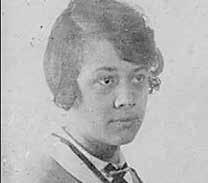
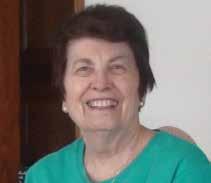
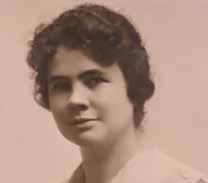


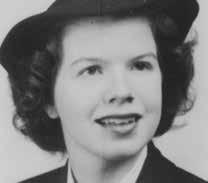

Northland servicewomen throughout the years
service • Monarch Buddies help butterflies thrive in Northland • Fashions
Twisted Turquoise Boutique • Prolific volunteer aids a variety of Northland causes • Barnum woman transforms love of dogs into Liberty K9
Saluting military
by Sam heads to




Mon., Tues., Wed. & Fri. 9 a.m. — 5:30 p.m. • Thurs 9 a.m. — 7 p.m. • Sat 9 a.m. —3 p.m. Voted Best Flooring for 6 years in a row! Get the best under your feet 5611 GRAND AVENUE •218 628-2249 The Northland’s Leader in Floor Covering Since 1955

© 2012 Healogics, Inc. All Rights Reserved MHBG 11/12 The healing begins here. The healing begins here. MHBB New hope for your non-healing wound. 14 e Su Street, 1st East 000 Dh t u, MN 55805 2 3 025 . 942 . s undCare om/ th du Y of he the Seek down. you w s wound a t to have don u oS & Care Wound Advanced Luke t. Hr Cente bar yp care wound advanced experts e We ve deser you e act the to back you get to ay na nat Our y mob a h hea to return rtab com a sa a you to ment comm our r Contact n. phys your h w work we as y recover your speed wi approach ed cogn eS e L t. Ar Cente rbar Hy & Care Wound vanc d. re s beg g al T
PROFILES
6 Jennifer Sandstrom
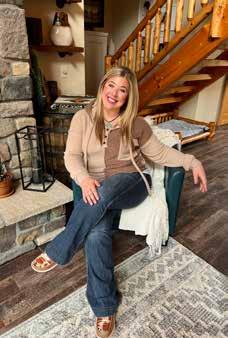
A calling and a passion: Barnum dog trainer
12 Chris Magnusson
Prolific volunteer and military veteran has energy to spare
16 Dana Letica
Meet the woman behind the badge
20 Laura Haack
Co-owner of Lake Avenue Restaurant and Bar celebrates connection through food
FEATURES
32 The history of the Greysolon Daughters of Liberty
36 Helping Minnesota’s monarch butterflies, one yard at a time
40 Siggy’s Musical Garden and Superior Porchfest: Spreading joy through music and art
FASHION
28 Fashions by Sam
ENTERTAINMENT/ARTS
24 Arts and Events Calendar
HEALTH/MEDICINE
26 St. Luke’s Healing chronic wounds

30 Essentia
Uniquely equipped for the challenge
44 Embroidered Pillowcases
FOOD/NUTRITION
48 Summer Grillin’ KIDS KORNER
46 Sloane's Suggestions/Kids Korner
52 Northland servicewomen throughout the years
4 July 2023
contents july 2023 vol. 27, no. 5
Pick up The Woman Today at a store near you. View us at thewomantoday.com Like us on 32 40 28
WOMAN the today
DIY
THE WOMAN YESTERDAY
WOMAN the today
GROUP PUBLISHER


Neal Ronquist
EXECUTIVE EDITOR
Rick Lubbers
ADVERTISING ACCOUNT EXECUTIVE
Ali Carlson
ADVERTISING ACCOUNT EXECUTIVE

















Kim Quinones
GRAPHIC DESIGNER















Renae Ronquist
PRODUCTION COORDINATOR
Julie Schulz
CONTRIBUTORS


TO OUR READERS
Hello, Woman Today readers!
First a quick introduction. My name is Rick Lubbers and I am the executive editor of The Woman Today. In my role with Duluth Media Group, I also have the pleasure of overseeing the Duluth News Tribune, Superior Telegram and Cloquet Pine Journal newsrooms and the many talented journalists who work hard to bring you the news.

I’m excited to continue the work Megan Keller put into The Woman Today and increase my role with the magazine.
Abigail Blonigen
Andrea Busche
Cheryl Finkbeiner
Comstock Creative








Christine Magnusson
Dana Letica
Janna Goerdt
Jennifer Sandstrom
Laura Haack
Molly Milroy
Samantha Roffers


Don’t worry. We don’t have any plans to change our focus in bringing you the stories of the many hard-working, talented and impactful women in the Northland. That’s been the focus of this magazine since its inception, and will continue to be going forward.
So, let’s jump into what we have waiting for you, shall we?
Here are some of the stories we’re excited to share with you this month:
• Chris Magnusson is a full-time legal secretary for the St. Louis County Attorney’s Office in Hibbing, but she is also a prolific volunteer who helps a variety of good causes in the Northland.
EMAIL CORRESPONDENCE TO: magazines@duluthnews.com





The Woman Today is published by Duluth News Tribune. Mailed copies available for $32 per year (eight issues). Send check to The Woman Today®, 424 West First Street, Duluth, MN 55802
• How can you help monarch butterflies thrive in our communities? You can find out how to do that in this issue.
• You will meet Dana Letica, a Duluth police officer who aims to make a difference in our community every day.
• The Greysolon Daughters of Liberty Chapter is part of the Minnesota State Society Daughters of the American Revolution, and its members have direct ties to the men and women who fought for or helped support the American colonies during the Revolutionary War. Find out more about this fascinating club inside.
• Barnum’s Jennifer Sandstrom has taken her love of dogs and poured that into Liberty K9, a dog-training business founded on the idea that dogs should be allowed to act like dogs.
ON THE COVER:
The Woman Today reflects on the profiles of six Northland women who have made significant contributions to the United States military: LaVeryn
Slaughter McKeever, Julia Newell Marshall, Shirley
Lumae Armstrong Hedin, Lydia Whiteside, Ilene
Cecilia Pearson, and Louise Mary Tardiff..
PHOTOS COURTESY OF THE ST. LOUIS COUNTY HISTORICAL SOCIETY
• You will also learn about several Northland women who served our nation during wars spanning World War I through the Vietnam War.
Thanks for spending some of your day reading The Woman Today. Your readership is greatly appreciated.
Rick Lubbers Executive Editor, Duluth Media Group
THEWOMANTODAY.COM
© 2023 Forum Communications Company All rights reserved. No part of this publication may be reproduced without written permission from the publisher.
Duluth Monarch Buddies
Michelle Henderson White St. Louis County Historical Society
A calling and a passion: Barnum dog trainer feels blessed to do what she loves in the community
 By Janna Goerdt
PHOTOS COURTESY OF JENNIFER SANDSTROM
Jennifer Sandstrom and Dunkin enjoy a walk together.
~ Jennifer Sandstrom ~
Jennifer Sandstrom loves a challenge.

And she needs a challenge — the retired police officer and Air National Guard veteran and current dog trainer is frequently on the lookout for the next passion that will pique her interest.
It’s got to keep her busy — Sandstrom is always on the move.
It’s got to be satisfying — Sandstrom sincerely wants to make a difference in the world.
And she’s got to be able to jump in with both feet — Sandstrom started her dog training business, Liberty K9, as a “one-woman show,” she said, and today she has 14 employees and a waiting list of clients.

“God has blessed my business 1,000%,” Sandstrom said. “I have very high standards, an amazing staff, and we’ve built an amazing reputation.”





Liberty K9 is founded on the idea that dogs should be allowed to act like dogs.
There isn’t any babying or coddling at Liberty K9, but there is an abundance of positive attention, and trainers expect the best from the dogs they work with.

“Our dogs are spoiled, but with the right things,” Sandstrom said. “They are spoiled with physical activity, with mental challenges.”
Continued on page 8-11
THEWOMANTODAY.COM 7
Jennifer Sandstrom's family has been an inspiration and an indispensable help to K9 Liberty. Pictured, from left, are Sandstrom's grandfather, Leon, mother, Lori, Sandstrom, and her father, Mike.
7 8TH STREET, CLOQUET•218.879.7171 VOTED BEST MEXICAN RESTAURANT 6 YEARS RUNNING! Patio Seating with Outdoor Fireplace Casual
Couture for every body and every budget! www.theloftinduluth.com The Loft Consignment 218.591.2762 · 1709 Mall Drive
to

8 July 2023
Jennifer Sandstrom takes a dog through a skills and agility course at Liberty K9 in Barnum.
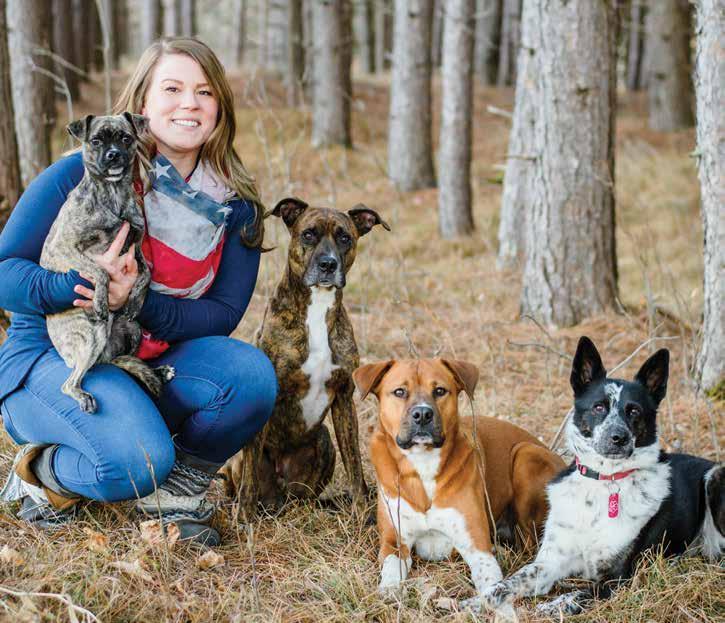
Jennifer Sandstrom's four dogs go with her everywhere. From left are Spanky, Dunkin, Sapper and Kirby.
Jennifer Sandstrom does dish out affection and attention to her dogs, but in just the right amount.
Sandstrom came to the job in a roundabout way.
“All I ever wanted to do since I was 9 was be in law enforcement,” Sandstrom said.
She did have a career as a police officer in St. Cloud and Superior, Wisconsin, but an injury she sustained while in the Air National Guard began to haunt her.
She had a hard time handling the weight of her law enforcement duty belt, and she had to have her back surgically repaired. She didn’t feel she could safely work as a police officer any longer — but what could be next?
Sandstrom’s dad, Mike, asked her what she would do if she could do anything at all. An unexpected answer popped up: Jennifer said she would want to train service dogs for veterans. That same week, she began forming connections to make that a reality, and she was off to Texas to learn how to be a dog trainer. Today, boarding and training clients from Colorado, Arkansas, Nebraska and other states have brought their dogs to Barnum to work with Sandstrom and her other trainers.
The training style she uses is known as “balanced training,” and it combines positive reinforcement and consequences for unacceptable behavior. The dog learns that its actions have consequences: behave correctly, and they are rewarded. Behave otherwise, and they may get an unpleasant sensation from the training collars that are used with this method.
The goal is to have a happy, excited dog that doesn’t respond only when treats are offered. Many of these training methods run counter to our ideas about what makes a good dog good; don’t all well-loved dogs want to be cuddled and smooched and sit next to us on the couch and eat endless snacks?
Sandstrom says: nope.
“Dogs are wired to be animals,” Sandstrom said. “All that coddling and babying makes them anxious and nervous.”
After training, a dog’s day and home life are structured so that they know their place in the home, and they know what is acceptable behavior and what is not.
“It makes life better for everyone,” Sandstrom said. “We take our dogs on road trips, and it’s not stressful. It’s just more fun.”
The training worked well for Wendy Anderson of Tower. She heard about Liberty K9 from a co-worker and decided to bring her two Australian shepherds, Ellie and Lani, for a twoweek intensive session.
“I wanted to be able to walk them off-leash,” Anderson said. “I walk them twice a day, and before training, they would take off into the woods and be gone for half an hour. … Now, they have good recall. They are interested in deer, but they don’t chase the deer. Before training, they would have been gone.”
Soon after Sandstrom opened the business in autumn 2019, Liberty K9 turned into a family affair. Her mom, Lori, learned how to groom dogs. Her dad is her accountant and maintenance man, along with her grandpa, Leon.
Sandstrom’s background in law enforcement and the Air National Guard turned out to be a good training for her current career.

10 July 2023
“Law enforcement has lots of rules and expectations and
Equine therapy horses are the next business and community venture for Liberty K9. Here, Jennifer Sandstrom rides Yeti.
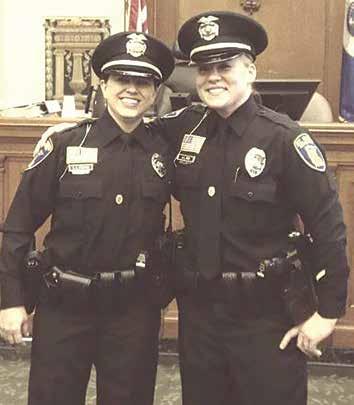
Jennifer Sandstrom (right) and fellow police officer Sara Gangle worked together on the St. Cloud police force. Sandstrom also worked with the Superior Police Department in Superior, Wis.
standards,” Sandstrom said. “For my business, not only do I have high standards, but (my background) trained me to be a hard worker, to talk to and relate to people.”
That comes in handy with dog owners, who also have to learn a set of new behaviors. Sometimes that’s hard for dog owners to take on, Sandstrom said.

“The most complicated piece of animal training is working with the humans,” Sandstrom said. “We are teaching (the owners) the opposite of what they have learned their whole lives. Everyone coddles puppies. Everyone babies their dogs. But we are teaching people to hold their dogs accountable. Most dogs can be good dogs, but they need leadership.”
Once Sandstrom was confident and secure in her dog training and boarding business, true to her nature, she began looking for the next challenge, and she thinks she found it — all 1,000 pounds and four hooves of it.


She and her husband, Joe, recently welcomed eight horses into their family, and they are working toward providing equine therapy for children. Working with horses is altogether different than working with dogs, Sandstrom said.
“I can manhandle dogs, but I can’t manhandle a horse,” she said. “It’s more of a partnership. They don’t have to do anything you ask of them — you have to build their trust.”
The Sandstroms say they pray daily for God to bless their business, “so we can bless our community,” Jennifer Sandstrom said. But there’s also a lot of hard work that they put into the world.
“I get bored when I’m not challenged,” Sandstrom said, and taking on equine therapy horse training has been just what she needs. While working with dogs and in law enforcement and the national guard had been relatively easy for Sandstrom to learn, “the horse thing has not been easy for me,” she said. “I love that I am being challenged.”
It may take a year or two for Joe and Jennifer Sandstrom to get their horse therapy project up and running — what with
maintaining their full-time Liberty K9 business and family life. But Sandstrom said she is up to it.
“Mom always said I was her spitfire,” Sandstrom said. D

THEWOMANTODAY.COM 11 GrandRapids Hibbing Duluth 409 NW 1st Ave 405 EHoward St 901 WCentral Entrance Celebrating Years findyour dudes or dudettes BendersShoes.com 218.326.8055
Janna Goerdt is an Iron Range farmer and freelance writer.
Prolific volunteer and military veteran has energy to spare
By Andrea Busche
Hibbing resident Chris Magnusson keeps her hours very full.
In addition to her full-time career as a legal secretary for the St. Louis County Attorney’s Office in Hibbing, she is a prolific volunteer, often logging 10 or more hours per week.
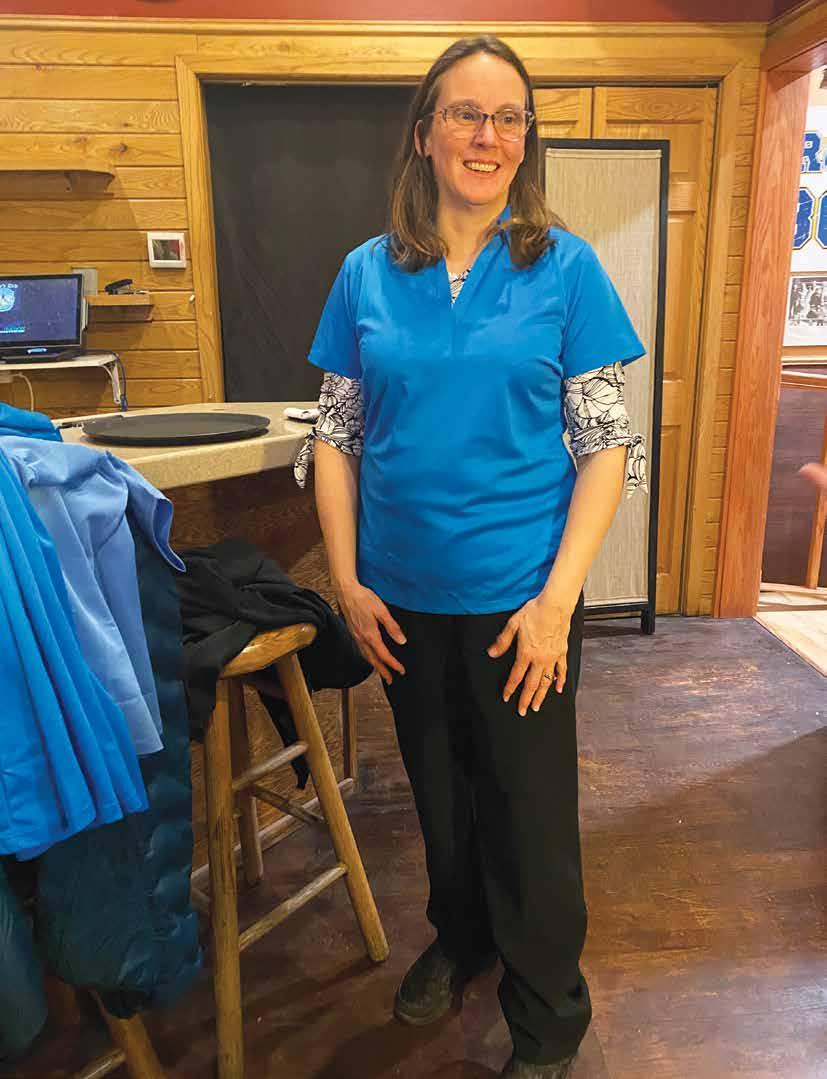
Now retired from the United States Marine Corps (USMC), she is also deeply involved in many veterans’ groups. As if that weren’t enough, she’s also a wife, a mom, and a caregiver for her “grand dog,” Lina, a border collie.
When asked where she gets her bountiful energy, Magnusson said, “I’ve just always been someone that likes
learning new things. And, by being as active as I am, I’m always learning.”
It also helps that she finds all her efforts personally rewarding.
“I enjoy connecting people to resources they had no idea were available to them,” she said, “and seeing their quality of life improve.”
Youth and military
Magnusson grew up in the Hibbing-Chisholm area. Due to her parents’ divorce and subsequent remarriages, she was part of a large, blended family. She recalls being a shy, quiet kid who
~
PHOTOS COURTESY OF CHRISTINE MAGNUSSON
Chris Magnusson
~
enjoyed reading.
Magnusson enlisted in 1984, right out of high school, and remained in the USMC until 1991. She explained a bit about this decision.


“A recruiter approached me after taking the ASVAB (Armed Services Vocational Aptitude Battery — a standardized test) in school,” she said. “I didn’t know what I wanted to go to school for, I didn’t think my parents should pay for it, and I didn’t have any money or any real job prospects.”
Although Magnusson had family members in the military, she didn’t know it at the time.
“My dad, stepmom and stepsister were all in the (National) Guard, my stepdad was in the Army, and many uncles served, but none of them talked about it,” she said.
Much of what she learned during her time with the USMC is directly applicable to her life today.
“I was a special intelligence communication center operator. This was before the internet, email and even the personal computers we are so used to today,” she said.
“But even that early communications and technology training was really the basics of what I did as an automation librarian, giving me the troubleshooting, documentation, and training to resolve problems and make system changes.
“It also gave me a lot of confidence
and determination, and the ability to ‘improvise, adapt and overcome’ any obstacle, in whatever situation they are needed. This is something ingrained in you as a Marine, and how I really face life.”
Education and recognitions
A quality education was always important to Magnusson. First, she earned an associate of applied arts degree as a legal secretary, and later, a bachelor’s degree in business administration. Additionally, she earned a master of library and information science degree.
But her learning hasn’t been limited to the classroom. She is also a 2010 graduate of the Hibbing Area Chamber’s Leadership Program, and attended the Minnesota Library Association’s Institute for Leadership Excellence in May 2015.
Magnusson has also earned many recognitions over the years, including:
• Above and Beyond Award (2011) — Given through the Hibbing Area Chamber for leading the development of the Minnesota Beyond the Yellow Ribbon in the Hibbing/Chisholm Area.
• Certificate of Appreciation (December 2018) — From Beyond the Yellow Ribbon for voluntarily
Continued on page 14
THEWOMANTODAY.COM 13
Chris Magnusson is wearing her 1989 blues at the Marine Corps Birthday Ball in Rota, Spain.
Chris Magnusson is pictured during boot camp in 1984.
Dr. Sarah Crandall welcomes
Lakewalk Center, 1420 London Rd., Ste. 101 | Duluth, MN 55805 | (218) 724-7363 info@nor thlandplasticsurger y.com | nor thlandplasticsurger y.com
Dr. Sarah Crandall is a board certified plastic surgeon. She joins our team in offering both cosmetic and reconstructive services.
supporting veterans and members of the Minnesota National Guard.
• Life Saver Award (March 2019) — Given by the United Way of Northeastern Minnesota for planning a woman veterans’ weekend retreat that inspired the development of the Northeastern Minnesota Women Veterans organization.
• Lyle C. Pearson Sr. Award (April 2022) — Received the Disabled American Veterans’ Award for State Volunteer of the Year. This is the Minnesota DAV’s highest award for volunteering to support veterans across Minnesota.
• Life Saver Award (March 2023) — Given through the United Way of Northeastern Minnesota for her efforts planning and volunteering for a weeklong event in Chisholm showcasing the Vietnam Traveling Wall that Heals.
Career
Before landing in her current position, and in addition to her military service, Magnusson has held several other jobs. She was a travel agent for six years. She has also worked at the city of Hibbing, where her roles varied from library worker to garbage truck driver. She also worked in a variety of roles for the Arrowhead Library System, and was a librarian for the Minnesota Military Museum.
Magnusson has also served on many boards and committees. She was involved in the PTA when her son, John Keefover, was a child. She has also served on the city of Hibbing’s branding, safety, and emergency management committees.
Additionally, she served on her church council, the Library
and Veterans Forum, and was a board member for Customers of SirsiDynix User Group Inc. — a vendor for the automated library system used by the Arrowhead Library System that she was responsible for maintaining and updating.
Volunteering
Magnusson’s list of volunteer efforts is far too lengthy to include here. However, here are some highlights:
• Beyond the Yellow Ribbon-Hibbing/Chisholm Area — current secretary and past treasurer and co-chair (2011-present).
• American Legion Member, Post 222 (2013-2017; 2022-present).
• United for Veterans — member (2016-present).
• Women Veterans of Minnesota — member (2018-present).
• Women Veterans Initiative — public relations (2018-present).
• Northeastern Minnesota Women Veterans — de facto leader (2018-present).
• Hibbing Elks Lodge — veteran committee member (2019-present).
• Disabled American Veterans-Hibbing Chapter 3 — treasurer (2019-present).
• Minnesota DAV Women Veterans — committee member (2022-present).
• Northeastern Minnesota Suicide Prevention Coalition — committee member (2020-present).
She has also volunteered in many roles for her church, and for a variety of library organizations.
14 July 2023
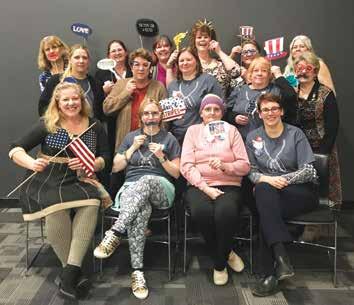
In February 2019, Christine Magnusson attends a DAV-sponsored Women Veterans Gala at Black Bear Casino Resort, Carlton, with women veterans from the Northeastern Minnesota Women Veterans group.
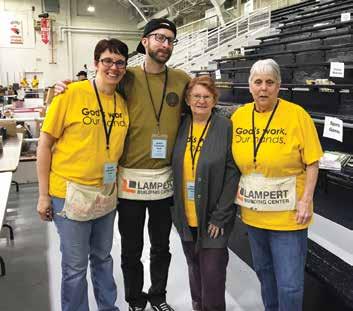
Christine Magnusson volunteers with her son John Keefover, great-aunt Lloydine Pietila, and mother Sandy Wakefield at the 2018 White Elephant Sale fundraiser for Our Savior's Lutheran Church.
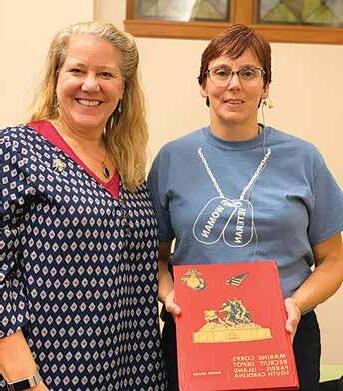
serving in the military. Magnusson is holding the "yearbook" from the time she was in boot camp.
Personal

Magnusson and her husband, Andy, recently celebrated their 25th wedding anniversary. Her adult son, John, lives in Duluth.



In her spare time, she loves to hike.
“I like to hike at RedHead Mountain Bike Park with a friend of mine who knows the trails backwards and forwards, as well as the North Shore and state parks,” she said. “Jay Cooke is one of my favorites; I love to hike along the rushing water through the falls, and then sit along the shore of the slower-flowing river.”
Advice
For those looking for advice on volunteering, Magnusson had this to share.

“Look for an organization that matches your passions,” she said. “That way, it’ll be fun and rewarding and won’t seem like work.

“I always start by just attending meetings with a group to get the feel, because you may think some organization sounds great but for some reason it doesn’t click for you,” she added. “If this happens, don’t give up on volunteering, but don’t stay, either; keep looking for other groups to join.” D

THEWOMANTODAY.COM 15 GO OD BU SI NE SS . WHAT ’S RIGHT IS JUST WHEN DOING ° BU SI NE SS /C OR PO RATE LA W ° ›› John Ga se le ›› Jo se ph He ck ›› Ro be rt Ka nu it ›› Paul Lora as ›› Da ni el Ma dd y ›› Ju li e Pa di ll a ›› Da vid Pr it chet t We have an attor ne y for you. fr yb er ge r.co m IT’S TIME TO UPGRADE YOUR DECK RAILINGS THIS SUMMER. CHECK OUT ALL OF THE OPTIONS. TUSCANY RAILINGS STOCKED IN BLACK AND BRONZE! DRINK RAIL OPTION AVAILABLE. Hours: M-F 8-5:30 • SAT. 8-3 3107 Tower Ave. • Superior • 715-394-7721 facebook.com/campbelllumber www.campbelllumber.com
Andrea Busche is a Duluth freelance writer.
Christine Magnusson and Jane Matson attend a St. Croix Valley AAUW meeting about women veterans and the issues women face while
Meet the woman behind the badge
By Andrea Busche
Police officers can appear intimidating. Dressed in crisp uniforms, and with weapons at their sides, it’s clear they mean business.
Dana Letica
But officers are human beings, just like the rest of us. Many of them are incredibly compassionate and tender-hearted toward the populations they serve.
Officer Dana Letica, with the Duluth Police Department, fits this dichotomy. Letica is a wife and mother, has two dogs, and enjoys helping the less fortunate. But she also knows how to handle any situation that arises while on duty.
“Some people have a hard time seeing past the badge,” she said. “But we’re just normal people with families and friends that we love.”
Duluth native
Letica was born and raised in West Duluth and graduated from Proctor High School. She has one younger brother, Dusty.
Growing up, she played several sports, including softball, volleyball and basketball. She also went to nationals as part of
her high school DECA team.
Interestingly, Letica’s father, Duluth businessman Mike Letica, is of Okinawan descent. His mother, whom Dana called “Grandma Yoshi,” was a proud Okinawan immigrant who shared many traditions with her family, such as flavorful meals of rice, fish and squid.
“We ate so much rice that I thought mashed potatoes were a special treat,” Letica said with a laugh.
Law enforcement
Letica, who has always wanted to pursue law enforcement, is the first police officer in her family. After a few career hops, which included bartending, working in group homes, and beverage sales, she firmed up her decision.
“I remember seeing cops when I was younger, and they always made things safe and calmer when they arrived,” she said. “I really wanted to help people and make a difference. And I have always liked the idea of something new each day. I’m not really a desk person.”
16 July 2023
PHOTOS COURTESY OF DANA LETICA ~
~
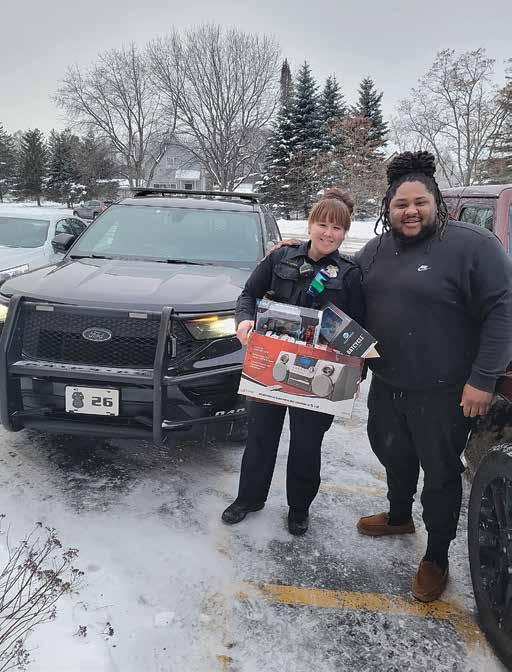
Officer Dana Letica and Pez Davila distribute toys to kids around Christmas 2022.
Letica earned her general education credits from Lake Superior College, and earned her associate’s degree from Fond du Lac Tribal and Community College. Letica was hired as a Duluth police officer on Jan. 5, 2015.
She spent her first seven years working the downtown district, and is now assigned to the Piedmont/Kenwood/Duluth Heights district. In addition to her regular work as an officer, she is also a peer support member, field training officer, department mentor and a member of the crisis negotiation team.
She explained a bit about her duties.
“Dispatch tells us where to go, which can be anywhere, including outside of our regular district. We are called out to shootings, robberies, stabbings, accidents, issues with fraud, domestic assault — you name it. You never know what is
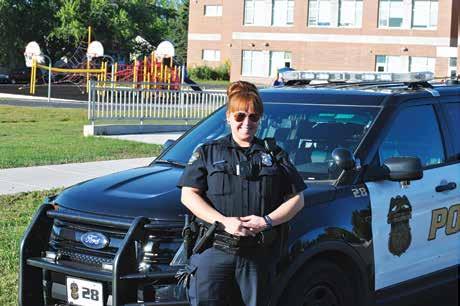
Officer Dana Letica in front of her patrol vehicle. Letica has been with the Duluth Police Department since January 2015 and currently patrols the Piedmont, Kenwood and Duluth Heights neighborhoods.
coming next. It could be a water emergency or a child who isn’t breathing.”
Saving lives
When asked for some memorable on-the-job stories, Letica shared that she prevented a suicide back in 2020. A woman was ready to jump off a bridge when first responders arrived.
“She wouldn’t let anyone get close to her, but she talked to me,” Letica said. “She wanted to grab her phone to make one
Continued on page 18
Over 50 years of creating dream kitchens


THEWOMANTODAY.COM 17
• Cabinets and Countertops • Tile and Stone • Hardwood and Luxury Plank • Decorative Plumbing & Shower Doors • Creative and Knowledgeable Staff Our showroom is open M-F 9-5 and by appointment. 1735 Maple Grove Road Duluth, MN 218-722-6306 • www.bradleyinteriorsmn.com
last call. I took that opportunity to grab her arm and pull her off the ledge. She survived.”
Her colleagues and superiors have taken notice of the many lives Letica has impacted. Her boss, Sgt. Tom Stolee, recently nominated Letica for an Excellence in Performance Award through the Minnesota Association of Women Police.
From his nomination: “Officer Letica joined the Duluth Police Department in 2015. During this time, she has received eight letters of appreciation, three department commendations, two life-saving awards and one meritorious service award.
“She always treats people in a professional and caring manner, and goes the extra mile to find resources to help people. Additionally, she models and sets the example for other officers that one can be firm, but still be fair, respectful and compassionate.

“Although it is impossible to quantify, I believe with 100% certainty that over the years, lives have been saved, crises have been mitigated, use of force has been avoided, and people have been helped because officer Letica was involved.”
Goals and dreams
Officer Letica has some big goals and dreams to accomplish — both personal and professional. She’d like to establish a mentor/mentee network between the Duluth Police Department and at-risk youth.
She is currently in talks with her friend, Pez Davila, who is associated with several local youth centers, to make this a reality. Additionally, she’d like to become a sergeant someday, and perhaps work in an investigative unit.
She has some pretty big personal goals, too.
“I want to raise good kids and see them succeed and be good, happy people,” she said.
Personal
Letica and her husband, Caleb Rhodes, who works for Bernick’s (a beverage supplier), live just outside of Duluth. Together, they are raising a blended family with three sons and a daughter. They also have two rescue dogs, Fuji and Ammo.
In her free time, Letica loves fishing, with one caveat.
“I like fishing, but don’t like to bait the hook. I have my husband do it. I don’t like anything squiggly, but I have no problem chasing down a man in a dark alley,” she said with a laugh.
Rewarding
For Letica, the success stories are the most rewarding parts of work.
“I often see things like abusive relationships and overdoses,” she said. “Sometimes, I’ll see the person months down the road, after they got out of the bad situation.
“They’ll say to me, ‘Do you remember me? You helped me, and I was able to get out or go to treatment.’ Things like that are my biggest motivators.” D
18 July 2023
Andrea Busche is a Duluth freelance writer.
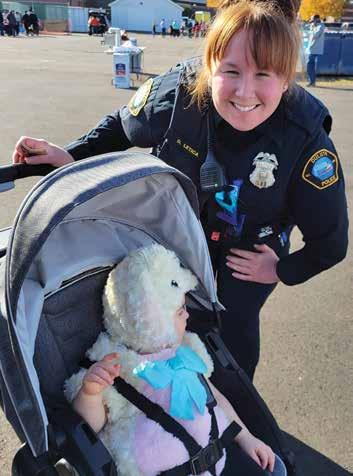
Officer Dana Letica with her young daughter at Duluth’s Trunk or Treat in October 2022.
At a recent “Shop with a Cop” event, Dana Letica (second from left) joins former Duluth city councilor Derek Medved, Sergeant Meghan Jones, Officer Nate Smith, WDIO anchor Baihly Warfield and cameraman, Dana’s father Mike Letica, and former Duluth Police chief Mike Tusken.











































































Co-owner of Lake AvenueRESTAURANT AND BAR celebrates connection through food
 By Abigail Blonigen
"Foodmay not be the answer to world peace, but it’s a start.”
Bourdain
Laura Haack, co-owner of Lake Effect Restaurant and Bar, shared this quote in reference to what she loves about the restaurant industry.
Haack grew up in Superior, Wisconsin and began serving at a local Perkins restaurant when she was in high school. She continued to serve locally while she attended the University of Minnesota Duluth and University of Wisconsin-Superior, earning her degrees in Spanish and anthropology.
Post graduation, Haack moved to Colorado and continued to work in the service industry, which allowed her a flexible schedule and freedom to travel. She lived in both Costa Rica and Mexico for a time, learning to eat crazy foods like iguana, grasshopper and guinea pigs.
PHOTOS
COURTESY OF LAURA HAACK
~Anthony
20 July 2023
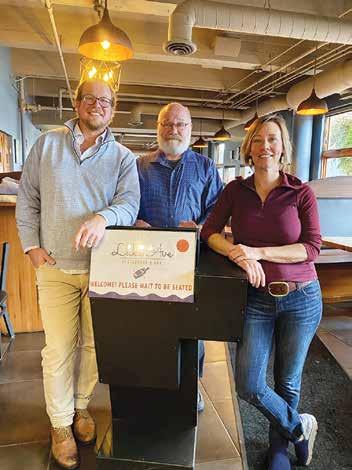
Lake Avenue and Lake Effect owners Derek Snyder, Mark Swenson and Laura Haack pose for a photo at the host stand.
Eventually, Haack found her way back to Duluth.
“I always wanted to get back to Lake Superior,” she said. “Nature is very important to me, being out in the woods, being in solitude. I think being so social in my work … my balance in that is being in the woods, being amongst trees, being by a river — anywhere where there’s nature and quiet and solitude.”
Haack returned to Duluth in 2012 and began working as a server at Lake Avenue Restaurant and Bar.
“I always knew when I started there that I really believed in what Mark (Swenson) and Derek (Snyder) created, and that I wanted to be a part of that,” she said.
That she did, buying into the business in 2017. The trio — Haack, Swenson and Snyder — are now all co-owners of the restaurant. Haack continues to serve and works as a floor manager. She is involved in businesswide decision-making processes, such as Lake Avenue’s recent expansion.


Lake Effect Restaurant and Bar opened in February 2023 on Rice Lake Road on Island Lake. The location was formerly Boondocks Saloon and Grill.
Lake Effect has a similar feel to the Canal Park Lake Avenue location, which Haack says tries to appeal to both the

adventurous and more conservative palette.
“People that might be a little bit more adventurous with their palate, we want to challenge them a little bit and have real interesting things on the menu,” she said. “Then other people that might come in and not be as adventurous for new foods, we have more traditional or easy dishes on the menu.”
Haack said the industry has changed significantly since she started serving in the mid-1990s. In general, she said people eat out more frequently; it’s less of a special occasion occurrence. Guests also tend to be more knowledgeable about what they are looking for, and have more diverse palettes. Social media has also changed the restaurant game, as it’s easier than ever for folks to share what they loved about a restaurant — or what they didn’t.
She has also seen more women in the industry throughout the years taking on more traditionally male-dominated roles. As a manager, Haack said her gender can sometimes pose a challenge.



“As a woman, I think there’s a challenge to be assertive without being considered pushy,” she said.
Continued on page 22

THEWOMANTODAY.COM 21
BU SI NE SS BA NK IN G HERMANT OW N | 218.415.7130 DULUTH | 218.673.5050 Fr andsenBank .com JODI MAY VP /Busine ss Ban ke r CA013123 STACEY JOHNSON VP /Busine ss Ban ke r BANK SBAPreferred Lender HELPING CLIENTSLIVE LIFE FILLED WITH JOY CL OQU ET ( 218 )8 79-46 63 HER MAN TO WN (2 18) 729-6 79 1 SUP ERI OR (7 15) 71 8- 590 0 RELIABLEMN.COM
~ Laura
~
Haack
Laura Haack smiles with a giant bottle of wine.
Haack said this dynamic, though tricky, has helped her to grow, and she is grateful for the unyielding support of her male business partners.
Referencing back to the Bourdain quote, Haack said what keeps her in the industry is the sense of connection food provides.

“There’s a lot of important conversations that happen around food, around gathering,” she said. “When we come together, whether it’s with our friends and family or whether it’s complete strangers that we’re meeting at the bar, I think those are always opportunities to make human connections. I think we need a little more of that in this world.” D
Abigail Blonigen is a Minnesota-based freelance writer.

22 July 2023
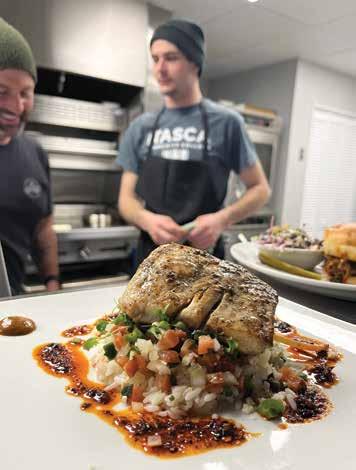
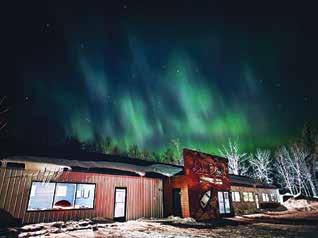
Top left: The northern lights shimmer over Lake Effect Restaurant and Bar's Island Lake location. Above: Laura Haack said Lake Superior was one of reasons she came back to Duluth after living in Colorado, Costa Rica and Mexico. Above right: The view from Lake Avenue Restaurant and Bar's Canal Park location. Right: Lake Avenue serves up fresh market fish. Both Lake Avenue and Lake Effect cater to those with adventurous and more conservative palates.
CALLED TO CARE FOR OUR CO MMUNITY
Ourmissionisreflectedintheworkwedoevery day.Andit’sthe peopleofthisplacewho inspireus.Here,weshareourlives,ourwork,ourstories.It’speoplelikeSandy,whocares notonlyfor patientsbutourcommunityas awhole,thatmakethisplaceunlikeanyother. Wearecalledtomake ahealthydifferenceinpeople’slives.
Joinourteam: EssentiaCareers.org EssentiaHealth.org


THEWOMANTODAY.COM 23
SA ND Y, RN ▶F AMILYM EDICINE
Arts & Events Calendar
Superior Porchfest

6 p.m. Thursdays
This free, familyfriendly music and art festival in Superior continues every other Thursday (July 13, 27, Aug. 10, 24, and Sept. 7). Bring a blanket or lawn chair, pack a picnic and enjoy the show. Visit www.superiorporchfest. org.

Lucius Woods

Performing Arts Center
7 p.m. Fridays
Gates open at 6pm at Lucius Woods, Solon Springs. July 8 - Church of Cash; July 15- Molly and The Danger Band; July 22 - Lamont Cranston; July 29 - Charlie Parr; and Aug. 5 - The Whitesidewalls. Visit www.lwmusic.org/concert-schedule.
Silver Bay Music in the Park
7:30 p.m. Fridays
Enjoy free outdoor concerts at City Center Park in Silver Bay. July 14 - Charlie Parr; July 21 - Tommy Bentz Band; July 28 - Joyann Parker Band; Aug. 4 - Pert Near Sandstone; Aug. 11 - Pat Donohue & the Prairie All Stars; Aug. 18 - Rich Mattson & the North Stars; Aug. 25 - The Scarlet Goodbye; and Sept. 1Erik Koskinen. Visit www.facebook.com/ RockyWallProductionsNorthShore.

Minnesota Ballet Sunday Matinee
2 p.m. July 2
The Minnesota Ballet offers screenings of previously recorded Minnesota Ballet performances; July 2 is Billy’s Dancing Farm, a narrated dancing talke based on the children’s story, performed in Minnesota Ballet’s Studio Four Theater. Visit www. experiencethedepot.org/series/minnesotaballet-sunday-matinee

Hairball
4 p.m. July 3
The 12th annual Party in the Park features a rock-and-roll homage to Van Halen, KISS,

We make every effort to ensure the accuracy of this information. However, you should always call ahead to confirm dates, times, location, and other information.
Motley Crue, Queen, Journey, Aerosmith and more at Bayfront Festival Park, rain or shine. Visit www.decc.org/ event/decc-presents-hairball-2023.
Duluth Fourth Fest

4 p.m. July 4
Enjoy live music throughout the day at Bayfront Festival Park and cap off the night with fireworks. Admission is free. Visit www.perfectduluthday.com/the-event/ duluth-fourth-fest-2023.

South St. Louis County Fair
July 6-9
The 102nd annual fair will be held in Proctor and feature all the events and attractions you’d expect at a county fair. Visit www. proctorduluthfair. com.

Movies in the Park
July 7-August 25
Enjoy free outdoor movies on a giant screen in Leif Erikson Park, Duluth, at sunset every Friday. July 7 - Spider-Man: No Way Home; July 14 - Top Gun Maverick; July 21 - Willy Wonka & The Chocolate Factory; July 28 - The Muppet Movie; Aug. 4 - School of Rock; Aug. 11Despicable Me; Aug. 18 - Minions: The Rise of Gru; and Aug 25 - DC League of SuperPets. Visit www.downtownduluth.com/ movies-in-the-park.

Trampled by Turtles with Jenny Lewis

6 p.m. July 8
Inspired by bluegrass, folk and other genres, Duluth’s own Trampled by Turtles will perform at Bayfront Festival Park, along with special guest Jenny Lewis. Visit www.decc.org/ event/trampled-byturtles-2023.
Chester Park Concert Series

July 11-August 15
Musicians perform Tuesdays at 7 p.m. in July and at 6:30 p.m. in August at Chester Bowl. July 11 - Aly Aleigha; July 18 - North Shore Big Band; July 25 - Jojo Green; Aug. 1 - Ross Thorn; Aug. 8 - The Most Wanted;and Aug. 15 - Fish Heads. Aug. 22 is a rain date. Visit www.duluthmn.gov/parks/ programs-events/special-events.
Sidewalk Days
July 12-14
Superior Street shuts down to traffic from Lake Avenue to Fifth Avenue West for three days of sidewalk shopping, food, entertainment and fun, including a car show, 5K, Zoomobile, and Imagination Playground for kids. Visit www. downtownduluth.com.
Kinky Boots

July 14-30
This joyous, musical sensation is guaranteed to lift your spirits and have you dancing in the aisles. Based on a true story. Performance is at the Norshor Theater. Visit www.duluthplayhouse.org/norshor-theatre.
Bayfront Reggae & World Music Festival

July 15
This is a celebration of world music whose artists spread the message of love, hope and equality for all people.
Event includes international foods, artisans and more at Bayfront Festival Park. Visit www. bayfrontworldmusic.com.
Tour of Homes and Gardens
10 a.m. July 19
The Duluth Woman’s Club’s 55th annual fundraising event is a daylong selfguided tour of Duluth’s
24 July
2023
historic and new homes. Visit https:// duluthwomansclub.com/2022-tourofhomes/ special-events/


Festival by the Lake
11 a.m. July 22
Enjoy a full day of live music from local and regional artists, exhibitors, shopping, food and fun at Bayfront Festival Park. Visit www. festivalbythelake.com

Whiskey Myers

7 p.m. July 23
Whiskey Meyers will perform at Amsoil Arena. Visit www.decc. org/event/ whiskey-myers
FinnFest 2023
July 26-30
This 40th annual event will inform as well as celebrate Finnish and Finnish American culture. The five-day festival at the DECC features workshops, seminars, tours, concerts and art. Visit www. decc.org/event/finnfest-2023

Open Dance Night:

Studio Four
7:30 p.m. July 27
Solo, duet, or group — all dancers are welcome to Duluth’s “open dance” night, just like open mic night. Bring your music on a smartphone and your props. Minnesota Ballet’s Studio Four Theater provides a professional dance floor, theater lighting and sound. Or, be part of the audience! Visit www.experiencethedepot.org/event/opendance-night-studio-four/2023-07-27.
All Pints North Summer Brewfest

3:30 p.m. July 29
Join the Minnesota Craft Brewers Guild at Bayfront Festival Park for unlimited samples from over 100 Minnesota breweries and brewpubs, plus activities, music and more. Visit www.decc. org/event/all-pints-north-2023
Nestled on 40 acres with a 20-acre school forest, a greenhouse, an orchard and outdoor classrooms.
Naturebased schoolser
Pre-K - 6th Gr
Nature based school serving students

Learn more at northshorecomm or call to schedulea

Pre-K - 6th Grade Northshorecommunityschool.org
Pre-K-6th: Environmental Educationintegrated curriculum,witha 20-acre schoolforest, greenho outdoorclassrooms.
• Environmental Education integrated throughout the curriculum
• Art, Music, PE, and Environmental Ed Specialists


Art, PE,Music,and EnvironmentalEdSpecialis
• Small Class Sizes
Nor th S hore Community School
BusingfromDuluthand TwoHarb
• Busing from Duluth and Two Harbors
Preschool: Fu ll an dH alfDay op tion s, Ha nds-on learning that is developmentally appropriate, Busingavailable for4 &5 year olds,Possiblescholarships
Kids First * Knowledge * Stewardship * Partnership
Kids First* Knowledge* Stewardship *Partn
5926 Ryan Road~ Duluth, MN 55804 21
Naturebased schoolser
Pre-K - 6th Gr
Learn more at northshorecommu or call to schedulea

employment opportunities availableat jobswithus.org
Pre-K-6th: Environmental Educationintegrated curriculum,witha 20-acre schoolforest, greenho outdoorclassrooms.
Art, PE,Music,and EnvironmentalEdSpecialis
Nor th Shor e Community School
BusingfromDuluthand TwoHarb
Preschool: Fu ll an dH alfDay op tion s, Ha nds-on learning that is developmentally appropriate, Busingavailable for4 &5 year olds,Possiblescholarships
Kids First* Knowledge* Stewardship *Partn
duluthedison.org
THEWOMANTODAY.COM 25
5926
Ryan Road~ Duluth, MN 55804 21
5926 Ryan Road
Duluth,
218-525-0663
~
MN 55804
x100
Healing chronic wounds
St. Luke’s Advanced Wound Care & Hyperbaric Center shines a light on wound care
By Felicia Schneiderhan
Big problems can start small.
In Jenny Vanyo’s case, the wound on her neck began with a small stitch that got infected.
Her neck area was already sensitive after many years of treatment for recurring cancer. Multiple surgeries and radiation left the skin more susceptible, and after a biopsy, one of the stitches festered into a wound that would not heal. It would close over, then open again, and gradually grew to an infection several inches in diameter.
Her aunt took a picture and showed it to some surgeons she works with. They said it needed to be taken care of right away.
Committing to the healing process
Vanyo was referred to Dr. Jarrod Buresh at St. Luke’s Advanced Wound Care & Hyperbaric Center in Duluth.
The center provides support and education for patients and caregivers on caring for wounds at home. Their goal is to support a faster, more stable healing process. Hyperbaric oxygen therapy is also available. This advanced wound care technology helps patients with chronic, non-healing wounds.
Everyone’s wound healing experience is unique, said Dr. Buresh. With appropriate care, most wounds should heal within 14 weeks. But if a wound is growing, if there’s drainage or if it’s stagnating and not healing, additional support may be needed.
Vanyo’s wound was quite deep, with bacteria and layers of dead tissue to gradually remove. The healing process would require ongoing commitment over several months. Dr. Buresh
told her, “It’s going to get worse before it gets better. That wound is going to get angry when we start working on it. But we’ll be with you every step of the way and in the end, it will be absolutely worth it.”
Vanyo was ready to start the healing process.
For more than a year, she came weekly to the wound center for debridement. This process removes damaged tissue or foreign objects from a wound. Her appointment took about 15 minutes and would include cleansing, topical antibiotics and instructions for ongoing care at home.
“In the beginning, I had to change the dressing three times a day,” she said. “I had to wear a tubular dressing around my neck for 14 months, to make sure the bandages stayed on. It’s been a long haul. Now, we’re getting near the end and Dr. Buresh was right — it has been well worth it.”
Continued support
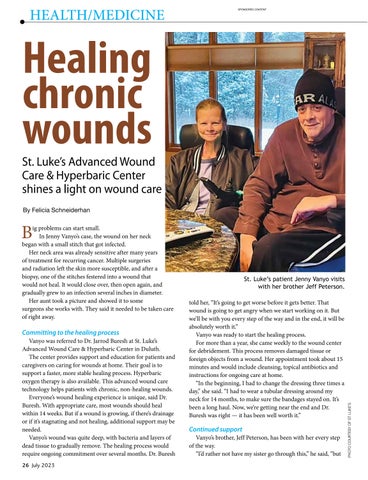
Vanyo’s brother, Jeff Peterson, has been with her every step of the way.
“I’d rather not have my sister go through this,” he said, “but
26 July 2023 HEALTH/MEDICINE SPONSORED CONTENT
PHOTO COURTESY OF ST. LUKE’S
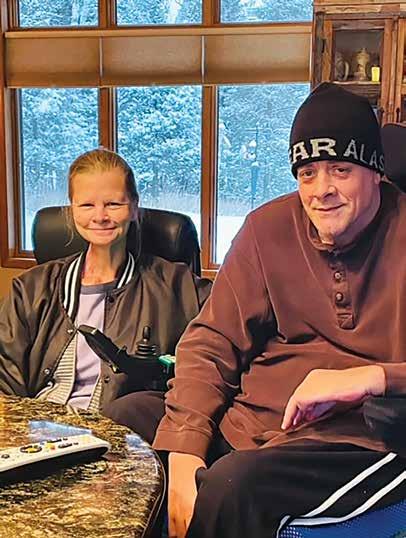
St. Luke’s patient Jenny Vanyo visits with her brother Jeff Peterson.
it’s exciting watching the new skin form. It’s been really educational, and everyone at St. Luke’s has been so supportive.”
Education is an important goal of the center’s providers.
“We help patients and caregivers understand why the problem is there and how they can take care of it,” Dr. Buresh said. “We give them tools for the future.”
“Hindsight is 20/20,” Vanyo said. “If I hadn’t waited so long, it would not have been so bad. My biggest suggestion is to watch your body and take care of things when you see them. Don’t hesitate to go to the doctor.”
Success stories like Vanyo’s inspire Dr. Buresh every day.

“Jenny was resigned to wearing a shawl and having it drain forever, and here she is, almost healed,” Dr. Buresh said. “We’re not far from having it closed, and that’s with no surgery. It’s


Jenny and her body treating it. We’re here supporting her, guiding her along the way. It’s so gratifying to see people with chronic wounds who thought this was just their life now. We can shine a light on why it’s there and make a difference moving forward.”
Vanyo is looking forward to having the wound finally healed.
“It’s awesome to see all my hard work finally paying off,” she said.
To learn more about St. Luke's Advanced Wound Care & Hyperbaric Center, visit slhduluth.com/WoundCare. D
THEWOMANTODAY.COM 27 SPONSORED CONTENT
Appointments that fit my schedule BlueStone nearUMD 218-606-1040 Downtown Duluth 218-722-3679 Hermantown 218-722-7770 We provide flexiblehours,personalized care and98% patient satisfaction at threeconvenient locations nearyou Schedule onlineatparkdental.com Together we have accomplished so much. LarsonForDuluth.com Together we will accomplish muchmore! Prepared and paidfor by EmilyLar sonfor Duluth Mayor, Bill Burns, Treasurer.1331E11th St,Duluth, MN 55804 Paid Advertisement
Felicia Schneiderhan is a Duluth based writer.
Samantha Roffers,
Hello, dear readers!
Thank you so much for being here.
This issue of Fashions By Sam is incredibly bittersweet for me, as this will be my last issue. Fashions By Sam has been such a large part of my life for the past three years, it’s hard to believe how fast time goes by. I have met some incredible business owners and employees over the last three years. I have stepped out of my comfort zone on more than one occasion, scored some great outfits, laughed until my cheeks were sore and I have been recognized by strangers … which is crazy!
It is so fun to get a copy of The Woman Today and watch my kids search through it for their mom. Watching them light up and be proud is something I will really miss. I also will miss my time at the computer writing and reflecting on my experiences. I have always loved fashion and shopping, and the fact that I got to shop professionally is something I will cherish forever.
I want to thank the readers for all of their support and love of my column over the years. To Ali Carlson and Megan Keller, thank you for all the laughs, support and incredible memories. Thank you, The Woman Today, for offering me this opportunity. I will say I am so happy Megan never got a chance to feature her blooper issue with all of the terrible photos she took of me!
For my final issue I am so thrilled with the business we’re featuring — Twisted Turquoise Boutique, which just so happens to be owned by a dear friend of mine, Amber Gregg. Amber started Twisted Turquoise Boutique in December 2021.

She has carefully hand selected every piece of inventory. She spends hours learning about the boutique industry and months mulling over every detail of her business. Her boutique features trendy pieces with an edgy, Western flare. She works hard to be size-inclusive and demos every single
by Sam
piece of inventory before offering them to the public. She offers online shopping, at-home try-ons and can be found at local pop-up events. Amber knows her inventory inside and out, which ensures that her buyers have a fun, beautiful and personalized experience when shopping with her.
Without further adieu, let’s get into the looks! D
If you have that special knack for fashions, can manage your own photo shoot, and write a column about Fashions in the Northland for our magazine, please contact The Woman Today at magazines@duluthnews.com and tell us about yourself and your vision. Calling all Fashionistas!
28 July 2023
a Moose Lake writer, believes it’s important to shop for things you love and feel comfortable in. Everyone’s style is unique and that’s what makes it so special.
PHOTOS BY SAMANTHA ROFFERS
Amber Gregg, owner of Twisted Turquoise Boutique, and Samantha Roffers put together some unique looks for this month's Fashions by Sam.
Our first outfit features this incredible black suede western blazer, which is so luxuriously soft and comfortable. It's all in the details in this beauty — full fringe, turquoise buttons and aztec detailing. It’s perfect for concerts, rodeos, parties and more. I paired this blazer with jeans and turquoise snip-toe booties. This blazer could be paired with heels and slacks for an awesome western business look. I also paired this blazer with a beautiful turquoise squash blossom on Navajo pearls.

2Our second outfit was definitelyy the favorite of the day! You can take the girl out of the Midwest, but you can’t take the Midwest out of the girl. This outfit screams boating, fishing, campfires, sporting events and county fairs. This is the perfect outfit for any casual occasion, and features this cream fleece “Midwest” hoodie and distressed jean jacket. Pair these items with a jean, yoga pants or sweatpants and flats or sandals for the perfect comfortable look. We are lucky enough to be steps away from one of Minnesota’s 10,000 lakes which provided a perfect backdrop for this look.


This third outfit features a gorgeous black bodysuit with a stretchy velvet body and lace sleeves. This bodysuit is extremely comfortable, the lace is soft and forgiving and the pinstripe velvet is incredibly flattering. I paired this body suit with these high-rise, multi-button flares and a tan felt hat. This outfit would be perfect for a girls night or a concert. I especially love the high neckline of this top that gives it a choker effect.
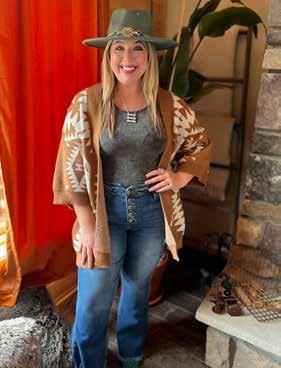
For this outfit, I took the same high rise button flares from the third outfit, paired with a mineral wash gray bodysuit and this comfy western cardigan. This is the perfect casual look for any event and it is so comfortable. You could dress this look up with heels or down with flats. I added a green felt hat and white buffalo turquoise bar necklace.


THEWOMANTODAY.COM 29
1
4
3
Uniquely equipped for the challenge
By Anthony Matt
AtEssentia Health, we know cancer can be scary. We know that it comes with much uncertainty. That’s one of the many reasons we hire breast health navigators — people who help breast cancer patients navigate their diagnosis by assisting with things like appointment scheduling, finding resources and symptom management.
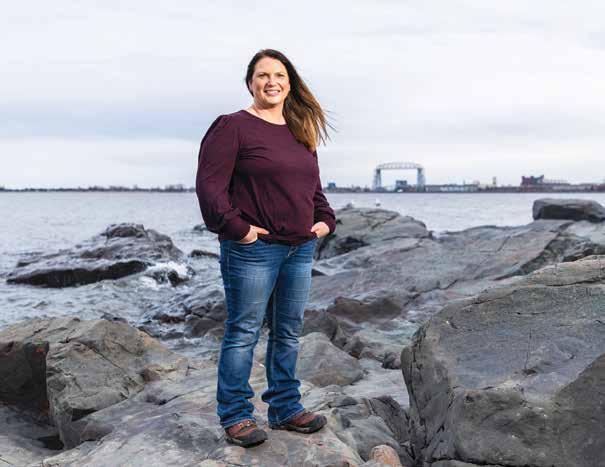
One of those people is Kari Norman, a 48-year-old Duluth resident who has been working as a breast health navigator at Essentia since 2014.
“It is a really rewarding job; there is so much to keep track of and we are proud to help with that,” Norman said. “We really strive to make this difficult time as easy as possible and make sure our patients are well taken care of outside of their regular appointments.”
Little did Norman know that in 2019 she would be faced with some of that same uncertainty. She attended a Melanoma Monday event, a free skin cancer screening hosted by Essentia. She went with no suspicions, thinking it was a good idea to get screened due to her previous work as a lifeguard.
The screeners found an abnormality and ordered a biopsy. A week later, she was diagnosed with melanoma.
“It was really scary, especially for me because I work in the
cancer world and know where things can go,” she said. “There is nothing you can do to prepare yourself to hear the words ‘You have cancer.’ It’s very scary and your mind runs until you get answers.”
She suddenly found herself needing some of the same care she lovingly provides to other cancer patients at Essentia.
“I’m so grateful to have had people guide me through this whole process,” Norman said. “Even though I work here, when I was receiving my care I was treated like a patient and no stone was left unturned in my care.”
Fortunately for Norman, she was able to have surgery the following month to remove the cancer before it could spread.
“I’m so thankful it was caught early and I didn’t have to undergo more rigorous treatment,” Norman said. “Being able to see a surgeon so quickly and get it removed might have saved my life.”
Norman said she now feels better equipped than ever to help guide patients on their cancer journey due to her own battle with the disease.
“I can put myself in their shoes to a point,” she said. “I know the questions and worries that are running through people’s minds; and while I don’t tell everyone about my journey, I know,
30 July 2023 HEALTH/MEDICINE SPONSORED CONTENT
PHOTO COURTESY OF ESSENTIA
As a breast health navigator at Essentia, Kari Norman helps breast cancer patients navigate their diagnosis. After she was diagnosed with melanoma in 2019, she added a whole new level of understanding for what a cancer patient goes through.
in the back of my mind, I can help them even better than before.”

While she’s cancer-free, Norman still receives routine care to make sure she stays that way.

“I’ve had 11 more biopsies since my cancer was removed,” she said. “My doctors are very thorough with my postcancer care and I’m really grateful that they go to great lengths to keep me cancer-free.”
“After someone is diagnosed with a skin cancer, we monitor them very closely and carefully as they are at an increased risk to develop another skin cancer in the future,” said Dr. Susan Ash, Norman’s doctor and an Essentia dermatologist. “Routine monitoring can help us catch that early if it happens and begin treatment before it spreads.”
Norman now takes many precautions to reduce the chances of something like this happening again and said there is no better tool than regular screenings.
“If it wasn’t for that Melanoma Monday event, I don’t know when I would have caught it,” Norman said. “If I hadn’t caught it early, through routine screening, who knows what might have happened.”
“We recommend that people with increased risk of skin cancer have routine screening exams,” Dr. Ash said. “Highrisk individuals are those with a history of excessive sun and UV exposure (including tanning bed use), those with fair skin and eye color, multiple moles, history of multiple sunburns in their youth, immunosuppressed patients, a family history of melanoma, and those with prior history of skin cancer.”
According to the American Academy of Dermatology, skin cancer is the most common cancer in the U.S., with more than 9,500 people diagnosed every day. D


THEWOMANTODAY.COM 31 SPONSORED CONTENT
AFRESH VIE W •Eye Exams •Eyeglasses •Contacts •Billing Your Insurance Direct Appointments available at Kenwood and West Duluth Visit Vi si on Pr oOptical.com
Anthony Matt is the media relations specialist at Essentia Health.
Honoring history and exploring your ancestry: today’s Daughters of the AMERICAN REVOLUTION
By Janna Goerdt
Cora Knutson is honoring her grandmother.
Velma Mae Row Coffin, who lived in Iowa, went about learning her family’s genealogy the old-fashioned way: through writing letters and traveling to do research. Through it all, Coffin discovered that one of her ancestors, Benjamin Coffin, was a sergeant serving in the Revolutionary War, which raged from 1775 to 1783 before the American patriot forces serving under George Washington defeated the British.
That ancestral connection meant Coffin could join the Daughters of the American Revolution, or DAR. The more than 130-year-old organization is open to anyone who proves one of their ancestors was a patriot in the Revolutionary War.
That ancestral connection also meant Knutson could join the Greysolon Daughters of Liberty in Duluth.
“My grandmother did a lot,” said Knutson, who works as a software project manager in Duluth. “She also passed away when I was young. I wanted to honor her, and preserve her legacy.”
Each DAR chapter carries on their ancestors’ patriotic tradition by promoting education and patriotism. Individual chapters can also develop their own focus and special projects, Knutson said. She is at the beginning of her first two-year term as chapter regent.
“The organization as a whole and our chapter have a lot of vitality,” Knutson said. “There has been a surging interest in genealogy in recent years, and a lot more tools at people’s disposal. We encourage people to do their research, and learn about that history.”
32 July 2023
PHOTO COURTESY OF CORA KNUTSON
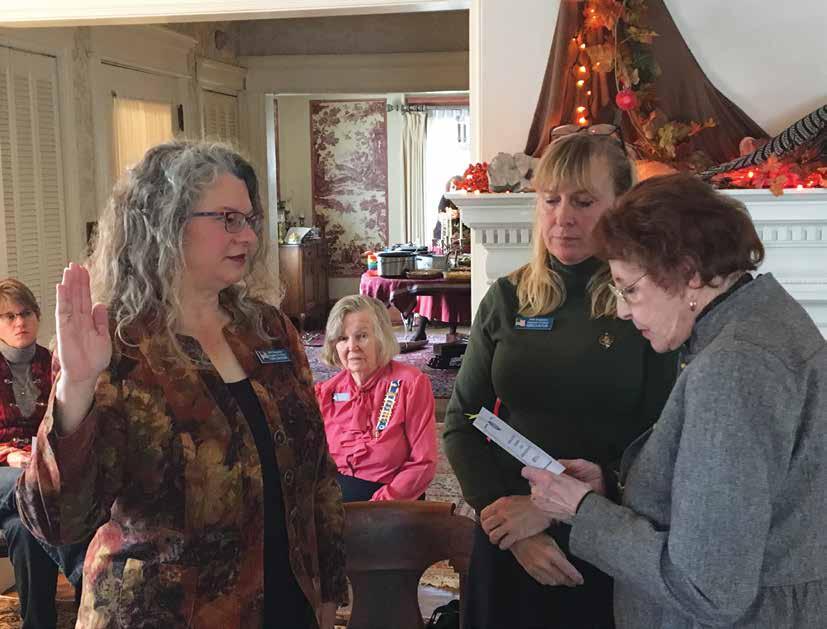
Cora Knutson, currently the regent of the Greysolon Daughters of Liberty Chapter in Duluth, is shown during her swearing-in ceremony.
While your Revolutionary War ancestor “does need to be on the American side,” Knutson said, they didn’t necessarily have to be involved in battle. Ancestors who contributed to the American war effort might include those who fed, assisted or supported soldiers in a way that can be proven, Knutson said.

The DAR has lists of people who have been proven to have served in the Revolutionary War. For the Greysolon chapter, for example, patriot ancestors claimed by chapter members include Ebenezer Durfee of Connecticut, Lemuel Fowler of Massachusetts, and Abraham and Hugh Gormley of Pennsylvania, among many, many others.

Knutson joined the DAR under her six-times greatgrandfather, Benjamin Coffin. She also has three other known Revolutionary War ancestors, all painstakingly documented by her grandmother. Velma Coffin also traced her lineage to an ancestor who was present at the signing of the Magna Carta, as well as someone who
Continued on page 34









THEWOMANTODAY.COM 33
PHOTO COURTESY OF UNIVERSITY OF MINNESOTA DULUTH ARCHIVES AND SPECIAL COLLECTIONS, KATHRYN A. MARTIN LIBRARY
WOMEN’S CONSIGNMENT AND GIFTS Call Us! 715.394.7002 angiesclosetresale.com 1315 Tower Avenue, Superior, WI Voted Best Liquor Store & Wine Selection in the Duluth News Tribune’s 2022 Best of the Best Contest KEYPORTLIQUORS.COM 1900 Belknap, Superior 715.392.5855 youth accounts financial education think your www.nccyou.com Sm
sailed aboard the Mayflower.
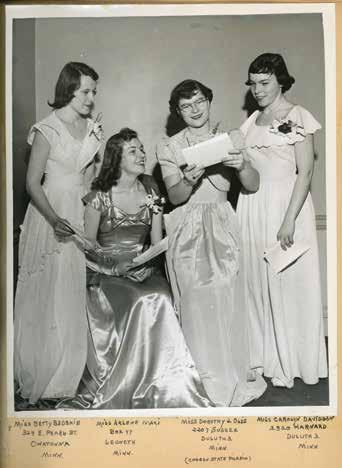
Four young members of various Daughters of the American Revolution chapters in Minnesota are pictured around 1950. From left are Miss Betty Bzoskie of Owatonna, Miss Arlene Maki of Leoneth, Miss Dorothy J Olds of Duluth (notes on the photo indicate she was the "chosen state pilgrim") and Miss Carolyn Davidson of Duluth.
Julie Demgen of Superior also has a family connection that drew her into the Daughters of the American Revolution.
“I’ve been a member for 15 years, my mother was a member before me, and my grandmother was a member before her,” Demgen said. And like Knutson, she joined under the same ancestor her mother and grandmother claimed: Daniel Bouton, a captain from New York.
Growing up, Demgen was familiar with DAR, but she said she wasn’t exactly sure what it was all about.
“I knew it was a patriotic group, and that there were a lot of very nice ladies that were members,” Demgen said.
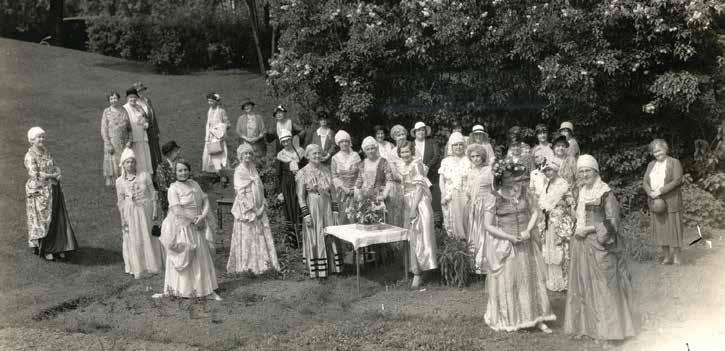
Above: The Greysolon du Lhut Chapter of the Daughters of the American Revolution members are pictured on Mrs. W. H. Hoyt's lawn on 21st. Avenue East in Duluth, sometime around 1935. The Duluth chapter was organized in 1895.
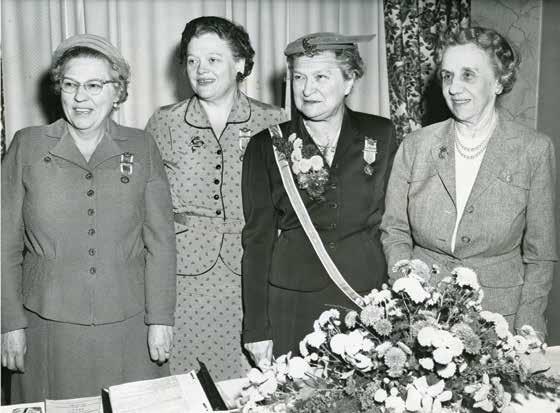
Below: Four members of various Daughters of the American Revolution are pictured around 1970. Mrs. B.B. Lee, pictured at left, was the Regent of the Greysolon Du Lhut chapter, and was the state vice-regent at the time of the photo.
That has turned out to be true of the chapter today.
“It’s just a lovely group of women,” Demgen said. And today, the women come from “all walks of life,” she said, rather than primarily the wives of bankers and doctors from chapters decades ago.
There are great-grandmothers, mothers with young children, professional women and retired women in the chapter, Demgen said. They attend to a wide range of projects throughout the year, from presenting wreaths at local Memorial Day celebrations, and organizing an annual essay contest with a patriotic theme, to raising funds for Safe Haven
34 July 2023
PHOTOS COURTESY OF UNIVERSITY OF MINNESOTA DULUTH ARCHIVES AND SPECIAL COLLECTIONS, KATHRYN A. MARTIN LIBRARY
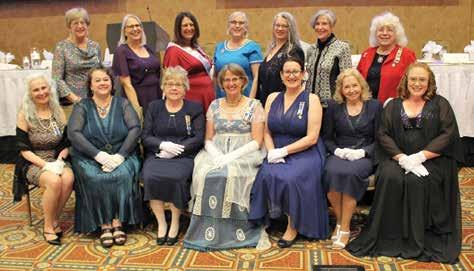
THE HISTORY OF THE GREYSOLON DAUGHTERS OF LIBERTY
Greysolon Daughters of Liberty Chapter is one of the Minnesota State Society Daughters of the American Revolution that was created from the 2011 merging of the Greysolon du Lhut Chapter, organized in 1895, and the Daughters of Liberty Chapter, organized in 1897.


The chapter serves the northeast portion of Minnesota from Sandstone to International Falls. The national Daughters of the American Revolution was founded in 1890 by four women in Washington, D.C., and to date has counted about a million women in its membership. The organization is open to any woman over age 18 who can claim lineal descent from a patriot of the Revolutionary War.
Shelter and Resource Center in Duluth.

They frequently welcome speakers to learn about interesting and relevant topics, Knutson said. For instance, a man who had repatriated the remains of a family member who had died in the Vietnam War spoke about his experience.
While the chapter promotes patriotism, they avoid talking about politics, Knutson said.
“We are not a political organization,” Knutson said. “We talk about history, not current events; women’s issues, like heart health.”

Individual chapters also can weave in local skills and interests, Knutson said. The most recent state regent spearheaded a project of cleaning headstones at cemeteries.
The Greysolon DAR chapter works to promote literacy, Knutson said. They also support veterans’ causes, and, until they were paused due to the COVID pandemic, chapter members supported new citizens at local naturalization ceremonies.
Think you might have an ancestor who is connected to the Revolutionary War? The Greysolon Daughters of Liberty can help point you in the right direction to help you find out. While they won’t be able to do your research for you, Knutson said, they can offer guidance and verification.

And if, perhaps, you identify such an ancestor, you might consider hanging out with this group of women to honor that history.
To learn more about the Greysolon Daughters of Liberty, visit their website at www.greysolon.minnesotadar.org. D
THEWOMANTODAY.COM 35 Dr. Nathan A. Jarnot 303 S.E. First Street and River Road, Grand Rapids, MN 55744 • 218.326.0349 Dr. Nathan A. Jarnot • Dr. Eric Scotland, DDS • Dr. Scott K. Varland • Dr. Paul K. Hodapp • Dr. Scott K. Varland • Dr. Nathan A. Jarnot 303 S.E. First Street and River Road, Grand Rapids, MN 55744 • 218.326.0349 Your Oral & Maxillofacial Surgeons and their team are ready to assist you in making the best decisions for a healthy mouth and lasting smile. We have a wide scope practice to offer, including: •Dental Implants •Wisdom Teeth Extraction •Corrective Jaw Surgery •Financing Available/CareCredit Serving the area since 1969
Janna Goerdt is an Iron Range farmer and freelance writer.
MONARCH BUTTERFLIES,
Helping Minnesota’s one yard at a time
By Janna Goerdt
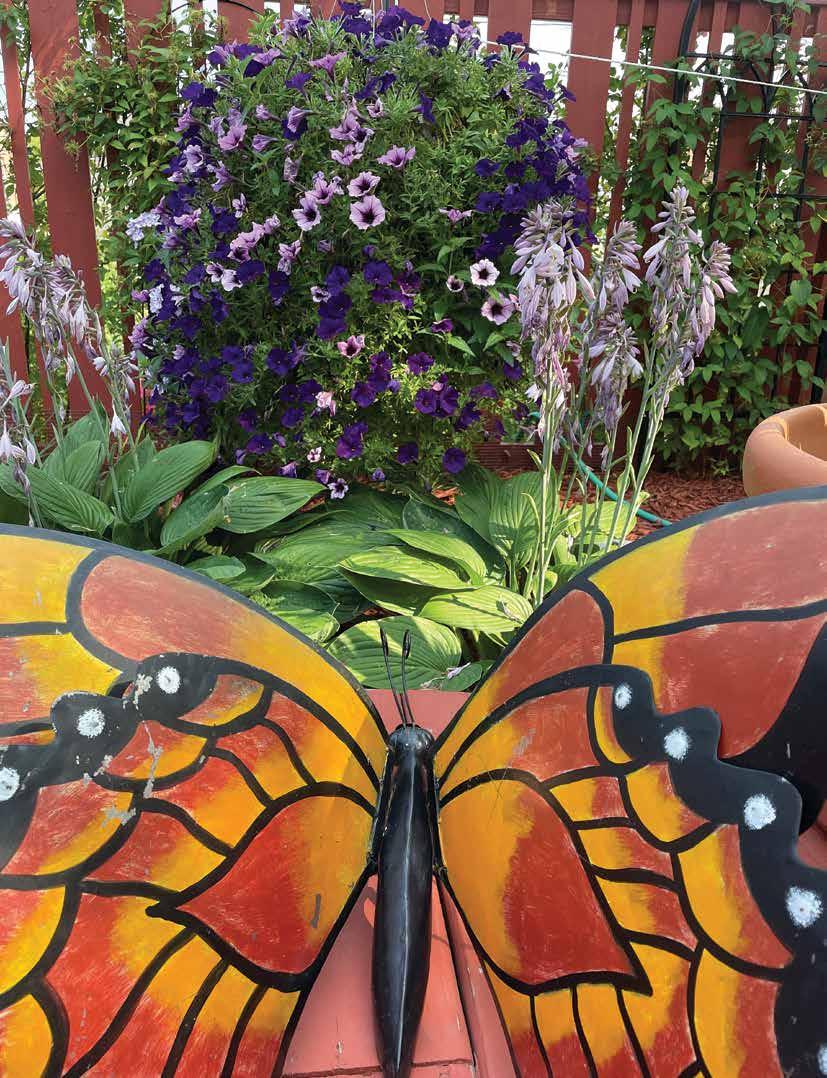
Monarch decor and pollinator plants fill this Duluth garden.
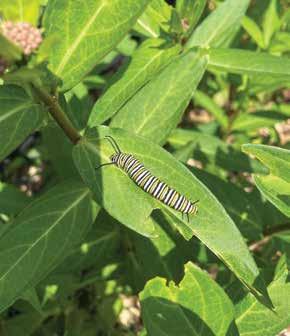
Chemicals in milkweed plants make the monarch caterpillars that munch on them taste bitter, thus deterring predators like birds.
PHOTOS COURTESY OF DULUTH MONARCH BUDDIES
One Duluth yard connects to another Duluth yard, and they connect to other yards.
Add them all up, plant the right kind of flowers and shrubs, and all those front, back, and side yards can provide valuable habitat for monarch butterflies and a host of other pollinators.
That’s the goal of the Duluth Monarch Buddies program, said Cathy Wood, president of the nonprofit organization that works to increase habitat for the distinctive butterflies.
“If we create spaces for pollinators, and if they are linked together, it can make a big difference,” Wood said.


The group has encouraged and fostered milkweed and other pollinator-friendly plantings, called “way stations,” throughout Duluth, including a pollinator demonstration garden along the Lakewalk. This spring, members of Monarch Buddies reached their goal of installing the 100th monarch way station in the city of Duluth.
Almost anyone with a yard can plant flowers and shrubs that are useful for monarchs and other species, Wood said.


“You only have to have a few milkweeds in there,” she said.
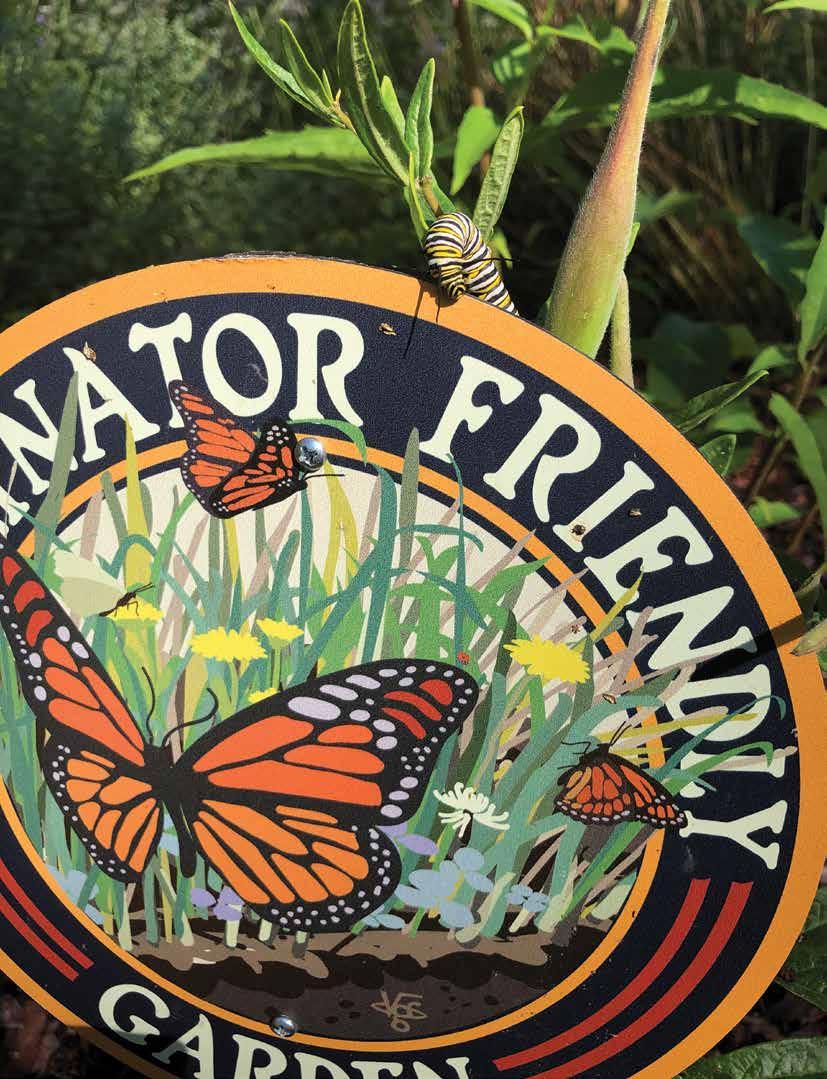
Milkweed plants are crucial to monarchs’ survival, Wood said. While the adult butterflies will sip nectar from many kinds of flowers, a monarch caterpillar eats one food only — milkweed leaves. The plants contain a bitter chemical that makes the monarch caterpillars taste bad, thus protecting them from being eaten by birds and other predators.
Monarchs are found across North America, and historically they could be found feeding on milkweed that grew in fields, prairies and along roadsides. But a lot of that habitat has disappeared, or the milkweed otherwise eradicated. That means the monarch caterpillars simply don’t have enough to eat.
Enter groups like Duluth Monarch Buddies.

Wood has always been a gardener. When she moved to Duluth, she started learning about local plants. She joined the Arrowhead chapter of Wild Ones, which promotes planting native species to benefit and beautify the environment. Learning how to help butterflies in general — and monarchs in particular — was a natural next step.
Continued on page 38


THEWOMANTODAY.COM 37
Cathy Wood is the president of Duluth Monarch Buddies, and loves educating the public about how to help monarchs and other pollinators.
www.campbelllumber.com 3107 Tower Ave. • Superior • 715-394-7721 facebook.com/campbelllumber BUILT TO LAST Hours: M-F 8-5:30 • SAT. 8-3
·Trex ·Azek ·Timber-Tech Decking
Duluth homes that were part of previous Waystation Tours show that pollinator gardens come in many shapes, styles and sizes.
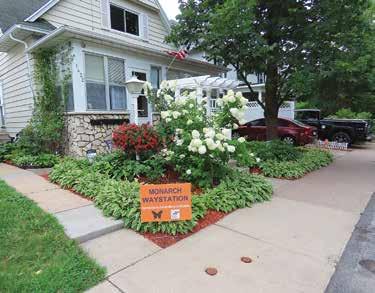
“People might know about monarchs, but they don’t know what to plant,” Wood said.
Don’t worry — Monarch Buddies has plenty of suggestions. Members hand out educational materials about what types of plants monarchs need, and where to find them in the Duluth area. They often distribute free milkweed seeds, and each summer the group puts together a way station tour of pollinator-friendly gardens across the city. The tour usually takes place in August.
“We select new locations every year, and we always include our demonstration garden” on the Lakewalk, Wood said.
To become an official monarch way station, you do have to document the kinds of beneficial plants in your yard, and you do have to include milkweed, but other than that, you can go as big or as small as you’d like, Wood said.
The plants don’t necessarily have to be native to northern Minnesota, but that does help, Wood said. Certain species of
milkweed, like swamp milkweed or whorled milkweed, can survive Minnesota weather, while the tropical milkweed just won’t make it. She noted a word of caution about buying flowering plants from big-box retailers, because they may contain insecticides that are harmful to pollinators. Monarch Buddies maintains a list of local nurseries that grow native plants from seed.
“I tell people, you don’t have to redo your whole yard at once,” she said. “Maybe you have an empty corner, and you put in a bush that blooms. And maybe around the bush, you plant some flowers, and that would be enough for one year.”
And that might be it — or it might be the beginning of a larger pollinator-friendly planting project, Wood said.
Monarch Buddies was founded by retired elementary school teacher Tom Uecker, who was known as “the butterfly guy” thanks to his years of educational programs about monarchs, Wood said.
Uecker is the current vice president of Monarch Buddies, and he has been fascinated with monarchs for about 40 years — long before most people even knew where migrating monarchs spent the winter.
It’s a pretty easy job, getting people excited about and interested in monarchs, he said.
“You don’t find a whole lot of people who don’t like butterflies,” Uecker said, “and there is more interest in monarchs now.”
While the masses and masses of monarch butterflies that once blanketed fields are no longer there, the species is holding on. And more and more people are at least aware of the monarchs’ plight, and are moved to action, Uecker said.
Even before Monarch Buddies was created, Uecker was doing education programs at schools and state parks. He toted along a collection of home-collected and grown monarch eggs, caterpillars, chrysalises and adult butterflies as demonstrations, and even sent chrysalises home for curious visitors to watch as they hatch.
This summer, Uecker will continue his work to encourage more regional churches to let pollinator gardens flourish on their properties. He is involved with the Northeastern Minnesota Synod of Lutheran churches, and 13 more churches are planning to add pollinator habitat to their grounds this summer, he said.
Those gardens will be part of a chain of pollinator habitat across Duluth that keeps on spreading, like a patch of wild milkweed.

“There are so many young families in their first homes, and now they have children, and a yard to plant,” Wood said. “They have so many questions about how to help monarchs, interest is just growing.”
Learn more about Duluth Monarch Buddies at www. duluthmonarchbuddies.org. D
38 July 2023
Janna Goerdt is an Iron Range farmer and freelance writer.
A caterpillar perching on a monarch waystation sign in Duluth demonstrates that if you plant the right flowers, monarchs will find them.
Local Sources of Native Plants
Prairie Restorations 3943 Munger Shaw Road, Cloquet 218-729-9044

borealgreenhouse@prairierest.com
Farm Landē LLC 2709 Doe Road, Duluth 651-587-4466
claire@farmlande.com
Rusty Patch Natives 3904 Reinke Road, Hermantown 218-591-4578
mandyrose525@gmail.com
Shoreview Natives 1185 Shoreview Road, Two Harbors 218-341-5286
shoreviewnatives@gmail.com
Siggy’s Musical Garden and Superior Porchfest:
Spreading joy through music and art

PHOTOS COURTESY OF CHERYL
FINKBEINER
Sometimes all inspiration needs is a tiny seed — such as a chance encounter or a personal connection — for an idea to grow.
For the local nonprofit business known as Siggy’s Musical Garden (which is a concept, rather than a physical place) and its premiere event, Superior Porchfest, the inspiration was a woman named Sigrid Marie Johnson — affectionately known as “Siggy” — and her love of music. Siggy passed away July 1, 2018, at age 97, but her legacy lives on.
Siggy’s appreciation for music inspired an enjoyable summertime event — Superior Porchfest — which has been around since 2020. Porchfest brings neighbors together to enjoy live musical performances in Superior, all summer long. Its motto is: “Spreading joy through music and art.”

Inception

Siggy’s granddaughter, Superior resident Cheryl “Cheri” Finkbeiner, is the founder and executive director for the

organization. She shared that Siggy was a devoted wife and mother. She had three children, and has many grandchildren and great-grandchildren, too. Although she was mostly a homemaker and stay-at-home mom, Siggy also taught in Solon Springs for a time.
“She was someone who made you feel better just by being around her,” Finkbeiner said. “She was very kind-hearted and made everyone feel loved. She also loved music, and she loved having friends. And as her older friends started to pass away, she kept making new, younger friends.”
Finkbeiner explained the history of the event.
“Some friends of mine, including Sarah Jane Hale from the group Similar Dogs, played music for my grandma every year, beginning when she was 93. This continued during her time in hospice. It was pretty life-altering to see the peace that the music brought to my grandmother.
Continued on page 42
THEWOMANTODAY.COM 41
120 E Superior St Coffee Shop/Cafe 2632 W 3rd St Walk-Up Window Open TUES-SAT 6am to 1pm, SUN 7am to 2pm duluthsbestbread.com *WE ALSO OFFER MONTHLY TASTE TESTER SUBSCRIPTIONS! duluthsbestbread.com/taste-tester-box* NOW OPEN SUNDAY
Musicians jam around the fire pit at Billings Park’s Girl Scout Point, which continues to be one of the spots for Superior Porchfest performances.
“Six months after she died, I learned there was a porch festival in Sanford, Florida,” she added. “I researched it and learned about how the event offered free music for the neighborhood. ‘What an interesting concept,’ I thought. I got in contact with Sarah again and asked what she thought about doing something like this here in Superior. ‘Let’s do it,’ she said, ‘in honor of your grandma.’”
Siggy’s Musical Garden
Since the event started in 2020, smack-dab in the middle of the COVID-19 pandemic, it began with “window serenades” for seniors living at elder care facilities. Residents at Villa Marina, Twin Ports Health Center, and Cedar Ridge (where Siggy resided) enjoyed live music performed by Shane Nelson, Similar Dogs, Dance Attic, and Daryl Yankee.
As the pandemic showed signs of retreating, the event expanded to Superior Porchfest, where live musical acts perform for the Superior community from residential porches and a few public venues.
“In our first year, we did some door knocking and left some notes for people whose porches we thought would work,” Finkbeiner said. “We got some nos, but we also got a lot of yeses. Now we do a callout on Facebook every year, looking for porches.”
Superior Porchfest
This summer, Superior Porchfest is taking place from 6-8 p.m. every other Thursday. It started on June 1 and will run through Sept. 7. In total, 20 musical acts will perform on six Thursday evenings on 18 porches located across Superior.
All the music is family friendly, and the event is free to attend. Bubbles, sidewalk chalk and hula hoops are provided for participants.
A special event, called Make Music Day, will also be part of the fun. Visit the Superior Porchfest Facebook page to learn more.
Volunteers
In addition to the many musicians who have contributed
their talents to make the event what it is today, Finkbeiner has rounded up a loyal team of volunteers who serve as the board of directors for Siggy’s Musical Garden. They each have specific committee roles, too.

Current board members include:
• Shauna Porter: president, sign and merchandise coordinator.
• Scott Lillo: music coordinator.
• Matt Osterlund: porch coordinator.
• Melissa Brown: Make Music Day coordinator.
• Charlie Brown: event day coordinator.
• Molly Milroy: social media and grant coordinator.
• Trisha Hecimovich: public relations.
• Tina Johnson: senior living music coordinator.
• Paul Finkbeiner: event day coordinator.
• Corey Scribner: technology.
Additionally, Finkbeiner’s aunt, Jeannie Agni, manages the Siggy’s Musical Garden Facebook page.
Other Support
Financial support has been provided in the form of grants from several organizations, including the city of Superior, Duluth Superior Community Area Foundation, and the Ben and Jeanne Overman Charitable Trust.
“It takes the collaboration of so many people — businesses, homeowners, audiences, musicians, volunteers and sponsors,” Finkbeiner said. “Everyone plays a part. It’s nice that, through these grants, we can provide some income for the musicians.”
Not everyone associated with the group is a skilled musician, though.
“I always say I am in awe of musicians, so I like to do what I can to show they are appreciated,” noted board president Shauna Porter. “I love music, but do not have that skill set. I’m good at running events.
“I love listening to local musicians and watching people pursue their passions,” Porter added. “I am just happy to be part of this organization, spreading joy and music throughout Superior.”
Rewarding
Looking ahead, Finkbeiner has some ambitious goals and dreams in mind.
“I want to continue to grow, and continue getting neighbors out to meet each other,” she said. “I’d also like to do more performances at senior homes, and keep expanding into different neighborhoods.”
This event that honors the beloved Siggy continues touching hearts and making connections all over Superior.
“It’s so rewarding to see people enjoying themselves,” Finkbeiner said. “I really enjoy watching neighbors who have maybe only waved at each other meet and have great conversations.”D
42 July 2023
Andrea Busche is a Duluth freelance writer.
Superior Porchfest provides hula hoops, bubbles and chalk for the audiences to enjoy, like these children did in 2022.

THEWOMANTODAY.COM 43 *WITHAP PR OV ED CREDI T.SEE ST OR E FO R DE TA ILS 0%APR FOR 12MONTHS* ON ALLAPPLIANCE PURCHASES FEATURING 218.722.5803|4258 Haines Road |JohnsonMertzAppliance.com CH EFIN TRAINING BROUGH T TO YO U BY
Embroidered Pillowcases: a unique and personalized gift
 By Molly Milroy
Have you ever wanted to make something special for someone? Have you ever been stuck on a gift to give for a wedding, a birthday or other occasions?
An embroidered pillowcase could be your answer.
Pillowcases are practical gifts, but by adding a personal touch, these embroidered ones make the gift much more meaningful. Throughout the years, I’ve made and gifted these gems as wedding gifts to family and friends, and they still use them today.
Supplies needed
You will need pillowcases, embroidery floss, embroidery ring, needle, pencil and ruler.
What to write
First, decide what you will embroider on the pillowcase. If it’s a wedding gift, I typically choose a Bible verse or a line from a poem that is read during the ceremony. If it’s a birthday or special occasion gift, I go with a favorite saying or term of endearment. For my latest creation, I chose a Scripture verse
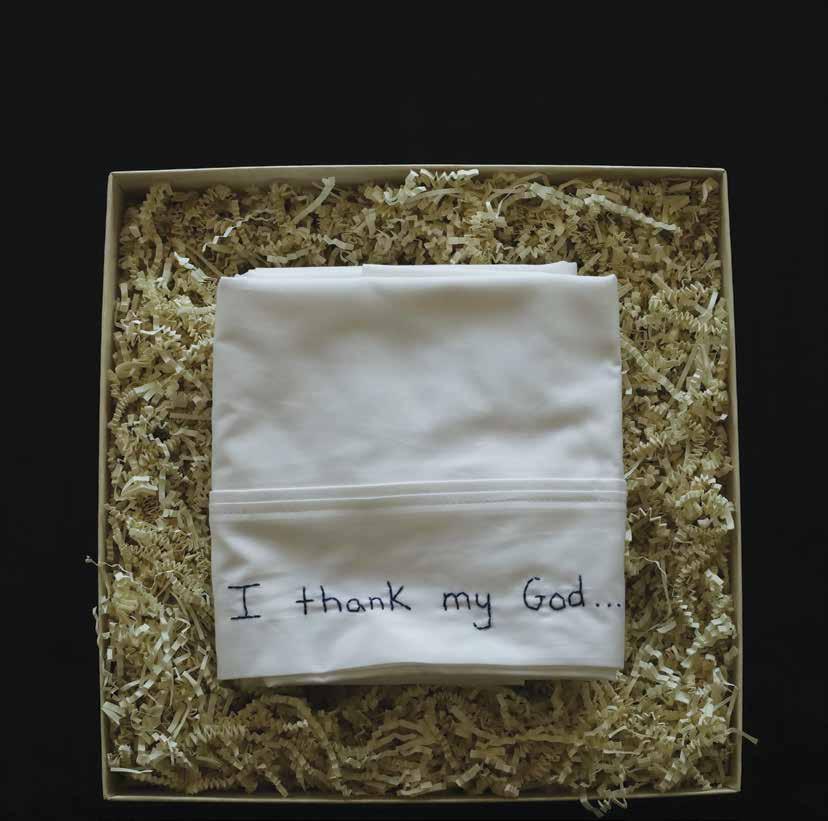
44 July 2023 DIY
PHOTOS BY MOLLY MILROY
from Philippians 1:3, “I thank my God every time I think of you.” I also wrote part of the sentence on one pillowcase and finished it on the other. Another nice touch for a wedding gift is to add the couple’s initials and wedding date. I typically do this on the backside of one of the pillowcases.
Depending on the occasion, how much room you have, and how creative you want to be, you may also choose to embroider a heart, sunshine, smiley face or other picture. Color selection can be chosen for the occasion. For wedding gifts, I use the couple’s wedding colors. For other gifts, you might choose the recipient’s favorite color(s) or pick something you think will look nice.
Prepping the pillowcase
To prep the pillowcases, first iron them so they are crisp and fresh. Next, practice writing out the words on a piece of paper. Experiment with cursive versus printing and different font sizes. Note that it will be easier to embroider larger letters, especially circular ones like “o” and “e” — so factor this in when you determine your font size. Overall, make the letters bigger than usual, as it will give you more space to work with.
Next, position the pillowcase seams to determine which side you will embroider. Then, lightly write the words onto the pillowcase with a pencil and a ruler. Use the ruler to center the words, determine the best spacing and to maintain a straight line. Next, secure the embroidery ring around the first word, making the fabric as tight as possible.
Threading floss embroider
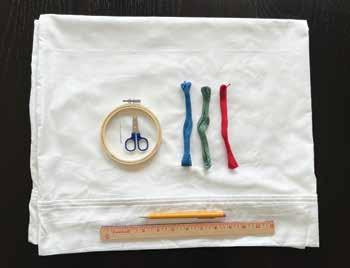
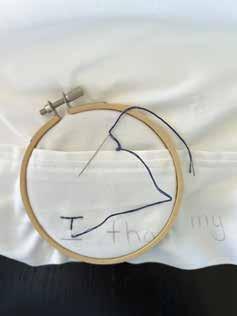
Take the six-strand embroidery floss and cut a section off. I typically work with an arm’s length.
Then pull the six strands apart so you end up with two three-stranded floss. Take one of the three-stranded floss and make a knot at one end. Then thread the floss through the needle.
Beginning on the inside of the pillowcase, thread the needle with floss through the pillowcase, starting at the top of the first letter. Make sure to pull the threaded needle all the way through.

Next, make a small loop back through the pillowcase, pulling it taut. Your threaded needle should now be on the inside of the pillowcase. Now thread through again, weaving the threaded needle back and forth while following the outline of the letter. The closer you make the threads together, the tighter it will look.
Once you are done with one word, thread the needle through the floss on the inside of the pillowcase to make a knot. Do this two or three times to make it secure. Cut the remainder of the floss near the knot, but not too close so that it will come undone. Then begin the process again with the next word.
I typically start and end each word with its own floss as I don’t want the floss to stretch across the blank spaces between the words. When you are finished, iron the pillowcases again and package them in a gift box or bag.
Other options
It’s been a few years since I made an embroidered pillowcase, but I knew it would be a special gift for my nephew’s upcoming nuptials. Since it had been a few years since I made one, there was some trial and error. If it’s your first time, you may want to first practice on a separate pillowcase. You can experiment with different letters, cursive, printing, and different pictures. The more practice you have, the better you’ll become. No matter the outcome, the recipient will be surprised and happy to receive such a unique and personalized gift. D
THEWOMANTODAY.COM 45
Molly Milroy is a Duluth freelance writer.
k i d skorner
By Ali Carlson
Sponsored by:

Is it safe to say summer is finally here??

SLOanE’s Suggestions
We’ve been making the best of the warm sunny days because we know they fly by :)
Sloane says get out and enjoy it and stay up past your bedtime as often as you can!
At the Depot
Museum exhibits
Educational programming. Family events. The St. Louis County Depot is a welcoming space for all. Follow us on social media or visit our website to find all there is to experience inside this wonderous building. ExperienceTheDepot.org or “St. Louis Count Depot” on Facebook & Instagram.

At the Zoo
Feed the Otters!

Wednesday through Sunday from 11:30 a.m. to noon and 3:30-4 p.m. The Zoo is open DAILY from 10 a.m. to 5 p.m.
The Safari Café and Tiger’s Paw Gift Shop are open! Last admission is at 4 p.m.
Let’s Skate
FRIDAY
5:00-8:00 pm*
Super Glow Skate Party!

*Free light stick with each paid admission!!
Fun For All Ages!
8:30-11:00 pm
Adult Night Ages 18+ Only!
College Rate With ID
$8.99 + Rental $9.95 + Rental $8.95 + Rental
At the Aquarium
Great Lakes

Aquarium
Whirligigs
Preschool
This preschool encourages exploration and learning while promoting a deep connection to nature. These one-and-a-half-hour drop-off classes are designed for the 3- to 5-year-old learner. There are multiple days and times to suit your family’s schedule. Classes start in September. Registration opens Aug. 14. www.glaquarium.org/education

46 July 2023
THEWOMANTODAY.COM 47 Brought to you by:
BURGERS STUFFED PIMENTO CHEESE with
 By Kim Quinones The Woman Today
PHOTOS COURTESY OF KIM QUINONES
Pimento Cheese

4 oz. Cream cheese, softened
¼ cup Mayonnaise

¾ cup Sharp cheddar, shredded
¾ cup Sharp white cheddar, shredded
1 oz. Pimentos, diced
1 Tbsp. Chives, dried or fresh snipped thin

3 Green onions, trimmed leaving some green and thinly sliced
Blend all ingredients into softened cream cheese. Cover and chill for 30 minutes.

THEWOMANTODAY.COM 49 It’s GrillinG Time Featuring PREMIUM ANGUS BEEF by Locally sourced MN beef Open 6 a.m. to 11 p.m. every day 1600 Woodland Ave., Duluth 218-728-3665 www.MountRoyalMarket.com
Burger grilling and assembly
2 lbs. Ground Beef 80/20 blend (makes 8 ¼ lb patties = 4 stuffed burgers)
Salt and pepper for seasoning
1. Season beef with salt and pepper and pat out 2 thin patties for each burger
2. Place a 2-tablespoon scoop of pimento cheese in the center of one beef patty, then top with the second patty. Press around the edges to seal.

3. Place on a prepared outdoor grill or indoor grill/grill pan heated to 400 degrees.
4. Grill for 5-8 minutes on each side until the beef has reached an internal temperature of 160 degrees F measured with a food thermometer.
5. Toast up your favorite hamburger bun on the grill, add the stuffed burger and top with preferred toppings such as mayonnaise, lettuce, tomato, pickle and onion. Enjoy!
50 July 2023
GRILLED CUCUMBERS

8 Salad Cucumbers approximately 6’’ long
Olive oil
Aleppo red pepper or a salt free seasoning mix
Slice cucumbers in half lengthwise. Lightly toss in olive oil. Sprinkle with seasoning.
Place cut side down on hot grill for 3-5 minutes; turn over to grill on other side.

ROASTED PEACHES SERVED OVER ICE CREAM

Small- to medium-sized peaches
Olive oil
Wash peaches thoroughly and pat dry. Lightly coat in olive oil. Place whole peaches on hot grill and turn every 2 minutes until all sides show grill marks. Cool and slice.

Top ice cream or your favorite toast, yogurt, oatmeal or cake.
218.728.0884 wholefoods.coop

THEWOMANTODAY.COM 51
Fa rm-to-table su mm er fl avo rhappi ness!
By Abigail Blonigen
Northland servicewomen throughout the years The Woman Yesterday
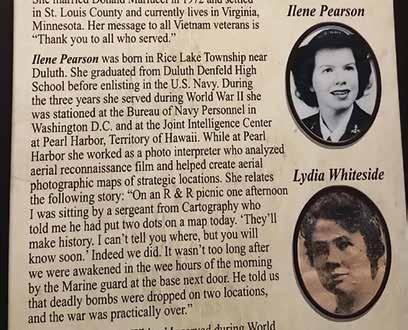
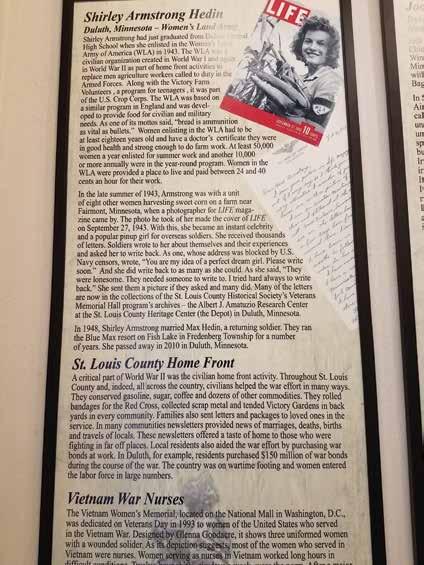
From nursing injured soldiers on the front lines, to studying reconnaissance film or holding down the home front, Northland women have made significant contributions to the United States military throughout recent history. This article offers a glimpse into the stories of six women, whose legacies live on through their service.
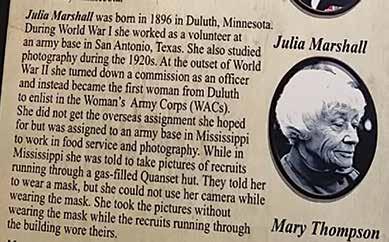
52 July 2023
PHOTOS COURTESY OF THE ST. LOUIS COUNTY HISTORICAL SOCIETY
Lydia Whiteside is noted as the only female Duluth servicewoman to have died during World War I. She served as a nurse on the front lines.
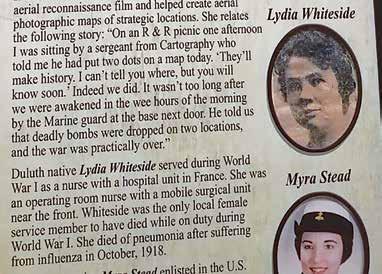
Lydia Whiteside (1884-1918)
Conflict: World War I
Role: Army Nurse Corps
Lydia Whiteside was born in Severn Bridge, Ontario, Canada on Nov. 3, 1884. The family moved to Minnesota in 1887, first to the Ely area, and then to Duluth in about 1901, according to the Duluth Public Library’s Vintage Duluth.
Whiteside attended school in Duluth and then moved to Minneapolis to train as a nurse at Asbury Methodist Hospital. She received her certificate in 1911 and returned to Duluth to live with her family and work as a nurse.
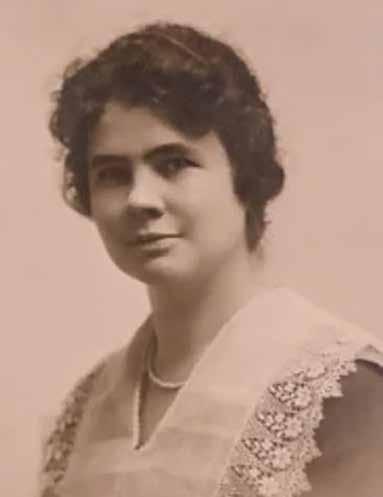
By 1917, World War I had begun and Whiteside signed up for the U.S. Army Nurse Corps. Her unit was first sent to Georgia for training and then to New York to sail to Europe. The unit was stationed in eastern France in the town of Allerey.
According to the Dakota County Historical Society, Whiteside worked as a surgical nurse in a mobile unit close to the front lines. During her time of service, she sent letters to her family which were published in the Duluth News Tribune.
In 1918, Whiteside contracted Spanish influenza, which ran rampant during World War I, accounting for more deaths than the battles themselves. Whiteside’s sickness progressed into pneumonia, which proved to be fatal. She is noted as the only Duluth service woman to have died during World War I, according to the St. Louis County Historical Society’s Veterans Memorial Hall.
Two years after her death, Whiteside’s body was exhumed from France, and she was reburied in Duluth with a full military funeral. An all-female American Legion post named in Whiteside’s honor formed after her death. She is also recognized in a memorial on a Canadian parliament building, commemorating nurses who died in World War I.

THEWOMANTODAY.COM 53
Julia Newell Marshall (1896-1994)
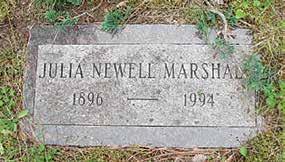
Conflict: World War II
Role: Women’s Army Corps
Julia Newell Marshall was born in Duluth on Feb. 5, 1896. She graduated from a boarding school in New York and later took a cafeteria management class during World War I. This led to a volunteer food service position at an Army base in San Antonio, Texas, according to the St. Louis County Historical Society’s Veterans Memorial Hall.
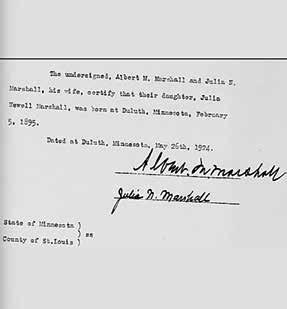
Marshall studied photography in the 1920s and eventually became a photographer in the Women’s Army Corps during World War II. She was the first woman from Duluth to enlist in the WAC, serving at an Army base in Mississippi.
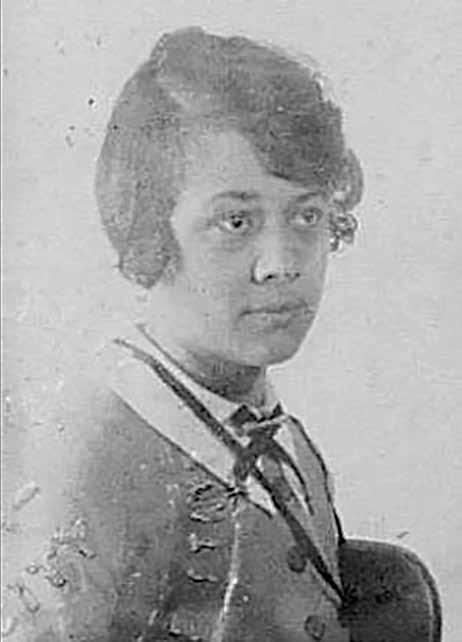
One of her photography assignments during this time was to take photos of recruits running through a Quonset hut that was filled with gas. Marshall was advised to wear a gas mask
like the recruits, but the mask got in the way of her camera, so she opted not to.
After the war, Marshall made significant contributions to the Duluth community. According to blogger Ed Newman, Marshall helped found the Duluth League of Women Voters and the Duluth Art Institute. She was the first woman director of the Duluth Chamber of Commerce, and she directed the St. Louis County Heritage and Arts Center in the Union Depot.
Throughout her life, Marshall was an avid traveler, art collector and watercolor painter. Her paintings and photographs have been exhibited both nationally and internationally. Two of her World War II scrapbooks, including photographs and newspaper clippings, are housed at the University of Minnesota Duluth archives.
Marshall passed away in 1994 at the age of 97. Duluth’s Marshall School and the UMD Performing Arts Center are named after her family.
54 July 2023
Julia Marshall was a photographer in the Women’s Army Corps (WAC) during World War II. She was the first woman from Duluth to enlist in the WAC, serving at an Army base in Mississippi.
Louise Tardiff joined the Army in 1943 during World War II, serving in the hospital unit and rising to the rank of 1st Lieutenant (1LT). She also served in the Korean War, rising to the rank of Captain.
Louise Mary Tardiff (1906-1996)
Conflict: World War II
Role: Army
Louise Mary Tardiff was born May 4, 1906 in Duluth. She graduated from Duluth Central High School and St. Luke’s Hospital School of Nursing, according to the St. Louis County Historical Society’s Veterans Memorial Hall.
Tardiff joined the Army in 1943 during World War II, serving in the hospital unit. By 1944, her rank was first lieutenant. She also served in the Korean War, rising to the
Ilene Cecilia Pearson (1923-2019)
Conflict: World War II, Korean War
Role: Navy, Air Force
Ilene Cecelia “Ailie” Pearson was born May 24, 1923 in Duluth, according to her obituary. She graduated from Denfeld High School and served in both World War II and the Korean War.
Pearson enlisted in the U.S. Navy in 1943 during World War II. According to the St. Louis County Historical Society’s Veterans Memorial Hall, she was stationed both at the Bureau of Naval Personnel in Washington, D.C., and the Joint Intelligence Center near Pearl Harbor.
At Pearl Harbor, she worked as a photo interpreter, reviewing aerial film from the South Pacific. She would select the photos used to create maps of strategic locations for the military. Her rank was yeoman third Class.
During the Korean War, she served as staff sergeant in the Air Force. She retired from the military in 1976 after 22 years of service as a WAVE (Women Accepted for Volunteer Emergency Service) and WAF (Women in the Air Force).
After she retired, she worked as a stenographer in Duluth.
rank of captain.
Tardiff’s four brothers also served during World War II, three in the Army and one in the Navy. Tardiff’s mother was awarded a five-star pin by the Duluth Emblem of Honor Association for having five children in the armed forces.
After leaving the service, Tardiff worked as a registered nurse at the Veterans Hospital in Palo Alto, California. She retired in 1978. Though she spent most of her life in California, Tardiff was born and died in Duluth. She passed away in 1996 at the age of 90.
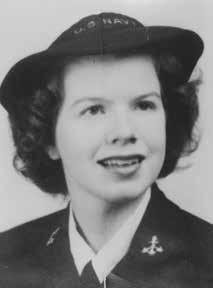
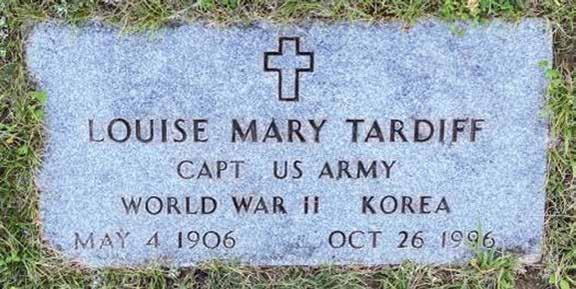
According to her obituary, she loved dogs, travel, family gatherings and bingo. She was a member of The Red Hat Society and the Women’s Air Force Sergeants Group.
Pearson died in 2019 at the age of 96, and is buried at Fort Snelling National Cemetery.

THEWOMANTODAY.COM 55
Ilene Pearson served in both World War II and the Korean War, serving a total of 22 years.
Shirley Lumae Armstrong Hedin (1925-2010)
Conflict: World War II
Role: Women’s Land Army
Shirley Lumae (Armstrong) Hedin was born in Duluth on Dec. 13, 1925. After graduating from Duluth Central High School, she joined the Women’s Land Army, working on a farm in Fairmont, Minnesota.
According to the St. Louis County Historical Society’s Veterans Memorial Hall, the WLA existed to replace the men who left the fields to serve in World War II. About 50,000 women signed up each year for summer work, and 10,000 for the year-round program.
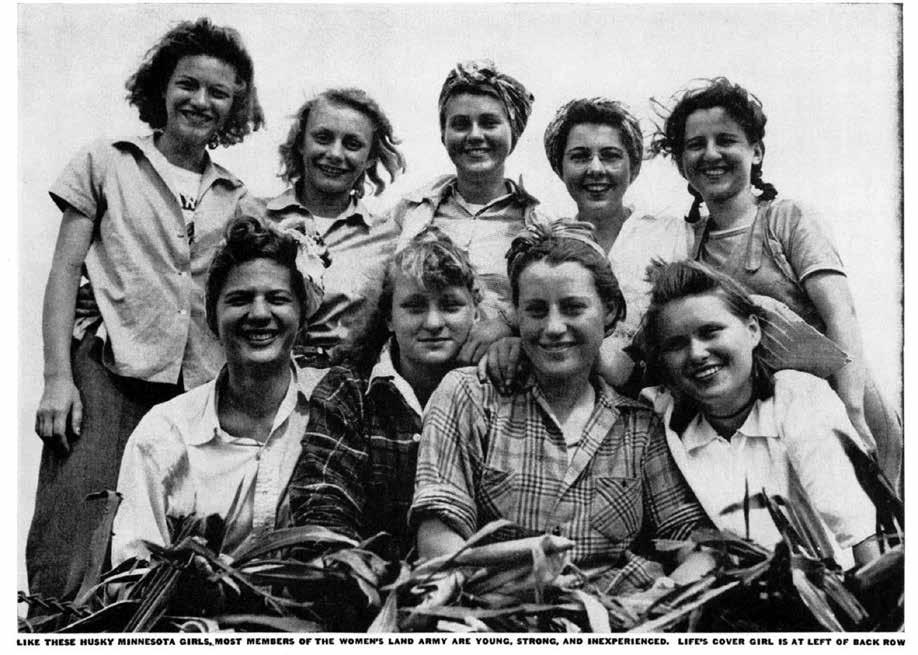
In 1943, a photographer snapped an image of her harvesting corn. This image ended up on the cover of LIFE magazine, and Hedin became an overnight celebrity, especially for soldiers overseas. She was sent thousands of letters and responded to as many as she could. Many of these letters are housed at the Albert J. Amatuzio Research Center, part of the St. Louis County Historical Society’s Veterans Memorial Hall Program.

Hedin married her husband, Max Winfred Hedin, in 1948. He was a U.S. Army Air Corps sergeant in World War II. The couple owned and operated the Blue Max Resort on Fish Lake north of Duluth for many years.
Hedin passed away in 2010 in Duluth.
56 July 2023
Shirley Hedin (back left) joined the Women's Land Army to replace the men who left the fields to serve in World War II.
Shirley Hedin appeared on the cover of LIFE magazine in 1943.the fields to serve in World War II.
support
families of soldiers in the area. Throughout her life, she volunteered with many veterans organizations.
fields to serve in World War II.
LaVeryn Slaughter McKeever (1929-2022)
Conflict: Korean War, Vietnam
Role: Semper Fidelis Club
LaVeryn Slaughter McKeever was born June 5, 1929. She went to Duluth Cathedral High School, where she met her husband, Edward McKeever, according to her obituary. The two eventually had four children.
Edward McKeever was a U.S. Marine, who left home to serve in the Korean War in 1950. While he was overseas, LaVeryn helped create the Semper Fidelis Club to support the families of soldiers in the area. “Semper Fidelis” is Latin for “always faithful” and is the motto of the Marine Corps.
According to an interview with McKeever for the Company B Marines Oral History Project, the Semper Fidelis Club first met in McKeever’s home. When the club outgrew her house, they moved their meetings to the American Legion. The club provided a sense of camaraderie, providing moral support and solace while waiting on family members abroad. Edward McKeever returned in 1951.
McKeever’s son Michael later served as a Marine in Vietnam. He was killed in action in 1968 at the age of 20, according to the St. Louis County Historical Society’s Veterans Memorial Hall.
Throughout her life, McKeever volunteered with veterans, particularly of the Vietnam and Korean wars. According to her obituary, she was involved in the VFW, Disabled American Veterans, Northland Vietnam Vets, Italian-American Club, Cathedral/Marshall Alumni Board, Girl Scouts, Cub Scouts, Boy Scouts, Little League Baseball, and the Altar Society and Benevolent Committee for St. Benedict’s Church.
Her family described her as “feisty, compassionate, and ferociously patriotic.” McKeever passed away in 2022. D
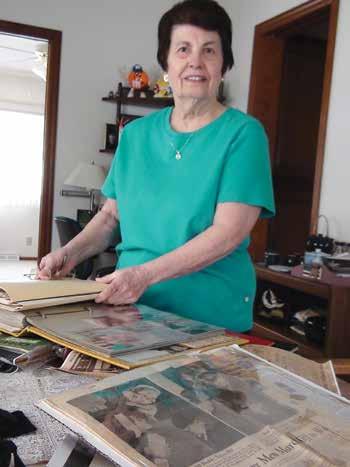
THEWOMANTODAY.COM 57
Abigail Blonigen is a Minnesota freelance writer.
"Warm Welcome Awaits Marine Vets" reads an article from the Duluth News Tribune, August 26, 1951, featuring LaVeryn McKeever. the fields to serve in World War II.
LaVeryn McKeever helped create the Semper Fidelis Club to
the
the
Four members of the Semper Fidelis club -- from left, Pat Grassinger, Helen Pearl, Bamy Pratchios, and LaVeryn McKeever -- look at a letter from abroad. (Source: Duluth News Tribune, 1951)





58 July 2023 MED SPA Be confident in your own skin. COMPLIMENTARY CONSULTATIONS AVAILABLE BOTOX, FILLER & PRP INJECTIONS | WEIGHT LOSS | BODY CONTOURING SKIN TREATMENTS | HAIR REMOVAL & RESTORATION | HORMONE REPLACEMENT 2510 Maple Grove Rd Duluth, MN 55811 218-481-1800 LOCATED AT: SCHEDULE & SHOP: Cannot be combined with any other offer. Filler or Sculptra offer valid now - September 30, 2023. Receive $100 off EACH filler or Sculptra syringe in a single treatment when you mention this ad.




Federally insured by NCUA. Membership Eligibility Required. To learn more about MPECU’s Star Tiered Savings Account call us at 218-336-1800 or scan this code here.