
Mountaineer Summer 2023 • VOLUME 117 • NO. 3 WWW.MOUNTAINEERS.ORG in this issue: Summiting at Seventy The Wonderful Burden of Backcountry Parenting A Paddler’s Guide to Birds of PNW Rocky Coastlines Bikepacking Vancouver Island EXPLORE • LEARN • CONSERVE
tableofcontents
Summer 2023 | Volume 117 | Number3
The Mountaineers enriches the community by helping people explore, conserve, learn about, and enjoy the lands and waters of the Pacific Northwest and beyond.


18 Summiting at Seventy
28 Learning to Backpack as an Adult
38 How to Paint a Mountain Mural
Discover The Mountaineers
If you are thinking of joining, or have joined and aren’t sure where to start, why not set a date to Meet The Mountaineers? Check the Branching Out section of the magazine for times and locations of informational meetings at each of our seven branches.
22 34
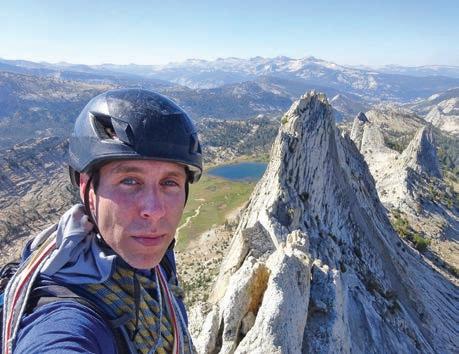
On the cover: Neal Kirby on the summit of Pinnacle Peak, 2022.
Mountaineer uses:
Photo courtesy of Neal Kirby.
AREA CLEAR
Features
22 The Wonderful Burden of Backcountry Parenting
31 A Paddler’s Guide to Birds of PNW Rocky Coastlines
34 Bikepacking Vancouver Island
Columns
Robert
Peak Performance Conquer
You
8 Bookmarks & Staff Picks Dirty Gourmet Plant Power 10 Youth Outside The Intangible Takeaways 12 Outside Insights The Amazing Night Sky 14 Impact Giving Homegrown Expertise and Values-Based Publishing 16 Conservation Currents Engaging Mountaineers Youth in Conservation 33 Global Adventures Shifting Perceptions of Adventure Travel 40 Trail Talk East or West, Which is Best? 42 Retro Rewind A Family’s First Climb of Mt. Rainier, August 1974 44 GoGuide How to Get Involved 50 Did You Know? Responsible Fun in the Sun 28 2 mountaineer | summer 2023
3 Tying In 4 Editor’s Note 5 Reader Feedback 6 Member Highlight
White 7
What Holds
Back
I became a member of The Mountaineers in 2013. Like many new members, I joined to take a course and access other member benefits, but I stuck around because of the community I found and because I believe in supporting the mission of the organization. Since joining, I have engaged with this community in many ways through volunteering for courses, serving on committees, as a donor, and on the Board of Directors. Each new role has given me an opportunity to learn more about The Mountaineers while allowing me to adapt and evolve as a person. Even though I approach new opportunities with the mindset of “what can I give?” the new challenges here have also allowed me to grow as a climber, professionally in my day job, and in my personal life.
During a recent board retreat, we welcomed a facilitator to support board members in developing new skills to help the organization navigate complicated conversations, specifically related to our conservation and advocacy work and engagement with other community groups, indigenous groups, and land managers. Effective conservation and advocacy efforts are about finding common ground among various stakeholders while navigating differences with transparency and respect.
Many of our board members noted that this was the first such training they had ever attended. While commonplace in the nonprofit sector, these types of conversations are often rare in the for-profit sector. This conversation gave us all an opportunity to gain a new perspective on the complicated world of land protection, recreation, and community engagement. We also learned new tools to approach these conversations with understanding, respect, and trust, especially when the perspectives of different groups sometimes diverge. Maybe most importantly, we all came to the conversation with a sense of humility and open-mindedness to learn through the process.
I know this will not be the last of these conversations as the organization begins to implement our new strategic plan, Adventure with Purpose. With this plan, we will lead innovation in outdoor education, engage a vibrant community of outdoor enthusiasts, and advocate on behalf of the natural world. These priorities act as a guide for the organization with roots in our mission, core values, and vision. They will require the entire board to continue to be open to new ways of working, ensuring the organization has what is needed to achieve our mission. And, Adventure with Purpose will support the growth of current and future members who join for many reasons and stay for our vibrant community and lifechanging mission.
The Mountaineers is a nonprofit organization, founded in 1906 and dedicated to the responsible enjoyment and protection of natural areas.
EDITOR
Skye Michel
CONTRIBUTING EDITORS

Kristina Ciari
DESIGNER
Sarah Kulfan, Beans n' Rice
CHIEF EXECUTIVE OFFICER
Tom Vogl
EXECUTIVE PUBLISHER
Tom Helleberg
DEVELOPMENT DIRECTOR
Bri Vanderlinden
PROOFREADERs
Nathalie op de Beeck, Evy Dudey, Issy Steckel
PUBLICIST
Kate Jay
BOARD OF DIRECTORS
OFFICERS
President, Gabe Aeschliman
Vice President, Manisha Powar
VP of Branches, James Henderson
VP of Governance, Roger Mellem
VP of Outdoor Centers, Matt Simerson
Secretary, Carry Porter
Treasurer, Paul Stevenson
DIRECTORS AT LARGE
Serene Chen
Rich Johnston
Brynne Koscianski
Takeo Kuraishi
Maya Magarati
Amanda Piro
Alex Pratt
Sam Sanders
Anita Wilkins
Siana Wong
BRANCH DIRECTORS
Tim Schafermeyer, Bellingham
Matt Vadnal, Everett
Liz McNett Crowl, Foothills
Mark Goodro, Kitsap
Mike Kretzler, Olympia
Brad Near, Seattle
Mark Kerr, Tacoma
YOUTH BOARD REPRESENTATIVES
Serophina Ouyoumjian
Katie Strausz-Clark
Gabe Aeschliman Board President
The Mountaineer (ISSN 0027-2620) is published quarterly by The Mountaineers, 7700 Sand Point Way NE, Seattle, WA 98115. 206-521-6000.
Postmaster: Send address changes to Mountaineer, 7700 Sand Point Way NE, Seattle, WA 98115. Periodicals postage paid at Seattle, WA.
Opinions expressed in articles are those of the authors and do not necessarily represent the views of The Mountaineers.
tying in
mountaineers.org 3
Growing up in the oak woodlands and maritime chaparral of California’s central coast, I sap-stained my share of hiking bottoms and tore through my well-loved Teva straps. I even went an entire summer subjecting my friends to smelly, post-hike pits under the assumption that deodorant was a farce. (For those who don’t know me, I was born without a sense of smell and had no business running such experiments.) Which is to say, I thought I was a fairly outdoorsy person.
Then I moved to Seattle. I was hard-pressed to find someone who wasn’t currently training to summit Rainier or would rather break a sweat than catch up on the latest season of Survivor. The outdoor world bloomed open, and with it, the awareness of how behind I was on shredding proper gnar. I had to learn that “pow” was not a punch, “scramble” was not an egg, and “beta” was not a fish.

In an attempt to Seattle-ize myself, I agreed to join my friends on a 5.8 climb in Leavenworth. But it would be generous to call what I was doing "climbing." My belayer used more strength to pull me up than I used to hold on. (I recently learned that move is called an “assisted dyno”). At a slabby section, my fingers struggled with the unfamiliar, holdless surface. Panicked, I hid my face and let a few tears slip, then confidently yelled to my friends below how much fun I was having.
My performance paid off. That day my friends were convinced that I love climbing, and I discovered that enjoying the outdoors means different things to different people. Sometimes the outdoors is a place of comfort where we return to things

familiar; sometimes it’s a place of courage where we get to test our acting skills. A place of growth, healing, reflection, strength, solace… you name it.
The theme of this edition is “Shifting Perspectives,” inspired by the various ways we engage with the outdoors and how those experiences shape us. We have stories about growing up, growing into ourselves, and growing out of who we were and into someone wiser. In “The Wonderful Burden of Backcountry Parenting,” a new dad confronts his evolving relationship to the backcountry after taking his daughter on her first backpacking trip. In “Learning to Backpack as an Adult,” Dominique Sabins tackles the fears and doubts that come with trying something new. “Summiting at Seventy” explores a recovering alcoholic’s belated introduction to the alpine and what it takes to keep up with other mountaineers in old age, and “Shifting Gears” details an avid bike tourer’s experience entering the new world of bikepacking. We’ve also got a bird guide to identify who you might encounter from an aqueous outdoor perspective, and some artistic advice on how to bring the outdoors into your own home.
Our regular columns stay true to the theme as well. Maureen Seeley teaches us how perceptions of adventure travel have shifted over the years, Craig Romano reflects on the different but equally inspiring beauty that beckons from both coastlines, and Courtenay Schurman coaches readers on how to reframe weaknesses to achieve better training results.
Whether you’re trying something for the first time, or revisiting something with new eyes, I hope this edition inspires you to enter the outdoors with curiosity, open-mindedness, and even some well-earned tears.
 Skye Michel skyem@mountaineers.org
Photo by Eleanor Lewis.
Skye Michel skyem@mountaineers.org
Photo by Eleanor Lewis.
4 mountaineer | summer 2023 editors note
Photo by Tim Nair.
In “A Journey Through Cancer & Resilience,” Kiana Ehsani interviewed Ida Kaller-Vincent about her changing relationship to alpine climbing as a two-time survivor of lung cancer. Our readers were touched by the story.
Ms. Ehsani's remarkable interview with Ms. Ida Kaller-Vincent unexpectedly wandered into deeper waters than "whether recovery from cancer and climbing can coexist." The touching vulnerability of a very strong woman; gratitude even for her diminished abilities; acknowledgement of an uncertain future; refusal to allow herself to be regarded as an inspiration; and her insistence on looking reality straight in the face, come what may, are what the rest of us might consider to be a model of personal heroism and, if you will, of wisdom. Thank you for printing this excellent article.
-Bruce Barcklow, 40-year member
Amazing story.
-Pooria Koleyni, Mountaineer reader
Well said…"what lies at the periphery of possibility” and "Go find your bridges, fall down your sand mounds, scale your frozen buildings.” Who knows where daydreaming can take you?
-Deborah Anderson, 50-year member
In “Changing Climate, Changing Climbs,” Skye Michel explored what recreation may look like in the face of climate change. One reader was inspired by the article's musings.
In “The Perils and Joys of the Backcountry,” Craig Romano reflected on the level of risk and solace offered by backcountry adventuring. Many readers responded with high praise.

"I am writing to express my appreciation for Craig Romano’s article, “The Perils and Joys of the Backcountry,” published in the spring 2023 edition of Mountaineer. Over the years, I have made good use of his wonderful hiking guides and his articles in Mountaineer and Washington Trails magazines. Thus, I am familiar with his excellent, down-to-earth advice and his vast knowledge of hiking throughout the Pacific Northwest. As I sat down to read “The Perils and Joys of the Backcountry,” I was expecting another article with straightforward analysis and advice. Instead, I found my chest tightening with emotion as Mr. Romano described hiking as his “refuge from the craziness of the world.” I was fully on board as he acknowledged that heading out into the wild country always entails risk and that unforeseen danger can threaten even the best prepared. However, what was truly striking about the essay was a weighing of these risks against the perils and “chaos of the front country.” Mr. Romano’s sensitive description of how he feels in these two environments, and why he so often chooses the backcountry, truly struck a chord. I am sure that I am not the only fellow hiker to find their own feelings reflected so eloquently in his words.
-Daphne Fairbairn, 2-year member
Nice article, Craig. It's spot-on.
-Kim Brown, Mountaineer reader

We value feedback from our readers, and we’d like to hear from you! Share your thoughts about Mountaineer magazine at magazine@mountaineers.org.

readerfeedback
mountaineers.org 5
How did you get involved with The Mountaineers?
Originally, I was not involved with The Mountaineers my first three years. Being a person of color who presents white and a disabled veteran, I really didn’t see “myself” being represented within The Mountaineers membership. When I received an invitation to join the Equity & Inclusion (E&I) Working Group, I was hesitant at first. I then remembered my experiences of how outdoor recreation and organizations like The Mountaineers have historically excluded people of color. I felt I had a responsibility to use this opportunity and my white privilege to improve access to the outdoors through The Mountaineers for our Black, Indigenous, People of Color (BIPOC) communities. This eventually led me to apply and join The Mountaineers Equity & Inclusion Committee where I have worked on initiatives to improve our scholarship process, review and update our Land Acknowledgement, and incorporate equity and inclusion principles into the 2023-2028 Mountaineers Strategic Plan.
What motivates you to get outside with us?
The authentic connection and reverence given to the land we recreate on.
What's your favorite Mountaineers memory?
It would have to be when I climbed Sahale Peak last year for the Basic Alpine Climbing Course. Two of my friends, Sam Benefiel and Dave Foong, were on the climb and it was superb to complete my first glacier climb with them. What made the trip even more memorable was Sam being video recorded to The Sound of Music as he twirled in a meadow on the Sahale Arm Trail. Priceless!
Name Robert White
Hometown I was born on Mountain Home Air Force Base and grew up in Okinawa, Germany, and Virginia.
Member Since 2016
Occupation Climate and Equity Planner for FEMA
Favorite Activities Mountaineering, backpacking, and camping

Who/What inspires you?
The nomadic spirit that connects us to the past of the land is what inspires me. Being in the outdoors, I am humbled knowing that in the past, someone was there for their first time as well. I ponder why they were there, what they were doing, and where they were going. In the future, I will get to experience every past climb, backpack, hike, and camping trip again but for the very first time with my daughter.
What does adventure mean to you?
Experiencing life boldly! And stretching myself to the limit of my emotional and/or physical safety.
Lightning round
Smile or game face? Of course, smile! Everyone knows I have a big smile.
We all know about the Ten Essentials. What's your 11th essential? My 11th essential is not a physical object. It is building a spiritual connection to where I recreate and thanking the traditional stewards of that land.
What’s your happy place? Along the Pacific Coast, watching the sunset meet the edge of the ocean. Post-adventure meal of choice? Chicken strips with a Reese’s Peanut Butter Cup Blizzard.
If you could be a rockstar at any outdoor activity overnight, what would it be? Sea kayaking — it involves a whole new level of self-preservation.
Robert exploring the spirit and beauty of the Pacific Northwest.
6 mountaineer | summer 2023 member highlight
Conquer What Holds You Back
By Courtenay Schurman, MS, CSCS, PN2
If now is the year you’re committed to accomplishing a long-pursued goal, you may benefit from reframing your perspective. Start by asking yourself what’s held you back in the past. By critically examining your current levels of fitness, you can achieve better results.
Re-examine challenges
We all face certain challenges. They might include navigating boulder, scree, or talus slopes while carrying a heavy or uneven pack. Or paddling for hours with extended legs in choppy waters. Sleeping on uneven, hard ground. Crouching in awkward belay positions on exposed ledges, or looking up for a long time as a partner climbs. The list is long, and all put different stresses on the body.
Now try viewing these activities through the lens of training needs. What are the aerobic and anaerobic requirements of the trips you’d like to go on? How much upper, core, and lower body strength is needed? Do you have sufficient flexibility? How important is it to have full mobility in all your joints? Rather than letting weaknesses hold you back, focus on what areas you can develop to improve your experience.
Determine what’s lagging
The simplest way to find out where you’re struggling is to do a trial that simulates your target goal. For example, if you’re preparing to go backpacking, hiking, or climbing, walk on a trail similar to the one you’ll be traveling. To prepare for a kayaking trip, pull out your kayak and go paddling. If your goal includes rock climbing, explore the crags or a climbing gym with some friends. For any multi-day adventure, see how you feel doing your activity two days in a row without a rest day.

Afterward, assess how you feel. What was easy? Where did you have difficulty? Then, instead of simply doing more of what was easy, create a plan specifically designed to target your weaknesses.
Shore up weaknesses
If your legs give out going uphill, focus on adding lower body strength training exercises such as step-ups, squats, wall sits, static dips, or lunges. If your arms fail, add upper body strength training exercises including pull-ups, dead hangs, push-ups, and arm work.
If you can hike forever on flat ground but struggle as soon as you put on a backpack, add time on the trail with a loaded pack. If terrain causes difficulty, practice traversing over talus, scree, or uneven ground. And if you hate the thought of being stiff and tight while camping, add flexibility and mobility exercises to your training. If any parts of your body ache, consider adding stretches for the lower back, hips, and shoulders.
Finally, assess your gear. How do your feet feel? If they’re hurting, you may need new boots, or simply more time to get used to the terrain. Did the pack give you any problems? Determine whether you’re loading it evenly, or if you need a better fitting pack. Be sure to introduce any changes (like added pack weight or mileage) gradually to give your body time to adapt.
Make this season count
Always start your plan by thinking of your end goal. Identify the tasks you will need to perform. Think about the positions you’ll be in and for how long. Then, figure out how to include simulations of these activities in your training. By looking at your weaknesses as an opportunity to improve your skills and enhance your adventures, you can design an appropriate program that prepares you to achieve your goals.
Courtenay Schurman is an NSCA-CSCS certified personal trainer, Precision Nutrition Level 2 Certified Nutrition Supercoach, and co-owner of Body Results. She specializes in training outdoor athletes. For more how-to exercises or health and wellness tips, visit her website at www.bodyresults.com or send a question to court@bodyresults.com.
mountaineers.org 7 peak performance
Photo by Will Wade.
Dirty Gourmet Plant Power
Food for Your Outdoor Adventures
By Mai-Yan Kwan, Emily Nielson, and Aimee Trudeau
Turkish Flatbread
sumac, plant-based meat crumbles, tahini
Makes 4 to 5 servings
Cooking time: 15 minutes
TOOLS
• Cutting board
• Knife
• Campfire grill or camp stove
• Medium skillet
• Spatula
• Aluminum foil (optional)
• Tongs (optional)
INGREDIENTS
• 2 tablespoons olive oil, divided
• 1 small yellow onion, finely chopped
• 2 cups (10 ounces) plant-based meat
crumbles
• 2 garlic cloves, minced
• 3 large tomatoes, finely chopped
• 1/2cup roasted red pepper, chopped
• 3 tablespoons chopped flat-leaf parsley
• 1 tablespoon tomato paste
• 1 1/2 teaspoons sumac
• 1 teaspoon paprika
• 1/2 teaspoon ground cumin
• 1/2 teaspoon crushed red pepper flakes
• Salt
• 4 to 5 flatbreads or naan

FOR SERVING
• Tahini
• 1 shallot, thinly sliced
• Toasted pine nuts
• Lemon, sliced in wedges
From the bestselling authors of Dirty Gourmet: Food for Your Outdoor Adventures, comes a brand new cookbook: Dirty Gourmet Plant Power. This cookbook focuses on vegan recipes with a global twist. In the spirit of accessibility, the authors have included snacks and meals that work great for every outdoor adventure: from play dates at the local park and picnics on the beach to urban and day hikes or longer wilderness outings. With details on how to dehydrate your own meals and helpful tips on equipment and basics to keep at hand, Dirty Gourmet Plant Power will have you enjoying scrumptious recipes like White Bean and Artichoke Pressed Sandwiches, Tahini Soba Noodles, and Pumpkin Pecan Pie Iron Waffles wherever you head outside. Enjoy an excerpted recipe for a taste of what Dirty Gourmet Plant Power has to offer.

This recipe is inspired by my husband Daniel’s time living in Berlin, where he would pick up Turkish flatbread (lahmacun) most days for the equivalent of a couple bucks. As part of my research for this recipe, I reached out to my Turkish friend Rengin to get insider information. She shared that this dish is usually made in a large wood-fired oven with a thin layer of spiced meat baked right into the dough. The whole thing is typically topped with lots of fresh leafy greens, tomatoes, and raw red onions. For our campified plant-based version, we kept the rich spiced tomato base and went with shallots for a slightly milder allium. Our addition of tahini and pine nuts is totally nonregulation, but it has Rengin’s approval. —
Mai-Yan
bookmarks
8 mountaineer | summer 2023
DIRECTIONS:
Heat the skillet over medium heat and add 1 tablespoon of oil. Add the onions and cook, stirring occasionally, until they are translucent, about 7 minutes.
Add the meat crumbles, garlic, tomatoes, roasted red peppers, parsley, tomato paste, sumac, paprika, cumin, red pepper flakes, and another tablespoon of oil and mix well. Cook the mixture for 5 minutes, stirring occasionally. Season to taste with salt.
If you want to warm up the flatbread, wrap each separately in foil. Set each individually on the campfire grill out of direct heat or over a low flame on the camp stove for a few minutes.

Place the flatbread on a cutting board and spread about 1/2 cup of spiced crumble mixture all the way to the edges. Cut into quarters and top with tahini, shallot slices, pine nuts, and a squeeze of lemon.
Tip: Frozen crumbles work well for this recipe and will act as an additional ice pack in your cooler.
The Naturalist at Home: Projects for Discovering the Hidden World Around Us
 By Kelly Brenner
Kelly Brenner’s bestselling Nature Obscura came out during the pandemic’s beginning and was a lifeline of joy and curiosity when many were facing uncertainty. Her new book, The Naturalist at Home, encourages us once again to step outside and appreciate the nature around us — no matter where we are. This hands-on book has twenty projects that bridge the gap between sophisticated science experiments and simple nature activities. With a focus on accessibility and conscientiousness, each project asks the reader to slow down and appreciate the smaller moments our natural world offers each day. The nature-curious of every age have something to gain from this book and the projects in it.
The Wanderer: An Alaska Wolf’s Final Journey
 By Tom Walker
Follow Wolf 258, nicknamed “the Wanderer,” as he traverses the Alaskan and Canadian wilds. As part of a research project studying wolves in Alaska’s Yukon-Charley Rivers National Preserve, a GPS collar recorded the Wanderer’s coordinates once a day as he traveled more than 2,700 miles in less than six months. With each leg of this remarkable journey through expansive, rugged, and varied terrain, award-winning author, photographer, and naturalist Tom Walker immerses the reader in the habitat and landscapes that the Wanderer would have encountered. The first book to chart a wolf’s daily movements for such an extended period of time, The Wanderer offers unique insights into this beloved, feared, and mysterious creature.
Day Hiking Central Cascades, 2nd Edition
 By Craig Romano
With some of the largest tracts of wilderness in the Pacific Northwest, the Central Cascades are packed with wildlife, geological diversity, and opportunity for adventure. Using US Highway 2 as its primary organizing principle, this new and improved edition of Day Hiking Central Cascades focuses on the best day hikes to be found between the Sultan Basin and Wenatchee, and around Blewett Pass, Chelan, and the Stehekin and Entiat River Valleys. Compact and full-color, this must-have guide from expert hiker and guidebook author Craig Romano covers everything from leisurely, close-to-home strolls to all-day treks and backpacking spots deep in the Alpine Lakes, Glacier Peak, Henry M. Jackson, and Wild Sky Wilderness areas.
staff picks
mountaineers.org 9
The Intangible Takeaways Reflections from summer camp
 By Tailor Dolgin,
Counselor-in-Training
By Tailor Dolgin,
Counselor-in-Training
Summer is a special season at The Mountaineers. Our program centers and lodges buzz with activity as campers fill the buildings, bringing with them their contagious excitement for making new friends and new connections to the outdoors. When campers, counselors, and counselors-in-training (CITs) come together, they create lasting memories — both blissful and challenging — that shape how they engage with the world around them. Tailor Dolgin, Camps Program Manager, and Maggie O'Shea, CIT, reflect on the growth they've seen and experienced as a part of our Summer Camp Programs.
Hard is not the same as bad
Tailor
Before campers are even out of school, our team of camp staff and CITs begins camp preparations. We attend trainings, hone our climbing skills, pore over handbooks, and play team-building games. This pre-camp preparation becomes the baseline for the summer ahead, allowing staff to build relationships and bond over shared experiences before camp begins. First day of camp anticipation feels like the excitement of a holiday mixed with the nervousness of starting a new job. It’s my second favorite part of the summer.
My favorite part of summer is bearing witness to the resiliency and growth that staff, CITs, and campers experience. Whether it’s a camper being lowered off a climb with a smile on their face despite having cried at the top of the wall, or a staff member confidently leading their first group assembly,
growth is abundant. Our program is tailored toward creating empowering and transformative outdoor experiences for youth. If you know where to look, you’ll often see the same growth in our staff, too.
A camp instructor once shared with me that while working at camp is a lot of fun, it’s easy to forget during the off-season and pre-camp preparations how much mental fortitude is necessary to keep everyone happy, healthy, and safe on a daily basis. In order to provide a great experience for 70 campers during the week, you may end up sacrificing your own happiness or testing your own patience. Occasionally things will get difficult, and you have to move forward with the plan anyway. Sometimes you lead an activity perfectly; sometimes you don’t. And that’s okay. Not every day is going to be easy. Staff and CITs learn this lesson repeatedly throughout the summer.
Our staff mantra at camp is that hard is not the same as bad. This is because our staff accomplish a lot when they learn hard things, like how to enforce consequences for behavior or how to teach climbing commands after only learning them two weeks prior. They develop transferable communication skills, learn self-efficacy, and flex their creative muscles. They discover that they can tackle challenges and have fun doing it. Then they model this willingness to challenge themselves even when the going gets tough for campers, too.
Flexible expectations
Maggie
Before I was born, my parents were Mountaineers members.
10 mountaineer | summer 2023 youthoutside
Camps Program Manager, and Maggie O’Shea,
Maggie O'Shea (right) with campers at the Seattle Program Center. All photos by Mountaineers staff.
They filled every free moment with rock climbing, camping, and hiking. When they took me camping and hiking in the summers, they passed on their love for these activities to me. It was only natural for them to enroll me in an outdoor-based summer camp with The Mountaineers.


I instantly adored all the activities included in The Mountaineers camp weeks, especially the “Water Weeks” since I have always been a swimmer. My fun and heartfelt memories as a camper inspired me to volunteer as a CIT during the summer of 2022 in the hopes of giving incoming campers the same wonderful experiences. I spent a week of summer with the Trailblazers, our six to eight-year-old campers, and enjoyed the challenge of managing their energy and getting to know each camper individually.
One hot day, on a field trip at Alderleaf Wilderness College, the kids were learning wilderness skills. As we began building shelters, a brave Trailblazer stepped deeper into the woods to search for more logs. I heard a loud cry and turned around to see a swarm of bees fly by. They stung two campers and the lead counselor. The staff and CITs, trying to remain calm, escorted the campers out of the woods. As soon as we returned to Alderleaf, we treated everyone who had been stung while redirecting those who had not been stung to the learning center. As a CIT, I quickly realized that to be a valuable leader I had to care for the injured and uninjured campers alike. Although not part of the day’s plan, we incorporated a variety of alternative activities into the remainder of the day, such as visiting a stream, seeing llamas, and picking berries. I was determined to make sure that all campers left camp that day with something positive to take away.
I still think about that day. It taught me the importance of being flexible with my expectations, something I’m still working on. The field trip was a great example of how challenges and roadblocks are inevitable. The maturity the Trailblazers displayed and the capability of the staff and CITs to lead under challenging circumstances continues to inspire me. I am reminded to remain calm when pressure rises and to lead with
flexibility. Above all, I remember to always be proud of myself, even when things don’t go as planned.
Reflection and growth
Tailor
I remember when Maggie and her camp group returned to the Seattle Program Center after their bee encounter; they were all subdued and tired. Rather than talking about what it takes to stay calm in a crisis or participating in our usual end-of-day debrief, the counselors and CITs sat down to decompress. In the immediate aftermath of a hard experience, no one was ready for lessons and takeaways. But the next morning, one of the staff who had been on the field trip asked to talk through what they could have done differently to support the campers. A week later, the staff member who had been stung shared that, as stressful as the moment was, she was glad she could stay calm, be flexible, and rely on the team. Months later, Maggie still reflects on her experience supporting campers through a tough moment and shares what she learned. This process of reflection and growth is what makes the camp experience so valuable.
It’s easy to list off the tangible takeaways that campers, CITs, and counselors learn at camp, like climbing skills and new navigation knowledge which can be quantified and repeated to curious parents or future employers. Intangible growth is a lot harder to explain, and often takes a bit of reflection to be identified. Its impact extends beyond the boundaries of summer.
These moments when we learn that hard is not the same as bad become the camp memories that staff and campers carry forward. While they may not all be the happiest moments of summer, they are often the most fruitful. They stand out in our memories as experiences that help us evolve as we head into the next year. They’re moments we are proud of when the dust settles, and the hard work of the summer is done.
mountaineers.org 11
Kenji McCracken, camp staff, walking with campers to Magnuson Park.
Aly Stobie and Hunter Uhl, camp staff, at Wallace Falls.
The Amazing Night Sky
By Michelle Song, Volunteer Development Manager
Mountaineers spend their days looking down the trail, across the horizon, and toward the peaks. We plan our logistics around daylight, often aiming to avoid pitch darkness. If we find ourselves in nightfall, we may briefly praise the luminous celestial bodies that dot the sky, but typically, our time in the night is temporary. Yet, extending time under the night sky is exactly what Alan Vogt and Keith Krumm encourage. Alan, the Seattle Night Sky Committee Chair, and Keith, a Seattle Night Sky Course instructor, are eager to pique curiosity about the astronomical entities that occupy our night sky.
After years of membership with the Seattle Astronomical Society and the Goldendale Sky Village, Alan and Keith recognized the need for more beginner-friendly, educational platforms to support beginner stargazers. In 2021, with the help of Sabrina Minnick, they created the Seattle Night Sky Committee. Their goal was simple: to teach Mountaineers how to sit back, look up, and admire all that the cosmos has to offer. As Keith shares, they wanted to “provide an opportunity for people to learn more about the night sky, and then go out and experience it,” through telescopes, binoculars, or even eyes alone.
Their enthusiasm for teaching new students stems from spontaneous interactions with strangers and neighbors. Individuals often ask Alan or Keith about what they see while stationed at a public area, like a park, with their equipment. “My favorite part of astronomy is bringing new people into it,” says Alan. At these unexpected encounters, Alan and Keith may point out the Moon, Mars, or Jupiter. Keith shares that when showing individuals celestial objects for the first time, “it’s like a light bulb goes off.” The delight and amazement of
these beginners is what motivates these two astronomers to continue teaching others to enjoy the night sky.
The Night Sky and Astronomy Course

While most activities at The Mountaineers strive to end their trips and field trips before dark, for the Night Sky Committee, everything is done at night. The reason is obvious: after the sun sets you are primed to “see some cool stuff.”
When participating in a night sky activity, your main objective doesn’t have to be stargazing. The joys of the night sky can be integrated into other daytime activities where you can safely remain in your trip location until it becomes dark, like enjoying the evening sky during a backpacking trip. You don’t even need a telescope to enjoy a dark sky. “A good pair of binoculars will open up the skies unbelievably,” explains Alan. In addition to binocular use, students in the Night Sky and Astronomy Course will learn how to operate telescopes, navigate the night sky, and identify nighttime objects, as well as dark sky etiquette and safety. The course field trip occurs at Goldendale Sky Village, the premier dark sky area in the Pacific Northwest, and combines single or multi-night camping with ample observation time and shared astronomy equipment so that students can experience the wonders of an extraordinary night sky.
Even though the committee and course are just getting started, Mountaineers are singing their praises. One student highlighted the generosity experienced on a field trip last year, saying “many other volunteers showed up with telescopes and shared their scopes and knowledge. It was very clearly a large community of generous, enthusiastic folks that created an excited, infectious vibe during the entire course.”
outsideinsights 12 mountaineer | summer 2023
The Tulip Nebula, also known as Sh2-101. All photos by Stephanie Pahl Anderson.
Fostering future night sky enthusiasts
With five years of stargazing experience, Alan admits he still considers himself a “newbie,” but he draws on decades' worth of experience from Keith, Sabrina, and the rest of the committee to elevate course instruction. Keith is happy to oblige. "I love the teaching part," he says. Under their instruction, even common sky sights become unforgettable highlights. Both recall moments of excitement after showing a beginner the Moon or a planet through their telescopes, even from a light-polluted area like Seattle. The chance to exhibit the many facets of the night sky, from the remarkable to the familiar, fuels their mission to educate.
After two years of successful courses, they are excited to reach even more curious Mountaineers as they embark on year three of the Night Sky and Astronomy Course. Their course is especially important since public astronomy classes are scarce in Washington. Most local astronomy classes are offered through college courses, and while Alan and Keith may not be teaching a full-fledged college course, they are keen on expanding their course offerings. “Right now, we're just covering the basics [of astronomy]” Alan shares, “but who knows what we'll do in the future.” Their top goal for this year is to engage even more aspiring night sky enthusiasts to explore, conserve, learn about, and enjoy the lands, waters, and skies of the Pacific Northwest and beyond.
The Seattle Night Sky Committee offers courses in late spring to early summer, with the possibility of fall courses in 2023. If you are interested in a course or joining as a volunteer, visit the Seattle Night Sky at mountaineers.org/seattle-night-sky-committee.

NIGHT SKY LIGHTNING ROUND
Favorite dark sky sites
LEADER PRO TIP: YOUR RISK MANAGEMENT TEAM
When it comes to managing risk, being intentional with your team about decision-making processes can make all the difference. It is easy for individuals to take a step back and defer to the official leader, or to the person with the most experience or loudest voice. But as a leader, your team is often your best resource for managing risk, regardless of their experience. Your job is to empower them to participate in risk management. Our least experienced participants are often the ones who will notice something out of the ordinary, so we must empower every individual to speak up if something feels wrong. An environment of psychological safety will allow all team members to speak up if they notice a personal or group risk that must be addressed.
Psychological safety is an environment in which all participants feel comfortable fully engaging. It empowers participants to speak up with questions or ideas without fear of negative consequences. This is critical to team risk management and has a direct impact on physical safety.
Want to continue expanding your leadership and instruction skills? Check out the Foundations of Leadership, Foundations of Instruction, and Emotional Safety in the Outdoors eLearning Courses.
Alan: Kerry Park - You can’t see the constellations but you can see the planets and the moon really well.
Keith: Bryce Canyon - They have an astronomy festival every June.
Favorite constellations
Alan: The Orion constellation in winter, and Albiero in the summer, a double star system in the constellation Cygnus.
Keith: Mizar and Alcor, a double star system in the Big Dipper constellation.
Favorite stargazing tips for beginners
Alan: Take a trip away from the city’s light pollution. The farther you get from Seattle, the darker the sky is going to be, and the better you're gonna be able to see the stars.
Keith: Download an app called SkySafari.
Bucket list items
Alan: Sunrise at Paradise on Mt. Rainier, as well as Hurricane Ridge.
Keith: The northern lights.
mountaineers.org 13
The Orion Nebula also known as M42.
Homegrown Expertise and Values-Based Publishing
By Mckenzie Campbell Davies, Annual Giving Manager
As an independent nonprofit publisher, one of the goals of Mountaineers Books is to amplify the values of Mountaineers members. The editorial team has a finger on the pulse of our outdoor community and chooses projects that help bring readers to the frontlines of outdoor education.
So when Mountaineers Books Editor in Chief, Kate Rogers, was exploring what kind of technical guide the climbing world needed next, she reached out to Ian Nicholson.
Ian loves climbing. Ever since he first touched rock as a teenager, he has enjoyed exploring and developing routes in the Cascades and beyond. Like many Pacific Northwesterners, he delights in the variety of terrains and technical challenges that the region has to offer.

And, with almost twenty years of IFMGA-certified guiding under his harness, Ian’s truest passion is teaching. He feels lucky to have found a career where he can coach and collaborate with climbers of all levels. He has assisted with half a dozen high-angle rescue situations, and serves on the technical committee of the AMGA, where he interfaces with top guides in the industry using the latest in technology and research.
Having seen his sport transformed by growth and innovation over the decades, Ian was excited to suggest the next climbing self-rescue guide.
“For some trips and techniques, such as glacier travel, you practice most of the skills every time,” Ian explains. “But rock rescue is one of those things that you never know when you’re going to need it. You can probably sketch your way through problems, but if you know and practice the techniques, it can be quick and easy. It’s like a riddle: once you know the answer, it’s obvious.”
Ian had recently volunteered to train Mountaineers climbing trip leaders on problem-solving techniques. Attendees loved the session, but wondered how they were supposed to remember everything. As a climbing instructor and student myself, I feel this need deeply. The sport gives us high stakes situations, extreme limitations on gear, and myriad real-world factors that can send our vertical excursions sideways. The need to study and practice for split-second decisions is of paramount importance.
With the support of Mountaineers Books, Ian began working on the guidebook of his dreams, including rich, step-by-step photo illustrations. His goal isn’t just to create the definitive
impactgiving
Photo by Ian Nicholson.
14 mountaineer | summer 2023
text on self-rescue. He wants to infuse the climbing community with a renewed sense of collaboration and imaginative problem-solving.

“A lot of people learn to climb from a class or a friend, and they never get the chance to check in with what everyone else is doing. Maybe they took their intermediate course a decade ago and have been climbing with the same people since. It’s not like what they’re doing is wrong, but this book is a way for people to check back in to see if there are ways to make it easier or safer.”
Leading through the written word
By writing this book, Ian is stepping into a legacy of leadership that has always been part of our Mountaineers ethos. Take, for example, Mary and Lloyd Anderson, founders of REI. They were among the first graduates of The Mountaineers Climbing Course in 1936 and took copious notes during course activities and their subsequent explorations of the PNW. Before long, their Climber’s Notebook was compiled into a replicable handbook for climbing course students. It toured the fundamentals, from packing lists to piton placement to mountain photography.
“This Climbing Course Outline is an attempt to present mountaineering knowledge in an orderly manner to large numbers of people,” begins the 1940 hand-bound edition. “It represents the effort and accumulated experience of members too numerous to list. It is our hope that it will prove of value to others.” This handbook eventually evolved into Mountaineers Books premiere publication, Mountaineering: The Freedom of the Hills.
It’s been almost 90 years since Mary and Lloyd started scribbling their climbers’ notes, and the spirit of the publishing program has remained true to the trail they broke. Building on their legacy, Mountaineers Books continues to produce new titles by homegrown experts on topics that matter most to me, including urban cycling, wilderness navigation, plantbased backpacking food, and, soon, the latest in climbing selfrescue technique.
Community-supported publishing invests in our future
Leading innovation in outdoor education is broader than documenting knowledge. It’s about preserving the vision of early volunteers like the Andersons. It’s about producing books that emerge from the interests and expertise of our community; books that serve as guides to the natural treasures of our region; and books that help all members become experts in their own right. These are the values that have driven our publishing for the past 63 years and will drive us for another 60 and beyond.
“If Mountaineers Books doesn’t publish these books, who will?” Ian pondered. “Half of the how-to books wouldn’t exist. Climbing has grown a ton, but it’s not totally mainstream. It’s still not baseball.” Throughout the creative process, Ian has felt that he and the publishing team have had the same guiding
light: to create a useful resource for climbers. “They’ve never told me ‘Ian, it needs to be less than 200 pages’ or ‘to sell it for this price we need half as many pictures.’ Instead it’s ‘we know you know what to do.’ There’s no script. It’s nice.”
Like any venture grounded in community and place, this kind of publishing requires support. I personally support Mountaineers Books for the same reasons I invest in local farms: I’m supporting a better system. Local farmers use sustainable methods, pay their growers fairly, minimize carbon footprints, and enrich our local landscapes. Because of community-supported agriculture and other local food resources like farmers markets, more people have access to seasonal, healthy produce, and we reduce our dependence on national food chains. By enjoying a hearty share of our local harvest, I also get to enjoy giving back.
In the same way, when I support Mountaineers Books, I know that the team has cultivated titles that meet the needs and reflect the values of our outdoor community. I can trust that the creators have been compensated fairly for sharing their hardearned knowledge in their own voice. I know that when I crack open the latest title, it will not be written to a cookiecutter template, but authentic with best practices and a local flavor that can’t be beat.
Ian Nicholson’s forthcoming book, Climbing Self-Rescue: Essential Skills, Technical Tips & Improvised Solutions, is scheduled to hit bookshelves, classrooms, and crag bags on January 1, 2024.
MOUNTAINEERS BOOKS LEADS INNOVATION IN OUTDOOR EDUCATION
As an independent nonprofit publisher, Mountaineers Books supports local experts and creators like Ian Nicholson at every stage of a project: ideation, outlining, editing, graphic design, photo selection, print production, promotional events, and distribution to readers and retailers around the world.
Donations to The Mountaineers and Mountaineers Books allow us to rise to our mission potential, lead with our values, and choose projects that matter most to our community. Mountaineers Books publications help more people enjoy the natural world safely and sustainably. For more information, or to make a donation, go to mountaineers.org/books.
mountaineers.org 15
How many national parks are there in Washington?
Why is Washington nicknamed the Evergreen State? When visiting wilderness, what should you take home with you?
If you knew that Washington has three national parks, about half of the state is covered in forests, and you should take home only photos when visiting wilderness, you’re just as conservation-savvy as Mountaineers summer campers, who nailed these questions during a rousing public lands trivia game last August. The excitement among the teams of nine to 12-year-old campers echoed across the Seattle Program Center as they eagerly answered trivia questions about public lands, conservation, wilderness, and fun outdoor facts about Washington.
Creating engaging learning opportunities such as public lands trivia is just one of the ways we’re working to educate youth on the importance of conservation. At The Mountaineers, we introduce young people to the benefits of outdoor recreation because we believe that an early connection to nature gained through outdoor experiences fosters a strong appreciation for the natural world and a commitment to conserving it. We help youth develop a healthy lifestyle and create experiences that improve their outdoor skills, perseverance, self-confidence, and self-reliance.
Our year-round clubs, camps, and other youth programs help young outdoor enthusiasts explore the public lands and waters of Washington State and beyond. Whether it’s climbing at Exit 38, snowshoeing at Lake Easton, or hiking the Hoh River Valley in the Olympics, our youth programs provide the special moments and memories that allow younger Mountaineers to build community and cultivate interest in a life outdoors.
Engaging Mountaineers Youth in Conservation
By Conor Marshall, Advocacy & Engagement Manager
There’s no better time to encourage deep reflection about the natural places youth are experiencing and why it’s important to conserve them.
Talkin’ conservation with Mountaineers youth
While staff and volunteers have informally incorporated conservation education into youth programming over the years, we recently ramped up efforts to show our younger members that conservation knowledge is the 11th essential. Thanks to additional capacity on our conservation team, we began sharing conservation lessons with our Seattle youth clubs and summer camp in the fall of 2021.
These hands-on learning experiences focus on building an understanding of why conservation is important, clarifying the different types of public lands and their varying uses, and making connections with the places youth explore with The Mountaineers. Lessons are typically taught with fun group activities, including creating posters promoting youth members' favorite public lands and playing the "Name that Washington Volcano" game.
Conservation is intertwined with every aspect of outdoor recreation. “It’s just as important to engage youth on conservation and advocacy topics as it is to teach them fundamental skills like Leave No Trace, first aid, and belaying," said former Seattle youth clubs staff member Carl Marrs.
By increasing awareness of public lands, and having some fun along the way, we’re building trail markers to help our younger Mountaineers find that sweet spot where recreation and conservation intersect. Doing this early in their outdoor journey gets them ready for a lifetime of adventure with
 Seattle Nomads on a climbing trip at Mt. Erie.
conservationcurrents 16 mountaineer | summer 2023
purpose. “Learning about conservation and public lands is an important piece of The Mountaineers youth clubs experience,” shared Seattle Mountaineers Adventure Club (MAC) member Malcolm Bryan. “It helps create good stewards of the land and teaches participants important lessons.”
Public lands are Native lands
Part of building a strong conservation ethic is understanding that the public lands where we hike, ski, and climb are also Native lands. During the 2022-23 programming year, we began incorporating lessons about Native peoples of Washington and their ancestral lands into our educational curriculum for Mountaineers youth.
At the November 2022 Seattle Mountaineers Adventure Club meeting, Conservation & Advocacy Director Betsy Robblee led a discussion about the importance of honoring the cultural history of the lands and waters where we recreate. Club members learned about the importance of recreating mindfully and respectfully, and avoiding a culture of conquest over nature — perpetuated through terms such as “first ascents” and “peak bagging” — through educational resources created by tribal governments and Native organizations, including the Snoqualmie Tribe’s Ancestral Lands Movement. One of the ways The Mountaineers is seeking to grow our community’s awareness of Native peoples and their connection to our region’s lands and waters is through the practice of land acknowledgment. Land acknowledgments are brief statements that recognize and respect Indigenous peoples’ historical and
ongoing stewardship of, and connection to, the land. Practicing land acknowledgment is particularly important for The Mountaineers because our trips and activities take place on the ancestral or traditional lands of Native peoples.
Using The Mountaineers organizational land acknowledgment statement as a starting point, MAC members collaborated on how to integrate land acknowledgments into their shared outdoor experiences and brainstormed what a specific statement might look like for our youth clubs. “That lesson was a great reminder that we’re all living in places where Native people lived and are still living today,” said MAC member, Beckett Efta. Following the meeting, MAC began incorporating the following land acknowledgment statement into their club’s trip planning process:
The Mountaineers Adventure Club acknowledges that we recreate on the ancestral lands of the Indigenous peoples of the Pacific Northwest. As we use this land, we wish to be respectful of both the land and its original stewards.
“It’s important to make these conversations part of the consciousness of Mountaineers programs in general, and especially with MAC,” said Seattle MAC parent, Ken Efta. Educating youth about Native lands and land acknowledgment early on sets them up for a lifetime of culturally cognizant and mindful recreation.
By incorporating the practice of land acknowledgment into our programs, we are building a framework for a more meaningful relationship between recreationists and our beloved landscapes. We’re encouraging our community to consider the connections that Indigenous peoples hold to the places we explore together, and inspiring our membership to do more to conserve and steward the Northwest’s lands and waters.
Making conservation connections
Our recent efforts to integrate conservation education into the organization’s Seattle-based youth programs have left many young Mountaineers and their parents interested in public lands and inspired to learn more about the natural world, especially the places where they recreate.
We all have a responsibility to grow our own understanding of conservation and responsible recreation, and encourage others to do the same. So, the next time you’re enjoying the outdoors, consider how the land you’re recreating on has been stewarded by Native peoples since time immemorial. The next time you’re adventuring with a younger outdoor enthusiast, take a moment to ask them a question that could spark a deeper connection and a lifelong interest in the outdoors. Together, we can cultivate future generations of champions for the natural world and the recreation experience.
As we continue to grow our conservation education efforts and reach youth in our Tacoma and Olympia programs, we’re looking for qualified youth leaders to support this work. Those interested in learning more are encouraged to contact conservation@mountaineers.org.

More information on land acknowledgment can be found on our website at mountaineers.org/about/land-acknowledgment. Resources from the Snoqualmie Tribe’s Ancestral Lands Movement can be found at snoqualmietribe.us/snoqualmie-tribe-ancestral-lands-movement.

mountaineers.org 17
Top: Seattle Mountaineers Adventure Club members drafting land acknowledgment statements at a club meeting. Bottom: Seattle summer campers partaking in a lively game of public lands trivia.
SUMMITING AT SEVENTY

A septuagenarian’s dedication to the alpine
Neal Kirby and his sprightly crew were the first to attempt Mt. Baker via Coleman Glacier last season after a washout added nearly ten miles to the climb. Being the first, they had the coveted and grueling responsibility of kick stepping and trail breaking through miles of fresh, untraveled snow. Black Buttes basecamp — their intended resting stop for the night — was just in sight when ominous clouds enveloped the mountain. With the warning flashes of fast-approaching lightning, no one was in the mood to become a hillside’s electrical conductor. They retreated to treeline and set up camp for the night.
The following morning, Neal awoke to the weight of sore legs and an apprehension for the 16 more miles that lay ahead. He was the slowest of the group, which isn’t saying much considering his counterparts — Becky Nielson, Jake Fagerness, and Adam Clarno — were known for their speed. Reluctantly, Neal bowed out of the climb, which was the second alpine climb this group had organized together. Their first was a successful summit of Mt. St. Helens, intentionally postponed so it could take place a few days after Neal’s birthday.
Very few birthday wish lists include summiting a volcano, let alone all of Washington’s five in one season. For those that do, hardly any are made by folks who remember when Manila hemp ropes and oval-shaped steel carabiners were in style. Unless you’re Neal, who, at the age of 70, was on a mission to prove that the alpine still holds a place for old-timers.
A slow journey to the alpine
Watching Neal trudge up the steep slopes of a ridgeline, glissade down a volcano for three miles, or car camp at trailheads to catch a sunrise summit, you might think he was born in the mountains; but surprisingly, he only found a home above treeline nine years ago.
Neal’s exposure to the outdoors took a more do-it-yourself approach than most. Divorced with four children and only a bartending income, his mother, though supportive, didn’t have the finances for outdoor adventuring. So Neal took backcountry education into his own hands. First was downhill skiing. As a teen, he saved enough paper route earnings to purchase his own gear and bus passes to Stevens Pass where he bypassed the cost of lessons, taught himself to ski, and miraculously avoided any broken bones. At the age of 14, an irresistible urge to be outside grew even stronger after his grandmother took him on a road trip to various Utah national parks. The geological novelties and starry skies inspired him to dive deeper into the backcountry. With just a tent, a sleeping bag, and his intuition, he hit the trails. “I didn’t know what the Ten Essentials were at the time,” Neal said. “I’m surprised I survived 30 years of backpacking.”
The outdoors were Neal’s playground, but it took him a while to feel comfortable elevating his adventures from lowland trails to the higher alpine. It wasn’t until after retirement that Neal came to the world of mountaineering through One Step at a
Skye Michel, Associate Communications Manager
18 mountaineer | summer 2023
Neal summiting Wahpenayo Peak in Mt. Rainier National Park. Photo by Steve Thompson. All other photos courtesy of Neal Kirby unless otherwise noted.
Time (OSAT), an organization that connects folks in recovery to a sober community through outdoor activities such as alpine climbing. His first volcanic summit was a graduation climb of Mt. Baker followed by Mt. Rainier, where he and his group were subjected to what Neal described as the coldest time of his life in unpredicted blizzard-like conditions.


Fortunately, Neal has an aptitude for withstanding precarious environments. The cold didn’t scare him off, and the following year he joined The Mountaineers to enroll in our Basic Alpine Climbing Course. It was at this point that he realized how accessible mountaintops are – if you’re willing to take the time to reach them. “Most are just longer, steeper hikes,” Neal said. “I had it in my head that there was something more difficult or mysterious about mountaintops. I didn’t know that’s where I belonged.”
Neal’s experiences in the mountains have changed his life, but he has also discovered that people often value speed as much as they value summits. As Neal’s years increase, so, too, does the difficulty to get accepted onto alpine climbs. Although speed is often quoted as the determining variable for incompatibility, Neal was starting to feel the effects of his age. In the backcountry, it wasn’t difficult to notice that those going a lot faster were also a lot younger. “I was older,” Neal said, “and speed is an issue. So part of the reason why I wanted to summit all five volcanoes at 70 was to show despite my age I could climb, and climb well enough to get all volcanoes done in one summer.”
A need for speed
Since joining The Mountaineers, Neal has served as Olympia Branch Chair, been recognized as a five-year Super Volunteer, and on occasion helps lead and instruct for our Alpine Scrambling and Climbing programs. His feet have tasted more than just Washington’s peaks, including summits of Kilimanjaro, China’s Yellow Mountains, Tasmania’s Acropolis, and Guatemala’s Acatenengo.
Compared to most outdoors people, Neal is by no means a slow climber, but as an older climber, it takes more conditioning to keep up with the youthful Lightning McQueens that populate the mountaineering community. He can’t control his age, but he can control his strength, which is why he developed a thorough training plan that enables him to "enjoy a climb without feeling held back by fitness levels." To avoid the risk of injury that comes with intense training, Neal begins training with mellow hikes and gradually introduces more mileage, pack weight, and elevation until he can complete the 12-mile and 5,000-foot climb of Mt. Elinor. To expand lung capacity and build his diaphragm, Neal swims on his back for an hour with large flippers. To build strength, he does extended stretching at home, and weight lifting and yoga at the gym. “I've never been able to develop a really great speed but I have a good pace,” Neal shared, and what he lacks in timeliness he makes up for in grit. He may not be setting any records, but he wasn’t going to let a pesky thing like age hold him back.
Rising to the challenge
The alpine is not the only place where Neal has had to fight against the odds. As a young boy, he had to navigate family financial instability, abusive older siblings, and dysfunctional parents. Speaking about his childhood, Neal said it was “a lot like being in a chicken coop where everything was just kind of running wild.” After he started working on a farm at age 11, his father would “borrow” his earnings. In his sophomore year of high school, Neal sought foster care, and at the age of 16, he found alcohol and started racking up his fair share
 Climb leader, Carly Gintz, playing ice axe guitar for Neal and the OSAT summit team on Mt. Baker, 2023.
Neal kneeling in front of his mother, age 29, and his seven siblings, born between 1947 and 1959. Photo by Neal's father, Don Kirby.
Neal on the summit of Mt. Kilimanjaro, Thanksgiving Day, 2022.
Climb leader, Carly Gintz, playing ice axe guitar for Neal and the OSAT summit team on Mt. Baker, 2023.
Neal kneeling in front of his mother, age 29, and his seven siblings, born between 1947 and 1959. Photo by Neal's father, Don Kirby.
Neal on the summit of Mt. Kilimanjaro, Thanksgiving Day, 2022.
mountaineers.org 19
of blackouts, muddled memories, and difficult relationships. While some people can drink for years before developing an addiction to alcohol, Neal believes one can inherit alcoholism and dopamine's overreaction to it. It wasn't long before Neal’s drinking was like Russian roulette, not knowing when he might go over the top. “The insane thing about alcoholics is they desperately want to drink normally,” Neal shared. “They try over and over and over again, despite the same disastrous results. It takes hitting a bottom for it to ring through that maybe drinking isn’t working for them.”
What a former alcoholic can teach you about mountaineering
One of the most impactful lessons Neal learned on his path to sobriety was how to manage his reaction to life’s unpredictability. Neal uses the Serenity Prayer as a framework for going through life, which asks people to accept what they can’t control and have the courage to change what they can. It took Neal a while to learn the former, especially as it applied to his personal life. In reaction to childhood family dysfunction and poverty, he controlled finances and nitpicked how a family should operate. “That childhood anxiety just hung over me,” Neal said. “I tried to micromanage everything to be the kind of family I didn’t get when I was growing up, and that didn’t work too well in a marriage.”
The mountains, however, were a wake-up call. A lot can happen that’s beyond your control. Weather can creep in unnoticed, routes become obscured, intended hiking partners have to cancel. While you can’t control the mountain, you can control your response to it. Neal emphasized that in recovery — and in the mountains — you must train yourself not to react to your circumstances in a way that makes matters worse. You must learn how to keep yourself calm, think clearly during stressful situations, and examine not only your needs but the needs of the people around you.
At 31, Neal was arrested for the fourth time. The judge gave him the option of jail time or deferred prosecution. Recently married, he had just started teaching and had a baby on the way. For Neal the choice was obvious. “I had things I cared about that I didn’t want to lose,” he shared. So he accepted deferred prosecution and outpatient treatment. Neal had a breakthrough when he realized that “alcoholism is not how much you drink, what you drink, or how often you drink, but what it does to you when you do drink and whether or not it’s impacting other things you value such as family, finances, work, or education.” With lessons learned through outpatient treatment and the encouragement of fellow recovering alcoholics in support groups, sobriety took hold.
After getting sober and starting his career, Neal poured his heart into fighting systemic discrimination in Washington’s schools and educational finance system. As a child, the classroom had been his refuge from the consequences of alcohol, poverty, and his family’s poor emotional foundation. “But I never forgot my roots,” Neal said, and until retirement he worked hard to provide safe and challenging learning environments to lower-income students. While working as principal, his school achieved “exemplary” academic ratings from the state despite 70% poverty rates. Not afraid of holding truth to power, he became a whistleblower for the theft of Medicaid money by the Centralia School District. Of all his educational accomplishments, he is most proud of founding and chairing the Committee for Levy Equalization, which, over 30 years, secured four billion dollars for poorer schools in Washington. Even before entering the alpine, Neal was overcoming mountains.
Many in the mountaineering community may be obsessed with speed, but that doesn’t keep Neal from hopping on climbs with folks that move at challenging pace. Fortunately, he has found a community of climbers that support his pursuits to test his limits. “The Mountaineers and OSAT give you an ethic in the wilderness of being responsible for each other and helping take care of one another,” Neal said. During a Mountaineers climb of Foss and Pinnacle Peaks last year, Neal worried he was holding the group back. His climbing partners replied that they were simply happy for any opportunity to be outside enjoying the views. Looking back on last summer’s climbs, Neal recalled fondly how attentive Becky, Jake, and Adam were to his needs, checking in and acknowledging his level of improvement throughout the season. “All three of them were very supportive,” Neal shared. “I think they thought it was kind of cool climbing with an old guy on some volcanoes.”
Embracing old age in the mountains
Neal succeeded in summiting all five Washington volcanoes last summer and has now climbed Rainier six times since qualifying for Social Security.
He completed Baker on the Easton Glacier route during a formal OSAT climb. Following that, he summited Rainier on the Emmons route during a formal OSAT climb, and Adams with an informal OSAT group. Although Becky, Jake, and Adam wanted to accompany Neal on his five summits, they were unable to make it work due to inclement weather, conflicting schedules, and all other misalignments that make backcountry planning difficult. They did, however, come together for Neal’s favorite climb: Glacier Peak, during which Neal had to lug 40 pounds over 16 miles and 6,000 feet of elevation gain on the first day. He described the experience

20 mountaineer | summer 2023
Neal (left) with OSAT summit leader, Bill Link, and team on Mt. Rainier, 2023.
as the best climb of his life, and was just six miles short of finishing the 36 mile climb in two days.
This year marks 40 years of sobriety for Neal. As a volunteer leader with OSAT and The Mountaineers, he’s both an inspiration for sobriety and for the possibility of climbing in old age. “A number of older mountaineers have shared that they would have kept climbing bigger peaks but feared holding back the teams,” Neal said. “So I wonder, how many checked themselves out of glaciated climbs too early, and how many would join a climb less focused on speed?”
With his summer-summit bucket list complete, Neal dreams of leading trips for older climbers who might appreciate a little more time to take in the views on their way to the top, such as a five-day climb of Glacier or a four-day climb of Rainier.

Summer Book Sale
Looking
The committed student, he remains dedicated to his training and continues to charge his way into the alpine at any speed. “I feel blessed to be in good health and still able to climb at 70,” he says.
At some point, Neal’s conditioning and strength will also enter the veil of the uncontrollable, and he’ll know when it’s time to bow out of climbing for good. But for now, he continues to hold his place in the alpine. One thing’s for sure; Neal doesn’t shy away from the unknown. Sometimes things go according to plan, and you’re rewarded with bluebird views of a snowcovered valley. And sometimes a washout adds extra mileage to an important climb that you have no choice but to try again later. The mountain will give you what it will, and you have to work with it.
July 2023, In-store only Monday-Friday, 9am-5pm
7700 Sand Point Way NE
Seattle, WA 98115
25% off Books and Maps
25% off Logo Merchandise
35% off Book Bundles
50% off Book “Seconds”
“I had it in my head that there was something more difficult or mysterious about mountaintops. I didn’t know that’s where I belonged.”
Neal en route across the bergschrund from the Emmons Glacier to the Winthop Glacier on Mt. Rainier during an OSAT climb. Photo by Kevin Forsyth.
for more inspiring stories like Neal's?
The Mountaineers
this July to find your next title at 25% off!
Swing by
Bookstore
Photo by Skye Stoury.
mountaineers.org 21
THE WONDERFUL BURDEN OF BACKCOUNTRY PARENTING
By Benja Catton, writer, teacher, and expert diaper changer
Our group erupted in peals of laughter as I smashed the pee-soaked diaper into the boulder with my boot, hoping to squish out some of the water weight. I peeled back the diaper in astonishment. Not a drop of pee had transferred to the rock.
“This should be an ad for their absorbency,” I mused.
I hefted the diaper again — two pounds? — and joined the group laughter with lighthearted trepidation. We were resting in an alpine meadow about four miles into day one of the Wonderland Trail. I was struggling. We had eight miles to go. This was the first diaper change.
“At least she’s hydrated,” my wife Jessie said.
At the car four miles earlier, my brother-in-law required that we weigh our packs. All were heavy, but mine came in at a soul-flattening 64 pounds. That included our 20 pound oneand-a-half-year-old daughter, Maya. Ten days of strenuous hiking lay in front of us to circumnavigate the 93-mile base of Mt. Rainier.
“We just have to play it by ear,” Jessie said. Or hope that an ear infection doesn’t take us out, I thought. Maya beamed through her ever-present pacifier.
“If nothing else, at least we’ve planned a great trip for everyone else,” I replied.
Our first day’s 12 miles from Longmire to South Puyallup was likely to be our hardest. If we were capable of day one’s challenges, we’d be up for the rest, but we were going to get whipped into shape. I shouldered my pack under sunny skies, exchanged high fives, got a “giddy up” out of Maya, and started trudging uphill.
Within five minutes I was soaked in sweat, immediately second guessing every item I’d packed. In less than two miles we smacked into another couple with a baby in tow. They were just as surprised to see us as we were to see them, and they were nearly done with their loop. We stopped to take notes. Jessie and I were aghast at the size of their bags, which looked so light compared to ours.
“Why does she have shoes on?” they asked. “She’s not hiking.” Their kid was barefoot. They looked like they were out for a day hike. “You brought her a sleeping bag? Oh, just stuff her in with you. Formula? Pouches? No way. He’s all breastmilk.”
The cars were just far enough that I’d rather have taken a flogging than return to repack. Jessie, sensing my hesitation, chimed “If your grandparents could do this with four kids in the sixties, we can handle it with one.”
For my dad’s side of the family, the Wonderland Trail is a pilgrimage. My dad first walked around Mt. Rainier in 1963 when
22 mountaineer | summer 2023
(From left to right) Wally Catton, Benja, Anne Guion, and Joey Kotnour hiking Emerald Ridge on day one of the Wonderland Trail. Photo by Jessie Kotnour.
he was three. His family repeated the journey several years later when his younger brother was three. My grandparents, uncles, aunts, cousins, and brothers all made subsequent laps around the mountain, so I was well overdue. To make up for that, I was carting Maya. I loved thinking about the thousands of footsteps taken on the same trail by so many members of my family. I loved knowing that Maya’s tiny feet would leave some prints in the dirt, too.
Field testing our new roles
The first night, we fell into camp desperate to drop our packs. We furiously dug for snacks and started cooking our freezedried backpacker meals. Maya put her tongue out for tentative licks. She nibbled the “lasagna,” but her pallet was more discerning than ours. She insisted on instant oatmeal. After dinner, we braced ourselves for bedtime. Maya can make a ruckus protesting sleep. Weeks earlier, we’d taken her on an overnight trip in anticipation of this adventure. She was thrilled by the tent, treating it like a bounce house and performing countless body slams on the soft pads and sleeping bags. When we tried to sleep, she wailed for hours, so I resolved to do some training. I set up our tent in her bedroom and slept in it with her during naps and overnight. We normalized it, and now was the test. I had her stuffed sloth, Sleepy Joe, at the ready, as well as two slim books and a few backup pacifiers. These items contributed some “luxury” pounds that I’m sure the lightweight parents weren’t carrying, but they were worth the higher probability of a smooth bedtime.
Thanks to the training — or perhaps the long day in the sun — Maya only fussed a little. “Maybe our lives aren’t over,” I said. Jessie nodded with eyes closed.
Jessie and I had met climbing and forged our relationship in the mountains; having a child was challenging our ability to do big adventures together. This trip was a test of what our relationship could look like moving forward. Were big trips


still possible? Would we get stuck with a tag team lifestyle, never sharing big outings as a couple? Would it be rewarding to trade the weight of a rope and cams for diapers and toddler food? Or were we forcing this trip and dragging our family, friends, and daughter through it with us?
Resupplying on parental influence and junk food
On our second day, Maya enjoyed her first skinny-dip in St. Andrews Lake’s shallow, crystalline water and discovered huckleberry picking. She wobbled around with a cooking pot in hand as she picked berries. Her face and fingers turned purple, but the pot stayed empty.
“How’s Maya’s berry diet going to impact your diaper rationing?” my brother joked. I hoped it wouldn’t.
Day three included our first sobering challenge, beyond the berry-laden diapers anyhow. As we came upon South Mowich River, our hearts sank. Heavy rains days earlier had pushed the glacial river to jump its banks and form new channels, washing out the bridges and rendering it impassable. A trail crew was working on the last section of a new bridge and preventing folks from crossing until the handrail was complete. Our options were to ford the river elsewhere, or wait indefinitely for the crew to finish. The churning, silty river was thigh-deep and moving fast. With Maya on my back, I couldn’t risk falling in. We chose to wait.
mountaineers.org 23
Top left: Maya, Benja, and Jessie descending toward White River Campground on day eight. Photo by JD Kohchar. Top right: A group rest at Skyscraper Pass on day seven. (From left to right) Arturo Commando, Noah Burgess, Wally Catton, Jessie Kotnour, Benja, Maya, Anne Guion, Joey Kotnour, and JD Kohchar. Photo by JD Kohchar. Bottom: Jessie, Benja, and Maya on the eighth day of their trek, between Berkeley Park and White River Campground. Photo by Joey Kotnour.
Eventually, the crew softened to the idea of us guinea-pigging the bridge — a single log — without the handrail since we had “special cargo.” As I took my first steps over the river, water leapt up at the center of the log. I stayed focused on the feel of my feet while keeping my gaze at the log’s end. If I slipped, I hoped to fall on the log in a bear hug, preventing Maya from getting soaked, or worse, hurt. With one foot in front of the other, I slowly made it across.
After surviving the river crossing and a drizzly night at South Mowich River, we made our way to Mowich Lake Trailhead to enjoy our first resupply and a reunion with my dad. In preparation for the hike, everyone had sent buckets of supplies to the ranger stations we’d encounter at the trailheads. We cracked open our resupply buckets — including beer, potato chips, candy, and pastries — and devoured the junk food smorgasbord. Another friend met us with pizza, cheesecake, and more beer. We indulged shamelessly.
Jessie and I took the opportunity to stash a number of things — like Sleepy Joe the sloth — in my dad’s car. Our packs were heavy again, but this time with more food than dirty diapers. Maya tramped around with her purple hands and empty cooking pot. My dad trailed as her shadow, grinning at our madness and her simple joy. Three generations of Wonderland pilgrims, I thought.
I was eager to have my dad with us, and to be both an imparter and a receiver in the bestowing of connection to this trail. I imagined him running around this campground as a toddler while my grandparents shuffled gear. I wondered if glimmers of his childhood were resurfacing as he followed her curious impulses.
Maya finds Wonderland
When it was time to head for the next campsite, we reshouldered our packs feeling worse instead of better. The feast was overkill, but the food coma burned off with the clouds, and we made it through 4,400 feet of elevation gain to Ipsut Creek Campground without vomiting. The campsites sat under towering false cypress. Maya and I wandered around with our
necks craned, staring into the steaming canopy. We reached our hands up as tall as we could and stared in quiet wonder.
Fortunately, the sun was out the next day. Riding its plucky, uplifting thermals, we leap-frogged one another through see-sawing bouts of verve and fatigue. We took quick dips in Mystic Lake then basked in alpine sunshine. Tiny ants found Maya’s snack crumbs. She was fascinated.
That evening, Maya stole our friend’s trekking poles, asked for them to be shortened, then marched through camp asking each of us, “Will you hike with me?” She would only drop them to pick huckleberries.


The trail as a rite of passage
The following few days were unglamorous. We spilled over the edges of White River Campground’s group site and nauseated our neighbors discarding stomach-churning diapers. Mist and rain swallowed us at Indian Bar, and our tent felt considerably smaller with our wet gear inside. Maya was irritated that we weren’t outside playing.
We started the ninth morning drying our gear beneath a creekside rock shelter. A keen awareness that we were closing the loop crept over our group. For a brief moment we shared the shelter with twin girls who were headed to college after their trip around the mountain. They’d spent their whole lives together, and intentionally chose different colleges to build independent identities. They were using this adventure as a rite of passage to mark the closing of their shared childhood. Similarly, my grandparents knitted the Wonderland Trail into significant markers in their lives. They hiked it as a family of four, then five. They completed the loop with their grandkids. For their fortieth anniversary, they made the loop in three installments, and their sons’ families shared the experience by waiting at trailhead campgrounds with hot food and ice cream. Two of my uncles went around to celebrate one’s recovery from cancer. For them, and now I could say for us, it was a place of connection and reflection.
My family isn’t religious, but I couldn’t help myself from drawing verbal comparisons to pushing a giant prayer wheel
24 mountaineer | summer 2023
Maya picking berries near Mystic Lake on day five. Photo by Jessie Kotnour. The Catton family's first trip around the Wonderland Trail in 1963. (From left to right) William, Steve, Ted (3 years old), Philip, and Nancy. Photo by William Catton.
or completing a hajj. I’d been a father for over a year and each day was a joy, but these were ten of the best days of my life. Maya and I were a two-headed parade of awe, extensions of each other’s sensory processing. We moved as one, looked as one, exclaimed as one. I picked huckleberries and passed them over my shoulder so that I could hear her say, “Yummm.” What rite of passage was I performing?
Closing the loop
Our final day was a whopper: 17.8 miles and 4,000 feet of gain from Olallie Creek to Longmire. The magnetic forces of success, pizza, and beer awaiting us at the finish line were in our favor. We started early. Blue skies returned and lightened our steps. We ate lunch on the shores of Reflection Lake. Snow-white clouds and glaciers dissolved into one another in the sky and on the lake’s surface. It was difficult to define the mountain. Physically, its edges can blur in white; its ridges can run to city, sound, and soul. Its importance to my family’s identity runs deeper than the ubiquitous Tahoma photos speckling our home decor. We passed Cougar Rock Campground, a fixture in my childhood memories of camping with my grandparents. A flash from one of my grandfather’s impromptu naturalist lectures played out in my mind’s eye — he was explaining “nurse logs,” or how older species of trees can provide a foundation for their kin to thrive. I smiled at the irony in this memory as I thought back to what my grandparents had nursed for me, and what we were nursing for Maya.
As we neared the final stretch, Jessie, Maya, and I were at the back of the pack. We could see friends and family waiting on us at the end of the trail — or on Maya, really. Maya keyed into the significance of the moment and requested to hike.

I removed her from my back and she walked the final mileand-a-half holding her uncle and aunt's hands. In the last 100 yards, we began cheering. Maya stopped hiking and started clapping, looking around at her parents, uncles, and aunts. We walked another ten yards. Maya stopped again and initiated another applause. We clapped and cheered and danced. We did this a half-dozen more times before reaching the cars, and did it again there. We had accomplished our trip, and enjoyed it tremendously. Jessie and I hugged in joy and relief. We could live adventurously without killing our one-and-a-half-year-old.
The sapling meets her nurse log
Our summer trip would conclude with a visit to my nonagenarian grandmother, Nana. My grandparents’ adventurous example was the genesis for our trip, and we couldn’t wait to share our photos and stories. Most importantly, we were excited to introduce her to Maya.

Before meeting Nana, we spent a few days in a hotel awaiting negative COVID test results. Our room was dressed in vintage wallpaper, and Maya kept wandering to the walls to touch them. I eventually came over to see what she was up to and realized she was pretending to pick the berries in the floral pattern. I grinned with satisfaction. Her fondness for the outdoors was lingering; we’d achieved something.
Nana and Maya clicked. At ninety-two years old, Nana was still up for a hike in the city’s forested Lithia Park, and Maya toddled around, holding her hand. We shared photos on our laptop and Nana picked out landmarks from the Wonderland Trail unprompted. Her deep connection to the mountain was also long-lasting. Then, we set up her projector and found a carousel of slides that included the 1963 trip, my dad’s first pilgrimage around Mt. Rainier. I watched Maya become absorbed in the beam of light and the whir of an ancient slide projector from Nana’s lap. Our steps around the mountain had connected these generations, and I found part of myself somewhere in between.
Post-Wonderland Trail first introductions between Maya and Nana. Photo by Benja Catton.
mountaineers.org 25
Benja and Jessie helping Maya hike the trail. Photo by JD Kohchar.

"Before the deed comes the thought. Before the achievement comes the dream. Every mountain we climb, we first climb in our mind."
–Royal Robbins
 Climbers on Mt. Shuksan.
Photo by Nate Derrick.
Climbers on Mt. Shuksan.
Photo by Nate Derrick.
LEARNING TO BACKPACK AS AN ADULT
By Dominique Sabins, writer and outdoor enthusiast
As a San Francisco-born and raised city girl, I used to dread backpacking. My love of the outdoors inspired me to move to the Pacific Northwest in 2016, but backpacking remained a beast I feared to tackle.

After having car camped and day hiked for three years, backpacking began to pique my interest. I wanted to explore the more untouched Pacific Northwest wilderness and step outside my comfort zone. So, last summer, I gathered the Ten Essentials and embarked on my first backpacking trip: Seven Lakes Basin in Olympic National Park.
Preparing for the trail
To prepare for my expedition, I closely studied the trail. Seven Lakes Basin clocks in at roughly 20 miles — depending on how much you explore around the lakes — and includes about 5,120 feet of elevation gain. I knew that the elevation would be the hardest part for me, so I started training six months before my trip and made elevation acclimation my top priority.
My backpacking partner and I intended to cover over 3,000 feet of elevation in only six miles during the first day. To practice and build strength, I set my sights on day hikes that had comparable elevation gains. My training location of
choice was Mt. Si, just outside of North Bend. Its climbs were even steeper than the trail I would be doing for my trip, and I figured that training somewhere more difficult would boost my confidence.
To practice carrying a heavy backpack uphill, I filled my dayhiking pack with extra weight by using gallon jugs of water. If I found myself too exhausted on a training hike, I could lighten my pack by dumping out some water and finishing the trail. As time went on, I gradually increased the aMt. of water until I reached my desired pack weight.
Persevering through defeat
My first training session was not a success.
Mt. Si begins with an immediate uphill climb and endless switchbacks. I was carrying around 20 pounds in my pack — something I had never tried before — and couldn’t make it to the end of the trail. After about two hours of non-stop elevation gain, I collapsed on a nearby bench. My legs were shaking and I was completely out of energy. About halfway up, I turned around.
This first failure left me deflated. I was consumed with the anxiety that I wouldn’t be able to build the conditioning to complete my backpacking trip. As I drove home, fears swarmed
28 mountaineer | summer 2023
Dominique enjoying the view of Mt. Olympus. All photos courtesy of Dominique Sabins.
my mind. I could see myself attempting the Seven Lakes Basin and giving up before the finish line. I continued to train, but the fear of being defeated by the trail stuck with me. My second attempt was unsuccessful, too. Halfway through, I released some weight out of my bag in an attempt to reach the summit. But even then, my feet hurt with every step. I stopped frequently to catch my breath, and my shoulders ached under the weight of my pack. I turned around before reaching the top.
On my third attempt at Mt. Si, I finally summited. As I hiked uphill, I felt the usual pains in my feet and shoulders, but my outlook was different. I had attempted the trail twice at this point, so I knew what to expect. I took breaks frequently, drank plenty of water, and kept my pace slow and even. As I stood at the top of Mt. Si and looked at the valley below, I felt for the first time that I had a chance of actually completing a backpacking trip.
Gathering gear and beta
I kept hiking Mt. Si, adding slightly more weight each time, until I got to 40 pounds. I knew this was more weight than I would need, but it helped my confidence grow. I wanted to push myself and shake off the lingering fear of not being able to reach my goal.
There were others fears, too, that clouded my mind. I worried about animals, inclement weather, and unforeseen dangers that might cross my path. To tackle this fear, I studied the trail extensively and sought out stories from other backpackers who had recently completed Seven Lakes Basin. I noted their suggestions about the trail conditions, weather, and wildlife they saw along their journey. I wanted to avoid any unwanted surprises.
Next came the gear. I had acquired all of it, but wanted to make sure I knew how to use everything correctly, so I started bringing my backpacking gear on weekend car camping trips. The equipment required for backpacking can be overwhelming, and adding additional gear to an already packed camping car can be challenging. Still, I found it incredibly useful to
familiarize myself with my equipment. Getting acquainted with my bag helped a lot. I learned how to pack and adjust the straps to distribute the weight and organize the contents to easily access food, clothes, and water. I also practiced deflating and repacking my sleeping pad, which resisted but eventually fit back in its sack. The sleeping pad provided much more insulation than I anticipated, so I learned to avoid overheating at night by layering appropriately. This ultimately saved me pack space.
Putting training into action
On the morning we left for Seven Lakes Basin, I woke up early to make breakfast and ensure I had everything I needed. I was eager to prove I could complete this hike, and worried about what would happen if I couldn’t. I started the trail feeling nervous.

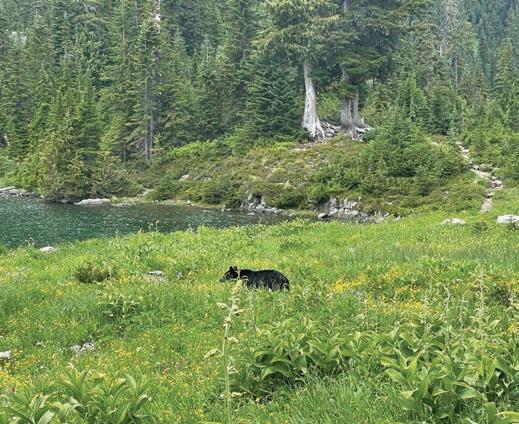
The trail started flat, but quickly steepened into switchbacks under heavy forests. The climb felt strenuous at first. My pack weighed on my shoulders as my feet slowly acclimated to the steady incline. I kept my head down and focused on maintaining a steady pace. But shortly after the second mile, the tension in my body faded. The beauty of my surroundings distracted me from the difficulty of the climb.
Before I knew it we were on the ridgeline, staring down at the valley we had started climbing only a few hours earlier. Vibrant wildflowers covered the trail. Snow-dusted peaks and hidden glaciers sparkled in front of us. In the valley below we could spot lakes, meadows, and even the occasional black-tailed
mountaineers.org 29
A black bear grazing on wildflowers near the campsite.
Dominique and her partner on day two of their backpacking trip.
deer grazing. I even opted to take a detour, adding a few extra hundred feet of elevation gain. When we reached the ridge’s highest peak, we were greeted by views of Mt. Olympus, which dominated the sky line. Its peaks were covered in thick beds of snow. To the left, Blue Glacier curved down the mountain like a pathway that perfectly reflected the clear-blue sky. Although exhausted, I felt energized by the surrounding landscape. The pictures I had seen on trip reports couldn’t compare to the first-hand experience, and the fears I had throughout my training dissipated.
As we descended the ridge to our campsite, we saw several black spots throughout the meadow below, and as we got closer, we realized these spots were black bears. The old me of only a few months earlier would have been terrified. But thanks to my research, I knew black bears were extremely common in this area, and I was equipped with appropriate knowledge. I knew we could handle the situation safely by traveling in a group — which we were doing — carrying bear spray, and making soft noises to let the bears know of our presence. Armed with these safety tips, I enjoyed watching the bears from a respectful distance as they ate flowers and dipped in the water.
Cultivating confidence through new experiences
We traversed 11 more miles the next day, despite aching feet and sore muscles. The last third of the trail wandered through old forest growth so thick we could no longer see the sky.

We wove our way between flowing creeks and ancient trees covered in moss. I won’t lie, I was pretty beat, but I was filled with so much pride that I had made it this far.
I had spent months fearing that I would be underprepared or unable to finish the hike. Yet there I was: sore, but confidently taking one step after another. At the last mile, I turned to my partner and bet him I could beat him to the finish line — and I did. By backpacking the Seven Lakes Basin, I plunged into the unknown and came away with a sense of confidence. I allowed myself to be a beginner and accepted failure until I persevered. This kind of acceptance comes fairly naturally to children. But as adults, this growth mindset can be a harder lesson to learn. It's challenging to fail at something, and even harder to pick yourself back up and try again. But now that I have succeeded at backpacking, my mind feels free to wonder what else I can achieve. I’m looking at snowboarding and rock climbing next, but this time around, I’ll be taking the learning curve with a smile and the initial failures with a hearty laugh.
Dominique’s tips for tackling your first backpacking trip
•Identify your areas of improvement and train accordingly. These areas could be conditioning for elevation gain, getting accustomed to heavier pack weight, or learning how to use your gear appropriately.
•Set reasonable goals. Don’t try to accomplish too much on your first trip. If you are new to backpacking, start with a single night backpacking trip that covers fewer than five miles each way and less than 1,000 feet of elevation gain.
•Study your route. Know how much elevation you will be covering within a given mileage, where your water sources are, what wildlife you may encounter, and what the trail conditions are like. The Mountaineers has great trail details on their Routes & Places webpage, as well as recent trip reports completed by hikers.
•Research gear and use it before your trip. If it’s adding weight to your pack, you should know how to use it. And don’t forget, there’s no shame in practicing how to pitch a tent in your backyard.
•Don’t be afraid to mess up. It's all part of the process. Messing up is how you learn what works for you and what doesn’t.
•Lean on your community for advice and support. It can be hard to ask for help, but that’s what your Mountaineers community is there for, and they are learning from experience just like you.
•Have fun and immerse yourself in nature. This is the primary goal of backpacking — don’t lose sight of the wonder and excitement of the outdoors! Not everyone gets to climb 3,000 feet to a gorgeous overlook, watch bears and elk forage in their habitats, or walk a path among mountain wildflowers.
30 mountaineer | summer 2023
Dominique crossing a bridge before the initial climb.
BIRDS OF PNW ROCKY COASTLINES A Paddler’s Guide to
 By Esther Andrews, Sea Kayak Leader
I enjoy sea kayaking and watching the birds along the way, but I'm definitely not a birder who has the book memorized, so I need a little extra help to figure out what I'm looking at. Years ago, I picked up a laminated coastal bird guide, only to find that most birds I saw paddling were not included, while some of the birds featured in the guide weren't common in our rocky coastal habitat or even in our state. That's when I decided to make my own bird cheat sheet. A version of it has gone on many family outings over the years and helped get the next generation hooked on paddling and birding. I hope you will get the same enjoyment out of it!
mountaineers.org 31

32 mountaineer | summer 2023
Shifting Perceptions of Adventure Travel
By Maureen Seeley, 29-year member and Adventure Travel Professional


Trekking through Nepal’s villages for the first time many years ago, I felt like I was dropped into the pages of a National Geographic magazine. Everything was new to me.
Vibrant saris flowed as women walked, balancing cisterns on their heads. The bright green, terraced rice fields were ripe for harvest, and the snow-capped Himalaya pierced the sky. Sounds were everywhere, with chimes of temple bells and monks chanting. The warm, humid, earthy air alternated between the scent of sweet incense and burning cow dung.
Those were my first days on the trail, days that would turn into a year of slowly traveling through Nepal, northern India, and Thailand. I took my time to enjoy the experience, moving by foot, by bike, and even by camel. I became wholly immersed in the activity of movement. I felt like an explorer. I felt accomplished as I stepped out of my comfort zone and leaned into wonder, discovery, and excitement of the unknown.
In the early days of adventure travel, “extreme” or “highadrenaline activities” – such as mountaineering, white water rafting, and skydiving – were pursued by a small group of hardcore enthusiasts. At the time, adventure travel was considered a small, niche market. Those adventure travelers sought destinations and activities outside the typical tourist experience that required higher physical fitness and mental endurance.
The perception of adventure travel has shifted.
The Adventure Travel Trade Association (ATTA), the largest global network of adventure travel leaders, surveyed travelers in 2005 and 2015. They found that the words used to describe adventure travel differed significantly. In 2005, terms like hardcore, risk, power, extreme, physical exertion, and danger were top of mind. Ten years later, respondents hardly mentioned risk, with the focus shifting to learning, meaningful experiences, and being in a natural environment.
As adventure travel has become more mainstream, the activities
have broadened to include a range of experiences, such as cultural immersion, wellness, culinary skills, wildlife safaris, and nature walks. More people seek physically and mentally challenging experiences. And what people find challenging is unique to them.
Today, a more encompassing definition of adventure travel is that it provides novel mental, emotional, and physical experiences to the traveler, highlights the natural environment, and provides challenges that promote physical health and fun.
While I still seek physically active endeavors in nature and enjoy exploring places off the beaten path, the human connections I forged during the trip ultimately stay with me the most. Interacting with the local people creates the most impactful experiences and strongest memories, whether it’s a spontaneous cup of tea with shepherds in Jordan or a planned homestay in Croatia. I highly recommend engaging with the local culture through art, music, cooking classes, homestays, or simply conversation. It will enhance your trip more profoundly than any of the spectacular views you see along the way.
Global Adventures is The Mountaineers adventure travel program and currently offers a wide range of domestic and international activities suitable for all types of adventureseekers, such as trekking, backpacking, day hiking, and crosscountry skiing. There is no limit – any type of adventure can become a Global Adventure. What are your perceptions of adventure travel, and where in the world would you like to go?
globaladventures
Maureen trekking in the Khumbu Valley in 2015. All photos courtesy of Maureen Seeley.
mountaineers.org 33
Maureen and a friend at Everest Basecamp in 1997.
Shifting Gears
BIKEPACKING VANCOUVER ISLAND
 By Jessica C. Levine,
Many Pacific Northwesterners rely on cars to get to the mountains, forests, islands, and waters to adventure and experience nature. Yet, you don’t need a car to access these beautiful places. As an experienced and carbon-conscious adventure cyclist, I’ve rolled directly from home on many previous adventures, and prefer my trips rely on just two wheels. My first big cycling tour was a coast-to-coast tour across Canada during a hot summer when much of British Columbia was burning. And during the Covid-19 pandemic, I pedaled a two-week, 360 mile loop around the Puget Sound to see the Salish Sea from the saddle after a friend asked, “Sure, you’ve biked on the San Juan Islands, but have you ridden to them?” I frequently ferry to Washington State Parks for bike overnights, and even take trains north to Skagit Valley in spring to tiptoe through the tulips.
I had just returned from a 1000+ mile solo bike tour along the Pacific Coast Highway when I was invited on a unique opportunity to try bikepacking for the first time. The plan was to bikepack Vancouver Island’s 120-mile Cowichan Valley 8 route straight from our front door in Seattle, with the help of the Victoria Clipper ferry.
While I’ve done extensive bike touring on paved roads, bikepacking was a shift. Bikepacking requires traveling offroad on gravel trails that necessitate tires optimized for
rougher terrain, including steep grades, gravel of all sizes, and “peanut butter” mud. You usually pack much lighter, for optimum balance, and plan to get a lot dirtier. I was eager to combine my mountaineering, backpacking, and bike touring experiences for this nearby bikepacking trip.
To shift from a long cycle tour to this four-day gravel bikepacking adventure, I made a few minor adjustments to my steel frame touring bike, to my gear, and to my mindset. I invite you to come along for the ride.
Prepping for a multi-day bikepack
Just like the proper footwear needed for through-hiking the Pacific Crest Trail or boot packing a glacier, the right tires make a bikepacking trip much more enjoyable. Because the Cowichan Valley 8 route is mostly gravel, I swapped my touring tires for a slightly wider and knobbier set, better suited for gravel because they allow more surface area to be in contact with the variety of gravel size. The wider tires meant I had to remove my rain-blocking fenders to allow for more clearance, but fortunately the weather forecast for late August was blueskied. To make the ride a little smoother, I deflated the tires to around 35-40 psi. This takes pressure off your joints by essentially adding some suspension to the ride which absorbs the vibrations of the gravel road.
Jessica on the Sooke Hills Wilderness Trail.
34 mountaineer | summer 2023
Photo by Emily Behrendt. All other photos by Jessica C. Levine unless otherwise noted.
place-based science educator; @olivemybike
Planning provisions along the path is another important part of packing light. Unlike a long backpacking trip where every calorie might be accounted for months in advance (and even delivered to resupply stations), the Cowichan Valley 8 bikepacking route had regular opportunities for re-supplying. While I have a handmade kitchen kit for longer tours, including a “food repair spice kit” and guaranteed stash of backup hot chocolate, this route required fewer supplies. One bowl, one bamboo spork, and a couple of lightweight backpacker dinners for the first night were all I needed. Even though water access is usually readily available on more urban tours, I packed a lightweight water filter just in case, which ended up being useful on a few occasions.
My system was sleek and balanced. Because my bike doesn’t have front fork mounts, I secured my panniers to the front rack with removable zip ties and used Voile straps (which I used for backcountry ski gear) to secure my tent and poles on the back rack. For my non-biking camp shoes, I packed the lightest flip-flops I owned. I was ready to ride.
Day one: Salish Sea to regional trails


It’s easy to pay attention to the scenery from a bike’s saddle. As I rolled down the hills on the way to the ferry terminal, I soaked up the stunning sunrise view of the Olympic

Mountains. The waterfront trail along Elliot Bay was still under construction, and I dreamed of peering through the pilings to get a peek at a wild giant Pacific octopus. Up ahead, people at Pier 69 were already lined up for the Victoria Clipper. A few of my trip companions were among them. Unlike Washington State ferries that don’t require bike reservations, the Victoria Clipper requires all passengers to pre-book their passage as there is limited space for bikes.
While floating across the Salish Sea, we kept an eye out for our favorite marine mammals: orca whales, Dall’s porpoises, and harbor seals. Gulls glided by as we gawked from the gunwales, watching the water weave various shades of blues under an equally magnificent sky. After crossing the international boundary between the United States and Canada in the Strait of Juan de Fuca, we pulled into the city of Victoria, a mere 2.75 hours later.
The Cowichan Valley 8’s 120-mile route starts and ends in front of Victoria’s Parliament building and winds through the city across Johnson Street Bridge toward the first of many well-marked regional rail trails. Eating lunch at the Fol Epi cafe meant we could carry a lighter load as we began the trail. We started at the Galloping Goose trailhead, which travels backroads to Saanich before paralleling, and then crossing, the Trans-Canada Highway into Lanford. Plenty of vegetation
mountaineers.org 35
Clockwise from top left: Bikepackers checking in at Gold Stream Provincial Park. Cycles resting against a cephalopod mural along the Galloping Goose Regional Trail. Cowichan River Gorge from the 70.2-mile trestle bridge. Gravel roads along the Lochside Regional Trail, which winds from the Saanich peninsula back to Victoria. A portion of paved roads on the Lochside Regional Trail.
— ferns, shrubs, and rock outcrops — shaded much of the concrete. Bigleaf maple leaves rustled as we rode by. The trail smelled strongly of sweet dirt and blackberries so plump and within reach that if we dared slow our wheels we’d risk thorn pricks.
The route continued through the Westhill suburbs, with a steep climb to Irwin Park, and a long descent down Humpback Road where a corner store at the junction of Sooke Lake Road offered cold drinks and a variety of my favorite Old Dutch potato chips, a surprise pre-dinner appetizer. We rolled across the street to the Goldstream Provincial Park for our first night at camp and cooked one of the backpacker meals I packed for the first night. Unlike Washington State Parks who have no-turn-away policies for hikers and bikers, reservations for provincial parks are required and can be made up to four months in advance at camping.bcparks.ca.
Day two: A river runs through it
Goldstream Provincial Park is just outside the protected watershed of the Greater Victoria Water Supply Area. The bike route wraps around the Humpback Reservoir and into the Sooke Hills Wilderness Trail, a 13-kilometer trail through forests, over hilltops, and across rivers in the 4,000-hectare wilderness of the Sooke Hills Wilderness Regional Park. The area is home to bears, cougars, and wolves, but we kept these large carnivores away with brightly colored bear bells that
bounced under our behinds. The Sooke Hills Wilderness Trail is part of the Great Trail, a multi-use trail system that spans across Canada, and was by far the most challenging of the trip. There is a suspension bridge crossing the Goldstream River, steep grades up to 16%, narrow sections, loose gravel, and limited to no cell phone coverage.
It was slow going those first three hours, but it was also the most beautiful. Morning light banked around gravel curves, and I could hear the sound of my breath through the stillness. Being immersed in the serenity of nature reminded me that bikepacking is just backpacking on wheels. Sometimes it’s also walking those wheels. When the grade got too hard to pedal, I would use all my strength to push the bike uphill from behind. Where northwest rains washed rivulets down the steep parts pocketing the path, just to be safe, I would dismount and walk the bike along the edge of the wash.
I was pausing to catch my breath and read a large trail map when a friendly local stopped to say hi. He reminded us of the scarcity of water this particular August, despite our proximity to a watershed, and encouraged us to ask residents for water refills when the trail crossed into the community. Later on, along the Koksilah River below the Kinsol Trestle, I used my lightweight Sawyer Squeeze to filter more drinking water. As the stream babbled, I listened to the stories it had to tell of the sword ferns, the bigleaf maple, the moss, the kingfisher, and the riparian macroinvertebrates nearby. As my cleats tapped on river stones, I offered thanks.
Near the south end of Shawnigan Lake, just before the bridge over Shawnigan Creek, there was a wonderful welcome. The Yos totem pole featured a central thunderbird with a beak pointed in the direction we were heading. With the difficult climbing behind us and the smooth gravel of the rail trail ahead, the bird seemed to give me wings.
The next 25 miles to Lake Cowichan were quick. The slight downhill made the gravel sing. Grit gathered on my shins and everywhere. I’d never been dirtier. I turned my face to the breaks of light weaving through drapes of moss in deep forests and smiled. I paused to soak in the expansive views from the Kinsol Trestle, Holt Creek Trestle, and 66-mile Trestle. My favorite view was the 70.2-mile trestle high above the gorgeous greens of the Cowichan River. The silence of the wilderness was incredible.

We arrived at Lake Cowichan in the late afternoon sun and feasted on an early dinner and milk shakes at the delicious J and V’s Diner before heading to our campsite. I paused for a photo at the western terminus of the Trans Canada Trail sign which rests at the top of Cowichan Valley Trail’s figure eight and parallels both the Cowichan Lake Road and the nearby Cowichan Valley Highway. Ten miles later, via a slightly uphill grade on great gravel, we dropped to the Cowichan River Valley Provincial Park to make camp for the night.
Water was not potable here, so we had to filter the water we obtained from the campsite’s huge iron pump. But the river itself was a sheer delight. My friends and I held back vegetation for one another as we made footprints in the sand
36 mountaineer | summer 2023
A bikepacker on the Sooke Hills Wilderness Trail suspension bridge.
and hung small towels and t-shirts on the branches before tiptoeing into the river. I let the flow of the water massage my muscles and rubbed my legs to loosen the grit and grime. The dirt, debris, and sediment that had collected on me returned to the riparian ecosystem.

Day three: Toads and totems
We learned from a Cowichan River Valley Provincial Park ranger that riding along Riverbottom Road would bypass the steep grade that exits the park. His route took us on a more meandering path that rolled up and down less-intense hills for a few miles. At the junction of Barnjum Road, a curious caution sign jumped out at me: “Watch for Toads!” It was a neat surprise to learn that western toad migration happens here annually for three weeks each year as small toads cross the road to the Wake Lake Nature Reserve.

A mere ten miles after we left camp, we rolled into the town of Duncan, “The City of Totems.” The town has 44 totem poles honoring the peoples and traditional lands of the Quw’utsun’ (Cowichan) people. Yellow footprints on the pavement connecting each totem pole to one another demanded we detour for a closer look. The lollygagging led us to the Saturday farmer’s market, the longest-running, year-round farmers market in British Columbia. Syrian falafel, a pint of summer strawberries, and live music made for a feast that propelled the afternoon ride to Mill Bay. The long, summer days gave plenty of time to provision and grab an ice cream cone before continuing along Mill Bay Road toward Bamberton Provincial Park Campground.

Day four: Ferries and finish

The final day of our trip routed us across the Saanich Inlet on the ferry from Mill Bay to Brentwood. Our bikes had plenty of space to park along the ferry wall, and we had time to stretch our legs and reflect on the intersection of forest, rivers, and seas that make our Pacific Northwest region a marvelous place to adventure, even without a car.
Crossing the Saanich Peninsula through Malahat and Tsartlip
First Nations lands to Lochside Drive is rural and rolling. The Lochside Regional Trail burst with summer cyclists on that sunny Sunday. It was a lovely ride along the Blenkinsop Valley Greenway’s agricultural fields. The Galloping Goose Regional Trail took us right back to Victoria, where we celebrated our loop’s completion with a meal and a photoshoot in front of the parliament buildings before biking the short few blocks to the ferry.
Hours later, by that lovely lingering late-day light, I let the sun set on my successful bikepacking adventure. How lucky we are to live where you don’t need a car to access nearby nature. Two feet, two wheels, and a few ferries can foster deep connections to this place along the Salish Sea, where rivers run through the fragrant forests, toads hop towards totemfilled towns, and blackberries beckon. I was joyfully covered in grit, my tires had rumbled the gravel with grace, and I was ear to ear with one big grin. After disembarking the ferry, I rode right on home.
mountaineers.org 37
Top to bottom, left to right: The Yos Totem pole, carved by Stz'uminus artist John Marston, Nuu-chah-nulth artist Moy Sutherland Jr., and several youth from the Malahat Nation. Jessica enjoying the water massage in the Cowichan River.
Photo by Greg Downing. Ample bike parking on the Mill Bay to Brentwood ferry. Jessica at the Bamberton Park entrance.
Photo by Therese Casper.
HOW TO PAINT A MOUNTAIN MURAL
 By Kristina Ciari, Membership & Communications Director
Calm, centered, present, and grateful. Spending time outdoors makes me feel all of these things and more. A few years ago, I was inspired to bring that serenity indoors. Into my bedroom, specifically, via a mountain mural on the wall.
Like any intrepid Mountaineer, I started my journey with research. I only found a few ‘how to paint your own’ resources, none of which seemed possible for a mere mortal, and the fancy mural wallpaper was out of my price range. I loved paintby-numbers as a child, so I opted to rely on memory and luck to figure it out. After a few starts at stops, and about 16 hours of painting the 11’x8’ wall, I had my completed design. It still brings me peace anytime I walk into the room.
If you are looking for a sign that it’s time to freshen up your space, here are seven easy steps to paint a mountain mural. Keep in mind these instructions are meant to be approachable and don’t involve any fancy shadows or shading. You can always add those later if you’re artistically inclined.
1. Identify and prep your blank canvas. Locate an empty wall of reasonable size. You should probably own this wall, because you can’t take wall murals with you. Paint it white.
2. Select your colors. Go to the paint store. If you’re like me, you’ll spend at least an hour putting different colors in cascading order until you have the right mix for your masterpiece. I recommend seven to nine colors (odd numbers look better) in 1/2-1 pint cans. You’ll need enough for two to three coats of each color. (I thought the colors were the crux of the entire endeavor, and recruited a friend
to help me. I’ve included the colors I selected in case it’s helpful.)
3. Draw your outline. Using a pencil, lightly sketch the different mountain layers on the wall to provide a general outline of where you want the different colors to meet. These outlines do not need to be perfect – you’ll add details later – but I do recommend looking at a few mountain photos for inspiration. Make sure to note where furniture will be located in front of your masterpiece. It will help you decide where to put your mountain layers (for example, I painted a wider bottom layer than I might have because it was going behind a bedframe and nightstand).
4. Paint your first layer. I numbered my layers one through nine, from lightest (at the top of the mural) to darkest. I started on top, but recommend starting with the darkest color on the bottom because it’ll require the most layers. The first strokes will be nerve-wracking. Use a big brush to give yourself a general outline and fill in the area. You will come back later and use a small brush to add detail.
5. Continue to paint, alternating layers. You don’t want to be painting a new color next to the color that is still drying. Paint the bottom – or darkest – layer (in my case #9) first, then alternate at least one layer away so you won’t have any overlap. Darker colors will need three coats, and lighter colors will require two coats plus touch-up work. After painting the top layer, I skipped a layer to paint the next one down (#3). This allowed #1 to dry. Then I could paint #2 and so forth.
38 mountaineer | summer 2023
A finished mountain mural makes a home feel complete. All photos courtesy of Kristina Ciari.
6. Apply your second coat. Taking what you learned on all of your layers in your first coat, paint your second coat. Now that you know what you’re doing, pick the method you think is best. At this stage, you can begin adding details along the edges if you want.

7. Add the detail. With the border set between layers, grab a small paintbrush and use paint #2 to add details overtop paint layer #1. You’ll likely need to go over the detailed borders twice. It’s easiest to paint the details as though they come from the bottom layer onto the top layer, which is why I used paint #2 to add details on top of paint #1, and used paint #3 over top #2, and so forth. This assures the bottom layer is more prominent in its detail.
Enjoy your space! That’s it, now it’s time to put your furniture in place and enjoy the fact that you’ve brought the outdoors in. Kick back and enjoy the view.
TIPS FOR SUCCESS
•Set aside a few days to get this done. I already had the room taped and prepped to cover up hideous red paint from the previous occupants. Prep always takes more time than you think it will, so plan accordingly. Painting my mountain mural took about 16 hours.

•Get flat paint. Paint comes in different ‘sheens.’ Higher sheens are shinier and more durable (that’s why higher-gloss is used in bathrooms). Flat paint has no shine, followed by eggshell, satin, semi-gloss, and high-gloss. I got an eggshell, but wish I had gone with a flat paint, even on a textured wall. Flat paint allows you to see your artwork better.

•Spend money on good brushes. Get a big brush for edging and general application, a medium-sized brush for touch up work, and a very small brush for the detail work.
•Embrace imperfection. My outline started with parallel and sweeping lines – it’s natural to make a perfect mound with a paintbrush – but once you fill in the colors, it will look like Dr. Seuss took a mountainshaped poo on your wall. Take a small brush and create smaller bumps and mounds and sharp edges. Imperfections are good. They make the landscape look real.
•Remember this is an investment in your new home. The paint – plus painters tape, plastic, and brushes – will run you about $200. This ain’t your kid’s paint-by-number.


mountaineers.org 39
Feel free to borrow Lisa’s excellent color selection. Next time I’d go with a starker (and more pink) contrast between the two colors of the sky.
Left to right, top to bottom: Kristina feeling nervous in front of a blank canvas. Kristina painting with her friend Lisa Bowers. Lisa picking out the paint colors. Paint cans lined up in order.
East or West, Which is Best?
By Craig Romano, Mountaineers Books Guidebook Author

Go West, young man,” heeded author and newspaperman, Horace Greeley, in 1865. It would become one of the most quoted phrases of the 19th century. And while its intent was rooted in the concept of Manifest Destiny, promising opportunities for homesteaders and industrialists at the expense of Native American sovereignty and environmental integrity, the phrase became a rallying call for Euro-Americans and an invitation to a better life than back East.
I was born and raised in New England. My early years were spent in a predominately Jewish and Italian neighborhood in Bridgeport Connecticut, an old industrial city 50 miles east of New York City. At age eight, my family moved to a town of 3,000 in New Hampshire. Now surrounded by nature, I bonded with the natural world and had no desire to live in the East’s urban areas. The forests, mountains, and lakes of New Hampshire and Vermont captivated me through my teens and twenties. But while I contently traipsed through the backwoods of New England, the West still held an allure. I was drawn by the desire to see a wilder side of America, bigger mountains and wilderness areas, grizzly bears, wolves, orcas, old-growth forests, and large tracts of North America lacking settlements. When a crisis struck me at age 28, I did what so many Eastern folks did before me: I headed West for an opportunity to start over. I had traveled the western half of the country prior and was particularly drawn to the Northwest. Despite its distance from New England, it held some similar traits with its forests and abundance of water. But the Appalachians and Cascades
are two different beasts and the newness and excitement of the Northwest landscape enchanted me.
I fell in love with the glacier-capped volcanoes, wild coastline, roaring rivers, alpine meadows, and sprawling wilderness areas of the Northwest. But all the while, I also grew fonder for what I had left behind. The Northwest was no New England. It lacked the charm and quaintness I was accustomed to. It was a big boom town, its cities surrounded by huge tracts of urban sprawl. New England is well established and steeped in tradition, while the Northwest is a breeding ground of new technology disrupting the old order. Culturally, they are two different places with different ethnic make ups and very different vibes.
What also soon became evident is the illusion of the West as a polar opposite of the East. Most folks think of the East as crowded and urban, and the West as wild and open. But there are big cities in the West, and large rural tracts in the East. Western Washington is far more crowded and congested than northern New England, and there are more people in King County than in New Hampshire and Vermont combined.
While the West and East vary in many respects, their natural beauty elicit the same level of awe. Both hold me spellbound and bewildered, but the effects are different. The mountains of the Northwest are rugged, austere, awe-inspiring and inyour-face, while the mountains of the Northeast are rolling, rounded, soothing, and poetic. The old-growth, towering coniferous forests of the Northwest are massive pools of biomass that blow me away, while the stately hardwood forests of the Northeast are tanks of biodiversity that… also
40 mountaineer | summer 2023 trailtalk
Craig pondering the attributes of hiking the East and the West. All photos courtesy of Craig Romano.
"
blow me away. Out West I love sharing habitat with mountain lions, wolves, and grizzly bears, but sharing habitat with moose, loons, spring peepers, and snapping turtles back East is just as satisfying and exciting.
While I did come West to start over, I came primarily for the promise of the mountains. I was not as interested in job opportunities (although the Northwest has been very good to me and I owe it thanks for my career) as I was in allowing the power of nature to heal my heart and restore my well-being. I have hiked thousands of miles in the Northwest’s mountains and am grateful for their rejuvenating qualities. And while nearly every hike here filled me with awe and fueled a sense of discovery, I soon realized that when I returned East to familiar mountains, they, too, soothed my soul and helped release my demons. Nevertheless, I am continuously pressed by folks both West and East as to which area I like most, to which I answer, both. My feelings on this debate parallel my musical preferences. I like jazz, country, folk, and rock. They all bring me great pleasure. Being different genres, they cannot be compared, so I accept them for what they are and listen as my moods dictate. So, too, is how I feel about the mountains of New England and the Northwest. I am just as enthralled and bedazzled hiking across a Cascades alpine meadow bursting with blossoms in summer as I am hiking across a New England forest exploding with colors in autumn.
My East-West pull never abated. I became torn as to where my heart lies. Eventually I acquiesced to being bi-coastal,
cherishing both the West and East for their unique attributes. I feel equally at home in both regions and savor every day I’m on the trail whether it be in Washington, Oregon, and British Columbia or New Hampshire, Vermont, and Maine.


So, go West, East, North, or South my friend. But go with an open heart and mind. Accept the beauty around you and don’t be tempted to compare or quantify it. I have witnessed stunning landscapes and felt the sanctity of nature in the bayous of Alabama, the prairies of Saskatchewan, and the deserts of Southern California as much as I have on the rocky coast of Maine and the sparkling alpine lakes of the Cascades. The natural world in all of its facets is a special place that has sustained and instilled reverence to humans for thousands of years. As these special places — both East and West — become more threatened, we must see the beauty, sanctity, and lifesustaining importance of all of our natural places.
It was my desire to experience a different place that ironically helped establish my love for a place I once took for granted. Sometimes we don’t appreciate what we have until it’s gone. I pray to never have to lament the wild places of the Northwest and Northeast because we took them for granted, failed to worship them, and neglected to protect them.
Craig Romano is an award-winning guidebook author who has written more than 25 books, including Backpacking Washington, Day Hiking Central Cascades 2nd edition, and eight titles in the Urban Trails series (Mountaineers Books). Purchase his titles at our Seattle Program Center Bookstore, online at mountaineersbooks.org, and everywhere books are sold.


mountaineers.org 41
Craig and his wife enjoying the landscapes of the East: (clockwise) Mt. Flume in the Pemigewasset Wilderness, Tumbledown Mountain in Maine, Rattlesnake Cliffs in the Green Mountain National Forest.
Craig enjoying the landscapes of the West: (clockwise) Old Snowy Mountain in the Goat Rocks Wilderness, Little Giant Pass in the Glacier Peak Wilderness, and Vesper Peak in the Morning Star NRCA in the North Cascades.
A Family’s First Climb of Mt. Rainier, August 1974
 By John Kutz, 50-year member
On the blue-skied morning of August 9, 1974, I steer our 1969 Ford van, “Bessie,” into the parking lot at Paradise. With me are my 16-year-old daughter Kim, my 14-year-old son Harold, and our fellow Mountaineer, 16-year-old Ken Cook. The four of us have completed all but one of our required climbs for Seattle’s Basic Climbing Course, and we’ve chosen Mt. Rainier as our graduation goal — a mountain none of us has summited before.
Standing in the parking lot, we fiddle with our packs in anticipation. From our vantage, we can see the hut at Camp Muir, our resting stop for the night. We meticulously rearrange our gear one last time, wave goodbye to Bessie, and hit the trail. Making our way up the mountain, I ponder the risk of taking my teenagers and their friend on this serious climb. Although summiting Rainier is not uncommon, the mountain offers its share of hazards. Then I remember all the effort Kim and Harold have put into this course, preparing themselves for exactly this achievement. The decision to continue is obvious — but, being Dad, I watch them for signs of hesitation. They are steady as rocks.
Entering crevasse country
The arrival to Camp Muir comes fairly easily. With the first part of our journey complete, we rest our feet and indulge in a deluxe dinner of freeze-dried food. The climbers’ hut is crowded and noisy, but we find places to bunk before starting the climb. It’s hard to unwind in our sleeping bags with all the commotion from climbers coming and going, but eventually we fall asleep. In what feels like minutes later, we awake to start the climb.
Under a starry midnight sky, we set out across the Cowlitz glacier.
Anticipating a slower pace, Kim and I share our own rope. Leading Harold and Ken’s rope is a 17-year-old we picked up at Muir who reassured us he’d climbed the mountain a couple of times recently. I know it’s a risk to allow a stranger to join our group, so I watch him carefully.
We cross Cowlitz — the first glacier traverse — quite readily, which leads us toward a ridge-crossing known as Cadaver Gap, named after two men who lost their lives there in 1929. Thank God we had no such calamity. Lethal events on Mt. Rainier happen, but are rare considering the thousands who summit every year.
To avoid the fate of the 1929 climbers, we take the safer crossing of the ridge at Cathedral Gap and arrive at Ingraham Flats. We climb Ingraham Glacier slowly, paralleling the ridge for a while and then shooting across the glacier to stay above a yawning crevasse lined by flags planted by earlier climbers. A giant ice shelf hangs above our path, so we stay quiet, careful that our voices don’t cause disturbance. It’s a climbing motto to remain quiet while in dangerous areas. If the ice shelf above were to break, it would drag us straight into the large crevasse we are paralleling.
Fortunately, our crossing of Ingraham is safe, but that is not always the case. In a few years from now, ten novice climbers and one guide would follow our same route and be swept into the crevasse by an immense avalanche of ice and snow. When a climber is swept into a crevasse like the one at Ingraham, there is not much hope for their survival.
retrorewind
Kim and Ken enjoying the view while Harold rearranges his pack. All photos courtesy of John Kutz.
42 mountaineer | summer 2023
It takes two
As we approach Disappointment Clever, the sun begins to illuminate Little Tahoma in a most beautiful way. We take a short break to enjoy the sunrise show.
Beside us we hear the heated chatter of two young men. They are arguing about whether they should continue, knowing that eventually one of them will have to give way. On Mt. Rainier, it is extremely unsafe to travel alone. Whether you’re continuing upward or resigning to descent, the choice is a partnered package.

Harold and his team move on, but Kim continues to listen. I decide to gently check in with her, wondering if the strangers’ disagreement is making her question our climb. “Are you ready, Honey?” I ask. The two of us are a team, and where my daughter goes, I will follow. Her reply is earnest. “Yes, Dad. Let’s
go.”
We continue up the Emmons Glacier. In the distance, we can see the boys charging up the mountainside, already halfway up. At 12,600 feet with the summit in sight, we see a big climber running from our right. He is perhaps a half-mile away, shouting, “Ho, there! Ho, there!” to someone, but we can’t tell who he’s calling. We keep on moving, because time is moving on. It isn’t until after we get back from the climb that we’d learn the man was responding to a three-person climbing team that had fallen into a crevasse nearby. One member of the party got their crampon caught on their gaiter while crossing a snow bridge and slipped, dragging the two others with them; the other two went into self-arrest and lowered their companion to an ice shelf. No one died, but one member of the party fell into the crevasse and suffered serious injuries. In the mountains, a simple misstep can have serious consequences. Reaching 13,900 feet, we encounter another couple arguing beside a large, frozen skating pond at 30 degrees. They’re also

disagreeing about whether to continue, and their dilemma is the same — someone has to give. Regardless of what direction you’re traveling, you can’t go alone on this mountain.
Even so, I’m shocked they are having this argument with the summit rim in sight. I’m grateful that Kim is just as eager as I am to get to the top.
Reaching Rainier’s summit
Unperturbed by the arguing couple, we move forward, belaying one another over the frozen surface. One of us plunges our ice axe into the ice, digs our crampon front cleats in, and waits for the other to pendulum up. Gradually, we arc our way up the 30-degree slope. I know Kim is strong, and am confident she’ll hold me if I slip. Her trust in me is the same.
Finally, we make it to the top.
Our boys are exhausted, cold, and eager to descend the mountain, but they stay for a moment, allowing Kim her summit glory while I dig around for the summit register to sign us all in. I walk into the bowl of the summit crater toward Columbia Crest, the highest peak on Mt. Rainier at 14,410 feet. The horizon is endless with snow-capped Cascades. I take pictures in all directions, which pale in comparison to the inperson view. Among my snapshots is a view of Mt. St. Helens, about six years before it blew.
The boys begin their descent for Camp Muir, but Kim and I linger. We are in no hurry to leave.
 Kim's head peeking over a mound on Ingraham Glacier.
mountaineers.org 43
Top: (From left to right) Kim, John, Ken, and Harold huddling for a summit photo. Bottom: A view of Mt. St. Helens before it erupted.
go guide
Virtual Education Center and Calendar
Check out our Virtual Education Center and Calendar, your home base for accessing all of our great virtual learning tools. Find activities, events, and classes held online, and browse our educational resources for skills and more.
How to Get Involved
Step 1: Visit mountaineers.org/courses/virtual-education-center This is your first stop to find everything you need for outdoor education and exploration.

Step 2: Choose what you want to learn
There’s so much to explore! With a wide range of topics - from leadership tips to how to coil a rope - there’s something for everyone. We also have a special ‘Just for Fun’ section if you need a laugh.


Step 3: Decide what kind of learning experience you want to have

Would you prefer to read a blog or complete an online course? What about attending a live webinar with an open discussion? We offer multiple educational formats to choose from so that everyone can find what works for them.
What You'll Find
18 Online Courses
200+ Educational Blogs
25 Virtual Events & Activities

Step 1
Visit
Click
How to Sign Up for Activities
Step 2
Filter your activity search
Define your search using the filter options in the green column on the left. To view activities by location, choose ‘Map’ in the upper right.
Step 3
Select an activity & register
Click on the activity of your interest to learn more. If you like what you see, select the orange 'Register' button. You’ll be added to the trip roster and receive a confirmation email.
Note: Activities require registration unless otherwise noted. You will also need a current waiver on file with The Mountaineers to participate.
How to Sign Up for Events
Step 1
Visit our website
www.mountaineers.org
Click on the 'Upcoming Events' button on the left of the main page, or click 'More' and choose the 'Events' tab.
Frequently Asked Questions
Step 2
Browse for local events
Scroll down to view our most popular events, or choose a branch or program center calendar for more events in your area. Browse through your options, and click on an event to learn more.
Step 3
Select an event & register
Many events are free but require you to RSVP via the orange RSVP button. Events that require tickets will have a link for online ticket purchases.
What if I’m not a member? Many of our activities – especially day hikes and urban adventures – are open to the general public. You simply need to sign up for a guest membership at www.mountaineers.org/join. Guests can participate in two activities for free before joining.
What are some easy ways to get started? Sign up for an activity without prerequisites. These include day hikes, backpacking trips, stewardship activities, photography outings, and occasional sailing opportunities! Also, consider taking a basic or introductory course like Basic Snowshoeing, Introduction to Rock Climbing, Navigation, and much, much more! Visit www.mountaineers.org/courses to see what’s currently available.
How are events and activities different? Activities are primarily daylong outings that require participants to use skills in an outdoor setting. Examples include hikes, naturalist walks, or snowshoeing – in short, you are outside doing something. Events are open to the community, and are primarily opportunities to see presentations and socialize. Examples include summer picnics, branch banquets, and speaker series like BeWild, Walking the Wild, and the Adventure Speaker Series.
What if I don’t meet the prerequisites for an activity? Some of our technical activities, like climbing and kayaking, have prerequisite skill requirements. If you want to learn the prerequisite skills, we encourage you to take one of our courses. If you already have the prerequisite skills, you might qualify for equivalency. Email info@mountaineers.org and we will help you apply for equivalency so you can participate at the appropriate skill level.
Why do some activities say ‘Leader Permission Required’? All of our Mountaineers activities are led by volunteers. To ensure everyone on a trip has a set of specific skills, some volunteers require you to contact them in advance to participate. Before signing up for a trip that requires leader permission, please contact the leader by clicking on their name in the course/activity listing and send them an email. You can always email our Member Services team with questions at info@mountaineers.org.
What if the activity is full? Sign up for the waitlist! Yes, it works. We have roughly a 10-20% drop-out rate in courses and activities, so spots often become available.
mountaineers.org 45
our website
www.mountaineers.org
on the big green 'Find Activities' button, or hover over the ‘Activities’ tab and choose ‘Find Activities’.
Introductory Course Overview
Updated October 2022
The Mountaineers is a volunteer-led community built around sharing knowledge and skills to safely recreate outdoors. We offer courses every season and some all year round. The same course may be offered by multiple branches, and you can take a course with any branch. Exploring our clinics and seminars is also a great way to refine or expand your existing skills. Practice skills taught in our courses, learn about new techniques or gear, and explore new possibilities within our organization, like becoming an activity leader. Our clinics and seminars are often open to both our membership and the general public.
To learn when our courses are coming, take a look at our course calendar:
First Aid
Basic Wilderness Navigation
Avalanche AIARE Level 1
Conditioning Hiking Series
Backpacking and Wilderness Skills
Ski & Snowboard Mountaineering
Winter Camping
Basic Snowshoeing
Basic Wilderness Navigation
Frontcountry & Backcountry Trail Running
Fastpacking
Basic Alpine Climbing
Basic Alpine Scrambling
Rock Climbing: Learn to Belay & Intro to Rock
Cross Country and Skate Skiing
Canyoning
Basic Sea Kayaking
Sailing
Whitewater Packrafting
Basic Photography
Introduction to the Natural World
Outdoor Leadership Seminars
Basic Bikepacking
Flatwater Packrafting
Please visit www.mountaineers.org to see current course listings and to sign up. Course selection varies by branch. Registration usually opens 1-3 months prior to the start of the course.
46 mountaineer | summer 2023
ALPINE CLIMBING COU R S COURSEE B A S I BASICC ACKPACKING KPACKINC BACK ING PAC BACKPACKING COURSE CO U R SE AB S I C NATUR E P HOTOG R A P YH CO U R SE AB S I C NATUR E P HOTOG R A P YH COU RSE FIR S T AID D COU RSE FIRST AID
Open to Mountaineers members and the general public, our lodges provide visitors with unparalleled access to skiing, snowshoeing, hiking, and more. The Mountaineers is also home to the Kitsap Forest Theater, a historic outdoor theater showcasing two musical productions a year which are open to the public and a family favorite.
LODGE WEBPAGES Information about schedules, availability, meals, group rentals, and special events can all be found on the lodge webpages. You can also book your stay online. To access our lodge webpages, visit the direct links listed below or go to mountaineers.org, click on ‘More’ in the top menu, and then click on ‘Locations & Lodges’ in the dropdown menu.
VOLUNTEER Our lodges and the Kitsap Forest Theater are run by dedicated volunteers, and they can use your help! Visit their webpages to learn how you can contribute to the teams that keep our outdoor centers running.

Baker Lodge
mountaineers.org/bakerlodge
Our rustic Mt. Baker Lodge is nestled in the spectacular North Cascades and is a beautiful getaway year-round. The lodge is located within walking distance of the Mt. Baker Ski Area and numerous summer and fall hiking trails.

Stevens Lodge
mountaineers.org/stevenslodge
Nestled near the Stevens Pass ski area, this rustic ski-in/skiout lodge is open to PCT thru-hikers and mountain bikers in the fall, and skiers in the winter. Tired of the hustle and bustle of the big city? Come for a quiet respite to a cabin in the woods, with bunks for the whole family. Several trails are a short walk or drive from the lodge.


Meany Lodge
mountaineers.org/meanylodge
Come visit Meany Lodge this summer to enjoy our great food and hospitality. We're hosting work parties the last weekend of June, July, and August. Work parties also provide stewardship credit required for Mountaineer classes. Check our webpage for details and registration information. We’re looking forward to breaking bread with you!
Kitsap Forest Theater
foresttheater.com
The Kitsap Forest Theater has been alive with music and the power of imagination for 100 years (1923-2023). Celebrate our centennial with two fabulous musicals perfect for all ages. In The Sound of Music, showing spring 2023, an exuberant young governess brings music and joy back to a broken family, only to face danger and intrigue in 1930s Austria. Showing summer 2023 is Seussical, The Musical, which celebrates friendship, loyalty, family, and community with the best-loved characters from Dr. Seuss' magical books.
Come be a part of this milestone year, either on stage, behind the scenes, or in the audience. Enjoy our incredible outdoor theater by planning your day away in the forest. Tickets make great gifts and are available online; save on our two-show package.
outdoorcenters mountaineers.org 47
branchingout
The Mountaineers is home to seven branches, each offering a number of courses and seminars. Our branches also host a variety of events like picnics, film screenings, and guest speakers. Regardless of which branch you join, you can sign up for offerings with any branch. Learn more at mountaineers.org/locations-lodges.
BELLINGHAM
Chair: Nathan Andrus, nathan.andrus@gmail.com
Website: mountaineers.org/bellingham; bellinghammountaineers.com
COURSES & ACTIVITIES: avalanche safety, navigation, climbing, first aid, hiking, scrambling, stewardship and conservation.
You’ll find the Bellingham Branch tucked alongside the upper craggy expanse of the North Cascades. We enjoy easy access to the peaks that drain into the Nooksack and Skagit River basins. Our close-knit community offers climbing courses, hiking trips, and backcountry adventures in a diverse, inclusive, and supportive environment. We’re also home to one of the most popular Mountaineers getaway destinations, Mt. Baker Lodge.
Branch Council meetings are on the fourth Tuesday of each month. Visit our branch calendar for details.
EVERETT
Chair: Nick Mayo, nicholas.e.mayo@gmail.com
Website: mountaineers.org/everett
COURSES & ACTIVITIES: avalanche safety, backcountry skiing, climbing, cross-country skiing, first aid, hiking & backpacking, navigation, scrambling, sea kayaking, snowshoeing, and stewardship.
Founded in 1911, the Everett Branch offers several programs. As a smaller branch, we value companionship and are excited to restart inperson events including our Salmon Bake, Gear Grab & Potluck, Annual Awards Banquet, and more. Check our branch calendar for details. Our branch is also known for our unique Lookout and Trail Maintenance Committee, which restored the Mt. Pilchuck Lookout and continues to maintain the historic Three Fingers Lookout. Branch Council Meetings are held every other month and are open to all. We host a combination of hybrid and fully remote meetings depending on the month. As we ramp up our in-person events and programs, we’re looking for talented and passionate volunteers to make an impact. In particular, we have some great opportunities to get involved with the Hiking & Backpacking Committee. Reach out to the branch chair for details.
KITSAP
Chair: John Mackey, john@pttaxcpa.com
Website: mountaineers.org/kitsap
COURSES & ACTIVITIES: climbing, exploring
nature, first aid, hiking & backpacking, navigation, outdoor leadership, scrambling, sea kayaking, snowshoeing, and youth & family.
The Kitsap Branch draws members from throughout western Puget Sound, from Gig Harbor to the Olympic Peninsula, including Pierce, Kitsap, Jefferson, and Clallam counties. Join us at our program center, conveniently located in Bremerton.
Branch Council Meetings are held in February, May, August, and November. Our annual branch celebration is in October, please join us! Visit our branch calendar for details.
SEATTLE
Chair: Tess Wendel, tesswendel@gmail.com
Website: mountaineers.org/seattle
COURSES & ACTIVITIES: avalanche safety, canyoning, climbing, cross-country skiing, exploring nature, first aid, folk dancing, hiking & backpacking, navigation, outdoor leadership, photography, retired rovers, sailing, scrambling, sea kayaking, snowshoeing, and stewardship.
The Seattle Branch began as the sole club location in 1906 when The Mountaineers was founded. Our Meet The Mountaineers open houses are held about once a month and are a great way for new and prospective members to learn about our many offerings. Our branch is also home to the Seattle Program Center, which features a book store, indoor and outdoor climbing walls, event spaces, and more.
Branch Council meetings are held every other month to discuss new and ongoing initiatives. We’re growing rapidly and actively seeking people to support our community. Visit our branch calendar for details and reach out to the branch chair if you are interested in volunteering.
FOOTHILLS
(I-90/I-405 CORRIDORS)
Chair: Brad Peacock, bmpeacock@aol.com
Website: mountaineers.org/foothills
COURSES & ACTIVITIES: AIARE avalanche safety, backcountry and downhill skiing, climbing, conservation and stewardship, crosscountry skiing, first aid, hiking & backpacking, navigation, scrambling, snowshoeing, urban walking, and trail running.
The Foothills Branch is the club’s newest branch, founded in 2004 and encompassing the eastside communities along the I-90 and I-405 corridors. In addition to our educational and activity programs we host film screenings, guest speakers, stewardship events with the
Mountains to Sound Greenway Trust, and other community events. We are also excited to be a close partner with Meany Lodge!
Our branch is growing rapidly, and we are actively seeking people to support our community – no prior experience required. We invite you to get involved in branch leadership and committees to get our communities outside. Contact the branch chair if you might be interested.
Branch Council Meetings are held every other month (except summer) to discuss new and ongoing initiatives. All branch members are welcome! Visit our branch calendar for details.
TACOMA
Chair: Curtis Stock curtis@tacomamountaineers.org
Website: mountaineers.org/tacoma
COURSES & ACTIVITIES: avalanche safety, climbing, first aid, hiking & backpacking, navigation, outdoor leadership, photography, sailing, scrambling, sea kayaking, snowshoeing, and youth & family.
The second largest of all seven branches, the Tacoma branch maintains its own program center in the Old Town neighborhood of Tacoma, as well as the Irish Cabin property located near Mt. Rainier. A great way get involved is our Meet the Tacoma Mountaineers event, consisting of a meet-and-greet and a 90-minute interactive presentation giving you opportunities to learn about our history, our website, and how you can get involved.
Branch Council meetings are held every six weeks to discuss new and ongoing initiatives and general branch business. Visit our branch calendar for details.
OLYMPIA
Chair: Janette Zumbo, janettezumbo@gmail.com
Website: mountaineers.org/olympia
COURSES & ACTIVITIES: avalanche safety, backcountry skiing, climbing, cross-country skiing, exploring nature, first aid, hiking & backpacking, navigation, outdoor leadership, scrambling, sea kayaking, stewardship, snowshoeing, wilderness skills, and youth & family. Our branch is known for its robust stewardship program.
Our Adventure Speaker Series ends its season in March. Visit our website for details. Branch Council Meetings are held at 6pm on the second Wednesday of the month, alternating in-person and Zoom, though Zoom is always available. Members are encouraged to attend. Contact Janette Zumbo for information about attending.
BELLINGHAM EVERETT SEATTLE FOOTHILLS TACOMA OLYMPIA KITSAP 48 mountaineer | summer 2023
Get Involved With Your Branch
Visit Your Branch Page Go to mountaineers.org and click on ‘More’ in the top menu; then click ‘Locations & Lodges’ and select your branch from the dropdown options. On your branch home page, you’ll find branch news, upcoming events, contact info, and more. You can also access your branch page using the direct links listed in the branch summaries.
Browse Branch Courses & Activities To see what’s available, visit mountaineers.org and click the big green ‘Find Courses’ button or ‘Find Activities’ button. You can then narrow your search by branch using the filter options in the green column on the left. Remember, you can sign up for courses and activities offered by any branch.
Branch Events With picnics, open houses, banquets, guest speakers, and more, our branches host an array of events for you to get involved. To check out what’s next, visit mountaineers.org/events. From this page, you can select your branch calendar.
Volunteer Our branches draw on people with a range of skills and interests to power their programs. Instructors, event planners, admin help, and more are all needed. Volunteering is a great way to plug into our community. Reach out to your branch chair to get started.
membershipmatters
Branch eNewsletters Branch eNewsletters are a great way to stay up to date. To opt in to these emails, visit mountaineers.org/profile. Login, then scroll down and make sure the box next to ‘Branch Communications’ is checked.*
*The Seattle Branch doesn't have a branch-wide eNewsletter, but several activity committees publish eNewsletters, including climbing, navigation, photography, and naturalists, and many activities have a Facebook presence. To learn more, contact the committee chairperson. To find a committee, input the committee name into our search bar at the top of our website.
SNIFF OUT

member benefits
As a Mountaineers member you have access to: Courses, clinics, and seminars to gain lifelong skills
Activities to get outside and find community
Gear Library access to help outfit your trips
Lodge access at our Baker, Meany, and Stevens lodges
20% off Mountaineers Books publications and Green Trails maps
10-70% off gear and experiences from our partners
And more!
To learn more, visit mountaineers.org/membership/benefits
Photo by Nate Derrick.
Did you know that algae are one of the oldest life forms? They’ve been producing an estimated 30-50% of the Earth’s net global oxygen for the past three billion years and can be found throughout the world on snow, fresh water, salt water, and even animals. Nearly all life owes its existence to this small but mighty organism.
Many algae are extremely sensitive to changes in their environment, such as shifts in pH, nutrient levels, and temperature. Their sensitivity makes them key indicators of an ecosystem’s health, and scientists are able to monitor water quality by examining the amount of algae, as well as the various types of algae, in a given location. When there is a shift in an ecosystem — often due to some level of disturbance — algae can multiply enough to produce large patches called “blooms.” These blooms can discolor the water, deplete its oxygen, and in some cases poison the surrounding aquatic wildlife.
One cause for algal blooms is the introduction of invasive species. Invasive species are non-native species such as plants, animals, or microbes that are introduced from one ecosystem into another. By preventing the introduction of invasive species into our aquatic ecosystems, we can lessen the possibility of algal blooms and the harmful environmental consequences that come with them.
How to be a responsible recreationist this summer
As we dive into summer and find ourselves recreating in all the wonderful environments that the Pacific Northwest has
Responsible Fun in the Sun
Algal Blooms and You
By Westlee Craig, Member Services Associate
to offer, it is our responsibility to be stewards of the land and protect the waters where we play. Whether you’re rappelling through waterfalls in our Waterfall Canyoning Course, hitting the high seas with a Mountaineers sea kayaking trip, or delving into the world of packrafting, the importance of recreating responsibly applies to everyone who recreates on water.
Here are three easy steps for preventing invasive species introduction and protecting our waterways:
Step 1: Clean your gear. Remove mud and any extra debris from your wetsuit, shoes, and any other gear you have on. There’s no need to purchase any fancy supplies — you can use tap water, or even the water you just recreated in. Pro tip: a stiff-bristled brush comes in handy when removing debris from the bottom of your shoes.
Step 2: Drain excess water. Even the smallest amount of water can be home to invasive species, so be sure to drain as much standing water out of your watercraft as possible. Pro tip: Gravity is your friend! Flip your boat upside down to drain out any excess water.
Step 3: Dry your gear and watercraft. After giving your gear a good rinse and drain, leave your gear outside to dry. Dry gear is much less likely to transport unwanted hitchhikers. Pro-tip: Using a small microfiber towel will help speed up the drying process.
Whether your watercraft moors on a lake, packs down to fit inside your vehicle, or paddles the sea, armed with these tips, you’ll be ready to adventure with purpose as a responsible water recreationist this summer.

didyouknow
50 mountaineer | summer 2023
Westlee rappelling in Hall Creek. Photo by Stephanie Moe.
600,000 Reasons to Say Thank You!



On Saturday, April 1, The Mountaineers community gathered in person and virtually to celebrate our efforts to transform lives and protect the outdoor experience. Thanks to you, we raised more than $600,000, elevating the way we LEAD innovation in outdoor education, ENGAGE a vibrant community of outdoor enthusiasts, and ADVOCATE on behalf of the natural world.

Thank you for making a difference for our people, places, publishing, and programs.


Save the date for next year's Gala Saturday, April 6, 2024.


Read the recap and watch the event at mountaineers.org/2023gala/recap

For 50 years, Hilleberg has been making the highest quality tents and shelters available. Developed in Sweden, manufactured in Europe, and used worldwide, Hilleberg tents and shelters offer the ideal balance of high strength, low weight, ease of use, and comfort. hilleberg.com 1-866-848-8368 order a Free catalog: Facebook.com/HillebergTheTentmaker Jon Dykes/Hilleberg Team Staying local doesn’t mean settling for less! Take your Hilleberg tent and get out there. Staying local doesn’t mean settling for less! Take your Hilleberg tent and get out there.
