Apartment Spotlight
Timeless appeal
Luxury living in a riverside gem
May 24-25, 2023 SPECIAL ADVERTISING FEATURE
The frst release of Highet Common, Bayside’s Premier Masterplanned Community.
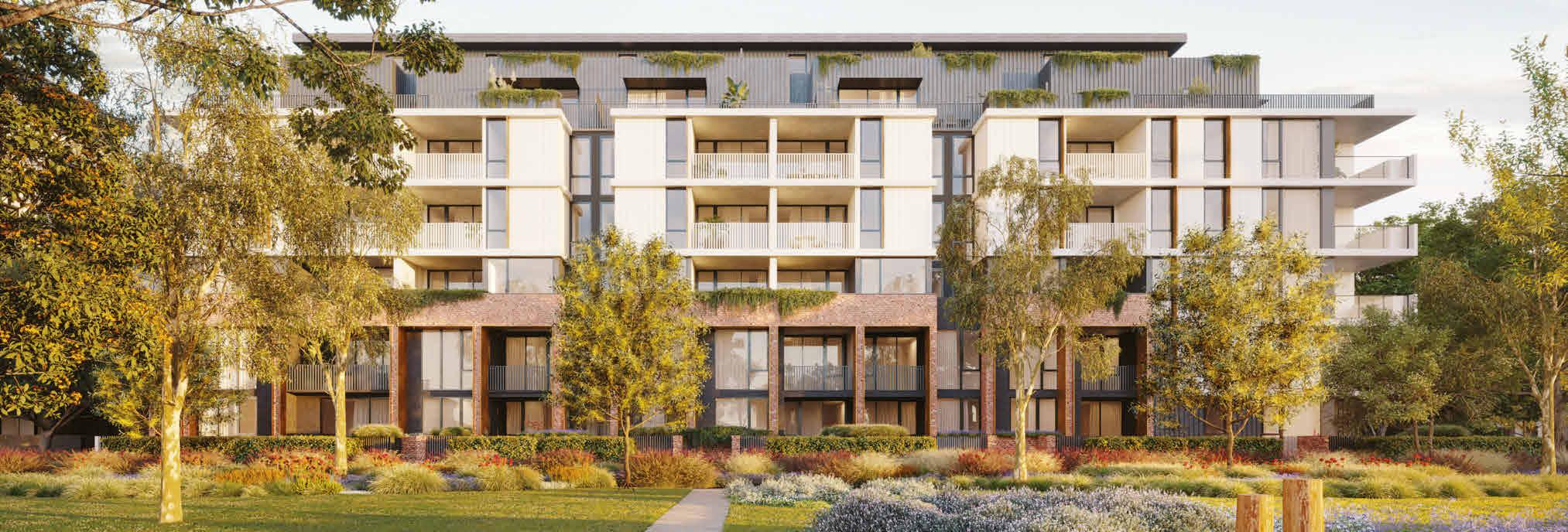
Surrounded by nature and located in Highet Village, only a stones throw from Sandringham Beach.
Luxury 1, 2 & 3 bedroom apartments from $415,000.
9.3 ha walkable precinct:
• 3 ha conservation park
• 1 ha park with playgrounds & BBQ areas
• Home to the new Highett library
• 5 mins from Sandringham beach
• Moments from Westfield Southland
• On Highett Road retail precinct
• Next Door to Woolworths
• Across from Highett train station
Private resident amenities:
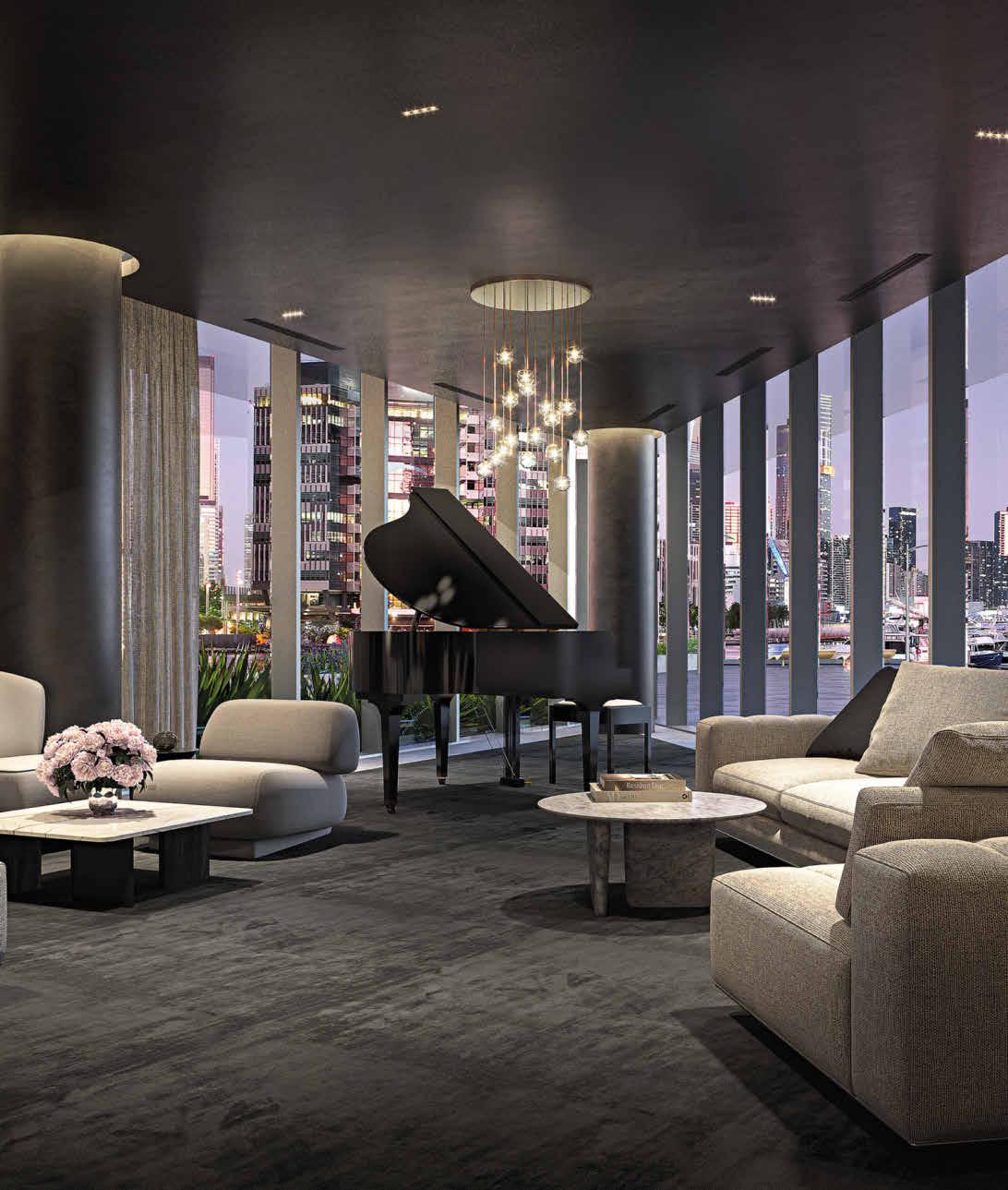
• Outdoor & indoor pools
• Gym & wellness areas
• Private dining & lounge areas
Move in by mid 2025. Construction has commenced.
Artist impression
Display Suite Open Daily 12pm - 4pm 37 Graham Road, Highett Andrew Leoncelli 0405 523 451 Stefanie Palazzolo 0434 369 683 highettcommon.com.au A PROJECT
BY Artist impression Artist impression
Words by Elizabeth Clarke
The rise of biophilic design
Despite our inherent desire to connect with nature, modern-day living over the past few years has seen us spend more time indoors than ever.
“Early man spent most of their waking hours out in nature, and ancient cave drawings indicate the cave was where, having retired from the daily hunt and gather, they could lower their defences,
take comfort in the company of their tribe and relax,” says psychologist Dr Maria-Elena Lukeides.
Thousands of years later, we still hanker for a connection to nature, especially in our homes.
“The power of a single minute spent meditating by a babbling brook in a forest is better understood today than
ever before,” says Decibel Architecture creative director Dylan Brady.
“Given recent challenges with connection and social responsibility, the growing desire to embed this closer relationship to nature in our dwellings is understandable and necessary for building a healthier, more self-aware society.”
Biophilic design principles embrace raw materials, sunlight, fresh air and plants to create soothing interiors that bolster our health and create beautiful living spaces.
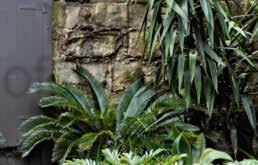


“The simplest links to nature we can build are to air, natural light, plantings and water,” Brady says.
“Biophilia in our built environment simply enables natural systems, harnessing the lessons of billions of years of practice.”
Cramped, cluttered places and poorly lit interiors can negatively impact our mood, leading to agitation and increased mental stress, and also affect our circadian rhythms, which can cause sleep problems.
“A neat, clean living space evokes a sense of competence, self-discipline and calm, which is the optimal environment for relaxation, sense of safety, intellectual creativity, emotional processing and wellbeing,” Lukeides says. “Noise also
4 | Domain Feature
DESIGN TRENDS
REPRESENTED Xeriscaping: Succulents and cactuses add energy to any space. Apartment Spotlight Publishers Domain Apartment Spotlight is published by Domain Holdings Australia Limited and is printed by IVE, 25-33 Fourth Avenue, Sunshine VIC 3020 Sales inquiries Ash Wood ashley.wood@domain.com.au Editor Jessica Golding jessica.golding@domain.com.au Senior designer Colleen Chin Quan Designer Emma Drake The pandemic has accelerated our need to improve our wellbeing through closer natural connections in the built environment. Apartment Spotlight Our cover Trielle by Mirvac delivers a life of leisure and luxury, page 19
creates a decreased sense of privacy, which leads one to feel more exposed and therefore less relaxed, which can increase stress.”
Biophilic design has become more central to designers’ practices as they become increasingly conscious of nature’s benefits. Architects place windows that purposely frame the landscape and incorporate plants into the structural interior designs of buildings, from green rooftops to lush indoor courtyards, so interior spaces feel more like nature than bricks and mortar. Living with greenery, whether it’s growing plants or nurturing our gardens or indoor plants, brings us close to nature and its benefits no matter how we live.
“Nature therapy, or ‘forest bathing’ as it’s called in Japan, has highlighted that exposure to nature decreases stress, lowers heart rate, increases physical immunity and creates altered states of consciousness by inducing relaxation,” Lukeides says.
Filling a space with tactile materials such as ceramic, wool, linen and cotton, and hanging artwork and wallpaper depicting cloudscapes, florals and trees does much more than simply beautify; they can soften hard edges and robust materials and provide a calm and soothing aesthetic.
“Wood is reminiscent of a forest environment more than a material like concrete,” says Sophia Kaplan, author and co-founder of Leaf Supply.
“The same goes for natural versus artificial stone. If financial constraints make this untenable, choose smaller areas to focus your biophilic intentions.”
Natural light can be created in abundance with floor-to-ceiling windows and reflective surfaces, like white walls, mirrors, glossy finishes and glass that bounce light around the smallest of rooms. Skylights are experiencing huge popularity for their ability to draw in sunlight and fresh air and convert dark, unused spaces into liveable and lightflooded interiors.
Planting for pleasure
More apartments integrate nature and planting into their designs in countries where climates make indoor-outdoor living essential.
“Balconies, planted terraces, and common rooftop gardens are a requirement for any new product on the market,” Brady says.
“I love that people understand the benefit of connection to nature and that
this leads to investment on the supply side to meet that demand. Legislation around balcony spaces, cross ventilation requirements, light and air go some way to establishing a solid baseline.
“Long-term renters are more inclined to be swayed by ventilation, landscape and green spaces, and the increasing awareness of the benefits of biophilic design is pushing the market ahead of these rules.”

While biophilic design is ideally addressed from the outset of creating a new building, nature can still be incorporated into existing spaces.
Plants are one of the easiest biophilic additions to make to a space; not only do they absorb carbon dioxide and release oxygen, but they can elevate its aesthetic.

“Gardens and balconies are great for growing sun-loving species, but there is a huge variety of plants that will happily thrive in lower-light indoor settings,” Kaplan says. “Consider the vigorous Monstera deliciosa [Swiss cheese plant], Hoya carnosa [wax plant] and Epipremnum aureum [devil’s ivy], which can be trained up a wall, and do simple things like throw open curtains and windows to let sun and air flow freely through your home.”
While sophisticated plantings soften our relationship to the built environment, there’s a growing trend for the “wild” and “natural”. Horticulturist Mark Morrison from Zerascapes in North Fremantle says the xeriscape (Greek for “dry-scaping”) landscaping method is taking off in Australia as a more sustainable and climate-appropriate choice.
“Xeriscaping embraces cacti and succulents and can be expressed as a large garden or in an apartment using a large pot or a cluster of smaller ones,” Morrison says.
With their characterful forms and vibrant colour, succulents and cactuses add energy to any size space.
“They are extremely low-care and require very little water, so they’re ideal for high-rises with a balcony, courtyard or window sills that get sunlight,” he says.
Look for agave species like blue glow, Agave celsii, potatorum or Aloe mitriformis, and Aloe vera varieties like southern cross, ivory dawn or fairy pink.
While Australia’s approach to biophilic design continues to improve and gain traction, we still have some way to go.
“We lag behind some cities and countries, like Singapore and France, when it comes to legislation around biophilia, green space and planting,” Brady says. “I have faith we will continue to listen, learn and improve.”
Domain Feature | 5
Natural benefits: Filling a space with tactile materials and integrating plants are two steps towards better health.
“Biophilia in our built environment simply enables natural systems, harnessing the lessons of billions of years of practice.” Dylan Brady
STOCKSY
HIGHETT COMMON
Words by Kate Jones
Giving back to the community
It may be one of Melbourne’s largest urban renewal projects, but it’s also one of the greenest. Highett Common is a 9.3-hectare residential development about to spring up in Melbourne’s south-east, and almost half of it will be reserved for parkland.

The nature-first approach runs against the grain of property development, which has historically taken a denser approach for maximum return.
Before engaging the architects or interior designers for the $600 million project, developer Sunkin Property Group sought out landscape architects. Experts at Tract were engaged to scope out the possibilities of such a large site,
says Scott Jessop, head of sales and marketing at Sunkin.
“We worked with Tract landscaping on identifying what’s on the site already and then coming up with what should be conserved for the future,” Jessop says.
“It was through that process that a number of mature trees – river red gums, yellow box trees – were found that were unique to the area and to Melbourne, as well as some rare grasses and species that were thought to be extinct.


“And obviously, there are a number of animals that are involved in that process,” he adds.
“So, there’s a flying fox, for example, that’s unique to that area as well as a
Uncommon development: Highett common will include 75 townhomes, 970 apartments, a public library, a community centre and parkland the equivalent of two MCGs, which will be reopened to the public.
number of native fauna species and indigenous and planted species already on site. So, as part of this planning, the nature elements are really what we started with first.”
The former CSIRO site on Graham Road, Highett, has largely been off-limits for about 30 years, but this development will see parkland the equivalent of two MCGs reopened to the public.
When finished, it will include walking trails, bench seating, open grassy areas and playgrounds.
Much of this parkland at the southern end of the site will be gifted as conservation space to the Bayside City Council. Of the three-hectare site, two
6 | Domain Feature
SPECIAL REPORT
Apartment Spotlight
hectares can be found at the southern end and another hectare to the north.
Work has already begun on site, with the parkland areas taking priority, says Andrew Leoncelli, CBRE’s managing director, residential projects Victoria.

“Out of 9.3 hectares, 43 per cent of the site is being gifted back to the community in the form of either the nature reserve in the Southern Common or the active community-based parkland on the north and eastern section of our project,” he says.
“It will allow the community to finally go and spend time in what is quite an unusual feature of Bayside, which is like a mini forest that does exist and has
been there forever and has quite a few different endangered species of plants, flora and wildlife, that will finally ... be allowed to be enjoyed by the public.
“It has to be built before the first stage settles, and that has to be handed over before December next year. There’s a lot of activity because all the civil works for the entire project are being built now.”
The community benefits of this new development will also be reaped at a new two-storey public library and a community centre designed by DKO Architecture.
Architects at ClarkeHopkinsClarke have designed the residential component of Highett Common, which will see more than 1000 residences built on-site. These include 970 apartments across 14 different buildings, and 75 townhomes.
The medium-density project will reach six storeys at its peak. Walkways separate each building, and multiple entrances give residents easy access to nearby green spaces.
This careful planning also provides a sense of belonging to neighbouring communities within a larger precinct.
Residents will also have access to a communal pool, gym and lounges.
The building’s sustainability credentials are top-notch, with plans for it to become net-zero carbon. This will include environmental initiatives such as EV charging for residents’ electric cars.
Combine this with the location, and Jessop says you have a project that will appeal to buyers.
“You’re only four kilometres down the road to the beach at Sandringham, where you’ve got the yacht club, so that’s a five-minute drive or 10-minute bike ride and you’re on the beach,” he says.
“Highett Road, which is just on the corner, has the trendy little restaurants and even the likes of George Calombaris opening a new restaurant there.
“There’s a supermarket right on the doorstep and a train station just across the road – the Highett train station, which has plans to remove that level crossing. It’s a walkable precinct with a walkable transport network.
“You’ve also got some of the best golf courses on the doorstep, with Royal Melbourne only down the road, and
the same with the education. Some of Melbourne’s best schools can be found around there.”
The project is expected to attract a broad range of buyers, including first-home buyers, young professionals and downsizers.

All are set to enjoy the natural surroundings of a mini-metropolis in a bushland setting.

“When you talk lifestyle, it’s really going to be a unique opportunity and a unique product,” Jessop says.
“It’s a community-focused development with really good quality landscape environments.”
Building will start at Highett Common later this year, and by the end of 2024, all of the parkland will be finalised.
The first residents are slated to move into their new homes in early 2025.

Domain Feature | 7
Open your camera and hover your phone over the app code to view the listing IN PARTNERSHIP WITH
Green in more ways than one: The medium-density parkland project has top-notch sustainability credentials, with plans for it to become net-zero carbon.
“Highett Road ... has the trendy little restaurants and even the likes of George Calombaris opening a new restaurant there.” Scott Jessop

Average
Smart energy efficient

at a glance
MEKKO
& build by Mirvac
Quality design
7+ star NatHERS rating
Smart energy efficient design
At MEKKO enjoy a lifestyle that inspires everyday, no matter how monumental or exquisitely simple. Enjoy spaces for community connection, collaboration and celebration.
at MEKKO will embrace all of life’s possibilities, and we look forward to meeting you. Coming Soon, Register Now! MEKKO.MIRVAC.COM Download Guide to the inner west brochure Say Hello to MEKKO Apartments at The Fabric by Mirvac. Discover an outstanding new era of sustainable apartment living that will enjoy the best of the flourishing, future-forward community at The Fabric, in Altona North, just 9km's from Melbourne's CBD.
A fully-electric community
Life
NatHERS
design
Words by Margaret Quilter
Building a sense of connection
Shared amenities are helping to create communities in apartment developments.
With spacious designs and luxury amenities, apartment buildings across Australia have evolved from offering affordable living to aspirational multi-residential lifestyles that echo places like New York, London and Singapore.
With land in short supply, multiresidential complexes are popping up throughout urban centres. Yet, this move to apartment living has done little to detract from the notion of community that is synonymous with neighbourhoods comprised mainly of stand-alone homes.
“Apartments are no longer just a cheaper alternative to house living,” says Jason Fraser, principal and residential sector leader of architecture studio Woods Bagot.
“When done right, they can provide amenities and community beyond what most of us could ever achieve or afford in single homes, such as large-scale dining spaces, music rooms, study and flexible workspaces, among others.”
A sense of community organically emerges from thoughtfully designed communal zones – such as wellness spaces, business centres and rooftop gardens – and connectivity to mixed-use retail and dining.
By their very purpose, these spaces spark a feeling of community that
apartments traditionally designed for investors 10 to 20 years ago struggled to instigate. Shared experiences foster a sense of community and old-school neighbourhood values. This, in part, is why communal amenities within apartment complexes are becoming more valued.
“Apartment living is adapting and, in my opinion, improving to include consideration of what apartment living can contribute to the quality of life at a living and social level,” Fraser says.
“We are highly focused on creating environments that have been considered with all aspects of the user experience: physical, mental and social.”
Brenton Smith, director of architecture firm Bates Smart, says new apartment developments are becoming more creative, offering owners “the opportunity to become connected to their neighbours in a way that is relaxed and informal, whether it is the communal library, dining rooms or wellness spaces.
“These spaces instigate opportunities for community conversation without knocking on a neighbour’s door and asking for a cup of sugar.”
From entry-level to luxury markets, developers are working alongside architects and designers to meet the rising expectations of buyers.
“[Downsizers] are looking for a lifestyle that enables them to have access to all the great things about a particular area, but also a lifestyle that is connected to a community where they can create
relationships and friendships that are borne out of this communal living,” Smith explains.
Developers are responding by building complexes that offer amenities like communal gyms, pools, barbecue zones, co-working spaces, playground areas and dog-friendly facilities that encourage occupants to live beyond the confines of their own apartments.
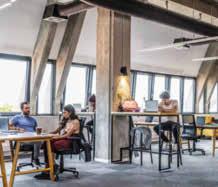
Some developments have apps so you can book into gym and yoga sessions, join social events and more.
“Our approach is to promote active, passive and outdoor amenity zones that are diverse and adaptable to accommodate the varied people that will use them,” Fraser says.
“We try to locate these zones to make them visible and encourage use. And
importantly, as shared amenities, these spaces encourage increased social interaction within a building.”

The concept of neighbourhood and community is increasingly at the forefront of developers’ minds.
“You’re almost intentionally creating environments that activate communication and socialisation by virtue of the amenity that you put in there,” Smith says. “It can happen at the communal letter box area, by sitting in the library one Sunday afternoon having a glass of wine, and ... in your gym.”
10 | Domain Feature SHARED SPACES
ISTOCK
Apartment Spotlight
Public space: Top apartment buildings have active, passive and outdoor zones.
“These spaces instigate opportunities for community conversation.” Brenton Smith
SUSTAINABLE LIVING
Words by Elizabeth Clarke
Simple tips for a greener life
“I also buy vintage and secondhand pieces that won’t be landfill after six months.”
Choose pieces made of repurposed wood and recycled glass, metal and plastic, or natural fibres like jute, bamboo, cork or wool, and nurture nature in every corner with plenty of plant life.
“Integrating greenery into the home enhances a sense of wellbeing, mitigates the urban heat island effect and supports biodiversity,” says Liam Wallis, founder of HIP V. HYPE, an environmentfocused property development and sustainability practice.
Shop smart
Australians throw away around 1.9 million tonnes of packaging yearly, with supermarket items chief among them.
“Make a list to avoid buying too much and plan meals with items before they expire,” suggests Erin Rhoads, author of Waste Not.
Swap single-use plastics for glass jars, silicon bags, beeswax wraps and cotton swags. Choose tea leaves rather than tea bags, coffee grains instead of pods and items packaged in biodegradable and recyclable hemp, wood and cotton.
Green up the essentials
“Sustainable design reduces our impact on the planet and benefits occupants,” Wallis says.
Switching appliances from gas to electric reduces costs, cuts greenhouse gas emissions and improves air quality.
“Electrification of the home is a key step on the journey to net zero,” Auburn says. “Get an electric stovetop if you can.”
As one of the driest continents on earth with few freshwater sources, saving water is critical for Australians.
For those living remotely, it can be more challenging.
“The option is to travel less, but I wouldn’t change location purely for sustainability,” Auburn says. “You must be happy [where you live] otherwise, it’s an unsustainable change.”
Waste not
Composting reduces food waste and can be used to improve soil quality and enrich plant life. Now, with innovative composting systems available, you don’t need a sun-drenched garden to compost.
“Set up a system in your kitchen with a worm bin or bokashi bin under the sink,” Rhoads suggests.
Sustainability begins at home, which can feel overwhelming, especially if you are living in an apartment.
“A big challenge living in a multiresidential space is implementing alterations,” says interior designer Jono Fleming. “There are limits … so I focus on the smaller changes.”

With most activities impacting the environment in some way, small steps taken daily can combine for real change.
“One of my favourite quotes is, ‘The greatest threat to our planet is the belief that someone else will save it,’ ” says Joanna Auburn, co-founder at climate tech platform Trace. “Everyone has a role to play.”
Try these ideas from the experts for living a greener life in a planetfriendly apartment.

Sustainable design
Mass-produced furniture is easy to buy and ditch, not only because it’s trenddriven and inexpensive but also because it’s hard to repair.
Handmade pieces by smaller, homegrown brands take longer to produce, so are limited in quantity and generally have a smaller carbon footprint associated with transportation.
“I’m conscious of supporting local designers – it’s a quality issue,” says Fleming, whose Sydney apartment is a space filled with unique furnishings.
“Get leaks fixed quickly and install low-flow faucets,” Rhoads suggests.
Lower your bills by designing spaces around natural lighting and switch to eco-friendly LEDs. Air-conditioners also zap vast amounts of energy.
“One degree saves about 10 per cent of your energy bills associated with heating and cooling,” Wallis says.
Location, location
Living centrally within access to public transport and amenities can bolster wellbeing while reducing your carbon footprint.
“I work from home and walk to meetings,” Fleming says. “The car is barely used; it’s a big shift to daily life from pre-COVID.”
Composting is made even easier by freezing food scraps and dropping them off at a community garden. Or sign up to ShareWaste and donate your scraps.
Green power
Solar energy is one of the most significant green energy sources but is difficult to implement if you live in a high-rise.
“Living in an apartment, you choose your energy plan, and the best one is a GreenPower plan from a provider that only sells green/renewable energy options,” Auburn says. “That way, you know you’re not funding fossil fuels.” For Fleming, it was a simple process for substantial change.
“I use 100 per cent GreenPower, which adds 3 cents per kilowatt-hour on my standard rates,” he explains. “For only a couple of extra dollars a month, I’m able to support renewable energy with ease from home.”
Domain Feature | 11
JACQUI TURK
Sneak peek: Interior designer and stylist Jono Fleming’s Sydney apartment is filled with unique furnishings.
Saving the planet is a job for everyone and it all starts with changes at home.

Stage two residential release, now selling at Melbourne Square. Visit the website to discover more. BLVDMSQ.COM
Artist’s Impression
Architecture that not only looks good, but feels good, is design done well. More of today’s buildings are moving past the age of mere aesthetics and pushing new boundaries of liveability and sustainability.
At BLVD, the second release of residences at Melbourne Square, living standards have taken top billing.


The 73-level tower, by Malaysian developer OSK Property, is one of the first residential projects in Australia to be registered for WELL Certification. The certificate is issued by the International WELL Building Institute (IWBI) and sets the bar for health and wellness achieved through design and construction criteria.
At BLVD, these include optimising access to natural light to create thermal comfort, good indoor air quality, and building facilities that cater for social, physical and mental wellbeing.
By assembling these elements, designers have made an ecosystem to help residents live well every day, says Jack Noonan, vice-president Asia Pacific IWBI.
“We know that great spaces prioritise and improve health by helping fuel our bodies, keeping us connected, inspiring our best work and facilitating a good night’s sleep,” he says.
“We also know that our buildings must respond better to create places that feel healthier, happier and deliver more sustainable outcomes.
“This is why BLVD is one of the first residential projects in Australia registered to pursue WELL Certification.”

Positioned near Melbourne’s most renowned cultural attractions, BLVD also gives its residents the convenience of a central location.
This, along with the surrounding 3745 square metres of parkland designed by TCL at Melbourne Square, inspired the architecture.
“BLVD’s apartments are uniquely designed and centred on the park and landscape of Melbourne Square,” explains Paul Curry, director at Cox Architects.
“They draw on the landscape and nature for materiality and offer views over Melbourne’s iconic landscape with the Royal Botanic Gardens, the Sports and Entertainment Precinct, Arts Precinct, Port Phillip Bay, Yarra River and Melbourne’s CBD.”
Interior designers have also drawn on the local greenery to produce a palette of natural textures and qualities. These can be seen in the shared amenities, including the Podium Club on level eight, which features a pool, indoor spa, sauna, gym, golf simulator and karaoke or cinema room as well as a podium garden.
Words by Kate Jones
Looks great, feels even better
There’s also the Skye Club on level 55, which is exclusive to the owners of premium residences, with its own lounge, private dining room and gym. All residents of BLVD can access the Co-Quarter co-working space located on level 56 and the Horizon Dining Rooms on level 55.
Every interior space has bay and garden views to offer a sense of scale, says Chris McCue, managing director at interior design firm Carr.
“The residences capture beautifully restrained and timeless interior architecture,” he says.
“Continuing the same reductionist ideology and palette, nature shines through warm, tonal materials and subtle, textured finishes. Together, they create a calm environment.”
The building’s use of green technology is also sure to impress – it is gas-free and carbon-neutral-operation-enabled with electric vehicle charging facilities.
The apartments and shared spaces at BLVD have both been designed with residents’ comfort and wellbeing in mind, says Ivy Chen, OSK Property Australia’s sales and marketing director.
“Within residents’ own apartments, customised, curved double-glazed windows and insulated walls and ceilings
will provide thermal and acoustic comfort in addition to carefully chosen, premium, energy-efficient appliances,” she says.
“This next stage has been designed with future-proofed living and wellbeing front of mind. We know that people thrive through feeling connected, so providing the latest technology alongside natural and sociable spaces will result in happy and healthy residents.”
Residents will also benefit from the established community at Melbourne Square, including a full-size supermarket. Construction starts in early 2024.
Open your camera and hover your phone over the app code to view the listing IN PARTNERSHIP WITH SPECIAL REPORT BLVD
Natural connection: BLVD draws on the landscape and offers magnificent views.
Apartment Spotlight
ARTIST’S IMPRESSION ARTIST’S IMPRESSION Domain Feature | 13
“The residences capture beautifully restrained and timeless interior architecture.” Chris McCue
URBAN RENEWAL
Words by Larissa Dubecki
If cities rarely sleep, Melbourne in 2023 is a chronic insomniac. A raft of urban renewal projects, either poised to start or already well underway, is set to bring a new complexion to the inner city and selected suburbs.

Some involve the redevelopment of outmoded industrial sites to create new neighbourhoods where high-rise housing, office and retail spaces mix business with pleasure. Some aim to correct existing fault lines, whether that’s a lack of green space or simply a tired civic centre that needs a comprehensive glow-up. And others are about creating an alternative to Melbourne’s CBD, taking the pressure off postcode 3000 as the business centre to rule them all. At all points on the compass, Melbourne is morphing. Here are three of the significant projects designed to take the city into the next decade and well beyond.
Projects taking the city into the future
North Melbourne, Southbank and Dandenong are spearheading Melbourne’s renewal.
North Melbourne
Inner-urban North Melbourne is the site of one of Melbourne’s original urban renewal projects.
The 19th-century home of tanneries, horse stables and factories, and the workers who toiled there, was the focus of slum reclamation efforts in the 1930s and thoroughly gentrified as Melbourne moved into the 20th century.
Errol Street, its broad high street shopping thoroughfare, is full of grand examples of Victorian architecture, while the suburb’s traditional corner pubs are a much-loved feature.

Now the Arden urban renewal project promises to take a section of the ’burb abutting the CBD into the current era.
At its centre will be the underground Arden train station, one of five being built as part of the Metro Tunnel, which is expected to open in 2025.
Taking over 44 hectares of industrial land, while also forcing the relocation of the Lost Dogs Home, the new precinct of Arden is all about mixed use.

It promises to provide 12 hectares of open space – including a one-hectare park – community facilities, and apartment towers up to 40 storeys tall alongside CityLink and the rail corridor, dropping to 15 storeys next to existing residential areas.
A new primary school has also been earmarked as the area prepares to accommodate about 15,000 residents in the next three decades, while a biotech and medical research facility is proposed for the central area near the station.
14 | Domain Feature
A
slum no more: North Melbourne is set to be transformed by over 44 hectares of development.
Apartment Spotlight
GREG BRIGGS ISTOCK
Suburban hub: Dandenong Market, left, and Civic Centre, right.
“What you can see of the station at ground level is already looking great and the renders of the underground area are amazing,” says Charles Bongiovanni of Alexkarbon Real Estate.
“It’s getting a lot of people excited about what’s to come next in the area that has been very traditionally blue collar. People are already buying in central North Melbourne based on the projections for Arden, and the extra open space will be welcomed with open arms.”

Southbank
You don’t have to be a Baby Boomer to remember when the southern bank of the Yarra River was an industrial wasteland facing the commuters at Flinders Street Station. The opening of the Southbank development and its riverfront promenade in 1990 was a game-changer for the city, bringing life and entertainment to the “wrong” side of the river.
It’s Melbourne’s big hitter in terms of arts infrastructure, home to the spire-


topped Arts Centre and Hamer Hall and the equally iconic National Gallery of Victoria, along with the Melbourne Theatre Company, Malthouse Theatre, Australian Centre for Contemporary Art, the Ian Potter Southbank Centre and –ahem – Crown casino.
It’s long been a great place to visit, but when it comes to liveability, it took some years for a critical mass of projects and infrastructure to legitimise the Southbank precinct.
Defying some controversial planning decisions of the past, the densely populated area continues to evolve. A number of new renewal projects with their eye on green space and community feel will further help realise the potential of a suburb that’s as close as it gets to the CBD without actually living there.
On a prominent Kavanagh Street site near City Road, the Boyd Village development will transform the former J.H. Boyd Girls School site into a
“vertical village”, including much needed affordable units and a park.
A number of greening projects for the formerly grey ’burb include the Dodds Street Linear Park, which will see 1300 square metres of native grassland planted among pathways, gathering spaces and public artwork.
For apartment owner Matt Foster, the only way for Southbank is up: “The green space is really improving. It makes it feel less like a concrete jungle and more like a place you really want to hang out in.”
Aiming for Melburnians’ dog-loving jugular, a new off-leash park has also been established under the overpass for Kings Way.
Dandenong
Not all urban redevelopment is centred on the inner city.
Dandenong, 35 kilometres away, is already the largest suburban hub in the south-east, with a population expected to grow significantly in the next decade.
And a rejuvenation project proposed in 2006 by then-Labor premier Steve Bracks to establish Dandenong as a satellite city to Melbourne is only just becoming reality.
Featuring apartment towers, retail centres and office complexes in the heart of the proudly multicultural suburb, the multibillion-dollar Revitalising Central
Dandenong project is set to begin this year with promises to modernise one of Melbourne’s fastest-growing areas.
Hocking Stuart Dandenong principal Jack Miltos says the project will give a much-needed boost to the heart of Dandenong.
“The central part of the suburb around the train station looks dated,” he says. “Plenty of people come here to work but then go and spend their money elsewhere. The shopping needs a revup to compete with Narre Warren or Fountain Gate.”
Spearheaded by developers Capital Alliance, the master plan for the twohectare site by architecture firm DKO includes the provision of a minimum of 500 dwellings and is beginning with a new Little India.
“On the plus side, Dandenong has already got a fantastic fresh food market, lots of multicultural places to eat, a train station, great public transport links and a hospital,” Miltos says. “Smart development will keep in mind that it’s a price-sensitive area. People create their beginnings here.”
Domain Feature | 15
Still evolving: The University of Melbourne’s Ian Potter Southbank Centre is one of the many arts institutions helping to make the “wrong” side of the river one of the city’s heavy-hitting areas.
“It’s getting a lot of people excited ... people are already buying in central North Melbourne based on the projections for Arden” Charles Bongiovanni
ELIANA SCHOULAL TREVOR MEIN
Shades of the past: Auction Rooms cafe, Errol Street, North Melbourne.
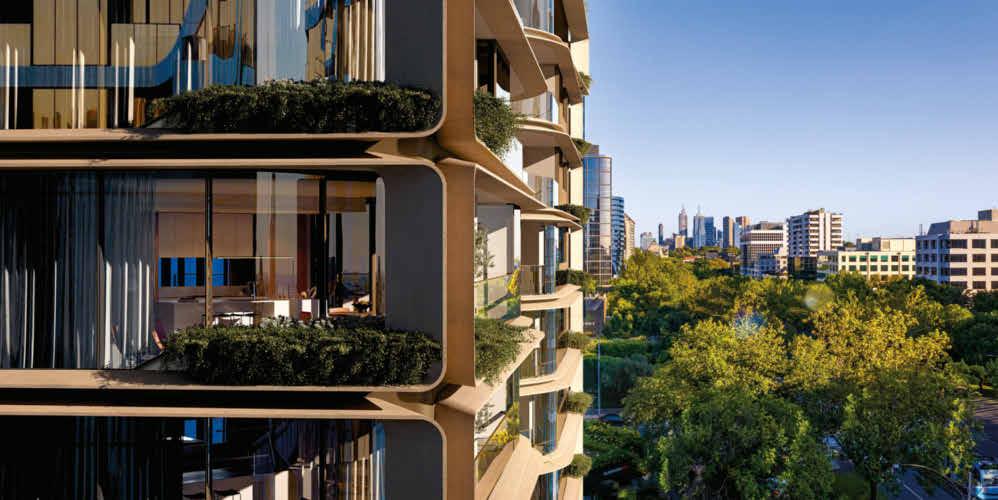
A NEW ERA FOR ST KILDA ROAD LIVING


























































ARTIST IMPRESSION
Elevated 1, 2 & 3 bedroom residences with lake and boulevard views – Now Selling
PARK QUARTER
Words by Liz McLachlan
A rare boulevard opportunity
Exceptional St Kilda Road residential projects always excite buyers but it’s been more than three years since a high-end development launched on Melbourne’s grandest boulevard.

Park Quarter is in its most soughtafter pocket between Albert Park Lake and Fawkner Park, positioning residents for easy access to Melbourne’s best amenities and sweeping views.
Developer Sunnyland Investment

Powell says Park Quarter is one of relatively few quality Melbourne projects scheduled to start construction next year. Accordingly, it is attracting strong interest from diverse buyer groups, particularly owner-occupiers trading up or rightsizing.
“If you are looking to downsize well in Melbourne, Park Quarter is your best chance to secure a new apartment in a prime location with services and amenities,” Powell says.
A quartet of Melbourne’s best architects and designers – Cox Architecture, Carr, DKO and Paul Bangay – collaborated on the design for Park Quarter’s 4645-square-metre site, inspired by St Kilda Road’s former stately homes and surrounding parklands.
The design of the building focuses on proportion, scale, symmetry, detail and landscaping while maximising the natural light, the views and the flexibility of space.
the changing seasons. Views of the bay, lake and CBD are also available. Park Quarter residents have an easy stroll to the Arts Precinct for shows and exhibitions, and Southbank and the CBD for dining, shopping and entertainment.
Prospective residents have a choice of Garden Homes, a mix of one, two and three-bed options on levels six to 14, or the premium three-bedroom Sky Manor apartments on levels 15 and 16.
Levels 17 and 18 house four elite penthouses, each with a private rooftop terrace with a pool and spa pool.

One-bed layouts start from $495,000, two-bed from $985,000 and three-beds from $1.677 million. Internal floor plans range from 50 to 190 square metres. The apartments sit above Australia’s first Marriott Executive Apartments all-suite hotel. Thanks to the building’s corner site, the Marriott will have a separate lobby and lifts on a different street frontage.
Exclusive resident amenities include a private lounge and dining room, cinema, co-working space and library, golf simulator, dog wash, mud room and smart parcel lockers.
Residents also have the choice of club membership to hotel amenities, which include a pool, sauna and gym.
A concierge service will ease daily living with services such as parcel and grocery delivery, housekeeping, in-home nannying, private chefs, car wash and detailing and e-bike hire.
Development Group (SIDG) bet on the popularity of this pocket in 2010, when it bought the Clemenger BBDO building at 474 St Kilda Road.
Now, after working with Colliers Victoria for several years, it has launched Park Quarter, an 18-level residential development of 244 apartments.
Colliers director Zoe Powell says it is a rare opportunity to buy into a highquality project in a prime Melbourne location. The launch has coincided with Melbourne’s property shortage, which is tightening supply of new apartments and rental accommodation.
SIDG sales and marketing director Kevin Lin says Sunnyland is optimising an outstanding St Kilda Road site with an iconic landmark building that heightens residents’ living experience.
“After COVID, apartment dwellers care far more about their living experience and interacting with their natural surrounds,” he says. “So, we have given all residences larger balconies for seamless connection with their lush green environment, and enhanced natural ventilation.”
Wide views of the St Kilda Road boulevard and Fawkner Park showcase
Interior apartment finishes inspired by the local parks include flooring in blackbutt timber – a Fawkner Park tree species – and natural stone. Clean lines and sophisticated finishes flow through apartment interiors, differentiated by light and dark schemes. Expansive windows optimise views to the parklands, lake or CBD, and all living spaces extend onto terraces.
Construction is expected to start in Q1 2024 with completion in 2026.
Domain Feature | 17
Open your camera and hover your phone over the app code to view the listing IN PARTNERSHIP WITH SPECIAL REPORT
View for miles: The vistas range from St Kilda Road boulevard and Fawkner Park to the bay, Albert Park Lake and the CBD.
Apartment Spotlight
“Park Quarter is your best chance to secure a new apartment in a prime location with services and amenities.”
Zoe Powell
Artist’sImpression
DISPLAY GALLERIA GRAND OPENING
Inspired by luxury’s ultimate expression, Trielle is a rare, shining diamond defining Melbourne’s north-facing riverbank. The crowning jewel of Mirvac’s award-winning Yarra’s Edge precinct.


The Trielle Display Galleria captures the exquisite craftsmanship and sophistication that define Trielle’s breathtaking residences. From the custom gem cut Apaiser bathtubs and basins, to highly sculptural kitchens, to exceptional-quality materials throughout, Trielle revels in true beauty.

We invite you to view the Trielle Display Galleria, and to discover for yourself luxury living beyond imagination.


1 Bedroom Residence 8.06 $680K* | 2 Bedroom Residence 4.05 $1.18M*



3 Bedroom Residence 3.01 $1.89M* | Sub Penthouse POA
JOIN US TO CELEBRATE LIFE LIVED FULLY Saturday 27 May, 1–4pm
16 Point Park Crescent, Docklands
Contact Janet Walker 0466 440 863 janet.walker@mirvac.com TRIELLE.MIRVAC.COM


Artist’sImpression
Artist’sImpression

* Pricing correct as at 01/05/23 TIMELESS LUXURY RIVERSIDE RARITY
Entrepreneur and author Tim Ferriss describes luxury as “feeling unrushed”.
“It is designing a life that allows you to do what you want with high leverage, with many options, all while feeling unrushed,” he writes.
Mirvac design director Michael Wiener hopes to deliver exactly this feeling with Trielle, the latest addition to Melbourne’s Yarra’s Edge precinct.
On the north-facing bank of the Yarra River, the 45-storey diamondinspired building has been designed with amenities that celebrate life’s most precious commodity: time.

“Bling is gorgeous, luxurious fittings and finishings and furnishings are beautiful, but real luxury is having time to do what you want,” Wiener says.
“We really looked at how we can make the experience of Trielle be akin to a sixstar hotel – the kind of place where you just come in and everything is easy.”
From a concierge service to an oasis retreat with both indoor and outdoor pools, and a wellness centre with a day spa, Trielle’s long list of community facilities is impressive on paper.

However, Wiener is quick to explain that this is not merely “tick-box amenity”.
“They’re beyond A-grade spaces, they’re amazing spaces,” he says.
“We’re not just there saying, ‘Oh, we’ve got a spa.’ We actually have a spa that
Words by Kate Farrelly
A life of leisure and luxury
we’ve designed in conjunction with one of the best spa operators and designers in the country.
“We’ve spoken to the best people to help us ensure that what we’re providing for the residents is first class.
“[These facilities] give you back time because all of a sudden you’re in an environment that’s better than you could find anywhere else, but all you’ve had to do is get in the lift to go there.
“All of what you need is within the building itself.”
Trielle is a hybrid worker’s dream find: instead of renting occasional office space, find a space in The Biblioteca, a series of business-class working pods in the lobby, or take your laptop to one of the glazed Chill pods set in the landscaped gardens on level seven.
Many of the apartments also feature work-from-home spaces, either as a study nook or a dedicated office.
For those who still need to head into town, it’s only two kilometres into the Melbourne city centre.
When it’s time to relax, there’s plenty to enjoy on site.
The Salone is a riverfront lounge taking inspiration from the most welcoming whiskey bars. It will have wine racks, a kitchen and a self-playing piano.
Wiener says residents will be able to hire a chef and a pianist and dress up for an amazing evening in their own private club on the river.
The wellness centre will be located on level seven, alongside the Oasis Retreat and its lush gardens.
Wiener describes Trielle’s location adjoining Point Park and the riverfront promenade as a “hidden gem” but one that is being discovered by savvy buyers.
“The beauty of Trielle is it’s really well-located because it’s very close to the marina, it’s got the park next door, it’s
very close to the eastern part of the city, yet at the same time, you’ve just got a little bit of separation, so it’s actually the best of both worlds,” he says.
Wiener is delighted with the feedback from buyers so far.
“I think people understand what they’re getting in this building, and they know that it’s going to actually make their lives easier,” he says. “They know that what we’ve provided is going to provide them with more time and more ability to have more control over their life.
“I think luxury is about doing what you want, not doing what you have to do. It’s about giving people the opportunity to choose what they want to do, with the time they need to make choices.”
Domain Feature | 19
Open your camera and hover your phone
the app code to view the listing IN PARTNERSHIP WITH SPECIAL REPORT TRIELLE
Location: Trielle is on the north-facing bank of the Yarra River, which puts it very close to the marina with Point Park next door and close to the city centre.
over
Apartment Spotlight
“Bling is gorgeous, luxurious fittings and finishings and furnishings are beautiful, but real luxury is having time to do what you want .”
Michael Wiener
Ask an inner-city dweller what they love about their urban lifestyle, and they’ll probably mention the nightlife, the restaurant scene and the festival culture, especially in a city like Melbourne.
Miranda Campbell, however, decided to move to South Yarra for a different reason entirely – which is surprising given that she has a significant background in hospitality.

“I chose South Yarra because I really loved the Botanic Gardens, and I wanted to be close to them,” she says.
“I do the Tan most days [and] walk through the gardens.”
The social procurement lead, who cofounded the wildly successful restaurant Belles Hot Chicken in 2014 (she stepped away from it in 2021), had spent most of her adult years living in the inner north before moving briefly to Sydney.
When she returned, she felt like she needed a change of scenery.
CITY LIFE
Words by Jane Hone • Photos by Greg Briggs
In love with the inner city
living area, but Campbell has turned the bedroom into a home office and set up her bed on the raised platform of the study nook.
is a really good friend, and we often swap our baking or special meals, or have a wine on the balcony.”
Campbell has now been living in a South Yarra apartment for two years, which she describes as cosy, eclectic, full of indoor plants and brimming with “too many books”. It’s a one-bedroom apartment with a study nook in the
As is often the case with apartment living, Campbell has found a strong sense of community in her building.
“I have wonderful neighbours and we all look out for each other, “ she says. “My neighbour in the flat next door, Lauren,
While the Royal Botanic Gardens were the biggest drawcard for moving to South Yarra, there were other considerations, too.
“It’s an hour walk into the CBD, so it’s pretty accessible,” Campbell says. When she isn’t working at her regular job, which involves connecting with social enterprise leaders and founders making an impact, Campbell moonlights as a Dolly Parton wedding celebrant. Living so close to the city allows her to easily zip around to various weddings on the weekends.

20 | Domain Feature
Above: The popular 38-hectare Royal Botanic Gardens.
Apartment Spotlight
Left: Domain Road has some of South Yarra’s favourite eateries.
South Yarra resident Miranda Campbell is one of the thousands attracted by the amenities – and greenery – of urban Melbourne.
Plus, she’s found some firm favourites in the hospitality sphere.
“Canecutters bar is my local, run by some lovely guys,” Campbell says. “I like to swing by there. You always make new friends.
“France-Soir is my favourite restaurant in Melbourne. It’s so eclectic, and you always bump into people and, you know, having a steak frites and a glass of burgundy is a real treat.
“There’s an amazing little Italian cafe right near South Yarra station that does the best paninis and focaccias ever, and hand-piped cannoli.
“That is South Yarra’s best kept secret … it’s called Italiana Delicatessen.”

Among her other favourite things about the area, Campbell lists being able to grab a coffee and browse through the shops on Chapel Street, visiting the historic Astor theatre, and walking down to the river and across the bridge to Cremorne to visit her “old haunt”, the Cherry Tree Hotel.
Even though most of her friends still live on the north side and she frequently finds herself driving up Punt Road to
visit them, Campbell stands by her decision to install herself on the other side of the river. When comparing the two areas, she doesn’t believe one is better than the other.
“I think when you’re younger there’s this idea of this divide and north versus
south, and as you get a bit older it’s nice to just ignore that and appreciate both sides for what they are and not buy into that division,” she says.
Campbell says she loves both sides, “but also the south side comparatively is kind of more affordable, weirdly, in terms of
Below: The Tan is a 3.827-kilometre
value for money, and maybe it’s because there’s a bit of a premium on the cooler suburbs in the north.”
Campbell says she believes there is a common misconception that South Yarra is more expensive.

“And there’s a lot of good stock,” she adds. “[There are] older flats that have been well-built and well maintained.”
Campbell believes that one of the key differences is that the south side doesn’t boast as many natural wine bars or vinyl shops or as much “hipster cool stuff”.
Natural wine bars are close to her heart as Belles Hot Chicken was conceptualised around serving interesting, minimal intervention wines alongside “tasty, high-calorie dude food” inspired by Nashville in the United States. The first store opened in Fitzroy nearly a decade ago.
“It’s pretty mainstream now, but at the time very few people were pouring natural wines in the way that we were,” Campbell says. “We knew all the makers; they were the people coming by and eating chicken and showing off their wines. So, that was the genesis, and it was just like a party. We really fostered a spirit of hospitality that everyone who walked in was welcome and was here for a good time.”
While South Yarra “feels very different” to somewhere like Thornbury, Campbell has managed to find a similar spirit of hospitality where she is.
“There are beautiful establishments like Cosi and France-Soir that have been here for 30-plus years, and that feels really nice; that established sense of hospitality history,” she says.
Still, nothing can beat being close to the 38-hectare Royal Botanic Gardens while in such an urban environment.
“You’ve got this garden oasis around the corner, and I love it,” Campbell says.
Domain Feature | 21
Left: Grabbing a coffee and browsing through the shops on Chapel Street is one of Miranda Campbell’s favourite pastimes.
track that runs around the Botanic Gardens.
“I chose South Yarra because I really loved the Botanic Gardens, and I wanted to be close to them. I do the Tan most days.” Miranda Campbell
A R e MARKABL M A R K A B L e N e W ASP W A S P e C t
Nestled within 20 hectares of parkland with dedicated racetrack frontage, Trackside House represents the very best in contemporary architecture – a distinguished, luxurious residential building ofering state-of-the-art amenities and a strong connection to nature, just 6km from the CBD.

Resident interiors are designed by Carr, one of Australia’s most awarded names in luxury living.
Elegant, understated and impeccably styled, these generously proportioned residences ofer supreme comfort and sophistication, with premium appliances and finishes.
TO REGISTER, VISIT TRACKSIDEHOUSE.COM.AU
OR CALL 1300 426 866
SCAN TO REGISTER YOUR INTEREST AND DOWNLOAD A BROCHURE
ARTIST’S IMPRESSION
HOTEL-STYLE AMENITY AT TRACKSIDE HOUSE INCLUDES:
• Rooftop infinity pool and private dining with track and city views.
• Wellness sanctuary including yoga room, gym and sauna.
• Hotel-style lobby, private vehicle drop-of, concierge and workspace hub.
RESIDENCES WITH TRACK &
CITY SKYLINE VIEWS
Trackside House is located in Moonee Valley Park. The $2 billion redevelopment of Moonee Valley Racecourse will transform the 40 hectare site into a botanic-inspired residential landmark, and the new premium neighbourhood of Melbourne’s inner north.
1, 2, 3 & 4 BED RESIDENCES
1 Bedroom from $565K
2 Bedrooms from $685K
3 Bedrooms from $1.345M
4 Bedrooms from $3.245M
BROUGHT TO YOU BY
DISPLAY GALLERY
Gate 10, Thomas Street, Moonee Ponds
Open by private appointment
A GENEROUS COLLECTION OF PREMIUM 2 - 3 BEDROOM RESIDENCES FROM $1.8M – $7M
CONSTRUCTION COMMENCING NEXT MONTH

CONTACT SARAH STOCK
584 047
0418
WEBSITE GORE.PICCOLO.HOUSE A PICCOLO HOUSE WOODS BAGOTHECKER GUTHRIE DESIGNED BY AND
