Moon Back
Counting down to an historic live stream


IThen and now
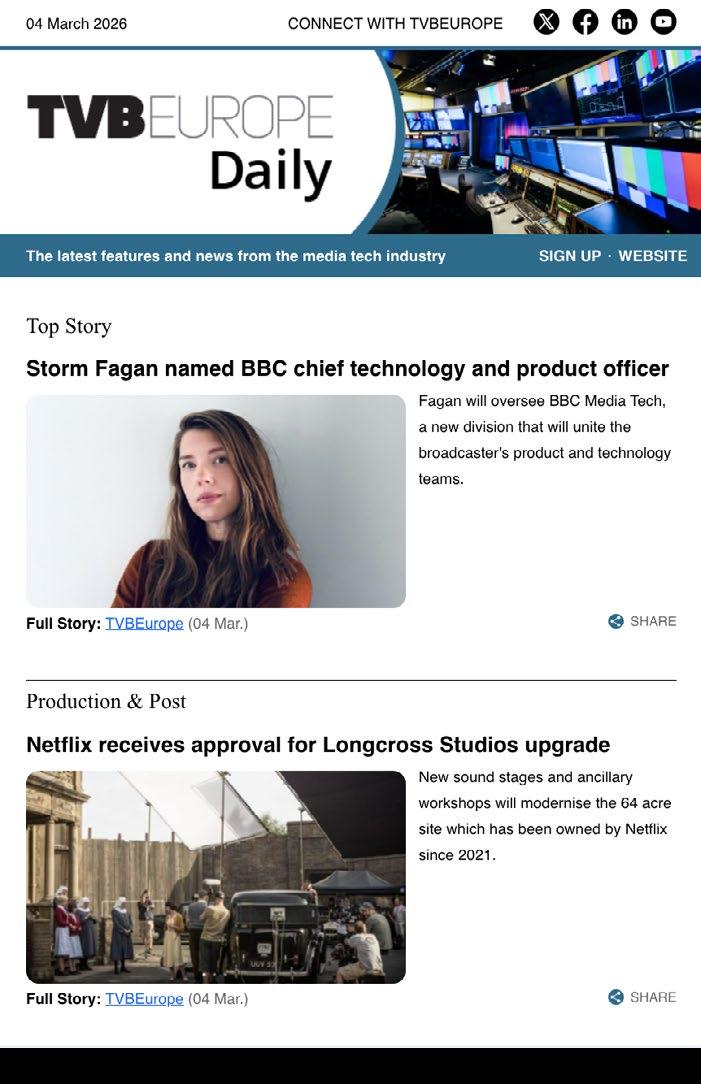
have recently been sent a copy of The view from the television director’s chair by Philip Stevens. If you’ve been reading TVBEurope for a while, you’ll know Philip was a long-time contributor, often covering the production side of the industry. What you might not know is that he also spent 40+ years working in TV as a director (hence the title). Philip has written the book mostly for family and friends, but he’s been kind enough to share five copies to give away to TVBEurope readers (more on that later).
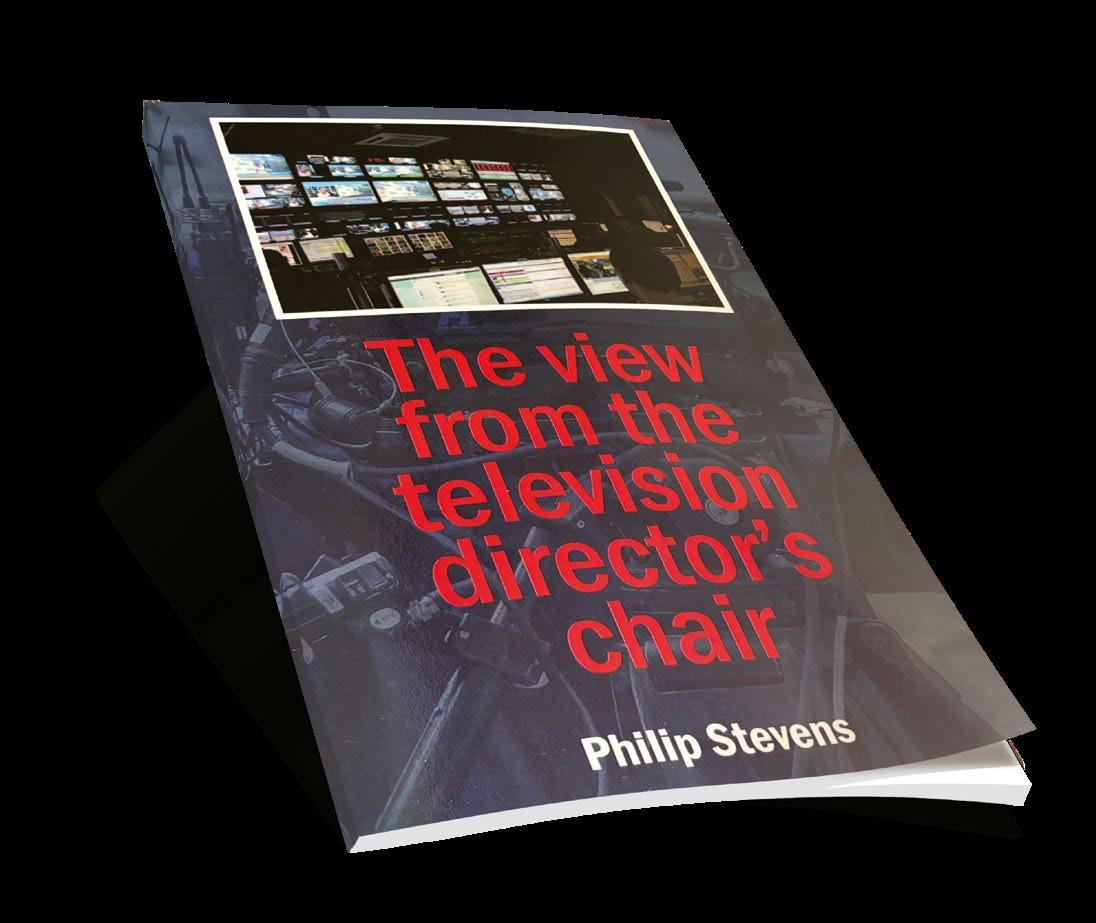
Philip details how his love of TV began while he was still at school. Back then, according to his careers teacher, working in TV was not a suitable occupation for a young man planning to make his way in the world. But Philip would not be put off. He even created a production control room in his bedroom, complete with monitors made from paper and a switcher made of wood.
Can you imagine a student attempting to recreate a PCR now? Almost all of the technology would be software loaded onto their tablet. I wonder what tales someone starting their career in the industry now might have to tell in 40 years?
The book includes multiple anecdotes from his career. Not to include any spoilers, but many left me chuckling. My favourites include a time he was working on an OB at Kensington Town Hall in London. It was a very hot day, and the truck had no air conditioning, so the team decided to keep the doors open. Halfway through directing the broadcast, Philip suddenly heard an older lady ask, ‘Do you know the way to Woolworths, luv?’ Unfortunately he didn’t.
This leads me to the focus of this issue, which explores some of the new technologies shaping the media industry. In the following pages, you’ll read about some of the newer kids on the block, such as the Media eXchange Layer and artificial intelligence, as well as remote production, virtual master control rooms and 5G. The issue also includes interviews with creatives behind some of the most popular TV series at the moment, including The Pitt. And there’s a special guide to the 2026 NAB Show.
Finally, Philip has kindly given me copies of his book to give away to the first five readers who answer the following question: What was the name of the Midlands ITV weekend contractor in 1960? Send your answers via the email below.
www.tvbeurope.com
FOLLOW US
X.com: TVBEUROPE / Facebook: TVBEUROPE1 Bluesky: TVBEUROPE.COM
CONTENT
Content Director: Jenny Priestley jenny.priestley@futurenet.com
Senior Content Writer: Matthew Corrigan matthew.corrigan@futurenet.com
Graphic Designers: Cliff Newman, Steve Mumby
Production Manager: Nicole Schilling
Contributors: David Davies, Monica Heck, Kevin Hilton, Graham Lovelace
ADVERTISING SALES
Publisher TVBEurope/TV Tech, B2B Tech: Joseph Palombo joseph.palombo@futurenet.com
Account Director: Hayley Brailey-Woolfson hayley.braileywoolfson@futurenet.com
SUBSCRIBER CUSTOMER SERVICE
To subscribe, change your address, or check on your current account status, go to www.tvbeurope.com/subscribe
ARCHIVES
Digital editions of the magazine are available to view on ISSUU.com Recent back issues of the printed edition may be available please contact customerservice@futurenet.com for more information.
LICENSING/REPRINTS/PERMISSIONS
TVBE is available for licensing. Contact the Licensing team to discuss partnership opportunities. Head of Print Licensing Rachel Shaw licensing@futurenet.com
MANAGEMENT
SVP, MD, B2B Amanda Darman-Allen
VP, Global Head of Content, B2B Carmel King MD, Content, Broadcast Tech Paul McLane
Global Head of Sales, B2B Tom Sikes
Managing VP of Sales, B2B Tech Adam Goldstein VP, Global Head of Strategy & Ops, B2B Allison Markert VP, Product & Marketing, B2B Andrew Buchholz
Head of Production US & UK Mark Constance Head of Design, B2B Nicole Cobban

JENNY PRIESTLEY, CONTENT DIRECTOR JENNY.PRIESTLEY@FUTURENET.COM
In this issue
12 The future is now
Jenny Priestley visits Vivid’s new Remote Production Centre to discover the technology helping deliver the Women’s Super League on Sky Sports
18
Satellite television
Ahead of the Artemis missions that will take humans back to the Moon, Rebecca Sirmons, general manager and head of NASA+, tells Matthew Corrigan about preparations to live stream from space
22 Next level sport experiences with 5G
In future, a blend of 5G applications will tailor coverage to each sporting event’s unique profile. Monica Heck explores how the tech is allowing broadcasters to create ever more engaging content
26 NAB Show 2026: from concept to practice
NAB EVP Karen Chupka tells TVBEurope how the 2026 NAB Show will highlight where technologies like AI and cloud are moving beyond concept to redefine collaboration across media and entertainment
34
Getting personal with the news
As viewers increasingly get news from a variety of sources at different times, Kevin Hilton discovers the EBU Gen AI-based NEO, used by Swedish Radio for its conversational news search chatbot
44 Cloud MCRs: the next phase of virtualisation
Virtualised Master Control Rooms could bring new opportunities to live production, but issues around interoperability and latency mean mass-adoption is unlikely to be just around the corner, writes David Davies
48
The audiologist
Bryan Parker, supervising sound editor on HBO Max’s Emmy-winning medical drama The Pitt, tells TVBEurope how the use of sound adds realism to the series
Beyond transition— an update on ST 2110
By John Mailhot, senior vice president, product management, at Imagine Communications
Nearly a decade after its introduction, SMPTE ST 2110 has become the operational backbone of modern media infrastructure. What was once viewed as a bold departure from SDI is now a proven architecture underpinning new facilities, large-scale live productions, and hybrid environments around the world.
The first core documents—ST 2110-10, ST 2110-20, and ST 2110-30—were published in 2017 after several years of industry collaboration, and the standard has remained stable. This maturity translates directly into operational advantage: faster deployment timelines, reduced integration complexity, and support for long-term investment decisions.
With ST 2110 established across modern facilities, the industry has moved beyond initial IP adoption and into fundamentally different ways of operating. Cloud, virtualisation, and software-defined workflows are no longer theoretical constructs, they are being deployed in production environments, built on the deterministic, highperformance IP connectivity that ST 2110 provides.
These shifts are also expanding what production teams can do. Workflows that were difficult or impractical in SDI environments are becoming routine. Alternative formats such as RGB 4:4:4 are more practical to deploy. As production teams increasingly work with nontraditional formats such as vertical video, unconventional resolutions, and varied pixel structures, ST 2110 supports all these requirements—allowing content to be produced and delivered in ways that align more closely with evolving audience expectations.
ST 2110 was built to enable software-defined infrastructure. Opensource initiatives including the Open Visual Cloud Media Transport Library (MTL) now enable anybody to download ST 2110 software that can run on COTS hardware using widely available network interface cards (NICs). This reduces reliance on specialised hardware while maintaining the performance and interoperability required for professional media applications.
The result is a more flexible and cost-effective deployment model. High-performance media transport can now be implemented using general-purpose hardware and software, allowing organisations to scale more efficiently and align media infrastructure with broader IT and data centre strategies.
MXL: not a replacement, but an expansion
As ST 2110 has become widely deployed, industry attention has naturally shifted to newer initiatives including the Media eXchange
Layer (MXL). Some will assert the familiar assumption that new technologies always replace what came before.
However, MXL is designed to address a different problem than ST 2110. It focuses on communication between software processes within a shared computing environment, such as a Kubernetes cluster, enabling efficient video exchange between coordinated applications operating inside tightly integrated software systems.
Now at its 1.0 release as an open-source project under the Linux Foundation, MXL is clearly aligned with video interchange inside all-software environments. ST 2110, by comparison, remains the standard for transporting video between physical devices—cameras, production switchers, multiviewers—and for interfacing those systems with compute infrastructure.
In hybrid deployments, that distinction becomes critical. Rather than competing, ST 2110 and MXL operate at different layers of the workflow. MXL enables efficient media exchange within software systems, while ST 2110 ensures high-performance transport across the boundaries where those systems connect to the physical world.
DMF: orchestrating modern media facilities
Stepping back, the fundamental objective of media companies is to deliver more content per dollar. Achieving that outcome depends on operational flexibility—more specifically, the ability to dynamically scale the workload of the facility, using a common pool of computing resources to do different jobs over the course of the day/week/ month. The recently announced Joint Taskforce on Dynamic Media Facilities (JT-DMF) is taking the lead on defining and developing the important layers above ST 2110 and MXL, such as planning, resource management, and timing management, to enable this level of operational flexibility. The JT-DMF concepts are not tied to a single transport technology. Whether infrastructure is based on ST 2110, MXL, or a combination of both, the objective remains to support changing production requirements without requiring a complete redesign of the underlying system. What is emerging is a layered ecosystem, where different technologies operate at different levels of the workflow, each addressing a specific set of challenges.
Within that model, ST2110 continues to govern how video moves between physical systems and integrates directly with softwarebased environments. ST 2110 is already widespread in real-world deployments, and that momentum will continue as software-defined workflows mature and scale.
How to avoid an AI flop
By Graham Lovelace, AI strategist, writer and keynote speaker
Among the many things we are forced to consider in the era of generative AI is this nagging question: Can I believe what I’m seeing and hearing? At least half of the new articles posted online are generated by AI, according to SEO firm Graphite. A recent CNET survey found that 94 per cent of social media users believe they regularly encounter AI-generated content, but less than half (44 per cent) are confident they can tell real photos and videos from their synthetic counterparts. AI slop—low-quality AI material largely intended to grab attention rather than impart the truth—is able to flood the web and social networks since editorial control is decentralised. Broadcasters, on the other hand, decide what goes out. They often work to codes which seek to ensure that certain standards such as due impartiality, fairness and accuracy are met, particularly in news and factual. Most broadcasters have policies on their use of generative AI, including when and how audiences should be notified. Given the technology is still in its infancy, not everything can be captured. And sometimes it takes an audience backlash to decide whether an experiment is worth repeating or should be consigned to the dustbin.
Last year, former CNN anchor Jim Acosta sparked derision when he ‘interviewed’ the victim of a school shooting who died in 2018. Acosta, who’s now a fellow indie journalist on Substack, excitedly trailed his “one-of-a-kind” discussion with Joaquin Oliver, saying his parents had trained an AI-animated avatar “to deliver a powerful message on gun violence”. The interview made for uncomfortable viewing. The avatar was devoid of expression; its voice was flat; its words empty and generic—as you’d expect from an AI chatbot. Acosta said it “really felt like I was speaking with Joaquin”. My immediate thought: How could he possibly know? Commenters on social media included a Bluesky user saying he could have interviewed “living survivors of school shootings ... and it would really be their words and thoughts instead of [being] completely made up”. Another pointed out that AI was not a “sentient entity”, and jokingly added: “Next up—my microwave’s views on immigration?”
If that idea sounded bad then wait until you hear what happened at Radio Kraków’s revamped station OFF in 2024. Station managers replaced human presenters with AI avatars, then had

that synthetic ‘talent’ interview a Nobel Prize-winning Polish poet who had died in 2012. The eerie encounter and other embarrassing snafus prompted a petition signed by 23,000 people, forcing radio chiefs to pull the plug on a three-month AI experiment that didn’t make a full week.
In other scenarios the ethics are more nuanced. Netflix’s recent true crime doc The Investigation of Lucy Letby featured two interviewees who had been anonymised using AI. As the two contributors told their stories in the case of the British neonatal nurse convicted of murdering seven babies and attempting to murder seven others in her care, viewers were informed they had been “digitally disguised to maintain anonymity”. At points in the doc both characters gave non-verbal emotional expressions, the first time that I had seen anonymised contributors visibly break down. In the social media backlash that followed one commenter said on Reddit: “It was so weird and cringe, especially when the AI got emotional. I really hope they don’t normalise this AI slop on Netflix.” Media commentator Claire Atkinson told me: “My initial reaction was why are we creating fake people to tell the truth? What’s wrong with a silhouetted person and an actor’s voice?”
Dorothy Byrne, the multiple-award-winning former TV news chief who continues to executive produce international documentaries, felt “in principle” it was “just a new and more effective” way of protecting the identity of contributors. Byrne went on to call for a debate over the use of generative AI to anonymise contributions in documentaries. She’s right, of course. We need to know that what we’re watching represents something real, and that we can believe what we’re seeing and hearing. Otherwise, it’s just more AI slop.
One final point: numerous research studies tell us that audiences are incredibly wary of AI, particularly in news and factual content. If things go bad they won’t just blame the technology, but also the humans who thought it was a good idea to deploy it. If you’re about to experiment with a novel use of generative AI first think through every potential pitfall. And if you’re in doubt, then leave it out.
Graham charts the global impacts of generative AI on humanmade media at grahamlovelace.substack.com
From fixed pipelines to dynamic media facilities
By Daniel Robinson, product manager at Matrox Video
The move to IP has modernised broadcast infrastructure, but in many facilities the underlying architectural model remains largely unchanged. Processing stages are still tightly coordinated, capacity planning is tied to peak demand, and scaling often means adding hardware rather than rethinking design. As workflows extend into cloud and distributed environments, those constraints become more visible.
The European Broadcasting Union’s (EBU) Dynamic Media Facility (DMF) initiative outlines a different direction: modular, software-native systems that scale dynamically, operate across locations, and support multi-vendor ecosystems. It is less a product blueprint than a design philosophy—a North Star for facilities that are dynamic by default. One practical element within that framework is the Media eXchange Layer (MXL). Rather than redefining transport, MXL focuses on how software applications exchange media. Through an open SDK approach, it enables processing services to share content in a vendorneutral way, separating media exchange from tightly synchronised signal chains. It addresses a critical architectural question: how media moves between software components in a dynamic facility. A key enabler of this broader vision is asynchronous architecture.
The limits of traditional pipelines
Most broadcast systems are built as linear chains. One stage processes a frame and passes it directly to the next. Each element depends on the previous stage completing its task on time. In hardware-based facilities, this model delivers precision and predictability. But it also introduces rigidity. Capacity is largely fixed. Handling additional inputs or more complex processing typically requires larger systems or significant redesign. Adding servers does not automatically expand capability because the workflow operates as a tightly coordinated chain. When each step depends directly on the one before it, interruptions can ripple through the system. When these workflows are migrated into virtualised or cloud environments without architectural change, the result is often added complexity rather than elasticity.
Rethinking the processing model
Asynchronous architecture approaches the problem differently. Instead of passing frames directly between stages, media is made available through an exchange layer where services retrieve and publish content independently—aligning with initiatives such as MXL within the DMF framework.
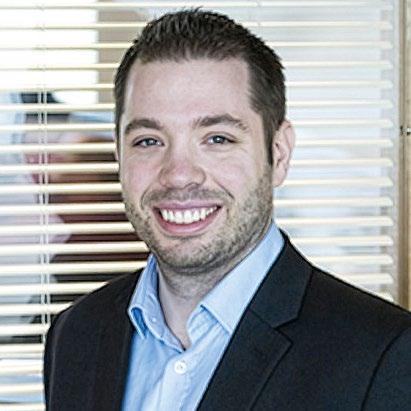
Each frame carries sufficient timing information to be processed correctly, even when services run on different machines. Components operate independently while referencing shared timing logic. If a processing instance restarts, it can determine the current production position and resume without forcing a full system reset.
Capacity expands by adding compute nodes rather than replacing hardware, and different parts of a workflow can operate in separate locations while maintaining aligned output. Coordination happens through shared identifiers and timing references instead of direct signal chaining.
Resilience through software design
The architectural choices that enable scaling also strengthen resilience. In traditional pipelines, a single failure can immediately disrupt downstream stages. In asynchronous systems, services interact through a shared exchange layer rather than fixed links, reducing the impact of individual interruptions. If one processing instance fails, another can continue publishing or adding frames. Multiple producers can operate in parallel, maintaining continuity even if infrastructure in one location becomes unavailable.
Maintenance also becomes more flexible. Individual services can be updated or restarted without bringing down the entire workflow. Complexity does not disappear, but it shifts from hardware coordination to software design and orchestration.
Flexibility comes with trade-offs and every system must determine how much delay it can tolerate in exchange for buffering, scalability, and seamless failover. In ultra-low-latency environments such as live sports, that balance is especially important. The objective is not to eliminate latency but to manage it deliberately, aligning technical design with production requirements.
The DMF framework does not prescribe a single implementation. Instead, it outlines principles: modularity, openness, softwarenative design, and scalability across environments. Asynchronous architecture is one practical path toward that North Star. It does not replace established workflows overnight, nor does it remove the need for careful engineering. But it offers a way to build facilities that are less rigid, more elastic, and better aligned with modern compute models.
The transition to IP changed how media travels. The shift toward dynamic, software-defined facilities may change how systems are conceived. The opportunity now is not simply to adopt new technologies, but to rethink system design - moving from fixed pipelines toward infrastructures that are inherently adaptable.
ATEM Mini Extreme ISO G2
ATEM Mini Extreme ISO G2 makes it easy to create professional multi camera productions for live streaming! Simply connect ATEM Mini Extreme and you can live switch up to 8 high quality video camera inputs for dramatically better quality images. You can even sync your recording to Blackmagic Cloud, so you can edit your live production with DaVinci Resolve anywhere in the world!
Share Internal Storage with Multiple Users
ATEM Mini Extreme ISO G2 is not just a switcher, it’s also a shared network disk using the 10G Ethernet port to the internal CFexpress memory card or external USB disk! CFexpress cards are extremely fast so they can keep up with recording multiple ISO video files while external network users all work on separate computers for editing, color correction, VFX and audio post production.
Build the World’s Most Amazing Broadcast Studio!
The ATEM Mini Extreme ISO G2 is ideal for building a high-end broadcast studio as it offers all the ATEM Mini features plus extra features! It has a professional style control panel with amazing input buttons. It has 3 independent video outputs that can be routed. The built-in Thunderbolt offers live video capture and playback, enabling real-time effects software or live action replay.
Get Powerful Broadcast Replay with DaVinci Resolve
Blackmagic Replay uses the ISO files recorded by ATEM Mini Extreme ISO G2 to do replay in DaVinci Resolve. The ISO files are recorded to a CFexpress card which DaVinci can access via Ethernet. You can use multi-view in the cut page to view all cameras in DaVinci Resolve at the same time. The files will even continuously upload as you’re recording so you can edit live!
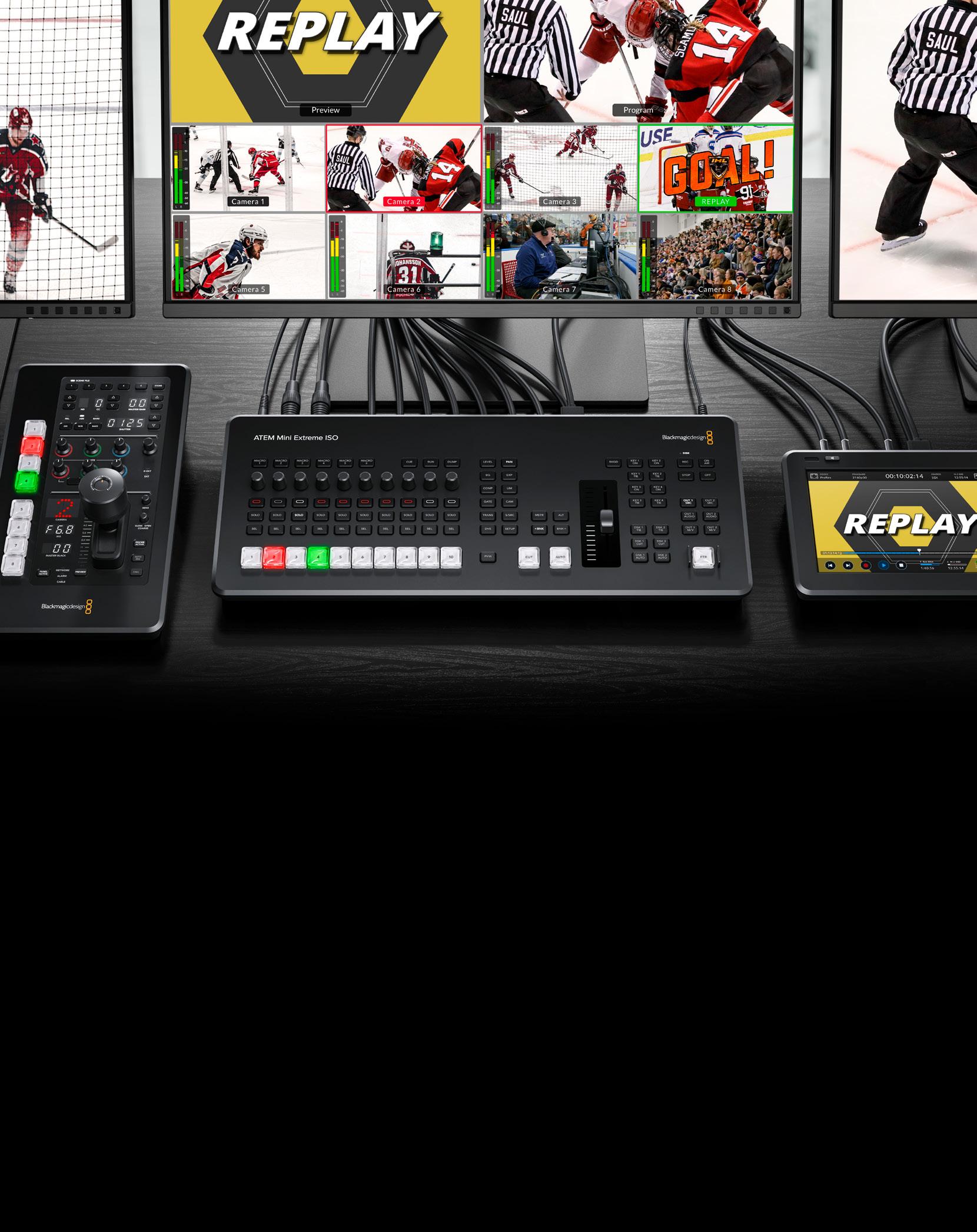

The Most Advanced Broadcast Quality Control Panel
The front panel has buttons for selecting sources, triggering transitions, and setting video effects. It also features an innovative audio mixer control area with live metering on a Fairlight style HDMI status output. You get buttons for recording, streaming, and dedicated output buttons for changing outputs between the 8 cameras, program, preview, multi-view, or Fairlight status.
TVBEurope’s newsletter is your free resource for exclusive news, features and information about our industry. Here are some featured articles from the last few weeks…
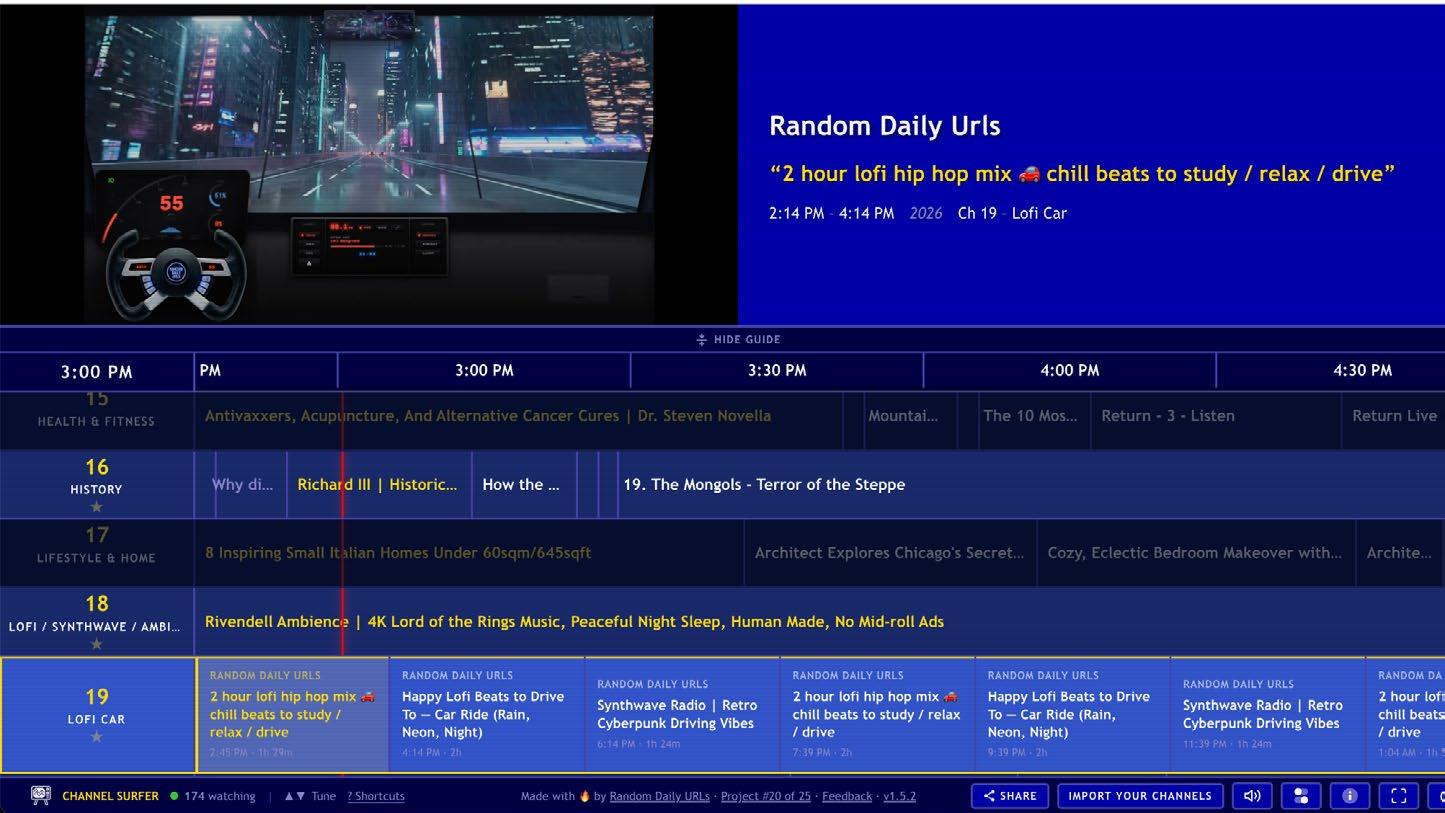

HOW CHANNEL SURFER TURNS YOUTUBE INTO A CLASSIC LINEAR TV EXPERIENCE
Steven Irby tells TVBEurope about his online tool, which creates an old-school EPG for the videosharing platform.
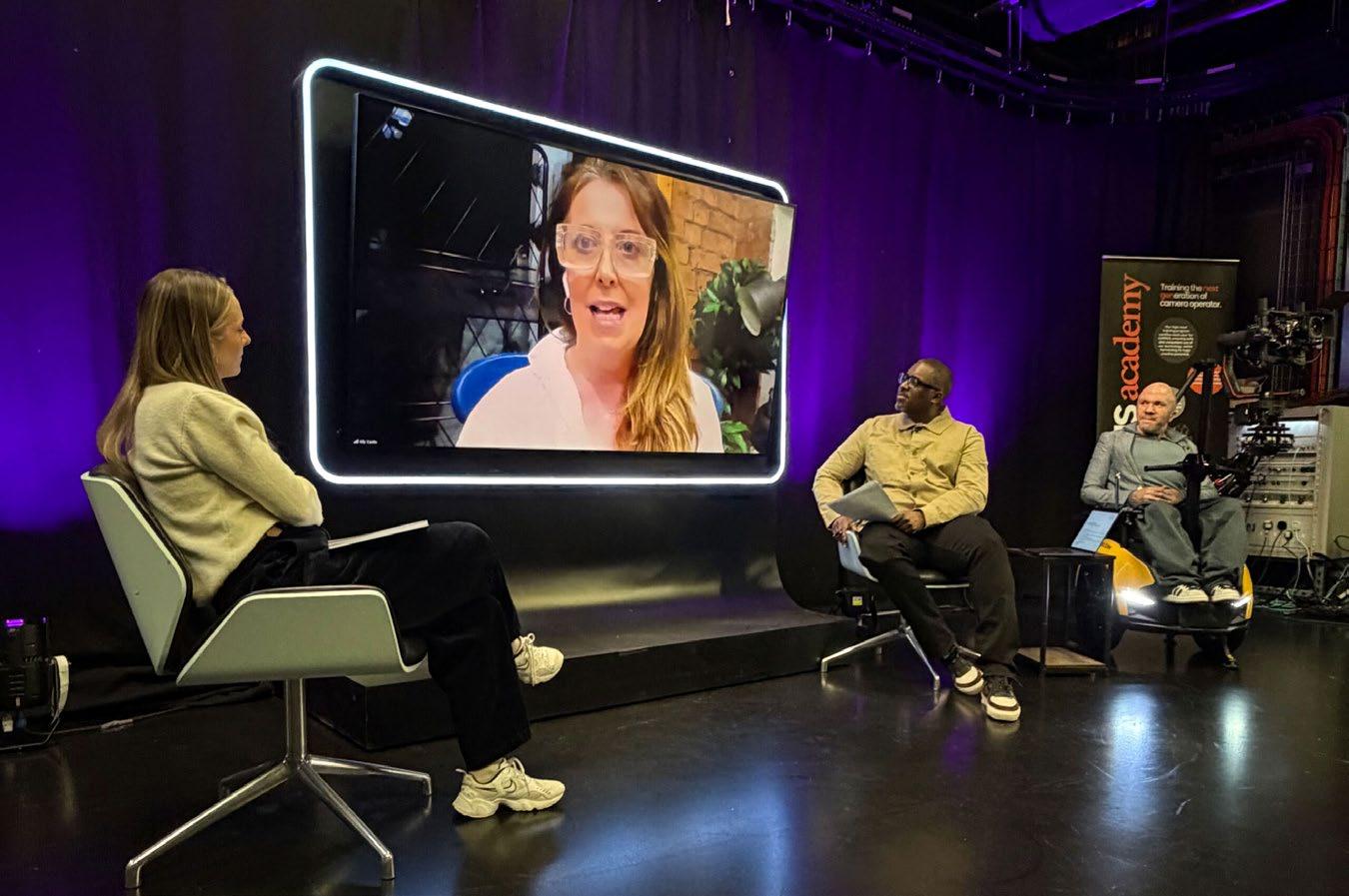
CHANGING THE CONVERSATION ON INCLUSIVE PRODUCTION


CELEBRATING THE WOMEN WHO EMBODY ‘GIVE TO GAIN’ IN THE MEDIA INDUSTRY
To mark International Women's Day 2026, TVBEurope was proud to highlight the women who encourage collaboration and a mindset of generosity within our industry.

DO YOU SUBSCRIBE TO TVBEUROPE’S FREE NEWSLETTER? SIGN UP VIA THIS QR CODE

A recent RTS Technology Centre event brought together production innovators and industry specialists to examine how accessible design and inclusive production practices are reshaping the way content is made, and where the industry still needs to move (much) faster.

The reality of fiction
Matthew Corrigan wonders if a resurgence in old filmmaking techniques might be a good thing for the industry
Somewhere in the dark reaches of the internet, there is a grainy photograph of what appears to be an old cable drum that has been discarded in a field somewhere in Hertfordshire. The picture was apparently taken some time during the 1980s and closer examination reveals a rather depressing truth. It is, in fact, the last known sighting of the space station model that wheeled majestically in low Earth orbit during Stanley Kubrick’s much-lauded classic, 2001: A Space Odyssey . As a symbol of a largely lost art, the forlorn wreckage is hard to beat. Today, depicting a futuristic spacecraft for a TV or film production is a matter of rearranging a collection of 1s and 0s located somewhere in the vastness of the cloud.
I’m trying not to wallow in nostalgia, but those miniatures had— and I’m struggling for the word—a physicality to them, a realness. While I knew they were not really blasting across the cosmos, I also knew that someone had lovingly laboured over them to make the impossible become reality. To borrow a phrase popularised by another TV classic, I wanted to believe.
Not that this is a new phenomenon, of course. I think I’m right in saying that the original Westworld was the first film to use CGI back in 1973. Even I’m too young to have seen that one on the big screen. In that instance, and many that followed, the technology added to the experience.
There is, however, a rather large irony in that Michael Crichton, who created Westworld and a host of other thrillers, always tried to deliver a crucially important message: don’t let the technology run amok. Anyone see any parallels with the ongoing dialogue over the creative use of AI?
Way to completely miss the message, everyone. Rather than use these innovations sparingly, TV and film productions have become utterly enamoured of them, squeezing digital imagery in at every opportunity. For me, there’s always something slightly off with the way it looks—it’s too smooth, too clinical. It doesn’t feel real any more. Recently, I was idly watching Roger Moore’s first Bond outing, Live and Let Die on TV (coincidentally released the same year as Westworld ). At one point Bond escapes in a vintage double decker bus, outfoxing his pursuers in a series of death-defying stunts. On a
rational level I understood it wasn’t Sir Rog at the wheel, but I knew a highly-skilled stunt driver really was sliding the old heap around a Jamaican street. Although trickery has been endemic since the very beginning of this business, these old productions at least contained a sprinkling of truth.
And there’s something else. I watched an episode of Paramount+ series Yellowstone on a very high-end TV not long ago. It was undoubtedly visually incredible, but it left me feeling cold. In one scene, a close-up of an actor’s face revealed every pore, every blemish in hyper-real detail. It felt as though I was watching an anatomical study, rather than a piece of entertainment.
I used to think this was a ‘me’ problem, part of my inevitable descent into believing everything was better in my day. Lately though, I’m not so sure. More and more, it seems I’m not alone. More and more, it seems storytellers are starting to understand that over-reliance on technology is diluting the tales they want to tell.
We all loved Top Gun: Maverick because we knew that while it wasn’t actually Tom Cruise at the controls of his alter-ego’s FA/18, he really was filmed while strapped in the back of one. And it showed.
Last year, I covered a story for TVBEurope’s Daily newsletter about a collaboration involving the University of Salford and Danish camera maker Logmar, working with the company’s Magellan 65mm camera. Used by Christopher Nolan in Tenet , it was the first 65mm camera to be manufactured and used on a major motion picture in 30 years. Speaking about the project, Laura Hiliard, film production lecturer at the University, spoke of the “magic” feeling the film created. Students are being trained in its use.
Next year marks the 50th anniversary of Star Wars . There was never any chance it was not going to be re-released, but, somewhat unexpectedly, Disney has confirmed the original version will return to cinemas—no new titles, no 1990s CGI additions. I guess we’ll soon be able to definitively answer who fired first.
And with Ryan Gosling sci-fi Project Hail Mary in cinemas, it has been revealed that the film was made without green screens, that the titular spacecraft was built as a physical set, and that alien character Rocky was a real-life puppet.
Maybe there’s something in nostalgia after all.
THE IS future
now
Jenny Priestley visits Vivid’s new Remote Production Centre to discover the technology driving the company’s move to remote production, and how it’s delivering an impressive product for the Women’s Super League on Sky Sports
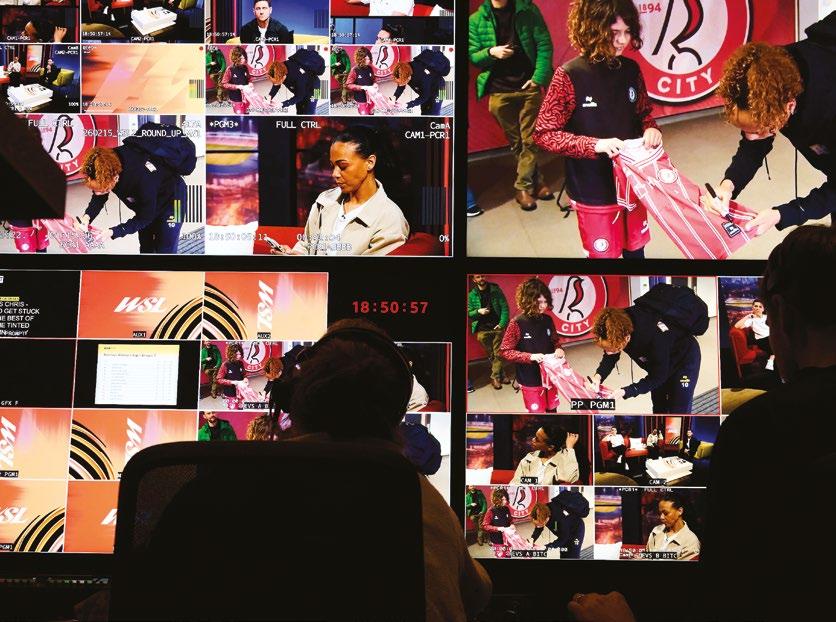
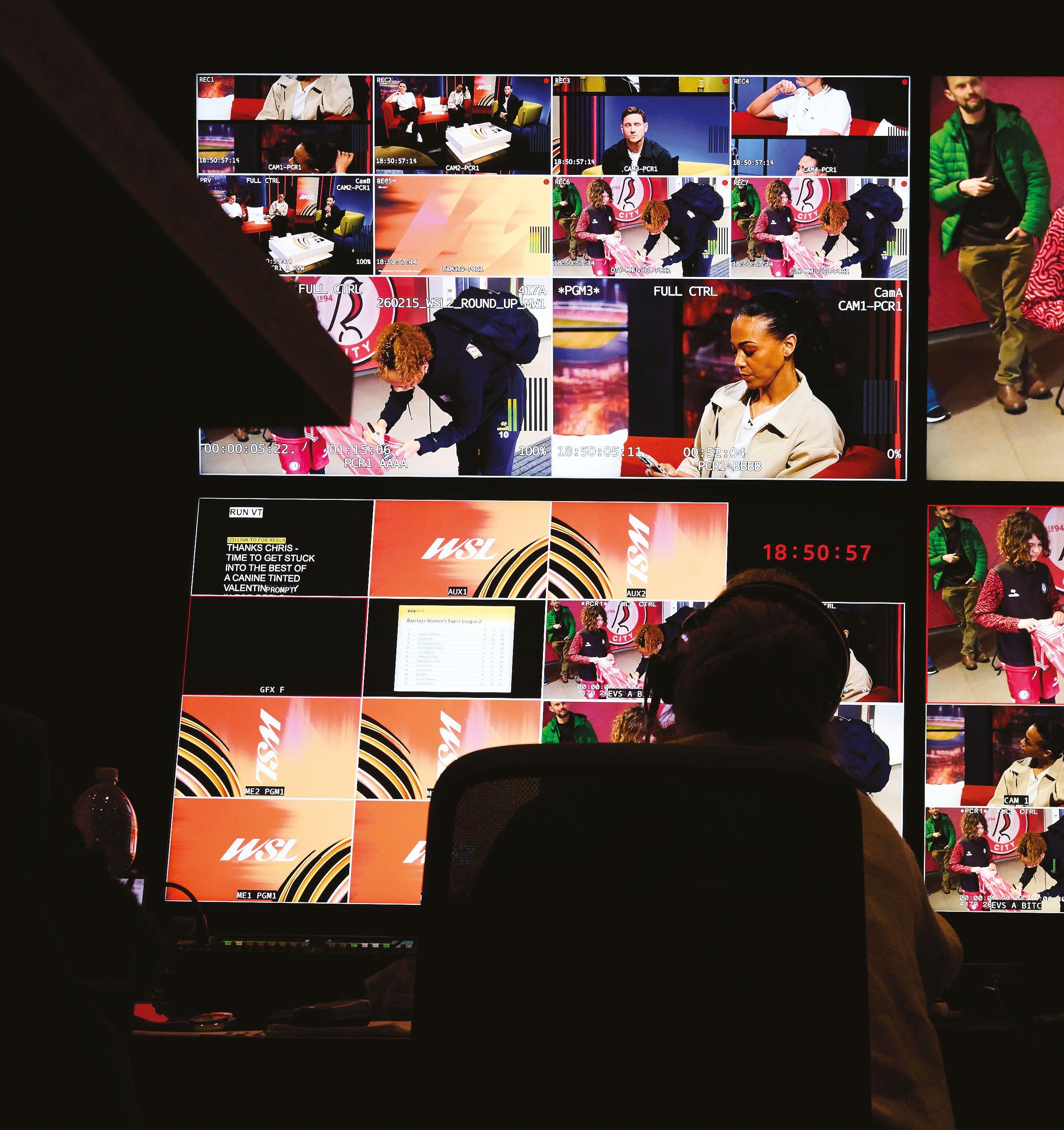
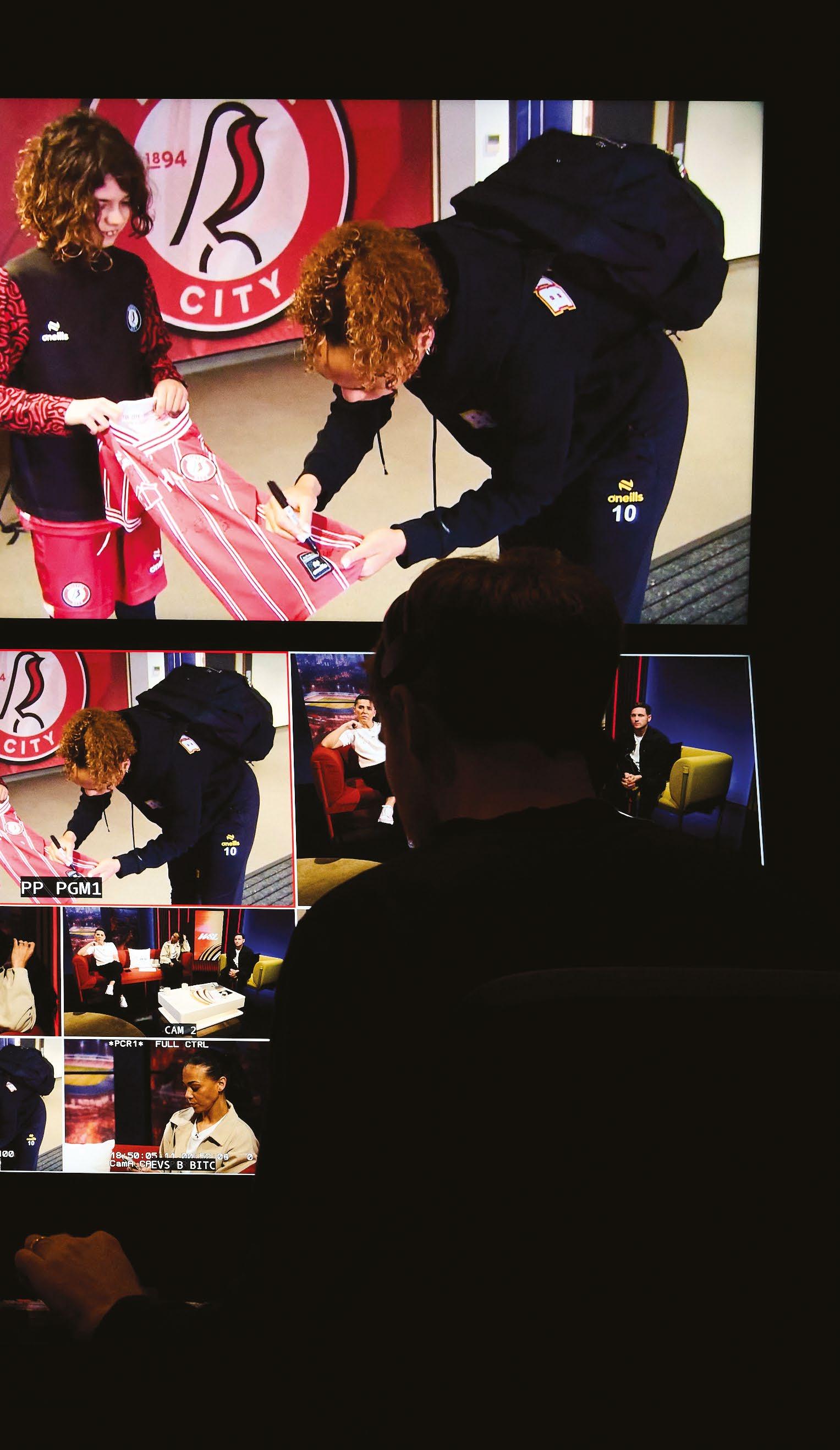
Based in Woking, just 30 minutes south of London, Vivid’s Remote Production Centre (RPC) is a hive of activity when TVBEurope visits on a wet Sunday in February. The company has been working in outside broadcasting for over 20 years, but recently expanded its facility to incorporate remote production. The reason things are so busy on this particular Sunday is because it’s Round 16 of the Women’s Super League—and alongside Sky Sports, Vivid supports a combination of eight and four camera matches, with the four camera matches remotely facilitated at the RPC.
Originally, Vivid’s base housed the company’s offices and OB trucks, with the team working on remote production on an ad-hoc basis. But, after taking over the building adjacent to their HQ, Vivid saw an opportunity to both expand its footprint and client base. The company’s new facility opened at the end of last summer.
“Vivid has been doing remote production since preCovid,” states Stephen Montgomery, co-founder of the company, “but, back then, we didn’t know it was called remote production. We’d send some feeds somewhere and deal with them somewhere else.”
He goes on to give an example of a music show that Vivid was involved in before the pandemic, which featured acts in South Korea, Toronto, and London. “The client came and asked us, ‘how do we do this?’ We said, it’s easy, we’ll just do a livestream, and the director can see all the cameras, and we know how to do comms
over IP. So, without even necessarily knowing it, we built remote production workflows.”
“We started from scratch as far as the physical space,” adds Montgomery. “The facility was very much built out of considering where we want it to be in the future. For the WSL, we run at 50p, but we’re finding increasingly remote production means international, so we’re running 59.94p for clients in the US, and 24p for live to cinema—as well as 1080 50i.”
For incoming and outgoing contribution paths, Vivid use encoders from Intinor and Haivision. “Many of our partners are starting to implement Intinor,” explains Montgomery. “Some of their proprietary codecs, such as Bifrost, are like SRT on steroids.”
Although only 20 minutes off the M25, Vivid’s facility is refreshingly rural compared to other companies, but that hasn’t been a problem in terms of making sure it has plenty of internet capacity. The company worked with Vorboss, a London-based dark fibre provider who partnered with BT Open Reach to “dig up the road all the way here. It’s the first installation they’ve really done like this outside of central London. Vorboss have given us fully diverse 10 Gps lines.”
The RBC runs fully redundant, high-availability, cross-routed Peplink routers, which means that should there be any failures at any point in the chain, Vivid has redundancies in place throughout. It also has Arista 100GbE switches with “the ability for anything to go through them and loads of room to spare”.
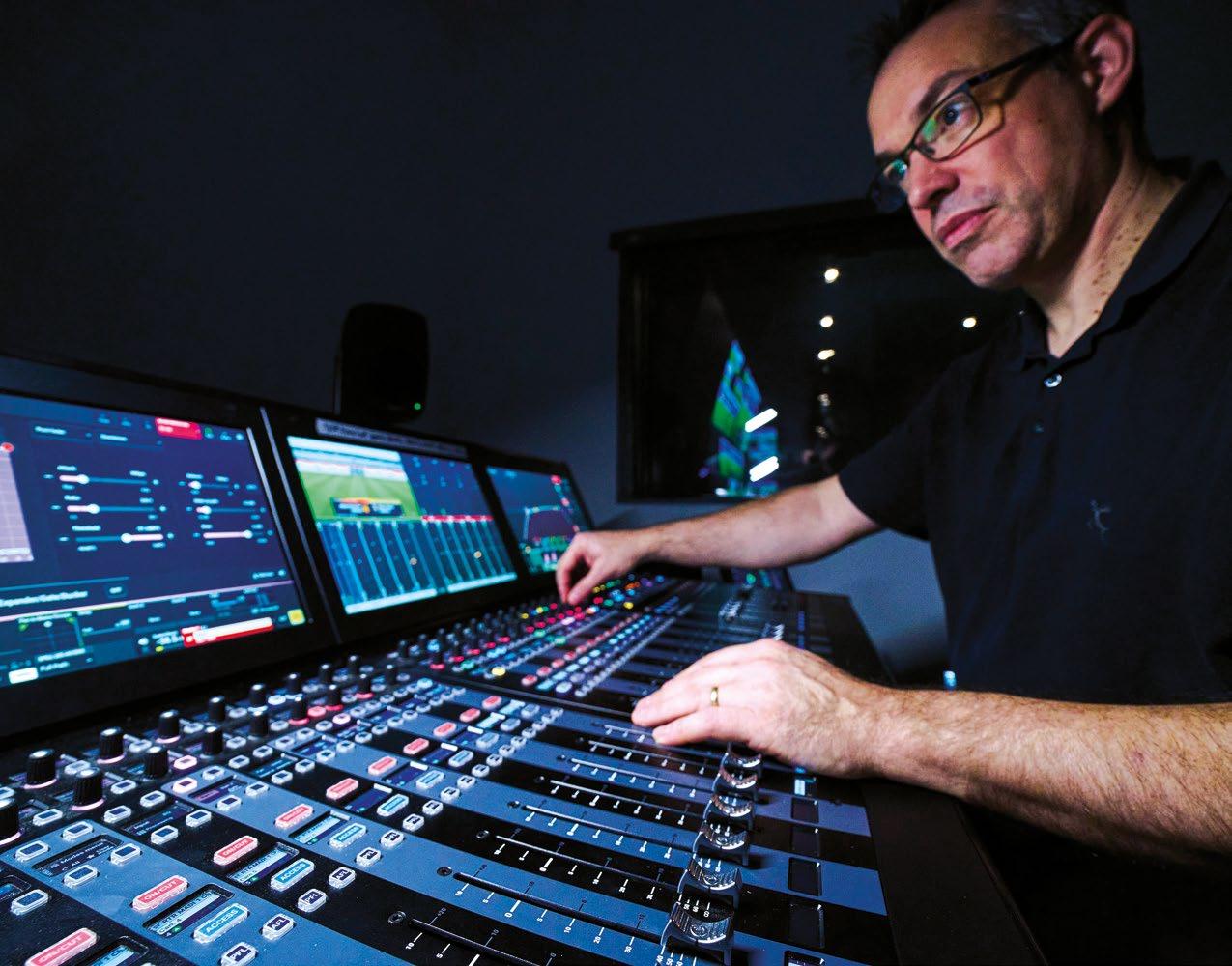
Other technology found in the facility’s rackroom includes AJA Video’s format converters, EVS IPDirector, EVS XFile 3, ADDERLink KVM and storage from Synology. Ross Video’s Ultrix FR12 is connected to Vivid’s five galleries, studio and EVS workflow including the new Xtramotion slo-mo solution.
Flexibility
The broadcast centre is located over two floors, with the studio, green room and four “pods” on the first floor. All of the pods are equipped with Glensound Dante so that they can be used for commentary at the weekends, and transformed into editing suites during the week via the push of a few buttons.
“We’ve got plans that by the summer, we’ll increase the capacity again as contracts evolve—the key is being agile and flexible,” reveals Montgomery.
In terms of editing systems, Vivid predominantly uses Adobe with editors working in the cloud.
“When we originally began working out of the Remote Production Centre, the facility was very much built with extra capacity, and what we found is that we’re already
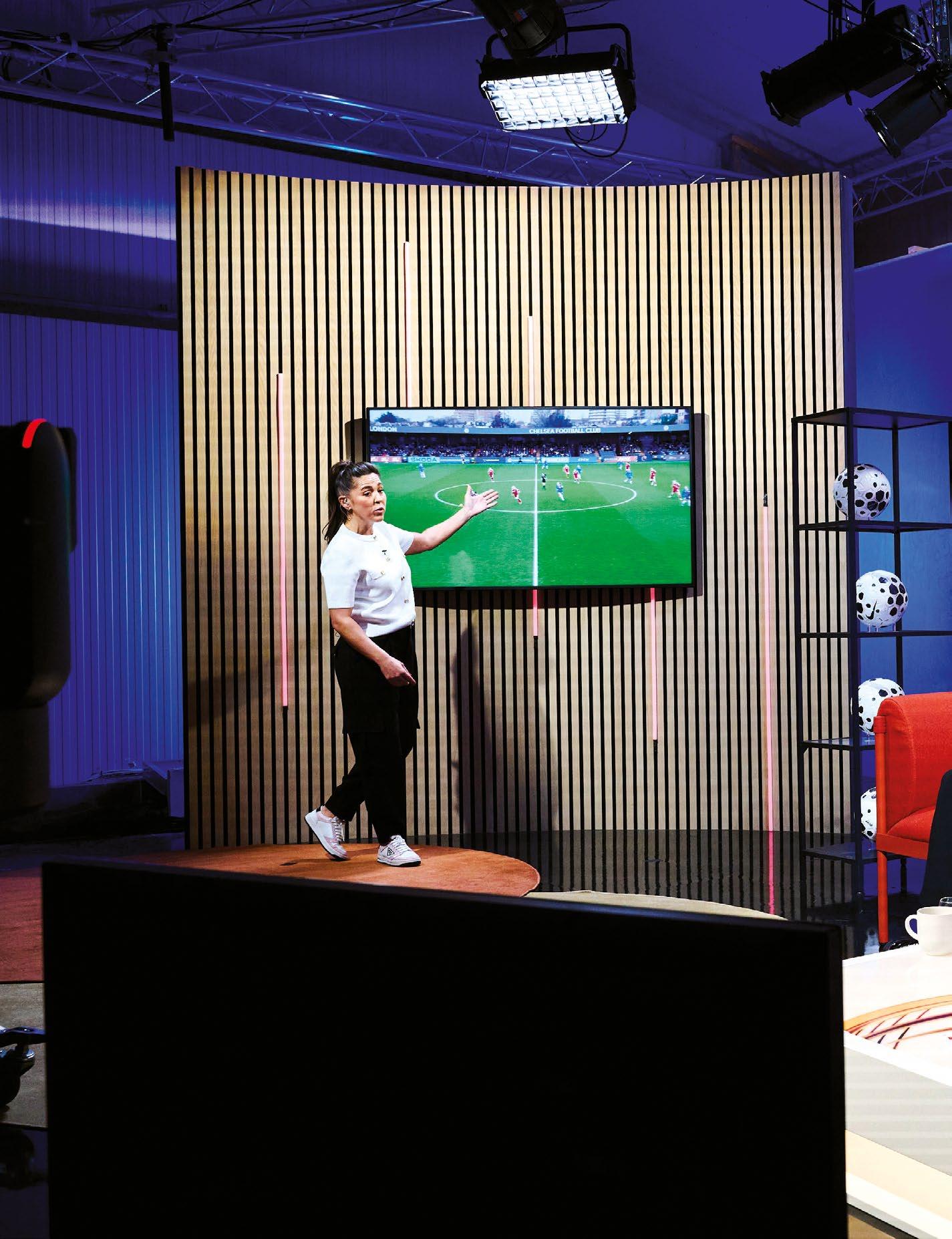
PICTURED ABOVE: The studio is used for the WSL's highlights show
looking at increasing that capacity,” Montgomery explains. “We’re going to be adding another gallery. We know the volume of various contracts will be growing. So we’re very much looking ahead to how we can support that expanded capacity.”
Down the corridor from the pods is the facility’s studio, which includes four Sony FR7 PTZ cameras,
“PCR 1 can fit as many people, if not more, as a full-size, tripleexpanding OB truck”
FRANCIS COUSINS
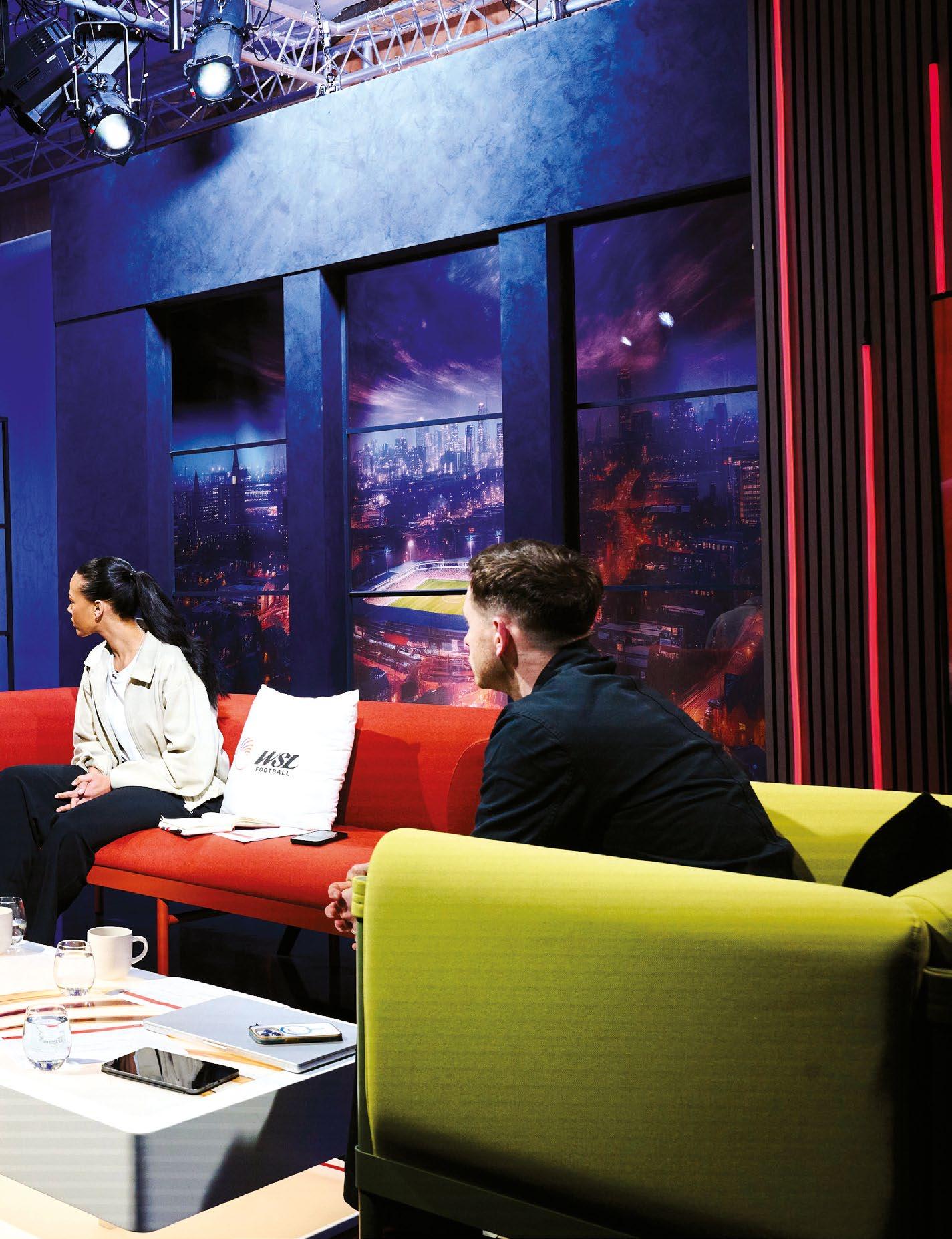
controlled by one operator. There are plans to include facial recognition and tracking in the future, to enable the camera to follow presenters as they move around the set, as well as designs to install an LED screen backdrop which will offer producers flexibility and ease in changing set styles.
The studio will offer clients a dedicated space for presentation, for shows such as a recent multi-city live broadcast, with acts in Scotland, Cardiff and London and the presenter based in a remote studio. “We also work with Nike—on Sneakers Day as an example, they had a presenter in one central location who was throwing to events in Amsterdam and Paris. We brought all of the feeds into Woking with the director based here. That’s where remote production really does thrive. It’s about utilising the fact that different things are happening in different spaces, and we can centrally bring all that together.”
Vivid uses Bitfocus’s Buttons as its control software. The hub provides a user-friendly interface to streamline workflows uniquely controlling Sony vision mixers and Calrec audio surfaces via a single control panel in each gallery. While Buttons is officially in beta, the team at Vivid has been working with Bitfocus on R&D and feedback. “We’ve actually got direct Slack comms with them, and almost daily we’re asking, can you add this feature?” explains Francis Cousins, Vivid vision guarantee. “A lot of the features that are now in Buttons are as a direct result of us using it in this facility.”
The WSL coverage for Sky Sports is all produced in HD at 50p, with waveforms monitored in the OB trucks and back at base via Telestream Prism. “If we’re not working on the WSL, there are bits of the facility’s workflow that would be fine with 4K. The Intinor encoders are eight-channel but if you’re in UHD, because of the processing capacity, it does drop. So it’s not that across the board. We can switch everything we’re doing to UHD.”
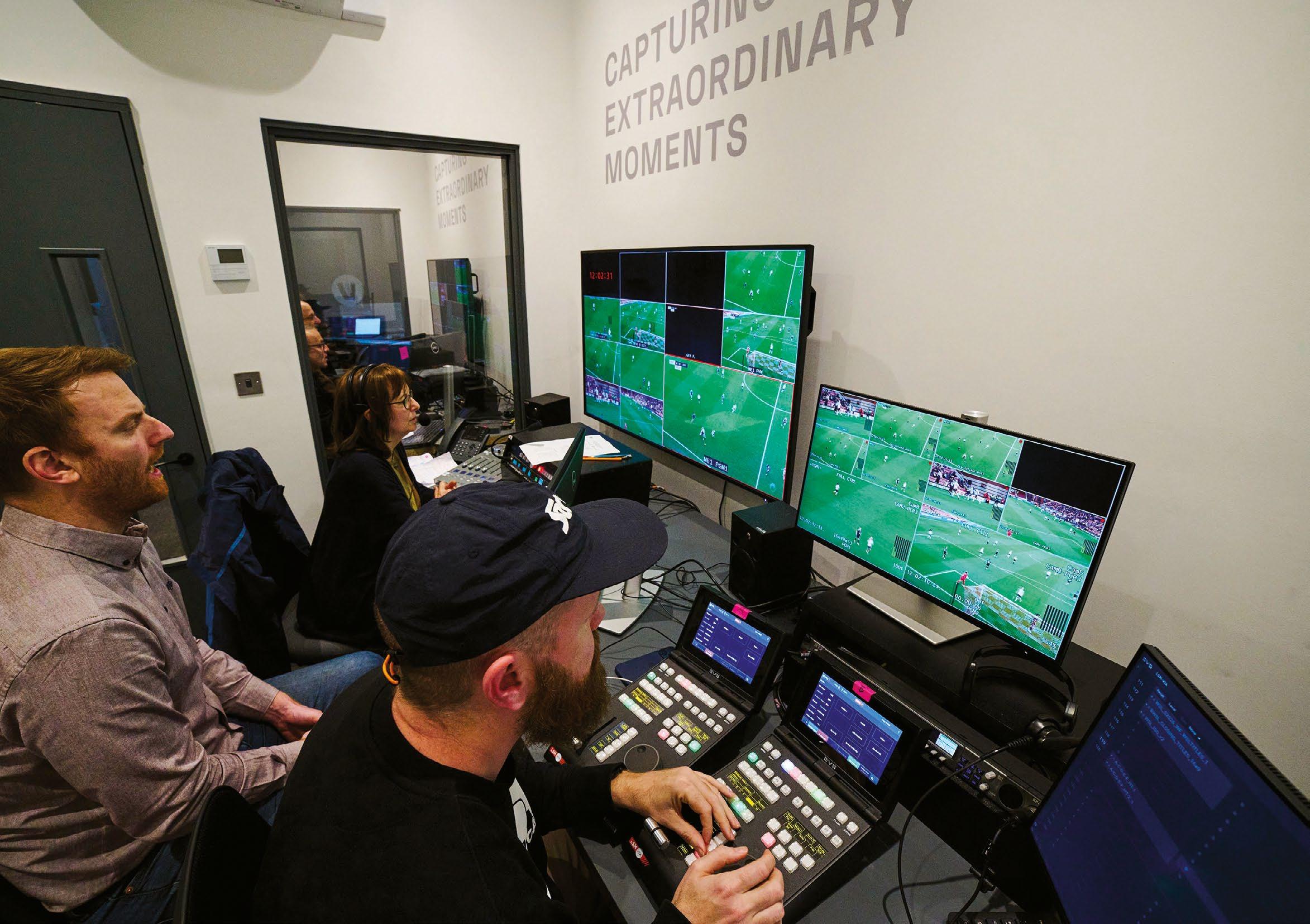
The broadcast centre houses five production control rooms/galleries, the biggest being PRC 1 with eight individual multiviewers. It includes three rows of desks, with room for eight seats on the front and middle rows and six on the back. “PCR 1 can fit as many people, if not more, as a full-size, triple-expanding OB truck. Flexibility is built into all areas with PCR 2 & 3 able to operate as dedicated VT rooms for larger productions.
Like the other galleries, PCRs 2 and 3 include Stream Deck and Bitfocus Buttons, as well as a Calrec Type R surface for sound. According to Cousins, using Buttons means that directors and operators can be as agile as possible. “Whilst in some ways it’s set up like a
The facility’s dedicated sound room includes a Calrec Argo
PICTURED ABOVE:
For the WSL, Vivid is involved in four and eight camera matches
traditional vision mixer, the director has a preview bus, a programme bus, and if they cut to an EVS for the replay, they’re not only telling the Sony vision mixer to cut to the EVS input, i’s also telling the Calrec surface to fade the audio up. The director can also just grab the fader and push it up or pull it down if they need to. So while it’s automated, the director can interrupt the automation and make changes required for whatever reason.”
The facility’s dedicated sound room also includes a Calrec Argo. “For football, the mics in the stadium are fed back here to be mixed. That’s remote production in the traditional sense. For the studio-based highlights show, we use Wysicom radio mics, which are fed via Dante to the sound room," adds Montgomery.
“The two worlds are getting blurred, between what is remote and what is traditional, and I think that’s quite exciting” STEPHEN MONTGOMERY
Scoring with Sky
Vivid has been working with Sky Sports on the WSL for two seasons, with the 2025/26 season utilising the RPC for four-camera coverage. It’s a multi-faceted contract, with the company providing both remote production facilities as well as OB vans at the various stadia. “What that means in terms of flexibility is that our trucks can talk to our gallery, and they can talk to other people’s galleries. Our gallery can get feeds from our trucks or someone else’s trucks. It’s all very flexible.”
The WSL workflow also includes EVS XtraMotion for slo-mo footage, Sony Ci for logging, Ross Piero on-screen graphics, and the Sony XVS G1 vision mixer, which can be split, explains Montgomery: “For the WSL when we’re doing lots of four camera matches, we’ve got individual directors who feel like they’re using a vision mixer, but, we’ve got two different frames, one frame is probably doing two or three matches. It’s just segmented off.
"There’s no risk that one director is going to ruin something for another director; you can properly segregate it into parts. But if we were doing one really big show, those two frames can be joined together so it’s very flexible.”
The future
The team at Vivid is also busy futureproofing workflows for other areas of the business, such as “cinematic multicam”.
“We use ARRI cameras for things like music, fashion, and theatre, but there are some misconceptions about why you shouldn’t use them, for example, for sport,” explains Montgomery. “We’ve been really pushing to say you can use cinematic multicam for sport, as long as you understand the different parameters.
“The same is true for remote production. Most people who work on music projects say you can’t use remote production because of the delays. But again, that’s focusing on saying that remote production needs to be fully remote production. I think remote production has the potential to be so integrated that it’s no longer a question of whether you’re using remote production or traditional workflows.”
Montgomery cites an example of a recent project for the National Theatre, where a Vivid OB truck was based at London’s Southbank, but one of the producers was located elsewhere. The team at Vivid used its remote production facility to provide the producer with
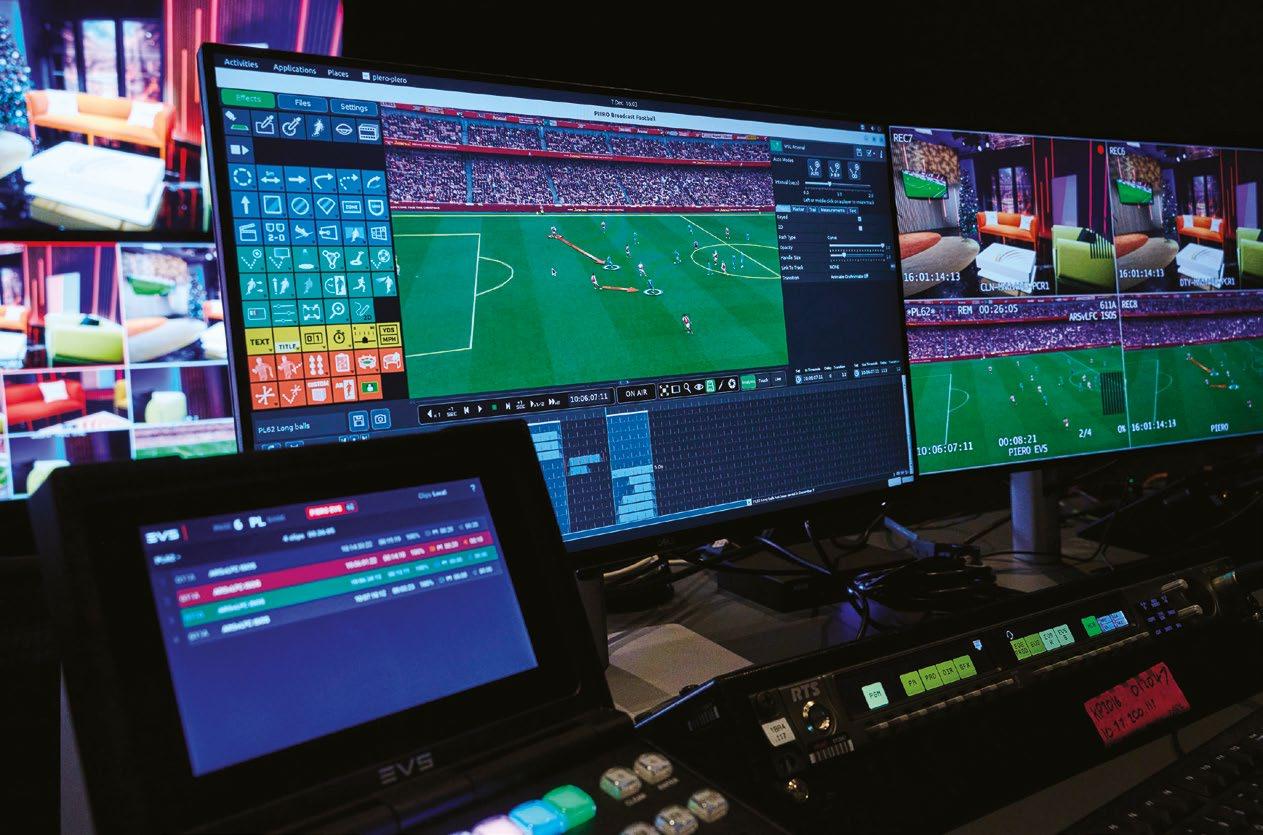
a multiviewer. “The two worlds are getting blurred, between what is remote and what is traditional, and I think that’s quite exciting. Every genre can benefit from it, as long as you know the limitations and desires of that genre.”
PICTURED ABOVE: PCRs 2 and 3 include Stream Deck and Bitfocus Buttons


Satellite
television
Ahead of the Artemis missions that will see humans return to the Moon, Rebecca Sirmons, general manager and head of NASA+, tells Matthew Corrigan how the team is preparing to live stream the space flights
The first time humans journeyed to the Moon, the world watched in black and white. Right around the globe, people gathered in front of bulky tube television sets wherever they could—universal TV ownership was still some way into the future— collectively holding their breath as they peered at the grainy images coming from almost a quarter of a
million miles away, and one small step left an indelible imprint on history.
Overall, six spaceflights of NASA’s (National Aeronautics and Space Administration) Apollo programme landed some 12 astronauts on the Moon between 1969 and 1975, before the project ended and the administration turned its focus towards other missions, including the STS (Space Transportation System aka the Space Shuttle) and its role
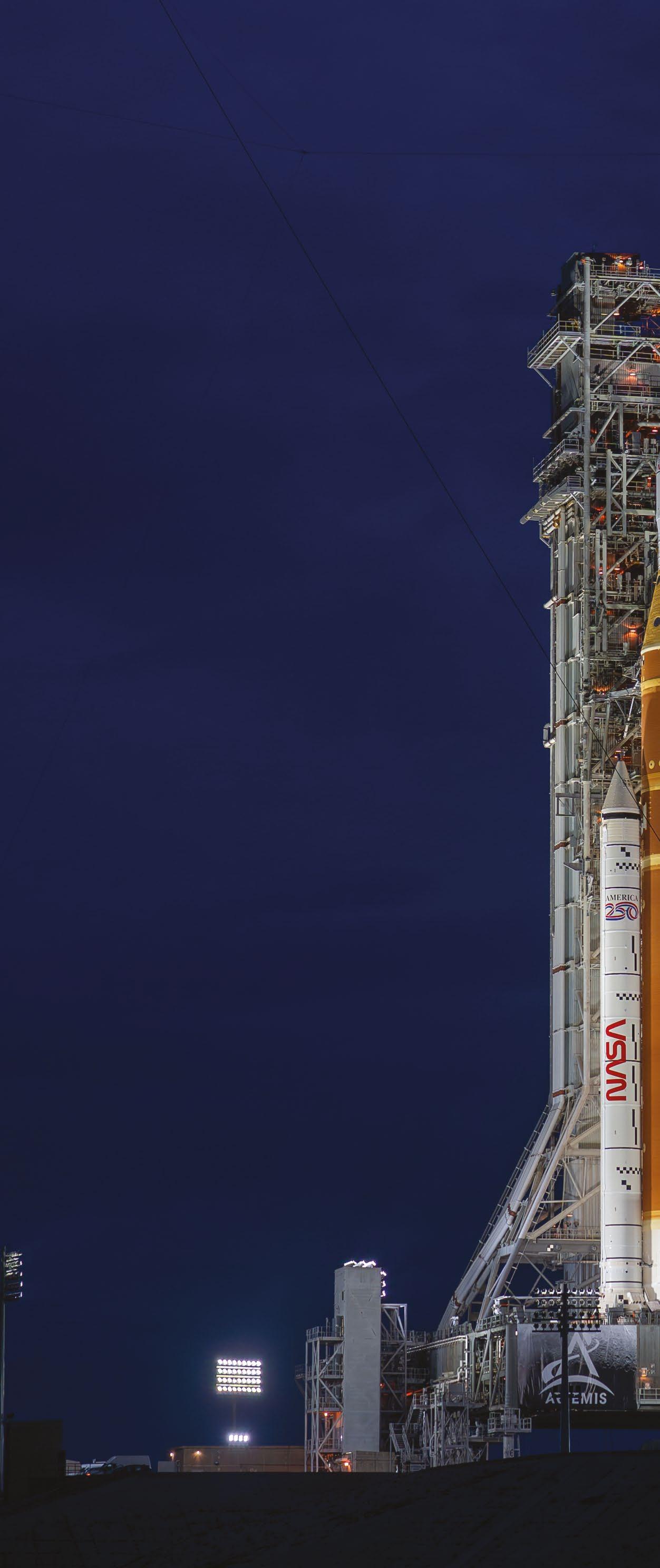
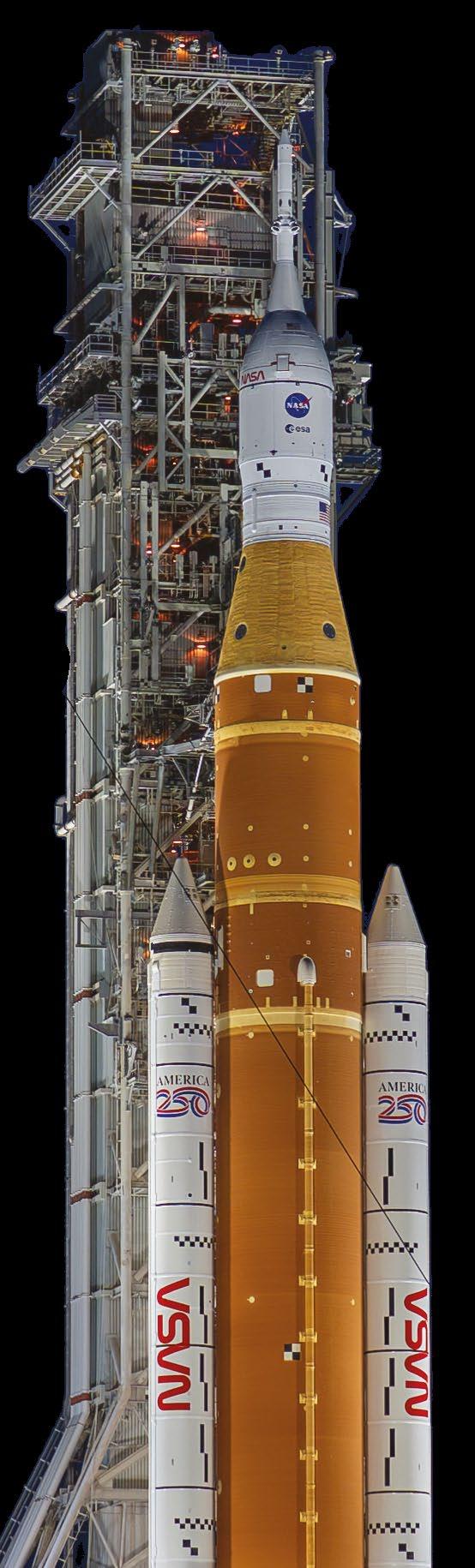
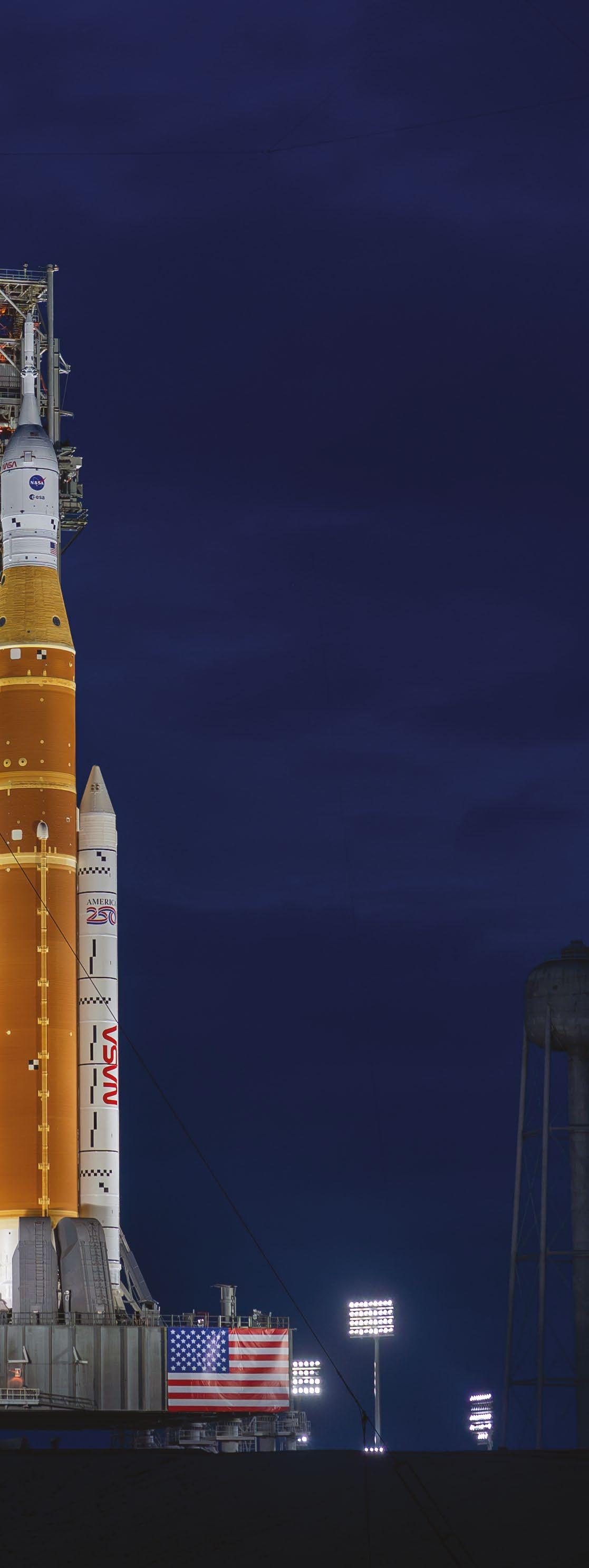
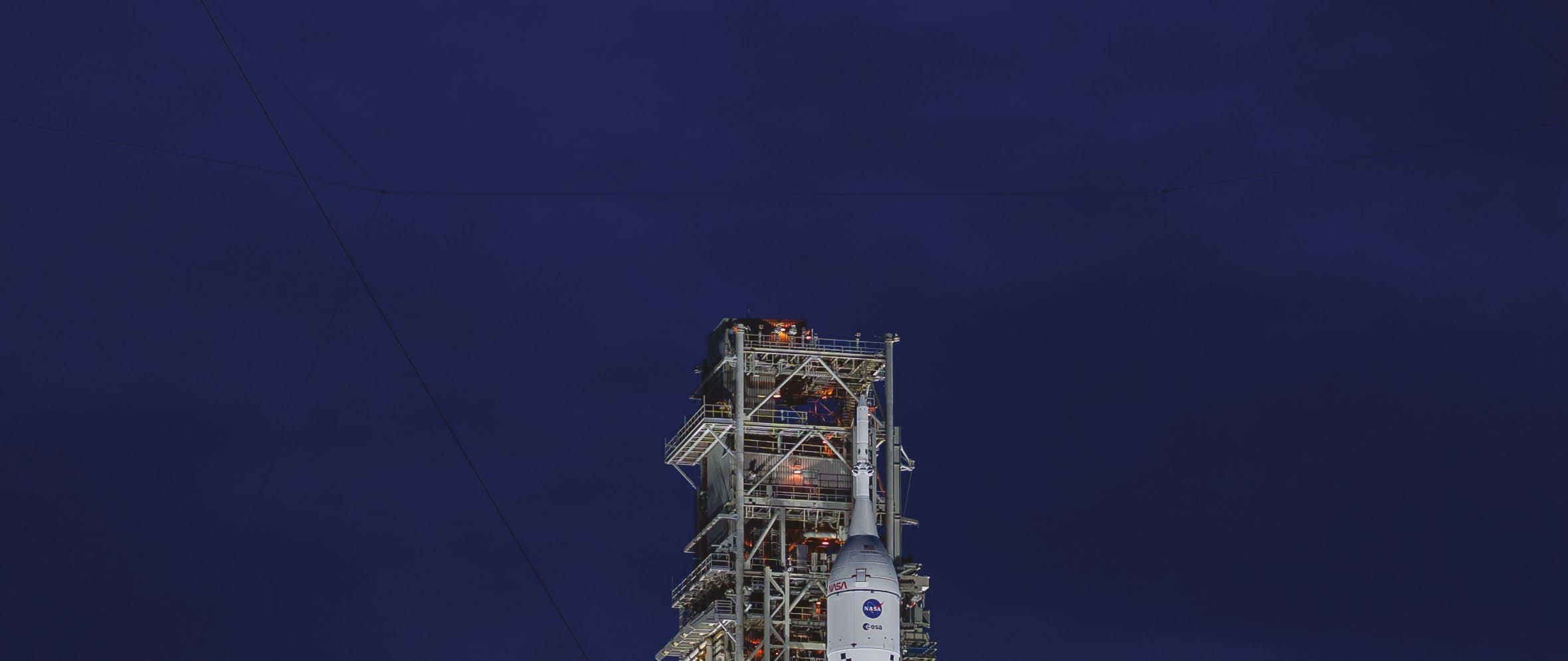
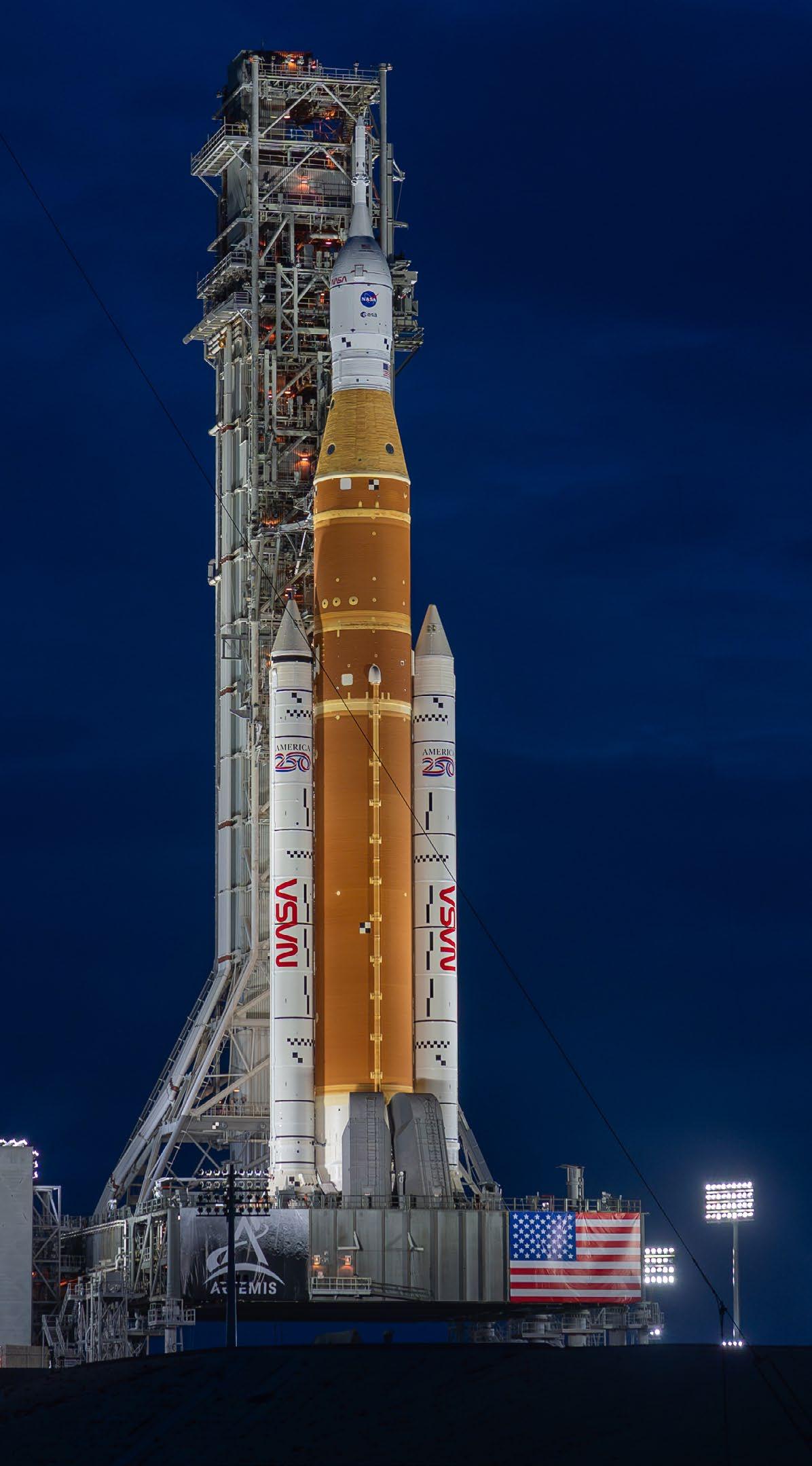
Artemis II on the launch pad at Kennedy Space Center
in the International Space Station project. It seemed, at least to those with an amateur interest, as though the Moon was no longer in favour. The occasional probe was sent to visit, but manned missions to our closest celestial neighbour looked to be a thing of the past.
Until Artemis. Because now, more than five decades after an astronaut last left a mark on the lunar surface, the countdown is on to NASA’s next manned mission to the Moon. If all goes well,
“We’re looking at working with multiple CDN partners moving forwards, to leverage these major broadcasts”
REBECCA SIRMONS, NASA+
Artemis II will blast off from Cape Canaveral in April on a six day flight around our only satellite. That mission will pave the way for Artemis III, when humans will once again take steps on the Moon.
Public fascination is likely to be intense, and as the technology that drives space exploration has advanced over the last half century, so too has innovation in the media environment. This time, the potential global audience can only be described as massive. Preparations are underway at NASA’s official streaming platform, NASA+, to meet viewer demands that have changed beyond recognition from the days when Armstrong and Collins took mankind’s first tentative extraterrestrial steps.
“We will obviously be live streaming,” says Rebecca Sirmons, general manager of NASA+, as she outlines the task ahead. “The upcoming Artemis II launch will be flying around the Moon and we’re looking at viewership totalling around 25 million. Those are Olympics numbers, right?” For these missions, cameras are fixed “all over the space craft”, while the crews will use Nikon D5 digital cameras to capture detailed views of the lunar surface.
Given the scale of the task at hand, it is understandable that there are some nerves ahead of the operation. “We’re crossing our fingers,” she says, although it’s clear that the organisation has been carefully planning against all eventualities. NASA is actually mandated to share its story with as wide an audience as possible under the terms of the US Space Act of 1958, which also led to its creation. Broadcast innovation has long been part of its story. “[NASA+] is one of the most creative places I’ve ever worked,” continues Sirmons, who spent two decades in the entertainment industry prior to joining the space race.
Primary live events are handled at the Kennedy Space Center and Johnson Space Center, with all technical infrastructure interconnected to ensure nimble, flexible operations via a virtual master control room. Live streaming operations are based at the Marshall Space Flight Center in Alabama. “It's the home of our head of live streaming tech and streaming tech in general for NASA, plus Lee Erickson is there,” Sirmons refers to the Emmy Award-winning NASA engineer who led the administration’s transition to IP-based video delivery. Redundancy is set up both in Alabama and at the Goddard Space Flight Center in Maryland. “We can basically run the machine from wherever we are,” says Sirmons. “The model is economically sustainable and a really smart way of operating, no matter where we are.”
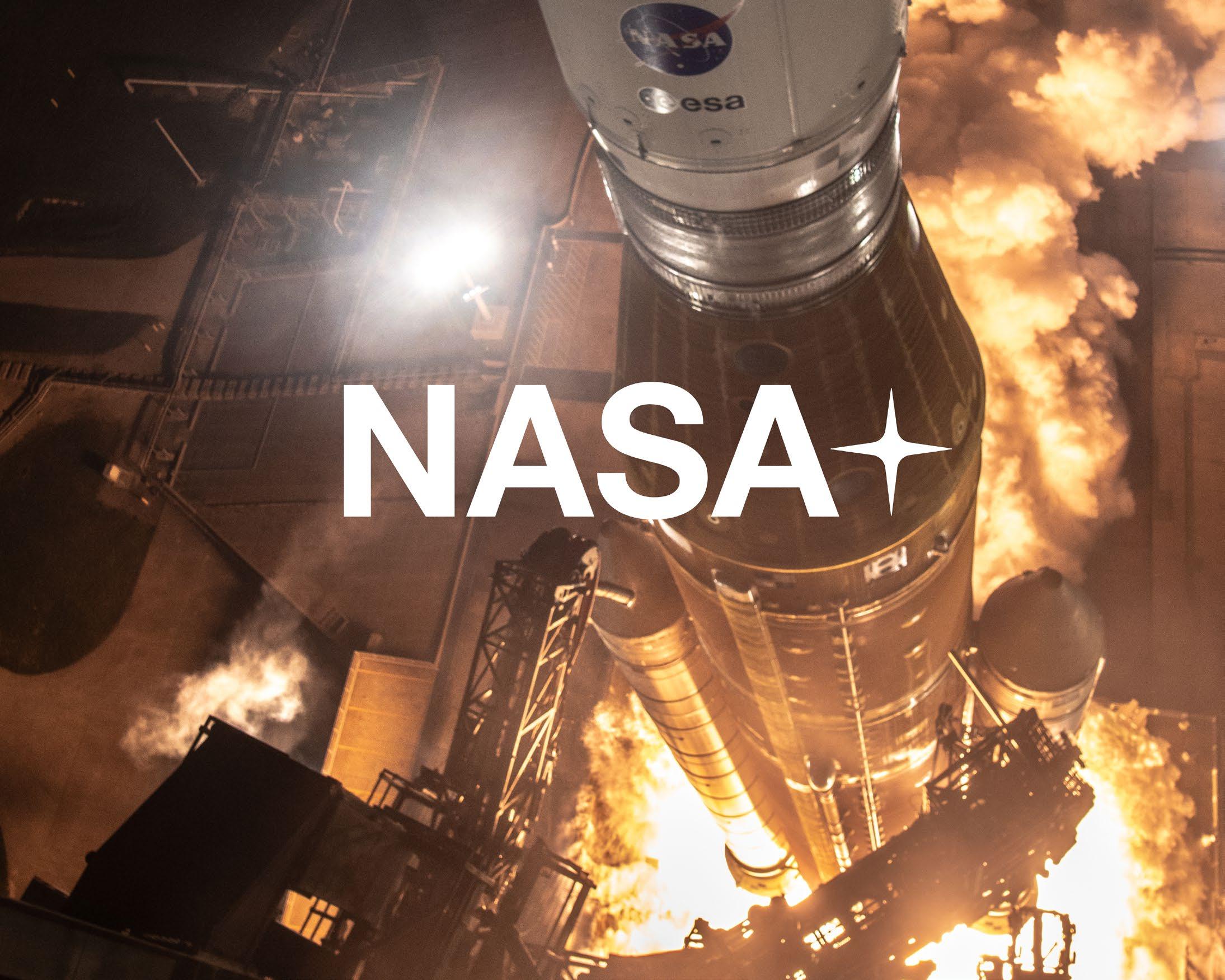
Around 25 million people are expected to watch the Artemis II mission
It’s also where the hub was developed for Amazon Web Services (AWS). “We’re using Akamai as our CDN [Content Delivery Network],” she continues, “And we’re looking at working with multiple CDN partners moving forwards, to leverage these major broadcasts. We lean into diversified distribution, partnerships with Netflix and Amazon Prime. We also have original content partners like PBS and Canopy. [These will enable us to] get global distribution on a bigger level, so it’s more of us getting our feeds out there and having the partnerships in place to ensure success. My goal is to make sure that no matter where you are or how you consume content, you can find NASA.”
Artemis II features three so-called ‘tent pole moments’ which are expected to drive the majority of views. The team is leveraging YouTube for distribution, strategically placing NASA+ to avoid overwhelming its own CDN when interest spikes. Sirmons explains how the team anticipates viewing figures will unfold over the duration of the mission.
“This is our Apollo moment”
“The launch will have a large viewership. Six days later, we will have the lunar fly by and then, 10 days after launch, we have splashdown. I think, cumulatively, we’ll have 25 million.”
Signals should arrive back from the Moon in around three seconds, with latency extending to between five and 10 seconds overall “when we get through the broadcast infrastructure” as every hop slows things down. “I know that with space flight, we don’t have the fastest latency but the good news is we’ll be able to get it out pretty quickly.”
The broadcast crew on the ground is spread across the different
centres and surprisingly small, with members often carrying out multiple roles. “There’s a lot of surge support,” says Sirmons, referring again to the expected spikes in viewing. “The team’s small. It’s not in the hundreds like what you’d see for Olympic broadcasts. I’d say the NASA+ team is under 10.”
A recent exciting development has seen astronauts equipped with smartphones to capture their own mission footage. Although it hasn’t
yet been confirmed how much of this content will be shown—they are the crew’s personal devices—Sirmons expects some will make their videos available. “It’s going to be interesting to see what they come back with,” she adds.
Growing up in Florida, Sirmons says she was “obsessed” with space from an early age, and saw a number of rocket launches, sadly including the ill-fated Challenger shuttle mission. As a child, she harboured ambitions to be a fighter pilot before entering a career in the media and entertainment business.
During the pandemic, her daughter wanted to watch astronauts Bob Behnken and Doug Hurley make their historic first crewed flight of the Dragon spacecraft en route to the International Space Station. Live coverage, however, proved impossible to find. “A seed was planted. I didn’t want another kid to experience that again.” As an executive specialising in streaming with an engineering background from the University of Central Florida, Sirmons was determined to solve the problem and, after seeing a random post on LinkedIn, soon found herself at NASA’s door.
“This is our Apollo moment,” she says. “Artemis is this generation’s answer to Apollo. I look at my daughter, and I think, oh my God, you’re probably going to be going to Mars one day. This is the beginning,” she concludes. “And it’s not just the Moon. We’re going to the Moon and then beyond.”
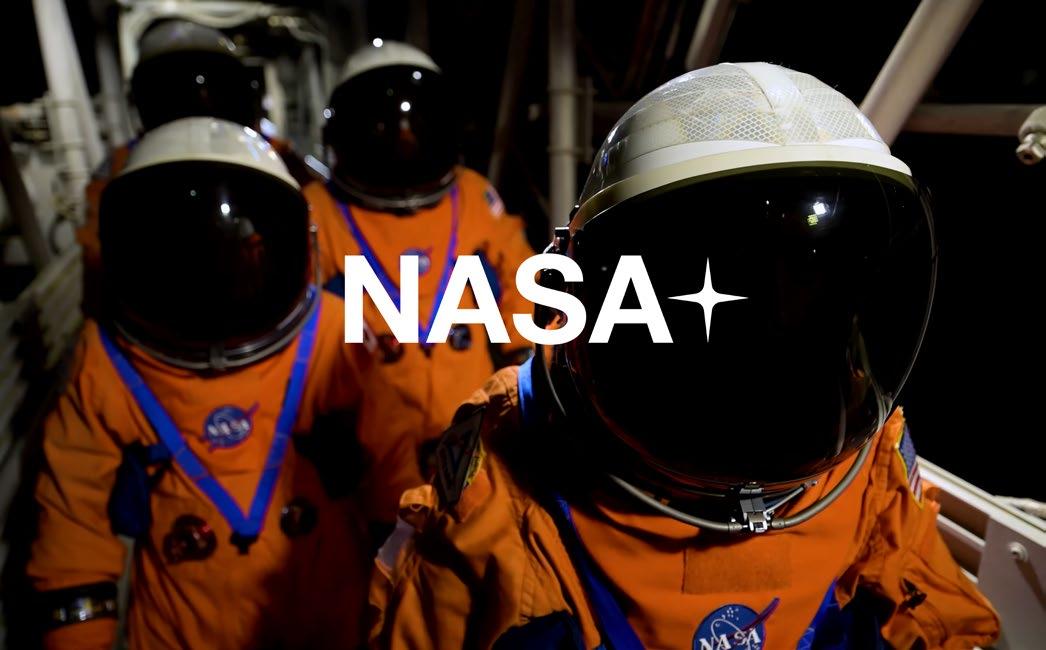
Astronauts have recently been equipped with smartphones to capture their own mission footage
NEXT-LEVEL SPORT EXPERIENCES WITH

The future will see a blend of 5G applications working together to tailor coverage to the unique profile of each sporting event. Monica Heck examines how 5G is allowing broadcasters to create ever more engaging content
Both 5G mobile networks and 5G Broadcast, built upon the 3GPP standard, can work side by side to make immersive fan experiences in sports a reality, delivering benefits across the entire broadcast production chain, from camera to screen.
On the contribution side, the deployment of private 5G networks is leading the 5G technology charge that is making the production of sporting events more flexible, according to Matt Stagg, in charge of strategy and partnerships at Neutral Wireless.
“The advantage of 5G mobile networks over traditional RF is that it’s bidirectional, so you can access not just remote cameras, but also reverse communications and return video,” he says.
“The sports industry has the most well-defined use case for 5G slicing, which is complex to provide: you carve off some of the network purely for an application, and it can be configured for uplink to support incoming camera feeds, whereas a traditional mobile network is configured for downlink, because its main use is streaming.”

Olympic solutions
Successful coverage of the Coronation for the BBC, where Neutral Wireless deployed a seven-cell 5G private network outside Buckingham Palace to cover part of the procession route, supporting 60 devices from 20 different international media at a time when public networks were saturated, inspired Olympic Broadcasting Services (OBS) to examine the use of private 5G networks for the opening ceremony of the Paris Olympics in 2024.
“They weren’t sure how to provide coverage over a 6km stretch of the river, with content coming off boats and feeds for each delegation,” explains Samuel Yoffe, senior system engineer at Neutral Wireless. “You can’t do 207 feeds with conventional RF. We deployed a 22-cell network that we put out for video production, but also to support mobile photographers with instant FTP upload of photos to their respective press agencies.”
Private 5G networks were also deployed over three stadia: Stade de France, Bercy Arena and La Defense. The 5G equipment in Stade de France is still there, according to Yoffe, used weekly for rugby coverage to support cameras going onto the pitch.
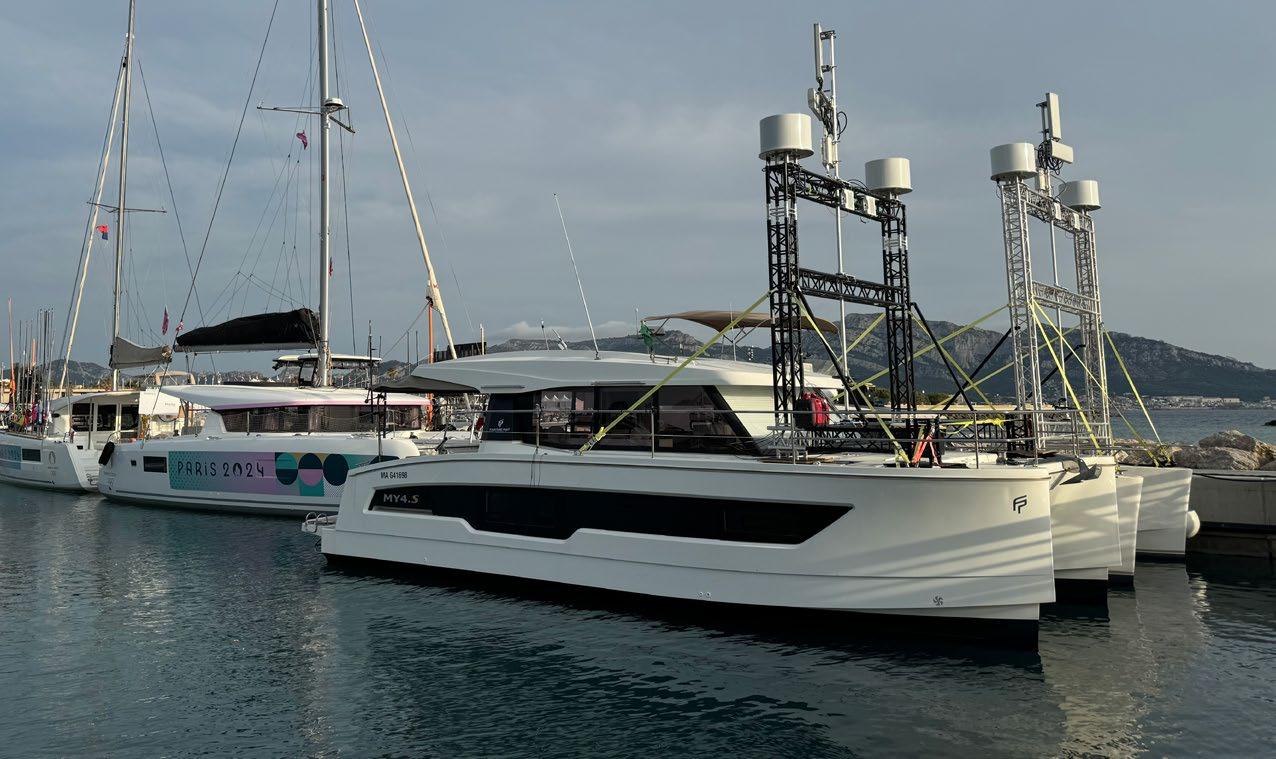
Olympic sailing was a particular 5G highlight of the Paris Games in 2024. “The race areas in Marseille were up to six kilometres offshore, and trying to listen to a low power mobile phone uploading video from a land-based infrastructure was impossible,” explains Yoffe. “We built a three-cell network on catamaran boats that positioned themselves around the field of play. They received the video signals from the race boats and transmitted them at a much higher power back to shore.”
“The big revelation was not just the amazing footage, but the audio. The athletes had Bluetooth microphones, you could hear them shouting. It was just so engaging, it’s what made you feel like you are on board with them. 5G is allowing access to content that is just a lot more engaging than a long camera lens from a helicopter or a chase boat. It's allowing you to take small form factor devices off the shelf and actually deliver content from those.”
5G broadcast
On the distribution side, the 5G broadcast standard works on a “one-to-many” format, with transmissions leveraging broadcast tower infrastructure to offer live, free-to-air delivery to smartphones and other devices as required. 5G broadcast can deliver the same content to unlimited numbers of users,
A three-cell network on catamaran boats was used for the sailing events at Paris 2024
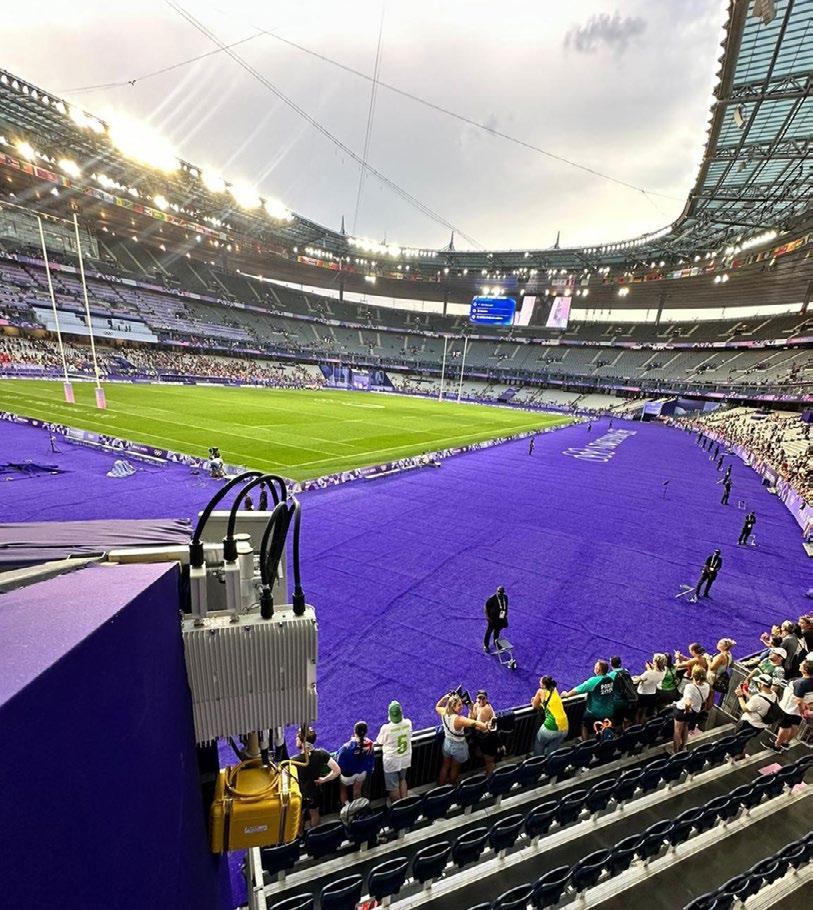
A private 5G network deployed at the Stade de France during the Summer Games
without congesting mobile networks or consuming data allowances.
This is especially relevant for demanding situations like coverage of major sports events, and for emergency alerts. Release 19 of the standards has reached maturity, according to European Broadcasting Union (EBU) CTO and CIO Antonio Arcidiacono. “Towards the end of 2027, we will see the appearance of new mobile phones with embedded 5G broadcast functionality,” he says.
There is some skepticism out there around this development, however. Future upgrade requirements to 5G-ready consumer devices and regulatory, technical, and commercial hurdles in assigning UltraHigh Frequency (UHF) spectrum are some of the bottlenecks to full 5G broadcast adoption.
“I feel like any technology that is trying to replace a highly capable IP streaming capacity with broadcast over IP, which requires new devices and chipsets, is an approach to staying relevant in world where broadcast is no longer necessary to distribute content,” states Tom Morrod, research director and co-founder of Caretta Research.
“Making millions of consumers buy a new device is a pretty big barrier to adoption, and if your argument is that the internet's not fast enough, then just wait for six months. Broadcasters make great content and should follow where consumers want that content to be, not try to change the way that consumers are accessing content.”
Momentum keeps on building around 5G broadcast, however, which was once again successfully tested by Italian public service broadcaster Rai and the EBU during trials at the Milano Cortina 2026 Olympics last month. “Technically, it worked as we were expecting, now we are waiting for feedback on the content side, because any new technology should not be only a substitute of the technical way of transmitting bits and bytes, but an innovation in terms of creativity and formats,” says Arcidiacono. “Broadcasters are looking into the real value proposition.”
Arcidiacono adds that 5G broadcast can deliver a “phy-gital” experience to fans, who might be enjoying an in-person sports experience in a specific location while also watching digital content on their personal screen, a process also known as “venue-casting”.
“In a stadium like San Siro in Milan, holding 90,000 people, 5G could enhance each person’s experience by providing many different points of view, different angles and a look backstage. The fan becomes their own director, deciding what angle they want, or using an AI to select the best view. 5G broadcast will make that possible: with a single transmission in the stadium, you can distribute a lot of content, no matter how many users there are.”
Some of the arguments being made for 5G broadcast delivering fully immersive experiences include the technical simplicity of venue casting. “All you need is a core network and one low power transmitter is more than enough to cover 80K to 100K people,” states Graziano Casale, director of technical sales for broadcast distribution at Rohde & Schwarz. “We did trials in France at Roland Garros and in F1. The application is there, but in Europe I don’t see it as a priority for broadcasters, or a driver for adoption of 5G broadcast yet.
“We do however see increased interest worldwide for sporting events, in Latin America for football, and South East Asia. Major live sports events and venue casting are interconnected in this broadcast conversation, to avoid unicast network congestion in a stadium with 50,000 people trying to stream on their mobile.”
5G broadcast also addresses the need for higher quality of service when it comes to signal drop or quality reduction, low latency and 'the spoiler problem'. “Super Bowl analysis showed that Over-theAir (OTA) TV has a low delay of roughly 11 seconds, while streaming lags by up to 60 seconds,” explains Casale. “In live sports, using OTA gives you a 45+ second advantage over streaming, which is a major advantage for avoiding spoilers during tailgating or watch parties."
Arcidiacono believes that 5G broadcast deployed massively for content distribution will inspire more people to invent new, creative ways of using it. “The cellular network is complementary to 5G broadcast,” he concludes. “I'm in favour of this idea of using the law of physics where they work best. The cellular network is best for one-to-one connections, 5G broadcast is best for one to many, which is typical of live events.”

What’s happening in Vegas?

NAB Show 2026: from concept to practice
NAB EVP Karen Chupka tells TVBEurope how the 2026 NAB Show will showcase where technologies like AI and cloud are moving from concept into practical applications, redefining storytelling and collaboration across broadcast, streaming, and the expanding creator economy
What should attendees expect from this year’s NAB Show?
Attendees should expect a show that reflects how much the industry is converging. Broadcast, streaming, sport, film and creators are no longer operating separately. They’re using shared tools, infrastructure and workflows.
What stands out this year is that technologies like AI and cloud are no longer theoretical. They’re being applied across real production and distribution environments. The value of the 2026 NAB Show is seeing how all of this connects—not just what’s new, but how it works together to support storytelling at scale.
What are the key themes/trends of this year’s show, and why have they been chosen?
The themes centre on how storytelling is evolving and the technologies enabling that shift. AI, cloud, creators, sport and the business of media aren’t standalone topics: they reflect a broader transformation happening across the entire content lifecycle.
The tools behind storytelling are becoming more powerful and interconnected. AI is streamlining production and opening new creative possibilities, while cloud workflows are enabling collaboration at scale.
These themes were chosen because they represent where we’re seeing real investment and change, and where the industry is actively redefining how stories are created, distributed and monetised.
The Sports Summit has grown to four days this year. What can attendees expect to hear/see?
The expansion reflects how central sport has become to the media ecosystem. The Sports Summit brings together leaders from
leagues, teams, broadcasters, streaming platforms and technology companies to explore how live sports are produced, distributed and monetised today. You’ll hear discussions around rights strategy, production innovation, fan engagement and investment, all of which are increasingly interconnected.
Opening it to all attendees underscores how influential sports have become across the broader media landscape.
Creator Lab has also been expanded for 2026. Why?
Creator Lab has expanded because creators are no longer on the margins of the industry: They’re central to it. What’s changed is that many creators are now building full-scale businesses, not just audiences, which brings about new operational, financial and creative challenges.
The programming reflects that shift, focusing on sustainability, measurement and long-term growth, while also looking at where the creator economy is heading. Expanding Creator Lab is about giving that evolution the depth it deserves and connecting it more directly to the rest of the show.
Nearly 27 per cent of NAB’s visitors are from outside the US. How do you plan on catering for them at this year’s show in terms of topics, speakers, events etc?
Programming focuses on universal industry shifts like AI, cloud, streaming and sport, with speakers including international technology leaders, broadcasters and other storytellers.
We also welcome delegations from countries around the world, including embassies, chambers of commerce, government ministries and industry associations. Combined with country
pavilions and the International Business Lounge, the focus is on delivering relevant insights, meaningful connections and real business value.
Can you tell us about any speakers across the whole of the show that you think attendees should watch out for?
There’s a wide range of voices this year, which is what makes the lineup so compelling. You have someone like Sir Roger Deakins, regarded by many as the greatest cinematographer of his generation, alongside screenwriter Akela Cooper, whose films like M3GAN and Malignant have helped redefine the modern horror genre, and creators like Markiplier, who has built a massive worldwide audience on YouTube.
You’ll also hear from leaders across journalism, media and technology like Deborah Norville and Nexstar chairman and CEO Perry Sook, as well as Nate Bargatze, one of the biggest names in comedy today. What stands out is how those perspectives come together, adding up to a whole that is greater than the sum of its parts.
Any innovation this year in terms of the show floor?
There’s a more intentional shift toward a connected, navigable show floor this year. With the full Las Vegas Convention Center campus in play, the focus is on creating a cohesive environment where different parts of the industry intersect.
That includes a reimagined broadcast hub, a second AI Pavilion reflecting rapid adoption across workflows, and deeper integration of creators and enterprise media. The goal is a floor that feels less like a series of exhibits and more like a working media ecosystem.
Bringing that all together, our new and improved
NAB Show app will help attendees navigate the show with personalised schedules and relevant recommendations.
What are you most looking forward to seeing at this year’s show?
What I’m most looking forward to is seeing how quickly some of these shifts are moving from concept into practice. We’ve been talking about things like AI, cloud workflows and new creator-driven models for a few years now, but this is the year where you can really see how they’re being applied in real environments.
I’m also interested in the unexpected connections that happen when different parts of the industry come together, whether that’s creators influencing enterprise media or innovations in sport production shaping other areas. That’s where the most meaningful ideas often emerge.
What piece of technology innovation or new trend has stood out for you over the past year?
What’s stood out most over the past year is the pace at which AI has been adopted across the industry. It’s not just being tested in isolated use cases anymore; it’s becoming part of everyday workflows in a very practical way.
What I find interesting is how quickly expectations have shifted. The conversation has moved beyond what AI can do to how it can be used reliably and responsibly at scale. That change in mindset is happening across the industry, and it’s driving a much more grounded and actionable approach to innovation.
Please sum up this year’s NAB Show in three words. Convergence, collaboration and transformation—reflecting how the industry is coming together, working across boundaries and redefining the possibilities of storytelling.
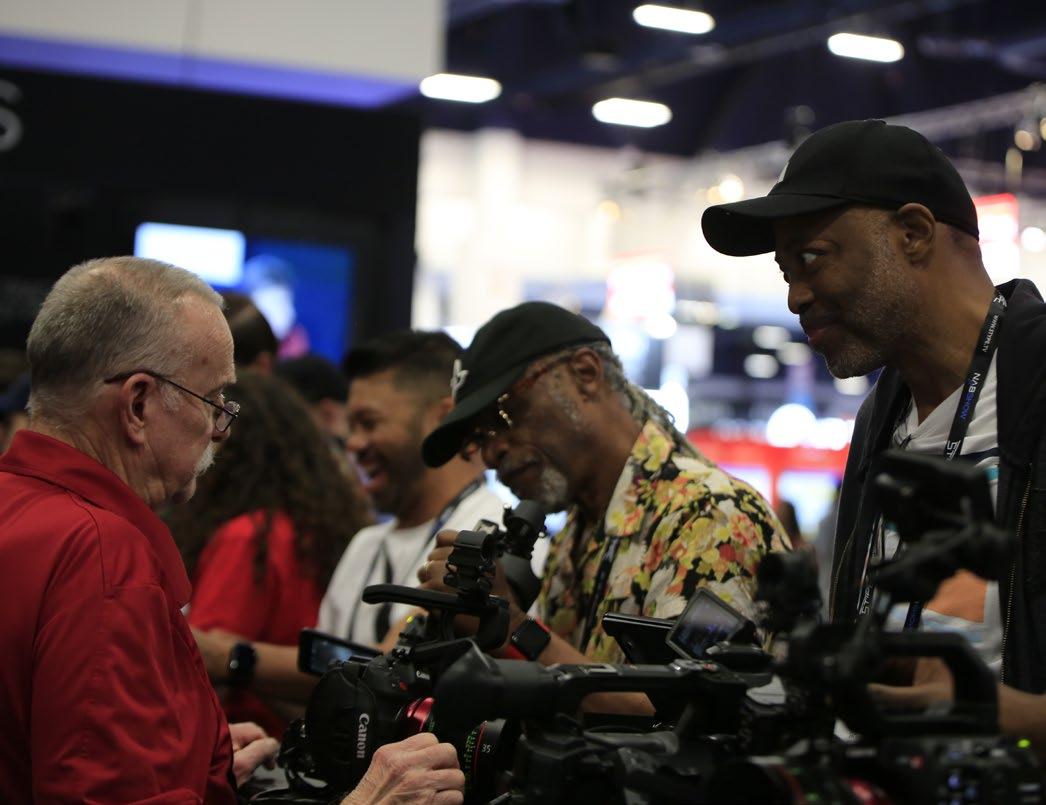
This year’s show will feature a reimagined broadcast hub
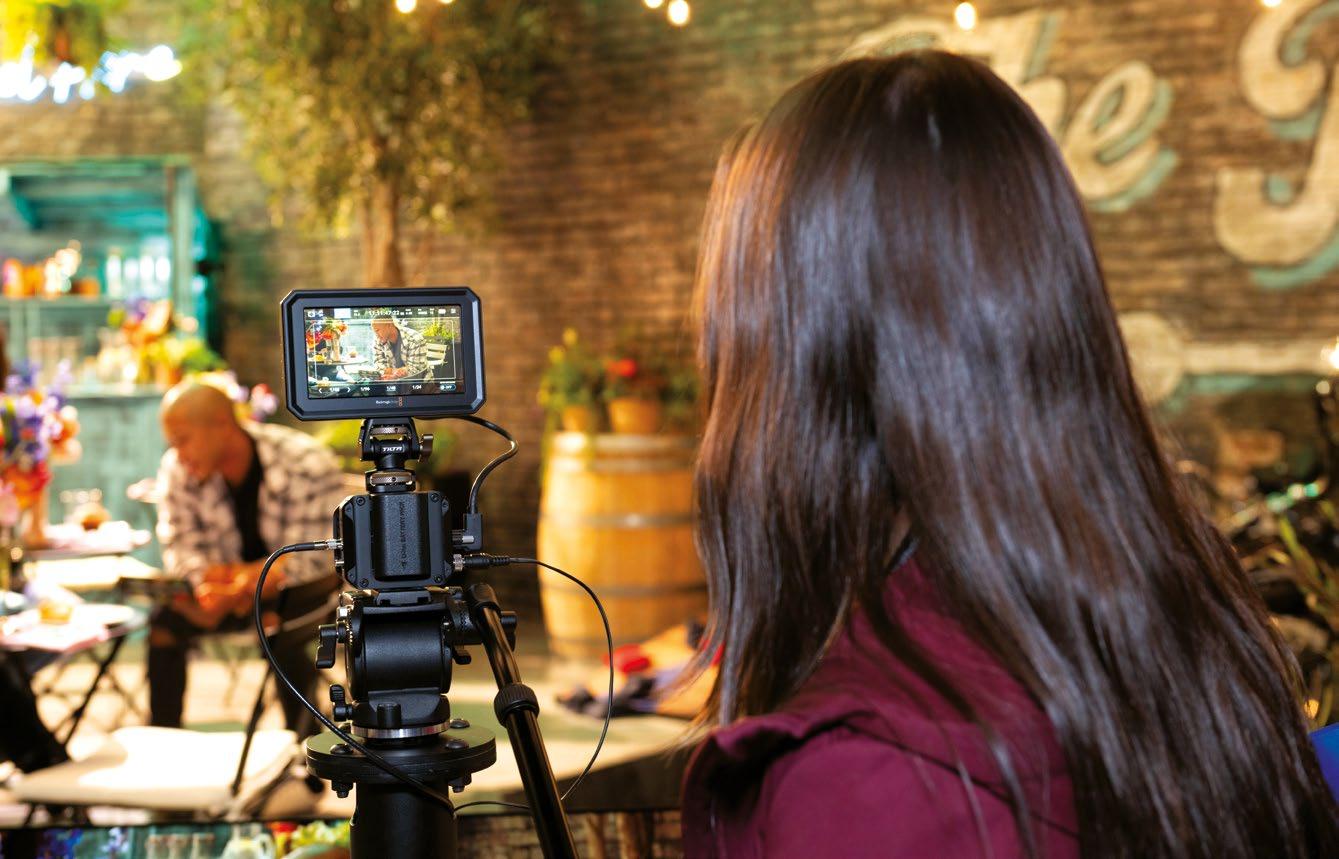
Organisers are hoping to create a more navigable show floor

Flexibility is key
Geoff Stedman, chief marketing officer at SDVI, offers advice for broadcasters planning multi-year technology
roadmaps
What is the biggest trend in your part of the media and entertainment industry at the moment, and what impact is it having?
At the moment, we are seeing significant uncertainty among media companies due to factors such as new or changing industry partnerships, new business models, shifting consumer behaviour, and accelerating technology evolution. Broader industry changes are also putting new financial pressure on media companies and forcing them to figure out how to do more with less. This uncertainty is causing many organisations to pause new initiatives while they evaluate their strategic options and organisational structures. Against these dynamics, media organisations must continue to produce and deliver the highest quality content, which means that efficient and agile media operations are even more important than ever.
What would you say will be the technologies or trends that are going to have the most profound impact in your field in the coming years, and why?
Clearly, AI in all its forms is the defining new technology that will have the greatest impact not only on our field but on virtually every corner of every industry. From agentic AI to generative AI, this new technology will be a driving force in how media companies produce and process content. In contrast, for their technology vendors, it will accelerate the capabilities in their products and the speed of new feature development.
While there are still many considerations to be resolved around using AI for content creation, there is no doubt that the technology can have a dramatic impact on the operational side of a media business and will lead to tremendous efficiencies. Those that lean into using AI to enhance their operations and their technical platforms will gain a competitive advantage.
Where does AI realistically add value today—and where is it still hype?
Today, AI is making software developers vastly more productive, accelerating their code development and testing processes. AI is also accelerating the ability to evaluate reams of data in ways that were not possible before, leading to new insights about consumer behaviour, tastes, and intentions. For media companies, AI will help
them better understand their customers, make their operations more efficient, and monetise their content archives in new ways. The value of using AI today is highest for repetitive, timeconsuming, and data-intensive tasks. While there are many use cases where generative AI is not yet ready for prime time, the pace at which AI is improving is astonishing, so it is important to watch the space closely and experiment frequently.
What advice would you give customers planning multi-year technology roadmaps?
The pace of innovation, particularly with AI, is so fast right now that the best advice is to remain as flexible as possible with your roadmaps. What you thought might take three years may actually happen in only 16 months, or less. Additionally, industry dynamics also require a high degree of flexibility in your technology plans, as new content deals and distribution platforms may happen and require new technical capabilities. Realise that any plan will need modifications as things change, so don’t over-analyse. Be prepared to take action and iterate as you learn.
How do you design technology to remain relevant as workflows rapidly evolve?
Keeping your technical infrastructure relevant means designing architectures to be agile, flexible, and responsive to changing dynamics. There is no way to predict every scenario that might happen in the media business, so maintaining the ability to adapt and respond to changes is perhaps the most important characteristic. Keep your technology components loosely coupled but intelligently managed so that you can make changes to individual elements if needed.
If you were a broadcaster today, where would you invest first?
While linear broadcasting is still the most important function for a broadcaster today, it’s clear that consumer behaviour is driving new requirements for content availability and distribution. Broadcasters should invest in technologies that enable them to reach audiences where they are and how they want to consume content. Embrace new distribution mechanisms and content delivery platforms. Build the capability to deliver your content directly to consumers, and optimise your operations to support every delivery option.


Prioritising agility
Anthony Zuyderhoff, executive director global sales, Riedel Communications, explains why software-defined video infrastructure is the future of the broadcast industry
What is the biggest trend in your part of the media and entertainment industry at the moment, and what impact is it having?
We’re continuing to see an accelerated shift toward distributed, remote workflows. This obviously means that production teams, depending on the size/complexity of the event, are no longer tethered to a single control room or large Outside Broadcast (OB) truck. Even when an OB is required, we’re seeing a need for quick tear/up down, and flexible licensing to account for the downtime of these trucks. In the case of remote production, directors, replay operators, audio engineers, and others are increasingly working from different locations. This physical fragmentation, however, has highlighted two important realities. First, as workflows decentralise, critical communications are more vital than ever. They are the fail-safe glue holding a live broadcast together. Second, managing disparate, multi-vendor hardware across different locations is causing friction. Broadcasters are solving this by adopting browser-based, platform-independent control layers, allowing operators to manage a wide range of devices from a single web interface, anywhere in the world.
What would you say will be the technologies or trends that are going to have the most profound impact in your field in the coming years, and why?
Intelligent production automation and software-defined, scalable video infrastructure. Why? Because the demand for live content such as sport, esports, and niche events, is exploding while budgets are not. Technologies that allow smaller teams to produce high-value content will have the most profound impact. For example, automated, flexible and integrated audio mixing tools, allowing complex live environments to be balanced intelligently without requiring a dedicated, large-format audio desk for every tier-two or tier-three event.
Where does AI realistically add value today—and where is it still hype?
AI and machine learning are delivering value right now in tools like automated audio mixing—intelligently riding faders, managing automixing for unscripted panels, or isolating voice from stadium background noise in real-time. It acts as an increasingly reliable co-pilot for technical operators, reducing cognitive load.
In terms of the AI hype, the idea that this technology will completely replace the human elements of high-stakes live production is not something we see as probable. Generative video and autonomous
directing get the headlines, but live broadcasting is deterministic and unforgiving. When a critical moment occurs, human editorial judgment driving the replay is required. You absolutely need instantaneous, humanto-human critical communications to coordinate the pivot.
What advice would you give customers planning multi-year technology roadmaps?
Prioritise agility, break free from legacy hardware lock-in, and abstract your control layer. Broadcasters need to look for remote video production and replay tools that offer the reliability of legacy giants, but with vastly superior flexibility and economics. Most importantly, we advise building a roadmap that includes a platform-independent control layer. If you standardise how operators interface with equipment via a browser, you can seamlessly swap out the underlying hardware like routers, switchers, and cameras, as technology evolves over the next five years—without forcing your operators to learn a completely new system every time. It has to be assumed that the workflows you design today will change within 18 months; your infrastructure must be able to pivot, scale up, or scale down without requiring a complete rip-and-replace.
How do you design technology to remain relevant as workflows rapidly evolve?
While no one is fully there yet, technology remains relevant when you rely on software-defined, API-first approaches. If physical hardware is necessary, rely on COTS IT servers and GPU clusters rather than bespoke, proprietary broadcast boxes. This is a journey for many solution providers, including Riedel, but directionally accurate. By building a media supply chain that is essentially a series of containerised software applications, adapting to a new workflow just means updating code or spinning up a new virtual microservice, rather than racking and cabling new gear.
If you were a broadcaster today, where would you invest first?
I would say infrastructure that connects people and abstracts hardware such as a bulletproof, modern critical communications matrix that supports a fully distributed workforce. If a team cannot communicate with zero latency, the broadcast fails. I would also invest in a unified, browser-based control platform and flexible remote production tools. Freeing up capital that used to be tied up in legacy hardware allows for greater investment in acquiring more live rights and producing much more content.

The broadcast shift
Erling Hedkvist, sales and business development at manifold technologies, discusses why flexibility is the ultimate investment for media companies
What is the biggest trend in your part of the media and entertainment industry at the moment, and what impact is it having?
The biggest trend right now is the shift toward software-defined infrastructure at scale. Broadcasters and content providers are moving away from fixed-function hardware toward flexible, cloud-connected and on-prem software platforms that can adapt in real time. The impact is clear. It’s not just about cost efficiency, but operational agility. Teams can spin up new workflows faster, scale capacity dynamically, and support increasingly complex formats like UHD, HDR, and low-latency streaming. It’s also enabling more distributed production models, where resources are no longer tied to a single facility. Ultimately, this shift is redefining how infrastructure is designed, moving from static systems to continuously evolving platforms.
What would you say will be the technologies or trends that are going to have the most profound impact in your field in the coming years, and why?
Hardware-accelerated software processing is emerging as a key enabler. By combining the flexibility of software with the performance of FPGA and GPU acceleration, broadcasters can achieve both scalability and deterministic performance. These trends matter because they remove traditional bottlenecks. They allow infrastructure to keep pace with creative ambition, whether that’s more feeds, higher resolutions, or more complex live workflows, without a proportional increase in footprint or cost.
Where does AI realistically add value today—and where is it still hype?
AI is already delivering real value in areas like metadata generation (closed captions), content indexing, quality control, and operational monitoring. For anything else the jury is still out on where it can provide value. We are still far away from AI providing autonomous production or creative decisionmaking. While AI can assist editors and operators, it’s not yet replacing human judgment in high-value creative or editorial workflows.
What advice would you give customers planning multi-year technology roadmaps?
The key is to design for flexibility, not perfection. The industry is evolving too quickly to predict exact future requirements, so rigid, single-purpose systems quickly become limiting. In our opinion, customers should prioritise modular, software-defined platforms that can evolve over
time. Open standards, interoperability, and the ability to integrate new technologies without major disruption are critical. Finally, balancing performance with efficiency is essential, especially as energy consumption and operational costs become increasingly important factors.
How do you design technology to remain relevant as workflows rapidly evolve?
We focus on abstraction and scalability. By decoupling software functionality from underlying hardware, we allow systems to evolve without requiring complete redesigns. A key part of this is leveraging hardware acceleration in a way that is programmable and adaptable. That means customers can deploy new codecs, formats, or workflows on the same infrastructure.
Interoperability is equally important, so although based on a modern shared-memory-architecture, we provide control “handles” that are familiar to traditional broadcast control systems so it can be made to look just like a traditional broadcast product and therefore integrate easily into diverse ecosystems. Ultimately, it’s about creating a platform rather than a product.
If you were a broadcaster today, where would you invest first?
I would invest first in a high-performance core infrastructure that can scale with demand. That foundation enables everything else, from production to distribution. Specifically, I’d prioritise high-bandwidth networking, efficient processing, and a software-defined architecture. This creates the flexibility to support both current workflows and future innovations without constant reinvestment. Equally important is investing in systems that improve operational efficiency. Automation, orchestration, and intelligent resource management can significantly reduce complexity and cost. With the right foundation in place, broadcasters can then layer on new capabilities, whether that’s AI, new formats, or new distribution models, with much lower risk.
“The industry is evolving too quickly to predict exact future requirements, so rigid, single-purpose systems quickly become limiting”

personal WITH THE GETTING news
Today, people increasingly get their news from a variety of sources rather than traditional bulletins at set times. Among the platforms available, discovers Kevin Hilton, is the EBU Gen AI-based NEO, which is being used by Swedish Radio for its conversational news search chatbot
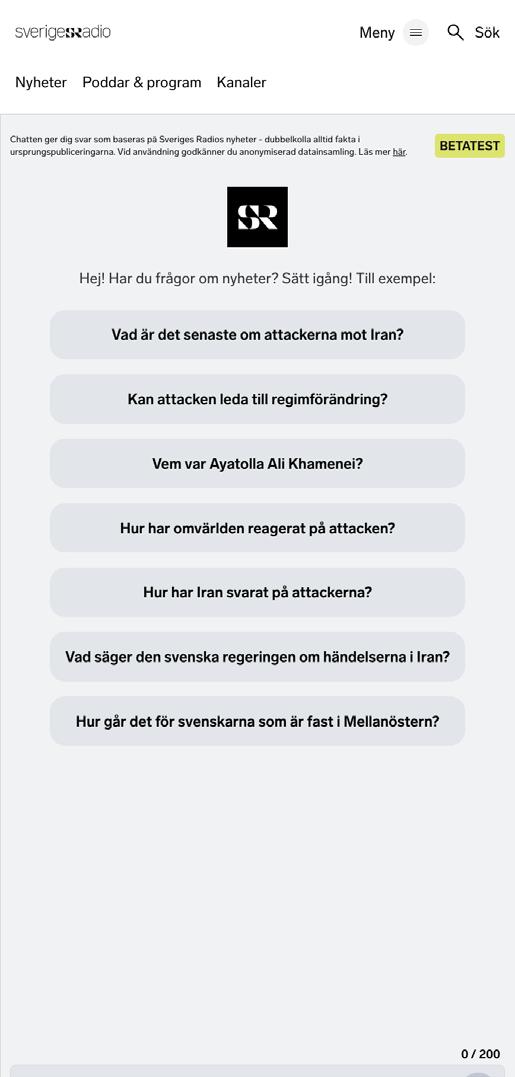
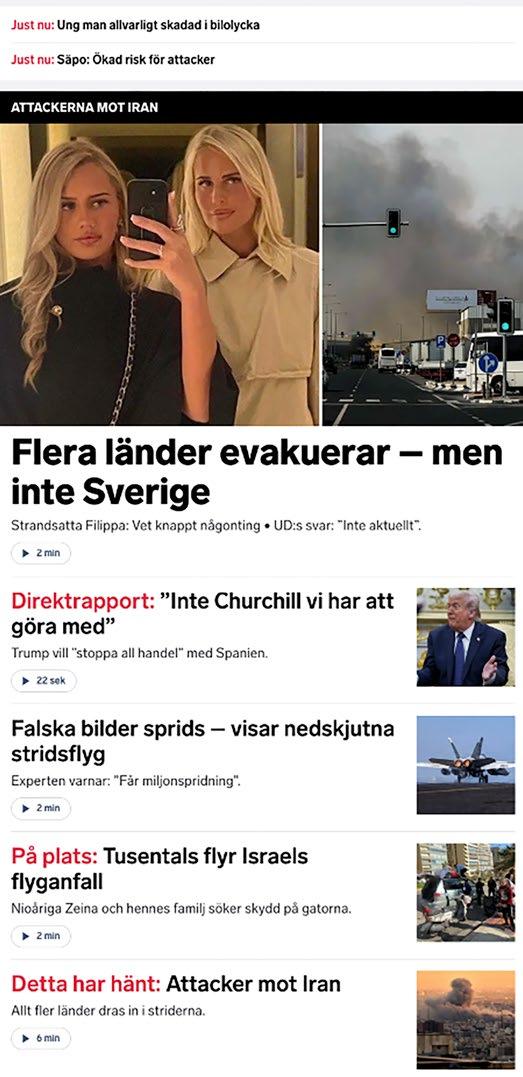
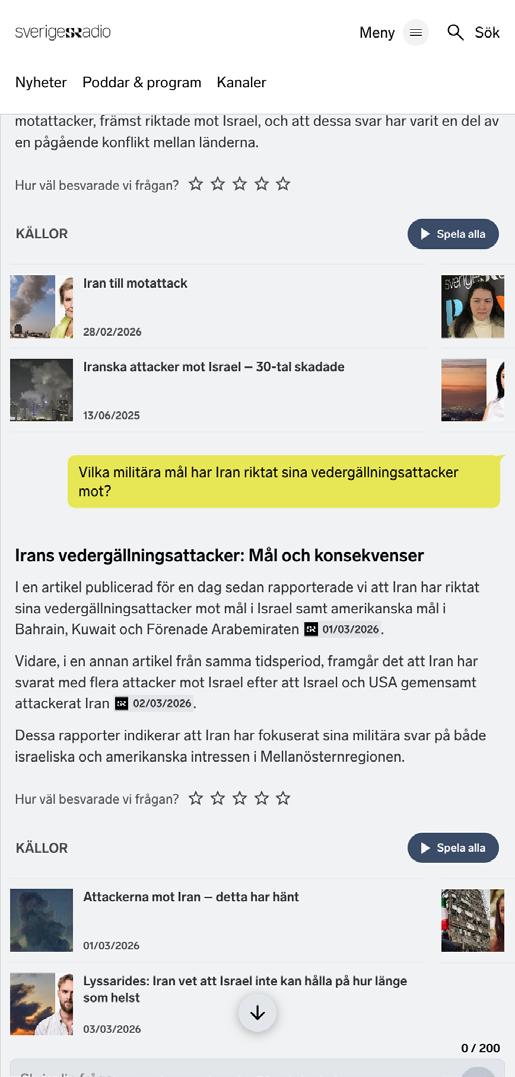
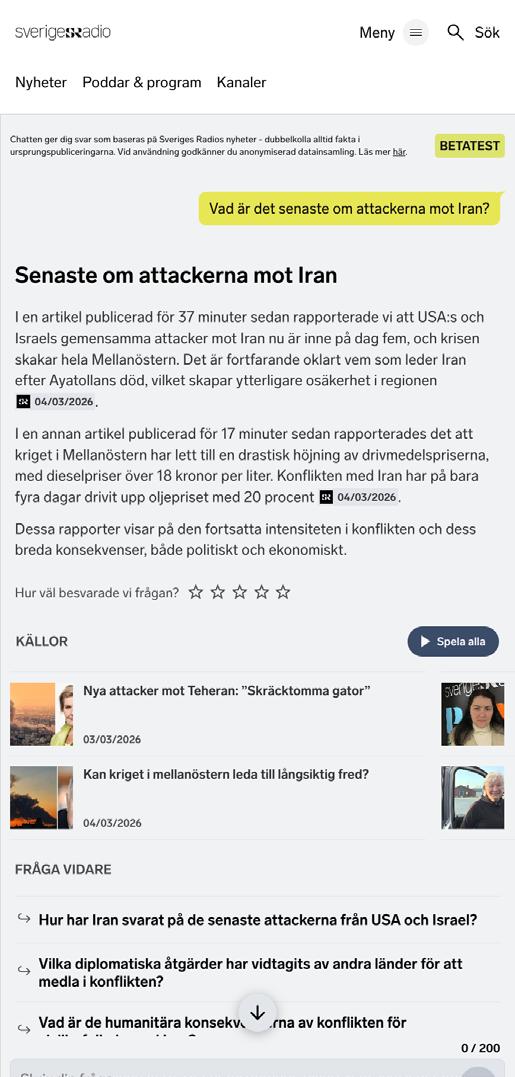
TO RIGHT: Start page of Swedish Radio's news search, results page, follow up questions on the SR news search, answer to a question generated by SR news search
In this modern media world, personalised content is a critical part of broadcasting and news is high on the list of priorities. There are already several commercial personalisation apps available that use AI to find stories from print, online and broadcast media, which are evaluated by journalists and then presented to individuals based on their preferences or online enquiries. Public service organisations also see the benefits of a more personal, targeted approach to delivering programming of all kinds, not just news.
This trend, and its implications, are highlighted in the October 2025 online paper, The Personalisation Dilemma in Public Service Media:
LEFT
Ways Forward, by Helen Jay, research lead at the Responsible Innovation Centre for Public Media Futures (RIC), an independent research body hosted by the BBC. She observes that "the rise of AI agents [is] predicted to bring a new wave of hyper-personalisation", with the public service sector arguing that these techniques will assist audiences in discovering "public service content in the digital era".
Examples of public service personalisation cited by Jay include the BBC instilling editorial values into its recommender systems and Swedish Radio (SR)'s news search feature, which enables users to find stories relevant to their interests or communities using natural language.
SR news search is based on the EBU NEO interface, a Generative AI platform described as a "conversational AI agent" that has been "optimised for news content" and is able to present "insightful responses" to users. Sébastien Noir, deputy director of Technology and Innovation (T&I) at the EBU, acknowledges that NEO was inspired by the launch of Open AI's ChatGPT in 2022, rather than the result of a planned AI strategy.
Noir explains that a colleague suggested putting ChatGPT on the EBU website to make content searches easier, which the T&I team found an interesting proposition but later realised could be problematic. "If you plug ChatGPT on top of your website, people could ask any kind of question," he says.
The development then became more focused on specific technological questions related to material contained on the EBU website. Noir says finding usable content, "maybe sending it to ChatGPT" and formulating an answer "worked OK-ish" but obstacles, including security, dealing with bad answers and cost, began to appear. "Then we had this kind of 'a-ha' moment," he comments, "and thought maybe, instead of doing this on top of our corporate website, we could do it on the news from our members [through the A European Perspective/NewsPilot platform] and have a service for our journalists."
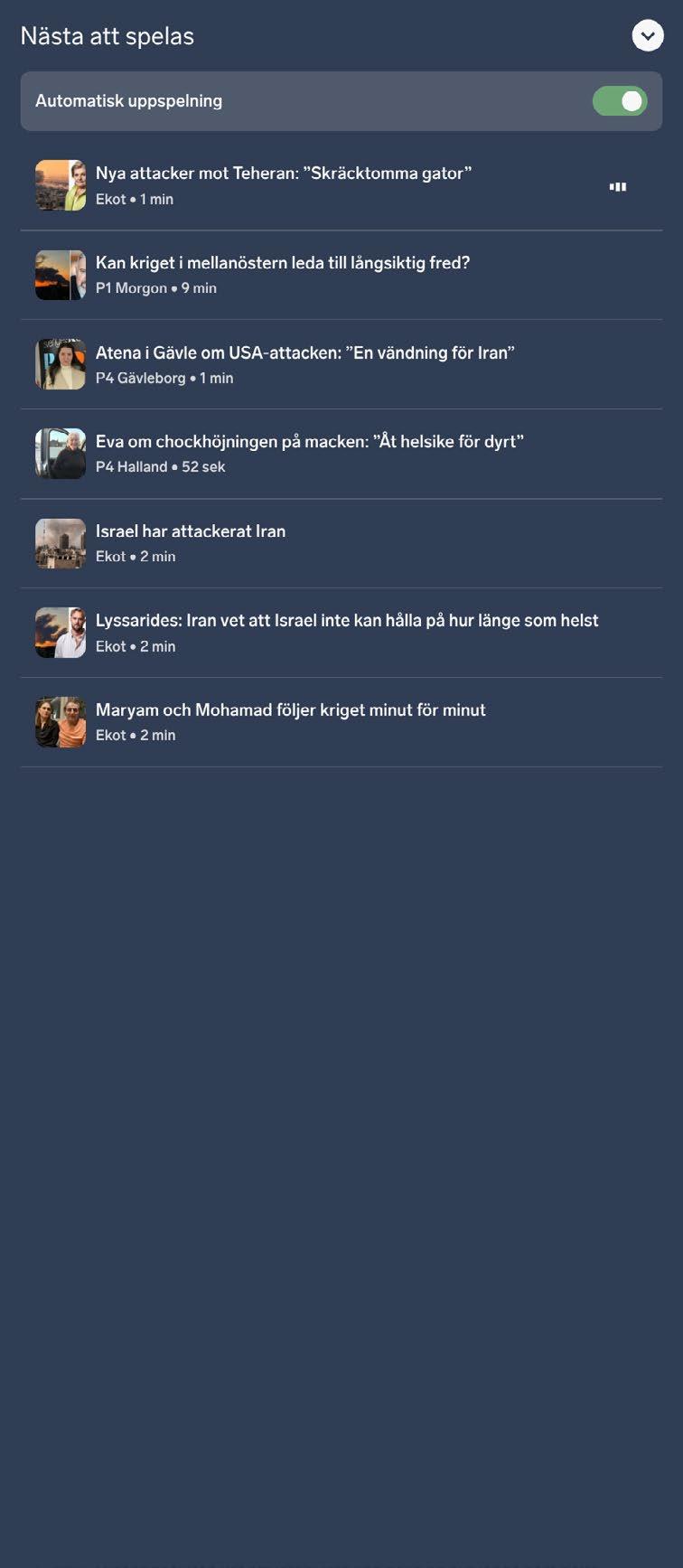
began with SR about developing something from NEO for its own audience's needs.
These led to the news search chatbot, which began testing in February 2025 as part of SR's Play mobile app. The test project was described in an SR blog at the time as combining "factual news with AI functionality, implemented responsibly", with all editorial control maintained by the broadcaster, which does not allow AI companies "to scrape its content."
Jörgen Bang, product owner at SR for its digital news app and web offerings, worked on the tests. "Before we talked about AI we were talking more about algorithms and machine learning," he says. "A lot of what NEO is built upon is a combination of language models that can summarise [material] and the use of natural language."
Bang explains that within news search, users can access NEO and search for stories or answers to their questions based on questions pre-written by SR editors and journalists.
This, he says, can start with a very general query—such as 'What is going on in Iran?'—and then follow up with specific questions about the war and those involved. Sébastien Noir comments that the public version of NEO, rather than the one for news professionals, is purely text-based. It can link to media clips—audio or video—on source sites but to include these within NEO right now would involve rights issues.
As part of news search, SR focuses on audio content, with everything sourced from its own journalism, and currently does not present text transcripts, although Bang says it does provide short written summaries of stories that connect to clips from its output.
"Our job is to be audio-first and that is one of the reasons why we seldom write long text [versions] of our pieces," he says. "By selecting the articles [summaries] and pressing 'Play All', the selections will be queued up in a playlist, which is a personalisation thing and basically creating your own radio show."
Noir explains that because 3,000 news stories come into NewsPilot every day, it is difficult to find specific topics or get an overview of what is available. "It seemed like a way to bridge this gap and help journalists search for the news that matters most to them," he continues. "It fulfils the need to scout the news and find that information."
The first version of what became NEO was developed in two days in 2023 using the EBU's Peach (Personalisation for Each) recommendation algorithm. Noir says the result was "far from perfect" and more work went into improvements, after which discussions
NEO is Gen AI rather than Agentic AI but Noir believes that might change over time. "It's not fully agentic but could be in the future. The definition of agents depends on who is speaking about it; people might refer to NEO as a commercial channel agent. When we talk about agents we mean systems that have capability to make decisions on their own. For NEO at the moment, it's still quite directed in how it performs the search."
While AI in general is enabling the personalisation of news today, it is a relatively new and still developing part of broadcasting. "We still don't know what users would want in the coming years," Noir states.
"We need to be relevant: it's all about having a link to your users and delivering them what they want and need."
Playlist of audio clips about the Iran war generated by SR news search
next THE OFchange chapter
New microdrama app Tattle TV offers short-form vertical video, with a focus on British content. Co-founders Marina Elderton and Philip McGoldrick tell Jenny Priestley how they leveraged AI to create both the app and some of its content
Earlier this year, TVBEurope looked at how microdramas are gaining traction within the industry. In 2025, short form vertical videos generated $11 billion in global revenue, nearly twice that of free ad-supported streaming television (FAST) channels, according to figures from analysts Omdia.
While China leads the way in terms of worldwide revenue, the UK is one of the territories where microdramas are finding an audience, with many producers seeing these vertical videos as a way to release content without having to secure film distribution.
However, one production company has gone a step further and launched its own microdrama app, Tattle TV.
Marina Elderton and Philip McGoldrick met at film school and have since launched their own production company, EMC Productions. The pair, who are also husband and wife, have experience in working on features, branded content, music videos and short-form content. It was while working on their latest feature, Tramp, that they heard about microdramas for the first time.
“We saw they were making waves in China and the United States,” explains Elderton, “and at the same time, we were witnessing all the struggles of our fellow filmmakers in the industry, just things crumbling and people out of work. And we thought, what about vertical video for the UK?”
What makes Elderton and McGoldrick’s move into vertical video different is that, as well as creating content, they’ve launched their own app to distribute it. “We felt like we could really make a difference and draw on our filmmaking expertise, our networks, and provide opportunities for people and ourselves,” adds Elderton. “It’s not just these kinds of archetypal billionaire CEO microdrama stories. We want it to be broader than that.”
Tattle TV, which is currently available in iOS with plans to launch an Android version, focuses on ‘Britishness’. It offers audiences microdramas, reality TV and feature films, and is also testing a usergenerated content (UGC) element. “We want to be at the forefront of the British movement into vertical, and we really believe it’s coming this year.”
Creating the app with AI McGoldrick “impulsively” decided to build Tattle TV himself using Flutter, which employs artificial intelligence to create mobile apps. “The assistance of AI is crucial in today’s world. It’s making coding more accessible,” he explains. “A lot of people are vibe coding, exploring code as a result of AI, and that is empowering.
“We jumped on the bandwagon and made the app in the space of about six months. Having some sort of ownership over it was important to us in these changing times.”

Once the app was built, the pair needed a name. They came up with Tattle TV together, and say they’re now working to make it a recognisable brand name. One of the positives of working on a direct-toconsumer app compared to their work in films is that they’re able to get feedback almost instantly. “I’m a musician originally, so I was used to being able to put my music out really quickly, build my audience,” explains Elderton. “I wanted to know why there is such a difference between the film model and that music model, which feels so much more immediate. That’s what’s so exciting about what’s happening now, it’s a way for filmmakers to bypass those gatekeepers and find more audiences directly.”
Another way the pair hope Tattle TV stands out is their decision to include user-generated content in order to introduce a “bit of a YouTube element”, enabling anyone making their own microdramas to find a natural home.
“We’ll be able to provide creators with an opportunity to upload their content to our app, have it immediately spliced into reels, and then the chance to monetise it,” McGoldrick explains. “I think it could be a really nice way for creators to have a different way of monetising, that’s maybe a bit more immediate than YouTube and the streaming giants, where they can get lost. Our app is very much at the beginning stages, but it will hopefully give people that extra opportunity to have their work seen.”
As well as user-generated content, and TV series and films made by their company, EMC Productions, Elderton and McGoldrick are also working on co-productions with other microdrama producers such as Onset Octopus. They want to see how UK audiences respond to the different genres to help build the app’s content going forward. “We have been speaking to companies that have some IP that they may want to repurpose, like more famous domestic shows. Hopefully, we’ll
be experimenting with that, because I think it would be quite fun to have some more recognisable series on the app as well,” says Elderton.
Deconcatenating Hitchcock’s first thriller
One example of existing content that has already been repurposed is Alfred Hitchcock’s The Lodger: A Story of the London Fog. Originally released in 1927, the film is now in the public domain in the US (it’s still under copyright in the UK).
McGoldrick used Luma AI to cut the 98-minute feature into short vertical video episodes. The technology places the original film onto a 9:16 canvas and hallucinates the top and bottom edges. “We then used our in-house AI systems to streamline the process,” he explains. “We have an option to deconcatenate the footage into reels, and then reframe it. Deconcatenating is almost like splicing a film.”
He adds that prompting Luma AI to cut the film can get “quite specific” and that whoever is tasked with the job needs to understand how to use the technology. “There’s a lot of trial and error with it.
“We’ll also have a visual effects person look at the nodes. Some of the AI platforms have node-based systems. By linking prompts and nodes, you have to figure out how to actually get the reframe and how to export. So it’s quite a specialist job. That’s why we believe there is work available, there’s an option for people to retrain. There are definitely still opportunities in editing and prompting.”
“We definitely still see a role for humans,” agrees Elderton. “We’ve seen solely AI-produced work in microdrama format, and it’s impressive, but it’s still quite stilted. There’s something off in the characterisation, and it feels harder to connect to.”
While they see a use for AI in content creation, the pair are keen to stress that they’re also using traditional workflows to film their shows. Dog Dates, a reality TV series available on Tattle TV, is about humans (and their canine friends) and made by humans. “There’s a camera person, a director, there are subjects with their dogs,” says McGoldrick. “We are leveraging AI, but we are also focused on human-centric stories that are made by real people, so that we have both worlds working together.”
Following the official launch of Tattle TV in January, Elderton and McGoldrick are now focusing on their next steps, with plans to scale quickly. “Ideally, we want it to be the first port of call for UK and international audiences for high-quality British vertical entertainment,” says Elderton. “We want to broaden the space. We want to shift things. We don’t just want to repeat what’s being done on other apps. We see ourselves as the next chapter of change in this cultural movement.”
McGoldrick agrees, adding that traditional broadcast media models are no longer working and many are being left behind. “My message would be, let’s move forward together as an industry and be at the forefront of this, as opposed to just always catching up, which is what the UK seems to always do.”
Marina Elderton
Philip McGoldrick
Hydrogen makes its debut
TV and film production has long been blighted by the noise and fumes of diesel generators. Now, a new, clean power source has arrived, which is already being used by shows such as Netflix's Bridgerton
Dearest gentle reader, it has come to this author’s attention that fundamental changes are afoot in the production of TV series and films that entertain so many of us.
For much of the industry’s existence, the dazzling spectacle of a period drama or the breathless tension of a modern thriller has been betrayed by an ill-mannered guest at the perimeter of every location shoot: the diesel generator. Imagine, if you will, a show like Netflix’s Bridgerton, which can often be found shooting at many of the UK’s National Trust properties. Among the exquisite production design and gorgeous costumes sits the mechanical pariah, burning its way through the atmosphere.
But no more! I hear tell of a new hero that has arrived not astride a white charger, but rather within a cleverly recycled 20-foot container. Enter GeoPura and its Hydrogen Power Units, or HPUs. Launched in 2019, the company’s mission is to banish the "dirty diesel" from the film and TV world.
While a diesel generator will chug constantly, running 24/7 with varying degrees of efficiency, HPU Two handles any load with the calm demeanour of a seasoned chaperone, delivering power in the “most efficient way possible”.
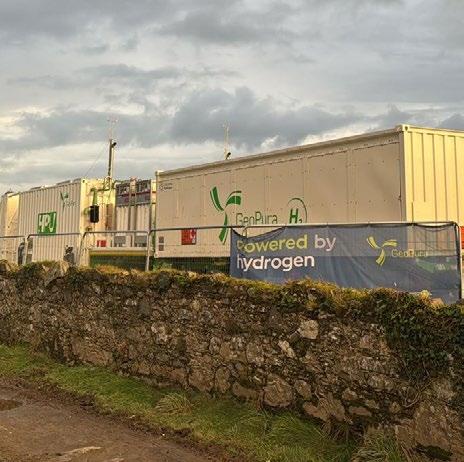
But the flourish that truly elevates this technology from mere utility to the height of societal grace is its byproduct, because after the magic of the chemical reaction has taken place, there is no soot or smell. Instead, it produces water. On one recent production, the process yielded a thousand litres a day, with the water used by the catering team for the pot wash and the production’s greens department to feed their flora. This author even hears that just before the Christmas festivities, Will Docherty, sales director for film, TV and events at GeoPura, used the water produced by the HPUs to make hot chocolate for a weary crew. Though some were initially nervous about drinking the water of the future, they were assured of its purity and soon imbibed the sweet, chocolatey nectar.
The HPUs are manufactured in Newcastle, and after launching with just one, GeoPura’s fleet has grown to over 60. One of the first companies to see the future was Netflix, which trialled the technology on season two of its regency romance Bridgerton, and has continued to work with GeoPura since. Other forward-thinking productions to have employed the company’s units include the BBC’s Springwatch and Winterwatch, where the HPUs have proven their reliability for both live and pre-recorded content.
HPU One is a 250-kilowatt self-charging battery, continuously topped up by a fuel cell that performs a chemical reaction rather than combustion. No explosions, no smoke, merely hydrogen and oxygen molecules uniting to create renewable energy right on site. This author hears tell that a single production recently removed 13 diesel generators and replaced them with two GeoPura units. For those in need of something even bigger, HPU Two is a 500-kilowatt unit specifically designed to replace 500 kVA diesel generators, often the biggest polluters on any set.
While HPU One and Two are perfect for countryside shooting, the team at GeoPura is looking to deliver the same technology for productions that wish to reside in the bustling metropolis. HPU Agile, due to launch this summer, has been developed from the feedback of productions that want to shoot in chaotic city centres. The 80-kilowatt towable version of HPU One can be swiftly moved by an electric SUV. It operates with “very limited noise" (just 60 decibels at a metre away,) barely above the level of a gentle conversation at a ball.
From the quiet reliability of Bridgerton’s unit base, where GeoPura’s technology powered the essentials of catering, craft, and tech, to the robust needs of complete broadcast coverage for major outside broadcasts, the message is clear. Hydrogen is a clean replacement for its “dirty” predecessor.
The days of the chugging diesel beast casting a pall over the glamour of the silver screen are numbered.
Yours, Lady Whistledown.

Boldly going
Cinematographer Tommy Maddox-Upshaw explains the creative vision and processes driving his work on Paramount+ series
Star Trek: Starfleet Academy
Tell us about how you got into filmmaking
I always had an affinity for films because my aunt, who was my babysitter, had my younger sister and I watching crazy B-movies. Then, when I became a teenager, my sister Kyla was a casting director for music videos in the ‘90s, namely with Hype Williams. She and her friend Rich Ford got me on as a PA for some classic music videos during my summer breaks.
How did you get involved with Starfleet Academy?
Executive producer Alex Kurtzman had interviewed me for Star Trek: Strange New Worlds, only to decide he wanted me to work on another show he was developing called The Man Who Fell to Earth—the continuation of the Nicolas Roeg film. So after our experience doing the pilot and through the fourth episode of the series, we became great collaborators.
How early did you get involved with the project?
I received the scripts about three months before starting prep but that was still about six months before ever starting principal photography. I was actually reading scripts while I was finishing Opus for A24. After reading the first two scripts, Alex and I started talking visual language and concepts.
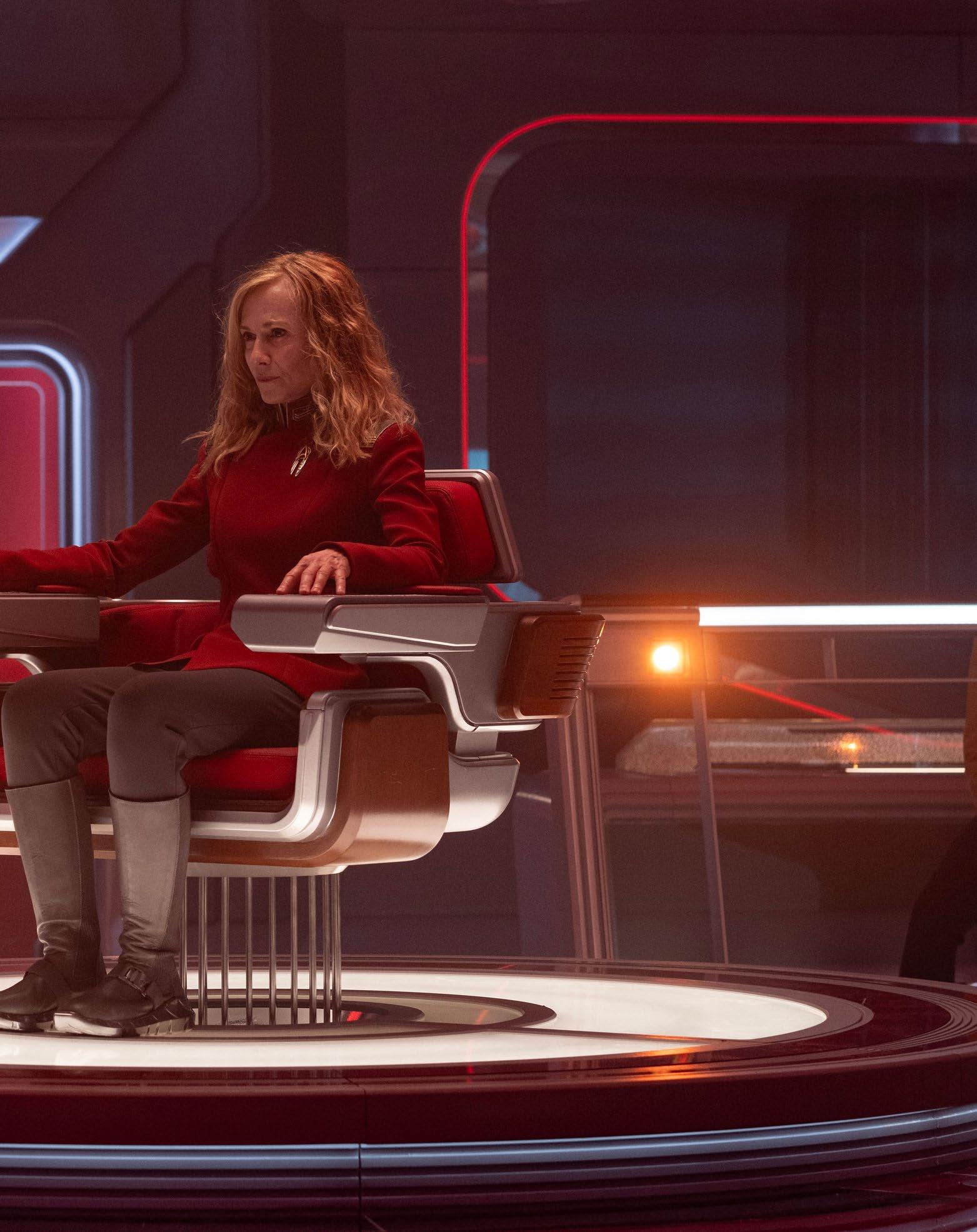
Where did your vision for the show’s look come from?
My vision for the visual language of the show came from analysing what Star Trek had done in the past and present, and also the sci-fi that Alex and I liked and enjoyed. Also the show is about learning, incubation, young adult experiences of making mistakes in and out of the classroom. What is the world view of young adult experiences in college, what is your field of view?
How much were you influenced by previous Star Trek films/series?
The previous series helped influence me in discussions about what I did and didn’t like in the lensing and how our story is different. In the other series everyone is an adult who has been trained to some extent, which I felt could be seen in how things were lensed in very sharp anamorphic language. Also it felt as though everything was photographed very far away, nothing felt like close intimate lensing.
At the same time, Alex and I both respond to anamorphic lensing. So, we felt that meant warmer than most sci-fi shows, it meant close focus lensing, and after watching episodes of Star Trek Voyager, I saw certain close-ups on Kate Mulgrew in 4:3 and thought, what if we saw the close-ups and not black bars on both sides of the frame that close?
How did you balance the tone between a brand new story and what’s gone before?
The objective was to change the language from very clean, linear Trek, to morph into more of a messy Trek ideology, simply because these are kids who are discovering and learning. More handheld coverage when possible, closer, wider in lensing and not long lens compressed close ups. I wanted to keep the roundness in the young faces of our cadets and be a bit more intimate between the relationships on screen.
How much collaboration was there between you and the series’ other cinematographers, Philip Lanyon and Maya Bankovic?
When it came to the language of the show, I gave them a PDF that had the overall feel of the show. They both brought things to certain scenes having done Trek before, the thing I emphasised was that it needed to be “messy Trek” that is more intimate than previous series being wider and closer, and warmer in palettes. Mix and match LUTs with different colour temps.
I also had them look at early tests of the designs of the lenses that were coming from Panavision’s Ultra Panatar 2 anamorphic lenses. When the two of them
would want to make a big shift in lenses or palette, it would be a discussion with me and the directing producer, Olatunde Osunsanmi, and showrunner Alex Kurtzman.
How did you find working with the different directors?
I’ve enjoyed working with different directors over the years, even though some relationships are closer than others and the language can be second hand. On this series, not until season two did I work with two new wonderful directors for episodes two and seven.
Please provide details about the cameras and lenses used on the project and why they were selected.
I used the Sony Venice 2 8.6K 16x9 1.3X Anamorphic with the Ultra Panatar 2s. The lenses were modified by Dan Sasaski, and my LUTs were created by Stefan Sonnenfeld from Company 3, which I designed with him and his colour science team to understand the colour construction and exposure for the show.
Did you do any testing ahead of production?
Before production, I did a few different tests. First, I did a lens test with the Sony Venice 2 body and about 13 different sets of 2x, 1.5x, 1.3x Anamorphics. During that time I was dealing with both Keslow and Panavision trying to find the most versatile Anamorphics while we were deciding to go 1.78 or
Paul Giamatti as Nus Braka alongside Holly Hunter as Nahla Ake
Tommy Maddox-Upshaw
2.40. Upon making the decision that we could lean in to 1.78, it took us to a few experimental options that Panavision had in the 1.3X Anamorphic space.
Once we decided on the Ultra Panatar 2s, we started testing for three months different configurations of flares and colour temperature of the glass. Alex would view my test and we would make decisions then let Dan and his team know. Then came the idea of extreme close focus photography while in this Anamorphic space. Dan had a few ideas and thoughts about how to achieve it on certain focal lengths and we tested them and it was amazing.
After the lens test it was time to make the LUTs. I recipe my LUTs with the ideas of the palettes from the production designer’s art concepts and also my ideas of tone. I present this to Alex and we sit with Stefan for a session after we do our initial testing with the chosen lenses at Panavision, so we make sure the colour temperature of the lenses are involved in the LUT design.
What can you tell us about the show’s lighting?
The base look of the show is a warmer Trek that is thought about as an incubation of learning. A warm learning environment for the cadets in San Francisco. Then upon going on adventures and tests, we shift the palette to a more clinical cool tone, and if we are on an alien planet it's a bit more in the cyan green world vs the cool tone of the ship adventure.
What are the biggest challenges when working on a sci-fi project?
The biggest challenge of working in the sci-fi space is to try and not do what everyone else is doing in terms of lensing and tone. I love sci-fi and watch a lot of it,
Starfleet Academy is a "warmer Trek" than previous series
According to the cinematographer, the biggest challenge of working in sci-fi is to not repeat what's gone before
and am very influenced by it. But the scripts being founded in an Academy base helps my starting point to create looks that are not as baseline as I feel sci-fi can end up being.
Was there anything you wish you could have done, but were prevented from doing?
The one thing I tell Alex all the time on this show is, let's get back outside. Having the VFX combined with day and night exteriors made certain episodes in season one so big in scope and fun, especially with the visual tone of the lenses and LUTs that have been created specifically for us.
Were there any shots that you were particularly pleased with?
I must say I’m really happy with the opening of the pilot with young Caleb and that first third, and even when we get him into the first action scene in the pilot. The debates in the Atrium during episode two were great moments when a lot of things came together, and also when Caleb tries to escape and meets Tarima for the first time on that day exterior. All were great stuff when I viewed them again on the big and small screen. Very happy with it.
Star Trek: Starfleet Academy is available to stream on Paramount+
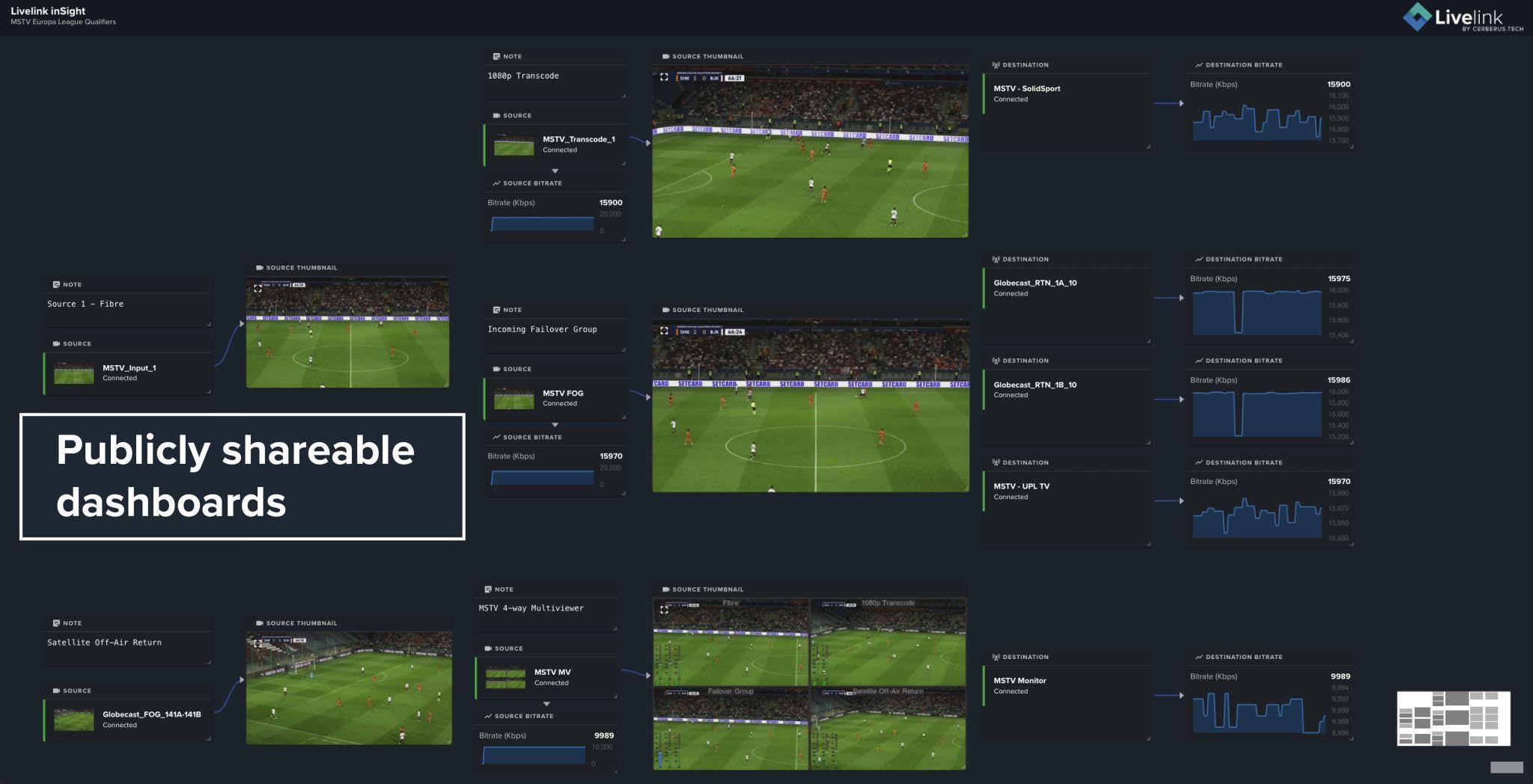
Cloud MCRs:
THE NEXT PHASE OF VIRTUALISATION
Virtualised Master Control Rooms seem destined to add a new tier of opportunity to live production, but issues around interoperability and latency mean mass-adoption is unlikely to be just around the corner, writes David Davies
As virtualisation and content requirements have advanced and expanded, it was surely inevitable that the concept of a cloud-based Master Control Room (MCR) would begin to gain traction. In 2025, it was the subject of an IBC Accelerator project that yielded a series of important findings (of which more shortly) as well as some high-profile live deployments, including for several UEFA Europa League qualifier matches.
Michael Demb

In terms of the potential benefits of virtualised MCRs, there is a general consensus neatly summarised by Michael Demb, vice-president of product strategy at TAG Video Systems: “Cost efficiency and the ability to spin up capacity quickly are certainly major advantages of a cloud-based MCR approach, particularly for events or workflows that require short-term scale," he says.
"However, other benefits are just as important, including geographic flexibility, easier collaboration across distributed
Open Broadcast Systems' MCR in the cloud
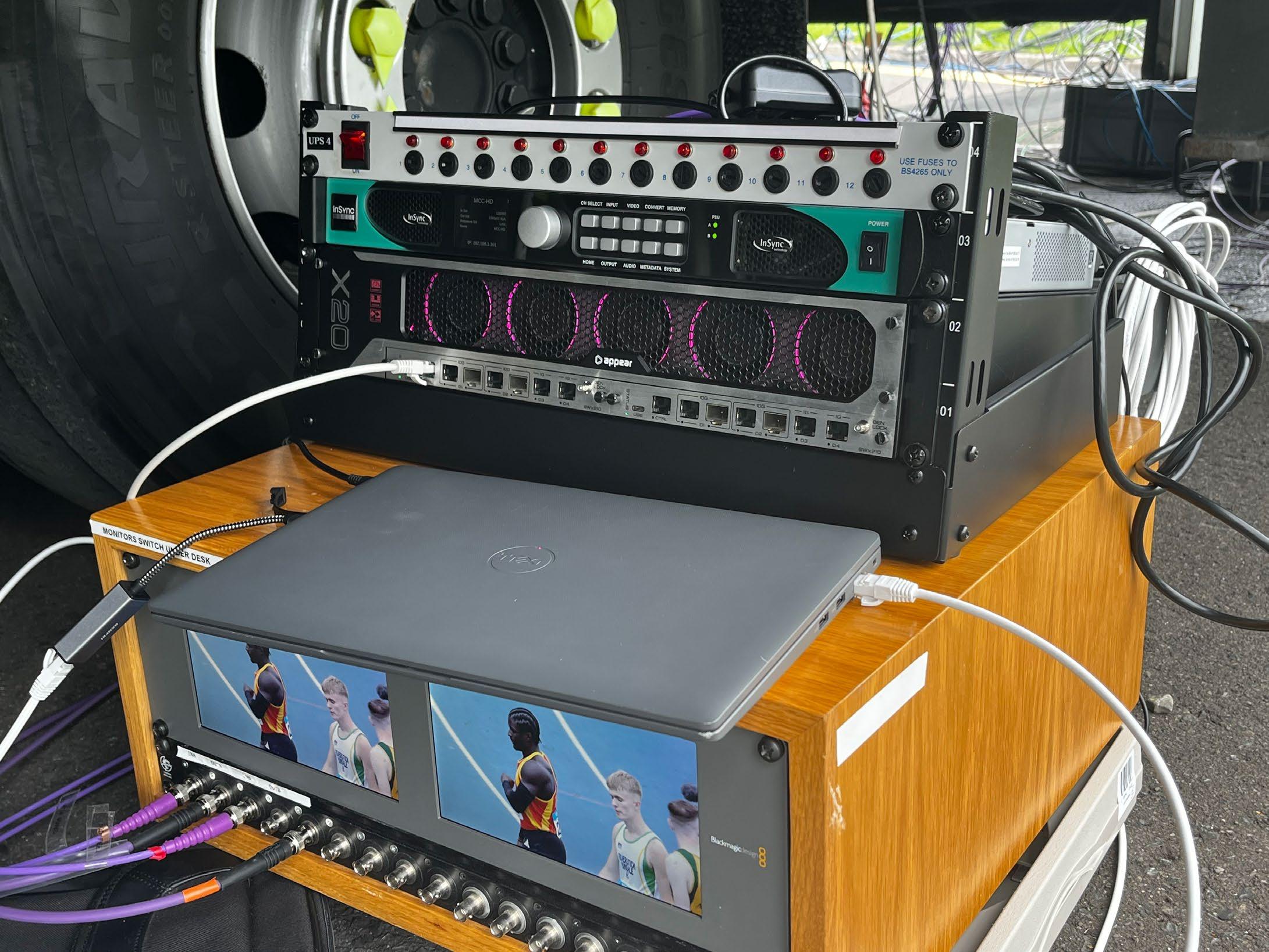
teams, improved disaster recovery, and the ability to dynamically allocate resources based on demand.”
But although there have been some notable projects already, significant challenges remain to be addressed if a virtualised MCR model is to be widely implemented—especially around the additional complexity introduced by shifting away from a more traditional, onprem approach.
Smart followers
The aforementioned IBC Accelerator, entitled Master Control Cloud, seems likely to inform the direction this model takes over the next few years. With champions including RTÉ, BBC and ITV, and participants such as Zixi and InSync, the project set itself the goal of “reimagining the master control room for the cloud era […exploring] how the essential functions of a broadcast master control room can be achieved natively in the cloud, with full interoperability between multiple vendors”.
Invited to consider why RTÉ wanted to be part of the project, Rostam Kilgour, the broadcaster’s manager first line
response, explains: “We’re a small organisation and we don’t have our own sort of R&D department, but equally we’re keen to see how broadcast technology is developing and functionality is changing. We like to call ourselves ‘smart followers’, and [one of the benefits of our size] is that we are perhaps a bit more nimble when it comes to testing and proof of concept.”
Hence RTÉ’s participation in the Accelerator’s PoC at the Irish National Senior Track and Field Championships in Dublin. SRT was used for programme feeds over public internet, with WebRTC employed to capture commentary; the output was ultimately provided both to RTÉ Player for public viewing and to ground-based MCRs in a number of formats.
In general, the Accelerator struck an upbeat tone about the potential of cloud MCRs, but it did highlight several key areas for attention. In particular, the move to the cloud introduces new complexities, such as the orchestration of different vendor solutions. Without a unified orchestration layer and single operational interface, and the ability of production teams to retain switching
IBC Accelerator PoC at the Irish National Senior Track and Field Championships
Rostam Kilgour
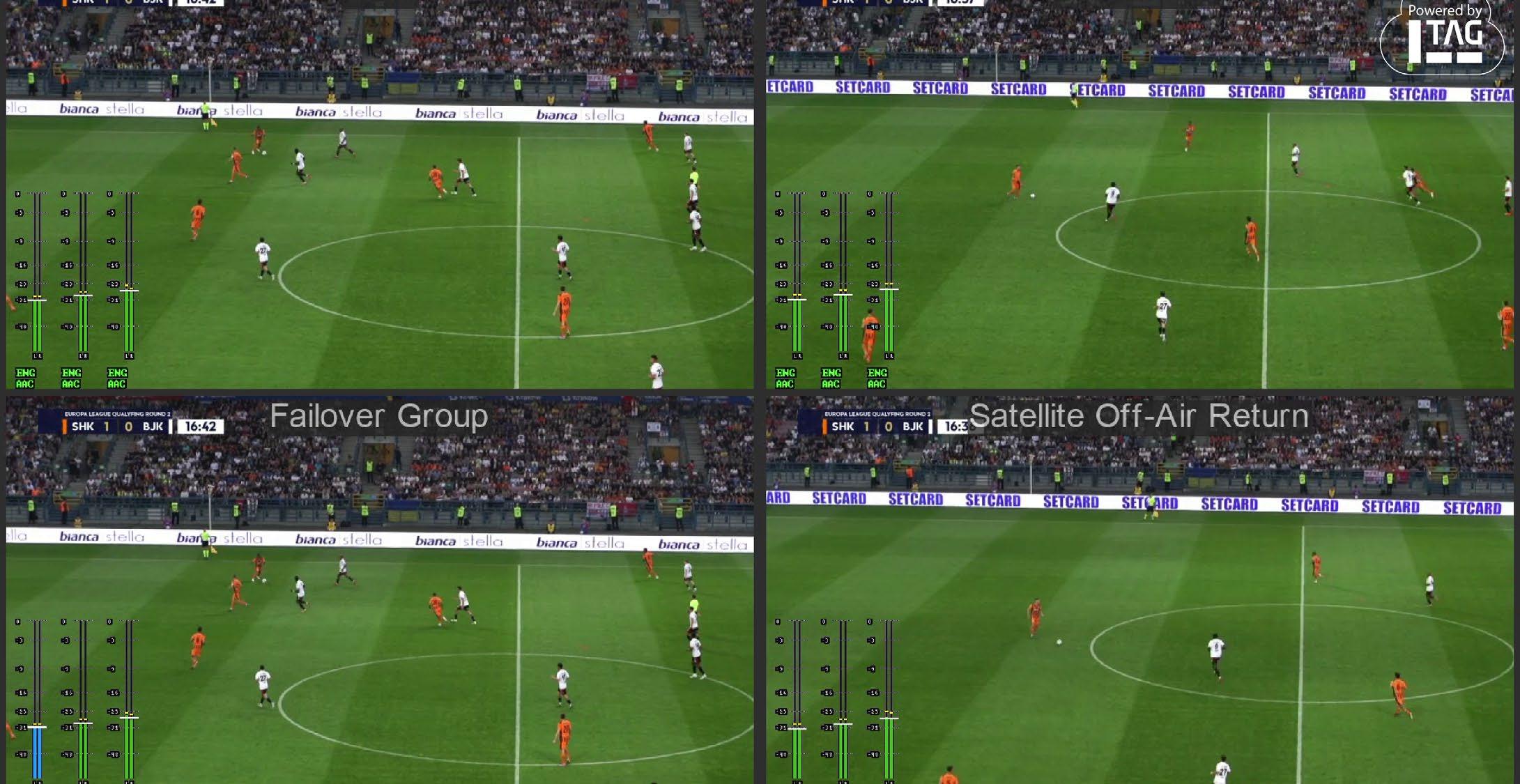
control, there is a risk of creating latency and synchronisation issues. Concluding that a single universal API for MCR functions is “not practical or desirable”, the Accelerator instead calls for a templatebased API model that supports interoperability while still allowing vendors to innovate individually.
RTÉ has recently gone through its own significant infrastructural upgrade—to SMPTE ST 2110—meaning its MCR operations are now based around an IP router. That’s “probably not going to change anytime soon, but I think some of the learnings are very valuable for us to understand where the pain points are and how we might develop things operationally in the future,” says Kilgour.
Cost-conscious
Meanwhile, a recent deployment of cloud-based MCR at a UEFA Europa League qualifier match makes a strong case that, at least initially, the greatest potential of this approach is for events where there are specific circumstantial and/or cost pressures. Working in close cooperation with Cerberus Tech, Open Broadcast Systems played a critical role in delivering the transmission of a match between Ukraine’s Shakhtar Donetsk and Turkey’s Besiktas, which was held in Krakow. Rather than a more conventional blend of fibre and satellite delivery, the match was transmitted from site using public internet and 5G, and managed entirely within the cloud (visit Open Broadcast Systems’ website for a more detailed case study on the project).
“In this case the host broadcaster was Shakhtar Donetsk, and given the current
situation [in Ukraine] the budget did not cover a traditional workflow by quite a long way,” says Kieran Kunhya, founder and CEO of Open Broadcast Systems, which supported first path venue international usage with its low-latency encoders, and also provided its 5G Flyaway product in case of any problems with the primary route. Hosted in AWS, the Cerberus Tech Livelink platform managed the two flows and ensured automatic failover if the main internet-based path went down.
With 17 takers there was no small amount of pressure, but the reception was very positive. Ultimately, says Kunhya, it was “a really topclass feed considering the budgets that Ukrainian TV has, [and had the added benefit] of being able to show that you can deliver a great feed to millions of people using more interesting cloud MCR workflows”.
There is also general agreement that keeping workflows as clear and concise will be essential to further adoption of cloud MCR; it may also be that hybrid architectures offer another valid pathway.
As opposed to comprehensive cloud-based MCR deployment, Demb notes that “what we’re seeing instead is a steady rise in hybrid workflows where cloud resources are used selectively, only where they make technical and commercial sense, rather than a wholesale migration away from traditional infrastructure.
“[Therefore] in the coming years, I expect continued growth in hybrid architectures that combine on-premise infrastructure with cloud and virtualised environments. Emerging technologies such as MXL will play an important role by simplifying interoperability between vendors and systems in cloud and VM-based workflows, helping reduce integration complexity and accelerating adoption.”
Open Broadcast Systems used a four-tile TAG Video Systems cloud multiviewer
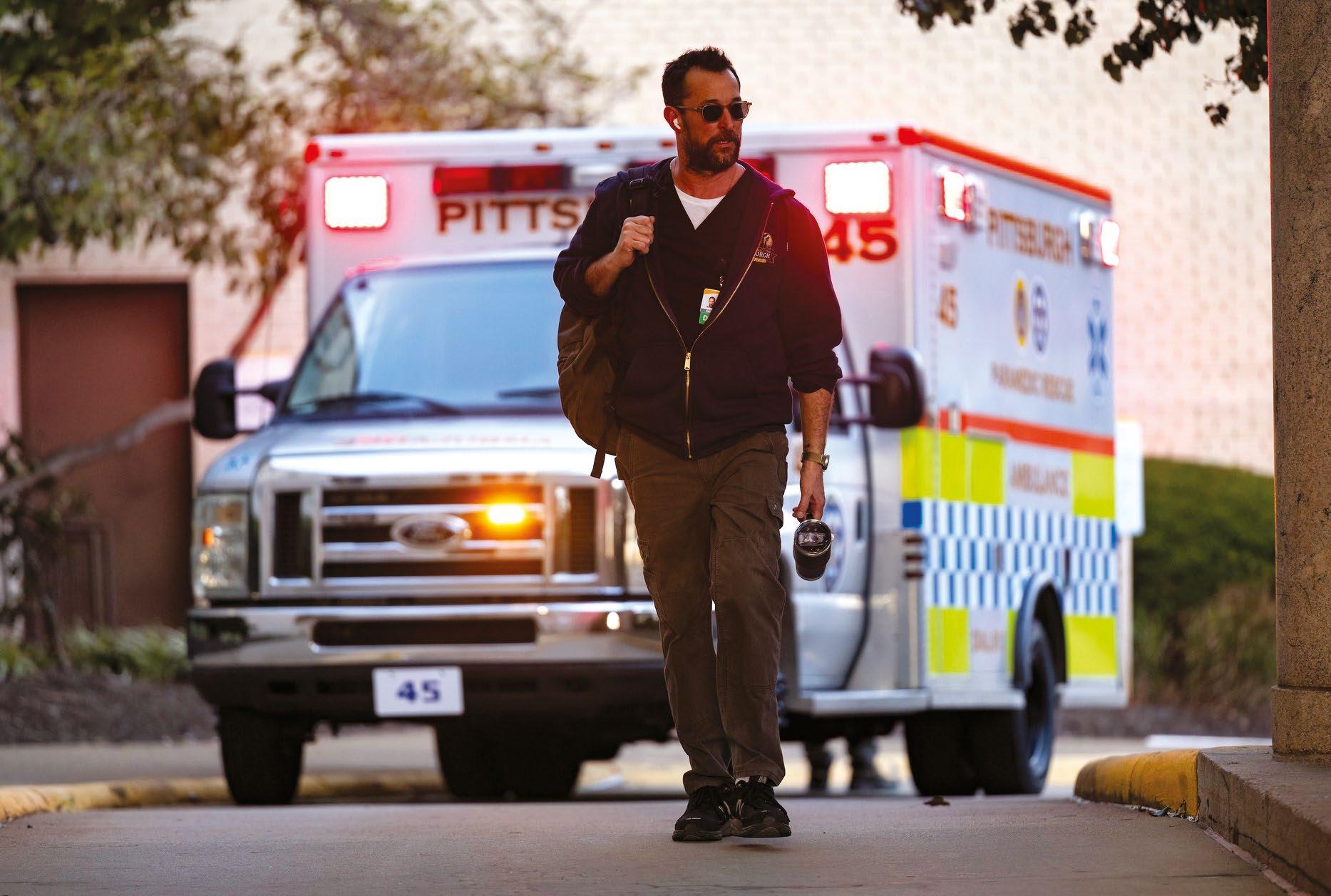
THE audiologist
Bryan Parker, supervising sound editor on HBO Max’s Emmy-winning medical drama The Pitt tells TVBEurope how the use of sound adds realism to the series
How did you get involved in The Pitt?
I started working with producer Terri Murphy on a pilot for John Wells Productions in 2021 and we did a fabulous show for Peacock called Mrs Davis Emperor of Ocean Park on MGM+, and she thought I would be a good fit for The Pitt as well, so she brought me and my team on board.
Please explain what the role of a supervising sound editor means on the show On this show, the supervising sound editor is there to make sure that all our sound choices are accurate, all our sound additions have purpose, and all our sound adjustments point to the same story as the other
departments. I’m in charge of understanding each scene and episode and advising how sound can help achieve the common goals, and I convey those ideas to my sound editors, mixers, and Foley team in terms they can work with. I organise the ADR needs, I put all the work together and make sure it works in harmony before it goes to the mix stage.
not on set during production; I’ve visited the set a few times to make sure I understand the geography and the scale, but my work is all in post production.
Please provide as many details as possible about
Like many productions these days, we use Auto-Align Post to get the most focused, clear dialogue we can a combination of Ediload and Kraken to make scene also use Kraken to pull alt takes quickly when
Bryan Parker
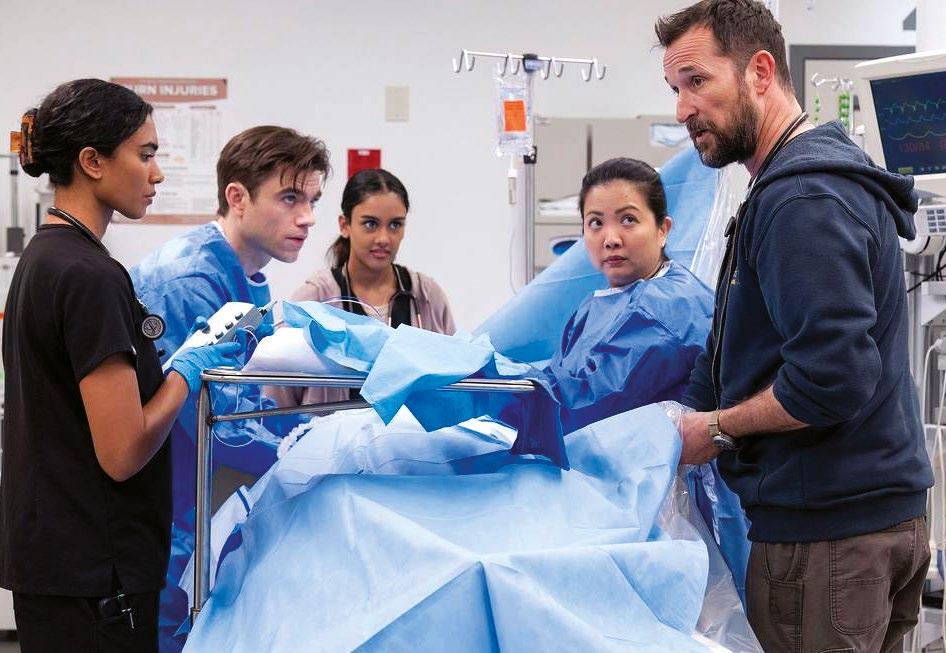
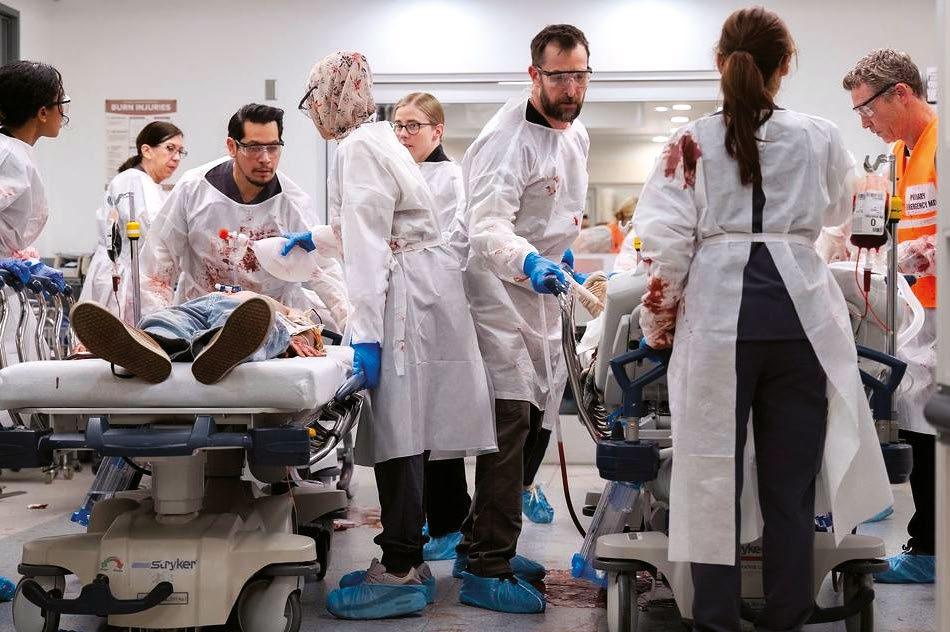
necessary to preserve performances. We get real medical devices from the props department for some procedures, to record the accurate sound in Foley or to add to our internal library.
Since there’s so much movement in the background of our large set with our large cast, we use small amounts of various types of noise reduction: ACON, accentize, iZotope, Brusfri, etc. I use a modular synthesiser to recreate some medical equipment sounds with precision if I can’t get a hold of the real thing to record it, especially ultrasound device sounds. I’ve written custom plugins to help create certain sounds for this show. We will try anything - anything to get the right sound for our scenes!
Was the show mixed in stereo or 5.1? This show is mixed in Home Atmos 7.1.4 for a
realistic, immersive experience. There is always activity around us. Some other patient is having a totally different experience across the hall at all times.
Were there any specific sounds that you wanted to highlight in the mix?
The show uses real medical devices from the props department for some procedures, to record the accurate sound in Foley
I like to highlight the bony reduction sounds. There is something very satisfying about getting those sounds exactly right, not going too big with them, just making them feel as real as the dialogue. I learned on a movie called Birth/Rebirth that going realistic can be more effective than going big, if you want to make the audience’s skin crawl.
How do you juggle all the sounds in such a fastpaced show?
The key to juggling all those sounds and making them work in the mix is the precise placement into the gaps in the dialogue. That’s how we get a dense, busy background without stepping on the intelligibility.
What is the biggest challenge of working on The Pitt?
The biggest challenge in the show is finding the exact right level of background activity in each moment, especially in the Central Work Area. Too much activity and it all sounds washed out. Too little and it sounds dead, or the individual voices poke out and distract. It’s a moving target each episode.
What are you most proud of achieving on the show?
I’m most proud of the sound on The Pitt when someone outside our business questions whether we added anything at all, or if it was just recorded like that on set, like it was the most natural thing in the world, and of course, it sounds like that when you put someone’s hip back where it’s supposed to go.
The Pitt uses both boom and lavalier microphones
Nimbleness and agility are key

Remote production has been around for a decade, and it has set something in motion that could be described as laser-focused minimalism, writes Lawo’s Chris Scheck
When the first fly-away racks were set up and connected in football stadiums throughout France back in 2016, the broadcast world held its breath. The promise was that the signals of all the cameras and microphones at the venues would be transported to the International Broadcast Centre over IP where the actual production took place. A year later, a Belgian telecoms provider and rightsholder for the Belgian Pro League decided to equip all relevant stadiums with dark fibre lines. The IP equipment, cameras and microphones were carried to each venue in relatively small vans, and a skeleton crew on site took care of ingesting the content, complete with interviews and discussions at half- and full-time. All other tasks were performed at the production hub.
There were many reasons for this workflow, which the team later developed with fixed IP infrastructure installations at the venues to further cut down on set-up time.
The remote production approach quickly triggered workflows that involved camera shaders, audio supervisors, and other members of the production team working from more convenient locations. Called ‘distributed production’, this approach is now becoming mainstream. Off-tube commentators working from their respective countries—or their preferred location—for multilingual live broadcasts of skiing, cycling and athletics are considered the new normal. Commenting from anywhere using just a tablet and a headset is about to go live, too.
One of the drivers of this remote/distributed production trend has been the necessity to produce more with less: broadcasters and service providers need to get as much content mileage as possible out of their teams, which stopped growing a long time ago, while also saving on travel expenses, compensation days and fuel.
Owners of OB trucks on the verge of being overweight have begun to migrate to IP, which requires substantially fewer cables and has a positive effect on the weight, not to mention flexible signal distribution. Some are already replacing dedicated processors with generic servers that run
any video and audio processing app operators need. Different productions require different technology stacks, so the ability to build and scale a virtual infrastructure in a few seconds, pressing just one button, means that less bespoke hardware is required. Plus, servers are much more versatile than any dedicated device.
Another way of doing less with more is by ‘shrinking’ the hardware. Unless absolutely indispensable, most audio engineers are happy to use a compact console for smaller jobs, especially if what is not accessible via the control panel can be set on an adjacent tablet or touchscreen. The same applies to video processing: while there used to be a button or rotary for every function, some engineers quite enjoy a graphic user interface that allows them to set the parameters of a given processing app.
Similarly, the ability to use tablets and smartphones in a professional production environment is most welcome for operators who need to take care of several tasks simultaneously. A quick glance at a stream is often enough to confirm that all is going well. If such a check is possible right from where you are at that time, it means you no longer need to head back to the production or master control room. Have a quick look and get on with the other job.
Sophisticated automation routines and AI further contribute to keeping things manageable. Automation algorithms are deterministic and can therefore be relied upon in all situations. Once users can be sure that no hallucination or erroneous assumptions will wreak havoc on a production, AI is bound to be a big step forward.
There is still more dead weight that can be eliminated. It is to do with connectivity. Compact stageboxes are often enough for small-scale productions. They are certainly more convenient, as they can easily be carried around. Installing several close to the relevant sources and destinations means shorter analogue or digital cable runs overall. Now, just for a minute, imagine a solution that accepts both audio and video signals. Every little bit helps!