Prologue | 2 | Module 3
Prologue | 2 | Module 3
How did civil rights advocates respond to injustice?
Great Minds® is the creator of Eureka Math® , Eureka Math2® , Wit & Wisdom® , Arts & Letters™, and PhD Science®
Published by Great Minds PBC greatminds.org
© 2025 Great Minds PBC. All rights reserved. No part of this work may be reproduced or used in any form or by any means—graphic, electronic, or mechanical, including photocopying or information storage and retrieval systems—without written permission from the copyright holder. Where expressly indicated, teachers may copy pages solely for use by students in their classrooms.


Prologue Module Overview
Prologue to L5
• Learning Goal | Identify the role of the participants at the March on Washington.
• Language Progress | Build on the ideas of others.
Prologue to L8
• Learning Goal | Use reflexive pronouns to create sentences that describe what people did at the March on Washington.
• Language Progress | Use reflexive pronouns correctly.
Prologue to L3
• Learning Goal | Organize key details about the March on Washington.
• Language Progress | Students practice connecting ideas using linking words (and, but, or, so, because) to share more robust knowledge statements.
Prologue to L4
• Learning Goal | Identify examples of segregation.
• Language Progress | Students practice connecting ideas using linking words (and, but, or, so, because) to share more robust knowledge statements.
14
20
Prologue to L9
• Learning Goal | Analyze Dr. King’s words in I Have a Dream
• Language Progress | Build on the ideas of others.
Prologue to L10
• Learning Goal | Describe the change Dr. King wants for the country in his speech I Have a Dream
• Language Progress | Students practice connecting ideas using linking words (and, but, or, so, because) to share more robust knowledge statements.
Prologue to L11
• Learning Goal | Examine the meaning of the repeated phrase “one day” in I Have a Dream
• Language Progress | Build on the ideas of others.
26
32
38
44
50

Prologue to L12
• Learning Goal | Explain who Dr. King’s dream was about and what he wanted for them.
• Language Progress | Students practice connecting ideas using linking words (and, but, or, so, because) to share more robust knowledge statements.
Prologue to L15
• Learning Goal | Describe what happens at the lunch counter.
• Language Progress | Students practice connecting ideas using linking words (and, but, or, so, because) to share more robust knowledge statements.
Prologue to L16
• Learning Goal | Explain how Connie feels about the protests.
• Language Progress | Students practice connecting ideas using linking words (and, but, or, so, because) to share more robust knowledge statements.
Prologue to L17
• Learning Goal | Describe injustices the characters in Freedom on the Menu experience.
• Language Progress | Build on the ideas of others.

Prologue to L21
• Learning Goal | Describe images in Ruby Bridges Goes to School by using singular possessive nouns.
• Language Progress | Form singular possessive nouns.
56
Prologue to L22
• Learning Goal | Describe what happens when Ruby attends the William Frantz Elementary School.
• Language Progress | Build on the ideas of others.
Prologue to L23
• Learning Goal | Describe challenges Ruby Bridges experienced in Ruby Bridges Goes to School
• Language Progress | Students practice connecting ideas using linking words (and, but, or, so, because) to share more robust knowledge statements.
88
94
62
68
76
Prologue to L24
• Learning Goal | Examine the effects of Ruby’s actions in Ruby Bridges Goes to School.
• Language Progress | Students practice connecting ideas using linking words (and, but, or, so, because) to share more robust knowledge statements.
100
82
• Learning Goal | Describe what happens in We Want to Go to School!
• Language Progress | Build on the ideas of others.
• Learning Goal | Explain the families’ point of view.
• Language Progress | Students practice connecting ideas using linking words (and, but, or, so, because) to share more robust knowledge statements.
106
112
• Learning Goal | Describe what happened before, during, and after the Mills v. Board of Education lawsuit.
• Language Progress | Build on the ideas of others.
118

Prologue Vocabulary
Prologue Reference Charts
Acknowledgments
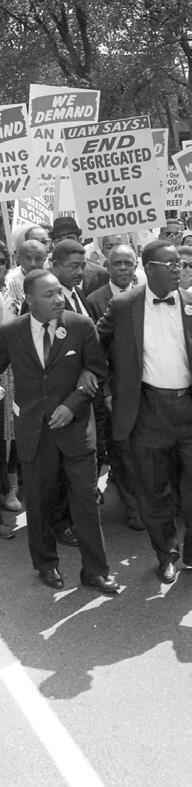
In module 3, Arts & Letters Prologue™ lessons focus on helping students deepen their understanding of how civil rights advocates responded to injustice.
• Prologue lessons support reading development by helping students identify key details in each literary, literary nonfiction, and informational text. Students build knowledge about how advocates respond to injustice as they learn the meaning of words and phrases and identify important events as they build knowledge about how advocates respond to injustice. They also learn about point of view by examining dialogue in literary texts.
• Prologue lessons support writing development by helping students understand the informative paragraph structure. This support prepares students to write informative paragraphs for the module tasks.
• Prologue lessons support speaking and listening development by providing more instruction and practice for the module’s speaking and listening goals: Build on the ideas of others. Use the Module 3 Speaking and Listening Goal Tracker to track progress toward these goals.
• Prologue lessons support language development by helping students connect ideas by using linking words. Students also practice using appropriate pronouns to replace nouns and using adjectives to describe things or people.
Books
Literary
• Freedom on the Menu: The Greensboro Sit-Ins, Carole Boston Weatherford and Jerome Lagarrigue
Literary Nonfiction
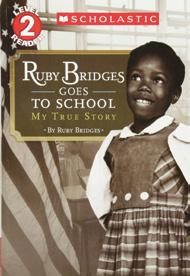
• Ruby Bridges Goes to School: My True Story, Ruby Bridges
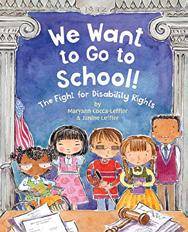
• We Want to Go to School! The Fight for Disability Rights, Maryann Cocca-Leffler and Janine Leffler
• I Have a Dream, Dr. Martin Luther King Jr. and Kadir Nelson
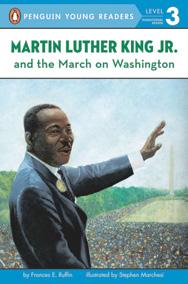
• Martin Luther King Jr. and the March on Washington, Frances E. Ruffin and Stephen Marchesi
• People responded to injustice with words.
• People responded to injustice with actions.
• People responded to injustice by challenging or proposing laws.
Prepare the following materials for use throughout the module.
• Determine how to access the module texts.
• Determine how to display Prologue reference charts, Prologue student resources, and select Learn book pages. These are listed in the Materials section of each lesson.
• Determine how to access the Module 3 Speaking and Listening Goal Tracker from the digital platform.
• Ensure access to the module 3 Knowledge Cards.
• Ensure students have paper for short responses. They can use their journals or other paper.
• For a comprehensive list of all the materials used in the module, see the digital platform.
Arts & Letters Prologue lessons for module 3 provide additional language support to develop the following English Language Development (ELD) standards. Educators should consult their state’s ELD standards and proficiency descriptors to identify the best ways to help multilingual learners reach the module’s learning goals. See the digital platform for a lesson-by-lesson breakdown of ELD standards.
ELD-SI.K-3.Narrate: Multilingual learners will
• Share ideas about one’s own and others’ lived experiences and previous learning
• Connect stories with images and representations to add meaning
• Recount and restate ideas
ELD-SI.K-3.Inform: Multilingual learners will
• Describe characteristics, patterns, or behavior
• Sort, clarify, and summarize ideas
ELD-SI.K-3.Explain: Multilingual learners will
• Share initial thinking with others
• Follow and describe cycles in diagrams, steps in procedures, or causes and effects
ELD-LA.2-3.Narrate.Interpretive: Multilingual learners will interpret language arts narratives by
• Identifying a central message from key details
ELD-LA.2-3.Inform.Interpretive: Multilingual learners will interpret informational texts in language arts by
• Identifying the main idea and key details
• Describing relationship between a series of events, ideas or concepts, or procedural steps
Standard 1: An ELL can construct meaning from oral presentations and literary and informational text through grade-appropriate listening, reading, and viewing.
Standard 2: An ELL can participate in grade-appropriate oral and written exchanges of information, ideas, and analyses, responding to peer, audience, or reader comments and questions.
Standard 3: An ELL can speak and write about grade-appropriate complex literary and informational texts and topics.
Standard 4: An ELL can construct grade-appropriate oral and written claims and support them with reasoning and evidence.
Standard 6: An ELL can analyze and critique the arguments of others orally and in writing.
Standard 7: An ELL can adapt language choices to purpose, task, and audience when speaking and writing.
Standard 8: An ELL can determine the meaning of words and phrases in oral presentations and literary and informational text.
Standard 9: An ELL can create clear and coherent grade-appropriate speech and text.
Standard 10: An ELL can make accurate use of standard English to communicate in grade-appropriate speech and writing.
Students’ home languages and cultures are assets that everyone in the school setting should value and celebrate. Teachers can support the strategic use of home language to facilitate activating background knowledge, acquiring ELA knowledge and world knowledge, and engaging with grade-level content. This can happen individually or in groups. Teachers should encourage students to draw explicit metalinguistic connections between English and their home language through cognates and morphological awareness.
Multilingual learners in the United States speak a variety of languages, but an increasing majority speak Spanish at home. In 2019, more than 75 percent of students who were identified as “English learners” spoke Spanish as a home language (National Center for Education Statistics). For this reason, we offer a number of supports for Spanish speakers.
This module focuses on helping students connect ideas by using linking words (and, but, or, so, because). Prologue lessons help students understand the correct use of pronouns and descriptive adjectives. For students who also speak other language(s), the grammatical rules of English may be confusing. Here are some grammatical differences for which students may need extra explanation and modeling of this structure. In addition to Spanish, we compare English to Arabic and Chinese, the second and third most common languages spoken among multilingual learners in the United States (National Center for Education Statistics).
Language Similarity Difference
Spanish Linking words are also used in Spanish, with similar meanings to English terms.
Spanish also uses personal pronouns to replace nouns. Spanish also has reflexive pronouns.
Adjectives are also used in Spanish.
Arabic Linking words are also used in Arabic, with meanings similar to those of English terms.
Arabic also uses personal pronouns to replace nouns. Reflexive pronouns also exist in Arabic.
Adjectives are also used in Arabic.
The uses of so may be confusing for Spanish speakers because it can be used as an adverb or a conjunction.
In Spanish, the subject of the sentence can be omitted entirely. Reflexive pronouns come before the verb.
In Spanish, adjectives can come before or after nouns.
There is not a 1:1 correspondence between English and Arabic linking words.
In Arabic, personal pronouns always reflect gender and number. There is not a 1:1 correlation between Arabic and English reflexive pronouns.
In Arabic, adjectives come after nouns.
Chinese The Chinese language uses linking words with meanings similar to those English terms. Chinese also uses personal pronouns to replace nouns. Chinese has a reflexive pronoun.
The Chinese language allows the omission of linking words if the relationship between the two ideas is clear. Some conjunctions in English do not correspond to Chinese ones.
In Chinese, personal pronouns do not reflect gender. Chinese also uses the same pronouns for objects and subjects; there is no difference between the Chinese words for he and him. The reflexive pronoun in Chinese does not reflect gender; it is used to express that the subject and object of the sentence are the same.
Here are Spanish cognates for terms taught in module 3 Prologue lessons. Teacher notes in the lessons draw attention to Spanish cognates. Use an online Spanish dictionary for pronunciation guidance or to play a recording of the Spanish cognate for students.
dialogue (n.)
equally (adv.)
injustice (n.)
protest (n.)
role (n.)
segregation (n.)
diálogo (s.)
igualmente (adj.)
injusticia (s.)
protesta (s.)
rol (s.)
segregación (s.)
Lesson 1
Opening Bookend
= assessment = Prologue lesson
Lesson 2
Wonder
Martin Luther King Jr. and the March on Washington
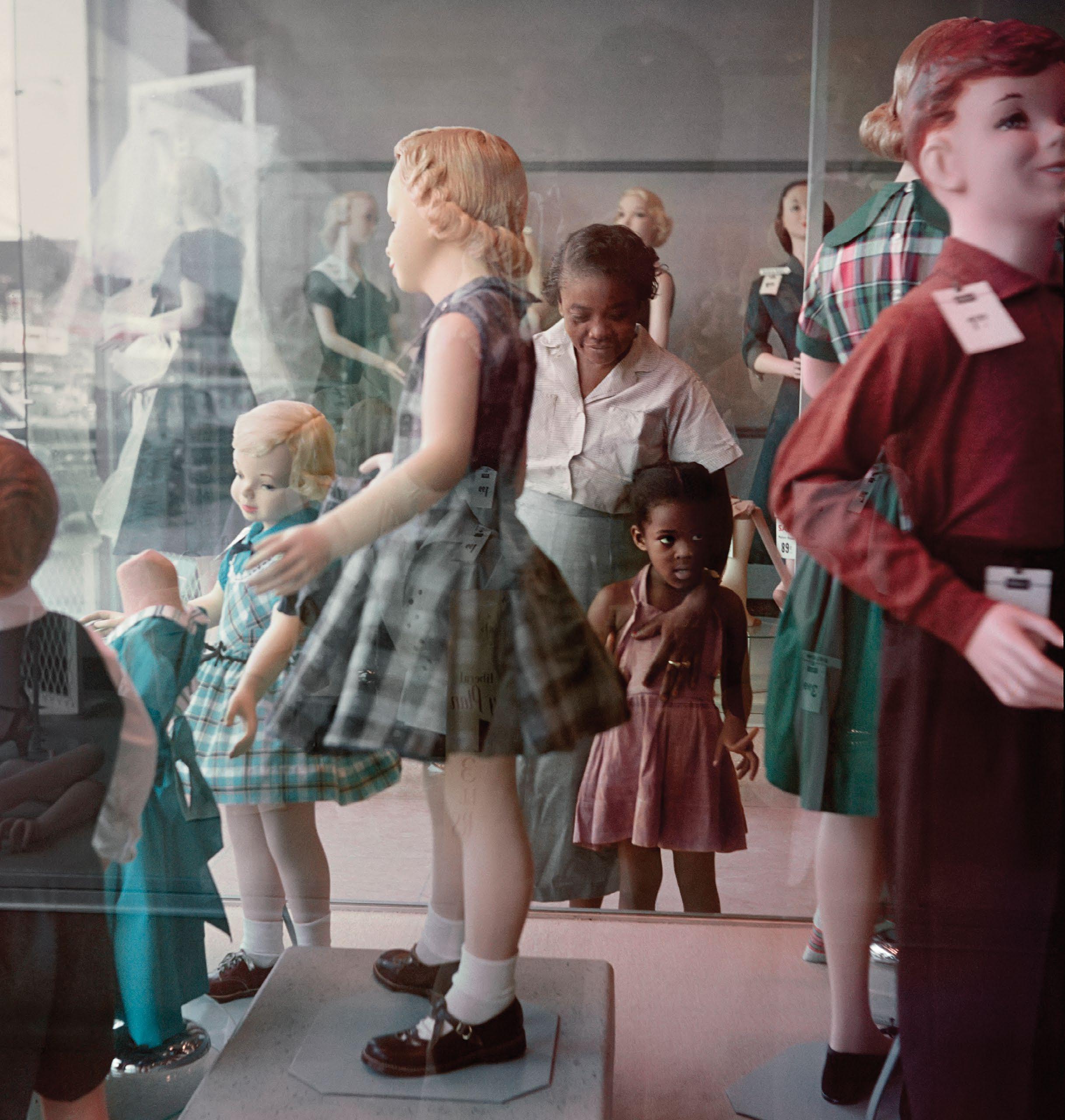
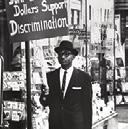
Ondria Tanner and Her Grandmother Window-Shopping
Lesson 3
Organize
Martin Luther King Jr. and the March on Washington
Ondria Tanner and Her Grandmother Window-Shopping
Lesson 4
Reveal
Martin Luther King Jr. and the March on Washington
Ondria Tanner and Her Grandmother Window-Shopping
“Joan Baez Performing at the March on Washington”
Lesson 5
Reveal
Martin Luther King Jr. and the March on Washington
Gordon Parks
Ondria Tanner and Her Grandmother Window-Shopping
Lesson 6
Know
Martin Luther King Jr. and the March on Washington
“Congress at Work”
“LBJ Signs Civil Rights Act”
Gordon Parks
Ondria Tanner and Her Grandmother Window-Shopping
Lesson 7
Know
Martin Luther King Jr. and the March on Washington
“Honoring a Hero”
Ondria Tanner and Her Grandmother Window-Shopping
Lesson 8
Wonder I Have a Dream
Lesson 9
Organize I Have a Dream
Martin Luther King Jr. and the March on Washington
Lesson 10
Reveal I Have a Dream
Lesson 11
Reveal I Have a Dream “I Have a Dream”
Lesson 12
Distill I Have a Dream
Lesson 13
Know I Have a Dream excerpt from “Martin Luther King, Jr.” “I Have a Dream”
Module Task 1 completed
Lesson 14
Wonder Freedom on the Menu
Lesson 15
Organize Freedom on the Menu
Lesson 16
Reveal Freedom on the Menu Lesson 17 Distill Freedom on the Menu
Lesson 18
Know Freedom on the Menu “Student Civil Rights Activism”
Lesson 19 Reading Comprehension Assessment
Lesson 20
Responsive Teaching
Lesson 21
Wonder
Ruby Bridges Goes to School
Lesson 22
Organize Ruby Bridges Goes to School
Lesson 23
Reveal
Ruby Bridges Goes to School
Lesson 24
Distill
Ruby Bridges Goes to School
Lesson 25
Know Ruby Bridges Goes to School
“Ruby Bridges”
Module Task 2 completed
Lesson 26
Wonder
We Want to Go to School!
Free to Move
Gordon Parks
My Freedom Story
We Will Ride
Lesson 27
Organize We Want to Go to School!
Free to Move
Gordon Parks
My Freedom Story We Will Ride
Lesson 28
Reveal We Want to Go to School!
Lesson 29
Distill We Want to Go to School!
Lesson 30
Know We Want to Go to School!
Lesson 31
Know module texts
Module Task 3 completed
Lesson 32 Listening Comprehension Assessment
Lesson 33
Responsive Teaching Module Finale
Essential Question | How did civil rights advocates respond to injustice?
Students discuss the March on Washington. As they identify key details about the March on Washington, students practice connecting ideas by using linking words. This work prepares students to explain the meaning of the term injustice in lesson 3.
Organize key details about the March on Washington.
LEARNING TASK: Use because to share one reason for the March on Washington.
In this lesson, students work on this module language goal: Students practice connecting ideas using linking words (and, but, or, so, because) to share more robust knowledge statements.
To support students with beginning English proficiency, prompt them to explain why they like their favorite food by using this sentence frame: I like because . To support students with intermediate English proficiency, prompt them to expand their explanations by using the linking words because and and to connect two ideas.
equally (adv.)
• Martin Luther King Jr. and The March on Washington
• class March on Washington Chart (Prologue Reference Charts appendix)
• none
• Make a class March on Washington Chart. See the Learn section for details and the Prologue Reference Charts appendix for a sample.
• Determine how to display the sentence frame. See the Learn section for details.
1. Display Martin Luther King Jr. and the March on Washington and Echo Read the title.
2. Direct attention to the image on the last page of the book. Ask this question: What do you notice and wonder about the image?
3. Explain that this was a real event called the March on Washington.
4. Tell students they will discuss the March on Washington.
1. Display the class March on Washington Chart. Remind students that the question words when, where, who, and why ask for different information. Explain that students will answer different types of questions about the March on Washington.
2. Direct attention to pages 4–5. Tell students to listen for when and where the March on Washington takes place. Echo Read the portion of page 4 starting with “August 28, 1963” to “in Washington, DC.” Ask these questions:
When did the march take place?
Where did the march take place?
3. Reinforce the correct responses:
• when—August 28, 1963
• where—Washington, DC
Add responses to the When? and Where? columns on the chart.
4. Tell students to listen for who was at the March on Washington. Echo Read the remainder of page 4, starting with “More than 250,000.” Ask this question:
Who was at the March on Washington?
5. Reinforce the correct response: 250,000 people. Add the response to the chart under the Who? column.
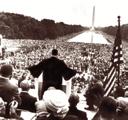
6. Direct attention to the illustrations on pages 30–33. Ask this question:
What do you see in the illustrations?
Key Ideas
• a man waving
• a large crowd of people
• a man speaking into the microphones
7. Explain that many people are waiting for this man to speak at the March on Washington. Tell students to listen for who the man is. Read aloud the portion of pages 31–32 from “The crowd goes” to “Luther King Jr.” Ask this question:
Who is this man?
8. Reinforce the correct response: Martin Luther King Jr. Add the response to the chart under the Who? column.
9. Direct attention to the last column on the chart. Echo Read the heading. Remind students they have used the question word why to explain a reason something happened.
10. Direct attention to page 9. Echo Read the question on page 9, starting with “Why are so.” Tell students they will read a key passage to understand why people were at the March on Washington.
11. Introduce the vocabulary term equally by displaying the term. Explain that the Vocabulary Exploration routine has three parts. First, you say the term and simultaneously clap once for each syllable. Then, students copy the action by repeating the term and clapping once for each syllable. Finally, you read aloud the definition.
12. Practice this routine with the term equally.
Language Support
The term equally has a Spanish cognate: igualmente. Share this language connection with students whose home language is Spanish.
13. Read aloud the portion of pages 11–13 from “There has been” to “think is wrong.” Instruct students to Think–Pair–Share to answer this question:
Why were so many people at the March on Washington?
Language Support
For students with beginning English proficiency, display the Knowledge Card for protest and read the definition. Direct attention to the image on the Knowledge Card and pages 12–13 to help students understand the term’s meaning.
Key Ideas
• They were there because they wanted equal treatment for Black people and White people.
• They were there to protest.
• They were there to speak out against something that was wrong.
Language Expansion
For students with intermediate English proficiency, prompt them to include vocabulary from the text, such as protest, in their response.
Definition equally (adv.): the same way
14. Add responses to the chart under the Why? column.
15. Display this sentence frame: People were at the March on Washington because . Explain that writers can use the word because to explain a reason something happened.
16. Think aloud to model how to explain why people were at the March on Washington. Emphasize how to use the word because to explain why people were at the March on Washington.
1. Introduce the learning task. Instruct students to work with a partner and to use because to explain why people were at the March on Washington.
Analyze Student Progress
Monitor: Do students give an accurate reason why people were at the March on Washington?
Offer Immediate Support: If students need additional support explaining why people were at the March on Washington, repeat the definition of equally. Then direct attention to the chart and ask them if Black people and White people were treated equally.
2. Instruct students to work with a partner and complete the sentence frame: People were at the March on Washington because .
Remind students to refer to the class March on Washington Chart.
Sample Think Aloud
Black people experienced unequal treatment to White people. I can use because to explain why people were at the March on Washington. People were at the March on Washington because they wanted equal treatment for Black people and White people.
3. Invite a few students to share.
Key Ideas
• People were at the March on Washington because Black people and White people were not treated equally.
• People were at the March on Washington because they came to protest.
• People were at the March on Washington because they wanted to speak out against something that is wrong.
4. Summarize that organizing key details can help readers understand historical events.
Essential Question | How did civil rights advocates respond to injustice?
Students describe examples of segregation. As they learn about segregation in the South, students practice connecting ideas by using linking words. This work prepares students to explain how racial segregation affected the lives of Black people in lesson 4.
Identify examples of segregation.
LEARNING TASK: Share two examples of segregation by using the linking word and.
In this lesson, students work on this module language goal: Students practice connecting ideas using linking words (and, but, or, so, because) to share more robust knowledge statements.
To support students with beginning English proficiency, prompt them to share two things they like by using this sentence frame: I like and . To support students with intermediate English proficiency, model how to use the linking word and to connect ideas. Then prompt students to combine ideas from two separate sentences (e.g., I eat hamburgers. I eat pizza.).
segregation (n.)
• Martin Luther King Jr. and the March on Washington
• Knowledge Card: segregation
STUDENTS
• none
• Determine how to display the sentence frame. See the Learn section for details.
1. Place both palms together. Then move both palms apart. Invite students to mimic your gesture. Ask this question:
What did you notice about your hands?
2. Use responses to emphasize that you moved your hands apart. Explain that another word for apart is separate.
3. Display the Knowledge Card for segregation. Engage students in Vocabulary Exploration.
Language Support
The term segregation has a Spanish cognate: segregación. Share this language connection with students whose home language is Spanish.
4. Direct attention to the term segregation on the Knowledge Card. Explain that knowing different word parts helps readers use new words to discuss a topic.
5. Underline and Echo Read the root word segregate. Explain that segregate is a root word that means “to separate, or keep apart, people by differences.”
6. Circle the suffix -tion. Explain that -tion is a suffix, or a word part that can be added to the end of a word to change the meaning. The suffix -tion means “the action of doing something.” So segregation means “the action of separating.”
7. Explain that in the past, laws forced people to be separated in some places because of the color of their skin.
8. Tell students that they will describe examples of segregation in Martin Luther King Jr. and the March on Washington.
Definition segregation (n.): the practice of separating people by their differences, such as race, gender, religion, and/or ability
1. Tell students that they will look for examples of segregation of Black people and White people. Remind students that the events occurred in the past.
2. Read aloud pages 14–15, starting with “In the South.”
3. Display and Echo Read this sentence frame: Laws kept Black people and White people apart in and . Direct attention to the linking word and. Tell students that they can use and to connect two or more ideas or things.
4. Model how to complete the sentence frame with the correct response: Laws kept Black people and White people apart in restaurants and hotels. Instruct students to repeat the correct response with a partner.
5. Read aloud pages 16–17, starting with “In movie theaters.” Ask these questions:
How did Black people enter the movie theaters?
Where did they sit in the movie theaters?
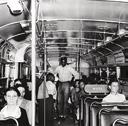
Where did Black people sit on public buses?
Language Support
For students with beginning English proficiency, ask them to point to the specific part of the image on pages 16–17 where Black people and White people are apart (e.g., back of the bus).
6. Reinforce the correct responses:
• enter movie theaters—by separate doors
• sit in movie theaters—in the balcony
• sit on public buses—in the back
7. Instruct students to work with a partner and to use the sentence frame to share two more places where laws kept Black people and White people apart.
8. Reinforce the correct response: Laws kept Black people and White people apart in movie theaters and public buses.
9. Emphasize that keeping people apart or separate because of skin color is an example of segregation. Think aloud to model how to describe two examples of segregation.
1. Introduce the learning task. Instruct students to share two examples of where Black people and White people were segregated by using the linking word and with a partner.
Monitor: Do students describe two examples of segregation?
Offer Immediate Support: If students need additional support naming two examples of segregation, read aloud the sentence on page 15 and ask them to name two places Black people could not go.
2. Look for students to address key ideas in their responses.
Key Ideas • restaurants
hotels
movie theaters
buses
Sample Think Aloud Laws segregated Black people and White people in restaurants. They also kept people apart at hotels. I can say, “Laws segregated Black people and White people in restaurants and hotels.”
3. Instruct students to write a sentence to answer this question:
Where did laws segregate Black people and White people?
Language Expansion
For students with intermediate English proficiency, prompt them to describe additional examples of segregation by using these sentence frames: Laws segregated Black people and White people in and . Laws also segregated Black people and White people in and
4. Invite a few students to share.
Key Ideas
• Laws segregated Black people and White people in movie theaters and buses.
• Laws segregated Black people and White people in restaurants and hotels.
5. Summarize that writers can use the linking word and to connect ideas about a historical event.
Essential Question | How did civil rights advocates respond to injustice?
Students describe the roles of people at the March on Washington. As they discuss the roles of different participants, students practice building on the ideas of others. This work prepares students to explain how different advocates worked together in Martin Luther King Jr. and the March on Washington in lesson 5.
Identify the role of the participants at the March on Washington.
LEARNING TASK: Describe the role of a person or people at the March on Washington.
In this lesson, students work on this module speaking and listening goal: Build on the ideas of others.
To support students with beginning English proficiency, prompt them to restate their partner’s idea before adding their own. To support students with intermediate English proficiency, encourage them to build on the ideas of their partner by explaining why they think the role of the person was important.
protest (n.)
role (n.)
speech (n.)
• Martin Luther King Jr. and the March on Washington
• School Workers photograph (digital platform)
• Martin Luther King Jr. and the March on Washington
• Determine how to display the sentence frames. See the Learn section for details.
1. Display School Workers photograph. Explain that the people in the image work at a school. Ask these questions:
Who do you see?
What do they do?
Language Support
If possible, pair students who speak the same home language, and instruct them to describe the roles of the school workers.
Key Ideas
• teacher; helps students learn
• principal; leads the school
• nurse; takes care of students’ health
2. Emphasize that each person has a title, such as a teacher, and role, or the tasks and responsibilities that they have in the school.
3. Introduce the vocabulary term role by displaying the term. Engage students in Vocabulary Exploration.
Language Support
The term role has a Spanish cognate: rol. Share this language connection with students whose home language is Spanish.
4. Emphasize that many people attended the March on Washington. Tell students that they will describe the roles that different participants had in the march.
Definition
role (n.): the part that someone has in a group
1. Display the illustrations on pages 4–6 in Martin Luther King Jr. and the March on Washington. Ask this question:
What do you see in this illustration?
Key Ideas
• buses
• people walking and holding signs
• American flag
2. Explain that these people came from all over the country and had an important role in the March on Washington.
3. Introduce the vocabulary term protest by displaying the Knowledge Card. Engage students in Vocabulary Exploration.
Language Support
The term protest has a Spanish cognate: protesta. Share this language connection with students whose home language is Spanish.
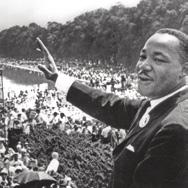
4. Direct attention to the photograph on pages 26–27. Explain that the people in the photograph went to the March on Washington to protest and show their desire for change.
Definition
protest (n.): an organized action by a group of people to show dislike for an idea and to cause change
5. Direct attention to the photograph on page 24. Ask this question:
What do you notice in the photograph?
Key Ideas
• two men
• a microphone
• a man talking
6. Tell students the men’s names are A. Phillip Randolph and Bayard Rustin. Emphasize that they also had an important role in the March on Washington.
7. Read aloud the portion of pages 24–25 from “But what if” to “as the place.” Explain that Randolph and Rustin’s role was to have the idea for the march. They also helped organize the march.
8. Direct attention to the illustrations on pages 36–37. Ask this question:
Who is this man?
9. Reinforce the correct response: Dr. Martin Luther King Jr.
10. Introduce the vocabulary term speech by displaying the term. Engage students in Vocabulary Exploration.
11. Read aloud the portion of page 36 from “Today, in Washington” to “a better world.” Instruct students to Think–Pair–Share to answer this question:
What was Dr. Martin Luther King Jr.’s role in the March on Washington?
12. Reinforce the correct response: Dr. King’s role was to give a speech about his dream for a better world.
13. Display and read aloud these sentence frames:
• The marchers’ role was to .
• Also, their role was to . Definition speech (n.): the formal communication of thoughts using spoken words
14. Instruct students to read page 13 with a partner and identify two details that describe the role of the marchers. Direct one student to complete the first frame and the second student to complete the second frame to practice building on their partner’s ideas.
Language Support
For students with beginning English proficiency, read aloud the assigned page. Then model how to complete the first sentence frame.
Language Expansion
For students with intermediate English proficiency, prompt them to build on their partner’s ideas by adding evidence from the text.
15. Invite a few students to share their responses.
Key Ideas
• The marchers’ role was to march, carry signs, and to show their desire for change.
5 minutes
1. Introduce the learning task. Instruct students to share a detail with a new partner about the role of a person or people at the March on Washington. Encourage students to build on their partner’s idea by sharing an additional detail about the same person or people.
Analyze Student Progress
Monitor: Do students accurately describe the person’s or people’s role at the March on Washington?
Offer Immediate Support: If students need additional support describing the role, direct their attention to corresponding illustrations or photographs in the book.
2. Invite a few students to share their responses.
Key Ideas
• Rustin and Randolph’s role was to have the idea for the march and to help organize the march.
• The marchers’ role was to carry signs and show their desire for change.
• Dr. King’s role was to give a speech about his dream for a better world.
3. Summarize that understanding the roles of people helps readers understand the text and historical events.
Essential Question | How did civil rights advocates respond to injustice?
Students examine how writers use reflexive pronouns in sentences about the civil rights movement. As they annotate sentences, students practice using reflexive pronouns when the subject and object of a sentence are the same. This work prepares students to use reflexive pronouns correctly in lesson 8.
Use reflexive pronouns to create sentences that describe what people did at the March on Washington.
LEARNING TASK: Share a sentence that uses a reflexive pronoun that describes what two advocates did to fight injustice.
In this lesson, students work on this expectation for the End-of-Module Task: Use reflexive pronouns correctly.
To support students with beginning English proficiency, model how to use I/myself in a sentence about something done without help. Prompt them to share sentences by using this sentence frame: I myself. To support students with intermediate English proficiency, model how to use the class Reflexive Pronouns Chart to form sentences that include a pronoun and its corresponding reflexive pronoun. Prompt them to practice sharing sentences with a partner.
• class Reflexive Pronouns Chart (Prologue Reference Charts appendix)
• none
• Determine how to display the sample sentences. See the Launch and Learn for details.
• Make a class Reflexive Pronouns Chart. See the Learn section for details and the Prologue Reference Charts appendix for a sample.
Vocabulary
none
1. Instruct students to Think–Pair–Share to answer this question: What is something you can do without help?
2. Display and Echo Read this sample sentence: I tie my shoes. Ask this question: Who is the sentence about?
3. Reinforce the correct response: I. Remind students that words such as I, you, she, he, it, we, and they are pronouns and can take the place of people’s names.
4. Explain that another kind of pronoun is a reflexive pronoun. Say the term aloud, and invite students to repeat it.
5. Display and Echo Read this sample sentence: I tie my shoes myself. Ask this question: What do you notice about this new sentence?
6. Reinforce the correct response: Myself is at the end of the sentence. Explain that myself is a reflexive pronoun.
7. Circle myself and draw an arrow to I. Emphasize that myself refers to I and that both refer to the same person, or subject.
8. Tell students they will use reflexive pronouns to discuss Martin Luther King Jr. and the March on Washington.
1. Display the class Reflexive Pronouns Chart. Echo Read the pronouns and the corresponding reflexive pronouns. Emphasize that the word part -self is added to the end of each reflexive pronoun when referring to a single person, and -selves is added when referring to more than one person.
2. Tell students they will use the chart to match the reflexive pronouns to the corresponding subject in the sentences about what advocates did to fight injustice.
3. Display and Echo Read these sentences: Martin Luther King Jr. was a leader. He led protests himself.
4. Think aloud to model how to identify the subject and pronoun in the sentences.
5. Underline Martin Luther King Jr. and circle he.
Language Support
For students with beginning English proficiency, review the definition of the subject in a sentence.
6. Ask this question: What is the reflexive pronoun?
Language Expansion
For students with intermediate English proficiency, direct attention to pages 34–36 and encourage them to work with a partner to form a sentence about Dr. Martin Luther King Jr. using one of the sentences (e.g., Dr. King uses words. He gave speeches himself.).
7. Reinforce the correct response: himself.
Sample Think Aloud
The first sentence is about Martin Luther King Jr. This is the subject. The second sentence starts with he. This is referring to Martin Luther King Jr. He is a pronoun.
8. Instruct students to discuss these questions with a partner:
Who does he refer to in the second sentence?
Who does himself refer to in the second sentence?
9. Invite two students to share their responses. Reinforce the correct responses:
• he—Martin Luther King Jr.
• himself—Martin Luther King Jr.
As students share, underline Martin Luther King Jr. in the first sentence. Circle the pronoun he and draw an arrow from he to Martin Luther King Jr. Then draw an arrow from himself to He in the second sentence. Remind students that the writers uses the pronoun he so that they don’t repeat Dr. King’s name in the second sentence. Emphasize that both he and himself refer to Martin Luther King Jr.
10. Display and Echo Read these sentences: The marchers came to Washington to protest. They wanted to see change for themselves.
11. Instruct students to discuss with a partner these questions:
What is the subject in the first sentence?
What is the pronoun in the second sentence?
What is the reflexive pronoun?
Language Support
For students with beginning English proficiency, Echo Read the sentences. Then ask these questions:
• Who came to Washington to protest?
• Who wanted to see the change?
• What reflexive pronoun refers to the pronoun?
12. Reinforce the correct responses:
• the marchers
• they
• themselves
Invite a student to annotate the sentences by underlining The marchers in the first sentence. Then by circling They and drawing an arrow from They to the marchers and from themselves to They. Emphasize that both they and themselves refer to the marchers.
13. Display and Echo Read these sentences: Randolph and Rustin wanted everyone to protest in one place. They chose Washington, DC, .
14. Instruct students to work with a partner to identify the subject and pronoun and then complete the sentence on a piece of paper by using a reflexive pronoun. Tell them to annotate the sentences as they had done earlier, by underlining the subject, circling the pronoun, and drawing an arrow from the subject pronoun to the subject, and from the reflexive pronoun to the subject pronoun.
15. Look for students to determine the correct responses:
• subject—Randolph and Rustin
• pronoun—they
• reflexive pronoun—themselves
1. Introduce the learning task. Share a sentence that uses a reflexive pronoun and describes what Randolph and Rustin did to fight injustice.
2. Instruct students to share their sentence with a new partner and compare their annotations.
Analyze Student Progress
Monitor: Do students use the correct reflexive pronoun that refers to the corresponding subject?
Offer Immediate Support: If students need additional support using a reflexive pronoun, prompt them to use the class chart as a reference. Then Echo Read the sentences. Ask these questions: Who wanted the protest in one place? Who chose Washington, DC? What reflexive pronoun can you use for the subject?
3. Invite a student to read aloud their sentence and explain who the reflexive pronoun in the second sentence refers to. Reinforce the correct responses:
• They chose Washington, DC, themselves.
• The reflexive pronoun themselves is referring to the pronoun they, or Randolph and Rustin.
4. Summarize that identifying pronouns and reflexive pronouns in a sentence can help readers understand who the sentence is about.
Essential Question | How did civil rights advocates respond to injustice?
Students analyze Dr. Martin Luther King’s words in I Have a Dream. As they explain the meaning of his words, students practice building on the ideas of others. This work prepares students to describe Dr. King’s dream in I Have a Dream in lesson 9.
Analyze Dr. King’s words in I Have a Dream.
LEARNING TASK: Draw to illustrate the meaning of a key phrase in Dr. King’s I Have a Dream speech.
In this lesson, students work on this module speaking and listening goal: Build on the ideas of others.
To support students with beginning English proficiency, prompt students to use gestures (e.g., a thumbs-up) to show that their partner gave them a new idea. To support students with intermediate English proficiency, encourage them to explain how they could revise their work by using an idea from their partner. Prompt them to use these sentence frames: I noticed you drew . This gave me the idea to .
none
• I Have a Dream
• none
• I Have a Dream is an unpaginated text. Number your text; begin with the title page as page 1. Pages on the left will be even, and pages on the right will be odd.
• Determine how to display the quotations and sentence frames. See the Learn section for details.
1. Display I Have a Dream. Read aloud the title.
2. Explain that dream can be used to describe something that you have wanted very much for a long time.
3. Tell students to think about what might make them happy in the future. Model how to share a dream by using this sentence frame: My dream is . Instruct students to Think–Pair–Share to answer this question:
What is your dream?
Language Support
If possible, pair students who speak the same home language, and instruct them to share their dream.
4. Emphasize that Dr. King shared a dream for the future of the country.
5. Tell students they will discuss key parts in Dr. King’s speech about his dream.
1. Display page 5 of I Have a Dream and read aloud from “We hold these” to “are created equal.” Direct attention to the phrase “all men are created equal.” Tell students that equal means “the same.” Say the term aloud, and instruct students to repeat it.
2. Model how to draw a sketch of the phrase “all men are created equal” by drawing an equal sign with two stick figures on each side. Emphasize that Dr. King’s words say that he believes everyone is the same.
3. Instruct students to copy or draw a similar sketch using symbols, words, or illustrations to represent the phrase’s meaning.
4. Display pages 8–9 and direct attention to the image of the children. Explain that this part of the speech describes what Dr. King wanted for his children.
5. Tell students they will listen to a quote and create a picture in their mind. Invite students to close their eyes as you read aloud page 8, starting with “I have a dream.”
6. Direct attention to the phrase “be judged.” Explain that be judged means “to have an opinion formed.” Write opinion above the phrase “be judged” and invite students to do the same.
7. Direct attention to the phrase “content of their character.” Explain that this phrase means “what kind of people they are.”
8. Tell students that they will practice building on the ideas of others. Display and Echo Read these sentence frames:
• You said . I think .
• What you said makes me think .
9. Reread from “my four children” to “of their character.” Instruct students to Think–Pair–Share to discuss what they pictured in their mind.
10. Then prompt them to use the sentence frames to build on their partner’s ideas.
Language Expansion
For students with intermediate English proficiency, encourage them to make a personal connection by sharing a time when someone judged them.
11. Emphasize that this phrase says that Dr. King had a dream that people would form an opinion about his children based on what kind of people they were and not based on their skin color.
12. Instruct students to draw a sketch by using symbols, words, or illustrations to represent the meaning of the phrase.
13. Tell students to discuss what they drew with a partner.
14. Display pages 12–13 and direct attention to the image of the children holding hands. Explain that this part of the speech describes what Dr. King wanted for all children in the future.
15. Tell students they will listen to a quote and create a picture in their mind as you read page 13, starting with “I have a dream.” Invite students to close their eyes as you read aloud the phrase.
16. Direct attention to and Echo Read the words “brothers and sisters.” Instruct students to Think–Pair–Share to answer this question:
What do you think Dr. King means by “brothers and sisters”?
17. Instruct students to use the sentence frames to build on their partner’s ideas.
18. Use responses to emphasize that Dr. King means he wanted all children to treat each other like family.
19. Read aloud page 13, starting with “little black boys.” Instruct students to discuss with a partner what they pictured in their mind.
Language Support
For students with beginning English proficiency, prompt them to describe how it feels when someone treats them kindly.
20. Direct attention to and Echo Read the phrase “will be able to join hands.” Instruct students to draw a sketch by using symbols, words, or illustrations to represent the meaning of the phrase.
1. Introduce the learning task. Instruct students to share their drawing of the phrase “will be able to join hands” from page 13 and explain how it represents the meaning.
Analyze Student Progress
Monitor: Do students’ sketches represent the idea that Dr. King wants all children to get along and treat each other kindly?
Offer Immediate Support: If students need additional support understanding the meaning of the phrase, direct attention to the illustration on pages 12–13. Then ask these questions: What are the children doing? How are they getting along?
2. Instruct students to share what their partner’s drawing made them think about by displaying the following sentence frames:
• Your drawing made me think .
• You drew . I think .
3. Summarize that visualizing helps readers understand the meaning of key words and phrases in a text.
Essential Question | How did civil rights advocates respond to injustice?
Students explore contrasting ideas in I Have a Dream. As they examine key words in Dr. Martin Luther King’s speech, students practice connecting ideas by using linking words. This work prepares students to analyze contrast in I Have a Dream in lesson 10.
Describe the change Dr. King wants for the country in his speech I Have a Dream.
LEARNING TASK: Create a sentence about what Dr. King believes and the change he wants for the country by using the linking word but.
In this lesson, students work on this module language goal: Students practice connecting ideas using linking words (and, but, or, so, because) to share more robust knowledge statements.
To support students with beginning English proficiency, model how to use the linking word but to connect contrasting ideas about familiar topics. Then prompt students to complete this sentence frame: Today, , but tomorrow . To support students with intermediate English proficiency, encourage them to use the linking words but and because to share their preference between two contrasting ideas and to explain why (e.g., I like summer, but I don’t like winter because it is cold).
freedom (n.)
injustice (n.)
• Night and Day photograph (digital platform)
• Knowledge Cards: injustice, freedom
• none
• I Have a Dream is an unpaginated text. Number your text; begin with the title page as page 1. Pages on the left will be even, and pages on the right will be odd.
• Create a word bank with the following terms from the lesson to help with the students’ discussion: freedom, justice, injustice, oppression. See the Land section for details.
• Determine how to display the sentence frame. See the Learn section for details.
1. Display Night and Day photograph. Instruct students to Think–Pair–Share to answer this question: What differences do you notice?
Key Ideas
• The sun is shining during the day.
• It is bright.
• The moon is shining during the night.
• It is dark.
2. Emphasize that the photograph shows a contrast between night and day.
3. Reinforce that contrast means “ideas that are opposite from each other.”
4. Invite a few students to share other examples of contrast.
Key Ideas
• short and tall
• old and young
• walk and run
5. Tell students they will explain the contrasting ideas between key terms in I Have a Dream.
1. Display only the word on the Knowledge Card for injustice. Say the term aloud, and instruct students to repeat it. Ask this question:
What do you notice about the word injustice?
Key Ideas
• It starts with in-.
• It has the word just
• It has the word justice.
2. Emphasize that the word part in- that comes before the root word means “not.” Remind students that the root word just means “treating people in a way that is right or fair.” Instruct students to discuss this question with their partner:
What do you think injustice means?
Language Expansion
For students with intermediate English proficiency, encourage them to use an example when explaining the definition of injustice and other lesson terms.
3. Invite a few students to share their responses, and use their responses to reinforce the correct definition of injustice. Display the Knowledge Card, and direct attention to the image to help students understand the term’s meaning.
Language Support
The term injustice has a Spanish cognate: injusticia. Share this language connection with students whose home language is Spanish.
Definition
injustice (n.): unfair treatment or a situation in which a person’s or a group of people’s rights are violated
4. Tell students that they will now listen for a word that contrasts with injustice. Read aloud the portion of page 6 from “I have a dream” to “freedom and justice.” Ask this question:
What do you think the opposite of injustice is?
5. Reinforce the correct response: justice.
6. Instruct students to discuss this question with a partner:
What do you think justice means?
7. Invite a few students to share their responses, and use their responses to reinforce that justice means “being right or fair” and is the opposite of injustice.
8. Tell students that they will now look at other words that show contrast. Display only the term on the Knowledge Card for freedom. Say the term aloud, and instruct students to repeat it. Ask this question:
What do you notice about the word freedom?
9. Introduce the vocabulary term freedom by displaying the Knowledge Card. Engage students in Vocabulary Exploration.
10. Display the term oppression. Say the term aloud, and instruct students to repeat it. Explain that Dr. King uses this word to describe the opposite of freedom. Instruct students to Think–Pair–Share to answer to this question:
What do you think oppression means?
Language Support
For students with beginning English proficiency, remind them of how Black people could not go to the same places as White people. Then ask this question: Who was experiencing oppression—Black people or White people?
11. Invite a few students to share their responses, and use their responses to reinforce that oppression means “the act of treating people or groups of people in a cruel or unfair way.”
Definition
freedom (n.): the ability to choose to live, act, or be as one wants
12. Emphasize that Dr. King uses the contrasting words to describe the reality for Black people that he speaks against and the change he wants to see in his dream for the United States. Ask these questions:
Which words describe what Dr. King speaks against?
Which words describe Dr. King’s dream for people?
13. Reinforce the correct responses:
• speaks against—injustice, oppression
• dreams for—justice, freedom
14. Display and Echo Read this sentence frame: Dr. King believes there is , but he wants .
15. Display a word bank with these words: freedom, justice, injustice, and oppression.
16. Remind students that they can use linking words to connect their ideas. Explain that the linking word but can be used to describe contrasting ideas about the change Dr. King wants for the country.
1. Introduce the learning task. Instruct students to share with a partner what Dr. King believes and the change he wants for the country by using the linking word but.
Direct students to complete the sentence frame by using the words from the word bank, and share their sentence with a partner.
Monitor: Do students choose the correct contrasting ideas of injustice and justice or oppression and freedom?
Offer Immediate Support: If students need additional support connecting contrasting ideas, direct attention to the Knowledge Cards for injustice and freedom. Ask these questions: What is the opposite of justice? What is the opposite of oppression?
2. Invite a few students to share their responses.
Key Ideas
• Dr. King believes there is injustice, but he wants justice.
• Dr. King believes there is oppression, but he wants freedom.
3. Summarize that identifying contrasting words can help readers understand important ideas in a historic speech.
Essential Question | How did civil rights advocates respond to injustice?
Students examine repetition in I Have a Dream. As they examine the meaning of the repeated phrase “one day,” students practice building on the ideas of others. This work prepares students to examine the effect of repetition in I Have a Dream in lesson 11.
Examine the meaning of the repeated phrase “one day” in I Have a Dream.
LEARNING TASK: Explain why the phrase “one day” is repeated in I Have a Dream.
In this lesson, students work on this module speaking and listening goal: Build on the ideas of others.
To support students with beginning English proficiency, model how to use the phrase “one day” to describe a future goal. Prompt them to build on their partner’s ideas by sharing a goal that is similar or different by using this sentence frame: My goal is similar/different because . To support students with intermediate English proficiency, encourage them to use the lesson’s sentence frames to build on their partner’s ideas by sharing what module terms such as equality and freedom mean to them.
repetition (n.)
• I Have a Dream
• none
• I Have a Dream is an unpaginated text. Number your text; begin with the title page as page 1. Pages on the left will be even, and pages on the right will be odd.
• Determine how to display and annotate quotations from I Have a Dream. See the Learn section for details.
• Determine how to display the sentence frames. See the Learn section for details.
1. Display the cover of I Have a Dream, and remind students that Dr. King gave a speech in front of a large crowd. Instruct students to Think–Pair–Share to answer this question:
What do you think makes a good speech?
2. Summarize responses.
3. Introduce the vocabulary term repetition by displaying the term. Engage students in Vocabulary Exploration.
4. Explain that repetition is a strategy writers use to write a memorable speech.
5. Tell students that they will examine Dr. King’s use of repetition in I Have a Dream.
Discuss the Meaning of the Phrase “One Day”
1. Display page 5 of I Have a Dream. Read aloud pages 5–13, starting with “I have a.” Instruct students to use a nonverbal signal (e.g., a thumbs-up) when they hear the phrase “one day.”
Teacher Note
Alternatively, play the CD included with the text.
2. Tell students that they will examine quotations to determine what the repeated phrase “one day” means.
3. Display page 8. Direct attention to the phrase “be judged.” Remind students that this phrase means “to have an opinion formed.” Direct attention to the phrase “content of their character.” Remind students this phrase means “what kind of people they are.” Annotate the quote by adding to have an opinion formed above “be judged” and adding what kind of people they are above “content of their character.”
Definition repetition (n.): the act of doing or saying something again
4. Echo Read page 8, starting with “I have a dream.” Underline the phrase “one day.” Ask this question:
What does Dr. King mean when he says “one day” in the first sentence?
5. Reinforce the correct response: “One day” means that his dream for his children will happen in the future. Annotate the quote by adding in the future above “one day.”
6. Clarify that “one day” is not a specific day; it is referring to the future in a more general way.
7. Underline and Echo Read, starting with “they will not” to “of their character.” Ask this question:
When Dr. King gave his speech, did he believe that his children were judged by the kind of people they were?
8. Reinforce the correct response: No, Dr. King believed that his children were judged by the color of their skin, not by the kind of people they were.
9. Display and Echo Read this sentence frame: In the future, Dr. King wants .
10. Instruct partners to use the sentence frame to answer this question:
What does Dr. King want for his children in the future?
Language Support
For students with beginning English proficiency, Echo Read the annotations and explain that the annotations explain what Dr. King is saying. Then prompt them to use the annotations in their responses.
Key Ideas
• In the future, Dr. King wants his children to live in a country where people will form an opinion about them based on their character, or what kind of people they are.
• In the future, Dr. King wants his children to live in a country where people will not judge them by the color of their skin.
Language Expansion
For students with intermediate English proficiency, encourage them to build on their responses by asking them question: Can you share an example?
11. Invite a few students to share their responses.
12. Display pages 12–13. Echo Read page 13, starting with “I have a.”
Language Support
For students with beginning English proficiency, display pages 12–13 of I Have a Dream and discuss what is happening in the image before reading the quote.
13. Direct attention to the phrase “sisters and brothers.” Explain that this phrase means Dr. King wants all children to treat each other like family. Annotate the quote by adding family above “sisters and brothers.”
14. Ask this question:
When Dr. King gave his speech, did he believe that Black and White children were able to join hands as sisters and brothers?
15. Reinforce the correct response: No, he didn’t believe that they were able to join hands as sisters and brothers.
16. Ask this question:
What does Dr. King mean when he says “one day” in the first sentence?
17. Reinforce the correct response: “One day” means that his dream for Black and White boys and girls will happen in the future, but it is not happening now. Annotate the quote by adding in the future above “one day.”
18. Remind students that they can build on the ideas of others. Display and Echo Read these sentence frames:
• You said . I think .
• What you said makes me think .
19. Instruct students to use the sentence frames to build on their partner’s ideas. Ask this question:
What does Dr. King want for Black and White children?
Key Ideas
• Dr. King wants all children to get along.
• Dr. King wants all children to treat each other kindly.
• Dr. King wants all children to treat each other like family.
20. Direct attention to both quotations. Ask this question:
What words or phrases does Dr. King repeat?
21. Reinforce the correct response: “I have a dream” and “one day.”
1. Introduce the learning task. Instruct students to discuss with a partner why Dr. King repeats the phrase “one day.” Remind students to use the sentence frames to build on their partner’s idea by sharing a different idea about why Dr. King repeats this phrase.
Monitor: Do students explain that the phrase “one day” means that what he wants is not happening now and that he believes it can happen in the future?
Offer Immediate Support: If students need additional support describing why Dr. King repeats the phrase, direct attention to the annotations on the chart and ask this question: When does Dr. King want his dream to happen?
• He repeats “one day” because what he describes was not happening at the time he gave his speech.
• He repeats “one day” because he hopes that these things will happen in the future.
• He repeats “one day” to emphasize the contrast between the reality of the present and his dream of a better future.
2. Summarize that speakers can use repetition to emphasize important ideas in a speech.
Essential Question | How did civil rights advocates respond to injustice?
Students describe the audience for I Have a Dream and explain why Dr. Martin Luther King included them in his speech. As they discuss who Dr. King spoke to and what he wanted for them, students practice connecting ideas by using linking words. This work prepares students to explain why Dr. King shared his dream with others in lesson 12.
Explain who Dr. King’s dream was about and what he wanted for them.
LEARNING TASK: Share who Dr. King’s dream was about and what he wanted for them by using the linking word because.
In this lesson, students work on this module language goal: Students practice connecting ideas using linking words (and, but, or, so, because) to share more robust knowledge statements.
To support students with beginning English proficiency, model how to use this sentence frame: I spoke to because I wanted . Prompt them to work with a partner to use the sentence frame to share who they spoke to and what they wanted. To support students with intermediate English proficiency, encourage them to share sentences that describe who they spoke to and what they wanted (e.g., I spoke to my friend because I wanted to play together).
none
• I Have a Dream
• class Dr. King’s Dream Chart
STUDENTS
• none
• I Have a Dream is an unpaginated text. Number your text; begin with the title page as page 1. Pages on the left will be even, and pages on the right will be odd.
• Make a two-column chart titled Dr. King’s Dream Chart. Label the first column Who and the second column What He Wanted. See the Learn section for details.
1. Remind students that treating someone equally means to treat them the same way. Display an equal sign and say the term equally aloud. Instruct students to repeat it.
2. Prompt students to think about the injustices that Black people experienced under segregation. Ask this question:
How can people be treated equally?
Key Ideas
• go to the same movie theaters
• drink from the same water fountain
• eat at the same restaurants
• sit anywhere on a bus
3. Emphasize that Dr. King’s dream was about how he wanted people to be treated.
4. Tell students that they will discuss who Dr. King’s dream was about and what he wanted for them.
1. Display the class Dr. King’s Dream Chart. Explain that students will use the chart to discuss who Dr. King’s dream was about and what he wanted for them.
2. Display page 5. Read aloud page 5, starting with “I have a.” Ask this question: Who was Dr. King talking about?
3. Reinforce the correct response: the nation. Emphasize that Dr. King was talking about the country we live in, the United States. Add the nation to the chart under the Who column. Annotate the nation by adding a visual cue of the flag of the United States.
4. Echo Read the phrase “that all men are created equal.” Ask this question: Were all people treated equally at the time Dr. King gave his speech?
5. Reinforce the correct response: No.
6. Instruct students to Think–Pair–Share to answer this question: What did Dr. King want for the nation?
7. Use responses to emphasize that Dr. King wanted the country to treat everyone equally, or the same way. Add treat everyone equally to the chart under the What He Wanted column. Annotate treat everyone equally by adding a visual cue of an equal sign.
8. Direct attention to pages 8–9. Ask this question: Who are the people in the illustration?
9. Reinforce the correct response: Dr. King’s children. Add his children to the chart. Annotate his children by adding a visual cue of four stick figures.
10. Tell students to listen for what Dr. King wanted for his children. Read aloud page 8, starting with “I have a.” Ask this question:
What did Dr. King want for his children?
Language Support
For students with beginning English proficiency, explain that the phrase “judged by the content of their character” means “to form an opinion about what kind of person someone is.”
Language Expansion
For students with intermediate English proficiency, prompt them to use because to explain why Dr. King included his own children in his speech.
11. Reinforce the correct response: to be judged by the content of their character. Add judged by the content of their character to the chart. Annotate judged by the content of their character with a visual cue of a stick figure and a heart.
12. Direct attention to the illustration on pages 12–13. Ask this question:
Who do you think Dr. King was talking about in this part of the speech?
13. Invite a few students to share their responses, and reinforce the correct response: all children. Add all children to the chart. Annotate all children with a visual cue of a child with the word all.
14. Tell students to listen for what Dr. King wanted for all children. Read aloud page 13, starting with “I have a.”
15. Explain that students can use these sentence frames to build on their partner’s description of what Dr. King wanted for all children. Display and Echo Read these sentence frames:
• Dr. King wanted .
• He also wanted .
16. Instruct students to Think–Pair–Share to answer this question:
What did Dr. King want for all children?
Key Ideas
• to join hands
• to play together
• to treat each other like family
17. Prompt students to build on their partner’s ideas by using the sentence frames.
Add responses to the chart. Annotate these responses with a visual cue of two stick figures holding hands.
18. Read aloud all of the responses in the Who column of the chart. Ask this question:
What do you notice about who Dr. King’s dream was about?
19. Reinforce the correct response: His dream was for many different people.
20. Read aloud all of the responses in the What He Wanted column of the chart. Ask this question: What do you notice about what he wanted for the people in his speech?
21. Reinforce the correct response: He wanted everyone to be treated the same.
1. Introduce the learning task. Pair students, and instruct them to share who Dr. King’s dream was about and what he wanted for them by using the linking word because. Remind students to refer to the class Dr. King’s Dream Chart. Encourage students to build on their partner’s idea by sharing additional ideas about what Dr. King wanted.
Monitor: Do students describe that the dream was for everyone and that Dr. King wanted them to be treated equally?
Offer Immediate Support: If students need additional support describing who the dream was for and what Dr. King wanted for them, direct attention to the Who column and ask students who Dr. King included when he talked about the nation. Then ask them how he wanted everyone treated.
2. Invite a few students to share.
Key Ideas
• Dr. King’s dream was for all because he wanted all people to have freedom.
• Dr. King’s dream was for everyone because he wanted everyone to be treated equally.
3. Summarize that readers can use the linking word because to explain reasons for including ideas in a speech.
Essential Question | How did civil rights advocates respond to injustice?
Students describe what happens at the lunch counter in Freedom on the Menu. As they discuss the events, students practice connecting ideas by using linking words. This work prepares students to describe what happens at the beginning and end of the story in lesson 15.
Describe what happens at the lunch counter.
LEARNING TASK: Share one thing that happens at the lunch counter by using the linking word but.
In this lesson, students work on this module language goal: Students practice connecting ideas using linking words (and, but, or, so, because) to share more robust knowledge statements.
To support students with beginning English proficiency, prompt them to use the linking word but to connect contrasting ideas, using opposites such as night and day (e.g., I sleep at night but go to school during the day).
To support students with intermediate English proficiency, encourage them to use but by sharing a time when they weren’t allowed to do something (e.g., I wanted to go play outside, but I had to finish my homework first).
none
• Freedom on the Menu
• none
• Freedom on the Menu is an unpaginated text. Number your text; begin with the title page as page 1. Pages on the left will be even, and pages on the right will be odd.
• Determine how to display the sentence frames. See the Learn section for details.
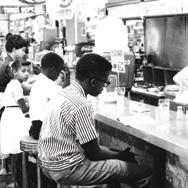
1. Display Freedom on the Menu. Tell students that the people in the illustration on the cover are at a lunch counter. Ask this question:
What do people do at a lunch counter?
Key Ideas
• serve food
• order food
• eat meals
2. Reinforce that the lunch counter is an important setting in the story. Explain that the problem of the story focuses on the lunch counter because Black people were not allowed to sit and be served at the counter.
3. Tell students that they will discuss what happens at the lunch counter in Freedom on the Menu.
1. Direct attention to page 3. Tell students that they will listen to identify who is telling the story.
2. Read aloud pages 3–5.
Teacher Note
The text uses the inappropriate terms colored and Negro to refer to people of a specific race. Reinforce that while these terms were used at that time, they are not acceptable. Today, terms such as Black and African American are acceptable. Arts & Letters™ materials use the term Black to describe people of African or African American descent.
3. Read aloud the portion of page 3 from “Just about every” to “for the afternoon.” Ask these questions:
Who is the I in this sentence?
Who is she with?
4. Reinforce the correct responses:
• who—Connie
• who she is with—Mama
5. Tell students to look closely at the illustrations on pages 3–4. Ask this question:
What is happening at the lunch counter in this part of the story?
Key Ideas
• Connie and her mother are standing and drinking.
• A White girl is sitting at the counter.
• Connie and her mother are walking away from the lunch counter.
6. Instruct students to listen for what Connie wants at the lunch counter and what happens to her. Read aloud the portion of pages 3–5 from “Whenever it was” to “one at home.” Ask these questions:
What does Connie want?
What happens to Connie at the lunch counter?
Language Support
For students with beginning English proficiency, direct attention to page 5. Read aloud the dialogue between Connie and Mama in lines 3 and 4. Then ask these questions:
• What does Connie ask Mama?
• What does Mama say to Connie?
Key Ideas
• want: She wants to sit down to drink her cola.
• want: She wants to eat a banana split.
• happens: She isn’t allowed to sit at the counter because she is Black.
• happens: Her mother tells her she will fix her one at home.
7. To help students use a linking word to connect ideas, display this sentence frame: Connie wants to , but . Tell students that they can use this sentence frame to tell what happens to Connie at the lunch counter.
8. Think aloud to model how to add details to the sentence frame. Emphasize how to link different or contrasting ideas.
9. Instruct students to use the sentence frame with a partner to describe what happens to Connie at the lunch counter.
10. Invite a few students to share their responses.
Key Ideas
• Connie wants to sit down to drink her cola, but she isn’t allowed to sit at the counter because she is Black.
• Connie wants to eat a banana split, but Mama tells her she will fix her one at home.
11. Direct attention to the illustrations on pages 14–15 and 17. Ask this question:
What is happening at the lunch counter in this part of the story?
Key Ideas
• Four men are sitting at the lunch counter.
• A woman and man are standing away from the four men.
• A police officer is standing near the counter.
Sample Think Aloud Connie wants to eat a banana split. Her mother tells her she can’t have a banana split at the counter. I can use but to connect contrasting ideas. I can say, “Connie wants to eat a banana split, but her mother tells her she will fix her one at home.”
12. Reinforce that the woman is a waitress and the man is the manager.
13. Ask this question:
What do you think the four men want?
14. Reinforce the correct response: to be served at the lunch counter.
15. Instruct students to listen to find out what happens to the four men at the lunch counter. Read aloud the portion of pages 14–16 from “I heard one” to “a tall policeman.” Instruct students to Think–Pair–Share to answer this question:
What happens to the four Black men at the lunch counter?
Language Support
If possible, invite multilingual learners to discuss what happens to the four Black men at the lunch counter with a partner who speaks the same home language.
Key Ideas
• The waitress tells them she can’t serve them.
• A kitchen worker tells them to go to the snack bar and to stop making trouble.
• The manager returns with a policeman.
Language Expansion
For students with intermediate English proficiency, after they share their responses, encourage them to describe what happens by using module terms such as injustice or freedom (e.g., the waitress tells them she can’t serve them, and this is an injustice).
16. Display this sentence frame: The four Black men want to be served at the lunch counter, but . Tell students that they can use this sentence frame to tell what happens to the four Black men at the lunch counter.
1. Introduce the learning task. Instruct students to share with a partner what happens to the four Black men at the lunch counter by using the linking word but.
Monitor: Do students use the word but to describe contrasting events involving the four men at the lunch counter?
Offer Immediate Support: If students need additional support describing contrasting events, direct attention to the illustration on page 17 and ask these questions: What do the four men want? Do they get what they want?
2. Invite a few students to share.
Key Ideas
• The four men want to be served at the lunch counter, but the waitress tells them she can’t serve them.
• The four men want to be served at the lunch counter, but a kitchen worker tells them to go to the snack bar.
• The four men want to be served at the lunch counter, but the manager returns with a policeman.
3. Summarize that identifying contrasting events can help readers understand what’s happening in a text.
Essential Question | How did civil rights advocates respond to injustice?
Students explain how Connie feels about the protests. As they examine the dialogue, students practice connecting ideas by using linking words. This work prepares students to identify the characters’ points of view in lesson 16.
Explain how Connie feels about the protests.
LEARNING TASK: Share one example of how Connie feels about the protests by using the linking word because.
In this lesson, students work on this module language goal: Students practice connecting ideas using linking words (and, but, or, so, because) to share more robust knowledge statements.
To support students with beginning English proficiency, ask these questions: How do you feel today? Why? Prompt them to respond by using this sentence frame: I feel because . To support students with intermediate English proficiency, encourage them to have a brief conversation about how they feel and why. For example, Partner A asks, “How do you feel today?” Partner B says, “I feel excited.” Partner A asks, “Why?” Partner B says, “I feel excited because I will play with my friends at recess.”
dialogue (n.)
• Freedom on the Menu
• class Feeling Words (Prologue Reference Charts appendix)
• Freedom on the Menu
• Freedom on the Menu is an unpaginated text. Number your text; begin with the title page as page 1. Pages on the left will be even, and pages on the right will be odd.
• Determine how to display the sentence frames. See the Learn section for details.
1. Display pages 4–5 of Freedom on the Menu. Tell students that they will listen to Connie and Mama speak to each other.
2. Invite a student to read Connie’s lines while you read Mama’s lines in the dialogue between Connie and Mama. Read aloud the portion of page 5 from “Can I have” to “‘same,’ I grumbled.”
3. Explain that when different characters speak to each other in a story, they are having a dialogue. Ask this question:
What did you notice about our conversation?
4. Introduce the vocabulary term dialogue by displaying the term. Engage students in Vocabulary Exploration.
Language Support
The term dialogue has a Spanish cognate: diálogo. Share this language connection with students whose home language is Spanish.
5. Tell students that they will look closely at a dialogue between Connie and her family.
1. Direct attention to pages 20–21. Explain that in this part of the story Connie’s family learns about the protests at the lunch counter.
2. Distribute the text to students, and direct attention to page 21. Tell students that they will read the dialogue to determine how Connie feels about the protests.
Definition dialogue (n.): the things that are said by the characters in a story, movie, play, etc.
3. Direct attention to the quotation marks around Connie’s dialogue, starting with “The protests are.” Remind students that the quotation marks tell readers when a character begins and finishes speaking.
4. Instruct students to use a nonverbal signal (e.g., air quotes) when they hear what Connie is saying aloud. Model how to read the portion of page 21 from “By Friday, we” to “I told Daddy” with facial expressions and gestures. Ask this question:
What did Connie say?
5. Reinforce the correct response: “The protests are growing!”
6. Tell students that you will read Connie’s part in the dialogue, including the parts that aren’t in quotation marks. Invite two students to read Brother’s and Sister’s parts.
7. Along with the students, read aloud the dialogue between Connie, Sister, and Brother on page 21 from “By Friday, we” to “I can sit.” Instruct students to discuss these questions with a partner:
Who is speaking?
What are they saying?
8. Invite a few students to share their responses, and reinforce the correct responses:
• who—Connie, Brother, Sister
• what—The family learns of the protests at the lunch counter. Sister and Brother say they will join. Connie wants to go too.
Language Support
For students with beginning English proficiency, explain that sit-ins are a form of protest where people sit in one place to fight for freedom. Direct attention to the illustration on pages 14–15 showing people sitting at the lunch counter.
9. Display the class Feeling Words, and Echo Read the words while using facial expressions and gestures to show the meaning of each word. Explain that students can use this chart to explain how Connie feels throughout the dialogue.
10. Read aloud Connie’s part in the dialogue again. Ask this question:
How do you think Connie feels when she learns the protests are growing?
Language Support
Invite multilingual learners to share how Connie feels in their home language(s).
Key Ideas
• excited
• curious
11. Display this sentence frame: I think Connie feels because . Explain that students can use this sentence frame to explain how Connie feels about the protests.
12. Think aloud to model how to add details to the sentence frame. Emphasize how to connect ideas with because to explain how Connie feels.
13. Instruct students to choose a word from the class Feeling Words and to use the sentence frame with a partner to explain how they think Connie feels about the protests.
Key Ideas
• I think Connie feels excited because she also wants to go to the protests.
• I think Connie feels curious because she wonders what the protests will be like.
Teacher Note
Students may respond with more than one feeling or a feeling word that does not appear on the class chart to describe how a character feels (e.g., Connie feels excited and nervous about her brothers joining the protest).
Sample Think Aloud Connie feels excited about the protests. She also wants to go. I can use because to explain why she feels excited. I can say, “I think Connie feels excited because she also wants to go to the protest.”
14. Pair students, and instruct them to read the dialogue between Connie and Daddy on page 21 from “It’s good that” to “I pouted.” Remind them to read with facial expressions and gestures. Ask these questions:
Who is speaking?
What are they saying?
Reinforce the correct responses:
• who—Connie and Daddy
• what—Daddy tells Connie that it’s good she wants to help, but she is too young. Connie doesn’t like that she can’t go.
15. Instruct students to use the sentence frame to explain how Connie feels about not being able to join the protests.
Key Ideas
• I think Connie feels disappointed because she can’t go to the sit-ins.
• I think Connie feels disappointed because Daddy tells her she is too young.
• I think Connie feels disappointed because she does not get to do anything important.
Language Expansion
For students with intermediate English proficiency, encourage them to use synonyms such as upset and frustrated in their responses.
16. Form new pairs, and instruct them to read the dialogue between Sister and Brother on page 21.
17. Instruct one student to read Sister’s part, from “You can help” to “That’s very important,” and one student to read Brother’s part, from “The next morning” to “‘home,’ Brother promised.” Remind them to read with facial expressions and gestures. Ask these questions:
Who is speaking?
What are they saying?
Key Ideas
• who: Brother and Sister
• what: Sister tells Connie she can make signs. Brother promises to tell Connie what happens at the sit-ins.
18. Instruct students to use the sentence frame to explain how Connie feels about making the signs.
Key Ideas
• I think Connie feels happy because she makes the signs.
• I think Connie feels proud because she gets to do something important.
1. Introduce the learning task. Tell students that they will follow the instructional routine Mix and Mingle to discuss how Connie feels. Explain how this routine works. First, you pose a prompt and students silently think about their response. Next, students find a partner and share their response. On your cue, they find a new partner and share their response. This process repeats until you end the routine. Tell students that for their first practice, they will discuss their responses with two partners. Instruct students to Mix and Mingle to respond to this prompt:
Share an example of how you think Connie feels about the protests by using the linking word because.
Analyze Student Progress
Monitor: Do students use because to explain how Connie feels about the protests and why she feels that way?
Offer Immediate Support: If students need additional support describing Connie’s feelings and why she feels that way, display the illustration on page 20 and ask them what Connie is doing. Then prompt them to identify a word from the class Feeling Words that best matches Connie’s feeling in this picture.
2. Invite a few students to share.
Key Ideas
• I think Connie feels excited because she also wants to go to the protests.
• I think Connie feels angry because she can’t go to the sit-ins.
• I think Connie feels happy because she makes the signs.
3. Summarize that dialogue can help a reader understand how a character feels about key events in a text.
Essential Question | How did civil rights advocates respond to injustice?
Students describe examples of how characters in Freedom on the Menu experience injustice. As they discuss the characters’ experiences, students practice building on the ideas of others. This work prepares students to explain how characters in Freedom on the Menu stand up to injustice in lesson 17.
Describe injustices the characters in Freedom on the Menu experience.
LEARNING TASK: Share examples of injustices the Greensboro Four experience in Freedom on the Menu.
In this lesson, students work on this module speaking and listening goal: Build on the ideas of others.
To support students with beginning English proficiency, model how to build on an idea using the Think–Pair–Share routine and the following sentence frame: They also . To support students with intermediate English proficiency, encourage partners to build on each other’s ideas by first paraphrasing what their partner said and then responding with a new idea.
injustice (n.)
• Freedom on the Menu
• Knowledge Card: injustice
STUDENTS
• Freedom on the Menu
• Freedom on the Menu is an unpaginated text. Number your text; begin with the title page as page 1. Pages on the left will be even, and pages on the right will be odd.
• Determine how to display the sentence frames. See the Learn section for details.
1. Review the vocabulary term injustice by displaying the Knowledge Card. Engage students in Vocabulary Exploration.
2. Direct attention to the image on the Knowledge Card for injustice. Tell students that the image shows passengers on a bus. Ask this question: What do you notice on the bus?
Key Ideas
• Only White people are sitting in the front.
• Only Black people are sitting in the back.
• It’s crowded in the back.
• There are empty seats in the front.
Definition
injustice (n.): unfair treatment or a situation in which a person’s or a group of people’s rights are violated
3. Remind students that being forced to sit in the back of the bus is one example of injustice Black people experienced.
Language Expansion
For students with intermediate English proficiency, ask them to share other examples of injustices Black people experienced.
4. Tell students that they will describe examples of injustices the characters experience in Freedom on the Menu.
1. Display Freedom on the Menu. Tell students that they will look for examples of injustice some characters experience in the story.
2. Direct attention to the illustration on page 3. Tell students to listen for what injustice Connie and Mama experience. Read aloud page 3, starting with “Just about every.” Ask these questions:
What does Connie want to do?
What injustice does Connie experience?
3. Reinforce the correct responses:
• Connie wants to drink a cola at the lunch counter.
• injustice—Connie and her mother are not allowed to sit at the lunch counter because they are Black.
4. Read aloud the portion of page 5 from “All over town” to “theaters, even bathrooms.” Ask these questions:
What does Connie see?
What injustice does Connie experience?
Language Support
For students with beginning English proficiency, point to the signs in the illustrations on pages 5 and 7 to help them understand what the signs say.
Language Expansion
For students with intermediate English proficiency, prompt them to support their responses with strong evidence about injustices in the text by using this sentence frame: In the book, .
5. Reinforce the correct responses:
• Connie sees signs on water fountains, swimming pools, movie theaters, and bathrooms.
• injustices—She’s told where she can or cannot sit; she’s told which water fountain to drink from.
6. Explain that students will use the following sentence frames to build on their partner’s description of how Connie experiences injustice. Display and Echo Read these sentence frames:
• Connie experiences injustice when .
• She also experiences injustice when .
7. Invite a student to complete the first sentence frame.
• Connie experiences injustice when she is not allowed to sit at the lunch counter.
8. Think aloud to model how to build on the student’s idea by using the second sentence frame.
9. Direct attention to pages 14–15. Explain that four men, known as the Greensboro Four, are sitting at the lunch counter. Tell students to listen to the injustices the men experience. Read aloud the portion of page 14 from “I heard one” to “of the store.” Ask this question:
What does one of the men do?
10. Reinforce the correct response: He orders coffee and a doughnut.
11. Display and Echo Read these sentence frames:
• The Greensboro Four experience injustice when .
• They also experience injustice when .
Sample Think Aloud
My partner says, “Connie experiences injustice when she is not allowed to sit at the lunch counter.” She also sees the signs telling where she can and cannot go. I can build on my partner’s idea by saying, “She also experiences injustice when she sees signs telling her where she can and cannot go.”
1. Introduce the learning task. Instruct students to share with a partner examples of how the Greensboro Four experience injustice in Freedom on the Menu. Encourage students to build on their partner’s idea by sharing an additional example of injustice.
Analyze Student Progress
Monitor: Do students describe examples of how the Greensboro Four experience injustice?
Offer Immediate Support: If students need additional support naming examples of injustice, direct attention to the illustration on page 4 and ask this question: What is Connie not allowed to do? Then direct attention to the illustration on page 15 and ask this question: What is the waitress not doing?
2. Invite a few students to share.
Key Ideas
• The Greensboro Four experience injustice when the waitress doesn’t serve them. They also experience injustice when a kitchen worker tells them to leave.
• The Greensboro Four experience injustice when the waitress says, “I’m sorry, we can’t serve your kind.” They also experience injustice when a kitchen worker tells them to leave the counter and go to the snack bar.
3. Summarize that describing characters’ experiences helps readers understand what happens in a text.
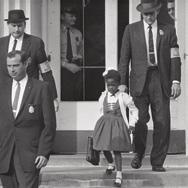
Essential Question | How did civil rights advocates respond to injustice?
Students share what they notice in images from Ruby Bridges Goes to School. As they discuss what they notice, students practice forming singular possessive nouns. This work prepares students to use apostrophes to form singular possessive nouns in lesson 21.
Describe images in Ruby Bridges Goes to School by using singular possessive nouns.
LEARNING TASK: Write a sentence to describe an image by using a singular possessive noun.
In this lesson, students work on this module language goal: Form singular possessive nouns.
To support students with beginning English proficiency, read these two sentences: Dr. King dream is for everyone. Dr. King’s dream is for everyone. Then prompt students to identify the difference and explain the meaning of the sentence. To support students with intermediate English proficiency, instruct them to identify and change the noun to a singular possessive noun in incorrectly written sentences such as this: Connie mama will make her a banana split at home. Then prompt them to read the sentence with the correct form of the singular possessive noun.
none
• Ruby Bridges Goes to School
• sticky note
• sticky notes
• Ruby Bridges Goes to School is an unpaginated text. Number your text; begin with the title page as page 1. Pages on the left will be even, and pages on the right will be odd.
• Determine how to display the incomplete sentences. See the Learn section for details.
1. Give a pencil to a student. Display this sentence frame: This is pencil. Complete the sentence with the student’s name as a singular possessive noun (e.g., Michelle’s). Read aloud the sentence, and invite students to repeat it.
2. Circle the -’s and emphasize that the -’s indicates that the pencil belongs to the student.
3. Pass the pencil to another student. Instruct a volunteer to use the student’s name to express that the pencil belongs to this student.
Language Support
For students with beginning English proficiency, direct attention to the sentence frame and ask them who the pencil belongs to.
4. Repeat the previous step, passing the pencil to two more students.
5. Tell students that they will preview Ruby Bridges Goes to School by describing what belongs to the characters in the images.
Teacher Note
The text includes photographs with the inappropriate terms colored and Negro. Reinforce that while these terms were used at that time, they are not acceptable. Today, terms such as Black and African American are acceptable. Arts & Letters materials use the term Black to describe people of African or African American descent.
1. Display the cover of Ruby Bridges Goes to School and explain that this is a true story about a girl named Ruby Bridges.
2. Direct attention to the image of the man on page 4. Ask this question:
What do you notice about the restaurant sign?
3. Summarize responses, and emphasize that a man is standing in front of a restaurant that has a sign that says White Only.
4. Display this incomplete sentence: I notice the sign says White Only. Think aloud to model how to describe the image by using restaurant as a singular possessive noun.
5. Write restaurant’s on a sticky note and place it in the blank. Echo Read the sentence: I notice the restaurant’s sign says White Only. Annotate the sentence by drawing an arrow from sign to restaurant’s to show that the sign belongs to the restaurant.
6. Explain that this story takes place during a time when people were segregated, or separated for differences in their race, or skin color.
7. Direct attention to the image of Ruby Bridges on page 9. Ask this question:
What do you notice about Ruby’s face?
8. Summarize students’ responses, and emphasize that Ruby is standing with a smile on her face.
Sample Think Aloud
The sign belongs to the restaurant.
The sign says White Only. I can add an apostrophe and an -s to the end of restaurant to make it a singular possessive noun. I can say, “I notice the restaurant’s sign says White Only.”
9. Display this incomplete sentence: I notice face has a smile on it. Distribute sticky notes to students. Instruct students to work with a partner to write Ruby as a singular possessive noun.
10. Tell students to hold up their sticky notes with their responses. Affirm their responses, and invite a student to place their sticky note in the blank. Echo Read the sentence: I notice Ruby’s face has a smile on it. Instruct the same student to annotate the sentence by drawing an arrow from face to Ruby’s to show that the face belongs to Ruby.
For students with intermediate English proficiency, direct attention to pages 10–11 and prompt them to use school as a singular possessive noun in a sentence to describe what they notice about the picture.
11. Direct attention to the image of the man with a jacket on page 12. Ask this question:
What do you notice about the jacket?
12. Summarize responses, and emphasize that the jacket has a badge on it.
13. Display this incomplete sentence: I notice the jacket has a badge on it. Tell students to find a new partner. Instruct pairs to write man as a singular possessive noun on a new sticky note.
14. Tell students to hold up their sticky notes with their responses. Affirm their responses, and invite a student to place their sticky note in the blank. Echo Read the sentence: I notice the man’s jacket has a badge on it. Invite a different student to annotate the sentence by drawing an arrow from jacket to man’s to show the jacket belongs to the man.
15. Direct attention to the image on pages 16–17. Ask this question:
What do you notice about the teacher’s classroom?
16. Summarize responses, and emphasize that the woman, Mrs. Henry, only has one student in her classroom.
1. Introduce the learning task. Instruct students to write a sentence in their journals about the image of the classroom on pages 16–17, using Mrs. Henry as a singular possessive noun.
Analyze Student Progress
Monitor: Do students add an -’s to the end of Mrs. Henry to form a singular possessive noun?
Offer Immediate Support: If students need additional support writing a singular possessive noun, provide this sentence frame: The only student in classroom is Ruby Bridges.
2. Invite a few students to share.
Key Ideas
• The only student in Mrs. Henry’s classroom is Ruby Bridges.
• Ruby Bridges is the only student in Mrs. Henry’s classroom.
• There is only one student in Mrs. Henry’s classroom.
3. Summarize that using singular possessive nouns can help readers describe historical figures and events.
Essential Question | How did civil rights advocates respond to injustice?
Students examine Ruby Bridges’s experience integrating into the William Frantz School. As they describe key details, students practice building on the ideas of others. This work prepares students to sequence main events in lesson 22.
Describe what happens when Ruby attends the William Frantz Elementary School.
LEARNING TASK: Explain what happens when Ruby is the only student at the William Frantz School.
In this lesson, students work on this module speaking and listening goal: Build on the ideas of others.
To support students with beginning English proficiency, model how to make a personal connection to build on the ideas of others. Prompt them to build on their partner’s ideas by sharing their own experience at school. To support students with intermediate English proficiency, encourage them to build on the ideas of their partner by explaining why they think integration of schools is important.
none
• Ruby Bridges Goes to School
• class Ruby Bridges Chart
STUDENTS
• Ruby Bridges Goes to School
• Make a class Ruby Bridges Chart. Annotate each question word with the following symbols: Who—stick figure, What—question mark, When—clock, Where—house. See the Learn section for details.
• Determine how to display the sentence frame. See the Learn section for details.
1. Display Ruby Bridges Goes to School. Echo Read the title, including the subtitle My True Story.
2. Invite a few students to share what they notice and wonder about the cover.
3. Explain that Ruby Bridges is a real person, and the events in the story are real.
4. Tell students they will discuss what happens to Ruby when she attends the William Frantz School.
Discuss Ruby Bridges’s True Story
1. Display the class Ruby Bridges Chart. Explain that students will answer different types of questions about Ruby’s experience at school.
2. Direct attention to pages 8–9. Tell students to listen for key details about Ruby. Read aloud the portion of page 8 from “My name is” to “for black children.” Ask these questions:
Who is telling the story?
When did it take place?
Where did she go to school?
3. Reinforce the correct responses:
• who—Ruby
• when—1960
• where—a school for Black children
Add responses under the Who, When, and Where columns.
4. Read aloud the portion of page 8 from “I liked my” to “liked my friends.” Ask this question: What did Ruby like about her school?
5. Reinforce the correct responses: her teacher and her friends. Add these responses under the What column.
6. Display and Echo Read this sentence frame: Yes, I also notice , and I notice .
Explain that students can use this sentence frame to build on their partner’s ideas.
7. Direct attention to the photograph on pages 10–11. Ask this question: What do you notice in the photograph?
8. Emphasize that the photograph only shows White students because the school was not integrated and only White students could attend it.
9. Model how to use the sentence frame with a student to build on their ideas. Instruct the student to say something that they notice, use the first part of the sentence frame to restate what the student noticed, and add something you notice. Remind students that it’s important to pay attention to what their partner says so they can build on their ideas.
10. Tell students to listen for more details about the school. Direct attention to the name of the school in the photograph. Ask this question: What was the name of the school?
11. Reinforce the correct response: the William Frantz School. Add the response under the Where column.
12. Read aloud page 11, starting with “But there was.” Ask these questions:
Who made the decision to integrate schools?
What did the government say?
13. Reinforce the correct responses:
• who—The government made the decision.
• what—Ruby should be allowed to go to the William Frantz School.
Add these responses under the Who and What columns.
Language Expansion
For students with intermediate English proficiency, encourage them to build on each other’s ideas by explaining why the government’s decision to let Ruby attend the William Frantz School was important.
14. Direct attention to the photographs on pages 12–13. Instruct students to Think–Pair–Share to answer this question:
Who is in the photographs?
15. Reinforce the correct response: Ruby, men in suits. Remind students to build on their partner’s ideas.
16. Tell students to listen to find out what’s happening in this part of the story. Read aloud page 12, starting with “In 1961, I.” Ask these questions:
When did this happen?
Who came with Ruby?
What did the men do?
17. Reinforce the correct responses:
• when—1961
• who—her mother and the marshals
• what—keep Ruby safe
Add the responses under the When, Who, and What columns.
Language Support
For students with beginning English proficiency, direct attention to the men in suits to help them understand who the marshals were.
18. Direct attention to the photograph on pages 16–17 . Tell students to use the words and photograph to identify what is happening. Read aloud pages 16–19, starting with “Parents took their.” Instruct students to work with a partner to answer this question:
What did parents do when Ruby began attending the William Frantz School?
19. Reinforce the correct response: White parents took their students out of the school.
5 minutes
1. Introduce the learning task. Instruct students to work with a partner to explain what happens when Ruby is the only student at the William Frantz School. Ask these questions:
Who was Ruby’s teacher?
Where did she teach Ruby?
What did Ruby learn with her teacher?
Monitor: Do students accurately explain that Ruby learned math and how to read with Mrs. Henry alone at school?
Offer Immediate Support: If students need additional support explaining what happened at the William Frantz School when Ruby began attending, direct attention to the photograph on page 21 and ask them what they notice.
2. Invite a few students to share their responses. Reinforce the correct responses:
• who—Mrs. Henry
• where—in a classroom alone with Ruby
• what—she learned math and how to read
3. Summarize that describing a person’s experience helps readers understand a text about historical events.
Essential Question | How did civil rights advocates respond to injustice?
Students describe Ruby Bridges’s experience as the first Black student at the William Frantz Elementary School. As they discuss the challenges she faced, students practice connecting ideas by using the linking word but. This work prepares students to examine how Ruby exhibited bravery in lesson 23.
Describe challenges Ruby Bridges experienced in Ruby Bridges Goes to School. LEARNING TASK: Share a sentence describing a challenge Ruby Bridges experienced at the William Frantz School.
In this lesson, students work on this module language goal: Students practice connecting ideas using linking words (and, but, or, so, because) to share more robust knowledge statements.
To support students with beginning English proficiency, model how to describe a challenging activity by using this sentence frame: I enjoy , but . To support students with intermediate English proficiency, prompt them to expand their explanations by using the linking words but and because to connect two ideas. For example, Ruby went to school, but the marshals came with her because they had to keep her safe.
none
• Ruby Bridges Goes to School
• Ruby Bridges Goes to School
• Determine how to display the sentence frames. See the Learn section for details.
1. Tell students to imagine they are a new student in a new school. Instruct students to Think–Pair–Share to answer this question:
Why is it difficult to go to a new school?
Language Support
If possible, pair students who speak the same home language, and instruct them to explain why going to a new school would be difficult.
Key Ideas
• miss old friends
• don’t know the teachers
• can’t find the classrooms
2. Emphasize that there could be many difficulties, or challenges, going to a new school.
3. Explain that Ruby Bridges experienced challenges going to the William Frantz School because of the color of her skin.
4. Tell students they will describe the challenges Ruby experienced at her new school.
1. Display pages 6–7 in Ruby Bridges Goes to School. Read aloud pages 6–7, starting with “And in some.” Ask these questions:
In this part of the story, could Black and White children go to the same schools?
What did the government say about children going to school?
2. Reinforce the correct responses: Black and White children could not to go the same schools. The government said “Children should go to school where they want.”
3. Display this sentence frame: Black and White children could not go to the same schools, but . Explain that the linking word but connects different or opposite ideas.
4. Think aloud to model how to use the sentence frame to describe different or opposite ideas about Black and White children going to the same schools.
5. Instruct students to repeat this sentence: Black and White children could not go to the same schools, but the government said they should go to school where they want.
6. Distribute the text to students. Instruct students to look closely at the photographs on pages 12–17. Ask this question:
Who is in this photograph and what are they doing?
Key Ideas
• Ruby is entering the school with the marshals.
• A person is holding a sign that says, “We want segregation.”
• Ruby and Mrs. Henry are at the school together.
7. Summarize students’ responses, emphasizing that this part of the story describes Ruby’s experience at the William Frantz School.
In some places, Black and White children could not go to the same schools. The government said the opposite: Children should go to school where they want. The linking word but connects two different, or opposite, ideas. I can say: Black and White children could not go to the same schools, but the government said they should go to school where they want.
8. Tell students they will describe different challenges Ruby experienced in this part of the story. Read aloud page 12, starting with “In 1961, I.” Instruct students to Think–Pair–Share the answer to this question:
What challenge did Ruby experience?
9. Reinforce the correct response: Ruby was not safe, so marshals had to go with Ruby and her mother to school.
10. Choral Read pages 14–17, starting with “Some people did.” Instruct students to work with a partner to identify other challenges Ruby experienced.
Language Support
For students with beginning English proficiency, direct attention to and reread pages 14–17. Then ask these questions: What did the people do in front of the school? What did parents do with their children?
11. Invite a few students to share their responses.
Key Ideas
• People held up signs with messages against Ruby going to the William Frantz School.
• Some people yelled at Ruby to go away.
• Parents took their children out of school.
• Ruby didn’t have any classmates.
12. Display the sentence frame: Ruby was allowed to go to the William Frantz School, but . Tell students that this sentence frame can connect different ideas about Ruby’s experience at the William Frantz School.
13. Instruct students to use the sentence frame to write a sentence describing a challenge Ruby experienced at the William Frantz School.
1. Introduce the learning task. Instruct students to Mix and Mingle to respond to this prompt:
Share your sentence describing a challenge Ruby experienced when the government allowed her to go to the William Frantz School.
Lead students through a Mix and Mingle.
Language Expansion
For students with intermediate English proficiency, encourage them to use the term integration in their responses. For example, Ruby was allowed to go to the William Frantz School, but some parents were against integration.
Analyze Student Progress
Monitor: Do students describe a challenge Ruby experienced while going to the William Frantz School?
Offer Immediate Support: If students need additional support describing a challenge Ruby experienced, direct attention to pages 12–13 and ask these questions: Who came with Ruby to the William Frantz School? Why?
2. Invite a few students to share their sentence.
Key Ideas
• Ruby was allowed to go to the William Frantz School, but marshals had to come with her to keep her safe.
• Ruby was allowed to go to the William Frantz School, but some people did not want a Black child to go to the White school.
• Ruby was allowed to go to the William Frantz School, but parents took their children out of school.
3. Summarize that readers can use the linking word but to connect different or opposite ideas in a text or historical event.
Essential Question | How did civil rights advocates respond to injustice?
Students examine events in Ruby Bridges Goes to School to determine the effects of Ruby’s actions. As they discuss the link between her actions and their effects, students practice connecting ideas by using the linking word so. This work prepares students to explain how Ruby was a civil rights advocate in lesson 24.
Examine the effects of Ruby’s actions in Ruby Bridges Goes to School.
LEARNING TASK: Explain the effects of Ruby attending the William Franz School by using the linking word so.
In this lesson, students work on this module language goal: Students practice connecting ideas using linking words (and, but, or, so, because) to share more robust knowledge statements.
To support students with beginning English proficiency, model how to describe the cause and effect of an activity or action by using this sentence frame: I so . To support students with intermediate English proficiency, encourage them to have a brief conversation exploring cause and effect. Instruct one student to share an activity or action, and then instruct the other student to ask this question: What was the effect?
Vocabulary integrate (v.)
• Ruby Bridges Goes to School
• none
• Determine how to display the sentence frames. See the Launch and Learn sections for details.
1. Tell students they will discuss why the light was turned off. Turn off the light in the room. Instruct students to Think–Pair–Share to answer this question:
Why would a teacher turn off the light?
Key Ideas
• to get the class to be quiet
• to transition to the next activity
• to signal it is time to leave the classroom
2. Emphasize that students described the effect of turning the light off. Tell students that effect means “a change that results in response to something that happens.”
3. Explain that students can use the linking word so to connect a cause and effect. Display and Echo Read this sample sentence: I turned off the lights so .
4. Model how to complete the sentence frame to describe the effect of turning off the lights.
5. Invite a few students to complete the sentence frame.
6. Emphasize that Ruby’s actions had an effect on herself and others. Tell students they will examine the effects of Ruby’s actions.
1. Display page 6 in Ruby Bridges Goes to School. Read aloud page 6, starting with “And in some.” Ask this question: What do the words and photographs tell you about schools in some places?
Key Ideas
• images: Only Black children are together in the top photograph.
• images: Only White children are together in the bottom photograph.
• words: Black and White children could not go to the same schools in some places.
• words: Schools were segregated in some places.
Language Expansion
For students with intermediate English proficiency, explain that the term segregated is another way to describe how children experienced school. Encourage partners to include the term in their response.
2. Emphasize that schools were segregated in some places in the past.
3. Read aloud page 11, starting with “But there was.” Facilitate a brief discussion of this question: Why do you think Ruby goes to the William Frantz School?
4. Use responses to emphasize that Ruby goes to the William Frantz School to learn at a school closer to her home. Clarify that she becomes the first Black student to attend the school.
5. Display and Echo Read this sentence frame: Ruby goes to the William Frantz School so .
6. Think aloud to model how to complete the sentence frame. Emphasize how to use the linking word so to describe the effect of Ruby’s actions.
7. Instruct students to repeat this sentence: Ruby goes to the William Frantz School so she becomes the first Black student to integrate.
8. Introduce the vocabulary term integrate by displaying the term and definition. Engage students in Vocabulary Exploration.
Language Support
For students with beginning English proficiency, direct them to page 30. Explain that Ruby, who is Black, and the other children, who are White, are integrated so they are at school together.
9. Read aloud pages 17–18, starting with “Parents took their.” Ask this question:
What do the parents of the White children at the William Frantz School do?
10. Reinforce the correct response: They take their children out of the school.
11. Ask these questions:
What kind of student is Ruby?
What is the effect of being Mrs. Henry’s only student?
12. Reinforce the correct responses:
• Ruby—a very good student
• effect—learns math, learns how to read
13. Display and Echo Read this sentence frame: Ruby goes to the William Frantz School so . Instruct students to Think–Pair–Share to answer this question:
What effect does being a very good student have on Ruby?
14. Reinforce the correct response: Ruby goes to the William Frantz School so she learns math and how to read.
Sample Think Aloud
Ruby goes to the William Frantz School and becomes the first Black student to attend the school. The linking word so connects Ruby’s action of going to the William Frantz School, the cause, with the effect of Ruby being the first Black student to integrate. I can say: Ruby goes to the William Frantz School so she becomes the first Black student to integrate.
Definition integrate (v.): to end a policy that keeps people of different races apart
15. Direct attention to the photograph on pages 20–21. Ask this question:
What do you notice about the children?
16. Emphasize that the photo contains Ruby and the White children playing together.
17. Display and Echo Read this sentence frame: The children come back to school so . Tell students they will use the sentence frame to describe the effects of the children coming back to school.
18. Read aloud pages 20–21, starting with “Months and months.” Instruct students to Think–Pair–Share to answer this question:
When the students begin to come back to the William Frantz School, what effect does this have on Ruby?
19. Reinforce the correct responses:
• The children come back to school so she is happy.
• The children come back to school so she has friends to play with.
minutes
1. Display and Echo Read this sentence frame: Ruby attends the William Frantz School so .
2. Introduce the learning task. Instruct students to work with a partner to use the linking word so to explain the effects of Ruby attending the William Frantz School.
Monitor: Do students use the linking word so to accurately explain an effect of Ruby attending the William Frantz School?
Offer Immediate Support: If students need additional support explaining the effect of Ruby’s actions, direct attention to pages 28–30 and ask them what Ruby Bridges tells children.
3. Invite a few students to share their responses.
Key Ideas
• Ruby attends the William Frantz School so she learns how to read and do math.
• Ruby attends the William Frantz School so the school becomes integrated.
• Ruby attends the William Frantz School so Black and White students become friends.
4. Summarize that readers can use the linking word so to explain the connection between a person’s actions and their effect in a text or historical event.
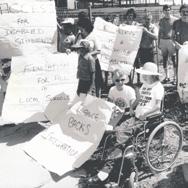
Essential Question | How did civil rights advocates respond to injustice?
Students describe what people fought for in We Want to Go to School! As they identify who fought for disability rights and what they were fighting for, students practice building on the ideas of others. This work prepares students to sequence the main events in lesson 27.
Describe what happens in We Want to Go to School!
LEARNING TASK: Explain what students and families wanted in We Want to Go to School!
In this lesson, students work on this module speaking and listening goal: Build on the ideas of others.
To support students with beginning English proficiency, select a student to discuss a topic (e.g., their favorite book). Encourage the student to share their thoughts about it. Then use the following sentence frame to restate their idea before sharing your thoughts about it: I heard you say . To support students with intermediate English proficiency, encourage students to work with a partner to clarify an idea before sharing their own idea. They can also use the following sentence frame: I heard you say .
disability (n.)
• We Want to Go to School!
• Knowledge Card: disability
STUDENTS
• none
• Determine how to display the sentence frame. See the Learn section for details.
1. Display We Want to Go to School! Read the title, including the subtitle The Fight for Disability Rights. Ask this question:
What do you notice about the cover?
2. Emphasize that the illustration contains images of children with different disabilities.
3. Direct attention to the words disability rights. Explain that the story gives information about historical events and real children with disabilities who fought injustice.
Language Support
For students with beginning English proficiency, tell them that the term rights means “something that a person is allowed to have, get, or do by law.”
4. Introduce the vocabulary term disability by displaying the Knowledge Card. Engage students in Vocabulary Exploration.
5. Direct attention to the children in the illustration on the front cover. Explain that the children have brains and bodies that require different equipment or support.
6. Tell students they will discuss what the students and families wanted as they fought for disability rights.
Definition disability (n.): a circumstance in which a person’s brain or body works in a way that may require specific equipment or support to help that person with everyday activities in some environments
1. Direct attention to page 3. Tell students to listen to identify who is speaking and the details about the person. Read aloud page 3, starting with “Hi, I’m Janine.” Ask these questions:
Who is speaking?
What did you learn about her?
2. Reinforce the correct responses:
• who—Janine
• what—Her muscles were weak.
• what—She needed help doing a lot of things.
3. Remind students that they can build on the ideas of others. Display and Echo Read the sentence frames:
• You said . I think .
• What you said made me think .
4. Think aloud to model how to use one of the sentence frames to build on the idea of a response.
5. Direct attention to Janine in the illustration on page 7. Tell students to think about what Janine’s role is in this story. Echo Read the portion of page 7 from “But one day” to “been that way.” Ask these questions:
Why did Janine need help?
What story will Janine tell?
6. Reinforce the correct responses:
• why—She has a disability.
• what—She is going to tell the story of the fight for disability rights.
Sample Think Aloud
You said her muscles were weak. It made me think about how it took her a long time to talk and walk, but not to read.
7. Read aloud pages 10–11, starting with “But in 1971.” Ask these questions:
When did this happen?
Where did this happen?
8. Reinforce the correct responses:
• when—1971
• where—Washington, DC
9. Instruct students to answer these questions with a partner and to use the sentence frames to build on ideas. Ask these questions:
Who are the children? What did they have in common?
Key Ideas
• who: seven school-age children
• commonalities: They all wanted to go to school; none of them were allowed to go to public school; they all had disabilities; they didn’t feel good about being left out; they wanted to know why they couldn’t go to public school.
10. Direct attention to the illustration on pages 14–15. Ask this question:
Who are the people with the children?
11. Reinforce the correct response: the families of the children with disabilities.
12. Read aloud pages 14–15, starting with “The children and” and including the speech bubbles.
13. Instruct students to answer these questions with a partner and to use the sentence frames to build on ideas.
14. Ask this question:
What did the children and their families want?
15. Invite a few students to share their responses.
Key Ideas
• for their children to have a free public education
• for their voices to be heard
• for the schools to listen to them
16. Direct attention to page 18. Tell students to listen for what else the families did. Read aloud the portion of page 18 from “The children and” to “for their rights.”
Language Expansion
For students with intermediate English proficiency, display the Knowledge Card for lawsuit. Explain that people can file a lawsuit to fight injustice. Read the definition and encourage students to use the phrase file a lawsuit in their response.
1. Introduce the learning task. Instruct students to discuss with a partner what the families did to fight for disability rights in We Want to Go to School! Remind students to use the sentence frames to build on their partner’s ideas by sharing a different idea about what families did.
Monitor: Do students accurately explain what the families did in We Want to Go to School!?
Offer Immediate Support: If students need additional support explaining what the families did, direct attention to page 27 and ask this question: What were thousands of kids able to do?
2. Invite a few students to share their responses.
Key Ideas
• They began meeting.
• They filed a lawsuit against the school district.
• They joined together to fight for students’ rights.
3. Summarize that describing the actions of real people can help readers understand the effect of their actions.
Essential Question | How did civil rights advocates respond to injustice?
Students explain the families’ point of view about students with disabilities attending public school in We Want to Go to School! As they examine the book’s speech bubbles, students practice connecting ideas by using linking words. This work prepares students to identify the author’s point and reasons in lesson 28.
Explain the families’ point of view.
LEARNING TASK: Share a reason that supports the families’ point of view.
In this lesson, students work on this module language goal: Students practice connecting ideas using linking words (and, but, or, so, because) to share more robust knowledge statements.
To support students with beginning English proficiency, model how to share a point of view and reason about a familiar topic. Prompt them to use this sentence frame: I think because . To support students with intermediate English proficiency, encourage them to share their point of view and reason. After students share their point of view, prompt them to ask these questions to a partner: What’s your point of view about ? Why?
Vocabulary point of view
• We Want to Go to School!
• We Want to Go to School!
• We Want to Go to School! is an unpaginated text. Number your text; begin with the title page as page 1. Pages on the left will be even, and pages on the right will be odd.
• Determine how to display the sentence frame. See the Learn section for details.
1. Display pages 12–15 of We Want to Go to School! Remind students that books sometimes include text features to provide information in a different way. Ask this question:
What text feature is next to most of the characters in the illustration?
2. Reinforce the correct response: speech bubbles.
3. Emphasize that speech bubbles are a fun way to show the reader who is speaking and the speaker’s point of view, or how they think about ideas and events.
4. Review the vocabulary term point of view by displaying the term and definition. Engage students in Vocabulary Exploration.
5. Tell students that they will discuss the families’ point of view about students with disabilities attending public school.
minutes
Discuss the Families’ Point of View in We Want to Go to School!
1. Distribute We Want to Go to School! to pairs.
2. Direct attention to pages 14–15. Read aloud pages 14–15, starting with “The children and,” but exclude the speech bubbles. Ask these questions:
What do the children and families do?
What do the schools do?
Definition point of view: a way of thinking about or looking at something
3. Reinforce the correct responses:
• children and families—make their voices heard
• schools—do not listen
4. Think aloud to model how to use the linking term because to connect the ideas of the children and families with the schools.
5. Tell students to repeat this sentence: The children and families make their voices heard because the schools do not listen.
6. Explain that the speech bubbles show the families’ point of view about their children going to public school.
7. Model how to read the conversation between the family members in the speech bubbles by using gestures and facial expressions.
Teacher Note
Based on your students’ needs, pause to define any terms (e.g., deserve, benefit) to support comprehension of the speech bubble text.
8. Direct attention to the speech bubbles and annotate each one with alternating letters A and B. Instruct students to work with a partner and assign each partner the A or B speech bubbles. Instruct pairs to take turns reading aloud the speech bubbles. Then invite two students to take turns reading the speech bubbles to the class. Remind them to use gestures and facial expressions.
Language Support
For students with beginning English proficiency, Echo Read their assigned speech bubbles to help them read fluently, use gestures, and use facial expressions.
The children and families make their voices heard. I can use the linking word because to explain why they make their voices heard. The schools do not listen. So I can say, “The children and families make their voices heard because the schools do not listen.”
9. Ask this question:
Which words or phrases help you understand what the families want?
Key Ideas
• “deserve an education”
• “they CAN learn”
• “Our children would benefit”
• “Their doctors say so”
• “Isn’t public school for everyone?”
10. To help students explain why the families want their children to attend public school, provide this sentence frame: The families want their children to go to public schools because . Ask this question:
Why do the families want their children with disabilities to attend public schools?
Key Ideas
• They deserve a public education.
• They can learn just like other kids.
• Doctors say public education would help their children.
Language Expansion
For students with intermediate English proficiency, direct attention to the speech bubble of the school’s lawyer on page 23. Encourage them to explain the lawyer’s point of view.
11. Instruct students to Think–Pair–Share to answer this question:
What is the families’ point of view about students with disabilities attending public schools?
12. Reinforce the correct response: Students with disabilities should go to public school.
1. Introduce the learning task. Instruct students to Mix and Mingle to respond to this prompt:
Share a sentence explaining the families’ point of view in We Want to Go to School! Use this sentence frame: Students with disabilities should go to public schools because .
Monitor: Do students provide an accurate reason that supports the families’ point of view by using the linking word because?
Offer Immediate Support: If students need additional support explaining the families’ point of view, direct attention to the last speech bubble on page 15 and ask this question: What does this family say for everyone?
2. Invite a few students to share their responses.
Key Ideas
• Students with disabilities should go to public schools because all children deserve an education.
• Students with disabilities should go to public schools because they can learn just like other children.
• Students with disabilities should go to public schools because the doctors say it would help them.
• Students with disabilities should go to public schools because public school is for everyone.
3. Summarize that using text features can help readers understand the point of view of real people within the context of historical events.
Essential Question | How did civil rights advocates respond to injustice?
Students describe what happened before, during, and after the lawsuit in We Want to Go to School! As they discuss the main events, students practice building on the ideas of others. This work prepares students to explain why the Mills v. Board of Education case was important in lesson 29.
Describe what happened before, during, and after the Mills v. Board of Education lawsuit.
LEARNING TASK: Describe what happened after Judge Waddy’s decision.
In this lesson, students work on this module speaking and listening goal: Build on the ideas of others.
To support students with beginning English proficiency, model how to Think–Pair–Share with a partner and emphasize how to build on an idea by using the following phrase: I want to add. To support students with intermediate English proficiency, encourage partners to build on each other’s ideas by first paraphrasing what their partner said and then responding with a new idea.
lawsuit (n.)
• We Want to Go to School!
• Knowledge Card: lawsuit
STUDENTS
• We Want to Go to School!
• We Want to Go to School! is an unpaginated text. Number your text; begin with the title page as page 1. Pages on the left will be even, and pages on the right will be odd.
• Determine how to display the sentence frames. See the Learn section for details.
1. Tell students to think of a time when they disagreed with someone. Facilitate a brief discussion of this question:
How did you handle the disagreement?
2. Explain that sometimes people file a lawsuit when they have big disagreements about important things.
3. Introduce the vocabulary term lawsuit by displaying the Knowledge Card. Engage students in Vocabulary Exploration.
4. Explain that in We Want to Go to School! the families filed a lawsuit against public schools because they did not allow children with disabilities to attend.
5. Tell students they will discuss the lawsuit that helped children with disabilities.
20 minutes
Discuss the Lawsuit in We Want to Go to School!
Definition
lawsuit (n.): a process by which a court of law makes a decision to end a disagreement
1. Display pages 8–9 of We Want to Go to School! Tell students to look closely at the children in the illustration. Ask this question:
What are the children doing in the illustration?
Key Ideas
• A child in a wheelchair is watching a school bus from the window.
• Two children are looking into the classroom through the window of the door.
• Children with disabilities are all sitting at a table together.
2. Explain that before the lawsuit, public schools did not allow children with disabilities to attend.
3. Display and Echo Read these sentence frames:
• Before the lawsuit, children with disabilities .
• Also, they .
4. Tell students to listen for details that describe what it was like for children with disabilities before the lawsuit. Read aloud the portion of pages 8–9 from “Most of the” to “the other kids.” Ask this question:
What is education like for children with disabilities before the lawsuit?
Key Ideas
• They stay at home or in hospitals.
• If they get into public schools, they learn in segregated classrooms.
• Their families pay to send them to special schools.
• They do not have the same quality education as other students.
5. Model how to complete the first sentence frame. Invite a student to complete the second sentence frame to practice building on the ideas of others.
6. Distribute the text to pairs. Explain that pages 18–25 show what happened during the lawsuit. Tell students that they will work with a partner to identify what happened during the lawsuit.
7. Read aloud the portion of page 19 from “Soon, word started” to “of their disabilities.” Ask these questions:
Who joins the lawsuit?
How many students with disabilities could this lawsuit impact? Why?
8. Reinforce the correct responses:
• who—more families
• how many and why—18,000, because that is the number of students with disabilities in Washington, DC, who did not receive a public education
9. Tell students to use the words and illustration to identify what happens during this part of the lawsuit. Read aloud the portion of pages 22–23 from “On September 24” to “to both sides,” but exclude the speech bubbles. Ask this question:
What happens during this part of the lawsuit?
Language Support
For students with beginning English proficiency, invite them to act out the events to better understand what happens during the lawsuit.
Key Ideas
• The lawyers for the children fight hard.
• The lawyers for the schools argue.
• Judge Waddy listens to both sides.
Language Expansion
For students with intermediate English proficiency, display the Knowledge Card for inclusive. Then encourage them to use the term to describe what the lawyers want.
10. Read aloud the portion of page 24 from “It took a” to “thought and thought,” and page 25 starting with “Finally, on August.” Ask this question: What happens during this part of the lawsuit?
Key Ideas
• Judge Waddy thinks about what to do.
• The children wonder if they could go to school.
• The families wonder if their children would be included.
11. Display and Echo Read these sentence frames:
• During the lawsuit, .
• Also, during the lawsuit.
Instruct students to use the sentence frames to build on their partner’s ideas about what happened during the lawsuit on pages 18–25.
Key Ideas
• During the lawsuit, more families join.
• During the lawsuit, lawyers on both sides argue the case.
• Also, Judge Waddy listens to both sides to make an important decision during the lawsuit.
• Also, the families and children wonder what would happen during the lawsuit.
12. Direct attention to pages 26–27. Explain that these pages show what happens after the lawsuit.
13. Read aloud the portion of pages 26–27 from “Yes! They Won!” to “needed and deserved.” Instruct students to work with a partner to discuss what happens after the lawsuit.
1. Introduce the learning task. Instruct students to work with a new partner to share what happens after Judge Waddy’s decision. Encourage students to build on their partner’s ideas.
Monitor: Do students include details from the text in their description?
Offer Immediate Support: If students need additional support describing what happens after Judge Waddy’s decision, direct attention to pages 26–27 and ask this question: What are students with disabilities allowed to do after the decision?
2. Invite a few students to share their responses.
Key Ideas
• The court rules that students with disabilities must be allowed to go to public schools.
• Children are allowed to go to school with their friends.
• More laws allow students with disabilities to go to public schools.
3. Summarize that discussing main events helps readers understand texts and historical events.
dialogue (n.)
the things that are said by the characters in a story, movie, play, etc.
to lesson 16 | lesson 16
disability (n.)
a circumstance in which a person’s brain or body works in a way that may require specific equipment or support to help that person with everyday activities in some environments
to lesson 27 | lesson 27
equally (adv.)
the same way to lesson 3

injustice (n.)
unfair treatment or a situation in which a person’s or a group of people’s rights are violated to lessons 10 and 17 | lesson 3

integrate (v.)
to end a policy that keeps people of different races apart to lesson 24
protest (n.)
an organized action by a group of people to show dislike for an idea and to cause change to lesson 5 | lesson 4

repetition (n.)
the act of doing or saying something again to lesson 11
freedom (n.)
the ability to choose to live, act, or be as one wants to lesson 10 | lesson 11

lawsuit (n.)
a process by which a court of law makes a decision to end a disagreement to lesson 29 | lesson 27

point of view
a way of thinking about or looking at something to lesson 28 | lesson 5
role (n.)
the part that someone has in a group to lesson 5
segregation (n.)
the practice of separating people by their differences, such as race, gender, religion, and/or ability to lesson 4 | lesson 4

speech (n.)
the formal communication of thoughts using spoken words to lesson 5
A four-column chart with headings labeled When, Where, Who, and Why. When?
A two-column chart with headings labeled Singular and Plural. Singular
myself you yourself she herself he himself it itself Plural we ourselves you yourselves they themselves
Bridges, Ruby. Ruby Bridges Goes to School: My True Story Scholastic, 2009.
Cocca-Leffler, Maryann, and Janine Leffler. We Want to Go to School! The Fight for Disability Rights. Albert Whitman, 2021.
King, Dr. Martin Luther, Jr. I Have a Dream. Illustrated by Kadir Nelson, Schwartz and Wade Books, 2012.
National Center for Education Statistics. “English Learners in Public Schools.” Condition of Education, US Department of Education, Institute of Education Sciences, 2022, nces.ed.gov/programs/coe /indicator/cgf.
Ruffin, Frances E. Martin Luther King Jr. and the March on Washington 2001. Illustrated by Stephen Marchesi, Penguin Young Readers, 2012.
Weatherford, Carole Boston. Freedom on the Menu: The Greensboro Sit-Ins. 2005. Illustrated by Jerome Lagarrigue, Puffin Books, 2007.
WIDA. WIDA English Language Development Standards Framework 2020
Edition: Kindergarten–Grade 12. Board of Regents of the University of Wisconsin System, wida.wisc.edu/sites/default/files/resource/WIDA -ELD-Standards-Framework-2020.pdf.
Great Minds® has made every effort to obtain permission for the reprinting of all copyrighted material. If any owner of copyrighted material is not acknowledged herein, please contact Great Minds for proper acknowledgment in all future editions and reprints of this module.
Cover, Ondria Tanner and Her Grandmother Window-Shopping, Mobile, Alabama, 1956, Gordon Parks (1912–2006), Pigment print, Photograph courtesy of and © The Gordon Parks Foundation; pages 1, 14, 20, 26, Archive Photos/Getty Images, Alpha Historica/Alamy Stock Photo; page 2, Ruby Bridges Goes to School: My True Story book cover, Copyright © 2009 Ruby Bridges, Martin Luther King Jr. and the March on Washington book cover, Copyright © 2001 Stephen Marchesi, We Want to Go to School! The Fight for Disability Rights book cover, Copyright © 2021 by Maryann Cocca-Leffler; page 3, Collection of the Smithsonian National Museum
Karen Aleo, Trevor Barnes, Sarah Baughman, Anthony Bautista Ramil, Allie Beman, Madison Bonsignore, Kelsey Bordelon, Sarah Brenner, Beth Brown, Catherine Cafferty, Victoria Capehart, Melissa Chung, Ashley Cook, Julia Dantchev, Camille Daum, Laurie Delgatto-Whitten, Enaka Enyong, Jen Forbus, Pamela Frasier, Nina Goffi, Lorraine Griffith, Tamara Griffith, Caroline Goyette, Shelley Hampe, Elizabeth Haydel, Robin Hegner, Sarah Henchey, Liz Henkel-Lorenz, Patricia Huerster, Holli Jessee, Stephanie Kane-Mainier, Lior Klirs, Liana Krissoff, Karen Latchana Kenney, Karen Leavitt, Farren Liben, Brittany Lowe, Whitney Lyle, Liz Manolis, Maya Marquez, Meredith McAndrew, Cathy McGath, Emily McKean, Maia Merin, Patricia Mickelberry, Julie Mickler, Andrea Minich, Lynne Munson, Katie Muson, Gabrielle Nebeker, Amy Ng, Evann Normandin, Vivian Nourse, Carol Paiva, Catherine Paladino, Marya Parr, Sierra Penrod, Katie Pierson, Eden Plantz, Natalie Rebentisch, Rachel Rood, Rachel Rooney, Miguel Salcedo, Lori Sappington, Amy Schoon, Carolyn Scott, Danae Smith, Rachel Stack, Susan Stark, Sarah Turnage-Deklewa, Kati Valle, Kara Waite, Keenan Walsh, Michelle Warner, Katie Waters, Dr. Heather Waymouth, Sarah Webb, Erika Wentworth, Nicole Williams, Margaret Wilson, Eleanor Wolf
of African American History and Culture, White House Photo/Alamy Stock Photo, Bob Daemmrich/Alamy Stock Photo; pages 21, 124, F.M. Gay’s annual barbecue given on his plantation every year. Alabama, None. [Between 1930 and 1941] Photograph; pages 28, 124, Bettmann/Contributor/Getty Images; pages 32, 38, 44, 50, 56, Pictorial Press Ltd/Alamy Stock Photo; page 46, Pictorial Press Ltd/Alamy Stock Photo; pages 47, 124, Alpha Historica/Alamy Stock Photo; pages 62, 68, 76, Oklahoma Historical Society/Contributor/Getty Images; pages 77, 124, Pictorial Press Ltd/Alamy Stock Photo; pages 82, 88, 94, 100, © 1960 Associated Press. All rights reserved; pages 106, 112, 118, Fairfax Media Archives/Getty Images; pages 119, 124, EyeEm/Alamy Stock Photo.
All other images are the property of Great Minds.
Ana Alvarez, Lynne Askin-Roush, Stephanie Bandrowsky, Mariel Bard, Rebeca Barroso, Brianna Bemel, David Blair, Charles Blake, Lynn Brennan, Adam Cardais, Dawn Cavalieri, Tatyana Chapin, Christina Cooper, Gary Crespo, Lisa Crowe, David Cummings, Cherry dela Victoria, Sandy Engelman, Tamara Estrada Del Campo, Ubaldo Feliciano-Hernandez, Soudea Forbes, Diana Ghazzawi, Laurie Gonsoulin, Kristen Hayes, Marcela Hernandez, Sary Hernandez, Abbi Hoerst, Ashley Kelley, Lisa King, Sarah Kopec, Drew Krepp, Jennifer Loomis, Christina Martire, Siena Mazero, Alisha McCarthy, Thomas McNeely, Cindy Medici, Ivonne Mercado, Brian Methe, Sara Miller, Christine Myaskovsky, Mary-Lise Nazaire, Tara O’Hare, Tamara Otto, Christine Palmtag, Katie Prince, Jeff Robinson, Gilbert Rodriguez, Karen Rollhauser, Richesh Ruchir, Isabel Saraiva, Gina Schenck, Leigh Sterten, Mary Sudul, Deanna Thomann, Tracy Vigliotti, Bruce Vogel, Charmaine Whitman, Glenda Wisenburn-Burke, Samantha Wofford, Howard Yaffe





Prologue lessons support students’ vocabulary acquisition, and oral language development. Through this research-based instructional approach, students—including multilingual learners and those with language-based disabilities—gain confidence and are better prepared to build enduring knowledge.
Prologue prepares every student to succeed.
Module 1 | A Season of Change
Module 2 | The American West
Module 3 | Civil Rights Advocates
Module 4 | Good Eating
ISBN 979-8-88811-246-5
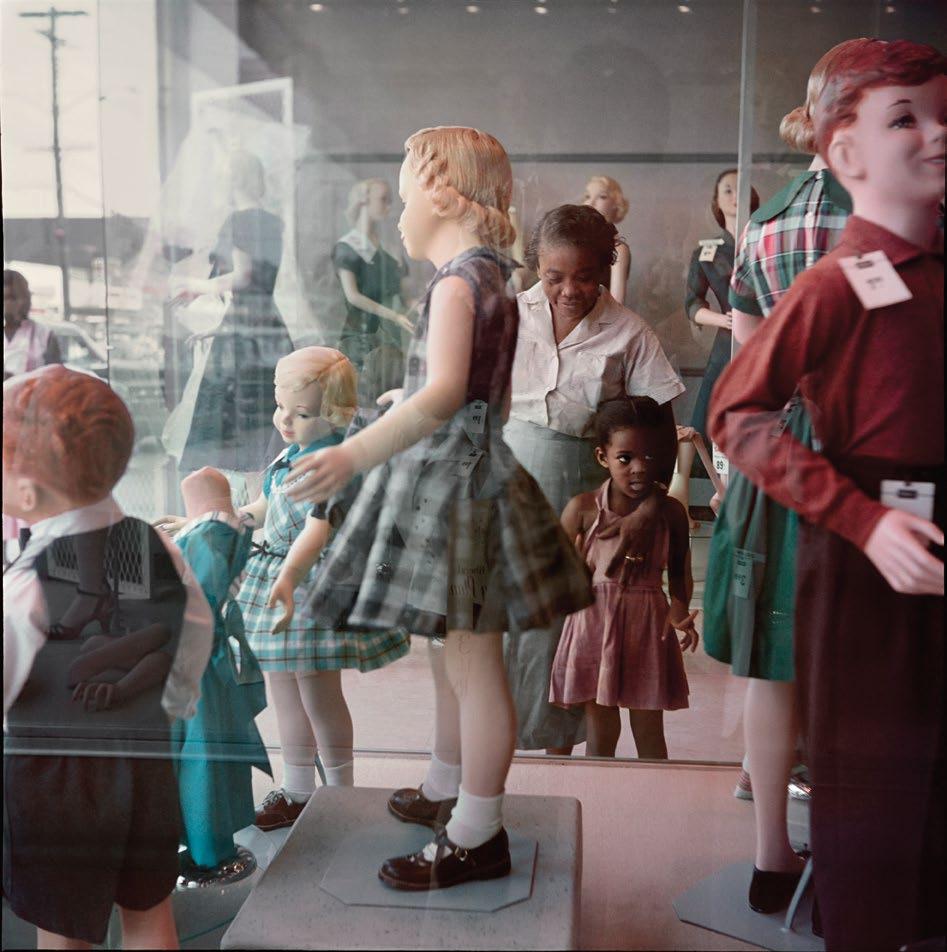
ON THE COVER
Ondria Tanner and Her Grandmother Window-Shopping, Mobile, Alabama, 1956
Gordon Parks (1912–2006)
Pigment print