
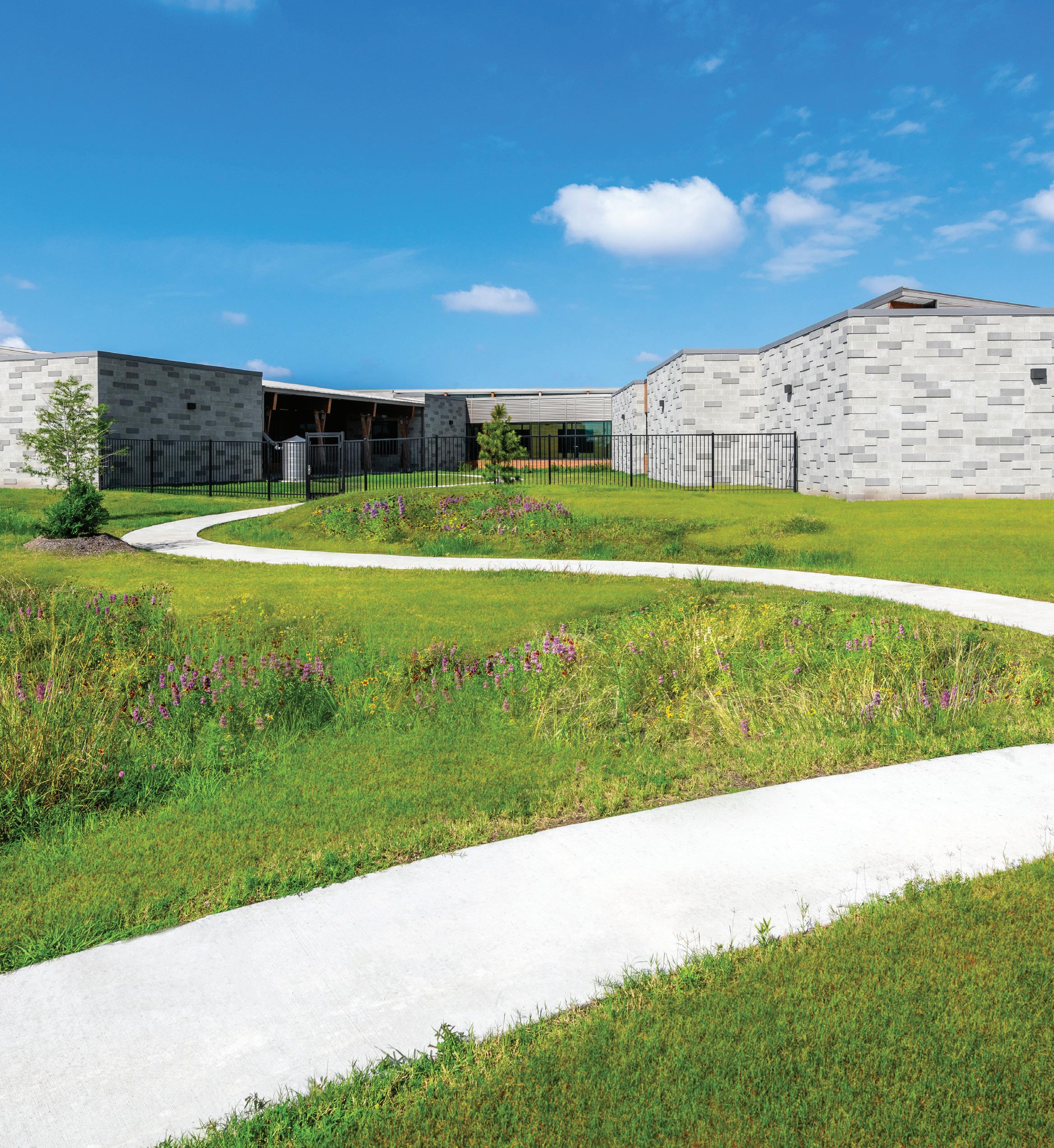

Visit SchoolDesigns.com ENTER TODAY INTERIORS 2024 EDUCATIONAL SHOWCASE 16 SUSTAINABLE STEPS Schools and universities continue to look for effective and affordable ways to make their facilities more environmentally friendly. ALSO INSIDE: Indoor Air Quality 22 Facility Planning 28 March/April 2024 asumag.com | schooldesigns.com


DRIVING INNOVATION FORWARD GOES BIG.


Say goodbye to wasted motion and hello to increased productivity with the Armada® BRC 45/38 W Carpet Extractor’s self-propelled, walk-forward extraction feature. This innovative solution not only boosts productivity but also reduces labor costs, making it the ideal investment for schools and universities. Karcher.com/us





Sustainable Waste Solutions for Total Campus Management


It’s your job to keep your campus clean and sanitized—and at Landmark, it’s our job to help you do just that. We make organizing and managing waste simple and sustainable. All our products are made from GreenCircle-certifi ed recycled materials, making them easy to clean and sanitize. And because they are sustainably produced, you can feel good knowing you’re helping keep plastic out of the environment and boosting your own sustainability initiatives.
Waste and Recycling Bins
• Choose from single-, double-, or triplesize models
• Side-, front-, and back-loading options available
• Customize frame and panel colors
• Add your school’s logo


Bussing Stations

• Includes open shelving and tray dividers
• Personalize aesthetics with different handle, header, and roof styles
• Can be customized to include storage doors, drawers, and plasticware dispensers
• Different sizes and frame and panel colors available
Scan to start customizing—and tell your Landmark Account Manager you saw this ad in AMERICAN SCHOOL & UNIVERSITY MAGAZINE


1-888-839-3853 LandmarkStudio.com 1 - 8 8 8 - 8 3 9 -3 8 5 3




American School & University (USPS Permit 023-180, ISSN 0003-0945 print, ISSN 2161-7791 online) is published 7x a year (Jan/Feb, Mar/Apr, May/Jun, July, August, Sep/Oct, Nov/Dec) by Endeavor Business Media, LLC., 201 N. Main St., 5th Floor, Fort Atkinson, WI 53538. Periodicals postage paid at Fort Atkinson, WI, and additional mailing offices. POSTMASTER: Send address changes to American School & University, PO Box 3257, Northbrook, IL 60065-3257. SUBSCRIPTIONS: Publisher reserves the right to reject non-qualified subscriptions. Subscription prices: U.S. ($ 123.75); Canada/Mexico ($ 98.75); All other countries ($ 123.75). All subscriptions are payable in U.S. funds. Send subscription inquiries to American School & University, PO Box 3257, Northbrook, IL 60065-3257. Customer service can be reached toll-free at 877-382-9187 or at americanschool@omeda.com for magazine subscription assistance or questions. Printed in the USA. Copyright 2024 Endeavor Business Media, LLC. All rights reserved. No part of this publication may be reproduced or transmitted in any form or by any means, electronic or mechanical, including photocopies, recordings, or any information storage or retrieval system without permission from the publisher. Endeavor Business Media, LLC does not assume and hereby disclaims any liability to any person or company for any loss or damage caused by errors or omissions in the material herein, regardless of whether such errors result from negligence, accident, or any other cause whatsoever. The views and opinions in the articles herein are not to be taken as official expressions of the publishers, unless so stated. The publishers do not warrant either expressly or by implication, the factual accuracy of the articles herein, nor do they so warrant any views or opinions by the authors of said articles. TABLE OF CONTENTS CONTENTS VOLUME 96 • ISSUE 4 • MARCH/APRIL 2024 DEPARTMENTS 10 Inside Flooring/Carpeting 12 Construction Zone Libraries/Media Centers 14 Knowledge Center Washrooms 34 Profiles People, Places and Goings-on VIEWPOINTS 28 Facility Planning Furniture that enhances student learning FEATURES 22 Clean Campuses, Healthy Spaces Cleaning plays a critical role in achieving IAQ improvements in schools and universities. ALSO IN EVERY ISSUE ... 6 EDITOR’S FOCUS 8 ON THE WEB 30 PRODUCT SOLUTIONS 32 MARKET PLACE 33 AD INDEX 22 10 16 SUSTAINABLE STEPS ON THE COVER: At the Jefferson Early Childhood Center in the Alief (Texas) district, students experience the outdoors and the natural ecosystems of the region. PBK COVER STORY Schools and universities continue to look for effective and affordable ways to make their facilities more environmentally friendly. 4 AMERICAN SCHOOL & UNIVERSITY • ASUMAG.COM • MARCH/APRIL 2024


Our business is rooted in clean, so your school can thrive. Naturally derived products, for a clean that makes an impact. If a century of industry leadership has taught us anything, it’s how to effectively cater to our customers’ evolving needs, such as participation in initiatives like The Healthy Green Schools & Colleges program. That’s why we created Clorox EcoClean™. Our latest product lineup combines the trusted power of Clorox with EPA Safer Choice and Design for the Environment approved ingredients for cleaning experiences that help your school cultivate fresh, healthy spaces and get the job done. Learn more at CloroxPro.com/CloroxEcoClean

Showing Up
By Mike Kennedy
If “80 percent of success is showing up” (a maxim usually attributed to Woody Allen), then too many students have been falling short of success at school since the Covid-19 pandemic. Chronic absenteeism—students who miss 10% or more of the school year—ballooned in the chaos that accompanied the Covid-19 pandemic, and it has yet to subside to pre-Covid levels.
Family engagement: Schools with higher levels of family engagement had significantly lower increases in chronic absence during the pandemic. Relational home visits and using an app to improve communications in the home language with families also improved attendance.
EDITORIAL ADVISORY BOARD
Bruce Mather Executive Director of Facilities Management Elmhurst College, IL Martin Montaño Capital Projects Administrator Rio Rancho Public Schools Rio Rancho, NM
James E. Rydeen FAIA, Armstrong Torseth Skold and Rydeen, Inc. Minneapolis, MN
For example, in the Clark County (Nevada) district, the nation’s fifth-largest, 38.3% of its 300,000 or so students were chronically absent in 2022-23. That’s an improvement over the 40.6% rate in 2021-22, but significantly worse than the district’s pre-pandemic chronic absenteeism rate of 21.9%. Florida Department of Education 2022-23 statistics show that 30.9% of Florida’s 3.2 million public school students were chronically absent. The Illinois Department of Education reports that 28% of the state’s 1.9 million students were chronically absent in 2022-23.
Research says students who miss school that frequently are more likely to encounter setbacks later in life—they tend to perform more poorly than other students, they are more likely to drop out of school, and struggle to develop relationships and social skills needed to interact successfully with others.
Attendance Works, a non-profit group that works to combat chronic absenteeism, has outlined several strategies to help more students return to regular school attendance.
School Connectedness: Building a sense of connection to school is an effective universal prevention action for chronic absenteeism. Students are connected to schools when they believe there is an adult at school who knows and cares about them, they have a supportive peer group, they engage at least some of the time in activities they find meaningful and which help others, and they feel seen and welcome in school.
Expanded Access to Health Service: Health supports in schools, including school nurses, school-based health clinics and telehealth are all proven strategies for improving attendance. These resources provide access to health care that students might not otherwise have and can encourage healthful habits that prevent illness. Nurses or other health staff can help families learn how to avoid keeping students home unnecessarily for minor illness or anxiety.


Enter the Educational Interiors Showcase 2024
It’s not too late to include your project in the 2024 Educational Interiors Showcase. Judging starts in late May. Visit SchoolDesigns.com for more information and to enter online. Don’t miss this chance to include your project in the August Educational Interiors Showcase issue.
■ editor's focus
6 AMERICAN SCHOOL & UNIVERSITY • ASUMAG.COM • MARCH/APRIL 2024
Senior Editor Mike Kennedy has written for AS&U on a wide range of educational issues since 1999.








Make a Difference Inside Your Education Spaces. ™ From hectic hallways, chaotic classrooms, busy restrooms + bustling dormitories, students put your school building interiors to the test. Transform your school with Inpro’s durable architectural products for easier maintenance and cost-effective solutions. Durable Wall Protection | Mold-resistant Shower Systems | ADA Signage Safe for Schools Window Shades | High-impact Elevator Interiors | Expansion Joint Systems Scan to view our entire product line for schools. Architectural Products inpro.com | 800.222.5556
www.asumag.com www.schooldesigns.com
CONTENT DIRECTOR/ ASSOCIATE PUBLISHER
Joe Agron • jagron@endeavorb2b.com
SENIOR EDITOR
Mike Kennedy • mkennedy@asumag.com
ART DIRECTOR
Julie Whitty • jwhitty@endeavorb2b.com
AWARD PROGRAM MANAGER
Heather Buzzard • hbuzzard@endeavorb2b.com
EDITORIAL CONTRIBUTORS
Stephen Ashkin; Paul Erickson; American Institute of Architects Committee on Architecture for Education
VICE PRESIDENT, BUILDINGS & CONSTRUCTION GROUP
Mike Hellmann • mhellmann@endeavorb2b.com
GROUP EDITORIAL DIRECTOR— BUILDINGS & CONSTRUCTION GROUP
Mike Eby • meby@endeavorb2b.com
SENIOR PRODUCTION OPERATIONS MANAGER
Greg Araujo • garaujo@endeavorb2b.com
PRODUCTION MANAGER
Brenda Wiley • bwiley@endeavorb2b.com
ENDEAVOR BUSINESS MEDIA, LLC
CEO | Chris Ferrell
President | June Griffin
COO | Patrick Rains
CRO | Paul Andrews
Chief Digital Officer | Jacquie Niemiec
Chief Administrative and Legal Officer
Tracy Kane
EVP, Design & Engineering Group, Buildings, Lighting, & Digital Infrastructure
Tracy Smith
Maine district closes elementary school found to be unsafe

An elementary school in Maine has been shut down because of multiple safety failures.
The Lewiston Sun Journal reports that Maine School Administrative District 17’s school board has closed Agnes Gray Elementary School in West Paris and moved students to other campuses.
An inspection by LaVallee Brensinger Architects concluded that the building is not safe to be occupied by students or staff.
The school was built in the late 1800s and lacks adequate fire protection and functional emergency exits. It also has outdated and poorly functioning plumbing and electrical systems; exterior degradation, including a roof that sheds decayed shingles during poor weather; exterior and interior stairwells that are not up to code; and a boiler that is years beyond its serviceable life.
Superintendent Heather Manchester says that the details of the school inspection made it obvious that putting off repairs at Agnes Gray has been endangering children.
Architects say the cost to remedy immediate problems would be about $657,000 and would take at least several months. To tackle all the school’s needs, they said it would require spending $4.5 million over five or more years.
www.asumag.com/21282385
Los Angeles board restricts which campuses can be shared with charters
The Los Angeles Unified school board has adopted a policy limiting which district campuses will be shared with charter schools.

the district reported that there were 52 colocations, 39 of which are on high-need campuses.

547–7377
The Los Angeles Daily News reports that the policy will prevent charter schools from sharing the same campus as sites that serve some of the district’s most vulnerable students. They include campuses that are the lowest performing or that have the highest concentration of Black students, or “community schools” that serve many lowincome families.
The policy will take effect starting in the 2025-26 school year. L.A. Unified will still have to offer district space to charter schools, as required by state law, but the new policy puts roughly 200 of the district’s 770 school buildings off limits. Earlier this school year,
Existing charter schools already co-located won’t automatically be kicked out, but the policy will apply if there’s a change to their existing situation.
Those who support the board’s policy say it’s unfair to ask schools that already serve the most vulnerable students to also share classrooms, playgrounds, cafeterias or other campus spaces. They say co-location places more burdens on administrators to coordinate schedules and compromises the quality of school programs or their ability to offer programs.
But advocates of charter schools say the school board’s latest decision is discriminatory.
www.asumag.com/21282750
11th-hour donations will keep Catholic school open in Illinois
ACatholic school in Cicero, Illinois, had been set to close later this year, but now has acquired the funds needed to keep operating.
St. Frances of Rome School has secured funds to stay open for at least the next five years, the Archdiocese of Chicago says. The lead gift comes from anonymous donations to the Big Shoulders Fund, which provides financial support to inner-city Catholic schools in the Chicago area.
After the Archdiocese announced in January that St. Frances of Rome would have to close, school supporters stepped up fundraising efforts.
St. Frances of Rome now will become part of the Big Shoulders Fund Plus network. Launched in 2020 with 30 schools, the network has a 10-year, nearly

$100 million commitment to support highest-need schools. With the addition of St. Frances of Rome, the initiative now includes 38 schools.
www.asumag.com/21284091
■ on the web | asumag.com Los Angeles Unified School District 8 AMERICAN SCHOOL & UNIVERSITY • ASUMAG.COM • MARCH/APRIL 2024
SUBSCRIPTION CUSTOMER SERVICE: (847)
CORPORATE OFFICE: Endeavor Business Media 30 Burton Hills Blvd. , Ste 185 Nashville, TN
(800)
559-7598 americanschool@omeda.com
37215
endeavorbusinessmedia.com
Google Google
Simplify Your Next School Build or Renovation with the Latest from Kalwall®
Kalwall 175CW: The Most Versatile Daylighting Product in the Industry
Building or renovating a school requires a delicate balancing act. How do you disrupt operations as little as possible? Are you confident your project is going to have a neutral or positive impact on your long-term energy costs? Are the benefits to students and staff worth it?
Kalwall’s new translucent insulated glazing units (TIGUs), known as Kalwall 175CW, make school projects a quick study.
These fully customizable TIGUs offer superior thermal performance and the ultimate in energy efficiency. Because these Kalwall TIGUs can integrate into third-party curtail wall systems, designers have the ability to mix and match with doubleor triple-glazed units, spandrels and other claddings for the best of both worlds, and no longer have to choose between translucent or vision glazing.
If you’re not sure a glass supplement or alternative like Kalwall 175CW is right for your next build, ask yourself these questions:
1. Do you have a new build or are you looking to conduct a retrofit?
2. Do you want to mix and match vision glass with translucent glazing units while providing privacy in desired areas?
3. Does your project require daylight modeling to maximize student wellness and avoid overheated spaces?
As a new product that combines the best of Kalwall’s panel technology— perfectly diffuse daylighting, lightweight nature and best-in-class thermal performance and solar heat gain control—175CW allows you to increase occupant comfort without sacrificing performance. Additionally, excellent impact resistance and a lower carbon footprint require minimal operational maintenance compared to glass.
With the flexibility to integrate into a much wider array of systems, 175CW fits seamlessly into any project. Plus, daylight modeling allows you to take the guesswork out of a new product. Kalwall offers complimentary daylight modeling services, which reveal the exact light patterns that envelop any building, allowing us to combine science and art to create perfect daylighting.
175CW is just the first in a series of TIGUs that we hope will help you take your next project from ordinary to extraordinary. When you’re ready for your next build or upgrade, whether it’s a retrofit or a future-fit, remember: Kalwall 175CW fits in anywhere.
To download the Kalwall 175CW brochure, scan here.


Facades | Skyroofs ® | Skylights | Canopies
KALWALL.COM
photo: Phil Grayson
photo: Alex Upton
photo: Behind the Lens Media Ltd
SPONSORED BY
ESSER funding provides flooring upgrades

The Gadsden (Arizona) Elementary District has used Covid relief funds to install new carpeting at Arizona Desert Elementary School in San Luis, as well as new luxury vinyl tile in three of the district’s schools.
The district says in a news release that the carpet installation is a response to concerns about the cleanliness of the old carpet and how it might affect the health and well-being of students.
“The improved flooring provides a comfortable and inviting atmosphere for students and staff,” the district says. “The softness underfoot can help reduce fatigue druing long periods of standing or walking, promoting better concentration and focus in the classroom.”
The gymansium flooring installations were carried out at Arizona Desert Elementary, Ed Pastor Elementary, and San Luis Middle.
“We are thrilled to introduce our new innovative gym flooring for our schools,” said Lizette Esparza, Gadsen Superintendent. “Many of the carpet floors were torn, which can cause many accidents for our students, and it was becoming a hazard since carpets tend to collect many germs and dust. We believe this flooring system will greatly benefit our schools and contribute to the overall well-being of our students.”
The district used Elementary and Secondary School Emergency Relief (ESSER) funds for the upgrades: $133,404 in for the new carpet and $158,471 for the gym floors.
New gym floor—again—for West Virginia high school
Capital High School in Charleston, West Virginia, had to install a new gymnasium floor for a second time earlier this school year.
WCHS-TV reports that the gym floor was being replaced over the summer after more than 30 years. The job was nearly finished in August when a small fire in a school hallway set off sprinklers for about an hour and a half. The water damage ruined the new floor.

“We were literally within a week of having the entire floor
done, and being able to get on it for preseason,” Boys Basketball Coach Matt Greene said. The damage left school teams without a place to play their indoor sports for several months.
The ruined floor cost about $250,000 to install. The new one was covered by the contractor’s insurance, and was completed in a few months. The first game on the new floor took place in December.
“I actually like this version better than the one that had gotten ruined before,” Greene said.
Broken pipe ruins gymnasium floor at Arizona high school
Bisbee High School in Bisbee, Arizona, is carrying out repairs of its gymnasium floor after it sustained damage from a broken water pipe.
The Sierra Vista Herald reports the damaged floor has been removed and a new maple wood floor is being installed.
“The main floor has been installed, then they have to pull out the bleachers, replace the

floor there and push the bleaches back and then they can start the finishing product,” Bisbee High Principal John Watts said.
The damage to the gym floor occurred over the Christmas holiday, forcing the school’s boys and girls basketball teams to find other locations to play their remaining home games.
Watts says the target date for completion is April.


■ inside | flooring and carpeting
10 AMERICAN SCHOOL & UNIVERSITY • ASUMAG.COM • MARCH/APRIL 2024
Capital High School/Facebook
Gadsden Elementary School District


Energy Saving Ceilings for A+ Thermal Comfort



Enhances Thermal Comfort
Ultima® Templok® ceiling panels can reduce your school’s HVAC energy costs and consumption up to 15%* and enhance thermal comfort for occupants using advanced Phase Change Material (PCM) technology.
All Ultima Templok panels have a fine-texture finish that is washable, impact- and scratch-resistant with a nondirectional visual for fast and efficient installation. The panels boost performance with thermal comfort and Total Acoustics® performance for maximum design versatility with enhanced sound blocking and sound absorption. Start saving today at armstrongceilings.com/energysavingceilings
Ultima® Templok® Beveled Tegular Panels with Suprafine® Suspension System *Measured cooling energy savings in lab test. Results may vary. See Templok Technical Guide for details.
Villanova builds new library
Villanova University in Villanova, Pennsylvania, plans to construct a 150,000-square-foot building for Falvey Library on the existing site of Kennedy Hall.
The $150 million building will be named Vic Maggitti Hall in recognition of a $20 million gift from alumnus Victor J. Maggitti.
Falvey Library at Vic Maggitti Hall will have five floors of modern, technology-enabled spaces.
Features of the building:
• Areas to showcase rare and distinctive collections in hightech, accessible spaces that will offer ample room for reading, teaching and appropriate storage.
• An expanded digital scholarship suite where faculty and students learn how to use digital tools and techniques in their research.
• On-site general collections, housed in browsable, compact shelving.
• Event spaces for lectures, conferences and other programming
• A floor dedicated to the student learning experience, called the Learning Commons, bringing together essential aca-
demic resources for students— including the Writing Center, The Learners’ Studio (tutoring), Learning Support Services and the Center for Access, Success and Achievement.

• A main entrance that will carry visitors from the Riley Ellipse at the center of campus into a bright atrium. The architectural focal point for the building, the atrium will open to the floors above and below.
• A significant increase in study seats and meeting rooms and a dedicated graduate student space. The project will begin in Summer 2024 with the demolition of Kennedy Hall; the new building is scheduled to be completed by Winter 2027. The project was designed by Robert A.M. Stern Architects.
Arizona State library will honor the life of John McCain
Arizona State University in Tempe is planning an 80,000-square-foot library to honor the life of the state’s longtime senator, John McCain.


The state will receive a federal grant to help design and build the facility. The project will be built on a 22.5-acre site north of the university’s main Tempe campus that now is home to the university’s community services building.
The McCain National Library will honor McCain, who served as one of Arizona’s U.S. senators from 1987 to his death in 2018. He also was the Republican presidential nominee in 2008.
The National Library will include archives for McCain’s papers and materials from his decades of work in Arizona, Washington and around the globe. A visitor’s center and an Arizona home for the Washington, D.C.-based McCain Institute are among other elements planned for the site.
The ASU Foundation will raise funds to support the development and enhancement of the site. The schedule and timeline for planning and development for the ASU project has not been established.
“John McCain was an exemplary leader who made a positive impact on many people nationally and within the ASU community” said ASU Foundation CEO Gretchen Buhlig. “Our development team will connect with donors who are passionate about the library’s offerings to serve ASU students and the greater community for years to come.”
Benedictine University is building an expanded library
Benedictine College in Atchison, Kansas, is building a 58,000-square-foot library.

The new library will house the college’s entire book collection, triple the study area allocated for students, and provide space for new classrooms, academic programs, and a coffee shop. The library will house the Center for Constitutional Liberty in addition to library staff.
The project will give Benedictine the space to preserve, expand
and make available the historical and contemporary collections of more than 250,000 bound volumes, periodicals, and other resources.
The facility will have a museum-quality replica of the Independence Hall Assembly Room where the U.S. Constitution and Declaration of Independence were signed. The space will help tell the story of America’s founding in a hands-on, dynamic way to visiting regional students.
It will also feature living history exhibits; museum-quality presentations of the story of freedom with trained docents and historical interpreters. In addition, the library will have a reception hall with a catering kitchen.
The classically designed library will match the architecture on campus and will create a new campus quad and green space.


■ construction zone | libraries
Benedictine College
Villanova University
12 AMERICAN SCHOOL & UNIVERSITY • ASUMAG.COM • MARCH/APRIL 2024
Arizona State University


ASI OFFERS THE ONLY METAL PARTITIONS WHERE PRIVACY IS ENGINEERED INTO THE DESIGN.
DON’T SETTLE FOR AN ADD-ON PRIVACY STRIP AS AN AFTERTHOUGHT.

AT ASI, PRIVACY ISN’T OPTIONAL. IT IS OUR STANDARD.
ASI’s proprietary, Integrated Privacy ™ partitions are engineered with built-in privacy and manufactured as one color matched unit, offering complete privacy without the need for any retrofitted components. Exactly what building occupants want and deserve. See the difference at asi-accuratepartitions.com/privacy.


WASH THOSE HANDS
The threat of Covid-19 has lessened, but schools should still emphasize frequent handwashing as an effective way to avoid illness.
Four years ago, with society gripped in fear about the spread of an unfamiliar and potentially deadly virus, frequent handwashing became an important step for protecting the health of everyone, including students.
The Covid-19 pandemic has ended, and concerns about its effects have eased, but the rationale for schools emphasizing frequent handwashing remains: Health care specialists say It is one of the best ways students and staff can protect themselves from contracting an illness.
Adults seem to have kept up their regular handwashing in post-pandemic times, according to the most recent results of The Healthy Handwashing Survey™ conducted by the Bradley Company.

The survey found that 74% of Americans wash their hands more frequently or more thoroughly in response to seasonal virus outbreaks, and 54% increase their handwashing activity when they’re sick. In public washrooms, respondents said they wash their hands 89% of the time.
On the other hand, adults are not so confident that their children are as diligent about their hand hygiene. The survey found that only one in four parents believed that their children wash their hands as much as they claim they do. And those adults had good reason to doubt their children’s assertions—63% of respondents admitted that they sometimes pretended to wash their hands when they were children.
Those findings make clear the importance of establishing good hand hygiene habits at a young age. The best place to do that is at school.
“It’s important to encourage cleaning hands at key times with soap and water for at least 20 seconds or using an alcohol-based hand sanitizer with at least 60% alcohol if soap and water are not readily available,” says the U.S. Centers for Disease Control and Prevention (CDC).
The CDC provides lots of guidance to help schools incorporate handwashing into the daily routines of students.
• Teach and reinforce handwashing with soap and water for at least 20 seconds. Integrate hand hygiene lessons in K–12 school and ECE program curricula to regularly remind children of the importance of keeping hands clean.
• Build time into daily routines for children and staff to wash hands, especially at key times like after bathroom breaks, before lunch, or after playing outside.
• Supervise and assist children with handwashing as needed. Younger children and children with certain disabilities (such as disabilities that limit their ability to move, or disabilities that make it difficult to follow instructions) may need help with washing their hands.
• Consider making hand sanitizers with at least 60% alcohol available for teachers, staff, and children, especially in areas where soap and water are not readily available (like cafeterias, classrooms, and gyms) and near frequently touched surfaces, such as water fountains, doors, and shared equipment.
• Consider increasing access to hand hygiene infrastructure and supplies, such as sinks, soap dispensers, portable handwashing stations, and hand sanitizer dispensers. It is also important to provide a way for children and staff to dry hands by providing paper towels or hand dryers.
• Germs spread more easily when hands are wet, so making sure children and staff have a way to dry hands completely can help keep them safe.
One possible handwashing hurdle for schools to overcome is the reluctance of some students to use washrooms because of social anxieties, fears of being bullied or poorly maintained facilities.
The handwashing survey found that the complaints and concerns of adults about public washrooms mirror those regularly brought up about conditions in school and university washrooms.
Although 43% of respondents said they believed the overall condition of public washrooms is better than it was 15 years ago, 68% of respondents say they’ve had an unpleasant experience because of the condition of washroom facilities.

■ knowledge center | washrooms 14 AMERICAN SCHOOL & UNIVERSITY • ASUMAG.COM • MARCH/APRIL 2024
QUARTZ PERFECTION.
IN A MATTE FINISH.
Finally, sleek design without the shine. Introducing the Evero Matte Mason Series quartz material — a new matte finish in a variety of refined colors and basin shapes — to complement any restroom space. Perfectly.
Available in 8 colors | shown in Cinder bradleycorp.com/evero


SUSTAINABLE STEPS
Schools and universities continue to look for effective and affordable ways to make their facilities more environmentally friendly.
by Mike Kennedy
Schools and universities have been making efforts for a long time to incorporate sustainability into the design and operations of their facilities. Numerous strategies have been adopted to design and construct spaces that expend energy more efficiently, conserve water, reduce waste, use a smaller carbon footprint, and provide a healthful learning environment for students.
Much progress has been made in making education facilities more energy efficient and
environmentally friendly. But, as scientists issue more urgent warnings about the negative effects of global warming and climate change, the cry has grown louder for schools and universities to emphasize sustainability in their buildings and on their campuses.
With tens of thousands of K-12 and higher education facilities across the nation, many opportunities remain for the sustainability movement to make greater strides in education.
16 AMERICAN SCHOOL & UNIVERSITY • ASUMAG.COM • MARCH/APRIL 2024 ■ feature | sustainablility


Cost concerns
As is the case with many of the goals that schools and universities pursue, a gap exists between what is theoretically possible and what is feasible given the financial limits that constrain most education institutions. Lack of money puts many initiatives at schools and universities on the back burner.
“It really comes down to construction costs and budgets,” says Ryan Gregory, managing partner of the PBK architecture firm. “With the increase in construction costs that we’ve seen across the board, it makes it that much more challenging from both a design standpoint and an owner standpoint to implement what I will call more progressive sustainable technologies.”
The green movement has progressed to the point where most states have enacted regulations and codes that set certain requirements for sustainability and green design, Gregory says. Many education institutions embrace sustainability to meet those standards, but budget limitations persuade them not to go beyond that.
“With the high construction costs and everything else, our clients are defaulting to just going with standard state code to achieve to achieve that level of green design or sustainability,” Gregory says.
Gregory adds that he won’t necessarily try to persuade reluctant school administrators to pursue specific strategies to enhance sustainability, but he makes sure they have the information needed to make an informed decision.
“As far as what research is uncovering, as a company, we make it a practice—almost like a moral obligation—to share information,” Gregory says. “We are completely transparent with everything that comes with it, including the costs. But as a practice, we think we are obligated to share research that is evidence-based.
“Because of budgeting, state mandated codes and regulations and because of some clients’ ten-
 Paths and outdoor classrooms throughout the Jefferson Early Learning Center in the Alief (Texas) district encourage student and community engagement with nature. PBK
MARCH/APRIL 2024 • ASUMAG.COM • AMERICAN SCHOOL & UNIVERSITY 17
A solar array helps power Stockton Junior High School in the Conroe (Texas) district. PBK
dencies to want to just meet the bare minimum, we’re finding it more important to just educate them on the technologies and applications that we know research supports. And we have found that when we do share that research, sometimes it opens the eyes of some of our clients.”
Daylighting
One of the sustainability strategies that schools have widely embraced in the last 20 years is daylighting.
“The incorporation of natural light into spaces continues to be popular,” Gregory says. “There’s still a big push for that. There are all kinds of health benefits to natural light and everything it offers. Reducing artificial light internally continues to be a big discussion with everything we do in design.”
Those design decisions involve building orientation, placement of windows and skylights, use of low-E glazing, and making
Beyond LEED
by John Hyde
In the early days of sustainable design, the U.S. Green Building Council’s LEED rating system was an overwhelming success in higher education markets by providing a framework for designing and constructing buildings through a sustainability lens. Eventually, the requirements were adopted by building codes, and manufacturers shifted toward more sustainable practices. Building projects were now “certifiable” by default.
However, academic institutions are now looking beyond LEED and broadening their sustainable focus to provide more healthful workplaces. The next generation of sustainable projects is here. And instead of building to a specific rating system, many choose to cherry-pick fundamentals from several rating systems, build the most sustainable project they can afford, and re-allocate certification costs to programming.
One of the most prominent themes on college campuses is decarbonization.
Here are some helpful tips to set a decarbonization plan in motion.
Perform a greenhouse gas inventory to establish a baseline operational carbon footprint and begin benchmarking progress. Consider following the Greenhouse Gas Protocol for tracking and reporting emissions because it’s the most widely recognized standard. Another acceptable standard is the U.S. Environmental Protection Agency’s Scope 1, 2, and 3 guidelines.
sure the daylighting techniques used are maintenance-friendly while still providing the student performance improvements that effective daylighting strategies can deliver.
“It does come down to placement and orientation of the building as it relates to east, west and sun exposure,” Gregory says.
Meeting climate goals
Hundreds of universities have made a commitment to reducing their greenhouse gas emissions, and sustainably designed and built facilities provide one path to achieve those reductions. But upgrading existing facilities can be challenging if carrying out the university’s climate goals impedes the day-to-day work of faculty and students.
Steve Cunningham, director of academic for Columbia, the construction management firm, says that was the case for a sustainability project at a university’s large neuroscience facility

Next, reduce energy demand by improving building enclosures. Look for ways to upgrade the enclosure when performing renovations. Air sealing and insulation alone can result in long-term savings and improve occupant comfort. Retro-commissioning HVAC equipment will optimize system performance, lower operating budgets, and reduce carbon emissions.
Third, eliminate dependence on fossil fuels and electrify buildings. Electrification is a viable option for new construction and renovations. Develop a comprehensive electrification plan, taking into consideration phasing requirements and impacts on ongoing operations.
Finally, deploy renewable energy strategies when feasible. Solar panels are economical and can be installed on buildings or ground mount structures. Many higher education facilities are exploring ground source heat pump systems. Geothermal systems can be networked to condition multiple buildings.
Academic facility managers need to effectively communicate the plan to everyone who might have a part in its success. Colleges and universities must work together with construction and design partners to mitigate climate change and preserve the planet.
John Hyde is Senior Sustainability Manager for Chapman Construction/Design

18 AMERICAN SCHOOL & UNIVERSITY • ASUMAG.COM • MARCH/APRIL 2024 ■ feature | sustainability
Students have settled in as a phased renovation of this LEED Gold library on a Boston campus moves to the lower floors. Halkin Mason Photography
An Essential for Inclusion
Adult Changing Stations help ensure that a facility is inclusive for people with disabilities.
The KB3000 has essential features such as powered height adjustment, 500 lbs. load capacity, and a vandal resistant changing surface.
Learn more: www.koalabear.com
KB3000-AHL
Adult Changing Station
in Massachusetts. Those working in the research labs may or may not have been supporters of sustainability and the university’s climate goals, but they were definitely unhappy about the disruption to their workspace.
“We’re going into their space and impacting their work,” Cunningham says. They’re not getting more lab space; they’re not getting better equipment; they’re not getting new case work. We’ve got to make sure we communicate with them consistently throughout the project and that we’re clear about the impacts we’re going to have.”

Forgoing fossil fuels
One of ways for schools and universities to reduce their greenhouse gas emissions is to wean themselves off fossil fuels. They can accomplish this by converting buildings to heat and cool with electricity rather than fossil fuels, says Conor McGuire, director of sustainability at Columbia.
“There is a big push for electrification, says McGuire. “If you’re electrifying the building, then you can source clean energy, whether that’s with on-site solar or if that’s procuring clean energy from the grid. The grid is in the process of getting cleaner nationally, and here in New England, more renewables are being added. So a building that’s all electric today will actually be cleaning five years from now, and 10 years from now.”
Aesthetic concerns
Sustainability upgrades like a solar installation may run into opposition on some campuses, especially older ones with many historic buildings.
“Some campuses don’t want to even think about solar because it’s going to have a big impact on the aesthetic, and aesthetic is very important in the brand universities have established for themselves,” Cunningham says. “It depends on what the aesthetic is whether those things are going to be impactful.”
McGuire adds that he wouldn’t necessarily advocate for changing the aesthetic of a building, but there might be feasible alternatives.
“Maybe on the campus somewhere, there might be something like a parking garage that is not considered historic,” he says. “So there is an opportunity to put up a large array that might be a canopy over a parking lot or over a garage. It’s more palatable than (altering) a historic building.
Post-Covid
In the aftermath of the Covid-19 pandemic, many schools and universities are focusing their sustainability efforts not only on conserving resources and energy efficiency, but also on the health and safety of students, staff and others spending time in education facilities.
 Warren Jagger
A project that would have taken five or six month in an unoccupied building lasted 18 months because of the efforts to minimize the disruption to the researchers continuing to work in the space.
The construction team established a detailed color-coded schedule so the researchers knew what was coming .
“It’s going to be a red day, so you can’t be in your lab,” Cunningham says. “Here’s the work we’re doing, and it’s going take this long. Or it’s a green day, so we’re going be in your space, but you should be able to still keep working, and we’ll try to stay out of your way.”
“Air quality has become more of a talking point for our clients,” Cunningham says. “They didn’t use to think about it too much, and maybe that is an aftermath of Covid where people are more concerned about filtration of the air. As we’re renovating and building, those questions come up a lot more than they did before.”
Because access to fresh air was considered critical to reducing the chances of contracting Covid-19, many schools have been making facility decisions that create outdoor spaces for students.
“There is a huge uptick in outdoor learning spaces—getting students out of the building and either expanding or adding programs where students are going outdoors to learn,” Gregory says. “A lot of parents are interested in getting their kids outside so they’re not confined in a space with other people all day long. We have seen in a lot of these bond programs, more and more money is being put into outdoor spaces—everything from playground equipment to walking tracks to amphitheaters.”
20 AMERICAN SCHOOL & UNIVERSITY • ASUMAG.COM • MARCH/APRIL 2024 ■ feature | sustainability
Lab buildings like this one on a Cambridge, Massachusetts, research campus, with their heavy demands on air flow and energy use, play a key role in how campuses are targeting greenhouse gas emission reductions.
Improving IAQ has NEVER BEEN SMARTER.
For today’s schools, indoor air quality can go a long way in impacting student health and performance. That’s why Carrier offers a full portfolio of solutions to help schools optimize learning environments with students, staff and sustainability in mind.
• Rooftop Units
• Air Handlers
• Chillers
• Variable Refrigerant Flow (VRF) Systems
• Building Automation and Controls
• Air Purifiers and Filters
• Service and Replacement Parts
• Equipment Rentals
From design to ongoing maintenance, Carrier will work with you to customize a solution to fit your school’s unique needs. Connect with us today to create better spaces for learning – and a better future for your students, staff and planet.
Count on Carrier to help you optimize the health, safety and performance of your school with confidence. Visit carrier.com/k-12 to get started.
©2024
All Rights Reserved.
Carrier.
CLEAN CAMPUSES, HEALTHY SPACES
 by Keith Schneringer
OPhoto 306520174 © Olga Korshunova | Dreamstime.com
by Keith Schneringer
OPhoto 306520174 © Olga Korshunova | Dreamstime.com
ver the last 100 years, society has seen significant gains in public health with regard to water quality, outdoor air pollution, food safety, and general health, hygiene, and sanitation. Several improvements have been crucial in evolving the building occupant wellness expectations of students, faculty, and visitors at a school or university campus.
Where does Indoor Air Quality (IAQ) fit in public health advancements, and what’s needed for a total facility care approach for campuses going forward?
The Covid-19 pandemic and recent wildfires in some areas have demonstrated the dramatic need for improvements in IAQ on higher education campuses. How institutions clean and maintain
Cleaning plays a critical role in achieving IAQ improvements in schools and universities.
22 AMERICAN SCHOOL & UNIVERSITY • ASUMAG.COM • MARCH/APRIL 2024 ■ feature | indoor air quality
Schools should consider cleaning solutions like scrubbers that collect and remove particulates instead of just moving them around.










THE BRANCH SCHOOL, HIGHTOWER MIDDLE SCHOOL CORNELL COLLEGE RICHARD AND NORMA SMALL ATHLETIC AND WELLNESS CENTER VANCOUVER COMMUNITY COLLEGE CENTRE FOR CLEAN ENERGY AND AUTOMOTIVE INNOVATION OAKLAND UNIVERSITY VARNER HALL JANUARY AUGUST JULY ROCHESTER PREP HIGH SCHOOL WAREHAM ELEMENTARY SCHOOL FEBRUARY SEPTEMBER MARCH OCTOBER APRIL DECEMBER NOVEMBER MAY JACKSON PREP LOWER SCHOOL COTTRELL ELEMENTARY SCHOOL INDIAN LAND HIGH SCHOOL NORTHEASTERN UNIVERSITY- CHALOTTE, SCHOOL OF NURSING & HEALTH SCIENCES KNAUSS CENTER FOR BUSINESS EDUCATION JUNE Click, Print, Plan. 2024 Industry Events Calendar Free at SchoolDesigns.com. Visit SchoolDesigns.com today to print your complimentary copy of the 2024 American School & University/SchoolDesigns.com Calendar of Industry Events. Includes a detailed list of 2024 live and virtual conference and event dates. Plus a comprehensive directory of industry organizations with complete contact information. Each month showcases an outstanding school or university project. Visit SchoolDesigns.com to get your copy today! THE UNIVERSITY OF MARYLAND EASTERN SHORE SCHOOL OF PHARMACY AND HEALTH PROFESSIONS Photo Credits—January: Slyworks Photography; February: Stantec Architecture; March: Feinknopf Photography/ Brad Feinknopf; April: Sully Clemmer; May: Tim Wilkes Photography; June: Gaffer Photography; July: Halkin Mason Photography LLC; August: Peter McCullough; September: Justin Maconochie Photography; October: Brett Beyer Photography; November: Karl. L Moore/ Mooreshots LLC; December: Peter Brentlinger

ENTRYWAY I the first line of defense to stop particulates from entering the facility
CLEANING I use cleaning equipment with enhanced filtration, cleaning tools which trap and remove particulates, and cleaning chemicals with low or no VOC
RESTROOM I use low impact bioactive products to remediate odors, trap seals for floor drains, and air purifiers to deal with “toilet plume”
the built environment on campuses plays a vital role in achieving more healthful IAQ.
Enhanced IAQ cleaning protocols help reduce the spread of infectious respiratory diseases, protect against airborne allergens, and diminish the effects of wildfire smoke and other indoor air pollutants.
IAQ Impact
Americans, on average, spend up to 90% of their time indoors.
Considering that indoor air is typically two to five times more polluted than outdoor air, is it any wonder that one in five Americans suffers from allergies and asthma?
Joseph Allen, director of the Healthy Buildings Program at Harvard T.H. Chan School of Public Health, makes the case that facility managers now play a more significant role in the health of building occupants than their personal care physicians do.
Thinking differently about cleaning protocols can help eliminate, substitute, or apply engineering or administrative controls to address hazards posed by airborne particulates before they ever reach the HVAC system–or building occupants’ lungs.
Regular deployment of portable air purifiers supplemented with periodic use of personal protective equipment (PPE) for increased exposure risks can help mitigate against airborne transmission of infectious aerosols and help protect the health of building occupants.
MONITOR & MEASURE I use IAQ monitors to measure quality of indoor air
WASTE COLLECTION I use low impact bioactive products to remediate odors, and collect and contain waste
AIR PURIFICATION I use air purifiers to clean particulates which have not been addressed by other cleaning operations
PERSONAL PROTECTIVE EQUIPMENT (PPE) I use PPE to protect occupants from any remaining particulates
BradyPLUS
So, what does cleaning differently look like?
It looks a lot like green cleaning with a few important evolutions and modifications.
Entryway IAQ
First, deploy entryway matting systems to help trap and remove dirt, moisture, and other particulates so they don’t enter a building in the first place. Did you know that 70% to 80% of the dirt in buildings is tracked in on the bottom of shoes? These particulates then circulate within a building until removal.
Entryway matting systems can help eliminate airborne particulates so they don’t have to be dealt with later.
Cleaning IAQ
Next, clean hard floors and other horizontal and vertical surfaces with microfiber instead of traditional cleaning tools like cotton mops and feather dusters. Microfiber is more effective at trapping and removing dirt, moisture, and other particulates from all surfaces than other cleaning tools that frequently just move dirt and particulates around to settle somewhere else in a building.
Also, use vacuum cleaners with filtration. Vacuum cleaners certified by the Carpet & Rug Institute Seal of Approval Green Label have been proven to trap, remove, and, most important, keep particulates contained so they are not redistributed to settle on surfaces and be breathed in by students and other build-
ing occupants. High-Efficiency Particulate Air (HEPA) filters are available for many vacuum cleaners and can provide even better filtration.
For other cleaning equipment, consider solutions that collect and remove particulates instead of just moving them around. Think autoscrubbers instead of mops for cleaning floors, no-touch cleaning caddies instead of cleaning cloths for cleaning restrooms, and floor burnishers with dust skirts and active vacuum dust capture instead of those without. In addition to helping with IAQ, mechanizing the cleaning process helps the cleaning staff be more effective and efficient.
For cleaning chemicals, consider those that are third-party certified to meet standards from Green Seal, UL ECOLOGO, or EPA Safer Choice. These certified products have been demonstrated to have a reduced effect on human health and the environment, and recent studies have concluded that these products also typically emit fewer Volatile Organic Compounds (VOCs) than traditional products used for the same purposes. VOCs can cause respiratory irritation for cleaning staff as well as students and faculty.
Consider also cleaning chemicals with supplemental certifications that address VOCs specifically, including UL GREENGUARD and Clean Air Choice Cleaners Certification from South Coast Air Quality Management District – each of these standards conducts air chamber testing with these cleaning chemicals to identify those which have low or no VOCs.
Restroom IAQ
For restroom air, floor drain trap seals help protect building occupants from pests and odors that can be spread throughout a building via pipes and plumbing. Using bioactive drain maintainers also helps mitigate the odors caused by fats, oils, and greases in the pipes, and helps keep the drains flowing when incorporated into a regular drain care protocol.
Bioactive chemistry is typically a lowVOC way to clean restrooms; several formulas have received third-party green certification and are effective at remedi-
24 AMERICAN SCHOOL & UNIVERSITY • ASUMAG.COM • MARCH/APRIL 2024 ■ feature | indoor air quality
Federal program offers $180 million for school energy upgrades
The U.S. Department of Energy has opened applications for the 2024 Renew America’s Schools Prize, which will award $180 million to districts engaging in strategic partnerships to build capacity and carry out energy upgrades at K-12 schools.
The aim of the awards is to lower energy use and costs, improve indoor air quality, and foster more healthful learning environments.
“There’s nothing more critical than investing in the health and education of our nation’s children,” said U.S. Secretary of Energy Jennifer M. Granholm. “This program’s first round of funding saw an unprecedented influx of applications, requesting billions in school infrastructure upgrades.”
The 2024 Renew America’s Schools Prize will invest an anticipated $180 million in school facilities that demonstrate the need for energy improvements and financing. The program will focus on schools that serve disadvantaged communities, including those with a high percentage of students eligible for free and reduced-price lunch, or which qualify as rural.
The energy department says in a news release that eligible improvements—such as new HVAC and ventilation systems, building envelope and lighting projects, alternative fuel (such as electric) vehicles and infrastructure, and renewable energy technologies—will improve energy performance or lead to improvements in student, educator, and staff health.
By reducing energy use, these improvements can reduce building operating costs—the second highest operational expense for schools.
Learning environments that have been enhanced with better indoor air quality, lighting, and other upgrades can boost student health outcomes and improve overall well-being and academic performance, the energy department says.
Competitive proposals will consist of energy assessments and building improvement projects across a portfolio of 10 or more school facilities. A portfolio may be composed of school facilities from one or more districts.
In 2023, this program’s first round of funding awarded $178 million in Renew America’s Schools grants, which benefited over 90 school facilities across 22 states.
Applications for the 2024 Renew America’s Schools Prize are due on June 13.
To access the 2024 Renew America’s Schools Prize, visit https://www.herox. com/renewschoolsprize. To view the tools and resources that will support an application, visit /scep/renew-americas-schools.

Introducing: Clean, Outdoor Air for Schools
Greenheck's model KSQ roof supply fan is designed, engineered and tested to be the performance leader. Multiple intake and discharge configurations provide application flexibility with a mixed flow wheel that improves airflow and efficiency while reducing sound and footprint. Introduce more clean, outdoor air into your school with the KSQ.
©2024 Greenheck
2404ASU_Greenheck.indd 1 2/12/24 9:35 AM MARCH/APRIL 2024 • ASUMAG.COM • AMERICAN SCHOOL & UNIVERSITY 25

Waste IAQ
When designing waste management protocols, be mindful of pathogens that may be present in waste, recyclable, and compostable materials, and mitigate against potential exposure. Collecting, moving, and storing these waste materials should be focused on containing them to avoid producing malodors or any other airborne particulates of concern. Bioactive chemistry can be used to keep receptacles and carts clean from organic material and residue buildup.
Air Purifier IAQ
ating organic matter typically found in restrooms that cause malodors and provide a haven for pathogens to grow.
To combat the negative effects of “toilet plume” on the quality of restroom air, disinfectant bowl cleaners and air purifiers can help mitigate potential exposure of students and staff to the pathogens aerosolized and spread throughout the restroom with each flush.


The next step is to begin cleaning the air. Bringing portable air purifiers into building spaces can help clean up airborne particulates not addressed by the enhanced IAQ cleaning protocols described previously. The U.S. Environmental Protection Agency, the Centers for Disease Control and Prevention, and the American Society of Heating, Refrigerating, and Air Conditioning Engineers all recommend air purifiers using HEPA filters. These air purifiers have been proven to mitigate against Covid-19, cold and influenza, and seasonal allergies. They also are effective at clearing out smoke from wildfires, cigarettes, cigars, and marijuana.


PPE IAQ
For any particulates not addressed by cleaning differently with enhanced IAQ protocols, or by using air purifiers, PPE can be deployed to protect students and staff from harmful particulates during times of increased risk.
PPE is the last step in mitigating hazards not addressed by protocols designed to eliminate, substitute, or engineer out a hazard.
In understanding the important roles enhanced hand hygiene, surface cleaning and high touchpoint disinfecting play in protecting public health, one can see the critical role that cleaning also plays in mitigating exposure to airborne allergens, malodors, and infectious pathogens at schools and universities.
Keith Schneringer is Senior Director of Marketing, Facility Care + Sustainability, at BradyPLUS.


I 2311ASU_EvergreenTelemetry.indd 1 10/5/23 11:16 AM
Disinfectant bowl cleaners and air purifiers can help mitigate potential exposure of students and staff to the pathogens aerosolized and spread throughout a restroom.
26 AMERICAN SCHOOL & UNIVERSITY • ASUMAG.COM • MARCH/APRIL 2024 ■ feature | indoor air quality
Photo 174108622 © Fedecandoniphoto | Dreamstime.com
Personal protective equipment is the last step in mitigating hazards not addressed by protocols designed to eliminate, substitute, or engineer out a hazard.
Photo 178817940 © Lawcain | Dreamstime.com


 By Kara Rise
Furniture that enhances student learning
Is it time to select new furniture? Schools may be replacing worn-out systems, adding to existing inventories, or ordering completely new furniture. Before purchasing, think of this as an opportunity to enhance the student-learning process – the importance of furniture is frequently overlooked!
Engage an interior designer or trusted furniture dealer to develop a thoughtful furniture plan. Establish a vision for furniture. What are the objectives? Setting guiding principles will help plan for the needs of today and for the future – and prevents just recreating what was done in the past.
Shifts in teaching have transformed spaces to support various learning activities: lecture settings, independent study, small groups, team collaborative work, project-based activities, presentations and storytelling, and play/movement learning. Change is constant; a classroom with rows of traditional desks misses the mark. Flexibility is the key to enhancing learning and supporting future pedagogical shifts.
Students come in different sizes, each with their own learning styles. The Dunn and Dunn Learning Style Model provides an in-depth framework for graphically explaining the stimuli and elements that affect every person’s learning idiosyncrasies. Environmental, emotional, sociological, physiological, and psychological elements affect each learner differently. The Dunn model lays a solid foundation for selecting a variety of furniture that supports and enhances an individual’s unique needs and preferences.
Kinetics and ergonomics provide a brain-tobody connection for learning. Studies show that brain activity is stimulated through physical activity. Students need to move—fidgeting boosts the brain. Dieter Breithecker, a health and kinetics scientist and expert on ergonomics for children, emphasizes that movement is a vital ingredient in how a body supports well-being and development in the learning environment. His research reveals that learners are best served by 50% sitting (in dynamic/flexible chairs), 30% standing (at a
desk), and 20% walking around (active learning, movement breaks). Breithecker emphasizes that the next posture is the best posture!
Experts agree that choice and flexibility are paramount in furniture selection. Take the opportunity to rethink learning spaces and how to furnish spaces to function best for today and the future. Planning criteria may include supporting a quantity of students (e.g., for classrooms, cafeterias, labs, small group spaces, presentations), establishing standards (e.g., providing similar furniture for K-2 and 3-5 grades), adhering to guiding principles (e.g., provide choice and support for varied activities), designing for change (e.g., thinking about students/teachers 10 years from now), and rethinking classrooms (e.g., preparing furniture pilot mock-ups to explore new ideas).
Think about the type of furniture that would best support user needs in various spaces. Share ideas through rough sketches, inspirational pictures, lists…whatever works to relay ideas. Think about who is using the space, when it is used, the function, space requirements and kinds of technology.
Designers can create “kit-of-parts” sheets as an excellent tool that serves as a menu to show various options/choices for designing furniture for a space. A ‘kit-of-parts’ sheet graphically shows options to consider for chairs, stools, active/soft seating, standard-height and adjustable-height tables/desks, portable storage units, teacher set-up equipment, and mobile markerboards.
Establishing a vision with guiding principles and planning criteria is a sure way to deliver the most thoughtful solutions in selecting furniture. Once the furniture is procured, allocate time for training and professional development. Supporting varied activities through furniture flexibility and choice prepares a pathway for enhancing studentlearning!
Kara Rise, IIDA/LEED-AP ID+C (krise@atsr.com), is partner at ATSR Planners/Architects/Engineers, a firm specializing in school planning and design. Kara has 17 years of experience in school furniture planning, selection, and design.


■ facility planning 28 AMERICAN SCHOOL & UNIVERSITY • ASUMAG.COM • MARCH/APRIL 2024
Entry Forms Due: June 14
Portfolios Due: July 26


2024 Call for Entries
Entry Forms Due June 14. Portfolios Due July 26.
• Discounts for multiple projects and multiple pages.
• Open to projects completed since January 1, 2019.
• Entry categories for pre-K through higher-education. New construction, renovation, and work in progress.
• Featured in the fall 2024 Architectural Portfolio issue, full-screen galleries on SchoolDesigns, and our e-newsletter.
• Larger circulation, including expanded reach to school boards and industry event partners.
• National recognition for you, your project, and the school or university.
• Free print-ready PDF for multiple entries and multi-page projects.
Contact Heather Buzzard at hbuzzard@endeavorb2b.com or visit SchoolDesigns.com to enter today.
Presented by
right) 1.
High
Credit-Zack
2. Jackson Prep Lower School-Firm-Ferguson and Associates Architecture- Photo Credit- Sully Clemmer
Pavilion-Firm-Design Development Architects Photo Credit- Design Development Architects; (middle row) 4. The Parr Center- Firm-Moody Nolan-Photo Credit Mark Herboth 5. Cornell College Richard and Norma Small Athletic and Wellness Center-Firm- Kahler Slater-Photo Credit- Peter McCullough; 6. Gwinnett Technical College-Firm-Sizemore
FORTY-SECOND ANNUAL
Photo
credits: (top row from left to
Liberty
School-Firm-DLR Group-Photo
Benson;
Photography; 3. Ty Willimas Memorial
Group- Photo Credit- Dorian Shy, Framework Photographic.
www.asumag.com www.schooldesigns.com
Reprints
To purchase custom reprints or e-prints of articles appearing in this publication contact reprints@endeavorb2b.com.
Archives & Microform
This magazine is available for research and retrieval of selected archived articles from leading electronic databases and online search services, including Factiva, Lexis-Nexis and Proquest.
Privacy Policy
Your privacy is a priority to us. For a detailed policy statement about privacy and information dissemination practices related to Endeavor Business Media products, please visit our website at endeavorbusinessmedia.com.
Variety of ceilings reflect new image of Alabama A&M event center
Administrators of Alabama A&M University in Huntsville wanted a new multipurpose events center that would house not only athletic teams but also a variety of campus and community events.
As part of that design vision, the architectural team at Nola|Van Peursem Architects selected a variety of ceilings depending on the function of the space. Perforated WoodWorks® DesignFlex™ Shapes from Armstrong in a walnut finish were chosen for the main entrance/lobby. DesignFlex ceilings provide the opportunity to mix and match shapes, sizes, colors, and materials to create a signature ceiling.
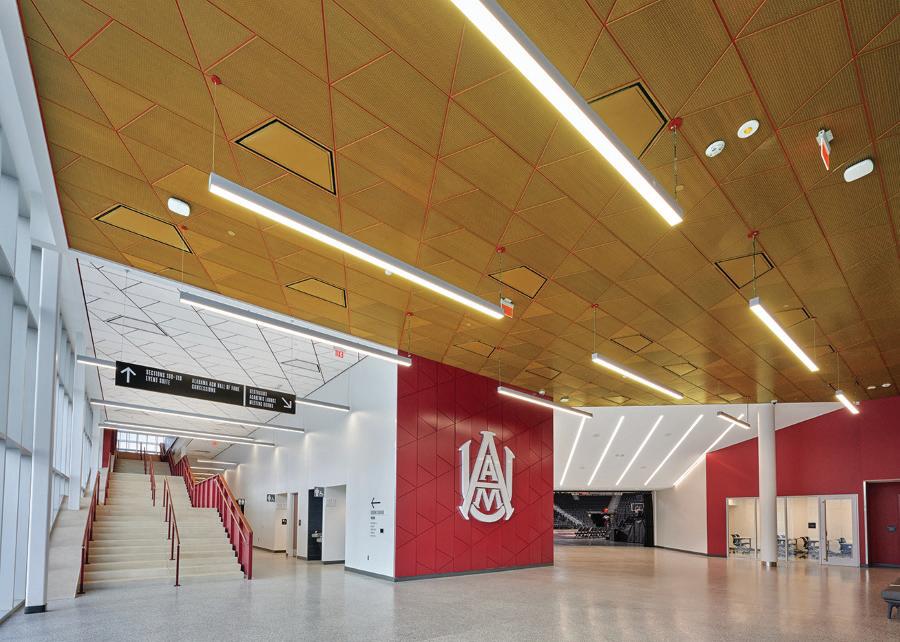
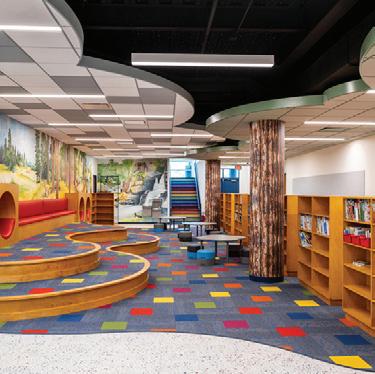
Optima® DesignFlex Shapes were selected for many of the hallways, the entrance to the athletic arena, and the University Hall of Fame. Smooth-textured Optima ceilings provide excellent acoustical absorption (NRC = 0.95), light reflectance, and durability. Trapezoids and triangles were once again the primary shapes.
ProjectWorks®, the Armstrong design and pre-construction service, assisted in the project by providing a comprehensive drawing package to support the DesignFlex portion of the project. It included panel, grid, and hub layouts.
For the athletic locker room, the architects selected Arktura® Vapor® Cloud Dense ceiling panels. The aluminum ceiling has perforated torsion spring panels in which the holes are staggered to produce an eye-catching visual. The school wanted the locker room ceiling to be impressive because the room is a key element of campus tours when recruiting athletes.
Custom colored “Bulldog Maroon” Suprafine® suspension systems from Armstrong were used throughout much of the building to boost the school’s strong branding.
www.armstrongceilings.com/commercial/en/case-study/education/alabama-a-and-m-university-eventcenter.html
Bobrick’s B-8281 SureFlo® Automatic Top-Fill Bulk Foam Soap Dispenser
Joe Agron Director of Sales Buildings & Construction Group 941-200-4778 jagron@asumag.com
Brian Sack Account Manager East & Northeast 732-629-1949 bsack@endeavorb2b.com
Randy Jeter Account Manager South 512-263-7280 rjeter@endeavorb2b.com
Bill Boyadjis Account Manager Midwest 973-829-0648 bboyadjis@endeavorb2b.com
Ellyn Fishman Account Manager West 949-239-6030 efishman@endeavorb2b.com
Steve Suarez Account Manager 816-588-7372 ssuarez@endeavorb2b.com
The SureFlo® Automatic, Top-Fill Bulk Foam Soap Dispenser has a touch-free sensor, so there is no direct contact between the patron and the dispenser, preventing cross-contamination. The dispenser is compatible with any foam bulk jug soap available on the open market, which may save 80% or more soap cost savings.

www.bobrick.com/products/washroom-accessories/restroom-accessories/b-8281-retrofit/
New higher-efficiency air filters from Greentech
Greentech Environmental has announced a new lineup of highefficiency True Mechanical MERV 13A filters. The Greentech Filters+ incorporate ODOGard® technology, revolutionizing odor elimination at the molecular level within the filter. The filter represents the fusion of two pioneering technologies, high-capacity, ultrafine filtration and advanced odor elimination, setting a new standard for air filtration. Greentech Filters+ have been engineered to meet the demands of both modern and older HVAC systems, effectively addressing the requirements of post-pandemic facilities.
https://greentechenv.com/
Gerflor unveils Creation Guidepoint LVT for school facilities
Gerflor, a manufacturer of specialized resilient flooring for sport, commercial, transport, and residential environments, has unveiled a line of Luxury Vinyl Tile (LVT) for education facilities. Creation GuidePoint is designed to transform education spaces. It has a blended tonal design, carefully curated in a palette of neutrals and modern accents. Whether it’s a classroom, library, or common area, GuidePoint is designed to be versatile while maintaining a distinct identity for each space. Backed by industry certifications, the LVT ensures the highest standards of performance, meeting and exceeding the rigorous criteria set for indoor air quality and durability.
www.gerflorusa.com/products/creation-guidepoint


■ product solutions
30 AMERICAN SCHOOL & UNIVERSITY • ASUMAG.COM • MARCH/APRIL 2024


APRIL 17-18, 2024 ANAHEIM CONVENTION CENTER, ANAHEIM, CA REGISTER FOR FREE* AT: WWW.LIGHTSPECWEST.COM THE WEST COAST’S PREMIER LIGHTING & DESIGN EXPERIENCE Presented by: Owned by: *Qualified Attendees (which do not include lighting suppliers/manufacturers or non-sponsoring agencies) can register for free through April 1, 2024



Think Inside The Box Specify with Confidence. Specify Greenheck. ©2024 Greenheck Greenheck SQ direct drive inline fans with mixed flow wheel technology in a square housing design provide a unique combination of High Efficiency, Low Sound & Easy Installation. Boost performance with Greenheck square inline mixed flow fans. Model SQ 2404ASU_Greenheck_MKPL.indd 1 2/12/24 11:13 AM AD INDEX Get your own FREE subscription School and univ rsity administrators, as w ll as ducation archit cts, turn to Am rican School & Univ rsity for how-to f atur s, industry xclusiv r ports and r s arch on th planning, d sign, construction, r trofit, op rations, maint nanc , s curity and manag m nt of ducation faciliti s. G t continuous cov rag of th rapidly growing and volving ducation faciliti s and busin ss mark t, sign up for your own FREE subscription today. Sign up now at: www.asumag.com/N wSub 2404ASU_House_Subscription_MKPL.indd 1 3/22/24 11:22 AM MARKETPLACE ADVERTISER PAGE WEBSITE 2024 Industry Events Calendar 23 www.SchoolDesigns.com Aiphone Communications Systems 27 www.aiphone.com American School & University 32 www.asumag.com/NewSub Architectural Portfolio 29 www.SchoolDesigns.com Armstrong World Industries 11, 33 www.armstrongceilings.com/energysavingceilings Asi Group 13 www.asi-accuratepartitions.com/privacy Bobrick Washroom Equipment, Inc. 33, IBC www.Bobrick.com/freevend Bradley Corporation 15, 33 www.bradleycorp.com Carrier Corporation 21 www.carrier.com/k-12 Clorox Company 5 www.CloroxPro.com/CloroxEcoClean Daikin Comfort Technologies BC www.daikincomfort.com Evergreen Telemetry 26 www.evergreentelemetry.com Greenheck 25, 32 www.greenheck.com InPro Corporation 7 www.inpro.com Kalwall Corporation 9 www.kalwall.com Karcher North America, Inc. IFC www.Karcher.com/us Koala Kare Products 19, 33 www.koalabear.com Landmark Studio Design 3 www.LandmarkStudio.com LightSpec West 31 www.LightSpecWest.com This index is a service to our reader. Every effort is made to maintain accuracy, but American School & University cannot assume responsible for errors or omissions. 32 AMERICAN SCHOOL & UNIVERSITY • ASUMAG.COM • MARCH/APRIL 2024


QUARTZ PERFECTION. IN A MATTE FINISH. bradleycorp.com/evero Finally, sleek design without the shine. Introducing the Evero Matte Mason Series quartz material — a new matte finish in a variety of refined colors and basin shapes — to complement any restroom space. Perfectly. Available in 8 colors | shown in Cinder 2404ASU_Bradley_MKPL.indd 1 3/18/24 2:13 PM Better indoor air quality begins at the ceiling The 24/7 Defend™ air purification portfolio offers both MERV 13 air filtration and UV-C air disinfection so students and teachers can breathe easy. These products are easy to install and retrofit and do not require HVAC integration. Learn more at armstrongceilings.com/healthyschools 2404ASU_ArmstrongWorldIndustries_REV_MKPL.indd 1 3/15/24 9:52 AM Learn more: www.koalabear.com KB3000-AHL Adult Changing Station Adult Changing Stations help ensure that a facility is inclusive for people with disabilities. The KB3000 has essential features such as powered height adjustment, 500 lbs. load capacity, and a vandal resistant changing surface. An Essential for Inclusion 2404ASU_KoalaKare_MKPL.indd 1 3/21/24 4:29 PM Prepare your restrooms for the legal requirements in your area by installing Bobrick’s ADA-compliant free-vend dispensers. Bobrick’s selection of Napkin/Tampon Vendors, Free Vend Operation empower you and your patrons, supporting hygiene, health and wellness in public restrooms. Plan ahead to stay ahead at Bobrick.com/freevend BUILDING VALUE SINCE 1906 2404ASU_BobrickWashroomEquip.indd 1 3/13/24 1:13 PM MARKETPLACE Specify Smarter HYGIENE YOU CAN BANK ON. THAT’S SMART. Hygiene is top of mind. Touch-free delivers. Support good hygiene. Encourage savings. bobrick.com/SureFlo
1 3/14/24 11:01 PM MARCH/APRIL 2024 • ASUMAG.COM • AMERICAN SCHOOL & UNIVERSITY 33
2404ASU_BobrickWashroomEquip_14sq.indd
Vending machine motivates students at New Mexico elementary school
The vending machine at Ernest Stapleton elementary School in Rio Rancho, New Mexico, dispenses treats for students, but it doesn’t have candy bars or chips.
The rows are filled with books that students can acquire if they receive “Paws-itive” referrals (the school mascot is the coyote) by meeting goals in attendance, behavior, math and reading, or if they receive Principal Awards for exhibiting kindness or other “character strong” traits.

Students who meet the goals receive a gold token that they insert into the machine (it doesn’t take money) and enables them to choose one of the books on display. The book drops to the bottom of the machine, and students take the book home.
The machine provides incentives for positive behavior and gets students excited about reading, teachers say.
The school’s PTA says worked for more than two years raising funds to acquire the machine.
Liberty University pays record fine for safety violations
Liberty University in Lynchburg, Virginia, has agreed to pay a record $14 million fine for violations of federal campus safety laws.

The U.S. Department of Education says its settlement agreement with Liberty stems from the university’s “material and ongoing violations” of the Clery Act, which requires colleges and universities to collect data on campus crime and notify students of threats.
The fine is the largest ever imposed for violating the Clery Act, which requires institutions to provide important information about
Superintendent of the Year changes jobs

Less than two weeks after being named the national school superintendent of the year, the leader of the St. Paul (Minnesota) district announced that he is leaving that post for the top job in the Madison (Wisconsin) district.
The St. Paul Pioneer Press reports that the Madison school board has hired Joe Gothard, who has been the superintendent in St. Paul since 2017.
“Dr. Gothard has been a strong leader for [St. Paul], and we are grateful for his nearly seven years of service to this community,”
public safety issues to students, parents, employees, prospective students and employees, and the public postsecondary schools participating in the federal student aid programs.
As a part of the settlement, Liberty has agreed to spend $2 million over the next two years for on-campus safety improvements and compliance enhancements. The Education Department will conduct post-review monitoring of Liberty through April 2026 to ensure that the school carries out the promised improvements.
“The $14 million fine and other remedial actions imposed in this settlement reflect the serious and longstanding nature of Liberty’s violations, which undermined campus safety for students, faculty, and staff,” the Education Department says in a news release. “The settlement also takes into account current Liberty administration’s prompt acknowledgment of almost all the violations identified in the program review report, and its demonstrated commitment to remedying them.”
said Halla Henderson, chair of the St. Paul school board. “At the same time, we are excited he has the opportunity to continue his career and return to his hometown with his family.”
A native of Madison, Gothard had worked in the Madison Metropolitan School District (MMSD) for 18 years as a teacher, principal and district administrator.
“Having grown up in Madison, and having attended MMSD from kindergarten through grade 12, I am excited to return home,” Gothard said in a statement on the Madison district website.
In February, AASA, The School Superintendents Association, selected Gothard as its 2024 national superintendent of the year.
Superintendent of Montgomery County (Maryland) district resigns
Monifa McKnight, superintendent of the Montgomery County (Maryland) School District, the nation’s 16thlargest, has resigned.
McKnight reached “a mutually agreed separation” in February with the county school board and is departing about two years into a four-year contract.
WTOP News reports that McKnight will receive $1.3 million as part of her separation agreement with the school board.
Monique Felder, a 32-year education veteran, has been named interim superintendent of the 160,000-student district.
■ profiles | people, places & goings-on in education facilities & businesses
34 AMERICAN SCHOOL & UNIVERSITY • ASUMAG.COM • MARCH/APRIL 2024
AASA
Liberty University
Rio Rancho Public Schools







Prepare your restrooms for the legal requirements in your area by installing Bobrick’s ADA-compliant free-vend dispensers.
Bobrick’s selection of Napkin/Tampon Vendors, Free Vend Operation empower you and your patrons, supporting hygiene, health and wellness in public restrooms.
Plan ahead to stay ahead at Bobrick.com/freevend
BUILDING VALUE SINCE 1906








SCONNECTED


From the world’s #1 air conditioning company, discover the cloud connected benefits of VRV EMERION provided by Daikin’s HERO Cloud Services.

DISCOVER MORE AT: WWW.VRVEMERION.COM
2024
.
.
