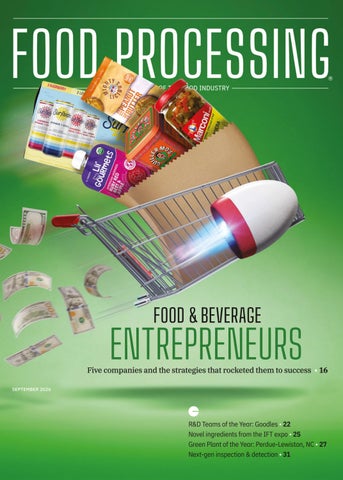
FOOD & BEVERAGE
ENTREPRENEURS
Five companies and the strategies that rocketed them to success • 16 SEPTEMBER 2026
R&D Teams of the Year: Goodles • 22 Novel ingredients from the IFT expo • 25 Green Plant of the Year: Perdue-Lewiston, NC • 27 Next-gen inspection & detection • 31
2609FP_01-02_Cover.indd 1
9/8/26 7:53 AM
100% Synthetic
MOAH and MOSH free Lubricants For the Food Processing Industry Manufactured in dedicated MOAH and MOSH free production equipment Formulated to provide unsurpassed performance in food processing facilities. These high-performance, 100% synthetic, MOAH/MOSH free lubricants provide extended lube intervals, multiple application capability, lubricant inventory consolidation and improved performance. All while maintaining the highest level of food safety. These lubricants are not “synthetic blend” products. They are 100% synthetic / long-life. Available products include:
Synthetic Gear Oils Synthetic Compressor Fluids Synthetic Hydraulic Fluids Synthetic Oven Chain Lubricants Synthetic Spray Lubricants
See the NSF White Book™ for a complete list of registered / ISO21469 certified products.
100% Synthetic • NSF H1 Registered • MOAH and MOSH Free INCLUDED AT NO ADDITIONAL CHARGE
Lubriplate’s
H1 LUBRICANTS Newark, NJ 07105 / Toledo, OH 43605 / 800-733-4755 To learn more visit us at: www.lubriplate.com
2609FP_LubriplateLubricantsCompany_FP.indd 1 2609FP_01-02_Cover.indd 2
ESP
Complimentary Extra Services Package COLOR CODED LUBE CHARTS & MACHINERY TAGS PLANT SURVEYS / TECH SUPPORT / TRAINING FOLLOW-UP OIL ANALYSIS
8/10/26 9/8/26 8:54 7:53 AM AM
CONTENTS FEATURES COVER STORY
Food & Beverage Entrepreneurs
Guillermo’s Salsa, Lil’ Gourmets, Marconi Foods, Mightylicious and Surfside share the strategies that made them successes.
16
R&D TEAMS OF THE YEAR
16
IMAGE BY 19 STUDIO | SHUTTERSTOCK.COM; COMPOSITE IMAGE BY BILL ANTKOWIAK
Goodles: Mac & Cheese for Grownups
Our third and final team creates sides in peppery parmesan, hatch chile and pesto.
22
INGREDIENTS
Novel Ingredients From IFT FIRST Expo
27
New proteins and natural sweeteners and colors were introduced at the show.
25
PLANT OPERATIONS
Green Plant of the Year: Perdue's Lewiston, N.C., Chicken Plant
It's reduced greenhouse gas emissions and water and electricity consumption.
31
27
EQUIPMENT
DEPARTMENTS EDITOR’S PLATE
5
NEWS
9
ON THE WEB
7
ROLLOUT
14
FOOD SAFETY
8
NEW EQUIPMENT
33
FOODPROCESSING .COM
2609FP_03_TOC.indd 3
Next-Gen Inspection & Detection
Technology helps keep foreign material out while also performing quality checks.
31
3
9/8/26 7:53 AM
REST ASSURED, YOU’RE IN COMPLIANCE. At Clarion, we’re passionate about peace of mind. Our food grade lubricants meet the industry’s most stringent purity standards and deliver proven performance shift after shift. To learn how our solutions can save you money and protect your operation, scan the code below.
2609FP_CitgoPetroleumCorporation_FP.indd 1 2609FP_04-05_Editor's Plate.indd 4
8/12/26 9/8/26 2:26 7:53 PM AM
EDITOR'S PLATE
Does Sustainability Still Matter?
It does to our Green Plant of the Year nominees, and should matter to you too.
F
or 16 years now, we’ve named a Green Plant of the Year in the final few months of the year. This year’s winner, profiled on p27, is Perdue Farms’ Lewiston, N.C., poultry processing facility. Does anybody care? Some people do, and we all certainly should. I’m writing this in my home office in suburban Chicago, hoping the power stays on. A month ago, a tornado touched down in my medium-sized suburb, a few blocks away from my home, a first for our town. Illinois this summer won the dubious distinction of having the most tornadoes of any state in the U.S. – take that, Oklahoma and Texas! – with more than 200. That’s nothing to be proud of. My electricity went out for only a few hours. Just 40 miles east of me, people in northwest Indiana went without power for more than two weeks. Where are we? Cuba? My house has endured at least three downpours that flooded my street and brought water right up to my garage door. Other Chicago suburbs had it worse. We haven’t been back to our favorite vacation spot – Ft. Myers Beach, Fla. – because it was essentially wiped out by hurricanes in 2017 AND 2022 AND 2024 (I think it’s largely rebuilt now).
FOODPROCESSING .COM
2:26 PM
2609FP_04-05_Editor's Plate.indd 5
By the time you read this, a few weeks will have passed since the disaster at the Nepal-Tibet border. What caused the sudden flood that killed more than 1,000? It wasn’t a rainstorm; a glacier melted. Glaciers aren’t supposed to melt. I’m writing this just days after a sudden rainstorm caused flash flooding in Grand Canyon National Park in Arizona, leaving at least two dead. Have you read about forecasts for a Super El Nino? How can anyone still deny climate change? After experiencing three 100-year rains in about two weeks plus a tornado, I’m convinced something is very wrong with the climate. We’ve been polluting Mother Nature for eons now, and I suspect it’s reached a tipping point. While the current administration in Washington has rolled back a number of programs and policies meant to fight climate change – with the underlying premise that climate change is a myth – we are happy to see so many food & beverage processors continuing efforts toward sustainability. Perdue’s Lewiston factory is a great example, capturing methane from its wastewater lagoons and converting it to natural gas for reuse, reducing water use and wastewater creation, and accomplishing near-zero waste to landfill. Kudos also to the other competitors
in our Green Plant of the Year poll: Ajinomoto Foods North America’s Portland, Ore., plant and Gills Onions’ Oxnard, Calif., facility. As I said, we’ve been doing this project for a while, so we have 16 years of great examples of sustainability efforts in the food & beverage industry. Environmentalism still matters to consumers, too. Multiple largescale studies show shoppers care about sustainability, with 79-83% expressing concern and sustainable products growing faster than conventional ones – and that’s in both U.S. and global markets. Studies and surveys from Bain & Company, Euromonitor, Deloitte, Vanderbilt University and others consistently show consumers have strong environmental concerns, are willing to pay more for sustainable goods and have expectations that companies and brands commit to sustainability. So keep up the good work … or get on the bandwagon. The Earth needs healing. And I don’t need another flooded garage. n
Written by
Dave Fusaro EDITOR IN CHIEF dfusaro@endeavorb2b.com
5
9/8/26 7:53 AM
2609FP_06-07_Web.indd 6
9/8/26 7:53 AM
SEPTEMBER 2026 | VOLUME 87 NUMBER 5
EDITORIAL TEAM EDITOR IN CHIEF
Dave Fusaro
dfusaro@endeavorb2b.com SENIOR EDITOR
Andy Hanacek ahanacek@endeavorb2b.com CONTRIBUTING EDITORS
Ed Avis, Claudia O’Donnell EDITORIAL ADVISORY BOARD Mohamed Z. Badaoui Najjar, Ph.D.
What’s New Online Don’t miss what’s happening on FoodProcessing.com.
R&D Senior Director– Strategy & Portfolio Sector Food & Beverage, PepsiCo
James Davis
Director-Global Sanitation, OSI Group LLC
Leslie Herzog
Vice President of Operations & Research Services, The Understanding & Insight Group LLC (retired from Unilever)
Steven Hill, Ph.D.
Vice President-R&D, QA, Food Safety, Sustainability, Engineering, Regulatory, Marzetti Co.
David Joy
Partner, Keller & Heckman LLP
Leslie Krasny
Krasny Consulting
Amit Pal, Ph.D.
Director, R&D - Beverage, The Campbell's Co.
T
products. The list alone is great, but it's accompanied by a story analyzing why some companies are succeeding and some are failing. And the best part of all is our online database, where you'll see the chart with all the companies but if you click on a name, you'll be taken to an extensive profile of that company, including headquarters, executives, brands, and in most cases manufacturing plants. See it at: www.FoodProcessing.com/ top100/2026
wo of our annual research projects were finished in the past month and are now available online: the Top 100 and our 55th annual R&D Survey. You'll need to register to see either, but registration opens a wealth of other opportunities for you, too (see descriptions below).
Jagriti Sharma
Senior Vice President of Product, Poppi
Gary M. Stibel
R&D SURVEY
Founder & CEO, The New England Consulting Group
DESIGN & PRODUCTION ART DIRECTOR
Bill Antkowiak bantkowiak@endeavorb2b.com PRODUCTION MANAGER
Rita Fitzgerald
rfitzgerald@endeavorb2b.com AD SERVICES MANAGER
Jennifer George
jgeorge@endeavorb2b.com
EXECUTIVE STAFF VP CORPORATE CONTENT STRATEGY
Travis Hessman
CIRCULATION REQUESTS
Lori Books
AUDIENCE DEVELOPMENT MANAGER
Delicia Poole
dpoole@endeavorb2b.com
ENDEAVOR BUSINESS MEDIA, LLC
Ingredient costs, UPFs, GLP-1s vexing product developers
Those are some of the topline observations from our annual survey of our product development audience. We've been doing this survey for 55 years! The online package includes the analysis plus all nine infographics, which detail responses to questions about budgets, general targets for the year, progress on replacing synthetic colors and more. See it at: www.FoodProcessing.com/ 55394915
EHANDBOOKS
Issues important for your job
Our ehandbooks are a great way to brush up on topics that can help you do your job better. In the past two months we've added ebooks on mixing & blending and advances in the bakery category. See the whole ebook library at: www.FoodProcessing.com/ ehandbooks PODCASTS
CEO
Chris Ferrell COO
Patrick Rains CDO
Jacquie Niemiec CALO
Tracy Kane CMO
Amanda Landsaw EVP MANUFACTURING & ENGINEERING GROUP
Lisa Paonessa
Campbell's on foodservice trends, KPMG on back-to-school
THE TOP 100
A list, a story and a massive online database
We continue to build our podcast library with expert insights from folks like those on pertinent topics. Listen in at: www.FoodProcessing.com/ ehandbooks
The Top 100 is our unique list of the largest food & beverage processors – but based on only North American-manufactured
Endeavor Business Media, LLC
30 Burton Hills Blvd, Ste. 185, Nashville, TN 37215 800-547-7377
2609FP_06-07_Web.indd 7
FOODPROCESSING .COM
7
9/8/26 7:53 AM
FOOD SAFETY
Risks in Chasing the GLP-1 Boom
There’s opportunity but also food safety risk in launching products for this market disruption.
U
sers of blockbuster GLP-1 weight-loss drugs are expected to account for around 35% of all food & beverage sales by 2030. Already, the medications are reshaping consumer demand, pulling shoppers away from calorie-dense, processed foods toward products with more nutritional benefits, such as fiber and protein. Analysts expect that trend to accelerate now that pill forms of the drugs are on the market. The FDA approved Novo Nordisk’s Wegovy pill late last year, followed by Eli Lilly’s orforglipron – which goes by the brand name Foundayo – in April, giving patients a needle-free and often cheaper alternative to the injectable versions that have driven the market so far. Food & beverage processors have started responding to shifting demand patterns by offering new products with higher protein content and smaller portions. Some manufacturers have also relabeled products as “GLP-1 friendly” and are working directly with large retailers to better market to this growing segment. As GLP-1 adoption grows, many manufacturers are already capitalizing on the opportunity to develop new products and retool existing lines to meet demand. But moving quickly also carries risk that, if not managed carefully, can result in costly claims, recalls or litigation down the road.
8
2609FP_08_Food Safety.indd 8
Reformulating existing products or launching new ones to meet GLP-1 driven demand requires much more than just swapping a few ingredients. It requires new suppliers, new production lines, new packaging and updated safety protocols. These types of changes introduce risks that manufacturers must be aware of and take steps to address before they turn into a costly problem. Consider issues such as: Supply chain: As companies make changes to their product lines, they likely need to add or change suppliers. This can increase competition for the same raw materials and leave companies exposed to disruption if a key ingredient becomes scare. Diversifying suppliers and having a backup source in place can help reduce that exposure. Production line: Retooling a line to make a new or reformulated product increases the risk of malfunction or system failure, especially when it comes to entirely new products. It’s critical that food safety protocols keep pace with any production line changes and for employees to be properly trained on new equipment before full-scale production begins. Recalls: Recalls tied to food safety issues or mislabeling are already a persistent risk across the industry; that risk grows significantly when companies make a product that’s never been made before.
Testing, quality control checks and clear labeling review before a product launch can help spot any issues before it hits shelves. Workers: New products, new lines and new packaging often mean employees taking on unfamiliar tasks. Proper training and updated safety planning can help mitigate the risk of workplace injuries and the liability that comes with them. Packaging: Class action lawsuits linked to misleading language on packaging, such as “all natural,” have been on the rise in recent years. In fact, class action filings against food & beverage makers reached nearly 300 in 2024, a near record high. Labeling a product as “GLP-1 friendly” can attract similar scrutiny, making accurate, careful labeling paramount. The risks are real, but they’re manageable with the right mitigation steps and insurance coverage in place. The insurance market is currently working in manufacturers’ favor. For example, product recall coverage remains competitive, with many carriers willing to write coverage. And business interruption insurance can help backstop against supply chain disruption. n Written by
Mary Keiser SR. VP, HUB INTERNATIONAL www.hubinternational.com
SEPTEMBER 2026
9/8/26 9:40 AM
IN THIS SECTION » HHS reveals GRAS, UPF plans » JBS' next global CEO » Fairlife's new $650 million plant
Chobani Plans Another Billion-Dollar Plant In a two-part deal with Keurig Dr Pepper, the yogurt company will take over the latter’s Allentown, Pa., facility and convert it to dairy processing.
C
hobani will acquire the Keurig Dr Pepper (KDP) plant in Allentown, Pa., and then invest $1.2 billion to expand and convert it into a dairy processing plant, the two sides announced Sept. 1. In a companion deal, KDP will sell its full equity stake in Chobani back to the company for $800 million. The Allentown plant opened in 2021 “focused on the production of non-carbonated beverages” – that's all KDP said at the time. Chobani will pay the beverage company about $125 million for the facility and warehouse. Chobani called the twin moves “part of an expanded partnership with Keurig Dr Pepper.” Production at the plant is expected to begin in 2027. It’s expected to create 900 jobs in the next five years. Chobani plans to operate up to 10 production lines, manufacturing a variety of food products beyond just yogurt. As far as the relationship with KDP goes, Chobani will repurchase KDP’s equity stake in Chobani, and the two will expand their distribution partnership, giving Chobani access to KDP’s company-owned DSD network, which reaches about 80% of the U.S. population.
FOODPROCESSING .COM
2609FP_09-13_News.indd 9
In addition, some of the current Allentown employees will remain with KDP, while the rest will receive offers to join Chobani. The plant will be Chobani’s first in Pennsylvania, the company’s second billion-dollar-plus investment in the northeast U.S. over the past few years and the fifth significant capital project announced over the past several years. The company notes it is investing more than $4 billion in capital projects to build capacity and capabilities to support the next round of growth — it also said it has grown
approximately 20% annually over the past three years. Chobani is building a facility in Rome, N.Y. (also a $1.2 billion investment), expanding its Twin Falls, Idaho, plant (for $500 million), renovating its New Berlin, N.Y., site and expanding its Norton Shores, Mich., facility (for $567 million), which produces La Colombe beverages. KDP intends to use the proceeds from the transactions to reduce debt as it continues plans to split into two businesses, tentatively called Beverage Co. and Global Coffee Co.
Chobani's founder and CEO Hamdi Ulukaya (left) jokes with Pennsylvania Governor Josh Shapiro.
IMAGE COURTESY OF THE COMMONWEALTH OF PENNSYLVANIA
9
9/8/26 7:53 AM
HHS Unveils Proposals to Reform GRAS, Define Ultraprocessed Foods In mid-August, the Dept. of Health and Human Services (HHS) announced two “landmark” actions to increase federal oversight of food ingredients: a rule requiring manufacturers to notify FDA when claiming an ingredient is Generally Recognized as Safe (GRAS) and the federal government’s first proposed definition of ultraprocessed foods (UPFs) — although that definition was not specified. Since Congress established the GRAS exemption in 1958, manufacturers have been permitted to reach their own conclusions that certain substances are generally recognized as safe under the conditions of their intended use, HHS explained. Although the FDA has long operated voluntary notification programs, companies have not been required to notify the agency when making these determinations. If the rule is approved, manufacturers will be required to notify FDA; and the agency also will establish a “public-facing inventory of submitted notices, significantly improving transparency while strengthening FDA’s ability to oversee ingredients entering the food supply.” For substances already on the market based on industry selfGRAS conclusions, the proposal would establish a time-limited streamlined submission pathway that would allow manufacturers to provide FDA with information about existing uses. This enables the agency to prioritize post-market safety evaluations while minimizing unnecessary regulatory burden.
10
2609FP_09-13_News.indd 10
On the issue of UPFs, Robert Kennedy, secretary of HHS, said FDA and USDA worked together to come up with a definition that “incorporates feedback from thousands of stakeholders, including industry, consumer organizations, researchers and members of the public.” But no details were shared. The definition was “submitted for approval” – although he didn’t say to what agency, but recent reports say it’s sitting with the White House’s Office of Management and Budget. News reports said it was more of a whitepaper than a rule proposal, and that the White House was stalling its public reveal. “Americans deserve confidence that the ingredients in their food are subject to transparent, science-based oversight, and today’s actions strengthen both sides of that equation,” said Acting FDA Commissioner Kyle Diamantas. “By proposing mandatory GRAS notifications, we are closing critical information gaps and giving FDA greater visibility into substances entering the food supply,” he continued. “By advancing a proposed definition of ultraprocessed foods, we seek to create a stronger foundation for future nutrition research. Together, these reforms represent a significant step toward a more transparent and modern food safety system.” And the announcement added, “HHS also encourages Congress to build on these efforts through legislation that further strengthens the safety of the American food supply.”
Consumer Brands’ Nasty Response to UPF Definition Consumer Brands Assn. wasted no time criticizing the Health & Human Services announcement about defining ultraprocessed foods, saying “some rogue unelected bureaucrats are trying to push this misguided definition without [President Trump’s] knowledge.” Needless to say, the main lobbying group for food and consumer packaged goods found the proposal, which they haven’t officially seen, “fundamentally flawed, not based on sound science and politically motivated.” It will “create consumer confusion and increase grocery costs for American families.” And the effort raises “serious concerns.” “America’s packaged food supply is safe and has been a staple in American households for decades. That’s something that a guidance document, crafted without credible experts, cannot change,” said the statement, attributed to Rhonda Bentz, Consumer Brands’ executive vice president of public affairs. “Any so-called definition that captures 80% of the nation’s food supply while picking winners and losers is fundamentally flawed, not based on sound science and politically motivated.”
SEPTEMBER 2026
9/8/26 7:53 AM
2609FP
NEWS
AFIT Food Coalition Urges Congress To Enact National Ingredient Standards The coalition Americans for Ingredient Transparency (AFIT) sent a letter on July 29 to Congressional leaders urging swift action on a uniform national framework for food ingredient safety and labeling. Otherwise, “a growing patchwork of state ingredient regulations threatens to increase grocery costs by 12%,” the group says. “270 industry leaders from across the country” called on Congress to act on bipartisan food policy reforms that “strengthen consumer confidence, preserve food affordability and maintain a safe, reliable, and secure national food supply.”
The letter comes a week after Bill Cassidy, chairman of the Senate’s Health, Education, Labor and Pensions (HELP) Committee, said he will work on “a national uniform standard for food regulations rather than a patchwork of widely different state laws,” according to AFIT. The group did not specify who the signers were other than to say they include “major national and state groups and industry leaders, including state farm bureaus, beverage associations, retail federations, and grocers associations spanning nearly every U.S. state.”
Presumably that includes food & beverage companies identified when the group was formed in October 2025: CocaCola Co., Conagra, General Mills, Hormel, Ken’s, Keurig Dr Pepper, Kraft Heinz, McCormick, Nestle, Ocean Spray, PepsiCo, Sargento and Tyson – as well as associations Consumer Brands Assn., American Beverage Assn., Meat Institute, National Restaurant Assn., National Milk Producers Assn., FMI-The Food Industry Assn., and others. The letter was addressed to Senate Majority Leader John Thune, Senate Democratic Leader Chuck Schumer, House Speaker Mike Johnson, House Minority Leader Hakeem Jeffries and others.
Standards and IP68 and
WWW.STOBER.COM
2609FP_09-13_News.indd 11 2609FP_StoberDrivesInc_12h.indd 1
9/8/26 11:00 7:53 AM 9/1/26 AM
IMAGE COURTESY OF BAUDUCCO
People JBS NV said Wesley Batista Filho, grandson of company founder José Batista Sobrinho, will become global CEO of the company in January 2027. Batista Filho has been the CEO of JBS USA since 2023, and previously was CEO of JBS Brazil and president of the company’s Seara business. He will take the reins of the global food company from Gilberto Tomazoni, who has served as global CEO for the past eight years. Bauducco, the world's largest producer of panettone, announced two leadership appointments: Jean-Pierre Comte as CEO for North America and Stefano
Stefano Mozzi (left), Jean-Pierre Comte
Mozzi's promotion to global CEO. Comte is a 30-year consumer goods veteran who spent nearly a decade leading Barilla's Americas operations. Mozzi has 16 years at Bauducco, most recently as leader of the international business unit. Olipop founder Ben Goodwin will transition to executive chairman and head of innovation, making way for Christian Patiño Webb to take the CEO reins.
12
2609FP_09-13_News.indd 12
Haribo of America made Jon Hughes its new president/CEO. Hughes most recently served as managing director for Haribo U.K. & Ireland and has extensive experience leading growth across the entire Haribo organization. A week after announcing the retirement of its president/CEO Kenneth C. “Casey” Keller, B&G Foods Inc. introduced Robert Mills as his successor. Mills has served on B&G’s board of directors since 2018 and leaves Tractor Supply Co., where he was an executive vice president and chief technology officer. Conagra Brands made a handful of internal executive changes to streamline the company's structure. Tom McGough, executive vice president and chief operating officer, will retire on Sept. 4, at which point the COO role will be eliminated. Noelle O'Mara, executive vice president and president of Refrigerated and Frozen, and Jill Dexter, executive vice president and president of Grocery and Snacks, will report directly to new President/CEO John Brase. Burke Raine will assume the role of executive vice president and chief growth officer, and he will oversee Foodservice, International and the Company's R&D efforts in addition to leading growth initiatives across the organization. Kettle Cuisine hired Peter Hall away from Kraft Heinz Co. to be CEO, replacing Liam McClennon, who retired in July after 11 years with the company. Hall spent more than 12 years at Kraft Heinz. J.M. Smucker Co. promoted Jeff Varcoe to senior vice president of science and technical excellence. Since 2023, he’s been vice president of quality assurance and food safety. Before joining Smucker, he spent 21 years at Schwan Food Co.
SEPTEMBER 2026
9/8/26 7:53 AM
NEWS
Expansions Fairlife in August began operations at its new Webster, N.Y., plant. The dairy processing facility represents a $650 million investment for the Coca-Cola subsidiary, spans 745,000 sq. ft., and is expected to process 5-6 million pounds of milk per day when complete. Ice cream manufacturer Wells Enterprises, part of the Ferrero Group, in August cut the ribbon on the first two (of four) phases of its $425 million plant expansion and renovation in Dunkirk, N.Y. InnovAsian Cuisine Enterprises Inc., a subsidiary of Nichirei Foods Inc., broke ground on its new, Jonesboro, Ark., frozen foods processing plant. The $150 million development will span 180,000 sq. ft., is anticipated to begin production in early 2028 and should create about 200 jobs. Cheese-making cooperative Bongards Creameries plans to invest $135 million to expand its process cheese manufacturing facility in Bongards, Minn. Construction is scheduled to begin during the fourth quarter of 2026, with commercial operations expected by early 2028. The expansion will add approximately 120,000 sq. ft. to the production facility, including approximately 50,000 sq. ft. of additional production space and a 70,000sq.-ft. automated warehouse. Lotus Bakeries, makers of Biscoff cookies, said it will spend €500 million ($578 million) on three manufacturing sites on three continents, including one in the U.S. The greenfield Biscoff plant in Thailand is fully operational, and “significant capacity expansion projects” for Biscoff are underway
in the U.S., presumably Mebane, N.C., and in Belgium. Contract manufacturer Sany Nutrition Group expects to invest more than $30 million and create more than 150 jobs in Jonesboro,
Ark., by acquiring and renovating a former Butterball facility there. Instead of closing its Souderton, Pa., processing plant, JBS USA will convert the facility into a dedicated value-added operation.
Maximizing Dry Bulk Solids Safety & Handling. Guaranteed Solutions. Bulk Material Handling • Industrial Vacuum Cleaning
Feeder Refill Systems
Bulk Bag Loader/Unloader
Bag Dump Stations
Direct-Charge Blender Loading
Combustible Dust Vacuums
Let us solve your bulk material handling & industrial vacuum cleaning needs, challenges & requirements for compliance. Visit www.vac-u-max.com for RFQ or call (800) VAC-U-MAX. Maximizing Food Safety, Compliance & Production with VAC-U-MAX “Airtight Performance Guarantees”TM
ActivatorTM Bulk Bag Unloading System
CD Series Compressed Air Operated Combustible Dust Vacs
PNEUMATIC, FLEXIBLE SCREW & AERO-MECHANICAL CONVEYING SYSTEMS BULK BAG LOAD / UNLOAD SYSTEMS • BAG DUMP STATIONS • BATCH WEIGHING UL-CONTROLS • MOBILE VACUUM CONVEYING SYSTEMS DIRECT CHARGE BLENDER LOADING FEEDER / FOOD EXTRUDER REFILL SYSTEMS INDUSTRIAL VACUUM CLEANERS • CENTRAL VACUUM CLEANING SYSTEMS VAC-U-MAX • 69 WILLIAM STREET • BELLEVILLE, NJ USA www.vac-u-max.com • info@vac-u-max.com • (800) VAC-U-MAX
FOODPROCESSING .COM
2503FP_VacUMax_12i.indd 1 2609FP_09-13_News.indd 13
2/12/25 2:15 PM 9/8/26 7:53 AM
ROLLOUT Chef Boyardee Is Alive and On-Trend
Chef Boyardee is now in the shelf-stable cooking kit category with Skillet Meals, a line of easy, budget-friendly meal solutions that don’t compromise on taste. The lineup features five varieties: Beef Pasta, Cheeseburger Mac, Cheesy Italian Shells, Chicken Alfredo and Meat Lasagna. The launch represents a major milestone in Chef Boyardee’s ongoing brand revitalization under Hometown Food Co., which acquired the brand from Conagra in 2025. Hometown also boosted the nutrient density of its canned products with new Chef Boyardee Protein Canned Pasta. The first wave of products, featuring at least 25g of protein per can, meets a growing consumer demand for convenient, affordable and satisfying high-protein meal options. The high-protein offerings are Beefaroni, Beef Ravioli, Chicken with Rice & Vegetables, Chili Mac and Spaghetti & Meatballs. “In just one year since acquiring Chef Boyardee, we’ve turned out meaningful innovation on a fast-paced, entrepreneurial timeline,” said Henk Hartong III, chairman and CEO of Brynwood Partners, owners of Hometown Food.
Multi-Textured Protein Bars
Since launching in 2012, Fitcrunch has challenged the notion that protein bars have to sacrifice taste or texture for nutrition. Built on the belief that “chef-crafted” extends far beyond the kitchen, the brand, owned by 1440 Foods, has created indulgent, dessert-inspired protein bars that satisfy cravings while supporting active lifestyles. Its newest offering is Puff N’ Crunchy, which features a combination of marshmallow-like softness layered over a crisp cookie base, wrapped in chocolate and finished with crunch. Varieties are Caramel Peanut S’mores, Double Chocolate Rocky Road and Raspberry Meringue Pie. Each bar contains 18g of protein, 3-6g of fiber and 200 calories or less, delivering the indulgence of a candy bar with better-for-you nutrition that consumers can enjoy every day.
14
2609FP_14-15_Rollout.indd 14
Skillet Meals From the Sea
Seafood has long been underrepresented in the frozen meals aisle. High Liner Foods has set out to change that with its new Sea Cuisine Skillet Meals, a line of globally inspired, one-pan seafood meals that are ready in 15 minutes. Each 22-oz. bag contains two servings. Mediterranean-Style Sole Pasta (22g of protein per serving) features wild-caught sole paired with penne pasta, roasted yellow and red peppers and diced tomatoes in a Mediterranean-inspired lemon caper sauce. Thai Red Curry Salmon (19g of protein) is salmon with snap peas, red bell peppers, carrots and brown rice in a Thai red curry sauce. Chili Garlic Shrimp (15g of protein) combines premium shrimp with chow mein noodles, broccoli, red peppers and carrots in a chili garlic sauce. “Today’s consumers are looking for options that taste great, come together quickly and are high in protein,” says Anthony Rasetta, chief commercial officer. “This innovative lineup offers all the quality and convenience they want with none of the wait.”
SEPTEMBER 2026
9/8/26 7:53 AM
ROLLOUT
Indian Cheese With an American Twist
Mooj Foods introduces Mooj Paneer, a 21st century formulation of the traditional Indian cheese. Founded by Ritu Sreenivasan and Munveer Rihal, Mooj is modernizing traditional paneer with a higher-protein, lower-fat dairy product designed for everyday cooking across a wide range of cuisines and consumer preferences. Sreenivasan and Rihal felt the meatless category was missing protein-dense and clean-label options, which is why Mooj Paneer delivers 30g of protein for only 180 calories and 5g of fat per serving, making it the most protein-dense vegetarian protein source on the market, they claim, with similar macros to chicken breast. Mooj Paneer comes in three varieties: The OG, Taco Tuesday and Zesty Italian. Mooj has been selected to participate in the second annual Midwest Dairy Accelerator, a competitive 10-week program hosted by Midwest Dairy, in partnership with VentureFuel, to help emerging food and beverage brands scale innovative products that use Midwest dairy as a key ingredient.
Another Frozen PBJ Enters the Fray
Welch Foods Inc. helped define one of America’s most iconic sandwiches — peanut butter and jelly — for generations with its Welch’s Fruit Spreads. Now the company is bringing that combo to the freezer aisle with the launch of Welch’s Real PB&Js. Rolling out at select Walmart stores, the line delivers a peanut butter and jelly designed for bigger appetites, as the company’s research showed that traditional portion sizes weren’t keeping pace with the needs of today’s young adults. Made with bread packed with creamy peanut butter and Welch’s fruit spreads, the sandwiches come in Concord Grape Jelly, Strawberry Jam and an entirely new Mixed Fruit spread inspired by the brand’s iconic Fruit Snacks. Made with no artificial colors and no high-fructose corn syrup, each individually wrapped sandwich delivers 12g of protein, is a good source of fiber and is 50% bigger than the leading national brand’s 2-oz. sandwich. They come in a six-count box that sells for $8.87.
FOODPROCESSING .COM
2609FP_14-15_Rollout.indd 15
Potato Crisps Meet Wings
Just in time for football season, two game-day favorites are joining forces. Pringles, now a Mars brand, and Buffalo Wild Wings bring the taste of three legendary wing sauces to the stackable crisp category for the first time ever. The new Pringles x Buffalo Wild Wings lineup delivers a flavor roster with a range of heat levels to satisfy every fan. Varieties are Asian Zing, Medium Buffalo and Parmesan Garlic. The sports-bar-inspired snack flavors made their debut in July — for “international football,” the World Cup — at select retailers, and expanded nationwide in September. The limited-edition 5.5-oz. cans have a suggested retail price of $2.69. Back in summer, Pringles introduced Pringles Pop Dog Buns, a first-of-its-kind line of potato-based buns infused with the iconic taste of three fan-favorite Pringles flavors: BBQ, Honey Mustard or Sour Cream & Onion. They’re 7.5 in. long and packaged in the brand’s iconic cans for a perfect fit.
15
9/8/26 7:53 AM
COVER STORY
FOOD & BEVERAGE
ENTREPRENEURS
Written by
Andy Hanacek SENIOR EDITOR
Guillermo’s Salsa, Lil’ Gourmets, Marconi Foods, Mightylicious and Surfside share their stories and the strategies that helped rocket them to success in the food & beverage industry.
T
he food & beverage industry may seem loaded with mega companies that set the pace for the category. But it’s often the mid-sized and small companies and brands that disrupt, push the envelope, and change the game — seeking also their own success. Entrepreneurs push traditional categories into new territory, bucking the status quo and making people notice untapped potential. Sometimes, those entrepreneurial companies don’t make it. Plenty of them, however, find their niche and sometimes create demand for products consumers didn’t fully realize they wanted.
IMAGE COMPOSITE: BILL ANTKOWIAK STOKKETE | SHUTTERSTOCK.COM
2609FP_16-21_Entrepreneurs.indd 16
16
The food & beverage entrepreneurs that we’ve chosen to feature this year have found success, but they’ve blazed their trails in different ways. Entrepreneurial companies aren’t always “new,” as Marconi Foods shows us this year (it has been in business for more than 125 years).Some can find success in a very short time, as demonstrated by Guillermo’s Salsa (which is less than a year old). All of them have thrived, typically by changing the game within their category, or even creating an entirely new category. And each one of the five we highlight this year holds lessons from which anyone in the industry can learn and use to rocket to success.
SEPTEMBER 2026
9/8/26 7:53 AM
IMAGE COURTESY OF GUILLERMO'S SALSA
In many ways, Guillermo’s could only have been built in America. Chris Kirby went from being a chef to building one of the country’s growing refrigerated food brands: Ithaca Hummus. He spent years proving that consumers were hungry for fresher food made with real ingredients and uncompromising quality. Meanwhile, Guillermo Rodriguez immigrated from Mexico and built a life in America through hard work, humility and an infectious sense of humor, ultimately becoming one of America’s most loved late-night television personalities. Food has always been central to his life because of what it represents: family, celebration and belonging. Together, they saw an opportunity hiding in plain sight: Salsa is one of America’s most consumed condiments, yet much of the category had become a sea of products engineered for shelf life rather than flavor. They believed salsa deserved better. But turning that vision into a company required more than a great idea. This led Chris and Guillermo to partner with Leo Chris Kasuya, whose experience in building and scaling food brands helped turn that idea into a company built for national growth. What were some of the early challenges for the company? For the first four months, [Leo] was essentially the company’s only full-time employee. [Leo]
FOODPROCESSING .COM
2609FP_16-21_Entrepreneurs.indd 17
Chris Kirby (co-founder & CEO), Guillermo Rodriguez (co-founder & “salsapreneur”) and Leo Chris Kasuya (co-founder & president) of Guillermo’s Salsa
could be pitching a retailer one minute and reviewing packaging, solving a manufacturing issue, answering consumers or building financial models the next. At first, that’s energizing. But eventually, it becomes the biggest risk to the company, because no business scales when every important decision flows through one person. And so our biggest challenge has been building the infrastructure to support our growth without losing the agility that got us here. What’s a recent challenge the company overcame? This ties back to the last question, but over the past several months we’ve added leadership across operations, finance, sales, insights, customer support and community management, all while building a network of agency partners, brokers and specialists around them. We still operate with the speed of a startup, but we’re no longer trying to prove how much we can endure. Our goal isn’t to build the biggest team. It’s to build the right one, so that we can deliver for our consumers, retail partners and one another for years to come.
What’s the next big thing we should expect from your company? If our first chapter was proving consumers wanted a fresher, better salsa, the next is making sure they can find it. This fall, Guillermo’s is expanding nationwide with Kroger, bringing our salsa to more than 2,500 stores across 35 states. This expansion coincides with Guillermo’s debut on “Dancing with the Stars,” creating an exciting opportunity to introduce the brand to millions more people. n IMAGE COURTESY OF GUILLERMO'S SALSA
17
9/8/26 7:53 AM
IMAGE COURTESY OF LIL' GOURMETS
Lil’ Gourmets was born out of both my life experiences and medical research. My long struggle with infertility led me to eliminate all processed foods from my diet. Once I became a mom, I realized the baby food aisle was filled with the same over-processed foods. At the time, I was a director of mergers & acquisitions at Kraft Foods. My role in strategy provided me with knowledge and data. As a mom, I understood the struggle to find any convenient options that I felt good about feeding my kids. As a strategist, I saw whitespace and an incredible opportunity for disruption and to elevate a category. As a seasoned professional in the food industry, I knew we could and should do better for our youngest eaters. What were some of the early challenges for the company? When we launched, fresh baby food was less than 1% of the baby food category. There was no consumer or retailer awareness. Retailers didn’t have clear decision makers, so finding the right person to sell to
Shibani Baluja, founder and CEO of Lil’ Gourmets
took time and often internal alignment. And in-store placement was sometimes in Produce and sometimes in Dairy, making findability an issue for parents. What’s a recent challenge the company successfully solved? Over the past year, we found ourselves short on organic cauliflower, which is the primary ingredient in our Cauliflower & Carrot flavor. There were no prospects of supply with our primary supplier for months on end. Further complicating the situation,
our co-packer has requirements on the format they can work with. We had to get creative to maintain our high standards, leaning hard on our supplier relationships and building new ones to secure the ingredients we needed and get them to the specification that our co-packer required. We unfortunately did have to go out of stock on this flavor, but have since solved it, and it’s now back on shelves. Do you have any goals for the company or product line? With the early introduction of veggies, we strive to change kids’ perception of veggies from something they have to eat to something they love to eat. And by introducing global flavors and cultures early on, we strive to increase acceptance and appreciation of diversity and a curiosity of the world. Today, 60% of children’s calories come from ultraprocessed foods. We’re working to drive systemic change by reducing our addiction to processed foods, which will reduce childhood obesity and diet-related disease. To drive that systemic change, we need to greatly increase our accessibility, both in points of distribution and in price.
IMAGE COURTESY OF LIL' GOURMETS
18
2609FP_16-21_Entrepreneurs.indd 18
SEPTEMBER 2026
9/8/26 7:53 AM
FOOD & BEVERAGE ENTREPRENEURS
but Mom and Dad still spend plenty of time here, even after 50-plus years.
Our founder, Vincent Formusa, came to Chicago from Sicily in 1892, and worked in watch-making. He helped other Italians immigrate to Chicago and saw growing demand for Italian food products, so he began importing olive oil, pasta, produce and other specialty items to sell to the Italian community. In 1898, he established his company, V. Formusa Co., and as the years went by the focus of the business went from importing to packing and distribution. When my grandfather (Vincent’s oldest son), Peter, took over the business upon Vincent’s death, he continued to grow it all over Chicago. Peter had four daughters, one of which is my mother, Sue. She married my father, Robert Johnson, who began to work for Peter. When Peter unexpectedly passed away in 1976, my parents took ownership of the company and it grew exponentially. The popularity of Marconi giardiniera began to grow, and as the foodservice business grew, so did the retail business. Today, my parents are both still very involved in the business. I run the day-to-day operations with my sister, Joey,
FOODPROCESSING .COM
2609FP_16-21_Entrepreneurs.indd 19
How does your company’s primary product stand out? What we are best known for today is our line of giardiniera products. The biggest stand-out point for our giardiniera is that we are the original Chicago-style. We have been doing it the longest and have the most consistent product available. We work very hard to ensure that every jar our customers grab delivers the same great flavor and crunch, no matter where they find it. What’s the next big thing we should expect from your company? Giardiniera continues to grow in popularity. On its own, it is an amazing product. But the offshoots that can happen with giardiniera and other uses (beyond Italian beef) are limitless. We have a number of new innovative products and “collabs” in the hopper. Different sauces, spreads and seasonings are all on the horizon. Each with its own unique spin, using giardiniera as the backbone.
IMAGE COURTESY OF MARCONI FOODS
and go. So, my advice is stay true to your brand and product. Trying to stay on top of trends just to make a few extra dollars may seem like a good idea in the short term, but in order to build a legacy, people look for consistency. That’s what we’ve always tried to provide in a brand people can count on.
What’s the best advice you can give other food & beverage entrepreneurs? The food business can be a wild place. The number of gimmicky marketing tactics, trend analyses, focus groups and all other types of information out there to garner sales can be staggering. A company with a history as vast as ours has seen countless trends come Jeff Johnson, president of Marconi Foods
IMAGE COURTESY OF MARCONI FOODS
19
9/8/26 7:53 AM
IMAGE COURTESY OF MIGHTYLICIOUS
In 2012, I was diagnosed with celiac disease, and as a lifelong foodie and baking enthusiast, I found many gluten-free products on the market to be uninspiring when it came to taste and texture. In 2017, I left a lucrative job in finance at JP Morgan and spent four months baking 15 hours a day, looking to create the perfect gluten-free cookie. That resulted in development of a rice flour blend that worked for baking (most at the time were manufactured for cooking applications and did not work well for baking). By 2020, I had applied that flour blend to my grandmother’s 100-year-old family recipe to create a vegan, gluten-free oatmeal coconut cookie for Whole Foods. The product took off, and today, Mightylicious offers seven gluten-free cookie varieties, and three gluten-free flour blends and baking mixes, across 43 states in the U.S. Were there any challenges with creating new varieties or lines that you’ve rolled out? Developing new varieties has presented some unique challenges, particularly with maintaining the taste, texture and quality that customers expect, while keeping the products gluten-free. Gluten-free
20
2609FP_16-21_Entrepreneurs.indd 20
formulations can be more sensitive to ingredient ratios and baking conditions, so introducing new flavors often requires additional testing and adjustments. We’ve spent time refining recipes to make sure each new variety delivers the same delicious, high-quality experience as our existing cookies. While the development process can take longer, it has also allowed us to be creative and continue expanding the Mightylicious line. What’s the next big thing we should expect from your company? Continuing to grow the brand while expanding the ways people can enjoy our cookies. We’re always exploring new flavors and opportunities to bring our gluten-free products to more customers, but we’re also very intentional about growing at the right pace and maintaining the quality that has always been at the heart of Mightylicious. For me, the most exciting part is continuing to innovate
Carolyn Haeler, founder and CEO of Mightylicious
— creating delicious gluten-free cookies that surprise people with just how good gluten-free can be.
What’s the best advice you can give other food & beverage entrepreneurs? My best advice is to be patient, stay true to your product and never underestimate how much there is to learn. Building a food company takes time, and there will inevitably be challenges with production, costs, distribution and getting your product in front IMAGE COURTESY OF MIGHTYLICIOUS of the right customers. I also believe it’s important to listen to your customers, your retailers and the people around you. Some of the best ideas and improvements come from simply paying attention to what people are telling you. Most importantly, make sure you genuinely believe in what you’re creating. There are going to be difficult days, and when you’re passionate about your product and your purpose, that belief helps you keep moving forward.
SEPTEMBER 2026
9/8/26 7:53 AM
FOOD & BEVERAGE ENTREPRENEURS
IMAGE COURTESY OF STATESIDE BRANDS
In 2013, Matt and Bryan Quigley had the idea to create an ultra-premium American vodka from Philadelphia. In 2014, I met them and by 2015, my brother Zach and I joined them. We spent the next few years building Stateside Vodka, and in 2020, we created Stateside Vodka Sodas, our first foray into the RTD category. Then, Matt began noticing all the empty iced tea bottles and cans discarded around the city. Iced tea is everywhere in Philadelphia. With that key insight, we felt strongly about the opportunity for a great tasting vodka iced tea beverage. So, we developed one that we would like to drink ourselves: Surfside. Since launching in 2021, Surfside has experienced a meteoric rise from a beloved hometown RTD brand in Philly to the spirits-RTD Hard Tea and Hard Lemonade category leader. How does your company’s primary product stand out? We hear time and time again from our fans how much they love the taste of Surfside and all our flavors. We take enormous care in always crafting the best tasting liquid possible, as well as being recognized as the best tasting iced tea
FOODPROCESSING .COM
2609FP_16-21_Entrepreneurs.indd 21
and lemonade RTD brand in the market. The Surfside product, brand name, design and packaging are all new-to-world and authentic, which has created a powerful consumer proposition that resonates with people who live an active lifestyle. What's a recent challenge the company successfully solved? The launch of our new RTD brand Super Lyte has proven to be an excellent challenge and wonderful success story. We set out to lead this new and emerging vodka + ade category, and decided to expedite the initial launch as well as the national launch. All four flavors — Blue Chill, Lemon Lime, Orange and Fruit Punch — have been a tremendous hit with our target consumer. Super Lyte has already depleted over 1.4 million cases in just more than five months and only 24 states (as of presstime in mid-August). With that success, the challenge we faced was to scale production even faster than anticipated. Our entire team
Clement Pappas, co-founder and CEO of Stateside Brands
worked diligently to meet this challenge as we take the brand national this fall.
Do you have any goals for the company or product line? Stateside Brands will continue to grow and lead the RTD spirits category through continued penetration of the Surfside brand both nationally and internationally. Our new Super Lyte brand has tremendous upside. We believe the Stateside Vodka brand has the opportunity to play IMAGE COURTESY OF STATESIDE BRANDS a true challenger role in the premium vodka category, and exciting plans are on the way. The broader Stateside Brands portfolio will continue to grow and evolve as we assess strong market opportunities. We remain committed to being a best-in-class organization, with a relentless focus on driving leadership and innovation in the RTD spirits category.
21
9/8/26 7:53 AM
R&D TEAMS OF THE YEAR
GOODLES: MAC & CHEESE FOR GROWNUPS Written by
Dave Fusaro EDITOR IN CHIEF
In favors like peppery parmesan, hatch chile and pesto, and with added protein, fiber and nutrients, these are not you-know-who’s blue-box dinners.
B
oxed macaroni & cheese was a groundbreaking invention back in 1937. James L. Kraft, master of all things cheese, found a way to make a shelf-stable processed cheese powder, which he packaged with dried macaroni to create a complete, nonperishable meal in a box. And not much has changed since then. That is, until Goodles arrived on the scene in 2021. Jennifer Zeszut and Paul Earle started the company with a mission to make a better boxed mac & cheese — more nutritious and with some new flavors that would appeal to adults, not just to their childhood memories. Molly Michet, chief product officer, was a key part of that founding effort. The initial product was boxed mac & cheese, but “gooder,” as the company likes to say, in Cheddy Mac (the traditional product), Shella Good (shells), Twist My Parm (curly noodles covered in an Asiago cheese sauce)
and Mover & Shaker (peppery parmesan). Those were followed by more flavors of boxed dinners, followed by Twirly Mac in novel flavors, followed by Squeezy Cheese products, joined last year by microwavable single-serve cups and, this year’s launch, Protein Pasta.
Just as we went to press, Goodles announced it was being acquired by Barilla. See www.foodprocessing.com/55402840 Meaning the R&D team headed by Michet has been very busy the past few years – and not just with new flavors or new shapes of macaroni, but incorporating new packaging, cooking formats and fortification ingredients. All of which helped make Goodles our R&D Team of the Year in the medium-sized ($100-750 million sales) category. “We have four people on our team,” explains Michet. “There's myself, who leads the whole
R&D Teams of the year competition For 18 years now, Food Processing has asked food & beverage companies to nominate their research & development groups for our annual R&D Teams of the Year competition. This year, 633 readers and website visitors read their 150-word essays and selected as winners:
22
2609FP_22-24_Product Development.indd 22
Ajinomoto Group in the large-company category (more than $750 million in sales). Runners-up were PepsiCo and Cuisine Solutions. See www.foodprocessing.com/55391614. Goodles in the medium-sized category ($100-750 million in sales), edging out Fermented Food Holdings. Mighty Spark in the small category; see www.foodprocessing.com/55388002.
SEPTEMBER 2026
9/8/26 7:53 AM
Two of the new microwavable single-serve cups.
IMAGE COURTESY OF GOODLES
team, and I'm also a food scientist and product developer. Kristin Slarve, who's also a food scientist and our director of R&D, is responsible for formulation, ingredient procurement, labeling. Chris Woods is director of brand and innovation, but he’s really like our cross-functional business liaison, making sure all the projects get through on time. And Martha Chapman, senior manager of packaging R&D, and she's a new addition. She came on early this year, and just in the nick of time, as we're going into many new categories. “This is the first time we've had a packaging engineer; we've sort of been cobbling it together ourselves and with our manufacturing partners, but it just got to be too cumbersome and kind of over our heads. So we knew we needed to hire somebody.” A small handful of contract manufacturers make all Goodles products. “Different product lines require different manufacturing partners,” says Michet. “We do all of the upfront lab benchwork and prototyping work ourselves. We do employ them [co-mans] when it comes to commercialization, working with their teams to make sure that scale-up is successful.
FOODPROCESSING .COM
2609FP_22-24_Product Development.indd 23
The typical process
“Chris Woods pulls together information to provide a brief to us with multiple inputs, including my own, but also from sales and Jen [Jeszut], our CEO, and others in operations. Chris puts together a project brief that we use like a guideline on what we need to do to produce a prototype. “From there, we source our materials, we create formulas, all adhering to the nutritional targets and other targets that are listed on the brief. We have daily touch points with one another. We've got weekly
cross-functional meetings with the broader team, and then we also have stage gate meetings on a regular basis that bring in the management team for approvals. “This process could be anywhere from six months to 12 months. We're in a speedto-market kind of environment here. And then we work with our contract manufacturers to help scale up and ensure success. We have groups of commercialization people that go out and support trials and support first production runs to make sure everything goes as planned.” That original dry, boxed mac & cheese line now comprises 14 varieties, including asiago, grilled American cheese, hatch chile, smoked gouda, black truffle and pesto. Three variations are gluten-free and one is vegan. The Goodles R&D team (from left): Chris Woods, Martha Chapman, Molly Michet, Kristin Slarve.
IMAGE COURTESY OF GOODLES
23
9/8/26 7:53 AM
Chief Product Officer There are three varieties with Molly Michet “squeezy cheeses,” liquid cheeses in pouches, in mild cheddar, aged was getting the flavor right, white cheddar and Tex-Mex. And because taste No. 1 for nine varieties of Protein Pasta, our brand. That surpasses dried noodles in various shapes, all with 19g of protein, 12g of fiber and anything nutritional or “21 nutrients from plants.” Three of cost-wise. Getting the taste perfect took a lot of time. them are gluten-free. That was our biggest hurdle.” Single-serve cups were just While the team at Goodles is launched last year and proved to be always looking for ways to innovate, a challenge because they were the first Goodles products not meant to it’s apparent they will stay close to be cooked on a stove top. “Now you noodles in at least the short term. “We are always playing in the see why we needed a packaging kitchen,” Michet continues. “Ideas at engineer?” Michet asks. “This is a our company come from everywhere. totally different way of cooking and They can come from the lab and preparing our food. things that we happily, and maybe “We were hoping it would be as surprisingly, come across ourselves. easy as just putting our regular food They come from our retailers. They into the cup and letting it rip. But, come from our consumers. We have a no, we had to re-engineer almost lot of inputs. We’re always looking to the whole thing. Starting with the noodle, we had to alter the thickness see what is our next big opportunity, but we see a lot of space to grow still to make sure it cooked quickly and evenly in the microwave. The cheese within the macaroni segment. “I think the reason for our companeeded to be redesigned, because we're no longer asking the consumer ny’s success is our team. [Not just] the R&D and innovation team, but all to add milk or butter. We needed of our cross-functional team memto revise it to be flavored properly, bers. We are such a tight group here adding a little bit more buttery and at Goodles, and we meet regularly. milky notes, and also redesigning it to work so you can stir it in easily. Goodles also sells uncooked macaroni with “We also had to make sure the higher protein, fiber and nutrient contents. noodles didn't boil over in the microwave, so we had to develop a special anti-spillover, antiboil starch blend. And then we had to design the new cup, which we hadn't had in the past. We wanted to use a paper-based cup versus an all-plastic cup, with a higher edge to help prevent spill over.” And a reattachable lid to prevent messes on the go. “It was a stretch. It was a learning curve. I think the hardest thing to overcome IMAGE COURTESY OF GOODLES
24
2609FP_22-24_Product Development.indd 24
IMAGE COURTESY OF GOODLES
“I live nearby, so I do a lot of my work at [company headquarters] in Santa Cruz, Calif. But we're all spread out all over the country. But we talk all the time. We have regular meetings in-person off site, and we get together for team building and get some really good work done while we're together. None of this could ever happen without all of us working together. “In Santa Cruz, we have a gorgeous, huge kitchen at HQ. I think it's probably a third of the size of the building. The way it's laid out, it's open, there’s a tasting table, so I'm able to use folks at HQ to provide input into flavor and help with ideas. It’s a really fun environment. It's very engaging and collaborative, and it's just a great group. “Our mission was to take the noodle, which everybody loves, and make it better for you and still be as delicious as everybody remembers it to be. To get protein in there, to get fiber in there, to get vitamins and minerals from plant-based sources in there. To make it a better, healthier experience. “We also want to bring joy to everybody. We have a lot of joy when we're making the food, developing the food, but we also want our consumers to experience as much joy as they can when they're eating the food.” Mission accomplished. n
SEPTEMBER 2026
9/8/26 7:53 AM
INGREDIENTS
NOVEL INGREDIENTS FROM IFT FOOD EXPO New proteins and natural colors and sweeteners were introduced at the show. Written by
Dave Fusaro EDITOR IN CHIEF
P
rotein and fiber – separately and together – natural colors and concern over the labeling of ultraprocessed foods were among the widespread themes at this summer’s IFT FIRST (Food Improved by Research, Science and Technology) expo and conference in Chicago. But, as always, the stars of the show were the new and novel ingredients that played to the above trends and solved other formulation challenges for the product developers walking the aisles. The Almond Board of California found a timely solution to what to do with all those almond hulls. After working on the problem for 10 years, ABC demonstrated almond hull powder. There’s still a fair amount of protein in those hulls, plus loads of fiber, and after finely grinding them they can become an upcycled product. One ounce of a prototype “Hullnola,” a demonstration granola fortified with the powder,
FOODPROCESSING .COM
2609FP_25-26_Ingredients.indd 25
IMAGE COURTESY OF IFT
delivered 11g of fiber and 4g of protein. Almond Board is looking for processors to use it. While the protein craze has created a shortage of whey protein, Leprino Foods, the biggest mozzarella maker in the world, is pushing its ingredients division to the fore. Leprino Nutrition was promoting its whey protein concentrates and caseinates in protein-fortified cookies, broccoli-cheddar soup, even a ready-to-drink coffee beverage. In the Startup Pavilion, Standing Ovation, a new French company, showed its Advanced Casein produced via precision fermentation. The company recently got funding from French dairies Bel Group and Danone Ventures, and hopes to have commercial quantities available in the U.S. by the end of this year. A novel alternative to dairy proteins is rubisco, the protein found in leaves, and as a result called “most abundant protein on the planet.” Leaft Foods, among a small handful of companies extracting it at commercial scale, explained how rubisco compares to other proteins in dairy fortification, bakery and beverage applications. Natural color replacement was a recurring theme at IFT. California Natural Color is
25
9/8/26 7:53 AM
owned by Gallo Winery, so not surprisingly most of its colors derive from grape juice concentrates and grape seed extract. GRA Nutra AG introduced AuraBC, a natural, clean-label, beta-carotene food color derived via non-GMO fermentation technology. GNT prototypes in blue, pink and violet showed the range of colors available from its Exberry portfolio. Phytolon is developing colors through precision fermentation starting with Beetroot Red. Givaudan showed its new natural blue color Everzure Galdieria Green Blend, fermented and extracted from microalgae. Givaudan also previewed its upcoming Synthetic Replacement Hub, an interactive new online
space for replacing synthetic colors and ingredients. It seems like there’s a little less urgency to replace sugar, although substituting natural non-nutritive sweeteners for synthetic ones is still a goal for many. In addition to its Astraea allulose and PureCircle stevia, Ingredion offered prototypes featuring monellin and brazzein, two sweet proteins from its year-old partnership with biotech firm Oobli. Icon Foods sampled ice cream with TagaLite, its new tagatose ingredient, while Thaumatiq, its new thaumatin ingredient, sweetened a lemon-lime beverage. Nambawan Spain in the Startup Pavilion offered tastes of Thaûma, its newly launched plant-derived protein sweetener
and flavor modifier that works as a universal co-sweetener, helping food and beverage manufacturers get more from their natural sweetener formulations. The American Egg Board’s Eggcelerator Lab announced the winners of its Product Development Competition, which challenged undergraduate and graduate food science students to develop eggbased beverages, especially in emerging beverage formats. Texas A&M University students Ikenna Okehie, Muhammad Bilal Haider and Rebeka Saldivar took first place with Ovivive. The egg-based functional beverage is clean-label and provides a rich, creamy, dairy-free experience powered by the natural functionality of eggs. n
SETTING THE STANDARD FOR HYGIENICALLY CLEAN FOOD PROCESSING GARMENTS The stakes are high in food processing, so we keep our standards higher. With certified hygienically clean garments that exceed safety criteria, plus personalized service you can trust, we help keep your team comfortable and prepared. Simplify your uniform program and stay Ready™ for the shift ahead. Cintas has you covered.
Technology-based garment management
Best-in-class garments
HACCP garment laundry and delivery process
Third-party certified hygienically clean (Hohenstein)
Learn more about our managed uniform program at cintas.com/foodpro
2609FP_CintasCorporation_12h.indd 2609FP_25-26_Ingredients.indd 26 1
7/23/26 1:37 AM PM 9/8/26 7:53
GREEN PLANT OF THE YEAR
STRIVING TO BE AN INNOVATOR AND SUSTAINABILITY LEADER Perdue’s chicken processing plant in Lewiston, N.C., has implemented a string of sustainability initiatives over the past year, reducing greenhouse gas emissions and water and electricity consumption. IMAGE COURTESY OF PERDUE FARMS
Written by
Andy Hanacek SENIOR EDITOR
W
ith headquarters on the Delmarva peninsula and numerous facilities and chicken suppliers throughout the Chesapeake watershed, it’s no surprise that Perdue Farms has deeply attuned itself to reducing its environmental impact. This year, for our 16th annual Green Plant of the Year award, Food Processing honors Perdue Farms’ Lewiston, N.C., chicken processing plant for its holistic, multi-faceted approach to sustainability. Lewiston stands as a microcosm of what the company strives to achieve across its entire operations network, says Ben Hildebrand, director of environmental sustainability for Perdue Farms.
Aerial view of the covered anaerobic wastewater lagoons at Perdue’s Lewiston, N.C., processing plant.
IMAGE COURTESY OF PERDUE FARMS
You Selected Perdue Farms-Lewiston
Every year, Food Processing solicits nominations from food & beverage processors for our Green Plant of the Year award, and then asks you, our readers, to vote for the plant that you believe deserves recognition. This year, Perdue’s Lewiston, N.C., facility won our 16th annual Green Plant of the Year poll, besting very worthy plants from Ajinomoto Foods North America (its Portland, Ore., plant) and Gills Onions (Oxnard, Calif.). Our thanks to the 403 of you who read through the essays during the month of August and voted.
FOODPROCESSING .COM
2609FP_27-30_Plant Ops.indd 27
27
9/8/26 7:53 AM
IMAGE COURTESY OF PERDUE FARMS
reduced greenhouse gas emissions at the facility by a whopping 99%.
Multiple opportunities
Perdue officials cut the ribbon inaugurating the renewable natural gas system at the Lewiston plant. It captures methane from wastewater lagoons and converts it to natural gas, which is then injected into the natural gas supply.
“We strive to be the most trusted name in food and agricultural products. To do that in 2026, we have to understand our impact on the ecosystems of the communities we’re working in,” he explains. “Our job is to be the innovator in the industry, to push the envelope, do better, and force the rest of the industry to follow us and demand better.” The Lewiston facility reflects its parent company’s mentality, and it continues to successfully push for a place as an industry leader. In 2025, the U.S. Poultry & Egg Assn. awarded the Lewiston facility its 2025 Clean Water Award, given annually to poultry facilities that demonstrate exceptional performance in wastewater treatment, water reuse and overall sustainability, with winners
28
2609FP_27-30_Plant Ops.indd 28
selected by a committee of industry engineers and university experts. Lewiston treats approximately 2.4 million gallons of wastewater per day and earned the award predominantly for renewable natural gas (RNG) initiatives it started in 2022. The facility worked with a third-party company to cover two anaerobic wastewater lagoons on the site in order to capture the methane that was being produced. The methane is then converted into RNG by equipment on site and sent into the natural gas supply. The USPoultry award also factored in Lewiston’s work to purify byproduct carbon dioxide from the RNG production on site and convert it into liquid CO2, which is then used for both internal and external applications. These RNG initiatives have
Although its RNG initiative stands out at first at the Lewiston plant, sustainability isn’t defined by a single initiative. “Years of continuous improvement and innovation,” the facility’s nomination says, have led to progress and high achievement in numerous areas. The facility demonstrated a 97% waste diversion from landfill rate in 2021, and employees have continued to drive further improvements in waste management. In 2024, the Lewiston plant replaced outdated fluorescent lighting with high-efficiency LEDs throughout key areas of the facility, leading to a reduction in electricity consumption in those areas of 67%. Ashton Weller, environmental manager for the Lewiston complex, explains how the plant’s sustainability team contributes to these achievements. “We have a cross-functional team of associates who are actively engaged in trying to find improvement opportunities across all sorts of areas, like electrical, water, air supply and waste management,” she says. “We’re actively looking for small projects because they add up to big environmental impacts.” And the project list grew in 2025, when the Lewiston plant turned to reducing water consumption and identified an opportunity to conserve water in its offal department. The plant leaned on insights from its sister plant in Accomac, Va., which had embarked upon a similar initiative, and then configured a system to capture vacuum pump
SEPTEMBER 2026
9/8/26 7:53 AM
2609FP
40 YEARS OF WASHDOWN EXCELLENCE For four decades, ABB Baldor-Reliance White Washdown motors have been the trusted choice in the food and beverage industry worldwide. From light washdown environments to moderate cleaning cycles, our motors deliver the corrosion resistance, sealed protection and easy maintenance your facility demands. Engineered for cleanability, durability and uptime - shift after shift. Learn more via the QR code.
2609FP_ABBMotorsDrivesUS_FP.indd 1 2609FP_27-30_Plant Ops.indd 29
Scan the QR code to learn more.
8/10/26 AM 9/8/26 11:16 7:53 AM
IMAGE COURTESY OF PERDUE FARMS
The Lewiston facility cut its electricity consumption by 67% by simply replacing outdated light fixtures with new LED lighting in select areas of the plant.
cooling and lubrication water and reuse it rather than send it down the drain. It is estimated that project is reducing annual water consumption by nearly 25 million gallons (or 3.4% of total harvest plant water usage). Lewiston is not finished minimizing the impact it has on the environment and the company’s bottom line, especially given the culture that exists throughout the company and at the facility itself. In fact, Lewiston is already working on further reductions to its water usage, exploring
30
2609FP_27-30_Plant Ops.indd 30
more efficient nozzles and spray guns in the facility. Every little bit helps, and Weller says the employees are always on point when it comes to sustainability. “Everybody has a role to play in sustainability, because it’s not just the big projects we do that matter,” she says. “It’s turning the light off when you walk out of the office or turning the water hose off — small things add up to big environmental impacts, and our employees know that.” n
SEPTEMBER 2026
9/8/26 7:53 AM
TECHNOLOGY
NEXT-GEN INSPECTION AND DETECTION
ZBLASTER | SHUTTERSTOCK.COM
Technology and supporting systems are evolving at a fast pace to help food & beverage processors keep foreign material out of their product streams while also performing quality checks.
Written by
Andy Hanacek SENIOR EDITOR
T
he food & beverage industry continues to battle foreign material contamination in the product stream, and technological innovation continues to feed processors the tools they need to push back the enemy. Even as food & beverage recalls continue to make headlines for foreign material issues, there has been progress toward reducing the risk of product contamination. “We're moving from reactive to predictive decision-making,” explains Juanfra DeVillena,
FOODPROCESSING .COM
2609FP_31-32_Technology.indd 31
senior vice president of quality assurance and food safety for chicken processor Wayne-Sanderson Farms. “Digital platforms provide real-time visibility into quality and food safety performance, while AI and machine learning technologies are creating new opportunities throughout our 23-plant operation.” Many processors have begun to explore new technologies and even incorporate a multi-hurdle approach to finding foreign material and removing that contaminated product from the stream, says Jessica Evans, director of food advisory and training for NSF. “Throughout the industry, we are seeing many food manufacturers transition from traditional metal detection systems to X-ray inspection technology,” she says. “Some facilities use both technologies, depending
31
9/8/26 7:53 AM
Some produce companies are using inspection systems not only to check for foreign material in the product stream, but also to perform quality assessments and sorting. RGTIMELINE | SHUTTERSTOCK.COM
on product characteristics, hazard analysis and cost considerations.” X-ray inspection has come into play, Evans says, because of its ability to identify materials such as glass, packaging defects, missing product units and a variety of other product non-conformances, beyond just metal contaminants. Furthermore, its use extends beyond the realm of food safety for some processors. “In produce operations, for example, X-ray technology is being used not only for foreign material detection but for quality assessment, including evaluation of attributes including size, weight, color, bruising and other defects,” Evans notes. “These systems can then automatically sort products into designated processing streams based on predefined criteria.”
Next-gen inspection
Like many systems in food & beverage processing, data and subsequent analysis are driving innovation forward. According to DeVillena, Wayne-Sanderson has been able to transform its approach to quality assurance, food safety, sustainability and operational performance simply through leveraging data analytics to identify trends, mitigate risk and make informed decisions before a shift ends. Smart inspection systems support processors’ compliance efforts even as operational technology improves. DeVillena points to AI
32
2609FP_31-32_Technology.indd 32
and deep-learning vision systems, advanced X-ray and CT scanning systems, and hyperspectral imaging as leading solutions for the industry. In terms of the actual detection developments, advanced X-ray and CT systems use dual-energy imaging and density differentiation to detect bone fragments, glass, rubber and other contaminants. Hyperspectral imaging uses high-speed photography to analyze hundreds of spectral bands and identify unique material signatures, helping distinguish food from foreign materials regardless of color similarities. Meanwhile, advances in AI and machine learning can take all those various images, translate the results into usable data, then analyze and react or suggest next steps to plant operators and maintenance — representing a new frontier for inspection and detection.
The next frontier
Although AI continues to evolve, and quite quickly in most cases, it is already delivering measurable results when it comes to inspection and detection, DeVillena says. In the wake of all this progress, processors will be able to alter their approach to foreign material prevention as well. “The next frontier is moving from reactive containment to predictive prevention through multimodal AI, hyperspectral sensing and integrated digital food safety systems,” DeVillena says. “Additionally, broader plant connectivity through IoT sensor
networks, predictive maintenance, automated traceability and digital compliance systems will continue transforming food safety programs from retrospective reporting to proactive risk prevention.” Evans sees the innovation spectrum already shifting: “We are increasingly seeing processors seek inspection systems that not only detect foreign materials and quality defects but identify root causes and help prevent future occurrences,” she says. Whereas technology decades ago likely prevented the identification of issues due to low sensitivity at the time, an additional modern-day challenge revolves around systems potentially being too sensitive or unable to differentiate between risks and non-issues all that well, Evans adds. “A key challenge when moving from detection to prediction is achieving the right balance between sensitivity and accuracy,” she says. “Inspection systems must reliably identify risks while minimizing false positives that can result in unnecessary product waste and reduced operational efficiency.” DeVillena agrees, saying “the primary drivers — stricter food safety requirements, increased production speeds and the need to reduce costly waste and eliminate recalls — demand solutions that improve detection accuracy while minimizing false positives and maintaining throughput.” That’s a thin line on which to balance for many processors, but in the name of keeping consumers safe by removing dangerous foreign material from their food and beverage products, using innovative technology to tip toward the side of safety should always be the goal. n
SEPTEMBER 2026
9/8/26 7:53 AM
IMAGE COURTESY OF CEJN NORTH AMERICA
EQUIPMENT Retractable hose reel
SafetyReel G2 is a next-generation retractable hose reel designed to help industrial facilities improve hose management, safety and productivity. Built for demanding compressed air and fluid applications, it features hose lengths up to 98 ft., smooth controlled retraction and a fully enclosed design that helps protect hoses from dirt, debris, abrasion and premature wear. CEJN’s Viscosity Brake technology helps reduce hose whip during retraction, improving operator safety while helping extend hose life and reduce maintenance costs. CEJN North America; Gurnee, Ill. 800-222-2356, www.cejn.com
Process for alcohol extraction
IMAGE COURTESY OF ABB MOTION
Monarc Clean Oilseed Processing is a patent-pending, alcohol-based, solvent extraction technology that is projected to have competitive operational efficiency to traditional hexane-based extraction systems while delivering significant advantages in safety, environmental impact and consumer appeal. Processors now can work with alcohol-based solvents, like ethanol, and take advantage of benefits: Alcohol is already present in or utilized to produce many foods and beverages; its use enables clean-label products;
it improves worker safety; reduces environmental impact; and aligns with sustainability goals. CPM Crown; Blaine, Minn. 651-639-8900; www.onecpm.com
Ultra high-shear mixer
The MegaShear Model HSM-706MS-50 is designed for ultra high-shear mixing applications requiring rapid particle size reduction, emulsification and homogenization. This sanitary inline mixer is ideal for processing
HEAT EXCHANGERS ▼
Liquid Cooled
Processors preparing for the U.S. Department of Energy's 2027 motor efficiency requirements now have a simple, yet advanced, solution with the SD200 SP4 severe-duty motor. Designed for maximum compatibility with existing SD200 motors, the motor features heavy-duty cast iron frames, C-4140 high-strength steel shafts, Class H insulation systems and IP55 ingress protection for demanding environments. It delivers NEMA Premium 4 efficiency while simplifying upgrades, reducing energy consumption and minimizing supply chain complexity. SD200 SP4 gives customers a proven, practical path to DOE compliance today. ABB Motion; Fort Smith, Ark. go.abb/motion
FOODPROCESSING .COM
2609FP_33-36_Floor_Index.indd 33
33
Air Cooled FOR
▼
Ready for 2027 motor requirements?
G ASES & L IQUIDS !
Talk Directly with Design Engineers! Blower Cooling
Vent Condensing
(952) 933-2559 info@xchanger.com
2402FP_Xchanger.indd 1
1/25/24 4:41 PM 9/8/26 7:53 AM
U.S. SALES TEAM VICE PRESIDENT-SALES
Jason DeSarle
liquids and semi-viscous materials. It features a high-performance rotor/stator generator capable of operating up to 7,200 rpm, delivering tip speeds of approximately 11,300 ft/min for efficient dispersion and uniform product consistency. The mixer is powered by a 50 HP explosion-proof, inverter-duty motor for safe and reliable operation and enabling precise variable speed control. Product-contact surfaces are constructed of Type 316 stainless steel.
IMAGE COURTESY OF KEY TECHNOLOGIES
Charles Ross & Son Co.; Hauppauge, N.Y. 800-243-7677; www.mixers.com
(440) 476-9526, jdesarle@endeavorb2b.com ACCOUNT MANAGER
Lisa Williman (205) 332-5915, lwilliman@endeavorb2b.com ACCOUNT MANAGER
Roland Espinosa (201) 912-1112, respinosa@endeavorb2b.com
Defect removal for potato strips
ACCOUNT MANAGER
Mike Kelly
ADR X is a new automatic defect removal system for potato strips that identifies defects on wet potato strips and precisely trims only the affected areas. Featuring enhanced multi-spectral sensing, it delivers superior defect detection with simple operation and reliable performance in continuous, high-capacity production environments, helping processors increase yield and maximize profitability. This machine aligns, singulates, inspects and trims both peeled and peel-on wet potato strips of various cut sizes while maximizing hygienic operation in wet processing environments. Key Technologies; Walla Walla, Wash. 509-540-7415; www.key.net
(331) 529-1973, mkelly@endeavorb2b.com SALES DEVELOPMENT REPRESENTATIVE
Kristen Borman (719) 505-5411, kborman@endeavorb2b.com U.S. ADDRESS
30 Burton Hills Blvd, Ste 185 Nashville, TN 37215 Food Processing © (USPS 203-820 ,ISSN 0015-6523), is a registered trademark. Food Processing is published 6x annually by Endeavor Business Media, 201 N Main St 5th Floor, Fort Atkinson, WI 53538 . Periodicals postage paid at Fort Atkinson, WI and additional mailing offices. Subscription rates per year: U.S. $128.75; Canada and other international: $373.38 (payable in USA funds). Single copies are $19.31. All rights reserved. Reproduction
Advertiser Index
in whole or in part without permission is prohibited. We
COMPANY
PAGE
ABB...............................................................................................................................29 B&P LITTLEFORD..........................................................................................................30 CINTAS..........................................................................................................................26 CLARION LUBRICANTS...................................................................................................4 ERIEZ..............................................................................................................................6 FRAIN INDUSTRIES......................................................................................................35 LUBRIPLATE LUBRICANTS ..............................................................................................2 NELSON-JAMESON........................................................................................................12 STOBER DRIVES............................................................................................................11 VAC-U-MAX...................................................................................................................13 VAN DER GRAAF............................................................................................................36 XCHANGER ...................................................................................................................33
34
2609FP_33-36_Floor_Index.indd 34
make portions of our subscriber list available to carefully screened companies that offer products and services that are important to your work. If you do not want to receive those offers and/or information via direct mail, please let us know by contacting us at List Services Food Processing, Endeavor Business Media, 201 N Main St 5th Floor, Fort Atkinson, WI 53538. Printed in the USA. POSTMASTER: send address changes to Food Processing, PO Box 3257, Northbrook, IL 60065-3257 SUBSCRIPTIONS: Qualified reader subscriptions are accepted from key people with managerial responsibilities for processing activities in the food industries at no charge. To change or cancel a subscription, email foodprocessing@omeda.com. Subscription rate for nonqualified U.S. subscribers is $128.75/yr. Single copy rate is $19.31. International rate is $373.38/year Airmail only. Copyright ©2026 by Endeavor Business Media. All rights reserved. The contents of this publication not be reproduced in whole or in part without consent of the copyright owner.
SEPTEMBER 2026
9/8/26 7:53 AM
2608FP
WHEN YOUR PROCESSING CAN’T WAIT, FRAIN IS READY. Frain has the equipment you need, in stock and shipping in as little as 48 hours.
INDUSTRIAL TANKS
INDUSTRIAL MIXERS
INDUSTRIAL HOMOGENIZERS
INDUSTRIAL KETTLES
INDUSTRIAL MILLS
INDUSTRIAL CUTTERS, SLICERS, DICERS, PEELERS & SHREDDERS
INDUSTRIAL SIFTERS & SEPARATORS
INDUSTRIAL PUMPS
Smart operations stay flexible, with Frain’s equipment, deployed quickly to keep your lines running. Access thousands of in-stock machines, from individual units to fully integrated lines.
• Avoid long equipment lead times and capital expense • Support new launches, line extensions, and seasonal demand • Keep production moving with flexible, rental-ready machinery • Reduce downtime during changeovers or equipment transitions
See us at PACK EXPO Chicago 2026 in Booth #N4939
2608FP_Frain Industries_FP.indd 31 2609FP_33-36_Floor_Index.indd
7/21/26 7:34AM PM 9/8/26 7:53
2609FP_33-36_Floor_Index.indd 4
9/8/26 7:53 AM