Module 1 • Fabric of the Andes
FABRIC OF THE ANDES Wit & Wisdom Grade K Module 1: The Five Senses Set 1: Explore South America, Book 2 Literary Sound Search Book ®
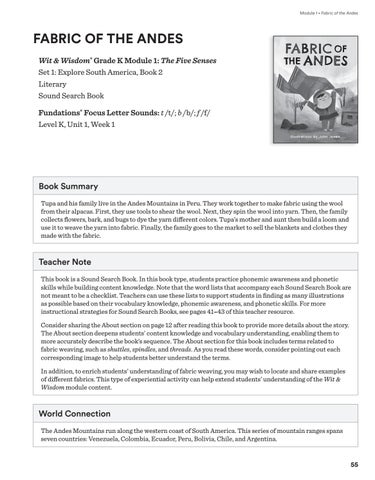
FABRIC OF THE ANDES
Fundations® Focus Letter Sounds: t /t/; b /b/; f /f/ Level K, Unit 1, Week 1 illustrations by John Joven
Book Summary Tupa and his family live in the Andes Mountains in Peru. They work together to make fabric using the wool from their alpacas. First, they use tools to shear the wool. Next, they spin the wool into yarn. Then, the family collects flowers, bark, and bugs to dye the yarn different colors. Tupa’s mother and aunt then build a loom and use it to weave the yarn into fabric. Finally, the family goes to the market to sell the blankets and clothes they made with the fabric.
Teacher Note This book is a Sound Search Book. In this book type, students practice phonemic awareness and phonetic skills while building content knowledge. Note that the word lists that accompany each Sound Search Book are not meant to be a checklist. Teachers can use these lists to support students in finding as many illustrations as possible based on their vocabulary knowledge, phonemic awareness, and phonetic skills. For more instructional strategies for Sound Search Books, see pages 41–43 of this teacher resource. Consider sharing the About section on page 12 after reading this book to provide more details about the story. The About section deepens students’ content knowledge and vocabulary understanding, enabling them to more accurately describe the book’s sequence. The About section for this book includes terms related to fabric weaving, such as shuttles, spindles, and threads. As you read these words, consider pointing out each corresponding image to help students better understand the terms. In addition, to enrich students’ understanding of fabric weaving, you may wish to locate and share examples of different fabrics. This type of experiential activity can help extend students’ understanding of the Wit & Wisdom module content.
World Connection The Andes Mountains run along the western coast of South America. This series of mountain ranges spans seven countries: Venezuela, Colombia, Ecuador, Peru, Bolivia, Chile, and Argentina.
55
Module 1 • Fabric of the Andes
Fundations® Alignment Words Beginning with Fundations® Focus Letter Sounds Level K, Unit 1 The following words feature the Focus Letter Sounds and appear as illustrations in this book. The page numbers indicate the first instance of each featured illustration. Some rows may have gray boxes. These boxes indicate where students are not prompted to search for illustrations with that Focus Letter Sound. Based on your knowledge of students’ vocabulary, help students locate as many illustrations as possible. This list is not designed to be a checklist, but rather a tool for introducing vocabulary and reinforcing letter-sound knowledge.
pp. 0–1
/t/__
/b/__
/f/__
teeth
blue bird
fabric
Tupa
boy
face fly fog fur
pp. 2–3
table
family
tail
father
toe(s)
finger(s)
tool
foot
toy(s)
fox frog
pp. 4–5
basket(s)
fire
boil
flower(s)
braid brother bug pp. 6–7
toss
baby
tug
back bag ball branch
pp. 8–9
tongue
bell block(s) button(s)
pp. 10–11
textile tomato(es)
56
bench
finger puppet flute(s)
Module 1 • Fabric of the Andes
Vocabulary Practice Using your knowledge of students’ vocabulary, select a limited number of words to introduce within the context of the book. Let’s talk about one of the words in this book.
This word is fabric. In this book, the word fabric means “a type of cloth.” Tupa and his family turn yarn made from alpaca wool into fabric (p. 8).
Additional Vocabulary to Discuss: dye, herd, loom, process, shear, spin, textiles, tool, weave, wool
Notes:
57
Module 1 • Fabric of the Andes
Comprehension Discussion Guide To support students in retelling, consider discussing the following questions:
Characters are who the book is about. Who are the characters in this book?
The setting tells where and when the book happens. What is the setting of this book?
The setting of this book is the mountains. The setting is Peru.
Tell about the beginning, middle, and end of this book.
Notes:
58
The characters in this book are Tupa and his brother, father, mother, and aunt. The characters in this book are a family that makes fabric.
At the beginning, Tupa and his family shear wool from their alpacas and turn it into yarn. In the middle, the family works together to dye the yarn and weave it into fabric. At the end, they sell items at the market that they made from the fabric.
Module 1 • Fabric of the Andes
Image Discussion Guide Possible Opening Questions
What do you notice about the images? What do you wonder? What can you learn from the images? How do the images build your knowledge?
Page(s)
Things to Notice
More to Discuss
title page
The woman has a bright hat and clothing.
This woman is a member of the Quechua people. The Quechua are native people from areas of South America, including Peru. Each Quechua village has its own traditional style of dress. Traditional styles for women often include brightly colored skirts, capes or shawls, and hats with detailed embroidery.
2
That looks like a sheep.
This is an alpaca. Quechua women and children tend herds of alpacas, sheep, and llamas all year. Each spring, the families shear the animals, or remove their wool.
4
The boy is carrying flowers in a basket.
Many different natural ingredients are used to make the dye that colors the wool. The bark of the yanali tree is used to make orange dye. Ground-up q’olle flowers make yellow. Red dye comes from the crushed bits of a dried cochineal insect.
8–9
They are making patterns with the yarn.
Tupa’s mother and aunt use colors to make shapes and patterns in the fabric. These patterns can be important symbols for the Quechua people. Long ago, rather than using writing, the Quechua wove specific colors and patterns to tell stories, share thoughts, and make observations about the world.
Notes:
59
Module 1 • Fabric of the Andes
Teachable Moments Vocabulary | Categorizing Words When we sort, or categorize, words or phrases, we group similar words. Many words in this book have to do with making fabric. One example is wool. Ask: “What other words in this book have to do with making fabric?” Examples include dye, loom, shear, spin, tool(s), weave, and yarn.
Style and Conventions | Using Complete Sentences When you talk about, or discuss, the images in a book, you can point to the characters or people and name them. You can also use complete sentences when talking about the people you see. For example, you can tell who you see and what they are doing. On pages 2 and 3, you see Tupa’s brother, and he is shearing wool. Your complete sentence could be “Tupa’s brother is shearing wool.” Ask: “On page 4, who is another person you see?” Then ask: “What is that person doing?” Encourage students to combine that information into a complete sentence to tell what they see. Examples could include “Tupa is collecting flowers” or “Tupa’s mother is dying the yarn.” As applicable, encourage students to discuss how they use different senses to discuss the images in the book.
Response Journal Ideas Depending on students’ readiness, they may draw, dictate, label, or write their responses.
60
Choose an illustration or photograph that taught you something new. Share what you learned. Choose a word you learned from this book. Draw a picture to show what it means.