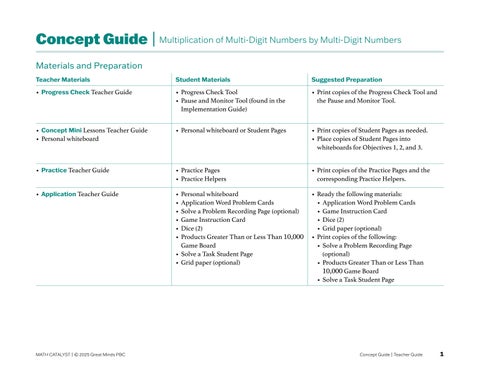
• Pause and Monitor Tool (found in the Implementation Guide)
• Personal whiteboard or Student Pages
Suggested Preparation
• Print copies of the Progress Check Tool and the Pause and Monitor Tool.
• Practice Teacher Guide
• Application Teacher Guide
• Practice Pages
• Practice Helpers
• Personal whiteboard
• Application Word Problem Cards
• Solve a Problem Recording Page (optional)
• Game Instruction Card
• Dice (2)
• Products Greater Than or Less Than 10,000 Game Board
• Solve a Task Student Page
• Grid paper (optional)
• Print copies of Student Pages as needed.
• Place copies of Student Pages into whiteboards for Objectives 1, 2, and 3.
• Print copies of the Practice Pages and the corresponding Practice Helpers.
• Ready the following materials:
• Application Word Problem Cards
• Game Instruction Card
• Dice (2)
• Grid paper (optional)
• Print copies of the following:
• Solve a Problem Recording Page (optional)
• Products Greater Than or Less Than 10,000 Game Board
• Solve a Task Student Page
Addressing Student Misconceptions
Student Misconception How to Address Misconception
Students do not record the partial products with the correct units.
Invite students to use unit form to say the expressions that represent the partial products. For example, when students are multiplying 345 and 24, use the following questions to help them make connections between unit form and the standard algorithm.
• What is 5 ones × 4 ones?
• Can we rename 20 ones by using a larger unit?
• Are there only going to be 2 tens after we multiply 345 by 4 ones, or will there be more?
Demonstrate how to record the 2 below the line in the tens place to leave room to add more tens later. Then record the 0 in the ones place. Have students discuss how they see the partial product of 20 represented. Continue using unit form to say the expressions that represent the partial products.
Language Support
To support multilingual learners in making cross-linguistic connections through oral discourse, consider using strategic, flexible grouping.
• Pair students who have different levels of mathematical proficiency.
• Pair students who have different levels of English language proficiency.
• Join pairs to form small groups of four.
As applicable, complement any of these groupings by pairing students who speak the same home language. Encourage students to use their home language alongside English to make sense of the directions and the mathematics.
To support multilingual learners in making cross-linguistic connections through written discourse, consider creating cross-linguistic connections anchor charts. The chart should include
• key terminology in the student’s home language that is related to the current concept,
• the same key terminology in English, and
• images to support understanding.
Family Math
Dear Family,
Multiplication of Multi-Digit Numbers by Multi-Digit Numbers
Your student is working on multiplying multi-digit numbers by multi-digit numbers. Your student uses area models, the distributive property, vertical form, and partial products to multiply multi-digit numbers. All of this leads to multiplying multi-digit numbers by using the standard algorithm with and without regrouping. You can support your student’s progress by asking the questions in the table below as your student multiplies multi-digit numbers by multi-digit numbers.
Can you picture an area model to help you think about how to break apart the factors?
I can picture the area model in my head without drawing it. I think about how the factors would be broken apart in the area model.
How can you record the partial products when you need to rename as a larger unit?
When I need to rename as a larger unit, I can use more than one place to record the product. For example, the product of 4 ones and 7 ones is 28 ones or 2 tens 8 ones. I can record a small 2 in the tens place and an 8 in the ones place.
How can you use the partial products to find the product?
I can add the partial products.
Matemáticas en familia |
Multiplicación de números de varios dígitos por números de varios dígitos
Estimada familia:
Su estudiante está trabajando en multiplicar números de varios dígitos por números de varios dígitos. Usa modelos de área, la propiedad distributiva, la forma vertical y los productos parciales para multiplicar números de varios dígitos. Todo esto lleva a multiplicar números de varios dígitos usando el algoritmo convencional con y sin reagrupación. Usted puede apoyar el progreso de su estudiante haciéndole las preguntas de la siguiente tabla mientras su estudiante multiplica números de varios dígitos por números de varios dígitos.
¿Puedes dibujar un modelo de área como ayuda para pensar cómo separar los factores?
Puedo imaginar el modelo de área sin dibujarlo. Pienso en cómo separar los factores en el modelo de área.
34 × 637 = 21,658
¿Cómo puedes registrar los productos parciales cuando necesitas expresarlos como una unidad de valor posicional más larga?
Cuando necesito expresarlos como una unidad de valor posicional más larga, puedo usar más de una posición para registrar el producto. Por ejemplo, el producto de 4 unidades por 7 unidades es 28 unidades o 2 decenas y 8 unidades. Puedo registrar un pequeño 2 en la posición de las decenas y un 8 en la posición de las unidades.
¿Cómo puedes usar los productos parciales para hallar el producto?
Puedo sumar los productos parciales.
Concept Mini Lessons
Progression of Mini Lesson Objectives
1 Multiply three-digit numbers by two-digit numbers by using the distributive property.
2
Start here if students
• can decompose a multi-digit number into place value units and
• can multiply two-digit numbers by two-digit numbers by using an area model, but
• need support multiplying a three-digit number by a two-digit number by using the distributive property.
Multiplication of Multi-Digit Numbers by Multi-Digit Numbers
2 Multiply three-digit numbers by two-digit numbers by using vertical form and six partial products.
Start here if students
• can multiply a two-digit number by a two-digit number by using four partial products and
• can multiply a three-digit number by a two-digit number by using the distributive property, but
• need support multiplying a three-digit number by a two-digit number by using vertical form and six partial products.
3 Multiply three-digit numbers by two-digit numbers by using the standard algorithm.
Start here if students
• can multiply a three-digit number by a two-digit number by using partial products and
• can multiply a two-digit number by a two-digit number by using the standard algorithm, but
• need support multiplying a three-digit number by a twodigit number by using the standard algorithm when no regrouping is required in the partial products.
4 Multiply three-digit numbers by two-digit numbers with multiple regroupings by using the standard algorithm.
Start here if students
• can multiply a two-digit number by a two-digit number by using the standard algorithm and
• can multiply a three-digit number by a two-digit number by using the standard algorithm when no regrouping is required, but
• need support multiplying a three-digit number by a two-digit number by using the standard algorithm when regroupings are required in the partial products.
Objective 1 |
Multiply three-digit numbers by two-digit numbers by using the distributive property.
10 MINUTES
Summary
Students multiply three-digit numbers by two-digit numbers by using an area model and relating it to the distributive property.
Distribute the Objective 1 Student Page. Direct students to problem 1: 12 × 324.
H I can ask myself, How can I break apart the factors to help me multiply? What do you think?
3 hundreds + 2 tens + 4 ones
+ 20 + 4 1 ten + 2 ones
H Now we can use an area model to multiply.
Invite students to label the side lengths of the area model.
Teacher Tip
A factor in a multiplication expression can be represented by either side length of an area model. To support students as they multiply multi-digit numbers and record partial products in vertical form, encourage them to consistently represent the first factor by using the vertical side length and the second factor by using the horizontal side length.
Materials
• Objective 1 Student Page
Gesture to the 2 by 4 rectangle in the area model as you ask the following question.
H
How can I find the area of the 2 by 4 rectangle?
You can multiply: 2 × 4 = 8.
Write the equation in the rectangle as students record the partial product in their area model. Repeat the process with the 2 by 20 rectangle and the 2 by 300 rectangle.
H We distributed 2 to the 4 ones, the 2 tens, and the 3 hundreds of the factor 324. First, we found 2 × 4. Next, we found 2 × 20. Then, we found 2 × 300. What do we still need to multiply?
We need to multiply 10 by 300, 20, and 4.
Gesture to the 10 by 4 rectangle in the area model as you ask the following question.
H I can ask myself, How can I find the area of the 10 by 4 rectangle? What do you think?
10 × 4 = 40
Write the equation in the rectangle as students record the partial product in their area model. Gesture to the remaining rectangles and
Objective 1 |
Multiply three-digit numbers by two-digit numbers by using the distributive property.
10 MINUTES
repeat the process.
After each row is complete, discuss how 10 was distributed to 300, 20, and 4.
Teacher Tip
Consider drawing on a place value chart to support student understanding of 1 hundred × 1 ten = 1 thousand. It is important for students to be able to apply this understanding to multiply multiples of 10 by multiples of 100 (e.g., 10 × 300). × 10 thousandshundreds
1 hundred × 1 ten = 1 thousand 100 × 10 = 1,000
H The area model shows the partial products. How do we use the partial products to find 12 × 324?
We add all the partial products.
Invite students to add the partial products to find the product.
What is the sum of the partial products? H
3,888
What is the product of 12 and 324? H
3,888
We used an area model to multiply. We can also use equations and the distributive property to organize the multiplication.
Write the following:
3,888
Gesture to the multiplication expression 10 × 300.
H Where do you see 10 × 300 in the area model? It’s the 10 by 300 rectangle.
Repeat the process with the remaining multiplication expressions to help students make connections between the equations that show the distributive property and the area model.
Invite students to turn and talk about how they can use the distributive property to multiply multi-digit numbers.
Repeat the process: Use the following problems during Concept Mini Lessons or at another time to provide additional practice as necessary. Consider providing the Objective 1 Practice Helper and supporting students in using the worked-out example to guide their own work.
Objective 1 |
Multiply three-digit numbers by two-digit numbers by using the distributive property. 10 MINUTES
• 23 × 516 = ________
• 38 × 912 = ________
• 52 × 604 = ________
Analyze Student Progress
Monitor:
• Can the student use place value to break apart both factors in the area model?
• Can the student correctly find the partial products?
• Does the student add the partial products to find the product?
• Can the student explain how the distributive property is used to find the product?
Questions to Advance Student Thinking:
• How can you draw and label an area model to show how to break apart both factors?
• How can you use the area model to help you find the partial products?
• How can you use the partial products to find the product?
• How do you see the distributive property represented in the area model?
Plan Future Practice:
Use Practice Page 1 to support students who need additional practice. Structure the additional practice strategically to allow for teacher support or peer support. Notes
Objective 2 |
Multiply three-digit numbers by two-digit numbers by using vertical form and six partial products.
10 MINUTES
Summary
Students use unit form to identify place value units as they record six partial products in vertical form.
Distribute the Objective 2 Student Page. Direct students to problem 1: 52 × 415.
H Let’s record the partial products without drawing an area model. Try to picture the area model in your head without drawing it. In your head, how would the factors be broken apart in the area model?
We would break apart 52 as 50 and 2. We would break apart 415 as 400, 10, and 5
Language Support
The word picture has multiple meanings. In this context, picture is used to prompt students to create a mental image in their minds. In other contexts, it is used to refer to a concrete image of something. Consider highlighting the different meanings of picture.
Write 52 × 415 in vertical form as students do the same.
H Let’s use unit form to say the expressions that represent the partial products to make sure we record the place value units correctly.
Point to the numbers in vertical form as you refer to them.
Materials
• Objective 2 Student Page
H Picture the top row of the area model. We need to distribute to multiply 5 ones, 1 ten, and 4 hundreds by 2 ones. First, we find 2 ones × 5 ones. What is 2 ones × 5 ones?
10 ones
Write the expression 2 ones × 5 ones near where the partial product will be recorded. Then record the partial product 10 as students do the same. Repeat the process with 2 ones × 1 ten and 2 ones × 4 hundreds.
HWe distributed 2 to the 5 ones, 1 ten, and 4 hundreds of the factor
415. First, we found 2 × 5. Next, we found 2 × 10. Then, we found 2 × 400. Picture the bottom row of the area model.
What do have left to multiply?
We need to multiply 5 ones, 1 ten, and 4 hundreds by 5 tens.
H Now we need to find 5 tens × 5 ones. What is 5 tens × 5 ones?
25 tens
Objective 2 |
Multiply three-digit numbers by two-digit numbers by using vertical form and six partial products.
10 MINUTES
How do we record 25 tens? H
250
Write the expression 5 tens × 5 ones near where the partial product will be recorded. Then record the partial product 250 as students do the same.
H I can ask myself, What do I multiply by 5 tens next? What do you think?
1 ten
When we multiply two multiples of ten, what unit do we use for the product?
Hundreds
What is 5 tens × 1 ten? H
5 hundreds
Write the expression 5 tens × 1 ten near where the partial product will be recorded. Then record the partial product 500 as students do the same.
H What is the final partial product?
5 tens × 4 hundreds
H When we multiply a multiple of ten by a multiple of one hundred, what unit do we use for the product?
Thousands
H What is 5 tens × 4 hundreds?
20 thousands
Write the expression 5 tens × 4 hundreds near where the partial product will be recorded. Then record the partial product 20,000 as students do the same.
H How do we find the product?
We add all the partial products.
Invite students to add the partial products to find the product.
H What is the sum of the partial products?
21,580
What is the product of 52 and 415?
21,580
H How do we know that we found and recorded all the partial products?
We multiplied each part of 415 by each part of 52
We started with 2 ones and multiplied each part of 415 by 2 ones. Then we multiplied each part of 415 by 5 tens.
Objective 2 |
Multiply three-digit numbers by two-digit numbers by using vertical form and six partial products.
10 MINUTES
Invite students to turn and talk about how they can record partial products in vertical form.
Language Support
Consider providing scaffolded sentence frames to support students as they explain their calculations.
• First, we multiply ________ ones by ________ ones.
• Next, we multiply ________ tens by ________ ones.
• Then, we multiply ________ by ________. (Repeat for remaining units.)
• Finally, we add the partial products and get ________.
Repeat the process: Use the following problems during Concept Mini Lessons or at another time to provide additional practice as needed. Consider providing the Objective 2 Practice Helper and supporting students in using the worked-out example to guide their own work.
• 45 × 281 = ________
• 16 × 836 = ________
• 34 × 201 = ________
Analyze Student Progress
Monitor:
• Can the student use place value to break apart both factors?
• Can the student find and record all the partial products in vertical form?
• Does the student add the partial products to find the product?
Questions to Advance Student Thinking:
• Can you picture an area model to help you think about how to break apart the factors?
• How do you know that you found and recorded all the partial products?
• How can you use the partial products to find the product?
Plan Future Practice:
Use Practice Page 2 to support students who need additional practice. Structure the additional practice strategically to allow for teacher support or peer support.
Objective 3 |
Multiply three-digit numbers by two-digit numbers by using the standard algorithm.
10 MINUTES
Summary
Students use the standard algorithm to multiply multi-digit numbers that require no regroupings in the partial products.
Distribute the Objective 3 Student Page. Direct students to the image of the two area models on the Student Page.
Gesture to each area model and say how many partial products are represented by the area models. Invite students to think–pair–share to compare the area model with six partial products to the area model with two partial products.
Both area models represent 43 × 212.
3 × 212 is represented in the top row of each area model. The 636 in the area model with two partial products is represented by three separate partial products, 600, 30, and 6, in the area model with six partial products.
40 × 212 is represented in the bottom row of each area model. The 8,480 in the area model with two partial products is represented by three separate partial products—8,000, 400, and 80—in the area model with six partial products.
Materials
• Objective 3 Student Page
The area model with six partial products broke apart both factors, and the area model with two partial products only broke apart one of the factors.
H Both area models represent the same multiplication problem, but they break apart the factors differently. The second area model has fewer partial products to add.
Write 13 × 321.
HLet’s record the partial products in vertical form with two partial products. We can still picture an area model in our heads without drawing it.
Direct students to write 13 × 321 in vertical form and to picture an area model with two partial products that represent 13 × 321. Invite students to turn and talk about how one of the factors would be broken apart in the area model with two partial products.
H Let’s use unit form to say the expressions that represent the partial products to make sure we record the place value units correctly.
Point to the numbers as you refer to them.
Objective 3 |
Multiply three-digit numbers by two-digit numbers by using the standard algorithm.
10 MINUTES
Language Support
Point and use gestures to support students in tracking the factors they multiply in each step and in recognizing where they record the digits in the partial products.
H
We need to multiply 13 by each part of 321. Picture the top row of the area model. I can ask myself, Which part of 13 do I multiply by first? What do you think?
3 ones
H To multiply 321 by 3 ones, we first find 3 ones × 1 one. What is 3 ones × 1 one?
3 ones
Write 3 below the line in the ones places as students do the same.
H What do we multiply by 3 ones next?
2 tens; 3 ones × 2 tens is 6 tens
H We record the 6 tens to the left of the 3 ones.
Write 6 below the line in the tens places as students do the same.
H What do we multiply by 3 ones next?
3 hundreds; 3 ones × 3 hundreds is 9 hundreds.
H We record the 9 hundreds to the left of the 6 tens.
Write 9 below the line in the hundreds places as students do the same.
H We multiplied 3 ones by each digit of 321. Picture the bottom row of the area model. I can ask myself, Which part of 13 do I multiply by next? What do you think?
We should multiply by the other part of 13, 1 ten.
H We need to multiply 1 ten by 321. To do that we first multiply 1 ten by 1 one. What is 1 ten × 1 one in unit form?
1 ten
Watch how I record 1 ten, or 10.
Write 1 below the first partial product in the tens place and write 0 in the ones place. Direct students to do the same.
I can ask myself, What do I still need to multiply? What do you think?
We still need to multiply 1 ten × 2 tens, which is 2 hundreds.
Write 2 below the first partial product in the hundreds place, to the left of the 1 ten. Direct students to do the same.
Do I still need to multiply? What do you think?
Yes. We need to find 1 ten × 3 hundreds, which is 3 thousands.
Write 3 below the first partial product in the thousands place, to the left of the 2 tens. Direct students to do the same.
Objective
3 |
Multiply three-digit numbers by two-digit numbers by using the standard algorithm.
10 MINUTES
H Do I still need to multiply? What do you think?
No. We have multiplied all the parts of 13 by 321.
Label each partial product to show that 963 is 3 × 321 and 3,210 is 10 × 321. Direct students to do the same.
What is important to think about as we record three partial products on the same line in vertical form? H
We need to think about the units we are multiplying by and record the partial product with the correct units.
H
When we combine partial products and record them on the same line, it is called using the standard algorithm.
Model adding the partial products to find the product as students follow along.
What is 13 × 321? H 4,173
Teacher Tip
Students can record the factors in either order when recording in vertical form. Recording the number with more digits on top, as modeled in this Concept Mini Lesson, reduces the number of partial products.
Invite students to turn and talk about how they can find and record partial products by using the standard algorithm.
Repeat the process: Use the following problems during Concept Mini Lessons or at another time to provide additional practice as needed. Consider providing the Objective 3 Practice Helper and supporting students in using the worked-out example to guide their own work.
• 21 × 143 = ________
• 43 × 421 = ________
• 504 × 22 = ________
Teacher Tip
Problems 3 and 4 on the Student Page do not contain grids. Consider providing grid paper to support students in aligning the digits by place value units.
Objective 3 |
Multiply three-digit numbers by two-digit numbers by using the standard algorithm. 10 MINUTES
Analyze Student Progress
Monitor:
• Can the student use place value to break apart both factors?
• Can the student record two partial products by using the standard algorithm?
• Can the student add the partial products to find the final product?
Questions to Advance Student Thinking:
• Can you picture an area model to help you think about how to break apart the factors?
• How can you record two partial products by using the standard algorithm?
• How can you use the partial products to find the product?
Plan Future Practice:
Use Practice Page 3 to support students who need additional practice. Structure the additional practice strategically to allow for teacher support or peer support.
Notes
Objective 4 |
Multiply three-digit numbers by two-digit numbers with multiple regroupings by using the standard algorithm.
10 MINUTES
Summary
Students use the standard algorithm to multiply multi-digit numbers that require regrouping in the partial products.
Write 23 × 546 and direct students to do the same.
H What partial products could we use to find this product?
3 × 546 and 20 × 546
H Let’s use unit form to say the expressions that represent the partial products to make sure we record the place value units correctly. We can still picture an area model in our heads without drawing it, if needed.
32 + ×
3 ones × 546
2 tens × 546
Materials
• Objective 4 Student Page (optional)
Direct students to write 23 × 546 in vertical form and to identify the partial products.
Point to the numbers as you refer to them.
H
We need to multiply 546 by 2 tens and 3 ones. Picture the top row of an area model. I can ask myself, Which part of 23 do I multiply by first? What do you think?
3 ones
To multiply 546 by 3 ones, we first find 6 ones × 3 ones.
What is 6 ones × 3 ones?
18 ones
H Can I rename 18 ones by using a larger unit?
12 tens plus 1 ten is 13 tens. 546
Yes. You can rename 18 ones as 1 ten 8 ones.
Is there only going to be 1 ten after we multiply 546 by 3 ones, or could there be more?
There could be more.
H Let’s record that 1 ten and leave room to add more later. Watch how I record 18 ones, or 1 ten 8 ones.
Write a small 1 to represent 1 ten on the line under the tens place. Write 8 below the line in the ones place. Direct students to do the same.
H What do we multiply by 3 ones next?
4 tens; 3 ones × 4 tens is 12 tens.
H How many tens do we have in all?
+ ×
Objective 4 |
MINUTES
Say 13 tens as hundreds and tens.
1 hundred 3 tens
H Is there only going to be 1 hundred after we multiply 546 by 3 ones, or could there be more?
There could be more.
Cross out the 1 on the line. Write a small 1 to represent 1 hundred on the line under the hundreds place. Write 3 below the line in the tens place. Direct students to do the same.
What do we multiply by 3 ones next?
5 hundreds. 3 ones × 5 hundreds is 15 hundreds
H How many hundreds do we have in all? 15 hundreds plus 1 hundred is 16 hundreds.
Say 16 hundreds as thousands and hundreds.
1 thousand 6 hundreds
H Is there only going to be 1 thousand after we multiply 546 by 3 ones, or could there be more?
There cannot be more, because we have multiplied each unit of 546 by 3 ones.
Cross out the 1 on the line. Write a 1 below the line in the thousands place and a 6 below the line in the hundreds place.
H Picture the bottom row of the area model. I can ask myself, What do I multiply by next? What do you think?
2 tens
To multiply 546 by 2 tens, first we find 2 tens × 6 ones. What is
tens × ones 26 in unit form?
12 tens
H Say 12 tens as hundreds and tens. 1 hundred 2 tens
Will there be more tens after we multiply 546 by 2 tens?
No. There will be no more tens.
H Is there going to be only 1 hundred after we multiply 546 by 2 tens, or could there be more?
There could be more.
H Watch how I record 1 hundred 2 tens.
Write a small 1 to represent 1 hundred just under the 6 in the hundreds place. Write 2 below the 3 in the tens place. Write 0 below the 8 in the ones place. Direct students to do the same.
H I can ask myself, What do I still need to multiply? What do you think?
We still need to multiply 2 tens by 4 tens, which is 8 hundreds.
Objective 4 |
Multiply three-digit numbers by two-digit numbers with multiple regroupings by using the standard algorithm.
10 MINUTES
H 9 hundreds
How many hundreds do we have in all?
H Watch how I record 9 hundreds.
Cross out the small 1. Below the 6 in the hundreds place, write 9.
Is there more to multiply? What do you think? H
We still need to multiply 2 tens by 5 hundreds, which is 10 thousands.
H Say 10 thousands as ten thousands. 1 ten thousand
Will there be more ten thousands after we multiply 546 by 2 tens? H
No. There will be no more ten thousands.
H Watch how I record 1 ten thousand.
Write a 1 in the ten thousands place and a 0 below the 1 in the thousands place.
H How do we know we found all the partial products?
We know because we multiplied 546 by each part of 23.
What is important to think about as we record the partial products in vertical form? H
We need to think about the units we are multiplying by and record the partial product with the correct units.
We may need to rename units and add new units after we multiply.
Model adding the partial products to find the product as students follow along.
H What is 23 × 546?
Invite students to turn and talk about how they can find and record partial products by using the standard algorithm.
Repeat the process: Use the following problems during Concept Mini Lessons or at another time to provide additional practice as needed.
Consider providing the Objective 4 Practice Helper and supporting students in using the worked-out example to guide their own work.
Objective
10 MINUTES
|
Teacher Tip
The last problem, 624 × 83, is presented with the larger number first. Consider discussing how students can apply the commutative property of multiplication to think about the problem as 83 × 624.
Analyze Student Progress
Monitor:
• Can the student use place value to break apart both factors?
• Can the student record two partial products by using the standard algorithm, including regrouping units?
• Can the student add the partial products to find the final product?
Questions to Advance Student Thinking:
• Can you picture an area model to help you think about how to break apart the factors?
• How can you record the partial products when you need to rename as a larger unit?
• How can you use the partial products to find the product?
Plan Future Practice:
Use Practice Page 4 to support students who need additional practice. Structure the additional practice strategically to allow for teacher support or peer support.
Concept Mini Lessons |
Multiplication of Multi-Digit Numbers by Multi-Digit Numbers
Multiply three-digit numbers by two-digit numbers by using vertical form and six partial products.
Multiply by recording the partial products in vertical form.
52 × 415 =
45 × 281 =
Objective 2 |
Multiply three-digit numbers by two-digit numbers by using vertical form and six partial products.
Multiply by recording the partial products in vertical form.
Objective 3 |
Multiply three-digit numbers by two-digit numbers by using the standard algorithm.
Multiply by using the standard algorithm.
Objective 3 |
Multiply three-digit numbers by two-digit numbers by using the standard algorithm
Multiply by using the standard algorithm.
Objective 4 |
Multiply three-digit numbers by two-digit numbers with multiple regroupings by using the standard algorithm.
Multiply by using the standard algorithm.
1 23 × 546 = _______________
3 63 × 804 =
2 38 × 529 = _______________
4 624 × 83 =
Progress Check |
Multiplication of Multi-Digit Numbers by Multi-Digit Numbers
About the Progress Check Tool
The Progress Check Tool is an assessment that can be used before, during, or after providing direct instruction. It is intended to collect data about students’ proficiency with multiplication of multi-digit numbers by multi-digit numbers and is not designed to be graded. The Progress Check Tool has problems that are sequenced from simple to complex. Problems 1 and 2 involve multiplying three-digit numbers by two-digit numbers by using the distributive property, problems 3 and 4 involve multiplying three-digit numbers by two-digit numbers by using vertical form and six partial products, problems 5 and 6 involve multiplying three-digit numbers by two-digit numbers by using the standard algorithm, and problems 7 and 8 involve multiplying three-digit numbers by two-digit numbers with multiple regroupings by using the standard algorithm.
Using the Progress Check Tool to Inform Instruction
When making instructional decisions based on the data collected with the Progress Check Tool, consider the following questions:
• Can the student multiply a three-digit number by a two-digit number by using the distributive property?
| Objective 1
• Can the student multiply a three-digit number by a two-digit number by using vertical form and six partial products?
| Objective 2
• Can the student multiply a three-digit number by a two-digit number by using the standard algorithm when no regrouping is required in the partial products?
| Objective 3
• Can the student multiply a three-digit number by a two-digit number by using the standard algorithm when regroupings are required in the partial products?
| Objective 4
Teacher Tip
Consider acknowledging and praising students’ achievements. Share the results of the Progress Check Tool with students and celebrate their progress.
Progression Toward Proficiency Rubric
Progress Check Tool
Item(s)
Not Yet Proficient
Items 1 and 2
Objective 1
The student may show evidence of beginning to understand how to multiply three-digit numbers by two-digit numbers by using the distributive property but makes more than one calculation error that leads to an incorrect answer.
Items 3 and 4
Objective 2
The student may show evidence of beginning to understand how to multiply three-digit numbers by twodigit numbers by using vertical form and six partial products but makes more than one calculation error that leads to an incorrect answer.
Item 5
Objective 3
The student may show evidence of beginning to understand how to multiply three-digit numbers by twodigit numbers with no regrouping by using the standard algorithm but makes more than one calculation error that leads to an incorrect answer.
Items 6 and 7
Objective 4
The student may show evidence of beginning to understand how to multiply three-digit numbers by two-digit numbers with multiple regroupings by using the standard algorithm but makes more than one calculation error that leads to an incorrect answer.
Partially Proficient
The student correctly demonstrates solid reasoning but makes one calculation error that leads to an incorrect answer, or the student demonstrates some reasoning and has the correct answer.
Proficient The student correctly uses the distributive property to multiply.
1. Area model completed ; 25,848
2. Area model completed; 21,126
The student correctly demonstrates solid reasoning but makes one calculation error that leads to an incorrect answer, or the student demonstrates some reasoning and has the correct answer.
The student correctly demonstrates solid reasoning but makes one calculation error that leads to an incorrect answer, or the student demonstrates some reasoning and has the correct answer.
The student correctly demonstrates solid reasoning but makes one calculation error that leads to an incorrect answer, or the student demonstrates some reasoning and has the correct answer.
The student correctly uses vertical form and six partial products to multiply.
The student correctly uses the standard algorithm to multiply.
5. Correct standard algorithm; 6,908
The student correctly regroups while using the standard algorithm to multiply.
6. Correct standard algorithm; 19,608
7. D
Progress Check Tool |
Multiplication of Multi-Digit Numbers by Multi-Digit Numbers
Distribute to multiply.
Multiply by recording the partial products in vertical form.
Progress Check Tool | Multiplication
of Multi-Digit Numbers
by Multi-Digit Numbers
Multiply by using the standard algorithm. 5 22 × 314 = _______________
43 × 456 = _______________
7 What is the product of 65 and 807? Show your work. Circle the letter of the correct answer. A 41,455
Practice |
Multiplication of Multi-Digit Numbers by Multi-Digit Numbers
Practice Pages
The Practice Pages are sequenced from simple to complex and align with Multiplication of Multi-Digit Numbers by Multi-Digit Numbers
Concept Mini Lessons Objectives 1–4. Consider providing students with the answer key for the Practice Pages. Then students can check their work and make corrections if necessary.
Practice Helpers
Practice Helpers can be used to support students working independently or with a partner to complete the Practice Pages. Each Practice Page has a corresponding Practice Helper with one solved problem that is similar to a problem on the Practice Page. The solutions include sample work and guiding questions that represent the thinking required to approach the problem. Consider providing the Practice Helpers during Concept Mini Lessons and supporting students in using the worked-out examples to guide their own work.
Practice Page 1
Objective 1 Multiply three-digit numbers by twodigit numbers by using the distributive property.
Look for ...
• Can the student use place value to break apart both factors in the area model?
• Can the student correctly find the partial products?
• Does the student add the partial products to find the product?
• Can the student explain how the distributive property is used to find the product?
Practice
Page 2
Objective 2 Multiply threedigit numbers by two-digit numbers by using vertical form and six partial products.
Look for ...
• Can the student use place value to break apart both factors?
• Can the students find and record all the partial products in vertical form?
• Does the student add the partial products to find the product?
Practice
Page 3
Objective 3 Multiply threedigit numbers by two-digit numbers by using the standard algorithm.
Look for ...
• Can the student use place value to break apart both factors?
• Can the student record two partial products by using the standard algorithm?
• Can the student add the partial products to find the final product?
Practice Page 4
Objective 4 Multiply three-digit numbers by twodigit numbers with multiple regroupings by using the standard algorithm.
Look for ...
• Can the student use place value to break apart both factors?
• Can the student record two partial products by using the standard algorithm, including regrouping units?
• Can the student add the partial products to find the final product?
4. To find the first partial product, 4 × 402, Kayla multiplied 4 ones by 4 tens. She should have multiplied 4 ones by 4 hundreds. To find the second partial product, 30 × 402, Kayla multiplied 3 tens by 4 tens. She should have multiplied 3 tens by 4 hundreds.
4. To find the second partial product, 60 × 752, Noah multiplied 6 tens by 2 ones and wrote the product as 12. 60 × 2 = 120.
Student
Edition | Printable Pages for students
Practice Page 1 |
Multiply three-digit numbers by two-digit numbers by using the distributive property.
Distribute to multiply. 1 14 × 275 =
23 × 613 =
32 × 876 =
46 × 702 =
Practice Page 2 |
Multiply three-digit numbers by two-digit numbers by using vertical form and six partial products.
Multiply by recording the partial products in vertical form.
32 × 355
Practice Page 2 |
Multiply three-digit numbers by two-digit numbers by using vertical form and six partial products.
Multiply by recording the partial products in vertical form.
3 17 × 957 = _______________
4 What is the product of 26 and 701? Circle the letter of the correct answer.
A 1,846
B 5,608
C 18,226
D 18,926 + ×
Practice Page 3 |
Multiply three-digit numbers by two-digit numbers by using the standard algorithm.
Multiply by using the standard algorithm.
Practice Page 3 |
Multiply three-digit numbers by two-digit numbers by using the standard algorithm.
Multiply by using the standard algorithm.
3 What is the product of 23 and 213? Show your work. Circle the letter of the correct answer.
A 1,065
B 4,896
C 4,899
D 4,999
4 Kayla incorrectly multiplied by using the standard algorithm. Look at Kayla’s work. What mistake did Kayla make?
Kayla’s Work
402 × 34 = 1,428
Practice Page 4 |
Multiply three-digit numbers by two-digit numbers with multiple regroupings by using the standard algorithm.
Multiply by using the standard algorithm.
4 Noah incorrectly multiplied by using the standard algorithm. Look at Noah’s work. What mistake did Noah make?
Practice Helper 1
Look at the problem. Then look at the work. It shows how to multiply three-digit numbers by two-digit numbers by using the distributive property.
Distribute to multiply.
37 × 528 = ________
How can you draw and label an area model to show how to break apart both factors?
500 20 8 7 30 5 hundreds + 2 tens + 8 ones
3 tens + 7 ones
I can break apart both factors by place value. Then I can label the side lengths of the area model.
How can you use the area model to help you find the partial products?
I can find the area of each rectangle in the area model.
How can you use the partial products to find the product?
The area model shows a partial product in each rectangle. I can add all the partial products to find 37 × 528.
How do you see the distributive property represented in the area model?
In the top row, I see 7 distributed to all three parts of 528. In the bottom row, I see 30 distributed to all three parts of 528.
37 × 528 = 19,536
Practice Helper 2
Look at the problem. Then look at the work. It shows how to multiply three-digit numbers by two-digit numbers by using vertical form and six partial products.
Multiply by recording the partial products in vertical form.
32 × 355 = ________
Can you picture an area model to help you think about how to break apart the factors?
I can picture the area model in my head without drawing it. I think about how the factors would be broken apart in the area model.
How do you know that you have found and recorded all the partial products?
I know that I have found and recorded all the partial products when I have multiplied each part of 355 by each part of 32.
How can you use the partial products to find the product?
I can add all the partial products.
32 × 355 = 11,360
Practice Helper 3
Look at the problem. Then look at the work. It shows how to multiply three-digit numbers by two-digit numbers by using the standard algorithm.
Multiply by using the standard algorithm.
31 × 233 = ________
Can you picture an area model to help you think about how to break apart the factors?
I can picture the area model in my head without drawing it. I think about how the factors would be broken apart in the area model.
How can you record two partial products by using the standard algorithm?
I can record the partial products on the same line. I need to think about the units we are multiplying by and record the partial product with the correct units.
How can you use the partial products to find the product?
I can add the partial products.
31 × 233 = 6,913
Practice Helper 4
Look at the problem. Then look at the work. It shows how to multiply three-digit numbers by two-digit numbers with multiple regroupings by using the standard algorithm.
Multiply by using the standard algorithm.
34 × 637 = ________
Can you picture an area model to help you think about how to break apart the factors?
I can picture the area model in my head without drawing it. I think about how the factors would be broken apart in the area model.
How can you record the partial products when you need to rename as a larger unit?
When I need to rename as a larger unit, I can use more than one place to record the product. For example, the product of 4 ones and 7 ones is 28 ones, or 2 tens 8 ones. I can record a small 2 in the tens place and an 8 in the ones place.
How can you use the partial products to find the product?
I can add the partial products.
34 × 637 = 21,658
Application
| Multiplication of Multi-Digit Numbers by Multi-Digit Numbers
Activities, Structures, and Considerations
Use the chart below to determine how to use the Application resources to best meet the needs of your students. The activities provide opportunities for partner or independent work. Use any combination of the activities and structures to engage students in applying their understanding of multiplication of multi-digit numbers by multi-digit numbers.
Read–Draw–Write
Support students as they use this simple, repeatable process to solve problems. The more students participate in reasoning through problems with this systematic approach, the more they internalize these practices and thought processes. The Read–Draw–Write (RDW) process is a way students can make sense of problems, choose and apply mathematical strategies, and solve. Here are the steps students take when using the RDW process.
• Read the problem all the way through. Then reread a chunk at a time. As you reread, ask yourself, “Can I draw something?” Then ask, “What can I draw?”
• Draw to represent the problem as you reread. Add to or revise your drawing as you uncover new information or discover what is unknown. As you draw, label what is known and what is unknown. When you finish rereading and drawing, ask yourself, “What does my drawing show me?” Let your drawing help you find a way to solve.
• Write number sentences or equations to represent your thinking. Solve. Then use your solution to write a statement that answers the original question.
Activity Structure(s) Considerations
Solve a Problem Independent Work Partner Work
Play a Game Partner Work
Solve a Task Partner Work
• Consider providing the Read–Draw–Write Tool to support students as they solve problems involving multiplication of multi-digit numbers by multi-digit numbers. Two printable versions of the Read–Draw–Write Tool can be found in the Implementation Guide.
• Consider inviting students to share their work with a partner. Students can compare solution paths and make connections between different representations.
• Consider providing students with the Solve a Problem Recording Page as an alternative to working on a personal whiteboard.
• Consider providing tools such as grid paper to support students in drawing an area model or in using vertical form.
• Consider providing grid paper to support students in aligning digits by place value units.
Application | Multiplication of Multi-Digit Numbers by Multi-Digit Numbers
Solve a Problem
Materials
• Personal whiteboard
• Application Word Problem Cards
• Solve a Problem Recording Page (optional)
Students use the Read–Draw–Write process to solve word problems that involve multiplication of multi-digit numbers by multi-digit numbers. Students can record solutions on a whiteboard or on the Solve a Problem Recording Page. Problem 1 involves multiplying a number by a multiple of 10. Problems 2 and 3 involve multiplying a three-digit number by a two-digit number.
Teacher Tip
Consider facilitating one of the Application activities with a small group of students. Facilitating an Application activity enables you to informally monitor progress and provide support as needed.
Play a Game:
Products Greater Than or Less Than 10,000
Materials
• Dice (2)
• Products Greater Than or Less Than 10,000 Game Board
• Game Instruction Card
• Personal whiteboard
• Grid paper (optional)
Students work with a partner to play a game involving multiplying three-digit numbers by two-digit numbers.
Preparing to Play
• Before playing, each player rolls a die. The player with the lower number is player A.
• Consider providing tools such as grid paper to support students in drawing an area model or in using vertical form.
Playing the Game
• Player A rolls their die three times and records the three-digit number. Player B rolls their die
two times and records the twodigit number.
• Each player records both multidigit numbers and multiplies them to find the product. Players check each other’s work.
• Player A gets a point if the product is less than 10,000. Player B gets a point if the product is greater than 10,000.
• The player with more points after five rounds wins.
Solve a Task Materials
• Solve a Task Student Page
Students work with a partner to solve a multi-part task that involves multiplication of multi-digit numbers by multidigit numbers. They are given important information about the problem and an image to support their understanding of the context. Then students solve three problems related to the given context. The problems require students to think critically about how to use the given information to determine a solution.
Answer Key
Solve a Problem
1. The warehouse has 6,750 glue sticks.
Solve a Task
2. There are 4,920 staples in one box.
3. Adesh walks his dog for 16,425 minutes.
1. The grocery store sells 1,500 ounces of peanut butter.
2. About 42,120 peanuts were used to make the peanut butter.
3. Grocery store A sells 1,344 more ounces of peanut butter.
Application
Word Problem Cards
1 A warehouse has 225 packs of glue sticks. Each pack has 30 glue sticks. How many glue sticks does the warehouse have?
2 One box of staples has 24 strips. Each strip has 205 staples. How many staples are in one box?
3 Adesh walks his dog for 45 minutes each day. How many minutes does Adesh walk his dog in 365 days?
Student Edition | Printable Pages for
students
Application | solve a Problem
Use the Read–Draw–Write process to solve the problem on the card. Record the problem number and show your work.
Problem Number
Application |
Play a Game
Game Instruction Card
Products Greater Than or Less Than 10,000
What You Need
• Dice 2
• Products Greater Than or Less Than 10,000 Game Board
• Personal whiteboard
• Grid paper (optional)
How to Play
1. Before playing, roll a die. The player with the lower number is player A.
2. Player A, roll a die three times and record each number in the top row of the game board.
3. Player B, roll a die two times and record each number in the bottom row of the game board.
4. Find the product and record it. Check each other’s work.
Player A gets a point if the product is less than 10,000.
Player B gets a point if the product is greater than 10,000.
5. Play again. This time, switch roles.
How to Win
The player with more points after five rounds wins.
Application | Play a Game | Products Greater Than or
less Than 10,000
Game Board
solve a Task
That’s a Lot of Peanuts
Peanuts grow on a plant. Each plant produces 25–50 peanuts.
It takes about 540 peanuts to make one 12-ounce jar of peanut butter.
A grocery store sells 125 12-ounce jars of peanut butter. How many ounces of peanut butter does the grocery store sell?
Application | solve a Task
2 A grocery store sells 78 12-ounce jars of peanut butter. About how many peanuts were used to make the peanut butter?
3 Grocery store A sells 879 12-ounce jars of peanut butter. Grocery store B sells 767 12-ounce jars of peanut butter. How many more ounces of peanut butter does grocery store A sell than grocery store B?