

PURPLE LINE

PURPLE LINE
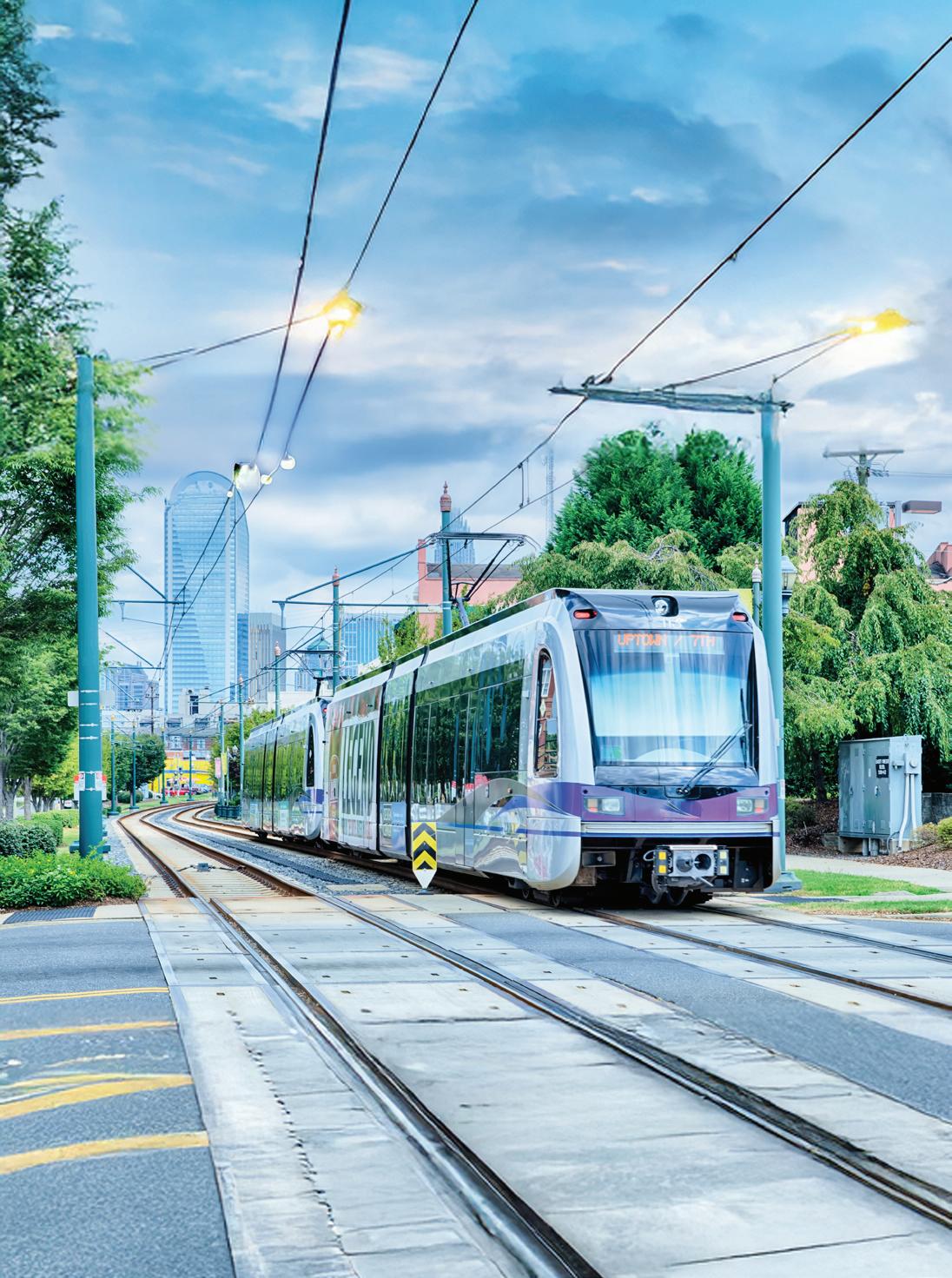
Set to open in winter 2027, MDOT MTA’s 16mile light-rail line will provide service from New Carrollton to Bethesda.
12



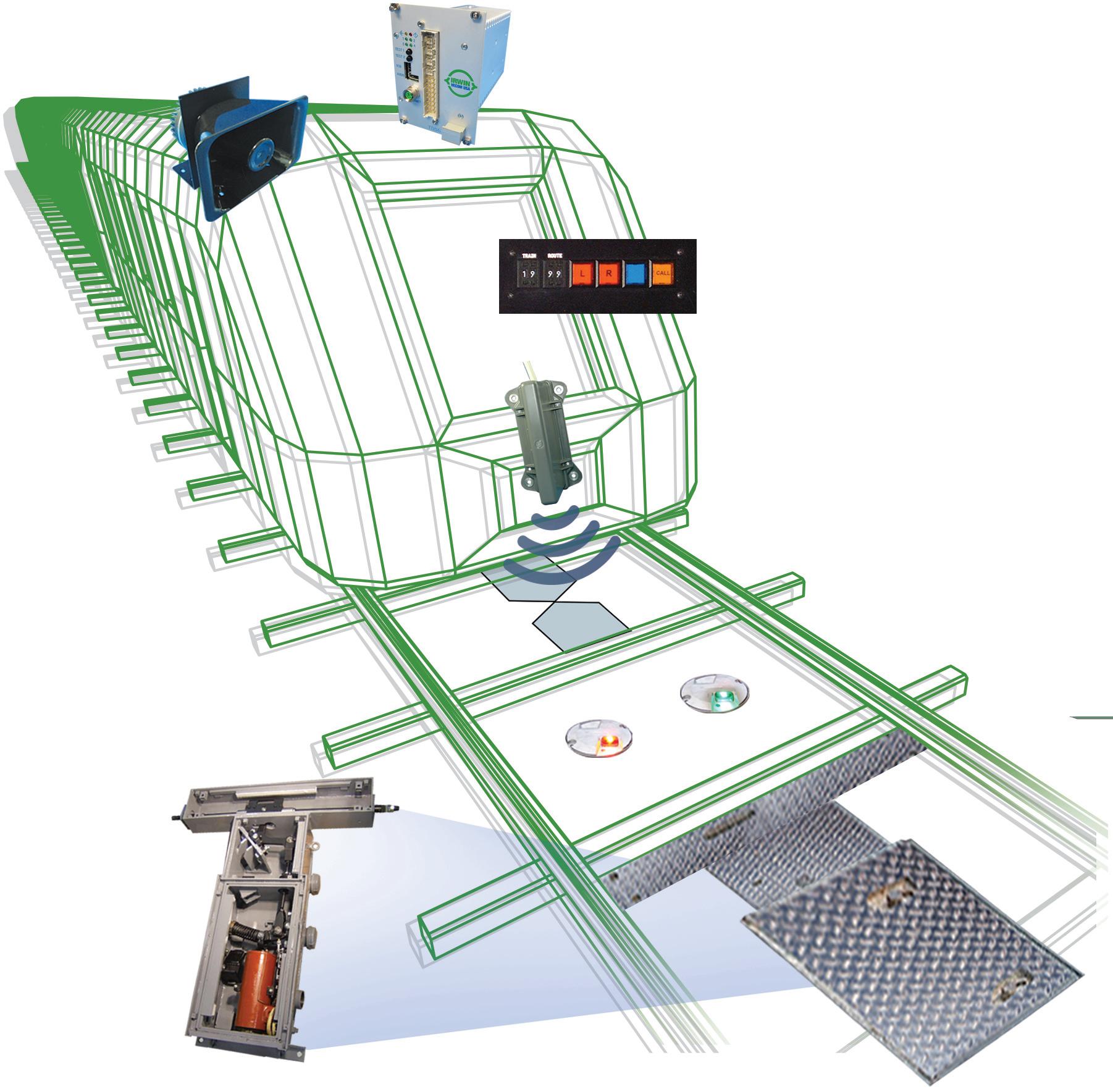
Interrogator System
+ Automatic Loop Scanner Hands-Off, Always 100% Tuned
+ Remote Access Through Web Browser
Cabinet comes complete with Interrogator and...
> Track Switch Control
> Point Indication
> Traffic Signal Preemption
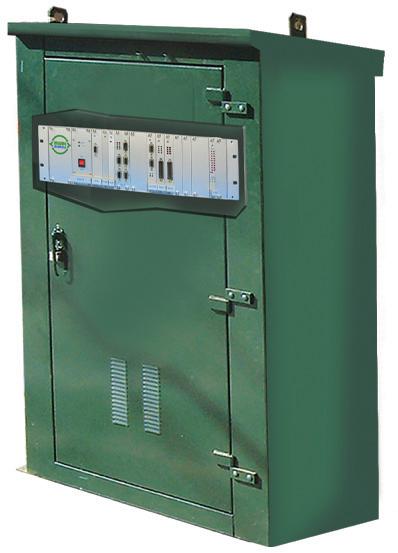

VECOM USA is the industry’s leading provider of BUY AMERICA COMPLIANT train to wayside communications (TWC) and track switching solutions.
> One-way or Bi-directional Data Transmission between Vehicle Equipment & Wayside System
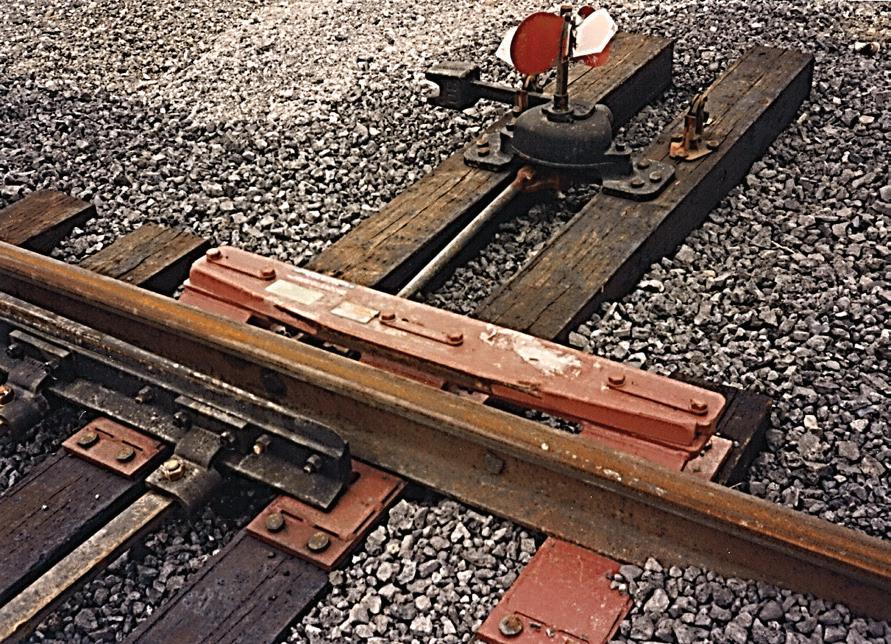
> T-3 Electric-Mechanical Switch Machines
> T-3 Electro-Hydraulic Switch Machines
> Aftermarket Support and Diagnostic Test Equipment

If
reliability, outstanding engineering & customer service, and fast response time are critical to your success, then it’s time to switch.

Our products, services, and certifications include:
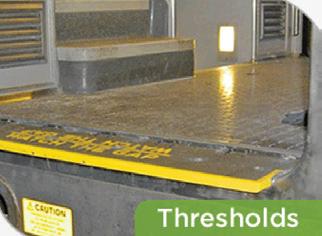
• Car Door Thresholds
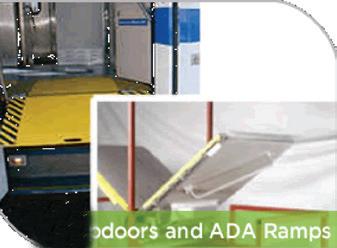
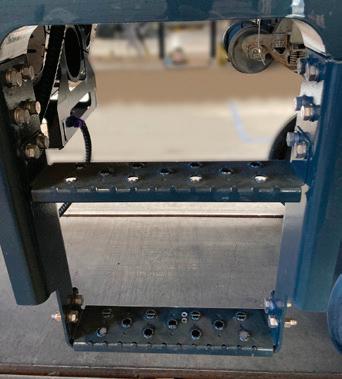
• Ramps, Steps, Trapdoors & Step Wells
• Modern Integrated Manufacturing Capabilities
• AWS Certified Welding
• Custom Design & Engineering Capabilities
• ISO 9001 Certified
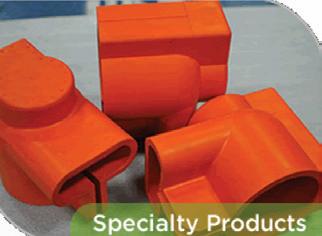
We offer metalworking, plasma spray, powder coating, and finishing to ensure superior craftsmanship, quality, and durability.
Experience the UKM
ukmco.com
fweisbecker@irwincar.com
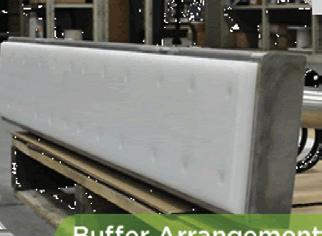
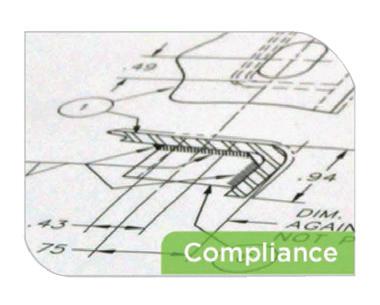
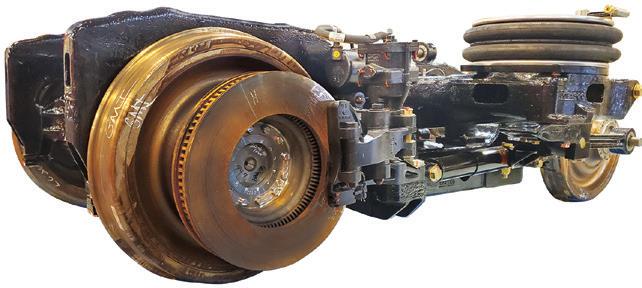
Since 2006, Gray Manufacturing Industries (GMI) has been supplying transit agencies with overhaul kits for the in-house maintenance of rail vehicles.
Our expertise in project sourcing and reverse engineering of components no longer supported by OEMs helps transit agencies prolong the operating lives of their vehicles.
Our customers include the Chicago Transit Authority, Niagara Frontier Transportation Authority (Buffalo), and Southeastern Pennsylvania Transportation Authority (SEPTA – Philadelphia).



MARYLAND

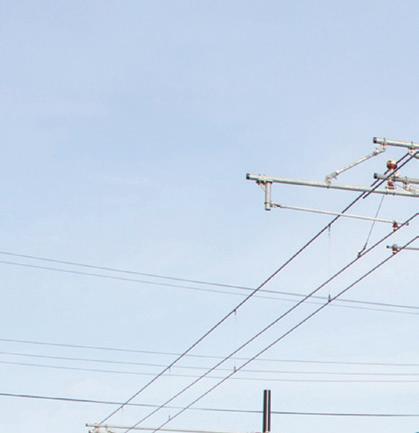
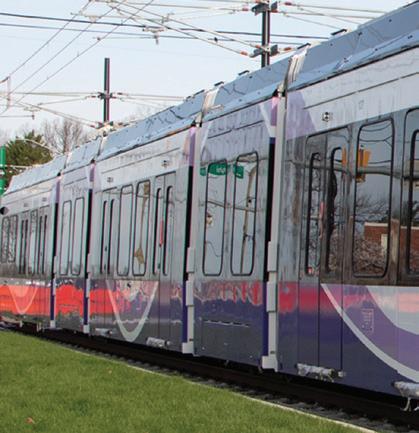



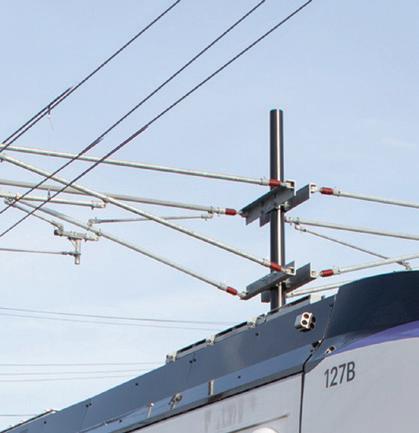
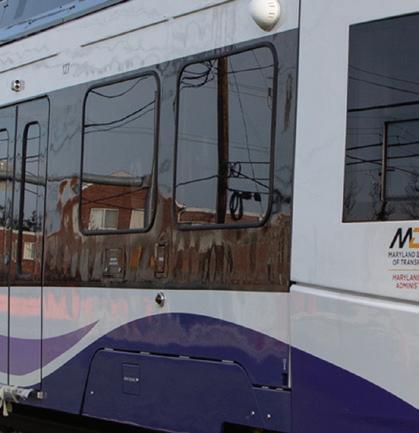
Set to open in winter 2027, MDOT MTA’s 16-mile light-rail line will provide service from New Carrollton to Bethesda.







18 A Look at 2026 Passenger Rail Trends in the U.S. Transit agencies are connecting communities to new destinations as they complete system build outs and progress with line expansions.
23 The New Era: AI-Based Bus Lane Enforcement and Driver Behavior Monitoring Artificial intelligence now has eyes inside and outside of transit buses to boost efficiency and bolster safety.
27 Transit-oriented Development Starts with Clear Priorities Agencies looking to advance TOD programs need market intelligence, local developer insights and strategic public sector focus.
Powering sustainability: The overlooked role of third rail in green transit goals
Transit agencies have a responsibility to source and invest in systems that enhance conductivity, promote energy efficiency and support equipment longevity. MassTransitmag.com/55376816
How project delivery methods shape risk on major transit infrastructure projects
For transit agencies, selecting the appropriate delivery method requires aligning the approach with project complexity, risk profile and operational considerations. MassTransitmag.com/55376800
FACEBOOK facebook.com/MassTransit
@MassTransitmag
LINKEDIN linkedin.com/company/masstransit
INSTAGRAM instagram.com/masstransitmag_
SUBSCRIBE TO OUR NEWSLETTERS
MassTransitmag.com/subscribe
Managing a
Managing a mixed fleet of compressed natural gas, battery-electric buses, and soon hydrogen fuel-cell electric buses, isn’t something coming down the road; it’s already here for Victor Valley Transportation Authority.
Best Practices:
Foothill Transit’s Strategy to Deploying Zero-emission Technologies and Managing a Mixed Fleet
Lessons learned include using a phased deployment of various
technologies to reduce operational risk and allow staff to adapt to new fleet parameters gradually.
Published by Endeavor Business Media, LLC
30 Burton Hills Blvd, Ste. 185, Nashville, TN 37215
800-547-7377
Vol. 52, No. 3
VP/MARKET LEADER - INFRASTRUCTURE & AVIATION GROUP Andrena Feaster AFeaster@endeavorb2b.com
EDITOR IN CHIEF Megan Perrero (603) 891-9454 | MPerrero@MassTransitmag.com
ASSOCIATE EDITOR Brandon Lewis (216) 298-3269 | BLewis@MassTransitmag.com
ASSOCIATE EDITOR Noah Kolenda (231) 999-1405 | NKolenda@MassTransitmag.com
CONTRIBUTORS Patrick McDonough, Richard Montgomery, Doran Barnes
MULTIMEDIA ACCOUNT MANAGER Meriwether Drummond (678) 992-5071 | MDrummond@MassTransitmag.com
PRODUCTION MANAGER Rita Fitzgerald
AD SERVICES MANAGER Terry Gann
ART DIRECTOR Erin Brown
AUDIENCE DEVELOPMENT MANAGER Debbie Dumke
DIGITAL AUDIENCE DEVELOPMENT MANAGER Alden Metzger
ENDEAVOR BUSINESS MEDIA, LLC
CEO Chris Ferrell
COO Patrick Rains
CDO Jacquie Niemiec CALO Tracy Kane
CMO Amanda Landsaw
EVP INFRASTRUCTURE & PUBLIC SECTOR GROUP Kylie Hirko VP OF CONTENT STRATEGY, INFRASTRUCTURE & PUBLIC SECTOR GROUP Michelle Kopier
SUBSCRIPTION CUSTOMER SERVICE
877-382-9187; 847-559-7598
Circ.MassTransit@Omeda.com PO Box 3257, Northbrook IL 60065-3257
ARTICLE REPRINTS reprints@endeavorb2b.com
Mass Transit (USPS 017-230), (ISSN 0364-3484 print, ISSN 2150413x online) is published 7 times per year in January/February, March/April, May/June, July/August, At the Show Issue, September/ October, November/December by Endeavor Business Media, LLC. 201 N Main St 5th Floor, Fort Atkinson, WI 53538. Periodicals postage paid at Fort Atkinson, WI, and additional mailing offices.
POSTMASTER: Send address changes to Mass Transit, PO Box 3257, Northbrook, IL 60065-3257.
SUBSCRIPTIONS: Individual print and digital subscriptions are available without charge to qualified subscribers in U.S. and Canada. Please visit www.masstransitmag.com and click on “Subscribe”. Publisher reserves the right to reject non-qualified subscriptions. Subscription prices: U.S. $49.00 per year, $97.00 two years; Canada/Mexico $84.00 per year, $146.00 two years; All other countries $120.00 per year, $223.00 two years. Back issue $13.00 prepaid, if available. All subscriptions payable in U.S. funds. Canadian GST #842773848. Send subscription inquiries to Mass Transit, PO Box 3257, Northbrook, IL 60065-3257. Customer service can be reached toll-free at 877-382-9187 or at circ.masstransit@ omeda.com for magazine subscription assistance or questions. Printed in the USA. Copyright 2026 Endeavor Business Media, LLC. All rights reserved. No part of this publication may be reproduced or transmitted in any form or by any means, electronic or mechanical,
Representatives from transit state associations have several pieces of advice on how to work with your state legislatures to secure your funding.
While visiting Omaha, Neb., for the Community Transportation Association of America’s annual conference, I attended a session focused on how state associations are marketing transit to state legislatures to secure state-level funding. It was one of the livelier sessions I’ve attended in a while, with a diverse range of voices speaking up on what’s worked for them and asking questions so that they can refine their messaging strategy.
There were several takeaways I think are worth sharing as we deal with the funding uncertainty at the federal level—the first being that without having proper state funding, transit agencies will struggle coming up with the local match required to unlock federal dollars. The moderator astutely pointed out that if agencies can’t access federal funding, and it lapses, Congress will feel justified in cutting transit dollars.
The second takeaway, which may sound like a broken record to some, is to talk to your state legislatures early and often. One of the panelists shared a success story that wouldn’t have happened without this. He started his outreach during the primaries, working all sides of the aisle that led to securing a $20 million grant to build a transit center. He noted that by having conversations during the primary, you’re usually getting to the candidate when not as many people are targeting them with asks. They can also still mold their platform as they head to the general election. On the other hand, the candidates don’t want to look like they flip flop on issues, so if they’ve voiced support for transit—especially publicly—they’re more likely to stay committed to working with your agency.
Next, when you’re speaking with elected officials, start by asking what it is they want to accomplish within their current term. Understanding their platform and their key issues will help you frame your story on how transit can help accomplish that. Then, be sure to follow up with them on the results. Because of the funding you helped secure, we were able to launch this many routes, serve this many people, etcetera—you know the drill. One of the panelists shared their strategy of regionalizing state funding through bus routes, so that if that funding were to go away, this is how many districts and constituents would be impacted. Another panelist suggested following this messaging formula by answering these questions:
• What do you do?
• How do you do it?
• Why do you do it?
• What happens if you don’t do it?
Coalition building was another strategy the panelists emphasized, ensuring you’re not tearing down other organizations along the way. Yes, in many ways you’re fighting for the same funding. Is there a way to consolidate projects so it’s easier to approve one funding ask? Or consider other trade associations that may be experiencing similar problems to transit that can lead to policy changes benefitting everyone. Several people in the audience also reminded the group of the importance of coordinating with your state departments of transportation. Make sure they know what funding you need, what projects you’re working on and what the impact will be. While they can’t lobby on how funding should be allocated, they can serve as a fact checker that confirms the numbers and the goals for the project.
Finally, remember that you’re never done. Budget cycles are just that—cyclical. Legislatures term out or may not run again. It’s crucial to never stop educating and never stop advocating.
When speaking with elected officials, start by asking what it is they want to accomplish within their term, and tie in how transit can help achieve their goals.
m perrero@ masstransitmag.com
( 603) 891-9454
linkedin.com/in/ m egan-perrero

Megan Perrero, editor in chief


















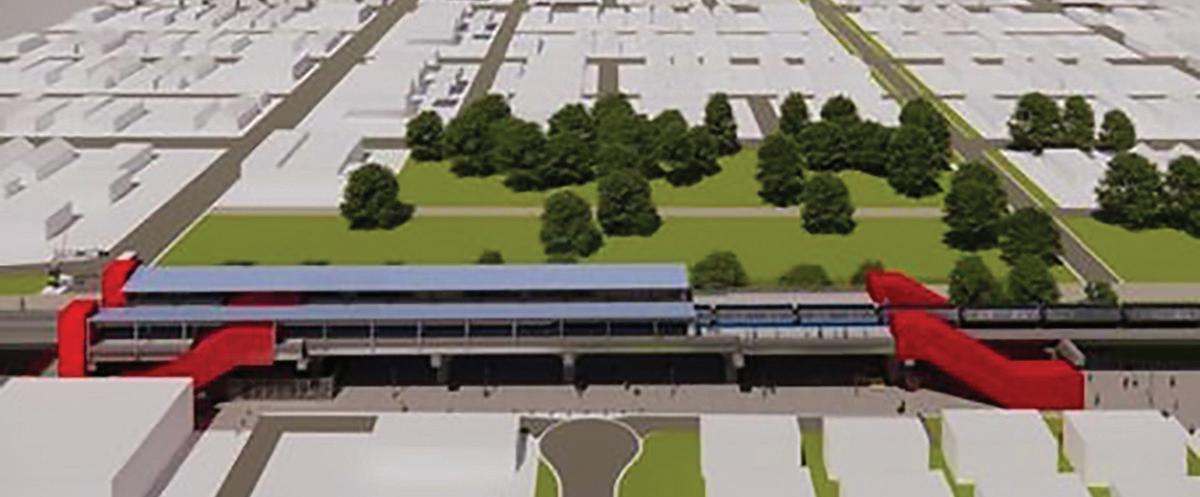
The Chicago Transit Authority (CTA) broke ground on the Red Line Extension (RLE) Project. The RLE Project will be the largest construction project in CTA history, connecting the Far South Side of Chicago with rapid rail transit for the first time via a 5.5-mile extension to the Red Line from 95th Street to 130th Street. The project includes building four new Red Line stations at 103rd Street, 111th Street, Michigan Avenue and 130th Street. The project will also see the building of a new rail yard and related rail facilities near 120th Street to improve operational efficiency for the entire Red Line and CTA system, ensuring the new extension is fully capable of serving the community it’s connecting.
MassTransitmag.com/55374234
UTA’s Midvalley Express BRT begins passenger service
▶ The Utah Transit Authority’s (UTA) third bus rapid transit (BRT) route, Midvalley Express, began passenger service on April 12. The seven-mile BRT route connects local destinations and planned developments to increase mobility across Murray, Taylorsville and West Valley, Utah. The new BRT service includes 1.4 miles of bus-only lanes and priority at traffic signals. The BRT line also will prepare the Salt Lake City region for the 2034 Olympic Games by providing a connection between Frontrunner commuter rail and the Maverik Center, a planned venue for the games. The all-electric bus route runs between West Valley Central and Murray Central stations and will be free for riders through April 2029. MassTransitmag.com/55374528
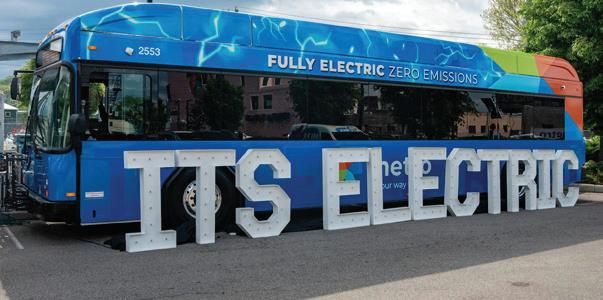
The rollout is part of the agency’s Reinventing Metro plan, a longterm strategy designed to improve passenger service, expand access and invest in innovation throughout the network. Cincinnati Metro notes that it integrated hybrid-electric buses into its fleet throughout 2023 and 2024.
MassTransitmag.com/55372938
Gateway Development Commission awards tunnel boring construction contract for Hudson Tunnel Project
▶ The Gateway Development Commission (GDC) has awarded Traylor/Walsh/Skanska joint venture (JV) the contract for the Hudson Tunnel Project’s (HTP) sixth construction package. The JV will be responsible for boring the section of the new tunnel tubes under the Hudson River and installing the tunnel liner and floor. Known as Package 1C: The Hudson River Tunnel Section, the GDC says the work is expected to begin in the coming months. With the award of this contract, GDC notes six of the 10 construction packages that make up the HTP are now in progress or completed.
MassTransitmag.com/55373848
High Valley Transit breaks ground on the Bob BRT service
Cincinnati Metro launches first fully battery-electric buses to its system
▶ Cincinnati Metro has launched its first set of battery-electric buses (BEBs). Two BEBs entered service on April 22, with four additional vehicles expected to join the fleet this summer. Seven more buses are planned by the end of 2027, which will bring Cincinnati Metro’s total zero-emission fleet to 13 buses.
▶ High Valley Transit has broken ground on the Bobsled Express (The Bob), the state of Utah’s first rural bus rapid transit (BRT) system. The project will create a new high-capacity transit corridor connecting Kimball Junction and Park City’s Old Town. According to the agency, local partners began planning the project more than 10 years ago as a strategy to address congestion on SR-224—one of the region’s busiest corridors that serves more than 10,000 workers daily. The BRT service will include a combination of dedicated bus-only and mixed-flow lanes along seven miles of the SR224 corridor. The system will operate zero-emission electric buses, with service every 10 to 15 minutes, seven days a week.
MassTransitmag.com/55372897

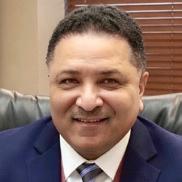
The San Joaquin RTD Board has appointed Bearnard Veasley as its next interim CEO. Veasley is a military veteran who has more than 30 years of leadership in transportation operations, logistics and public service. His appointment follows the recent departure of former Interim CEO Kimberly Turner. Veasley has led transportation operations across multiple large school districts. At Stockton Unified School District, he oversaw service for more than 36,000 students and managed a 150 bus fleet and workforce. He also led operations in Simi Valley Unified and McKenzie County School District, managing fleet performance, compliance, budgeting and service delivery across large geographic areas. MassTransitmag.com/55373287
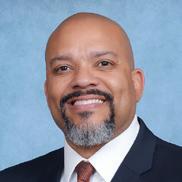
MCTS has named Brian Wojcik as its next COO. He brings more than 20 years of leadership experience across public transportation, public safety and financial services. Most recently, he served as senior manager of bus operations at the Chicago Transit Authority (CTA), overseeing a workforce of more than 600 employees across dozens of bus routes, and managing regulatory compliance, labor relations, budget oversight and service delivery. Prior to joining CTA, he served for a decade as a police officer and held a licensed financial advisory role at Prudential Financial. He succeeds Kevin Pumphrey, who is retiring after 28 years of service to MCTS. MassTransitmag.com/55373287

For more information, visit www.MassTransitmag.com/10065221



The DART Board of Directors has appointed David Leininger as interim president and CEO. The agency notes Leininger is returning to the agency in the same role he previously served in from 2020 to 2021. He also served the agency for nine years as its CFO. As interim president and CEO, Leininger will oversee DART’s day-today operations, support ongoing strategic initiatives and work closely with the board, staff and regional stakeholders to ensure the continued delivery of high-quality transit services. MassTransitmag.com/55371560
▶ Keolis North America has agreed to a four-year extension of its contract with Valley Metro to continue operating the East Valley fixed-route bus service. MassTransitmag.com/55374244
▶ The Metropolitan Transportation Authority has awarded a contract to Siemens Mobility, in collaboration with L.K. Comstock, to modernize New York City’s Fulton-Liberty lines—or A and C lines—with advanced CommunicationsBased Train Control technology and 5G connectivity. MassTransitmag.com/55373855
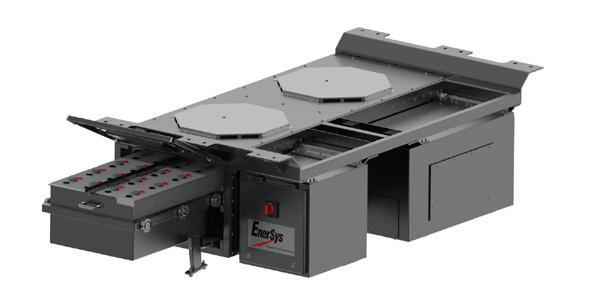
Designed for rolling stock railway applications, ZeMa Rail batteries aim to deliver maintenancefree performance. Featuring advanced thin plate pure lead (TPPL) technology, the ZeMa Rail range of valve-regulated lead-acid TPPL+Sn (tin addition) batteries can pack more power into the same space compared to conventional batteries. ZeMa Rail batteries deliver high energy density in a compact design, with no water topping required. Solutions can be tailored for new operating equipment systems and retrofit applications. ZeMa Rail is designed for deep discharge recovery and durability against vibration and shock.
NATIONAL RAILWAY SUPPLY www.nrsga.com
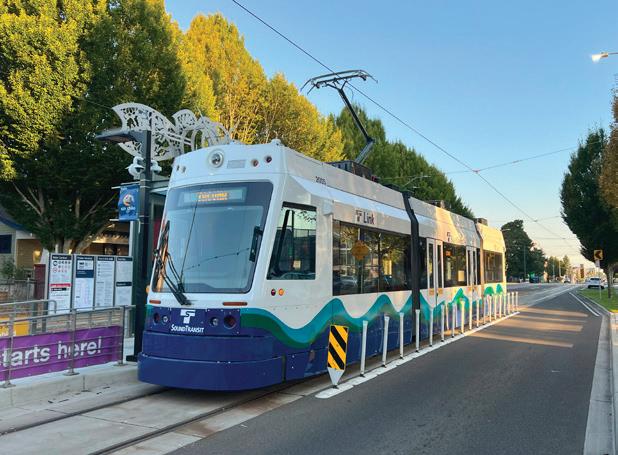
The new Liberty NXT Streetcar model is the second version of the BROOKVILLE streetcar platform. The Liberty NXT features stationlevel boarding, more than 70% low-floor standing and a modified coupler. BROOKVILLE’s Liberty NXT is a custom design, manufactured in America to adapt to existing streetcar applications.
BROOKVILLE EQUIPMENT CORPORATION
www.brookvillecorp.com
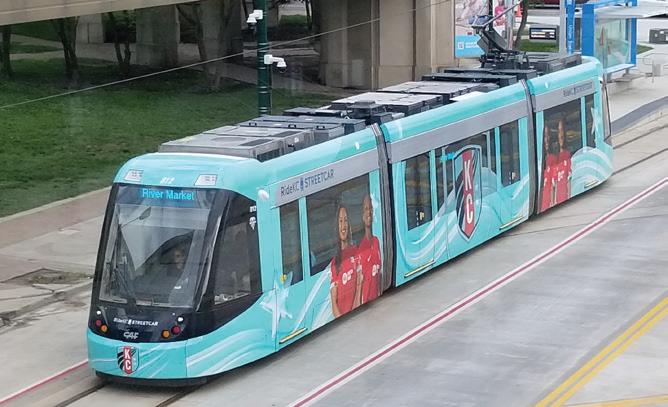
CAF’s URBOS is a modern, low floor streetcar and lightrail vehicle platform designed to deliver accessible, efficient and passenger focused urban mobility. Featuring a modular design, URBOS vehicles can be configured in a range of capacities, lengths and interior layouts to meet the specific needs of transit agencies and cities in the U.S. The platform meets North American rail safety standards and Buy America requirements. It’s engineered for reliability, reduced lifecycle costs and energy efficient performance, with options for advanced onboard systems and catenary free operation.
CAF USA INC.
www.cafmobility.com
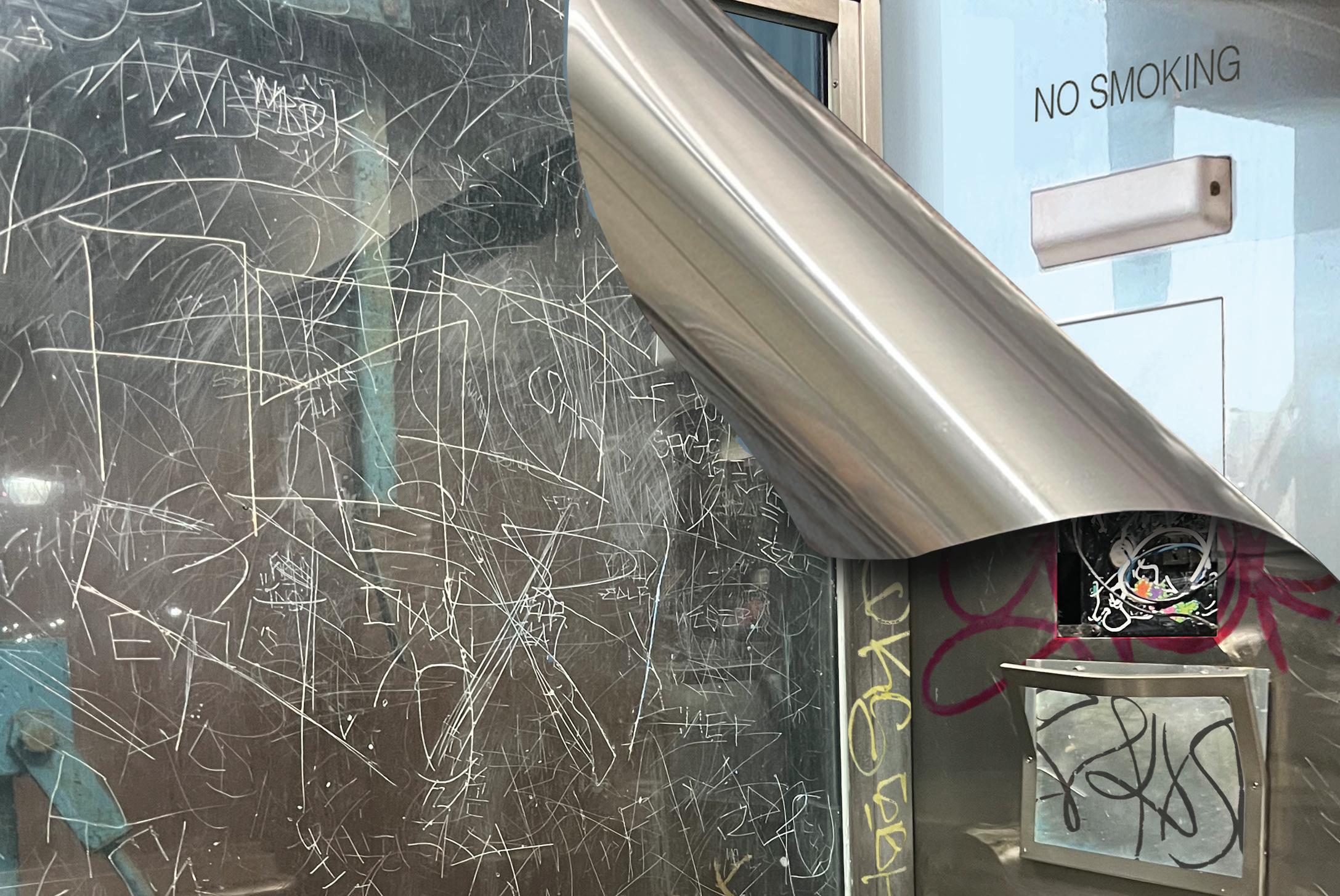
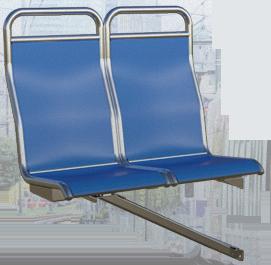
The RSS is a stainless steel seat designed to be a durable, anti-vandal seating solution.
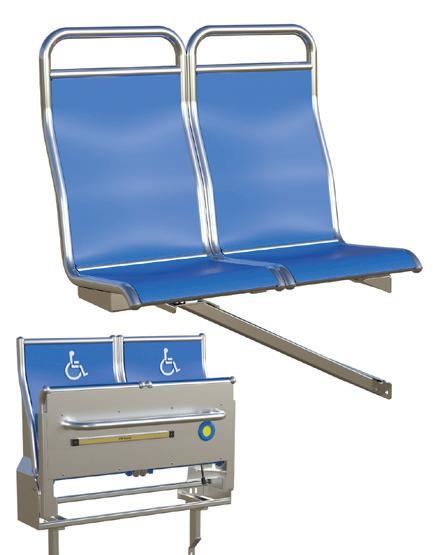
The RSS is built with a stainless steel frame and lightweight construction. The RSS has ADAcompliant stainless steel grab rails, quick-change interchangeable inserts and hidden fasteners. Its designed to offer more hip-to-knee space and legroom. Available in transverse or longitudinal rigid and flip-up configurations.
FREEDMAN BY LIPPERT www.freedmanseating.com
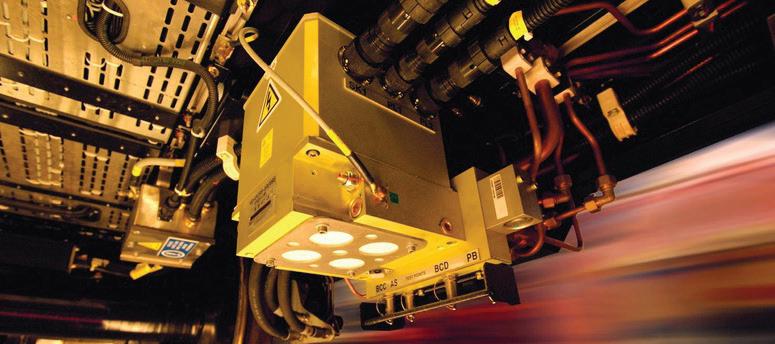
CubeControl is a decentralized brake control system built for regional, commuter and high-speed trains. Derived from EP2002, it’s designed to offer reliable, repeatable braking performance—even in lowadhesion conditions—through deceleration and wheel slide protection. The compact, underfloor-mounted unit combines direct EP braking with secure Ethernet connectivity, condition-based maintenance and remote diagnostics. Key features include brake disc temperature monitoring, per-bogie control, extended service intervals and a lightweight design for easier installation and upgrades.
KNORR-BREMSE rail.knorr-bremse.com
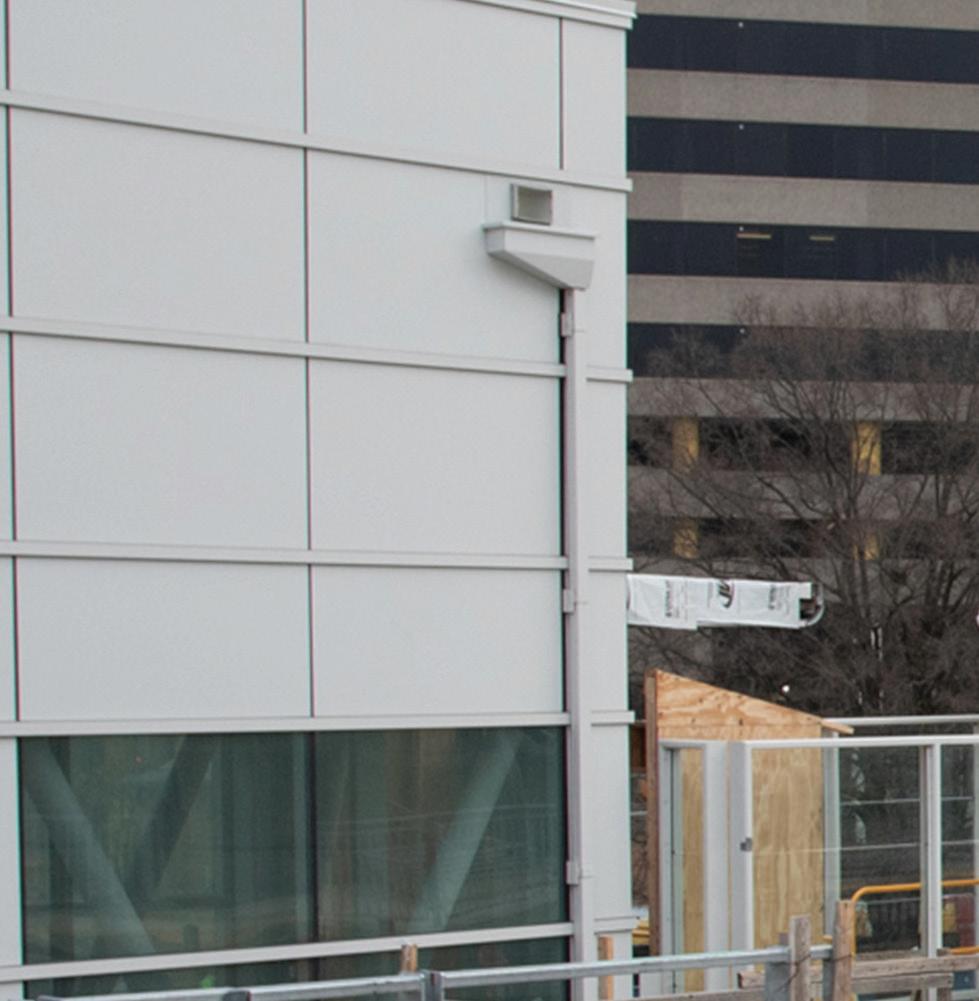
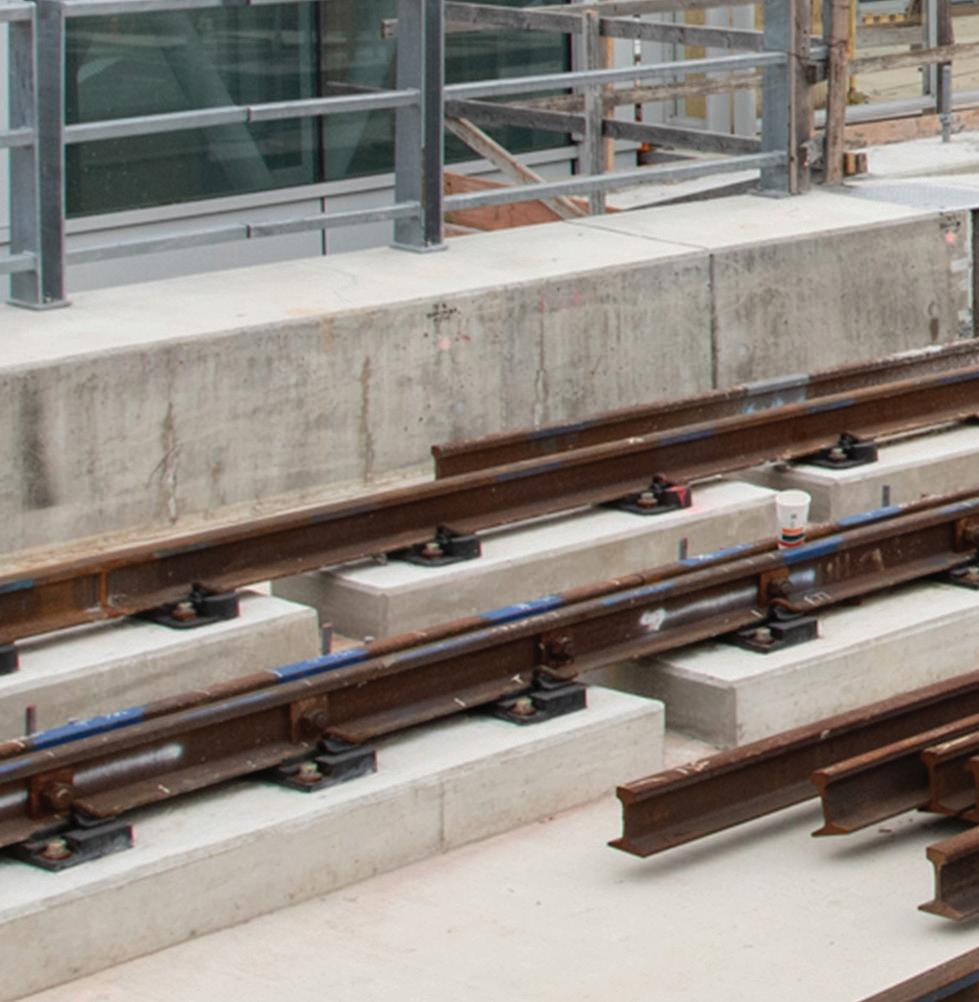

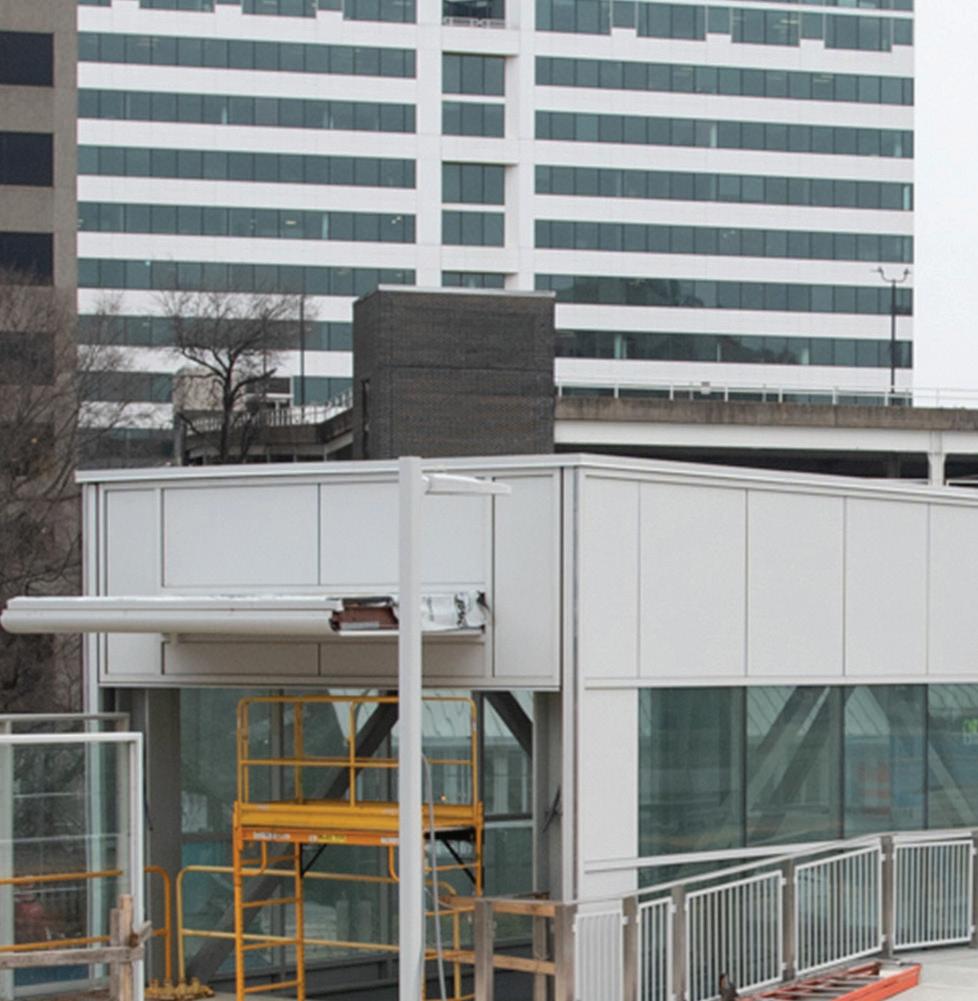
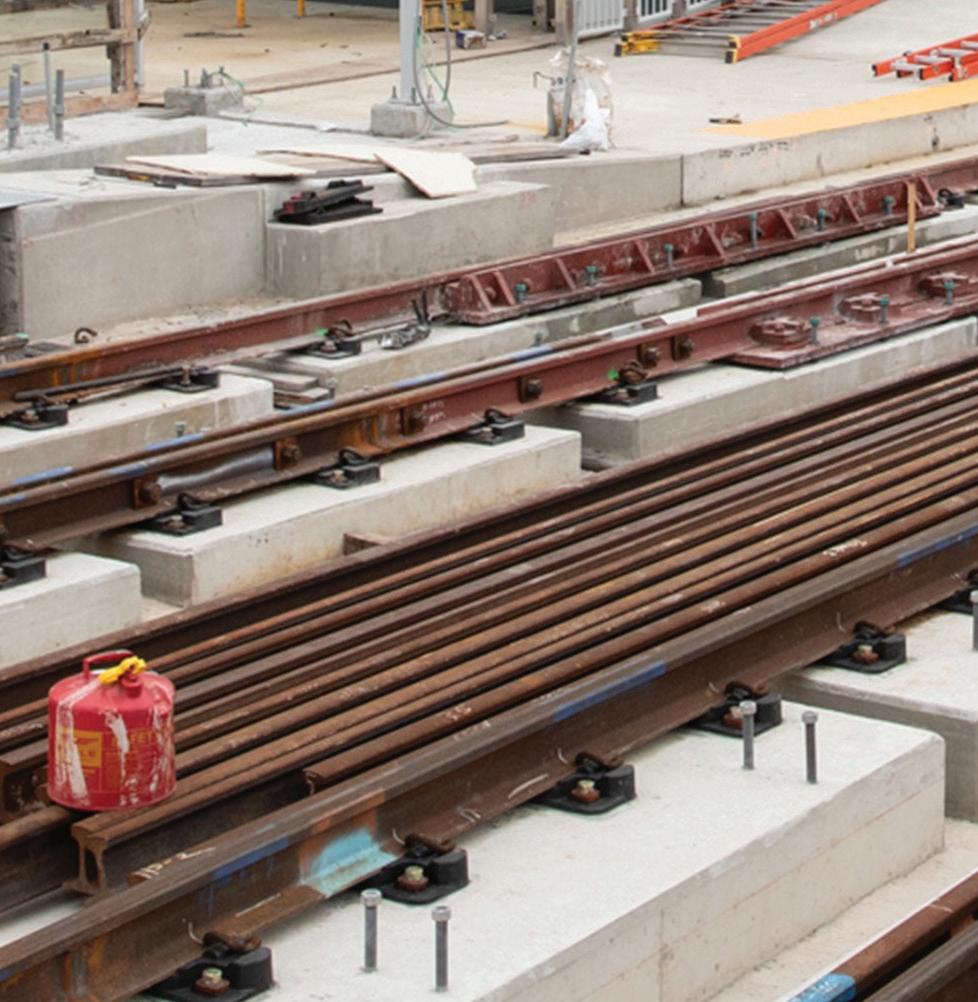
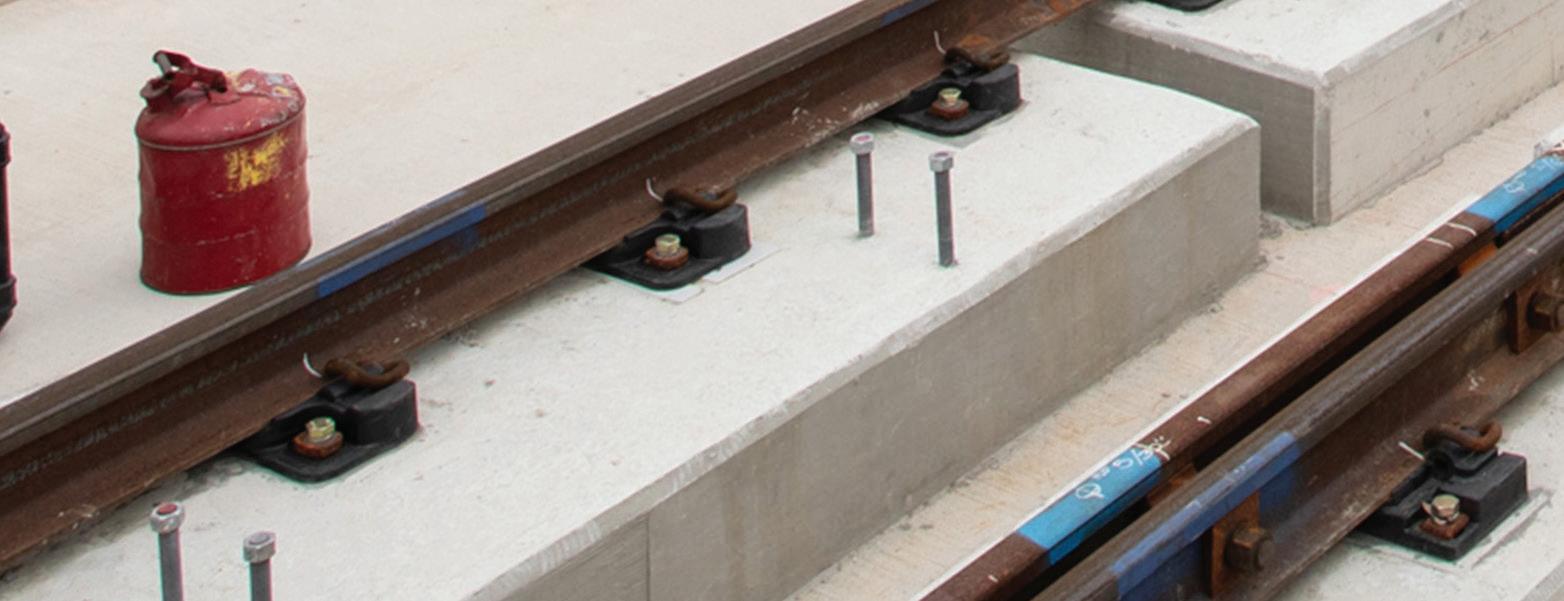

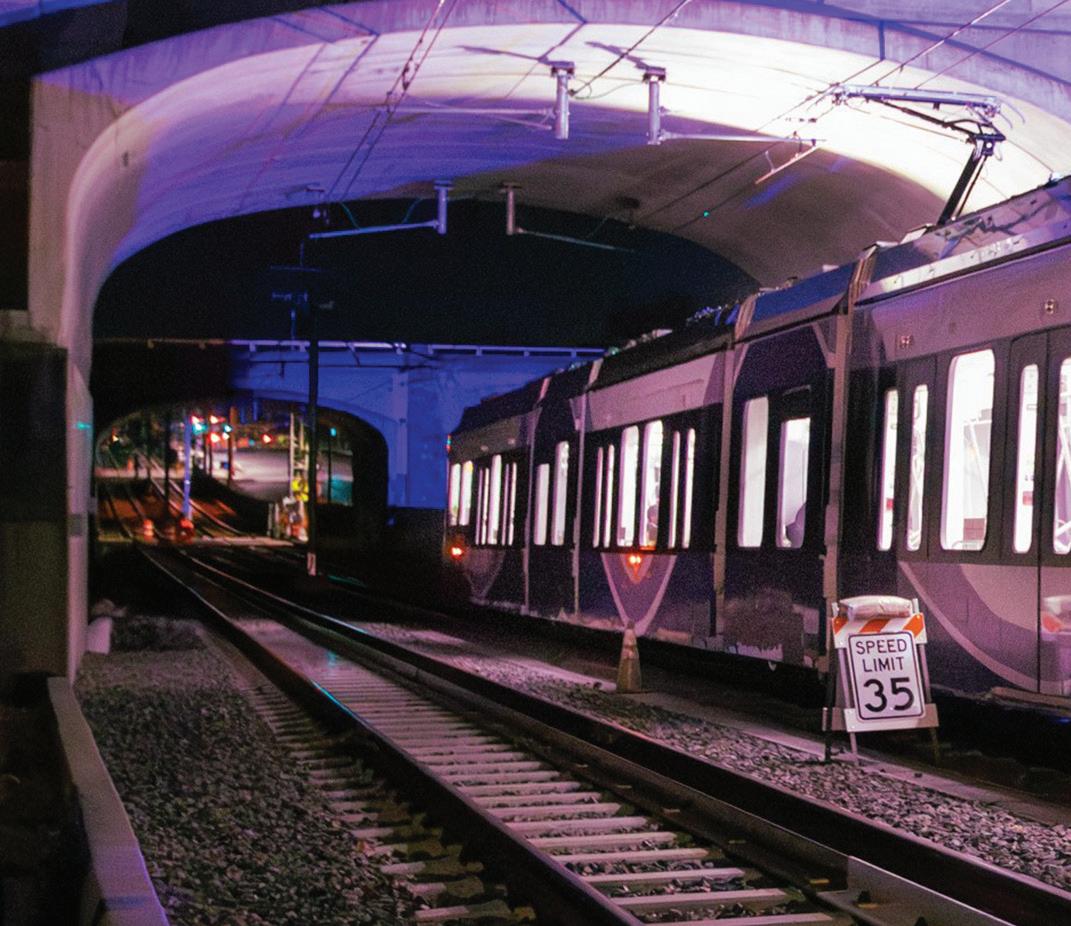
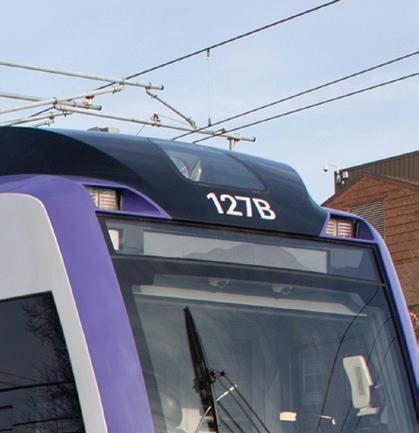
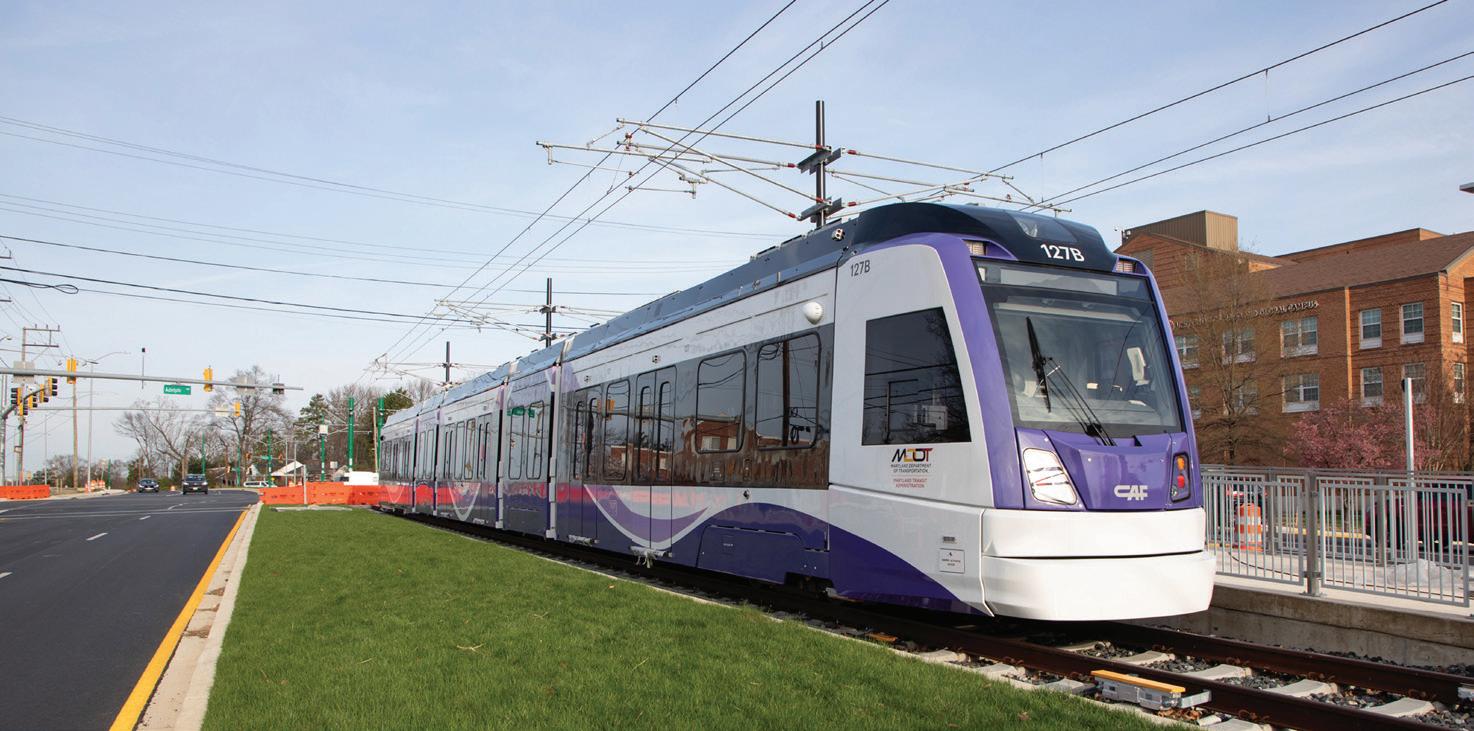
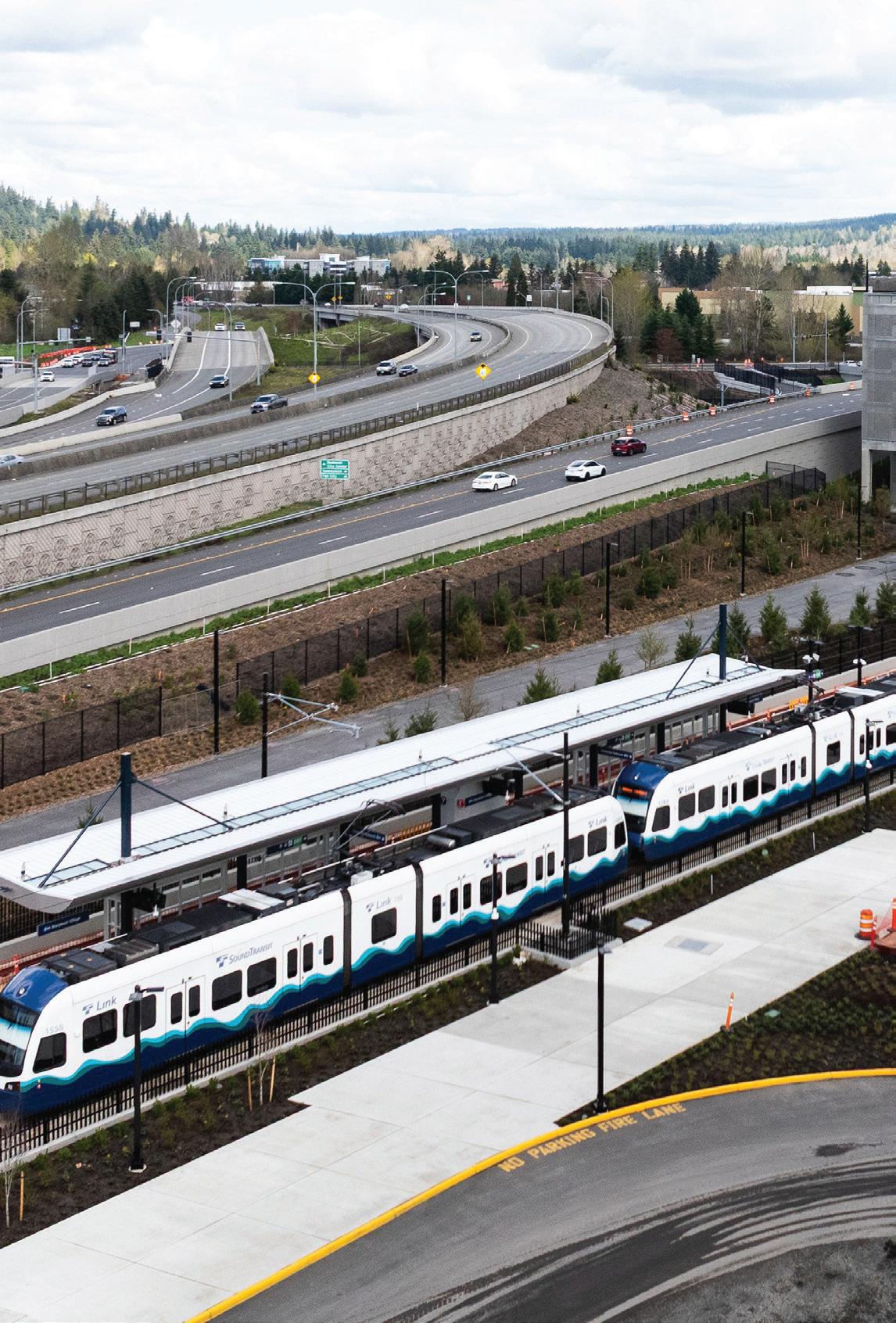
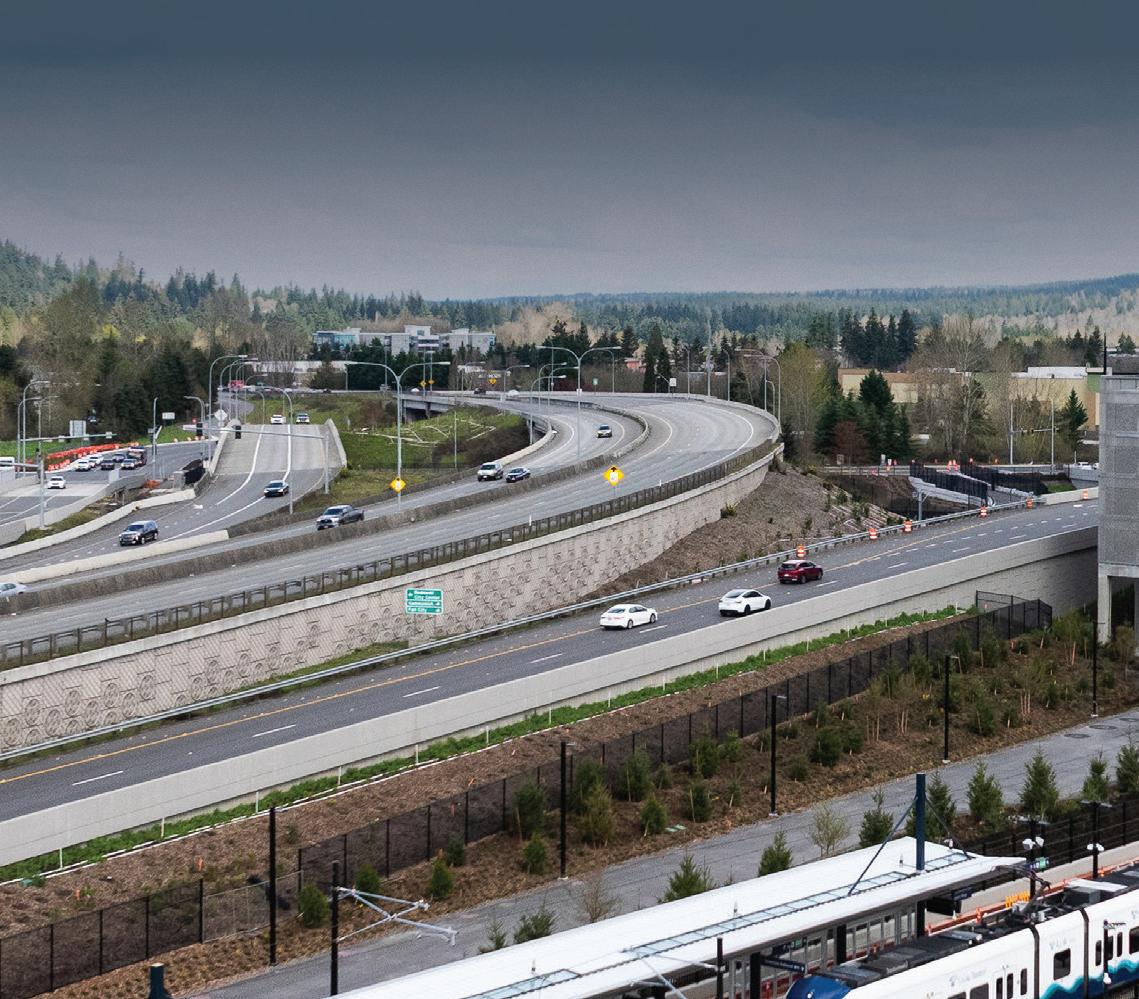
Set to open in winter 2027, MDOT MTA’s 16-mile light-rail line will provide service from New Carrollton to Bethesda.

BY BRANDON LEWIS, ASSOCIATE EDITOR
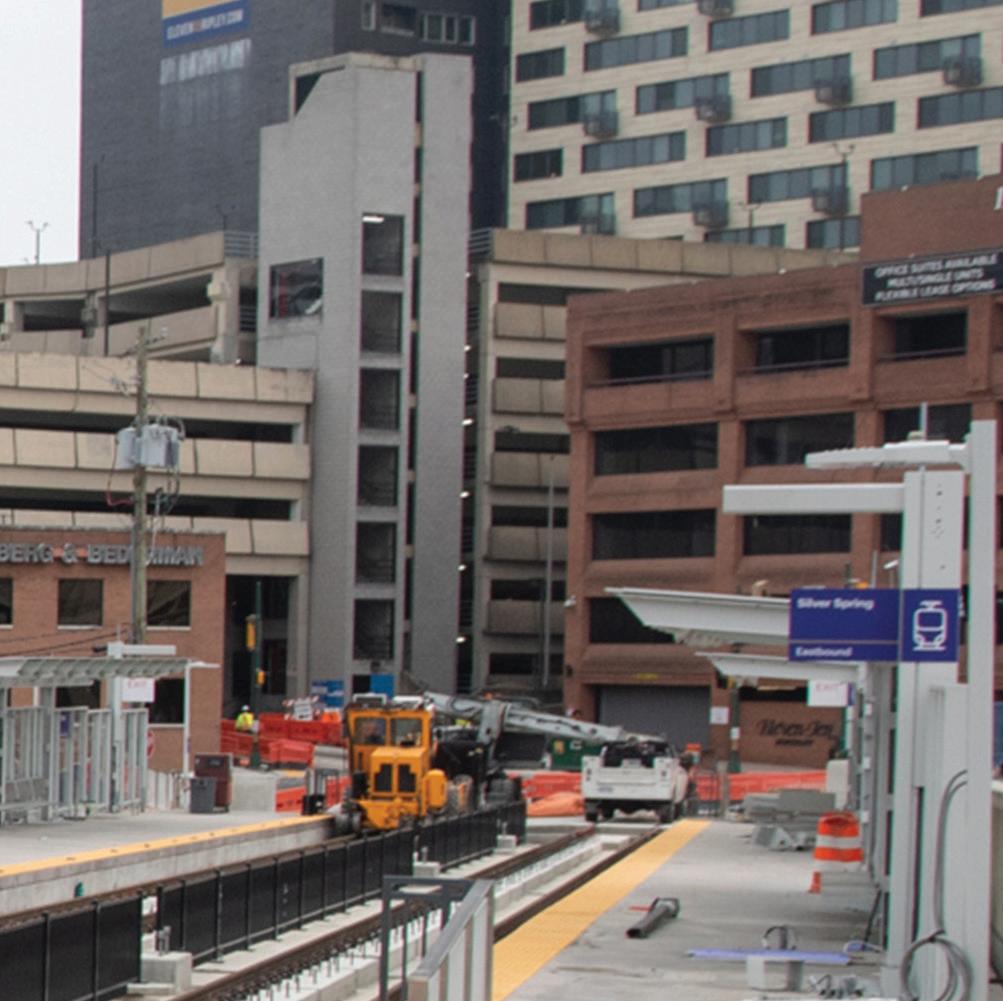
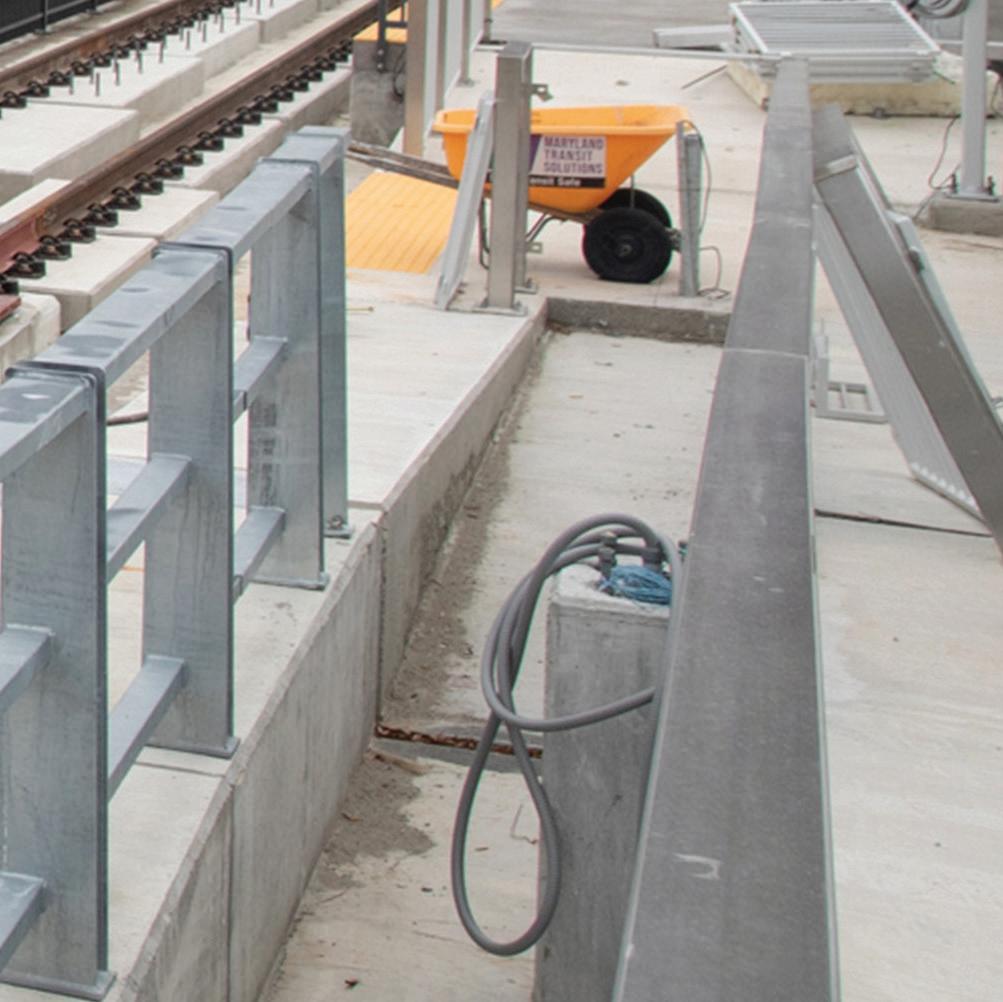
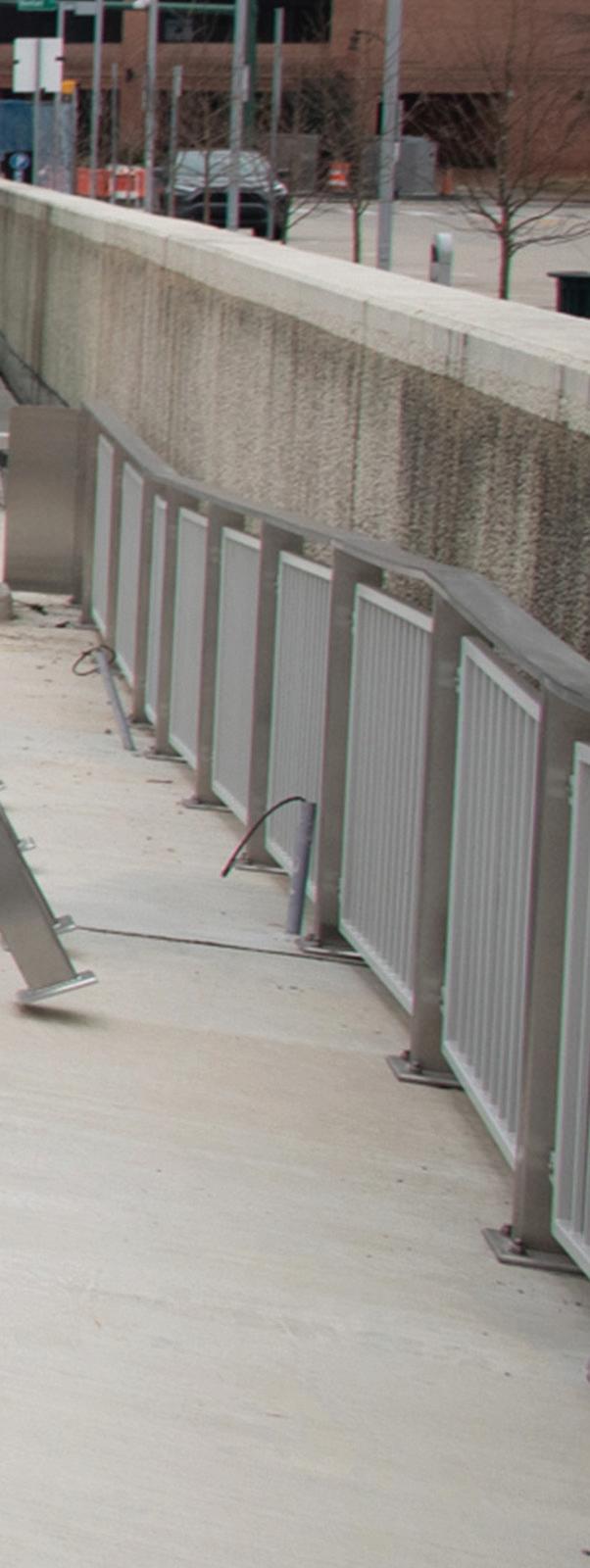

In winter 2027, the Maryland Department of Transportation Maryland Transit Administration (MDOT MTA) will launch service of the Purple Line, a 16-mile light-rail line that will provide service from New Carrollton to Bethesda, Md., including direct travel options to connect to the following:
• Washington Metropolitan Area Transit Authority’s (WMATA) Metrorail: Red (Bethesda and Silver Spring), Green (College Park) and Orange (New Carrollton) lines
• MARC commuter rail (Silver Spring, College Park and New Carrollton)
• Amtrak (New Carrollton)
• Local and regional bus networks
When complete, the project timeline will have spanned over two decades, starting with a survey MDOT MTA issued to riders in 2002 that asked their thoughts on new potential transit modes that could be coming to the area. Lightrail transit (LRT) was selected as the mode of transportation for the project in 2009 a er a dra environmental impact study was completed a year prior. Once service begins, Purple Line Transit Partners (PLTP) will operate and maintain the light-rail system for 30 years.
According to MTA Administrator Holly Arnold, a transportation project this massive in the state of Maryland has been dreamed of since the 1970s, noting that even though WMATA can get residents between Bethesda and Silver Springs, Md., “you gotta go all the way in and come all the way out or take a bus or a series of buses through pretty congested roadways.”
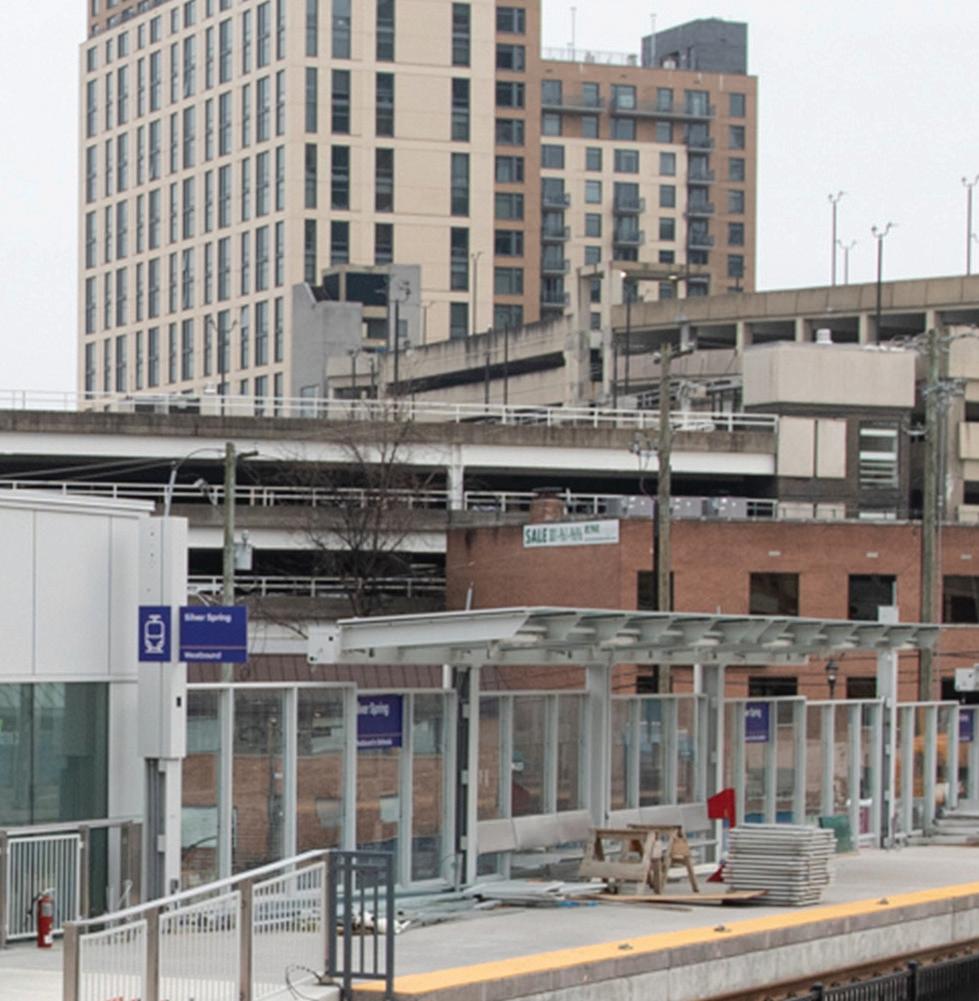
Purple Line work is continuing at Silver Spring Station.
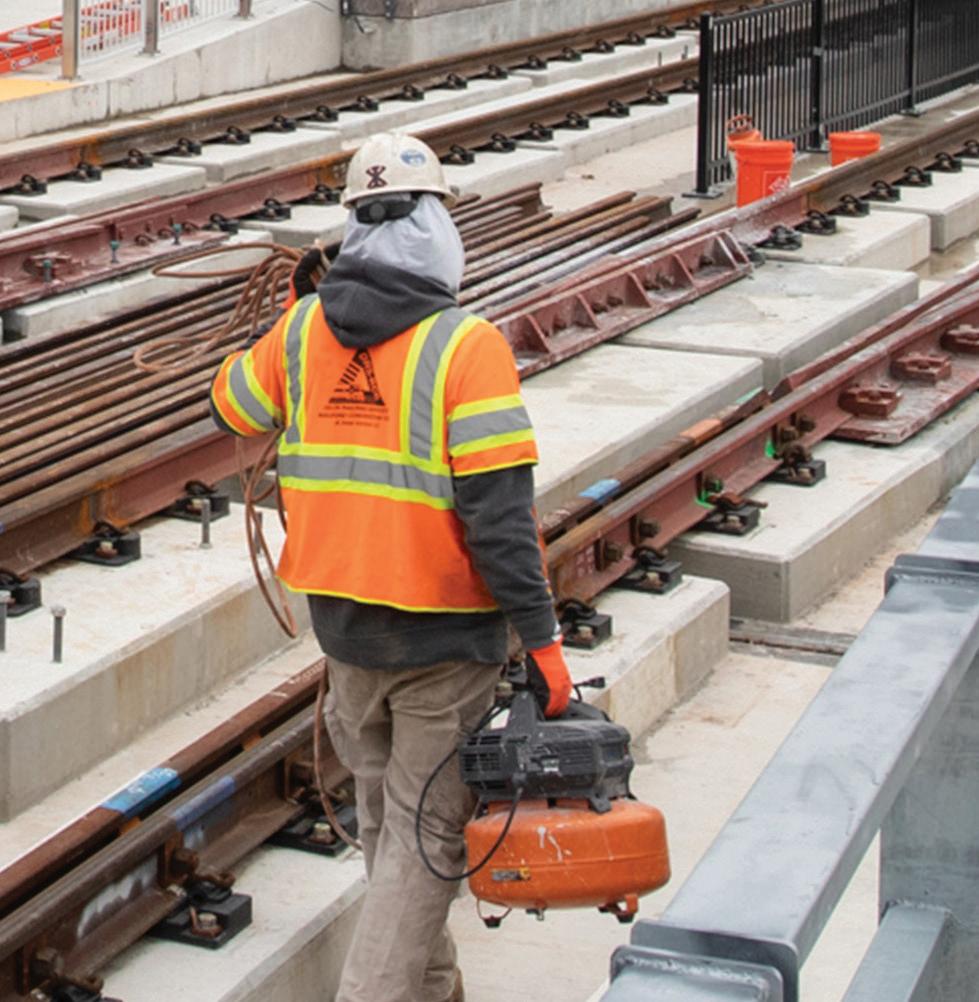
Construction on the project began in 2016. In 2021, MDOT MTA brought in Maryland Transit Solutions (MTS), a team comprised of Dragados USA Inc. and OHL USA Inc., to be the design-build contractor on the project. MTA Senior Project Director for the Purple Line Ray Biggs II says this massively sped up the project’s construction.
“Thanks to MTS, we were able to begin full-scale construction in the summer of 2022 a er dealing with challenges from the pandemic,” Biggs said.
Those challenges included supply chain issues, as well as what Biggs and Arnold both describe as natural problems that pop up when dealing with a project in an urban area. When construction began, it was anticipated to be finished by winter 2026. But with all the construction challenges, in 2023, MDOT MTA agreed to provide an additional $148 million to PLTP to allow the project completion date to be pushed back a year to winter 2027.










Biggs explains the location of the project is unique, as the project is just outside the Washington, D.C., area and covers Interstate 495, also known as the Capital Beltway, in Maryland. Because of the area, MDOT MTA had to coordinate with multiple agencies and counties, including WMATA, Prince George County and Montgomery County, to complete underground and overhead utility location work before rail could be installed across the alignment.
“I like to say the project has two parts: part one being the roadway and utility project and part two being the light-rail project,” Biggs said.












He notes the project is a public-private partnership (P3) and that there are over 30 third parties working on the construction side of the project.
“That P3 partnership is the only way we could complete this project because there’s too many different parts when you’re dealing with a project this big,” Biggs noted. “It took that project-first approach to identify and communicate and resolve issues as quickly as possible, as there’s a lot of moving parts with a multi-billion-dollar project.”
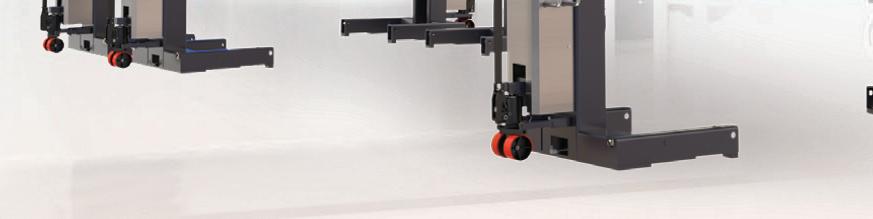


















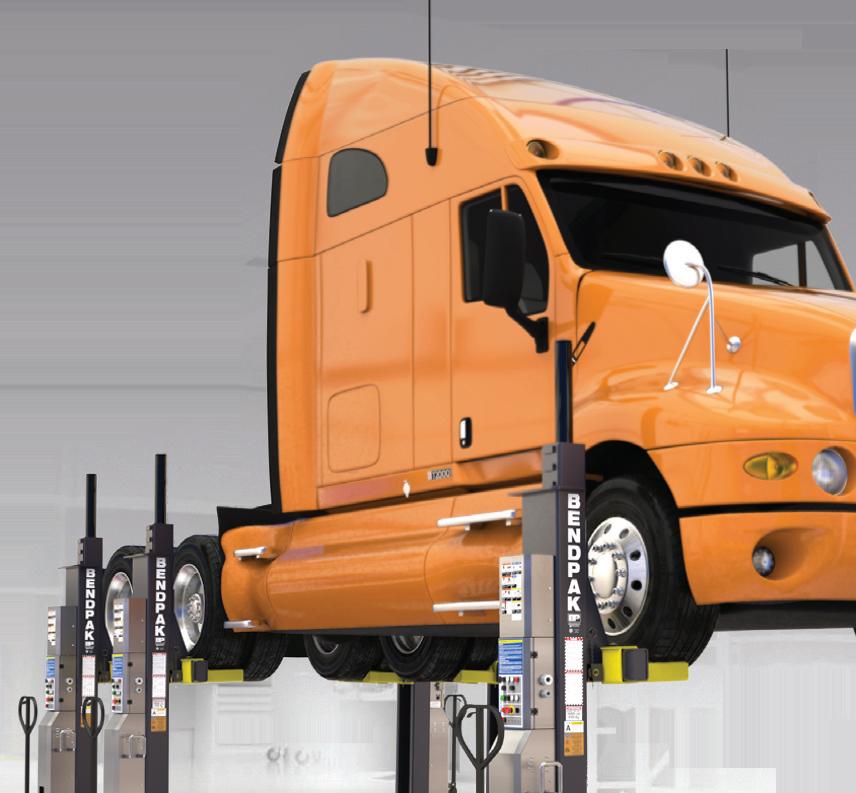
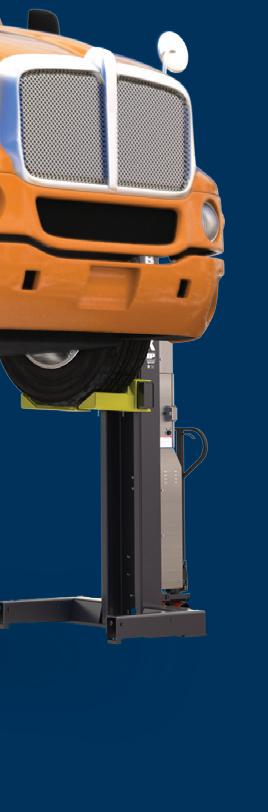
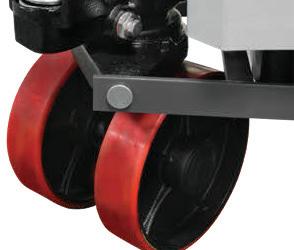
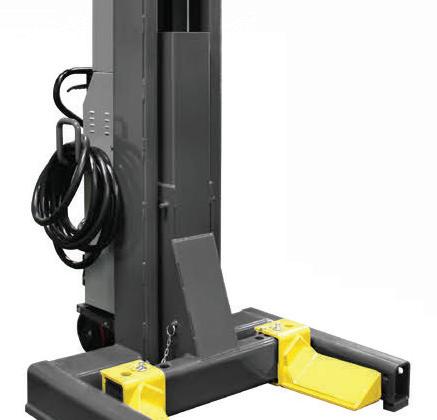
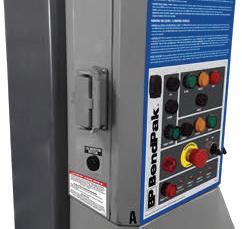
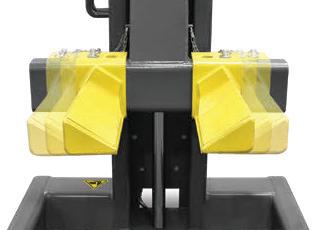
BendPak is the name that fleet operators rely on because they’re the toughest lifts on earth. And nowhere is that strength more impressive than on our PCL-18B series portable column lifts. With a lifting capacity of 18,000 pounds for each column and paired configurations ready to accommodate from two, three, & four axle positions, the PCL-18B is ready to service trucks as heavy as 144,000 pounds. From charter buses and fire engines, to agricultural vehicles and utility trucks, BendPak’s portable column lifts deliver mammoth lifting capability, right to where your heavy work is. To learn more or to shop now, visit bendpak.com or call us at 1-800-253-2363

In an emailed statement to Mass Transit magazine, PLTP CEO Doran Bosso says the project’s location is “woven into the fabric of densely populated, existing urban and suburban areas.”



Arnold notes it’s not just light rail that makes a project of this size so complicated to complete.




“We connect to multiple [operators],” Arnold said. “We go over CSX tracks. We go over Amtrak tracks. We connect with Amtrak, and we make connections with Prince George’s County, the bus with Montgomery County Ride On and with multiple WMATA buses.”
She notes those connections are what make it difficult to coordinate the normal day-to-day roadway closures with state highway officials and local counties. In addition to coordinating with local entities, MDOT MTA also had to work with residents due to the line impeding on their property.
“We’re on people’s doorsteps, we’re going through their neighborhoods, we’re in their front yards,” Arnold said. “And so it
has been a lot of coordination, and Ray’s team does a fantastic job of knowing who the communities are and that different communities have different needs.”
Arnold adds the University of Maryland even moved the iconic ‘M’ on its main campus to make room for the project’s rail lines.
In her statement to Mass Transit magazine, Bosso adds that there are over 1,200 people on site on a given day.
“PLTP has worked hard to establish processes and communication channels to keep everyone on the same page, and that extends to our teams’ outreach efforts informing the community about what they can expect throughout the various phases of construction and testing as this transformational infrastructure takes shape,” Bosso said.
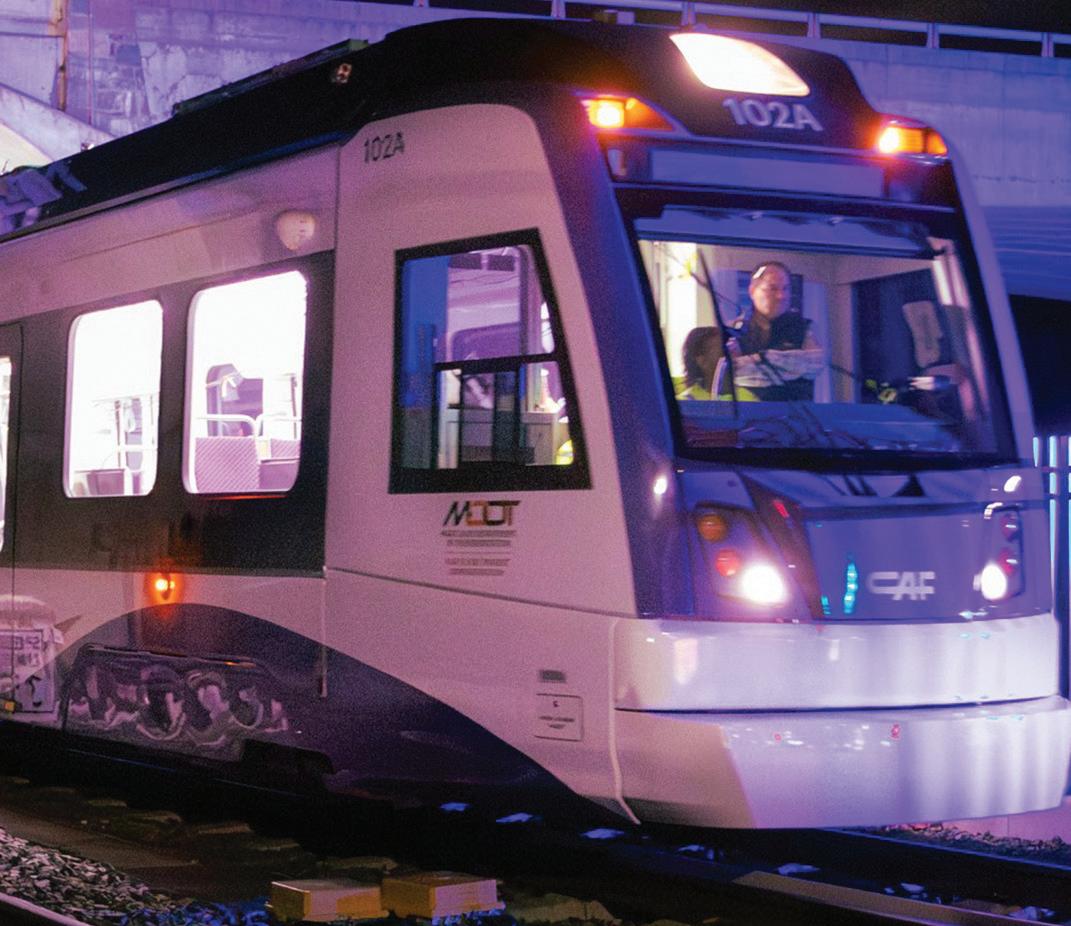
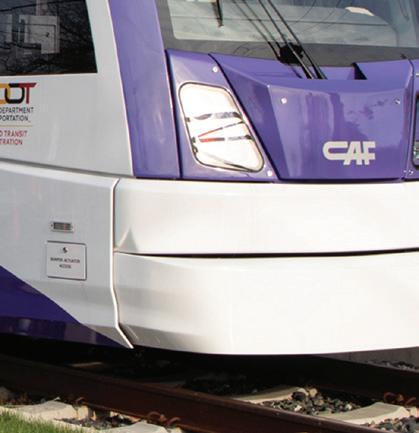
The 28 light-rail vehicles (LRVs) for the Purple Line were assembled by CAF in Elmira, N.Y. Arnold notes that when putting out a request for proposals for the railcars, there wasn’t anything specific the agency was looking for.
“We were pretty open to the type of car, other than it needed to be a light-rail vehicle, and it needed to be accessible for everyone,” Arnold said.
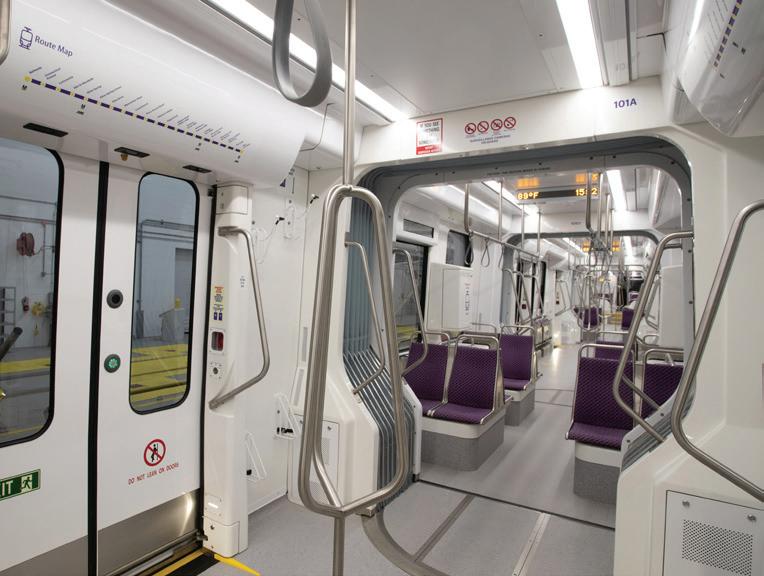
The cars are 142 feet long and are more than 8.5 feet wide, with a total passenger capacity of 400. They are lowfloor vehicles, making it easy for those with mobility challenges to ride.
Features include seating for 80 people, bicycle storage and a fully open gangway, so riders can have clear visibility throughout the entire length of the train, as well as noise reduction measures such as dampening wheel skirts. The vehicles are electric, which make them less noisy compared to a typical railcar.
The first LRV for the Purple Line was delivered in 2024. Testing began on the
cars in 2025, with the final car arriving in November. Cars will be tested through the end of 2026.
While the Purple Line will be connecting parts of Maryland that are currently difficult to reach, the state will also be using the Purple Line to integrate transit with housing with the help of TOD.









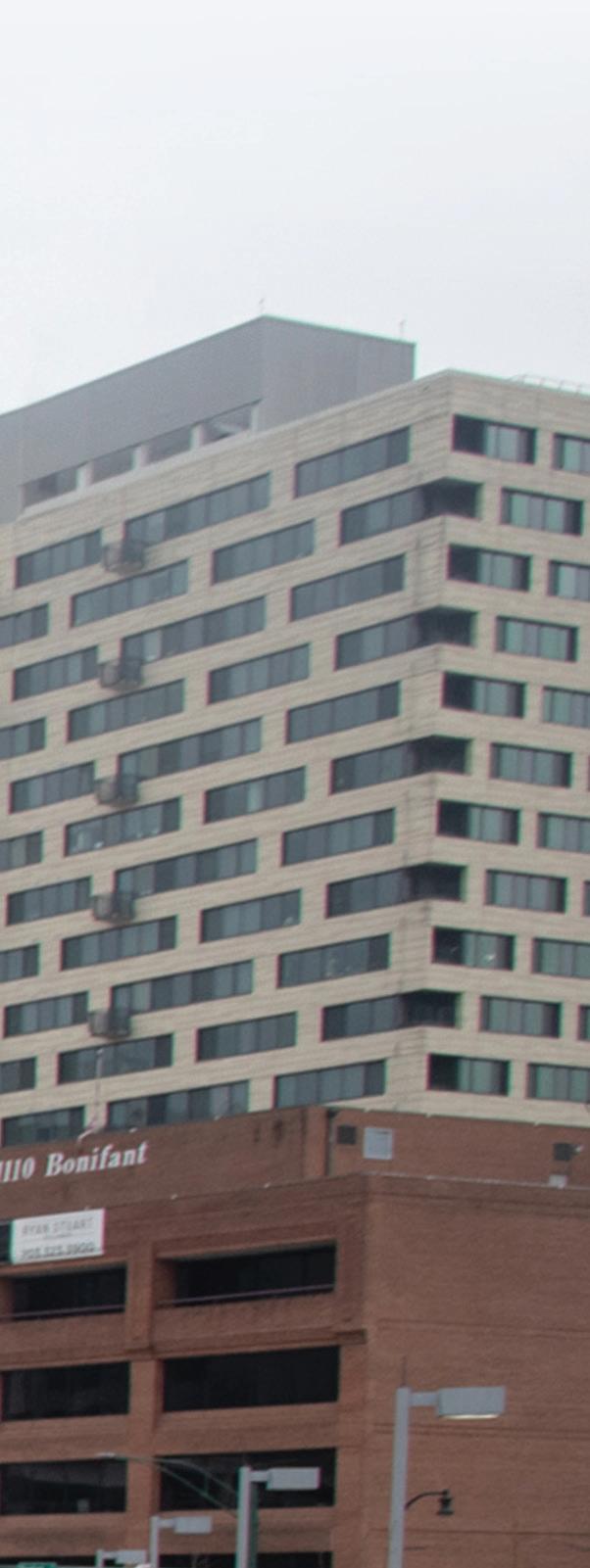
According to Arnold, the TOD focus speaks to the growth in both Prince George and Montgomery County, who noted that apartments around the Purple Line location have already begun opening up.
“It is amazing to see the TOD that is popping up already around the Purple Line stations in anticipation… it’s like high rise after high rise,” Arnold said.
Along with the TOD development, Biggs notes the project has led to the creation of 19 miles of sidewalks, helping those with mobility challenges reach stations more safely. Biggs says all the locations for the new sidewalks, as well as new bike trails, were strategically chosen so residents wouldn’t have to use a car to get to one of the 21 Purple Line stations, including 11 stations in Prince George’s County and 10 in Montgomery County.
“These were sidewalks we had to build from scratch; this area
simply didn’t exist before,” Biggs said. “We’ve taken an area where you couldn’t go with a stroller or using a wheelchair and now you can easily access and be able to get to any one of our new stations with ease.”
The project is currently 90% done with construction. In May, MDOT MTA celebrated the installation of the final piece of rail connecting Prince George and Montgomery counties. According to Arnold, the latest the line would open would be early 2028, but the end of 2027 is still the goal.
“The reason why we can’t say for sure when the line will open is because of all the testing that still needs to be done,” Arnold said, while noting that around April 2027 pre-revenue service testing will begin.
The agency is planning a phased approach for the launch of the line, but it’s too early to know exactly the frequency


of service. According to Arnold, the target is a train coming every seven minutes during peak hours and every 10 to 15 minutes off peak, depending on the time of day. The frequency goal is to align train times so that they are not operating during class changeover at the University of Maryland due to the potential of high-volume pedestrian activity near the tracks. Arnold notes the timing “will have to be worked out as we get through the trial running period.”
MDOT MTA is working with Arts in Transit, a $6 million public art program designed to make art an integral element of the project and to further enhance the stations, aesthetic treatments and landscape designs. Art is incorporated into stations, as well as other project structures, including bridges, fencing and lighting.
The Purple Line Art-in-Transit Com-
mittee selected 22 artists from more than 700 submissions for the Purple Line stations. Currently, 10 out of the 21 Purple Line stations have Art in Transit installations complete. The agency has also received over $500 million in funding for small minority and disadvantaged businesses to work on the project.
“It was really important to us to have the community involved in this whole process,” Arnold said. “Transit is an economic driver, and this project is a great example of that.”


• 2002-2008: MTA studied a range of alignments and transit modes for more transit options throughout the Baltimore region.
• 2008: A draft of the environmental impact study was completed on the project.
• 2009: Light-rail transit was selected as the mode of transportation for the project.
• 2013: MTA selected privatepublic partnership as the project delivery method, and the final environmental impacts study was accepted by the Federal Transit Administration (FTA).
• 2014: FTA issued a record of decision on the project, and MTA issued a request for proposals.
• 2016: Purple Line Transit Partners was selected as concessionaire on the project, and construction began on the project.
• 2021: Maryland Transit Solutions was selected to be the designbuild contractor for the project, accelerating construction.
• 2027: The project is scheduled to conclude.




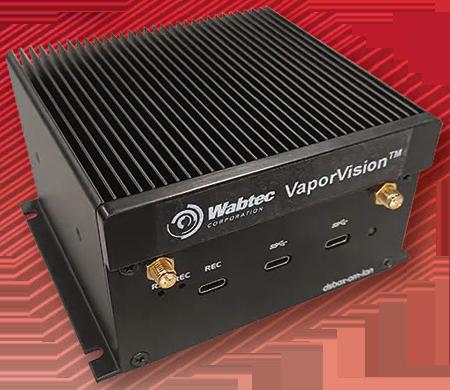
VaporVision uses AI-powered machine vision to intelligently monitor bus door zones — protecting passengers while optimizing door operation in high-traffic transit environments.
VaporVision uses machine vision to AI-powered on-board camera with 180° coverage Optimizes door safety:






Reduce delays Replaces multiple sensors with one smart system
Contact free exits







Transit agencies are connecting communities to new destinations as they complete system build outs and progress with line expansions.
BY MEGAN PERRERO, EDITOR IN CHIEF

The U.S. passenger rail industry is deep in its build out era. Voter-approved system expansions are being completed or nearing completion. Preferred alternatives are being selected. Rail line extensions are moving into the design and engineering phase. Projects are advancing into the construction phase. One rail line is even one step closer to becoming a reality to connect Denver to Fort Collins, Colo. A lot of movement is happening from coast to coast.
This can be seen by the nearly 5% increase in transit agencies’ track miles over the past few years, according to data from the National Transit Database. In 2020, there were 13,755 track miles transit authorities operated on in the U.S. This number jumped to 14,421 in 2024 and will continue to grow in the coming years as new lines and extensions enter service. A similar bump is reflected in the number of active rail vehicles, jumping from 22,896 in 2023 to 23,676 in 2024. Again, this number is anticipated to increase as agencies like New Jersey Transit, the Metropolitan Transportation Authority and Amtrak introduce modernized rolling stock onto their systems. While the passenger experience continues to be top of mind, this is seeming to be prioritized through new service offerings. Yes, optimizing schedules, offering flexible fare payment options and providing real-time information is
still important. However, the passenger experience can only improve once a community has access to a new rail line or connection—especially for the first time. Take the light-rail projects that have come online this year alone. At least 11 new miles have entered service, connecting at least just as many communities to new destinations.
It’s been a standout year for light-rail systems. After nearly 18 years, Sound Transit completed its voter-approved Link system expansion with the opening of the Crosslake Connection—the final Link 2 Line segment. Even more notably, this light-rail project required an engineering feat—constructing the world’s first light-rail floating bridge. The teams had to leverage innovative engineering techniques to address the










unique challenges of running electric trains across a moving body of water. e feat was worth tackling. anks to this connection, the seven-mile segment now unites the Eastside with Seattle, Lynwood, Federal Way and the Seattle–Tacoma International Airport via a transfer to the 1 Line. Sound Transit’s Link system now spans 63 miles, with stops at 50 stations. While shorter in distance, the Kansas City Streetcar Authority’s newly opened 0.7-mile Riverfront Extension provides connectivity that’s just as meaningful. anks to the $62-million extension, riders can now seamlessly travel from the University of Missouri–Kansas City through downtown all the way to Kansas City’s riverfront. is project marks an important step as the city invests in the area to be more accessible, connected and multimodal. With the streetcar serving as the backbone, a bridge for bikes and pedestrians will o er additional options to access the riverfront.
Turning to heavy rail, the Los Angeles County Metropolitan Transportation Authority (L.A. Metro) is also providing new connections with the opening of the rst section of the D Line Subway Extension Project. With 3.9 miles added, riders can now travel west beyond the original station in the Koreatown neighborhood into Beverly Hills. At least four communities will have access to three new underground stations. e extension also creates a one-seat
2023 Cost 2024 Cost
$413,257,602
$506,335,602
$647,360
$0
$18,557,080
$132,613,754
$3,478,968
$3,433,709
$0
$0
$1,202,648
$2,110,478
$4,259,514
$3,463,272
Source: NTD 2024 Capital Expenses
By
the Numbers
2,742
Number of escalators available within passenger rail stations
Source: NTD 2024 Transit Stations
$547,175,695
$712,583,976
2,972
Number of elevators available within passenger rail stations
Source: NTD 2024 Transit Stations
ride from downtown L.A.’s Union Station to La Cienega in Beverly Hills. L.A. Metro completed the extension as part of its Twenty-Eight by ’28 initiative to enhance the region’s transit infrastructure ahead of the 2028 Olympic and Paralympic Games.
Other rail
e Austin Light Rail project in Austin, Texas, is quickly moving ahead. In under two years, the Federal Transit Administration (FTA) issued a record of decision for the project’s nal environmental impact statement. e Austin Transit Partnership (ATP), the entity tasked with overseeing the implementation of the system, can now move forward with the federal funding process and begin more detailed project work. Shortly a er FTA’s decision was issued, ATP also selected Austin Rail Constructors (ARC) as its development partner. ARC is a joint venture between Stacy Witbeck and Sundt Construction responsible for constructing a majority of the system—including the transitway, tracks, systems, stations, bridges, tra c signals, utilities and drainage structures. Another voter-approved initiative, phase one of the project will connect communities to places such as downtown, East Riverside and South Congress.
Up in the Tri-State area, one of the nation’s most critical infrastructure projects—the Hudson Tunnel Project—continues to progress a er overcoming federal funding obstacles from earlier in the year. In April, the Gateway Development Commission awarded Package 1C: e Hudson River Tunnel Section to Traylor/Walsh/Skanska joint venture. is con-
Capital expenses for streetcars in existing service increased by 614.6% from 2023 to 2024.
$1,144,536,953
$1,689,359,570
By the Numbers
14,421
Number of track miles operated by U.S. transit agencies
9,116
Number of transit grade crossings
1,455
Number of elevated guideway miles operated by U.S. transit agencies
Source: NTD 2024 Track and Roadway
struction package includes boring the section of the new tunnel tubes under the Hudson River and installing the tunnel liner and oor. Now, six of the 10 construction packages that make up the project are either in progress or completed.
Back out in California, the Claremont Extension of L.A. Metro’s A Line is pushing forward on two fronts. At the start of this year, the Foothill Gold Line Construction Authority awarded the design and engineering services contract to Parsons Transportation Group, Inc. e $60-million contract includes designing all elements of the 2.3-mile light-rail extension from its current design level of approximately 30% to approved for construction drawings, as well as supporting the project with any


needed design services during construction. Second, at the time of publication, the authority was planning to award the construction manager contract to one of the four teams that submitted bids. Both contracts utilize the construction manager at risk delivery method. When complete, the extension will connect riders in Claremont to Pasadena, Calif., and into downtown L.A.
Updates from Amtrak
Amtrak is also starting the year out strong. While newer state-sponsored routes like the Mardi Gras and Borealis service are seeing high demand, Amtrak more recently is turning its focus to modernizing its rolling stock. Earlier this year, Amtrak introduced the first new Airo trainset that’s slated to begin passenger service on the Cascades route in the Pacific Northwest. All eight trainsets should complete manufacturing by the end of this year. By 2027, Amtrak will
expand the Airo trainsets to the Northeast Regional route, giving more riders a chance to ride on the sleek new trains. Amtrak plans to expand the Airo to other short- and mid-distance routes in the future.
But long-distance travelers need not fret. Shortly after the Airo debut, Amtrak released an updated strategy to replace its long-distance fleet. Amtrak canceled its request for proposals on bi-level trains after receiving industry feedback




23,676
Total number of active vehicles in U.S. rail fleets
Source: NTD 2024 Revenue Vehicle Inventory
and completing a joint review with the Federal Railroad Administration. Instead, Amtrak is asking suppliers to bid on its new long-distance eet replacement contract. Amtrak plans to add over 800 new railcars across 14 routes through its replacement program. e selected supplier is scheduled to be announced by the end of 2027. is all follows the highly anticipated launch of Amtrak’s Acela eet, which debuted last year on the Northeast Corridor. ese premium, high-speed trains are modernizing the passenger experience and helping reshape the idea of train travel. Updated amenities and enhanced design features are creating a new experience for riders connecting up and down the corridor. Time will tell if Amtrak is able to build upon the Acela’s excitement with its upcoming rolling stock and truly usher in the next generation of what it means to travel by train.
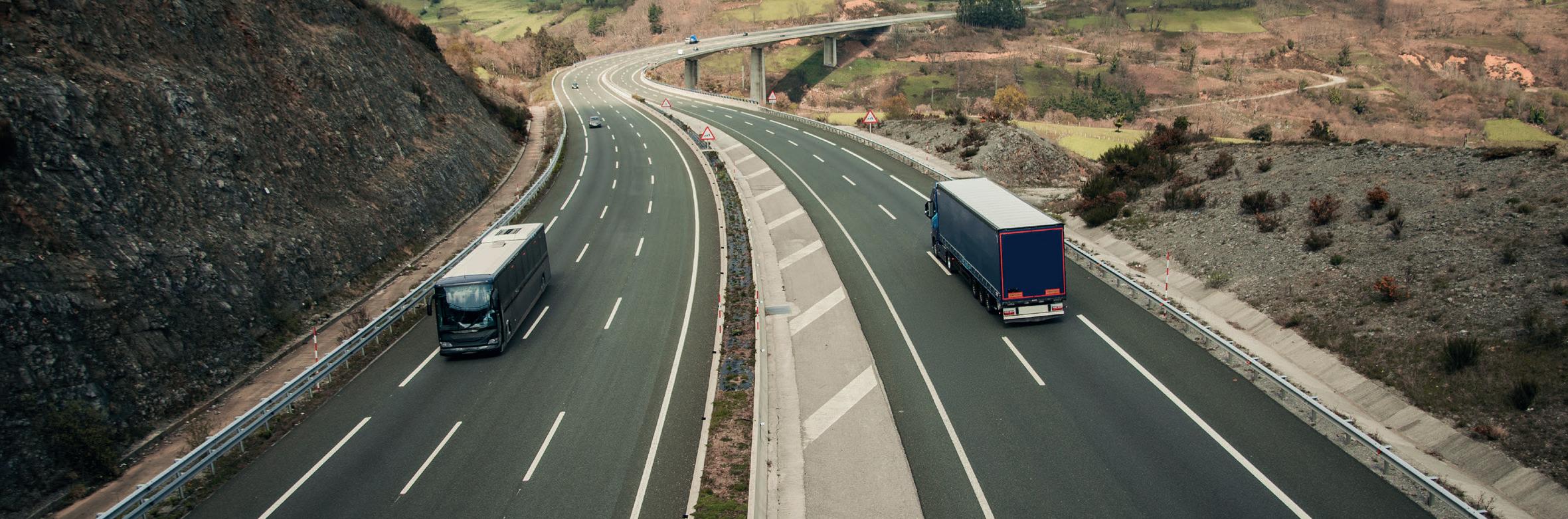
From the sensitive transportation of goods to tightly scheduled passenger transport: trucks and buses keep the world moving. To be successful, they have to meet increasing demands – in terms of performance, safety and sustainability. Our holistic drive systems and service concepts enable original equipment manufacturers and fleet operators to successfully master this change.

Artificial intelligence now has eyes inside and outside of transit buses to boost efficiency and bolster safety.
BY NOAH KOLENDA, ASSOCIATE EDITOR
Transit agencies have spent countless years dealing with lane blockages and have been collecting vehicle and driver data for the last three decades—data that’s typically archived and called upon only when an incident requires it, not embedding it in the way the system functions. Now, artificial intelligence (AI) is coming to bus fleets to change both, and in some cities, it’s already begun.
Enter AI vision, being used for both automated camera enforcement (ACE) to ticket drivers that block bus lanes and bus stops, and now in dash cams that monitor transit operators and the road in front of them for more robust incident reporting and driver training. These implementations of AI seek to improve the transit experience by making trips more efficient and safer for riders.
ACE leads to low rates of recidivism and system efficiency improvements
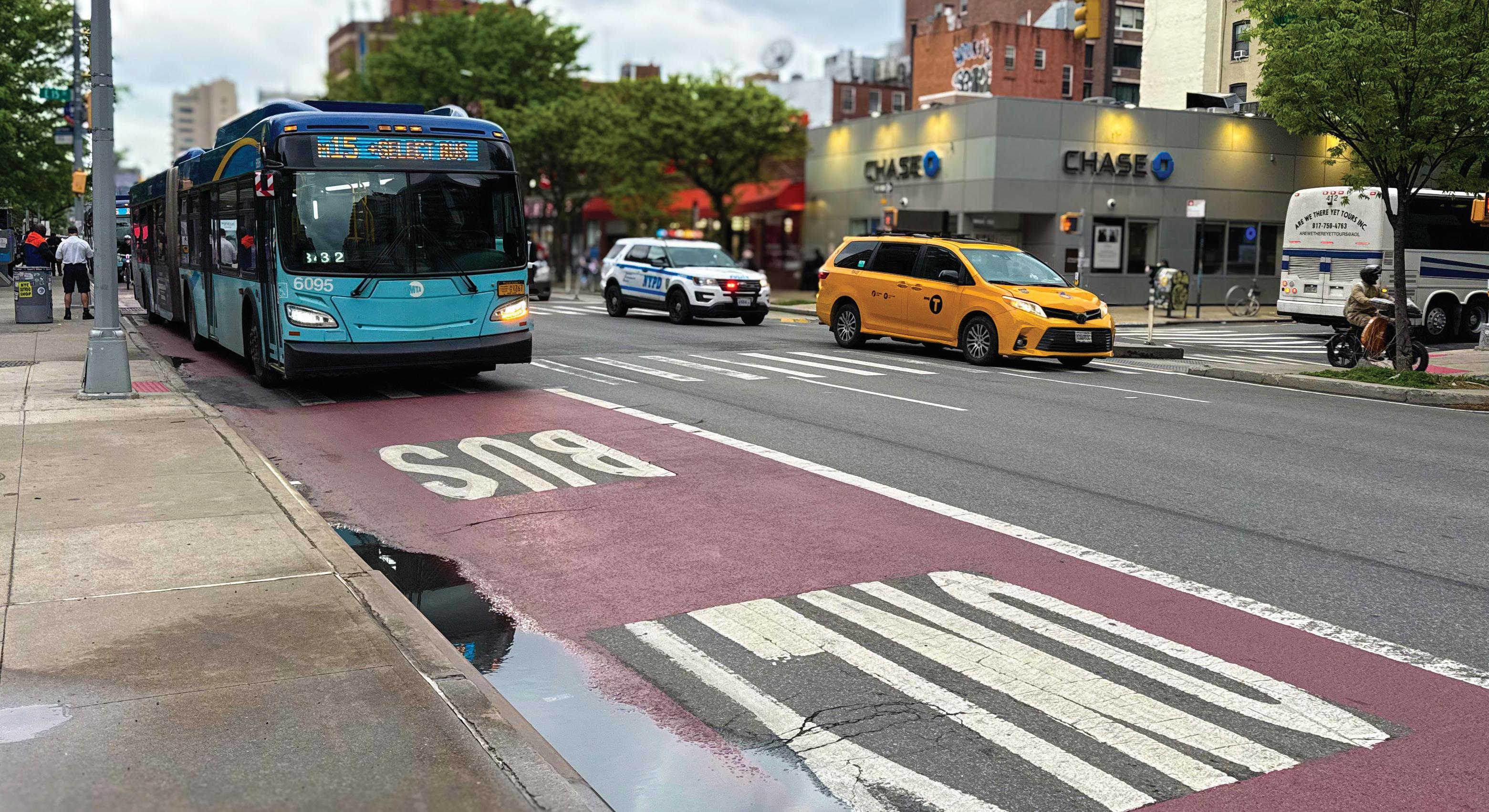
On the ACE side of things, Hayden AI has made big strides since its 2019 inception—now serving multiple major metropolitan areas like New York City and Philadelphia—with its bus-mounted cameras that are enforcing the rules of modern bus-only lanes.
“I think it’s no secret that managing bus lanes—keeping bus lanes clear—is essential to cities being able to take advantage of the full value of adding them,” said Hayden AI Chief Growth Officer Charley Territo. “We decided to take a look at whether or not we could at least initially provide a mobile-based system that provided a high level of capture with a high level of accuracy and was able to do essentially four things: one, increase bus speeds; two, enhance safety; three, increase the amount of on-time arrivals; and lastly, hopefully increase bus ridership, and the system we developed was designed to do exactly that.”
Those things were also what the Southeastern Pennsylvania Transportation Authority (SEPTA) was looking to solve when it first piloted the technology back in 2023, according to Hayden AI. The company noted that bus speeds in
Hayden AI has deployed its automated camera enforcement technology in multiple major metropolitan areas, including in New York City where it’s currently enabled on 60 bus routes.
Photo: Noah Kolenda
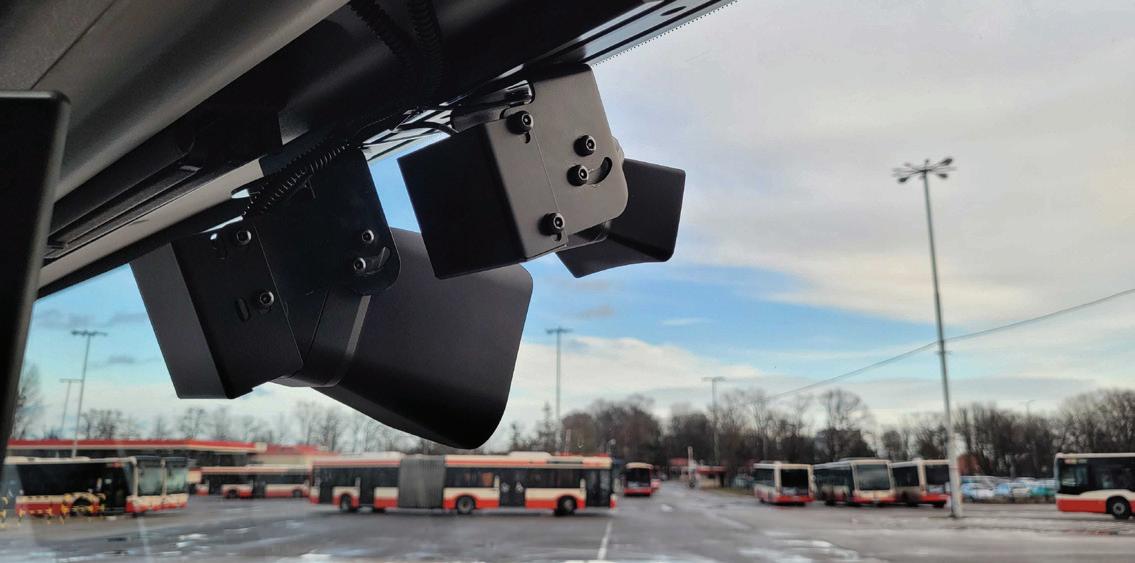
AI’s dual-camera system mounted behind a bus windshield, positioned to detect bus lane and parking violations from the vehicle’s point of view.
the city were averaging eight miles per hour, slower than the national average of between 13 and 14 miles per hour, costing its riders time and its operations budget $15.4 million. Additionally, blocked bus stops create unsafe boarding conditions, especially for those with disabilities or who are using mobility aids.
That pilot, which captured more than 36,000 observations of parking obstructions, led SEPTA to adopt the technology throughout its system in April 2025. Hayden AI installed 152 systems on SEPTA buses and is currently installing 38 systems on SEPTA trolleys.
According to SEPTA, bus routes equipped with this technology have seen speeds increase by 3% to 6% since the program began while routes without enforcement have gotten slower during the same timeframe.
The program did receive some critiques, largely focused on oversight. However, SEPTA Planning Programs Manager Matthew Zapson notes that there’s oversight with every citation.
“We were really comfortable with the process that was laid out through the legislation—through that ordinance— that was passed because it required the same requirement as there is for automated red-light enforcement and automated speed enforcement,” Zapson said. “In all three programs, a sworn law enforcement officer has to sign or affirm a violation before a ticket is ever issued.”
Zapson explained a perception of false positives could “undermine the program more generally.”
By design, Territo says the technology is not being billed as a parking enforcement tool, rather a tool that’s designed
to aid in the flow of transit and that the system was created with nuance to only enforce rules when violations impact that flow, not just if they’re seen at all.
“Our systems are only capturing events when those events impede the operation of the bus and the transit network, and I think that’s important,” Territo said. “You know, I don’t think anyone believes that there are never times when a vehicle may need to stop at a bus stop or stop in a bus lane to discharge a passenger for a brief moment. Quite honestly, as long as that doesn’t impede the operation of the transit network, it’s not always a bad thing. Cities are complicated, crowded spaces.”
Territo also explains the benefit of operating a system like that is it requires less compute and data transmission and allows for the processing of incidents to be done on the bus instead of having to be sent to the cloud for analysis. Once the on-bus system sees what it deems as a violation, it then creates a package of information and sends only that information for review instead of a constant stream of the camera feeds. Further, the AI isn’t just left to figure it all out on its own, as cities work with Hayden AI to chart out what constitutes a violation in pre-defined zones.
“Every program begins with a discussion of the rules of that particular city,” Territo said. “Our system is designed so that how a city treats a violation or a specific zone is specific to how our system detects events. So, if a city has certain hours that a bus lane is enforced, that is something that our system accounts for. If the system has certain rules with the size of a bus stop, that’s something that our system accounts for. If our system has rules with the amount of time a vehicle can stop at a bus stop, that’s something that our system accounts for.”
Territo explains that the first step is defining the rules, then applying those to a layer of mapping. The program then merges that mapping layer with a layer that detects vehicles, and when deployed, determines if passed vehicles fall within the parameters of a citable offense as defined by those rules. If the system determines it does meet the parameters, that’s when an event is created, and data is collected for the ticketing authority.
Since launching last April, 63% of registered vehicle owners who received one violation from the Philadelphia Parking Authority have not received a second ticket—a number that stretches to 91% when looking at the Metropolitan Transportation Authority’s multi-year implementation, according to Hayden AI. As recidivism numbers are low and dropping with subsequent check-ins—suggesting driver behavior is changing—the company doesn’t see this as a means to generate revenue from ticketing, but in cost savings that can be achieved through an increase in efficiency.
“So over time we would expect the benefits to shift and any benefit that comes from revenue, comes from revenue generated by more people riding buses, by less fuel being needed because of reduced idle time, by maybe less buses being needed because of faster, more reliable service and not because of just violation or fines,” Territo said.
As for reactions to the technology in practice, Zapson says it’s been a positive experience because of the equitable way
enforcement is carried out—only ticketing when a violation impedes transit instead of just when a violation occurs at all.
“It’s a happy surprise because there’s always some caution when you’re introducing a new enforcement tactic like this, but by and large, it’s seemed pretty positive,” Zapson said.
Another area where AI is being employed in the busing experience is in the dash cams buses are outfitted with. Samsara has launched an AI-powered dash cam that’s designed to prevent incidents while monitoring the transit operator and the road ahead for faster, more robust event logging and as a method to help train drivers based on their own behaviors.
What started as a telematics and equipment management company, Samsara has expanded to include new offerings that harness AI for safety and behavior correction. Corrected with in-cab alerts like beeps or voice prompts, the system is monitoring for drowsiness, unintended lane departures, possible forward collisions, inattentive driving, seatbelt usage, phone usage, tailgating, rolling stops, harsh driving and possible pedestrian collisions to prevent incidents, helping drivers maintain awareness and improve their skills.
Samsara Principal Product Manager Margaret Finch notes that she saw the benefit of adding AI vision to its dash cam when she saw immediate behavior changes in session videos.
“I think for me, seeing video evidence of drivers holding their phone or looking down, hearing an in-cab alert and correcting that behavior in real time was really the moment where I realized there is huge potential here,” Finch said. “Like, we can scale this out. We can help customers get their drivers off of their phone, off of distraction and actually implement this as a key behavior change mechanism.”
Beginning in other applications outside of public transit— like in construction and trucking—Samsara has expanded its offerings to include coaches and buses, like that from Coach USA, while also beginning contracts with public transit agencies like the San Mateo County Transit District (SamTrans).
In its implementation with Coach USA, Finch notes a 92% decrease in preventable incidents involving pedestrians, cyclists and motorcyclists since the company implemented Samsara’s dash cams in its coaches.
“Those numbers just are incredible, right?” Finch said. “I think when you imagine at that scale of over 1,000 buses being able to have that 92% decrease in these preventable incidents, it’s just such an amazing proof point that we know so many other customer types can benefit from.”
As for the drivers, Finch says the platform is designed to keep them at the center, noting that feedback on the coaching was positive as it kept drivers actively aware instead of truncating training or review to a manager’s office. Finch also says this gives the opportunity to recognize and reward drivers for safe behaviors as the AI unlocks data points that managers may not have had time to calculate on their own in the past.
Finch notes that while she’s seen a lot of variety in the adop-
tion curve with drivers, once a driver notices a change in themselves or has evidence from an incident they otherwise wouldn’t have, they become a “spokesperson internally” for their other drivers.
“Typically what we see is as soon as a tenured driver in the fleet has a moment where they either get exonerated from an accident or they notice a real change in their own behavior, like, ‘oh, I didn’t realize I was picking my phone up that much,’ they can really help drive the buy-in and the adoption of the rest of the drivers,” Finch said.
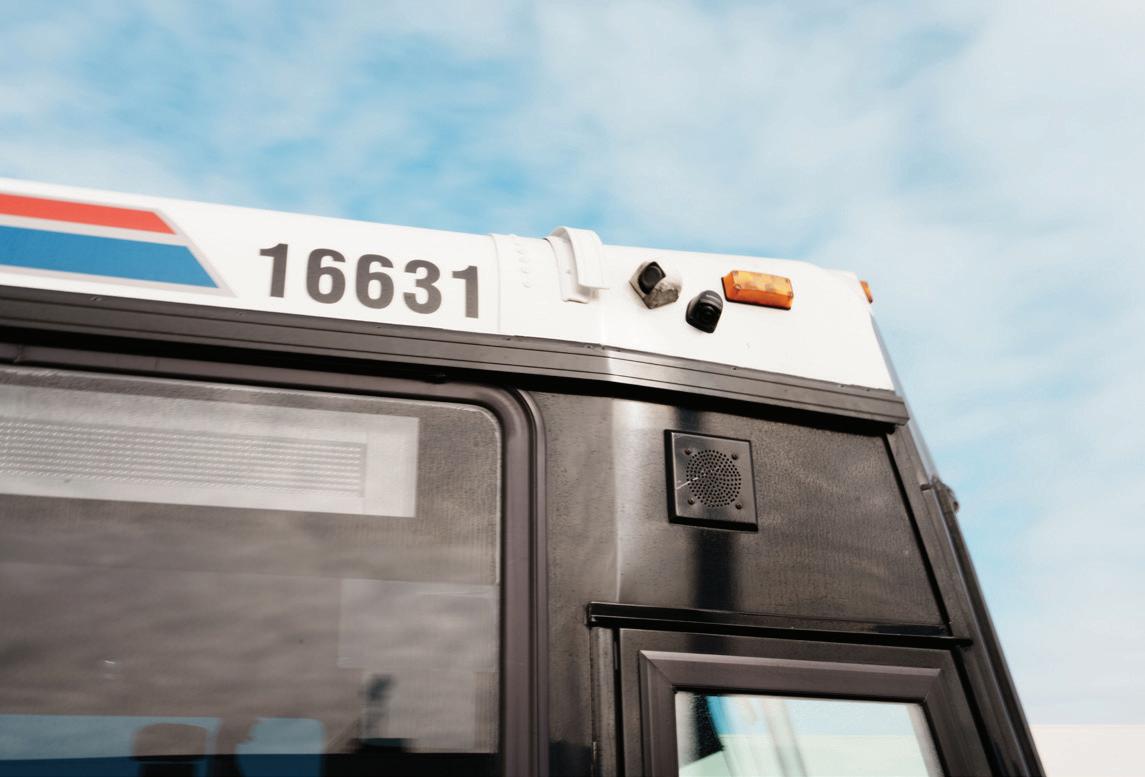
USA bus equipped with a Samsara AI camera on its exterior roofline, part of the fleet safety monitoring system.
INC 120 N.3rd. Street Richmond, Indiana 47374 (765) 962-0526 Fax (765) 966-5374 Web Site: www.wch.com E-mail: wch@wch.com

As for how the cameras are making these detections, Finch explained that the AI is specifically seeking out things “on the edge” and using those to generate training events—only firing when it notices something it’s not supposed to see in normal driving. Further, the AI looks at the situation holistically instead of just focusing on one trigger to gauge the severity of the event.
For example, if the AI detects a mobile phone event, it then examines the rest of the available data from connected streams to assess things like road and weather conditions, vehicle information and GPS data to understand road characteristics such as speed and special zoning—like schools or construction—to assemble a full report. These events then turn out a personalized training item that aims to correct a behavior by delivering the why behind the lack of safety in the event determination instead of just reminding a driver to stay off their phone.
The approach of holistic data collection also allows for different events to be handled in different manners—small events can be recapped and noted in weekly AI training summaries, leaving more time and focus for larger events that need human intervention in training.
“We want to get people focused on the right thing and focused on impacting the biggest risk and the biggest impact drivers,” Finch said. “So, it’s like, how can we help safety


managers and coaches free up their time to focus where it really matters instead of just having a blanket approach for everyone, which won’t work as effectively.”
The cameras are next set to be installed on 235 SamTrans fixed-route buses, expanding what the agency says is efforts to reduce collisions and improve safety for passengers, operators and the public.
“This technology gives our operators additional tools to stay aware of their surroundings while helping us better understand and prevent incidents,” said SamTrans Acting Deputy Director of Safety Omar Brown in a press release. “Improving safety for our riders, employees and everyone sharing the roadway remains a top priority for SamTrans.”
What’s emerging across both lanes of AI adoption is less a collection of individual products and more the early architecture of a connected fleet. A bus equipped with Hayden AI’s ACE cameras can now coordinate with traffic signals through LYT. A bus running Samsara’s suite of sensors and its AI-powered dash cam can share its data with maintenance systems, dispatch platforms and safety dashboards through an open API. In both applications, the technology is converging toward the same destination: a vehicle that doesn’t just collect data, but acts on it—and increasingly, does so before a driver or a dispatcher has to ask.



































Agencies looking to advance TOD programs need market intelligence, local developer insights and strategic public sector focus to successfully implement transit-oriented programs.
BY PATRICK MCDONOUGH, CONTRIBUTOR
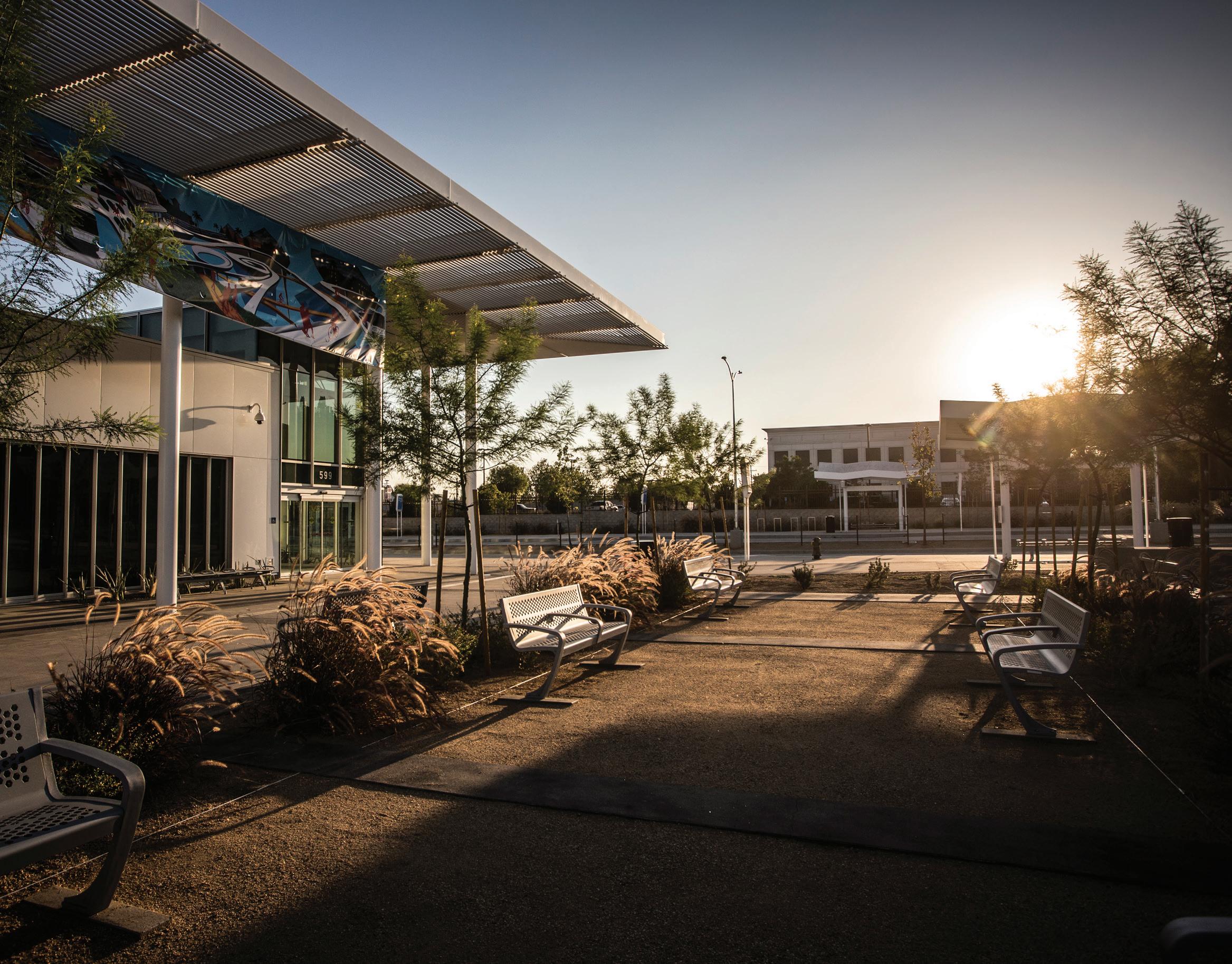
Awell-executed transit-oriented development (TOD) effort around bus rapid transit (BRT) can strengthen ridership and support wider social goals, such as affordable housing and creating more livable communities, but these benefits don’t automatically follow any new BRT project. Agencies that want to advance TOD programs need market intelligence, local developer insights and strategic public sector focus to attract and sustain the support needed to fund, staff, develop and successfully implement transit-oriented programs.
Transit stations and routes can be powerful development catalysts in neighborhoods, but sometimes those TOD efforts require action by a transit agency or city, which a prioritization assessment can reveal.
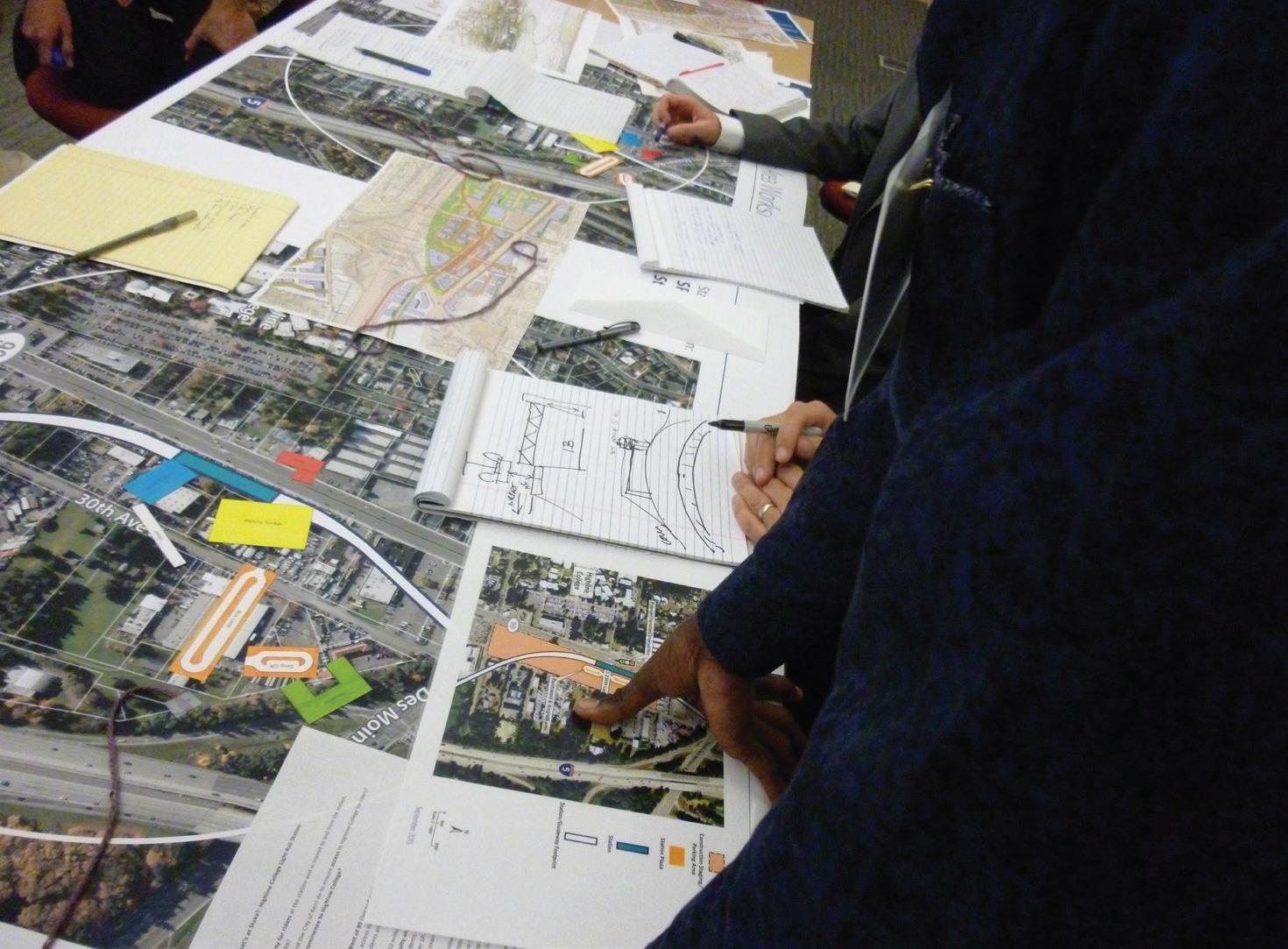
Workshops and roundtables with developers and other local stakeholders are key to understanding the local development environment.
Reaping the benefits of TOD starts with knowing where to focus efforts. Combining clearly established agency and stakeholder development goals with tools to prioritize station area planning positions agencies to efficiently and effectively navigate the challenges of implementation. Transit agencies or cities that are planning across corridors with multiple or even dozens of station sites need an awareness of site-specific readiness for TOD development. This can help prioritize limited staff resources, cultivate stakeholder partnerships and advance TOD progress for sites in multiple real estate submarkets simultaneously.
What does this look like in practice? A midsize Midwest metro provides a great recent example. HDR is working with a transit agency developing BRT in two corridors simultaneously. The agency’s goals for the corridors include driving economic growth, attracting new businesses and helping employers attract and retain employees—all outcomes that TOD can support.
Across the two corridors, there are 28 different station sites. To develop strategies appropriate to each station area, HDR and the agency grouped stations with similar characteristics. This involved evaluating five development attributes of each location:
• Real estate market interest and development potential and activity
• Transit market depth
• Development pattern of existing built environment
• Land use regulatory frameworks
• Institutional presence and orientation
After each station site was scored, they were grouped into six typologies. This categorization was combined with an assessment of the time it takes to make changes in the attributes studied for each station location—institutional policy can change quickly, for instance; development patterns may change over decades.
The resulting ranking helped the agency and city officials understand which station areas and types were already performing well in terms of development goals. It revealed which are likely to need catalyzation for redevelopment in response to BRT implementation. This corridor-wide analysis also showed some common factors that could most influence TOD efforts at the station locations.
Every city and metro area has different strengths to support positive TOD outcomes. Some cities, for instance, have advanced transit-supportive land use reforms to allow taller buildings or eliminate parking requirements along transit corridors.
In the course of the prioritization study for the Midwest agency, it quickly became clear that the presence of government or nonprofit institutions near stations was a key criterion affecting development in this city. The institutions in question are diverse—they include city and county governments, the school system, a local development authority and religious organizations of different faiths.
But they share a common trait: Institutions that are present, active, occupy significant landholdings near future BRT stations and are open to partnership can act as a powerful X-factor to increase a location’s likelihood of achieving the agency’s and city’s development goals.
Institutional presence becomes particularly powerful when an institution owns significant land acreage near a station. If a champion at the institution embraces the vision for TOD in the region, that institution can adapt

very quickly to position a site for development that can attract both public and private partners.
With the data available for all 28 stations and the importance of institutions established, the team turned to focusing on more granular, station-level strategies for TOD. A key place to start was institutions with strong partnership opportunities, especially those with significant acreage within an eighth of a mile of future BRT stations.
A local community college, for example, has underutilized parking that could be converted to development opportunities. It also recognizes that onsite housing could give the campus more vibrant energy around the clock. An institutional partnership could offer a way forward to jumpstart development.
Five questions a TOD prioritization framework should answer
As agencies consider how to prioritize their efforts and focus, the questions below offer a good place to start.
1. What outcomes are we trying to advance through TOD?
Is the priority ridership, access to jobs, housing choice, climate goals or a mix of these and others? A framework should reflect stated agency and community objectives.
2.
Given our staffing and budget, where can we make a real difference in the next 12 to 24 months?
A good framework helps agencies pick a short list of stations or corridors where focused efforts will produce visible outcomes, rather than trying to “do TOD” everywhere at once.
3. What level of effort is appropriate for each location?
Some areas may warrant detailed planning and capital investment
now while others may benefit more from policy coordination, land preservation or incremental improvements.
4. How will this framework guide real decisions over time?
A prioritization tool should inform capital planning, grant applications and partnerships. Agencies should be able to explain how it shapes what they do next.
5.
How will success be measured?
The best sounding framework is only useful if it actually leads to the outcomes identified as its main goals. Long term, how will an agency track and measure whether those goals are being achieved? Starting projects with the understanding that evaluation and tracking of specific metrics will be included provides an opportunity to build ongoing momentum by showing proven results to the community, leaders and stakeholders.
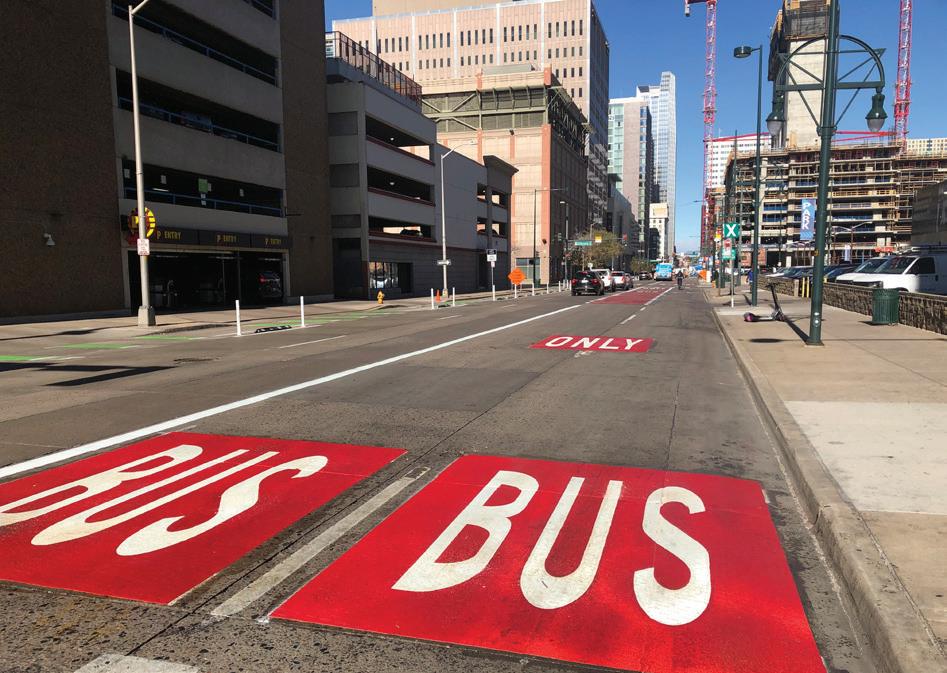
Understanding the development possibilities and current environment along a new transit route is an important step in determining which locations will naturally encourage development and which may require an extra push.
When those sites’ strengths are known, a clear prioritization framework helps focus efforts and optimize the schedule for interventions.
Patrick McDonough
The local nonprofit development authority also holds promise. It holds 22 acres immediately adjacent to a future station and more land near a second station site. These are locations where the development authority and the transit agency could partner on potential joint development projects with market rate housing procured under the Federal Transit Administration’s (FTA) joint development program (FTA 7050.1c). They could be used as proof of concept to private market developers that this corridor can be an emerging market.
These sites also benefit from being at stations adjacent to each other along the corridor. If the transit agency and the city seek to catalyze both sites simultaneously, this could improve the frameworks for both small-scale and large-scale development. Making these investments adjacent to each other also signals a level of public investment and stewardship that incentivizes the private sector to increase its interest.
a
The finished TOD framework described here—expected to be complete in summer 2026—will have strategies for all 28 stations to prepare for future TOD success.
For sites where development interest is already strong, those strategies will be about staying the course, educating the development community about project approval procedures and sharing stories of projects that are already successfully navigating regulations.
For areas where the market is likely years away from receiving strong market interest, this is a great time to look at land swaps and land assemblage close to future station sites.
And for places in the middle, where a nudge from the public sector could be the spark that ignites a local market, recommendations will include developing new advisory roles in local government or nonprofit sectors. These could include professionals who can help smaller developers learn how to bundle local incentive programs into their capital stacks. Another suggestion is the addition of a “process navigator” to help developers who may only deliver
a project every three to five years understand the latest regulatory opportunities and constraints.
Prioritization promotes progress
All of this work began with setting clear development goals. The prioritization effort then investigated conditions, held multiple roundtables with developers and discussed with local stakeholders. The result is a better understanding of where best to deploy limited resources to meet the agency and city’s TOD goals.
Successful TOD prioritization uses transit alignment planning as a foundation and then explores land use regulations, real estate markets, the existing built environment and unique local influences to identify sites that have more potential than may be immediately obvious.
When those sites’ strengths are known, a clear prioritization framework helps focus efforts and optimize the schedule for interventions. It builds shared language and understanding of why different stations benefit from different TOD planning activities in different parts of the real estate cycle. It can also be useful in demonstrating strategic intent when competing for grants.
Ultimately, if followed consistently, prioritization reduces uncertainty for developers by demonstrating how the city is taking coordinated actions to promote the uplift of an entire corridor to match a generational investment in transit.

About the author
Patrick McDonough, AICP , is the transit-oriented development lead at HDR and has spent more than 20 years leading analyses and studies for transit corridors.

By Richard Montgomery Fleet and Facilities Manager Victor Valley Transportation Authority
MANAGING A MIXED FLEET of compressed natural gas (CNG), battery-electric buses (BEBs), and soon hydrogen fuel-cell electric buses (FCEBs), isn’t something coming down the road; it’s already here for Victor Valley Transportation Authority (VVTA).
VVTA operates in the high desert region of San Bernardino County in southern California. With a fleet of 130 revenue vehicles, VVTA operates fixed-route service, demand response, commuter bus and microtransit. The agency’s fixed-route fleet consists of 12 BEBs, 13 FCEBs and 49 CNG buses. Managing a diverse fleet of mixed fuels requires training, data, communication and infrastructure.
Technicians need to be knowledgeable and trained to work on each of the fuel types.
Fueling infrastructure is different for all three types of fuel. CNG is compressed on site via three compressor skids. Hydrogen is planned for liquid delivery with an existing interim gaseous solution. Electricity is dispensed via plugin charging stations at 100kw. Shop and facility upgrades were required to add hydrogen to an existing CNG fleet. Gas detection is required for both methane and hydrogen, and flame detection is also required for hydrogen.
Technicians need to be knowledgeable and trained to work on each of the fuel types. High voltage systems on BEBs and FCEBs need technicians to be qualified and require strict safety practices, standard operating procedures and proper personal protective equipment use aligned with NFPA 70E. The CNG side still needs to stay current with inspection standards like CGA C-6.4. Utilizing original equipment manufacturer (OEM) training is a must, but fully relying on the OEM is not the best approach. VVTA utilizes organizations like the California Transit Training Consortium, works with its industry partners and has a train the trainer approach; the balance between cross-training and specialization makes a big difference.
Maintenance strategies also must adjust as zeroemission buses are not like CNG buses. BEBs, for
example, don’t do well sitting dormant. If a bus is down, a plan is needed to cycle it, monitor battery health and document what’s happening to minimize problems down the line and reduce out-of-service times. Hydrogen adds another layer with a fuel cell system that requires monitoring fuel economy to help determine when to maintain and rebuild systems.
For data, VVTA is using a dedicated zero-emissions platform to monitor both BEBs and FCEBs. This pulls data from the vehicle telematics systems, infrastructure and the CAD/AVL systems on every bus. The information received includes everything from state of charge and FCEB fuel economy to fault codes and charging status. The issue isn’t getting the data; it’s having an overabundance of data, trusting it and knowing what to do with it.
Each vehicle type has a different range, and fueling times differ greatly. BEBs and FCEBs don’t have nearly the amount of range of a CNG bus. BEBs can also take a significant amount of time to charge—upwards of eight hours—as opposed to FCEB and CNG buses being fueled within a few minutes. The key to making it all work is managing the range using data to find the best routes and pull times that each type of vehicle can be placed on.
VVTA doesn’t design service around the limitations of a vehicle, though. Instead, routes are built around the customer, and that doesn’t change just because of the limitations of the vehicle type. What changes is how the fleet is deployed. You must be strategic about where those buses go while keeping enough flexibility, so operations can adjust when needed. Some routes are more demanding, and you plan for that, but the goal stays the same: consistent, reliable service.
With the range limitations of BEBs and the high costs of hydrogen fuel, how the bus is driven matters.
Regenerative braking has a direct impact on range and performance. Improving range and fuel economy helps, with a focus on training drivers to be conscious of regenerative braking, smooth acceleration, controlled braking and understanding how the bus responds. Communication and documentation tie everything together. When operations and maintenance are aligned and sharing information, you start to see real improvements and fewer issues.
Managing a mixed fleet isn’t simple, but it’s manageable if you stay disciplined and positive. Align your facility, train staff, develop and follow SOP’s, adjust your maintenance approach and keep your focus on the customer.

By Doran Barnes CEO Foothill Transit
OPERATING A MIXED FLEET of compressed natural gas (CNG), battery-electric and fuel cell electric buses (FCEB) buses has positioned Foothill Transit as one of the nation’s most innovative public transportation agencies in the country. Serving the San Gabriel and Pomona Valleys from its headquarters in West Covina, Calif., the agency has spent more than a decade testing and integrating multiple propulsion technologies while balancing operational reliability, environmental sustainability and fiscal responsibility.
Foothill Transit first emerged as a leader in zeroemissions transit when it introduced fast-charge battery-
electric buses (BEBs) in 2010—the first in the nation to do so. The expansion of the electric fleet occurred slowly while the agency continued to test the new technology, relying on a large CNG fleet for dependable daily service. By 2020, the agency operated approximately 327 CNG buses alongside 33 BEBs. This diversified approach allowed the agency to evaluate performance in real-world conditions instead of relying on a single technology strategy.
One of Foothill Transit’s strongest business practices has been phased deployment. Foothill Transit introduced zero-emission technologies incrementally, deploying into myriad ridership environments and along both short local service and longer commuter style routes. This reduced operational risk and allowed maintenance staff, operators and planners to adapt to new fleet parameters gradually.
Infrastructure planning has also been critical to thorough deployment evaluation. The agency invested in extensive charging systems, in partnership with local utilities, and upgraded electrical infrastructure, later developing hydrogen fueling capabilities at the agency’s Pomona Operations and Maintenance Facility. In 2021, Foothill Transit approved contracts for hydrogen fueling infrastructure and FCEB buses, further
High-performance application for large-scale coating work
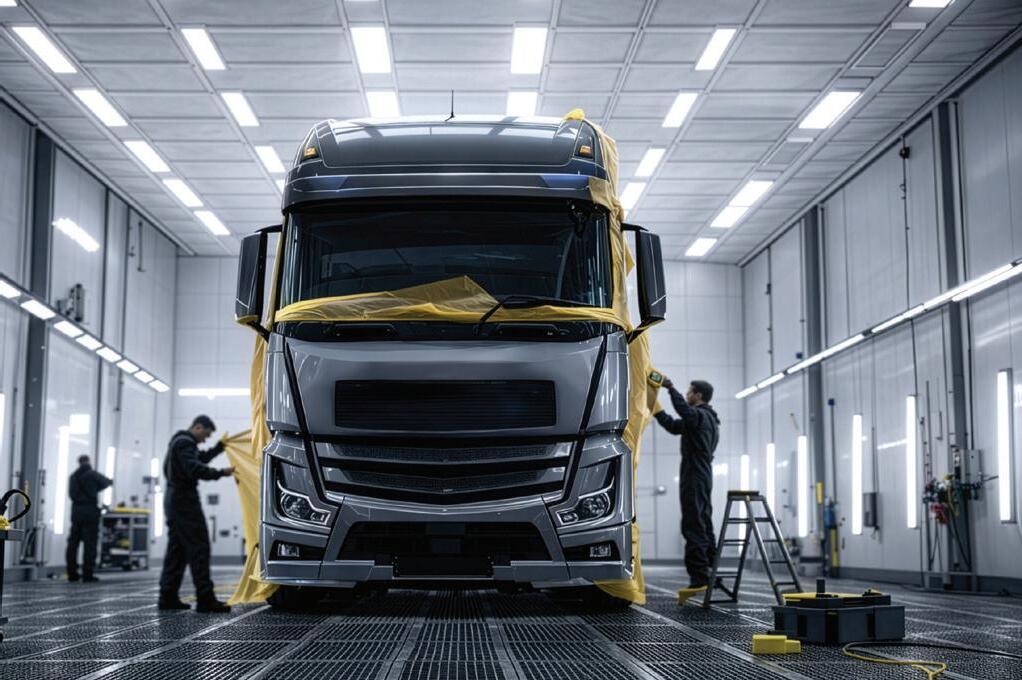
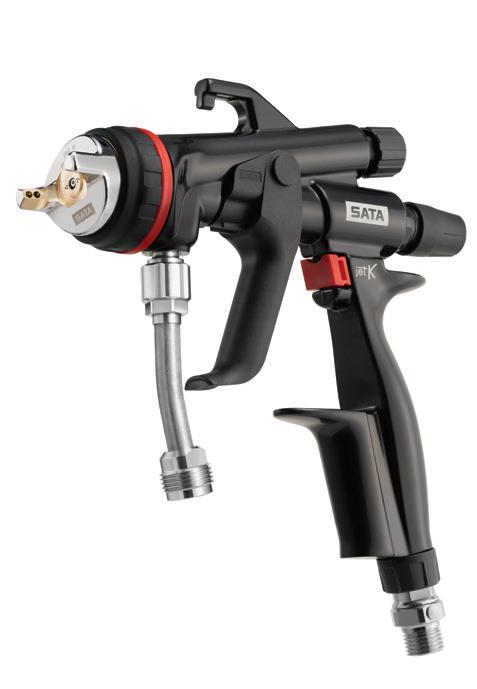
The jet K is SATA’s pressure-fed spray gun built for large surfaces in industrial applications. Its labyrinth airflow system delivers smooth atomization with less overspray and mottling. Standard and MaxLayer nozzles support a range of coatings, while a tall spray pattern improves coverage. Lightweight and adaptable, it works with pressure tanks and pump systems.
Available June 2026
diversifying its fleet strategy. By 2022, the agency launched Los Angeles County’s first FCEB buses into revenue service and eventually had the largest FCEB fleet in the country. These investments demonstrate a key best practice for mid-sized transit agencies: infrastructure must evolve alongside fleet procurement, not after it.
Infrastructure must evolve alongside fleet procurement, not after it.
Another important lesson from Foothill Transit’s experience is the value of operational flexibility. BEBs offer significant emissions reductions and lower fuel costs, but they can face range limitations, considerable charging downtime compared to the CNG equivalents and parts availability challenges. Instead of abandoning zero-emission goals, the agency diversified into FCEB technology, which offers longer range and faster refueling— equivalent to CNG—for demanding routes.
The most challenging disparity has been the cost in both available fuel and in the vehicles themselves, with FCEB buses costing $1.6 million compared to half that price for a CNG vehicle. Here, the most important best practice is flexibility. With this sig-
nificant cost differential, Foothill Transit has had to pause FCEB purchasing.
Strong grant management and partnership development have been key at all steps of this transition. Foothill Transit leveraged federal and California climate funding programs and nurtured meaningful partnerships with manufacturers, fuel providers and engineering firms, which has allowed the agency to reduce financial exposure while staying committed to a zero- emissions future.
Thus far, the best path forward has been flexibility and not reliance on a single propulsion technology. CNG buses can continue providing dependable backup capacity during infrastructure transitions. BEBs are ideal for shorter urban circulators and predictable routes. Hydrogen FCEB buses can support longer regional service where charging constraints remain challenging.
Moving forward, Foothill Transit will continue expanding its hydrogen and battery-electric fleets while using data-driven route analysis to determine the best technology for each service type. Continued investment in workforce training, predictive maintenance systems and scalable fueling infrastructure will help ensure operational reliability and long-term financial sustainability.



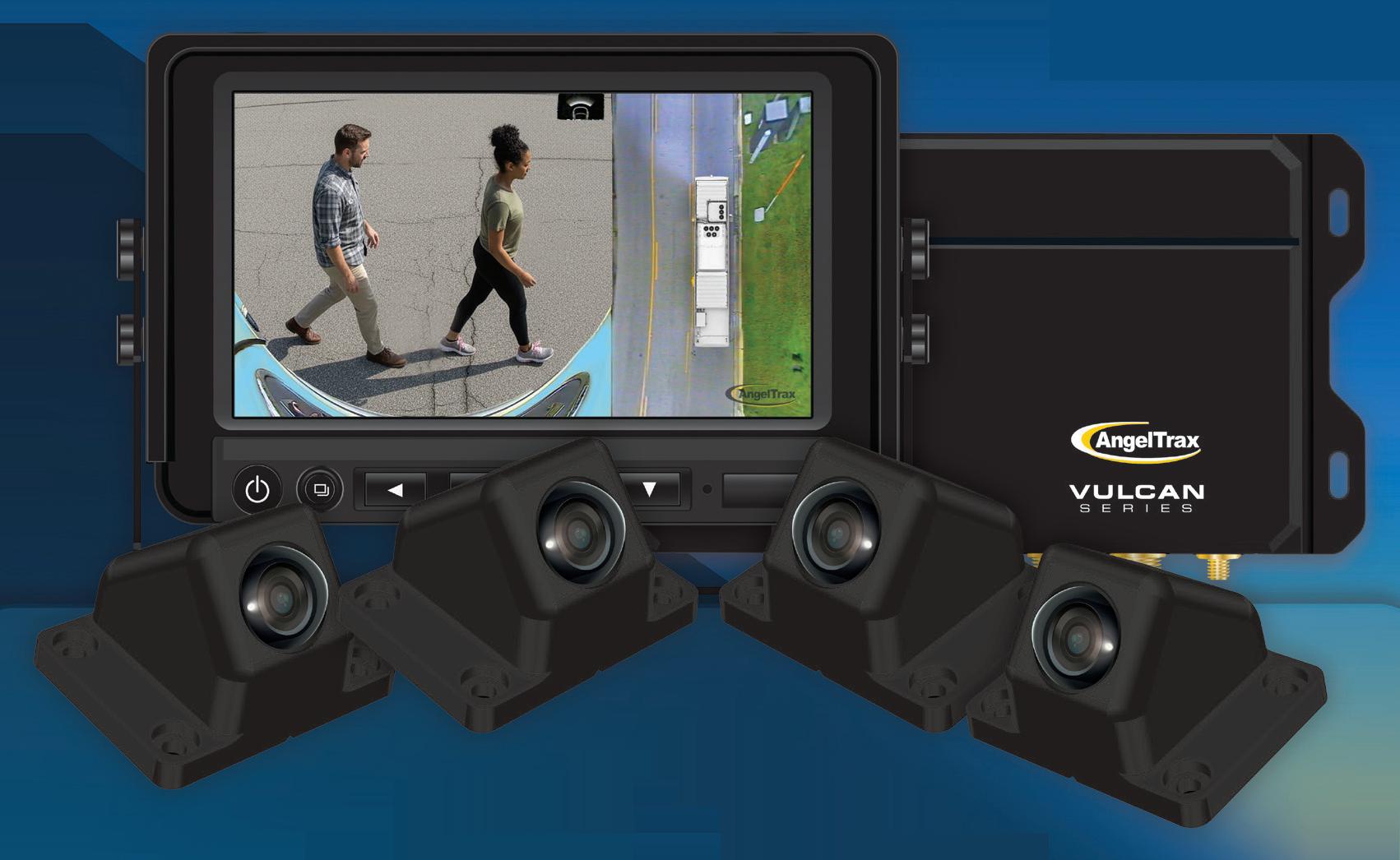
Vulcan™ Series Bird’s Eye View 360-Degree Camera System


• AI-POWERED PEDESTRIAN DETECTION WITH AUDIBLE ALERTS when passenger door is open
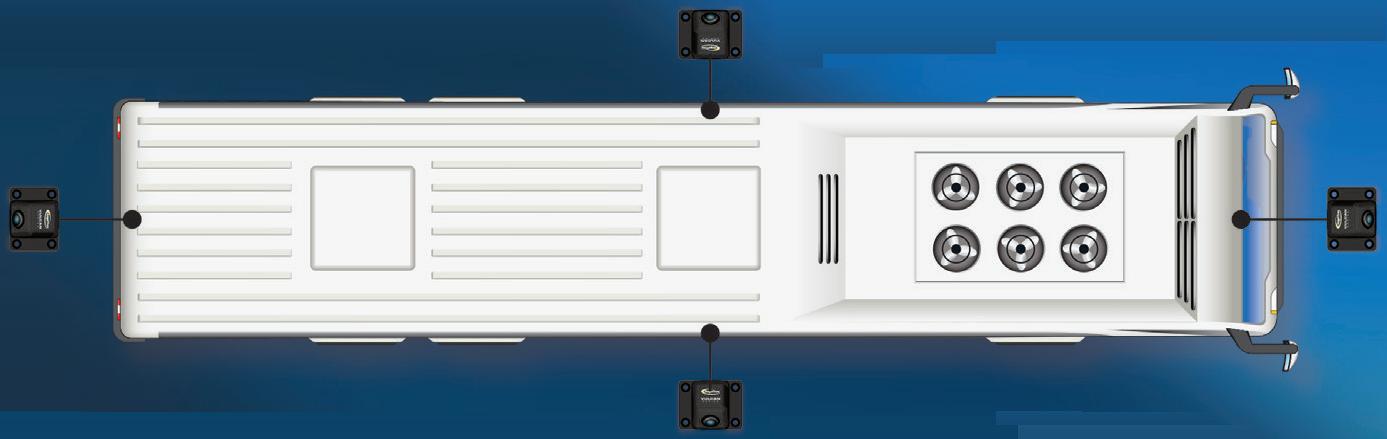
• 360-DEGREE PANORAMIC VIEW with four 1080P cameras







• REAL-TIME MONITORING on a 7-inch display
• STAND-ALONE SYSTEM with microSD card storage
Rail transportation is poised to double globally in the next 25 years.*
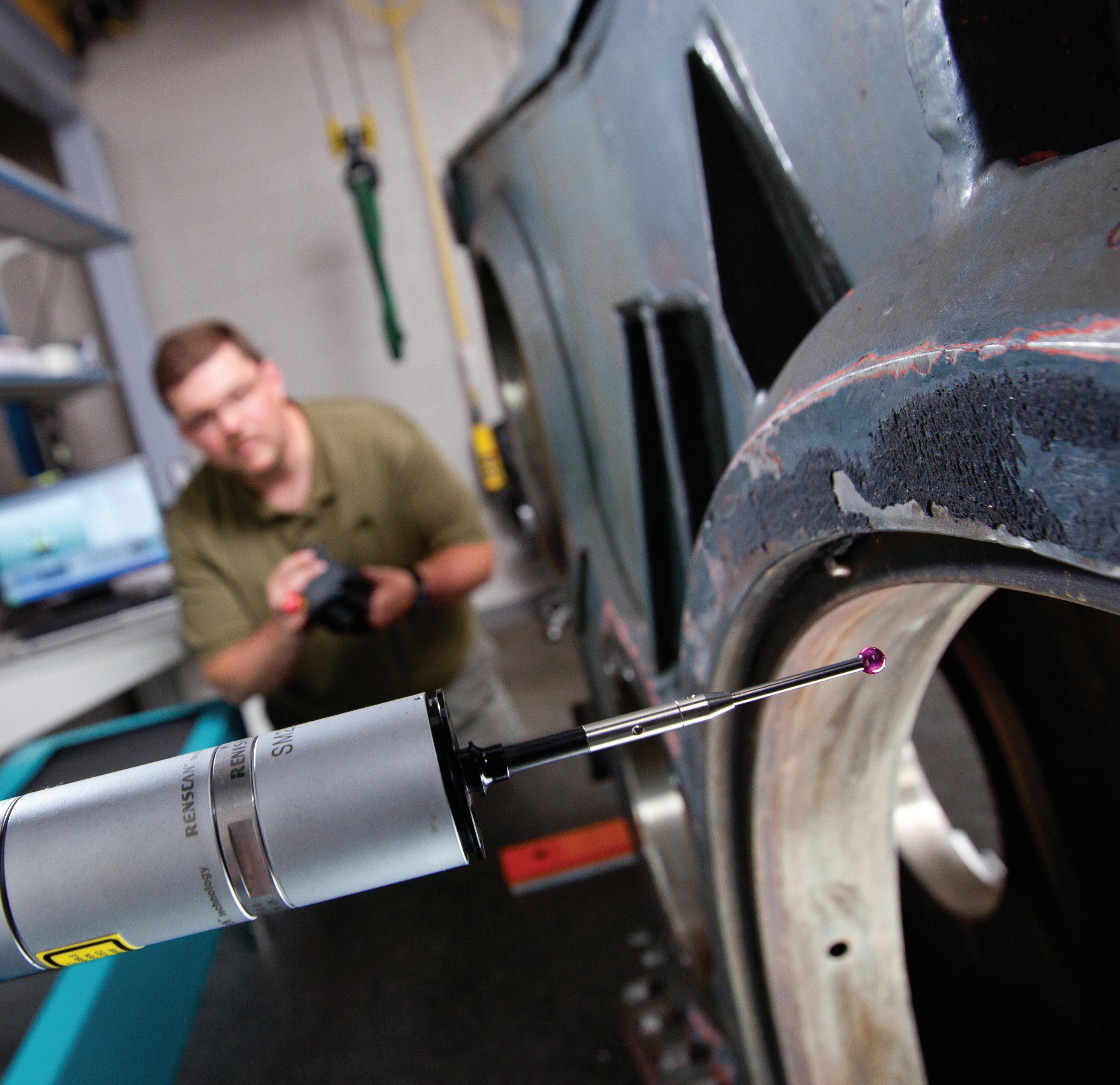
With precision manufacturing and a commitment to making the best products in the world, we’re proud to be a part of the industry that manufactures the vehicles that move people and goods to their destinations smoothly and efficiently.
Our employees are passionate about their work and about applying the world’s most precise standards to everything we make.