










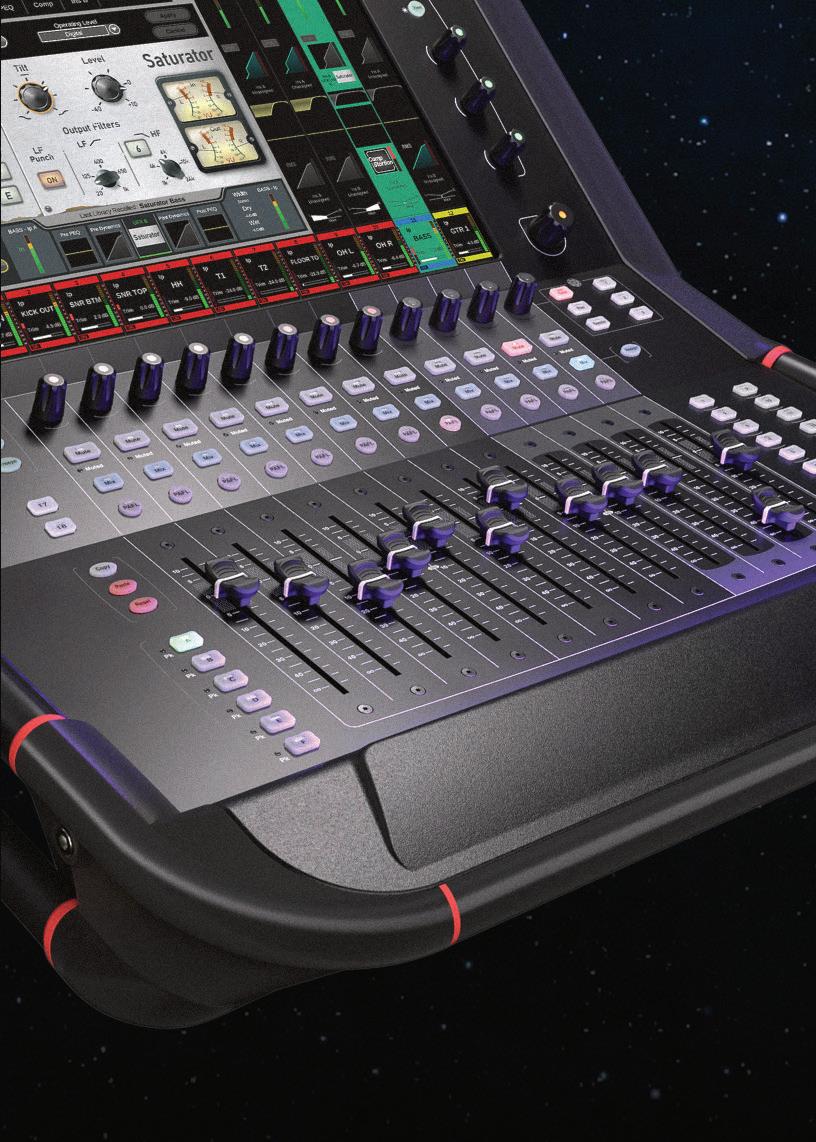




















Studio-grade FX... now that's a plus.









EXPLORE SQ+






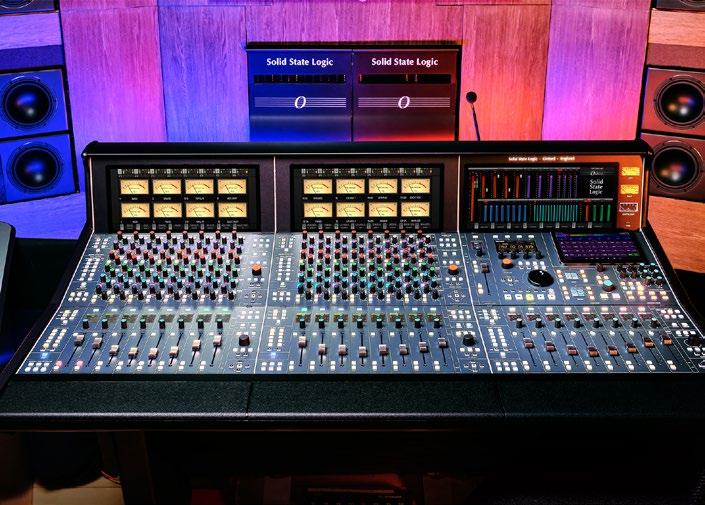
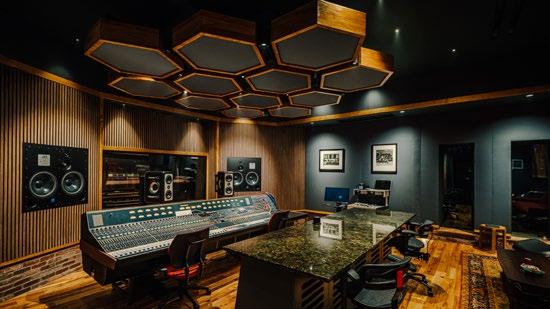
PHOTO: Chapman Baehler
STEVE LA CERRA
08 From the Editor: Billy Joel and the Birth of Digital Recording
10 Current: View From the Top: Chris Neethling, President, Neutrik Group Americas; David ‘Mr. Bonzai’ Goggin Passes 34 Open Channel: The Price of Pursuing Perfection BY CRAIG ANDERTON

*
*


FOLLOW US twitter.com/Mix_Magazine facebook/MixMagazine instagram/mixonlineig
CONTENT
Content Directors Tom Kenny, thomas.kenny@futurenet.com
Clive Young, clive.young@futurenet.com
Senior Content Producer Steve Harvey, sharvey.prosound@gmail.com
Technology Editor, Studio Mike Levine, techeditormike@gmail.com
Technology Editor, Live Steve La Cerra, stevelacerra@verizon.net
Contributors: Craig Anderton, Barbara Schultz, Barry Rudolph, Robyn Flans, Rob Tavaglione, Jennifer Walden
Production Manager Nicole Schilling
Design Directors Will Shum and Lisa McIntosh
ADVERTISING SALES
Managing Vice President of Sales, B2B Tech
Adam Goldstein, adam.goldstein@futurenet.com, 212-378-0465
Janis Crowley, janis.crowley@futurenet.com
Debbie Rosenthal, debbie.rosenthal@futurenet.com
Zahra Majma, zahra.majma@futurenet.com
SUBSCRIBER CUSTOMER SERVICE
To subscribe, change your address, or check on your current account status, go to mixonline.com and click on About Us, email futureplc@computerfulfillment.com, call 888-266-5828, or write P.O. Box 254, Lowell, MA 01853.
LICENSING/REPRINTS/PERMISSIONS
Mix is available for licensing.
Contact the Licensing team to discuss partnership opportunities. Head of Print Licensing: Rachel Shaw, licensing@futurenet.com
MANAGEMENT
SVP, MD, B2B Amanda Darman-Allen VP, Market Lead Carmel King MD, Content, AV Anthony Savona
Global Head of Sales, Future B2B Dena Malouf
Managing VP of Sales, B2B Tech Adam Goldstein VP, Global Head of Strategy & Ops, B2B Allison Markert VP, Product & Marketing, B2B Andrew Buchholz
Head of Production US & UK Mark Constance Head of Design, B2B Nicole Cobban


A few months ago, I made a stupid mistake: I read that the Long Island Music and Entertainment Hall of Fame was planning a two-day event about the region’s favorite musical son. Right then and there, I should have doomscrolled off on my merry way, but instead I kept reading.
It turned out the Hall is hosting a Billy Joel Symposium in June and it sounded interesting, so I marked it on my calendar. A summer weekend spent indoors listening to academic papers like “Piano Man as Ethnographer: Billy Joel and the Anthropology of Deindustrialization?” I am so there.
But I write for a living, so I started wondering what I would have written for that symposium...and you can see where this is going. On a whim, I submitted a proposal for a paper that would look at how Joel’s career mirrored the development of digital recording technology. I figured the worst that could happen was that the Hall would accept the proposal, and if it did, so what? The paper would be easy to write, and researching it would be a snap between the Mix archives and calling up audio pros he’s worked with. It would be fun!
The worst happened: They accepted the proposal. It was a nightmare to write. Researching it was not a snap. It was not remotely fun, and as my wife reveled in pointing out, I had done this to myself for absolutely no reason.
However, it was fun to discover that Joel’s career really did parallel the dawn of digital recording, as both began in the mid-Sixties and advanced in fits and starts before finally catching on in the late 1970s.
While The Hassles, featuring an 18-year-old Billy Joel on keys, were releasing their first album in 1967, on the other side of the world, NHK in Japan was unveiling the first digital audio recording system—a 12-bit/30 kHz device that did little more than prove digital recording was possible. In 1969, as the Hassles upgraded by making Joel the frontman on their second album, NHK upgraded its system to record 13-bit/32 kHz audio across two channels. In both cases, it was too little too late; The Hassles and the NHK system both went nowhere
In 1971, Joel released his first solo album, the poorly recorded Cold Spring Harbor. Meanwhile, over in Japan, Denon issued the first commercially released digital recording. The record—two tracks of avant-garde, experimental percussion—was not a hit. Neither was Cold Spring Harbor. Throughout the early 1970s, both Joel’s solo career and digital recording made sporadic progress; during this period, both Sony and the BBC created digital recording systems, but the BBC’s was proprietary and used for broadcast work, while Sony’s was exhibited at trade shows but never went into production. In the States, Joel kept releasing albums and got minor radio play with “Piano Man,” but none of it translated into record sales.
And then, in 1978, as Joel finally made it big with a string of hits from his album The Stranger, digital recording finally broke through, too. That year, the 3M Digital Audio Mastering System was introduced—a true digital multitrack recorder. Running a cool $150,000 per machine ($675,000 in 2026 dollars), it could record up to 32 tracks, fitting 45 minutes of material on a single digital tape. It was a major step forward, but given the price, only a handful of machines were available at first.
By this time, Joel was working with legendary producer Phil Ramone and engineer Jim Boyer, and his albums were being tracked on 24-track analog, but that changed with his 1981 live album, Songs in the Attic, which was recorded digitally on a rented 3M System.
Not only was it the first live album to be digitally multitracked, but it also became the first album ever to be recorded digitally but mixed analog, as it was transferred down to 24 tracks on a Studer A800. The reason for that wasn’t technological, but rather financial—it would cost too much to keep renting the 3M machine during the mix process. As Ramone noted in a contemporary interview, “Digital is obviously the way to go eventually, but I think we need to avoid having the studios and their clients strangled by the cost.”
Ramone reverted to analog to record and mix The Nylon Curtain (1982) and An Innocent Man (1983), and it wasn’t until The Bridge (1986) that digital recording was used for one of Joel’s studio albums. From then on through his final studio album, 1993’s River of Dreams, everything he put out was recorded digitally, but still mixed analog—which means his last album came out before DAWs began radically changing the industry at the turn of the Millennium.
Since 1993, Joel has recorded a scant 14 songs—most of them covers, many of them duets on other artists’ albums, and nearly all of them made in Pro Tools. Talking with producers and engineers who recorded some of those latter-day tracks, they all agreed DAWs wouldn’t have changed Joel’s process if he was still recording on the regular. Even today, he’s always preferred recording like he did in the analog days, with full band takes capturing the magic of musicians interacting in real time, rather than meticulously building a perfect track piece-by-piece from the ground up. Will Billy Joel ever record another album? Probably not, but it’s safe to say if he does, he won’t go changing.
Clive Young Co-Editor
By Clive Young
Last year, Neutrik AG, the company in Liechtenstein and the Neutrik brand, celebrated its 50th anniversary, and while five decades is hardly a sprint, the company is really just getting started. The pro audio manufacturer was founded in 1975 and soon made a name for itself by introducing the first latch-locking XLR connector; over time, however, it has developed a far broader product portfolio, expanding its offerings to include the familiar powerCON, etherCON, speakON, opticalCON, mediaCON and FIBERFOX lines.
These days, the company has grown far beyond the borders of Liechtenstein, too. Neutrik USA was founded in 1988, and today it’s part of the Neutrik Group; based in Charlotte, N.C., Neutrik Americas is the main hub for distribution and regional management across the U.S., Canada and Latin America, and it’s led by its President, Chris Neethling.
While Neethling began his career overseas in industrial banking, he was in the U.S. working in pro audio when he first joined Neutrik USA in 2009. Rising up the ranks in sales roles while also contributing in finance due to his background, in 2016, Neethling was named Chief Sales Officer for the global Neutrik Group—a position based in Liechtenstein.
In 2024, however, he returned to the U.S. to take on the role of President of Neutrik Americas, overseeing the company’s operations across the region, and maintaining both overall regional performance and strategic direction. “As a leader, my role is to support and enable this team,” he says. “That means creating an environment where individuals feel empowered to contribute, make decisions and grow professionally.”
Much of Neutrik Group’s business strategy is based on utilizing and building upon its audiorelated roots, says Neethling. “Products like the XLR connector were foundational, establishing the brand as a trusted name among musicians
and audio engineers,” he notes. “That heritage continues to shape the brand and provides a level of trust that is difficult to replicate.”
Nonetheless, as the industry has changed and expanded, Neutrik Group has kept up with the times. “Today, the company supports a much broader ecosystem tied to live entertainment,” he says. “This includes not only audio, but also video, lighting and LED technologies. Modern live productions require a fully integrated approach, and the company has adapted by developing connectors and solutions that support the entire signal chain— from audio and data to power distribution.”
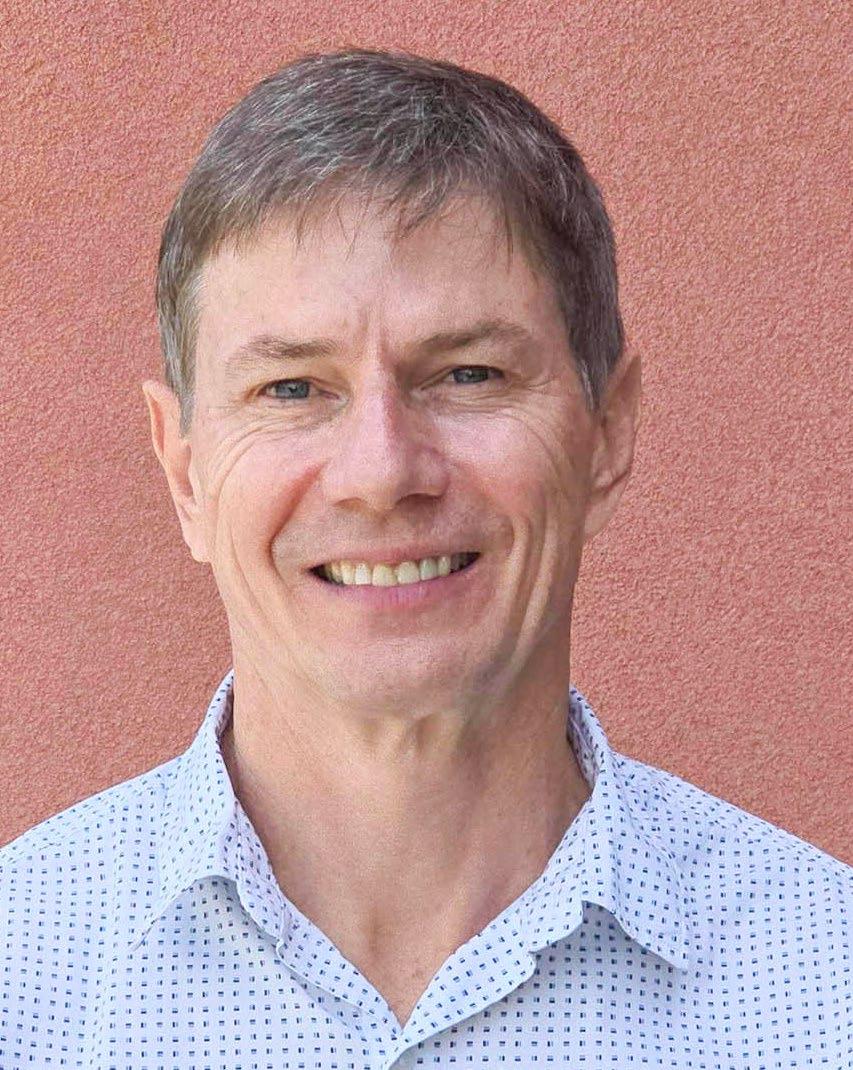
Neutrik Americas’ go-to-market strategy is primarily reseller and distributor-based, which allows the company to reach a broad network of OEMs, broadcast studios, system integrators, rental companies and touring professionals. At the same time, the company also maintains direct relationships with certain OEMs, cable assemblers and key customers.
“One of the key initiatives is strengthening engagement with consultants and system integrators,” says Neethling. “They play a critical role in specifying products for largescale projects, so it is essential to build strong relationships with them. This includes providing education and training to ensure they understand the company’s solutions and how they can be applied effectively.”
Live entertainment has long been central to Neutrik Group’s success, and it remains both a core market and a key driver of revenue for the company. As a production pro, you may have trusted a Neutrik connector with your career at points—but increasingly, people may be entrusting their lives to Neutrik Group products
as well. That’s because one of the company’s strongest emerging markets is the medical field, where its products are being used in applications like digital operating rooms, requiring highperformance connectivity solutions.
Broadening Neutrik Group’s footprint in new markets means collaborating with OEMs and other companies, according to Neethling: “By working closely with key players, the company can ensure that its products are integrated into new technologies and remain at the forefront of innovation. This collaborative approach is essential for staying competitive and continuing to deliver value to customers.”
Neutrik Group has been expanding its reach across different markets, but it remains very aware of how it got where it is today. “Ultimately, while the company has grown and diversified significantly, its roots remain a key strength,” says Neethling. “Neutrik has always been about making the right connections technically, professionally and personally. By building on that foundation while continuing to innovate and adapt, the organization is well positioned for the future.” ■
Los Angeles, Calif.—David Goggin, often known by his pen name “Mr. Bonzai,” whose journalism, photography, visual art, and advocacy chronicled the recording studio industry, died peacefully in April after a valiant fight with two cancers and a stroke. He was 78.
Goggin is survived by his wife of 42 years, acclaimed artist Keiko Kasai. Goggin was a Zen Buddhist practitioner throughout his entire life. His teacher was Rev. Tozen Akiyama.
Goggin was an accomplished artist, writer, photographer, journalist, filmmaker, and poet. He was best known for his monthly interviews with producers, engineers and musicians for Mix magazine and later EQ magazine from the late 1970s through the 1990s. He produced more than 250 interviews, offering quirky, insightful and vivid portraits of studio life. Over his career, he authored eight books, including 2025’s Buzz Me In: Inside the Record Plant Studios with music journalist Martin Porter, reconstructing the wild history of Record Plant Studios, where he worked as a press agent.
For more, please see our extended remembrance at Mixonline.com. ■

Las Vegas, Nev. Mix is pleased to announce the recipients of its 2026 Best of Show Award for the NAB Show. The winners of the various brands’ awards were selected by panels of professional users and magazine and site editors.
The winning products were (in alphabetical order):
Allen & Heath Avantis Ultra Digital Mixer
Clear-Com FreeSpeak Cell
Ross Video Lama
Sennheiser HD 480 PRO Headphones
Shure SLX-D+ Wireless Microphone System

By Sarah Jones
When Tedeschi Trucks Band guitarist and vocalist Mike Mattison brought his “Future Soul” demo into the studio, it arrived fully formed in feeling, if not in execution. The track was grungy, urgent, a battle cry against a world where algorithms are eating the culture alive. Derek Trucks knew immediately what the recording needed to match it.
“I just want it to sound like the building’s going to blow apart,” he says.
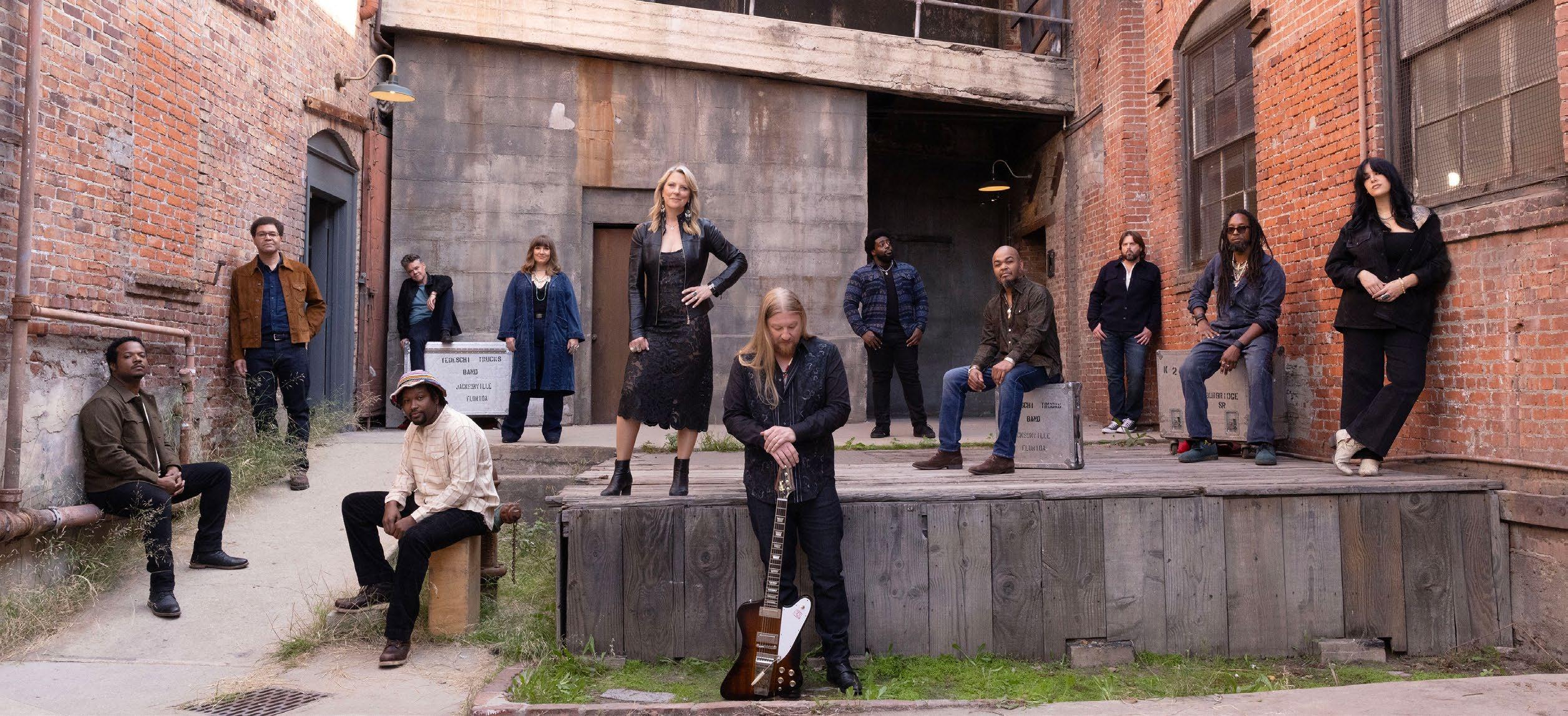
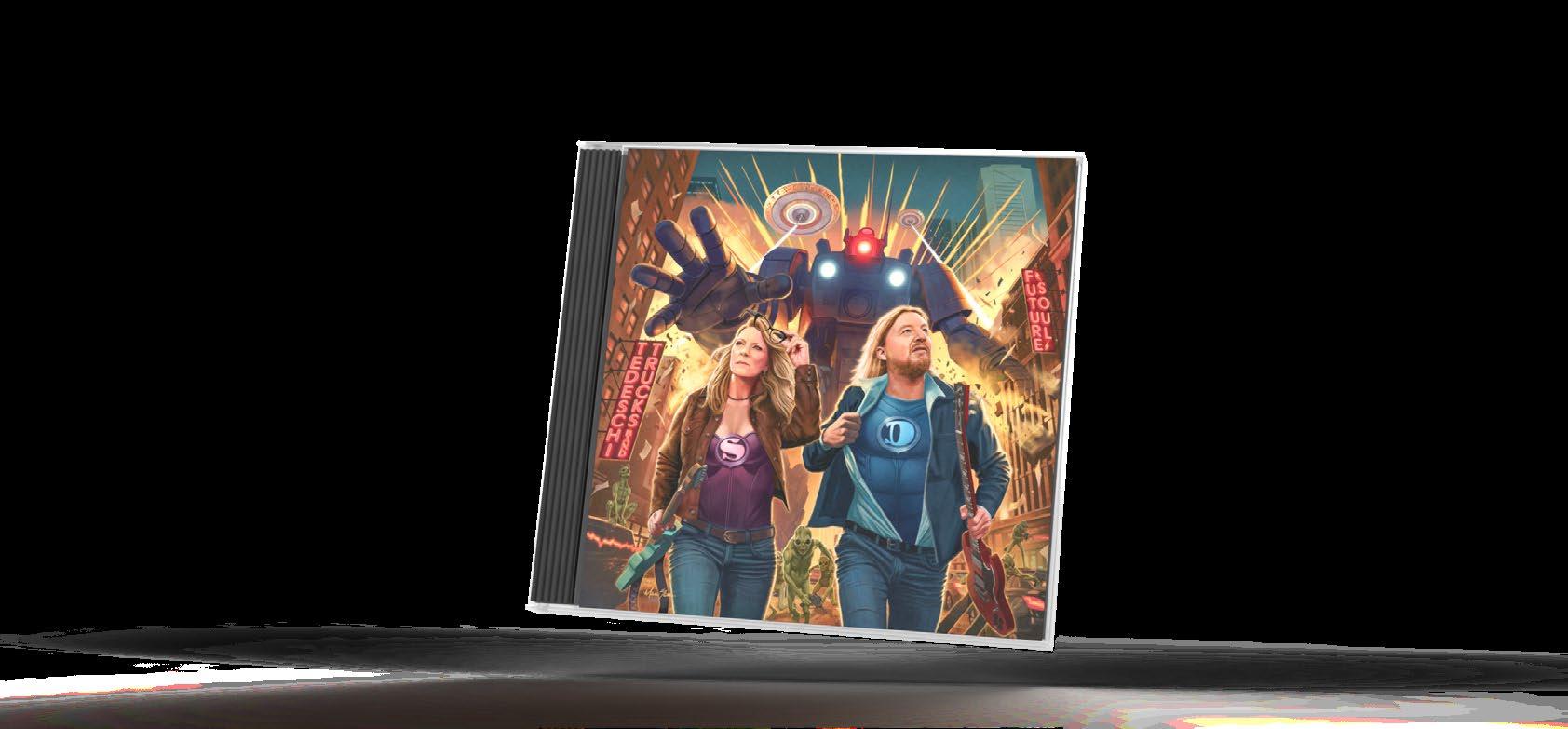
That instinct became the north star for the Tedeschi Trucks Band’s sixth studio album, released March 20 via Fantasy Records. Produced by Mike Elizondo and co-produced by Trucks, Future Soul is the sound of a 12-piece band that could unfurl a song into the stratosphere, choosing instead to distill and sharpen.
After the sprawling I Am the Moon, a quadruple
album recorded during the pandemic, TTB spent two years on the road. When the core of the band finally convened at the Trucks family farm in Georgia to write, the directive was clear: lean and mean. “We really don’t need to do that again,” Trucks says of the four-album format. The question was who would help execute their new vision.
Mike Elizondo’s name surfaced early. A prolific songwriter and multi-instrumentalist, Elizondo has forged a genre-spanning career as a producer, moving fluidly from the rhythmic architecture of Dr. Dre’s 2001 to records with Eminem, Twenty One Pilots and Carrie Underwood. “Mike has lived a lot of lives musically,” Trucks says. “He’s comfortable in a lot of places.”
The sessions began at Swamp Raga, the studio
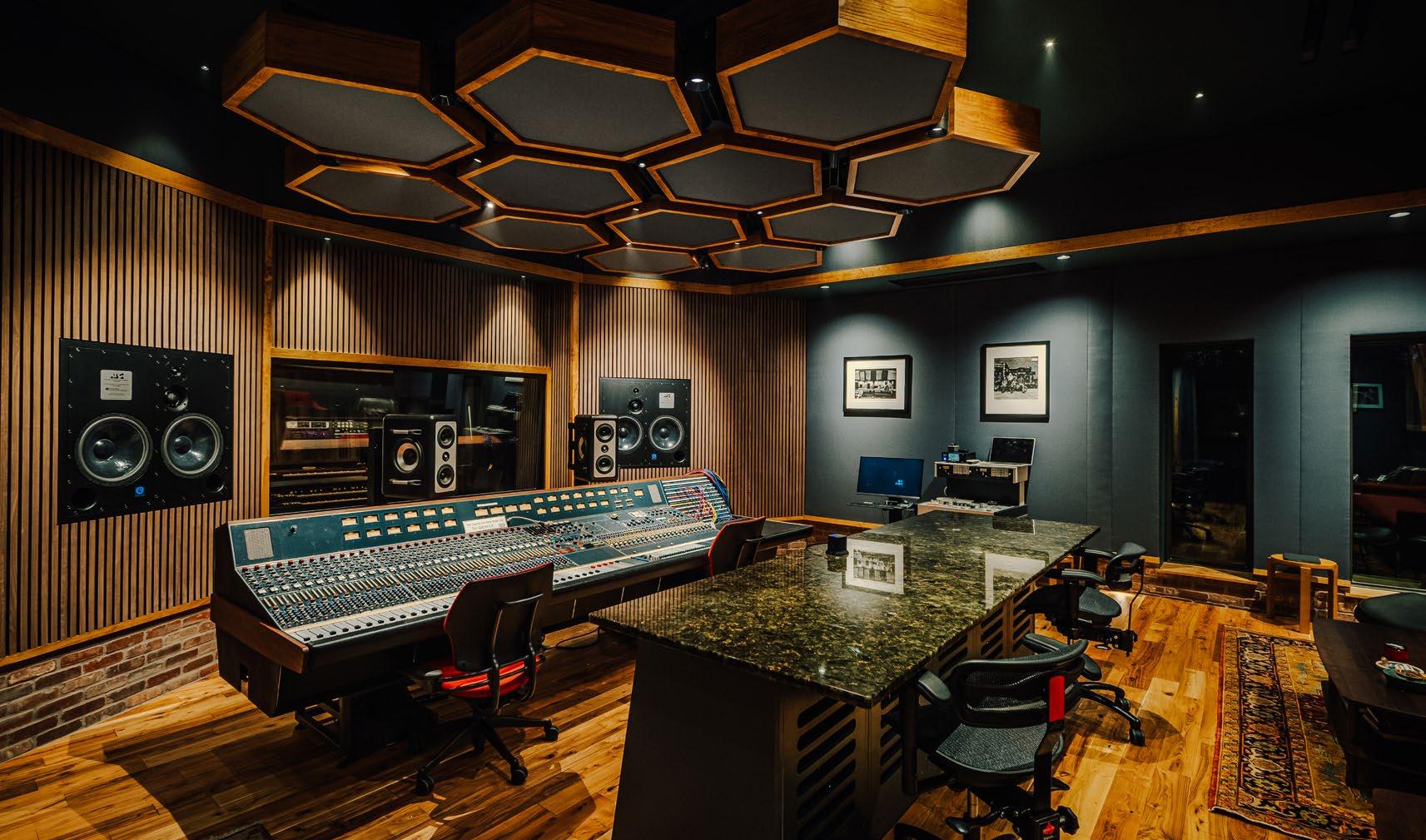
that Trucks and Susan Tedeschi added on to their Jacksonville property. The control room had just undergone a rebuild—Future Soul was the first record made in the new space—driven in part by the room’s centerpiece: a vintage Neve 8048 console that had always felt like a tight fit.
“It went wall to wall,” says TTB’s longtime touring/recording engineer, Bobby Tis, who helped construct the studio more than 20 years ago and led the renovation alongside Derek’s brother David. “Part of building the new control room was building a space worthy of this amazing device.”
Elizondo arrived with his engineer, Justin Francis, who has worked alongside him for the past seven years. The sessions ran with an efficiency TTB hadn’t experienced before. Where the band’s default mode was to “roll in around noonish and go until people are just dropping on the floor,”
jokes Trucks, Elizondo brought structure to the days. The approach to tracking matched that discipline: one or two takes per song, capturing the immediacy and live energy. Two or three completed tracks a day became the rhythm.
Part of what Elizondo brought was a producer’s willingness to press on arrangements before committing them. Unlike previous TTB records where, as Tis puts it, they would “learn the tune and record it,” the band demoed extensively before the sessions began. Songs arrived with ideas largely worked out, but structures got reworked, sections revamped, melodies reconsidered.
“How long is that outro guitar solo going to be?” Elizondo asks. “Things like that, to just make sure that the album felt like it could move from song to song.” The goal was economy: nothing longer than five minutes, something listeners could latch onto and return to, leaving the stage as the place for songs to stretch and breathe.
The core tracking band consisted of Trucks, Tedeschi, drummers Tyler “Falcon” Greenwell and Isaac Eady, bassist Brandon Boone, keyboardist Gabe Dixon, and Mattison, who Tis calls “our utility guy,” contributing acoustic guitars and background vocals throughout. The two drummers were isolated from each other, one in the main room and one in an iso booth. “I try to be more sparing with microphones than I would be if I only had one drummer,” Tis says.
The sessions pushed Trucks into new sonic territory. Known for his minimalist guitar chain—Gibson SG, open E tuning, straight into a classic tube amp—he found himself reaching for new tools. “There’s something nice when you fall into new territory musically or sonically,” he says. “I think everybody kind of gets excited in a way that something about playing a song for the first time does that. And it’s the same when you hear your instrument from a different angle; you’re like, ‘Oh, I didn’t know I could do that.’”
Usually, a second amp running a dirty signal— what Tis calls “the slime sound”—was tracked alongside Trucks’ main rig, sometimes with a tape delay, sometimes through a Leslie. “It definitely led to some vibe in the tracks automatically,” Tis says. Trucks’ primary amp setup was captured with a blend of two microphones, typically a Neumann U47 FET paired with a Beyerdynamic M160 ribbon, or the M160 alongside an RCA 44.
Tedeschi’s vocal was captured with a Neumann U47 running into a 1081 module, then into either
an 1176 or 175 for compression. “Good source, good mic, good preamp, good compressor, hit the track,” Tis says. “It’s not rocket science. She has one of the nicest U47s I’ve ever heard. You’re always trying to beat it, and you’re never going to.”
Elizondo had a clear sonic target: “to try and give the sound something more aggressive, more punchy,” he says. Vocals were pushed forward, dynamics managed, intimate moments given room so that when the band wanted to explode, there was space to do it. “Bringing in a couple of us who didn’t have any rules with the band or any history, we could just say, ‘Hey, why don’t we do this?’ And for them, it provoked something new.”
For Trucks, that provocation was the point. “It freed everybody up,” he says. “It felt like the band, but it felt like a different version of the band—which was really fun.”
When the sessions wrapped, the band headed to Phantom Studios, Elizondo’s facility outside Nashville, for overdubs. There, horn section and background vocalists were each tracked as a group. “Anytime we get multiple people in a room, they’re going to play off each other and the sound is going to be that much bigger,” Elizondo says.
Arrangements were sometimes worked out on the spot, with Trucks, Tedeschi and Mattison weighing in alongside the players. Elizondo often contributed ideas that the band then made their
own. “It was, ‘Hey, it’d be great to have a keyboard line come in here,’” Elizondo says. “I’d have a specific idea and let them take it and run with it.”
The Phantom sessions gave the record some of its most unexpected textures. Elizondo’s collection of vintage analog synthesizers proved catalytic: If Trucks heard a sound in his head, Elizondo could locate it almost instantly.
“I would say, ‘I’m feeling this Stevie Wonder sound,’ and 30 seconds later, he’s got it dialed up and on the track,” says Trucks. “It was fun to experiment with him. He has a bunch of cool, weird gear—the Lee ‘Scratch’ Perry reverbs, a bunch of funky old gear...run horns or background vocals through it. It gave it a lot of personality.”
After the Nashville sessions, Trucks returned to Swamp Raga for one more pass at a solo here, a vocal there. When it was done, 17 tracked songs had been whittled to 11. “There’s a half a record sitting there still,” Trucks says. “Amazing stuff.”
The stereo mix was handled by Justin Francis. For the Atmos version, engineer Ryan Hewitt took an unconventional approach, setting up speakers in the original tracking room at Swamp Raga, playing back stems, and recapturing them with a dozen microphones to recreate the actual space where the band had played.

The result is a sonic fabric that rewards close listening. “When you find those sounds that blend together and just become their own sound all alone,” Trucks says, “there are spots on this record where I was there when we cut it and I still listen back and think, what the hell is that?”
Trucks says he has Future Soul on repeat. “I’ve probably listened to this one more than any record we’ve made,” he says. “It just kind of flies by. And when it’s done, I kind of want to put it back on again.” He pauses. “I’m kind of ready to get back in and do another one.” ■

By Clive Young
Listening to The Midnight is like going back in time, because the band’s lyrics may be filled with modern wistfulness, but they’re encased in sleek, synth-drenched pop that recalls 1985 all the way down to the wailing sax solos and shimmering keytars. The duo—Tim McEwan and Tyler Lyle—released its fifth album, Syndicate, last year and has been circling the globe ever since on its Time Machines tour (or at least Lyle has; McEwan has retired from the road). Expanded to a band of six for live work, The Midnight has hit China, Australia, India and Europe in recent months, and wrapped up a 23-date U.S. run in May,
playing 2,000-3,000-seaters like the Paramount Theatre in Seattle and the Hollywood Palladium along the way.
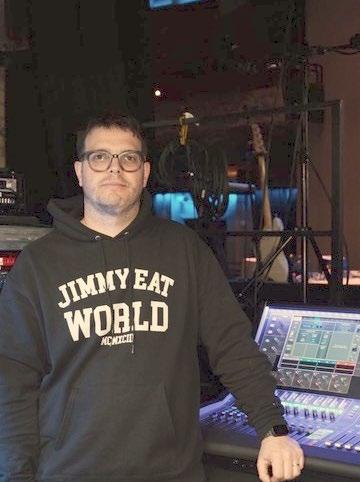
Tackling mixing duties for the trek were TJ Elias, front-of-house engineer, and Hamish Dickinson, a former touring drummer (more on that later) turned production manager/monitor engineer. While the U.S. tour used the house P.A. at every stop, it ensured consistency night after night by carrying video, lighting and audio control systems, all sourced from production provider LMG in Orlando, Fla.
At the FOH position, Elias mixed nightly on a DiGiCo SD12 console, using mostly onboard
effects, but running Live Professor for some vocal chains that employed plug-ins like Waves Doubler and Primary Source Expander. “PSE has been great with cleaning up the vocals, especially since Tyler’s on a wireless mic and he’s moving around the stage a good bit,” said Elias.
The key to presenting the band’s meticulously curated sound, he said, was to present it as-is: “I always want to keep that ‘live band’ aspect, but still make it feel like a record out front. To me, a front of house engineer’s job is to amplify what’s been given to you and put that together in the best, cleanest way possible. Aside from maybe adding some effects here and there, a band should
give you all the texture you need—and they tend to do that if you just stay out of their way.”
At stageside, Dickinson tackled monitors on an Allen & Heath dLive desk, providing mixes to the band’s in-ear monitors—a selection of 64 Audio, Ultimate Ears and JH Audio earpieces. “We’re on the new Shure Axient Digital PSM system,” he said, “although I am running it in Analog FM Mode because it was an easy setup and there’s no panning around with things. We just have eight frequencies, which includes five band members— because our drummer is hardwired—a guest, myself and our video tech on stage right.”
Vocal mics were a mix of Shure KSM9 capsules on wireless handhelds used by frontman Lyle and keyboardist OBLVYN, while bassist/MD Oliver McEwan and guitarist/keyboardist Rhett Shull used sE V7s. Elsewhere on stage, Justin Klunk’s saxophone was captured with a wireless Beta98 on a horn clip, and two guitar cabinets were each miked in stereo using sE V7X and sE8 mics. The drum kit was captured with both a Shure Beta 91A and an Audix D6 on the kick, AKG C451s on the hi-hats and a stacker, sE4400 condensers for overheads, and a beyerdynamic
M 201 on snare top and a Shure KSM137 on bottom, along with four V-Drums feeding into a Roland TM-6 drum trigger module.
That drum kit was readily familiar to Dickinson when the U.S. leg began, but he got to know it much better during the tour’s east coast swing. Drummer Kwesi Robinson became extremely sick during a show and when he couldn’t finish it, Dickinson jumped on stage to sit in for the encore. The next day in Boston, he
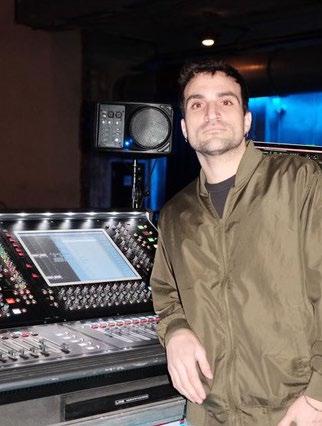
filled in behind the kit, playing the entire show without rehearsa—and then did it again the next two nights as well, ensuring their Brooklyn and Pittsburgh shows could go on as planned. Speaking with Mix a few days later, Dickinson didn’t even mention it had happened—the epitome of a team player—but pulling off triple duty as production manager, monitor engineer and fill-in drummer? It’s all in a day’s work with The Midnight. ■
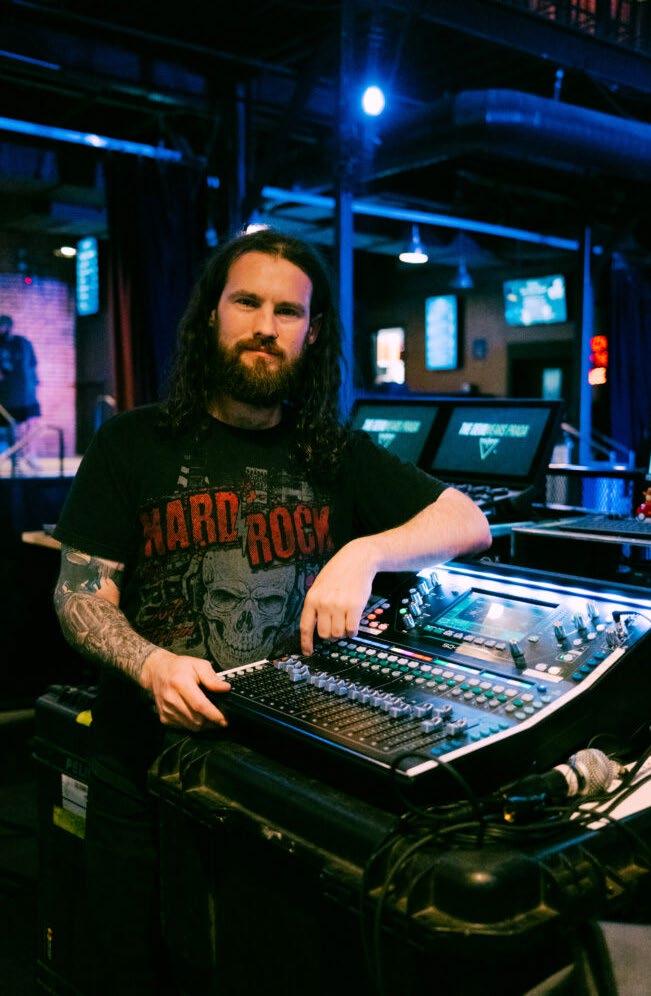
Worcester, Mass.—Pop-punkers Four Year Strong just wrapped up a busy spring, opening for The Devil Wears Prada on tour, and along for the ride was front-of-house engineer Jonah Kay, making sure the band’s signature sound translated to the raucous crowds every night.
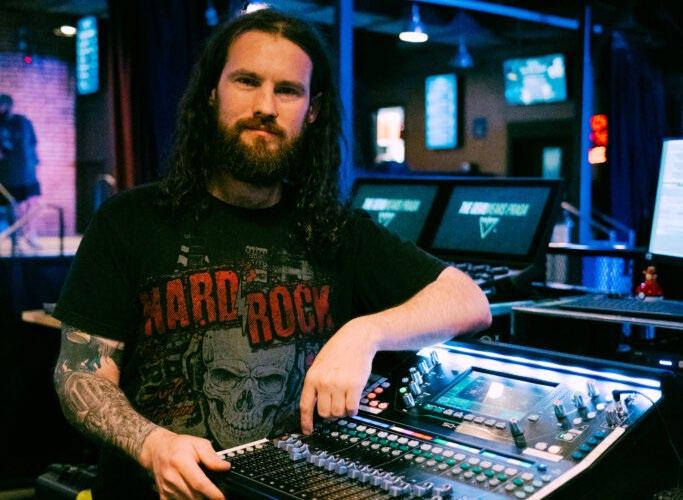
Using house boards and dealing with festival slots is a recipe for inconsistent sound, so to mitigate that as much as possible, Kay mixed the band on a 48-channel Allen & Heath SQ-5 digital console. The desk is small enough to carry as luggage on fly dates, but it still ensures that the mix is the same, day after day.
“Ultimately, what it comes down to is consistency; I can basically just unmute the P.A. and ride the master fader up,” said Kay. “I’m not worried about how I’m gonna get a mix to sound good in each venue.”
Carrying his own desk on tour also meant Kay was able to develop a daily workflow and always have the same features available, such as the desk’s 32-channel USB interface. “I record tracks from every show to my laptop,” said Kay. “That serves me if the band needs the recordings later, and it also lets me run a virtual soundcheck at the next venue.”
Kay also made use of the desk’s onboard DEEP processing plug-ins. “I’m
using 16T compressor quite a bit across my vocal and snare groups,” he noted. “I also like the new BUS compressor for my drum groups and the Tube preamp models. I double up my vocals so that I can have one clean and one with that Tube saturation.”
Kay also programmed custom SoftKeys to trigger different preamp settings, and mixed in stereo guitar tracks to create a wider, more dynamic live mix when needed: “When we go back to the verse with just one guitar, I can jump back to mono with another key press to create that separation.”
All that honing of the band’s sound won’t go to waste: Kay will be out with Four Year Strong and the SQ-5 again this summer for Vans Warped Tour performances in Montreal and Mexico City. ■
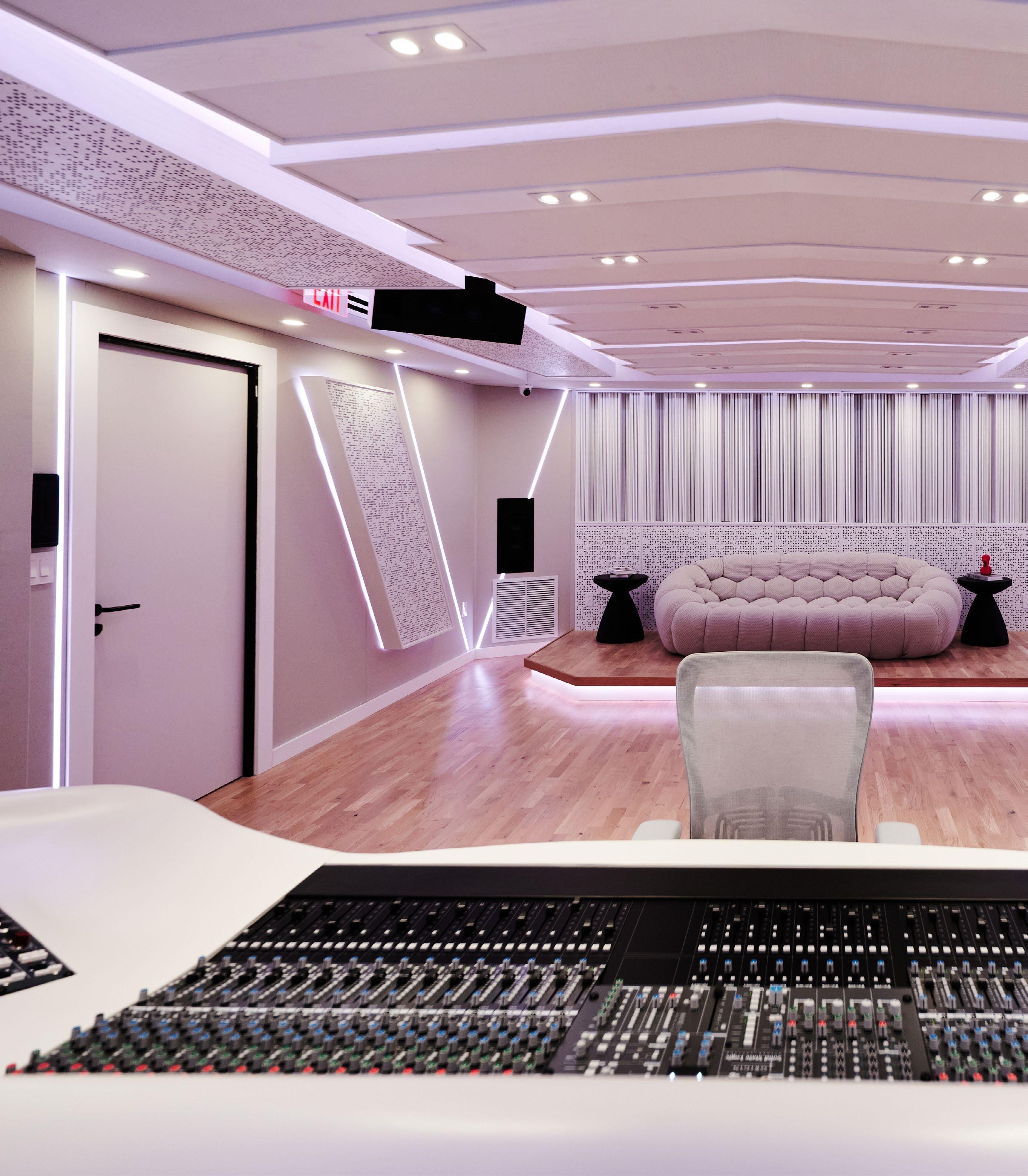
20 of this year’s top new studios, from the world’s leading studio designers
By The Mix Editors • Text by Steve Harvey
LEC Studios | Doral, Fla.
Malvicino Design Group, Horacio Malvicino and Fabiola Mena
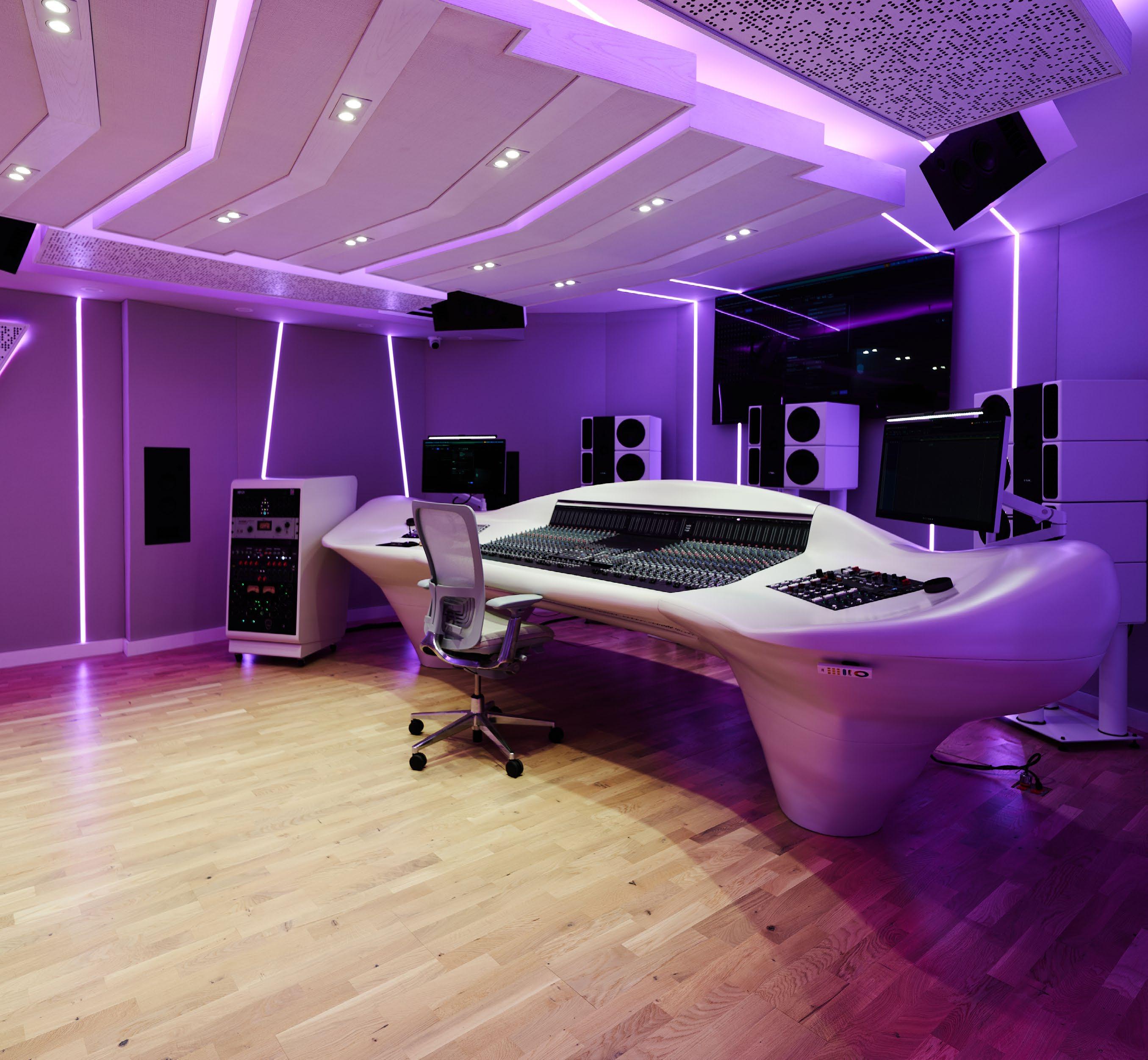
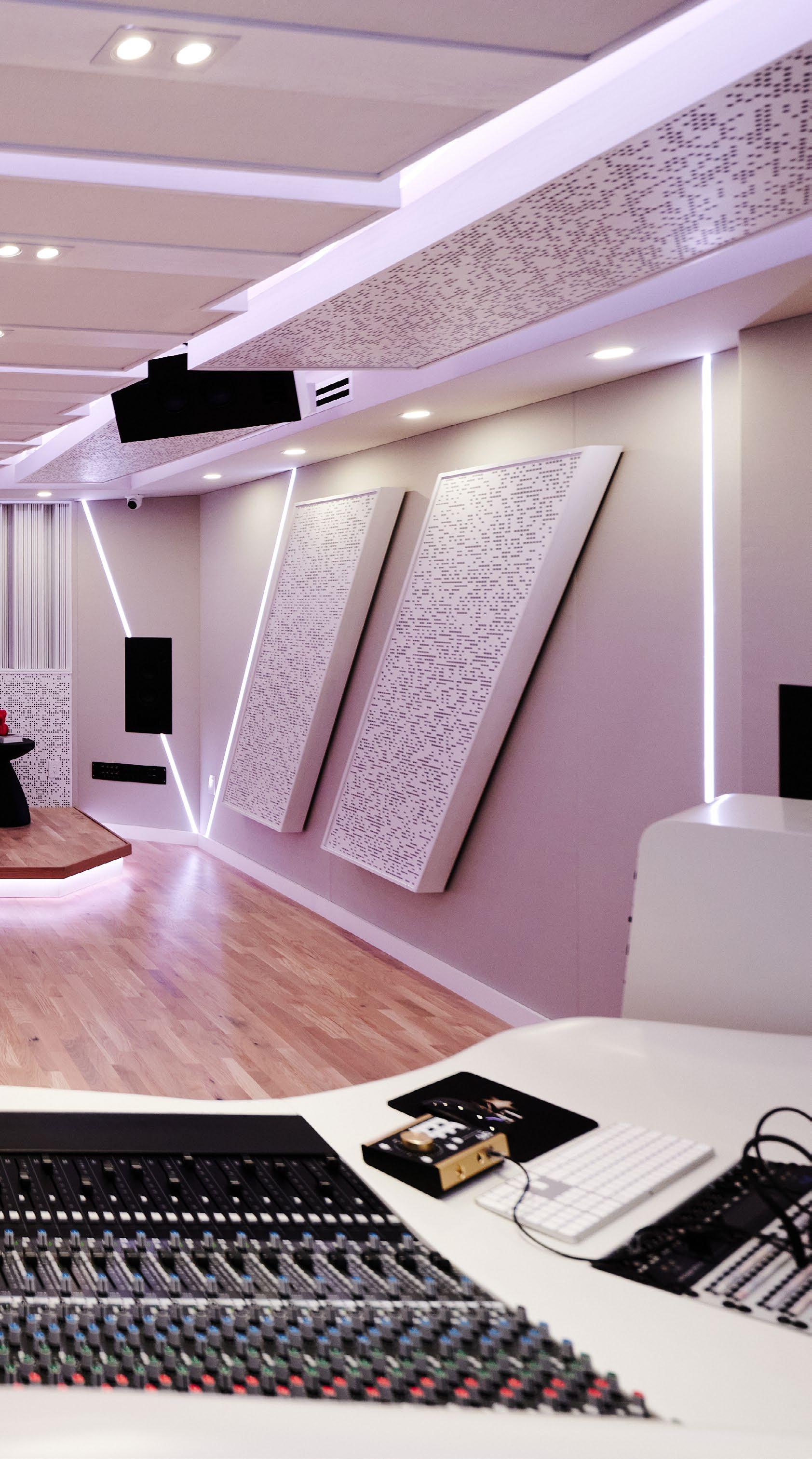
LEC Studios’ control room, anchored by an SSL Origin console in a custom desk with a PMC 9.1.4 speaker system, acoustically balances absorption, diffusion and reflection control. Horacio Malvicino and Fabiola Mena led a design team that also included Javier Martinez, project development and supervision; Diego Mejia, studio installer; and system integrator Federico Petrone. The ceiling’s stepped geometry helps manage early reflections while maintaining a sense of openness and volume. Perforated panels and integrated treatments along the ceiling perimeter help control reverberation and maintain even frequency distribution. The side and rear walls continue this strategy, with diffusive panels strategically positioned to break up standing waves and flutter echoes, and absorptive zones that ensure clarity and definition. The rear portion of the room transitions into a more relaxed lounge environment, a dual-purpose design that allows the space to function both as a critical mixing room and as a comfortable client area.
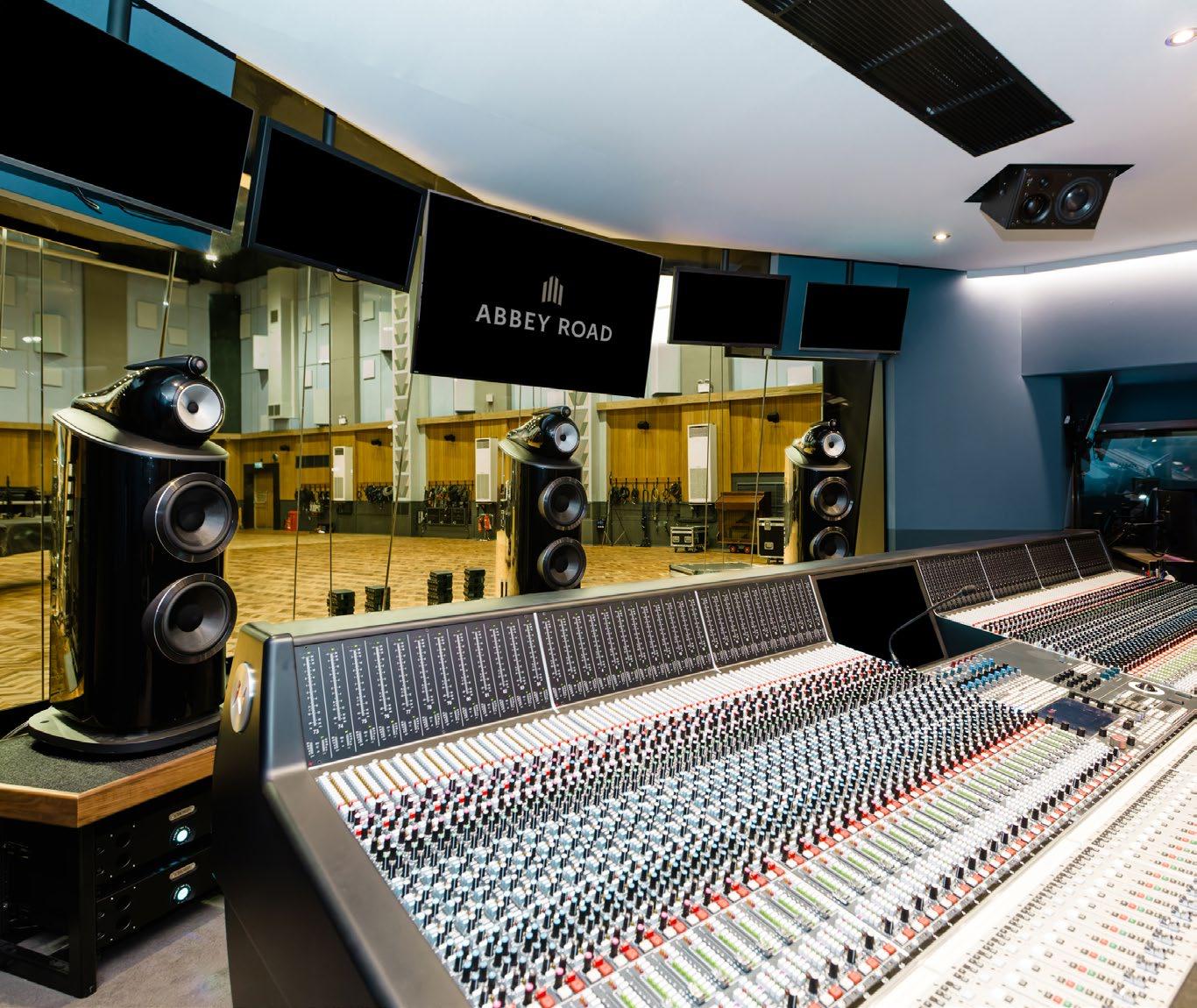
Studio One Control Room | London, U.K. Munro Acoustics, Clive Glover
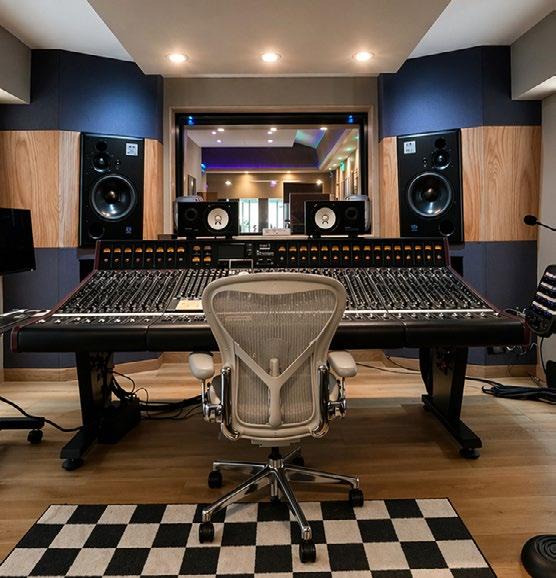
Studio One’s live room acoustics are hallowed, but Munro Acoustics was given license to rework the control room to a set of specific criteria by the Abbey Road Studios Technical Services team and project leads Simon Campbell and Dan Cole, following a console upgrade to an 84-channel AMS Neve 88RS SP3D. Munro says the aim was to provide a new level of monitoring accuracy to keep the control room on par with the legendary live room. Preceded by 18 months of careful planning, the control room’s acoustic treatment was entirely replaced, and the layout reconfigured to create a more ergonomic, spacious environment, the first major changes to Studio One in 20 years. An ATC 7.1.4 monitor system with Dynaudio Acoustics 18-inch custom subs was also added, with optional Bowers and Wilkins LCR speakers. The studio features multiple, dedicated isolated networks via Cisco switches for Dante, Transfer and Eucon. HHB Communications supplied the equipment. Cable was supplied by VDC, Canford and Belcom.
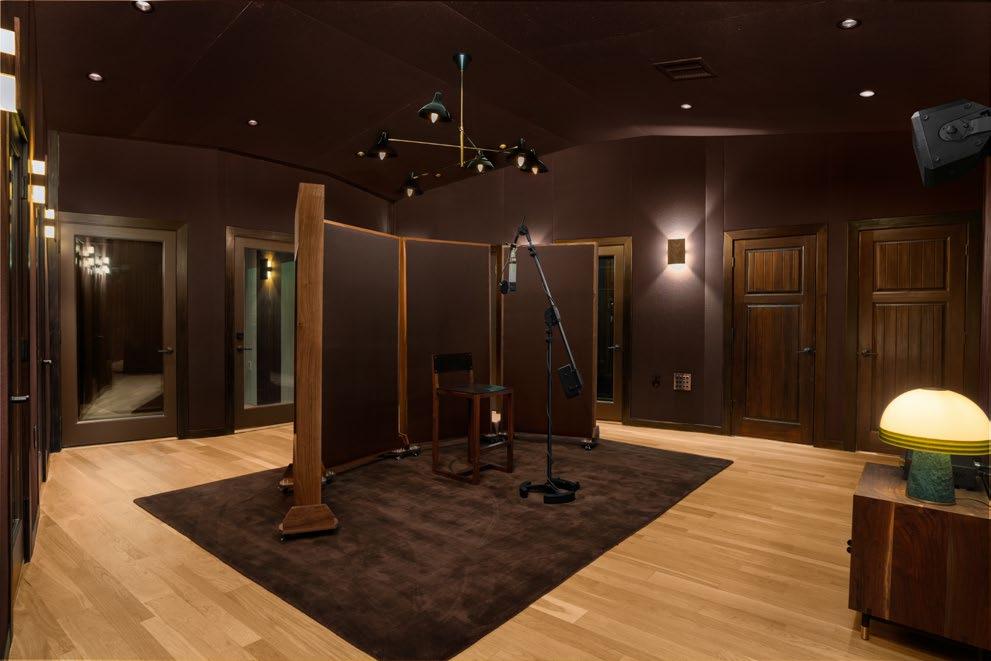
Haverstick Designs, Gavin
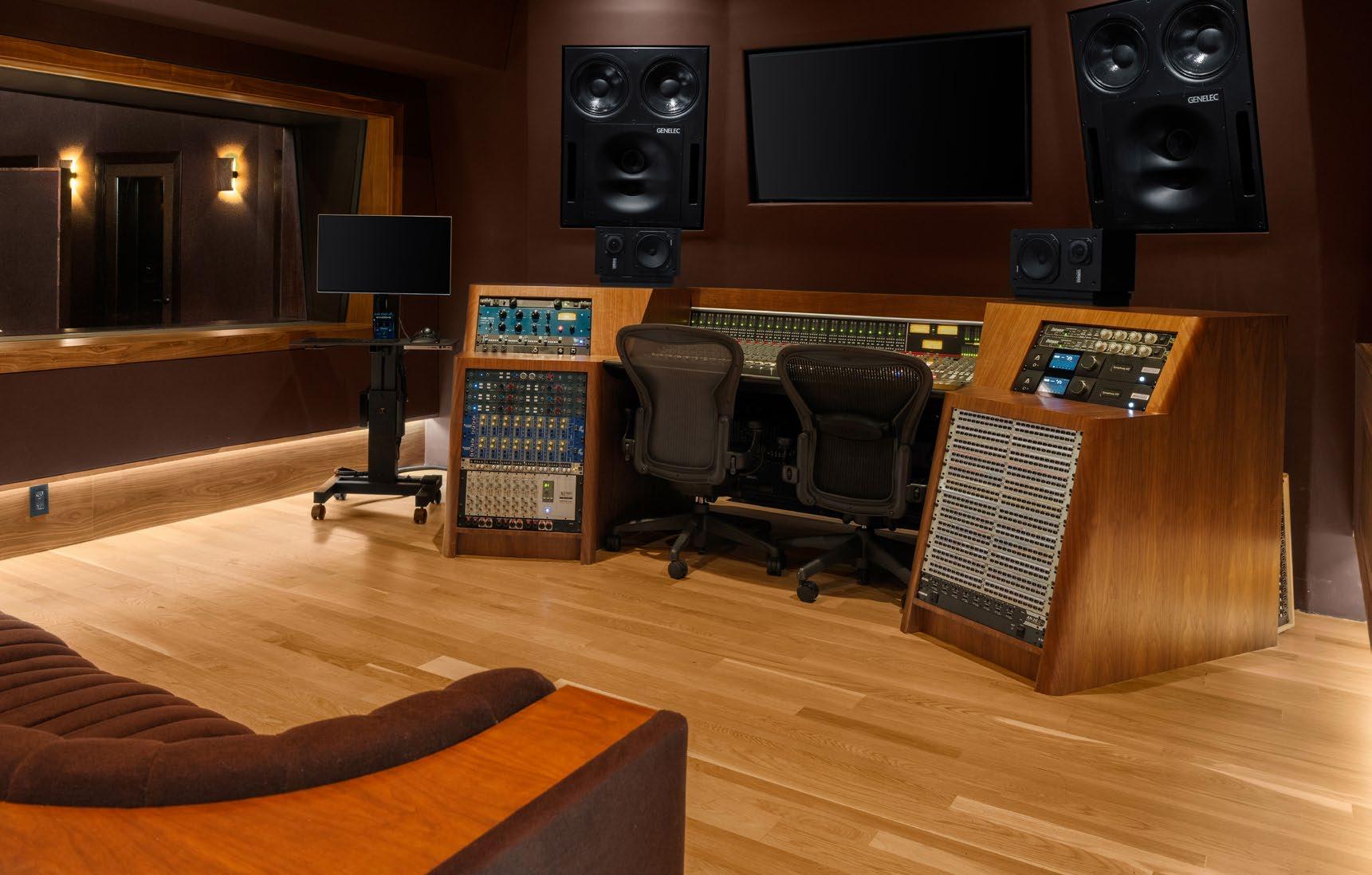
Haverstick Designs’ Gavin Haverstick and Tracy Roberts partnered with Electric Feel to create a 3,000-sq.-ft. Music Row facility housing two recording studios and a production suite that are more akin to a private artist retreat. The design language of the studio blends modern restraint featuring natural warmth with custom furnishings and soft, indirect lighting. Expansive hospitality offerings include a large chef’s kitchen opening to a private outdoor lounge via telescoping glass doors. Studio A’s 350-sq.-ft. control room is outfitted with soffit-mounted Genelec 1234A main monitors and an SSL AWS 948 console set into a bespoke walnut workstation. The 500-sq.-ft. live room features six isolation booths and two dedicated amp rooms. Studio B features Genelec 1238DFM monitors and a host of outboard processors. System design and integration and interior design were provided by Electric Feel’s Nick Mac and Danielle Engen, respectively.









Wes Lachot Design Group
Featuring a Wolff Audio Propatch 128R, SSL Sigma summing mixer and other outboard gear housed in a custom Brett Acoustics desk, Dominik Kazmierczak’s music production and mixing studio, launched in March 2026 in Vienna, Austria, offers analog sound with digital flexibility and precision. Designer Wes Lachot was assisted on the project by draftsman Rob Warren and acoustician Aaron Kelly. The ATC SCM150 AiW monitors are flush-mounted into a reflection-free frontend configuration, built by Tony Brett, who traveled to Vienna to help with the studio build and acoustic installation. Acoustic materials were provided by Brett Acoustics and Acoustic GRG.
WSDG, David Molho
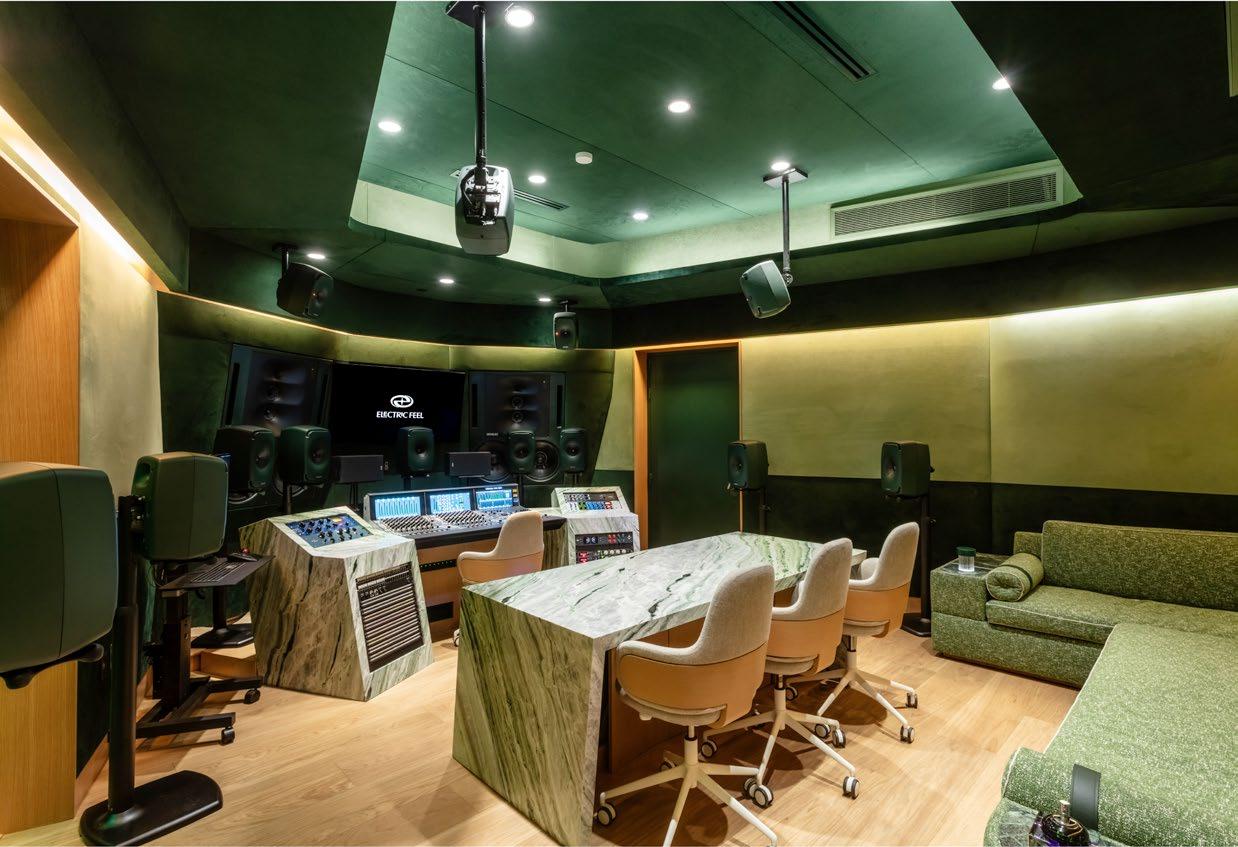
Opened in April 2026 in Miami’s Wynwood district, the new facility serves as the new headquarters for Electric Feel Entertainment, a multi-faceted management, publishing and label company founded by CEO Austin Rosen. Spanning three floors, the complex encompasses recording studios, offices, listening environments and artist-focused hospitality, with acoustics and AV design developed collaboratively by Electric Feel’s Danielle Engen and Nick Mac, and WSDG’s David Molho, Sergio Molho, Silvia Molho, Leandro Kirjner, Federico Paez and John Storyk. The Jade Room is centered on the first SSL Oracle console deployed in the U.S., with Genelec 1236A mains and Dolby Atmos monitoring. The Onyx Room houses an SSL AWS 948 ∂elta with a Symphonic Acoustics V15 main stereo system and Genelec 8361A secondary monitors. Both rooms were developed through advanced modeling and simulation, with six distinct acoustic treatment topologies, including a 13-foot rear-wall fractal diffuser alongside perforated, micro-perforated and slotted panels, concealed behind acoustically transparent fabric.
Russ Berger Design Group
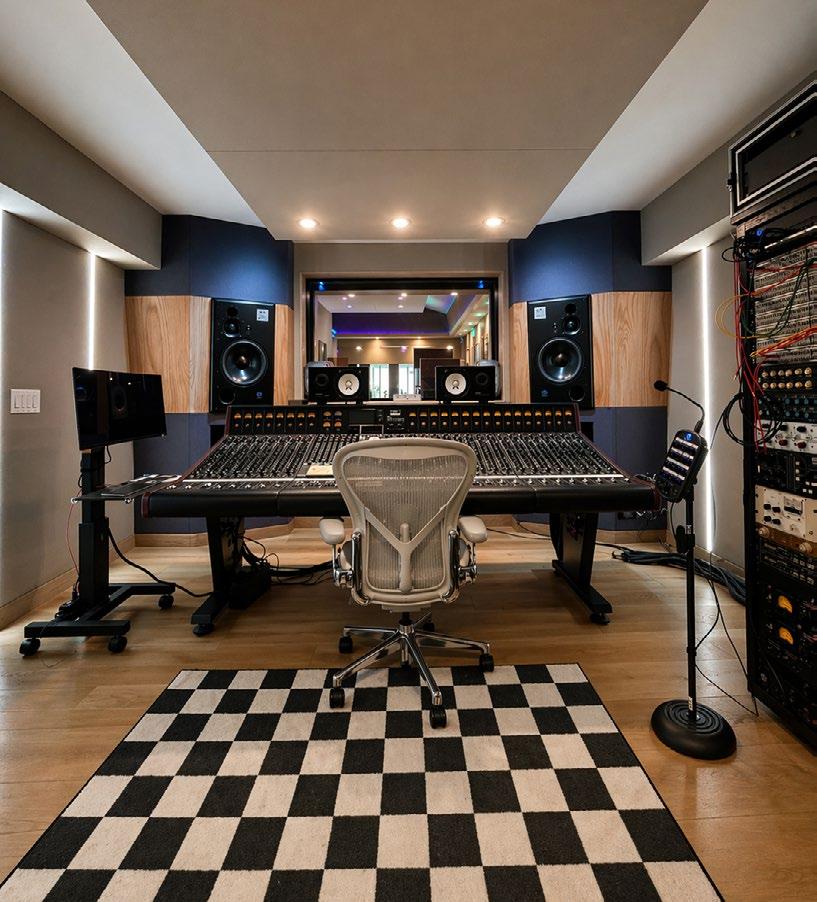
N. Hollywood, Calif. Haverstick Designs, Gavin Haverstick
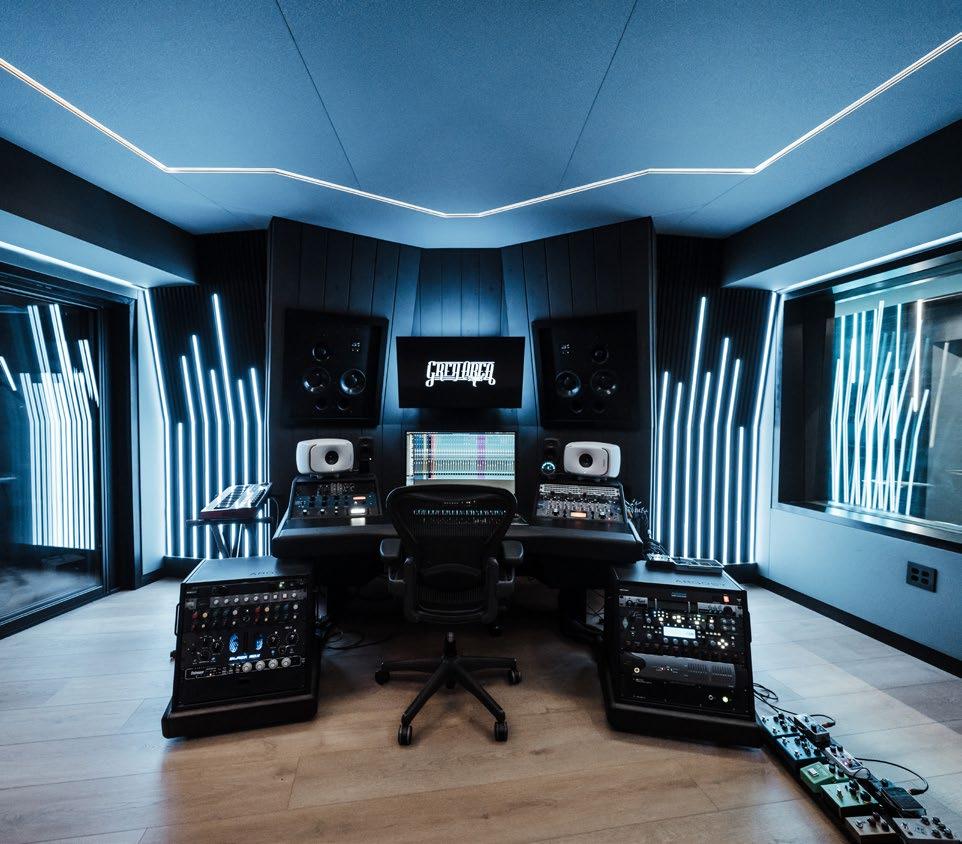
The design team of Gavin Haverstick, Tracy Roberts and Alex Harris created a versatile, ground-up facility for music producer Erik Ron in L.A.’s San Fernando Valley. Opened in September 2025, it encompasses a control room, live room, isolation booth and production room. All sound isolation construction and custom acoustical treatments, including integrated lighting, were executed by Built By Rosetone. Production equipment, supplied by James Good at Vintage King, includes in-wall ATC SCM110 Pro monitors and near-field Genelec 8341A speakers with a Grace m905 controller and racks of outboard gear.
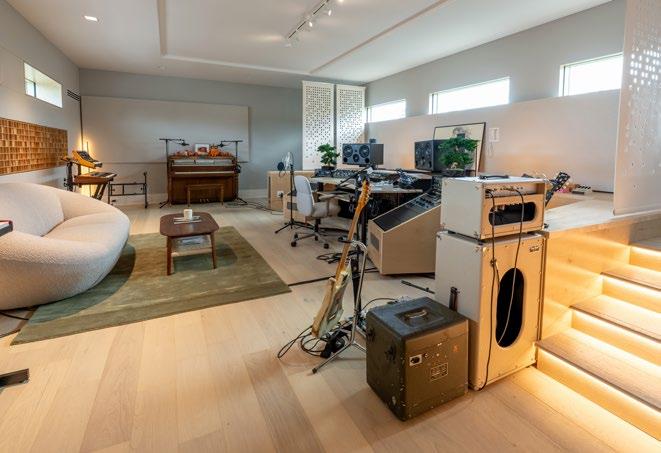
RBDG team members Mark Hornsby, Russ Berger, Nathan Heironimus, Michael Kapinus and Richard Schrag, in consultation with Sweetwater’s Mike Picotte and Charlie Kim, who provided system design, collaborated on this flexible facility for Houston-based artist Keshi above his three-car garage. His hands-on production style and technical understanding shaped many of the design decisions. The space was designed as a cohesive hub for writing, recording, mixing and everyday living, reflecting a broader industry trend, RBDG says, in which artists seek to balance creativity, practicality and costefficiency within the home. Rather than relying solely on heavy absorption, the design incorporates a combination of absorption, diffusion and reflection to create a natural and accurate listening environment. Visually, the studio departs from the stereotypical high-tech aesthetic often associated with home studios. Studio equipment includes Apple Logic, ATC SCM45A Pro monitors, a Danley TDS subwoofer and high-quality converters and controllers.

Orange County, Calif.
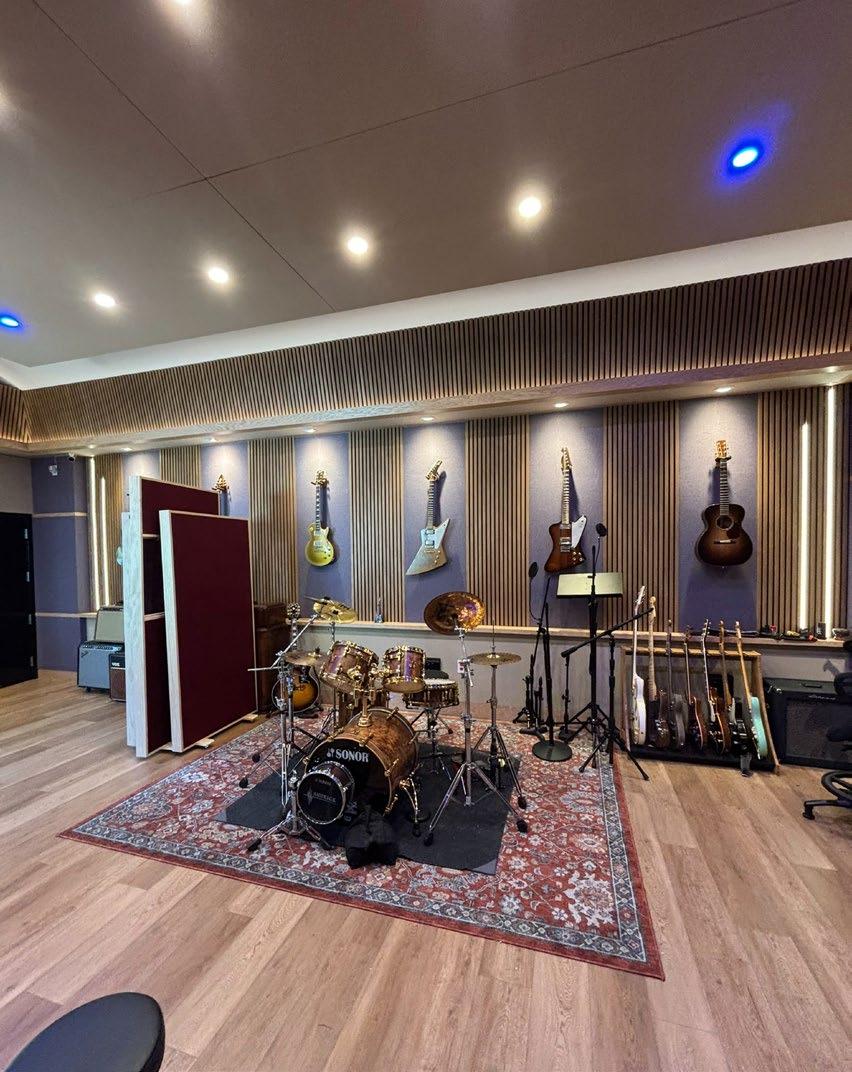
JSX Audio
Le Nest Studios is a private recording environment designed, permitted and managed by JSX Audio that began as an ADU attached to the client’s home but was planned for eventual transformation into a studio. JSX Audio performed extensive acoustic modeling for the interior treatment strategy of the 550-sq.-ft. live room, 240-sq.-ft. control room and 30-sq.ft. amp closet. Low-voltage system design and layout were developed in partnership with Hamid “Gadget” Hopkins and the Advanced Systems Group team, who also led installation and commissioning. A primary challenge was fitting the client’s collection of boutique analog gear into the available space, aligning equipment placement with the patchbay to ensure logical signal flow and efficient daily operation. The studio features a 24-channel Hum Audio N-Trophy all discrete analog console with custom mods by Hum and ATC SCM150ASL Pro monitors tuned by JSX Audio.

Los Angeles area
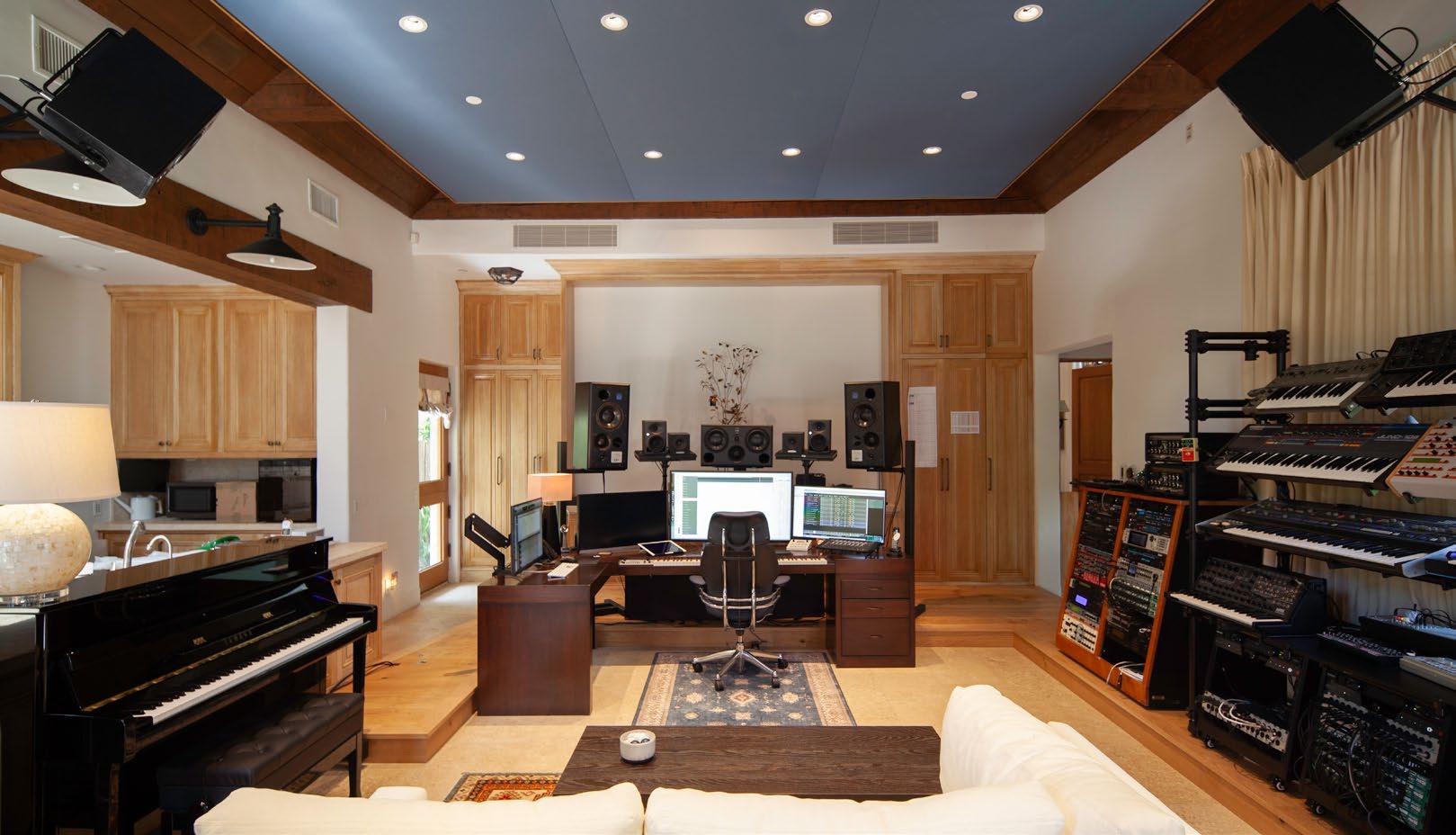
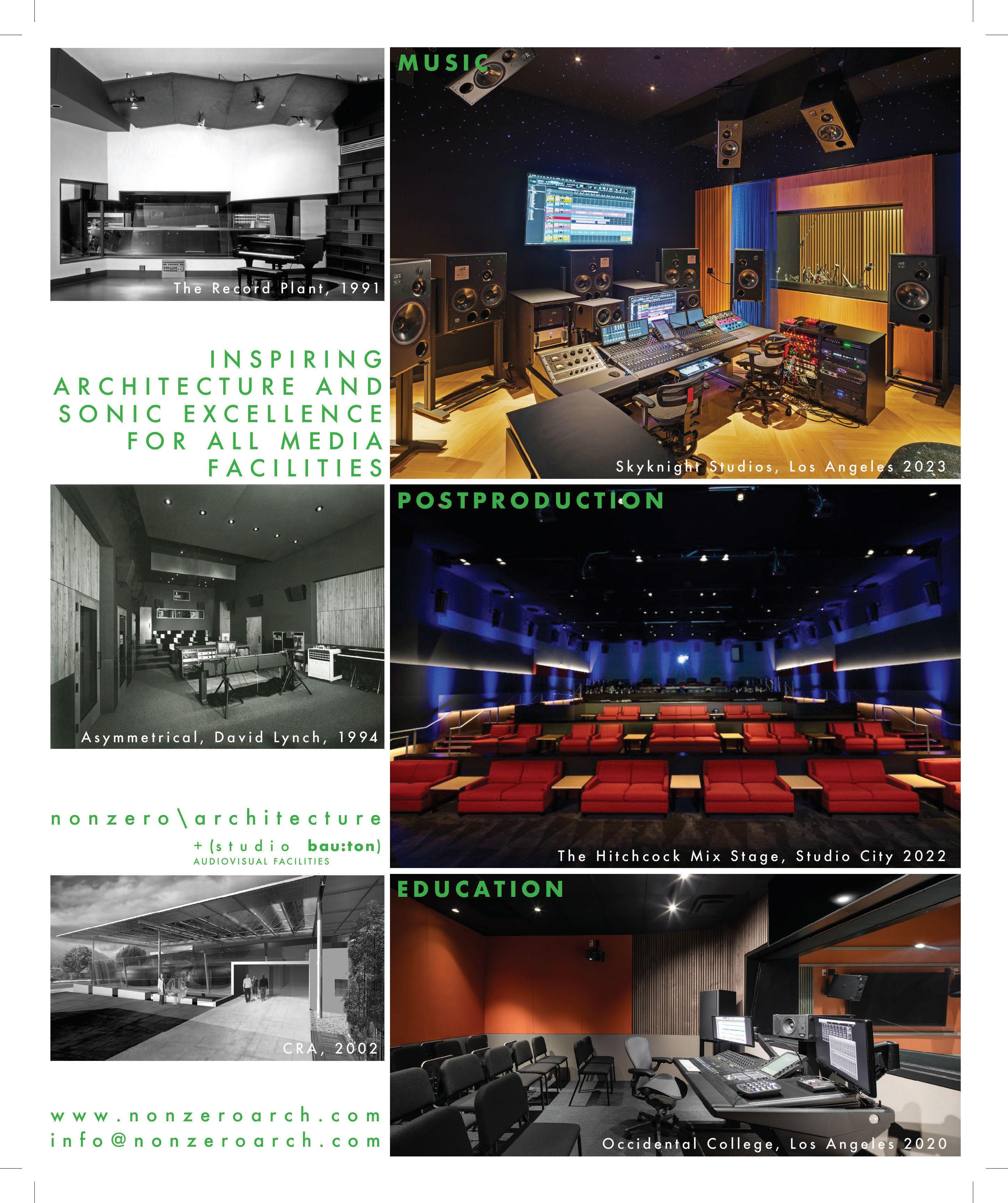
nonzero\architecture, Peter Grueneisen, FAIA
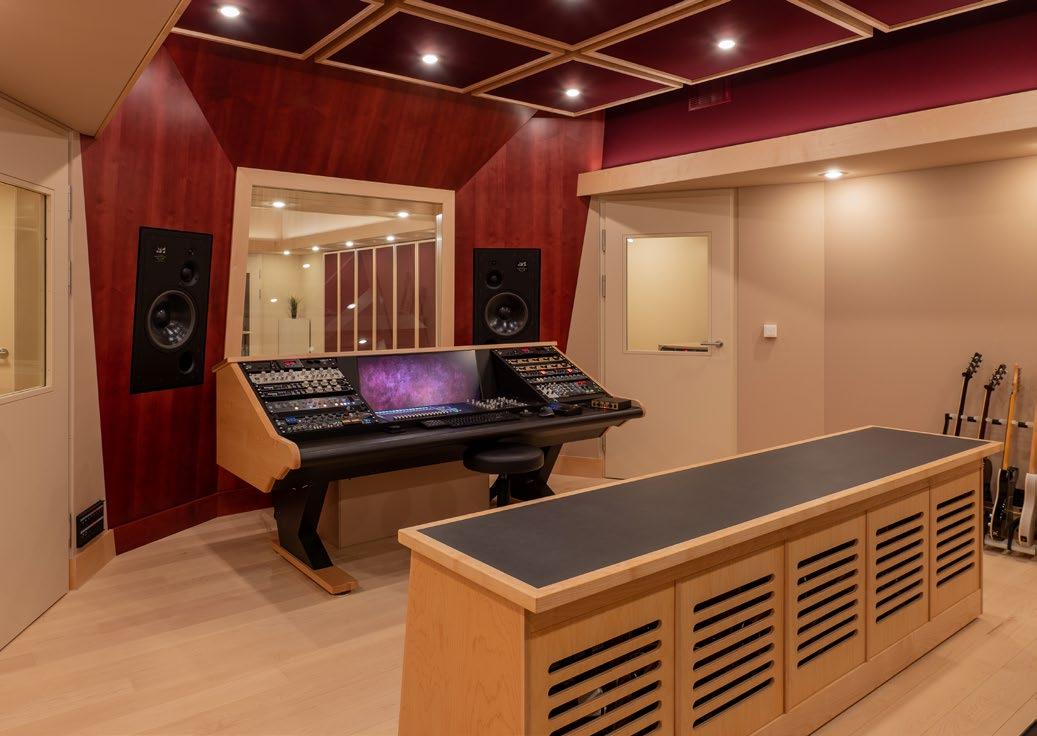
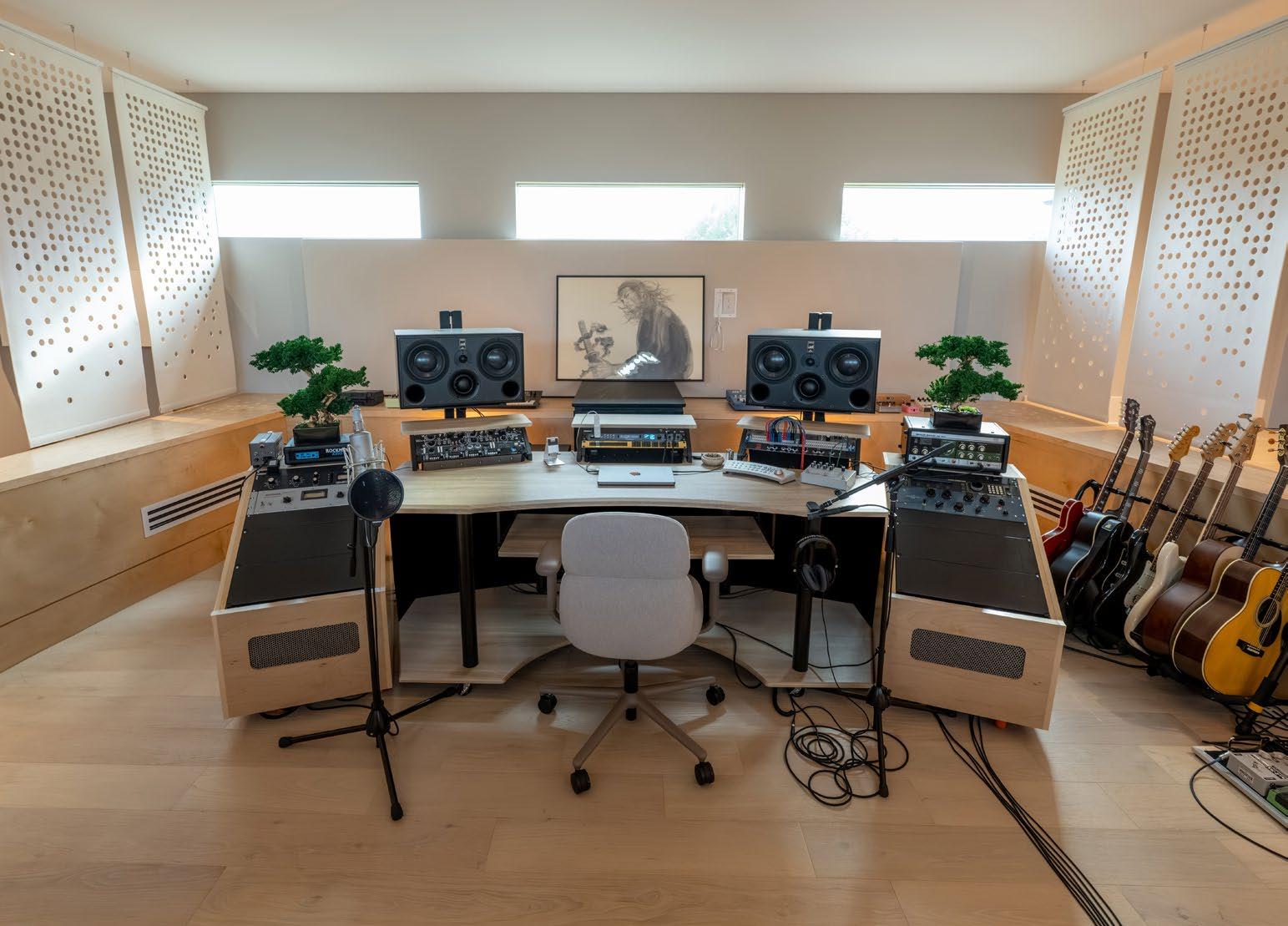
This writing and mixing studio in an existing guest house is the fourth studio project by Grueneisen in over 10 years for the film composer owner, and complements his main studio in a commercial building. Grueneisen says the design by the nonzero team, which included Ava Grueneisen, Alex Paik and Rax Wan, illustrates how low-key intervention can create a highperforming space. The quiet location required only minimal soundproofing, while the room acoustics were addressed with a ceiling cloud below the cathedral ceiling and drapes along the windows. An adjacent room serves as a recording space, and a walk-in closet becomes a machine room. A partial raised wood platform provides cable management over the ceramic tile flooring. ATC SCM50A Pro main monitors are supported by an ATC SCM45A Pro center speaker, ATC SCM20 Pro rears and a JL Audio F112v2 sub, with Neumann KH 120 and Auratone options.

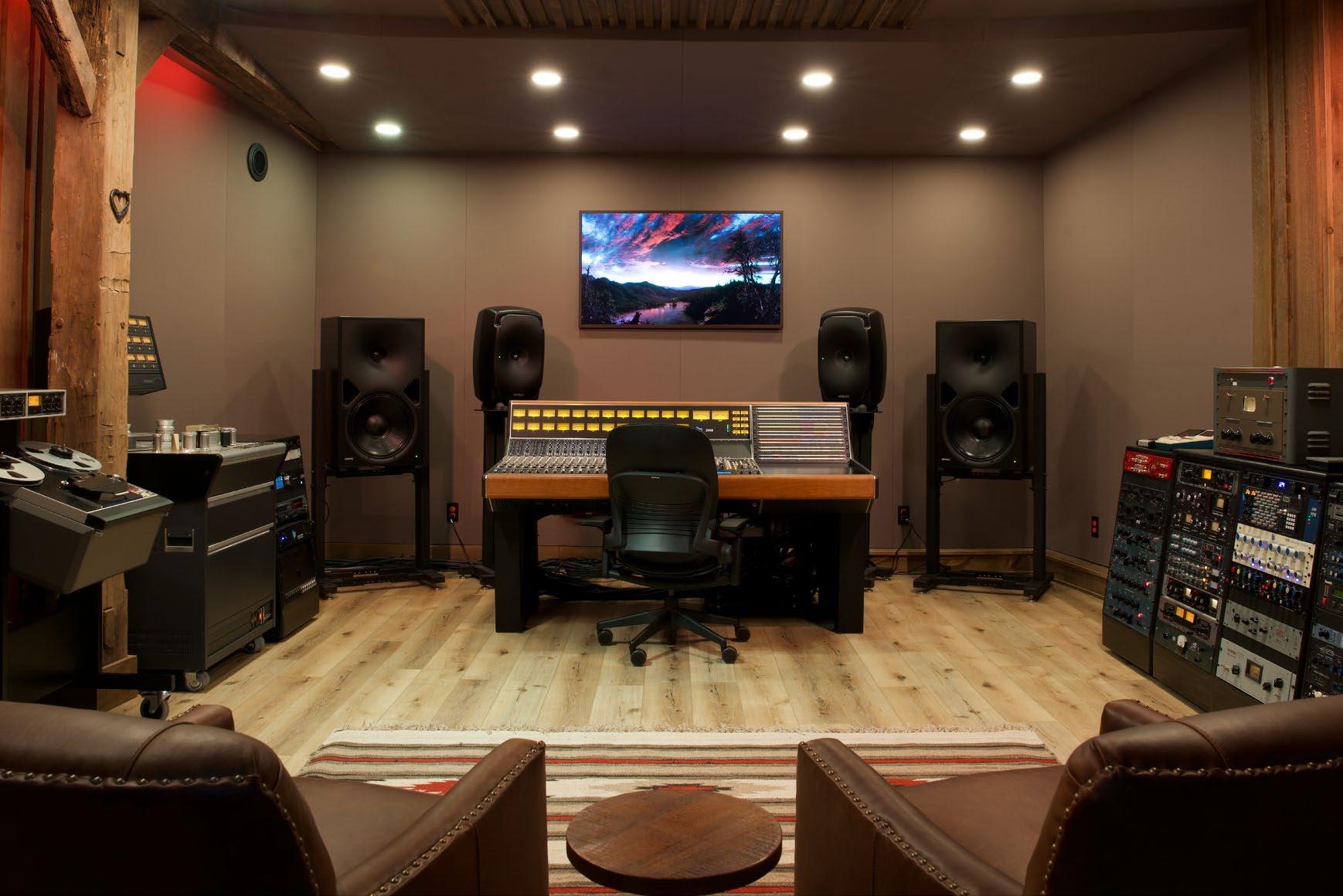
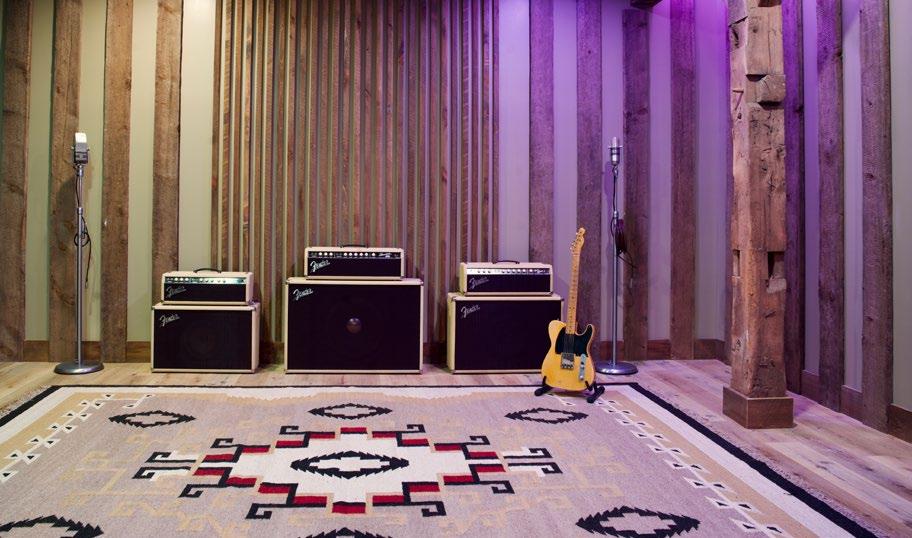
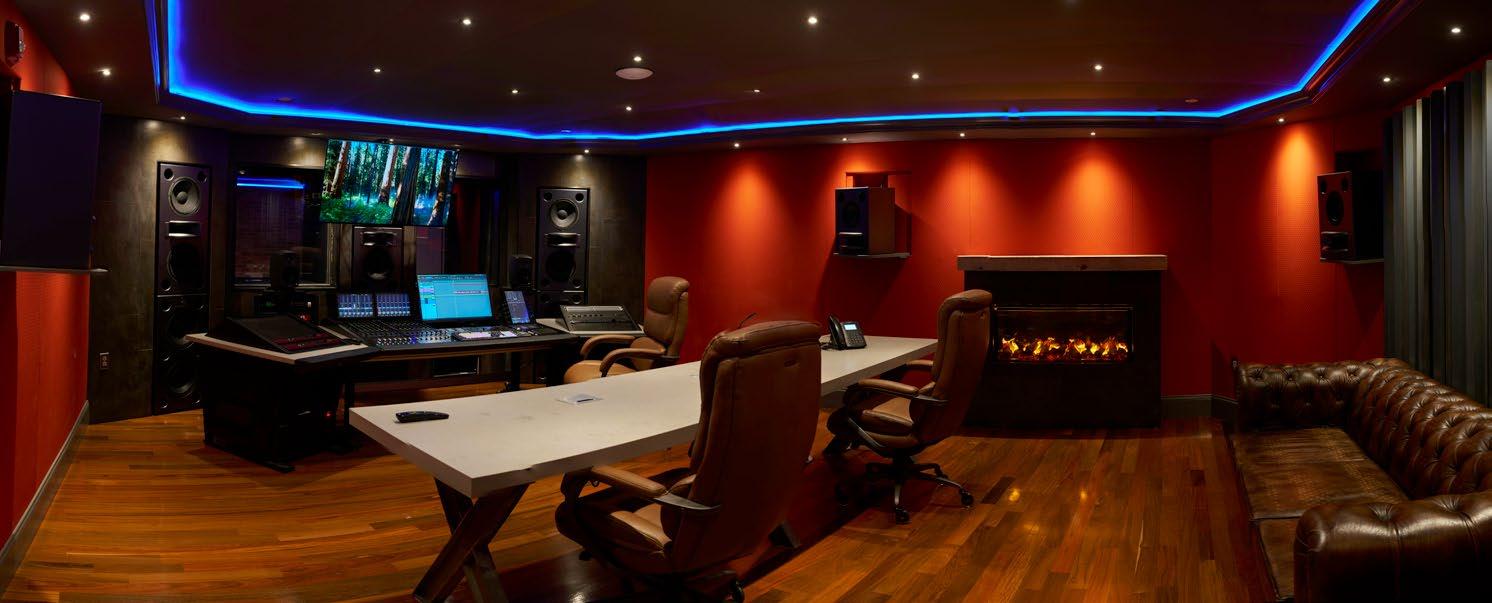
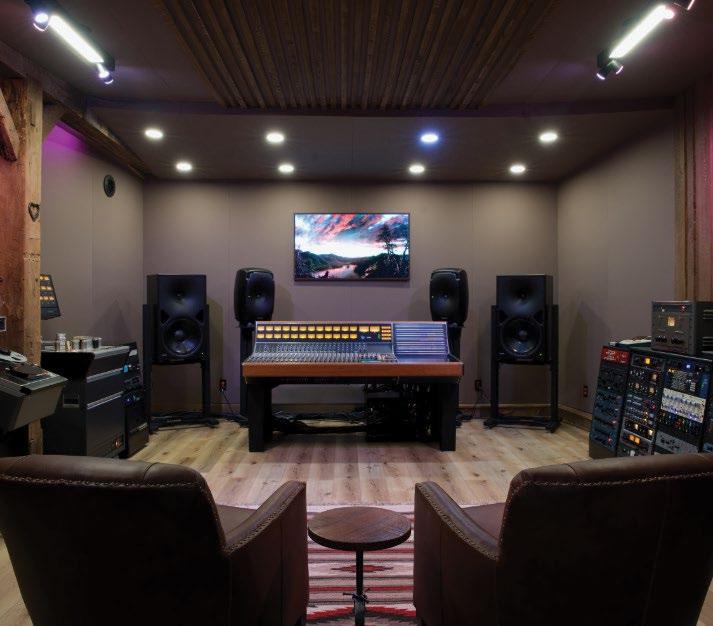
Having worked together more than a decade ago, Spanic Boys co-founder Ian Spanic contacted Hedback to design a control room and tracking room within the lower level of his residence near the Mississippi River. The challenges of the space included structural reclaimed wood support beams and other irregularities. Hedback’s detailed lowfrequency sound pressure mapping studies led to positioning the tracking room behind the rear wall of the control room to allow the best mix position and space for the tape machines and rack bays. Both rooms feature a reclaimed wood theme. The shaping of the wall in front of the automated API 2448 console and Genelec 8361 and 8380 monitors was dictated by the depth of custom-tuned 30 Hz trapping and broadband absorption. The general contractor was The Thistle Group; Simplified Acoustics provided the stretch fabric interiors.
Malekpour Design Partners
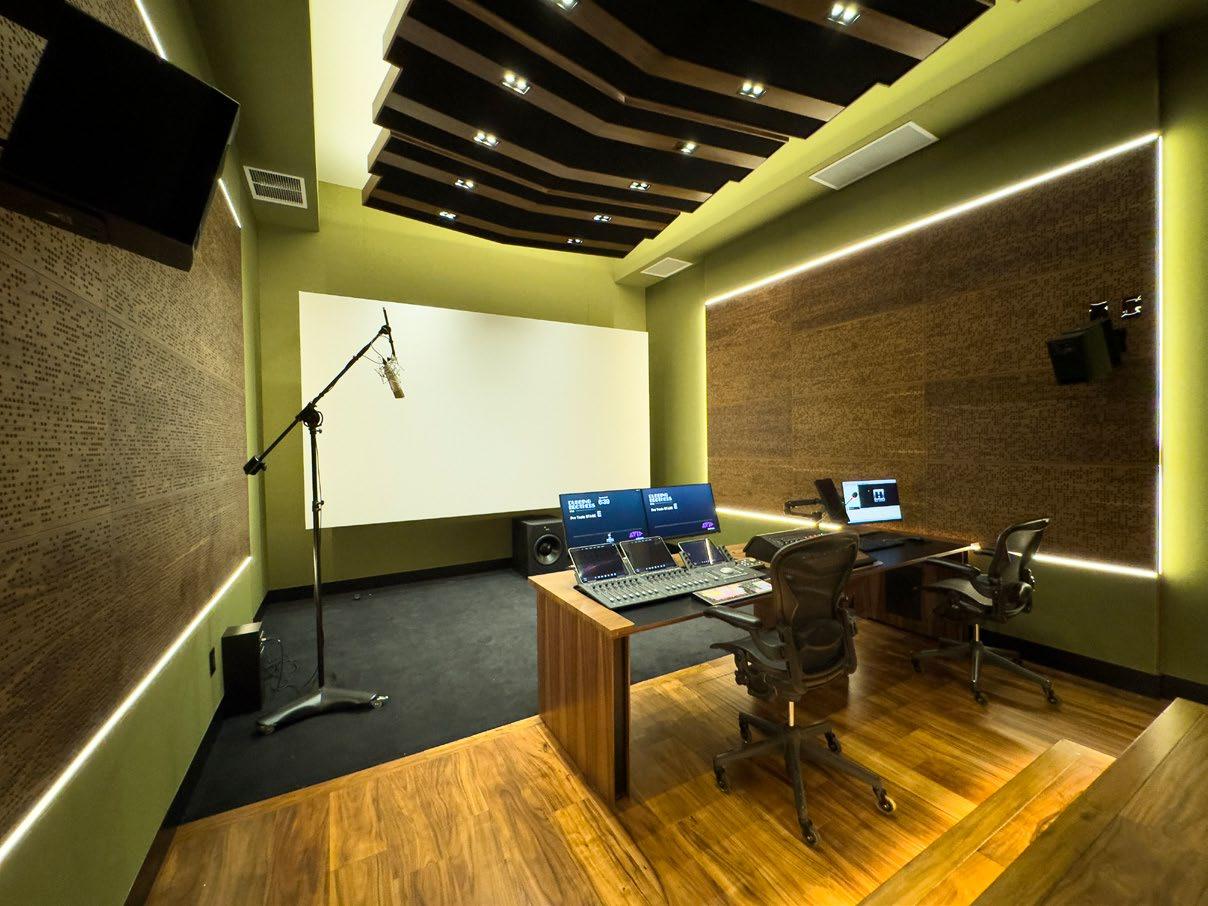
Advertising-focused audio post house District Audio, opened in Boston’s South End in May, features four control rooms. The flagship, Studio X, is a dedicated 5.1/7.1 creative environment for facility owner Michael Secher, an accomplished voiceover artist and composer. Design lead Dave Malekpour worked with Michael Bashkhangy, who handled architecture and design, and acoustics consultant João Vieira of Jocavi. Ken Simon and Eric Anderson handled technical integration. Studio X features an Avid S6 in a Sterling Modular custom console with a custom surround monitor system of Augspurger Duo12MF Sub212, Solo 12 (center) and Solo 8 (surrounds, rears), powered by SXE 4D amplifiers, integrated into the front wall design. District Audio is located in a nine-story residential building, requiring extensive acoustic planning and a comprehensive isolation strategy, including IsoRaft decoupling systems.
Malvicino Design Group, Horacio Malvicino and Fabiola Mena
French dubbing studio Dubbing Brothers, with locations in Belgium, Germany and Italy, upgraded its U.S. outpost in Burbank with two new rooms for ADR, voice recording, editing and critical listening. The rooms, designed by Horacio Malvicino and Fabiola Mena, alongside project manager Jerome Malaize, offer a symmetrical layout, ensuring optimal stereo imaging and an accurate listening experience. The front wall is anchored by a central visual display and fabric-wrapped wall panels providing controlled absorption across mid and high frequencies, minimizing early reflections and enhancing intelligibility. The rear wall manages lowfrequency energy and eliminates unwanted resonance, while suspended ceiling clouds further refine the acoustic response. Audio equipment includes Avid S-1 and Dock surfaces with 5.1 JBL Studio monitors and ADAM Audio subs.
Yanchar Design and Consulting, Carl Yanchar, and Wavespace, Jonathan Deans
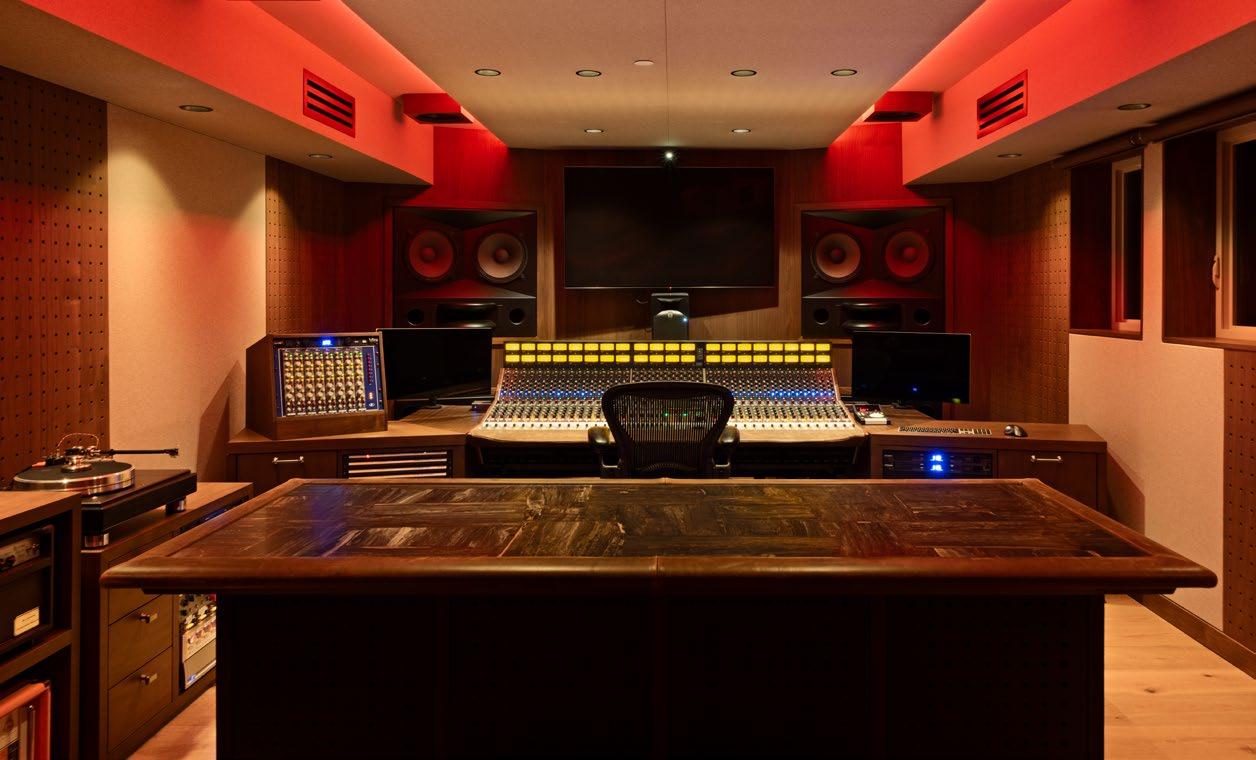
Opened in March 2026 and conceived as an artist retreat, Little Sur Studios sits on 70 acres of redwood forest overlooking Monterey Bay and features a 23-by-18-foot control room tuned for accurate translation across both stereo and immersive formats, with particular attention to low-frequency control, imaging and mix consistency. The room houses a 32-channel Rupert Neve Designs 5088 console paired with a fully integrated 9.1.6 Dolby Atmos monitoring system, with a soffitmounted Augspurger Classic 215 system with dual Augspurger 18-inch subs delivering extended low-frequency response and high SPL capability. Notable outboard gear includes eight rare Focusrite ISA110 modules from the legendary Focusrite Studio Console and vintage 1176 Revision D compressors sourced from Tittenhurst Park’s Ascot Sound Studios, famously associated with John Lennon and Ringo Starr.
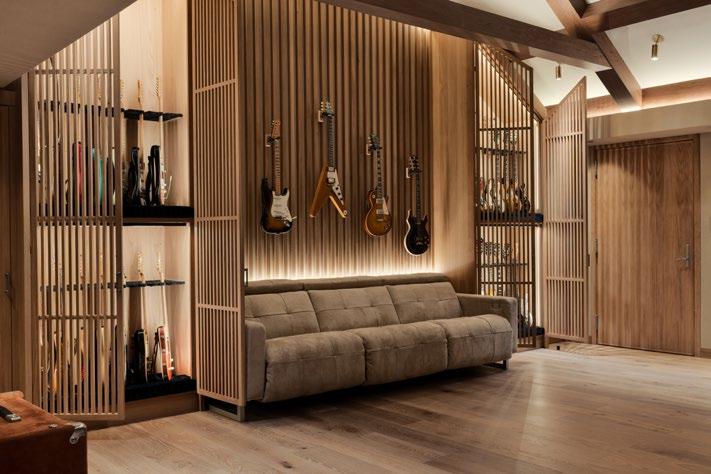
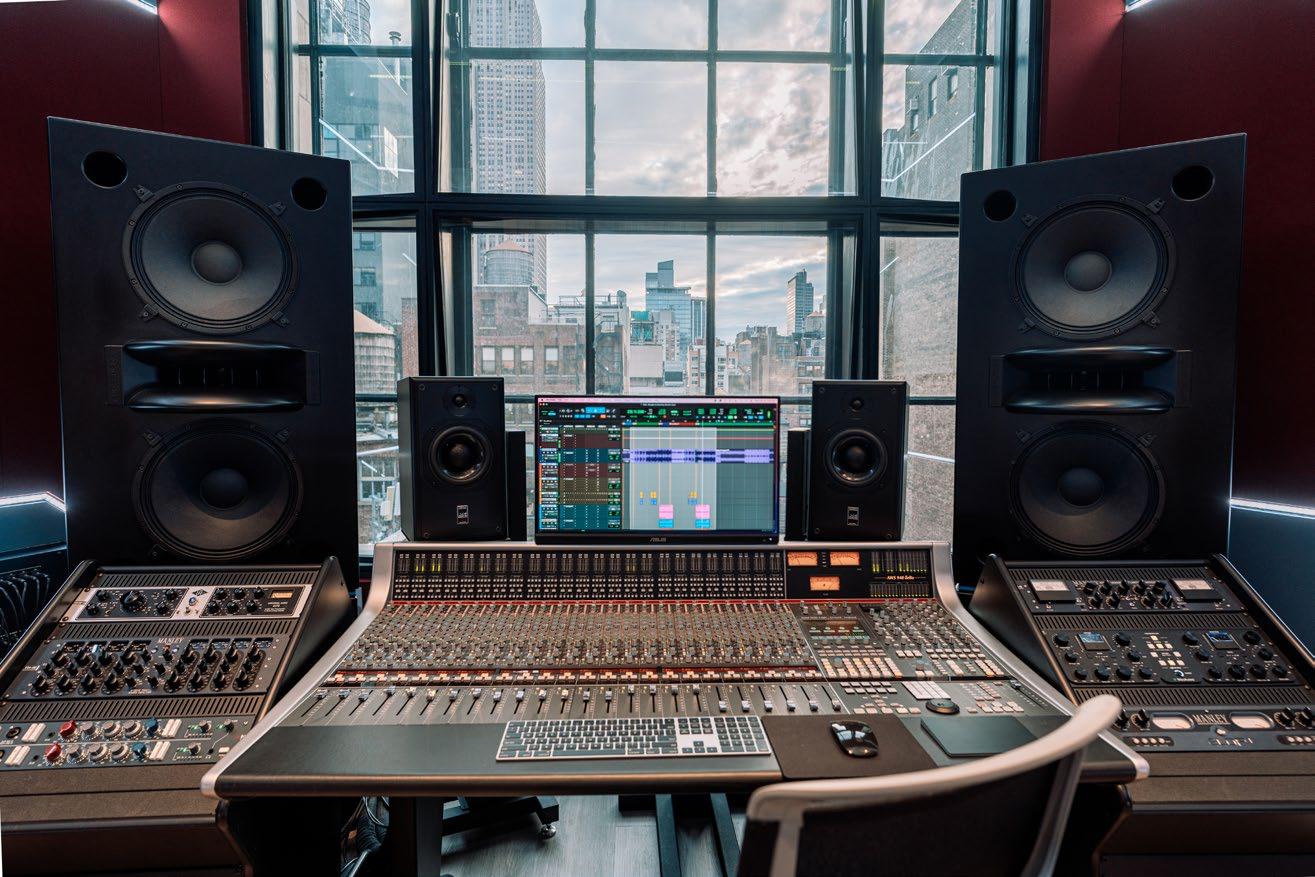
Embassy Studios
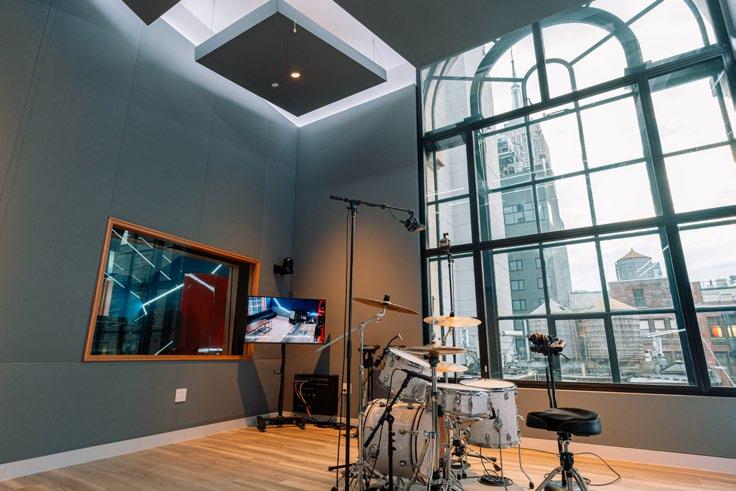
Embassy Studios is in the historic Engineering Building in Midtown Manhattan and offers 20-foot-high ceilings and panoramic views of the Empire State Building. The complex was designed as a full-service creative hub in collaboration with C.S. Scott (construction), MAOarch (architecture) and interior designer Lisa Babar, and features a facility-wide Dante network. The four production studio control rooms all feature Augspurger monitoring, with ATC, Focal and PMC alternatives, and SSL mixing consoles, including an Origin, AWS 948 and two Matrix2 Deltas. A Dolby Atmos room is outfitted with a 7.1.4 PMC monitor setup while a versatile multimedia room accommodates press interviews, podcast recordings, live streaming and creative video sessions.
Beijing, China
WSDG, Silvia Molho
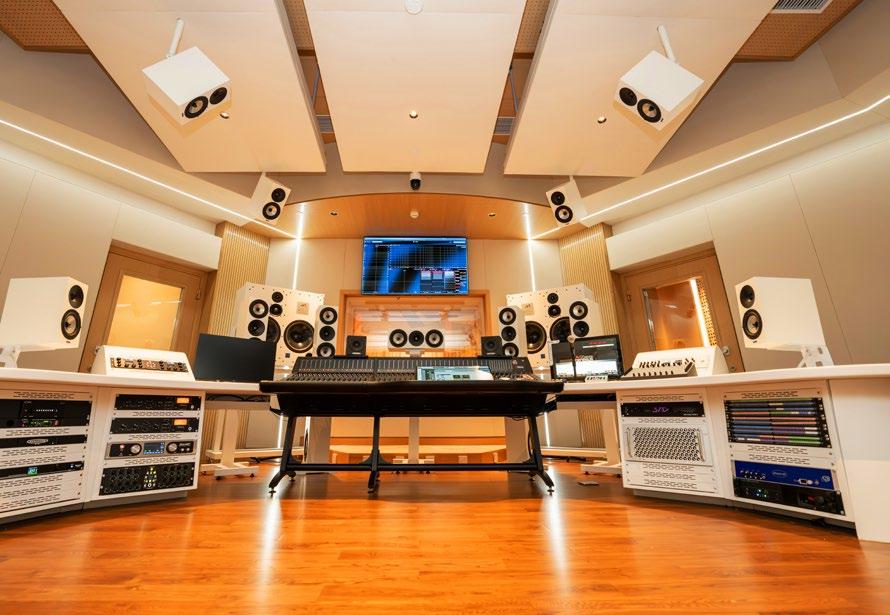
Located at Alibaba’s headquarters, the complex is the dedicated production facility for YOUKU and Damai Entertainment, purpose-built for music production, ADR and immersive audio post. WSDG, led by Silvia Molho and Víctor Cañellas, was engaged to deliver a complete recording studio design and systems package encompassing four specialized control rooms, a large live room and multiple iso booths. Each offers its own spatial character while maintaining visual cohesion through light wood detailing, curved ceilings and soffits, with abundant natural light and a warm interior aesthetic. Control Room A pairs an AMS Neve Genesys Black G4 with ATC SCM300ASL Pro mains and Amphion 9.1.6 Atmos monitoring. Control Room B handles ADR with a Kali Audio 7.1.4 system and direct sightlines to adjacent performance spaces. Control Rooms C and D serve as immersive mix suites with Genelec and Kali Audio 7.1.4 Atmos monitoring, respectively.
Saskatoon, Canada
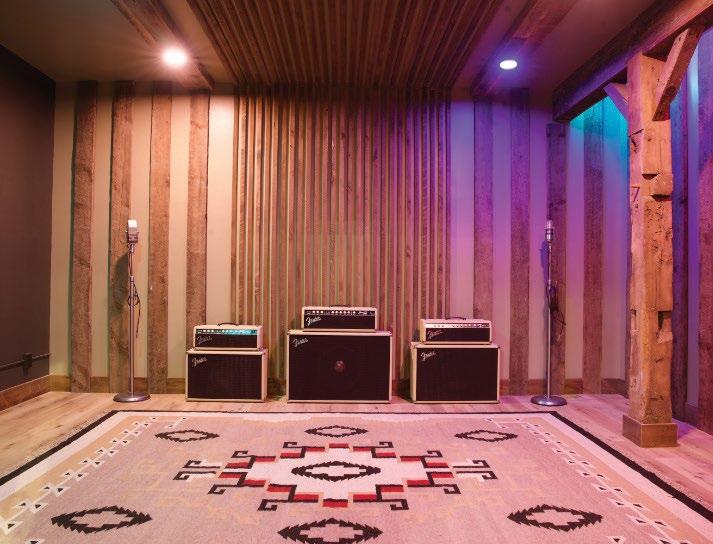

Haverstick Designs, Gavin Haverstick
Haverstick Designs’ Gavin Haverstick and Tracy Roberts, alongside 2H Interior Design, partnered with Liam Hopkins to bring his dream home studio to life with a 725-sq.-ft. live room and 333-sq.-ft. control room. The control room is equipped with Kii Three BXT monitors and customized acoustical treatments, including bass trapping, wood slat absorption panels and ceiling clouds. The adjacent live room, with views of the Canadian countryside, offers a versatile setting for rehearsals, recording sessions and video production, facilitated by Blackmagic Designs cameras and switcher. It incorporates adjustable curtain systems, custom ceiling clouds within a vaulted ceiling and a custom-designed QRD diffuser spanning two walls for balanced, dynamic acoustics. Studio Economik supplied the audio gear which was integrated by Facca Audio.
Sonic-Space, Lou Clark
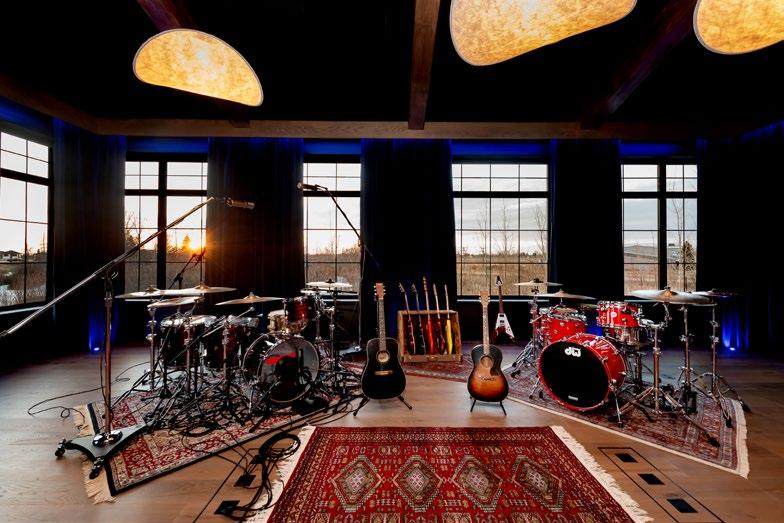
| Brewster, Mass.
Wingbeats offers seven tracking and control rooms networked with AES67, Merging Technologies conversion and Anubis monitor controllers. Lou Clark led a design team comprising Richard Pugsley, Christy and Peter Haig, Andy Degahnal and facility owner Dan Pfeiffer. The 500-sq.-ft. Control Room
A offers sightlines into the 2,200-sq.-ft. scoring stage and large iso rooms, and sports a Neve Genesys G64 console with Egglestonworks Viginti, Genelec 8341 and Genelec 7.1.4 Atmos monitoring and classic outboard gear. A DAD Core256 integrates the room with the AES67 network. Control Room B supports 7.1.4 and is linked to a 400-sq.-ft. tracking room and a vocal iso booth. A Production and Editing Suite features Avid S1 control and Genelec 8341 speakers.
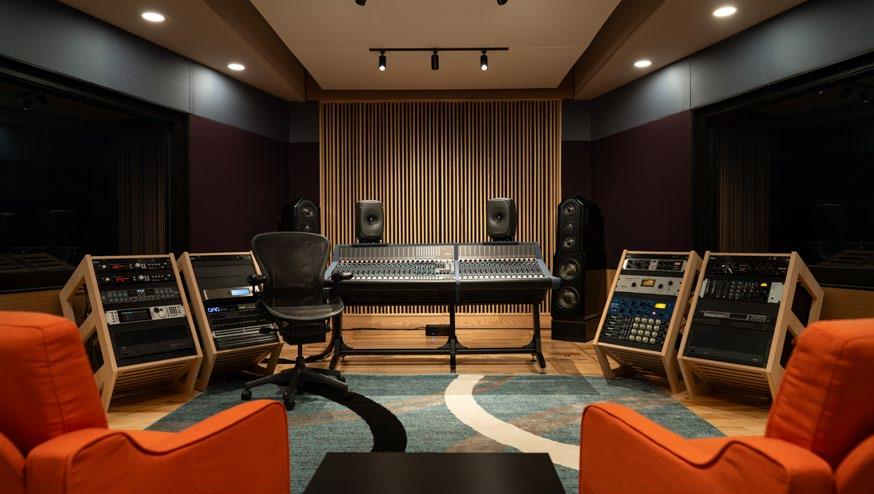
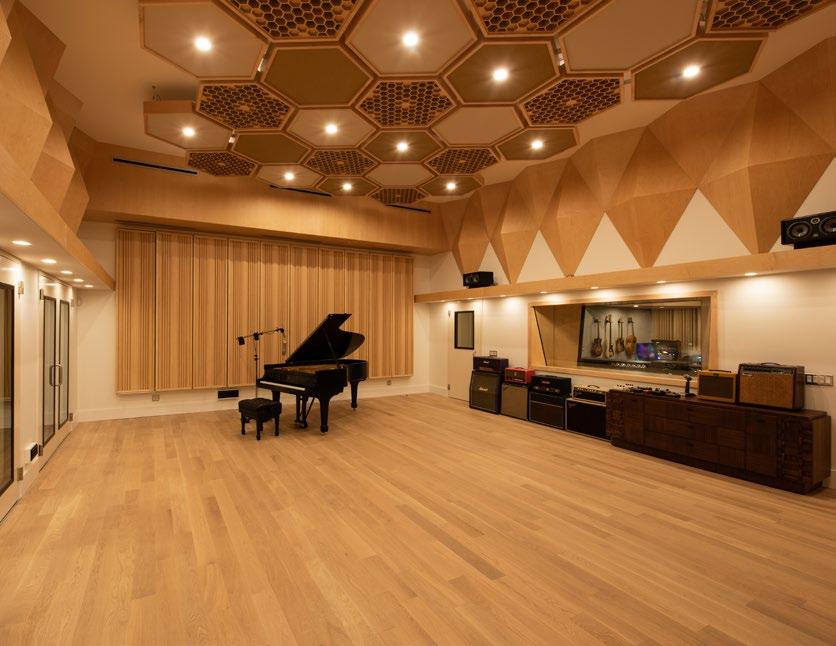
Wes
The new ground-up recording facility, owned by John Boggess, includes living space for musicians who want to work near North Carolina’s Research Triangle. Designer Wes Lachot worked with Brett Acoustics on the construction. The facility was designed by Lachot with Aaron Kelley sharing in acoustical design and handling drafting, modeling and project management. Audio and wiring was installed by Canova Audio. The control room features a Reflection Free Zone design employing ATC SCM150 Pro in-wall monitors with 15-inch ATC subs. The console is a restored vintage Quad Eight 3650. A large live room offers adjustable acoustics plus three iso booths and houses a large collection of vintage instruments.
Steven Durr Designs
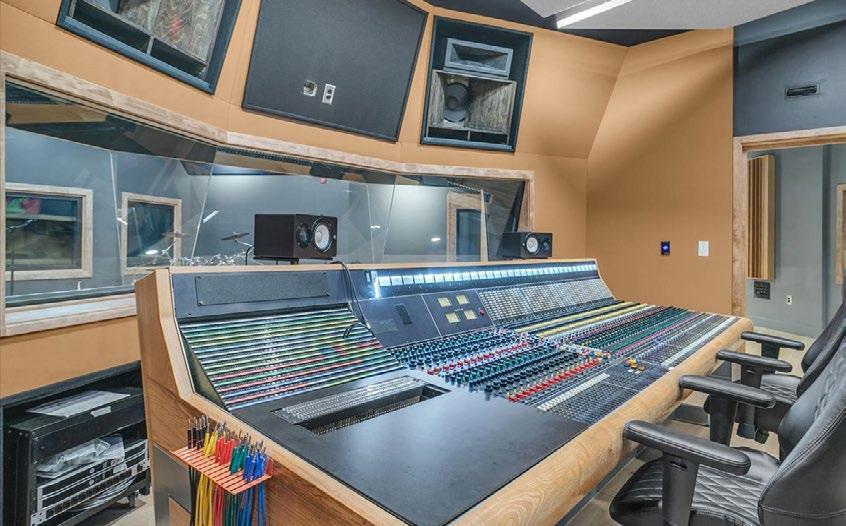
Opened about a year ago, Poe Mill is a 5,300-sq.-ft. modern, multi-purpose creative hub where music, media and community converge. The facility’s capabilities span recording, video podcasting, teaching studios and The Listening Room, a multipurpose, industrial-chic venue—all of which were designed by Steven Durr. A vintage Trident TSM 40-input console, originally from The Plant in Sausalito, Calif., and Addiction Studio, Nashville, Tenn., anchors the control room, which houses racks of analog outboard gear. The soffited main monitors feature TAD components and horns with Bag End subs. A stage box splitter allows for live recording from the venue’s stage.


Fort Wayne, Ind.
Haverstick Designs, Gavin Haverstick
Russ Berger Design Group
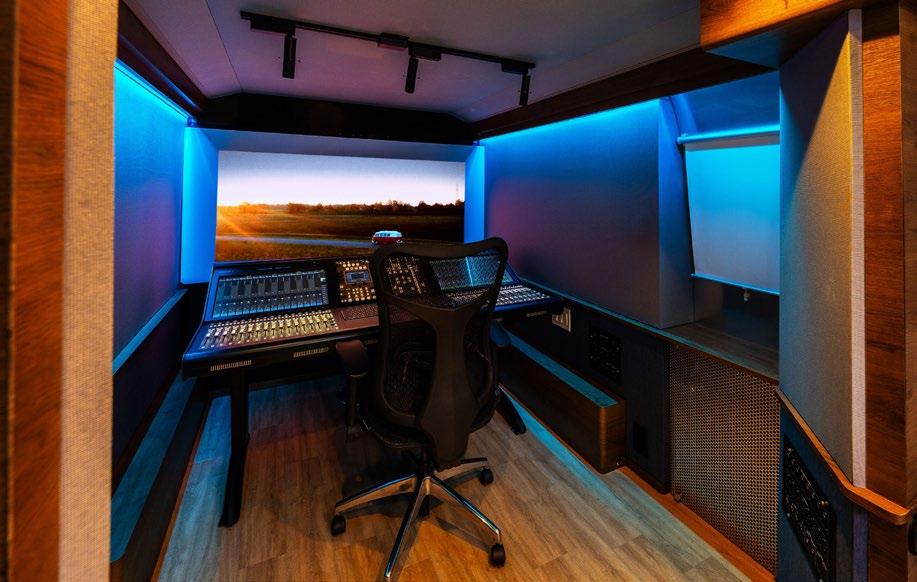
The Sweetwater Airstream Studio Edition is the first professionally engineered, Dolby Atmos-compliant mixing room built in a production Airstream trailer. Designed by Russ Berger Design Group on a 25-foot chassis, it is a mobile, reference-quality, 7.2.4 immersive monitoring environment. The control room is 79.5 inches wide, in a North/ South configuration at the trailer’s center. RBDG led the acoustic design and interior finishes, working with Sweetwater on a system built with Avid, SSL and PMC technologies. Also involved were Sweetwater’s Mike Pico tte (integration), and contractors Josh Gifford of Airstream and Frank Rose, Cinematech.
Missing text for Mad oak studio


















By Clive Young
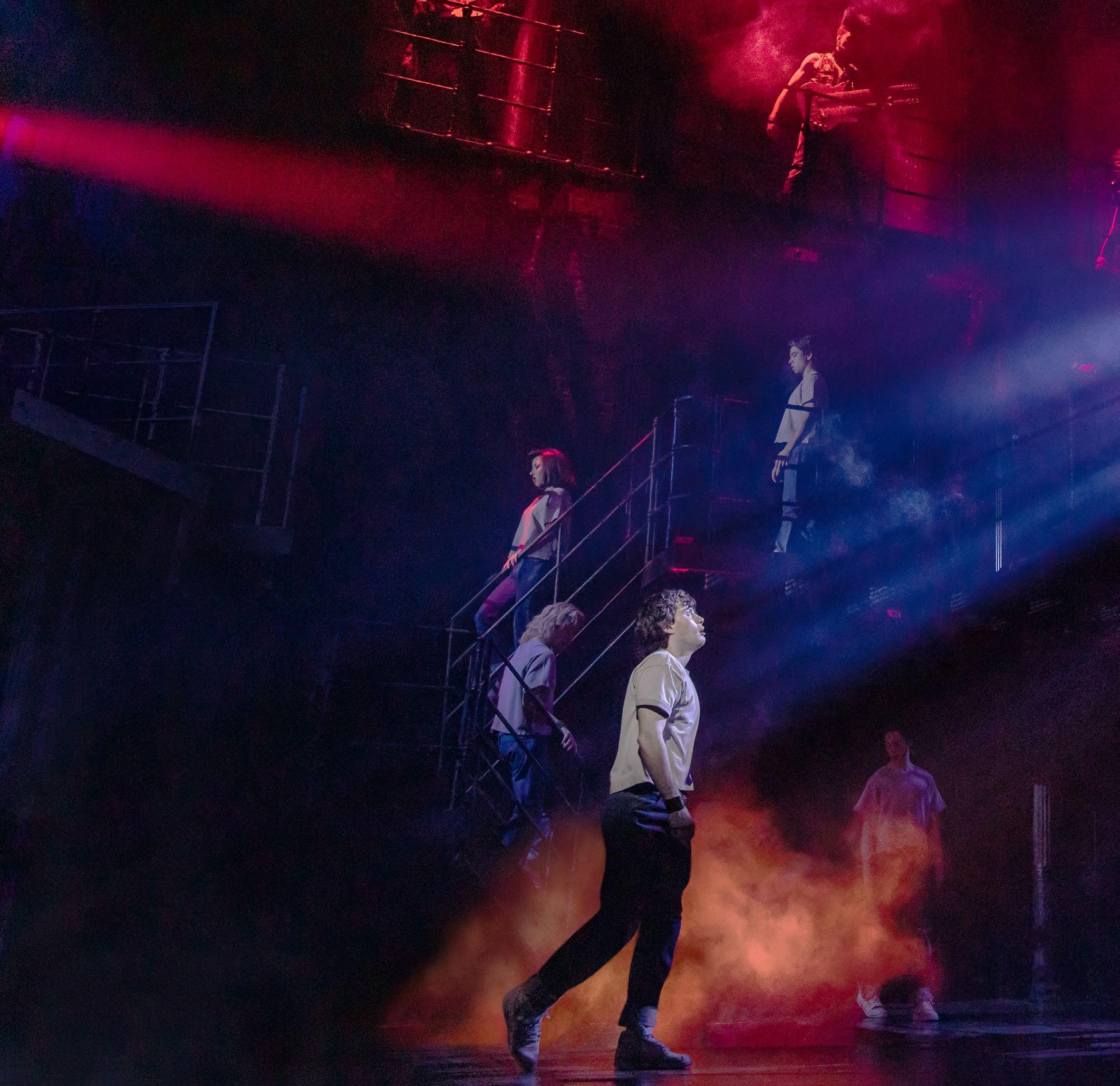
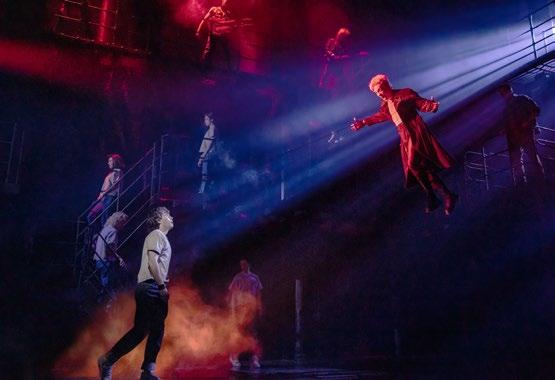
Back in 1987, audiences packed movie theaters to see The Lost Boys, a hit thriller that followed two brothers and their mom battling evil teenaged vampires in a coastal California town. Nearly 40 years later, those vampires have returned to roost in New York: The Lost Boys is now a Broadway musical that opened in late April and nabbed 12 Tony Award nominations the following week, including one for Adam Fisher who’s up for Best Sound Design of a Musical.
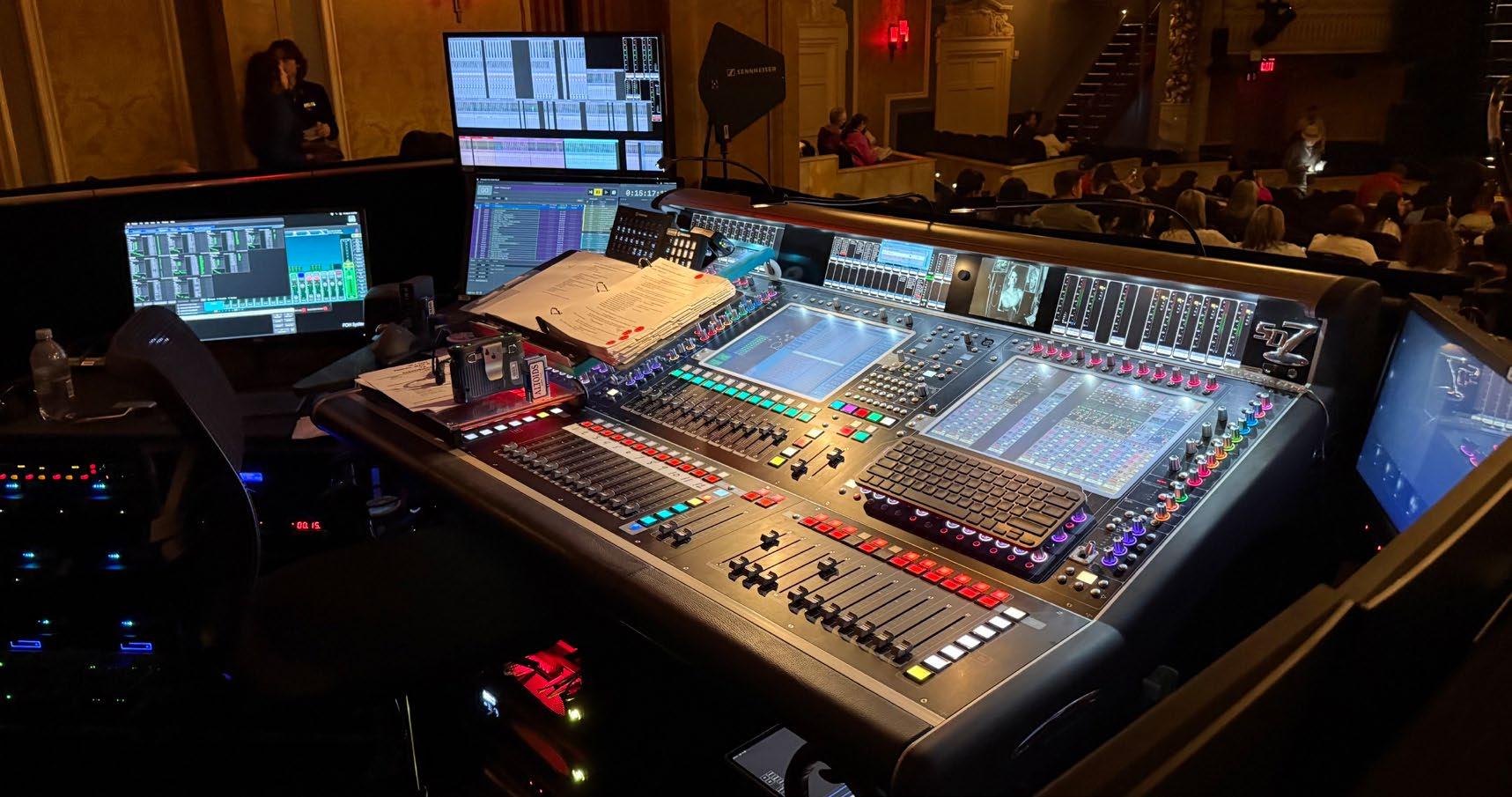
Staged at the 1,648-seat Palace Theatre, the show has a Sound Associates-provided audio system that is equally huge, with 278 speakers in play. “I’ve been told by the general managers that there’s far too many speakers,” Fisher says with a chuckle, “but for me, that’s what theater is. You’re not trying to blast from the front; you’re
trying to deliver sound as close to the audience as possible, so it is about making the level even throughout the auditorium.”
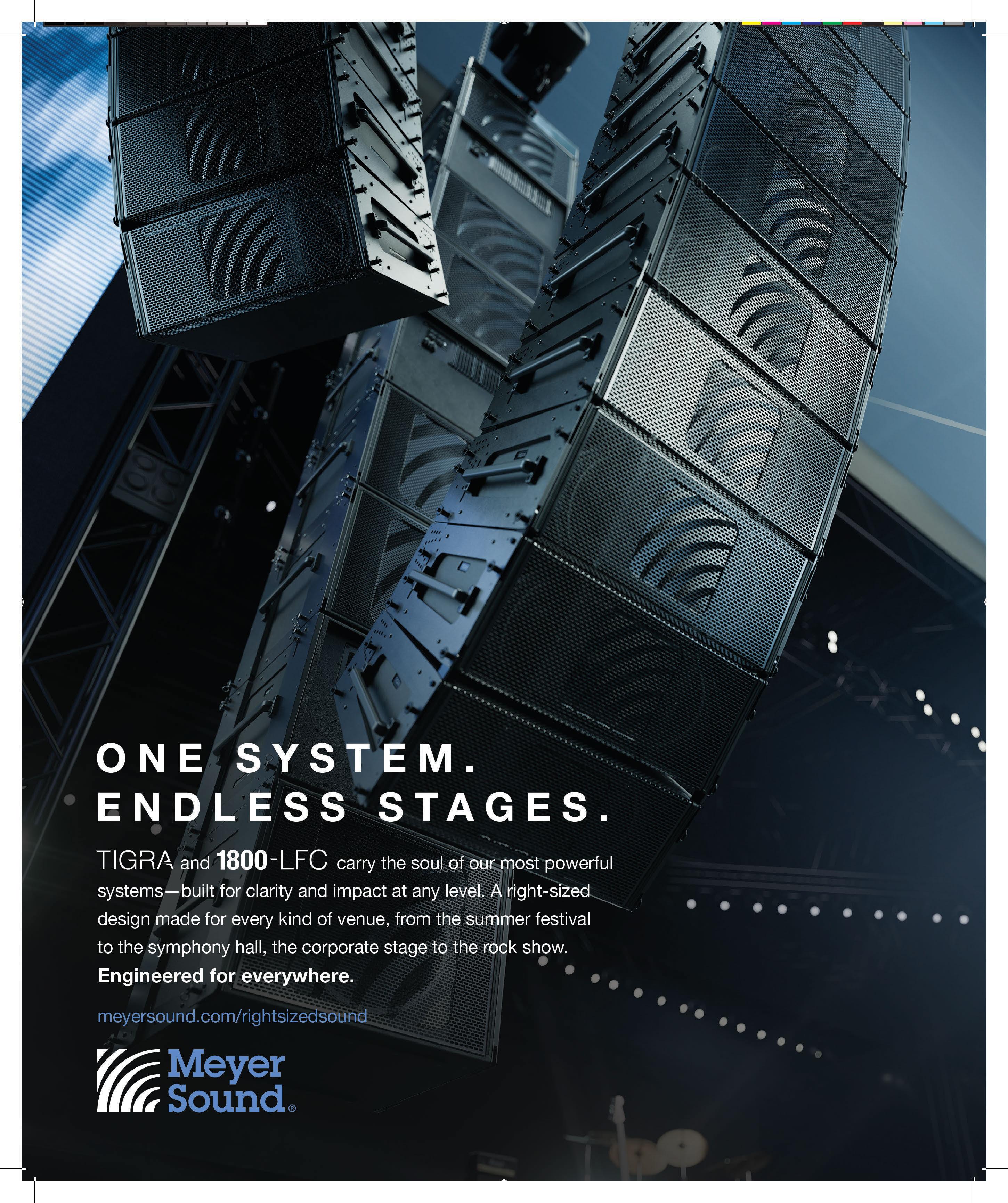
Central to the system are Meyer Sound Panther large-format line array hangs on either side of the stage, which he says is “a bit of overkill for this show, but I thought that for the ‘rock’ aspect of it, you want to have a big speaker that you’re not driving too hard.”
The massive hangs do more than cover the orchestra and mezzanine, however. “They’re also a visual statement,” says Fisher. “The audience comes in and sees two huge line arrays left and right, which gives the anticipated feel of ‘It’s not going to be quiet—this is going to be a rock show.’”
The 20 Panther elements are among 140 Meyer Sound speakers used in the system.
Meanwhile, surround and foldback are handled with passive boxes from U.K. manufacturer EM Acoustics.
Immersive atmospherics, ranging from unsettling noises and drones to things that go bump in the night, are a huge part of the show— and The Lost Boys makes the most of them due to a tight collaboration between Fisher and Ethan Popp, the show’s music supervisor (Popp is also a co-orchestrator and co-arranger with the show’s composers, The Rescues—Adrianne “AG” Gonzalez, Gabriel Mann and Kyler England— and all four received a Tony Award nomination for Best Orchestrations).
Fisher and Popp, who previously worked together on Andrew Lloyd Webber’s School of Rock musical 10 years ago, focused on the creative possibilities of the show’s 7.1 immersive sound.
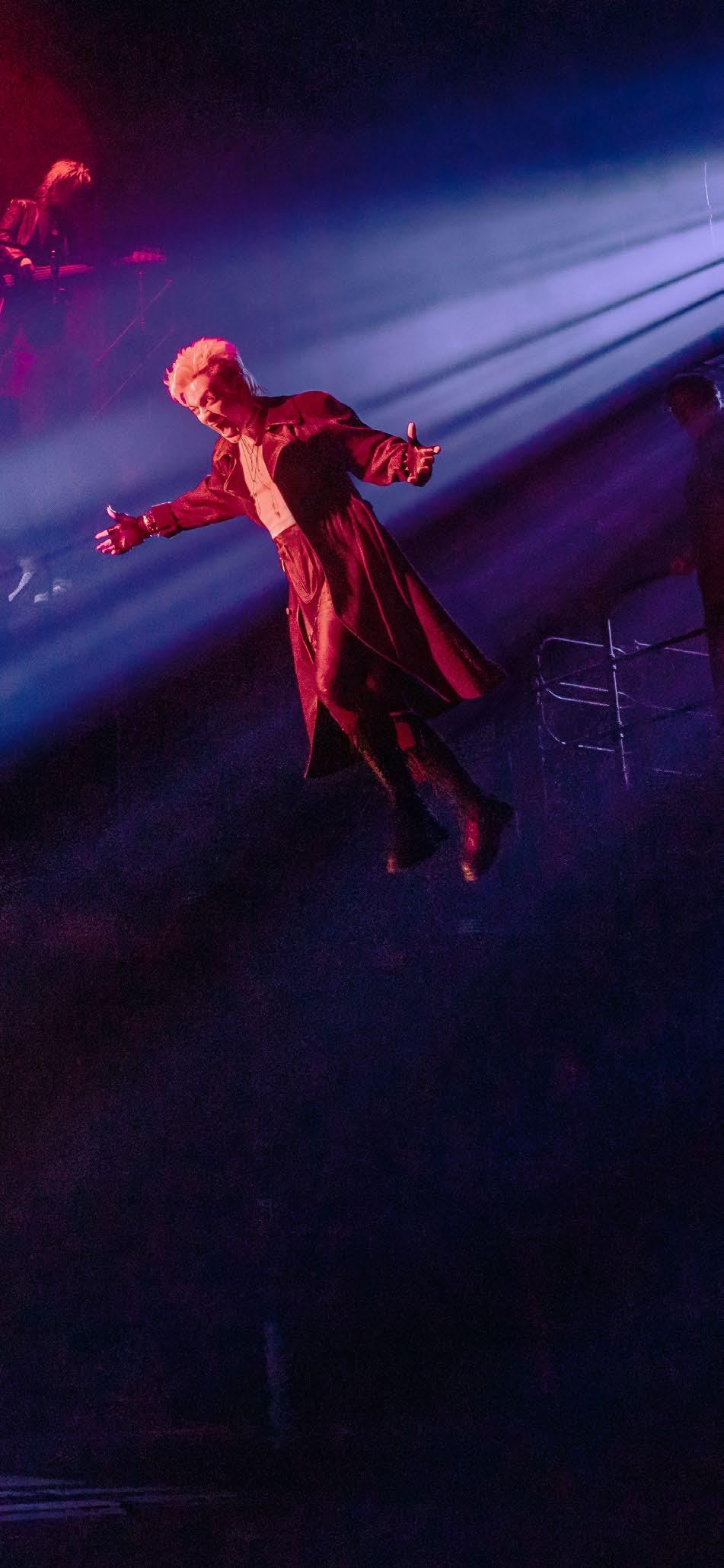
“On a show like The Lost Boys, orchestration and sound can’t really exist in separate silos,” says Popp. “We’ve been thinking about how the music lives in the room—how the audience experiences it, spatially, emotionally and dramatically—and that’s where the collaboration with Adam and his team becomes so exciting. The score is being experienced as atmosphere and narrative energy, so the immersive environment becomes an integral part of the orchestration; it determines how the audience lives inside of the score.”
Fisher, in turn, uses the immersive aspects of the show’s sound design to draw the audience deep into the story unfolding on stage. “Ideally, you want them to believe that sound is coming from the performer, not from the speaker that’s nearest them,” he says. “I try to make sure that everyone is in at least two or three zones, so that we can then create an image to where they are…. Some places, we achieve that better than others, but it’s an endless balancing act. Do you go for pristine-like vocal clarity, or do you image more?”
To support that imaging, Fisher has speakers onstage, hidden in set pieces, to help localize some sounds. When the teenaged vampires’ rock trio performs, two Meyer UPQ speakers hidden in the back wall are employed to image the drummer and guitars onto the stage.
“We were trying to find ways to localize
the drums,” Fisher adds. “It was a long process because we tried to find other places to hide speakers, too, and it never landed. We were in rehearsals and Ray Wetmore, who’s our prop supervisor, went, ‘Well, could you put a speaker in the kick drum?’ The actor playing drums is hitting V-Drums, so they’re just triggers. We found an in-car entertainment driver, a 15-inch driver with a coaxial horn on it, that we mounted in the kick drum and it works quite well.”
In other parts of the stage, there is a comprehensive foldback system for the cast, with sidefills on the rear of the proscenium, nine speakers in the deck and a grid of boxes flown overhead. The giant system is necessary as the show sports a three-story set and the vampires can fly, so the actors need to hear themselves whether they’re on the deck or 20 feet above it. Additionally, in the pit where the orchestra would traditionally be, there’s instead an apron lift used for several scenes; since it’s so far downstage from the rest of the foldback system, the lift, too, has its own set of wedge-like speakers for the cast.
Despite all the foldback speakers, when the vampire band performs, the actors hear themselves via in-ear monitors on Shure Axient wireless packs. For the show’s miking, however, RF distribution is tackled with Sennheiser EM 6000 wireless systems, and all the cast wears DPA Core 4066 headset mics. “I think they’re the best in the realm of what they do,” says Fisher. “They sound like a studio mic, but they also have this uncanny ability to isolate.”
DPA mics are also used to capture all strings and guitars in the orchestra. Most of the 16-piece ensemble is in a room three floors below the stage, while drums and percussion are one floor up. All the musicians use Roland M48 live personal mixers to hear themselves, getting sound derived from a DiGiCo SD10 desk used for
both the orchestra and onstage band monitoring.
Out at front of house, another DiGiCo console is put to use—a Quantum 7 with theatre extensions; a pair of adjacent Fourier Audio transform.engines handle outboard processing, though vocal processing is handled within the console to keep latency as low as possible. The Fourier systems are used for reverb effects—and there’s a lot of them, often from Seventh Heaven or Soundtoys plug-ins. “There’s a lot of reverbs on this show,” Fisher confirms. “Every moment, it’s either atmospheric because it’s a horror section—they’re in a lair or a cave—or we’re trying to do an Eighties number where you’ve got some gated snare plates on drums.”
All those reverbs get their moments to shine thanks to the show’s immersive setup, and are often employed as part of the musical arrangements to help take the audience on an emotional journey. Musical supervisor Popp explains, “In practical terms, that means being very intentional about how playback elements—reverbs, delays, synthesized textures, vocal atmospheres and traditional material— occupy the room. Some elements want to feel frontal and immediate because they’re carrying narrative focus; others can widen that emotional space or create unease. When that’s done well, the audience isn’t just hearing the orchestration; they’re experiencing it around them, even just from an unconscious point of view, and that makes the storytelling more immersive.”
Storytelling is key for a production that is equal parts musical, emotional drama and overthe-top thrill ride, and Fisher’s sound design supports it all with thoughtful nuance. With the show playing nightly to packed houses, that attention to detail has paid off. “It was quite long, probably one of the longest processes that I’ve ever been in,” Fisher admits, “but it’s also been one of the most rewarding.” ■
By Steve Harvey
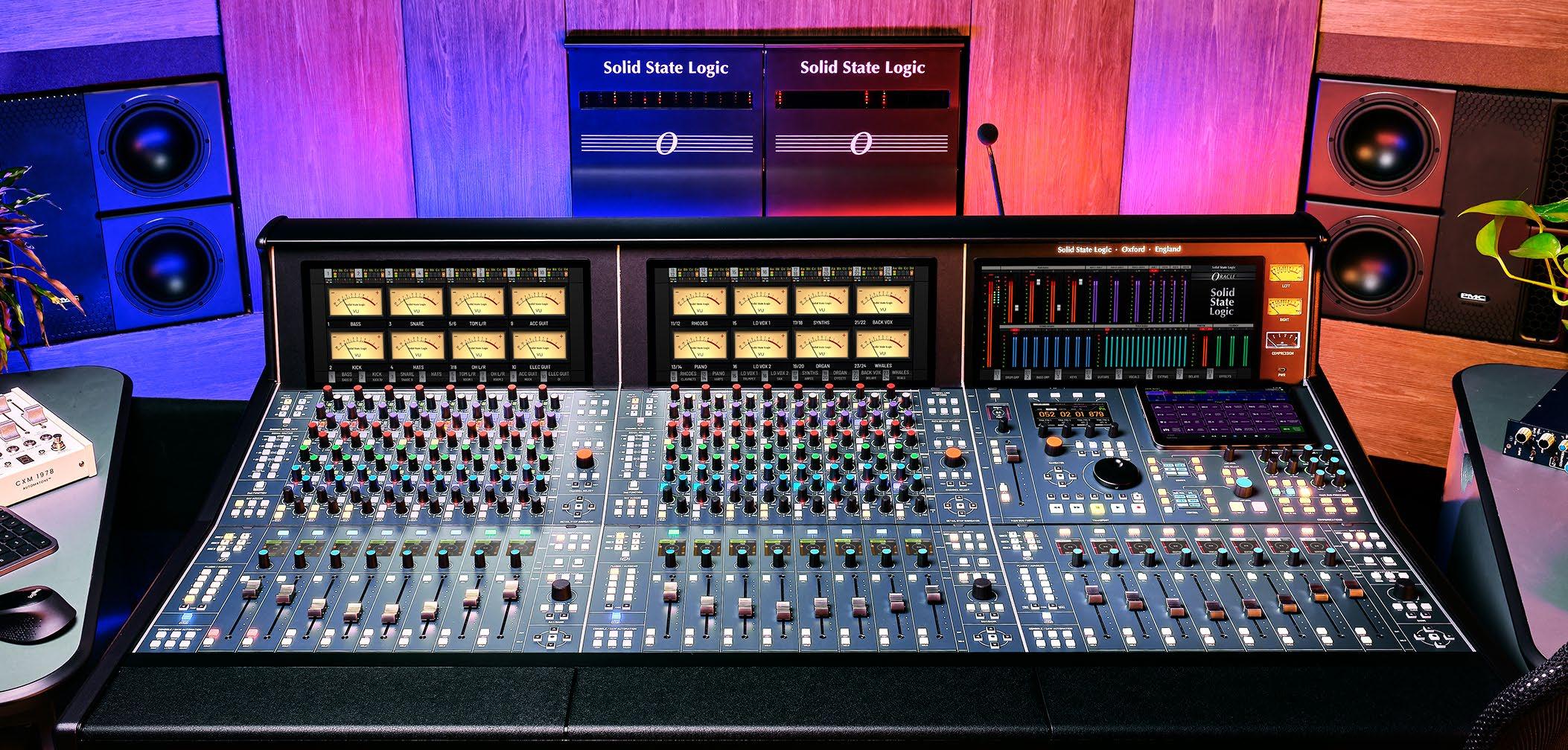
At first glance, you might be forgiven for thinking that the Solid State Logic Oracle mixing console is just another digital desk. The compact form factor, three large display screens and channel fader panels, almost identical to SSL’s UF8 DAW controller, certainly give off a digital worksurface vibe. But Oracle is very much an analog console, from input to output, combining the brand’s PureDrive mic preamps, E and G Series EQs and other legacy SSL features with digital recall of every knob, switch and fader in a design the U.K. manufacturer is marketing as ActiveAnalogue. Mixing consoles providing digital control of an analog signal path are not new. In the mid1980s, Amek, Saje and Trident all pioneered
large-format analog desks with some form of digital assignability, reset and recall control. There were only a few buyers.
Forty years on, users are now comfortable with digital controller workflows and manufacturers have access to more advanced technologies and components. As a result, today’s market could be more receptive to a fully analog, inline production console with near-instant recall and reset of all gain, processing, pan and routing settings.
Oracle’s worksurface, approximately the same dimensions as SSL’s popular but aging AWS desk (launched 20 years ago), will feel familiar to anyone who has sat behind any of today’s controllers—or an analog console, for that matter. Input channels are laid out with all
the physical controls that might be expected on any large analog console, from channel input selection, gain and a high-pass filter to pan and large fader. Similarly, the master section includes all the necessary controls for the four stereo buses, eight stereo group faders, monitor speakers, DAW transport and other features.
Two configuration options are both based on a single surface housing two bays of eight channel strips each, plus a center section. This being an inline console, there is both a small fader and a large fader input path—each with an insert—through each channel. Eight stereo inputs can also be introduced to the group faders, so Oracle 24 offers 64 inputs on mixdown while Oracle 48 supports up to 112 inputs.
The biggest attraction of Oracle is obviously that it’s a fully analog SSL console with the functionality and sound quality associated with the brand, yet it can save and almost instantly recall every setting across the board. Both the creative and economic advantages should be immediately apparent. An artist or engineer can quickly move from one session to another and fully reset the console in virtually the same time as it takes to switch between Pro Tools sessions a real timesaver. What’s more, SSL’s O Session software allows the entire console to be configured offline, significantly reducing setup time at the start of or between sessions. Sleep Mode is an additional cost-saver.
Layering digital control onto an analog signal path presents opportunities to expand the surface’s capabilities way beyond anything a typical analog console could offer, of course. Digital worksurface novices needn’t feel intimidated, however, as Oracle can largely be operated just like a typical analog console, using familiar dedicated controls. That said, in today’s hybrid production environments, Oracle’s ability to switch between operating as an analog console and as a controller for up to three separate DAWs, each on a separate layer, may also be attractive.
Control strips to either side of each eightchannel block provide access to features typically only found on a digital desk or controller. For example, in console mode, there are several ways to quickly bring a detailed view of a selected input channel or channel section onto the display above it. The operator can then step or scroll, depending on the controls used, from one channel to another. Further, sections of an input channel can be copied and pasted to other channels, and channels can be linked for stereo operation—tasks involving repatching, or impossible, on a regular analog console.
The order of input channels can also be rearranged, should, for instance, an engineer wish to focus on certain channels or groups of channels. There are 16 channel strips on Oracle’s surface but potentially many more inputs, whether in console or DAW mode, so the control strips to either side of each channel bay also provide switching to bring other bays and layers in front of the engineer.
The processing order for each input can also be rearranged, allowing filters and EQs to be moved and put before or after inserts, for instance. And this may be unique to Oracle: Each frequency
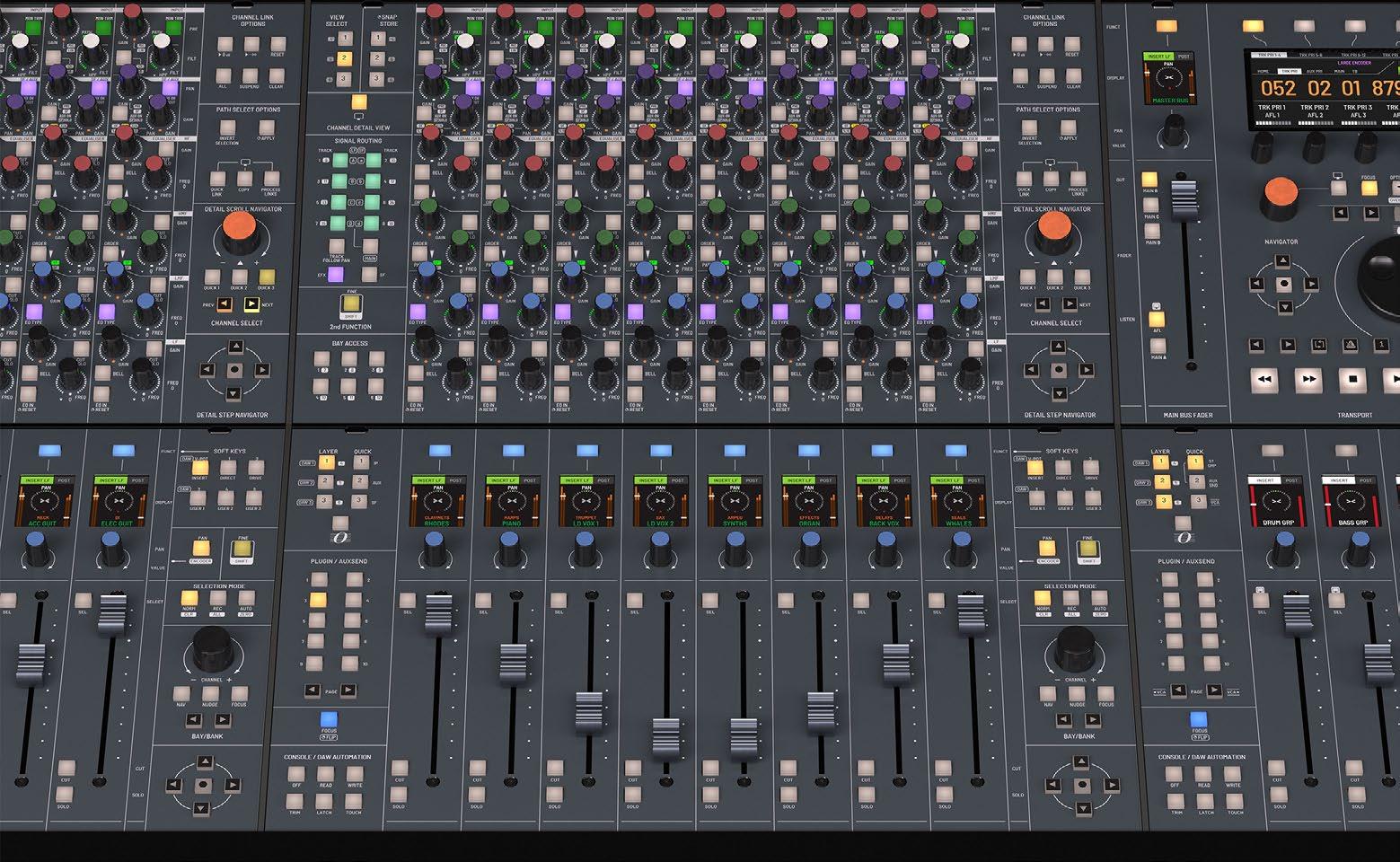
band of the EQ section can be separately cut or soloed, allowing precise adjustment without interference from the other bands.
Happily, despite so much going on, visual feedback is very clear. Input channel functions are color-coded, with the long and short fader paths indicated respectively by green or red LEDs, or LCD legends, as well as font size. With just a glance, it’s easy to see what the input sources are and which channel functions—filter, EQ, insert—are assigned to which input path.
Ten aux sends, color-coded purple, can be placed in either path and configured as all mono, five stereo or any combination in between. An operator can step through pairs of sends and control them using the two knobs, which provide access to levels (mono auxes) or level/pan (stereo) or, again, because this is digital control surface, aux levels can be mixed from the faders. An EFX button, found on other high-end SSL consoles, provides access from channels to unused multitrack buses for use as extra sends to effects.
Some might be disappointed by the lack of SSL’s famed channel dynamics but think about it for a moment. How often do you apply the exact same processor to every source at the same time across the console? Plus, for customers at this price point, who likely already have significant collections of outboard gear, there are alternatives—and plenty of insert points.
There are 16 multitrack and four stereo buses (A, B, C, D), routable from those channel bay control strips. Main bus A has both pre- and post-fader insert points; B, C and D have a single insert. Select a detailed view of any of the main buses and a precision stereo image feature becomes available that enables the rebalancing of the return from an outboard device that is out
of calibration. A thoughtful touch. SSL is well known for its G bus compressor, but Oracle goes a step further, integrating an enhanced version of the company’s The Bus+ compressor, as well as dynamic EQ, both with dedicated surface controls, across the master stereo out.
The three bay-wide display screens can each be selected to show a variety of information, including numerous metering options, from bargraph to VU and with various ballistics. Screen brightness—in fact, of any illuminated feature, including the SSL logo—may be adjusted. A variety of solo modes may also be selected, including solo in front, introduced on SSL’s 9000 Series, which places the chosen channel in context with the mix with an adjustable level differential.
Finally, O Session and O Setup, two separate apps that may eventually become one, are where projects are saved and recalled and Oracle can be set up offline. Individual channel views are the same detailed view as on the console display and, when linked to the console, enable remote operation of every control, if desired.
SSL may well have identified a market niche for a compact analog console with large console capabilities, especially now that control rooms are trending toward a smaller size. Oracle packs a lot of inputs and outputs into a small package, but don’t be deceived—anyone building a patchbay for Oracle will discover that it is similar in size to that of the larger 9000 and Duality consoles. The big difference, though, is that while those consoles have recall, manually resetting them is a time-consuming task. With Oracle, one click of the mouse and—presto!— the session is underway.
SSL plans to launch a major update to Oracle’s software this summer, so the console’s feature set will be enhanced and expanded in the coming months. Prices start at $150,000. ■
By Steve La Cerra
When the Audix D6 was introduced in the early 2000s, it was well-received as a “pre-EQ’d” kick drum microphone with a voicing that appealed to a variety of users, while simultaneously falling quite comfortably into the hard rock and metal genres. The success of the original D6 cannot be denied: It’s become a staple on stage and in studio mic lockers,
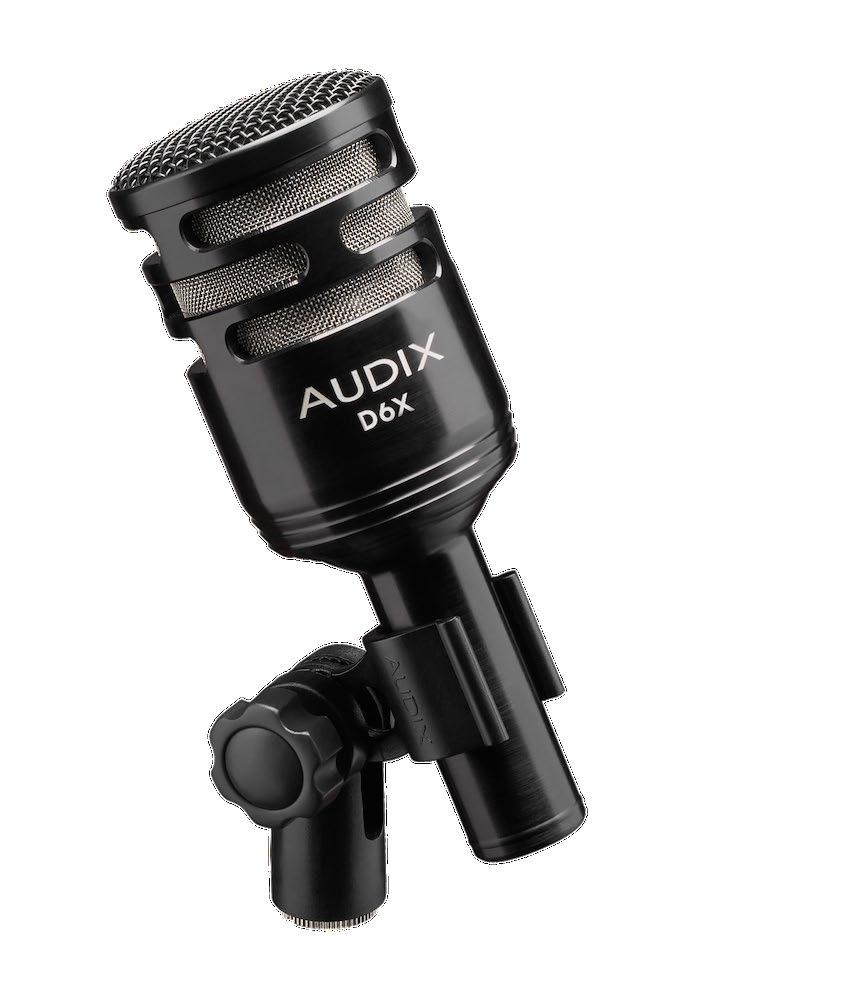
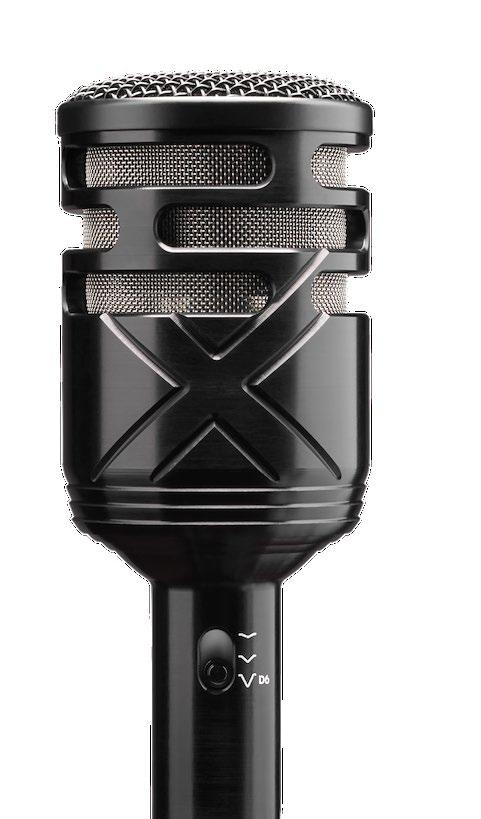
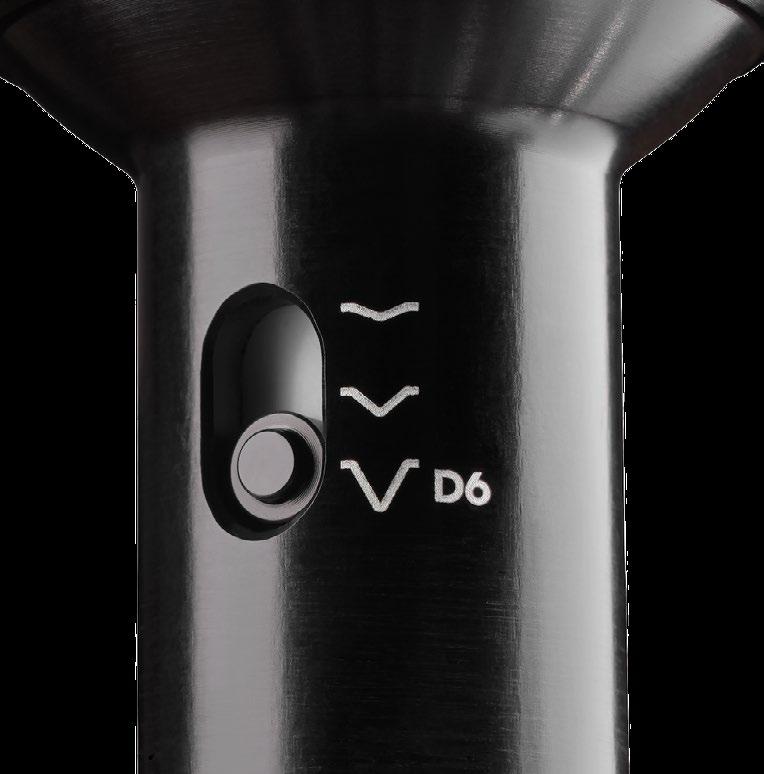
Enter the Audix D6X, a dynamic microphone with a twist on the original D6. While the two microphones appear identical at a casual glance, a closer look at the D6X reveals an engraved “X” on one side of the body, below which lives a three-position switch. This switch is the raison d’être for the D6X, offering three different EQ curves.
The lowest position (labeled with a deep “V” and “D6”) retains the voicing of the original D6, with a boost of approximately 5 dB around 40 Hz, a midrange scoop of almost 17 dB in the region between 700 and 800 Hz, and a gentle boost of a few dB that starts around 4.5 kHz, continues out to about 15 k, then rolls off. The middle switch position (labeled with a flatter V-shaped graphic) provides a more balanced—some would say “tamer”—version of the D6 sound, with a slightly reduced boost in the low end, significantly less cut in the midrange (maximum cut around 8 dB between 500 and 600 Hz) and a similar boost in the top end. Finally, the top “natural” position of the switch (labeled with an even flatter ”V”) removes the bass boost, decreases the midrange cut to about 5 dB, and moves the HF peak to around 3 kHz, rolling off above 7 kHz.
[Note: Published specs for the original D6 have varied over the course of its 25-year history, so my description of the “V D6” curve may not match what you see in published data when viewing the frequency response curve for the D6, particularly in the highfrequency portion of the curve.]
Dimensions of the D6X are almost identical to those of the D6, the difference being a slight increase in length: 5.4 inches overall for the D6X versus 4.6 inches for the original. Construction employs a precision-machined aluminum body, black anodized finish and a
The D6X cardioid capsule incorporates Audix VLM (Very Low Mass) diaphragm technology, which is designed to extend lowfrequency response and improve transient response. The output is transformerless, with an impedance of 280Ω. Frequency range is stated as 25 Hz to 17 kHz (-6 dB), maximum SPL is 144 dB, and sensitivity is spec’d at 0.842 mVrms/Pa @ 75 Hz (0.5 meter). As with most Audix microphones, the D6X is manufactured in the U.S. It ships with a soft zippered pouch and a DCLIP mic stand clip.
I used the Audix D6X in the studio and on stage for a variety of applications, though it’s almost a given that the mic will most frequently be used on kick drum. My tests also included A/B comparisons of the D6X to the D6 on kick, rack tom, floor tom and bass amp, using an API 3124 (4-channel) microphone preamp.
In the interest of staging a fair fight, I placed the two mics side-by-side in front of a hole in the front kick head on a 22-inch Pearl Masters Series kick drum. Neither mic was placed precisely where I’d want it, which would be dead-center of the hole, because they simply occupied too much space. So, I split the difference in the initial comparison and did later trials with the D6X placed in my preferred location.
When the D6X was set to the D6 curve, the results were as expected: the microphones sounded virtually the same. Matched settings on the API 3124 yielded similar (if not identical) levels. I thought that the D6X might be ever-soslightly extended in the low end, resulting in a tad more whump, but these subtle differences could be due to placement or due to the difference between a brand-new mic (the D6X) and one with high mileage (the D6).
Changing the D6X switch to the middle position/medium curve reduced low end and increased midrange, the subjective impression being that the D6X produced much more midrange snap compared to the D6. The top switch/mild curve setting on the D6X clearly differentiated it from the D6: This least-EQ’d setting yielded a flatter sound with tighter low end and restoration of the mids in the range of 500 Hz. I found this setting to be a bit on the vanilla side of the spectrum, but YMMV.
I then removed the D6 from the kick drum, changed the D6X switch to the middle position, and placed the mic at the center of the hole. Compared to the D6, low end was reduced and midrange was increased, the objective impression being that the D6X had much more midrange punch.
The difference between the middle switch position and the “D6” setting was not as pronounced as I was expecting, but if you’ve ever felt that the original D6 curve was too overthe-top, then the middle position will make you happy. This placement and switch setting was my favorite for kick drum. When I used the D6X on-stage with this setup, I felt like the mic produced sufficient low end without worry that it would be overbearing.
As advertised(!), when the D6X was set to the D6 curve, it sounded identical to the D6 (no surprise). The middle curve made the tom sound more midrange-forward, capturing less of the
shell and more of the head. Changing the switch to the mild curve made the D6X sound like it was placed on a different drum compared to the D6: much more midrange-y, less warm, not as round-sounding and producing more in the “boing” department.
As good as the D6 and D6X can be on kick drum, they kill on floor toms. The mics sounded identical when the D6X was set to the D6 curve—great balance of lows to highs, plenty of attack and great capture of the bottom end. Changing the D6X to the middle curve made the floor tom a little more polite; the bottom was not as extended, while the midrange and HFs seemed more pronounced, but this could be the reduced bottom end making the tom
COMPANY: Audix USA
PRODUCT: D6X Dynamic Instrument Microphone
WEBSITE: www.audixusa.com
PRICE: $299.00
PROS: Variable EQ curves with three options; can reproduce the sound of the original D6.
CONS: None, really.
appear brighter. Some might say the middle position produces a “cleaner” or “midrangeforward” sound on floor tom. At the mild curve setting, the D6X sounded nasal to me, producing less from the shell and more from the drumhead than I care to hear.
Both mics sounded great on bass amp. I thought that the D6X might have captured a tad more of the attack of the pick on the strings, but this could have been due to slight variations in placement. The middle curve of the D6X produced more growl and snap, while the mild curve can clean up any low end you might have doubts about. If the D6 has the ability to make the lowest octave on a bass a bit sloppy, the medium switch position on the D6X takes that away, subjectively resulting in more attack and tighter bottom. The mild curve on the D6X worked really well for a punk rock bass sound: tight, throaty and lean.
First and foremost, the Audix D6X must be judged against the baseline that Audix itself has established: When set to the “D6” curve, does the D6X sound identical to the original D6? Yes, it does.
Next, we can evaluate the mic on its own merits. The two additional EQ curves are truly useful, taming the D6 mojo for situations that require it, while offering a third option that unmistakably takes the microphone into different sonic territory.
Pricing for the D6X is about $110 (street) higher than that of the D6, but it’s definitely worth the extra bucks and provides a wide range of voices. If you’re looking for a microphone to use on kick drum and/or bass amp, you should definitely take a listen to the Audix D6X. ■
By Craig Anderton
“
Perfect sound forever.” Well, that’s what marketing departments said, yet the CD wasn’t perfect, or forever. We know that. But what did “sound” mean? If something was on a CD, was the recording itself inherently perfect? Were the drums miked perfectly? Would the playback system also be perfect? “Perfection” matters to our studio world in diverse ways, such as...
The Studio Itself: Recently, I heard superbly recorded music at Blackbird Studio, and the sound quality was as close to perfection as the state of the art allows. However, that only underscored the cruel reality that my studio, like most others, doesn’t sound as good. For studio gear, the price of pursuing perfection is steep. It’s a truism that a $500 speaker is 10 times better than a $50 speaker, but a $5,000 speaker isn’t 10 times better than a $500 speaker—and a $50,000 speaker isn’t 10 times better than a $5,000 speaker.
And expenses escalate. Better mics. Better converters. Recording at 64-bit float. Faster computers. Of course, cynics say the music ends up being heard mostly by people listening to data-compressed files on earbuds or computer speakers anyway, but even over compromised playback systems, superb sound translates better. Also, it’s fair to remember that some listeners do prioritize quality over convenience and mirror a studio’s pursuit of perfection in their own systems.
quality…or do they? If the Snot Puppies are recording “Punk You, Evil Billionaires,” do they want transparently pristine sound? Maybe they want to sound like “Louie Louie,” not “Lewis Lewis.” Maybe perfection shows up as a filthy, distorted drum sound. The price of pursuing perfection now takes on a different meaning, because it can be more difficult to capture the perfection of raw, unfiltered emotion than it is to tinker with plug-ins while editing a sound to “perfection.”
The Playback System: “Hi-fi” used to be a big deal. Even if your friends couldn’t afford the best, they aspired to that goal with big speakers, precision turntables and power amps loud enough to frighten small animals. No, I’m not veering off into “the old days were better,” because there are still plenty of well-to-do people with beautiful home theaters and perfect-adjacent audio playback systems—but as with recording studios, the price of pursuing that level of perfection is steep. It’s not just about the gear, but having a house with enough space for decent acoustics.
So, where do these examples lead us? At best, perfection is elusive, costly or both, as embodied in another truism—“The perfect is the enemy of the good”—but perhaps music software tells us what we need to know about perfection: It’s a process, not a terminus.
At the very least, the “perfect take” requires the best balance of fixing “imperfections” that are unintentional, leaving the ones that aren’t unintentional alone, and recognizing the difference between the two.
The Artist: Every artist wants the perfect take, and every engineer wants to capture it perfectly. Although “time is money,” there’s not necessarily a direct monetary tie-in to pursuing this kind of perfection. The price of trying to attain artistic perfection can take a toll in various ways, whether it’s on the psyche because of self-doubt, not evolving due to being fixated on a project that stubbornly refuses to gel, going down endless rabbit holes in search of something “better” or letting one’s art stagnate because of needing to prioritize the marketing that’s so important in our “supply-ofmusic-exceeds-the-demand” world.
Besides, what is “perfection” when it comes to art? That debate will never end, whether it involves comping individual syllables, tuning every vocal or quantizing anything that has a rhythm. Some believe that human imperfections add interest, but are they really flaws, or are they conscious—or perhaps subconscious—decisions to color outside the lines? I tend to think the latter. At the very least, the “perfect take” requires the best balance of fixing “imperfections” that are unintentional, leaving the ones that aren’t unintentional alone, and recognizing the difference between the two.
The Sonic Character: Anyone working in a studio wants perfect sound
Today’s software evolves continuously. Version 1.0 is never perfect. Nor is version 1.1. Instead, software pursues perfection over time. It’s like calculus describing a ball bouncing halfway to a wall on each bounce: It never reaches the wall but keeps getting ever closer. I’ve adopted the same model for my tech eBooks, because download-only publications can be updated. It used to be that when printed books hit a store’s shelves, that was the end of their journey; now, books can evolve over time and follow the same process as software.
We’re seeing more artists and engineers doing remixes and remasters—a tacit admission that the original wasn’t perfect, at least to them. Films have updated “director’s cuts.” Cover songs revise classic music for modern tastes. I’d love to see YouTube make it possible to update videos without wiping comments and views. We have Peter Gabriel offering two different mixes of his new songs. So, which one is “perfect”? Both…and neither.
The music you make, the recordings you engineer, the live mix at a concert, the software you use, the vocalist’s take? None of these will ever be “perfect”—but they don’t need to be. It certainly doesn’t mean that “good enough” is the goal; it means that pursuing perfection is the goal.
Thinking you can attain perfection is a trap, because you’ll be forever chasing that which isn’t possible—but the chase can be a lot more fun when you control the chase, rather than having that chase control you. ■