Optimize Your Air Chain Writer
Paul Shulins Co-owner, Over the Air RF Consulting
When it comes to air chains, less is more Today’s broadcast equipment can do so much more than in the past
A
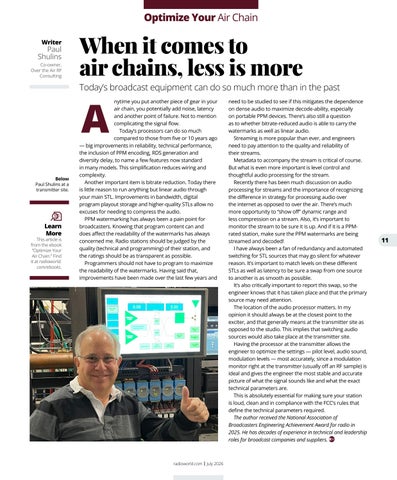
Below Paul Shulins at a transmitter site.
Learn More
This article is from the ebook “Optimize Your Air Chain.” Find it at radioworld. com/ebooks.
nytime you put another piece of gear in your air chain, you potentially add noise, latency and another point of failure. Not to mention complicating the signal flow. Today’s processors can do so much compared to those from five or 10 years ago — big improvements in reliability, technical performance, the inclusion of PPM encoding, RDS generation and diversity delay, to name a few features now standard in many models. This simplification reduces wiring and complexity. Another important item is bitrate reduction. Today there is little reason to run anything but linear audio through your main STL. Improvements in bandwidth, digital program playout storage and higher-quality STLs allow no excuses for needing to compress the audio. PPM watermarking has always been a pain point for broadcasters. Knowing that program content can and does affect the readability of the watermarks has always concerned me. Radio stations should be judged by the quality (technical and programming) of their station, and the ratings should be as transparent as possible. Programmers should not have to program to maximize the readability of the watermarks. Having said that, improvements have been made over the last few years and
radioworld.com | July 2026
need to be studied to see if this mitigates the dependence on dense audio to maximize decode-ability, especially on portable PPM devices. There’s also still a question as to whether bitrate-reduced audio is able to carry the watermarks as well as linear audio. Streaming is more popular than ever, and engineers need to pay attention to the quality and reliability of their streams. Metadata to accompany the stream is critical of course. But what is even more important is level control and thoughtful audio processing for the stream. Recently there has been much discussion on audio processing for streams and the importance of recognizing the difference in strategy for processing audio over the internet as opposed to over the air. There’s much more opportunity to “show off” dynamic range and less compression on a stream. Also, it’s important to monitor the stream to be sure it is up. And if it is a PPMrated station, make sure the PPM watermarks are being streamed and decoded! I have always been a fan of redundancy and automated switching for STL sources that may go silent for whatever reason. It’s important to match levels on these different STLs as well as latency to be sure a swap from one source to another is as smooth as possible. It’s also critically important to report this swap, so the engineer knows that it has taken place and that the primary source may need attention. The location of the audio processor matters. In my opinion it should always be at the closest point to the exciter, and that generally means at the transmitter site as opposed to the studio. This implies that switching audio sources would also take place at the transmitter site. Having the processor at the transmitter allows the engineer to optimize the settings — pilot level, audio sound, modulation levels — most accurately, since a modulation monitor right at the transmitter (usually off an RF sample) is ideal and gives the engineer the most stable and accurate picture of what the signal sounds like and what the exact technical parameters are. This is absolutely essential for making sure your station is loud, clean and in compliance with the FCC’s rules that define the technical parameters required. The author received the National Association of Broadcasters Engineering Achievement Award for radio in 2025. He has decades of experience in technical and leadership roles for broadcast companies and suppliers.
11