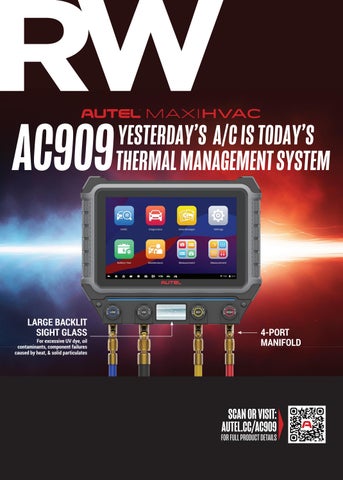
AC909 LARGE BACKLIT SIGHT GLASS
For excessive UV dye, oil contaminants, component failures caused by heat, & solid particulates
MaxiHVAC Maxi
YESTERDAY’S A/C IS TODAY’S THERMAL MANAGEMENT SYSTEM
4-PORT MANIFOLD
SCAN OR VISIT: AUTEL.CC/AC909
FOR FULL PRODUCT DETAILS
2601RW_Autel_CVRTip.indd 1
12/29/25 2:26 PM
2601RW_Autel_CVRTip.indd 2
12/29/25 2:26 PM
01.26
STRATEGIES & INSPIRATION FOR AUTO CARE SUCCESS
GROWTH SPECIALIST Shari Pheasant encourages shop owners to look beyond being the boss and embracing spirited communication and personal assessments.
A LOOK AT VEHICLE MAINTENANCE IN 2026 PAGE 20
ARE YOU PAYING TOO MUCH IN TAXES? PAGE 30
NEW COLUMN! SCHMIDT:
WALK YOUR TALK PAGE 18
HOW TO BE MORE
HUMAN AS A LEADER
HINT: IT INVOLVES EMPATHY AND COMPASSION FOR YOUR WORKFORCE PAGE 16
LEVEL UP IN 2026! LEARN THE AUTO SHOP CONCEPT THAT WILL CHANGE YOUR LIFE Transform Your Business with Advanced Automotive Training
KEY TO KEY TO CALLBACKS
AIX ACADEMY
ACCOUNTING FIRST & FRAUD PREVENTION
We have not just enhanced, but mastered, the concept of car repair. With monthly revenue figures over $1 million, our system guarantees exceptional customer service and unprecedented sales numbers.
A full day of learning the new AI tools being used in our shops. Spend the day in a deep dive with the industry’s best teachers of AI. This class will elevate your shop to new heights!
“If you’re not counting your money, someone else is.”
NEXT COURSE
NEXT COURSE
FEBRUARY 21-22 MARCH 21-22 APRIL 25-26
APRIL 24
Todd Westerlund, President www.AutoShopAnswers.com Cell: 925-980-8012 ToddWesterlund@AutoShopAnswers.com
Financial / P&L Statements Budgeting, Projections & Forecasting Inventory Management Fraud & Embezzlement Plus so much more!
NEXT COURSE FEBRUARY 20
SCAN TO REGISTER FOR THE NEXT COURSE
A forcefield of stopping power. Fewer comebacks. Smart margins. Trusted warranty backing. It’s braking technology that protects your customers, and your shop’s reputation.
bproautoparts.com
Six ways to search parts bproautoparts.com
©2026 Stellantis Auto SAS. All Rights Reserved. bproauto is a registered trademark of Stellantis Auto SAS.
PHOTO BY BETTINA HANNA
JANUARY
01.26
VO LU M E 15 N U M B E R 01
08
ONLINE
10
BREAKDOWN
15
NUMBERS
16
SOP
18
ROOTED IN SUCCESS
What you need to know about Google’s new “Sponsored” and how to build a service now mantra. Plus: Nick Papakyrikos shares how small gestures can make a big impact on employee morale in a podcast episode
Using AI in predictive maintenance
A look at leadership styles
How to be more human as a leader
Walk your talk LOL A SCHMIDT
F E AT U R E
30
FINANCE
32
CASE STUDY
34 P R O F I L E
THE 35,000-FOOT VIEW
26 BUILDING FAMILY-LIKE CULTURE
D U T C H S I LV E R S T E I N
20 THE FUTURE OF VEHICLE MAINTENANCE Consumer behavior, legislation, and market dynamics in 2026 Three automotive aftermarket experts—a legal professional, a shop owner, and a researcher—discuss the outlook for the industry BY CHRISTINE SCHAFFR AN
Are you paying too much in taxes?
Raise your rate
Confidence crisis: Why they don’t trust us
The InTown Auto Care Approach BY ALISON JOHNSON
ON THE COVER:
Shari Pheasant, Growth Specialist at Horsepower Strategies photographed by Richard Bednarski.
Ratchet+Wrench (USPS 9957), (ISSN 2167-0056) is published monthly 12 times per year by Endeavor Business Media, LLC. 201 N Main St 5th Floor, Fort Atkinson, WI 53538. Periodicals postage paid at Fort Atkinson, WI, and additional mailing offices. POSTMASTER: Send address changes to Ratchet+Wrench, PO Box 3257, Northbrook, IL 60065-3257. SUBSCRIPTIONS: Individual print subscriptions are available without charge to qualified subscribers in U.S. Please visit www.ratchetandwrench.com and click on “Subscribe”. Publisher reserves the right to reject non-qualified subscriptions. Subscription prices (USA Only): U.S. $93.00 per year. All subscriptions payable in U.S. funds. Send subscription inquiries to Ratchet+Wrench, PO Box 3257, Northbrook, IL 60065-3257. Customer service can be reached toll-free at 877-382-9187 or at ratchetwrench@omeda.com for magazine subscription assistance or questions. Printed in the USA. Copyright 2026 Endeavor Business Media, LLC. All rights reserved. No part of this publication may be reproduced or transmitted in any form or by any means, electronic or mechanical, including photocopies, recordings, or any information storage or retrieval system without permission from the publisher. Endeavor Business Media, LLC does not assume and hereby disclaims any liability to any person or company for any loss or damage caused by errors or omissions in the material herein, regardless of whether such errors result from negligence, accident, or any other cause whatsoever. The views and opinions in the articles herein are not to be taken as official expressions of the publishers, unless so stated. The publishers do not warrant either expressly or by implication, the factual accuracy of the articles herein, nor do they so warrant any views or opinions by the authors of said articles.
HOW ATI SHOPS PERFORM*
$211,500
$46,500
$258,000
$1,032,000
AVG SHOP LIFT PER YEAR
ANNUAL SAVINGS
YOU TOO CAN LEVEL UP YOUR SHOP.
AVG PARTNER REBATE/SAVINGS
AVG 4YR PROFIT INCREASE
Extensive network of major industry partners: NAPA, AutoZone, Cintas, Imperial, NTB, and more. Enjoy franchise-level discounts as an independent shop. The most comprehensive program and support network, backed by ROI results guarantee.
CONTACT
+1 410.988.6409 contact@autotraining.net www.autotraining.net Scan the QR code or visit www.autotraining.net/path-to-profit *These figures are calculated by taking the average performance achieved by all ATI shops as tracked from their financial statements. Savings, rebates and profit lift vary by ATI shop. Profit lift requires minimum 12 months in ATI re-engineering program. Results may vary.
mar a 5 - 8, 22026 0 20 26
t
t
ing rain
in th
st e fa
Kansas ansas City K City
www.visionkc.com
lane
e v i t o m o . t e u l t a t e o c r n h e t i r l l u f E x p en t a g raini training & expo!
Thursday Opening Keynote
Setema Gali Super Bowl Champion, Speaker & Coach
A transformational speaker and elite results coach empowering individuals and teams to achieve “impossible” outcomes across life, leadership, and performance.
Management and Technical training including live car and hands-on over 60,000+ sq ft of exhibits
EXPO SCHEDULE Thursday / 4:00 PM - 7:00 PM - hi-tech tool expo friday / 5:00 PM - 8:30 PM - VISION EXPO saturday / 9:00 aM - 2:30 PM - VISION EXPO
Register T o d ay y!
ES & CLASSELS HOT LING ARE FILKLY! QUIC
Scan this QR code to register for VISION today!
visionkc.com/register
ed bby: tted ossted hhos hosted byy:
O N L I N E
E X T R A S
CLICK ON THE LOGO BELOW FOR PRODUCT INFORMATION Auto Care Association
Auto Shop Answers
Automotive Training Institute
BendPak
BG Products
bproauto
NAPA
ShopTrak
The Award Zone
VISION
Worldpac
RATCHET+WRENCH RADIO Connecting listeners from around the a u t o m o t i v e a f t e r m a r ke t w i t h t h e i n d u s t r y ’ s latest trends, impor tant topics, and the leadership and business management tips and strategies you need to thrive.
R AT C H E TA N DW R E N C H .C O M / P O D C A S T S
01. 2 6 / R + W / 7
01.26
ONLINE
RATCHET+WRENCH
RATCHET+WRENCH
EDITORIAL EDITORIAL DIRECTOR Chris Jones EDITOR-IN-CHIEF Christine Schaffran ASSISTANT EDITOR Griffin Matis ASSISTANT EDITOR Kacey Frederick CONTRIBUTING WRITERS Tess Owings, Alison Johnson, Noah Brown EDITORIAL ADVISORY BOARD Tara Topel, Topel’s Towing and Repair Andrew Marcotte, American Pride Automotive Rachel Spencer, Spencer’s Auto Repair Tonnika Haynes, Brown’s Automotive Ceasar Cordon, Fifth Gear Automotive Bill Snow, Rad Air Complete Car Care SALES PUBLISHER Andrew Johnson / ajohnson@endeavorb2b.com ASSOCIATE SALES DIRECTOR Mattie Gorman-Greuel / mgorman@endeavorb2b.com DIRECTOR OF BUSINESS DEVELOPMENT Cortni Jones / cjones@endeavorb2b.com ACCOUNT EXECUTIVES (NATIONAL ACCOUNTS) Diane Braden / dbraden@endeavorb2b.com Darrell Bruggink / dbruggink@endeavorb2b.com Marianne Dyal / mdyal@endeavorb2b.com Chad Hjellming / chjellming@endeavorb2b.com Lisa Mend / lmend@endeavorb2b.com Austin Miller / austinm@endeavorb2b.com Kyle Shaw / kshaw@endeavorb2b.com Sean Thornton / sthornton@endeavorb2b.com
MOST READ ONLINE COLUMNS SODHI: Google’s New “Sponsored” Label If you rely on Google Ads to bring new customers into your auto repair shops, there’s a new curveball to watch. With Google officially rolling out a global update that changes how ads appear in search results and how users can interact with them, Taran Sodhi explains what shops need to know about the new “sponsored” label.
BENNETT: The “Service Now” Revolution More and more shops are moving from a “No promises, let me see what we can do” mindset to a “how can we make this work” approach, reshaping the competitive landscape of the automotive service industry as well as the entire consumer marketplace. Mike Bennett welcomes us to the service now economy.
MOST DOWNLOADED EPISODE PODCAST: Big Thanks, Small Budget: Smart Ways to Show Employee Appreciation You don’t need lavish parties or big bonuses to make your team feel valued. In this episode, small business expert Nick Papakryikos talks about meaningful, budgetfriendly ways to show appreciation during the holiday season. From catered lunches and “12 Days of Appreciation” countdowns to handwritten notes and extra paid time off, learn how small, sincere gestures can boost morale, strengthen loyalty, and help your business start the new year on the right foot.
ART AND PRODUCTION ART DIRECTOR Emme Osmonson PRODUCTION MANAGER Mariah Straub AD SERVICES MANAGER Jen George ENDEAVOR BUSINESS MEDIA, LLC CEO Chris Ferrell COO Patrick Rains CDO Jacquie Niemiec CALO Tracy Kane CMO Amanda Landsaw EVP TRANSPORTATION GROUP Chris Messer EVP ENDEAVOR BUSINESS INTELLIGENCE Paul Mattioli VP OF CONTENT STRATEGY, TRANSPORTATION GROUP Josh Fisher SUBSCRIPTIONS Send address changes and subscription inquiries to: Ratchet+Wrench PO Box 3257 Northbrook, IL 60065-3257 SUBSCRIPTION CUSTOMER SERVICE: 877-382-9187 ratchetwrench@omeda.com LETTERS TO THE EDITOR editor@ratchetandwrench.com Opinions expressed in Ratchet+Wrench are not necessarily those of Endeavor Business Media, and Endeavor Business Media does not accept responsibility for advertising content.
RATCHET+WRENCH RADIO Strategies and inspiration for auto care success.
RADIO
Catch new episodes every Wednesday featuring thought leaders from across the automotive aftermarket. Scan to subscribe!
8 / R + W / 01. 2 6
APPLE PODCASTS
SPOTIFY
EQUIPMENT
RESOURCES
SERVICES
RETENTION
We’re more than the goods we deliver. SALES TOOLS
Since 1971, you’ve counted on BG as the pioneer in preventive maintenance. But it takes more than great chemistry to be the industry leader. Innovation drives everything we do, whether helping you retain customers or powering your profitability with time-saving equipment, exceptional programs, and unparalleled training. We support you—our shop partners—so that your business keeps growing while your returns keep flowing.
L e ar n more : B G P r o d. c o m
TRAINING
PHOTO BY RACHEL KO
JUMP START
N E WS I D E AS PEO PLE TRENDS
ARTIFICIAL INTELLIGENCE: A GAME CHANGER FOR EURO CAR DOCTOR’S PREDICTIVE MAINTENANCE WORK
Euro Car Doctor owner Tony Perez breaks down how he’s using AI to sell more maintenance jobs and standardize communication between multiple locations BY KACEY FREDERICK
Tony Perez has always been interested in technology. Whether it’s for
cars or computers, he wants to understand it and how it will impact his California repair shop, Euro Car Doctor, which has locations in Irvine, Costa Mesa, and an upcoming store in Orange County. Perez has sought something that would help him streamline the process of 10 / R + W / 01. 2 6
identifying each and every need a car has and has made a breakthrough with the implementation of artificial intelligence. Now, service writers have a fast process for cross-examining a vehicle’s service history with manufacturer recommendations and breaking it down based on priority for a customer, leaving more room for what matters: communicating
and building trust. When team members follow each step of the new process he’s outlined, they see success that’s consistent throughout his multiple locations.
Streamlining Predictive Maintenance
The goal with implementing AI was to find more opportunities to sell mainte-
J U M P S TA R T / B R E A K D O W N
nance jobs to customers, rather than only helping them with urgent needs as they arise. He researched different tools to f ind something that could easily make recommendations based on a vehicle’s service history. Currently, Perez’s shops use a tool that pulls data from manufacturer databases and CARFAX. Before appointments, the shop collects info like license plate numbers and VINs, which the AI tool uses to find info on the car. The vehicle’s service history is compared against manufacturer maintenance schedules, preloading overdue and upcoming service items that are displayed during a customer’s appointment. Perez uses my 2011 Toyota Camry as an example of how this process typically plays out with a customer. “Your Camry comes in, but before it shows up, I trained all of our service writers at all of our stores to literally say, ‘I’m glad you’re coming in tomorrow for an oil service. Looking forward to seeing you again. Since this is your first visit, would you mind if I get your license plate or your VIN number so I can do the history research on the work you’ve done to your car?’” Perez explains. Throughout all of this, service writers are reminding customers that the shop will not recommend anything they don’t need. While that has always been the case, having a tool that generates comparisons between the service received and the manufacturer’s recommendation has resulted in many more customers saying yes. Why? Because when they can see for themselves what their car needs in order to be safe—according to the manufacturer itself—then they have more trust in your guidance. The shop continually reminds customers of this, with service writers stating that they will not recommend anything that isn’t necessary. But to drive the point home, when a customer comes in for their appointment, the shop categorizes different vehicle needs into colored labels, depending on the severity of the issue. Red represents urgent needs, while green highlights jobs that aren’t essential at the moment. “With AI, it gives everything in red
that needs to get done or is past due; everything in gray that’s going to be due within the next oil change; and everything that’s in green doesn’t need to be done,” says Perez. This allows customers to understand the state of their vehicle, and to have the option of only having urgent needs met or going ahead and having it all done.
Standardizing Communication
For service writers, they’ve also had a lot of trivial work lifted off their shoulders. With AI automatically pulling data on the vehicle’s service history and manufacturer databases, employees can immediately have the info they need to communicate with customers. Especially in a time when it can be difficult to recruit service writers, this tool can make it easier for people to transition into the role. In addition to compiling service history, the AI tool can also provide rebuttals for service writers, based on a customer’s needs and budget, and will provide prompts and questions for service writers to ask customers, enabling the technicians on the shop f loor to have a clearer picture of what’s wrong with the vehicle. “It capsulates all those questions and summarizes it,” says Perez. “Check engine light started a month ago, only happens for 15 minutes at startup, and you can only feel the vibration at high speeds on the freeway; this only happened after a recent visit for brakes at the dealership. It summarizes that whole packet. So, when the technician gets it, he’s not reading ‘diag,’ he’s reading, ‘The client states X, Y, and Z.’” “I gave him the golden tool—he knows exactly what to go look for and exactly how to replicate it, because the AI asked it that way; not ‘diag on the freeway at high speeds.’” Shops like Euro Car Clinic get lots of phone calls and voicemail messages; but some are more urgent than others. Every call taken at the shop is recorded, and AI has the capability to detect if a customer starts yelling, uses certain trigger words, and similar reactions. That recording is then f lagged, and sent to Perez’s inbox,
allowing him and the whole team to remedy the situation before a customer’s car even leaves the shop. Additionally, it collects data on what issues customers aren’t returning to the shop for, which can help shops that are trying to boost client retention rates. “Tools like this help you see why the customers are not coming back. Because what you feel is what you feel. That may or may not be the actual reality,” Perez says.
A Tool to be Used Mindfully
The process works seamlessly, as long as a service writer follows each step. It’s crucial to remind the customer, at least twice, that they will not be recommended anything they do not need. “You identify twice—they need to hear it two times—that we will never recommend anything your vehicle does not need. I need to psychologically start to program this in your mind,” says Perez. Because that’s precisely what the shop’s prescribed process does: It identif ies everything in the car that needs attention, and divides each area based on urgency. Service advisors are meant to focus on top priority jobs: things that could impact the safety of the vehicle, such as worn brakes or a leaky water pump. But if this step is skipped, and customers are presented with a laundry list of components to have replaced, they may become overwhelmed and leave. When that’s followed, customers don’t feel like they’re having a myriad of random jobs dumped on them, but rather that the shop is attuned to every part of their vehicle and is helping guide them according to their needs and budget. “You may not want to do it right now, so let’s tackle the priority ones first, and they’ll come back in a couple of months and do the priority twos,” explains Perez. “When that’s not presented, customers are like, ‘You just tried to sell me a smorgasbord of things.’ … What a difference of an environment somebody has coming to you, getting this information data dump, me telling you that we will never, ever recommend something you don’t need, and then telling you what’s a priority and what’s not.” 01. 2 6 / R + W / 11
J U M P S TA R T / S P E E D R E A D
ASE President Pens Open Letter to Industry Dave Johnson, president and CEO of the National Institute for Automotive Service Excellence (ASE), has issued a letter to the industry about supporting nationally recognized ASE standards. Dated November 2025, here is his letter: Dear Industry Professionals: The future of workforce development in America is being reshaped, and we need to be at the table. In response to the Trump Administration’s executive order focused on “HighPaying Skilled Trade Jobs of the Future,” the Departments of Labor, Commerce, and Education recently released a comprehensive national strategy. This strategy is not just a roadmap, it is a signal of where federal policy, priorities, and funding are headed. At the heart of this strategy are principles that emphasize accountability, measurable outcomes, industry-driven standards, and credentials that hold true value in the labor market. These are principles ASE has upheld for decades. The strategy’s direction aligns powerfully with what ASE already provides: ASE Education Foundation’s Program Accreditation ensures measurable accountability and rigorous quality standards for Career and Technical Education (CTE) programs. ASE service professional certifications are the recognized, industrydeveloped credentials that employers rely on, and workers strive to earn. They carry proven value for individuals and the businesses that hire them. To put it simply, ASE is the standard the federal government is asking for, right now. The strategy document makes clear that taxpayer dollars will increasingly be directed toward education and training programs that: • Are industry-driven and aligned with employer needs. • Issue credentials that matter in the real world. • Deliver measurable results, linking public investment to outcomes and workforce impact. This is a pivotal moment. I believe we 12 / R + W / 01. 2 6
have a short window to ensure that ASE Accreditation and Certification are clearly and formally recognized as essential components of federally funded workforce development in the transportation sector. This matters because the policy decisions made in Washington will dictate how grants and other resources are allocated to community colleges and technical schools across the country. If ASE standards are embedded in this policy, it ensures: • Schools that receive funding are truly preparing students for today’s and tomorrow’s jobs. • Instructors are teaching current, industry-relevant material. • Students are graduating with credentials that employers value, leading to real, high-wage careers. This is not about lobbying for narrow interests. It is about securing a future where our entire industry benefits from smart policy that rewards proven excellence and prepares a pipeline of talented, qualified technicians. We cannot afford to have fragmented efforts where individual companies or associations each push for their own agendas. That risks a patchwork of standards that weakens our industry’s credibility. Rallying behind ASE as the standard gives us collective influence and a seat at the table when policies are being written. We will continue engaging with policymakers, advocating for: • ASE Education Foundation’s Program Accreditation as the benchmark for accountability in CTE programs. • ASE Certifications as the credential standard recognized and rewarded by federal policy. I do not pretend to know every outcome of engaging in this process. But I do know this, the stakes are too high for us to sit on the sidelines. We have the chance to shape the direction of workforce development in our industry for decades to come. That means better schools, better-trained students, and a stronger, more resilient transportation service workforce. Please join us in this effort, get involved, and support ASE and the ASE
Education Foundation. The future of our industry depends on it. Sincerely, Dave Johnson President & CEO General Motors Faces Class Action Lawsuit Over L87 Engines A new class action alleges that several vehicles from General Motors contain defective L87 engines, according to Car Complaints. Illinois plaintiff Ronald S. Hermanowicz filed the lawsuit, claiming the rod bearings in his new 2024 GMC Sierra 1500 spun, causing damage to the rods and crankshaft and filling the engine with metal. The lawsuit argues that the V8 engines contain defects that damage the connecting rod bearings as well as incorrect crankshaft dimensions. GM has allegedly known the engines were defective since at least 2021. GM has previously issued a recall for the V8 L87 engine, but the lawsuit argues it was insufficient. If no problems were found with the crankshafts or camshafts, vehicles had their factory oil replaced; the suit claims the replacement oil only led to increased drag on internal engine components. Hyundai Owner Faces Data Access Restrictions Over Brake Replacement Job Right to Repair has been an ongoing topic within the automotive industry—but it may be impossible to perform even a brake replacement on electric vehicles without being impacted by data access issues. According to CarScoops, a discussion on the topic was sparked by a user on Reddit’s r/Ioniq5N community who sought to replace his rear brake pads. He soon found out that in order to do so, he would need Hyundai’s J2534 Diagnostic Tool, a Windows-based application available exclusively through Hyundai’s tech info portal. Additionally, the software requires a $60 weekly subscription, an approved hardware adapter costing over $2,000, and a constant internet connection for authentication, according to the post. Unfortunately for DIY users, they’re barred from using the application—the
Reddit user was prompted to enter a business name and 9-digit Federal Employer Identification Number. The situation underscores the changing landscape of Right to Repair, showing that everything from in-depth repairs to quick brake jobs are impacted as vehicles become more digital. Nearly Half of Vehicles Overdue for Major Maintenance Recent data from CARFAX shows that nearly half of drivers are behind on at least one major automotive service, as shared in a press release. Forty-one percent of vehicles nationwide are overdue for maintenance work, such as brake line and rotor inspections and replacements; vehicle suspension and steering components inspection; transmission fluid draining and refilling; coolant flush to keep the vehicle operating at a safe temperature; and replacement of engine air and cabin air filters. Notably, the data showed nearly 20% of cars are behind on oil changes, and almost 30% are behind on tire rotations. Christian Brothers Automotive Awarded by ASE for its Training Programs The ASE Training Managers Council recently announced Christian Brothers as a recipient of its Grand Award for outstanding training programs, as shared in a press release. The ATMC National Excellence in Training Awards are bestowed annually to shine a spotlight on highly effective or innovative training programs. Dan Aldrich of Christian Brothers accepted the award for the company’s Tech Ambassador Program at a special reception held Nov. 5 during Industry Week at The Venetian Expo in Las Vegas. Two additional organizations were recognized by ATMC with National Excellence in Training Awards: Educational Resource Services for its Kia Veterans Technician Apprenticeship Program, and ImmerseLearn for its EV Technician program. “We are very proud to present Christian Brothers with the highest ATMC honor, the Grand Award, in recognition
of their outstanding training initiative,” said Matt Shepanek, president of ATMC. “We also extend our congratulations to ERS and ImmerseLearn who earned National Excellence in Training Awards for their remarkable contributions. This year’s competition featured a strong pool of submissions, and we sincerely thank all the participating organizations for their commitment to delivering impactful training programs.” Study: Since 2018, Dealerships Have Lost 12% of Service Visits to Independents A recent study from Cox Automotive showed that U.S. dealerships are losing customers to independent competitors at a steady rate, as detailed in a press release. The Cox Automotive Service Industry Study, conducted between April and May of 2025, found that dealerships are losing customers to independent businesses, despite a rise in overall number of service visits. As the average age of cars increases in the U.S., demand is also creating more business for automotive services and repair companies. However, Cox Automotive found that dealerships now handle 12% fewer service visits than they did in 2018. Dealerships are losing most business from cars that are five years old or newer. In 2025, only 54% of people with cars two years old or newer went back to the dealership where they purchased for service, which is down from 72% in 2023. Instead, these customers are going to regular repair shops, quick oil change places, and mobile service companies. The study highlighted clear pain points customers have with service departments: unexpected costs and lack of communication. Nearly half of vehicle owners (45%) were dissatisfied with their dealership service experience, primarily due to unexpected costs and poor communication. Yet, dealership repair costs in 2025 averaged $261, lower than the $275 average at general repair shops. The findings underscore the need for transparent pricing, easy scheduling, and flexible service options. Repair providers will have an edge if they offer digital tools that simplify communication as well as modern conveniences like after-hours scheduling, pickup and delivery, and rideshare integration.
EARN IT. OWN IT. No Gimmicks. Real Rewards. You put in the hours. Now get the payoff. Join eXtra Rewards!
eXtra is a FREE, easy-to-use loyalty program for shop owners. Kind of like airline miles, but for the parts you’re already buying. You buy the parts, you earn rewards!
extra-awards.com
01. 2 6 / R + W / 13 2601RW_TheAwardZone.indd 1
12/29/25 8:
SPONSORED CONTENT
Stocking Up on FluidFocused Profitability By Nick Peyton, BG Training Manager and BGU Instructor
As we kick off a new year, it’s the perfect time for independent shop owners to take a hard look at how quickly the maintenance landscape is changing. Today’s market isn’t slowing down—and neither are manufacturers. If we want to protect our customers, technicians, and profitability, we have to be proactive about modern fluid stocking instead of rush-ordering the correct fluid and absorbing the extra cost. Such government regulations as Corporate Average Fuel Economy (CAFE) standards continue to push manufacturers to improve efficiency and reduce emissions. To meet these goals, OEMs are redesigning engines, transmissions, and driveline components at a rapid pace. One of the biggest and most overlooked results of this evolution is the change in modern fluids.
LOWER-VISCOSITY FLUIDS Thinner fluids reduce parasitic drag and help improve fuel economy, but they come with a trade-off. Less viscosity means less inherent protection. To compensate, manufacturers rely heavily on advanced additive packages to maintain durability, reduce wear, and extend service life. These additives aren’t optional, and neither is using the correct, thinner fluid: • Gear oil: Where we once commonly stocked SAE 75W-90 or SAE 75W-140, many manufacturers now specify SAE 70W-80 and SAE 75W-85. These newer gear fluids are engineered for tighter tolerances and lower operating losses. Substituting an older, thicker fluid can
lead to reduced efficiency, improper lubrication, and even component failure. • Engine oil: We’ve watched the progression move from SAE 5W-20 to SAE 0W20, then to SAE 0W-16, and now as low as SAE 0W-8. These ultra-low viscosity oils are designed specifically for modern engines with precise bearing clearances and advanced valvetrain designs. Using the wrong engine oil—even if it “used to work”—can create long-term damage and open the door to costly comebacks. • Brake fluid: The industry moved from DOT 3 to DOT 4, then to DOT 4 LV (low viscosity), and now to DOT 5.1 in many applications. These changes aren’t just about boiling point—they’re about compatibility with modern ABS and stability control systems. The wrong brake fluid can negatively impact braking performance and electronic system operation.
Your Partner Beyond Products™
placed by electric power steering, which often requires specialized fluids—or none at all. For vehicles that still use hydraulic or electrohydraulic systems, power steering fluid specifications are more critical than ever. • Fuel treatments: With the rise of GDI engines and turbochargers, fuel systems are more prone to carbon buildup, injector deposits, and combustion inefficiencies. Proper fuel system maintenance— including fuel treatments—is no longer an upsell; it’s a necessity.
EXTENDED SERVICE INTERVALS On top of all this, service intervals are getting longer. Oil change recommendations have stretched from 3,000 miles to 7,500 miles, 10,000 miles, or more. While this is appealing to customers, it puts even more pressure on fluids to perform at a higher level for longer periods.
FINAL THOUGHTS ADVANCED-TECHNOLOGY FLUIDS • Cooling system fluids: Coolant technology has come full circle in a modern way. Many manufacturers are returning to organic, acid–based coolants, but with far more refined chemistry and highly purified deionized water. Mixing or substituting coolants today can shorten component life, cause corrosion, and lead to expensive cooling system repairs. • Power steering fluids: Traditional hydraulic systems are rapidly being re-
For shop owners, the takeaway is clear: Starting the new year right means adapting your fluid strategy. Stocking the correct fluids is about compliance, of course, but also about maximizing profit, ensuring availability, and keeping dead stock to a minimum. The shops that win in modern maintenance are the ones that understand fluid specifications, train their teams accordingly, and educate their customers with confidence. The future of maintenance is already here. The question is whether your shop is ready for it.
J U M P S TA R T / N U M B E R S
LEADERSHIP STYLES
How you lead creates a culture among your employees Not all leaders are created equal. While
some take a more hands-on approach, others prefer to remain in the background or even hand the baton to their second in charge. As leadership styles continue to evolve, one thing is certain: every leader has a definitive style. Here’s what respondents reported as their method of leading according to the 2025 Ratchet+Wrench Industry Survey.
36%
Direct involvement: “I get dirty on the shop floor and lead by example.”
2601RW_ShopTrak.indd 1
15%
Visionary: “I focus on the big picture and inspire my team to succeed.”
23%
Democratic: “I encourage my staff’s input in decision-making.”
24%
Hands-off: “I trust my team with key decisions and am not afraid to delegate.”
2%
Authoritarian: “It’s my way or it doesn’t get done.”
01. 212/29/25 6 / R+W 15 8:22/ AM
PHOTO BY RICHARD BEDNARSKI
J U M P S TA R T / S O P
How to be More Human as a Leader Create a supportive environment that aligns with today’s workforce values BY G R I F F I N M AT I S
As a shop owner, you have to know how to lead. Managing a business isn’t easy, and managing employees can be even harder. Even if you’re confident in your skills and knowledge under the hood, the reality is that successful leadership requires more than just being in charge. Today’s workforce isn’t the same as previous generations, and the way we lead needs to change along with it. The stereotypical “shop boss” simply can’t compete with today’s empathetic leader. Shari Pheasant, growth specialist, has coached countless shops, helping them go from struggling to hiring new talent and retaining their most experienced employees. To become a more human leader, a new approach in how we communicate is required. By using scientific methods, shop leaders can create a better environment for employees and a more effective workplace at the same time.
As told to Griffin Matis I hear this from shop owners often:
“Oh, everyone’s fine. The shop’s doing OK.” I know a shop that just lost 25% of their technicians and their shop foreman. The owner is making excuses, but the reality is he’s shrinking and accepting it. We have to stop being in denial, and leaders have to admit they don’t have 16 / R + W / 01. 2 6
all the answers. It’s not easy, especially if your ship is failing or turnover is high. But people don’t leave companies; they leave managers. Leaders need to be more empathetic, to listen first, and to be more aware of the unique, authentic talents that each person brings to the table. They need to be dedicated to the bigger pic-
ture of the team and willing to do things differently to make a difference. WHY NOW IS THE TIME The workforce has changed. People have a new understanding of what they want and what their choices are. Employee happiness is the ultimate profit driver in every business. If we help employees be excited to come to work and align with their principles and values, they feel like they’re getting something more done in this world. People want to be a part of making things better. The problem is we’re not having the right conversation. It involves talking about the right thing to the right person, at the right time, using the right tone, and with the right intention. Don’t tell me something to show your authority; tell me to teach me, to help me grow, to be my advocate. WHERE IT ALL BEGINS The first step to becoming a more effective leader? Look in the mirror. Leaders are responsible problem solvers that help to develop their employees. The mistake we make is taking good individual contributors and promoting them without train-
ing. As a manager, what matters is finding people to do the work, motivating them, and understanding them so you can give them the assignments they’re best at. Instead of focusing only on learning how to work on a car or approach a customer, we need to understand better how we communicate, how we don’t communicate, and how we want people to communicate with us. We need to understand people scientifically. We use a scientific method to measure and check brake fluid, so why aren’t we using scientific data for people? They’re the most important asset we have. Fortune 100 and 500 companies have been using assessments for years. Now it’s coming down to the mainstream, and we’re only at the early adopter stage of assessments in this industry. BEING VULNERABLE Some owners worry that being an empathetic leader makes them vulnerable or like they’ll get taken advantage of, but it doesn’t have to be that way if you use science. With scientific assessments, I’ve watched owners transform teams in a day because we open up conversations that they never would have had before. You can be an empathetic, effective leader who is in touch with their staff and doesn’t get taken advantage of so long as you make sure you’re clear with your expectations and have the right conversation before. HOW TO GET UNSTUCK Pre-planning promotes premium performance. You can’t run your shop like you’re tending to a forest fire. A lot of shops rush to get the customer to pick up the car as soon as it’s done. However, you really need time to check for mistakes. When you first meet the customer, tell them you may need to hold onto the car a little longer and explain how important it is to have the time to put things back together in the right manner. If you refuse to take the time to plan, you’re going to keep wasting your time spinning your wheels. Leaders need to be more open to the idea that you have to fail to succeed. We learn more from our mistakes, so you’ve got to allow people to make a mistake and then fix it. That’s what your QC process is for. Let them make the mistake, check it, and have them fix it. People want to come to where there’s a future where they can see growth for themselves, and where there’s somebody willing to provide that.
SOLVING THE SHORTAGE STARTS IN THE SHOP The technician shortage persists because there are children being born every day that prefer hands-on work, but we are letting them go to plumbing or construction. Tools are a big barrier, so partnering with colleges and being willing to invest in training is important to attracting new talent. Also, teaching your technicians that the “new guy” isn’t the one you kick around the shop is important, otherwise, they won’t want to stay. Many are romanced by the dealership, which has amazing equipment and training, but they get burned out. We have to be willing to invest in our people by understanding who they are from the inside out, not just the face they put on. When you’re in survival mode, you can’t develop. You’ve got to get into a learning and developmental mode, which is exactly what the workforce is looking for. We haven’t necessarily found the complete answer, but using assessments makes a huge difference.
Assessing for Direction Using assessments should be to point out where your team excels, and even where they might fall short. The intent is not to label or embarrass anyone. It’s simply to provide a better roadmap on how to utilize team members’ strengths. Here are some types of assessments to consider according to the American Psychological Association:
• Behavioral and communication assessments • Strengths and talent assessments • Emotional intelligence assessments
Shari Pheasant Growth Specialist, Horsepower Strategies As a business innovator, growth strategist, talent development specialist, engagement consultant, organizational facilitator, and powerful keynote speaker, Pheasant continues to be deeply involved in personal growth and how it plays a massive role in shifting company culture. Her innovative approach to building, growing, and inspiring company culture from the inside out starts with a people-first strategy. Pheasant collaborates with leading consultants and coaches, working with hundreds of businesses to improve communication, engagement, and achievement.
• Values and motivators assessments • Problem-solving assessments
shari@sharipheasant.com
01. 01.2266 / R + W / 17
COLUMN / SCHMIDT
ROOTED IN SUCCESS
Walk Your Talk
Choose your words carefully and back them with consistent actions to build trust and authenticity BY LOLA SCHMIDT
There is no finite number of words we
have access to in the human language. We are privileged to access—and use—all the words at will. With that privilege comes great responsibility, and somewhere along the way, it seems words matter less and less to people. But not me. I love words, and they hold weight with me. My mother always said there is power in the tongue. It is one thing to say words, but it’s quite another to uphold the words that you put forth. One common denominator I see in business is the disconnect between the words people use around their business and their actual business execution. It’s easy to call yourself the “best shop in town,” but can you truly back those words up with your public? Are you the best? And by what standard are you measuring? BUILDING TRUST INSTEAD OF CATCHY SLOGANS My shop has a few simple slogans that encompass it. They are direct and to the point. One is, “A Family Shop Taking Care of Families.” What kind of shop would I be if I used this slogan in a marketing campaign, then fell flat when families came to call? I like action-based verbiage because I believe brands should move people to action in some manner. I want to show everyone how much family means to us when they walk through our doors. If I say I’m a family business that cares for families, how can I show that? When we started planning and pairing our values with our marketing, we brought to life Curbside Service, which solves a problem for busy moms and dads. We worked on a Loaner Car Program to help move families around easier when longer repairs were required. And we evolved things like our New Driver Classes, Tiny Techs, and Community Partnerships to be leaders in auto education. We walked the talk. 18 / R + W / 01. 2 6
Like many of you, we are a veteranowned facility, with veterans working in our brand. Each year, we discuss our community “bless backs” we want to offer. It is important to the veterans on our team that we give back to our veteran guests. We offer a standing discount to them all year long, but on Veteran’s Day, we turn our busy bays into a lube shop and offer free oil changes, set up a coffee bar, and hand them a gift. We could easily put out a cliché social media post with the same old “Thank You,” and move along like it’s any other day, but we have a mission to accomplish. We are also “veterans taking care of veterans.” DON’T EAT YOUR WORDS, LIVE THEM INSTEAD Consider the mindset you put your potential new guests in when you create content for your brand. Consider what they see, what they read, and how that creates subconscious expectation. If your guest sees you are offering “smart and friendly service,” but they receive subpar somber service, their trust is breached, and you will not make a sale or a lifelong guest. Your level of care did not meet their expectations simply because your words didn’t match your actions. It’s important your service department and marketing department are on the same page, so everyone is aligned in the mission at hand. When you create your marketing and branding strategies, consider the words you utilize. Make sure they align with your mission, your level of ability to execute, and the effort you’re willing to put forth. You can create brand greatness in people’s minds just as easily as you can remove it. There is great power in the words you use around your brand. Use them wisely. Then, walk your talk.
Lola Schmidt is the vice president of operations and marketing for Schmidt Auto Care in Springboro, Ohio. She joined her husband, Erich, in helping to run his shop nearly 10 years ago with ambitions as high as her heels. Through the years, she has helped to develop an award-winning business that provides veterans with opportunities for employment as well as the community with a trusted resource for auto repair. Outside of the family business, she is a mom to one, a gardener, an artist, and a musician. Lauralee@schmidtautocare.com
NAPA Auto Care’s Top Tier Program Created by Auto Care centers for Auto Care centers.
To be the best, we must recognize our best.
NEXT-LEVEL BENEFITS
NAPA SMART SIGN PRO Designed to ensure every Gold Certified shop delivers exceptional consistency to customers.
What does it take to be GOLD CERTIFIED? Active Auto Care Member for 1 year Open for business for at least 2 years ASE Master Certification or ASE Blue Seal PROimage Co-Branding Program 4-Star rating on Google, Yelp or NAPA CSI
Use Digital Vehicle Inspection (DVI) Applied for consumer financing (NAPA Credit Card) Parts purchases of $7,500/month Business Development Group (BDG) participation
These top-tier centers set the benchmark for the NAPA Auto Care brand, leading the way in quality and trust nationwide. Login to member.NAPAAutoCare.com and click the Gold Program tag (Gold Certified application) or contact your NAPA Representative.
F E AT U R E
THE FUTURE OF VEHI Consumer Behavior, Legislation, and Market Dynamics in 2026 Three automotive aftermarket experts—a legal professional, a shop owner, and a researcher— discuss the outlook for the industry BY CHRISTINE SCHAFFRAN
W
hile there is no crystal ball to deliver the state of the industry in 2026, there are solid indicators to pinpoint various trends—both positive and negative. As tariffs continue to threaten profit margins and technology shoehorns itself between technicians and the Right to Repair, one thing is certain—Americans love their vehicles. “It’s interesting that the industry is somewhat insulated from a weak or strong economy because people need their vehicles,” notes Rob Pietrowski, VP Research at IMR/Endeavor Business Intelligence. According to data collected by IMR from vehicle owners and repair shops,
2 0 / R + W / 01. 2 6
ICLE MAINTENANCE:
PHOTO BY BETTINA HANNA
01. 2 6 / R + W / 21
F E AT U R E
NATHAN SHIPLEY PHOTO COURTESY OF CIRCANA
WHAT’S DRIVING DEMAND? When it comes to the automotive aftermarket, there are many factors that affect customer demand, says Nathan Shipley, executive director and industry analyst for Circana’s Automotive Aftermarket practice. While he describes the industry’s overall outlook as “optimistic,” he attributes a lessthan-stellar economy as the reason for its success. “The industry tends to benefit when the economy is not as healthy as it could be,” he explains. “So, you have consumers that tend to hang on to their cars longer, lean into more maintenance, etc., instead of buying new cars and using their warranties.” Other factors contributing to people driving older models include:
2. The market is still COVID hung over. Plain and simple: People overpaid for cars during COVID while demand was high and stock was low, Shipley says. “I think there’s a lot of people that are stuck in their cars financially, which oddly helps the aftermarket, because it keeps that person from going and buying a brand-new car.”
1. People are still working from home. With the number of people working from home still teetering around 50%, Shipley says, corporate America never really fully returned to the office after COVID. As a result, the need for a new car became less of a priority because the need for reliable transportation took a backseat. “If every operation in this
And while dealerships scramble to incentivize purchasing new vehicles, drivers are staying put behind their trusty older models with higher miles while lowering their debt. Although maintenance is still necessary, Shipley notes, it beat the price tag of a new vehicle. “Until we start to see some of those shifts back the other way, I think the aftermarket will continue to benefit,” he says.
2 2 / R + W / 01. 2 6
country recalls their employees back to the office five days a week, that’s going to have a fundamental shift in mobility patterns,” Shipley points out. “But I don’t see very much changing; at least not in the next 12 to 24 months.”
there are several topics that have catapulted to the front of the line while others have taken a backseat in the list of priorities when it comes to vehicle ownership and maintenance. For instance, research suggests finding good technicians is not as pressing an issue for many shops as it has been in years past. So, what is at the top of the list? Sit back and take a look at what the experts have to say about the automotive repair industry in 2026. According to Research
1. People are becoming more price aware. As talk of inflation and tariffs
continues, consumers are tuning in. So, it’s probably not surprising that 71.6% of shop owners surveyed note their customers are slightly more concerned about price compared to 2024. “There’s a cost-of-ownership issue that’s really going to start to impact the industry because vehicle insurance costs are up dramatically, new and used vehicle prices are up significantly, financing costs are higher than they’ve been in the past, and then the cost of repair vehicles is higher than it’s been in a strong uptrend,” Pietrowski points out. “So, all of these factors are going to make it more difficult for the average consumer to buy and maintain a vehicle and I think that’s going to become a big issue in our industry.” As a result, Pietrowski adds, Ameri-
ROB PIETROWSKY PHOTO COURTESY OF IMR
LISA FOSHEE
PHOTO COURTESY OF AUTO CARE ASSOCATION
industry will remain strong and vibrant in the new year, says Lisa Foshee, Senior Vice President of Government Affairs and general counsel for the Auto Care Association. “From an economic standpoint, our industry continues to thrive and meet the challenges that the market presents,” she notes. “We have done that for 100 years and we continue to evolve, change, and meet the next big challenge.” Still, the market faces three challenges that are tough to ignore. Among them: 1. Right to Repair
cans will try to hold onto their vehicles longer to avoid the high costs of new car purchases. This trend will likely prompt consumers to inquire with auto shops about the ability to finance repairs. In addition to funding mechanisms, Pietrowski says, consumers have steadily increased their habits in doing their research on automotive repair shops, purchasing parts online, and performing maintenance themselves even if they haven’t done a job previously. “We’ll see preventative maintenance categories like oil changes and air filters where people are going to try to delay them because of financial pressure,” he says. 2. Engine repairs and rebuilds are becoming more prevalent. On the flip
side, Pietrowski says, because people are holding onto vehicles longer, they are investing more in them. For example, engine replacements have skyrocketed more than 146% in 10 years while engine rebuilds have seen a 148% increase in the same timeframe. He attributes this not only to more price-conscious shoppers, but also the lack of availability due to stricter environmental regulations. “It’s the result of the government push for fuel economy and electrification that had an impact on what engines are offered in new vehicles,” he explains. “So, in other words, there are fewer V8s
available for pickup truck buyers, which means more rebuilds of old V8s and more big engine work. So, in a climate where big vehicles have become prohibitively expensive for a lot of consumers, big repairs on their existing vehicle become a more practical option.” 3. Finding good techs is taking a backseat to finding affordable parts. Speak-
ing of affordability, the topic seems to outweigh the age-old gripe of “good employees are hard to find” and is instead replaced by “good parts are hard to find.” While finding quality employees remains in the top concerns for shop owners, other issues have risen to the top of the list: • Finding affordable parts. • Finding the right parts. • Keeping overhead costs low.
Pietrowski adds he expects this trend to continue so long as the economic conditions remain unchanged. “I think good shops are always looking for good techs, but in the big picture, the demand for techs has maybe softened a bit based on the state of the economy,” he notes. Legally Speaking On the legislative side, the pulse of the
Maine and Massachusetts led the charge in passing legislation that requires manufacturers to provide access to vehicle repair and diagnostic data. In Maine, an amendment to the first Right to Repair law passed is currently under scrutiny and threatens to reverse the approval of 80% of the voters who favored the law. “The automakers ran a campaign to support an amendment to that law that essentially gutted any obligation on them to produce or make available repair and maintenance data and unfortunately that amendment passed through the legislature,” Foshee explains. “At the state level, it really shows how much the automakers oppose making this repair data available to vehicle owners. They are fighting it on every front.” On Jan. 7, Gov. Janet Mills vetoed the legislation and cited independent auto repair shops being “left at a significant competitive disadvantage” and consumers having “fewer choices for automotive service and repair” for her reasons. On the federal side, Foshee says the fight will continue to pass the Right to Equitable and Professional Auto Industry Repair (REPAIR) Act, which at press time had 40 co-sponsors in the House and six co-sponsors in the Senate. The bill aims to offer standardized legislation that requires manufacturers to provide shops access to vehicle diagnostic, repair, and maintenance data. “Particularly in times of economic difficulty, it’s really important for American families to be able to have a choice. The automotive aftermarket does 70% of out-of-warranty repairs, so that means vehicle owners choose the aftermarket
01. 2 6 / R + W / 2 3
F E AT U R E
70% of the time to keep their vehicles running,” she notes. “We need this law to persevere.” 2. Extended Producer Responsibility
In the meantime, Foshee expects topics like extended producer responsibility
laws to have a bigger impact on suppliers, retailers, and distributors in 2026. The purpose of these laws, Foshee explains, is to shift the cost of recycling programs from states and municipalities to the producers of the material. This not only includes the products themselves,
BY THE NUMBERS From how customers pay for repairs to the types of vehicles rolling into the bays, the data shows clear signals about where today’s auto repair business is headed.
SOURCE: IMR
3. Tariffs
40% 61% 77% of vehicle owners would be extremely
of shop owners report seeing an increase in
of shop owners have seen an increase in
likely or somewhat likely to take advantage of financing for a major
the number of BEVs coming into the shop for service or repair.
the number of hybrid vehicles coming into the shop for service or repair.
or costly repair.
48% 38% 37% of shop owners have made investments in tools or equipment to specifically service electric or hybrid vehicles.
24 / R + W / 01. 2 6
but the packaging in which they are delivered. What makes the laws taxing is that they vary from state to state, according to Foshee, leaving manufacturers scrambling to comply. “While good intentioned, what this has resulted in is a disparate patchwork of very complicated, very onerous regulations on our (manufacturers), many of whom don’t even realize that these laws apply to them,” Foshee points out. Colorado and Oregon currently have laws in place with compliance deadlines looming. Similar laws are expected in Washington, Minnesota, Maryland and Maine, with New Jersey and New York poised to potentially follow. “You need to look at these laws to see if you are covered. No one should be assuming that they’re not covered without having done an analysis because the penalties are potentially draconian all the way up to not being allowed to sell your product in a particular state,” she warns. She encourages shop owners to ask their vendors and distributors about the regulations and their ability to comply.
of shops report tariff-related cost increases.
of shops report increasing prices in response to cost increases.
As the industry adjusts to life after implementing tariffs, it braces for the possibility of more. However, Foshee applauds the manner in which it has been handled and encourages individuals to keep responding without reacting. “I think the industry has done a great job after the initial wave of tariffs of approaching these changes with a thoughtful, measured response because we know they can change,” she says. “The best thing that we can do is try not to ride the roller coaster on these because the market does seem to be sorting itself out in response to the tariffs. And I think 2026 will just call for more of that thoughtful response as the differing tariffs get implemented.” As for future tariffs, Foshee advises shop owners not to get caught up in the fear of the unknown. “Focus on running your business, focus on doing the best you can do by your customers, and focus on getting new talent,” she asserts. “And I think the rest of it is going to all sort itself out.”
fueling future THE
February 17-19 2026 Fort Worth Texas
EXCLUSIVE OFFER FOR RATCHET AND WRENCH READERS:
Receive $50 off registration for the Women in Auto Care Conference with the coupon code “RW50”
REGISTER TODAY!
profile
Buil ding a Fa mily- L ik e C ult ure in A u t o Re pa ir Shop s:
The InTown Auto Care Approach The shop’s culture of valuing employees beyond their technical skills—through activities, shared interests, and personal support—demonstrates how a caring workplace boosts morale and productivity BY ALISON JOHNSON | PHOTOS BY BREANA DUNN
2 6 / R + W / 01. 2 6
Mike and Suzanne Dunn encourage their employees to have hobbies outside of work and do what they can to support their interests.
IN 11 YEARS AS AN AUTOMOTIVE technician at several businesses, John Ausmus always had supervisors who—unsurprisingly—pushed him to learn as much as possible about diagnosing and repairing cars. But none had also encouraged him to pursue hobbies and interests that had nothing to do with his career—like golf—until now. Ausmus began playing about a year ago as a way to bond with his father. Shortly after he joined InTown Auto Care in Moorestown, New Jersey, in spring 2025, Owner Mike Dunn offered to pay for him to take a few golf lessons. “This is something very new to me,” Ausmus says. “It’s unheard of, really.
Having someone who appreciates you not only on a professional level, but away from the shop speaks volumes. It just makes me feel appreciated.” To Dunn, whose small company specializes in European cars, such gestures are not only acts of kindness, but smart business decisions. Team members who feel supported in all parts of their lives, he believes, are less likely to leave and more motivated to work hard every day. “No one wants to feel like they’re just a cog in a wheel,” he notes. “You want to feel like somebody. Like you have a personality, a life. Helping people feel valued will naturally create a better atmosphere inside the shop, I think.”
CONNECTING ON A DEEPER LEVEL
Members of InTown Auto Care’s 10-person staff have very diverse interests, ranging from skydiving and lottery games to gardening and cooking. They have shared those in individual conversations with Dunn and at weekly Friday pizza lunches. Kevin Schmidt, a technician and father of two, is pondering parachuting from a plane after years of dirt biking adventures. While Dunn is mystified by that wish, he has volunteered to foot the bill—likely $220 to $250—if Schmidt opts to take the leap at a nearby skydiving business. As for Devon Jenkins, another technician, his planting and culinary expertise 01. 2 6 / R + W / 27
profile
The InTown Auto Care team from left: John Ausmus, Kevin Schmidt, Omar Linares, and Adam Mendeleski.
has led to frequent conversations with Dunn’s wife, Suzanne, who is head of human resources at InTown Auto Care and raises backyard chickens. Recently, Jenkins taught her that some hardy produce, including carrots, radishes, garlic, and kale, could grow during winter months. He also shared tips on cooking the typically discarded leaves of carrots, broccoli, and cauliflower and—following childhood years spent in Jamaica—holistic remedies, such as fresh ginger for digestive issues. “We can talk for a long time; sometimes we’re like, ‘Uh oh, we’ve got to get back to work’!” Suzanne Dunn says with a laugh. “You spend a lot of hours with people you work with, so to me it’s good for everyone to be comfortable and like part of a family.” Another frequent pastime for Jenkins, a married father of five, is playing the lottery. So, on his one-year anniversary at the shop, the Dunns gifted him 25 lottery tickets. 2 8 / R + W / 01. 2 6
“You’d have thought we gave him a new car,” Mike Dunn recalls. “He was like, ‘I can’t believe you guys did this for me.’ I told him, ‘Well, if you win big, please just give us at least two weeks’ notice before you leave’.” ( Jenkins didn’t hit a major jackpot, but Dunn recalls he scored at least one $20 to $30 prize). Adam Mendelewski, a technician originally from Poland, has become a devoted fan of the Philadelphia Eagles since arriving in the United States. Mendelewski also likes to sample different types of beer when he’s off the clock. “We’ve gotten Adam four to six craft brews for his work anniversaries, plus Eagles sweatshirts, hats, jackets,” Dunn says. “He’s a pretty quiet guy, but if you take the time to get to know him, he’ll definitely open up.”
DOING WHAT YOU LOVE
Originally from Philadelphia himself, Dunn has lived in New Jersey since age 8. His father, a steamfitter, was
a part-time drag racer and enjoyed tinkering with cars; he steered Dunn away from his own trade by predicting a downturn. Dunn bounced from job to job before enrolling at Pennco Tech for Automotive Technology. He gained experience at car dealerships and specialty shops while running a side business buying and reselling four-wheel drive truck parts from a wholesaler. In 1989, Dunn took over an auto shop called Motorsports Tire & Auto with Suzanne, his then-girlfriend and wife since 1991, who has a background in business management, administration, and analytical sales. She also has an uncle who owned two gas stations. While in his mid-20s, Dunn struggled with a steep learning curve on both the business and technical side of his first shop, which he ran for about six years. He later moved into automotive consulting and construction equipment.
Adam Mendelewski is the shop’s resident Philadelphia Eagles fan.
In 2012, however, Dunn felt the urge to own another repair shop in Moorestown. “It’s what I do; it’s what I love,” he says. “Interacting with the customers is what drives me. I consider myself to be in the customer service business, where I just happen to fix cars.” While InTown Auto Care accepts all vehicle makes and models, the shop has carved out a niche with comprehensive services for European cars, especially German models, as well as exotics, such as Ferrari and Lamborghini. “We’ve had to invest heavily in advanced software and our people, technology, and tools,” Dunn says. “We want to be able to do everything we can in our building without having to send customers anywhere else. That’s so important today in this industry.” Other incentives include a 4-year, 40,000-mile warranty on parts and labor; digital inspections that send
recommendations to customers’ cell phones or computers; a courtesy shuttle and loaner cars and bicycles. The shop also sells a limited number of pre-owned vehicles. The Dunns have three grown children. The younger of their two daughters, Breana, is now office manager for InTown Auto Care and is training to take over the business down the road. Her daughter Emma, 7, has become a shop fixture, too. “Emma already wants to answer the phones,” Suzanne Dunn says. “She walks around saying, ‘InTown Auto Care, how may I help you?’ She’s not quite ready, but we love having her; we welcome kids and animals. It’s a good, warm environment.”
HAPPY EMPLOYEES = PRODUCTIVE PEOPLE
Staff biographies on the business’ online site combine each employee’s automotive expertise and training with personal life details. Take Men-
delewski: He attended Lincoln Technical Institute, is a Master Certified Technician with an original background in Acura models, has two children with his Polish-born wife, Ewelina, and loves soccer and ski jumping. Discovering that Ausmus was entering the fun-but-frustrating world of golf was ideal for Dunn, an experienced golfer himself. He has passed along a few coaching tips and follows up to see if Ausmus is practicing. “I want to see passion in their faces when they talk about what they’re doing,” Dunn explains. “Why? Because that’s the same energy I want in the shop. If you’re happy, in a good frame of mind in life, that’s got to translate into the workday, right?” Ausmus, for one, thinks it does: “It’s comforting that they actually care about me. They don’t look at me like some kind of robot. It makes me want to work harder to make the business better and also to make myself better.” 01. 2 6 / R + W / 2 9
FG TRADE / E+ / GETTY IMAGES
T O O L B OX / F I N A N C E
ARE YOU PAYING TOO MUCH IN TAXES? Discover the hidden mistakes and smart strategies that could save your business thousands BY NOAH BROWN
Many shop owners are doing far more these days than what their job description outlines. Depending on the size of the shop, an owner or manager can often be found managing finances, handling front-of-shop responsibilities, and even working on repairs themselves in addition to actually running their business. Wearing multiple hats can sometimes be looked at as a point of pride, but oftentimes it results in being stretched too thin and missing a lot of key details, which can cost your shop thousands of dollars. Nick Papakyrikos, a Boston-based CPA who works with automotive businesses nationwide, says far too often he’s seen shop owners try this strategy with their taxes, electing to do it themselves instead of hiring someone. 3 0 / R + W / 01. 2 6
“A lot of times, they don’t know what they’re looking at with business taxes. They don’t know what to do,” Papakyrikos says. “That’s like me trying to do all of the maintenance on my own vehicle instead of bringing it to a professional.” Running an auto repair shop is hard enough without worrying about whether you’re paying too much in taxes. So how do you determine if you’re overpaying? And if you are, what can you do about it? Here are three key strategies every shop owner should consider. Understand What You Should be Paying Diving into your shop’s taxes and financials can feel daunting, but the math itself is usually straightforward. Hunt Demarest, a CPA and owner of
Paar, Melis & Associates, which provides accounting and tax services to automotive repair shops, says most tax software is fairly simple to use if the numbers you feed it are accurate. But that’s where most people run into problems. “Many shop owners don’t realize their underlying financials are wrong,” Demarest says. “If you want a general rule of thumb, you should be paying around 25% of whatever your net income is. If you’re paying significantly more than that, something’s off.” That “something” is often inaccurate data. Maybe your inventory is overstated. Maybe you’re paying tax on accounts receivable that customers will never pay. These errors inflate your taxable income, and the IRS happily accepts the extra money. Imagine this scenario: Your shop had a rough year and actually lost $100,000. But because of bad bookkeeping, your tax return shows $200,000 in net income. You’re now paying taxes on money you never earned. Demarest has seen cases like this push shops to the brink of closure. To avoid errors, Demarest says you should always review your financial statements before filing and, if you have an accountant, ask them to explain how your taxable income is being calculated. Fix Inaccurate Financials and Capture Missed Deductions Although the biggest culprit behind overpayment is incorrect data, you could still be missing out on major tax breaks even if your numbers are accurate. Beyond fixing errors, here are five areas where shop owners often leave money on the table: 1.
State Pass-Through Entity Tax: When federal tax law capped state and local tax deductions at $10,000, many states introduced a workaround: the pass-through entity tax. This allows your business to pay state tax directly and claim a federal deduction. There are about 36 states that have this rule,” Papakyrikos says. “If you’re in the highest tax bracket and have $10,000 in state tax, you could save $3,700 or more. But you need to know your state’s deadlines. Some require election by mid-year.”
2.
Bonus Depreciation: Thinking about buying a new lift or loaner car? Timing
matters. Thanks to 100% bonus depreciation, you can write off the entire cost in the year of purchase, even if it creates a loss. “If you spend some money on equipment such as lifts or loaner cars, make sure you understand bonus depreciation and talk to your accountant about it,” Papakyrikos says. “It can make a huge difference.” Demarest agrees, adding that timing purchases correctly can save thousands. “I used to think buying equipment was just about the shop floor,” he says. “Now I see it’s also a tax strategy.” 3.
4.
5.
Qualified Business Income Deduction: This deduction lets you write off up to 20% of your business income. But it’s often missed due to simple errors like failing to check a box in tax software. “That’s one that a lot of people miss if they’re not terribly experienced with business tax returns,” Papakyrikos says. “But it can lead to a pretty big savings.” Put Your Kids on Payroll: If your children legitimately work in the business—sweeping floors, helping with marketing, even appearing in ads—you can pay them up to $15,000 tax-free. That’s $30,000 for two kids, fully deductible for the business and tax-free for them. “There are some specific rules that apply in certain cases,” Papakyrikos says. “But often, if that’s their only work and they’re just helping out the family business, it makes sense to put them on the payroll.” Max Out Retirement Contributions: A simple IRA or similar plan lets you contribute up to $16,500 tax deferred. “If you have extra cash, this is a smart move,” Papakyrikos says. “It reduces your taxable income and forces you to save for retirement.”
Be Proactive Waiting until tax season is too late. Real savings happen through year-round conversations and planning. “If you’re getting this right when filing your taxes, it’s too late,” Demarest says. “We look at financials monthly so owners can guide their business, not just once a year.” Most tax-saving moves such as equipment purchases or retirement contributions need to happen before Dec. 31.
HUNT DEMAREST
PHOTO COURTESY OF PA AR, MELIS & ASSOCIATES
NICK PAPAKYRIKOS
PHOTO COURTESY OF PAPAKYRIKOS, CPA, P.C.
Amending returns is possible within three years, but Papakyrikos says it raises audit risk and doesn’t solve the bigger problem: missed opportunities. “Business tax laws change more than anything else,” Papakyrikos says. “It’s specialized knowledge. You don’t know what you don’t know.” Regular financial reviews prevent costly surprises and give you time to act. If you want to save money next spring, you need to be having year-round check-ins. The Bottom Line Understanding the strategy of taxes is essential in helping ensure every dollar you make is used most effectively. Though shop owners can learn to successfully manage their own finances, Papakyrikos says hiring a proactive CPA that understands the automotive industry can give you a significant leg up and make sure that you’re getting the most out of your return.
Papakyrikos lays out a scenario: You can pay someone $100 to file your taxes, or you can pay a CPA $1,000. You’ll save $900 initially, but he says chances are you’ll pay significantly more in income taxes. “You’re never going to know that you paid more than you should, and the federal government doesn’t really care that you’re paying more than you should,” he says. “If you have a good CPA, they’ll point out where they’re saving you money, and they can usually do that in an initial review. Good tax advice will almost always pay for itself.” Demarest adds that even if you do hire someone, it’s crucial to have a basic understanding of your shop’s financials and take on the responsibility of reviewing everything. “The shop owners who understand their numbers make more money and pay less in taxes,” Demarest says. “Those are your numbers, and this is your business. You can delegate this stuff, but it does not absolve you of all responsibility.” 01. 2 6 / R + W / 31
PHOTO PROVIDED BY DANIELLE VILA
T O O L B OX / C A S E S T U DY
THE ART OF PRICE ADJUSTMENT By focusing on value, transparency, and customer relationships, shop owners can implement necessary price increases with minimal impact on customer retention BY TESS OWINGS
“When you go to the grocery store, they don’t put a notice on the milk carton that it’s 40 cents higher—that’s just the price. You can decide whether or not you want to buy it.” Danielle Vila vividly recalls hearing this quote during a work convention during her career as a hairdresser. It stuck with her, and she’s found that the hair world and the auto world are actually very similar when it comes to navigating pricing. Do you want to be a cheap hairdresser or a quality hairdresser? The same can be said of auto repair, Vila says. 3 2 / R + W / 01. 2 6
When she and her now ex-husband took on an auto repair shop, it was overwhelming, and they felt like they were drowning financially. However, they were nervous to raise their labor rate because—like most—they were concerned that it would scare customers away. However, when they began to look at it from the approach of “that’s just the price,” they were able to successfully raise the labor rate every year while retaining customers. “We question it because we’re on the inside,” Vila says of how scary it can be to raise your prices. “But the
customer doesn’t notice a $5 increase on a $250 repair.” When they purchased the Red Rock Repair in Las Vegas, the labor rate was $125 and when she sold her shop in September 2025, it sat at $199.99 for non-diesel and $235 for diesel. BACKSTORY: Vila moved with her then-husband from San Francisco to Las Vegas when she grew tired of doing hair. The duo made the decision to go into business together and chose auto repair—as her ex was mechanically inclined. They found a shop in an auto repair complex in an affluent part of Las Vegas. “We had drive and audacious ignorance,” Vila laughs of their decision to purchase the shop. The owner was 80 years old and ready to retire and she says on paper, it was great. At the end of day one, she says she felt like she had made one of the biggest mistakes of her life. PROBLEM: Her ex-husband had some experience
SOLUTION: When Vila started working with Elite Worldwide, the couple began to understand that they wouldn’t make money if they did not raise their labor rate. Within the first month of the partnership, Vila says they raised the labor rate from $125 to $140 and continued to make some bigger jumps in the first few years to accommodate for their lack of price increases. In 2025, she notes, they calculated the new labor rate based on the cost of living in the U.S. How are they able to do this without scaring customers? It’s simple. They don’t highlight it. They’re not hiding it by any means, but just like the cost of milk, it’s simply what it costs. It’s up to the customers to decide whether or not they want to buy it. “I don’t think anyone is ignorant of the cost of living and how much more expensive everything is,” Vila says. If customers do question it, taking a few minutes to explain that techs supply their own tools helps them understand why a cost-of-living increase is necessary. Vila adds that they justify their higher labor rate by providing quality service as well as value for services they offer that their competitors do not, such as vehicle inspections, which they offered before anyone else in their auto repair complex. AFTERMATH: Vila admits that when they first took over and were considering the increase in labor rate, they were worried about losing customers. In the end, she says that the impact was minimal and if they did lose customers, they probably weren’t the clientele that they wanted in the first place. “It’s small enough that the custom-
ers don’t really notice or care that much,” she points out. She adds that as long as you’re upfront and there are no surprises, customers generally understand. “If it’s handled respectfully toward the customer, they feel in control of the situation,” Vila says. It took roughly four years after taking over the shop to turn a profit, Vila says, and part of the reason they were able to do so was because of the labor rate increase; but it was just one part of a very complicated puzzle. “The whole conversation around profitability is so complicated because there are so many factors,” Vila says. “You need to charge what you need to stay open because you’re no good to your customers if you’re not open and you need to be able to pay your employees.” TAKEAWAY: For those who are worried about losing customers because of an
increased labor rate, Vila says to give your customers the benefit of the doubt. “They’re your customers because they trust you and they want you to stay open,” she notes. After all, a car is at the center of most people’s lives. It’s how they get to and from the people and places most important to them. And they take comfort in seeing familiar faces when they drop their vehicle off and know that it’s in good hands. That employee retention can only occur when shop owners take care of them. And similar to your employees, what matters most to customers is not a slight increase in your labor rate but trusting that their vehicle is safe and that you took care of them. As for advice from Vila for those who are scared, she encourages you not to lead with fear. “You’re taking care of business and your employees,” she asserts. “You’re not taking advantage.”
PHOTO PROVIDED BY DANIELLE VILA
working at an auto parts shop and knew the basics of how the industry was supposed to run. For her part, Vila’s business experience was owning her own chair for hairdressing. But they didn’t understand profit and loss or effective labor rate, and their overhead was extremely high. The rent was $20,000 per month for the 5,000-square-foot business and the weight of the financial stress made Vila feel like they were drowning.
A slight labor increase doesn’t compare to the peace of mind your customers have in knowing they can trust you with their vehicle, says Danielle Vila, former coowner of Red Rock Repair in Las Vegas.
01. 2 6 / R + W / 3 3
C O L U M N / S I LV E R S T E I N
THE 35,000-FOOT VIEW
Confidence Crisis: Why They Don’t Trust Us The right way to handle a misdiagnosis that leads to unnecessary repairs BY R . “ D U T C H ” S I LV E R S T E I N
What would you do in this scenario:
A customer presents a late-model vehicle to your shop with a specific noise/steering complaint. The tech verifies, then diagnoses the cause of the complaint and your service writer sells the solution to the customer which includes replacing steering components. The customer pays and departs. Unfortunately, the problem persists, as the “solution” was ineffective. The customer returns with the original complaint still unresolved. This time, the vehicle is dispatched to a more senior, experienced technician and a different remedy is recommended and performed. Here, too, the customer pays and much to their dismay, the problem remains. What is your next course of action as the shop owner? Your staff has been presented with two opportunities to repair the customer’s vehicle and failed. Do you dispatch the vehicle to a third technician? Do you refer them to another shop or to the dealer? Do you refund all or part of the money they spent at your facility while NOT fixing the problem? Or do you keep the money spent by the customer because they “probably needed those parts anyway.” This situation raises an uncomfortable but necessary question: In automotive repair, what exactly are customers paying for—our time or the outcome? The honest answer is that they are paying for both. Our time has value, but so does accuracy, and the burden of accurate diagnosis rests on us, not the customer. These kinds of misdiagnoses happen far more often than anyone in our trade likes to admit. A RECURRING PROBLEM A recent video from a major manufacturer brought the issue back to mind. A dealership employee explained a recurring steering concern found in one of their newer models. To address the steady stream of unnecessary part replacements, the OEM issued a Special Service Message that spelled out the symptom, the real cause, and the correct repair procedure—before any components were condemned or replaced. Vehicles still under warranty were covered by 3 4 / R + W / 01. 2 6
the manufacturer, but owners of out-ofwarranty vehicles were paying out of pocket for fixes that frequently didn’t fix anything. This cycle is not new. Years ago, Toyota issued a well-known Technical Service Bulletin after a wave of shocks and struts were replaced simply because a small amount of oil was visible on the outside of the shock/ strut. Toyota had to publish line drawings to teach techs the difference between normal seepage and actual leakage. In other words, unnecessary repairs caused by incomplete or inaccurate diagnosis have been part of our industry for decades. IMPLEMENT GUIDELINES So, what is the right course of action when your shop becomes part of that problem? First, you own the failure. That does not mean throwing your techs under the bus. It means acknowledging to the customer (without becoming defensive) that the shop did not resolve their concern and that it is now your responsibility to make it right. Accountability is huge. Second, you re-diagnose the vehicle— properly this time—at no additional charge. The customer should not pay again until the root cause is known and confirmed. It is unreasonable to expect them to fund what is essentially a third attempt. Third, you refund the previous charges. This is where many shop owners wince because no one wants to give money back. But ethics and long-term business health demand it. If the previously installed parts did not contribute to solving the customer’s complaint, and there was no prior approval for “might-fix” repairs, the fair resolution is either a full refund or at minimum a substantial adjustment. Fourth, you create an internal process to prevent the same situation from happening again. Some practical steps include: • Checking TSBs, SSMs, and pattern failures as well as reviewing the Service Information prior to performing electronic, emissions, steering, and suspension repairs. • Documenting diagnostic steps so the
customer can understand what they are paying for. • Training techs on common misdiagnosed areas. Finally, you need to consider whether the problem is a symptom of your shop’s culture. Rushed diagnostics, pressure to sell, or a lack of technical information can all push techs toward guessing instead of testing. Fix that, and you fix a significant share of repeat-visit headaches. In the end, the standard should be simple: The customer pays for the correct repair, not for the shop’s learning curve. A shop that stands behind its work— even when it stings financially—will outlast one that hides behind excuses.
R. “Dutch” Silverstein, who earned his Accredited Automotive Manager Certificate from AMI, owns and operates A&M Auto Service, a seven bay, eight lift shop in Pineville, North Carolina. Dutch was a captain for a major airline earning type ratings in a variety of aircraft including the Boeing 767/757, 737, 200, 300 and 400 series, Airbus 319/320/321, McDonnell Douglas MD80/DC9 and Fokker FK-28 mk 4000 and 1000. After medically retiring, he transitioned his parttime auto repair business into a full-time occupation. dutch@dutchsgarage.com
IT’S NOT JUST A LIFT. IT’S YOUR LIFE. Model 10AP
Don’t Bet Your Life on a Bargain.
LEARN MORE
CHOOSE AN ALI CERTIFIED LIFT. ANYTHING LESS IS A GAMBLE. Every day, professionals and DIYers trust their lives to vehicle lifts. But the web is flooded with offshore resellers pushing uncertified, no-name lifts with bold claims — no proof, no oversight, no accountability. BendPak certified lifts meet ANSI/ALI ALCTV (current edition), the only nationally recognized lift safety and performance standard. Only certified lifts carry the ALI Gold Label and appear in the official ALI Directory, proof of third-party testing and validation.
At BendPak, safety is engineered into every lift. Built strong. Certified tough. And every Gold Label tells the story. If you’re lifting cars and putting people under them, nothing matters more than safety. Don’t risk it on unverified imports. Get the lift that’s certified. Get BendPak. Demand the Gold Label. Trust BendPak. Call 1-800-253-2363 or visit BendPak.com.
Built Strong by BendPak. Certified by ALI. Trusted by Professionals.
1-800-253-2363 • BENDPAK.COM ©2026 BendPak Inc. All rights reserved.
YOU’RE COVERED Worldpac has the quality OEM brands you trust.
worldpac.com | worldpac.ca
Access quality brands, technical training and business solutions all in one place.