







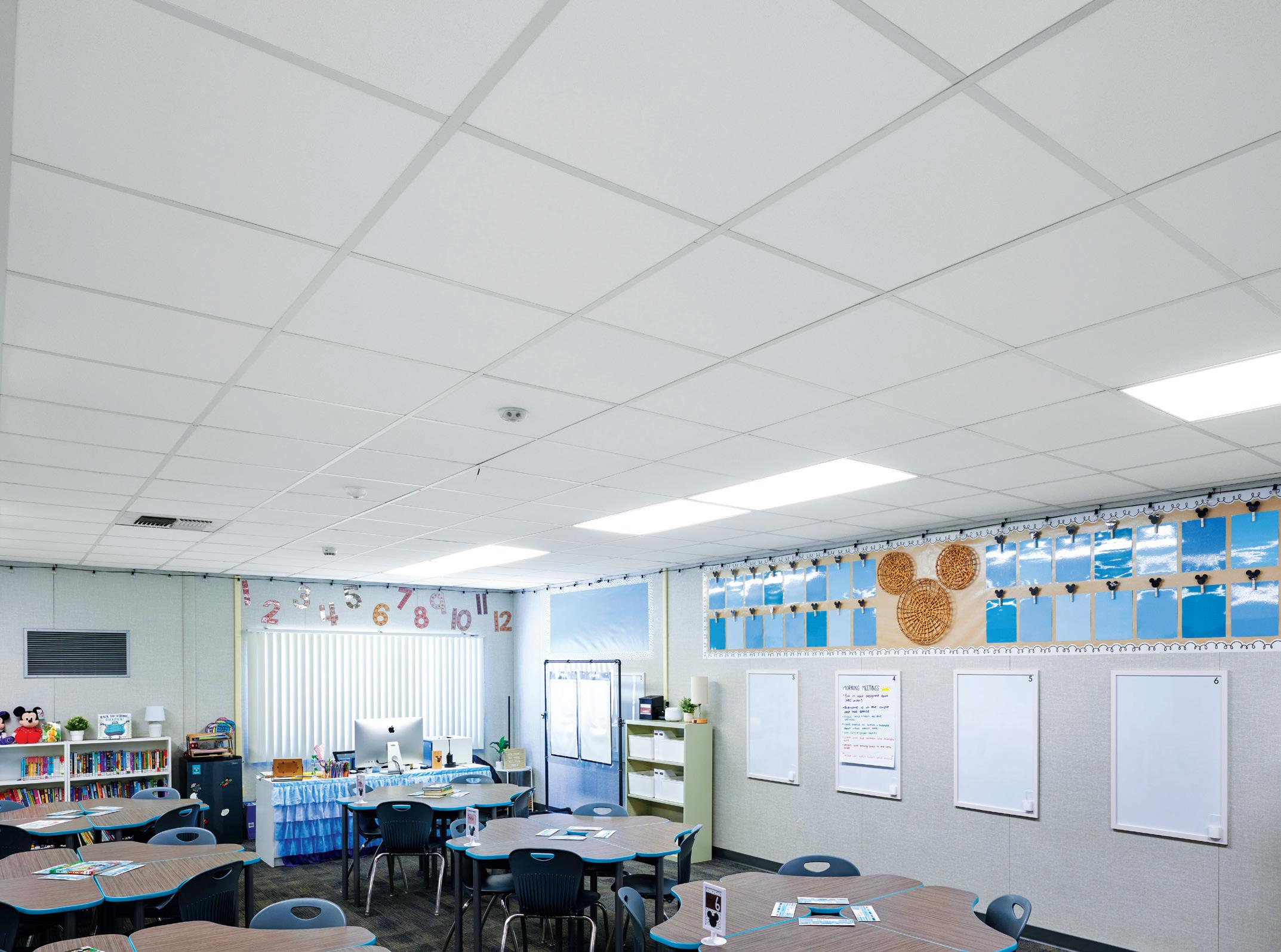

Improve thermal comfort in learning environments with Templok® Energy Saving Ceilings. These innovative ceiling panels feature phase change material to help regulate indoor temperatures. With a simple upgrade to the ceiling, a school district in Palm Springs, CA, achieved up to 4ºF cooler temperatures during the hottest hours, up to 20% lower HVAC demand in the afternoons, and 7% HVAC energy savings
























































By Mike Kennedy
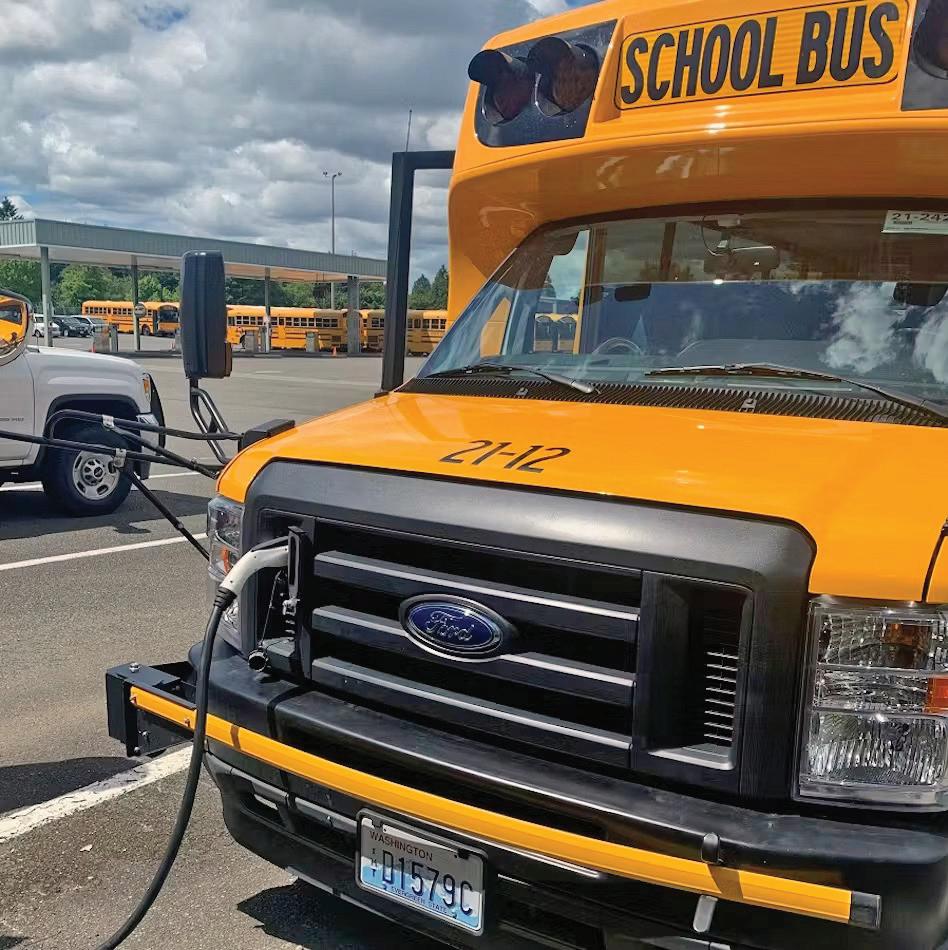
Will schools be able to acquire the electric school buses they expected to buy with help from the federal government’s $5 billion Clean Bus program?
EDITORIAL
ADVISORY BOARD
Bruce Mather
Executive Director of Facilities Management Elmhurst College, IL
Martin Montaño
Capital Projects Administrator Rio Rancho Public Schools
Rio Rancho, NM
James E. Rydeen FAIA, Armstrong Torseth Skold and Rydeen, Inc. Minneapolis, MN
That will depend on whether the U.S. Environmental Protection Agency carries out the changes it envisions for the program. The EPA announced in February that it plans to revamp the program to give school districts increased choice and affordable options for school buses.
The program, established in 2021, had provided funds for more than 8,500 electric school buses as of July 2025, according to the Electric School Bus Initiative.
But since the second Trump administration has taken office, it has stalled funding and raised concerns among schools expecting to receive grants that the money would not be forthcoming. In announcing the program revamp, EPA Administrator Lee Zeldin characterized the Clean School Bus program as “a disaster of poor management and wasteful spending” and asserted that the program “has forced unsafe and unreliable electric buses onto American schools.
Clean energy advocates say Zeldin’s statements about the program don’t hold up to scrutiny.
The Southern Alliance for Clean Energy disputed the EPA’s claim that the planned program changes would provide increased choice of fuel types.
“The reality is the Clean School Bus Program already offers fuel choice,” the alliance said.

Some types cited by the EPA, such as liquefied natural gas and hydrogen, have not been part of the program because no company manufactures those buses, the alliance said.
Affordability also was addressed in the original legislation. “The program was created to make clean school buses affordable to school districts — to help school districts choose the cleaner, healthier option, even if it has a higher sticker price,” the alliance argued.
The more important benefit of electric buses, the alliance says, is that they eliminate tailpipe pollution.
“Tailpipe pollution is linked to cancer, shorter lifespans, lung and heart illnesses, and higher rates of asthma, bronchitis, and pneumonia,” the alliance said. “This leads to more missed days of school (and more parents missing work) while children are dealing with asthma attacks and hospitalizations. Tailpipe pollution has even been found to impact brain development and cognitive performance.”
The alliance contends that most schools, bus drivers, students and parents have approved of electric buses. It dismisses Zeldin’s position as fearmongering to push a fossil-fuel agenda.

American School & University is the publication for thought leaders shaping school and university facilities. The August 2026 Educational Interiors Showcase issue is the guidebook for those planning interior learning environments. Q&A pages are a unique, cost-effective way to show your expertise in this special magazine devoted to the best in educational interiors and facility planning.
Contact Heather Buzzard at hbuzzard@asumag.com or visit SchoolDesigns.com for information.






carrier.com/k-12



www.asumag.com www.schooldesigns.com
VP/MARKET LEADER— BUILDINGS & CONSTRUCTION
Mike Hellmann • mhellmann@endeavorb2b.com
CONTENT DIRECTOR/
ASSOCIATE PUBLISHER
Joe Agron • jagron@endeavorb2b.com
SENIOR EDITOR
Mike Kennedy • mkennedy@asumag.com
ART DIRECTOR
Julie Whitty • jwhitty@endeavorb2b.com
AWARD PROGRAM MANAGER
Heather Buzzard • hbuzzard@endeavorb2b.com
EDITORIAL CONTRIBUTORS
Stephen Ashkin; Paul Erickson; American Institute of Architects Committee on Architecture for Education
SENIOR PRODUCTION OPERATIONS MANAGER
Greg Araujo • garaujo@endeavorb2b.com
PRODUCTION MANAGER
Sheila Ward • sward@endeavorb2b.com
ENDEAVOR BUSINESS MEDIA, LLC
CEO | Chris Ferrell
COO | Patrick Rains
CDO | Jacquie Niemiec
CALO | Tracy Kane
CMO | Amanda Landsaw
EVP Building & Construction Group | Chris Perrino
VP of Content Strategy— Buildings & Construction Group | Mike Eby • meby@endeavorb2b.com
SUBSCRIPTION CUSTOMER SERVICE: (847) 559-7598 americanschool@omeda.com
Nine years after the Greater Johnstown (Pennsylvania) district shuttered Garfield Middle School, the school system is preparing to reopen the campus.
The Tribune Democrat reports that students in seventh and eighth grades are set to move into the middle school building starting for the 2026-27 academic year.
The 100-year-old school was closed in 2017 during a restructuring of the district, but now the need has arisen for more classroom space.
“This project will relieve projected overcrowding at Johnstown Elementary School, restoring appropriate class sizes and ensuring students learn in environments designed to support focus, safety and academic success,” said Assistant Superintendent Michael Dadey.
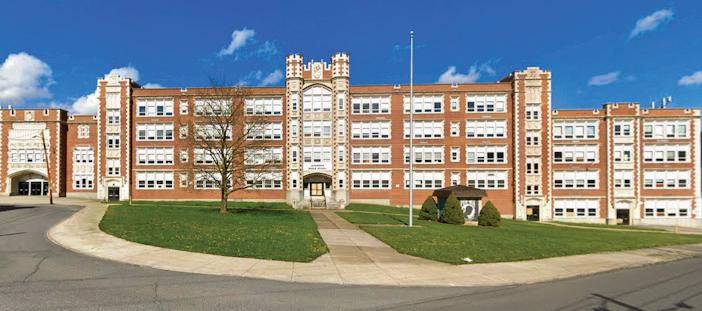
Improvements to the building will include updates to the HVAC system, accessibility updates, restroom renovations, a new media center, upgraded offices and a new music room. In total, the project will cost between $24 million and $30 million.
https://asumag.com/55362779
The Mercer County (New Jersey) board of commissioners has agreed to spend $10 million to acquire a 56-acre portion of the Rider University campus and other assets in an effort to help the school ease its financial difficulties.
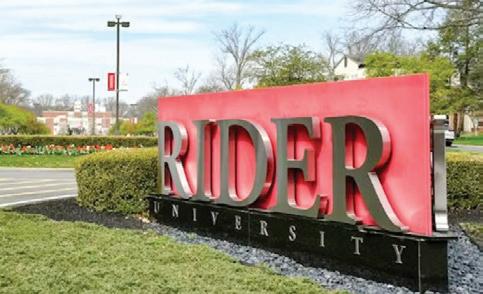
NJ.com reports that in addition to buying the land on the Lawrenceville campus, the county will acquire the school’s presidential house and lease some facilities for use as a county office.
The land acquisitions and service agreements in the deal could pay the university up to $9,999,999.
The deals would provide “essential financial liquid-
CORPORATE OFFICE:
Endeavor Business Media
30 Burton Hills Blvd. , Ste 185 Nashville, TN 37215 (800) 547–7377 endeavorbusinessmedia.com

ity to a critical regional anchor institution” and “help prevent the insolvency of Rider University, a major regional employer,” according to the resolutions approved by county commissioners.
Rider, which has about 3,600 students, was placed on probation last year by its accrediting agency, the Middle States Commission on Higher Education, because of its financial problems.
The university remains accredited while it is on probation and classes are continuing.
https://asumag.com/55361716
Acoalition of Wisconsin school districts, teacher unions, advocacy groups, parents and students has sued the state legislature, contending that lawmakers have failed to fund public schools adequately.

The Associated Press reports that the lawsuit asks the court to intervene and impose a new finance system that meets the needs of districts, unless the legislature and governor enact one first “in a timely fashion.”
The suit asserts that the state is violating the Wisconsin Constitution’s requirement that all children be provided with an equal opportunity for a sound, basic and uniform education.
In 2000, the last time the state’s school funding formula faced a court challenge, the Wisconsin Supreme Court upheld the system as constitutional. But attorneys argue in the new lawsuit that conditions have changed so much since then that a new challenge is warranted. As recently as 2003, the state paid two-thirds of the cost of each student’s education. But now districts are paying about half the costs, the suit says.
https://asumag.com/55361000
The Dallas school board has voted to put a $6.2 billion bond proposal before voters on May 2. It is the largest school bond request ever in Texas.
The district says that if voters approve, the proposal would provide funds to:
• build 26 replacement schools.
• renovate and modernize all campuses.
• remove the district’s 700 remaining portable classrooms (used by nearly 10,000 students).
• upgrade safety and security at all campuses.
• update school furniture.
• upgrade student technology and buy new school buses.
• upgrade physical education facilities.
• repair the district’s swimming pools.
The bond request is divided into four ballot questions.

https://asumag.com/55358413





The U.S. Department of Education’s Office for Civil Rights (OCR) has begun an investigation into the New Richmond (Wisconsin) School District concerning reports that its policy regarding transgender students allows biological males to use female restrooms. The inquiry will look into whether the district violated Title IX of the Education Amendments of 1972 “by allowing students to access intimate facilities based on ‘gender identity,’ not biological sex,” the department said in a news release.

At a January 2026, school board meeting in New Richmond, some parents expressed concern that boys were being permitted to use the girls’ restroom.
In February, the school board rejected a proposed policy to have bathrooms and locker rooms separated by biological sex. The Milwaukee Journal Sentinel reports that Michael Waldspurger, the school district’s lawyer, told the board that recent court decisions have ruled in favor of allowing transgender students to select a restroom or locker room based on their gender identity. He said the district could face legal action and would likely lose a lawsuit if it were to deny transgender students the right to use their preferred bathrooms.
The Trump administration’s interpretation of Title IX calls for bathroom use to be determined based on biological sex and not gender identity.
“Young women should never be forced to share intimate spaces with boys and men because school leaders care more about radical gender ideology than protecting girls’ safety, dignity, and privacy,” said Assistant Secretary for Civil Rights Kimberly Richey. School board members who ignore these allegations are failing the families they serve.”
After the OCR announced its investigation, the New Richmond district said that it has followed the applicable laws and would work with the federal investigators to address the district’s bathroom policies.
“The safety and security of all of our students is our top priority as a district, and we remain committed to ensuring that our students have the best learning environment possible,” the district said. “The district also takes its legal obligations very seriously and has remained in compliance with all applicable laws in this area. Despite the tone and tenor of the press release, we look forward to participating in the OCR’s investigation and to work collaboratively with the OCR on these matters moving forward.”
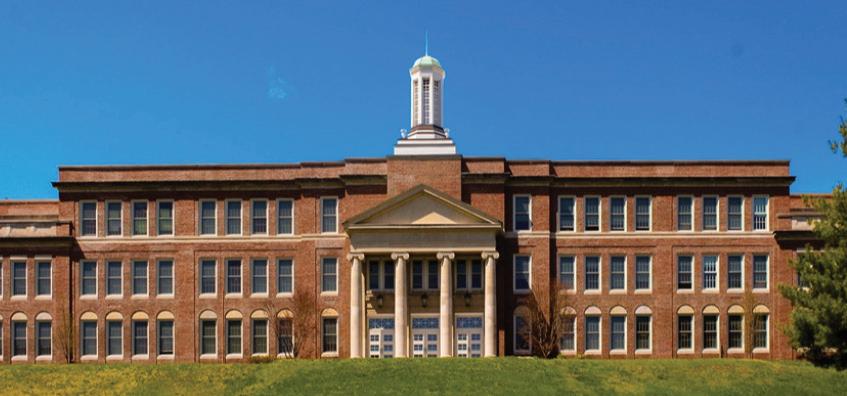
The Westfield, Massachusetts City Council has approved spending $637,000 to upgrade four bathrooms at Westfield Technical Academy.
The Westfield News reports the project involves full replacement
of four bathrooms, two in the upper campus outside the auditorium and two on the lower campus outside the gymnasium. The renovations will bring all four bathrooms into full compliance with applicable building codes and ADA requirements. The work includes electrical, plumbing and flooring upgrades and asbestos abatement. Council President John Beltrandi III said that he’s been to the school and has seen the bathrooms. “Yeah, they’re bad,” he said. “That really needs to get done.”
City Councilor Cindy Harris said a recent accreditation review of the school specifically noted the deficiencies in the bathroom facilities. The approved upgrades will help the school in achieving greater compliance with accreditation standards. Superintendent Stefan Czaporowski said the upgrades will ensure ADA compliance and significantly improve the student experience.
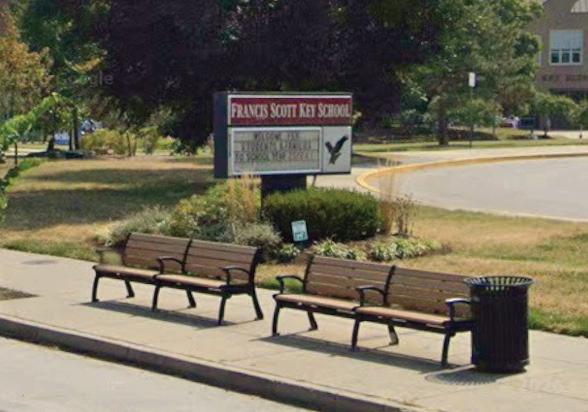
The reopening of Francis Scott Key Elementary/Middle School in Baltimore has been delayed by about a month after lawmakers secured funds to carry out bathroom renovations.
SouthBMore.com reports that the school was closed in January to carry out mold remediation and HVAC repairs. Its scheduled March reopening has been put off until April to add bathroom renovations to the construction project.
The renovation will include:
• Installation of new toilet room accessories in all renovated restrooms.
• Repair of all existing plumbing systems and existing drainage lines serving the restrooms.
• Installation of new plumbing fixtures throughout the renovated bathroom spaces.
• Installation of new restroom partitions.
• New wall tile in all renovated restroom areas.




Our Technical Services team is here to solve, not sell. When you choose our pipe and fittings, you’re also armed with technical expertise, industry knowledge, and a library of resources. Get services you can rely on and answers you can trust.

Inspecting roofs twice a year will help schools and universities detect facility problems before they cause major damage.
by Mike Kennedy
Deferred maintenance is a problem that constantly nags at school facility managers as they try to keep their buildings operating safely while staying within budgets that can’t cover all the work that is needed. One of the prime spots where a school or university may be tempted to hold off on such work is on the roof of a building—almost no one can see what is going on up there, so it’s easier to defer those jobs and instead focus on repairs and maintenance where people can see...and complain about when the problems linger or become worse.
The problem with forgoing inspections and putting off minor roof repairs is that the unchecked damage and the leaks that result can lead to major facility breakdowns. Ceilings, walls and floors can be ruined, electrical and mechanical systems wrecked. There’s also potential harm to the students and staff inside the school building. Leaking roofs let unwanted moisture inside and create conditions for dangerous mold to grow unseen and cause health problems.
But research indicates that at too many schools, those inspections aren’t happening often enough. A 2020 survey by the U.S. Government Accountability Office estimated that about 28,000 schools needed their roofs updated or replaced.
Regular inspections of roofs will help school maintenance workers monitor conditions and detect damage or deterioration before they cause more serious infrastructure problems that can compromise an entire building. Roofing experts recommend inspecting roofs at least
twice a year, in the fall and in the spring. Springtime inspections make it possible for school personnel to determine if their roofs emerged from the harsh winter months with any new problems that need to be addressed.
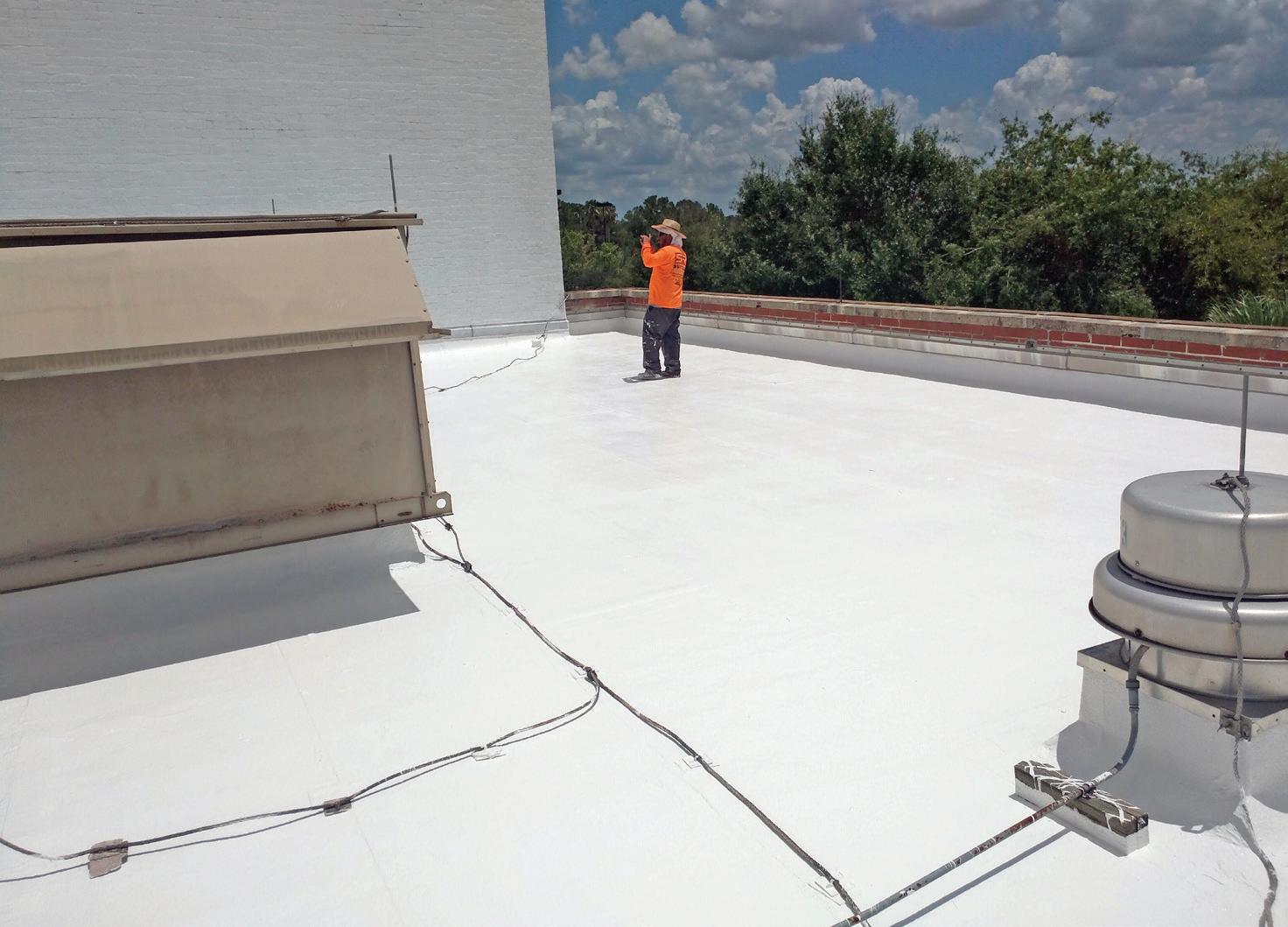
Roof inspections should focus first on whether water or other unwanted moisture can be seen.
“The key to maintaining good roofs is the timely removal of water from the surface and substructure of the roof,” says the National Center for Education Statistics Planning Guide for Maintaining School Facilities. “Thus, all leaks and damaged tiles must be repaired as soon as possible to prevent water damage and mold growth.”
The National Center on School Infrastructure’s Facility Condition Assessment Manual says roof inspectors should look for “soft” spots on a roof that may indicate water intrusion.
“If you encounter soft spots on the roof, it’s best to walk through the inside of the building,” the manual says. “Look for water stains on the ceiling tiles or missing tiles.”
Inspections also should include an examination of parapet walls and HVAC curbs to make sure nothing is leaking through. “The majority of water intrusion issues can be found in these transition points,” the manual says.
The manual also urges maintenance workers to look closely at roof membranes for exposed areas, signs of wear, blisters or
punctures. “Look for any mildew, moss or debris on the roof that may cause a breakdown in the membrane,” it recommends. Inspect roof membrane seams for signs that the seam is no longer adhering. “Seams are typically the first point in lowslope roofing systems that degrade,” the manual says. “This will cause blistering and water pooling...and will become a perfect spot for water intrusion over time.”
Inspectors also should examine roof repairs that have been made in the past to see if they have affected the overall roof performance.
“A roofing system over time will leak and the facility team may start to fill these areas with a roof repair kit,” the manual says. “Sometimes the roof repair material does not match the membrane. This will eventually make the issue worse over time.”
Many education institutions aren’t able to carry out two roof inspections a year. But Davenport University, with several campuses in Michigan, has committed to as minimum of three yearly inspections of the roofs on all university buildings.
“Roofs will be visually inspected in early April, July and late October,” Davenport’s website says. “Roofs will also be inspected after each incidence of extreme inclement weather.”
The website provides a detailed list of the potential problems inspectors should look for: missing or damaged shingles; deteriorated flashing; standing water or ponding; debris laying on roof; debris clogging roof drains; open, torn, punctured, cracked, separated or blistered rubber membrane and seams; missing chimney or vent caps; gaps and breaks between the metal edging and the roofing membrane; empty or improperly installed pitch pockets; missing or open caulk joints; poor or missing seals around roof access ladders, HVAC equipment, and other roof penetrations; damaged soffits, fascia, and vents; and missing or damaged downspouts and gutters.
“Where feasible, university facilities staff will correct ‘routine’ roof deficiencies, such as removal of debris from the roof and around roof drains, or replacing vent caps,” the university says.
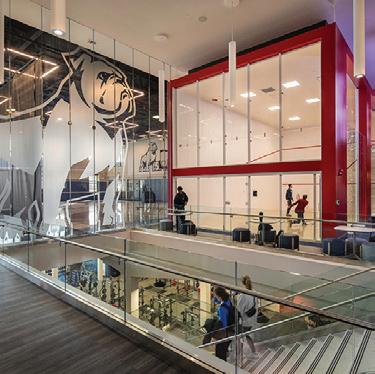
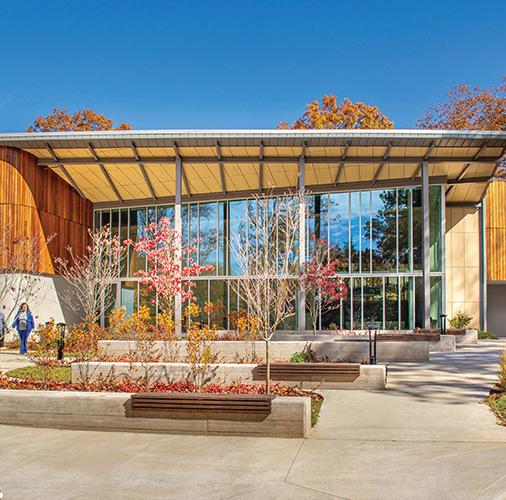
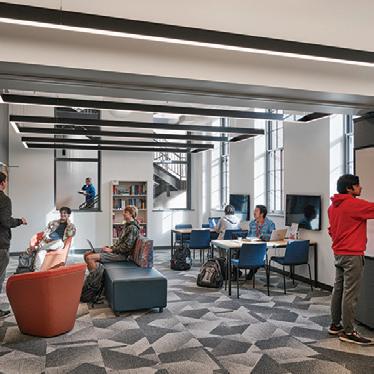


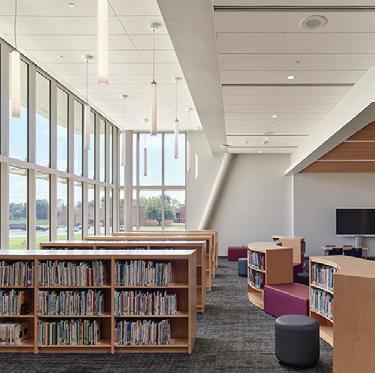
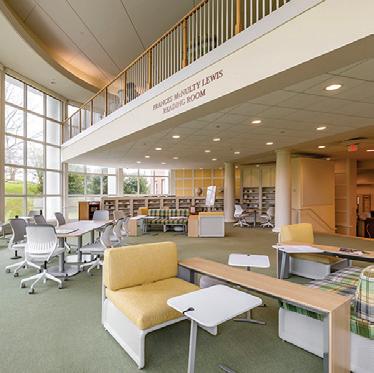








Northwestern University has reopened the Charles Deering Memorial Library on its Evanston, Illinois, campus after an extensive renovation.
Northwestern Magazine reports that the upgrades preserve the original architecture of the Deering Library, increase accessibility for visitors and enhance spaces for study, collaboration and engagement with library resources.
The Deering Library, modeled after King’s College Chapel in Cambridge, England, opened in 1933 and served as the university’s main library until 1970. It now houses special collections and archives.
The renovations at Deering focused on three spaces: the Eloise W. Martin Reading Room, the Richard C. Devereaux Foundation Reading Room (formerly the Music Listening Center) and the third-floor lobby. These spaces now have restored woodwork, furnishings and flooring as well as retrofitted lighting, technology upgrades and new furniture.
The Martin Reading Room can now seat 176 people — 40 more than before. Interior bookshelves have been removed to create
The Campbell Library at Rowan University in Glassboro, New Jersey, is undergoing a major renovation to adapt to the changing needs of students.

The university is modernizing a facility that opened on campus in 1995. The biggest change emerging from the renovation will be fewer stacks of print books and more spaces for students to study and interact.
“There will be a variety of seating arrangement options and a
space for additional study tables, chairs and lounge seating. New wiring and electrical outlets have been installed, so visitors can charge their devices more conveniently.

The Devereaux Room has been reconfigured to serve as a reading room and a technology-enabled event space that can accommodate up to 150 people. Flexible furniture will enable the room to be used for open study, large-group meetings, public lectures and other events.
The third-floor lobby houses the Sandi Lynn Riggs Gallery, which will showcase Northwestern’s archival and special collections. Artificial overhead lighting that mimics sunlight without causing ultraviolet light damage to rare books and manuscripts makes it possible to put more library materials on display.
The architect for the renovation is HBRA Architects.
full floor dedicated to silent study,” the university says. “We are also increasing the number of bookable group study rooms and will offer improved wifi throughout the building while still retaining several desktop stations for those who prefer or need them.”
To reduce the amount of materials on site, items will be categorized into three groups: “Keep On Site,” “Store Off Site,” and “Donate or Recycle.”
“If we focus simply on growing our collections without paying attention to evaluating our existing books, our patrons would quickly be swamped by materials they do not find useful,” the university says. “By recycling unneeded books and moving less frequently used ones off-site...we aim to make it easier for people to find the books they are looking for.”
The renovation is scheduled to be completed later this year.
Forty-six school libraries in the Prince George’s County (Maryland) district have undergone upgrades that transform them into modern learning hubs.
The effort is funded through a multimillion-dollar partnership with two non-profits — Heart of America and the Pull Up Fund.
“This effort is about more than remodeling spaces — it’s about reimagining the role of libraries as vibrant, inclusive hubs of learning,” says Heart of America President Jill Hardy Heath.
The project also will include construction of a new library focused on training and professional development for the district’s librarians and educators.
The school libraries will be outfitted with high-tech educational resources such as smart TVs, projectors, computer stations, 3D
printers, robotics kits; green screens, video equipment, editing tools, makerspaces with engineering instruments, digital calipers, and construction kits.
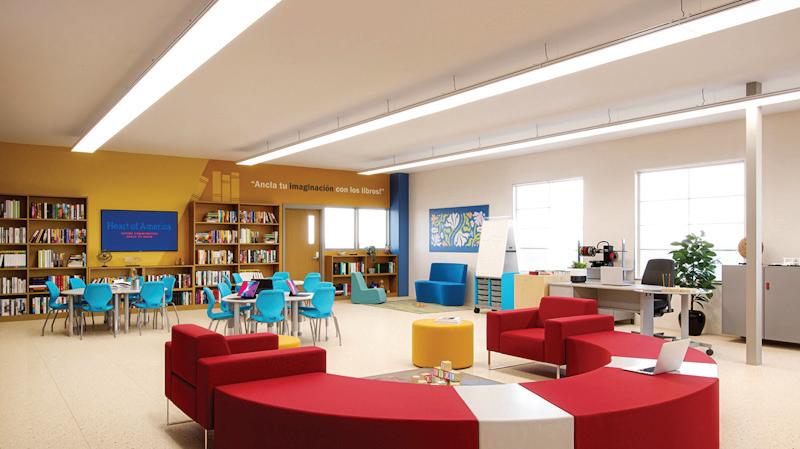
Heart of America also will provide more than 72,000 books featuring culturally relevant stories that reflect the diversity of Prince George’s County students. The district says nearly 26,000 students will benefit directly from the modernized libraries.
Cornell University has completed a major renovation of Olin Library on the Ithaca, New York, campus.
An overhaul of the main floor and lower levels has updated some of the most-used common areas of the facility, which was built in 1961. Wayfinding and the availability of study spaces have been improved on both floors.

The renovations on the main floor have combined what had been separate circulation and help desks into one. The improvements also have created a more open floor plan and added an entrance on the Arts Quad side.
One floor below, the Map Collection entrance has been reconfigured and a new student commons area has been added. Space also has been created for the Anthropology Collaboratory, home to several collections that used to be housed in McGraw Hall.
The architect is Goody Clancy.
Grand Rapids Community College in Grand Rapids, Michigan, has begun a $35 million renovation of the Library and Learning Commons, a building constructed in 1972. The project aims to transform the 61,268-square-foot facility into a “technology-rich space that combines traditional library resources with tutoring, testing, media and multicultural services.”



Upon completion in January 2027, the renovated facility will reopen as the Learning Resource Center. The name reflects an expanded mission and enhanced offerings, including an array of student-centered services, updated technology, individual study areas and collaborative spaces. The redesigned facility will blend traditional library elements with modern resources; it will cater to diverse learning styles and encourage collaborative education.
The first floor will include the Experimental Classroom, Media Technologies and the Testing Center, situated along a bright, open corridor.
The architect is Progressive Companies.

Aurora University in Aurora, Illinois, is building a 45,000-squarefoot learning commons that will replace the school’s 63-year-old Phillips Library.
The university says the three-story facility has been designed to be a central hub of academic life on campus.
Instead of spaces filled with shelves and stacks, the Learning Commons will provide a mix of open spaces, study pods, and technology-rich learning environments. Expansive windows, natural light, and open layouts will create an inviting atmosphere.
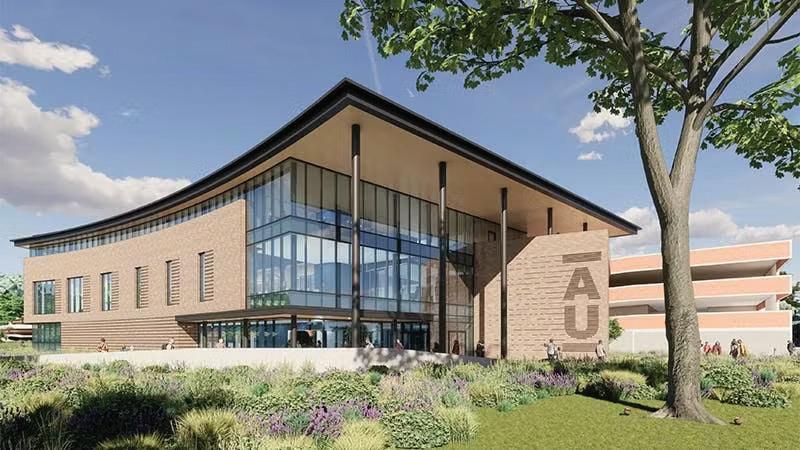
brary resources, a café, career services, and a lounge where students and employers can connect. The second floor will have a technology center, makerspace, content creation lab, academic support center, and collaboration areas. The third floor will be a quiet space featuring university archives, study spaces, an expanded testing center, and a scenic terrace overlooking campus.
The first floor will have a welcoming entry with traditional li-
Student support services, including the Academic Support Center and Disability Resource Office, will be easier to access; they will have extended hours and offer a range of workshops, tutoring options and one-on-one assistance.
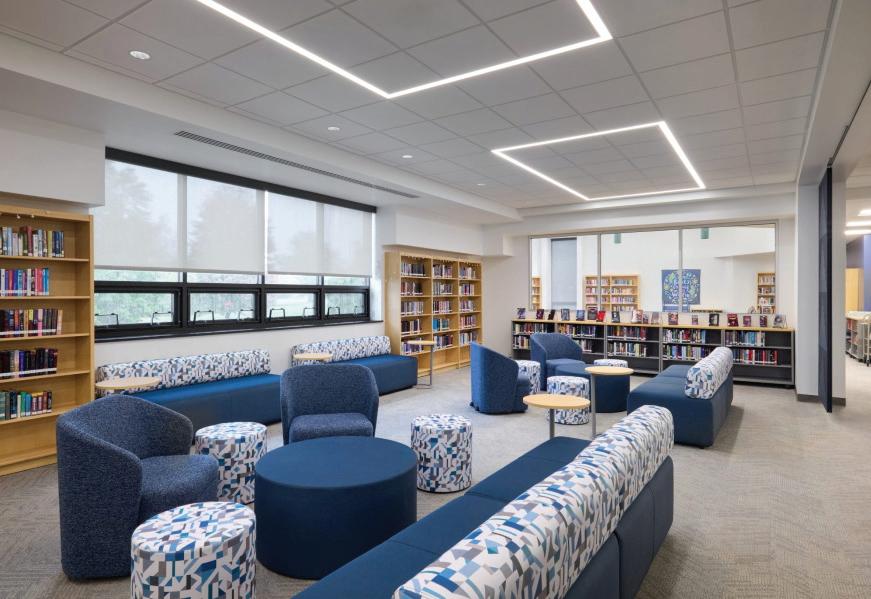
The Southern Lehigh (Pennsylvania) district has completed construction of a $1.7 million media center at Southern Lehigh High School in Upper Saucon Township.
LehighValleyNews.com reports that media center, which occupies the same space as the school’s former library, is a far cry from its predecessor, according to students.
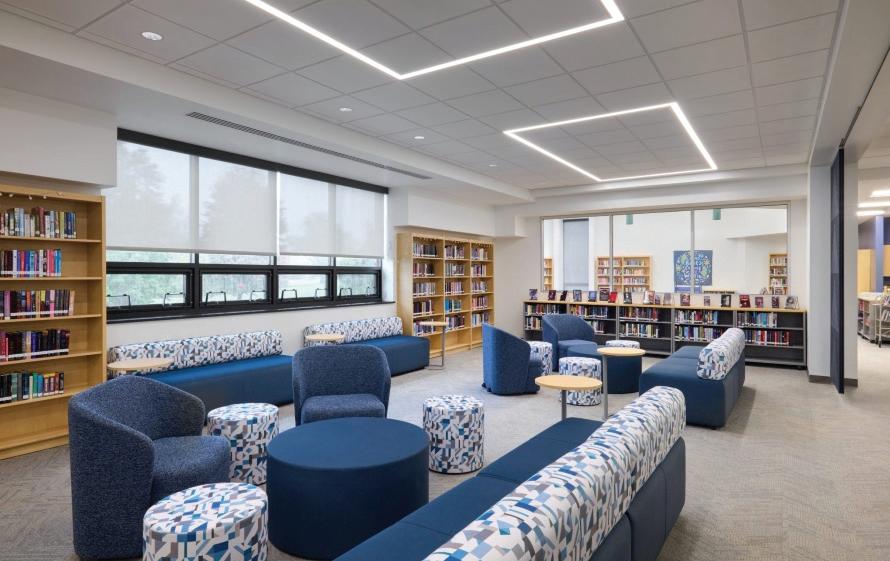
It has comfortable couches and lots of natural light, thanks to added windows. It also has study rooms and makerspaces, where students can take part in hands-on activities such as science labs and art projects.
The school weeded out 83% of its former book collection because they were out of date; it has bought 3,902 new books to offer students a more modern selection.
The architect is Alloy5, and the contractor is Boyle Construction.
The Bjork Library at Stockton University in Galloway, New Jersey, is in the midst of a two-year, $19.5 million renovation.
The university says the project will transform the three-story, 100,000 square-foot space into a library learning commons that will be a place for students to gather for meetings, participate in experiential learning opportunities, and work with archival materials and primary sources.
Construction is expected to be completed by June 2026; the renovated library is set to open in fall 2026.
The upgrades:
• The number of rooms for students to study and hold meetings will increase from 11 to 34.
• The space for learning commons—open areas designed to encourage collaborative learning—will increase fourfold from 6,950 square feet to more than 26,000 square feet in the redesign. The spaces will be spread throughout all three floors of the library.
• A new roof and heating and air conditioning system will be installed. The library hasn’t had a significant infrastructure update since its opening in 1972.

• More charging stations so students can plug in and charge computers and mobile devices.
• There also will be more comfortable chairs, more waterfilling stations and more bathrooms, including a genderneutral one.
To free up space in the building, Stockton is reducing the number of volumes in the library from 376,000 to just over 181,000.
The California Polytechnic State University in San Luis Obispo has reopened the Robert E. Kennedy Library after a $78 million renovation.
The university says the upgrade was the five-story facility’s first major renovation since it opened in January 1981. The two-year project improved accessibility, added classroom space, upgraded heating and cooling systems and expanded the on-site cafe.
The reimagined first floor holds two exhibit spaces for art and historical artifacts, an expanded café and a redesigned courtyard. Hub24, the university’s 24-hour study space, has grown to include the library’s first and second floors.
Students also have access to the Digital Scholarship Studio, which includes a research help desk, a place to consult with peers on data
science projects, group study space and computer workstations.
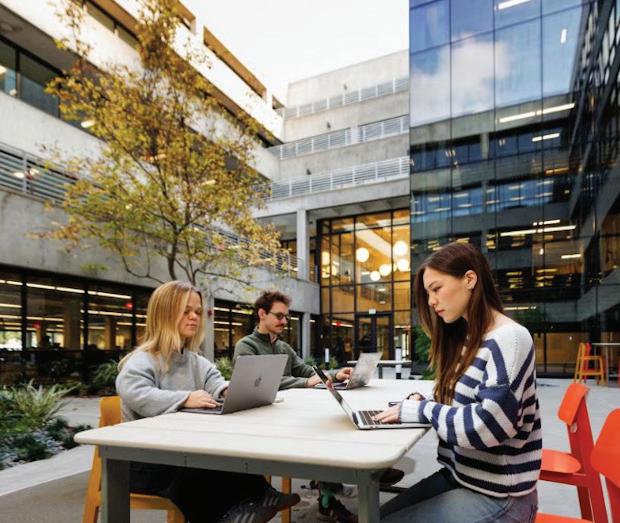
One of the key upgrades is the library’s redesigned staircase that has freed up more square footage on several floors. The change created space for two seminar-style classrooms. Upper floors are now home to books and reference materials in the library’s main collection of more than 5 million items, a meditation room, all-gender restrooms and a host of programs.
Behind the scenes, improved insulation and upgraded systems, including heating and cooling, have reduced the building’s energy usage by 30%.
The Hillman Library at the University of Pittsburgh has received LEED Platinum certification from the U.S. Green Building Council after an extensive renovation.
The recognition for environmentally friendly design and construction came following an improvement project that stretched over nine years. The renovations revived a building “that was more warehouse than community hub,” with faltering infrastructure and


unreliable heating and cooling.
“The renovation upcycled a 1968 brutalist repository of books into a 2025 resource for engaging student study,” said Gina Bleck, vice chancellor for planning, design and construction.






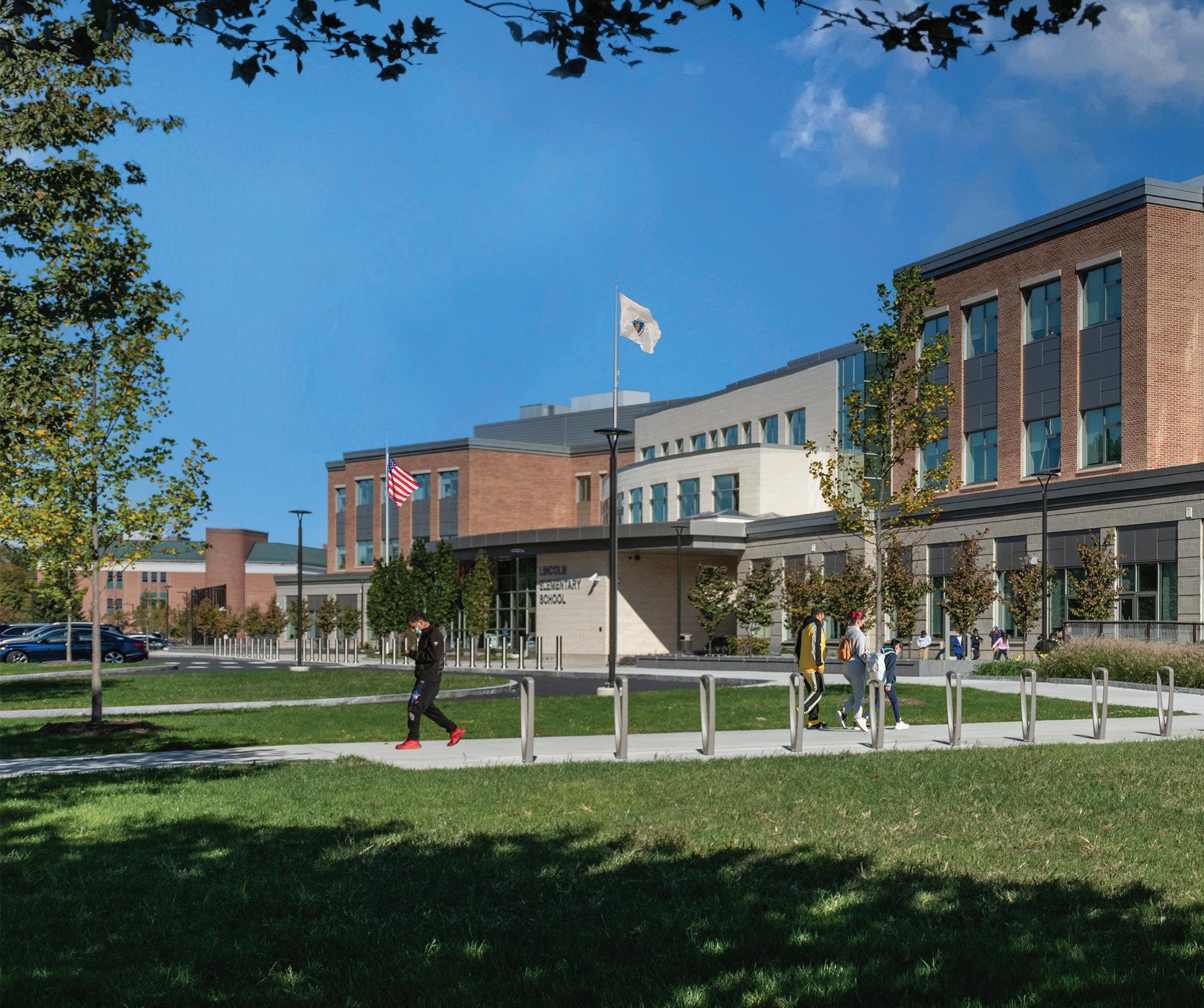
Despite the Trump administration’s hostility toward sustainability and clean energy efforts, green school advocates continue to pursue strategies to conserve energy and combat climate change.
By Mike Kennedy
hey say that elections have consequences, and that certainly was the case for the green schools movement when Donald Trump replaced Joe Biden in the Oval Office.
Since Trump returned to the White House in January 2025, his administration has held up funding earmarked for energy efficiency upgrades, clean energy grants, and clean school buses. The president has called for “reinvigorating” the coal industry and
increasing offshore drilling for oil, while expressing skepticism about climate change and the benefits of clean energy like solar and wind power.
Even the recognition program established to honor schools for their sustainability efforts—the Green Ribbon Schools program—ended abruptly soon after Trump took office.
Those obstacles have made green school initiatives more difficult for sustainability advocates, but they have persevered. Environmental organization,

education groups, individual states and school systems continue to embrace sustainability and combat climate change.
The federal government’s Green Ribbon Schools program has ended under the Trump Administration, but several states continue to honor schools’ green accomplishments with their own programs.
In February, the California Green Ribbon Schools awards were bestowed on 26 schools, 12 school districts and one county education office. Of those recipients, five—two public schools, two school districts and one private school—were singled out as “Green Achievers” for their efforts in resource conservation, health promotion and environmental literacy:
• Captain Leland F. Norton Elementary School in San Bernardino stands out for its innovative, hands-on Science, Technology, Engineering, and Mathematics curriculum and its commitment to fostering environmentally literate, communityminded leaders. Through project-based learning, energy conservation initiatives, recycling, watersaving practices, and wellness-focused programs, Norton instills a culture of responsibility, health, and environmental awareness that extends beyond the classroom. By integrating sustainability into daily operations, student learning, and community engagement, the school not only equips students with the knowledge and skills to protect and improve their environment but also ensures long-term, meaningful impact on the school and its surrounding community.
• Joaquin Moraga Intermediate School in Moraga integrates sustainability across academics, operations and community engagement. The school provides hands-on, place-based learning—from creek restorations to biodiversity monitoring and waste-reduction campaigns—while engaging students as active environmental leaders. Sustainability is embedded through outdoor classrooms, edible gardens, renewableenergy projects, and civic engagement programs. Students gain practical knowledge in energy, climate, and ecological systems while participating in service projects that strengthen community resilience and environmental stewardship.
• The National School District in San Diego County exemplifies how high-impact sustainability can thrive in high-need communities. Over the past decade, the district has achieved
School districts in Illinois, Maryland and Washington have received the Grand Prize in the Magna Awards for their efforts to improve indoor air quality and reduce greenhouse gas emissions.
The National School Boards Association and the Go Green Initiative, sponsors of the awards program, said the top honors went to the East St. Louis (Illinois) district, Prince George’s County (Maryland) district and the Issaquah (Washington) district.
“School districts are proving that protecting student health and protecting our climate go hand in hand,” says said Jill Buck, CEO and founder of the Go Green Initiative. “The leaders of these districts are creating safer classrooms today and a more sustainable future for every child tomorrow.”
The East St. Louis School District was recognized in the under 5,000 enrollment category. Its indoor air quality efforts include the district’s carbon-free schools initiative and its five-year carbon footprint reduction and energy savings plan. 5,000 to 20,000 enrollment:
The Issaquah School District was recognized in the 5,000-to20,000 enrollment category. It has adopted an indoor air quality policy that aligns with EPA standards. Its objectives are to reduce the level of indoor air pollutants through preventative measures; provide and maintain adequate airflow by repairing and maintaining ventilation equipment; and provide timely progress reports to all interested parties.
The Prince George’s County district was recognized in the over 20,000 enrollment category. It has a newly developed comprehensive indoor air quality plan that is based on guidelines set forth by the EPA and the Go Green Initiative training. The plan will help the district meet the goals of creating healthy indoor environments for staff and students.
Two other districts received Silver Awards. The Salamanca (New York) City Central School District has aligned indoor air quality improvements with energy efficiency initiatives to ensure that school facilities remain healthy, resilient, and well maintained.
The Boston district was recognized for an indoor air quality program that has resulted in the installation of indoor air quality sensors in every classroom, nurse’s office, and main office, along with rooftop sensors for baseline outdoor measurements.
measurable gains—including over 1 million gallons of annual water savings; 1,000-plus tons of waste diverted; a 13% reduction in greenhouse gas emissions; and improved energy efficiency. Its partnerships with organizations such as Rady Children’s Hospital, Olivewood Gardens, Ocean Connectors, and Tree San Diego engage families and the community to embed sustainability into daily life. Its multi-year strategy integrates resource conservation, health, and environmental literacy into operations and curricula to prepare students as future environmental leaders
• The Ravenswood City School District uses sustainability as a tool for health, resilience, and opportunity despite limited funding and staffing challenges. Through a decade-long facilities master plan and more than $250 million in modernization investments, Ravenswood has electrified campuses; expanded solar energy; reduced water use; planted over 1,300 trees; improved air quality; and created green schoolyards and outdoor learning spaces that integrate environmental literacy into daily instruction. These initiatives position Ravenswood as a model for long-term, equitable, and climate-resilient transformation in an under-resourced school district.
• Lycée Français de San Francisco in San Francisco has integrated sustainability into its identity, curriculum and operations since the 1960s by blending French educational values with Northern California’s rich ecosystems. Students engage in hands-on learning experiences that explore ecology; science, technology, engineering, arts, and mathematics (STEAM); biodiversity; wellness; and climate citizenship across urban, coastal, and bayside settings. Students learn to view sustainability as both a scientific and civic responsibility. The Lycée sustains long-term impact through investments in renewable energy, water-wise landscapes, efficient facilities, green transportation, and wellness-centered design.
In Wisconsin, the Department of Public Instruction began its own green schools recognition program last year to fill the gap left by the end of the federal program.
“After more than a decade of celebrating school leadership in sustainability, it’s disappointing that the current administration shut down the federal Green Ribbon Schools program,” State Superintendent Jill Underly said. “Wisconsin isn’t standing still. We’re proud to launch our own recognition to honor schools doing the real work.”
Two schools—Mahone Middle School in Kenosha and West De Pere High School in De Pere received the new Stewardship and Sustainability Award.
Mahone Middle was recognized for the initiatives of its Eco Club. It has produced “In a Green Minute” educational videos and led a two-year campaign to fund and build an outdoor classroom that supports mental health and well-being. The school also encourages public transportation, water conservation, and has created rain gardens.
West De Pere High has reduced greenhouse gas emissions through facility improvements, revamped waste and transportation practices and a holistic approach to indoor building health.


Hands-on learning experiences include watershed data collection and recycling drives.
The Center for Green Schools at the U.S. Green Building Council and the Green Schools National Network have awarded the 2026 Best of Green Schools Awards to 11 recipients.
The awards recognize schools, districts, organizations, or individuals for advancing environmental stewardship, creating healthy learning environments, and promoting education for a sustainable future.
School System: Bellingham (Washington) Public Schools. The district has leveraged local experts and national networks to prioritize sustainability in a systematic way that encompasses

Federal government support for clean energy initiatives like solar panel installation has declined under the Trump administration.
ID 22843463 © Stangot | Dreamstime.com
everything from building standards to procurement procedures to climate curriculum. Bellingham is one of the only school districts in the nation to monitor both indoor and outdoor air quality in preparation for wildfire smoke events.
School System: The School District of Philadelphia. The district has built a coordinated approach to sustainability through long-standing partnerships and collaboration among operations, academics, and community organizations. Guided by GreenFutures, the district’s sustainability plan, the work supports progress in energy and resiliency planning, greenscapes and outdoor learning, waste reduction, health and indoor environmental quality, and student leadership that connects classroom learning with system-level priorities. The district shares its practices at the annual Summit for Sustainable Schools, publishing resources and collaborating with local and national partners so that other school systems can learn from what they have put into action.
K-12 Educator: Laure Grove. Under Grove’s leadership as the lead environmental stewardship educator in Burke, Virginia, Terra Centre Elementary received consecutive Eco-Schools U.S. Green Flag Awards and launched a student-led monarch project that influenced Fairfax County to adopt the Mayor’s Monarch Pledge and establish countywide pollinator and sustainability initiatives. Through audits, advocacy and community partnerships, Grove empowers students to build sustainability knowledge, leadership skills, and meaningful community impact.
Policy Maker: Tammy Murphy, former First Lady of New Jersey. Murphy is being recognized for her role in establishing the Office of Climate Change Education. Through this office, the state supports climate change education across all K-12 learning standards, including all content areas and starting in elementary school. Because of her leadership on this initiative, New Jersey ensures that students are prepared across multiple content areas and understand how and why climate change occurs and its impacts.
K-12 School: Berwyn Heights Elementary School, Berwyn
Heights, Maryland. The school has sustainability embedded its culture and curriculum. Berwyn Heights received a 2025 Green Ribbon School state honor, has been awarded Sustainable Bronze Status from the Maryland Association for Environmental and Outdoor Education, and, for the 18th consecutive year, has maintained its status as a Maryland Green School. The school has a longstanding commitment to reducing its environmental footprint through energy efficiency, student-led sustainability and conservation efforts, and outdoor spaces that support health and wellness.
Ambassador: Robin Sidman. As the founder and executive director of Project Green Schools, Sidman has built one of the nation’s leading organizations dedicated to developing the next generation of environmental leaders, engaging over 500,000 students across more than 6,500 schools worldwide. Through innovative programs like the National Green Schools Society and the National Youth Council, she has empowered students to design and lead sustainability projects, influence policy, and deliver measurable environmental impact in their communities. By bridging grassroots student action with national and international policy engagement, Sidman has created a scalable model for youth-led climate leadership.
Student Leader: Kayla Ling. Kayla, a high school student in San Mateo, California, is a winner of the National Geographic Slingshot Challenge, co-lead of the Nueva Environmental Club, co-lead of the Citizens’ Climate Lobby San Mateo County Youth Group, and co-host of the CEC Student Film Fest. Her goal is to help lead a cultural, economic and political shift toward environmental justice.
Business Leader: MCN Build. The company is an awardwinning general contractor founded in Washington, D.C., that delivers resilient, high-performance facilities. MCN Build specializes in transformative projects that foster economic and environmental sustainability, with a special focus on K-12 education. The firm is a signatory to the Contractor’s Commitment to Sustainable Building Practices and champions sustainability across all projects and internal operations. Its K-12 educational portfolio includes three net-zero energy schools, 43 LEED-certified schools, and three WELL-certified projects. Ongoing MCN projects are targeting two LEED Platinum, 24 LEED Gold, and 3 net-zero energy projects.
School District Champion: Aaron Presberg. Presberg has spent the last decade spearheading the energy and sustainability program at Portland (Oregon) Public Schools. His work has included upgrading over 100 buildings to LED lighting, passing
the district’s first climate crisis response policy, carrying out the district’s decarbonization roadmap, and helping to design and build the district’s first all-electric schools. His work has yielded $5 million in energy efficiency incentives and millions of dollars in annual utility savings for the Portland district.


Moment for the Movement: Seal of Climate Literacy. Established in 2024 by the Colorado legislature, the Seal of Climate Literacy is a high school diploma endorsement that students earn by demonstrating an understanding of climate literacy principles and completing an experiential learning project. Nearly 2,000 Colorado students will have attained the endorsement by May 2026. The seal is expected to be established next year in five other states: Maine, Minnesota, New Jersey, California, and Oregon. The Seal of Climate Literacy was founded by Lyra Colorado, a non-profit organization dedicated to incubating and accelerating high-impact initiatives that tackle some of the biggest challenges facing education. Now, the Seal is shared by a growing coalition of community-led climate and environmental partners who see it as advancing their missions to build a climate-educated society. Michelle Curreri Collaborator Award: Show-Me Green Schools. This Missouri program provides one-on-one mentoring and free professional development to teachers and school staff who are taking on sustainability projects throughout Missouri and southern Illinois. Over 250 schools have participated in a Show-Me Green Schools program, and over 150 mentors from sustainability fields have connected with schools to support student sustainability projects.
Mike Kennedy, AS&U senior editor, can be reached at mkennedy@ asumag.com.



















Universities are turning to onsite solar panels to advance sustainability and save money.
By Ellie Wilkoff
More than 1,000 universities and colleges have pledged to halve their emissions by 2030 and reach net-zero by 2050 as part of the United Nations’ Race to Zero for Universities and Colleges. Meeting these goals requires solutions that reduce emissions, strengthen financial resilience, and modernize campus operations. As these higher education institutions look for practical, high-impact steps to advance their goals, on-site solar photovoltaic (PV) energy is emerging as a valuable strategy.
Universities are well-positioned to benefit from solar because they consume large amounts of electricity and face increasing pressure to demonstrate

meaningful sustainability progress. On-site solar generation helps these institutions take control of their energy strategy, reducing costs, advancing climate commitments, and adding to the academic experience.
For universities and colleges to realize the value of solar power, they must start with right-sized system design. This doesn’t necessarily mean filling every available rooftop with panels; it means universities should design systems so that the solar energy produced is consumed entirely on site. This is especially important in states like Georgia, where utilities are not required to credit excess energy at retail rates. When power is “pushed” back to the grid, it is often valued at the utility’s “avoided cost”—a fraction of the retail rate—making oversized systems financially risky.
A right-sized system serves as a strategic hedge against utility-cost volatility by aligning solar power generation with the building’s real-time usage. By producing solar energy during expensive summer afternoons, institutions can insulate themselves from peak-hour price spikes and rising demand charges when the grid is most strained.
Ultimately, a right-sized approach can ensure the system offsets the most expensive electricity the university would usually have to purchase, protecting budgets and minimizing risks.
Many universities purchase electricity under market-based rate structures, such as real-time pricing, with hourly rates that fluctuate with utility demand. But this makes colleges vulnerable to market volatility driven by seasonal changes or unexpected spikes because of infrastructure strain, fuel pricing, weather or other factors.
On-site solar mitigates this risk because the solar system generates energy during some of the peak-demand periods. This can meaningfully reduce exposure to the highest-cost hours. For universities with large research facilities, athletic complexes, data centers, or 24/7 operations, this creates an important financial hedge.
Solar can lower peak energy spending to a more manageable level. This is extremely beneficial in times when energy costs are rising faster than many campuses can adjust their budgets.
Meaningful utility offsets for universities can require large-scale solar installations with capital and maintenance requirements that typically exceed standard annual budget cycles.
To mitigate upfront costs and operational risk, many institutions are starting to use behind-the-meter (BTM) Power Purchase Agreements (PPAs). Through the third-party solar PPA model, this offers:
• Direct grid offset: Because the system is “behind-the-meter,” solar energy flows directly into the campus, reducing the
Asolar program administered by Washington State University Extension’s energy office is powering rural schools and their communities.
About 20 schools are signed up for the project, called The Giving Grid, and more have expressed interest.
The participating schools usually pay nothing for the solar installation, which is funded by state tax credits. In return, they agree to use money saved on their power bills to benefit low-income students and their families for 10 years.
Partners in the project say it’s a win for all involved: the small, rural schools that
amount of power purchased from the utility.
• Zero upfront cost: The solar provider handles all design, financing, installation and long-term ownership.
• Pay-for-performance: The university pays only a fixed rate per kWh for the energy produced.
• Budget certainty: Energy pricing remains locked and predictable for 20 to 30 years and serves as a hedge against utility inflation.
• No operational burden: All maintenance, inverter replacements, and performance optimizations are managed by the provider and bundled into the PPA rate.
This approach eliminates the need for universities to take on debt or draw from capital reserves, while still delivering measurable, immediate cost savings.
Universities often struggle with installing solar on older or more complex buildings. These sites may have limited roof space, older electrical infrastructure, or other structural constraints that complicate solar retrofits.
Although solar still can be added through careful planning, the most cost-effective path is to integrate solar considerations early in new constructions and major renovations. This includes:
• Designing flat, unobstructed roof space from the start
• Including electrical-room capacity for solar equipment
• Running conduit pathways during construction rather than retrofitting later
likely couldn’t afford to convert to solar; the community members who’ll benefit; and the state, which has an interest in clean energy and in making it available equitably.
How the schools spend their extra revenue is largely up to them, as long as it directly benefits low-income community members, said Jody Opheim, executive director of Partners for Rural Washington, a nonprofit leading the project.
The Harrington School District in eastern Washington was the first installation completed. Some options being considered to benefit its 105 students are weekend food programs, technology upgrades, and field trips and experiences,
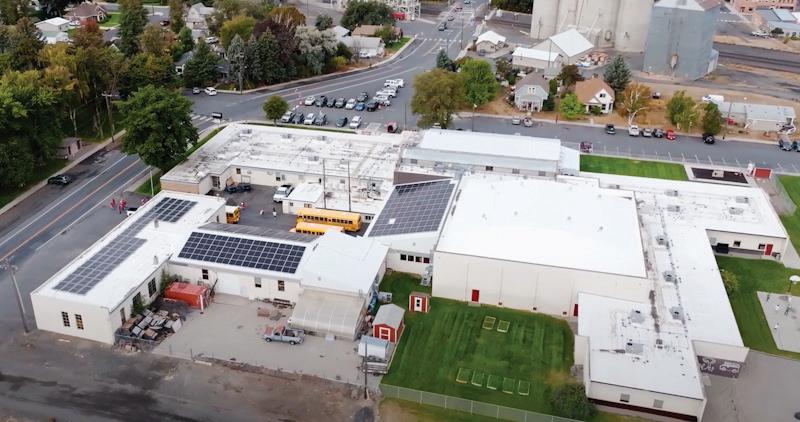
The Harrington (Washington) district has installed solar panels on its campus as part of a program administered by Washington State University Extension’s energy office. Washington State University
said Superintendent Courtney Strozyk.
The schools taking part are expected to achieve nearly $20 million in energy bill savings over the expected 30-year life of the systems, said David Funk, president of Zero Emissions Northwest, the company that’s leading the project with Partners for Rural Washington.
It’s also making renewable energy more widely available.
“Schools can benefit that would never be able to install infrastructure like this on their own,” said Georgine Yorgey, director of the WSU Energy Program. “And many rural schools have high populations of lowincome students who really could benefit.”
Under the program, solar systems are installed on or near schools. Utilities receive a state tax credit and reimburse the partners for the school solar installations.
Once installed, the solar systems could lead to other upgrades, like battery storage, so that the schools can be used as emergency shelters during extended power outages.

April 29-30, 2026
Portland, OR
NORTHERN CALIFORNIA
October 2026
Santa Clara, CA
August 19-20, 2026
Reno, NV
NORTH TEXAS
October 14-15, 2026
Irving, TX













Solar can lower peak energy spending to a more manageable level. This is extremely beneficial in times when energy costs are rising faster than many campuses can adjust their budgets.
These early decisions can significantly reduce costs in the long run and eliminate future barriers.
Solar’s impact extends beyond operations. Today’s students, particularly those in STEM, environmental studies, and architecture and design, expect universities to prioritize climate action. Sustainability efforts consistently rank among the factors influencing school choice, and on-site solar installations reinforce a university’s commitment.
Beyond recruitment, solar installations can support learning and engagement in coursework. This includes bolstering undergraduate and graduate research, creating real-time energy dashboards for classroom use, highlighting them in campus tours, and collaborating across engineering, policy, architecture and business colleges.
Small reductions in electricity use can yield meaningful budget relief for universities. With stable and competitive pricing through a third-party PPA model, institutions can reinvest electricity cost savings into research funding, lab and class -
room technology, student services, facility upgrades and capital projects. Cost savings and climate leadership don’t have to be competing priorities. Behind-the-meter solar can make them mutually reinforcing.
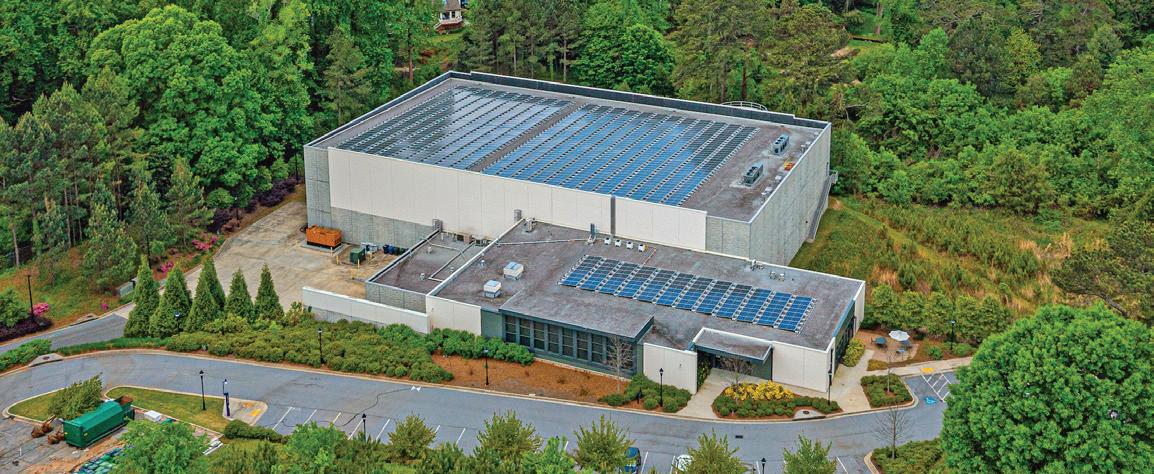
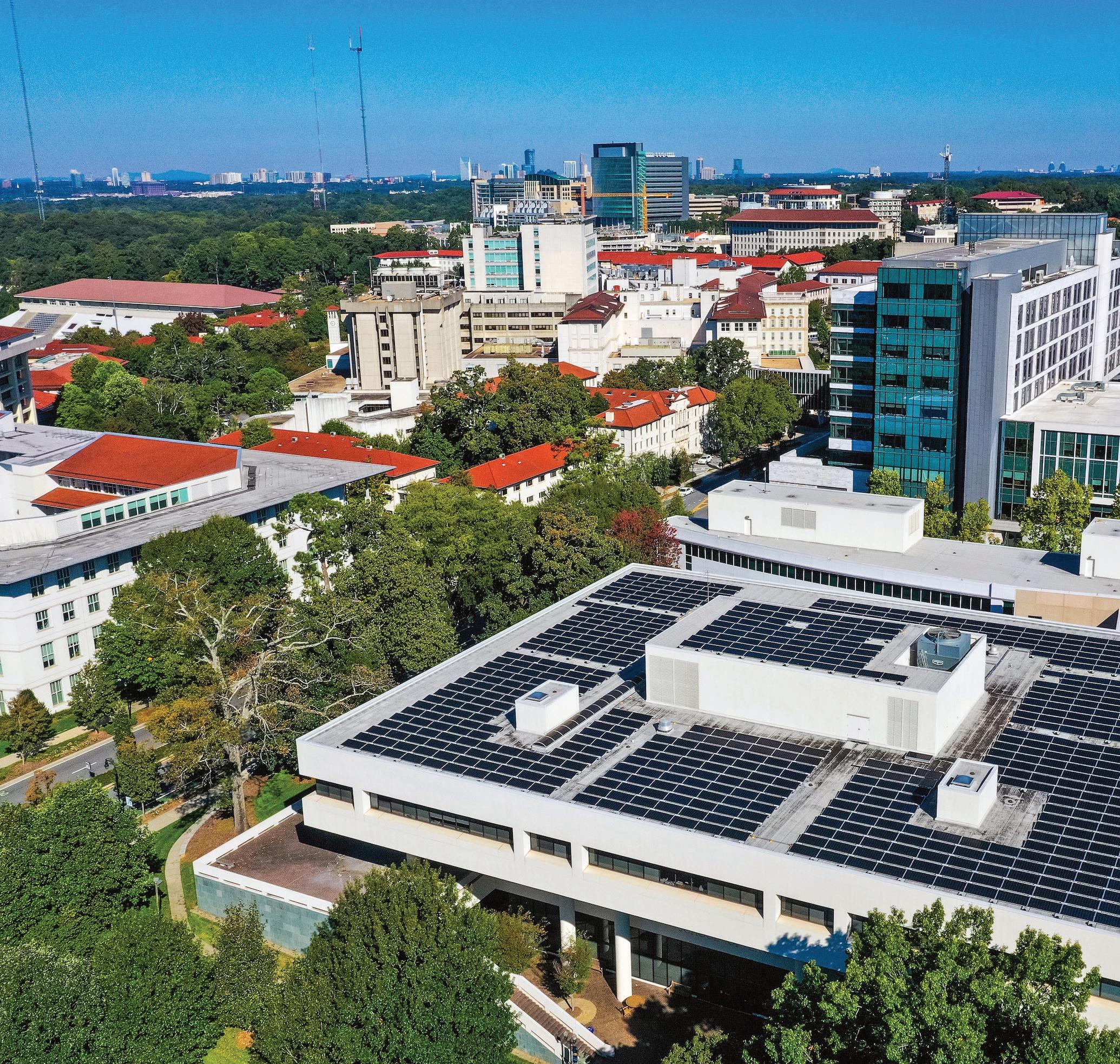
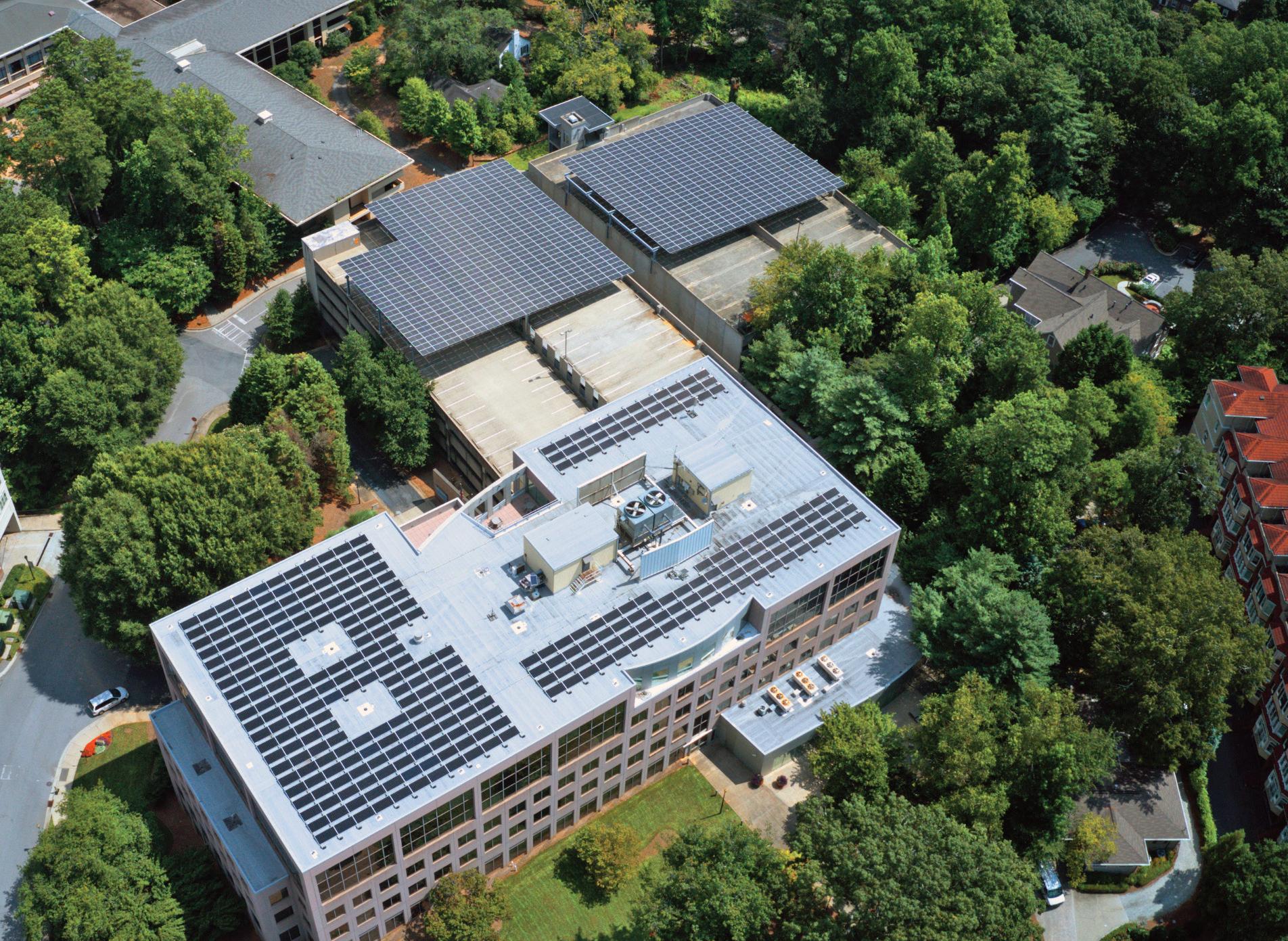
With a stated goal to achieve net-zero carbon emissions by 2050, Emory University has installed 15,000 solar panels across nine solar power systems on its Atlanta campus. They generate about 10% of the university’s peak energy requirements. Since the panels were installed, Emory has avoided over 10,000 metric tons of emissions by using on-site solar PV energy
As universities navigate volatile energy markets and rising climate expectations, on-site solar has evolved from a sustainability initiative into a foundational financial strategy. Behindthe-meter solar is now an integral component of modern campus infrastructure and energy strategy. By right-sizing solar systems and leveraging third-party energy agreements, universities can secure predictable operating budgets, resilient energy systems and a competitive edge in student recruitment.
On-site solar is an investment in institutional strength, academic excellence, and long-term financial stability. Universities that adopt solar are preparing their campuses and students for a resilient future.



















By Paul Erickson
Let’s “dive” into this topic! School natatoriums (i.e., swimming pools) are disappearing from new building designs and some existing pools are being converted for other functions. How did pools initially get into schools? Can today’s schools afford to allocate resources to operating swimming pools?
Here’s some history. In 1914, responding to high rates of U.S. drownings, the American Red Cross inaugurated a Lifesaving Corps that led to structured swimming programs. Swimming popularity soared after American swimmers’ accomplishments in the Olympics and the increased availability of aquatic activities. The 1930s New Deal incentivized pool construction; more than 700 new pools were built and hundreds were remodeled through 1938.
In England in the 1950s, the Ministry of Education and Science, various swimming associations and wealthy benefactors funded pool construction in and near schools. The United States took notice and started a new wave of pool construction.
In 1964, the National Swimming Pool Foundation of Washington D.C., the Red Cross, National Safety Council, and the Council for National Cooperation in Aquatics began “pools in schools” initiatives. Concurrently, civil rights breakthroughs were creating greater public pool access.
The 1970s saw increased construction of pools in schools. However, expenses mounted, as did complaints about irrelevant programs and facility underuse. Consequently, community-and-school aquatics partnership programs emerged to maximize space and use.
Over time, pool viability shifted. In 2009, USA Swimming documented that public schools and municipalities were closing more than 300 pools annually. A 2023 survey by Pool & Hot Tub Alliance estimated that 309,000 public pools were still operating – a steady decline from 600,000 pools reported in 2009 by the U.S. Consumer Product Safety Commission.
Initial construction and ongoing operations costs of school pools are higher than other spaces, because of 1) specialty construction (e.g., basin, pipe tunnels, filtration systems, building enclosure, mechanical systems); 2) special features (e.g., underwater lights, observation windows, deck
space, acoustical treatment); 3) staff requests for enhancements; and 4) inexperienced designers.
Costs to heat and cool the space, heat the water, and maintain the facility can be prohibitive. Replacement costs of piping, valves and other equipment can be excessive.
Many public school pools have been converted into other functions over the last 15 years. Pools have become fitness centers, gyms, classrooms, storage, and performance spaces. A Minnesota district infilled its 8-lane 25-meter pool with six 850-square-foot classrooms and circulation. South Washington County (Minnesota) Public Schools, Manitowoc (Wisconsin) Public Schools and Laramie (Wyoming) Central School District are closing or repurposing facilities because of enrollment declines and budget cuts.
For new pool construction, some schools seek private or community partners (e.g., municipalities, health clubs, colleges, hospitals) to help sustain operations and programming such as community lessons, competitive events, aquatics exercise and therapy).
Intermittently, some public schools and municipalities continue to build or renovate pool facilities. In 2015, the Shawnee Mission (Kansas) School District partnered with Johnson County Parks and Recreation and the City of Lenexa to construct an aquatics center. The City of Boston, Detroit Public Schools Community District, Waukee (Iowa) Community School District and the City of Waukee, and Merced (California) Union High School District are planning or have opened new or revitalized pools.
Before embarking on designs for new pools or conversions, facility planners should analyze the essentials (e.g., program impact, construction/operations/maintenance costs, partnership opportunities, conversion options) and evaluate whether having a pool is viable. Pools provide many benefits for learning, recreation and personal development, and education administrators have to decide if the price is right.
Paul Erickson , AIA/NCARB/REFP, executive officer and partner, is past president of ATSR Planners/Architects/ Engineers. He has 48 years of experience in school planning, design, and construction. Erickson can be reached at perickson@atsr.com .
www.asumag.com www.schooldesigns.com
To purchase custom reprints or e-prints of articles appearing in this publication contact reprints@endeavorb2b.com.
This magazine is available for research and retrieval of selected archived articles from leading electronic databases and online search services, including Factiva, Lexis-Nexis and Proquest.
Your privacy is a priority to us. For a detailed policy statement about privacy and information dissemination practices related to Endeavor Business Media products, please visit our website at endeavorbusinessmedia.com.
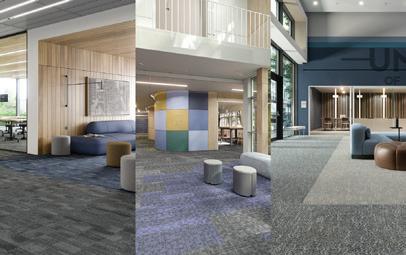
Tarkett has updated three of its ethos® carpet tile and Powerbond® hybrid carpet collections with new color lines. The refreshed collections—Aftermath III SD™, Edifice II SD™ and Primary Color™—are ideal for education environments. Aftermath III SD is an interpretation of Euler’s phi function and Fibonacci’s famous sequence, merging art and algorithm into a distinctive visual harmony. Edifice II SD draws inspiration from the rhythm and geometry of city skylines. Its design builds from layered blocks and shifting perspectives, creating a visual interplay of shadow and reflection. Primary Color captures the energy of motion through its layered, mechanical shifts of color.
https://commercial.tarkett.com/
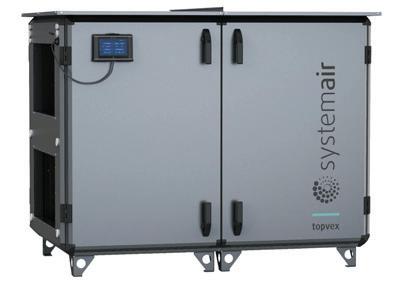
Systemair, a supplier of ventilation, heating, and cooling products and systems, is launching the updated Topvex SR and Topvex TR air handling units in the United States and Canada. Designed for modern buildings that prioritize energy performance and healthy indoor environments, the new Topvex models provide a practical way to meet tightening sustainability requirements. The units deliver high-efficiency rotary heat recovery, a compact footprint, and factory-integrated controls, making them a strong match for offices, schools and other commercial spaces.
www.systemair.net
Joe Agron
Director of Sales Buildings & Construction Group 941-200-4778 jagron@asumag.com
Brian Sack
Account Manager East & Northeast 732-629-1949
bsack@endeavorb2b.com
Randy Jeter
Account Manager South 512-263-7280 rjeter@endeavorb2b.com
Bill Boyadjis
Account Manager Midwest 973-829-0648 bboyadjis@endeavorb2b.com
Ellyn Fishman
Account Manager West 949-239-6030
efishman@endeavorb2b.com
Steve Suarez
Account Manager 816-588-7372 ssuarez@endeavorb2b.com
Armstrong World Industries has acquired Eventscape, Inc., a design and fabrication company known for delivering complex, design-driven architectural environments. Eventscape specializes in the design, fabrication and installation of high-design, complex architectural features for multiple applications including ceilings, feature walls, facades and public art installations. It has added inspiring architectural details that distinguish the interior and exterior spaces for some of the most iconic brands and institutions in North America. Eventscape uses a broad range of materials and technologies to execute designs across diverse applications.
http://armstrong.com/Eventscape


Durawatt® Mini from PVI is a compact, high-performance electric water heater designed for versatility in commercial and institutional applications. Ideal for primary, booster, or recirculation heating, it also integrates seamlessly with sustainable systems like heat pumps and solar thermal setups. Durawatt Mini’s AquaPLEX duplex stainless steel tank eliminates the need for anode rods and resists both aqueous corrosion and chloride stress cracking. Durawatt Mini is a solution for facilities seeking long-term durability, simplified maintenance, and optimized performance in high-temperature applications. www.pvi.com/products/hvac-hot-water-solutions/water-heaters/electric-water-heaters/durawatt-mini

Clopay Corporation has introduced a compact solution for its Counter Fire Doors: the AlarmGard® Conceal Motor Operator. The new space-saving motor operator delivers dependable alarm-triggered closure during a fire while streamlining aesthetics. By enclosing the motor and controller within the door hood, AlarmGard Conceal reduces headroom requirements for the coil and operator by 11 inches. The AlarmGard Conceal Motor Operator can be installed flush with the ceiling, concealing the motor and operator. For counter fire doors 10 feet and wider, AlarmGard Conceal also increases the bracket height and aligns the brackets with the stoppers for a seamless look.
https://www.clopaydoor.com/counter-fire-door
3form has unveiled its 2026 Color Collection. Available in Glass, Chroma, and Varia, the collection imbues confidence in designers to put deep and rich hues found in early modernism at the forefront of projects. The palette of eight iconic hues demonstrate how colors that have been passed through tradition and time are still relevant in modern design. The eight colorways: Cabernet (a berry wine-inspired red), Spice (a saturated amber-orange), Sienna (an earthy terracotta), Safflower (a yellow/golden), Peach, Sprig (a muted green), Indigo (a muted blue), and Russet (an earthy amber-brown).
https://3-form.com/inspiration/2026-color-collection

The Measuring Division of Kaman Precision Products offers its KD-2306 single-channel, multipurpose non-contact displacement sensing system. When paired with any supported dual or single-coil sensor, the KD-2306 offers a highprecision solution for both static and dynamic measurements, ideal for research and development at schools and universities. The KD-2306 supports dual and single coil sensors, ensuring broad compatibility and versatility. Its DIN rail mount interface simplifies integration into OEM equipment and industrial control systems. The device features front face coarse and fine calibration controls that provide precise, onsite adjustments. www.kamansensors.com/


Atlas Copco has expanded its HiLight series of light towers with the addition of the M+ 5 and M+ 7. Built on a shared platform, the M+ light towers combine advanced SMD LED technology with Smart Light Distribution technology. They offer low fuel consumption, full ergonomics with a hydraulic mast and electric rotation, and extended autonomy. This helps reduce operating costs and downtime without compromising performance. The HiLight M+ 5 is equipped with four high-class 250W floodlights offering up to 212 hours of autonomy and the lowest fuel consumption in the range. The HiLight M+ 7 is equipped with four high-class 350W floodlights, offering a higher light output without sacrificing fuel efficiency. https://www.atlascopco.com/en-us/construction-equipment/products/light-towers-us
Sensaphone remote monitoring systems help facility managers identify developing problems with equipment and environmental conditions before they escalate into costly emergencies. By providing continuous monitoring and realtime alerts, Sensaphone systems enable faster response, minimize downtime and help protect facilities, equipment and inventory from damage. Designed for straightforward, always-on monitoring, the Sensaphone Sentry system supports up to five external sensors to track critical parameters such as humidity, power outages, water detection and temperature. For facilities that require expanded monitoring and deeper integration, the Sensaphone Sentinel PRO remote monitoring system strengthens maintenance programs with predictive and preventative capabilities. www.sensaphone.com
Crystal Window & Door Systems has expanded its product line with the launch of the high-end aluminum OPUS lines. All three of the new OPUS window and door model lines – SL38, ML8, and MP – have narrow sightlines, slim but strong frames, robust high-performance thermal breaks, and several designer options for frame profiles. With clean lines, crisp details and precise finishes, each Crystal OPUS product is a work of art. From grand historic restorations and lofty towers to cutting-edge modern projects, Crystal OPUS windows and doors are perfectly suited for all applications. www.crystalwindows.com
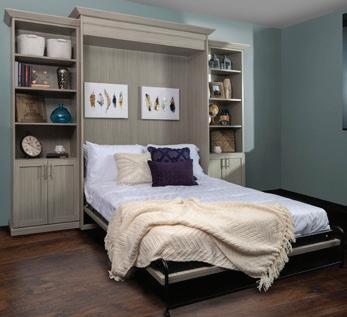
Bethesda Custom Closets custom Murphy beds fold seamlessly into built-in cabinetry to transform underused areas into flexible living, study or guest spaces. The beds enable student housing communities to make the most of limited square footage while maintaining a clean, built-in aesthetic. When closed, the system integrates with cabinetry that can incorporate shelving, desks, or storage—supporting the multifunctional way students use their rooms for sleeping, studying and socializing. The Murphy beds provide a flexible solution for student apartments, micro-units, and shared living spaces. By integrating sleeping, storage, and workspace into one cohesive system, Bethesda helps communities create more efficient and livable spaces.
https://bethesdaclosets.com/murphy-beds/
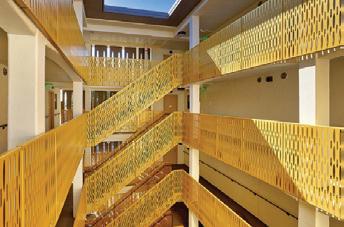
BŌK Modern has released the Stair Guardrail Fascia Mount, a pre-engineered guardrail solution designed for interior and exterior use. The system mounts to the top or exterior of stair stringers, with joints oriented either at right angles to the stringer or perpendicular to the treads, providing architects and builders with flexible detailing options that avoid visual clutter. The guardrail brackets fasten directly to the BŌK Universal Mount, which offers adjustability in all directions and in rotation, allowing installers to fine-tune each connection for a precise fit.
https://bokmodern.com/products-standard/stairs/


Mopster 2.0 from Hospeco Brands Group is a highly effective spray mop with a cleaning solution built in. It does an effective job without the need to break out a bucket-and-mop combo that might obstruct patrons or send the wrong brand message. Mopster 2.0 helps improve ergonomics and efficiency and enables discreet, ongoing cleaning during business hours. Lightweight and highly portable, it speeds up cleaning while helping to reduce physical strain. Because it’s bucketless, it is ideal for quick or spot cleaning unobtrusively without the unhygienic “standing bucket” of dirty water and a worn mop.
www.hospecobrands.com




Afather whose son is accused of fatally shooting four people in 2024 at a Georgia high school has been found guilty of murder and other charges after providing his son the gun allegedly used in the shooting.

USA Today reports that a jury in Barrow County found Colin Gray, 55, guilty of numerous charges. Prosecutors said Gray provided his then-14-year-old son with a gun and should have known the danger the boy posed.
Colt Gray allegedly opened fire in September 2024 at Apalachee High School in Winder, Georgia. The attack killed students Mason Schermerhorn and Christian Angulo, both 14, and teachers Richard Aspinwall and Christina Irimie. Nine others were injured.
The case against the father was “about who armed Colt and who enabled him to do what he did,” prosecutor Patricia Brooks told jurors.
The younger Gray has not yet been tried. He is facing 55 charges, including murder, aggravated assault and cruelty to children.
Colin Gray testified at the trial that he gave his son the rifle allegedly used in the shooting as a Christmas present.
Ravi V. Bellamkonda has been appointed president of Ohio State University following the abrupt resignation of Walter “Ted” Carter Jr.
Bellamkonda has been Ohio State’s executive vice president and provost since January 2025 and previously served as an administrator at Emory University and Duke University.
His promotion to the university president’s job came only a few days after the board of trustees accepted Carter’s resignation. Carter left his position for personal reasons after disclosure of “an inappropriate relationship” he had with a woman seeking public resources for her personal business.

The University of Texas System Board of Regents has approved construction plans for the first building on a new campus—The University of Texas at Arlington West in Fort Worth.
Chron.com reports that the regents allocated $94.4 million for construction of a 150,000-squarefoot facility on the 51-acre campus that is being developed on

the western edge of Fort Worth near Aledo. UTA West is projected to welcome its inaugural class in fall 2028.
An additional $55.1 million has been approved for design services, fixed equipment and project management.
Construction was expected to begin on the building in March. Final completion is projected for May 2028.
The Santa Cruz (California) district is building a 100-unit Educator Housing Development to provide affordable spaces to live for teachers and support staff who work for the district.

The Santa Cruz Sentinel reports that the $85.9 million, fourstory housing complex will
consist of 11 studio apartments, 28 one-bedroom apartments, 50 two-bedroom apartments and 11 three-bedroom apartments. The development will charge rent at 60% to 70% of market rates.
The project has been in development since 2015. The Santa Cruz district has found it difficult to keep teachers on the job because of high rent prices in the city. New teachers were leaving the district after three to five years, Santa Cruz Superintendent Kris Munro said, because high housing costs often forced them to live with roommates. Around 95% of declined job offers are attributed to high housing costs, the district said.
Entry Forms Due: June 12
Portfolios Due: July 24
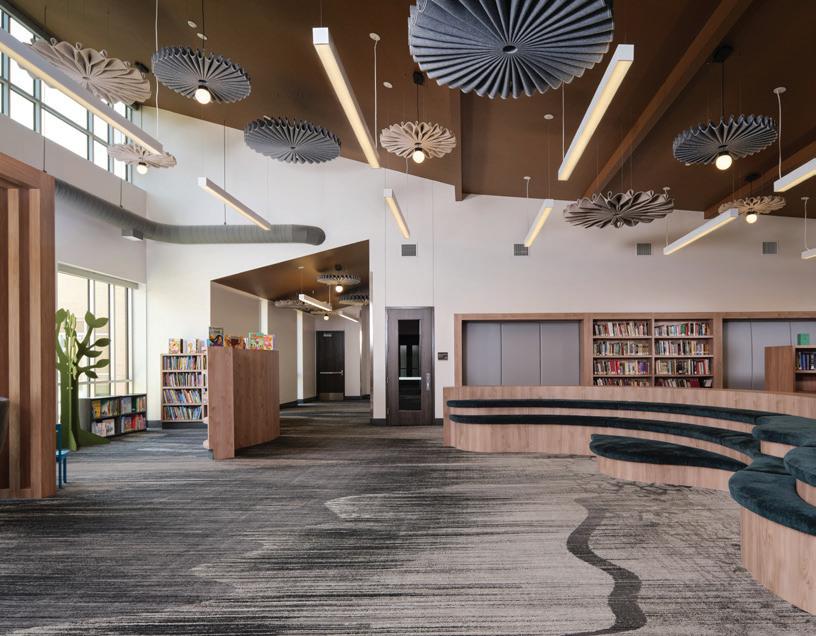
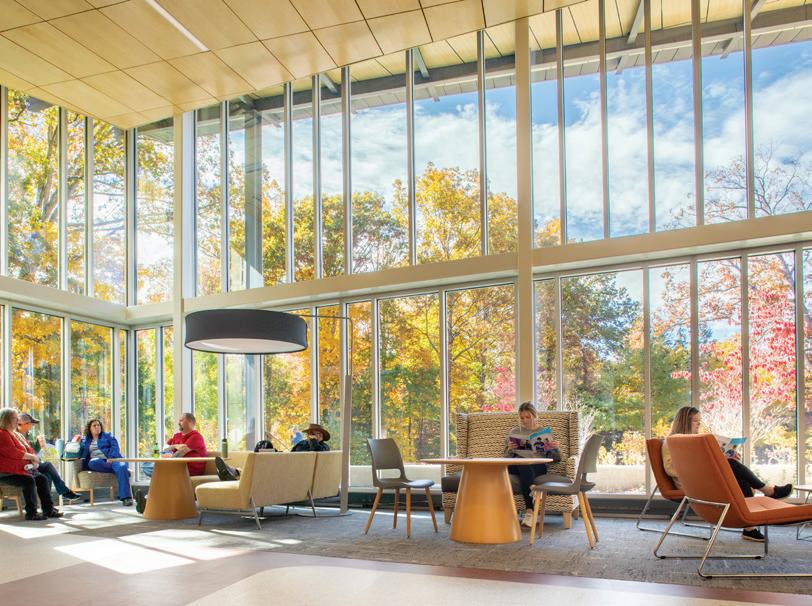

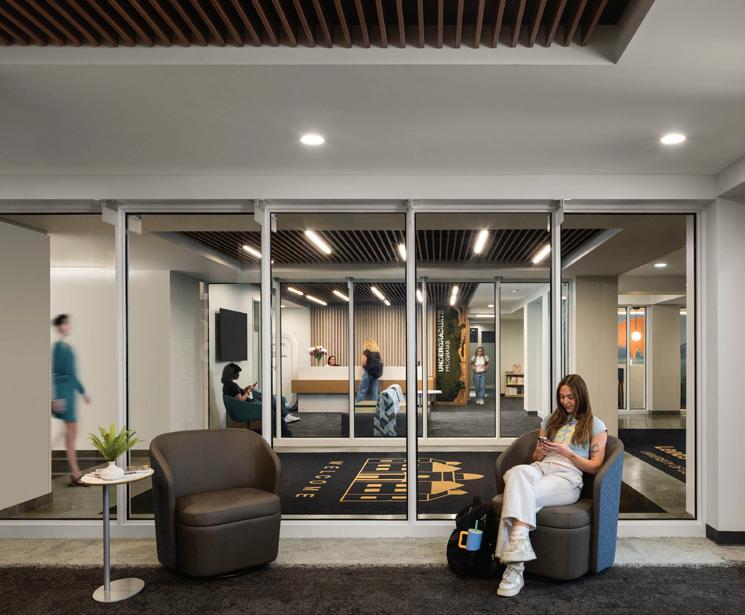


Entry Forms Due June 12. Portfolios Due July 24.
• Discounts for multiple projects and multiple pages.
• Open to projects completed since January 1, 2021.
• Entry categories for pre-K through higher-education. New construction, renovation, and work in progress.
• Featured in the fall 2026 Architectural Portfolio issue, full-screen galleries on SchoolDesigns, and our e-newsletter.
• Larger circulation, including expanded reach to school boards and industry event partners.
• National recognition for you, your project, and the school or university.
• Free print-ready PDF for multiple entries and multi-page projects. Contact Heather Buzzard at hbuzzard@endeavorb2b.com or visit SchoolDesigns.com to enter today.
by