

Maintenance, All Vehicle Classes, All Management, All the Time






Maintenance, All Vehicle Classes, All Management, All the Time














If passed, will the right-to-repair legislation lift uptime or fracture the balance between OEMs and independent shops? Page 20


















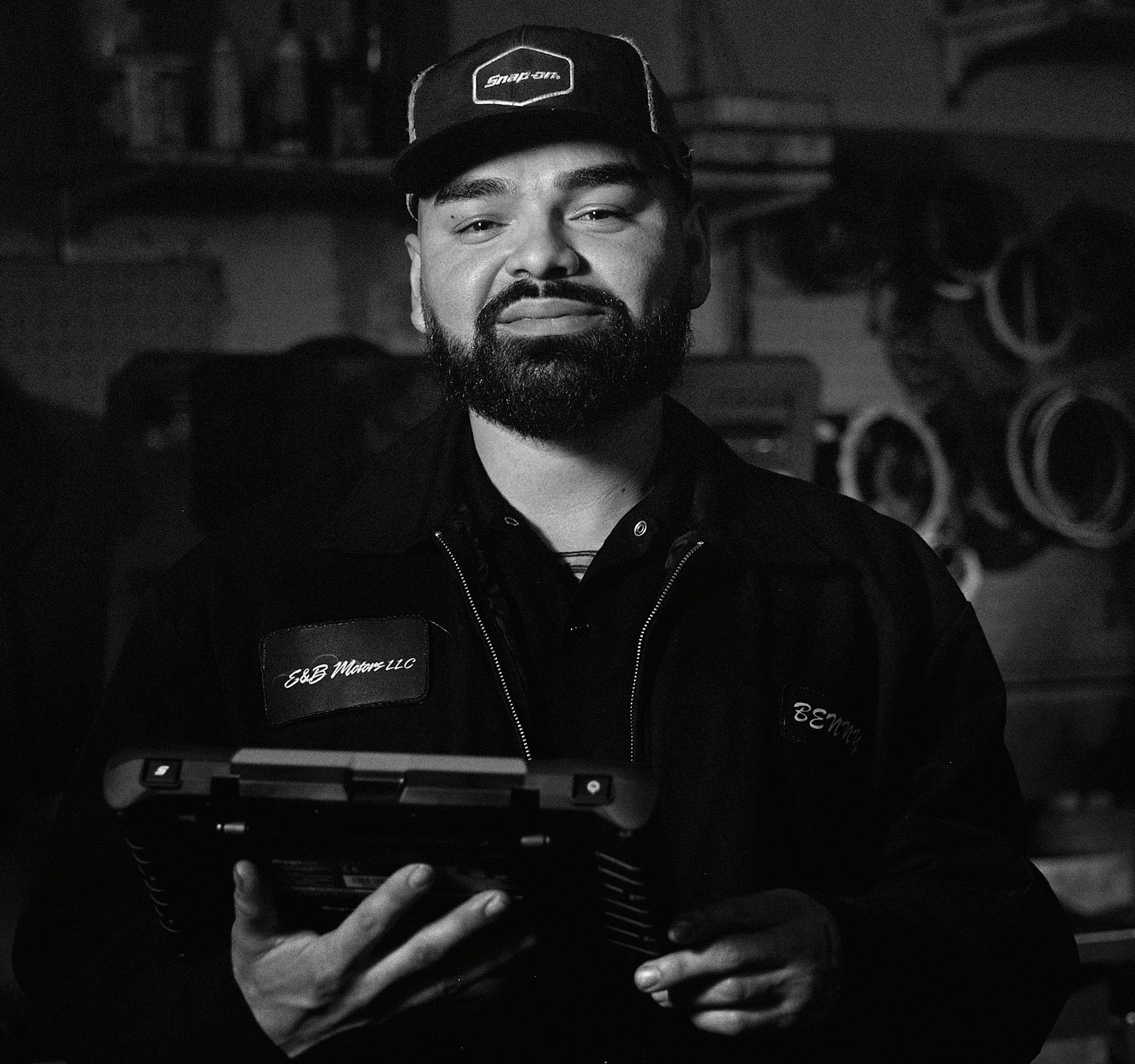













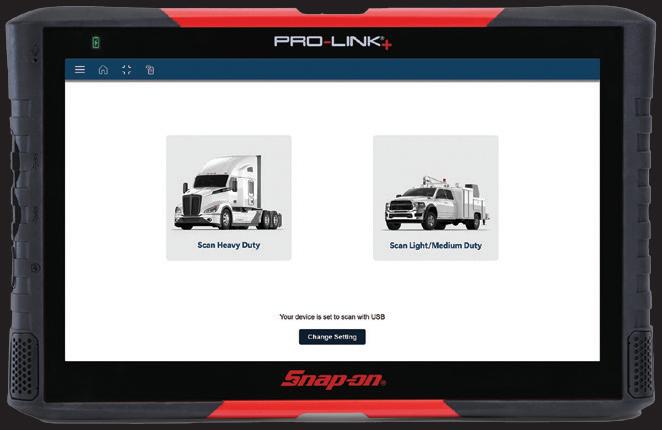
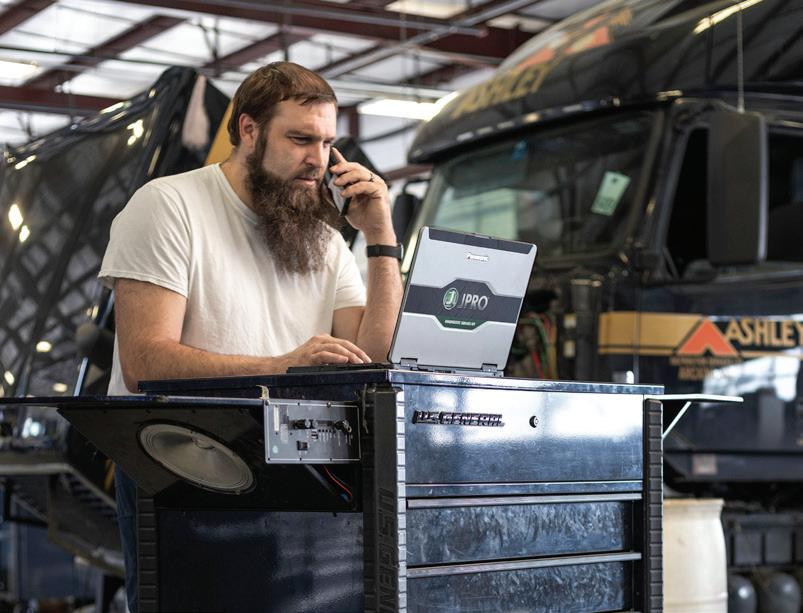
PRO-LINK+, built for servicing a complete range of commercial vehicles, makes Benny more than just a pitstop technician - it makes him an efficiency expert.
Under the hood, PRO-LINK+ delivers:
• OEM-specific coverage for engines, transmissions, chassis, and brakes
• Code-specific information with detailed testing procedures, component photos and wiring diagrams
Take control with over 200 special tests and 600 user-configurable parameters. Built tough for medium and heavy-duty trucks, PRO-LINK+ is your essential diagnostic companion.
p. 8
Equipment
No more idle chatter
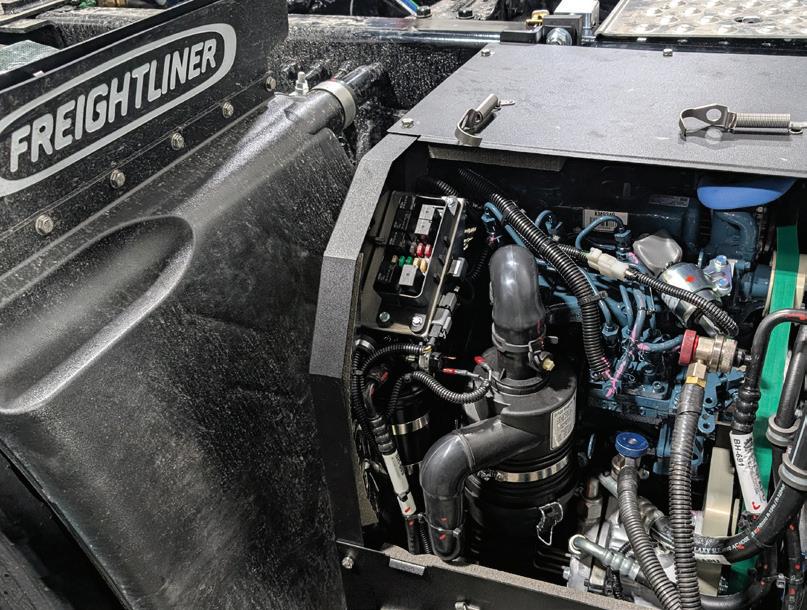
Fleets that frequently idle aren’t just burning excess fuel; they’re likely losing money, so it’s time to rev up the calculator and crunch the numbers on anti-idle systems like APUs.
p. 14
In The Bay Go Cart! Diagnostic Cart Buildouts
A practical look at building a diagnostic cart that supports faster, more accurate troubleshooting.
p. 20
Shop Operations
Breaking down the REPAIR Act
Is the third time the charm for the REPAIR Act, or will a new OEM-approved Right to Repair bill have more luck making it through the legislative process?
p. 26
NOx Sensors
School of hard NOx sensors
Here’s everything you need to know about one of the most replaced—and misunderstood— emissions system components.
p. 28
Trailer Connections
The search for J560’s replacement
The industry wants smarter trailers, but at some point, tractor-trailers will need more capable connectors as well. First, stakeholders must agree on a standardized design.
p. 32
HDAW Roundup
News from Heavy Duty Aftermarket Week
From vendor transparency to updates on the FleetPride/TruckPro merger, here’s notable news from Heavy Duty Aftermarket Week.

Hitched Up Right to Repair takes a Topsy turvy turn
Fleet Parts & Components
new in products for more efficient fleet operation
Tools & Equipment
roundup of the latest tool and equipment offerings
Industry First Reinventing the wheel end
Cover image: Erin Brown, generated with Shutterstock AI; 2228839874 | MileA | Getty Images; 44089526 © Yotsatorn Laonalonglit, 3594004 © Brandon Seidel, 142859317 © Filindmitriy86 | Dreamstime.com; 566387782 | Shutterstock
Visit the official website of Fleet Maintenance for more information from stories in this issue, plus online exclusives on pertinent topics in the fleet maintenance management industry.

Stay up-to-date on industry news and events, new product launches, and more. FleetMaintenance.com/subscribe
ARTICLE
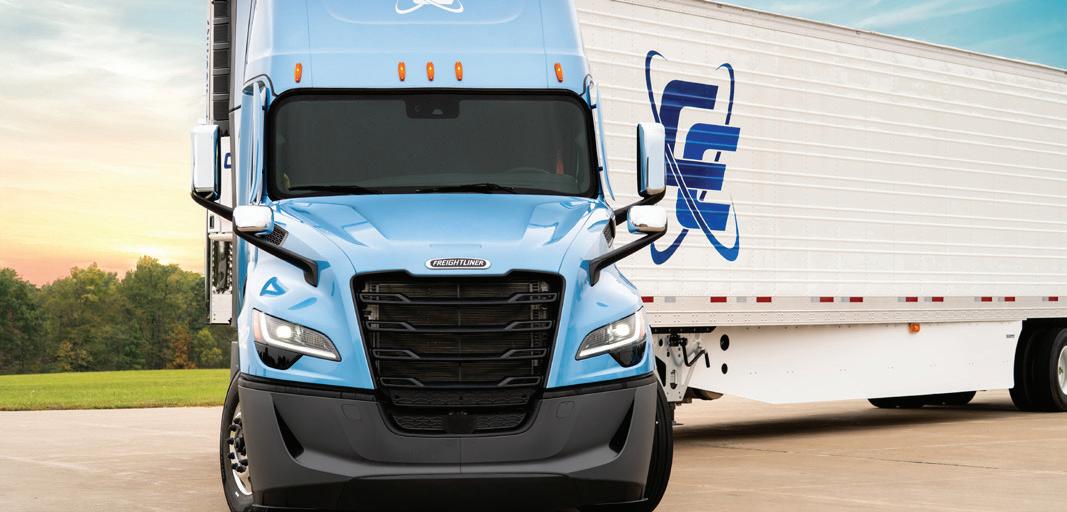
Continental Express’ secret to weathering recessions? Consistency.
Outlasting recessions is nothing new for Ohio-based mid-sized reefer fleet Continental Express, which is reaching new heights by doing what it has always done: consistent investment in new equipment, thorough maintenance, and taking care of its people. FleetMaintenance.com/55341843
ARTICLE
Hiring techs, diagnostics still top shop challenges, Noregon says
The latest industry report from Noregon Research found these issues also vex fleets’ maintenance teams the most. FleetMaintenance.com/55344685
DOJ won’t pursue jail time for diesel deleting; civil penalty risk to remain
The DOJ said they will no longer jail people for tampering with emissions systems or selling diesel delete devices, but your wallet is still fair game. FleetMaintenance.com/55352642
What to expect for PC-12 engine oils with Shell’s Karin Haumann
With PC-12 engine oils on the way in 2027, fleets need to be prepared for how the new category will impact their assets and know how to choose the right oil for their business. FleetMaintenance.com/55342055
The Fleet Lead podcast features EndeavorB2B’s CV journalists and aims to help fleet managers and trucking professionals navigate the industry. It covers topics like new technology, efficiency, and regulations with expert analysis and realworld insights.
Spotify Apple Podcasts
Published by Endeavor Business Media, LLC
30 Burton Hills Blvd, Ste. 185, Nashville, TN 37215
800-547-7377
Vol. 29, No. 1
FLEET MAINTENANCE
Market Leader - Commercial Vehicle Group Dyanna Hurley 248-705-3505 | dhurley@fleetmaintenance.com
Editorial Director Kevin Jones kevin@fleetmaintenance.com
Editor-in-Chief John Hitch john@fleetmaintenance.com
Associate Editor Alex Keenan alex@fleetmaintenance.com
Associate Editor Lucas Roberto lucas@fleetmaintenance.com
Contributors Seth Skydel, Gregg Wartgow
Sales Development Representative Sachin Sinha sachin@fleetmaintenance.com
Fleet Maintenance Multimedia Account Executives
Multimedia Account Executive - West Michael Simone 973-713-0094 | michael-s@fleetmaintenance.com
Multimedia Account Executive - Southeast Peter Lovato 231-233-2660 | peter@fleetmaintenance.com
Multimedia Account Executive - Northeast Larry Schlagheck 248-444-1320 | larry@fleetmaintenance.com
Tool & Equipment Multimedia Account Executives
Multimedia Account Executive - Midwest Diane Braden 920-568-8364 | diane@fleetmaintenance.com
Multimedia Account Executive - West Mattie Gorman-Greuel 920-563-1636 | mattie@fleetmaintenance.com
Multimedia Account Executive - East Cortni Jones 920-568-8391 | cortni@fleetmaintenance.com
Production Manager Patricia Brown Ad Services Manager Karen Runion
Art Director Erin Brown Audience Development Manager Laura Moulton
ENDEAVOR BUSINESS MEDIA, LLC CEO Chris Ferrell COO Patrick Rains CDO Jacquie Niemiec
Join the conversation: Facebook.com/ FleetMaintenanceMag
Follow us on X.com/fleetMx
Connect with us LinkedIn.com/ company/fm-mag
Watch our videos youtube.com/@ fleetmaintenance
READ ANYTIME, ANYWHERE Read the digital edition online at FleetMaintenance. com/magazine




IL 60065-3257
ARTICLE REPRINTS reprints@endeavorb2b.com Fleet Maintenance (USPS 020-239; ISSN 2150-4911print; ISSN 2150-492Xonline) is published nine times a year in January/February, March,




Meet us at ConExpo–Con/Agg 2026 in Las Vegas.
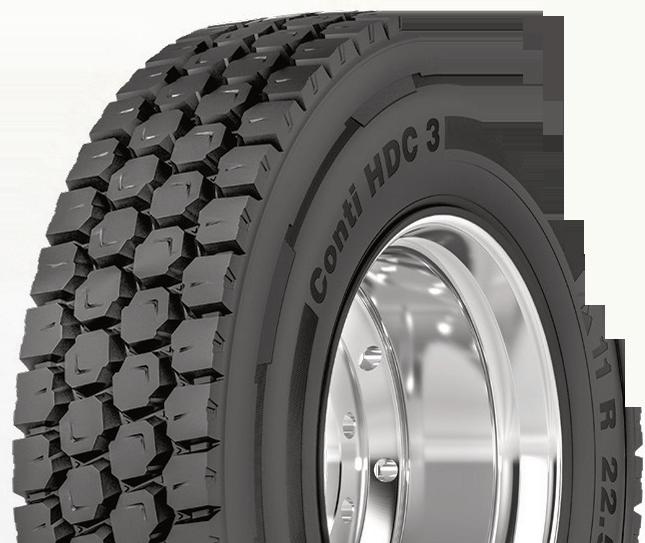



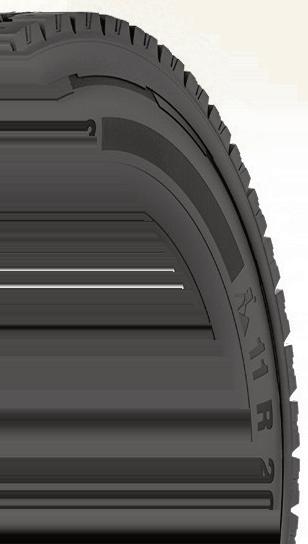
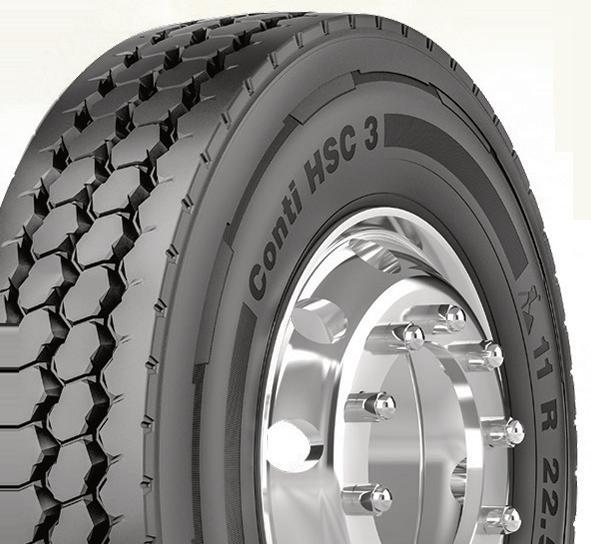

Construction Drive Tire







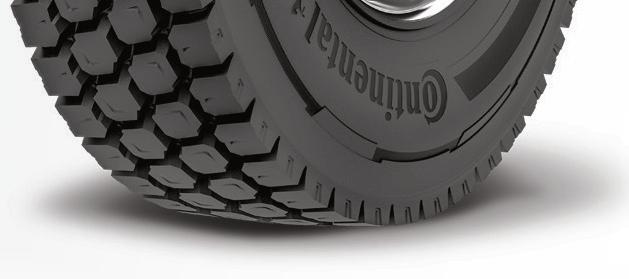

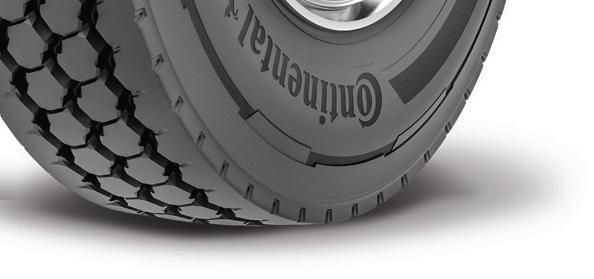
Construction Steer Tire
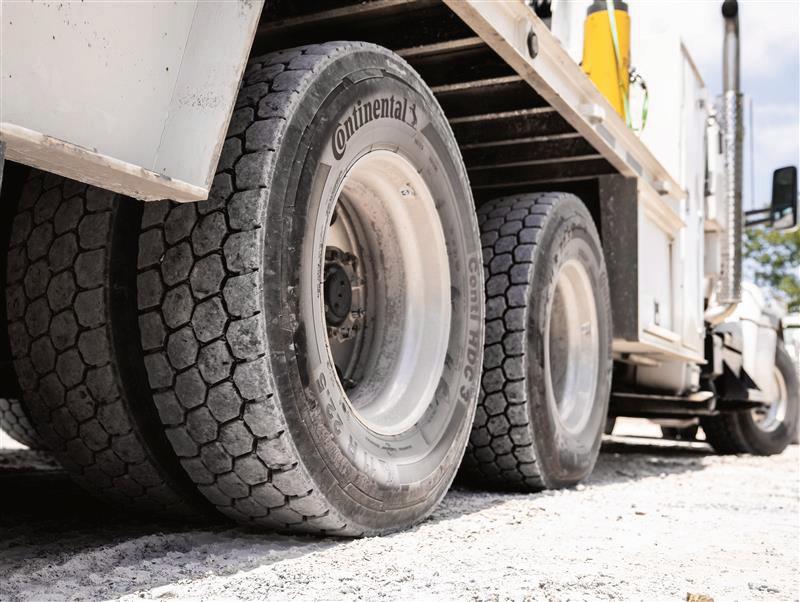
When the ground gets tough, Continental construction tires get tougher. Our lineup delivers the durability, traction, and uptime your operation demands—day after day, shift after shift.
In 2026, we’re bringing that performance to the biggest stage in construction.
Explore our latest tire innovations, talk with our experts, and see how Continental keeps your fleet rolling. Conti HDC 3
What do Thomas Edison and an electrocuted elephant have to do with right to repair? Maybe nothing; maybe everything.

By John Hitch Editor-in-chief
The fight for access to data has put the a ermarket and OEMs at odds as they wrestle for the right to write federal right-to-repair standards (Pg. 20). It’s not the fi rst time two industrial heavyweights went to blows over the precious resource du jour. e War of the Currents remains the gold standard. And because history has a pesky way of repeating itself, it serves as a road map for what not to do as the various companies, lobbyists, and politicians amp up their R2R campaigns.
In the late 19th century, everyone knew that electricity would change everything. e disagreement was how to harness it. omas Edison believed the power grid should run on low-voltage direct current, while Nikola Tesla and George Westinghouse argued for high-voltage alternating current.
Edison, who had the patents, infrastructure, and sheer will, struck fi rst with a small-scale DC grid in Lower Manhattan to reliably power dozens of streetlights. But AC could travel farther and more e ciently, providing power to more people. Despite Edison’s advantage, AC won out.
Learning to control any force of nature rarely comes without casualties. Early electrical work was dangerous, and workers o en lacked protective gear or safeguards. Back then, the closest thing to OSHA was the last thing you cried before hitting the ground (“Oh shi….”)
Edison’s companies turned these tragedies into opportunities, highlighting the inherent danger of AC. DC, though more costly to overcome energy loss, was safer, they argued. at argument held merit; many linemen died in the early days. But specifically regarding Westinghouse, records indicate far fewer deaths than the media and Edison’s camp claimed.
Enter Harold P. Brown, an “independent” critic who lambasted AC power in op-eds, claiming safety had been sacrificed for profits. Edison liked the cut of his jib and provided the resources for Brown to show how deadly AC was by electrocuting cats and dogs. Brown later staged the fi rst execution by electric chair in 1890, and surviving letters indicate Edison was directly involved in coaching Brown to convince authorities the process was humane and e ective.
is was all done as the propaganda war to defeat Westinghouse escalated, though it was to no avail; AC simply proved the better option. Edison’s idea to insulate underground
lines in cities was later adopted as AC infrastructure matured. Had Edison collaborated with Westinghouse to develop safer measures instead of fomenting fear, it’s possible fewer lives would be lost. And Edison’s legacy would be far cleaner— and not as closely tied to the tragedy of Topsy the Indian elephant.
A er allegedly killing a drunk ru an for burning her trunk with a cigar, the misunderstood pachyderm moved homes, now trying to fi nd her way in man’s world, working for peanuts at Coney Island. But her trainer, also a bit of a drinker, commanded her to attack the police, or she followed him to the station a er he was arrested. Reports vary, but the noble beast was branded a menace and sentenced to death.



» After being fed a cyanide-laced carrot, Topsy was shackled with copper sandals and electrocuted in 1903.
Screenshot “Electrocuting an Elephant” | Edison Manufacturing Company
Topsy was publicly electrocuted at Coney Island in 1903, with many still believing omas Alva fl ipped the switch himself. e truth is Edison Electric Illuminating Co., not owned by Edison, provided the 6,600 volts of AC, which took an excruciating 10 seconds to topple Topsy. And yes, Edison Manufacturing Co. did provide the fi lm crew to capture it all.
You can blame Edison for the invention of the Kinetoscope camera, but no records link him to the event. In this case, blame Whitey (as in her abusive handler, William “Whitey” Alt.)
Back to R2R. e a ermarket-supported REPAIR Act provides universal access to repair data to all shops and vehicle owners. e OEM side has argued that the bill as written allows third-party access to proprietary data unrelated to repairs, which could have a damaging e ect. Insurance companies could use this data to spy on your speeding habits and raise your rates, while foreign competitors could steal OEMs’ trademark secrets. ese arguments surfaced during a Jan. 13 hearing by U.S. House Subcommittee on Commerce, Manufacturing, and Trade on vehicle safety.
During his questioning of Hilary Cain, SVP of policy for the Alliance for Automotive Innovation, Rep. Tom Kean, Jr. of New Jersey,
who noted the state was once home to Edison, wondered if federal repair laws could infringe on modern innovators’ IP and lead to customers buying less tested (i.e. dangerous) parts from China.
Meanwhile, the a ermarket side theorizes that without their bill, the OEMs are out to destroy the a ermarket and jack up parts and repair prices. e U.S. parts a ermarket generated over $500 billion last year and the pro-REPAIR Act Auto Care alliance itself admits indie shops outnumber dealerships 15 to 1. is type of polarizing rhetoric from both sides gets us nowhere and is contrary to this industry’s nature. Vehicles are about taking you places, and the repair industry is about fi xing things. So let’s move to a solution. Both sides publicly agree that R2R should exist. As Edison did with DC power, the OEM’s unsponsored SAFE Repair Act contains good ideas that could strengthen the REPAIR Act, such as a transparency proviso similar to a CARFAX for repair parts. If both sides can dispense with the hyperbole and work together, a real solution that improves uptime for everyone can fi nally see the light of day.
But if instead they wage a propaganda war to serve self interests over the customer and industry, remember that unlike in Topsy’s era, we have access to all the data— and the modern record has a memory like an elephant.








































Jaltest Diagnostics enables hands-on service in the shop, while Jaltest Telematics extends maintenance beyond it through remote actions. ce, no essw
Uptime depends on well-executed maintenance, not guesswork.














Fleets that frequently idle aren’t just burning excess fuel; they’re likely losing money, so it’s time to rev up the calculator and crunch the numbers on anti-idle systems like APUs.


By Gregg Wartgow









































If your fleet’s sleeper trucks idle more than 1,000 hours a year, it’s time to ask yourself if you, too, have remained idle too long. At the very least, shi into low gear and run the numbers on idling costs versus the total cost of ownership for an auxiliary power unit, or APU.
ere are several di erent options to reduce idling, ranging from diesel-powered and electric APUs to bunk heaters and OEMs’ battery-powered HVAC systems. Even in the specific longhaul segment, the ROI for each can vary greatly from fleet to fleet, as can the various hotel loads. One driver might only need climate control and juice to run the fridge, while another powers a microwave, television, and gaming system. In addition, those who su er from sleep apnea may need a CPAP machine, which can consume up to 800 Wh at max setting.
But you can fi nd the best fit with a few calculations and a review of the latest North American Council for Freight Efficiency Confidence Report, titled e Idle-Reduction Playbook: Operational Strategies for Modern Trucking Fleets.
e Confidence Report exhaustively details the many idle mitigation solutions, but one thing is clear: ey all provide maintenance and cost benefits versus leaving the engine idling all night. On APUs, specifically, NACFE has found that advances in APU technology and other anti-idle products have made them more attractive than letting a Class 8 sleeper’s engine run throughout an extended Hours of Service rest period.
“We are currently at a technological and economic inflection point,” Dean Bushey, the report’s lead author, told Fleet Maintenance. “Fuel remains the second-largest operating expense for fleets, accounting for 20% to 25% of total costs.”
Wear and tear also increase, leading to additional downtime and repair expenses.
“Component failures are also more likely to happen sooner due to that extra idling time on the engine,” said Sid Gnewikow, APU portfolio leader at ermo King, a provider of both diesel and electric APUs.
Furthermore, several states have adopted idling restrictions for buses and trucks, ranging from no idling in Washington, Idaho, and Illinois to five minutes or fewer in California, Pennsylvania, Florida, and New York. To fi nd out what the restrictions and fi nes are by state and county, use the U.S. Department of Energy’s database, IdleBase.
Due to these reasons, “idle reduction has moved from a fuel-saving ‘extra’ to a core economic necessity for many modern fleets,” Bushey, NACFE’s director of programs, said.
As with any onboard technology, though, what saves money and cuts downtime for one fleet or route might have the inverse e ect for another. And a technology that failed five years ago might be mature enough to succeed today.
Fleet managers will have to figure out a lot of this on their own, but we’ve collected several best practices and updated learnings on the many anti-idle options out there to help get you moving in the right direction.
Idling burns about 0.8 gallons per hour, based on Department of Energy data, which equates to 8 gallons per 10-hour rest period, or around $30 per night with average diesel costs hovering around $3.50/gallon. Annually, this cost can rise above $6,000 when idling around 1,800 hours per year, NACFE noted.
NACFE estimated that when such fl eets purchase and install a diesel APU, they see an ROI in 12 to 24 months. Various industry surveys have placed sleeper adoption of diesel APUs at around 40% in 2010 and 55% in 2010. With an all-electric APU (eAPU), assuming diesel is at $4/gallon, the fuel savings alone pay for the device in 18 to 30 months. Incentives and factory-ordered options can shorten that ROI period to under two years, the report stated.
At 0.2 gph (under a moderate load), a modern diesel-powered APU burns a quarter of an idling engine, according to NACFE. An eAPU doesn’t burn any, although a modest amount of idling may be necessary to keep the batteries charged. And in freezing temperatures, drivers will likely idle to warm up the engine to prevent cold start wear and heat and defrost the cab. Certain diesel APUs can integrate into an engine block heater, and in open-loop systems, they can share a radiator with the engine to prevent cold starts.
On the maintenance side, the generally accepted rule is that an hour of idling is equivalent to at least 25 miles of driving. If idling 10 hours a day, 300 days a year, that’s like putting another 75,000 miles on the truck engine. at’s another oil drain or two per year.
Fleets should also consider the impact of excessive idling on a truck’s a ertreatment system. Based on Green APU’s online savings calculator, 3,000 hours of idling per year adds roughly $2,400 worth of a ertreatment-related costs. NACFE estimated $600 to $2,000 for DPF maintenance, as idling creates more clogging
and forced regeneration. Maintaining a diesel APU can cost $300 to $600 per year for PMs such as oil and fi lter changes.
“If your shop isn’t trained to service diesel APUs as rigorously as the tractor itself, the ROI will evaporate,” Bushey said.
However, of the 14 fleets that participated in NACFE’s 2024 fuel study, about 14% reported using diesel APUs, while only 7% said they currently used them. Bushey explained that the overall low penetration reflected how day cabs comprised the majority of these fleets, though the amount that discontinued diesel APUs showed that undermaintenance, improper spec’ing, and lack of driver buy-in can doom a successful deployment.
Electric APUs don’t require nearly the same routine maintenance, needing only some cleaning and inspections. ey typically have a higher upfront cost. e latest generations benefit from battery advances that allow them to last even longer and improve their ROI.
“We are seeing a resurgence in eAPUs, but they won’t entirely replace simpler methods,” Bushey said. “Lithium eAPUs now provide 10 to 17 hours of cooling with zero engine maintenance.”
He suggested pairing an eAPU with a bunk heater, which “at an installed cost of $1,000 to $2,000, they pay for themselves in months by saving roughly 85% to 90% of winter idle fuel.”
For summer cooling, you turn on the eAPU.
Another option for fleets is fi nding a truck parking spot with a shore power hookup. e problem is only 2,000 of these electrified spots exist and are spread out across 100 to 150 facilities, Bushey noted.
In general, Bushey’s rule of thumb for any solution to avoid a failed deployment is: proper spec’ing + driver buy-in + rigorous maintenance.
“Tech that drivers fi nd complicated or unreliable won’t be used,” he concluded. “ e best results come from combining tech with training and incentive programs that align fuel savings with driver comfort.”
A er a fleet decides an APU is right for them, the next question is if it wants a diesel or all-electric version. Factoring all the power draws will discern that an eAPU can get drivers through a 10-hour rest period.
“Fleets need to account for the total hotel load, including climate control, appliances, electronics, and anything else drawing power,” said Bill Maddox, senior manager for product at Carrier Transicold, a provider of diesel and electric APUs. “Our Aspen diesel APU, for example, delivers 5.2kW continuously and can handle HVAC and multiple hotel loads simultaneously while also heating the tractor engine and maintaining a battery charge. Battery-based APUs may struggle when demand is high or runtimes are long.” at has defi nitely been the argument against traditional AGM battery-style eAPUs. However, new battery technologies are leveling the playing field.
Lithium-ion batteries are capable of providing the power needed to fully operate an eAPU for a full 10 hours. ey utilize a “lithium iron-phosphate” chemistry, or LiFePO4, which is known for its thermal stability and high cyclability. e result is considerably longer runtimes and life cycles than AGM-style APUs.
Carrier Transicold, DClimate, Dragonfly Energy, and Polar Fox APU have already introduced lithium-ion eAPUs. Gnewikow said ermo King continues to explore this approach.
Fleets should always consider their specific application to determine if diesel or electric makes the most sense. Analysis of total cost of ownership (TCO) should factor into that determination.
Purchase price: Diesel APUs have generally cost more up front than AGM-style eAPUs. However, lithium-powered products in general have historically been more expensive than their gas- or diesel-powered counterparts. at is changing.
“ e price of lithium cells and battery packs has dropped dramatically,” said Martin Du y, executive vice president of DClimate, a Transtex brand that specializes in eAPUs. “Generally speaking, the eAPU we introduced in March 2025 should be the same price or even a tad lower than a comparable diesel unit. I could never have said that five years ago.”
Dragonfly Energy says its lithium-powered eAPU is also less expensive to purchase than a comparable diesel. In addition, even though it’s more expensive than an AGM-style eAPU, it o ers significant cost savings over time due to reductions in fuel consumption and required maintenance.
Fuel consumption: While a diesel APU eliminates idling, it does burn 1/4 gallon of fuel per hour to operate. According to data from Dragonfly Energy, an AGM-style eAPU doesn’t consume fuel, but it does require 8 to 12% idling because it normally can’t make it through a full 10-hour
Flexible cab/trailer panels
20-23% efficiency
AUTONOMOUS
No driver = no cab comfort
Sensors-only power
SHORE POWER
Electrified truck stops
Grid-connected parking
Source: NACFE
rest period. Even a lithium-ion eAPU will likely incur some idling, albeit much less.
“We designed our Battle Born All-Electric APU to store enough energy to get through a driver’s 10-hour rest period, even in the hottest climates when the AC is working the hardest and pulling max power,” said DJ Hasler, market manager for HDT at Dragonfly Energy. “In real-world usage, however, drivers sometimes don’t drive long enough to charge 100%, or maybe they’re on the road a while and need to do a 34-hour reset.” at is why Dragonfly Energy estimates an average of 2% idle over the course of a year.
Solid state 400+ Wh/kg 10+ hour eAPU runtime
Predictive management
Weather-aware planning
ELECTRIC HVAC
Engine-oil climate
Heat pump + 48V systems
In 2024, technology support company Velociti partnered with Dragonfly to fund new Battle Born eAPU deployments through Velociti’s Instant ROI and VeloCare programs, spreading payments over a period of up to 36 months.
During that pay period, one fleet of 1,000 tractors using his solution saved $2.25 million versus
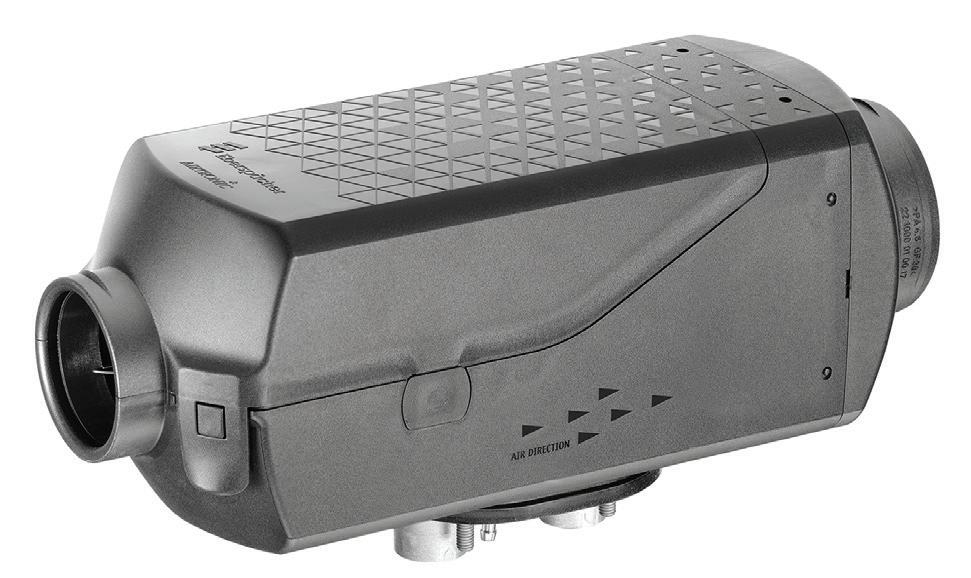
» If a full-blown APU doesn’t make financial sense, Eberspächer’s Airtronic Heater is an affordable solution for fleets that simply want to provide heat in the cab to keep drivers comfortable. With an expected lifespan of up to 5,000 hours thanks to a brushless motor, fleets can anticipate several years of use.
Eberspächer



















By Gregg Wartgow
Manufacturers of auxiliary power units (APUs) designed for sleeper cabs definitely haven’t been asleep at the wheel in recent years. For fleets that want to reduce truck idling, improve driver satisfaction, and make things a little easier on technicians, modern units are maximizing performance while minimizing maintenance needs and total cost of ownership.
Here’s a look at some of the top sleeper cab APUs for 2026.
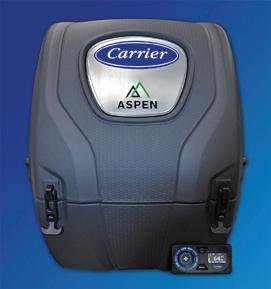
Carrier Transicold’s Aspen APU is powered by a 2-cylinder diesel engine, while a 6kW generator powers appliances and electronics. Unique features include Battery Monitor mode and Winter Watch mode to help facilitate engine preheating. Aspen is also available with an integrated coolant-exchange system to warm the tractor’s engine or as a stand-alone system that heats the engine using a block heater powered by the APU generator.
using an AGM to power their eAPU, according to the companies.
Even against a bunk heater, Dragonfly said its LiFePO4 solution was a quarter of the cost of using the engine auto start/stop and bunk heater. is is because although an engine auto start/ stop and bunk heater solution costs $2,000 versus $8,500 for the Battle Born APU, you have to look at the long game. A er four years, the former solution consumes 40,000 gallons for rest-period idling versus 672,688 gallons for lithium eAPU. Another $4,000 is saved in maintenance costs from the reduced strain in the main engine and emissions system.
at is just one example, of course. Most APU manufacturers provide their own TCO/ROI calculators where you can input your own data. Make sure you work closely with any vendor you are considering to ensure everyone understands the application you are trying to solve.
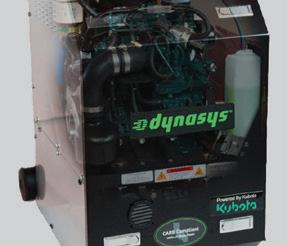
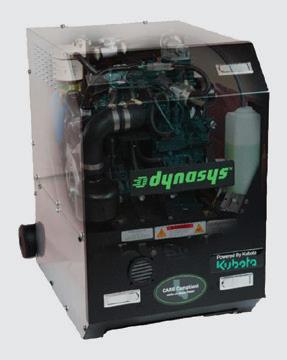
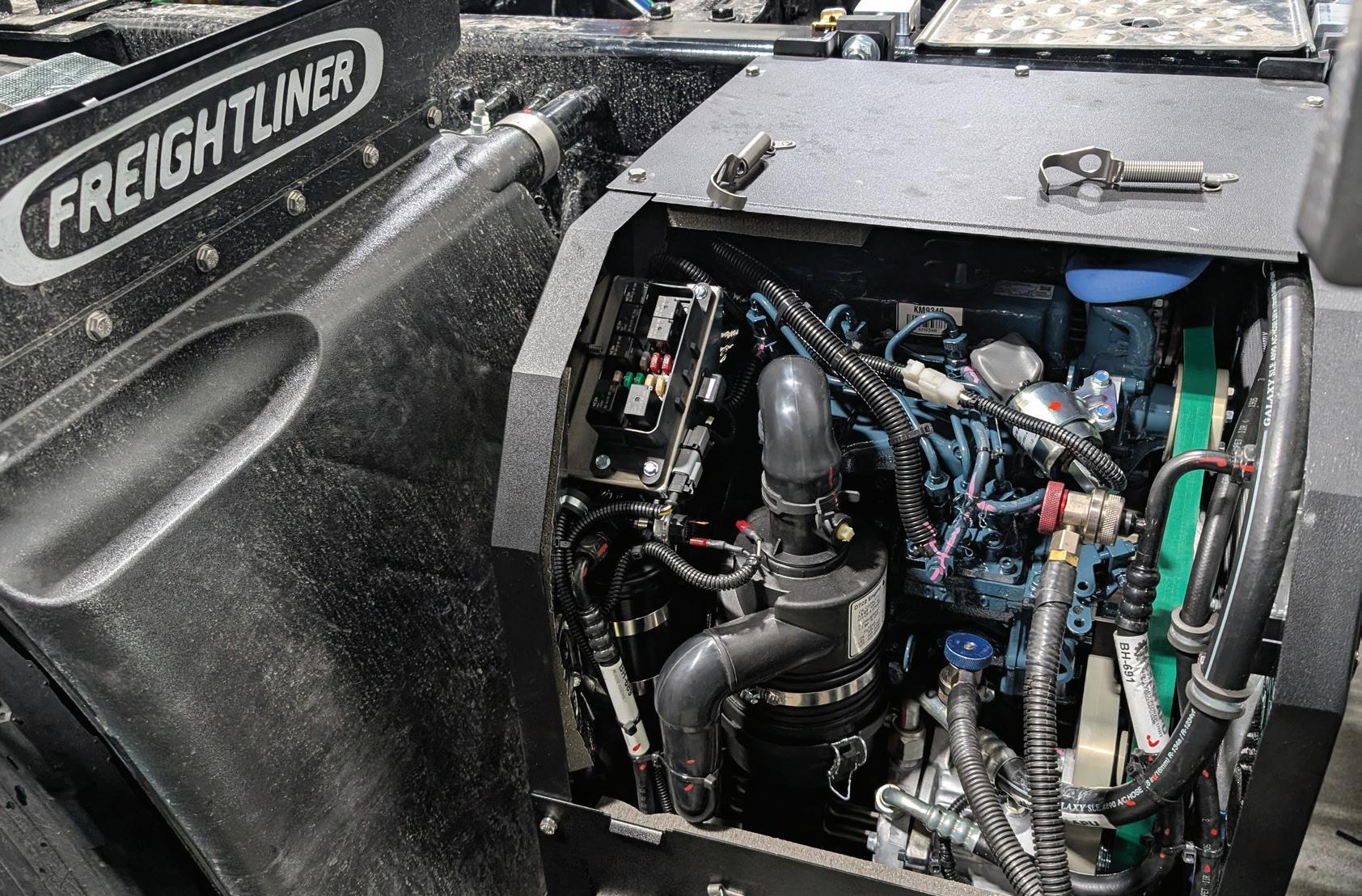
Dynasys Gen3K diesel APU operates independently to prevent downtime, connecting only to the truck’s battery and fuel tank, not the vehicle coolant and AC systems. The Kubota 2-cyl. engine produces 14.5 BHP at 3,200 RPM. A 6 kW generator powers appliances. Climate control delivers 12,000 BTU/ hr. cooling and 2,500 watts of heating through double heat coils. An upgraded controller displays critical diagnostic info.
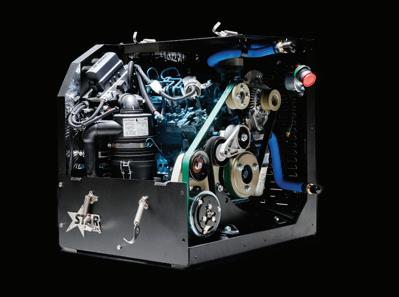
Green APU is powered by a 3-cylinder Kubota diesel engine and uses industry-standard components to help keep maintenance costs down. Additionally, a clean, serviceable layout is designed to keep things easier for technicians. All diagnostics are built into the APU controller, so there is no need for software updates or specialized diagnostic tools.
Maintenance: Diesel APUs have engines and a ertreatment devices that need to be periodically maintained; eAPUs don’t. Diesels also have more mechanical parts that can wear and require replacement.
e eAPUs do have electrical connections that need to be closely monitored and maintained. AGM-style units also have batteries that need to be replaced every couple of years. Lithiumbased systems are generally designed to provide roughly 10 years of life, and generally come with five-year warranties on the batteries. Dragonfly Energy actually o ers a 10-year warranty on its battery system.
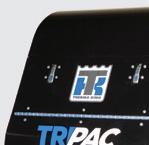
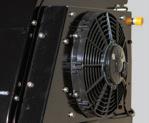
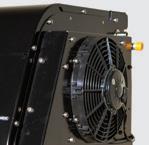


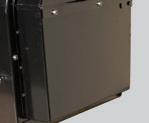

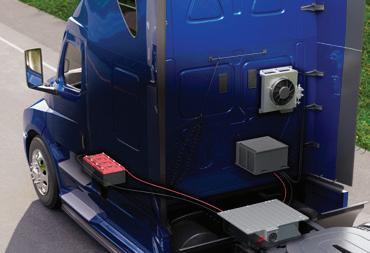
Thermo King’s 3rd Generation TriPac APU is powered by a 2-cylinder diesel engine. One model in the line features a unique aftertreatment device with new metal mesh technology for faster regeneration in as little as eight minutes. Streamlined wire harnesses, connectors, fusing, and routing improve installation and serviceability. All major components are backed by a four-year warranty.
DClimate Lithium Pro is an eAPU powered by a LiFePO4 battery system that’s backed by a five-year warranty. An advanced BMS (battery management system) allows for rapid charging and longer battery life. Up to 6.7kWh of power is available per cycle, which is ample for hotel loads through an entire 10-hour rest period. A high-efficiency compressor and evaporator minimize fan electrical load, which helps conserve power for those longer runtimes.
Polar Fox APU says its lithium-based eAPU provides another avenue for fleets to reduce TCO. Polar Fox utilizes “dual-purpose” LiFePO4 batteries, which means they also possess the cold cranking amps (CCA) needed to start a truck. us, they eliminate the need for a second set of starting batteries, which helps reduce TCO.
Resale value: One more factor to consider when analyzing TCO is residual value when selling or trading the truck. Well-maintained diesel APUs o en add value because of their long life cycle and the fact that they reduce wear on the truck engine and a ertreatment system. e eAPUs provide the same benefit, particularly today’s new lithium-based systems that o er warranties exceeding the typical fi rst trade cycle (four years).










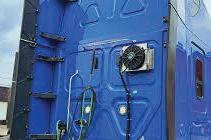


Dragonfly’s Battle Born All-Electric APU is powered by a LiFePO4 battery system that’s backed by a 10-year warranty. It provides 6.9kWh of energy storage while maintaining 12V-plus for nearly the entire discharge cycle. That enables powering of HVAC and appliances through a full 10-hour rest period when fully charged. An efficient charging system recharges from 0-100% in under four hours of driving.
Polar Fox APU’s Elite Series is available in both 12V and 24V configurations. It is a complete system built around the unique Skana dual-purpose LiFePO4 battery system. These batteries possess the cold cranking amps necessary to start a truck, eliminating the need for a second set of starting batteries. The Skana battery system is backed by a five-year warranty.
Thermo King’s TriPac Envidia is an eAPU powered by Thermo King’s NXT battery, an AGM battery featuring dry cell technology for greater efficiency, longer life, and lower life cycle cost.
Just in case a fleet can’t get the residual value it’s looking for, DClimate’s Du y said plug-and-play systems are beneficial because the fleet could easily remove the eAPU and put it on another truck in the fleet. “It’s almost like having residual insurance,” Du y said.
While an argument can defi nitely be made that a lithium-based battery system is the least maintenance-intensive, some diesel APU manufacturers have focused on making preventive maintenance easier and less costly themselves, helping reduce TCO for fleets that see more value in a diesel APU. Green APU, for example, uses non-proprietary components that are readily available across
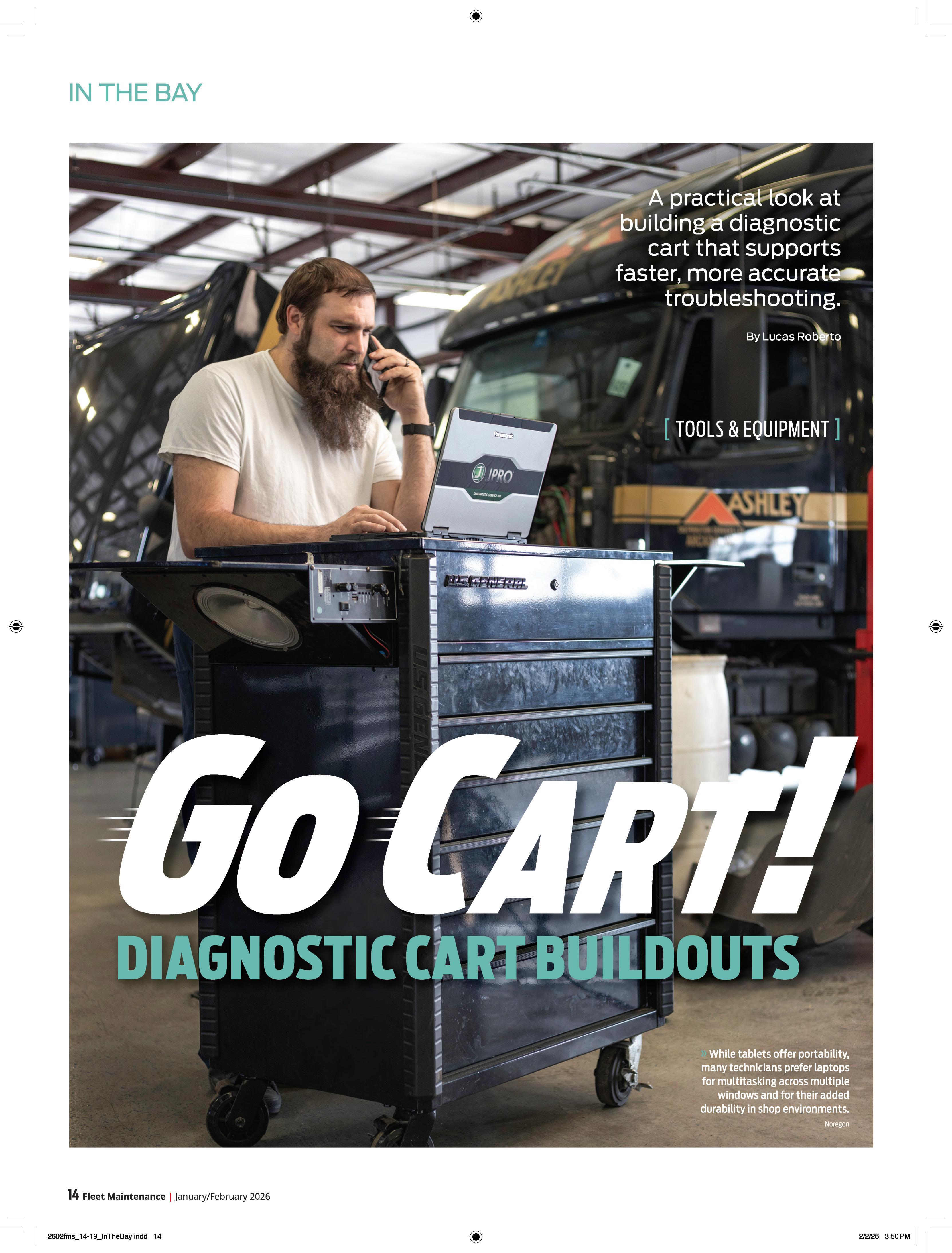
It’s no secret that modern vehicle maintenance revolves around the diagnostic process. Nowadays, finding underlying issues often starts with a scan tool over master technicians’ own senses. They spend so much time diagnosing and investigating ECUs and OBDII ports over manipulating nuts and bolts that they’re more fault whisperer than wrench turner.
The amount of time to diagnose issues is unpredictable, though, possibly taking minutes or hours. Respondents in our 2025 survey who perform their own maintenance listed diagnostics and repair efficiency as the top maintenance management concern (33%). Noregon Research’s far more expansive 2026 study on heavy-duty diagnostics reported more than half of both fleets and shops said accurate and effective diagnosing and troubleshooting was their top issue.
Because of this, it makes sense to shave off diag time (while achieving an accurate resolution) wherever you can. Over weeks and months, small changes can improve uptime and shop throughput, and ease any possible debates with customers or insurers about billing. In short, it becomes a clear competitive advantage.
Experience and training do the heavy lifting in this respect, but there’s also a simple and immediate way for any tech to reduce diagnostic time: an organized diagnostic cart.
“Proper cart organization is one of the fastest and easiest ways to improve diagnostic efficiency,” Jason Hedman, product manager at Noregon, said. He noted that an orderly and properly stocked cart helps techs move more quickly through the troubleshooting process.
Conversely, he said a disorganized cart slows things down.
“When technicians constantly need to dig around for tools or test equipment, especially when those items should always be at hand, it brings a halt to the diagnostic process,” he offered.
This goes hand in hand with lean methodology, an approach focused on minimizing waste, where the goal is to make every movement and every action as efficient as possible.
Think about it. Trips back and forth across the shop or searching for the right tool eat up valuable time. This is where the cart comes in. Outfitting and organizing it the right way can make a world of difference and steal some of that lost time back. Here are some ways to set up that cart—and your diag techs—for success.
When setting out to build a diagnostic cart that works for you, it’s important to consider its purpose, because not every cart needs to be equipped for every job. Will it need to provide support in performing in-depth diagnostics, or will an austere triage cart suffice? Deciding the role of the cart should come before choosing the right tools and even the cart itself. Maximizing efficiency while avoiding overbuilding is key.
“A triage cart works great with basic tools, such as a simple code reader and DEF refrac-
tometers and test strips to better understand the level of repair a heavy-duty vehicle needs,” Hedman explained. “However, advanced diagnostic carts require a stronger setup.”
A complete diagnostic suite could include tools that might be helpful for deeper diagnostics dealing with electrical, aftertreatment, or software issues, like a thermal imager or borescope.
Generally, set the cart up to attack the most common problems, makes, and models that come into your shop. According to our survey, your peers cited the most costly repair challenges relate to engine/aftertreatment (49%), electrical systems and wiring (24%), and diagnostics in general (15%).
A review by management of specific issues based on equipment and VMRS codes can further narrow what tools you will need, as can using historical repair data.
While the essentials may be standard, like scan tools and a multimeter, if your shop only deals with gas-powered vehicles, for example, DEF equipment won’t be necessary.
Once you know what the cart will be used for, it’s time to spec the cart itself.
At its most advanced, a diagnostic cart can serve as a true mobile command center. A cart walkthrough from Jarhead Garage on YouTube shows just how far a diag workstation can be taken. The custom buildout houses scan tools, test equipment, and reference data in one centralized workspace. Add-ons include a modified side table for extra workspace, an attached boom arm to hold leads out of the way, and a mounted PC and battery backup. These highly built-out setups are designed to cut down on wasted motion by keeping everything a technician needs within arm’s reach.
The goal isn’t to load the cart with every tool in the shop, however. It’s to understand the role the cart needs to play, and build it accordingly.
The tool loadout you carry should also influence your choice of cart itself, with many options available on the market. Bigger isn’t always better, and things like mobility and access are key aspects of how well your diag cart will serve you. For example, Missy Albin, technician at Taylor and Lloyd International, learned through trial and error just how much the wrong setup, and even the wrong cart, can impact your workflow.
“I thought that having a larger selection of tools with me would make me more efficient, more organized,” she said. But the size and loadout were too much.
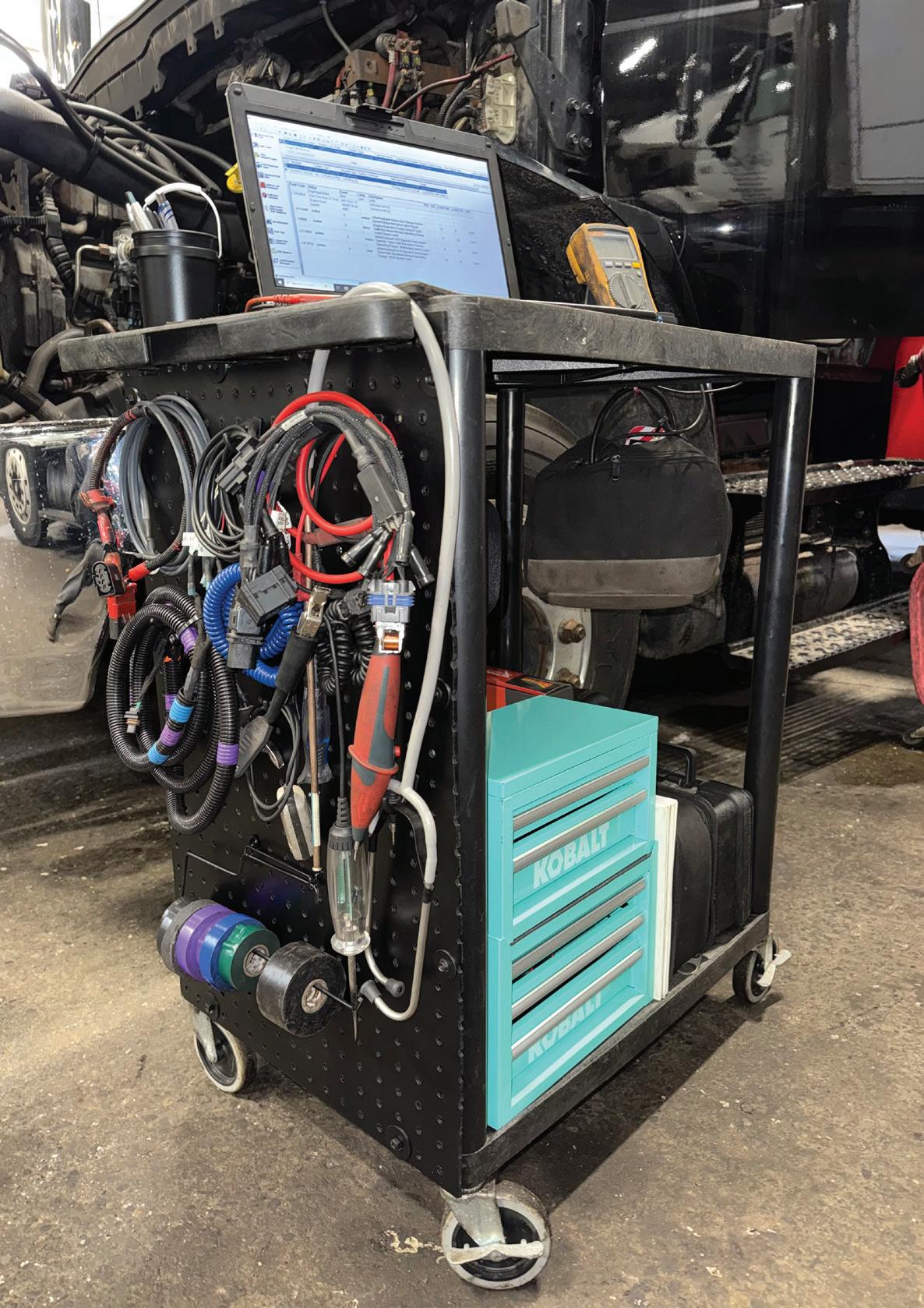
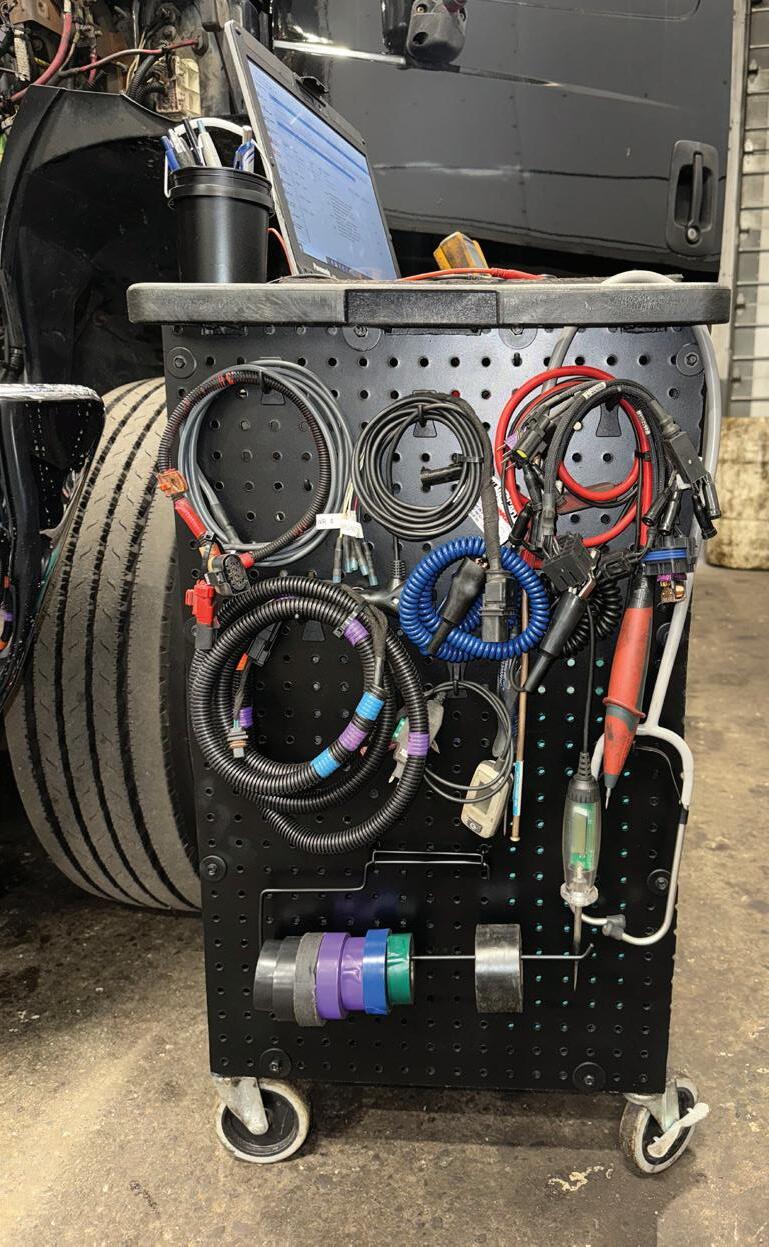
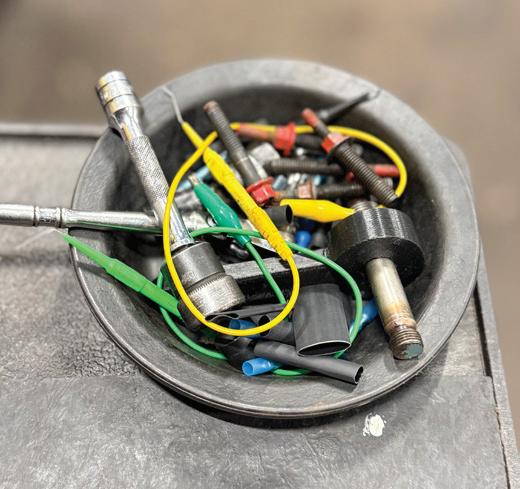
» Albin also added cupholders and other small containers for hardware like bolts and terminals. Missy Albin
» Albin’s setup includes a pegboard where she hangs a 5V load tester, stethoscope, numerous breakouts, and electrical tape.
“ I found that having this composite cart with no top and without the metal, it’s more narrow, very easy to manipulate and push around into tight areas. ”
Missy Albin, technician, Taylor and Lloyd International
• Scan tool or diagnostic software
• Laptop or tablet
• Power strip or surge protector
• Battery maintainer / diagnostic power supply
• Extension cords
• USB hubs and charging cables
• Shop Wi-Fi or cellular hotspot access
• Test light
• Fault code databases and repair procedures
• Note-taking tools
• Quality multimeter
• Wiring schematics
• Test leads
• Breakout leads and probing kits
• DEF refractometer/test strips
• Mechanical gauges
• Breakout box
• Socket set with common sizes
• Flashlight or headlamp
• PPE (gloves, glasses)
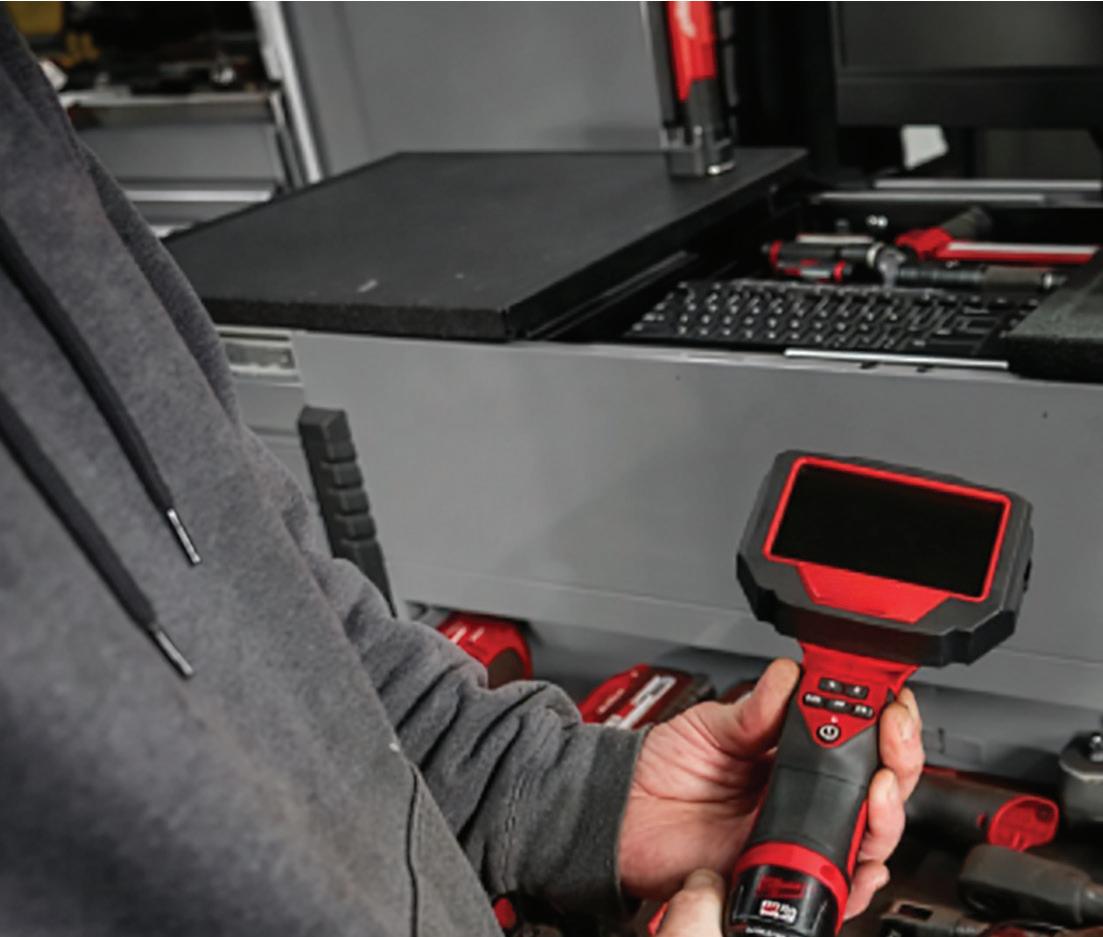

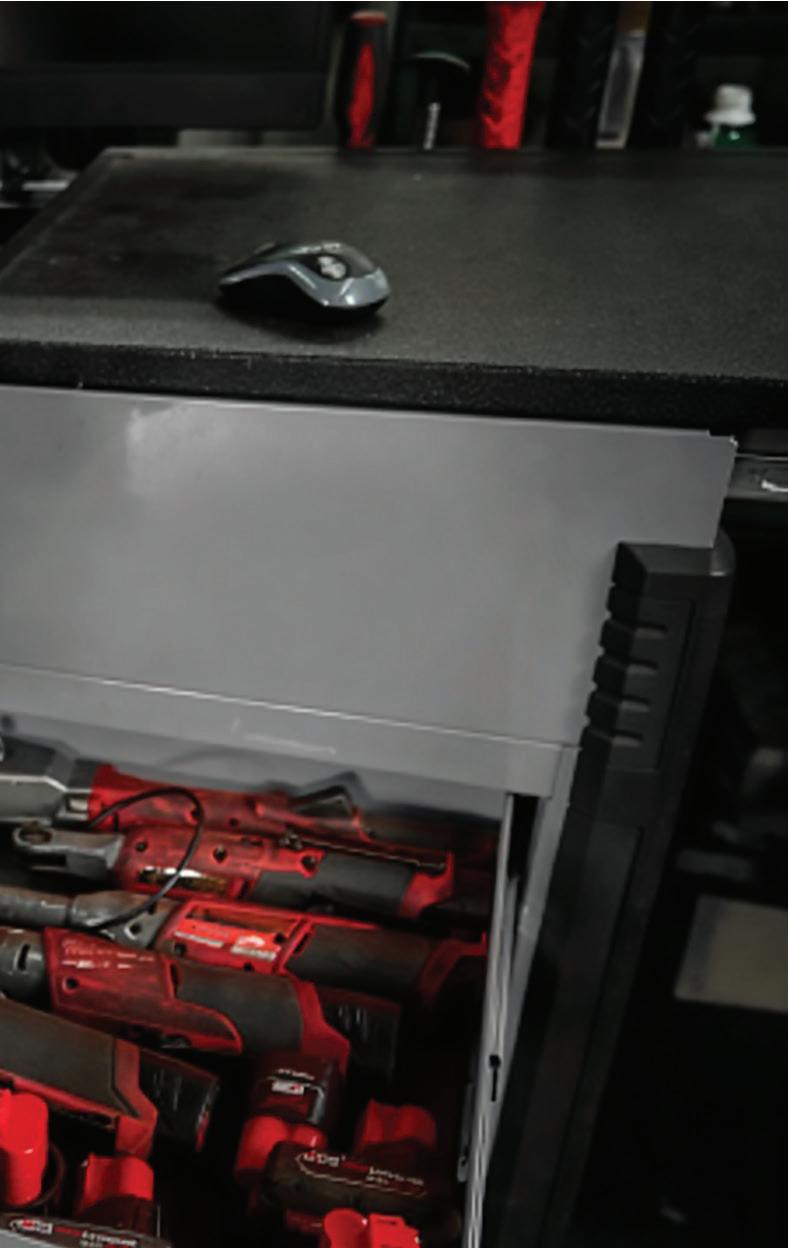
She noticed this and pivoted, scaling down her tool loadout, which also allowed her to downsize the cart itself. She now uses a lighter composite cart from Luxor that she says is easier to maneuver and navigate within the shop.
“I found that having this composite cart with no top and without the metal, it’s more narrow, very easy to manipulate and push around into tight areas,” she continued. “I can bring it closer to the vehicles without having to worry that I’m going to damage somebody’s vehicle, their paints, or dent anything.”
Cart choice can also make a di erence when it comes to organization and discipline, ensuring you only have space for what you need. Albin discussed her tendency to fi ll the larger cart she used previously just because she had the space to do so, even if the tools weren’t absolutely necessary.
“ is cart has helped me stay cleaner because it’s smaller. I am now forced to only use the tools that I am usually using on most jobs, and it’s disciplined me to keep the tools that I’m not using constantly in my actual box rather than pushing the extra around.”
Where the cart will be used is equally important. Take a look at the terrain in your shop. If the floors are cracked or the cart needs to be maneuverable in outdoor environments, this will tell you how robust it should be. Larger wheels or heavy-duty casters can make it more versatile, and given the investment in diagnostic tools it carries, the cart should be sturdy and built to last.
Once a cart’s purpose is settled on and you know what size you need, the next step is outfitting it with the essentials. ese are the tools that technicians use in almost every diagnostic situation.
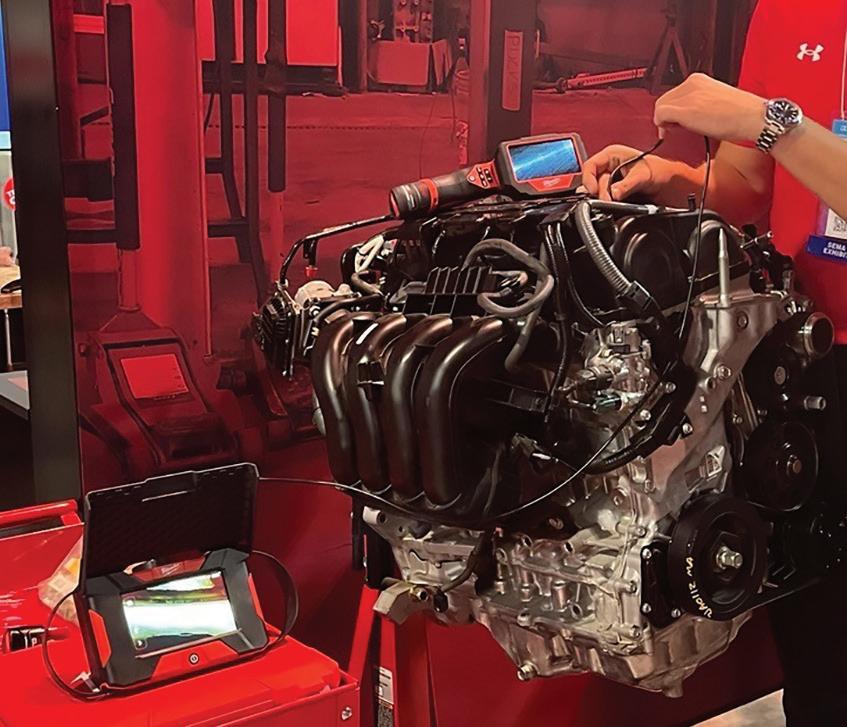
» Borescopes, like this one from Milwaukee, can provide a quick look into areas techs may not otherwise be able to access easily. Borescopes can “allow them to save time and hassle of tearing down components on an engine to identify issues,” said Nicholas Pond, senior manager, product marketing at Milwaukee Tool. Milwaukee Tool
Access to OEM diagnostic procedures, wiring diagrams, and other service information is a good start. As a former lead technician, Nathan Herschbach, diagnostic product manager, Snapon, noted that many repairs aren’t mechanical but require so ware updates or calibrations, making information just as essential as the tools themselves.
“Following the factory diagnostics tree on how to fi x a vehicle error code is the fastest way to the fi x, and you need shop information to get them and wiring diagrams,” he said.
As Hedman said, another crucial addition is the proper scan tool, laptop (or tablet), and cables to interface with the vehicle. A centrally mounted or easily accessible location ensures the tool is ready whenever it’s needed.
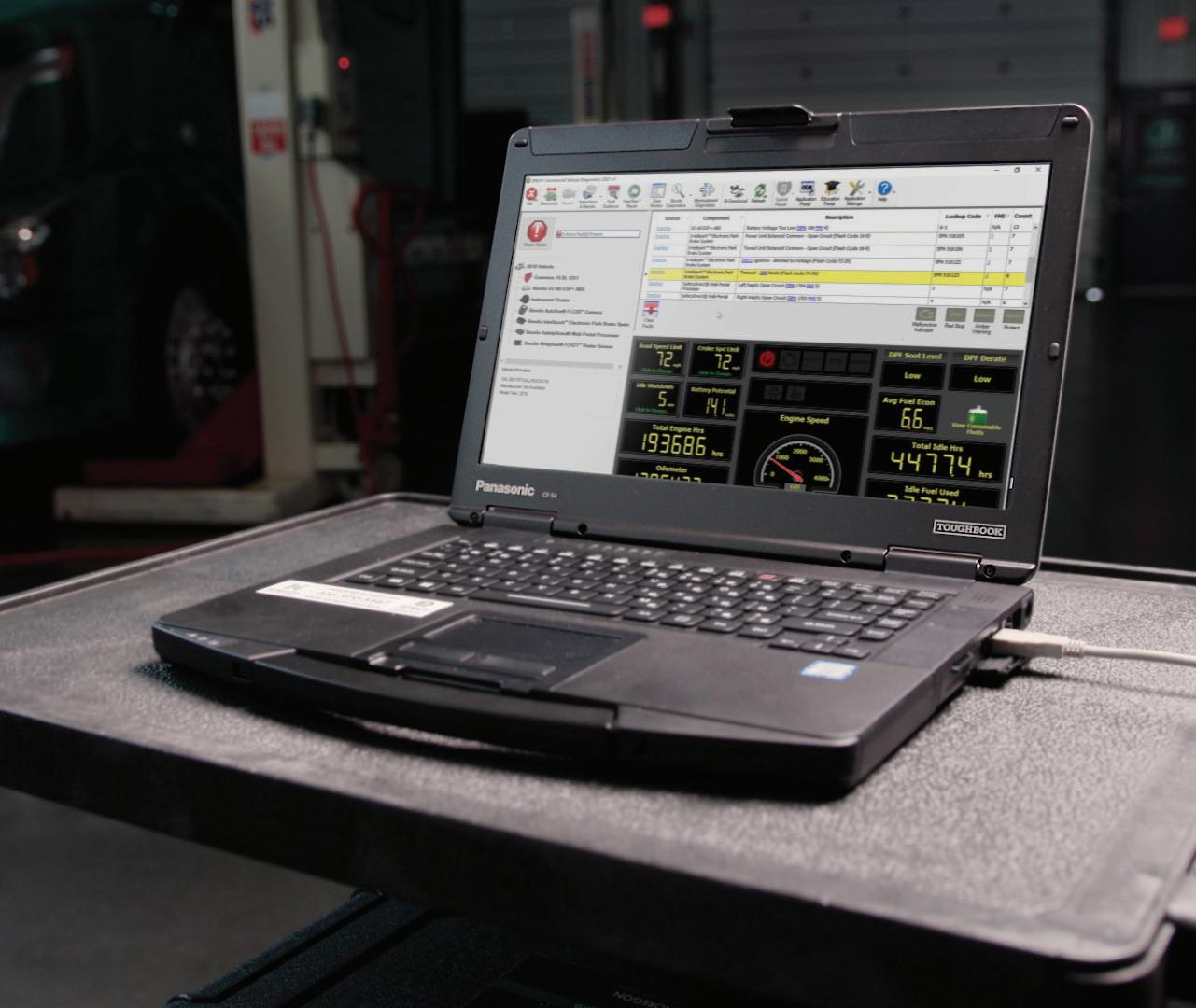
Albin prefers a laptop for most of her diagnostic work because the ability to have multiple windows open helps her multitask, though she says the portability of a tablet can be convenient.
“ e laptop is tough and when closed, you’re less likely to break your screen, versus a tablet that would be easier to break,” she continued. “I have
done that before by closing a driver door onto it. I didn’t see it.”
Johnny Chagoya, operations director and technician with Rush Enterprises, highlighted the importance of schematics when it comes to electrical confidence.
“If you don’t know what you’re looking at or what the connector looks like, you’re going to be lost,” he said. “You’re just going to be guessing, ‘What wire is this?’”
“A lot of carts often miss simple tools like a good test lead kit, DEF refractometer, or mechanical gauges,” Hedman detailed, “and of course, somehow the 10mm socket is always missing! When those few essentials aren’t within the technician’s reach, the diagnostic process slows down.”
Even the most comprehensive and well-curated diagnostic cart tool arsenal won’t help you save time if it’s buried under clutter or put back in a different place each time. Organization is just as important when it comes to cutting down on wasted diag time. If you know where things are and keep them there, those time savings add up.
Albin keeps her cart’s top surface mostly clear, using it for the tools she’s actively working with.
“I have a two-tier cart, and I like to keep the top about 75% clear for whatever diagnostic equipment, whether it’s the laptop, or if I’m using a multimeter, or I just need to write my notes,” she explained. Items used less frequently are stored on the lower tier. She also organizes smaller tools and items into dedicated bags.
“Everything I just have kind of neatly placed in this bag so I can just reach in and grab it and I know where the location is,” she detailed. Her system reduces time lost looking through piles, though she admits it takes discipline to maintain.
“I used to be, and sometimes I still am, a piler, and I have to go back in and correct myself,” which she explained might mean taking a moment to reset or reorganize throughout the day.
up after myself.”
Her setup also includes a pegboard, cupholders, and other small containers for hardware like bolts and terminals.
Sometimes, organization can mean more than just knowing where the right tool is when you need it. For Snap-on’s Herschbach, his layout became a staple of his workflow, with the cart set up for various levels of diagnostic difficulty per drawer.
“The top drawer was an easy job. If other technicians walked by and saw that I had drawer three or four open on the cart, they knew this was a difficult vehicle to diagnose and not to bother me,” he explained. “Having my drawers organized vertically as to the level of what tools I needed helped me follow my own diagnostic process and the ‘flow tree’ I had designed in my head on how to tackle issues.”

















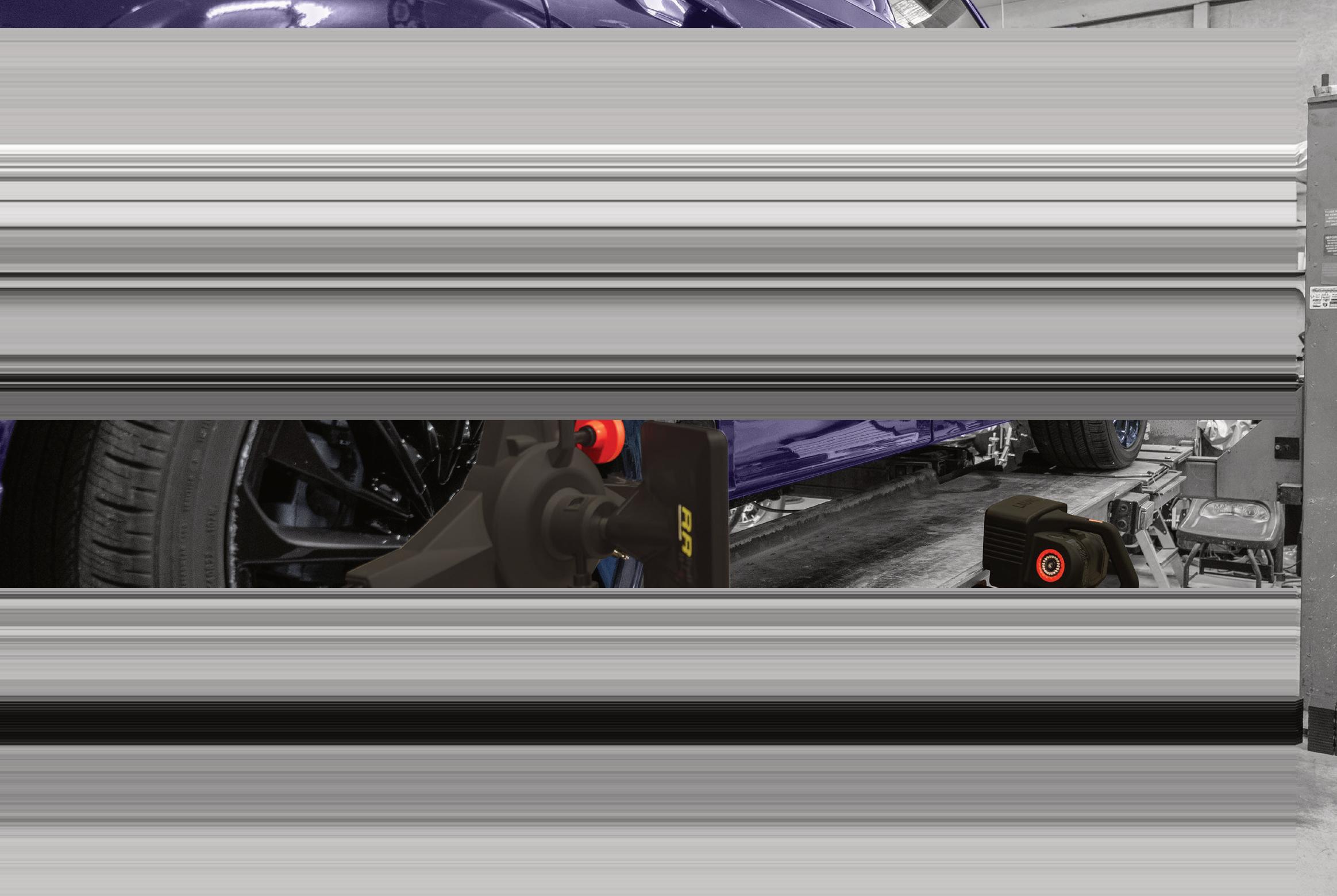














“I’ve been trying to train myself to give myself a good setup in the beginning and make it look as clean as possible and ready to go, very organized with everything that I need. As I start doing the pile up, I try to discipline myself to tidy Every unnecessary delay reduces fleet availability. The X-613 Advanced Wheel Aligner is purpose-built to keep vehicles in rotation by eliminating alignment-related downtime.
Mobile-ready, highly accurate, and designed for efficiency, the X-613 helps fleet operations return vehicles to service faster—without sacrificing alignment precision or technician confidence.

Proper lighting, charging, and cable management are the next step, as this ensures that tools and devices are not only ready when technicians need them but are able to perform as they should.
“If a technician’s cart can’t keep everything powered and connected, they’re setting themselves up for inaccurate readings,” Hedman emphasized. “Weak batteries can create fake faults and misdiagnosis, good lighting prevents technicians from missing easily identifiable problems, good cables keep them connected, and good charging keeps the diagnostic laptop running and ready for when you need it.”
It’s clear that power is essential, but supporting it on the cart can be a challenge. Albin recommends having an extension cord, as well as a 12V cigarette lighter laptop charger that can plug right into the vehicle for emergencies.
“It has saved me in so many times where I could have lost a program or I was in the middle of a test that was actually running and I had a few more minutes left, and my laptop wouldn’t have given me that,” she said.
On-cart lighting can also make a difference in dimly lit shop environments. John Amato, director of sales and training, diagnostics, at Autel, noted, “Additional lighting in darker areas, such as inside the lower cabinet, is appreciated when you need to find things quickly.”
Cable management, he added, is equally important for maintaining easy access to components. “Keeping everything clean and organized ensures you can work without obstruction,” Amato said.
Proper cable care goes hand in hand with organization. Albin shared that her setup includes a USB cable and dongle tucked into a cushioned electronics pouch, with the end exposed for quick access.
“For the longevity of the interface cable, no matter what you’re using, it’s definitely going to be beneficial if you put it in some type of protection bag and just carry it like that. That’s a definite win in my book,” she said.
With the essential tools in place, some techs often find that a few carefully selected extras can



» For Albin, a durable laptop is better than a tablet, since there’s less risk of cracking the screen by accident during the diagnosis.
Noregon
streamline their diagnostic process and help them save time, making them worthy additions to the cart even if they aren’t required for every job. For example, some techs, like Albin, dedicate a section of their cart to faster electrical diagnostics.
“The most common breakouts that I use are put in a little tiny diaphragm that’s off to the side, but underneath I actually carry my complete breakout kit,” she explained, including two power probes. “I carry one as the regular power probe to check and give power and ground to different circuits, and then I have a Power Probe 3 [circuit tester]. I am loving this tool so much because it gives me insight into locations that I might not necessarily be able to get to or be able to check.”
Herschbach noted that sometimes having multiples of the same tool on you can save time as well.
“I had two screw guns when I worked, usually one with a #2 Phillips and one with a T30,” he recalled. “That way, I didn’t have to stop working to switch out my most common bits. I just grabbed the other gun.”
Many technicians keep a borescope or endoscope on their carts, providing a quick look into areas they may not otherwise be able to access easily.
“Technicians can spend a lot of time diagnosing things that they otherwise can’t see,” explained Nicholas Pond, senior manager of product marketing at Milwaukee Tool, “so borescopes can really be beneficial in terms of driving productivity, allowing them to save time and hassle of tearing down components on an engine to identify issues.”
A thermal imager can also be a worthy addition, and Albin said that she uses the one on her cart daily.










“It is a staple on my diagnostic tool cart next to my multimeter and flashlight,” she noted, saying it has come in handy for diagnosing everything from bad electrical connections and batteries to overheating issues and fuel restrictions.
The best way to upfit and outfit a cart to save time will look different for each individual tech, but the real way to judge success is if those changes make troubleshooting a little less troublesome.












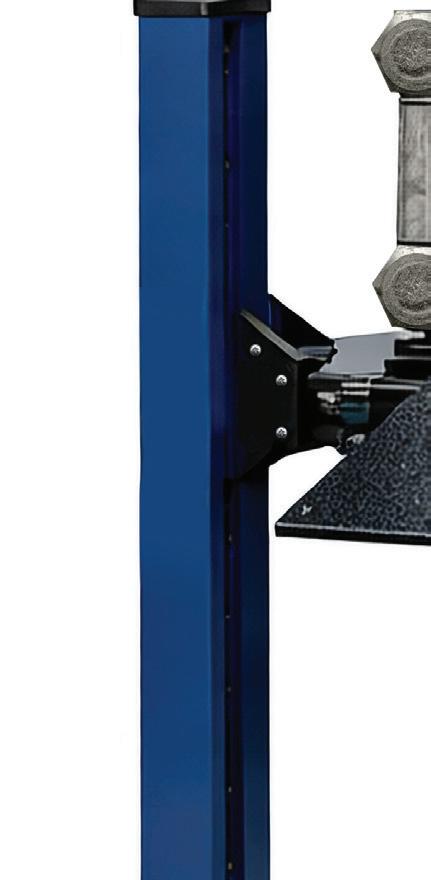
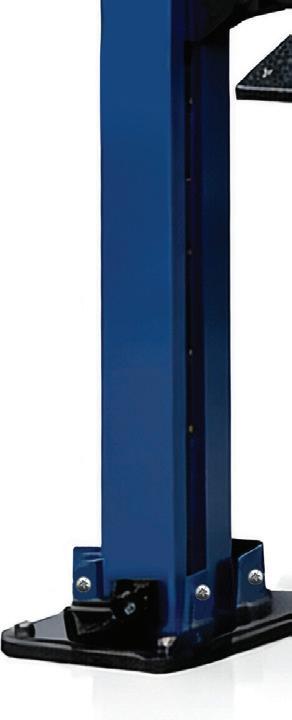
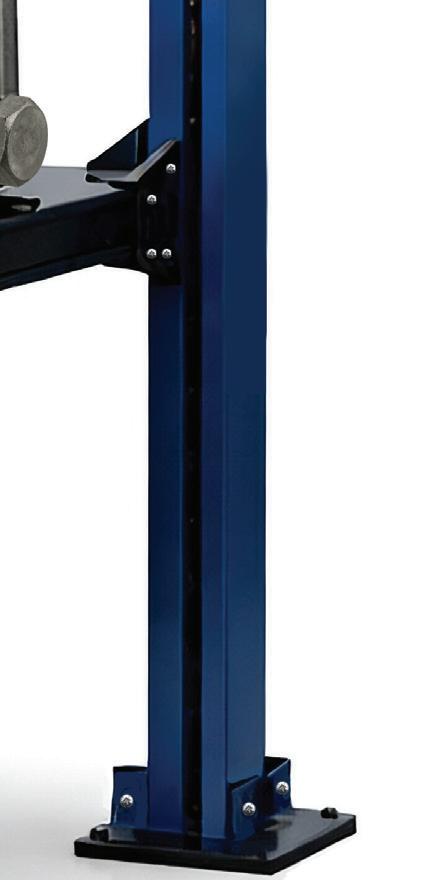
Equalization System Failsafe mechanical system delivers equal lifting and a stable, level vehicle for operators.
Extended Height
The extended-height top beam on 192 models provides greater clearance.
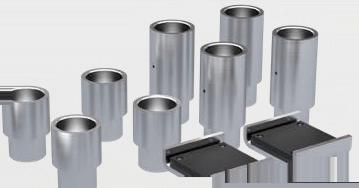
Hydraulic Cylinders
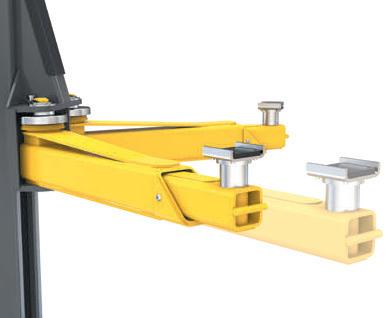
Dual-drive hydraulic cylinders deliver smooth operation and rise higher than those in comparable lifts.
UHMW Polyethylene Load Bearings Evenly distribute radial and axial forces during operation.
Column Safety Locks Placed every four inches in the columns and engage automatically when lifting.
Safety Lock Failsafe mechanisms secure the lifting carriages and arm assemblies during operation.

FOR BETTER ERGONOMICS**



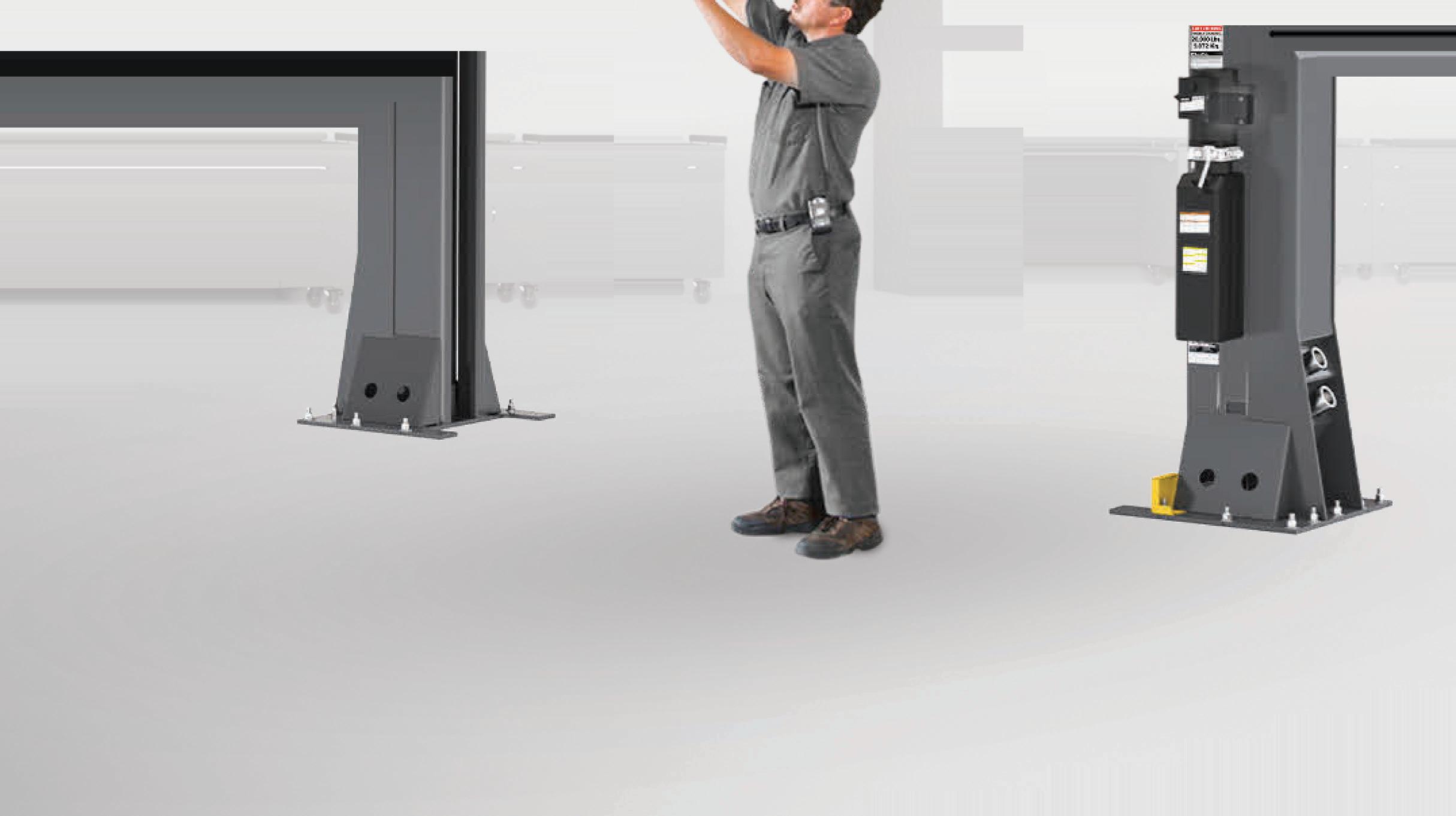
A versatile choice for mixed fleets, BendPak’s new 16AP and 20AP Series super-duty two-post lifts easily take on Class 1 through 5 vehicles, from passenger cars to commercial trucks and vans. They reach further, lift higher and deliver greater stability than other lifts, all while protecting technicians with unmatched safety systems and ergonomics. With fewer moving parts, they’re easier to maintain, less prone to wear, and more cost-effective to operate. Maximize your uptime and efficiency with BendPak’s super-duty lifts — delivering superior performance and unmatched value. To learn more or to shop now, visit bendpak.com or call us at 1-800-253-2363










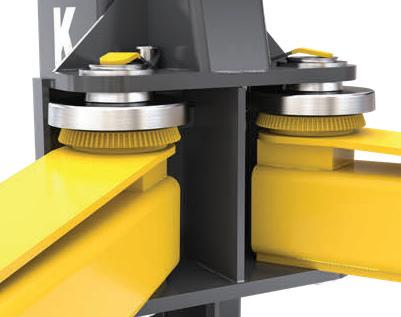
Multi-face Metal Columns Innovative design better withstands twisting and biaxial loading forces to minimize movement for greater stability.
Lift Dampener Precision controls allow operators to manage descent speed.

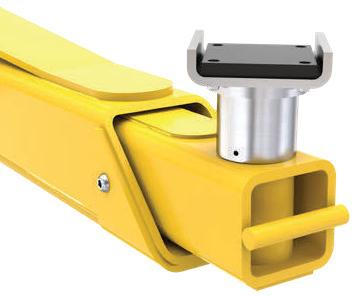
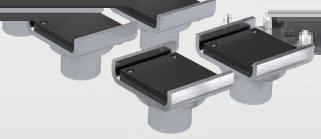
FRAME CRADLE PADS



















Is the third time the charm for the REPAIR Act, or will a new OEM-approved Right to Repair bill have more luck making it through the legislative process?
By John Hitch
[ RIGHT TO REPAIR ]









f you buy something and it breaks or malfunctions, you should have the option to fi x it yourself. And if you don’t have the necessary technical skills and tools, you should at least be able to choose who does it for you. It’s your right as a customer.
at’s a very simplified rationale for vehicle right to repair, and most would fi nd this an uncontroversial argument. It’s also the justification a ermarket associations such as the Auto Care Alliance (ACA) and MEMA, e Vehicle Suppliers Association and other a ermarket groups are using to get the bipartisan-sponsored Right to Equitable and Professional Auto Industry (Repair) Act passed.
Collectively, the ACA said the a ermarket comprises of 525,000+ businesses that employ nearly 5 million people and generate more than $500 billion.
A R2R agreement between OEMs and independent shops to share repair data has existed for over a decade and re-emphasized in 2023, but pro-REPAIR Act organizations want a more binding solution. Without it, they envision a future where OEMs demand only their parts be used for repairs, and with a monopoly created, can raise prices. Along with the customers paying more, the a ermarket sector contests it loses out.
“Without the REPAIR Act, the automotive a ermarket will cease to exist in any meaningful way,” stated Bill Hanvey, CEO and president of the ACA, in his written testimony to Congress in January. Long term, he argued failure to pass federal R2R “will send prices skyrocketing, quality plummeting, and eliminating consumer choice.”
OEMs, meanwhile, maintain their OE parts have been engineered and tested to ensure safe and reliable performance.
“It’s not that we want you to have a bad experience and a bad quality product coming out of [a repair],” o ered Johann Agebrand, director of product marketing at Volvo Trucks North America. “We want the right thing to be replaced. We want you to use the right parts replacing it.”
On the fleet side, we have reported that many fleets prefer using premium OEM parts for optimal safety and better total cost of ownership, but this argument is about the right to repair, not what’s the right way to repair.
But what’s the right way forward?
e current REPAIR bill prohibits vehicle manufacturers from creating technological or legal barriers that prevent the owner, a ermarket parts and tool providers or repair facilities from accessing critical repair information and tools, and allows the owner (or designated repairer) to have access to vehicle-generated and telematics data “without restriction or limitation.” Language also exists to dissuade OEMs from implicitly mandating a specific part or tool brands—a hedge to prevent monopolies and parts pricing.
is changes the R2R debate from who can repair

a collision mitigation system or swap a fuel injector to what parts can be used.
Consumers already have the Magnuson Moss Act to allow non-OEM parts to be used without voiding warranties, but that does not apply to commercial vehicles. is bill does.

And instead of focusing on who can access repair data and tools, the more relevant question is who gets all that valuable vehicle-generated data? Technicians want access to diagnose trucks and clear codes, but the phrase “without restriction or limitation” has OEMs questioning the bill’s true motives.
row intellectual property and cybersecurity into the mix and things don’t just get complicated; they get ugly. e two critical and symbiotic sides of vehicle maintenance sector, OEMs and a ermarket, stand on opposing sides of an issue they mostly agree on.
But this fight could reach a resolution with the stroke of a pen, or more likely, President Donald Trump’s Sharpie, assuming the REPAIR Act fi nally escapes the purgatory of Congressional subcommittees and reaches a simple majority in the U.S. House of Representatives and the president signs it into law.
at’s a big if, as this is the third Congressional term that the REPAIR Act, which has the full support of the auto and commercial a ermarket, has been proposed.
Meanwhile, a competing bill has gathered significant support from the OEM side and organizations representing independent shops and collision repairers. It’s called the Safety as First Emphasis (SAFE) Repair Act. According to the framers at the Alliance of Automotive Innovation (AAI) and Society of Collision Repair Specialists (SCRS), it’s everything the REPAIR Act is, but better, because it safeguards data and customer choice, expands transparency, and protects manufacturers’ intellectual property.
Aaron Schulenburg, executive director of the SCRS, said the SAFE Repair Act safeguards access to required tools and info, providing customers true freedom of repair options without giving out unrelated vehicle data or being influenced by insurers.
“ ere is even a specific section that provides both diagnostic and repair parity, providing independent repair facilities the means to perform diagnostic and repair functions in the same manner as dealers—including the capability to perform the function remotely if that’s how the dealer can perform it. Isn’t this what proponents of ‘right to repair’ claim to want?”
e real question is really which is the best and safest and most feasible option for the vehicle owners of America, from the struggling single mom with a rusted out Dodge Caravan trying to make ends meet to the third-generation trucking company owner…also trying to make ends meet?
Let’s look at both sides.
• Requires OEMs to provide owners and independent repairers equal access to vehicle data, repair information, and tools
• Prohibits technical or legal barriers that restrict diagnosis, repair, or maintenance outside OEM-authorized networks
• Protects the right to choose repair facilities and aftermarket parts
• Prevents OEMs from mandating specific brands of parts, tools, or equipment
• Protects competition in the aftermarket for parts, tools, and diagnostic equipment
• Establishes strict limits on how vehicle-generated data may be used, shared, or retained
• Allows de-identified vehicle data to be used for research and development under defined safeguards
• Ensures customers and shops have access to data and tools needed to properly diagnose and repair
• Allows customers to choose repair location and insist OEM-recommended repairs are followed
• Empowers repairers to follow OEM procedures
• Promotes regular safety inspections and postcollision repair inspections
• Increases consumer choice in aftermarket parts
• Applies OEM part safety and recall rules to aftermarket, with clear disclosures of prior alterations or repairs when selling used vehicles
• Establishes guardrails around data privacy and cybersecurity


Time is of the essence, REPAIR Act proponents insist, as vehicles are getting more sensors and more connected every model year.
“What we try to explain to lawmakers is that we’re just seeing the beginning of these [modern vehicles] coming out of warranty now,” explained Lisa Foshee, SVP of government a airs and the general counsel for the Auto Care Association. “And if you don’t obligate the manufacturers to provide this repair and maintenance data, it is going to be like Pandora’s box, because the way the manufacturing cycles work, we’re not going to be able to get it five years from now, if you don’t require them to do it now.”
ere’s no indication Congress has the same urgency, but headway was made Jan. 13 when the House Subcommittee on Commerce, Manufacturing, and Trade heard from experts on 16 bills involving technology, safety, and right to repair.
Bill Hanvey, the ACA’s CEO and president, represented the a ermarket side, which has been championing R2R for many years. Hilary Cain spoke on behalf of the AAI and SAFE Repair Act. ey also fielded questions on other issues such as autonomous vehicles and catalytic converter the .
In his testimony, Hanvey argued that indie shops don’t have the access to the data they were promised and it’s costing the customer.
“Vehicle manufacturers are increasingly restricting access to critical repair and maintenance data to owners and independent repair shops, forcing vehicle owners into franchise dealer repair facilities, where costs are, on average, 36% higher and repair wait times are significantly longer,” he testified.
For a business relying on commercial vehicles, like a plumber, three days of downtime means “three days of lost productivity and many disgruntled customers,” he said.




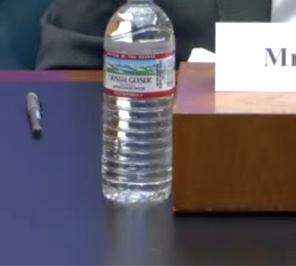



In addition, the executive also cited a 2024 ACA study of indie shops that found one in five repairs are sent to dealers “due to repair data restrictions, costing consumers upwards of $3 billion in added repair expenses.”
He gave examples such as one vehicle needing to be placed in dealer service mode to swap windshield wipers, while in another case, during a battery changeout on a new model, a dealer code was needed to reset the Electric Control Module.
More than half of indie shops surveyed by ACA said they send one to five vehicles to dealers for repairs every month.
All-makes tools have to work with each OEM’s “non-standardized methods of getting
to the security systems,” and with fi xed innovation budgets, a ermarket developers have to “pick and choose” what they can and cannot access. at leads to some makes and models being le out.
Sometimes auto makers do give enough access, and sometimes not enough to get into security-enabled modules.
“If you pass the gate, you can get into any make and model and get to whatever you needed to get,” said Ben Johnson, VP of general automotive repair segment for Repairify. e most reliable way to do this is buy the OE-specific tool, which can cost $2,000. He noted all-makes shops can’t a ord to buy 22 di erent versions and “it becomes pretty unrealistic to expect them to be able to do that.
Johnson said generally the auto side is good about compliance, though mentioned some European brands are “awful” in this regard.
Fleets and shops have a tougher time.
“As far as I know, it’s been very di cult to get a non-dealer shop access to OE diagnostic tools in that commercial side,” he said.
Hanvey asserted why accessibility and supply chain integrity are crucial reasons to pass the REPAIR Act. Hanvey also noted there are 235,000 independent shops “on the corner of every Elm and Main Street of every town in this country,” versus 17,000 authorized dealers. ese are far more accessible and available, especially to rural customers who might drive 100 miles to buy a vehicle but not to get it maintained.
Foshee agreed.
“If you’re hauling medical supplies across Nebraska and your truck breaks down, you can’t have it towed three hours to get to the nearest dealership,” she said.
Sources we interviewed also agreed data is being gatekept.
“[ e OEMs are] shutting down key access to complete the repair,” insisted Shari Pheasant, who co-owns a 12-bay shop in Sparks, Nevada,
called A Master Mechanic with her husband Je . ey service a 60/40 split of consumer to fleet customers, and she said sometimes their diagnostic technicians “get about 75 to 80% of the way through” before the scan tool says a dealer code is needed to complete the repair. e shop must then send the vehicle to a dealership.
“And our dealerships are two months out [for service] right now,” added Pheasant, who was named 2025 Female Shop Owner of the Year by Women in Auto Care, an ACA o shoot.
While keeping some data from shop technicians, Hanvey alleged the OEMs “monetize [their telematics] data by selling it to third parties like insurance companies, ticket sellers, co ee shops and fast-food restaurants, or anyone else willing to pay for it.”
While REPAIR Act proponents say they are working in the best interest of indie repairers, the Automotive Service Association, which comprises thousands of independent repair shops, helped author the SAFE Repair bill. All three signed the 2023 agreement to keep the 2014 data-sharing policy in place with OEMs.
At the hearing, Rep. Tom Kean, Jr. (R-N.J.), submitted the testimony of a few shop owners opposed to the a ermarket bill, including Gerald McNee.
“ e REPAIR Act doesn’t provide independent shops like mine with anything we don’t already have to properly fi x your vehicle,” wrote McNee, member of the SCRS. He noted his shop invests in all the tools and training needed to safely repair vehicles to OEM standards.
“ e idea that independent repairers are being ‘locked out’ by automakers is not true,” he added, calling the lack of access a “myth” propagated by special interests such as large insurance companies and corporations that profit o alternative parts sales. He wrote the SAFE Repair Act, conversely, ensures access to info, tools and training, while addressing the “real challenges” that customers and small shops endure, while supporting shops that “refuse to cut corners.”
According to Cain’s testimony, besides providing only the necessary diagnostics and repair data to consumers and indie shops, the SAFE Repair Act would ensure customers can choose between OEM and a ermarket parts, keep insurance companies from deciding where and how repairs are done, safeguard IP and strengthen cybersecurity.
She noted in her written testimony that the SAFE Repair Act “does not limit repair access or favor franchise dealers over independent repair shops.”
is version would also provide parts transparency, the former director of innovation for Toyota argued.
e SAFE Repair Act, as explained by Cain, would also benefit potential vehicle buyers by notifying them via a repair history report of any “prior repairs, alterations or deviations” contrary to OEM recommendations.


“ Repair decisions should be guided by safety and technical requirements, not [insurance] reimbursement formulas. ”
at is something Cain alleged happens today. In some instances, she said a safety system failed a er repair because the shop skipped a step or used a cheaper part than what OEM guidelines called for.
“In many of these cases, the deviations were driven not by consumer preference or technician judgment, but by insurance reimbursement models that incentivized lowercost, faster repairs rather than complete and proper ones,” she testified.
One specific case involved John Eagle Collision Center in Dallas. e shop did not follow Honda Fit roof replacement guidelines a er it damaged by hail and used adhesive glue instead of shop tack-welding it. In 2013, the car was T-boned by a hydroplaning Toyota Tundra. e owners were trapped inside, receiving severe burns.
Because the incorrect repair a ected the crashworthiness of the compact car, a jury decided John Eagle was 75% liable for the couple’s injuries, and on the hook for $31.5
million in damages. Shop manager Boyce Willis testified in 2017 they “were guided by insurance” to make the cheaper repair. Not following their wishes could result in them “not paying the bill,” Willis said.
SCRS’ Schulenburg said “the SAFE Repair act preserves consumer choice and puts the decision-making in the hands of the consumer,” not the insurers. He was quick to point that several insurers, as well as the lobby group American Property Casualty Insurance Association, support the REPAIR Act and have spent lobbying money on HR. 1566.
Cain also theorized language within the REPAIR Act would open the data floodgates too wide and unleash “vehicle data far beyond what is necessary to perform safe repairs [and] potentially undermine intellectual property protections.” is means instead of licensing the rights to produce OE-compatible parts, the a ermarket has the data they need to make their own—without putting in the billions of dollars in R&D like the OEMs have.
The subcommittee was generally concerned with China, both competing with their auto manufacturing technology and preventing them from stealing ours.
“We are seeing a lot of intellectual property theft and counterfeit parts coming out of China, and our fear would be that…reducing the intellectual property protections in the law may encourage more of that,” Cain asserted.
It’s important to reiterate that the current R2R debate is about what’s in a federal repair bill, not it’s existence. This is evidenced by lobbyists on both sides drafting a federal repair bill. A July 2025 poll done by the Tarrance Group on behalf of the CAR Coalition, a pro-REPAIR Act lobby group, indicated 83% of vehicle owners also support R2R.
“When you talk to the folks at the manufacturers or in the repair shops, everybody wants to get to the same place, which is getting their customers back on the road,” ACA’s Foshee said.
She noted aftermarket repair shops perform 70% of out-of-warranty repairs and OEMs support that.
And aftermarket scan tool providers continue to grow in the current environment, with Noregon tracking the aftermarket and OE diag tool sectors having an even split of the market share by 2028. It was 100% OE in 1990.
And even dealers rely on all-makes tools, as Freightliner dealers will fix an older Kenworth while and vice versa.
Now if you ask the top brass of those OEMs, they would still recommend staying with your own team throughout the life of the truck. It’s not a conspiracy, though, just quality control, according to VTNA’s Agebrand. He explained in the case of Mack and Volvo dealers, their techs are specifically trained and develop an expertise on those specific brands, along with models’ “issues or quirks” that come up.
“We can also put demand on [dealership service centers] to actually do training enough to have true knowledge, which, with the right-of-repair service, you might not be able to control,” Agebrand offered.
Meanwhile, he explained they are confident their OE-level parts provide optimal safety and reliably, because they engineered and tested them.
And the OEMs are actually part of the aftermarket. Pheasant pointed out, “in many cases, aftermarket parts are made by the same manufacturers, in the same factories, as OE parts; they
are just put in different boxes.”
All this is to say the aftermarket and OEMs will continue to work together.
“I don’t think the working relationships are as broken as some lobbyists in D.C. make it out to be,” Schulenburg opined. “I see a positive relationship in the real world between dealers and independents, independents and automakers, and vice versa. I think ‘right to repair’ legislation that is about companies trying to gain access to more vehicle data will do little to impact how repairs are conducted, or the quality of those working relationships.”
He also feels confident the SAFE Repair Act will find a sponsor.
“I continue to believe that there is, or there must be, a way to resolve this, because everyone does want the same end goal,” Foshee explained to Fleet Maintenance in October. “We’ve been unable to do it so far, so maybe I’m a little Pollyanna about it.”
Pheasant is adamant it will. “I think something has to be done,” she said. “It very much is about freedom and choice.”
She sends letters to legislators and encourages her customers to do the same. The staunch REPAIR Act-ivist also went to Capitol Hill twice last year to talk to member of Congress.
But Pheasant’s idea of freedom won’t come easy. She said before meeting with House members, the side lobbying against the REPAIR Act prepped members with questions critical of the REPAIR Act. They also allegedly paid for box trucks emblazoned with anti-REPAIR Act messaging to drive around the Capitol Hill grounds.
Foshee alleged the OEMs have spent “millions and millions of dollars” in lobbying fees. And Pheasant said this worked in the ACA’s favor, as the contingent had a chance to rebut each and every talking point.
But the shop owner noted the OEMs “have a lot of money behind what they do.” The indie side, meanwhile defends its stance with “time, people, and energy,” though “that wears out easier than money does,” Pheasant offered.
But considering the massive size and scale of the aftermarket, this fight is less David vs. Goliath and more Goliath vs. Godzilla, with the winner still uncertain.
For now the REPAIR Act continues to dangle in limbo while the SAFE Repair Act waits on a champion to appear. Neither side seems willing to give an inch, expecting the other to flinch— with no sign of repair in sight.
For related content go to FleetMaintenance.com/ shop-operations


» NOx sensors have the unenviable job of measuring engine emissions and aftertreatment effectiveness and can be impacted by water, soot buildup, and electrical failures.
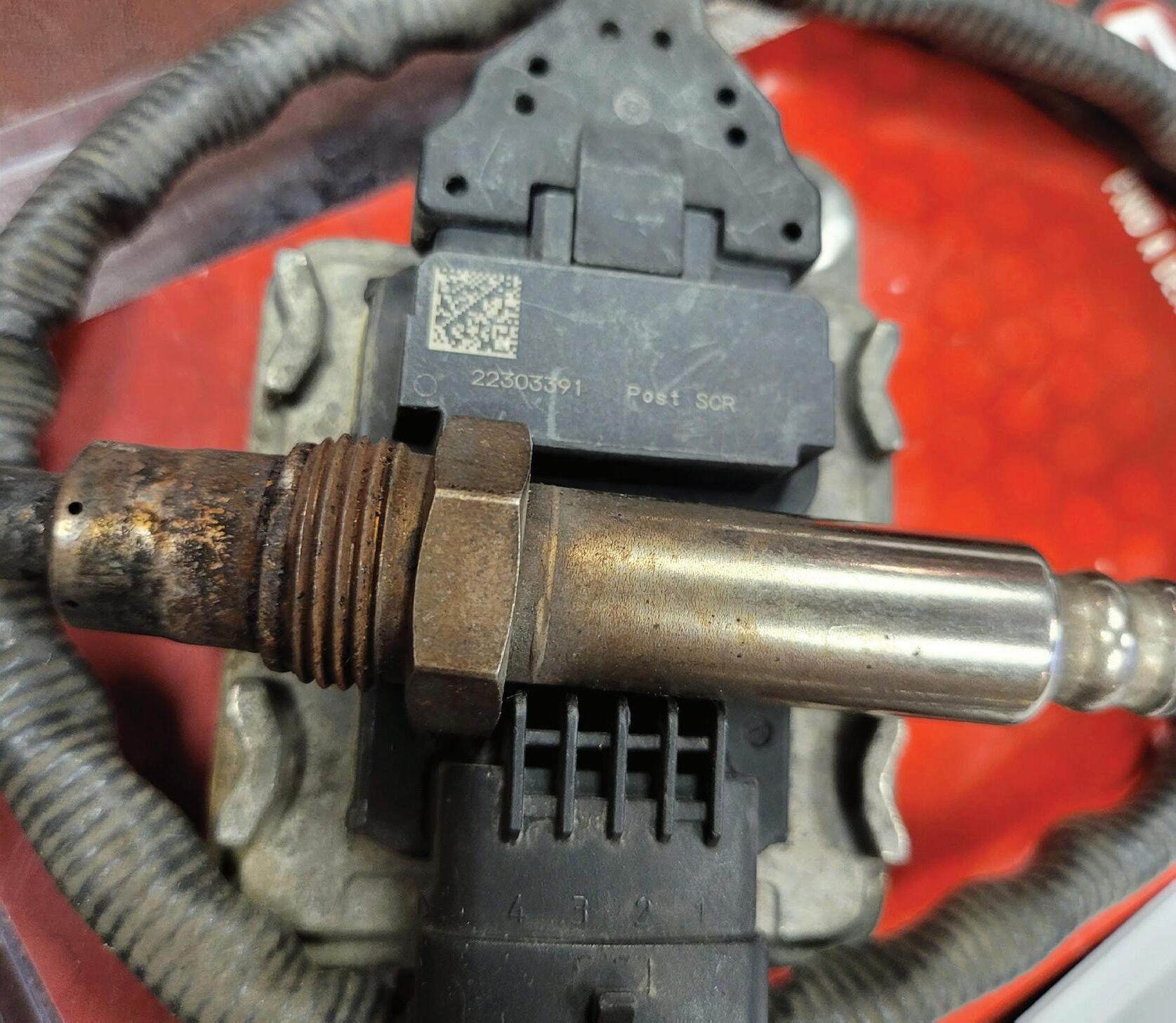
Here’s everything you need to know about one of the most replaced—and misunderstood— emissions system components.
By Seth Skydel
NOx sensors occupy a difficult position in modern diesel engine diagnostics, and few components sit at the intersection of regulation, technology, cost, and technician frustration quite like the NOx sensor. These sensors play a central role in emissions compliance, measuring nitrogen oxide levels in exhaust before and after selective catalytic reduction (SCR) and sending the data to the ECU. If that received data is out of tolerance, it may trigger warnings and fault codes and put the truck in derate mode. The root cause of these warnings could be any number of upstream problems, but oftentimes the technician decides to “shoot the messenger” and swaps the sensor out.
While legitimate sensor failures do occur, industry experts agree that unnecessary NOx sensor replacement remains a systemic problem, often done in haste and leaving the real problem unresolved. The main issues are “service misdiagnoses and
swapnostics,” according to Raymond Parrish, current product support leader for the Cummins Components business segment.
And at a price tag of several hundred to over a thousand dollars per replacement, taking out the NOx sensor can be a costly misunderstanding. And with the industry prepares for EPA 2027 emissions-compliant engines, understanding how NOx sensors actually fail and how to service them correctly has never been more important. So, let’s try to clear the air regarding these critical components.
At some point, all NOx sensors will need to be replaced. For example, a Cummins X15 sensor could last anywhere from 50,000 to 150,000
miles, with higher severity of service and poor aftertreatment system maintenance reducing its lifespan. But in the past, technicians might not consider a sensor’s lifespan when dealing with aftertreatment issues in favor of resolving alerts. This meant that the answer to NOx fault codes has typically been to first assume the sensor is bad and see if engine issues persist with a new one.
Things have improved on the OEM side, though, “NOx sensor replacements in recent years have dropped significantly with improvements in sensor designs, optimized placement, and refined control strategies,” Parrish offered.
Compared with other service events, NOx sensor issues are relatively rare, said Mike Young, powertrain and safety product marketing manager at Daimler Truck North America, saying, “While they can occur, they are among the least frequent service items.”
However, the picture appears to be quite different from the aftermarket perspective. Steve Hoke, president of Diesel Emissions Service, sees NOx sensors replaced in large volumes, often without addressing the underlying cause.
“As an aftertreatment parts supplier, we sell several thousand NOx sensors annually,” Hoke related. “It seems like it’s the go-to sensor to replace without looking for the actual cause.”
This disparity reflects a core issue in aftertreatment service. After all, many NOx sensors are replaced not because they have failed but because they are reporting a problem elsewhere
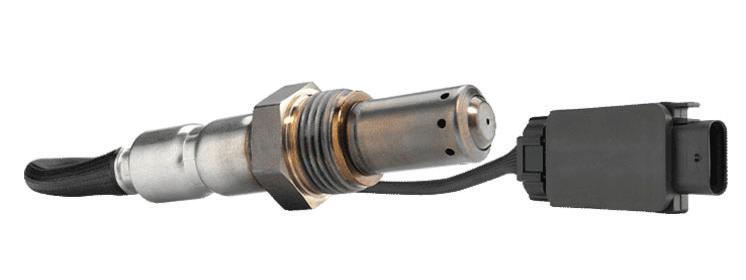
» NOx sensors shouldn’t need much in terms of regular maintenance. Instead, technicians should be sure to use OBD-II scanners to diagnose specific sensor faults before replacing them.
Modern diesel emissions systems usually employ multiple NOx sensors, often positioned both upstream (inlet) and downstream (outlet) of the SCR system.
Diesel vehicles typically use two to three NOx sensors, reflecting the need to measure both raw engine-out emissions and post-treatment effectiveness.
On the Detroit Gen-5 DD15, for example, the inlet sensor monitors NOx levels entering the aftertreatment system, providing baseline data for dosing strategies, while outlet sensors confirm SCR efficiency and regulatory compliance. This distinction matters when it comes to diagnostics because an outlet sensor reporting high NOx levels may be accurately signaling poor SCR performance, DEF dosing issues, or catalyst degradation, not a failed sensor.
in the aftertreatment system. Technicians and fleets just need to be prepared to find these issues instead of defaulting to the easiest solution.
Because NOx sensors are designed to measure system performance in accordance with EPA guidelines, a fault code may indicate that the aftertreatment system is not operating efficiently, not that the sensor has failed.
“It is important to follow published troubleshooting trees to determine if a replacement is actually needed,” Cummins’ Parrish emphasized.
Bosch Engineering Manager Roop Majumder added that wiring issues are frequently misinterpreted. “A wiring failure may trigger fault codes, but in some of these instances, technicians may mistakenly replace the sensor instead of addressing the faulty wiring,” he said.
For Hoke, high-mileage engines introduce additional variables to sensor health. “Engine wear can allow combustion, oil, or fuel past the piston rings,” he explained. “Many factors can contribute to either the NOx sensor failing or needing replacement because it shows readings outside its given parameters.”
Young, meanwhile, pointed to delayed action as another contributor. “Ignoring fault notices from the system can allow problems to escalate beyond the initial issue, affecting other components in the aftertreatment system,” he said.
Despite their reputation, NOx sensors are relatively robust. When they do fail, the cause tends to fall into a few well-defined categories:
Environmental and contamination factors:
Water is one of the most common enemies of electronics, and NOx sensors are no exception.
“Water is known to transport material that can block the internal chambers from proper operation and cause damage to the sensing element,” Parrish said.
Several other factors can cause a NOx sensor to fail as well, Hoke added. “The most common include soot and carbon buildup on the sensor head, moisture or heat damage, or contamination from DEF,” he said. “Weather and external corrosion cause issues with sensors because these units depend on an exact voltage to operate properly.”
Electrical and signal-related
According to Bosch’s Majumder, modern NOx sensors contain their own electronic control unit, which is capable of diagnosing internal issues. “Electrical failures occur when there is no signal, a short circuit, or an open circuit, often due to wiring damage,” he explained.
“Slow response faults can be triggered when sensor gas entry holes become clogged,” Majumder added. “Offset and gain failures occur when contamination or degradation alters the
sensor’s baseline or sensitivity, leading to inaccurate readings.”
Additional note: The symptoms indicating a bad NOx sensor are consistent across all manufacturers. Whenever a malfunction criteria exceeds thresholds, the engine control module intervenes, and a Check Engine Light will be displayed to the driver and technician, Parrish said.
As diesel aftertreatment systems become more integrated, NOx sensors will increasingly function as system health monitors rather than standalone components. Still, one point is consistent across all sources—NOx sensors are not routine maintenance items.
“The NOx sensor will only need replacement if the Engine Control Module flags a fault code that requires so,” Parrish said.
Every expert also stressed the importance of adherence to published troubleshooting procedures. In addition, technicians should use the correct service manual for the engine platform, review warnings carefully, and rely on fault trees that may have been updated since their last service event.
At Bosch, Majumder advised technicians to reference the sensor’s internal ECU and use OBD-II scanners to identify the specific fault type before replacing any component.
“Poor engine maintenance can shorten sensor life dramatically,” he said. “And irregular oil changes, incorrect oil specifications, and delayed component replacement can be major contributors to contamination.
“Conscious use of fuel additives is another way to prolong the life of a NOx sensor,” Majumder continued. “The use of manufacturer-recommended fuel additives ensures the sensor is not exposed to unwanted chemicals and prevents poisoning. This also helps by creating a cleaner combustion process, preventing soot and unburned fuel from interfering with or contaminating the sensor.”
In addition, it is important to consider fuel quality. Jessica Crabtree, director of technical services for Power Service, explained the influence of seasonal challenges can indirectly affect NOx sensors.
“During winter months, some fleets rely on anti-gel agents with little detergency, allowing injector deposits to build up,” Crabtree said. “Poor spray patterns lead to incomplete combustion, excess soot, overloaded DPFs, and increased stress on sensors. Preventive fuel system cleaning can reduce soot accumulation and protect aftertreatment components during cold-weather operation.”
Hoke emphasized the importance of ensuring that the installation is done properly.
“The best practices are to follow the manufacturer’s recommended torque values and to keep the lead harness free from kinks or sharp bends,” he explained. “Always use quality fuels, operate the engine at the correct temperature, and service your DPF and EGR systems as recommended.”
As the EPA 2027 emissions standards approach, NOx sensors will operate within increasingly sophisticated aftertreatment architectures. Part of the new regulations relates to cutting NOx down 82% from current standards, while the other aspect deals with useful service life.
“To meet 2027 EPA standards, some engine manufacturers are using dual SCR substrates to increase efficiency,” Steven Hoke, president of Diesel Emissions Services, explained. “Others are adding heaters to the exhaust stream, along with more efficient turbochargers and EGR systems.”
Cummins, for example, will use a Twin Module aftertreatment system with parallel exhaust flow to reduce backpressure. The new aftertreatment system will incorporate 5kW electric heaters powered by a 48V alternator.
“The purpose of the heating system is to directly add thermal energy to the aftertreatment system, ensuring that the catalysts operate at optimal temperatures,” said Raymond Parrish, product leader, Cummins Components business segment.
Even with the changes, Cummins states that the modular design will make the engine more serviceable and configurable to various chassis.
International Motor’s EPA27-compliant S13 Integrated Powertrain does not have the heaters, but also uses a dual-stage SCR and smart DEF dosing. International is adding an Ammonia Slip Catalyst NOx sensor, which takes into account if the SCR is getting too much DEF and the unreacted ammonia ought be oxidized.
Volvo’s EPA27 NOx sensor has a new sensing-head design with primary benefits on the controls side.
“Previous-generation NOx sensors required a delayed activation on cold start to allow exhaust condensation to clear, which limited early control authority,” Duane Tegels, product marketing manager at Volvo Trucks North America, explained. “The new design is dewpointfree and activates very rapidly after engine start, enabling earlier and tighter control of both the engine and exhaust aftertreatment systems.” He added the NOx sensor meets or exceeds the MY2027 useful-life requirement of 650,000 miles.
Specific details will be announced soon on Detroit’s Gen 6 heavy-duty powertrain and Paccar’s MX engine to meet upcoming standards.


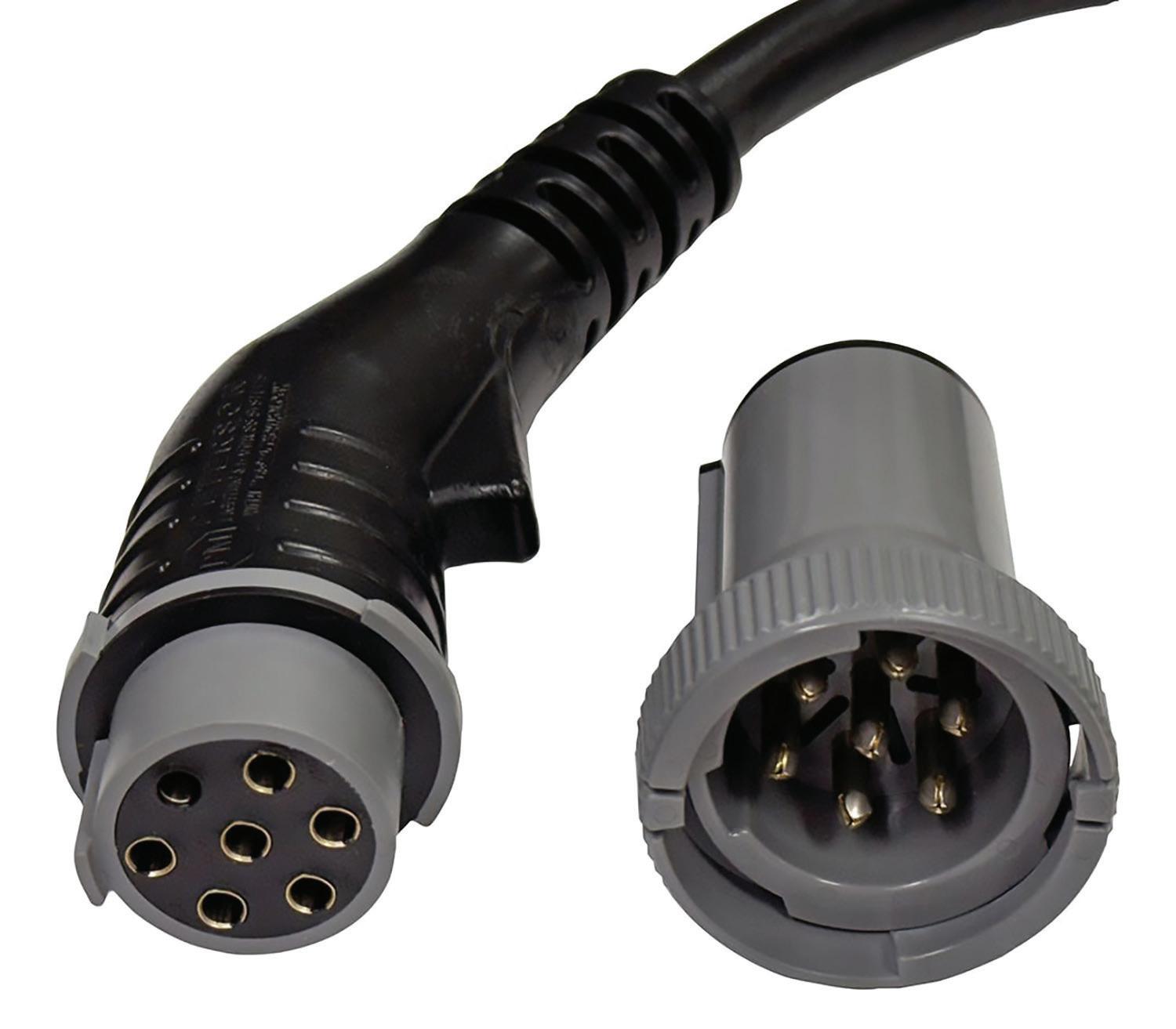


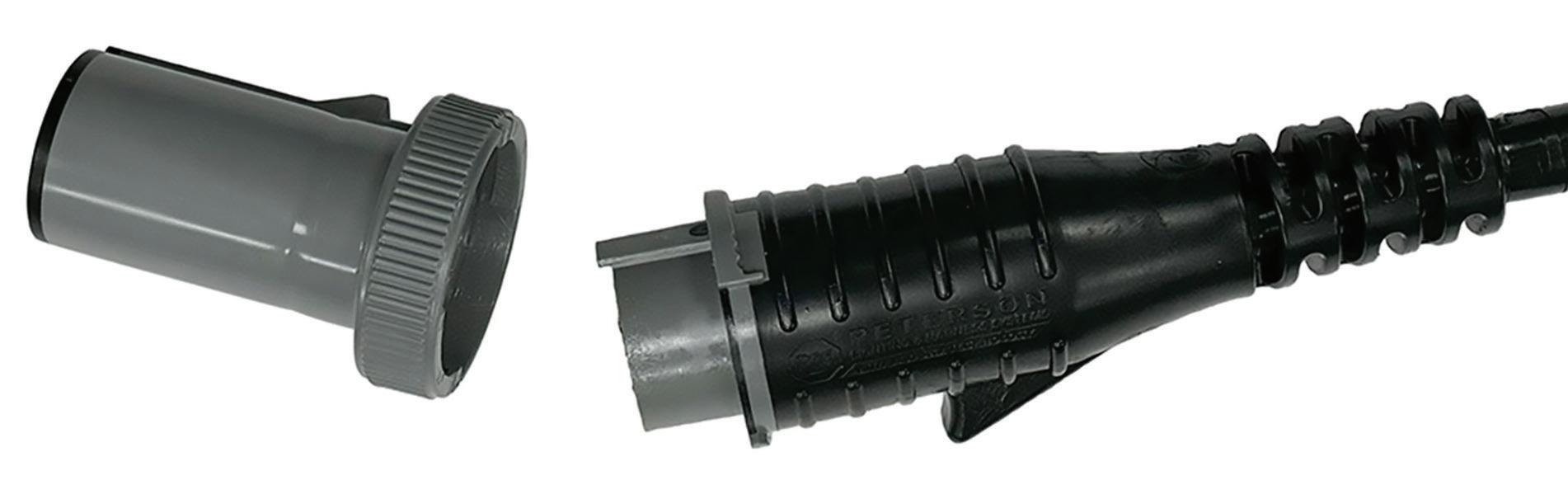


The industry wants smarter trailers, but at some point, tractor-trailers will need more capable connectors as well. First, stakeholders must agree on a standardized design.
By Alex Keenan
As with most things in trucking, trailers have evolved and become smarter. Unfortunately, the connection to the tractor has not advanced along with the amount of trailer technology, with most fleets using the 7-pin SAE J560 standard connector that was fi rst developed in 1951. At the time, each pin had a specific role, such as for brake lights or turn signals.
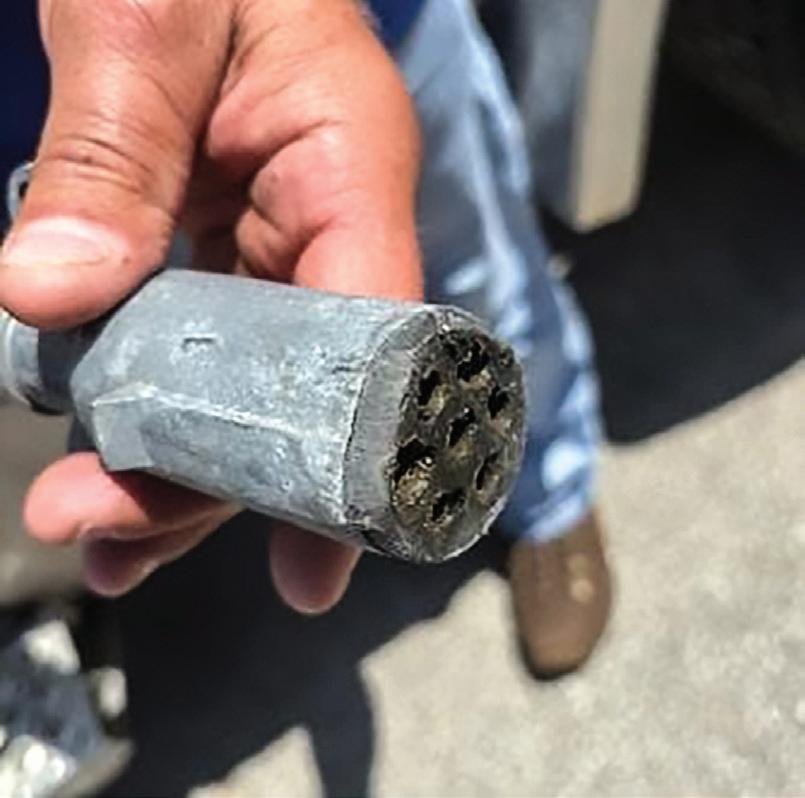
Nowadays, these 12V connectors transmit crucial power and diagnostic data between the cab and trailer, primarily for antilock braking systems (ABS) and lighting. While J560 has worked admirably for a long time, it appears a bit antiquated as trailers add more sensors but also need to power ABS, li gates, and lights.
e original J560 developers could not have foreseen the futuristic bandwidth needs of 21st century trailers. A er all, famed sci-fi author Phillip K. Dick wasn’t even published until 1952. But the industry realizes that it needs a smarter connector to match the tractor-trailers of today and tomorrow.
“ e traditional role of a trailer connector was lighting and basic ABS signaling, but that no longer reflects how trailers are actually used,” explained Dan Fortho er, VP of corporate research and development at Phillips Industries, a component manufacturer for trucks and trailers, adding that connectors are now tasked to move “information, not just power.”
So, something has to change.
ey have a few options on the table, but before we get into those, let’s look at what J560 does in more detail.
e J560 hit mass adoption in the late 1960s and has changed with the times as much as it can.
Chris Lee, VP of engineering at Great Dane, noted that the J560 connector has increased its durability and sealing over the years, with stronger strain relief, better locking tabs, and stronger cable jackets. As part of that durability, the connector’s corrosion resistance has also improved.
“Specifically, manufacturers have enhanced plating materials (nickel, tin blends), sealing and gaskets, and terminal designs to reduce fretting corrosion,” Lee explained.
Additionally, Gri n Wurm, systems engineering supervisor at Truck-Lite, also noted that connectors now o en have corrosion-resistant plating on the terminal pins and that they o en fit better in the plug.
Also, OEMs increased the J560’s electrical contact quality over the years so they can better deliver power from tractor to trailer.
“Even with the same pin count, newer J560 connectors o er lower contact resistance, more consistent voltage delivery, and reduced fl icker and ABS fault triggers,” Lee added.

SAE did introduce a revised standard SAE J2691 15-pin connector 13 years ago, but it failed to attract widespread adoption like its European cousin, the ISO 12098 15-pin 24V connector. In recent years, industry leaders have mulled over what a new standard should look like at various conferences, such as American Trucking Associations’ Technology & Maintenance Council meetings.
Another notable recent advancement is the Repairable J560 connector from Peterson Manufacturing, which makes lighting and harness systems. It features the standard electrical connection and corrosion resistance of the typical J560, but it also provides easier maintenance and has the capability to integrate with smart trailer systems, according to the company.
e key feature is in its name: When a connector end hanging from a tractor in the yard gets run over or damaged, a technician can disconnect »
the end from the cable, so you only replace the damaged part.
“You only pay the cost of that end [connector]; you save everything else, in terms of the part price; and in terms of labor, you don’t have to unwind it and rewind everything,” emphasized Al Anderson, VP of sales and marketing at Peterson.
Additionally, current J560 connections have evolved to carry Power Line Carrier (PLC) communication via the PLC4Trucks integrated circuit.
is allows the connector to ferry ABS and lighting malfunction signals from the trailer to the tractor and was o cially standardized in SAE J2497 in October 2002.
“Since lighting and ABS systems share common power and grounding paths, intermittent electrical issues can o en be the cause of both lighting failures and ABS faults,” Wurm explained. “PLC diagnostics allow technicians to identify if the failure originates from the Tractor-Trailer interface, internal trailer wiring, or other components on the trailer. is allows for a more e cient rootcause analysis and minimizes unnecessary parts to be replaced due to trial-and-error techniques.”
Today, several companies, such as LaunchTech USA (with its J560 PLC Trailer Connector) and Autel (with its Trailer PLC Connector), o er diagnostic connectors that interface with the J560 so technicians can troubleshoot trailer ABS and lighting issues using PLC signals.
Despite these updates, the J560 still can’t keep up with the raw data demands of today’s trailers.
Smart trailers today “need to have a di erent set of information going back and forth between the tractor and trailer that the J560 cannot handle, because they’re just not in the right kind of devices to carry it,” Anderson stated.
For today’s fleets, a modernized connector needs to have a few main features. According to Great Dane’s Lee, that includes backwards compatibility with current J560 systems, higher bandwidth and connectivity capabilities for cameras and sensors, greater durability, lower maintenance, and the ability to be rolled out without disrupting current operations.
at backwards compatibility is important so that the new connectors don’t make the millions of tractors and trailers on the road today unusable—or, more likely, the connectors themselves.
“Across the board, the message is the same: [Fleets] want compatibility, flexibility, and choice,” Phillips’ Fortho er said. “ ey do not want to be forced into a wholesale retrofit or stranded with legacy equipment.”
More specifically, fleets seem like they want to remain compatible with the J560 via a direct plugin connector, according to TMC Executive Director Robert Braswell.
e second requirement for the next-gen connector is strong, reliable connectivity. is is especially important for smart trailers equipped with camera arrays and assistive-driving sensors, which require gigabytes of processing power.
“Neither the J560 connector nor existing ISO CAN connectors are designed to support Ethernet over the length of a truck-trailer combination,” Wolfgang
» Al Anderson, VP of Sales and Marketing (L) and Dan Miller, sr. manager of Fleet Sales (R), of Peterson Mfg., show off the Repairable J560 connector at ATA’s Management Conference & Exhibition.
John Hitch Fleet Maintenance
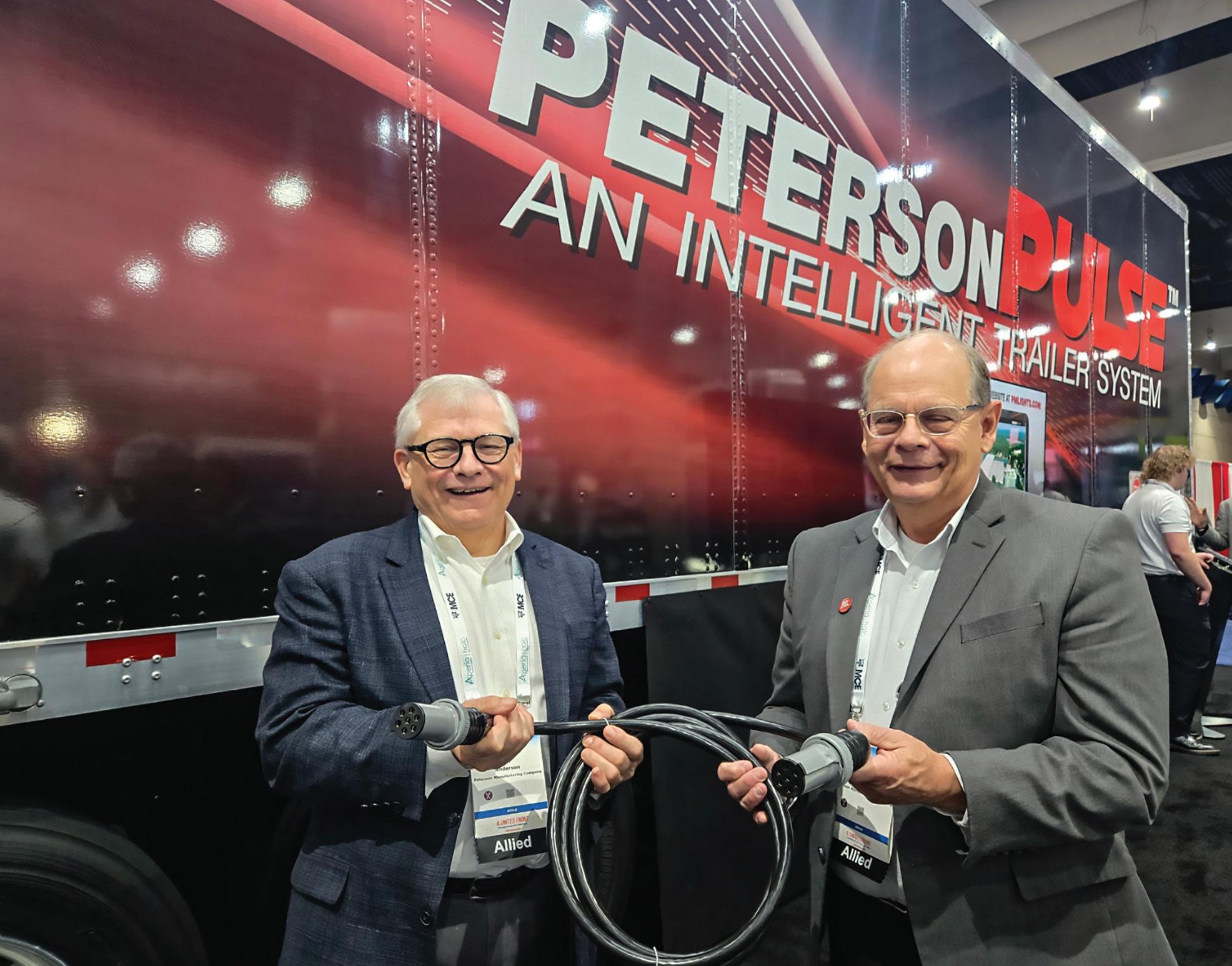
Hahn, systems innovation leader, ZF Group, explained. “As a result, enabling next-generation trailer sensing and automation will require new connector standards that add Ethernet capability alongside existing power and CAN connections.”
And this higher bandwidth data communication isn’t just important for the next generation of trailer technology but for devices used in fleets right now.
“It’s really important for fleets to understand the need for the reliability of that transmission [and] the speed of that transmission of information,” said Bruce McKie, chairman of the Board of Directors for Tectran, a designer and manufacturer of maintenance and safety solutions for transportation equipment, and head of several SAE Standards development teams. “If I’m trying to back into a shipping dock, or if I’m trying to negotiate my way around a fairly busy parking lot for delivery purposes, I need split-second, immediate information if I’m a driver.”
Plus, Noregon Research has stated that faster, more reliable tractor-trailer communication is likely to advance beyond PLC notifications, impacting that facet of connector design as well.
“Tractor–trailer communication will advance significantly as the industry moves beyond legacy J2497 power line communication, historically limited to ABS fault alerts,” Noregon Research reported. Instead, trailer connectors using CAN communication will need to be able to provide deeper trailer data, spurring the adoption of more smart-trailer technologies and scanning tools with greater diagnostic reach.
Next, durability and serviceability are also important for fleets, especially since technicians already need to take apart and clean out the current J560 connector with some regularity, Braswell added.
Finally, the new connector needs to be able to provide enough power for all the devices that let a trailer detect the world around it, whether that’s pumps, cameras, or sensors.
“We have to think about the future of higher voltages,” McKie cautioned. “We have to have something that’s adaptable to 24 or 48 volts, that’s critical [for the next generation of connectors].”
When the industry can agree to a new standard and a new connector is rolled out that meets these capabilities, the roads will be safer, Truck-Lite’s Wurm asserted.
“Fleet safety across all aspects will be achieved with a next-generation connector that provides a physical layer for controlling safety systems on the trailer and enables instantaneous data flow between the power unit and trailer,” he said. is is especially true for braking and safety systems, even on present-day trucks.
“A more modernized trailer connector could support improved system robustness for ABS today and emerging technologies like EBS (brakeby-wire) in the future,” Jason Paauwe, VP, head of Trailer Sales North America for the ZF Group, noted. “Enhanced power availability, improved communication pathways, and greater redundancy can contribute to faster diagnostics, improved system response, and higher overall reliability, all of which support vehicle safety and uptime.”
And looking even further ahead, a new connector should be able to support the next leap in trucking operations, where there may be no driver in the cab at all.
“Recognizing the industry’s appetite for change—such as the current J560 standard, which has been in use for 70 years—the next generation of connectors must also address the needs of Level 4 and Level 5 autonomous vehicle ecosystems,” Wurm added.
TMC and SAE have been working toward replacing the J560 for some time now. TMC presented a position paper, “Recommendations Regarding Technical Needs for Next Generation Tractor/
Trailer Electrical and Data Connectivity” in 2024, a er which the group received four potential connector system proposals.
Two years later, the main connector front runners will soon undergo testing from SAE to make sure they meet safety requirements, TMC’s Braswell said.
is testing includes both computer-based, or lab, testing as well as field testing. According to Braswell, the industry will be starting lab-based testing by the end of 2026, which may yield results within the next year or two as SAE evaluates which tests are needed and what performance metrics they’re looking for.
“Within the SAE group, we’re [looking at] performance requirements,” Tectran’s McKie said. ese performance requirements for the next connector include sealing, environmental elements, and vibration. “We’ve gone through all of the ISO standards, the SAE standards, some of the USCAR standards, and other ones that are out there, and created a test plan and performance requirements,” McKie continued.
en comes the field testing, which fleets are likely to be much more involved in.
“Generally speaking, fleets are rather curmudgeonly,” Braswell joked. “If they don’t see ‘real-world testing,’ they usually will sco at the results.”
A er that, the industry at large will need to decide which connector design they prefer. Once that decision is made, then the chosen connector specs will be put into a full design that any manufacturer can use while building their products.
“We want to make sure that it’s not just a single player that can do this; anybody can manufacture according to the next-generation connector standard,” McKie a rmed.
en, TMC and SAE will turn its attention to the J560 to see where it can be further improved so that all future connectors have a strong basis to work with. And, of course, there will be even more durability testing.
However, Braswell noted that even as testing is ongoing for these connectors, there’s not much consensus yet in the industry on which design will be the standard going forward.
“It’s not all that entirely sure what the fleets want,” he said. “We’ve had these discussions, we’ve put together these educational sessions, and I think a lot of fleet maintenance personnel are still like ‘Is this really relevant to me right now? Is there a standard that’s going to emerge?’”
Despite this, Braswell is confident that there will be an outstanding connector that will become standard throughout the industry, as determined by the most important stakeholders: fleets. But there’s no timeline on how long this process will take.
“Typically, we found at TMC [that it takes] 35 to 40 years for technology to become ubiquitous,” Braswell stated. “But take a look at automated manual transmissions. ey actually started back in the late ’80s or early ‘90s, but they didn’t really become ubiquitous until just a few years ago.”
Ultimately, it depends on when and how fleets decide which connector will “do the best job for the least amount of maintenance and cost and stay in the field the longest in terms of durability and reliability,” Braswell concluded.
TMC Executive Director Robert Braswell noted that right now, t here are a few main connector options and some from Europe that could replace the J560 connector. These include Phillip’s Industries EvolutionIQ and Te ctran’s 17-Way Tractor/Trailer Connection System.
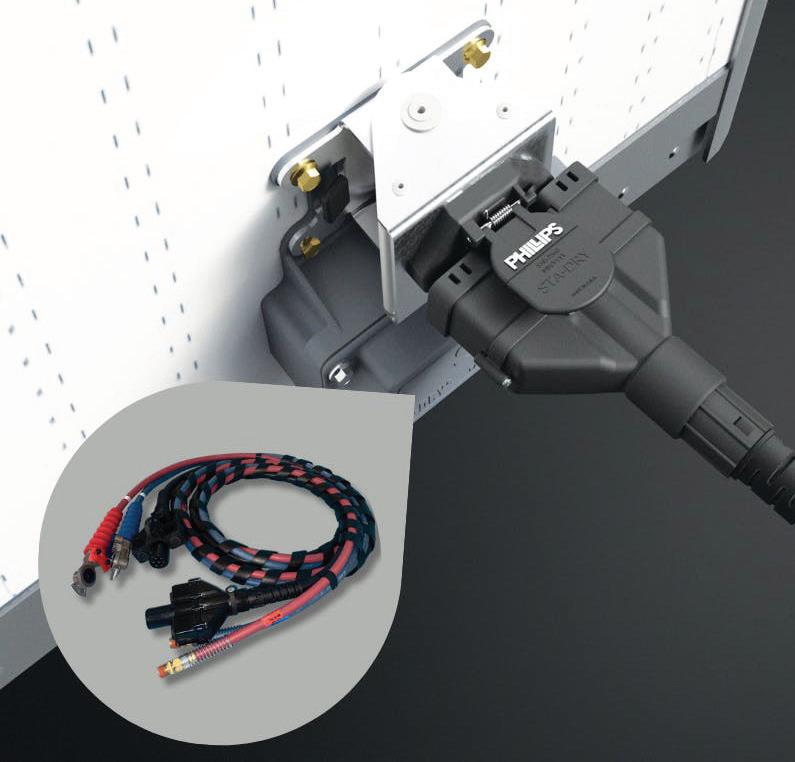
The EvolutionIQ connector combines seven-way power with Ethernet, CAN, and four auxiliary circuits in one connector, according to Dan Forthoffer, VP of corporate research & development at Phillips Industries. It is cross-compatible with legacy 7-way connectors and allows for future tractor-trailer communication expandability. Plus, it can handle a minimum of 2G of video streaming through two field-serviceable, ISO Standard Ethernet channels and 6k plug cycles with IP67/IP69K protection, and includes two CAN FD networks and four AUX power/ground connections.
“With EvolutionIQ, we built an architecture that preserves the trusted J560 power foundation but adds dedicated safetycritical communication paths, CAN for driver and trailer status data, Ethernet for low-latency video and smart trailer systems [like Phillips Connect], and additional auxiliary power circuits,” Forthoffer said.
He said this means that EvolutionIQ will be able to support cameras, real-time video, and more accurate sensors, making vehicle maneuvers like backing into a dock safer and more controlled. That kind of technical support will also make unloading operations safer, as stronger connectivity can let a driver know immediately if freight shifts inside the trailer or a door opens unexpectedly.
Finally, Forthoffer also emphasized that EvolutionIQ’s connectivity will increase the braking and stability capabilities for trailers.
“Advanced brake systems already exist on tractors and trailers, but without a robust communication path, they cannot function as a truly coordinated system,” he noted.
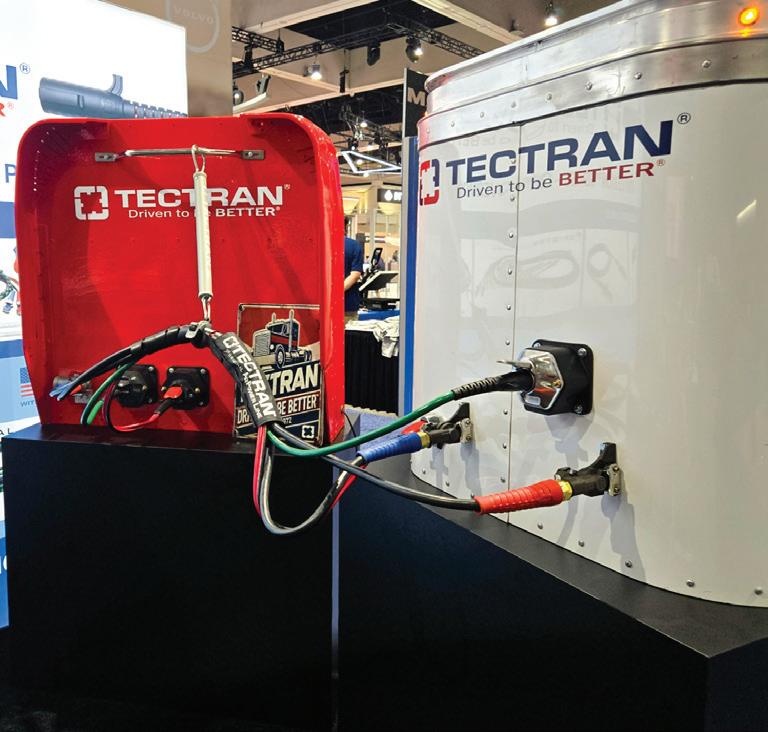
Tectran’s connector includes seven standard J560 pins, two 30A AUX pins, two CAN buses, and two High-Speed Ethernet buses, all capped off with corrosion-proof connectors, according to the company. It is also backwards compatible and fits within the J560 seven-way connector, and it features multi-stage engagement for security and compatibility, Bruce McKie, chairman of the Board of Directors for Tectran, noted.
The multi-stage approach features several steps, he explained, starting with the longer, fatter ground pin mating with the plug.
“The whole idea is to try to guide it in place, and then it mates with the six remaining pins,” McKie stated. “Then, because we put the data connections deeper into the connectors, it will connect there.”
Then for the last step, the connector fully locks together. This, plus the specially designed “Park Socket” used for bobtailing, requires that the trailer plug and gladhands are locked in for the parking brakes to release. This helps avoid drive-offs and connector damage, McKie explained.
“That engagement and the locking capability help to make it a better connection for the data itself,” he stated. “When you are connecting a new [trailer] to a new [tractor], you really need to have that compression for sealing and vibration resistance.”
Tectran emphasized how its connectors were designed as part of a system at the back of the tractor, including air brake lines and other components, because the tractor-trailer never exists in isolation.
“They all influence each other,” McKie said. “It’s important for us to think of [the connector] as a complete system, that’s an important part of how we are designing this.”

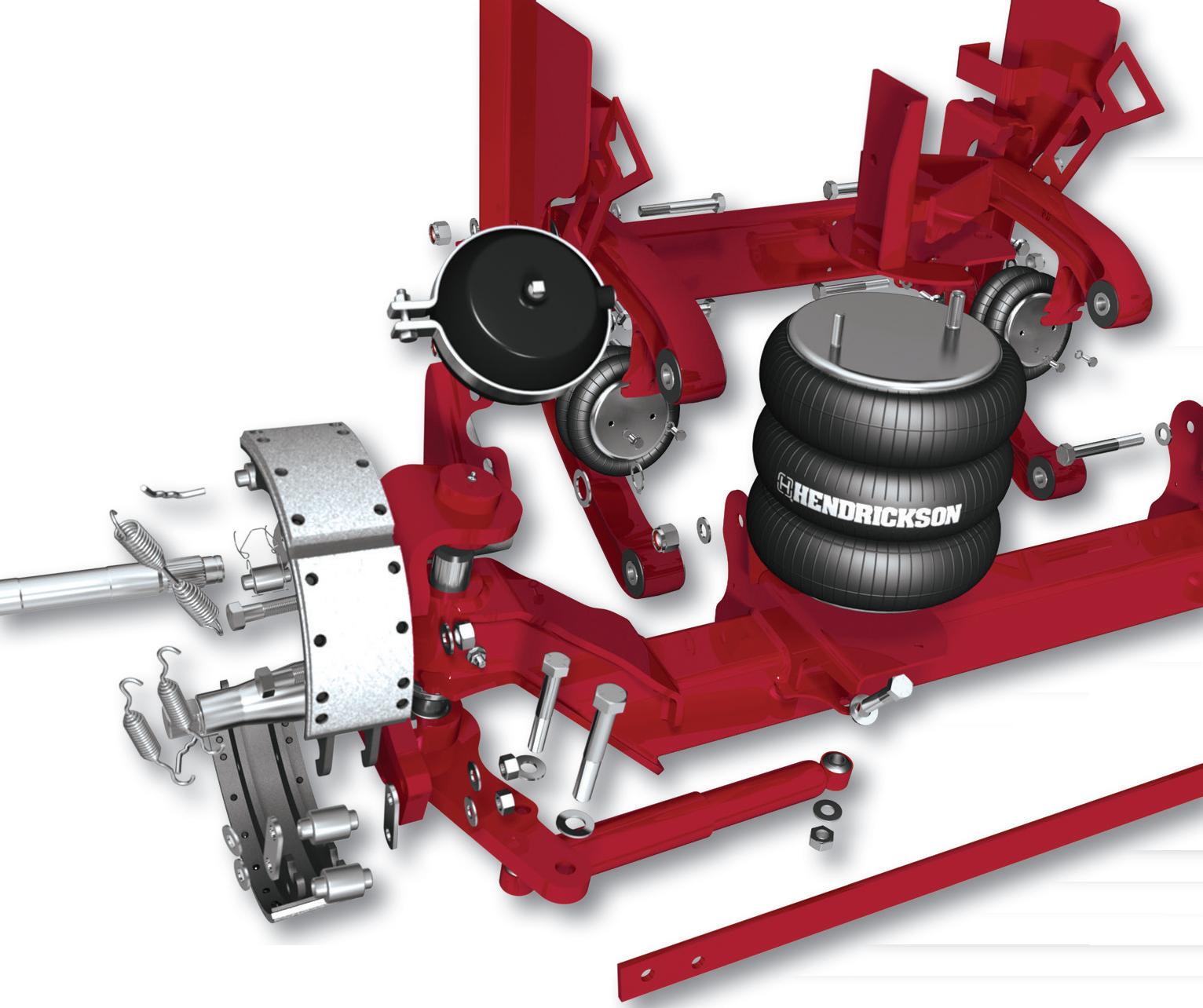







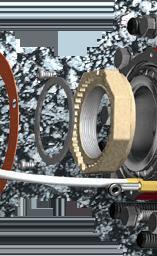

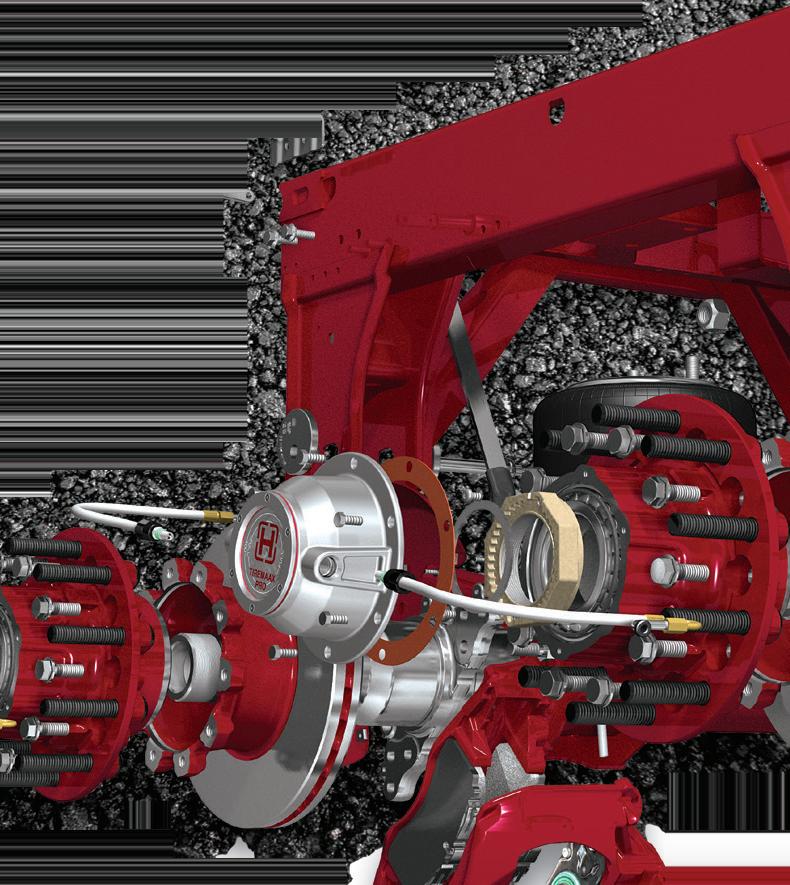







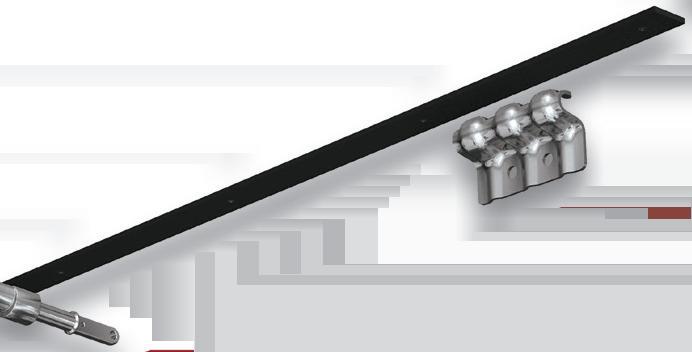





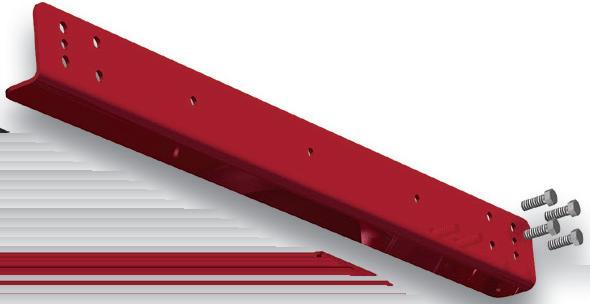
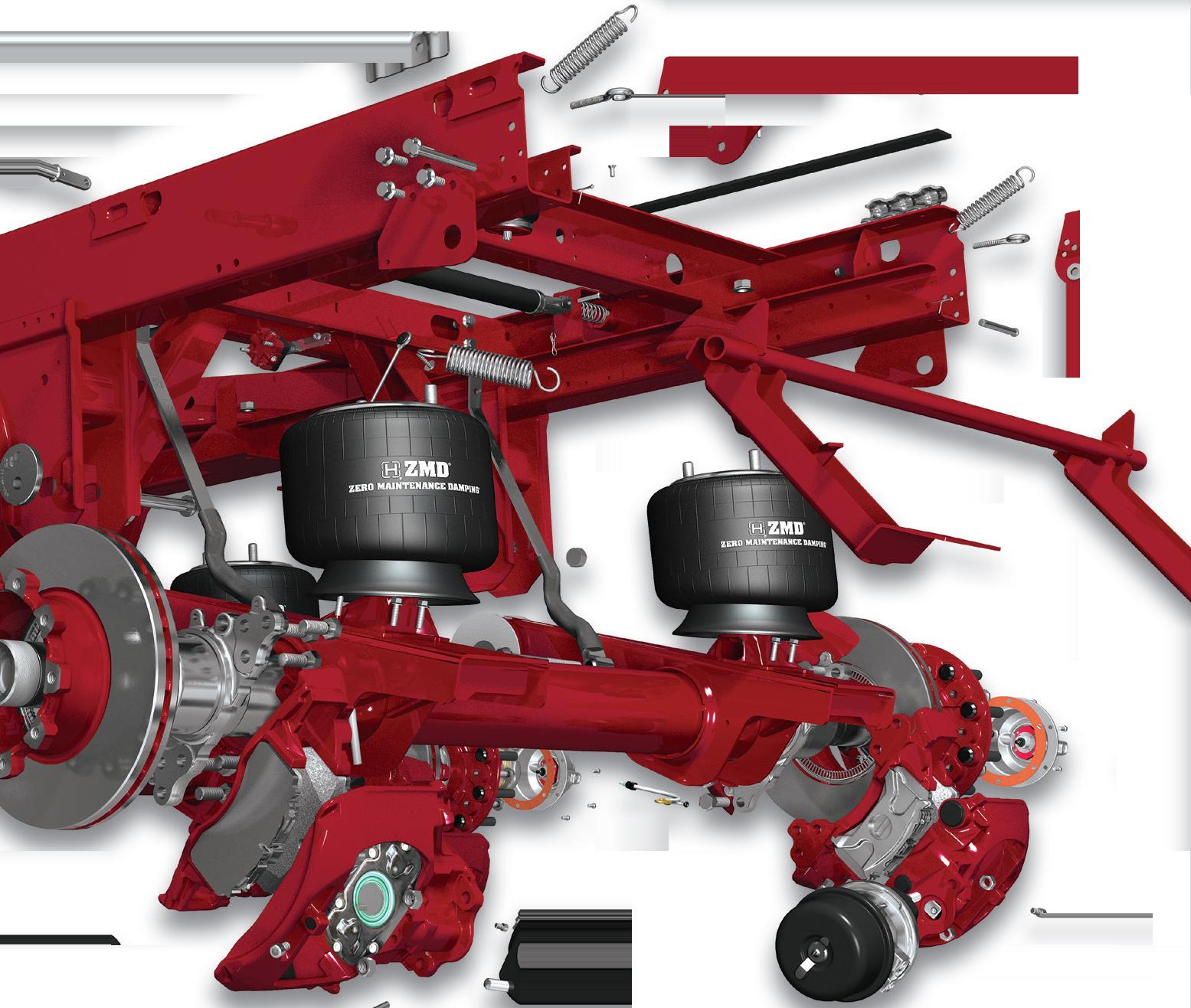


» Heavy Duty Aftermarket Week kicked off with Heavy Duty Aftermarket Dialogue, where fleet executives shared how OEMs and vendors need to be more transparent and accountable concerning pricing to keep their business.
Kevin Jones | Fleet Maintenance

As tariffs and recession pressures grow, fleet leaders at Heavy Duty Aftermarket Dialogue shared what it will take to get their business in the coming year.
By Kevin Jones
GRAPEVINE, Texas— Pricing transparency: Is that too much to ask? In most business relationships, no.
With tariffs looming over trucking right now— so that invoices and estimates are like Russian nesting dolls, as each hidden cost covers another—it probably is a lot.
But that didn’t stop veteran fleet leaders from demanding it at the 2026 Heavy Duty Aftermarket Dialogue (HDAD) during the Fleet Perspective panel, which overall addressed changing trends in buying behavior due to the current economic landscape. The fleet executives shared a sobering look at the state of the trucking industry. Heading into year four of the Great Freight Recession, freight rates remain low, but operating costs are soaring. That means every penny per mile counts, and fleet leaders are under pressure to find savings.
And this isn’t just one corner of the industry. From automotive steel and bulk chemical hauling to agricultural cooperatives and port containers, this panel featured representation from diverse sectors:
Ü Jim Burg, president and CEO of James Burg Trucking Company
Ü Dennis Meyer-Razon, category manager at CHS Inc.
Ü Joseph Richley, VP of maintenance at Groendyke Transport
Ü David Schnautz, president of Clark Freight Lines
They all hail from different markets, but carried the same message for their OEM and aftermarket suppliers: The traditional “strategic partnership” with vendors is under significant strain. And more than ever, equipment vendors and service providers have an opportunity to strengthen partnerships—or ruin them.
With this more discerning and frugal fleet crowd, a vendor can’t get by on its logo and reputation alone. The panelists emphasized that strength can be gained from communication, transparency, accountability, and, of course, a demonstrated return on investment (ROI), which they agreed are now the most critical factors in maintaining vendor relationships.
Here’s the breakdown:
Topping the panel’s list of concerns was the lack of clear communication regarding pricing, particularly concerning tariffs. Groendyke’s Richley noted that while tariffs are often announced and paused with high visibility, OEMs have struggled to provide accurate, detailed pricing. Fleets are frustrated and want to see the specific impact of tariffs on invoices, down to the penny.
Schnautz noted that while suppliers are quick to pass on tariff-related price increases, they are rarely as fast to lower those prices when costs drop. This perceived lack of honesty has led some fleets to “bake in a question mark” for their budgets, relying on best guesses rather than reliable data from their partners.
The economic pressures of 2025 and 2026 have forced fleets into a “cost-savings mode,” which in
turn has changed how they view their suppliers. Meyer-Razon observed that the term “strategic partnership” often feels one-sided in the current market.
Consequently, fleets that once prioritized loyalty are increasingly “shopping around” for parts to maximize spend and ensure availability.
This shift is most evident in the move toward value-line parts and e-commerce. Schnautz admitted that when an OEM cannot provide a part for a month, his team will turn to Amazon or eBay to find the same component.
As Richley put it, while he prefers a partner he can hold accountable, “price is king” in an environment where freight rates are low and parts costs continue to rise. As long as a part meets quality standards, does not violate warranties, and demonstrates a clear ROI, the brand name on the box is becoming less important than the bottom line.
Despite the rise of online platforms, the panel unanimously supported face-to-face sales relationships. While they appreciate the efficiency of e-commerce for simple ordering, they believe digital platforms cannot replace the knowledge base of a dedicated sales representative.
“I want my salespeople,” Schnautz said, emphasizing that a good representative knows the specific needs of a fleet and can offer solutions that e-commerce cannot.
The panelists value reps who can visit shops, check inventory, and troubleshoot failures, which is a level of support that returning a part through an online portal cannot match. However, the panelists emphasized that scheduled visits were important, rather than “unannounced pop-ins,” reflecting a desire for more professional, less disruptive communication.
As the industry moves through 2026, fleets are asking their vendors to do more than just sell parts; they are asking for demonstrated ROI. Meyer-Razon challenged suppliers to take on more responsibility for cost fluctuations rather than simply passing every increase to the customer.
The panelists’ “rapid-fire” demands for 2026 centered on four pillars:
Ü Transparency: Openness about costs and availability.
Ü Availability: Ensuring parts are on the shelf to keep trucks running.
Ü Understanding: Truly knowing the client’s business needs.
Ü Quality: Not jeopardizing the long-term integrity of the vehicle for short-term gains. Ultimately, while the economy remains the primary concern keeping these leaders up at night, the strength of their vendor relationships serves as their primary tool for navigating that uncertainty. For vendors, the message from the HDAD panel was clear: Those who provide clear data, reliable support, and honest communication will be the ones who will be able to survive this cycle alongside their fleet partners.
CEO outlines the plan for the new company, now the leading independent distributor in the heavy-duty aftermarket.
By Kevin Jones
GRAPEVINE, Texas—A deal is a deal, but some deals are bigger than others. The FleetPride/Truck Pro merger last October was a really big deal, and one that was still generating buzz during various presentations and hallway discussions at Heavy Duty Aftermarket Dialogue (HDAD).
It was there FleetPride CEO Tom Greco took to the stage to outline his vision for the industry giant during the distributor keynote presentation.
The business combination is now the nation’s leading independent distributor in the heavy-duty aftermarket, with more than 450 locations, 110 service centers, and six distribution centers. Greco, who took the helm in July 2025, emphasized that this strategic move is designed to create a “stronger, faster-growing company” through enhanced scale and innovation.
Greco’s strategy for the merger centers on a crucial distinction between low-hanging cost cuts and long-term value creation.
While Greco noted consultants often warn that 80% of mergers fail, he is focused on the 20% that flourish by prioritizing people and culture over simple financial maneuvers.
“We’re trying to retain all the good things that came from TruckPro, all of the good things that came from FleetPride, and obviously evolve the culture,” he said. “Culture is not a light switch; you can’t just change it overnight. It evolves over time, and you have to pay a lot of attention to it.”
He explicitly warned against focusing solely on “capturing synergies”—such as eliminating redundant corporate roles—at the expense of the frontline. Many mergers “go sideways” when they achieve their synergy targets but suffer a growth slowdown that wipes out those gains.
To ensure this merger results in true scale, the “Stronger Together” strategy focuses on unit growth and operational efficiency.
“We’ll finish that up by the end of February and be able to share more with our suppliers, in terms of what we’re doing,” he added.
The company plans to leverage its combined logistics network to service locations from the most geographically logical distribution centers, such as using a California hub to service local branches rather than shipping from Memphis.
By identifying five key value drivers—availability, category management, customer experience, frontline capabilities, and technology—the
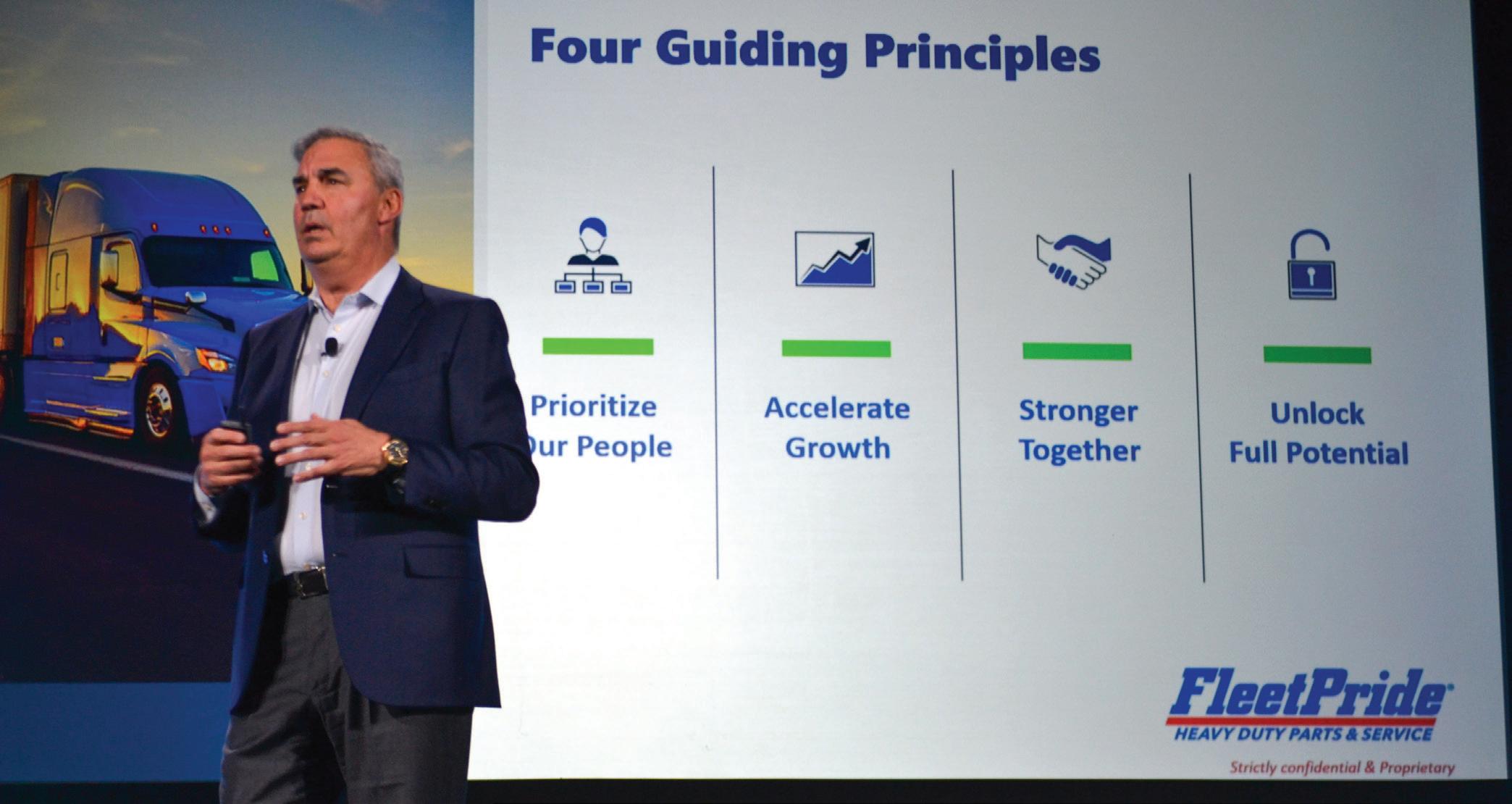
leadership team aims to shift the focus from administrative tasks to customer-serving time, turning the merger’s raw scale into a frontline competitive advantage.
“There’s a lot of things that we ask our people to do in our branches that are task oriented, that take time away from serving our customers,” Greco said. “How do we do that and get our team members super excited about it?”
The FleetPride push for growth comes during a persistent “freight recession,” a dominant theme during the HDAD presentations throughout the day.
Greco pointed to vehicle miles traveled as the metric most closely correlated with aftermarket demand. While 2021 and 2022 saw stimulus-driven growth, the last three years have trended negatively.
“We polled all of our suppliers on a call we had recently, asking ‘What do you think about the year? What are your growth expectations for the year?’” he explained. “And many of them said what you heard this morning: a little bit better than 2025, but probably back-half [of 2026] weighted.”
To win in this environment, the new, even bigger FleetPride is investing in a frictionless customer experience, particularly through digital assets and e-commerce. Greco noted that the “Amazon effect” has permanently raised expectations for parts availability and delivery speed—again, a recurring theme at HDAD.
“We’re going to build a formidable digital asset as we build up the new FleetPride,” he said.
Greco’s outlook for the distributor market involves moving beyond transactional supplier relationships, another theme at HDAD.
“We’re looking for ideas to really get out of the gates quickly in 2026, and many of you have already stepped up and helped us with that,” he said. “But, over time, we are looking for a longerterm strategic relationship with each of you.”
A four-step “joint business planning” process— discovery, big bet planning, joint execution, and measurement—is the model to ensure mutual success. Vendors need to be “thought partners” in innovation and training, and the best solutions are “win-win” propositions, he explained.
“We want to be thoughtful as we make decisions on assortment, on brands, on what gets emphasized,” he said. “All of those things will be considerations for us, but, having spent 30 years on the supplier side, I know that we’re not going to win long term if you’re not winning, too.”
Indeed, Greco’s goal is that in three years, suppliers, customers, and team members will all agree they “won big” because of this merger.
“Again, we’re going to put the customer at the center of everything we do,” he said, mentioning that employee satisfaction is still a priority. “Our customers would say that we were serving them better than we ever did as individual companies, and our team members would find new opportunities that potentially they weren’t able to realize in an individual company.
“If they all say those things, I’m very confident that financials [of the merged companies] will be something we can all be proud of,” Greco said.
The Heavy Duty Aftermarket dialogue’s OEM Perspective segment focused on how fleets are trying to stretch costs, and how OEMs can help them do so.
By Alex Keenan
Speaking at the Heavy Duty Aftermarket Dialogue portion of Heavy Duty Aftermarket Week, Drew Backeberg, SVP of aftermarket at Daimler Truck North America (DTNA), outlined how the OEM is navigating the freight recession, parts availability, and more.
“We recognize that the current market is incredibly dynamic and challenging right now,” Backeberg said. “The culprit is pretty obvious. Despite the relatively healthy economy, our customers are experiencing the longest freight recession in memory.”
According to Backeberg, freight softness, excess capacity, higher borrowing costs, and inflation have created a “wait-and-see” attitude across the market. And keeping the economy moving while the industry wades through that uncertainty means addressing its root causes and adapting to them where possible.
Backeberg noted a few of the elements that were causing the most uncertainty for the transportation industry right now, including tariffs, emissions regulations, new truck market headwinds, and supplier expectations.
The first of these, tariffs, is unusual, he said, “because unlike other regulatory measures, tariffs don’t impact all OEMs and all suppliers equally.” He said tariff effects could vary by production footprint, component, and country of origin.
To cope with this, the executive said that DTNA was working with suppliers to understand the upstream impacts from tariffs, and then “responsibly” pass uncovered costs on to the market while staying competitive. Backeberg also said that the company was pairing this work with “resilience measures” that included onshoring and nearshoring practices, saying that businesses that did not adapt now were going to be left behind.
Emissions regulations were another cause of uncertainty, he said. But while “that dust has mostly settled” in regard to emissions regulations, big changes are on the way with the upcoming EPA 2027 regulations that require new trucks to have cleaner engines and aftertreatment systems.
“We now have a pretty clear picture of what the rules will be for the future ahead,” he said. “And I would say at this point, what’s really important is how we navigate these changes for our customers, but also as an industry, regardless of policy cadence, [that] our stance as an OEM is firm.”
This stance includes playing the powertrain field and providing plenty of options, from electrified vehicles and buses to stocking charging service parts and remanufacturing batteries and e-drive components. Backeberg also took a moment to shout out DTNA’s partnership with Greenlane and their charging network while also highlighting that the company would continue to develop their ICE technology “for the foreseeable future.”
Finally, Backeberg said that another one of the reasons for uncertainty in the trucking industry was the new truck market. But in this instance, he emphasized how weakness in the new truck market was creating opportunity for the aftermarket “to serve as the constant among all of the other variability.”
In particular, Backeberg explained that the freight recession was pushing fleets to stretch trade cycles and park vehicles and, in some cases, defer maintenance and repairs as well.
“But they can’t defy gravity for long, until they need to maintain the investment to keep those vehicles in operation on the road and generating revenue,” Backeberg said. “And hypothetically, even if new truck demand were to rebound, let’s say this year, we believe that the industry wouldn’t have the capacity to replace all of those deferred purchases, and therefore we expect parts and service demand to rise in the near future as a result of this dynamic.”
This is where the aftermarket could provide stability, he explained, in terms of helping provide the parts fleets need to keep trucks on the road. That opportunity could also come with greater expectations for the aftermarket, especially in an industry that’s doing more with less income overall.
“Lately, we’ve seen a pretty noticeable change with what our customers are looking for,” Backeberg asserted. “As I mentioned earlier, they’re scrutinizing every expense, and we’re seeing a shift in their buying behavior from, let’s say, premium genuine parts to lower-cost-value products.”
For OEMs, he said, this means that they need to adjust and refine their product offerings so that fleets have options across the value spectrum.
In response to this uncertainty, Backeberg emphasized DTNA’s greater reliance on e-commerce, digital services, and warranty offerings designed to meet fleet needs.
For the company’s e-commerce offerings, Backeberg lauded how its online platform, first launched in 2020, has achieved $1 billion in annual parts sales. And he stated that it’s a channel that DTNA is looking to grow.
“This platform is a key enabler today, but we view it as a future channel of engagement, not

» Backeburg’s OEM Perspective address touched on the freight recession, parts availability, and delivery speed.
Kevin Jones Fleet Maintenance
just for parts but also for services,” he said. “Going forward, e-commerce through Daimler Truck will be a one-stop-shop across all retail opportunities.”
He also noted that DTNA is working on growing its digital services for vehicles by monetizing the data from its trucks. For example, Backeberg cited how Daimler Truck Financial Services and Geico launched insurance premium savings for using safety technology on Cascadia trucks.
Additionally, DTNA is responding to the dips in the new truck market by strengthening its warranty offers for second-life-use trucks.
“Second and third owners often rely on third-party warranty coverages as well as, let’s say, lower-cost service alternatives, which limits our ability as an OEM to stay connected with them,” Backeberg stated. “By expanding our second-life warranty program specifically targeting that usedtruck market, we have an opportunity to engage these customers and to bring them back into our brand and into our dealer network.”
Together, Backeberg said these efforts will make DTNA and its suppliers stronger service partners.
“This is a little bit cliché, but we’re not looking for a stereotypical OEM-supplier relationship that’s more transactional in nature,” Backeberg said. “That means that it’s a give and take, in that we are effectively arm-in-arm in our efforts to grow our mutual businesses.”
This is especially true since Backeberg said he didn’t anticipate that any shifts in the political climate in three years will have a large impact on the economic one.
“From my perspective, it’s very difficult for the Treasury to walk away from [tariff] revenue,” Backeberg noted. “We are of the belief that these tariffs are going to be sticky, and so for us and our suppliers, we are pursuing nearshore and onshore opportunities so that we minimize those costs.”
But despite the prospect of ongoing economic strain, Backeberg ended his address on a positive, yet realistic note.
“I am positive with our outlook for calendar year 2026,” he concluded. “I don’t know that the fundamentals of the economy necessarily change. So the demand side of the freight equation probably doesn’t change very much, but having fewer trucks on the road is going to put our customers in a more healthy position. I think that will create some optimism and drive both truck sales and aftermarket business in ’26.”
The new axle and transmission lubricants are suited for new and old equipment.
By Alex Keenan
Eaton debuted two new drivetrain lubricants at Heavy Duty A ermarket Week, including the Eaton EverTough transmission fluid and the XFE 75W-80 axle lubricant.
“As fleets extend vehicle life and focus more closely on operating value, the a ermarket needs solutions that balance performance, durability, and cost,” said Corneliu Bogdan, director of a ermarket sales, Eaton’s Mobility Group. “ ese new Eaton fluids strengthen our ability to support


customers whether they’re running new equipment or keeping older vehicles on the road longer.”
e EverTough transmission fluid is a fully synthetic alternative for manual and automated transmissions working beyond OEM warranty windows and certain remanufactured applications. It can work with Eaton’s PS-386 transmission fluid and is good for manual transmissions across several makes and models. Its typical drain intervals range from 300,000 to 500,000 miles.
e company is looking to market its new lubricants to indie service shops, rebuilders, and a ermarket distributors and fleets working with mixed-age vehicles—and EverTough is designed to serve older trucks as well.
Meanwhile, Eaton’s XFE 75W-80 is a fully synthetic axle lubricant designed to help fleets improve their fuel e ciency and durability, especially for heavy-duty vehicles. Designed for linehaul and vocational operations, the XFE
The new air disc brake pad is designed for linehaul and severe-service applications, with Meritor Positive Pad Retraction Springs and two friction mixes.
ByAlex Keenan
Cummins has launched the Meritor MFLEX4 air disc brake pad to simplify service and reduce inventory complexity. According to the company, the brake pad will cover up to 70% of the Class 8 trailer-truck market, including Bendix ADB22X, Hendrickson MAXX22T, WABCO MAXXUS, and WABCO PAN22.
“ e MFLEX4 is a technician-friendly solution that directly addresses common challenges, such as fitment complexity, parts proliferation, and service e ciency,” said Jason Soika, North American A ermarket general manager for Cummins Drivetrain and Braking Systems. “By combining Meritor’s OE expertise with a ermarket insights, we’re empowering parts dealers and distributors to streamline their operations and helping fleets maximize uptime with a high-quality, cost-e ective product.”
Good for both linehaul and severe-service applications, the MFLEX4 features Meritor positive pad retraction springs designed to improve fuel e ciency and extend rotor and pad life. It also features two friction mixes, linehaul and severe service, each of which are designed to meet OE performance standards. e MFLEX4 is uniformly priced across all four of its caliper applications, and it comes with a limited one-year warranty
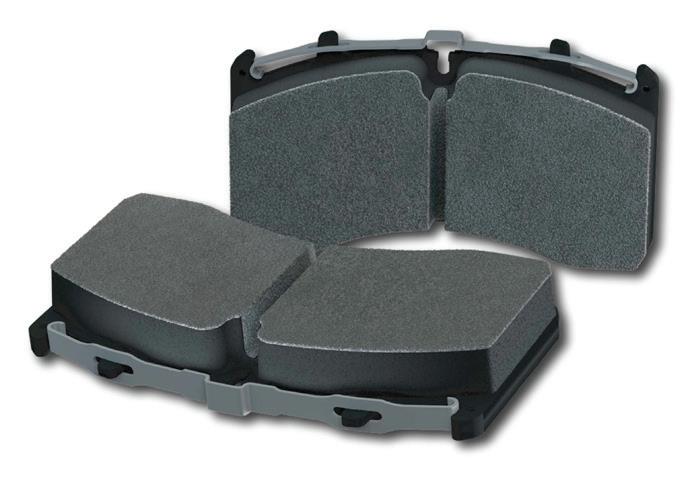
» The Meritor MFLEX4 air disc brake pad is an aftermarket solution compatible with the following caliper models: Bendix ADB22X, Hendrickson MAXX22T, WABCO MAXXUS, and WABCO PAN22.
Cummins
and Bendix’s ADB22X caliper warranty coverage. ere are four di erent part numbers, two each for linehaul and severe service, with one for each including a retainer bar. e brake pads are supplied with all-in-one installation kits for technicians, which include:
• 4 pads
• 4 springs
• 2 WABCO pressure
• 4 pads
• 4 springs
• 2 WABCO pressure plate springs
• Bendix cotter pin assembly
• 2 Bendix shear nuts
• Adjuster caps
• Retainer bolts
• Meritor positive pad retraction springs
e MFLEX4 was developed by Cummins Drivetrain and Braking Systems and is available through Meritor a ermarket distributors across North America.
75W-80 features an OE-approved formulation and can be used in axle applications under warranty. According to the company, Mesilla Valley Transportation Solutions found that the XFE 75W-80 provides up to 2% improvement in fuel economy compared to standard axle lubricants.
Both the Eaton EverTough transmission fluid and Eaton XFE 75W-80 axle lubricant are expected to be available to the market in Q1 2026.








for local
The Peterbilt Model 220EV Class 6–7 electric truck is designed for local pickup, delivery, and regional hauling, supporting anywhere from 26,000 to 33,000 lbs. and offering 355–499 hp with a midship-mounted electric motor powering the rear axle. The truck features two thermally controlled battery packs, providing daily ranges of 100, 150, or 200 miles with a minimum charge time of 2.1 hours. Available in 24’, 26’, and 30’ box sizes, the cabover design enables a tight turning radius for urban operations. Driver-focused features include large windows and mirrors for visibility, a wraparound dash, 90-degree doors, and an enhanced gauge cluster displaying power, charge, and energy usage. For more information visit FleetMaintenance.com/55311811

Backwards-compatible and features AUX pins, CAN buses, and Hi-Speed Ethernet
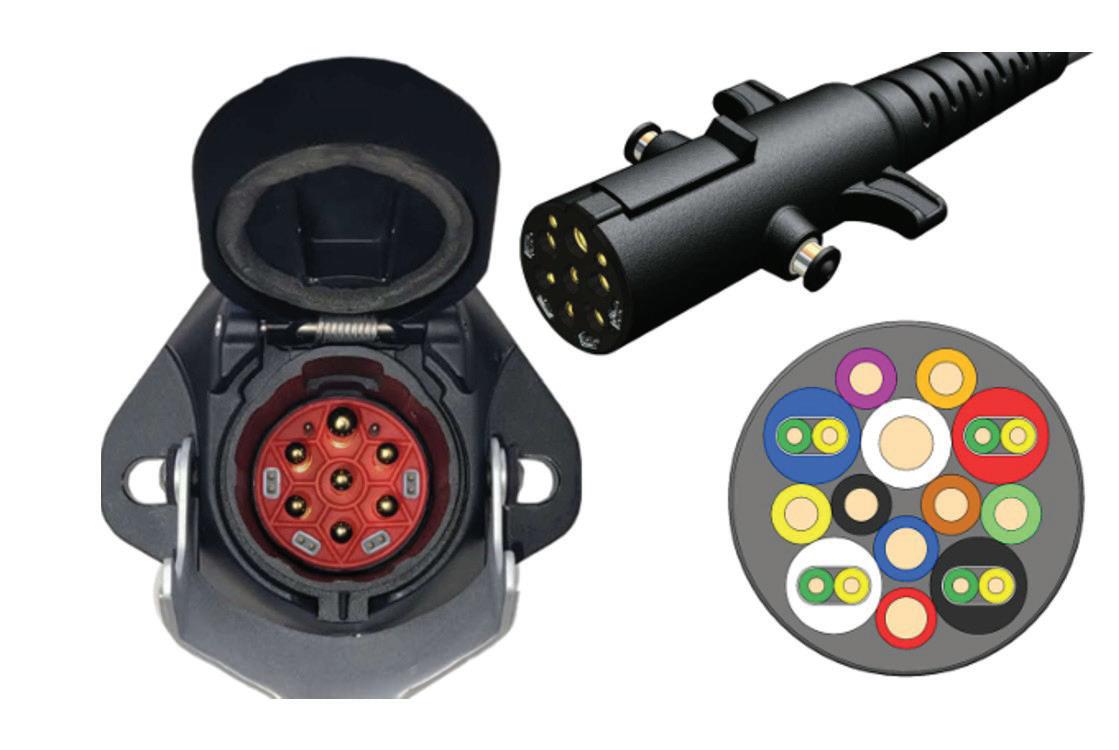
The 17-Way Tractor/Trailer Connection System from Tectran Manufacturing features seven standard J560 pins, two 30A AUX pins, two CAN buses, and two high-speed Ethernet buses for backwards compatibility and future capabilities. The system works within the 7-way footprint and features a locking system for full connector engagement and better weather sealing, as well as a “Park Socket” that requires that the trailer plug be locked in place for the parking brakes to release.
For more information visit FleetMaintenance.com/55343932
The EverTough transmission fluid from Eaton is a synthetic option for manual and automated manual transmissions. Specially designed for fleets with older truck populations and mixed-age vehicles, the fluid is good for manual transmissions across multiple makes and models. Its typical drain interval ranges from 300,000 to 500,000 miles and is designed for reliable performance without OE-grade specifications. EverTough also complements Eaton’s PS-386 transmission fluid. For more information visit FleetMaintenance.com/55344592
AI-powered
Lytx ’s Coach Assist is a new AI-powered tool to help coaches deliver faster feedback to drivers. It can streamline the coaching process by surfacing driver strengths and improvement areas, as well as peer comparisons via bullet points and easy-to-scan visuals. This allows coaches to handle their prep work faster so they can focus on working with the driver. Coach Assist is currently available to certain Lytx Lab participants and will be available for customers mid-2026.
For more information visit FleetMaintenance.com/55341716

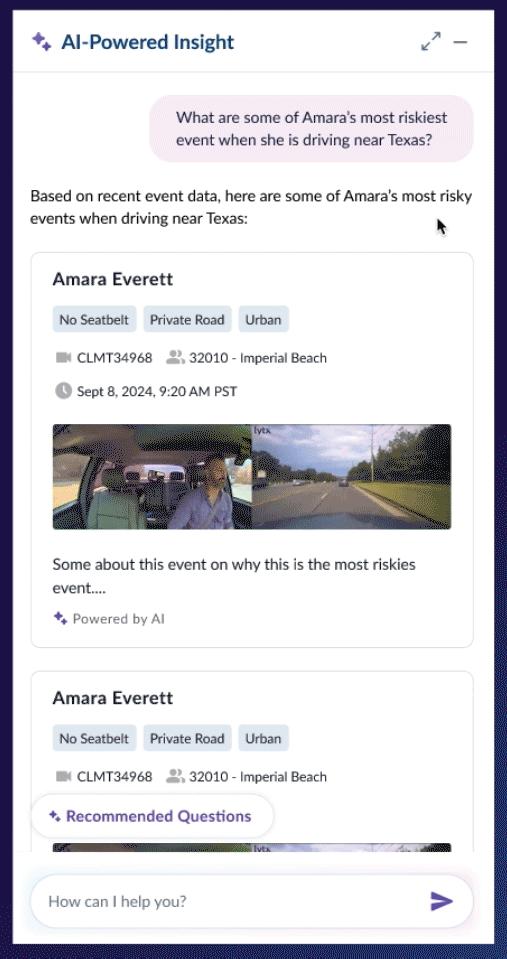
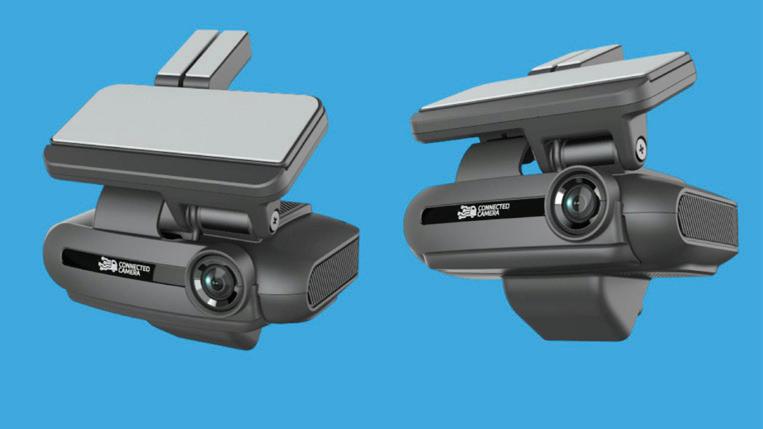
The SureCam Vantage is a 360-degree multicamera system that offers up to six synchronized views around the vehicle. Optional in-cab monitors provide drivers with realtime, high-quality visibility and safer operations with a road-facing camera, and optional driver-facing, side, and rear cameras. The camera also features optional AI Driver Monitoring System (DMS) capabilities to detect distraction, fatigue, phone use, and other risky driving behaviors, along with automated in-cab alerts to help drivers self-correct. All footage is automatically uploaded to the SureCam cloud platform for rapid viewing.
For more information visit FleetMaintenance.com/55353211
Lytx ’s new fleet management platform, LytxOne , includes GPS, odometer, and fuel tracking; AI alerts for driver behavior; and preventative maintenance features. The system connects to OBD-II and J1939 to provide a vehicle’s location, read engine data, and get alerts on fuel levels, fault codes, trip logs, and more. LytxOne also works with Lytx’s dashcams to provide driver alerts for distraction, fatigue, and risky driving while also storing video footage of the cab and road. LytxOne can also monitor DTCs and battery voltage, and it features 4G connectivity and a compact, rugged design.


For more information visit FleetMaintenance.com/55344582
For Air Link suspensions rated between 46k-52k lbs.
The severe-duty bushings and torque rods from Link Mfg. are designed for the Air Link suspension systems rated between 46,000 and 52,000 lbs. The new bushings feature a proprietary, double-bonded rubber compound and optimized geometry to extend component life in demanding fire apparatus applications. The bushing design eliminates bushing friction and reduces wear while also maintaining optimal clamp load throughout the bushing’s service life. The new bushings are upgraded with extended warranty coverage up to two years. The severe-duty torque rods are engineered for suspensions rated between 46,000 and 60,000 lbs. They feature permanently lubricated and spherical ball ends and a double-adjustable design.
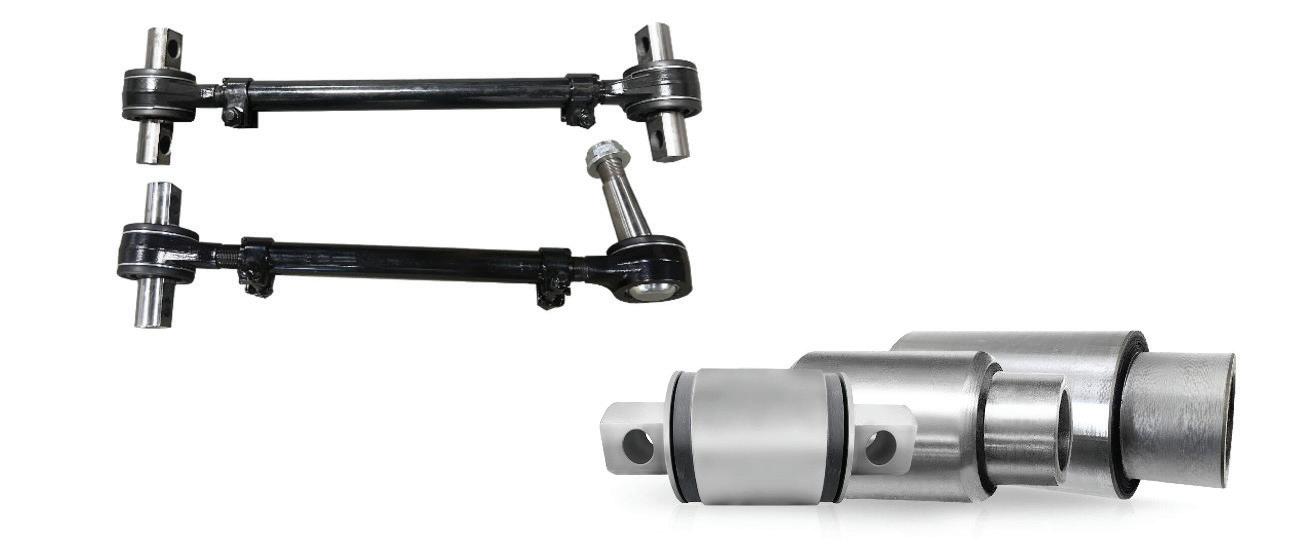
For more information visit FleetMaintenance.com/55329906
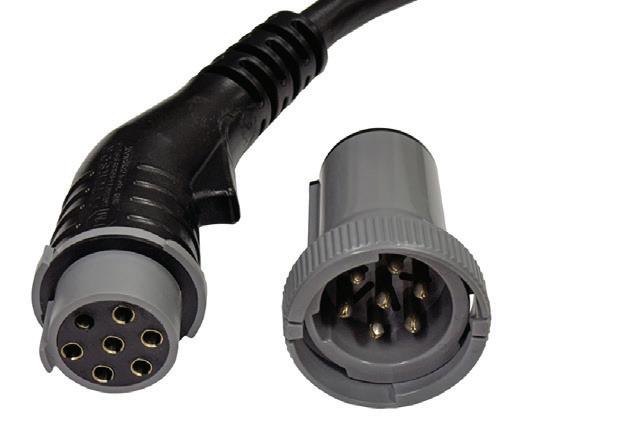
Allows for quick repairs at the connection point
Peterson Manufacturing ’s Repairable J560 Connector is designed to help fleets cut down on repair times and costs by allowing users to twist off the head of a broken connector while maintaining the cable’s length. According to the manufacturer, the Repairable J560 is durable and reliable with a corrosion-resistant design and the ability to integrate with Smart Trailer Systems while also providing the standardized electrical connection. Easy to maintain, the repairable connector is cost-effective and requires no tools to use.
For more information visit FleetMaintenance.com/55343947
The Heliox 44 kW V2G charger from Heliox Energy is an all-in-one DC fast charging system with vehicle-to-grid (V2G) functionality. It provides bidirectional charging and discharging capabilities and features 44 kW of output. It is compatible with most EVs due to its ISO 15118-20 and SAE J2847 compliance, and its compact design allows for easier installation. Plus, the 44 kW has flexible AC input settings that are adjustable from 15A-56A, and its NEMA 3R-rated enclosure allows it work indoors or outdoors. Moreover, it comes with wall-mount and pedestal options and features an LED that shows real-time EV State of Charge and a 7” LCD display for charging session information. It comes with 5m or 7m cable lengths and features OCPP, Ethernet, and 4G connectivity.
For more information visit FleetMaintenance.com/55329477
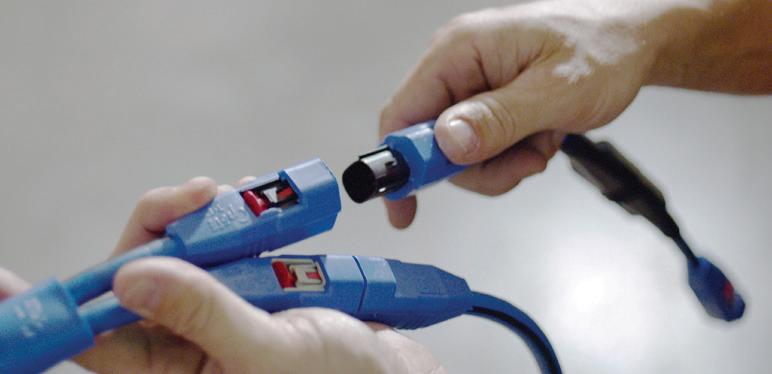
The 4SEE Rear-Collision Warning System from Grote Industries uses data processing, a rear radar unit, and an auxiliary strobe lamp to help drivers avoid rear-ending trailers ahead of them. The system calculates the ‘time to collision’ whenever a car approaches the back of a truck, and if that time is less than four seconds, then the light flashes, warning the trailing driver that they’re approaching too quickly. The system is built on Grote’s 4SEE Digital Harness and includes a lamp-specific light-out detection and over-the-air updates.
For more information visit FleetMaintenance.com/55329545
CTech ’s VanPro Cabinets are durable and can integrate into most popular commercial vans. They feature lightweight aluminum construction and come in pre-built packages to fit Ford Transit, Mercedes Sprinter, and Ram ProMaster vehicles. The cabinets also come with van profiles so that the shelves fit curved van walls and feature MotionGlide and MotionLatch drawers for greater security and smooth operation. Cabinets come assembled and are made in the U.S.
For more information visit FleetMaintenance.com/55342928

The Paccar TX-12 PRO automated transmission for Class 6-7 and light Class 8 vocational applications builds upon the existing Paccar TX-12 transmission and is designed to operate at up to 445 hp, 1,700 ft.-lb. of torque, and 70,000-lb. GCVW. The transmission features Paccar’s Extreme Duty clutch for improved low-speed maneuvering, Rock Free mode to help trucks get unstuck in mud or sand, an off-highway calibration tuned for changing soil conditions, a 12-speed gearset for wide ratio coverage, and an internal oil temperature sensor. Oil maintenance intervals are 250,000 miles, and the clutch is maintenance-free. Additionally, the TX-12 PRO is available for Kenworth’s T880 and W990 models with Paccar engines and a rear engine power take-off.
For more information visit FleetMaintenance.com/53099206

The Ex-Guard MAX Grille Guard comes with three new features for Class 6-8 trucks. The VISR Bar (vehicle Illumination Safety Reinforcement) strengthens impactprone areas and works with ADAS. The Front Underrun Mitigation System can prevent other vehicles from sliding beneath the truck. Finally, the Steer Tire Defender 3.0. offers the company’s highest protection for front tires. The Xero-G Lift Assist also allows for easy maintenance.
For more information visit FleetMaintenance.com/55352815
Grote Industries ’ H.E.L.P. DeliverSAFE is a new safety system designed with Emergency Safety Solutions. It can help prevent crashes at the roadside by warning oncoming drivers that a truck is on the road with specialized lighting and digital notifications. H.E.L.P. DeliverSAFE pushes real-time notifications with a downed vehicle’s location into drivers’ navigation and in-cab displays, while the regulatory-compliant lighting flashes in a quick, synchronized pattern and outlines the vehicle. Drivers can turn off the alert and lights by holding down two buttons, reverting the truck to standard hazard lighting.
For more information visit FleetMaintenance.com/55329541

EMCO Industries ’ High-Performance Mono-Leaf Spring for heavy-duty trailers features a 22,400-lb. gross axle weight rating. According to the company, the new spring offers a 25% weight reduction compared to traditional 22.4K axle leaf springs, dropping from 53 to 40 lbs. It also exceeds Truck Trailer Manufacturers Association (TTMA) B-10 fatigue life requirements. Additionally, EMCO says that the new springs will be ideal for applications with lower suspension clearance, such as container chassis, flatbed trailers, and drive-on trailers. Both low-arch and high-arch configurations are available.
For more information visit FleetMaintenance.com/55352204
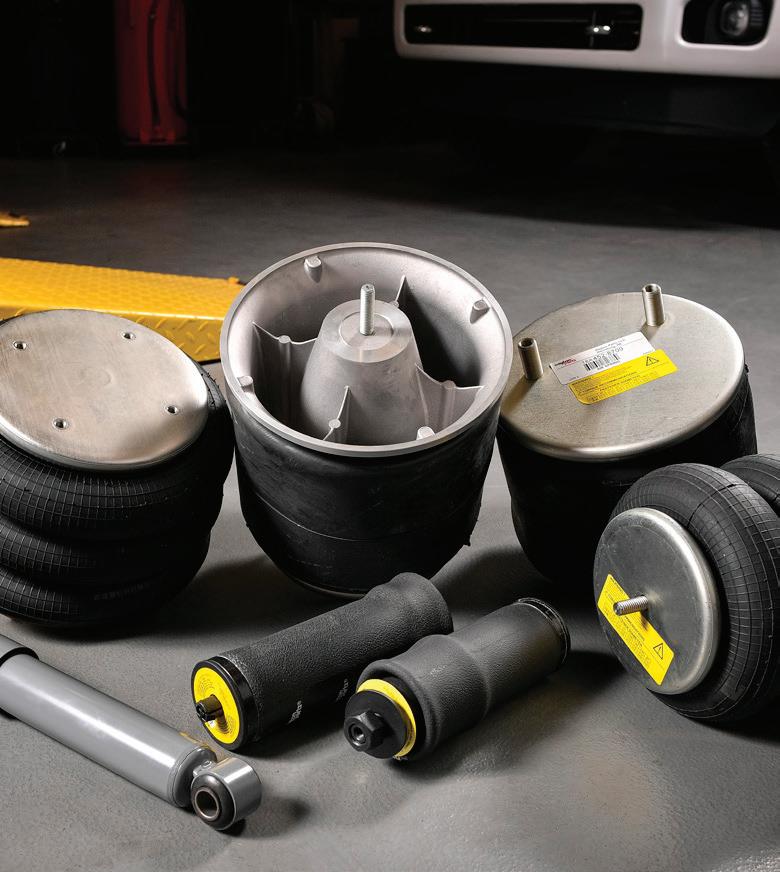
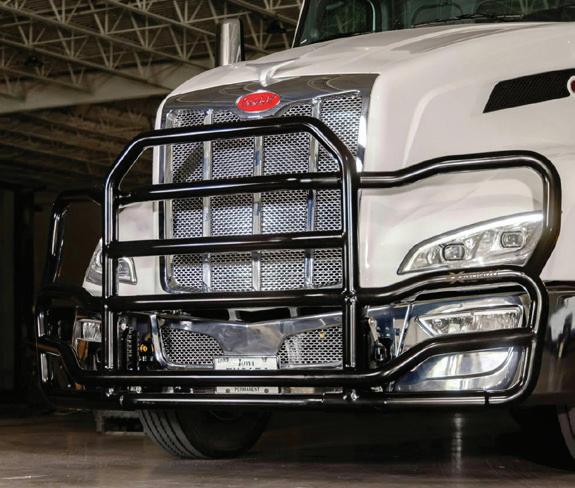
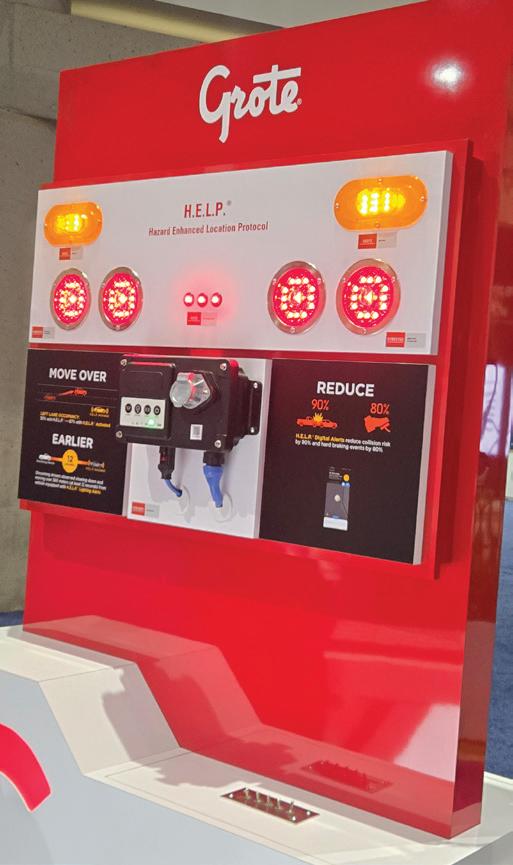
Hilltip ’s AM Series Extended-Auger Spreader is a combination material and liquid spreader designed for interchangeable truck bed systems, allowing the hopper to sit closer to the bulkhead for improved weight distribution. Available in 2.0- to 4.2-cu.-yd. polyethylene hopper capacities, the spreaders use 6” stainless-steel augers to resist corrosion and are driven by 12- or 24-volt dual motors. An integrated vibrator and inverted-V help maintain consistent material flow. Units can be equipped with 220- to 250-gal. liquid tanks with pre-wet and spray options for anti-icing and de-icing. The extended auger is also offered as a retrofit kit, helping fleets adapt existing spreaders to newer bed configurations while improving winter maintenance efficiency.
For more information visit FleetMaintenance.com/55352206
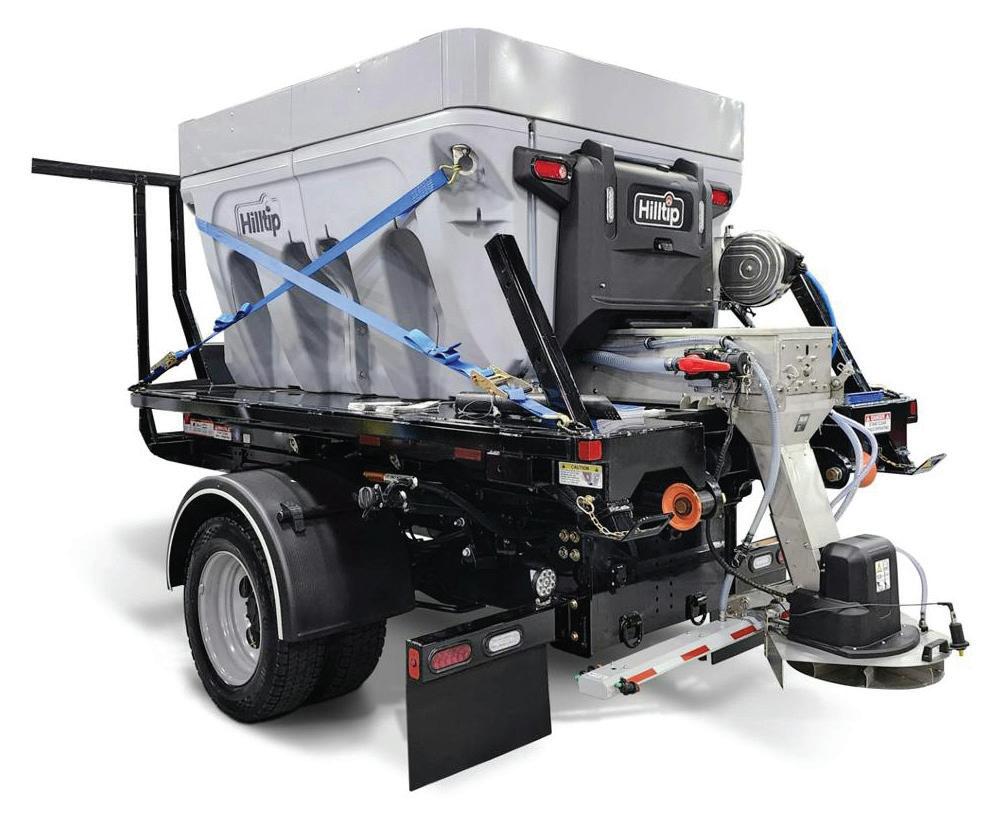
The Wheeler F.A.T. Wrench AutoTorque features an ultra-precise digital torquing sensor to prevent damage and easy torque adjustments between 10-65 in.-lbs. Featuring a variable speed motor that can reach up to 200 rpm and a multi-speed trigger, the drill includes a magnetized 1/4” hex drive that securely holds bits and an easy-to-read digital LCD screen that displays torque settings in 0.1 in.-lb. increments. It is powered by a 12V detachable battery, is capable of providing a continuous runtime of two hours on a single charge, and comes with a USB-C charge port and a quickcheck LED for battery status. It comes with 15 of the most popular bits, including SAE hex and Torx bits.
For more information visit FleetMaintenance.com/55329522
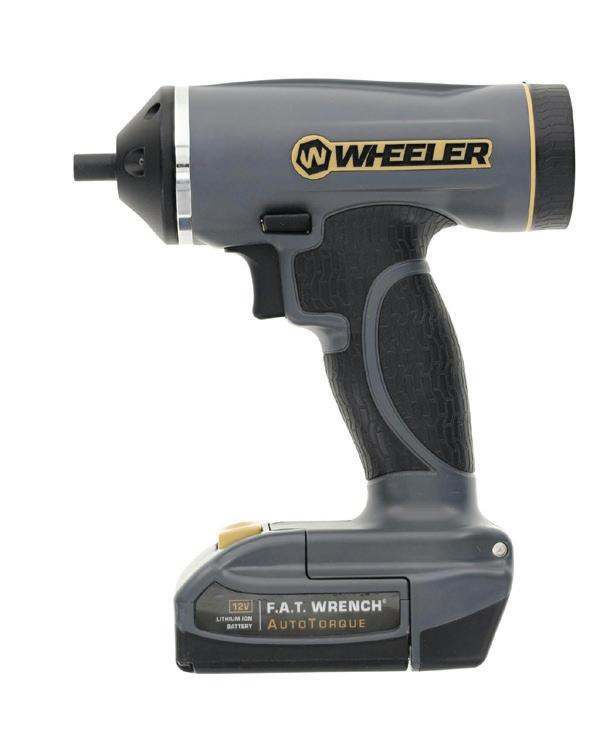
The Harbor Freight 20V
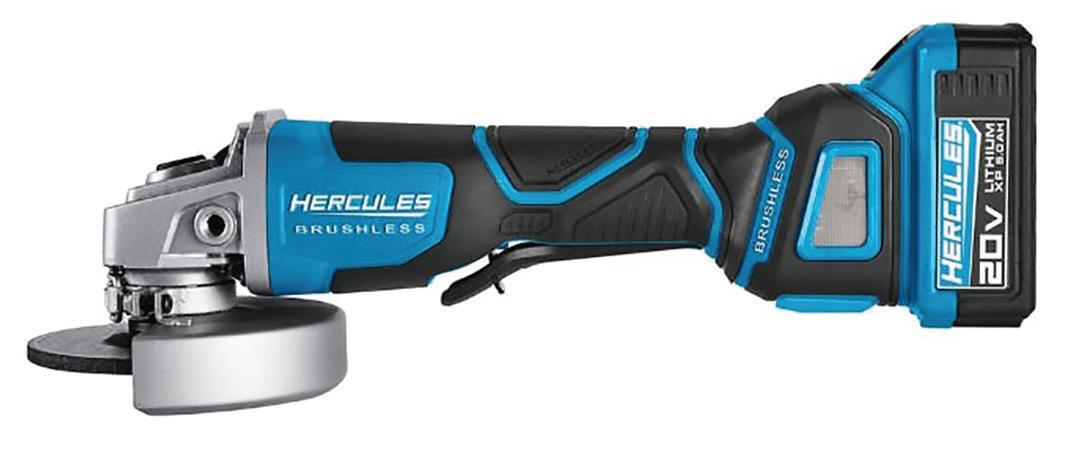
HERCULES Brushless Cordless Paddle Switch Grinder features a new flat head design. This grinder can easily access tight spaces, and the low clearance allows the disc to get closer to the work surface than an angle-head grinder. The low-profile head gives the user a clearer line of sight of their workpiece and is optimized for grinding, cutting, shaping, and other material removal. Other features include an all-metal gearbox, ball-bearing motor, a paddle switch with a lock-on that provides superior control, and an electric brake that can stop the wheel from spinning within two seconds. For added precision, it has variable push-button speed control with a range of 3,000 to 11,000 rpm.
For more information visit FleetMaintenance.com/55342937
The Killer Tools Heavy Duty Tire Lift , No. ART47, is engineered for safe and efficient tire handling, enabling technicians to remove and install tires with ease. Its heavy-duty, powder-coated steel frame supports tires up to 220 lbs., and the wide stance with locking casters keeps the unit secure. The offset column and built-in lug tray offer convenient access and lug storage. It features precise height adjustment up to 27” with an ACME thread and 1/2” impact drive for precise tire alignment. Adjustable rolling arms and a securing bar fit most tires up to 38”. For more information visit FleetMaintenance.com/55329912
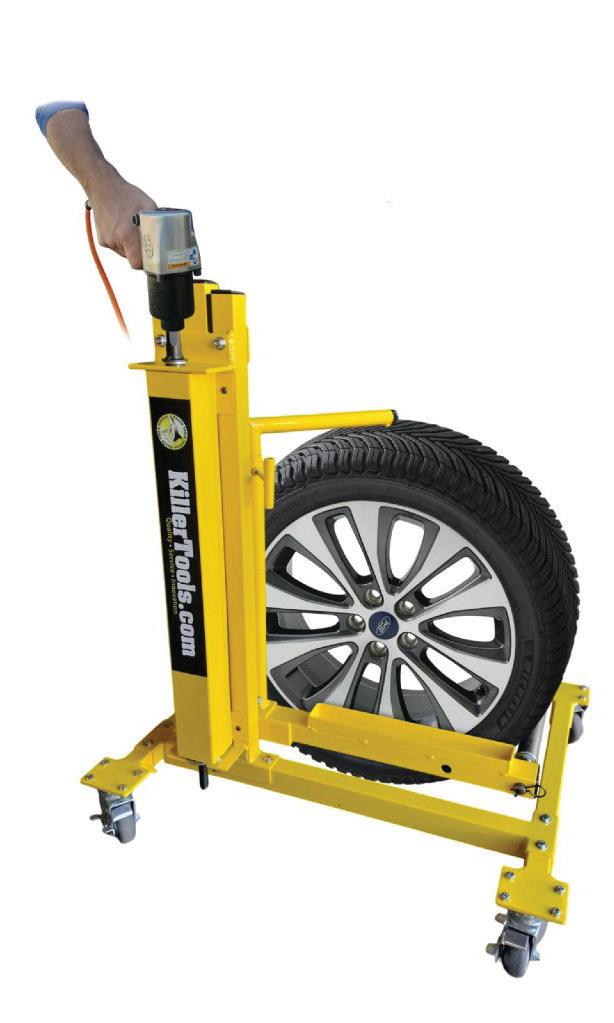
The M18 TOP-OFF Charger and Power Supply, No. 2847-20, from Milwaukee Tool is the most compact M18 charger, up to 65% smaller than traditional kitted chargers. Designed for users who charge on the go, this charger delivers simultaneous M18 battery and device charging. It features one 100W bidirectional USB-C PD port and one 15W USB-C port to deliver 115W of continuous power for faster headlamp, phone, tablet, and laptop charging.
For more information visit FleetMaintenance.com/55310795
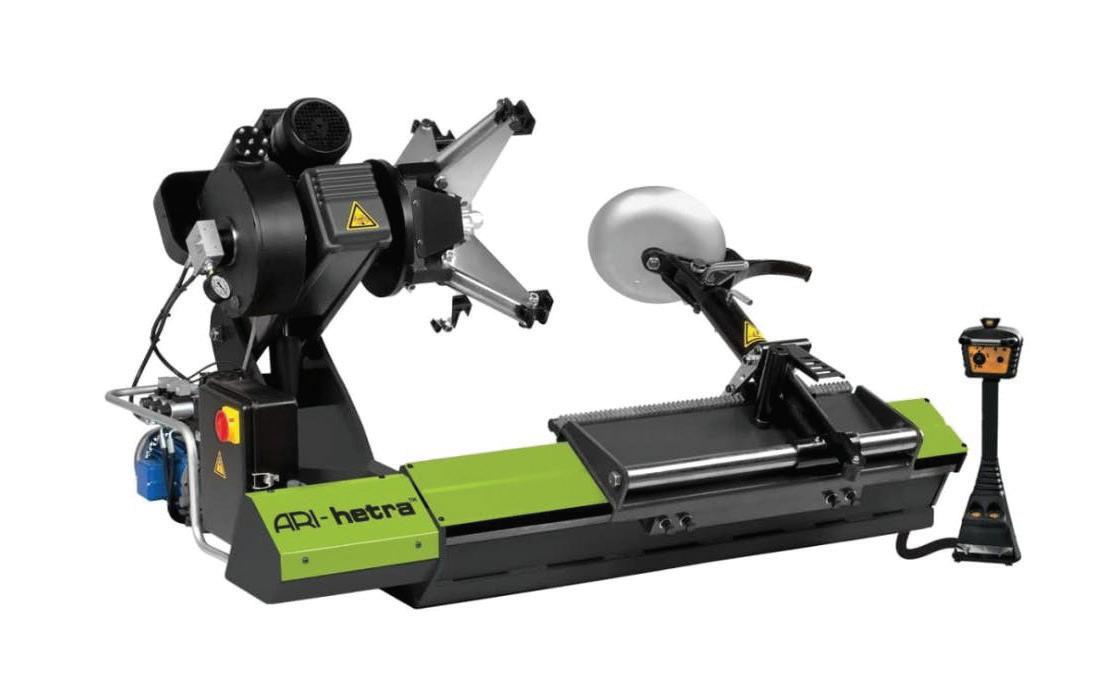
The ARI-Hetra Heavy Duty Tire Changer, No. WS-25TC30, is designed to easily mount and dismount trucks, buses, and super single tires. It features an automotive carriage, manual tool arm and tool head, and a hardwired remote control. The changer is electrohydraulic.
For more information visit FleetMaintenance.com/55343713
If you are interested in sharing your thoughts on tools you’ve used, or would be open to trying out new ones, or represent a company that wants to provide tools or shop equipment for reviews, please email editors@fleetmaintenance.com



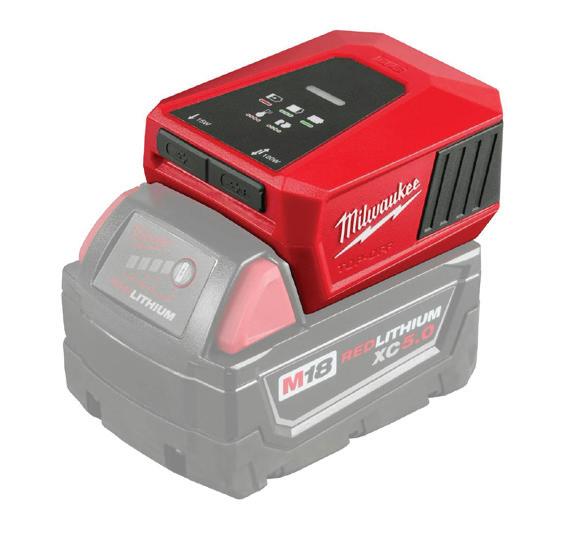



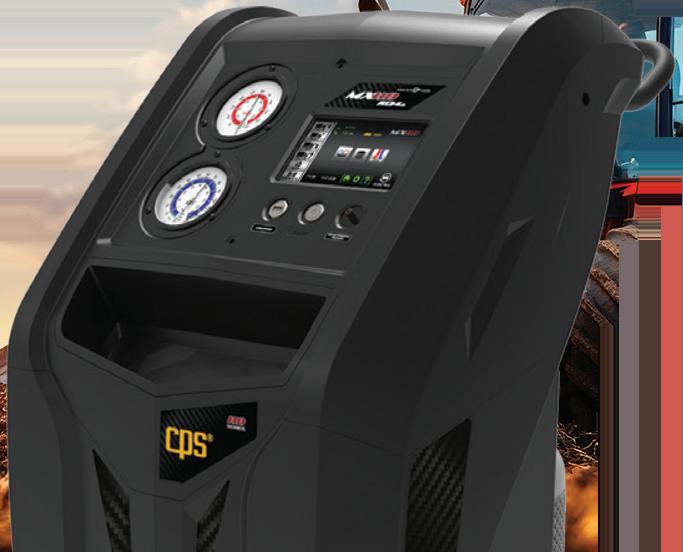
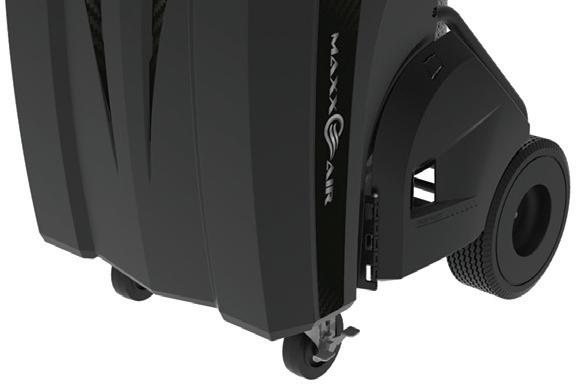
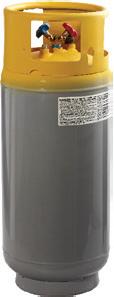



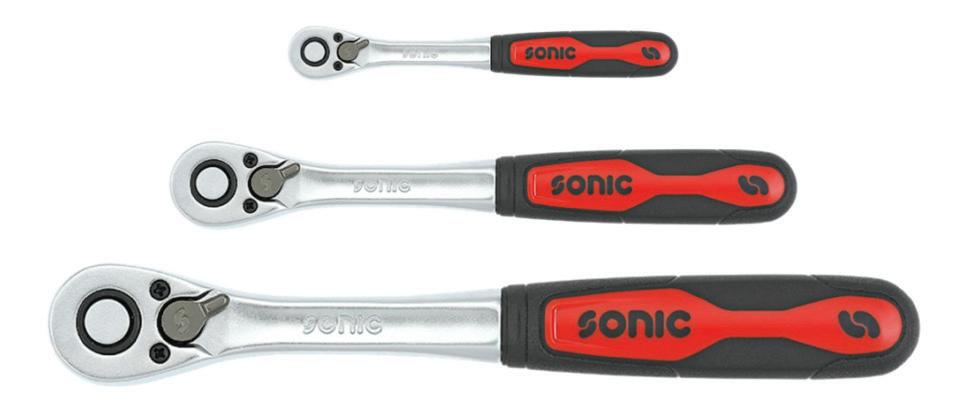
1/4”, 3/8”, and 1/2”
The NEXT Ratchet Set from Sonic Tools is a 15-piece collection designed for precision and reliability. The set includes three ratchets, 1,4”, 3/8”, and 1/2”, built with an ergonomic, thermoplastic grip to ensure optimal hand contact, resulting in greater comfort and enhanced power transmission of up to 558.3 ft.-lbs. Each ratchet features a 60-tooth mechanism that delivers smooth operation, rugged performance, and minimal back drag. Sealed heads protect internal components from dirt and debris, extending their lifespan. Backed by the company’s Lifetime Warranty.
For more information visit FleetMaintenance.com/55329184
The RLink X3 from TOPDON is designed to work on eight OE software systems and achieves OEM-level diagnostics when paired with OE software, including ECU programming and coding, active test, and special functions. It also supports J2534 and CAN-FD protocols, ensuring compatibility with a wide range of vehicles from 2006 to the latest 2025 models. This tool includes a lifetime of free driver updates, real-world programming case references, and direct user feedback submission.
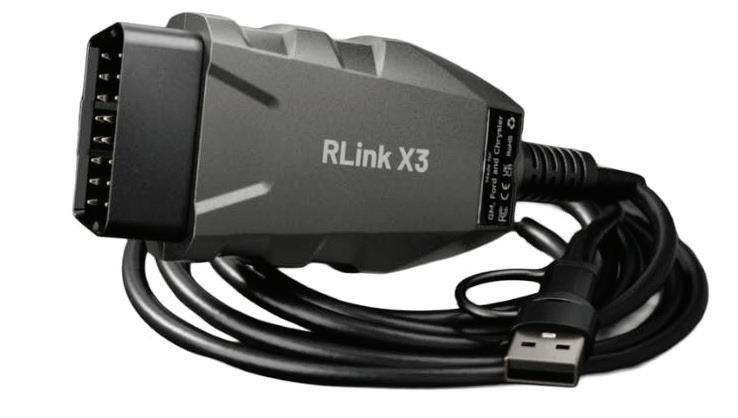
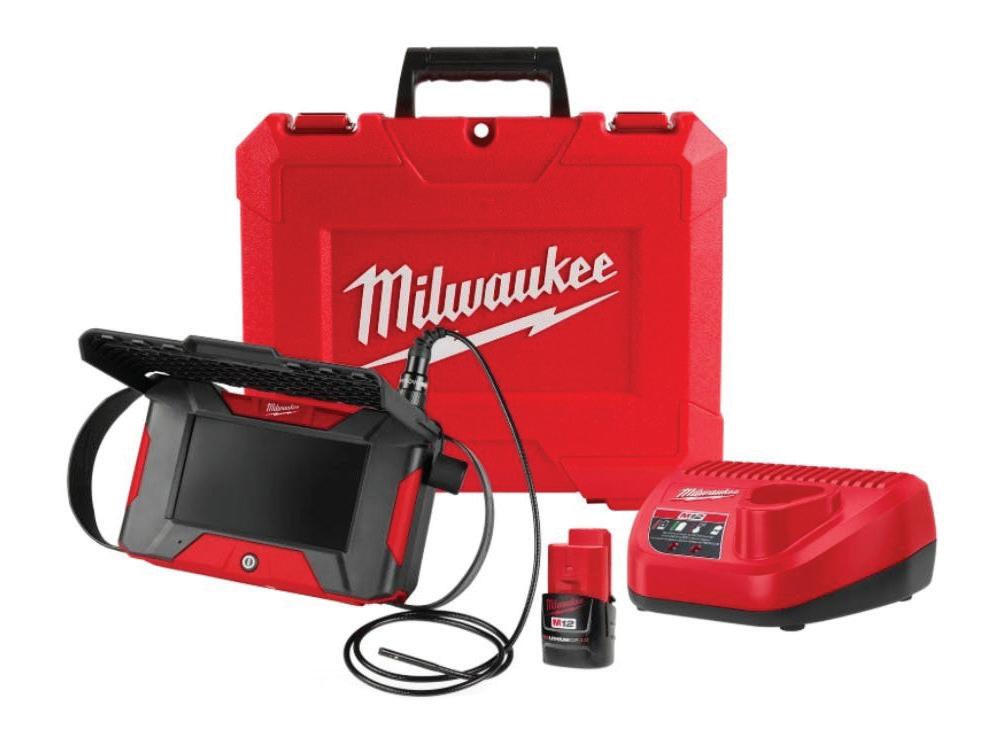
The M12 Auto Shop Borescope w/ Wi-Fi File Sharing , No. 3151-21, from Milwaukee Tool delivers simplified inspections and faster repair approval. The borescope has a 5.5” HD touchscreen display and can connect to the shop’s Wi-Fi to share and document findings via email. The 5mm access provides leverage in tight spaces, including glow plug holes and fuel injector ports. Front and side view cameras with adjustable LED brightness provide increased application viewing. High-definition photo and video with four times zoom allow the technician to diagnose hairline cracks. Equipped with HEAT SENSE Temperature Alert Technology, the borescope notifies the user and shuts down if the vehicle is too hot. Includes field-replaceable 5’ camera cable for reduced downtime. For more information visit FleetMaintenance.com/55342544
ADAS calibrations on demand
IVS Calibrate from Opus IVS is a feature that’s integrated in the Opus IVS DriveSafe2 collision diagnostics platform. It allows shops to perform ADAS calibrations on demand and works for both static and dynamic ADAS calibrations. More specifically, IVS Calibrate allows shops to handle dynamic calibrations without any equipment (but some static calibrations may need targets, target boards, and Trihedrals). The system is designed to be user friendly and provides step-by-step guidance through the calibration process.
For more information visit FleetMaintenance.com/55336779
For more information visit FleetMaintenance.com/55336781
floodlight output (white, red, green)
The Nightstick Rechargeable Headlamp, No. XPR-5552G, is a USB-C rechargeable headlamp that is certified ATEX Zone 0 and Class I Division 1 Intrinsically Safe for use in hazardous work environments. This light features a tri-color floodlight output (white, red, and green) with intuitive dual-switch controls. The right switch activates high and low white modes and can be held in any mode for a flashing white signal. The left switch toggles red or green. Red helps preserve night vision during low-light tasks, while green enhances contrast and detail. The headlamp runs 200 lm for up to 8 hours on high and 60 lm for 40 hours on low. Built from PC/ABS polymer, it is IP-67 rated for waterproof and dustproof protection.

For more information visit FleetMaintenance.com/55341724
The Autel MaxiHVAC AC909 is a 4-port manifold system designed to bring skill, understanding, and precision to HVAC diagnostics. The system provides step-by-step guided instructions for equipment hookup and the entire repair workflow. It also features a vehicle-specific overview of A/C specifications and locations, including compressor and refrigerant types. The tool introduces the use of nitrogen for a pressure leak test, a “system tightness test,” and purge procedures for faster evacuation. According to the company, this is the first A/C manifold gauge tool that decouples from the A/C lines while still monitoring low and high pressures.
For more information visit FleetMaintenance.com/55330854
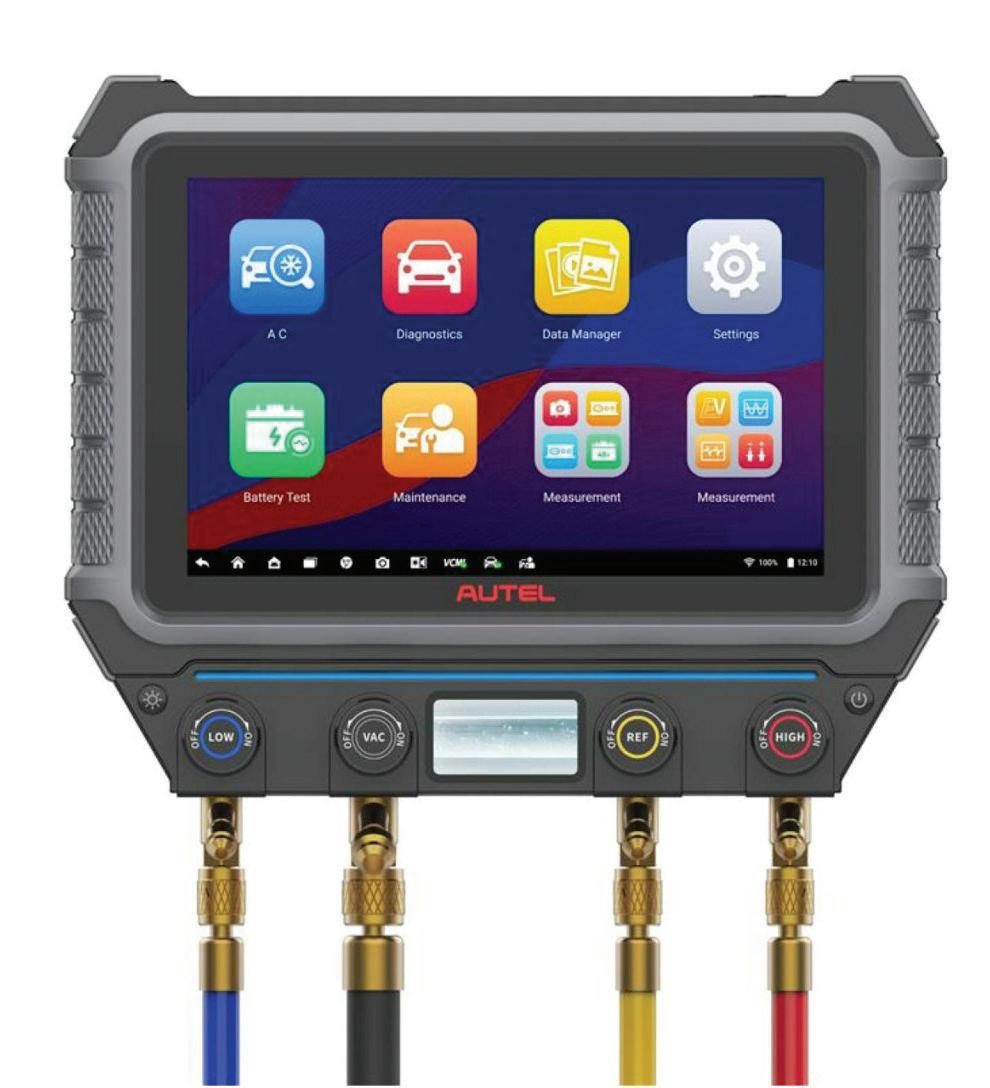
Can diagnose many vehicle brands through one platform
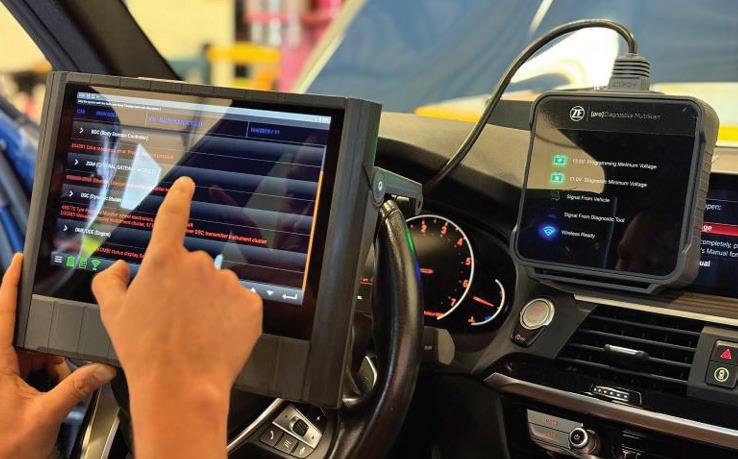
MultiScan from ZF is a diagnostic solution that covers nearly all makes and models, according to the company. It also supports all major diagnostic protocols, including DoIP and CAN FD processes, and can work as a J2534 passthrough and OEM Vehicle Connection Interface (VDI) for European vehicle makes. MultiScan also offers remote-assistance features with access to ZF’s diagnostic experts. Remote techs can run diagnostics or programming with OEM software, with all expert assistance priced on a pay-as-you-go basis. The tablet and VCI includes a multi-position locking kickstand, a long battery life, Wi-Fi connectivity, a built-in QR code scanner, and a camera magnifier. For more information visit FleetMaintenance.com/55328663
The 4-Drawer Tool Cart Set from SK Tools comes stocked with the company’s latest socket sets, precision-engineered screwdriver sets, and durable dual-material handle pliers sets. This tool cart is designed for maximum organization and efficiency and includes exclusive SK swag. This fully loaded cart is also available as a 6-drawer option.
For more information visit FleetMaintenance.com/55328664
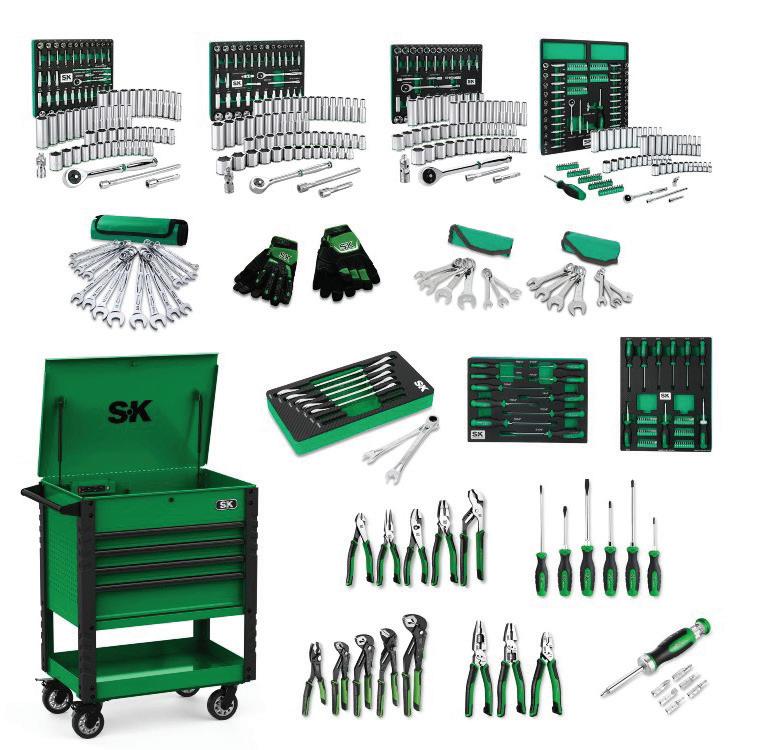
Contains tools for everything from bead breaking to rim protection
The Truck Tire Service Kit , No. 35645, from Ken-Tool includes professional-grade tools for all kinds of tire service jobs, from lubrication to bead breaking and rim protection. The kit includes a tubeless tire iron, a 30” double-end tire spoon, a T35 heavy-duty tire hammer, an 8-lb. bucket of white tire paste, a Eurostyle lube applicator brush, two aluminum C-Lok bead holders, and a leather rim protector.
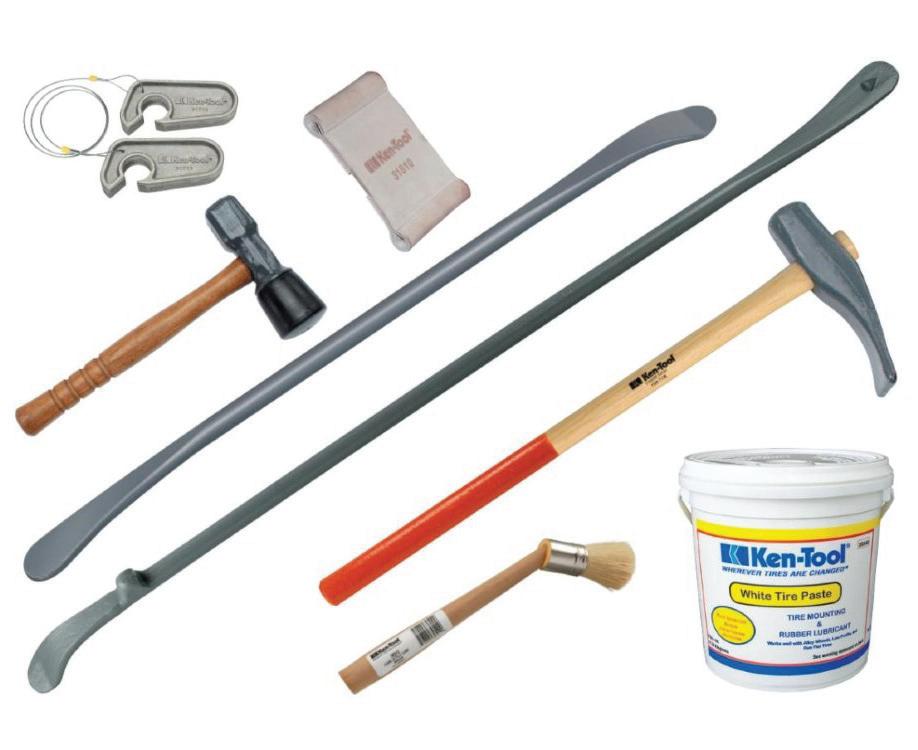
For more information visit FleetMaintenance.com/55342527
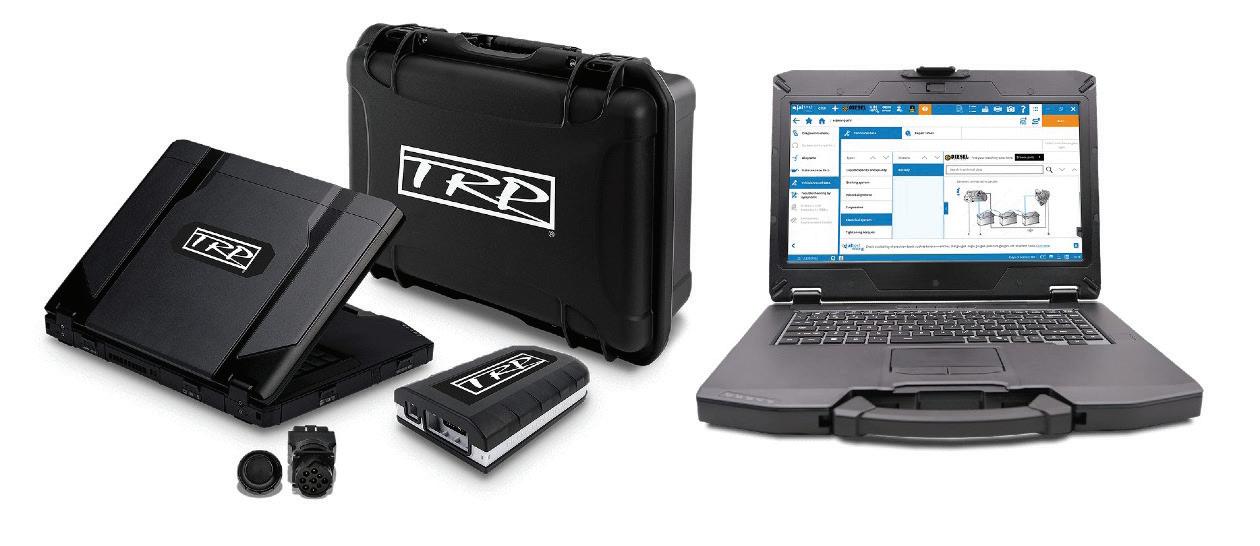
The TRP Diagnostic Pro from Paccar Parts is a bidirectional diagnostic tool for all makes and models of light-, medium-, and heavyduty trucks. It comes with a one-year subscription to a diesel repair platform and digital library to diagnose fault codes, explore repair options, and look up parts. It can perform forced regenerations, DPF resets, cylinder cutouts, and more. Billed as a way to turn a smartphone into a heavy-duty diagnostic tool, the TRP Diagnostic Pro allows technicians to log in remotely, walk repair shops through diagnostics, and find parts linked to fault codes, wiring diagrams, repair guides, and more. ABS coverage is included.
For more information visit FleetMaintenance.com/55331232
Hunter Engineering ’s Road Force WalkAway wheel balancer automates tire inflation and balancing to significantly reduce four-tire changeover times by up to 45% when paired with Hunter’s Revolution tire changer. Its WalkAway Inflation System automatically releases the chuck after inflation, allowing the balancer to perform the spin test without the technician. This enables techs to complete other tasks while the machine works. The unit includes a two-piece hood for tighter wall placement, a hood angle sensor for smooth operation, and updated software. It retains Hunter’s eCal auto-calibration, SmartSpot laser weight placement, and vision system for consistent accuracy.
For more information visit FleetMaintenance.com/55329002
dedicated entry-level heavy-duty
The XTool HDGURU offers heavy-duty vehicle diagnostics via standard OBDII protocols, with over 60 bidirectional tests, more than 35 Cummins-dedicated functions, and advanced feature and parameter programming across over 45 applications. It features a streamlined Linux system and a 5.45” display. The HDGURU can provide DTC scanning and clearing, ECU information, live data, freeze frame, and more for Cummins ECUs via OBDII and 6+9-pin Cummins diagnostic connectors. The tool can also perform feature activations and parameter modifications for all major Cummins ECUs, and covers MIL status checks, PID reading, and more HD functions. The HDGURU has 35GB of storage and a 3150mAh battery.
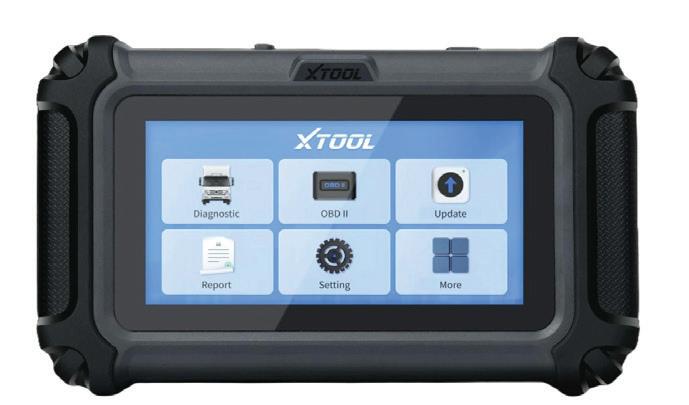
For more information visit FleetMaintenance.com/55323047



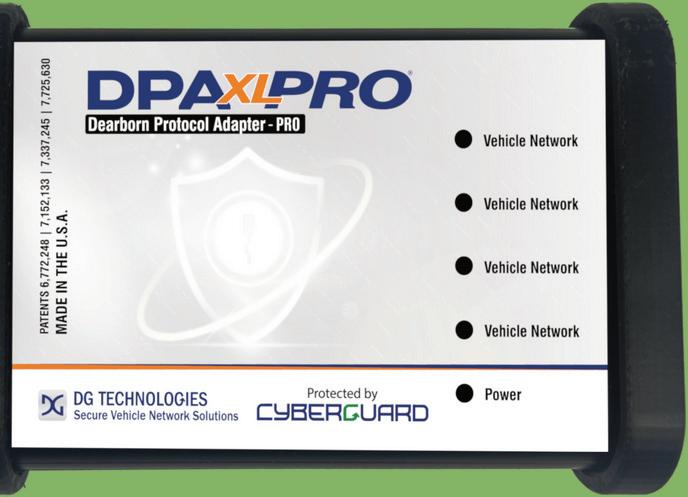







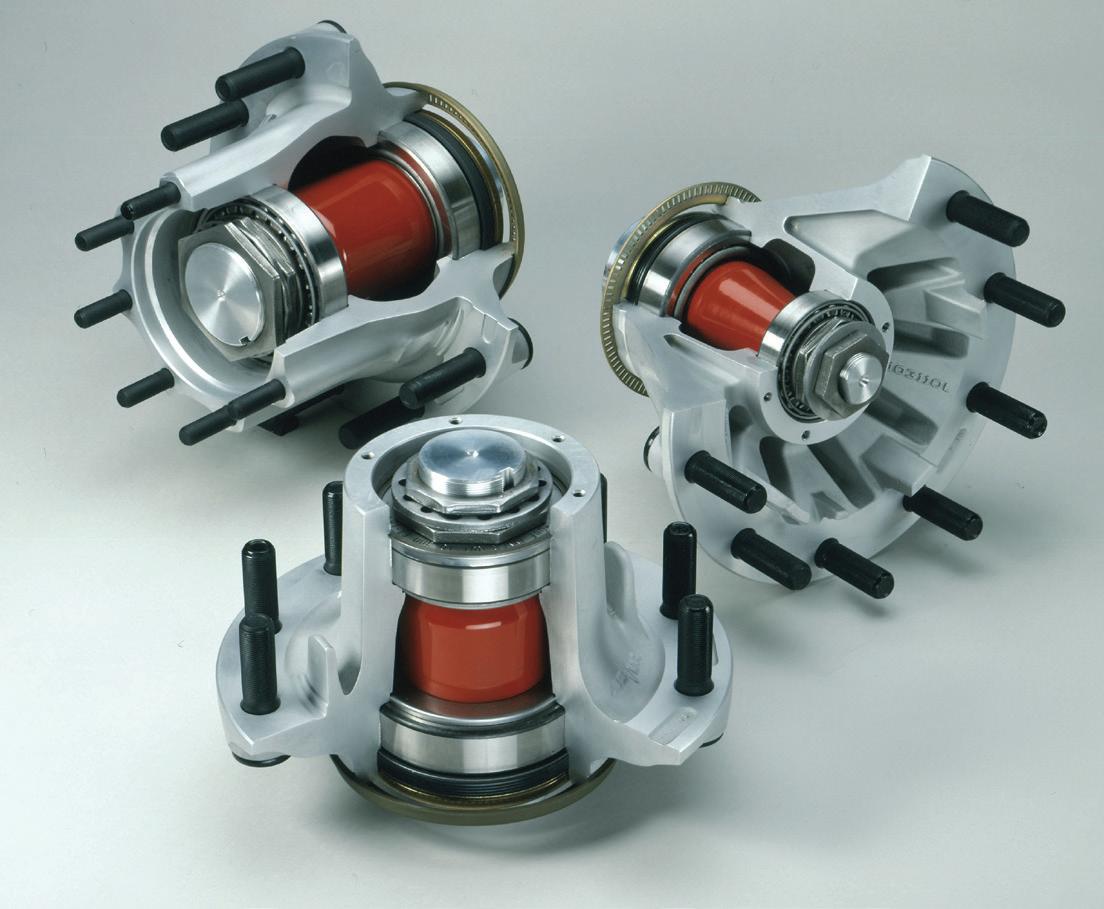
Thirty years ago, ConMet realized that pre-assembling wheel-end components before sending them to the OEM made them stronger.
By Brian Rieger
Throughout the 20th century, wheel-end installation on heavy-duty trucks followed a familiar pattern. OEMs largely sourced their hubs, bearings, seals, and other wheel-end components from different suppliers. Assembly and bearing adjustment then took place on the production line, relying on manual procedures and the skills of the assemblers.
The process worked but introduced the potential for inconsistencies. Even small differences in how a spindle nut was set could lead to variations in end play. This in turn affected heat generation and service life. For OEMs producing trucks at scale, that variability made it challenging to confidently support longer warranties. The industry largely accepted this as an unavoidable cost.
That mindset changed in the mid-1990s. Rising durability expectations from fleets and longer warranty targets for wheel ends put new pressure on OEMs, with more emphasis on achieving consistent bearing adjustment across high-volume assembly lines.
Wheel-end supplier ConMet began rethinking the traditional approach and had the technical know-how to do something about it. Since its 1964 founding in Portland, Oregon, the company had built its reputation on engineering-driven solutions, starting with lightweighting for Freightliner. By the ’90s, ConMet had evolved to focus on delivering complete systems versus individual components.
The new ambitious goal was to simplify wheel-end installation for OEMs while improving reliability in the field.
“ConMet was already producing the hub with the kind of precision the industry depended on,” recalled Mike Harman, a former ConMet sales VP. “And we had the engineering capability to design the bearing system around it. That’s what allowed us to start thinking of the wheel end as a complete, integrated assembly— not just a collection of parts.”
Eventually, the team collectively realized that a fully pre-assembled, pre-adjusted hub could eliminate those manual bearing adjustments on the line while also improving quality and supporting longer warranty intervals.
The true breakthrough came when ConMet engineers demonstrated that a bearing spacer, used in combination with bearings made to tight tolerances, could reliably control end play without manual adjustment. By assembling the hub, bearings, spacer, and seal into a single engineered unit, ConMet could hold critical dimensions and deliver consistent results.
“When we saw how repeatable the bearing setting was, we knew it wasn’t just a good idea on paper,” Harman said. “It had the potential to change how wheel ends were installed.”
This idea was commercialized in 1995 as the PreSet line, the first pre-assembled, pre-adjusted wheel-end solution for North America. The significant departure from tradition required ConMet to work closely with OEMs to walk through the design, testing, tolerances, and installation process.
Initial reactions from the OEM side were cautious, as many engineers and line workers wanted to understand how proper end play could be maintained without manual adjustment. But as ConMet walked them through the design and installation process and testing data and production trials demonstrated consistent results, confidence in the approach grew quickly. OEMs began to recognize that PreSet technology reduced rework, simplified assembly, and improved confidence in meeting durability targets. Over the next seven years, PreSet wheel ends became standard equipment on nearly every Class 8 truck in North America, Harman noted.
Beyond adoption, PreSet technology helped redefine the wheel end as a fully engineered system rather than a collection of individual parts. That system-level approach delivered more consistent performance and supported the longer warranties the industry increasingly demanded.
“Wheel-end performance is very sensitive to installation and bearing setting, and there’s not much margin for error,” Roger Maye, techni-
cal service director at ConMet, said. “It is very difficult to set the end play right manually on every single hub, even on an assembly line. By assembling the units and setting the correct end play at the factory, ConMet was able to remove that variability. That improved consistency supported the industry’s move toward longer warranty expectations.”
ConMet also has more quality control by designing and producing hub castings, bearings, seals, spacers, and since 2011, spindle nuts as well. By engineering these parts to work together at such tight tolerances, ConMet is able to offer a single, unified warranty for the complete assembly.
Since PreSet’s inception, ConMet has continued to refine the PreSet line performance and improve component life, focusing on maintaining clamp load and managing the wide variety of spindle nuts used across different platforms.
Those efforts culminated in the introduction of PreSet Plus hubs in 2011. The integrated spindle nut was a key advancement, simplifying installation and improving consistency on the assembly line. In service, the PreSet Plus spindle nut locks in place to help retain clamp load and help prevent cone race rotation over the life of the wheel end. The spindle nut was also designed to help keep the hub on the axle if a wheel end experiences a severe failure, reducing the risk of a wheeloff event. During service, it can also function as a hub puller, making it easier to remove the hub from the axle.
More broadly, PreSet Plus technology was a refinement of an already proven design, strengthening long-term stability and addressing issues such as cone-race rotation later in the life of the hub.
In 2016, PreSet Plus entered into the aftermarket, giving fleets and technicians access to the same system-level approach used at the factory. By replacing end-of-life hubs with a complete PreSet Plus assembly rather than rebuilding them, maintenance operations could now reduce downtime and eliminate manual bearing adjustment.
Today, PreSet technology remains foundational to ConMet’s wheel-end portfolio. More than 40 million PreSet and PreSet Plus hubs have been installed on commercial vehicles, collectively traveling over 31 trillion miles. As the technology enters its fourth decade, development continues, driven by new applications, materials, and evolving fleet needs— all grounded in the same system-based approach that made PreSet technology an industry first.
By Brian Rieger VICE PRESIDENT OF NORTH AMERICA TRUCK
OEM AND AFTERMARKET SALES AT CONMET
Brian Rieger began his career at ConMet as a design engineer in 1999. During his tenure, he has held roles in all of ConMet business units both in U.S. and abroad. Before joining ConMet, Rieger received a BS in Mechanical Engineering from Oregon State University.

































We’re