Managing Director, Content & Editor in Chief Paul J. McLane, paul.mclane@futurenet.com, 845-414-6105
Content Producer Nick Langan, nicholas.langan@futurenet.com
Technical Advisors W.C. “Cris” Alexander, Thomas R. McGinley, Doug Irwin
Contributors: Michael Baldauf, David Bialik, John Bisset, Edwin Bukont, James Careless, Ken Deutsch, Todd Dixon, Mark Durenberger, Charles Fitch, Donna Halper, William Harrison, Alan Jurison, Paul Kaminski, John Kean, Mark Lapidus, James O’Neal, Jim Peck, Mark Persons, Jeremy Preece, John Schneider, Gregg Skall, Dan Slentz, Randy Stine, Tom Vernon, Chris Wygal
Production Manager Nicole Schilling
Senior Design Director Lisa McIntosh
Senior Art Editor Will Shum
ADVERTISING SALES
Senior Business Director & Publisher, Radio World John Casey, john.casey@futurenet.com, 845-678-3839
To subscribe, change your address, or check on your current account status, go to www.radioworld.com and click on Subscribe, email futureplc@computerfulfillment.com, call 888-266-5828, or write P.O. Box 254, Lowell, MA 01853.
LICENSING/REPRINTS/PERMISSIONS
Radio World is available for licensing. Contact the Licensing team to discuss partnership opportunities. Head of Print Licensing Rachel Shaw licensing@futurenet.com
MANAGEMENT
SVP, MD, B2B Amanda Darman-Allen
VP, Market Lead Carmel King MD, Content, Broadcast Tech Paul J. McLane
VP, Global Head of Sales, B2B Dena Malouf Managing VP of Sales, B2B Tech Adam Goldstein VP, Global Head of Strategy & Ops, B2B Allison Markert VP, Product & Marketing, B2B Andrew Buchholz Head of Production US & UK Mark Constance Head of Design, B2B Nicole Cobban
FUTURE US, INC.
Future US LLC, 130 West 42nd Street, 7th Floor, New York, NY 10036
If you submit material to us, you warrant that you own the material and/ or have the necessary rights/permissions to supply the material and you automatically grant Future and its licensees a licence to publish your submission in whole or in part in any/all issues and/or editions of publications, in any format published worldwide and on associated websites, social media channels and associated products. Any material you submit is sent at your own risk and, although every care is taken, neither Future n or its employees, agents, subcontractors or licensees shall be liable for loss or damage. We assume all unsolicited material is for publication unless otherwise stated, and reserve the right to edit, amend, adapt all submissions. Radio World (ISSN
Optimize Your Air Chain
Are you getting the most out of yours?
Paul McLane Editor in Chief
In this latest Radio World ebook, we’ve asked engineers, consultants and technology sponsors about best practices that can help stations avoid common problems and missed opportunities.
Is the audio clean? Is the metadata right? Is the watermarking doing its job? Do the streams function correctly?
What other questions should smart engineers and managers be asking to make sure their chains are functioning at top efficiency from microphone to the listener’s ears?
Jeff Detweiler explores how IP, cloud and precision timing are remaking the air chain. Julien Libeau encourages us to take a systems mentality to this topic.
Paul Shulins, Jeremy Preece and Kirk Harnack provide three different takes on simplification. Bud Williamson shares lessons from many due diligence and other site inspections.
Jim Kuzman seeks to apply common sense to air chain decisions. Jeff Keith explores a specific angle in the world of audio processing.
Rob Bertrand shares the lessons of his research into how spoken-word programming does in the PPM ecosystem. Rojith Thomas urges managers to think of engineering as a business function. And Mike Pappas and Greg Ogonowski share their unique insights.
These ebooks are intended to be educational but also engaging. I am pleased with what I learned in collecting comments for this topic and hope you find it useful.
Pappas: What you don’t know can hurt you!
Greg Ogonowski: Audio quality, start to finish
Julien Libeau: Optimizing the FM air chain through end-to-end visibility
Paul Shulins: When it comes to air chains, less is more
Jim Kuzman:
Andrei AkushevichGetty Images
Optimize Your Air Chain
Writer
Jeff Detweiler
The author has played numerous industry roles throughout his career, most recently as senior director of broadcast business development at Xperi.
Welcome to the new air chain
How IP, cloud and precision timing are reshaping broadcasting
The radio broadcast “air chain” is undergoing one of its most significant transformations since the shift from analog to digital transmission.
What was once a linear, hardware-defined signal path is rapidly evolving into a flexible, software-driven ecosystem built on IP networking, virtualization and precise synchronization. The result is a fundamentally different approach to how audio is processed, transported and transmitted — one that is redefining resilience, scalability and audience reach.
From hardware racks to virtualized air chains
For decades, the air chain was a clearly defined sequence of devices: studio console, audio processor, studio-totransmitter link (STL) and transmitter.
Today, that architecture is evolving. Broadcasters are increasingly deploying virtualized and cloud-based air chains, where playout systems, audio processing and even HD Radio Importer/Exporter and Exgine functions run as software instances in data centers, cloud platforms and transmitters.
This shift offers several advantages.
Redundancy, once achieved through costly backup hardware, can now be handled through rapid failover between virtual instances. Scalability also becomes far more dynamic. Stations can spin up additional processing resources during peak demand or major events and scale down afterward.
Operationally, the transmitter site becomes simpler, with fewer dedicated boxes requiring maintenance.
Perhaps most importantly, virtualization enables geographic decoupling. Studio operations, processing and transmission no longer need to be co-located, opening the door to distributed workflows and centralized technical oversight.
AoIP becomes the backbone
Underpinning this transformation is the widespread adoption of audio over IP.
Technology standards such as AES67, SMPTE ST 2110-30, Dante and Livewire+ have become the default infrastructure for modern broadcast facilities.
In an AoIP environment, audio is no longer tied to fixed wiring paths. Instead, it travels as packets over standard
Andrei Akushevich/Getty Images
Optimize Your Air Chain
Ethernet networks, effectively turning the network itself into a routing matrix. This allows hundreds of bidirectional audio channels to coexist on a single link, dramatically increasing flexibility.
The benefits extend beyond routing. AoIP enables distributed digital signal processing, allowing audio to be manipulated anywhere on the network. It also integrates seamlessly with virtualization and cloud workflows, creating a unified environment where content can be created, processed and delivered without the constraints of traditional physical infrastructure.
Standards like AES67 further ensure interoperability across manufacturers, reducing vendor lock-in and allowing broadcasters to mix and match equipment more freely.
Integrated processing across analog and digital
As radio continues to operate across both analog (FM) and digital platforms (HD Radio, DAB), a key engineering challenge has been maintaining alignment between these paths. Historically, listeners have experienced noticeable delays when receivers switch between analog and digital signals.
Modern processing systems now address this by tightly integrating analog and digital chains. Audio is processed in a unified environment with precise time alignment across outputs. These systems are increasingly “clock-aware,” synchronized across the network to ensure that all signal paths remain in lockstep.
The result is a seamless listener experience, even in hybrid broadcast environments where multiple transmission formats coexist.
AI begins to influence audio processing
While still emerging, artificial intelligence is already influencing broadcast audio processing. Early implementations focus on adaptive loudness control, automatically adjusting levels based on content type, differentiating between music, speech and commercials.
More advanced concepts include context-aware processing and automated optimization for various codecs and streaming platforms. Although not yet universal, these capabilities point to a future in which audio chains can selfoptimize in real time, reducing the need for manual tuning while improving consistency across platforms.
IP-native STL: “Everything is data”
The shift to IP does not stop at the studio. It now extends to the transport of signals to transmission sites. IPnative STL architecture is now the industry standard, replacing legacy T1 lines, analog links, and even traditional microwave systems.
In this new paradigm, audio, metadata, control signals and timing information all travel as data over IP networks. This convergence simplifies infrastructure while enabling
new capabilities such as centralized monitoring and remote management.
A notable trend is the rise of MPX (composite) over IP. Instead of sending separate left- and right-channel audio, broadcasters can generate the entire FM multiplex at the studio and transport it as a single, synchronized stream. This ensures consistent modulation across transmitters and reduces complexity at the transmission site.
Redundancy through multi-path networking
Reliability remains paramount in broadcasting, and IP networks are delivering new approaches to redundancy. Modern STLs often use multi-path distribution, combining fiber, microwave and satellite or low-earthorbit services.
Protocols such as Secure Reliable Transport (SRT), forward error correction and dual streaming allow for “hitless switching” between paths, ensuring continuity even if one link fails. This approach brings carrier-grade reliability to what are often commodity network connections.
At the same time, microwave technology is evolving. Today’s systems are increasingly IP-native or hybrid IP/
“Taken together, these trends signal a profound shift in broadcast engineering. ”
MPLS platforms capable of multi-gigabit throughput. These solutions integrate routing and RF functions, reducing system complexity while delivering low-latency connectivity.
Low latency for real-time broadcasting
Latency is a critical factor in modern broadcast chains, particularly for live programming and synchronized transmission networks. Advances in IP codecs now allow end-to-end delays of a few milliseconds.
This ultra-low latency supports real-time interaction, accurate timing for digital services and precise alignment in hybrid analog-digital broadcasting. It also plays a key role in emerging network topologies such as singlefrequency networks.
The expansion of SFNs into FM
Single-frequency networks, long associated with digital broadcasting standards like DAB and DVB, have made their way into the FM band. Technologies such as GeoBroadcast Solutions ZoneCasting and booster-based systems allow
Optimize Your Air Chain
multiple transmitters to operate on the same frequency, improving coverage and enabling localized content insertion.
Use cases include filling coverage gaps, enhancing reception in urban environments, and creating targeted messaging along highways or within specific geographic zones.
Precision timing
The success of SFNs, and increasingly, broadcast systems, depends on precise synchronization. GPS remains a primary timing source, offering sub-100-nanosecond accuracy. However, broadcasters increasingly are adopting the IEEE 1588 Precision Time Protocol (PTP) standard as either a complement or backup.
PTP distributes timing over IP networks, enabling synchronized operation even in GPS-challenged environments. Hybrid approaches combining GPS and PTP are becoming common, improving resilience while maintaining accuracy.
Modern systems can achieve sub-microsecond alignment, ensuring that signals from multiple transmitters reinforce rather than interfere with one another. Engineers must carefully account for propagation delays and implement compensation strategies to maintain synchronization across large geographic areas.
IP-based
network topologies take shape
With these technologies in place, broadcast network design is evolving toward more flexible topologies. Centralized hub-and-spoke models remain common but are increasingly complemented by regional hubs and fully meshed IP backbones.
These architectures enable multipoint distribution, allowing content to be delivered simultaneously to multiple transmitters without the limitations of point-to-point links. Redundancy is built into the network itself, with multiple paths for both audio and timing signals.
A new era for broadcast engineering
Taken together, these trends signal a profound shift in broadcast engineering. The air chain is no longer a fixed, hardware-defined path but a dynamic, software-driven system built on IP connectivity and precise timing.
For engineers, this means new skill sets: networking, virtualization and cybersecurity are now as critical as RF expertise. For broadcasters, it means greater flexibility, improved resilience and the ability to reach audiences more effectively and efficiently.
Radio remains a powerful and adaptable medium. As these technologies continue to mature, the industry is poised not just to evolve, but to redefine what broadcasting can be in an increasingly connected world.
EBOOKS: Tools for Strategic Technology Decision-Making
Radio World’s growing library of ebooks can assist you in maximizing your investment in an array of platforms and tools: licensed transmission, online streaming, mobile apps, multicasting, translators, podcasts, RDS, metadata and much more.
The ebooks are a huge hit with readers. They help engineers, GMs, operations managers and other top radio executives — radio’s new breed of digital, crossplatform decision-makers — understand this new world and thrive in it.
Practical tips from Bud Williamson
Lessons learned from due diligence inspections and other site visits
Bud Williamson is a broadcast entrepreneur, engineer and consultant. He is managing member of the radio company Neversink Media Group as well as the head of Digital Radio Broadcasting Inc., where he provides technical consulting and licensing expertise
for FM stations, translators, boosters and entire broadcast facilities.
In your work with various stations, are there one or two common steps in the air chain that often are deficient technically or not being maximized fully?
Bud Williamson: Often I see analog audio being converted to digital and transported over a codec, such as a BRIC-Link or a Tieline device. Recently I saw a configuration that was at 48 kbps mono with 4:1 data compression that ultimately fed an expensive audio processor.
With fiber IP connectivity at both ends with decent speeds and low latency, there seemed to be no reason to restrict the quality. I switched it to linear stereo and to this day, the station maintains very good transport quality with no data dropouts. (The codecs are that good today!)
I advise stations to try to use the same provider and be on a fiber platform on both ends. While Direct Internet Access or DIA is preferable, as it supposedly “bypasses” a large number of smaller customers, that creates bursty conditions that interrupt the stream of your IP connection. This results in unrecoverable bits and can lead to artifacting or dropouts entirely.
While performing due diligence station inspections in smaller markets, I often hear problems before even pulling up to the station —
whether it is low modulation, channel imbalance or even varying levels.
Much of that is the result of a poorly engineered facility where levels are not set properly, there are too many items on the program pairs to the processor, or perhaps a bad punch on a punchblock.
They hear the station in their car and that is all that matters to them. Sadly, these guys accept the deficiencies and dismiss the fact that they sound “weaker” because they feel they are a small station. However, any FM station can have the same audio quality, regardless of size or class.
What can stations do to assure that audio is clean and optimized?
Williamson: Start with good, uncompressed audio files. Not just for music, but for commercial production as well! Yes, even your commercials should be uncompressed wave files, along with imaging, jingles and voice tracks.
Also, there is no need for clipping on audio files. Leave that for the final processor, whether on the air or stream processors.
And earn the functions of the processor you are using. Just because there is an adjustment present doesn’t mean you need to change it. This is how you get lost in the setup and you start trying to fix something you hear with the wrong function.
What common issues do you see with metadata management?
Williamson: There are still stations I tune to while travelling that still do not have any metadata posting!
Even if you can only do a static message, get something on. Brand your station.
Most broadcast automation systems output metadata that can be fed to an RDS encoder, HD PAD data as well as a stream. At minimum, send song title and artist data. Consider middleware to insert other messaging if your automation system cannot do it natively. There are tools available at different price points that handle this task elegantly and enable you to add an additional source of revenue.
Finally, double confirm your Pi codes for each of your signals. Each call sign, including translators, has a separate Pi code and is used by companies including DTS AutoStage and RadioDNS to improve the listener experience in autos. In fact, you can even send your AM station’s metadata to DTS AutoStage for display on the substantial number of equipped auto radios.
How can stations make sure that their PPM encoding is being detected on all relevant platforms?
Williamson: Make sure your PPM encoder has enough audio to attach the watermark to. It cannot put the watermark on silence.
It is preferable to loop the PPM encoder via the patch points of an audio processor so that there is more controlled (compressed) audio feeding the encoder. Newer processors are beginning to include PPM watermarking capability within their boxes.
Encode your streams as well.
Nielsen provides monitoring equipment along with each PPM encoder. Installing the monitor that comes with the encoders provides status of the watermark. Whether the basic grey box with a red / green LED is simplest, you can get into the newer MCEM monitors and get better detail of each monitored source.
Also, many stations in larger markets have a specific monitor that they can purchase, providing very good detail, in color!
Nielsen is good about monitoring PPM encoded stations and streams themselves.
“
Earn the functions of the processor you are using. Just because there is an adjustment present doesn’t mean you need to change it. ”
Are stations paying sufficient attention to the quality of their audio streams to digital platforms?
Williamson: No. Often people are using inexpensive simple wideband audio processors that are cranked up to see LEDs flash. The resulting quality on the stream is harsh and, depending on the listening device, can sound mediocre or even “wavey” since holes are getting punched into the audio.
Worse yet, people still use an FM receiver to feed their stream, which is way more processed than it needs to be. Yes, you can hear it, but it will not support long term listening. Again, for many, it’s a “I hear it, so it must be OK” situation for stations.
Today, there are inexpensive audio processors that are designed to process streams and they are available as a software plug-in.
Optimize Your Air Chain
Writer
Kirk A. Harnack CBRE, CBNE Strategic Consultant, MaxxKonnect
Cleaner radio through simplification
Sometimes meaningful improvement does not come from adding but from removing
Cleaner radio starts with eliminating analog noise.
For decades, broadcast engineers have pursued “better-sounding radio” through improved microphones, cleaner consoles and better processing. But in today’s radio plant, one of the biggest opportunities for air chain improvement is surprisingly simple: Remove as much analog circuitry from the signal path as possible, especially older analog equipment that adds measurable noise and alters characteristics such as group delay and impulse response.
Modern air chain optimization is less about adding devices and more about removing the ones that quietly degrade performance every day.
That means retiring aging analog distribution amplifiers. It means replacing legacy analog STL systems. And increasingly, it means transporting the FM multiplex signal itself over IP using linear IP-audio methods or modern MPXover-IP technologies.
In the author’s experience, these improvements are not merely measurable; they are audible. Station staff — and often listeners — have commented on the cleaner and more open sound after such changes were implemented.
The hidden problem with “good enough”
Many FM stations still operate with signal paths that evolved over decades. A station may have started with
analog consoles, analog STLs and analog processing, then gradually added digital equipment over time. The result is often a hybrid plant with multiple conversion stages and legacy analog infrastructure still embedded in critical parts of the chain.
The problem is that many analog stages contribute component noise, crossover distortion, level uncertainty, group delay and degraded impulse response.
In many cases, older analog distribution amplifiers are among the worst offenders. These devices were often designed in the 1980s or 1990s and may only achieve noise performance 80 to 90 dB below peak program level. That may have been acceptable decades ago, but in a modern FM air chain, it becomes increasingly obvious once the rest of the system is cleaned up.
Engineers are often surprised when bypassing an aging analog DA results in improved stereo clarity, cleaner highfrequency detail and lower background noise.
Noise and distortion introduced anywhere before the exciter become transmitted artifacts — imperfections that are faithfully delivered to the listener.
This issue becomes especially important when discussing legacy analog STL systems, particularly traditional composite STL radios operating in the 950 MHz band. These systems were extraordinarily reliable for many years and still remain in service across the country. But they also introduce inherent FM noise into the multiplex baseband.
Optimize Your Air Chain
Typically, the noise floor of an analog composite STL may only be 70 to 75 dB below modulation peaks. Again, that was acceptable in another era. But today, with modern audio processing and cleaner source material, that residual noise becomes increasingly noticeable.
And unlike noise buried deep inside a studio monitoring chain, STL noise is directly transmitted by the FM exciter. That means stereo subcarrier noise, pilot contamination and upper-baseband artifacts all become part of the listener experience — especially in fringe coverage areas where stereo performance is already challenged.
IP transport is no longer experimental
Reliable IP connectivity is now available through fiber, licensed microwave Ethernet, public internet, managed circuits, 5G wireless gateways and even LEO satellite-based services such as Starlink.
The important lesson, however, is not merely to “use IP,” but to engineer IP transport with redundancy and path diversity. Modern STL design therefore increasingly centers around path diversity and intelligent failover.
MaxxKonnect works with broadcasters across North America to address this critical aspect of modern air chain design. As broadcasters increasingly move STL systems toward IP-based architectures, the reliability of the transport path itself becomes just as important as the audio quality it delivers.
MaxxKonnect’s prioritized wireless and satellite services can provide an IP path for primary connectivity or back-up redundancy to a terrestrial internet service. Because a wireless path is independent of the primary connection, it can provide true path diversity for critical on-air STL systems, helping maintain program continuity during outages and reducing the risk of a single point of failure.
Composite-over-IP can be a smart option
One of the most important developments in modern FM transmission has been the rise of composite or MPX transport over IP.
Rather than transmitting left/right audio to the transmitter site and recreating the multiplex signal there, composite-over-IP systems transport the fully generated MPX baseband directly to the exciter. This offers several advantages.
First, it preserves the exact output of the audio processor, including stereo generation, clipping behavior, RDS injection and other composite-domain characteristics. The air sound becomes more predictable and repeatable.
Second, it eliminates analog STL noise entirely.
Third, it enables much more sophisticated filtering and spectrum management of the multiplex signal itself.
One of the most widely recognized technologies in this area is MicroMPX. What makes this particularly interesting is that it does not rely on traditional psychoacoustic bitrate reduction methods. Instead, it uses highly efficient mathematical reduction techniques specifically optimized for the FM multiplex spectrum.
That’s a key distinction.
Rather than treating the signal as conventional audio, the system intelligently manages portions of the MPX spectrum that are intended to remain quiet anyway.
For example:
• The area around the 19 kHz stereo pilot is carefully protected.
• The 57 kHz RBDS/RDS region is effectively filtered and stabilized.
• Upper baseband regions are cleaned up to provide additional spectral room for services such as HD Radio injection or future multiplex components.
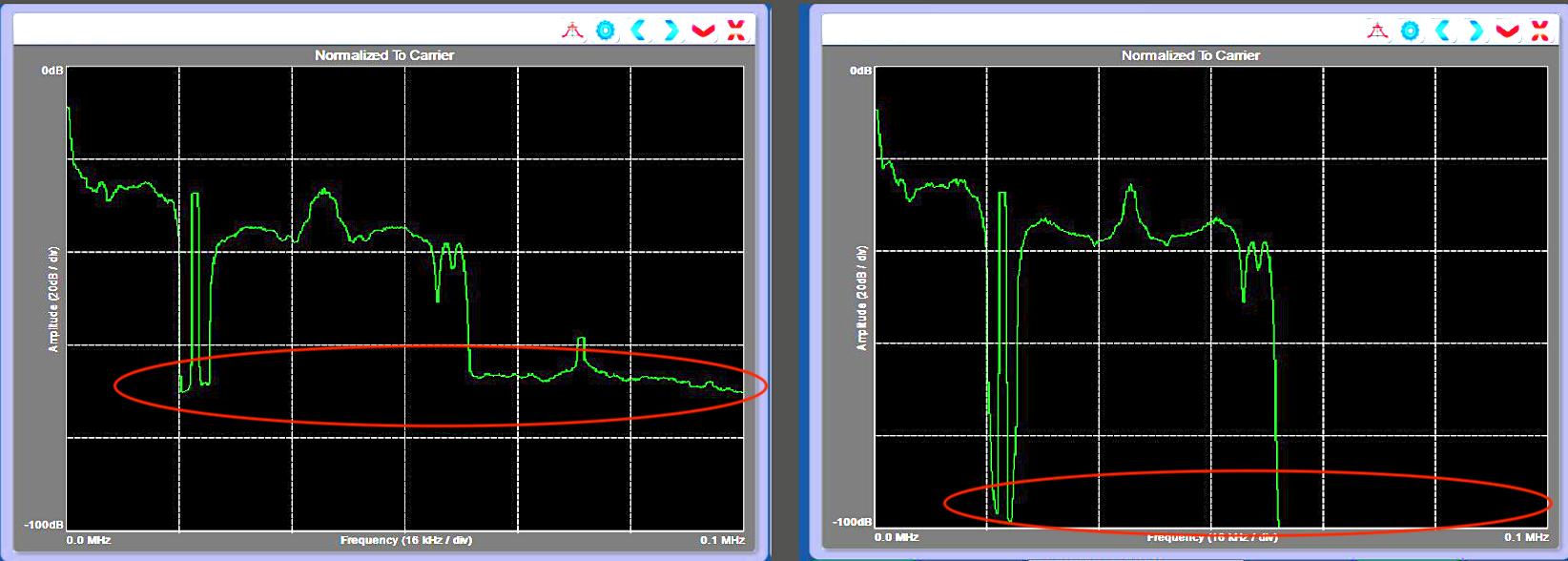
The result is an exceptionally clean composite signal that can be transported at surprisingly low data rates while preserving outstanding on-air performance (Fig. 1).
MaxxKonnect has helped refine MicroMPX implementation approaches and broaden adoption within the broadcast industry, particularly in the United States. Beyond simply making the technology available, a collaboration with
Left Fig. 1: FM MPX spectrum from a Nautel AUI, comparing analog, left, vs. MicroMPX.
Optimize Your Air Chain
MicroMPX developer Thimeo has focused on practical deployment considerations, real-world integration and helping broadcasters understand how MPX-over-IP techniques can be incorporated into existing facilities.
As a result, technologies that once may have seemed experimental to many engineers have become increasingly accessible and familiar within day-to-day broadcast operations.
Today, approximately 20 models of MicroMPX encoders and decoders are available from roughly a dozen manufacturers. In addition, nine FM audio processors offer MicroMPX encoding capabilities, while six FM transmitter platforms include MicroMPX decoding either as an option or as part of their standard feature set.
This level of integration suggests that composite-over-IP transport has moved well beyond the experimental stage and into mainstream broadcast infrastructure.
The case for linear audio over IP
Another approach worth considering is transporting uncompressed linear audio all the way to the transmitter site using audio over IP infrastructure.
When bandwidth and connectivity allow, this can provide an extraordinarily clean signal path because there is no perceptual coding, no psychoacoustic compression and no codec artifacts being introduced into the program chain. Instead, the audio arrives bit-for-bit identical to what left the studio.
More Info MaxxKonnect is an ebook sponsor. Learn about its products at https:// maxxkonnect.
Improved stereo coverage is real
One of the more interesting field observations from broadcasters adopting modern MPX-over-IP systems is improved stereo coverage.
At first glance, this seems counterintuitive. After all, transmitter power and antenna systems remain unchanged.
But the explanation becomes clear when examining the multiplex baseband itself.
A cleaner MPX spectrum reduces incidental noise and unwanted modulation products surrounding the stereo subcarrier. That means receivers operating near the stereo threshold can maintain stereo lock more effectively and with fewer audible artifacts.
Engineers describe the improvement as “quieter stereo,” “more stable imaging” or “less swishing” in fringe areas.
In practical terms, listeners may simply perceive that the station sounds stronger and cleaner than before, particularly near the fringe areas of stereo coverage.
“Station staff — and often listeners — have commented on the cleaner and more open sound after such changes were implemented. ”
Linear IP STL systems will transport digital audio perfectly with the same 1s and 0s that go into such an STL being delivered to the far end. Twenty-four-bit, 48 kHz-sampled linear audio typically requires about 2.5 Mbps to transport.
While this form of audio delivery is essentially bit-perfect, it generally depends on an IP transport path with extremely low packet loss and properly engineered buffering and redundancy.
Whether using AES67, Livewire, WheatNet-IP, Dante or another compatible transport technology, the principle remains the same: Preserve the digital signal without alteration until it reaches the transmitter facility.
This approach still generally requires audio processing and stereo generation to occur at the transmitter site, which has traditionally been an acceptable design philosophy and remains common in many facilities today.
For stations moving away from analog STL systems, linear AoIP transport can represent a major step toward a remarkably clean and transparent air chain.
And because FM remains fundamentally an analog RF medium, improvements in transmitted baseband cleanliness still matter enormously.
A new philosophy
For many years, air chain optimization meant adding another box. Today, the philosophy is often the opposite.
The best sounding stations are increasingly the ones with fewer analog stages, fewer unnecessary conversions and fewer opportunities for accumulated noise.
AoIP infrastructure, AES67 transport, AES/EBU interconnection and MPX-over-IP STL systems are allowing engineers to simplify the signal path while simultaneously improving reliability and sonic performance.
Most importantly, these improvements are audible.
Listeners may never know why a station sounds cleaner, more open or more stable in stereo. But they notice the difference.
Sometimes the most meaningful air chain improvement does not come from adding another device; it comes from identifying and removing what has been quietly degrading the signal all along.
Don’t be afraid to try new techniques to achieve the best possible sound quality. Whether simple IP codec transport, MicroMPX or linear digital audio, the technology is there and engineers can implement these standards without a big learning curve. After all, radio has an overlooked advantage to the streaming services it now competes with: the ability to run uncompressed audio from playout to receiver.
Optimize Your Air Chain
Writer Jeremy Preece CPBE, DRB President, Wavelength Technical Solutions LLC
I have a passion for simplification
Is your on-air path complicated by unnecessary appliances?
As we explore ways to optimize and improve the efficiency of our air chains, allow me to share a few thoughts and experiences around the idea of simplification.
Demands on a radio station air chain have changed a lot over the past couple of decades. It used to be that getting stereo audio to the listeners was all that was required. While it sometimes took a surprising number of boxes to accomplish this, the end product was relatively simple.
Then along came RDS, HD Radio, diversity delay adjustments, live traffic data, album art, remote studios, voice tracking, and a slew of other complications that, if we aren’t paying attention, can create rather complex air chains with many failure points.
New technologies and the demands from our audiences require us engineers to think in a much more strategic manner when both planning and working with the modern air chain.
For me, one priority remains the same: Keep It Simple (Smarty?).
Simplicity begins by considering what’s truly most important. That goes back to the basics in radio: delivering audio to the listeners. Everything else is anchored to this foundation.
Many years ago, I was working a project in Los Angeles. My goal was to get as close as reasonably possible to “five nines” uptime. A noble aim, one that I thought I could achieve by over-engineering each system.
I designed a web of interconnected and layered devices so that if any failed, the backup could be routed remotely or automatically into the air chain without a site visit.
What a great idea on the whiteboard.
What a mess in real life.
It quickly became very difficult to determine what was actually on the air and what was in standby. The need for numerous tallies, monitoring points and alarm triggers quickly grew to the point where the wiring was far more complicated than any other site I oversaw.
After months of headaches and plenty of downtime, we went back to isolated main and backup air chains
Optimize Your Air Chain
with a simple A/B switch between diverse paths. The station seldom had another notable outage due to equipment failure.
This was a hard and expensive lesson, but a valuable one. It taught me to look at the air chain differently.
I began removing all unnecessary appliances from the on-air path. Eventually this got down to audio source, EAS and processing. It was literally a couple boxes in a rack that kept stations on the air, with all other systems wired in a way that prevented them from taking out FM audio.
Auxiliary sites were built around same barebones equipment necessary to keep the music playing.
From this core K.I.S.S. foundation we can begin adding features.
For example, RDS is inserted into the processor, but if it fails, no one will die. Diversity delay equipment, if required, is in the HD path, not the FM path, because, while important, if HD1 goes down fewer people will miss it than if FM is silent.
Inline audio switchers were removed in favor of multiple
“I prefer to have both the primary and backup audio paths going to both the main and backup transmitters. ”
discrete paths. And so on.
To achieve a more robust backup to both the primary and backup chains, I prefer to have two diverse audio paths to the audio processor(s). If the facility is using AES67, this is often primary, but an old-fashioned AES3 or even analog lane from the source audio is valuable, especially if a switch on the AES67 network fails.
And while many processors have an automatic fallback to the second input when the main is lost, I favor manual switching to ensure I’m aware the main path is down and can more effectively troubleshoot the system.
Most modern consoles use AoIP, and some are entirely virtual, which unfortunately means they lack meaningful AES3 or analog input and output options. This is where I find taking an old-school approach helpful.
As mentioned, getting audio to the listeners is the most important task, so consider the simplest ways to do it. A CD player wired to the STL or standby audio processor’s second input can buy you an hour to swap gear or get a prod studio ready to become the main.
Better yet, a cheap Windows PC with a Focusrite USB sound card and freeware automation system, such as RadioDJ or Playout One Standard, can provide endless hours of content to keep listeners happy while repairs are made.
If your automation system supports running a standalone machine without a connection to a remote database or server, that’s a great option.
If these offline emergency audio backups are implemented, I recommend you set recurring reminders to have your PDs update their playlist and liners so things aren’t too out of date when needed.
If physical space allows, consider outfitting an office or production studio with an inexpensive “classic” console, mic and playout system.
STL paths should also be viewed from a what-mattersmost perspective. With many stations moving to IP STLs, we are now dealing with large corporations that own the circuits we rely on. Even with contracted SLAs, repairs may take hours.
A backup RF STL or unlicensed 5.8 GHz link that you own is more than enough to survive “backhoe fades” on the local fiber circuit. Cellular and satellite backups are also great, but again we’re dealing with big companies in the middle, and a local disaster may overwhelm their capacities quickly. Point-to-point is arguably the simplest and most reliable option.
If you implement automated switching to backup feeds and sources, add alarming on the links to ensure you’re notified when failure occurs.
Finally, considering our transmitter sites, this is another great opportunity to simplify and streamline the air chain. I prefer to have both the primary and backup audio paths going to both the main and backup transmitters. This gives more options than simply having the backup audio lane (say, your RF STL) land only at the backup transmitter.
This works best if you can remotely access your exciter to switch inputs. A composite or audio switcher can be helpful, but these are points of failure especially if they are not passive, so I lean toward leaving them out and wiring direct whenever possible. Less is more.
There are a thousand ways to optimize and improve the air chains at the stations we maintain. From my experience, great gain has come through removing unnecessary complexity and minimizing failure points.
Thankfully, our industry has moved away from cart machines and miles of analog wiring in studios. But we’ve replaced those with servers, managed switches and cloudbased applications.
Failures in these systems are often more technically challenging to troubleshoot than a loose ground connection on a 66-block. So I personally am always looking for ways to bring the K.I.S.S. principle back into the radio facility so that the music never stops playing.
Optimize Your Air Chain
Writer Mike Pappas Senior VP of Global Sales, Orban Labs
More Info
Orban Labs is an ebook sponsor. For more info about the company visit www.orban. com.
Make a block diagram
Eliminate unnecessary A/D and D/A conversion
Listen to your audio critically
Assess your STL
Do you really need that AGC? Make sure your PPM health is good
What you don’t know can hurt you!
Here’s a quick seven-step tutorial
An air chain consists of anything you want to transmit. It starts with audio sources like automation systems, mics, satellite feeds and so on. This audio then runs through your “plant,” which may consist of consoles, routers, EAS gear, PPM encoding and maybe processing (if it’s not at the transmitter site).
It then takes a ride on a microwave or some other method to go from the plant to the transmitter site. Once there, the audio might encounter an EAS box and/or processing.
This is all part of your air chain, and there are lots of opportunities for audio to become damaged along that circuitous route.
Over the years, I have diagnosed many issues with air chains, both at the plant and the transmitter site.
How do you diagnose these issues?
Step 1 is to realize you have a problem. Audio corruption is subtle and may have many sources. The best way to start looking at an air chain is to make a block diagram. Start at the output of the plant and, working backward, put your hands on every inch of the system.
In our travels, we have found gear patched into air chains hiding in the bottom of racks under piles of cables, hiding in closets and stuffed in all kinds of weird locations. We hunted down pairs of cascaded processors
under a pile of wire 12 inches deep at the bottom of a rack. Those were running a combined 40 dB of compression before the main processor, and it sounded like Satan’s ShopVac.
Key message of this step: Air chains tend to accumulate gear over the years, and if you are relatively new to the station it probably makes sense to see what’s been added by your predecessors.
Step 2: While you are digging around, look for unnecessary digital-to-analog and analog-to-digital conversions. Even though A /D and D/A have come a long way in terms of performance, having six sets of them in an air chain isn’t a good plan for great audio.
Step 3: LISTEN to your audio. A good set of closed-back headphones with an appropriate headphone amp is a great addition to your “bag of tricks.”
I was hunting a pernicious distortion problem at an AM facility and found that the IP-based STL was having its input clipped at the studios. I found it by carefully listening to the STL output … and that clipped audio was ugly.
Step 4: Don’t forget about the STL. Microwave STLs can have all kinds of issues, especially if they are old enough to have a driver’s license!
When was the last time you looked at the RF link margin and/or receive level? Do those numbers look like they
did when it was installed, or have they degraded? Have you looked at the error rate on the digital STL lately?
Did the link come up within a couple of dB of the predicted path when it was installed, or was it off by 6 dB or more?
Dish misalignment from high winds, water in the RF connectors, N connectors tightened with a pliers can all contribute to an STL problem. This becomes critical if you are right at the edge of the link budget.
Step 5: Check to see if there is AGC before the STL. These devices are a throwback to the days of analog STL. If you have a digital plant and a digital STL, and there aren’t a raft of D-to-A-to-D conversions or gain being added, it’s probably unnecessary. FS should be FS everywhere in the system. The air chain is going to sound better with the fewest number of devices in the path between the console and the transmitter.
Optimize Your Air Chain
If you can’t get around using one, make sure that the AGC in the processor is turned off or the two of them will be at war with each other. A typical symptom of this is major pumping and breathing.
If you’re using an Orban processor and you don’t have a preceding AGC in your chain, you should be running somewhere in the range of 9 dB to 12 dB AGC action with “nominal” program level. This is the number one problem I see in the field.
Step 6: Don’t forget about Nielsen PPM encoding. PPM encoding requires the cleanest, highest density audio you can provide. Bad audio or poorly processed audio will negatively impact PPM encodability.
Field story: We ran into a PPM issue with a client who had a remote host. Every time the host was on the air talking, Above
block diagram for a 50 kW (by day) AM station in California.
“Air chains tend to accumulate gear over the years, and if you are relatively new to the station it probably makes sense to see what’s been added by your predecessors.
the PPM numbers plummeted. We did some sleuthing and found that the remote host was using mono MP3 encoding at 64 kpbs. We changed the encoding to mono AAC at 256 kbps and the PPM encoding problem went away.
At a minimum, PPM encoding should be done after the AGC. It’s significantly more effective to encode PPM after all of the multiband processing is done and before the safety limiter. That requires dual PPM encoders if you are running HD.
Audio processors with onboard PPM encoding are more effective than external outboard hardware encoders even with “PPM Enhancers.” Do not use lossy codecs on PPMencoded audio, and be wary of lossy compressed composite schemes too. Testing by one of our largest customers found that these can seriously degrade PPM encoding and damage Nielsen numbers by upwards of 20 percent!
Step 7: Check those microphone preamps. It’s really hard to find well-designed mic preamps!. Many sound OK at low gain but fall apart at the 60 dB to 70 dB of gain that dynamic mics typically need in a broadcast environment. Listen for lack of high frequencies; elongated, unnatural sibilance; and excessive noise. You aren’t going to be able to fix those problems with processing. Take a listen to the output of the morning drive console without any processing. You might have the wrong mics, or the preamp isn’t up to par, or both.
Your assignment: Make a block diagram and then look at what’s in the air chain … and get rid of everything that absolutely doesn’t need to be there. With air chains, less is always more.
Good audio processing goes beyond the audio processor
The title of this ebook really says it all.
There are many more technical details to optimizing broadcast and netcast audio than simply installing an audio processor. What comes before and after the audio processor can have a huge effect on audio processing results.
First, let’s understand what audio processing is. With many new technical staff, there is little to no real understanding of this, since many with IT backgrounds, now responsible for broadcast/netcast operations, lack technical media experience. Outsourcing to third parties has become another problem. This is known as the big “digital divide.”
With more and more audience migrating to streaming from traditional radio, it is more important than ever to audio process streams correctly. Much of what is available now still sounds like the amateur hour, because the proper engineering has not been applied.
The primary goal of audio processing is to solve the biggest age-old listener complaints of volume and tonal variations, improving your listener experience.
The secondary goal may be to give your sound a “sonic signature” so you sound better than your competition, in hopes that this keeps your listeners coming back for more.
The tertiary goal is to prevent transmitters and encoders from over-modulating or being over-driven causing clipping distortion.
Before and after
Some claim audio processing is unnecessary, especially in a digital world. This couldn’t be further from the truth.
The same level and tonal variations are still present in digital media delivery. Broadcast/netcasting is not a content delivery audio link or studio-to-transmitter function. It is a “last-mile” delivery function to provide entertainmentgrade audio.
You are providing a program for listener consumption that should be frictionless to consume, the same way movies are shot, corrected and produced before release for viewing. Delivering unprocessed audio to your audience is exactly what they don’t want. Although this might be tempting in theory for audio purists, be careful what you wish for here.
Before we continue, a few important things must be noted.
Like analog audio equipment implementations, digital solutions suffer from the good, the bad and the ugly. Just because something is digital doesn’t necessarily mean it is right or better. Digital audio solutions are only as good as the arithmetic behind them, and suffice it to say, many software developers did not pay attention in math class. Not all digital is the same!
The slimming down of broadcast facilities and staff reductions does not leave much time for serious vetting of products and services. Technical personnel have had no
“Yes, different browsers sound different. This is not audio crackpottery. It is fact. They use different audio engines with different audio implementations. ”
alternative but to turn into “emergency firefighters,” leaving little time for solutions research.
This leaves broadcasters open to vendors taking advantage or providing bad advice. Proceed with caution.
Over the years there have been many articles on audio processing adjustment. As co-developer of Optimod audio processing, there are many available, including a library of Optimod Processing Presets to get you started, or use as is. Instead of another subjective audio processing discussion, here is a brief factual account of what comes before and after audio processing to make sure your audio processing system will shine.
AM, FM, HD/Streaming are audio processed in entirely different ways.
AM and FM are the most severe cases, with quality levels that can never achieve that of HD or streaming. They involve the use of pre-emphasis, which puts AM and FM at
a severe disadvantage compared to digital systems such as HD Radio and streaming.
And streaming has yet another added advantage, lossless audio, provided you are using a good streaming encoder, such as StreamS HLSdirect Encoders and a content distribution network (CDN), StreamServerHLS, that supports it.
Because of the pre-emphasis requirement of AM and FM processors, these devices spend much of their time rolling off high frequencies to prevent distortion and overmodulation. This audio can never compete favorably with digital systems, unless severely turned down, which many broadcasters are not willing to do, not to mention ratings encoder abuse.
Seems like distortion rules here! Wonder why new audience is going to streaming? Wonder no more.
Best practices
First, the input audio source. This is important. No audio processing can fix bad audio sources. Both analog and digital systems must maintain a flat frequency response and have adequate headroom to prevent clipping. Digital facilities should have a house reference media clock. All digital I/O should be synchronous as much as possible, rather than relying on sample rate converters everywhere. Not all SRC performance is the same and can cause quality issues, especially when many are used in the signal path. Streaming encoders should also be locked to this reference.
If sources are audio files from an audio playout system, the playout system audio performance should be vetted. These software players, once again, are not created equal. Player engines vary, and with the introduction of audio over Ethernet, sample rate conversion performance is now very important. Measuring this performance is tricky. Everyone assumes they are right. Many are not, affecting your sound.
Then there is the audio file format. It cannot be stressed enough that MP3 is dead! It is over 30 years old and a primitive, inferior audio codec by comparison to what is available today.
However, since storage has now become cheap, there is absolutely no reason to use lossy coded audio for playout. FLAC or PCM WAV should be used. There is no need to worry about double coding for HD or streaming audio encoders.
FLAC is probably preferred, since metadata tagging is an enforced standard unlike PCM WAV. Contrary to popular belief, PCM WAV can be tagged, although there are support and standards limitations.
This brings us to audio music sources, the most popular being the CD rip.
Here, once again, not all CD ripping software and CD/ DVD drives are created equal. Unlike data CDs or DVDs, audio CDs do not have the same kind of error correction, so it is important to get the right stuff to rip CDs.
Optimize Your Air Chain
But this is just the tip of the iceberg now. With so many releases of the same songs on multiple CDs, the audio quality is now all over the road, even from the same record companies. This requires careful audio knowledge vetting if you are to achieve the best audio quality. We often assist users with procurement of their audio libraries. We’ve seen and heard it all here!
If you are running talk formats with voice and telephone source audio, modern HDvoice VoIP systems should be employed. This can achieve 8 kHz audio with a rather stunning improvement to your callers. POTS and low-rent VoIP providers are to be avoided.
Even new VoIP telephones with a USB headset jack can be used with an audio interface such as StreamS IOdigi2X or a USB headset adaptor for minimal cost, and the telephone acts as the controller. VoIP telephones do not require hybrids.
Tradeoffs
All this said, you may be ready to apply an audio input to the audio processor. What comes next is also important in achieving your processing goals.
The peak-limited output of an audio processor has strict requirements to maintain peak control for maximum processing efficiency.
The signal path following the processing must maintain this peak control to achieve maximum loudness without
overmodulation or overload. Otherwise you will need more processing to compensate for this loss of peak control to maintain competitive loudness. This fragile processed signal requires careful distribution and highperformance transmitters and streaming encoders. And yet, again, none of these devices are created equal. It’s all in the details.
The peak-limited signal requires extremely low-frequency response to prevent low-frequency square wave tilt. If tilted, levels must be reduced, costing loudness. The peaklimited signal requires a high-frequency response that does not overshoot on properly bandlimited signals. If overshoot or ringing is present, levels must be reduced, once again, costing loudness.
Keeping the signal path in the digital domain helps preserve these requirements.
Beware of insufficient AC coupling of analog stages, or high-pass filters associated with digital receivers. Many developers are not aware of these strict requirements. And when passing FM-DMPX 192 kHz signals, stereo separation must be maintained.
Not all streaming encoders are created equal. What happens on the other side of the input meter, inside the encoder, is not at all what it may seem.
Above Greg Ogonowski
First, depending upon the coding bit rate and how much energy is actually removed from the signal, significant peak overshoot happens. If the encoder operates in fixed-point arithmetic, this can be an internal clipping disaster, and nothing indicates this on the input level meter. StreamS Encoders use commercial floating-point arithmetic to alleviate this problem.
What happens on the other side of the encoder at the decoder is even more interesting (and sets us up for a forthcoming article in depth). Simply put, the decoder should also operate in floating-point arithmetic, to recover the peak overshoot without distortion. This problem also exists with coded audio music files. To accommodate fixed-point systems, it is probably best to reduce encoder audio drive levels to at least –3 dBTP (True Peak).
And yes, different browsers sound different. This is not audio crackpottery. It is fact. They use different audio engines with different audio implementations. What you don’t know will hurt you.
We will discuss computer and browser audio another time. This will present some surprising performance results, some good, some not so good.
One would think that after being at it for so many years, computer operating system suppliers have had enough time to work all of this out. Sad, but “I guess you just don’t want to rush into these things …”
For the ultimate article on this topic, the “gold book” Maintaining Audio Quality in the Broadcast and Netcast Facility is a comprehensive guide to getting this all right. An updated edition will be available soon.
Julien Libeau Business Development Manager, U.S. & Canada, WorldCast Group
Optimizing the FM air chain through end-to-end visibility
The individual links in the chain aren’t separate projects, they constitute one system
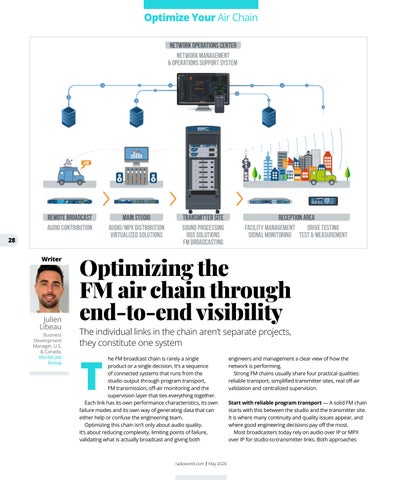
The FM broadcast chain is rarely a single product or a single decision. It’s a sequence of connected systems that runs from the studio output through program transport, FM transmission, off-air monitoring and the supervision layer that ties everything together. Each link has its own performance characteristics, its own failure modes and its own way of generating data that can either help or confuse the engineering team.
Optimizing this chain isn’t only about audio quality. It’s about reducing complexity, limiting points of failure, validating what is actually broadcast and giving both
engineers and management a clear view of how the network is performing.
Strong FM chains usually share four practical qualities: reliable transport, simplified transmitter sites, real off-air validation and centralized supervision.
Start with reliable program transport — A solid FM chain starts with this between the studio and the transmitter site. It is where many continuity and quality issues appear, and where good engineering decisions pay off the most.
Most broadcasters today rely on audio over IP or MPX over IP for studio-to-transmitter links. Both approaches
Optimize Your Air Chain
can deliver excellent results when paired with proper redundancy, controlled latency and a stable IP path. The choice often comes down to where the broadcaster wants to handle sound processing and stereo coding.
MPX over IP is increasingly popular because it lets audio processing and multiplex generation happen at the studio, before transport. The transmitter site receives a fully formed composite signal and simply broadcasts it.
That reduces the number of units installed at each site, simplifies cabling and makes remote sites easier to maintain. This matters especially for operators running dozens or hundreds of transmitters across wide geographies.
Whichever transport method is used, the priorities stay the same: redundancy on critical links, predictable latency, error-recovery mechanisms suited to live audio and clear monitoring of the IP path itself. Transport that “usually works” isn’t good enough. Broadcasters need transport whose behavior is understood and measurable.
Reduce failure points with feature-packed FM transmitters — Once the signal reaches the transmitter site, the next optimization opportunity is reducing the number of independent devices in the rack.
Modern FM transmitters can integrate functions that used to require separate units, including RDS encoding, sound processing, IP audio decoding, audio backup playback and full remote-control capabilities.
The benefit goes beyond convenience. Every external device adds cables, power supplies, network connections and configuration interfaces. Each is a potential point of failure. A transmitter that handles processing, RDS and IP decoding internally removes several of those interfaces from the equation. Maintenance gets simpler, troubleshooting is faster because there are fewer suspects and spare-parts logistics for remote sites become more manageable.
This doesn’t mean every site has to use a single integrated unit. Some networks genuinely need dedicated standalone processors or specialized RDS encoders. But where integration makes sense, it usually translates into more robust operation and lower long-term operating costs.
Validate the real signal with off-air monitoring — Even a well-designed transmission chain can produce surprises. A transmitter may report nominal status while the actual broadcast suffers from low modulation, lost RDS, distorted audio or, in the worst case, silence on air. Internal device telemetry is necessary, but not sufficient on its own.
Off-air monitoring closes this loop by measuring what listeners actually receive. A dedicated FM monitoring receiver (and an HD receiver where applicable) at or
near the site verifies RF level, modulation, MPX power, pilot, RDS and metadata content, audio presence and program continuity. For networks subject to regulatory requirements, off-air monitoring also provides documented evidence of compliance.
The real value of off-air monitoring is that it shifts the team’s confidence from “the equipment says it’s fine” to “the signal on the air is fine.” Those aren’t the same thing, and the gap between them is where most undetected service issues live.
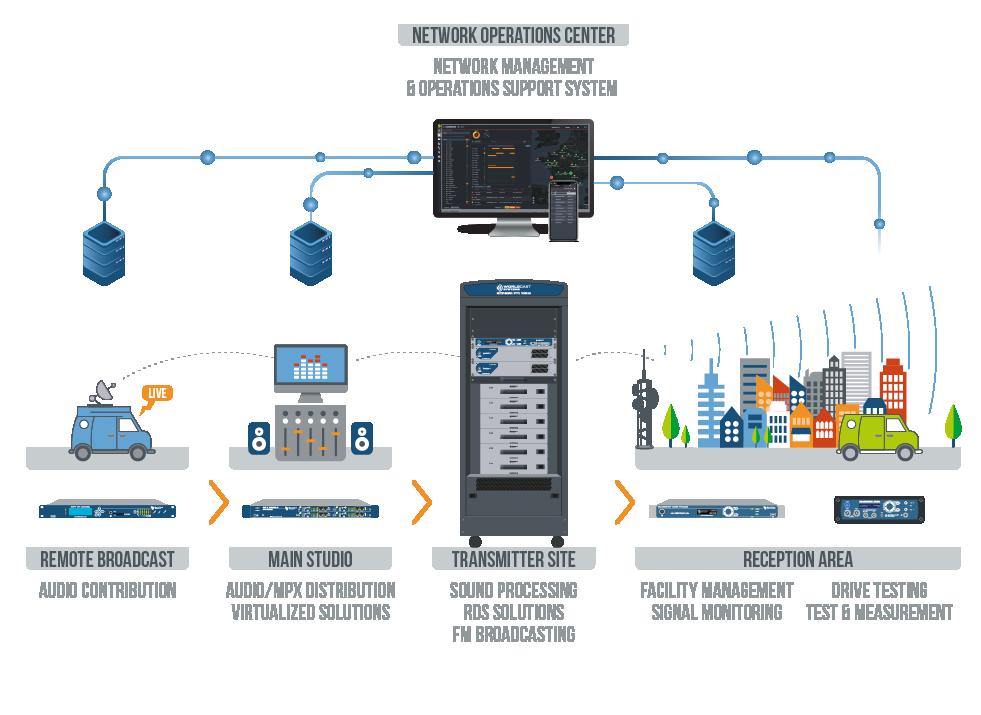
Bring it together with centralized NMS supervision — Each of these elements, taken individually, produces useful data: transport links, transmitters, off-air monitors. Together, they produce more data than any team can track manually, especially across multiple sites.
A network management system (NMS) brings the full FM chain into a single supervision layer. Alarms from codecs, transmitters, monitors and supporting infrastructure are correlated in one place. Dashboards show the real-time state of the network, and historical data supports trend analysis, capacity planning and post-incident reviews.
The benefit works on two levels. For engineers, an NMS shortens the path from alarm to root cause. Instead of logging into several devices, they see the full context immediately. For technical management, it provides clear reporting on uptime, recurring issues, regional performance and overall service quality. That kind of visibility supports better operational decisions and clearer conversations with stakeholders.
Reliable, simple, measurable, visible — The best FM broadcast chains aren’t necessarily the most complex or the most expensive. They tend to share a small set of practical qualities.
They’re reliable, because transport and transmission are designed with redundancy and predictable performance. They’re simple, because integration has reduced the number of external devices and interfaces. They’re measurable, because off-air monitoring confirms what is actually on air. And they’re visible, because a centralized NMS turns thousands of data points into clear, actionable information.
Optimizing the FM air chain comes down to thinking end-to-end. The studio, the transport, the transmitter site, the off-air receiver and the supervision platform aren’t separate projects. They’re one system. Treating them that way is what lets broadcasters deliver consistent quality to listeners, while giving their teams and management confidence that the network is performing as expected.
Julien Libeau is based in Miami. He works with radio groups, distributors and technical teams to develop practical broadcast infrastructure projects across the North American market.
Writer Paul Shulins Co-owner, Over the Air
Optimize Your Air Chain
When it comes to air chains, less is more
Today’s broadcast equipment can do so much more than in the past
Anytime you put another piece of gear in your air chain, you potentially add noise, latency and another point of failure. Not to mention complicating the signal flow.
Today’s processors can do so much compared to those from five or 10 years ago — big improvements in reliability, technical performance, the inclusion of PPM encoding, RDS generation and diversity delay, to name a few features now standard in many models. This simplification reduces wiring and complexity.
Another important item is bitrate reduction. Today there is little reason to run anything but linear audio through your main STL. Improvements in bandwidth, digital program playout storage and higher-quality STLs allow no excuses for needing to compress the audio.
PPM watermarking has always been a pain point for broadcasters. Knowing that program content can and does affect the readability of the watermarks has always concerned me. Radio stations should be judged by the quality (technical and programming) of their station, and the ratings should be as transparent as possible. Programmers should not have to program to maximize the readability of the watermarks. Having said that, improvements have been made over the last few years and
need to be studied to see if this mitigates the dependence on dense audio to maximize decode-ability, especially on portable PPM devices. There’s also still a question as to whether bitrate-reduced audio is able to carry the watermarks as well as linear audio.
Streaming is more popular than ever, and engineers need to pay attention to the quality and reliability of their streams.
Metadata to accompany the stream is critical of course. But what is even more important is level control and thoughtful audio processing for the stream.
Recently there has been much discussion on audio processing for streams and the importance of recognizing the difference in strategy for processing audio over the internet as opposed to over the air. There’s much more opportunity to “show off” dynamic range and less compression on a stream. Also, it’s important to monitor the stream to be sure it is up. And if it is a PPMrated station, make sure the PPM watermarks are being streamed and decoded!
I have always been a fan of redundancy and automated switching for STL sources that may go silent for whatever reason. It’s important to match levels on these different STLs as well as latency to be sure a swap from one source to another is as smooth as possible.
It’s also critically important to report this swap, so the engineer knows that it has taken place and that the primary source may need attention.
The location of the audio processor matters. In my opinion it should always be at the closest point to the exciter, and that generally means at the transmitter site as opposed to the studio. This implies that switching audio sources would also take place at the transmitter site.
Having the processor at the transmitter allows the engineer to optimize the settings — pilot level, audio sound, modulation levels — most accurately, since a modulation monitor right at the transmitter (usually off an RF sample) is ideal and gives the engineer the most stable and accurate picture of what the signal sounds like and what the exact technical parameters are.
This is absolutely essential for making sure your station is loud, clean and in compliance with the FCC’s rules that define the technical parameters required.
The author received the National Association of Broadcasters Engineering Achievement Award for radio in 2025. He has decades of experience in technical and leadership roles for broadcast companies and suppliers.
Below
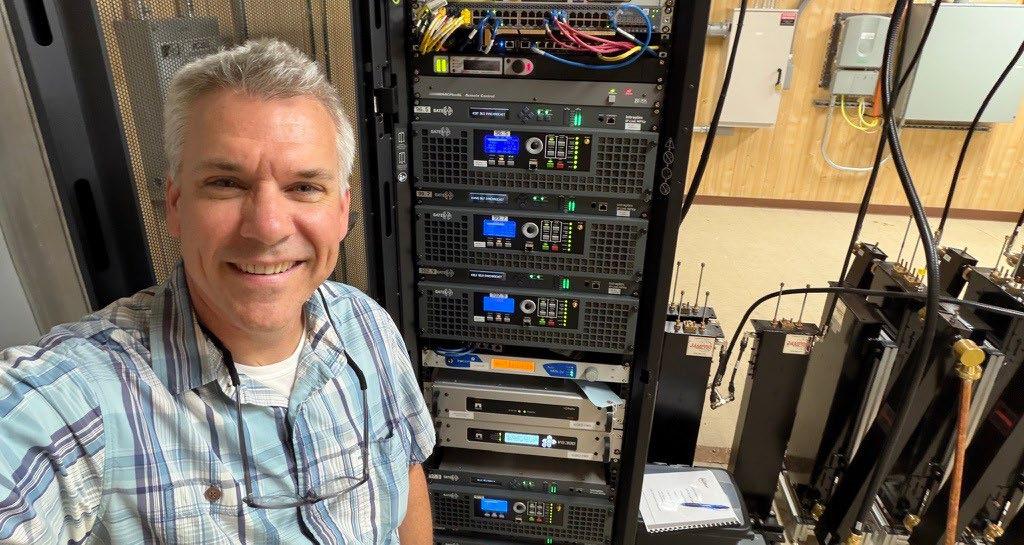
Paul Shulins at a transmitter site.
Writer
Jim
Kuzman Director of Content, Telos Alliance
Optimization starts with common sense
The “secret sauce,” if there is one, consists of these basic ingredients
There is a widespread sentiment within the broadcast community that radio, as an industry and as a medium, is becoming increasingly irrelevant to today’s audience.
“Radio” in the traditional sense — an RF signal emanating from a transmitter and received by a tuner — has more competition than ever, and there is no denying that listening habits have shifted markedly in recent years.
But radio isn’t dying: It is changing and evolving, much like it has for the past 100 years.
AM gave way to FM, which is now being challenged by streaming audio. Rack-mounted solid-state transmitters now deliver the same power as much larger tube rigs of the past, and with much greater efficiency and reliability.
Optimizing your air chain to meet the needs of what radio is today reveals a mix of practices that are as relevant now as they were many years ago, and some that are uniquely reflective of the current media landscape.
One example of something that has not changed is the importance of high-quality source audio.
It mattered in the days of vinyl and tape, and it matters just as much now — arguably more so — in the era of digital audio files.
Music libraries consisting of low-bitrate MP2s and MP3s to save once-precious hard drive space still exist, but have no place in a radio station today. This content’s audio quality is already compromised before being pre-emphasized and clipped in the analog FM signal, or
Comp image using: Mariia
subjected to multiple rounds of lossy transcoding in HD, DAB and streaming paths.
Speaking of source audio, the importance of normalizing levels when importing songs and commercials cannot be overstated.
This can easily be accomplished using automated workflows supported by playout systems, either by making a static gain change or changing metadata values.
Normalization not only ensures consistent loudness across the entire library, but it makes things easier on operators and talent running the board. It also means that downstream processing can be relaxed as levels are already well-controlled at the input.
That’s a win for the audience, who get better-sounding audio and are more likely to stick around for the next song.
Something that has changed significantly in recent years
“Music libraries consisting of lowbitrate MP2s and MP3s to save once-precious hard drive space still exist, but have no place in a radio station today.
is the in-car listening experience.
Radios no longer look like radios; they’re integrated into touch-sensitive vehicle-wide infotainment systems. With technologies like DTS AutoStage, manufacturers are able to deliver a more consistent experience across platforms.
That’s a boon for the driver and passengers, but it also means expectations are higher for traditional radio. Streaming services such as Spotify and Apple Music deliver excellent-sounding audio, and listeners are expecting the same from their local stations.
There is also some behind-the-scenes magic going on that should be considered when making decisions about audio processing, loudness and modulation.
In an effort to avoid annoying listeners with source-tosource loudness shifts, many systems endeavor to match the loudness of a newly selected source to that of the one prior. This can negate attempts to build perceived loudness with aggressive processing; if the radio is going to attenuate loudness, there is little reason to compromise quality by crushing the audio.
World’s daily SmartBrief newsletter is free to industry professionals. To subscribe, go to radioworld.com and click on the Subscribe button. More Info Telos is an ebook sponsor. For information about its products visit www. telosalliance. com.
Consider this a gift, as it lets you set your processing to be consistent and punchy while retaining the impression of dynamics. Loudness-wise, aim to be in the middle of the field among your in-market competition.
On the RF side, traditional receivers have largely been replaced by software-defined receivers. While both perform a similar decoding function, they do so in ways that impact decisions about modulation and audio processing in unexpected ways. SDRs do not tolerate over-modulation well and will cause audible distortion on modulation in excess of 110%.
Finally, AM and FM listenership may be on the decline, but the streaming audience is growing, so it is imperative to treat your station’s streaming audio with the same level of care and attention as your terrestrial signal.
This is especially important when it comes to processing. Blowing the dust off a shelved wideband AGC isn’t going to cut it, and feeding the output of your FM processor to your streaming encoder is a big no-no.
At the very least, you can use the HD output of your on-air processor for your stream, but ideally, it would have its own purpose-built processor optimized for coded audio and low bit rates. Many Omnia processors include independent streaming processing and encoding for each audio path, or were designed from the ground up specifically for streaming.
There is no magic bullet for optimizing your air chain. The “secret sauce,” if there is one, is made up of an unwavering commitment to quality, the application of some commonsense audio basics, an understanding of how emerging technology affects your approach to audio and recognizing that radio faces some stiff competition from other players on the digital dashboard.
PPM works, but spoken-word formats just need a bit more help
It is possible to make a big ratings impact for spoken-word audio without making it sound harsh
Rob Bertrand is CEO of Inrush Broadcast Services. He gave a talk at the Public Radio Engineering Conference about the Nielsen PPM and its impact on spokenword stations.
Rob how did this talk come about?
Rob Bertrand: I’ve spent 12 years or so focused on ratings watermarking as it pertains to spoken word. My work began with the primitive tools we had available not long after Arbitron released their new methodology in 2008 and continued to evolve as I noted patterns in failure alarms, audio distortion and ratings spikes and dips in the early days.
It so fascinating to me that the audio chain had such a direct impact on our ratings. I loved partnering with folks around the industry to help improve this situation for my favorite radio format: all-news.
What did you do to perfect encodability at WAMU?
Bertrand: Essentially, I took all I learned about ratings watermarking for all-news and sports at CBS and I brought it to WAMU. It made a big difference in ratings performance — for a number of years, consistently besting the ratings powerhouse of WTOP.
For sure, this included adding supplemental audio processing like the 25-Seven Voltair, but it involved efforts that extended well beyond adding a single piece of hardware.
I spent a great deal of time testing and modifying air chain designs and processing approaches for our spoken-word formats in New York. When I arrived at WAMU in 2016, that was still fresh in my mind.
When I asked my new boss at WAMU, “Hey does public radio care about ratings?” he enthusiastically said “Yes!” I spent time analyzing our performance using a box that I may have been the only one to buy: the “Voltair M,” a monitor-only version of the Voltair that was a precursor to the TVC-15 analyzer.
It confirmed my suspicion that public radio content, with its wide-open dynamics and frequent periods of silence, watermarks very poorly.
Gaining that visibility into encoding performance via the Voltair-M and the TVC-15 was a game-changer in thinking about spoken-word watermarking performance.
Rob Bertrand
Optimize Your Air Chain
We spent several years working through multiple iterations of improvement. Ultimately the “productized” technology caught up, and we wound up with the “gold standard” of using the insert point on an Omnia.11 processor, Voltair and TVC-15 to tame the Voltair and help the audio during passages where it needed help the most.
I am proud of the fact that we received so many unsolicited compliments on the audio quality of WAMU. A lot of folks have spent too much time focused on audible distortion induced by misusing the Voltair without taking the time to understand how it can be used responsibly. It really is possible to make a big ratings impact for spokenword audio without making it sound harsh.
A big takeaway here is that the PPM system works. Spokenword just needs a bit more help to ensure consistency. Attention to this issue really matters for this format, especially.
You’re now a partner and CEO at Inrush. How does this work carry over?
Bertrand: I’m able to take all that I’ve learned over the course of my career and share it with so many people, regardless of whether they are commercial or public, large or small.
I’ve been working at this so long. I built a “watermarking analysis lab” in my basement when I began to forge my path as a consultant.
The biggest operators have internal resources and substantial leverage with Nielsen to ensure their ratings encoding operates at peak performance. For small operators and public operators, there isn’t anyone teaching about these issues. I’m able to play an educational role and deliver hands-on technical expertise.
how one’s level of education generally correlates with a likelihood to listen to public radio.
When I looked across the industry and saw other public stations suffering far greater losses after COVID — or consistently ranking outside the top 10 — I became curious. We know that radio audiences are shifting on the whole. But public radio listeners really, really love public radio. I found it hard to believe that all these die-hard fans had just started to fall away. It didn’t make sense.
At WAMU we had optimized our stream for PPM encoding in the same way we did for FM. So I knew that as people shifted to from listening to FM to the stream, they were still likely to be measured as strongly via PPM as they were for FM. This was despite the reality that listening to a stream at home would generally be at a lower audio level — i.e., harder for a PPM meter to “hear” than in the car.
So I wanted to know how stations that optimize watermarking on the stream vs. those who don’t were performing. There was a problem, though, in that I couldn’t find another station to compare to. So I had a data set of only one station until very recently; and that’s hardly enough to prove a theory.
“Public radio listeners really, really love public radio. I found it hard to believe that all these die-hard fans had just started to fall away. ”
I work with exceptional people at Inrush who are smart about so many things. I’ve been glad to contribute this piece of unique technical expertise to our already strong repertoire.
What does your experience say about how people are consuming public radio?
Bertrand: I started down this renewed PPM analysis path during COVID because I noticed an interesting trend. After the initial shock of the shutdown and everything, WAMU saw gradual audience loss over time. Other public stations were seeing far steeper audience losses than we were. For sure, the nature of the Washington, D.C., market is unique; but I suspected there was something more going on.
For a long time after finishing those encoding experiments and subsequent improvements, WAMU was No. 1 in Washington. This ranking was achievable because of the highly educated residents of the D.C. metro area and
What else should we know?
Bertrand: I’m proud to say that we’ve helped another station achieve results similar to WAMU. They gained nearly a 50% cume increase within the first weeks following our processing work. They were a centerpiece of my talk at PREC. We will need to follow them over the course of time to watch the interplay between FM listening, streaming shifts and ratings impact. I’m hoping to build a bigger cohort for this long-term study as well.
My hope is that as more leaders across public media become aware of these success stories, they’ll call us for help.
This effort is as much an educational process as anything — trying to get engineers to look beyond the bad rap that PPM enhancement developed 10 years ago and understand how critical it is to help ensure their audiences are fully counted. In public media, especially, this has never mattered more.
As much energy as we are putting into our digital evolution, we still need the fuel of our linear broadcast and streaming audiences to propel us forward. Ensuring that we can continue to tell a strong sponsorship and fundraising story is critical to being able to secure the funding we need to survive in this pivotal moment.
Writer
Jeff Keith CPBE, NCE Senior Product Development Engineer, Wheatstone
Optimize Your Air Chain
We are coming out of a “deep compression” This means we can deliver so many more program details in a way that’s energetic and vibrant
Broadcasters have spent the last few decades feeding their air chains highly compressed source material. But now, with affordable archiving available and the impact of streaming across several platforms, not to mention the adoption of lossless streaming by Spotify in late 2025, music mastering seems to have shifted back toward retaining program dynamics rather than buzzsawing them as before.
This means that radio can now deliver much better sound to its listeners, which is good because radio today competes with so many other listening options easily available to the public.
Spectral processing
The spectral approach to audio processing that we developed considers how the human ear hears and then interprets audio. It uses the laws of psychoacoustics to mask the action of peak control while also revealing subtle audio details usually buried by other processors. Audio researchers tell us that our auditory system can be modeled as a filter bank with 25 overlapping bandpass filters known as critical bands (i.e. bins). By modeling our limiter on a similar structure, we can not only surgically limit audio without affecting nearby frequencies, but also uncloak subtle audio details that wouldn’t otherwise be heard.
Klaus Vedfelt/Getty Images
Optimize Your Air Chain
This is because limiting a signal in one narrow band psychoacoustically preserves the subtle audio details residing adjacent to the band in limiting. Even though the audio signals in the bands adjacent to the one being limited have not undergone any modification, our brain decodes it very differently and allows us to hear subtle details in the program material.
We call this our critical band theory of spectral audio processing, and Wheatstone’s new Neuron FM/HD/DAB+ processor was designed around this theory. Neuron is a spectral audio processor that models its 31-band limiter algorithms on the human auditory system and uses the ISO standard 1/3 octave frequencies.
Critical-band theory
What is important to remember about critical bands is that our ears can’t tell that there are other signals inside a bin when one is slightly louder than the other (see Fig. 1).
When there are audio signals present in different bins, each signal is heard independently as long as the signals are loud enough and far enough apart in frequency to stay above and away from an adjacent bin’s asymmetrical masking threshold (Fig. 2).
If an audio signal is soft enough in level or close enough in frequency to sneak under the masking threshold of an adjacent band, that signal is inaudible. Even so-called Golden Ears can’t hear it (Fig. 3).
When audio is divided up into numerous frequency bins, the energy within each bin falls according to how many bins the audio has been divided into — the more bins there are, the less audio there is in each bin. Probably not intuitive in Fig. 1 is that when there are 25 bins or more, the “sound of processing” within an individual bin disappears because of the “in-band, multi-stimulus” masking rule.
More limiter bands? Better?
Limiters with only a few bands are often seen in operation with more than 6 dB of limiting depth. On the contrary, because a spectral processor has such a small amount of audio energy in each band, it typically needs no more than a dB or two of limiting.
Such shallow limiting combined with the high number of bands meshes so well with how human hearing works that it makes the spectral processor’s operation remarkably invisible to the ear. Gone are the dense, smashed-sounding audio and other annoying characteristics of multiband limiting.
A better listening experience
Our patented spectral processor manages the energy of electrical signals without our ears noticing that limiting has even occurred. But just as important, the spectral processor also uncloaks fragile audio details, the same ones often turned into mush by less-capable limiter techniques.
In a conventional multiband limiter, the broadness of each limiter band (Fig. 4) allows the act of limiting to affect a large portion of the audio spectrum; nearby frequencies that don’t even need limiting get pulled down too and many users end up driving the limiters harder and harder trying to get those lost details back.
Conversely, as Fig. 5 shows, each band of the spectral processor is quite narrow — note how little audio spectrum is affected by one limiter band. Even more important is how the high selectivity of the spectral processor allows adjacent audio details to be completely untouched — it is all still there.
This is completely different behavior from the way multiband broadcast limiters with only a few bands work. It sounds a lot different, too!
The science is in the details
When a band of the spectral processor reduces its gain to limit a particular frequency, two things happen.
One is that the level of the signal being limited is restricted to the band’s limit threshold, just as it would be in any limiter.
But what also happens is that the act of limiting a signal in one narrow band psychoacoustically raises the perceived loudness of subtle audio details residing near to, but not inside of, the band in limiting.
Even though the audio signals in the bands adjacent to the one in limiting have not undergone any modification, our brain decodes it very differently and allows us to hear subtle details in the program material not often heard from other broadcast audio processors.
The mechanism for this is quite simple: The frequency in the band undergoing limiting and the audio frequencies in nearby limiter bands not being limited have undergone a change in their relative gains. Our brain doesn’t notice the effect of limiting because, psychoacoustically, it is constrained to such a narrow band.
Optimize Your Air Chain
But there’s a perceived increase in the level of the nearby signals in the nonlimited bands even though their electrical amplitudes have not changed.
This is entirely opposite behavior from what limiters with only a few bands do when they carve up huge chunks of the audio spectrum just to limit a single isolated signal.
The goals of audio processing haven’t changed, after all. We still need peak protection and audio levels normalized. But what has changed is that we can now deliver so many more program details to listeners and in a way that’s energetic, vibrant and easy to listen to all day long.
Writer Rojith Thomas Technology Coordinator, KUT Public Media
The ROI of reliability
Why engineering is a business function
Engineering is often seen as a support function in radio. Something necessary to keep things running, but not directly contributing to revenue or growth.
That view does not reflect reality. Radio engineers are either making money or saving money for the station. If that is not happening, the role has been reduced to basic maintenance. Real engineering is about protecting the business.
From maintenance to business protection
Most people notice engineering only when something breaks. Dead air gets attention. Silence gets attention.
But the real work happens long before that. A stable station does not happen by luck. It comes from planning, testing and constant attention to detail.
When a transmitter runs for months without an issue, that is not accidental. When automation plays day after day without crashing, that is not luck. When an AoIP system works, that is the result of good engineering. And when everything is working well, nobody notices. That is exactly how it should be.
The invisible complexity of modern broadcast Broadcasting has changed significantly. It is no longer just RF. A modern station depends on a combination of RF systems, IP networks, AoIP infrastructure, virtualized automation, metadata platforms and hybrid radio systems. Everything is connected, and everything depends on something else. That brings flexibility, but it also introduces new risks.
Not all failures are obvious anymore. A transmitter failure is immediate and visible. A network issue is not. A switch problem, a timing issue or a small misconfiguration can cause intermittent audio drops or unusual behavior that takes time to show up. Sometimes the only indication is a listener complaint. By the time it becomes visible, the issue has often been there for a while.
Once everything moved into IP, another responsibility became part of the job: security. We are no longer working with isolated systems sitting inside a rack. Most broadcast infrastructure today operates on networks that can be exposed if not designed correctly. Transmitters, AoIP systems, automation servers and remote-controlled equipment are all part of this environment.
The security blind spot: A lesson in exposure
A situation that comes up often is how AoIP networks are deployed.
To make devices function properly, ports are open for audio transport, control and discovery. In some cases, these systems end up on networks that have public exposure. This creates risk.
Open ports on the internet are constantly scanned. This is not targeted in most cases. It is automated and continuous. If something is open, it will eventually be found. Once it is found, it becomes a potential entry point. An attacker does not need full access immediately. They only need a way in, and from there, they can explore deeper into the network.
We had a real experience that made this very clear. At one point, we tried to check our exposure using tools like Shodan. We searched using our station name and the identifiers we were familiar with. Nothing appeared, and we felt reasonably confident that nothing was exposed.
Later, we received a message from a well-wisher pointing out that one of our transmitter site PCs was visible on the public internet. In addition, some of our remote-control devices were also exposed and could be accessed much more easily than they should have been.
We had completely missed it.
The issue was not the tool. The issue was how we used it. We were searching based on what we already knew. Someone with more experience approaches this differently, using IP ranges, services and other methods to discover what is actually visible.
Just because we could not see it did not mean it was not there.
That realization changed how we approached our network. We went back and reviewed the entire transmitter site. We removed unnecessary exposure, tightened access controls and improved network isolation.
The focus shifted from assuming things were safe to actively verifying that they were. That experience made one thing clear: Security is not a separate function anymore. It is part of engineering.
If a system is exposed, it is an engineering problem. And in broadcasting, a security issue can quickly become an on-air issue.
Even short failures carry real cost. A few minutes off the air can interrupt revenue, affect listenership and introduce compliance concerns.
But the bigger problem is repetition. Small disruptions that happen again and again slowly reduce trust. Listeners do not analyze technical problems. They simply move on when reliability becomes inconsistent.
Reliability is what keeps an audience, and reliability is what engineering protects.
Fixing problems after they occur is the easy part. Anyone can replace a failed component or restart a system. The real value comes from preventing that failure from happening again.
That requires understanding why the failure occurred and addressing the root cause. It may involve redesigning part of the system, improving monitoring or adding redundancy. It takes more effort, but it creates long-term stability.
Reliability is the foundation of listener trust Every system will fail at some point. The question is how it fails.
In a well-designed facility, failures do not turn into major disruptions. Audio switches cleanly. Backup systems engage automatically. The listener may not even notice anything happened. That outcome is not luck. It comes from designing systems with failure in mind and making sure they can handle it.
At its core, engineering is about continuity. It is about making sure the signal stays on, the content is delivered and the infrastructure supports everything the station is trying to do.
“
When a transmitter runs for months without an issue, that is not accidental. When automation plays day after day without crashing, that is not luck.
Today, that includes more than transmission. It includes streaming, hybrid radio platforms and how the station appears across connected devices. All of it depends on stable and reliable systems.
The audience does not see any of this. They experience the result. When everything works as expected, they trust it. And that trust is what drives listening.
A well-run station is not one where engineers are constantly fixing problems. It is one where systems run predictably and consistently without drawing attention. That does not happen by accident. It happens because someone is thinking ahead, making the right design decisions and preventing problems before they reach the air.
That is the real value of engineering. Not just fixing things.