Application of Multiplication and Division Concepts 1
Multiplication and Division with Units of 2, 3, 4, 5, and 10
Topic A
Conceptual Understanding of Multiplication
Topic B
Conceptual Understanding of Division
Topic C
Properties of Multiplication
Topic D
Two Interpretations of Division
Topic E
What’s Included
The Teach book empowers teachers with all the tools they need to help students access grade-level content and meet the learning needs of their students through language supports, varied assessments, and effective instructional design.
The Learn book is students’ companion text to the instruction in Teach. It contains all the pages students need for each lesson, including in-class work pages, glossaries, and opportunities for practice.
The Apply book provides integrative family supports and extensive at-home practice opportunities to help students deepen their understanding.
The digital platform provides seamless digital access to items in Teach, Learn, and Apply. It also includes lesson slides, digital interactives, assignments and assessments, implementation videos, and teaching supports.
Assessment
The Eureka Math2® assessment system helps teachers understand student learning by generating data from many perspectives. The assessments are designed to monitor student learning and thus provide teachers with feedback that they may use to inform ongoing instruction. The assessments may also be used summatively to produce a grade or report that becomes part of a student, school, or district record. Using the data from a combination of assessments generates a complete picture of student learning.
• Exit Tickets at the end of a lesson provide immediate insight into whether students have learned the main concepts and skills in the lesson.
• Observational Assessment Recording Sheets are checklists in each topic or module that teachers can use to record observations and evidence of student thinking by date or activity.
• Topic Quizzes/Topic Tickets consist of up to 6 items that assess proficiency on major concepts and skills covered in a topic.
• Module Assessments consist of 6–10 items that evaluate proficiency of the major concepts, skills, and applications from the module. Module assessments are available to download or assign digitally on the digital platform.
• Pre-Module Assessments in Eureka Math2 EquipTM help teachers identify where students need support by assessing students’ foundational knowledge that is essential to the content of upcoming lessons. Go to the digital platform to access Equip content.
• Performance Assessments provide students with multiple means of entry and opportunities to apply a variety of skills to solve complex, real-world problems. This work allows students to demonstrate a deep understanding of content and process standards. Go to the digital platform to access performance assessments.
Lesson Design
The Dynamic Middle
The Eureka Math2® lessons strategically blend conceptual understanding, procedural fluency, and real-world application.
• Conceptual Understanding: Daily lessons include concrete–pictorial–symbolic representations and simple-to-complex progressions to develop understanding, as well as opportunities to identify math relationships and patterns and engage in meaningful discourse to answer Why does this work?
• Procedural Reliability and Fluency: Distributed and interleaved practice through fluency and practice problems provides ample daily opportunities for students to grow through the three stage hierarchy of mathematical fluency.
• Application: Real-world problems and collaborative tasks consolidate student thinking through why and how questions, inviting students to draw conclusions and make deep connections among math ideas.
Coherence
Following a logical and systematic mathematical progression designed around the mathematical areas of emphasis, Eureka Math2 lessons foster deep and lasting connections.
• A consistent structure—Fluency, Launch, Learn, Land—connects concepts from topic to topic, module to module, and grade to grade.
• High-leverage models—such as number bonds, area models, tape diagrams, and number lines—build knowledge within and across grade levels.
Real-World Context
Fairness and Empowerment
Eureka Math2 advances fairness and empowers students and teachers.
• Lessons provide suggestions for proactive student support, including flexible grouping ideas that leverage students’ home languages and knowledge, academic terminology, and sentence frames to support discourse.
• Lessons engage students through a variety of facilitation styles (problem-based learning, direct instruction, guided discovery) to meet all students’ needs.
• Authentic problems and videos represent and engage students from different cultures, backgrounds, and abilities.
Multilingual Learner Support
Language supports embedded into instructional design
Mathematical content, practices, and language development are interconnected. The curriculum uses a variety of tools to support students’ language needs. Leverage the following supports to customize a plan for your multilingual learners.
Amplify rather than simplify language
Support for interpretive, and expressive language from the WIDA English Language Development Standards Framework, 2020
The following research-informed supports amplify rather than simplify language by drawing students’ attention to important aspects of language, such as language functions, structure, syntax, and morphology. These supports provide multilingual learners with access to sense-making that happens in mathematical discussions.
• Strategically pair multilingual learners to leverage every turn and talk and think–pair–share for multilingual learners to clarify in their home language, pause and take time to translate, and orally rehearse responses.
Each of the following actions supports language comprehension from written and spoken texts, or interpretive language.
• Provide varied and flexible opportunities to make meaning. Use different structures such as pairs, small groups, and whole-class discussion. Support language used to engage in dialogue.
• Support expressive language. Model using the Talking Tool during class discussions, including specific sentence frames and starters.
• Observe multilingual learners’ strengths during discussion. Use those strengths to build toward academic language in student responses.
These supports allow multilingual learners to meaningfully participate in mathematical discussions.
Multilingual Learner Support
Consider using strategic, flexible grouping throughout the module.
• Pair students who have different levels of mathematical proficiency.
• Pair students who have different levels of English language proficiency.
As applicable, complement any of those groupings by pairing students who speak the same home language.
Multilingual Learner Support
Consider supporting students in the Always Sometimes Never routine by displaying an equation labeled with words from the statement.
Research-based, multimodal terminology support
Lessons provide research-based embedded support for math-specific terms, multiplemeaning terms such as homophones and homographs, academic verbs, and everyday language. Support focuses on what students are expected to know and be able to do by the end of each lesson:
• Build or activate background knowledge to honor students’ assets and funds of knowledge
• Integrate all four domains of language: reading, writing, speaking, and listening
• Use multimodal methods, such as pairing terms with visuals, real items (realia), gestures, or acting out
Lessons invite students to engage with concepts through mathematical discussions and experiences, such as digital interactives, manipulatives, or math language routines, before they learn mathematically precise terminology for the concept. This opportunity allows all learners, and especially multilingual learners, to attach new terms to their own lived experience.
Lessons contain functional language needed to engage with the mathematics of the grade level. Each grade level explicitly teaches the meaning of a small list of targeted academic verbs, such as combine or approximate, as the verbs take on mathematical meaning.
Lessons use synonyms to preview and support meaning before students are expected to use the language.
Math language routines to amplify, assess, and develop language
Math language routines are structured but adaptable formats for amplifying, assessing, and developing students’ language. Lesson-embedded routines support sense-making, optimize output, cultivate conversations, and maximize meta-awareness. Math language routines can be used flexibly whenever there are opportunities to support students with interpretive, and expressive language.
Universal Design for Learning (UDL) & Differentiation
UDL: Engagement
Support motivation and enthusiasm
•Make real-world connections and relate concepts to students’ interests and experiences
•Form cooperative groups with roles to promote participation
•Offer choice of, and options within, tasks and activities
•Provide action-oriented feedback
•Recognize mistakes as opportunities
•Support self-regulation by modeling coping strategies for dealing with frustration
Eureka Math2 has been awarded CAST’s Universal Design for Learning (UDL) Product Certification, demonstrating Great Minds’ commitment to making math accessible for all learners. This certification recognizes that Universal Design for Learning (UDL) is core to the product’s design. UDL suggestions are organized according to the three principles of the framework: engagement, representation, and action & expression. Differentiation suggestions are provided for students who need more individualized support or are ready for a challenge. The chart below summarizes the suggestions provided at point of use in the materials, but teachers are encouraged to apply the suggestions at any time to best meet the needs of their class and individual students.
UDL: Representation
Support perception and comprehension
• Provide visuals, realia, and hands-on experiences
• Activate prior knowledge
• Use graphic organizers
• Emphasize patterns, key features, and big ideas through labeling, annotations, color-coding, etc.
• Chunk information into smaller elements
• Pause to provide think time and to emphasize the importance of information
UDL: Action & Expression
Support expression of learning and executive function enthusiasm
• Provide sentence starters and frames
• Offer manipulatives, calculators, or other tools
• Provide exemplars, worked examples, checklists, or templates
• Model by thinking aloud
• Prompt students to plan and strategize
• Provide questions that guide self-monitoring and reflection
Differentiation
Offer additional support and provide challenge
• Support: Targeted approaches to supporting students with specific challenges of the concepts, procedures, or calculations presented
• Challenge: Targeted suggestions for expanding or deepening understanding for students who demonstrate readiness for more
Support for Families
The resources in the Apply book give students more practice with the concepts learned in class. There are three components in Apply that support students in deepening their understanding of the concepts covered in the daily lesson: Family Math, Practice Partners, and Terminology.
can use rules to complete a pattern and write rules to describe a pattern.
Your student is learning to analyze and generate number patterns in various forms. They begin by working with two number patterns simultaneously and use the patterns to complete input–output tables. They also identify the relationship between corresponding inputs and outputs and use the relationship to write a rule for finding an output given an input.
To extend their understanding of number patterns, students learn to write expressions to represent the output when given an input. They explore how to use a variable to represent any input, and they practice by using the expressions to find outputs when given corresponding inputs. Throughout the topic, students write expressions with addition, subtraction, and multiplication that represent the output when given an input and use the expressions to solve real-world problems.
Multiply the input by
and subtraction relationships between corresponding inputs and outputs when the rules for the inputs and outputs are both to add
x Students find multiplication relationships between corresponding inputs and outputs when the addition rules for the inputs and outputs are different. When the rule for the inputs is to add 1 the number added to the outputs is the coefficient in the multiplication expression.
Multiply the input by 2 and then add 1 2x + 1 Students find mixed-operation relationships between corresponding inputs and outputs. They use the addition rules for the inputs and outputs to compare how many times as much is added to the outputs as is added to the inputs. Once students know the factor, they multiply the input by the result. Then they find how much to add or subtract to get the corresponding outputs.
Family Math is a letter to families that describes the major concepts in the current topic.
1. Use the table to complete parts (a) and (b).
a. The rule for the inputs is start at 1 and add 1. The rule for the outputs is start at 5 and add 1 Complete the table.
b. Write the rule for the corresponding inputs and outputs.
Add 4 to each input to get the corresponding output.
2. Use the table to complete parts (a) and (b).
use the rules to find the missing inputs and outputs by adding 1 to find the next terms. see the output is always greater than the input. I look at some sets of corresponding inputs and outputs. Some corresponding inputs and outputs in this table are 1 and 5, 4 and 8, and 7 and 11 must add 4 to any input to find the corresponding output.
a. The rule for the inputs is start at 15 and add 1. The rule for the outputs is start at 10 and add 1. Complete the table.
b. Write the rule for the corresponding inputs and outputs.
Subtract 5 from each input to get the corresponding output.
Practice Partners show the thinking required to approach the problem using steps that are like those named and described in the lesson.
Terminology
These terms are introduced in the
Axes are the pair of perpendicular number lines that create a coordinate system. Axes refers to both the x -axis and the y -axis together.
(Lesson 7) coordinate
A coordinate is a number used to identify the location of a point.
(Lesson 6) coordinate plane
A coordinate plane is a plane with a coordinate system used to describe locations of points in the
Terminology includes a list of terms and definitions introduced in the module.
Multiplication and Division with Units of 2, 3, 4, 5, and 10
Conceptual Understanding of Multiplication
Lesson 1
Organize, count, and represent a collection of objects.
Lesson 2
Interpret equal groups as multiplication.
Lesson 3
Relate multiplication to the array model.
Lesson 4
Interpret the meaning of factors as number of groups or number in each group.
Lesson 5
Represent and solve multiplication word problems by using drawings and equations. Topic A Quiz Sample Solutions
A Observational Assessment Recording Sheet
B
Conceptual Understanding of Division
Lesson 6
Explore measurement and partitive division by modeling concretely and drawing.
Model measurement and partitive division by drawing equal groups.
Model measurement and partitive division by drawing arrays.
Represent and solve division word problems using drawings and equations.
Lesson 10
Demonstrate the commutative property of multiplication using a unit of 2 and the array model.
11
Demonstrate the commutative property of multiplication using a unit of 4 and the array model.
Lesson 12 .
Demonstrate the distributive property using a unit of 4.
Lesson 13
Demonstrate the commutative property of multiplication using a unit of 3 and the array model.
Lesson 14
Demonstrate the distributive property using units of 2, 3, 4, 5, and 10.
Topic C Quiz Sample Solutions
Topic C Observational Assessment Recording Sheet
Topic D
Two Interpretations of Division
Lesson 15
Model division as an unknown factor problem.
Lesson 16
Model the quotient as the number of groups using units of
and 10
Lesson 17
Model the quotient as the size of each group using units of
and 10
Lesson 18
Represent and solve measurement and partitive division word problems.
Topic D Quiz Sample Solutions
E
Application of Multiplication and Division Concepts
Lesson 19
Use the distributive property to break apart multiplication problems into known facts.
Lesson 20
Break apart division problems into known facts.
Lesson 21
Compose and decompose arrays to create expressions with three factors.
Lesson 22
Determine and explain whether an equation involving multiplication or division is true or false.
Lesson 23
Represent and solve two-step word problems using the properties of multiplication.
Lesson 24
Represent and solve two-step word problems using drawings and equations.
Achievement Descriptors: Overview
Multiplication and Division with Units of 2 , 3 , 4 , 5 , and 10
Achievement Descriptors (ADs) are standards-aligned descriptions that detail what students should know and be able to do based on the instruction. ADs are written by using portions of various standards to form a clear, concise description of the work covered in each module.
Each module has its own set of ADs, and the number of ADs varies by module. Taken together, the sets of module-level ADs describe what students should accomplish by the end of the year.
ADs and their proficiency indicators support teachers with interpreting student work on
• informal classroom observations,
• data from other lesson-embedded formative assessment,
• Exit Tickets,
• Topic Quizzes, and
• Module Assessments.
This module contains the ten ADs listed.
FL.3.Mod1.AD1: Represent a multiplication situation with a model and convert between several representations of multiplication with products from 0 to 144. MA.3.NSO.2.2
FL.3.Mod1.AD2: Represent a division situation with a model and convert between several representations of division with dividends from 0 to 144. MA.3.NSO.2.2
FL.3.Mod1.AD3: Multiply within 144 with a factor of 2–5 or 10 and divide by using related facts with procedural reliability. MA.3.NSO.2.4
FL.3.Mod1.AD4: Apply the distributive property to multiply a factor of 2–5 or 10 by another factor. Only one factor needs to be 2–5 or 10. Other factors are assessed in module 3.
MA.3.AR.1.1
FL.3.Mod1.AD5: Apply the commutative property of multiplication to multiply a factor of 2–5 or 10 by another factor.
MA.3.AR.1.1
FL.3.Mod1.AD6: Solve one-step real-world problems by using multiplication and division involving factors 2–5 and 10.
FL.3.Mod1.AD8: Represent and explain division as an unknown factor problem.
MA.3.AR.2.1
FL.3.Mod1.AD9: Determine and explain whether an equation involving multiplication or division is true or false.
MA.3.AR.2.2
FL.3.Mod1.AD10: Determine the unknown whole number in a multiplication or division equation involving factors and divisors
2–5 and 10.
MA.3.AR.2.3
Before This Module
Grade 1 and Grade 2
In grade 1 and grade 2, students determine and explain whether equations involving addition or subtraction are true or false.
Grade 2
In grade 2, students complete foundational work for multiplication and division. They form equal groups, write repeated addition sentences, arrange objects in rows and columns to form arrays up to 5 by 5, and discover how adding the number of objects in the rows or columns relates to repeated addition. At first, arrays are made with gaps between rows and columns and, later, are made with no gaps. Students build and manipulate arrays and use part–total language to express the composition and decomposition.
Grade 3 module 1 elevates the work of grade 2 through formal introduction of multiplication and division.
Overview
Multiplication and Division with Units of 2 , 3 , 4 , 5 , and 10
Topic A
Conceptual Understanding of Multiplication
Students connect their understanding of equal groups and repeated addition to multiplication. They identify the number of groups, the number in each group, and the total within equal-groups models and arrays. They write multiplication equations to represent the equal groups and arrays. Students interpret the meaning of the factors as the number of groups and the number in each group and solve word problems.
Topic B
Conceptual Understanding of Division
Students use equal-groups models and arrays to explore the two interpretations of division: measurement and partitive. They determine the total and either the number of groups or the number in each group based on the problem situation. They identify what is known and what is unknown, relate it to an unknown factor problem, and write a division equation. Students solve word problems involving division and make connections between multiplication and division.
315 = x 15 = 3
total number in each group number of groups
515 = x 15 = 5 ÷
total number of groups number in each group
Topic C
Properties of Multiplication
515 = x 15 = 5 ÷
total number of rows number in each row 315 = x 15 = 3 ÷
total number in each row number of rows
Students use the properties of multiplication to explore strategies they can use to multiply efficiently. They explore the commutative property of multiplication by skip-counting the rows and columns in arrays, which helps them build number sense while learning multiplication facts. Students use arrays and number bonds to model the distributive property when finding the products of unfamiliar facts.
Topic D
Two Interpretations of Division
Students solidify their understanding of the relationship between multiplication and division and express division as both unknown factor problems and division equations. Students describe the quotient as either the number of groups or the size of each group and draw tape diagrams to represent the problems.
After This Module
Grade 3 Module 3
In grade 3 module 3, students apply conceptual understanding and use the commutative, distributive, and associative properties to extend their learning of multiplication and division to units of 6, 7, 8, 9, 0, 1, 11, and 12, two-digit multiples of 10, and three-digit multiples of 100. Students identify multiplication and division equations with factors of 6, 7, 8, 9, 0, 1, 11, and 12, and solve one- and two-step word problems involving the four operations.
Topic E
Application of Multiplication and Division Concepts
Students apply the distributive property to complete multiplication and division problems and explore the foundations of the associative property of multiplication by breaking apart arrays into smaller arrays. Students solve two-step word problems using multiplication and division. Students also determine and explain whether an equation involving multiplication or division is true or false.
Why
Multiplication and Division with Units of 2 , 3 , 4 , 5 , and 10
Why are multiplication and division concepts taught in module 1 and module 3?
Understanding and applying multiplication and division concepts are part of the major work of grade 3. Beginning the year with multiplication and division concepts with units of 2, 3, 4, 5, and 10 maximizes time for students to develop conceptual understanding and build fluency. In module 2, students continue daily practice with multiplication and division through fluency activities. Students return to multiplication and division in module 3. They build upon the strong foundation established in module 1, now extending to more complex strategies with units of 6, 7, 8, 9, 0, 1, 11, and 12.
Multiplication concepts are the basis of much of the other work in grade 3 (e.g., area of plane figures, building fractions from unit fractions, and scaled bar and pictographs). Beginning the year with multiplication allows for rich connections and enables multiplication to be the lens through which other concepts are explored.
How does the learning progress from module 1 to module 3?
Students’ familiarity with skip-counting by twos, fives, and tens from earlier grade levels provides a natural starting point to establish the concepts of multiplication and division in module 1.
Early representations for multiplication and division in module 1 include equal groups and arrays, which are used to skip-count. Students learn the meaning of multiplication and division with familiar units of 5 and 10 and the smaller units of 2, 3, and 4, which allows for a smoother transition to more abstract representations, such as tape diagrams, before working with larger units.
Seeing the relationship between 10 and 5—that is, 10 as 5 doubled—provides a foundation for students’ understanding of 4 as 2 doubled. In module 3, that understanding extends to 6 as 3 doubled, 8 as 4 doubled, and 12 as 6 doubled. The units of 6, 7, 8, 9, 11, and 12 are introduced in module 3 after students have developed some proficiency with smaller units and strategies based on the commutative and distributive properties. These strategies allow students to multiply and divide with larger units by creating easier problems using smaller and familiar units.
After students have developed some proficiency with the other single-digit factors, they can explore and understand the factors of 0 and 1 through patterns. Students learn why multiplication and division with 0 and 1 are unique and develop the meaning behind them to support understanding of the identity property in later grades.
Why do lessons focus on certain representations and tools for multiplication and division? Is it acceptable for students to use other representations and tools when they are not included in a lesson?
Most lessons include multiple representations and tools to facilitate access for all students. Allow students to demonstrate their understanding using representations and tools that make sense to them, even if those representations or tools are not a focus in the lesson.
Mathematical Language Routines
Multiplication and Division with Units of 2, 3, 4, 5, and 10
Routine Description
Critique a Flawed Response
Math Chat
Share, Compare, and Connect
This language routine promotes effective communication techniques for critiquing others’ work, correcting errors, and clarifying meaning.
This language routine develops number sense, flexibility, efficiency, and accuracy as students solve a math task and discuss their different solution strategies.
This language routine fosters students’ meta-awareness as they identify, compare, and contrast different mathematical strategies, representations, concepts, and examples.
Lessons
Topic D Lesson 16
Topic A Lesson 3
Topic E Lesson 19
Topic E Lesson 22
Topic A Lesson 1
Topic A Lesson 5
Topic B Lesson 9
Topic E Lesson 23
Topic E Lesson 24
Take a Stand
Which One Doesn’t Belong?
Think–Pair–Share
This language routine supports students in making and justifying arguments as well as critiquing the reasoning of others.
This language routine promotes metacognition, reasoning, and mathematical discourse as students use precise language to compare different representations.
This language routine supports mathematical discourse and maximizes linguistic output as students mentally rehearse their ideas and discuss with a partner before sharing with the class.
Topic B Lesson 9
Topic C Lesson 10
Most lessons in this module contain the Think–Pair–Share routine.
Topic A Conceptual Understanding of Multiplication
Topic A lessons provide students with time and space to build conceptual understanding of multiplication, through concrete and pictorial exploration, with equal groups and arrays. Students expand their foundational understandings of multiplication from grade 2. The relationship among the number of groups, the number in each group, and the total is established, and students repeatedly practice identifying the number of groups and the number in each group. Building conceptual understanding in this topic helps establish tools and strategies that students can use to make sense of multiplication facts and to recognize situations where they can multiply to solve problems.
The topic opens with students counting a collection of objects. This serves as an informal formative assessment of the foundational understanding of multiplication from grade 2 and provides teachers with insight as to how students organize, count, and represent the collections. In addition to its mathematical content goals, the lesson’s format sets the stage for students to work with and learn from each other throughout the year.
Unit form and skip-counting provide bridges from repeated addition to multiplicative thinking. Equal-groups representations progress from concrete objects to drawings, to arrays, and finally to tape diagrams. Regardless of representation, the number of groups and number in each group are consistently related to unit form and multiplication expressions and equations. Precise use of language and symbols are emphasized throughout the topic to maintain consistency between similar and interchangeable terminology (e.g., the convention of multiplication as the number of groups times the number in each group and the use of terms such as factor, product, multiply, multiplication, and times).
In topic B, students build conceptual understanding of division by using what they know about multiplication and the relationship of the number of groups, the size of the groups, and the total.
Progression of Lessons
Lesson 1
Organize, count, and represent a collection of objects.
Lesson 2
Interpret equal groups as multiplication.
3 + 3 + 3 + 3 = 12 4 threes = 12 4 x 3 = 12
Multiplication is another way to represent repeated addition. I use unit form and write multiplication equations to represent equal groups. The symbol × is used to show multiplication and to write multiplication expressions and equations.
Lesson 3
Relate multiplication to the array model.
I organize equal groups in an array or tape diagram. Then I can see the number of groups and the number in each group and I can write a multiplication equation.
If I organize my collection into equal groups, I can skip-count and then add the extras to find the total.
Lesson 4
Interpret the meaning of factors as number of groups or number in each group.
The numbers I multiply in a multiplication problem are called factors. They describe the number of groups and the number in each group. In the tape diagram, I see 7 groups with 5 in each group. The tape diagram represents 7 × 5 = 35
Lesson 5
Represent and solve multiplication word problems by using drawings and equations.
Using Read–Draw–Write helps me make sense of problems. When I see the drawings and strategies my classmates used to solve the problem, I learn more strategies to use next time.
Organize, count, and represent a collection of objects.
I can count a collection and explain the ways I organize and count.
Lesson at a Glance
This student-driven lesson provides an opportunity to gather formative assessment data as students work with counting collections. Students decide how to organize, count, and represent the items. They analyze the work of others and discuss efficient strategies as a class.
There is no Problem Set for this lesson. Instead, use classroom observations and student work to analyze student thinking after the lesson. The Exit Ticket for this lesson serves as an opportunity for students to reflect on their counting strategies.
Language Objectives
• Write or draw to record how to organize and count a collection of objects. Include an estimate of the number of objects, the actual number of objects in the collection, and an equation to describe how to find the total.
Key Question
• How can we use groups to help us organize?
Mathematical Thinking and Reasoning Standard
MTR.5.1
• Listen to and orally describe counting strategies—including counting by ones, skipcounting, and recognizing a total—to accurately count. Orally compare and connect strategies.
• In writing, explain the choice of units used to count the collection and the way that counting by units helps to find the total.
Agenda
Fluency 5 min
Launch 10 min
Learn 35 min
• Organize, Count, and Record
• Share, Compare, and Connect
Land 10 min
Materials
Teacher
• 100-bead rekenrek
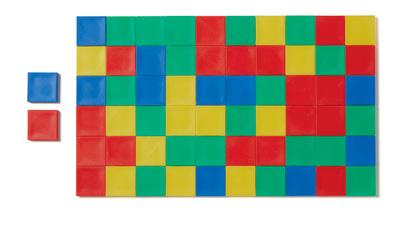
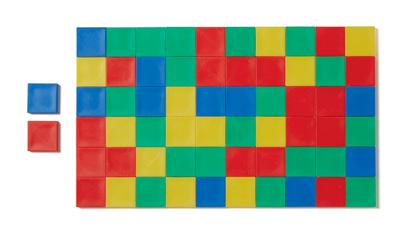
• Color tiles, plastic, 1 inch (60–150)
• Interlocking cubes, 1 cm (100)
• Computer or device*
• Projection device*
• Teach book*
Students
• Color tiles, plastic, 1 inch (60–150 per student pair)
• Interlocking cubes, 1 cm (60–150 per student pair)
• Organizational tools
• Dry-erase marker*
• Learn book*
• Pencil*
• Personal whiteboard*
• Personal whiteboard eraser*
*These materials are only listed in lesson 1. Ready these materials for every lesson in this module.
Achievement Descriptor
This lesson is foundational to the work of grade 3. Its content is intended to serve as a formative assessment and is therefore not included on summative assessments in grade 3.
Lesson Preparation
• Create collections of interlocking cubes or color tiles that have between 60 and 150 objects (per student pair). Organize each collection in a bag or small box. Although this lesson uses interlocking cubes and color tiles, you can incorporate other items of high interest.
• Display tools for students to choose from to help organize their counts. Tools may include envelopes, cups, bags, rubber bands, or graph paper.
Fluency
Counting on the Rekenrek by Tens
Materials—T: Rekenrek
Students count by tens in unit and standard form to develop an understanding of multiplication.
Show students the rekenrek. Start with all the beads to the right side.
Say how many beads there are as I slide them over.
Slide the top row of beads all at once to the left side.
10
The unit is 10. In unit form, we say 1 ten. Say 10 in unit form.
1 ten
Slide the second row of beads all at once to the left side.
How many beads are there now? Say it in unit form.
2 tens
Continue sliding over each row of beads all at once as students count.
Now let’s practice counting by tens in standard form. Say how many beads there are as I slide them over.
Let’s start at 0. Ready?
Slide over each row of beads all at once as students count.
0, 10, 20, 30, 40, 50, 60, 70, 80, 90, 100 5
Teacher Note
Unit form expresses a number in terms of how many (as a numeral) of certain units (as a word) make that number (e.g., 2 tens or 14 hundreds 8 ones). The term unit form is synonymous with numeral word form and was chosen because it helps emphasize unit thinking.
Student View
Counting the Math Way by Tens
Students relate counting on the rekenrek to counting the math way to develop a strategy for multiplying beginning in lesson 2.
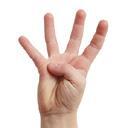
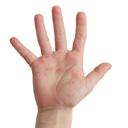
Let’s count the math way. Each finger represents 10, just like a row on the rekenrek.
Face the students and direct them to mirror you. Show a fist with your right hand, palm facing out.
Show me your left hand. Make a fist like me. That’s 0.
Now, raise your right pinkie.
Show me your left pinkie. That’s 10.
Differentiation: Support
Students with fine motor delays may find it easier to use their fingers when they lay their hands flat on the desk or floor. The flat surface helps them hold out the fingers they want up and keep the others tucked in.
Let’s put up the very next finger.
Raise your right ring finger. Students raise their left ring finger.
That’s 20.
Put up the next finger. 30.
Student View of Your Hand
Student View of Student's Hand
Now that students understand the routine, switch to having them say the count as they show fingers. Guide students to continue counting the math way by tens to 100 and then back down to
Students estimate the total of a class collection and prepare to count one of their own.
Gather students and display a counting collection.
Multilingual Learner Support
Consider using strategic, flexible grouping throughout the module.
• Pair students who have different levels of mathematical proficiency.
• Pair students who have different levels of English language proficiency.
• Join pairs to form small groups of four.
As applicable, complement any of these groupings by pairing students who speak the same home language.
Student View of Your Hands
Student View of Student’s Hands
Invite open-ended discussion by asking students what they notice or wonder about the collection.
Then ask students to estimate the total number of objects in the collection. Ask questions such as the following:
• What prediction, or estimate, would be too big? Why?
• What prediction, or estimate, would be too small? Why?
Briefly orient students to the materials and procedure for the counting collection activity:
• Partners will collaborate to count a collection.
• Partners will make their own recordings to show how they counted.
• Partners may use organizational tools. Organizational tools may include readily available classroom items such as cups, rubber bands, personal whiteboards, etc.
Partner students and distribute a different counting collection to each pair.
Before they begin to count, invite partners to work together to predict how many objects are in their collection. Have them write down their estimates. Then encourage them to talk about how they will organize their collections to count.
Invite students to select organizational tools they would like to use, with the understanding that tools may be exchanged as plans are refined.
Transition to the next segment by framing the work.
Today, we will count our collections and record the ways we organize and count.
Teacher Note
Plan for what students should do when they finish counting their collection and recording how they counted:
• Try another way to organize and count.
• Switch collections with another student pair, and count to confirm the total.
Partners organize and count a collection and record their process.
Ask partners to begin counting their collections. Circulate and notice how students engage in the following behaviors:
Organizing: Strategies may include counting a scattered configuration, separating counted and uncounted objects, lining up objects as they are counted, making equal groups, creating 5-groups, forming arrays, and writing expressions or equations. Students may also organize their collections using attributes that do not support counting efficiently, such as by color or size.
Counting: Students may count by ones, twos, fives, or tens. Some may count subgroups and then add to find the total.
Recording: Recordings may include drawings, numbers, expressions, equations, and written explanations.
Circulate and use questions and prompts such as the following to assess and advance student thinking:
• Show and tell me what you did.
• How can you organize your collection to make it easier to count?
• How does the way you organized your collection make it easier to count?
• How did you keep track of what you already counted and what you still needed to count?
• How close was your estimate to your actual count?
Promoting Mathematical Thinking and Reasoning
Students use patterns and structure (MTR.5) as they decide how to organize their counting collections to count them efficiently.
Ask the following questions to promote MTR.5:
• What is another way you can organize your collection that would help you count it?
• How does what you know about counting by tens help you count your collection?
Differentiation: Support
If students sort by size or color or in other ways not related to equal groups, help them transition to more efficient ways of organizing and counting. Use prompts such as the following:
• How can you organize your collection to help you count?
• What organizational tools can help you count?
• Let’s visit another group to see what helps them count their collection.
Select two or three pairs of students to share their counting work in the next segment. If possible, take pictures to show the class in the next segment. The samples show possible strategies. They demonstrate
• making equal groups and counting on by that unit (e.g., grouping by fives and skip-counting),
• counting by a basic unit (e.g., sorting by an attribute and then adding the totals of the groups), and
• organizing groups as an array and counting on by that unit (e.g., making an array with ten in each row and knowing the total without having to skip-count).
Organize in an Array and Recognize the Total
Teacher Note
Students may progress at different paces with counting and recording, so they may count and record with different levels of sophistication.
Group and Count by Fives
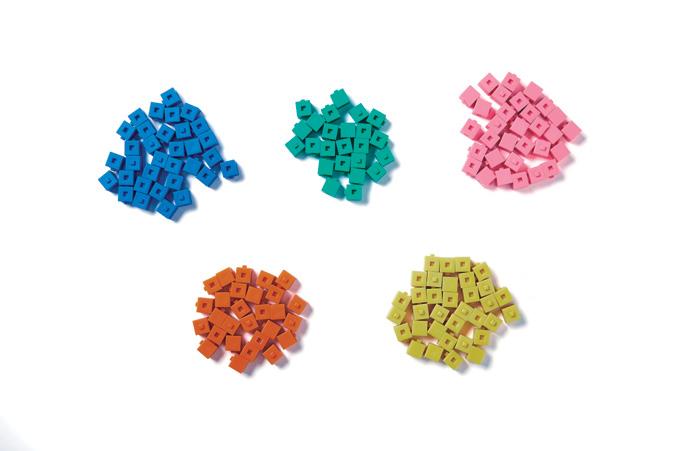
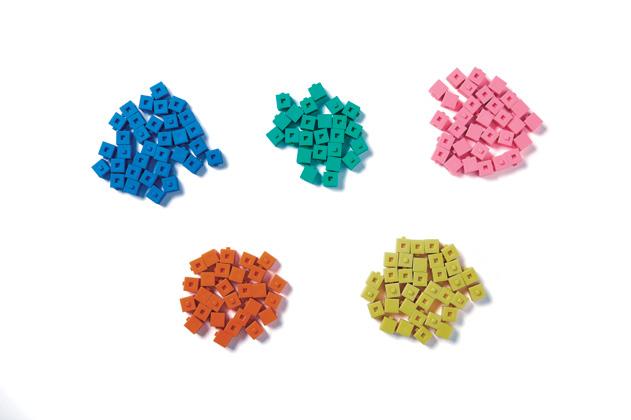
Blue Green Pink
Orange Yellow
Count the collection. Record your work.
For this counting collection, I am partners with .
We are counting .
We estimate there are about of them.
This is how we organized and counted the collection:
We counted altogether.
An equation that describes how we found the total is
Self-Reflection
Write one thing that worked well for you and your partner. Explain why it worked well.
It worked well for me and my partner to connect the cubes into groups of 10 to organize our collection. We both agreed that 10 was a number we could count by.
Write one challenge you had. How did you work through the challenge?
At first we thought we should make groups of 20, but the sticks kept breaking, and we lost track of our count. We decided to make groups of 10 instead.
Share, Compare, and Connect
Students discuss strategies for organizing and compare the efficiency of each.
Gather the class to view the selected work samples and lead a discussion. Invite the selected pairs to share their counting process. The following dialogue models a sample discussion.
Teacher Note
Consider reserving time for the class to engage in discussion after partners have time to complete the self-reflection questions. Development of metacognitive strategies may support students in understanding how they learn best and help them self-monitor their progress.
Universal Design for Learning: Representation
Consider creating a three-column chart and, as partners share, recording each strategy. After all pairs have shared, compare the different organizations of the count, the methods for finding the total, and the efficiency of each strategy. For example, emphasize that each pair organized in a different way (by color, by 5-groups, and in rows of 10) and found the total in different ways (counted on, skip-counted, and used a known fact).
Group and Count by Fives (David and James’s Way)
This sample uses a skip-count. Invite partners to share.
How did you know the total?
We counted by fives.
Why did you decide to count that way?
We know how to count by fives and tens, so we made groups of 5 with our cubes and put 2 fives together to make tens on the sheet.
Can you count your collection a different way? How?
Yes, we can put 2 tens together and skip-count by twenties. Then we can add what’s left.
Ask students to raise their hand if they used a skip-count.
Teacher Note
As students count, they exhibit different levels of sophistication in their counting strategies. Select students to share their work so that students with less sophisticated counting strategies have an opportunity to hear new ideas. If time allows, encourage students to count their collection a second time by using a strategy they heard from another group.
Group by Color and Count by Ones (Ivan and Jayla’s Way)
Note that sorting by color is a common strategy but that it is not always efficient.
Invite partners to share their counting strategy.
Could we use David and James’s way, a skip-count, to find the total of this collection?
Yes. We could count each color group by fives or tens.
How would the recording change if we skip-counted by fives or by tens?
We wouldn’t have to add all the numbers together. We could just count in our head.
Blue Green Pink
Orange Yellow
Organize in an Array and Recognize the Total (Mia and Amy’s Way)
Invite partners to share.
How did your organization help you count?
We made 6 rows of 10 tiles. We know that 6 rows of 10 is 60, so we didn’t have to count all the tiles or skip-count. We had 2 extra tiles, so we added 2 to 60 and got 62.
Invite students to turn and talk about how Mia and Amy’s strategy could be used for 8 rows of 10.
Some students might notice that they can find the total of their array by multiplying, but this is not expected of students at this point in the year. If students make the connection, invite them to share their thinking. Formal introduction of multiplication using different units begins in lesson 2.
If time permits, have students show a new partner their recording and explain their work.
Debrief 5 min
Objective: Organize, count, and represent a collection of objects.
Use the following prompts to guide a discussion about how the organization of a collection helps in finding the total.
What were you successful with when counting?
I organized my cubes into equal groups so I could skip-count to find the total.
What did you find challenging about counting?
At first, I counted by twos. It was hard to keep track of my count. Then I switched to making and counting groups of 5 and that was much easier.
Did you see something you’d like to try next time we count collections? Why do you want to try it?
Next time, I’ll use groups of 5 again, but I’ll organize the groups better so that I know which ones I’ve already counted and which ones I haven’t.
I’d like to use cups to put my collection in the next time. We counted cubes and they were hard to line up. We could just count 10 and put 10 in each cup. Then we could skip-count by tens to find the total.
Next time, I’d like to try multiplication to find the total number. 10
How does organizing help you count?
It helps me to keep track of which things I’ve counted, and it makes it faster to count. If I make a mistake, I don’t have to start all over again.
Exit Ticket 5 min
Direct students to the Self-Reflection on the back of the Exit Ticket. Have them read the I can statement to reflect on their learning in this lesson. Invite them to circle the choice that best matches their agreement with the statement. After they complete the Exit Ticket, consider having students confirm whether they still agree with their selection.
Provide up to 5 minutes for students to complete the Exit Ticket. It is possible to gather formative data even if some students do not complete every problem.
Sample Solutions
Expect to see varied solution paths. Accept accurate responses, reasonable explanations, and equivalent answers for all student work.
I can count a collection and explain the ways I organize and count.
EXIT TICKET
1. What unit did you use to count your collection? Explain why you chose that unit.
Sample:
I chose fives. Counting by fives is quick. I found the total using fewer counts than I would have if I had counted by ones.
2. If you counted your collection again, would you choose the same unit? Explain.
Sample:
I would use a different unit. I would use tens because I could find the total using fewer counts than I used when I counted by fives.
Interpret equal groups as multiplication.
I can represent equal groups with a multiplication equation.
Lesson at a Glance
Students find the total of equal groups using skip-counting and repeated addition. Students describe the groups in unit form and write related multiplication equations. This lesson formalizes the terms multiply and multiplication and introduces the multiplication symbol, ×.
Key Questions
• How is writing a multiplication equation more efficient than writing a repeated addition equation?
• What is the relationship between equal groups, repeated addition, unit form, and multiplication equations?
Mathematical Thinking and Reasoning Standard
MTR.4.1
Language Objectives
• Listen to and orally discuss various ways to describe equal groups by using the terms repeated addition, unit form, and multiplication.
• Orally determine a total by using skip-counting.
Agenda
Fluency 10 min
Launch 10 min
Learn 30 min
• Relate Equal Groups to Multiplication
• Represent Equal Groups with Multiplication Equations
• Problem Set
Land 10 min
Achievement Descriptor
FL.3.Mod1.AD1 Represent a multiplication situation with a model and convert between several representations of multiplication with products from 0 to 144. (MA.3.NSO.2.2)
Materials
Teacher
• 100-bead rekenrek
Students
• Interlocking cubes, 1 cm (12)
Lesson Preparation
Prepare 12 interlocking cubes of one color for each student.
Florida B.E.S.T. Standard
MA.3.NSO.2.2 Explore multiplication of two whole numbers with products from 0 to 144, and related division facts.
Fluency
Ready, Set, Add
Students find the total and say an addition equation to maintain fluency within 10 from grade 1.
Let’s play Ready, Set, Add.
Have students form pairs and stand facing each other.
Model the action: Make a fist and shake it on each word as you say, “Ready, set, add.” At “add,” open your fist, and hold up any number of fingers.
Tell students that they will make the same motion. At “add” they will show their partner any number of fingers. Consider doing a practice round with students.
Clarify the following directions:
• To show zero, show a closed fist at “add.”
• Try to use different numbers each time to surprise your partner.
Each time partners show fingers, have them both say the total number of fingers. Then have each student say the addition equation, starting with the number of fingers on their own hand. See the sample dialogue under the photograph.
Circulate as students play the game to ensure that each student is trying a variety of numbers.
Differentiation: Challenge
Students who demonstrate fluency adding within 10 can be challenged to add within 20. Encourage each partner to use both of their hands to show a number of fingers.
Counting on the Rekenrek by Tens
Materials—T: Rekenrek
Students count by tens in unit and standard form to develop an understanding of multiplication.
Show students the rekenrek. Start with all the beads to the right side.
Say how many beads there are as I slide them over.
Slide the top row of beads all at once to the left side.
10
The unit is 10. In unit form, we say 1 ten. Say 10 in unit form.
1 ten
Slide the second row of beads all at once to the left side.
How many beads are there now? Say it in unit form.
2 tens
Continue sliding over each row of beads all at once as students count.
Now let’s practice counting by tens in standard form. Say how many beads there are as I slide them over.
Let’s start at 0. Ready?
Slide over each row of beads all at once as students count.
0, 10, 20, 30, 40, 50, 60, 70, 80, 90, 100
Teacher Note
Take care not to count or “mouth” the words along with students. Students may learn to mimic the teacher rather than focus on number order.
Student View
Counting the Math Way by Tens
Students construct a number line with their fingers while counting aloud to develop a strategy for multiplying.
Let’s count the math way. Each finger represents 10, just like a row on the rekenrek.
Face the students and direct them to mirror you. Show a fist with your right hand, palm facing out.
Show me your left hand. Make a fist like me. That’s 0.
Now, raise your right pinkie.
Show me your left pinkie. That’s 10.
Let’s put up the very next finger.
Raise your right ring finger. Students raise their left ring finger.
That’s 20.
Put up the next finger. 30.
Student View of Your Hands
Student View of Student’s Hands
Now that students understand the routine, switch to having them say the count as they show fingers. Guide students to continue counting the math way by tens to 100 and then back down to
Student View of Your Hands
Student View of Student’s Hands
Students determine an efficient way to organize and count an unknown number of objects.
Gather the class and invite 10 students to stand in front of the room.
How many students are standing?
How many arms does each student have?
How many groups of 2 arms are there?
What addition expression can we write to represent our groups of 2?
2 + 2 + 2 + 2 + 2 + 2 + 2 + 2 + 2 + 2
Teacher Note
Consider using eyes, ears, shoes, or other common classroom items as an alternative for counting student arms.
Write the addition expression.
How many twos do we have?
10 twos
Write 10 twos.
Ask students to work with a partner and add to find the total.
What is the value of 10 groups of 2?
20
Write = 20. Write 10 groups of 2 is 20.
Instead of adding, what is another way we can find the total of 10 twos?
Skip-count by twos.
Lead the class in skip-counting to find the total number of arms the students have.
Which way is more efficient: repeated addition of 2 until we have 10 twos or skip-counting by twos 10 times?
Ask students to return to their seats.
Invite students to turn and talk about how each of the three statements relates to the skip-count.
Transition to the next segment by framing the work.
Today, we will find a more efficient way to represent repeated addition.
10 twos
10 groups of two is 20.
Teacher Note
Throughout the lesson, equal group representations are used with familiar terms from grade 2, such as repeated addition, unit form, and skip-counting, to support students in conceptualizing multiplication.
Learn
Relate Equal Groups to Multiplication
Materials—S: Cubes
Students represent equal groups with repeated addition, unit form, and a multiplication equation.
Distribute 12 cubes to each student and ask them to take out their whiteboards.
Ask students to use their cubes to make equal groups of 3. Provide students time to work.
How many equal groups of 3 did you make?
You made 4 equal groups of how many cubes?
4 equal groups of 3 cubes is how many cubes altogether?
Ask students to write a repeated addition equation on their whiteboards to represent the groups.
What repeated addition equation represents the equal groups?
Write the unit form, 4 threes = 12, below the addition equation.
3 + 3 + 3 + 3 = 12 4 threes = 12 4 x 3 = 12
Multiply: 4 times 3 equals 12
Promoting Mathematical Thinking and Reasoning
Students engage in discussions that reflect on their mathematical thinking (MTR.4) when they communicate by using multiplication vocabulary and the times symbol accurately and effectively.
Ask the following questions to promote MTR.4:
• How can we write 2 + 2 + … + 2 = 20 by using multiplication?
• What do the 4, the 3, and the symbol × mean in the expression 4 × 3?
• How are you using the symbol × in your work?
How many times do you see a group of three?
Write 4 × 3 = 12.
We see a group of three 4 times. 4 × 3 is another way to write 3 + 3 + 3 + 3 or 4 threes. These statements all represent the equal groups.
Invite students to Think–Pair–Share about how 4 × 3 = 12 relates to repeated addition and unit form.
They are all groups of 3 and the answer is 12.
You add three 4 times because there are 4 groups of 3. That’s how you get 4 × 3.
4 × 3 = 12 is a shorter way to write the long addition equation.
When we have equal groups, multiplication is another way to represent repeated addition. Instead of repeatedly adding the same number, we multiply the number in each group by the number of groups. The times symbol is used to show multiplication.
Below the multiplication equation, write Multiply: 4 times 3 equals 12.
Repeat the sequence to make equal groups of 2, 4, and 6 using 12 cubes. Continue to reinforce the relationship between repeated addition, unit form, and multiplication equations.
Represent Equal Groups with Multiplication Equations
Students represent pictorial equal groups with repeated addition and multiplication equations.
Multilingual Learner Support
The term times is associated with multiplication but not explicitly taught. Consider creating an anchor chart for the terms and symbols associated with multiplication (i.e., multiplication, multiply, times, and ×).
Teacher Note
How many times do you see groups of 2?
I see two 5 times.
Show the picture of groups of cubes. Invite students to turn and talk about how they know the groups are equal.
Encourage students to use the convention that the first factor represents the number of groups and the second factor represents the number in each group (e.g., 5 × 2).
Consistently following this convention will help develop students’ conceptual understanding of multiplication.
Although not the convention used here, 2 × 5 is also considered correct if students see the first factor as the number in each group and the second factor as the number of groups.
Ask students to work with a partner to write a related repeated-addition equation and a multiplication equation for the picture.
Invite students to turn and talk about how the addition and multiplication equation represents the equal groups.
Show the picture of groups of cubes and invite students to Think–Pair–Share about whether they agree or disagree that the equation accurately represents the groups.
I disagree because my addition equation equals 13, not 15.
The last group doesn’t have 5 cubes, so you can’t say there are 3 fives.
You can multiply when the groups are equal. These groups aren’t equal, so the picture doesn’t show 3 × 5.
3 x 5 = 15
I hear most of you disagreeing because the groups are not equal. To multiply, you must have equal groups.
What should I change in the picture to make it match the multiplication equation?
You should put 2 more cubes in the group that has 3 cubes.
Problem Set
Differentiate the set by selecting problems for students to finish independently within the timeframe. Problems are organized from simple to complex.
Universal Design for Learning: Representation
Consider providing additional examples and nonexamples to emphasize that to multiply you must have equal groups. For example, display three groups of cubes that are not equal: the first group with 5 cubes, the second group with 5 cubes, and the third group with 4 cubes. Then have students write an addition expression to represent the total. Students should write 5 + 5 + 4. Discuss why 5 + 5 + 4 cannot be represented with multiplication.
Repeat the process with three equal-sized groups and discuss why these groups can be represented with multiplication.
Alternatively, provide a repeated-addition equation and ask students to represent it with manipulatives or ask students to generate the examples themselves.
Land
Debrief 5 min
Objective: Interpret equal groups as multiplication.
Initiate a class discussion using the prompts below. Encourage students to restate their classmates’ responses in their own words.
How does thinking about how many times we see equal groups help us write a multiplication equation?
It helps me think about unit form and that helps me to write a multiplication equation. So if I see a group of two 7 times, that’s 7 twos, which is the same as 7 × 2.
Why is writing a multiplication equation more efficient than writing a repeated-addition equation?
When I write a repeated-addition equation, I write the same number over and over again. When I write a multiplication equation, I think about the number of groups and the number in each group and then write an equation by using only those two numbers.
Is it always more efficient to write a multiplication equation?
Sometimes it’s not more efficient, like when I have 2 groups of 3. Writing 2 × 3 isn’t any faster than writing 3 + 3.
What is the relationship between equal groups, repeated addition, unit form, and multiplication equations?
I can represent the total number of items in equal groups by using repeated addition, unit form, or a multiplication equation. They can all be used to represent equal groups.
Exit Ticket 5 min
Direct students to the Self-Reflection on the back of the Exit Ticket. Have them read the I can statement to reflect on their learning in this lesson. Invite them to circle the choice that best matches their agreement with the statement. After they complete the Exit Ticket, consider having students confirm whether they still agree with their selection.
Provide up to 5 minutes for students to complete the Exit Ticket. It is possible to gather formative data even if some students do not complete every problem.
Sample Solutions
Expect to see varied solution paths. Accept accurate responses, reasonable explanations, and equivalent answers for all student work.
I can represent equal groups with a multiplication equation.
3. The picture shows 2 groups of apples.
a. Does the picture show 2 × 3? Explain.
1. Use the equal groups of bananas for parts (a) and (b).
a. Fill in the blanks to skip-count by 5.
b. Fill in the blanks to show the total number of bananas.
5++=5515 groups of five is 315 3 fives is 15 3 × 5 =15
2. Fill in the blanks to match the picture.
groups of nine is 2 nines is 2 × 9 = 9918
No. The expression 2 × 3 means 2 equal groups of 3. There are 2 groups, but they are not equal. The group on the right only has 2 apples.
b. Draw a picture to show 2 × 3 = 6 Sample:
I can represent equal groups with a multiplication equation.
4. Eva says, “I see six 3 times. We can multiply 3 × 6 to find the total number of eggs.”
Do you agree with Eva? Explain.
Name
Use the equal groups of fingers for parts (a)–(d).
I agree with Eva because there are 3 equal groups of 6 eggs. So 3 × 6 can be used to find the total number of eggs.
a. How many groups of 10 fingers are there? groups
b. Fill in the blanks to show the total number of fingers.
c. How many tens are there? tens
d. Fill in the blanks to match the picture.
Relate multiplication to the array model.
I can use an array to represent equal groups and write a multiplication equation to find the total.
Lesson at a Glance
Students build concrete arrays of fives and tens and relate them to equal groups, unit form, and multiplication to find the total. They relate the concrete array to a rekenrek and draw tape diagrams to represent equal groups. This lesson formalizes the term product.
Key Questions
• How does an array show equal groups?
• How does an array show each number in a multiplication equation?
Mathematical Thinking and Reasoning Standard
MTR.2.1
Language Objectives
• Orally explain how arrays relate to equal groups and multiplication equations.
• Orally identify the product in a multiplication equation.
Agenda
Fluency 10 min
Launch 5 min
Learn 35 min
• Groups of 5 in an Array
• Groups of 10 in an Array
• Arrays with a Rekenrek
• Tape Diagram
• Problem Set
Land 10 min
Materials
Teacher
• Interlocking cubes, 1 cm (20)
• 100-bead rekenrek
Students
• Interlocking cubes, 1 cm (20)
• Equal Groups (in the student book)
Lesson Preparation
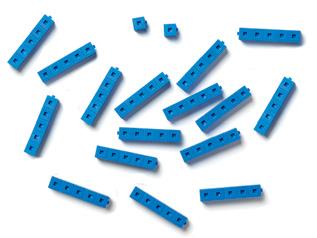
• Prepare 2 sticks of 5 interlocking cubes in one color and 2 sticks of 5 interlocking cubes in a different color for each student and teacher.
• Print a copy of Equal Groups for use in the lesson.
• Tear out Equal Groups from the student books and place them inside personal whiteboards. Consider whether to prepare this material in advance or have students assemble it during the lesson.
• Review the Math Past resource to support delivery of Learn.
Achievement Descriptor
FL.3.Mod1.AD1 Represent a multiplication situation with a model and convert between several representations of multiplication with products from 0 to 144. (MA.3.NSO.2.2)
Florida B.E.S.T. Standard
MA.3.NSO.2.2 Explore multiplication of two whole numbers with products from 0 to 144, and related division facts.
Fluency
Ready, Set, Add
Students find the total and say an addition equation to maintain fluency within 10 from grade 1.
Let’s play Ready, Set, Add.
Have students form pairs and stand facing each other.
Model the action: Make a fist and shake it on each word as you say, “Ready, set, add.” At “add,” open your fist and hold up any number of fingers.
Tell students that they will make the same motion. At “add” they will show their partner any number of fingers. Consider doing a practice round with students.
Clarify the following directions:
• To show zero, show a closed fist at “add.”
• Try to use different numbers each time to surprise your partner.
Each time partners show fingers, have them both say the total number of fingers. Then have each student say the addition equation, starting with the number of fingers on their own hand. See the sample dialogue under the photograph.
Circulate as students play the game to ensure that each student is trying a variety of numbers.
Choral Response: Relating Multiplication Models
Students relate an equal groups picture with a unit of 5 or 10 to a repeated-addition expression and unit form to develop an understanding of multiplication.
After asking each question, wait until most students raise their hands, and then signal for students to respond.
Raise your hand when you know the answer to each question. Wait for my signal to say the answer.
Show the picture of 2 groups of 5 apples.
What repeated-addition expression represents this picture?
5 + 5
How do you represent the picture in unit form?
2 fives
Repeat the process with the following sequence:
Teacher Note
Use hand signals to introduce a procedure for answering choral response questions. For example, cup your hand around your ear for listen, lift your finger to your temple for think, and raise your own hand to remind students to raise theirs.
Teach the procedure using general knowledge questions, such as the following:
• What grade are you in?
• What is the name of our school?
• What is your teacher’s name?
Launch
Students consider ways to organize and count an unknown number of objects.
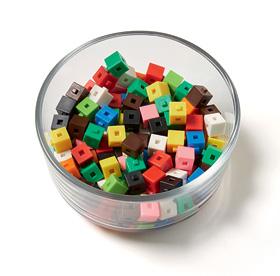
Show the picture of the bowl of cubes. Use the Math Chat routine to engage students in reasoning about efficient strategies they could use to organize and count to find the total number of cubes.
• Allow about 1 minute of silent time for students to think of ways to organize and count the cubes.
• Pair students to discuss their thinking. Circulate and listen as partners talk.
• Identify a few students to share their thinking. Purposely choose students with ideas that lead toward discussion of equal groups, efficiency, or skip-counting by fives or tens, or that activate other knowledge from prior lessons.
Multilingual Learner Support
As students are sharing, consider encouraging the student who is sharing to use prompts from the Share Your Thinking section of the Talking Tool to support them in explaining their strategy. Also, consider encouraging students who are listening to use the Ask for Reasoning section or Say It Again section to better understand what is being shared.
• Ask the selected students to share their thinking with the class. Record their ideas and have them help facilitate discussion.
Transition to the next segment by framing the work.
Today, we will arrange equal groups in a different way and write equations to find the totals.
Learn
Groups of 5 in an Array
Materials—T/S: Cubes; S: Equal Groups
Students interpret an array and represent it as a multiplication equation.
Direct students to remove Equal Groups from their books and insert it into their whiteboards. Distribute 2 five-sticks of one color and 2 five-sticks of another color to each student. Display a set for the class to refer to. Make sure to leave space between the rows.
Arrange your sticks on your whiteboard like mine. Are your sticks organized into equal groups?
In grade 2, you arranged sticks into equal rows, like this with one under the other. When we use rows and columns to arrange equal groups, it is called an array.
Guide students to see the rows and columns in the array by tracing each row of 5 and column of 4. Refer to the sentence frames found on Equal Groups and guide students to complete the frames when prompted.
Look at your cubes. How many cubes are in each row?
How many times do you see a group of 5?
Let’s skip-count by fives. Write the skip-count on your whiteboard down the side of the array. 5, 10, 15, 20
Universal Design for Learning: Representation
Consider creating a web graphic organizer to help students make connections between the idea of multiplication and the different representations of it. Label the center of the web Multiplication. Ask students to think about the representations that they already know, such as repeated addition and unit form. Then explain that an array is another way to show multiplication. Add Array to the web. Later in the lesson, add Tape diagram to the web.
Teacher Note
Be prepared for some students to describe the array using the terms rows and columns. Rows and columns should be familiar from previous grade levels since students have worked with models such as 5-group rows and 5-group columns. In grade 2, students made arrays up to 5 by 5 and described them by using unit form and repeated addition equations.
Although row and column are not an essential part of this lesson, the terminology will be needed in later lessons.
Record the skip-count down the side of the array.
Let’s record: How many groups of 5 do we have?
What is the total of 4 groups of 5?
We can also describe the array in unit form. 4 fives is 20. Let’s record: Write 4 fives is 20 on the second line.
Let’s record: How can we write 4 fives is 20 as a multiplication equation?
4 × 5 = 20
Ask students to relate each number in the multiplication equation back to the array. Ask them what each number in the multiplication equation represents in the array.
In multiplication, the answer, or total number, is called a product.
What is the product in the multiplication equation 4 × 5 = 20?
To pair the written term product with its meaning, use a different color marker to trace the 20 in the equation. Below the equation, write The product is 20.
Model putting together the 4 five-sticks to form a 4 by 5 array and ask students if it still shows 4 fives. Ask them what changed.
Does 4 × 5 = 20 still represent the array? Why?
4 x 5 = 20
The product is 20.
Yes, because the array did not change. We just put the five-sticks together to remove the spaces between the rows.
Invite students to turn and talk about how equal groups are represented in an array.
Promoting Mathematical Thinking and Reasoning
Students demonstrate understanding by representing problems in multiple ways (MTR.2) as they discuss the array of cubes and corresponding multiplication by using two quantitative sentence frames (more concrete descriptions of the cubes) and two abstract sentence frames.
Ask the following questions to promote MTR.2:
• What does the product you found tell you about the cubes?
• What do the numbers in the first sentence frame tell you about the numbers in the last sentence frame?
Groups of 10 in an Array
Materials—T/S: Cubes
Students interpret an array and represent it as a multiplication equation.
Ask students to erase their whiteboards and to combine their five-sticks to make ten-sticks, each with 5 cubes of one color and 5 cubes of another color.
Ask students what they notice about the relationship between fives and tens.
I notice that 2 fives make 1 ten. 5 + 5 = 10.
I notice that there are still 20 cubes. But now the cubes are in 2 rows of 10 instead of 4 rows of 5.
Repeat the sequence of instruction from the previous segment to complete the statements and equation.
Teacher Note
Students progress through three stages of using arrays throughout module 1. First, they see familiar circle arrays from earlier grades, such as the rekenrek and 5-groups. Then students build arrays with square interlocking cubes and link them together to develop the big idea that all numbers can be units.
They initially build square arrays with gaps and then move to square arrays with no gaps. The square arrays without gaps support students in the transition to the area model later in module 4.
In module 1, when students are asked to draw arrays, prompt them to draw circles instead of squares. Students can draw circles more efficiently than they can squares, which require more precision.
Arrays with a Rekenrek
Materials—T: Rekenrek
Students interpret a pictorial array and represent it as multiplication.
Display a 100-bead rekenrek with only the top 3 rows showing. Direct students to the array of circles in their books.
Use the array to write an equation.
6 × 5 = 30 3 × 10 = 30
Compare my rekenrek to the array shown in the book. What is different about them?
The rekenrek has red beads and white beads, but the drawing has only white beads. Fives are easier to see on the rekenrek than in the array.
Ask students how many red beads are in each row and how many white beads are in each row. Have students shade the first 5 circles in each row of their books to match the rekenrek.
Look at your array. How many times do you see groups of 5?
I see five 6 times.
Where do you see the 6 fives?
Ask students to write a multiplication equation in their books to describe the fives in the array.
Math Past
Students might wonder why we use × as a symbol for multiplication. Provide them with some fun facts about the history of the multiplication symbol from Olden ×.
Present some of the ways that × has been written in the past. Invite students to turn and talk to discuss each way and why they think the symbols were made. What similarities and differences do they notice among the symbols? Which symbol do they like best and why? Why is it that most people use the same symbol? Consider providing students with an opportunity to research other mathematical symbols and to share their findings.
What multiplication equation describes the 6 fives?
6 × 5 = 30
Let’s count by fives the math way to check our work. Each finger represents 5. Count with me.
5, 10, 15, 20, 25, 30
Ask students to look at their array again and describe how many times they see groups of 10. Guide students to explain where they see 3 tens in the array and have them write a related multiplication equation in their books.
What multiplication equation did you write?
3 × 10 = 30
Let’s count by tens the math way to check our work. This time when we count, each finger represents a unit of ten. Count with me.
10, 20, 30
What do you notice about 3 × 10 and 6 × 5?
The product of each is 30, so they are equal.
It’s the same array. We saw groups of 5 inside the groups of 10.
Invite students to turn and talk about how the same array can represent groups of 5 and groups of 10.
Tape Diagram
Students relate tape diagrams to equal groups.
Use the following sequence to interactively model drawing a tape diagram.
Watch as I draw 3 tens using a tape diagram.
Model drawing the outline of the tape diagram.
How many equal groups are in 3 tens?
Model partitioning the tape diagram into three equal groups.
How many are in each group?
Label each part of the tape diagram as 10.
What is the total, or product, of 3 tens?
Label the product on the tape diagram. Invite students to turn and talk about where they see the multiplication equation 3 × 10 = 30 in the tape diagram.
Problem Set
Differentiate the set by selecting problems for students to finish independently within the timeframe. Problems are organized from simple to complex.
Teacher Note
Students used tape diagrams to represent repeated addition and equal groups in grade 2. In later grade 3 module 1 lessons, students draw tape diagrams to represent multiplication problems.
Land
Debrief 5 min
Objective: Relate multiplication to the array model.
Engage the class in discussion about the relationship between multiplication and the array model.
How does an array show equal groups?
The equal groups are the rows in the array.
How does an array show each number in a multiplication equation?
An array has equal groups and you can see the total.
The array shows the equal groups and you can see how many groups there are.
What is the difference between an equal-groups picture and an array?
They both show equal groups and the total, but they are organized differently.
Exit Ticket 5 min
Direct students to the Self-Reflection on the back of the Exit Ticket. Have them read the I can statement to reflect on their learning in this lesson. Invite them to circle the choice that best matches their agreement with the statement. After they complete the Exit Ticket, consider having students confirm whether they still agree with their selection.
Provide up to 5 minutes for students to complete the Exit Ticket. It is possible to gather formative data even if some students do not complete every problem.
Sample Solutions
Expect to see varied solution paths. Accept accurate responses, reasonable explanations, and equivalent answers for all student work.
I can use an array to represent equal groups and write a multiplication equation to find the total.
2. Use the picture of hands for parts (a) and (b).
1. Use the picture of fingers for parts (a) and (b). 5 , 10 , , ,
a. Fill in the blanks to skip-count by 5
b. Fill in the blanks to match the picture.
a. Fill in the blanks to skip-count by 10
b. Fill in the blanks to match the picture.
3. Use the array for parts (a)–(c).
4. Use the array for parts (a)–(c).
a. Skip-count by 5 down the side of the array.
b. Fill in the blanks to match the array. fives is ×= c. Circle the product in the equation. 840
a. Skip-count by 10 down the side of the array.
b. Fill in the blanks to match the array. tens is ×=
c. Circle the product in the equation.
5. What do you notice about 8 × 5 and 4 × 10?
Each expression is equal to 40, so they have the same value.
8 × 5 = 40 and 4 × 10 = 40
I can use an array to represent equal groups and write a multiplication equation to find the total.
Use the array for parts (a) and (b).
a. Skip-count by 5 down the side of the array.
b. Fill in the blanks to match the array.
Interpret the meaning of factors as number of groups or number in each group.
I can describe what the factors in a multiplication expression represent.
Lesson at a Glance
Students relate equal groups, arrays, and tape diagrams to multiplication equations. They interpret the meaning of factors in equations as either the number of groups or the number in each group. This lesson introduces the term factor.
Key Questions
• What do the factors represent in multiplication equations?
• How can the same multiplication equation represent an equal group picture and an array?
Mathematical Thinking and Reasoning Standard
MTR.4.1
Language Objective
• Orally explain how the number of groups, the number in each group, and the total are each represented in equal groups, arrays, tape diagrams, and equations by using the terms factors and product.
Agenda
Fluency 10 min
Launch 5 min
Learn 35 min
• Relate Equal Groups to Arrays
• Equal Groups, Arrays, and Equations
• Arrays, Tape Diagrams, and Equations
• Problem Set
Land 10 min
Achievement Descriptor
FL.3.Mod1.AD1 Represent a multiplication situation with a model and convert between several representations of multiplication with products from 0 to 144. (MA.3.NSO.2.2)
Materials
Teacher
• 100-bead rekenrek
• Interlocking cubes, 1 cm (15)
Students
• None
Florida B.E.S.T. Standard
MA.3.NSO.2.2 Explore multiplication of two whole numbers with products from 0 to 144, and related division facts.
Lesson Preparation
Gather 15 interlocking cubes in one color.
Fluency
Counting on the Rekenrek by Fives
Materials—T: Rekenrek
Students count by fives in unit and standard form to develop an understanding of multiplication.
Show students the rekenrek. Start with all the beads to the right side.
Say how many beads there are as I slide them over.
Slide 5 red beads in the top row all at once to the left side.
5
The unit is 5. In unit form, we say 1 five. Say 5 in unit form.
1 five
Slide the 5 red beads in the next row all at once to the left side.
How many beads are there now? Say it in unit form.
2 fives
Continue sliding over 5 red beads in each row all at once as students count.
Now let’s practice counting in standard form. Say how many beads there are as I slide them over.
Let’s start at 0. Ready?
Slide over 5 beads in each row all at once as students count.
0, 5, 10, 15, 20, 25, 30, 35, 40, 45, 50 10
Teacher Note
Take care not to count or mouth the words along with students. Students may learn to mimic the teacher rather than focus on number order.
Student View
Counting the Math Way by Fives
Students construct a number line with their hands while counting aloud by fives to develop a strategy for multiplying.
Let’s count the math way. Each finger represents 5.
Face the students and instruct them to mirror you. Show a fist with your right hand, palm facing out.
Show me your left hand. Make a fist like me. That’s 0.
Now, raise your right pinkie.
Now, show me your left pinkie. That’s 5.
Let’s put up the very next finger.
Raise your right ring finger. Students raise their left ring finger.
That’s 10.
Put up the next finger. 15.
Student View of Your Hands
Student View of Student’s Hands
Now that students understand the routine, switch to having them say the count as they show fingers. Guide students to continue counting the math way by fives to 50 and then back down to
Choral Response: Relating Multiplication Models
Students relate an equal groups picture, array, or tape diagram with a unit of 5 or 10 to a repeated addition expression, unit form, and multiplication equation to develop an understanding of multiplication.
After asking each question, wait until most students raise their hands, and then signal for students to respond.
Raise your hand when you know the answer to each question. Wait for my signal to say the answer.
Show the picture of 2 groups of 5 apples.
What repeated addition expression represents this picture?
5 + 5
How do you represent the picture in unit form?
2 fives
What multiplication equation represents this picture?
2 × 5 = 10
Student View of Your Hands
Student View of Student’s Hands
Repeat the process with the following sequence:
Launch
Teacher Note
Arrays in the sequence of pictures with more than 5 rows are shaded to support students in quickly determining the number of rows in each array without having to count each one. 5
Students learn the term factor and relate it to a multiplication equation.
Ask students to stand and, without talking, organize themselves into groups of 4.
When they have finished, encourage students to verify that the groups are equal, and ask the class the following questions.
How many equal groups did we make?
How many students are in each group?
How many total students are there?
Write the sentence frame and equation frame as shown.
groups of 4 is .
x 4 =
Teacher Note
If you can’t arrange your class into equal groups of 4, adjust the directions for the beginning of Launch to make equal groups of a different size. If it’s not possible to make equal groups, consider having an adult, a teddy bear, or a class pet stand in to adjust the size of the groups. Avoid having students make 4 groups of 4.
Direct students to complete the sentence frame and equation orally with their group. Then restate the completed sentence frame and equation for the class.
Which number in our equation is the product?
In a multiplication equation, the two numbers we multiply together are called factors.
Circle the factors in the equation and refer to them as you discuss the term factor.
In this example, is the first factor and 4 is the second factor.
Consider creating an anchor chart for the terms product and factor along with a pictorial example of each to support students in their precision using each term.
Transition to the next segment by framing the work.
Today, we will learn what the factors in a multiplication expression represent.
Learn
Relate Equal Groups to Arrays
Materials—T/S: Cubes
Students draw an array to represent groups of concrete objects and interpret the meaning of factors.
Display 3 groups of 5 cubes.
Ask students how many groups there are and how many cubes are in each group. Have the class skip-count by fives to find the total.
Rearrange the groups to make an array with 3 rows of 5. Move one group of cubes at a time.
How did I organize the equal groups?
You put the equal groups into rows. You made an array.
The equal groups are the rows in the array. Do I still have 3 equal groups?
Do I still have 5 cubes in each group?
Do I still have 15 as the total?
Direct students to problem 1 in their books. Ask students to draw an array to show 3 rows of 5, using circles to represent the cubes.
1. Draw an array to show 3 rows of 5.
3 × 5 = 15
When most students have finished, write 3 × 5 = 15.
15 is the product. What do we call 3 and 5?
Factors
What does the 3 represent in the array?
3 rows
What does the 5 represent in the array?
The 5 circles in each row
Teacher Note
The digital interactive Groups and Arrays helps students visualize the connection between the properties of equal groups and arrays.
Consider allowing students to experiment with the tool individually or demonstrating the activity for the whole class.
Universal Design for Learning: Action & Expression
Consider providing resources to support organization and alternatives that minimize fine-motor demands when students are required to draw arrays. Examples include the following:
• Provide lined paper to help draw circles in even rows.
• Provide stamp markers to create circles of the same size.
• Provide physical manipulatives, such as circle-shaped counters as an alternative to drawing.
Tell students that one way we use factors to write a multiplication equation is to have the first factor represent the number of groups. The second factor represents the number in each group.
Equal Groups, Arrays, and Equations
Students draw arrays to represent pictures of equal groups and interpret the meaning of factors.
Pair students and direct them to complete problem 2. Invite students to Think–Pair–Share about how they can use equal groups to determine the total number of balloons.
We can count the number of groups of balloons.
We can count the number of balloons in each group.
We can multiply the number of groups by the number in each group to determine the total number of balloons.
2. Use the equal groups of balloons for parts (a)–(d).
a. There are 6 groups of balloons. There are 5 balloons in each group.
There is a total of 30 balloons.
b. Complete the equation to describe the equal groups of balloons.
6 Number of groups × 5 Number in each group = 30 Product
Teacher Note
The first few lessons scaffold the meaning of multiplication for students by consistently using the first factor to represent the number of groups and the second factor to represent the number in each group. In later lessons this scaffold is removed. Students understand that factors may be written in any order and the number of groups may be represented by the first or the second factor.
c. Draw an array to show the total number of balloons. Make each equal group a row.
Multilingual Learner Support
Consider reviewing the terms factor and product. Follow up each question in this section with, “Is this a factor or a product?” (heavier support) or “What is this number in the equation called?” (lighter support).
d. Complete the equation to describe the array.
As students work, consider asking partners the following questions:
• Where are the 6 groups of balloons in the array?
• Where are the 5 balloons in each group in the array?
• What part of the equation represents the number of rows in the array?
• What part of the equation represents the number in each row in the array?
• What part of the equation represents the total, or product?
Promoting Mathematical Thinking and Reasoning
Students engage in discussions that reflect on their mathematical thinking (MTR.4) as they describe and discuss how parts of their models are represented in the equations and vice versa.
Ask the following questions to promote MTR.4:
• What do the 6, the 5, and the symbol × mean in the expression 6 × 5?
• What are the 6 and the 5 called in the equation 6 × 5 = 30?
• What is the 30 called in the equation 6 × 5 = 30?
After students finish problem 2, show the picture of 3 plates of crackers.
Ask the class the following questions:
How many groups of crackers are there?
How many crackers are in each group?
What is the total number of crackers?
Ask students to take out their whiteboards and draw the equal groups of crackers as an array. Then have them write a matching multiplication equation.
Arrays, Tape Diagrams, and Equations
Students relate an array and a tape diagram to the factors in a multiplication equation.
How would we draw an array model to show 7 groups of 5?
We would draw 7 rows of 5 circles.
Direct students to problem 3 and ask them to draw the array and answer the questions.
3. Draw an array to show 7 groups of 5. Make each group a row.
a. What factor shows the number of groups? 7
b. What factor shows the number in each group? 5
c. What is the product? 35
d. Complete the equation to describe the array.
Select a student work sample to display and use it to lead a discussion about the meaning of factors. Consider asking the following questions:
• How does the array show the number of groups?
• How does the array show the number in each group?
• How could we use a tape diagram to show 7 groups of 5?
Model drawing the tape diagram. 55 55555 35
What multiplication equation represents the tape diagram? The first factor should be 7.
Write 7 × 5 = 35.
Invite students to turn and talk about how the factors and product relate to the tape diagram.
How are the array and the tape diagram similar?
They both have a total of 35.
The array has 7 rows, and the tape diagram has 7 equal groups.
There are 5 circles in each row of the array, and 5 is in each group of the tape diagram.
Invite students to turn and talk about how arrays and tape diagrams can represent equal groups.
Problem Set
Differentiate the set by selecting problems for students to finish independently within the timeframe. Problems are organized from simple to complex.
Land
Debrief 5 min
Objective: Interpret the meaning of factors as number of groups or number in each group.
Use the following prompts to guide a discussion about the meaning of each factor in an equation and how equations relate to pictorial models such as equal groups, arrays, and tape diagrams.
What do the factors represent in multiplication equations?
The factors represent the number of groups and the number in each group. They represent the number of circles in each row.
Teacher Note
Help students recognize the words complete and equation in the Problem Set. Consider providing extra support, such as reading the problems aloud and underlining the terms.
How can the same multiplication equation represent an equal-group picture and an array?
Both the equal groups and the array represent 4 fives and have a total of 20.
The number of rows and groups are the same. So are the number in each row and the number in each group.
Exit Ticket 5 min
Direct students to the Self-Reflection on the back of the Exit Ticket. Have them read the I can statement to reflect on their learning in this lesson. Invite them to circle the choice that best matches their agreement with the statement. After they complete the Exit Ticket, consider having students confirm whether they still agree with their selection.
Provide up to 5 minutes for students to complete the Exit Ticket. It is possible to gather formative data even if some students do not complete every problem.
Sample Solutions
Expect to see varied solution paths. Accept accurate responses, reasonable explanations, and equivalent answers for all student work.
I can describe what the factors in a multiplication expression represent.
1. Use the equal groups of cars for parts (a)–(c).
a. How many groups of cars are there? groups
b. How many cars are in each group? cars are in each group.
c. Complete the equation. 4 5 4 Number of groups ×5 Number in each group =20 Product
2. Use the array for parts (a)–(c).
3. Use the array for parts (a)–(d). a. Number of rows: b. Number in each row:
5 3 5 Number of rows ×3 Number in each row =15 Product
d. There are apples in all. 15
4. Use the array for parts (a)–(d).
a. Number of rows:
a. How many rows of cars are there? rows of cars
b. How many cars are in each row? cars are in each row.
c. Complete the equation. 4 5
b. Number in each row: 5 4 c. 5 Number of rows ×4 Number in each row =20 Product
d. The product is 20
I can describe what the factors in a multiplication expression represent.
Represent and solve multiplication word problems by using drawings and equations.
I can solve multiplication word problems.
Lesson at a Glance
Students select strategies to represent and solve multiplication word problems by using drawings and equations. A video provides context for the word problems. After working independently to solve the problems, students share their work to compare and connect various representations and strategies.
Key Questions
• How is a tape diagram a useful model to use when solving multiplication word problems?
• How do you decide which model to use when solving a multiplication word problem?
Mathematical Thinking and Reasoning Standard
MTR.7.1
Language Objectives
• Read word problems involving multiplication.
• Write or draw to record a solution strategy and an equation to solve a word problem involving multiplication.
• Listen to and orally describe solution strategies and representations—including equal groups, arrays, and tape diagrams—to find the product and compare and connect solution strategies.
Agenda
Fluency 5 min
Launch 5 min
Learn 40 min
• Equal Groups Word Problem
• Equal Groups: Share, Compare, and Connect
• Array Word Problem
• Array: Share, Compare, and Connect
• Problem Set
Land 10 min
Achievement Descriptor
FL.3.Mod1.AD6 Solve one-step real-world problems by using multiplication and division involving factors 2–5 and 10. (MA.3.AR.1.2)
Materials
Teacher
• None
Students
• Interlocking cubes, 1 cm (45)
Florida B.E.S.T. Standard
MA.3.AR.1.2 Solve one- and two-step real-world problems involving any of four operations with whole numbers.
None
Fluency
Choral Response: Relating Multiplication Models
Students relate an equal groups picture, an array, or a tape diagram with a unit of 5 or 10 to a repeated addition expression, a unit form, and a multiplication equation to develop an understanding of multiplication.
After asking each question, wait until most students raise their hands, and then signal for students to respond.
Raise your hand when you know the answer to each question. Wait for my signal to say the answer.
Display the picture of 3 dice.
What repeated addition expression represents this picture?
5 + 5 + 5
How do you represent the picture in unit form?
3 fives
What multiplication equation represents this picture?
3 × 5 = 15
Repeat the process with the following sequence:
Teacher Note
Arrays in the sequence of pictures with more than 5 rows are shaded to support students in quickly determining the number of rows in each array without having to count each one.
Launch
Students work together to determine which picture accurately represents a given multiplication scenario.
Display the picture of 3 card arrangements and read the following problem aloud to the class. Casey plays a card matching game. To start the game, Casey puts her cards in 5 rows with 4 cards in each row. How many total cards does Casey use to play the matching game?
Invite students to turn and talk about whether picture A, picture B, or picture C accurately represents the problem about Casey’s cards. Have students turn and talk to respond to the following questions:
• How are the cards represented in picture A? Picture B? Picture C?
• Where do you see 5 in picture A? Picture B? Picture C?
• Where do you see 4 in picture A? Picture B? Picture C?
• How are the pictures similar? How are they different?
Ask which picture represents the problem about Casey’s cards.
Picture A
Picture B
Picture C
How many total cards does Casey use to play the matching game?
Which picture shows a total of 20 cards?
Since all three pictures show a total of 20 cards, any picture can be used to find the total.
If all three pictures show the same total, why did you choose picture B?
All three pictures show 5 fours, just in different ways. Since the problem said Casey makes 5 rows of 4, we chose picture B because it is an array with 5 rows of 4.
Transition to the next segment by framing the work.
Today, we will solve word problems and share and compare our strategies.
Learn
40
Equal Groups Word Problem
Students collect information from a video and solve an equal groups with unknown product word problem.
Play part 1 of the Amusement Park video. If necessary, replay the video and ask students to note any details.
Give students 1 minute to turn and talk about what they noticed.
Engage students in a brief conversation about the video. Discuss student observations and any relevant questions they have. Guide the conversation to problem 1. Consider the following possible sequence of questions to ask students:
What do you notice?
I saw people getting on a roller coaster.
The roller coaster had 10 cars.
There were 3 people in each car.
Teacher Note
Read the problem all the way through. Then reread a chunk at a time. As you reread, ask yourself, “Can I draw something?” then “What can I draw?”
Draw to represent the problem as you reread. Add to or revise your drawing as you uncover new information or discover what is unknown. As you draw, label what is known and what is unknown.
When you finish rereading and drawing, ask yourself, “What does my drawing show me?” Let your drawing help you find a way to solve.
Write number sentences or equations to represent your thinking.
Solve.
Then use your solution to write a statement that answers the original question.
Teacher Note
This is the first use of a context video. It is shown before a related word problem to build familiarity and engagement with the context. It also allows students to visualize and discuss the situation before being asked to interpret it mathematically.
What do you wonder?
How many people fit on the roller coaster?
There are many mathematical questions we could ask. Let’s use what we saw in the video to help us understand and solve a word problem.
Direct students to problem 1, and chorally read the problem with the class. Have students work independently to use the Read–Draw–Write process to solve the problem. Provide materials such as interlocking cubes for student use. Encourage students to self-select their tools and strategies.
Use the Read–Draw–Write process to solve the problem.
1. A roller coaster has 10 cars.
There are 3 people in each car.
How many people are on the roller coaster?
10 × 3 = 30
There are 30 people on the roller coaster.
Circulate and observe student strategies. Select two or three students to share in the next segment. Look for work samples that help advance the lesson’s objective of using different multiplication models, such as equal groups, arrays, and tape diagrams.
The following student work samples demonstrate using equal groups and a tape diagram to represent multiplication.
Universal Design for Learning: Action & Expression
Consider providing access to manipulatives to support problem solving. For example, students may choose to use cubes to model the problem.
Prompt students who use repeated addition to transition to multiplication by using unit form with the sentence frame: I see threes.
Then follow up by asking: How many times do you see 3?
Use the equation frame: ×= .
Promoting Mathematical Thinking and Reasoning
Students apply mathematics to real-world contexts (MTR.7) as they use the Read–Draw–Write process to understand, represent, and solve a word problem.
Ask the following questions to promote MTR.7:
• What can you draw to help you understand the roller coaster problem?
• What math can you write to represent this problem?
• How can you represent the key ideas in the roller coaster problem in your model?
Equal Groups Word Problem: Share, Compare, and Connect
Students share solutions for problem 1 and reason about their connections.
Gather the class, and invite the students you identified in the previous segment to share their solutions one at a time. Consider intentionally ordering shared student work from a representational model, such as an equal groups drawing, to a more abstract model, such as a tape diagram.
As each student shares, ask questions to elicit their thinking and clarify the model used to represent the problem. Ask the class questions to make connections between the different solutions and their own work. Encourage students to ask questions of their own.
Teacher Note
The sample student work shows common responses. Look for similar work from your students, and encourage authentic classroom conversations about the key concepts.
If your students do not produce similar work, choose one or two pieces of their work to share, and highlight how it shows movement toward the goal of this lesson. Then select one work sample from the lesson that works best to advance student thinking. Consider presenting the work by saying, “This is how another student solved the problem. What do you think this student did?”
Teacher Note
Throughout module 1, students are encouraged to complete tape diagrams by labeling all components; the number of groups, the number in each group, and the product. This supports their understanding of the problems and validates their solutions.
In module 3, as the size of factors increases and students gain fluency with their multiplication facts, they transition to using a symbol or letter to identify the unknown.
Equal Groups (Luke’s Way)
What did Luke do in his drawing?
He drew 10 equal groups to represent the 10 roller coaster cars. Then he drew 3 dots in each group to represent the 3 people in each car.
What strategy did Luke use?
He skip-counted by threes like this:
3, 6, 9, 12, … , 30.
Why did you decide to represent the problem with equal groups?
When I read the problem, I thought about equal groups because I pictured 10 cars with 3 people in each group. That’s the same as 10 groups with 3 in each group.
What multiplication equation represents the problem? Why?
10 × 3 = 30 because the number of groups is 10, the number in each group is 3, and the total number of people is 30.
Invite students to turn and talk about the similarities and differences between Luke’s work and their work.
x 3 = 30
Multilingual Learner Support
Consider modeling a think aloud for a solution strategy by using academic language.
Also consider posting sentence frames for students to reference until they are more comfortable sharing their thinking in a way that allows other students to follow their solution sequence. Sentence frames could include:
• First, I drew a to represent the problem.
• I chose to draw a because .
• I wrote the equation because .
• My strategy to find the total was to .
• My strategy is similar to/different from because .
Tape Diagram (Eva’s Way)
What did Eva do in her drawing?
She drew a tape diagram with 10 parts to represent the 10 roller coaster cars. She wrote the number 3 in each part to represent the 3 people in each car. She wrote a question mark to show that she needed to find the total number of people.
What strategy did Eva use?
She used doubles facts and added one extra 6 at the end to get 30.
Why did you decide to represent the problem with a tape diagram?
I used a tape diagram because I thought about equal groups. The tape diagram shows the equal groups.
What multiplication equation represents the problem? Why?
10 × 3 = 30 because 10 represents the 10 roller coaster cars, 3 represents the 3 people in each car, and 30 represents the total number of people.
How is Luke and Eva’s thinking similar?
They both thought about equal groups.
Invite students to turn and talk about the similarities and differences between Eva’s work and their work.
Array Word Problem
Students collect information from a video and solve an array with unknown product word problem.
Play part 2 of the Amusement Park video. If necessary, replay the video, and ask students to note any details.
Give students 1 minute to turn and talk about what they noticed.
Engage students in a brief conversation about the video. Discuss student observations and any relevant questions they have. Guide the conversation to problem 2. Consider the sequence of questions used in part 1.
Direct students to problem 2. Chorally read the problem with the class. Prompt students to use the Read–Draw–Write process to solve the problem. Provide materials such as interlocking cubes for student use. Encourage students to self-select their tools and strategies.
Use the Read–Draw–Write process to solve the problem.
2. The swinging ship ride has 9 rows of seats.
Each row has 5 seats.
How many seats are on the swinging ship ride?
9 × 5 = 45
There are 45 seats on the swinging ship ride.
Circulate and observe student strategies. Select two or three students to share in the next segment. Look for work samples that help advance the lesson’s objective of using different multiplication models, such as equal groups, arrays, and tape diagrams.
The student work samples demonstrate using an array and a tape diagram to represent multiplication.
Diagram
Array Word Problem: Share, Compare, and Connect
Students share solutions for problem 2 and reason about their connections.
Gather the class, and invite the students you identified in the previous segment to share their solutions one at a time. Consider intentionally ordering shared student work from a representational model (array) to a more abstract model (tape diagram).
As each student shares, ask questions to elicit their thinking and clarify the model used to represent the problem. Ask the class questions to make connections between the different solutions and their own work. Encourage students to ask questions of their own.
Array (Mia’s Way)
What did Mia do in her drawing?
She drew 5 circles in each row to represent the 5 seats in each row. She continued to draw rows of 5 until she had 9 rows because there are 9 rows of seats on the ride.
What strategy did Mia use to solve the problem?
She skip-counted by fives. I can see it at the end of each row.
What is useful about representing the problem with an array?
It helps me imagine all the parts of the problem.
What equation represents the problem? Why?
9 × 5 = 45 because the number of rows is 9, the number in each row is 5, and the total is 45.
There are e 45 seats on the swinging ship ride 9 x 5 = 45
Invite students to turn and talk about the similarities and differences between Mia’s work and their work.
Teacher Note
Students may represent their work differently than the sample, such as by drawing an array with 5 rows of 9 circles and writing the equation 5 × 9 = 45. Accept other answers as long as they accurately represent the problem.
Tape Diagram (Pablo’s Way)
What did Pablo do in his drawing?
He drew a tape diagram with 9 parts to represent the 9 rows of seats. He wrote 5 in one of the parts because he knew each row has the same number of seats, so he didn’t need to keep writing 5 in every part. He drew a question mark to show that he needed to find the total number of seats.
How is the total number of seats represented in the tape diagram?
There are e 45 seats on the swinging ship ride. 9 x 5 = 45 5 ?
The total number of seats is represented by the 9 parts in the tape diagram.
What strategy did Pablo use to solve the problem?
I think he skip-counted by fives 9 times.
What is useful about representing the problem with a tape diagram? It is quicker to draw a tape diagram than an array.
What equation represents the problem? Why?
9 × 5 = 45 because there are 9 rows with 5 in each row, which makes a total of 45.
Invite students to turn and talk about the similarities and differences between
• Mia’s work and Pablo’s work, and
• Pablo’s work and their work.
To support the discussion in Land, save two or three student solutions that use tape diagrams.
Problem Set
Differentiate the set by selecting problems for students to finish independently within the timeframe. Problems are organized from simple to complex.
Universal Design for Learning: Action & Expression
Consider reserving time for students to self-reflect on their experience solving multiplication word problems.
• How did your drawing help you understand the problem better?
• Did you try any new strategies today? How did you feel trying them?
• What did you feel successful with today?
• What do you think you need more support with? Why?
Land
Debrief 5 min
Objective: Represent and solve multiplication word problems by using drawings and equations.
Use the following prompts to guide a discussion about the usefulness of equal groups, arrays, and tape diagrams to represent different multiplication scenarios. To support this discussion, display selected student work that uses tape diagrams.
How is the tape diagram a useful model to use when solving multiplication word problems?
Tape diagrams help me make sense of the problem.
I can see the equal groups and the number in each group with a tape diagram.
How can you use a tape diagram to find the total in a multiplication problem?
You can skip-count.
You can add all the parts together.
You can use repeated addition or doubles to add all the parts together.
How do you decide which model to use when solving a multiplication word problem?
I draw an equal groups picture or an array so I can count to find the total.
I read the problem and picture what it is about. Like in problem 2, it said 9 rows with 5 seats in each row. The word row helped me picture an array.
I like to draw tape diagrams because they can show equal groups or equal rows.
Exit Ticket 5 min
Direct students to the Self-Reflection on the back of the Exit Ticket. Have them read the I can statement to reflect on their learning in this lesson. Invite them to circle the choice that best matches their agreement with the statement. After they complete the Exit Ticket, consider having students confirm whether they still agree with their selection.
Provide up to 5 minutes for students to complete the Exit Ticket. It is possible to gather formative data even if some students do not complete every problem.
Sample Solutions
Expect to see varied solution paths. Accept accurate responses, reasonable explanations, and equivalent answers for all student work.
I can solve multiplication word problems.
Use the Read–Draw–Write process to solve each problem.
1. Oka has 4 baskets.
Each basket has 5 bagels.
How many bagels does Oka have?
4 × 5 = 20
Oka has bagels. 20
2. A muffin pan has 5 rows.
Each row has 3 muffins.
How many muffins are in the pan?
5 × 3 = 15
There are muffins in the pan. 15
3. Mr. Lopez has 10 packs of cups.
Each pack has 6 cups.
How many cups does Mr. Lopez have?
10 × 6 = 60
Mr. Lopez has 60 cups.
4. Ivan has 6 packs of tomatoes.
Each pack has 5 tomatoes.
How many tomatoes does Ivan have?
6 × 5 = 30
Ivan has 30 tomatoes.
5. A garden has 4 rows of beets.
Each row has 10 beets.
How many beets are in the garden?
4 × 10 = 40
There are 40 beets in the garden.
6. Mrs. Smith has 10 boxes of books. Each box has 10 books.
How many books does Mrs. Smith have?
10 × 10 = 100
Mrs. Smith has 100 books.
EXIT TICKET
I can solve multiplication word problems.
Use the Read–Draw–Write process to solve the problem.
Mr. Endo has 5 boxes of crayons. There are 8 crayons in each box. How many crayons does Mr. Endo have?
Sample:
Mr. Endo has 40 crayons.
Topic A Quiz Sample Solutions
The digital platform provides access to digital quizzes and assessments as well as three downloadable print versions. Expect to see varied solution paths. Accept accurate responses, reasonable explanations, and equivalent answers for all student work.
ANSWER KEY ▸ TOPIC QUIZ A-1
1. Complete the multiplication equation to describe this picture.
3. Deepa has 3 packs of 6 pencils.
How many pencils does Deepa have altogether?
18 pencils
4 × 2 = 8 (Number of groups) (Number in each group) (Total)
2. Liz has 5 rows of 3 shells.
Part A
Draw an array to represent Liz’s shells.
Part B
Complete this multiplication equation to describe how many shells Liz has.
5 × 3 = 15 (Number of rows) (Number in each row) (Total)
Part C
How many shells does Liz have in total?
15 shells
4. Which situation can be represented by 4 × 3?
A. Luke has 4 shelves. He puts 3 books onto one shelf.
B. Luke has 4 shelves. He puts 3 books onto each shelf.
C. Luke has 4 books on a shelf. He takes 3 books off the shelf.
D. Luke has 4 books on a shelf. He puts 3 more books onto the shelf.
Distractor rationale:
A. Incorrect. The student may have mistaken 3 for the total number of books.
B. Correct.
C. Incorrect. The student may have misinterpreted the subtraction situation as a multiplication situation.
D. Incorrect. The student may have misinterpreted the addition situation as a multiplication situation.
Observational Assessment Recording Sheet
Grade 3 Module 1 Topic A
Conceptual Understanding of Multiplication
Standards and Achievement Descriptors
MA.3.NSO.2.2
MA.3.AR.1.2
FL.3.Mod1.AD1 Represent a multiplication situation with a model and convert between several representations of multiplication with products from 0 to 144.
Student Name
FL.3.Mod1.AD6 Solve one-step real-world problems by using multiplication and division involving factors 2–5 and 10.
Dates and Details of Observations
Topic B
Conceptual Understanding of Division
In topic B, students develop a conceptual understanding of division, following a sequence similar to topic A’s development of multiplication. Throughout the topic, two interpretations of division are presented in tandem. Sometimes the number of groups is known (partitive division), and sometimes the number in each group is known (measurement division). Students do not use the terminology of partitive and measurement division, but they do identify what is known and unknown in each situation. They develop an understanding that the unknown affects the choice of modeling, the solution path, and the meaning of the solution. Problems are contextualized so students gain experience identifying whether a number represents the number in each group, the number of groups, or the total.
Students transition from representing division situations with equal-groups models to representing them with arrays and equations by using the ÷ symbol. They make the connection between the rows and columns of an array and the number of groups and the number in each group in the problem situation. They relate these representations to the quantities in the division equation.
When solving real-world problems, students determine whether an equal-groups model or an array model best represents the situation. They create drawings to represent the situations and then use their drawings to write equations and determine an appropriate solution path before solving the problem.
In topic C, students extend their work from topic A, applying their understanding of arrays as equal groups to the commutative property of multiplication and to the distributive property. Topic C focuses on the units of 2, 3, 4, 5, and 10.
Progression of Lessons
Lesson 6
Explore measurement and partitive division by modeling concretely
My strategy for equal sharing when I know the total and the number in each group is different from my strategy when I know the total and the number of groups.
Lesson 7
Model measurement and partitive division by drawing equal groups.
There are 5 equal groups. There are 5 equal groups.
Lesson 8
Model measurement and partitive division by drawing arrays. total number in each row number of rows 20 ÷ 5 = 4
÷ 5 = 3
number in each row number of rows
There are 4 pieces of candy in each group. There are 4 pieces of candy in each group.
I draw equal-groups pictures to represent division situations. Sometimes I know the total and the number in each group, and sometimes I know the total and the number of groups.
I use arrays and equations to represent division situations. The ÷ symbol means “divided by,” and I use the symbol when I write division expressions and equations.
Gabe's Seashells Gabe's Rocks
Lesson 9
Represent and solve division word problems using drawings and equations. 24 ÷ 8 = 3
Miss Wong makes ss 3 rows of pictures.
There are many ways to represent and solve division word problems using drawings and equations. I select strategies that I’ve learned that make sense to me.
Explore measurement and partitive division by modeling concretely and drawing.
I can represent equal sharing by using the number of groups and the number in each group.
Lesson at a Glance
Students use concrete models in equal-sharing division situations where the total and either the number of groups or the number in each group are known. Students describe how their modeling changes based on what is known.
Key Questions
• How can equal sharing be done in different ways?
• Why is it helpful to think about what the numbers in an equal-sharing problem represent?
Mathematical Thinking and Reasoning Standard
MTR.1.1
Language Objectives
• Orally explain what each number represents in both measurement and partitive division situations by using the terms total, number of equal groups, and number in each group.
• Read division situations and orally describe to a partner how solution strategies change based on whether the number of equal groups or the number in each group is known.
Agenda
Fluency 10 min
Launch 5 min
Learn 35 min
• Equally Share Ten Crackers
• Equally Share Twenty Crackers
• Problem Set
Land 10 min
Materials
Teacher
• None
Students
• Paper plates (5 per student pair)
• Crackers (20 per student pair)
Lesson Preparation
None
Achievement Descriptor
FL.3.Mod1.AD2 Represent a division situation with a model and convert between several representations of division with dividends from 0 to 144. (MA.3.NSO.2.2)
Florida B.E.S.T. Standard
MA.3.NSO.2.2 Explore multiplication of two whole numbers with products from 0 to 144, and related division facts.
Fluency
Choral Response: Equal Parts
Students identify and describe equal parts of a shape to maintain geometry concepts from earlier grades.
After asking each question, wait until most students raise their hands, and then signal for students to respond.
Raise your hand when you know the answer to each question. Wait for my signal to say the answer.
Display the circle.
What is the name of this shape?
Circle
This is 1 whole circle.
Show the circle partitioned into halves.
How many equal parts is the whole partitioned into?
2
Show the partitioned circle and the answer choices.
Is the whole partitioned into halves, thirds, or fourths? Halves
Show the answer: Halves
Halves Thirds Fourths
Repeat the process with the following sequence:
HalvesThirdsFourths HalvesThirdsFourths
HalvesThirdsFourths
HalvesThirdsFourths
Counting the Math Way by Tens, Fives, and Twos
Students construct a number line with their fingers while counting aloud to maintain fluency with counting by tens, fives, and twos and develop a strategy for multiplying.
For each skip-count, show the math way on your own fingers while students count, but do not count aloud.
Let’s count the math way. Each finger represents 10.
Teacher Note
Control the pace of the count with your hands. Remember to listen to student responses and be mindful of errors, hesitation, and lack of full-class participation. If needed, adjust the tempo or limit the range of numbers.
Now let’s count the math way by fives. Each finger represents 5.
Have students count the math way by tens from 0 to 100 and then back down to
Have students count the math way by fives from 0 to 50 and then back down to
Now let’s count the math way by twos. Each finger represents 2.
Have students count the math way by twos from 0 to 20 and then back down to 02468101214161
I Say, You Say: 5 of a Unit
Students say the value of a number given in unit form to prepare for using 5 + n with the distributive property beginning in topic C.
Invite students to participate in I Say, You Say.
When I say a number in unit form, you say its value. Ready?
When I say 5 tens, you say 50.
5 tens
50
5 tens
50
When I say 5 fives, you say 25. Ready?
5 fives
25
5 fives
25
Repeat the process with 5 twos.
When students are ready, repeat the sequence, but this time do not provide the value before beginning the chant (i.e., “When I say 5 tens, you say …?”).
Teacher Note
The repetition in the vignette is intentional. Consider adding energy to the routine in one or more of the following ways:
• Use the call and response like an upbeat chant heard at sporting events.
• Build to a quick pace.
• Use gestures such as leaning in, pointing, or cupping your ear to signal students to respond.
Launch
Students determine 5 as either the number of groups or the number in each group.
Show pictures of ducks and strawberries one at a time. For each picture, ask the following question: Is 5 the number of groups or the number in each group?
Invite students to turn and talk about how they know whether 5 is the number of groups or the number in each group.
Transition to the next segment by framing the work.
Today, we will represent equal sharing using what we know about the number of groups and the number in each group.
Learn
35
Equally Share Ten Crackers
Materials—S: Paper plates, crackers
Students model, discuss, and compare two interpretations of division.
Give each student pair 5 paper plates and 10 crackers. Direct students to problem 1 in their books and read it chorally.
What does it mean to share equally?
To share equally means to give each person the same amount of something.
Invite partners to work together to model problem 1 with their plates and crackers. Then direct students to complete the rest of problem 1. Circulate as partners work and provide support as needed.
Universal Design for Learning: Engagement
To promote relevance of the concept of equal sharing, make connections to contexts that are familiar to students. For example, before asking about what it means to share equally, invite students to think about a time they had to share a snack with friends. Ask students to indicate, by a show of fingers, how many friends shared the snack. Tell students to give a thumbs-up if they think their snack was shared equally.
1. Use 10 crackers to make equal shares with 5 crackers in each group.
a. Draw to show how you equally shared the crackers and then complete the sentences.
Teacher Note
There are two distinct interpretations of division: partitive and measurement
b. The total number is .
c. The number in each group is .
d. The number of equal groups is .
Gather the class to discuss the equal sharing of 10 crackers in groups of 5. Display a completed copy of the problem to support the discussion.
What does 10 represent in this problem? How do you know?
10 represents the total because there are 10 crackers in all.
It’s the total because there are 10 dots in my equal-groups drawing.
What does 5 represent in this problem? How do you know?
5 is the number in each group because I have 5 crackers on each plate.
It’s the number in each group because there are 5 dots in each equal group.
How does knowing that 5 is the number in each group help you equally share the crackers?
We put 5 crackers on a plate and kept doing that until we used all 10 crackers. Invite students to Think–Pair–Share about how they equally shared.
In partitive division, the total and the number of groups are known, but the number in each group is unknown. Partitive division asks the question, “How many are in each group?”
In measurement division, the total and number in each group are known, but the number of groups is unknown. Measurement division asks the question, “How many groups are there?”
Students are not expected to know the terms partitive division and measurement division, but they are expected to identify which number in a situation or equation represents the number of groups and which represents the number in each group. In later lessons, students describe a division situation in terms of what is known and what is unknown.
Multilingual Learner Support
As students work through the tasks, refer them to the Talking Tool. This tool can help guide their discussions when they aren’t sure what to say or how to start.
Invite partners to work together to model problem 2 with their plates and crackers and then complete the rest of problem 2. Circulate as partners work and provide support as needed.
2. Use 10 crackers to make 5 equal groups of crackers.
a. Draw to show how you equally shared the crackers. Then complete the sentences.
Universal Design for Learning: Representation
Consider creating and posting a chart to clarify the difference between the phrases number of groups and number in each group. Use numbers that are not included in this lesson to provide an additional example and to help students generalize both phrases.
Number in each group: There are 4 in each group.
b. The total number is .
c. The number in each group is .
d. The number of equal groups is .
Gather the class to discuss how 10 crackers were equally shared in 5 groups. Display a completed copy of the problem to support the discussion.
What does 10 represent in this problem? How do you know?
10 represents the total because there are 10 crackers in all.
What does 5 represent in this problem? How do you know?
5 is the number of groups because there are 5 plates.
How does knowing that 5 is the number of groups help you equally share the crackers?
We knew we needed 5 groups, so we put 5 plates on the desk. Then we equally shared the crackers until we used all 10 crackers.
Invite students to Think–Pair–Share about how they equally shared.
Number of groups: There are 3 groups .
Color coding and using different shapes for each phrase may further support students’ understanding.
Promoting Mathematical Thinking and Reasoning
Students actively participate in effortful learning (MTR.1) as they analyze each problem to determine what it asks and then attempt to find a solution strategy.
Ask the following questions to promote MTR.1:
• What are some things you could try to start solving the problem?
• Is your strategy for making equal shares working? What is another way you could try?
Display the two pictures of plates with crackers. Guide students to discuss the similarities and differences between the equal sharing in problems 1 and 2. Fill in the blanks as students discuss.
Problem 1
The total number is .
The number in each group is .
The number of equal groups is .
Problem 2
The total number is .
The number in each group is . The number of equal groups is .
How is the equal sharing in problems 1 and 2 similar? Different?
In both problems, we equally shared a total of 10 crackers.
The number in each group is 5 in problem 1. The number of equal groups is 5 in problem 2.
Invite students to Think–Pair–Share about the two different ways they equally shared.
Equally Share Twenty Crackers
Materials—S: Paper plates, crackers
Students model, discuss, and compare two interpretations of division with a larger total.
Give each student pair 10 more crackers. Direct students to problem 3 and read it chorally. Invite partners to work together to model problem 3 with their plates and crackers and then complete the rest of problem 3. Circulate as students work and provide support as needed.
3. Use 20 crackers to make equal shares, with 5 crackers in each group.
a. Draw to show how you equally shared the crackers, and then complete the sentences.
b. The total number is .
c. The number in each group is .
d. The number of equal groups is .
Gather the class to discuss the equal sharing of 20 crackers in groups of 5. Display a completed solution to the problem to support this discussion.
What does 20 represent in this problem? How do you know?
20 represents the total because there are 20 crackers in all.
What does 5 represent in this problem? How do you know?
5 is the number in each group because I have 5 crackers on each plate.
How does knowing that 5 is the number in each group help you equally share the crackers?
We put 5 crackers on a plate and kept doing that until we used all 20 crackers.
Invite students to Think–Pair–Share about how they equally shared.
Direct students to problem 4 and read it chorally. Invite partners to work together to model problem 4 with their plates and crackers and then complete the rest of problem 4. Circulate as students work and provide support as needed.
4. Use 20 crackers to make 5 equal groups of crackers.
a. Draw to show how you equally shared the crackers. Then complete the sentences.
b. The total number is .
c. The number in each group is .
d. The number of equal groups is .
Gather the class to discuss the equal sharing of 20 crackers in 5 groups. Display a completed copy of the problem to support this discussion.
What does 20 represent in this problem? How do you know?
Invite students to Think–Pair–Share about how they equally shared. 20 4 5
20 represents the total because the first sentence says use the 20 crackers.
What does 5 represent in this problem? How do you know?
5 is the number of groups because I have 5 plates.
How does knowing that 5 is the number of groups help you equally share the crackers?
We knew we needed 5 groups, so we put 5 plates on the desk. Then we equally shared the crackers until we used all 20 crackers.
Display the two pictures of plates with crackers. Guide students to discuss the similarities and differences between the equal sharing in problems 3 and 4. Fill in the blanks as students discuss.
3
The total number is .
The number in each group is .
The number of equal groups is .
4
The total number is .
The number in each group is .
The number of equal groups is .
How is the equal sharing in problems 3 and 4 similar? Different?
In both problems, we equally shared a total of 20 crackers.
4 is the number of equal groups in problem 3. 4 is the number in each group in problem 4.
How is the equal sharing that you did today different from the work we’ve done with multiplication? How is it similar?
Today we knew the total and the number in each group or the number of equal groups.
When we multiply, we know the number in each group and the number of equal groups, but we don’t know the total.
We can use equal groups for both multiplication and equal sharing but in different ways.
Problem Set
Differentiate the set by selecting problems for students to finish independently within the timeframe. Problems are organized from simple to complex.
Differentiation: Challenge
Consider asking students how the equal sharing in problems 1 and 2 and problems 3 and 4 are similar and different. Listen for answers such as the following:
• In problems 2 and 4 we put the crackers in 5 equal groups. We had more crackers in problem 4, so those groups are larger.
• In problems 1 and 3 we put the crackers in equal groups of 5. We had fewer crackers in problem 1, so there are fewer groups.
Problem
Problem
Land
Debrief 5 min
Objective: Explore measurement and partitive division by modeling concretely and drawing.
Gather students with their completed work. Use the following prompts to guide a discussion about the two interpretations of division. Consider displaying the plates of crackers to support the discussion.
What does the number 5 represent in problems 1 and 3? In problems 2 and 4?
5 represents the number in each group in problems 1 and 3.
5 represents the number of equal groups in problems 2 and 4.
What are the different ways you equally shared 10 crackers? 20 crackers?
We shared 10 crackers by first showing 5 as the number of crackers in each group. Then we used 5 as the number of equal groups.
We did the same thing for 20 crackers. We started by showing 5 as the number of crackers in each group. Then 5 was also the number of equal groups.
Why is it helpful to think about what the numbers in an equal-sharing problem represent?
It helps me make equal groups. If I know that it’s the number in each group, then I can keep making groups with that number until I get to the total.
If it’s the number of groups, I make that many groups and then share the total number equally in each group.
Exit Ticket 5 min
Direct students to the Self-Reflection on the back of the Exit Ticket. Have them read the I can statement to reflect on their learning in this lesson. Invite them to circle the choice that best matches their agreement with the statement. After they complete the Exit Ticket, consider having students confirm whether they still agree with their selection.
Provide up to 5 minutes for students to complete the Exit Ticket. It is possible to gather formative data even if some students do not complete every problem.
Sample Solutions
Expect to see varied solution paths. Accept accurate responses, reasonable explanations, and equivalent answers for all student work.
I can represent equal sharing by using the number of groups and the number in each group.
3. There are 20 apples.
a. Circle groups of 5 apples.
Use the pictures to help you fill in the blanks.
1. There are 20 pencils in equal groups.
a. The total number is
b. The number in each group
c. The number of equal groups
2. There are 30 apples in equal groups.
a.
b. There are groups of 5
c. Circle two correct statements. 4
I can represent equal sharing by using the number of groups and the number in each group.
d. Circle the apples to make 5 equal groups.
There are 12 balloons.
a. Circle groups of 4 balloons.
e. There are apples in each group.
f. Circle two correct statements. 4
5 is the number in each group. 5 is the number of equal groups.
4 is the number in each group. 4 is the number of equal groups.
g. In parts (a) and (d) you equally shared 20 apples.
How was the equal sharing different?
Part (a) has 4 groups with 5 apples in each group. Part (d) has 5 groups with 4 apples in each group.
b. Fill in the blanks to match the picture.
The number in each group is
The number of equal groups is . 4 3
Model measurement and partitive division by drawing equal groups.
I can draw equal groups by using the number of groups and the number in each group.
Lesson at a Glance
Students reason about situations that involve equal-groups division. Students represent the division situations with drawings and multiplication equations and relate division to multiplication. This lesson formalizes the terms divide and division.
Key Questions
• How is dividing like multiplying? How is it different?
• Why is it helpful to think about whether we know the number in each group or the number of equal groups when dividing?
Mathematical Thinking and Reasoning Standard
MTR.2.1
Language Objectives
• Orally explain how equal groups drawings represent division situations by using the term divide.
• Read, describe, and represent division situations involving equal groups.
• Orally relate an unknown factor problem to a division situation.
Agenda
Fluency 10 min
Launch 5 min
Learn 35 min
• Divide Ten Balloons
• Divide Twenty Pieces of Candy
• Problem Set
Land 10 min
Materials
Teacher
• None
Students
• None
Achievement Descriptor
FL.3.Mod1.AD1 Represent a multiplication situation with a model and convert between several representations of multiplication with products from 0 to 144. (MA.3.NSO.2.2)
Florida B.E.S.T. Standard
MA.3.NSO.2.2 Explore multiplication of two whole numbers with products from 0 to 144, and related division facts.
Preparation
None
Fluency
Choral Response: Equal Parts
Students identify and describe equal parts of a shape to maintain geometry concepts from earlier grades.
After asking each question, wait until most students raise their hands, and then signal for students to respond.
Raise your hand when you know the answer to each question. Wait for my signal to say the answer.
Display the rectangle.
What is the name of this shape?
Rectangle
This is 1 whole rectangle.
Show the rectangle partitioned into halves.
How many equal parts is the whole partitioned into?
2
Show the partitioned rectangle and the answer choices.
Is the whole partitioned into halves, thirds, or fourths?
Halves
Show the answer: Halves.
How many halves make the whole?
2 halves
Halves Thirds Fourths
Repeat the process with the following sequence:
Counting the Math Way by Twos and Tens
Students construct a number line with their fingers while counting aloud to maintain fluency with counting by tens and twos and develop a strategy for multiplying.
For each skip-count, show the math way on your own fingers while students count, but do not count aloud.
Let’s count the math way by twos. Each finger represents 2.
Have students count the math way by twos from 0 to 20 and then back down to 0.
Now let’s count the math way by tens. Each finger represents 10.
Have students count the math way by tens from 0 to 100.
Show me 50.
(Students show 50 on their fingers the math way.)
Have students count the math way by tens from 50 to 100 and then back down to 50.
Offer more practice counting the math way by tens, emphasizing counting on from 50.
Teacher Note
In this activity, students have progressed from starting at 0 to starting with numbers other than 0. In this instance, students start with all five fingers and say “50.” Then they count up and count down from there. They know from previous experience that if each finger represents a unit of ten, then holding up five fingers represents 50.
Tap, Tap, Clap Threes
Students count with an emphasis on multiples of three to build fluency with counting by threes.
Show students the rhythm of tap, tap, clap (i.e., soft tap thighs, soft tap thighs, loud clap hands). For each soft tap of the thighs, tell students they should whisper the number. When they get to a clap, they will call out the number.
Model the action: Clap as you say “0,” tap as you whisper “1,” tap as you whisper “2,” clap as you say “3.”
Tap as you whisper “4,” tap as you whisper “5,” clap as you say “6.”
Let’s try it together.
(clap) 0
(tap 1), (tap 2), (clap) 3
(tap 4), (tap 5), (clap) 6
(tap 7), (tap 8), (clap) 9
Continue counting to 30, whispering on each tap and saying the multiples of 3 in a louder voice with each clap.
Count backward from 30 to 0, slowing the pace. Whisper on each tap and say the multiples of 3 in a louder voice with each clap.
Launch
Display the equal-groups pictures one at a time. For each picture, ask the following: Is 5 the number of equal groups or the number in each group? 5
Students determine whether 5 represents the number of equal groups or the number in each group.
Invite students to turn and talk about how they know whether 5 is the number of equal groups or the number in each group.
Transition to the next segment by framing the work.
Today, we will draw equal groups using what we know about the number of groups and the number in each group.
Learn
Divide Ten Balloons
Students watch, discuss, and model a division story, where the unknown is the number of groups.
Gather the class and set the context for the video. Tell students that the video shows a boy preparing for a party. Ask students to watch to figure out what the boy knows and what he is trying to find.
Play part 1 of the Party Problem video, which shows a boy thinking about how many groups of two balloons can be made from ten balloons.
What does the student know? How do you know?
He knows the total because he has 10 balloons. He knows the number in each group because he puts 2 balloons in a group.
Is he trying to find the number in each group or the number of equal groups? How do you know?
He’s trying to find the number of equal groups because he’s not sure how many groups of 2 balloons he can make.
Let’s draw to find the number of equal groups.
Direct students to the picture of the balloons in their books. Interactively model equal sharing when the number in each group is known. Invite students to cross off 2 balloons in the picture and draw a circle with 2 dots in it to represent one group of 2 balloons. Encourage students to continue in this manner until all 10 balloons are equally shared.
Promoting Mathematical Thinking and Reasoning
Students demonstrate understanding by representing problems in multiple ways (MTR.2) when they create abstract models and equations based on the context of the video.
Ask the following questions to promote MTR.2:
• What does the video tell you about your equal groups picture?
• Is there another way to represent what happens in the video that could help you solve the problem?
1. Draw to find the number of equal groups.
There are 5 equal groups.
Facilitate a class discussion about how the equal-groups drawing represents the problem.
Where do you see the total in your equal-groups drawing?
I see 10 balloons represented by 10 dots.
Where do you see the number in each group?
The 2 dots in each circle represent the 2 balloons in each group.
Where do you see the number of equal groups?
The 5 circles represent the 5 equal groups of balloons.
If you know that 2 is the number in each group, how does this help you solve the problem?
If I know that 2 is the number in each group, I can keep drawing groups of 2 until I reach the total. Then I can count the number of equal groups in my drawing.
Differentiation: Support
Students may benefit from acting out the balloon division scenario from the video with their partner. Consider providing manipulatives for students to use to support their understanding. Make connections between the concrete manipulatives and the pictorial representations.
• Show me how you would make groups of 2
• What can you draw to show the number of twos you made?
• How can you describe what you acted out and what you drew?
Prompt students to write a solution statement.
Let’s use a multiplication equation to describe this problem.
Write × 2 = 10.
What does 2 represent?
Label 2 as the number in each group.
What does 10 represent?
Label 10 as the total.
number of equal groups number in each group total
What number should I write in the blank? How do you know?
I should write 5 because I know that 5 × 2 = 10.
I should write 5 because my equal groups drawing shows 5 groups with 2 in each group. This makes a total of 10.
Label the blank as the number of equal groups.
The multiplication equation shows that we know the total and the number in each group. The blank represents the number of equal groups, which we don’t know.
We just used equal groups and multiplication to help us think about an equal-sharing problem. Another way to think about an equal-sharing problem is to use the word divide. This type of problem is called a division problem.
Display the statement: The boy divides 10 balloons into groups of 2.
Whisper-read the sentence to a partner. What does the word divide mean in this sentence?
It means that he equally shares the balloons in groups of 2. It means that he started with the total and made equal groups.
We just saw that 10 balloons divided into groups of 2 makes 5 groups. Let’s finish watching to see if that is what the boy found.
Continue to play the video to show the boy making 5 groups of 2 balloons.
Teacher Note
The unknown factor is used informally to show relationships between the factors and the product. Students will formally find the unknown factor in later lessons.
Universal Design for Learning: Representation
The chart suggested in lesson 6 supports the number in each group and number of equal groups terminology. Consider using the same colors as in the chart when writing the multiplication equations.
Number in each group: There are 4 in each group.
Number of groups: There are 3 groups.
Multilingual Learner Support
After displaying and discussing the statement, consider directing students to write “The boy divides 10 balloons into groups of 2” next to the illustrations in their books. Students should circle the term divides.
What strategy does the boy use to find the number of equal groups?
He starts with 10 balloons and puts 2 balloons in each group until he runs out of balloons. He makes 5 groups.
How does this match what we did with our drawing?
We drew groups of 2 balloons until we ran out of balloons.
Invite students to turn and talk about how knowing the total and the number in each group helped to find the number of groups.
Divide Twenty Pieces of Candy
Students watch, discuss, and model a division story, where the unknown is the number in each group.
Let’s see what else the boy does to get ready for his party.
Play part 2, which shows the boy thinking about how he can equally share 20 candies among 5 bags. Ask students to watch to figure out what the boy knows and what he is trying to find.
What does the boy know? How do you know?
He knows that 20 is the total, and he knows the number of equal groups because there are 5 bags.
What is he trying to find? How do you know?
He’s trying to find the number in each group because he’s not sure how many pieces of candy to put in each bag.
Why do you think his friends look confused?
He didn’t share the candy equally. Some friends have more candy than others.
What can he do differently to divide the candy into equal groups?
He can put one piece of candy in each bag until all the candy is gone.
He can put 4 pieces of candy in each bag.
Let’s draw to find the number of candies in each group.
Direct students to the picture of candy in their books. Interactively model equal sharing when the number of groups is known. Draw 5 circles to represent 5 groups. Cross out one piece of candy and draw a dot in the first circle. Cross out another piece of candy and put a dot in the second circle. Continue to equally share in this manner until all 20 pieces of candy are shared.
2. Draw to find the number in each group.
There are 4 pieces of candy in each group.
Facilitate a class discussion about how the equal-groups drawing represents the problem.
Where do you see the total in your equal-groups drawing?
I see 20 pieces of candy represented as 20 dots.
Where do you see the number of equal groups?
There are 5 circles that represent 5 groups.
Where do you see the number in each group?
There are 4 dots in each circle to represent 4 pieces of candy in each group.
If you know that 5 is the number of groups, how does this help you solve the problem?
If I know that 5 is the number of groups, that helps me because I can draw 5 circles. Then I can equally share until I reach the total. I can count the number of dots in one circle to find the number in each group.
Prompt students to write a solution statement.
Let’s use a multiplication equation to describe this problem.
Write 5 ×= 20.
What does the 5 represent?
Label 5 as the number of equal groups.
What does the 20 represent?
Label 20 as the total.
What does the blank represent?
Label the blank as the number in each group.
What number should I write in the blank? How do you know?
You should write 4 because we know that 5 × 4 = 20.
You should write 4 because the equal groups drawing shows 5 groups and 4 in each group. This makes a total of 20.
Let’s watch to see how the boy divides the candy into equal groups.
Play part 3, which shows the boy equally sharing 20 candies among 5 bags.
How does the boy use what he knows—the number of equal groups—to divide the candy?
He knows he needs to make 5 equal groups, so he puts a piece of candy in each bag until he uses all 20 pieces of candy.
Invite students to Think–Pair–Share about the differences between what was known and unknown when he equally shared the balloons and the candies.
When he divided the balloons, he put 2 balloons in each group, but he wasn’t sure how many groups he could make.
When he shared the candy, he knew he had 5 bags, but he didn’t know how many pieces of candy to put in each bag.
Invite students to turn and talk about how the equal groups drawings represent the problems.
As time allows, continue the same process with the following problems:
• The boy puts 12 blueberries on some cupcakes. He puts 2 blueberries on each cupcake. How many cupcakes get blueberries?
• The boy has 30 pieces of gum. He wants to divide the gum equally among the 5 bags. How many pieces of gum can he put in each bag?
Display the following sentences.
The boy divides 10 balloons into groups of 2.
The boy divides 12 blueberries into groups of 2.
The boy divides 20 pieces of candy into 5 groups.
The boy divides 30 pieces of gum into 5 groups.
These sentences describe the different ways the boy divides to get ready for his party. What is the total in each sentence?
Circle the total in each sentence.
Why do we need to know the total to divide?
To equally share something, first you need to know how many you have. Dividing is the same as equally sharing.
Problem Set
Differentiate the set by selecting problems for students to finish independently within the timeframe. Problems are organized from simple to complex.
Land
Debrief 5 min
Objective: Model measurement and partitive division by drawing equal groups.
Initiate a class discussion using the prompts below. To support this discussion, invite students to refer to their completed problems.
What are the two different ways we divided today?
We divided 10 into equal groups of 2. We knew the total and the number in each group. We didn’t know the number of equal groups.
We divided 20 into 5 equal groups. We knew the total and the number of groups. We didn’t know the number in each group.
How is dividing like multiplying? How is it different?
They both use number of equal groups, number in each group, and a total.
When we multiply, we start with the number of groups and the number in each group. Then we find the total.
When we divide, we start with the total and the number in each group or the number of groups. Then we find the number of groups or the number in each group.
Why is it helpful to think about whether we know the number in each group or the number of equal groups when dividing?
If we know the number in each group, then we know we’re trying to find the number of equal groups.
If we know the number of equal groups, then we know we’re trying to find the number in each group.
It makes it easier to draw an equal-groups picture. When we know the number in each group, we can keep drawing equal groups of that number until we get to the total.
When we know the number of groups, we can draw that many groups and then equally share until we get to the total.
Exit Ticket 5
min
Direct students to the Self-Reflection on the back of the Exit Ticket. Have them read the I can statement to reflect on their learning in this lesson. Invite them to circle the choice that best matches their agreement with the statement. After they complete the Exit Ticket, consider having students confirm whether they still agree with their selection.
Provide up to 5 minutes for students to complete the Exit Ticket. It is possible to gather formative data even if some students do not complete every problem.
Sample Solutions
Expect to see varied solution paths. Accept accurate responses, reasonable explanations, and equivalent answers for all student work.
I can draw equal groups by using the number of groups and the number in each group.
1. There are 12 buttons.
They are in groups of 3
How many groups are there?
a. What are you trying to find? Circle it.
the number in each group the number of groups
b. Draw to show the buttons equally shared in groups of 3
2. There are 12 buttons. They are in 3 equal groups. How many are in each group?
a. What are you trying to find? Circle it. the number in each group the number of groups
b. Draw to show the buttons divided into 3 equal groups.
c. Fill in the blanks to match your drawing. The total is The number in each group is . The number of groups is 12 4 3
c. Fill in the blanks to match your drawing.
The total is
The number in each group is
The number of groups is 12 3 4
3. There are 30 crackers.
a. Draw to show the crackers divided into 5 equal groups.
b. How many crackers are in each group? There are 6 crackers in each group.
c. Draw to show the crackers divided into groups of 5
d. How many groups of crackers are there? There are 6 groups of crackers.
e. Which drawing shows 5 as the number in each group? How do you know?
The second drawing shows 5 as the number in each group. There are 5 crackers in each group because 30 crackers were divided equally into 6 groups.
5 + 5 + 5 + 5 + 5 + 5 = 30 or 6 × 5 = 30
4. Adam draws a picture to show 15 divided into 5 equal groups.
Do you agree with Adam’s work? Explain.
I do not agree with Adam’s work. He divided 15 into 3 equal groups with 5 in each group.
He should have divided 15 into 5 equal groups, so there would be 5 groups with 3 dots in each group.
I can draw equal groups by using the number of groups and the number in each group.
TICKET
Name
Ray divides 30 beads into 5 equal groups.
a. Draw an equal groups picture to show Ray’s beads.
b. How many beads are in each group? There are 6 beads in each group.
Model measurement and partitive division by drawing arrays.
I can use arrays to divide.
Lesson at a Glance
Students relate equal groups to arrays and write division equations to represent division situations. This lesson introduces the division symbol, ÷, and the division equation.
Key Questions
• How can arrays be used to represent division?
• How can equations be used to represent division?
Mathematical Thinking and Reasoning Standard
MTR.1.1
Language Objectives
• Orally describe how arrays represent division situations by using division equations and the division symbol, ÷.
• Read division equations to a partner by using the term divided by when reading the division symbol.
• Orally explain how a division equation can represent different division situations.
Agenda
Fluency 10 min
Launch 5 min
Learn 35 min
• Arrays and Equations to Represent Division
• Same Equation, Different Situation
• Problem Set
Land 10 min
Achievement Descriptors
FL.3.Mod1.AD2 Represent a division situation with a model and convert between several representations of division with dividends from 0 to 144. (MA.3.NSO.2.2)
FL.3.Mod1.AD6 Solve one-step real-world problems by using multiplication and division involving factors 2–5 and 10. (MA.3.AR.1.2)
Materials
Teacher
• Interlocking cubes, 1 cm (20)
• Straightedge Students
• Straightedge
Florida B.E.S.T. Standards
MA.3.NSO.2.2 Explore multiplication of two whole numbers with products from 0 to 144, and related division facts.
MA.3.AR.1.2 Solve one- and two-step real-world problems involving any of four operations with whole numbers.
Lesson Preparation
Prepare 20 interlocking cubes in one color.
Fluency
Counting the Math Way by Twos and Fives
Students construct a number line with their fingers while counting aloud to maintain fluency with counting by twos and fives and develop a strategy for multiplying.
For each skip-count, show the math way on your own fingers while students count, but do not count aloud.
Let’s count the math way by twos. Each finger represents 2.
Have students count the math way by twos from 0 to 20 and then back down to 0.
Now let’s count the math way by fives. Each finger represents 5.
Have students count the math way by fives from 0 to 50.
Show me 25.
(Students show 25 on their fingers the math way.)
Have students count the math way by fives from 25 to 50 and then back down to 25.
Offer more practice counting the math way by fives emphasizing counting on from 25.
Tap, Tap, Clap Threes
Students count with an emphasis on multiples of three to build fluency with counting by threes.
Show students the rhythm of tap, tap, clap (i.e., soft tap thighs, soft tap thighs, loud clap hands). For each soft tap of the thighs, tell students to whisper the number. When they get to a clap, they call out the number.
Model the action: Clap as you say “0,” tap as you whisper “1,” tap as you whisper “2,” clap as you say “3.”
Tap as you whisper “4,” tap as you whisper “5,” clap as you say “6.”
Let’s try it together.
(clap) 0
(tap 1), (tap 2), (clap) 3
(tap 4), (tap 5), (clap) 6
(tap 7), (tap 8), (clap) 9
Continue counting to 30, whispering on each tap and saying the multiples of 3 in a louder voice with each clap.
Count backward from 30 to 0, slowing the pace. Whisper on each tap, and say the multiples of 3 in a louder voice with each clap.
Count from 0 to 30 again, but this time encourage students to think of the number in their head on each tap and say only the multiples of 3 aloud.
Choral Response: Relating Multiplication Models
Students relate an equal-groups picture, array, or tape diagram with a unit of 2 or 3 to a repeated addition expression, unit form, and multiplication equation to build an understanding of multiplication.
After asking each question, wait until most students raise their hands, and then signal for students to respond.
Raise your hand when you know the answer to each question. Wait for my signal to say the answer.
Display the picture of 2 groups of 3 apples. What repeated addition expression represents this picture?
3 + 3
How do you represent the picture in unit form?
2 threes
What multiplication equation represents the picture?
2 × 3 = 6
Repeat the process with the following sequence:
Students discuss the similarities and differences between equal groups and arrays.
Display the pictures of the eggs arranged in groups and an array. 5
Teacher Note
The Launch supports students as they transition from equal groups to the more abstract array model to represent division. Students build proficiency with equal groups and arrays to represent division problems in topic B. Then they work with division tape diagrams in topic D.
Picture A
Picture B
Invite students to Think–Pair–Share about how pictures A and B are similar and how they are different. Circulate as partners discuss, and use the following questions to advance their thinking:
• How are the eggs arranged in picture A? In picture B?
• What is the total number in picture A? In picture B?
• Where do you see 5 in picture A? In picture B?
• Where do you see 4 in picture A? In picture B?
Gather the class and invite students to share what they discussed with their partner. After giving students an opportunity to share, ask the following:
Do you think these pictures represent multiplication or division?
The equal-groups picture could represent either. We use equal groups to represent multiplication and division.
I think the equal-groups picture could represent either, but I’m not sure about the array. I wonder if we can use arrays to show division.
Transition to the next segment by framing the work.
We just used both arrays and equal groups to represent multiplication. But we’ve only used equal groups to represent division. Today, we will use arrays to divide.
Learn
Arrays and Equations to Represent Division
Materials—T: Cubes, straightedge; S: Straightedge
Students draw arrays and write equations to represent measurement and partitive division.
Direct students to problem 1 and read it chorally. Ask the class what they know and what they are trying to find.
Use the Read–Draw–Write process to solve the problem.
1. Gabe collects seashells.
He has 20 seashells that he wants to put in rows of 5.
How many rows of 5 seashells can Gabe make?
Gabe can make 4 rows of 5 seashells.
20 ÷ 5 = 4
Display a pile of 20 loose cubes on a whiteboard.
Each cube represents a seashell. Watch as I use the cubes to help us find how many rows Gabe can make with his seashells. I am going to start with the total, 20. Then I am going to make rows of 5.
Model making a row of 5 with the interlocking cubes.
Here’s one row of 5.
Teacher Note
The Read–Draw–Write process used in problems 1 and 2 is slightly different from the traditional RDW process. The teacher uses concrete materials (i.e., cubes) to represent the problem instead of drawing, and the solution statement is written before the equation. This change in process allows for formal introduction of the division equation using the newly learned division symbol.
Invite students to draw a row of 5 small circles to represent the cubes.
Repeat the process of teacher modeling while students draw until you have used all 20 cubes.
What is the name of the model we just made?
It’s an array.
How can we use the array to find how many rows of seashells Gabe can make?
We can count the number of rows in the array.
Let’s circle each row as we count.
Model circling and counting each row of the cube array as students do the same.
How many rows of 5 seashells can Gabe make?
Direct students to write a solution statement.
We started with the total, 20, and made rows of 5 until all 20 cubes were used. Did we multiply or divide? How do you know?
We divided because we started with the total and shared it in rows of 5 equally.
We can represent how we divided 20 into rows of 5 by writing a division equation.
Think aloud as you write 20 ÷ 5 = 4.
We started with the total, 20. We divided 20 into rows of 5. We figured out that there are 4 rows.
We use the symbol ÷ to show division.
Differentiation: Support
To support students in seeing 4 fives, consider linking the cubes in each row together instead of circling.
• How many fives are in 20?
• Let’s count. 1 five, 2 fives, 3 fives, 4 fives.
• There are 4 fives in 20.
Write divided by and draw an arrow from the words divided by to the symbol. Support student understanding of the division equation by labeling each number as shown.
Have students copy the division equation.
To read the division equation, we say twenty divided by five equals four. Whisper-read the division equation to a partner.
20 ÷ 5 = 4
divided by total number in each row number of rows
Guide students to make connections among the division equation, the array, and the context of the problem. Ask them how each number in the equation relates to the array and the word problem.
Direct students to problem 2 and read it chorally. Ask the class what they know and what they are trying to find.
Use the Read–Draw–Write process to solve the problem.
2. Gabe also collects rocks.
He has 15 rocks that he wants to display in 5 equal rows.
How many rocks can Gabe put in each row?
Gabe can put 3 rocks in each row.
15 ÷ 5 = 3
Differentiation: Support
Provide access to manipulatives, such as interlocking cubes, square tiles, or two-color counters, for direct modeling. This supports students as they transition from concrete to pictorial representations and allows for flexibility in demonstrating learning.
Display a pile of 15 loose cubes on a whiteboard.
Watch as I use the cubes to help us find how many rocks Gabe can put in each row. I’ll draw 5 lines to represent the 5 rows.
Invite students to draw 5 lines to represent the 5 rows of rocks.
I am going to start with the total, 15, and put one cube in each row.
Model putting one cube in each of the 5 rows. Invite students to draw circles on the 5 lines to represent the cubes. Repeat the process of modeling while students draw until you have used all 15 cubes.
How can we use the array to find how many rocks Gabe can put in each row?
We can count the number in each row.
Model circling to show the number in each row of the cube array as students do the same.
How many rocks can Gabe put in each row?
Direct students to write a solution statement.
We started with the total, 15, and made 5 equal rows. Did we multiply or divide? How do you know?
We divided because we started with the total and shared it equally in 5 rows.
Let’s write a division equation to represent how we divided 15 into 5 rows.
Universal Design for Learning: Action & Expression
Remind students that they can draw lines to represent rows. Alternatively, provide a template with the lines already drawn. This familiar strategy from grade 2 supports students in organizing their work.
Teacher Note
The lines provide a structure for students to show the number of equal groups and to share the total equally. Lines are used as a scaffold to support students with partitive division, where the number of groups (or rows) is known.
Think aloud as you write 15 ÷ 5 = 3.
We started with the total, 15. We divided 15 equally into 5 rows. We figured out that the number in each row is 3.
Support student understanding by labeling each number in the division equation. Have students copy the division equation and whisper-read the division equation to a partner.
Guide students to make connections among the division equation, the array, and the context of the problem by asking how each number in the equation relates to the array and to the word problem.
Display the pictures of the arrays of cubes representing Gabe’s seashells and rocks. Invite students to Think–Pair–Share about how the arrays also show equal groups. Ask partners to share their ideas with the class.
Our arrays look like equal groups that have been neatly lined up.
It’s easy to see equal groups in these arrays because we circled the rows. We can see the number of rows and the number in each row.
Look at the number of rows and the number in each row to help you think about arrays as equal groups.
Gabe's Seashells Gabe's Rocks
Gabe's Seashells Gabe's Rocks
I noticed that we used the number 5 in both of our division equations. Does 5 represent the same thing in both equations? How do you know?
No, in the division equation for Gabe’s seashells, 5 represents the number in each row. In the division equation for his rocks, 5 represents the number of rows.
How does knowing that 5 is the number in each row help you draw an array?
When I know 5 is the number in each row, I keep drawing rows of 5 until I get to the total.
How does knowing that 5 is the number of rows help you draw an array?
When I know 5 is the number of rows, I can draw 5 rows. Then I can draw one circle in each row again and again until I get to the total.
Same Equation, Different Situation
Students draw arrays and write division equations to represent measurement and partitive division word problems.
Direct students to problem 3 and read it chorally. Ask the class what they know and what they are trying to find. Guide students to make a connection between the shelves in the word problems and rows in an array.
Invite students to work with a partner to solve problem 3. Circulate as students work and use the following questions to advance student thinking.
• What does 2 represent in the problem? How does knowing what 2 represents help you draw an array?
• How does the array help you solve the problem?
• What division equation can you write to represent the problem?
Use the Read–Draw–Write process to solve each problem.
3. Jayla stocks shelves at the grocery store.
a. Jayla has 10 rolls of paper towels. She puts 2 rolls of paper towels on each shelf. How many shelves does Jayla put paper towels on?
Promoting Mathematical Thinking and Reasoning
Students actively participate in effortful learning (MTR.1) as they analyze word problems in a way that makes sense given the task.
Ask the following questions to promote MTR.1:
• What are some things you could try to start solving the problem?
• Have you solved a problem like this before? How did you solve it before?
10 ÷ 2 = 5
Jayla puts paper towels on 5 shelves.
b. Jayla has 10 cereal boxes. She puts an equal number of cereal boxes on 2 shelves. How many cereal boxes does Jayla put on each shelf?
10 ÷ 2 = 5
Jayla puts 5 cereal boxes on each shelf.
Facilitate a discussion about problem 3 by gathering the class. Show the array pictures of paper towels and cereal boxes.
What do you notice about the equations in problem 3?
Invite students to turn and talk about how the same equation can represent different division scenarios. Circulate as partners discuss and listen for students to articulate the following:
• The number 10 represents the total in both equations.
• In the paper towels array, 2 represents the number in each row. In the cereal boxes array, 2 represents the number of rows.
• In the paper towels array, 5 represents the number of rows. In the cereal boxes array, 5 represents the number in each row.
Multilingual Learner Support
Consider having students restate the problem in their own words. Ask students to state what is known and highlight it in the problem. Use a different color to highlight the question in the problem. Ask students to restate the question as a solution statement with a blank for the unknown. Repeat this procedure as needed when students are working through contextual problems involving division.
Teacher Note
To support the discussion, consider displaying a sample of student work for problem 3 instead of the picture provided.
Paper Towels
10÷2=5
Cereal Boxes
10÷2=5
Problem Set
Differentiate the set by selecting problems for students to finish independently within the timeframe. Problems are organized from simple to complex.
Debrief 5 min
Objective: Model measurement and partitive division by drawing arrays.
Show the pictures of the eggs arranged in groups and an array.
Gather the class and facilitate a discussion about arrays and division.
How can arrays be used to represent division?
Arrays show the total, the number of rows, and the number in each row.
Picture A
Picture B
What are the two ways you used arrays to represent division today?
When we knew the total and the number in each row, we were trying to find the number of rows.
When we knew the total and the number of rows, we were trying to find the number in each row.
How can equations be used to represent division?
We start with the total and divide the total by the number of rows or the number in each row.
Exit Ticket 5 min
Direct students to the Self-Reflection on the back of the Exit Ticket. Have them read the I can statement to reflect on their learning in this lesson. Invite them to circle the choice that best matches their agreement with the statement. After they complete the Exit Ticket, consider having students confirm whether they still agree with their selection.
Provide up to 5 minutes for students to complete the Exit Ticket. It is possible to gather formative data even if some students do not complete every problem.
Sample Solutions
Expect to see varied solution paths. Accept accurate responses, reasonable explanations, and equivalent answers for all student work.
I can use arrays to divide.
3. Adam puts 14 books on shelves.
He puts 7 books on each shelf.
How many shelves does Adam put books on?
a. Draw an array to represent the problem.
Fill in the blanks to match the arrays.
1. There are 8 pencils in equal rows.
a. The number in each row is .
b. The number of rows is 2 4 824
c. total ÷ number in each row = number of rows
2. There are 12 stars in equal rows.
b. Write a division equation to represent the problem. 14 ÷ 7 = 2
c. Adam puts books on shelves. 2
a. The number in each row is
b. The number of rows is
c. 4 3
total
number in each row = number of rows
4. There are 21 students in a class. The students sit in 3 equal rows. How many students are in each row?
a. Draw an array to represent the problem.
5. Amy has 9 chairs. She arranges the chairs in 3 equal rows.
What mistake did Amy make? How do you know?
Amy’s mistake is that she drew 9 chairs in each row, but there are only 9 chairs total. She should have drawn 3 chairs in each row.
b. Write a division equation to represent the problem.
c. There are students in each row.
I can use arrays to divide.
Name Ray puts 18 cards into rows of 3
a. Draw an array to find the number of rows.
b. Write a division equation to show the number of rows. 18 ÷ 3 = 6
c. How many rows does Ray make?
Represent and solve division word problems using drawings and equations.
I can solve division word problems.
Lesson at a Glance
Students select strategies to represent and solve division word problems using drawings and equations. After working independently to solve the problems, students share their work to compare and connect the representations and strategies.
Key Questions
• How does thinking about what is known and unknown help you solve division word problems?
• Why is it helpful to compare different strategies that are used to solve the same problem?
Mathematical Thinking and Reasoning Standard
MTR.3.1
Language Objectives
• Read word problems involving division.
• Write or draw to record a solution strategy and an equation to solve a word problem involving division.
• Listen to and orally describe solution strategies and representations, including equal groups and arrays, to find the unknown and compare and connect solution strategies.
Agenda
Fluency 10 min
Launch 10 min
Learn 30 min
• Number in Each Group Unknown
• Number in Each Group Unknown: Share, Compare, and Connect
• Number of Groups Unknown
• Number of Groups Unknown: Share, Compare, and Connect
• Problem Set
Land 10 min
Achievement Descriptors
FL.3.Mod1.AD2 Represent a division situation with a model and convert between several representations of division with dividends from 0 to 144. (MA.3.NSO.2.2)
FL.3.Mod1.AD6 Solve one-step real-world problems by using multiplication and division involving factors 2–5 and 10. (MA.3.AR.1.2)
Materials
Teacher
• Prepared signs
Students
• None
Florida B.E.S.T. Standards
MA.3.NSO.2.2 Explore multiplication of two whole numbers with products from 0 to 144, and related division facts.
MA.3.AR.1.2 Solve one- and two-step real-world problems involving any of four operations with whole numbers.
Lesson Preparation
Prepare two signs—one that says Equal Groups and one that says Array. Hang the signs up in two different locations in the classroom.
Fluency
Counting the Math Way by Twos and Threes
Students construct a number line with their fingers while counting aloud to maintain fluency with counting by twos, build fluency with counting by threes, and develop a strategy for multiplying.
For each skip-count, show the math way on your own fingers while students count, but do not count aloud.
Let’s count the math way by twos. Each finger represents 2.
Have students count the math way by twos from 0 to 20 and then back down to 0.
Show me 10.
(Students show 10 on their fingers the math way.)
Have students count the math way by twos from 10 to 20 and then back down to 10.
Offer more practice counting the math way by twos, emphasizing counting on from 10.
Now let’s count the math way by threes. Each finger represents 3.
Have students count the math way by threes from 0 to 15 as shown and then back down to 0.
Choral Response: Relating Multiplication Models
Students relate an array or tape diagram with a unit of 2, 3, or 5 to a repeated addition expression, unit form, and multiplication equation to build an understanding of multiplication.
After asking each question, wait until most students raise their hand, and then signal for students to respond.
Raise your hand when you know the answer to each question. Wait for my signal to say the answer.
Display the 3 by 2 rectangle.
What repeated addition expression represents this picture?
2 + 2 + 2
How do you represent the picture in unit form?
3 twos
What multiplication equation represents the picture?
3 × 2 = 6
Repeat the process with the following sequence:
Teacher Note
Take care not to count or “mouth” the words along with students. Students may learn to mimic the teacher rather than focus on number order.
I Say, You Say: 5 or 2 of a Unit
Students say the value of a number given in unit form to prepare for using 5 + n with the distributive property beginning in topic C.
Invite students to participate in I Say, You Say.
When I say a number in unit form, you say its value. Ready?
When I say 5 tens, you say? 50
Repeat the process with the following sequence:
Materials—T: Signs
Students identify and justify their choice of models to represent division word problems.
Introduce the Take a Stand routine to the class. Draw students’ attention to the signs hanging in the classroom that say Equal Groups and Array.
Teacher Note
Consider using this fluency to reenergize the class throughout the school day. It can be a review of previous learning or used with the current content. Variations could include:
• a different number of each unit (e.g., I say 3 tens; you say 30.);
• measurement conversions (e.g., I say 100 centimeters; you say 1 meter.).
Display the following problem:
There are 30 students in the library. The students are working in groups of 3 to complete a project. How many groups of students are working in the library?
Chorally read the problem and ask students to think about which model they would draw to represent the problem—equal groups or an array. Invite students to stand beside the sign that best describes their thinking.
When all students are standing near a sign, allow a few minutes for students to discuss with a partner the reasons why they chose that sign.
Then call on each group to share reasons for their selection. Invite students who change their minds during the discussion to join a different group.
Repeat the process with the following problem:
The librarian puts 32 books on a table for the students to use. He arranges the books in 4 rows. How many books does the librarian put in each row?
Guide students in understanding that both equal groups and arrays can be used to represent the problems. Have students return to their seats. As a class, reflect on how students decide what to draw to represent a word problem.
Transition to the next segment by framing the work.
Today, we will use our understanding of different division models to solve word problems.
Differentiation: Support
Some students may need to work through the problem to select a preferred representation and explain their choice rather than only processing mentally and verbally. Consider supporting these students by encouraging them to use a whiteboard to show their thinking.
Also consider displaying pictures of the representations instead of just their names to assist students who need visual cues.
Equal Groups Array
Learn
30
Number in Each Group Unknown
Students reason about, represent, and solve an equal groups with group size unknown word problem.
Direct students to problem 1 and chorally read the problem with the class. Have students work independently to use the Read–Draw–Write process to solve the problem. Provide materials such as interlocking cubes for student use. Encourage students to self-select their tools and strategies.
Use the Read–Draw–Write process to solve the problem.
1. There are 24 desks in Miss Wong’s classroom.
She arranges the desks into 6 equal groups.
How many desks does Miss Wong put in each group?
24 ÷ 6 = 4
Miss Wong puts 4 desks in each group.
Circulate and observe student strategies. Select two or three students to share their strategies in the next segment. Look for work samples that help advance the lesson’s objective of using different division models, such as equal groups and arrays.
The student work samples demonstrate using equal groups in different ways to divide.
Equal Groups
24 ÷ 6 = 4
Miss Wong ss puts 4 desks in each group.
Promoting Mathematical Thinking and Reasoning
Students complete tasks with mathematical fluency (MTR.3) as they select efficient and appropriate methods for solving problems within a given context.
Ask the following questions to promote MTR.3:
• What kind of drawing would be helpful?
• Why did you choose to draw an array with 6 rows?
Differentiation: Support
Consider providing prompts to support students in picturing the scenario and drawing a representation. Circulate and monitor them while they work, and ask the following:
Visualization:
• Close your eyes while I reread the problem. Try to imagine what is happening. What did you see? What can you draw to represent what you saw?
Representation:
Equal Groups
24 ÷ 6 = 4
Miss Wong ss puts 4 desks in each group. oup.
• Tell me about your representation of the problem. Why did you choose to use this representation? Is it helpful? How?
• Where is the 24 represented? Is 24 the total number of desks, the number of groups, or the size of each group? How do you know?
• Where is the 6 represented? Is 6 the total number of desks, the number of groups, or the size of each group? How do you know?
Number in Each Group Unknown: Share, Compare, and Connect
Students share solutions for problem 1 and reason about their connections.
Gather the class and invite the students you identified in the previous segment to share their solutions one at a time. As each student shares, ask questions to elicit their thinking and clarify the model used to represent the problem. Ask the class questions to make connections between the different solutions and their own work. Encourage students to ask questions of their own.
Equal
Groups (Carla’s Way)
Carla, tell us about your drawing.
I drew squares to represent the 24 desks. Then I made 6 equal groups by circling 4 desks in each group. I saw that 1, 2, or 3 desks in each group were not enough.
What did we have to find, or was unknown, in this problem?
We had to find the number in each group.
How does drawing what is known help solve for the unknown?
My drawing shows 6 equal groups with 4 desks in each group, so that’s how I know that the number in each group is 4.
What division equation represents the problem? Why?
24 ÷ 6 = 4
Miss Wong puts 4 desks in each group.
Teacher Note
The sample student work shows common responses. Look for similar work from your students and encourage authentic classroom conversations about the key concepts.
If your students do not produce similar work, choose one or two pieces of their work to share, and highlight how it shows movement toward the goal of this lesson. Then select one work sample from the lesson that works best to advance student thinking. Consider presenting the work by saying, “This is how another student solved the problem. What do you think this student did?”
24 ÷ 6 = 4 because 24 is the total and we divided that by 6, the number of groups. We found that 4 is the number in each group.
Invite students to turn and talk about the similarities and differences between Carla’s work and their work.
Multilingual Learner Support
Consider having the Talking Tool available to assist students when asking and answering questions.
Equal Groups (Gabe’s Way)
Gabe, tell us about your drawing.
My drawing shows 6 circles to represent the 6 equal groups. After I drew the circles, I drew a dot in each circle until I got to 24 dots.
What is unknown in this problem? How does drawing what is known help solve for the unknown?
24 ÷ 6 = 4
Miss Wong ss puts 4 desks in each group. oup.
The unknown is the number in each group. The picture shows 6 groups with 4 dots in each group. Each dot represents a desk, so that’s how we know that the number of desks in each group is 4.
How does the equation represent the problem?
24 represents the total, 6 represents the number of groups, and 4 represents the number in each group.
How is Gabe’s work similar to Carla’s work? How is it different?
They both used equal groups and have the same division equation.
Carla drew 24 squares and then circled the squares to make 6 equal groups. Gabe drew 6 circles and then drew a dot in each circle until he had a total of 24 dots.
Invite students to turn and talk about the similarities and differences between Gabe’s work and their work.
Number of Groups Unknown
Students reason about, represent, and solve an array with number of groups unknown word problem.
Direct students to problem 2 and chorally read the problem with the class. Have students work independently to use the Read–Draw–Write process to solve the problem. Provide materials such as interlocking cubes for student use. Encourage students to self-select their tools and strategies.
Use the Read–Draw–Write process to solve the problem.
2. Miss Wong displays the 24 pictures her students made in art class on a bulletin board.
She puts 8 pictures in each row.
How many rows of pictures does Miss Wong make?
24 ÷ 8 = 3
Miss Wong makes 3 rows of pictures.
Circulate and observe student strategies. Select two or three students to share their strategies in the next segment. Look for work samples that help advance the lesson’s objective of using different division models, such as equal groups and arrays.
The student work samples demonstrate using equal groups and an array to divide.
Differentiation: Support
Consider providing students tools such as sticky notes, interlocking cubes, or inch tiles to act out the word problem.
24 ÷ 8 = 3
Miss Wong makes ss 3 rows of pictures.
Number of Groups Unknown: Share, Compare, and Connect
Students share solutions for problem 2 and reason about their connections.
Gather the class and invite the students you identified in the previous segment to share their solutions one at a time. Consider intentionally ordering shared student work from a representational model (equal groups) to a more abstract model (array).
As each student shares, ask questions to elicit their thinking and clarify the model used to represent the problem. Ask the class questions to make connections between the different solutions and their own work. Encourage students to ask questions of their own.
Equal Groups (Shen’s
Way)
Shen, tell us about your drawing.
I drew groups of 8 dots. I kept drawing groups of 8 until I got to 24. I circled each group of 8 dots to show the number of groups.
What was unknown in this problem? How does drawing what is known help solve for the unknown?
24 ÷ 8 = 3 Miss Wong makes ss 3 rows of pictures.
The unknown is the number of groups. The drawing shows a total of 24 in 3 groups of 8, so that’s how we know that Miss Wong can make 3 rows of pictures.
How does the equation represent the problem?
24 represents the total, 8 represents the number in each group, and 3 represents the number of groups.
Invite students to turn and talk about the similarities and differences between Shen’s work and their work.
Teacher Note
To further investigate student thinking and increase student engagement, consider other questions such as the following:
• Who can explain Shen’s solution strategy?
• Who can restate how Liz figured out the problem?
• What relationship do you see between Shen’s drawing and Liz’s drawing? Why did they both draw dots and circle them?
• Who has a similar way to represent and solve the problem? Who has a different way?
Array (Liz’s Way)
Liz, tell us about your drawing.
I drew 8 dots in each row until I got to the total, 24. I wrote the total number of dots at the end of each row so I could easily keep track of how many dots I drew. Then I circled each row of 8 dots to show the number of rows.
What was unknown in this problem? How does drawing what is known help solve for the unknown?
The unknown is the number of rows. In the array, there are 3 rows of 8, so we know that Miss Wong makes 3 rows of pictures.
How does the equation represent the problem?
÷ 8 = 3
Miss Wong makes ss 3 rows of pictures.
24 represents the total, 8 represents the number in each row, and 3 represents the number of rows.
How is Liz’s work similar to Shen’s work? How is it different?
They have the same division equation and the same answer.
Shen drew an equal groups picture and Liz drew an array. Shen’s drawing shows 3 groups of 8 and Liz’s drawing shows 3 rows of 8. The groups and the rows show the same thing.
Invite students to turn and talk about the similarities and differences between Liz’s work and their work.
Problem Set
Differentiate the set by selecting problems for students to finish independently within the timeframe. Problems are organized from simple to complex.
Universal Design for Learning: Action & Expression
To support students in monitoring their own progress, consider providing questions that guide self-monitoring and reflection. For example, post the following for students to refer to as they work independently:
• How is the problem like other problems?
• What ways of solving have I or my classmates used to solve problems like this before?
Land
Debrief 5 min
Objective: Represent and solve division word problems using drawings and equations.
Gather students and use the following prompts to guide a discussion about solving division word problems. To support this discussion, display the selected student work for problem 2.
How does thinking about what is known and unknown help you solve division word problems?
Thinking about what is known helps me know if I should draw the number of groups or the number in each group.
If the unknown is the number of groups, I can count the number of groups in my drawing to solve the problem.
If the unknown is the number in each group, I can look at the number in each group in my drawing to solve the problem.
Why is it helpful to compare different strategies that are used to solve the same problem?
It helps me think about the problem in a different way. Maybe I drew equal groups, but someone else drew an array. We can talk about how our drawings show the same things but in different ways.
I can think about how I solved the problem differently from someone else, but we got the same answer. It helps me see that there are different ways to solve the same problem.
Exit Ticket 5 min
Direct students to the Self-Reflection on the back of the Exit Ticket. Have them read the I can statement to reflect on their learning in this lesson. Invite them to circle the choice that best matches their agreement with the statement. After they complete the Exit Ticket, consider having students confirm whether they still agree with their selection.
Provide up to 5 minutes for students to complete the Exit Ticket. It is possible to gather formative data even if some students do not complete every problem.
Sample Solutions
Expect to see varied solution paths. Accept accurate responses, reasonable explanations, and equivalent answers for all student work.
I can solve division word problems.
Use the Read–Draw–Write process to solve each problem.
1. 12 friends want to paddle boats across the lake.
2 friends can fit in each boat.
How many boats do the friends need?
12 ÷ 2 = 6
The friends need 6 boats.
2. Zara uses 16 cards to play a matching game. She makes rows of 4 cards.
5. Mr. Davis sells peaches and apples at his fruit stand.
a. Mr. Davis has 32 peaches to sell.
He puts the peaches equally into 4 baskets.
How many peaches are in each basket?
32 ÷ 4 = 8
There are 8 peaches in each basket.
b. Mr. Davis has 27 apples to sell.
He displays the apples in 3 equal rows.
How many apples are in each row?
27 ÷ 3 = 9
There are 9 apples in each row.
EXIT TICKET
I can solve division word problems.
Name
Use the Read–Draw–Write process to solve the problem.
Luke has 20 dog treats.
He divides the treats equally among 5 dogs.
How many treats does each dog get?
Each dog gets 4 treats.
Topic B Quiz Sample Solutions
The digital platform provides access to digital quizzes and assessments as well as three downloadable print versions. Expect to see varied solution paths. Accept accurate responses, reasonable explanations, and equivalent answers for all student work.
ANSWER KEY ▸ TOPIC QUIZ B-1
1. Miss Wong divides 20 grapes equally among 5 students. She wants to know how many grapes each student gets.
Which picture represents this problem?
2. Which situation can be represented by 28 ÷ 4?
A. Ivan has 28 stickers. He gives 4 of them to Liz.
B. Ivan has 28 stickers. He puts them into rows of 4
C. Ivan has 28 stickers. Liz gives him 4 more stickers.
D. Ivan has 4 pieces of paper. Each piece has 28 stickers.
Distractor rationale:
A. Incorrect. The student may have found how many students will each get 5 grapes if 20 grapes are divided equally.
B. Incorrect. The student may have used 5 to represent both the number of groups and the number in each group.
C. Correct.
D. Incorrect. The student did not divide 20 equally and may have thought 5 represented the total number of grapes and the number of groups.
Distractor rationale:
A. Incorrect. The student may have misinterpreted the subtraction situation as a division situation.
B. Correct.
C. Incorrect. The student may have misinterpreted the addition situation as a division situation.
D. Incorrect. The student may have misinterpreted the multiplication situation as a division situation.
Casey arranges 12 chairs into 3 equal rows. Part A
Draw an array to represent the chairs. Part B
How many chairs are in each row?
4. Mr. Lopez puts a total of 35 notebooks into stacks of 5
How many stacks of notebooks does Mr. Lopez make? 7 stacks of notebooks
Observational Assessment Recording Sheet
Grade 3 Module 1 Topic B
Conceptual Understanding of Division
Standards and Achievement Descriptors
MA.3.NSO.2.2
MA.3.AR.1.2
FL.3.Mod1.AD2 Explore multiplication of two whole numbers with products from 0 to 144, and related division facts.
Student Name
FL.3.Mod1.AD6 Solve one-step real-world problems by using multiplication and division involving factors 2–5 and 10
Dates and Details of Observations
Topic C Properties of Multiplication
With the conceptual foundation for multiplication established in topic A and familiarity with arrays from topics A and B, the focus in topic C shifts to building procedural reliability with multiplication facts and developing multiplication strategies based on the commutative property of multiplication and the distributive property. Students explore the commutative property of multiplication for factors 2, 3, and 4 and use it as a multiplication strategy for working with larger factors (e.g., if I know 9 × 4 = 36, then I know 4 × 9 = 36).
Prior to topic C, rows in an array represent the unit and multiplication expressions are written by using the convention number of rows × the number in each row to help establish the meaning of multiplication and to maintain consistency. In topic C, as a bridge from the commutative property to the distributive property, students interchange rows and columns and refer to the number in each column as the number in each group. Students also shift to describing the size of each group, or its group size, rather than the number in each group.
To apply the distributive property, students partition arrays representing unknown multiplication facts into two smaller arrays representing known facts and then add the products of the smaller facts. This strategy is known by students as the break apart and distribute strategy. Students use number bonds and equations containing parentheses to show how the numbers were grouped and relate this work to counting the math way. As students progress through grade 3 and beyond, breaking apart a multiplication problem and distributing a factor to find partial products is a reliable strategy for multiplying large numbers and evaluating algebraic expressions.
In topics D and E, students apply the commutative and distributive properties as strategies to solve multiplication and division problems.
Progression of Lessons
Lesson 10
Demonstrate the commutative property of multiplication using a unit of 2 and the array model.
5 × 2 = 2 × 5
The commutative property of multiplication says that changing the order of the numbers in a multiplication fact does not change the product. I show this by rotating my array.
Lesson 11
Demonstrate the commutative property of multiplication using a unit of 4 and the array model.
I apply the commutative property of multiplication to change the order of the factors. This is a strategy I can use to find the product when I don’t know the fact.
Lesson 12
Demonstrate the distributive property using a unit of 4.
The column can represent the size of the group. When the unit is the same, composing smaller arrays into a larger array helps me to solve a larger multiplication fact.
Lesson 13
Demonstrate the commutative property of multiplication using a unit of 3 and the array model.
10, 20, 30
Arrays can be used flexibly to represent the commutative property of multiplication and to help solve problems.
Lesson 14
Demonstrate the distributive property using units of 2, 3, 4, 5, and 10.
6 fours =5 fours +1 four 6×4=(5×4)+(1×4) 24=20+4
The break apart and distribute strategy helps me to break a large multiplication fact that I don’t know into two smaller multiplication facts that I know. This helps me multiply.
Demonstrate the commutative property of multiplication using
a
unit of 2 and the array model.
I can describe an array in two ways.
Lesson at a Glance
Students develop an understanding of the unit of 2 and use the commutative property to show connections with other units. Students draw arrays to solve problems. This lesson formalizes the terms rotate and commutative property of multiplication.
Key Questions
• What changes when an array is rotated? What stays the same?
• How can the commutative property of multiplication help us learn new multiplication facts?
Mathematical Thinking and Reasoning Standard
MTR.4.1
Language Objectives
• Orally describe commutativity represented in arrays and multiplication equations by using the terms rotate and commutative property of multiplication.
• Orally and in writing, explain how two multiplication equations can each represent the same array.
Agenda
Fluency 10 min
Launch 10 min
Learn 30 min
• 5 Twos or 2 Fives?
• One Array, Two Equations
• Problem Set
Land 10 min
Achievement Descriptors
FL.3.Mod1.AD1 Represent a multiplication situation with a model and convert between several representations of multiplication with products from 0 to 144. (MA.3.NSO.2.2)
FL.3.Mod1.AD5 Apply the commutative property of multiplication to multiply a factor of 2–5 or 10 by another factor. (MA.3.AR.1.1)
Materials
Teacher
• Envelopes (14)
• Equal Groups cards, Set A and Set B (in the student book)
• Interlocking cubes, 1 cm (10)
Students
• Envelopes of Equal Groups cards, Set A and Set B (1 per student pair)
• Sticky notes (6 per student pair)
• Interlocking cubes, 1 cm (10)
Lesson Preparation
• Tear out and cut apart the Equal Groups cards from the student book. One set per student pair and one set for the teacher are needed. Prepare seven envelopes with Set A cards and seven envelopes with Set B cards. Save cards for reuse in lesson 11.
• Prepare 10 interlocking cubes, 5 in one color and 5 in another color, per student and teacher.
Florida B.E.S.T. Standards
MA.3.NSO.2.2 Explore multiplication of two whole numbers with products from 0 to 144, and related division facts.
MA.3.AR.1.1 Apply the distributive property to multiply a one-digit number and two-digit number. Apply properties of multiplication to find a product of one-digit whole numbers.
Fluency
Counting the Math Way by Tens and Threes
Students construct a number line with their fingers while counting aloud to maintain fluency with counting by tens, build fluency with counting by threes, and develop a strategy for multiplying.
For each skip-count, show the math way on your own fingers while students count, but do not count aloud.
Let’s count the math way by tens. Each finger represents 10.
Have students count the math way by tens from 0 to 100 and then back down to 0.
Show me 50.
(Students show 50 on their fingers the math way.)
Have students count the math way by tens from 50 to 100 and then back down to 50.
Hands down. Now you count while I show my fingers. Ready?
Teacher Note
Have students count forward and backward by tens, emphasizing counting on from
Now count the math way by threes. Each finger represents 3.
Have students count the math way by threes from 0 to 30 and then back down to 0.
Have students watch and count aloud as you show the math way on your fingers. Continue to listen to student responses and be mindful of errors, hesitation, and lack of full-class participation. If needed, adjust the tempo or go back and forth to review numbers where you hear students falter. Expect a slower pace counting down.
Teacher Note
Threes facts are not formally taught until lesson 13. Therefore a productive struggle and slower pace is expected when counting by threes.
Sort: Relating Multiplication Models
Materials—S: Equal Groups cards, sticky notes
Students identify and sort models with units of 2, 3, 5, and 10 that represent the same multiplication expression and record the expression to build an understanding of multiplication.
Have students form pairs. Distribute either Set A or Set B cards and six sticky notes to each student pair. Have them sort the cards using the following procedure. Consider doing a practice round with students.
• Place all the cards faceup.
• Sort cards that model the same multiplication expression into a row.
• Use a sticky note to record the expression and place it next to the row of cards.
2threes 2 × 3 33
• Continue until all cards are sorted.
Circulate as students work and provide support as needed. If time permits, invite students to shuffle the cards and play again. Save the envelopes of cards. Students who had Set A today will get Set B in lesson 11. Students who had Set B today will get Set A in lesson 11.
Launch
Students engage in mathematical discourse to compare representations of equal groups.
Introduce the Which One Doesn’t Belong? routine. Display the picture with four arrangements of objects and invite students to study them.
Give students 3 minutes to find a category in which three of the pictures belong, but a fourth picture does not.
When time is up, invite students to explain their chosen categories and to justify why one picture does not fit.
Highlight responses that emphasize reasoning about the arrangement of objects (e.g., equal groups, array, or scattered). Responses that reason about the representation of 5 and 2 (i.e., number of groups or number in each group) should also be highlighted.
Invite students to make connections and ask questions of their own, using precise language. Consider asking the following questions to guide the discussion:
• Why doesn’t the picture of belong?
• How are the sock and playing card pictures similar? How are they different?
• Does the picture of the eggs show 2 fives or 5 twos? Explain.
• What do all the pictures have in common?
Transition to the next segment by framing the work.
Today, we will describe an array in two ways.
Promoting Mathematical Thinking and Reasoning
When students explain their categories and analyze their peers’ categories, they are engaging in discussions that reflect on their mathematical thinking (MTR.4).
Ask the following questions to promote MTR.4:
• Why are your categories correct? Convince the class.
• What parts of your classmates’ categories do you question? Why?
Learn
5 Twos or 2 Fives?
Materials—T/S: Cubes
Students create and rotate an array to represent related multiplication equations.
Partner students and prompt them to arrange the cubes to show 5 twos on their whiteboards.
What multiplication equation represents our cubes?
5 × 2 = 10
Prompt students to make 2 fives. Each group of 5 cubes should be the same color.
What multiplication equation do our cubes represent now?
2 × 5 = 10
Universal Design for Learning: Representation
If students have not already made an array, invite them to arrange their cubes to show 5 rows of 2, so that each column is the same color. Lead the class in a choral count by twos to find the total. Have students record the skip-count on their whiteboards as they say each number aloud. Then ask questions such as the following:
• What did we count by?
• How many twos did we count?
• What is the total of 5 twos?
In topic C, multiplication is presented in a variety of ways. Students explore
• concrete interlocking cubes arranged in arrays,
• pictorial representations of arrays and tape diagrams, and
• equations using abstract numbers and symbols.
Students learn that they can rotate an array and represent a multiplication scenario with the same two factors in a different order, yet the product stays the same.
Prior knowledge is activated by using familiar models and by explicitly connecting to students’ understandings about skipcounting. Finally, students practice applying multiplication in context, promoting transfer of learning. 2
Have students write a multiplication equation to represent 5 twos. After students have time to work, write 5 × 2 = 10.
Invite students to turn and talk about another way they could skip-count to find the total. Circulate and listen as students talk. Identify partners who discuss skip-counting by 5 to share their thinking with the class. Guide the discussion with questions such as the following:
What is another way we can count to get the total?
We can count by fives.
What part of the array is 5, the rows or the columns?
We turn, or rotate, our arrays to look at them another way. There are two ways to see the fives.
Model turning, or rotating, the array to show 2 rows of 5 and record the count at the end of each row. Prompt students to do the same.
Lead the class in a choral count by fives to find the total. Have students record the skip-count on their whiteboards as they say each number aloud. Then ask questions such as the following:
• What did we count by?
• How many fives did we count?
• What is the total of 2 fives?
5
10
Teacher Note
Rotating the array is a scaffold that is used to help students conceptualize commutativity. In lesson 11, students see that a single array can represent two equations by interpreting the row or the column as the number of groups.
Have students write a multiplication equation to represent 2 fives. After students have time to work, write 2 × 5 = 10.
Invite students to turn and talk to compare the arrays that represent 2 groups of 5 and 5 groups of 2. Guide students to notice that 5 rows of 2 is the same array as 2 rows of 5.
Why did the total number of cubes stay the same?
It is the same array. It was just rotated.
The position of the rows and columns changed, but the total number of cubes stayed the same.
How are the equations we wrote the same? How are they different? They use the same numbers, but the position of the factors changes. The product is the same.
Since 5 × 2 = 10 and 2 × 5 = 10, we can say 5 × 2 = 2 × 5. We can change the order of the factors and have the same product. We call this the commutative property of multiplication.
One Array, Two Equations
Students draw an array and relate it to multiplication equations.
Direct students to complete the following prompts, one at a time, on their whiteboards. After each prompt, ask students to hold up their whiteboards. Scan student work and address any misconceptions.
Draw an array that represents 2 × 4.
Write two multiplication equations to describe the array.
Choose two samples of student work to share. Choose one that shows 2 rows of 4 and one that shows 4 rows of 2. Lead the class in a discussion to compare the two samples. Students should understand both arrays can represent 2 × 4. The rows and the columns can represent either the number of groups or the number in each group.
Repeat the process with 2 × 6 and 2 × 8 as time permits.
Direct students to the problem in their books. Encourage students to use the Read–Draw–Write process to solve the problem.
Teacher Note
Students should be familiar with the term commutative property and apply the concept of commutativity moving forward.
Multilingual Learner Support
Consider creating an anchor chart with students that highlights the commutative property of multiplication by showing that changing the order of the factors results in the same product.
Commutative Property of Multiplication
Use the Read–Draw–Write process to solve the problem.
Pablo arranges his grapes into 12 rows. Each row has 2 grapes. How many total grapes does Pablo have?
a. Draw an array to represent Pablo’s grapes.
b. Write a multiplication equation to describe the array. 12 × 2 = 24
c. Use the commutative property to write a different multiplication equation for the array. 2 × 12 = 24
d. Complete the solution statement. Pablo has 24 total grapes.
Circulate as students work independently. When finished, ask students to compare their work with their partner. Guide a discussion using the following questions:
• How do your equations represent the word problem?
• How do your equations describe the array?
Problem Set
Differentiate the set by selecting problems for students to finish independently within the timeframe. Problems are organized from simple to complex.
Land
Debrief 5 min
Objective: Demonstrate the commutative property of multiplication using a unit of 2 and the array model.
Ask students to reflect on the work they did with cubes at the beginning of Learn. What changed when we rotated the array? What stayed the same?
The rows became columns and the columns became rows. The total stayed the same.
Because of the commutative property of multiplication, what related fact do I know if I know 6 × 2?
2 × 6
And if I know what 9 × 2 is, I also know what related fact?
2 × 9
How can the commutative property of multiplication help us learn new multiplication facts?
If we don’t know a multiplication fact, we can switch the order of the factors to a fact we already know.
Exit
Ticket 5 min
Direct students to the Self-Reflection on the back of the Exit Ticket. Have them read the I can statement to reflect on their learning in this lesson. Invite them to circle the choice that best matches their agreement with the statement. After they complete the Exit Ticket, consider having students confirm whether they still agree with their selection.
Provide up to 5 minutes for students to complete the Exit Ticket. It is possible to gather formative data even if some students do not complete every problem.
Sample Solutions
Expect to see varied solution paths. Accept accurate responses, reasonable explanations, and equivalent answers for all student work.
I can describe an array in two ways.
Fill in the blanks to match each array.
7. Jayla has 6 rows of 2 stickers.
a. Draw an array to represent the stickers.
b. Write two multiplication equations to describe the array.
2 × 6 = 12
6 × 2 = 12
c. What property states that if you change the order of the factors, you have the same product? commutative property of multiplication
b. Explain how the array also shows 4 × 2. Then, name the property. The array also shows 4 × 2 because when I rotate it, there are 4 rows of 2 I did not add or take away any shapes in the array. The product stayed the same.
Property: commutative property of multiplication 2442
c. Complete the equation to show how 2 fours and 4 twos are related.
×=×
EXIT TICKET
I can describe an array in two ways.
1. Draw an array to represent 2 × 3
2. Explain how the array also shows 3 × 2. Then, name the property. The array also shows 3 × 2 because when I rotate it, there are 3 rows of 2. I did not add or take away any circles in the array. The product stayed the same.
Property: commutative property of multiplication
Demonstrate the commutative property of multiplication using a unit of 4 and the array model.
I can show the product of 4 and a number is the same when the order of the factors is switched.
Lesson at a Glance
Students use their knowledge of units of 2 to learn units of 4. They skip-count rows and columns in an array to demonstrate the commutative property using equivalent expressions such as 4 × 6 = 6 × 4. Students draw tape diagrams to represent the equal groups in an array.
Key Questions
• How does knowing 6 × 4 = 24 help us to know 4 × 6 = ?
• What changes and what stays the same when we use the commutative property?
Mathematical Thinking and Reasoning Standard
MTR.5.1
Language Objectives
• Orally skip-count to determine the value of multiplication expressions with units of 4.
• Orally and in writing, explain how an array and equivalent multiplication expressions with units of 4 each represent the commutative property.
• Orally explain how tape diagrams with units of 4 represent the commutative property of multiplication and how they relate to arrays.
Agenda
Fluency 10 min
Launch 5 min
Learn 35 min
• Build an Array and Skip-Count by Fours
• Commutativity with Units of 4
• Tape Diagrams to Represent an Array
• Problem Set
Land 10 min
Achievement Descriptors
FL.3.Mod1.AD1 Represent a multiplication situation with a model and convert between several representations of multiplication with products from 0 to 144. (MA.3.NSO.2.2)
FL.3.Mod1.AD5 Apply the commutative property of multiplication to multiply a factor of 2–5 or 10 by another factor. (MA.3.AR.1.1)
Materials
Teacher
• Interlocking cubes, 1 cm (48) Students
• Envelopes of Equal Groups cards, Set A or Set B (1 per student pair)
• Sticky notes (6 per student pair)
• Interlocking cubes, 1 cm (48)
Lesson Preparation
• Gather envelopes of Equal Groups cards from lesson 10. If students had Set A cards in lesson 10, they should get Set B cards today (and vice versa).
• Prepare 48 interlocking cubes, 24 in one color and 24 in another color, per student and teacher.
Florida B.E.S.T. Standards
MA.3.NSO.2.2 Explore multiplication of two whole numbers with products from 0 to 144, and related division facts.
MA.3.AR.1.1 Apply the distributive property to multiply a one-digit number and two-digit number. Apply properties of multiplication to find a product of one-digit whole numbers.
Fluency
Counting the Math Way by Fives and Fours
Students construct a number line with their fingers while counting aloud to maintain fluency with counting by fives, build fluency with counting by fours, and develop a strategy for multiplying.
For each skip-count, show the math way on your fingers while students count, but do not count aloud.
Let’s count the math way by fives. Each finger represents 5.
Have students count by fives the math way from 0 to 50 and then back down to 0.
Show me 25.
(Students show 25 on their fingers the math way.)
Hands down. Now you count while I show my fingers. Ready?
Differentiation: Support
If students need support with visualizing the value of each finger while counting by ones or by counting by a particular unit, consider using a number glove. Label the fingers by the unit by which you are counting. The picture shows the teacher’s right hand, open to face students.
Have students count forward and backward by fives, emphasizing counting on from
Now count the math way by fours. Each finger represents
Have students count the math way by fours from and then back down to 0.
Sort: Relating Multiplication Models
Materials—S: Equal Groups cards, sticky notes
Students identify and sort models with units of 2, 3, 5, and 10 that represent the same multiplication expression and record the expression to build an understanding of multiplication.
Have students form pairs. Distribute envelopes of Set B cards to student pairs who used Set A cards in lesson 10. Distribute envelopes of Set A cards to student pairs who used Set B cards in lesson 10. Provide six sticky notes to each student pair. Have students sort the cards using the following procedure.
• Place all the cards faceup.
• Sort cards that model the same multiplication expression into a row.
• Use a sticky note to record the expression and place it next to the row of cards.
• Continue until all cards are sorted.
Circulate as students work and provide support as needed. If time permits, invite students to shuffle the cards and play again.
Launch
Students build on their knowledge of twos to see the relationship between twos and fours.
Show the picture of 1 car and ask students how many tires a car has. Model a think aloud to demonstrate.
A car has 4 tires. I don’t see 4 tires in the picture, but I know there are 2 tires in the front and 2 tires in the back. I can count by twos to find the total number of tires. Since we know our twos well, let’s count by twos to find the total number of tires. Ready?
One at a time, show the pictures of 3, 6, and 9 cars. For each picture, ask students to tell how many tires there are and to explain how they counted efficiently. Reinforce strategies that include equal grouping and skip-counting.
Teacher Note
Today’s Launch prompts students to think about units of 2 within units of 4 to support the major work of Learn. The cars intentionally show 2 tires so that students do not count one by one and instead count by twos or fours to find the total number of tires.
Transition to the next segment by framing the work. Today, we will use what we know about twos to multiply by fours.
Learn
Build an Array and Skip-Count by Fours
Materials—T/S: Cubes
Students relate units of 2 to units of 4 by using a cube array and skip-counting.
Use sticks of 2 to model joining the cubes to form a new unit of 4. Then build an array as shown. There should be spaces between the sticks. Prompt students to work with a partner to make the units of 4 with their cubes and to place them on their whiteboards.
Direct students to whisper-count by twos to help count by fours. Emphasize each multiple of 4 by saying it in a slightly louder voice.
Model pushing the rows together as you skip-count. Invite students to write the skip-count on their whiteboards as you model writing the skip-count next to each row.
Invite students to turn and talk about how skip-counting by twos helps to skip-count by fours.
Work with your partner to find the value of each of the following expressions by using the array and skip-count.
Display the following expressions:
After providing time for students to work, discuss the strategies they used to multiply by 4
How did you use the array and skip-count by fours to multiply?
To find 6 × 4, I used the array to count down 6 rows since I know each row has four. The skip-count shows the answer is 24. 12 × 4
I skip-counted by threes 4 times to find 3 × 4 = 12.
I started at 10 fours because I know 10 fours is 40, and then I counted backward to find that 8 fours is 32.
Invite students to turn and talk about how the array and skip-count help them to multiply by four.
Commutativity with Units of 4
Students skip-count by the rows and columns of an array to show the commutative property and use it to solve problems.
Direct students to remove 2 rows from their arrays so the arrays show 10 rows of 4 cubes.
Look at the array of cubes. Where do you see 10 fours?
There are 10 rows of 4.
Where do you see 4 tens?
There are 4 columns of 10.
Let’s show that. Write the skip-count at the bottom of each column as we count by tens.
10, 20, 30, 40
Did the total number of cubes change?
Since the total number of cubes did not change, we can say that 10 fours is the same number as 4 tens. What equation can we write to show that 10 × 4 is the same number as 4 × 10?
10 × 4 = 4 × 10
What is the name of the property that tells us that changing the order of the factors does not change the product?
The commutative property of multiplication
Trace the 10 fours and 4 tens in the array while saying the following:
Yesterday we showed commutativity by rotating the array, but now we don’t have to rotate it. We can see the 10 fours and 4 tens.
Continue to practice creating equations by using 5 fours and 4 fives, and 7 fours and 4 sevens.
Promoting Mathematical Thinking and Reasoning
Students use patterns and structure (MTR.5) when they use concrete array models and abstract unit form expressions to represent and understand commutativity.
Ask the following questions to promote MTR.5:
• How can you use the different colors in each row to help skip-count by fours?
• How does what you know about 7 × 4 help you with knowing 4 × 7?
• How does what you know about 7 fours help you with knowing 4 sevens?
Remove 2 rows from your array. How many fours do you have now?
8 fours
We can use commutativity to think about 8 fours as what?
4 eights
How could we find 4 eights if we don’t know our eights?
We can count by fours 8 times.
4 eights is the same number as 8 fours, and I know 8 fours is 32.
Continue with a similar process to find 4 × 6 and 4 × 9. Support students in seeing that the rows and the columns can represent either the number of groups or the number in each group.
Invite students to turn and talk about how the commutative property can help solve unfamiliar facts.
Tape Diagrams to Represent an Array
Students draw tape diagrams to represent the rows and columns in an array.
Tell students that just like the cubes and arrays, tape diagrams can also show equal groups.
Let’s relate our fours array to tape diagrams.
Show the 10 fours tape diagram.
What multiplication equation can we use to represent this tape diagram, where the first factor is the number of groups?
Universal Design for Learning: Action & Expression
Continue to provide students with the option to use interlocking cubes as they transition to the tape diagram. While some students may prefer the use of tape diagrams immediately, others might favor the familiarity of the interlocking cubes until the factors get larger and they recognize the efficiency of tape diagrams. Providing a choice of representations allows students to express learning in flexible ways.
Show the 4 tens tape diagram.
What multiplication equation can we use to represent this tape diagram, where the first factor is the number of groups?
How are the tape diagrams similar to the array we made to show 10 × 4 = 4 × 10?
The array has 10 rows of 4 and the first tape diagram has 10 groups of 4. The array has 4 columns of 10 and the other tape diagram has 4 equal groups of 10. One tape diagram shows 10 fours and the other tape diagram shows 4 tens. They both show 40 as the total, just like the array.
How are the tape diagrams different from the array?
We can show 10 fours and 4 tens in one array, but we can’t show both in one tape diagram.
We see all 40 cubes in the array, but the tape diagrams only show the numbers that represent the number of rows or columns.
How is the commutative property shown in both representations?
The array shows that the 10 rows of 4 cubes is the same total number of cubes as 4 columns of 10 cubes. The array shows that 4 tens is the same as 10 fours.
Ask students to draw tape diagrams to represent 5 × 4 and 4 × 5. Place emphasis on the tape diagrams being the same length because they have the same total.
Invite students to turn and talk about how tape diagrams relate to equal groups and arrays.
Problem Set
Differentiate the set by selecting problems for students to finish independently within the timeframe. Problems are organized from simple to complex.
Multilingual Learner Support
Model a think aloud that includes “groups of” language and unit form to support students in understanding how the tape diagrams and expressions represent the rows and columns of an array.
Land
Debrief 5 min
Objective: Demonstrate the commutative property of multiplication using a unit of 4 and the array model.
Direct students to look at problem 4 in their Problem Set. Have students Think–Pair–Share to discuss the following:
How does knowing 6 fours is 24 help us know 4 sixes is 24?
If I know 6 fours, I know 4 sixes because it’s the same array. It’s the same because I just switched the number of groups and the size of the group.
What model did we use today to show that 4 × 6 = 6 × 4 is true?
We used an array and skip-counting.
Select a student who drew two arrays and a student who drew and labeled rows and columns in a 4-by-6 array to share their responses. Also select a student who drew and labeled rows and columns in a 6-by-4 array.
What changes and what stays the same when we use the commutative property?
The order of the factors changes.
The product stays the same.
Exit Ticket 5 min
Direct students to the Self-Reflection on the back of the Exit Ticket. Have them read the I can statement to reflect on their learning in this lesson. Invite them to circle the choice that best matches their agreement with the statement. After they complete the Exit Ticket, consider having students confirm whether they still agree with their selection.
Provide up to 5 minutes for students to complete the Exit Ticket. It is possible to gather formative data even if some students do not complete every problem.
Sample Solutions
Expect to see varied solution paths. Accept accurate responses, reasonable explanations, and equivalent answers for all student work.
I can show the product of 4 and a number is the same when the order of the factors is switched.
1. Skip-count by fours. Match each number to the correct expression.
8. Use the Read–Draw–Write process to solve the problem. Miss Diaz has 5 tables.
There are 4 chairs at each table.
How many chairs are there altogether?
5
There are altogether.
9. Draw to show why the statement in the box is true. Then, name the property.
I can show the product of 4 and a number is the same when the order of the factors is switched.
Label the tape diagrams to match their equations. Then complete the equations.
Use the array to explain why 5 × 4 = 4 × 5 Then, name the property
12. Describe the commutative property of multiplication. Use the array to help you.
The array has 2 rows of 4, which shows 2 fours. The array has 4 columns of 2, which shows 4 twos. This shows 2 fours is the same number as 4 twos. The order of the factors changes, but the product stays the same.
The array shows 5 rows of 4 and 4 columns of 5. I can count by fours 5 times or count by fives 4 times to get 20.
Property: commutative property of multiplication
Demonstrate the distributive property using a unit of 4 .
I can use smaller multiplication facts to find the product of larger multiplication facts.
Lesson at a Glance
Students use the distributive property to compose known facts as a strategy to multiply 4 by factors such as 6, 7, 8, and 9. Students transition from describing the number in a group to the size of the group. This lesson formalizes parentheses as a math term and symbol for showing groups in expressions and equations.
Key Questions
• How does knowing that large arrays are composed of smaller arrays help find the total?
• How do parentheses show the smaller arrays within a large array?
Mathematical Thinking and Reasoning Standard
MTR.5.1
Language Objectives
• Orally describe how large arrays are composed of smaller arrays.
• Write equations with parentheses to represent concrete and pictorial arrays that show the distributive property.
Agenda
Fluency 10 min
Launch 5 min
Learn 35 min
• Columns as the Size of the Group
• Compose a Large Array from Smaller Arrays
• Find Smaller Arrays Inside a Large Array
• Problem Set
Land 10 min
Achievement Descriptors
FL.3.Mod1.AD3 Multiply within 144 with a factor of 2–5 or 10 and divide by using related facts with procedural reliability. (MA.3.NSO.2.4)
FL.3.Mod1.AD4 Apply the distributive property to multiply a factor of 2–5 or 10 by another factor. (MA.3.AR.1.1)
Materials
Teacher
• Interlocking cubes, 1 cm (48)
Students
• Interlocking cubes, 1 cm (48)
Lesson Preparation
Prepare 48 interlocking cubes, 24 in one color and 24 in another color, per student and teacher.
Florida B.E.S.T. Standards
MA.3.NSO.2.4 Multiply two whole numbers from 0 to 12 and divide using related facts with procedural reliability.
MA.3.AR.1.1 Apply the distributive property to multiply a one-digit number and two-digit number. Apply properties of multiplication to find a product of one-digit whole numbers.
Fluency
Whiteboard Exchange: Add and Subtract Within 100
Students identify and find the unknown in a number bond and equation to maintain work with addition and subtraction from grade 2.
Display the number bond.
Is the unknown a part or the total? Raise your hand when you know.
Wait until most students raise their hands, and then signal for students to respond.
The total
How can you find the value for the unknown? Whisper your idea to your partner.
Provide time for students to share with their partners.
Add the parts.
Show the sample equation.
Find the unknown in the number bond and equation. Show your work.
Give students time to work. When most students are ready, signal for students to show their whiteboards. Provide immediate and specific feedback. If students need to revise, briefly return to validate their corrections.
Show the unknown in the number bond and equation: 28.
Repeat the process with the following sequence:
Teacher Note
Validate all ideas about equations that may not be displayed on the images. For example, the following number bond could represent 15 + ? = 29 or 29 - ? = 15.
Teacher Note
Establish a signal (e.g., Show me your whiteboards.) to introduce a procedure for showing Whiteboard Exchange responses.
Practice with basic computations until students are accustomed to the procedure.
• What is 2 + 2?
• What is 4 + 1?
Prompt students to turn their whiteboards over to indicate that they are ready.
Counting the Math Way by Twos and Fours
Students construct a number line with their fingers while counting aloud to maintain fluency with counting by twos, build fluency with counting by fours, and develop a strategy for multiplying.
For each skip-count, show the math way on your fingers while students count, but do not count aloud.
Let’s count the math way by twos. Each finger represents 2.
Have students count by twos the math way from 0 to 20 and then back down to 0.
Show me 10.
(Students show 10 on their fingers the math way.)
Hands down. Now you count while I show my fingers. Ready?
Have students count forward and backward by twos, emphasizing counting on from 10.
Now count the math way by fours. Each finger represents 4.
Have students count the math way by fours from 0 to 40 and then back down to 0.
Choral Response: Commutative Property
Students find the product and use the commutative property to state a related equation, which develops use of the property as a strategy for multiplication.
Explain the commutative property of multiplication.
The commutative property of multiplication says that when the order of the factors changes, the product stays the same.
Display 3 × 10 = .
What is the product? Raise your hand when you know.
Wait until most students raise their hands, and then signal for students to respond.
30
Show the product: 30.
When I give the signal, switch the order of the factors and say the related equation.
10 × 3 = 30
Show the related equation.
Repeat the process with the following sequence:
Students describe the composition of an array’s parts and find the total.
Display the picture of the eggs. Provide students a few seconds to study the picture and then ask students to find the total number of eggs. Ask students to explain how they counted efficiently. Reinforce strategies that include equal grouping, such as skip-counting and seeing 2 fours + 2 fours.
Transition to the next segment by framing the work.
Today, we will use smaller multiplication facts to find the product of larger multiplication facts.
Learn
Columns as the Size of the Group
Materials—T/S: Cubes
Students use the columns as groups in an array to skip-count and write an equation.
Direct students to use one color of cubes to make an array with 5 columns of 4 on their whiteboards. Tell students that each column is a group.
How many groups are there?
How many cubes are in each group?
Ask students to restate their answers using the following sentence frame: We have groups of . Then invite the class to skip-count and use a finger to trace the columns of 4 to find the total. Record the count, as shown beneath the array.
4, 8, 12, 16,20
There are 4 cubes in each column. We can say 4 is the size of the group because it is the number in each group.
Write an equation to describe the array. Use the number of groups as the first factor in the equation.
5 × 4 = 20
Invite students to turn and talk to explain how the equation represents the array.
Universal Design for Learning: Representation
Students often rely on patterns to make sense of a new term. To support students in their understanding of size of the group, consider writing the term on the board. Use a variety of visuals and identify the group in different locations. Use consistent phrasing such as the following to refer to each visual.
One group has a size of ___.
This will help students understand the concept of size.
Size of the Group:
One group has a size of 2.
One group has a size of 5.
3 groups of 2 3 x 2
44444
3 groups of 5 3 x 5
One group has a size of 4. 5 groups of 4 5 x 4
Compose a Large Array from Smaller Arrays
Students represent the distributive property with number bonds and equations with parentheses.
Use the following suggested sequence to model making a number bond with the cubes.
Show a stick of 1 four made from cubes that are a different color than the first array.
I have another array. This is 1 column of 4.
Display the two arrays and label each in unit form. Then complete the number bond as follows:
I want to make one large array using the two smaller arrays. Let’s use a number bond to show how I can put the two arrays together.
Draw the number bond.
Combine the 5 fours array and the 1 four array into the total section of the number bond while asking the following:
5 fours and 1 four make how many fours? 5 fours 1 four
Teacher Note
In grade 2, students informally compose and decompose arrays and use number bonds to relate it to part–part–total thinking.
Today’s lesson is the first formal introduction to the distributive property in grade 3. To scaffold understanding, students are taught to compose smaller arrays to form a larger array. In lesson 14, students decompose larger arrays into smaller arrays and name this decomposition as the break apart and distribute strategy. 5 fours 1 four
6 fours
Label 6 fours in unit form.
We just showed that 5 fours and 1 four make 6 fours. Now our number bond is complete.
Direct students to make a number bond on their whiteboards and show 5 fours and 1 four as the parts. Have students move the parts together to show 6 fours as the total.
Connect the number bond work to students’ experience counting the math way on their fingers.
Let’s show what we did with the fours using our fingers. It is like counting the math way. Each finger is a unit of 4. Show me 6 fours on your fingers the math way. Now break the fours into two parts, 5 fours and 1 four, like the number bond.
Promoting Mathematical Thinking and Reasoning
Now put the fours back together. 5 fours and 1 four make 6 fours.
Invite students to turn and talk about how they made 6 fours with cubes and their fingers.
Students use patterns and structure (MTR.5) to help them understand mathematical concepts when they decompose the array into manageable parts. They see the array multiple ways: as a single object (an array of 6 fours) and as being composed of several objects (an array of 5 fours and another array of 1 four).
Ask the following questions to promote MTR.5:
• How can what you know about fives facts help you multiply by 6?
• Can you break 6 × 4 into facts you already know?
6 fours
Direct students to move their 6 fours cube array out of the number bond to an empty space on their whiteboards. Support students in writing 5 fours + 1 four = 6 fours underneath their cube array. Guide students through the process of recording the remaining computations with the following possible prompts:
• What multiplication expression represents 5 fours?
• What multiplication expression represents 1 four?
Insert the + and = to form the equation as shown.
What multiplication expression represents 6 fours?
Insert parentheses around 5 × 4 and 1 × 4 while saying the following:
To help us solve, we can use parentheses to show our groups. Parentheses are symbols we use around an expression to show groups. They help us know what to do first when we solve. They show the order.
Find the value of the expressions in parentheses first. What is 5 × 4? 1 × 4?
What is 20 + 4?
What multiplication problem did we find?
So 6 fours, or 6 × 4, is 24.
Leave the sequence displayed as a model for students in the next segment.
Using their cube arrays, invite students to break 6 fours into parts other than 5 and 1. Invite students to share other possible combinations, such as 3 fours and 3 fours, or 4 fours and 2 fours.
Teacher Note
Expression: An expression is a number or any valid combination of numbers and operations. An expression does not include an equal sign.
Equation: An equation is a statement that two expressions are equal.
Multilingual Learner Support
Consider adding visual emphasis to the word parentheses by writing it as (PARENTHESES). Highlight or write the ( ) in a different color.
Why do you think we started with 5 fours and 1 four? What is helpful about multiplying by 5 and 1 instead of 6?
If I don’t know what 6 times 4 is, but I know how to multiply by 5, I can use my fives to help me. 6 fours is just 1 more four than 5 fours.
Note that naming this strategy comes later in lesson 14, after students have more experience using it.
Find Smaller Arrays Inside a Large Array
Students transition from concrete to pictorial representations with arrays by partitioning a large array into two smaller arrays.
Direct students to the problem in their books. Establish that the column is the group and ask students for the number of groups and the size of each group.
Complete the equations to describe the total number of squares in the array.
Guide students through the process of composing two smaller, more familiar multiplication facts to find 7 fours.
What are all the ways to make 7?
How can we compose 7 fours?
Make number bonds as students share. Invite students to Think–Pair–Share about how they would compose 7 fours using familiar multiplication facts.
I can multiply by 5 and 2, so I would use 5 fours and 2 fours to make 7 fours.
Let’s show this the math way. Each finger is a unit of four. Show me 7 fours on your fingers the math way. Now break the fours into 5 fours and 2 fours. 5 fours and 2 fours make 7 fours.
Direct students to shade the array to represent how they would compose 7 fours. Allow students time to complete the problem. Consider encouraging students to compare their work with a partner.
Invite students to turn and talk about how the array and their written work are helpful when solving multiplication problems with unfamiliar factors.
Problem Set
Differentiate the set by selecting problems for students to finish independently within the timeframe. Problems are organized from simple to complex.
Land
Debrief 5 min
Objective: Demonstrate the distributive property using a unit of 4.
Facilitate a discussion about how breaking apart an array helps us multiply.
How does knowing that large arrays are composed of smaller arrays help find the total?
I can use facts that are easy for me to solve facts that I don’t know.
How do parentheses show the smaller arrays within a large array?
The parentheses help me see the multiplication facts that represent the smaller arrays, or groups.
Exit Ticket 5 min
Direct students to the Self-Reflection on the back of the Exit Ticket. Have them read the I can statement to reflect on their learning in this lesson. Invite them to circle the choice that best matches their agreement with the statement. After they complete the Exit Ticket, consider having students confirm whether they still agree with their selection.
Provide up to 5 minutes for students to complete the Exit Ticket. It is possible to gather formative data even if some students do not complete every problem.
Sample Solutions
Expect to see varied solution paths. Accept accurate responses, reasonable explanations, and equivalent answers for all student work.
I can use smaller multiplication facts to find the product of larger multiplication facts.
Shade each array to show two parts. Then fill in the blanks to describe each array.
I can use smaller multiplication facts to find the product of larger multiplication facts.
6. Oka puts her stickers in 5 columns of 4
a. Multiply to find Oka’s total number of stickers. 5 × 4 =20
Oka adds 2 more columns of 4.
b. Add onto the array to show her new total.
Shade the array to show two parts. Then fill in the blanks to describe the array Sample:
c. Fill in the blanks to represent 2 columns of 4 × 4 =
e. Write a multiplication equation that shows Oka’s total. ×= 28 208 7428
d. Find the total number of stickers Oka has. Add the products from parts (a) and (c). += 28
Demonstrate the commutative property of multiplication using a unit of 3 and the array model.
I can show the product of 3 and a number is the same when the order of the factors is switched.
Lesson at a Glance
Students develop an understanding of the unit of 3 and use the commutative property to show connections with other units. They skipcount rows and columns in an array and write equations to find products of unfamiliar multiplication facts.
Key Questions
• What can we draw to show 3 × 7 = 7 × 3?
• How does the commutative property of multiplication help us learn unfamiliar multiplication facts?
Mathematical Thinking and Reasoning Standard
MTR.5.1
Language Objectives
• Orally skip-count to determine the value of multiplication expressions with units of 3.
• Orally and in writing, explain how an array and equivalent multiplication expressions with units of 3 each represent the commutative property.
• Orally explain how tape diagrams with units of 3 represent the commutative property of multiplication and how they relate to arrays.
Agenda
Fluency 10 min
Launch 5 min
Learn 35 min
• Build an Array and Skip-Count by Threes
• Commutativity with Units of 3
• Tape Diagrams to Represent an Array
• Problem Set
Land 10 min
Achievement Descriptors
FL.3.Mod1.AD1 Represent a multiplication situation with a model and convert between several representations of multiplication with products from 0 to 144. (MA.3.NSO.2.2)
FL.3.Mod1.AD5 Apply the commutative property of multiplication to multiply a factor of 2–5 or 10 by another factor. (MA.3.AR.1.1)
Materials
Teacher
• Interlocking cubes, 1 cm (36)
Students
• Interlocking cubes, 1 cm (36)
Lesson Preparation
Prepare 36 interlocking cubes, of one color, per student and teacher.
Florida B.E.S.T. Standards
MA.3.NSO.2.2 Explore multiplication of two whole numbers with products from 0 to 144, and related division facts.
MA.3.AR.1.1 Apply the distributive property to multiply a one-digit number and two-digit number. Apply properties of multiplication to find a product of one-digit whole numbers.
Fluency
Whiteboard Exchange: Add and Subtract Within 100
Students identify and find the unknown in an equation where the change is unknown to maintain work with addition and subtraction from grade 2.
Display 14 + ? = 29.
Is the unknown a part or the total? Raise your hand when you know.
Wait until most students raise their hands, and then signal for students to respond.
A part
How can you find the value for the unknown? Whisper your idea to your partner.
Provide time for students to share with their partners.
Subtract the part from the total.
Add on to the part until you reach the total.
Find the unknown. Show your work.
Give students time to work. When most students are ready, signal for students to show their whiteboards. Provide immediate and specific feedback. If students need to revise, briefly return to validate their corrections.
Show the value of the unknown: 15.
Repeat the process with the following sequence:
Counting the Math Way by Threes and Fours
Students construct a number line with their fingers while counting aloud to build fluency with counting by threes, fluency with counting by fours, and a strategy for multiplying.
For each skip-count, show the math way on your fingers while students count, but do not count aloud.
Let’s count the math way by threes. Each finger represents 3.
Have students count the math way by threes from 0 to 30 and then back down to 0.
Now count the math way by threes from 0 to 15 and then back down to 0 with your partner. When you get to 15, give your partner a high five. When you get to 0, give your partner a fist bump.
Now let’s count the math way by fours. Each finger represents 4.
Have students count the math way by fours from 0 to 40 and then back down to 0.
Now count the math way by fours from 0 to 20 and then back down to 0 with your partner. When you get to 20, give your partner a high five. When you get to 0, give your partner a fist bump.
Students find the product and use the commutative property to state a related equation, which develops use of the property as a strategy for multiplication.
Display 9 × 10 = ?.
What is the product? Raise your hand when you know.
Wait until most students raise their hands, and then signal for students to respond.
90
Teacher Note
Introduce the partner component of this fluency to offer more movement and practice counting the math way. Encourage partners to count in unison.
Show the product: 90.
When I give the signal, switch the order of the factors and say the related equation.
10 × 9 = 90
Show the related equation.
Repeat the process with the following sequence:
8×102×57×54×27×2
10×9=90
Launch
Students count the total number of wheels on tricycles by skip-counting by threes.
Display the picture of the tricycle and ask how many wheels are on a tricycle.
One at a time, display the pictures of the tricycles. For each picture, ask students to tell how many total wheels there are and to explain how they counted efficiently. Reinforce strategies that include equal grouping and skip-counting.
Transition to the next segment by framing the work.
Today, we will use strategies to help us multiply by 3.
Teacher Note
There is a specific significance to the last tricycle being different and facing the other way. This refers to the 5 + n strategy, or the break apart and distribute strategy. The intent is to informally connect the distributive property and counting the math way, which students do in the Learn section of this lesson.
Learn
Build an Array and Skip-Count by Threes
Materials—T/S: Cubes
Students connect units of 3 to multiplication equations by building a cube array and skip-counting.
Invite students to build an array on their whiteboards showing 12 units of 3, as you do the same.
When the array is finished, as a class, touch and whisper-count with an emphasis on the multiples of 3.
Invite students to write the skip-count on their whiteboards as you model writing the skip-count next to each row.
Work with a partner to find the value of each of the following expressions using the array and skip-count.
Display the following expressions: 35 3 6
4 × 3 6 × 3 9 × 3 10 × 3 11 × 3
After providing time for students to work, discuss the strategies they used to multiply by 3.
How did you use the array and skip-count by threes to multiply?
To find 4 × 3, I used the array to count down 4 rows since I know each row has 3.
I skip-counted by threes 6 times to find 6 × 3 = 18. I started at 10 threes because I know 10 threes is 30. Then I counted backward to find 9 threes is 27.
To find 11 × 3, I start with 10 threes because I know 10 threes is 30. Then I counted forward to find that 11 threes is 33.
Invite students to turn and talk about how arrays and skip-counting help to multiply by units of 3.
12 15 18 21 24 27 30 33 36
Multilingual Learner Support
Simultaneously whisper-counting while building the array is especially helpful for students who are still acquiring English. It helps them connect the concrete representation to the units they should see. If it is challenging for students to do these two tasks at the same time, consider building the array and then having students whispercount as they touch each row.
Promoting Mathematical Thinking and Reasoning
As students recognize similarities between the number of individual objects in an array and skip-counting strategies, they are using patterns to connect mathematical concepts (MTR.5)
Ask the following questions to promote MTR.5:
• When you look at each row of the array, does anything repeat? How can that help you count more efficiently?
• How do you know that skip-counting by threes, instead of counting individual cubes, will help you find the total?
Commutativity with Units of 3
Students skip-count by the rows and columns of an array to show the commutative property and use it to solve problems.
Direct students to remove 2 rows from their arrays so the arrays show 10 rows of 3 cubes.
Look at the array of cubes. Where do you see 10 threes?
There are 10 rows of 3.
Where do you see 3 tens?
There are 3 columns of 10.
Let’s show that. Write the skip-count at the bottom of each column as we count by tens.
10, 20, 30
Did the total number of cubes change?
So 10 threes is the same number as 3 tens. What equation can we write to show that 10 × 3 is the same number as 3 × 10?
10 × 3 = 3 × 10
What is the name of the property that tells us that we can change the order of the factors and have the same product?
The commutative property of multiplication
Continue to practice creating equations using 5 threes and 3 fives, and 7 threes and 3 sevens.
Remove 2 rows from your array. How many threes do you have now?
8 threes
We can use commutativity to think about 8 threes as what?
3 eights
How could we find 3 eights if we don’t know our eights facts?
We can count by threes, 8 times.
3 eights is the same number as 8 threes, and I know 8 threes is 24.
I know 5 threes and 3 threes is 8 threes, so I can think 15 + 9 = 24.
Universal Design for Learning: Representation
Consider using color-coding and annotation to emphasize that changing the order of the factors results in the same product. For example, write a multiplication equation using different colors for each factor and the product. Then rewrite the equation changing the order of factors. Label each factor and product.
Continue with this sequence to find 3 × 6 and 3 × 9.
Invite students to turn and talk about how the commutative property can help solve unfamiliar facts.
Tape Diagrams to Represent an Array
Students draw tape diagrams to represent the rows and columns in an array.
Remind students that just like cubes and arrays, tape diagrams also show equal groups.
Let’s relate our threes array to tape diagrams.
Direct students to draw a tape diagram to represent 10 threes.
What multiplication equation can we use to represent this tape diagram, where the first factor is the number of groups?
Direct students to draw a tape diagram to represent 3 tens.
What multiplication equation can we use to represent this tape diagram, where the first factor is the number of groups?
Teacher Note
Labeling tape diagrams in this lesson is different from how they were labeled in lesson 11. In this lesson, the value of the unit is written on the outside of the tape diagram rather than inside each part. This is an example of flexibility in how tape diagrams are drawn. Students should label their tape diagrams in a way that makes sense to them.
How are the tape diagrams like the array we made to show 10 × 3 = 3 × 10?
The array has 10 rows of 3, and the first tape diagram has 10 equal groups of 3. The array has 3 columns of 10, and the other tape diagram has 3 equal groups of 10.
One tape diagram shows 10 threes, and the other tape diagram shows 3 tens. They both show 30 as the total, just like the array.
We can change the order of the factors and get the same product because multiplication is commutative.
Ask students to draw an array and two tape diagrams to represent 3 × 7 = 7 × 3. Place emphasis on the tape diagrams being the same length because they have the same total.
Invite students to turn and talk about how they could use the commutative property to find 3 × 6, 3 × 8, and 3 × 9.
Problem Set
Differentiate the set by selecting problems for students to finish independently within the timeframe. Problems are organized from simple to complex.
Land
Debrief 5 min
Objective: Demonstrate the commutative property of multiplication using a unit of 3 and the array model.
Ask students to look at problem 14 in their Problem Set. Have students Think–Pair–Share to discuss the following:
What can we draw to show 3 × 7 = 7 × 3?
We can draw arrays. The rows can be either the number of groups or the size of the groups.
We can use two tape diagrams to show that 3 sevens and 7 threes have the same product.
How does the commutative property help us learn unfamiliar multiplication facts?
We can switch the order of the factors.
If I know my twos, threes, fours, and fives, I also know any other multiplication fact that has a factor of 2, 3, 4, or 5.
Exit Ticket 5 min
Direct students to the Self-Reflection on the back of the Exit Ticket. Have them read the I can statement to reflect on their learning in this lesson. Invite them to circle the choice that best matches their agreement with the statement. After they complete the Exit Ticket, consider having students confirm whether they still agree with their selection.
Provide up to 5 minutes for students to complete the Exit Ticket. It is possible to gather formative data even if some students do not complete every problem.
Sample Solutions
Expect to see varied solution paths. Accept accurate responses, reasonable explanations, and equivalent answers for all student work.
I can show the product of 3 and a number is the same when the order of the factors is switched.
the equations.
1. Use the array to fill in the blanks.
a. Skip-count the rows by 3 and the columns by 10 b. 10 rows of 3 is 10 threes is ×= c. 3 columns of 10 is 3 tens is × 10
d. Complete the equation to show how 10 threes and 3 tens are related.
14. Draw to show why 3 × 7 = 7 × 3. Then, name the property. Sample: 7 14 21
3,6,9,12,15,18,21 Property: commutative property of multiplication
15. Complete the table. Label the tape diagram. Complete the related equation. Draw an array to match. Use the commutative property to write a related multiplication equation.
16. a. Circle two equations that show the commutative property of multiplication.
3 × 5 = 5 × 3
4 × 3 = 6 × 2
3 × 5 = 10 + 5 8 × 3 = 3 × 8
b. Explain how the equations you circled in part (a) show the commutative property. In the commutative property, the order of the factors can be switched.
I can show the product of 3 and a number is the same when the order of the factors is switched.
Name
Use the equation 3 × 4 = 4 × 3 to complete parts (a) and (b).
a. Draw to show that 4 × 3 = 3 × 4
Sample: 4 8 12
3,6,9,12
b. Explain how your model shows the commutative property. I see 3 rows of 4 and 4 columns of 3. My array didn’t change, so 3 × 4 = 4 × 3
Demonstrate the distributive property using
units of 2 , 3 , 4 , 5 , and 10 .
I can use facts I know to solve multiplication problems with larger factors.
Lesson at a Glance
Students use the distributive property to multiply. Students break apart arrays, first concretely and then pictorially, into smaller arrays that guide them to use familiar facts. This lesson names the application of the distributive property as the break apart and distribute strategy.
Key Questions
• How does the break apart and distribute strategy help us multiply larger numbers more efficiently?
• When does it make sense to use the break apart and distribute strategy?
Mathematical Thinking and Reasoning Standard
MTR.2.1
Language Objectives
• Orally describe how to multiply by breaking apart arrays into smaller arrays, including within the context of a word problem.
• Draw representations and write equations with parentheses to represent the break apart and distribute strategy.
Agenda
Fluency 10 min
Launch 5 min
Learn 35 min
• Compose a Large Array from Smaller Arrays
• Find Smaller Arrays Inside a Large Array
• Break Apart and Distribute
• Apply the Break Apart and Distribute Strategy to Context
• Problem Set
Land 10 min
Achievement Descriptors
FL.3.Mod1.AD3 Multiply within 144 with a factor of 2–5 or 10 and divide by using related facts with procedural reliability. (MA.3.NSO.2.4)
FL.3.Mod1.AD4 Apply the distributive property to multiply a factor of 2–5 and 10 by another factor. (MA.3.AR.1.1)
Materials
Teacher
• Interlocking cubes, 1 cm (40)
Students
• Interlocking cubes, 1 cm (40)
Lesson Preparation
Prepare 40 interlocking cubes—20 in one color and 20 in another color—per student and teacher.
Florida B.E.S.T. Standards
MA.3.NSO.2.4 Multiply two whole numbers from 0 to 12 and divide using related facts with procedural reliability.
MA.3.AR.1.1 Apply the distributive property to multiply a one-digit number and two-digit number. Apply properties of multiplication to find a product of one-digit whole numbers.
Fluency
Whiteboard Exchange: Add and Subtract Within 100
Students identify and find the unknown in an equation where the start is unknown to maintain work with addition and subtraction from grade 2.
Display ? + 15 = 29.
Is the unknown a part or the total? Raise your hand when you know.
Wait until most students raise their hands, and then signal for students to respond.
A part
How can you find the value for the unknown? Whisper your idea to your partner.
Provide time for students to share with their partners.
Subtract the part from the total.
Add on to the part until you reach the total.
Find the unknown. Show your work.
Give students time to work. When most students are ready, signal for students to show their whiteboards. Provide immediate and specific feedback. If students need to revise, briefly return to validate their corrections.
Show the value of the unknown: 14.
Repeat the process with the following sequence:
Counting the Math Way by Threes and Fours
Students construct a number line with their fingers while counting aloud to build fluency with counting by threes, fluency with counting by fours, and a strategy for multiplying.
For each skip-count, show the math way on your fingers while students count, but do not count aloud.
Let’s count the math way by threes. Each finger represents 3.
Have students count the math way by threes from 0 to 30 and then back down to 0.
Now count the math way by threes from 0 to 15 and then back down to 0 with your partner. When you get to 15, give your partner a high five. When you get to 0, give your partner a fist bump.
Now let’s count the math way by fours. Each finger represents 4.
Have students count the math way by fours from 0 to 40 and then back down to 0.
Now count the math way by fours from 0 to 20 and then back down to 0 with your partner. When you get to 20, give your partner a high five. When you get to 0, give your partner a fist bump.
Students find the product or factor and use the commutative property to state a related equation to develop use of the property as a strategy for multiplication.
Explain the commutative property of multiplication.
The commutative property of multiplication says that when the order of the factors changes, the product stays the same.
Display × 10 = 20.
What is the value of the unknown factor? Raise your hand when you know.
Wait until most students raise their hands, and then signal for students to respond.
2
Show the value of the unknown factor: 2.
When I give the signal, switch the order of the factors and say the related equation.
10 × 2 = 20
Show the related equation.
Repeat the process with the following sequence: ×10=50×5=15×5=30×2=10×2=16
Launch
Students skip-count to find the total number of objects in an array.
One at a time, display the pictures of the apples. For each picture, invite students to turn and talk to find how many total apples there are and to explain how they counted efficiently. Reinforce strategies that include equal grouping and skip-counting. 5
Transition to the next segment by framing the work.
Today, we will solve multiplication problems with larger factors by using multiplication facts we already know.
Learn
Compose a Large Array from Smaller Arrays
Materials—T/S: Cubes
Students concretely represent and solve an array with unknown product word problem by using the distributive property.
Direct students to problem 1. Instruct students to work with a partner to model the problem with cubes and answer each question.
1. Luke is selling vases of flowers.
He arranges vases of pink flowers in 5 columns of three.
He arranges vases of yellow flowers in 2 columns of three.
a. How many total columns of vases are there?
7 columns of vases
b. How many vases of pink flowers are there?
15 vases of pink flowers
c. How many vases of yellow flowers are there?
6 vases of yellow flowers
d. How many total vases of flowers are there?
21 total vases of flowers
Circulate and observe student work. Select a few students to share their work. Look for examples in which student models or drawings resemble the strategy as shown. Note that naming the strategy comes later in the lesson after students have more experience using it. If no one clearly uses this strategy, guide students to draw a number bond and write the equation with a sequence as in the following example.
Teacher Note
While teaching, consider including moments for students to pause and self-reflect. Pose a question to promote metacognition:
• What is helping you make sense of this strategy?
• Where are you getting confused?
• How does this strategy relate to other concepts you learned in math?
• How can this strategy help you solve other problems?
Draw a number bond, and place a cube array for 5 threes and a cube array for 2 threes in the parts.
We can draw a number bond to show how we composed the columns of three. Show 5 columns of three to represent the vases of pink flowers and 2 columns of three to represent the vases of yellow flowers as the parts of the number bond.
Combine the 5 threes array and the 2 threes array into the total section of the number bond while saying the following:
5 threes and 2 threes are 7 threes. Show this with your cubes.
We can also show this with multiplication expressions.
Drag the 7 threes array out of the number bond to where there is room for writing the expressions. Instruct students to do the same.
What multiplication expression represents 5 threes?
Remember, to show how we group, we use parentheses. So we can put parentheses around 5 × 3.
Continue questioning and writing the expression for 2 threes and 7 threes as students do the same.
What is 5 × 3? 2 × 3?
What does the 15 represent in the problem?
What does the 6 represent in the problem?
What is 15 + 6?
So 7 × 3 is?
Teacher Note
5 threes 2 threes
The digital interactive Combine Arrays helps students visualize and work with properties of distributive multiplication.
Consider allowing students to experiment with the tool individually or demonstrating the activity for the whole class.
5 threes
7 threes 2 threes
Invite students to complete the solution statement: Luke has a total of vases of flowers.
The array and our written work help us see 7 × 3 as two simpler multiplication facts.
Invite students to Think–Pair–Share about how the array and the written work were helpful when completing a multiplication problem with unfamiliar factors.
I know how to multiply by 5 and by 2, so those are easier facts for me. I do not know all my sevens yet.
Instead of skip-counting by threes 7 times, I know 5 × 3 = 15, and then I can just count on 2 more threes.
Find Smaller Arrays Inside a Large Array
Students transition from concrete to pictorial representations of the break apart and distribute strategy with arrays by tracing and shading a large array on grid paper.
Direct students to problem 2. Invite students to shade a 7 × 3 array:
Each square on the grid paper is the same size as one of our cubes. We can use the grid paper to show our array. Put the 7 × 3 array you made with your cubes on top of the grid to line up with the squares.
Carefully pick up one of the pink threes. Heavily shade in the squares that are under the three cubes so they are dark.
Use the break apart and distribute strategy to multiply.
Guide students to repeat shading columns of 3 until 5 columns are heavily shaded to represent the vases of pink flowers.
Repeat for the 2 threes representing the vases of yellow flowers. Shade these squares lightly for contrast.
Trace the lines around the entire array to create a border.
Invite students to Think–Pair–Share about how the array represents the problem.
The 5 columns of three represent the 15 vases of pink flowers. The 2 columns of three represent the 6 vases of yellow flowers. The whole array represents the 21 total vases of flowers.
Universal Design for Learning: Action & Expression
Offer alternative materials if tracing and shading presents a fine motor challenge for students. For example, some students may benefit from using square-inch tiles and inch grid paper to create their arrays.
Universal Design for Learning: Representation
Instead of prompting students to shade heavily and lightly, consider using colored pencils or crayons to color 5 columns pink and 2 columns yellow to match the array they built with cubes. This will help students bridge their representations from concrete to pictorial.
Break Apart and Distribute
Students decompose an array pictorially into smaller arrays and name the strategy as the break apart and distribute strategy.
Let’s draw an array and break it apart to help us multiply.
Direct students to problem 3. Invite students to trace an array of 6 columns of 4 on the grid. Then instruct them to shade 5 fours heavily and 1 four lightly.
Guide students through completing the computation by using a sequence such as the following:
How many fours are in the whole array?
How many fours are heavily shaded?
How many fours are lightly shaded?
What multiplication expression represents 6 fours?
Continue guiding students through the strategy by asking for the multiplication expression that represents 5 fours and 1 four. Use parentheses to show the grouping.
Find the value of the expressions in parentheses first before adding. What is 5 × 4? 1 × 4?
What is 20 + 4?
So 6 × 4 is?
This strategy is called the break apart and distribute strategy. We use it to break apart larger factors, like the 6, into more familiar factors to help us multiply. There is usually more than one way we can break apart the factors. We want to choose a way that is efficient because it uses facts that we know well.
Use a similar sequence to find 8 × 3 and 9 × 4 as time allows. Be less explicit with what smaller factors students use to break apart the larger factor.
Invite students to turn and talk about which problems they would use the break apart and distribute strategy to solve.
Multilingual Learner Support
To help students solidify their understanding of the break apart and distribute strategy, revisit the number bond. Build an array. Show the decomposition and composition so each part can be analyzed.
Differentiation: Challenge
Consider challenging students to identify as many ways as possible to break apart an array that represents a fact. Ask them to explain how some combinations are more efficient than others and how they decide how to break apart the array.
Apply the Break Apart and Distribute Strategy to Context
Students apply the break apart and distribute strategy to find a product.
Direct students to problem 4.
4. A shoe store has a display of 9 stacks of 3 boxes of shoes.
Some stacks of 3 boxes are on sale.
The rest of the stacks are not on sale.
a. Draw one possible combination of stacks that are on sale and stacks that are not.
b. Write expressions and equations to represent your drawing and how many boxes there are altogether.
c. Write a solution statement to describe how many boxes there are altogether.
Promoting Mathematical Thinking and Reasoning
Students demonstrate understanding by representing problems in multiple ways (MTR.2) as they decontextualize the word problem by drawing, writing, and manipulating mathematical representations of the story.
Ask the following questions to promote MTR.2:
• How does the shaded part of your array relate to the original problem?
• How do your expressions and equations represent the stacks that are not on sale and the stacks that are on sale?
There are 27 boxes altogether. 9 threes =5 threes +4 threes 9×3
Sample: There are 27 boxes altogether.
15+ (5+(4×3)=×3) =
Provide students time to work. Circulate and observe student work. Look for work that models the break apart and distribute strategy.
Invite a few students to share their work. As each student shares, ask questions to elicit their thinking and clarify the strategy. Ask the class questions that invite students to make connections between different representations that show the break apart and distribute strategy.
Invite students to turn and talk about how the drawings and written work used to show the break apart and distribute strategy are helpful when solving multiplication problems with unfamiliar factors.
Problem Set
Differentiate the set by selecting problems for students to finish independently within the timeframe. Problems are organized from simple to complex.
Land
Debrief 5 min
Objective: Demonstrate the distributive property using units of 2, 3, 4, 5, and 10.
Facilitate a discussion of the benefits and limitations of the break apart and distribute strategy to prepare students for choosing an appropriate strategy on future problems.
How does the break apart and distribute strategy help us multiply larger numbers more efficiently?
I can break apart the problem into simpler multiplication facts that I know so I can multiply quickly.
When does it make sense to use the break apart and distribute strategy?
It makes sense to use it when the problem is a fact I don’t know.
I can use it when the factors are hard to skip-count.
It is helpful to use when one factor is large.
Exit Ticket 5 min
Direct students to the Self-Reflection on the back of the Exit Ticket. Have them read the I can statement to reflect on their learning in this lesson. Invite them to circle the choice that best matches their agreement with the statement. After they complete the Exit Ticket, consider having students confirm whether they still agree with their selection.
Provide up to 5 minutes for students to complete the Exit Ticket. It is possible to gather formative data even if some students do not complete every problem.
Sample Solutions
Expect to see varied solution paths. Accept accurate responses, reasonable explanations, and equivalent answers for all student work.
I can use facts I know to solve multiplication problems with larger factors.
4. Show two different ways to make 6 threes. Shade the arrays and complete the equations. Sample:
5. Liz buys a box of yogurt cups.
The box has 7 columns. There are 4 yogurt cups in each column. There are 2 columns of lemon yogurt, and the rest are peach.
a. Draw the array of lemon and peach yogurt cups.
b. Fill in the blanks to find the total number of yogurt cups. ( × 4) + (5 × 4) =+
2820
6. There are 9 columns of 4 mailboxes in the office.
Some of the columns have gray mailboxes. The rest of the columns have white mailboxes.
a. Draw to show one possible combination of gray and white mailboxes.
Sample:
b. Write equations to represent your drawing. ()()() 944454 361620 ×=×+× =+
c. How many mailboxes are there altogether? There are 36 mailboxes altogether.
I can use facts I know to solve multiplication problems with larger factors.
Topic C Quiz Sample Solutions
The digital platform provides access to digital quizzes and assessments as well as three downloadable print versions. Expect to see varied solution paths. Accept accurate responses, reasonable explanations, and equivalent answers for all student work.
ANSWER KEY ▸ TOPIC QUIZ C-1
1. Which expressions describe this array?
Circle the two correct answers.
A. 3 + 3 + 3 + 3
B. 15 × 3
C. 3 + 5
D 5 × 3
E 3 × 5
Distractor rationale:
A. Incorrect. The student may have incorrectly counted the number of columns.
B. Incorrect. The student may have used the total for one of the factors.
C. Incorrect. The student may have confused addition and multiplication.
D. Correct.
E. Correct.
2. Fill in the blanks to make each equation true
2 × 6 = 6 × 2
3 × 7 = 7 × 3
4 × 8 = 8 × 4
3. Which expressions are equal to 8 × 4?
Circle the two correct answers.
A (5 × 4) + (3 × 4)
B. (4 × 4) + (2 × 4)
C. 6 fours + 2 fours
D. (3 × 2) + (5 × 2)
E. (5 × 4) × (3 × 4)
Distractor rationale:
A. Correct.
B. Incorrect. The student may have used factors instead of addends to break apart 8
C. Correct.
D. Incorrect. The student may have broken apart both 8 and 4
E. Incorrect. The student may have correctly broken apart 8 but used multiplication instead of addition.
FL.3.Mod1.AD1 Represent a multiplication situation with a model and convert between several representations of multiplication with products from 0 to 144
Student Name
MA.3.AR.1.1
FL.3.Mod1.AD3 Multiply within 144 with a factor of 2–5 or 10 and divide by using related facts with procedural reliability.
Dates and Details of Observations
MA.3.AR.1.1
FL.3.Mod1.AD4 Apply the distributive property to multiply a factor of 2–5 and 10 by another factor.
FL.3.Mod1.AD5 Apply the commutative property of multiplication to multiply a factor of 2–5 or 10 by another factor.
Topic D
Two Interpretations of Division
Topic D lessons provide students with multiple opportunities to build understanding of the two interpretations of division: partitive (number of groups known) and measurement (size of each group known). Students expand their foundational understanding of division from topic B by establishing the unknown factor in a context and constructing a tape diagram to match. Relating the quotient to an unknown factor problem supports students as they progress toward procedural reliability with multiplication and division facts within 144. As students contextually explore measurement and partitive division, they analyze the differences and relate the solution back to the original problem.
The relationship between the number of groups, the size of each group, and the total continues to be developed as students apply their understanding to tape diagrams. Experience with each interpretation of division helps students analyze and plan for the construction of a division tape diagram before they start drawing. Tape diagrams for measurement division tend to be more challenging for students because they must anticipate how many equal partitions to make as they construct the tape diagram. When students understand the differences between the two interpretations of division, they can accurately draw models that represent problems and use them to solve the one-step problems included in this topic and the more complex problems they encounter later.
In topic E, students apply their understanding of the two interpretations of division to the distributive property and to multi-step problems. In module 3, students continue to experience examples of the two interpretations of division with larger factors.
Progression of Lessons
Lesson 15
Model division as an unknown factor problem.
Lesson
16
Model the quotient as the number of groups using
Lesson 17
Model the quotient as the size of each group
4
To find the quotient in a division problem, it can be helpful to think about multiplication. Finding the quotient is like finding an unknown factor in a multiplication problem.
Sometimes when I divide, I know the total and the size of each group. The unknown is the number of groups. I can draw a tape diagram to help me see a solution strategy. I can finish the tape diagram after I find the quotient and know how many groups there are.
Sometimes when I divide, I know the total and the number of groups. Drawing a tape diagram when I know the number of groups is different than when I know the size of each group. I draw equal parts to represent the number of groups and then equally share among the groups. A skip-count can help track how many of the total I have shared.
Represent and solve measurement and partitive division word problems.
When I solve a division word problem, I need to make sure my drawing and equation correctly show the unknown, whether it’s the number of groups or the size of each group. The Read–Draw–Write process helps me make sense of a problem and see the solution path.
Model division as an unknown factor problem.
I can use the relationship between multiplication and division to solve problems.
Lesson at a Glance
Students relate unknown factor equations to division. They represent division problems using equal groups, arrays, and tape diagrams. This lesson formalizes the term quotient.
Key Questions
• What is the relationship between the quotient in division and the unknown factor in a related multiplication equation?
• What helps you identify the unknown as either the number of groups or the size of each group?
Mathematical Thinking and Reasoning Standard
MTR.7.1
Language Objectives
• Read, describe, and represent division situations.
• Orally explain how an unknown factor equation relates to division by using the term quotient.
Agenda
Fluency 10 min
Launch 10 min
Learn 30 min
• Express Division as an Unknown Factor Problem
• Represent Measurement Division with a Tape Diagram
• Problem Set
Land 10 min
Materials
Teacher
• None
Students
• None
Achievement Descriptors
FL.3.Mod1.AD2 Represent a division situation with a model and convert between several representations of division with dividends from 0 to 144. (MA.3.NSO.2.2)
FL.3.Mod1.AD8 Represent and explain division as an unknown factor problem. (MA.3.AR.2.1)
FL.3.Mod1.AD10 Determine the unknown whole number in a multiplication or division equation involving factors and divisors 2–5 and 10. (MA.3.AR.2.3)
Florida B.E.S.T. Standards
MA.3.NSO.2.2 Explore multiplication of two whole numbers with products from 0 to 144, and related division facts.
MA.3.AR.2.1 Restate a division problem as a missing factor problem using the relationship between multiplication and division.
MA.3.AR.2.3 Determine the unknown whole number in a multiplication or division equation, relating three whole numbers, with the unknown in any position.
None
Fluency
Choral Response: Telling Time
Students tell time on a digital clock to the nearest five minutes, using picture clues to distinguish between a.m. and p.m., to maintain work with time from grade 2.
After asking each question, wait until most students raise their hands, and then signal for students to respond.
Raise your hand when you know the answer to each question. Wait for my signal to say the answer.
Display the picture that shows 2:00.
What time does the clock show?
2:00
Is it 2:00 a.m. or p.m.? p.m.
Repeat the process with the following sequence:
Counting the Math Way by Twos and Threes
Students construct a number line while counting aloud to maintain fluency with counting by twos and threes and develop a strategy for multiplying.
For each skip-count, show the math way on your fingers while students count, but do not count aloud.
Let’s count the math way by twos. Each finger represents 2.
Have students count the math way by twos from 0 to 20 and then back down to 0.
Hands down. Now you count aloud while I show the count on my fingers. Ready?
Lead students to count aloud forward and backward by twos, emphasizing counting on from 10.
Now let’s count the math way by threes. Each finger represents 3.
Have students count the math way by threes from 0 to 30 and then back down to 0.
Show me 15.
(Students show 15 on their fingers the math way.)
Have students count the math way by threes from 15 to 30 and then back down to 15.
Whiteboard Exchange: Divide Equal Groups
Students write division equations to describe an equal-groups picture to develop procedural reliability with two interpretations of division and associated terminology.
After asking each question, wait until most students raise their hands, and then signal for students to respond.
Raise your hand when you know the answer to each question. Wait for my signal to say the answer.
Display the picture of the apples.
What is the total number of apples?
What is the number of groups?
What is the size of each group? 5
After each prompt for a written response, give students time to work. When most students are ready, signal for students to show their whiteboards. Provide immediate and specific feedback. If students need to revise, briefly return to validate their corrections.
Write a division equation where the answer is the size of each group.
Show the equation: 10 ÷ 2 = 5.
Write a division equation where the answer is the number of groups.
Show the equation: 10 ÷ 5 = 2.
Repeat the process with the following sequence:
10÷2=5
10÷5=2
Launch
Students relate division to multiplication by seeing division as an unknown factor problem.
Direct students to problem 1 in their books. Ask them to write two multiplication equations to represent each picture. Then ask students to draw a box around the factor that represents the number of groups in each equation. Clarify that for picture c, the rows are the number of groups. For picture d, the columns are the number of groups.
Use the pictures to complete the chart.
b. =1 3×42 ×124=312÷4=3 c. 4×2=8 ×82= 4
1. Picture
=2 4×50 ×205= 4 20÷5=4
For each picture, ask the corresponding question below. Then ask students to write a division equation for each picture and to draw a box around the answer.
a. How many threes are in 6?
b. How many fours are in 12?
c. How many twos are in 8?
d. How many fives are in 20?
Are the answers to each division equation the number of groups or the size of each group?
The number of groups
Facilitate a discussion about the relationship between the multiplication and division equations by asking the following questions:
Let’s compare the three equations for the cherry picture. What is the same and different about them?
All the equations use 2, 3, and 6, but they are in different places.
The 2 represents the number of groups and is boxed in each of the equations.
What relationships do you notice between the equations you wrote for the oranges, pears, and plums?
The equations for the other fruits also use the same numbers but in different places.
The boxed numbers are the number of groups.
The three equations in each set are related because they describe the same picture and use the same three numbers.
Invite students to turn and talk about how knowing multiplication facts can help solve division problems.
Transition to the next segment by framing the work.
Today, we will use the relationship between multiplication and division to solve problems.
Express Division as an Unknown Factor Problem
Students represent an equal groups with number of groups unknown word problem and solve it with a related multiplication equation.
Direct students to problem 2. Prompt students to use the Read–Draw–Write process and select their own strategy to solve.
Use the Read–Draw–Write process to solve the problem.
2. Mia puts lemon slices into cups of iced tea.
She has 8 lemon slices.
She puts 2 lemon slices in each cup.
How many cups of iced tea have lemon slices?
4 cups of iced tea have lemon slices. 30
Circulate and observe student work. Select a few students to share their work. Look for a student’s drawing that highlights equal groups and another that highlights arrays.
Use the following questions to lead a discussion:
What is unknown: the number of groups or the size of the group? How do you know?
The number of groups is unknown. We know the total number of lemon slices and how many are in each cup, but we don’t know how many cups there are.
Display one student work sample of an equal-groups model and one of an array model.
Promoting Mathematical Thinking and Reasoning
Students apply mathematics to real-world contexts (MTR.7) when they solve division word problems by using familiar models of equal groups, arrays, tape diagrams, and equations.
÷ 2 = 4 4 × 2 = 8
4 cups of iced tea a have lemon slices.
4 cups of iced tea a have lemon slices.
Where do you see the unknown in the equal-groups model? Where do you see the unknown in the array?
In the equal-groups model, the large circles represent the cups.
In the array, each row represents a cup.
Write × 2 = 8.
We need to find the unknown factor. How does this equation represent both the array and equal groups?
We know that 2 is the size of the group and 8 is the total. We are trying to find how many groups there are.
Ask the following questions to promote MTR.7:
• What key ideas from problem 2 do you need to make sure are included in your drawing?
• What does each number in your equation tell you about the iced tea and the lemons?
Point to the blank in the equation and ask students to name the unknown factor. Write 4 in the equation and box it. Invite students to write the completed multiplication equation. Then ask guiding questions such as the following:
What does 4 represent in the problem?
The number of cups
Do the cups represent the number of groups or the size of the group?
The number of groups
What division equation can be used to find the number of cups?
8 ÷ 2 =
Write the equation 8 ÷ 2 = and ask students for the answer. Write 4 as the quotient in the equation. Ask students to write the division equation and explain how the division equation represents the problem.
When we divide, we call the answer the quotient. Let’s draw a box around the quotient. Which number is the quotient?
4
Direct students to draw a box around 4 in the equation and to write the word quotient.
How is the division equation similar to the equation with the unknown factor?
The unknown in both equations is the number of groups.
Invite students to turn and talk about how the multiplication and division equations are related.
Teacher Note
There are two distinct interpretations of division: partitive and measurement.
In partitive division, the total and the number of groups are known and the size of each group is unknown. Partitive division asks the question, What is the size of each group?
In measurement division, the total and size of each group are known and the number of groups is unknown. Measurement division asks the question, How many groups are there?
Students are not expected to know the terms partitive division and measurement division, but they are expected to identify which number in a situation or equation represents the number of groups and which represents the size of each group.
Represent Measurement Division with a Tape Diagram
Students reason about, represent, and solve equal groups with number of groups unknown word problems by using array and tape diagram models.
Model creating the tape diagram shown.
Watch as I show how we can represent this problem another way with a tape diagram.
We know there are 8 total lemon slices. I will draw a tape diagram and label the whole tape with an 8 to represent the 8 lemon slices.
There are 2 lemon slices in each cup of iced tea. The total 8 will be made up of equal parts of 2. I will draw one part and label it 2, to represent the 2 lemon slices. The tape diagram shows me that I know the group size. I need to find the number of groups.
We can find the number of groups by asking ourselves, How many twos are in 8?
Write × 2 = 8.
What strategy can we use to find how many twos are in 8?
Skip-count by twos until we get to 8.
Let’s skip-count by twos until we say 8.
Chorally count by twos and track the count the math way with fingers.
How many twos are in 8?
4
Let’s show this on the tape diagram.
Multilingual Learner Support
Make an anchor chart for the terms sum, difference, product, and quotient to help students associate the terms with the correct operations. Discussion of these terms should include how the parts and the whole are related in the operations.
• When we add and multiply, the sum and product represent the whole.
• But when we subtract, the difference is a part of the whole.
• The quotient represents either the number of groups or the size of the group.
Complete the tape diagram and ask students to skip-count by twos as you touch each part in the tape diagram.
What do the 4 groups represent in the problem?
The 4 groups represent the 4 cups of iced tea.
Invite students to Think–Pair–Share to relate the tape diagram to the array and equalgroups models with questions such as the following:
How is the tape diagram similar to the array and equal-groups models? How is it different?
The tape diagram, the equal-groups model, and the array model all represent the problem.
The tape diagram has numbers to tell the size of the group. The array and equal-groups models have dots and circles.
How does the tape diagram represent 4 × 2 = 8?
There are 4 groups with 2 in each group. The total is 8.
How does the tape diagram represent 8 ÷ 2 = 4?
The total of 8 is divided into equal groups of 2. There are 4 groups of 2.
Write a solution statement to answer the question.
Invite one student to share their solution statement.
Teacher Note
Throughout module 1, students are encouraged to complete tape diagrams by labeling all components: the total, the number of groups, and the number in each group. This labeling supports their understanding of the problems and validates their solutions.
In module 3, as they gain deeper conceptual understanding and the size of divisors increases, students transition to using a symbol or letter to identify the unknown.
Direct students to problem 3. Prompt students to use the Read–Draw–Write process to solve.
Use the Read–Draw–Write process to solve the problem.
3. A fruit stand has a total of 40 plums on a table. They are arranged in rows. There are 5 plums in each row.
How many rows of plums are there?
a. Draw an array to represent the problem.
b. Draw a tape diagram to represent the problem.
c. Complete the equations to find the unknown.
d. There are 8 rows of plums.
Universal Design for Learning: Action & Expression
Consider modeling a think aloud for drawing the tape diagram from problem 2 to guide students through drawing the tape diagram for additional problems. Students may need continued support drawing a tape diagram when the number of groups is unknown. In addition, encourage students to share their thought process by asking them to think aloud and address misconceptions as needed.
Universal Design for Learning: Action & Expression
Consider including opportunities for students to self-reflect on their process by displaying the following sentence frames for students to refer to either independently or during partner work:
• After reading the word problem I ask myself .
• I look for .
• If I get stuck I can .
• It is important to .
Circulate and observe student work. Lead a discussion emphasizing the following questions:
• What does the quotient represent: the number of groups or the size of the group? How do you know?
• How do the array and tape diagram both represent the same problem?
• Where do you see the unknown in the array? Where do you see it in the tape diagram?
• How can multiplication and division be used to solve the problem?
If time allows, direct students to problem 4 using a similar process.
Use the Read–Draw–Write process to solve the problem.
4. There are 44 students in a marching band.
The students line up in rows of 4.
How many rows of students are there?
44 ÷ 4 = 11
There are 11 rows of students.
Invite students to turn and talk about how knowing multiplication facts can help solve division problems.
Problem Set
Differentiate the set by selecting problems for students to finish independently within the timeframe. Problems are organized from simple to complex.
Teacher Note
Help students recognize the words unknown and solution statement in print on the Problem Set. Consider providing extra support, such as reading the problems aloud and underlining the terms.
Land
Debrief 5 min
Objective: Model division as an unknown factor problem.
Facilitate a discussion to emphasize the use of models to identify the unknown as the number of groups or the size of each group in multiplication and division situations.
What is the relationship between the quotient in division and the unknown factor in a related multiplication equation?
They are the same number.
They both represent the unknown in the problem.
What helps you identify the unknown as either the number of groups or the size of each group?
The words in the question of the problem help me know what I am trying to find.
When I draw a picture to represent the problem, I can see whether I need to find the number of groups or the number in each group.
Exit Ticket 5 min
Direct students to the Self-Reflection on the back of the Exit Ticket. Have them read the I can statement to reflect on their learning in this lesson. Invite them to circle the choice that best matches their agreement with the statement. After they complete the Exit Ticket, consider having students confirm whether they still agree with their selection.
Provide up to 5 minutes for students to complete the Exit Ticket. It is possible to gather formative data even if some students do not complete every problem.
Sample Solutions
Expect to see varied solution paths. Accept accurate responses, reasonable explanations, and equivalent answers for all student work.
I can use the relationship between multiplication and division to solve problems.
Name
1. Robin puts 15 tennis balls into cans.
She puts 3 balls in each can.
How many cans does Robin use?
a. Circle groups of 3 to show the balls in each can.
2. 36 apple trees are planted in rows.
There are 4 trees in each row.
How many rows are there?
a. Draw an array to represent the problem.
b. Complete the equations and statement.
× 3 = 15
15 ÷ 3 = Robin uses cans.
c. What do the unknowns in the equations represent? Circle the correct answer. the number of groups the size of each group 5 5 5
b. Complete the equations to find the unknown.
369 ÷4= 9×4=36
c. Write a solution statement. There are 9 rows of apple trees.
d. What do the unknowns in the equations represent? Circle the correct answer. the number of groups the size of each group
3. Mrs. Smith puts a total of 24 peaches into bags. She puts 2 peaches in each bag.
How many bags does Mrs. Smith use?
a. Draw an array to represent the problem.
b. Draw a tape diagram to represent the problem. 24
c. Complete the equations to find the unknown.
2412 ÷2= 12×2=24
d. Write a solution statement. Mrs. Smith uses 12 bags.
4. Mrs. Smith puts a total of 18 plums into bags. She puts 6 plums in each bag. How many bags does she use?
a. Draw an array and a tape diagram to represent the problem.
18 666
b. Complete the equations to find the unknown.
63 61 38 18 ×= ÷=
c. Write a solution statement. Mrs. Smith uses 3 bags.
I can use the relationship between multiplication and division to solve problems.
TICKET
Name
Carla has 12 grapes. She gives 4 grapes to each friend. How many friends get grapes?
a. Draw a picture to represent the problem.
Sample:
b. Complete the equations to find the unknown.
÷4= 3×4=12 c. friends get grapes. 3
Model the quotient
as the number of groups using units of 2 , 3 , 4 , 5 , and 10 .
I can represent word problems with tape diagrams and use multiplication and division equations to find the number of groups.
Lesson at a Glance
Students draw tape diagrams to represent division problems where the unknown, or quotient, represents the number of groups. They represent problems with division equations and unknown factor multiplication equations.
Key Questions
• How does knowing the size of the group and the total help with selecting a solution path?
• How can we use multiplication and division equations to represent the same problem?
Mathematical Thinking and Reasoning Standard
MTR.4.1
Language Objectives
• Read, describe, and represent division situations involving an unknown number of groups.
• Orally explain how multiplication and division are related by using terms such as number of groups, size of each group, and total.
Agenda
Fluency 10 min
Launch 5 min
Learn 35 min
• Draw to Represent Measurement Division
• Error Analysis of a Tape Diagram
• Problem Set
Land 10 min
Materials
Teacher
• None
Students
• None
Achievement Descriptors
FL.3.Mod1.AD2 Represent a division situation with a model and convert between several representations of division with dividends from 0 to 144. (MA.3.NSO.2.2)
FL.3.Mod1.AD6 Solve one-step real-world problems by using multiplication and division involving factors 2–5 and 10. (MA.3.AR.1.2)
FL.3.Mod1.AD8 Represent and explain division as an unknown factor problem. (MA.3.AR.2.1)
FL.3.Mod1.AD10 Determine the unknown whole number in a multiplication or division equation involving factors and divisors 2–5 and 10. (MA.3.AR.2.3)
Florida B.E.S.T. Standards
MA.3.NSO.2.2 Explore multiplication of two whole numbers with products from 0 to 144, and related division facts.
MA.3.AR.1.2 Solve one- and two-step real-world problems involving any of four operations with whole numbers.
MA.3.AR.2.1 Restate a division problem as a missing factor problem using the relationship between multiplication and division.
MA.3.AR.2.3 Determine the unknown whole number in a multiplication or division equation, relating three whole numbers, with the unknown in any position.
None
Fluency
Choral Response: Telling Time
Students tell time on an analog clock to the nearest half hour, using picture clues to distinguish between a.m. and p.m., to maintain work with time from grade 2.
Display the picture of the blank clock.
Let’s count by 5 minutes around the clock together.
Point to the numbers on the clock as students count by fives from 0 to 60.
After asking each question, wait until most students raise their hands, and then signal for students to respond.
Raise your hand when you know the answer to each question.
Wait for my signal to say the answer.
Display the picture of the clock that shows 2:00.
What time does the clock show?
2:00
Is it 2:00 a.m. or p.m.? p.m.
Continue the process with the following sequence: 1:00a.m.7:00a.m.8:30a.m.6:30p 12:30.m. p
Counting the Math Way by Tens and Fours
Students construct a number line while counting aloud to maintain fluency with counting by tens and fours and develop a strategy for multiplying.
For each skip-count, show the math way on your fingers while students count, but do not count aloud.
Let’s count the math way by tens. Each finger represents 10.
Have students count the math way by tens from 0 to 100 and then back down to 0.
Hands down. Now you count aloud while I show the count on my fingers. Ready?
Lead students to count aloud forward and backward by tens, emphasizing counting on from 50.
Now let’s count the math way by fours. Each finger represents 4.
Have students count the math way by fours from 0 to 40 and then back down to 0.
Show me 20.
(Students show 20 on their fingers the math way.)
Have students count the math way by fours from 20 to 40 and then back down to 20.
Whiteboard Exchange: Divide Equal Groups
Students write division equations to describe an equal-groups picture to develop procedural reliability with the two interpretations of division and associated terminology.
After asking each question, wait until most students raise their hands, and then signal for students to respond.
Raise your hand when you know the answer to each question. Wait for my signal to say the answer.
Display the picture of the apples.
What is the total number of apples?
What is the number of groups?
What is the size of each group?
5
After each prompt for a written response, give students time to work. When most students are ready, signal for students to show their whiteboards. Provide immediate and specific feedback. If students need to revise, briefly return to validate their corrections.
Write a division equation where the quotient is the size of each group.
Show the equation: 15 ÷ 3 = 5
Write a division equation where the quotient is the number of groups.
Show the equation: 15 ÷ 5 = 3
Repeat the process with the following sequence:
15÷3=5
15÷5=3
Launch
Students write multiplication and division equations to represent equal groups, arrays, and tape diagrams.
Display the pictures one at a time. Ask students to write two multiplication equations and two division equations to represent each picture. Then have them draw a box around the number of groups. Students may identify the rows or columns as the number of groups for picture c and picture d.
Transition to the next segment by framing the work.
Today, we will represent word problems with tape diagrams and use multiplication and division equations to find the number of groups.
Learn
Draw to Represent Measurement Division
Students draw a tape diagram to represent an equal groups with number of groups unknown word problem and solve it with a related multiplication equation.
Direct students to problem 1 in their books. Read the entire problem chorally.
Solve.
Use the Read–Draw–Write process to solve the problem.
1. Some students share 32 sticks of sidewalk chalk.
Each student gets 4 sticks of chalk.
How many students get sticks of chalk?
a. Draw a tape diagram to represent the problem.
Teacher Note
Topic D provides students with their first experience using tape diagrams for division. Lessons 16 and 17 provide intentional explicit instruction on creating and interpreting different division tape diagrams. In lesson 18, students apply their understanding of tape diagrams to represent the two types of division word problems. Students may self-select their model for division in later lessons, once an understanding of using tape diagrams has been established.
b. Complete the two equations to represent the problem. Box the unknown. 32 ÷ 4 = 8 8 × 4 = 32
c. 8 students get sticks of chalk.
Guide students to draw a tape diagram using the following sequence. Read the first sentence of the problem chorally with the class.
What do we know?
There are 32 sticks of sidewalk chalk.
We can draw a tape diagram to represent the problem. How can we show a total of 32 sticks of chalk with a tape diagram?
Draw a tape diagram, and label the whole tape 32 to represent the 32 sticks of chalk.
Read the second sentence of the problem chorally with the class.
How can we show on our tape diagram that each student gets 4 sticks of chalk?
Label a part of the tape as 4 to represent the chalk.
Draw a line to show a part of the tape diagram, and label it 4 as shown. Read the last sentence of the problem chorally with the class.
Look at our tape diagram. Is 4 the number of groups or the size of each group? How do you know?
It is the size of each group because it is how many sticks of chalk each student gets.
It is the size of the groups because I see one group of 4 in the tape diagram, and the problem did not say how many groups there are.
It is the size of each group because it is the size of one part on my tape diagram.
What division equation represents the problem?
Write 32 ÷ 4 = .
We can find the number of groups by asking how many fours are in 32. Let’s skip-count by fours until we get to 32.
Teacher Note
In Launch, students were prompted to write two multiplication equations and two division equations to match the pictures. In Learn, students are prompted to write one equation using each operation. Without a context, multiplication and division relationships can be represented with multiple equations. However, when there is context given, there is one division equation that best represents the situation. The multiplication equation that follows the division equation supports seeing division as an unknown factor problem.
Chorally count by fours, and track the count the math way with fingers.
How many fours are in 32?
Ask students to write the division equation. Invite students to work with a partner to complete the tape diagram and the equation.
What do we call the 8, or the answer to a division problem?
The quotient
Complete the equation by writing 8, and draw a box around it.
What does the quotient represent in the problem?
The number of groups, or the number of students, that get chalk
Ask students to write a multiplication equation to represent the problem and box the number of students in the equation. Prompt students to explain how both equations represent the problem with the following:
How can multiplication and division represent the same problem?
The numbers are switched around, but both multiplication and division equations show the number of groups, the size of each group, and the total.
How can we see both multiplication and division in our tape diagram?
I see multiplication because there are 8 groups of 4, and the total is 32.
I see division because the total, 32, is divided into 8 equal groups with 4 in each group.
I see the number of groups, the size of each group, and the total in the tape diagram.
Multiplication and division are related. They both show the relationship among the number of groups, the size of each group, and the total. That is why we can solve division equations by thinking about our multiplication facts.
Prompt students to complete the solution statement for the problem.
Invite students to turn and talk about specific division equations they have solved by thinking about multiplication.
Error Analysis of a Tape Diagram
Students critique a flawed response and provide a correct solution strategy.
Use the Critique a Flawed Response routine, and present the following problem:
Deepa plants 24 seeds. She plants them in rows of 3. How many rows of 3 seeds does Deepa plant?
Display the picture of the tape diagram.
Here is a student’s drawing to represent the problem, but it has an error. Can you find what the error is?
Invite students to Think–Pair–Share to identify the error.
The problem says she planted the seeds in rows of 3. That means the size of each group is 3.
This student solved for 3 groups of 8 rather than for 8 groups of 3.
Give students a few minutes to represent the problem with a tape diagram and solve the problem. A sample tape diagram and solution are shown here. Circulate and identify a few students to share their thinking.
Multilingual Learner Support
Encourage the use of the Talking Tool to help students engage in the conversation. The tool will help students consider what questions to ask and will initiate student-tostudent discourse.
Promoting Mathematical Thinking and Reasoning
When students Think–Pair–Share about a mystery student’s flawed work, they are engaging in discussions that reflect on the mathematical thinking of others (MTR.4).
Ask the following questions to promote MTR.4:
Then facilitate a class discussion. Invite students to share their solutions with the class. Lead the class to consensus about how to correct the flawed response.
As time permits, direct students to solve problem 2 and problem 3. Circulate as students work, and guide them to draw a tape diagram to represent the problem.
• What parts of the student’s drawing do you question? Why?
• How would you change the student’s drawing to make it more accurate?
Use the Read–Draw–Write process to solve the problem.
2. A pet store has 14 birds.
There are 2 birds in each cage.
How many cages of birds are there?
Use the Read–Draw–Write process to solve the problem.
3. A classroom has enough tables to seat a total of 48 students.
There are 4 students seated at each table. How many tables are in the classroom?
Invite students to turn and talk about how to draw tape diagrams when the total and the size of each group are known and the number of groups is unknown.
Problem Set
Differentiate the set by selecting problems for students to finish independently within the timeframe. Problems are organized from simple to complex.
Universal Design for Learning: Representation
Consider presenting several word problem scenarios and asking students if the problem tells the size of each group or the number of groups. Have students show 1 finger if the size of the groups is known and 2 fingers if the number of groups is known.
• Some friends share 21 markers. Each student gets 3 markers. How many students get markers? What else do we know besides the total, the size of the groups (show 1 finger), or the number of groups (show 2 fingers)?
• Zara has 24 stickers. 6 friends share the stickers. How many stickers does each friend get? What else do we know besides the total, the size of the groups (show 1 finger), or the number of groups (show 2 fingers)?
Continue with examples as needed to ensure students can differentiate between the number of groups and the size of the groups in the context of word problems.
Land
Debrief 5 min
Objective: Model the quotient as the number of groups using units of 2, 3, 4, 5, and 10.
Facilitate a discussion emphasizing the relationship between multiplication and division and the use of tape diagrams to represent division problems when the number of groups is unknown.
Display the picture of the tape diagram.
How does knowing the size of the group and the total help with selecting a solution path?
If I know the total and the size of each group, then I know I need to find the number of groups. That tells me I can divide or think of it as an unknown factor problem.
How can we use multiplication and division equations to represent the same problem?
Both multiplication and division equations show the same three things—the total, the number of groups, and the size of the groups.
Multiplication and division are related like addition and subtraction are related.
Exit Ticket 5 min
Direct students to the Self-Reflection on the back of the Exit Ticket. Have them read the I can statement to reflect on their learning in this lesson. Invite them to circle the choice that best matches their agreement with the statement. After they complete the Exit Ticket, consider having students confirm whether they still agree with their selection.
Provide up to 5 minutes for students to complete the Exit Ticket. It is possible to gather formative data even if some students do not complete every problem.
Sample Solutions
Expect to see varied solution paths. Accept accurate responses, reasonable explanations, and equivalent answers for all student work.
I can represent word problems with tape diagrams and use multiplication and division equations to find the number of groups.
1. 6 tomatoes are divided into groups of 3
How many groups of 3 are there?
2. Divide 8 lollipops into groups of 2 How many groups of 2 are there?
3. Divide 10 stars into groups of 5 How many fives are in 10?
5. There are 10 birds in cages at the pet store. Each cage has 2 birds in it.
How many cages of birds are there?
a. Circle the birds to show the number of cages.
There are groups of 3 2
b. Complete the equations and write a solution statement. There are 5 cages of birds.
I can represent word problems with tape diagrams and use multiplication and division equations to find the number of groups.
Use the Read–Draw–Write process to solve each problem.
6. Adam buys 24 meters of wire.
He cuts the wire into pieces that are each 4 meters long. How many pieces of wire does he cut?
24 ÷ 4 = 6
Adam cuts 6 pieces of wire.
Zara uses 21 apples to make pies. She uses 3 apples for each pie. How many pies does Zara make?
a. Draw a tape diagram to represent the problem.
b. Write an equation to solve the problem.
÷ 3 = 7
7. Eva makes 24 pancakes and puts them into stacks. There are 6 pancakes in each stack. How many stacks of pancakes are there?
24 ÷ 6 = 4
There are 4 stacks of pancakes.
c. Zara makes pies. 7
Model
the quotient as the size of each group using units of 2 , 3 , 4 , 5 , and 10 .
I can represent word problems with tape diagrams and use multiplication and division equations to find the size of each group.
Lesson at a Glance
Students draw tape diagrams to represent division problems where the group size is unknown. They represent problems with division equations and unknown factor multiplication equations.
Key Questions
• How does the tape diagram help us see relationships and select a solution path?
• How can we use multiplication and division equations to represent the same problem?
Mathematical Thinking and Reasoning Standard
MTR.7.1
Language Objectives
• Read, describe, and represent division situations involving an unknown group size.
• Orally describe how tape diagrams can help determine a solution path.
Agenda
Fluency 10 min
Launch 5 min
Learn 35 min
• Draw to Represent Partitive Division
• Partitive Division Word Problems
• Problem Set
Land 10 min
Materials
Teacher
• None Students
• None
Achievement Descriptors
FL.3.Mod1.AD2 Represent a division situation with a model and convert between several representations of division with dividends from 0 to 144. (MA.3.NSO.2.2)
FL.3.Mod1.AD6 Solve one-step real-world problems by using multiplication and division involving factors 2–5 and 10. (MA.3.AR.1.2)
FL.3.Mod1.AD8 Represent and explain division as an unknown factor problem. (MA.3.AR.2.1)
FL.3.Mod1.AD10 Determine the unknown whole number in a multiplication or division equation involving factors and divisors 2–5 and 10 (MA.3.AR.2.3)
Florida B.E.S.T. Standards
MA.3.NSO.2.2 Explore multiplication of two whole numbers with products from 0 to 144, and related division facts.
MA.3.AR.1.2 Solve one- and two-step real-world problems involving any of four operations with whole numbers.
MA.3.AR.2.1 Restate a division problem as a missing factor problem using the relationship between multiplication and division.
MA.3.AR.2.3 Determine the unknown whole number in a multiplication or division equation, relating three whole numbers, with the unknown in any position.
None
Fluency
Choral Response: Telling Time
Students tell time on an analog clock to the nearest five minutes, using picture clues to distinguish between a.m. and p.m., to maintain work with time from grade 2.
After asking each question, wait until most students raise their hands, and then signal for students to respond.
Raise your hand when you know the answer to each question. Wait for my signal to say the answer.
Display the picture of the clock and the child in bed.
What time does the clock show?
7:15
Is it 7:15 a.m. or p.m.? a.m.
Repeat the process with the following sequence:
11:20a.m.8:35a.m.1:50p.m.3:55p 5:45.m. p.m.
Counting the Math Way by Fives and Threes
Students construct a number line while counting aloud to maintain fluency with counting by fives and threes and develop a strategy for multiplying.
For each skip-count, show the math way on your fingers while students count, but do not count aloud.
Let’s count the math way by fives. Each finger represents 5.
Have students count the math way by fives from 0 to 50 and then back down to 0.
Hands down. Now you count aloud while I show the count on my fingers. Ready?
Lead students to count aloud forward and backward by fives and emphasize counting on from 25.
Now let’s count the math way by threes. Each finger represents 3.
Have students count the math way by threes from 0 to 30 and then back down to 0.
Show me 15.
(Students show 15 on their fingers the math way.)
Have students count the math way by threes from 15 to 30 and then back down to 15.
Hands down. Now you count aloud while I show the count on my fingers. Ready?
Lead students to count forward and backward by threes, and emphasize counting on from 15.
Whiteboard Exchange: Divide Equal Groups
Students write division equations to describe an equal-groups picture to develop procedural reliability with two interpretations of division and associated terminology.
After asking each question, wait until most students raise their hands, and then signal for students to respond.
Raise your hand when you know the answer to each question. Wait for my signal to say the answer.
Display the picture of the apples.
What is the total number of apples?
8
What is the number of groups?
2
What is the size of each group?
4
After each prompt for a written response, give students time to work. When most students are ready, signal for students to show their whiteboards. Provide immediate and specific feedback. If students need to revise, briefly return to validate their corrections.
Write a division equation where the quotient is the size of each group.
Show the equation: 8 ÷ 2 = 4
Write a division equation where the quotient is the number of groups.
Show the equation: 8 ÷ 4 = 2
Repeat the process with the following sequence:
Launch
Students write multiplication and division equations to represent a picture.
Display the pictures one at a time. Ask students to write two multiplication equations and two division equations to represent each picture. Then have them draw a box around the size of the group in each equation. Students may identify the rows or columns as the size of the group for picture c and picture d.
Transition to the next segment by framing the work.
Today, we will represent word problems with tape diagrams and use multiplication and division equations to find the size of each group.
Learn
Draw to Represent Partitive Division
Students draw a tape diagram to represent an equal groups with group size unknown word problem and solve it with a related multiplication equation.
Direct students to problem 1 in their books. Read the entire problem chorally.
Solve.
Use the Read–Draw–Write process to solve the problem.
1. 3 students share 27 crackers equally.
How many crackers does each student get?
a.
b. Complete a division equation and a multiplication equation to represent the problem. Box the unknown.
Guide students to draw a tape diagram using the following sequence. Read the first sentence of the problem chorally with the class.
What do we know?
3 students equally share 27 crackers.
We can draw a tape diagram to represent the problem. Do we know the total? Yes.
What is the total? 27 crackers
How can we show 27 crackers on our tape diagram?
Label the whole tape 27 to represent the 27 crackers.
Draw a tape diagram and label 27 as the total.
What happens with the 27 crackers?
The 27 crackers are equally shared by 3 students.
Is 3 the number of groups or the size of each group?
Invite students to turn and talk to verify that 3 students is the number of groups.
How can we show this on our tape diagram?
We can partition the tape diagram into 3 equal parts.
Partition the tape diagram into 3 equal parts.
Read the last sentence of the problem chorally with the class.
What is the unknown?
The number of crackers each student gets
What division equation represents the problem?
Write 27 ÷ 3 = .
Look at your tape diagram. Does it represent everything the problem told us? How do you know?
Yes, the tape diagram shows there are 27 crackers and 3 groups.
Watch me equally share the crackers in a way that is different from what we have done before.
Model equally sharing the crackers on the tape diagram. Give each student 1 cracker. Track the running total of the number shared with a skip-count, along the side of the tape diagram.
I gave each student 1 cracker. How many total crackers did I give out?
Do I have enough to give them all 1 more?
Draw another dot in each of the parts of the tape diagram to equally share 3 more crackers.
How many total crackers did I give out?
I’ll keep track of the total crackers with a skip-count, like this.
Continue to equally share the crackers and record the running total next to the tape diagram.
How many crackers does each student get? How do you know?
Each student gets 9 crackers. I counted the dots in one group of the tape diagram.
They each get 9 crackers because I counted how many times you skip-counted by threes. There are 9 threes in 27.
Direct students to work with a partner to solve as modeled and complete the tape diagram and skip-count.
What do we call 9, or the answer, to a division problem?
quotient
By modeling the skip-count along with the equal sharing, students see skip-counting as a strategy for both interpretations of division, partitive and measurement. Students can solve this problem by skipcounting because they are giving out a total of 3 crackers at a time, as they give 1 cracker to each student.
As students become more comfortable with using skip-counting as a solution strategy, they will no longer need to equally share within the tape diagram with dots and can move to a more abstract representation.
Students may write the size of the group in each part of the tape diagram instead.
Draw a box around 9.
What does the quotient represent in the problem?
The quotient represents the size of each group, or the number of crackers each student gets.
Write a multiplication equation that represents the problem. Box the size of each group.
Write 27 ÷ 3 = 9. Invite students to turn and talk about how the equation represents the problem.
Prompt students to complete a solution statement.
Invite students to Think–Pair–Share about what makes the tape diagram a useful representation.
The tape diagram is just like our equal-groups model. They both help me see the number of groups, the size of the groups, and the total.
I can represent each part of the problem with the tape diagram. It helps me to know how to represent the problem with an equation.
Invite students to Think–Pair–Share about how this tape diagram is different from tape diagrams that have been used in previous lessons.
Today we showed the number of groups on a tape diagram. Last time we showed the size of each group on a tape diagram.
When the number of groups is unknown, we draw one part at a time. When the size of each group is unknown, we partition the tape into the number of groups and equally share the total.
Multilingual Learner Support
Show the completed tape diagram, and prompt students to connect the pictorial representation to the strategy.
• Point to where the drawing shows the number of groups. This is the number of students who share the crackers.
• Point to where the drawing shows the size of each group. This is the number of crackers each student gets.
• Ask students to discuss how the drawing shows sharing the crackers as “one for you, one for you.”
Partitive Division Word Problems
Students draw tape diagrams to represent and solve equal groups with group size unknown word problems.
Direct students to problem 2. Ask them to use the Read–Draw–Write process and work with a partner to solve the problem. Encourage students to draw a tape diagram to represent the problem.
Use the Read–Draw–Write process to solve the problem.
2. Mr. Endo puts 28 papers equally into 4 piles.
How many papers are in each pile?
There are 7 papers in each pile.
Circulate and observe student work. Select a few students who correctly draw a tape diagram to share their work.
Consider using the following suggested questions to guide student sharing:
• What do we know? What are we looking for?
• How did you represent the problem with a tape diagram?
• How does your tape diagram help you write an equation and select a strategy to solve?
• What division equation represents the problem?
• What unknown factor multiplication equation represents the problem?
• What strategy did you use to solve? Why?
• What does the quotient represent?
Promoting Mathematical Thinking and Reasoning
When students draw tape diagrams and write equations to represent and solve a word problem, they are applying mathematics to real-world contexts (MTR.7).
Ask the following questions to promote MTR.7:
• What key ideas in problem 2 do you need to make sure you include in your model?
• What does each number in your equation tell you about the papers in the problem?
Teacher Note
Accept any accurate representation, including equal sharing within the tape diagram with dots or the more abstract tape as shown.
The drawing should make sense to the student using it and correctly represent the problem. The student should be able to accurately explain how the tape diagram relates to the problem.
If time allows, direct students to problem 3 using a similar procedure.
Use the Read–Draw–Write process to solve the problem.
3. Shen puts a total of 55 marbles equally into 5 bags.
How many marbles are in each bag?
There are 11 marbles in each bag.
Invite students to turn and talk about how they used skip-counting to track their equal shares.
Problem Set
Differentiate the set by selecting problems for students to finish independently within the timeframe. Problems are organized from simple to complex.
Universal Design for Learning: Action & Expression
To support the use of a tape diagram for this interpretation of division, consider modeling drawing one group at a time instead of drawing the entire tape diagram and then partitioning it into equal groups. Inch grid paper may help with creating same-size groups.
Land
Debrief 5 min
Objective: Model the quotient as the size of each group using units of 2, 3, 4, 5, and 10.
Facilitate a discussion that emphasizes how the tape diagram represents division problems when group size is unknown.
How are the tape diagrams we have been using today helpful in selecting a solution path?
Tape diagrams help me see the total and how many groups there are so that I can find the group size. That tells me I can divide or think of it as an unknown factor problem.
How can we use multiplication and division equations to represent the same problem?
Both multiplication and division equations show the same three things—the total, the number of groups, and the size of groups.
Multiplication and division are related like addition and subtraction are related.
Exit Ticket 5 min
Direct students to the Self-Reflection on the back of the Exit Ticket. Have them read the I can statement to reflect on their learning in this lesson. Invite them to circle the choice that best matches their agreement with the statement. After they complete the Exit Ticket, consider having students confirm whether they still agree with their selection.
Provide up to 5 minutes for students to complete the Exit Ticket. It is possible to gather formative data even if some students do not complete every problem.
Sample Solutions
Expect to see varied solution paths. Accept accurate responses, reasonable explanations, and equivalent answers for all student work.
I can represent word problems with tape diagrams and use multiplication and division equations to find the size of each group.
1. 14 flowers are divided into 2 equal groups.
How many flowers are in each group?
7 14÷2= 2×=14
There are flowers in each group. 7
2. 28 books are divided into 4 equal groups. How many books are in each group?
4×=28 There are books in each group.
5. The pet store has 50 fish for sale. The fish are divided equally into 5 tanks. How many fish are in each tank?
a. Complete the tape diagram.
b. Then complete the equations and statement.
There are fish in each tank.
20 markers are divided into equal groups.
How many markers are in each group?
I can represent word problems with tape diagrams and use multiplication and division equations to find the size of each group.
6. Mr. Davis has 24 pencils.
He divides them equally among 4 tables.
a. How many pencils are on each table?
b. Complete the tape diagram. Then complete the equations and statement.
Luke has 14 oat bars.
He eats the same number of oat bars each day. He eats all the oat bars in 7 days. How many oat bars does Luke eat each day?
a. Draw a tape diagram to represent the problem.
There are pencils on each table.
Use the Read–Draw–Write process to solve the problem.
7. 24 jelly beans are shared equally by 2 students. How many jelly beans does each student get? 24 ÷ 2 = 12
Each student gets 12 jelly beans.
b. Write an equation to solve the problem. 14 ÷ 7 = 2
c. Luke eats oat bars each day. 2
Represent and solve measurement and partitive division word problems.
I can use division to solve word problems.
Lesson at a Glance
Students solve two types of division word problems—measurement and partitive—and examine a solution strategy for each problem. A video provides context for the word problems. Students answer questions to frame their thinking about how the context provides support for representing each type of problem.
Key Questions
• What is the difference between the two types of division word problems?
• How can we use tape diagrams to represent the two types of division word problems?
Mathematical Thinking and Reasoning Standard
MTR.7.1
Language Objectives
• Through speaking and listening in class discussions, describe how to represent different types of division situations by using tape diagrams and equations.
• Read and represent division situations involving an unknown number of groups or an unknown group size.
• Orally compare solution strategies for both measurement and partitive division word problems.
Agenda
Fluency 15 min
Launch 10 min
Learn 25 min
• Compare Measurement and Partitive Division Word Problems
• Apply the RDW Process to Two Types of Division Word Problems
• Problem Set
Land 10 min
Achievement Descriptors
FL.3.Mod1.AD2 Represent a division situation with a model and convert between several representations of division with dividends from 0 to 144. (MA.3.NSO.2.2)
FL.3.Mod1.AD6 Solve one-step real-world problems by using multiplication and division involving factors 2–5 and 10. (MA.3.AR.1.2)
Materials
Teacher
• None Students
• Count by Tens and Fives Sprint (in the student book)
• Tape Diagram and Equation Card Sort (1 per student pair, in the student book)
• Scissors (per student pair)
Lesson Preparation
• Consider tearing out the Sprint pages in advance of the lesson.
• Tear out and cut apart the Tape Diagram and Equation Card Sort cards from the student book. One set of cards per student pair is needed. Consider whether to prepare these materials in advance or have students assemble them during the lesson.
Florida B.E.S.T. Standards
MA.3.NSO.2.2 Explore multiplication of two whole numbers with products from 0 to 144, and related division facts.
MA.3.AR.1.2 Solve one- and two-step real-world problems involving any of four operations with whole numbers.
Fluency
Sprint: Count by Tens and Fives
Materials—S: Count by Tens and Fives Sprint
Students write the unknown number in a sequence to maintain fluency with counting by tens and fives.
Have students read the instructions and complete the sample problems.
Fill in the blank to complete the sequence.
1. 10, 20, 30, 40
2. 45, 40, 35, 30
Direct students to Sprint A. Frame the task.
I do not expect you to finish. Do as many problems as you can, your personal best.
Take your mark. Get set. Think!
Time students for 1 minute on Sprint A.
Stop! Underline the last problem you did.
I’m going to read the answers. As I read the answers, call out “Yes!” if you got it correct. If you made a mistake, circle the answer.
Read the answers to Sprint A quickly and energetically.
Count the number you got correct and write the number at the top of the page. This is your personal goal for Sprint B.
Celebrate students’ effort and success.
Provide about 2 minutes to allow students to complete more problems or to analyze and discuss patterns in Sprint A. If students are provided time to complete more problems on Sprint A, reread the answers but do not have them alter their personal goals.
Lead students in one fast-paced and one slow-paced counting activity, each with a stretch or physical movement.
Point to the number you got correct on Sprint A. Remember this is your personal goal for Sprint B.
Direct students to Sprint B.
Take your mark. Get set. Improve!
Time students for 1 minute on Sprint B.
Stop! Underline the last problem you did.
I’m going to read the answers. As I read the answers, call out “Yes!” if you got it correct. If you made a mistake, circle the answer.
Read the answers to Sprint B quickly and energetically.
Count the number you got correct and write the number at the top of the page.
Figure out your improvement score and write the number at the top of the page.
Celebrate students’ improvement.
Teacher Note
Consider asking the following questions to discuss the patterns in Sprint A:
• How do problems 1–6 compare to problems 7–12?
• What do you notice about problems 13–22?
Teacher Note
Count forward by fives from 0 to 50 for the fast-paced counting activity.
Count backward by fives from 50 to 0 for the slow-paced counting activity.
Launch
Materials—S: Scissors, Tape Diagram and Equation Card Sort
Students match word problems with tape diagrams and equations, focusing on how the information in a word problem provides support with how to start drawing a tape diagram.
Pair students. Direct students to the Tape Diagram and Equation Card Sort. Direct one student in each pair to tear out the page, and direct partners to cut out the cards. Then direct partners to match each problem with the unfinished tape diagram and equation that represents the problem.
Provide partners time to work. As partners work, consider asking the following questions:
• How do you know this is a division problem?
• In the word problem, we know the total. What else do we know in the word problem—the number of groups or the size of each group?
• Look at the tape diagram. Do you know the number of groups or the size of each group?
• What is the unknown?
• What does the number 10 (or 6) represent in the problem?
Gather the class with their matched cards for discussion. Verify that partners have accurate matches.
Differentiation: Support
Instead of sorting the problems, tape diagrams, and equations simultaneously, students may find it easier to first match the problems and equations, and then add the tape diagrams. The numbers in the equation match the numbers in the word problem regardless of the interpretation of the division.
Matching the word problems to the tape diagrams involves identifying whether the division is partitive or measurement. Keep the focus on the known and unknown information in the problem and what is known and unknown in the tape diagrams to help students reason about the correct matches.
There
There are 60 cookies packed equally in boxes. There are 6 boxes. How many cookies are in each
There are 60 cookies packed equally in boxes. There are 10 boxes. How
Teacher Note
Consider creating an anchor chart with unfinished tape diagrams and equations to support students in seeing the difference between the two interpretations of division. Reference the chart throughout the lesson while students work and during class discussions.
Facilitate a conversation about the similarities and differences in the problems, tape diagrams, and equations. The goal is for students to see the following:
• Sometimes the unknown is the number of groups and sometimes it is the size of the groups.
• The same equation can describe two different division situations. Consider asking the following questions:
• How are the problems, tape diagrams, and equations similar? How are they different?
• Where do we see the total, number of groups, and size of each group?
Refer to the tape diagrams that represent the equation 60 ÷ 10 = 6.
Look at the tape diagrams that match the equation 60 ÷ 10 = 6. How do each of these tape diagrams represent 60 ÷ 10 = 6?
In one tape diagram, there are 10 groups, so each group must have a size of 6. In the other tape diagram, the size of the group is 10, so there must be 6 groups.
Look at the tape diagram. What do we know?
The total and the number of groups
What is unknown?
The size of each group
How does the unknown in the tape diagram relate to the problem?
The question in the problem asks how many cookies are in each box, so the size of each group is the unknown.
Look at this tape diagram. What do we know?
The total and the size of each group
What is unknown?
The number of groups
How does the unknown in the tape diagram relate to the problem?
The question in the problem asks how many boxes there are, so the number of groups is unknown.
Ask similar questions to compare the tape diagrams that represent the equation
Guide students to the conclusion that the unknown in the context determines how the problem is represented with a drawing. Sometimes different drawings can be represented by the same equation.
Transition to the next segment by framing the work.
Today, we will solve two types of division word problems. Sometimes the number of groups will be unknown, and other times the size of the groups will be unknown.
Learn
Compare Measurement and Partitive Division Word Problems
Students collect information from a video, solve division word problems, and reason about the similarities and differences between measurement and partitive division.
Play part 1 of the Boxing Cookies video. If necessary, replay the video and ask students to note any details.
Give students 1 minute to turn and talk about what they noticed.
Engage students in a brief conversation about the video. Consider the following possible sequence:
What do you notice?
She baked 24 cookies.
She put 6 cookies in a box.
What do you wonder?
How many boxes will she fill with cookies?
Let’s keep watching. As you watch, think about what changes.
Play part 2 of the Boxing Cookies video. If necessary, replay the video and ask students to note any details.
Give students 1 minute to turn and talk about what they noticed.
Engage students in a brief conversation about the video. Listen for students to make connections between the two parts of the video. Consider the following possible sequence:
What do you notice?
She baked 24 cookies again.
She has 6 boxes. The boxes are smaller.
She hasn’t put any cookies in a smaller box yet.
What do you wonder?
How many cookies will she put in each smaller box?
There are many mathematical questions we could ask. Let’s use what we saw in the video to help us understand and solve two word problems.
Direct students to problem 1 in their books. Read the entire problem chorally.
Use the Read–Draw–Write process to solve the problem.
1. There are 24 cookies packed in boxes.
Each box has 6 cookies.
Multilingual Learner Support
Consider asking multilingual learners to expand on their wonderings about the Boxing Cookies videos. Recognize and elevate their ideas while making explicit their mathematical thinking, especially as it pertains to solving the two types of division problems. Provide time for additional exploration independently or in interest groups. Invite students to generate and answer their own questions using a selected method and present their findings to the class.
How many boxes are needed to package all the cookies?
Use the Read–Draw–Write process to solve the problem.
2. There are 24 cookies packed equally in 6 boxes.
How many cookies are packed in each box?
×6=24
Promoting Mathematical Thinking and Reasoning
As students extract the relevant information from the word problem, write and evaluate expressions, and then relate their solution back to the original context, they are applying mathematics to real-world contexts (MTR.7).
Ask the following questions to promote MTR.7:
• What does the given information in each problem tell you about drawing your tape diagram?
Prompt students to reason about the situation by rereading the problem and asking questions such as the following:
• What do you know?
• What are you trying to find?
• How could a tape diagram represent the problem?
Have students turn and talk about how to represent the problem with a tape diagram.
Use a similar sequence to facilitate a discussion about the context and tape diagram for problem 2.
Direct students to work with a partner to draw a tape diagram, write an equation, and write a solution statement for each problem.
Provide partners time to work. As partners work, circulate and observe the tape diagrams and equations they use to represent the problems.
• How do your tape diagrams represent the problems?
• What conclusions can you draw about the original problem from your drawing?
Universal Design for Learning: Action & Expression
Consider providing students one of each type of tape diagram card from Launch to use as a model for creating tape diagrams for the new problem. Invite partners to select the drawing that represents the same action and use it to create a tape diagram for the new problem. Offering this type of scaffold supports students as they develop fluency with creating tape diagrams.
Invite partners to share their drawings and strategies by asking questions such as the following:
How are the problems similar?
Both problems have 24 cookies that are put in boxes.
How are the problems different?
Problem 1 asks how many boxes are needed and problem 2 asks how many cookies are in each box.
What is unknown in problem 1—the number of groups or the size of each group? In problem 2?
In problem 1, the number of groups is unknown. In problem 2, the size of the group is unknown.
Explain how you started drawing your tape diagram for problem 1.
Since we know the total is 24, we drew a tape diagram and labeled the total tape 24. The size of each group is 6, so we drew just one part and labeled it 6.
Explain how you started drawing your tape diagram for problem 2.
Since we know there are 6 boxes, we drew a tape diagram with 6 parts.
Invite students to turn and talk about why the equations for both problems are the same if the situations are different.
Apply the RDW Process to Two Types of Division Word Problems
Students reason about, represent, and solve an equal groups with group size unknown word problem and an equal groups with number of groups unknown word problem.
Direct partners to problem 3 and problem 4. Invite students to Think–Pair–Share about what information is known and unknown in each problem.
In problem 3, we know the total and the number of groups. We do not know the size of each group.
In problem 4, we know the total and the size of each group. We do not know the number of groups.
Instruct students to draw a tape diagram to represent the problems.
Use the Read–Draw–Write process to solve the problem.
3. Jayla has 20 toy cars.
She puts the cars in 4 equal groups.
How many cars are in each group?
There are 5 cars in each group.
Use the Read–Draw–Write process to solve the problem.
4. The students on the team equally share 24 apples.
Each student gets 2 apples.
How many students are on the team?
24 ÷ 2 = 12
2 There are 12 students on the team. 2, 4, 6, 8, 10, 12, 14, 16, 18, 20, 22, 24 2 2 2 2 2 2 2 2 2 2 2
Provide partners time to work. As partners work, circulate and observe the tape diagrams used to represent the problems. Select partners to share their work with the class.
Invite partners to share their drawings and strategies by asking questions such as the following:
• What is unknown in problem 3—the number of groups or the size of each group? In problem 4?
• How did the unknown help you know how to draw the tape diagram?
• How did the tape diagram help you know what equation to write?
Problem Set
Differentiate the set by selecting problems for students to finish independently within the timeframe. Problems are organized from simple to complex.
Land
Debrief 5 min
Objective: Represent and solve measurement and partitive division word problems.
Facilitate a discussion emphasizing the differences between partitive and measurement division.
What is the difference between the two types of division word problems?
Sometimes we know the total and the number of groups, and sometimes we know the total and the size of the group.
In one type of division word problem, we are trying to find the size of each group.
In the other type, we are trying to find the number of groups. Why is understanding what is unknown useful when solving problems?
It helps us know if we need to find the number of groups or the size of each group.
It can help us to make sense of the problem and make a plan to solve the problem.
How can we use tape diagrams to represent the two types of division word problems?
When we know the total and the number of groups, we can make a tape diagram with the number of parts to match the number of groups.
When we know the total and the size of each group, we make a tape diagram with an unknown number of parts. We draw one part and label it with the group size.
Exit Ticket 5 min
Direct students to the Self-Reflection on the back of the Exit Ticket. Have them read the I can statement to reflect on their learning in this lesson. Invite them to circle the choice that best matches their agreement with the statement. After they complete the Exit Ticket, consider having students confirm whether they still agree with their selection.
Provide up to 5 minutes for students to complete the Exit Ticket. It is possible to gather formative data even if some students do not complete every problem.
Sample Solutions
Expect to see varied solution paths. Accept accurate responses, reasonable explanations, and equivalent answers for all student work.
The digital platform provides access to digital quizzes and assessments as well as three downloadable print versions. Expect to see varied solution paths. Accept accurate responses, reasonable explanations, and equivalent answers for all student work.
ANSWER KEY ▸ TOPIC QUIZ D-1
1. Match each pair of equations with the number that makes both equations true.
Part B
Which equations can be used to find the number of coins in each row?
Circle the two correct answers. A. × 5 = 20
Distractor rationale:
A. Correct.
B. Incorrect. The student may have interpreted the problem as addition.
C. Correct.
D. Incorrect. The student may have correctly interpreted the problem as division but thought 20 was the quotient instead of the dividend.
E. Incorrect. The student may have interpreted the problem as addition.
Part C
2. 20 coins are arranged into 5 equal rows.
Part A
Draw an array to represent the coins.
F. Incorrect. The student may have thought there were 20 equal rows of 5 instead of 20 divided into 5 equal rows.
How many coins are in each row?
There are 4 coins in each row.
3. Mr. Davis has 28 students in his class. He divides the class into groups of 4
How many groups does Mr. Davis make?
Part A
Complete the division equation so that the quotient is the number of groups Mr. Davis makes.
÷ 4 = 7
Part B
Complete the related multiplication equation.
7 × 4 = 28
Part C
How many groups does Mr. Davis make?
Mr. Davis makes 7 groups.
Observational Assessment Recording Sheet
Grade 3 Module 1 Topic D
Two Interpretations of Division
Standards and Achievement Descriptors
MA.3.NSO.2.2
Student Name
Dates and Details of Observations
FL.3.Mod1.AD2 Explore multiplication of two whole numbers with products from 0 to 144, and related division facts. No content.
MA.3.AR.1.2
MA.3.AR.2.1
FL.3.Mod1.AD6 Solve one-step real-world problems by using multiplication and division involving factors 2–5 and 10.
MA.3.NSO.2.2
FL.3.Mod1.AD8 Restate a division problem as a missing factor problem using the relationship between multiplication and division.
FL.3.Mod1.AD1 Represent a multiplication situation with a model and convert between several representations of multiplication with products from 0 to 144.
Topic E Application of Multiplication and Division Concepts
In topic E, students apply what they learned in previous topics to more complex problems, including those with larger factors. Through exploration, students become more flexible with using the properties of multiplication. They represent facts in ways that make sense to them and enhance their fluency with multiplication and division.
The break apart and distribute strategy is used to help students multiply, and the break apart to divide strategy is used to help students divide. Emphasis is placed on breaking apart arrays into fives facts and another fact when a factor is larger than 5. Other efficient ways to break apart arrays, such as forming doubles, are discussed as well. The term distributive property is formalized in module 3.
Equal groups are revisited in topic E to lay a foundation for the associative property of multiplication. Students break an array into equal groups and describe the resulting groups using a multiplication expression with three factors. Students build on their understanding of multiplication and division by determining whether equations are true or false.
In the final two lessons of the topic, students solve two-step word problems involving all four operations. They represent the problems using drawings such as arrays, number bonds, and tape diagrams, and they select appropriate solution strategies based on their understanding of the problem situations. Class discussions follow. Explaining, justifying, and comparing their strategies with peers improve students’ ability to make sense of future problems and approach them with confidence.
In module 2, students build fluency with multiplication and division facts through fluency activities. In module 3, students use the associative and distributive properties as strategies for working with the remaining factors (i.e., 6, 7, 8, 9, 11, 12, 0, and 1), factors that are two-digit multiples of 10, and factors that are three-digit multiples of 100. Flexibility in the use of the properties fosters a deep understanding that supports students with the more abstract property work and formal study of algebraic concepts that are introduced in later years.
Progression of Lessons
Lesson 19
Use the distributive property to break apart multiplication problems into known facts.
Lesson 20
Break apart division problems into known facts.
9101 9410414 94404 9436 foursfoursf =−our
The break apart and distribute strategy lets me break apart an array that represents a large multiplication fact into arrays that represent smaller facts to find the product. This strategy can be applied in a special way to multiply by 9 by finding 10 units and subtracting 1 unit.
The break apart to divide strategy lets me break apart an array that represents a larger division fact that I don’t know into smaller arrays that represent division facts that I do know.
A larger array can be decomposed into equal-size smaller arrays. I represent the total using a multiplication expression with three factors.
Lesson 22
Determine and explain whether an equation involving multiplication or division is true or false.
To decide whether an equation is true or false, I can draw a model, solve both sides of the equation, or reason about the numbers.
Lesson 23
Represent and solve two-step word problems using the properties of multiplication.
Lesson 24
Represent and solve two-step word problems using drawings and equations.
To represent and help solve two-step word problems, I make drawings and use strategies that I know.
There are many ways to represent and solve two-step word problems. Seeing the strategies my classmates use helps me to understand their strategies and to learn new strategies that I could try the next time
Use the distributive property to break apart multiplication problems into known facts.
I can break apart the rows of an array to multiply.
Lesson at a Glance
Students apply the break apart and distribute strategy to breaking apart the rows of an array and representing their work using a series of equations. Students extend the break apart and distribute strategy to multiply by 9 by thinking about 10 − 1.
Key Questions
• How is using a number bond to represent break apart and distribute similar to using an array? How is it different?
• How do we use tens to help us multiply by nine?
Mathematical Thinking and Reasoning Standard
MTR.2.1
Language Objectives
• Orally explain how to multiply by breaking apart arrays and multiplication problems into known facts.
• Write equations with parentheses to represent the distributive property.
Agenda
Fluency 10 min
Launch 10 min
Learn 30 min
• Break Apart and Distribute to Multiply
• Break Apart and Distribute 10 Units to Multiply by 9 Units
• Problem Set
Land 10 min
Achievement Descriptors
FL.3.Mod1.AD3 Multiply within 144 with a factor of 2–5 or 10 and divide by using related facts with procedural reliability. (MA.3.NSO.2.4)
FL.3.Mod1.AD4 Apply the distributive property to multiply a factor of 2–5 or 10 by another factor. (MA.3.AR.1.1)
Materials
Teacher
• None
Students
• None
Florida B.E.S.T. Standards
MA.3.NSO.2.4 Multiply two whole numbers from 0 to 12 and divide using related facts with procedural reliability.
MA.3.AR.1.1 Apply the distributive property to multiply a one-digit number and two-digit number. Apply properties of multiplication to find a product of one-digit whole numbers.
Fluency
Counting the Math Way by Threes and Fours
Students construct a number line with their fingers while counting aloud to build fluency with counting by threes and fours and develop a strategy for multiplying.
For each skip-count, show the math way on your fingers while students count, but do not count aloud.
Let’s count the math way by threes. Each finger represents 3.
Have students count the math way by threes from 0 to 30 and then back down to 0.
Hands down. Now you count aloud while I show the count on my fingers. Ready?
Lead students to count forward and backward by threes, emphasizing counting on from 15. Repeat the process with fours.
Whiteboard Exchange: Add Within 1,000
Students add within 1,000 to prepare for similar work beginning in module 2.
Display 15 + 13 = .
Complete the equation.
Give students time to work. When most students are ready, signal for students to show their whiteboards. Provide immediate and specific feedback. If students need to revise, briefly return to validate their corrections.
Show the answer: 28
Teacher Note
As students complete each equation, they may notice a pattern. Allow a few students to share how they are adding three-digit numbers mentally by using place value strategies.
15+13=28
115+13=128
115+113=228
Repeat the process with the following sequence:
15+13=28
115+13=128
I Say, You Say: 5 or 2 of a Unit
Students say the value of a number given in unit form to build fluency for using 5 + n with the distributive property.
Invite students to participate in I Say, You Say.
When I say a number in unit form, you say its value. Ready?
When I say 5 fives, you say?
fives
fives
Repeat the process with the following sequence:
Launch
Students select and explain an efficient strategy to solve an equal groups with unknown product word problem.
Direct students to problem 1 in their books. Use the Math Chat routine to engage students in mathematical discourse.
1. Mrs. Smith bakes a tray of mini muffins.
The tray has 7 rows of 4 mini muffins.
What is the total number of mini muffins Mrs. Smith bakes?
Mrs. Smith bakes a total of 28 mini muffins.
Give students 2 minutes of silent work time to solve. Have students give a silent signal to indicate they are finished.
Have students discuss their work with a partner. Circulate and listen as they talk. Identify a few students to share their thinking. Purposefully choose work that allows for rich discussion about the strategies students chose and their reasoning. Emphasize thinking that shows the break apart and distribute strategy.
Teacher Note
If a student shares the break apart and distribute strategy by breaking apart the 7 rows into 5 rows and 2 rows, use this to support the transition to Learn by modeling a think aloud such as the following:
“I wonder if we can use the break apart and distribute strategy by breaking apart rows instead of columns. Let’s look into this thinking some more.”
“I thought about 7 rows of 4 as 7 × 4. I don’t know 7 × 4, but I can break it apart into two multiplication facts that I do know. I know that 5 × 4 is 20 and 2 × 4 is 8, so 7 × 4 is 28.”
Multilingual Learner Support
While students discuss their work with their partners, consider working with multilingual learners individually or in a small group. Ask students to describe how they solved the problem encouraging students to point or gesture at the array. Highlight where students showed understanding of the break apart and distribute strategy and celebrate the success with students. Encourage students to build on this understanding to complete the remainder of the problems.
Then facilitate a class discussion. Invite students to share their thinking with the whole group, and record their reasoning.
I used the break apart and distribute strategy. When I look at the array, I see columns of 7. Thinking of 4 sevens as 2 sevens and 2 sevens helped me because 2 sevens is 14, and 14 + 14 = 28.
Ask questions that invite students to make connections, and encourage them to ask questions of their own.
When we use the break apart and distribute strategy, we break apart the columns. We can also use the strategy by breaking apart the rows.
Transition to the next segment by framing the work.
Today, we will break apart the rows of an array to multiply.
Learn
Break Apart and Distribute to Multiply
Students solve a multiplication problem by breaking apart the rows in an array and using a number bond to represent the decomposition.
Direct students to problem 2.
2. Miss Diaz’s class is going on a field trip.
The bus has 8 rows of 4 seats.
How many seats are on the bus?
Guide students through the process of using the break apart and distribute strategy by breaking apart the rows to find out how many seats are on the bus. Consider the following possible sequence:
What multiplication fact represents the entire array?
Write 8 × 4 below the array.
Let’s use the break apart and distribute strategy to break apart the 8 rows of 4. Break the array into 5 rows of 4 and 3 rows of 4 by shading 5 rows of 4 with your pencil.
What multiplication fact represents the shaded part of the array?
Write 5 × 4 next to the shaded rows in the array.
What multiplication fact represents the unshaded part of the array?
Write 3 × 4 next to the unshaded rows in the array.
Let’s make a number bond to show how we broke apart the 8 fours. What are the shaded and unshaded parts in the array?
5 fours and 3 fours
Draw the number bond as shown in the sample response.
Guide students to complete the equations as shown in the sample response to find 8 × 4. Conclude by asking the following question.
What is the product of 8 and 4?
Prompt students to write a solution statement. Direct students to rotate their book to show the 8 rows as columns.
Invite students to turn and talk to compare how using the break apart and distribute strategy with rows is similar to using the break apart and distribute strategy with columns.
Universal Design for Learning: Representation
After directing students to break the array into 5 rows of 4 and 3 rows of 4 by shading, consider pausing. Ask students to think about why the 8 rows were broken into 5 rows and 3 rows. Allow students time to generate and share ideas. Review the relationship of 8, 5, and 3. Emphasize that working with fives facts and threes facts is easier than working with eights facts. Pausing here provides time for students to process information and highlights the reasoning involved in using the break apart and distribute strategy.
Promoting Mathematical Thinking and Reasoning
Students demonstrate understanding by representing problems in multiple ways (MTR.2) when they represent the break apart and distribute strategy by using pictorial models and equations.
Ask the following questions to promote MTR.2:
• How can we write 8 × 4 with two other multiplication facts?
• How do these equations represent your array (or number bond)?
• What do the parentheses mean in your work?
Break Apart and Distribute 10 Units to Multiply by 9 Units
Students multiply by 9 by finding 10 units and subtracting 1 unit.
Direct students to problem 3
3. Find 9 × 4.
Differentiation: Support
To present the information in more than one mode, provide a verbal description of the array. For example, describe the array by saying the following:
There are 10 rows of 4 squares. 9 of the rows of 4 squares are white. 1 row of 4 squares is shaded.
9=10fours fours−1four
9×4= − 10414 ()() ×−×
9×4= 936 ×4=
Guide students through the process of using the break apart and distribute strategy by breaking apart the rows. Consider the following possible sequence:
Let’s find 9 × 4. One way to do this quickly in my head is to think about 10 × 4. We know how to multiply by 10 really well, and 9 is 1 less than 10. Let’s use this relationship to help us find 9 × 4.
Look at the array. How many fours are in the entire array?
10 fours
Label the array 10 fours.
9 fours is 1 four less than 10 fours. So I can think about 9 fours as 10 fours minus 1 four.
Label the shaded row as 1 four on the array.
Write 9 fours = 10 fours – 1 four.
Let’s write that as a multiplication equation.
Write 9 × 4 = (10 × 4) − (1 × 4).
Guide students to complete the equations to find 9 × 4.
Conclude by asking the following question.
What is the product of 9 and 4?
Invite students to Think–Pair–Share about where they see the break apart and distribute strategy being used.
10 fours is broken into 9 fours + 1 four. Since I know 10 fours is 40 and 1 four is 4, I can find 9 fours by subtracting: 40 − 4 = 36.
Teacher Note
Students multiply with 9 as a factor when working with the factors of 2, 3, 4, 5, and 10 throughout module 1. Thinking of 9 as 10 − 1 supports students when multiplying where one of the factors is 9. This strategy is more efficient than skip-counting by the smaller factor 9 times.
For example, to find 9 × 4, instead of skipcounting by 4 nine times, emphasize how useful tens are for multiplying.
(10 × 4) − (1 × 4) or 40 − 4
This distributive strategy is revisited in module 3, along with explicit instruction of multiples of 9.
Prompt students to work with a partner to use the same strategy to complete problem 4.
4. Find 9 × 3.
9threes=10threes1three
9×3=(10×3)(1×3)
9×3=303
9×3=27
Invite students to turn and talk about how using 10 can help to multiply by 9.
Problem Set
Differentiate the set by selecting problems for students to finish independently within the timeframe. Problems are organized from simple to complex.
Land
Debrief 5 min
Objective: Use the distributive property to break apart multiplication problems into known facts.
Use the following prompts to guide a class discussion on using the break apart and distribute strategy.
How is using the break apart and distribute strategy to break apart the rows of an array similar to using it to break apart the columns of an array? How is it different?
Whether we break apart the rows or the columns of an array, we are breaking the multiplication problem into facts we know so that it is easier to multiply.
It’s different because I think about the rows as groups instead of thinking about the columns as groups.
How is using a number bond to represent break apart and distribute similar to using an array? How is it different?
Either way, I break the problem into parts that are easier for me to think about.
I use the number bond when I know how I want to break apart the fact into smaller facts.
I use the array to help me see how to break apart the fact.
How do we use 10 to help us multiply by 9?
We can multiply the unit by 10, and then subtract 1 unit to get 9 units.
Exit Ticket 5 min
Direct students to the Self-Reflection on the back of the Exit Ticket. Have them read the I can statement to reflect on their learning in this lesson. Invite them to circle the choice that best matches their agreement with the statement. After they complete the Exit Ticket, consider having students confirm whether they still agree with their selection.
Provide up to 5 minutes for students to complete the Exit Ticket. It is possible to gather formative data even if some students do not complete every problem.
Sample Solutions
Expect to see varied solution paths. Accept accurate responses, reasonable explanations, and equivalent answers for all student work.
I can break apart the rows of an array to multiply.
Use the Read–Draw–Write process to solve the problem.
8. Luke makes 9 pancakes. He puts 4 berries on each pancake. What is the total number of berries that Luke uses?
Complete the number bond. Then, use the break apart and distribute strategy to multiply.
9×4 54×4 ×4 94(54)(44) 942016 9436 ×=×+× ×=+ ×=
Luke uses 36 berries.
I can break apart the rows of an array to multiply.
Use the array to complete the equations.
Break apart division problems into known facts.
I can use facts I know to divide.
Lesson at a Glance
Students apply the break apart to divide strategy to find quotients. They represent the strategy by using concrete models, pictorial arrays, and number bonds.
Key Questions
• How are fives facts helpful for breaking apart division problems?
• How is using the break apart to divide strategy for division similar to using the break apart and distribute strategy for multiplication? How is it different?
Mathematical Thinking and Reasoning Standard
MTR.4.1
Language Objective
• Orally and in writing, explain how to divide by breaking apart arrays and division problems into known facts.
Agenda
Fluency 10 min
Launch 10 min
Learn 30 min
• Concretely Break Apart the Total to Divide
• Pictorially Break Apart the Total to Divide
• Problem Set
Land 10 min
Materials
Teacher
• Interlocking cubes, 1 cm (28)
• Ruler
• Blue colored pencil
• Red colored pencil
Students
• Interlocking cubes, 1 cm (28 per student pair)
• Ruler (1 per student pair)
• Blue colored pencil
• Red colored pencil
Achievement Descriptors
FL.3.Mod1.AD3 Multiply within 144 with a factor of 2–5 or 10 and divide by using related facts with procedural reliability. (MA.3.NSO.2.4)
FL.3.Mod1.AD8 Represent and explain division as an unknown factor problem. (MA.3.AR.2.1)
Florida B.E.S.T. Standards
MA.3.NSO.2.4 Multiply two whole numbers from 0 to 12 and divide using related facts with procedural reliability.
MA.3.AR.2.1 Restate a division problem as a missing factor problem using the relationship between multiplication and division.
Lesson Preparation
None
Fluency
Whiteboard Exchange: Pictographs
Students answer a question about a pictograph to maintain measurement concepts from grade 2.
Display the information about the pictograph.
Let’s read the information together.
After reading, show the pictograph.
Here’s Amy’s pictograph.
What is the title of the pictograph?
Give students time to work. When most students are ready, signal for students to show their whiteboards. Provide immediate and specific feedback. If students need to revise, briefly return to validate their corrections.
Repeat the process with the following questions:
animals at the zoo.
Birds Fish Mammals Reptiles
Animals at the Zoo
Key: Each stands for 1 animal.
Birds Fish Mammals Reptiles
Whiteboard Exchange: Add or Subtract Within 1,000
Students add or subtract within 1,000 to prepare for similar work beginning in module 2.
Display 17 + 12 = . Complete the equation.
Give students time to work. When most students are ready, signal for students to show their whiteboards. Provide immediate and specific feedback. If students need to revise, briefly return to validate their corrections.
Students explore efficient strategies to concretely model division as equal sharing.
Provide pairs of students with 28 cubes. Display the problem:
Liz has 28 cubes to divide equally among 4 students. She gives 5 cubes to each student. Then she gives 2 cubes to each student.
David wonders why she used that strategy to divide the cubes. What do you think Liz’s explanation might be?
Invite students to Think–Pair–Share about how Liz might explain her strategy.
Circulate and listen as students talk. Look for examples that show reasoning about Liz’s work. Purposefully select work that allows for rich discussion about the strategies students choose.
Liz knows 5 fours is 20, so she knew she could give 5 to each of the 4 students. Then she saw that she had 8 cubes left. Because 2 fours is 8, each person got 2 more cubes. She broke the 28 cubes into 20 cubes and 8 cubes.
Then facilitate a class discussion. Invite students to share their thinking with the whole group and record their reasoning.
Transition to the next segment by framing the work.
Today, we will apply Liz’s strategy to divide by using facts we already know.
Learn
Concretely Break Apart the Total to Divide
Materials—T/S: Interlocking cubes, ruler, red and blue colored pencils
Students divide by breaking apart an array into a fives fact and another fact.
Write 21 ÷ 3 = .
Interactively model solving the problem while students follow along.
Let’s count the math way by threes until we get to 21.
How many threes are in 21?
With your hands, break 7 threes into two parts, like a number bond. What are the two parts?
5 threes and 2 threes
Put your hands together and say 7 threes. Then separate your hands and say 5 threes and 2 threes.
Let’s build an array to show 7 threes. Use your cubes to make an array with 7 columns of 3.
Use a ruler to break apart, or decompose, the array into 5 threes and 2 threes.
Model breaking the array with a ruler.
Invite students to turn and talk about how the array and counting the math way show 21 ÷ 3 = 7.
Teacher Note
The digital interactive Break-Apart Arrays helps students visualize and work with properties of distributive multiplication.
Consider allowing students to experiment with the tool individually or demonstrating the activity for the whole class.
Let’s make a drawing to show how we decomposed the array.
Direct students to problem 1 in their books. Invite students to draw with you as you model tracing the outline of the array on the centimeter grid.
Use the break apart and distribute strategy to divide. 1.
Direct students to color the squares representing the 5 threes blue and the squares representing the 2 threes red. Use a sequence such as the following to interactively model and record the computational thinking.
Let’s think about how decomposing, or breaking apart, the array can help us find the quotient. How did we decompose the total of 21 into smaller parts? Say it in unit form. 5 threes and 2 threes
What is 5 threes?
Make a number bond under 21 and write 15 in blue as a part.
What is 2 threes?
Write 6 in red as the other part.
We can divide each part of 21 by 3 to help us find the quotient. What is 15 ÷ 3?
Write 5 in blue below the number bond.
Universal Design for Learning: Representation
As you model and record the computational thinking involved in dividing to find the partial quotients, demonstrate this by using cubes. For example, build the array representing 21 ÷ 3 by using blue and red cubes. Then show the parts by separating the columns of red cubes from the columns of blue cubes. Focus on each part. Show 15 ÷ 3 = 5 by separating each column. Do the same to show 6 ÷ 3 = 2. Then focus on all the columns to demonstrate 5 + 2 = 7. This presents the information in another format.
Teacher Note
The use of the color-coding to shade parts of the array helps students to track how the numbers in the parts of the number bond relate to the array. Encourage students to explain how the items of the same color relate to each other. For example, “Where do we see the number of blue squares from the array in the number bond?”
What is 6 ÷ 3?
Write 2 in red.
Now that we have divided the parts, we can add to find the quotient for 21 ÷ 3.
What is 5 + 2?
Write + and = 7 in black to complete the addition equation.
So 21 ÷ 3 = 7.
Invite students to turn and talk about how 5 + 2 = 7 tells us the quotient for 21 ÷ 3.
Pictorially Break Apart the Total to Divide
Materials—S: Red and blue colored pencils
Students break apart an array to find the quotient.
Direct students to problem 2. Interactively model by using the break apart to divide strategy.
How many total squares are in the array?
Let’s use the array and break apart to divide strategy to find 32 ÷ 4.
Write 32 ÷ 4 =.
Use a sequence such as the following to model and record the thinking for the selected strategy. Consider simplifying the notation from the previous example.
I know 5 fours is 20. So I’ll break 32 into 20 and some other number. 20 and what is 32?
Make a number bond underneath 32, and write 20 in blue as one part and 12 in red as the other part.
How many fours are in 20?
Next to 32 ÷ 4 =, write 5 in blue.
How many fours are in 12?
Write + in black and 3 in red.
What is 5 + 3?
So what is 32 ÷ 4?
Write = 8 in black.
To decompose the total, we have been using our fives facts since we know them really well, but those are not the only facts we know well. Is there another way to decompose the total into smaller parts?
Direct students to problem 3. Prompt students to work with a partner to practice another possible way to break apart the total and to show their decomposition on the array provided.
3. Sample:
Multilingual Learner Support
Consider directing students to use the Say It Again section of the Talking Tool to emphasize how they can break apart the total another way. Pair students with mixed language ability. Have partner A describe how they broke apart the total. Have partner B rephrase partner A’s thinking. Repeat this routine to support students as they make sense of using the distributive property to break apart division problems into known facts.
Invite students to share how they divided. If possible, select a student who partitioned the array into 4 fours and 4 fours to share.
Invite students to turn and talk about when the break apart to divide strategy is helpful for division.
Problem Set
Differentiate the set by selecting problems for students to finish independently within the timeframe. Problems are organized from simple to complex.
Land
Debrief 5
min
Objective: Break apart division problems into known facts.
Initiate a class discussion by using the prompts below. Encourage students to restate their classmates’ responses.
How are fives facts helpful for breaking apart division problems?
Sometimes it is hard to look at a division problem and know what facts it can be broken into. Since I know my fives facts, that is an efficient way for me to start breaking the problem apart.
How is using the break apart to divide strategy for division similar to using the break apart and distribute strategy for multiplication? How is it different?
It is similar because I am using facts I know to help me find the value of facts that I do not know.
It is different because for division I break apart the total, but for multiplication I break apart one of the factors.
Promoting Mathematical Thinking and Reasoning
Students engage in discussion that reflects on their mathematical thinking and the mathematical thinking of others (MTR.4) when they share their strategies for decomposing the total and breaking apart the array.
Ask the following questions to promote MTR.4:
• Why does your strategy work? Convince your partner.
• What questions can you ask your partner to make sure you understand their strategy?
Exit Ticket 5 min
Direct students to the Self-Reflection on the back of the Exit Ticket. Have them read the I can statement to reflect on their learning in this lesson. Invite them to circle the choice that best matches their agreement with the statement. After they complete the Exit Ticket, consider having students confirm whether they still agree with their selection.
Provide up to 5 minutes for students to complete the Exit Ticket. It is possible to gather formative data even if some students do not complete every problem.
Sample Solutions
Expect to see varied solution paths. Accept accurate responses, reasonable explanations, and equivalent answers for all student work.
I can use facts I know to divide.
Use the arrays to help you complete the equations.
Divide by using the break apart to divide strategy.
÷4=5+
9. Use the break apart to divide strategy to find 36 ÷ 6 Explain your thinking.
Sample:
÷3=5+ 1512
36÷6=5+1=6 306 I broke apart 36 into 30 and 6. I chose 30 because I know that 5 sixes is 30. I also know that 1 six is 6. I added 5 and 1 to get the answer, 6
I can use facts I know to divide.
Name
Use the break apart to divide strategy to find 28 ÷ 4 Explain your thinking
Sample: 28+ ÷4=5 208 2=7
I broke apart 28 into 20 and 8. I chose 20 because I know that 5 fours is 20. I also know that 2 fours is 8. I added 5 and 2 to get the answer, 7
Compose and decompose arrays to create expressions with three factors.
I can describe how I see smaller arrays inside larger arrays.
Lesson at a Glance
Students establish a foundation for the associative property of multiplication by composing and decomposing arrays into three factors. Students use statements and three-factor multiplication expressions to represent the groups of arrays.
Key Questions
• How is breaking apart an array into three factors different than describing an array with two factors?
• How can thinking about different ways to make equal groups help us multiply more efficiently?
Mathematical Thinking and Reasoning Standard
MTR.5.1
Language Objectives
• Orally describe arrays decomposed into equal groups by using multiplication expressions and the term groups of.
• Write three-factor multiplication expressions and equations with parentheses to represent equal groups of arrays.
Agenda
Fluency 10 min
Launch 5 min
Learn 35 min
• Break Apart an Array into Smaller Arrays
• Break Apart an Array in Many Ways
• Problem Set
Land 10 min
Materials
Teacher
• None
Students
• Interlocking cubes, 1 cm (20 per student)
Lesson Preparation
None
Achievement Descriptor
FL.3.Mod1.AD3 Multiply within 144 with a factor of 2–5 or 10 and divide by using related facts with procedural reliability. (MA.3.NSO.2.4)
Florida B.E.S.T. Standard
MA.3.NSO.2.4 Multiply two whole numbers from 0 to 12 and divide using related facts with procedural reliability.
Fluency
Whiteboard Exchange: Bar Graphs
Students answer a question about a bar graph to maintain measurement concepts from grade 2.
Display the information about the bar graph.
Let’s read the information together.
After reading, show the bar graph.
Here’s Mr. Lopez’s bar graph.
What is the title of the bar graph?
Give students time to work. When most students are ready, signal for students to show their whiteboards. Provide immediate and specific feedback. If students need to revise, briefly return to validate their corrections.
Repeat the process with the following questions:
Which animal got the fewest votes?
Penguin
Which animal got the most votes?
Each student in Mr. Lopez’s class voted for their favorite zoo animal
Counting the Math Way by Twos and Fours
Students construct a number line with their fingers while counting aloud to maintain fluency with counting by twos and fours and develop a strategy for multiplying.
For each skip-count, show the math way on your fingers while students count, but do not count aloud.
Count the math way by twos from 0 to 20 and then back down to 0 with your partner.
Hands down. Now you count aloud while I show the count on my fingers. Ready?
Lead students to count forward and backward by twos, emphasizing counting on from 10.
Now let’s count the math way by fours. Each finger represents 4.
Have students count the math way by fours from 0 to 40 and then back down to 0.
Hands down. Now you count aloud while I show the count on my fingers. Ready?
Lead students to count forward and backward by fours, emphasizing counting on from 20.
I Say, You Say: 5 or 3 of a Unit
Students say the value of a number given in unit form to build fluency for using 5 + n with the distributive property.
Invite students to participate in I Say, You Say.
When I say a number in unit form, you say its value. Ready?
When I say 5 fives, you say?
Repeat the process with the following sequence: 5 threes 5 fours 3 fives 3 twos 3 threes 3 fours 5 twos
Launch
Materials—S: Cubes
Students build equal groups of arrays.
Write the sentence frame: I see groups of .
Provide 20 cubes to each student. Invite each student to build an array with 4 rows of 5 cubes on their whiteboards.
Direct students to discuss their arrays with a partner by using the following prompts:
Use the sentence frame to describe your array to your partner.
Tell your partner the multiplication expression that represents your array.
Ask students to share their multiplication expressions. Emphasize thinking that shows both 4 × 5 and 5 × 4.
Ivan uses the expression 4 × 5. Shen uses the expression 5 × 4. Who is correct?
Invite students to justify how both expressions correctly represent the array.
Both expressions are correct because the commutative property says we can multiply in any order. For this activity, let’s think of this array as 4 × 5.
Universal Design for Learning: Action & Expression
Encourage students to build their arrays by sliding the cubes together instead of snapping them together to minimize fine motor demands. Model how to build arrays with the connecting side facing up as shown.
Alternatively, square tiles can also be used to build arrays.
Refer to figure 21.1.
x 5 4 x 5
21.1
Move your array next to your partner’s array, but do not let them touch. Under each array, write the multiplication expression that describes your array, starting with the number of rows.
Write the following sentence frame: I see groups of × .
Point to the sentence frame and have students Think–Pair–Share about the following questions:
How could we complete this sentence frame to describe our arrays?
I see 2 groups of 4 × 5.
What other math expressions can we write to describe the arrays?
Have students discuss their work with a partner. Circulate and listen as they talk. Identify a few students to share their thinking. Invite students to share their thinking with the whole group and record their reasoning. Responses may include 4 + 4 + 4
2 × (4 × 5), and 2 × 20.
Leave the sentence frame displayed to reference later in the lesson.
Transition to the next segment by framing the work.
Today, we will describe how we see smaller arrays inside larger arrays.
Figure
Learn
Break Apart an Array into Smaller Arrays
Materials—S: Cubes
Students break an array into three factors.
Invite partners to push their arrays together so they touch to make 4 rows of 10 (see figure 21.2).
Now we have 4 rows of 10 cubes. What multiplication equation does your new array represent?
4 × 10 = 40
I wonder if there is another way to think about 40 as 2 groups of something. Work with your partner to find another way to show the array in 2 equal groups. Use the sentence frame to describe the groups you made.
Provide partners time to work. Select partners to share their arrays and sentence frames (see figure 21.3).
Figure 21.2
Figure 21.3
Work with your partner to find ways to break apart the arrays to make 4 equal groups. Use the sentence frame, I see groups of × , to describe the equal groups.
Provide partners time to work. As partners work, circulate and select examples that show arrays as shown in figures 21.4 and 21.5.
Invite partners to share each of the cube arrangements and the completed sentence frame. Direct students to the arrangement in figure 21.4.
Let’s write a multiplication expression to represent our statement: I see 4 groups of 1 × 10.
1 × 10 is repeated 4 times. So we can write 4 × (1 × 10). I can use parentheses to group the factors to show how we broke apart the arrays.
Write 4 × (1 × 10).
Direct students to the arrangement in figure 21.5. Invite students to turn and talk to find the multiplication expression to describe the statement: I see 4 groups of 2 × 5.
Write 4 × (2 × 5).
Invite students to turn and talk with their partner about which expression is easier for them to think about and why.
Teacher Note
Encourage students to think flexibly about multiplication expressions that describe an array. This work is preparation for application and naming of the associative property in module 3.
Promoting Mathematical Thinking and Reasoning
Students use patterns to help them understand and connect mathematical concepts (MTR.5) as they look for similarities when breaking apart the same array into different sets of equal groups, e.g., by noticing how the number of rows (or columns) in the original array relates to the number of rows (or columns) in each equal group.
Ask the following questions to promote MTR.5:
• What patterns do you notice when you compare the number of rows (or columns) in the original array to the number of rows (or columns) in each equal group?
• What patterns do you notice about the equations and products of all the arrays? How could that help you multiply more efficiently?
Figure 21.4
Figure 21.5
Break Apart an Array in Many Ways
Materials—S: Cubes
Students break one array into various three-factor expressions.
Invite partners to build an array with 4 rows of 6 cubes.
What multiplication equation does your array represent?
Work with your partner to find various ways to break apart the array into equal groups. Write and complete the sentence frame on your whiteboard to describe each new arrangement.
Provide partners time to work. While partners work, circulate and ask questions such as the following to promote strategic reasoning:
• Can you break the array into a different number of equal groups?
• How could you make a different number of rows? Columns?
Teacher Note
The solutions shown in figure 21.6 are only some of the possible solutions. Accept any student models and explanations that show equal groups.
Some possible solutions are shown in figure 21.6.
2 Groups 6 Groups
Figure 21.6
Invite partners to share their completed sentence frames and write them where students can study the sentences. Ask questions that invite students to make connections. Consider using the following sequence:
What do you notice?
Three of the sentences have 2, 3, and 4, but the numbers are in different orders.
Two of the sentences have 1, 4, and 6, but the numbers are in different orders.
There are two ways to make 2 groups and 4 groups, but only one way to make 3 groups and 6 groups.
There are many ways to break apart an array with 24 cubes into equal groups of arrays.
Invite students to turn and talk with their partner about which representation of 24 is easiest for them to think about and why.
Direct students to the sentence frames that show 2 groups of 4 × 3 and 4 groups of 2 × 3 and ask the following:
How might it be helpful to think about 2 groups of 4 × 3 instead of 4 groups of 2 × 3?
I know my doubles, so I know 2 twelves is 24. But I am still working on learning my fours facts and don’t know 4 × 6 yet.
What product do all our arrays represent?
The product for all the expressions is 24. I can break 24 up into three factors in many different ways.
Problem Set
Differentiate the set by selecting problems for students to finish independently within the timeframe. Problems are organized from simple to complex.
Multilingual Learner Support
Invite students to use a sentence frame to support their discussions.
groups of × was the easiest for me to think about because .
Differentiation: Challenge
Challenge students to find various ways to break apart an array with 3 rows of 8 cubes into equal groups by using the following sentence frame to describe each arrangement:
I see groups of × .
Consider prompting them to compare the sentences for the 4 rows of 6 cubes and the 3 rows of 8 cubes.
Land
Debrief 5 min
Objective: Compose and decompose arrays to create expressions with three factors.
Use the following prompts to guide a class discussion about different ways to break apart arrays.
How is breaking apart an array into three factors different than describing an array with two factors?
Usually we describe how many rows and columns there are in one array. With three factors, we see smaller arrays inside a larger array. It helps us to see an array in more than one way.
How can thinking about different ways to make equal groups help us multiply more efficiently?
I can make groups that represent facts I know to help me find facts that I don’t know.
Exit Ticket 5 min
Direct students to the Self-Reflection on the back of the Exit Ticket. Have them read the I can statement to reflect on their learning in this lesson. Invite them to circle the choice that best matches their agreement with the statement. After they complete the Exit Ticket, consider having students confirm whether they still agree with their selection.
Provide up to 5 minutes for students to complete the Exit Ticket. It is possible to gather formative data even if some students do not complete every problem.
Sample Solutions
Expect to see varied solution paths. Accept accurate responses, reasonable explanations, and equivalent answers for all student work.
I can describe how I see smaller arrays inside larger arrays.
5. Draw a line to break apart the array into 2 equal groups.
Fill in the blanks to match the array.
I see 2 groups of ×
6. Fill in the blanks to match the expression. Break apart the array by drawing lines to match the expression.
7. The same array is shown four times.
Show a different way to break apart each array. Then complete the statement.
Sample:
I can describe how I see smaller arrays inside larger arrays.
1. Fill in the blanks to match the arrays.
Determine and explain whether an equation involving multiplication or division is true or false.
I can use strategies to decide whether an equation is true or false.
Lesson at a Glance
Students match models to expressions and then match expressions to create true equations. In partners, they use strategies from the matching activity to create their own true or false equations.
Key Question
• What strategies can we use to decide whether an equation is true or false?
Mathematical Thinking and Reasoning Standard
MTR.2.1
Language Objectives
• Orally and in writing, describe whether two expressions have the same value.
• With a partner, create an equation and orally reason whether the equation is true or false.
• Orally and in writing, describe strategies to determine whether an equation is true or false.
Agenda
Fluency 5 min
Launch 10 min
Learn 35 min
• Expression Match-Up
• Creating True or False Equations
• Problem Set
Land 10 min
Achievement Descriptor
FL.3.Mod1.AD9 Determine and explain whether an equation involving multiplication or division is true or false. (MA.3.AR.2.2)
Materials
Teacher
• Expression Cards (in the teacher edition)
Students
• Expression Match-Up Cards (in the student book)
Lesson Preparation
Prepare the Expression Cards by cutting them out.
Prepare the Expression Match-Up Cards by cutting them apart. One set is needed for each student pair.
Florida B.E.S.T. Standard
MA.3.AR.2.2 Determine and explain whether an equation involving multiplication or division is true or false.
Fluency
Choral Response: Related Equations
Students find the product or factor and use the commutative property to state a related equation to develop use of the property as a strategy for multiplication.
Display _____ × 10 = 40.
What is the value of the unknown factor? Raise your hand when you know.
Wait until most students raise their hands, and then signal for students to respond.
4
Show the value of the unknown factor: 4.
When I give the signal, switch the order of the factors and say the related equation.
10 × 4 = 40
Show the related equation.
Repeat the process with the following sequence:
× 10 = 30 × 4 = 16 × 5 = 35 × 4 = 24 × 2 = 18
I Say, You Say: 5 or 4 of a Unit
Students say the value of a number given in unit form to maintain fluency for using 5 + n with the distributive property.
Invite students to participate in I Say, You Say.
When I say a number in unit form, you say its value. Ready? 5
Repeat the process with the following sequence:
Present the following problem and use the Math Chat routine to engage students in mathematical discourse.
Display 7 + 7 = 2 × 7.
Give students 2 minutes of silent think time to determine whether the equation is true or false. Have students give a silent signal to indicate they are finished.
Have students discuss their thinking with a partner. Circulate and listen as they talk.
Identify a few students to share their thinking. Purposefully choose work that allows for rich discussion about connections between the totals on either side of the equal sign.
Then facilitate a class discussion. Invite students to share their thinking with the whole group, and record their reasoning.
The equation is true because 2 sevens can be written as 7 + 7 or as 2 × 7. The equation is true because 7 + 7 = 14 and 2 × 7 = 14.
Teacher Note
Support the terms equation and expression with their definitions and a visual.
This is a true equation because the expression on one side of the equal sign has the same value as the expression on the other side.
Display 2 × 8 = 3 × 8. Invite students to turn and talk about whether this equation is true or false.
Today, we will investigate whether equations are true or false.
Students determine and explain whether two expressions have the same value.
Ask students to take out their personal whiteboards. Show the card with 4 equal groups.
Write a division equation where the answer is the size of each group.
When most students are ready, signal for students to show their whiteboards.
Check that students have written 16 ÷ 4 = 4 and provide feedback or support as needed.
Place the card for 16 ÷ 4 beneath the equal-groups model. 35
Direct students to turn over their whiteboards. Show the card with 5 equal groups.
Write a division equation where the answer is the size of each group.
When most students are ready, signal for students to show their whiteboards.
Check that students have written 20 ÷ 5 = 4 and provide feedback or support as needed.
Place the card for 20 ÷ 5 beneath the equal-groups model.
What is the same and what is different about these equal-groups models and their expressions?
The number of groups is different. There are 4 groups in the first model, and there are 5 groups in the second model.
The size of the groups is the same. Both models have 4 in each group.
Do the expressions 16 ÷ 4 and 20 ÷ 5 have the same value? How do you know?
They have the same value because their quotients are both 4.
Show the equation 16 ÷ 4 = 20 ÷ 5.
Is this a true equation or a false equation? Why?
This is a true equation because the expression on one side of the equal sign has the same value as the expression on the other side.
Put the cards aside and direct students to erase their whiteboards.
Show the card with the 5 × 4 array.
Write a multiplication equation to match this array.
When most students are ready, signal for students to show their whiteboards.
Multilingual Learner Support
To support students with describing the similarities and differences among the models, consider providing the following sentence starters:
Both models have _____.
One model has _____. The other model has _____.
Check that students have written 5 × 4 = 20 and provide feedback or support as needed.
Place the card for 5 × 4 beneath the model.
Direct students to turn over their whiteboards. Display the card with the 5 × 5 array.
Write a multiplication equation to match this array.
When most students are ready, signal for students to show their whiteboards.
Check that students have written 5 × 5 = 25 and provide feedback or support as needed.
Place the card for 5 × 5 beneath the model.
What is the same and what is different about these arrays and their expressions?
Both models have 5 rows, but the first only has 4 in each row and the second has 5 in each row.
Both equations have a first factor of 5, but the second factors are different.
Do the expressions 5 × 4 and 5 × 5 have the same value? How do you know?
They do not have the same value. One product is 20, and the other product is 25.
Show the equation 5 × 4 = 5 × 5.
Is this a true equation or a false equation? Why?
This is a false equation because the expression on one side of the equal sign has a different value than the expression on the other side.
This is a false equation because there is one more five on the right side of the equation.
Put aside the 5 × 5 card and its corresponding array.
Invite students to turn and talk about what expression could be used with the expression 5 × 4 instead of 5 × 5 to make a true equation.
Teacher Note
Both the equation 5 × 4 = 20 and the equation 4 × 5 = 20 accurately represent the array. If both equations are shown on whiteboards, encourage students to describe why both equations are correct.
Have students form pairs. Distribute one set of Expression Match-Up Cards to each student pair.
Have students set aside the division expressions. Describe the following rules to students. Then circulate as students play the game and provide support as needed.
• Lay out cards faceup.
• Match a model to an expression.
• Work to find another model and expression to match the first set.
• Place each set of matched cards to the side.
• Continue until all cards are matched. If time permits, continue with division.
Invite students to share the strategies they and their partners used to match the expressions. Consider using the following questions to prompt student thinking.
• How did the model help you?
• How did you know the expression matched the model?
• What did you do when you had two expressions that did not match?
Creating True or False Equations
Students create equations and determine whether the equations are true or false.
Invite students to use two multiplication expression cards from their set of Expression Match-Up Cards to write a true equation on their whiteboard.
When most students are ready, signal for students to show their whiteboards.
Direct students to look around at their classmates’ true equations.
Change one factor in one of your expressions to make a false equation.
Give students time to adjust their equations. When most students are ready, signal for students to show their whiteboards.
Differentiation: Challenge
Encourage students to write a multiplication expression to match a division expression with the same value.
Direct students to look around at their classmates’ false equations.
Invite students to participate in a partner activity. Have them use the following procedure.
• Partner A writes a true or false equation on one side of their whiteboard. On the other side, partner A identifies whether the equation is true (T) or false (F).
• Partner A shows their equation to partner B. Partner B decides whether the equation is true or false. Partner B can use their whiteboard to draw a model, if needed.
• Partner A confirms whether Partner B is correct.
• Students reverse roles.
Circulate during the activity to ensure that students are writing both true and false equations.
Bring the class back together to discuss the activity.
Display 3 × 5 = 5 × 3.
How could we decide whether this is true or false?
Both expressions give a product of 15, so I know the equation is true.
The factors, 3 and 5, are the same, just in different positions, so the expressions must be equal.
The factors are the same, just in a different order, so we know this equation is equal because of the commutative property.
Invite students to turn and talk with a different partner about the strategies they used to determine whether the equations were true or false.
Problem Set
Differentiate the set by selecting problems for students to finish independently within the timeframe. Problems are organized from simple to complex.
Promoting Mathematical Thinking and Reasoning
Students demonstrate understanding by representing problems in multiple ways (MTR.2) as they use models to determine whether an equation is true or false. They express connections between the concept of the truth value of an equation and the representation of that equation with equal-groups and array models.
Ask the following questions to promote MTR.2:
• What does your picture tell you about the equation?
• Is there another way to represent this equation that would help you think about whether it is true or false?
Land
Debrief
Objective: Determine and explain whether an equation involving multiplication or division is true or false.
Initiate a class discussion by using the prompts below. To support this discussion, invite students to refer to their completed problems.
How can we decide whether the equation 4 × 3 = 5 × 3 is true or false?
We can solve both expressions and see what the product is.
We know the equation is false because if we have 4 threes on the left side and 5 threes on the right side, we have one more group of 3 on the right side, so the sides can’t be equal.
What strategies can we use to decide whether an equation is true or false?
We can draw a model and see whether the total is the same for multiplication expressions or the number in each group is the same for division expressions.
We can solve each expression first. If they each have the same answer, they are equal.
We can look at the numbers and reason about them. When we had 3 × 5 = 5 × 3, we didn’t have to solve. We used the commutative property.
Exit Ticket 5 min
Direct students to the Self-Reflection on the back of the Exit Ticket. Have them read the I can statement to reflect on their learning in this lesson. Invite them to circle the choice that best matches their agreement with the statement. After they complete the Exit Ticket, consider having students confirm whether they still agree with their selection.
Provide up to 5 minutes for students to complete the Exit Ticket. It is possible to gather formative data even if some students do not complete every problem.
Sample Solutions
Expect to see varied solution paths. Accept accurate responses, reasonable explanations, and equivalent answers for all student work.
I can use strategies to decide whether an equation is true or false.
1. Use the pictures for parts (a)–(d).
a. Write an expression to match the picture.
c. Write an equation with the expressions from part (a) and part (b). 4 × 6 = 12 × 2
d. Is the equation true or false? Explain. The equation is true because the expression on one side of the equal sign has the same value, 24, as the expression on the other side.
2. Use the equation for parts (a)–(c).
5 × 6 = 2 × 10
a. Draw a model to show 5 × 6 Skip-count to find 5 × 6
b. Write an expression to match the picture.
× 6 =
b. Draw a model to show 2 × 10 Skip-count to find 2 × 10
× 10 =
c. Is 5 × 6 = 2 × 10 true or false? Explain. The equation 5 × 6 = 2 × 10 is false because the expression on one side of the equal sign does not have the same value as the expression on the other side.
I can use strategies to decide whether an equation is true or false.
3. Circle true or false for each equation.
7 × 3 = 10
18 ÷ 3 = 6
8 × 2 = 4 × 4
9 ÷ 3 = 6 ÷ 3
4. Is 6 ÷ 3 = 10 ÷ 5 true? Explain.
Yes. 6 ÷ 3 = 10 ÷ 5 because both expressions equal 2. The expression on one side of the equation has the same value as the expression on the other side.
5. Casey says that 27 ÷ 3 = 18 ÷ 2
James says the equation cannot be true because the expressions use different numbers.
Who is correct?
Draw to explain.
Casey is correct because 27 ÷ 3 = 9 and 18 ÷ 2 = 9. The expression on one side of the equation has the same value as the expression on the other side, so the equation is true.
Is 16 ÷ 4 = 12 ÷ 3 true or false? Explain. True. The equation is true because the expression on one side of the equal sign has the same value, 4 as the expression on the other side.
16 ÷ 4
20 ÷ 5
5 × 4
5 × 5
Represent and solve two-step word problems using the properties of multiplication.
I can use familiar strategies to solve word problems.
Lesson at a Glance
Students select representations and strategies to solve two-step word problems. After working independently to solve the problem, students share their work to compare and connect the strategies. Students make connections between the properties of multiplication that they use to solve problems.
Key Questions
• How can a problem be solved using different representations?
• How can a problem be solved using different equations?
Mathematical Thinking and Reasoning Standard
MTR.6.1
Language Objectives
• Read word problems involving addition, subtraction, multiplication, or division.
• Write or draw to record a solution strategy and equations to solve a twostep word problem involving addition, subtraction, multiplication, or division.
• Listen to and orally describe solution strategies and representations, including using the properties of multiplication, to find the unknowns and compare and connect solution strategies.
Agenda
Fluency 15 min
Launch 5 min
Learn 30 min
• Solve a Two-Step Word Problem
• Share, Compare, and Connect
• Problem Set
Land 10 min
Materials
Teacher
• None
Students
• Count by Twos and Fours Sprint (in the student book)
Lesson Preparation
Consider tearing out the Sprint pages in advance of the lesson.
Achievement Descriptors
FL.3.Mod1.AD3 Multiply within 144 with a factor of 2–5 or 10 and divide by using related facts with procedural reliability. (MA.3.NSO.2.4)
FL.3.Mod1.AD6 Solve one-step real-world problems by using multiplication and division involving factors 2–5 and 10. (MA.3.AR.1.2)
MA.3.NSO.2.4 Multiply two whole numbers from 0 to 12 and divide using related facts with procedural reliability.
MA.3.AR.1.2 Solve one- and two-step real-world problems involving any of four operations with whole numbers.
Fluency
Sprint: Count by Twos and Fours
Materials—S: Count by Twos and Fours Sprint
Students write the unknown number in a sequence to maintain fluency with counting by twos and build fluency with counting by fours.
Have students read the instructions and complete the sample problems.
Fill in the blank to complete the sequence.
1. 2, 4, 6, 8
2. 36, 32, 28, 24
Direct students to Sprint A. Frame the task:
I do not expect you to finish. Do as many problems as you can, your personal best.
Take your mark. Get set. Think!
Time students for 1 minute on Sprint A.
Stop! Underline the last problem you did.
I’m going to read the answers. As I read the answers, call out “Yes!” if you got it correct. If you made a mistake, circle the answer. Ready?
Read the answers to Sprint A quickly and energetically.
Count the number you got correct and write the number at the top of the page. This is your personal goal for Sprint B.
Celebrate students’ effort and success.
Provide about 2 minutes to allow students to complete more problems or to analyze and discuss patterns in Sprint A. If students are provided time to complete more problems on Sprint A, reread the answers but do not have them alter their personal goals.
Lead students in one fast-paced and one slow-paced counting activity, each with a stretch or physical movement.
Point to the number you got correct on Sprint A. Remember this is your personal goal for Sprint B.
Direct students to Sprint B.
Take your mark. Get set. Improve!
Time students for 1 minute on Sprint B.
Stop! Underline the last problem you did.
I’m going to read the answers. As I read the answers, call out “Yes!” if you got it correct. If you made a mistake, circle the answer.
Read the answers to Sprint B quickly and energetically.
Count the number you got correct and write the number at the top of the page.
Figure out your improvement score and write the number at the top of the page.
Celebrate students’ improvement.
Teacher Note
Consider asking the following questions to discuss the patterns in Sprint A:
• How do problems 1–6 compare to problems 7–12?
• What do you notice about problems 13–22?
Teacher Note
Count forward by fours from 0 to 40 for the fast-paced counting activity.
Count backward by fours from 40 to 0 for the slow-paced counting activity.
Launch
Students use the properties of multiplication to write equations or statements to represent a picture.
Display the picture of the dice.
Invite students to write equations, expressions, or statements on their whiteboards to describe how the total number of dots are organized. Circulate and observe student work. Select three or four students to share their work. Purposefully choose work that allows for rich discussion about the use of the commutative property, break apart and distribute strategy, or using three factors to multiply.
• Three factors: 4 groups of 2 × 3, 2 groups of 4 × 3, and 4 × (2 × 3)
Prompt students to explain where they see their equation, expression, or statement in the picture. If students do not provide some of these examples, consider showing a few and discuss how each relates to the picture. Consider asking the following questions:
• How do the numbers in this equation relate to the picture?
• How is it helpful to think about the total in so many different ways?
• Why can we describe one picture so many ways?
Transition to the next segment by framing the work.
Today, we will solve word problems using familiar strategies.
Learn
Solve a Two-Step Word Problem
Students reason about and solve a two-step word problem using self-selected strategies.
Direct students to the problem in their books. Have students work independently to use the Read–Draw–Write process as they solve parts (a) and (b).
Use the Read–Draw–Write process to solve the problem.
6 people go to the county fair.
They bring a total of $60 to spend on food.
Each person buys a lemonade and a popcorn.
a. How much do the 6 people spend on lemonade and popcorn?
They spend $54 on lemonade and popcorn.
b. How much money do they have left?
They have $6 left.
Circulate and observe student strategies. Select two or three students to share their work in the next segment. Look for work samples that help advance the lesson’s objective of using the properties of multiplication to represent and solve two-step word problems. Purposefully choose work that allows for rich discussion about the use of the properties of multiplication students have learned throughout the module.
Teacher Note
A context video for this word problem is available. It may be used to remove language or cultural barriers and provide student engagement. Before directing students to the problem in their books, consider showing the video and facilitating a discussion about what students notice and wonder. This supports students in visualizing the situation before being asked to interpret it mathematically.
Universal Design for Learning: Action & Expression
Consider making available the tools and materials students used in previous lessons, such as interlocking cubes and centimeter grid paper available. This allows students to express learning in flexible ways.
Lemonade $4
Popcorn $5 Snacks
The student work samples demonstrate the use of previously learned multiplication properties.
Break apart the size of the group with a tape diagram.
Break apart the number of groups with a number bond.
Use an array to show 6 × 9 as 2 groups of 3
Promoting Mathematical Thinking and Reasoning
Students assess the reasonableness of solutions (MTR.6) as they evaluate the results of their models based on the original context and verify their solutions by explaining the methods they used.
Ask the following questions to promote MTR.6:
• Does your answer make sense in the original problem?
• Why does your strategy work? Convince the class.
Teacher Note
The sample student work shows common responses. Look for similar work from your students and encourage authentic classroom conversations about the key concepts.
If your students do not produce similar work, choose one or two pieces of their work to share and highlight how they show progress toward the goal of this lesson. Then select one sample work from the lesson that would best advance student thinking. Consider presenting the work by saying, “This is how another student solved the problem. What do you think this student did?”
Share, Compare, and Connect
Students share and compare solution strategies for problem 1 and reason about their connections.
Gather the class and invite the students you identified in the previous segment to share their solutions one at a time. Consider purposefully ordering shared student work that shows different solution paths.
As each student shares, ask questions to elicit their thinking and clarify the strategy. Ask the class questions that invite students to make connections between different solution strategies. Encourage students to ask questions of their own.
The sample discussion demonstrates questions that elicit thinking and invite connections.
Break Apart the Size
of the Group (Zara’s Way)
Zara, how did you represent the problem?
I drew a tape diagram with 6 parts to represent the 6 people.
Explain how Zara’s equations relate to the tape diagram.
Her equation shows 6 groups of 5 plus 6 groups of 4. The tape diagram shows how she thought about $5 and $4 for each person.
What does the 6 × 9 represent?
It represents the total amount spent. There are 6 people and each person spends $9, so 6 × 9 = 54
What does 60 − 54 = 6 represent?
It represents the amount of money left over. They have $60 and spend $54, so there is $6 left.
Invite students to turn and talk about the similarities and differences between Zara’s work and their own work.
Multilingual Learner Support
The Say It Again and Ask for Reasoning sections of the Talking Tool can support students in making connections and asking questions of their own, in this lesson and in lesson 24.
Break Apart the Number of Groups (Adam’s Way)
Adam, how did you represent the problem?
I drew a number bond and a tape diagram.
What does 9 represent?
It represents how much money each person spent. Each person buys lemonade for $4 and popcorn for $5, so they spend $9 each.
Why did you break the 6 nines into 5 nines and 1 nine?
I know my fives, so it made it easier to solve.
How did Adam find out they had $6 left?
He drew a tape diagram and he subtracted the amount they spent from the total amount of money they had.
How is Adam’s way different from Zara’s way?
They used different drawings.
Zara broke apart the 9 and Adam broke apart the 6.
Invite students to turn and talk about the similarities and differences between Adam’s work and their own work.
See Smaller Arrays Within a Larger Array (Casey’s
Way)
What did Casey do in her drawing?
She drew an array and circled two groups of 3 × 9.
What expression can we write to show Casey’s two groups of 3 × 9?
2 × (3 × 9)
Casey, how did you find out they had $6 left?
I solved the same way that Adam did. I know they had $60 and they spent $54, so I used a number bond to show they had $6 left over.
Invite students to turn and talk about the similarities and differences between Casey’s work and their own work.
Write the following expressions: 2 × (3 × 9), 5 nines + 1 nine, and (6 × 5) + (6 × 4).
Have students Think–Pair–Share about how the expressions are related.
They are different ways to write 6 × 9.
One expression breaks apart the 6 nines into 2 groups of 3 nines. Another expression breaks apart the 6 nines into 5 nines and 1 nine. And another breaks apart the 6 nines into 6 fives and 6 fours.
They’re different expressions but they all have the same value.
We’ve been using different strategies to help us multiply and divide. These strategies help us solve problems efficiently.
Problem Set
Differentiate the set by selecting problems for students to finish independently within the timeframe. Problems are organized from simple to complex.
Universal Design for Learning: Action & Expression
Consider reserving time for students to engage in a self-reflection before moving on to the Problem Set.
• What helped you make sense of the problem?
• How can you check that your answer is reasonable?
• Name one thing you did well today. How do you know you did well?
• Name one thing you need to improve upon. Why do you think you need to improve?
• What is something you will do when solving the problems on the Problem Set? Why?
Land
Debrief 5 min
Objective: Represent and solve two-step word problems using the properties of multiplication.
Use the following prompts to guide a discussion about using the properties of multiplication to solve word problems:
How can a problem be solved using different representations?
We can represent problems in ways that make sense to us. We can use tape diagrams, number bonds, arrays, or equal groups.
How can a problem be solved using different equations?
We can break up factors to make different equations that have the same value.
Exit Ticket 5 min
Direct students to the Self-Reflection on the back of the Exit Ticket. Have them read the I can statement to reflect on their learning in this lesson. Invite them to circle the choice that best matches their agreement with the statement. After they complete the Exit Ticket, consider having students confirm whether they still agree with their selection.
Provide up to 5 minutes for students to complete the Exit Ticket. It is possible to gather formative data even if some students do not complete every problem.
Sample Solutions
Expect to see varied solution paths. Accept accurate responses, reasonable explanations, and equivalent answers for all student work. 202
I can use familiar strategies to solve word problems.
2. 7 students share 28 markers equally.
a. How many markers does each student get?
Use the Read–Draw–Write process to solve each problem.
1. Carla buys 3 books and 1 card.
Each book costs $8
The card costs $4.
a. What is the total cost of the books?
The total cost of the books is $24
b. How much does Carla spend altogether?
÷ 7 = 4
Each student gets 4 markers.
b. What is the total number of markers shared with 3 of the students?
× 4 = 12 12 markers are shared with 3 of the students.
3. A total of 18 cups are equally packed into 6 boxes.
a. How many cups are in each box?
There are 3 cups in each box.
÷ 6 = 3
b. All of the cups in 2 boxes are broken. How many cups are not broken?
× 3 = 12 12 cups are not broken.
+ 4 =
spends $28 altogether.
I can use familiar strategies to solve word problems.
4. 25 blue balloons and 15 red balloons are shared equally among 5 children.
a. What is the total number of balloons?
25 + 15 = 40
There are 40 balloons.
b. How many balloons does each child get?
40 ÷ 5 = 8
Each child gets 8 balloons.
5. Adam packs 27 limes into some bags. Each bag has 3 limes in it.
a. How many bags of limes does Adam pack?
27 ÷ 3 = 9
Adam packs 9 bags of limes.
b. Adam sells 5 of the bags. How many bags are left?
9 − 5 = 4
4 bags are left.
c. How many limes are left?
4 × 3 = 12 12 limes are left.
Use the Read–Draw–Write process to solve problems (a) and (b).
At lunch, a total of 30 students sit at 5 tables. The same number of students sit at each table.
a. How many students sit at each table?
30 ÷ 5 = 6 6 students sit at each table.
b. 4 tables are red, and 1 table is blue. How many students sit at a red table?
4 × 6 = 24 24 students sit at a red table.
Represent and solve two-step word problems using drawings and equations.
I can use familiar strategies to solve word problems.
Lesson at a Glance
Students select representations and strategies to solve two-step word problems. After working independently to solve the problem, students share their work to compare and connect solution strategies.
Key Questions
• How do pictorial models help us understand the problems?
• How did you use familiar strategies to solve problems?
Mathematical Thinking and Reasoning Standard
MTR.3.1
Language Objectives
• Read word problems involving addition, subtraction, multiplication, or division.
• Write or draw to record a solution strategy and equations to solve a twostep word problem involving addition, subtraction, multiplication, or division.
• Listen to and orally describe solution strategies and representations, including tape diagrams and number bonds, to find the unknowns and compare and connect solution strategies.
Agenda
Fluency 10 min
Launch 10 min
Learn 30 min
• Solve a Two-Step Word Problem
• Share, Compare, and Connect
• Problem Set
Land 10 min
Materials
Teacher
• None
Students
• None
Achievement Descriptors
FL.3.Mod1.AD3 Multiply within 144 with a factor of 2–5 or 10 and divide by using related facts with procedural reliability. (MA.3.NSO.2.4)
FL.3.Mod1.AD6 Solve one-step real-world problems by using multiplication and division involving factors 2–5 and 10. (MA.3.AR.1.2)
MA.3.NSO.2.4 Multiply two whole numbers from 0 to 12 and divide using related facts with procedural reliability.
MA.3.AR.1.2 Solve one- and two-step real-world problems involving any of four operations with whole numbers.
None
Fluency
Whiteboard Exchange: Bar Graphs
Students answer a question about a bar graph to maintain measurement concepts from grade 2.
Display the information about the bar graph.
Let’s read the information together.
After reading, show the bar graph.
Here’s Jayla’s bar graph.
What is the title of the bar graph?
Give students time to work. When most students are ready, signal for students to show their whiteboards. Provide immediate and specific feedback. If students need to revise, briefly return to validate their corrections.
Repeat the process with the following questions:
How many butterflies did Jayla count?
How many more bees than grasshoppers were counted?
Which bug’s count was double the number of grasshoppers? Spiders
How many bugs did Jayla count at the park?
How many fewer butterflies than bees and grasshoppers were counted?
Jayla counted bugs at the park.
She used the data to make a bar graph.
Whiteboard Exchange: Add or Subtract Within 1,000
Students add or subtract within 1,000 to prepare for similar work beginning in module 2.
Display 46 + 33 = . Complete the equation.
Give students time to work. When most students are ready, signal for students to show their whiteboards. Provide immediate and specific feedback. If students need to revise, briefly return to validate their corrections.
Students use the properties of multiplication to write equations or statements to represent a given picture.
Display the picture of dice. Invite students to write equations, expressions, or statements on their whiteboards to describe how the total number of dots are organized. Circulate and observe student work. Select three or four students to share their work. Purposefully choose work that allows for rich discussion about the use of the commutative property, the break apart and distribute strategy, or using three factors to multiply.
• Three factors: 4 groups of 2 × 5, 2 groups of 4 × 5, 4 × (2 × 5), and 2 × (4 × 5)
Prompt students to explain where they see their equation, expression, or statement in the picture. If students do not provide some of these examples, consider showing a few and discuss how each relates to the picture. Consider asking the following questions:
• How do the numbers in this equation relate to the picture?
• How is it helpful to think about the total in different ways?
• Why can we describe one picture in so many ways?
Transition to the next segment by framing the work.
Today, we will solve word problems using familiar strategies.
Learn
30
Solve a Two-Step Word Problem
Students reason about and solve a two-step word problem using self-selected strategies
Direct students to the problem in their books. Have students work independently to use the Read–Draw–Write process to solve the problem. Encourage students to self-select their tools and strategies.
Use the Read–Draw–Write process to solve the problem.
There are 4 crates with 6 books in each crate.
3 brothers equally share the books.
How many books does each brother get?
Each brother gets 8 books.
Guide students to reason about the problem by asking questions such as the following: What information does the problem give us?
What does the question ask?
It asks us how many books each brother gets.
Multilingual Learner Support
An alliteration with the words books and brothers may present a challenge for students with limited English proficiency. Consider having students act out the problem with props or change the words in the problem to toys and students.
Promoting Mathematical Thinking and Reasoning
Students complete tasks with mathematical fluency (MTR.3) when they select efficient and appropriate models (tape diagrams, number bonds, equations, etc.) to represent the parts of each two-step word problem in this lesson.
Ask the following questions to promote MTR.3:
• What kind of diagram or strategy would be helpful in solving this problem?
• How could a tape diagram or number bond help you find the total number of books?
After a few minutes of work time, invite students to turn and talk about the possibility of solving the problem in one step. Come to a consensus that more than one step is needed. Provide time for students to continue working.
Circulate and observe student work. Select two or three students to share their work in the next segment. Look for work samples that help advance the lesson’s objective of using drawings and equations to represent and solve two-step word problems. Purposefully choose work that allows for rich discussion about the use of the properties of multiplication and various solution strategies.
The student work samples shown demonstrate several possible strategies:
Multiply to find total number of books, and then divide to equally share.
Multiply to find total number of books, and then use distributive division to equally share.
Divide the 6 books in each crate by the 3 brothers, and then multiply the 2 books from each crate by 4 to find how many books each brother gets.
Teacher Note
The sample student work shows common responses. Look for similar work from your students and encourage authentic classroom conversations about the key concepts.
If your students do not produce similar work, choose one or two pieces of their work to share and highlight how they show movement toward the goal of this lesson. Then select one sample work from the lesson that would best advance student thinking. Consider presenting the work by saying, “This is how another student solved the problem. What do you think this student did?”
Share, Compare, and Connect
Students compare solution strategies and reason about their connections.
Gather the class and invite two or three students to share their solutions one at a time. Consider purposefully ordering shared student work that shows different solution paths.
As each student shares, ask questions to elicit their thinking and clarify the strategy they used. Ask the class questions that invite students to make connections between different solution strategies. Encourage students to ask questions of their own.
Multiply and then Divide (Robin’s Way)
What did Robin do in her drawing?
She drew tape diagrams to show equal groups.
Robin, how did your tape diagrams help you find a solution path?
My first tape diagram shows that I needed to multiply to find the total number of books. My second tape diagram helped me to see that I needed to divide to find how many books each brother gets.
How does Robin’s tape show 4 × 6?
There are 4 parts and each part is 6, so there are 4 sixes, which is the same as 4 × 6.
How did Robin know to divide 24 by 3?
The problem says 3 brothers equally share the books. So she had to divide the total number of books by 3.
How does the tape diagram show 24 divided by 3?
The entire tape diagram represents the 24 books. The 3 parts represent the 3 brothers. Since Robin knew the total and the number of groups, she divided to find the size of each group. The 8 in each part shows the size of each group.
Invite students to turn and talk about the similarities and differences between Robin’s work and their own work.
Universal Design for Learning: Action & Expression
After the class compares solution strategies, encourage students to monitor their own progress by prompting them to evaluate the success of their problem-solving approach. For example, provide guiding questions for students to ask themselves.
• How did I do?
• Did I show my thinking?
• Did my strategy work?
• Will I use the same strategy to solve a similar problem next time? Why or why not?
Multiply then Use Distributive Division (Shen’s Way)
Shen, tell us what you did to solve the problem.
First, I tried to find the total number of books in the 4 crates. I drew a tape diagram and got a total of 24 books. Then I divided the 24 books equally among the 3 brothers.
How did Shen get the quotient of 8?
He broke apart 24 into 15 and 9. Then he divided 15 by 3 and 9 by 3 and added those quotients together.
Invite students to turn and talk to a partner about why Shen is able to add the quotients to get his final answer.
Divide then Multiply (Pablo’s Way)
How did Pablo think about the problem?
He found out how many books each brother gets from each crate, and then he multiplied his answer by the number of crates.
How does his tape diagram show that?
He drew a tape diagram to represent the 6 books in 1 crate. Then he partitioned it into 3 parts, 1 part to represent each brother. He wrote 6 ÷ 3 = 2 to find that each brother gets 2 books from each crate.
Tell us the next step you took to solve, Pablo.
Since each brother gets 2 books from each crate and there are 4 crates, I can multiply. I found that each brother gets 8 books.
Universal Design for Learning: Action & Expression
To support executive function, encourage students to monitor progress by evaluating the success of their plan. For example, prompt students to ask themselves the following questions:
• Did I identify what was unknown in the word problem?
• Did I show my thinking?
• Will I use the same strategy to solve a similar problem next time? Why?
Invite students to turn and talk to a partner about how Pablo solved the first part and how it is different from what Robin and Shen did.
Why didn’t Pablo need to find the total number of books first?
He found the number of books each brother gets from each crate instead of how many each brother gets from all the crates.
Invite students to turn and talk about what is valuable about sharing different ways to solve the same problem.
Problem Set
Differentiate the set by selecting problems for students to finish independently within the timeframe. Problems are organized from simple to complex.
Land
Debrief 5 min
Objective: Represent and solve two-step word problems using drawing and equations.
Facilitate a discussion using the following prompts.
How do pictorial models help us understand the problems?
Drawing models helps make sense of the problem and helps us see how many steps there are to solve.
How did you use familiar strategies to solve problems?
I broke apart the numbers to help make easier problems when I was dividing.
Which tool or strategy did you see today that you’d like to try? Why?
Shen used break apart and distribute to divide. I’d like to try that because it breaks a division problem into two simpler problems.
Exit Ticket 5 min
Direct students to the Self-Reflection on the back of the Exit Ticket. Have them read the I can statement to reflect on their learning in this lesson. Invite them to circle the choice that best matches their agreement with the statement. After they complete the Exit Ticket, consider having students confirm whether they still agree with their selection.
Provide up to 5 minutes for students to complete the Exit Ticket. It is possible to gather formative data even if some students do not complete every problem.
Sample Solutions
Expect to see varied solution paths. Accept accurate responses, reasonable explanations, and equivalent answers for all student work.
I can use familiar strategies to solve word problems.
Use the Read–Draw–Write process to solve each problem.
1. Mr. Lopez buys 4 packs of 7 markers.
After he gives 1 marker to each student in his class, he has 5 markers left.
How many total markers does Mr. Lopez give to his students?
Step 1: Find the total number of markers that Mr. Lopez buys.
4 × 7 = 28
Step 2: Find the total number of markers Mr. Lopez gives to his students.
28 – 5 = 23
Mr. Lopez gives a total of markers to his students.
2. Amy has 21 meters of ribbon.
She cuts the ribbon so that each piece measures 3 meters in length.
a. How many pieces of ribbon does Amy have?
21 ÷ 3 = 7
Amy has 7 pieces of ribbon.
b. If Amy needs a total of 12 pieces, how many more pieces does she need?
12 – 7 = 5
Amy needs 5 more pieces of ribbon.
3. Travis earns money doing chores.
He earns $6 each week for 4 weeks.
He earns $4 the fifth week.
How much does Travis earn altogether?
4 × 6 = 24
24 + 4 = 28
Travis earns $28 altogether.
4. Ivan has a bag of 18 fruit snacks.
There is an equal number of peach, cherry, and grape fruit snacks.
Ivan eats all the grape fruit snacks.
How many fruit snacks does Ivan have left?
18 ÷ 3 = 6
18 – 6 = 12
Ivan has 12 fruit snacks left.
I can use familiar strategies to solve word problems.
Name
Use the Read–Draw–Write process to solve the problem.
Carla buys 5 packs of glow sticks.
Each pack has 8 glow sticks.
Carla uses 12 glow sticks on a project.
How many glow sticks are left?
Sample:
Topic E Quiz Sample Solutions
The digital platform provides access to digital quizzes and assessments as well as three downloadable print versions. Expect to see varied solution paths. Accept accurate responses, reasonable explanations, and equivalent answers for all student work.
ANSWER KEY ▸ TOPIC QUIZ E-1
1. Complete the number bond. Write one expression in each circle from the given answer choices.
3. A bookcase has 6 shelves. There are 5 books on each shelf.
How many books are in the bookcase?
There are 30 books in the bookcase.
4. Deepa buys a pack of 12 juice boxes.
The pack has an equal number of juice boxes in lime, grape, and peach flavors.
Deepa drinks all the lime-flavored juice boxes.
How many juice boxes does Deepa have left?
2. Fill in the blanks to find 9 × 4 9 × 4 = ( 5 × 4) + (4 × 4) = 20 + 16 = 36
Deepa has 8 juice boxes left.
5. James and Eva plant rows of flowers.
James plants 3 more flowers than Eva plants. He plants 8 rows of 3 flowers.
How many flowers does Eva plant?
Distractor rationale:
A. Incorrect. The student may have thought that James planted a total of 8 flowers.
B. Incorrect. The student may have thought that James planted 3 more rows of flowers than Eva planted.
C. Correct.
D. Incorrect. The student may have added 3 to the number of James’s flowers instead of subtracting 3
Observational Assessment Recording Sheet
Grade 3 Module 1 Topic E
Application of Multiplication and Division Concepts
Standards and Achievement Descriptors
MA.3.NSO.2.4
MA.3.AR.1.1
FL.3.Mod1.AD3 Multiply within 144 with a factor of 2–5 or 10 and divide by using related facts with procedural reliability.
Student Name
MA.3.AR.1.2
FL.3.Mod1.AD4 Apply the distributive property to multiply a factor of 2–5 and 10 by another factor.
Dates and Details of Observations
FL.3.Mod1.AD6 Solve one-step real-world problems by using multiplication and division involving factors 2–5 and 10.
MA.3.AR.1.2
FL.3.Mod1.AD7 Solve two-step real-world problems.
MA.3.AR.2.2
FL.3.Mod1.AD8 Restate a division problem as a missing factor problem using the relationship between multiplication and division.
FL.3.Mod1.AD9 Determine and explain whether an equation involving either multiplication or division is true or false.
MA.3.AR.2.1
Spiral Review Sample Solutions
Each module contains two Spiral Review sets to reinforce skills and concepts through distributed practice. The sets do not contain content from the current module so they can be given to students at any time during the module. Expect to see varied solution paths. Accept accurate responses, reasonable explanations, and equivalent answers for all student work.
1.
the unknown.
3. Measure the line. inches centimeters
4. Write two equations for each problem. Circle if the sum is even or odd Add an even number to an even number.
5. Use the Read–Draw–Write process to solve the problem.
Mr. Green has 33 books.
Mrs. King has 60 more books than Mr. Green.
How many books does Mrs. King have?
33 + 60 = 93
Mrs. King has 93 books.
1. 10 + 6 = 2. 9 + 6 =
3. 8 + 5 = 4. 8 + 7 =
5. Make an array with 8 circles. Draw 4 circles in each column.
Write two different repeated addition equations to match the array.
6 + 6 + 6 = 18
3 + 3 + 3 + 3 + 3 + 3 = 18
7. Use the Read–Draw–Write process to solve the problem.
A blue rocket travels 60 yards on its first launch.
The blue rocket travels 40 yards less on its second launch. What is the total distance in yards the blue rocket travels?
Sample:
60 − 40 = 20; 60 + 20 = 80
The blue rocket travels 80 yards.
Write two different repeated addition equations that match the array.
4 + 4 = 8
2 + 2 + 2 + 2 = 8
6. Describe the array Ming drew.
Standards
Add and subtract multi-digit whole numbers. Build an understanding of multiplication and division operations.
MA.3.NSO.2.2 Explore multiplication of two whole numbers with products from 0 to 144, and related division operations.
MA.3.NSO.2.4 Multiply two whole numbers from 0 to 12 and related division facts.
Solve multiplication and division problems.
MA.3.AR.1.1 Apply the distributive property to multiply a one-digit number and two-digit number. Apply properties of multiplication to find a product of one-digit whole numbers.
MA.3.AR.1.2 Solve one- and two-step real-world problems involving any of four operations with whole numbers.
Develop an understanding of equality and multiplication and division.
MA.3.AR.2.1 Restate a division problem as a missing factor problem using the relationship between multiplication and division.
MA.3.AR.2.2 Determine and explain whether an equation involving multiplication or division is true or false.
MA.3.AR.2.3 Determine the unknown whole number in a multiplication or division equation, relating three whole numbers, with the unknown in any position.
Mathematical Thinking and Reasoning Standards
MA.K12.MTR.1.1 Actively participate in effortful learning both individually and collectively.
MA.K12.MTR.2.1 Demonstrate understanding by representing problems in multiple ways.
MA.K12.MTR.3.1 Complete tasks with mathematical fluency.
MA.K12.MTR.4.1 Engage in discussions that reflect on the mathematical thinking of self and others.
MA.K12.MTR.5.1 Use patterns and structure to help understand and connect mathematical concepts.
MA.K12.MTR.6.1 Assess the reasonableness of solutions.
MA.K12.MTR.7.1 Apply mathematics to real-world contexts.
ELA Expectations
ELA.K12.EE.1.1 Cite evidence to explain and justify reasoning.
ELA.K12.EE.2.1 Read and comprehend grade-level complex texts proficiently.
ELA.K12.EE.3.1 Make inferences to support comprehension.
ELA.K12.EE.4.1 Use appropriate collaborative techniques and active listening skills when engaging in discussions in a variety of situations.
ELA.K12.EE.5.1 Use the accepted rules governing a specific format to create quality work.
ELA.K12.EE.6.1 Use appropriate voice and tone when speaking or writing.
Module Achievement Descriptors and Content Standards by Lesson
Multiplication and Division with Units of 2 , 3 , 4 , 5 , and 10
Achievement Descriptors (ADs) are standards-aligned descriptions that detail what students should know and be able to do based on the instruction. ADs are written by using portions of various standards to form a clear, concise description of the work covered in each module.
Each module has its own set of ADs, and the number of ADs varies by module. Taken together, the sets of module-level ADs describe what students should accomplish by the end of the year.
ADs and their proficiency indicators support teachers with interpreting student work on
• informal classroom observations,
• data from other lesson-embedded formative assessment,
• Exit Tickets,
• Topic Quizzes, and
• Module Assessments.
This module contains the ten ADs listed.
FL.3.Mod1.AD1
Represent a multiplication situation with a model and convert between several representations of multiplication with products from 0 to 144.
Note: This excludes the creation of a multiplication situation from an expression, an equation, or a model, which is reserved for module 3.
MA.3.NSO.2.2
FL.3.Mod1.AD2
Represent a division situation with a model and convert between several representations of division with dividends from 0 to 144.
Note: This excludes the creation of a division situation from an expression, an equation, or a model, which is reserved for module 3.
FL.3.Mod1.AD3
Multiply within 144 with a factor of 2–5 or 10 and divide by using related facts with procedural reliability.
Note: Only one factor needs to be 2–5 or 10. Other factors are assessed in module 3.
FL.3.Mod1.AD4
Apply the distributive property to multiply a factor of 2–5 or 10 by another factor.
Only one factor needs to be 2–5 or 10. Other factors are assessed in module 3.
FL.3.Mod1.AD5
Apply the commutative property of multiplication to multiply a factor of 2–5 or 10 by another factor.
Note: Only one factor needs to be 2–5 or 10. Other factors are assessed in module 3.
FL.3.Mod1.AD6
Solve one-step real-world problems by using multiplication and division involving factors 2–5 and 10.
Note: Only one factor needs to be 2–5 or 10. Other factors and operations are assessed in module 3.
MA.3.AR.1.1
MA.3.AR.1.1
MA.3.AR.1.2
MA.3.NSO.2.2
MA.3.NSO.2.4
FL.3.Mod1.AD7
Solve two-step real-world problems.
Note: For module 1, In multiplication or division problem types, at least one factor or the divisor must be 2–5 or 10. Other factors are assessed in module 3.
FL.3.Mod1.AD8
Represent and explain division as an unknown factor problem.
FL.3.Mod1.AD9
Determine and explain whether an equation involving multiplication or division is true or false.
FL.3.Mod1.AD10
Determine the unknown whole number in a multiplication or division equation involving factors and divisors 2–5 and 10.
Note: Only one factor needs to be 2–5 or 10. Other factors and divisors are assessed in module 3.
MA.3.AR.1.2
MA.3.AR.2.1
MA.3.AR.2.2
MA.3.AR.2.3
Each lesson identifies the ADs aligned with that lesson. Each AD may have up to three indicators, each aligned to a proficiency category (i.e., Partially Proficient, Proficient, Highly Proficient). While every AD has an indicator to describe Proficient performance, only select ADs have an indicator for Partially Proficient and/or Highly Proficient performance.
An example of one of these ADs, along with its proficiency indicators, is shown here for reference. The complete set of this module’s ADs with proficiency indicators can be found in the Achievement Descriptors: Proficiency Indicators resource.
ADs have the following parts:
• AD Code: The code indicates the grade level and the module number and then lists the ADs in no particular order. For example, the first AD for grade 3 module 1 is coded as FL.3.Mod1.AD1.
• AD Language: The language is crafted from standards and concisely describes what will be assessed.
• AD Indicator: The indicators describe the precise expectations of the AD for the given proficiency category.
• Related Standard: This identifies the standard or parts of standards from the Florida Benchmarks for Excellent Student Thinking (B.E.S.T.) that the AD addresses.
AD Code: FL.Grade.Mod#.AD#
FL.3.Mod1.AD10 Determine the unknown whole number in a multiplication or division equation involving factors and divisors 2–5 and 10.
AD Language Related Standard
Note: Only one factor or divisor needs to be 2–5 or 10. Other factors and divisors are assessed in module 3.
MA.3.AR.2.3 Determine the unknown whole number in a multiplication or division equation, relating three whole numbers with the unknown in any position.
Determine the unknown whole number in a multiplication or division equation involving factors and divisors 2–5 and 10 when the unknown is the product or quotient.
Fill in the blanks to make the equations true.
6 × 5 =
8 ÷ 2 =
Determine the unknown whole number in a multiplication or division equation involving factors and divisors 2–5 and 10 when the unknown is in any position.
Fill in the blanks to make the equations true.
12 = × 3
15 ÷ = 5
AD Indicators
EUREKA MATH2 Florida 3 ▸ M1
Achievement Descriptors: Proficiency Indicators
FL.3.Mod1.AD1 Represent a multiplication situation with a model and convert between several representations of multiplication with products from 0 to 144.
Note: This excludes the creation of a multiplication situation from an expression, an equation, or a model, which is reserved for module 3.
RELATED B E S T
MA.3.NSO.2.2 Explore multiplication of two whole numbers with products from 0 to 144, and related division facts.
Partially Proficient
Represent a multiplication situation with equal groups or an array.
Liz arranges her rocks into 3 rows of 10. Draw a model to represent Liz’s rocks.
Convert between several representations of multiplication (e.g., from a situation to a model, an expression, or an equation).
Complete the equation to describe the picture.
Ivan has 4 bags of acorns. There are 6 acorns in each bag. Write a multiplication expression that could be used to find the total number of acorns Ivan has.
FL.3.Mod1.AD2 Represent a division situation with a model and convert between several representations of division with dividends from 0 to 144.
Note: This excludes the creation of a division situation from an expression, an equation, or a model, which is reserved for module 3.
MA.3.NSO.2.2 Explore multiplication of two whole numbers with products from 0 to 144, and related division facts. Partially Proficient
Represent a division situation with equal groups or an array.
Circle groups of pencils to show 20 pencils divided equally into 5 groups.
Convert between several representations of division (e.g., from a situation to a model, an expression, or an equation)
Complete the equation to describe the picture.
Luke arranges 15 crayons into 3 equal rows. Write a division expression that could be used to find the number of crayons in each row.
FL.3.Mod1.AD3 Multiply within 144 with a factor of 2–5 or 10 and divide by using related facts with procedural reliablity.
Note: Only one factor needs to be 2–5 or 10. Other factors are assessed in module 3.
RELATED B E S T
MA.3.NSO.2.4 Multiply two whole numbers from 0 to 12 and divide using related facts with procedural reliability.
Partially Proficient Proficient Highly Proficient
Multiply two whole numbers including a factor of 2–5 or 10 and divide by using related facts and the relationship between multiplication and division.
Use the given equation to fill in the blanks.
Part A
8 × 5 = 40
40 ÷ 5 = _____
Part B
30 ÷ 3 = 10
3 × 10 = _____
10 × 3 = _____
Multiply two whole numbers including a factor of 2–5 or 10 and divide by using related facts with procedural reliability.
Multiply.
7 × 3 = _____
Divide. Use the related multiplication fact.
20 ÷ 4 = _____
4 × _____ = 20
Write a multiplication or division equation related to a given equation based on multiplying two whole numbers including a factor of 2–5 or 10 or dividing with procedural reliability.
Multiply.
2 × 10 = _____
Write a related division equation.
FL.3.Mod1.AD4 Apply the distributive property to multiply a factor of 2–5 and 10 by another factor.
Note: Only one factor needs to be 2–5 or 10. Other factors are assessed in module 3.
RELATED B E S T
MA.3.AR.1.1 Apply the distributive property to multiply a one-digit number and two-digit number. Apply properties of multiplication to find a product of one-digit whole numbers.
Partially Proficient Proficient
Apply the distributive property to generate equivalent expressions.
Is each expression equal to 6 × 5?
Circle Yes or No.
(4 × 5) + (2 × 5) Yes No
(2 × 5) + (3 × 5) Yes No
(4 × 5) × (2 × 5) Yes No
(5 × 5) + (1 × 5) Yes No
Apply the distributive property to multiply a factor of 2–5 or 10 by another factor.
Break apart the 8 to find 8 × 4. 8 × 4 = (____ × 4) + (____ × 4)
Highly Proficient
Explain the distributive property for multiplication.
Carla says she can find 6 × 5 by using the expression (4 × 5) + (2 × 5). Is she correct? Explain.
FL.3.Mod1.AD5 Apply the commutative property of multiplication to multiply a factor of 2–5 or 10 by another factor.
Note: Only one factor needs to be 2–5 or 10. Other factors are assessed in module 3.
RELATED B E S T
MA.3.AR.1.1 Apply the distributive property to multiply a one-digit number and two-digit number. Apply properties of multiplication to find a product of one-digit whole numbers.
Partially Proficient
Apply the commutative property of multiplication to generate equivalent expressions.
Fill in the blanks to make the equations true.
2 × 7 = × 2
5 × = 4 × 5 × 3 = 3 × 6
Explain the commutative property of multiplication.
Explain why the array represents 2 × 8 and 8 × 2.
Highly Proficient
FL.3.Mod1.AD6 Solve one-step real-world problems by using multiplication and division involving factors 2–5 and 10.
Note: Only one factor needs to be 2–5 or 10. Other factors and operations are assessed in module 3.
RELATED B E S T
MA.3.AR.1.2 Solve one- and two-step real-world problems involving any of four operations with whole numbers.
Solve one-step real-world problems involving equal groups of objects and factors 2–5 or 10 by using multiplication and division.
Ray has 4 boxes of pens. Each box has 10 pens. How many pens does Ray have in all?
Robin divides 10 cookies equally into 5 bags. How many cookies are in each bag?
Solve one-step real-world problems involving arrays of objects and factors 2–5 or 10 by using multiplication and division.
Shen arranges his shells into 3 rows with 5 shells in each row. How many shells does Shen have?
Amy arranges 8 rocks into rows of 2. How many rows does she make?
FL.3.Mod1.AD7 Solve two-step real-world problems.
Note: For module 1, in multiplication or division problem types, at least one factor or the divisor must be 2–5 or 10. Other factors are assessed in module 3.
RELATED B E S T
MA.3.AR.1.2 Solve one- and two-step real-world problems involving any of four operations with whole numbers. Example: A group of students are playing soccer during lunch. How many students are needed to form four teams with eleven players each and to have two referees?
Solve two-step real-world problems involving grades K and 1 addition or subtraction problem types and/or equal groups of objects multiplication or division problem types.
Oka has 14 balloons. She gives 2 balloons to each of her 3 friends. How many balloons does Oka have left?
Solve two-step real-world problems involving grade 2 addition or subtraction problem types and/or arrays of objects multiplication or division problem types.
Gabe and Deepa plant rows of sunflowers. Gabe plants 6 fewer sunflowers than Deepa. Gabe plants 6 rows of 4 sunflowers. How many sunflowers does Deepa plant?
FL.3.Mod1.AD8 Represent and explain division as an unknown factor problem.
RELATED B E S T
MA.3.AR.2.1 Restate a division problem as a missing factor problem using the relationship between multiplication and division.
Partially Proficient Proficient Highly Proficient
Recognize related multiplication and division equations.
Which equation can be used to find 30 ÷ 5?
A. 5 × ? = 30
B. ? ÷ 5 = 30
C. 30 × ? = 5
D. 30 × 5 = ?
Represent division as an unknown factor problem by using equations.
Pablo has 18 fish. He divides them equally into 3 bowls. How many fish are in each bowl?
Write a multiplication equation and a division equation to describe the problem. Use a blank to represent the unknown.
Explain division as an unknown factor problem.
Eva uses the equation 5 × = 40 to find 40 ÷ 5. Is her thinking correct? Explain.
FL.3.Mod1.AD9 Determine and explain whether an equation involving either multiplication or division is true or false.
RELATED B E S T
MA.3.AR.2.2 Determine and explain whether an equation involving multiplication or division is true or false.
Proficient
Determine whether an equation involving either multiplication or division is true or false.
Is each equation true or false? Circle True or False.
9 × 5 = 14 True False
50 ÷ 10 = 5 True False
12 × 3 = 6 × 4 True False
18 ÷ 2 = 36 ÷ 4 True False
Determine and explain whether an equation involving either multiplication or division is true or false.
Is the equation true or false?
8 × 5 = 4 × 10
Explain how you know.
FL.3.Mod1.AD10 Determine the unknown whole number in a multiplication or division equation involving factors and divisors 2–5 and 10.
Note: Only one factor or divisor needs to be 2–5 or 10. Other factors and divisors are assessed in module 3.
RELATED B E S T
MA.3.AR.2.3 Determine the unknown whole number in a multiplication or division equation, relating three whole numbers with the unknown in any position.
Determine the unknown whole number in a multiplication or division equation involving factors and divisors 2–5 and 10 when the unknown is the product or quotient.
Fill in the blanks to make the equations true.
6 × 5 = 8 ÷ 2 =
Determine the unknown whole number in a multiplication or division equation involving factors and divisors 2–5 and 10 when the unknown is in any position.
Fill in the blanks to make the equations true.
12 = × 3
15 ÷ = 5
Module Assessment Sample Solutions
The digital platform provides access to digital quizzes and assessments as well as three downloadable print versions. Expect to see varied solution paths. Accept accurate responses, reasonable explanations, and equivalent answers for all student work.
ANSWER KEY ▸ MODULE ASSESSMENT 1
1. Which number makes this equation true? 3 × = 12
Distractor rationale:
A. Correct.
B. Incorrect. The student may have doubled 3
C. Incorrect. The student may have subtracted 3 from 12
D. Incorrect. The student may have added 3 and 12
3. Mr. Davis sets up chairs for a school play. He sets up 4 rows of 8 chairs.
How many chairs does Mr. Davis set up altogether?
Part A
Draw an array to represent the problem.
Part B
Which equations can be used to solve the problem? Circle the two correct answers.
Distractor rationale:
A. Correct.
B. Incorrect. The student may have confused multiplication with division.
C. Incorrect. The student may have used 4 for the number of rows and the number of chairs in each row.
D. Correct.
E. Incorrect. The student may have only added 7 equal groups of 4
1 Student response includes the following component:
• Reasoning: 1 point
The student correctly explains why the array also represents 8 × 2
James is correct. The array also represents 8 × 2. There are 8 rows of 2 when I rotate the array. I do not add or take away any circles. The product stays the same.
0 Student response is missing or incorrect.
6. Fill in the blanks to find 7 × 4 Use the array to help.
7 × 4 = (5 × 4) + ( 2 × 4) = 20 + 8 = 28
7. Which situations can be represented by 12 ÷ 3?
Circle the two correct answers.
A. The total of 12 books and 3 books
B. The difference of 12 cookies and 3 cookies
C. The total number of grapes when 3 children each have 12 grapes
D. The number of rows of flowers when 12 flowers are planted in rows of 3
E The number of marbles in each group when 3 children share 12 marbles equally
Distractor rationale:
A. Incorrect. The student may have misinterpreted the addition situation as a division situation.
B. Incorrect. The student may have misinterpreted the subtraction situation as a division situation.
C. Incorrect. The student may have misinterpreted the multiplication situation as a division situation.
D. Correct.
E. Correct.
8. Miss Wong’s class plays a game.
• The students earn 5 points for each question they answer correctly.
• They earn 40 points on Monday.
Part A
How many questions does the class answer correctly on Monday?
The class answers 8 questions correctly on Monday.
Part B
To find how many questions the class answers correctly, Miss Wong uses the equation
5 × = 40
Is Miss Wong using a correct equation? Explain.
Scoring Notes for Item 8 Part B
Points Description
1 Student response includes the following component:
• Reasoning: 1 point
The student correctly explains how to use multiplication to solve the problem.
Yes, her equation is correct. Miss Wong solved the problem by representing the division as an unknown factor problem. In both 5 × = 40 and 40 ÷ 5 = _____ , the size of the group is the same and the total is the same. The unknown is the number of groups.
0 Student response is missing or incorrect.
Part C
The class answers 7 questions correctly on Tuesday.
What is the total number of points the class earns on Monday and Tuesday?
The total number of points the class earns on Monday and Tuesday is 75
9. Use the equation to answer part A and part B.
Part A
Is the equation true or false?
Circle True or False. True False
Part B
Explain your thinking.
Scoring Notes for Item 9 Part B
Points Description
1 Student response includes the following component:
• Reasoning: 1 point
The student correctly explains why the equation is true or false.
Sample:
The value of 12 ÷ 4 is 3. The value of 16 ÷ 8 is 2. The number 3 is not equal to the number 2, so the equation is false.
0 Student response is missing or incorrect.
Terminology
The following terms are critical to the work of grade 3 module 1. This resource groups terms into categories called New, Familiar, and Academic Verbs. The lessons in this module incorporate terminology with the expectation that students work toward applying it during discussions and in writing.
Items in the New category are discipline-specific words that are introduced to students in this module. These items include the definition, description, or illustration as it is presented to students. At times, this resource also includes italicized language for teachers that expands on the wording used with students.
Items in the Familiar category are discipline-specific words introduced in prior modules or in previous grade levels.
Items in the Academic Verbs category are high-utility terms that are used across disciplines. These terms come from a list of academic verbs that the curriculum strategically introduces at this grade level.
New
commutative property of multiplication
Changing the order of the factors in a multiplication expression does not change its product. For example, if 7 × 3 = 21 is known then 3 × 7 = 21 is also known because 7 × 3 = 3 × 7. (Lesson 10)
division, divide, divided by, ÷
To partition a total into groups of a specific size or into a specific number of equal groups. For example, 15 divided by 3 (written 15 ÷ 3) can mean either of the following: 15 put into groups of 3 or 15 put into 3 equal groups. (Lessons 7 and 8)
factor
The numbers used in a multiplication expression. For example, in 3 × 4, the numbers 3 and 4 are the factors. (Lesson 4)
multiplication, multiply, ×
The multiplication expression 3 × 5 means 3 groups of 5. To multiply two whole numbers is to find the total, or product, for a multiplication expression. (Lesson 2)
parentheses, ( )
Symbols used for grouping and ordering parts of an expression. For example, in 3 × (5 + 1), the 5 + 1 is grouped between the parentheses. The parentheses make it clear that the 3 is being multiplied by 5 + 1, not just by 5. (Lesson 12)
In grade 3, students gain the general understanding that operations inside parentheses are done before operations outside parentheses. Fluency with parentheses begins in grade 5 and is made formal in grade 6.
product
The total when one number is multiplied by another. For example, in 3 × 4 = 12, the number 12 is the product. (Lesson 3)
quotient
The number resulting from the division of two numbers. For example, in 28 ÷ 4 = 7, the number 7 is the quotient. (Lesson 15)
rotate
To turn, used in reference to turning arrays 90 degrees. When an array is rotated, the rows become columns and the columns become rows. (Lesson 10)
The degree measure of an angle is introduced to students in grade 4.
size of group
The number in the group. For example, the multiplication equation 3 × 4 = 12 represents 3 groups of 4; so, the size of each group is 4. (Lesson 12)
expression number in (or size of) each group number of groups repeated addition row
skip-count unit
unit form
unknown
Academic Verbs
Module 1 does not introduce any academic verbs from the grade 3 list.
Math Past
Olden ×
Who first used the symbol × for multiplication? Were there other multiplication symbols? Do we still use any of them today?
Tell your class that you will write 3 times 5 on the whiteboard. Your students probably expect you to write the following expression:
3×5
That is, after all, the way modern elementary students learn to write multiplication. In fact, the × symbol to represent multiplication has been in use for over 400 years. It was first used in print in the early 1600s by English mathematician William Oughtred. But along the way, scholars tried, and eventually discarded, several other notations for multiplication.
Instead of writing what students expect, build wonder by writing this:
3M5
Tell students that mathematicians in mid-1500s Germany represented multiplication by using an M instead of the × symbol. Ask your students to guess why mathematicians picked the letter M to represent multiplication. Some students may observe that M is the first letter in the word multiply. In fact, the M stands for the German word multiplizieren, meaning “to multiply.”
Again, build wonder by writing a different notation: 3,5
This should start some interesting student discussion. What could the rectangle mean? If it is supposed to mean “multiply,” then why isn’t it between the 3 and the 5? And why is there a comma?
This way of writing multiplication was introduced in France in the mid-1600s. The rectangular symbol is a shortcut way of saying “find the area of an array containing 3 rows of 5.” The comma is actually the multiplication symbol.
Once more, build wonder by writing yet another multiplication notation. Students might be quite amused by this one.
35
What do students think of the symbol between 3 and 5? Some may see it as a letter C drawn sideways or even a pair of headphones.
This way of writing multiplication was invented by mathematician Gottfried Leibniz in 1666. It was Leibniz’s first attempt to invent a symbol for multiplication. We do not know why he chose this particular symbol, but it was indeed just a letter C drawn sideways. Over the years, Leibniz experimented with other symbols for multiplication and finally discarded the sideways C in favor of using a simple dot.
3·5
We still use the dot today, but students have not yet seen it at this stage of learning. In algebra, the dot helps students avoid confusion between the variable × and the multiplication symbol ×. Leibniz even predicted this problem. He wrote,
I do not like × as a symbol for multiplication, as it is easily confounded with ×. …
Challenge your students to create a multiplication symbol of their own!
The following materials are needed to implement this module. The suggested quantities are based on a class of 24 students and one teacher.
1 100-bead demonstration rekenrek 4 Color tiles, plastic, set of 400 25 Colored pencils, set of 8 1 Computer with internet access
Crackers, round
Dry-erase markers
Envelopes 1,300 Interlocking cubes, 1 cm
Learn books
Please see lesson 1 for a list of organizational tools (cups, rubber bands, graph paper, etc.) suggested for the counting collection.
Works Cited
Cajori, Florian. A History of Mathematical Notations, Vol. 2. La Salle, Ill.: The Open Court Publishing Company, 1929.
CAST. Universal Design for Learning Guidelines version 2.2. Retrieved from http://udlguidelines.cast.org, 2018.
Florida Department of Education. Florida’s B.E.S.T. Standards: Mathematics. Tallahassee, FL: Florida Department of Education, 2019.
Zwiers, Jeff, Jack Dieckmann, Sara Rutherford-Quach, Vinci Daro, Renae Skarin, Steven Weiss, and James Malamut. Principles for the Design of Mathematics Curricula: Promoting Language and Content Development. Retrieved from Stanford University, UL/SCALE website: https://ul.stanford .edu/resource/principles-design-mathematics-curriculaand-mlrs, 2017.
Credits
Great Minds® has made every effort to obtain permission for the reprinting of all copyrighted material. If any owner of copyrighted material is not acknowledged herein, please contact Great Minds for proper acknowledgment in all future editions and reprints of this module.
For a complete list of credits, visit http://eurmath.link /media-credits.
Cover, All Canada Photos/Alamy Stock Photo; page 236, (left) Mike Flippo/Shutterstock.com, (right), View-point/Shutterstock.com; All other images are the property of Great Minds.
Acknowledgments
Kelly Alsup, Leslie S. Arceneaux, Lisa Babcock, Christine Bell, Melissa Benner, Dawn Burns, Cathy Caldwell, Mary Christensen-Cooper, Julia Dantchev, Cheri DeBusk, Jill Diniz, Christina Ducoing, Melissa Elias, Janice Fan, Scott Farrar, Ryan Galloway, Anita Geevarghese, Krysta Gibbs, Danielle Goedel, Julie Grove, Jodi Hale, Karen Hall, Eddie Hampton, Tiffany Hill, Robert Hollister, Rachel Hylton, Travis Jones, Laura Khalil, Jennifer Koepp Neeley, Liz Krisher, Courtney Lowe, Whitney Lyle, Bobbe Maier, Ben McCarty, Maureen McNamara Jones, Cristina Metcalf, Ashley Meyer, Melissa Mink, Richard Monke, Bruce Myers, Marya Myers, Amy Ng, Tara O’Hare, Geoff Patterson, Victoria Peacock, Marlene Pineda, Carolyn Potts, Elizabeth Re, Meri Robie-Craven, DesLey V. Plaisance, Jay Powers, Amanda Roose, Jade Sanders, Deborah Schluben, Colleen Sheeron-Laurie, Jessica Sims, Danielle Stantoznik, Theresa Streeter, Mary Swanson, James Tanton, Stella Tessarollo, Julia Tessler, Saffron VanGalder, Philippa Walker, Rachael Waltke, MaryJo Wieland, Jackie Wolford, Jim Wright, Rachel Zanders, Jill Zintsmaster, Leslie Zuckerman
Trevor Barnes, Brianna Bemel, Adam Cardais, Christina Cooper, Natasha Curtis, Jessica Dahl, Brandon Dawley, Delsena Draper, Sandy Engelman, Tamara Estrada, Soudea Forbes, Jen Forbus, Reba Frederics, Liz Gabbard, Diana Ghazzawi, Lisa Giddens-White, Laurie Gonsoulin, Nathan Hall, Cassie Hart, Marcela Hernandez, Rachel Hirsh, Abbi Hoerst, Libby Howard, Amy Kanjuka, Ashley Kelley, Lisa King, Sarah Kopec, Drew Krepp, Crystal Love, Maya Márquez, Siena Mazero, Cindy Medici, Patricia Mickelberry, Ivonne Mercado, Sandra Mercado, Brian Methe, Mary-Lise Nazaire, Corinne Newbegin, Max Oosterbaan, Tamara Otto, Christine Palmtag, Andy Peterson, Lizette Porras, Karen Rollhauser, Neela Roy, Gina Schenck, Amy Schoon, Aaron Shields, Leigh Sterten, Mary Sudul, Lisa Sweeney, Samuel Weyand, Dave White, Charmaine Whitman, Nicole Williams, Glenda Wisenburn-Burke, Howard Yaffe
ON THE COVER
Florida Manatee
Crystal River, Florida
EXPONENTIALLY GREATER
Eureka Math² Florida is crafted—by teachers, for teachers—to bring Florida’s B.E.S.T. Standards to life. Grounded in research and shaped by real classroom experience, this program ensures college and workforce readiness. It equips educators and students in classrooms across the state to explore math with confidence, clarity, and joy.
ACCESS & ENGAGEMENT Developing conceptual understanding begins with students accessing and engaging in learning. That’s why Universal Design for Learning principles are at the heart of the program. Lessons engage students through a variety of facilitation styles and hands-on learning activities. Embedded support helps all learners become active participants in every lesson.
CONCEPTUAL UNDERSTANDING & FLUENCY Daily lessons guide students in growing through the three-stage hierarchy of mathematical fluency. Each lesson includes concrete, pictorial, and symbolic representations, opportunities to identify math relationships and patterns through simple-to-complex progressions and meaningful discourse, and distributed and interleaved practice through fluency and practice problems.
APPLICATION Real-world contexts and collaborative tasks consolidate student thinking through why and how questions. Students are invited to draw conclusions and make deep connections among math ideas.
Grade 3 Modules
Module 1
Multiplication and Division with Units of 2, 3, 4, 5, and 10
Module 2
Place Value Concepts Through Metric Measurement
Module 3
Multiplication and Division with Units of 0, 1, 6, 7, 8, 9, 11, and 12