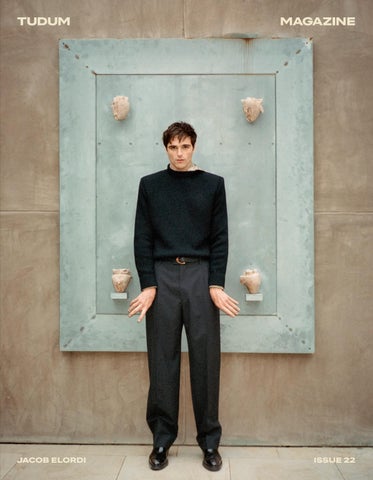
TUDUM MAGAZINE
TUDUM TUDUM
MAGAZINE MAGAZINE
ISSUE 22
JACOB JACOB ELORDI ELORDI
ISSUE ISSUE 22 22
Table of Contents 04 Queued Up 28 Features
30 George Clooney 38 Jay Kelly
44 All the Empty Rooms
48 A HOUSE OF DYNAMITE
138
WAKE UP DEAD MAN: A KNIVES OUT MYSTERY is the perfect whodunit in the hands of filmmaker Rian Johnson.
54 Left-Handed Girl 58 Book to Screen:
84 Craft Notes ON THE COVER
George Clooney photographed by Greg Williams. Jacob Elordi photographed by Isabella Elordi. To manage your subscription, reach out to tudum-magazine-info@netflix.com.
Tudum Magazine
30
GEORGE CLOONEY
plays a star of the screen in Noah Baumbach’s Jay Kelly. G E OR G E CLO ON E Y PH OTO BY G R E G W I LL I A M S . WA K E U P D E A D M A N : A K N I V E S OU T M YSTE RY PH OTO BY JO H N W I LS O N . JAC OB ELO R D I P H OTO BY K EN WO R O N E R . A H OU S E O F DYN A M I TE P H OTO BY E RO S H OAG L A N D.
Train Dreams 62 On the Scene 74 Wednesday’s Thing 80 Edward Berger 120 Jacob Elordi 128 Guillermo del Toro 134 Zoey Deutch 138 Wake Up Dead Man: A Knives Out Mystery 142 KPop Demon Hunters 148 Petra Costa & Geeta Gandbhir 152 Steve 156 The New Yorker at 100 158 Victoria Beckham 162 In Your Dreams 166 Dinner Party: Black Rabbit
3
142
KPOP DEMON HUNTERS finds a hero, and hope, in Rumi.
120
JACOB ELORDI
takes us on the set of Guillermo del Toro’s Frankenstein.
48
A HOUSE OF DYNAMITE
continues Kathryn Bigelow’s cinematic vision. Issue 22
About the Covers
GEORGE CLOONEY
MAGAZINE
ISSUE 22
George Clooney
The Jay Kelly star was joined by photographer Greg Williams for Tudum Magazine ahead of the debut of his latest film, directed by Noah Baumbach, at the Venice Film Festival. Williams has photographed Clooney previously, and he captured magic once again as he caught the moment the actor stepped onto the red carpet of the film’s world premiere. “George Clooney is a real movie star — that may sound obvious, but there are actually very few,” says Williams. “He gives his attention and energy and empathy to the fans, to the press, to the hotel staff, to the team. Everyone feels they’ve had a bit of his stardust sprinkled on them after an interaction. You believe he cares because he does. I feel it every time I photograph him.” TUDUM
JACOB ELORDI
MAGAZINE
ISSUE 22
Jacob Elordi
For his cover, the Frankenstein star was photographed by Isabella Elordi, whose work has appeared in Vogue Australia, Vanity Fair Italy, and Wonderland, and who also happens to be the actor’s sister. “I took this image of Jacob during the filming of Frankenstein,” Elordi says. “The frame with the heart sculptures seen in the background immediately captured the attention of both myself and Jacob, as it brought to mind the world of Frankenstein.” Of her collaborator and brother, who breathes life into the Creature in Guillermo del Toro’s latest, Elordi says: “Whenever we are together, we are creating. He is my muse, and I am so fortunate and grateful to be able to work with him.” Tudum Magazine
Filmmaker Kathryn Bigelow returns with the urgent political drama A HOUSE OF DYNAMITE.
DI T E L I TAT E P E R U M R E R I ST E N DUC I M U S A A D E AT I UM N UM F UG I A S E QU I D I T I S E T AC E S S E C UPTATUR? I D E LE CTI S I TI C O RPO R A S PI C I D U TA M E NI MI L I S QU E NIMI, NE CTI SIM
TUDUM
DI T E L I TAT E P E R U M R E R I ST E N DUC I M U S A A D E AT I UM N UM F UG I A S E QU I D I T I S E T AC E S S E C UPTATUR? I D E LE CTI S I TI C O RPO R A S PI C I D U TA M E NI MI L I S QU E NIMI, NE CTI SIM
Queued Up 06 THE BREAKTHROUGH
Grace Edwards
08 ARTIFACTS
Frankenstein
12 THE SUBJECT
Cover-Up
14 BY THE NUMBERS
KPop Demon Hunters
16 SPOTLIGHT
The Beast in Me
18 PLAYLIST
Black Rabbit
20 THE MAP
A House of Dynamite
22 PALETTE PLAY
Monster: The Ed Gein Story
24 SOUND BITES
That’s What They Said
26 THE LEGEND
William H. Macy Issue 22
The Breakthrough
Grace Edwards One month before Grace Edwards auditioned for the role of Daisy Kelly in Noah Baumbach’s Jay Kelly, she had an impromptu introduction to the director at the premiere of another film. “I was really shy and frightened to meet him,” says Edwards. “It just happened, spur of the moment; I don’t think we had any idea of what to say to each other, honestly.” A few weeks later, Academy Awardnominated Baumbach and Edwards would have plenty to discuss, as the young actor arrived in New York City to read — for the third time — for the role of Jay Kelly’s (George Clooney) youngest daughter. Though she still felt the nerves during the meeting, the actor’s representatives called her a week or so later, requesting to speak with “Daisy.” Edwards barely remembers the rest of that phone call. In Jay Kelly, Daisy is the impetus for her Hollywood-star father’s soulsearching. Confronted with a long and dazzling career, but fewer personal accomplishments to show for his life, Jay crashes his daughter’s trip to Europe — an attempt to cling onto their relationship and prove himself a good and present father. “Daisy’s well aware and ultimately hurt about her father’s absence in her life, but she’s also one of the few people left who actually loves him truly,” says Edwards. Tudum Magazine
Playing the daughter of a superstar isn’t new territory for Edwards. After landing roles in an episode of the anthology series Modern Love and the drama Call Jane, the LA-based actor played the child of a movie star in Wes Anderson’s Asteroid City, alongside Scarlett Johansson. Despite that experience, Edwards didn’t find Daisy’s life (a movie star parent and jaunt to Europe) the most relatable, but she was drawn to “her level of independence.” In one memorable scene, Edwards, Clooney, and Théo Augier Bonaventure (who plays Daisy’s boyfriend, Guillaume) sit around a table on a European train as the Italian countryside whips by outside. During that seven-minute continuous take, Edwards found herself “intrigued by George’s vivacity,” rather than intimidated by Clooney’s stardom. “It was all a bit perplexing, but it wasn’t because George was there per se — it was more because of the elements in the scene,” says Edwards. “There was a seven-minute sequence uncut, and there were a lot of different feelings we had to evoke.” Luckily, Edwards found herself responding to Baumbach’s directorial style and writing, particularly in those complex and emotive scenes. “We intuitively understood everything we needed to know through the script, and usually Noah would ask us if we had
any questions or even suggestions as we went along,” she says. “As a director, he’s rather quiet and methodical. He does like to do a lot of takes. But I think it’s honestly a meditative process for him as opposed to adjusting, critiquing. Sometimes I think he just allows the process to go on in its own time.” Baumbach is the most recent in a slew of Oscar-nominated directors with whom Edwards has shared a set. “I like that I’ve worked with so many different directing styles in the span of my very short career,” she says. “They have all been so different. I’m very curious about directors, not just in a creative sense, but in a psychological sense.” So after working on a film about Hollywood legacy, what kind of career does Edwards want to chase? That might be asking for a lot of perspective from a 22-year-old so early in their professional journey, but Edwards has an answer. “There are a lot of artists that I would like to meet or work with — and learn more about their medium,” she says. “People like Charlie Kaufman, Yorgos Lanthimos, Craig Mazin, Sean Baker, M. Night [Shyamalan], Kathryn Bigelow — I really enjoy their work. So if I could one day be in a room with them, ask them questions and get to know what their individual process is, that would be really special to me.” Jay would tell her to shoot for the stars.
P H OTOG R A P H BY R OB H A R R I S .
The actor discusses her breakout role in Noah Baumbach’s Jay Kelly and working with George Clooney. By Ruthie Kinane
7 Grace Edwards on the set of Jay Kelly, in which she plays the youngest daughter of the titular character.
Frankenstein Artifacts
1
More than two centuries ago, the 18-year-old Mary Shelley began writing a novel called Frankenstein, which she published anonymously two years later. Her story of a brilliant scientist with an ambition to play God and his monstrous experiment remains as relevant today as it was in 1818, and filmmaker Guillermo del Toro’s cinematic adaptation is a vivid rendering of the totemic tale. Here’s a closer look at 10 of the objects that linger through the epic drama Frankenstein. Tudum Magazine
9 2
5
4
1. ELECTRIFYING CHEST PIECE & 2. CREATION HELMET Ingenious yet tormented, Victor Frankenstein (Oscar Isaac) is driven by an intent to defy death. A striking chest piece and creation helmet, made out of silver and wired to electrify, adorn the body of the Creature (Jacob Elordi) as Victor completes his biggest experiment: bringing life to the lifeless. 3. LETTER FLASHCARDS After fleeing Victor’s lab, the Creature ventures through the woods before stumbling upon a family and their farm. He hides in their mill, making an effort not to be seen, as he watches and studies them. As a blind man (David Bradley) uses these cards with letters and symbols to educate his grandchild on the alphabet, the Creature’s own vocabulary gets stronger.
3
4. LEG BRACE When he realizes the power of his creation, Victor seeks to destroy it, setting the entire lab on fire. As he flees the burning structure, he hears the Creature calling his name and has a momentary change of heart as he attempts to re-enter his once-promising workspace. But the combustible power that has been building inside explodes before Victor can get in, destroying his leg and requiring him to wear a prosthetic leg brace for the rest of the film. 5. FAMILY RING The men of the Frankenstein family share a complex dynamic shaped by the death of their matriarch (Mia Goth). Despite his resentment of his father (Charles Dance), Victor can be seen sporting the same ornate ring that the elder Frankenstein wears throughout his childhood.
Issue 22
Artifacts
6
7
Tudum Magazine
11
6. SKETCHES After being shunned by the academic establishment for his unprecedented methods, Victor receives resources from the mercurial Harlander (Christoph Waltz) that allow him to finally play God: his notebook of sketches, which contain all his epic scientific aspirations, from intricate machinery to creating a man out of forged body parts.
9
7. SURGICAL GLASSES Victor’s safety gear might seem more at home at a rock concert than at the helm of an operating table. “Guillermo and I talked a lot about approaching Victor like a musician, like a rock star,” Isaac says. “He’s not the scientist — we’ve seen that a lot. He’s a misunderstood artist, and that fuels him to provoke. That punk rock energy was an important thing. When Victor walks into the lab for the first time, he’s imagining it like a stage, not as a lab. That was a really unexpected way to hook into the guy.”
8
10
8. DARK ANGEL Grief at the loss of his beloved mother isn’t the only thing Victor carries into adulthood: A statue of a double-winged angel that stood tall in his childhood manor ultimately finds a home in his sleeping chamber in the laboratory he creates inside an old water tower. “Guillermo actually painted the face himself because he’s a very good artist,” explains production designer Tamara Deverell of the figure. In moments of mania, the angel comes to life in Victor’s nightmares, set ablaze. 9. ELIZABETH’S FAN The empathetic and luminous Elizabeth, also played by Mia Goth in a dual role, brings some much-needed lightness into Victor’s world. Costume designer Kate Hawley favored a brighter color palette of blues and greens for her character, inspired by beetles. “Guillermo wanted Elizabeth to be very ethereal, and there’s an iridescence and ephemeral nature to some of those colors and fabrics that helped us,” says Hawley. 10. VICTOR’S BACKPACK After losing all that matters to him, Victor traverses the Arctic with his frost-tinged belongings to find the Creature and destroy him once and for all. “Guillermo talked about white being a really important color and how it represents death,” says Hawley. “When we’re talking about the Arctic, it’s almost like a limbo. It’s almost that place between heaven and hell.”
Issue 22
Cover-Up The Subject
Seymour Hersh didn’t want to be the focus of the story. Filmmaker Laura Poitras had first reached out to Hersh — a Pulitzer Prize–winning journalist who uncovered the My Lai massacre during the Vietnam War, probed the Watergate scandal, reported on the torture and abuse of prisoners at Abu Ghraib, and more — about making a documentary on him two decades ago. He rebuffed the idea of a lens being turned on himself. Luckily, Poitras, the Academy Award–winning documentarian behind Citizenfour and the Golden Lion winner All the Beauty and the Bloodshed, and Emmy Award winner Mark Obenhaus (Steep), who spent years collaborating with Hersh on PBS Frontline reporting, continued to pursue the story, and the result is their expansive documentary Cover-Up. Both a riveting portrait of Hersh and a timely political thriller, the film chronicles the journalist’s reporting and his exposure of a pattern of impunity within the US military and intelligence agencies, told through stacks of his own meticulous notes, primary documents, and archival footage. “This is a film I’ve been wanting to make for over two decades, and I’m so grateful that Sy finally relented,” Poitras says. “It is an honor to introduce younger generations — particularly young journalists — to Sy’s outsider muckraking reporting.” Obenhaus adds, “Through him, the film speaks to the essential role of investigative journalism in holding the powerful accountable.” The documentary recalls Hersh’s beginnings as an AP reporter who covered the Pentagon, and how a keen instinct for the right questions of the right sources can lead to an eradefining political discovery. “What you simply have to do is find those people, and then they talk to others, you find them, and then they talk to others,” says Hersh, but Cover-Up ruminates on the nuances of being a journalist and the complicated landscape they find themselves in today. “I was watching the movie ... [and] it was sort of fascinating to see what [Laura and Mark] did,” Hersh says. “This is a time when journalism needs all the support it can get.”
Journalist Seymour Hersh.
Tudum Magazine
P H OTO C OU RT E SY OF T H E N E W YO R K T I M E S / R E D UX .
Journalist Seymour Hersh is the story in Laura Poitras and Mark Obenhaus’s captivating documentary Cover-Up. By Jenny Changnon
13
By the Numbers
KPop Demon Hunters
3
Dive into the facts and figures behind the film beloved around the world.
MILLION+ likes on the official KPop Demon Hunters TikTok account, a number that keeps growing as fans on social media support the film. From costume re-creations to viral dance trends, users have also been creating their own content to show their love.
#1
most popular film of all time
on Netflix, enjoyed by millions around the world.
4 songs in the Top 10 simultaneously of the Billboard Hot 100
making KPop Demon Hunters the first film soundtrack to ever reach such heights. Songs “Golden,” “How It’s Done,” “Soda Pop,” and “Your Idol” achieved the record, and also marked the first time in 30 years that a soundtrack had four Hot 100 Top 10s at all. Thanks to HUNTR/X, the group at the center of the film voiced musically by EJAE, Audrey Nuna, and Rei Ami, “Golden” hit the No. 1 spot, the first time a song of three or more members topped the charts since Destiny’s Child’s “Bootylicious” in 2001.
Tudum Magazine
541,800,000 hrs
viewed on Netflix, as of Oct. 1, 2025. What makes that number all the more impressive is that, with a runtime of one hour and 40 minutes, it is the shortest film on the Top 10 English language films of all time.
+ 1K
15
sold-out sing-a-long screenings
3B
+
across the US, Canada, Australia, New Zealand, and the UK. Fans flocked to cinemas to belt their hearts out to the film’s anthems.
global streams of the songs featured on the soundtrack With the cast welcoming 58 million Spotify monthly listeners as of October 2025, the hits keep on playing. EJAE, who co-wrote several songs as well as performed as Rumi, found that the K-pop genre worked well not only in creating pop songs, but also in animation. “K-pop is very maximalist, there’s a lot of harmonies, a lot of background vocals,” she says. “That translated beautifully into film.”
25
costumes designed for the protagonist Rumi. Between stage looks and cozy hoodies, Rumi and her bandmates are setting trends globally.
Issue 22
The Beast in Me Spotlight
An ill-fated biography of Ruth Bader Ginsburg, a divorced woman grieving the death of her son, and a real estate mogul who wants to build a running path through a sleepy Long Island town may seem like an odd launching pad for a limited series. But that’s fitting, because the thrilling drama The Beast in Me is anything but traditional. Aggie (Emmy– and Screen Actors Guild Award–winning Claire Danes) is a Pulitzer Prize–winning author struggling to make a dent in her new book on RBG while processing the tragic death of her son and the thorny dissolution of her marriage. It’s no wonder, then, that she snaps at her new neighbor, the arrogant Nile Jarvis (Emmy winner Matthew Rhys), who has fled his home in NYC amid scandal (did he kill his first wife?) as he tries to bully her into signing over some land rights. What follows is an exquisite cat-and-mouse mystery as Aggie and Nile become increasingly attracted to and simultaneously repelled by each other, and uncover each other’s darkest secrets. The Beast in Me represents a reunion between Danes and showrunner, writer, and executive producer Howard Gordon,
Tudum Magazine
who collaborated for eight seasons on Homeland. Gordon, for one, is thrilled to reteam with his former lead. “[Claire] has that rare, uniquely rare, ability to convey the most interior thoughts and you know what’s going on in her. I’ve never seen an actor able to respond so quickly on the set to a note,” he says. Finding the right person to play Nile was a challenge, says Gordon. The producers were looking for a “dangerous, charming, and even vulnerable” performance — words that are rarely used to describe an accused killer. “Not only was I surprised by [Matthew and Claire’s] chemistry,” Gordon says, “but how virtuosic he was. Colors that I’d only hoped for and imagined were so much more vivid. He really played every corner and every edge of his silences.” The show is named for a Johnny Cash ballad about the difficulty of containing your worst impulses, a theme that runs throughout the thriller. “Sometimes we are quick to make assumptions and to be led to believe what we want to,” says Gordon. “To look at it from another angle, do we have the humility and the compassion to listen and revise the narrative?”
A DD I T I ON A L R EP O RT I N G BY J OH N D I LI LO.
Claire Danes and Matthew Rhys embrace their dark sides in this propulsive thriller. By Henry Goldblatt
17
“[Claire] has that rare, uniquely rare, ability to convey the most interior thoughts and you know what’s going on in her.” HOWARD GORDON
Nile (Matthew Rhys) and Aggie (Claire Danes).
Issue 22
Playlist Vince (Jason Bateman) and Jake (Jude Law).
Black Rabbit By Madeleine Saaf-Welsh From the jump, music was always a key component in Black Rabbit for Kate Susman and Zach Baylin, co-creators of the limited series. “Zach and I lived in New York for about 17 years,” says Susman. “We’re big into food and music, and we started thinking about a TV show that we might want to make together.” They wrote a series about two brothers who were musicians before entering the New York restaurant scene with their nightlife hotspot, Black Rabbit. To create the music of the fictional band, called the Black Rabbits, once helmed by brothers Jake (Jude Law) and Vince (Jason Bateman), they turned Tudum Magazine
to a guitarist who has long crafted the soundtrack of the city: Albert Hammond Jr., of the Strokes. “We had lived in New York all throughout the early 2000s when the Strokes were launching, and we’re huge fans,” says Baylin. “At the top of our wish list was that maybe we could get Albert to write a couple [of songs].” Hammond Jr. joined, writing “Outside People” and “Turned to Black” for the series. “My day job is playing guitar in the Strokes, so being given the opportunity to be structured in different ways and using the tools I have to enhance something is very exciting. It really came together. When we were doing vocals with Jude, he
said sometimes some of the lyrics on the demo song just felt like they were part of the show. I’m still so excited that they like the songs so much.” Another artist who joined the Black Rabbit soundtrack to fill the fictional place with a modern sound is British singer-songwriter and six-time BRIT Award winner Raye. From her haunting cover of “What a Difference a Day Makes” to her original song “Genesis,” the artist adds to the rich sonic landscape of the soundtrack, developed by music supervisor Gabe Hilfer. To set the mood for your own dinner party, queue up the Black Rabbit playlist.
19 SONG TITLE
PERFORMED BY
EPISODE
TIMESTAMP
“We’ve Been Had”
The Walkmen
01
00:01:02
“I Choose You”
Willie Hutch
01
00:12:30
“Just a Test”
Beastie Boys
01
00:29:27
Jude Law and Albert Hammond Jr
02
00:04:25
Raye
03
00:29:50
Jude Law and Albert Hammond Jr
05
00:17:34
Eels
05
00:23:23
Run the Jewels
06
00:33:50
Interpol
07
00:55:00
The Strokes
08
00:00:03
Dinah Washington
08
00:47:52
“Turned to Black”
T H E WA L K M EN : M ED I OS Y M E DI A / G ET T Y I M AG E S ; T H E ST R OK E S : PI E TE R M . VA N H ATTE M / C O N TO UR C O URTE SY O F G E TTY I M AG E S .
“What a Difference a Day Makes” “Outside People” “Prizefighter” “Blockbuster Night, Pt. 1” “Untitled” “You Only Live Once” “Manhattan”
“We’ve Been Had”
The song that introduces the audience to Jake, as he looks at himself in a mirror on a night at Black Rabbit that is about to unfurl into life-changing chaos, comes from the 2002 debut album of New York City band the Walkmen. Hamilton Leithauser’s raw vocals prepare the audience for the gritty, frenetic ride they are about to join.
“What a Difference a Day Makes”
In less than a week, the cover Raye recorded for the series accumulated over 300,000 streams on Spotify alone. “There was something nostalgic about the mood of the restaurant, and what the brothers were trying to evoke,” says Baylin. “Having someone like Raye, who is both incredibly modern but also has this sort of old soul to her, really spoke to the mood of the piece.”
“You Only Live Once”
The final episode includes a flashback to the day Jake and Vince officially made moves to open Black Rabbit, and the Strokes’ track playing in the background couldn’t encapsulate a time and place better. New York in the mid-2000s was awash with the wave of music that the Strokes ushered in with their 2001 debut album Is This It and continued for years to come, including with this single from their third album.
Issue 22
The Map
49th Missile Defense Battalion,
FORT GREELY, ALASKA
Major Daniel Gonzalez (Anthony Ramos) is a crew commander at the military base that operates and maintains Ground-Based Interceptor missiles designed to detect, track, and destroy incoming ballistic missile threats.
In director Kathryn Bigelow’s thrilling drama A HOUSE OF DYNAMITE, a single, unattributed missile is launched at the United States, and a race begins to determine who is responsible and how to respond. The teams and government agencies tasked with understanding the dire threat are scattered across the US, connected only by phone and video call. Take a look at the locations of the key players.
US Strategic Command
(USSTRATCOM) BELLEVUE, NEBRASKA
Led by General Anthony Brady (Tracy Letts), USSTRATCOM is the Department of Defense combatant command that oversees the command and control of US strategic forces, including nuclear and missile defense operations.
A House of Dynamite Tudum Magazine
21
Chicago
The trajectory of the unidentified missile lands it squarely in Chicago, where Secretary of Defense Reid Baker’s (Jared Harris) daughter Caroline (Kaitlyn Dever) lives.
Marine One
As the crisis unravels over the course of 20 minutes, the president (Idris Elba) is confronted with a monumental decision aboard Marine One, with Lieutenant Commander Robert Reeves (Jonah HauerKing) by his side.
Raven Rock Mountain Complex PENNSYLVANIA
A secure underground military facility located in Pennsylvania designed to serve as an alternate government command center in the event of a national emergency.
WASHINGTON, DC
The Pentagon
The headquarters of the US Department of Defense and the Office of the Secretary of Defense where Baker advises the president on defense policy.
The White House
SITUATION ROOM
Captain Olivia Walker (Rebecca Ferguson) and Admiral Mark Miller (Jason Clarke) oversee the “Watch Floor” of the Situation Room, a 24/7 intelligence center that provides the president and senior staff with real-time information, crisis management support, and secure communications during national and international events.
Federal Emergency Management Agency (FEMA)
Cathy Rogers (Moses Ingram), the director of the Office of National Continuity Programs at FEMA, arrives to work for a day like every other when she discovers she’s on a list of government agency employees marked to be evacuated to Raven Rock Mountain Complex.
Issue 22
Palette Play
Monster: The Ed Gein Story Threads of significant color are woven into the fabric of the Monster anthology. Created by Ryan Murphy and Ian Brennan, the limited series has homed in on a signature hue for each of its installments: In DAHMER – Monster: The Jeffrey Dahmer Story, a dirty yellow shade mirrors the moral decay of its central serial killer; Monsters: The Lyle and Erik Menendez Story utilizes a cool blue that contrasts with its sunny Los Angeles setting; and in the latest entry, Monster: The Ed Gein Story, a sinister green infiltrates the killer’s world.
Flashes of green throughout episode four, integrated by all departments on the Monster set. Characters including Ed Gein (Charlie Hunnam), Bernice Worden (Lesley Manville), and Evelyn (Addison Rae) inhabit the emerald world of the series.
Tudum Magazine
23 “Whenever I do anything, I always have a general first concept meeting with all of the department heads. What I like to do is talk about, ‘This is the reason why I want to make this, this is what it’s about, this is the feeling of it and the light of it,’” says Murphy of the visual language of the Monster anthology. “We always spend a full year designing the show. Every season
has a color, it has a tone. It’s very timeconsuming, but fun.” The third season focuses on Ed Gein, played by Charlie Hunnam (Sons of Anarchy), who haunted the frozen fields of rural Wisconsin, killing and desecrating the bodies of multiple women throughout the 1950s, and whose crimes would go on to inspire all-time
classic horror films including Psycho, The Texas Chain Saw Massacre, and The Silence of the Lambs. The eerie green of the season permeates Gein’s obsessions and victims, like in the women’s underwear he lusts after, and the hardware store staffed by Bernice Worden (Lesley Manville), an older woman who shows kindness for Gein before becoming one of his victims.
Issue 22
Sound Bites “I read the film and I was blown away. I felt scared. I felt the importance of what she was going to make.”
That’s What They Said
Familiar voices had some things to say on Netflix podcasts. Scan the QR code to listen to the latest Netflix podcasts.
“The things that scared me the most I fell in love with in order to cope. And I think that that is the origin, probably, of my love of monsters.” GUILLERMO DEL TORO, SKIP INTRO Tudum Magazine
R E B EC CA F E R G US O N BY D I M I T R I O S K A M B OU R I S / GE T T Y I M AG E S F OR F LC; GU I L LE RM O D E L TO RO BY KATE G RE E N .
REBECCA FERGUSON, SKIP INTRO
25 “I played Maid Marian in Robin Hood. I think I was the only fellow that wanted to wear a wig and a dress.”
LO UI S PA RT R I D GE BY P E T R OS ; J E N N A ORT E GA BY ST I L LM OV I N G. N E T; A R DE N CH O BY C H A RLE Y GA LL AY; JA S O N BATE M A N BY JA S O N ME NDE Z .
LOUIS PARTRIDGE, SKIP INTRO
“We were trying chunky sandals with white socks. Wednesday doesn’t like showing skin.” JENNA ORTEGA, WEDNESDAY SEASON 2 OFFICIAL WOECAST
“I feel like sometimes the heart is always gonna be Southern. I feel like when I’m down South, the y’alls come right back.” ARDEN CHO, SKIP INTRO
“If I look like somebody that just got off a stage and unplugged his guitar, all the better.” JASON BATEMAN, SKIP INTRO Issue 22
The Legend
William H. Macy The performer has much in common with the character he brings to life in Train Dreams. By Jenny Changnon William H. Macy is no stranger to the elements: In Fargo, he braved freezing snowfall as Jerry Lundegaard; his “Quiz Kid” Donnie Smith sought shelter from a frog-drenched rainstorm in Magnolia; as Frank Gallagher in Shameless, he embraced a different kind of force of nature as he looked after a brood of unruly children across 11 seasons. So when the forest-set Train Dreams came his way, he felt right at home. “I got the script in the morning. I try to read scripts fast. This one, I think I read it the morning it came in, and it was love at first sight. I was smitten,” he remembers. “I do a lot of independent films and I had a lot of work around that time, and they were jammed
William H. Macy as logger Arn Peeples in Train Dreams.
Tudum Magazine
in rather tightly, but I said, ‘I’m doing it.’ And that was it. I mean, instantaneous decision and I never looked back.” In the moving drama, Macy lends his signature humanity to Arn Peeples, a logger in the Pacific Northwest during the early 20th century, whose way of seeing and embracing the living world leaves a lasting impression on fellow laborer Robert Grainier (Joel Edgerton) and reverberates through what Macy calls the “delicious melancholia” of the film long after the character leaves the screen. “He’s complicated, which I love. He’s funny, which I adore. He’s got a great name, Arn Peeples,” says the Academy Award–nominated actor.
“How can you say no to playing Arn Peeples?” But that’s not the only thing that the performer couldn’t pass up: Like Arn, Macy has an affinity for woodworking. “He loved the trees. And I love trees. I’m a bit of a carpenter. I turn bowls on a lathe, wooden bowls, so I collect all kinds of wood,” he says. “I’ve been such a fan of William H. Macy’s for so long,” says Train Dreams director Clint Bentley of the actor. “I grew up watching his movies, and was a bit nervous to work with him, just because of being such a fan.” Bentley, along with co-writer Greg Kwedar, adapted the script from Denis Johnson’s novella of the same name. “Arn Peeples is a character who, even in the book, is just kind of larger than life. It’s a character that’s hard for an actor to maybe step into and make their own,” Bentley says. “Bill brought Arn to life in such an indelible way, and brought so much nuance to that character. He was just such a kind and generous and brilliant actor to work with.” Macy relished working with fellow Oscar nominee Bentley, who co-wrote Sing Sing with Kwedar, and the thoughtful yet joyous atmosphere the filmmaker cultivated. “The feeling on the set that Clint engendered was, it was a happy set. It was a contemplative set. He is not afraid to talk about the scenes and what they mean and what’s going on in them,” recalls the performer. “When the scene was over, he let the camera roll and he said, ‘Keep going.’ And I wasn’t raised that way. I was raised onstage where ad-libbing is a criminal act at worst and boring at best. You just don’t ad-lib in the theater. But the scene would roll on, and we just kept going. And I was having the time of my life.”
P ORT R A I T BY CH R I ST I N A H O US E / LO S A N GE L E S T I M E S V I A C ON TOU R R A . A DD I T I O N A L RE PO RTI N G BY K RI STI N I VE RS E N .
27
Issue 22
TUDUM JAY KELLY ALL THE EMPTY ROOMS A HOUSE OF DYNAMITE LEFT-HANDED GIRL TRAIN DREAMS WEDNESDAY BALLAD OF A SMALL PLAYER FRANKENSTEIN NOUVELLE VAGUE WAKE UP DEAD MAN: A KNIVES OUT MYSTERY KPOP DEMON HUNTERS APOCALYPSE IN THE TROPICS THE PERFECT NEIGHBOR STEVE THE NEW YORKER AT 100 VICTORIA BECKHAM IN YOUR DREAMS BLACK RABBIT MAGAZINE
GEORGE CLOONEY is JAY KELLY The Oscar winner teams up with Noah Baumbach for a portrait of a movie star at a time of reflection. BY JOHN DILILLO
32
IN NOAH BAUMBACH’S JAY KELLY, GEORGE CLOONEY PLAYS A MOVIE STAR IN CRISIS. The star of Ocean’s Eleven, O Brother, Where Art Thou?, Up in the Air, and Michael Clayton takes on the title character, a beloved actor who sets out on a journey of self-discovery, a little late. “If you make a movie about an actor, you’re inherently making a movie about identity and performance,” Baumbach says. “We come to points in our lives where we’ve settled on an idea of ourselves.” For Jay Kelly, that idea is about to be challenged. In the film, following the loss of his mentor (Jim Broadbent) and an unpleasant encounter with an old friend (Billy Crudup), Jay has an epiphany: All that time spent on movies has left the rest of his life neglected. He travels with his faithful manager Ron (Adam Sandler) from Los Angeles to a film festival in Italy, where he’ll be honored in a tribute — and it’s a journey that has him reexamining his career and relationships, both professional and familial, along the way. “The character has a lot more regrets than I would have,” Clooney says. “Luckily for me, fame came much later in life. I got to figure out how to live life before I figured out how to be famous. And I don’t think this character did.” Unlike the young hotshot Jay Kelly, Clooney did not truly find his sea legs as an actor until he was 33, as a star in television’s medical drama ER in the ’90s (He’d started out onscreen a decade earlier with a recurring role on the sitcom E/R.) He pivoted to film with a series of winning performances, including Steven Soderbergh’s Out of Sight and Michael Hoffman’s One Fine Day. Since then, Clooney has worked with a number of acclaimed filmmakers multiple times, including Soderbergh, Robert Rodriguez, and the Coen brothers. He’s also won an Oscar (for 2005’s Syriana), transitioned to directing himself (with films including 2002’s Confessions of a Dangerous Mind and 2020’s Tudum Magazine
The Midnight Sky), and taken to the stage (in his hit Broadway adaptation of his own film Good Night, and Good Luck). Jay Kelly is Clooney’s first live-action collaboration with Frances Ha, White Noise, and Marriage Story director Baumbach, who co-wrote the film with BAFTA-nominated actor (Lovely & Amazing, Match Point), writer (Doll & Em), and director (The Pursuit of Love) Emily Mortimer. Clooney had previously voiced the lead role in Wes Anderson’s Fantastic Mr. Fox, which Baumbach co-penned. It didn’t take much convincing for Clooney to join Jay Kelly. “Even before I read it, I was interested because it’s Noah,” Clooney says. “It’s very funny and it’s very touching and I thought it would be fun to do.” Clooney understood how to portray a character at a crossroads. “He’s coming to terms with the idea that maybe he hasn’t been such a great friend or father,” Clooney says. “He has just been really good at being a movie star.” That’s the contradiction at the heart of Jay Kelly: A movie star has to be himself, but bigger and more intimate at the same time. And when all of that energy is put into creating an onscreen persona, what’s left for real life? What drew you to Jay Kelly? George Clooney: First and foremost it’s the director and writer, who happen to be the same guy, Noah. Noah Baumbach is an incredibly gifted, talented man. The script had some beautiful storytelling and some beautiful moments in it. The idea of being able to do a film about a guy who is still kind of an infant out in the world was a really fun idea. As an actor, was there something that particularly resonated with you about playing an actor? Clooney: Noah and I talked about how one of our great pet peeves is how movies that are about making movies can be so inaccurate. So, we really worked to make sure that we were depicting what we do accurately. Then there are all of the other things that come behind the scenes that people don’t often see, although they’re seeing more and more of it because of things like social media. We really wanted to focus on telling the story, giving everybody some idea of being very famous and also not really knowing how to deal with real-life things. I’ve met some people who got famous really early in life. My aunt was one of them, actually. She was a famous singer. She acted in a couple of movies, like White Christmas. Because she was so famous at 19 years old, she hadn’t really been in the world long enough, and so she didn’t handle fame very well, particularly when it started going away. I’ve always felt, again, very lucky that it took such a long time for me, but also it gave me a chance to learn how not to be Jay Kelly in real life.
George Clooney plays Jay Kelly opposite Adam Sandler as Ron Sukenick.
Tudum Magazine
“I GOT TO FIGURE OUT HOW TO LIVE LIFE BEFORE I FIGURED OUT HOW TO BE FAMOUS. AND I DON’T THINK THIS CHARACTER DID.” George Clooney
George Clooney
Issue 21
36
How would you describe your first experience being directed by Noah Baumbach? As a director yourself, how would you sum up his style? Clooney: Noah is one of those sort of savants. He knows exactly what he wants. He’s a really good storyteller and I really enjoy being directed by him. I like his ideas and I like how this is a different film for him in a lot of ways. It’s a bigger scale film, cinematically, though almost all of the things we’re shooting are in-camera instead of visual effects. When you see these transitions to memories that go from a plane to an acting class, there’s actually a plane built and an acting class built on top of it. I did a film called Confessions of a Dangerous Mind that way, so I really can appreciate the idea of having all of these things play in one shot. The opening shot is a 10-page oner with 30 actors, and it’s really exciting. So, visually, it’s going to be really quite something and a real departure. Emily Mortimer co-wrote the script. What was it like working with her? Clooney: When I first got the script, there was no cover page. And so I didn’t know that she was a co-writer. I came to rehearsals and I was like, “what is Emily doing here?” It’s fun when it’s actors who are writing, because some of the things that she writes about, I really recognize, being an actor. It’s really fun to see her put that to paper, or to a computer, I suppose (I still use paper). But look, what a talent, my God. She’s directing a film [Dennis], she can write, she’s an extraordinary actor as well. Baumbach is known for assembling incredible ensembles. Can you talk a little about the rest of the cast? Clooney: I first worked with Laura [Dern] in 1984, 40 years ago, doing my first film. We were in Budapest doing a movie Tudum Magazine
called Grizzly II, which was financed by this Hungarian group. It was literally communist Hungary at the time, and they ran out of money and got stuck in Hungary. Laura and I got to be very close friends and spend time together. The movie never came out for 40 years. A few years ago, somebody got some money together and released it. We get eaten by a bear in the first scene, and now it’s like, “Laura Dern and George Clooney starring in ...” and they put a movie together. It’s just God-awful. So it’s really fun to just spend time with her and to work with her. Billy Crudup and I have been friends. I’ve been watching him. He’s so good in everything. I remember seeing him on Broadway, and he’s just a very special, gifted actor. Riley Keough is just an elegant, talented actress. She’s very unassuming and you don’t understand how good she is. Grace Edwards, who plays my youngest daughter, is really good. Patrick Wilson and Isla Fisher I’ve been friends with for 20-some years. Patrick is one of those actors, every time he’s in something, he’s good. Stacy Keach, my God, he is really exciting. He’s really sweet and funny. The cast is spectacular. It’s a well-known fact that you’re a big fan of Italy. What’s it like filming there again? Clooney: We have a home in Lake Como and we were [filming Jay Kelly] in Milan, which is about an hour drive away, so everybody stayed there for a little bit. I love shooting in Italy. It’s my favorite place to be. I’ve shot tons of movies and TV series and Nespresso commercials there. When I bought the house in Italy, the first night I got there, I looked out the window in the town, and there were these construction workers walking home, and they had, like, those orange vests and no shirt, gut out to here, but they had a loaf of bread and a bottle of wine and they were singing. America is a young country, and we’re in a hurry all the time. We live to work and Italians often work to live — not everybody, obviously. That’s why I stayed there and why I continued to go back. There’s a celebration of life, in a way that we could learn from in the States. We’re always in a hurry to get to the next destination. And the theme of this film is, you know, you’re gonna get to that next destination and you’re gonna be in a hurry to get to the next one. And days turn into months and months turn into years. What is it that you hope audiences will enjoy most when watching this film? Clooney: When you work in my industry, what you’re really hoping to do is buy somebody two hours away from the things that make them crazy: work, family, anything. And so this hopefully is a diversion for a couple hours that does that. And if that’s what we do, then we’ve succeeded massively at doing our job.
ON T H E P R EV I O US PAG E : P H OTO GR A P H BY P E T E R M O UN TA I N .
Adam Sandler plays Jay’s long-suffering manager, Ron. What was it like working with Adam? Clooney: Adam and I have been friends for 25 years or so. I really like him. We play basketball together, throw a baseball around. He’s really funny and he’s got a great family. But I think sometimes what gets overlooked with Adam is his skill as an actor. Sometimes it’s because he does big funny movies that people don’t think require the kind of talent that it actually requires. This is a movie that continues to expose his talent. He’s done some films that have proven that over the years and everybody sees it, but it always kind of gets dismissed. And he likes that, by the way. He likes to sort of downplay it. But what he does in this film is extraordinary. It’s a great character. He plays my manager and he has to sort of work at Jay Kelly’s pace all the time. It’s demeaning at times, and exhausting, and he does it beautifully.
The cast of Jay Kelly bring to life a human and humorous exploration of self-discovery.
BY MADELEINE SAAF-WELSH
entourage
40
j
Jay Kelly opens on a soundstage during the production of a film within the film. However, Noah Baumbach’s latest feature is not an exploration of filmmaking — rather, it’s about what happens when a film, and more particularly its star, enters into the world. The story picks up on the last day of shooting, just as its lead actor, Jay Kelly, heads off on what will be an unexpected journey spanning countries and memories. “It’s a movie about a movie star who represents our humanness and our vulnerabilities and our failings,” says writer and director
Baumbach. “I start to sound kind of stoned if I talk about it too much. The points of identification are multitudinous.” To play his movie star, Baumbach needed to cast a man that could remind audiences of the thrill of seeing their hero onscreen once again. Enter George Clooney. “George is a timeless movie star,” says Baumbach. “He could be a movie star in any era, and there’s something really appealing about that. We never wanted to make a movie about Hollywood now. It is now, but we were interested in other things.” After the loss of a mentor, a surprising encounter with a friend from another era, and a looming empty nest, Jay is forced to take stock of what his monumental career success has meant for his relationships. As much as Jay Kelly takes place in the present, it invites Jay and the audience into defining moments throughout his past.
“George has a way where you know where he is at all times,” Baumbach notes of Clooney’s particular talents. “It’s such a clear performance in such a complicated emotional area, and that’s what it had to be. I think that’s an incredible gift. It’s something that not a lot of actors can do, that kind of storytelling. It offers the audience a form of identification and projection that I think is incredibly pleasurable, because you’re always exactly where you need to be with Jay at any given point of the movie.” While the world of Jay Kelly revolves around the life of its singular star, it is as much a tribute to the constellation of people in Jay’s orbit. “It was important that everyone we meet on Jay’s journey suggest a whole life outside of the film,” says the director. “I like a big cast and lots of speaking roles. The dialogue at times is like music. There’s a certain energy
From left: Candy (Emily Mortimer); Ron (Adam Sandler); Timothy (Billy Crudup) and Jay Kelly (George Clooney); Liz (Laura Dern).
Tudum Magazine
41
to the 1930s and 1940s, the screwball comedies, that my co-writer, Emily Mortimer, and I respond to and love.” And so the writing duo crafted the deeply human, often humorous characters who surround their protagonist. Jay’s world includes the part of his entourage he’s accrued across his career — his manager Ron (Adam Sandler), his publicist Liz (Laura Dern), his old drama class compatriot Timothy (Billy Crudup), his mentor Peter (Jim Broadbent) — and those from his familial life, including his daughters Daisy (Grace Edwards) and Jessica (Riley Keough), and his father Ben (Stacy Keach). Mortimer, an actor and director herself, found that the lives of the ensemble characters enriched the story they were telling on the page. “[Jay Kelly’s] on his hero’s journey, but so is everybody else in the movie. Everyone
has a life journey that is full of all the ups and downs and roundabouts,” she says. Ron’s journey is perhaps the most visible, as he juggles his family and his other work obligations while he traverses Europe to bring his star client Jay to a film festival tribute event. As other people along Jay’s ride make exits, Ron remains steadfast. “Emily and I were thinking that it should be Adam from the beginning,” says Baumbach when recalling casting the weary manager. “Ron is so giving and caretaking and sweet, and there’s an inherent humor in what he’s going through, being pulled in so many directions. Adam has such a genuine heart and has such a close-knit group of people who have been with him for his whole career in so many roles, which speaks to his loyalty and generosity. So I knew he could identify with the caretaking side of Ron.” Sandler was ready to pull from his own
decades-long experience in the business to craft the character. “I’ve met many Rons in my last 40 years of working. I’ve met a lot of nice people along the way who have helped me, thought of me, and put stuff aside in their lives to make sure that mine was going smoothly when I needed them,” says the actor. “This movie is not just about show business. Jay Kelly is about work and life, and about what comes first. It’s about putting aside some of your goals to make sure that your family’s thought of, put first, and never left alone; that they’re the first instinct, and the priority. I connected to that. I always want to be like that. I’m not like that every time, but I feel my best when I am.” Clooney and Sandler were joined by a cast of Hollywood heavy hitters and fresh faces, each with experience that enhanced their insights into their roles. Dern, who won an Oscar for Marriage Story, her
Issue 22
previous collaboration with Baumbach, saw beyond the résumé of publicists to the heart of the job. “That combination of mother hen, protector, fixer, manager, life coach — what an amazing profession,” says the actor. “When done with grace and when done with class, it’s an unbelievable, rare gift in your life, and kind of an amazing human. I have known many and I have definitely stolen from a few.” Bringing together this caliber of talent, handled thoughtfully by casting directors Nina Gold and Douglas Aibel, created opportunities to capture magic moments when the cameras were rolling. Crudup, whose character has a particularly charged interaction with his estranged friend Jay early on in the film, was enlivened by the dynamic that Baumbach, his crew, and the other actors were able to create on set. “When you have the ability to work with people who don’t have an expectation,
Tudum Magazine
but are just going to set the table for you in a collaborative way, it’s rare and pretty spectacular,” he reflects. “And there was no judgment from one take to the next. We did a lot of different takes and investigated a lot of different nuances, and I didn’t feel proprietary over any of it. I just felt grateful to be in the room trying to execute something complicated.” To play Peter, the director who once launched Jay’s career but from whom Jay has long since moved on, Baumbach turned to an actor he’d long been looking to work with: Jim Broadbent. “We needed somebody who was going to be formidable,” he explains, “but also someone who could play the other side of it, which is the guy who now no longer has the power he once had, who’s hustling for work.” While the Oscar- and BAFTA-winning Broadbent brought gravitas, it took the
spirit of two up-and-coming actors, Charlie Rowe and Louis Partridge, to convey the creative excitement of a young Jay and Timothy in flashback scenes. “The really telling stuff is their ability to capture the young hearts of those characters,” Gold says. “Part of the story is about how looking back on one’s young self almost feels like looking at a different person. So they were the youthful, different versions, but they also brought enough of the essence of Jay and Timothy to tie it together.” For Jay’s youngest daughter, Daisy, the casting directors identified another bright new talent in Grace Edwards. “What’s interesting about Grace is that she’s not your typical young aspiring actor,” Aibel says. “She lives in North Dakota. She’s interested in film theory and film history. She’s just a fascinating person, and she’s not really about
PH OTOG RA P H Y BY P E TE R MOU NTAIN.
42
43
aggressive career ambition as much as doing work that’s really meaningful to her.” Aibel found these qualities dovetailed nicely with Daisy, a young woman ready to strike out on her own. Jay’s eldest daughter, Jessica, has been on her own for quite a while at the point the audience is introduced to Jay. It is the relationship with Jessica that haunts Jay the most. “That’s a character who could come off, in the wrong hands, as unsympathetic, because she’s unbending in her feelings towards her father,” Aibel says. “But Riley Keough brought it to life with such heart and compassion that you really understood her and felt for her, and felt for the sadness of this relationship.” While Jay contends with his role as a father, he also is confronted with his role as a son. When Ben, Jay’s Southern father, shows up in Italy for the tribute, a new energy enters the film, courtesy of Golden
Globe–winning actor Stacy Keach. “You see this old cowboy type who’s flirting with people and sassy, and then, in a weird way, rather cutting and mean to his son,” Aibel says. “Stacy Keach has this incredible history playing all kinds of characters, from Western characters to prizefighters and so on and so forth. I think he had that kind of machismo and a wry wit that was quite wonderful. Both with him and with the character of Ben, you kind of feel this lift when they come on the screen.” The formidable cast realize Baumbach and Mortimer’s vision of a film inhabited by vibrant characters each with their own hopes and fears, failures and successes. “Life contains every theme,” says Mortimer, “and so they’re all going to be there intrinsically: love and one’s relationship with one’s children, and parents, and one’s self, and work. That’s going to inevitably be threaded through
any kind of reckoning with what you did while you were on the Earth.” A life story told through the prism of film, Jay Kelly is full of internal reflection and external mirrors. “If you make a movie about an actor, you’re inherently making a movie about identity and performance,” says Baumbach. “We come to points in our lives where we’ve settled on an idea of ourselves. ‘This is who I am, as a parent, as a son, as a daughter, as a co-worker, as a professional, as a friend.’ But I think, for all of us, there’s a gap between who we are deep down and who we present ourselves to be, and this varies in terms of all the different roles we play in our lives. And as we get older and gain more experience, and maybe wisdom –– how do we remeet and redefine the person that we are? Which brings us back to the actor. It was a way of externalizing and making a clear metaphor for, really, what is the human experience.”
From left: Daisy (Grace Edwards); Ben (Patrick Wilson) and Melanie (Isla Fisher); Jessica (Riley Keough) and Jay (Clooney); Alba (Alba Rohrwacher), Ben (Stacy Keach), and Jay (Clooney).
Issue 22
All the Empty Rooms
In their heartbreaking documentary short, filmmaker Joshua Seftel, journalist Steve Hartman, and photographer Lou Bopp confront the impact of school shootings. by Joshua Seftel
46
F
ilmmaker Joshua Seftel was surprised when veteran CBS News correspondent Steve Hartman reached out to discuss the possibility of chronicling the heartbreaking impact of school shootings in the United States. It had been over two decades since they’d last spoken, and Seftel, who had been a producer for the feel-good stories Hartman was known for, was surprised by the turn to such devastating subject matter. But Hartman explained that the shadow of gun violence that hangs over everyday American life was too pervasive for him to ignore. He told Seftel of a project he had embarked on with photographer Lou Bopp seven years prior: a series of journeys across the country to photograph the empty rooms of children lost to gun violence, and to document the stories of their Tudum Magazine
tragically short lives. The conversation resulted in All the Empty Rooms, a harrowing portrait of the seemingly never-ending grief that follows in the wake of school shootings, as well as a way to honor the undeniable memories of those lost. Here, Seftel shares his journey of making the documentary short. In the spring of 2023, I got a call from Steve Hartman. He said, “I’m doing a story about the empty bedrooms of children who’ve been killed in school shootings, and I wonder if there might be a documentary film in all of this.” My immediate reaction was, “Yes.” I don’t think I hesitated for a minute. We were on the road filming with Steve and Lou within weeks of the call. Steve Hartman wrote to every family that lost a child to a school shooting since Columbine. Many of these families had
47
“In many ways, this film is about silence.” Joshua Seftel
never talked with the press before, but they trusted Steve. What I quickly learned is that many of these families participated because they want the world to know their child and to make sure their child is not forgotten. And that’s one thing I hope All the Empty Rooms will do. The reporting on school shootings tends to focus on headlines and statistics, and I think that can make us numb. It makes it harder for us to truly process what is happening on a human level. We don’t usually get to know the people who were affected by these acts of violence. The reason I was so drawn to making this film is that it reframes the issue of school shootings by putting the focus on the children who were killed, and on the families who are clinging to the memory of their children through these empty bedrooms. I believe that framing makes it harder for us to ignore this or to
look away — that we will never again read a headline about a mass shooting without thinking of the empty rooms. In many ways, this film is about silence. We wanted to try to give people the experience of what it’s like to step into these rooms, and to feel the absence of these children. We also spent time lingering on Lou’s photographs, the small details he captured with his camera in each bedroom — hair bands on a doorknob, a wellworn blankie, an overdue library book, a cap left off a toothpaste tube — because the photos are how we begin to understand who each child was. And words aren’t necessary for that. Each child in this film was an individual who had a rich and unique life, and I hope people will get a sense of what they liked to do and what gave them joy. To me, this film is about loss, and to understand that loss, I think you need to understand the life that was there before. Issue 22
A
HOUSE
BY JENNY CHANGNON
FILMMAKER KATHRYN BIGELOW AND SCREENWRITER NOAH OPPENHEIM CONSIDER THE ULTIMATE “WHAT IF” IN THEIR DRAMATIC THRILLER.
Kathryn Bigelow is compelled by the moral intricacies of reality. The filmmaker examined the actualities of combat during the Iraq War in the wartime drama The Hurt Locker (2008), which won six Academy Awards, including Best Director and Best Picture. In her 2012 Oscar-nominated political thriller Zero Dark Thirty, Bigelow chronicled the exhaustive and expansive manhunt for Osama bin Laden in the wake of 9/11. “For me, film is an opportunity to explore worlds few people know anything about,” she says. “It’s a journalistic approach to filmmaking, where the distinction between entertainment and information is fused and fluid.” That cinematic inclination continues with A HOUSE OF DYNAMITE. The director returns to familiar subject matter with the drama, an unofficial third installment in a trilogy of films that examine the state of the military-industrial complex in the 21st century and its terrifying vulnerabilities and shortcomings. “In Iraq, few people spoke about the methodology of the insurgency, so we didn’t know what was going on. I thought that was information that people need to know, so I made The Hurt Locker. For Zero Dark Thirty, we’d been taking our shoes off at airports for a decade, so I was curious. That’s how it always begins, with my own curiosity being sparked,” says Bigelow. With her latest film, the spark was of a nuclear kind. In A HOUSE OF DYNAMITE, a single, unattributed missile is launched at the United States. This starts a race amongst government officials, who have only ever been confronted with this scenario during drills and training, to determine who is responsible for the attack and how to respond. The film tracks them as they attempt to make sense of the threat, both imminent and existential, under a ticking clock. It moves from the military bases and the White House Situation Room –– where Captain Olivia Walker (Rebecca Ferguson) Tudum Magazine
K AT H R Y N B I G E L O W
“FOR ME, FILM IS AN OPPORTUNITY TO EXPLORE WORLDS FEW PEOPLE KNOW ANYTHING ABOUT.”
K
Opposite page: Rebecca Ferguson as Olivia Walker in A HOUSE OF DYNAMITE. This page, top to bottom: Idris Elba as the president, Jared Harris as Reid Baker. Previous page: Tracy Letts as Anthony Brady.
51
and Admiral Mark Miller (Jason Clarke) navigate the threat –– to the US Strategic Command, led by General Brady (Tracy Letts), to the Pentagon, where Secretary of Defense Reid Baker (Jared Harris) must advise the president (Idris Elba) remotely. “I was curious about what would happen in the minutes after a nuclear missile was launched towards the US and wanted to know more,” explains Bigelow. This curiosity led her to connect with screenwriter Noah Oppenheim. Oppenheim brought a level of expertise that was essential to Bigelow’s filmmaking approach. As the former president of NBC News, he has an unparalleled journalistic background when it comes to understanding how a nuclear attack on the US mainland would realistically unfold. He drew on his extensive contacts and relationships with experts when it came to portraying the dynamics of the Pentagon, the White House, and the CIA as he cracked the story for the film. “The authenticity and accuracy of this project was really paramount,” says Bigelow. “It couldn’t in any way feel fictional because although the film shows us a hypothetical, it’s a hypothetical grounded in fact.” Bigelow and Oppenheim dove deep into the research process to maintain
that crucial sense of realism. “I spoke to as many people as I could who’ve worked in these rooms, who’ve had these jobs,” says Oppenheim, who won the Best Screenplay Award for Jackie at the 2016 Venice Film Festival. “One of the things we were really committed to was to make sure that the people in these scenes speak the way that people who have these jobs actually talk. They’re not delivering exposition for the sake of the audience, because we trust that the audience can follow along and make sense of it in real time.” Jargon and acronyms that might be unfamiliar to the general public become a language they are fluent in by the time the credits roll –– GBIs, or ground-based interceptors, and EKVs, or exoatmospheric kill vehicles –– and bolster the film’s structure, storytelling, and characters. “I think one of the really clever things that Kathryn did was explaining a lot of the acronyms onscreen for the audience, at least the ones they need in order to follow the story,” adds Oppenheim. What also informed the narrative was the discovery of the window of time the government had to react after the detection of a nuclear missile. “When I heard from Noah that the time frame was around 18 minutes, I thought of the
idea of these separate chapters, each relaying the same 18 minutes from a different vantage point, starting with the foot soldiers, if you will, and moving up the chain of command to the decision maker at the top, the president,” explains Bigelow. “That structure allowed us to dig much deeper down into the decisionmaking in each theater of action — and Noah executed it beautifully.” The narrative is carefully organized into three chapters that unfold more or less in real time. Of these segments, Bigelow says, “We see into the halls
of power where highly competent individuals are confronted with confusion, chaos, and helplessness. This invites the audience to lean into the problem.” These claustrophobic, high-stakes spaces in A HOUSE OF DYNAMITE are meticulously re-created and invite the audience right into the action. The film also explores the quieter moments that can be found in crisis. “People go to work in the White House Situation Room every day, and they lock their cell phones in a lockbox, which prevents them from calling home. They’re cut off from their loved ones for the length of their shift,”
Tudum Magazine
says Oppenheim. “Little details like that obviously affect how a person does their job, their psychology, and in the events of the movie when they’re confronting what could be potentially the end of the world, how does someone respond?” Joining Bigelow and Oppenheim in bringing extensive research and expertise to the screen are some frequent collaborators behind the camera. “It’s helpful when we’ve worked together before because there’s a trust there,” says producer Greg Shapiro, who also produced Bigelow’s The Hurt Locker, Zero Dark Thirty, and Detroit. “We’ve done two movies with [production designer] Jeremy [Hindle], two with [director of photography] Barry [Ackroyd]. [Composer] Volker [Bertlemann] and [editor] Kirk [Baxter], who were brand new to the team, just slid into the rhythm of it like we had worked with them before. The agenda is the filmmaker’s vision. Everyone works in support of that.” Getting a chance to work with Bigelow and Oppenheim attracted a top-notch cast, as excited by the conversationstarting material as the filmmakers were. “For me, it was the fact that Kathryn was going to direct it,” says Ferguson of what compelled her to the project. “There’s a trust with Kathryn that comes when
you meet with her and understand the knowledge that she has.” Adds Elba: “I was an immediate yes. I knew that with her telling this story, written by Noah, that it was being told by the right people.” The actors immersed themselves in the high-stakes environments of their characters, conferring with consultants like Larry Pfeiffer, a former senior director of the White House Situation Room, to aid them in pursuing the truthful performances that are key to Bigelow’s vision. While armed with protocols and vernacular, this directing style also allowed for the humanity to break through, empowering the actors to hold the emotional weight of the questions A HOUSE OF DYNAMITE asks. “This movie shows the hint of the personal life behind the protocols — those moments where human life leaks out,” says Letts. “They’re dealing with their own real lives. ‘Can I get in touch with my daughter? What’s happening to my wife and kid?’ As an audience member, you have great empathy for all of these people.” Despite the film’s intensity and fierce commitment to real-world accuracy, the environment the director created was anything but militant. “Kathryn Bigelow is this calm presence on set, which is very interesting because her films are such
P H OTOG R A P H Y BY E R OS H OAGL A N D.
52
K AT H R Y N B I G E L O W
“I WANT AUDIENCES TO LEAVE THEATERS THINKING, ‘OK, WHAT DO WE DO NOW?’”
Opposite page: Anthony Ramos as Daniel Gonzalez. This page: Kathryn Bigelow and Harris on the set of A HOUSE OF DYNAMITE.
tense experiences onscreen,” says Harris. “She’s very generous in terms of ideas — there was no such thing as a bad question — and just tremendously supportive as well. She knows what you need as an actor.” All these forces colliding start a necessary conversation: “I want audiences to leave theaters thinking, ‘OK, what do we do now?’ This is a global issue, and of
course I hope against hope that maybe we reduce the nuclear stockpile someday. But in the meantime, we really are living in a house of dynamite,” explains Bigelow. The film is a fitting conclusion to the director’s unofficial trilogy as its provocations confront the “quiet normalization of the unthinkable,” as she puts it. “The fate of the world hangs in the balance. How can we call this defense
53
when the outcome could well be total destruction? The antagonist is the system we’ve built to essentially end the world on a hair-trigger. That goes beyond politics,” she says. “I felt it was so important to get that information out there so we could start a conversation. That’s the explosion we’re interested in — the conversation people have about the film afterwards.” Issue 22
54
Family Portrait Shih-Yuan Ma, Nina Ye, and Janel Tsai form a complex bond in Shih-Ching Tsou’s Left-Handed Girl. By Nadine Zylberberg
Tudum Magazine
55
Issue 22
56
F
or director Shih-Ching Tsou, family isn’t always warm and affectionate. “Sometimes the closer we are, the more distant we become,” she says. It’s this complex emotional landscape that Tsou wanted to bring to her very personal debut feature, Left-Handed Girl. In the film, I-Jing (Nina Ye), a young girl who has just moved back to Taipei from the countryside with her mother and older sister, is left with her grandfather one afternoon. He forbids her from using her left hand, her dominant one. “Left hand is evil,” he says. I-Jing looks at her hand, horrified. She wraps it to avoid using it. When she does, it’s to steal bracelets and other knickknacks. She’s a good kid; as for the shoplifting, she says, “the devil hand got it for me.” Tsou and longtime producing partner and co-writer Sean Baker first began discussing the idea for the film some 21 years ago, and traveled to Taiwan in 2010 to work on the script and begin location scouting for Left-Handed Girl. But it would be another decade, after the Cannes Film Festival premiere of Red Rocket in 2021, which Baker directed and Tsou produced, until the film took off. “I never let go of this story,” says Tsou, who drew upon her own experiences growing up in Taiwan as she crafted the drama. “I often felt confined by tradition and expectations, especially as a girl. I was taught to stay quiet, to follow the rules, to not take up space or draw attention.” It turns out those limitations shaped her tendency to observe, just as young I-Jing does onscreen. Mostly, the women I-Jing observes and learns from are I-Ann (Shih-Yuan Ma), her much older, and more rebellious, sister, and Shu-Fen (Janel Tsai), their mother, who has brought them to Taipei to set up a noodle stand in one of the city’s bustling night markets. The actors who play these women deliver performances
Tudum Magazine
that show the complex push-pull between tradition and individuality. Casting them was a journey all on its own. Tsai, an award-winning Taiwanese actor, was looking for a challenge when the role of Shu-Fen came along. Tsou gave her the opportunity of a lifetime. “It was so genuine, unlike anything else that I’ve gotten in my career,” Tsai says. “I felt very clear about the characters and the story.” She brings a raw and convincing weariness to this single mother, who struggles to pay rent for her noodle stand and feels the full weight of the world on her shoulders. When Tsai was first cast, Tsou brought her to the night market and told her the story of the woman who inspired this character as they walked around. “I immediately became Shu-Fen as we walked through the night market,” Tsai says. She maintained some distance from her cast members on set in order to embody a mother who, in navigating the weight of generational expectations, could be withholding and aloof. “I think this film is one of the most important works in my career,” reflects Tsai. Tsou discovered Ma, a model, on Instagram. Despite this being her first onscreen role, Ma brings a natural presence to I-Ann: strong and guarded, with a vulnerability just beneath the surface. “The biggest challenge was internal,” Ma says. “There were moments when I felt unsure or insecure, but over time, I realized that those doubts were part of the process. Instead of trying to be a certain version of myself, I learned to trust that being honest and open was enough.” I-Ann used to be a straight-A student, but never made it to college. She works at a betel nut stand, reckless in her quest to assert her independence. She is quick to snap at her mother and sister, but she shows up — to work at the noodle stand and to teach her younger sister the power of honesty when she falters. “She may seem quiet
A DD I T I ON AL R E P ORT I N G BY J EN N Y C H A N GN ON .
I-Ann (Shih-Yuan Ma) and Shu-Fen (Janel Tsai) at their night market noodle stand.
57
on the outside, but she’s full of passion inside,” Ma says of her character. “I-Ann is someone who dares to love and hate. She grows up in a family that avoids emotions, yet she longs for love and connection.” As for the scene-stealing I-Jing, the team found Ye, a small commercial star in Taiwan, just one month before shooting. I-Jing, with all her sweetness and naïveté, comes to life in Ye’s hands. “The moment I saw her, I knew — she was I-Jing,” says Tsou. “Watching her step into the role felt like the character we had written quietly came to life right in front of my eyes.” I-Jing notices her family’s flaws without judging them harshly. For reasons that become clearer toward the end of the film, she holds this family together — a great weight to bear for such a small person. “She is a pure, clever, and smart little girl who listens to and loves to help her family. But sometimes she doesn’t know how to actually help them,” says Ye, who infuses the character with an innocence that feels rare to see onscreen. At one point, with the simple hope of making some money
“Watching her step into the role felt like the character we had written quietly came to life right in front of my eyes.” SHIH-CHING TSOU ON ACTOR NINA YE
for her family, she accidentally saves her grandmother from possible jail time — all with that devil hand. “When she uses her left hand, she’s confident,” Ye says. While some directors bring their cast together to bond before shooting, Tsou refrained. This kept the actors’ interactions feeling natural, even though it meant preserving some uneasiness. It was important to maintain that emotional tension — a mix of love and frustration — between them. “When I first met Nina, I told her, ‘I’m sorry. I won’t be a nice mom,’” Tsai says. “I tried not to bond with her too much to create that distance.” In preparing for I-Ann, Ma took a different approach. “I really treated [Nina] like someone very, very close to me, like real family. I genuinely wanted her to be OK, but I expressed it in ways that weren’t always gentle or mature.” The film takes a similar cinéma vérité approach as Tsou and Baker’s previous work, filming in cramped apartments, narrow alleys, and the buzzing night market. Because of this filmmaking style, the three actors were able to fully immerse themselves in the world of their characters. “Some people came up to us and really wanted to buy noodles from us,” Tsai says. “People in the market would stop and watch what we were filming,” adds Ye. “Some of them thought it was boring and would walk away, but then some people brought out folding chairs and watched us film.” In one scene, while sitting at a table at their mother’s noodle stand, I-Ann and I-Jing sneakily shoot boba pearls through straws at a nearby fridge. Their mother, already at the end of her rope, will have to clean it up later. And so it goes. Together onscreen, these women become a family, albeit one wrought with emotional tension and generational secrets. Between the lines, between the jabs at one another and the small irritations, there exists a bond unique to mothers and daughters.
I-Jing (Nina Ye) watches her family members in awe.
Issue 22
58
Book to Screen
TRAIN DREAMS Clint Bentley and Greg Kwedar on adapting Denis Johnson’s powerful novella.
By Kristin Iversen Illustrations by Hope Gangloff In just over a hundred pages, Denis Johnson’s novella Train Dreams encapsulates the majesty and degradation that exist not only within the natural world and the man-made structures that populate it, but also within ourselves. Director Clint Bentley’s (Jockey) film adaptation, with a script by Bentley and Greg Kwedar (the duo behind the Academy Award– nominated screenplay for Sing Sing, which Kwedar also directed), pays tribute to the elegiac spirit of the novella that inspired it, mirroring its spare and lyrical style while using a singular visual language to add different textures and sensations to the narrative. Train Dreams, which was first published in The Paris Review in 2002 and released as a stand-alone book in 2011, tells the story of the life of Robert Grainier (played by Golden Globe nominee Joel Edgerton), as he grows into a man amongst the towering forests of the Pacific Northwest in the early 20th century, working amid those trees, laying down railroad tracks, and building a home with his wife, Gladys (Academy Award nominee Felicity Jones). An ode to a vanishing way of life, an ever-evolving world, and to the extraordinary possibilities that exist within even the simplest of existences, Train Dreams captures a time and place that are now long gone, and the people who built a bridge to a future they could only dream of. There are elements of the film that are pure cinematic translations of Johnson’s work — such as intimate scenes between Robert and Gladys, or longtime railroad worker Arn’s (Academy Award nominee William H. Macy) observation that “a standing tree is a friend” — but there are departures as well, in which the film’s story takes its own path. Still, both works of art are aligned in that they capture a moment in time and amplify the importance of connection between individuals, despite the vast expanses of space and experiences. Here, Bentley and Kwedar talk about their experience bringing Train Dreams to the screen. Tudum Magazine
60
On how they approached adapting Johnson’s novella
Clint Bentley: The challenges and the exciting aspects of translating the book to film were kind of one and the same. It’s a really slim book, yet it covers an entire life, and it covers a very specific time in the world. A period of great change. It’s a book structured around memories, and it’s kind of all over the place. Trying to retain that spirit of the book and fit that into a structure that can work in a film without losing the qualities of it that are really charming and are really special — some of the wooliness of it and the strangeness of it — was always the challenge, but that was also the excitement. Greg Kwedar: The first thing I did was I read it for my own joy, and just experienced the book. The things I remember the most that I wrote down at the end were like, “Oh, this is a book about language in a way, the language of working men, the language of love, the language of sadness, the language of solitude, the language of community.” Our job was just to study that as closely as we could, to get underneath these words, sometimes get in between them, sometimes go beyond them.
On what they did to bring the book to life
This page, top to bottom: Robert Grainier in a moment of reflection; Robert says goodbye to his wife and young daughter as he heads out for work. Previous page: Robert finds employment as a logger, making room for railroads.
Tudum Magazine
Bentley: Greg and I have been working together now for about 15 years, and we’ve written many scripts together. This one was unique because we had never adapted a work of fiction before. We try to bring a deep level of research to what we do, and this film was no different, but it’s hard to research something that’s about a time gone by. We went up to the area where Denis Johnson lived and where the story is set while we were writing, and stayed in a cabin along the river where Grainier would’ve lived. We met loggers in that area and people whose parents and grandparents had been loggers. It was a really unique writing process and really rewarding. I wanted to make sure that we were completely loyal to the spirit of the book that Denis had written, but also let the adaptation
61
take its own path to become the movie that it needed to be. It was a constant exploration of trying to find what that balance was. I read the book five or six times, really trying to internalize it, and then I left it behind to let the script evolve into the story I wanted to tell.
On what made Train Dreams their ideal adaptation
Kwedar: Clint and I were in a meeting once, and we were talking about our work, and Clint said, “Our movies have a message. It’s just not one that you can write down.” I think this book was the right pairing [for us] because, in just a few short pages, it captures an infinite quality — one that feels so lived in and so specific, but that defies our human vocabulary.
On Joel Edgerton’s performance as Robert Grainier
Bentley: I’ve been a fan of Joel’s for so long. He’s just an amazing actor, and a brilliant filmmaker and storyteller on top of that. But he just felt perfect for this character of Robert Grainier because what Joel does so beautifully is that he can do so much with so little, and he can give such a subtle performance that he can completely disappear into a character, and yet you still feel the strength of his presence. Robert Grainier is a character who could fall into the background because he’s a man of few words, and he’s a quiet person. He’s watching a lot of the time. Joel is just such a magnetic actor that you can just watch him staring off in the distance, and you always are wondering what he’s thinking or what he’s doing.
On how they hope the film feels to audiences
Kwedar: I think the whole movie, in its totality, may come close to that sensation you have when you’re standing at the foot of one of these great old-growth trees. That breathless sensation of how small we are and how we’re just a blip, but not in a way that feels meaningless. There’s a comfort that comes from it. That you’re wrapped in the same story that the tree is part of.
Top to bottom: Co-writers Clint Bentley and Greg Kwedar sought to maintain some of the novella Train Dreams’ “wooliness” and “strangeness”; the filmmakers were longtime fans of Joel Edgerton, who managed to bring a quiet power to the role of Robert.
Issue 22
George Clooney
on the e n e c s festival
season 2025
Venice 64
• A HOUSE OF DYNAMITE • COVER-UP • FRANKENSTEIN • IL MOSTRO • JAY KELLY
Telluride 68
• ALL THE EMPTY ROOMS • BALLAD OF A SMALL PLAYER • COVER-UP • FRANKENSTEIN • JAY KELLY • NOUVELLE VAGUE • THE NEW YORKER AT 100
P H OTO BY GR EG W I LL I A M S .
Toronto 72 Adam Sandler
• ALL THE EMPTY ROOMS • BALLAD OF A SMALL PLAYER • BLACK RABBIT • COVER-UP • FRANKENSTEIN • GOOD NEWS • LEFT-HANDED GIRL • NOUVELLE VAGUE • STEVE • TRAIN DREAMS • WAKE UP DEAD MAN: A KNIVES OUT MYSTERY • WAYWARD
Issue 22
64
Jacob Elo
rd i
Venice I nte r n at i o n a l Film Festival 08/27-
09/06
Kim Morg l Toro Marisa de Tudum Magazine
e rmo d Guille
l Toro
an
65
Kat h r y n B
Gabriel Ba
igelow
sso
P H OTOS BY G I U LI A PA R M I GI A N I .
A n t h o ny R
Re b e c c a F
e rg u s o n
amos
Billy Crudup
Venice I nte r n at i o n a l Film Festival 08/27-
09/06
Tudum Magazine
Felix Kammerer
B I LLY C R UD UP P H OTO BY G R EG WI L LI A M S . N OA H B AU M B AC H , G R E TA G E R WI G, A N D L AURA D E RN PH OTO S BY K ATE G RE E N . A LL OTH E R P H OTOS BY G I U L I A PARMIG IANI.
67
Noah B
G ret a G e r
aumbac
wig
h
Idris Elba
Mia Goth L a u ra D e r
O scar Isaac
G ret a L e e
Issue 22
n
68
Patrick Wilson
08/29-
Telluride Film Fe
09/01
Colin Farrell
Andrew Scott Tudum Magazine
rd B E d wa
e rg e r
P H OTOS BY PA M E L A H A N S O N .
stival
Zoey D eutch
Richard Linkla
Guillaume Mar
ter
beck
Marshall Curr y Laura D ern O scar Isaac
David Remnick Issue 22 21
70
Colin Fa
E d wa rd B e
r re l l
rg e r
08/29-
Telluride Film Festival
Noah Baumbac
Billy Crudup
Tudum Magazine
h
Adam Sandler
P H OTO S BY PA M E L A H A N S ON .
09/01
Laura D ern Issue 22 21
72
Joel Ed
ger ton Colin Fa
Felicity Jones
M
i a G ot h
r re l l
Jason
B at e m a
n J u d e L aw
Toronto I nte r n at i o n a l Film Festival 09/04-
Glenn Clo
Rian Jo
hnson
Tudum Magazine
09/14
se Daniel C
ra i g
P H OTO O F F E L I CI T Y J ON E S A N D J OE L E DG E RTON BY DA N I E L BOC Z A R S K I . A LL OTH E R PH OTO S BY TO M M A S O BO D D I .
73
Kerry Washington
Toni Collet te
Fala Chen
Mila Kunis
Nina Ye
Josh O
'Conno
r
Issue 22
74
HOLIDAY GIFT GUIDE
BY THING PHOTOGRAPHY BY CHARLY GOSP When the editors of Tudum Magazine approached me to curate a holiday gift guide, I assumed it was a joke. Then I remembered that a sense of humor is a prerequisite for joking, and sure enough, they were serious. They said readers were craving “dangerous sophistication with an air of silent luxury,” and mine was the first authoritative voice that came to mind. I can only assume they’ve been watching my work, along with the rest of the world. So after they met my demands — the right to hand-select a photographer and absolutely no edits to my copy — I agreed. And here we are.
Tudum Magazine
The following is a collection of gift ideas for the human on your list whose taste is decidedly acquired. Each selection is aesthetic, functional, and easily weaponized — all things that would make even Wednesday Addams, the toughest of customers, crack a smile. So stuff one of these into a family member’s stocking, inflict it upon your Secret Santa, or throw it into a game of White Elephant, and I can guarantee it will be the gift that will make, or end, their year. May these help you survive your annual display of forced cheer.
A Timepiece
For those who crawl in silence but never miss an appointment, an analog watch serves elegant punctuality. Clean face, no notifications — just listen to each satisfying tick toward the inevitable.
76
A L ighter
A well-crafted clicker — heavy in the hand, matte in finish — feels undeniably classic. For candles, funeral pyres, combustible Yule logs. Besides, playing with fire is fun.
Tudum Magazine
An Um brella
For storm-chasers who refuse to be weathered, consider a perfectly weighted umbrella — black, of course — with a wood crook handle and reinforced canopy. Styled here with a green Hermès scarf caught in mid-flight, this piece whispers preparedness and howls drama.
A Signature Scen t
Gifting the right fragrance is an art. Choose something earthy and unsettling — moss, ink, a trace of Frump crematorium ash. Applied sparingly at the wrist (or pulse point, if applicable), it makes your presence known without a word.
79
A Coc ktail Set
For the host who prefers their gatherings intimate and a touch unpredictable. A gleaming cocktail set — complete with etched glasses, poison dropper (optional), and piercingly sharp olive picks — is both practical and decadent.
P H OTO BY H EL E N S LOA N .
ONE MORE THING...
Actor Victor Dorobantu has his hand makeup applied on the set of Wednesday.
How does Thing stay camera-ready — whether crawling through cobwebs on the Wednesday set or striking a pose for a high-gloss editorial shoot? According to Victor Dorobantu, the actor attached to the appendage, it’s all in the (literal) hands-on maintenance. “On set, it was a lot of work,” he tells Tudum. “The prosthetic makeup that we did every morning for two hours, touching it up throughout the day, maintaining it, and getting the makeup off at the end of the day — it’s a very long process. Also you have to moisturize your hand every day so it can look amazing the next.” If Thing appears particularly limber and expressive in this spread, it’s
no accident — he’s had practice expanding his limits while filming Wednesday Season 2. “The goal is always to push the envelope a little more,” says VFX supervisor Tom Turnbull. “Get him to walk farther, climb higher — just give him more range.” But what’s the real secret to how Thing stays so fresh? “It’s a different prosthetic every day,” reveals prosthetics makeup artist Tristan Versluis, because the prosthetic adorning Dorobantu’s hand gets damaged each time he uses it. [Editor’s note: Thing declined to comment for this section and would like to remind readers that he does his own stunts — and his own moisturizing.]
Issue 22
ACE
IN
THE
HOLE
Oscar-winning director Edward Berger’s latest film, Ballad of a Small Player, showcases Colin Farrell at his finest. by Miranda Tsang
Edward Berger’s producing partner Mike Goodridge handed him a copy of The Ballad of a Small Player, Lawrence Osborne’s 2014 Macao-set novel, he knew he’d found his next film. “It was so luscious, as the setting of Macao is luscious,” says the Academy Award–winning director of the story and the Asian island where it takes place. “You feel like all the plants will pop out of the earth at any second. That has to be in the film, that kind of feeling that anything could happen, and that’s why I don’t want to make a straight drama. There have been tons of movies made like that.” Certainly, not many movies are like Ballad of a Small Player. With a riveting performance from lead Colin Farrell, and co-starring Fala Chen and Tilda Swinton, Ballad follows Lord Doyle, a high-rolling gambler whose endless appetite and addictive behaviors threaten his way of life, as he moves through Macao’s casino wonderland. The movie’s gripping tension is what Berger and his films have become known for — All Quiet on the Western Front, his 2022 World War II film, took home the Academy Award for Best International Feature Film and three other Oscars for its up-close depiction of a soldier’s experience on the battlefield. His 2024 follow-up, Conclave, a thriller set behind the locked doors of a Vatican in transition, was nominated for the Academy Award for Best Picture and won the Oscar for Best Adapted Screenplay. Here, Berger discusses his vision for Ballad of a Small Player, a film that transports the director and his audience into colorful new territory. What was the initial journey that brought you, producer Mike Goodridge, and screenwriter Rowan Joffe together? Edward Berger: Mike is a great friend. About eight years ago, he brought me a book set in Macao, The Ballad of a Small Player, written by Lawrence Osborne. Mike was the head of the film festival in Macao at the time and knew the life there and was very interested in Macao as a Tudum Magazine
setting. I immediately said, “Oh, this is a wonderful place to go. The lush tropics of it, the contrast to the airconditioned halls of all the biggest casinos in the world.” We brought this book to Rowan Joffe, who really wonderfully responded to it and had a great take on this tale of addiction. Together we developed the screenplay over the last seven years. We really tried to creep into the soul of this character. Your three recent films — All Quiet on the Western Front, Conclave, and now Ballad of a Small Player — have all been markedly different from one another. Is that something that you challenge yourself to achieve?
Berger: Very much so. You have to imagine a movie is almost like a conversation with yourself for years. You talk about it with your inner self, with your colleagues, with everyone around you, and eventually you say, “I really want to talk about something else.” If you compare, All Quiet has a very dark, vast drive, and Conclave has a very rigid world that’s almost like a prison. Ballad busts open and is full of life and color and energy that comes from Colin’s character’s inner drive to find himself. “Kinetic” is a very good word to describe the energy of Doyle, as well as the camera, the colors, the light, the costumes, the makeup — everything comes together to serve Colin’s character.
P H OTOG R A P H Y BY A K I M OTO C H A N .
WHEN
83
What choices did you make to create a highly kinetic camera style to pull the audience in? Berger: A lot of the style was fast camera moves, moving with Colin, trying to express with the camera whatever is going on inside his head. I’m a big believer in taking the audience by the lapel and dragging them through the movie from beginning to end. Be it All Quiet, be it Conclave, be it Ballad of a Small Player, I want you to experience what the hero you’re watching goes through and to create the biggest possible identification with this character. And that’s what the camera is a big part of. The camera is the partner in that in terms of bringing Doyle’s inner demons to life, bringing whatever drives him, and whatever drives him crazy. And that might mean flipping the camera upside down, or throwing it in the air, or putting it underwater. Just having no limits. The camera shouldn’t be limited, especially in this story.
Previous spread: Director Edward Berger and Colin Farrell. This spread: Berger and Tilda Swinton.
“You ask yourself, as an audience member, ‘Am I in a comedy or a drama? Am I in a ghost story?’ And the thing is, you’re in all of it. And ideally you get to enjoy all those elements.” Edward Berger
What challenges came as far as landing the tone of the film? What did you want the audience to experience? Berger: On the surface you might paint this movie as a drama of a guy that goes through a bout of addiction. That can be a very heavy story, and I have no interest in making stories that reject the audience, that makes something heavy and indigestible. Taking the surroundings and this manic world into consideration, I thought, “We’ve got to bring all this colorful, exploding life to the audience.” We wanted to make something completely new that embraces pop, opera, and drama with Tilda Swinton and Colin Farrell both bringing their great sense of humor into the film. Supernatural cultural elements and a ghost story are all part of the film. It’s a very thin needle to thread — you don’t want to unsettle the audience. You ask yourself, as an audience member, “Am I in a comedy or a drama? Am I in a ghost story?” And the thing is, you’re in all of it. And ideally you get to enjoy all those elements and enjoy an experience that you haven’t had before. Issue 22
CRAFT A celebration of the makers: those who light, stitch, design, and shape the worlds to which we escape. Here, their stories and processes take center stage.
94
Tudum Magazine
NOUVELLE VAGUE
86
FRANKENSTEIN
96
TRAIN DREAMS
NOTES 85
100
LEFT-HANDED GIRL
102
A HOUSE OF DYNAMITE
110
WAKE UP DEAD MAN: A KNIVES OUT MYSTERY
112
JAY KELLY
Issue 22
FRANKENSTEIN PROD.
DIR.
Guillermo del Toro
TA K E
Reimagining a Gothic classic through a fresh and epic adaptation.
Filmmaker Guillermo del Toro takes bloody matters into his own hands on the set of Frankenstein.
88
stone and tile, the laboratory is defined by its green patina, as though the copper piping in the space had corroded with age. “We played with so many palettes of green-on-green tones,” Deverell says. The lab became one of the most distinctive environments in a film teeming with striking sets and locations. For Deverell, the film is particularly noteworthy for its discrete spaces, each of which has its own color signature: the gray of urban Edinburgh; the marble and gold of Victor’s ancestral estate, indicating the family’s tremendous wealth; the green grasses, trees, mosses, and leaves of the natural world; and finally, the harsh and unforgiving white Arctic climate where the film begins and returns throughout.
COSTUME DESIGN
Circular shapes took prominence for production designer Tamara Deverell throughout the film, including in Frankenstein’s laboratory, seen above in a scale model and the full set.
P R O D U CT I O N D E S I G N
Tamara Deverell Production designer Tamara Deverell created breathtakingly detailed sets on a massive scale for Frankenstein, Academy Award–winning director Guillermo del Toro’s epic adaptation of Mary Shelley’s Gothic novel. To bring the scientist Victor Frankenstein’s (Oscar Isaac) laboratory to life, Deverell designed an abandoned water tower. Stretching several stories upward, the lab features a custom-fabricated metal spiral staircase and an enormous circular window that dominates one wall. Tudum Magazine
The circular detail echoes both the top of the tower and a round grate set into the floor. “You’ll see a lot of circle motifs, which, to Guillermo, represent the circle of life: the beginning, the end, the endless ouroboros, the snake eating its tail,” says the production designer, who was nominated for an Academy Award for her work on del Toro’s Nightmare Alley. “It’s a definite theme, and I do my best to incorporate it as many times as I can.” Creating a 3D rendering of the space allowed Deverell to visualize every detail, and she continued to refine the design over a period of five months before construction got underway. Finished in
As the physical spaces for Frankenstein were taking shape, costume designer Kate Hawley (Crimson Peak) began conceptualizing the wardrobe that would help cement the characters’ identities. Since the film unfolds against the backdrop of the Crimean War, the Emmy nominee began researching the middle decades of the 19th century, knowing that the tale would span the whole of Frankenstein’s life. Channeling history through a creative lens, however, was the true key to developing the film’s costumes. “It’s a fantasy at the end of the day, so we’ve made allowances,” Hawley explains. “Guillermo said to me, ‘I don’t want fusty old period for this.’” For Victor’s costumes, Hawley also looked to famous men of the arts, including the Soviet-born ballet dancer Rudolf Nureyev: “[I loved the] wonderful grandeur around him and the irreverence of the way he wore his clothes,” the designer says. “Guillermo wanted Victor to be a dandy and have a little bit of a punk element.” When it came to the gowns for Frankenstein’s sister-in-law-to-be, Elizabeth (Mia Goth), Hawley drew inspiration from the character’s interest in entomology, botany, and the natural world. The costume designer studied the anatomy of beetles and various cellular
OP E N I N G S P R E A D P H OTO BY K E N WO R O N E R . PH OTO OF G U I LL E R M O DE L TO R O A N D O S CA R I S A AC BY K E N WO RO N E R. M I N I AT U R E TOWE R P H OTO BY J O H N W I LS O N . C OST UM E PH OTO G R A PH Y BY H EAT H E R G I LM O UR.
Kate Hawley
89
Costume designer Kate Hawley was inspired by ballet dancers for Victor and the colors and textures in nature for Elizabeth.
structures to develop an array of unique patterns that could be woven into the custom-made fabrics. In addition to more conventional options like damasks, silks, and taffetas, Hawley used lustrous fabrics that refract light in otherworldly colors. The overall look for Elizabeth was
shaped further by two key accessories: a classical shawl authentic to the Crimean War period — which Hawley made from fabrics adorned with fractal patterns — and veiled bonnets. “Religious language is a big part of Elizabeth’s character, and that bonnet is
like a halo,” Hawley says. “I used colored veils to move away from tradition. Mia has such an amazing, mercurial face. One of the first fittings we had, we put that bonnet on her, and we put the yellow veil over her, and she just became this other creature.” Issue 22
90
Cinematographer Dan Laustsen used filters inside of his camera to create the film’s romantic images, capturing the lighting that is a vital element in all del Toro productions.
Tudum Magazine
91
Prosthetics master Mike Hill researched surgical prodecures of the era to understand how Victor would have created his Creature.
SCORE
Alexandre Desplat Frankenstein marks the fourth time that Oscar–winning composer Alexandre Desplat (The Shape of Water) has teamed up with del Toro, an experience he describes as “a gift.” “He’s always open to trying things,” says Desplat. This openness encouraged Desplat to experiment, too. “I had to push myself to different pastures, [following] emotions that go from intimate and gentle to huge, passionate, lyrical, crazy, with twirling strings and organs and an 80-piece choir,” he says. “This energy that Guillermo puts in his film, I tried to convey with the music.” Desplat and his team worked with an orchestra and choir, church organs, and Norwegian solo violinist Eldbjørg Hemsing, and even added in very subtle electronic sounds here and there. “They give some gravitas sometimes to the orchestra,” he says. “You can create depth of field just by having a larger orchestra in a scene, and then a smaller [one] in another scene.” With dueling narratives and two distinct protagonists in Frankenstein and his Creature (Jacob Elordi), Desplat was often faced with the challenge of choosing between motifs. But the composer says that scoring a film isn’t about marking every event or scene. “To have a good score,” Desplat says, “you have to find the soul of the film and create another
dimension of sensation, of poetry, of spirituality, that follows the film and amplifies the emotions.”
C I N E M AT O G R A P H Y
Dan Laustsen
Another frequent behind-the-scenes collaborator of del Toro’s, two-time Academy Award nominee Dan Laustsen (Nightmare Alley), employed the Arri Alexa 65 camera, ideal for large-format shooting, and opted for more wide-angle lenses than on his previous del Toro productions. Diffusion filters were inserted inside the camera to create a specific sort of romantic image. “We can have deep blacks but still a kind of flare in the highlights,” Laustsen says. “It’s organic and beautiful.” Light and color are always vital elements in del Toro films, which often feature beautifully cool blues and warm arresting ambers, offset with heavy layers of shadow. Laustsen says he and del Toro opted for those “two sides of the color wheel” with Frankenstein, going from steel-blue cyan to deep, warm amber tones. To illuminate the lavish sets created by Deverell, Laustsen returned to a more traditional approach that harkens back to his earliest collaboration with del Toro on 1997’s Mimic. He placed enormous lights outside the confines of the sets, allowing
the actors to move around with ease and creating pathways for the sizable camera. Colored gels in front of the lights created the desired hue.
C R E AT U R E D E S I G N , M A K E U P + H A I R
Mike Hill
To design and build his Creature, del Toro turned to veteran creature makeup designer and prosthetics master Mike Hill, continuing their lengthy and successful professional relationship. Hill’s designs helped transform actor Doug Jones into the regal Amphibian Man in 2017’s The Shape of Water, and conjure the carnival sideshow performers in 2021’s Nightmare Alley, among other del Toro projects. Del Toro and Hill had frequently discussed their reverence both for the story of Frankenstein and the creature makeup worn by actor Boris Karloff in the classic 1931 adaptation by director James Whale. However, Hill deliberately resisted any obvious influences and hewed only to what the filmmaker had described in his script; the goal was to craft a beautiful monster unlike any that had been seen onscreen. “We agreed that we didn’t want all these garish wounds and stitching. Victor Frankenstein is not a butcher,” says Hill, who researched the surgical procedures of the era to better understand the tools that Frankenstein might have had Issue 22
92
EDITING
Evan Schiff Del Toro has a singular approach to editing: He prefers to have the previous day’s footage cut together before beginning the
next day’s shoot. That means arriving to set hours before the other crew members and sitting with his editor as they piece together a full day’s scenes. Having previously worked with del Toro, editor Evan Schiff (Pan’s Labyrinth) was familiar with his process, and the pair quickly fell into a productive rhythm on Frankenstein. “[Guillermo] was a constant presence in the cutting room early every day, cutting the scenes and assembling the movie and making sure that it was exactly what he wanted,” says Schiff. The pair paid careful attention to the pacing of the epic tale, balancing sequences of riveting action and suspense with intimate character drama. To ensure that the narrative flowed seamlessly from chapter to chapter — beginning with the Arctic-set prologue and extending through the sections told from Victor’s and the Creature’s points of view — Schiff and del Toro considered the placement of the movie’s three title cards, the use of voiceover, and the right place in the narrative for landmark scenes like the moment the Creature is created. During post-production, Schiff and del Toro concentrated on perfecting the rhythm of the scenes, as well as the
Casting director Robin D. Cook found that her work hinged on actors who bring a timelessness to their roles.
Tudum Magazine
integration of sound cues and score. Schiff was unfailingly impressed by del Toro’s editorial instincts and the clarity of his vision: “He is very sensitive to figuring out what is being problematic in any given moment.”
CASTING
Robin D. Cook Casting any film, and particularly a sprawling epic like Frankenstein, is part science, part alchemy — and all collaboration. Emmy–nominated casting director Robin D. Cook is well-versed in creating this type of potent mix alongside del Toro, with whom she has worked on films like Nightmare Alley, The Shape of Water, and Crimson Peak, and praises the director for his sensitivity and insight when it comes to assembling the perfect group of actors. “I come up with ideas,” Cook says, “Guillermo has the vision … He just has such an ability to marry the right actors together and to bring his vision to life.” For Frankenstein, many of those pieces were already in place; del Toro already knew he wanted Oscar Isaac to portray the brilliant, tortured doctor, Victor Frankenstein. “Oscar is phenomenal,” says Cook, explaining why the director can help attract such incredible talent. “I’ve spoken to enough actors to know that they adore working with him because Guillermo gives them room. He’s an actor’s director.” This also came in handy when it was time to cast Elordi as the Creature. It was important that Elordi — and all the actors — bring a timelessness to their roles. “When you’re casting periods, you know if somebody is too contemporary,” Cook says, “and you just know if it’s not that time period. Guillermo lets us know what he wants. He really wants interesting character faces, interesting actors that don’t necessarily portray the contemporary feel of now. He was able to see that Jacob could bring the mystique, but also the sympathy that the Creature has.” “If an actor auditions for me,” Cook says, “I will see the potential, but Guillermo can see the performance. He’s able to go a step further. He is always able to see the finished product, and it’s mind-blowing when you go to watch the actual film.”
P R E VI O US S P R E A D BTS A N D CU R R E N T S PR E A D P H OTOS BY K E N WOR ON E R .
at his disposal to fashion his Prometheus. “He’s trying to make the perfect man, so he wouldn’t make this thing look like a car accident. This was a sympathetic being.” To prepare Elordi for his scenes as the newly incarnated Creature, Hill and his team of technicians, including prosthetics supervisor and hair stylist Megan Many, applied 42 separate prosthetic appliances to the actor. His head and shoulders alone required 12 separate, overlapping silicone rubber appliances. His eyebrows were glued down and a bald cap was placed over his head of hair. “I broke the makeup up along the actual cuts and stitches where Frankenstein put him together, so we had to go in like a jigsaw puzzle and fit [the appliances together] every time, which is very exacting,” Hill says.
93
Editor Evan Schiff balanced intimate character drama with riveting action sequences.
Issue 22
Guillaume Marbeck as Jean-Luc Godard.
NOUVELLE VAGUE DIR.
Richard Linklater
TA K E
Reinventing the French New Wave through a new lens.
P H OTO BY J E A N - LOU I S FE R N A N DE Z .
PROD.
C I N E M AT O G R A P H Y
David Chambille At the heart of Richard Linklater’s vision for Nouvelle Vague, the director’s reimagining of the making of Jean-Luc Godard’s masterpiece Breathless, was a desire to transport audiences straight to Paris circa 1959. “Although I knew it would be difficult to achieve, I always wanted this movie to look and feel like one shot in Paris at the time of Breathless — an insider account of the vibe on set,” he says. “And of course, it would be in black-and-white.” Shooting in monochrome influenced every aspect of production. Visually, the film draws from the radical language of Breathless, a movie that shattered convention with its spontaneous style thanks to Raoul Coutard’s nimble cinematography. “The cinematography was revolutionary because it was light and simple,” says Nouvelle Vague cinematographer David Chambille (Borgo, L’Opéra). “All the gear had to fit in a car. Godard literally demanded it.” To film Nouvelle Vague, Linklater and Chambille strove to replicate Coutard’s approach. They avoided Steadicams and atmospheric haze, relying on natural light and subtle bounced photofloods. When additional lighting was necessary, HMIs and LEDs were used sparingly, calibrated to mimic the hot summer sunlight of late-’50s Paris. Key locations from Breathless were lovingly revisited, while the tiny hotel room where Patricia and Michel share some of the original film’s most intimate moments was painstakingly reconstructed on a soundstage. “We brought in the same radio, the same mirror, the same posters,” Chambille recalls. “It felt like stepping directly into Breathless. It’s one of my favorite memories from the shoot.”
96
Joel Edgerton as logger Robert Grainier.
TRAIN DREAMS PROD.
DIR.
Clint Bentley
TA K E
Capturing awe-inspiring landscapes, immersive sounds, and heartbreaking music.
97
C I N E M AT O G R A P H Y
Adolpho Veloso Trees cascade toward a fading horizon, twilight filters through the jagged silhouettes of old-growth pines and towering firs, and a timber home roars under a hurricane of flames. These are the striking images brought to life by director of photography Adolpho Veloso in Train Dreams, Clint Bentley’s film about ordinary logger Robert Grainier (Joel Edgerton) and his wife (Felicity Jones), adapted by Academy Award–nominated writing duo Bentley and Greg Kwedar from the novella by Denis Johnson. The story is set amid the vast forests of early 20th-century America and the extraordinary expansion of the railroad. Veloso embraces both the immensity and fragility of the Pacific Northwest, rendering nature not as a backdrop but as a living, breathing force. “We wanted to play nature as a character,” says the cinematographer, who also worked with Bentley on his 2021 film Jockey. “It was really important to capture nature in its beauty — and also in its danger.” Train Dreams is ultimately rooted in human life, and Veloso brings focus to the weathered faces of men and women who ventured west and carved out an existence at the edge of the wilderness. In contrast to the film’s sweeping landscapes, he brings the camera in close, almost reverently lingering on faces illuminated by the flicker of candlelight — “to make the audience really be able to connect,” he says. “Then, when you cut to a superwide, where you see nature in its majesty, you realize how small we are.” To portray the hardship and dignity of lives lived in such harsh conditions, Veloso turned to still photography for inspiration. “Dorothea Lange’s work was a big influence,” he says. “Her pictures from the Great Depression — trying to capture beauty within all that desperation.” For all its visual grandeur, the film carries a raw immediacy in every frame. “Period movies can make you feel distant, because people are talking in a different way, they dress in a different way,” Veloso says. “I felt like having naturalistic light could help.” Nowhere is this more striking than in the sequences that portray a devastating wildfire, images that remain
98
seared into memory. The screen erupts in torrents of red and gold, the flames rendered with such intensity they feel alive. “There is something magical about fire. You can be hypnotized by it,” Veloso muses. “It’s our light source, it’s our warmth, but it’s also something that can destroy everything. We tried to be as faithful as possible to its real power. The destruction that comes after it is just horrible, but also very important to see.”
SCORE
Bryce Dessner Train Dreams is a film about humanity’s place in the natural world. For composer Bryce Dessner, whose work appears in films like The Two Popes and Bardo, False Chronicle of a Handful of Truths, that meant scoring moments of tranquil wonder: a sunrise before a day of logging, a meteor blazing across the night sky, a solitary swim in the river that feels like an impromptu baptism. “I was thinking about orchestral music from
Sound designer Lee Salevan grounded the film in natural textures.
Tudum Magazine
that period — how strings and texture could blend in an organic way — but also about how there is a kind of epicness to the cinematography in this film and the sense of nature,” says the Grammy winner and member of the rock band the National. “A lot of the film, there’s very little dialogue. It’s very much immersed in the environment, so that even just the sweep of the forest — the sense of the earth — was really important for me in the music.” Dessner previously worked with Bentley and Kwedar on Jockey and Sing Sing, and his experience on this latest film underscored the value of real collaboration. “Honestly, it is very rare to have a creative experience as rewarding as working on the score for Train Dreams,” he says. “It’s wonderful to have that kind of trust and confidence with artists, where they really give me a lot of range to work. There’s always a possibility of trying things or taking risks.” Of course, the setting was a big influence on Dessner’s score, which features swelling, creaking, string instruments and sparse, sweet piano. “I chose to approach this film
differently than the last few scores I have composed,” he says. Ultimately, he turned to historic American analog recording studios, including the famous Flora studio in Portland. “I wanted to get closer to the sound world of early American folk music and recordings, and much of the score I am playing myself on old upright pianos, using RCA and ribbon microphones,” he explains. “Typically, film scores are recorded in high-end, state-of-the-art, new environments. For this, I wanted to capture some dust in the sound in a way — a more rustic sound.”
ORIGINAL SONG
“Train Dreams” Because Train Dreams is set in such a specific period of American history, it’s all the more astonishing when, as the credits roll, we hear the unmistakable voice of Nick Cave carrying us out of the story. Dessner collaborated with the iconic Australian musician — known best for his work with his band the Bad Seeds — on
P H OTOG R A P H Y BY DA N I E L S CH A E F E R .
99
an original title track for the movie, and though Cave is an undeniably modern artist, the song wonderfully expresses the melancholy and sweetness at the center of the story. “I sent some music of mine that I loved for the tone of the ending as an idea to start the conversation, and Nick beautifully wrote his lyrics and melody over the idea, adding more layers and instruments in the studio,” Dessner says of the track, which was co-produced by Luis Almau. “I felt immediately like Nick’s voice and lyrics captured so perfectly the feeling of the film.” For Bentley, it was the meaning as much as the music: He knew Cave possessed a rare, bard-like gift for distilling an entire life into song, and that he could capture the heart and soul of the film’s main character. “When we started thinking about making a song for the film, Nick felt like the perfect artist to do it,” the director says. “There’s a deep poeticism alongside rock and roll. That felt like the perfect fit for a film like this that’s telling the story of this person who lived a beautifully resonant life, even if it did include heartache and pain.” Bentley was elated with the result: a delicate weave of plucked guitar, drifting piano, and ghostly harmonies, all in service of Cave’s commanding baritone, which comes through like a beacon. “I was blown away,” he says. “It surpassed anything I felt like it might be. It took all the feelings that I was trying to communicate at the end of the movie and expanded them into another place. His lyrics are so evocative, and there’s a deep mystery to the song.” The title track drives home one of the film’s deepest truths: A story worth telling can take many forms and will echo beyond time and place. “There’s no one thing that defines a Nick Cave song — sonically, lyrically, or otherwise. He’s got songs about everything, all the varieties of our experience here,” says Bentley. “It all just feels so natural.”
SOUND DESIGN
Lee Salevan The hum and melody of nature color the striking landscapes of Train Dreams. And so, for sound designer Lee Salevan (A Quiet Place: Day One, Sing Sing), the
While William H. Macy’s character Arn Peeples plays music, it was composer Bryce Dessner and musician Nick Cave who contributed an original song.
goal was to capture a gripping, vibrant atmosphere by grounding it in real-world flora and fauna. “After seeing what Clint and Adolpho shot,” he says, “I knew we had to make the world sound as big and beautiful as the picture.” That often meant letting the rhythms of the earth pulse through the audio, as if the land itself were part of the score. “Wildlife plays a very important role in the soundscape. An idea we talked about a lot is magical realism,” Salevan says. “We experimented with being more impressionistic during key moments, letting the world blur together to envelop a moment or to create a more magical environment.” Sometimes that meant layering in sounds that had no real roots in the Pacific Northwest, but still felt right for the story. “In one scene, we used some European birds that have hauntingly beautiful calls,” he says,
“because it was supporting the emotion of the scene.” The aura of Train Dreams is also often hushed. We are witnessing the story through the eyes and ears of one man: Edgerton’s Robert is a reserved character who speaks volumes with just a flicker of a facial expression. “Silence can represent so many ideas in film, like isolation and heartbreak, but also intimacy and love,” Salevan says. In an emotional scene after the wildfire, Salevan found that voiceless calm best conveyed the drama. “When silence is coupled with or against loud sounds, those silent ideas become even more powerful,” he says. “The one big moment in our film is directly after the fire when the simple dusty breeze and gentle movements from Robert become absolutely heartbreaking — without having to use score or dialogue.” Issue 22
100
LEFT-HANDED GIRL PROD.
DIR.
Shih-Ching Tsou
TA K E
Shaping a family drama from an unexpected point of view.
EDITING
Sean Baker Renowned filmmaker Sean Baker — fresh off his 2024 romantic dramedy Anora and four Academy Award wins for Best Picture, Best Director, Best Screenplay, and Best Film Editing — continues his exploration of kinetic, vérité-style storytelling as editor, producer, and co-writer of Shih-Ching Tsou’s Left-Handed Girl. Two decades ago, creative collaborators Tsou and Baker began shaping what would become the screenplay for the film, inspired by Tsou’s childhood in Taipei. After Baker’s 2021 film Red Rocket, which Tsou produced, the filmmakers focused on Left-Handed Girl next. “Left-Handed Girl was heading into production as I was headed into production on Anora, so the biggest difference in this collaboration is that I wasn’t present during principal photography,” explains Baker. “Before Tudum Magazine
editing, after all the years it took to get this project off the ground, I spent time with her in Taiwan while co-writing a new draft of the script, then refined it until it was ready to be shot. After that, I stayed out of the process until the dailies came in. It was very strange to edit this film, though, because it was the first time I’d done it for someone else.” Baker and Tsou frequently collaborate; they co-directed 2004’s Take Out and Tsou has produced a number of Baker’s acclaimed films, including Tangerine and The Florida Project. In many ways, they share a creative sensibility, so even though Baker wasn’t around when the cameras were rolling, helping realize Tsou’s ultimate vision for her solo directorial debut came naturally. “As with all our other films, the starting point was the desire to tell a story at a human level, with highly embodied characters,” he says. One of those characters is 5-year-old I-Jing (Nina Ye), a fierce, precocious girl who spends her time wandering around the bustling and colorful night market
where her mother, Shu-Fen (Janel Tsai), works. Her point of view was a major influence on Baker’s approach. “There was something telling me that I needed a fast pace to this film, to be in that hyperactive space of just seeing the world through the eyes of a child. Everything is a little more chaotic and loud and big, because that’s how she was seeing the world,” he says. “I think that it allowed me to just keep the momentum moving.” Baker’s agile, attentive interpretation underscores something more profound: the shared cinematic language between him and Tsou. “In my films, I draw on the authenticity of details from encounters, and this was no different, except that we drew on Shih-Ching’s background to create a story and dramatize it,” says Baker. “She wanted it to tackle the question of equality between men and women in society, because she felt that, during the years she lived in Taiwan, this fed a certain frustration in her. The last part of Left-Handed Girl is clearly a catharsis for her and for the characters.”
I-Jing (Nina Ye) observes her sister I-Ann (Shih-Yuan Ma) and mother Shu-Fen (Janel Tsai).
A HOUSE OF DYNAMITE PROD.
DIR.
Kathryn Bigelow
Director Kathryn Bigelow leads her team of craftspeople and actors, including star Rebecca Ferguson, to deliver a political thriller for the ages.
TA K E
Crafting the human drama of a global nuclear crisis.
104
CASTING
When casting the political thriller A HOUSE OF DYNAMITE, which tells the story of a nuclear crisis through the eyes of those working at the highest levels of US government, Academy Award–winning director Kathryn Bigelow (The Hurt Locker), producer Greg Shapiro, and casting director Susanne Scheel assembled a deep bench of talent. Scheel (Past Lives, The Tragedy of Macbeth) zeroed in on a singular ensemble that includes Idris Elba as the president of the United States, Jared Harris as the secretary of defense, Tracy Letts as hawkish STRATCOM Commander General Brady, and Rebecca Ferguson as the senior officer of the White House Situation Room — alongside Jason Clarke, who starred in Bigelow’s Zero Dark Thirty, as Ferguson’s commander, Anthony Ramos as a military officer stationed in Fort Greely, Alaska, and Greta Lee as a national intelligence officer. “Because Kathryn Bigelow is making the movie, everyone feels lucky to be a part of any film that she’s doing,” says writer and producer Noah Oppenheim (Zero Day). The production collaborated with expert consultants who helped the actors shape their performances and advised on the particulars of their roles. But the cast also featured performers familiar with the meticulously re-created spaces they were inhabiting. “A lot of our actors actually have a military or government background,” Scheel explains. “For instance, Gabriel Basso and Malachi Beasley were in the United States military, and the majority of the extras that you see are ex-military or currently serving.” Populating the call sheet with performers who have real-world experience grounds A HOUSE OF DYNAMITE’s intensity. “That was incredibly important to Kathryn, given the context of the film — making it as authentic and specific as possible, to make sure we didn’t misstep or include some procedural detail that was phony,” Scheel says. “I don’t see that care being taken by every filmmaker, and that came from Kathryn on day one.” Tudum Magazine
Production designer Jeremy Hindle brought Bigelow and writer Noah Oppenheim’s vision to life through three main spaces. From top to bottom: the White House Situation Room, United States Strategic Command, and Fort Greely mililtary base.
P H OTOG R A P H Y BY E R OS H OAGL A N D.
Susanne Scheel
105
Casting director Susanne Scheel brought in many actors with military backgrounds, including Gabriel Basso (center).
P R O D U CT I O N D E S I G N
Jeremy Hindle
Initially, there was discussion of shooting the propulsive drama on location, but it was decided that Emmy-winning production designer Jeremy Hindle and his team would construct three separate
sets in New Jersey — representing the White House Situation Room, United States Strategic Command (STRATCOM), and Fort Greely military base in Alaska — so that production could take place on all three sets simultaneously. “Technically it was incredibly complicated because we had cameras in simultaneous sets running all at the same time,” says Shapiro, who credits first assistant director Simon
Warnock with keeping everything running “like a Swiss watch.” To build the sets, Hindle, who had worked with Bigelow before on Zero Dark Thirty and Detroit, toured the White House Situation Room and STRATCOM, in Oklahoma, with the director, at the invitation of Daniel Karbler, a former chief of staff at the latter facility. “Obviously very few people get to visit Issue 22
106
Hindle, with paper in every desk drawer and each cabinet full, allowing the actors to step into a world close to reality. “It’s not a political story, it’s a story that I think everyone needs to know,” he says. “Who are these people that are watching over us, and what are the protocols, and are they safe enough? What are the decisions? Who gets to make them? What they deal with every day, to me, is the most important thing.”
C I N E M AT O G R A P H Y
Barry Ackroyd To shoot A HOUSE OF DYNAMITE, Bigelow reunited with her Oscarnominated collaborator on The Hurt Locker, director of photography Barry Ackroyd. “I probably wouldn’t have made the movie if he wasn’t available,”
she says. “That’s how important he was.” Ackroyd, who also lensed United 93 and The Big Short, is informed by a preference for minimal preparation and a background in documentary filmmaking, including 1995 Academy Award winner Anne Frank Remembered. The cinematographer stepped onto Hindle’s 360-degree sets and then lit them so the actors could move freely in any direction. The cameras then stayed deep, out of the circle, often equipped with Ackroyd’s favored Angenieux 24-290-foot zoom lens. Normally used for concerts or sporting events, the lens allowed him to capture even the subtlest movements and shifts in body language. “It’s about understanding the humanity that’s in front of the camera, whether it is for a documentary or drama, so you can feel the emotion — the intensity and the love and the happiness, and the fear and the danger. There’s a fluidity to it,” says Ackroyd. “It’s something that we actually
Cinematographer Barry Ackroyd used handheld cameras to keep everything fluid, capturing the detailed performances of the actors, including Idris Elba, in the 360-degree sets.
Tudum Magazine
P H OTOG R A P H Y BY E R OS H OAGL A N D.
the battle deck of STRATCOM, but Dan Karbler came on board as technical advisor, in large part because he knew Kathryn’s work. It’s helpful when you’ve seen The Hurt Locker and Zero Dark Thirty and know that a filmmaker is going to treat the military with respect,” says Shapiro. Hindle, who also serves as a co-producer on the film, was in awe of the space he was tasked with re-creating. “The battle deck is multiple stories underground. I’ve never been in a more secure place in my life. You feel the intensity of those rooms. It’s a machine, and its accuracy is incredible, and how it’s designed,” says Hindle. “There’s a wallpaper in there that’s very textured and metallic-looking. I got to touch it, and it is real metal. The whole room is a Faraday cage, to block electromagnetic charges. Just showing the seriousness of what they deal with every day, to me, is the most important thing.” Total accuracy was important for
107
The camera and editing enhance the narrative propulsion throughout the film.
evolved with Kathryn. When we did The Hurt Locker, it was three cameras. Now it’s four cameras. And we shot simultaneously with all these cameras, handheld, moving them around and capturing everything.” Bigelow and Ackroyd’s process allowed the ensemble to truly live in the moment of any given scene, whether in the kinetic Situation Room or the contemplative quiet of a military base in collective shock. “When the actors realize that they’re not being told to hit their marks on the ground so that the light is right, they will often say, ‘I didn’t know where the cameras were. I was in the scene and I didn’t know.’ I think that’s the
biggest gift you can give to the actor,” he says. “Feel free. Do your best thing. We’re just there to capture it. And once you’ve got that amazing stuff happening, you don’t have to cut and stop. Nobody says, ‘Let’s do that again.’ It’s more like, ‘Keep doing it, it’s great, I love it.’”
EDITING
Kirk Baxter To cut the film, Bigelow enlisted twotime Academy Award–winning editor Kirk
Baxter, known for his collaborations with David Fincher on The Social Network and The Girl with the Dragon Tattoo. “He is the best film editor working today, as far as I’m concerned,” says Oppenheim. Baxter had previously worked with Bigelow on an Apple commercial and had been struck by the warmth of her respect for her team. He considers himself fortunate that scheduling necessitated he join A HOUSE OF DYNAMITE after principal photography wrapped. This meant that, for the first time in his career, he was able to edit a film in story order — from beginning to end. “I was more frightened by the film in written form. It’s so complicated. But the actual execution of it I embraced and is why I wanted to be part of it,” says Baxter. “The movie was always intended to be a three-act structure repeating the same events, because Kathryn wanted it to be told in somewhat real time. Once you’re aware that this missile’s in the air, you’ve got about 18 minutes until it hits, and she wanted to play out in real time the intensity and the insanity of how you’d react to that.” For Baxter, choices made in the editing room were greatly informed by the collective work of the team, from the actors and Oppenheim’s script to the cinematography. “Barry shoots with movement, so in the edit itself, you cannot hold on things. You’ve got to keep moving and crosscut between different worlds within the scene. But I love that,” Baxter says. “When the story becomes focused on the president later in the movie, there are also less places to be, and it changes from that kinetic energy to raw emotion. You want to make sure you’re doing justice to the performance. When the performances are good, they dictate where you want to be and it’s almost a crime to move away from it.”
SCORE AND SOUND DESIGN
Volker Bertelmann and Paul N.J. Ottosson Early in post-production, Bigelow told Baxter, “You’ve got to watch Conclave and listen to the score. I’d really love to work with Volker Bertelmann.” The German composer had first come to Issue 22
108
Hollywood’s attention with his Oscarwinning score for 2022’s All Quiet on the Western Front. “Kathryn doesn’t typically use much traditional scoring in her films,” says Baxter. “She leans more into sound design.” With Bertelmann, however, the two elements are fused. The composer prefers to mic his instrumentalists at extreme proximity and record them in different-sized rooms, capturing every Tudum Magazine
breath, scrape of a bow on a string, and click of woodwind keys. The effect is percussive, intimate, and urgent — sound design and score in one. A HOUSE OF DYNAMITE also reunited Bigelow with frequent collaborator, sound designer Paul N.J. Ottosson, who won Oscars for The Hurt Locker and Zero Dark Thirty, to fill out the pulsating soundscape. “When you put Volker’s music together
with the sound editing of Paul Ottosson, there are various inflection points where you ask, ‘Is this music or is this sound design, or is it a place where they converge?’” says Bigelow. “It’s a whole other category of storytelling.” The captivating balance of the epic and overwhelming with the quiet details has come to define Bertelmann’s work. “I love to have the full scope of a big
109
The sound editing by Paul N.J. Ottosson and the score by Volker Bertelmann combine to create what Bigelow calls a “whole other category of storytelling.”
orchestra, the equivalent of cinema’s big widescreen shots, and at the same time, to go into a microscopic world where you hear every little noise and every breath,” he explains. “Opening up the film there are string themes that express the longing for a more peaceful world, and then there are themes that are much more like tonalities that create tension. You just feel like it can explode every second.”
The composer’s work mirrors the film’s devastating emotional journey and implications. “A HOUSE OF DYNAMITE is intended to create conversation. The music is doing that, too. Volker instinctively knew it had to be an evolution through the movie,” says Baxter of Bertelmann’s contributions. “We layered a couple of elements that are slowly repeating and spiraling up,
getting faster and more intense, and then at some point they break off and then you are just left with the silence,” adds Bertelmann. “That is something that I really love, when the film gives me opportunities to cut everything away sharply and put the focus on the moment where the music stops. It can give you goosebumps. You are left alone with the silence and the actors.” Issue 22
110
WAKE UP DEAD MAN: PROD.
A KNIVES OUT MYSTERY Rian Johnson
TA K E
Unraveling a mystery with remarkable precision and instinct.
EDITING
Bob Ducsay If writer-director Rian Johnson is the architect of the Benoit Blanc murder mystery series of films, then editor Bob Ducsay (Looper) is one of its most important engineers — the person who helps make sure every clue, red herring, and reveal snaps perfectly into place. Ducsay’s approach always comes back to a straightforward idea: “A great interest in a story well told and told clearly,” he says. “For us, that’s absolutely paramount. We really enjoy, at least stylistically speaking, keeping things as simple as you possibly can. It guides everything that we do.” Of course, each of the series’ three films presents its own challenges, and the most recent chapter, Wake Up Dead Man: A Knives Out Mystery, is no different. For Ducsay, the more somber nature of the venture required him to adapt his style. “This is probably the most serious of the movies — even though it’s tremendously funny, so there’s a bit of a tonal shift,” he says. “That makes cutting the movie a little bit more complicated. There’s still lots of laughs and lots of jokes. You want Tudum Magazine
the audience to know it’s OK to laugh here because we want you to laugh here. That’s really just a matter of using instinct and experience.” Ducsay’s job is to fine-tune the rhythm of suspicion, holding back just enough, then revealing just enough, so that the mystery stays taut until the final twist. “I am a great consumer of movies in addition to working on them. Movies work on me. I have a pretty good ability, even though it’s something that I’ve seen a thousand times, to put myself in the audience’s place,” he says. “You just have to work extra hard in trying to understand what the audience is thinking at this moment. The goal is to be as honest as possible. That’s always on our mind.”
CASTING
Mary Vernieu and Bret Howe There are a number of variables that have to be decided on for a curveball of a film like Wake Up Dead Man: A Knives Out Mystery, but one thing was certain from the start: Josh O’Connor would play
Reverend Jud Duplenticy, the young priest at the center of the murder mystery. “He’s such a good actor,” says casting director Mary Vernieu (Promising Young Woman), who cast the film alongside Bret Howe (Euphoria). “You can see it in everything he does. He’s a real artist.” Howe agreed that O’Connor’s “undeniable” talent made the actor their first pick. “He was on our list from day one,” says Howe. “He read [the script], spoke to Rian, and jumped right in. It wasn’t even a question.” With O’Connor on board, Daniel Craig returning as beloved sleuth Benoit Blanc, and a stacked ensemble that includes the likes of Josh Brolin, Kerry Washington, Mila Kunis, Jeremy Renner, Andrew Scott, and Thomas Haden Church, Wake Up Dead Man: A Knives Out Mystery is teeming with star power. The cast even includes eight-time Oscar nominee Glenn Close. “She’s such a legend,” Vernieu says. “Her work is incomparable.” Vernieu and Howe had just as much fun finding newer faces, like Cailee Spaeny or Daryl McCormack, the Irish actor who, here, plays an aspiring politician named Cy Draven. “[Rian’s] just wonderful because we know what he likes and who he likes,” says Vernieu, “but also he’s very open to new talent.”
P H OTOS BY J OH N W I LS O N .
DIR.
The impressive cast of Wake Up Dead Man: A Knives Out Mystery includes Daniel Craig, Josh O’Connor, Glenn Close, Josh Brolin, Mila Kunis, Jeremy Renner, Kerry Washington, Andrew Scott, Cailee Spaeny, Daryl McCormack, and Thomas Haden Church.
Issue 22
JAY KELLY PROD.
DIR.
Noah Baumbach
TA K E
Weaving together past and present to create a rich tapestry of one man’s life and career.
Noah Baumbach directs from inside a train car for a film that took both crew and characters on a European journey.
114
SCORE
Nicholas Britell Early on in the writing stage of Noah Baumbach’s Jay Kelly, the filmmaker knew he wanted a musical accompaniment that was full in its old-fashioned pleasures, brimming with orchestral melody and emotion. For this, he turned to Academy Award–nominated composer Nicholas Britell (Moonlight, Don’t Look Up). After an hours-long meeting where the duo discussed what they loved in film scores, Baumbach (Marriage Story, The Squid and the Whale) sent Britell a draft of the script — a comedy-drama that follows movie star Jay Kelly on a European trip that unleashes a flood of memories. The composer used the draft for inspiration on a few ideas that he then played for the director, well before shooting had started. In fact, the work started so early that Baumbach was even able to play Britell’s work on set for the actors, an all-star ensemble including George Clooney in the titular role and Adam Sandler as Kelly’s loyal manager. “There are certain types of emotions that I think are missing, sometimes, in movies today, and Noah is very comfortable with wanting people to feel those things,” Britell says of the Academy Award–nominated writer-director. “Music that has a happy feeling or a sad feeling can change depending on how you think about it, and that’s Jay’s trajectory. At different times in the film, I think the main theme can feel optimistic and sort of upward, and then at other times, it can feel inward and perhaps a bit forlorn.” For Jay’s central theme, Britell was drawn to the felt piano, a variation of upright piano. “On a felt piano, you get all these material sounds and you hear more of the machinery and the mechanism,” Britell explains. “There’s something imperfect about it, and I think that’s very beautiful. There’s something about how Jay is not fully realized as a sound. He’s held back, in a way, and the film itself is a journey of him exploring these other parts of himself.” Britell was able to experiment further in the recording process, including the decision to record the entire score to analog tape. Though no longer common practice, it allowed Britell to more directly Tudum Magazine
Baumbach collaborated with his production designer Mark Tildesley on spaces including the interior of a luxurious Los Angeles home (seen above as the director works with actor Adam Sandler in the space) and a train station in Milan repurposed to be shot as one in Paris (right).
115
connect his work to the kind of film Baumbach was making. “The movie has buoyancy and a life to it that I wanted to feel inviting and warm, even though at the same time, it’s acknowledging our humanity in its complexities,” Baumbach says. “Nicholas’s music does just this in such a beautiful way. It is big and intimate and bold and delicate. There’s nothing he can’t do.”
P R O D U CT I O N D E S I G N
Mark Tildesley
The efforts of production designer Mark Tildesley (The Two Popes) stretch from marrying Malibu locations with set builds in London to forging a dynamic collaborative process to produce the illusion of a cross-continent odyssey — not to mention crafting sets where actors could walk from the present into a memory of the past. “Mark’s work in this movie is so remarkable, but it’s going to
be nearly invisible to people because he created such verisimilitude in all these sets,” Baumbach says. “They just feel like the real thing, which is what you wanted for this movie.” For starters, a lot of thought went into Jay’s movie-star abode. Tildesley and his team searched all over Los Angeles looking for the right location. The goal was to find something that was modernist but also naturalistic, with a touch of warmth. “We were looking for texture and color and things that made the house feel like it was originally a family home,” Tildesley says. “It still had to be a superstar’s house, but there was an interesting contradiction, trying to find a level where it felt homey but also slightly cold, like there was a family there at one time, and now it’s empty.” He did find a house in Malibu that was close to fitting the bill, one formerly owned by legendary actor Jack Nicholson, in fact. But the interior didn’t suffice for Baumbach and Sandgren’s planned camera movements, so they ultimately used the exterior
and swimming pool before building the home’s interiors on a stage at Shepperton Studios outside of London. “One of our producers, Amy Pascal, who ran Sony for 20 years and has been on some of the biggest movie sets, came onto that set and said, ‘This is the most amazing set I’ve ever been on,’” Baumbach recalls. Other location considerations involved making the Milano Centrale train station appear to be a Paris station and scouring Tuscany for the right town to serve the film’s third act. They ultimately settled on Pienza, south of Siena, which had just the right central square for a film festival party in honor of Jay. “It’s all about trying to put this puzzle of a journey together with different spaces and different places, not the actual ones,” Tildesley says. “Noah is a cinephile and he loves films, but he also loves the way they’re made. He loves the craftsmanship of filmmaking. Some directors just want you to get on with it and don’t want to get involved, but he is fully engaged with his design team.”
Issue 22
116
Casting director Nina Gold assembled a group of actors to enliven a European train journey.
CASTING
Douglas Aibel and Nina Gold The ensemble that Baumbach and co-writer Emily Mortimer (Doll & Em) crafted on the page required savvy calibration. New York–based casting director Douglas Aibel (Succession, Little Women) has worked with Baumbach since The Squid and the Whale, and he was tasked with finding the right ingredients to surround Jay on the domestic front. “The film conveys characters from a lot of different worlds,” Aibel says. “There’s the backstage world of Hollywood — agents, managers, lawyers, actors, wives, children. Then you get to Europe and there are all sorts of hangers-on and enthusiasts. In the memories, you have the younger versions of Jay and different periods from Jay’s life. You needed to put all the pieces together.” Tudum Magazine
Acclaimed casting director Nina Gold (Game of Thrones, The Power of the Dog) joined the team to help construct the ensemble. With all of the principal roles filled, Gold’s biggest challenge was populating the world Jay enters in Europe. Once he boards a train from Paris to Tuscany, where he’s set to receive a tribute award at a film festival, it’s a completely different spectrum: “On that train, just about every possible member of humanity is represented,” Aibel explains. Even though some of these roles were not particularly large, “the detail of how each person would play even a small role was something Doug, Noah, and I obsessed on,” Gold says. “I also think the casting of the film crew in the first scene is a good example of how, even though those parts are moving through quite quickly and it’s all quite impressionistic, the people playing those parts are properly excellent actors
with real nuance and subtlety and make it totally believable. That really does create the world.” Aibel adds, “A lot of times people think of casting as a craft, and it is a craft, but I also think that it’s an art. In a way, you’re helping the director create this canvas, and in this case, a really large one, almost a triptych of all the worlds merging together in this man’s mind and heart as he’s going on this journey. You have to make sure that every single element is right and alive and true.”
COSTUME DESIGN
Jacqueline Durran For a film concerned with identity and aspects of self-reflection, centered on a movie star no less, the look of that
117
Costume designer Jacqueline Durran was inspired by iconic, fashionable movie stars of the past when it came to dressing Jay Kelly (George Clooney).
character becomes a fundamental part of the very fabric of the storytelling. For the task of outfitting Jay on his whirlwind journey to Tuscany, Baumbach called on the Academy Award–winning costume designer Jacqueline Durran (Little Women, Anna Karenina). “What Jacqueline did, which was so sophisticated, was she had this sense that Jay’s outfits would be essentially inspired by iconic looks from movie stars of the past,” Baumbach explains of his collaborator. “It wasn’t about referencing anything specific, though in some cases they were outfits like Cary Grant in a magazine or the blazer from North by Northwest, or Marcello Mastroianni’s white suit from La Dolce Vita. And yet, once we see them on George, they become Jay Kelly and it never takes you out of the movie.” Durran worked with Italian designer Caruso Menswear for the majority of Clooney’s tailoring in the film. As for the ensemble surrounding him, she was tasked with creating individualism within a set of “types,” from Jay’s manager to his publicist to his stylist, to say nothing of the many people who enter and exit his journey along the way. Durran says she wasn’t working with an overall color-story arc in mind, though she did make specific choices related to locations. When Jay arrives in Paris, for example, it felt right that he would wear blue. When he gets off the train in Italy, he’s wearing white. “They were just instinctive choices that were possibly not rational,” Durran recalls, “but still appropriate for the scene and for the location.” When the story finally settles into Italy, there was real consideration given to how the locale would emanate both authentically and aspirationally from the screen. For Durran, the choices in that section were about being both organically Italian, and also somewhat arrantly so, which made for a delicate exploration. “We tried to really embed those characters in Tuscany, to not bring a kind of British or American sensibility to what they looked like,” Durran remarks on the authenticity required for the latter half of the film. “But our selection process was also about what Italy represents in the movie and what Italy represents to a broader group of people outside of Italy who aspire to that kind of life.” Issue 22
118
EDITING
Valerio Bonelli and Rachel Durance “I really felt like I had to live up to the experience of making the movie when I was in the cutting room,” Baumbach says of his work with editors Valerio Bonelli (Darkest Hour) and Rachel Durance. “I wanted it to feel as joyous and emotional and rewarding as the shoot felt. Both had a great sense of the film’s rhythm, of going with the smooth buoyancy of the journey and moving with Jay’s energy, knowing when to slow it down, when to take time.”
The ensemble nature of the film set quite the task for Bonelli and Durance to navigate the characters from scene to scene. “Noah loves getting the actors to perform fast, overlap with one another, and deliver lines in a way that they are often on top of each other,” Bonelli says. “He asked the sound recordist to have radio mics for almost every single character. So, there’s a lot of separation that you can get through lines of dialogue. That allows us in the editing room to sometimes dilate or reduce.” Baumbach’s exploratory nature with the actors on set also lent itself quite well to Bonelli and Durance’s efforts, providing them with many different versions to dial the tone up or down from scene to
scene.“George was very good at showing the side of Jay that is a façade,” Durance says. “Then he would just sort of switch that up in the next take and play it a little bit more, but without that acting façade. That gave us a lot to work with.” For Bonelli, the most rewarding scene to cut had to be the culminating moment: Jay’s final reckoning with his life and career as he watches it all unspool onscreen at his film festival tribute. “The story to tell was kind of simple, but very difficult at the same time,” Bonelli says. “When he turns around and sees the audience’s reaction and realizes what impact his career has made on people — I remember feeling I was in a kind of magic place with that sequence.”
One of Baumbach’s editors, Valerio Bonelli, calls out the final sequence of the film as one of the most rewarding scenes to cut.
Tudum Magazine
119
C I N E M AT O G R A P H Y
P H OTOG R A P H Y BY P E T E R M O UN TA I N .
Linus Sandgren When it came to lifting the story off the page and into the realm of visual storytelling, Baumbach turned to a new collaborator in Academy Award–winning cinematographer Linus Sandgren (La La Land). Sandgren had always been impressed with Baumbach’s ability to apply the appropriate visual language to his films and the naturalism they manage to harness. He came into Jay Kelly with the expectation of exploring that brand of naturalism, but the look of the film evolved considerably. “We talked a lot about the introspective journey of the character,” says Sandgren, “and whether the memories should just be flashbacks, or could it be that he actually visits these memories physically? We built sets that could create this without visual effects and that was very fun to work out.” With that, the central stylistic exercise of Jay Kelly took flight. Sandgren and Baumbach, in tandem with other department heads, conceived a string of in-camera applications that would allow Jay to casually drift into his memories of youthful ambition, lost love, and fractured family connections. It was a bold choice, one meant to convey a sense of how memory actually tends to work as thoughts of the past float in and out of one’s mind.“[We] explored the methodology of the memories for months. Discussion led to tests,” says Baumbach. “Our memories aren’t regressive for us, they live simultaneously with our present. They can feel incredibly present. We wanted to convey this in the way we designed and shot them.” Sandgren and Baumbach also made a subtle choice in how Jay is framed in the film, keeping him dominant and central in the early scenes where he is this larger-than-life movie star, and then gradually framing him off-center, then smaller and further away as he becomes immersed in the world at large and engages with everyday people. What may have initially read to Sandgren as a film calling for a “naturalistic” approach gave way to a more exploratory production, one that centers Jay Kelly as an ode to cinema from artists enamored with the history of the art form.
Baumbach and cinematographer Linus Sandgren thoughtfully crafted the scale and position of the Jay Kelly character on the screen to point to Jay’s journey away from Hollywood and towards the world at large.
Issue 22
ON SET WITH JACOB ELORDI
By Ariana Romero Photography by Jacob Elordi
The performer captivates with his emotional and physical transformation in Guillermo del Toro’s Frankenstein.
DI T E L I TAT E P E R U M R E R I ST E N DUC I M U S A A D E AT I UM N UM F UG I A S E QU I D I T I S E T AC E S S E C UPTATUR? I D E LE CTI S I TI C O RPO R A S PI C I D U TA M E NI MI L I S QU E NIMI, NE CTI SIM
122
From the moment he got the call about playing the iconic monster in Guillermo del Toro’s Frankenstein, Jacob Elordi knew it was going to be “the biggest film” of his career so far. But the Australian actor was never intimidated by the monumental task ahead of him as he stepped into the world of the Oscar-winning filmmaker’s beloved story — there was a sense of trust from the beginning. “I wasn’t afraid, because I knew that Guillermo knew,” Elordi says. “I knew I didn’t have to tell him or show him.” In del Toro’s visionary retelling of Mary Shelley’s classic novel, Elordi wholly transforms as he navigates the evolution of Tudum Magazine
the Creature (as Frankenstein’s monster is known) from newborn being — forced into existence by scientist Victor Frankenstein (Oscar Isaac), who is fueled by hubris and obsession — to a mature individual who must judge his own maker. Elordi’s Creature evokes difficult questions about monsters and men; about creation and salvation. “I’ll remember this [experience] forever. It completely reignited my passion for movies … I have a whole different energy toward making films now,” says the actor, who has been on a cinematic roll as of late, working with auteurs like
123
Sofia Coppola (Priscilla), Paul Schrader (Oh, Canada), Emerald Fennell (Saltburn, which earned Elordi a BAFTA Film Award nomination for Supporting Actor), Justin Kurzell (in the sweeping limited series The Narrow Road to the Deep North), and Ridley Scott (in the forthcoming The Dog Stars). “My hope is that you feel something. Frankenstein is not to be watched idly.” Frankenstein — a “gothic fairytale,” according to Elordi — is meant to be enjoyed with the same keen eye its creators applied to its production. Elordi studied everything from the
avant-garde Japanese dance form of butoh to the movements of his golden retriever, Layla, to portray the Creature’s journey from wide-eyed naïveté to hardened existence. “The way Jacob plays him like a baby in the beginning is just wonderful, and then the way he moves like a man is so moving, and it’s all Jacob,” says del Toro. “Jacob came in fully formed with that.” Elordi sat through hours of prosthetics application (Creature designer Mike Hill and his team created 42 separate pieces for Elordi’s character), donned fake dentures, and popped in a large brown contact lens to embody the character del Toro Issue 22
124
has revered since childhood. “From the moment I got into the makeup trailer [the performance] began, and it was alive,” Elordi says. “Guillermo said this would be not just a meditation, but a metamorphosis.” Now, the actor takes you inside his Frankenstein transformation. What was it like collaborating with Guillermo del Toro for Frankenstein? Jacob Elordi: Working with Guillermo was a really profound experience; he creates a cinema of the soul. When Guillermo Tudum Magazine
del Toro asks you to make a movie, there’s no decisionmaking process. It’s just, “Yes.” Once you said yes to taking part in the film, how did you begin to prepare? Elordi: I had about four weeks to really get ready for production. There’s a point where you have to leave the world behind. You have to close all the doors to your house emotionally. You close your ears off and close your eyes off and change the way that you see things — all the regular
125
things that you would do in a day, like eating and showering. They have to take on a new life to be able to shift into something else. How did you and the Creature design team approach creating the character physically? Elordi: Mike Hill is a genius. He loves Frankenstein as much as Guillermo does. I wanted to be as calm and as respectful of his process as I could be. The original drawings Mike did for this makeup are incredible — breathtaking. They make
my eyes well up when I see how he draws, the anatomy of a recomposed human being. He’s genuinely one of the finest artists I’ve ever encountered. Your vocal performance is so remarkable in this film. How did you find the Creature’s voice? Elordi: The dentures I wore told me exactly what his voice was. I would go into my room and start doing these throat chants in the mirror. Then I put the teeth in, and the Creature just started speaking. There’s a composition of lots of different voices. He Issue 22
126
learns language from the blind man [played by David Bradley]. It’s hard to articulate a singular thing. After all that preparation, how did your performance come together once you were on set? Elordi: It was consuming. Your skin gets washed out and covered with something new. Your face, and its structure, change. Then you put the costume on and there’s leather and furs, and the weight — it’s all real. Finally, you walk through the studio doors. Inside, as far as you can see up, Tudum Magazine
is this spire of a castle, and there’s snow falling from the ceiling, and the doors of the castle open, and there’s a fire burning inside. It’s an alive experience. Which themes spoke to you throughout the filming process? Elordi: It’s an exploration of the archetypal father–son relationship — physically, emotionally, and spiritually. Forgiveness is a key part of the film, and it’s a key part of the Creature’s journey in life. You can’t really move forward from a trauma until you’ve faced it and gone through the
127
feelings and learned to forgive whatever caused that. Through forgiveness, the Creature learns that he can finally be human. He can be a person, but the way he discovers that is not through violence or revenge. It’s through actually seeing another person, understanding them, and understanding his father’s flaws — that his father came from somewhere as well. We have three generations of men. You meet Victor’s father and see Victor acknowledge the terror that his father was. But then Victor becomes that terror. The Creature becomes the terror, too, but is able to take the trauma and turn it into something else.
What was it like working alongside Guillermo del Toro and your co-stars Oscar Isaac, Mia Goth, and Christoph Waltz? Elordi: It was necessary for me as a performer to come and do this with Guillermo. I needed to sit with someone to tell me that movies are so important. That this is heaven. This cast is incredible. These are all heavy hitters and people that I’ve watched my whole life. Working with them was amazing. We just ripped our chests open and showed each other everything that we have. It’s like being in a candy shop. These actors are all my favorite sour worms. Issue 22
THE BEAUTY OF THE BEAST
GUILLERMO DEL TORO ADAPTS THE MOTHER OF ALL MONSTER STORIES WITH FRANKENSTEIN. BY JOHN DILILLO
130
W
hen Guillermo del Toro began designing his version of Frankenstein’s monster, he knew one thing: “Many Frankenstein monsters in the history of cinema, they look like they are in the intensive care unit, they have all these stitches and things,” says the writer-director. “I want it to look like something newly minted, beautifully firstborn.” It’s a tempting metaphor for del Toro’s film itself. Rather than a patchwork quilt of previous adaptations of Mary Shelley’s totemic novel, this Frankenstein is a ravishing Gothic romance that feels wholly birthed from the mind of the Academy Award–winning filmmaker of The Shape of Water and Pan’s Labyrinth. The story of scientist Victor Frankenstein (Oscar Isaac) and his quest to create life may be familiar, but del Toro’s take is as newborn as its creature. The monster here is played by actor Jacob Elordi, who brings a dancer’s grace to Victor’s unformed creation. Del Toro’s love for misbegotten creatures radiates across his filmography; his iteration of Frankenstein’s monster is as beautiful as it is monstrous. “I do think the monsters I design have an aesthetic signature that makes them all feel that they came from the same hand and the same mind,” the director says. “I would say there’s a beauty and ornamental quality to the creatures that makes them almost like moving sculptures.” Like del Toro’s other films, Frankenstein is defiantly handmade, with the Creature as a makeup-fueled centerpiece. Del Toro is no stranger to digital effects — his genre-spanning career contains Tudum Magazine
high-concept marvels like Hellboy and Pacific Rim — but he has a very simple doctrine for their use. “I think VFX should only exist where set construction, prop building, wardrobe creation cannot go,” del Toro explains. “I believe that people can tell when a set is real, when a prop has been made by human hands.” From the design of the Creature, the film spreads outward. “Every monster has a counterpart,” he says. “You design the monster and his counterpart to have a dialogue visually. In this instance, I think that Victor and the monster are two sides of a mirror.” Victor has undergone his own transformation under del Toro’s pen. Like his creation, the most famous mad scientist in fiction is younger and angrier than in previous interpretations. He’s introduced to us for the first time in the deep reaches of the Arctic, a shivering bundle on the run from his own mistakes. Isaac’s performance runs the gamut, as flashbacks show that this helpless refugee was once a confident rebel raging against the machine. Del Toro saw his version of Victor as a sort of proto-rock star, and directed Isaac accordingly. “I filmed two concerts in the movie,” del Toro says. “One concert is him like a rock star in the middle of the medical class, moving around like Keith [Richards] or Mick [Jagger], you know? He’s really doing a concert for the younger medics.” The second “concert” is the most essential element of any Frankenstein retelling: the reanimation of the Creature. “The creation of the monster is like a concert,” del Toro says. “I said to him, ‘You’re going to be like [keyboardist] Rick Wakeman with five synthesizers on the sides playing something. Or you’re going to be like Elmer Bernstein or Leonard Bernstein conducting an orchestra.” Victor spends the first half of the film searching for the correct hands and torsos for his macabre experiments, but del Toro had another body part in mind while building his cast. “Films are people looking or being looked at by eyes. That’s most of film: somebody looking
Above: Victor Frankenstein (Oscar Isaac) meets his Creature (Jacob Elordi). Left: Director Guillermo del Toro meets his Creature (Elordi).
Issue 22
A DD I T I ON AL R E P ORT I N G BY R AC H EL S A M UE L S A N D LI S S A BL ACK . P H OTOG R A PH Y BY JO H N WI LS O N .
132
The torment of Victor (Isaac) meets the innocence of his Creature (Elordi).
Tudum Magazine
133
at something or something looking at someone,” he says. “You need Oscar’s eyes in order to know that he’s tortured and he thinks he’s doing good and he’s driven. In order for the Creature to have innocence, you need Jacob’s eyes.” Elordi’s Creature has a pure temperament that darkens as he experiences more of what it means to be human. Del Toro recommended Elordi look at butoh, a form of Japanese dance theater that the filmmaker felt captured the Creature’s emotional volatility. “Butoh is about being able to transition from one element to the next,” del Toro says. “You can transition from fire to water in a second.” The relationship between the Creature and his creator has been subject to plenty of speculation and interpretation over the decades of Frankenstein’s existence. Are they lovers? Brothers? Father and son? Del Toro’s film settles on the last. This is a story of parenthood — an archetype that runs throughout the filmmaker’s career, from John Hurt’s loving adoptive father in Hellboy to Ariadna Gil’s ailing mother in Pan’s Labyrinth. In this sense, Frankenstein forms a duology with del Toro’s last film, his Academy Award–winning 2022 stop-motion adaptation of Carlo Collodi’s Pinocchio. The films share a personal significance for del Toro: He dreamt of adapting both books for most of his career, only to finally direct them during a tragic period. “I ended up making them basically back to back,” del Toro says. “And it’s a time where I lose my father and I lose my mother. And I really have to
”YOU NEED OSCAR’S EYES IN ORDER TO KNOW THAT HE’S TORTURED AND HE THINKS HE’S DOING GOOD AND HE’S DRIVEN. IN ORDER FOR THE CREATURE TO HAVE INNOCENCE, YOU NEED JACOB’S EYES.” GUILLERMO DEL TORO
Del Toro works with actors Isaac and Mia Goth, who plays Elizabeth, on set.
wonder about ‘Who am I?’ Because then you become nobody’s child.” Del Toro connects his own experience to that of Frankenstein’s real-life creator. “[Shelley] was constantly fusing life and death,” he says. “She’s born out of the death of her mother.” Shelley’s time period, too, swam with the twin paths of love and loss. “The romantic spirit that fuses love and death with cemetery poetry, the revival of the Gothic romance, Piranesi engravings, all these things are in the air,” del Toro says. “I wanted to infuse that spirit into the adaptation.” Shelley and del Toro’s path between love and loss is the same one Elordi’s Creature walks, and del Toro paints his journey with the monstrous compassion he’s come to be known for. “He needs to feel like a baby, and then he needs to feel like a philosopher, like a man,” del Toro says. “This is one of the salient things that Mary Shelley did in the book, and that this movie does: We track the growth of the Creature into a man.” Issue 22
134
In
z o e y
Richard Linklater’s sparkling homage to the French New Wave, steps into the shoes of a screen legend — and delivers a performance worthy of the legacy.
Tudum Magazine
Nouvelle Vague,
Zoey Deutch
BY Alex Frank PHOTOGRAPH BY Pamela Hanson
Zoey Deutch takes on the role of Jean Seberg as the actress filmed Godard’s Breathless. Aubry Dullin plays Jean-Paul Belmondo.
Tudum Magazine
T H I S S P R E A D: P H OTOG R A P H Y BY J E A N -LO UI S F E R N A N D E Z.
136
137
faced a daunting challenge in Nouvelle Vague, Oscar nominee Richard Linklater’s ode to the French New Wave. She was to play an icon within an icon — a process a bit like unstacking a cinematic Matryoshka doll. The film reimagines the making of Breathless, the 1960 classic that crowned JeanLuc Godard a pioneer of global cinema, while simultaneously peeling back the curtain on the film’s creation. Deutch plays the film’s luminous star, Jean Seberg, but also inhabits Patricia, Seberg’s gamine Breathless heroine. “I realized there were all these different versions: I was playing Jean, I was playing Patricia, and then I was playing Jean playing Patricia,” says Deutch. “There were almost three different characters.” As Nouvelle Vague explores, Breathless — Godard’s first feature — was born out of youthful rebellion and creative chaos, shot in an off-thecuff, improvisational style. In one key way, Linklater mirrored Godard in his choices: Aside from Deutch, known for bringing quick wit and rom-com charm to movies like Set It Up and Not Okay, as well as her turn in the recent Broadway revival of Thornton Wilder’s Our Town, the cast is made up of lesserknown actors. Guillaume Marbeck steps into the role of Godard, while Aubry Dullin plays JeanPaul Belmondo, Seberg’s effortlessly cool though still burgeoning co-star in Breathless. Otherwise, Linklater’s approach to filmmaking couldn’t be more different, especially when it comes to preparing his actors. Deutch, who first worked with him on 2016’s wistful Everybody Wants Some!!, knew the drill: Linklater is a stickler for rehearsal, insisting on days, even weeks, of practice before the cameras roll, a far cry from Godard’s habit of creating dialogue on the fly. “It’s a nonnegotiable,” says Deutch. “There are always weeks of rehearsal. If you’re doing Richard’s movie, you’re spending time together and getting on the same page. His genius is that you rehearse so much that by the time you’re on set, those words are yours.” She added, “I’ve never in my 17 years [acting] ever gotten to go to the location, rehearse the scene in the location — except with him.” Different as their methods may be, Godard and Linklater share the ability to conjure pure cinematic magic — stories that sparkle with wit, romance, and an almost ineffable sense of delight. If Breathless endures for its daring charm, Nouvelle Vague carries a sweeter, more sentimental note. It’s an adoring ode not just to cinema, but to the artists like Seberg — not to mention the cinematographers and producers, who are also lovingly portrayed. “Richard is the perfect person to have made this movie. It’s a
love letter to cinema, but it’s also a love letter to an artist doing things their own way. And there are very few other filmmakers who have maintained such integrity from the start,” Deutch says. “Richard has never wavered from what truly inspires him.” Filming on the streets of Paris — just as Godard did to make Breathless — the Nouvelle Vague team obsessed over every detail to capture the essence of the city in its mid-century vibrance. “It’s a very special moment in history we were taking on,” Linklater says. “Everyone felt the obligation to get it right.” For Deutch, that meant adopting Seberg’s signature style: a blonde pixie cut, and sleek, simple, smart outfits that felt radical when the film debuted and remain iconic today. Patricia’s androgynous, Breton-striped looks in Breathless were a reflection of Seberg’s personality. In keeping with a tight budget and Godard’s push for realism, the actor largely dressed herself for the film. “The styling was mostly her own,” says Deutch. “That minimalist wardrobe — the [New York Herald Tribune] T-shirt, the cropped pants — was largely her choice. And it absolutely helped make her a fashion icon.” For Nouvelle Vague, the costume team, led by Pascaline Chavanne, worked with no less than Chanel to re-create some of Seberg’s looks. And when it came to her character’s hair, Deutch embraced the transformation. “I had very long, thick, dark curly hair,” Deutch recalls. “I was so excited to do this movie that I didn’t feel much about cutting it all off.” Deutch did loads of research to prepare for the role, poring over Seberg’s work and steeping herself in New Wave films — watching a different one every night she was in Paris, in fact. But she also knew that there’s something inherently unlearnable about a character like Patricia-cum-Jean. “You can talk all you want about how a person is — the essence that they have, their energy — but to actually put it into practice and find a tangible way of playing it is a different thing,” Deutch says. “There’s this quality of mystery.” Linklater agrees: “Zoey brought so much to the part, but mostly she brought herself. Yes, you get the hair right, the accent … you watch and listen to everything you can get your hands on, but at the end of the day, you’re honoring her not by doing an imitation, but finding that place where you are confidently her, because you’ve internalized everything and are now just completely being yourself as her. It was stunning to be around.” What comes across most palpably, then, is not an exact replica of a fabled performance, but the expression of the enthusiasm Deutch has for the art of creating cinema and the pure, essential jeu d’esprit that makes great cinema come to life. “The movie is about authenticity, doing things your way,” says Deutch. “Call me an optimist, but I am of the mindset that film is more alive than ever. It’s up to us to go forth and conquer — and make things that we want to make.” Issue 22
PEWS &
CLUES Rian Johnson takes the whodunit genre to church with his third Benoit Blanc mystery. By Brookie McIlvaine
140
Tudum Magazine
Previous spread: Josh O’Connor and Rian Johnson. This spread: Johnson and Glenn Close.
Craig, who plays the only recurring main character across the three films, applauds Johnson’s ability to metabolize the genre’s devices for the modern day. “What Rian’s movies do best,” Craig says, “is subvert the genre. You start off thinking you’re watching an old-fashioned sort of Agatha Christie– type mystery — but then it shifts, and you realize you’re watching something entirely different.” This approach is part of why Johnson’s films have earned such commercial and critical success: Knives Out was nominated for a Best Original Screenplay Oscar in 2020, with Glass Onion earning its own nod in the Adapted Screenplay category in 2023. Wake Up Dead Man reinvents the genre once again, with some help from the script’s sharp wit and the actors’ compassionate performances. “What made me want to do the movie was the balance between comedy and Rian’s writing, which is always uncovering something that we don’t often see in a comedy,” says O’Connor. Scott adds, “There are subtle things that he talks about in relation to how we view religion and
P H OTOG R A P H Y BY J O H N WI L S ON .
the early days of Wake Up Dead Man: A Knives Out Mystery’s production, the cast had to channel their inner detective Benoit Blanc to uncover any information about Rian Johnson’s next chapter. When the actors finally got their hands on the script, they understood why: Wake Up Dead Man is far and away the filmmaker’s most complicated and unexpected installment yet. Each Benoit Blanc mystery presents a clever spin on the classic whodunit, blending sharp takes on modern life with a healthy dose of fun. 2019’s Knives Out introduces the suited detective (played by Daniel Craig) at a cozy New England mansion, where a family’s greed boils over in the wake of its patriarch’s mysterious death. Its 2022 follow-up, Glass Onion: A Knives Out Mystery, skewers tech-world excess with heightened comedy on a Greek island. Wake Up Dead Man follows in this tradition, but turns the lens inward to explore the nature of belief. “This film charts [Blanc’s] most personal journey yet,” says Johnson. “He’s forced to engage with the case — and with himself — in a way that’s completely new.” Johnson’s latest film brings Blanc to a small hamlet in leafy upstate New York, where eager young priest Jud Duplenticy (Josh O’Connor) has been sent to assist the local priest, Monsignor Jefferson Wicks (Josh Brolin). A charismatic firebrand, Wicks tends to a flock led by mysterious church lady Martha Delacroix (Glenn Close) that includes circumspect groundskeeper Samson Holt (Thomas Haden Church), tightly wound lawyer Vera Draven (Kerry Washington), aspiring politician Cy Draven (Daryl McCormack), town doctor Nat Sharp (Jeremy Renner), bestselling author Lee Ross (Andrew Scott), and concert cellist Simone Vivane (Cailee Spaeny). After a seemingly impossible murder rocks the town, local police chief Geraldine Scott (Mila Kunis) joins forces with Blanc to unravel a mystery that pushes the boundaries of both faith and reason. But as Blanc puts it, “This was dressed as a miracle; it’s just a murder. And I solve murders.” The religious setting offered rich soil for a murder mystery to take root. “Themes of guilt, mystery, morality, and fallible humanity all feel right at home in a church, with a man of God in the center of the mix,” Johnson explains. Wake Up Dead Man is a return to form for Johnson, a film that hearkens back to the literary lineage of the murder mystery. “It’s more similar to the first Knives Out in that it gets back to the real origins of the genre, which predate Agatha Christie, going back to Edgar Allan Poe,” Johnson says. He describes the look as “gothic” and the tone as “grounded,” with most of the film’s drama unraveling in a cavernous chapel built by Oscar-winning production designer Rick Heinrichs (Sleepy Hollow). Chiaroscuro cinematography from Steve Yedlin (Looper), paired with a haunting score by Nathan Johnson (Nightmare Alley), spot-on costuming from Jenny Eagan (Widows), and nimble editing by Bob Ducsay (The Mummy), only heighten the film’s atmospheric tone.
141
faith that are no less important because we’re seeing them with a sleight of hand and a lightness. That takes real skill.” Spaeny chimes in: “The way he keeps flipping it on its head and is still able to surprise you, it’s just like, how do you come up with this stuff? It’s brilliant.” Naturally, many of today’s most renowned performers jumped at the opportunity to join Wake Up Dead Man, and casting directors Mary Vernieu (Promising Young Woman) and Bret Howe (The Menu) helped assemble another starry group. “It was a no-brainer,” says Close. “It’s one of the best, if not the best, experiences of my career so far.” McCormack adds, “I don’t think there are many actors who wouldn’t want to be part of Rian’s franchise. There’s something special about this genre that he’s really brought back to life.” “I am a huge Knives Out fan,” says Washington. “I knew from the first time that I got a phone call that I was going to do this because I trust Rian so immensely. That’s probably the best acting I’ve had to do — not leaping and saying yes immediately.”
Each cast member wholeheartedly gives credit to their experience on and off of the Wake Up Dead Man set to Johnson’s dedication and attention to detail. “My [character’s] office has so many things that [Rian] finds funny, like a McGruff gag that is so important to him,” says Kunis. “It made me laugh so much. He wrote every detail of the script, so nobody knows the story better than he does. This is all his brainchild.” Haden Church seconds this, adding, “Rian’s imagination is a present character in the story and is encompassing of everything that we do. It’s a gift that he has in his hand every day for you, and it’s just so generous.” For the director, this generosity that Haden Church describes comes easily. “To me, the most fun thing in the world is digging into slightly darker, more intricate murder mystery territory,” says Johnson. “All of these movies are about having a really good time. That’s the heart of where all these came from — my memories of watching murder mystery movies when I was a kid and thinking, ‘This is the most fun a movie can possibly be.’” Issue 22
At the center of the KPop Demon Hunters global phenomenon is a hero defined by her heart and soul. BY A L E X F R A N K
144
F
For fans of KPop Demon Hunters — the animated blockbuster that has shattered streaming records worldwide — it’s almost impossible to imagine the hero, Rumi, sounding any other way than exactly as she does. But for voice actor Arden Cho, stepping into the role of K-pop girl group HUNTR/X’s lead vocalist and demon slayer wasn’t a given. “I actually auditioned for [Rumi’s parental figure] Celine. And when it came back as Rumi, I didn’t know if I’d be right for it. Like, am I cool enough to be Rumi?” Cho remembers. It was her first time doing voice work for a feature film, and the anxiety was real. “There was definitely nerves and uncertainty. I also felt a lot of pressure because Rumi was the No. 1 idol, she’s a star,” she says. “I just felt like I had to be perfect.” Of course, Cho — the former Teen Wolf star who has also acted in the series Partner Track and in the live-action adaptation of Avatar: The Last Airbender — brings Rumi to life with razorsharp wit, an infectious sense of humor, and powerful vulnerability. As it turns out, her worry about getting things “perfect” prepared her immeasurably for the role: The real heart of Rumi isn’t faultlessness; it’s the impossible weight of trying to be immaculate even when reality is a bit trickier. “She has to hide her flaws, and Tudum Magazine
she has to be perfect. She has to be the leader, she has to be good at everything. And I feel like this is a very cultural thing. I feel like I grew up with similar pressures. And I think when you grow up feeling like you have to be so perfect, you don’t really get a chance to figure out who you are,” Cho says. “Rumi’s fighting to figure that out for herself.” In the film, conceived by Maggie Kang and directed by Kang and Chris Appelhans, Rumi has a profound point of difference from her fellow bandmates, one that she has to conceal from those closest to her: She has demon heritage herself. Though she hides in plain sight as one of the world’s biggest K-pop stars, Rumi carries a hidden lineage. On one side of her family, she descends from the same otherworldly predators that she and her bandmates, Mira and Zoey, have been trained to fight. “She spends most of her life working really hard to cure herself of this thing that she’s ashamed of, which is admirable but also sad,” says Appelhans. Ultimately, Rumi is able to harness her secret into a strength. “We were very intrigued by the idea of inner demons, because it’s something that I think everybody has. It’s that little voice in your head that is telling you negative things when you
P H OTOG R A P H OF A R D EN CH O BY R I C K Y M I DDL E S WORT H .
Actor Arden Cho gives a voice to Rumi.
Issue 22
147
“When you grow up feeling like you have to be so perfect, you don’t really get a chance to figure out who you are.” ARDEN CHO
don’t really want to hear it. And it never goes away — it’s just always going to be there. The idea of Rumi having her inner demon be an actual demon was a really interesting idea,” says Kang. “We wanted to tell people you can make a choice about how you want to live your life — even though there’s this little voice that’s nagging you.” Cho only inhabits one half of Rumi’s identity — for her singing voice, the creators turned to singer-songwriter EJAE, born Kim Eun-jae, who not only voices Rumi in the film’s many musical segments, but in some cases co-wrote the melodies and lyrics behind her hits. That includes HUNTR/X’s ode to empowerment “Golden,” which has topped the charts in more than 15 countries, including the US. The track’s origins were as humble as they come. “I was on my way to the dentist, and I heard a melody [in my head]. I’m like, I have to record this — literally on my phone,” she remembers. “Those are moments as a songwriter that are just a miracle.” What started as a brief voice note is today a song without borders — an emotional touchstone cherished by listeners across the globe. “When I’m on my TikTok and I see people who I don’t know in their homes singing songs that we wrote — there’s nothing that can explain it. I feel connected to people I don’t know,” EJAE says. “It’s such a hopeful song. I feel like we need hope right now.” EJAE, now based in Brooklyn, was born in Seoul and once trained to be a K-pop artist herself, enduring the famously rigorous programs that drill everything from vocals to dance to music production. Though she ultimately moved to New York to strike out on her own, those early experiences in Korean entertainment gave her a visceral understanding of Rumi, a K-pop superstar, on a deep level. “It’s very competitive. You can’t show weakness. You gotta put your best foot forward all the time. Be great at singing, dancing, and look great physically. I think that made me push a lot of my insecurities down,” she says. “But if you do that, the insecurity grows — and I think that I really try to bring that emotion into the singing and the writing.” In Rumi’s climactic moment — when she must embrace her own imperfections one final time to vanquish the demons and save the world — she sings “What It Sounds Like,” a soaring anthem for anyone who has ever felt different from everyone else, who has faced life’s trials and emerged triumphant. It’s a track about finding “the beauty in the broken glass,” which EJAE imbues with a fiery sense of purpose. “[Rumi] decides her mission is to acknowledge the fact that we’re all unique, and that we’re all individuals — and get to be individuals. That is what creates harmony. Trying to [communicate] that with her voice,” says Ian Eisendrath, the film’s executive music producer, “she is singing in her most authentic, rich, not-squeakyclean K-pop sound. What she’s saying is, ‘This is my voice without the lies. This is who I really am. This is what I look like.’ We wanted it to almost be like a battle cry.” Ultimately, Rumi’s power is not just in how remarkable she strives to be, but in how relatable she already is. “Maggie created this story, and she has a daughter. And so, when she would share about this, I was like, yeah, this is why I became an actor, so that one day I hope that girls growing up like me wouldn’t think, ‘I want to be someone different,’ that they would want to be who they are,” says Cho. In that way, Rumi becomes less a character than a compass — a role model whose reach spans generations. “I am much older than Rumi, but I feel like it’s still something you have to remind yourself of — just to be happy with who you are and not try to be someone else. Rumi’s fighting to figure that out,” Cho says, “and I love that journey.” Issue 22
Documentaries in Dialogue
Tudum Magazine
Petra Costa and Geeta Gandbhir examine the dangers of societal anxieties in their films Apocalypse in the Tropics and The Perfect Neighbor. By Jenny Changnon Photography by Virginie Khateeb
Issue 22
150
ilmmakers Petra Costa and Geeta Gandbhir embarked on two very distinct journeys when they began crafting their latest documentary projects. For Costa, it was capturing the evolving landscape of extremist politics in her home country of Brazil, an exercise that she began with the 2019 Academy Award–nominated The Edge of Democracy; with her new film, Apocalypse in the Tropics, she explores how evangelical Christianity came to influence far-right figures like former President Jair Bolsonaro and current President Luiz Inácio Lula da Silva. For Gandbhir, it was answering a call to action after family friend and beloved community member Ajike “AJ” Owens was killed by a disgruntled neighbor; her film The Perfect Neighbor, which won the Sundance Film Festival U.S. Documentary Directing Award, became a way to honor Owens’s legacy and make sense of the tragic events that led to her death. Yet despite the works’ structural and subject-matter differences –– Apocalypse in the Tropics is an essay film, created from years of footage Costa captured while embedded with the people and politicians of Brazil, while The Perfect Neighbor utilizes police body camera footage and 911 calls –– each is an urgent examination of fractured societies and their devastating and irreparable consequences for everyday life. The two directors met to discuss their projects’ unexpected connections, the importance of the role of editors in documentary filmmaking, and more. “The biggest issue facing us today is the distortion of the truth,” says Gandbhir. “Holding onto truth is the only thing keeping us from complete demise. I think these films speak to that and what happens [in] the aftermath.” Costa adds: “How can you have a debate when there’s no common ground that we can sit on? That’s what facts are. And of course, as documentary filmmakers, we can’t be impartial. There’s no objectivity, but there are facts, and that’s what we anchor ourselves in.”
F
What first got you both into documentary filmmaking? Petra Costa: I didn’t know what I wanted to do for a long time. I was divided by many desires and callings. I started with theater, but felt that I did not have enough elements to express something through theater. I didn’t understand
enough of my own society and its history. I ended up falling in love with anthropology, which I think was a beautiful means of getting to know a country such as Brazil with so many diverse communities. Through anthropology and in my ethnographic work, I started to use the camera as an instrument into people’s lives. I loved how the camera opened doors into getting to know people whom I would never have known, and then I fell in love with the cinematic language. I think anthropology also gave me a perception, which is of the history of colonialism that is behind both anthropology and documentary filmmaking and how delicate it is to portray another. How impossible it is to be objective. And that’s the reason why I ended up using voiceover in my films so far, because I think it opens the crack of showing who is the person, and where is my own point of view. Geeta Gandbhir: We actually have so much in common because I studied anthropology, too. I studied a bunch of things, but primarily visual arts. I did printmaking and animation. Anthropology was really interesting to me. I loved the idea of immersing myself in the history and culture of my own community and other communities, but I was also troubled by the colonial legacy and genesis of anthropology in the West. I started in narrative film [as an editor]. Spike Lee was my mentor, and I came up with him and Sam Pollard. I worked on a number of narrative films and then segued into documentary. Animation is sequential art, so I think Spike thought editing was a fit. The first film I worked on was Malcolm X, and Spike asked me to come back and work on When the Levees Broke. And that was my first real foray into documentary with Sam Pollard. I fell in love with it. Access is so important in your two films. How did you approach maintaining trust with your participants, and how was that your anchor throughout these projects? Costa: I had already filmed with Bolsonaro since The Edge of Democracy when he was the most available congressman in the Parliament. With Lula, I thought it would have been easier to get access because he had already been in the previous film too, but it took us a year and a half to get access to him after much insistence, and we mollified the pastor that we accompany in the film, who becomes one of the consiglieres of Bolsonaro. He granted us access as soon as we asked him. What was fascinating was that as we accompanied him throughout the four years, his power only
“We really try to investigate what this kind of apocalyptic thinking, that is very much at the root of the American DNA, leads to ... It’s really changing the social fabric of our society and in very scary ways.” Petra Costa
Tudum Magazine
151
grew, and his influence over the president also, to the point where he was possibly writing the president’s speeches. Gandbhir: The Perfect Neighbor is a little bit different because in some ways it’s a personal film. The access came through my family. My sister-in-law was deeply connected to Ajike, they were best friends. This was not a story we sought out. It came to us. So I think the trust with the community came through my family’s relationship to Ajike’s family and her mother, Pamela Dias, because they, along with Nikon Kwantu, my partner and a producer on the film, were on the ground immediately trying to advocate and get media attention to the situation. About two months later, the thought of a film came about. We were really just trying to help with the media strategy around the case before that. We were working together to make sure there was some sort of justice for Ajike. I shared the film with Pam once it was ready to go to Sundance and asked her what she wanted to do. We always were of the mind that if she wanted to throw it out the window or never have it out there, that that would be the case because it’s her daughter’s story and legacy. She wanted to proceed. I do wish this film didn’t have to be made. Ajike should be alive. But I think it has given her mother, and she has said this to me, some purpose to the pain. That Ajike won’t be forgotten is the most important thing to her, and that this doesn’t happen to anyone else. I think that’s really what has been the call for this film. Both films deal with so much material, whether it’s the archival footage or years spent with political figures. What is the process of building the documentary narrative and assembling it? Costa: I love that you started as an editor, Geeta, because I feel the editors are my main collaborators, and without them, I would never have been able to make one single film. In this film, we were filming for three years as the crisis unraveled. I worked with editors, co-writers, who were David Barker, Nels Bangerter, and Tina Baz. And it was a process of editing, writing, editing, writing, filming, editing, writing, filming, editing, writing. Because they’re essay films, both this and my previous film The Edge of Democracy, which means that I don’t come with any thesis, and it’s much more about trying to make sense of the material and the story that is unfolding, and then the research that informs as well. I wasn’t just interested in how people move, but what moves people. What moves
people to go into Christian fundamentalism, what led Christian fundamentalism into Brazil, things that very few people know, actually, even though it’s 30% of the Brazilian population, 20% of our Congress, we’re still at the beginning of making this into the public debate. Gandbhir: I totally agree with you, Petra. Having been an editor, I’m a huge fan of editors. I feel like editors in documentary are really almost like co-directors. It is where the work gets done. I had an incredible editor on this, Viridiana Lieberman, and I’ve worked with her on a couple projects. There’s a long relationship and a shared language. We really wanted to just live in the police body camera footage and not impose any voice-over or interviews or anything like that, so people could feel embedded within the community. We really wanted to trust the audience. We had to sync all these hours of police body camera footage, which just came to us in a jumble, and figure out which audio went with which police officer. There were always two on the scene. There were also 911 calls and calls just that the shooter made to the police. And then there were detective interviews with the community. Figuring out who everyone was [was] a complete puzzle. That kind of investigation to me is fascinating. I realize it was also grief work. We felt like we had to know: How do you get from living next door to someone and they’re just your neighbor, to picking up a gun and committing such a horrible act? How do you get there? What could possibly lead to that? And I think that question of how we turn on each other, how we become so polarized, again, is the beating heart of this film. How are we divided? We were trying to answer that in this process. Costa: It’s interesting, in Apocalypse in the Tropics, we really try to investigate what this kind of apocalyptic thinking, that is very much at the root of the American DNA, leads to. And it’s ultimately the feeling not that you should love thy neighbor, but kill thy neighbor if thy neighbor is not of the same faith as you or of the same color as you. And this type of thinking was not present in Brazil until very recently. It’s really changing the social fabric of our society and in very scary ways. Gandbhir: It’s almost like these films speak to each other. They feel to me like they work in tandem –– my film being the microcosm of the immediate, and then Petra’s showing what happens after that. There are these deep connections.
“It’s almost like these films speak to each other ... my film being the microcosm of the immediate, and then Petra’s showing what happens after that. There are these deep connections.” Geeta Gandbhir
Issue 22
STEVE
EXPLORES
THE
TRANSFORMATIVE
POWER
OF
VULNERABILITY.
BY KRISTIN IVERSEN PHOTOGRAPHY BY TOM CRAIG
M
Mistakes can be a difficult thing to embrace. The pursuit of excellence — at a job, in school, in life — can be an overwhelming drive, blinding us to the beauty of what exists around the margins of perfection, and the possibilities that can grow out of vulnerability. Steve, directed by Tim Mielants and adapted by Max Porter from his 2023 novel, Shy, reveals how a refusal to confront our own darkest thoughts and actions can lead to defensiveness and isolation, whereas an acknowledgment of all the ways in which we’re capable of failing — of being human — can bring us closer together, can form community. Set in England in the mid-’90s at a school for troubled young men, the film captures a day in the life of students and staff as they’re visited by a documentary crew and a member of Parliament. Cillian Murphy plays Steve, the head teacher, who is made newly aware that the sprawling estate where the school and its students are housed has just been sold, and feels his dream of providing a refuge for these boys is disappearing in front of him. One of those students is Shy (Jay Lycurgo): Sensitive and brilliant and full of pain, he’s unclear on how to inhabit a world he isn’t sure wants him in it. For Murphy, who also produced Steve with Alan Moloney, his partner at Big Things Films, there was an urgency to telling this story now, even though the issues it addresses, he says, are “perennial.” He explains, “The stuff that those boys are going through, it always will exist. Today, it’s a million times worse because of the technology that we’re all addicted to, but there’s plenty of stories that deal with that. What we’re trying to show is how immutable that is … and you can either abandon these kids or you can connect with them. Punishing them, not communicating with them, isolating them, locking them up doesn’t work. It just has never worked.” Instead, the film captures the ways in which connection is the only path forward. The only way to find understanding is to really see each other, and to be seen in return. This ethos isn’t just something that was captured onscreen, however; it was also a part of how the film was made, and is a big part of why Murphy, Lycurgo, and all the other actors felt like they could be vulnerable in their performances, and unconstrained. “Man, it was just so freeing — so freeing,” says Lycurgo. “I just felt very seen as well. The great thing about Tim [Mielants] is that he’s not just seeing you as the actor, he’s really seeing you as a person. So when I was on set, I just felt like I could just really let go and everyone was going to catch me if I fell.” Tracey Ullman plays Amanda, the deputy head teacher at the school, whose no-nonsense exterior belies her tender feelings for the students as well as for Steve, whose struggles with addiction are starting to bleed into his work. For Ullman, the opportunity to flex into this role and tell this type of story Tudum Magazine
was exciting and liberating. She praises Mielants and Murphy, saying they made it “no fuss — there was no vanity. It all just had to feel so real. It’s painful stuff, and you need someone as brilliant as Tim to trust.” This type of on-set environment — filled with room for error and experimentation — is not perhaps a typical one, but it was one that was essential for Mielants, who says that it’s what he values when it comes to creating a film: “Making mistakes — giving the opportunity for the boys to make mistakes … finding ways to get there. It’s just work, really. If you want those kinds of performances, you have to invest in them.” This investment paid off in poignant performances from Murphy, Lycurgo, Ullman, and every other actor in the film. Each embodies so many different facets of their characters, capturing how a person can be when they’re aware of being perceived, and who they are when they are alone with their reflections. Steve and Shy have inner and outer selves, mirror images of pain and love, heartache and triumph; they each have to reach into the depths of their beings before they can even begin to find a way out from the darkness and rise up through the surface. Ullman says, “We all had an enormous experience doing this, and watching [Murphy and Lycurgo] was astonishing — the depths they had to go to every day. And when I saw the film, I did say, ‘Oh my God, I get it.’ It was so hard because we all wanted it to be so real and so good, and we cared about it.” That care for each other is reflected in Steve, and also was apparent behind the scenes, in ways both big and small. In a sense, Murphy didn’t just serve as a teacher in the film, but also as a mentor of sorts for the younger actors. Lycurgo says, “One of my favorite things that Cillian ever said to me is that when a scene works, it’s just like music — it’s unspoken. It just flows and there’s just a chemistry that you don’t really need to talk about; it’s just a synergy. “I think that the whole cast just had that from the moment that we had the workshops to when we were on set,” Lycurgo continues. “There weren’t a lot of conversations that we were having to be like, ‘Oh, Steve and Shy should be like this,’ or ‘Amanda and Shy.’ It just flowed. It worked so well.” For Murphy, this kind of connection and ease is what makes storytelling work, and what makes it capable of capturing the rawest moments of existence, those times when we’re most vulnerable, when we most need to be saved — like the students in Steve, and like Steve himself. This type of narrative is important to Murphy. “It’s all about listening to each other and making sure everyone feels safe to be vulnerable,” he says, “and to try shit out and to fail and to get up and try again, because sometimes mistakes are the portals to magic.”
U N I T P H OTOG R A P H Y BY R O BE RT V I GL A S K Y.
154
155
Steve follows a day in the life of a head teacher (Cillian Murphy) at a school for troubled boys.
Stars Jay Lycurgo, Murphy, and Tracey Ullman.
Issue 22
“ F E BR UA RY 2 1, 1 92 5 ” BY R EA I RV I N © R E A I RV I N & T H E N E W YO R K E R . F I R ST PU BL I S H E D A S TH E C OVE R O F TH E N E W YO RKE R, F E BRUA RY 2 1 , 1 9 2 5 . U S E D BY P E RMISSION. AL L RIG HTS RE SE RV E D.
156
TUDUM MAGAZINE
157
DOCUMENTARY
THE NEW YORKER AT 100 Director Marshall Curry and The New Yorker editor David Remnick reflect on making a documentary about 100 years of the magazine. BY BLAINE ZUCKERMAN
T
here’s this thing you learn as a documentary filmmaker,” explains director Marshall Curry, while sitting next to David Remnick, editor of The New Yorker and one of the subjects of his new film The New Yorker at 100. “You learn to sit quietly and just wait when you ask a question. And eventually the other person will fill that space.” Curry, the documentary filmmaker behind the Academy Award–winning The Neighbors’ Window and the Academy Award–nominated Street Fight, then gets specific about making this documentary with Remnick, who has a Pulitzer Prize for journalism: “I was sitting with David. I asked a question. I sat. He sat. I sat. He sat. Finally David says, ‘I know this trick too.’” Remnick offers a kicker to the anecdote: “rook to king’s bishop 4.” The two men laugh, and one gets a sense of the mastery that each brought to this project. Game recognizes game. Remnick isn’t the only journalist shown at work here. Over the course of the documentary, Curry embeds himself with the writers, editors, critics, cartoonists, fact-checkers, essayists, and artists who work on the weekly magazine, which published its first issue on February 21, 1925. Shooting took place over several months in 2024, as the magazine approached a
milestone anniversary, and while the film — and The New Yorker — reflects the heaviness of the current cultural moment and its implications for journalism (“It comes at a serious time,” notes Remnick), there is lightness with the dark. “You want the thing that you’re publishing to not only inform and to scrape away the carapace of bullshit and get to the essence of things, but also to relish life in all its absurdity,” says Remnick. One of the most absurdly funny and beloved aspects of The New Yorker are the legendary cartoons peppered throughout each issue. In the film, longtime staff cartoonist Roz Chast can be seen off the clock, at home with her bird, who also happens to be a fan of the magazine. “She likes The New Yorker. It chews well,” Chast says. Cartoons and the team that works on them are a human embodiment of stress management. “Can we safely agree that the high point [of the film] is of Emma Allen, the cartoon editor, doing Japanese calisthenics in front of her laptop?” asks Remnick.
W
oven into the stories of the current staff are flashbacks to notable moments and eras in the print publication’s history, with narration by Academy Award winner Julianne Moore,
and testimonials from some of the magazine’s devoted supporters and contributors such as Sarah Jessica Parker, Jon Hamm, Molly Ringwald, Ronny Chieng, and Jesse Eisenberg, who speak to The New Yorker’s cultural impact. But what ultimately distinguishes the magazine — and the team that makes it — is its commitment to truth-seeking journalism and reasonable storytelling. That objective may lead to the impression that it’s a hoity-toity endeavor. “A lot of outsiders think The New Yorker is this stuffy magazine,” Remnick allows. But the staff paints a different picture, revealing that they’re in on the joke, basking in the intersection of serious and tongue-in-cheek. “These people have a sense of humor about what they do and who they are.” This vision of humanity among journalists is crucial for Remnick and Curry, who say the greatest sign of success is younger audiences appreciating The New Yorker and its enduring legacy — and by association, social justice, prose, politics, and journalism. “It was important to me to say, ‘This work is important, it’s fascinating, it’s a thrilling thing to do,’” says Curry. “And the people who do it are —” Remnick finishes the line for him: “Hugely fun.”
Left: The first ever cover of The New Yorker. ISSUE 22
In an intimate three-part documentary, Victoria Beckham reveals the woman behind the iconic name. B Y M A D E L E I N E S A A F-W E L S H
PHOTOGR APH BY MERT AND MARCUS
what’s in a
160
First, in the music industry where she and her fellow Spice Girls transformed pop, ushered in an era of “girl power,” and, decades later, still maintain the record as the best-selling girl group of all time. Then, in fashion, where her namesake brand has made waves on the runways in Paris, New York, and London, with chic, minimalist designs that continue to be worn by some of the most prominent and stylish women globally, including Zendaya, Nicole Kidman, and Catherine, Princess of Wales. Next, Beckham branched into the makeup and skin care industry, creating luxury products under the Victoria Beckham Beauty brand. And while building several businesses and careers for herself, she has also been raising a family with her husband, soccer legend David Beckham. One of the most written-about women in the world, the time has come for her to tell her own story. “I have been keeping my head down and really focusing on the product, whether that’s fashion or beauty, so that the product spoke for itself,” says Beckham. “I feel that it’s only quite recently that I am confident enough to talk about my time in the Spice Girls, to talk about my family, to talk about my journey, and I feel that only now can I do that with confidence, knowing it’s not going to have an effect on the brand that I’ve spent two decades building. I’ve now earned my place in this industry, and I have to work hard to maintain that.” In her eponymous three-part documentary series, the designer invites director Nadia Hallgren (Becoming) and her crew to follow her on two journeys — one through her history and one to the runway for her Fall 2024 Paris Fashion Week presentation. “I have been so defined by when I was in the Spice Girls, which was only a four-year period in my life, whereas fashion I’ve been in for coming up to two decades,” Beckham says. “I love this industry, so if I can use my voice to shine a light on the incredible talents, passion, hard work, and just how multifaceted it is, then that’s great. People may not understand this industry, but everyone is participating in it. Most people don’t realize it, but they are — because it is illegal to go out naked!” Here, Beckham discusses the process of laying bare her successes and hurdles for the camera and bringing the world closer to the woman behind the name. The documentary revisits pivotal, exciting moments in your life. What was it like to look back and see those experiences come to life onscreen? Victoria Beckham: I think this is the first time I’ve ever really looked back and reflected, which was honestly difficult. This was made easier though by the incredible crew, who I genuinely loved being in the company of. When I did my master interviews, of which there were quite a few, it was the first time I’ve ever been forced to look back. Sometimes it made me smile; sometimes it was frustrating because I’m trying to remember things that maybe I’ve blocked out, there’s a few triggers along the way. This has been like a year’s therapy for me. I feel that I went into this process calling myself a control freak and I’ve come out the other Tudum Magazine
end a reformed control freak. I haven’t had the control with this documentary that I have with most elements of my life, and I feel much more content coming out the other end. When I reflected on not just the Spice Girls, but my family, growing up, my journey from when I was very small, I really was an underdog. If my story can inspire anyone along the way, [it’s] to really not take no for an answer, to believe in themselves, to not be afraid of the hard work. I’ve been knocked [down] so many times, and I just bounce back up again. [But] that doesn’t come without its challenges — physically, mentally, emotionally — so I’d say I’ve been very honest about all of these things. On paper, I should not be sitting where I am now, but I am. I was probably the most unpopular kid at my school. And I think it’s such a strong message to give to kids, if this can happen to me, I genuinely do believe it can happen to anybody. What was it like working with Nadia Hallgren? Beckham: I’m very respectful of what Nadia has done — she’s had her own journey in the industry. She really understands British humor, and that was important to me. I’ve got a very British sense of humor, so I needed a director that understood that. She comes from a cinematography background; that was key for me as well. I wanted a documentary that looked beautiful and felt cinematic. What was it like filming whilst preparing for Paris Fashion Week? Beckham: The documentary crew felt like an extension of our team in a way. They got emotional at the show! A couple of the guys cried at the end of the show, which was a real shock, but I think this is where Nadia and the production team really selected every single member of the crew very carefully. Everyone commanded so much respect. Don’t get me wrong, it can be annoying to be asked to put a mic on when you’ve got a lot of things going on, but you just put the mic on and get on with it. They were there to get a job done, as I was there to get a job done. This is a business, and there was so much riding on that show, and all these elements are so important and really can affect the business at the end of the day. You create a show because you are selling that collection, so if something goes wrong with the show, that ultimately affects your selling campaign, and I’m responsible for a lot of people. I have a lot of people working for me — talented, hard-working people, and of course there’s that added pressure. We all feel it. Looking back across your life and career thus far, what has made you feel most proud? Beckham: I mean, I’m proud of many things! I was constantly told I wasn’t good enough in my youth and as a young adult, so I’m proud of what I’ve achieved, first with the Spice Girls and over the past two decades with my team, across both fashion and beauty. The business has been through so much and at times really struggled, but when I look at where we are now as a business, I’m really proud and feel that we’re doing something right.
A DD I T I ON AL R E P ORT I N G BY N ATA LI E JA M I E S O N .
Victoria Beckham’s name has carried cultural capital since the mid-’90s.
“If my story can inspire anyone along the way, [it’s] to really not take no for an answer, to believe in themselves.” 161
VICTORIA BECKHAM
Issue 22
The animated film In Your Dreams envelops audiences in a kaleidoscopic landscape, where every detail is crafted with visual innovation. BY ALEX FR ANK
DREAM
A
LITTLE
DREAM
164
Welcome to In Your Dreams, a new animated feature that leaps in and out of REM-cycle wonderlands. One moment you’re lying safely in bed, and the next, eyes fully closed, you’re immersed in a giant bowl of cereal, battling a colossal teddy bear, and drifting along a river of plastic balls. “Dreams often feel real, and sometimes you don’t know you’re dreaming. We wanted to play with that and make it hard to tell if you’re in a dream or reality at times, and then contrast that with hyperstylized parts of the dream world,” says director Alex Woo, who is also the creator and executive producer of the Emmy-winning Netflix original series Go! Go! Cory Carson. “It let us play with the audience’s expectations and create a sense of purposeful disorientation.” In Your Dreams, Woo’s feature directorial debut film and the first feature of Kuku Studios, the animation studio he co-founded, tells the story of siblings Stevie (Jolie Hoang-Rappaport) and Elliot (Elias Janssen), who, upon learning their parents are about to separate, turn to the dream world for answers about how to keep their rapidly changing real life intact. In their quest to find the magical being known as the Sandman, they experience some wild encounters, including a scene in which breakfast becomes a psychedelic galaxy unto itself. “We decided the food would be alive. The characters themselves are the food, like strawberries and blueberries,” says production designer Steve Pilcher. “Instead of making the buildings out of food, which has been done before, we created a craft world from things like popsicle sticks and milk cartons to reflect Stevie’s playtime.” This gave Stevie and Elliot’s dream world a clear structure, Pilcher continues, “and gave the sequence its own unique, imaginative rules. I believe in creating specific rules for each fantasy world, so it feels consistent and fun, and once we did that, everything just clicked together.” Woo — who worked on Ratatouille and WALL-E in his previous role at Pixar Animation Studios — knew this would be a challenge. “I’ve always wanted to see an animated movie about dreams. It’s sort of been the white whale in animation,” he says. “Every major studio has probably tried to develop an animated feature about dreams, but the challenge is bringing real stakes to a dream world, because whatever happens in a dream doesn’t always have consequences in the real world.” Woo drew inspiration from Matthew Walker’s book Why We Sleep: Unlocking the Power of Sleep and Dreams and the mystical world of Hayao Miyazaki’s anime landmark Spirited Away. He also turned to live-action explorations of dreaming such as Inception, as well as ’80s adventure classics in the vein of The Goonies and E.T. the ExtraTerrestrial. Woo wanted scenes that shifted dynamically between animation styles as the dreams twist and unfold. Tudum Magazine
“That’s what really pulled me in,” says Sebastian Kapijimpanga, head of character animation. “When we were first looking at doing this movie, the pitch had a lot of 2D art and showed the range of environments. We’re dealing with a dream world, so the possibilities are endless. It really felt like making 10 movies in one. That challenge was a real draw for me.” Of course, the film doesn’t take place only in fantasyland — it’s rooted in the story of a real family, including Stevie and Elliot’s mom and dad, voiced by Simu Liu and and Emmy Award–winner Cristin Milioti. For a film that has moments of profound surreality, it’s some of the human touches, from the pain of a lost stuffed animal to the pang of a first crush, that stand out the most. “It can be completely absurd and hilarious,” says Woo, “but also grounded and emotional.” While the film is fiction, for Woo, its narrative comes from someplace very real. “At its heart, it’s a story about two siblings finding their way through a world that doesn’t always make sense,” says Woo. “When I was six years old, on a cold Minnesota morning, I woke up to find my mom at the front door with her bags packed. She gently told my brother and me that she needed some time away to figure things out for our family. … The alarm of that morning woke me up to the reality that life is far from perfect.” A sense of authenticity had to be resonant in the animation styles as well. “We wanted depth and history in all the characters, environments, and props. Even the characters’ bedrooms are full of little details that bring the sets and characters to life and give them history,” says VFX supervisor Nicola Lavender. “We also brought in little bits of ourselves. The mom character’s hairstyle was based on our senior producer, Carey Smith. We took lots of pictures of her and used her as the reference. And because I have long hair, we did some tests with my hair to figure out how Stevie’s should move realistically. Alex would say, ‘Kind of like Nicky’s hair,’ so I’d have to do a little hair whipping for the team. There are personal touches from the whole team throughout.” Woo knew that, at the end of the day, the animation could only be as compelling as the story it was tasked with bringing to life. No matter how inventive the visuals or how fluid the movement, the audience’s connection would hinge on whether the narrative itself resonated — whether Stevie and Elliot, their dreams, and the realities they faced felt real and urgent amid the spectacle. “We rooted everything in story,” says Woo. “In Your Dreams is about dreams, both in the literal sense of when we sleep and in the metaphorical sense of what we aspire to and long for. At its core, the movie is about the power of dreams — especially the power of dreaming together.”
A DD I T I ON AL R E P ORT I N G BY JA M ES R E E D.
In dreams, anything is possible: Kids can fly, avocados can dance, and pacifiers can rain down like hail.
Siblings Stevie (Jolie Hoang-Rappaport) and Elliot (Elias Janssen) head off on an adventure into their dreams, encountering the Sandman along the way.
Issue 22
Welcome to Black Rabbit A night at the series’ titular restaurant is unlike any other in New York. By John DiLillo Illustrations by Barry Falls
168
Tudum Magazine
B
lack Rabbit is the place to be. In the new series of the same name from creators Zach Baylin and Kate Susman, the restaurant is a New York City destination: a location for the rich and famous to see and be seen. And the food isn’t bad either. “We always thought about Black Rabbit being a restaurant that had all the talent and taste and prestige of a Michelin-star restaurant but without any of the trappings of being pretentious, or feeling like an uptown spot in any way,” Baylin says. “I think that it wants to feel emblematic of Jake and Vince, like it has a rock’n’roll DNA.” Jake and Vince, played by Jude Law and Jason Bateman respectively, are the ex-musician brothers who built Black Rabbit. “At the heart of it, it’s really about two brothers who love each other but don’t match — one’s a screwup, and the other is much more buttoned up, or is better at hiding his dysfunction,” says Bateman. “Everybody can relate to that.” The third main character of Black Rabbit is the business itself — and the
production needed to find the perfect location. “One of my amazing scouts wandered into an empty storefront downtown and just happened to meet the owner,” says location manager Paul Eskenazi. “Classic New York moment. Turns out he’s this eclectic character who collects historic buildings like baseball cards. He gave a tour of five of his incredible properties, all downtown, all dripping with personality, and the last one? Boom. The Rabbit.” While Black Rabbit’s interiors were constructed on a soundstage, the location on Water Street was still crucial to the development process. “We lifted a lot of details directly from that architecture — things like the carved wood banister, the exposed lath, the peeling wallpaper, the chipping brick and concrete,” production designer Alex DiGerlando adds. The interiors of Black Rabbit drew from a few disparate influences. The New York restaurant scene was an immediate reference, but the production also drew from the same rock’n’roll scene that Jake and Vince started out in. “Because of the rock’n’roll origin story of the Rabbit, we talked about looking at classic rockers’ homes — for example, Jimmy Page and Keith Richards live in these amazing English estates,” DiGerlando says. “So we were looking at those and thinking about taverns in the English countryside — the kind you could imagine stumbling into after a long day of traveling.” It added up to an immersive experience for the actors. “Our interiors are such that I found it very hard to believe that this place doesn’t really exist,” Law says. “You just buy the spirit and the tone. The attention to detail, it feels like a lived-in, breathed-in, battered restaurant that fills up with 400 people a night, drinks and food spilt, cleaned up, do it again.” Of course, it wouldn’t be a restaurant without great food. Enter Tamara Reynolds, Black Rabbit’s sous chef (aka the series’ culinary consultant and lead
169
food stylist). Reynolds had plenty of experience in the culinary world of New York City, having taught herself to cook during her 15 years working as a server in the five boroughs. “One of the first things we did was we spoke with the writers to find out who our chef was,” Reynolds says. “They told us her name was Roxie, and they told us the actor was Amaka Okafor. Roxie is an American chef. The writers told us she was probably from a small town in Maryland, which is what we all settled on. But Amaka herself is from Nigerian and Punjabi descent.” Reynolds and her team combined all of these elements to construct a menu that would suit Roxie’s tastes. “We started with Fergus Henderson’s cookbooks, because there’s no better place to start,” Reynolds says. “And a cookbook called Maryland’s Way, and then some Nigerian recipes and Punjabi recipes and we sort of blended the ideas together in most of the dishes.” But Black Rabbit’s menu doesn’t just tell Roxie’s story — it also communicates her partnership with brothers Jake and Vince. “She came in in the beginning, but they clearly had some ideas,” Reynolds says. “And they’re strong personalities, these boys.” The brothers’ food preferences are reflected in one of the first dishes you see on Black Rabbit: an enormous burger with a marrow bone spiked through it. “That was our audition for the show, as a food styling team,” Reynolds recalls. “Roxie does this dish for them, but then she does a fried soft shell crab dish because she’s from Maryland. She does a curried lamb shank, which is Punjabi, with jollof rice, which is Nigerian. She throws some carrots on there because we need some vegetables. That’s for her. There are dishes for her, there are dishes for them. It’s a really nice marriage.”
Issue 22
The End.
TUDUM MAGAZINE
“When “When Guillermo Guillermo deldel Toro Toro asks asks youyou to to make make a movie, a movie, there’s there’s no decision-making no decision-making process. process. It’s It’s just, just, ‘Yes.’” ‘Yes.’”
ISSUE 22
ChrisChris Appelhans Appelhans SeanSean BakerBaker Jason Jason Bateman Bateman NoahNoah Baumbach Baumbach ZachZach Baylin Baylin Clint Bentley Clint Bentley Edward Edward Berger Berger Kathryn Kathryn Bigelow Bigelow Arden Arden Cho Cho George George Clooney Clooney GlennGlenn CloseClose PetraPetra CostaCosta Daniel Daniel CraigCraig Billy Crudup Billy Crudup Marshall Marshall CurryCurry Guillermo Guillermo del Toro del Toro LauraLaura Dern Dern ZoeyZoey Deutch Deutch Grace Grace Edwards Edwards EJAEEJAE JACOB JACOB ELORDI ELORDI Rebecca Rebecca Ferguson Ferguson Geeta Geeta Gandbhir Gandbhir Howard Howard Gordon Gordon Thomas Thomas Haden Haden Church Church Albert Albert Hammond Hammond Jr. Jr. JaredJared Harris Harris Seymour Seymour Hersh Hersh Oscar Oscar IsaacIsaac Rian Johnson Rian Johnson Maggie Maggie KangKang Mila Kunis Mila Kunis Greg Greg Kwedar Kwedar JudeJude Law Law TracyTracy LettsLetts Richard Richard Linklater Linklater Jay Lycurgo Jay Lycurgo Shih-Yuan Shih-Yuan Ma Ma William William H. Macy H. Macy DarylDaryl McCormack McCormack EmilyEmily Mortimer Mortimer CillianCillian Murphy Murphy RyanRyan Murphy Murphy MarkMark Obenhaus Obenhaus Josh Josh O’Connor O’Connor NoahNoah Oppenheim Oppenheim Jenna Jenna Ortega Ortega LouisLouis Partridge Partridge LauraLaura Poitras Poitras DavidDavid Remnick Remnick Jeremy Jeremy Renner Renner Adam Adam Sandler Sandler Andrew Andrew ScottScott Joshua Joshua SeftelSeftel Greg Greg Shapiro Shapiro Cailee Cailee Spaeny Spaeny Kate Susman Kate Susman JanelJanel Tsai Tsai Shih-Ching Shih-Ching Tsou Tsou Tracey Tracey Ullman Ullman KerryKerry Washington Washington Alex Woo Alex Woo Nina Ye Nina Ye