Sea 3 The LE A R N Module 1
3 | Module 1
The Sea How do people explore the sea?
Name
Great Minds® is the creator of Eureka Math®, Eureka Math2®, Wit & Wisdom®, Arts & Letters™, and PhD Science®. Published by Great Minds PBC greatminds.org © 2025 Great Minds PBC. All rights reserved. No part of this work may be reproduced or used in any form or by any means—graphic, electronic, or mechanical, including photocopying or information storage and retrieval systems—without written permission from the copyright holder. Printed in the USA B-Print 1 2 3 4 5 6 7 8 9 10 XXX 33 32 31 30 29 28 27 26 25 24 ISBN 979-8-88811-294-6
3 | Module 1
Contents The Sea | How do people explore the sea? Knowledge Statements . . . . . . . . . . . . . . . . . . . . . . . . . . . . . . . . . . . . . . . . . . . . . . . . . . . . . . . . . . . . . . . . . . . . . . . . . . . . . . . . . . . . . . . . . .
1
Lessons . . . . . . . . . . . . . . . . . . . . . . . . . . . . . . . . . . . . . . . . . . . . . . . . . . . . . . . . . . . . . . . . . . . . . . . . . . . . . . . . . . . . . . . . . . . . . . . . . . . . . . . . .
5
Lesson 2 “The Sea Wind” . . . . . . . . . . . . . . . . . . . . . . . . . . . . . . . . . . . . . . . . . . . . . . . . . . . . . . . . . . . . . . . . . . . . . . . . . . . . . . . . . . . . . . . . . . . . . . . . . . . . . . Notice and Wonder Chart | Work of Art 1 . . . . . . . . . . . . . . . . . . . . . . . . . . . . . . . . . . . . . . . . . . . . . . . . . . . . . . . . . . . . . . . . . . . . . . . . . . . . . . .
7 9
Lesson 3 Poem Organizer | “The Sea Wind” . . . . . . . . . . . . . . . . . . . . . . . . . . . . . . . . . . . . . . . . . . . . . . . . . . . . . . . . . . . . . . . . . . . . . . . . . . . . . . . . . . . . . . 10 Lesson 7 Notice and Wonder Chart | Amos and Boris . . . . . . . . . . . . . . . . . . . . . . . . . . . . . . . . . . . . . . . . . . . . . . . . . . . . . . . . . . . . . . . . . . . . . . . . . . . .
11
Lesson 8 Story Map | Amos and Boris . . . . . . . . . . . . . . . . . . . . . . . . . . . . . . . . . . . . . . . . . . . . . . . . . . . . . . . . . . . . . . . . . . . . . . . . . . . . . . . . . . . . . . . . . . . 12 Lesson 9 Gallery | “Glowing Oceans” . . . . . . . . . . . . . . . . . . . . . . . . . . . . . . . . . . . . . . . . . . . . . . . . . . . . . . . . . . . . . . . . . . . . . . . . . . . . . . . . . . . . . . . . . . . . 14 Lesson 11 “The Shepherd and the Sea” . . . . . . . . . . . . . . . . . . . . . . . . . . . . . . . . . . . . . . . . . . . . . . . . . . . . . . . . . . . . . . . . . . . . . . . . . . . . . . . . . . . . . . . . . . . 15
Arts & Letters | © Great Minds PBC
3 | Module 1
Lesson 12 Notice and Wonder Chart | Giant Squid . . . . . . . . . . . . . . . . . . . . . . . . . . . . . . . . . . . . . . . . . . . . . . . . . . . . . . . . . . . . . . . . . . . . . . . . . . . . . . . . 17 Lesson 13 Informational Outline | Giant Squid . . . . . . . . . . . . . . . . . . . . . . . . . . . . . . . . . . . . . . . . . . . . . . . . . . . . . . . . . . . . . . . . . . . . . . . . . . . . . . . . . . . . 18 Lesson 18 Word Parts Web | mar, mer . . . . . . . . . . . . . . . . . . . . . . . . . . . . . . . . . . . . . . . . . . . . . . . . . . . . . . . . . . . . . . . . . . . . . . . . . . . . . . . . . . . . . . . . . . . . 20 Lesson 19 Notice and Wonder Chart | Work of Art 3 . . . . . . . . . . . . . . . . . . . . . . . . . . . . . . . . . . . . . . . . . . . . . . . . . . . . . . . . . . . . . . . . . . . . . . . . . . . . . . 21 Lesson 20 Notice and Wonder Chart | Solving the Puzzle Under the Sea . . . . . . . . . . . . . . . . . . . . . . . . . . . . . . . . . . . . . . . . . . . . . . . . . . . . . . . . . . . . 22 Lesson 21 Timeline | Solving the Puzzle Under the Sea . . . . . . . . . . . . . . . . . . . . . . . . . . . . . . . . . . . . . . . . . . . . . . . . . . . . . . . . . . . . . . . . . . . . . . . . . . . . 24 Lesson 25 Notice and Wonder Chart | The Fantastic Undersea Life of Jacques Cousteau . . . . . . . . . . . . . . . . . . . . . . . . . . . . . . . . . . . . . . . . . . . . . . 26 Lesson 26 Details Organizer | The Fantastic Undersea Life of Jacques Cousteau . . . . . . . . . . . . . . . . . . . . . . . . . . . . . . . . . . . . . . . . . . . . . . . . . . . . . . 27 Lesson 30 Notice and Wonder Chart | Shark Attack . . . . . . . . . . . . . . . . . . . . . . . . . . . . . . . . . . . . . . . . . . . . . . . . . . . . . . . . . . . . . . . . . . . . . . . . . . . . . . 28 Lesson 31 Informational Outline | Shark Attack . . . . . . . . . . . . . . . . . . . . . . . . . . . . . . . . . . . . . . . . . . . . . . . . . . . . . . . . . . . . . . . . . . . . . . . . . . . . . . . . . . . 30
Arts & Letters | © Great Minds PBC
3 | Module 1
Lesson 35 Word Parts Web | graph . . . . . . . . . . . . . . . . . . . . . . . . . . . . . . . . . . . . . . . . . . . . . . . . . . . . . . . . . . . . . . . . . . . . . . . . . . . . . . . . . . . . . . . . . . . . . . . 32 Talking Tool . . . . . . . . . . . . . . . . . . . . . . . . . . . . . . . . . . . . . . . . . . . . . . . . . . . . . . . . . . . . . . . . . . . . . . . . . . . . . . . . . . . . . . . . . . . . . . . . . . . . . 33 Writing . . . . . . . . . . . . . . . . . . . . . . . . . . . . . . . . . . . . . . . . . . . . . . . . . . . . . . . . . . . . . . . . . . . . . . . . . . . . . . . . . . . . . . . . . . . . . . . . . . . . . . . . . Painted Essay® — Informative . . . . . . . . . . . . . . . . . . . . . . . . . . . . . . . . . . . . . . . . . . . . . . . . . . . . . . . . . . . . . . . . . . . . . . . . . . . . . . . . . . . . . . . . . . On-Target Writing Models . . . . . . . . . . . . . . . . . . . . . . . . . . . . . . . . . . . . . . . . . . . . . . . . . . . . . . . . . . . . . . . . . . . . . . . . . . . . . . . . . . . . . . . . . . . . . Advanced Writing Models . . . . . . . . . . . . . . . . . . . . . . . . . . . . . . . . . . . . . . . . . . . . . . . . . . . . . . . . . . . . . . . . . . . . . . . . . . . . . . . . . . . . . . . . . . . . . Checklist for the Writing Model . . . . . . . . . . . . . . . . . . . . . . . . . . . . . . . . . . . . . . . . . . . . . . . . . . . . . . . . . . . . . . . . . . . . . . . . . . . . . . . . . . . . . . . . Module Task 1 . . . . . . . . . . . . . . . . . . . . . . . . . . . . . . . . . . . . . . . . . . . . . . . . . . . . . . . . . . . . . . . . . . . . . . . . . . . . . . . . . . . . . . . . . . . . . . . . . . . . . . . . . Checklist for Module Task 1 . . . . . . . . . . . . . . . . . . . . . . . . . . . . . . . . . . . . . . . . . . . . . . . . . . . . . . . . . . . . . . . . . . . . . . . . . . . . . . . . . . . . . . . . . . . . Evidence Organizer for Module Task 1 . . . . . . . . . . . . . . . . . . . . . . . . . . . . . . . . . . . . . . . . . . . . . . . . . . . . . . . . . . . . . . . . . . . . . . . . . . . . . . . . . . . Module Task 2 . . . . . . . . . . . . . . . . . . . . . . . . . . . . . . . . . . . . . . . . . . . . . . . . . . . . . . . . . . . . . . . . . . . . . . . . . . . . . . . . . . . . . . . . . . . . . . . . . . . . . . . . Checklist for Module Task 2 . . . . . . . . . . . . . . . . . . . . . . . . . . . . . . . . . . . . . . . . . . . . . . . . . . . . . . . . . . . . . . . . . . . . . . . . . . . . . . . . . . . . . . . . . . . . Evidence Organizer for Module Task 2 . . . . . . . . . . . . . . . . . . . . . . . . . . . . . . . . . . . . . . . . . . . . . . . . . . . . . . . . . . . . . . . . . . . . . . . . . . . . . . . . . . . End-of-Module Task . . . . . . . . . . . . . . . . . . . . . . . . . . . . . . . . . . . . . . . . . . . . . . . . . . . . . . . . . . . . . . . . . . . . . . . . . . . . . . . . . . . . . . . . . . . . . . . . . . . Checklist for the End-of-Module Task . . . . . . . . . . . . . . . . . . . . . . . . . . . . . . . . . . . . . . . . . . . . . . . . . . . . . . . . . . . . . . . . . . . . . . . . . . . . . . . . . . . Evidence Organizer for the End-of-Module Task . . . . . . . . . . . . . . . . . . . . . . . . . . . . . . . . . . . . . . . . . . . . . . . . . . . . . . . . . . . . . . . . . . . . . . . . . . Sentence Strategies for Module 1 . . . . . . . . . . . . . . . . . . . . . . . . . . . . . . . . . . . . . . . . . . . . . . . . . . . . . . . . . . . . . . . . . . . . . . . . . . . . . . . . . . . . . . .
37 39 41 45 49 51 53 55 57 59 61 65 67 69 73
Fluency . . . . . . . . . . . . . . . . . . . . . . . . . . . . . . . . . . . . . . . . . . . . . . . . . . . . . . . . . . . . . . . . . . . . . . . . . . . . . . . . . . . . . . . . . . . . . . . . . . . . . . . . . 75 Fluency Practice | “The Sea Wind” . . . . . . . . . . . . . . . . . . . . . . . . . . . . . . . . . . . . . . . . . . . . . . . . . . . . . . . . . . . . . . . . . . . . . . . . . . . . . . . . . . . . . . 77 Fluency Practice | Amos and Boris . . . . . . . . . . . . . . . . . . . . . . . . . . . . . . . . . . . . . . . . . . . . . . . . . . . . . . . . . . . . . . . . . . . . . . . . . . . . . . . . . . . . . . 79 Arts & Letters | © Great Minds PBC
3 | Module 1
Fluency Practice | Giant Squid . . . . . . . . . . . . . . . . . . . . . . . . . . . . . . . . . . . . . . . . . . . . . . . . . . . . . . . . . . . . . . . . . . . . . . . . . . . . . . . . . . . . . . . . . Fluency Practice | Solving the Puzzle Under the Sea . . . . . . . . . . . . . . . . . . . . . . . . . . . . . . . . . . . . . . . . . . . . . . . . . . . . . . . . . . . . . . . . . . . . . . Fluency Practice | The Fantastic Undersea Life of Jacques Cousteau . . . . . . . . . . . . . . . . . . . . . . . . . . . . . . . . . . . . . . . . . . . . . . . . . . . . . . . Fluency Practice | Shark Attack . . . . . . . . . . . . . . . . . . . . . . . . . . . . . . . . . . . . . . . . . . . . . . . . . . . . . . . . . . . . . . . . . . . . . . . . . . . . . . . . . . . . . . . .
81 83 85 87
Volume of Reading . . . . . . . . . . . . . . . . . . . . . . . . . . . . . . . . . . . . . . . . . . . . . . . . . . . . . . . . . . . . . . . . . . . . . . . . . . . . . . . . . . . . . . . . . . . . . . 89 Volume of Reading Questions . . . . . . . . . . . . . . . . . . . . . . . . . . . . . . . . . . . . . . . . . . . . . . . . . . . . . . . . . . . . . . . . . . . . . . . . . . . . . . . . . . . . . . . . . 90 Reading Log . . . . . . . . . . . . . . . . . . . . . . . . . . . . . . . . . . . . . . . . . . . . . . . . . . . . . . . . . . . . . . . . . . . . . . . . . . . . . . . . . . . . . . . . . . . . . . . . . . . . . . . . . . 91 Glossary . . . . . . . . . . . . . . . . . . . . . . . . . . . . . . . . . . . . . . . . . . . . . . . . . . . . . . . . . . . . . . . . . . . . . . . . . . . . . . . . . . . . . . . . . . . . . . . . . . . . . . . . 99 Credits . . . . . . . . . . . . . . . . . . . . . . . . . . . . . . . . . . . . . . . . . . . . . . . . . . . . . . . . . . . . . . . . . . . . . . . . . . . . . . . . . . . . . . . . . . . . . . . . . . . . . . . . . . 115 Works Cited . . . . . . . . . . . . . . . . . . . . . . . . . . . . . . . . . . . . . . . . . . . . . . . . . . . . . . . . . . . . . . . . . . . . . . . . . . . . . . . . . . . . . . . . . . . . . . . . . . . . . 116
Arts & Letters | © Great Minds PBC
Knowledge Statements
World Knowledge Statements
3 | Module 1 | Knowledge Statements
Module 1 | Write complete sentences about what you learned.
2
Arts & Letters | © Great Minds PBC
3 | Module 1 | Knowledge Statements
Arts & Letters | © Great Minds PBC
3
Lessons
3 | Module 1 | Lesson 2
THE
SEA WIND BY SARA TEASDALE
1
I am a pool in a peaceful place, I greet the great sky face to face, I know the stars and the stately moon And the wind that runs with rippling shoon—
5
But why does it always bring to me The far-off, beautiful sound of the sea? The marsh-grass weaves me a wall of green, But the wind comes whispering in between, In the dead of night when the sky is deep
10
The wind comes waking me out of sleep— Why does it always bring to me The far-off, terrible call of the sea?
Arts & Letters | © Great Minds PBC
7
L2 | Notice and Wonder Chart
3 | Module 1 | Lesson 2
Work of Art 1 | Write what you notice and wonder about the work of art. A two-column chart with headings labeled Notice and Wonder.
Notice
Arts & Letters | © Great Minds PBC
Wonder
9
L3 | Poem Organizer
3 | Module 1 | Lesson 3
“The Sea Wind” | Complete the poem organizer. Poet: Speaker: How many stanzas are there?
Does the poem rhyme? yes no
How long are the lines? short long
a mix
What words or lines does the poet repeat?
What is happening in this text?
What is a central idea or life lesson in this poem?
10
Arts & Letters | © Great Minds PBC
L7 | Notice and Wonder Chart
3 | Module 1 | Lesson 7
Amos and Boris | Write what you notice and wonder about the text. A two-column chart with headings labeled Notice and Wonder.
Notice
Arts & Letters | © Great Minds PBC
Wonder
11
L8 | Story Map
3 | Module 1 | Lesson 8
Amos and Boris | Add the story elements.
Four boxes with headings labeled Characters, Setting, Problem, and Solution.
Characters
Setting
Problem
Solution
Central Idea
12
Arts & Letters | © Great Minds PBC
L9 | Gallery
3 | Module 1 | Lesson 9
“Glowing Oceans”
Bioluminescent jellyfish in the Atlantic Ocean
Biodiversity in the sea, including fish and seaweed
14
Tiny life-forms viewed through a microscope
Bioluminescent algae glowing in Jervis Bay, Australia
An adult blue whale with a calf
Arts & Letters | © Great Minds PBC
3 | Module 1 | Lesson 11
The Shepherd and the Sea adapted from Aesop by Rachel Hylton A shepherd was taking care of his sheep near the sea. The day was beautiful, and the sea was calm and smooth. “I would be so happy if I sailed on the sea,” said the shepherd. He sold all his sheep and used the money to buy a boat and a big load of fruit. Then he set sail toward a distant land to sell his fruit. But on the sea, a huge storm arose. Giant waves slammed the ship and the shepherd was afraid. To keep the ship afloat, he threw all of the fruit overboard. Even so, the ship wrecked, and the shepherd barely escaped. He had no boat and no sheep, so he had to work for someone else. Later, the shepherd passed another man looking out at the sea. “Isn’t the sea beautiful today?” said the man. “It’s so smooth.” “Bah,” said the shepherd. “It only looks smooth because it’s hungry for fruit! Never will I trust the sea again.”
Le berger et la mer by Tony Johannot
Arts & Letters | © Great Minds PBC
15
L12 | Notice and Wonder Chart
3 | Module 1 | Lesson 12
Giant Squid | Write what you notice and wonder about the text. A two-column chart with headings labeled Notice and Wonder.
Notice
Arts & Letters | © Great Minds PBC
Wonder
17
L13 | Informational Outline
3 | Module 1 | Lesson 13
Giant Squid | For each section, write the main idea and at least two key details that support it. A box with the main idea. The Key Details are in a bulleted list underneath.
Topic: Main Idea:
• • • Main Idea:
• • •
18
Arts & Letters | © Great Minds PBC
3 | Module 1 | Lesson 13
Main Idea:
• • • Main Idea:
• • • Main Idea:
• • •
Arts & Letters | © Great Minds PBC
19
L18 | Word Parts Web
3 | Module 1 | Lesson 18
mar, mer | In the ovals, write words that contain the root mar or mer. A circle in the center for the root words, mar and mer. Lines branch off the circle in different directions. The lines connect the central circle to seven other circles.
mar, mer sea
20
Arts & Letters | © Great Minds PBC
L19 | Notice and Wonder Chart
3 | Module 1 | Lesson 19
Work of Art 3 | Write what you notice and wonder about the work of art. A two-column chart with headings labeled Notice and Wonder.
Notice
Arts & Letters | © Great Minds PBC
Wonder
21
L20 | Notice and Wonder Chart
3 | Module 1 | Lesson 20
Solving the Puzzle Under the Sea | Write what you notice and wonder about the text. A two-column chart with headings labeled Notice and Wonder.
Notice
22
Wonder
Arts & Letters | © Great Minds PBC
L21 | Timeline
3 | Module 1 | Lesson 21
Solving the Puzzle Under the Sea | Add events and details that led to Marie Tharp mapping the seafloor. A representation of the passage of time as a line. Boxes for writing with headings labeled Events and Details.
Events
Details
24
Arts & Letters | © Great Minds PBC
3 | Module 1 | Lesson 21
Events
Details
Arts & Letters | © Great Minds PBC
25
L25 | Notice and Wonder Chart
3 | Module 1 | Lesson 25
The Fantastic Undersea Life of Jacques Cousteau | Write what you notice and wonder about the text. A two-column chart with headings labeled Notice and Wonder.
Notice
26
Wonder
Arts & Letters | © Great Minds PBC
L26 | Details Organizer
3 | Module 1 | Lesson 26
The Fantastic Undersea Life of Jacques Cousteau | Categorize details from Jacques Cousteau’s life. A two-column chart with headings showing the vocabulary words inventor and producer.
inventor (n.):
someone who creates a new machine or process
Arts & Letters | © Great Minds PBC
producer (n.):
someone who creates a new movie or show
27
L30 | Notice and Wonder Chart
3 | Module 1 | Lesson 30
Shark Attack | Write what you notice and wonder about the text. A two-column chart with headings labeled Notice and Wonder.
Notice
28
Wonder
Arts & Letters | © Great Minds PBC
L31 | Informational Outline
3 | Module 1 | Lesson 31
Shark Attack | Write the main idea and key supporting details of the sections “Sharks Up Close” on pages 30−37 and “Sharks Under Attack” on pages 38−45. A box with the main idea. The Key Details are in a bulleted list underneath.
sharks
Topic:
Main Idea:
• • • • • 30
Arts & Letters | © Great Minds PBC
3 | Module 1 | Lesson 31
Main Idea:
• • • • •
Arts & Letters | © Great Minds PBC
31
L35 | Word Parts Web
3 | Module 1 | Lesson 35
graph | In the ovals, write words that contain the root graph. A circle in the center for the root words, mar and mer. Lines branch off the circle in different directions. The lines connect the central circle to seven other circles.
graph
to write or draw
32
Arts & Letters | © Great Minds PBC
Talking Tool
Talking Tool Listen Closely
3 | Module 1 | Talking Tool
What do you mean by Can you tell me more about I think
Share What You Think
?
First,
?
because
.
. Also,
.
I agree and I will add that I disagree because
. .
What you said makes me think In the text,
Support What You Say
.
For example, One reason is This evidence shows
Arts & Letters | © Great Minds PBC
.
. . Another reason is
.
.
35
Writing
Painted Essay® — Informative Six boxes arranged vertically show the different parts of a Painted Essay. From the top, the first heading is labeled Introduction. The second heading is labeled Thesis, with sub parts labeled point 1 and point 2. The third box is labeled Proof Paragraph 1 (evidence). The fourth box is labeled transition. The fifth box is labeled Proof Paragraph 2 (evidence). The sixth box is labeled Conclusion. The Conclusion box contains two questions: What? (restate your thesis) and So What? (reflect). The Key at the bottom of the page reads: red or dots, green or squares, yellow or horizontal lines, and blue or vertical lines.
3 | Module 1 | Writing
Introduction
catches the reader’s attention, gives some background context
Thesis
point # 1
point # 2
Proof Paragraph # 1 (evidence)
transition
Proof Paragraph # 2 (evidence)
Conclusion
What? (restate your thesis) So What? (reflect) Key: Arts & Letters | © Great Minds PBC
red,
green,
yellow,
blue
The Painted Essay® is a registered trademark of Diana Leddy. All rights reserved.
39
On-Target Writing Model
3 | Module 1 | Writing
Prompt: How does Katsushika Hokusai explore the sea? Two columns. The first page has a writing sample. The second columns is labeled Notes. Can you imagine sailing in a stormy sea? Katsushika Hokusai explores the sea as an artist. In The Great Wave, he shows the sea’s beauty
Notes
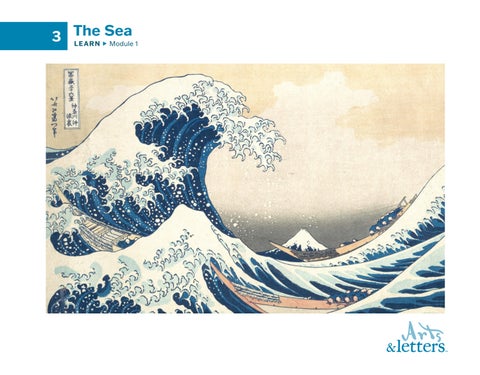
and its danger. Hokusai explores the sea by showing its beauty. For example, he makes rippling waves out of different shades of blue. His little white curves and dots make the waves look deep and foamy. In addition, Hokusai explores the sea by showing its danger. In his work of art, he uses scale to make the wave seem huge. The wave towers over the mountain, and it stretches to the clouds. Hokusai explores the sea by making art. In The Great Wave, he shows that the sea is beautiful and dangerous.
Arts & Letters | © Great Minds PBC
41
On-Target Writing Model
3 | Module 1 | Writing
Prompt: How does Katsushika Hokusai explore the sea? Two columns. The first page has a writing sample. The second columns is labeled Notes. Can you imagine sailing in a stormy sea? Katsushika Hokusai explores the sea as an artist. In The Great Wave, he shows the sea’s beauty
Notes
and its danger. Hokusai explores the sea by showing its beauty. For example, he makes rippling waves out of different shades of blue. His little white curves and dots make the waves look deep and foamy. In addition, Hokusai explores the sea by showing its danger. In his work of art, he uses scale to make the wave seem huge. The wave towers over the mountain, and it stretches to the clouds. Hokusai explores the sea by making art. In The Great Wave, he shows that the sea is beautiful and dangerous.
Arts & Letters | © Great Minds PBC
43
Advanced Writing Model
3 | Module 1 | Writing
Prompt: How does Katsushika Hokusai explore the sea? Two columns. The first page has a writing sample. The second columns is labeled Notes. Can you imagine sailing in a stormy sea? Katsushika Hokusai explores the sea as an artist. In The Great Wave, he shows the sea’s beauty
Notes
and its danger. Hokusai explores the sea by showing its beauty. For example, he makes rippling waves out of bright white and different shades of blue. His little white curves and dots make these waves look deep and foamy. His big curves show how the waves rise and fall in smooth swooping movements. In addition to showing the sea’s beauty, Hokusai explores the sea by showing its danger. In his work of art, he uses scale to make the wave seem huge. The wave rises over the mountain, and it stretches to the clouds. He also uses little curves to make the waves seem scary. They seem to be reaching for the boats with hundreds of claws! Hokusai explores the sea by making art. In The Great Wave, he uses color, scale, and curves to show the sea’s beauty and its danger.
Arts & Letters | © Great Minds PBC
45
Advanced Writing Model
3 | Module 1 | Writing
Prompt: How does Katsushika Hokusai explore the sea? Two columns. The first page has a writing sample. The second columns is labeled Notes. Can you imagine sailing in a stormy sea? Katsushika Hokusai explores the sea as an artist. In The Great Wave, he shows the sea’s beauty
Notes
and its danger. Hokusai explores the sea by showing its beauty. For example, he makes rippling waves out of bright white and different shades of blue. His little white curves and dots make these waves look deep and foamy. His big curves show how the waves rise and fall in smooth swooping movements. In addition to showing the sea’s beauty, Hokusai explores the sea by showing its danger. In his work of art, he uses scale to make the wave seem huge. The wave rises over the mountain, and it stretches to the clouds. He also uses little curves to make the waves seem scary. They seem to be reaching for the boats with hundreds of claws! Hokusai explores the sea by making art. In The Great Wave, he uses color, scale, and curves to show the sea’s beauty and its danger.
Arts & Letters | © Great Minds PBC
47
Checklist
3 | Module 1 | Writing
Writing Model | Prompt: How does Katsushika Hokusai explore the sea? Checklist with headings labeled Knowledge, Writing, and Language. To the right are two columns labeled Review 1 and Review 2. At the bottom are two boxes labeled Review 1 Comments and Review 2 Comments. Review 1
Review 2
Knowledge shows knowledge of Katsushika Hokusai shows knowledge of how Katsushika Hokusai explores the sea Writing writes about each point in a proof paragraph uses a transition word or phrase to begin proof paragraph 2 uses a topic sentence to begin each proof paragraph uses evidence from The Great Wave to support each point
Arts & Letters | © Great Minds PBC
49
3 | Module 1 | Writing
Review 1
Review 2
uses elaboration to develop each piece of evidence has a concluding paragraph that restates the thesis Language writes in simple and compound sentences uses taught spelling strategies
50
Arts & Letters | © Great Minds PBC
Module Task 1
3 | Module 1 | Writing
Prompt: In Amos and Boris, how does Amos explore the sea? Write proof paragraph 1 to complete the essay.
How can a small mouse explore a big ocean? In Amos and Boris, Amos explores the sea as a traveler. He travels in a boat, and he rides on the back of a whale.
Arts & Letters | © Great Minds PBC
51
3 | Module 1 | Writing
In addition, Amos explores the sea by riding on the back of a whale named Boris. In the text, Boris rescues Amos from drowning. Amos rides on Boris’s back all the way back to shore and learns about Boris’s life under the sea. Amos explores the sea as a traveler. The tiny mouse sails across the sea on a boat and rides on his friend Boris’s back.
52
Arts & Letters | © Great Minds PBC
Checklist
3 | Module 1 | Writing
Module Task 1 | Prompt: In Amos and Boris, how does Amos explore the sea? Write proof paragraph 1 to complete the essay. Checklist with headings labeled Knowledge, Writing, and Language. To the right are two columns labeled Review 1 and Review 2. At the bottom are two boxes labeled Review 1 Comments and Review 2 Comments. Review 1 Review 2 Knowledge shows knowledge of Amos shows knowledge of how Amos explores the sea Writing uses a topic sentence to begin proof paragraph 1 uses evidence from Amos and Boris to support point 1 uses elaboration to develop each piece of evidence Language writes in simple sentences uses taught spelling strategies
Arts & Letters | © Great Minds PBC
53
3 | Module 1 | Writing
Review 1 Comments
54
Review 2 Comments
Arts & Letters | © Great Minds PBC
Evidence Organizer
3 | Module 1 | Writing
Module Task 1 | Collect evidence to support point 1 of the thesis. Elaborate on the evidence. Prompt: In Amos and Boris, how does Amos explore the sea? Write proof paragraph 1 to complete the essay. A three-column chart with headings labeled Point, Evidence, and Elaboration. Thesis: In Amos and Boris, Amos explores the sea as a traveler. He travels in a boat, and he rides on the back of a whale.
Source: Amos and Boris by William Steig Point
Arts & Letters | © Great Minds PBC
Evidence
Elaboration
55
3 | Module 1 | Writing
Point
56
Evidence
Elaboration
Arts & Letters | © Great Minds PBC
Module Task 2
3 | Module 1 | Writing
Prompt: How did Marie Tharp explore the sea? Write two proof paragraphs and a concluding paragraph to complete the essay. Do you ever wonder what the seafloor looks like? Marie Tharp explored the sea as a scientist. She used soundings to map the seafloor, and she studied her map to learn more about the earth’s surface.
Arts & Letters | © Great Minds PBC
57
3 | Module 1 | Writing
58
Arts & Letters | © Great Minds PBC
Checklist
3 | Module 1 | Writing
Module Task 2 | Prompt: How did Marie Tharp explore the sea? Write two proof paragraphs and a concluding paragraph to complete the essay. Checklist with headings labeled Knowledge, Writing, and Language. To the right are two columns labeled Review 1 and Review 2. At the bottom are two boxes labeled Review 1 Comments and Review 2 Comments.Review 1 Review 2 Knowledge shows knowledge of Marie Tharp shows knowledge of how Marie Tharp explored the sea Writing writes about each point in a proof paragraph uses a transition word or phrase to begin proof paragraph 2 uses a topic sentence to begin each proof paragraph uses evidence from Solving the Puzzle Under the Sea to support each point
Arts & Letters | © Great Minds PBC
59
3 | Module 1 | Writing
Review 1
Review 2
uses elaboration to develop each piece of evidence has a concluding paragraph that restates the thesis Language writes in simple and compound sentences uses taught spelling strategies Review 1 Comments
60
Review 2 Comments
Arts & Letters | © Great Minds PBC
Evidence Organizer
3 | Module 1 | Writing
Module Task 2 | Collect evidence to support each point in your thesis. Elaborate on the evidence. Prompt: How did Marie Tharp explore the sea? Write two proof paragraphs and a concluding paragraph to complete the essay. A three-column chart with headings labeled Point, Evidence, and Elaboration.
Thesis: Marie Tharp explored the sea as a scientist. She used soundings to map the seafloor, and she studied her map to learn more about the earth’s surface.
Source: Solving the Puzzle Under the Sea by Robert Burleigh Point
Arts & Letters | © Great Minds PBC
Evidence
Elaboration
61
3 | Module 1 | Writing
Point
62
Evidence
Elaboration
Arts & Letters | © Great Minds PBC
3 | Module 1 | Writing
Point
Arts & Letters | © Great Minds PBC
Evidence
Elaboration
63
End-of-Module Task
3 | Module 1 | Writing
Prompt: How did Jacques Cousteau explore the sea? Write two proof paragraphs and a concluding paragraph to complete the essay. Have you ever wanted to dive under the sea? Jacques Cousteau explored the sea with his inventions. He created new ways to stay underwater, and he developed tools to help him film underwater.
Arts & Letters | © Great Minds PBC
65
3 | Module 1 | Writing
66
Arts & Letters | © Great Minds PBC
Checklist
3 | Module 1 | Writing
End-of-Module Task | Prompt: How did Jacques Cousteau explore the sea? Write two proof paragraphs and a concluding paragraph to complete the essay. Checklist with headings labeled Knowledge, Writing, and Language. To the right are two columns labeled Review 1 and Review 2. At the bottom are two boxes labeled Review 1 Review 1 Review 2 Comments and Review 2 Comments. Knowledge shows knowledge of Jacques Cousteau shows knowledge of how Jacques Cousteau explored the sea Writing writes about each point in a proof paragraph uses a transition word or phrase to begin proof paragraph 2 uses a topic sentence to begin each proof paragraph uses evidence from The Fantastic Undersea Life of Jacques Cousteau to support each point
Arts & Letters | © Great Minds PBC
67
3 | Module 1 | Writing
Review 1
Review 2
uses elaboration to develop each piece of evidence has a concluding paragraph that restates the thesis Language writes in simple and compound sentences uses taught spelling strategies
Review 1 Comments
68
Review 2 Comments
Arts & Letters | © Great Minds PBC
Evidence Organizer
3 | Module 1 | Writing
End-of-Module Task | Collect evidence to support each point in your thesis. Elaborate on the evidence. Prompt: How did Jacques Cousteau explore the sea? Write two proof paragraphs and a concluding paragraph to complete the essay. A three-column chart with headings labeled Point, Evidence, and Elaboration.
Thesis: Jacques Cousteau explored the sea with his inventions. He created new ways to stay underwater, and he developed tools to help him film underwater.
Source: The Fantastic Undersea Life of Jacques Cousteau by Dan Yaccarino Point
Arts & Letters | © Great Minds PBC
Evidence
Elaboration
69
3 | Module 1 | Writing
Point
70
Evidence
Elaboration
Arts & Letters | © Great Minds PBC
3 | Module 1 | Writing
Point
Arts & Letters | © Great Minds PBC
Evidence
Elaboration
71
Sentence Strategies
3 | Module 1 | Writing
Module 1
Strategy 1: Use a coordinating conjunction to combine ideas. Examples: and, but, so, yet, for, or, nor Sample Sentences: The surf makes sounds, and the waves roll pebbles. Lots of birds live in the salt marsh, but not many reptiles live there. Salt marshes are near the ocean, so they flood at high tide. Your Turn
Whales spout water, and
.
Plankton are small creatures, but
.
Some animals are bioluminescent, so
.
Arts & Letters | © Great Minds PBC
73
Fluency
Fluency Practice
3 | Module 1 | Fluency
“The Sea Wind”
1. Ask a friend or adult to listen to you read.
2. Read aloud the fluency passage three to five times. 3. Focus on the day’s fluency element as you read.
4. Ask the listener to initial and comment below.
A two-column chart with headings labeled Initials and Comments.
Initials
Day 1 Accuracy Day 2 Phrasing Day 3 Expression Day 4 Rate Retelling Arts & Letters | © Great Minds PBC
Comments Fluency Elements Accuracy: Correctly decode the words. Phrasing: Group words into phrases, and pause for punctuation. Expression: Use voice to show feeling. Rate: Read at an appropriate speed.
77
3 | Module 1 | Fluency
“The Sea Wind” by Sara Teasdale
I am a pool in a peaceful place, I greet the great sky face to face, I know the stars and the stately moon And the wind that runs with rippling shoon— But why does it always bring to me The far-off, beautiful sound of the sea?
78
The marsh-grass weaves me a wall of green, But the wind comes whispering in between, In the dead of night when the sky is deep The wind comes waking me out of sleep— Why does it always bring to me The far-off, terrible call of the sea?
Arts & Letters | © Great Minds PBC
Fluency Practice
3 | Module 1 | Fluency
Amos and Boris
1. Ask a friend or adult to listen to you read.
2. Read aloud the fluency passage three to five times. 3. Focus on the day’s fluency element as you read.
4. Ask the listener to initial and comment below.
A two-column chart with headings labeled Initials and Comments.
Initials
Day 1 Accuracy Day 2 Phrasing Day 3 Expression Day 4 Rate Retelling Arts & Letters | © Great Minds PBC
Comments Fluency Elements Accuracy: Correctly decode the words. Phrasing: Group words into phrases, and pause for punctuation. Expression: Use voice to show feeling. Rate: Read at an appropriate speed.
79
3 | Module 1 | Fluency
Amos and Boris, page 20 by William Steig
The time came to say goodbye. They were at the shore. “I wish we could be friends forever,” said Boris. “We will be friends forever, but we can’t be together. You must live on land and I must live at sea. I’ll never forget you, though.” “And you can be sure I’ll never forget you,” said Amos. “I will always be grateful to you for saving my life and I want you to remember that if you ever need my help I’d be more than glad to give it!” How he could ever possibly help Boris, Amos didn’t know, but he knew how willing he was. The whale couldn’t take Amos all the way in to land. They said their last goodbye and Amos dived off Boris’s back and swam to the sand.
80
Arts & Letters | © Great Minds PBC
Fluency Practice
3 | Module 1 | Fluency
Giant Squid
1. Ask a friend or adult to listen to you read.
2. Read aloud the fluency passage three to five times. 3. Focus on the day’s fluency element as you read.
4. Ask the listener to initial and comment below.
A two-column chart with headings labeled Initials and Comments.
Initials
Day 1 Accuracy Day 2 Phrasing Day 3 Expression Day 4 Rate Retelling Arts & Letters | © Great Minds PBC
Comments Fluency Elements Accuracy: Correctly decode the words. Phrasing: Group words into phrases, and pause for punctuation. Expression: Use voice to show feeling. Rate: Read at an appropriate speed.
81
3 | Module 1 | Fluency
Giant Squid, page 24
by Mary M. Cerullo and Clyde F. E. Roper
The adult giant squid’s eyes, its most remarkable feature, are the size of car headlights. How do they penetrate the permanent darkness of the deep sea to find their prey? How far can giant squid see? Clyde wanted to answer these questions—and many more. Clyde talked with deep-sea fishermen who had caught giant squid in their fishing nets. He examined bodies of squid that had washed up on shore. But dead or dying specimens couldn’t answer the one big question that haunted Clyde: How does a giant squid behave in its natural habitat? He decided he had to find out.
82
Arts & Letters | © Great Minds PBC
Fluency Practice
3 | Module 1 | Fluency
Solving the Puzzle Under the Sea 1. Ask a friend or adult to listen to you read.
2. Read aloud the fluency passage three to five times. 3. Focus on the day’s fluency element as you read.
4. Ask the listener to initial and comment below.
A two-column chart with headings labeled Initials and Comments.
Initials
Day 1 Accuracy Day 2 Phrasing Day 3 Expression Day 4 Rate Retelling Arts & Letters | © Great Minds PBC
Comments Fluency Elements Accuracy: Correctly decode the words. Phrasing: Group words into phrases, and pause for punctuation. Expression: Use voice to show feeling. Rate: Read at an appropriate speed.
83
3 | Module 1 | Fluency
Solving the Puzzle Under the Sea, pages 18–20 by Robert Burleigh
It was like piecing together an immense jigsaw puzzle. I felt like a detective solving a great mystery. I was a scientist at last. Pinpointing the soundings helped me slowly understand the shape of the Atlantic’s floor: from its shallow shores, to its gradual drop-offs where the water deepened, to a long underwater mountain chain—called the Mid-Atlantic Ridge—that ran deep below the surface, north to south. I was a kind of artist, too. I used colors to show similar depths— shades of brown, blue, and green. Did all this take time? Yes. Even so, making a scientific discovery is worth it.
84
Arts & Letters | © Great Minds PBC
Fluency Practice
3 | Module 1 | Fluency
The Fantastic Undersea Life of Jacques Cousteau 1. Ask a friend or adult to listen to you read.
2. Read aloud the fluency passage three to five times. 3. Focus on the day’s fluency element as you read.
4. Ask the listener to initial and comment below.
A two-column chart with headings labeled Initials and Comments.
Initials
Day 1 Accuracy Day 2 Phrasing Day 3 Expression Day 4 Rate Retelling Arts & Letters | © Great Minds PBC
Comments Fluency Elements Accuracy: Correctly decode the words. Phrasing: Group words into phrases, and pause for punctuation. Expression: Use voice to show feeling. Rate: Read at an appropriate speed.
85
3 | Module 1 | Fluency
The Fantastic Undersea Life of Jacques Cousteau, pages 8–11 by Dan Yaccarino
Cousteau wanted to stay underwater longer to see even more. The diving suits of his day were heavy and bulky. They didn’t allow much freedom of movement, and an air hose tethered the diver to a boat. So Jacques set about tinkering, fashioning snorkels from things like inner tubes and garden hoses. But they weren’t good enough. Cousteau and his engineer friend Emile Gagnan created a breathing apparatus they called the Aqua-Lung. It was the first machine that would let a diver breathe underwater for long periods of time. Now Cousteau was free to truly explore. A silent world opened up to him.
86
Arts & Letters | © Great Minds PBC
Fluency Practice
3 | Module 1 | Fluency
Shark Attack
1. Ask a friend or adult to listen to you read.
2. Read aloud the fluency passage three to five times. 3. Focus on the day’s fluency element as you read.
4. Ask the listener to initial and comment below.
A two-column chart with headings labeled Initials and Comments.
Initials
Day 1 Accuracy Day 2 Phrasing Day 3 Expression Day 4 Rate Retelling Arts & Letters | © Great Minds PBC
Comments Fluency Elements Accuracy: Correctly decode the words. Phrasing: Group words into phrases, and pause for punctuation. Expression: Use voice to show feeling. Rate: Read at an appropriate speed.
87
3 | Module 1 | Fluency
Shark Attack, pages 32–33 by Cathy East Dubowski
The shark has perfectly evolved for surviving and hunting underwater. Its amazingly flexible skeleton is made of cartilage—the same material that forms our noses and ears! A shark has the same five senses as a human—sight, hearing, smell, taste, and touch. But the shark’s ability to catch prey in murky waters is due to two extra, and very unusual, senses. Running down each side of a shark’s body is a “lateral line.” This is a line of pressure-sensitive points under the skin, which help the shark sense small vibrations in the water. On the head of a shark are tiny pores called the ampullae of Lorenzini. They allow a shark to sense the faint electrical charges given off by all living things.
88
Arts & Letters | © Great Minds PBC
Volume of Reading
Volume of Reading Questions
3 | Module 1 | Volume of Reading
Module 1 | After reading or listening to a text, add it to your reading log for module 1. Then follow your teacher’s instructions for which questions to answer in your journal.
Wonder
What do I notice and wonder about this text?
Organize
What is happening in this text?
Reveal
What does a deeper look at captions or diagrams reveal?
Distill
What is a central idea in this text?
Know
How does this text build my knowledge?
Essential Question Your Knowledge 90
What does a deeper look at words and illustrations reveal?
How do people explore the sea? What sea mystery makes you most curious? Why? What types of sea exploration most interest you? Arts & Letters | © Great Minds PBC
Reading Log
3 | Module 1 | Volume of Reading
After reading or listening to a text, write the date and text title. If you did not read a whole text, write the page numbers for the section that you did read. A three-column chart with headings labeled Date, Title, and Pages.
Date
Arts & Letters | © Great Minds PBC
Title
Pages
91
3 | Module 1 | Volume of Reading
Date
92
Title
Pages
Arts & Letters | © Great Minds PBC
3 | Module 1 | Volume of Reading
Date
Arts & Letters | © Great Minds PBC
Title
Pages
93
3 | Module 1 | Volume of Reading
Date
94
Title
Pages
Arts & Letters | © Great Minds PBC
3 | Module 1 | Volume of Reading
Date
Arts & Letters | © Great Minds PBC
Title
Pages
95
3 | Module 1 | Volume of Reading
Date
96
Title
Pages
Arts & Letters | © Great Minds PBC
3 | Module 1 | Volume of Reading
Date
Arts & Letters | © Great Minds PBC
Title
Pages
97
3 | Module 1 | Volume of Reading
Date
98
Title
Pages
Arts & Letters | © Great Minds PBC
Glossary
Glossary
3 | Module 1 | Glossary
Module 1 | Parts of Speech Key: (n.) noun, (v.) verb, (adj.) adjective abstract (adj.)
Notes
using elements of art such as line, color, and shape without trying to show what the world looks like
ambassador (n.) someone who acts or speaks for those who live in a certain place
100
Arts & Letters | © Great Minds PBC
3 | Module 1 | Glossary
Notes autopsy (n.) an examination of a dead body
biography (n.) a piece of writing about a real person’s life
call (n.) a sound or feeling that makes someone want to go somewhere
Arts & Letters | © Great Minds PBC
101
3 | Module 1 | Glossary
Notes cartography (n.) the art and science of mapmaking
composition (n.) in a work of art, how an artist organizes all the elements of art
data (n.) facts or information about a topic
102
Arts & Letters | © Great Minds PBC
3 | Module 1 | Glossary
Notes depth (n.) 1. a distance below a surface 2. a deep place
discovery (n.) something seen or learned for the first time
ecosystem (n.) all the living and nonliving things, such as plants and water, that are in a particular environment
Arts & Letters | © Great Minds PBC
103
3 | Module 1 | Glossary
Notes edit (v.) to make changes to correct mistakes in the words and sentences of a piece of writing
evolve (v.) to gradually develop or change over time to become more advanced
experiment 1. (n.) a test used to see how something works or to learn something new 2. (v.) to try a new way of doing or thinking about something
104
Arts & Letters | © Great Minds PBC
3 | Module 1 | Glossary
Notes explore (v.) 1. to travel over or through a place to learn more about it or to find something 2. to look at something in a careful way to learn more about it; to study or think about something
extinction (n.) when a particular animal or plant dies out completely
Arts & Letters | © Great Minds PBC
105
3 | Module 1 | Glossary
Notes fable (n.) a short story that is intended to teach a lesson
fluency (n.) the ability to read with accuracy, phrasing, and expression at an appropriate rate
habitat (n.) the place where an animal or plant grows or lives
106
Arts & Letters | © Great Minds PBC
3 | Module 1 | Glossary
Notes illuminate (v.) to shine a light on something
inspire (v.) to make a person want to do something; to give a person an idea about what to create
invention (n.) 1. a useful new device or process 2. the act of creating something new
Arts & Letters | © Great Minds PBC
107
3 | Module 1 | Glossary
Notes inventor (n.) someone who creates a new machine or process
luminous (adj.) giving off light; brightly lit
marsh (n.) an area of soft, wet land that has many grasses and other plants
108
Arts & Letters | © Great Minds PBC
3 | Module 1 | Glossary
Notes moral (n.) a lesson that is learned from a story or an experience
mystery (n.) something that is not known, or difficult to understand or explain
perform (v.) to do or present something to entertain an audience
Arts & Letters | © Great Minds PBC
109
3 | Module 1 | Glossary
Notes phosphorescent (adj.) giving off a type of light that glows softly in the dark and that does not produce heat
predator (n.) an animal that kills and eats other animals for food
prey (n.) an animal that is hunted or killed by another for food
110
Arts & Letters | © Great Minds PBC
3 | Module 1 | Glossary
Notes producer (n.) someone who creates a new movie or show
refrain (n.) a repeated line or group of lines in a poem
relationship (n.) how people talk, feel, or act toward one another
Arts & Letters | © Great Minds PBC
111
3 | Module 1 | Glossary
Notes research 1. (n.) careful study or activity to find and report new knowledge about a subject 2. (v.) to collect more information about a subject
revise (v.) to make changes to improve the ideas and structure of a piece of writing
112
Arts & Letters | © Great Minds PBC
3 | Module 1 | Glossary
Notes scale (n.) a principle of design; the sizes an artist makes a work of art and the components within it
scientist (n.) a person who studies the natural world based on facts learned through experiments and observation
surface (n.) the upper layer of an area of land or water
Arts & Letters | © Great Minds PBC
113
3 | Module 1 | Glossary
Notes technique (n.) the way in which materials or skills are used
tentacle (n.) one of the long, flexible arms of an animal, used for grabbing things and moving
wonder (n.) something that is very surprising, beautiful, or amazing
114
Arts & Letters | © Great Minds PBC
3 | Module 1
Credits Great Minds® has made every effort to obtain permission for the reprinting of all copyrighted material. If any owner of copyrighted material is not acknowledged herein, please contact Great Minds for proper acknowledgment in all future editions and reprints of this module. Cover: Under the Wave off Kanagawa, also known as The Great Wave, 1830–32, Katsushika Hokusai (1760–1849), Woodblock print, 25.7 × 37.9 cm, H. O. Havemeyer Collection, Bequest of Mrs. H. O. Havemeyer, 1929, Courtesy of the Metropolitan Museum of Art; page 2, National Gallery of Art; page 7, Christopher Conser/Shutterstock.com; page 10, Burkhardt, Jacques Illustrations Courtesy of Harvard University/https://creativecommons.org/licenses/by/4.0/; page 11, John Anderson/ The Smithsonian; page 14, Ryan M. Bolton/Shutterstock.com, RugliG/Shutterstock.com, Wheatfieldstock/Shutterstock.com, Mike Rosecope/Shutterstock.com, Andriy Nekrasov/Shutterstock.com; page 15, Tony Johannot from The Shepherd and the Sea/OldBookIllustrations.com; page 17, from Mollusques vivants et fossiles: ou, description de toutes les espèces de coquilles et de mollusques: classées suivant leur distribution géologique et géographique 1845, Gide et Cie., éditeurs, in French; page 21, Library of Congress, Geography and Map Division; page 28, Burkhardt, Jacques Illustrations Courtesy of Harvard University/ https://creativecommons.org/licenses/by/4.0/; pages 102, Michelle Bridges/Alamy Stock Photo; page 103, Pictoral Press Ltd/ Alamy Stock Photo, davidrumsey.com; page 105, nsf/Alamy Stock Photo; page 107, Shannon White-Diecidue/Alamy Stock Photo, Patrick Guenette/Alamy Stock Photo; page 112, James R Gibson/Alamy Stock Photo; page 113, Jeff Rotman/Alamy Stock Photo, EXZOZIS/Shutterstock.com; Border images: The National Gallery of Art; John Anderson/The Smithsonian; Library of Congress; Burkhardt, Jacques/Provided by Harvard University. All other images are the property of Great Minds. Selected dictionary content appearing in Arts & Letters curriculum materials is used with permission of Merriam-Webster © 2025.
Arts & Letters | © Great Minds PBC
115
3 | Module 1
Works Cited Aesop. “The Shepherd and the Sea.” Translated by George Fyler Townsend, 1867, Townsend [1867], adapted by Rachel Hylton, 2022. Fables of Aesop, edited by Tom Simondi, 23 Nov. 2013, fablesofaesop.com/the-shepherd-and-the-sea .html#more-384. Burleigh, Robert. Solving the Puzzle Under the Sea: Marie Tharp Maps the Ocean Floor. Illustrated by Raúl Colón, Simon and Schuster Books for Young Readers, 2016. Cerullo, Mary M., and Clyde F. E. Roper. Giant Squid: Searching for a Sea Monster. Capstone Press, 2012. “Divers.” Getty Images, 21 Dec. 2015, app.boclips.com/videos/5c54cccfd8eafeecae1afeb8. Dubowski, Cathy East. Shark Attack. DK Publishing, 2023. “Marsh.” Mazz Media, 31 Dec. 2013, app.boclips.com/videos/5c54d5c5d8eafeecae1fe2f3. Steig, William. Amos and Boris. 1971. Square Fish, 2009. Teasdale, Sara. “The Sea Wind.” Rivers to the Sea. Macmillan, 1915. “Underwater Discovery and Adventure: The Story of Jacques Cousteau.” SciShow, 10 June 2016, library.boclips.com/ videos/64a52bf3a3d8e73ba2301e2e. “What Is the Painted Essay™?” Vermont Writing Collaborative, www.vermontwritingcollaborative.org/painted-essay/. WIDA. WIDA English Language Development Standards Framework 2020 Edition: Kindergarten–Grade 12. Board of Regents of the University of Wisconsin System, wida.wisc.edu/sites/default/files/resource/WIDA-ELD-StandardsFramework-2020.pdf. Yaccarino, Dan. The Fantastic Undersea Life of Jacques Cousteau. 2009. Random House Children’s Books, 2012.
116
Arts & Letters | © Great Minds PBC
Knowledge is your superpower. Read great books from around the world. Explore documents that take you back in time. Write like an author. Discuss and debate topics you care about. Study art to make paintings come to life. Ready to tap into knowledge?
O N TH E COVER
Under the Wave off Kanagawa, also known as The Great Wave, 1830–32 Katsushika Hokusai (1760–1849) Woodblock print, 25.7 × 37.9 cm H. O. Havemeyer Collection, Bequest of Mrs. H. O. Havemeyer, 1929 Courtesy of the Metropolitan Museum of Art
GR A D E 3 M O DULES Module 1 | The Sea Module 2 | Outer Space Module 3 | A New Home Module 4 | Artists Make Art
ISBN 979-8-88811-294-6
9
798888 112946
B