AT THE SHOW ISSUE
ONE REGION, ONE NETWORK: THE NEXT ERA OF CHICAGO TRANSIT PAGE 8
Pace on the Road to Project Zero PAGE 16
Metra Investing in Sustainble Future PAGE 22
AT BOOTH 1061
SOLVE YOUR OPERATIONAL CHALLENGES www.initusa.com
MassTransitmag.com | September 2026 APTA Expo Issue
2609mass_1_Cover.indd 1
AT BOOTH 1331
8/13/26 5:53 PM
We help keep people connected. Empowering the freedom to move every day, thanks to safe, reliable and innovative solutions that serve the common good.
» » » »
Come see us at APTA booth #1506 Battery running low? Visit us at APTA booth #2731 to recharge your electronics Learn about the Transdev difference at For more information, visit www.MassTransitmag.com/10065988
2609mass_2-5_TOC.indd 2 2609MASS_TransdevNorthAmerica.indd 1
8/13/26 5:53 PM 8/10/26 1:08 PM
2609MA
:08 PM
Get up-to-date industry news and product information delivered right to you. » Mass Transit Daily » Rail Update » Safety & Security News » Transit Bid Tracker
Sign up for the Mass Transit newsletters! MassTransitMag.com/Subscribe
2609mass_2-5_TOC.indd 3 2609MASS_HouseAds_Subscription.indd 1
8/13/26 5:53 PM 8/13/26 7:58 AM
Contents
SEPTEMBER 2026 AT THE SHOW
FE ATURES
11
8
One Region, One Network: The Next Era of Chicago Transit The Northern Illinois Transit Authority is tasked with transforming the rider experience throughout the Chicago region by coordinating fares, planning service, making capital investments and establishing enforceable standards.
22 11
Transit Agencies Rise to Challenge of Moving Millions Transit agencies across North America reflect on the planning, collaboration and customer service strategies behind operations that supported soccer’s biggest event, the 2026 FIFA World Cup.
Image: 296933346| Dreamstime.com
16
Pace on the Road to Project Zero
Rather than wait on battery-electric buildout, the agency is retiring older vehicles today and using hybrids as the bridge.
On the cover: 1350087930 | imagoDens | Getty Image
4 Mass Transit | SEPTEMBER 2026 APTA EXPO ISSUE 2609mass_2-5_TOC.indd 4
8/13/26 5:53 PM
Published by Endeavor Business Media, LLC 30 Burton Hills Blvd, Ste. 185, Nashville, TN 37215 800-547-7377
22
Metra Rolling into the Future with Alternative Propulsion Technology
The rail agency is pursuing two different paths to launch battery technology on its system, supporting its strategic plan and regional rail initiative.
28
From Policy to Projects: Lessons from Chicago’s Equitable Transit-Oriented Development Movement Through sustained collaboration, bold policy reforms and strategic investments in community-rooted developers, Chicago has built a model other cities can adapt to their own communities.
Vol. 52, No. 5 VP/MARKET LEADER - INFRASTRUCTURE & AVIATION GROUP Andrena Feaster AFeaster@endeavorb2b.com
D E PA R T M E N T S
7
EDITOR IN CHIEF Megan Perrero (603) 891-9454 | MPerrero@MassTransitmag.com
Editor’s Notebook
ASSOCIATE EDITOR Brandon Lewis (216) 298-3269 | BLewis@MassTransitmag.com
34
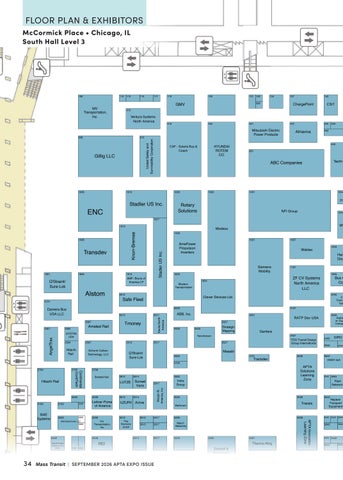
Expo Map & Exhibitor Listing
Find the booths that are on your list to visit
CONTRIBUTORS Maulik Vaishnav, Juan Sebastian Arias, Jacky Grimshaw, Kate Ansorge, Reed Schwartz, Will Poff-Webster
41
MULTIMEDIA ACCOUNT MANAGER Meriwether Drummond (678) 992-5071 | MDrummond@MassTransitmag.com
People & Places
The lastest industry and people news and updates
The Transit Abundance Playbook offers 15 solutions to empower transit agencies and improve their capacity to deliver infrastructure projects.
PRODUCTION MANAGER Rita Fitzgerald AD SERVICES MANAGER Terry Gann ART DIRECTOR Erin Brown AUDIENCE DEVELOPMENT MANAGER Debbie Dumke
42
DIGITAL AUDIENCE DEVELOPMENT MANAGER Alden Metzger
Products
In Focus: At The Show ENDEAVOR BUSINESS MEDIA, LLC CEO Chris Ferrell COO Patrick Rains CDO Jacquie Niemiec CALO Tracy Kane CMO Amanda Landsaw EVP INFRASTRUCTURE & PUBLIC SECTOR GROUP Kylie Hirko VP OF CONTENT STRATEGY, INFRASTRUCTURE & PUBLIC SECTOR GROUP Michelle Kopier
FOLLOW US FACEBOOK facebook.com/MassTransit X @MassTransitmag
SUBSCRIPTION CUSTOMER SERVICE
LINKEDIN linkedin.com/company/masstransit INSTAGRAM instagram.com/masstransitmag_ SUBSCRIBE TO OUR NEWSLETTERS MassTransitmag.com/subscribe
31
A Playbook for Building Cheaper and Faster Transit in the U.S.
ASSOCIATE EDITOR Noah Kolenda (231) 999-1405 | NKolenda@MassTransitmag.com
877-382-9187; 847-559-7598 Circ.MassTransit@Omeda.com PO Box 3257, Northbrook IL 60065-3257 ARTICLE REPRINTS
reprints@endeavorb2b.com Mass Transit (USPS 017-230), (ISSN 0364-3484 print, ISSN 2150413x online) is published 7 times per year in January/February, March/April, May/June, July/August, At the Show Issue, September/ October, November/December by Endeavor Business Media, LLC. 201 N Main St 5th Floor, Fort Atkinson, WI 53538. Periodicals postage paid at Fort Atkinson, WI, and additional mailing offices. POSTMASTER: Send address changes to Mass Transit, PO Box 3257, Northbrook, IL 60065-3257.
ADVERTISER’S INDEX Altro USA...............................................................................30 American Seating ................................................................20 Bitimec WASH-BOTS............................................................21 Brookville Equipment...........................................................14 Community Transit Insurance Program (CTIP)....................26 Complete Coach Works........................................................32 Driventic GmbH....................................................................19 Environmental Systems Research Institute (Esri)................44 Graffiti Shield........................................................................13 Hayden AI.............................................................................25 Lippert..................................................................................15 Railhead ...............................................................................27
SUBSCRIPTIONS: Individual print and digital subscriptions are available without charge to qualified subscribers in U.S. and Canada. Please visit www.masstransitmag.com and click on “Subscribe”. Publisher reserves the right to reject non-qualified subscriptions. Subscription prices: U.S. $49.00 per year, $97.00 two years; Canada/ Mexico $84.00 per year, $146.00 two years; All other countries $120.00 per year, $223.00 two years. Back issue $13.00 prepaid, if available. All subscriptions payable in U.S. funds. Canadian GST #842773848. Send subscription inquiries to Mass Transit, PO Box 3257, Northbrook, IL 60065-3257. Customer service can be reached toll-free at 877-382-9187 or at circ.masstransit@ omeda.com for magazine subscription assistance or questions. Printed in the USA. Copyright 2026 Endeavor Business Media, LLC. All rights reserved. No part of this publication may be reproduced or transmitted in any form or by any means, electronic or mechanical, including photocopies, recordings, or any information storage or retrieval system without permission from the publisher. Endeavor Business Media, LLC does not assume and hereby disclaims any liability to any person or company for any loss or damage caused by errors or omissions in the material herein, regardless of whether such errors result from negligence, accident, or any other cause whatsoever. The views and opinions in the articles herein are not to be taken as official expressions of the publishers, unless so stated. The publishers do not warrant either expressly or by implication, the factual accuracy of the articles herein, nor do they so warrant any views or opinions by the authors of said articles.
Safe Fleet..............................................................................33 Transdev North America......................................................2,6
SEPTEMBER 2026 APTA EXPO ISSUE | MassTransitmag.com
2609mass_2-5_TOC.indd 5
5
8/13/26 5:53 PM
SPONSORED BY
Beyond Today’s Workforce Challenges: Preparing Transit for the Next Decade
Photo: 2603758829 | Shutterstock
By Laura Hendricks, CEO
For years, conversations about transit
workforce challenges have focused on one issue: fi lling open positions. While attracting and retaining qualified talent remains critically important, the industry’s future depends on looking beyond today’s vacancies and preparing for tomorrow’s workforce needs. Like a driver focused on the road ahead, we must look beyond immediate challenges and cultivate the talent, skills, and leadership needed for the future. The nature of transit work is changing rapidly. New technologies, evolving stakeholder expectations, expanded service models, and growing data capabilities are reshaping how agencies plan and deliver service. At the same time, a significant portion of the transit workforce is approaching retirement
age, creating both challenges and opportunities. The question is no longer simply how many people we need to deliver service, but whether we have the right people, with the right skills, in the right roles to meet our communities’ expectations. Th is forward-focused shift requires a data-driven approach to workforce planning. Agencies are increasingly using workforce analytics to better understand their precise staffi ng needs, predict future skill gaps, and align employee resources with service-level requirements. Emerging technologies, including AI-enabled staffi ng tools, offer new opportunities to improve scheduling, reduce administrative overhead, and help agencies deploy personnel more efficiently and effectively. These innovations are not
about replacing people. Instead, these advances in technology ensure valuable human talent is deployed when and where they will have the most meaningful impact on passengers. Success in the coming decade will also depend on prioritizing quality over quantity. Filling positions is important, but building a workforce with the skills, adaptability, and leadership qualifications will drive long-term performance. That work starts by creating career pathways rather than simply fi lling jobs. Several transit agencies are investing in apprenticeship programs that provide hands-on experience while building a dedicated pipeline of qualified talent. Mentorship programs help transfer institutional knowledge from experienced employees to the next generation. Cross-training initiatives equip employees with broader capabilities, increasing operational flexibility by creating new career growth opportunities. Perhaps most importantly, we must continue strengthening our connection with the next generation of talent. Those entering the workforce now are looking for meaningful work, career mobility, and opportunities to learn new skills. To recruit and retain this talent, we must more clearly communicate the purpose behind what we do. Transit is more than a career. It connects people to opportunities, improves quality of life, and makes a meaningful difference in the lives of others every day. That sense of purpose is what draws many people to this industry and what inspires them to stay. Our goal is to tell that story more effectively and make it easier for young people to discover and pursue careers in transit. Transit has always been a business powered by people, for people. Technology will continue to transform the way we operate, but our success will always depend on the people delivering the service. By investing in workforce development today and leveraging opportunities, we can collectively build a stronger, more resilient industry that is prepared for tomorrow.
6 Mass Transit | SEPTEMBER 2026 APTA EXPO ISSUE 2609mass_6_TransdevSponsoredQ&A.indd 6
8/13/26 5:53 PM
Editor’s Notebook
Chicago region ready to host APTA’s triennial event I hope every attendee takes the time to explore and experience the investments and improvements our regional transit systems have been implementing in the past few years.
I
n just over a month, thousands of people will congregate in Chicago for the American Public Transportation Association’s 2026 TRANSform Conference & EXPO. From “What’s Next” to “Next Starts Here,” this year’s theme, “Elevate,” is fitting for our conference setting (‘L’evate, anyone?). By the time October rolls around, Chicago’s regional transit ecosystem will be a month into the Northern Illinois Transit Act taking effect—a mandate that promises to elevate the transit experience across the Chicago Transit Authority (CTA), Metra and Pace Suburban Bus (Pace). That’s not to say the region hasn’t already been investing in the rider experience. The CTA is making improvements on a number of fronts, including increasing bus frequency (shout out to routes #77 and #53), upgrading legacy rail stations and reinforcing safety and security efforts. Several major infrastructure projects are also taking shape. The Red and Purple Modernization Phase One Project, the second largest capital project in CTA’s history, reached substantial completion last summer. This massive undertaking involved installing new elevated track for the Red and Purple lines, completely rebuilding four Red Line stations, upgrading to a new signal system and constructing a new bypass (I’m astonished at how tall this thing is every time I ride the Brown Line). Notably, this project required the agency to move an entire 1,000-ton, 127-year-old building 30 feet west and 10 feet south to make room for the new track structures. The authority’s Red Line Extension project is also progressing, with soil boring, site preparation and utilities work happening across several locations. Metra has at least eight major projects happening concurrently, supporting its over $500 million 2026 capital program. Projects range from station rehabilitations and expansions to bridge replacements and a new rail yard. On the vehicle side, Metra recently completed overhauling 302 railcars through its in-house railcar program. The rehabbed vehicles were outfitted with outlets, sensitive-edge outer doors, new LED displays, new bathrooms, wheelchair lifts, composite floors and seats. Out in the burbs, Pace is pushing ahead with Project Zero—its effort to transition to 100% zero-emission vehicles by 2040. Within the past few years, the agency launched its inaugural electric bus into service, received its first electric paratransit vehicle, ordered an additional 22 electric buses and opened a charging station out of its North Division. As you make your conference plans, I encourage everyone to get on transit and explore one of the over 100 unique neighborhoods in what I believe is the best city in the world (but I may be biased; I’m a proud Chicagoan).
“
The Red and Purple Modernization Phase One Project required the agency to move an entire 1,000-ton, 127-year-old building 30 feet west and 10 feet south to make room for the new track structures.
”
mperrero@ masstransitmag.com (603) 891-9454 linkedin.com/in/ megan-perrero
Megan Perrero, editor in chief
SEPTEMBER 2026 APTA EXPO ISSUE | MassTransitmag.com
2609mass_7_Editor.indd 7
7
8/13/26 5:53 PM
One Region, One Network
The Next Era of Chicago Transit
8 Mass Transit | SEPTEMBER 2026 APTA EXPO ISSUE 2609mass_8-10_ChicagoRTA.indd 8
8/13/26 5:53 PM
The Northern Illinois Transit Authority is tasked with transforming the rider experience throughout the Chicago region by coordinating fares, planning service, making capital investments and establishing enforceable standards. BY MAULIK VAISHNAV
B
efore the sun comes up, a nurse in the south suburbs of Chicago heads to her shift without building an extra hour into the trip. Her Pace bus is scheduled to meet the Metra train, but if she misses her connection, another train is not far behind. When she reaches downtown, the same ticket takes her onto the Chicago Transit Authority’s (CTA) ‘L’ for her final leg. In the afternoon, a college student travels from class in the city to a part-time job in the suburbs. The buses and trains he takes are clean, the arrival information is accurate and one university pass carries him across operators seamlessly. Near midnight, a restaurant worker begins her trip home. The elevator status at the station is available to her on her phone, the platform is well lit and feels safe, and she knows her wait time will be just a few minutes. If she encounters someone smoking, a person in crisis or another problem, she can tell a transit ambassador working at the station or report it from her phone, and the right team will quickly respond. Together, these trips describe the future the Northern Illinois Transit Authority (NITA) was created to deliver: one system that works for everyone and connects the entire Chicago region. It is a rare opportunity to get to jumpstart the second largest transit authority of the nation (based on unlinked passenger trips) from scratch with a mandate to transform the rider experience and actually have the resources to make it happen.
Photo: 76623110| Dreamstime.com
NITA Act supplies needed funding to transform Chicago region’s transit
On Sept. 1, NITA formally began just as Chicago prepares to welcome transit professionals from across the country for the American Public Transportation Association’s (APTA) TRANSform Conference and Expo. The timing offers our region an opportunity to demonstrate what a truly coordinated regional transit network will look like. Illinois lawmakers gave us the tools to get there through the NITA Act, which paired more than $1.2 billion in estimated new annual operating funding and roughly $180 million in new annual capital funding with meaningful regional authority. Among our large transit agency peers, the state of Illinois has provided a blueprint to not only solve the post-pandemic transit funding crisis, but also doubled down on the promise of expanding transit access regionwide. NITA will coordinate fares, plan service and make capital investments blurring agency lines, establish enforceable standards and hold the
transit operators accountable for meeting them. Success will be measured in riders’ everyday experiences: more frequent service, dependable connections, simpler fares, safer and more accessible trips and a system they can trust. The combination of transformational investment, authority to act and a commitment to riders is what makes Chicago’s transit future significant beyond our region. Illinois did not treat the fiscal cliff that our transit ecosystem was facing in the wake of the pandemic as simply a budget hole to fill. It used the moment to transform how the system works going forward. While the governance changes will take a few years to implement to their full promise, the immediate positive impacts are already showing. Since Illinois Gov. JB Pritzker signed the NITA Act in December 2025, we launched pre-transition efforts and coordinated early changes to deliver for riders. In May, we infused $132 million into the regional system to fund near-term investments that riders are feeling. Those investments include expanded and more reliable service on CTA, Metra and Pace; improvements targeting rail slow zones and chronic bus delays; new safety and security resources; and expanded access to affordable fares. The Access Program, which provides reduced fares for riders experiencing low incomes, is expanding from a pilot only available to Metra riders to include eligible CTA and Pace riders this fall. Digital signage, multilingual information and real-time accessibility updates are becoming more consistent across the system. These investments are just the start.
Establishing standards will streamline regional service and investments
The biggest shifts ahead will transform how regional trips actually feel. NITA will establish transparent, systemwide standards for frequency, span of service, travel time, on-time performance, crowding, cleanliness, safety and connectivity across a six-county region with more than eight million residents. Those standards will recognize that a dense
SEPTEMBER 2026 APTA EXPO ISSUE | MassTransitmag.com
2609mass_8-10_ChicagoRTA.indd 9
9
8/13/26 5:53 PM
The Next Era
city neighborhood, a suburban job corridor and a lower-density community all deserve great transit but require different types of service. Coordinated network planning will mean key regional connections served by NITA’s three operators get the service and technology they need to make transfers as seamless as possible.
What changes is how decisions are coordinated across the region. The new governance structure is designed to make that coordination real.” Maulik Vaishnav
About the author
Maulik Vaishnav became chief transition officer in June 2026 to guide the Chicago Regional Transportation Authority through its transition to the Northern Illinois Transit Authority (NITA), ensuring strategic leadership and compliance with the NITA Act.
Fares are getting simpler, too. Regional fares are not going up, but better alignment will help riders understand what to pay and when. For example, changes to student fares starting this academic year will make every bus ride for students on CTA and Pace 75 cents while expanding the hours and days when they can ride, so the fare will make more sense with their lives and travel patterns. Within two years, systemwide fare capping will ensure that a rider paying trip by trip never pays more than someone who purchased a pass. By 2030, a next-generation fare system will provide a single, unified mobile ticketing application across CTA, Metra and Pace. Reliable information must also be available in whatever way a rider needs to receive it. Whether someone checks a station display, listens to an announcement, asks an employee or looks at a phone, the arrival times, accessibility updates and disruption alerts should be accurate and consistent across the systems. NITA will centralize digital trip planning and vehicle arrival information while establishing regional customer information standards. Those standards will be developed alongside the new Office of Disability Policy and Planning, ADA Advisory Council and Riders Advisory Council, so the system is designed with riders from the beginning. Riders will also see safety improvements that began this summer. Nearly $60 million in new funding is supporting additional sworn officers on transit vehicles and at stations, expanded K-9 patrols, crisis-intervention and outreach efforts, additional health and human-services support and the early development of a regional transit ambassador program. Over time, NITA will connect the public safety work of CTA, Metra and Pace through a coordinated regional structure. A new Office of Transit Safety and Experience, led by a chief transit safety officer, will work with a multi-jurisdictional law-enforcement task force, the Coordinated Safety Response Council, transit ambassadors, social service providers and the three transit operators. That structure will help ensure that different situations—from smoking and other quality-of-life concerns to a person in crisis or a serious safety threat—reach the people best equipped to respond. It will also strengthen operator protections, improve the sharing of incident data, iden-
tify recurring problems and help deploy resources where they are needed most. The physical system will continue to improve as well. A coordinated five-year capital program will rebuild aging infrastructure and prioritize projects based on service needs, equity, environmental benefits and clear performance criteria. Regionally significant projects will be managed as one connected portfolio instead of a collection of agency-by-agency projects. That investment reaches beyond the station door. NITA’s role in transit-supportive development—paired with investments in sidewalks, crossings and bicycle connections—will help more neighborhoods connect safely and conveniently to the regional network. None of this means the region’s operators, CTA, Metra and Pace, disappear into NITA. Riders will continue to see the same agencies operating their trains and buses each day because that operational expertise remains essential. What changes is how decisions are coordinated across the region. The new governance structure is designed to make that coordination real. A majority of directors on each transit agency board will also serve on the NITA Board. Those overlapping memberships will create a direct link between regional decisions and day-to-day operations. NITA will provide the foundation: setting regional direction, aligning funding and policy, coordinating decisions across agency lines and holding the network accountable while CTA, Metra and Pace will keep doing what they do best. Chicago’s experience offers a useful lesson for other regions: sustainable funding and system reform are strongest when pursued together. A coalition that includes riders, labor, business, civic organizations, transit agencies and elected leaders can build support for both investment and change. The Chicago region is only beginning this transformation, and continued engagement will be essential as NITA turns the law’s requirements into improvements riders can see and feel. NITA will work to earn trust through clear milestones, public reporting and continued rider input as we build toward a common goal: one network, one region.
10 Mass Transit | SEPTEMBER 2026 APTA EXPO ISSUE 2609mass_8-10_ChicagoRTA.indd 10
8/13/26 5:53 PM
Transit Agencies Rise to Challenge of Moving Millions Transit agencies across North America reflect on the planning, collaboration and customer service strategies behind operations that supported soccer’s biggest event, the 2026 FIFA World Cup. BY B R A N D O N L E W I S , A S S O C I AT E E D I T O R
F
rom June 11 through July 19, soccer fans from all over the world came to the U.S., Canada and Mexico to cheer on their country in FIFA World Cup 2026™. In the U.S., 11 cities hosted matches, with two cities hosting in Canada and three in Mexico. With an event as big as the World Cup, when deciding which regions would host the prestigious tournament, public transit was a factor.
2609mass_11-15_WorldCup.indd 11
TTC’s Dufferin Station is wrapped in FIFA World Cup 2026 “We Are Toronto” branding. Photo: Toronto Transit Commission
Many of the host cities implemented car bans near the match sites due to traffic, making public transit essential. Numerous ridership records were broken across many transit modes during the five-plus week tournament. In Seattle, more than 1.1 million people used public transit during the first two matches. Kansas City set a one-day record for streetcar ridership on June 27 with 48,260 riders. Atlanta counted more than two million rides to matches, fan fests and other events. The World Cup may be seen as the Super Bowl of soccer, but it is completely different in terms of mobility. While both share fan festivals and other activities leading up to the competitions, the Super Bowl is, at its most, a seven-day event, with the big game only taking place on one day. On the other hand,
SEPTEMBER 2026 APTA EXPO ISSUE | MassTransitmag.com
11
8/13/26 5:53 PM
FIFA World Cup 2026
Inside Brightline’s FIFA World Cup 2026 fan activation tent, an immersive display highlights the railroad’s station network from Miami to Orlando, inviting soccer fans to travel between host city venues by train. Photo: Brightline
this year’s World Cup was a 39-day event. This massive undertaking is why most host cities started planning with their respective public transit agencies at least more than a year before the first ball was kicked. For the Toronto Transit Commission (TTC) in Canada, Brightline, the Santa Clara Valley Transportation Authority (VTA) and Bay Area Rapid Transit (BART) in the U.S., planning for the World Cup not only involved planning for services on match days, but planning for services on off days, too. The agencies each planned around three specific areas: • Safety • Service • Wayfinding
TTC
According to TTC Chief Strategy and Customer Experience Officer Josh Colle, the agency started working with the city of Toronto on the World Cup 18 months before the event began. During that time and leading up to the start of the matches, the agency implemented many efforts to better the rider experience, including:
• New priority lanes for TTC buses. • A six-station wayfinding pilot program designed to make it easier for riders to navigate through some of the busiest subway stations in the city. • A bike‑based Special Constables Core Response Unit and a pilot program deploying drones in select locations. • Body cameras on station managers. On match days, the 29/929 Dufferin bus route ran additional service. Dedicated World Cup shuttles were were available on match days, operating between key locations. Service was also increased on lines 1 and 2 of the subway system, ensuring connections to bus and streetcar routes to get riders to and from BMO Field (Toronto Stadium for the World Cup). The 509 Harbourfront and 504 King streetcar routes also increased service levels. “We were pretty fortunate in the Toronto World Cup setup where the stadium and the major fan fest was right in our downtown core and pretty well already served by existing transit lines,” Colle said. Colle notes that the agency, with funding from the city, built a temporary transit hub right outside of the fan festival within a close walk to the stadium. The TTC is keeping all service adjustments it made for the World Cup through September, with Colle noting all of the changes the agency made for the World Cup are “intended to be forever and growing initiatives.” “The hope is with the performance and the ridership we’ve seen on those corridors that the ridership boom will stick around, but maybe even help us make the case for other services we can add,” Colle said.
Brightline
Brightline separated its World Cup service into two buckets: Match days and the fan festival. Matches took place in Florida at Hard Rock Stadium (known as Miami Stadium during the World Cup). The fan festival took place at Bayfront Park, about 15 miles away from Hard Rock Stadium. The Brightline station closest to Hard Rock Stadium is Aventura, which is approximately eight miles away. The Brightline station closest to
12 Mass Transit | SEPTEMBER 2026 APTA EXPO ISSUE 2609mass_11-15_WorldCup.indd 12
8/13/26 5:53 PM
Bayfront Park is Miami Central Station, located just a little over a mile away. Because of the two locations being far apart, Brightline Florida CEO Patrick Goddard notes that during the World Cup, fans would take trains from points north of South Florida (Orlando, Palm Beach, Fort Lauderdale and Boca), come to Aventura for the match and then come to Miami Central Station to attend the fan festival. To make the transit experience as seamless as possible, the agency partnered with Miami-Dade County, Fla., which set up four transit hubs that serviced the stadium with shuttles. “Anybody who had a ticket to the game could travel to the Aventura Station by train or by car, and then from there, show their ticket to get transported to and from the events at the Miami Stadium,” Goddard said. “And then similarly, people would take the train all the way down to Miami Central and
walk or take a freebie or a metro mover to the fan fest events.” Goddard says people could also ride South Florida Regional Transportation Authority (Tri-Rail) trains from any of its train stations and arrive at Tri-Rail’s Golden Glades commuter rail station, where they could connect directly to shuttle services that transported them to Miami Stadium. Fares were not adjusted for the World Cup, as Goddard explains the agency uses a dynamic pricing model. Short-haul trips are described as anyone traveling between West Palm Beach and Miami and long-haul is anybody that touches the Orlando station. “There really was no feedback from our guests relative to fares that were being charged during the games, and we moved anywhere between 2,000 and 3,000 people per game,” Goddard said. “We optimized trains so there was two to three trains per match to get you there, and two to three trains to get you out of there.” Service increased from trains running every hour out of the stadium to every half hour on match days, which Goddard notes the agency already does for Miami Dolphin home games at Hard Rock Stadium. To enhance the station experience during match days, the agency added more safety personnel at Aventura and Miami Central stations. The agency reported no arrests were made at stations during the World Cup.
Graffiti
Problem? We can help! Protect Your Fleet and Facilities with Our Anti-Graffiti Films
714.575.1100 www.graffiti-shield.com Watch Our GSML Video!
sales@graffiti-shield.com For more information, visit www.MassTransitmag.com/11299231 2602MASS_GraffitiShield.indd 1
2609mass_11-15_WorldCup.indd 13
1/5/26 13 3:46 PM SEPTEMBER 2026 APTA EXPO ISSUE | MassTransitmag.com
8/13/26 5:53 PM
FIFA World Cup 2026
In terms of accessibility for tourists, Goddard believes the agency lucked out with the teams that were playing in Miami, as most of the native languages in those countries are English, Spanish and Portuguese. “Those three languages, plus Creole, we already have available throughout our digital experience and in most of our announcements in station and onboard, so I think for the most part, people were able to navigate our systems without too much difficulty,” Goddard said.
Santa Clara VTA
Santa Clara VTA started planning for the World Cup in 2024 as part of its mega events planning initiative for not only the World Cup, but Super Bowl LX that took place in February 2026. Both events took place at Levi’s Stadium (known as San Francisco Bay Area Stadium for the World Cup) in Santa Clara, Calif.
According to Santa Clara VTA Public Information Officer Stacey Hendler Ross, since the stadium already hosted Super Bowl 50 a decade earlier in 2016, the agency leaned on that experience when planning for not only Super Bowl LX, but the World Cup. She also noted the agency carried riders to the stadium for a Taylor Swift concert in 2023, so the agency already had a grasp on how to move a massive crowd in a reasonable time. Along with Santa Clara, the city of San Jose hosted events for the World Cup, including fan festivals. Ross notes the challenge with the World Cup was the rules for trains coming to the stadium. “Because of security restrictions, we were not allowed to bring our trains in front of the stadium, so we couldn’t run the trains from the east side [the Lick Mill Station] to the Great America Station, which is on the west side of the stadium,” Ross said. With the restrictions in place, the agency had to run trains only to the Lick Mill Station from the east and to the Great America Station from the west. “Serving those two separate stations was a very different situation that we had to plan carefully for in terms of how many trains would be assigned to each station,” Ross noted. In terms of extra security for the World Cup, Santa Clara VTA hosted law enforcement agencies and transit agencies from throughout the Bay Area for a conference on human trafficking approximately eight months before the event. During the World Cup, the agency had increased security from the Santa Clara County Sheriff’s Department throughout the system, as well as Allied Universal, a private security company the agency uses for massive events, patrolling stations and transit systems. Ross notes the agency had “one or two false alarms” where security personnel had to check a suspicious package that was left on the train, but there were no arrests. For wayfinding, the agency worked closely with the other 27 agencies in the area on a regular basis to ensure riders could easily identify logos and signs in various languages. According to Ross, in Santa Clara VTA’s Customer Service Department, staff there have the ability to tap into almost any language in the world. The agency also had ambassadors in the field who were multilingual. If the ambassador didn’t speak the specific language that someone needed, the ambassador would refer the person to customer service. Levi’s Stadium hosted six matches for the World Cup. Ross says the agency was expecting a high of around 30,000 passengers, but the agency carried a max ridership of 42,000. Ross notes the standard to clear platforms during NFL games is two hours, and with more people riding to Levi’s Stadium for the World Cup, platforms were cleared in approximately 90 minutes.
BART
BART’s service areas were not a World Cup host site. Instead, the agency played a role in helping riders transfer to For more information, visit www.MassTransitmag.com/10064967
14 Mass Transit | SEPTEMBER 2026 APTA EXPO ISSUE
2609MASS_BrookvilleEquipment_rev.indd 1
2609mass_11-15_WorldCup.indd 14
8/6/26 11:35 AM
8/13/26 5:53 PM
2609MA
Santa Clara VTA and/or Caltrain via BART’s Millbrae Station and making sure that all services aligned to get riders to Levi’s Stadium in time for the matches. Marshalette Ramsey, BART’s operations control center manager, notes one of the unique service changes the agency made for the World Cup was creating service post-revenue hours, due to most of the matches taking place in the evening. “Instead of dropping fans off and leaving them to their own devices, BART came up with a limited service plan to be able to get everyone home at the end of the night,” Ramsey said. “We collaborated with [Santa Clara] VTA to make sure when they ran their last shuttle, we were there to transfer those fans and get them back home. That’s a little outside of our normal service area.” Ramsey explains that with the ser-
vice changes, BART changed its maintenance schedule during the 39-day event, as the times trains were running on match days were times maintenance crews would usually be working. Due to the high demand, staff worked extra hours and more trains were in service. For the first match day at Levi Stadium on June 16, BART had what Ramsey detailed as limited stop service, resulting in riders who were parking their cars at certain stations close to Milpitas Station being skipped as part of BART’s original service plan. After the first match, the agency received feedback and implemented a new service plan that covered the areas that were skipped within three days. When it came to wayfinding the agency made sure its maps on service plans showed images of stations. “We worked together with not only our marketing team, but other regional agencies to make sure the same color palette, the same imagery was consistent throughout all of our signs,” Ramsey noted. “We did not want riders to have a full-on culture shock that they were attending the same event but using multiple, different agencies.” The marketing teams of the transit agencies still meet quarterly now that the World Cup has concluded to better their collaboration efforts.
See How Lippert, Freedman, and Trans/Air Are Driving Innovation in Public Transportation
A FIFA World Cup 2026 directional floor decal bearing San Francisco Bay Area host city branding, designed for deployment in transit stations and public spaces to guide fans during the tournament. Photo: Bay Area Rapid Transit
SCAN HERE TO LEARN MORE
Visit Us at APTA Expo, Chicago, October 5–7 | Booth #3931 For more information, visit www.MassTransitmag.com/55287514
2609mass_11-15_WorldCup.indd 15 2609MASS_Lippert.indd 1
SEPTEMBER 2026 APTA EXPO ISSUE | MassTransitmag.com
15
8/13/26 5:53 PM 8/10/26 9:07 AM
Photos: Pace Suburban Bus
On the Road to Project Zero
16 Mass Transit | SEPTEMBER 2026 APTA EXPO ISSUE 2609mass_16-21_Pace.indd 16
8/13/26 5:53 PM
P
o
Pace has installed 12 chargers at its North Division facility to power buses, while also adding chargers to park and rides and other support facilities for passenger vehicle charging.
ace Suburban Bus (Pace) isn’t waiting for a full fleet of battery-electric buses (BEB) to be available, or for every charging post to go into the ground before embarking on its journey to decarbonize its fleet. Its zero-emission goals are set—laid out in the agency’s Project Zero plan—but the agency is already replacing its oldest vehicles with hybrid buses to bank emissions savings sooner. Pace launched its zero-emission goals in September 2021, committing to transitioning to a completely zero-emission fleet by 2040. Th is plan also includes upgrading its North Division in Waukegan, Ill., into a zero-emission facility by 2029. After setting its intentions, the agency began taking steps to procure its future fleet. “Pace understands that the transition to a fully electrified fleet is a marathon and not a sprint,” said Pace Executive Director Melinda Metzger in an exclusive statement to Mass Transit magazine. “Our new hybrid buses are a critical step in this journey by immediately delivering a quieter and more comfortable ride for our passengers and meaningful environmental benefits for our region. It’s a practical step that continues our momentum toward a modern and sustainable transit system and helps us address manufacturing and industry challenges at the same time.”
How Pace is bridging the gap as it pilots fully electric buses
Rather than wait on batteryelectric buildout, Pace Suburban Bus is retiring older vehicles today and using hybrids as the bridge. BY N OA H KO L E N DA , A S S O C I AT E E D I T O R
Pace’s first electric bus went into service in January 2024 on Route 381, providing a cleaner transit option in the region’s southwest suburbs—though this procurement stood more as a proof-of-concept for the agency while it built out the required infrastructure needed to support a full fleet. However, Pace needed to bridge a gap it was facing as it made this transition—needing new vehicles now. Enter hybrid technology, which the agency is now using as a stopgap emission reduction measure. Pace now has 47 hybrid buses in its fleet after a delivery of 24 new buses to its Will County fleet earlier this year. As for why the agency chose to proceed with hybrid buses at this moment when its zero-emission commitment was only 14 years off, Pace Chief Communication Officer Maggie Daly Skogsbakken says it came down to multiple elements of timing. “It’s a variety of reasons. The main one is we need the infrastructure for a fully electric fleet, and we need the vehicles,” Daly Skogsbakken said. “There are not a lot of battery-electric bus producers out there right now and a lot of people want electric buses.” Facing limitations on the production side and in how fast infrastructure could be stood up, the agency saw hybrid buses as a way to begin cutting emissions and solve for aging buses that were due for replacement. The agency says that the hybrid technology is expected to reduce fuel costs by approximately 20% annually compared with traditional diesel buses, supporting Pace’s ongoing focus on operational efficiency, fi scal responsibility and environmental stewardship. SEPTEMBER 2026 APTA EXPO ISSUE | MassTransitmag.com
2609mass_16-21_Pace.indd 17
17
8/13/26 5:53 PM
Pace Suburban Bus
Hybrid buses are equipped with systems to suggest the best times for operators to utilize full electric mode, providing opportunities to reduce pollution in residential areas.
“Hybrid buses move our Project Zero vision forward by providing cleaner, quieter and more efficient transportation today while creating a practical pathway toward a fully electrified fleet,” Metzger said in the statement. “Our approach allows us to address industry challenges head on and continue our progress toward an all-electric future.” Daly Skogsbakken notes, however, that that lead time has given the agency breathing room to achieve its goals. “It’s not as fast as we want it to be, but it is giving us time to secure all of the funding we’re going to need to fully transition the fleet,” Daly Skogsbakken said. While the agency already has an established compressed natural gas division, the reduced production of vehicles with that propulsion led the agency to select battery-electric hybrid buses for this gap. Additionally, while the agency is also working on hydrogen propulsion options, it’s just started to pilot those options in 2025, though that comes with similar infrastructure and procurement challenges that electric buses have.
Hybrid buses move our Project Zero vision forward by providing cleaner, quieter and more efficient transportation today while creating a practical pathway toward a fully electrified fleet.” Melinda Metzger, Executive Director, Pace
Building the infrastructure to power it all
To support the impending fully electric fleet, Pace has begun upgrading its facilities. It broke ground on the North Division garage project in Waukegan in early 2025—what will be the agency’s first facility purpose-built for handling a full battery-electric fleet. Pace launched the first phase of the renovation at the end of 2025, hosting 12 charging stations—10 pedestal chargers and two pantograph chargers.
It’s also upgrading its River Division in Elgin, Ill., which is projected to host 20 BEBs and up to 35 electric paratransit vehicles. This location is also where the agency is piloting hydrogen propulsion technology. As for how it decided to start with these facilities, Daly Skogsbakken explains that the agency considered a range of factors before making its initial decisions. “We look[ed] at the overall state-ofgood-repair schedule—what divisions had repairs, renovations or upgrades coming soon—that’s an initial consideration,” Daly Skogsbakken said. “Then, we consider the length of the route, so that we’re testing it on a little bit of a shorter route. We have buses out all day. We don’t want to test the first electric [buses] on those routes.” Daly Skogsbakken continued, explaining that the agency is trialing the electric buses on Route 395—one of the agency’s high-frequency routes— so that if a bus isn’t functioning properly or experiences a significant delay, there’s enough frequency to make up for a missing bus. “We chose Waukegan first because North Division needed a renovation. It had a good variety of routes that we can test these vehicles on as we get more of them,” Daly Skogsbakken said. The agency also made the choice to start with the North Division because of the “disinvestment” the area has experienced. It’s seeking to reduce emissions in an area that’s long delt with industrial pollution while also working to clear a transit desert. While Pace is interested in further expanding to more facilities, it’s facing the need for more capital funding and the general challenges that come with making such an upgrade: remediation, right-sizing the fire suppression system for the use case and ensuring the general safety of its staff when introducing high-powered, alternating current technology such as BEBs and their chargers. It’s also facing an industry-wide problem: vendor capacity. As so many agencies make similar, or even nearer-term goals, like Los Angeles County Metropolitan Transportation Authority
18 Mass Transit | SEPTEMBER 2026 APTA EXPO ISSUE 2609mass_16-21_Pace.indd 18
M
M
Ev co co co
Ex
8/13/26 5:53 PM
2609MA
that has a zero-emissions target of 2030, procurement doesn’t just come down to what an agency has already planned for itself or what it can afford at that moment. It must also contend with the timelines and contracts of others. “It really is like a game of Tetris,” Daly Skogsbakken said. As part of that breadth of planning, the agency isn’t necessarily locking onto one exact solution and is keeping an open mind as the zero-emission goal is still north of a decade away. “What if other fuel sources become available? Become cheaper? Become more safe? All of those things have to be considered,” Daly Skogsbakken said. “And that’s what’s really interesting about this time in project management. Generally, you have to be so flexible that you’re building plan A, plan B, plan C, and that’s what you have to do to be a responsible public entity—and that’s what we’re doing.”
Funding the upgrades both short- and long-term
To support this transition, Pace has sought funding from multiple sources, including grants, federal funding, state funding and from any other sources it’s able to tap. “We actively pursue grants. We actively lobby for funding from the federal government. We have a lot of legislators who want to see this happen and see the big picture,” Daly Skogsbakken said. “They’re working to get us the funding that we need to do this. Our state is working to get us the funding that we need for this.” Daly Skogsbakken notes the importance of building trust with the federal and state funding providers and elected officials, citing that good stewardship of funds creates a bit of a cycle that allows for more funding to flow down the line. “As we get this funding, managing it responsibly and transparently is really important to maintaining and building more trust to get that,” Daly Skogsbakken said. “We understand that a lot of this funding might be opportunistic, and that really relies on the relationship building aspect and involvement in groups like [the Illinois Association for Clean Transportation]… Being partners with these groups to learn about opportunities for funding and new technology is really important. We can’t be the subject matter experts on every little
Mobility beyond today.
Moving people. Enabling change.
Visit us at APTA 2026 TRANSform & EXPO, October, 4 – 7, Chicago, Stand 4021
Every day, local public transport buses move millions of people. With our drive solutions, digital tools, and tailored service concepts, we keep them running safely, efficiently, and sustainably. From conventional and hybrid to fully electric, Driventic covers the full spectrum of efficient drive systems from a single source. This enables manufacturers and operators to continuously optimize their fleets – and play a leading role in climate-friendly mobility. Experience the future of the bus drive: driventic.com For more information, visit www.MassTransitmag.com/55374929
2609mass_16-21_Pace.indd 19 2609MASS_DriventicGmbH_rev.indd 1
SEPTEMBER 2026 APTA EXPO ISSUE | MassTransitmag.com
19
8/13/26 5:53 PM 8/5/26 1:37 PM
Pace Suburban Bus
Once upgrades are complete, the River Division is set to host 35 paratransit vehicles and 20 battery-electric buses.
thing, so we need those relationships so people can help us identify grants, work with legislators to secure funding and to look at this technology that might save us some money.” Funding the North Division upgrades is a combination of Rebuild Illinois and federal grants, with $12.5 million in Rebuild Illinois funding also supporting high voltage electrical equipment, a stormwater detention system and parking lot reconstruction. Further, a Community Project Funding grant
was secured by Rep. Brad Schneider (DIL-10) in fiscal year 2023 appropriations to fund two pilot electric buses for the North Division. A new funding mechanism has also been created for the region to, in part, support these electrification endeavors in the form of the Northern Illinois Transit Authority Act (NITA)—a bill intended to modernize the governance of transit in the region, avoid service cuts and invest in the transit systems. The bill created $1.5 billion in annual funding, with over $800 million of that coming from fuel sales tax revenue. So far, this funding stream has allowed Pace to add 353 trips systemwide, funded through long-term dollars it expects from NITA, and delivered on the new hybrid buses it has already procured. The agency expects its current Project Zero plans to require $2.5 billion in funding, which covers both vehicle procurements and facility upgrades.
Serving Your Seating Needs For 140 years and Counting
No. 1221 Our First Bus Seat Circa 1931
20 Mass Transit | SEPTEMBER 2026 APTA EXPO ISSUE 2609mass_16-21_Pace.indd 20 2609MASS_AmericanSeatingCompany_rev.indd 1
For more information, visit www.MassTransitmag.com/10065868
See You at APTA Expo Booth 662
americanseating.com 8/13/26 5:53 PM 8/5/26 2:47 PM
New buses bring new technology, changes and a fortified strategy
The new vehicles hitting the streets aren’t just bringing a new propulsion technology to riders; they’re also bringing new amenities like Wi-Fi and points to charge devices. This move was made not only as a measure to come into parity with other transit agencies and modes, like that of Santa Maria Regional Transit, which made similar upgrades during its zero-emission transition, but also to lean into a desire the agency had discovered during focus groups it conducted before the pandemic—riding the bus to get time back to be productive. Additionally, Pace didn’t just opt for small technology upgrades. It’s also making upgrades to its bus lift systems to include automatic mobility device securement technology so that riders using mobility aids won’t need to have an operator get into their
personal space to assist with securing the aid. Daly Skogsbakken also shares that, while there was a near-agency-wide retraining, Pace was “very lucky” to have dedicated staff to manage the rollout. Further, the agency hasn’t just trained operators and maintenance staff and moved on, instead working through its communications and community relations departments to ensure it can effectively communicate the value of the new hybrid technology. Finally, operators aren’t just trained on the new features or how to best maximize the range or regenerative braking, but are trained in the full scope of the vehicles so they can confidently speak with riders and the public about them when questions arise. As to how it’s making this all work admidst so many unknowns, Daly Skogsbakken shared what’s worked for Pace so other agencies that may not be as far along can learn from its experience. “Some of the biggest advice I could give right now is utilize your networks, talk to people, learn about this and keep learning because it’s going to change,” Daly Skogsbakken said. “At this point, almost every month, I feel like there’s something new, right? So, it’s that commitment to being open and flexible and learning new things. That’s how you’re going to get to the finish line on projects like this.”
WHY US? DOUBLE CONTROLS STAINLESS STEEL FRAME PURE 24V DC POWER BRUSH ONLY INCLINATION NON-SLIP TRACTION
STOP BY BOOTH 2063 WWW.WASH-BOTS.COM INFO@WASH-BOTS.COM
at po 62
2:47 PM
203-340-9388
RAIL WASHING MADE EASY!
For more information visit the link WWW.WASH-BOTS.COM
For more information, visit www.MassTransitmag.com/10065485 2609MASS_BitimacWASH-BOTSInc.indd 1
2609mass_16-21_Pace.indd 21
8/7/26 21 9:59 AM SEPTEMBER 2026 APTA EXPO ISSUE | MassTransitmag.com
8/13/26 5:53 PM
M
etra is gearing up to roll into a new era of innovation and sustainability powered by battery technology. Th is culmination has been years in the making, built upon years of research, industry engagement and above all—patience for the technology to develop. Seven years ago, Metra challenged the industry to convert its older locomotives from diesel to zero-emission battery power. Though a request for proposal (RFP) was issued and a bid was accepted, the challenge proved to be too much at the time. “The technology hadn’t developed far enough yet that people could sit there and say, ‘Hey, I can build you one of these,’”
Metra CEO and Executive Director Jim Derwinksi told me during an interview. That didn’t deter the agency. Derwinksi kept an eye on battery technology’s progression, specifically in Europe’s trainsets and the freight industry’s locomotives. As industry peers saw success in battery performance, Derwinksi was ready to put out another RFP. This time though, Metra chose to take two different paths. In September 2022, Metra
Photos: Stadler US Inc
Metra Rolling in WITH ALTERNATIVE PROPULSION TE
22 Mass Transit | SEPTEMBER 2026 APTA EXPO ISSUE 2609mass_22-27_Metra.indd 22
8/13/26 5:53 PM
into the Future ON TECHNOLOGY The rail agency is pursuing two different paths to launch battery technology on its system, supporting its strategic plan and regional rail initiative.
Photos: Stadler US Inc
BY MEGAN PERRERO, EDITOR IN CHIEF
SEPTEMBER 2026 APTA EXPO ISSUE | MassTransitmag.com
2609mass_22-27_Metra.indd 23
23
8/13/26 5:53 PM
Alternative Propulsion Technology
issued an RFP for battery-powered trainsets and eventually awarded the $154 million contract in February 2024 to Stadler US Inc. The manufacturer is tasked with completing a base order for eight two-car, battery-powered trainsets that are currently being assembled in Salt Lake City. They’re expected to be delivered as early as 2027. Metra didn’t abandon its quest for greener locomotives, either. Earlier this year, the agency published an RFP for five, all-electric locomotives. Responses are being evaluated, with the goal of awarding a contract next year, according to Metra Spokesperson Michael Gillis. I recently sat down with Derwinksi and Gillis to get a deep dive on why Metra is pursing battery technology, how it’s executing these two projects and what it will take to get them to the finish line and beyond. The interview has been condensed and edited for clarity. Megan Perrero (MP): Why did you decide to pursue both
of these projects instead of picking one over the other?
Jim Durwinski (JD): I think first and foremost, we did a so-
licitation for zero emission many years ago. In a lot of cases, the technology itself was kind of early on. Well, over time, the technology has marched forward. In Europe, they’ve been actually deploying these trainsets and so we kind of took a stab at it. So we put out the RFP, and we awarded it to Stadler. The battery locomotive one, that’s a little bit different. So the battery locomotive is what it’s going to be demanded to do. Maybe it’s going to have to go 40 miles one way and 40 miles the other way. It’s going to have to have our start and stop patterns, and it’s going to have to get up to our track speed. For us, legally, 79 miles an hour. This is a lot more demand, and it’s got to tow the passenger cars behind it. The difference between the trainsets [and the locomotives] is trainsets are lighter, less capacity. You can put more batteries in the locomotive depending on how big they want to make it. And that technology, the freight industry has been starting to dabble in. So for us, I looked at the opportunity, and I like to say kick it, smell it, feel it and see what it really does in real-world conditions—not just in a lab or in a controlled environment. Our hope is that there is a manufacturer out there that will be able to build us a battery unit that can meet our salient needs. If the ultimate goal is reliability, reduced emissions footprint and potentially lower operating costs, if the potential bidders produce something that gives us all that, that’s incredible. MP: Why is Metra interested in battery propulsion? JD: From a zero-emission standpoint, [based on] our research
and discussions with other operators, battery technology is in many years advanced right now from hydrogen. The real challenge for us here in the U.S., specifically the Midwest, is there is no supply chain for hydrogen that really exists. From the type of fuel demand that we have, there’s just currently no
infrastructure to support it. And then of course the grants are what gave us that ability to [pursue battery technology]. These grants are going to allow not just Metra, but allow the industry to test these batteries. MP: For the all-electric locomotives RFP,
how did you identify the vehicle specifications without being overly prescriptive?
JD: The first step in that is we’ve been
talking to the manufacturers in the industry for years now about what is the next step. Obviously talking to a lot of our peers, the freight industry. Their engineering and their mechanical departments have shared with us their experiences both with hydrogen, batteries and kind of seeing this evolution occur. So our spec was really based on the operational performance need that the vehicle needs to produce. One of the biggest challenges, of course, when we talk about anything in the rail industry, is limited capacity. There’s really only one passenger locomotive manufacturer out there right now. When that supply chain is so limited, it challenges all of us to really be innovative in this. This is an opportunity I think for a lot of people to learn a lot of different things about how this technology will work. MP: How did the solicitation process
differ when it came to procuring the zero-emission trainsets?
JD: [It was] more defined because of
the fact that vehicles have been produced like this in the world. We did our investigation on the front end to see what the industry could produce, but on the other side of it, the RFP was pretty standard. This one’s giving a little more freedom to the manufacturers to really produce different ideas without us being too prescriptive other than the salient characteristics of operations. MP: When you were reviewing the bids
that you received for the trainsets, what were you looking for from the vendor side?
24 Mass Transit | SEPTEMBER 2026 APTA EXPO ISSUE 2609mass_22-27_Metra.indd 24
8/13/26 5:53 PM
2609MA
JD: For the trainsets, obviously we were
first and foremost looking at experience. Did they have the experience building what they said that they could build for us? One of the big challenges, especially with newer manufacturers, is it [Federal Railroad Administration (FRA)] compliant? It’s one thing to say, “Hey, I want to build you a train, and it’s going to cost this much.” The other one is, have you gone through the rigorous crash worthiness tests and all the other specific things that need to happen for an FRA-compliant vehicle? I think it was just pretty much a standard process. And then you get into the Q&A section where you bring in the manufacturers and then we can actually challenge them through dialogue of some of the things that we may have concern about. MP: How do the trainsets and ze-
ro-emission locomotives support Metra’s regional rail priority that is part of the current strategic plan?
JD: In the beginning, we’re going to use [the trainsets] in a
limited use service area. It’s a 15-mile section of track on our Rock Island District just to start really understanding the capacity, the recharge requirements, the recharge timelines and how we can incorporate that in there. That particular line, in the near future, will have pretty much half-hour service for most of the day. Today, those runs are done with diesels. So to tie into the regional rail, it’s a one for one replacement of what’s already in the service model. In an ideal world, [the zero-emission locomotives] come on property, they are a direct replacement for the service needs, and they’re able to perform at the same level as the diesel locomotives. The benefit that they have is obviously
Stadler US Inc is manufacturing Metra’s batterypowered trainsets after being awarded the contract in February 2024.
Keep cars and trucks out of bus zones. With the bus. Illegally parked vehicles in bus lanes and bus stops make safe, reliable, and accessible bus service impossible. Hayden Al is changing that. Our bus-mounted vision Al platform helps transit agencies change driver behavior and keep dedicated bus zones clear for buses, not cars. Cities across the globe use our automated enforcement solutions to improve transit performance and safety for everyone. Learn more at www.hayden.ai, or visit us at APTA TRANSform & EXPO booth #4043 For more information, visit www.MassTransitmag.com/21291201
2609mass_22-27_Metra.indd 25 2609MASS_HaydenAI.indd 1
8/13/26 5:53 PM 7/2/26 11:38 AM
Alternative Propulsion Technology
the reduced emissions footprint on the region. And then secondly, the noise footprint on the region. They were really more of just a direct replacement for aged technology.
next couple of years before we make longer term decisions on other vehicle replacements and service models.
Michael Gillis: But our strategic plan has other goals that
MP: What kind of progress has been
these check the boxes on. The strategic plan also calls for innovation to become more efficient and effective. So it checks those boxes. And also the environmental advantage of these checks the box for being more sustainable. JD: And the other thing thinking much farther ahead, de-
pending on the performance of the vehicles, we’ve actually had discussions about could these vehicles possibly move between lines? We have one line that’s electric. Today, you’d have to hang wire to get that anywhere else. These vehicles have the ability to go between two lines that potentially down the road through a reconfiguration on the build could work. In our strategic plan, we talk about efficiencies. If these vehicles tend to have less capacity on them, rather than haul an eight-car diesel train around for our evening service where we’re not filling that train up, these become an efficiency model specifically for a certain time of the service day. So there’s so many possibilities, I think, in the fact that we just want to really figure out how they operate over the
made to prepare infrastructure for the new train sets and locomotives?
JD: We already know we have the infra-
structure in place to do trickle charge based on our salient characteristics that we’ve laid out in the scope. So the trickle charge could be anywhere from an hour to eight hours, depending on how depleted the batteries get during the course of their use. The fast charge is the area that we’re working with Stadler right now to determine the load requirements. Then actually we’re looking at building this thing in a more portable manner where if we use it right now in the Rock Island and then we decide, “hey, this might work in another area,” now we’ve developed more portable types of units.
A NEW APPROACH TO CONTROL INSURANCE COSTS WHY Community Transit Insurance Program? $ Greater Cost Control $ Premium Relief Opportunity $ Best-in-Class Driver Training Program
Exclusive TPA Claims Handling Improved Premium Stability Transit Claims Analysis
Current CTIP Members Have Achieved
35%–55% LIABILITY PREMIUM SAVINGS
Stop Reacting to Insurance Increases. Start Taking Control of Insurance Costs.
Learn how others are saving at CT-IP.com *Individual results vary based on agency characteristics, loss experience, coverage structure, and underwriting factors. For more information, visit www.MassTransitmag.com/11307310
26
2609MASS_CTIP.indd 1 Mass Transit | SEPTEMBER 2026 APTA EXPO ISSUE
2609mass_22-27_Metra.indd 26
8/12/26 1:13 PM
8/13/26 5:53 PM
I’ll just call it the big battery charger that can plug into the ComEd power and eventually just hook up to an output, which then goes into the vehicle. Right now, the vehicles are going to be designed with a pantograph on the overhead that would deliver the higher voltage. And so again, that type of infrastructure, the battery charger, we’ll call it, our [vision] is it’s portable. The only thing we’d have to hang would be putting up a little bit of catenary. MP: How is Metra planning to upskill
its workforce so the team is ready to receive these new trainsets? JD: Part of the bid spec is the manu-
facturer has to provide training. This is obviously all new technology. What’ll end up happening is the vehicles will get here, and they’re going to go through seven to nine months of dynamic testing. We’ll have to train the operators on
how to use the vehicles, and we’ll have to train the mechanics on how to repair the vehicles. There’ll be formal coursework that they go through. There’ll be a service rep on site during the entire nine-month period before they go back to Pueblo, Colo., where they’re going to have further dynamic testing before they go in revenue service. MP: Do you have any final thoughts you’d like to share? JD: With regard to just alternate fuels, we’re interested. We obviously operate some pretty legacy equipment out here. Some of the things that we’ve been doing as we’ve modernized our fleet, going just from DC traction to AC traction, have proven to be incredible on the reliability side and the maintenance side of being more efficient. So we continue to really look at this as not the only potential solution, but as a piece of that conversation. I think in a lot of cases, the U.S. is way behind Europe and Asia. So, we continue to look over the big ponds and see what they’re doing over there. It’s the idea of testing it in this environment is very important. Without those federal grants for these pilot type programs, we can’t do this. I mean, the funding’s not there because ultimately, when you’re doing such a low batch order, the engineering cost just drives the expense.
For more information, visit www.MassTransitmag.com/11611073
SEPTEMBER 2026 APTA EXPO ISSUE | MassTransitmag.com
2609mass_22-27_Metra.indd 27
27
8/13/26 5:53 PM
From Policy to Projects:
Lessons from Chicago’s Equitable TransitOriented Development Movement Through sustained collaboration, bold policy reforms and strategic investments in community-rooted developers, Chicago has built a model other cities can adapt to their own communities. BY J UA N S E B A S T I A N A R I A S , JAC K Y G R I M S H AW, K AT E A N S O R G E
C
hicago passed its first transit-oriented development (TOD) ordinance in 2013, encouraging mixed-use, pedestrian-friendly development near transit through zoning incentives. Yet within a few years, an uncomfortable reality became clear: TOD projects were taking hold downtown and on the North Side—Chicago’s wealthier neighborhoods—but not in the long-disinvested South and West Side neighborhoods that, arguably, stood to benefit the most from it. A city analysis found that from 2016 to 2019, nearly 90% of new TOD projects were developed downtown and on the North Side. Today, Chicago’s TOD landscape looks very different. In May, Elevated Chicago members released the State of ETOD in Chicago report examining progress made on Chicago’s Equitable Transit-Oriented Development (ETOD) Policy Plan over the last five years. Adopted in June 2021, the plan was developed by the city and Elevated Chicago alongside more than 70 community, civic and public sector partners. It established 42 recommendations to direct transit-oriented investment to disinvested communities, prevent displacement in gentrifying neighborhoods and create more transit-connected, walkable and people-centered communities citywide. Though there is more work to do, the progress is real. Today, ETOD projects are reaching more neighborhoods across Chicago and increasingly on the South and West sides. These projects include grocery stores, coffee shops, daycare centers, affordable housing and community centers. The pool of developers has also become more diverse, with smaller, firsttime and community-rooted developers increasingly leading projects supported by city funding and technical assistance. At the same time, zoning reforms have made it easier and less costly to build near transit while supportive leadership from City Hall has embedded ETOD into broader housing, planning and economic development strategies.
That progress did not happen by accident. It reflects years of intentional collaboration and offers lessons for transit agencies, planners and local governments seeking to maximize the impact of transit investments while creating more affordable, connected and opportunity-rich communities. Here are three of the most important lessons.
Cross-sector collaboration is essential
ETOD is inherently cross-sector work. It requires transportation agencies, planners, housing departments, community organizations, developers, financial institutions and philanthropy working together toward a shared priority. Elevated Chicago was formed in 2017 to bring those voices together around a common goal: ensuring transit can live up to its potential as a catalyst for economic growth and opportunity, drawing investment that reflects community needs and aspirations while protecting against displacement. Alongside the city, Elevated Chicago co-led development of the ETOD policy plan. But adopting the plan was only the beginning. Sustaining momentum required an ongoing forum for implementation. Today, Elevated Chicago
28 Mass Transit | SEPTEMBER 2026 APTA EXPO ISSUE 2609mass_28-30_ChicagoETOD.indd 28
8/13/26 5:52 PM
continues to co-convene the city’s ETOD working group, along with the mayor’s office, bringing together city agencies, community organizations, developers, advocates and technical experts to identify barriers, workshop solutions and coordinate implementation. Meeting quarterly, the group keeps related initiatives moving, surfaces on-the-ground challenges and ensures policy continues to evolve alongside community needs. The lesson is simple: equitable development isn’t achieved through a one-time planning process. It requires ongoing partnership and mutual accountability.
Implementing policy requires community support
The ETOD policy plan established the vision. Implementing it required changing the rules of development. The plan paved the way for the 2022 Connected Communities Ordinance— still one of the country’s most ambitious local ETOD policies—along with deeper parking reform, transit corridor planning, strategic rezonings and new anti-displacement and housing initiatives. Together, these reforms have made it easier, faster and more financially feasible to build housing, mixed-use and pedestrian-friendly development near transit. None of these changes happened over-
night. They required years of education, coalition-building and strategizing among community organizations, city staff, elected officials and advocates. Building community and political support is just as important as writing smart policy. Chicago’s experience demonstrates that ETOD depends on more than visionary planning. It requires sustained advocacy, public leadership and real policy change that creates the conditions for equitable investment.
Policy needs a supportive ecosystem to be most effective—build one
ETOD projects are reaching more neighborhoods across Chicago and increasingly on the South and West sides. Photos: Elevated Chicago
Crafting a stronger policy vision is only the first step. Changing zoning codes creates opportunity, but it does not automatically produce equitable projects. Community-rooted developers— particularly in historically disinvested neighborhoods—face many barriers long before construction begins: securing predevelopment financing, assembling land, navigating approvals and accessing the technical expertise needed to move community visions from concept to construction. Recognizing this, Elevated Chicago focused on building the ecosystem of support needed to translate policy into projects. The coalition successfully advocated for dedicated ETOD funding through American Rescue Plan Act investments while incorporating ETOD principles into city grant scoring and expanding predevelopment funding. Between 2022 and 2024, dozens of developers received up to $150,000 in predevelopment grants and $250,000 in development funding totaling more than $5.5 million—early investments that helped unlock significantly larger public, private and philanthropic financing. Capital alone, however, wasn’t enough. Elevated Chicago launched Elevated Works, a city-funded and philanthropically supported initiative that operated from 2023 through 2025 to help community-rooted developers navigate the barriers SEPTEMBER 2026 APTA EXPO ISSUE | MassTransitmag.com
2609mass_28-30_ChicagoETOD.indd 29
29
8/13/26 5:52 PM
ETOD
About the author
Juan Sebastian Arias is the executive director of Elevated Chicago.
Jacky Grimshaw is the senior director at the Center for Neighborhood Technology and co-chair of Elevated Chicago’s Systems Change Working Group.
Kate Ansorge is vice president of real estate solutions at IFF and co-chair of Elevated Chicago’s Capital and Programs Working Group.
The Green Line Performing Arts Center serves as a theater venue and rehearsal space that supports the arts across the South Side of Chicago.
that often delay or derail projects. The program paired 36 developers with 18 technical assistance providers specializing in architecture, zoning, financing, legal services and more while every project received a dedicated real estate coach, available by phone or Zoom. In 2024 alone, Elevated Works delivered more than 2,000 hours of technical assistance and nearly 850 hours of coaching. The impact was tangible. More than 30 projects reached milestones such as site acquisition, groundbreaking or opening with fewer delays, with technical assistance helping developers secure reduced parking requirements, secure more funding and assess project readiness. Tracking this pipeline of capital projects brought additional upstream benefits. It helped show the impact of policy change—like the Connected Communities Ordinance—in neighborhoods while surfacing common barriers to inform future systems change efforts. The lesson extends well beyond Chicago. If cities want ETOD, they must invest in more than projects. They must invest in the people, organizations and systems capable of delivering them. Policy creates opportunity. Capital creates momentum. Capacity turns both into lasting community investment.
Looking ahead
Chicago has made meaningful progress over the past five years, but the work is far from finished. While significant advances have been made on many recommendations in the ETOD policy plan, nearly half remain incomplete and challenges around housing affordability, displacement and equitable access to transit persist.
30
For more information, visit www.MassTransitmag.com/10065283
2609MASS_AltroUSAInc.indd Mass Transit | 1SEPTEMBER 2026 APTA EXPO ISSUE
2609mass_28-30_ChicagoETOD.indd 30
Fortunately, the opportunities ahead are just as significant. The Northern Illinois Transit Authority Act—which gives the new agency authority to support development on agency-owned land—creates an opportunity to better align transit investment with housing and economic development. At the same time, the Red Line Extension, which will bring rail service to the Far South Side by 2030, offers a once-in-a-generation opportunity to pair transformative transit investment with equitable community development from the outset. Five years ago, Chicago set out to redefine what TOD could look like. Today, it is a national leader in ETOD—not because the work is finished, but because it has shown that equity can move from aspiration to implementation. Through sustained collaboration, bold policy reforms and strategic investments in community-rooted developers, Chicago has built a model other cities can adapt to their own communities. As communities look to reimagine transit’s role in economic development and housing affordability, Chicago’s experience offers a clear lesson: successful ETOD requires more than good transit and good policy. It requires sustained partnerships, political will, public investment and community leadership. The next generation of transit investment shouldn’t simply ask how we move more people. It should ask how we create more communities where people of all incomes can afford to live, thrive and benefit from that investment.
7/31/26 11:36 AM
8/13/26 5:52 PM
Guest Opinion
A Playbook for Building Cheaper and Faster Transit in the U.S. The Transit Abundance Playbook offers 15 solutions to empower transit agencies and improve their capacity to deliver infrastructure projects. By Reed Schwar tz, Will Poff-Webster
BETWEEN 1999 AND 2003, Madrid added 47 miles to its metro system for $7.2 billion in today’s dollars—about $150 million per mile. In 2017, after 10 years and for approximately the same price, New York City completed the first 1.7 miles of its Second Avenue Subway. On a per-mile basis, it was the most expensive subway project ever built. New York’s costs are shocking, but they are not unique. Since voter approval in 2008, the California High-Speed Rail Authority has spent $15 billion and produced 100,000 pages of environmental review; it has no plan to connect San Francisco to Los Angeles without at least another $90 billion in new funds. High costs compromise America’s ability to deliver the transit that voters have asked for and that constituents need. Thousands of riders take the Second Avenue Subway every day and millions benefit from the trips taken by their employees, customers, families and friends. If California ever manages to connect its two largest cities with highspeed rail, similar benefits will be felt by millions more. But with the costs of a single project swelling far beyond the entire annual Capital Investment Grants appropriation—and with little hope for major increases in federal funding, at least in the short term—many important projects will never break ground. But America’s exceptionally high transit costs are not inevitable. The U.S. is the wealthiest country in the world. The fact that it pays more than lower-income countries is no surprise. Yet, while American costs are three times as high as the international average, they are six times as high as developed countries like Spain and South Korea. If U.S. funds went as far as they do in France—a developed economy with roughly average costs— we could deliver more than twice as many projects for the same level of spending. Thanks to research from the Transit Costs Project, the Eno Center for Transportation and others, we know the drivers of our cost problem. Outdated procurement laws prevent transit agencies from
Spain builds tenneled subway for $200M per mile on average. NYC spends more than 20 times as much. Even controlling for the higher costs of tunneling subways, U.S. cities pay far more than comparable cities and countries. Percent tunneled
Percent surface or elevated
Chart: Institute for Progress
SEPTEMBER 2026 APTA EXPO ISSUE | MassTransitmag.com
2609mass_31-33_OpEd_Infrastructure.indd 31
31
8/13/26 5:52 PM
Guest Opinion adopting better practices; insufficient agency capacity leads to overreliance on consu lta nts w it h little incentive to limit Bid price weight costs; utilities and local Scheduling weight governments demand Technical qualifications weight exactions in exchange 80% for necessary permits; federa l requirements prioritize box-checking over efficient project 50% delivery and delay important planning steps; 30% over customization and 20% overdesign absorb scarce 10% 10% funds; and permitting laws treat emissions-reducing transit infrastrucMadrid Delaware Chart: Institute for Progress ture with a presumption of environmental harm. The Transit Abundance Playbook presents 15 solutions to address these problems. In it, experts ranging from transit practitioners to
Many U.S. states’ best-value procurement processes still weigh price over everything else
advocates, consultants and researchers identify evidence-based solutions to empower transit agencies and improve their capacity to deliver. As a case in point, one proposal details an improvement to American procurement laws. Across many states, agencies are required to select the lowest bid for construction and other contracts. Although originally intended as an anti-corruption measure, lowest-bid selection can lock agencies into selecting less qualified bidders and can be gamed through price coordination. Selecting the lowest upfront price can paradoxically raise overall spending, as contractors recoup costs through change orders and delays. The alternative in countries with low transit costs is best-value procurement, which gives transit agencies the freedom to pick the best contractor for the job. Many U.S. states that technically allow best-value procurement methods weigh price so heavily it makes the designation meaningless. Delaware weighs price at 70 to 90%, giving only marginal consideration to technical qualifications and scheduling. In contrast, Madrid, which has consistently built metro extensions cheaply and on
D
For more information, visit www.MassTransitmag.com/10065706
32
2609MASS_CompleteCoachWorks.indd 1 Mass Transit | SEPTEMBER 2026 APTA EXPO ISSUE
2609mass_31-33_OpEd_Infrastructure.indd 32
8/4/26 7:40 AM
8/13/26 5:52 PM
M s V
2609
time, weighed price at only 30% during its expansions. Allowing agencies to select better contractors will lead to lower costs and faster timelines. Another proposal would streamline third-party approvals, addressing the morass of potential veto points that can block linear infrastructure like transit lines. In order to build, transit agencies must negotiate with many different stakeholders, including utilities, local governments, asset owners and other government agencies, each with their own demands—and often, each with the ability to hold up the project. The Santa Clara Valley Transportation Authority negotiated 43 separate third-party agreements for the BART Silicon Valley Phase II project. In another glaring example, the Los Angeles County Metropolitan Transportation Authority paid for a new police kiosk for the city of Beverly Hills, Calif., in exchange for necessary street closure permits. While third parties have legitimate interests and priorities, the individual negotiations that agencies must undergo give disproportionate leverage for delay and value extraction.
The playbook’s solution would borrow from Italy’s “Conference of Services” model, empowering a single decision-maker—such as a member of the governor’s office—to convene all stakeholders and negotiate an agreement up front, with stakeholders that fail to raise substantive concerns forfeiting the right to litigate afterward. Such a process would create certainty for agencies while respecting the needs of third parties and could shave years off project timelines. Faster, more cost-effective construction will only deliver results if paired with adequate funding for both construction and operations. But reform complements funding by ensuring that the money agencies receive builds as much transit and creates as much access for riders as possible. Regardless of how much any lawmaker wants to spend on transit, there is bipartisan agreement that any dollars allocated should go as far as possible. Other countries’ successes show that high transit costs are a policy choice. The Transit Abundance Playbook authors present solutions to make a better one.
About the author
Reed Schwartz is an associate infrastructure fellow at the Institute for Progress, a public policy think tank that promotes scientific and industrial innovation.
Will Poff-Webster is the director of infrastructure policy at the Institute for Progress, leading the institute’s work on energy, transportation and housing policy.
DRIVING THE FUTURE OF TRANSIT SAFETY See Earlier. Respond Faster. Connect video, violation enforcement, vehicle data and operator visibility in one view for safer, smarter fleet operations.
AI-Powered Safety
Driver Awareness
Make Your Fleet Safer safefleet.net/apta Visit our Booth #2012 For more information, visit www.MassTransitmag.com/12089141
2609mass_31-33_OpEd_Infrastructure.indd 33 2609MASS_SafeFleet.indd 1
Violation Enforcement
Video Evidence
1.877.630.7366
safefleet.net SEPTEMBER 2026 APTA EXPO ISSUE | MassTransitmag.com
33
8/13/26 8/10/26 5:52 6:44PM AM
FLOOR PLAN & EXHIBITORS McCormick Place • Chicago, IL South Hall Level 3
112 113
115
117
119
125
131 132
GMV
MV Transportation, Inc.
Ventura Systems North America
515
506
Gillig LLC
HYUNDAI ROTEM CO.
CAF - Solaris Bus & Coach
1020
1813
AMF- Bruns of America LP
Alstom
AngelTrax
Siemens Mobility
2137
Strategic Mapping
2423
2420
Leitner-Poma of America
BAE Systems
3203
3206
3208
Via Transportation, Inc.
Masabi
2620
2814
LUTZE
Sunset Vans
3012
3014
3212
Feig Electronic GmbH
3217
3220
3317
March Networks
3417
3420
3414
3238
3606 3607
3807
Scheidt & Bachmann
3609 3610
3809
3612
2609mass_34-40_ExpoMapExhibitors.indd 34 In A
3810
Power Manufacturing
4009
4012 Driventic GmbH
Thermo King
3631
3622
3616 3617 3717
3816 3817
3619 3620
3819
3812
3907
3431
3425
4016
123
STER N.A. LLC
3825 3822
Ross and White Company
3636
ETA
3827
GIRO
2542
2544
2842
2446
STV
2645
2846
2843
Piper Networks
Nepean Transport Equipment
APT
3242 3243 3244
3342
3442
3344
3443
3542
3445 3446 344 3544 354 3545 3546
3639 3640
3642 3643
3839 3840
3843
3645 3646
3845 3846 3945 3946
Papercast
3931 4025
234
3042
Tracsis
REI
3405 3406
4006
3038
WeDriveU
3215
Hall Technical Services
4003
APTA Solutions Learning Zone
3020
2442
2642 OMER SpA
2638
Transdev
Indra Group
3315
34 Mass Transit | SEPTEMBER 2026 APTA EXPO ISSUE 3700
2731
2820 2917
UZURV Arrive
3408
3402
3906
TDG Transit Design Group International
APTA Innovation Learning Zone
3106
3803 3804
2437
2527
Woojin IS America, Inc
Continental ContiTech
3008
3103
3600
Genfare
224
2243 Systrans, an Equans Company
RATP Dev USA
2327
Q'Straint/ Sure-Lok
2812
Bus Climate Control
Cubic Transportation Systems
2708 Benteler/ioki
1843
2043
2231
2517
2513
Schunk Carbon Technology, LLC
Hanover Displays
ZF CV Systems North America LLC
ABB, Inc.
2217
Tmoney
2507
1643
1737
1924
Hendrickson
3100
3603 3604
1537
Wabtec
2720
Aurionpro
WSP USA
1820
Keolis North America
Amsted Rail
Mott MacDonald, LLC 3306
1244
Clever Devices Ltd.
SYSTRA USA
Global Display Solutions, Inc. (GDS)
Kiepe Electric LLC
2220
3005
Avail Technologies, Inc.
1044
1531
AmePower Propulsion Inverters
Masters Transportation
2212 2307
Hitachi Rail
643
Modaxo
Safe Fleet
Damera Bus USA LLC
2705
346 445 446
442
NFI Group
2012
2101
Hitachi Rail
343
342
Almaviva
631
Rotary Solutions
Stadler US Inc.
1806
2700
437
1031
1025
1420
Knorr-Bremse
Transdev
2504
Optimal
1317
1506
2404
CSiT
ABC Companies
1312
2401
ChargePoint
Mitsubishi Electric Power Products
Stadler US Inc.
ENC
Q'Straint/ Sure-Lok
145
142
137
431
425
419
1013
1006
1801
134
232
213
United Safety and Survivability Corporation
106
Lippert, Freedman,
3936
Wendel
3939
394 3942 3943
8/17/26 8:03 AM
Transit
4042 4043
4045
142
145
CSiT
148
150 151
155
153
158
Optimal 249
343
261 262 263 264
256 257
253
356 342
161
358
361 362
367
458
462
467
370
346 445 446
442
455
452
449
470
471 572 573
570 643 649
656
Avail Technologies, Inc.
659
662
1044
1055
1061
1452
Jacobs
1652
1849
1852
2243 Systrans, an Equans Company
2542
2544
2642 OMER SpA
2051
Bentech
Schaltbau North America
2251
2347
2351 2352 2353
2449
2649 2650 2651 2652 2749
2455
2452
Fuji SEMEC
2645
2750
2653
2846
2852
Mersen PTT NA
1281 1282
1379
1381 1382
1474 1475
1477
1478 1479
1574 1575
1577 1578 1579
1674 1675
1677
1277
1373
Infodev EDI
1081 1180 1181
1278
1667
1861
1863
1961
1963
1867
2058
2060
2158
2160
2063
Bitimec WashBots
2258
2260
2263
IRIS Inc. NA
Mohawk Lifts
2458
2460
2558
2560
3845 3846 3945 3946
1480 1481 1482
1580
1582
1874 1875
2367
1970
1972
1974
2070
2072
2073 2074 2075 2076
2170 2171 2172
2173 2174 2175 2176
2270 2271 2272
2274
2275
2370
2372
2374
2375
2470 2471 2472
2474
2570
APTA Hot Topics
3654 3655
3854 3855
2281
2085
2480
2481
2580
2581
2681
2676 2677 2678
2680
2774
2776 2777 2778
2780
2782
3081 3082
3463
3657 3658
2886
2885
3857 3858
3860 3861
3848 3749
3567
3862 3864
3867
3863
WiTricity
4063
4067
3574
Complete Coach Works
3087 3088 3089
3090
3186 3187 3188 3189
3190
3085 3086
3181
3182
3185
3281
3282
3285
Cummins
3570
2888
2985 2986
3289 3389
3390
3488 3489
3490
3588 3589
3590
3685 3686 3687 3688 3689
3690
3481
3467 3468 3 4 6 9 3470
Optibus
3660 3661
3478
Micro Bird
AeroBus
STraffic America
3278
2289
2387
2485
2880
3078
Micro Bird
2285 2286 2287 2385 2386
2674
3475 3476
2088 2186
2185
Beep
3751 3752 Map continues on page 36 3748 3851
ULTIMATE USA Transportation Equipment
Advanced Transit Manufacturing
3276
3453
APTA International Lounge
2077
2277
3275
3553 3554
1785
SHC
IT Curves
2571
1682
1781
1880
Televic Rail
3256
3254
3451 3452
3651 3652
1877
3176
3551
Aesys
1868 1870
1680 1681 1780
2875
3485
3579 3580 3581 3582
3679
3681 3682
SEPTEMBER 2026 APTA EXPO ISSUE | MassTransitmag.com 35 3787 3788 3789 3790 3785 3870
3874
Frontrunner Bus Group, Inc.
3879 3780
3781
3779
3881 3882
3885
3951 3952
2609mass_34-40_ExpoMapExhibitors.indd 35
4045
1774 1775
3075 3076
3549
3948
2267
Khrome 1771
3175
3449 3450
3648 3649
AROW Global
2467
3563 3645 3646
2067
2563
1670 1770
Beacon Mobility
3252
3445 3446
ARI-hetra
Nova Bus
3352 3353 3354
3344
4042 4043
1471
1079 1179
1279
2854
3342
394 3942 3943
1470
1077 1078
1177
1377
3052
APTA Central
3544 3545 3546
Message Point Media
2656
3242 3243 3244
3843
1371
2752 2753 2754
Piper Networks
Nepean Transport Equipment
SimTech
2255
2253
IBM
1857
2055
2247
STV
3042
1758 1759 1760
1855
2048
2446
2843
1658
Gerflor
Littlepay
Cubic Transportation Systems
GIRO
1655
1952
2043
2442
Masats
Sutrak Corporation
Kiel Americas
Bus Climate Control
3642 3643
1370
1570
Enseicom, Inc.
1648
1843
3443
1175
1662
Hanover Displays
3542
1174
TSI Video
InterClean Equipment
1458
IDIS Americas
1455
1643
3442
1074
1274
1552
2842
778
1067
1367
1362
WSP USA 1448
INIT Innovations in Transportation
Stertil-Koni
Hubner Manufacturing Corporation
1244
678
675
UTC RAS
1049
Kiepe Electric LLC
672
667
NS Corporation
4051 4052
4054
4057
Rosco
4060
4070
4071
4074
4078 4079 4080 4081 4083
VinFast Auto, LLC
8/17/26 8:03 AM
Ange AngelTrax
SYSTRA USA
2437
Hendrickson
2504
2507
Hitachi Rail
Schunk Carbon Technology, T chnology, Te yy, LLC
TDG Transit Design Group International
2527
2517
2513
Q'Straint/ Sure-Lok
Masabi
2620
Transdev
FLOOR PLAN & EXHIBITORS Continental ContiTech
Hitachi Rail
Benteler/ioki
2814
2812
LUTZE
Sunset Vans
3012
3014
McCormick Place • Chicago, IL South Hall (Continued) 3008
3005
3103
3106
Leitner-Poma of America
BAE Systems
3203
3206
3208
Via Transportation, Inc.
Mott MacDonald, LLC 3306
3212
Feig Electronic GmbH
3217
3220
3317
March Networks
3417
3420
3906
3700
3809
3807
Scheidt & Bachmann
3810
3612
In A Blink
4203
4016
123 Installs, Corp.
4407
4409
4412
4414
4505 4506
4507 4508
4509
4512
4514 4515 4516 4517
4608 4609 4610
4612
4614
Exhibitor
Booth
A
4415
4417 4418 4518
4617
ETA
3827
3931
Nepean Transport Equipment
4226
May Mobility
4231
Wendel
4234
Modula, Inc.
4335
4427
4431
4423
4425
4520 4521 4522 4523
4524 4525
I/O Controls Corporation
MTM Transit
4620
4624
4625
4627 4628
4631
4622
3342
3442
3839 3840
3843
4434 4534
4436
SELS USA LLC
4237
4239
4337
4338 4339
4241
4636
4444
Merak
Ride
4638
4642
4537
American Battery Solutions
467
AQ Wiring Systems NY
4521
Advanced Interconnect Mfg
3645
American Seating Company
662
ARI-hetra
1667 2777
American Traction Systems
3906
ARKON Mounts
2277
AMF- Bruns of America LP
1813
ArmorDeck / Nexatherm
1570
1Finity Americas, Inc
1477
Advantage Brokerage Corporation 2353
Amphenol Industrial Operations
2812
AROW Global Corp.
2067
A Customer’s Point of View, Inc.
4239
Advantage Manfacturing
4606
Amsted Rail
2307
Arrive
3014
ABB, Inc.
2220
Advantech
2370
AngelTrax
2401
Astronics Test Systems
2420
ABC Companies
631
AEMC Instruments
4508
Anil Verma Associates, Inc.
1175
Atkore
2172
Acapela Group
2778
AeroBus
2485
Antaira Technologies
3542
Aurionpro
3600
Acorn Wire & Iron Works LLC
4607
AerosUSA
3604
Antonics GmbH
1174
Auto-Motion Shade Inc.
4436
Acro Industries Incorporated
4505
Aesys
3948
Apacer
3588
Avail Technologies, Inc.
643
ACS Railroad Solutions LLC
4514
ALESIG Consulting LLC
4370
Applied Information
3449
Axalta Coating Systems
257
ACTIA Corp.
4448
Allison Transmission, Inc.
3450
APTA CENTRAL
2846
Axentia Inc.
1855
Activu Corporation
2720
Almaviva
437
APTA Connectivity Learning Zone
2656
Axiomtek
4512
ADA Guru
3244
AlphaStruxure
4363
APTA Hot Topics
3256
Axis Communications Inc
3827
Alstom
1806
APTA Innovation Learning Zone
3238
Axon
3785
Altro Transflor
134
APTA International Lounge
1785
Axon Vibe Inc
3603
AmePower Propulsion Inverters
1420
APTA Solutions Learning Zone
2638
idisamericas.com/en/transit 469.635.6800
4045
4244
4440
4437 4537
4535
4632
Transit
ADASTEC Corp
Booth 1455
3845 3846
394 3942 3943
3405
ct-ip.com 866.499.6303
3645 3646
4042 4043
Advanced Transit Manufacturing
Booth 4374
3445 3446 3544 3545 3546
3642 3643
Advanced Rail Systems
2352
3443
3639 3640
4016
Adams & Westlake, Ltd.
3344
3542
123 Installs, Corp.
ADA Solutions, a Diviision of SureWerx USA, Inc. 570
4644
4646
Booth 2012
safefleet.net/transit-bus-and-rail 1.877.630.7366
36 Mass Transit | SEPTEMBER 2026 APTA EXPO ISSUE 2609mass_34-40_ExpoMapExhibitors.indd 36
APT
3242 3243 3244
3939
3936
Lippert, Freedman, Trans/Air
FAAC, Inc.
4122
4420 4421 4422
2846
2843
3945 3946
4025
4220
BBA Project, Inc
3636
264 2645
Papercast
Ross and White Company
RideCo Inc.
4217
4405
4607
3822
STER N.A. LLC
Kuba
LockNClimb, LLC
3825
3819
4212
4210
Spare
4606
3619 3620
3816 3817
Power Manufacturing
4112 Voith US (VTI)
4207
3631
3717
4012 Driventic GmbH
4009
4006
Egis
3622
3616 3617
3812
3907
4003
Thermo King
STV
3042
3238
3431
2544
2446
Piper Networks
Tracsis
3425
2542
2842
3038
WeDriveU
3215
3414
3609 3610
3606 3607
3803 3804
3020
3315
Hall Technical Services
3600
Indra Group
REI
3405 3406
3603 3604
Aurionpro
UZURV Arrive
3408
3402
2820 2917 2
APTA Innovation Learning Zone
3100
Global Display Solutions, Inc. (GDS)
APTA Solutions Learning Zone
2708
2705
Woojin IS America, Inc
2700
GIRO
2642 OMER SpA
2638
2731
2720
2442
8/17/26 8:03 AM
4647
2542
2544
2446
2452
Fuji SEMEC
2645
2642 OMER SpA
2842
2449
STV
2649 2650 2651 2652 2749
2750
2852
Mersen PTT NA
Piper Networks
3042
Nepean Transport Equipment
2653
3645 3646
IT Curves
2581
2681
2680
2774
2776 2777 2778
2780
3176
3256
3275
3276
3254
3451 3452
3453
3551
3553 3554
AeroBus 2782
STraffic America
3078
3081 3082
3278
3845 3846 3945 3946
3748
3654 3655
3478
3475 3476
3463
3657 3658
4045
4042 4043
3185
4444
4646
3854 3855
4051 4052
4647
3857 3858
3860 3861
4057
4054
Swiftly
4249
4252
4255
4352
4355
4358
4455
4458
ACTIA Corp.
4648 4649
4060
Rosco Inc.
4349
4448
Merak
e
3090 3190
3281
3282
3285
3289
Cummins
3574
3570
3567
3862 3864
3867
3863
WiTricity
4063
4067
3390
3485
3488 3489
3490
3588 3589
3590
3579 3580 3581 3582
Complete Coach Works
3870
3389
3679
3681 3682
3874
Frontrunner Bus Group, Inc.
3879 3780
3781
3779
3881 3882
3685 3686 3687 3688 3689
3690
3785
3790
3787 3788 3789
3885
3951 3952
Aesys
4244
3087 3088 3089
3186 3187 3188 3189
3085 3086
3182
3481
3467 3468 3 4 6 9 3470
Optibus
3660 3661
3848 3749
3948
394 3942 3943
4644
3851
2985 2986
3181
3751 3752 3843
2888
2886
2885
Beep APTA Hot Topics
3549
2485
2880
3075 3076
3651 3652
2481
2580
2676 2677 2678
3175
3449 3450
3648 3649
2480
2674
2875
3563 3642 3643
2474
2571
2570
Beacon Mobility
3252
3445 3446
2470 2471 2472
Nova Bus
3352 3353 3354
3344
3544 3545 3546
2467 2563
3052
APTA Central
3443
2560
2854
3342
3542
2460
2656
3242 3243 3244
3442
2458 2558
2752 2753 2754
2846
2843
2455
Sutrak Corporation Cor
GIRO
Littlepay
2442
4170
4257
4261
4264
4267
4269
4361
4363
4367
4368 4369 4370
4463
4467
4460
4655
4657 4658
4659
4661
4663
4178
VinFast Auto, LLC
4179 4180 4182 4184
4286 4287 4288 4289
4290
4385 4386 4387 4388 4389
4390
4285 4280 4281
4274 4275 4374 4375
4470
4670
4667
4078 4079 4080 4081 4083
4172
GFT
4452 4453
4650 4651 4652 4653
4074
4071
4070
4672
4277
4380 4381
4485
4474
4480 4481
4574 4575 4576 4577 4578
4580 4581
4674 4675 4676
4677 4678
4679
4486 4487 4488
4489 4490
4585 4586 4587 4588 4589
4685 4686 4687 4688
4590
4689 4690
4785
B
Bizlink Elocab Ltd.
4074
Busline.
3780
Champlain Cable Corporation
BAE SYSTEMS
3100
Blink America
4523
BUSPAS INC.
3414
ChargePoint
Ballard Power Systems
462
Block By Block
4622
BUSRide & BUSRide Maintenance
3254
Chestnut Ridge Foam Inc.
2073
Basemap
1370
Block By Block
4624
Citiri, Inc.
2270
Bode North America, Inc.
4244
CITYROVER
4417
Bonatrans North America
4455
C.E. Niehoff & Co.
3616
CivicPlus
2170
Bosch Engineering
3545
CAC Turbo Intercool Ltd.
2649
Clark Testing
3862
Brandt Industries Inc.
2542
Cad Railway Industries Ltd.
3581
Clean Energy
3685
Brasco International, Inc.
3660
CAF - Solaris Bus & Coach
419
Clear-Vu Lighting
1382
Bremskerl CV, LLC
3354
California Creative Solutions, Inc.
2680
CLERPREM SPA
4063
Bremskerl North America, Inc.
3810
Bridgestone
4277
California High-Speed Rail Authority
4658
Brigade Electronics INC
4585
Calmo Inc
3580
Brookville Equipment Corporation
3103
BSPL North America Corp
3282
Bus Climate Control
1843
Bus Stuf Inc
778
BusGraphix
3242
BatOnRoute - School and Staff Transport App
4337
BBA Project, Inc.
4217
BBM Railway Solutions
3952
BEA Transit Technologies
2347
Beacon Mobility
3052
BEC Technologies, Inc.
2267
Becker Global America
4369
Beep
3278
Bentech Inc.
2048
Benteler/ioki
2708
Bentley Systems
3652
Bitimec Wash-Bots Inc.
2063
Bitzer U.S. Inc
2651
C
Camber Operating Company, LLC. 1972 Cambridge Systematics, Inc.
1470
Cameron Manufacturing & Design 4518 Camfil Clean Air Solutions
3751
Camira Group Inc.
1478
Camlin Rail
3609
Capitol Government Contract Specialists, Inc. 3353
Booth 3655
railheadcorp.com 800.235.1782
Capte Technologies
4452
CAPTRON North America LP
1180
CBM US
2780
Cembre Inc
3809
Central Sales & Service, Inc.
1278
Cetest
3717
137
Clever Devices Ltd.
1924
CloudFactory
2286
Coach Glass
4418
CoachCrafters
1482
Code Blue Corporation
3443
Cojali USA
2986
Common Pixels
4610
Compak Ramps
3787
Complete Coach Works
3574
Compliant Technologies
2085
Concept Seating
4648
Conduent Transportation
2517
Connectall Ltd.
3087
Connectpoint, Inc.
2247
Connixt, Inc.
1759
ConnX, Inc.
1379
SEPTEMBER 2026 APTA EXPO ISSUE | MassTransitmag.com
2609mass_34-40_ExpoMapExhibitors.indd 37
4520
37
8/17/26 8:03 AM
FLOOR PLAN & EXHIBITORS F
Consat Canada
2186
HSM Transportation
2620
Knick Interface
3864
Consertus, Inc.
263
FAAC Incorporated
4025
Hubbell
3475
Knorr-Bremse
1312
Consilium US Inc.
1077
Feig Electronic GmbH
3212
HUBER+SUHNER, Inc.
1677
Kontron
131
Continental ContiTech
2705
Femco USA Inc
2678
Hubner Manufacturing Corporation 1049
Kuba
4212
CSched
3752
Fenton Mobility Products
3285
HYDAC Technology Corporation
3342
CSiT
142
Filnor Inc.
3648
HYUNDAI ROTEM COMPANY
425
Cubic Transportation Systems
2043
Fire Rover
4080
Cummins
3481
Fit Consulting
4653
Cylus
261
FLEETWATCH by S & A Systems, Inc. 4237
I/O Controls Corporation
Cysca Technologies Inc.
1081
FleetZero
362
Fogmaker USA Inc. FOGTEC Fire Protection
D
L L.B. Foster Company
4458
Language Testing International
2677
4427
Lanner Electronics Inc
2472
IBASE Technology Inc.
3679
2580
IBM
1658
Lantech Communications Global, Inc.
3951
3446
ICP DAS Co., Ltd.
4625 1455 3619
I
Lazzerini Corporation
249
LDV, Inc.
4678
D&N Bending
3681
Fraenkische Industrial Pipes
3406
IDIS Americas
Daktronics, Inc.
4405
Frank Ralphs, Inc.
1780
IGRALUB North America, LLC Imagry Autonomous Buses & Shuttles
4642
LED Smart Inc.
3840
Imeco Cables
4178
Leitner-Poma of America, Inc.
3008
IMS Engineered Products
4425
Leroy Automation
4414
In A Blink
4006
LIFT-U, Division of Hogan Mfg., Inc. 452
InCharge Energy
4180
Lilliput Electronics (USA) Inc.
3845
Indra Group
2820
Lin Industries, Inc.
3488
Infodev EDI Inc.
1471
Lippert, Freedman, Trans/Air
3931
Litemax Electronics Inc.
2842
Littlepay
2563
LockNClimb, LLC
4210 4042
Damera Bus USA LLC
2101
Fraser Gauge
1371
Dana B. Kenyon
4646
Frontrunner Bus Group, Inc.
3874
Daniels Manufacturing Corp
2570
ddm hopt+schuler GmbH & Co. KG 4627 Dellner Polymer Solutions
4535
Delta-Danobat
4252
Fuji SEMEC Inc.
2449
Future Systems Inc.
2560
G
Device Technologies Inc
3855
G&G Industrial Lighting
2074
DEVISMES SAS Company
3579
Gatekeeper Systems Inc
2281
DEWESoft
3682
General Plastics
471
DFI Inc
4409
Genetec
3551
Diesel Laptops
2558
Genfare
2231
Digi International
1952
Gensco Equipment
Doron Precision Systems Inc.
3315
Genuine Cable Group
113
Driventic GmbH
4012
Geocomp, Inc.
572
Driverge Vehicle Innovations, LLC
3622
Gerflor
1655
Drossbach Inc.
1682
Gessmann
1680
Duo Form Plastics
4249
Getac
3452
GFT
4467
Gillig LLC
506
GIRO
2442
Eastern Connector Specialty Corp. 4421
Glenair, Inc.
2160
ebm-papst Inc
1861
Global Display Solutions, Inc. (GDS) 3402
EdgeDX Co., Ltd.
153
GMT International Corp.
E EAO Corporation
2070
1580
4667
Egis
4003
GMV
Ekyrail Enterprises Inc.
3417
Graffiti Shield, Inc.
3570
Electro-Techno, Inc.
117
Greatlink Int’l, Inc.
3649
119
Elmira Stamping & Manufacturing 3076
Green Flush Restrooms
4517
EMP
Guchen Industry
4672
449
ENC
1006
Enertec Rail Equipment
3646
Enfasco, Inc.
1874
H H.O. Bostrom Company, Inc.
3749
Lea + Elliott Inc.
1770
LECIP Inc.
2058
INIT Innovations in Transportation, Inc.
1061
InnoTrans
1575
Insperial
4661
Insurica
4374
Lockwood, Andrews & Newnam, Inc.
INTANGLES USA INC
1771
LPA Group Plc
3185
Intellicene
4078
Lucchini North America
1681
InterClean Equipment, LLC
1362
Lucerix International Corp
1774
Interloc Solutions
3468
Luminator Technology Group
659
IRIS Inc. NA
2258
LUTZE Inc.
2812
Irwin Transportation Products
1849
Lux Modus
4338
Isringhausen, Inc.
3215
LYT
3181
Istobal
3851
IT Curves
2474
M
ITT Cannon
1578
Maestronic USA Inc.
ITT Koni
4674
MAFELEC TEAM
4045 2176
IVU Traffic Technologies Inc.
4079
MAN Engines & Components Inc.
2055
MANCON
2470
Mankiewicz Coating LLC
3804
J. Lanfranco Fastener Systems Inc. 4423
March Networks
3220
J.W.E., Inc
3275
Jacobs
1458
Marmon Industrial Energy & Infrastructure, formerly RSCC Wire & Cable 3563
J
JCM COMMERCE MECHATRONICS, INC. 2375
Martinus Rail, LLC
675
Masabi
2527
Masats LLC
1652
Enghouse Transportation
4071
Hall Technical Services
3612
Jewell Instruments
445
enRoute
3946
Hallcon Corporation
4170
Enseicom, Inc.
2263
Hanning& Kahl GmbH & Co. KG
3861
Jing-Jin Electric Technologies Co., Ltd.
343
Mass Transit
2171
ERGO Transit
672
Hanover Displays
1643
Josefina Pan Pacific Ltd
2372
Masters Transportation
1820
Ericsson
253
Harting Inc. of North America
4509
Matawan
4506
Esri
4352
Hayden AI
4043
Matrix Railway Corp.
3606
ETA
3631
HBL Batteries
4407
EuropTec USA, LLC Eurovac (Clean Air Technologies)
115 3943
Everson Tesla Inc.
2274
Exclusively Yours Total Solutions (EYTS)
3546
Express Systems & Peripherals
4070
Heliox, A Siemens Business
2452
Hendrickson
2423
Herzog Transit Services, Inc.
1367
HID
4628
Hill International, Inc.
2455
Hitachi Rail
2504
Hitachi Rail
2700
Hoppecke Batteries, Inc.
3642
K Kawasaki Rail Car Inc.
3420
Mattei Compressors, Inc.
2374
Keolis North America
2217
May Mobility
4220
Khrome
1670
Mayser USA, Inc.
2251
Kiel Americas
1648
McAlpin Industries
4358
Kiepe Electric LLC
1044
McLaren Applied Ltd
1074
Kimley-Horn and Associates, Inc.
4659
MCS North America Inc
3686
Kirk’s Automotive Inc.
3816
MCT Brattberg
4524
Kismet Rubber Products
3467
Mechanical Rubber
3544
KLI Inc.
4676
Merak
4444
38 Mass Transit | SEPTEMBER 2026 APTA EXPO ISSUE 2609mass_34-40_ExpoMapExhibitors.indd 38
8/17/26 8:03 AM
Mersen PTT NA
2852
Ofolux S.R.L.
Message Point Media
1662
Oiles America Corporation
4267
Queen City Transit Solutions
3478
Sherwood Electromotion Inc.
151
Quester Tangent Corporation
4349
SHINBO Co.Ltd
Metal Solutions
1875
OMER SpA
2642
Metro Magazine
2886
Omnigo Software
1479
Michael Baker International, Inc.
4234
OnRails
1377
155
Quinte Plastics Ltd.
2173
Sicame
1870
Sideros America inc
4051
Micro Bird
2289
Onspot of North America
3554
r2p USA Inc.
Micro Bird
2088
Ontra Mobility
470
MIdsun Group
2754
Onward Health
2458
Midwest Bus Corporation
3643
Optibus
Milwaukee Composites, Inc.
4636
Optimal
Minuteman Security & Life Safety
3549
Oracle Corporation
4485
Miovision
3317
Oran Safety Glass, Inc.
Mitsubishi Electric Power Products Inc.
431
Mobile Mark, Inc.
1474
Modaxo
1025
R
3857
Siemens Mobility, Inc.
1531
4617
SIGMA S.p.A
3617
Railhead Corporation
3655
SignAgent
4269
Railroad Software
3639
Signal-Tech
1381
3567
RAM Mounts
3553
SIL4 Systems
2681
145
RATP Dev USA
2137
SilverRide
3082
Redstone Technologies LLC
3748
Sim-Tech
1857
4412
REI
3408
Sintrones Technology Corp.
3854
Orca Glass Company Inc.
148
REMS+
4516
SKODA GROUP
4655
oToBrite Electronics , Inc.
4644
Ride
4440
Smith Systems, Inc.
4422
RideCo Inc.
4122
Snake Tray
2075
RideShark
4275
P
Modern Networks
2285
P-Duke Technology, Inc.
1277
Rigidized Metals Corp.
3839
SOGECLAIR SIMULATION - OKTAL SYDAC 3843
Modeshift, Inc.
3654
Papercast
3825
Rochling Composites USA
4009
Sonca USA Inc.
2581
Modine Manufacturing Co., Inc.
3289
Parabit
Rogers Corporation
3661
SpaceAge Synthetics, Ltd.
4638
Modula, Inc.
4226
Parsec Antennas
150
ROK Brothers
4385
Spacecraft Components Corp.
4420
MOEV Inc.
2776
PCTEL, Inc.
2175
Romaine Electric Corp
2749
SPAL Automotive USA
4060
Mohawk Lifts
2260
Peak Transit, LLC
132
ROMELL INC
2287
Spare
4207
Mohawk Mfg. & Supply Co.
3658
Peerless-AV
1961
Rosco Inc.
4057
Spheros North America, Inc.
125
Moltec International
4067
Penn Machine Company
3607
Ross and White Company
3822
Spika Design & Manufacturing
3075
Moon Shadow Glass
4525
Penta Corporation
2653
Rotary Solutions
1020
Spradling International
4647
Morbern Inc
3463
Pfisterer North America
2275
ROUSH CleanTech
3106
Stadler US Inc.
1013
Motive
3640
Phoenix USA Inc.
1179
Roxtec
2753
Stadler US Inc.
1317
Mott MacDonald, LLC
3203
Piper Networks
2843
Royersford Spring Co.
3863
STER N.A. LLC
3819
Moxa Americas Inc.
3870
Plascore Inc.
2272
MTM Transit
4431
Plastic Components, Inc.
2158
MV Transportation, Inc.
106
Polymer Technologies
356
S. Sterling Company
Polymershapes
3610
S.K. Polymer Co., Ltd
N 2650
NANOV DISPLAY INC.
2645
NASPO Valuepoint
2752
National Bus Trader & Bus Tours Magazine
3881
National Railway Supply, LLC
2185
National Transit Institute Rutgers, The State Univ. of New Jersey 1281
Stertil-Koni
1055
STI-CO Industries, Inc.
4339
4620
Stirling Cryogenics Inc.
3085
3451
STONKAM CO, LTD
1863
3781
STraffic America
2880 2327
S
4203
Sable Corporation
Power Brake
1675
SAF-HOLLAND Group
4367
Strategic Mapping
Power Manufacturing
3812
Safe Fleet
2012
Streamax America LLC
1177
Powerex, Inc.
1781
Safety Brake Set Inc.
1577
Strive Transit Ambassadors
4274
PowerON Energy Solutions
3476
Safety Vision, LLC
3636
STV
2446
PowerPusher
4612
SAFOP
4663
Sunrise SESA Technologies Inc
3657
PowerTrunk
1079
Sahay AI
1760
Sunset Vans Inc.
2814
2774
Sure-Foot Industries Corp
1868
POLYVANTIS
Nagels North America LLC
4335
Poynting, Inc.
2782
Samsara
NATSCO/International Name Plate 4257
Prelco
4675
Sander Electronics USA
4437
Sutrak Corporation
2467
Neopart Transit LLC
2676
Pro-Flex Inc.
4261
Sardo Bus & Coach Upholstery
446
Swiftly
4054
NEORide
3470
Prodata PTexcellence LLC
2481
Scalabros Srl
1758
Syntech Systems
2386
Nepean Transport Equipment
3042
Schaltbau North America
2051
SYSTRA USA
2404
Netmotor (Mfg.) Ltd.
1579
Professional Software Associates, Inc.
2076
Scheidt & Bachmann
3425
Systrans, an Equans company
2243
NFI Group
1031
Proheat by Dometic
678
Schunk Carbon Technology, LLC
2507
NGIP Consulting
2387
Projye International Co., Ltd.
264
Schurter Inc.
4453
Propane Education & Research Council
3182
No-Spill™ Systems
161
Nord-Lock
1574
Noregon Systems
2471
North American Center of Excellence for Transportation Equipment 370 Nova Bus
2875
NS Corporation
649
O O’Neil & Associates, Inc.
4179
O-CITY
367
Octave
3779
Odyssey Battery
2271
Propelex Cybersecurity
2674
Protran Technology
3846
Prysmian
4460
PSI Repair Services, Inc.
1852
Pulse Transit Software
4685
PureTech Systems, Inc.
4281
Q Q’Straint/Sure-Lok
2513
Q’Straint/Sure-Lok
1801
QRyde by HBSS
3281
Quality Mobile Installations
3078
T
Seal & Design
346
Talkaphone
Seifert Graphics, Inc.
2571
TDG Transit Design Group International Inc. 2437
SEKISUI KYDEX
2255
SELS USA LLC
4632
SEMTECH (SIERRA WIRELESS)
2174
SENOPLAST USA
3081
Sensor Electronics Corporation
3582
SepsaMedha North America
4470
Shallco Incorporated
2072
SHC
1880
Shelterra Inc.
1867
Shenzhen Ltime In-Vehicle Entertainment System Co.,ltd
3276
Technical Services & Logistics, Inc. (TSL)
3817
Teknoware Inc.
4052
Televic Rail
1877
The Mobility House
455
The Okonite Company
3879
The Routing Company
4255
Thermo King
3431
ThermOmegaTech
1078
Thermon Inc
3243
Tmoney
2212
SEPTEMBER 2026 APTA EXPO ISSUE | MassTransitmag.com
2609mass_34-40_ExpoMapExhibitors.indd 39
256
39
8/17/26 8:03 AM
FLOOR PLAN & EXHIBITORS Token Transit
VDS Rail SpA
2351
Willowglen Systems Inc
361
Tolar Manufacturing Company, Inc. 4231
3175
TSR Engineering Inc. TSS Paratransit
2544 158
Veneklasen Associates
4368
Winchester Interconnect
3217
Top Tempo Technical
1181
TT Electronics
4522
Ventura Systems North America
213
Windhoff Rail Technology Corp
3344
TopBus
2480
Turbo Images
442
Verbom
1279
WiTricity
3867
Total Power Group (TPG).
4651
TYLin
2060
Via Transportation, Inc.
3208
Woojin IS America, Inc
2917
Tracsis
3038
Vidmar LISTA CribMaster
3485
Workday
2385
Transdev
1506
Vignal Group
1974
WOW Brand Products
4264
Transdev
2731
U.S. Train Products, LLC
3620
VinFast Auto, LLC
3885
WSP USA
1244
Transify
3352
Uber Technologies, Inc.
458
Visual Counter
4434
WTS International
358
Transit
3939
UITP
4361
VIVOTEK
3858
Wurth Electronics ICS
2854
Transit & Paratransit Company
3445
UKG
1582
Vogelsang USA
4355
Transit Ambassador
1775
ULTIMATE USA Transportation Equipment Inc.
2077
Voith US (VTI)
4112
1481
U
Transit Marketing Group / Sportworks
1448
UltraTech International, Inc.
Transit RE
3469
Uniform Warehouse Inc.
3442
Transit Resource Center
3390
Unipart
3860
Transit Technologies
656
Transit-Systems LLC
1282
United Safety and Survivability Corporation
515
TransitCheck
1674
Uptale USA, Inc.
262
Transportation Diversity Council
112
Transtech Innovations Inc.
2750
TransTrack Solutions Group
1025
Treelight BV
4172
Troman Industries Inc. & Metro Transit Sales 3252 TRONTEQ Gmbh
3942
TSI Video
1067
TSO Mobile
2652
Urban Engineers of New York, D.P.C. 4657 Urban Solar
4534
Urban Technologies
3882
Urban Transportation Associates, Inc.
4463
UTC RAS
667
UZURV
3012
V Valeo
Vontas
1025
X Xcalliber
3176
Xiamen Lenz Communication Co., Ltd. 3453
W WAAV, Inc.
2885
Wabtec Corporation
1537
WAGO Corporation
1963
WaySine LLC
4649
Webb Wheel Products
342
WeDriveU
3020
Wendel
3936
Westermo Data Communications, Inc. 2460 White Associates
3945
Whiting Corporation
2253
Xiamen Magnetic North Technology Co., Ltd. 4285 Xovis Germany GmbH
4241
Z Zebra Technologies Corp
232
ZF CV Systems North America LLC
1737
Zilla Corporation
4631
Zoppas Industries Heating Element Technologies 1970 ZPro Solutions
1475
Whiting Door Manufacturing Corp. 4608 2985
Wi-Tronix
3005
Start your search. Access your next Career Opportunity. Mass Transit Career Center: Your guide to open positions in the transit industry Start your search Jobs.MassTransitmag.com
40 Mass Transit | SEPTEMBER 2026 APTA EXPO ISSUE
2609MASS_HouseAds_12h_rev.indd 1
2609mass_34-40_ExpoMapExhibitors.indd 40
8/13/26 11:25 AM
8/17/26 8:03 AM
People & Places APTA celebrates commitment The American Public Transportation Association (APTA) honored 12 organizations and leaders with the 2026 APTA awards for their vision, leadership and commitment to public transportation. The association also inducted four new members into the APTA Hall of Fame. APTA says the 2026 APTA Awards recognize organizations and leaders in the public transportation industry in North America who have demonstrated significant leadership, are outstanding role models of excellence and whose accomplishments and innovations have greatly advanced public transportation. MassTransitmag.com/55395826
The Chicago Transit Board has authorized a pair of intergovernmental agreements with the Illinois Department of Transportation (IDOT) and with the city of Chicago that will fund transit infrastructure improvements across the city’s West Side. The agreement made with IDOT transfers funding to the Chicago Transit Authority to support the design of future track work along a significant portion of the Blue Line’s Forest Park Branch. As part of future project work, which has not yet been funded, the agency says that crews would completely remove more than 13 miles of existing track and underlying infrastructure and replace it with new materials and a new underlying drainage system. MassTransitmag.com/55390337 ▶
APTA honored 12 organizations and leaders with the 2026 APTA awards. Image: APTA
PEOPLE IN THE NEWS
Metra introduces new drones to expand aerial monitoring
Hampton Roads Transit (HRT)
The Transportation District Commission of Hampton Roads, the governing body of HRT, has appointed Noelle Pinkard, its current organizational advancement officer, as interim president and CEO. Pinkard assumed the interim leadership role following the retirement of William Harrell, who retired in August after 14 years leading HRT and 40 years of public service. MassTransitmag.com/55394903
Denver Regional Transportation District (RTD)
Denver RTD has selected Jimmy Vigil as the agency’s next director of safety and environmental compliance/chief safety officer. Vigil joined Denver RTD in 2021 as manager of rail safety, supporting operations, facilities and frontline teams across the agency. In this role, he led investigations using root cause analysis, advanced federal compliance efforts, implemented Federal Railroad Administration regulations and fatigue risk programs and coached employees to strengthen safety culture across bus and rail operations. Prior to Denver RTD, Vigil was a safety and security manager for Exxon Mobil Corp., leading teams and overseeing assignments in Texas, Vietnam, Iraq, Tanzania and Papua New Guinea. MassTransitmag.com/55394903
Metra Police have launched drones to monitor rail lines and facilities as part of a new pilot program, aiming to improve safety and security throughout the system and decrease response times. Under the pilot program, Metra has purchased three Beyond Visual Line of Sight drones and stationed them at its 18th Street Yard facility on the Metra Electric Line and its Western Avenue Coach Yard. The drones are controlled remotely and monitored by Metra Police officers who are licensed drone pilots. The drones are equipped with high-definition video, 3-D rendering and infrared capabilities with a flight range of about three miles. MassTransitmag.com/55392006 ▶
MORE NEWS AT A GL ANCE STV has completed the procurement effort for 78 Maryland Transit Administration heavy rail cars. MassTransitmag.com/55393372 ▶
Dallas Area Rapid Transit (DART)
The DART Board has named Nat Ford as its next president and CEO, effective Oct. 26. Ford has served as the CEO of the Jacksonville Transportation Authority since 2012. He also has experience working at the Metropolitan Transportation Authority, the San Francisco Municipal Transportation Agency and the Metropolitan Atlanta Rapid Transit Authority. MassTransitmag.com/55393378
Chicago Transit Board secures funds for Blue Line Forest Park Branch Rebuild project
AtkinsRéalis Group Inc. and Siemens Mobility have been selected by CDPQ Infra to advance the next phase of the TramCité project in Québec City. MassTransitmag.com/55392003 ▶
SEPTEMBER 2026 APTA EXPO ISSUE | MassTransitmag.com
2609mass_41_PeoplePlaces.indd 41
41
8/13/26 5:52 PM
Products
IN FOCUS: AT THE SHOW
H60D fast charger The H60D fast charger is a compact, high-utilization solution designed for cars, buses and trucks. The system combines a dynamic power allocation between its two CCS1 outlets, broad electric vehicle and backend compatibility and flexible mounting options to support higher charger usage across a variety of sites. The H60D enables two parallel charging sessions from a single unit, increasing the number of vehicles that can be served. Both outlets can operate simultaneously and share power dynamically, allowing operators to either deliver the full 60 kW to one vehicle or distribute power between two vehicles. HELIOX, A SEIMENS BUSINESS www.heliox-energy.com
Bus Shelter Digital Retrofit Geephon developed a retrofit kit for bus shelter displays that replace the LCD displays while maintaining the shelter’s integrity and the fit and finish of the enclosure. During refurbishment, Geephon determines which components can be reused and which should be replaced. Utilizing 70-inch, high-resolution LCMs that incorporate local dimming, IR/UV resistant glass and integrate the customer’s preferred media player and router, the end result is a lower-cost digital retrofit display. G E E P H O N G R O U P LT D. www.geephon.com
MTLx Pro MTLx Pro is a transit tunnel LED luminaire engineered for 15-plus years of unattended service—an engineering standard designed to eliminate one full tunnel re-entry cycle over a 20 to 25 year capital horizon. Two light sources deliver two operating modes in one fixture: a 40W downlight module provides continuous NFPA 130 §1.4 egress path illumination in standard mode and ramps to full OSHA 1926 output in work mode, joined by a 12W linear uplight for ceiling and overhead equipment visibility. It’s activated via clearNET or magnet wand and has IP66 housing, UL 1449 type 4CA surge protection, ANSI C136.22023 verified. Made in the USA. CLEAR-VU LIGHTING clearvulighting.com
TAP-M310R Wi-Fi 6 Train-to-Ground Radio
The 5M Paratransit Architecture unifies booking, scheduling, realtime dispatch, billing and National Transit Database reporting into one platform. The platform features an incremental batch optimization engine that works throughout the day without interruption to the dispatch system. 5M can help deliver operational stability and financial accountability for high-volume agencies.
The TAP-M310R Series Wi-Fi 6 (802.11ax) railway train-to-ground IP67-rated wireless AP/clients are built for communicationbased train control, closed-circuit TV and broadband radio service communications, supporting controller-based turbo roaming with handover times under 50 milliseconds.
T S S PA R AT R A N S I T www.tssparatransit.com
MOX A AMERICAS INC. www.moxa.com
5M Paratransit Architecture
View more products at MassTransitmag.com/directory
42 Mass Transit | SEPTEMBER 2026 APTA EXPO ISSUE 2609mass_42-44_Products.indd 42
8/13/26 5:52 PM
Connect with other transit industry leaders Join in the conversation! Follow Mass Transit at FACEBOOK
X
facebook.com/MassTransit @MassTransitmag
2609mass_42-44_Products.indd 3
linkedin.com/company/11303271 instagram.com/masstransitmag_
8/13/26 5:52 PM
Map the Whole Journey With ArcGIS® software, leading public transit agencies connect planning, operations, assets, customer experience, and security.
link.esri.com/PublicTransit
Copyright © 2026 Esri. All rights reserved.
2609mass_42-44_Products.indd 4 2608MASS_Esri.indd 1
For more information, visit www.MassTransitmag.com/10065906
8/13/26 5:52 PM 7/23/26 11:26 AM