
EXPERIENCE THE PERFECT STYLE WITH ADVANCED FUNCTIONALITY
Architectural™ Design Series
Cutting-edge plumbing products that do not compromise on quality or durability. Featuring hands-free technology that incorporates beautiful aesthetics for high-use areas such as hospitality, transportation hubs, retail, and offices.
Customize your space with three design options and four exquisite finishes available in the Architectural™ Design Series.


DriftexTM Collection
Electronic Faucet/Soap Combo
810DPA20-BLSD

ContrastaTM Collection
Electronic Faucet/Soap Combo
820DPA20-SSSD

RusticaTM Collection
Electronic Faucet/Soap Combo
830DPA20-CZSD


High marks in acoustics and design

Great acoustics go hand-in-hand with improved indoor environmental quality. That’s why we offer the largest portfolio of acoustical ceilings in the industry. Our Total Acoustics® ceilings feature the ideal combination of sound absorption and sound blocking in one panel – for the best acoustics in any space with no sacrifice to aesthetics. Make the grade at armstrongceilings.com/acoustics


Calla Shapes for DesignFlex > Saratoga Springs High School - Saratoga Springs, NY
> Mosaic Associates Architects - Troy, NY


ARE ADULT CHANGING STATIONS INCLUDED IN YOUR DESIGNS?
Adult changing stations help ensure that public places like stadiums, aquariums, and airports are inclusive to all people with disabilities. The durable and easy to use KB3000-AHL from Koala is designed to handle the challenges of high traffic facilities.
Scan the code to or visit koalabear.com to learn more.


MAKE YOUR M RK


Gilbert Place at Virginia Tech Blacksburg, Virginia — QuadCore ® KarrierPanel®, Designwall 4000 and Designwall 2000

Designwall Series
Kingspan’s BENCHMARK Designwall architectural insulated panels are the premiere choice for tailor-made, one-of-a-kind façade designs. Make your mark with a variety of custom finishes and sizes in an extended color range for striking aesthetics and design flexibility combined with advanced thermal performance and energy efficiency.
For the creative freedom to make your mark, explore Kingspan BENCHMARK at kingspanbenchmark.us
QuadCore® Designwall 4000
Creative freedom to make your mark www.kingspanbenchmark.us




Perforated metal layer spotlights entryway
“Perforated
-Matt Cortez, president/CEO, TESSERE


Feature // One Platte, Denver
Explore the design features that distinguish The Beck Group’s latest mixeduse creation in Denver’s vibrant Platte Street district. by Jeff Pitts
by Jana Madsen
Architectural Products Magazine, Volume 22, Number 06
Architectural Products USPS Permit 22941, ISSN 1557-4830 print is published bi-monthly, Jan/Feb, Mar/Apr, May/Jun, Jul/Aug, Sep/Oct, Nov/Dec, by
Endeavor Business Media, LLC. 201 N Main St 5th Floor, Fort Atkinson, WI 53538. Periodicals postage paid at Fort Atkinson, WI, and additional mailing offices.
POSTMASTER: Send address changes to: Architectural Products, PO Box 3257, Northbrook, IL 60065-3257.
SUBSCRIPTIONS:
Publisher reserves the right to reject non-qualified subscriptions.
Subscription prices: U.S.: $73.75 per year; Canada/Mexico: $117.50; All other countries: $117.50 per year. All subscriptions are payable in U.S. funds. Send subscription inquiries:
Architectural Products, PO Box 3257, Northbrook, IL 60065-3257. Customer service can be reached toll-free: 877-382-9187 or at ARP@omeda.com for
AWARDS
2024 Product Innovation Awards
It’s time to reveal the winners of the 14th annual Product Innovation Awards. Find the new forms, advanced finishes, and next-level functionality now available.
Great Expectations
It’s time to reveal the winners of the 2024 Product Innovation Awards (PIAs).
These annual awards enable Architectural Products to do what it does best—connect our professional architecture and design audience with new and innovative products that can be used to push boundaries in the built environment.
As readers peruse the 70+ 2024 PIA winners, they will find cool new forms, advanced finishes, and next-level functionality across several product categories. Sustainability and certifications also remained top-of-mind in both submissions and judges’ interest. Lots of products being introduced
“The field-swappable components are a welcome change in the industry and hopefully a game changer. I also love that this is one of the few LED fixtures with a Declare list showing Red List compliance.”
—2024 PIA Judge Comment
touted a new level of recycled content or recyclability—possible, in part, by new molecular recycling technology that breaks plastic down to its most basic molecules.
While award submissions are often padded with manufacturer claims about what makes a product unique and innovative, the days of green-washing, clean-washing, and well-washing are ending. The specification community at large increasingly demands the documentation and third-party verification to back-up promises of heightened performance, minimized environmental impact, or health-conscious qualities. Many of the PIA submissions contained these important substantiating documents, enabling judges to evaluate what made products interesting in a real and accurate way. See what they had to say about our PIA-winning products on page 30.
Beyond introducing readers to the possibilities of new products, this issue features several expert interviews and notable project profiles that will pique your interest and offer adept insights on some of the hottest topics of today.

PIA Winner: DMF Lighting 30
For example, Andrew Pace is a Healthy Home Concierge, Founder of The Green Design Center, and host of the “Non Toxic Environments” podcast. AP writer Jana Madsen asked this worldwide expert on green and healthy building products to explain the myths and obstacles making it harder to design green and healthy spaces. This conversation begins on page 12.
In closing, I’d just like to say that every issue of Architectural Products begins with great expectations. The expectation that we will introduce our readers to something new—a product, a possibility, a design approach they didn’t know about before they picked up the pages. The expectation that we will help to distill the findings of industry experts in a way that is interesting and accessible to the greater design community and an anticipation that our readers will enjoy exploring the content as much as we enjoyed creating it.
Happy reading.
—Jeanie Fitzgerald Pitts, Editor in Chief
EDITORIAL, DESIGN + PRODUCTION
Jeanette Fitzgerald Pitts Editor in Chief jfitzgerald@endeavorb2b.com
Robert Nieminen Chief Content Director rnieminen@endeavorb2b.com
Contributing Editors
Barbara Horwitz-Bennett
Jana Madsen
Janelle Penny
Jeff Pitts
Heather Ronaldson
Katy Tomasulo
Lauren Lenkowski Art Director llenkowski@endeavorb2b.com
Greg Araujo Senior Production Operations Manager garaujo@endeavorb2b.com
Jennifer George Ad Service Manager jgeorge@endeavorb2b.com
CIRCULATION MANAGEMENT
Emily Martin Senior Audience Development Manager emartin@endeavorb2b.com
ADVERTISING SALES
Joe Agron Director of Sales 941-200-4778 jagron@endeavorb2b.com
Tim Shea Brand Director/East 708-860-5684 tshea@endeavorb2b.com
Ellyn Fishman West 949-239-6030 efishman@endeavorb2b.com
Paul Hagen Midwest 319-360-1306 phagen@endeavorb2b.com
Tim Kedzuch West/Southwest/Canada 630-728-9204 tkedzuch@endeavorb2b.com

ENDEAVOR BUSINESS MEDIA, LLC
Chris Ferrell CEO
Patrick Rains COO
Paul Andrews CRO
Jacquie Niemiec Chief Digital Officer
Tracy Kane Chief Administrative & Legal Officer
Amanda Landsaw Chief Marketing Officer
Mike Christian EVP—Building, Energy + Water Group
EDITORIAL SUBMISSIONS
For editorial submissions, email Jeanette Fitzgerald Pitts: jfitzgerald@endeavorb2b.com
For subscriptions, visit: arch-products.com/subscribe For article reprints, email: reprints@endeavorb2b.com
Copyright © 2024 Endeavor Business Media llc
Printed in the U.S.A.
PRIVASEE™ —CONTROL SOUND


PrivaSEE is an all-glass operable wall that provides flexible space management and acoustical control.
BENEFITS INCLUDE
•Only Unit STC 36 rated operable all glass system.
•Unit heights up to 10’ 6” (3200 mm) are possible.
•All glass system with no floor track.





events resources
AWARDS
World of Concrete
Education:
January 20-23
Exhibits: January 21-23
Las Vegas Convention Center worldofconcrete.com
Surfaces Exhibit Hall: January 28-30


Promote Your Project with ELEV8 Design Awards
Do you have a project that you wish more building owners knew about? There’s a new competition honoring architectural and interior design excellence. The ELEV8 Design Awards recognize outstanding achievements across eight categories, from commercial and healthcare to mixed-use and civic/public spaces and more. Winning projects will be published in the Second Quarter 2025 issue of BUILDINGS, reaching over 70,000 building owners and facility managers. It’s a unique chance to present your work to a broad audience of potential future customers and earn industry-wide recognition. Don’t miss the chance to showcase your design acumen!
Education: January 27-30
Mandalay Bay Convention Center, Las Vegas intlsurfaceevent.com
AHR Expo
February 10-12
Orange County Convention Center, Orlando ahrexpo.com
IRE Expo
February 19-21
Visit elev8awards.com to learn more about this prestigious opportunity.
Submission deadline: January 2025.
CONTINUING EDUCATION PLATFORM


Henry B. González Convention Center, San Antonio, Texas theroofingexpo.com
International Builder’s Show (IBS)
February 25-27
Las Vegas Convention Center, Las Vegas buildersshow.com
Cevisama
International trade event for ceramic, bathroom equipment, and natural stone


The Architecture + Design Master Continuing Education Platform offers a wide range of AIAapproved courses covering the topics that professionals care about most. Here is a small sample of the courses currently available.
Decarbonization 101 (1 LU/HSW)
Exploring Design Trends for K-12 Applications (1 LU/HSW)
Flexible Offices: Key to Retaining Talent and Optimizing Space for a New Work Era (1 LU) Lessons in Renovation and Adaptive Reuse (1 LU/HSW)
Telehealth to Metaverse: The Bold Future of Healthcare Design (1 LU/HSW) archdesignmaster.com
February 24-28 Feria Valencia Convention Center, Valencia, Spain cevisama.feriavalencia.com
LEDUcation
Virtual Sessions: March 13-14
In Person: March 18-19
New York Hilton Midtown, New York City leducation.org

Ventanas™
Shayle™
Añejo™
Moment. Pure in Design. Outstanding in Performance. A minimalist approach inspires brilliant illumination.
Designed by Yonoh Creative Studio
Landscape Forms |
A Modern Craft Manufacturer
Best Practices in Lighting
›› Amber Lighting
An excerpt from the AIA-accredited course, “The Role of New Amber Lighting Technology in Advanced Semiconductor and Pharmaceutical Manufacturing,” sponsored by Kurtzon Lighting
The Need for Amber Lighting in Advanced Semiconductor Manufacturing
Semiconductor manufacturing is one of the most complex, expensive, and some may argue valuable processes on the planet. For those of us who may be a little unclear around what a semiconductor is, it is widely referred to as the “brains of modern electronics.” These components have been at the center of tremendous development and advancement over the past few decades. As Michio Kaku, the physicist and popular author of Physics of the Future, wrote, “Today, your cell phone has more computing power than all of nasa back in 1969, when it sent two astronauts to the moon.” That was in 2011.
Today, semiconductors are in everything from tires and toothbrushes—and while these elements are being incorporated into almost everything, there aren’t many facilities that manufacture them in large quantities. That is changing. The Biden administration invested over $50 billion to bring semiconductor manufacturing back to the United States, which has made the design of semiconductor manufacturing facilities a hot topic at many architectural firms.
The Biden administration invested over $50 billion to bring semiconductor manufacturing back to the United States, which has made the design of semiconductor manufacturing facilities a hot topic at many architectural firms.
One aspect at the center of that conversation is the lighting. Traditionally, the design of lighting systems in manufacturing facilities was concerned with illumination levels, energy use, and code compliance. Semiconductor manufacturing requires design teams to think about light differently, because the process is photosensitive—which means certain aspects of the process are sensitive to exposure to certain types of light. This means that in addition to illumination levels and energy use, design teams must also consider the spectrum of the lighting they specify for these projects.
In the Washington Post article, “Three months, 700 steps: Why it takes so long to produce a computer chip,” written by Jeanne Whalen, Whalen takes readers inside the semiconductor manufacturing
plant in Malta, NY. “The factory is filled with the static hum of $10 billion worth of machinery and the warm glow of yellow light, which protects the lightsensitive wafers from damage.”
What specifically is this warm yellow light that Whalen referenced as keeping the photo-sensitive semiconductor wafers safe? It’s amber light. It turns out that many light-sensitive environments, such as semiconductor manufacturing facilities, require that no light at 500 nm or lower be present. These specs protect products and processes that may be affected by exposure to UV, blue, and even some green wavelengths of light.
As a quick reminder, visible light, often seen as white light, is a blend of seven distinct colors of light—violet, indigo, blue, green, yellow, orange, and red. Each color in the visible light spectrum occupies its own unique band of energy that is defined by its wavelength, measured in nanometers (nm). The whole visible light spectrum occupies a wavelength range of 380-750 nm. Each color exists within that range.
Amber is defined as the color located midway between yellow and orange. In terms of its wavelength, with yellow wavelengths defined as between 570-590 nm and orange light occupying the 590-620 nm range, amber light exists where both yellow and orange meet, at 590 nm.
Amber light can provide interference-free illumination for semiconductor manufacturing facilities. The photosensitive photoresist coating used in semiconductor manufacturing is not sensitive to the wavelengths of the amber-colored light and does not react to it. This means that silicon wafers coated in an undeveloped layer of photoresist can be exposed to amber light without compromising the quality of the material or the ultimate quality of the completed semiconductor.
For teams looking to bring amber lighting into a manufacturing facility, there are several options— amber-colored fluorescent lamps, white fluorescent lighting with a gold sleeve, phosphor-converted amber LED lighting, and narrow spectrum, nonfiltered amber LED lighting.
While fluorescent lighting is rapidly being replaced with the more efficient LEDs in most project types, large manufacturing facilities are one of the last bastions where the sheer size of the buildings, the number of lighting fixtures, the budgets, and aggressive value-engineering practices can see fluorescent lighting fixtures installed in new spaces. Amber-colored fluorescent lamps produce white light, and the tubes are coated in a gold-colored material that acts as a filter. This is similar to the way that white florescent lamps in a gold sleeve would illuminate a room—producing white light and manipulating it with a filter.
A phosphor-converted (PC) amber LED offers bright, amber-colored light in the highly efficient fashion for which LEDs are known. This solution combines a very efficient blue LED chip with an amber phosphor coating, which produces the amber-colored light.
LEDs can also be manufactured to emit specific wavelengths of light. For example, there is an LED on the market that emits light with a peak wavelength of 590 nm. It is referred to as a narrow spectrum, nonfiltered light. This creates a purer, more consistent amber color that will not degrade over time.
For more information about the different performance characteristics these amber light sources offer photosensitive manufacturing processes, please contact Dana Porter at Kurtzon Lighting (danap@kurtzon.com) and inquire about the CEU, “The Role of New Amber Lighting Technology in Advanced Semiconductor and Pharmaceutical Manufacturing” (1.0 LU/HSW).
Visible Light Spectrum

Set Your Design in Motion


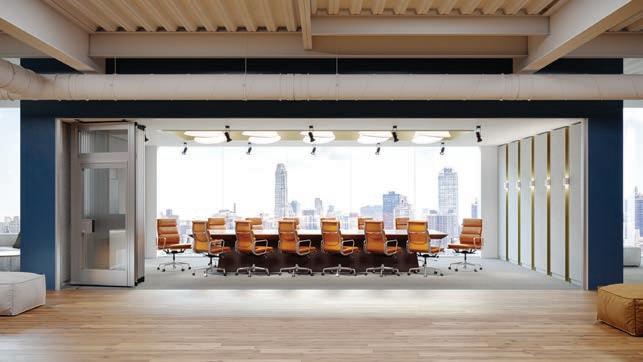
Transform your space with fully-automated movable walls by Modernfold. See how touchpad activation can achieve hands-free set up, industry-leading sound separation, and daylighting benefits. Watch as technology and design merge to elevate your flexible space solution.


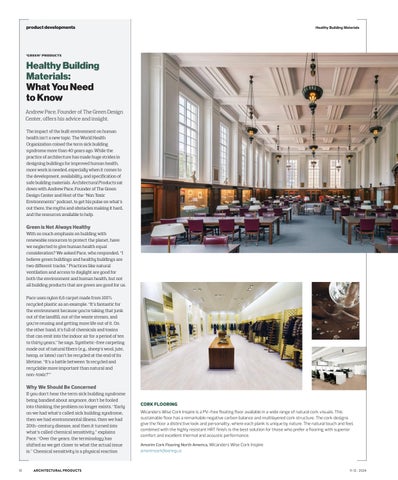
Healthy Building Materials: What You Need to Know
Andrew Pace, Founder of The Green Design Center, offers his advice and insight.
The impact of the built environment on human health isn’t a new topic. The World Health Organization coined the term sick building syndrome more than 40 years ago. While the practice of architecture has made huge strides in designing buildings for improved human health, more work is needed, especially when it comes to the development, availability, and specification of safe building materials. Architectural Products sat down with Andrew Pace, Founder of The Green Design Center and Host of the “Non Toxic Environments” podcast, to get his pulse on what’s out there, the myths and obstacles making it hard, and the resources available to help.
Green is Not Always Healthy
With so much emphasis on building with renewable resources to protect the planet, have we neglected to give human health equal consideration? We asked Pace, who responded, “I believe green buildings and healthy buildings are two different tracks.” Practices like natural ventilation and access to daylight are good for both the environment and human health, but not all building products that are green are good for us.
Pace uses nylon 6,6 carpet made from 100% recycled plastic as an example. “It’s fantastic for the environment because you’re taking that junk out of the landfill, out of the waste stream, and you’re reusing and getting more life out of it. On the other hand, it’s full of chemicals and toxins that can emit into the indoor air for a period of ten to thirty years,” he says. Synthetic-free carpeting made out of natural fibers (e.g., sheep’s wool, jute, hemp, or latex) can’t be recycled at the end of its lifetime. “It’s a battle between ‘Is recycled and recyclable more important than natural and non-toxic?’”
Why We Should Be Concerned
If you don’t hear the term sick building syndrome being bandied about anymore, don’t be fooled into thinking the problem no longer exists. “Early on we had what’s called sick building syndrome, then we had environmental illness, then we had 20th-century disease, and then it turned into what’s called chemical sensitivity,” explains Pace. “Over the years, the terminology has shifted as we get closer to what the actual issue is.” Chemical sensitivity is a physical reaction


CORK FLOORING


Wicanders Wise Cork Inspire is a PV-free floating floor available in a wide range of natural cork visuals. This sustainable floor has a remarkable negative carbon balance and multilayered cork structure. The cork designs give the floor a distinctive look and personality, where each plank is unique by nature. The natural touch and feel, combined with the highly resistant HRT finish, is the best solution for those who prefer a flooring with superior comfort and excellent thermal and acoustic performance.
Amorim Cork Flooring North America, Wicanders Wise Cork Inspire amorimcorkflooring.us

“It’s a battle between ‘Is recycled and recyclable more important than natural and non-toxic?’”
—Andrew Pace, Founder of The Green Design Center

INTERIOR MINERAL PAINT
Keim interior mineral paints are made from all-natural and renewable ingredients, mixed only with water, rendering them pure, non-toxic, and odorless. Innostar interior wall and ceiling paint is ideal for applications where a sustainable, healthy, and durable, velvety matte flat finish is desired. It is Cradle to Cradle silver certified and gold for Material Health, ensuring it’s a sustainable paint choice.
KEIM Mineral Coatings of America, Innostar keim.com

MOLD-REDUCING SHOWER DRYER
Airmada’s revolutionary AirJet Shower Drying System is a must have for a nearly maintenance-free shower experience. Available in eight finishes, Airmada’s AirJet Shower Drying System uses a series of air-jet nozzles, set flush to the ceiling or walls of the shower, to rid the area of dampness. The AirJet Drying System significantly reduces drying time and promotes a healthier bathroom environment by reducing mold and mildew while preserving grout and tile for the long term.
Airmada, AirJet Shower Drying System airmadadry.com
(e.g., headache, sore throat, nausea, joint pain, difficulty breathing, skin rash, or worse) to building materials or their components.
“There are 92,000 chemicals used in the production of building materials and home goods right now and we only know the toxicological effects of about 3% of those chemicals,” notes Pace. It’s only when there’s consistent harm that a product is removed from the market, its formulation changed, or a regulatory ban implemented—a process which can be very slow. For example, while we’ve known asbestos is a human carcinogen since the 1940s, the EPA didn’t ban chrysotile asbestos until March of this year. “A manufacturer or a chemical company develops a new compound, it gets used in products, and only gets taken out of the material or off the market if there’s been enough complaints and lawsuits,” he says.
Don’t be Duped
The information you may be relying on when selecting products might not be telling you what you think it is. Pace warns against falling for myths and misconceptions. Take volatile organic compounds. “VOCs have nothing to do with human health concerns. They have to do with outdoor air pollution. That’s why they’re regulated by the Environmental Protection Agency,” he explains. “A VOC is any carbon-based molecule that’s readily vaporized at room temperature that could rise to the upper atmosphere and react with nitrogen and UV and create low-level smog.” While some VOCs are bad for the environment and human health, not all of them fall into both categories. Pace cautions that products often marketed as “zero VOCs” may have merely replaced ingredients that are bad for the environment for ones that are bad for humans (e.g., acetone, ammonia, and butyl acetate).
You can’t rely on safety data sheets (SDS) for help either, unfortunately. The information disclosed there is intended for emergency response. “It has to do with alerting firefighters and first responders about how to protect themselves in case there’s a chemical spill on the highway or a fire,” says Pace. Additionally, the presence of a harmful substance may not be disclosed simply based on quantity. “They only have to list a hazardous material if it makes up more than one percent of the volume of the product or it’s not part of a proprietary blend. A manufacturer could have 15 to 20 different chemicals in a product, each one of them less than 1% of the volume, that will not be disclosed on the SDS. This is where manufacturers hide things like formaldehyde,” he explains.
Be careful about exaggerated marketing too. “Products that are natural, that’s also a red flag. Just because something’s natural doesn’t mean it’s safe. Asbestos is natural,” says Pace.
Help Specifying Healthy Products
“It is an absolute research nightmare,” says Pace. “It is the definition of analysis paralysis.” The work to discover which products are healthy and which aren’t is labor intensive because of a lack of transparency. Pace advises that you look for companies that are good corporate citizens, ones that have a whole line of healthy products, not one or two created to appease discerning architects. Look at the broad menu of certification programs (e.g., well, leed, Living Building Challenge, etc.) and use principles and guidance from each, instead of relying solely on one to guide your design and product specification process. “If I’m involved in a project, I’m using a little bit of all of these combined to create the correct checklist for the project versus following just one specific set of rules,” he shares.
“There are so many class action lawsuits against manufacturers all over the world because their products are unhealthy. I always assume that the materials that are specified are not safe until we know they are.”
—Andrew Pace, Founder, Green Design Center, Waukesha, WI
Other sources that can help include the Red List, the Declare Label, as well as health and environmental product declarations (HPDs and EPDs), which are produced by third-party organizations. And if you’re looking for some education, Pace recommends the Building Biology Institute, which offers courses, seminars, and certifications aimed at creating healthy homes, schools, and workplaces free of toxic indoor air, tap water pollutants, and the hazards posed by electromagnetic radiation.
These resources, along with the help of a consultant like Pace, can make specifying healthy building products simpler, and that makes everyone breathe easier.

CUSTOM CABINETS
Crystal Cabinet Works is a fully custom cabinet manufacturer capable of producing cabinets built to the designer’s exact specifications. The Keyline and Encore series offer an incredible range of elegant design details and premium cabinet accessories, with certified low-emitting sealer and topcoat finishes by request. Crystal is committed to being a leader in green—in both its products and manufacturing processes. Sound environmental practices add inherent value to its products and promote healthy lifestyles.
Crystal Cabinet Works, Keyline and Encore Series crystalcabinets.com

FLOOR FINISH
Safecoat Polyureseal BP Wooden Floor Finish is a highquality water-based clear floor finish. Its exceptional durability and abrasion resistance, coupled with very low odor, low VOC, and zero HAPs (Hazardous Air Pollutants) make it a clear alternative to conventional solvent and water-based polyurethanes. Available in gloss, satin, and matte sheens.
AFM Safecoat, Polyureseal BP Wooden Floor Finish afmsafecoat.com


Andrew Pace, Healthy Home Concierge and Founder of The Green Design Center.
Jana Madsen, contributing writer

SOMETHING unreal


H A S A R R I V E D

It might look familiar, but it will change the way you craft with wood. Introducing Wilsonart Woodgrains , the material that does everything wood veneer can’t. Unmatched durability. Unlimited options. Looks so real, it’s unreal.

The smarter way to do wood

Hurricane-Proofing Schools: Essential Steps for Safety
As severe storms become more frequent, schools face escalating risks from hurricane damage, emphasizing the critical need for resilient design. Investing in stronger, more adaptable school buildings isn’t just about safety; it’s a strategic initiative to protect occupants while keeping educational facilities operational, even amid extreme weather.
In this Q&A, Dr. Neall Digert, Vice President of Innovation & Market Development at Kingspan Light + Air, shares valuable expertise on proactive measures schools can take to prepare for hurricanes. Digert highlights common structural vulnerabilities and outlines essential steps to enhance resilience, ensuring safer, more durable learning environments.
QHow are school buildings most vulnerable to hurricanes?
AThe primary factors affecting school buildings during hurricanes are wind and water-related damage. Wind damage typically results from high-velocity winds and wind-driven debris that can breach a building’s weather-resistant envelope, including fenestration systems such as doors, windows and skylights. Water ingress can also occur due to failures in the fenestration system or the building’s exterior walls or roofing, allowing rainwater to penetrate.

When evaluating the hurricane preparedness of existing buildings, it is essential to review and upgrade the building’s structure and envelope systems to meet or exceed current performance requirements. This includes reviewing the building’s fenestration systems—curtain walls, windows, doors and skylights—for their ability to withstand high-velocity winds, debris impact and water infiltration.
QWhat is the role of local building codes in hurricane preparedness?
ALocal building codes play a vital role in hurricane preparedness by setting the standards for building materials and construction practices. It’s essential that all impact-resistant products meet or exceed local building codes, such as the ICC 500 standards, to provide adequate protection for school buildings during severe weather events.

ICC 500 ICC/NSSA Standard for the Design and Construction of Storm Shelters (ICC 500)
This ANSI-approved standard provides minimum design and construction requirements for storm shelters that provide a safe refuge from storms producing high winds, hurricanes, and tornadoes.
It contains design requirements for the main windresisting structural system and components and cladding of these shelters, and provides basic occupant life safety and health requirements for these shelters including means of egress, lighting, sanitation, ventilation, fire safety, and floor space.


(Above) The roof of the Calk-Wilson Elementary School, located in Corpus Christi, TX, remained intact after its exposure to Hurricane Harvey, which struck the Coastal Bend as a Category 4 major hurricane in 2017.
(Left) Tubular Daylighting Devices help to illuminate the Rosewood Elementary gymnasium.


Private Residence | West Norriton, PA
Corrugated Panel in Regal Blue & Boysenberry
Multi-Purpose Panel in Black
Architect: OW3 Architects
Contractor: J. Schwartz, LLC Remodeling & Fine Home Building


Distributor: Marvic Supply Co Inc. At ATAS International, Inc. we don’t just manufacture metal products; we forge connections, build trust, and shape the future. Join us on this journey as we continue to set new benchmarks in the metal products manufacturing realm, driven by a passion for quality, integrity, and progress.


QHow do advanced daylighting solutions contribute to building resilience?
AAdvanced daylighting solutions can enhance a school’s resilience in several ways. First, these systems need to be capable of withstanding the pressures of a hurricane, ensuring that the building’s protective envelope remains intact during the storm. To achieve this, it’s essential to incorporate fenestration products engineered for both cyclic wind loading and debris impact resistance. By ensuring the building envelope remains intact, these solutions contribute to the life safety of occupants sheltering within. Tubular Daylighting Devices by Solatube International, a Kingspan Light + Air company, offer a unique solution by delivering natural daylight to interior spaces where traditional windows or skylights are impractical or impossible. As the only roof-top daylighting system in the world compliant with ICC 500 and FEMA P-361 for use in storm shelters and safe rooms, the Solatube 750DS ensures that even in EF-5 tornado territory, buildings can remain naturally lit in the event of utility or backup power failures—without requiring additional penetration protection.
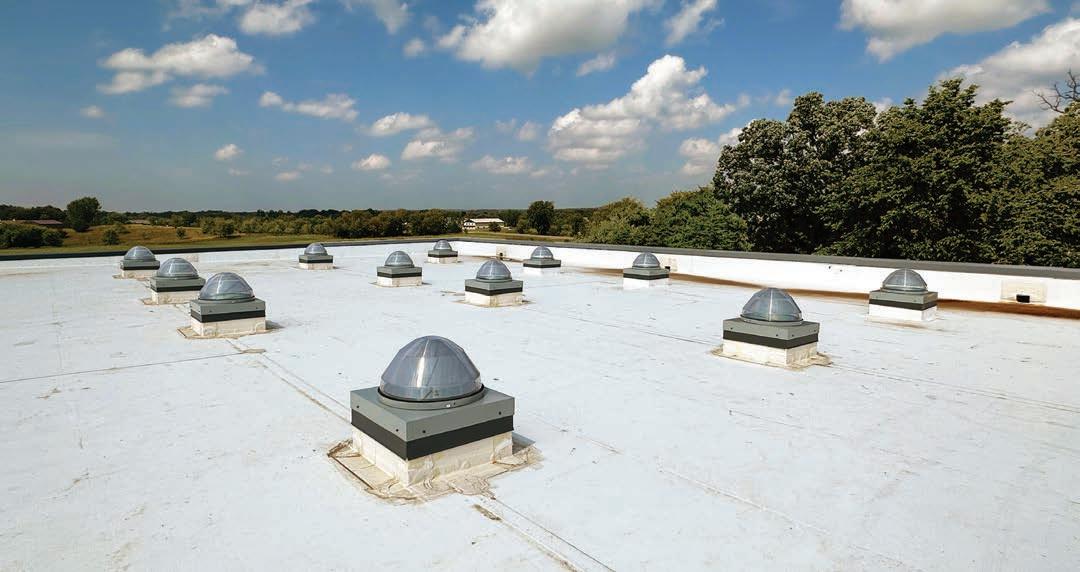
Q(Right) The recreation area at the New London ELC also functions as a storm shelter, requiring strict adherence to Minnesota’s E-occupancy standards and ICC 500 codes.
How can schools balance the need for resilience with budget constraints?
ABuilding storm resilience in educational facilities requires a careful balance of safety, functionality and budget. Today’s schools often serve as multifunctional storm shelters, and investments in reinforced roofing and impact-resistant windows can strain resources, even for well-funded districts. However, the potential for long-term cost savings through resilient design is substantial. Architects can address this challenge by prioritizing solutions that cost-effectively enhance resilience, offering districts financial reassurance. For example, multi-functional spaces, such as gyms, cafeterias, or auditoriums, can be designed to double as FEMA-rated storm shelters, optimizing space utilization while providing critical protection during severe weather.


Conclusion
Building resilience into educational facilities is essential as schools increasingly serve as both learning environments and community refuges during severe weather events. Proactive planning, adoption of advanced building technologies and compliance with local building codes lay the foundation for safer, stronger facilities. By investing in durable, cost-effective solutions—such as impact-resistant windows or ICC 500-compliant toplighting, reinforced roofing and multi-functional storm shelters—architects and school districts can safeguard both occupants and property, ultimately reducing long-term repair and replacement costs.

Moving forward, resilience should be central to facility planning. Collaboration between architects, engineers and district decisionmakers allows for a comprehensive evaluation of existing structures, identifying vulnerabilities and prioritizing upgrades that maximize safety within budgetary limits. With advancements in resilient materials and systems, schools have an expanding array of options to enhance safety.
School districts can also leverage local and federal grants to offset costs associated with resilient design, making these investments more feasible.
Neall Digert, Ph.D., MIES, Vice President, Innovation and Market Development, Kingspan Light + Air North America, has over 30 years of consulting and education experience.
(Above) The roof at the New London Educational Learning Center (ELC) in New London, MN, was designed by Hay Dobbs Architects to include 12 Solatube units.
Photo Credit: Solatube International
An exclusively daylit classroom at Calk-Wilson Elementary.


Above: Delaware Community College | LIGHTBLOCKS Palette
Right: Logan Airport Terminal B | LIGHTBLOCKS Palette

A Two-Faced Facade
Explore the distinctive design elements of One Platte—The Beck Group’s latest creation in Denver’s vibrant Platte
By Jeff Pitts, contributing writer

Street district.

The Beck Group has done it again. One Platte in Denver is the latest creation by their elite team of architects, designers, and builders. Here are several reasons why this stunning masterpiece might best be described as “Class A-PLUS mixed-use office space.” (Hint: One Platte contains ample high-end amenities, the project earned WELL certification, and the exterior consists of a gleaming two-faced facade.)
A Stunning Two-Faced Facade
“The building has two distinct sides,” explains David Morris, a Design Principal at The Beck Group. The concept harmonizes the site’s conflicting relationship between the cars zooming by on one side and the meandering foot traffic of a pedestrian-heavy zone on the other.
The remarkable result is an exterior that combines huge window panes, metal panels, and uniquely constructed, ultra-thin, prefabricated masonry slabs.
The scale and size of the glazing at One Platte has not been done before in Denver, at least to Morris’ knowledge. Most of the glass panes are roughly 8 ft. × 12 ft. or more, which would generally need to be broken up with either a joint or a mullion, but the team opted to use thicker glass sheets to maintain the larger spans. “We really pushed the envelope on the size of the glass in the building just to get as much natural daylight as we could into the building,” explains Morris.
The brick slabs interspersed between the large glass panes along the pedestrian-oriented side of One Platte are also a unique attribute. The masonry might appear to be a traditional laid-up brick, but it is not. “The prefab brick
panels actually slide into the window wall system,” says Morris. “If you took a brick panel out, you could theoretically replace it with a glass one. It’s a ‘plug-and-play system.’”
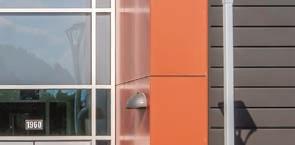
On the building’s flip side, onlookers driving by on I-25 see a slicker, curved facade made of the same glass but with metal panels interspersed instead of the bricks. “We did something unique on the highway side,” he says. Since the sights and sounds of passing traffic can distract office workers, the
The building’s stunning facade might be its most striking feature, and the access to plenty of natural light is a key attribute of modern offices.
glazing units on this backside have an additional veneer layer to dampen the noise. In addition, the metal panels have foam insulation built up along with a layer of Kevlar and Gypsum board behind that. The heavily densified panels offer noise protection and also protect against excessive heat gain.
Kevlar?
While Morris stops short of calling the building fully “bulletproof,” he allows that it is largely bullet-resistant. Adding the Kevlar required a significant influx of upfront capital, but the potential cost savings of needing fewer future replacement slabs, plus a reduction in insurance premiums and superior energy conservation made it worth it to the owners.
Project: One Platte
Location: Denver, Colorado
Architecture: Beck
Interior Design: Beck
Construction: Beck
Sustainability: Beck
Client: Nichols Partnership Inc. and Shorenstein Properties
Photography: Parrish RDV
Awards: 2023 National Award of Merit in the Commercial Buildings Category, Design-Build Institute of America (DBIA).
This is a high honor and awarded to only two projects nationally.
“The prefab brick panels actually slide into the window wall system. If you took a brick panel out, you could theoretically replace it with a glass one. It’s a ‘plug-and-play system.’”


The shop-fabricated brick panels consist of very thin bricks that were pre-assembled into slabs and constructed narrow enough to fit within a window wall system originally designed to hold glass sheets.
Endicott, Thin Brick endicott.com
BRICK VENEER MORTAR
Sika, Senergy Channeled Adhesive CI Design senergy-mbcc.sika.com
MODULAR CURTAIN-WALL SYSTEM
The facade’s differing panel types were made to slide neatly into the window wall system, including the factory-assembled thin brick slabs. Prefabrication can cut the necessary construction time while increasing the level of quality.
EFCO, 5600 PG efcocorp.com

ACOUSTICAL GLAZING
The increased dimension of the inner glazed portion was created by doubling up the thickness of the glass. The inboard lite is made up of two 0.25-in. panes laminated together for acoustical performance.
Viracon, 1.25-inch VRE143 Insulated viracon.com
BULLET-RESISTANT
FIBERGLASS PANELS
Kevlar layer in the building envelope.
Armorcore, UL 752 Level 3 panels - 7/16 inch armorcore.com
PANELS WEST
Horizon Glass, Custom fabricated metal horizonglass.net
METAL PANEL - ACM
Alpolic, Alpolic FR alpolic-americas.com
“We did something unique on the highway side.” Since the sights and sounds of passing traffic can distract office workers, the glazing units on this backside have an additional veneer layer to dampen the noise. In addition, the metal panels have foam insulation built up along with a layer of Kevlar and Gypsum board behind that.
BRICK VENEER
Morin, Exposed Fastener
—David Morris, Design Principal, The Beck Group
METAL

Well-Certified with Grand Atrium that Wows
The Beck Group designed and built One Platte to enhance human comfort and productivity which dovetails with achieving its WELL certification. One Platte’s stunning three-story grand atrium was one of the key features to attaining that distinction, and it serves as the interior’s visual crown jewel.
The natural wood paneling along the grand stair combines with the vertical wood ribs to mimic cottonwood trees alongside a riverbank. “All of that product, although it looks like custom-milled woodwork, that’s all pre-manufactured panels along the railing,” says Morris. “It looks like a custom-milled piece, but it’s not…it’s all off the shelf.”
The terrazzo stair treads that symbolize shimmering riverside rocks were also prefabricated, built to spec in California, and then trucked in for assembly. “They’re heavy aggregate,” Morris adds. “This is the look we wanted.”
The stair’s recessed handrail flows continuously from the third level to the lobby. A transparent tempered glass guardrail and draft curtain ensure that the craftsmanship of the grand staircase remains highly visible.
In keeping with the riverbed theme, the width of the stairway was deliberately widened at the landings to form strategically placed “eddies.” These resting spots encourage face-to-face meetings, facilitate impromptu gatherings, and offer space for contemplation and regeneration.

EXPANSIVE FOLDING GLASS SYSTEMS
The large conference/training room has “layers” of folding glass partition walls. A Hufcor modern fold door separates the large conference/training room from pre-function space. It also separates the main building lobby from the future coffee shop. On the exterior, Nanawall SL70 separates the pre-function space and the outdoor plaza. Opening these glass walls simultaneously allows this property to create expanded and connected indooroutdoor space.
Hufcor (distributed as Kwik-Walhel), GF Series kwik-wall.com
INDOOR/OUTDOOR FLEXIBILITY
This floor-supported, tall panel system is designed for heavy-duty weather performance and high-traffic applications.
NanaWall, SL70 nanawall.com


LOBBY FLOORING
Mosa, Terra Greys 36” × 36” mosa.com

AzoCore™ | Ultimate Thermal Performance
Ultra-low conductance polyurethane foam for superior strength, durability, and unrivaled U-factors.


Project: Luxury Residential, Chesapeake, MD Product: Quaker CityLine
—David Morris, Design Principal, The Beck Group


Round Trim Ring


METAL PANELS/ MECHANICAL PENTHOUSE BOH
Berridge, Thin-Line Panel berridge.com
TK Elevator, Evolution 200 with AGILE tkelevator.com
CAR-CHARGING STATIONS
WORK/LIFE BALANCE
Modern Amenities at One Platte
PARKING: Two below-grade parking levels with 300-plus spaces.
FITNESS CENTER: The spa-like fitness center is equipped with Peloton bikes and treadmills. The locker rooms boast towel service.
GOURMET KITCHEN: An enormous community kitchen opens to a roof-top terrace that is equipped to facilitate parties and big events. The fully loaded cooking space features a high level of fit and finish, but don’t expect to find paper plates. Instead, the kitchen has two dishwashers for the on-site staff to handle the cleaning.
RETAIL: On the ground level, One Platte has a restaurant, a café, and retail spaces to foster a vibrant community atmosphere. SMART PRODUCTS Destination Dispatch Elevator
ROOFTOP AMENITY & OUTDOOR SPACES: The rooftop deck provides stunning views of Denver’s downtown skyline and it is well-suited for relaxing or getting something done in a less stressful environment. “It’s an almost 3,000-square-foot rooftop with full WiFi,” Morris marvels. “People go up there and actually work.”
Siemens, VersiCharge AC Series siemens.com


Ample Amenities
An abundance of premium amenities is a key attribute that distinguishes modern contemporary office facilities from yesteryear’s austere work warehouses, and One Platte is the model of what modern Class A office space should be. The five-story, LEED Gold building is loaded with extras, such as retail shopping, a parking garage with rideshare vehicles, a spa-like fitness facility with lockers and showers, a community kitchen, a rooftop terrace with spectacular views, two large-scale bike barns, and more.
Bike barns?
Yep. And these are not your granddad’s run-of-the-mill, bike-storage spaces equipped with stiff benches and rusty padlocks. Instead, these spacious areas offer comfy seating and a legitimate ambiance.
“You actually want to be in there,” explains Morris. Meanwhile, vending machines spit out biking supplies and there is a station for doing repairs and maintenance to your rig. “In the wintertime, because we’re in Colorado, they actually have ski tuning,” he adds, “You can bring your skis or your snowboard in.”
When you add everything up that One Platte offers—a WELL-certified project with a magnificent, Kevlar-plated exterior, plus an interior replete with vending machines dishing out bicycle repair parts and on-site ski tuning services, and an array of high-end amenities—One Platte is the model for modern Class A-PLUS mixed-use office space.

Uline
Uline’s cushioning gives you the best seat in the house. And with over 42,000 products, you’ll love our variety. Order by 6 PM for same day shipping. Best service, products and selection – experience the difference!
Please call 1-800-295-5510 or visit uline.com


It’s that time again. The judging of the 14th annual Product Innovation Awards (PIAs) is complete. Architectural Products reveals our list of the latest and greatest architectural products launching into the market and onto projects right now.

This year’s winners demonstrate innovation in a wide array of product categories and offer solutions to some of the common problems architects face on every project. A few themes were evident—sustainability and certifications remained top-of-mind in both submissions and judges’ interest. Lots of products being introduced touted a new level of recycled content or recyclability—possible, in part, by new molecular recycling technology that breaks plastic down to its most basic molecules.
Delivering beautiful, high-functioning products that contain healthy materials was another hot topic and many manufacturers provided the third-party certifications necessary to support their claims.
There are more solutions for bringing a greater degree of glazing into the building envelope, without sacrificing thermal performance. More acoustic-friendly surfaces to create drama and character while managing sound. Powerful and better-quality light is now available in ever-shrinking forms and some forms bring a whole new sense of cool to luminaire design.
While our judges’ comments remain anonymous, members of our judging panel offered their insights into what makes this year’s winners particularly noteworthy. Here’s a sample of what they had to say:
“ This ceiling tile brings flair and sophistication to what is often a ‘boring ceiling tile,’ and has positive environmental benefits with healthier material certifications.”
“ Remarkable set of sustainability benefits paired with its Declare and HPD labels, and CDPH certification, this product is a top choice for interior designers concerned about the environment as well as building occupants.”
Keep reading to learn more about the products that inspired these glowing reviews and the many other incredible entries filling out the 2024 roster of PIA winners.
Chris Chatto, aia, leed ap bd+c, Principal, ZGF Architects, Portland
Zachary Christeson, asla, pla, leed ap, Regional Leader of Planning, HOK
Chris Hellstern, aia, lfa, Associate, Living Building Challenge Services Director, Miller Hull, Seattle
Kasey Josephs, Project Director, Orcutt Winslow
Steve Neimeister, LC, MIES, Senior Vice President, WSP
Andrew E. Thompson, aia, nomac leed ap bd+c, 2024 President-Elect, AIA New Jersey
Andrea Vendramin, Senior Designer, FM Architecture
Tom Widawsky, ra, ncarb Technical Sector Principal, HDR Inc.
Brian Wolf, ccs, leed ap bd+c, Principal, Director of Specifications, Grimm + Parker Architects
Entrance Systems/Hardware
A GRAND ENTRANCE, ALL YEAR LONG
JUDGE’S COMMENT: “ These monumental glass doors offer an AAMA CW Performance Class rated system that allows them to provide year-round, all-weather performance in coastal climates.”
Seamlessly installing into glass curtain walls and facades, these monumental glass doors, as large as 10-ft. tall and 4-ft. wide, can be specified with ultra-narrow 1-5/8in. door stiles for a striking grand entrance. Delivering exceptional aesthetics with outstanding performance, the system meets Florida Product Approval. Door handle hardware, such as the Blumcraft tubular panic device, mounts directly onto insulating glass units for a streamlined design. The system features a full perimeter seal around the doors, structural enhancements, and thermally-broken components.
CRL, Blumcraft Entice HP+ Glass Entrance System crlaurence.com

HISTORIC LOOK MEETS MODERN SMART LOCK
JUDGE’S COMMENT: “ The Art Deco Smart Lock provides a historically-informed aesthetic with contemporary functionality.”
Designed to evoke memories of the 1920s Jazz Age, the ISM-ADR500 Art Deco smart mortise lock meets growing user interest in blending advanced technology with elegant design. Controlled by Bluetooth or Wi-Fi, INOX’s Smart App can be programmed with four user types and four permission settings. The sophisticated, stylish mortise lock is easy to operate with remote access management.
INOX by Unison Hardware, ISM-ADR500 Art Deco Smart Lock inoxsmart.com


A WIDE WELCOME

JUDGE’S COMMENT: “ This application outlines significant innovation in the design of the product, making it an exceptional option for interior and exterior openings. Great product.”
Delivering the sought-after look and functionality, these stunning, monster XL-sized doors can be custom-made to be up to 10-ft. tall and up to 5-ft. wide. All exterior pivot doors are 2.25-in. thick and interior pivot doors can be 1.375 in. or 2.25 in. These oversized doors swing on a pivot hinge and operate with a unique roller latch system, which keeps the doors closed without handle operation.
Simpson Door Company, Pivot Door System simpsondoor.com
AIR AND LIGHTING IN ONE
JUDGE’S COMMENT: “ This product has a nice slimline aesthetic.”
With its low profile, 1-in. slot width design and frameless border, the FlowBar diffuser’s air stream can be directed to send air in any direction. A wide array of slot widths allows for more CFM per linear foot while minimizing noise and pressure loss. Lending greater design freedom with its small size, the linear air diffuser system also integrates LED downlights. The integrated HVAC and lighting system is both stylish and functional, reducing costs and installation time.
Titus, FL-10 LED www.titus-hvac.com


Would You Believe It’s Steel?
The real look of wood with the proven performance of steel. Introducing a new, revolutionary technology by Steel Dynamics. Tru ►Steel HD® makes steel look like real wood because the images are original scans of real objects, providing superior depth and image clarity not offered by any other technology. Our revolutionary, high-definition digital printing process for steel coils enables us to print beautiful and photo-realistic images, up to 32 feet in length without repetition, protected by an advancedtechnology clear coat.
Available in galvanized and Galvalume® steel sheet, Tru ►Steel HD® comes in a variety of patterns from Rough Sawn Cedar, to Barnwood, to Realtree® Camouflage. Now you can have the beauty of wood and other finishes — with less maintenance.
To find out more about how you can finish strong with Tru ►Steel HD®, contact your SDI representative, or visit us online at Tru-SteelHD.com


Barnwood Plank
Rough Sawn Cedar Dark Brown
Pecky Cypress Rough Sawn Cedar Hickory
Rough Sawn Gray Cedar
Realtree Camouflage
Surfaces


REVOLUTIONIZING RECYCLING IN TRANSLUCENT MATERIALS
JUDGE’S COMMENT: “ I appreciate the transparency here and attempt at a better product with more recycled content.”
In adopting cutting edge molecular recycling technology, 3form was able to boost the recycled content in their Textures series from 40% to 100% without sacrificing aesthetic value, durability or performance. Available in 21 patterns, the translucent resin material plays with light and shadow and comes in a variety of styles ranging from modern to Art Deco. The advanced molecular recycling technology breaks down the plastics’ complex polymers into simple molecules which are then used to create new clear materials.
3Form, 100% Recycled Textures 3-form.com

BEAUTY OF STONE IN FELT
JUDGE’S COMMENT: “ This product is due for recognition for sustainability. While the application is essentially a printing process, that process is done sustainably and expands the opportunities to use an already highly sustainable base material.”
After nearly four years of research and iteration, Turf has expanded its Textures finish family—previously a suite of eight wood Turf Textures—to offer new Stone Textures. Emulating the dynamic veining and intricate details of natural stone, the surfaces bring biophilia to commercial interiors, without sacrificing the acoustic qualities of a space. Stone Textures come in marble, travertine and granite in 31 colorways, digitally printed on high-performance felt.
Turf, Stone Textures turf.design
ODE TO NATIONAL PARKS
JUDGE’S COMMENT: “ This is another beautiful product with great opportunities for use. I am excited to discover this collection.”
Drawing inspiration from America’s national parks, Móz Designs presents six new colorways for its Patina Collection. Taking hues from locations like Yellowstone, Zion and Olympic National Park, the colors feature blue steel, vibrant corten, muted green, aged concrete and rubbed bronze. Well suited for covers, room dividers, and dimensional walls and ceilings, the surfaces can be enhanced with laser cuts, engravings, or a corrugated metal style.
Móz Designs, Patina Collection mozdesigns.com


FROM BOTTLES TO WALL CLADDING
JUDGE’S COMMENT: “ I appreciate the Red List free quality of this product, with transparency documentation, and the evolution away from PVC for this product type.”
Dubbed the first wall protection product with recycled content from post-consumer PET bottles or foodgrade single-use plastics, Acrovyn contains up to 50% post-consumer recycled content. Manufactured from PETG resin, a resin that contains shredded single-use PET plastic, the PETG resin pellets are then mixed with colorants and laminated to create numerous Acrovyn sheet colorways. This option is currently available on select woodgrains, brushed metals, and sheet-based products.
Construction Specialties, Acrovyn with Recycled Content c-sgroup.com
A NEW OUTDOOR ESCAPE
JUDGE’S COMMENT: “ I like the aesthetic of the large-format pieces.”
The outdoor collection of Plains & Pods features a combination of rectilinear and curvilinear seating and planters. Offering multifaceted settings, the pieces can be grouped together in tiered clusters for assorted group seating or as stand-alone spots surrounded by greenery. The seating and planters help designers create environments where occupants can connect with each other and with nature.
Landscape Forms, Plains & Pods landscapeforms.com

Flooring

RECYCLED RUBBER FLOORING AT ITS BEST
JUDGE’S COMMENT: “ This blend of post-consumer tire rubber, post-industrial vibrant EPDM chips, and low-VOC binder is an interesting flooring option.”
Striking, versatile and practical, REGUPOL Upscale leverages recycled rubber flooring to deliver highend, stylish flooring. This luxury rubber plank and tile collection features 12 neutral earth tones that pair well and create patterns that feel warm and soothing. An innovative alternative to terrazzo, ceramic tile, and luxury vinyl tile and plank, the material is easy on the feet and offers good acoustic performance.
REGUPOL America, REGUPOL Upscale regupol.us

ECO-FRIENDLY FLOORING
JUDGE’S COMMENT: “ Love the flexibility and beautiful design color options.”
With four soft-surface patterns and two non-PVC plank and tile patterns, the Layered Duality flooring collection offers combinations of forms, textures and colors. The soft surfaces are made from Dynex SD, a premium cationic nylon with permanent resistance against most staining agents. Dynex SD is treated with Eco-Ensure, a Platinum C2C Material Health-certified material. This fluorine-free soil protection technology lowers the cost of maintenance and creates healthier spaces by promoting better indoor air quality with low-VOC emissions.
Tarkett, Layered Duality tarkett.com
Landscape
WOOD OIL
JUDGE’S COMMENT: “ This wood treatment is very innovative. It allows for the natural beauty and raw characteristics of the wood to show through while still providing protection against the harsh environment.”
Unlike traditional wood coatings, this wood oil penetrates deeply, protecting wood from the inside out. It displaces water for long-term dimensional stability, reducing warping and splitting, and extending the wood’s service life. Importantly, this coating does not form a surface film, so it will not peel or flake. Coated wood will naturally fade and silver over time, preserving its original beauty.
Chemisys Group, CUTEK Extreme cutekstain.com


Coatings

CRAFT THE FUTURE
In high-end design, the natural beauty of wood enhances interiors with its warmth, texture, and elegance. The unique grain structure of wood adds character and sophistication, creating a luxurious, inviting atmosphere. By choosing wood, you don’t just enhance the design—you Craft the Future, merging sustainability with timeless style.
Two Union Square
Location: Seattle, WA
Architect: NBBJ
Wood Product: Beams

VISUAL AND ACOUSTIC COMFORT
JUDGE’S COMMENT: “ Roof’s felt enclosure provides a unique aesthetic for a lighting fixture.”
Creating visual appeal and acoustic comfort, the Roof luminaire incorporates a wide, curved diffuser, sound-absorbing felt, and unique geometric lines. The downlight offers a direct Lambertian distribution of up to 566 lumens per foot and an optional uplight delivers diffused, glare-free ceiling illumination of up to 460 lumens per foot.
Eureka, Roof eurekalighting.com

Acoustics

UP, DOWN, AND ALL AROUND
J
UDGE’S COMMENT: “ I like the thoughtfulness of the design that provides shadowless uplight lighting.”
Made from sound-absorbing recycled PET felt, the Frank acoustic luminaire is powered by a strong light source that projects onto a rounded diffuser, creating elegant and efficient illumination. Configured with uplighting, downlighting or both, the fixture’s carefully considered design ensures that the power cable casts no shadow when the uplight option is specified.
Eureka, Frank eurekalighting.com

COLOR, LIGHTING, AND ACOUSTICS
JUDGE’S COMMENT: “ These families of acoustic luminaires offer a fun way to bring pops of color into a project.”
Inspired by the Color Field painting movement of the 1950s, where color is applied in large-scale formats, Joli, Elke, and Marro pendants come in 30 rich and decorative colors. Each pendant features eight acoustic felt panels that radiate from a central globe diffuser. Available in three different shapes, the luminaires make a design statement while enhancing acoustics.
Eureka, Joli, Elke, and Marro eurekalighting.com
STONE LOOK, ACOUSTIC PERFORMANCE
JUDGE’S COMMENT: “ This product is pushing the boundaries of acoustical panels. I like the natural look that the design provides and the sustainable properties of the felt panel.”
Carrara is produced with two 9mm layers of felt— a base and top layer with intricate carvings etched into the material to create cracks and veins. These sculptural wall options are available in four panel types. Up to 52 colors and five standard layouts offer architects many ways to create a stunning stone look with these durable, Class A fire-rated panels.
Turf, Carrara turf.design


AESTHETIC ACOUSTICS
JUDGE’S COMMENT: “ This acoustic solution offers designers a nice way to bring color, texture, and dimension to the wall.”
Bringing color and dimension to acoustic performance, Hush Stack surfaces are made with two stacked layers of 3form’s Sola Felt, a 50% post-consumer recycled PET. Delivering a high NRC rating of 0.65, the material comes in 22 standard colors and 10 distinct bevel-cut designs. Pattern examples include Terra, resembling the contour lines on a map, and Bauwows, emulating the Bauhaus design movement. For spaces where improved acoustics are desired, Hush Stack reduces reverberation and dampens sound energy while creating visual appeal.
3Form Elements, Hush Stack 3-form.com/elements
JUST BAFFLED
JUDGE’S COMMENT: “ There are many acoustic baffle products on the market but I appreciate the flexibility offered in the Rockfon Contour.”
Playing with curves and geometric lines, the Contour’s stone wool acoustical frameless baffles deliver acoustics in style. Reducing reverberation and echo with its high sound absorption properties, the material provides a smooth, matte white surface that offers light reflectance and diffusion, thereby enhancing lighting in the space. The baffles also serve as a standalone solution when a space has exposed plenum, skylights or tall windows.
Rockfon, Rockfon Contour rockfon.com

ARCADE CEILING
JUDGE’S COMMENT: “ This ceiling tile brings flair and sophistication to what is often a ‘boring ceiling tile,’ and has positive environmental benefits with healthier material certifications.”
Taking a Gothic theme and turning it down a notch is Turf Arcade’s ceiling line. Made from polyester felt with 60% pre-consumer recycled content, the textured ceiling comes in five different shapes of contiguous arches. The ceiling solution is offered in six neutral colors curated from Turf’s Hues palette of Onyx, Carbon, Pumice, Talc, Sandstone and Travertine.
Turf, Arcade turf.design
HIGH-END PARTITIONS
JUDGE’S COMMENT: “ I like the high-end look of these fully enclosed compartments.”
The Skyline and Highrise join Bradley’s Euro Style restroom partitions delivering a high level of privacy, aesthetics and functionality. The floor-to-ceiling Skyline is made from opulent-looking enameled tempered glass, accented with an impressive floating glass front. The floor-to-ceiling Highrise partition is constructed with a durable, water-resistant Phenolic LT material and is moisture-resistant. Mortise locks and slow closing hinges support quiet, soft-closing doors, and both partitions come in a variety of colors and options.
Bradley Company, Euro Style Floor-to-Ceiling Restroom Partitions bradleycorp.com
Restroom Solutions

JUMP IN! THE WATER’S 59°F
JUDGE’S COMMENT: “ This seems to be an advancement in design to provide a wellness package to several lines of tubs, while offering pioneering in sanitation features. This is a product line worth recognition for innovation.”
This proprietary water-chilling system has a fullyremote chiller that does not need to be installed near the tub. It also features the HydrOzone UV Combo System which infuses ozone and UV light into the bath to disinfect the water and keep it clean, so it can remain in the tub for up to five days.
Hydro Systems, Cold Plunge hydrosystem.com


JAPANESE POTTERY-INSPIRED VESSEL
JUDGE’S COMMENT: “ I appreciate that this product is C2C certified and has 100% recycled content with no lead.”
Blending Japanese pottery with contemporary design, Stone Forest’s bronze Edo Vessel sink is crafted with traditional sandcasting techniques. The process leaves the exterior “rough cast” before applying a patina, which produces a unique finish on each sink. Hand-crafted, hand-finished and sustainable, the artistic sink is available in golden bronze and desert cream limestone.
Stone Forest, Bronze Edo Vessel Sink stoneforest.com


NATURALLY PATTERNED DRAINAGE
JUDGE’S COMMENT: “ This is a beautiful drain.”
Patterned after the natural movement of water droplets, Gensler teamed up with Infinity Drain to create the Adhesion Linear Drain. The drain pattern features an even distribution of irregularity that is random, yet precise. This thoughtfully considered design supports the efficient drainage of water through a visually interesting drain.
Infinity Drain, Adhesion Linear Drain infinitydrain.com


AIR POCKET DOOR
JUDGE’S COMMENT: “ This very innovative product allows a shower to transform into a steam shower while eliminating the potential for bacteria to grow on the shower door. I really appreciate the frameless design where the glass goes to the edge on all sides.”
With a new soft-open and soft-close feature in a stainless-steel frame, the AirPocket Door supports quieter, smoother opening and closing functionality for shower doors. Replacing the traditional swinging shower door with a slide-in door, the AirPocket enables the shower to double as a combination walk-in shower/steam shower as the door can create a full shower seal. The product also features Air-Jet technology, which dries the difficult-to-reach pocket after use.
AIRMADA Drying Solutions, AirPocket Door airmadadry.com
JUDGE’S COMMENT: “ Seems like a heightened level of control that adds another layer of luxury to these already high-end steam showers.”
The next generation ThermaTouch2 15 comes in 7-in., 10-in. and 15-in. screens displaying easy-to-toggle shower controls and accessing entertainment options via a wide range of apps. Integrated with voiceactivated smart home technology, users can turn the shower on remotely, set the water to a desired temperature and pressure, activate steam therapy and control chromatherapy options.
Thermasol, ThermaTouch2 15 thermasol.com

MODERNIZING LOCKERS


JUDGE’S COMMENT: “ This is a very innovative way to maximize personal storage efficiency and replace outdated heavy lockers. The sleek design is very ”
Revolutionizing the locker room, these lockers employ flexible, textile locker bags instead of sheet metal, achieving space savings of up to 70% compared to traditional lockers, and offer a host of other benefits including integrated ventilation, a separate shoe compartment, removable hangers to keep workwear and streetwear segregated, and carbon filtration to keep odors and relative humidity low. Every touchpoint is ergonomically designed and antimicrobial.
Zippsafe USA Inc., ZippSpace zippsafe.com
SPA SCREEN
Ceiling Systems
PHASE CHANGE MATERIAL CEILINGS
JUDGE’S COMMENT: “ Great transparency documentation. The focus on decarbonization and energy reduction for a commonly used product is much needed today.”
While phase change material (PCM) technology is used for applications like temperature-regulating mattresses, Templok ceiling panels apply it to create energy efficiencies and occupant comfort in buildings. The phase change material, which is a water and salt solution, solidifies and melts like ice and water at 72ºF, instead of 32ºF. As the heat in the room rises, the PCM absorbs the heat and melts. When the temperature falls, the PCM releases the heat and recharges for the next day. The net result is up to 15% in HVAC energy savings.
Armstrong World Industries, Templok Energy Saving Ceiling Panels armstrongceilings.com

LOWEST EMBODIED CARBON CEILING
JUDGE’S COMMENT: “ Remarkable set of sustainability benefits paired with its Declare and HPD labels, and CDPH certification, this product is a top choice for interior designers concerned about the environment as well as building occupants.”
Claimed to carry the lowest embodied carbon in the market for mineral fiber acoustical ceiling panels, this product offers a 43% reduction in embodied carbon as compared to standard Ultima products. Tapping into biochar technology—Armstrong has applied this carbon sequestering, nontoxic, wood-generated biochar to the built environment with this product. The durable, sanitary surface delivers sound absorption of 0.75 NRC and 35 CAC sound blocking.
Armstrong World Industries, Ultima Low Embodied Carbon Ceiling Panels armstrongceilings.com

Tech

POWER PLUG
JUDGE’S COMMENT: “ A highly functional and aesthetically pleasing product.”
This multi-faceted power station provides two dual USB-A and USB-C ports, an HDMI port, a 3.5mm audio jack and an overhead surface to rest small devices while charging. When not in use, the unit recesses, sitting discreetly, flush to the surface. Motorized struts open and close with the push of a button, making it easy to access the power ports below.
Mockett, PCS131 - Conference AV Power Pop-Up Grommet mockett.com
BIM GOGGLES
JUDGE’S COMMENT: “ A really cool product to bring 3D design to the masses. Both professionals and clients will love this application.”
View BIM models in a 3D spatial environment on the Apple Vision Pro. Narrowing gaps between the design studio, client’s office, and the construction site, building owners and project teams can now visualize designs and more easily evaluate different design possibilities. Users can also view BIM data such as project and element information, and interactive schedules.
Graphisoft, BIMx with Apple Vision Pro graphisoft.com


Avanti Linear Brick
Cladding
JAPANESE WOOD
JUDGE’S COMMENT: “ Beautiful product. I appreciate the sustainable shou sugi ban approach to durability, eliminating harmful chemical preservatives, as well as the provision of an EPD about the product’s life-cycle environmental impacts. Incredible durability (reportedly up to 80 years) with little maintenance.”
Made from Japanese cypress, Gendai goes through an intense burning process to produce a strong, resilient, smooth and dark surface. Applied as wood siding and cladding, this product can be coated with 13 different finishes or left to naturally patina over time. The wood can last up to 80 years with little maintenance. and serves as a welcomed carbon-negative alternative to chemically engineered cladding products.
Nakamoto Forestry, Gendai nakamotoforestry.com
FOR SUPER-INSULATED ENVELOPES
JUDGE’S COMMENT: “ It is notable that these products use a blowing agent with zero ODP, have virtually zero GWP, and are free from harmful CFCs, HCFCs, and HFCs.”
High-quality polyiso Defend-R rigid roof insulation panels and Defend-R CI rigid wall insulation panels combine high value-per-inch insulation, a custom finished metal panel, profile-specific clips, and screws in a single system. The Defend-R line offers three rigid roof insulation panels with facer options that include fiber-reinforced, coated glass, and OSB. The Defend-R CI line features seven types of rigid wall insulation panels composed of a closed-cell polyisocyanurate foam core manufactured to various facer types in both standard and Class A variants.
Drexel Metals, Defend-R and Defend-R CI drexmet.com


WOOD WARMTH, STEEL PERFORMANCE
JUDGE’S COMMENT: “ I give this product high marks on innovation for bringing the process in-house and offering it in steel sheet when many other entities limit the wood-look finishes on aluminum.”
Combining the warmth of wood with the performance of steel, TruSteel HD offers durable, long lasting cladding and garage doors. Leveraging a high-definition digital printing process, up to 32 ft. of material can be produced without repetition, and protected by an advancedtechnology clear coat. Available in galvanized and Galvalume, TruSteel HD options include rough sawn cedar, barnwood, charred and distressed wood. Steel Dynamics, Tru-Steel HD steeldynamics.com


LARGER THAN LIFE
JUDGE’S COMMENT: “ A nice option for customizing a facade with photos and logos.”
Façades by Design enables images to be digitally printed on flat perforated sheets, linear sun controls, louvers, custom profiles and extrusions. Photography, graphics, patterns and color are printed through a powder coated application offering scratch and fade resistance. Applicable for branding, signage or wayfinding, this printing capability provides architects a great deal of creative possibilities.
Construction Specialties, Facades by Design c-sgroup.com


SOPHISTICATED METAL LOOK FOR ALUMINUM
JUDGE’S COMMENT: “ This collection offers a beautiful natural metal aesthetic at a more accessible price point.”
Mimicking the timeless appearance of natural metals, the Alloy collection features Antique Brass, Copper Penny, Hairline Brass, Oil Rubbed Bronze, Sunrise Titanium and Verdigris Copper finishes. Creating the aesthetic of raw or aged metals at a more affordable price point, each finish is made from 20% recycled aluminum. Capturing metal’s patinated surface, the finishes deliver a consistent, refined and sophisticated appearance with reduced maintenance.
Pure + FreeForm, Alloy Collection purefreeform.com


IMPS AT THEIR BEST
JUDGE’S COMMENT: “ I appreciate that this product is Red List free.”
Combining all-in-one thermal, air, water and vapor protection with great aesthetics, Formawall panels deliver the best of insulated metal panel technology. Seamlessly integrating with windows, sunshades and daylighting panels, the metal wall and roofing panels can be installed vertically or horizontally with concealed clips, fasteners and sealants. Available in a full color palette, the panels can be smooth, smooth with striations, embossed or embossed with striations.
CENTRIA, Formawall Dimension Series centria.com
THE FINISH FOR INDOORS AND OUTDOORS
JUDGE’S COMMENT: “ It is nice to be able to use the exact same finish indoors and out.”
Offering a broad array of indoor and outdoor finished panel systems, Transitional Metal selections include blackened steel, brass, bronze, copper and silver. Designers can also choose stone and wood options. The system offers matching mounting systems for interiors and exteriors, creating a seamless transition between indoors and outdoors. Whether seeking opulence, warmth, modernity or sheen, designers are likely to find the right panel to fit their desired aesthetic.
Pure + FreeForm, Transitional Metal purefreeform.com


Outdoor Luminaires
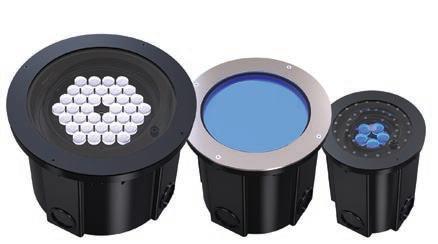
RUGGED AND FLEXIBLE
JUDGE’S COMMENT: “ Terra Drum promises a level of design variability and durability that should be appealing to designers.”
Designed for all-weather, in-ground applications, Terra Drums are well suited for recessed façade, walkway and tree lighting applications. The durable and rugged fixture offers a +/- 15-degree adjustment after installation and can be swiveled and set inside the sleeve before locking into place. With a wide range of emitter and optic options, the product offers 90 combinations to ensure a precise fit with any installation.
Acclaim Lighting, Terra Drum Series acclaimlighting.com

OUTDOOR LIGHTING ELEGANCE
JUDGE’S COMMENT: “ It is interesting that this luminaire is engineered to be fully dismantlable and recyclable at end of product life.”
A departure from traditional outdoor dome lighting, Mochi adopts a nature-inspired silhouette, lending a softer look to urban settings. Powered by Cyclone’s high-performance Orion light engine for maximum output capacity, the luminaire comes in more than 14 light distribution types. The elegant side or pendant mount luminaire delivers precise illumination supplying 3,000 to 16,000 delivered lumens.
Cyclone Lighting, Mochi cyclonelighting.com
SCULPTURAL BOLLARDS
JUDGE’S COMMENT: “ Now this is a cool deviation from the traditional light post. Sleek design with high output lighting.”
For the design of parks, public plazas and pedestrian paths, designers can choose from Outline’s selection of bollards and luminaires of varying heights, distribution options and lumen packages. Combining sculptural aesthetics and high-performance lighting, the luminaires offer an interplay of light and shade, crisp lines and soft fades. The elegant bollards help create well lit, pedestrian-centric, visually inspiring outdoor spaces.
Landscape Forms, Outline landscapeforms.com


CATERPILLAR-LIKE LIGHTING
JUDGE’S COMMENT: “ Very unique mounting solution for these outdoor lights. Allows for the light to be well hidden in the daytime when not in use.”
Creatively and expertly engineered, the design of CATIRPEL luminaires was inspired by a caterpillar with its ability to mount to irregular, curved, or undulating surfaces. A ball joint system gives each luminaire module the ability to be freely aimed and secured to a precise position with a locking screw. CATIRPEL can be installed directly to the mounting surface or used with optional mounting accessories for trees, landscape, and surface installations. The configurations are infinite, as are the possibilities.
Targetti, CATIRPEL targettiusa.com
A TWIST OF LINE
JUDGE’S COMMENT: “ Highly innovative light post design—both elegant and cutting edge.”
Ideal for parks, pedestrian paths, urban plazas, hospitality and office complexes, the Line Twist luminaire is designed with an innovative micro-faceted twist reflector system. The light pole is available in two settings. The 6 Cell spirals around half the column providing asymmetric light and the 12 Cell spirals all around the column delivering symmetric light. The design significantly reduces the complexity of a luminaire’s form by integrating the optics into the column.
Selux Corporation, Line Twist selux.us


MANY COLORS OF LIGHT
JUDGE’S COMMENT: “ This compact outdoor luminaire offers a variety of light colors with static white, Quad Tech RGBW, and RGBA color mixing.”
Made from impact and corrosion-resistant materials for harsh outdoor environments, the Tierra family of compact architectural in-grade lighting fixtures delivers optimal beam control and superior performance. The luminaire offers higher delivered lumens and more color temperatures than the average in-grade product, and features a compact design, available in 4.4-in. and 6.38-in. diameters. The groundrecessed LED is ideal for uplighting columns, pathways, architectural features, facades and landscaping.
Hydrel, Tierra IGF Ingrade Family hydrel.com

ONE FLEXIBLE FAMILY
JUDGE’S COMMENT: “ A very sleek and flexible outdoor luminaire, I appreciate the clean lines and attention to detail and I like that the same type of head can be used in multiple mounting configurations.”
The Syrios Pro family of luminaires includes a variety of mounting types—wall (downlight or up/ downlight), ceiling surface, pendant stem, aircraft cable, or catenary. A new pole mount has also been introduced. A 30-degree tilting mechanism is ideal for highlighting masonry, overhang canopies or pathways, and a 355-degree adjustable module rotation enables designers to accentuate specific areas.
Luminis, Syrios Pro luminis.com

FAÇADE AND CORRIDOR LIGHTING
JUDGE’S COMMENT: “ With Jaki, it’s easy to create a coordinated look with wall, surface, and ceilingmount options.”
Designed to illuminate building facades, stairwells, corridors and hallways, Jaki fixtures can be found in schools and university campuses, shopping centers, outdoor malls, sports complexes and condos. Available in eight standard and 12 faux wood finishes, the wall, surface, or ceiling mount luminaires can be installed horizontally or vertically, with or without a shield. Its shatterproof, UV-stable diffuser is made to weather high-impact environments.
Luminis, Jaki luminis.com
REDEFINE HIGH CEILING LIGHTING
JUDGE’S COMMENT: “ This is a great solution for designers looking to light the floor and ceiling in a high-ceiling application from one luminaire.”
This architectural fixture is suitable for mounting heights of 30 ft. and above. With separate control over its downlight and uplight, the highly compact Whiz 2.0 Bi-directional delivers a combined high lumen output of up to 48,750 lumens. Ideal for sports facilities and high-ceiling spaces, the aesthetic metallic finish is designed with airflow gaps for enhanced heat dissipation, supporting durability and superior performance. The luminaire also offers dynamic color-changing capabilities and flicker-free video performance.
Meteor Lighting, Whiz 2.0 Bi-directional www.meteor-lighting.com

Lighting

THE DO-IT-ALL LUMINAIRE
JUDGE’S COMMENT: “ This blend of form factors in one luminaire offers designers a go-to multifunctional solution.”
The M36 Combo is comprised of slim linear lighting, a louver and/or a mini adjustable spotlight. The mini spots can be single, double or triple luminaires, and can be used as fixed downlights or adjustable accents. Suitable for commercial and retail spaces, galleries, museums, schools, offices and hospitality, the LED lenses are extruded acrylic, delivering precise light distribution.
Selux Corporation, M36 Combo selux.us

HIGHLY FLEXIBLE AND CUSTOMIZED
JUDGE’S COMMENT: “ The field-swappable components are a welcome change in the industry and hopefully a game changer. I also love that this is one of the few LED fixtures with a Declare list showing Red List compliance.”
With its wide selection of field-changeable optics and trims, and decorative diffusers, the X Series Cylinders deliver tremendous flexibility and customization. At just 3 inches, the cylinders are available in assorted lengths and lumen outputs. The modular system’s drivers are integrated directly into the light engine modules delivering ideal space efficiency, performance, reliability, and serviceability.
DMF Lighting, X Series Cylinders dmflighting.com

3D-PRINTED LIGHT FIXTURES
JUDGE’S COMMENT: “ Lattice provides a unique aesthetic with its intricately 3D-printed metal.”
The Lattice luminaire is created with multiple layers of intricately 3D-printed metal. Available as a sphere, cone or cylinder, these sculpted elements come in four different color temperatures, delivering up to 583 lumens. Finished in natural aluminum, they can be suspended by a 36-in. stem or 90-in. stainless steel braided cable.
Eureka, Lattice eurekalighting.com

100% RECYCLED PENDANTS
JUDGE’S COMMENT: “ This collection is aesthetically pleasing and I appreciate the innovation this industry-first solution represents.”
Touted as the commercial lighting industry’s first clear, 3D-printed, 100% recycled pendants, LightArt’s Coil Collection harnesses molecular recycling technology to upcycle discarded materials. The collection features six new pendant shapes, including cylindrical, hexagonal, and bottle-shaped. Emphasizing the material’s clarity and light refraction, the pendants are assembled with a PVC-free cord and are finished with TGIC-free powder-coated hardware.
LightArt, Clear Coil Collection lightart.com

LINEAR LIGHTING INNOVATION
JUDGE’S COMMENT: “ Where a truly minimalistic aesthetic is needed, this product delivers.”
With its Opti Diamond optics and exclusive materials, the Libera linear lighting system provides a high level of versatility and design freedom. 360-degree rotatable joints and a miniaturized design, at just 0.59-in. wide, supports a high level of architectural integration while providing an exceptional lighting performance of 130lm/W. The product successfully addresses the need for unobtrusive lighting solutions that blend effortlessly with contemporary designs.
iGuzzini, Libera iguzzini.com

DISCREET, YET POWERFUL
JUDGE’S COMMENT: “ High quality appearance. Love how this beam of light seamlessly turns a corner. Very minimal with nice lighting output.”
At just 3-in. high and less than a finger-width wide, the Lines Onwall projects light from a narrow 0.5-in. aperture. Designed for use as discrete wall elements or continuous points of light, the systems can be configured in 1, 2, 3 and 4-way intersecting pivots. Available in four distributions, light outputs range from 800lm (1 ft.) to over 7000lm (8 ft.) with efficacies exceeding 125 lm/W.
Fluxwerx, Lines Onwall fluxwerx.com

TUBULAR LUMINAIRE
JUDGE’S COMMENT: “ Minimalist and elegant design. This luminaire allows for a variety of suspension formations and groupings to achieve unique looks.”
As a highly versatile, decorative, tubular luminaire, Velia can be arranged in countless configurations from vertical clusters to single linear pendants. Available in 20-in., 40-in., and 60-in. lengths, the product’s dual layer of optical film diffusion creates a soft glow, appearing as solid glass. A unique flat cable design blends seamlessly into the fixture displaying a sleek, continuous look.
Eureka, Velia eurekalighting.com
Lighting
TINY MIGHTY WALL GRAZER
JUDGE’S COMMENT: “ This fixture stands out for its ability to create a clean and continuous solution that runs up to 150 ft. ”
With a peak candela of 4700+ and a precise 10-degree beam angle, Rozino is one of the most powerful wall grazers in its class and perfect for highlighting architectural surface details with unparalleled clarity. The luminaire also features a patent-pending re-primed fixture cover that can bridge up to 150 ft. of individual fixtures to create a continuous monolithic fixture look without unsightly seems or mounts.
Optique Lighting, Rozino Nano Linear Wall Grazer optique-lighting.com


DIRECT CANOPY MOUNT
JUDGE’S COMMENT: “ As an architect, I really appreciate this light fixture allowing for a direct access mount to the canopy. This allows for less hardware in an exposed situation for a cleaner aesthetic. Saving cost of labor is also a big plus.”
Juno Trac now offers a direct canopy mount option where the fixtures mount directly to an electrical junction box. This trackless, single head application saves on cost and labor while resulting in clean, open ceilings. Unlike most line voltage track lighting, the system’s canopy mount option is Damp Location listed, making it suitable for covered outdoor applications that are well protected against the elements, but might be exposed to condensation and humidity.
Acuity Brands, Juno Trac Direct Canopy Mount Option juno.acuitybrands.com


DIM-TO-WARM
JUDGE’S COMMENT: “ These Dim-to-Warm LED modules provide a level of integrated tunable lighting, akin to daylight, where the higher lumen cooler color temperature dims to a warmer output, providing an intuitive operability.”
As the next generation to its high output, energy efficient static white 579e LED modules, Modular International introduces Dim-to-Warm modules ranging from 3000K correlated color temperature (CCT) to 1800K CCT. Compatible with Lutron Ecosystem drivers and the Athena Wireless Node, the modules can integrate into recessed, adjustable and fixed new construction or retrofit downlights, cable and surface mounted multiples, or cylinders, and custom-engineered lighting solutions.
Modular International Inc., Dim-to-Warm LED Modules modularinternational.com

INDIRECT + IMPRESSIVE
JUDGE’S COMMENT: “ Interesting option for glare-free illumination of high ceilings.”
The Angle architectural luminaire was designed to offer indirect illumination in high-ceiling applications. Available in surface, pendant, and dual pendant mounting options, this small luminaire produces a considerable amount of light. At just 1.5-in. high and 4-in. in depth, the minimalist, compact design delivers a light output of 12,151 lm/ft. Providing uniform, efficient illumination over large spaces, Angle is ideal for expansive environments such as airports, transit stations, and sports centers.
A-Light, Angle alights.com


COLORFUL AND SLEEK
JUDGE’S COMMENT: “ Great versatility with a large degree of color and light options.”
Delivering precision optics and exceptional color rendering via TruColor RGBTW, the Luca recessed downlight is available in 2.7-in. and 3.5-in. diameters and integrates with PureEdge’s WIZ Pro wireless control system’s app and dashboard to easily access and activate Luca’s extensive color palette. It’s compact form enables installation in spaces with limited clearance. Ideal for hospitality, retail and commercial environments, the system offers superior output, energy efficiency, smart control, and exceptional color consistency.
PureEdge Lighting, Luca Recessed Downlight Series pureedgelighting.com

IN THE SPOTLIGHT
JUDGE’S COMMENT: “ This fulfills the need for high ceiling type spaces that require a spot light. The luminaire throws light an impressive distance.”
Designed to project a narrow beam of lighting from a high ceiling, the Aculux 5° Precision Spot is ideal for applications like casinos, jewelry stores and hotel lobbies. Delivered from a 3-in. aperture, the luminaire projects pools of light for wayfinding, grazing columns or accenting high ceilings. The technology’s 5D distribution can be configured to highlight any target.
Acuity Brands, Aculux 5° Precision Spot aculux.acuitybrands.com
GOING FOR A SWIM
JUDGE’S COMMENT: “ Great solution for eliminating the cave-like feel of natatoriums, without blinding the swimmers while they backstroke.”
Made for natatorium environments and high-impact sports applications, the Bolt Nova is an asymmetric indirect floodlight. Available in three sizes, the light source delivers a lumen range of between 38,500 lm and 147,000 lm. A unibody design and advanced heat management capability supports exceptional durability and long-lasting performance. The fixture is coated with a highly durable fluorocarbon coating, has achieved an IP66 rating, and features an anti-corrosion treatment specifically engineered for natatoriums.
Meteor Lighting, Bolt Nova meteor-lighting.com

TERRIFIC TROFFER
JUDGE’S COMMENT: “ It is a nice nod to sustainability that this troffer comes with end-of-life recycling.”
The Illucent troffer stands out with its low-profile, curved shape designed to bring a modern flair to a variety of ceiling grid types. The troffer delivers a high lumen output of up to 150+ lumens per Watt at 80 CRI, dimming down to 1%. It also boasts a level of eco-friendliness, made from recycled and recyclable materials and eligible for the end-of-life recycling program offered by its manufacturer LANTANA LED.
LANTANA LED, Illucent Troffer lantanaled.com

Healthcare Lighting

BEHAVIORAL HEALTH LED
JUDGE’S COMMENT: “ The MedMaster combines the benefits of tunable, circadian lighting, which research has shown reinforces positive aspects of behavioral health, with tamper- and pathogen-resistant design, making it suitable for a range of applications.”
This fully recessed luminaire is tamper- and ligature-resistant, making it ideal for behavioral health settings. The product meets stringent performance standards for cleaning and infection control with a patented blend of 405nm indigo and white LED light that reflects off walls and surfaces to reach the many shadowed areas other disinfection technologies often miss. The round healthcare troffers also support more shapes and design consistency throughout a facility while tunable white lighting reduces sleep disturbances and depression.
Kenall, MedMaster BHRT kenall.com
PRIORITIZING PATIENT COMFORT
JUDGE’S COMMENT: “ The lighting in exam rooms is so specific to its function. The fact that this light was developed with healthcare professionals is critical to its success.”
Designed as an inner and outer disc, the HLER Exam Light delivers three modes of lighting depending upon the task at hand. Integrated with a grid ceiling and delivered through a controllable clean form factor, the fixture flexes from calming ambient light levels to a brighter exam mode. CCT’s can also be mixed between the inner disk and outer rings.
Healthcare Lighting, HLER Exam Light healthcarelighting.acuitybrands.com
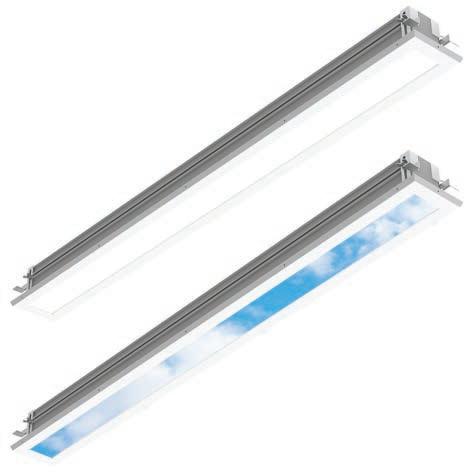

ROBUST, YET STYLISH
JUDGE’S COMMENT: “ Very nice design solution for health environments. I like the customizable nature of these wall mounted fixtures.”
Designed for behavioral health settings where creating a non-institutional environment is key for patient well-being, Strait Secure Ceiling and Wall Slots deliver high quality ambient lighting in customizable patterns, scenic images, or room numbers. The tunable white lighting option aids in maintaining circadian rhythms and promoting natural sleep-wake cycles in environments where natural light is lacking. Ceiling-mount and wall-mount luminaires feature concealed fastener hardware on the sides.
Kirlin Lighting, Strait Secure Ceiling and Wall Slots kirlinighting.com








“HVAC is used in every region of the world now so it’s very important that we have higher efficiency and better costs. This is the place to find it.”


Find your why.
FEBRUARY 10-12, 2025
Daylighting/Skylights/Glazing
HIGH PERFORMANCE, NEUTRAL GLAZING
JUDGE’S COMMENT: “ I really appreciate the transparency of this glass unit while having great thermal properties.”
Offering the highest light-to-solar gain ratio in Guardian’s North American SunGuard portfolio at 2.45, SNX 70+ coated glass lets in 68% of visible light while blocking 72% of solar heat gain. The crisp aesthetic delivers a neutral reflected color, whether viewed directly or at an angle. Guardian decided to develop the SNX 70+ as a direct response to an industry need for glass that is both high performing and highly neutral.
Guardian Glass, Guardian SunGuard SNX 70+ guardianglass.com

STEEL LOOK, ALUMINUM PERFORMANCE
JUDGE’S COMMENT: “ This is a beautiful, high-quality product with many applications. I appreciate the provision of an HPD certification.”
This folding glass wall solution offers the slimline aesthetic of steel and the superior weather and thermal performance of an aluminum frame. The NW Aluminum 643 Steel Effect is the new addition to the company’s Generation 4 folding glass wall system. Designed to match classic industrial, Art Deco, and other midcentury styles, this system can be specified in four Steel Effect (SE) colors. A fine matte texture is available.
NanaWall Systems, NW Aluminum 643 Steel Effect nanawall.com


AN ADVANCED SKYLIGHT OFFERING
JUDGE’S COMMENT: “ In an era where the industry struggles with numbers of quality installers and time constraints of construction, the QuickLink purlin connection advancement is a thoughtful, if not necessary, development in engineering.”
Engineered for long-term durability and excellent thermal performance, KlearSky metal framed glass skylights are available in several standard and custom configurations including single slope, ridges, pyramids and polygons. Advanced glazing and thermally improved framing allow this solution to meet stringent energy codes, while Kingspan’s QuickLink purlin connection system streamlines installation, reduces fasteners by 75%, and minimizes on-site labor.
Kingspan Light + Air, KlearSky metal framed glass skylights kingspan.com
VINYL DURABILITY, WOOD APPEARANCE
JUDGE’S COMMENT: “ Achieving a wood look that withstands weather better is a welcome option for windows.”
Crafted to mimic the look of a wood window with the low maintenance of quality vinyl construction, the StyleView Classic integrates precision-welded corners for a cleaner, quality look. A flat frame design supports easy integration into a wider variety of siding materials and a stronger pivot bar retention provides easy sash removal and replacement.
YKKAP America, StyleView Classic Window Series ykkap.com





See more courses at
Color Theory Helps Explain Our Relationship to Nature and Wellbeing
This CEU explores people’s interactions, effects and perceptions of color and its impact on wellbeing.

Credits: 1 LU/HSW / 0.1 CEU





Need to complete some CE credits to renew your architecture license? Join our Architecture + Design Master community and get free, on-demand courses all in one place.


Decarbonization 101

Exploring the opportunities to achieve operational decarbonization and reduce embodied carbon with design.
Credits: 1 LU/HSW





Exploring Design Trends for K-12 Applications

This course addresses student behaviors, improving the learning environment, and enhancing the sustainability of educational buildings.
Credits: 1 LU/HSW







Flooring + The Well Building Standard Version 2


Exploring the various ways that flooring can contribute toward a project earning WELL v2 certification.
Credits: 1 LU/HSW





THE ART OF HAND DRYING
JUDGE’S COMMENTS: “ This is an interesting illustration of how custom printing on an unusual surface can be used to bring branding, logos, or works of art into the restroom area.”
Project Winners

Project:

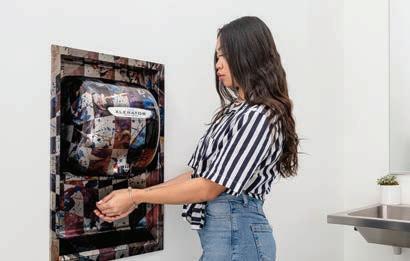
In a unique application of hand dryers, XLERATOR Hand Dryer partnered with AFH’s EpiCenter, a LEED Platinum-certified building in Boston, to print original artwork on the dryers using Excel Dryer’s Kolorfusion digital image technology. AFH teen artists created custom covers, essentially turning the restrooms into galleries and highlighting the potential for commercial spaces to serve as platforms for community art and creativity. The dryers enhance hygiene, deliver a 95% cost savings over paper towels, and help reduce waste and maintenance.
Excel Dryer, XLERATOR Hand Dryer with Electrostatic HEPA (eHEPA) Filtration exceldryer.com
PRODUCTS IN ACTION
JUDGE’S COMMENTS: “ As the largest industrial/ manufacturing project in Utah, and the first in Salt Lake City to achieve LEED v4 certification— this project is notable and noteworthy for many reasons.”
Serving as a showcase of Elevate’s insulation, metal panels, roofing membrane and skylights, the company installed several of its products in its new Salt Lake City manufacturing plant and distribution center. The ISOGARD Polyiso Roofing Insulation delivers a very high R-value per inch yielding great energy efficiencies and thermal performance, and the UNA-CLAD metal panels were used for both roofing and wall cladding, providing architectural flexibility, long-term durability and fire resistance. The UltraPly TPO Roofing Membrane offers outstanding durability and UV resistance and the SunWave Skylights boost natural lighting.
Holcim, Elevate LEED-Certified Manufacturing and Distribution Center in Salt Lake City


Project: Artists for Humanity EpiCenter, Boston Architect: Arrowstreet
Salt Lake City Architect: AEurbia
Recognizing Innovative Design
The EL EV 8 Awards will celebrate the best in commercial building design and operations across building types.
8 Judging Criteria
A panel of judges will focus on these 8 criteria: aesthetics, design innovation, f unctionality & accessibility, social impact, technology integration, sustainability, operational efficiency, and wellness.
Portfolios due: Jan. 31, 2025
Winner Profiles in Print
Winning entries will be published in the Second Quarter 2025 issue of BUILDINGS magazine, read by more than 70,000 building owners and facility managers
ELEV 8 AWARDS.COM
LEV 8 Awards will be presented in 8
Photo by Jorge Salvador on Unsplash

A Stand-Out School That Fits Right In
Echo Trail Middle School respects the surrounding forest and takes design cues from rural architecture.
By Jana Madsen, contributing writer
Echo Trail Middle School, Louisville, KY
As the city of Louisville, KY, expanded, the need for area schools grew. Echo Trail Middle School was built to bring education closer to these residents. “If you look at the map of the 100-plus schools that Jefferson County manages, the southeast part of the community is incredibly underserved. It’s the fastest growing part of the metro area,” says Colin Drake, Principal, JRA Architects, Louisville. Echo Trail is the first of two schools planned for a 40+ acre tract of land near the Floyds Fork River (an elementary school will be built there in the future).

While the design of the school was influenced by a tight budget, Jefferson County Public Schools wasn’t just concerned with the cost. Durability, efficiency, and ease of maintenance were all priorities. Respecting the site was another goal too, as the district planned for educators to engage with the surrounding ecosystem to teach students how to become better stewards of the environment.
Metal Roof + Wall Panels
The symmetrical standing seam metal roofing system installed at Echo Trail Middle School consists of McElroy Metals’ 238T panels, which feature mechanically seamed caps. Product advantages include easy repair or alterations after installation because, unlike asymmetrical standing seam systems, individual 238T panels can be removed and replaced. The benefits include watertight seam design, single piece panels up to 250-ft. long, and no lap conditions for improved weathertightness.
McElroy Metal, 238T panels mcelroymetal.com

Tubular Daylighting
Designed to deliver consistent light output throughout the day, the SolaMaster 750 DS effectively captures low-angle rays in the morning and late afternoon but rejects high-angle rays at midday. This prevents glare, overlighting, and overheating. It’s perfect for large spaces with dropped ceilings where a consistent level of light is required during typical work hours.
Solatube, SolaMaster 750 DS solatube.com


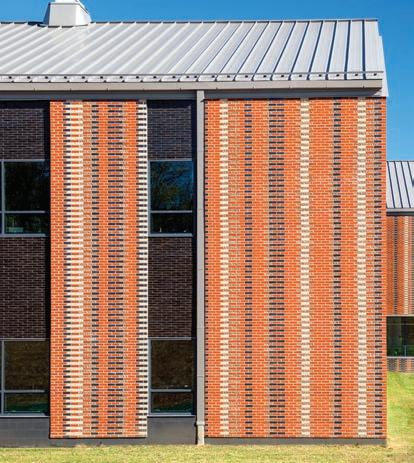
Brick
The thirty-three brick-long, two course pattern on the school uses the following four brick products:
1., 2. Brampton Brick, Platinum Velour, Red Velour bramptonbrick.com
3. Taylor Clay Products Inc., Autumn Blend in Riverbirch Texture (vertical scalloped texture) taylorclaybrick.com
General Shale, Black Metallic generalshale.com


The number system used by the mason contractor to lay the pattern below.
Masonry
LEE Building Products worked closely with JRA Architects to deliver the brick veneer and porcelain tile to create Echo Trail Middle School’s unique masonry façade, patterned to evoke the feeling of weathered barn boards. Originally a pattern was created using six different bricks during the mock panel process, but the perfect blend of contrasting colors and textures was arrived at with only four different brick products (see below).
LEE Building Products manufactures, sells, and distributes concrete and architectural masonry units, pavers, retaining walls, outdoor firepits, and natural and manufactured stone.
LEE Building Products leebp.com
A thirty-three brick-long pattern creates two courses that are repeated throughout all three pavilions. By stacking the brick veneer and porcelain tiles vertically and alternating every other course, bands were created that look like weathered barn boards. Up close the façade reveals its texture and sheen.
BRICK EXTERIOR
©Josh Beeman Photography
The new school building would have to be carefully scaled, oriented, and designed to accommodate the topography and conserve trees adjacent to the existing clearing.

Site-Influenced Design
Repurposing the architectural design of other schools in the Jefferson County Public School District wasn’t an option for the Echo Trail Middle School. The parcel of land purchased by the district is a rural property containing forest, fields, and streams. The new school building would have to be carefully scaled, oriented, and designed to accommodate the topography and conserve trees adjacent to the existing clearing. “Jefferson County Public Schools was very open minded when it came to letting the site inspire the solution,” explains Drake.
Across the street is the Parklands of Floyds Fork, a nationally recognized and beloved park system that opened in 2011. “The community obviously had some reservations about this beautiful agrarian-


A Familiar & Functional Form
JRA Architects carefully designed the middle school to exist in harmony with its surroundings, taking hints from existing architecture in the area. “We immediately started to think about what makes the Parklands project across the street so successful. We recognized traditional forms with unexpected materials, and vice versa, which offered familiarity and freshness to the compositions,” says Drake. The design for the 141,000-square-foot school used a perspicuous barn shape and replicated it in three interconnected pavilions. “We were trying to make it familiar enough that people could have an immediate visceral connection to this place. It just helped everybody buy into the project as an appropriate use for the site,” he adds.
The three interconnected pavilions sit in close proximity, subtly stepping back from each other on the plateaued clearing. An ideal east-west orientation creates a street-facing façade with prominence and transparency. The repetition not only evokes a visual rhythm, it’s also tremendously
type site being developed with pavement, buildings, and site infrastructure that could really whittle away the natural beauty of the place,” Drake recalls. The building’s siting, massing, and articulation needed to respect the land and the delicate ecosystems that rely on it.
JRA Architects’ design sought to capitalize on the beauty while minimizing site disturbance as much as possible. “What we found when we first started designing the building was, as soon as you started to lay that more one-story-oriented building on the site, you were either going to spend a fortune on site development or really destroy the character of the place. We pretty quickly landed on a very compact, two-story scheme,” he explains.
The shape of the school’s three pavilions took its cue from historic pole barns, a recognizable form in the rural agrarian landscape.
practical. “The notion was to try to create a form that can be repeated so that we weren’t doing a bunch of unique detailing from pavilion to pavilion. The west façades of all three are basically identical,” Drake explains. The width of each pavilion was determined by the gym. The length was stretched based on programming requirements. Two-story connectors between the pavilions not only house the elevators, but also the main distribution frame (MDF) rooms and serve as fire vestibules.
The compact pavilion design was as well-suited for the parcel of land as it was for students and staff. “We had a couple assistant superintendents that were deeply involved in identifying best practices for education planning, and one of the things they talked about at great length was the notion of treating each grade as its own neighborhood,” adds Drake. There are two neighborhoods in the south pavilion (first and second floor) and the third neighborhood is on the second floor of the middle pavilion. “Each of the grades has a place that they can call home,” he notes.
The grade-specific neighborhoods consist of traditional classrooms around a core of academic support (e.g., counselor and associate principal offices), creativity hub, technology learning space, and collaborative workspaces. The voids between the pavilions serve as outdoor learning courtyards.
“The challenge fundamentally is always square footage. By choosing to do the more compact layout, it necessitated the racetrack-type layout where there are landlocked rooms in the middle of the building,” says Drake. This challenge inspired JRA Architects to use tubular devices to bring daylight into the center of the building for closed off interior second-story spaces. “We were really keen to make sure that a few key moments in the building connected you to the outdoors, connected you to daylight,” notes Drake. An example of this is the panoramic view out the windows of the media center, which you can see over the top of an organically shaped commons space from the moment you enter the school.

Air Barrier
Not only can FastFlash Liquid Flashing Membrane be applied to damp surfaces, it also tolerates rain immediately after application. Available in gun-grade or roller-grade options, FastFlash is a silyl-terminated polymer (STP), fluid-applied membrane that protects rough openings, seals around penetrations, fills joints and seams, and counter-flashes air barrier components in new or existing wall assemblies. Compatible with most building materials, FastFlash can be used independently or as part of the R-Guard system to prevent the unwanted movement of water and air through building envelopes.

Prosoco Inc., FastFlash Liquid Flashing Membrane prosoco.com
Flashing
Hohmann & Barnard Textroflash Flashing is a thru-wall flashing/surface-mounted flashing. This 40-mil thick composite membrane has a proprietary high-tack adhesive that is factory-laminated to rugged, polyethylene sheeting, yielding a flexible membrane that is suitable for application to masonry, concrete, steel, gypsum and wood. Textroflash provides dual-layered waterproofing protection that doesn’t drool when exposed to UV or heat.
Hohmann & Barnard Inc. h-b.com

Waterproofing Membrane

Blueskin WP 200 is designed for self-adhering to a prepared substrate and provides a high-performance waterproofing barrier. This selfadhered composite membrane consists of an SBS rubberized asphalt compound, integrally laminated to a blue, high-density polyethylene film. It is flexible at low temperatures, prevents lateral movement, and no flame is required.
Henry Company henry.com
Traditional, Yet Unexpected Systems and Materials
Jefferson County Public Schools has had success with insulated concrete form (ICF) exterior walls and geothermal heating and cooling on other school projects, so these strategies were deployed at Echo Trail. Conventional materials like brick veneer, metal roofing, polished concrete floors, and acoustic ceiling panels meet the space’s institutional requirements, providing durability and long-lasting performance, as well as ease of maintenance. These criteria, along with affordability, didn’t limit the creative application of traditional materials though. The school’s main and gym entrances mix curtain wall and slices of the same standing seam metal used on the roof. A regular, yet randomly arranged pattern of windows along with a unique application of masonry creates the dynamic façade.

Curtainwall
Designed for low- and mid-rise applications, the durable framework of the Tubelite 400 Series Curtainwall offers daylighting, views, and high performance validated with rigorous testing by an independent agency. This curtainwall features the strength of variabledepth back-members and the visual appeal of a 2.5-in. sightline. An exterior screw-applied pressure bar secures the glass. Snap-on covers, available in a choice of colors, allow for different finishes on interior and exterior exposed surfaces. Silicone-glazed verticals complete a seamless, modern appearance.
Tubelite, 400 Series Curtainwall tubeliteusa.com

Storefront Framing
Tubelite 14000 Series Storefront Framing offers a choice of thermal performance options to meet climate-specific and energy code-compliant requirements. These systems accommodate glass or panels up to 1.125-in. thick and a variety of durable finishes. Glazing contractors can install from the outside or inside, helping reduce project labor costs. Extra-heavy intermediate verticals are available for high performance against strong windloads. Tubelite 14000 Series Storefront products have passed rigorous testing for air resistance, structural integrity, acoustical performance and condensation resistance.
Tubelite, 14000 Series Storefront Framing tubeliteusa.com

Echo Trail Middle School won a 2024 AIA Kentucky Honor Award. “Clever allegorical whimsy brings this composition to life through a reinterpretation of ‘rural vernacular,’” noted a juror.
“Jefferson County Public Schools loves brick. It’s incredibly durable. It’s very affordable. For school projects, it really is a hard-to-beat material in terms of its durability and aesthetics,” notes Drake. The clever pattern of four conventional bricks and glazed porcelain tile reflects the building’s inspiration. “It looks like one of those weathered barns that has started to fall apart, like a relic in the landscape. But when you get closer to it, you realize that it’s a more complicated, much more nuanced piece of design work, but by using traditional, one-half running bond brick,” explains Drake.
PROJECT SPECS
Project: Echo Trails Middle School, Louisville, KY
Architect: JRA Architects
Structural Engineer: Structural Services
Landscape Architect & Civil Engineer: Mindel Scott

Colin Drake, faia, leed ap, Principal, JRA Architects. Drake serves as the lead architect on numerous planning and design projects for JRA. He has a passion for urban design and public projects.
ARCHITECTS
COURTYARD
As the pavilions step back from each other, courtyards are created between them and the building connectors. These intimate spaces become ideal outdoor learning environments.
©Josh
Beeman Photography
© JRA
Architects

Room Darkening Window Treatment
Simple design combined with careful craftsmanship makes the Draper Spring Roller Shade an economical option for light control and room darkening in classrooms and educational settings. The Series SB9000 fabric is GREENGUARD Gold certified, Antimony-free, and reduces solar heat gain in both winter and summer.
Draper Inc., Series SB9000 draperinc.com


Welcoming 1,000 Students
The school was completed in August 2023 and immediately welcomed sixth grade students. For the current school year, both sixth and seventh graders are attending. In the 2025-2026 school year, the school will be fully occupied with the addition of eighth grade students. This phased use of the new school has allowed the staff, students, parents, and administrators to adjust to and perfect drop off and pick up, bus queuing, and scheduling spaces for extracurricular activities. “We’ve heard nothing but good feedback. The educators are loving it. The parents and kids seem to love it,” says Drake. JRA Architects’ design and the parcel of land it’s nestled within are rife with immersive educational opportunities.


MEDIA CENTER
Echo Trail Middle School’s media center and social commons strategically step down into a low point in the landscape. They, along with the connector hallways, gym, cafeteria, and breakout learning labs, offer breathtaking panoramic views.

Embracing Neurodiversity

INCLUSIVE DESIGN
The new Young Classroom at Smith College in Northampton, Mass., was thoughtfully designed for the needs and preferences of both neurodiverse and neurotypical students.
Students have the option to select a quieter alternate learning space while still being a part of the larger class and/or conversation.
Designed by Amenta Emma Architects, Smith College’s Young Classroom is one of the first to blend classroom design for neurodiverse learners with mainstream students.
Amenta Emma Architects has always prioritized inclusive design for its academic and workplace projects, so when Smith College asked the firm to design classroom spaces for The Young Library that would cater to neurodiverse students, the architects were excited to take a deep dive into the needs of this population. “This project really ignited our research, understanding and ultimately design approach,” said the firm’s President-Elect Michael Tyre, aia
“The neurodiversity movement promotes these differences not as deficits, but rather as normal and potentially valuable variations on the way brains work.”
-Michael Tyre, aia
The architects learned that neurodiverse individuals with some form of autism, adhd, dyslexia or other cognitive diagnosis comprise between 15% and 20% of people. “The neurodiversity movement promotes these differences not as deficits, but rather as normal and potentially valuable variations on the way brains work,” he explains.
While there were very few neuro-inclusive architectural case studies to reference, the team tapped into the research and discussion on neurodiversity in higher education, which provided insights on things to stay away from and strategies for creating
environments where neurodiverse students can thrive.
For example, sensory distraction, which can be created by visual contrast, reflectivity, noise, and large crowds should be avoided. On the other hand, employing the agency of choice, strong wayfinding, and good acoustics are important for this population.
Translating these insights into the physical environment of this project, Amenta Emma Architects made sure to incorporate features like assorted seating arrangements, occupant control for lighting, and a subtle palette of materials to identify zones and support wayfinding.
By interviewing neurodiverse students, the architects learned that introducing too much flexibility and ways to change classroom configurations could actually be jarring and unsettling.
This led to the development of what Tyre’s team calls “fixed variation,” to balance flexibility with predictability. For this project, the fixed variation solution provided traditional tables and chairs for the main academic space. Break out and peripheral areas offered students a greater degree of choice and flexibility.
The entire classroom design is supported with AV technology and screens, so if a neurodiverse student selects a peripheral area on any given day, he/she can still participate with the larger group, but in a

less distracting, more comfortable space.
Tyre notes that many of the strategies benefitting neurodiverse populations rarely present any conflicts for neurotypical students.
Does neurodiverse design cost more? Tyre doesn’t think so.
“Mitigating distractions through simple design choices involving color palettes, patterns and reflectivity add no cost at all. Controlling background noise and glare through additional acoustics and lighting controls adds marginal costs,” he states.
“Offering personal choice can simply be done through furniture selection, by providing an array of seating and desk types and locations.”
Because there is no established formula for designing these types of educational spaces, The Young Classroom is now serving as somewhat of a prototype as educational institutions seek to understand how neurodiverse students can thrive amongst mainstream populations.
“I have shared this case study with numerous colleges and universities, spoke about the project at several higher education planning conferences and received requests from others to meet to discuss how they may apply some of the principles we’ve outlined in their upcoming projects,” said Tyre.
—Barbara
Horwitz-Bennett, contributing writer

Michael Tyre, aia, is President-Elect of Amenta Emma Architects in Hartford, Conn.
Photo courtesy of Robert Benson